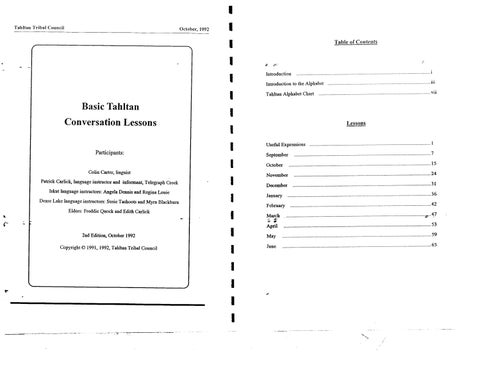
Tahltan Tribal Council
October, 1992
Table of Contents
Introduction Introduction to the Alphabet
Iii
Tahltan Alphabet Chart
vii
Basic Tahltan Conversation Lessons
Lessons
Useful Expressions
1
September
7
October
15
November
24
December
31
January
36
February
42
March
.47
April
53
2nd Edition, October 1992
May
59
Copyright 1991, 1992, Tahltan Tribal Council
June
65
Participants:
Colin Carter, linguist Patrick Carlick, language instructor and informant, Telegraph Creek Iskut language instructors: Angela Dennis and Regina Louie Dease Lake language instructors: Susie Tashoots and Myra Blackburn Elders: Freddie Quock and Edith Carlick
Introduction 111111
11111
This book is the second edition of Basic Tahltan Conversation Lessons. It is functionally the same as the first edition with typographical and spelling errors corrected, and some minor changes in illustrations. An alphabet chart has also been added. The book contains -the basic content of a year language course that has been taught in Tahltan schools since about 1980. It is based on Teaching Yukon Native Languages, a training manual published by the Yukon Native Language Center (Whitehorse, YT). Some modifications to content and gradation of material have been made. Our thanks goes to YNLC for their contribution.
Course Content The book begins with a brief introduction to the alphabet. This is followed by an overview of some useful expressions which a teacher might use in a classroom situation. The main course follows and is divided into ten sections which correspond to the months of the school year - September through June. An attempt has been made to make the subjects covered in any given month relevant to that time of the year, especially with regard to weather conditions and seasonal activities. Each month's material is further organized into topical sections to make it easier to find information on a given subject.
110
The useful expressions and monthly lessons have been taped by Pat Carlick, Telegraph Creek language instructor, and by the Iskut instructors Angela Dennis and Regina Louie. Two tapes have been made since there are occasionally slight differences in speech between the Telegraph Creek / Dease Lake speakers and Iskut speakers. These tapes are available for a nominal fee from the Tahltan Tribal Council in Dease Lake.
Variant Forms a
1111 Where there are differences in speech between the three communities, all variant forms are listed in the entry, followed by the initials of the community or communities where that form is most common (TC for Telegraph Creek, DL for Dease Lake or I for Iskut). For example:
It's sunny.
Sade hulin. (TC, DL) Sada' huhlin. (I)
These are two slightly different ways of saying "It's sunny." The first is preferred by the Telegraph Creek and Dease Lake instructors, and the second by the Iskut instructors. It is likely that both would be understood in either community, so neither is "right" or a-"wrong". This notation simply indicates a preference of the language teachers of a given community to the form indicated.
I ntroduction
Acknowledgements
INTRODUCTION TO THE TAHLTAN ALPHABET
I am indebted to all who have helped complete this project. Pat Carlick, my language assistant has endured much questioning and taping. His contribution has been invaluable. The other language teachers have also been a great help in confirming the material Angela Dennis, Regina Louie, Susie Tashoots and Myra Blackburn and those they in turn consulted. Several elders have also been very helpful in confirming the content, most notably Freddie Quock and Edith Carlick. Illustrations The Summer Institute of Linguistics has provided most of the illustrations used in this book. Leaf Thunderstorm, ..a resident of the Telegraph Creek area, also provided many of the drawings on the alphabet chart and the drawings on pages 7 and 36. The Yukon Territorial Government, Renewable Resources, provided several drawings by Yvonne L. Hannah (pp. 51, 55 - owl, 58 and the drawing for beak in the alphabet chart). Several other illustrations were taken from YNLC general teaching materials (pp. 8, 27, 32, 37, 47, 48, 50, 66). All are used with permission and our thanks goes to all contributors.
The development of the Tahltan alphabet has been based on the principles of a phonetic alphabet. A phonetic alphabet is one in which every sound in the language is always written with the same symbol. English is not written phonetically because there are individual sounds which can be written in several different ways. For example the 'oo' sounds in two, to and too are all written differently. For this reason, the Tahltan alphabet is not based on English spelling, though there are many similarities. Tahltan also contains more than 26 sounds, that is, more than the letters of the English alphabet. Therefore, the letters of English alone are not sufficient to represent all the sounds necessary. Rather than introduce strange new symbols, we have chosen to use only English letters, but to represent some sounds of Tahltan with-more.than one-letter, For example there is a sound in Tahltan like the sh in shin. This sound we write as sh, but consider it as one Tahltan "letter". Using combinations of two English letters as well as some other markings (like underlining or adding an apostrophe), we are able to represent all the sounds contained in the Tahltan language. The following is a list of all the Tahltan letters in their alphabetic order. The sound is also described, and where there is an English sound which closely resembles the Tahltan sound, this is indicated. An example word containing the sound is also given.
Publication
The book was created using Aldus PageMaker on au IBM microcomputer. The text was written in Microsoft Word for Windows. Illustrations were electronically scanned using a Logitech hand scanner, and the results were touched up using Ansel Image Editing software. Special fonts were created using Allays Fontographer and Windows 3.1 TrueType fonts. Master copies are printed on a Hewlett Packard LaserJet IIP and photocopied and bound by Tribal Council Staff.
Letter English equivalent / description
a a
b Funding
dr
The funding for this project came from the Ministry of Education and has been administered by the Tahltan Tribal Council. Hopefully this will be only the first of many useful teaching aids for the Tahltan language.
Colin Carter, linguist Tahitan Tribal Council October 30, 1992
ch' d
dl dz dz e e
gh g
Introduction
No written English equivalent - made with a stoppage in the throat. u in cup Same as a but longer in duration. Something like au in caught. b in big ch in church Same as ch but made with a stoppage in the throat. d in did No English equivalent. ds in pads No English equivalent. e in ten Same as e but longer in duration. g in good Similar to g, but a softer sound. g said farther back in the mouth
Example
Meaning
ete'e
father
gah diinä
rabbit money
bes 6E1 ch'oh
knife big, large quill
person dene dlune mouse dime bird dzel mountain menh lake bes knife gah rabbit ghu' tooth togatit (also said pants with a regular g)
Introduction to the Alphabet
Letter Dcelish equivalent /description It i
I .-- j k k
li in head e in enough, or ee in keep Same as i, but longer in duration j or dg in judge k in keep k said far back in the mouth.
k' k'
k with a stoppage in the throat. k' said far back in the mouth.
kh 1
Similar to k, but a softer sound. 1 in large No English equivalent. m in mother n in nothing No English equivalent. oa in oats same as o but longer in duration. p in pup (a very rare sound) s in see th in thin or s in sin - see notes on speech variation below. sh in shoot t in two I with a stoppage in throat. No English equivalent tl with stoppage in throat ts in cats ts with stoppage in throat No English equivalent ts with stoppage in throat oo in boot same as u but longer w in was y in yes No English equivalent z in zoo th in then (this is different from th in thin)
I
m n nh o 6 P s s sh t « t' 11 r tl' ts ts' ts ts' u A w Y ii- yh z z
iv
Introduction to the Alphabet
Examp le
caribou hodzili face ni' moss nr berry jije moose kedd kaztne (also said otter with a regular k) fish eggs k'il or kV bucket k'otl (also said with a regular k') trap kha hand la' fish tuwe thank you meduh Here, take it! na' lake menh grizzly bear khoh big, large chO my friend espane black bear sas Sit down! sindah ishIcAdi ill l'ii
tleyh tl'oyh tsa' ts'ots tse ts'e
ghu' to wandänä yige tleyh zedle zas
Some Comments on Vowels
Meaning
crazy water tender grease, lard grass beaver blowfly rock thread tooth water glasses under grease, lard only
M
en
There are five basic vowels in the Tahltan alphabet, represented by the five English vowels a, e, o and u. Again it should be mentioned that these vowel are not pronounced the same way as their English counterparts. Tahltan vowels also have two distinct lengths, short and long. This-means that a vowel sound can be held for a short or a longer period of time and that this could change the meaning of a word. The word for face is ni' (where the i sound is short), while the word for a certain type of moss is nr (where the i sound is held for a longer period of time). The word for raft is kenes (where both e's are short) while the word for cross is kenes (where the second e is long). Short vowels are written as a plain vowel - a, e, o, and u, while long vowels are written with a bar (macron) above them - A, e, I, o and A. Therefore when writing a Tahltan word, vowel length must always be determined and written accordingly:
Speech Variation 1/11 Amongst some speakers of Tahltan, there are different ways of pronouncing some of the Tahltan letters. The difference occurs in the letters s, ts, Is', z and dz. Words containing an underlined s (s) may be pronounced two different ways. Some people pronounce them with the th sound as in the English word thin. Others pronounce it much more closely to an s sound. Similarly, words containing an underlined z (z) are pronounced by some with the th sound in then or other, and by others with a sound much closer to an English z. In this way, a word like zas (snow), may have two perceptibly different pronunciations. This happens because the Tahltan s series of sounds are actually made somewhere between the s and th sounds of English. A person accustomed to hearing English, sometimes perceives a sound closer to an s and other times a sound closer to a th. To a person who grew up speaking Tahltan, the meaning of the words with this unusual sound is perfectly clear. To someone whose first language is English, however, the distinction is not easily perceptible. For this reason, words containing either s or z may be pronounced somewhat differently depending on the individual speaker's background. Neither way of pronouncing it is the "right way."
Glottalization Some Tahltan sounds are very similar except for what is called glottalization. Glottalization is something like saying a sound while adding a catch in the throat to it. It can only b learned through practice with someone who knows how to pronounce it. Sometimes glottalized consonants are hard to distinguish from a non glottalized ones. A glottalized consonant is written by adding an apostrophe (') to its non-glottalized counterpart. The non glottalized consonants are t, tl, ts, ts, ch, k and k. Their glottalized counterparts are t', tl', ts', ts', ch', k' and k'. 11 is very important that the student learns the difference between glottalized
snow
Introduction to the Alphabet
Tahltan Practical Alphabet Chart and non-glottalized consonants. Some words differ only in the fact that one contains a glottalized consonant and a second does not.
e
Some examples of these are as follows:
ke'
Glottalized t'u tender thread k'eda file
Non glottalized to water tse rock kedii moose Other Consonant Modification
LP? i
ke
IP
e
shoe
I ni'
foot
I
face
MOSS
u
In some Tahltan words,.a normal consonant may be modified by a sound like a w following it. Some Athapaskan languages have added several letters to their alphabet to deal with this. However, in Tahltan, this will just be treated as a series of two consonants.
chosh
Some examples of these are: Tahltan gwet k'waga Anishinägwät1
b
English bag a really old salmon nighthalk
About Learning The sounds of Tahltan can only be properly learned through talking with elders who have spoken Tahltan as their first language. Though there are many sounds that are similar to English, there are many that are not. A person will not learn Tahltan just by listening to a tape # of one speaker reciting various words and sentences, though this is a valuable exercise. A language must also be used to be learned. Similarly, learning to read and write Tahltan will only come with training and practice. Familiarity with the writing system will be very valuable in learning to speak the language. A word that can be visualized and heard is more easily remembered than one that is just heard. Don't be afraid to try to use what you know, even if you make mistakes. We all make mistakes in learning a new language.
feather
ghu'
tooth
Ch
ch \
cat
bes
knife
Ch'
chd
\•
"\\•• rain
DI
dl
C
ch'iyOne
wolf
dlane Dz dzel
Gh
'• gh
ghanje
goose
mountain h
mouse
G
g
gat
tree
J
It is our hope that this basic course will encourage many to begin learning the Tahltan language.
kedd vi
moose
hodzih
lee&
caribou jije
file
Kh
berry kh
khoh
grizzly
Introduction to the Alphabet Tahltan Alphabet Chart
vii
Tahltan Practical Alphabet Chart A
a
e
fish nh
Tuwe gah
rabbit e
foot I
N
chosh
shoe
feather
ni' 0 t'ok
face ni' 9,
Dz
bird dzex
friend sh
ice Sh
S
wart ghu' b Ch
tooth ch
knife
chd Dl
\\\\ rain dl
dz
mouse
mountain
saw
black bear t
son' T'
star keshd T1
tas 7arrow T1' tl'
t'ede
girl
tl'oyh
ts
tsa' Ts'
rock
ts'ih
mosquito wandänd glasses z yh
tleyh
lard eydze young one
sas T
Ts
grass Er, f,,,
ts
beaver ts'
fir Ts'
ts'
ts'ah
hat
G ts e
dzime
tenh
0
dlane Dz_
medicine
MOSS
\
cat bes
p
"A L
non' ke
n
I
gat
tree
h
hodzih
caribou jije
berry
Kh
z
kh
r
;,kt
t s!,
kedd
moose
k'eda
file
khoh
,
zas
grizzly
Tahltan Alphabet Chart
vii
snow
rtrwn
Ge'51cieck
CROW
0 Copyright, Tahltan Tribal Council, 1992. Illustranons by Leaf Thunderstorm, Summer Institute of Linguistics, Yukon Native language Center. Yinka Dein: Language Institute and Yvonne L Hannah (Yukon Renewabk Resources), used with permission.
viii
Tahltan Alphabet Chart
Useful Tahltan Expressions 1uwe
fish
n
P
cA
p
1. Sit down! (telling one person)
•,.%.;
non'
medicine
tenh
ice
p ane Sh
S
friend
Sindah!
Sit down! (telling two people)
Sahkel (TC, DL) Sahkeh! (I)
All of you, sit down!
Tsedze, dalits'ih!
sh 11111
sas
black bear
son' T'
tas
arrow
T1'
tl'
t'ede
star
keshd
saw
t'
TI
tl
- girl
tli
dog
ts
Ts'
ts'
PIN
2. Stand up! (telling one person)
Nanzet!
Stand up! (telling two people)
Nahzet!
All of you, stand up!
Tsedze, naddhyah!
3. Come here!
Ani!
4. Be quiet!
Tsini!
5,Ngs.
E.
11111
tsa'
beaver
Ts'
ts'
ts'ih
snow
da'
Tahltan Alphabet Chart
hat w
mosquito wandand glasses yh
z
lard
eyaze young one
beak
°Copyright, Tahltan Tribal Council, 1992. Illustrabons by Leaf Thunderstorm, Summer Institute of Lingu Language Institute and Yvonne L Hannah (Yukon Renewable Resources), used with permission.
viii
ts'ah
Ge l5kieck
z
CROW
N
No.
Duwe.
N 6. Look! (telling one person)
Ninh'In!
Look! (telling two people)
Nah'in!
All of you, look!
Tsedze, danah'in!
N
tics, Yukon Native Language Center, Y inks Deno
N
Tahltan Basic Conversation
Page 1
Useful Tahltan Expressions
Useful Tahltan Expressions
.
Listen! (telling one person).
Udenints'an! (TC, DL) Udenints'an'! (I)
Listen! (telling two people).
Udenahts'an! (TC, DL) Udenahts'an'! (I)
All of you, listen!
Tsedze, do'odenahts'an! (TC, DL) Tsedze, da'udenahts'an'! (I)
8. You, listen to me!
All of you, listen to me!
Nini, susints'an! (TC, DL) Nini, susints'an'! (I) Tsedze, susahts'an! (TC, DL) Tsedze, susahts'an'! (I)
9. Do you hear / understand me?
Susints'ana? (TC, DL) Susints' ana? (I)
6 -11,1 hear / understand you.
NusZhts'an. (TC, DL) Nusihts'an'. (I)
i I don't hear / understand you.
Edit nusats'an. (TC) Edit nusihts'an'. (I)
10. You, say it! (telling one person)
Nini, duka'adindih!
All of you, say it! 4/-*Say it again. (telling one person) } Say it again. (telling more than one) Page 2
Tahltan Basic Conversation
11. You, tell me! (telling one person) All of you, tell me!
K'aji duka'adandih.
Tsedze, esdahandech!
12. You ask me.
Nini sudinhkit.
13. Did you forget?
Endah lcuhats'eda?
Don't you remember?
Edit mendlj a?
14. What do you call it in Tahltan?
Dada 'dye didene k'eh? Didene k'eh dada oye?
15. Good. Really good!
Eti'e. Lani eti'e! Lan eti'e!
16..True! Not true!
La! Edil
Tsedze, duka'adandih! K'aji duka'adindih.
Esdandech!
Tahltan Basic Conversation
Page 3
Useful Tahltan Expressions
Useful Tahltan Expressions
_
47% That's the way!
That's not right.
18. I don't know.
Dekuh! (TC) Dukuh! (I, DL)
- _ 24. Don't! or Quit it!
Lagu!
Don't do that!
Edit deka'ant'in! (TC) Edit duka'ant'in! (DL, I) Edit ka'ant'In!
Enough!
Kuji k'at! Kuji!
Edit dekuh. (TC) Edit dukuh. (I, DL)
Edit me'esdih. Me'esdih.
I know.
19. Here, take it.
Na'.
20. Thank you.
Meduh.
21. Let me help you.
Ents'inOsdi'. (TC, DL) Ents' i ' nOsde . (I) Enzihgeh
1 t22. Move! or Get away!
Ejinda! (TC, DL) Ejinda! (I) Dege ejinda! (TC, DL) Dege ejinda! (I)
23. Nothing, no more.
Duwe. Edit yeda.
25. Hurry. Hurry up (telling one person).
Khadi. Khadi nanhdih. (TC, DL) Khadi nanhdih. (I)
26. Hot!
Sezet
Cold!
Sek'ats.
27. You poor thing!
Sadenht'eh! Sadeneeh! (I)
411-4° -
Page 4
Tahitan Basic Conversation
Tahitan Basic Conversation
Page 5
September Lessons
Useful Tahltan Expressions
"rn•
_
,;.2-6. See you tomorrow.
28. Good day!
29. Take care!
Greetings
Chachd nanasei. (TC, DL) Chacha sä nanenust'i. (I)
1. How are you?
Dada änh'e?
2. I'm fine.
Soga ast'eh.
3. How about you?
Nini k'aji.
4 Me too, I'm fine.
Sini k'aji soga ast'eh.
Dzenes hoti'e!
Soga edent'in!
Nini k'aji.
30. You too.
General Questions 1. What is this?
Yeda didi at'e? Di yeda at'e?
2. This is a person.
Dene ja'at'e.
3. This is an animal.
Khih ja'at'e.
4. This is a fish.
Luwe ja'at'e.
5. This is a bird.
Dzime ja'at'e.
111111
al
sr
IM Page 6
Tahltan Basic Conversation
Tahltan Basic Conversation
Page 7
September Lessons
September Lessons
r 11.
6-This is a berry.
Jije ja'at'a.
Weather 1. How is it outside?
Dada ahuht'e ah'ene? Ah'ene ditcla ahuht'e?
More about people. 1. Who is this person?
Mada didi at'a? Meda at'a?
2. This is a man.
DenezTa ja'at'a. (TC, DL) Denezd' ja'at'a. (I)
3. This is a woman.
Eghaden ja'at'a. Eghadani ja'ara.
4. This is a boy.
Eskiye ja'at'a.
5. This is a girl.
T'ade ja'at'e.
6. This is a child.
EdOne ja'at'a.
7. This is a little child / baby.
EdOne da'asedle ja'at'e. (I) EdOne tsedle ja'ara. (TC, DL)
41k I
-
2.- It's a nice day.
Dzenas hoti'e.
3. It's hot.
Hoszet
4. It's cold.
Hosdli. Hosdlih.
Page 8
Tahitan Basic Conversation
Tahitan Basic Conversation
Page 9
September Lessons
September Lessons
_
=More about animals 1. What animal is this?
Yeh lchih ja'at'e?
2. This is a moose.
Kea ja'at'e.
3. This is a rabbit.
3. This is a cranberry.
Gokhe ja'at'e. (TC, DL) Gokhe' ja'at'e. (I)
4. This is a soapberry.
Ishghoche ja'at'a. Ishghohche ja'at'e.
Gah ja'at'e.
More about weather
• 11,
4iThis is a dog. •—
Tli' ja'at'e. 1.It's sunny.
Sade hulin. (TC, DL) Sack. ' hulin. (I)
More about berries 1. What berry is this?
Yeh jije ja'at'e?
2. It's cloudy.
K'os hulin.
2. This is a blueberry. st--.1.(sometimes used for huckleberry)
Echish chO ja'at'e. (TC, DL) Echish chO ja'at'e. (I)
3. It's raining.
Cha nadetl'id.
Pa
ge
10
Tahltan Basic =I Conversation
•
•
•
Tahltan Basic Conversation Page 11
September Lessons
September Lessons
In
r 11'
Clothing 1. This is a jacket.
Kind'et ja'at'e.
2. This is a shirt.
Ech ja'at'e.
3. These are pants.
TogatAT ja'at'e. (All)
-
_
5. (S)he is going hunting.
Ejidadar.
6. What is the boy doing?
Eskiye (Vida at'ini? Dada eskiye at'ini?
7. The boy is fishing.
Eskiye uht'e.
8. What is the woman doing?
Eghaden dada at'ini? Duda eghadeni at'ini?
9. The woman is picking berries.
Eghaden jije unebe. (TC, DL) Eghadeni jije unebe. (I)
10. What is the girl doing?
T'ede dada at'ini? Dada t'ede at'ini?
so
Tugatät ja'at'e. (I)
4. These are shoes.
Ka ja'at'e.
5. This is a hat.
Ts'ah ja'ate.
N
Activities 411` What is (s)he doing?
Dada at'ini?
I 12. (S)he is fishing.
Uhee.
3. (S)he is picking berries.
Jije unebe.
4. (S)he is playing. 44-
NohOye. (TC, DL) Nahoyeh. (I)
Page 12
Tahltan Basic Conversation
•
N N N N N N N N
Tahltan Basic Conversation
Page 13
October Lessons
September Lessons
A
al• _ -1.1.
The girl is playing.
T'Ccle nohaye. (TC, DL) T'ade nahoyeh. (I)
M
More Greetings - Names 1. What's your name?
12. What is that man doing?
E deneza dada at'ini? (TC, DL) Dada ey deneza' at'ini? (I)
101 1111
2. My name is
3. What's his / her name? 4. His / her name is
13. That man is going hunting.
E deneza ejidadat (TC, DL) Ey deneza' ejidadat (I)
Dada Onye? ushye. (TC, DL) ushyeh. (I)
Dada aye?
aye. (TC, DL) uyeh. (I)
More Animals 1.What do you see?
YZda ninh'ini?
_z
2. I see a beaver.
Tsa' nes'in.
IIII
3. I see a porcupine.
Dech'uwe nes'in.
III
4. I see a wolf.
Ch'iyone nes'In.%. ,e,.... . .0,.
II.
Page 14
Tahltan Basic Conversation
lk :,;-'),"4.k"
5.1 see a black bear.
Sas nes'In.
1„
11";‘
%
Tahltan Basic Conversation
Page 15
11/11
October Lessons
October Lessons 11111 - _ -.6. I see a grizzly.
Khoh nes'in.
6. No, it's not cloudy.
Ma, edu k'os hulin. (TC, DL) Duwe, edu k'os huhlin. (I)
7. Is it raining?
Cha nadetl'ida?
8. Yes, it's raining.
cha nadetl'id.
11111 7. I see a squirrel.
8. I see a gopher.
Dests'edze nes'in. (All) (I) Dists'eze
11/11
Tseli nes'in.
Asking About Weather 1. Is it sunny?
2. Yes, it's sunny.
at* - -3. No, it's not sunny.
Sada hulina? (TC, DL) Sada' huhlind? (I)
E, sad hulin. (TC, DL) E, sada' huhlin. (I)
1
1111
Ma, edu sada hulin. (TC, DL) Duwe, edu sada' huhlin. (I)
4. Is it cloudy?
K'os hullna? (TC, DL) K'os huhlinä? (I)
5. Yes, it's cloudy.
E, k'os hulin. (TC, DL) k'os huhlin. (I)
Page 16
114
Tahitan Basic Conversation
9. No it's not raining.
MA, edu cha nadetl'id. Duwe, edu cha nadetl'id.
Possession
111.
1. My
es-
2. Your (singular)
en-
3. His / her
me-
Tahltan Basic Conversation
Page 17
October Lessons
October Lessons
•
_
•
4. Whose Jacket is this?
Me kind'et ja'at'e?
12. Your pants.
Entogarat
5. It's my jacket.
Eskind'et ja'at'e.
13. His pants.
Metogatät
14. My, your, his / her hat.
Ests'ahe, ents'ahe, mets'ahe.
15. My, your, his / her shoes.
Eske, mice, meke.
1111 1111
Passing objects. 6. It's your jacket.
Enkind'et ja'at'e.
7. It's his / her jacket.
Mekina'et ja'at'e.
1. Give it to me!
De'! Esghan'a / esghanhchush! (TC, DL) Esghan'ä / esghänhchilsh! (I)
2. Here, take it!
Na'!
3. Give me my coat.
Eskina'et de'. Eskind'et esghanhchush. (TC, DL) Eslcind'et esghänhchash. (I)
4. Give me your shirt.
En'eje de'. En'eje esghanhchush. (TC, DL) En'eje esghanhchush. (I)
1111 411
1111
1• 8. It's my shirt.
▪
En'eje ja'at'e.
9. It's your shirt.
En'eje ja'at'e.
10. It's his shirt.
Me'eje ja'at'e.
11. My pants.
Estogata1
111
>-
Page 18
Tahltan Basic Conversation
Tahkan Basic Conversation
Page 19
October Lessons
October Lessons
_
5. Give me his / her shoes.
Meke de'. Meke esghan'a. (TC, DL) Meke esghan'a. (I)
1
111
6. Give me my pants.
1-Give me his hat.
Estogatat de'. Estogatal esghanhchush. (TC, DL) Estogatät esghänchftsh. (I)
Mets'ahe de'. Mets'ahe esghan'a. (TC, DL) (I) Mets'ahe
Sas cha ja'at'e.
Ch'iyone ch5 nes'in.
4. I see a little wolf.
Ch'iyone tsedle nes'in. Ch'iyene da'ätsedle nes'in.
5. This is my good coat.
Eskind'et ti'e ja'at'e. Eskina'ede ti'e ja'at'e.
6. Thane are your good shoes.
Enke ti'e ja'at'e.
7. This is his good shirt.
Me'eje ti'e ja'at'e.
w
1111
Adjectives 1. This is a big black bear.
3. I see a big wolf.
/111
Activities 1. What are you doing?
Duda äneini?
2. I'm picking berries.
Jije unesbe.
1111 2. This is a small black bear.
Page 20
Tahitan Basic Conversation
Sas tsedle ja'at'e. Sas da'atsedle ja'at'e.
1111
Tahitan Basic Conversation
Page 21
October Lessons
October Lessons
_
3. I'm fishing.
Use E.
4. I'm going hunting.
Ejidesat
5. I'm walking.
6. (S)he's walking.
5. What are you fishing for?
Ye kah unhee? Ye kah da' unht'e?
6. I'm fishing for sockeye.
Dek'ane kah ust'e.
7. What are you going hunting for?
Ye kah ejidindall Ye kah da' ejidinda.,t?
8. I'm going hunting for moose.
Kedd kah ejidesät.
Desa.
Dedd.
Post Positional Phrases I. What is (s)he fishing for?
Ye kah uhee? Ye kah da' uhee?
l►
i t
2. (S)he's fishing for trout.
Saba'e kah uhre.
3. What is (s)he going hunting for?
Ye kah ejidadat? Ye kah da' ejidadAt?
; 4. (S)he's going hunting for black bear.
Sas kah ejidädal.
Page 22
Tahltan Basic Conversation
Tahltan Basic Conversation
Page 23
November Lessons
November Lessons
f
In Introductions
2. This is my mother.
Edla ja'at'6.
3. This is my father.
Ete'e ja'at'e.
4. I see my older brother.
Ediye nes'in.
5. I see my younger brother.
Eschidle nes'in.
6. I see my older sister.
Edade nes'in.
7. I see my youger sister.
Esdedze nes'in.
10.
1. Where do you live?
2. I live in town.
3. I live in the bush.
Dada nande? (TC, DL) De'cda nande? (I)
•
Tainh nasde. (TC, DL) Tarnh nasdeh. (I)
Dechinh tah nasde. (TC, DL) Dechinh tah nasdeh. (I)
/ 1,3
Food 4. I live in Telegraph. _ I live in Iskut. IC I live in Dease Lake.
TlegO'in nasde / nasdeh. Luwechen nasde / nasdeh. Tatl'ah nasde / nasdeh.
5. I live over there.
Ahyigi nasde / nasdeh. Ahlt nasde / nasdeh.
s
1.Are you hungry?
Dinbeda?
2. Yes, I'm hungry.
E, desbet.
3. No, I'm not hungry.
Ma, edfi desbet. Duwe, eda desbet.
4. What do you want?
Yeda enlin? Yeda enline? (I)
NI
Family relations
Who is this? 1. Who
)-
Page 24
Tahitan Basic Conversation
Meda at'e? Meda didi at'e?
Tahltan Basic Conversation
Page 25
November Lessons
November Lessons
_-5. I want food.
Bede eneslin. Bede enesline. (I)
13. (S)he wants fish.
Luwe enelin. Luwe eneline. (I)
6. I want meat.
Etsen' eneslin. Etsen' enesline. (I)
14. (S)he wants dry fish.
Luwe esgan enelin Luwe ts'ehgani eneline. (I)
Weather
7. I want dry meat.
Etsen' gane eneslin. Etsen' gane enesline. (I)
8. I want soup.
Tazet eneslin. Tazel enesline. (I)
- C-
1. Is it windy?
Nats'iya?
2. Yes, it's windy.
E, nats'i. (TC, DL)
Yeda enelin? What does (s)he want? Yeda eneline? (I)
10. (S)he wants bannock.
Suknen seht'ehi enelin. (TC, DL) Sulcnen ts'eht'ehi eneline. (I)
11. (S)he wants potatoes.
K'unts enelin. K'unts eneline. (I)
si -12. (S)he wants salt.
Page 26
Tahitan Basic Conversation
nats'ih. (I)
Etkukh enelin. Etkii eneline. (I) Tahitan Basic Conversation
Page 27
November Lessons
November Lessons
3": No, it's not windy.
Ma, edu nats'i. (TC, DL) Duwe, eda nats'ih. (I)
4. Is it cold outside?
Hosdli ah'ena? Ah'ene hosdlid?
47Here is the gun.
Janji find. .Tani ja' ana. 4gto, .va
5. Where are the bullets?
Etuteygh edida? (TC, DL) Eduteyghe edida? (I)
4g%', :!1'weineeogrei
g
5. Yes, it's cold outside.
6. No, it's not cold outside.
7. It's freezing up.
E, hosdli ah'ene. ah'ene hosdlih.
6. Here are the bullets.
Janji etuteygh / eduteyghe. Jani ja' etuteygh / eduteyghe.
Ma, eda hosdli ah'ene. Duwe, ecla ah'ene hosdlih.
7. Where is the trap?
Khet edida?
Tanhata.
8. Here is the trap.
Janji khet. Jani ja' khet.
9. Here's the packsack.
Janji uti. Janji (DL) Jani ja' uti.
10. Here's the pack.
Janji khet Jani ja' khe-t.
111
Finding Things slit, Where is the knife?
1-
Hes edida? Hes idida? (I)
1111 1111
2. Here is the knife.
Janji bes. Jani ja' bes.
3. Where is the gun?
Una edida? Una idida? (I)
111
1. What is that man fishing for?
sr
Page 28
More Postposition Phrases
Tahitan Basic Conversation
111
E deneza ye kah uht'e? (TC, DL) Ey deneza' ye kah da' uht'e? (I)
Tahitan Basic Conversation
Page 29
November Lessons
_
That man is fishing for sockeye. . 2. _
3. What is father hunting for?
m
E deneza" dekine kah uht'e. (TC, DL) Ey denezd' dek'ane kah uhee. (I)
Ete'e gah kah ejidadat
5. What is mother doing?
Edla dada at'ini? (TC, DL) Duda edla at'ini? (I)
At*
Mother is picking berries on the hillside.
Weather
Ete'e ye kah ejidadar (TC, DL) Ye kah da' ete'e ejidadali? (I)
4. Father is hunting for rabbit.
Edla honeh k'eh jije unebe. (TC, DL) Edla hohneh k'eh jije unebe. (I)
December Lessons
1. Is it snowing?
Zas nadetl'Ida?
2. Yes it's snowing.
E, zas nadetl'id.
3. No, it's not snowing.
Ma, edit zas nadetl'id. Duwe, eda zas nadetl'id.
4. It's getting to be winter.
Khaye ahadit
11111
More Relatives. 1111
N
1. This is my grandmother.
Estsil ja'at'e.
2. ilus is my grandfather.
Estsiye ja'at'e.
3. This is your father.
Enta' ja'at'e.
4. This is your mother.
Enma ja'at'e.
5. This is his / her father. •
Meta' ja'at'e.
N N N N N Page 30
Tahltan Basic Conversation
Tahltan Basic Conversation
Page 31
December Lessons
December Lessons
11.
6 This is his / her mother.
Meina ja'at-e.
Activities
fI Pli
1. What is your mother doing?
2. Mother is sewing.
3. What is his / her father doing?
4. His / her father is sleeping.
Enmä dada at'ini? Duda enmä at'in?
1.1
Meta' dada Duda meta' at'ini?
M
Meta' setin.
N4. N5. Estsiye sedah.
ss—r•
6. Your grandmother is singing. Page 32
Tahltan Basic Conversation
Medar de elfin.
8. My older brother is walking.
Ediye dedd.
9. Your younger sister is playing.
Endedze nohaye. (TC, DL) Endedze nahoyeh. (I)
10. His younger brother is running.
Mechidle gadeti.
Edlä na'enelfis.
M 1111
5. My grandfather is sitting.
7. Her older sister is dancing.
Entsft ejinh.
Food 1. What are you doing?
Duda äneini?
2. I'm eating.
Estsets.
z 3. What is (s)he doing?
Dada at'ini?
(S)he is eating.
Etsets.
What are you eating?
Yeda entsets. Yeda entsedzi?
N 6. I'm eating food.
Bede estsets.
Tahltan Basic Conversation
Page 33
December Lessons
December Lessons
7. What is (s)he eating?
8. (S)he's eating food.
Eda gendam nes'in.
7. I see a mouse.
Dlune nes'in.
8. I see a cat.
Dash nes'in.
9. The cat is eating a mouse.
E dash dlune etsets. Dash dlune etsets.
Yeda etsets? Yeda etsedzi?
Bede etsets.
Back to Animals. 1. Lots of moose!
6. I see no horses.
Keda tOdiht'eh! Keda utlan!
Time. 2. No moose.
Keda duwe.
3. I see a bull moose.
DeyO' nes'in.
1. It's getting to be evening.
Khihgah ahada.
2. Is it dark outside?
Hodenestl'ets ah'ena? Ah'ene hodenestl'edza?
3. Yes, it's dark outside.
E, hodenestl'ets ah'ene. E, ah'ene hodenestl'ets.
4. No, it's not dark outside.
Ma, edit hodenestl'ets ah'ene. Duwe, edit ah'ene hodenestl'ets.
.0t =
4-4 see a cow moose.
5. I see lots of horses.
Deyaze nes'in. (TC, DL) Deyaz nes'in. (I)
Gendam tOdihreh nes'in. Gendam utlan nes'in.
n n Page 34
Tahltan Basic Conversation
Tahltan Basic Conversation
Page 35
January Lessons
January Lessons
--My Body Parts.
1.This is my head.
Estsi' ja'at'e.
2. This is my neck.
Esk'os ja'at'e.
3. This is my shoulder.
Esyisgot ja'at'e. (TC, DL) Esghissot ja'at'e. (I)
I
Esgane ja'at'e.
5. This is my hand.
Esla' ja'at'e.
Ests'ene ja'at'e.
9. This is my knee.
Esgot ja'at'e.
10. This is my foot.
Eske' ja'at'e.
1111
1111 1.1
4. This is my arm.
8. This is my leg.
Weather
1. Is it snowing hard? (literally - Is it piling up?)
Nadenesdona.? Na'adenesdond?
2. Yes it's snowing hard / piling up.
E, nädenesdon'. E, na'adenesdon'.
3. No, it's not snowing hard / 'piling up.
Md, eda nädenesdon'.
*
/II Lit vg
Pli
1111 6. This is my chest.
Es(17.5 ja'at'e.
7. This is my stomach.
Esbet ja'at'e.
1111 1111
Duwe, edu na'adenesdon'.
/111 Page 36
Tahitan Basic Conversation
Tahltan Bask Conversation
Page 37
January Lessons
January Lessons
5. Five.
- More Objects. 1.This is a cup.
K'uk'd ja'at'e.
2. This is a fork.
Me'ugedi ja'at'e.
3. This is a small spoon.
Ts'ale tsedle ja'at'e. Ts'ale da'atsedle ja'at'e.
5. This is a good blanket.
Lige k'uk'a nes'in.
7. I have two plates.
Lake ts'a' ist'in.
8. I want five spoons.
Lola'e ts'ale enesIrn.
N N
4. This is a big plate.
6. I see one cup.
Ts'a' chO ja'at'e.
N Ts'ede ti'e ja'at'e.
Time for a drink.
N
Counting sa
Lige.
k_One.
1. Are you thirsty?
Ta k'e'edints'edd?
2. Yes, I'm thirsty.
E, to k'e'edehts'et. (TC) E, tit k'e'edests'et. (I, DL)
N
2. Two.
Lake.
3. Three.
Thee. Tadeee.
3 No, I'm not thirsty.
Ma, edu to k'e'edehts'et. (TC) Duwe, edu to k'e'edests'et. (I, DL)
44-LF' Four.
Lenee.
4. Do you want tea?
Dighi enlina?
N
Page 38
Tahltan Basic Conversation
N N
Tahltan Basic Conversation
Page 39
January Lessons
January Lessons
-Y5. Yes, I want tea.
E, dighi eneslin.
5. I'm sitting.
Sesdah.
6. No, I don't want tea.
Ma, eda dighi eneslin. Duwe, edit dighi eneslin.
6. I'm standing.
Naszet.
7. I'm walking.
Desa.
7. I want water.
Ta eneslin. Tu enesline. (I) 8. I'm running.
Gadesti.
8. I want milk.
Mashmash t'oje eneslin. Mashmash t'oje enesline. (I)
9. I want coffee.
Galin eneslin. Gahu enesline. (I)
More Verbs 41,
fr. What is (s)he doing?
Dada at'ini?
2. (S)he is crying.
Etsey. Etseyh.
3. (S)he is singing.
Ejinh.
4. What are you doing?
Duda ant'in? Dada ant'ini?
-
Page 40
Tahltan Basic Conversation
Tahltan Basic Conversation
Page 41
February Lessons
February Lessons
r 11,
"More Body Parts
8. This is your tooth.
Enghu' ja'at'e.
9. This is his / her tooth.
Meghu' ja'at'e.
1. This is my hair.
Estsigha' ja'at'e.
2. This is my face.
Esni' ja'at'e.
3. This is my eye.
Esdä ja'at'e. (TC, DL) Esda' ja'at'e. (I)
1. Do you understand Tahltan?
Diden usinhts'and? Didene usinhts'5n5.?
4. This is my ear.
Esdzesbate ja'at'e. (outer ear) Esdzehgeh ja'at'e. (inner ear)
2. Yes, I understand Tahltan.
E, diden usehts'an.
5. This is my nose.
Estsih ja'at'e.
6. This is my mouth.
Eszat ja'at'e.
4/A,..7. This is my tooth.
Page 42
Tahltan Basic Conversation
Esghu' ja'at'e.
Speaking Tahltan
didene usehts'an
Il N N N N N N N N
3. No, I don't understand Tahltan.
MA, edu diden usehts'an. Duwe, edu didene usehts'an.
4. Do you speak Tahltan?
Didene k'eh hodindehd?
5. Yes, I speak Tahltan.
didene k'eh hodese. (TC, DL) E, didene k'eh hodese. (I)
6. No, I don't speak Tahltan.
Ma, edd didene k'eh hodese. (TC, DL) Duwe, ed5 didene k'eh hodese. (I)
7. I don't speak Tahltan well.
Ed5 didene k'eh soga hodese. (TC, DL) Edu didene k'eh soga hodese. (I)
Tahltan Basic Conversation
Page 43
February Lessons
February Lessons
More Clothing
Travelling De'eda &mat? De'eda dinclali?
1. Where are you going?
1. What do you have?
Yeda int'in? Yeda int'ini?
2. I have mitts.
Bat ist'in.
3. I have my mitts.
Esbade ist'in.
4. I have moccasins.
Ejideh ke ist'in.
11111
•. .•
•••••• •
2. I'm going to the lake.
Menh ts'idesat. Menh tsTdesal.
5. I have your moccasins.
Enjideh ka ist'in. (TC, DL) En'ejideh Ice ist'in. (I)
3. I'm going to the dance. hall.
Eli kime ts'idesät. Eli kime hotsTdesat Da'ets'elini kime hotsTclesat (I)
6. I have socks.
Trak'enh ist'in.
e-
1111
1111 4. I'm going to the school.
5. I'm going to the store.
Edone kits'ehdi kime ts'idesat (TC, DL) Ke'ets'ehdi kime hotsTdesat. (I)
Utsikedi kime ts'idesät. (TC, DL) E uts'uhkedi kime hotsTclesat. (I)
7. I have his socks.
Metetak'enh ist'in.
8. I have snowshoes.
,kh
IN M
4rx'6. I'm going to
Page 44
lill
Z
's house.
Tahftan Basic Conversation
kime ts'idesat. kime hots'i'desat Tahltan Basic Conversation
Page 45
March Lessons
February Lessons
_
More greetings
--Commands 1. Come here!
Ani!
I. How are you?
Duda -artht'e?
2. Go away!
Dege! Ejindä! (TC, DL) Ejindä! (I)
2. I'm sick.
Eshya'e.
3. My knee hurts.
Esgot Odenelah.
4. I'm happy.
Esdike. (TC, DL) Esdrhgeh. (I)
5. I'm tired.
Hu'idests'et. (TC, DL) Ho'idests'et. (I)
6. I'm sleepy.
Nesta
Entsets!
3. Eat!
• %
Seasons And Weather 4. Drink it!
Dindi!
5. Go to sleep!
Ninte!
24. Go to your place!
1. It's getting to be spring.
No'oddla ahadq. No'oddlek.
2. The snow is going to melt.
E zas uddlet Zas uddlet.
Entl'd ts'idincld! Enti'a hots'i'dind5!
n Page 46
Tahltan Basic Conversation
Tahltan Basic Conversation
Page 47
March Lessons
March Lessons
23. The snow is melting.
-
E zas Met Zas alet
Pll
_
2. I see the moon.
Ihtl'ege diza'c nes'in.
3. I see the stars.
Son' nes'in.
More On Counting 1. Six
Nds.tige
2. Seven
Näslake
3. Eight
Nästa'e Nästäder e
PM
4. Nine
Nas,tent'e
PI
5 - Ter,
Ts'esnän Ts'osnäne
6. How many are there?
Dante? Duda and' e?
7. How many do you see?
Danee ninh'in? Dada anere ninh'ini?
PI
4. The ice is going to melt.
E tenh uddlet Tenh uddlet.
5. The ice is melting.
E tenh Met. Tenh Met.
6. It's starting to snow.
Zas nadestl'id.
7. It's starting to rain.
Cha nadestl'id.
U U
Looking Up afr-Ir
r-
1. I see the sun.
Page 48
Tahitan Basic Conversation
111 E sa nes'in. Sä nes'rn.
U U
Tahitan Basic Conversation
Page 49
11111
March Lessons
-8. I see one moon.
Lige ihtl'egc diza'e nes'in.
9. How many stars do you see?
Danee son' ninh'In? Dada anet'e son' ninh'ini?
10. I see ten stars.
Ts'Osnän son' nes'in. (TC, DL) Ts'osnane son' nes'in. (I)
March Lessons
4. This is a creek.
TO tsedle ja'at'e.
5. This is a lake.
Menh ja'at'e.
a More Verbs and Animals
a
I. The goat is standing on the mountain.
Isbd dzeI k'eh nazet. Isbd tsZ k'eh nazet.
2. The sheep is standing on the hillside.
Debehi honeh k'eh nazet. (TC, DL) Debehi hohneh k'eh nazet. (I)
3. The black bear is standing by the river.
Sas tit dese gah nazct.
Landforms 1. This is a mountain.
Dzet ja'at'e.
2. This is a hillside.
Honeh ja'at'e. (TC, DL) Hohneh ja'at'e. (I)
\
Pit
4rir
3. This is a river.
Page 50
11111 U a U U PM
Tahltan Basic Conversation
TO dese ja'at'e
Pi
Tahltan Basic Conversation
Page 51
April Lessons
March Lessons
The muskrat is swimming - - in the creek.
5. The moose is swimming in the lake.
Tehk'd tit tsedle ket debe.
About Daybreak 1. It's getting light outside now.
Kuji }<Mann.
2. It's already daylight.
K'at kOddein.
3. Is it daylight outside?
Keddein ah'ena? Ah'ene keddeind?
4. Yes, its daylight.
E, keddein.
5. No, its not daylight.
Ma, edit kedat'in. Duwe, eda kedafin.
Keda menh ket debe.
About Tracks
Page 52
Tahltan Basic Conversation
1. These are animal tracks.
Khih keke ja'at'e. (TC) Khih kehke ja'at'e. (DL, I)
2. What tracks are these?
Yeh keke ja'at'e? (TC) Yeh kehke ja'at'e? (DL, I)
6. These are muskrat tracks.
Tehk'd keke ja'at'e. (TC) Tehk'd kehke ja'at'e. (DL, I)
Tahitan Basic Conversation
Page 53
April Lessons
April Lessons
_-4. These are beaver tracks.
5. These are people tracks..
Tsa' keke ja'at'e. (TC) Tsa' kehke ja'at'e. (DL, I)
It's brown.
Denitsag.
9. What color are the mitts?
Dada meidat'in e bat? (TC, DL) Dada e bat mOdarin? (I)
10. The mitt's are red.
Bat detsidzi. (TC, DL) Bat detsidze. (I)
Dene keke ja'at'e. (TC) Dene kehke ja'at'e. (DL, I)
Colors 1. What color is it?
Duda mOdat'in?
2. It's black.
Denestl'ets.
3. It's white.
Dek'al.
Detsidzi. (TC, DL) Detsidze. (I)
-014. It's red. I 1-
Detl'ishde. 5. It's blue. Note - some people use this for green also.
6. It's green
Tl'ichda.
7. It's yellow.
Detsoy.
Page 54
Tahitan Basic Conversation
Birds 1. What bird is this?
reh dzime ja'at'e?
2. This is an owl.
Mesdzi ja'at'e.
3. This is a duck.
Tadi ja'at'e.
4. This is a mallard.
Tadi ch6 ja'at'e.
Tahitan Basic Conversation
Page 55
April Lessons
April Lessons
5. This is a grouse.
Dih ja'at'e.
6. This is a raven.
Sesk'iye ja'at'e. (TC) Tsesk'iye ja'at'e. (I, DL)
5. What is the bird doing?
E dzime dada at'ini? (TC, DL) Dada dzime at'ini? (I)
6. The bird is flying around.
E dzime k'inat'ah. Dzime k'inat'ah.
Weather And Ground Conditions 1. The snow has melted.
3. Yes, it's muddy.
4. No, it's not muddy.
Tahltan Basic Conversation
Kek'its ja'at'e.
2. This is a tree.
Gat ja'at'e.
3. Where is the raven sitting?
E sesk'iye dada sedah? (TC) Dada tsesk'iye sedah? (DL) De'eda tsesk'iye seda? (I)
4. The raven is sitting on the box.
E sesk'iye kek'its kage sedah. Tsesk'iye kek'its kage sedah.
5. The raven is sitting in the tree.
E sesk'iye gat kage sedah. Tsesk'iye gat k'eh sedah.
MI
Hotl'es Coda? Hotl'es t'ode ahuja?
hotl'es t'ode. hotl'es t'ode ahuja.
Ma, eda hotl'es t'ode. Duwe, edit hotl'es t'ode ahuja.
rn U U U MO U
Page 56
1. This is a box.
E zas udeslet. Zas udeslet.
ith
it muddy?
Location
Tahilan Basic Conversation
Page 57
May Lessons
April Lessons
t
The raven is sitting under the box.
7. The raven is sitting under the tree.
E sesk'iye kek'its yige sedah. Tsesk'iye kek'its yige sedah.
E sesk'iye gayige sedah. Tsesk'iye gayige sedah.
8. The dog is sitting beside its house.
E UT' dekime k'age sedah. TIT' dekime k'age sedah.
9. The dog is sitting in its house.
dekime t'aseda. E TIT' dekime eat sedah.
Weather 1. It's still raining.
K'a'a cha nadetl'id.
2. It's starting to rain again.
K'aji cha nandestl'id.
3. It's really cloudy.
Lath k'os hulin.
4. It's a really nice day.
Lan cizenes hoti'e. Lani dzenes hoti'e.
Tanning Hides More On Food And Drink 1. What are you eating?
e•---2. I'm eating candy.
Yeda endän?
4. I'm drinking water.
Tu esdan.
Page 58
Tahltan Basic Conversation
Yeh zes ja'at'e?
2. This is a moose skin.
Keda zes ja'at'e.
3. This is a caribou skin.
Hodzih zes ja'at'e.
Ledihi estsets.
3. What are you drinking?
I'm drinking juice.
I. What skin is this? Yeda entsets? Yeda entsezi?
Jije tu' esdan.
Tahltan Basic Conversation
Page 59
May Lessons
May Lessons
r 4' .4. What is she doing?
5. She's tanning a skin.
Duda at'ini?
1/11
7. This is a caterpillar.
Gonekhache ja'at'e. (TC) Gonekhahche ja'at'e. (DL) Gtmakhahche j a' at ' e. (I)
8. What is the caterpillar doing?
E gonekhache dada at'ini? (TC) Duda gonekhahche at'ini? (DL, I) Duda gunakhahche at'ini? (I)
Ezes ehse.
Insects I. This is a mosquito.
2. This is a blackfly.
Ts'ih ja'at'e. (TC, DL) Ts'ihe ja'at'e. (I)
Honesghaze ja'at'e. POI
3. This is a blowfly.
Ts'ots ja'at'e.
4. This is an ant.
Guh ja'at'e. (small black and red ants) Tasdlehe ja'at'e. (large black ants)
•%
I 1.-5. This is a spider.
6. This is a worm.
9. The caterpillar is crawling around. E gonekhache k'inadftz. (TC) Gonekhahche k'inädaz. (DL) Gunakhahche k'in5.dus. (I) 11111
10. This is a butterfly.
Behgehyale ja'at'e. Betkeya ja'at'e. (DL)
11. What is the butterfly doing?
E behgehyale Buda at'ini? Dada behgehyale at'ini? Duda bakey5. at'ini? (DL)
12. The butterfly is flying around.
E behgehyale k'inat'ah. Behgehyale k'inat'ah. Betkey5. k'inat'ah. (DL)
Guh tsiye ja'at'e.
Gonekhache ja'at'e. (TC) Gonekhahche ja'at'e. (DL) Gth ja'at'e. (I)
-
Page 60
Tahltan Basic Conversation
Tahltan Basic Conversation
Page 61
May Lessons
May Lessons
.Making Fire
Animal Young Ones
1. These arc matches.
Majish ja'at'e.
2. This is firewood.
Tsets ja'at'e.
1. This is a moose calf.
Keda tsiye ja'at'e. Keda yaze ja'at'e.
2. This is a baby rabbit.
Gah yaze ja'at'e.
3. This is a grizzly cub.
Khoh yaze ja'at'e.
mu 11. These are shavings.
Eghadzi ja'at'e. Ighadzi ja'at'e.
3. Make fire!
Kudinhk'a! (TC, DL) Kodinhk'a! (I)
4. This is a wolf pup.
Ch'iyOne yaze ja'at'e.
4. He's making fire.
KudihIc'a. KodihIc'a.
5. This is a colt.
Gendarn yaze ja'at'e.
6. This is a puppy.
TIT' etsedle ja'at'e.
1
Page 62
Tahltan Basic Conversation
Tahltan Bask Conversation
Page 63
June Lessons
May Lessons
7. How many puppies do you see?
8. I see three puppies.
Danee etsedle ninh'in? Dada anet'e t11' etsedle ninh'ini?
Some Questions
Tat'e etsedle nes'in. Tadat'e etsedle nes'in.
Fish 1. What fish is this?
2. This is a king salmon.
3. This is a sockeye.
1. Is it warm for you?
Endaga honizila?
2. Yes, it's warm for me.
E, esdaga honizit
3. No, it's not warm for me.
Ma, eda esdaga honizit Duwe, eda esdaga honizit
4. Are you hot?
Sinzeld?
5. Yes, I'm hot.
E, sesze4'.
6. No, I'm not hot.
Ma, eda seszet Duwe, eda sesze4'.
Yeh tuwe ja'at'e?
Ges ja'at'e.
U
Dek'ane ja'at'e.
4. This is a trout.
Sabre ja'at'e.
5. This is a steelhead.
Aseda ja'ate.
6. This is a coho salmon.
Tl'aga ja'at'e.
U U U U U U
Walking Around 1. (S)he is walking around.
K'inada.
2. (S)he's walking around by the lake.
Menh gah k'inada.
3. (S)he's walking around by the creek.
Ta tsedle gah k'inada.
• Page 64
Tahitan Basic Conversation
Tahitan Basic Conversation
Page 65
June Lessons
June Lessons
r
(S)he's walking around by the river.
Tu desc gah k'inddä.
5. (S)he's walking around on the mountain.
Dzet k'eh k'inradTt.
181-
4. This is a spruce tree.
Ts'tI ja'at'e.
5. This is a jackpine.
Gaza ja'at'e.
6. This is a poplar.
Chaba.'e ja'at'e.
7. This is a willow.
K'aye ja'at'e.
161
11111 -)ZL
4tint
Working on Fish 1. What are you doing?
Dada ant'Ini?
2. I'm working on fish.
tuwe gha'Ista.
3. He's working on fish.
Luwe
4. This is a smoke house.
Ek'än khit ja'at'e.
u, °! 712,„,
Khis k'eh k'inadd.
6. (S)he's walking around on the hill. Al*
". -Some Plants 1. This is a leaf / flower.
Eräne ja'at'e.
2. This is grass.
Tl'oyh ja'at'e.
3. This is a mushroom.
Ebaldza ja'at'e. Ebaladza' ja'at'e.
4-
Page 66
Tahltan Basic Conversation
is
Tahltan Basic Conversation
Page 67
June Lessons
't 3. I'm going to the smoke house.
Ek'an khit ts'idesät
6. He's going to the smoke house.
Ek'än khit ts'idadal.
7. I'm making dry fish.
Luwe ethgan asle. (TC, DL) Luwe ts'ehgani asle. (I)
s1,
E(..-He's making dry fish.
Luwe ethgan ale. (TC, DL) Luwe ts'ehgani ale. (I)
9. I'm making dry fish strips.
Enekäga asle. (TC, DL) Enakage asle. (I)
10. He's making dry fish strips.
Enekaga ale. (TC, DL) Enakage ale. (I)