Presence of Absence: Embodied Portraiture
Presence of Absence: Embodied Portraiture April 16, 2026 - February 19, 2027 The Carl & Marilynn Thoma Foundation Dallas, Texas
This exhibition reconceives portraiture as something shaped over time and perpetually in motion. The artworks consider how our sense of self is created and inherited, deliberately performed and often rejected. Many works move away from the literal human figure, focusing instead on how people define themselves and are perceived by others. The artists use everything from textiles and possessions to language, cultural beliefs, and digital personas to explore complex individuality. These materials carry the weight of bodies without depicting them directly. Identity is also formed under pressure, as visibility carries both power and risk. While some of the artists portray those who cause harm and the people affected, others examine how structures of authority assign labels that are difficult to escape. Portraiture is not a fixed image but a living and unfinished process. Identity is context: shaped by choice, circumstance, and the need to be known.
Meagan Robson, Collections Manager
LaTurbo Avedon Active since 2008 ID, 2015
Single-channel digital video with sound 3 min, 18 sec ID is the creation story of LaTurbo Avedon’s virtual body. 3D environments, virtual cameras and lighting, and a digital Avedon avatar intertwine with code and biology, creating a poetic viewing simulation. A lyrical narration through text at the bottom of the screen plays throughout the work, while we see aspects of Avedon’s virtual self–their face, a hand, and digitally-inked fingerprints. LaTurbo Avedon is an anonymous avatar artist, curator, designer, and founder of Panther Modern. Avedon creates artworks on and about the internet, focusing on topics of virtual identity, non-physical authorship, and self-empowerment in digital spaces. As a virtual persona–the physical identity of Avedon is unknown– the artist blurs boundaries between identity, technology, and artistry, curating and performing in worldwide exhibitions created solely by their avatar alias.
Marco Brambilla Italian Canadian, b. 1960 King Size, 2023
Single-channel 4K video (color, sound) 3 min, 15 sec King Size is a visual meditation on the intertwined legacies of Elvis Presley and Las Vegas, examining their roles as metaphors for the American Dream’s entropic trajectory. Looping imagery generated from a custom AI model trained on 12,000 film samples, including all of Elvis’ films, creates a surreal, upward-scrolling tableau. The work traces the symbolic ascension of the Nevada desert into a futuristic, neon metropolis, and Elvis from popular entertainer to mythic figure. Brambilla’s work explores the tension between reality and illusion, persona and image, reflecting on the complexities of fame and American cultural identity. Marco Brambilla is a London-based artist known for his recontextualizations of popular and found imagery, and pioneering digital imaging technologies in installations. His work is held in major collections and has been internationally exhibited.
Brian Bress American, b. 1975
Astronaut (Pat on pastel double lines), 2018 Single-channel HD video (color, silent) 26 min, 37 sec
Performing in a self-designed costume as his astronaut character Pat, Brian Bress’ clever method of drawing on the television’s surface plays with the conventional theory of art as a window into another realm. Pat’s drawings in dry-erase marker include a deserted, tropical island, a monster face, and a self-portrait as the astronaut character. Brian Bress merged his early passions of drawing, painting and animation in the early 2000s to create his ongoing series of costumed figures actively drawing from within TV screens. Designing and performing in his own wearable sculptures, Bress described his own work as “absurd, circularly narrative films driven by the circumstances of a bizarre cast of ridiculously costumed characters.”
Nancy Burson American, b. 1948
Method and Apparatus for Producing an Image of a Person’s Face at a Different Age, 1976 Gelatin silver print on fiber paper
A decade before Photoshop, Nancy Burson developed a custom graphics program with MIT computer scientists to artificially age and morph faces. Patenting her “Aging Machine” invention (U.S. #4,276,570), it was later used by the FBI to envision the faces of missing persons. Burson’s photograph demonstrates the beforeand-after of a human face aged by her program. Nancy Burson is a groundbreaking pioneer in digital art for her face-morphing software. Trained in painting, Burson participated in the EAT (Experiments in Art and Technology), linking scientists with artists. Her goal was to illustrate humanity’s fascination with the face, youth, and beauty, untying those social constructions from identity. Androgyny, a composite of six men and six women, was selected for Time Magazine’s 100 Photographs: The Most Influential Images of All Time as the first deceptive photographic manipulation using digital technology.
Cardiff & Miller (Janet Cardiff, Canadian, b. 1957; George Bures Miller, Canadian, b. 1960) Conversations with my Mother, 2024
Wooden cupboard with shelves, telephones, electronics, audio Conversations with my Mother appears as a domestic cupboard with nine vintage telephones on the shelves. The push-button and rotary-wired phones, resting off of their bases, emit intimate conversations between Janet Cardiff and her mother, Audrey, recorded over the span of eight years. The intimacy of the telephone offers access to the unique experience of their mother-daughter, intergenerational relationship. The conversations are memorialized in the cabinet, inspired by a work cupboard in the artist’s studio. Janet Cardiff & George Bures Miller first collaborated in 1983. They created their first multimedia installations in the early 1990s, bridging performance and sculpture. Immersive experiences, found objects such as vintage organs and cabinets, sound, and unsettling narratives manipulate the perception of reality, transforming viewers into active participants. Their interactive, site-specific audio and visual walks of international recognition have been presented in locations worldwide, including museums, art biennials, libraries, and natural settings.
Lia Chaia Brazilian, b. 1978
Comendo Paisagens, 2005
Single-channel digital video (color, sound) 29 min, 26 sec In Comendo Paisagens, "Eating Landscapes," artist Lia Chaia tears and consumes photographs of Brazil’s landscape. Each scene is accompanied by a distinct soundtrack, shifting between city and nature noises. Chaia alternates eating images of cityscapes and landscapes, embodying the act of assimilating to a place by absorbing its culture into the body. The video blurs the boundaries between self and environment, reflecting on how identity is shaped by the places we inhabit and the things we consume. Lia Chaia is a Brazilian artist working in video, performance, sculpture, and installation. Her art investigates issues surrounding Brazilian city life and cultural identity, often frontlining her own body as a tool to measure the impact of Brazil’s aggressive urbanism at the expense of its natural environment. Chaia graduated from the Armando Álvares Penteado Foundation in 2003 and studies dichotomies present in daily life.
R. Luke DuBois American, b. 1975
Hindsight is Always 20/20 (Selection of 24), 2008
Letterpress prints on Somerset paper Hindsight is Always 20/20 was commissioned by and first exhibited at the 2008 Democratic National Convention. R. Luke DuBois analyzed State of the Union speeches delivered by 41 U.S. presidents beginning with George Washington. Arranged into a hierarchy of frequently spoken words, Hindsight is Always 20/20 is designed like individual eye-exam charts to demonstrate the power of each president’s rhetorical vision. R. Luke DuBois is an American electronic composer, conceptual artist, and programmer known for his software-generated artworks that analyze cultural patterns using large datasets of public information. He has taught at Columbia, Princeton, and the School of Visual Arts, and is currently a Full Professor and the co-director of Integrated Digital Media at NYU’s Tandon School of Engineering. His art spans performance, video, installation, and generative, algorithmic-based works that explore information theory, temporality, and gaze.
Guillermo Galindo Mexican, b. 1960
Waveform Coded Landscape, 2015
Inkjet print; acrylic ink on cut Hahnemühle photo rag paper Waveform Coded Landscape is a silent musical score by Guillermo Galindo, honoring and memorializing the lives of undocumented migrants who died crossing the Mexico-United States border. Galindo recorded sounds in the border town of Laredo, Texas, and along the Rio Grande, turning the collected audio into abstract visual data. The names of the deceased are punched holes, a melody that could theoretically be performed by a player piano or computer. Guillermo Galindo is a self-described postMexican artist, his work spanning performance, sound, and visual art. Confronting stereotypes of Mexican art and identity, his work spans orchestral compositions, sonic sculptures, installations, and visual art, exploring the intersections of politics, humanitarian issues, spirituality, and social awareness. His award-winning Border Cantos project with American photographer Richard Misrach combines photographs, sonic art, and graphic musical scores.
John Gerrard Irish, b. 1960
Flag (Danube), 2017
Real-time generative custom software animation, LCD monitor, custom steel frame Flag (Danube) simulates an oil spill on the Danube River, using a video gaming engine. The shimmering petroleum slick, resembling a flag, is programmed never to disperse. Gerrard’s choice of rivers worldwide for the Flag series suggests that valuing industry over the environment is a global concern. John Gerrard is an Irish artist known for his works that merge portraiture, landscape, history, and installation with the post-cinematic medium of 3D simulation. His computer-generated simulations exist outside ‘time-based media,’ using real-time computer graphics to create virtual and alternate worlds. His work explores contemporary power structures, human expansion, and pivotal moments in the Industrial Age. Each of his eerily hyperreal and melancholic works operates from an algorithm and set of conditions, generating imagery in the virtual world.
Hong Hao Chinese, b. 1965
My Things No. 1, 2001
Scanned objects, digital chromogenic print on Kodak Professional Digital paper The first in this series, My Things No. 1 represents Hong Hao’s collection of every object he owned and used in his life over the course of one year. Every day he scanned his consumed objects, creating a visual diary of contemporary society. Hao’s inventory amounts to a personal archive of daily life, illustrating how we are defined by our physical possessions and consumable objects. The twelve-year timespan of the series draws upon the Chinese concept of the transmigration period in cycles of fate and destiny. Hong Hao is a Chinese photographer and multidisciplinary artist, known for his photographic assemblages of found objects and his possessions. He graduated in 1989 with a BA majoring in the Printmaking Department at the Central Academy of Fine Arts, Beijing. His work explores personal and societal relationships to material culture, consumerism, and Chinese History, and his works are held in numerous global institutions.
Matthew Angelo Harrison American, b. 1989 Braided Woman, 2018
3D printed and fired ceramic on acrylic and metal pedestal Matthew Angelo Harrison builds custom machines to 3D print ceramic sculptures of composite African masks, scanning masks from books and online sources to gather their structures as data, and blending the mask shapes in his software to generate an amalgam. Braided Woman is a hybrid of different masks in the Lipiko style, from the Makonde tribe of Tanzania and Mozambique. He destroys most of the masks in public performances, with Braided Woman one of the few he has saved. Matthew Angelo Harrison is known for his 3D-printed ceramic sculptures, first exhibiting the works in 2016 and earning swift critical acclaim and national exhibitions. His practice responds to the Atlantic slave trade and its severance of African Americans from ancestry and culture, the prototype masks and imagined artifacts his method to make up for the loss of identity.
Claudia Hart American, b. 1955
The Seasons, 2009/2018
Single-channel HD video (color, sound), LED monitor, custom wood frame 11 min 38 sec Claudia Hart’s The Seasons depicts a woman’s body blooming with roses, decomposing, then defying mortality returns to a youthful appearance. Hart explores how digital technologies offer a modern fountain of youth, warping our sense of time as we entrust aspects of our bodies and identities to technological advances. She critiques representations that equate femininity and women’s bodies with nature, challenging longstanding cultural narratives and dichotomies. Claudia Hart is a pioneer media artist and associate professor in the Department of Film, Video, New Media, and Animation at the School of the Art Institute of Chicago. She creates virtual representations and simulations from 3D imagery, integrated into photography, animated loops, and multi-channel installations. Since the 1980s, she has created work that engages in feminist critiques of contemporary culture, subverting the antiquated dichotomy of femininity and nature versus masculinity, civilization, and technology.
Lynn Hershman Leeson American, b. 1941 Camerawoman, 1986
Gelatin silver print on paper A woman’s body merges with the mechanisms of a camera in Lynn Hershman Leeson’s Camerawoman. The female figure is bifurcated by the machinery, the lens jutting out in place of her head and neck. In her prePhotoshop photographic collage series Phantom Limb, Hershman Leeson replaces the limbs of female bodies with objects–cameras, electrical plugs, and television screens–to create seductive, technologically mutated women. The series illustrates the profound effects of mass media and technology on women and their bodies, highlighting how gendered media portrayals distort and fuse with female identity. Since the 1970s, artist and filmmaker Lynn Hershman Leeson has been a pioneering figure in cyberfeminism, exploring how technology shapes the representation of women's bodies and identities. Her groundbreaking work examines the relationship between humans and technology, identity, privacy, surveillance, and the use of media as a means of empowerment against censorship and political repression. Her multimedia work includes installation, performance, photographic collage, sculpture, and video.
Lynn Hershman Leeson American, b. 1941 Seduction, 1988
Gelatin silver print on paper In Seduction, electronic mass media invades the intimacy of the bedroom. Lynn Hershman Leeson imagines a technological chimera–part-woman, part-screen, and seductive monster. Made before Photoshop, the Phantom Limb series collages electronic and technological objects in the place of limbs and features on female figures. This cyborg represents digital media’s seduction of humans, coupled with the prediction of a merging between humans and machines. The image is indicative of a motif pervasive throughout her career–the cohabitation in our minds of both the fear of technology and recognition of its brilliance. Since the 1970s, artist and filmmaker Lynn Hershman Leeson has been a pioneering figure in cyberfeminism, exploring how technology shapes the representation of women's bodies and identities. Her groundbreaking work examines the relationship between humans and technology, identity, privacy, surveillance, and the use of media as a means of empowerment against censorship and political repression. Her multimedia work includes installation, performance, photographic collage, sculpture, and video.
Gary Hill American, b. 1941 Equal Time, 1979
Single-channel video (color, sound) 4 min Equal Time explores the synchronization of visuals and linguistics through minimalism. Two identical gridpatterned panels move across a black background. As they overlap, they form moiré patterns, and each is associated with the voice of a different speaker. When the panels fully overlap, the voices and text merge, producing a phasing sound, then shift places with the voices now reciting the other’s text. Gary Hill is a foundational artist of media art, working from a language- and conceptual-based approach. He innovated video installation with integrated, sculptural arrangements of video screens and projections, emphasizing the material presence of digital media. Hill is known for his exploration of the physicality of language, synesthesia, and perceptual conundrums. His artwork has received critical acclaim for its technical expertise and philosophical underpinnings, which he eloquently expresses in his published essays.
Teresa Hubbard (Irish, b. 1965) & Alexander Birchler (Swiss, b. 1962) Set for Single Wide, 2003 C-print
Set for Single Wide is a collage of five stills and images from Hubbard & Birchler’s video work Single Wide. The pentaptych details the interior spaces of the trailer home film set. The pickup truck, surreally crashed into the home during the film’s endless loops, is featured in the center panel. The collage of images evokes a panoramic view, echoing the same movement the camera makes as it slowly pans through the set in Single Wide. Teresa Hubbard and Alexander Birchler have collaborated as an artist team since 1990. Their work in time-based media aims to inspire sensory interactions and explore connections between social life, history, and memory. Hubbard & Birchler engage with fields of study conventionally considered the domain of the anthropologist, archaeologist, and art historian.
William Kentridge South African, b. 1955
Self-Portrait as a Coffee-Pot, 2020-2024 Digital film. 9 episodes, 30 min each
William Kentridge’s nine-episode series offers an intimate exploration of the artist’s creative process. Drawing on influences from early cinema and modernist aesthetics, Kentridge presents hand-drawn animations, recorded conversations, and studio footage to create a self-portrait of his artistic practice. The series moves between studio and public space, blending the personal, political, and philosophical. Filmed during and after COVID-19 lockdowns, the work reflects on artistic freedom, mark-making, and the relationship between painting, music, and movement in the digital age. William Kentridge is a South African artist, renowned for his charcoal drawings and animations, video, and performance art. He has created designs for theatrical productions, served as art director for numerous productions, and collaborated with other artists and puppeteers. Born in Johannesburg to a Jewish family, both parents were advocates who represented people marginalized in South Africa, and his work often addresses the legacy of apartheid.
An-My Lê Vietnamese, b. 1960
BRIEF, from 29 Palms, 2005
Single-channel digital video (black-and-white, silent). 7 min 39 sec BRIEF, from An-My Lê’s series 29 Palms, observes U.S. Marines in non-combat roles, including cooks, drivers, maintenance, and IT personnel, during a training briefing for deployments to Iraq and Afghanistan. Shot with a long-distance lens as if from a surveillance position, Lê focuses on the soldiers’ expressions while they receive critique. The training ground near Joshua Tree National Park, used by the U.S. military since the 1960s, is an eerie topographic facsimile for Middle Eastern terrain. 29 Palms, alongside Lê’s other series Small Wars and Viet Nam, form a trilogy that explores the complexities of war. An-My Lê is a Vietnamese-American photographer renowned for exploring the legacy of the Vietnam War and themes of conflict and memory. A political refugee of the war, she fled to the U.S. as a teenager in 1975 and later attended Stanford University and Yale School of Art. Her award-winning work has been featured in international solo exhibitions and major publications.
LoVid Formed 2001 Tali Hinkis, Israeli American, b. 1974 Kyle Lapidus, American, b. 1975 Hugs on Tape (Erica/Anton), 2022
Single-channel digital video (color, sound) 38 sec The Hugs on Tape series emanated as a response to isolation during the COVID-19 pandemic. Satisfying the visceral need for physical contact during lockdown, the artists collected iPhone recordings from friends and family hugging. The footage captures tenderness and connection among those spending tremendous amounts of time together. The patterns and colors are made exclusively with hardware, analog synthesizers, and other analog instruments. LoVid is the artist duo Tali Hinkis and Kyle Lapidus, known for their eponymous “lo-fi” approach to analog video art and performances. Since 2001, LoVid has combined handmade technology, craftoriented analog processes, animation, and science in their works. Tali Hinkis was born in Israel and studied fine art at the Ecole National Superieure des Beaux-Arts in Paris and at Cooper Union in New York, and before forming LoVid, exhibited singlechannel videos and collaborative performances. Kyle Lapidus, an artist and scientist, studied neurobiology, electronic music, and engineering at Harvard and has an MD and PhD in Anatomy and Structural Biology from Albert Einstein College of Medicine.
LoVid Formed 2001 Tali Hinkis, Israeli American, b. 1974 Kyle Lapidus, American, b. 1975 Make Room For, 2022
Dye-sublimation on poly canvas with machineand hand-sewing Make Room For is a digitally constructed tapestry from LoVid’s Hugs on Tape series, showing friends reuniting and hugging following periods of social isolation during the COVID-19 pandemic. The scene is colorized using video processing tools to generate vibrant, glitchy patterns, then translated into textile designs. LoVid’s work explores the importance of personal and social connection–the tapestry a tangible representation of the social fabric that defines us during times of crisis. LoVid is the artist duo Tali Hinkis and Kyle Lapidus, known for their eponymous “lo-fi” approach to analog video art and performances. Since 2001, LoVid has combined handmade technology, craftoriented analog processes, animation, and science in their works. Tali Hinkis was born in Israel and studied fine art at the Ecole National Superieure des Beaux-Arts in Paris and at Cooper Union in New York, and before forming LoVid, exhibited singlechannel videos and collaborative performances. Kyle Lapidus, an artist and scientist, studied neurobiology, electronic music, and engineering at Harvard and has an MD and PhD in Anatomy and Structural Biology from Albert Einstein College of Medicine.
Jennifer & Kevin McCoy American, b. 1968 | 1967 Broker, 2016
Single-channel 4K video (color, sound) 28 min, 2 sec Broker explores the culture of superluxury, portraying a high-end realtor as its surreal and spiraling personification. Filmed in the upscale apartment of one of many New York City Trump Towers, a client walkthrough devolves into a musical of marketing platitudes. The trance-like recitation of opulent amenities, haunting electronicallydistorted speech, and music of Lori Scacco score the broker’s increasingly erratic behavior. Jennifer and Kevin McCoy create multimedia works that reexamine conventions in filmmaking, memory, and language, utilizing diverse media to explore the impact of emerging technologies on individuals and society. Their early projects included database sculptures constructed of filtered television clips and miniature diorama film sets. Recent work reframes imagery of the American West with collaged databases of AI-generated landscape photography, emphasizing their idea of technology as an active force shaping the human experience.
Paul Pfeiffer American, b. 1966
Caryatid (Stiverne), 2018
Single-channel SD video (color, silent), chrome 32" CRT monitor 1 min, 4 sec In Caryatid (Stiverne), Pfeiffer edits televised footage of heavyweight boxer Bermane Stiverne’s 2015 championship fight, which lasted less than three minutes before the boxer was knocked unconscious, hospitalized, and lost the world title. Pfeiffer erases Stiverne’s opponent through meticulous editing, focusing on his struggle and vulnerability. The work’s title refers to Classical caryatid statues of ritual dancers, transforming Stiverne into a moving sculpture carved by the extreme force of his opponent. Pfeiffer charts a continuum throughout human culture by linking the ancient sculpture with contemporary massmedia, where bodily violence is fetishized for public entertainment. Paul Pfeiffer is a photographer, sculptor, and video artist, known for his digitally manipulated works from popular media. He shapes the conditions of perception by erasing and isolating subjects and figures of historical importance, using television as a model of study that deals with overwhelming situations. He critiques exploitation in the entertainment industry, including the relationship between black bodies and spectacle.
Alan Rath American, 1959-2020 Electric Eyes, 2014
Custom electronics, digital video, LCD screens, acrylic, Delrin, Fr-4, fiberglass Alan Rath’s Electric Eyes envisions a cyborg species imbued with human emotions. Captured like a specimen in a transparent tube, two eyes on LCD screens communicate their feeling of disembodiment. Frequently embedding video of his wife’s eyes, Rath’s signature sculptures explore the emotional resonance of technology and the blurred boundaries between human and machine. The work reflects on the dangers of co-evolution, suggesting we are already fundamentally altered by artificial environments. Alan Rath was a pioneer in electronic, kinetic, and robotic sculpture who rose to prominence in the 1980s and 1990s. He wrote the software that animates his custom sculptures, opting for programs that avoid repetition and modify their behavior over time. Fascinated with machinery from a young age, he cited childhood influences including NASA, Robert Moog, and Jimi Hendrix, and trained at MIT in Electrical Engineering, earning a BS in 1982.
Daniel Rozin Israeli-American, b. 1961 Selfish Gene Mirror, 2015
Interactive generative custom software (color, silent), video camera, monitor Selfish Gene Mirror reinterprets a viewer’s reflection through a generative algorithm. Rozin’s artwork is inspired by Richard Dawkins’ 1976 book The Selfish Gene, which reframes Darwin’s theory of natural selection within modern computer engineering. The artist’s customized “Darwinian algorithm” creates a digital gene pool in which lines of ten pixels behave like competing genes. Of the approximately 10,000 pixel groupings, only half will survive to replicate the viewer’s image. Daniel Rozin is an internationally-acclaimed artist, educator, and developer. Best known for his interactive digital art, Rozin uses custom software and cameras to create installations that respond to a viewer’s presence and point of view. The viewer’s image becomes the material of the work, in others the viewer takes an active role in its creation. Rozin trained in industrial design and is a professor at NYU’s Tisch School of the Arts.
Molly Soda American, b. 1989
Me Singing Stay By Rihanna, 2018 Single-channel HD digital video, 4 min, 30 sec
Molly Soda’s Me Singing Stay by Rihanna presents 42 user-uploaded webcam videos of young women on YouTube singing Rihanna’s emotional hit Stay, synced by the artist into a virtual choir. Soda’s work features her interest in “girl culture”–specifically on the internet. Each of the 42 thumbnails is a miniature portrait and glimpse into the lives of these women in their bedrooms and living spaces. Molly Soda (Amalia Soto) is a Brooklyn-based internet performance and digital video artist. Her work includes selfie videos, GIFs, zines, and web-based performance art, capturing the desire to express oneself and to feel a sense of social belonging in online spaces. Her work explores the technological mediation of self-concept, contemporary cyberfeminism, mass media, and popular social media culture.
Elias Sime Ethiopian, b. 1968
(1) While Observing..., 2018
Reclaimed circuit boards and nails on panel In (1) While Observing… and the Tightrope series, Sime uses reclaimed circuit boards and nails from electronic waste dumped by countries in the West. These byproducts of globalization are transformed into layers of color, texture, and contours that suggest topography. The Tightrope series is a commentary and critique on the global exchange of values across economic, technological, and cultural systems. Elias Sime is an Ethiopian visual artist and sculptor. Creating work since the early 1990s, he uses industrial materials and electronic waste from Addis Ababa’s Mercato, where tech materials from the West travel along a global network. Sime rose to international prominence in 2009 when commissioned to design the stage for Oedipus Rex at the Sydney Opera House. In 2019, he co-founded the Zoma Museum with creative partner Meskerem Assegued, which hosts an artist-in-residency program, an elementary school, galleries, and an edible garden. Sime’s work is in the permanent collections of over forty institutions, including the Metropolitan, Pérez Art Museum Miami, and the Norval Foundation in Cape Town.
Jennifer Steinkamp American, b. 1958 Jimmy Carter, 2002
Computer animated video installation (color, silent) Jennifer Steinkamp’s Jimmy Carter is an immersive digital projection wall of computer-animated flowers. The vertical vines of artificial flowers–including asters, chrysanthemums, lilies, orchids, and tulips–sway in a turbulent, virtual wind, creating an ever-changing environment. Steinkamp named the piece in tribute to President Jimmy Carter, honoring his positive leadership, character, generosity, and pacifism. Jennifer Steinkamp is an iconic artist of the digital art revolution, best known for her botanical-themed projections. Since the late 1980s, her computergenerated video installations have drawn on science, botany, technology, and art history to provoke discussions around our planet’s ecological future. A Professor of Design Media Arts at the University of California, Los Angeles, her work is most aligned with the region’s Light and Space movement of the 1960s, modernized with new software capabilities.
Hito Steyerl German, b. 1966 November, 2004
Single-channel digital video (color, sound) 25 min, 15 sec November documents the life and death of Andrea Wolf, the artist’s former film collaborator, a radical left activist, and militant in the Kurdistan Workers’ Party (PKK), a guerrilla insurgency in the Middle East. Created in Steyerl’s essay documentary style, the work develops a theory of filmmaking around the representation of lone fighters, martyrs, and violence in historical and contemporary cinema, narrated with personal reflections by the artist. Hito Steyerl is a German filmmaker, video installation artist, writer, and pioneer of the essay documentary. Her ideas around digital art and images are cornerstones of contemporary art theory and have influenced generations of artists. Her work is known for taking a critical aim at global issues such as the art economy, mass media, and violent political ideologies.
cycle1, 1985
Andy Warhol American, 1928-1987
cycle1, 1985; andy7, 1985; andys, 1985
Digital moving images (color, sound), floppy disks, AMIGA computers Andy Warhol’s andy7, andys, and cycle1 animated artworks were among the first images ever created on a personal computer. Warhol was granted early access to the Amiga 1000 and its cutting-edge multimedia software for visual artists. Included on the floppy disk are ‘greatest hits’ of Warhol’s icons: Marilyn Monroe, self-portraits, the Campbell’s soup can, many hand-drawn with the mouse and signed. These rare and unique Warhol digital works are the only ones known to be animated, in colors and patterns that cycle with psychedelic effect. Andy Warhol was an American artist, filmmaker, and pioneer of pop art. His work spanned painting, film, photography, and publishing. His iconic silkscreens, like the Campbell’s Soup Can and Marilyn Diptych, are mainstays in popular culture. Warhol explored consumerism, celebrity, and mass media, transforming everyday images into high art. His studio, the Factory, evolved into a business enterprise and was a hub for creatives, art production, and counterculture nightlife.
andy7, 1985
andys, 1985
Carrie Mae Weems American, b. 1953
Afro-Chic, 2009-2010
Single-channel digital video (color, sound) 5 min, 28 sec Afro-Chic features Carrie Mae Weems and her friends performing in a fashion show, confronting the beauty industry’s oppressive standards of female bodies set to Marvin Gaye’s Sanctified Lady. Playing on the visual aesthetics of fashion shows, Weems focuses on her models and their personalities–their confident poses, exaggerated afros, jewelry, and clothing. A photograph of activists Angela Davis and Huey Newton, advocates of the ‘Black Is Beautiful’ and Black Power movements, sets the backdrop. Carrie Mae Weems is a groundbreaking American artist in photography, video, installation, and text. For over forty years, she has given voices to marginalized communities and challenged systems of oppression. Her iconic and critically acclaimed work highlights personal and collective Black experiences, merging art and activism and inspiring generations of artists. Her influential exhibitions and projects have made her a leading figure in contemporary art and social commentary, and she was the first African American woman to have a retrospective at the Guggenheim.
Robert Wilson American, 1941-2025
LADY GAGA: Mademoiselle Caroline Riviere, 2013
Single-channel digital video (color, sound) 9 min Robert Wilson’s video portrait features Lady Gaga styled after the iconic Mademoiselle Caroline Riviere by Neoclassical painter Jean-Auguste-Dominique Ingres. Gaga assumes the persona of the original sitter, Caroline Riviere, a refined 19th-century French aristocrat and teenager who tragically died within a year of her portrait’s completion. Set against a computer-generated landscape, Gaga’s somber expression holds the knowledge of Riviere’s demise. Robert Wilson was an influential American artist, director, playwright, and stage designer. Since the 1960s, he has been celebrated for his groundbreaking work in experimental theater, lighting, video, and performance. He founded The Watermill Center in New York as a hub for artistic experimentation and was renowned for his visually striking productions with composers Phillip Glass and Tom Waits. In 2013, he created a series of video portraits with custom sets, costumes, and music, including LADY GAGA: Mademoiselle Caroline Riviere, which were exhibited at the Louvre.
Kumi Yamashita Japanese, b. 1968 Chair, 2015
Enameled and carved wood, single LED light fixture, shadow Kumi Yamashita’s light sculpture installation utilizes light and shadow to create the ghostly figure of a woman sitting in an intricately carved chair. After months spent sketching, carving, and finishing, the sculpture appears as plain wood until illuminated. Yamashita masters light and form, turning everyday materials into illusory art. Kumi Yamashita is a Japanese New York-based artist renowned for her innovative light and shadow sculptures constructed from everyday objects, exploring the potential of shadow and form in her poetic portraits and installations. She relocated to the U.S. in high school as part of an exchange student program. Yamashita received a BFA from Cornish College of the Arts in Seattle, Washington, in 1994, and completed her MFA from the Glasgow School of Art in Scotland in 1999. Her awardwinning work has been exhibited internationally, in solo shows, and is featured in major collections.
McArthur Binion American, b. 1946
Modern:Ancient:Brown, 2021
Ink, oil paint stick, paper on board Modern:Ancient:Brown features large washes of colored ink amid grids of oil-stick paint to correlate color theory (primary colors around the border and secondary colors in the large vertical bands) with skin pigment (the color brown in the fourth vertical band). Beneath the paint are reproduced pages from the artist’s personal phone book while he was active in the SoHo, New York scene in the 1970s and 1980s. The names listed on the pages include Romare Bearden, James Baldwin, and Basquiat. McArthur Binion is a contemporary painter working in 1960s-era Color Field and post-painterly abstraction. Since the 1970s, Binion has added autobiographical artifacts into the layers of his paintings, devising a practice of color through motifs of skin tone and art pigments. Binion was active in the SoHo, New York scene alongside Dan Flavin, Al Loving, and Basquiat from 1973 to 1993, then relocated to Chicago. He operates a charitable foundation for arts and literacy in Detroit, where he was raised.
Jeffrey Gibson Choctaw and Cherokee, b. 1972 DON'T GIVE UP, 2023
Repurposed punching bag, acrylic felt, glass beads, artificial sinew, nylon fringe Jeffrey Gibson’s punching bag series was born from a period of personal frustration and a desire to merge traditional craft with the aggressive, masculine context of boxing. Adorned with intricate and colorful beadwork, fringe, and text, the piece draws on powwow regalia, queer subcultures, and Gibson’s own experiences. "DON’T GIVE UP" is spelled in red beads on a black-and-white pattern, the message a persistent belief in resilience, hope, and strength. Jeffrey Gibson is a MacArthur-winning artist of Choctaw and Cherokee heritage, known for his embellished hanging textiles and Everlast punching bags. His vibrant works combine intricate Native beadwork, charms, tassels, and other materials, honoring his heritage and cultural hybridity. His work addresses identity, land rights, and racial injustice, drawing inspiration from indigenous traditions, alternative subcultures, minimalism, and other modernist movements.
Eamon Ore-Giron American, b. 1973
Talking Shit with My Jaguar Face, 2024 Mineral paint and Flashe on canvas
Eamon Ore-Giron’s Talking Shit with My Jaguar Face, inspired by a funerary mask excavated from a tomb at Huaca Loro in northern Peru, explores disguise and transformation as he reimagines his own face as a jaguar. Part of his Talking Shit series, the paintings, ceramic works, and textiles represent an imagined conversation between the artist and deities from Mexico and Peru’s ancestral past. With precisely rendered, vibrant semi-abstract references to gods such as Quetzalcoatl, Coatlicue, Amaru, and Inti, Ore-Giron explores our ongoing relationship with symbols of culture. This re-imagining is a form of “talking shit,” a colloquial dialogue that transports the symbols’ historical and cultural import into the realm of personal exchange. Eamon Ore-Giron is an American artist renowned for his geometric paintings that focus on cultural exchange. His work spans painting, video, and music, incorporating modern globalism in his performances as alter-ego DJ Lengua. He co-founded the art collective OJO in 2005 with other visual artists, creating immersive exhibits and performance art. For the last decade, loss of sight in his right eye has caused his painting style to change.
Ward Jackson American, 1928-2004 Homage to JFK, 1963 Acrylic on canvas
In the early 1960s, inspired by Piet Mondrian and Josef Albers, Ward Jackson moved from the gestural style of his previous work and began to develop his signature hard-edged compositions on diamond-shaped canvases. His paintings debuted in the influential Eleven Artists exhibition at the Kaymar Gallery in 1964, organized by Dan Flavin, and became iconic within the Minimalist movement. Jackson regarded the diamond shape as having meditative power like a mandala, expanding beyond the confines of an ordinary square to represent both an inner order and rising, transcendental energy. Ward Jackson was an acclaimed American painter best known for his geometric abstractions and diamondshaped canvases. He studied painting at the Richmond Polytechnic Institute of the College of William and Mary (now the Virginia Commonwealth University), graduating with his master’s in 1952. Jackson was also an archivist at the Guggenheim and served as secretary of the American Abstract Artists group.
Lynn Leland American, 1937-2019 For Alban Berg, 1965 Acrylic on canvas
Throughout the 1960s, Lynn Leland’s abstract work focused on the optical effects of ordered grids of colored circles, influenced by his interest in contemporary musical composition. For Alban Berg is an homage to the Austrian composer Alban Berg, renowned for his expressive style full of emotion and structure. In 1930s Vienna, with the rampant rise of the Nazis and antisemitism, Berg’s performances were increasingly cancelled, his music proscribed, banned, and listed as degenerate due to its modernity and his affiliation with Jewish composer Arnold Schoenberg. Lynn Leland was a pioneer painter in Op Art, known for his signature abstract compositions of colored circles in grids. His work explored visual perception and musical structure, helping to shape the art movement in the 1960s. He studied at Pratt Institute and was awarded a Fulbright Scholarship to study in Hamburg with British sculptor Eduardo Paolozzi. In 1965, his work was featured in the monumental exhibition The Responsive Eye at MoMA.
Oscar Muñoz Colombian, b. 1951
Pixeles (a group of 9 works), 1999-2007 Coffee, sugar, Plexiglas
Pixeles depicts victims caught in the crossfire of violent conflicts between Colombian military forces and insurgent rebels, constructed from sugar cubes soaked in differing concentrations of coffee. The mosaic grid of Colombia’s key export goods form pixelated portraits, with the faces visible from a distance, then disappearing on closer inspection. Muñoz’s work critiques both the violence and our desensitization to tragedy in the media, using everyday materials to highlight the intersection of personal loss and national identity. Oscar Muñoz is a leading Colombian artist whose work explores representation, memory, and the fragility of human life, reflecting on his country’s history of strife. Working across photography, printmaking, drawing, installation, and sculpture, Muñoz began his career in the 1970s, with his first exhibition in 1971 in Ciudad Solar, a first-of-its-kind alternative arts space in Colombia and a major milestone for art history in Cali. Encouraged from childhood to pursue art by his parents, his art mourns Colombia’s tragedies– war, human rights abuses, and the drug trade–while also illuminating playful aspects of Colombian life.
Jules Olitski Ukranian-American, b. 1922
Prince Patutsky Triumph Over Kaiser Hymie, 1964 Acrylic on canvas
By 1964, Jules Olitski had achieved recognition for his “core” paintings, which feature circular compositions, tightly controlled contours, and contrasting blocks of vibrant color. He began to loosen his shapes, allowing for more variation in their size and leaving larger areas of the canvas unpainted, as seen in Prince Patutsky Triumph Over Kaiser Hymie. This work is part of the Curtain series and features a large swath of color painted on the diagonal top edge of the canvas. Jevel Demikovsky, known professionally as Jules Olitski, was a Ukrainian-American abstract painter, printmaker, and sculptor, known for his pioneering work in color field. He was born in Snovsk, Russia, now presentday Ukraine, months after his father was executed by the Soviet army. He and his family emigrated to Brooklyn and his mother married Hyman Olitsky. He studied art in New York and Paris on the G.I. Bill, earning bachelor’s and master's degrees from NYU. Olitski rose to prominence in the 1960s with spray-painted canvases of atmospheric fields of color. He exhibited his works internationally and represented the U.S. at the 1966 Venice Biennale, and was the first living American artist to be given a solo show at the Metropolitan.
Wendy Red Star Apsáalooke and Irish, b. 1981
Set B: kakóosshiissee (ration); áalissaxpaleete (vest); kakóosshiisee (ration), 2023
Archival pigment print on satin photo rag Set B draws on Red Star’s research into historical photographs of Apsáalooke (Crow) individuals and objects. The photographic prints, originally produced for her monograph Bíilukaa, are assembled from her personal archive and public institutional collections across the country. Cultural objects–dresses, moccasins, fans, and other items–are contextualized with historic images of Apsáalooke people using them. Red Star’s hand-written annotations surround them, interpreting and contemporizing the artifacts into a new narrative. Wendy Red Star is an Apsáalooke multidisciplinary artist whose humorous, vibrant work challenges stereotypes and reclaims Native identity. Raised on the Crow Reservation in Montana, her multimedia practice includes photography, sculpture, fiber art, and performance, exploring the intersection of Native American ideologies and colonialist structures. She blends humor, critical insight, pop culture, conceptual art strategies, and Crow traditions to confront romanticized representations and bring to life her unique perspective on American history.
Cara Romero Chemehuevi Tribe, b. 1977 TV Indians, 2017
Digital inkjet pigment print TV Indians features a group of Puebloan people on a cliff overlooking the Galisteo Basin in New Mexico. The man in the center looks away from the camera while the women casually sit atop the pile of dated television sets behind them. The forty recycled televisions display stereotypical and fictional depictions of indigenous people in American media, including Keep America Beautiful’s “Crying Indian” ad campaign, Dances with Wolves, and Joe Rosenthal’s photograph Raising the Flag on Iwo Jima. With its sepia tones, the work ironically references the myth of a golden age of the American Indian, fictionalized through pop culture, television, and movies. Cara Romero is an award-winning contemporary photographer and citizen of the Chemehuevi Indian Tribe. Raised on the Chemehuevi reservation, her work challenges modern depictions of indigenous people and explores life through a modern lens, blending personal and cultural narratives as well as her studies in cultural anthropology and photography at the University of Houston, the Institute of American Indian Arts, and Oklahoma State University. She is based in both Santa Fe and the Mojave Desert, and is married to Cochiti Pueblo artist Diego Romero. She has exhibited her work publicly since 2007 and served as the first executive director of the Chemehuevi Cultural Centre and was an elected member of the Tribal Council.
Cara Romero Chemehuevi Tribe, b. 1977 Coyote Tales No. 1, 2017
Digital inkjet pigment print In Coyote Tales No. 1, Cara Romero constructs a scene in front of the iconic Saints and Sinners bar in Española, New Mexico. Three figures, Derek No-Sun Brown, Kaa Folwell, and Dina DeVore, are present. Brown, adorned with a coyote tail and ears, embodies Coyote, a trickster figure in Native mythologies that is responsible for both good and bad unforeseen events. The glowing neon sign highlights the trickster’s power, and Romero amplifies other natural elements like the stars and red lighting to create metaphysical aspects that echo notions of the supernatural. Romero bridges traditional and contemporary indigenous experience, highlighting the significance of storytelling. The work reminds us that we are all saints and sinners. Cara Romero is an award-winning contemporary photographer and citizen of the Chemehuevi Indian Tribe. Raised on the Chemehuevi reservation, her work challenges modern depictions of Indigenous people and explores life through a modern lens, blending personal and cultural narratives as well as her studies in cultural anthropology and photography at the University of Houston, the Institute of American Indian Arts, and Oklahoma State University. She is based in both Santa Fe and the Mojave Desert, and is married to Cochiti Pueblo artist Diego Romero. She has exhibited her work publicly since 2007 and served as the first executive director of the Chemehuevi Cultural Centre and was an elected member of the Tribal Council.
Cara Romero Chemehuevi Tribe, b. 1977 The Zenith, 2022.
Digital inkjet pigment print. The Zenith features artist George Alexander, a member of the Mvskoke Creek tribe, floating in space amid stars and ears of white corn. Romero’s photograph explores the future of indigenous culture, including agriculture, community, and the ubiquitous presence of corn in histories and futures. She imagines a hopeful future where traditional practices and knowledge will persist alongside technological progress, and indigenous people are more included in STEM fields and space exploration. Cara Romero is an award-winning contemporary photographer and citizen of the Chemehuevi Indian Tribe. Raised on the Chemehuevi reservation, her work challenges modern depictions of Indigenous people and explores life through a modern lens, blending personal and cultural narratives as well as her studies in cultural anthropology and photography at the University of Houston, the Institute of American Indian Arts, and Oklahoma State University. She is based in both Santa Fe and the Mojave Desert, and is married to Cochiti Pueblo artist Diego Romero. She has exhibited her work publicly since 2007 and served as the first executive director of the Chemehuevi Cultural Centre and was an elected member of the Tribal Council.
Roger Shimomura American, b. 1939
American Infamy #4, 2010 Acrylic on canvas
Roger Shimomura’s earliest childhood memories were formed in the Minidoka concentration camp in southern Idaho, where he, his family, and others of the 120,000 Japanese Americans forcibly moved by the U.S. government during World War II were held under military guard. Since the 1970s, Shimomura has made hundreds of artworks reflecting on his experience and incarceration, working in a flat, cool style influenced by American pop art and Japanese ukiyo-e woodblock prints. American Infamy #4 presents a wide-angle view of the camp, with the ominous presence of two armed guards in the foreground observing daily life in Minidoka and dark clouds overshadowing all. Roger Shimomura is a third-generation JapaneseAmerican artist and retired distinguished professor at the University of Kansas in Lawrence. His work deals extensively with the cultural dichotomy experienced by Asian-Americans, evoking the humor, tragedy, and pathos from personal narratives and shared histories. Shimomura graduated with a BA from the University of Washington in 1961 and his MFA from Syracuse University in 1969.
Yinka Shonibare British, b. 1962
Refugee Astronaut VIII, 2024
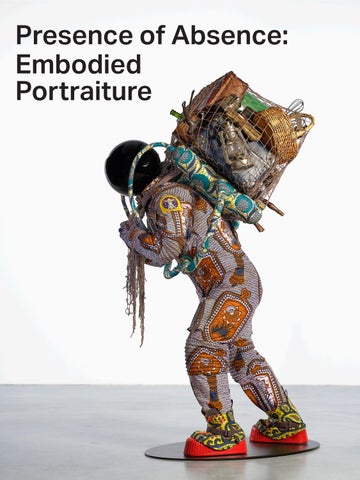
Fibreglass mannequin, Dutch wax printed cotton textile, net, possessions, astronaut helmet, moon boots, steel baseplate Refugee Astronaut VIII, first conceived in 2015, was inspired by the concept of space as a potential place of refuge for the human race. The sculpture is a warning, envisioning the consequences of rising sea levels and the mass displacement of people. While capitalism relies on the idea of continuous growth, our resources are finite, and endless expansion has devastating impacts on the environment. Unlike the astronaut as a colonial explorer, Refugee Astronaut VIII is a nomad searching for somewhere that remains habitable. Yinka Shonibare CBE RA is a British-Nigerian sculptor and installation artist acclaimed for his vibrant, batikinspired works that explore race, colonialism, and cultural identity. Raised in Nigeria and based in London, Shonibare is known for his costumed dioramas made from African textiles and multimedia projects that challenge Western narratives and reveal his passion for art history, literature, and philosophy. He incorporates his own experiences with heritage and his physical disability into his art, the assistants in his studio helping his artistic vision become real under his direction.
Yinka Shonibare British, b. 1962
Abstract Spiritual III, 2023
Patchwork, appliqué, embroidery, Dutch wax printed cotton textile quiltwork Shonibare’s series of pictorial quilts reimagine African artworks owned or referenced by European modernists. Abstract Spiritual III features two female figures–the left by a Tsogho artist from Gabon, the right an Ivory Coast work in the collection of the Musée du quai Branly. The works hover amidst an abstract background that interweaves Shonibare’s signature Dutch wax fabric with diamond motifs. The quilt points to the foundational influence of African and African Diasporic art in the development of abstraction within the Western European canon. Yinka Shonibare CBE RA is a British-Nigerian sculptor and installation artist acclaimed for his vibrant, batikinspired works that explore race, colonialism, and cultural identity. Raised in Nigeria and based in London, Shonibare is known for his costumed dioramas made from African textiles and multimedia projects that challenge Western narratives and reveal his passion for art history, literature, and philosophy. He incorporates his own experiences with heritage and his physical disability into his art, the assistants in his studio helping his artistic vision become real under his direction.
Saul Steinberg Romanian-American, 1914-1999 The General, 1970
Screen print in colors on paper Saul Steinberg’s The General, also known as The Customs Agent, was created for Peace Portfolio I, a fundraiser by twelve artists in support of peace candidates opposed to the Vietnam War in the 1970 midterm elections. Steinberg’s rubber-stamp lithograph reflects a stylistic shift in his art during wartime America. Expressing his aversion to the war and the politics behind it, he borrowed anti-war counterculture imagery, populating his drawings with cartoonish thugs, raging cops, and predatory figures. Saul Steinberg was a Romanian-born American artist from a family of Russian Jewish descent, best known for his iconic drawings for The New Yorker, including View of the World from 9th Avenue. He fled fascist Europe and antisemitic racial laws in 1941, eventually settling in New York after already having several of his illustrations featured in US periodicals. His career-spanning modernist work included magazines, gallery exhibitions, advertising, and stage sets. He also designed a poster for Referendum ‘70, a national organization that sought to elect anti-Vietnam War candidates.
Ramona Sakiestewa Hopi, b. 1948
Katsina for Patrice, 1999
Wool tapestry, wool warp, weft Sakiestewa’s Katsina for Patrice represents an abstraction of the katsina form through colors and design. A Hopi katsina, or kachina, is a supernatural spirit representing elements of nature, animals, and cosmic forces, embodying both good and evil. Kachina rites are central to Hopi, Hopi-Tewa, Zuni, Keres, and Puebloan traditions in New Mexico, with hundreds of supernatural beings featured in the Hopi ceremonial calendar. According to Hopi belief, kachinas reside on the San Francisco Peaks and act as intermediaries between the spiritual and human worlds. Ramona Sakiestewa is a Hopi contemporary artist acclaimed for her abstract tapestries, printmaking, and public art. Self-taught in weaving, she revived prehistoric Pueblo techniques and adapted them for her contemporary works. Based in Santa Fe, her work explores abstraction, color, and scale, integrating Native traditions with modern designs across tapestries, large-scale commissions, and museum collaborations. Sakiestewa is also recognized for her leadership in arts advocacy, being a major contributor to public art and architecture.
Ward Lockwood American, 1894-1963
Pueblo Indian Dancers, 1959 Oil on canvas
Ward Lockwood was recognized for his versatility across media and innovative approach to color and form. His paintings like Pueblo Indian Dancers were based on observed reality, but demonstrated his enduring concern with formal problem solving, unified chromatic impact, and contrasting paint surfaces. Ward Lockwood was an American painter and printmaker known for his Southwestern landscapes and New Deal-era public art. His painted murals for federal buildings spanned the country, including Texas, Kansas, Colorado, and Washington, D.C. Lockwood trained at the University of Kansas, the Pennsylvania Academy of Fine Arts, and in Paris, and taught at UC Berkeley and the University of Texas. In 1926, he moved to New Mexico and joined the Taos Artists Colony.
Henry Moore English, 1898-1986
Five Ideas for Sculpture, 1981
Lithograph in colors on BFK Rives paper Henry Moore’s Five Ideas for Sculpture is a lithograph sketch for large-scale modernist sculptures evoking the human form. Taking inspiration from African and pre-Columbian art, as well as from contemporaries Alberto Giacometti and Pablo Picasso, Moore developed his own visual language for sculpture using marble and bronze. The morphing form of his figures is thought to resemble the landscape and rolling hills of his Yorkshire birthplace. Henry Moore was an English visual artist best known for his monumental, semi-abstract bronze sculptures. His work, inspired by the human figure and natural forms, often featured reclining figures, pierced shapes, crevices, and hollow spaces. He rose to international acclaim after World War II, having his first overseas retrospective at MoMA in 1946, representing Britain at the Venice Biennale in 1948, and winning major awards. Moore’s legacy endures through his public sculptures, museum collections, and the Henry Moore Foundation, which he endowed with his earnings from large-scale commissions during his later career.
Willard Nash American, 1898-1942
The Guitar Player, c. 1928 Oil on canvas
Willard Nash had a diverse style ranging from New Mexico landscapes, abstractions, and portraits like The Guitar Player. His work came closest to modernism, blending cubism, fauvism, and expressionism. Influenced by Cezanne’s color and shadow, his vivid use of color caught the attention of the Santa Fe art community and critics. Willard Nash was an artist and the most progressive member of Los Cinco Pintores, a short-lived Santa Fe modernist group. Raised in Detroit, he studied with John P. Wicker before moving to New Mexico. There, he studied with famed painter Andrew Dansburg, who helped him shift from academic art into modernism. Nash contributed to the Works Progress Administration, painting six panels for the University of New Mexico’s library, and exhibited in two Whitney Biennials.
Robert Rauschenberg American, b. 1925
Cunningham Relief, 1974 Embossing and ink
Cunningham Relief reflects Rauschenberg’s move toward minimal, monochromatic, and textural works, recording dynamic moving figures through embossing. Off-center on the paper, a rust-brown ink figure stands out among the diagram-like composition and depicts a partnered lift in dance choreography. The embossment is part of the Merce Cunningham Portfolio, which included artists John Cage, Jasper Johns, Robert Morris, Bruce Nauman, Frank Stella, and Andy Warhol. Robert Rauschenberg was an American artist known for his painting, sculpture, performance, photography, and printmaking–the latter two his favorites. Emerging during the Abstract Expressionist era, he challenged its gestural abstractionism and heroic artist archetype by incorporating found, everyday objects. Born in Port Arthur, Texas, Rauschenberg studied at many art schools, including Black Mountain College, with Josef Albers and John Cage as his teachers. His innovative practice and interdisciplinary collaborations with other pioneers, including Cage, Cy Twombly, and Merce Cunningham, made him a central figure in postwar art.
Yufu Shōhaku Japanese, b. 1941
Genbu (Water God), 1984
Madake, nemagari, black bamboo, bamboo branches Genbu (玄武), the Black Turtle-Snake, is one of the Four Symbols–mythological creatures that appear in the Chinese constellations and represent each of the cardinal directions. Genbu is often depicted as a snake wrapped around a black tortoise, much like the bamboo branches and braided latticework coil around the body of this work. Yufu Shōhaku is a second-generation bamboo artist from Beppu, Japan. His father, Yufu Chikuryu, and bamboo master Shono Shounsai were both apprenticed to Sato Chikuyusai. Yufu began working with bamboo at a young age and, with his father, created many styles of Beppu’s now signature flower baskets. Today, Yufu is known for his organically plaited baskets that utilize traditional bamboo strips juxtaposed with roots and branches.
Yufu Shōhaku Japanese, b. 1941
Hotei (God of Wealth)
Madake, bamboo root Hotei (布袋), is the Japanese name for the historical Chinese monk Qieci, colloquially known as the Laughing Buddha. In Japanese mythology, Hotei is one of the Seven Lucky Gods who are associated with good fortune, happiness, and wealth. His name literally translates to “cloth sack,” which he is often depicted carrying on his journeys. Yufu’s use of plaits and raw bamboo root calls to mind the threadbare sack that would be carried by the simple but jolly figure. Yufu Shōhaku is a second-generation bamboo artist from Beppu, Japan. His father, Yufu Chikuryu, and bamboo master Shono Shounsai were both apprenticed to Sato Chikuyusai. Yufu began working with bamboo at a young age and, with his father, created many styles of Beppu’s now signature flower baskets. Today, Yufu is known for his organically plaited baskets that utilize traditional bamboo strips juxtaposed with roots and branches.
Tanabe Chikuunsai IV Japanese, b. 1973 Daruma, 2024
Black bamboo, hobi bamboo, decayed bamboo, rattan Daruma (達磨) dolls are traditional Japanese dolls modeled after the founder of Zen Buddhism, Bodhidharma. These dolls are typically round and limbless, drawing from the legend that Bodhidharma’s muscles greatly atrophied as a result of spending nine years in meditation. The slumped and organic shape of this piece, as well as Chikuunsai IV’s use of decayed bamboo, similarly embody Bodhidharma’s revered determination and sacrifice. Best known for his large-scale sculptural installations, Tanabe Chikuunsai IV is a fourth-generation bamboo artist born in the Kansai region of Japan. Like his father, and his father’s father, Chikuunsai IV grew up in the world of Japanese bamboo and was making baskets by the time he was in elementary school. Chikuunsai IV’s works–large and small–combine his family’s techniques and the exploration of modern ideas to create a legacy that is wholly his own.
Nakatomi Hajime Japanese, b. 1974
Laughing Mouth II, 2019 Bamboo branches
Laughing Mouth II stands out in the oeuvre of Nakatomi Hajime. Usually consisting of delicate, complex loops of bamboo, Nakatomi’s pieces are more similar to atomic models or Möbius strips. Laughing Mouth II, constructed out of one single bamboo branch, demonstrates Nakatomi’s appreciation of the material's beauty itself. The result is a frank dialogue between an artist and his medium. Nakatomi Hajime graduated from the prestigious Waseda University School of Commerce, where he studied business marketing. However, he decided to pursue a career in bamboo arts after seeing works by the great Shono Shounsai. Nakatomi then attended the Beppu Occupational School and apprenticed to Honda Syoryu. His atypical background and earnest passion for the medium allow him to take full advantage of the versatility of bamboo.
Kawashima Shigeo Japanese, b. 1958 Crying Ghost, 2017 Madake, rattan
Crying Ghost, characteristic of Kawashima Shigeo’s other works, is as much about the bamboo as the negative space created by the delicate weavings. The thread-like strips trace the form Kawashima carves out of thin air–in this case, the simple but recognizable shape of a ghost. These strips are tied together with his signature knots, a career-spanning souvenir from the time he built a traditional Japanese bamboo fence. Crying Ghost serves as an exemplar of Kawashima’s ability to bend bamboo to its sculptural extreme. Kawashima Shigeo was born in Tokyo, Japan, in 1958. A newspaper article about a local bamboo craftsman spurred Kawashima to pursue the art form as a career. Through training at the Beppu Advanced Technology Academy and exposure to the great Shono Shounsai, Kawashima began to embrace the sculptural potential of bamboo beyond what is considered traditional.
Nagakura Ken'ichi Japanese, 1952-2018 Woman, 2015
Madake, rattan, urushi, powdered polishing stone, clay At nearly six-feet tall, Woman is demonstrative of Nagakura’s belief in bamboo as an artistic medium capable of standing on its own and free from the constraints of traditional basketry. The piece’s organic and imperfect curvature emphasizes Nagakura’s acceptance of the natural world and its flaws. Nagakura’s tight plaiting allows the form rather than the weave to take precedence. Primarily concerned with natural forms, Nagakura Ken’ichi forged his own path in terms of sculptural bamboo works. Born in Shizuoka City, Japan, Nagakura was first introduced to bamboo by his grandfather and spent three years preparing the raw material for him. In a deviation from the norm, Nagakura was not a member of any arts organization and was an independent artist for over thirty years.
Rōkansai Iizuka Japanese, 1890-1958
Long Live His Majesty the Emperor, 1950s Susutake, hōbichiku, rattan
"Long Live His Majesty the Emperor" (天皇陛下万 歳) is a phrase originally used in Japanese culture to express respect for the imperial family, literally translating to “may the emperor reign for ten thousand years.” In many Eastern Asian languages, bansai, or ten thousand years, is used idiomatically to mean an indefinitely large amount of time and is translated best to the English phrase “long live.” In modern usage, bansai is used as an expression of enthusiasm, in political ceremonies, and was a sacrificial battle cry during World War II. Much like the phrase itself, the traditional flower basket form of Rōkansai Iizuka’s Love Live His Majesty the Emperor demonstrates the preservation of historical tradition through adaptation. By the age of twelve, Rōkansai Iizuka was working with his father and brother in their family bamboo arts studio. Rōkansai studied many of the traditional Japanese art forms, including calligraphy, painting, tea ceremony, and flower arrangement. In spite of–or maybe because of–this training, Rōkansai experimented with techniques and forms typical to bamboo basketry, and became known for his modernization of the field.
Unidentified artist Spain
Portrait of Antonio de Ulloa y de la TorreGuiral, c. 1768-70 Oil on canvas
Born in Seville, Antonio de Ulloa exemplified the Enlightenment ideal of the polymath in service to empire. As co-author of Relación histórica del viaje a la América meridional (1748), he contributed vital scientific observations from the French geodesic expedition to Ecuador, a work that later supported the discovery of platinum. His career spanned continents: governing Huancavelica's strategically critical mercury mines in Peru, administering Spanish Louisiana, and earning election to five of Europe's foremost scientific academies. This portrait, paired with that of his Limeña wife Francisca Ramírez de Laredo, commemorates their arrival in Spain in 1768 — a homecoming that marked the close of his transatlantic life.
Unidentified artist Spain
Portrait of Francisca Ramirez de Laredo y de Ulloa, c. 1768-70 Oil on canvas
This is possibly a wedding portrait. Painted in Spain around 1768, it captures Francisca Ramírez de Laredo shortly after her marriage to the naval commander and scientist Antonio de Ulloa. Born in Lima, Francisca embodies the elegance of viceregal Peru's elite women. Her richly adorned appearance — jewels, fine fabrics, elaborate dress, and a tembleque, the delicate trembling hair ornament worn by fashionable women across the Spanish Americas — recalls the vivid portrait of Lima's elite that Ulloa and Jorge Juan recorded in their Voyage to South America: women so lavishly bejeweled, head to foot in diamonds, lace, and gold, that dressing could cost thirty to forty thousand crowns, a splendor they marveled was astonishingly commonplace.
Unidentified artist Seville, Spain
Portrait of Joaquín Arias de Saavedra y Santa Cruz, Fifth Marquess of Moscoso and Thristeenth Count of Castellar, 1785 Oil on canvas
Born in Cajamarca, Peru, Joaquín Arias de Saavedra y Santa Cruz, Fifth Marquees de Moscoso, clearly took pride in his colonial roots even while living in Spain. Though dressed in an elegant pale pink silk suit embroidered in blue-grey, thoroughly fashionable in Madrid, he commissioned a portrait in the distinctly American tradition: a family coat of arms at upper left and an inscribed cartouche at lower right, devices far more common in viceregal Peru than on the Iberian Peninsula. The result is a work suspended between two worlds, asking us to consider how identity, loyalty, and belonging were negotiated across the vast Spanish empire.
Unidentified artist Cuba
Portrait of Francisco Javier de Ripalda de Beaumont Yoldi y Aoiz, 3rd Count of Ripalda, c. 1770 Oil on canvas
Portrait-making was an act of political self-fashioning across the Spanish Atlantic world. As lieutenant governor of Puerto Príncipe and Trinidad, Cuba, Francisco Javier Ripalda embodied the empire's reach: soldier, bureaucrat, and guardian of colonial order. His duties ranged from repelling English pirates threatening Caribbean seaports to conducting the island's first census — revealing how military and administrative power were inseparable in Spain's imperial machinery. His family crest, prominently displayed, stakes a claim to noble legitimacy far from Madrid. This portrait asks us: who was the Spanish empire, if not men like Ripalda — ambitious, capable, and largely forgotten?
Unidentified artist Cuzco, Peru
Portrait of Gregorio Viana, c. 1760-1770 Oil on canvas
Colonial portraiture in viceregal Peru was never merely about likeness, it was about legacy. While borrowing the poses and professional symbols of metropolitan Spanish convention, Peruvian portraits distinguished themselves through something strikingly literary: inscribed cartouches documenting the sitter's biography in precise detail. Here, Viana's achievements are recorded in text that spills from a cartouche into the painting's very border, an unusual formal choice that blurs the line between portrait and official record. His role in rebuilding Lima after the catastrophic 1746 earthquake is preserved alongside his family heraldry, fusing civic duty with aristocratic identity in a single, carefully constructed image.
Mariano Balcera Potosí, Bolivia
Our Lady of Mercy with donors, 1797 Oil on canvas
Painted in Potosí by Mariano Balcera, a well-regarded artist who counted elite patrons across presentday Bolivia and Argentina among his clientele, this devotional canvas layers heavenly and earthly realms with quiet precision. Our Lady of Mercy appears in her Mercedarian habit, flanked by angels, bearing the order's scapular and broken shackles, emblems of its founding mission to ransom captives. Below, donors Esteban Villanueva and his wife Dionisia López Camelo kneel in pious attendance. Dionisia's mourning dress, and the small female figure beside her, suggest a grief rendered sacred, private loss of possible her daughter elevated into collective intercession.
About The Thoma Foundation Based in Dallas, Texas, the Carl & Marilynn Thoma Foundation collection includes over 2,000 works and spans four broad fields: Art of the Spanish Americas, Digital & Media Art, Japanese Bamboo, and Post-War Painting & Sculpture. In addition to exhibiting our collection at our two free gallery spaces, Art Vault in Santa Fe, New Mexico, and our Cedar Springs Headquarters in Dallas, the Foundation has loaned over 2,200 artworks to more than 250 exhibitions worldwide. We make a concerted effort to share our collection with the public, conserve the works in it, and provide documentation and research that puts each piece into a more widely understood context. We award individual grants and fellowships to support original scholarship across our collection areas, supporting research, symposia, and equity in the arts. Our grants for nonprofit organizations help fund innovative exhibitions, academic programs, and collection-related publications. In 2024, the Foundation launched the Thoma Scholars Program to help broaden access to higher education for promising rural students in the rural American Southwest. Working with our university partners, the Thoma Scholars Program is a comprehensive scholarship that helps talented students graduate with as close to zero debt as possible. Beyond financial support, the Thoma Scholars Program gives high-achieving students a path to promising futures through mentorship, educational support, and leadership training.
1925 Cedar Springs Rd #205 Dallas, Texas 75201 thomafoundation.org