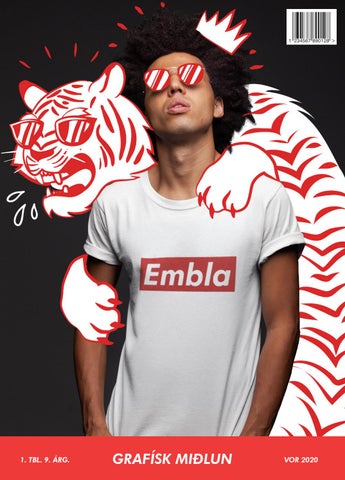
1. TBL. 9. ÁRG.
GRAFÍSK MIÐLUN
VOR 2020
Símenntun? Námskeið? Sveinspróf? IÐAN getur reddað þér námið sem þér hentar.
IÐAN fræðslusetur er í fararbroddi í símenntun iðngreina, með fræðslu, miðlun og þjónustu sem stuðlar að framþróun í iðnaði. 590 6400 idan.is idan@idan.is Vatnagarðar 20, 104 Reykjavík
Leiðari
Ritstjórn Sigurður Sverrir Sigurðsson
Embla, fyrsta tölublað níunda árgangs er tímarit Asks og útskriftar nemanda í grafískri miðlun. Þetta tímarit sýnir færni útskriftar nema í grafískri miðlun og þeirra vinnusemi vorið 2020. Núna kemur af því að við nemendur klárum loka verkefnið okkar og við útskrifumst. Við erum fyrstu nemendur sem fáum að útskrifast sem grafískir miðlarar um mið farald 21. aldar. Við fámenn, fáum að taka þátt í mannkynssögu og við getum verið stolt af því. Þótt að þetta eru undarlegir og smá ógnvekjandi tímar getum við staðið saman og sagt það að við náðum að útskrifast, við náðum að klára þennan áfanga á þessum erfiðu tímum og það er ekkert sem getur hægt á okkur. Það var skemmtilegt að vera partur af þessari fjölskyldu, en nú er komin tími á það að sýna okkar vinnusemi og kveðja hvort annað. Við erum grafískir miðlarar, við vinnum fyrir þig. “Don’t cry because it’s over, smile because it happened” -Dr. Seus.
Samsetning Sigurður Sverrir Sigurðsson Hönnun forsíðu Sigurður Sverrir Sigurðsson Nemamyndir ljósmyndadeild Útgefandi Tækniskólinn Prentun og frágangur Litlaprent Letur Meginmál: Univers 47 light 9/13 pt Pappír Innsíður: UPM digital 150 gr Kápa: Color laser 250 gr
Efnisyfirlit
4.
8.
6.
12.
3
Hæ! Ég heiti Sigurður Sverrir Sigurðsson og ég er fæddur árið 2000. Ég á 6 hálfsystkini og er yngstur. Ég hef flutt 8 sinnum, oftast innan Reykjavíkur. Ég hef hannað lógó og kennimerki síðan ég var 10 ára gutti. Ég vildi fyrst fara í tölvubrautina og læra að kóða, vegna þess að mér fannst það „töff“ á tímanum. En eins og örlög myndu hafa það, sú braut var troðfull. Ég vildi samt endilega koma mér í nám í Tækniskólanum svo ég kaus grafíska miðlunar brautina og hef aldrei verið ánægðari. Áhugamálin mín (fyrir utan grafísk hönnun) eru: Spil, tölvuleikir, svefn og sögur. Ég hef líka mikinn áhuga á ensku, eða frekar að tala og skrifa á ensku. Uppáhalds Adobe forritið mitt er Photoshop. Photoshop var fyrsta Adobe forritið sem ég lærði að nota og ég er orðinn frekar flinkur á að nota það. Sem dæmi má nefna að bakgrunnurinn á þessari opnu var allur unninn í Adobe Photoshop. Ég hef enga hugmynd um hvað mig langar nákvæmlega að gera í framtíðinni, en ég held það að vinna á auglýsinga stofu væri góð stefna. Eftir að ég útskrifast í vor ætla ég að halda áfram með námið í tvö ár til viðbótar. Kannski fara í nám í Edinborg eða einhvers staðar í Kanada. Eftir það ætla ég að byrja að vinna sem rithöfundur eða við eitthvað skapandi. „The time you enjoy wasting is not wasted time “ – Bertrand Russell
5
Iceland, a country that’s quite literally been shaped by fire, ice and the vikings that settled there over 1000 years ago. But where to begin? Geographical Information Iceland is the 18th largest island in the world and the 2nd largest in Europe. The country is located in between the North Atlantic Ocean and Arctic Ocean, east of Greenland and just south of the Arctic Circle. With its capital, Reykjavík being located 64°08 north of the equator, making it the northernmost capital in the world. The island sits on the Mid Atlantic Ridge, which splits the North American and Eurasian tectonic plates 2cm every year. The island is traditionally split into 8 regions:
Flag Representation The flag of Iceland has a blue background, white nordic cross and a thinner red nordic cross within the white cross. The blue represents the blue North Atlantic ocean, the white represents the snow and ice that covers the island most of the year, and the red represents the fiery hot lava that spews out of the many volcanoes on the island. The coat of arms is a shield with the flag configuration on it, sitting on a lava block with the 4 guardians of Iceland (Landvættir) surrounding it. The bull, Griðungur, protector of the northwest. The eagle, Gammur, protector of the northeast. The dragon, Dreki, protector of the southeast. And the rock giant, Bergrisi, protector of the southwest. Iceland #1
1. Höfuðborgarsvæðið 2. Suðurnes 3. Vesturland 4. Vestfiðir 5. Norðurland vestra 6. Norðurland eystra 7. Austurland 8. Suðurland
(Capital Region) (Southern peninsula) (Western Region) (Westfjords) (Northwestern Region) (Northeastern Region) (Eastern Region) (Southern Region)
Population Overveiw Roughly 2/3 of the population lives in the capital region. Iceland is the most sparsely populated country in Europe, with about ~360.000 residents. About 92% of which Identify as ethnically Icelandic, ~5% Polish and ~3% other ethnic groups.
6
Iceland comes up as number 1. In many rankings, such as the global peace index, happiness, equality, green energy, low pollution and low crime rates. Iceland has been regarded as the safest country to live in, for well over 12 years in a row. Life & Culture in Iceland Iceland has some amazing wildlife as well, the top notable animals being: Puffins, wild foxes, narwhals, seals, Gyrfalcons and the highly credited Icelandic horses. Iceland has some interesting national dishes, such as: Þorramatur, Harðfiskur, Hákarl, Rúbrauð, Skyr and Brennivín. Iceland is also the home of the popular kid TV series Latibær (LazyTown). Iceland is also famous for some of its people, like: musicians Sigur rós, Of Monsters and Men, Emilíana Torrini, Björk, GusGus, strong man Hafþór Björnsson, actor Stefán Karl Stefánsson, comedian Ari Eldjárn and director Friðrik Þór Friðriksson.
The Icelandic language is incredibly unique, it’s the closest language to old norse. And is said to be one of the hardest languages to learn, in the world.Most Icelanders don’t really have surnames either. They usually adopt the last name of their father’s or mother’s first name, and add a “son” or “dóttir” at the end of their last names depending on their gender. Iceland is also unique in sense that it doesn’t have a standing army, however it does have a coast guard, counter-terrorism unit and a search and rescue team.
Reynisfjara
Interesting Sights Iceland has some interesting man made sights to see such as: The National Gallery, The National Museum, Laugavegur, Austurstræti, Hallgrímskirkja, Perlan, The Viking World Museum, US Navy D-3 Plane Wreckage Site, Höfn Viking Village, Akureyri and the various terf houses which you can find around the island.
k Reykjaví Kirkjufell Some natural sights and attractions would include: Kirkjufell, Þingvellir, Skaftafell ice caves, Svartifoss, Gullfoss, Geysir, Fjaðrárgjúfur, Reynisfjara, The Blue Lgoon, Seljalandsfoss, Jökulsárlón, Þórsmörk, Goðafoss, The Sea Monster of Hvítserkur, Mælifell, Grjótgjá Caves, Krafla, Námaskarð, Gunnuhver and finally, the northern lights during winter time. And the best way to see most of these sites is to drive around the “Ring Road” or “The Golden Circle”, which can take anywhere between, 7-14 days.
OPNUNAR TILBOÐ -25% AF ÖLLU!
Ármúli 18 | 104 Reykjavík | Sími 567 8888
snjohornid@snjohornid.is | snjohornid.is
The Land, The Myth, The Legend The first possible mention of Iceland in historical records, could have been in the now lost work “On the Ocean” by a Greek explorer Pytheas in the late 4th centurary BC. Thankfully some Incomplete description of his work have survived in later works of Strabo and Polybius, where they mentioned that Pytheas talked about a land called “Thule” which was a “six-day sail north of Britain and is near the frozen sea”. However these aren’t the only mentions of Thule. Writers like Procopius, Orosius and Pomponius continued to cite Pytheas in their works, however with very different outcomes. Some clearly talked about Norway when they mentioned Thule and some even said Thule was Ireland or Scotland, and some described Thule’s location very closely to Iceland’s, but there was never any definitive proof of where Thule was exactly located. Later in the 6th century AD, saint Brendan could have spotted Iceland and it’s volcanic activity, as he wrote that he saw an island that threw down lumps of fiery slag. Writings from saint Brendan’s voyages have a very mythical aspect to them and aren’t very reliable. The first mention of Iceland as “Thule” is most likely by Dicuil, an Irish monk and geographer. He States that he’d met clerics that claimed they lived in Thule, which is north of the Faroe Islands. The statement of Dicuil, that there are Irish monks living in Iceland during the 8th and 9th century, is supported by the archaeological findings in Hafnir, where carbon dating tells us that Iceland was in fact populated during the 8th and 9th century. And is even more supported by the fact that Ari Þorgeilsson wrote about the norse settlers finding small bells, which the Irish monks used. Now, whether the monks left before the norse arrival in Iceland or were driven out by the norse settlers is still up for debate. The First Discovery The first norse discovery of Iceland (according to Landnámabók) was by a Norwegean named Naddoður, who lost his way at sea and found the island, which he named Snæland. After Naddoður, there were a few other norse explorers that came to Iceland, like Garðar Svavarsson who circumnavigated the island and named it “Garðarshólmi”, after himself. And then later on Hrafna Flóki, who found
8
the island by releasing ravens in different directions and heading towards the one that didn’t come back. He then later, named the island Iceland. The story goes that Hrafna Flóki failed to prepare accordingly to the Icelandic winter, and as a result, all of his animals died. in the spring, him and his settlers decided to leave, but before he left he hiked to the top of the nearby mountain and noticed a large fjord full of sheets of ice. Hrafna Flóki, therefore gave it a cold and unsympathetic name, Iceland. The First Settlement The first permanent norse settlers (according to Lannámabók) was a Norwegean chieftain called Ingólfur Arnarson, his wife Hallveig Fróðadóttir, his sister Helga Arnardóttur and his foster brother Hjörleifur Hróðmarsson. The most common reason given as to why they decided to move to Iceland, is that they became involved in a blood feud and thought that moving to Iceland was the best solution. So in the year 874, Ingólfur managed to set up a permanent residence in Iceland. According to the stories, Ingólfur cast his high seat pillars into the sea and vowed to settle wherever they washed ashore. This happened to be in a bay, which he named Reykjavík due to the amount of steam from the nearby geothermal springs, which he mistook for smoke. Later, Ingólfur’s brother and his party were killed by their celtic slaves, but Ingólfur managed to avenge them and continue on living in Iceland. The Icelandic Commonwealth During the settlement period, Landnáman describes ~3000 different names of settlers, and over 4000 different areas settled in Iceland. Genetical and historical records show that a large majority of Icelandic settlers were Norwegean and Celtic. With the sudden surge of viking activity in Europe, Iceland’s population started growing quickly. There’s a general agreement that around the end of the 10th century, the influx of settlers in Iceland died down. How many people lived on the island at this point is still debated, but it’s estimated to have been around 10.000 to ~50.000 people. With so many people now settled in Iceland, disputes and feuds started to become more common amongst the settlers. To solve these problems, people decided found a
“þing”. A þing was an assembly made up of free people from the community led by the most noble chieftains called “goðar” and “lögsögumenn”. The þing was used to settle disputes, make out punishment, agree on boundaries, set up prices and more. Naturally with no centralization on the island, many þings were established by various chieftains around Iceland. However around the year 930 AD, þorsteinn Ingólfsson and other chieftains in southwestern Iceland decided to create an “Alþingi”, an all-encompassing þing for the whole island. Making it the oldest, existing parliament in the world.
gods in private. Here, the written records seem to support archaeological findings, which state that pagan burials stopped somewhere in the mid 11th century. With the cathlic church now established in Iceland, it quickly gained a lot of power in Icelandic society. The power of the church can be demonstrated through the many established churches around the island. The churches were also the centers of learning in Iceland, and priests were oftentimes the only educated people on the island. And most books were kept in the church’s possession as well. The power of the church rivaled the power of the chieftains, and caused many disputes over the upcoming years.
Discovering the New World During the 10th and 11th century, we know of the Icelanders’ exploration and settlement of Greenland and also the founding and temporary settlement of Vinland in today’s Canada. We know this thanks to Grænlendinga saga and Eiríks saga rauða, which talks about Þorfinnur karlsefni Þórðarson and his wife Guðríðr Þorbjarnardóttir, which followed Leif Eriksson’s route to Vinland. And later, gave birth to their son Snorri Þorfinnsson while staying in Vinland. Rise of Cathlic Church Back in Iceland during this time outside of its alþingi, Iceland wasn’t a very unified country, there weren’t any kings or rulers like you’d see in mainland Europe at the time. Also compared to much of Europe at this point, which was largely christianized, Iceland was happily adhering to it’s pagan norse gods, besides a small number of christians. However when Ólafur Tryggvason, an eager christian, became the king of Norway, he set out to convert much of the norse lands including Iceland. But converting Iceland wasn’t easy, and there wasn’t much progress until 999. AD. When Ólafur was fed up with Iceland’s resistance and sent 2 converted christians to the alþingi, proclaiming he would no longer tolerate defiance. While also keeping the sons of the Icelandic chieftains locked up. After a long debate the alþingi decided that chritianity would be Iceland’s main religion, but pagans would be allowed to worship their pagan norse
The Icelandic Civil Wars Going into the 12th century, a large shift in power started to occur. Many of the Icelandic chiefdoms started becoming centralized into a few noble families. And most of the þings outside of the alþing, started to be discontinued, as there was no more use for them. Later in the 13th century there were 7 major families in charge of the island. This created a large instability on the island and many disputes between the main families started to be answered by force, which led to an era called “Sturlungaöld”. It was during this era that Snorri Sturluson, a chieftain, vowed to the Norwegian king Hákon Hákonarson, to bring Iceland under the Norwegian crown. He was hoping that this would give him the edge over the other chiefdoms, however he didn’t exactly keep all his promises. And as the instability in Iceland continued, Hákon decided to take matters into his own hands. He proclaimed Snorri a traitor, seized all of his land and managed to get other Icelandic chieftains to fealty to him. From there, he set on a campaign to completely take over the rest of Iceland, which he would succeed in around 1264 AD. Bringing all of Iceland under Norwegian rule. Now under the Norwegian crown, the alþingi became obsolete in creating new laws and therefore became a supreme court in Iceland, overseeing and settling disputes according to the Norwegian royal law.
9
Integration into the Kalmar Union In the 14th century, a complicated chain of political events happened in Scandinavia, which put the crowns of Denmark, Sweden and Norway, into a Kalmar Union, with Denmark being the dominant party in the association. This isolated much of Iceland, due to the lack of common ground with Denmark. During the 13th to 15th century the churches in state institutions in Iceland, started to resemble more of the mainland European feudal system. Even though Iceland still retained it’s political uniqueness mostly due to its alþingi. It was also at this time that the black death had reached Iceland and killed about ~50% of the ~60.000 people that lived there. However by the 16th century, despite the disease, feudal oppression and occasional fighting for autonomy, Iceland’s population managed to rebound to its former population of 50.000 to 60.000 people. And the lifestyle remained almost unchanged from the Norse settlers that came to Iceland over 600 years ago. Cattle and sheep farming was the main source of sustenance, and families were expected to provide their own food, which made starvation still common amongst the populous. Anglo - German Trade Era The small amount of trade goods Iceland was able to provide, was mainly from fishing. Which attracted some English traders and merchants during the 15th and 16th century, trading some manufactured goods like iron horse shoes, swords, cloths, wines and more, all for fish. This newfound trading with the English, finally connected Iceland to the outside world, like they could’ve never done before through Norway or Denmark. And it also prompted the creation of the trading towns primarily on the south side of the island. However this new trade in Iceland, brought new problems to the area. The rich got richer through trade, and the power in Iceland, once again started to be centralized around just a few small families. Denmark wasn’t a fan of this and also wasn’t happy with the English merchants getting Icelandic fish, which they thought should be under Danish control. The lucrative Icelandic fish trade also spiked the interest of the Hanseatic League, and this triple power struggle over the Icelandic fish trade, resulted in several wars between Germans, Danes and the English. And in the end, after
10
countless wars and several peace treaties, Denmark got what it wanted, the control of the Icelandic fish trade. And as a result of that, managed to alleviate the instability in Iceland, caused by the centralization of power through the fish trade. Protestant Reformation However a different power started to replace the nobles in Iceland in the middle of the 16th century, the catholic church, which was more powerful than ever, owning more than half the farms in Iceland. But in 1537 King Kristján III of Denmark, converted to Lutheranism and confiscated all the church’s property in Denmark, he then set out to do the same in Norway and Iceland. First the Icelandic population resisted the conversion, but slowly with the use of military force, Kristján III managed to convert the Icelandic population to protestantism and catholicism was forced out of Icelandic society.
Mist Hardships In the 17th century, the political structure now changing in Europe and Denmark becoming a hereditary kingdom, Iceland lost much of its autonomy, ensuring there’d no longer be instability created through the centralization of power. But it also put Iceland under the absolute rule of the Danish king. This created a de facto ruling aristocracy in Iceland, just as anywhere else in Europe. It was also during this time that much of the Icelandic trade came to a halt due to an establishment of a Danish trade monopoly. However with all these changes, Iceland still remained as a unique political entity in the Danish kingdom, due to its isolation from mainland Europe. From the 16th to the 18th century, many more human and animal diseases hit Iceland causing many deaths. And the feudal oppression from Denmark caused famine, which combined with the Little Ice Age, volcanic eruptions and Turkish barbary raids on the island, meant that by the end of the 18th century, Iceland had gained a serious dent in its population, bringing it back down to ~35.000 people. Almost ~50% of Iceland’s population had perished.
End of the Danish Trade Monoply In 1786 AD. six trading towns in Iceland were granted municipal charter by the Danish authority and the monopoly arrangement with Denmark was abolished, which helped Iceland’s economy get out of stagnation. Despite all of these changes, the towns on the island maintained a small population. Reykjavík for example, only had around ~300 residents, a few farms, a church and some housing at the turn of the 19th century. However it did start to get more urbanized, thanks to the wool processing industry, new trade routes from the west and Danish merchants migrating to the town, filling up the demand for skilled labor. In 1837, the first coffee house was opened in Reykjavík and by 1860 the town’s population grew to around ~1.500 people. The rest of Iceland also achieved more stability through better farming practises. But the life of the common Icelander seemed much the same as in the past. Start of a New Political Structure The 19th century was seen as a prosperous year for Iceland, considering the past 300 years. However it was still a very stagnant century for Iceland, compared to the rest of Europe. And from this perceived stagnation, many from the Icelandic higher class started to encourage nationalistic veiws. This combined with the shrinking prestige of Denmark, due to the losses in the Napoleonic wars and the Danish loss of Norway, meant that the awaited end to the Danish rule was inevitable. It started with the prelude of the first Icelandic assembly, which called itself the Alþingi in 1845. Even though it was only an advisory body to Copenhagen without any judicial power, it was the beginning of the Icelandic open commitment to self autonomy. With this added political pressure on Denmark, the first constitution was granted to Iceland in 1874. The Alþingi was recognized and gained some judicial power. Even though the Icelandic autonomy was increased, the political structure was far from perfect. The voting rights were only granted to high ranking males and usually less than half of them partook in the voting. Also much of Alþingi was very conservitive, even compared to the other conservitive governments in Europe. It was also in the late 19th century that roughly a quarter of the Icelandic population migrated to Gimli, Canada, which would also be known as “New Iceland”. The migration was due to the harsh environment, class divisions and injustice. And these problems were all well founded, Iceland was one
of the poorest nations entering the 20th century and was very much dominated by class divisions. It would at least take another 60 years for much of that to change. It was also during this time that the fishing industry emerged as the backbone of the Icelandic economy, comprising 60% of the Icelandic exports. However due to this, farmers were largely ignored in legislation, adding to the already large number of people leaving the island, but most of that would change in the 20th century. March Towards Freedom It was at the beginning of the 20th century that Iceland finally started to modernise. The first mechanical engines were brought to the island, the bank of Iceland was established to support the Icelandic economy and the Icelandic women were given more equal rights. It was at this time that Iceland gained even more autonomy in its home rule, now officially being regarded as a separate free entity in the Danish kingdom. This happened due to the revision of the Icelandic constitution, granting the Alþingi control over the ministry of Icelandic affairs residing now in the city of Reykjavík, instead of Copenhagen. Also a new Icelandic flag was proposed, consisting of a blue background and a white nordic cross on top. However it was deemed too similar to the Greek flag and therefore would be changed in 1915 to have a red and white cross on top instead. The earlier adaptation of the flag was later adopted by the Shetland islands in Scotland in 1966. At the same time the voting laws were changed, finally enabling workers of both genders to vote, regardless of their social class status. And it was also in 1915 that prohibition on alcohol was set in law, however this would be abolished on the 1st of march 1989, henceforth known as “Bjórdagurinn”. The prohibition on alcohol was due to the fact that beer was associated with Denmark, and drinking beer was seen as unpatriotic during the independence movement. The Fruits of Our Labor Iceland would later gain independence on the 17th of June 1944, after a 25 year arrangement with Denmark, which was made after the 1st world war. After being occupied by both the British and the American forces during the 2nd world war, Iceland emerged as a new little independent republic nation.
11
Introduction
Game Modes
Hearts of Iron IV (HoI4), is a grand strategy video game set in the WW2 era. The Game is similar to the table top board games such as Risk and Axis & Allies, but is a whole lot more complicated, and tends to scare off new players that aren’t familiar with the grand strategy genre. The game has one of the biggest learning curves I have ever had the pleasure of climbing up. I have clocked in just about 900~ hours in the game, but I’m far from mastering it. However I would consider myself somewhat of an expert. So, let me take you through this virtual headache of a video game called Hearts of Iron 4.
Game modes are the ingame rules which determine how the game will operate and how the computer AI will behave. There are five difficulty settings to choose from, ranging from Beginner, Easy, Normal, Hard and Vetaran. Each difficulty is harder than the last. You can also change how you want the AI to behave specifically, and how strong you want other nations to be, including your own.
The Start Upon starting the game you are given two scenarios to choose from. Scenario A: Gathering Storm. You’ll begin on the 1st of January 1936. 3 years before WW2. And this time allows you to gather your forces, bolster armies, strengthen your nation and of course, change history as we know it. Yes, that’s right, you can alter history to your liking. Scenario B: Blitzkrieg. You’ll begin on the 14th of August 1939. 3 weeks before WW2 is declared. This scenario is a bit harder, since you won’t be able to prepare as much.
12
Selecting Your Nation You can pick and choose to play whatever country you want, as long as it existed during the WW2 era. However there are some countries you can’t play even though they existed during that time period, such as micro nations. But I doubt such small countries would even leave an impact on anything, so it doesn’t really matter. Currently there are only 29 countries with unique focus trees, events, decisions, etc. 7 major countries: France, USA, UK, Germany, Italy, Japan and the Soviet Union. 12 minor countries: Poland, Czechoslovakia, Hungary, Romania, Yugoslavia, China, Communist China, Manchukuo, Mexico, Netherlands, Spain and Portugal. 5 British Commonwealth nations: Canada, Australia, New Zealand, South Africa and the British Raj (India). 5 Chinese warlords: Guangxi Clique, Yunnan, Shanxi, Xibei San Ma and Sinkiang.
Regnskógar eru höggnir niður 100 hekturum á mínútu. The rest of the countries in the game don’t have any unique focuses, but that shouldn’t deter you from playing them. There are some amazing things you can pull off even without unique events. For instance, you can play as Brazil and conquer all of South America, or play as Norway and take over the north, effectively becoming the ultimate northern league, or so on and so forth. The possibilities are endless in this game, and it’s one of the many reasons why I and thousands of other players love the game. The Start & Early Game Let’s say I picked scenario A, normal difficulty, chose Hungary as my nation and wanted to restore the Austro-Hungarian Empire. How would I play the game? I would begin by gathering up my forces, and since I’m playing as a landlocked country, I don’t have to worry about a navy (yet). I select all my divisions and assign them to qualified general, who I then assign to a field marshall. After that I exercise them and put them on Austria’s border to add some pressure and intimidate them. I’d also group up my airplanes, which I’ll use later when war arrives. Then I’ll choose what to research, and since I’m playing Hungary, I begin with 3 research slots. I’ll start by researching new battle tactics, engineering and industry. After that I’ll start building infrastructure and some factories. Then I’ll make sure to produce some equipment for my army. And make sure I have enough resources for said equipment. Then finally I’ll pick a focus in my focus tree. After a few focuses I’ll start increasing my relationship with Austria and send them a referendum to unify the 2 nations. After unifying the 2 countries I should gain some extra manpower, units and factories. And after gaining enough factories I’ll start establishing some intelligence agencies. Also, over time I’ve earned some political power, which I’ll use to hire some companies and politicians into my cabinet. Now with that said and done, I can officially restore the Austro-Hungarian Empire. But we’re not done yet. After that, I’ll offer Czechoslovakia a referendum as well, to unify with the old Austro-Hungarian empire. After unifying with Czechoslovakia I’ll gain even more manpower, equipment and factories, now making me a major power. The Mid Game In the mid game I should have enough power to declare war on both Poland and Romania at the same time, although I might get some help from either Germany, Russia or Italy. After conquering the lands which “belong” to Austria-Hungary, I can start focusing on improving and building up my nation for WW2. I’ll Join the Axis since I don’t want to fall early, however I won’t join the war for a while. This means that ‘i’m protected from a German invasion while also not being at war with any of the other major powers. The Late Game It’s probably 1943 or 1944 by now, which means that the allies have made some good advancements on the Germans who are probably also at war with Russia at this point. Now, I can backstab the Axis by leaving it and invading Yugoslavia, Italy and Germany. And since I’m attacking a mutual enemy, I’ll be invited to the Allies. Which gives the rest of the Allies a strong foothold in Europe to attack the Axis. This should lead to a relatively easy victory against the Axis. I’ll take the land which “belongs” to Austria-Hungary and rebuild some of my nation to prepare for a war against the Allies.
Langar þér að vita hvað þú getur gert fyrir jörðina? Við erum að halda ráðstefnu í Hörpu 1.-2. maí. Allir velkomnir!
The Endgame Now, I’ll start building some convoys, battleships and submarines, for a naval invasion against the rest of the major powers in Europe. I can also sort of cheat the game by putting a bunch of troops in most towns and cities in the countries that I’m planning on attacking, as long as they’re in the Allies. And once I leave the Allies and declare war, the troops will stay in the country, instantly capture it, swiftly ending WW3. Now that I’ve taken over Europe and fully restored the “once great” Austro-Hungarian Empire, the world is my oyster. I can now start focusing on a world conquest, if the game hasn’t ended by now. Final Input This is one of my Favorite games, and I highly recommend it if you like history and grand strategy video games. It may be a bit difficult to learn at first, but it’s worth it in my own opinion. Being able to change history, seeing what the world might’ve looked like if this or that happened. I find it incredibly cool, and it’s one of the many reasons why I and so many others play the game.
14
Þín
Hugmynd Svo einfalt!
Forvinnsla
Hágæða prent!
Prentun
Frágangur
litlaprent.is
litlaprent@litlaprent.is
Skemmuvegur 4, Blá gata, 200 Kóapvogur
Fullkomin þjónusta!
Sími: 540 1800
Oppið virka daga: 8:00 - 16:00
Við erum til staðar fyrir þig
Orlof
Þegar þig vantar frí
Kjaramál
Þegar þig vantar lífeyrir
Grafía
Þegar þig vantar traust stéttarfélag
Við veitum persónulega þjónustu á grafia.is Grafía eru samtök launafólks í prentiðnaði, grafískri hönnun og tengdum miðlunargreinum. Við vinnum fyrir þig.
Stéttarfélag í prentog miðlunargreinum
GRAFÍA
Stórhöfða 31, 110 Reykjavík
Sími: 540 0100
grafia@grafia.is