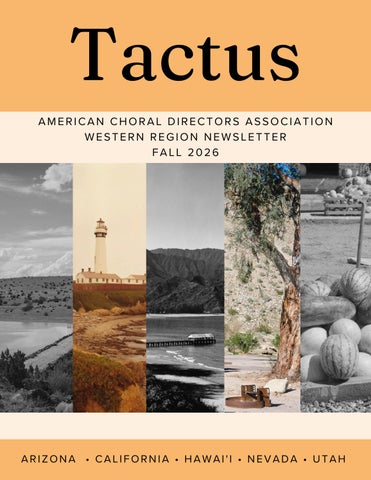
Tactus AMERICAN CHORAL DIRECTORS ASSOCIATION WESTERN REGION NEWSLETTER FALL 2026
ARIZONA • CALIFORNIA • HAWAI'I • NEVADA • UTAH
Western Region Leadership Executive Council Aimee Stewart, President Cari Earnhart, President-elect Julie Dana, Past-president David Sonnichsen, Treasurer Jennifer Lowry, Secretary Christopher Serrano, Membership Chair Nicky Manlove, Marketing Coordinator Yu-Feng Huang, DEI Chair
Conference Chair Ryan Holder
State Presidents Ryan Holder, Arizona President Chris Granger, Arizona President-elect Kristina Nakagawa, California President Molly Peters, California President-elect Christopher Serrano, Hawai‘i President Aaron Scholtz, Hawai‘i President-elect Jennifer Tibben, Nevada President Steph Council, Nevada President-elect Roger Hale, Utah President Shannon Sowby, Utah President-elect
Communications Team Marketing Coordinator Nicky Manlove, AZ Olivia Arnold, Tactus Editor Christina Hall, AZ, Brevo Newsletter Brandon di Noto, CA, Webmaster Jonathan Baltera & Ally Mishler, NV, Social Media/Graphic Design Heather Barclay-Drusedum, NV, Video Coordinator Jennifer Grover, UT, Tactus Ad Manager
2 | TACTUS • FALL 2026
Choral Repertoire and Resources Youth R & R Coordinator Cheryl Anderson, CA
Repertoire Specific Coordinator Timothy Westerhaus, AZ
Anna Volodarskaya, CA Elementary School Choir Chair Heather Barclay-Drusedum, NV & Heather Christiansen, UT Jr. High/Middle School Choir Co-Chairs Cami Clausen & Jason Neumann, AZ High School Choir Co-Chairs
Jennifer Tibben, NV, & Jess Edelbrock, AZ SSAA/Treble Choirs Co-Chairs Herbert Washington, AZ, TTBB Choirs Chair Kim Ritzer, NV Contemporary Acappella Janet Tyler, NV , Vocal Jazz Yu Hang Tan & David Saldaña, CA World Musics and Cultures Co-Chairs
Collegiate Choirs Co-Coordinators Stephanie Council, NV & Jeffrey Benson, CA Dalan Guthrie, UT, 4 Year College Chair Michael Huff, UT, 2 Year College Chair Ramon Cardenas, CA, Student Activities Lifelong Choirs Coordinator Sharon Hansen, AZ Allan Petker, CA Community Choirs Aaron Humble, CA & Brad Hayashi, UT Music and Worship Co-Chairs
Composer Initiatives Co-Chairs Katherine Saxon, CA & Kira Rugen, AZ
Table of Contents Western Region Leadership . . . . . . . . . . . . . . . . . . . . . . . . . . . . . . . . . . . . . . . . . . . . . . . . . . . . . . . . . . . . . . . . . . . 2 A Letter from the Editor . . . . . . . . . . . . . . . . . . . . . . . . . . . . . . . . . . . . . . . . . . . . . . . . . . . . . . . . . . . . . . . . . . . . . 4 A Message from WACDA President Aimee Stewart . . . . . . . . . . . . . . . . . . . . . . . . . . . . . . . . . . . . . . . . . . . . . . . . 5 Staying Updated . . . . . . . . . . . . . . . . . . . . . . . . . . . . . . . . . . . . . . . . . . . . . . . . . . . . . . . . . . . . . . . . . . . . . . . . . . . . 6 Feature Article: Tunes through Tones by Kai-Young Chan . . . . . . . . . . . . . . . . . . . . . . . . . . . . . . . . . . . . . . . . . . 8 When Dissonance Finds Resolution by William C. Whittington . . . . . . . . . . . . . . . . . . . . . . . . . . . . . . . . . . . . . 16 Yes, You Can! an Interview with Kristina Nakagawa and Brandon Ellsworth . . . . . . . . . . . . . . . . . . . . . . . . . . . 20 Interview with Michael Colavita and Ily Maniano on Filipino Choral Music . . . . . . . . . . . . . . . . . . . . . . . . . . . 24 The Hidden Scholarship of Repertoire Selection by Cari Earnhart . . . . . . . . . . . . . . . . . . . . . . . . . . . . . . . . . . 28 Repertoire & Resources . . . . . . . . . . . . . . . . . . . . . . . . . . . . . . . . . . . . . . . . . . . . . . . . . . . . . . . . . . . . . . . . . . 30 Let Curiosity Be Your Guide by Heather Christiansen . . . . . . . . . . . . . . . . . . . . . . . . . . . . . . . . . . . . . . . . . . 32 Social Media . . . . . . . . . . . . . . . . . . . . . . . . . . . . . . . . . . . . . . . . . . . . . . . . . . . . . . . . . . . . . . . . . . . . . . . . . . . 35
Front page images sourced from the Library of Congress Arizona: Concho, 1940, Natural springs used for irrigation California: San Mateo, 1933, Pigeon Point Lighthouse, named after a clipper ship “Carrier Pigeon”, was the earliest West Coast lighthouse on the West Coast to use a first-order Fresnel Lens. Hawai‘i: Hanalei, 1991, View of Hanalei Peir from Weke Road Nevada: Clark County, 2009, A view of the west lower campground in Cottonwood Cove Utah: Box Elder County, July 1940, Watermelons after harvest. Utah’s Famous Fruit Way is a 10-mile stretch of Highway 89 where peaches, melons, berries, are sold from July through September.
FALL 2026 • TACTUS | 3
A Letter from the Editor Dear Readers, Welcome to fall! I always love talking with our readership, and from our conversations, I have learned that some readers enjoy reading each issue of Tactus front to back, and others read in increments. However you enjoy reading Tactus, I am grateful for our readers who continue to return to this publication for the articles, interviews, repertoire and resources, state and regional news, and so much more. As Tactus shifts to a primarily online presence, I encourage you to try a new way of engaging with this content – clicking links! Links and hyperlinked text appear throughout this fall issue, bringing you even more curated information. “Staying Updated” uses this new feature with hyperlinked headings taking you to each state’s ACDA chapter website. Clicking on bibliographic links can bring new opportunities to read research and other primary source literature. These pages are filled with collaboration, inspiration, and reflection. A new “Featured Article” section highlights an ongoing conversation with Cantonese choral educators. Interviews shine a light on Filipino compositions and inclusive choral spaces. Two articles encourage reflecting on the process and curation of repertoire selection. Many thanks to the proofreaders and Communications Team for continuing to elevate Tactus and spread the word online! Please be on the lookout for article highlights and video introductions from this issue’s authors. Readers, I hope that the repertoire and knowledge in these pages might help carry you successfully through the fall and planning ahead for the winter. If I might suggest a takeaway from this issue, it would be to seek everyday joy. Joys in life can range from small to tremendous, and everyday joy is easy to forget amidst the many directions we are pulled. A friendly conversation, a helping hand, a thoughtful gesture, a compliment – these are the joys that make our collective experiences uniquely human. As always, I would love to chat about your thoughts and article ideas! Feel free to email me if you’d like some help brainstorming. Please contact me at: tactuseditor@acdawestern.org. All the best, Olivia Arnold Tactus Editor
4 | TACTUS • FALL 2026
A Message from the President Dear Western ACDA, Greetings from Arizona! I am freshly home from the Utah state ACDA conference, which completed my “tour” of the state conferences of our region. Now I can wholeheartedly and without a doubt say: We have an incredible region! (I knew it before, but now it’s confirmed!) Visiting Nevada (last year at their mini-conference), California at the summer conference at ECCO, Hawai‘i for their professional development over Labor day weekend, Utah for their state conference in September, and of course my home state of Arizona for our annual summer conference, has been a beautiful experience. Five fabulous states, each uniquely magnificent, with strong leadership, culture, talent, and traditions.
I’ve had the privilege of connecting with people throughout our region, from leaders I deeply admire to students, schoolteachers, church directors, college professors, and community choir directors. What an absolute joy it was to come to your home states and get to know you in person! Each state welcomed me with their own traditions and culture. You might not even realize that you have traditions and culture until you go somewhere else and see that other places do things quite differently! What is striking is that even though our states have wildly different needs, we also have a lot in common. We are looking for excellence in repertoire. We are searching for connections with colleagues. We honor those who have mentored us and whose shoulders we stand on. I am excited to welcome this board who will serve our region. They are enthusiastic and have a heart of service. They are ready to reach our membership and find ways to connect and serve. They want to be a resource for you and I am confident that they will find ways to do just that. I look forward to serving with them and for all of you for the next two years.
Gratefully, Aimee Stewart
FALL 2026 • TACTUS | 5
Staying
U pdated
National ACDA News
Regional ACDA News
Our National team is well under way preparing for the National conference to be held in Minneapolis on March 7-10, 2027. Please note the Sunday-Wednesday schedule format! Benefits include competitive hotel rates and lower travel demand. Student Conducting Master Class Auditions are still open until Oct 15, Research Poster Sessions open Oct 1, and National ACDA Conference Registration opens October 1! Scan or click on the following QR codes to learn more.
Congratulations to our region members and ensemble representing WACDA at the National ACDA Conference in 2027: Corie Brown, Roger Emerson, Erica Glenn, Cristian Grases, Rob Istad, Emily Mercado, Yoojin Muhn, Beth Philemon, David Saldaña, Jo-Michael Scheibe, Spring Children’s Choir, Jenny Tisi.
2027 NATIONAL CONFERENCE DETAILS:
STUDENT CONDUCTING MASTER CLASS AUDITIONS
CONFERENCE REGISTRATION OPENS OCTOBER 1
6 | TACTUS • FALL 2026
RESEARCH POSTER SESSIONS
Staying
U pdated
Hawai‘i We held Choral Conducting Master Classes and a Professional Development Day in early September that both went very well. We're looking ahead to the High School Choral Festival in February.
State ACDA News Click each state’s name to learn more!
Nevada
California
Our Mini-Conference was on September 12 with Dr. Colleen Chester as the keynote. Vassiliadis Elementary School choir and Mannion Middle School choir had excellent performances. Andy Sonnemaker received an award of recognition for his years of service to the profession. Dr. Chester led workshops throughout the day.
We piloted our first digital magazine “Cantate”, it is more timely as a digital platform. So far it has been successful, and can be published more than 3 times a year. We had a great summer conference, and recently held three fall conferences on Sept 5.
Arizona
Utah
We had a wonderful summer conference in June 2026, where Katie Gerrich was honored with the Director of the Year Award and Dr. Elizabeth Schauer received the Lifetime Achievement Award. We are now looking forward to our Student Symposium, taking place October 2-3 at NAU, with Joe Modica as our headliner.
Our state conference was held September 11-12 with Dr. André Thomas as the headliner. It featured a Director’s Choir and was held at the University of Utah. He also conducted some of his pieces with the Tabernacle Choir and Orchestra at Temple Square on the "Music and the Spoken Word" program the next Sunday morning.
FALL 2026 • TACTUS | 7
Tunes through Tones: Practices and Resources for Cantonese Choral Music BY KAI-YOUNG CHAN Cantonese is a naturally musical language. Its six primary tones, together with three entering tones, embed distinct melodic contours directly into everyday speech, shaping the very sound of the language. Spoken by more than 85 million people worldwide––from Hong Kong, Guangdong, and Macau to vibrant diaspora communities across North America, Europe, Australia, Southeast Asia, and beyond––Cantonese would seem destined to possess a rich repertoire of choral music. Yet the reality is strikingly different. According to the Cantonese Choral Database, there are fewer than 300 documented choral works in the language to date, with even smaller numbers in art songs, operas, and other contemporary genres.1 This scarcity has long prevented Cantonese-speaking musicians from fully expressing themselves in their mother tongue within the concert hall, leaving Cantonese classical music significantly under-represented on the international stage despite its large potential audience and many talented performers. The primary reason for this limited repertoire lies in the inherent challenge of aligning melody with the language’s tones. Unless the melody closely follows the lexical tones of the text, sung Cantonese can quickly become incomprehensible, unintentionally humorous, or even offensive to native ears. This phenomenon is memorably illustrated in the Hong Kong comedy-feature animation My Life as McDull (2001), where a kindergarten anthem’s (intentionally) mismatched tonemelody relationship turns the greeting ‘How are you, principal?’ into gibberish, ‘flirty elephant you consume blame.’ 2 While such mismatches can serve parody, they are studiously avoided in serious Cantonese vocal music. Composers and lyricists in Cantonese opera, naamyam, and popular music meticulously align tones with melody to ensure textual clarity. 3 Cantonese choral music—a rapidly growing segment of contemporary classical music in Hong Kong—presents unique text-setting demands, distinct from those of traditional Cantonese vocal genres because of the medium’s characteristic multi-voice textures and harmonic richness. This article explores the constraints of setting Cantonese text for choir and highlights the compositional practices that have emerged in recent works by Victor Chan, Daniel Lau, and myself. It aims to show how these constraints can be transformed into sources of creativity, serving as a reference for conductors and composers interested in exploring the genre. It will also introduce several resources developed to lower the barriers of access for
8 | TACTUS • FALL 2026
both performance and composition, so that musicians who are new to the repertoire can engage with it more confidently and contribute to its growth.
Figure 1. An all-Cantonese choral concert from a 2023 conference hosted by the Chinese University of Hong Kong (CUHK), featuring three choirs performing twelve original works by twelve composers.
The Cantonese Text-Setting Constraints Before examining the specific choral approaches that have emerged, it is important to first understand the fundamental constraints that shape them. Cantonese uses six tones to distinguish word meanings. (Figure 2). Using Chao’s numerical system that uses numbers to describe the relative pitch levels (1 lowest to 5 highest; y-axis on Figure 2), the six tones can be represented as: Tone 1/55/ (high), Tone 2 /25/, Tone 3 /33/, Tone 4 /11/, Tone 5 /23/, and Tone 6 /22/.4 1 Research on this article was supported by the General Research Fund of the Research Grants Council, Hong Kong (ref. no. 14616125). Cantonese Choral Database (https://db.cantonesecomposition.com). https://doi.org/10.1177/0027432110376042. 2 My Life as McDull, directed by Toe Yuen (Hong Kong: Lunchtime Productions, 2001), 76 min. School Music Programs,” Music Educators Journal 106, no. 1 (2019) https://doi.org/10.1177/0027432119856085. 3 The challenges are shared by composers and lyricists alike, though creatives from different genres tend to approach them from opposite directions. In Cantonese popular music—a genre with a long and thriving history of tone-melody matching practice—the melody is typically written first, and the lyricist then crafts words whose lexical contours fit the existing musical line. The contemporary classical tradition generally reverses this workflow: the text comes first, and the composer must find melodic shapes that honor both the meaning of the words and the lexical contour of the language. Each approach carries its own constraints, but the underlying challenge remains the same— reconciling the demands of musical expression with the phonological rules of Cantonese. For a critical discussion of speech-melody interactions in Cantonese, see Edwin K. C. Li, “Cantopop and Speech-Melody Complex,” Music Theory Online 27, no. 1 (2021). https://doi.org/10.30535/mto.27.1.6 4 Y. R. Chao, “A System of Tone Letters,” Le Maître Phonétique 45 (1930): 24.
Victor Chan’s Ode to Chung Chi (2011) aptly demonstrates both techniques within the same phrase. In 7 mm. 45–47 (Example 1), the composer employs the first technique in the setting of the two phrases cin1 bun1 gu2 lai6 ( ‘countless encouragements’ ) and mou4 haan6 gwaan1 oi3 ( ‘unwavering care’ ). The soprano presents an intelligible melody that follows the lexical contour and uses optimal melodic intervals between each word,8 while the alto and tenor-bass lines provide homorhythmic supporting harmonies with largely unintelligible settings—lines that misalign with the lexical contour by moving in a contrary direction or by using non-optimal intervals. Despite the presence of two unintelligible lines, the overall setting remains intelligible to Cantonese listeners so long as the intelligible melody stands out from the texture, whether by occupying the top voice or through prominent dynamics. Beginning in the second half of m. 47 and continuing through m. 49, Chan shifts to the second technique for the last phrase, sing6 ci5 ceon1 fai1( ‘prosperous like sunbeams of spring’ ). Here, the alto joins the soprano to sing an intelligible setting of the text, while the accompanying voices switch to the vocable ‘Mm.’ Replacing text with vocables in the inner and lower voices removes the need for those parts to follow the lexical 9 contour altogether.
千般鼓勵 無限關愛
Figure 2: fan in six tones represented by Chao numbers and the tones’ relative approximation on staff notation.
For a melody to be intelligible, melodic intervals must align with the lexical contours—whether falling, rising, or level—and employ optimal interval sizes. Nonoptimal intervals can easily distort meaning, for example, when the sound zing san is set to a descending perfect 5th, it suggests zing1 san4 ( ‘spiritedness’), while a descending minor 2nd suggests zing3 san6 ( ‘positive kidney’), and an ascending perfect 4th could be matched to zing6 san1 ( ‘castration’). Additionally, certain tones show affinities with specific diatonic scale degrees, further complicating the composition process. 5 While the scope of this article does not permit a full illustration of intelligible Cantonese melodic writing, the examples that follow illustrate the nature and extent of these constraints— and the creative strategies composers have devised to work within them.6
精神
淨身
正腎
Choral Writing in Cantonese Having outlined the text-setting constraints of Cantonese, the discussion now turns to the practical solutions composers have developed for choral writing. Their approaches fall into two broad strategies: (1) ensuring intelligibility in the foreground melody while using unintelligible accompanying melodies, and (2) crafting intelligible melodic lines in all voice parts. I. Intelligible Foreground Melody Only Within this first strategy, composers employ two principal techniques. The first places an intelligible foreground melody against accompanying voices that sing the same text but in settings that sacrifice accurate tone perception—and therefore meaning—for the sake of harmonic support. The second pairs an intelligible foreground melody with accompanying voices that sing nonsensical vocables rather than the text itself.
盛似春暉
Example 1: Ode to Chung Chi for mixed choir and piano, mm. 45–49 (voice-parts only). (https://youtu.be/NyuUjT5ho8?si=k0FrAP8wjc94I-UL&t=134)
5 In pairs of semitones, such ti-do/mi-fa, the lower note of the pair (ti/mi) is more readily perceived as tone 6, while the upper note (do/fa) as tone 3. For a more detailed illustration, see Kai-Young Chan, “From Constraints to Creativity: Musical Inventions through Cantonese Contours in Hong Kong Contemporary Music,” Principles of Music Composing 21 (2021). 6 For a more detailed illustration of writing an intelligible Cantonese melody, see Kai-Young Chan, “Writing Choral Music in a Tone Language: Problems, Practices, and Potentialities,” TEMPO (forthcoming). 7 In Cantonese choral scores, lexical tones are often omitted from the romanization, as they are not essential information for performers. Instead, the correct tones should be implied through the melodic contour itself. 8 It should be noted that consecutive Tone 1 or Tone 2, in the highest of the Cantonese tones, remains intelligible when set to descending intervals within a minor 3rd. This explains why cin1-bun1 can be intelligibly set to a descending minor 2nd, bun1-gu2 a major 2nd, and ceon1-fai1 a descending minor 3rd. See Chan (2021) for detailed perception test results. 9 Many a cappella choral works in Cantonese employ this technique. Notable examples include Ng Cheuk-yin’s Under the Lion Rock (2019) and Ernest Hui’s Moonlight Lullaby (2009), both of which feature the technique prominently.
FALL 2026 • TACTUS | 9
This first strategy grants composers considerable freedom to explore rich harmonies and varied textures, since only the foreground melody must follow the lexical tones. It is not without drawbacks, however. Singers have reported that melodies disregarding the lexical tone contours are significantly more difficult to sing in tune. Many performers find themselves having to disengage cognitively and treat the text as mere nonsense syllables—an experience that can be as amusing as it is agonizing. To address these challenges, other composers in recent years have adopted a second strategy: crafting intelligible melodic lines that respect the lexical tones in every voice part. II. Intelligible Settings in All Voice Parts Creating intelligible lines across all voices is considerably more demanding, as every part must follow the predetermined contours of the Cantonese text. Across the works emerging since 2015, several techniques have emerged: Displacing entries of intelligible lines Using parallel or similar motion with varied starting pitches and optimal intervals Omitting words within a semantic unit Creating pedal effect with sustained character(s) Introducing staggered entries and varying rhythms for the same words Using melisma between intelligible settings
In my work The Crane Releasing Pavilion (2018)––a rhythmically-driven setting of Song Dynasty poetry by Su Tung-po (1037–1101)––we can observe one of the more straightforward techniques associated with the second strategy: displacing the same melodic line across the voice parts (Example 2). In m. 68 (with pickup), the sopranos introduce the phrase duk6 zung1 jat6 jyu1 gaan3 guk1 zi1 gaan1 (‘alone all day amidst the streams and valleys,’ ). At m. 69 (with pickup), the tenor-bass enter with the same melody, transposed an octave lower. Because the parts enter at staggered times, the voices are free to move in contrasting directions and contours while still respecting the lexical tones of the text. For example, in m. 69 the treble voices ascend on gaan3 guk1 (‘streams and valleys,’ ), while the lower voices descend on zung1 jat6 (‘all day,’ ). This technique helps to preserve textual intelligibility while introducing contrapuntal interest between the parts. Later from m. 72, parallel motion can be observed between the soprano and alto lines, keeping the intelligible line intact while introducing harmonic interests. Both parts sing the leading melody deok3 cong1 toi4 ji4 lei5 baak6 sek6 (‘pecking at the green moss and treading on white stones’ ). The entire phrase is doubled in parallel fourths (the sopranos starting on B and the altos on F ), enabling both parts to remain faithful to the lexical tones while introducing some harmonic interest. At the same time, the tenor part makes use of word omission to introduce a contrasting contour. Instead of the full line, the tenors and basses sing only deok3 cong1 toi4 (‘pecking at the green moss’ ), lei5 baak6 sek6 (‘treading on white stones’ ), omitting the conjunction ji4. This omission alters the lexical contour of the phrase without changing its overall meaning. With fewer syllables fitted into the same number of beats, the note value for each character can be stretched to add rhythmic variety to the setting. In the basses, the word omission is even more extensive. Entering on the downbeat, they sing only lei5 baak6 sek6 as a bass line. As such, their rhythm is augmented further, minimizing motion while the other parts stay active. The result is an intelligible texture in which each voice part remains independent yet mutually supportive.
日於澗谷之間
澗谷
10 | TACTUS • FALL 2026
終日
啄蒼台而履白石 ♯
蒼台
Example 2: The Crane Releasing Pavilion for mixed choir and piano, mm. 67–74 (voice parts only). (https://youtu.be/watch?v=clewt4kihvY&t=89s)
獨終
啄 履白石
Having examined techniques for introducing contrapuntal interest, the next example focuses on the harmonic affordances of the Cantonese text-setting constraints. Example 3 is drawn from the ending of Seeking, Searching, my a cappella work for mixed chorus. The piece is set to a melancholic ci poem by Li Qingzhao (1084–c. 1155), widely regarded as the most renowned female poet of ancient China. At mm. 113–116, the opening six characters of the poem––cam4 cam4 (‘seeking’ ), mik6 mik6 (‘searching’ ), and laang5 laang5 (‘shivering’ )––reappear as a sustained background layer in the sopranos and altos, situating above the foreground bass melody. Treated as independent semantic units, these words are distributed across the upper voices and sung on sustained pitches. This staggered layering transforms the textual fragments themselves into harmony. For example, cam4 cam4 is set to F, mik6 mik6 on G, and laang5 laang5 on A . The addition of vocables (such as C–D in m. 113 and B –C in m. 120) further enriches the harmonic color above the contour suggested by the text. The same process recurs on a more microscopic level from m. 117 onward, where the sustained pedal effect is applied to individual characters cam4 and mik6, creating a pointillistic echo among the upper voices. When heard together, these pointillistic entries coalesce into the phrase ‘seeking, searching’––the central idea of the piece. Although this passage uses only three characters drawn from the lexical tones of cam4, mik6, and laang5, the technique suggests rich harmonic potentialities for more extended application when involving multiple characters from a jagged lexical contour. The remaining techniques offer possibilities in both harmonic and contrapuntal dimensions. We can observe them in Daniel Lau’s Cing Ming (2026), set to Du Mu’s (803–852) renowned Tang poem depicting a Ching Ming Festival scene. At the piece’s climactic moment in m. 130 (Example 4), Lau elaborates the phrase ho4 cyu3 jau5 (‘where to be found?’ ). In this passage, he sets ho4 cyu3 to various intervals––an ascending minor third, perfect fourth, perfect fifth, and minor sixth–– taking advantage of the multiple intelligible intervals available for the Tone 4–Tone 3 combination, hence maximizing the melodic potentialities of the tone combination. The phrase is then repeated across the voice parts at staggered moments with the same phrase set to varying rhythms. While the soprano and tenor retain the original eighth-note setting of ho4 cyu3 from m. 130 in their later iterations, the alto at m. 131 (echoed by the bass in m. 133) sings a dotted quarter
尋尋
覓覓
冷
♭
♭
冷
♭
Example 3: Seeking, Searching for mixed choir, mm. 117–121 (SA parts only). (https://youtu.be/oPjX1iVo6P0?si=fMVFxUjFqb-zgwLX&t=456)
何處有
10
Example 4: Cing Ming for mixed choir and piano, mm.130–134 (voiceparts only).
10 See Chan (2021) or access the Cantonese Melody Generator (https://app.cantoensecomopsition.com) for a full list of intelligible intervals for each Cantonese tone combination.
FALL 2026 • TACTUS | 11
有
note followed by an eighth note. The use of melisma on the sustained jau5 (‘to be found’ ) allows notes to be added in between an intelligible interval, hence creating further opportunity to enhance the harmonic and rhythmic interest. As a result, even while respecting the lexical contour of a three-character phrase, Lau crafts an expressive passage in which individual lines can retain their own character. The techniques discussed above represent some of the effective means of creating textural variety and harmonic richness in Cantonese choral music while preserving the intelligibility of the text. Although many of these methods are commonly employed in choral writing for non-tonal languages, they assume a distinctive, generative role in the Cantonese context. By aligning melodies and harmonies with the inherent lexical contours of the text, composers frequently discover expressive melodic shapes and harmonic progressions that might never have emerged under complete creative freedom. In this sense, the constraints of Cantonese text-setting function like a creative algorithm that guides composers toward musical possibilities that would otherwise remain unexplored.
Resources and the Path Forward To support the continued growth of the repertoire, I have developed two freely available digital resources. The Cantonese Melody Generator (https://app.cantonesecomposition.com) lets users input any Chinese text and instantly generates multiple intelligible melodic options that respect tone-melody principles (Figure 3). Since its launch in 2022, the application has received over 360,000 enquiries from more than 20 countries and regions. It is designed to lower the barrier for composition, enabling even nonnative speakers and students to experiment confidently with Cantonese text-setting. The Cantonese Choral Database (https://db.cantonesecomposition.com) is a growing, searchable collection of existing works. It includes scores, recordings (where available), and contact information of the composers. The database aims to inspire conductors and choirs worldwide to explore and perform more Cantonese choral music, strengthening ties within the global Cantonese diaspora while building bridges of understanding with nonCantonese audiences. It is encouraging to learn that since 2023, a growing number of Cantonese choral pieces have been performed by ensembles in Canada, 11 Germany, Malaysia, Singapore, the United Kingdom, and the United States. (Figure 4) Even among ensembles whose singers do not speak Cantonese, performances have proven to be highly effective.
12 | TACTUS • FALL 2026
Figure 3: The Cantonese Melody Generator and Cantonese Choral Database.
Bibliography Chan, Kai-Young. “From Constraints to Creativity: Musical Inventions through Cantonese Contours in Hong Kong Contemporary Music.” Principles of Music Composing 21 (2021): 41–59. https://zurnalai.lmta.lt/wpcontent/uploads/2023/08/MKP-XXI_Kai-Young-Chan.pdf. Chan, Kai-Young. “Writing Choral Music in a Tone Language: Problems, Practices, and Potentialities.” TEMPO (forthcoming). Chao, Y. R. “A System of Tone Letters.” Le Maître Phonétique 45 (1930): 24–27. Li, Edwin K. C. “Cantopop and Speech-Melody Complex.” Music Theory Online 27, no. 1 (2021). https://mtosmt.org/issues/mto.21.27.1/mto.21.27.1.li.html. My Life as McDull. Directed by Toe Yuen. Hong Kong: Lunchtime Productions, 2001. 76 min. 11 Many conductors from Hong Kong have led Cantonese choral workshops internationally, bringing the repertoire to both non-Cantonese speakers and recent Cantonese immigrants. Notable examples include Daniel Lau’s workshops with the Gey Teal Girls’ Choir in Manchester, UK (2023, 2024); Sanders Lau’s sessions at the Voices of Singapore Festival in Singapore (2024); Jeffrey Chan’s workshop at the Montréal Summer Choral Academy in Montréal, Canada (2025); and Man Li’s workshops with the Vancouver Cantonese Choir in Vancouver, Canada (2026). These initiatives have enabled singers from diverse linguistic backgrounds to come together through the shared experience of singing Cantonese choral music.
Figure 4: Sanders Lau (left) and Jeffrey Chan (right) leading performances and workshops of Cantonese choral works in Singapore (2024) and Montréal, Canada (2025).
Looking ahead, as the genre continues to grow, our research team is committed to extending the discussion to the emerging performance and notational practices that are developing alongside the repertoire—areas in which conventions are still being established and refined. This includes developing practical strategies for teaching non-Cantonese speakers and gathering insights from experienced conductors around the world. We invite composers, conductors, singers, and scholars to contribute their own ideas, experiences, and resources so that, together, we can further support the growth of this repertoire. Through these collective efforts, it is hoped that the emerging genre of Cantonese choral music will continue to reach new international audiences and resonate more deeply across linguistic and cultural boundaries.
Kai-Young Chan is a Hong Kong-based composer and scholar dedicated to advancing Cantonese contemporary choral music, exploring creative approaches that reach beyond Western paradigms. His music is performed in more than 25 countries and has represented Hong Kong at the ISCM World Music Days and the International Forum of Composers on multiple occasions. His portrait album Constraint/Creativity, recorded by Die Konzertisten and Felix Yeung, is the first Cantonese choral album released by a classical music label (Navona Records, 2025). His works are published by Universal Edition, Edition Peters, among other publishers. Chan’s research examines how the text-setting constraints of Cantonese can be transformed into creative resources, fostering interdisciplinary dialogue among music, artificial intelligence, and neuroscience. His online application Cantonese Melody Generator has accumulated over 400,000 queries since its 2022 launch. The inaugural conference on Cantonese contemporary music he organized in 2023 was recognized as one of Radio Television Hong Kong’s Top Ten Music Headlines of the Year. Chan is also a recipient of the CASH Golden Sail Music Award (2023), the CUHK Outstanding Research Impact Award (2026), and a MacDowell Artist residency as Norton Stevens Fellow (2025). Chan holds a PhD in Composition from the University of Pennsylvania and serves as Associate Professor in the Department of Music at The Chinese University of Hong Kong.
FALL 2026 • TACTUS | 13
When Dissonance Finds Resolution: Healing and Strengthening Clergy–Musician Partnerships in the Church BY WILLIAM C. WHITTINGTON
Clergy–musician partnerships shape the heart of congregational worship, yet they are often marked by both harmony and tension. This article reflects on lived experiences of conflict and collaboration, examining how insecurity, poor communication, and authoritarianism can fracture trust, while humility, shared accountability, and respect foster flourishing ministry. Drawing on the work of Westermeyer, Guenther, and Roberts, it reframes the vocation of the church musician as pastoral rather than functional and music itself as proclamation rather than ornament. Four guiding themes emerge as essential for nurturing healthy partnerships: polity as protection, humility as key virtue, trust as catalyst, and music as proclamation. Ultimately, the essay urges clergy and musicians alike to embrace collaboration as central to the church’s proclamation and witness. Introduction: The Organ Loft and the Pulpit Church musicians live at the intersection of art, theology, and community life. In that space, we find the potential for breathtaking harmony, and at times, painful dissonance. The organist or choirmaster is not merely a “performer,” but a pastoral leader entrusted with shaping the congregation’s sung prayer.1 Yet the way that trust is earned depends largely on the quality of the relationship between clergy and musician. My own journey has included seasons of collaboration that breathed new life into worship, and seasons of deep strain that left me questioning both vocation and identity. Each pastor–musician partnership has revealed not only the dynamics of personality and leadership style, but also the theological underpinnings of ministry itself. Strained Partnership At one point in my career, I served under a pastor who consistently undermined the work of staff and volunteers alike. Rather than supporting or amplifying the gifts of others, this leader introduced an atmosphere of authoritarianism, suspicion, and even dismissal. Grounding decisions in the governing documents was not welcomed as responsible stewardship, but instead was treated as a direct challenge to authority. Gaslighting became a common tactic: moments of genuine confusion or difference were reframed as personal failings on my part, while those who raised concerns were subtly marginalized. For me, the deepest wound was not a matter of professional disagreement, but the erosion of pastoral trust. Music ministry thrives on transparency, shared vision, and a willingness to be mutually 2 accountable to the church’s polity. Without those foundations, both choir loft and pulpit become isolated “silos,” unable to serve the congregation in unity. Soon after their arrival, the pastor began making changes to the order of worship without consultation from the appropriate committees, despite governing
16 | TACTUS • FALL 2026
documents clearly stating that such decisions are to be made collaboratively. Changes were introduced during staff meetings, long after I had already completed the study, research, and careful planning that shaped each service. Hymns and musical selections were cut on a whim, not because of theological or pastoral necessity, but seemingly to assert control. This disregard not only unraveled weeks of preparation but also signaled to the musical ensembles that their investment of time and spirit was dispensable. The impact on the music ministry was profound: what had once been an atmosphere of anticipation and trust quickly gave way to frustration, discouragement, and diminished joy in offering our gifts. This experience taught me, painfully, how fragile the relationship between clergy and musicians can become when insecurity or fear replaces mutual respect. As Eileen Guenther 1 observes in her article “Forging More Collaborative Relationships between Clergy and Musicians,” many of these conflicts stem not only from personality but from deeper misunderstandings about authority, 3 communication, and shared purpose. A Mirror Held Up Another season of ministry revealed a different kind of challenge, one less about malice and more about my own blind spots. I was young, ambitious, and eager to demonstrate both musical and theological competence. What I did not realize was how easily my directness came across as forcefulness or even disrespect. At the time, I attributed much of that directness to having just left the corporate world to serve in a parish church, where my communication style did not always translate well into the rhythms of pastoral ministry.
1 Paul Westermeyer, The Church Musician (Minneapolis: Augsburg Fortress, 1997), 13.
The pastor in that setting offered me the gift of honest feedback. Through those conversations, I began to see how advocacy for the music ministry must always be tempered with pastoral sensitivity. It is one thing to argue persuasively for hymn selection, choral repertoire, or liturgical shape; it is another to do so in a way that honors the broader responsibilities borne by clergy. In short, I had to learn that truth without grace can wound as deeply as silence. I still wince when I think back to a private meeting with this pastor, when I passionately, and perhaps too bluntly, defended the inclusion of a new hymn. Though my arguments were musically sound, my tone and intensity had the opposite effect, alienating someone who might otherwise have supported me. The secretary, just outside the office door, later remarked that the exchange had been difficult to overhear. In the aftermath, the pastor offered candid feedback that made me realize how my zeal for the music needed to be matched by an equally evident care for the people. That moment reshaped my ministry as much as any conducting class or theology seminar. Paul Westermeyer reminds us that the vocation 4 of the church musician is “one of ministry, not utility.” But ministry requires humility, a recognition that we serve alongside, not above, our pastoral partners. This realization transformed my approach, teaching me to listen more deeply and to articulate concerns in ways that invite collaboration rather than competition. A Model of Collaboration Finally, I have also been blessed with experiences of exemplary partnership. In one congregation, the pastor made clear from the beginning that our shared goal was not personal preference, but the flourishing of the congregation’s worship life. Every conversation began with an assumption of good intent: I was not “angling” for power, nor was the pulpit being “guarded” against intrusion. We were partners seeking the Spirit’s guidance. This colleague also encouraged serious engagement with the PC(USA) governing documents, reminding both staff and laity that polity is not bureaucracy for its own sake, but a framework for ensuring equity, accountability, and theological integrity. Where others had seen polity as a threat, this leader saw it as a gift. At the same time, there was never confusion about priority. Serving the congregation faithfully always came first, and the governing documents existed to support, not overshadow, that mission. 4 Westermeyer, The Church Musician, 16. 5 William Bradley Roberts, Music and Vital Congregations (Herndon, VA: Alban Institute, 2009), 5. 6 Eileen Guenther, interview in Sojourners, “Ministers and Musicians: Allies or Rivals?” by Adelle M. Banks, October 11, 2012 7 Eileen Guenther, “Forging More Collaborative Relationships.”
Practically speaking, this meant energetic support for music ministry initiatives, from new hymn introductions to largescale choral projects. It also meant an openness to dialogue: disagreements were aired honestly, prayed over, and resolved with a sense of shared purpose. In such a climate, choirs sang with freedom, congregations engaged worship with joy, and the boundary between organ loft and pulpit dissolved into a shared proclamation of the gospel. Theological Reflections on Partnership At its heart, the partnership between clergy and musicians is not merely pragmatic, but profoundly theological. Scripture consistently frames the act of musicmaking as ministry: the psalmist exhorts us to “sing to the Lord a new song” (Psalm 96:1), and Paul reminds the Colossians to “let the word of Christ dwell in you richly; teach and admonish one another in all wisdom; and with gratitude in your hearts sing psalms, hymns, and spiritual songs to God” (Colossians 3:16). William Bradley Roberts opines that music is indispensable to the vitality of 5 congregational life, not an ornamental addition. He notes that when musicians approach their work as ministry rather than function, the congregation experiences music as a vital force for spiritual growth. This reframing strengthens collaboration with clergy by placing music at the heart of the church’s mission. I’ve experienced firsthand that when clergy regard musicians not merely as staff but as pastoral partners, the tenor of planning and worship deepens. In early roles, I sometimes framed my work in purely technical terms, which resulted only in frustration on both sides. But when I embraced a posture of ministry, recognizing the musician’s calling as one of shared leadership, everything changed. Echoing this, Guenther observes that “mutual respect … when you respect each other, you work together, you talk together, you care about each other, you appreciate each other’s discipline.” 6 That respect, I’ve found, is the engine of creative, constructive collaboration. Further, Guenther asserts that “developing a collaborative, trusting relationship between clergy and musician is essential to creating meaningful worship and maximizing a congregation’s ministry.” 7 Those words resonate deeply with my experience: worship flourishes when neither party sees worship music as resource or rubric, but rather as a shared spiritual vocation. In such relationships, humility rather than hierarchy shapes the space, and mutual accountability becomes a path toward richer communal praise. In time, these partnerships become a living metaphor for the Body of Christ, where different gifts converge not in competition but in harmony, each distinct voice contributing to the integrality of worship.
FALL 2026 • TACTUS | 17
Lessons Learned Looking back across these varied relationships, I see several themes: Polity as Protection. Engagement with governing documents is not “legalism” but an act of stewardship, ensuring fairness and shared accountability. Where clergy encouraged this, ministry thrived. Where it was resisted, distrust multiplied. Humility as Key Virtue. My own missteps remind me that conviction must be expressed with pastoral sensitivity. Humility is not weakness, but the willingness to recognize one’s blind spots. I have learned that a well-placed apology can sometimes be the most pastoral act of all. Trust as Catalyst. When trust is present, collaboration can flourish into joyful creativity. When absent, even the most gifted musician or preacher cannot carry the weight alone. A member of our congregation once told me after a particularly moving service, “I could see that you and the pastor were on the same page.” Their words underscored how visible and contagious such trust can be. Music as Proclamation. We must reclaim the theological truth that music is not adornment but proclamation. This reorientation shifts clergy–musician relationships from rivalry to mutual mission.
Conclusion: From Dissonance to Resolution The history of the church is filled with stories of clergy and musicians at odds as well as stories of clergy and musicians in harmony. Both are part of the reality of ministry. Yet the vocation of the church musician is fundamentally pastoral, and music itself carries profound theological weight. To ignore these truths is to risk impoverishing the church’s witness. My own path has carried me through dissonance and resolution, through painful conflict and joyful collaboration. What I carry forward is the conviction that clergy–musician partnerships are not optional, but essential; not ancillary, but central to the church’s proclamation. For those of us entrusted with these relationships, may we enter them with humility, courage, and faith, always listening for the One whose voice resounds through Word and song alike. Acknowledgements I wish to express my gratitude to the many clergy, mentors, and colleagues who have shaped my understanding of music as pastoral ministry and who have modeled healthy collaboration across the years. In particular, I am indebted to Mr. Bill Anderson, Rev. Chris Jenkins, Rev. Diane Tomlinson, Rev. Dr. H. Powell Dew, Rev. Dr. John Tittle, Dr. Elizabeth Schauer, Dr. M. Nicole Davis, and Mr. Andrew Scanlon for their wisdom, guidance, and counsel throughout my career. Their examples of integrity, creativity, and faithful leadership continue to inspire my own work at the intersection of word and song.
William C. Whittington, M.M., serves as Director of Traditional Music Ministries at Mount Tabor United Methodist Church in Winston-Salem, North Carolina. He holds a Master of Music in Choral Conducting from the University of Arizona and a Bachelor of Music in Sacred Music from East Carolina University. His research and professional interests center on the sacred music of Duke Ellington, clergy– musician partnerships in the church, and modern approaches to traditional congregational song. His work on Ellington’s Sacred Concerts was presented at the 2026 Presbyterian Association of Musicians Worship & Music Conference.
18 | TACTUS • FALL 2026
Yes, You Can! An Interview with Brandon Ellsworth BY KRISTINA NAKAGAWA
Brandon Ellsworth teaches high school choir at North Salinas High School on the central coast of California. Kristina Nakagawa is the artistic director of Resounding Achord Productions and the executive artistic director of Vivace Youth Chorus, both based in San Jose. This article is a conversation between Kristina and Brandon about how their program, SingAble, came to fruition.
Kristina Nakagawa: Where did you come up with the idea for SingAble? Brandon Ellsworth: So, SingAble was an idea I had been conceptualizing since the beginning of my master’s program at Berklee College of Music. I had been teaching adaptive general music at the high school level and had always wondered what a similar model might look like in both the community setting, as well as the choral setting as my background is primarily in choir. It’s so funny to have this conversation with you as you were the one who helped this dream come true. It was post-CASMEC (California All-State Music Educators Conference) at a sushi dinner where I made my big proposition to you about having Resounding Achord Productions sponsor this program—that yes ended up changing my life.
KN: That ‘yes’ changed my life, too! Tell the readers more about what SingAble is. BE: SingAble is an multigenerational, accessible community choir designed to support the needs of its members. We have just wrapped up our second summer season and so far have worked with 75 different community members, aged three through eighty. SingAble is a community of members—with and without disabilities—who have come together to make music and make meaningful connections. We currently operate as a six-week summer program and through local partnerships, are able to sponsor this program for our members free of charge.
20 | TACTUS • FALL 2026
KN: One of the things I love most about this program is that it is for a true community of people, regardless of their musical background, physical limitations, or age. You also made time to educate anyone who wanted to learn about disability awareness and advocacy. Can you share more about that? BE: We sponsored optional, weekly pre-rehearsal sessions for disability awareness and advocacy that anyone was welcome to attend. Through these sessions we were able to talk about and navigate current legislative issues, as well as deconstruct what disability is and isn’t. The purpose of these was to inspire our community members to show up where it counts most and to have a language that was directly taken from disabled advocates—nothing about us, without us!
KN: What did you learn in the first year of the program? BE: Our first year was challenging in the sense that I was fearful that what I had envisioned would not match reality and that ultimately, our community members would have a bad experience. That was my biggest fear. However, what I learned from putting the program together that first year was that the preparation work really is the most important kind of work. Having a solid understanding of the kinds of needs that would be necessary for our community members to feel comfortable and take the risk on our program was absolutely essential. Even though I thought I had prepared enough, I learned that there is no such thing as too much preparation. For example, there were some unforeseen problems that ultimately impacted the program: mostly that our rehearsal space that first summer lacked the proper air conditioning to functionally cool down our space. I had spent so much time thinking about the accessibility of instruction and materials and community that some very real logistical problems were missed. My biggest takeaway from that first year—the thing that has truly become my professional rallying cry—is that our skills as choral directors are immediately transferable in this setting. The way I led musicking with SingAble was not fundamentally different from my advanced ensemble at my high school position. I, as the conductor, was the same. What really changed was the kinds of preparation and planning that led up to this program. Ironically enough, it has actually transformed my own planning for my high school job now. A lot of the SignAble planning, I’ve come to realize, is just good planning for any setting.
KN: What changed or was made better in Year 2?
BE: So, Kristina, what has SingAble done for you?
BE: Year two was changed dramatically in that once we had facilitated this community—once they’d taken the risk and started to believe in our program—we were able then to create a planning committee for the second year. It was important to me that this planning committee included members of varying abilities and backgrounds, including our members with disabilities. We met online in January of this year where we were able to talk not just about logistics (specific repertoire, number of rehearsals, etc.) but also about what our members valued and what should be prioritized. What I discovered through this committee was that the social aspect of this ensemble was a priority; taking time in our rehearsals for our community members to get to know each other became central to my planning for the second summer. I don’t think I would have come to this realization without the direct feedback from the same folks who I dreamed of creating this community for. What is the point of a community ensemble without letting our members act like a community? There was a palpable sense of singer ownership this past season that I believe was a direct result of this committee. All of the repertoire was selected by the community members; we scheduled rehearsal time for our members to sing and perform solos for each other; and we were able to connect our community members to local support agencies. Without our community, I genuinely don’t know what the second summer would have looked like. My biggest concern for year two was funding. We were lucky enough to secure grant funding for our first season which made the program completely free for our community. However, this was a one-time grant and we had to get creative about year two. Fortunately, we were able to connect with and partner with California Community Opportunities and Angels on Stage who donated their office space (and air conditioning!) to us free of charge. Lou De La Rosa and the staff at West Valley College also allowed us access to their campus as a free venue for our performance. With the support of Resounding Achord and all of our sponsoring organizations, we have been able to create a sustainable program that allows us to continue this program without needing to charge our community members.
KN: I love getting to think back on how easy it was to say “yes” to this initially. Our choral community is entrenched in tradition - the right songs, the right tone, the right uniform. But those “rights” don’t always translate to an individual’s right to experience group singing. I was so inspired by your passion and thoughtfulness to create a space where people of all abilities and disabilities could make music together. You made me believe that we could do this, and that we could create something that really hadn’t been done before in our area. Personally, my fear of the unknown guided my interactions with parents of singers with disabilities in the past. I’m not a certified music therapist and I don’t have a degree or training in special education. SingAble showed me that I don’t need those pieces of paper or certifications to create space for singers with disabilities. You’re completely correct, that it’s all about the preparation. If I’m prepared through conversations with the family, and I take the time to ensure that needs are met, we can be successful together. Examples of some questions to ask a family: What paper resources do they need? Sheet music or lyric sheets with pictures and icons? Are there physical limitations that we need to be aware of? Are there triggering situations for this singer? (Loud noises, temperature in the room, overwhelming activity, etc.) If the above are present, how can we help to facilitate a calming reset space for that singer, and what does that look like? So this is the unforeseen consequence–and true joy–of participating in SingAble: I now have the confidence that I can do this too, and one of the SingAble summer participants is enrolled in my treble chorus at Vivace! Is it challenging? In some ways, yes, but I know if I’m prepared it will be successful, both for that singer and for all of the kids in my ensemble.
FALL 2026 • TACTUS | 21
KN: Brandon, can you share resources for anyone who would like to learn more? BE: Books of all kinds have been my biggest resource in my education and preparation. For example, Judith Jellison’s Including Everyone (2015) has been a huge inspiration for my philosophical framework for SingAble. Likewise, despite it not being a music book, Steve Silberman’s Neurotribes (2015) discussed how the first autistic conference offered attendees an open house prior to the conference and sensory-friendly environments for attendees who may become overwhelmed. I was inspired to include these approaches in the design of SingAble. I bring this up because it is important to read and learn from individuals with disabilities—after all, I feel it is better to build spaces with folks rather than for them. Here is a short list of resources that have helped me as I’ve grown to be a better advocate for the folks in my community: Music Teaching Focused: Bernard, R. (2025). Accessible arts education: Principles, habits, and strategies to unleash every student’s creativity and learning. Solution Tree. Fard, S. (2025). Music education for all: Planning effective and inclusive lessons. CAST Publishing. Jellison, J. (2015). Including everyone: Creating music classrooms where all children learn. Oxford University Press. Wagner-Yeung, B. (2025). The accessible music classroom for all. Bloomsbury.
ABLE Assembly: Bettering the Lives of Everyone Is an annual conference held in Boston, MA. This professional development opportunity is an amazing experience where you can learn more about the world of inclusive music and arts education. Check out their website for more information: https://college.berklee.edu/able
Want to learn more? Brandon Ellsworth: brandon.singable@gmail.com Instagram: https://www.instagram.com/singablevoices Kristina Nakagawa: artistic@resoundingachord.org
Brandon Ellsworth is a high school choral director and adaptive music educator based in Salinas, California. He specializes in disability-inclusive music education, peerassisted learning, and Universal Design for Learning. Brandon is the founder of SingAble, an inclusive summer community choir in San Jose, and is a graduate student at the Boston Conservatory at Berklee College of Music, where his work centers on Autism and inclusive ensemble design. In 2025, Brandon received the CMEA Innovations Award for his inclusive general music curriculum. Brandon was named as a quarterfinalist for the 2027 Grammy! Award for Music Education and currently serves as President of CMEA’s Central Coast Section. Brandon is committed to building equitable, accessible music spaces for individuals of all abilities across school and community settings.
Disability Learning: Autistic Self-Advocacy Network (ASAN). (2020). Welcome to the autistic community. ASAN. Ladau, E. (2021). Demystifying disability: What to know, what to say, and how to be an ally. Penguin Random House. Nielson, K. (2013). A disability history of the United States. Penguin Random House. Siebers, T. (2008). Disability theory. Ann Arbor: University of Michigan Press. Wong, A. (2020). Disability visibility. Crown Books for Young Readers.
22 | TACTUS • FALL 2026
Kristina Nakagawa is the President of the California Choral Directors Association, and has served in various positions on the CCDA Board and Advisory Council since 2015. Outside of CCDA, she is the Executive Artistic Director of Vivace Youth Chorus and the Artistic Director of Resounding Achord Productions, both in San José. Previously, Kristina directed choirs at Saratoga High School, St. Francis Episcopal Church, San José State University, and Pinewood School. As a soloist, Kristina has performed in musicals and cabaret shows throughout the Bay Area. She received a BM in vocal performance from UC Irvine and a MA in choral conducting from San José State University. Kristina and her husband, Ryan, are the proud parents of a Vivace Youth Chorus singer.
An Introduction to Ily Matthew Maniano: An Interview with One of the Foremost Voices in Filipino Choral Music BY MICHAEL COLAVITA
Michael Colavita: What were some of your foundational musical influences, and what ultimately drew you toward writing for the choral instrument? Ily Maniano: Well, to be honest, I never thought I'd become a composer or even a musician at all. I was singing in a choir but I was actually set on studying visual arts. But one day, I watched a concert of this famous choir who’s seated when they are singing (So yeah, it's the Madz). From that moment on, I was just hooked on choral music. So I entered the university and I studied music education. Towards my later years, I never imagined I'd become a member of this choir that inspired me. I sang with the [Philippine] Madrigal Singers for a total of eight years. And then I became one of the group's resident arrangers and composers. [We perform] music from different styles, periods, cultures, traditions, everything. We have four concerts a year, average. And then on average two tours. One long and one short. The long one would be maybe two or three months. The longest tour we had was six months. Like North and South America. The commitment of the people is just over the top. So that's really a lot. I guess I began to develop an instinct in something that what I write, and what moves me, and what kind of works, and what doesn't. Whenever I arrange things, I tend to deviate from the melody. I bend stuff, I bend the chords, I add a vignette in my arrangements. Aside from just singing with a choir, back in the university we had some choral writing classes. But for influences, when I was starting, who wouldn't be captivated by the beautiful melodies of Lauridsen, right? And his harmonies, of course, Javier Busto, of course, Eric Whitacre, Caroline Shaw, and then Eriks Ešenvalds. I guess I can say my influences are very dynamic, they change through the years as you get more mature. MC: Do you feel like the way you compose changes based on what kind of piece you're composing? IM: Oh, yeah, definitely. But in general, whenever I write, I always begin with the text. I ask myself if it really speaks to me or if it compels me enough to write music from it. Whether it's sacred or secular or Filipino text, the text determines the language, the form, the structure, the meaning, the imagery, and the emotional weight. And I try to translate it into sound in my music.
24 | TACTUS • FALL 2026
From sacred text I try to not just capture the meaning of the text, but the spirit behind it. I want my music to communicate something that is spiritual or deeply human without telling the listener what to feel. When it comes to folk-inspired works, my process is a little different. Maybe instead of the text, I imagine a storyline or the narrative structure of the blueprint of the piece. When I have this story, it helps me determine the structure, the emotional trajectory. And, of course, the peak and the color and the sound that I want to portray. Then also the inclusion of traditional instruments, such as drums and percussion instruments. I try to have a balance between the Western choral practices and that Filipino distinct sound. I don't want my music to be boxed into, “Hey, this sounds like a Filipino composition”, something like that. I want the listeners to be like, “Oh, who created this? It sounds Asian, but not too Asian”, or something like that, with the tonalities. So I try to have that delicate balance. I want to allow my experience of being a Filipino to naturally shape the music, in a sense. I guess I can describe that my process is, when it comes to sacred music I really respond to the text and the meaning of the words, when folk or nature-inspired music, it's definitely the imagery, sounds, movements, the culture, and mostly my experiences. But again, in both, I just wanted to translate this idea or my inspiration or my experiences into something that feels natural to the human voice. I know that as a singer myself, I also want to think about how the singers would feel whenever they sing the piece.
MC: You chose Papuri, Amihan, In the Shadow of Your Wings, Sa Kanyang Paglalayag, Magnifikat, and Gloria as representative entry points for North American conductors. What makes these six pieces special to you, and what core elements of your style do they showcase? IM: Above all, [they show] my desire to communicate something deeply human, music that is really relatable. I think those are the things that I think about whenever I write. For Papuri, I think this represents the side of my Filipino musical voice. It has a strong Filipino flair with the rhythms, vibrance, and yeah, it is complex. It's not an easy
work, but it reflects that energy, that vitality. Of course, the incorporation of the percussion allows me to explore rhythm in a more physical way. It adds a different texture as well. I guess that same thing also goes for Magnificat. They're both rhythmic and exciting. But for Magnificat, I can say that that represents my fascination for combining texts. Here, I juxtapose the Latin and Tagalog. At one point in the text, I imagined there's an arrival of a king or someone being honored. That imagery was inspired by Singkil. It's a traditional Maranao royal dance from the south, in Mindanao Island. For Amihan, it’s the aleatoric elements. I enjoy leaving certain things open because it introduces the element of plainness and unpredictability. I think that also reflects the playful side of my personality as a composer. I just love the sound, how it differs from one performance to another. And it also leaves wiggle room for the conductors and choirs to explore how to perform it. It's just something heartfelt, something simple, something sincere that can be really moving and not really technically elaborate. Whenever I write a melody, I want to make you feel something, almost feel as if the music is embracing you. I think Amihan is one of the most performed works in the United States. Anyway, moving on. In the Shadow of Your Wings is one of my recent commissions. I wove together two Bible verses, and then these two verses compelled me to write this music because I was moved by its message. Also, since the piece is a meditation on reassurance, there's an underlying reference of Noah's Dove searching for refuge. You'll hear it in the piece. There’s also an aleatoric approach there somewhere. Again, I love combining texts. So at the end of the piece, I've incorporated a Hebrew phrase. With this piece, you can hear all the parts of my identity, I guess. Indeterminacy, lush harmonies, the rhythms, and an uplifting ending. Sa Kanyang Paglalayag is really personal for me; the text was written by a good friend of mine. He was also part of the Madrigal Singers, but he has passed away. He was writing that text for himself as a parting message. We didn't know that he would pass away. So when I learned about his passing, I just felt an urge to set that music as a tribute to him. I think this is one of the fastest pieces that I have written, maybe two to three hours. I really wanted us, Madz, to sing this in his funeral. Unfortunately, we didn't sing it, but we had a concert two months after that and we did a tribute.
Gloria is pretty straightforward. I feel like it's very popular. It's a funny story because this was one week before our tour, it was our launching concert. We wanted something festive, just an opener. So we had one week, and we had to memorize it. So I wrote Gloria in a way that is easy to memorize. It's just repetitive, repetitive. I remember giving the first five pages to see if it works. Like, okay. So once we read it, okay, I think this works. I didn't know that it would be a hit when I transcribed it for SATB. I think it has been used in some all-state honor choirs.
MC: For American conductors who are new to your music, what are the most crucial performance practice considerations - such as vocal tone, diction, rhythmic feel, or spatial staging - that they need to understand to bring these scores to life authentically? It really depends on the piece and the language. If the work is English or Latin, I don't think there's necessary considerations for that outside of the usual conventions of Western choral practice, just not Germanic Latin. When the work is in Tagalog or Filipino, of course, it's always best practice to consult a speaker. It's always a plus if there's a Filipino speaker or local speaker that could help. But of course, you can just simply ask me and I’m always happy to help with the pronunciation. I think one of the common issues I hear from foreign choirs, not just American choirs, is the over-aspiration of the consonants, especially Ks, Ts, etc.. Our consonants are much lighter and less aspirated than what English speakers usually do. All our vowels are really bright, like Spanish and Italian. As for interpretation, some of my works are kind of straightforward and quite specific in what they ask for. But some, I intentionally leave open for the conductors and singers to explore and interpret. I enjoy giving this freedom in my music if it allows for it. I also like to encourage collaboration and feedback because I love working with choirs. So whenever possible, a Zoom meeting just to get the story behind the music or sharing a recording of what they are working on, just to be on the same page. I think those interactions are really valuable for me. And it also brings us to the same page in terms of the intent, the meaning, the pronunciation, everything, the musical direction of the piece.
FALL 2026 • TACTUS | 25
Lastly, for performance practice, always have fun! I want the conductor to trust the music and the singers and allow the score to breathe or just speak for itself. I mean, the markings are there to guide you, but the goal is always to create something alive and dynamic. So one thing I say to the choirs, whenever I do some clinics, it's just to feel the music and have fun performing it. I believe when the singers are genuinely enjoying the music, the beauty of the piece comes out naturally. And it will be translated to the audience, they would feel it. Like, hey, they're not singing, they feel like they're only jamming, in a way.
Ily Matthew Maniano (b.1988), is one of the sought-after composers in the Philippines and in the international choral scene today. His works are being performed in prestigious choral competitions and festivals all over the world and have been recordedby some of the world’s best choirs and Grammy award winning groups like the King’s Singers & the Swingles, to name a few. A 2017 Polyphonos Composition Competition Awardee (Seattle, USA), and a finalist at the First Jean Sibelius Composition Competition (Hämeenlinna, Finland 2014). Ily studied Music Education at the University of the Philippines College of Music where he sang as a countertenor with the Philippine Madrigal Singers for several years. In pursuit of choral excellence, his works continue to reflect and set an exciting new set of standards that elevate the musical artistry and creativity of today's dynamic choral industry.
Michael Colavita is a choral conductor, performer, composer, and educator dedicated to excellence in vocal music. He currently serves as Director of Music Ministry at St. Andrew’s Episcopal Church in Palmetto Bay, Assistant Conductor of the Master Chorale of South Florida, and is pursuing a Doctor of Musical Arts in Choral Conducting at the University of Miami. Colavita holds bachelor’s degrees in Music and Neuroscience from Washington and Lee University and master’s degrees in Choral Conducting and Music Education from the University of Louisville. His past roles include directing the Singing Cardsmen at Louisville, leading the choral program at Montgomery Bell Academy in Nashville, and directing the high school choirs at Miami Arts Charter School. He has performed with and conducted choirs in diverse domestic and international settings, including Korea, Sweden, Ireland, Thailand, and at Carnegie Hall.
HTTPS://WWW.PAVANEPUBLISHING.COM/EDU-RESOURCES/
26 | TACTUS • FALL 2026
The Hidden Scholarship of Repertoire Selection BY DR. CARI EARNHART
Selecting repertoire for a choral ensemble is one of the most time-intensive and intellectually rigorous responsibilities a conductor undertakes, and often one of the most underrecognized. Long before a choir sings a single note, the conductor has spent hours, often spread across weeks and months, reading through scores, listening to recordings, and crossreferencing potential pieces against the specific needs of their ensemble. This process is not casual browsing. It requires a trained eye and ear to evaluate melodic and harmonic content, rhythmic complexity, voice leading, and overall musical architecture. A conductor may examine dozens of scores before finding one piece worthy of serious consideration, and that evaluation happens multiple times over for every concert cycle in an academic year.
Finding the Right Piece for This Choir, Right Now Central to the selection process is a careful assessment of choral suitability, not just whether a piece is "good," but whether it is the right piece for this choir, at this moment. Conductors must evaluate tessitura, the range in which voices are most frequently asked to sing, to ensure the music sits comfortably and healthily within the capabilities of their singers without causing vocal strain or disengagement. Alongside this, they weigh the technical demands of the piece against the current skill level of the ensemble, asking not only whether the choir can perform it, but whether performing it will stretch them in productive and meaningful ways. This question of educational value is fundamental: each piece is considered a stepping stone, chosen in part because the skills it demands, whether executing a particular rhythmic pattern, navigating a specific harmonic language, or sustaining a long melodic phrase will prepare the choir to take on the next challenge. Repertoire selection, at its best, is curriculum design. Programming as an Act of Curation Beyond the musical and technical dimensions, conductors also bear responsibility for curating programs that reflect the full breadth of human musical expression. This means deliberately seeking out works that span a range of historical eras, genres, and stylistic traditions — from Renaissance polyphony to contemporary choral writing, from folk-influenced settings to avant-garde works. It means prioritizing linguistic diversity, programming pieces in multiple languages to develop singers' phonetic awareness and cultural sensitivity. And increasingly, it means actively working against the historical biases of the Western choral canon by seeking out works by BIPOC composers, women, and composers from non-Western traditions; a search that requires additional research, engagement with specialized publishers and databases, and a willingness to move beyond the familiar. Thematic coherence across a program adds yet another layer of intentionality, as conductors consider how individual pieces speak to one
28 | TACTUS • FALL 2026
another and what collective statement a concert makes to its audience. A Personal Reckoning This isn't an abstract concern for many of us. Each year, I curate at least five mainstage choral concerts across two to three ensembles, in addition to guest conducting programs, each engagement requiring months of research, score study, and curatorial decision-making. Yet within higher education, this work is rarely counted as scholarship. Institutions ask professors to demonstrate scholarly output through peer-reviewed articles, while the deep, sustained research embedded in repertoire selection goes largely unrecognized. This is compounded by a deeper disconnect in training: most conductors in higher education hold a DMA rather than a PhD. As DMAs, we were required to complete research and produce a culminating document or dissertation, but the larger focus of the degree was on performance — unlike the PhD, in which research sits at the forefront from the start. Our doctoral training prepared us to demonstrate scholarship primarily through performance, not through publication, yet our institutions often evaluate us by a standard that was never at the core of our training. Applied Scholarship, Rarely Named as Such When considered in full, the research and decisionmaking that goes into choral repertoire selection across an academic year is substantial, easily comparable to, and in many cases exceeding, the scholarly investment required to produce a peer-reviewed article. A conductor programming just two or three concerts per year may evaluate well over a hundred scores, consult recordings and critical editions, research composer backgrounds and historical contexts, and make dozens of carefully reasoned curatorial decisions. This work draws on music theory, vocal pedagogy, cultural history, educational psychology, and artistic vision simultaneously. It is, in every meaningful sense, applied scholarship and deserves to be recognized as such.
Where Do We Go from Here? So how do we begin to change this? Part of the answer lies in advocacy at the institutional level, pushing for retention, tenure, and promotion language that explicitly names repertoire research, program curation, and performance preparation as forms of scholarship, rather than leaving them implicitly excluded by default definitions built around the peer-reviewed article. But institutional change is slow, and we don't have to wait for it to start protecting our own work. In the meantime, we can document our process the way any researcher would: keeping records of the scores considered and rejected, the reasoning behind a program's structure, the research into a composer's background or a work's historical context. Making this labor visible is often the first step toward making it count on paper, and it gives us the evidence we need when the conversation with our colleagues and administrators finally does happen.
Dr. Cari Earnhart serves as Director of Choral Activities and Chair of the School of Music at California State University, Fresno, where she conducts the university's premier choral ensembles and teaches graduate conducting. An active conductor, clinician, and adjudicator, Dr. Earnhart has worked extensively with choirs throughout the United States and internationally, with conducting engagements in Hungary, Türkiye, Italy, the UAE, and China. Before joining the faculty at Fresno State, she taught in a wide range of educational settings, including Middle School (TX), Oklahoma State University, the University of North Texas, BT Müzik Evi in Istanbul, and the American University of Sharjah in the United Arab Emirates. She regularly presents lectures and workshops on Arabic choral music, conducting, and vocal pedagogy. Dr. Earnhart serves on the ACDA Western Region Board as President-Elect and holds leadership roles with CCDA and on the National Conference Team. She holds BM and MM degrees in Vocal Performance & Pedagogy from Oklahoma State University and a DMA in Choral Conducting from the University of North Texas.
FALL 2026 • TACTUS | 29
Repertoire&Resources Youth Choirs
Music & Worship
El Vito arr. Emily Crocker 2-part
O Light of Life! Mack Wilberg SATB (Divisi)
This Spanish folk song arrangement has an upbeat minor flamenco sound that students and audiences love. For developing choirs, it has opportunities to ease into homophonic singing with a mix of independent voices and some simple homophonic harmonies. The text is also quite accessible, with a mix of Spanish, English, and "la la la's".
Mack Wilberg is renowned for his prolific and inspiring arrangements of sacred and secular works: “O Light of Life!” showcases his original compositional craftsmanship. Paired with David Warner’s comforting and hopeful words about Jesus Christ, Wilberg’s use of suspended hemiola-like rhythms within a larger phrase creates a lovely, charming, and peaceful setting, suitable for any service.
Chariot's Comin'!/Swing Low, Sweet Chariot arr. Don Besig & Nancy Price 2-part
This piece features two partner songs, which is a great way for younger choirs to develop part singing skills, and a supportive accompaniment. It works well as a concert closer with its driving energy and percussive text, "chariot's comin', comin'." High School Shine on Me arr. Rollo Dillworth SAB, piano
This traditional spiritual is a great piece for beginning or intermediate choirs. Students enjoy the gospel feel. It begins unison for the first sixteen bars, so it offers a great opportunity for building unification in tone and pitch. The song is in 9/8 time so it’s good for teaching compound meter and triplet feel. Et In Terra Pax John Purifoy SATB
The text uses the traditional Latin and also translates the text within the song to make a perfect choice for choirs who are working on performing in another language. The largely stepwise motion for the tenors and basses make it ideal for a younger mixed group. The treble singers get a little divisi which is a great challenge for them while still keeping the piece overall accessible for all voice parts.
Dove and the Olive Leaf Bob Chilcott SATB (Alto divisi)
This piece is written in both English and Hebrew, it could be used for church choir, temple choir, or for Interfaith services—which are often popular around Thanksgiving. The themes of the anthem are around peace including the classic symbols of peace named in the title. Accompaniment could be piano or organ with Soprano saxophone obligato with optional string parts for hire. The piece is airy and esoteric without being too harmonically obtuse.
Contributors to the Repertoire & Resources Column Cami Clausen, High School Aaron Humble, Music and Worship Jason Neumann, High School Kim Ritzer, Contemporary A Cappella David Saldaña, World Musics and Cultures Yu Hang Tan, World Musics and Cultures Anna Volodarskaya, Elementary School Herbert Washington, Tenor-Bass
FALL 2026 • TACTUS | 31
World Musics and Cultures
Contemporary A Cappella
Loi Kratong Euah Suntornsanan, arr. Kittiporn Tantrarungroj SATB
Iris SSAAATB a cappella with solo (original artist Goo Goo Dolls) arr. Rob Dietz
Tantrarungroj's arrangement of Loi Kratong features accessible writing, thoughtful voice leading, and motivic layering that mimics traditional Thai instruments. Named after the famous Loi Kratong Festival in Thailand, this beloved folk song is typically sung during the full moon of the twelfth lunar month, making it a wonderful addition to holiday choral programs that offers singers a culturally meaningful, pedagogically rewarding, and artistically satisfying experience.
Los veinte ratones (The Twenty Rats) Text based on a children’s poem Maria Granillo SA, a cappella Tantrarungroj's arrangement of Loi Kratong features accessible writing, thoughtful voice leading, and motivic layering that mimics traditional Thai instruments. Named after the famous Loi Kratong Festival in Thailand, this beloved folk song is typically sung during the full moon of the twelfth lunar month, making it a wonderful addition to holiday choral programs that offers singers a culturally meaningful, pedagogically rewarding, and artistically satisfying experience.
This arrangement of "Iris" expertly translates the iconic alternative rock anthem into a rich, vocal-first masterpiece through soaring solo lines and powerful, rhythmic backing textures. Its dramatic dynamic arc—shifting effortlessly from an intimate, vulnerable verse to an explosive full-throated chorus gives an ensemble a thrilling platform to showcase both emotional storytelling and vocal power. Performing it allows a contemporary group to captivate audiences with a loved classic while highlighting tight ensemble unity and expansive dynamic control.
Run To You SSATB a cappella (original artist Pentatonix) arr. Ben Bram
Ben Bram’s arrangement of "Run to You" is a masterclass in modern vocal writing, relying on exquisite four- and five-part voice leading rather than complex percussion to build emotional intensity. Its lush, close-harmony cluster chords and dynamic swell create a haunting, intimate atmosphere that showcases a contemporary group's blend, tuning, and expression. Performing it offers your ensemble a stunning, purely vocal feature that stands out in any set while highlighting refined musicality and vocal control.
Tenor-Bass Canto del Agua David Hill TTB
Amezaliwa Tushangilie! Robert Jim Begisen TTBB
A lively Venezuelan folk song fueled by guitar and percussion, colorful Spanish text, and an infectious groove that makes it genuinely fun to sing. Its accessible three-part writing and repetitive musical themes are perfect for middle to high-school tenors and basses, coming together quickly while giving singers plenty of opportunity to explore rhythm, style, and musical personality.
Written in Kiswahili and inspired by the Maasai musical idiom of East Africa, this 4 part piece radiates celebration through energetic chants, a featured tenor soloist, and percussion, which feels almost essential to the experience. It’s approachable, quick to learn, and a piece where tenors and basses can take pride in singing a cappella while also having fun with the addition of choreography that perfectly complements the music.
FALL 2026 • TACTUS | 31
Let Curiosity Be Your Guide BY HEATHER CHRISTIANSEN A textbook lay open in front of me, thoroughly forgotten; my well-intentioned plans to catch up on work, discarded. I was mesmerized with the performance unfolding before me. I was at a neighborhood talent show and a family that had recently moved in was performing a haka. I knew that the dad, Daniel (names have been changed), had grown up in New Zealand, and I loved seeing him and his two tween boys performing together. Throughout the entire performance I envisioned the boys in the middle school choir enthusiastically performing a haka together. My mind refocused on the talent show when, after concluding the haka, Daniel invited anyone in the audience who ever wanted to do a haka to join them on the stage. Around 40 people—ranging from three year olds to grandparents—ran to the stage. He proceeded to teach the basic actions and words to the haka resulting in wide grins and enthusiastic applause. I laid awake until after midnight that night, my mind swirling with new ideas for a concert program. The next day, I happened to run into the oldest son, Max, at the library, and I mentioned how much he had inspired me. I told him that I wanted to start next year’s concert with a haka, followed by songs from oceanic countries all around the world. His eyes widened excitedly, then sheepishly said “and I can teach it to them!” Once I assured him that I welcomed collaboration, he freely shared many ideas, including the suggestion that we should start with the easiest haka —Ka Mate. I spent the summer programming a concert specifically designed to celebrate Oceanic cultures. It was important to me to not include the haka as a gimmick. It needed to be central to the way students interacted with Māori culture. I worked closely with Daniel to ensure we could do it justice. Throughout the summer he would send me videos of Māori choirs singing his favorite songs. Max’s grandfather, who currently lives in New Zealand, frequently presents to schools about indigenous peoples of New Zealand. He will soon be visiting his grandchildren in the United States for a month. When he heard about what Daniel and Max were doing with our choirs he requested that while here, he come and talk to the students about Māori culture. School finally started and the moment had arrived. Admittedly, I was nervous the day Max taught Ka Mate to his peers. Above all, I wanted the students to be kind, but I also wanted them to realize the window this experience opens to the world around them. It turns
32 | TACTUS • FALL 2026
out, I had nothing to worry about. The students were incredibly responsive, one of them telling his friends on the way out the door, “I am 10,000 times more excited now.” Throughout this journey Max has been very willing to correct me. I tried to do my due diligence and research the lyrics and pronunciation of Ka Mate. When I showed him the printout I had prepared, he said “no, this is all wrong. Can I make a presentation to show the class instead?” Of course I agreed. When he overheard the other students suggesting traditional attire they could wear at the concert he approached me after class and gently said that all the ideas the students shared were actually Hawaiian and not Māori. When Daniel visited the class, he told stories about his childhood, showed the New Zealand flag and costumes he used as a youth when performing the haka. We performed the haka we had been practicing in class and he also had plenty of corrections for us. My personal favorite was that, while performing a haka, no one should smile. We were having so much fun it was difficult not to! The students expressed how much they enjoyed it when Daniel and Max performed the haka together for the class. The fortissimo those two could create was incredible—my heart actually skipped a beat when their energy and volume startled me. Programming this concert sparked a new level of excitement in me. My imagination ran wild. Reflecting on how I stumbled into this beautiful opportunity, I recognize a few key components. First, I was involved in my community. On a night when I was tempted to stay home to get things done, I chose to attend a community event which sparked my imagination. Second, I drew inspiration directly from the students—not by singling out a culture or letting students choose a piece, but by being genuinely curious about students’ interests, sincerely in awe of them, and letting my imagination take care of the rest. Third, as a Kodaly educator, I was particularly excited to collaborate with a culture bearer throughout this journey. Rather than relying on videos—which do great in a pinch —we were able to participate in a reciprocal relationship that benefitted both of us, students, and family members. In addition to him visiting our class I continued to ask about favorite songs—for my own enjoyment as much as anything. Following the visit to the school, I was pleased that Daniel asked when he can come back and if he can
come early to the concert to help us do it properly on the stage. More of Daniel and Max’s family members reached out with ideas. To me, this was a sign he and his family were enjoying the collaboration process, and invested in the students doing justice to a haka and the culture it represents. Organically, more of the community got involved. After seeing Daniel and Max share their experiences, various students shared that they have family members from Hawai‘i or Indonesia and they also want to invite their family members to visit our class. Finally, when introducing repertoire to the class, I was careful to incorporate ways to spark the students’ curiosity through stories, pictures, videos, and even food. Songs that I had taught previously had a much better reception this time around when I took the time to explore the background with the students first. See the end of this article for my program, along with a few rehearsal notes. The secret ingredient to this journey was my sincerity in wanting to learn more about this culture. I lived my life and paid attention to moments of inspiration. I pursued those ideas because I was personally excited about them—not because I needed to think of a neat idea for the next concert. I am passionate about the cultures and people these songs represent, and I believe that energy is making a difference in the experiences of the students in my classroom. Program Notes I designed this program for 6th and 7th graders with both unchanged and changing voices. I teach a mixed auditioned choir, treble choirs, and tenor-bass choirs. Concert Title: How Far I’ll Go Ocean Soundscape Origin: Student composed soundscape Pedagogical note: The students composed their own soundscape inspired by a painting of a ship at sea. They used body percussion, voices, and found sounds to create a storm. Ka Mate Origin: Māori, New Zealand Pedagogical note: This haka was transmitted directly to the ensemble via a student and a family member acting as local culture bearers. This collaboration emphasized authentic oral transmission, cultural respect, and historical context.
We Know the Way arr. Roger Emerson (Opetaia Foa'i and Lin-Manuel Miranda, from Moana) Pedagogical note: I featured changed voices on the low notes so they felt valued when they often are in the minority at this age. The Wellerman arr. Jacob Narverud Origin: 19th Century New Zealand maritime folksong Historical note: Originating among European shorewhaling crews at Otakou station on the south shore of New Zealand. This song is about a supply ship and their 40-day battle with a whale. Whaling is now highly regulated, with permission given only to specific indigenous groups worldwide. Tongo arr. Greg Gilpin Origin: Solomon Islands Pedagogical note: While traveling, people would communicate with other canoes using music. This is easily heard in the call and response nature of this song. I would have the students arrange themselves in “canoes” (putting their chairs in a line) and sing to each other while doing a rowing action. It is very simple and has a narrow range, helpful for changing voices. The melody is based around the notes do mi which makes it a great song to sightread at the beginning of the year. Shake the Papaya Down arr. Ruth E. Dwyer and Judith M. Waller Origin: Jamaica Pedagogical note: This song is in the Calypso style from Jamaica. We listened to several Calypso songs to become familiar with the vibe of Calypso music. The students were dancing along from day one. Many of my students had never seen or eaten a papaya, so I brought one to class for them to try. This song is a partner song which is great for the beginning of the year and establishing independent part singing. Ikan Kekek arr. Jerry Lim Origin: Malaysia Pedagogical note: The main melody is primarily do re mi and quarter notes and eighth notes which is easy to sightread. The two parts are usually in a round or using contrasting melodic lines which is accessible to the beginning part singer. This song is traditionally sung as a sing-off where singers improvise silly lyrics and sing louder and faster to attract crowds.
FALL 2026 • TACTUS | 33
Over the Rainbow arr. Andy Beck Origin: Harold Arlen / Yip Harburg (adapted from the rendition by Israel Kamakawiwoʻole) Pedagogical note: This is the version as performed by Israel “IZ” Kamakawiwo‘ole, a famous musician from Hawai‘i. The students enjoyed singing something familiar, and the ukulele players in the class got to show off their skills. How Far I’ll Go arr. Audrey Snyder; Lin-Manuel Miranda, from Moana Pedagogical note: From the movie “Moana” this song provided many opportunities to discuss how far these students will go. They shared dream jobs and life goals. We discussed life skills we learn in choir that will help them reach these aspirations. We also talked about places and people around the world, and how music has opened a window for us to see each other, no matter how far apart we may be geographically. I do believe these students will go far!
34 | TACTUS • FALL 2026
Heather Christiansen is a doctoral candidate in Music Education at the University of Utah. She holds a Bachelor's degree in Music Education and a Master's degree in Choral Conducting from Brigham Young University. Heather also teaches choir at Valley View Middle School and conducts Da Pacem, an elite adult community choir. Her research focuses on choral curriculum development and Kodályinspired instruction in secondary settings. A practitioner at heart, she works to equip choral educators with usable tools to foster joyful, lifelong musicians.