A Multi-Channel Education Program For Mental & Sexual Health Switzerland SA NPC South Africa
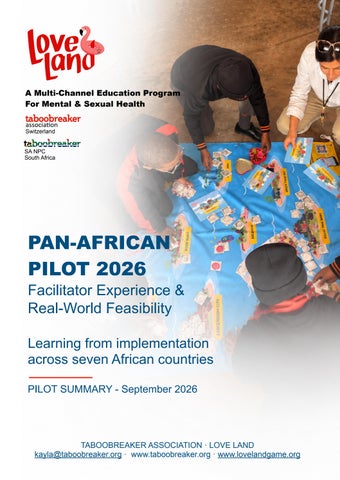
PAN-AFRICAN PILOT 2026 Facilitator Experience & Real-World Feasibility Learning from implementation across seven African countries PILOT SUMMARY - September 2026
TABOOBREAKER ASSOCIATION · LOVE LAND kayla@taboobreaker.org · www.taboobreaker.org · www.lovelandgame.org 1
Love Land Pan-African Pilot - 2026
EXECUTIVE SUMMARY
LOVE LAND A PAN-AFRICAN PILOT Facilitator Experience & Real-World Feasibility | 2026 Love Land is a multi-channel learning ecosystem that brings young people and trusted adults together to learn about sexual and reproductive health and rights, relationships and mental wellbeing through play, skills enhancement and conversation. Its development is informed by previous evaluation and evidence work with the University of Cape Town and Costello Medical, UK. In 2026, Love Land’s facilitated Board Game was piloted through 14 organizations across seven African countries. Twenty facilitators contributed data to the evaluation. Based on the post-pilot data available, participating organizations reached at least 3,172 young people. The evaluation focused on facilitator experience and game feasibility, using facilitator self-report before, during and after implementation. It did not independently measure participant-level outcomes. THE PILOT ASKED A PRACTICAL QUESTION: Can facilitators in diverse African contexts adopt Love Land, deliver it confidently and safely, and adapt it to real-world conditions? HEADLINE FINDINGS The findings show strong acceptance among facilitators, confidence that grew with real-world use, and clear lessons for expanding the program responsibly.
THE LOVE LAND ECOSYSTEM A multi-channel approach to learning, connection and support
In working progress
2
Love Land Pan-African Pilot - 2026
THE PAN-AFRICAN PILOT
WHAT CHANGED? From Preparation to Practice The pilot deliberately placed the Love Land board game in the hands of organizations working in very different environments across Rwanda, South Africa, Mauritius, Zambia, Kenya, Lesotho and Tanzania.
This allowed the evaluation to look beyond how facilitators rated Love Land at the end and ask a more interesting question: What changed once they actually started using it? FACILITATOR CONFIDENCE The largest matched pre/post gain in the evaluation
Among the 11 facilitators with matched data, 10 increased or maintained full confidence. Much of this growth happened early, with 80% reaching 5/5 by the mid-pilot check-in. Confidence grew most through doing. Other measures changed little: safe and open facilitation increased from 4.80 → 4.85, while handling conflict or emotional responses remained stable at 4.53 → 4.54. KEY TAKE-AWAY Practice builds facilitator confidence, but difficult situations still require professional support and strong systems.
LGBTQIA+ topics stood out for lower initial facilitator confidence and were later requested as a dedicated topic.
The 3'172 reach figure is based on organizations’ latest self-reported cumulative reach and is not independently verified. Some organizations continued using Love Land beyond the formal pilot period, while one organization did not provide post-pilot data. Actual cumulative reach is likely to be higher.
3
Love Land Pan-African Pilot - 2026
WHAT FACILITATORS EXPERIENCED
STRONG SIGNALS ACROSS KEY AREAS Across almost every post-pilot measure, facilitator ratings were high. Four results capture the strongest signals:
What facilitators experienced - more than enjoyment The strongest ratings point to something more significant than facilitators simply liking the game. Love Land appears to help create the conditions needed for sensitive conversations: energy and participation, greater engagement with difficult topics, and reduced stigma around subjects that are often hard to discuss. Supporting learning through play Peer learning Helping shy participants open up Making sensitive topics easier to facilitate
Voices from the field “When a child moves from silence to voice in 45 minutes, we know the game is working.”
“With each session I became more comfortable... I learned how to encourage participation from both outspoken and shy participants.”
“The game does something regular lecturing never could: it builds immediate trust and peer solidarity.”
Moswen NGO · South Africa
RWASH · Kenya
Komboa Jamii Initiative · Kenya
From positive feedback to local ownership Positive feedback was followed by something potentially more meaningful: Organizations began asking to use Love Land more.
93% of organizations independently requested additional game sets
13 / 14
+2
Pilot partners have integrated Love Land into their programs
additional facilitators trained by RWASH in response to demand
High satisfaction is encouraging. Choosing to use Love Land beyond the pilot is a stronger signal of emerging local ownership.
4
Love Land Pan-African Pilot - 2026
FROM INSIGHTS TO ACTION
KEY LEARNINGS AND NEXT STEPS The pilot identified four practical priorities for responsible growth. KEY LEARNINGS SAFEGUARDING & REFERRAL SUPPORT A serious home situation was disclosed during a session and the facilitator had no professional counsellor available for referral. Implication: Every implementation context needs a simple, usable safeguarding and referral pathway.
LOCALIZATION MEANS MORE THAN TRANSLATION Facilitators requested Xhosa, Sesotho and Swahili versions. The pilot also revealed a legalcontent mismatch in a different country context regarding of consent. Implication: Localization must include language and country-specific legal and contextual review.
LGBTQIA+ CONTENT NEEDS FURTHER DEVELOPMENT LGBTQIA+ emerged as an area of low facilitator comfort, was requested as a dedicated topic, and is not yet represented by a dedicated Love Land island. Implication: Specialist review should inform both content development and facilitator support.
FACILITATORS WANT MORE SUPPORT & CONTENT Multiple organizations requested a stand-alone Facilitator Manual with deeper topic content, practical activities and discussion guidance, as well as additional Q&A booklets for the board game covering more topics, alongside support for difficult questions, group dynamics and conflict. Implication: Further develop the practical manual and establish additional Q&A booklets to deepen content and strengthen facilitation support.
The pilot gives Love Land more than encouraging ratings. It provides evidence of real-world feasibility, facilitator confidence and emerging partner ownership; alongside a clear picture of what responsible The next phase is therefore not simply about reaching more young people. It is about using what we have learned to make Love Land safer, more locally relevant and better supported as it grows.
5
Love Land Pan-African Pilot - 2026