

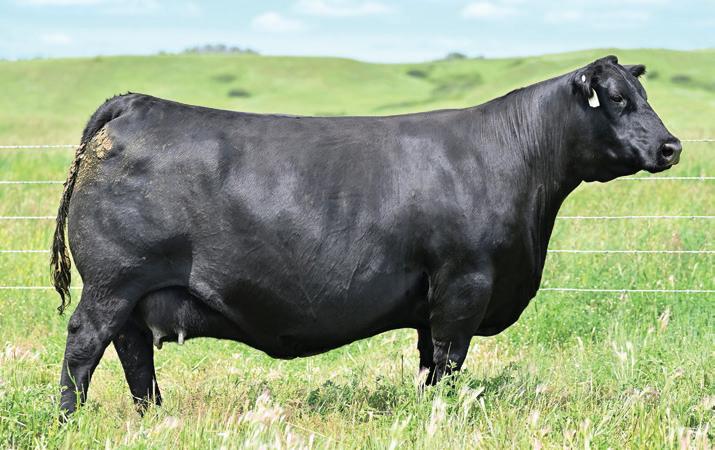
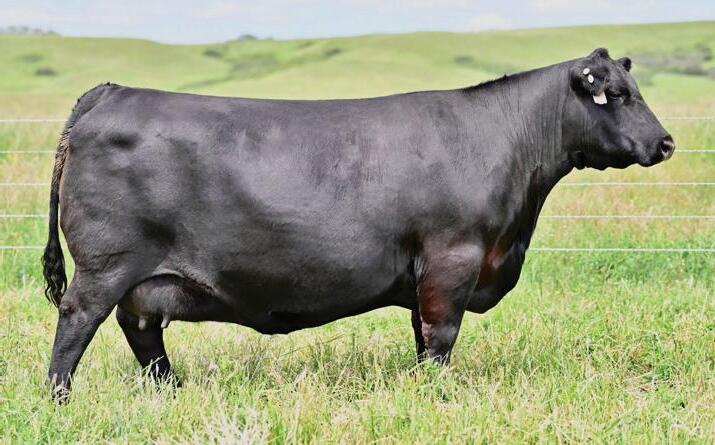
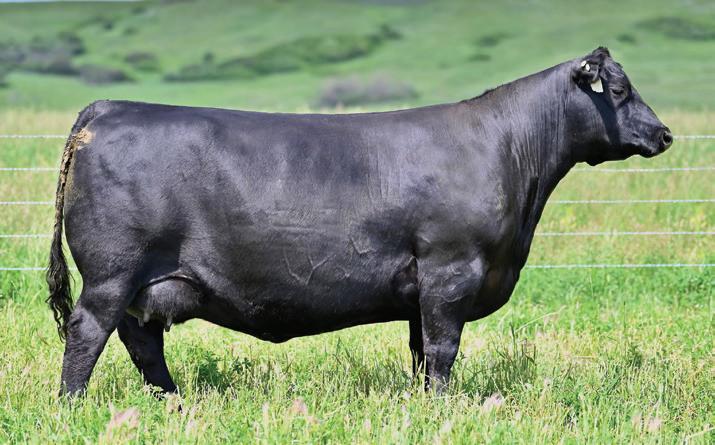
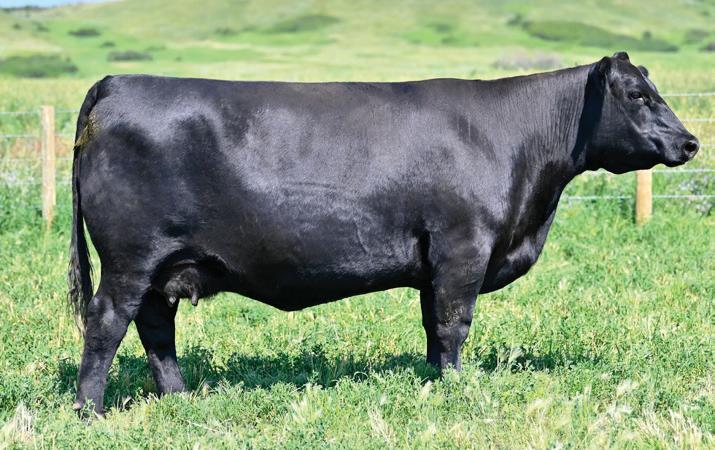
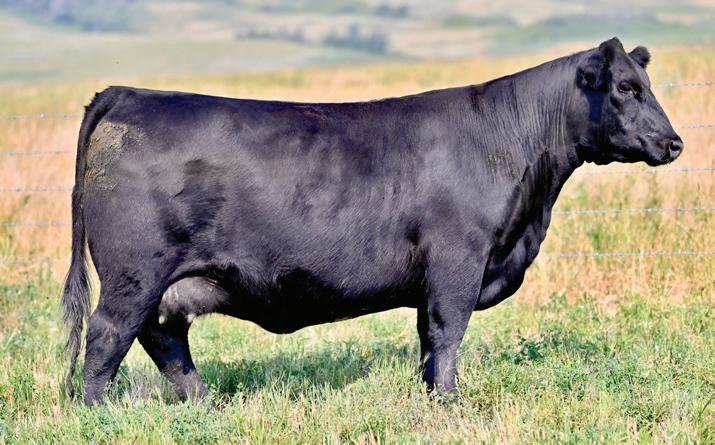


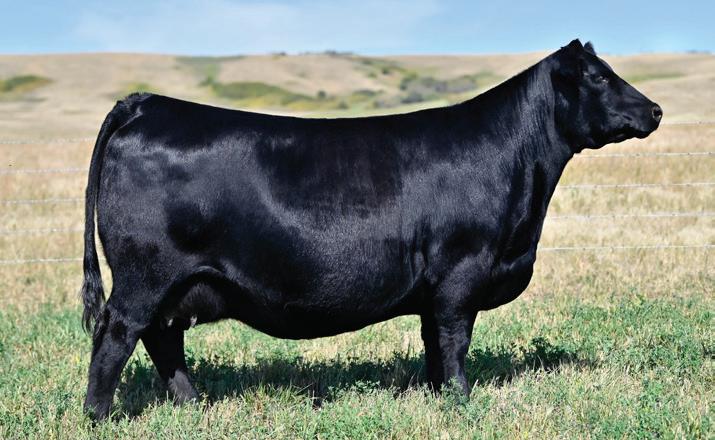
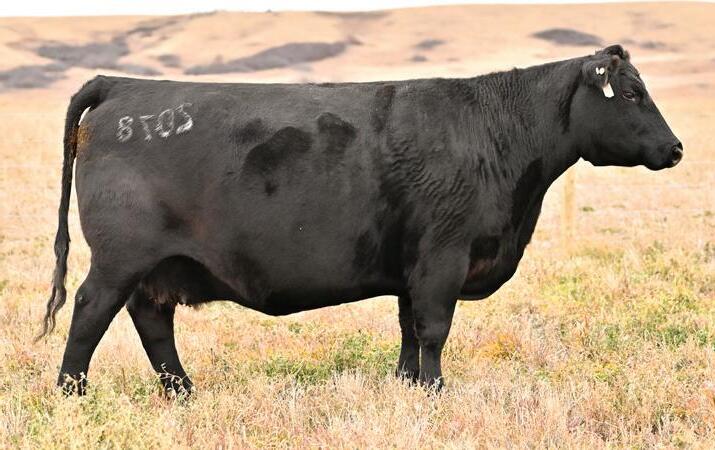
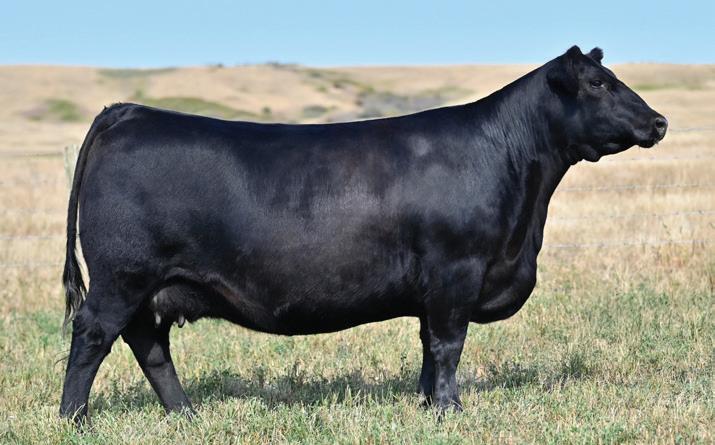

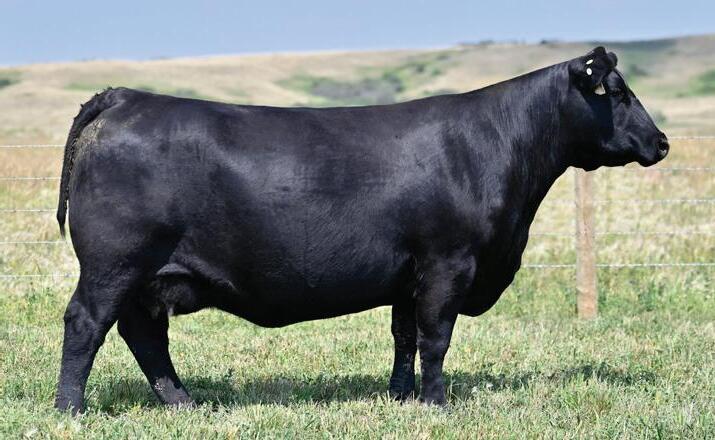


Bar-E-L Black Miss 73E
Bar-E-L April 51F
Bar-E-L Magnolia 127F
Bar-E-L Mardi 157K
DMM Kristina 65L
Bar-E-L Magnolia 105E
Bar-E-L Bride 131K
Bar-E-L Naomi 81H
Bar-E-L Duchess 70Z






BY CHRIS POLEY
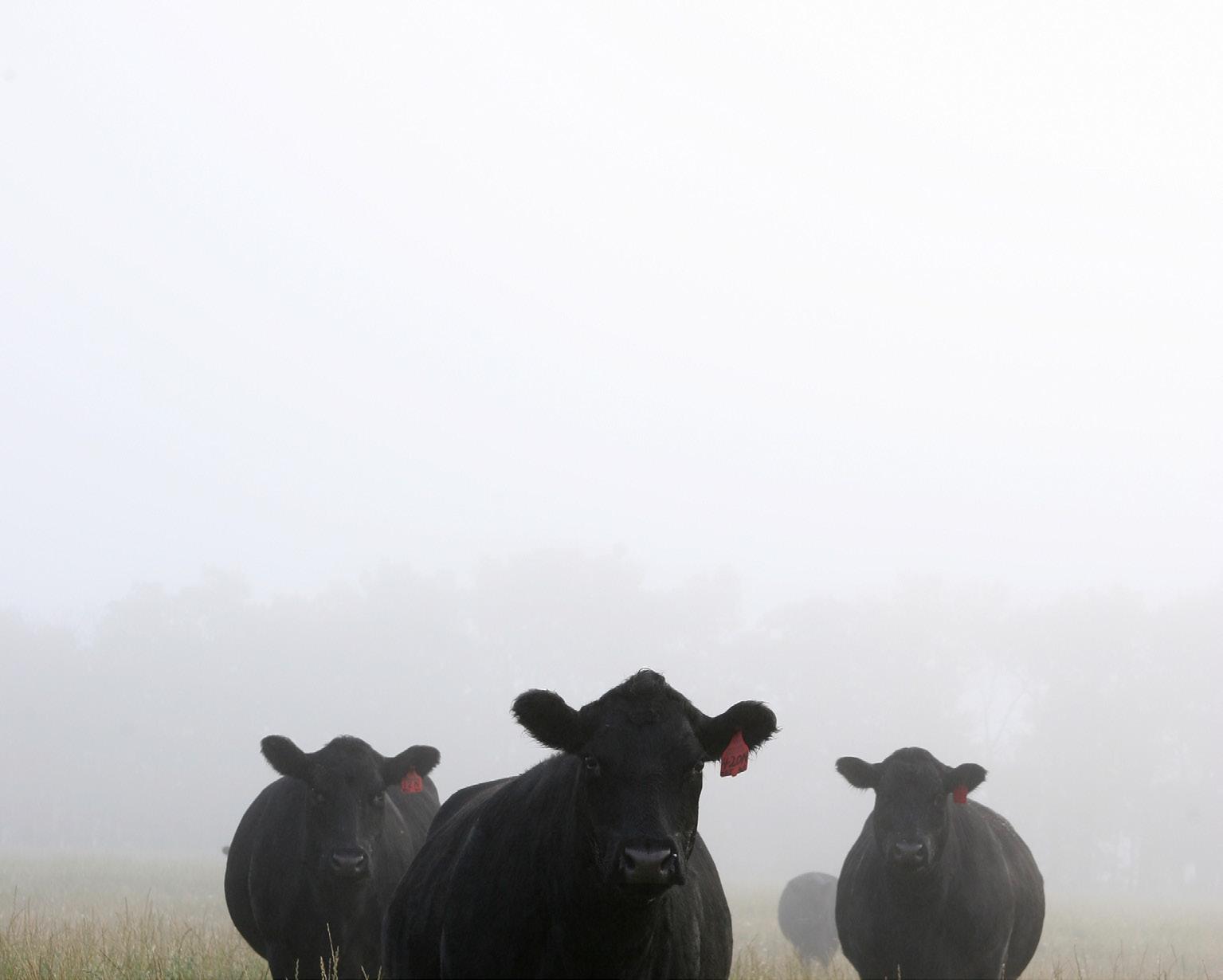

This past bull sale season has been one for the record books. Strong demand, active bidding, and high averages have become the norm rather than the exception. For many seedstock producers, it has been both exciting and rewarding to see years of careful breeding decisions and program development recognized in such a meaningful way.
But this success did not happen in a vacuum… it is a direct reflection of what is happening in the commercial sector.
The driving force behind this momentum is the current record-high feeder cattle market. Commercial producers are finally seeing prices that not only cover their costs but leave room for profit. When feeder cattle prices are strong, confidence returns to the countryside.
That confidence shows up at bull sales, where cattlemen are willing to invest in quality genetics that will push their programs forward. Simply put, when the commercial producer succeeds, the entire industry benefits.
What makes this moment particularly meaningful is the context behind it. For decades, beef producers have operated on extremely tight margins. Rising input costs, volatile markets, and unpredictable weather have tested even the most resilient operations.
Over the past twenty years, we have lost far too many good producers who either could not withstand the financial pressure or who simply grew tired of working tirelessly without fair reward. Each of those losses has been felt deeply in rural communities and across the industry as a whole.
That is why today’s market feels different. It feels earned. The current profitability is not the result of a short-term trend or luck; it is the payoff for years—often generations— of persistence, discipline, and grit. It belongs to the cattlemen and women who stayed committed to their cow herds through the hard times.
The ones who tightened their belts, made difficult decisions, and kept moving forward even when the outlook was uncertain. I tip my hat to those producers.
There is something deeply gratifying about seeing hardworking farmers and ranchers finally receive the returns they deserve. These are people who have dedicated their lives to producing a safe, sustainable, and high-quality product. They rise early, work late, and carry a responsibility that extends far beyond their own operations, they help feed a growing and hungry world with the best protein available.
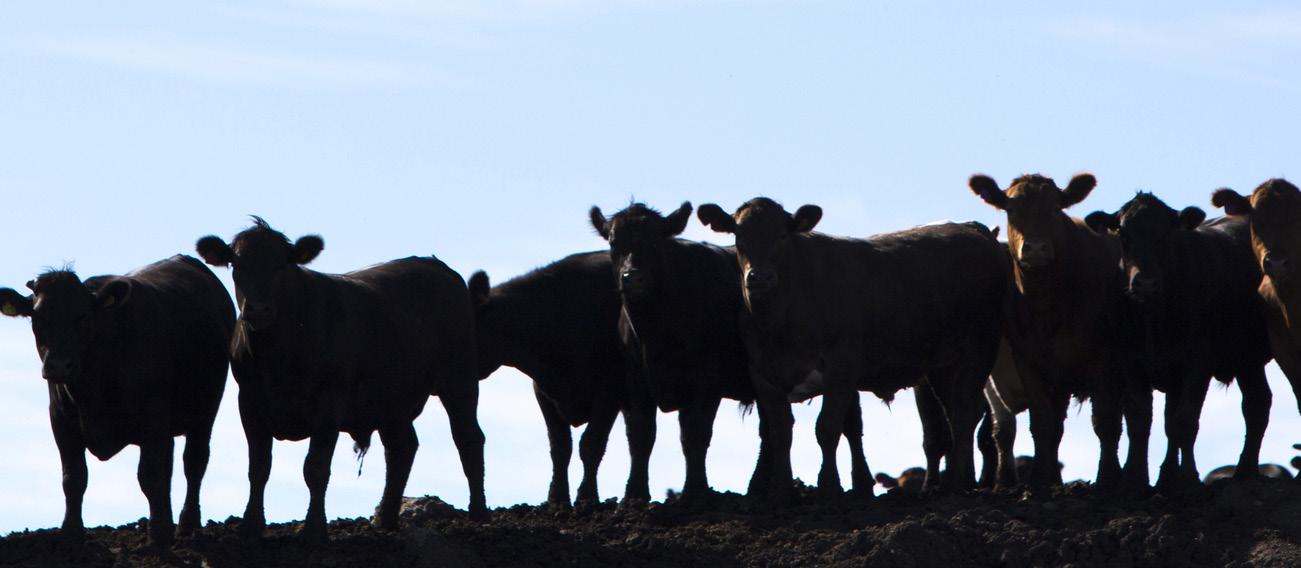
As we look ahead, there will inevitably be challenges again. Agriculture has always been cyclical, and no market stays at record levels forever. But for now, it is worth recognizing and appreciating this moment.
It is a reminder that perseverance matters, that good management pays off, and that the foundation of this industry, our commercial cow-calf producers—is as strong and resilient as ever.
This is the real world of the cattle business. And right now, it is rewarding the people who have earned it the most.




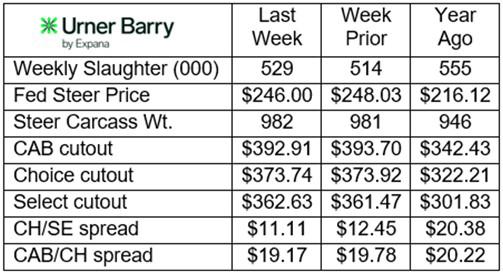
Fed cattle prices moderated slightly in last week’s trade with a $2/cwt. decline to average $246/cwt., just off the record high observed two weeks ago.
Last week’s 529K harvested total appears robust in a season when an erratic pattern of weekly head counts has bounced between 502K and 529K since mid-March. No doubt, worsening packer margins have been the overriding theme—intertwined with the temporary JBS –Greeley, Colo., plant shutdown— through this timeframe.
In reviewing total federally inspected harvest numbers, it’s important to factor in the normal seasonal decline in cull cow harvest during the spring. This year, the cull dairy cow harvest has declined from 60K head per week to 50K per week (-16%) from mid-February through early April. In the same period, cull beef cows have pulled back from 40K head to about 36K head (-10%) weekly. The confirmed year-todate total cow harvest is down 4.6% compared to last year, whereas the fed steer and heifer total is down 8.8%.
The month of April closes out with a bang as Live Cattle futures set new record-highs. With one day left on the contract, April Live Cattle traded at $256.35/cwt. by noon Wednesday. New highs will be recorded this week in the spot market as well, with Tuesday’s fed cattle business primarily conducted at $255/cwt., a $9/cwt. leap since Friday.
On the boxed beef side of the ledger, the market has recently eased lower in expected seasonal fashion from March through April. As the calendar turns to May, the smaller fed cattle harvest volume has turned a bit higher, driven on increasing end-user volume needs. Even so, market anticipation is that spot beef demand will get a boost from overall tighter supplies and continued consumer demand.
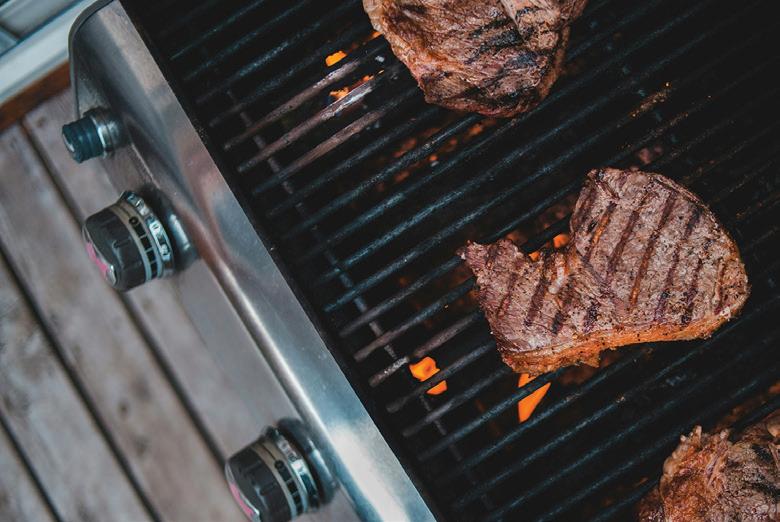
May is “Beef Month,” and many in the supply chain are anxious to see what this important season has in store for cattle and beef values. So far in 2026, consumers have shown strong support for the most preferred protein in the market. Yet higher cutout values may test demand as higher gasoline prices and weakening consumer sentiment raise caution. A look at wholesale prices indicates that demand for middle meat (ie: steak) remains seasonally mixed, with CAB ribeyes recently priced at $11.80/lb., 14% cheaper than a year ago and 7% cheaper than a month ago.
A strong weakening in the rib price trend in April is not uncommon, as 3 of the last 5 years saw a similar downtrend, while 2021 and 2025 featured a rapidly increasing rib market.
By Paul Dykstra
A conservative estimate suggests wholesale ribeyes could rise above $14.00/lb. by June, adding nearly $40 of value per carcass. Tenderloin demand typically increases modestly ahead of Mother’s Day, with just a 14% increase from February seasonal lows to early May. This year has featured a 4.5% softening of wholesale CAB tenderloin prices for the season since early March. Strip loins are the classic “in demand” steak cut for spring, with a 26% price increase dating back to January 1 through June over the past 5 years.
This year’s price pattern is developing near expectations, with a recent 6% pullback from the March high. There is plenty of room for strip loin prices to increase 15% by late June. Shifting focus to the lower-priced steak options shows strong recent demand for these cuts. CAB® top sirloin butts had a massive price run in the first quarter, with a 22% increase into mid-March. This uncharacteristic early demand has since corrected lower, but historic sirloin price patterns suggest a potential 15% wholesale increase by mid-June.
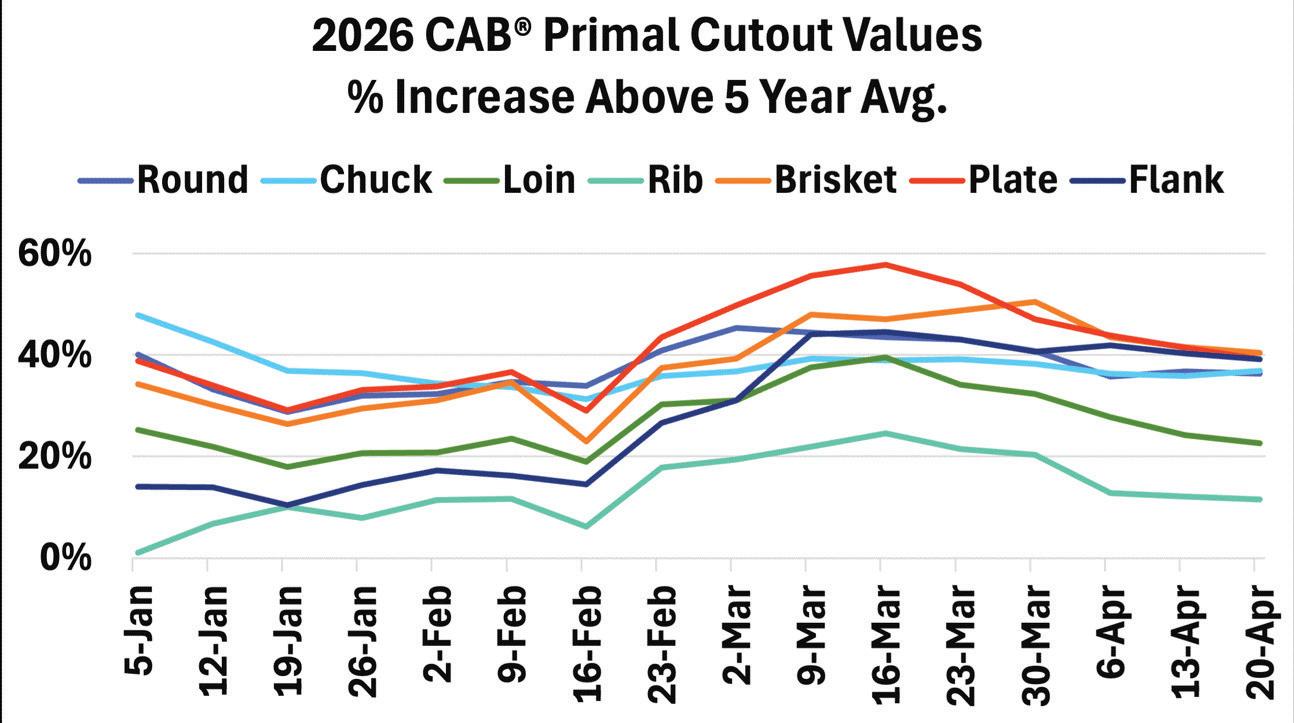
The loin complex is currently boosted by chart-topping ball tips, priced at an amazing 50% increase over a year ago and a stout 44% higher than early February. This popular item for Cinco de Mayo typically gets a small seasonal increase ahead of the early May holiday. This year’s unexpectedly high demand suggests broader use of the cheaper cut, even as the current $6.67/lb. wholesale average nears its record high of $6.90/lb. touched briefly during the pandemic shutdowns.
Also from the loin primal, CAB® tri-tips are recently 31% pricier than a year ago, steadily higher within seasonal expectations. In keeping with other loin items, tri-tip prices are historically expected to increase by another 23% through June.
Briskets, flanks and plates combine to make up just 15.5% of total carcass weight. Unfortunate, given that these lighter primals are seeing some of the stoutest demand, marked by major price increases, of any beef cuts. The average price increase across the three is 38% over a year ago, while the total CAB® cutout price is just 15% over a year ago. Carcass cutout values show a promising setup with plenty of room to run higher over the next 60 days.
Underpinned by ground beef prices, grilling demand should pull not only ribeye and strip loin prices higher, but also a handful of value steak items, which will likely gain attention as consumers budget their beef buying. Anticipated spot market demand growth will be important to keep processing margins moving in the right direction as fed cattle costs mark new record-highs.
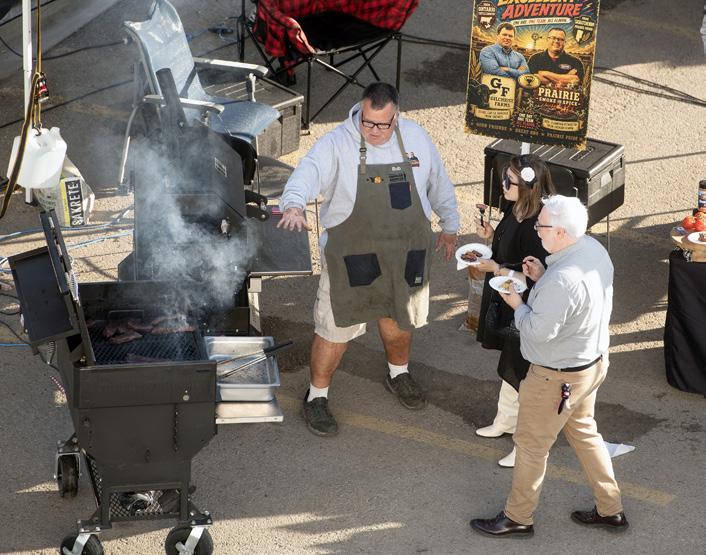
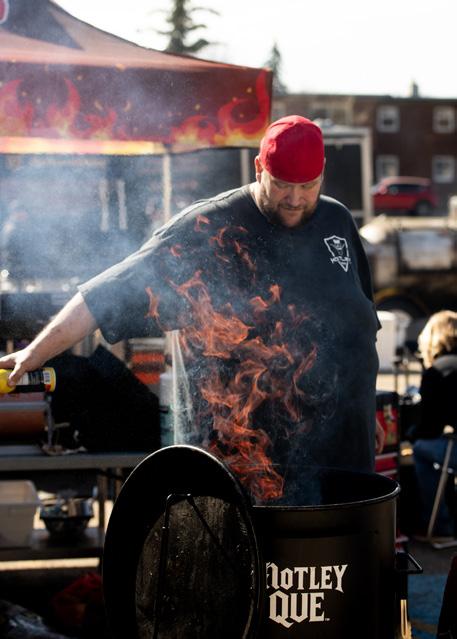
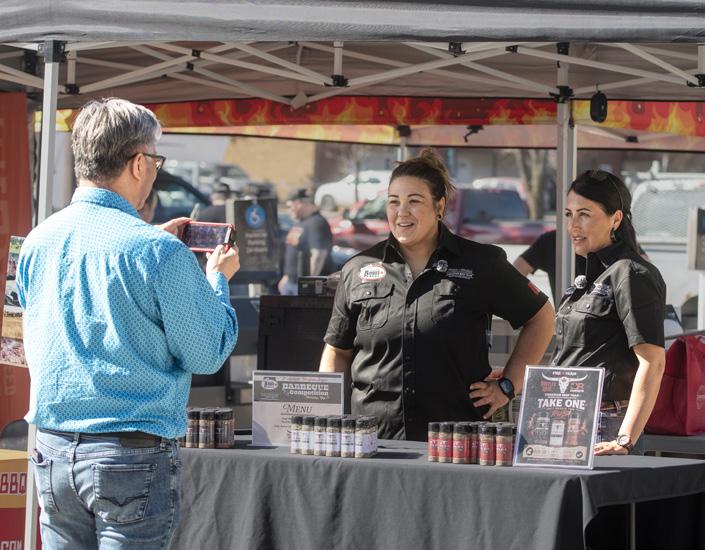
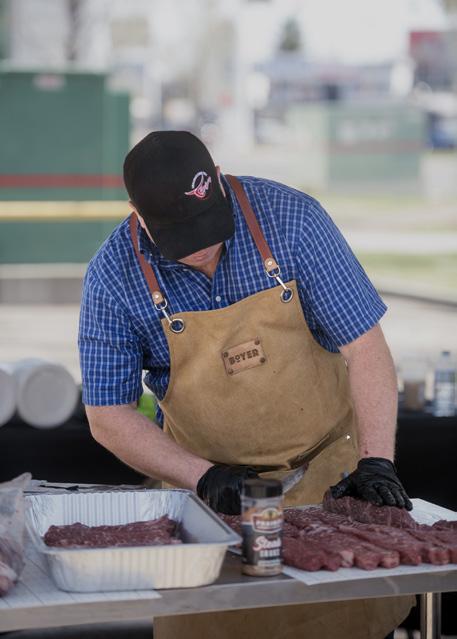
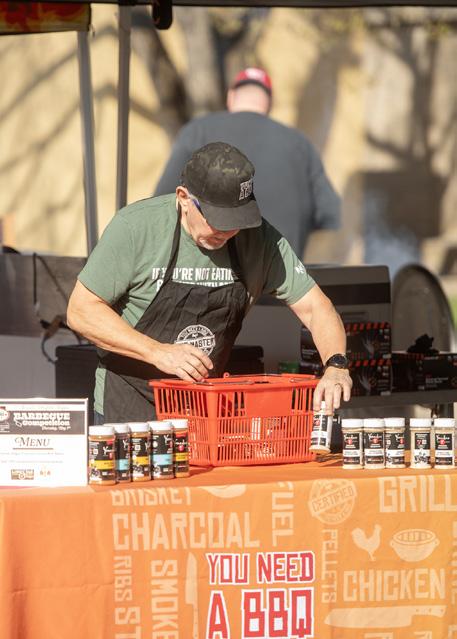
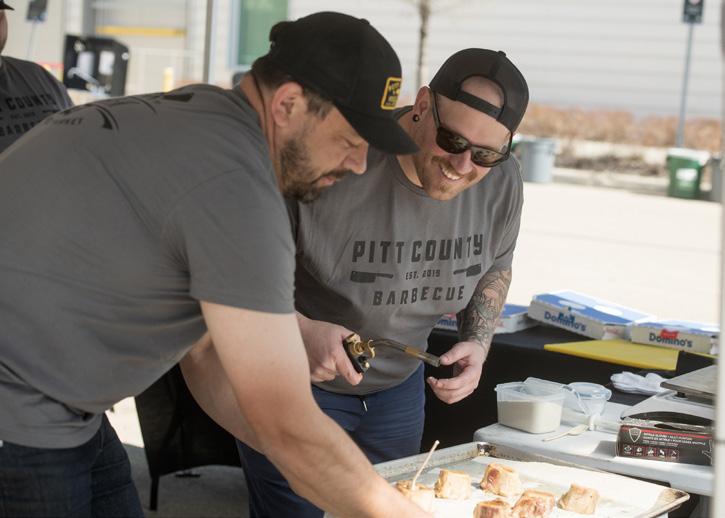
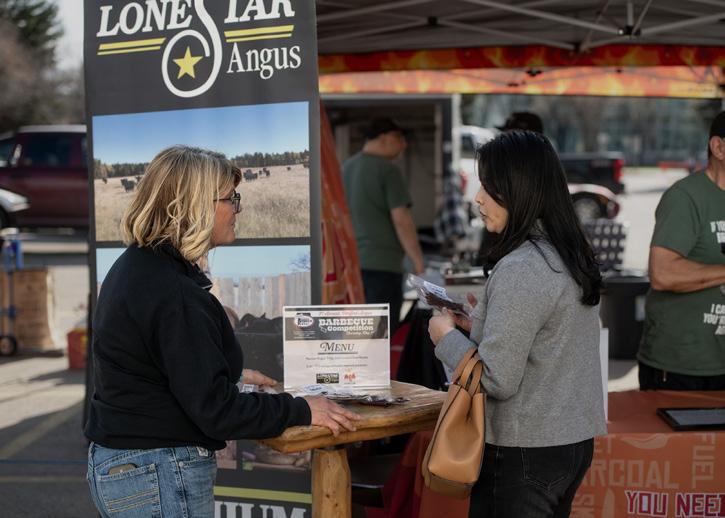
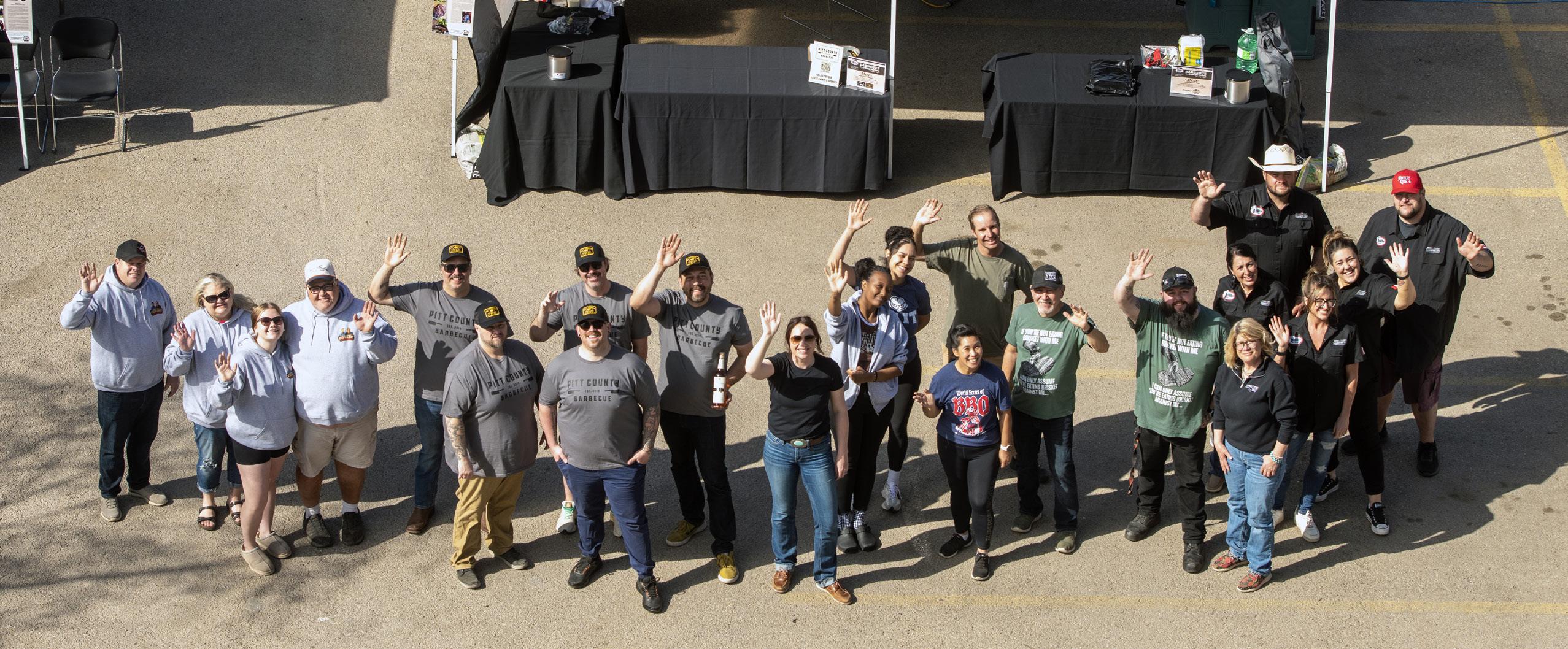
The 3rd Annual Verified Angus BBQ Cook-Off, hosted on May 7 at NAIT in Edmonton, brought together producers, pitmasters, industry leaders, culinary students, and international guests for an unforgettable evening celebrating the quality and versatility of Canadian Angus beef.
Held as the opening reception for the Hong Kong-Canada Business Association (HKCBA) National Conference, the event welcomed 309 registered guests, including delegates and business leaders from across Canada and Hong Kong. Interest in the event exceeded capacity, with many additional requests for attendance leading up to the evening.
The cook-off paired Canadian Verified Angus producers with talented pitmasters from across Canada in a friendly but highly competitive showcase of creativity, collaboration, and exceptional beef.
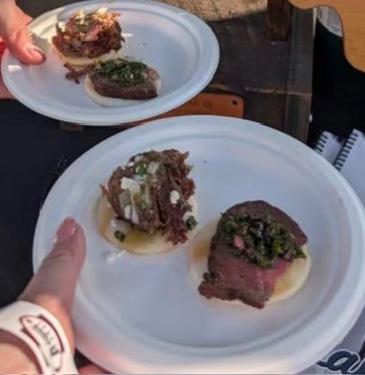
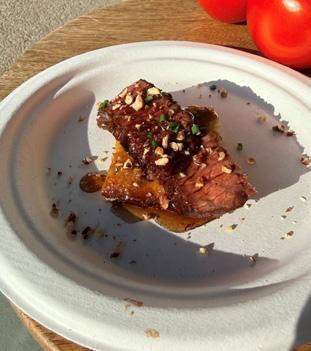
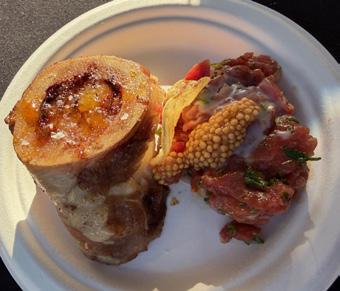
Guests experienced an incredible range of dishes that highlighted the versatility of Verified Angus Beef, from individually crafted beef wellingtons to smoked bone marrow finished with bourbon brûlée, and Korean Angus Tritip with Candied Beef Bacon. The creativity and skill demonstrated by each team made the judging process no easy task.
After an evening of tasting and competition, the final standings were announced:
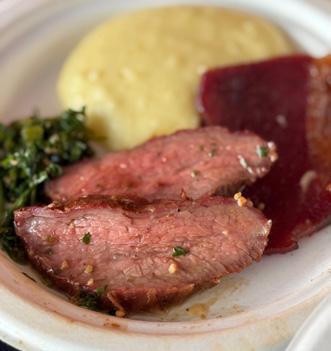
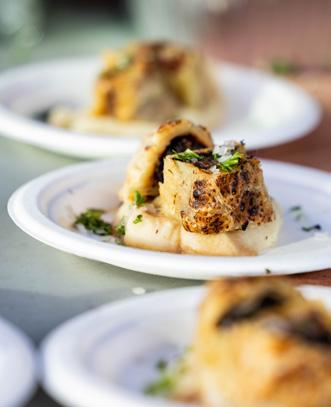




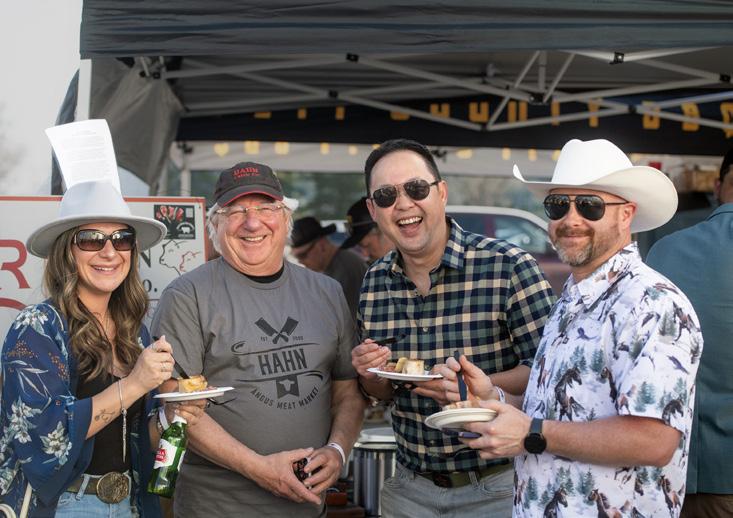
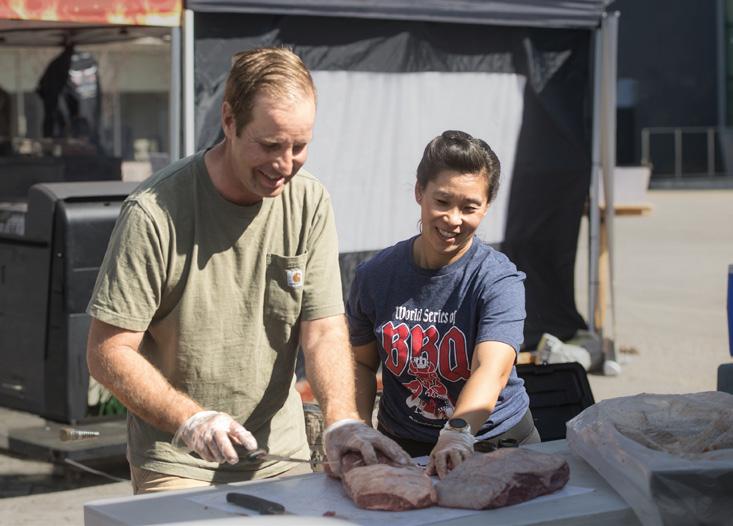
Beyond the competition itself, the event created valuable opportunities for connection and promotion between producers and pitmasters. Several teams have already begun cross-promotional efforts following the event, reinforcing the long-term value and relationships built throughout the day.
A particularly meaningful component of the evening was the involvement of NAIT culinary students. Team Smella Que & Hamilton Farms was the team supported by students, and those volunteers gained valuable hands-on experience in a fast-paced culinary environment, learning directly from seasoned BBQ professionals and interacting with producers and international guests.
The event also served as an important opportunity to showcase Canadian Angus beef to an international audience. Through conversations, networking, and of course exceptional food, guests experienced firsthand the quality, consistency, and culinary potential of Verified Angus Beef and the dedication of the producers behind it.
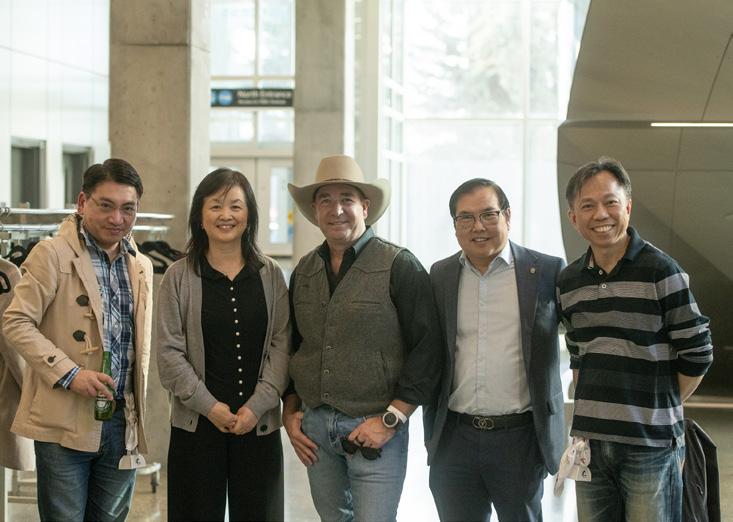
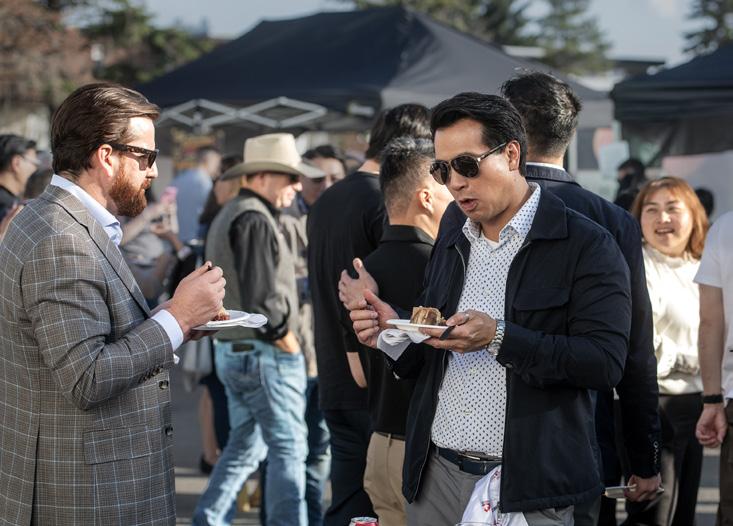
The Canadian Angus Association would like to extend sincere thanks to all participating producers, pitmasters, volunteers, NAIT staff and students, event partners, sponsors, and the HKCBA delegates who helped make the evening such a success.
The atmosphere throughout the event reflected exactly what the Angus community does best; collaboration, hospitality, innovation, and pride in producing world-class beef.
Following the overwhelming success and excitement surrounding this year’s event, we are already looking forward to building on that momentum at the 4th Annual Verified Beef BBQ Competition. The enthusiasm from producers, pitmasters, partners, and guests alike reinforced the value of bringing together great people, great food, and the shared passion behind Canadian Angus beef - and we can’t wait to do it again.

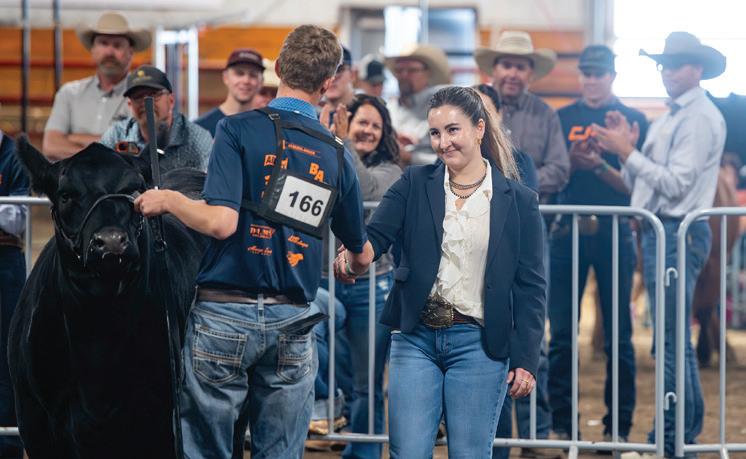
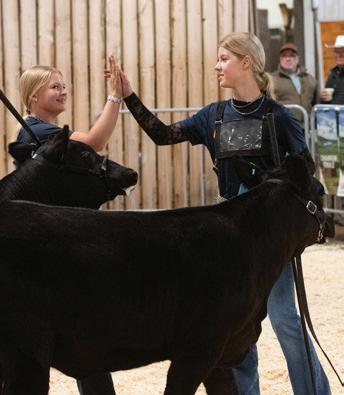
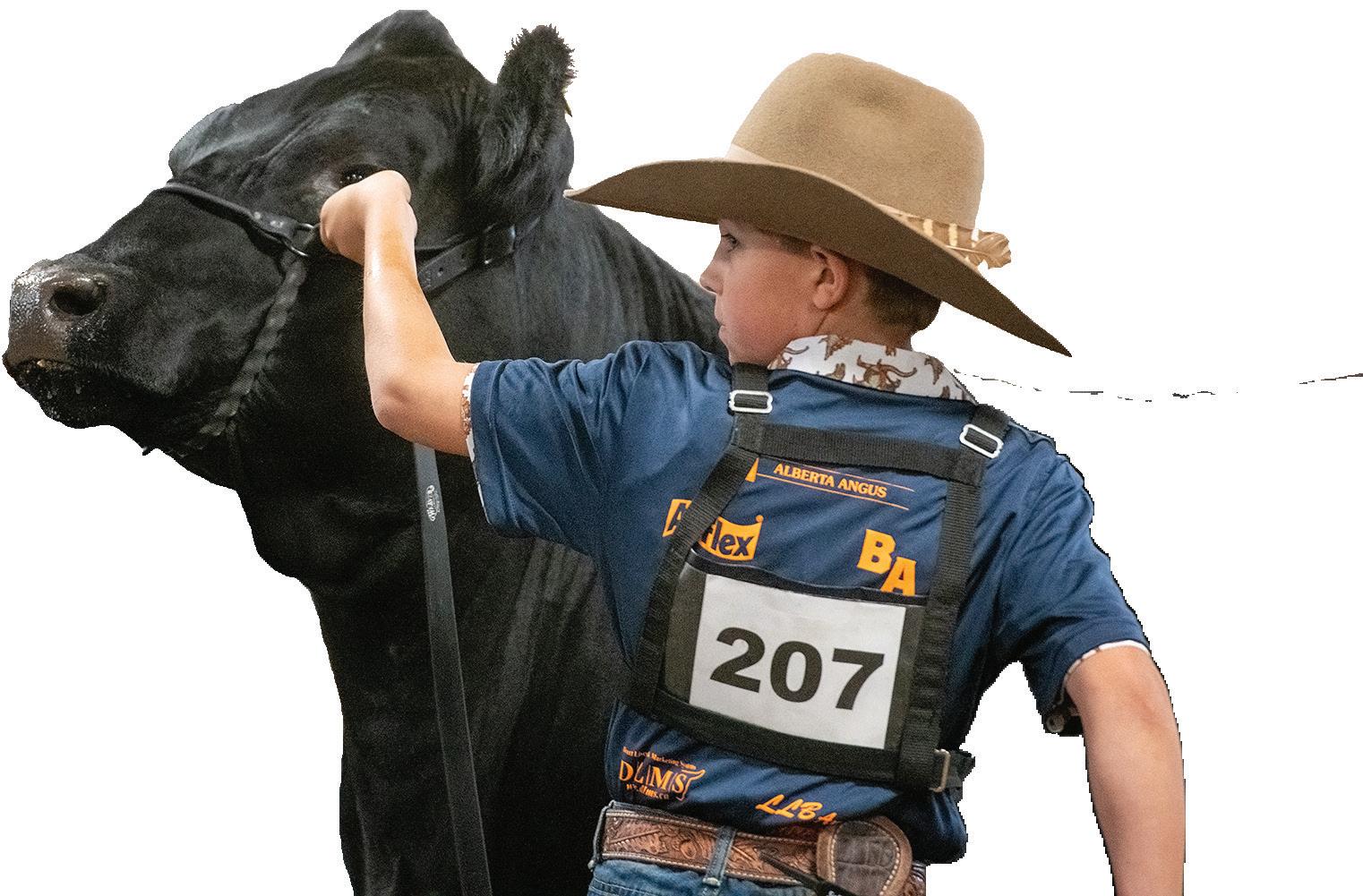
MOVE IN BEGINS JULY 15 AT 1 PM AYER’S CLIFF, QC JULY 16-18, 2026
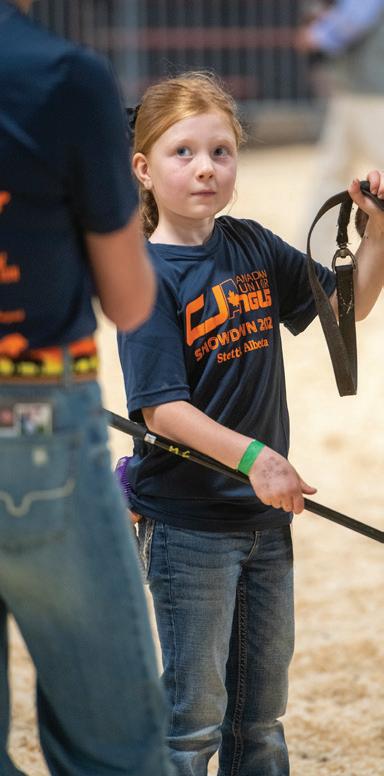
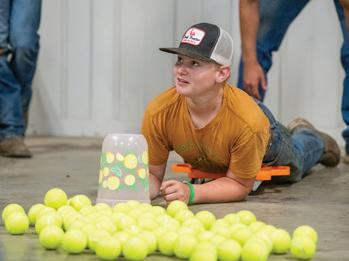
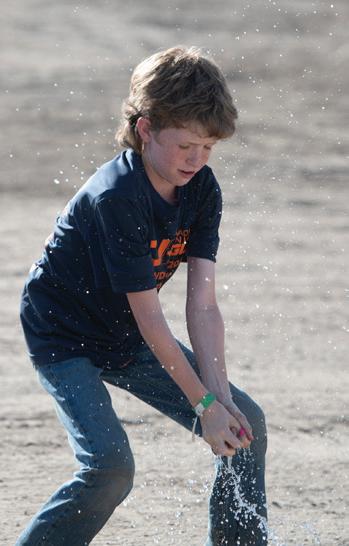

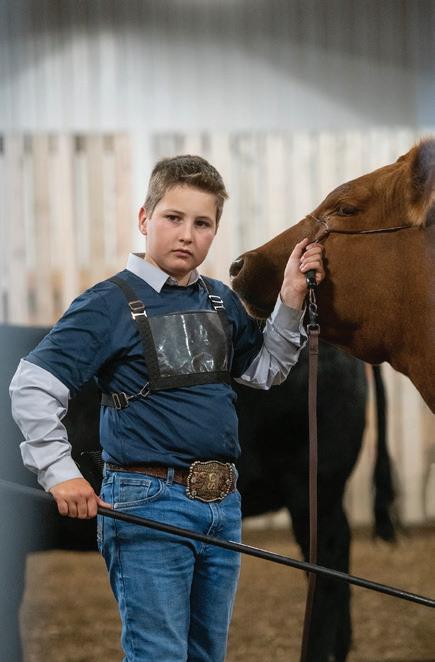
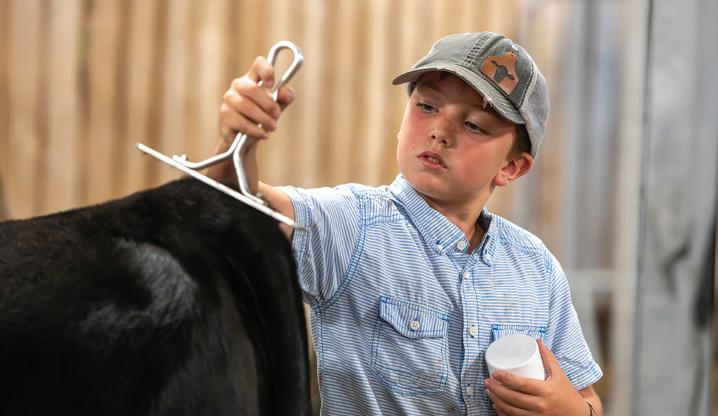
The Canadian Angus Foundation will provide travel and trucking bursaries to attend Showdown as well as significant cash prizes and scholarships for the Aggregate Winners.
There will also be three draws made for vouchers to purchase Angus females—one at $3,000 and two at $2,000. All exhibitors will automatically be entered to win!
Visit the Canadian Angus Foundation website at www.cdnangus.ca/foundation for more information and to apply for the bursaries.
For up-to-date Showdown information or to enter online, please visit www.cdnangus.ca/canadian-junior-angus/showdown
Allison Morse, Quebec Director: 819-212-7177
Kylie Willms • President: 306-380-4595
Belinda Wagner • Coordinator: 306-537-1518 or bwagner@cdnangus.ca
Thursday, July 16, 2026
11 am • Move in complete • CJA Annual General Meeting & Orientation
12 noon • Lunch
12:30 pm • Judging (individual competition – written reasons)
1:30 pm • Team Grooming 5:30 pm • Supper & Extravaganza
Friday, July 17, 2026
8:30 am • Group Photo
9:00 am • Showmanship
9:00 am–1:00 pm • Print Marketing
12 noon • Public Speaking
1:00–4:00 pm • Sales Talk
2:00 pm • Team Judging (must qualify from individual competition) 6:00 pm • Cook-off & BBQ
Saturday, July 18, 2026
9:00 am • Heifers of Distinction 10:00 am • Conformation Classes
5:00 pm • Banquet, Awards Presentations, Auction & Dance


By
This is an age-old problem that does seem to be improving with time. First off, we have to look at the number of seats available for veterinary students in general. Currently there are the two veterinary schools in Western Canada and three in the East. Calgary has 50 students per class but that just started to increase to 100 with the first years. What that means is in 3 years, there will be an additional 50 graduating veterinarians in Calgary who could go anywhere in Canada to practice.
The admission process is changing slightly with more weighing on the interview and essay questions, references, etc. Marks still get you the interview, and the interview gets you in. I think this may put rural students on maybe an even playing field. My experience is that all rural kids need to leave home for university and overall, there is an acclimatization time to get used to the big city. Over my career, I have met many promising sons and daughters of cattle producers and purebred seedstock producers, as well as those from acreages with a real interest, aptitude and skill level for production animal practice. The sad thing, even though they were all good students and getting decent grades, the competition is so keen that exceptional marks were often required. Now that is getting equilibrated and we will see applicants in Calgary from all walks of life and location in Alberta. I believe the same sort of thing is happening at other veterinary schools. If you know of someone seeking a career choice in vet medicine, whether it be a family member, relative or neighbor. Please encourage them and point them initially to getting mentored by a local veterinarian preferably to show them the process.
I saw one veterinarian in a similar article to this talking about how hiring veterinarians with a certain skill level was difficult. I would argue their skill level is generally quite high from the veterinary schools in Canada. That is evident by the scores in the National Licensing Exams. What they lack is experience and that is why Calgary students spend almost their entire year out in clinical practices to gain work experience, and they are marked and evaluated on this. They may of course lack experience but with proper mentorship at the clinics they are hired at can be quickly overcome in almost all cases. I have personally been more than impressed with the recent graduates entering large or mixed animal practices. The issue is really that there are not enough of them, and this is getting rectified. The other issue is that they may gravitate away from the province they grew up in. Many Saskatchewan students that are trained in Saskatoon gravitate to other provinces, which is probably not totally fair when Saskatchewan government coffers subsidized their education. Currently there is no mandate to work in the province that helped with your education and veterinary graduates have a multitude of reasons to go where they do. From the type of practice situation job opportunity, climate, wages and benefits offered. They may be following a spouse or significant other, but the vast majority do go back to their home province - at least initially.
There are several reasons I am telling you all this. These days, especially in the purebred business, some veterinarians specialize in embryo transfer, others do lots of semen evaluating over a large area. Some even get their hands in synchronized breeding. At the clinic I was affiliated with, one veterinarian has taken a real
interest in lameness and feet related problems. Some practices don’t do regulatory work such as export testing, others promote it. Veterinarians are doing herd health and now telemedicine or phone consultation can help in specific situations.
Lots of obstetrical cases and individual animal medicine are done in most clinics. I would suggest that the clinics that are busy promote and follow through with both health and preventative medicine as well as the individual animal medicine. They also need to make some arrangements for emergencies.
You as a producer/purebred breeder often use veterinarians that are local and have the expertise and are available for the things you need. If there are specific surgical or medical requests beyond what they feel competent in, a referral to another clinic or veterinarian within the clinic can happen. You generally will find the veterinary community is small and they can pool resources to get what’s best for your purebred stock. We often work hand in hand with nutritionists, foot trimmers, and AI specialists (and by that, I mean artificial insemination, not artificial intelligence).
The beauty of these days is you can take videos and pictures and send them to your herd veterinarian and their clinic to help you with your decision. What is imperative is having that trusting relationship. Then your veterinarian can decide whether treatment by yourself or having the patient examined or being brought into a clinic
can be made. Some things are obvious and yet others require a close examination and testing in some cases to confirm the diagnosis. If you are new to the industry, in an isolated area, or your veterinarian has just retired, talk to fellow breeders and neighbors as to their veterinary choice. The choice is ultimately yours of course, but there is also more collaboration between clinics and using a technician runs answering service is helping the workload.
The great news is as more and more work is required of veterinarians, but more are going to be graduating to meet that need. Clinics in some areas are sharing calls or covering for each other in other ways. In the more remote areas, ambulatory or locum vets are covering. Out in the field I hear more and more satisfaction in the veterinary service. For the one thing I still do which is freeze “owners use only semen” association or myself and hopefully one of us” and we as a group will help each other out if gets overloaded, because the big demand happens over two weeks. If having issues accessing a veterinarian, reach out to the Simmental Association or Veterinary Association in your province, or talk to your other professionals and I am sure they will come up with a fit to your operation. To me the philosophy of the producer and veterinarian needs to match, and you will have a great long-term vet-client relationship.
by Briley
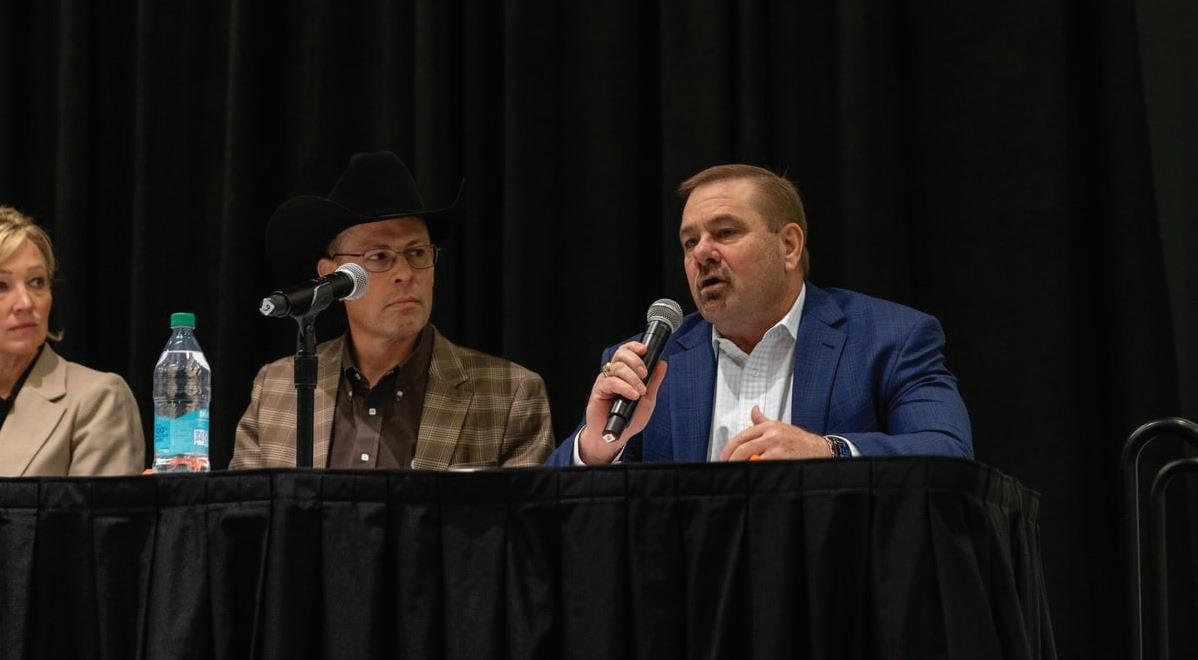
The best beef is raised the right way. This message was reinforced by remarks from Joe Don Eilers, vice president of merchandising for Sysco, who spoke as a panelist at the Beef Quality Assurance (BQA) Producer Forum during Cattle Con 2026.
Representing one of the nation’s largest foodservice distributors, Eilers shared how best practices in cattle care and beef production influence beef product, ultimately reaching the plates of restaurants and kitchen tables of consumers.
“At the end of the day, quality beef is a safe, wholesome product for our participants to use,” Eilers said, adding the ultimate goal is delivering a mouth-watering steak that keeps customers coming back for more.
Industry collaboration is key to delivering this eating experience, and programs like BQA help ensure consistency from pasture to plate. For decades, BQA has provided sciencebased guidelines and education to help family farmers and ranchers improve cattle care, product quality and consumer confidence.
“We believe in the value that the BQA program has brought to the industry for decades,” Eilers said. “That mission to bring knowledge about best practices and innovations to producers across the industry has resulted in a better product that we’re able to purchase and ultimately serve to consumers.”
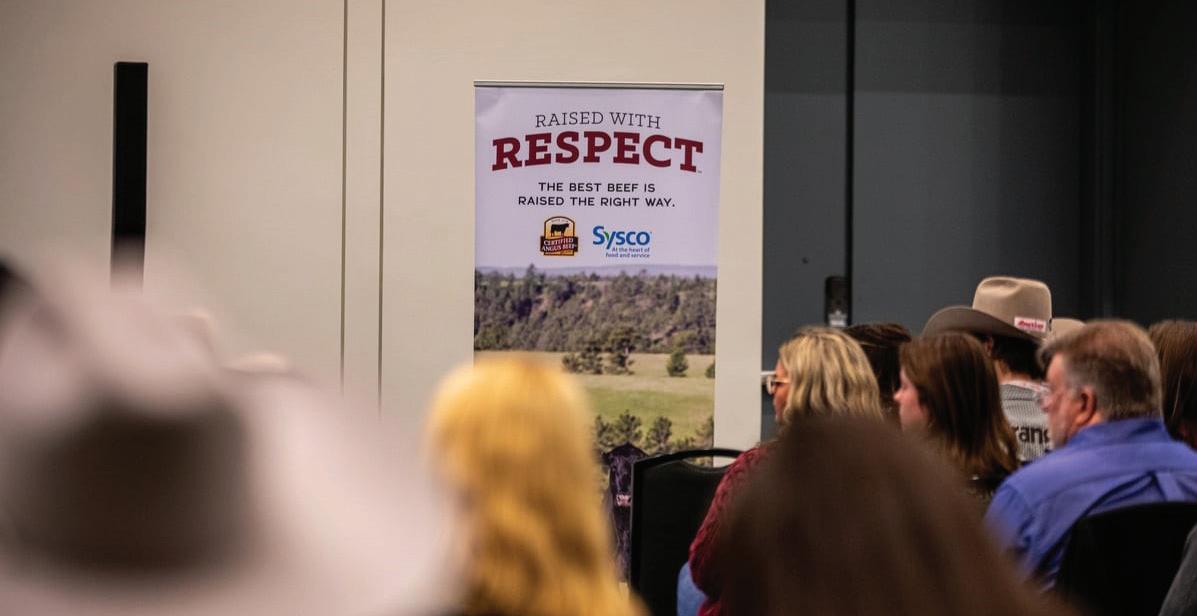
The commitment to cattle care and continuous improvement is also reflected in the Raised with Respect™ program, a partnership between (CAB) and Sysco, now in its third year. The initiative helps expand awareness of BQA principles while supporting educational resources for ranchers and additional collaboration across universities, extension systems and industry partners.
“This campaign is really about bringing another level of awareness to the work BQA has done over the years,” Eilers said, “and creating more opportunities to communicate what can be improved in beef production.”
The commitment to advancing best practices and helping to ensure beef demand recently earned Sysco national recognition; National Cattlemen’s Beef Association named the company the 2026 BQA Marketer of the Year at Cattle Con. This award highlights leaders who go above and beyond to promote BQA and support responsible cattle care across the beef industry.
“As a primary producer-facing program, BQA has been providing guidelines and resources to help cattlemen improve their cattle and resulting beef for decades,” said Josh White, senior executive director of producer education and sustainability for NCBA. “It’s exciting to see this work done on farms and ranches across the country and also lends value for how a large beef seller, like Sysco, tells the beef production story.”
For Eilers, those efforts also help build trust with consumers who want greater transparency about how their food is raised.
“Customers and consumers today want more and more information about the products they’re buying and eating,” he said. “The BQA program really helps us talk about best practices around animal husbandry and environmental stewardship, and that builds confidence in the beef producers raise.”























Box 105, Wood Mountain, SK S0H 4L0 Terry Moneo
Email: peakdot@xplornet.com www.peakdotranch.com

Stuart Redekop & Family
Box 99, Sheho, SK S0A 3T0
Stuart’s Cell: (306) 222-0540 E-mail: stuart.milliganbio@gmail.com









There’s value in simultaneously improving carcass and maternal traits in your Angus herd.
BY KARA LEE
When you look at quality grid premiums, Angus cattle continue to defy the fundamentals of supply and demand. As Angus cattle continue to improve, today there is a higher percentage of high-quality carcasses hanging on the rail, yet producers continue to get paid for it. That’s strong demand—and a clear signal back to ranchers.
These gains are driven by consumers who continue to purchase beef for its superior taste and tenderness. As this pull-through demand signal from the consumer has become evident, Angus breeders have met end-users’ increased appetite for quality beef. At the same time, Angus cows continue to offer strong maternal traits while raising calves that may later enter the supply chain. As carcass quality improves and the average marbling (Marb) expected progeny difference (EPD) for the Angus breed increases, many Angus breeders ask the supply development team at Certified Angus Beef (CAB), “Do we still need to focus on marbling?”Data says yes.
The Angus breed has a strong market share, with 72% of fed cattle being Angus-influenced. Still, only four in 10 head that meet the live animal specifications go on to meet all 10 CAB carcass specifications. In 2024, 82% of Angus-influenced cattle didn’t have enough marbling (CAB Consist Study).
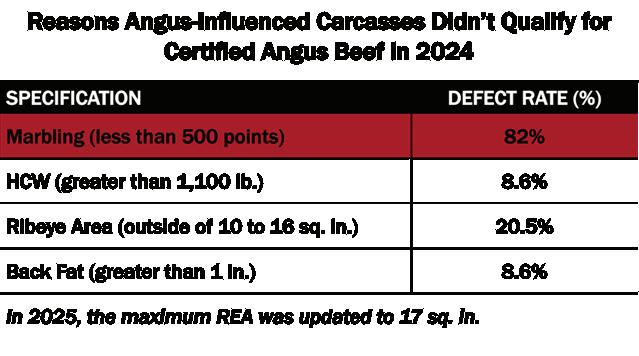
While cattle may not qualify for CAB for missing multiple carcass specifications, the greatest opportunity to increase the amount of Angus-influenced cattle that qualify for CAB are those that barely miss the marbling requirement Evaluating the marbling distribution of Angus-influenced cattle provides a clearer picture of the portion of the population that falls short of CAB’s marbling threshold. Just over 10% of our missed supply is within only 30 points of marbling. Moderate improvements in marbling can still leave room for improved selection across multiple traits while making meaningful strides in product quality.
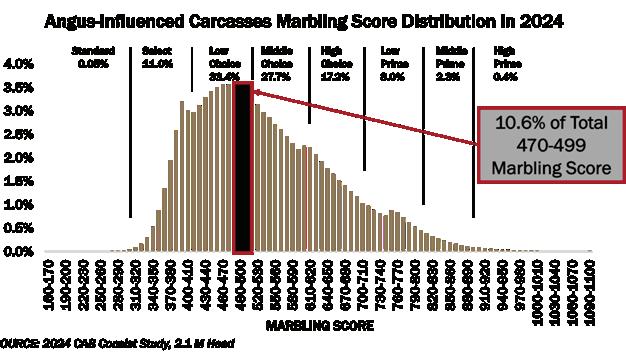
Carcasses must score 500+ for marbling to qualify for Certified Angus Beef ® brand.
The data proves that marbling should still be a priority. But additional data shows that it doesn’t have to be your only priority.
Another common question from cattle country: Has our breed been so focused on marbling that we’ve lost sight of other valuable traits? Specifically, feet and fertility are recent areas of concern.
In search of answers, CAB worked alongside the American Angus Association® (Association) team to identify genetic trends between fertility and feet issues and the culled animals’ Marb EPDs. The Association provided all disposal code records from the Angus Herd Improvement Records (AHIR) database for both fertility and feet from 2010 through 2023. AHIR offers valuable insights into the primary reasons cattle were removed from a herd.
In both cases, there was a normal distribution of animals culled—indicated by the bell-shaped curve. The real lessons become visible when we draw lines at the marbling threshold for Targeting the Brand™.
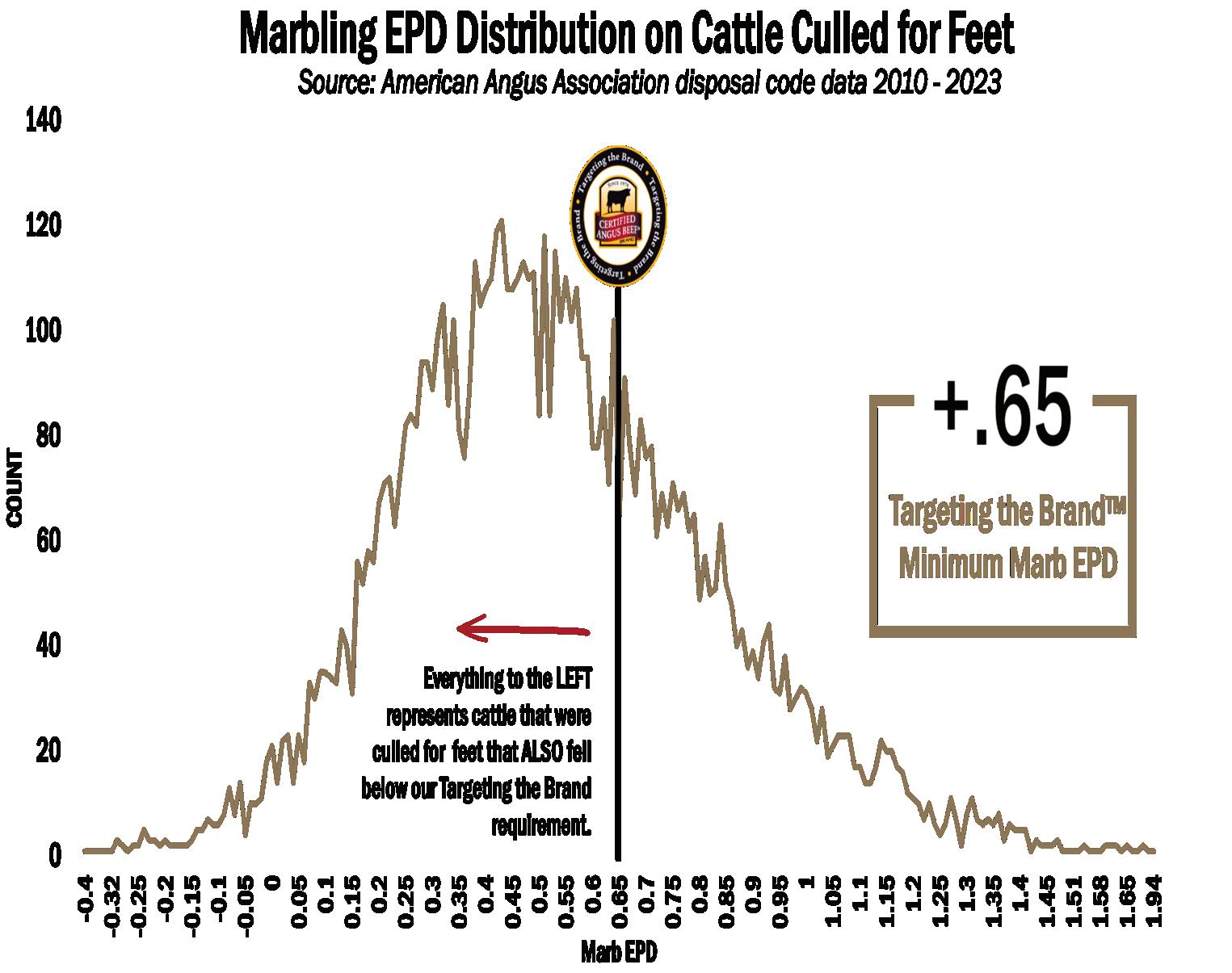
From 2010 to 2023, more than 7,600 cows, bull, and calves were culled for foot issues. Many culls fall below the black line representing the Targeting the Brand minimum requirement for Marb EPD (+0.65.)

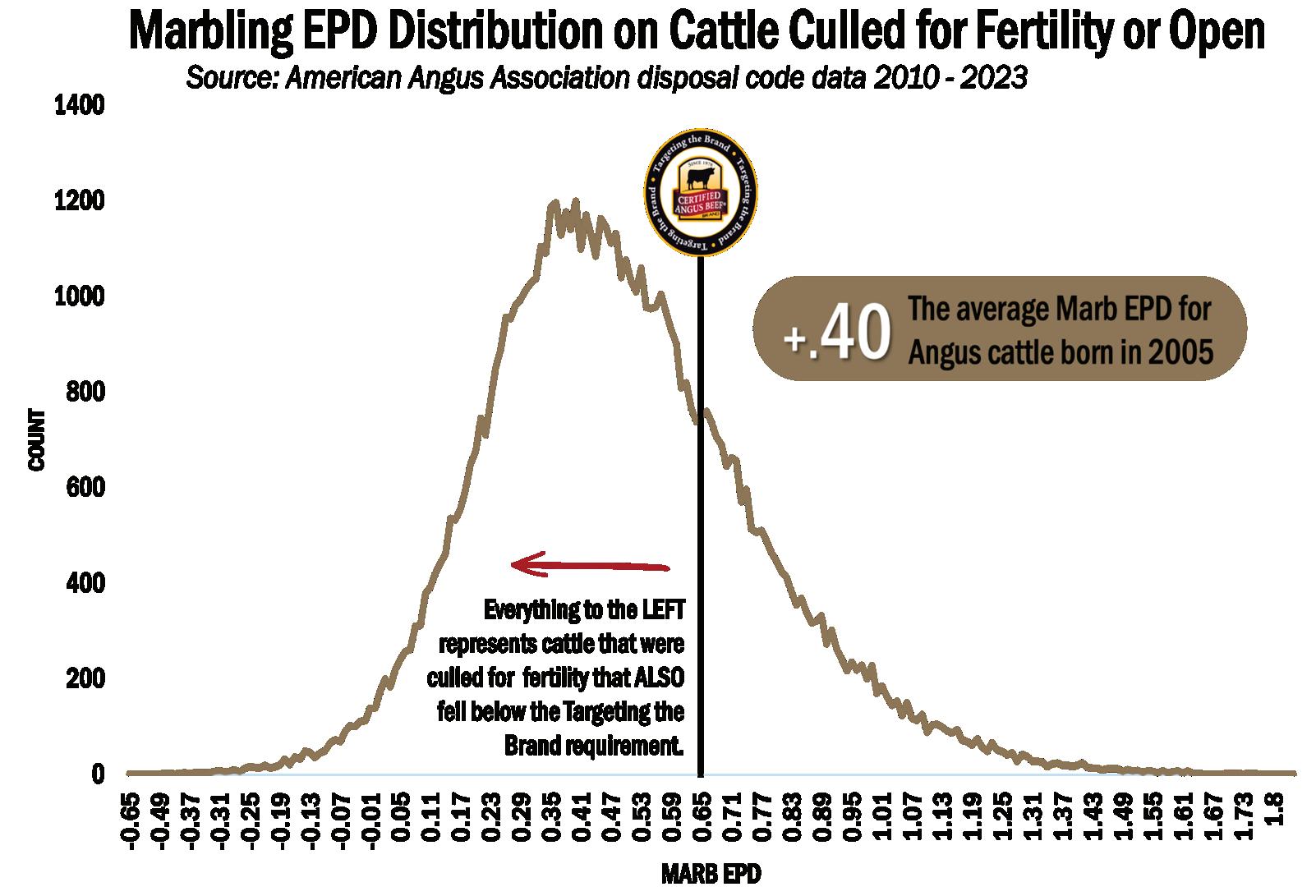
From 2010 to 2023, more than 7,600 cows, bull, and calves were culled for foot issues. Many culls fall below the black line representing the Targeting the Brand minimum requirement for Marb EPD (+0.65.)
For several years, CAB has published Targeting the Brand™ requirements for Marb EPD and Grid Value ($G) Index to help commercial customers easily identify registered Angus animals with added genetic carcass value. The minimum genetic requirement thresholds are +0.65 Marb EPD and +55 $G.
The most cattle culled for feet and fertility fall below +0.65 for marbling. Incidentally, the 2025 breed average for current sires was +0.64. While there are cattle with very high marbling values culled from herds due to feet or fertility problems, the whole picture shows that many of those culled cattle are not considered elite for carcass quality. Moreover, this data shows that recent improvements in Marb EPDs aren’t to blame. In both disposal codes, the bulk of the curve peaks at around a +0.40 Marb EPD, which was the average for Angus cattle born in 2005.
Perhaps improvement in quality doesn’t rely on extremes.
Stockmen bring immense value by objectively evaluating phenotypes, regardless of what the numbers say, and setting individual breeding objectives.
Cattlemen and women have a responsibility to look critically at their own herd, determine the areas that warrant improvement, and cull animals accordingly. Stockmen bring immense value by objectively evaluating phenotypes, regardless of what the numbers say, and setting individual breeding objectives.
When evaluating EPDs and considering what you’re breeding for, you must first recognize your environmental needs. Second would consider resources (labor, land availability, etc.) at your disposal. Third are your marketing goals and, just as important, your customers’ marketing goals.
For cattle producers who have goals of increasing their CAB acceptance rates, Targeting the Brand™ is a data-driven selection tool that helps bull and female customers more easily identify registered Angus animals that will help them achieve a 60% CAB acceptance rate, whereas the 2025 CAB acceptance rate (not exclusive to those utilizing Targeting the Brand™) averages 37%.
Some Angus breeders or their customers’ breeding objectives are higher than CAB acceptance and focus on increasing the number of cattle that grade USDA Prime. In 2025, the industry average Prime acceptance rate was around 11%. If you manage an average commercial cow herd under average management and environmental conditions, then data suggests registered Angus bulls with a +1.10 Marb EPD and +72 $G have more potential to achieve a 20% Prime acceptance rate.
As you’re making mating decisions for your next breeding season or headed to purchase new herd bulls, there’s space to put emphasis on marbling without excluding other valuable traits for your operation.
The Angus Sire Evaluation Report and Angus Media’s Pasture to Publish sale catalogs both offer an EPD Search tool, allowing you to set your EPD parameters and search for animals in a sale book that meet your criteria. When sale day arrives, you already know which bulls carry the genetics that will help meet your breeding objectives.






















Phone: 780-675-4664
info@olefarms.com www.olefarms.com
Kelly 780-689-7822
Graham: 780-675-0112
Residence: 780-675-3445
(780) 755-3160 (780) 209-9999
Justin: 403-647-4095
Ricki: 403-625-1606 rjlivestock13@gmail.com





- By LINDSAY GRABER RUNFT
With today’s historic profitability, cow/calf producers are looking at opportunities to rebuild—when conditions allow. Drought is still elongating the timeline for increasing the national cowherd. A slower rebuild could actually help keep the current returns we’re experiencing stronger for a longer stretch. Fewer feeder cattle and a cow herd unlikely to return to this cattle cycle’s peak in 2019 of 31.7 million mean oversupply isn’t looming anytime soon.
If packer margins remain positive and beef demand stays strong, boxed beef values should continue to sustain larger gross revenue for the entire chain—from packer to feedyard to the cow/calf sector. That matters when annual cow costs are hitting between $900 and $1,400 per head.
While every operation pencils out differently, current market dynamics suggest the potential for nearly $1,000 per head profit. Weather remains the wild card, but the bigger picture points to a marketplace that’s still favorable for those able to seize the opportunity.
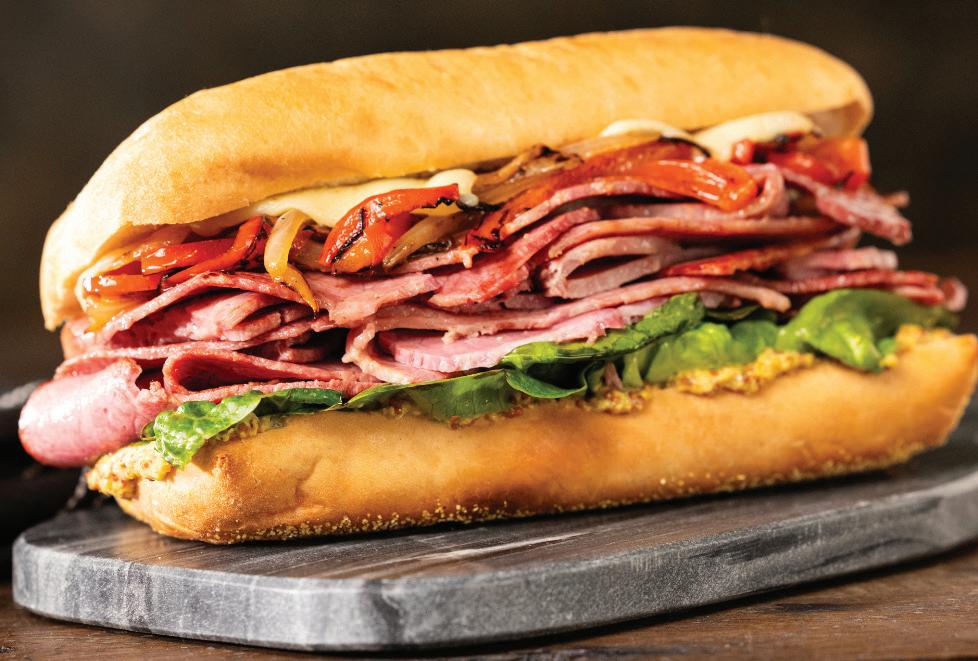
Flavor is one of the top decision-makers at the meat case. Every time. And right now, that expectation is accelerating growth in value-added products, especially within CAB Prime. Consumers aren’t just browsing these CAB items; they’re choosing them because they trust the eating experience to deliver.
That trust is opening doors across new products for retail and

They’re becoming go-to purchases, particularly with younger shoppers. Millennials are leading the shift, with 38% frequently buying value-added products, now representing a growing share of fresh meat sales.
CAB deli products signal quality consumers recognize and actively seek out. It ranks near the top for quality perception and purchase intent, with shoppers willing to pay more and even drive further to find it. Nearly three out of four consumers say offering CAB deli meats would improve their opinion of a grocery store. That’s a direct reflection of values tied to the product you produce.
This momentum starts with the great-tasting beef you raise. Consistent, high-quality beef is what allows CAB to expand into new spaces and still meet the expectation of what matters: flavor.



Animals sold as purebred must be transferred into the name of the buyer within six months of the date of sale.
The registration certificate:
• Authenticates pedigree, performance and EPD information
• Is a guarantee of authenticity backed by the Canadian Angus Association
• Qualifies the owner for Angus tags and Verified Angus Transfer the registration certificate whenever you sell an Angus animal.
“Wrap up the deal” and create satisfied customers by registering animals and transferring ownership. Satisfied customers become repeat customers–and repeat customers become the foundation of a successful business. Transfers set the stage for satisfied customers by authenticating pedigree, performance and EPD information through animal registration certificates and performance records. These documents communicate genetic merit of animals and provide essential information for helping new owners maximize profit from their investment in Angus seedstock. Reputation is key to buyers looking to invest in quality seedstock and being dedicated enough to register and transfer your cattle solidifies your reputation as a professional breeder. It pays to wrap up the deal and transfer the papers.

Questions about transfers? Contact us at registry@cdnangus.ca or 1-888-571-3580


Office
Gerald's #: (905) 252-6315 Email: galten.farms@sympatico.ca Gerald
(905) 898-4463
Office




















- By CERTIFIED ANGUS BEEF
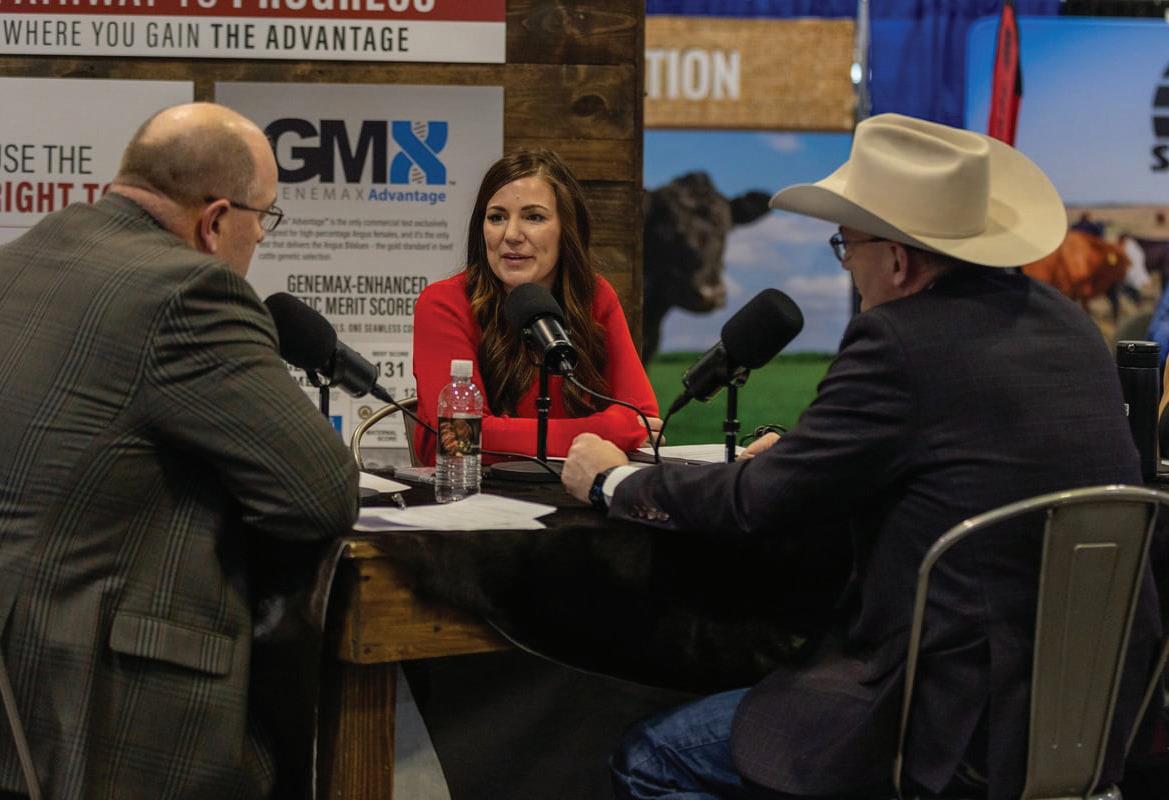
Ever wondered how Certified Angus Beef (CAB) got its start—or how the brand continues to drive demand for Angus genetics today? The CAB Bite podcast will answer those questions and more.
In 20 minutes or less, listeners will get an extra “bite” of news, insights and practical takeaways. The podcast launched in April, with the first three episodes now available.
Podcast host, and CAB director of producer communications, Lindsay Graber Runft welcomes guests from the brand and across the beef community to talk about all things CAB and high-quality beef production.
New episodes will be launched on an ad hoc basis, as part of the brand’s growing communications efforts to connect cattle producers with valuable news and information.
The short-form podcast aims to give the beef community an up-close, behind-the-scenes look at CAB and its supply chain.
CAB president, John Stika and American Angus Association® chief executive officer, Mark McCully, are among the first podcast guests, with podcast topics covering the brand’s inception, CAB’s live animal specification and international production in Uruguay. The CAB Bite podcast can be found at www.CABcattle.com/podcast and on all major podcast platforms.
Lindsay Graber Runft leads efforts to build awareness in the beef supply chain and guides the brand’s voice in the cattle market. She works closely with the brand communications and production teams to build strategic relationships with partners in the beef industry.
Lindsay is a fifthgeneration cattle producer and lives on her family’s cow-calf ranch in Kansas. Alongside her husband, Cody, they’re raising three kids who are already looking forward to being the next generation at the ranch.









The fed cattle market has been on an exceptionally bullish trend for the past two weeks. As if the wildly aggressive $10/cwt. price increase two weeks ago wasn’t enough, last week’s trade featured yet another $3/cwt. jump to the amazement of most market participants.
CME Live Cattle contract values led last week’s optimism, emboldening cattle feeders to hold a firmer asking price despite the major upswing the week prior. The week’s resulting $248.68/cwt. steer price was highlighted at the top end of the range with $252/cwt. quotes in the northern feeding region.
This week’s market promises to hold further strength as April Live Cattle contracts were valued at $252/cwt. Wednesday morning. Small cash trade volume had already been recorded at $248/cwt. live with additional $390/ cwt. dressed on Tuesday.
The strong cattle market has run counter to wholesale boxed beef cutout values, as this week started on a lower-price trend, with Choice boxes down $10/cwt. on Urner Barry’s quote and $5/cwt. on USDA’s report.
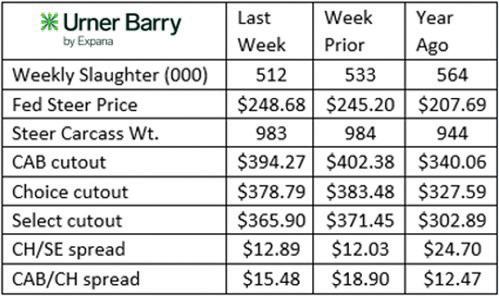
The resumption of processing at the JBS – Greeley, Colo., plant last Tuesday held promise for those looking for a larger national fed cattle harvest for the week. Reality set in by week’s end as packers collectively pulled the federally inspected total head count lower to 512K head, down 4%, with a fed cattle total of 414K head, down 3%.
Packer margins have raced backward from decently positive to roughly $200/head negative in the past few weeks. Spring holidays are lined up in the near future, with increased seasonal volume set to keep the supply chain on edge, as fulfilling large retail volumes requires larger headcounts. Beef demand appears to remain healthy, and a mid-April downturn in cutout values is not uncommon. Last year’s Choice cutout ran up 18% from April 15 through the end of June. Cutout values are 12-15% higher than a year ago.
The nation’s carcass marbling achievement has never been richer, as USDA data reports the latest record-high USDA Prime share at 15.55% of fed cattle. Year to date, the Prime grade has recorded weekly values of 14% or higher. With USDA Choice giving incremental ground to the growing Prime category, the two grades combine to chart a record 88.1% for the first quarter. In contrast, USDA Select carcasses comprised a new recordlow 8% of fed carcasses during March.
Historic highs in marbling outcomes logically suggest that the Certified Angus Beef brand would similarly capture record volumes of Angus-type carcasses, given the brand’s focus on quality and its Modest 00 (Premium Choice) or higher marbling requirement.
The importance of marbling among the brand’s 10 carcass specifications can’t be overstated. Several million Angus-type carcasses (often more than 2 million annually) have been evaluated using detailed data since 2012, revealing that 82% to 95% of carcasses failing to meet brand requirements did so due to insufficient marbling.
By Paul Dykstra
Consequently, the greatest opportunity for improvement or failure in CAB certification rates lies within the marbling specification.
However, in the midst of record-high nationwide marbling outcomes, the brand’s certification rate in March fell to 37% of eligible carcasses – less than impressive in contrast to 41.8% in March 2025. As confusing as this seems, current feedlot economics tell the rest of the story. Cheap corn, increased days on feed and temperate feeding weather combined to push average carcass weights to new heights in March.
Twenty-pound leaps in year-over-year weight increases have been a hallmark of the past two years. But the trend since December has held weights to a higher plane than ever.
This means that average steer carcasses in the 980+ lb. range yield a record proportion surpassing the brand’s 1,100 lb. upper limit. Our 2025 annual data review indicated that, of the eligible carcasses failing to meet brand standards, 14.5% of the cause was due to carcasses exceeding 1,100 lb., a significant increase from 8.6% in 2024.
It’s a safe bet that this carcass weight fallout rate was higher than 14.5% in the first quarter this year, given that steer weights have not dropped below 981 lb., year to date.
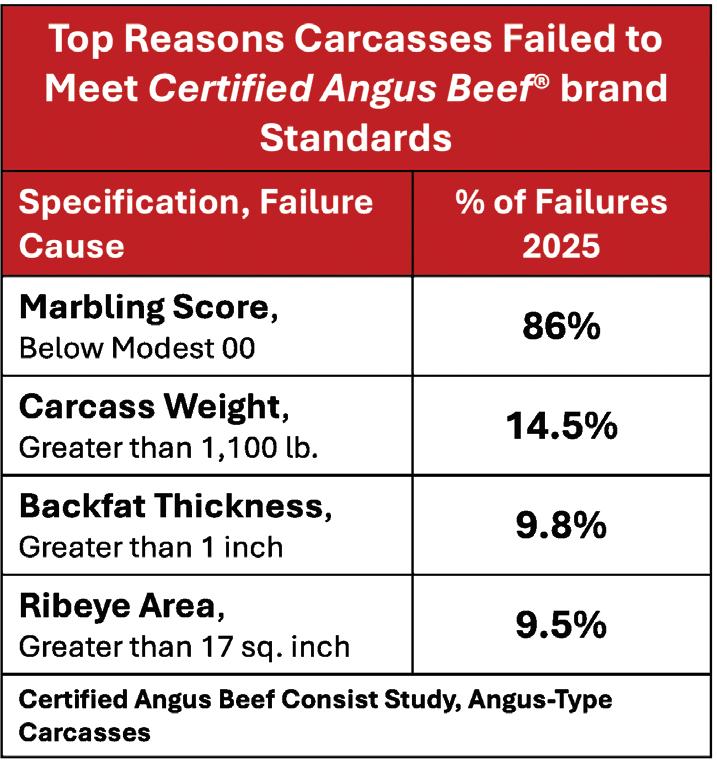
Longer feedlot stays have also generated a steady increase in external carcass fat in recent years. This was highlighted by the 2025 uptick to 9.8% of certification failures in the dataset exceeding the maximum allowable 1-inch backfact thickness.
Fallout from excess backfat was basically unchanged, in the 7-8% range, from 2022 to 2024, but will likely be reported higher again in 2026 if firstquarter finished weights are any indication.
In March 2025, the brand adjusted the upper limit for ribeye area from 16 to 17 sq. inches. The move aligned with the evolving cattle supply and resulted in cutting the brand’s fallout rate due to oversized ribeyes in half in the 2025 analysis.
Feedlot economics continue to reward heavier weights, urging cattle feeders to add days as they try to offset the high cost of feeder cattle with a favorable cost of gain. This has yielded unprecedented Prime carcass percentages in grid payment summaries, while simultaneously pressuring CAB carcass acceptance in the last two months.
Despite these recent challenges, marbling remains the driver in the brand’s ability to add value to a greater proportion of Angus-type cattle
By Molly Biggs, Angus Communications
16, 2026
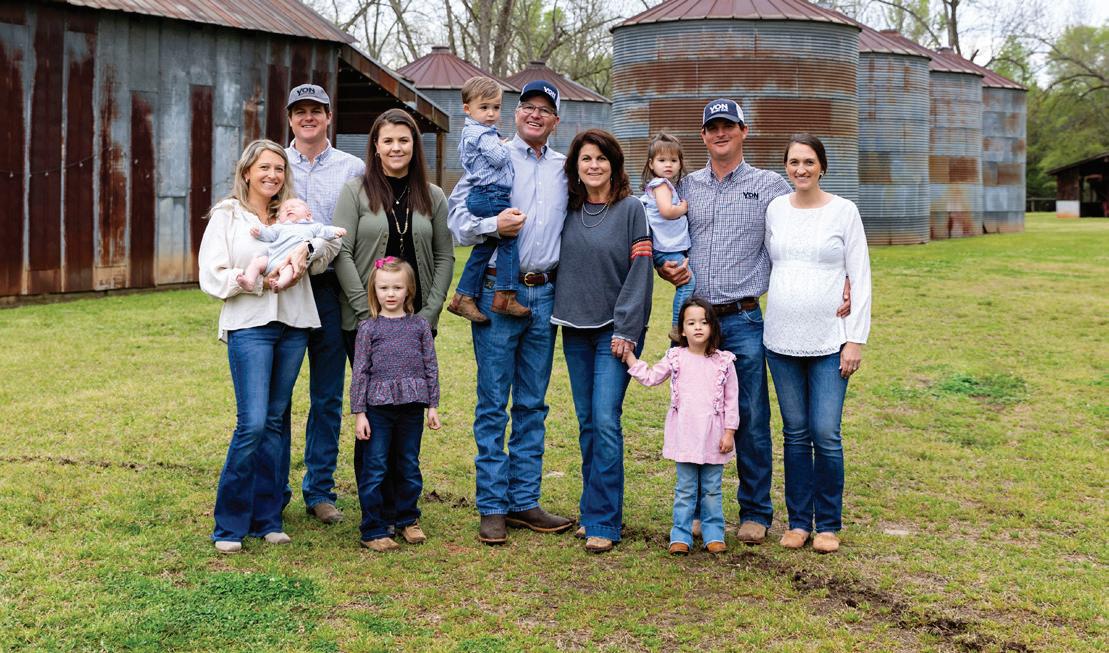
The Angus Foundation is pleased to announce Drake Yon of Ridge Spring, South Carolina, as the representative for the 2026 National Cattlemen’s Beef Association (NCBA) Young Cattlemen’s Conference (YCC). Yon, a lifelong Angus breeder, will join a class of emerging industry leaders who will travel nationwide in June to engage with all facets of beef production, policy and consumer relations.
Yon has been actively involved in the Angus breed since childhood. His years in the National Junior Angus Association (NJAA), service within the South Carolina Angus Association and participation in the Beef Leaders Institute have shaped him into an emerging leader. Today, he is an integral part of his family’s multigenerational operation, overseeing their breeding program and data collection.
“Drake not only has an outstanding work ethic, but a very inquisitive mind to learn the utilization of new technology for more efficiently producing food that meets our consumer’s expectations,” said Samuel Hands of Triangle H of Garden City, Kansas, and mentor to Drake. “As a young leader in our agriculture industry, Drake also possesses excellent communication and people skills.”
Yon’s selection reflects not only his involvement within Angus, but his extensive industry leadership. From speaking on industry panels to serving on the South Carolina Cattlemen’s Association Board, including his role as legislative chair, he has actively engaged in policy discussions affecting animal health and industry innovation.
His work with the South Carolina Farm Bureau has advanced resolutions supporting rural health access and agricultural land protections. His efforts extend beyond policy, often hosting groups on the farm from dietitians and chefs to state lawmakers to provide transparent, on the ground education about beef production. A passionate advocate for the story behind the Certified Angus Beef® brand, Yon frequently leads farm tours and industry visits.
“I look forward to the relationships formed through the YCC experience,” Yon said in his application. “Connecting with fellow cattlemen from across the country, hearing new
perspectives, and learning more effective ways to advocate for our industry is a once in a lifetime opportunity. Every interaction with policymakers is a chance to tell our family’s story and work toward positive change. I’m honored for the opportunity to represent the Angus breed.”
The YCC program provides participants with a robust understanding of the cattle industry from feedyards and packing plants to retail and policy development. The Angus Foundation is proud to sponsor an Angus breeder each year.
For more information about the Angus Foundation or the Young Cattlemen’s Conference, visit www.Angus.org.
Established as a 501(c)(3) organization in 1980, the Angus Foundation remains focused on its mission to support Angus education, youth, and research. The organization has distributed more than $5.3 million in youth scholarships since 1998 and has also invested more than $1.5 million in beef cattle research in the past decade.


Bryan Kostiuk Editor
306-933-4200 C: 306-292-7763
Chris Poley Marketing C: 306-220-5006
Shane Michelson Marketing C: 403-363-9973
We appreciate your interest in Today’s Angus Advantage and hope you have enjoyed this issue. To receive further issues, please fill out the following subscription form and return it along with your payment (prices listed below) to:
Today’s Angus Advantage Box 2330, Warman, SK S0K 4S0 P: 306-933-4200 info@todaysangus.com www.todaysangus.com
Please check one of the following:
□ Canada $50.00 TAX Included
□ United Staes $60.00 TAX Included □ International $60.00 USD
Make cheques payable to Today’s Angus Advantage Farm Name ______________________________________
Name
Address
City ______________________________________________ Province/State ___________________________________ Country ________________ Postal Code _____________ Phone ___________________________________________ Email
□ We would like to advertise in your next issue, please contact me.
Ben Wright Marketing C: 519-374-3335
Levi Rimke Marketing C: 204-851-4515
Booking Deadline Material Deadline Camera Ready Deadline
Bull Buyers Guide Special Issue - Herd Sire Issue JANUARY 2 JANUARY 6 JANUARY 13
Spring Issue - Female Issue APRIL 17 APRIL 22 APRIL 27
Summer Issue - Early Sales & Prospects
JULY 10 JULY 15 JULY 22
Early Fall Issue - Sales & Shows
AUGUST 29 SEPTEMBER 5 SEPTEMBER 12 Late Fall Issue - Late Sales & Shows OCTOBER 10 OCTOBER 15 OCTOBER 19
ADVERTISING RATES
*Plus GST/HST - Yearly Contract discount 15% (Card Ads Exempt)
Standard Issue
Spring, Summer, Early Fall, & Late Fall Issues
Full Page
Page
Page
Special Issue Rates
Bull Buyers Guide Special Issue
Page
Page
Page
Card Ad Rate
Annual (All Five Issues) $250.00

























Treena Ballantyne
Emmaline Usselman
Kiana