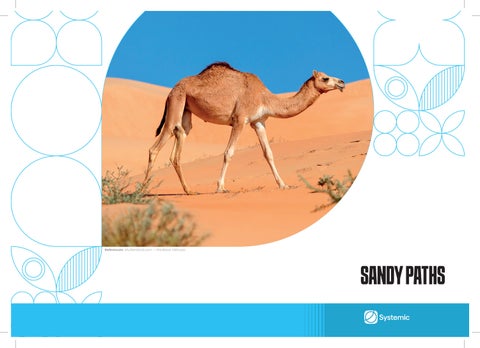
References: shutterstock.com – Vinnikava Viktoryia
SANDY PATHS
JOURNEY OVERVIEW RESUMO DA JORNADA Como é caminhar por um lugar onde quase nunca chove e por outro onde a água está por toda parte? A jornada Sandy Paths convida os alunos a descobrir, pelos sentidos, a diferença entre o seco e o molhado e a explorar dois ambientes que se contrastam: o deserto e o Pantanal. Ao longo das aulas, eles observam pegadas na areia, acompanham o sol secando a água, descobrem como pessoas e animais bebem água, comparam o cacto com plantas folhosas e imitam o jeito de andar dos animais do deserto. Cada experiência amplia o olhar sobre como a presença ou a falta de água molda a paisagem, os bichos e as plantas, desenvolvendo linguagem, observação e curiosidade investigativa.
OBJETIVOS DE APRENDIZAGEM Identificar diferenças entre seco e molhado por meio de experiências sensoriais. • Reconhecer características dos biomas deserto e Pantanal, considerando a presença de água e os seres vivos que ali habitam. • Observar animais e plantas desses ambientes, descrevendo características físicas e modos de locomoção e alimentação. • Relacionar as adaptações dos seres vivos à quantidade de água disponível no ambiente. • Representar, por meio de desenho, pintura e colagem, elementos que caracterizam o deserto e o Pantanal. • Expressar descobertas e experiências por meio de falas, gestos, desenhos e outras formas de linguagem. •
DOMAINS
SCIENCE
SOCIAL STUDIES
ART
PHYSICAL EDUCATION
REFERÊNCIAS CURRICULARES BNCC
EI01ET03
EI02ET02
EI01CG03
EI02CG03
EI01TS02
FLORIDA EARLY LEARNING AND DEVELOPMENTAL STANDARDS AND PROFESSIONAL COMPETENCIES U.S. FL.ELDS
Cognitive Development / Scientific Inquiry, 36–48 months · Uses
U.S. FL.ELDS
Cognitive Development / Social Studies, 36–48 months · Begins
the senses to observe and explore living and non-living things in the environment.
to describe characteristics of familiar places and the natural world.
RHODE ISLAND EARLY LEARNING AND DEVELOPMENT STANDARDS (RIELDS) U.S. RI
Cognitive Development / Scientific Knowledge · Children observe
U.S. RI
Social Studies / Geography · Children identify and talk about natural
and describe characteristics of living things and the physical world. features in the environment.
COLLABORATIVE FOR ACADEMIC, SOCIAL, AND EMOTIONAL LEARNING (CASEL) Relationship Skills
Taking turns and cooperating with peers during shared
Self-Awareness
Recognizing and communicating one’s own discoveries
exploration.
and feelings.
INTERNATIONAL BACCALAUREATE (IB) Science
Living things, early years / 3–5 years · Observing that living things
have features that help them survive in their environment. Social Studies
Human and natural environments, early years / 3–5 years ·
Recognizing features of different places and environments.
Proibida a reprodução total ou parcial desta obra.
NAME:
The sidewinder snake lives in the desert. Can you make its tracks in the sand?
KINDERGARTEN 1
01
DATE:
SANDY PATHS | LESSON 1 References: shutterstock.com – MichaelaB
SP01
Proibida a reprodução total ou parcial desta obra.
NAME:
Some places are dry and some are wet. Can you complete the desert and Pantanal pictures?
KINDERGARTEN 1
02
DATE:
SANDY PATHS | LESSON 1 References: shutterstock.com – SabbirDigitall / mariamalaya
SP02
Proibida a reprodução total ou parcial desta obra.
SANDY PATHS | LESSON 1
KINDERGARTEN 1
References: shutterstock.com – SabbirDigitall / mariamalaya
APPENDIX
SP03
Proibida a reprodução total ou parcial desta obra.
NAME:
The sun looks orange and yellow. Can you decorate this one?
KINDERGARTEN 1
01
DATE:
SANDY PATHS | LESSON 2 References: shutterstock.com – Twinpixle5
SP04
Proibida a reprodução total ou parcial desta obra.
NAME:
If the clouds are gray, it’s going to rain. Can you add the raindrops?
KINDERGARTEN 1
02
DATE:
SANDY PATHS | LESSON 2 References: shutterstock.com – s_oleg
SP05
Proibida a reprodução total ou parcial desta obra.
NAME:
We use many containers to hold water. Can you order them from smallest to largest?
KINDERGARTEN 1
01
DATE:
SANDY PATHS | LESSON 3 References: shutterstock.com – ArtPhoto21
SP06
Proibida a reprodução total ou parcial desta obra.
SANDY PATHS | LESSON 3
KINDERGARTEN 1
References: shutterstock.com – grey_and / Jr images / Alekcuo
APPENDIX
SP07
Proibida a reprodução total ou parcial desta obra.
NAME: 02
DATE:
Animals have different body coverings. Can you match them?
KINDERGARTEN 1
x
x
x
x
x SANDY PATHS | LESSON 3 References: shutterstock.com – TahminaRahim / Guillaume Angleraud / Edwin Butter / Wirestock Creators / Mark_Kostich / KateChris / Dennis W Donohue / MBK2021 / MSMondadori / Wirestock Creators
SP08
Proibida a reprodução total ou parcial desta obra.
NAME:
Cacti can have many flowers. Can you count the flowers on each one?
KINDERGARTEN 1
01
DATE:
SANDY PATHS | LESSON 4 References: shutterstock.com – Apinut Joeythongsri / tikisada
SP09
Proibida a reprodução total ou parcial desta obra.
NAME:
Look at these shadows. Can you find the complete one?
KINDERGARTEN 1
02
DATE:
SANDY PATHS | LESSON 4 References: shutterstock.com – New Africa / Hseena / mriqbalphotography / PetsGrgu
SP10
Proibida a reprodução total ou parcial desta obra.
NAME:
Many animals and plants live in the desert. Can you add them?
KINDERGARTEN 1
01
DATE:
SANDY PATHS | LESSON 5 References: shutterstock.com – Stefan Kostecki
SP11
Proibida a reprodução total ou parcial desta obra.
SANDY PATHS | LESSON 5
KINDERGARTEN 1
References: shutterstock.com – ScottieLinton15 / BubbleTeaOriginal / mriqbalphotography / fivespots / allahwasyia / PetsGrgu / edmon
APPENDIX
SP12
Proibida a reprodução total ou parcial desta obra.
NAME:
There are many plants and animals in the desert. Can you find the cacti?
KINDERGARTEN 1
02
DATE:
SANDY PATHS | LESSON 5 References: shutterstock.com – robiulislam123
SP13