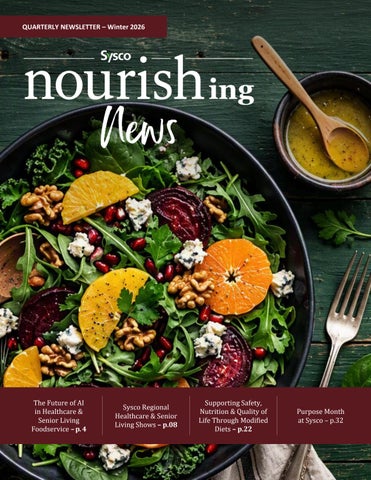
QUARTERLY NEWSLETTER – Winter 2026
The Future of AI in Healthcare & Senior Living Foodservice – p. 4
Sysco Regional Healthcare & Senior Living Shows – p.08
Supporting Safety, Nutrition & Quality of Life Through Modified Diets – p.22
Purpose Month at Sysco – p.32
Connecting THROUGH THE SHARED LOVE OF FOOD Welcome to the Winter issue of Nourishing News! This season, we’re celebrating the comfort, connection and traditions that make food especially meaningful in Healthcare & Senior Living.
Inside, discover insights on AI, highlights from our regional Healthcare & Senior Living shows, and a closer look at supporting safety, nutrition and quality of life through modified diets. We’re also bringing holiday magic to the table with product inspiration and seasonal solutions to spark creativity in your kitchen. As we wrap up the season, we hope these ideas help your teams create nourishing dining experiences that bring warmth, variety and connection to every table. Wishing you a joyful holiday season filled with great food and meaningful moments.
Warmest regards,
Sarah Emmerton Vice President, Healthcare & Senior Living
02
Sysco Nourishing News | Winter Issue 2026
Inside this Issue 04
The Future of AI in Healthcare & Senior Living Foodservice
08
Sysco Regional Healthcare & Senior Living Shows
10
2026 Chef Inspired Holiday Guide
11
NEW! Sysco Healthcare & Senior Living Ecosystem
12
Sysco Culinary Corner- Buckhead
16
Small Format Foods, Big Impact! Improving The Dining Experience in HCSL- Conagra
20
Nourishing Kitchen Recipe Book
21
Healthcare & Senior Living Special Event Menus
22
Supporting Safety, Nutrition & Quality of Life Through Modified Diets
26
Nourished Aging Toolkits
28
From Holiday Traditions to Everyday menus: The Ingredients for Multiple Possibilities- Alasko
32
Purpose Month at Sysco
35
Cultural Nourishment Toolkits
36
Quebecois Recipe Book
37
Nourishing Excellence Toolkit
39
Sysco Healthcare & Senior Living LinkedIn Page
Future
THE OF AI IN HEALTHCARE & SENIOR LIVING FOODSERVICE Picture catching a costly ordering mistake before it goes through instead of discovering it three weeks later. Or imagine building a menu in two or three hours instead of 40.
• Teams are stretched: Menu updates, purchasing, scheduling, data entry and other administrative work take time away from residents and frontline support.
That is the opportunity AI, is beginning to create for HCSL dining teams. By helping with repetitive administrative work, analyzing information and identifying possible issues earlier, AI can give teams more time to focus on the residents they serve.
• The work repeats: Many of these tasks happen daily, weekly and monthly, which makes them well suited to carefully designed automation.
AI is not about replacing people. It is about giving people better tools. To understand where those tools can make the greatest difference, it helps to begin with the pressures dining teams face every day. Why AI Matters in Healthcare & Senior Living Dining HCSL dining teams operate in an environment where safety, cost and time are always competing for attention. • Accuracy is critical: A missed diet order, texture requirement or allergen is not a small mistake. Resident safety depends on getting the details right.
• Food costs keep changing: Prices can move while budgets remain fixed, so small savings and avoided ordering errors can add up quickly across many purchases.
4
Sysco Nourishing News | Winter Issue 2026
Together, these pressures explain why AI is attracting attention. The value is not simply speed. It is the possibility of making routine work faster while creating more opportunities to catch issues before they affect cost, quality or resident safety. As with any new technology, using AI responsibly matters. Human oversight, data security and privacy remain essential, particularly when information could affect a resident or care decisions. Precautions: Never enter resident information into a public AI tool. Use only the secure, organizationapproved technology provided for your work. While AI can help accelerate and simplify our work, human oversight remains essential to review, validate, and ensure the accuracy of what it produces.
What AI Is and How It Works
The Evolution of AI
At its simplest, AI is software that learns patterns from large amounts of information and uses those patterns to generate an answer or help complete a task. Unlike a traditional search, AI can generate a response based on the information and context available to it. That also means an answer can sound confident and still be wrong. Human review remains essential, especially when the result could affect a resident, menu or purchasing decision.
AI is evolving from simply providing information to helping people complete more complex work.
AI is also only as useful as the information it can securely access. A general AI tool may understand broad concepts, but it does not automatically know your diet orders, purchasing contracts, approved products or operational rules. That is where connected, domain-specific AI becomes more powerful. When AI can securely work with the systems and information already guiding an operation, its answers and actions can become much more relevant to the work being done.
Chatbots answer questions and respond to prompts. Copilots work alongside the user, helping with tasks such as analyzing information, creating content and completing work more efficiently. AI agents represent the next step, with technology increasingly being designed to support multi-step work across connected systems. For HCSL foodservice, that evolution becomes particularly interesting when AI can work with the information teams already rely on every day. Interest in that evolution is growing across the HCSL industry. In a July 2026 survey of senior living professionals: • 65% Say AI tools are their top technology investment priority for 2026, ahead of data analytics at 52%. • 75% Say their staff already has a Microsoft Copilot subscription, up from 63% the year before.
• Over 85% Have already implemented some kind of automation somewhere in their organization.
Figure 1: Generic AI vs. Domain AI Generic AI Knows the internet. Knows nothing about your operation. Your diet orders
Your provincial regulations
Your GPO contract
Your residents
Source: Ziegler Link•age and LeadingAge CAST CTO Hotline survey, July 2026.
These numbers show growing interest, but adoption alone is not the end goal. The more meaningful question is what becomes possible when AI works with the information, standards and safeguards that dining teams already use.
Domain AI Menus & Recipes Point of Service Production
Diet Orders
AI
Electronic Health Record
Procurement
Sysco Nourishing News | Winter Issue 2026
5
Putting AI to Work with Synergy Tech Suite The potential of AI becomes easier to understand when we see how it can support everyday work. Synergy Tech Suite brings AI-powered capabilities into HCSL foodservice, helping teams simplify timeconsuming tasks while supporting nutrition, menu planning, purchasing and day-to-day operations. Its specialized virtual assistants are designed around key areas of foodservice: Virtual Dietitian Assistant Keeps nutrition accurate and maps recipes to IDDSI texture & therapeutic diet standards.
Virtual Procurement Specialist Improves purchasing decisions and cost control.
Virtual Chef Helps scale menus residents actually enjoy eating.
Virtual Foodservice Director Simplifies menu planning and day to day operational performance.
Less Manual Work, More Time with Residents The value of these capabilities goes beyond simply completing tasks faster. Repetitive work such as searching for information, reviewing data, updating recipes and supporting purchasing decisions can take valuable time away from the people dining teams serve. By bringing these capabilities together, AI can work alongside foodservice teams to reduce manual effort, provide useful information sooner and support better-informed decisions. The goal isn't fewer people. It's giving people better tools and more time to focus on the work that requires human expertise, judgement and connection with residents.
6
Sysco Nourishing News | Winter Issue 2026
How HCSL Leaders are Using AI Today
Gary McBlain, National Director of Culinary, Amica Mature Lifestyles
Gary is a leader in AI adoption in Canadian senior living dining. Nine months ago he had barely used it, and here is where he uses it now: • Food cost and pricing: spotting trends across everything his team buys and comparing product prices. • Catching duplicates: going to the item level to find duplicate products and duplicate payments. • Cost per resident day: breaking ordering down to a number he can compare across sites. • Finding the overspend: comparing sites that hit budget against sites well over, then looking for why. • Communication, people and scheduling: drafting emails and presentations, creating themed menus from templates, building schedules and spotting patterns from exit conversations. “Where I use it the absolute most is financial, looking at trends in our food costs and trends in our pricing.” Source: Gary McBlain, Senior Dining Association panel webinar, How Are Dining Leaders Actually Using AI?
AI isn't about replacing the people who care for your residents. It's about giving them their time back. Imagine faster, smarter menu planning, a cart that's built on contract at the moment you buy, overspend flagged while you can still do something about it and a team with time to truly engage with a resident at lunch. That's what becomes possible when your technology is connected to your data and your operation, and it's what Synergy Tech Suite NXT was built to do for HCSL. Experience Synergy Tech Suite NXT Request a personalized demo to see its capabilities in action.
Want to Learn More about AI? Catch the Mealsuite crew at our Spring 2027 Sysco HCSL Shows for a deeper look at AI, where the technology is headed and what it could mean for healthcare and senior living foodservice. Plus, visit the Mealsuite team at the Synergy Booth on the food show floor to continue the conversation!
Sysco Nourishing News | Winter Issue 2026
7
FALL 2026 - SPRING 2027
Save the Dates REGISTRATION OPEN NOW! INNOVATING TODAY TO DRIVE RESILLENCE FOR TOMORROW
Click the date to register!
ONTARIO March 3, 2027: Mississauga, ON
Join us for an inspiring day designed exclusively for healthcare and senior living foodservice professionals. Connect with industry peers, discover innovative solutions, and gain practical insights to help your operation thrive in an evolving landscape. Brandi Heather returns by popular demand with a brand-new keynote, Stay Steady, Keep Growing: Nourishing the Future Together, sharing practical strategies to lead through change with confidence while fostering resilience and growth. Explore the Future of AI in Healthcare & Senior Living Foodservice and discover how emerging technologies are helping operators streamline workflows, improve efficiency, and enhance the resident dining experience. Be inspired by innovation during an interactive session featuring fresh menu ideas, emerging food trends, and operational best practices you can bring back to your team. Experience our Vendor Food Showcase, where you can sample exciting new products, discover solutions, and connect with trusted vendor partners showcasing the latest products and services. We look forward to welcoming you for a day of learning, networking, and innovation!
8
Sysco Nourishing News | Winter Issue 2026
QUEBEC *Food Show Only March 23, 2027: Montreal, QE BRITISH COLUMBIA May 4, 2027: Richmond, BC ALBERTA June 8, 2027: Edmonton, AB
Thank you! To our customers who joined us in Moncton, NB (Oct) and Regina, SK (Nov)!
Sysco Nourishing News | Winter Issue 2026
9
2026 CHEF INSPIRED
Holiday Guide Created in collaboration with Sysco’s Culinary Consultants and featuring our talented chefs, this festive guide brings together inspiring holiday recipes and creative menu ideas. Showcasing a selection of Sysco products, it’s designed to help you craft memorable, seasonal dishes that delight residents and elevate your senior living dining experience.
Click
to explore the full Holiday Guide.
Click
to explore the full Holiday Guide.
10
Sysco Nourishing News | Winter Issue 2026
Culinary Corner Our Sysco Culinary Specialists are proud to support the dedicated teams who nourish Canada’s healthcare and senior living communities. Each issue, we’ll share practical tips, operational best practices, and chef-inspired techniques designed to help you deliver consistent quality, safety, and flavour. From optimizing efficiency and production strategies to elevating resident dining experiences, Sysco’s Culinary Corner brings you the expert guidance, tools, and insights you need to cook with confidence, care, and culinary excellence.
Pork Chops
Product Feature PORK CHOP 4oz BNLS FRZN SUPC 8524407
Tender, juicy, and incredibly versatile, pork chops are a classic protein that can easily be transformed with different seasonings, sauces, and accompaniments. Their familiar flavour and centre-of-the-plate appeal make them a great addition to healthcare and senior living menus. Unlock the full potential of pork chops. Read on for expert tips and techniques—from prep and seasoning to cooking, carving, and plating—to ensure every serving is a standout centre-of-theplate experience.
12
Sysco Nourishing News | Winter Issue 2026
✓ Vacuum-sealed in bulk to reduce prep time and labour. ✓ Naturally lean and suitable for a variety of menus. ✓ A mild, slightly sweet flavour that pairs well with herbs, spices, marinades, and sauces. ✓ Works well with grilling, braising, breading, roasting, and global flavour profiles.
IDEAL COOKING METHODS BRAISE: Slow-cooking in liquid creates a tender texture. Must cook to an internal temp of 205°F and hold in braising liquid. Liquid can also be used to build a finishing sauce. GRILL: Pat dry then season with desired seasoning. Grill following the cross-hatch method to an internal temp of 135°F to allow resting to 145°F. PAN SEAR: Pat dry then season with desired seasoning. Sear making sure the first side is the plate presentation side. Cook to an internal temp of 135°F to allow resting to 145°F.
TIPS FOR RETAINING MOISTURE • Brine or dry-brine: Salt ahead of time to improve flavour and moisture retention. Pat dry before searing creates better browning and crust. • Sear hot, finish gently: High heat for colour, then finish in the oven at moderate temperature. • Cook to temperature: Remove around 135°F–140°F and allow carryover cooking. • Baste for flavour: Finish with butter, garlic, and herbs. • Rest before slicing: 5–10 minutes allows juices to redistribute. • For holding: Keep covered with a small amount of warm jus or stock to avoid overheating.
PLATE PRESENTATION • Slice the pork into 3–5 pieces and fan it slightly to showcase a juicy interior. • Spoon sauces underneath or beside the meat rather than covering the crust. Build height by resting the chop against mashed potatoes or a purée. • Use contrasting colours, such as carrot purée, bright green vegetables, and deep brown jus.
• Finish with fresh herbs, crispy shallots, toasted nuts, or a small garnish for texture. Sysco Nourishing News | Winter Issue 2026
13
SMALL FORMAT FOODS,
Big Impact! IMPROVING THE DINING EXPEREINCE IN HEALTHCARE & SENIOR LIVING In healthcare and senior living (HCSL every meal serves a purpose beyond nutrition. Dining programs must support resident satisfaction while balancing staffing pressures, food costs, sustainability goals, and evolving care needs. As operators continue to prioritize personcentred dining, one area gaining attention is food format. While ingredients and nutrition remain essential, the way food is presented can significantly influence independence, enjoyment, flexibility, and operational efficiency. Sometimes, improving the dining experience isn't about introducing something new—it's about serving familiar foods in smarter ways. Familiar Foods Foster Comfort and Connection Food provides more than nourishment. It offers comfort, sparks memories, and helps residents maintain meaningful connections to lifelong routines and traditions. Breakfast foods are especially effective in creating these positive experiences. Their familiarity makes them a dependable favourite across healthcare and senior living communities. Rather than continually adding new menu items, operators can often increase resident satisfaction by presenting familiar favourites in formats that better suit changing abilities, preferences, and dining occasions.
16
Sysco Nourishing News | Winter Issue 2026
Supporting Independence at Mealtime Promoting independence at mealtime remains a key objective across the continuum of care. For residents experiencing reduced dexterity, mobility limitations, or other physical challenges, the design of a menu item can influence how confidently they eat. Foods that are easy to hold, portion, and consume may help residents participate more independently while reducing the need for assistance. Smaller handheld formats can complement traditional plated meals in a variety of settings, including: • Breakfast service • Between-meal nourishment programs • Recreation and social activities
• Coffee breaks • Casual dining occasions Supporting independence not only benefits operations—it also helps preserve dignity and creates a more positive dining experience.
*Image is AI Generated
Meeting Diverse Appetites with Flexible Portions One of the ongoing challenges in HCSL is accommodating a wide range of appetite levels. A portion that feels appropriate for one resident may feel overwhelming to another.
Creating More Variety with Less Complexity
Many operators face pressure to offer menu variety while managing labour, storage, and inventory complexity.
Flexible, portion-controlled menu items can help operators better align what is served with what residents are likely to consume. Smaller formats provide opportunities to:
One effective strategy is to identify products and menu components that can perform multiple roles across the menu. Instead of adding new ingredients to create variety, operators can often leverage versatile items across multiple dayparts and applications.
• Offer manageable portions for lighter appetites
For example, a single item like Duncan Hines® Waffle Sticks may be incorporated into:
• Create customizable meal combinations
• Breakfast entrées
• Support nourishment and snack programs
• Grab-and-go breakfast options
• Reduce the likelihood of plate waste
• Coffee break programs
• Adapt menu offerings across different care environments
• Mid-afternoon snacks
Providing residents with portions that better match what they are likely to consume can improve both satisfaction and food utilization.
• Dessert applications
Reducing Food Waste Through Smarter Portioning Food waste remains a significant concern for many operators. In addition to increasing food costs, excessive waste can impact sustainability objectives and operational efficiency.
• Recreation and activity events • Seasonal or special occasion menus This type of cross-utilization can help increase menu interest while minimizing additional inventory requirements and simplifying kitchen operations. Questions to Consider When Evaluating Menu Solutions:
Thoughtful portion design can help address this challenge. Rather than automatically serving larger portions, operators may benefit from offering menu items that allow greater flexibility in how much is served and consumed.
When assessing new menu items, consider whether they:
Smaller portions can often be added incrementally, allowing residents to consume what they want while reducing the amount of food returned to the kitchen. This approach not only supports waste reduction but can also improve overall satisfaction by providing portions that feel more appropriate to individual needs.
❑ Offer portion flexibility
❑ Support resident independence ❑ Can be used across multiple dayparts ❑ Help reduce food waste ❑ Simplify preparation and service ❑ Deliver a familiar, enjoyable dining experience ❑ Increase menu variety without adding inventory complexity The strongest menu solutions often deliver benefits for both residents and operators.
Sysco Nourishing News | Winter Issue 2026
17
A Small Change with Meaningful Results
A Practical Example
Today's HCSL operators are expected to deliver exceptional dining experiences while managing increasingly complex operational challenges. The most successful menu solutions often address both resident and operator needs simultaneously.
One example of a menu solution that aligns with many of these considerations is Duncan Hines® Belgian Waffle Sticks. Their handheld format can help support resident independence, provide portion flexibility, and create opportunities for menu variety across multiple occasions, including breakfast service, snack programs, recreation activities, and special events. Their consistent format also allows operators to easily adapt portions and incorporate them into a range of menu applications, helping balance resident satisfaction with operational efficiency.
When evaluating menu innovations, it can be helpful to look beyond the product itself and consider how food format influences dining outcomes. Ease of consumption, portion flexibility, versatility, operational simplicity, and resident satisfaction can all play meaningful roles in menu success. Small changes in how familiar foods are presented can have an outsized impact on the dining experience. By focusing on residentcentered design and practical operational considerations, operators can create menus that support independence, reduce waste, improve flexibility, and ultimately enhance the overall dining experience.
18
Sysco Nourishing News | Winter Issue 2026
While every operation's needs are different, solutions like these demonstrate how thoughtfully designed food formats can support key goals such as reducing waste, maximizing menu versatility, simplifying service, and creating a more enjoyable dining experience for residents and patients.
*Image is AI Generated
Nourishing Kitchen RECIPE BOOK Designed in partnership with our vendor community and Sysco’s Culinary Consultants to provide delicious & healthcare friendly recipe ideas that will be sure to make an impact on your senior living menu!
Click to explore the latest issue!
20
Sysco Nourishing News | Winter Issue 2026
Elevate every occasion with curated menus for special moments in healthcare and senior living.
Celebrate. Customize. Delight.
Whether you’re celebrating a holiday, milestone, or community event, Sysco Healthcare & Senior Living’s Special Event Menus make it easy to impress — without overburdening staff. Our curated selections span elegant hors d’oeuvres to comforting hot-and-cold fare, helping you craft menus that reflect your residents’ tastes and dietary needs. With flexible options, seasonal variety, and trusted Sysco quality, you can create memorable meals that bring people together. View
the Entire Collection of Special Events Menus
View
the Entire Collection of Special Events Menus
Sysco Nourishing News | Winter Issue 2026
21
Supporting SAFETY, NUTRITION & QUALITY OF LIFE THROUGH MODIFIED DIETS Kaitlyn Munro, MHSc, RD | Nutrition Services Consultant
22
In healthcare and senior living (HCSL), therapeutic diets and texture-modified meals are often viewed through the lens of nutrition and safety. While these factors remain critically important, a successful dining program goes beyond meeting dietary requirements. It also supports independence, dignity, enjoyment, and quality of life.
Food Is About More Than Nutrition
For many residents, meals are one of the highlights of their day. They provide comfort, familiarity, social connection, and a sense of normalcy. As a result, when food needs to be modified for medical, chewing, or swallowing reasons, the goal should never be simply to change the food. The goal is to meet clinical needs while preserving the resident experience.
While nutrition plays an essential role in supporting healthy aging, food also contributes to comfort, identity, culture, and enjoyment. A meal may meet every nutritional target, but if a resident finds it unappealing and chooses not to eat it, the intended benefit is lost.
Sysco Nourishing News | Winter Issue 2026
When most people think about a memorable meal, they rarely think about calories, sodium levels, or protein content. Instead, they remember the taste, presentation, atmosphere, or the people they shared it with. Residents are no different.
This balance between health and quality of life is at the heart of nutrition care in HCSL.
When evaluating diets and menus, it is important to consider several factors: • Safety – Is the food texture and consistency appropriate for the resident's swallowing and chewing abilities? • Nourishment – Does the menu provide the nutrients, energy, and hydration needed to support health and well-being? • Enjoyment – Does the resident find the meals appealing, flavourful, and satisfying? • Independence – Does the resident have access to the adaptive aides, support, or meal setup needed to eat as independently as possible? • Familiarity – Are meals aligned with the resident's cultural background, preferences, and lifelong eating habits? • Dignity – Does the dining experience preserve the resident's choice, autonomy, and sense of self? Together, these elements help create meaningful dining experiences that support both health outcomes and resident satisfaction. Understanding Therapeutic Diets
Two residents with the same diagnosis may have very different nutritional needs, preferences, and goals of care. A diabetic diet, for example, may look very different in a long-term care setting than it would for a younger adult living independently. Similarly, a renal diet may require different modifications depending on laboratory values and individual health status. Today's best practices emphasize individualized care rather than broad dietary restrictions. Diets should be reviewed regularly and adjusted as residents' needs change over time. Recognizing the Limitations of Restrictive Diets While therapeutic diets can play an important role in managing health conditions, it's also important to recognize that dietary restrictions are not always appropriate in every situation. Older adults often face a variety of challenges that can affect food intake, including reduced appetite, changes in taste, chewing or swallowing difficulties, and multiple chronic conditions. In some cases, highly restrictive diets may unintentionally contribute to poor intake, weight loss, or an increased risk of malnutrition.
Therapeutic diets are designed to support specific medical, nutritional, or safety needs. These diets may be prescribed to help manage conditions such as diabetes, kidney disease, cardiovascular disease, food allergies, or intolerances. However, one of the most important things to remember is that therapeutic diets are not onesize-fits-all.
Sysco Nourishing News | Winter Issue 2026
23
This is why therapeutic diets should never be viewed as a one-size-fits-all solution. Registered dietitians and other healthcare professionals evaluate the whole person, considering medical history, nutritional status, laboratory values, quality of life, food preferences, goals of care, and resident wishes. Working collaboratively with the resident and often their family or care team, healthcare professionals can determine the most appropriate nutrition approach for that individual's unique needs. The goal is not restriction for the sake of restriction, but rather finding the right balance between supporting health, maintaining nutritional status, and preserving quality of life. For frontline staff, this serves as an important reminder not to make assumptions based solely on a diagnosis or diet name. Instead, follow the resident's prescribed diet order and communicate any concerns, observations, or challenges to the care team. The insights gathered during mealtimes are invaluable in helping ensure nutrition care remains safe, effective, and person-centered. Why Texture-Modified Diets Matter Texture-modified diets play a critical role in supporting residents who experience chewing or swallowing difficulties. These challenges may result from a variety of conditions, including stroke, dementia, frailty, or poor dentition. Without appropriate modifications, residents may be at increased risk of choking, aspiration, dehydration, and poor nutritional intake. However, texture modification is about more than reducing risk. When done well, it also preserves dignity and helps residents continue enjoying food despite physical challenges. For more information on texture-modified diets and dysphagia management, explore our Dysphagia Toolkit & IDDSI Education Flyer.
24
Sysco Nourishing News | Winter Issue 2026
Mixed Consistencies: A Common Challenge
One area that often causes confusion is mixed consistency and transitional foods. Mixed consistency foods contain both solid and liquid components. Common examples include: • Soup with vegetables • Cereal with milk • Watermelon • Oranges Transitional foods present another challenge because they change texture with moisture or temperature. Examples include: • Ice cream • Frozen desserts • Gelatin While these foods may appear safe, they can behave differently once they enter the mouth, making them unsuitable for some individuals with swallowing difficulties. Understanding these hidden risks helps teams identify foods that may require additional assessment before being served. Building Success in the Kitchen Producing high-quality texture-modified foods starts long before meals reach the dining room. Successful programs focus on consistency, preparation techniques, and quality assurance. Several practical strategies can help improve outcomes: • Start with the Right Cooking Methods: Moist heat cooking techniques such as steaming, braising, and poaching naturally create softer foods that are easier to modify safely. Foods that retain moisture tend to produce better texture-modified results than foods that are dry or heavily crusted.
• Manage Moisture Carefully: One common mistake is adding excessive liquid during processing. Instead, drain excess liquid first and gradually add moisture back until the desired consistency is achieved. Broth, gravy, milk, sauces, or juice often provide better flavor and nutrition than water alone. • Standardize Recipes: Consistency is critical. Standardized recipes help ensure foods are prepared the same way regardless of who is cooking, the shift being worked, or the location preparing the meal. Clear standards reduce variability and improve resident safety. • Test Foods Throughout Production: Texture can change during holding, cooling, reheating, and service. Foods should be assessed at multiple stages to ensure they maintain the intended consistency from preparation through delivery.
The result is often improved satisfaction, better intake, and a more positive dining experience. Keeping the Resident at the Centre Ultimately, therapeutic diets and texturemodified meals are tools that help residents achieve the best possible outcomes. But they should never cause us to lose sight of the individual behind the diet order. Residents deserve food that is safe and nourishing. They also deserve meals that reflect their preferences, cultural backgrounds, lifelong eating habits, and personal choices. By balancing clinical needs with enjoyment, familiarity, independence, and dignity, healthcare and senior living teams can create dining experiences that truly support whole-person wellness.
We Truly Eat With Our Eyes First One of the most overlooked opportunities in texture-modified dining is presentation.
Research and real-world experience both show that appearance influences food acceptance. Residents are more likely to enjoy meals that look appetizing, recognizable, and thoughtfully prepared. Simple techniques can significantly improve presentation:
Because at the end of the day, the goal isn't simply to modify the meal. It's to modify the meal without losing the person. IDDSI MADE SIMPLE: Testing Texture-Modified Foods & Fluids
• Avoid covering entire meals with gravy or sauce
To support healthcare and foodservice teams, Sysco Canada, in partnership with Senior Services and Long-Term Care, City of Toronto, has developed a short educational video focused on safe, consistent texturemodified food and thickened fluid practices.
• Clean plate edges before service
The video covers:
• Consider molds or shaping techniques for special occasions
✓ Dysphagia fundamentals
• Keep foods separate on the plate • Use contrasting colors
These small details can elevate a meal, making it more appealing, recognizable, and enjoyable.
✓ The IDDSI Framework ✓ Testing methods for texture-modified foods and thickened fluids
Click to Watch the Video!
✓ Audit tools to support consistency and quality
Sysco Nourishing News | Winter Issue 2026
25
Nourished Aging TOOLKITS Discover Sysco Nutrition Services’ toolkit series—packed with practical tips and educational insights designed for senior living. These easy-to-use resources help teams stay informed, implement best practices, and elevate the quality of care every day. Turn knowledge into action and make mealtime and nutrition management smarter, simpler, and more effective!
Click
to Explore the Full Toolkit Series!
Click
to Explore the Full Toolkit Series!
26
Sysco Nourishing News | Winter Issue 2026
Holiday Traditions
FROM TO EVERYDAY MENUS: THE INGREDIENTS FOR MULTIPLE POSSIBILITIES
In healthcare and senior living (HCSL) environments, every meal serves a purpose beyond nutrition. A familiar recipe can spark memories, provide comfort, and create meaningful moments for residents and patients alike. Whether it's a warm breakfast, a favourite soup, or a classic home-style dinner, thoughtful menus contribute to wellbeing while helping build a sense of community. For foodservice teams, delivering these experiences means balancing nutrition, resident preferences, staffing challenges, budgets, and operational efficiency. One of the simplest ways to support all of these priorities is by choosing versatile ingredients that can be incorporated into multiple recipes across different menus and meal periods.
Build Better Menus with Versatile Ingredients Versatile ingredients provide the foundation for countless comforting meals. A single ingredient can become part of several recipes across different meal periods. This approach not only stretches food dollars but also simplifies purchasing and reduces unnecessary waste.
Frozen produce is especially well suited for HCSL operations because it combines convenience with consistent quality.
28
Sysco Nourishing News | Winter Issue 2026
Why frozen produce makes sense
Farm Fresh, Frozen For You
• Save time: Pre-washed and pre-cut fruits and vegetables reduce labour while allowing culinary teams to focus on meal quality and resident satisfaction instead of lengthy prep work.
IQF (Individually Quick Frozen) fruits and vegetables provide the flexibility to prepare a wide variety of dishes with consistent quality year-round, helping chefs and nutrition professionals create meals residents enjoy while making the most of their resources.
• Control costs and improve efficiency: Frozen ingredients can help reduce labour costs, extend shelf life, and maximize operational efficiency. Use one ingredient across multiple recipes and menus to get more value from every purchase. • Count on year-round availability: With a longer shelf life than fresh produce, frozen ingredients provide consistent availability and help teams plan menus with confidence in every season. Additionally, global sourcing and farmer partnerships secure variety and seasonal favourites throughout the year. • Deliver consistent quality: Harvested at peak freshness and flash frozen, IQF fruits and vegetables help preserve appearance, texture, flavour, and nutritional value in every serving. • Reduce waste while maximizing nutrition: Portion as needed to minimize waste while providing high-quality produce with preserved freshness and nutrition yearround. Plus, ready to use ingredients means no stems, seeds, or bruised pieces to remove and dispose of.
Harvested at peak ripeness and flash frozen to help preserve flavour, texture, and nutritional value, frozen produce offers reliable quality, year-round availability, and convenient portion control with minimal waste. Even better, a single versatile ingredient can be used across multiple recipes! This supports foodservice teams in creating familiar, home-style meals that residents enjoy while making the most of every purchase. A win-win for both organizations and the people they care for. Individual Quick Freezing (IQF) is an innovative technology that ensures consistent, high-quality products. The short freezing time prevents the formation of large ice crystals. As each piece is individually frozen, the product maintains its shape, colour, smell, and taste after thawing. Storage and Preparation Tips Frozen fruits and vegetables have a shelf life of up to 24 months when stored correctly. • Preservation: Keep frozen at 0°F or -18°C, or below. Take out desired amount and immediately return unused product to the freezer. Ensure package is properly closed to preserve product. Do not refreeze if thawed. Keep in refrigerator for up to 48 hours in a sealed container. • Preparation: Fruits may be thawed at room temperature or used frozen. Vegetables should always be cooked before consuming, and may be cooked from frozen.
Sysco Nourishing News | Winter Issue 2026
29
Holiday Recipe Inspiration USING ALASKO IQF INGREDIENTS •
Oatmeal topped with wild blueberries and Greek yogurt Warm wild blueberry compote served over pancakes or French toast Autumn-spiced blueberry muffins for breakfast or a snack break
Wild Blueberries
•
SUPC 7602673
•
Chopped Spinach
• • •
Spinach & sausage breakfast scramble Spinach and Swiss cheese quiche Minestrone soup with spinach and mixed vegetables
• • •
Turkey shepherd's pie using Thanksgiving leftovers Classic chicken pot pie with peas and carrots Vegetable fried rice
SUPC 6184408
Peas & Carrots SUPC 7613623
Supporting Quality Meals Every Day Reliable ingredients help foodservice teams deliver meals that residents look forward to while supporting efficient kitchen operations. By incorporating versatile IQF fruits and vegetables into menu planning, operators can create nutritious, comforting meals across multiple meal and snack occasions, reduce waste, and make better use of every purchase. Alasko is a trusted leader in IQF fruits & vegetables, offering year-round quality through a global network of 100+ growers across 30 countries. We cover all your frozen fruit & vegetable needs, offering turnkey solutions for the sourcing, delivery and logistics, and commercialization of conventional, single ingredients or blends, and innovative products. Discover the full Alasko product lineup available through Sysco and our seasonal promotions.
30
Sysco Nourishing News | Winter Issue 2026
NOVEMBER IS
Purpose MonthatSysco —a time dedicated to living our purpose: connecting the world to share food and care for one another. Across Canada, colleagues come together to give back, support their communities, and make a meaningful impact. This year, we set an ambitious national goal: 11,000 volunteer hours from coast to coast. And our Healthcare & Senior Living team delivered, bringing our purpose to life in communities across the country. The Sysco Healthcare & Senior Living team rolled up their sleeves in countless ways. They volunteered in community kitchens and food banks, lending a hand to support those in need. In resident homes, they helped put up holiday decorations, wrote heartfelt holiday cards, and spent quality time with seniors who might otherwise feel isolated. And in bakeries and kitchens, they baked Smile Cookies, spreading joy and a little extra sweetness to people near and far. A heartfelt thank you goes out to every colleague who contributed their time, energy, and heart throughout Purpose Month. Purpose Month may have come to a close, but our commitment to living our purpose continues every day. Take a look at a few of the highlights from our Purpose Month, coast to coast!
Sysco Nourishing News | Winter Issue 2025
33
CULTURAL NOURISHMENT
Building Inclusive Menus Sysco understands the importance of crafting menus that reflect cultural diversity. To support this, we offer featured cultural toolkits that include curated recipes, product recommendations, and guidance on incorporating cultural dishes in a respectful and authentic way. Click
Click
to explore the latest issue!
to explore the latest issue!
Click
Click
to explore the latest issue!
to explore the latest issue!
Sysco Nourishing News | Winter Issue 2026
35
From Québec, With C Bring the flavours of Québec to your table with our curated Québécois Recipe Flipbook. Designed for healthcare and senior living communities, this collection highlights comforting classics and seasonal favourites that honour tradition while supporting your residents’ tastes and dietary needs. From hearty mains to sweet finishing touches, these thoughtfully selected recipes make it easy to introduce regional flair — without adding complexity to your kitchen. With trusted Sysco quality and practical menu inspiration, you can create meaningful dining moments that feel both nostalgic and new.
Click
to Explore the Flipbook!
Click
to Explore the Flipbook!
AVAILBLE NOW!
Nourishing Excellence: Best Practices to E Healthcare & Senior Living Dining Across C Sysco and Suzanne Quiring, RD are proud to present a brand-new flipbook for our Healthcare & Senior Living Customers! This flipbook captures the amazing work happening nationwide, highlighting innovative approaches, shared successes, and actionable insights. Summarizing responses to Suzanne’s eight key questions from the 2025 Sysco Healthcare & Senior Living Shows, it showcases rich dialogue and creative thinking on topics like maximizing resident choice, gathering timely feedback, celebrating birthdays on the actual day, providing puréed meals with dignity, staying current with best-practice tools, and adapting to evolving resident and team needs. More than a recap, the flipbook is a snapshot of what’s possible when we listen, challenge assumptions, and think differently. It’s a unique opportunity to learn from one another, build on these ideas, and continue advancing nutrition and foodservice in Healthcare & Senior Living.
Click
to explore!
Click to explore!
Sysco Nourishing News | Winter Issue 2026
37
Did You Know? Sysco Canada has a LinkedIn page dedicated to Healthcare & Senior Living. Follow us to stay up to date with new events, publications and information relative to healthcare & senior living from Sysco Canada!
Click here to follow Sysco Healthcare Senior living
Click here to follow Sysco Healthcare & Senior living
Sysco Nourishing News | Winter Issue 2026
39
Stay Connected with U A black letter f in a white circle
A black and white logo
A black and white circle with letters in it
A black and white logo
Description automatically generated
Description automatically generated
Description automatically generated
Description automatically generated