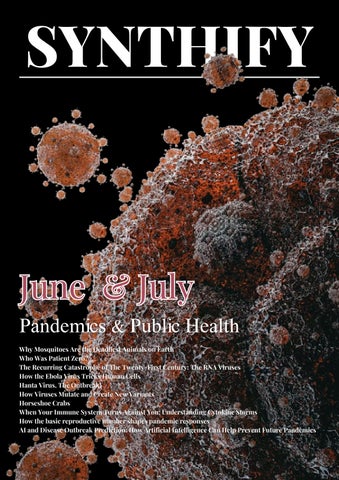
SYNTHIFY
June & July Pandemics & Public Health Why Mosquitoes Are the Deadliest Animals on Earth Who Was Patient Zero? The Recurring Catastrophe of The Twenty-First Century: The RNA Viruses How the Ebola Virus Tricks Human Cells Hanta Virus, The Outbreak! How Viruses Mutate and Create New Variants Horseshoe Crabs When Your Immune System Turns Against You: Understanding Cytokine Storms How the basic reproductive number shapes pandemic responses AI and Disease Outbreak Prediction: How Artificial Intelligence Can Help Prevent Future Pandemics
SYNTHIFY
05
WHY MOSQUITOES ARE THE DEADLIEST ANIMALS ON EARTH
09
WHO WAS PATIENT ZERO?
13
-ESTHER TYRNAUER
-NAGASAI LOHITH ANUMULA
THE RECURRING CATASTROPHE OF THE TWENTY-FIRST CENTURY: THE RNA VIRUSES -MEHREEN MUZAFAR
20
HOW THE EBOLA VIRUS TRICKS HUMAN CELLS :REVEALING THE THREE-STAGE MOLECULAR DECEPTION OF A GLOBAL HEALTH THREAT -PEACE OLAJIDE
24
HANYA VIRUS-THE OUTBREAK -TISTA BHATIA
HOW VIRUSES MUTATE AND CREATE NEW VARIANTS. -MAGGIE ZHANG
HORSESHOE CRABS -MARLEE MEI.
WHEN YOUR IMMUNE SYSTEM TURNS AGAINST YOU: UNDERSTANDING CYTOKINE STORMS -RAHEEN FATIMA
HOW THE BASIC REPRODUCTIVE NUMBER SHAPES PANDEMIC RESPONSES -QUYNH NHU HO
AI AND DISEASE OUTBREAK PREDICTION: HOW ARTIFICIAL INTELLIGENCE CAN HELP PREVENT FUTURE PANDEMICS -RACHELLE HENRIETTA
30 34 38 42 46
WHY MOSQUITOES ARE THE DEADLIEST ANIMALS ON EARTH
Esther Tyrnauer
W
hen asked to name the world's deadliest animal, most people think of sharks, lions, or snakes. The real answer is far less intimidating at first glance. It weighs less than a paperclip, fits on the tip of a finger, and can be swatted away in seconds. Yet, the mosquito kills more people each year than any other animal on Earth. Mosquitoes are responsible for spreading some of humanity's most devastating diseases, including malaria, dengue fever, and Zika virus. Collectively, these illnesses infect hundreds of millions of people annually and continue to place enormous pressure on healthcare systems around the world. Despite decades of scientific progress, mosquito-borne diseases remain one of the greatest challenges in global public health. The mosquito's danger lies not in its bite itself, but in what that bite can carry. Female mosquitoes require blood to produce eggs, and during feeding they can pick up parasites or viruses from infected individuals. When they bite an organism, those pathogens may be transferred into a new host, creating a chain of transmission that can spread rapidly through entire communities. Among the most well-known mosquito-borne diseases is malaria, a parasitic infection that continues to claim hundreds of thousands of lives each year, particularly among young children in sub-Saharan Africa. Dengue fever, sometimes called "breakbone fever" because of the severe pain it causes, has become increasingly widespread in tropical and subtropical regions. Meanwhile, the emergence of Zika virus demonstrated how quickly a mosquito-borne pathogen can become a global concern, especially when linked to serious birth defects. The impact of these diseases extends far beyond hospitals and clinics. Families may lose income when caregivers or workers become ill. Students can miss weeks of school. Healthcare systems in vulnerable regions often struggle to keep pace with outbreaks. Entire economies can be affected when disease limits productivity and strains public resources. In many parts of the world, factors such as poverty, limited access to healthcare, and favorable breeding conditions for mosquitoes create a cycle that is difficult to break. Climate change may further complicate the problem. As temperatures rise and weather patterns shift, mosquito habitats are expanding into new areas. Regions that previously faced little risk of mosquito-borne disease may become increasingly vulnerable, allowing pathogens to reach populations with limited immunity or preparedness. Fortunately, science is providing powerful new tools to fight back. Insecticide-treated bed nets have saved countless lives by reducing nighttime mosquito bites, while improved public health campaigns have helped communities eliminate breeding sites and recognize symptoms earlier. Vaccines are also beginning to change the landscape, offering new protection against diseases that have plagued humanity for generations.
06
Some of the most ambitious solutions involve genetic engineering. Scientists are developing genetically modified mosquitoes designed to reduce mosquito populations or prevent them from transmitting disease. Researchers are also exploring gene-drive technologies that could spread beneficial traits through mosquito populations at unprecedented speed. While these innovations hold tremendous promise, they also raise important ethical and environmental questions that must be carefully considered. Artificial intelligence is becoming another valuable weapon in the fight against mosquito-borne disease. By analyzing climate data, population movement, and disease trends, AI systems can help predict outbreaks before they occur. This allows public health officials to target resources more effectively and potentially stop epidemics before they gain momentum. The story of mosquitoes is a reminder that the world's greatest threats do not always come from the largest or strongest creatures. Sometimes they come from the smallest. For centuries, mosquitoes have shaped human history, influenced the outcomes of wars, and claimed millions of lives. Yet, for the first time, advances in genetics, artificial intelligence, vaccines, and global health initiatives are giving humanity an opportunity to turn the tide. The mosquito may still be the deadliest animal on Earth, but its reign is no longer uncontested.
Mosquitoes are responsible for spreading some of humanity's most devastating diseases, including malaria, dengue fever, and Zika virus. 07
Female mosquitoes require blood to produce eggs, and during feeding they can pick up parasites or viruses from infected individuals.
July 23th, 2026 / Esther Tyrnauer / estherbtyrnauer@gmail.com 08
WHO WAS PATIENT ZERO? THE MYTH AND REALITY BEHIND DISEASE OUTBREAKS
Nagasai Lohith Anumula
I
ntroduction
When a disease outbreak begins, one of the first questions people ask is who started it. News reports and the public often search for a single person responsible for spreading the disease, commonly called Patient Zero. However, scientists have found that disease outbreaks are far more complicated than one person infecting everyone else. Understanding the truth behind the idea of Patient Zero helps explain how diseases actually spread and why blaming individuals can be harmful.
The Origin of Patient Zero The term Patient Zero became famous during investigations of the HIV/AIDS epidemic in the 1980s. Researchers originally used the label Patient O to identify a person who lived Outside California. Over time, the letter O was mistakenly interpreted as the number 0, creating the term Patient Zero. This misunderstanding quickly spread through newspapers, television, and public discussions, becoming one of the most well-known misconceptions in medical history.
Gaëtan Dugas and the HIV/AIDS Epidemic Gaëtan Dugas, a Canadian flight attendant, became closely associated with the Patient Zero label after media reports claimed he had introduced HIV/AIDS to North America. Later scientific research demonstrated that HIV had been circulating for years before Dugas became infected. Today, historians and epidemiologists recognize that he was unfairly blamed due to misinformation. His story illustrates how easily individuals can become scapegoats during public health crises. 10
Why Finding the First Infected Person Is Difficult In reality, diseases rarely spread in a simple chain from one individual to everyone else. Many infected people can transmit an illness without showing symptoms, allowing diseases to spread unnoticed. By the time an outbreak is identified, hundreds or even thousands of infections may already exist. Early cases are often mistaken for other illnesses, and medical records from the beginning of an outbreak are frequently incomplete, making it nearly impossible to identify the true first patient.
Modern Outbreak Investigations Rather than searching for one person to blame, epidemiologists focus on understanding how diseases spread through transmission networks. Contact tracing helps identify who may have been exposed, while genetic sequencing allows scientists to compare virus samples and track mutations over time. These techniques provide far more useful information than trying to identify a single "Patient Zero" and help public health officials prevent future outbreaks.
The Consequences of Blaming Patient Zero People labeled as Patient Zero often experience severe public criticism, harassment, and lasting damage to their reputations. Entire communities associated with outbreaks may also face discrimination and prejudice. At the same time, fear and misinformation can spread just as rapidly as the disease itself. When people worry about being blamed, they may avoid testing or reporting symptoms, making it even harder for health officials to control an outbreak. 11
Patient Zero and Modern Public Health Today, scientists understand that disease outbreaks are usually driven by complex transmission networks rather than a single individual. Public health experts emphasize prevention, surveillance, disease tracking, and education to reduce the spreading of fear and misinformation during health emergencies. Cooperation among scientists, governments, healthcare workers, and communities is essential for controlling outbreaks. Modern epidemiology focuses on evidencebased solutions instead of assigning blame.
Conclusion The concept of Patient Zero is often more myth than reality. The term itself originated from a misunderstanding during HIV/AIDS research, and identifying the very first infected person is usually difficult or impossible. Labelling individuals as such can create stigma, spread misinformation, and distract the public from effective public health responses. By focusing on scientific evidence and understanding how diseases spread, society can respond more effectively to future epidemics and pandemics.
July 23th, 2026 / Nagasai Lohith Anumula / lohith.anumula@gmail.com 12
The Recurring Catastrophe of The Twenty-First Century: The RNA Viruses
Mehreen Muzafar
O
n January 28, 2026, a woman in her forties from Naogaon District, Bangladesh, was admitt ed to a hospital with fever, headache, muscle cramps, vomiting, and uncontrollable shaking. She had lost consciousness the day before and died the same day she was admitted.
Just days earlier, she had been perfectly healthy. Her only unusual habit in the weeks before falling ill was drinking raw date palm sap: a seasonal winter drink in parts of Bangladesh and India. Fruit bats, which carry the Nipah virus, often feed on the sap collection pots at night, contaminating them with their saliva. By morning, the sap is collected and sold. In just a matter of days, the virus can move from a bat's mouth to a human's bloodstream, ultimately leading to an untimely death.
Bangladesh has documented 348 such Nipah cases since 2001, with 250 deaths. That means nearly three out of every four people infected do not make it. These contained outbreaks, even though small, serve as signals from a class of pathogens that public health professionals consider the most dangerous pandemic threat on Earth—RNA viruses.
14
What RNA Viruses Are and How They Work Every pandemic of the twenty-first century has been caused by RNA viruses— SARS in 2003, H1N1 influenza in 2009, COVID-19 in 2020, and the list goes on. But what makes these viruses special or, to be precise, more dangerous than bacteria or DNA viruses? Most living things store their genetic information in DNA, which is stable and doublestranded. When human cells divide, they copy their DNA using a system that catches and fixes mistakes. This is why DNA can remain mostly unchanged throughout a person's lifetime. But RNA viruses store their genetic code in RNA, a single-stranded molecule that is less stable. Moreover, when RNA viruses copy themselves, their copying mechanism, called RNAdependent RNA polymerase, has no proofreading function. This means they cannot catch and fix errors the way human cells can. As a result, RNA viruses mutate at rates thousands of times higher than DNA viruses or human cells. Every infected person keeps helping the virus try out new forms through mutations by providing host cells. Most of these changes are useless and the virus dies out. But occasionally, one change works and it may help the virus save itself from the hold of the immune system, resist drugs, or spread more easily between people. This is why the flu changes every year and why COVID-19 vaccines have had to be updated constantly.
How RNA Viruses Replicate and Spread As soon as an RNA virus enters the body, it attaches to a cell and injects its genetic material inside. The virus then tricks the host cell into using its machinery to produce thousands of copies of the virus. This process happens very quickly, and within hours, the infected cell is converted into a virus factory. The new viruses escape and, infect neighboring cells, and the cycle keeps repeating. Apart from speed being a major advantage, some RNA viruses can also swap genetic material with other viruses when they infect the same cell. This is called reassortment, which is like shuffling a deck of cards and ending up with a completely new set. This is exactly how new versions of flu emerge. They mix genes from bird, human, and swine flu viruses, none of which had ever been seen together before.
15
There are three main types of RNA viruses based on how their genetic material is structured: Positive-sense RNA (+RNA) viruses have genetic material that works like a message that the cell can read immediately, making replication very fast. Examples include SARS-CoV-2 and Zika. Negative-sense RNA (-RNA) viruses must convert their RNA into a readable form before they can make more copies, which makes them slower but still fatal. Nipah, Ebola, and measles fall into this category. Double-stranded RNA ( DsRNA) viruses have both strands and are less common, with rotavirus being a major example. Each of these viruses operates differently, but they all share one critical advantage: they mutate and adapt quickly, outpacing the human immune system.
16
What RNA Viruses Are and How They Work Nipah virus is an RNA virus from the family Paramyxoviridae. It was first identified in Malaysia in 1999 after an outbreak among pig farmers. Since then, it has caused outbreaks, nearly annual, in Bangladesh and India. The virus's natural reservoir is fruit bats, specifically the Pteropus species, also known as flying foxes. Bats show no symptoms, but they shed the virus through their saliva, urine, and feces. Humans can be infected in several ways like by drinking raw date palm sap contaminated with bat saliva, eating fruit that bats have partially eaten, and coming into direct contact with infected animals or with the bodily fluids of infected humans. Once a human is infected, the virus can spread through close contact, including respiratory droplets, urine, and blood. What makes Nipah particularly frightening is its fatality rate. While COVID-19 kills about one to two percent of infected people, Nipah kills forty to seventy-five percent. For some outbreaks in Bangladesh, the fatality rate has been over ninety percent.
17
What makes Nipah particularly frightening is its fatality rate. While COVID-19 kills about one to two percent of infected people, Nipah kills forty to seventy-five percent. For some outbreaks in Bangladesh, the fatality rate has been over ninety percent. With no vaccine or specific treatment, the only option for patients is supportive care, which means rest, fluids, and breathing support if needed.
This virus that kills most people it infects, has no cure, and is carried by an animal that lives across South and Southeast Asia, within reach of billions of people sounds like a nightmare come true. But unfortunately, it doesn't end with the break of dawn.
Why This Makes RNA Viruses the Ultimate Threat RNA viruses combine three factors that no other pathogen can match: First, they evolve quickly, and because they mutate so fast, they can adapt to vaccines, drugs, and immune defenses faster than medical science can respond. Second, they spread without any signs. Many RNA viruses, including SARS-CoV-2 and influenza, can spread before symptoms appear. This means people are contagious without knowing it, and containment becomes nearly impossible. Third, they hide in animals. Most dangerous RNA viruses come from animals like bats, birds, and pigs. These animals show almost no symptoms, allowing the virus to continue evolving in the wild. The World Health Organization has listed Nipah as a priority pathogen for research because of the lack of vaccines and treatments, the high death rate, and the potential for human-to-human transmission. These three factors make RNA viruses fundamentally different from bacterial threats, which can be treated with antibiotics. DNA viruses mutate slowly enough that vaccines can be developed effectively. But RNA viruses are always one mutation away from a new variant and therefore a new pandemic.
18
Conclusion That woman in Bangladesh, just like any other common person, couldn't foresee the Nipah virus waiting in the pot. And this is how most RNA virus outbreaks begin, with a simple everyday interaction that most folks repeat without a second thought. The RNA viruses being the ultimate pandemic threat has nothing to do with deadliness. Ebola kills more than Nipah, and bacteria have killed millions throughout history. What makes them special is that they are the hardest to stop. There is no single solution in sight, but there are steps that can work. Stronger surveillance systems can detect outbreaks early. Better funding for vaccine research can speed up development. Public education about how these viruses actually spread can prevent infections. Unless we start doing what matters, the same pattern will keep on repeating. Some people will die, and the world will pay attention until the next outbreak in another village with another RNA virus starts surfacing the headlines.
July 18th, 2026 / Mehreen Muzafar / muzafarmehreen8@gmail.com 19
How the Ebola Virus Tricks Human Cells
Revealing the Three-Stage Molecular Deception of a Global Health Threat Peace Olajide
I
magine a biological spy so clever that is convinces your body’s cells to welcome it inside, and shield it from your own immune system. This is the strategy of the Ebola virus, a pathogen that doesn’t force its way into human cells, but tricks them into destroying themselves. Ebola remains a large threat to global public health, requiring a deep biochemical understanding of the virus toin order to prevent disastrous outbreaks. The Ebola virus can bypass human defenses using a threestage molecular deception: exploiting cell-clearing pathways to enter the body, hijacking internal cholesterol transporters, and blocking antiviral communication networks.
Cellular Camouflage Ebola hides itself by pretending to be a dying human cell. The viral envelope exposes a lipid called phosphatidylserine (PS). In healthy bodies, PS exposure signals to macrophages that a cell is dead and needs to be cleared away safely. Research by Jemielity et al. (2013) demonstrated that blocking these specific TIM-1 and TAM receptors on human cells can stop Ebola's ability to trigger macropinocytosis (the cell engulfing the virus).
21
Exploiting the NPC1 Transporter The virus uses the cell's internal transport system to enter the main cell body and replicate. Once swallowed into the cell's acidic endosome, human enzymes (cathepsins B and L) strip the virus’s outer shield, exposing a hidden binding site. This site attaches perfectly to the host's Niemann-Pick C1 (NPC1) protein, which normally moves cholesterol around the cell. A landmark study by Carette et al. (2011) proved that cells completely lacking the NPC1 protein are entirely immune to Ebola infection, confirming that the virus cannot replicate without hijacking this specific human pathway.
Immune Evasion via VP24 and VP35 The virus stops infected cells from sending warning signals to the rest of the body. Infected cells typically release interferons to warn neighboring cells to lock down. Ebola utilizes its VP24 protein to physically block the transport protein (Karyopherin Alpha) that carries this warning signal to the cell nucleus. Work by Zhang et al. (2012) mapping the crystal structure of VP24 showed that a single mutation in this viral protein disables its ability to blindfold the immune system, rendering the virus drastically less dangerous.
22
Conclusion Ebola successfully infects the body by hiding its appearance to enter cells, using internal proteins to release its genetic material, and blocking warning signals. Understanding these specific molecular steps helps scientists design targeted treatments and vaccines, which is essential for preventing and controlling future disease outbreaks. July 17th, 2026 / Peace Olajide / peaceee14@gmail.com 23
HANTA VIRUS, THE OUTBREAK !
Tista Bhatia
I
t starts with a dusty broom in an old, neglected cabin and ends in an ICU. Across rural landsc apes and suburban edges alike, a microscopic threat sits hiding in the most mundane of places: the quiet rustle of a mouse nesting in the attic, or a stack of cardboard boxes left undisturbed in the shed. Hantavirus is a family of viruses carried primarily by rodents. Unlike viruses that spread from human to human through a handshake or a sneeze, Hantavirus relies on an unwitting bridge between animals and humans. When aerosolized particles from infected rodent droppings, urine, or saliva are stirred into the air, a simple breath is all it takes to contract a life-threatening infection.
The Origin Story The virus takes its name from the Hantan River region in South Korea, where American and Korean soldiers fell ill during the Korean War in the 1950s with severe hemorrhagic fever. Decades later, the threat struck closer to home in a dramatically different form. In the spring of 1993, a cluster of sudden, mysterious respiratory deaths swept through the Four Corners region of the American Southwest—where New Mexico, Arizona, Utah, and Colorado meet. Previously healthy young adults were developing flu-like symptoms that rapidly collapsed into fatal lung failure. 25
Investigators from the CDC traced the culprit back to the deer mouse (Peromyscus maniculatus), whose population had exploded following heavy rainfall. This landmark outbreak introduced the world to Hantavirus Pulmonary Syndrome (HPS), forever changing how we view the risks posed by everyday pests.
The Shift from Flu to Fatal: Symptoms and Progression The Incubation Period One of the most dangerous aspects of Hantavirus is its patient timing. The incubation period typically ranges from 1 to 8 weeks after exposure. During this quiet phase, the patient feels entirely healthy, often forgetting the brief moment they swept out an old shed or moved a dusty box a month prior.
Early Symptoms: The Great Masquerader When symptoms finally surface, they rarely trigger immediate alarm because they mimic everyday seasonal illnesses.
High Fever and Chills: A sudden spike in core temperature. Severe Muscle Aches (Myalgia): Concentrated heavily in large muscle groups—particularly the thighs, hips, lower back, and shoulders.
Systemic Distress Deep fatigue, dizziness, headaches, and abdominal pain accompanied by nausea, vomiting, or diarrhea. Because these symptoms mirror influenza or food poisoning, patients frequently rest at home, unaware that time is running out.
Late Symptoms: The Respiratory Crash Within four to ten days after the initial symptoms begin, the disease transitions into its terrifying secondary phase: The Respiratory Crash.
Sudden Shortness of Breath Patients describe a sensation of a heavy weight on the chest, quickly escalating to severe air hunger.
Persistent Coughing: Driven by fluid build-up in the lungs. Hantavirus target the endothelial cells lining the small blood vessels in the lungs. Instead of destroying tissue directly, the virus triggers an overwhelming immune response that causes these capillary walls to leak. Fluid floods the alveoli (the air sacs of the lungs), effectively drowning the patient from the inside out and causing Acute Respiratory Distress Syndrome (ARDS). 26
Treatment and Triage: What Does "The Cure" Look Like Right Now? The Reality Check There is currently no specific cure, targeted antiviral medication, or vaccine available for Hantavirus infection. Treatment is not about killing the virus with a pill; it is a battle of endurance.
The Power of Supportive Care Because no specific medication exists, Immediate Intensive Care Unit (ICU) support is the true lifesaver. Supportive care bridges the gap, keeping the body alive long enough for the immune system to clear the infection: 27
Supplemental Oxygen & Mechanical Ventilation Assisting or replacing lung function when fluid prevents normal oxygen exchange.
Extracorporeal Membrane Oxygenation (ECMO) In severe cases, blood is pumped outside the body to a machine that removes carbon dioxide and infuses oxygen directly into the blood, bypassing the compromised lungs entirely.
Fluid Management Carefully balancing intravenous fluids and medications to support blood pressure without further flooding the lungs.
The Importance of Timing Survival hinges on the clock. Patients who receive early medical intervention before severe respiratory distress takes hold have significantly higher survival rates. Recognizing a potential rodent exposure and seeking immediate emergency medical care can mean the difference between recovery and fatal lung failure.
Prevention and Respecting the Wild Summary of the Threat While Hantavirus Pulmonary Syndrome remains relatively rare, its impact is severe: HPS carries a mortality rate of roughly 38%. It is a stark reminder that microscopic dangers do not always come from crowded cities—they can just as easily reside in quiet, rural spaces. 28
Actionable Prevention Tips Cleaning up rodent-infested spaces requires breaking the cycle of aerosolization: Never Dry Sweep or Vacuum: Sweeping or vacuuming dry rodent droppings or nests kicks viral particles directly into the air you breathe.
The Wet-Mopping Method Wear rubber gloves and a high-filtration mask (such as an N95). Spray infected areas thoroughly with a bleach solution (1 part bleach to 9 parts water) or a commercial disinfectant. Let it soak for 5 minutes to deactivate the virus. Wipe up the area with paper towels, place debris in a sealed plastic bag, and wet-mop the floor.
Seal Up Homes Prevent entry by sealing holes or gaps larger than 1/4 inch (0.6\text{ cm}) around foundations, doors, and windows using steel wool, caulk, or hardware cloth.
Coexisting Safely Understanding the biology of Hantavirus turns an invisible threat into a manageable one. Humans and rodents can coexist on the same planet safely, provided we respect the boundaries of the wild—and leave the dusty broom in the closet when clearing out the mouse nest.
July 28,2026 / Tista Bhatia/ tistabhatia@gmail.com 29
How Viruses Mutate and Create New Variants Why Viruses Keep Changing Over Time
Maggie Zhang
Introduction
W
hat if a virus could slowly change its identity over time? Every time a virus reproduces, small genetic changes can occur. While most of these changes have little effect, some can create new variants that spread differently or become more difficult to control. Viruses reproduce by making copies of their genetic material inside living cells. As they copy themselves, small changes called mutations can happen. Most mutations do not have a major effect, but some can change how a virus spreads, infects people, or responds to immunity. Understanding how viruses mutate, how new variants are created, and how scientists track these changes is important for protecting public health and preventing the spread of disease.
How Viruses Mutate Viruses contain genetic material made of either DNA or RNA. Unlike living organisms, viruses cannot reproduce on their own. Instead, they enter living cells and use the cell's machinery to make copies of themselves. During this copying process, small mistakes can occur in the virus's genetic code. These mistakes are called mutations Mutations happen because viruses reproduce very quickly, creating many opportunities for copying errors. RNA viruses generally mutate more rapidly than DNA viruses because their copying process is less accurate. Fortunately, most mutations have little or no effect on the virus. Some mutations may even weaken the virus, while a small number can make it better at surviving or spreading to new hosts. As mutations continue to build over time, they become a natural part of how viruses evolve. Scientists study these changes to better understand how viruses adapt and why some become more successful than others.
31
How New Variants Are Created A variant is a version of a virus that contains one or more mutations. As viruses continue reproducing, mutations gradually accumulate, creating slightly different versions of the original virus. Most variants disappear quickly because the mutations do not provide any advantage. However, some variants are able to survive and spread more successfully than others. The more opportunities a virus has to spread from person to person, the more chances it has to mutate. Large outbreaks increase the number of viral copies being produced, making new mutations more likely. Over time, these mutations can combine to create variants with different characteristics. During the COVID-19 pandemic, for example, scientists identified several variants, including Alpha, Delta, and Omicron, after they developed different combinations of mutations. Some variants spread more easily than earlier versions of a virus, while others may change how severe an illness becomes or affect how well the immune system recognizes the virus. This is why scientists closely monitor new variants as they appear. Understanding how variants develop helps researchers improve disease prevention and prepare for future outbreaks.
32
Monitoring Variants and Protecting Public Health Scientists use genetic sequencing to study the genetic makeup of viruses and identify new mutations. By comparing virus samples collected from around the world, researchers can determine when new variants appear and how they spread. Health organizations work together to monitor these changes and identify variants that may pose a greater risk to public health. Tracking variants also helps scientists improve vaccines and other medical treatments. When important mutations are discovered, researchers can study whether existing vaccines continue to provide protection or if updates are needed. Improved surveillance systems and international cooperation allow scientists to respond more quickly when concerning variants emerge. Although scientists have learned a great deal about viral mutations, predicting future variants remains a challenge. Viruses will continue to change over time, making ongoing research essential. Continued monitoring and global collaboration will help scientists respond more effectively to future outbreaks and better protect communities around the world.
Conclusion Viruses naturally mutate as they reproduce, leading to the creation of new variants over time. Most mutations have little effect, but some can influence how a virus spreads or interacts with the immune system. Scientists continue studying these genetic changes through sequencing and global surveillance to better understand viral evolution. As viruses continue to change, ongoing research and international cooperation will remain essential for improving vaccines, strengthening disease prevention, and protecting public health for future generations.
June 2026/ Maggie Zhang / magmaggiezhang@gmail.com 33
Horseshoe Crabs What’s in their blue blood and its use in medicine?
Marlee Mei
Introduction
C
ontrary to their name, this 445-million-year-old species, known as hHorseshoe crabs, is not actually a crab or even categorized as a crustacean. Horseshoe crabs are the only standing Xiphosura species. Though they are ancient, having been around since the dinosaurs, their blood is rare and in high demand. Vaccines, injections, and implants are being developed or tested with the horseshoe crab’s blood, as it can detect bacterial toxins. This article highlights the significance of horseshoe crabs, not only in their own ecosystems but also in advancing human health.
35
Limulus amebocyte lysate (LAL) is the extraction of motile blood cells, also known as amebocytes, from Atlantic horseshoe crabs, Limulus polyphemus. The LAL method was discovered by pathobiologist Frederik Bang and medical researcher Jack Levin. In 1977, the FDA approved LAL for testing drugs, products, and devices that come in contact with blood. This method requires that 500,000 to 1,000,000 horseshoe crabs should be harvested a year. In the blood collection process, up to 30% of blood is drained using a procedure that involves piercing the heart or, more specifically, the pericardium. After the harvest, they are normally returned to the water, sold for consumption, or used as bait.
There are recombinant/synthetic testing methods that may be more ethical than the LAL method. One major example is genetically- engineered proteins used to detect endotoxins. Recombinant Factor C(rFC) is a modern and animal-free alternative. This eliminates the need for animal sourcing and, in turn, is more ethical and follows guidelines. So what is it? It is a laboratory-produced version of Factor C, which is the endotoxin-sensitive enzyme found in the blood of horseshoe crabs. The rFC assay targets endotoxin and, unlike LAL, does not respond to beta-glucan, which can lead to false-positive results.
36
Beyond laboratories, overharvesting is leading to a significant permanent change in the ecosystems where they are found. Their availability as a cheap and accessible form of bait for whelk and eel fishing makes them highly sought after by fishermen. Moreover, the red knots, a type of medium-sized shorebird, relies on horseshoe crab eggs as a source of food and times its migrations to them. Each year, the birds time their arrival to align with the horseshoe crabs' spawning season. The decline in the horseshoe crab population directly affects the availability of eggs, which impacts the Red Knots' nutritional intake and affects breeding.
Conclusion This species is extremely valuable not only in its natural habitats, but also to humans. From its vital role in vaccine safety to a source of food for predators, it is important to help this 445million-year-old species to thrive peacefully by reducing their excessive use in drug-developing and testing processes.
Marlee Mei/June 27, 2026/marleebmei123@gmail.com 37
When Your Immune System Turns Against You: Understanding Cytokine Storms
A Closer Look at the Science Behind One of the Immune System's Most Dangerous Malfunctions. Raheen Fatima
D
uring the COVID-19 pandemic, a 16-year-old adolescent was admitted to the ICU with diarrhea, fever, and septic shock - nothing out of the ordinary for someone recovering from COVID-19. But soon, it became apparent that his immune system was attacking his body; within days, his heart began to fail. The virus was no longer the threat - his own immune system was. If our immune system is supposed to protect us, how does it end up attacking the very body it’s meant to defend? This isn’t an isolated instance; throughout history we have seen this pattern emerge repeatedly - from the devastating Spanish Flu at the end of the First World War to the bird and swine flu cases that we see today. Notably, in the case of the Spanish Flu, it was young, healthy adults who died at disproportionately high rates - their immune systems mounted dysregulated immune responses that contributed to many deaths. In fact, researchers believe a significant proportion of COVID-19 deaths were from overactivation of the immune system alongside other complications such as blood clotting. To understand why this happens, we must first look at how the immune system normally works. Our immune defenses rely on cytokines - small signalling proteins that act as chemical messengers. They allow different immune cells, primarily T-cells and macrophages, to communicate with each other. Cytokines tell the body when to produce more immune cells and how these cells should develop, as well as regulating inflammatory responses. Inflammation is a particularly important function of cytokines; it increases blood flow to allow plasma proteins and white blood cells to reach the site of infection. This helps control the infection but at the same time, it can also impair the organ’s function.
39
Usually, the production of cytokines is strictly regulated. The problem arises when this control system breaks down and too many cytokines are produced - a phenomenon termed a cytokine storm or hypercytokinemia. Immune cells release cytokines, which stimulate the production and activation of more immune cells. These newly activated cells then release even more inflammatory cytokines, creating a self-amplifying cycle that results in too much of a good thing.
Eventually, high levels of cytokines in the body lead to overactivation of T-cells, macrophages, and natural killer cells, which can cause tissue damage, multi-organ failure, hyperferritinemia (dangerously high levels of an iron-storage protein), hemodynamic instability, and other potentially fatal symptoms. Milder symptoms include rashes, rapid breathing, confusion, and fever. To highlight the severity of this, many individuals admitted to the ICU because of COVID-19, especially those with multi-organ failure, were found to have high levels of cytokines in their bloodstream.
Cytokine storms don’t appear at random - they tend to follow specific triggers. Some viruses such as influenza, SARS-CoV-2, dengue virus and Epstein-Barr virus are the most common causes of cytokine storms. Bacterial infections that spread throughout the bloodstream, known as sepsis, can also trigger the same runaway inflammatory response. Certain autoimmune diseases, including but not limited to lupus and Still’s disease, can cause the immune system to overreact as well. Interestingly, immunotherapy - in particular CAR-T cell therapy, a groundbreaking cancer treatment that reprograms a patient’s immune cells to fight cancer - can sometimes cause a cytokine storm too. In essence, any trigger that pushes the immune response beyond its regulatory limits has the potential to cause a cytokine storm.
40
However terrifying cytokine storms can be, we are not completely defenseless against them. Effective treatment depends on early diagnosis. Blood tests such as complete blood counts (CBCs) and tests that check levels of C-reactive protein and other inflammatory proteins make timely intervention possible. Once identified, a variety of treatments can be used for cytokine storms. In practice, corticosteroids are prescribed which treat inflammation along with cytokine inhibitors which block the function of inflammatory cytokines. JAK inhibitors, a newer treatment, are also being used as they reduce the activity of Janus kinases, a group of proteins that promote inflammation. In the case of our 16-year-old, corticosteroid treatment proved sufficient for him to make a full recovery.
As we uncover more about the mechanisms behind cytokine storms, we bring ourselves closer to reducing the severity of some viral diseases and enhancing our ability to combat pandemics. The more we understand about how and why the immune system attacks itself, the better equipped we become to prevent it from happening in the first place, so that our body's defense mechanisms can work with us, instead of against us.
Raheen Fatima/June 28, 2026/ theraheen2@gmail.com 41
HOW THE BASIC REPRODUCTIVE NUMBER SHAPES PANDEMIC RESPONSES
Quynh Nhu Ho
H
ave you wondered how scientists measure how many people one person will infect? A single has shaped quarantine orders, school closures, and vaccination targets for over a century. This leads to its apparent precision concealing epistemic uncertainty.
Definition 1. The basic reproductive number The basic reproductive number is a mathematical term that describes how many people one infected person will infect. The average number of new infections as a result of one infected person in a completely susceptible population. (The completely susceptible population is a hypothetical background in which people could get infected, and no preventive measures are in place.) R0 is a fixed characteristic of each pathogen in a concrete population.
2. The effective reproductive number The effective reproductive number is the practical reproductive number at time frame t. It measures according to quantitative orders, cumulative immunity, and interventional solutions. The sooner the infected people recover or die, the smaller the value of Re will be at any time. It is called Re, which is affected by the susceptible and infectious people with whom people are in contact. People’s behaviour can also affect Re. The relationship between the effective reproductive number and the basic reproductive number; the symbol R0 is often used in publications when Re is meant. Mathematical Relationship: Re = R0. S Re: Effective Reproductive Number R0: Basic Reproductive Number S: The fraction of the host population that is susceptible.
How is it calculated? R0 is impacted by several elements, each of which significantly affects the widespread infectious disease through a population.
Infectious Period One primary element of the reproductive number is the infectious period. It illustrates the duration during which an infected person can transmit the disease to others. In fact, the longer the infection period is in place, the greater the potential of the infection to spread. 43
Contact Rate Contact Rate is the number of people an infected person contacts during their infectious period. It is also a critical component. It depends on the infectious agent, the population, and environmental conditions such as climate change.
Typical Values and what they mean R0 values can illustrate different results of this pandemic and the aim to prevent it. R0 < 1: The disease will likely die out or be prevented soon. One infectious person can spread to fewer people. However, it can naturally decline. R0=1: Stable transmission. One infectious person can spread the infection exactly to one person. The disease maintains a constant level in the population. R0>1: Potential outbreak or epidemic: One infectious person can spread more than other people. The disease will spread rapidly. While R0 is a theoretical term, Rt will be monitored to conduct research continuously about diseases. Evaluating the effectiveness of applied solutions. For example, Rt decreases after lockdown and increases upon opening. Decide on well-being or a vulnerable timeframe. It approximately uses Rt to monitor the scenario diseases. Compare effectively between different nations with various strategies.
Mathematical Formula The most fundamental mathematical formula of the basic reproductive number is the product of three core epidemiological variables: R0= r x c x d r (transmissibility): the ability of the infections one person comes into contact with the susceptible and infectious individuals. c (contact rate): the average rate of contact between infectious and susceptible. d (duration): It means the duration of the infection period.
44
How the basic reproductive number shapes the policy decision The typical symptom One of the most influential reports affecting the UK government’s lockdown decision is the Imperial College COVID-19 research team's model. It was shaped into two strategies: Suppression: a methodology to decrease the Re value below 1. Mitigation: leads to a decrease in disease impact without reducing the value below The hypothesis model R0 is approximately 2.4, which suggests that there is no solution in control. On top of that, 81 percent of the UK population will be infected; however, this can decrease to 50,000 (probably to 6,000 people) if it implements preventive measures. It is also the reason why the UK government implements lockdown decisions rapidly.
The tool of the basic reproductive number Rt is the instrument for supervision and the decision in real time. In conducting the research during the infectious time, among people who have awareness and have applied public solutions, it needs an index to evaluate the effectiveness of preventative efforts ( including new pathogens). Countries also control the number of infectious cases successfully, regarding the tendency to maintain the values of R0 below 1.0 consistently.
The Mechanisms Impacting R0 The basic reproductive number depends on various factors, mainly including: The contact intensity between susceptible and infectious people in the same social contact model. The ability of infection with each contact The time of the infection period. There are three compounds, leading to various strategies to reduce infection in the publication.
June 28,2026 / Quynh Nhu Ho / nyuversebae@gmail.com 45
AI and Disease Outbreak Prediction: How Artificial Intelligence Can Help Prevent Future Pandemics How AI Is Transforming Public Health Through Early Detection and Preparedness
Rachelle Henrietta
I
magine if scientists could predict the next disease outbreak before it spread across the world. Advances in artificial intelligence (AI) are making this increasingly possible. By analyzing enormous amounts of health, travel, climate, and population data, AI can detect patterns that humans may overlook. During recent outbreaks, digital surveillance networks and AI systems demonstrated their ability to identify warning signs earlier than traditional public health surveillance methods (Nature Editorial; MacIntyre et al.). As global travel and environmental shifts increase the risk of emerging infectious diseases, AI offers a powerful tool for protecting global health infrastructure. This article explores how AI predicts disease outbreaks, its benefits, and the challenges that must be addressed before it can become a reliable part of global pandemic prevention.
47
How AI Predicts Disease Outbreaks AI uses machine learning algorithms to process massive volumes of data from hospitals, laboratories, digital media, weather reports, and international travel networks. These integrated digital tracking systems identify unusual disease patterns and provide early warnings, allowing public health officials to investigate potential outbreaks much sooner than manual tracking allows (Budd et al.; MacIntyre et al.). Automated platforms have gained widespread attention for identifying early clusters of atypical pneumonia—a type of pneumonia caused by uncommon pathogens or presenting with unusual symptoms—before global health organizations officially declared a pandemic crisis. Because these machine learning frameworks continuously ingest new data streams, their predictive capabilities and pattern-recognition accuracy steadily improve over time.
Benefits of AI in Public Health Earlier detection allows governments and healthcare systems to organize proactive interventions and respond more quickly to biological threats. On a practical level, advanced epidemiological models integrate AI into everyday strategic workflows to optimize the distribution of medical supplies, forecast localized hospital demand, map out high-risk transmission regions, and support real-time administrative decision-making (Abedi et al.). Ultimately, accelerating these public health responses can drastically reduce localized infection rates, save lives, and mitigate catastrophic global economic damage.
48
Challenges and Limitations Despite its transformative potential, AI depends entirely on the availability of accurate, highquality, and timely data. Incomplete information or structural data gaps can easily produce highly misleading predictive models (Schwalbe and Wahl). Furthermore, deploying AI in clinical and public settings requires navigating complex concerns regarding data privacy, security, and systemic biases (Syrowatka et al.). Most importantly, AI technology should function as a supportive tool rather than a replacement for public health experts, whose clinical judgment, field experience, and ethical oversight remain entirely essential.
Conclusion Ultimately, artificial intelligence represents more than just a collection of advanced algorithms. It represents a fundamental shift in how humanity defends itself against biological threats. While the technology is not a silver bullet capable of eradicating disease on its own, it has the potential to revolutionize outbreak prediction and fundamentally strengthen the resilience of global public health systems. To unlock this future, the global community must actively confront the systemic hurdles holding the technology back. Addressing critical challenges regarding data quality, algorithmic bias, patient privacy, and equitable international implementation is not an optional afterthought. It is the very foundation upon which reliable systems must be built. When utilized responsibly, governed by transparent ethical standards, and paired with human medical expertise, AI can move from a promising technological novelty to an invaluable, permanent partner in predicting, containing, and preventing future pandemics before they ever disrupt global society.
July 26th, 2026/ Fajar, Gracia Rachelle Henrietta/ rach.hf09@gmail.com. 49
WORKS CITED WHY MOSQUITOES ARE THE DEADLIEST ANIMALS ON EARTH- ESTHER TYRNAUER World Health Organization (WHO). Malaria. https://www.who.int/news-room/fact-sheets/detail/malaria World Health Organization (WHO). Dengue and Severe Dengue. https://www.who.int/news-room/factsheets/detail/dengue-and-severe-dengue Centers for Disease Control and Prevention (CDC). Mosquitoes. https://www.cdc.gov/mosquitoes National Institutes of Health (NIH). Mosquito-Borne Diseases. https://www.nih.gov Nature Reviews Microbiology The Lancet WHO WAS PATIENT ZERO? -NAGASAI LOHITH ANUMULA Centers for Disease Control and Prevention. "Contact Tracing for COVID-19." CDC, www.cdc.gov. Accessed 16 June 2026. Centers for Disease Control and Prevention. "Global Disease Detection Program." CDC, www.cdc.gov/globalhealth/index.html. Accessed 16 June 2026. History.com Editors. "The Myth of HIV Patient Zero." History, A&E Television Networks, www.history.com/news/patient-zero-aids-gaetan-dugas. Accessed 16 June 2026. World Health Organization. "Disease Outbreak News." WHO, www.who.int/emergencies/diseaseoutbreak-news. Accessed 16 June 2026. Worobey, Michael, et al. "The Emergence of HIV/AIDS and the Misidentification of Patient Zero." Nature, www.nature.com. Accessed 16 June 2026. THE RECURRING CATASTROPHE OF THE TWENTY-FIRST CENTURY: THE RNA VIRUSES -MEHREEN MUZAFAR "Nipah virus infection - Bangladesh," World Health Organization, February 5, 2026. https://www.who.int/southeastasia/outbreaks-and-emergencies/disease-outbreak-news/item/2026-DON594 "About Nipah Virus," Centers for Disease Control and Prevention, February 12, 2026. https://www.cdc.gov/nipah-virus/about/index.html "Risk of Nipah virus transmission through date palm sap trade in Bangladesh," One Health Outlook, Springer, November 19, 2025. https://link.springer.com/article/10.1186/s42522-025-00181-5 "High-Priority Pathogens with Potential to Cause Disease X Pandemics," Zoonoses Journal, July 2025. https://doaj.org/article/b1d44a41774f435a9f0492689f067c8b "Nipah virus - factsheet," World Health Organization, September 2025. https://www.who.int/news-room/factsheets/detail/nipah-virus "WHO R&D Blueprint priority pathogens," World Health Organization, 2025. https://www.who.int/activities/prioritizing-diseases-for-research-and-development-in-emergency-contexts "Estimated mutation rates of RNA viruses," Harvard University BioNumbers. https://bionumbers.hms.harvard.edu/bionumber.aspx?id=112262 Moshiur Rahman Happy https://commons.wikimedia.org/wiki/File:Flying_Fox_drinking_water_on_mid-flight.jpg Oliveagran, wikimedia commons https://commons.wikimedia.org/wiki/File:Pathway_of_how_double_stranded_RNA_viruses_replicate.png Nipah virus transmission
HOW THE EBOLA VIRUS TRICKS HUMAN CELLS -PEACE OLAJIDE Carette, Jan E., et al. "Ebola Virus Entry Requires the Cholesterol Transporter Niemann-Pick C1." Nature, vol. 477, no. 7364, 2011, pp. 340–43. Jemielity, Sarah, et al. "TIM-1 and TIM-4 Proteins Bind to Phosphatidylserine to Facilitate Chimeric Ebola Virus Entry." Journal of Virology, vol. 87, no. 1, 2013, pp. 543–53. Zhang, Anru, et al. "Structural Basis for Ebola Virus VP24-Mediated Suppression of Interferon Signaling." Journal of Molecular Biology, vol. 422, no. 2, 2012, pp. 205–15. Centers for Disease Control and Prevention. Digitally-Colorized Transmission Electron Micrograph of an Ebola Virus Particle. CDC Public Health Image Library, ID #23186, 2020, www.cdc.gov/phil/Details.aspx? pid=23186. Accessed 20 June 2026. Centers for Disease Control and Prevention. Ebola Virus Ecology and Transmission Graphic. CDC Communications Resources, 2024, www.cdc.gov/ebola/hcp/communication-resources/ebola-virus-ecologyand-transmission-graphic.html. Accessed 20 June 2026. RCSB Protein Data Bank. Structure 4M0Q: Crystal Structure of Ebola Virus VP24. RCSB PDB Archive, 2014, www.rcsb.org/structure/4m0q. Accessed 20 June 2026. HOW VIRUSES MUTATE AND CREATE NEW VARIANTS - MAGGIE ZHANG Mutation. (n.d.). Genome.gov. https://www.genome.gov/genetics-glossary/Mutation Herrero, L., & Madzokere, E. (2021). What’s the difference between mutations, variants and strains? A guide to COVID terminology. The Conversation. https://doi.org/10.64628/aa.67xfjj9ne Saka, T. (2021). Covid 19: Implication for Insurance, Risk Management and Insurability of Pandemic Risk. MedicalNewsToday, 255–266. https://doi.org/10.22624/aims/isteams-2021/v27p21 Griffiths, A. J. F. (n.d.). Mutation | definition, causes, types, & facts | britannica. Britannica. https://www.britannica.com/science/mutation-genetics HORSESHOE CRABS - MARLEE MEI Admin. “European Pharmacopoeia’s 2026 Endotoxin Testing Mandate Accelerates Animal‑Free QC Methods for Pharma Manufacturers.” Pharmaceutical-Tech.Com, Pharmaceutical Tech, 8 Jan. 2026, https://www.pharmaceutical-tech.com/news/european-pharmacopoeias-2026-endotoxin-testing-mandateaccelerates-animal-free-qc-methods-for-pharma-manufacturers. Accessed 24 July 2026. Clemente, Shelby. “Synchronous Survival: Red Knots and Horseshoe Crabs.” The National Wildlife Federation Blog, 1 June 2022, blog.nwf.org/2022/06/synchronous-survival-red-knots-and-horseshoe-crabs/. Cramer, Deborah. “Inside the Biomedical Revolution to Save Horseshoe Crabs and the Shorebirds That Need Them.” Audubon, 25 Jan. 2022, https://www.audubon.org/magazine/inside-biomedical-revolution-savehorseshoe-crabs-and-shorebirds-need-them. Accessed 24 July 2026. Randolph, Mary. “Horseshoe Crab Blood Has Long Helped Us Make Safe Medicines. Now, Alternatives That Spare the Ancient Creatures Might Be Breaking Through.” Smithsonian Magazine, 24 Oct. 2025, https://www.smithsonianmag.com/science-nature/horseshoe-crab-blood-has-long-helped-us-make-safemedicines-now-alternatives-that-spare-the-ancient-creatures-might-be-breaking-through-180987553/. Accessed 23 July 2026.
Schirn, Alexandra. “How Horseshoe Crabs’ Blue Blood Keeps Medicine Safe - ANSI Blog.” The ANSI Blog, 11 Aug. 2025, blog.ansi.org/ansi/how-horseshoe-crabs-blood-keeps-medicine-safe/. Sivasankar. “Recombinant Factor c (RFC) Endotoxin Test: Complete Guide for Pharmaceutical Microbiology and GMP Compliance.” Pharmaceutical Microbiology.in, Blogger, 14 Dec. 2025, www.pharmaceuticalmicrobiology.in/2025/12/recombinant-factor-c-rfc-endotoxin-test.html. Accessed 16 June 2026. WHEN YOUR IMMUNE SYSTEM TURNS AGAINST YOU: UNDERSTANDING CYTOKINE STORMS - RAHEEN FATIMA Cuffari, Benedette. “What Is a Cytokine Storm?” News-Medical.Net, 3 July 2020, https://www.newsmedical.net/health/What-is-Cytokine-Storm.aspx. Accessed 10 July 2026. “Cytokine Storm.” Sino Biological, https://www.sinobiological.com/resource/cytokines/cytokine-storm. Accessed 10 July 2026. “Cytokine Storm: Symptom, Causes & Treatment.” Cleveland Clinic, 9 Feb. 2026, https://my.clevelandclinic.org/health/diseases/cytokine-storm. Accessed 10 July 2026. Pfizer. “Inside a Cytokine Storm: When Your Immune System Is Too Strong.” Pfizer, 2018, https://www.pfizer.com/news/articles/inside_a_cytokine_storm_when_your_immune_system_is_too_stro ng. Accessed 10 July 2026. Rodriguez-Garcia, Veronica, et al. “Case Report: COVID-19 with Cytokine Storm in a 16-Year-Old Patient: If Heart Failures Comes Think About Levosimendan.” F1000Research, vol. 10, July 2023, p. 244, https://pubmed.ncbi.nlm.nih.gov/38545376/, doi:10.12688/f1000research.50782.2. Accessed 10 July 2026. “What Is a Cytokine Storm?” Dana-Farber Cancer Institute, 1 July 2021, https://blog.danafarber.org/insight/2021/07/what-is-a-cytokine-storm/. Accessed 10 July 2026. HOW THE BASIC REPRODUCTIVE NUMBER SHAPES PANDEMIC RESPONSES -QUYNH NHU HO Gideon https://www.gideononline.com/blogs/understanding-the-basic-reproduction-number-r0-the-keyto-tracking-disease-spread/ Stanford University https://web.stanford.edu/~jhj1/teachingdocs/Jones-on-R0.pdf QUARZ https://qz.com/1834700/rt-the-real-time-r0-guiding-how-to-lift-coronavirus-lockdowns The center of Evidence-Based Medicine https://www.cebm.net/covid-19/when-will-it-be-over-anintroduction-to-viral-reproduction-numbers-r0-and-re/ Frontiers https://www.frontiersin.org/journals/public-health/articles/10.3389/fpubh.2020.556689/full Pudmed Central https://pmc.ncbi.nlm.nih.gov/articles/PMC7783316/ Oxford Academic https://academic.oup.com/jrsssa/article/185/Supplement_1/S16/7069477
AI and Disease Outbreak Prediction: How Artificial Intelligence Can Help Prevent Future Pandemics -Rachelle Henrietta Abedi, Vida, et al. "Artificial Intelligence for Strategic Public Health Decision-Making." American Journal of Public Health, vol. 111, no. 8, 2021, pp. 1474–1481. Budd, J., et al. "Digital Technologies in the Public-Health Response to COVID-19." Nature Medicine, vol. 26, no. 8, 2020, pp. 1183–1192. MacIntyre, C. Raina, et al. "Artificial Intelligence in Public Health: The Use of Digital Disease Surveillance." Epidemiology and Infection, vol. 151, 2023, pp. 1–12. Nature Editorial. "Artificial Intelligence Can Help Predict Outbreaks." Nature, vol. 580, 2020, p. 169. Nature, https://www.nature.com/articles/d41586-020-00169-3. Accessed 26 July 2026. Schwalbe, Nina, and Brian Wahl. "Artificial Intelligence and the Future of Global Health." The Lancet, vol. 395, no. 10236, 2020, pp. 1579–1586. Syrowatka, Aniela, et al. "Key Features for Successful Clinical Artificial Intelligence Implementation." NPJ Digital Medicine, vol. 4, no. 1, 2021, p. 82.
SYNTHIFY
Publication: SYNTHIFY (instagram: @synthifyofficial_) Editor: Minsung Choi, Ryan Ahn, Soobin Leem, Paramith Bhandari, Irene Seohyun Lee, Jaehwan Kim Writer: Esther Tyrnauer, Nagasai Lohith Anumula, Mehreen Muzafar, Peace Olajide, Tista Bhatia, Maggie Zhang, Marlee Mei, Raheen Fatima, Quynh Nhu Ho, Rachelle Henrietta Layout: Ayeon Cho, Teresa Nam, Minsol Kim, Jeongyeon Han, Alan Yurikh
"Public health begins when all of us recognize the humanity and dignity of every human being." -Bryan Stevenson