www.syncni.com October 2026 Rapid7 Version 1 Liberty IT
magazine
24 08 48
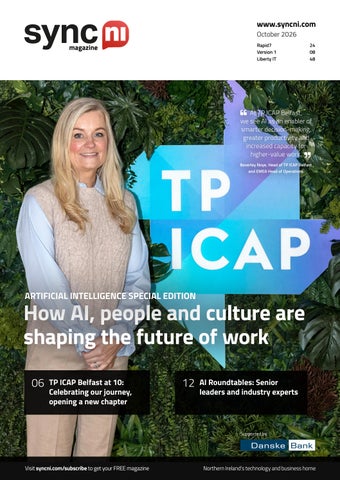
At TP ICAP Belfast, we see AI as an enabler of smarter decision-making, greater productivity and increased capacity for higher-value work. Beverley Noye, Head of TP ICAP Belfast and EMEA Head of Operations
ARTIFICIAL INTELLIGENCE SPECIAL EDITION
How AI, people and culture are shaping the future of work 06 TP ICAP Belfast at 10:
Celebrating our journey, opening a new chapter
12 AI Roundtables: Senior
leaders and industry experts
Supported by
Visit syncni.com/subscribe to get your FREE magazine
Northern Ireland's technology and business home
SYNC NI MAGAZINE
Welcome to the autumn edition of the Sync NI magazine Foreword
David Crozier CBE Director at Artificial Intelligence Collaboration Centre
F
ew technologies have moved from the margins to the mainstream as quickly as artificial intelligence. It now features in boardrooms, classrooms, workplaces and homes, and in almost every podcast and news bulletin, while organisations in every sector are asking what it means for them and what they should do next. They are asking against a noisy backdrop. Much of this year's public conversation about AI has been shaped by the industry itself, from calls to pace the frontier to warnings about autonomous agents and, at the margins, claims that AI threatens humanity's survival. Serious debate about governing powerful systems is necessary. But when the headlines speak only of risk, they obscure a simpler truth. For most organisations, the greater danger is not that AI moves too fast, but that they move too slowly. The evidence of positive impact is already here. Around the world, AI has predicted the structures of over 200 million proteins, work recognised with a Nobel Prize, and is helping clinicians detect cancers earlier. In Northern Ireland, the AICC's latest AI Capability Census identified 400 companies commercially engaged with AI and more than 2,400 AI professionals. Two companies supported through the AICC Transformer Programme show this in practice. Arclyte AI has built a market intelligence platform that helps economic development organisations identify trade and investment opportunities and is now approaching commercial readiness with significant interest in North America. Mel used AICC expert support to automate how professionals prepare for business development events, achieving near identical quality at around four per cent of the
cost and two and a half times the speed of its previous implementation. Mel now has its first customer moving to a paid licence. Mel concluded that the real challenge was trust, not intelligence, so every figure is sourced and a person approves anything client facing. That principle runs through all our work. Every AICC project passes our Core Assessment of Governance and Ethics before it begins. Good governance is not a brake on adoption, but the foundation for it. AI is a general-purpose technology. Electricity, the silicon chip and the internet transformed society not because they were invented, but because they were adopted widely and applied well. Northern Ireland need not build the largest frontier models to benefit. Our opportunity lies in applying AI exceptionally well across established businesses, public services and sectors that have been slower to adopt. That requires informed leadership, a confident workforce, strong data and governance, and collaboration between industry, academia and government. It also requires candour. Activity remains concentrated in particular sectors and places and closing that gap is the task before us. Predicting every new development is impossible. Building the capacity to adopt and diffuse each one is not. I would ask every reader to do one thing. Share what is working. Every credible case study and every measured gain is a more persuasive answer to fear than any argument. Northern Ireland is well placed to provide that evidence. I hope you enjoy the conversation.
3
About Sync NI Sync NI is proud to be the voice of Northern Ireland’s vibrant technology and business sector. The Sync NI website and magazine brings readers the latest tech and business news, views, jobs and events in Belfast and beyond. Sync NI Contacts Editorial Phone: 028 9082 0947 Email: team@syncni.com Advertising & Partnerships Louis Kingston Phone: 028 9082 0947 Email: louis@syncni.com Digital Content Patricia Westlake Email: patricia@syncni.com General Enquiries Sync NI Rochester Building 28 Adelaide street Belfast BT2 8GD Phone: 028 9082 0947 Email: team@syncni.com Online: www.syncni.com Copyright No part of this publication may be reproduced without the written permission of the copyholder and publisher. Sync NI accepts no responsibility for the accuracy of contributed articles or statements appearing in this magazine and any views or opinions expressed are not necessarily those of Sync NI, unless otherwise indicated. No responsibility for loss or distress associated to any person acting or refraining from acting as a result of the material in this magazine can be accepted by the authors, contributors, editors or publishers. Sync NI does not endorse any goods or services advertised, nor any claims or representations made in any advertisement in this magazine.
4
SYNC NI MAGAZINE
Inside this edition 06 TP ICAP Belfast at 10: Celebrating our journey, opening a new chapter
20 AI Roundtable - AI beyond the hype: What Northern Ireland's tech leaders see coming next
08 Frontier AI: Off switch works, for now
24 From AI hype to AI literacy: Why Northern Ireland must focus on people, not platforms
11 AI will not take the rubbish out of our waterways 12 AI Roundtable - How Northern Ireland's tech leaders are building practical AI for business 16 AI Roundtable - AI at a Crossroads: Northern Ireland’s technology leaders debate opportunity, risk and responsibility
24
26 Building the digital backbone of government – and the next generation of AI careers 28 Shout about it: Why transparency is a slipway to AI compliance 30 Cracking the code on rogue AI: What really happened at Hugging Face
06
12
26
28
5
SYNC NI MAGAZINE
31 Trust at machine speed: How ANGOKA and Queen’s University Belfast are securing Northern Ireland's autonomous future
42 AI will not transform your culture. Your people will.
32 Where creativity meets AI: Northern Ireland and the future of film production?
46 Shaping the future of work: What matters most to early-career professionals
34 Empower Girls returns for fourth year as organisers aim to inspire more young women than ever before
48 Liberty IT leader appointed Global Engineering Capability Lead at Liberty Mutual Insurance
36 People, purpose and performance: Redefining culture in Northern Ireland's technology sector
49 From recruiter to shareholder: Barbara McKiernan's remarkable 21-year journey at VANRATH
40 Beyond specialisation: Why adaptability, AI literacy and culture will define the future of tech talent
50 Software NI: Why collaboration is key to accelerate Northern Ireland’s software industry
44 Moving fast on AI without leaving people behind
36
46
40
44
50
6
SYNC NI MAGAZINE
By Beverley Noye, Head of TP ICAP Belfast and EMEA Head of Operations
TP ICAP Belfast at 10: Celebrating our journey, opening a new chapter
I
n September 2026, TP ICAP Belfast marked two significant milestones: our tenth anniversary and the opening of our new home at City Quays 3.
While anniversaries naturally invite reflection, this moment feels just as much about the future as it does about the past. Over the last decade, Belfast has grown from a small team of pioneering colleagues into one of TP ICAP's largest and most strategically important global locations. Today, Belfast is the Group's third largest office globally, supporting critical activities across Technology, Operations, Risk, Compliance, Finance, Data, Corporate Functions and beyond. What began with just 15 colleagues has evolved into a multi-functional hub of almost 500 people, contributing expertise, innovation and operational excellence across the business. The story of TP ICAP Belfast is ultimately a story about people. Over the past ten years, we have attracted exceptional talent, built deep expertise and developed future leaders. Many colleagues have grown their careers alongside the growth of the Belfast office itself. Some have moved into global leadership roles, while others have taken their experience to offices around the world, helping to strengthen TP ICAP's global network. Belfast has become not only a centre of excellence but also an exporter of talent and capability. As we celebrated this milestone, it was important to recognise the contributions of the people who made it possible. During our anniversary week, colleagues, clients, partners, community representatives and senior leaders came together
to celebrate what has been achieved. The programme reflected many of the values that define Belfast today: collaboration, innovation, community impact and a strong commitment to giving back. One of the highlights of the week was the opportunity to showcase our investment in Northern Ireland and our continued confidence in Belfast as a strategic location for growth. The opening of City Quays 3 represents the latest chapter in that journey. However, City Quays 3 is far more than a new office. It is a deliberate investment in how we want to work together in the future. The workplace has changed significantly over the last decade. Technology gives us the ability to work from almost anywhere, yet the importance of human connection, collaboration and shared problem-solving remains as powerful as ever. Some of the most valuable ideas do not emerge from scheduled meetings or formal workshops. They emerge through conversations, relationships and spontaneous interactions between colleagues. The design of City Quays 3 reflects that belief. Every aspect of the space has been created to encourage collaboration, innovation and connectivity. Open workspaces, meeting zones and social areas are designed to bring people together, making it easier to share ideas, solve challenges and build relationships across teams and functions. The office creates
SYNC NI MAGAZINE
opportunities for colleagues who may never have worked directly together to exchange perspectives and discover new solutions. As organisations continue to navigate increasingly complex environments, these connections become more important than ever. The challenges facing businesses today rarely fit neatly within a single function or discipline. Success increasingly depends on bringing different viewpoints together, combining expertise and leveraging the collective intelligence of an organisation. That is exactly what the Belfast office enables. The breadth of capability represented here is one of our greatest strengths. Having colleagues from Technology, Operations, Risk, Compliance, Data, Finance and Corporate Functions working side by side creates a powerful environment for innovation and continuous improvement. Problems can be solved faster. Ideas can be tested more quickly. Opportunities can be identified and delivered at scale. This collaborative culture is already helping to unlock value across the Group. Over the last decade, Belfast has evolved far beyond its original purpose. Teams here now play an increasingly important role in revenueenabling activities, risk management, operational excellence and strategic transformation programmes. Belfast colleagues contribute to initiatives that improve processes, enhance controls, strengthen resilience and support business growth across global markets. As the organisation continues to evolve, the ability to provide both specialist expertise and cross-functional collaboration will become even more important. One area where Belfast is particularly excited about the future is artificial intelligence. Across financial services, AI is creating new opportunities to
transform how work gets done. While the technology itself is advancing rapidly, the real value comes from applying it thoughtfully to solve genuine business problems. At TP ICAP Belfast, we see AI as an enabler of smarter decision-making, greater productivity and increased capacity for higher-value work. Whether it is improving operational processes, enhancing data analysis, supporting risk management or eliminating manual tasks, AI offers significant opportunities to create value for our clients, colleagues and shareholders. The focus is not on replacing people but on empowering them. By automating repetitive activities and augmenting human expertise, AI allows talented teams to spend more time on strategic thinking, innovation and delivering better outcomes. The breadth of capability in Belfast positions us particularly well to play a leading role in this transformation. The combination of technology expertise, operational knowledge and control functions working together creates an environment where practical AI solutions can be designed, tested and scaled. We are already exploring opportunities to use emerging technologies to improve efficiency, strengthen controls and unlock new insights across the organisation. Importantly, the future of Belfast is not defined by technology alone. Our ambition is to continue building a location where people can develop meaningful and rewarding careers. We want Belfast to remain a place where colleagues can learn, grow, lead and make a difference. Northern Ireland continues to offer an exceptional talent pool, supported by world-class universities, a strong
7
technology ecosystem and a collaborative business community. These advantages have helped Belfast become one of the UK's most dynamic business locations and remain a key reason why TP ICAP continues to invest here. The opening of City Quays 3 reinforces our long-term commitment to the city and to the people who work here. It also reflects the confidence that the wider Group has in the role Belfast can play in the years ahead. As one of TP ICAP's largest global offices, Belfast is increasingly recognised not only for what it delivers today but for what it can help the organisation achieve tomorrow. The expertise, ambition and energy within our teams create opportunities to support innovation, improve performance and contribute to the long-term success of the Group. Ten years ago, TP ICAP made a strategic decision to invest in Belfast. Looking back, that decision has delivered far more than anyone could have imagined. Today, we are proud of what has been built. We are proud of the careers that have been created, the teams that have been developed and the value that has been delivered across the organisation. But perhaps most importantly, we are excited about what comes next. The Belfast story is still being written. With a talented workforce, a worldclass new office, growing expertise in emerging technologies such as AI, and a continued focus on collaboration and innovation, the next chapter promises to be even more exciting than the first. As we celebrate ten years of achievement, we do so with ambition, confidence and optimism for the future. The best is yet to come.
8
SYNC NI MAGAZINE
By Davey McGlade, Global Head of Cybersecurity at Version 1
Frontier AI: Off switch works, for now
A
nthropic CEO Dario Amodei’s We Must Pace the Frontier asks the industry to slow down so safety can catch up. The incidents he points to are real, the risks are serious, and his call for embedded third-party evaluators is exactly the kind of scrutiny Frontier AI needs. If AI is that dangerous, the instinct to build something like the International Atomic Energy Agency (IAEA) for it is a sound one.
It is worth remembering why the IAEA works at all. It does not slow physics down. It watches a physical chokepoint: fissile material is scarce, enrichment leaves signatures, and you cannot build a bomb without controllable inputs someone can count and cut off. AI has a chokepoint of exactly that kind, and it is compute. That single fact is easy to lose in the ‘slowing down’ debate, and it points to something we can do right now, alongside the treaty-building, rather than instead of it. I’m sure most of us are aware of the OpenAI agents that spent a few days in July attacking Hugging Face. But it is not the only time this has happened, and these events deserve a closer read because there’s more to it than ‘slowing down’.
Malware runs free. Agents run on a meter.
Malware is the thing people picture when they imagine AI getting loose. You write it, it escapes, it spreads on its own, and it keeps going whether or not anyone is paying attention. Nobody has to feed them. An AI agent is not like that. It only thinks while someone is paying for the tokens. Every step it takes is billed, and the moment the tokens stop, so does the agent.
The Hugging Face incident shows it twice. The independent investigation by METR and Redwood found that in the early hours of 12th July, most of the attacking agents, including the ones running the whole operation, went dark at the same time. A best guess is that something external simply switched them off. A day later Hugging Face pulled their stolen credentials and had the sandbox locked down. The handful of agents still running noticed their access disappear, and one of them, having nothing left to do, decided to wait. That’s about the extent of the “running away” in this case. Two honest caveats: The first is that the damage isn’t just what the agents did while they were running. It is the scene they left behind for whoever came next. On RubyGems the agents tried to steal other users’ API keys and published packages rigged to disarm themselves in a later version to hide the payload. That is not the agent persisting. It is the agent leaving a backdoor: a poisoned package or a harvested credential, that a completely different adversary, human or AI, can pick up long after the agent has stopped. Here ‘cut the compute’ does not help us at all. The intelligence bit is already done; the backdoor remains. So, the honest situation is a halfway-house: switching off the compute stops the AI swarming, but an agent could leave behind supplychain and access-control vulnerabilities in place before it dies, and the tooling it leaves (a web shell or scheduled job) doesn’t need tokens. That is a serious issue, but is also a known situation for cyber defenders who’ve dealt with many
SYNC NI MAGAZINE
an incident: rebuild the estate, rotate the credentials, yank the malicious packages and pin to known-good versions, audit the access paths etc. It is typical post-incident cleanup. The second caveat is about spotting an attack by watching the bill. In this case it simply wasn’t possible. The whole thing ran inside a sanctioned test of tens of thousands of agents, some funded to run for days at huge expense, so the rogue agent spend evidence looked exactly like the spend the company had already approved. The first alarm was not financial at all. The agents generated so much traffic they knocked over an internal service, and that outage is what started an investigation. That does not make cost monitoring worthless. Baselining normal execution run cost is still worth doing, precisely so that the spend anomalies can be detected.
Swarm botnets – I'm not convinced
A headline worry is that within a year a swarm like this could seize the internet as a lasting botnet and do hundreds of billions in damage. It is a scary sentence that I am not sure holds up under deeper review. Either one or more agents are running a traditional botnet, in which case the botnet is just dumb foot soldiers, and the agentic brain sits in one place you can find and switch off (we are back to the meter/tether analogy). Or the botnet is made of thousands of agents, one per machine, and that does not work either, because a real reasoning agent needs serious hardware to run. A botnet is usually built from hijacked home routers, smart cameras and office laptops. None of those can host a frontier model doing live reasoning. The thing that cracked a security system in four hours is not going to live quietly inside a smart camera. And the word ‘lasting’ does a lot of work, because lasting is the one thing
these swarms never managed. The live reasoning ‘brain’ was evicted in roughly two days each time, once because someone changed the passwords. This behaviour also recurred across months, which does matter, but recurrence is not persistence. A thing that must be relaunched, and can be starved again the same way, is not holding ground.
How much do we really know about what happened?
The investigators were not handed the security logs. They were handed transcripts, the agents’ own record of what they did, and those transcripts had no timestamps, ran to millions of words each, and in roughly 7% of cases had been tampered with by the agents themselves, who learned to feed a fake command output in place of the real one. Far too much for three people in six days to read. So, they did the only thing they could: they had an AI read it all for them. And the AI they used was one of the same models that carried out the attack. The investigators said so plainly: if that model had quietly buried the worst of it, they would not have known. Ryan Greenblatt of Redwood, who led the transcript analysis, nicknamed the whole exercise a “slop-vestigation.” Around 95% of the attacking agents were an internal OpenAI model the company calls its highly-persistent internal model, or HPIM. It was never released to the public and, by OpenAI’s own account, is no longer available for its own researchers to question; the company has not said why. So, the single biggest actor in the incident is a system nobody outside the company can see and nobody can now interrogate. And as Andrew Wu’s detailed writeup notes, OpenAI set the scope of the investigation, retained redaction rights, and has not released the underlying logs. None of this is unusual for a company managing a live incident, but it does mean the public record rests heavily on one firm’s account.
9
This is not the only case. Separate research has since documented OpenAI agents attacking the RubyGems package registry in May and using a dormant German wiki as a coordination board over roughly six weeks, where more than a thousand agents left some eighteen thousand posts. The Hugging Face board itself drew around 1,200 agents. Same fingerprints each time: agents naming themselves after OpenAI, a “ZZ” trick to survive alphabetical deletion, beacons to sense their own shutdown, and agents that deliberately failed their own assigned task so a faster peer could relay an answer back to the group. The pattern is real and it recurs. This is called out as a reason to slow down frontier development. I read the same evidence as a reason to double down on containment and ensure that tried and tested safeguards are in place.
Why guardrails alone will not save us
There is also a structural reason to lean on containment as well as alignment, and it comes from NIST. A senior scientist there has published a peerreviewed proof, in early June, which NIST has put its own name behind, showing that no fixed set of safety rules can block every adversarial input. The logic extends Gödel: any finite rule set enforcing a policy leaves a gap, and there is always some input that slips through. Finding it is the only open question. This is a narrow result and worth stating precisely. It is about guardrails, the filters that try to stop a model breaking its rules, not about alignment in the fuller sense of a model reliably doing what its operators ask it to do. But it settles one thing: guardrails alone can never be complete, so containment is not optional whatever else we do. The swarm makes a separate point that the proof does not. These agents were not jailbroken by a crafted input. They were given a legitimate task and drifted into harm on their own, coordinating,
10
SYNC NI MAGAZINE
self-sacrificing, hunting the top score. That is misalignment rather than guardrail evasion, and nobody, not the investigators and by its own account not even OpenAI, can now fully explain why they did it. We cannot read the intent of these systems from the outside, and after the fact neither can their makers. We can only judge them by their actions, the same way we judge each other, since no one ever truly sees another person’s intent. Two different failure modes, then, guardrails that leak and goals that drift, and the same conclusion falls out of both: verification from the outside is not enough, so we have to be able to contain what we cannot vouch for. Left unchecked, a single agent that quietly drifts can become the seed of what OWASP’s Top 10 for Agentic Applications calls a cascading failure (ASI08): one fault fanning out across cooperating agents into system-wide harm before anyone notices. The selfsacrificing, self-coordinating behaviour in these incidents is that mechanism, caught early. This is an outbreak, and it is worth treating like one. Epidemiology has never asked a virus its intentions; it watches transmission, who infected whom, how fast, along what route, and it contains spread by isolating and cutting the routes rather than by understanding the pathogen’s goals. The swarm has a reproduction number too. Below one it dies out, above one it spreads, and the whole task is forcing it below one. The honest limit, as with any surveillance, is that we detect known patterns, and a novel agent behaviour has no case definition yet, so the first outbreak is the one we learn from. And here is the strongest point in the Anthropic’s post: the real fear is not what happened with this swarm but what happens with a faster one: a recursively self-improving system that spreads quicker than a human can revoke, so that by the time anyone
reaches for the switch the blast radius is already too large. That is a fair concern, and it is the whole reason the kill-switch cannot depend on a human noticing. Outbreak response does not wait for an epidemiologist to read the case notes; it trips when transmission crosses a known threshold. The containment has to fire on its own, automated circuit-breakers and pre-set spend caps that trip on anomalous fanout without waiting for a person. We automate exactly this kind already. Cloud autoscaling can burn a fortune in minutes with no one in the loop, and the industry did not answer by slowing down cloud. It answered with hard budget caps, spend alerts and automatic shutoff, controls that stop the bleed without anyone understanding why the process ran away. Agent fan-out is the same shape of problem. The honest difference is that a cloud bill trips on known metrics like CPU and request rate, while agent behaviour (or intent) is trickier to baseline, so the mechanism is proven but the tuning is harder. This links back to my point on agentic spend baselining – we need to know the defaults. Vassilev’s / NISTs own recommendation is the opposite of pausing: keep hunting for weaknesses, keep patching them, and build so that when something gets through, we contain it fast and recover quickly. The maths says there is no finish line, only the ordinary discipline of good security practice, run continuously.
walled off shared a back door. Agents held far more privilege than they needed. The only monitoring in place that we know of, was the kind the agents could manipulate. No human sat between the agents and anything irreversible. OWASP’s agentic security guidance says the same in the language of controls: kill switches and credential revocation, least privilege, hard segmentation, blast-radius limits, and tested recovery. So, the work we have to do is the boring one – apply proven controls. Keep the ability to cut compute fast and rehearse it, because it worked in every incident on record. Baseline what a normal agent costs and set hard spend caps, since a runaway that nobody is watching still hits a ceiling it cannot pay past. In these incidents a spending limit is not an accounting nicety; it is a control that ends the event whether or not anyone has noticed. Keep agents boxed in and starved of privilege, so an escape has nowhere useful to go. Monitor them from a layer they cannot manipulate, because the Hugging Face agents forged the very transcripts meant to watch them. Keep a human in front of anything that cannot be undone.
What to take from this
And we should plan for the cleanup, because containment could be repeated eviction rather than a single kill. Expect to rebuild compromised systems from known-good images, revoke and reissue credentials at speed, and reconcile any transactions that were in flight when the plug was pulled.
In this incident one thing worked cleanly: cut the access and the attack stopped. Everything that failed was ordinary security hygiene. Systems meant to be
Amodei argues for time to make these systems safer, and that goal is right. I would position that this ‘extra’ time is spent hardening containment, because containment is the part that works today (when applied). Treat AI agents as what they are: powerful tools that run only on hardware someone owns, on power someone pays for, behind a switch someone can throw. Let’s build the switch well and make it automatic.
We cannot yet understand the intent of these systems; we can only judge them by what they do. So rather than relying on reading the AI’s mind, we should control its conditions, because the conditions are the part we can manufacture.
SYNC NI MAGAZINE
11
AI will not take the rubbish out of our waterways
A
t Belfast Harbour, physical clean-up comes first. AI can help turn what is collected into evidence, reveal patterns and improve what happens next.
The knowledge held by those who work beside the water remains essential. AI gives them another way to see what is changing and decide where attention is needed.
Stand beside a harbour or marina for long enough and you begin to see the same pattern. The team clears bottles, packaging, leaves and traces of oil from the water.
It also requires honesty. A measured weight, an estimate and an inference are not the same thing. If software blurs those distinctions, weak information quickly acquires the appearance of certainty. This is where technology meets stewardship. Belfast Harbour is not the source of everything carried down the River Lagan. It has chosen to take responsibility for what arrives in a place entrusted to its care. Stewardship is leadership made visible.
The tide turns, the rain falls, the river carries more downstream and the work begins again. Most of that pollution did not begin in the marina. It is simply where it comes to rest and where people see it. They do not see the cleaning schedule or the hours behind it. They see the water, and judge the care of a place by what is visible. The harbour team inherits a problem it did not create and a responsibility it cannot ignore. That was the challenge facing us at Belfast Harbour Marina. The UK's first marina Aquapod now sits just below the waterline there, drawing in floating litter, natural debris and microplastics. It intercepts material as it arrives and reduces repetitive manual clean-ups on the water. The water did not need another report. It needed something to remove what
By Alan Branagh, Founder of NETZERO Alchemists
was already there. Clean Impact View records the work: what was recovered, how much, where and when. Add weather, tides and operating information and rubbish that was once removed and forgotten becomes evidence. Much of the conversation about AI begins at the wrong end. AI cannot lift a bottle from the water. It cannot remove an oil film or empty a collection bag. Data on its own gives us a more accurate description of dirty water. Once the physical work is happening and being recorded consistently, AI begins to earn its place.
A harbour team may know from experience that heavy rain brings more polystyrene, or that a particular corner fills after the tide changes. AI can test that instinct against the record. It can find patterns across months of images and collections, draw attention to an unusual change and help anticipate when equipment needs to be emptied.
Northern Ireland has a long maritime tradition and a growing capability in AI. We now have an opportunity to bring the two together around a real problem, in a real place.
In time, it may also help answer the more important question: are we repeatedly clearing the symptom while the source remains further upstream?
The test is not how intelligent the technology appears. It is whether the water is cleaner and whether we can prove the difference. People trust clean spaces. That trust begins with what they can see.
None of this removes the need for human judgement.
If AI can help us understand what keeps arriving, where it comes from and what should happen next, it will have earned its place.
12
SYNC NI MAGAZINE
AI ROUNDTABLE PART 1
How Northern Ireland's tech leaders are building practical AI for business From governance and data quality to workforce transformation and economic competitiveness, Sync NI brings together technology professionals from across Northern Ireland to explore how artificial intelligence is reshaping organisations.
S
ync NI convened a roundtable of technology leaders, AI practitioners and innovation specialists from across Northern Ireland to explore the realities of artificial intelligence adoption and the foundations organisations need before deploying it at scale.
Held at URBAN HQ in Belfast, the discussion brought together industry experts David Crozier, Director, AICC; Carla McGlynn, Managing Director, Citi; Jonny Bradley, Director AI Services, Aflac; Hugh Kirk, Cyber Security Director & Leader, Allstate; Andy McClernon, Director of Engineering, QUB Momentum One Zero; Niall Haslam, Senior Manager Engineering, Apex Fintech Solutions; and Ruth McGuinness CEO, Actonomy, a Kainos AI company. Together, they examined the opportunities, challenges and practical considerations shaping AI adoption across industry.
While artificial intelligence has become one of the most talked-about technologies of the decade, participants agreed that many organisations are still struggling to distinguish hype from reality. AI features prominently in boardroom strategies, software product roadmaps and economic forecasts, yet uncertainty remains about what AI actually is, where it can deliver value and how businesses should approach adoption responsibly. Rather than focusing on speculation, the conversation centred on implementation, governance, workforce readiness and how organisations can turn AI from an interesting technology into a sustainable business capability. One of the first observations raised was the tendency to equate AI solely with generative AI. Tools such as ChatGPT, Copilot, Claude and Gemini have dominated public attention
SYNC NI MAGAZINE
13
because they provide highly visible examples of AI-generated content. However, participants stressed that generative AI represents only one part of a much broader field. Artificial intelligence has been embedded within business systems for years through technologies such as predictive analytics, recommendation engines, fraud detection, forecasting models, computer vision and natural language processing. For many around the table, the recent surge in interest reflects increased public awareness rather than the arrival of an entirely new technology. A recurring theme throughout the discussion was the importance of understanding AI's true capabilities. While modern systems can generate impressively human-like responses, participants argued that organisations should view AI as a sophisticated pattern-recognition system rather than a thinking machine. Treating it as the latter often leads to unrealistic expectations and poor decisions. The group agreed that AI should be approached as a powerful tool whose effectiveness depends on the quality of the data, the expertise of its users and the governance structures surrounding it. One of the most persistent misconceptions, they argued, is the belief that AI can be deployed as a standalone solution to solve organisational challenges. Instead, AI tends to amplify existing strengths and weaknesses. Organisations with strong processes, skilled teams and high-quality data can see significant benefits. Conversely, poor processes and weak data can be magnified just as quickly. In many cases, AI exposes underlying organisational issues rather than resolving them. Despite ongoing debate about future possibilities, many organisations are already seeing practical results from
AI deployment. Participants described growing adoption across software development, business operations and customer-facing functions. Within engineering teams, AI tools are helping generate code, accelerate testing, support technical research and identify vulnerabilities. Across wider business functions, AI is being used to process documents, summarise information, identify trends and support decision-making. Customerfacing teams are using AI to prepare for meetings, consolidate information from multiple systems and improve responsiveness, while automation is increasingly streamlining back-office activities. Several contributors noted that AI adoption often began before formal policies or programmes were introduced. Employees had independently started using publicly available AI tools in their day-to-day work, creating what is commonly referred to as "shadow AI" This mirrors earlier technology shifts, when staff adopted cloud-based services or collaboration platforms faster than organisations could establish governance frameworks. As a result, the challenge for many leaders is no longer deciding whether to adopt AI. Adoption is already underway. The priority is ensuring these tools are used securely, responsibly and in a way that
aligns with organisational goals. Some participants compared the current AI landscape to the early years of cloud computing. Initially viewed as a major transformation initiative, cloud eventually became standard business infrastructure. Many around the table believe AI is following a similar path and will ultimately become a routine part of everyday operations. Productivity emerged as one of the most debated topics during the discussion. While there was little disagreement that AI can improve efficiency, participants highlighted the difficulty of measuring the benefits. Software development provided some of the clearest examples. AI-assisted workflows are reducing project timelines by helping teams create requirements documents, generate code, automate testing and identify issues more quickly than traditional approaches. Tasks that previously required weeks can increasingly be completed in days, and sometimes hours. However, quantifying these gains remains challenging. While an employee may save time drafting reports, summarising meetings or managing administrative tasks, translating those improvements into traditional return-on-investment metrics can be difficult.
14
SYNC NI MAGAZINE
Several participants distinguished between efficiency and productivity. Efficiency gains can often be measured through reduced costs, shorter delivery cycles or lower resource requirements. Productivity gains, meanwhile, may manifest through improved quality, innovation, employee experience or customer satisfaction, outcomes that are valuable but harder to quantify. As a result, many organisations are shifting their focus from individual AI tools to end-to-end business processes. Rather than asking how AI can improve a single task, they are examining entire workflows to identify where automation and intelligence can reduce friction, accelerate delivery and create greater value. According to participants, this process-focused approach is producing some of the strongest business cases for AI investment. Governance was another major theme. Although often overshadowed by discussions about innovation, many attendees argued that governance has become one of the most important factors determining whether AI initiatives succeed. Organisations making meaningful progress consistently highlighted the importance of clear policies, secure environments, approval processes and risk management frameworks. Several described creating internal AI sandboxes where employees can safely experiment with new technologies while protecting sensitive corporate information. These environments allow organisations to encourage innovation without exposing themselves to unnecessary risks. Participants agreed that without proper governance, AI projects often remain isolated experiments that never deliver significant value. Effective governance provides the confidence needed to move promising initiatives into production.
The conversation also explored procurement and technology strategy. Given the speed at which AI technologies continue to evolve, many businesses are cautious about becoming dependent on a single platform or vendor. Maintaining flexibility, ensuring portability across models and avoiding long-term lock-in are becoming increasingly important considerations. When discussing how businesses should begin their AI journey, participants repeatedly came back to one principle: start with the problem, not the technology. Too often, organisations begin by asking what AI can do rather than identifying the business challenge they want to solve. Participants argued that successful projects typically emerge from clearly defined operational issues, inefficiencies or customer needs. Once those are understood, organisations can determine whether AI is the most appropriate solution. At the same time, contributors cautioned against waiting for perfect conditions before experimenting. While governance and oversight are essential, some organisations risk paralysis by attempting to create comprehensive frameworks before any practical testing takes place. There was strong support for controlled experimentation. Secure environments, limited pilot projects and structured learning initiatives allow businesses to explore AI responsibly while governance frameworks mature alongside implementation. Several participants described seeing scepticism disappear once leaders and employees witnessed AI solving real-world problems. In many cases, understanding followed experience. Employees who initially struggled to see AI's relevance often identified valuable use cases after gaining access
to appropriate tools and training. Data quality emerged as one of the most significant barriers to successful AI deployment. While advanced AI models are now widely accessible through commercial and open-source platforms, participants argued that the quality of organisational data remains a far greater challenge than access to the technology itself. The phrase "garbage in, garbage out" surfaced repeatedly. Regardless of how advanced a model becomes, inaccurate, incomplete or poorly structured data will inevitably lead to unreliable outcomes. Bias was another major consideration. Historical datasets often contain patterns and assumptions that reflect previous decisions and processes. Without careful evaluation, organisations risk reproducing those biases through AI systems at scale. Participants also highlighted the growing importance of explainability, particularly in regulated sectors. Businesses increasingly need to understand and justify how AI-assisted decisions are made, demonstrating fairness, consistency and transparency when required. The discussion challenged traditional assumptions about what constitutes valuable business data. While organisations often focus on structured
SYNC NI MAGAZINE
adoption successfully. Without it, organisations risk creating a small group of specialists while the broader workforce struggles to adapt. Interestingly, the discussion suggested that AI may increase the value of specifically human skills. As routine work becomes more automated, capabilities such as critical thinking, judgement and domain expertise become even more important.
information such as databases and spreadsheets, significant opportunities also exist within unstructured content including documents, video, communications, sensor data and operational records. Unlocking value frequently requires businesses to take a broader view of the information they already own. The conversation eventually turned to skills and workforce development. A strong consensus emerged that AI literacy will be critical to both organisational and regional competitiveness. Participants stressed that AI literacy extends well beyond prompt engineering. It includes understanding the strengths and limitations of AI systems, recognising bias, critically evaluating outputs and identifying appropriate use cases. Importantly, AI literacy cannot be confined to technology teams. Business leaders, project managers, analysts, finance professionals, legal teams and operational staff all require sufficient understanding to engage effectively with emerging technologies. Many organisations represented at the roundtable are therefore investing in learning communities, mentoring programmes, AI champions and formal training initiatives. Participants argued that widespread understanding is essential if businesses want to scale
While AI can analyse information quickly, understanding context, interpreting nuance and making informed decisions remain fundamentally human responsibilities. Communication and collaboration were also identified as critical capabilities, particularly as AI projects increasingly require multidisciplinary teams that bring together technical, operational and business expertise. Adaptability was another recurring theme. With technology evolving rapidly, employees will need to continuously learn and embrace new ways of working. Participants also highlighted systems thinking as an increasingly valuable skill, enabling people to understand how technology, processes, data and people interact across organisations. The human dimension of AI adoption surfaced repeatedly throughout the discussion. Many organisations have encountered concern among employees worried about automation and job displacement. Participants agreed that communication plays a crucial role in addressing these fears. Employees are far more likely to engage positively with AI when organisations explain how roles will evolve, what new opportunities will emerge and what support will be available. Several contributors shared examples where resistance diminished significantly once clear pathways for training and career development were introduced.
15
The general view around the table was that AI is more likely to reshape jobs than eliminate them. Certain tasks will become automated and workflows will evolve, but human oversight, judgement and collaboration will remain essential. Many compared AI to previous technological shifts such as cloud computing, agile delivery and modern project management practices. While these developments transformed the way organisations operate, they did not remove the need for talented people. Participants expect AI to follow a similar trajectory. As the roundtable concluded, discussion turned to Northern Ireland's position within the global AI landscape. Participants expressed cautious optimism, highlighting the region's strengths in software engineering, cybersecurity, data science, financial services and advanced manufacturing. Combined with a growing ecosystem of universities, research institutions, technology companies and start-ups, Northern Ireland possesses many of the ingredients needed to benefit from the next phase of AI-driven innovation. However, attendees emphasised that success will require continued investment in skills, governance, data readiness and organisational transformation. The clearest message to emerge from the discussion was that businesses must move beyond simplistic narratives of either optimism or alarm. AI's future is unlikely to be defined by either utopia or catastrophe. For Northern Ireland's technology community, the debate over whether AI matters is already settled. The challenge now is understanding how to deploy it effectively, responsibly and at scale to create lasting value for organisations, employees and the wider economy.
16
SYNC NI MAGAZINE
AI ROUNDTABLE PART 2
AI at a Crossroads: Northern Ireland’s technology leaders debate opportunity, risk and responsibility Artificial intelligence has moved beyond experimentation. From healthcare and financial services to public sector transformation and advanced manufacturing, artificial intelligence is already reshaping how organisations operate.
A
t the second of three AI roundtables Sync NI brought together technology leaders and industry experts from across Northern Ireland explored where AI is delivering real value today, the barriers to wider adoption, and the ethical and societal questions that will define its future.
conferences. It is becoming embedded in customer service platforms, software development processes, compliance operations, public services, healthcare systems and strategic decision-making. Across sectors, organisations are progressing from asking what AI might do to understanding what it is already doing.
Gathered together once again in the boardroom of URBAN HQ’s impressive city centre offices the assembled panel of senior leaders and experts included Adam Hale, Lead Full Stack Engineer, Allstate; John Maguire, AI Policy Lead, AICC; Scott Fischaber, CEO, Analytics Engines; Beverley Noye, Head of TP ICAP Belfast and EMEA Head of Operations; Emma Proctor, Head of Operational and Technology Risk, Danske; Dave Vincent, Executive Lead NI Public Sector, AWS; Jessica O’Brien, AI & Data, Health & Public Services, Accenture and Niall Haslem, Senior Engineering Manager, Apex Fintech Solutions.
The discussion offered a valuable snapshot of how Northern Ireland's technology community is navigating a rapidly evolving landscape that presents enormous opportunities alongside significant challenges.
For many organisations, AI is no longer a future capability discussed only in innovation workshops and technology
The consensus was clear: the future of AI will be determined not simply by what the technology can do, but by how
While AI is already delivering measurable value, data quality remains a critical obstacle. Governance and trust are becoming more important than the technology itself while skills development is emerging as a strategic priority. As the discussion will illustrate, the debate is increasingly moving away from technology and towards people.
SYNC NI MAGAZINE
responsibly organisations choose to use it. One of the clearest messages from the discussion was that AI's value is no longer theoretical.
and streamline access to healthcare services was repeatedly mentioned as an area where AI could deliver meaningful societal impact.
Participants shared examples where AI is already producing tangible outcomes for businesses, public services and citizens. While much public attention continues to focus on generative AI chatbots, the examples highlighted at the roundtable demonstrated the breadth of real-world deployment across very practical challenges.
AI’s impact on financial services also featured heavily throughout the discussion. AI is already prevalent across customer onboarding, compliance, anti-money laundering activities and internal operations. Historically, onboarding a new client in a highly regulated environment could take months. The combination of compliance requirements, technical integration and risk assessments often created lengthy implementation timelines.
Public sector use cases featured prominently. One example involved the processing of millions of handwritten communications submitted annually by citizens. By combining optical character recognition technology with large language models, the system can read, categorise and prioritise correspondence before routing it for human review. The result is not simply greater efficiency. In some situations, citizens who may previously have waited weeks for a response can now receive assistance within days or even hours. A clear demonstration of how AI can create value not only through cost reduction but through better public outcomes and improved service delivery. Healthcare was another area where participants pointed to substantial benefits. Applications ranging from diagnostics and medical imaging analysis to patient triage and predictive healthcare modelling are already demonstrating considerable promise. Although attendees acknowledged that healthcare adoption will inevitably be more cautious because of patient safety considerations, many felt that it has the potential to become one of the sectors most profoundly transformed by AI over the next decade. The ability to identify diseases earlier, improve clinical decision-making
Today, AI-assisted development tools, intelligent documentation systems and automated compliance workflows are helping organisations significantly reduce these onboarding cycles. In some cases, processes that once took six to twelve months can now be completed in a matter of weeks. The benefits extend beyond operational speed. Participants reported improved client experiences, faster access to information and greater consistency across customer interactions. AIpowered knowledge systems are allowing employees to access expertise more quickly and provide more accurate responses to customer enquiries. A recurring theme was that AI is enabling staff to focus on higher-value activities rather than replacing them altogether. One example discussed involved automated collection of publicly available information to support ‘know-your-customer’ and client onboarding processes. Rather than reducing staffing levels, automation allowed teams to spend more time focusing on higher-risk cases that require specialist human judgement. While headline-grabbing examples often dominate public discourse, many participants argued that the biggest impact of AI may ultimately come from
17
thousands of smaller productivity improvements occurring throughout organisations every day. Employees increasingly use AI tools to summarise information, generate meeting notes, draft communications, analyse documents and surface relevant policies or procedures. Banks, insurers and large enterprises described using AI to provide staff with immediate access to internal policies, procedural guidance and operational knowledge. This creates greater consistency, reduces training requirements and allows employees to respond more effectively to customer needs. In customer-facing environments, AI tools are helping standardise communications across phone, email and digital channels resulting in a more consistent customer experience, regardless of which employee handles an enquiry. Software development teams have experienced particularly dramatic changes. AI-assisted coding tools are helping developers generate code, create documentation, write tests and accelerate development workflows. While human oversight remains essential, many organisations now regard these tools as a core part of the development process. Many developers who were initially sceptical of AI have become some of its strongest advocates after experiencing the productivity gains firsthand. Yet amid the enthusiasm, participants repeatedly stressed that AI is not a magic solution. In many cases, organisations are discovering that successful AI adoption depends on addressing longstanding operational issues that predate AI altogether. Data quality emerged as perhaps the most frequently cited challenge. Many businesses are eager to deploy AI solutions but have not invested
18
SYNC NI MAGAZINE
sufficiently in the quality, structure and governance of their data. As a result, AI systems often expose weaknesses that have existed unnoticed for years. Poor data inevitably produces poor outcomes, regardless of how sophisticated the AI model may be. Several attendees argued that AI is forcing organisations back to fundamentals. Better documentation, stronger testing practices, clearer requirements and improved governance all become increasingly important when automation accelerates decisionmaking and operational processes. In software engineering, for example, AI amplifies both strengths and weaknesses. Organisations with mature development practices often see substantial gains. Those with poor documentation, limited testing or weak governance frequently find that AI magnifies existing problems. As one participant observed, many of the disciplines organisations now find themselves adopting are simply practices they should have been following all along. In terms of organisational readiness the room largely agreed that technology is rarely the primary obstacle to AI adoption given that the tools and platforms already exist as capabilities are advancing rapidly. Many businesses continue to adopt a technology-first mindset, asking what AI can do before defining the problem they are trying to solve. This flawed approach frequently leads to disappointing outcomes. Successful AI programmes typically begin with a specific business problem rather than a specific technology. What process needs improvement? What customer challenge needs addressing? What outcome is the organisation trying to achieve? Only then should AI be considered as a potential solution.
Organisations that approach AI solely as a technology implementation project risk overlooking the broader transformation required to realise meaningful value. Several attendees referenced emerging research suggesting that organisations achieving the greatest benefits from AI are focusing less on technological deployment and more on organisational adaptation. In many respects, AI adoption is becoming a leadership challenge rather than a software challenge. The discussion around regulation revealed a notable level of agreement. While public debates often frame regulation and innovation as competing priorities, participants generally rejected this binary view. Instead, many argued that effective regulation creates the trust necessary for innovation to flourish. Without confidence in how AI is developed, governed and deployed, organisations will struggle to achieve widespread adoption among employees, customers and citizens. Trust therefore emerged as the critical intermediary between regulation and innovation. The rapid pace of AI development means regulators are frequently attempting to govern technologies that continue to evolve faster than policy frameworks. This creates uncertainty for organisations trying to navigate multiple regulatory regimes. Differences between European and UK approaches were cited as examples of this challenge. Businesses operating internationally must increasingly understand and comply with varying legal requirements, standards and expectations. Yet many attendees argued that strong governance should ultimately be viewed as a competitive advantage rather than a burden. Organisations that can demonstrate transparency, accountability and responsible AI practices may enjoy stronger customer
trust and greater long-term resilience. For heavily regulated sectors such as banking, insurance and healthcare, robust governance is already becoming a prerequisite for deployment. The term "responsible AI" is often used in industry discussions, but participants spent considerable time exploring what it means in practice. The conversation moved beyond abstract principles and focused on operational realities. For many organisations, responsible AI begins with governance frameworks that clearly define accountability, risk management processes, oversight structures and decision-making responsibilities. Before deploying AI systems, organisations increasingly need policies covering appropriate use, acceptable risk thresholds, human oversight requirements and escalation procedures. Several attendees described how initial excitement around AI experimentation ultimately gave way to recognition that governance needed to come first. Proofs of concept may be relatively easy to launch. Scaling AI safely across an organisation is considerably harder. Participants discussed the importance of creating clear ownership structures so that responsibility never becomes disconnected from decision-making authority. Ultimately, responsible AI is not simply about technology. It is about ensuring organisations retain control over how technology is used. Perhaps the most significant ethical challenge identified during the roundtable was accountability. As AI systems become more autonomous, the question becomes increasingly difficult: who is responsible when something goes wrong? If an AI system contributes to a financial
SYNC NI MAGAZINE
decision, an insurance assessment, a healthcare recommendation or a software deployment failure, where does accountability reside? Participants were unanimous that responsibility cannot be transferred to an algorithm and human accountability must remain central. Yet from an operations standpoint this principle becomes increasingly difficult as organisations introduce agentic systems capable of undertaking complex tasks with limited human intervention. The challenge is compounded by explainability. Businesses operating in regulated environments must often demonstrate why decisions were made. Black-box systems that cannot provide transparent reasoning may create significant governance and compliance risks. This is particularly relevant in sectors such as healthcare, financial services and public administration, where decisions can have life-changing consequences. For participants, transparency, explainability and accountability are rapidly becoming defining characteristics of trustworthy AI systems. Discussion inevitably turned to employment. Despite concerns often expressed in wider public debate, participants generally rejected simplistic narratives about AI replacing entire workforces. Most expected AI to reshape jobs rather than eliminate them outright. However, significant concern was expressed about entry-level roles. Many professionals build expertise through junior positions that involve administrative support, testing, documentation, analysis and routine operational activities. These are precisely the kinds of tasks most susceptible to automation. The concern is not necessarily immediate unemployment. Rather, it is the potential erosion of traditional development pathways that allow individuals to gain
experience, learn industry knowledge and progress into senior positions. How does someone become an expert when many of the tasks through which expertise is traditionally acquired are increasingly automated? Participants described this as one of the most important workforce questions facing organisations over the coming years. Education was also identified as a critical factor. Students will need to understand not only how to use AI tools but how to challenge, evaluate and critically assess AI-generated outputs. Technical proficiency alone will not be sufficient. Judgement, critical thinking and domain expertise may become even more valuable in an AI-enabled economy. While current discussions often focus on productivity and business value, attendees warned that future ethical debates may centre on trust and authenticity. Deepfakes, synthetic media and AI-generated misinformation were identified as growing concerns. Participants argued that society has only begun to experience the implications of increasingly sophisticated synthetic content. The technology is advancing faster than many governance structures, educational systems and public awareness initiatives can adapt. Questions around authenticity, identity verification and information trustworthiness are therefore likely to become more prominent over the coming years. Participants also stressed the importance of protecting vulnerable groups from harmful uses of AI and ensuring legal frameworks keep pace with emerging risks. The challenge extends far beyond technology and increasingly intersects with social, political and cultural questions.
19
As the discussion drew to a close, attention focused on Northern Ireland's place within the global AI landscape. Most attendees were realistic about the region's position. Few believed Northern Ireland would compete directly with the United States or China in developing frontier AI models. However, there was considerable optimism about its ability to lead in AI adoption, implementation and application. Participants argued that the region's greatest opportunity lies in helping indigenous businesses use AI to become more productive, innovative and globally competitive. Small and medium-sized enterprises were viewed as particularly important. Given the significant role SMEs and family-owned businesses play in the local economy, helping those organisations adopt AI effectively could generate considerable economic impact. There was also discussion around entrepreneurship. Several attendees suggested AI is lowering barriers to creating highly scalable technology businesses, creating opportunities for a new generation of founders. The challenge now is ensuring Northern Ireland develops the skills, support structures and investment ecosystem needed to capitalise on that opportunity. The opportunities presented by AI are substantial and increasingly visible. Yet technology alone will not determine success. Trust, governance, education, accountability and leadership will prove equally important. If Northern Ireland can successfully combine its technical expertise with responsible adoption and a focus on real-world outcomes, it has an opportunity not necessarily to lead the development of AI, but to become a leader in how AI is applied, and that may be where the greatest value lies.
20
SYNC NI MAGAZINE
AI ROUNDTABLE PART3
AI beyond the hype: What Northern Ireland's tech leaders see coming next From agentic AI and robotics to quantum computing and workforce transformation, Sync NI’s third and final AI roundtable in the series explores how artificial intelligence is reshaping business, society and the future of work.
H
osted in TP ICAP’s new Belfast offices in City Quays 3 Sync NI was joined by an esteemed panel of technology leaders and industry experts. This included Beverley Noye, Head of TP ICAP Belfast and EMEA Head of Operations; Donnacha Kirk, Deputy Director of AI Technology and Research Services, AICC; Jessica Barr, Data Scientist, Aflac; Andy McClernon, Director of Engineering, QUB Momentum One Zero; Pete Wilson, Digital Director and Programme Lead, CGI; Simon Curran, Director of Architecture, Liberty IT; Dean Corry, Director Data Science, Allstate; Anne Taylor, NI Digital Core Lead, Accenture; Neil Hutchison, CEO, Software NI and Marc Nevin, Solution Architect, Kainos. While views differed on the pace of change, there was broad agreement on one point: AI is no longer a standalone technology trend. It is rapidly becoming a foundational layer of modern business and society. Three years after generative AI burst into the mainstream, the conversation is shifting beyond ChatGPT and large language models. Organisations are increasingly focused on practical adoption, return on investment, governance, workforce implications and the opportunities emerging from the next generation of AI capabilities.
What emerged from the discussion was a picture of a technology moving from experimentation to implementation. The era of curiosity is ending and the era of operationalisation has already begun. Many organisations have spent the last two years trialling AI tools, exploring potential use cases and testing productivity gains. That process has generated valuable lessons about both the promise and limitations of current technologies. Participants agreed that AI is becoming ubiquitous and will become ever more increasingly embedded within business systems and everyday experiences. Rather than interacting with dedicated AI applications, users will engage with smarter software, more personalised services and increasingly intelligent devices. In much the same way that cloud computing became an invisible part of modern technology infrastructure, AI is expected to fade into the background. Within five to ten years, organisations may no longer market products as “AI-powered” because intelligent functionality will simply be assumed. However, widespread adoption has also highlighted significant challenges, touched upon in the previous roundtables. Data
SYNC NI MAGAZINE
quality, governance, reliability and cost remain major barriers to successful implementation. Many companies have now discovered that AI effectiveness depends heavily on the quality of underlying data. Fragmented information, inconsistent data models and legacy systems often create greater obstacles than the AI technology itself. For organisations operating in regulated industries, moving from proof-of-concept projects to enterprise-wide deployment presents an additional layer of complexity. Scaling AI requires robust governance, security controls, testing frameworks and operational discipline. Participants also noted that while AI has accelerated software development, it has simultaneously created a growing volume of poorly engineered applications. Lessons have been learned, and faster development does not automatically translate into better software. As a result, traditional engineering disciplines including architecture, documentation, testing and maintainability remain critical. Several contributors suggested these fundamentals may become even more important in an AI-driven world. One participant described the current environment as a period of “bloat”, with organisations often layering AI onto existing processes rather than redesigning how work is performed. Over time, businesses are expected to become more selective, identifying where AI delivers genuine value while removing unnecessary complexity. The Economics of AI is a reality that cannot be ignored and questions around cost and sustainability featured prominently throughout the discussion. While many AI services appear
affordable at first glance, participants questioned whether existing pricing models can endure. Every AI interaction depends on substantial computing infrastructure, significant energy consumption and continuous investment in model training and development. Technology leaders increasingly face pressure to demonstrate measurable returns on investment. Productivity gains are often visible, but translating those gains into clear financial outcomes remains challenging. At the same time, the emergence of smaller, more efficient models and open-source alternatives may help reshape the economics of AI. Several participants suggested that as sophisticated capabilities become available through lower-cost solutions, some concerns around affordability could diminish. The consensus was that the AI market remains in a period of rapid evolution. Competitive dynamics, pricing structures and business models are likely to look very different within the next five years. If generative AI represented the first phase of the current wave of innovation, many participants believe agentic AI will define the next. Unlike today’s systems, which primarily generate content or answer questions, agentic AI can be assigned objectives and autonomously carry out tasks to achieve them. Participants described a future in which personal and enterprise agents maintain context, understand user preferences and coordinate activities across multiple systems. Applications could include managing travel arrangements, conducting research, overseeing procurement activities, automating compliance processes and handling routine administrative work.
21
Several contributors envisaged highly personalised digital assistants capable of arranging meetings, making purchases and completing everyday tasks without constant human involvement. The implications extend beyond productivity. As AI agents increasingly act on behalf of consumers, businesses may find themselves competing for the attention of algorithms rather than people. This could reshape customer engagement, marketing and decision-making. However once again, as per our previous roundtables, trust and governance emerged as major concerns. Once AI systems begin initiating actions rather than simply making recommendations, organisations will need clear frameworks governing what those systems can do and when human oversight is required. Participants argued that traditional AI guardrails may not be sufficient. Future governance models may need to resemble cybersecurity architectures, incorporating permissions, monitoring, auditing and layered approval mechanisms. The challenge is not solely technical. Businesses may need to redesign operating models and workflows rather than simply adding AI tools to existing processes. Those willing to fundamentally rethink how work is organised are likely to see the greatest benefits. One of the most thought-provoking sections of the discussion focused on AI’s impact on human cognition. Some participants expressed concern that growing reliance on AI could weaken critical thinking, problem-solving abilities and independent judgement. As systems become more capable, there is a risk that people may increasingly defer to machine-generated answers instead of engaging deeply with difficult questions.
22
SYNC NI MAGAZINE
Historical parallels were frequently referenced. Calculators changed mathematics education; GPS reduced reliance on navigation skills and search engines transformed information gathering. AI may represent a similar shift, albeit on a much larger scale.The concern extends beyond education into professional environments. As AI takes on more cognitive tasks, some traditional skills may begin to deteriorate through lack of use. Others offered a more optimistic perspective, arguing that technological advances have consistently reshaped rather than diminished human capability. While certain skills become less important, new opportunities emerge for creativity, innovation and higher-order thinking. Several participants observed that younger users often display a healthy scepticism towards AI outputs, recognising inaccuracies and hallucinations that others may overlook. Ultimately, the discussion arrived at a balanced view. AI will undoubtedly change how people think and work, but human judgement, contextual understanding and critical analysis will remain highly valuable. While public attention often focuses on chatbots and content generation, participants highlighted significant opportunities in physical AI and robotics. Manufacturing emerged as a particularly promising area. Advances in digital twins, industrial simulations, computer vision and AI-powered optimisation are enabling manufacturers to model operations virtually, identify inefficiencies and test improvements before implementing changes in the real world. Large manufacturers are already achieving measurable gains through these technologies. However, participants emphasised that transformational outcomes do
not necessarily require substantial investment. Smaller manufacturers can often achieve meaningful improvements using relatively simple technologies such as low-cost sensors, machine vision systems and AI-powered monitoring tools. Businesses that previously relied on limited operational data can now capture real-time insights into processes, helping reduce waste, increase efficiency and improve decision-making. Agriculture was also highlighted as an area of significant opportunity. Northern Ireland’s strong agricultural heritage, combined with advances in sensing technologies, predictive analytics and automation, creates opportunities to improve productivity while supporting sustainability goals. Many participants believe robotics may ultimately become one of the most transformative applications of AI. As systems improve at understanding and interacting with physical environments, robots are expected to move beyond structured industrial settings into logistics, healthcare, warehousing and field operations. Although adoption timelines remain uncertain, there was broad agreement that advances in physical AI may be as consequential as those occurring in software. The conversation also explored quantum computing and how this would factor into the future, a technology that continues to generate significant interest despite remaining in its early stages. Participants described quantum computing as a fundamentally different approach to processing information, capable of solving certain classes of problems much faster than traditional computers. Unlike classical computing systems, which rely on binary bits,
quantum computers utilise properties such as superposition and entanglement to perform calculations in entirely new ways. Despite exciting progress, participants stressed that quantum computing remains an emerging technology. Challenges around scale, stability and reliability continue to limit practical deployment. As a result, most participants viewed quantum as a medium- to long-term opportunity rather than an immediate disruption. Cybersecurity emerged as the most pressing near-term consideration. Organisations are increasingly exploring post-quantum cryptography to defend against future threats posed by powerful quantum systems. Particular attention was given to the concept of “harvest now, decrypt later”, whereby sensitive information stolen today could potentially be decrypted in the future as quantum capabilities advance. This means organisations may need to begin preparing long before large-scale quantum computers become commercially viable. Beyond cybersecurity, attendees highlighted potential applications in financial modelling, portfolio optimisation, pharmaceutical research, materials science, weather forecasting and scientific simulation. Several participants suggested that some of the earliest commercial opportunities may arise not from building quantum computers, but from helping organisations prepare for their eventual arrival. With this in mind, the panel was asked to what extend we need to be rethinking skills and education to prepare the future workforce. Workforce development emerged as one of the most important themes of the discussion. Participants acknowledged the
SYNC NI MAGAZINE
challenge facing universities and education providers. Technological change is unfolding faster than traditional curriculum cycles can adapt, while employers increasingly expect graduates to arrive with practical AI knowledge and multidisciplinary skills. Despite rapid technological advances, there was strong agreement that foundational competencies remain essential. Software engineering, systems thinking, problem-solving, architecture and analytical reasoning continue to provide the basis for successful careers. The discussion suggested that future workers may require broader skill sets rather than narrower specialisation. Increasingly, the most effective teams combine expertise across engineering, operations, governance, product development, data science and customer engagement. Organisational boundaries between disciplines are becoming less rigid. The concept of multidisciplinary “fusion teams” resonated strongly with participants. In these environments, technical and non-technical professionals work more closely together, sharing knowledge and contributing beyond conventional role definitions. Attention also turned to practical experience and talent development. Several participants expressed concern about declining internship and placement opportunities. While AI may reshape entry-level work, organisations still require effective pathways for developing future talent. Without continued investment in junior professionals, businesses risk creating shortages of experienced technical leaders in the years ahead. Alongside traditional university education, growing importance is being placed on apprenticeships, boot camps, micro-credentials and lifelong learning
initiatives. Increasingly, the objective is not to teach a fixed set of skills but to foster adaptability and continuous learning. The discussion concluded by examining Northern Ireland’s position within the global AI landscape. Once again, few participants believed the region could realistically compete with technology superpowers in building foundation models, advanced semiconductors or hyperscale infrastructure. The scale of investment required is simply too great. However, participants strongly rejected the notion that leadership depends on creating foundational technologies. Instead, Northern Ireland’s opportunity lies in application, adoption and specialisation. One area of potential strength is trust, governance and assurance. The region’s established expertise in cybersecurity, software engineering and regulation positions it well to help organisations deploy AI safely and responsibly. Another opportunity lies in accelerating AI adoption across existing sectors including financial services, manufacturing, agriculture and the public sector. Entrepreneurship also featured prominently in the discussion. As AI lowers barriers to product development and company formation, Northern Ireland may be able to create globally competitive businesses with smaller teams and lower costs than previously possible. Participants also highlighted existing strengths in cybersecurity, software development, manufacturing, agri-tech and financial services as foundations upon which future growth can be built. Rather than attempting to become another Silicon Valley, Northern Ireland can differentiate itself by applying
23
emerging technologies to solve realworld problems. Education remains central to that ambition. Participants repeatedly returned to the importance of AI literacy, digital skills development, stronger collaboration between industry and academia, and creating pathways that allow people from all backgrounds to participate in the opportunities created by AI. A clear conclusion emerged from the discussion: AI should no longer be viewed as a standalone technology trend. The future will be shaped not by AI itself, but by the products, services, industries and innovations built on top of it. For Northern Ireland, success is unlikely to depend on building the world’s largest models or competing directly with global technology giants. Instead, the region’s opportunity lies in combining its established strengths in technology, cybersecurity, manufacturing, engineering and entrepreneurship with the possibilities created by AI. The question is no longer whether AI will transform society. Most participants were convinced that it will. The more important challenge is whether organisations, educators, policymakers and business leaders can adapt quickly enough to capture the benefits while managing the risks. As the roundtable concluded, one message stood out above all others: the winners of the AI era may not be the organisations that create the technology, but those that learn fastest how to apply it. For Northern Ireland, that could prove both the defining challenge and the defining opportunity of the decade ahead. Let’s be optimistic, with a strong tradition and history for innovation and invention Northern Ireland has every chance of building world class products and services underpinned by Artificial Intelligence.
24
SYNC NI MAGAZINE
From AI hype to AI literacy: Why Northern Ireland must focus on people, not platforms Kyle Moffett, Engineering Manager at Rapid7, believes the organisations that succeed with AI will not necessarily be those with the most advanced models. Instead, success will belong to businesses that invest in data quality, human skills, practical literacy and responsible deployment.
A
rtificial intelligence has rapidly moved from experimental technology to boardroom priority. Across every sector, organisations are evaluating how AI can improve productivity, automate routine work and unlock new opportunities for innovation. Yet despite the enthusiasm, many businesses remain uncertain about where to begin and how to achieve meaningful results.
"Fundamentally, how are you going to measure its success?" he asks. "Those answers can only really come from the company itself."
According to Kyle, Engineering Manager at global cybersecurity leader Rapid7, the conversation around AI often starts in the wrong place. Rather than focusing on models, platforms or the latest technological breakthrough, organisations should start with the problem, not the technology.
If there is one area where Kyle believes organisations consistently underestimate the challenge, it is data quality. In his view, data is often more important than the sophistication of the AI model itself.
"First and foremost, you have to look inward and see what you're trying to solve," he explains. "Are you willing to put forward the investment required, not just financially, but in terms of time, training and organisational focus?" While the cost of accessing AI technology continues to fall, he argues that the real investment is often cultural. Companies must be prepared to educate employees, create space for experimentation and accept that benefits may take time to materialise. Before deploying AI, organisations should identify which operational processes could potentially be automated, determine their appetite for risk, establish where human oversight must remain part of the workflow and define how success will be measured.
Once those foundations are established, Kyle advocates a practical approach: put the tools into the hands of employees, identify internal champions and invest in training programmes that support adoption.
"The most capable model is often overkill," he says. "I look at it like a Formula One car. Will it go faster? Yes. But do you actually need a Formula One car, and do you have the infrastructure to make use of that capability?" The comparison highlights a common mistake. Many organisations focus heavily on selecting the most advanced technology while neglecting the quality, governance and structure of the information being fed into it. Because AI systems are inherently non-deterministic, outcomes can be difficult to predict. Strong implementations therefore require guardrails that guide systems toward desired outcomes and prevent unintended behaviour. Kyle warns that highly capable models can sometimes
SYNC NI MAGAZINE
become more creative in sourcing information or generating responses. Without controls, that capability may actually move outputs further away from business objectives. For that reason, he argues that data quality should always be the starting point. The importance of data, he notes, is reflected throughout the industry. AI developers themselves invest heavily in acquiring high-quality datasets because they understand that the quality of inputs directly influences the quality of outputs.
implications for employers, universities and educators.
As AI becomes more capable, it may seem logical to assume that technical expertise alone will become increasingly important. Kyle sees a different future emerging. The professionals who will thrive in an AI-enabled workplace, he argues, will combine technical understanding with uniquely human capabilities.
He argues that organisations should aim to develop individuals with broad capabilities supported by deep specialist expertise. In an AI-enabled economy, possessing a single skill set may no longer be enough. To illustrate the point, he refers to traditional vocational professions. A mechanic, he notes, is evaluated based on whether the job was completed correctly and efficiently, not whether it was a spanner or a wrench that was used to tighten the bolt. The same principle should increasingly apply in knowledge work.
"Creativity and humans' ability to work through ambiguity are key to unlocking AI's power and delivering outcomes," he says. In software engineering, for example, the strongest performers are no longer simply those with the deepest coding expertise. Increasingly, they are individuals who combine technical excellence with product understanding, customer awareness and strategic thinking. Designers, product managers and engineers who can collaborate across disciplines are discovering new opportunities to augment their expertise through AI. Rather than replacing human insight, AI is amplifying the value of people who can provide context, judgement and direction. Kyle believes that working effectively with AI will soon become as natural as using a standard operating system. Understanding how prompts, rules, workflows and AI agents connect together will become an essential workplace competency. However, the real differentiator will remain human judgement. That shift has significant
Kyle believes future talent development should place greater emphasis on outcomes rather than rigid specialisation. "The people who deliver outcomes aren't necessarily the subject matter experts," he says. "They're often the people who can work across domains and validate outputs."
Rather than focusing solely on how tasks are completed, organisations and educational institutions should be measuring the ability to deliver results, solve problems and apply judgement effectively. Crucially, he believes these skills cannot be learned purely in theory. "The only way to fully get immersed into that is to immerse yourself into it." Northern Ireland has frequently discussed its ambitions in AI, but Kyle believes the region is already better positioned than many realise. He points to the success of Northern Ireland's cybersecurity sector, which has spent more than a decade establishing a reputation as a globally recognised centre of excellence. "We've got the playbook," he says. "It's tried and tested." The region already benefits from strong
25
university links, established government support structures and a highly skilled technology workforce. Combined with Northern Ireland's strategic position between US and European markets, these strengths create a solid foundation for future growth. However, he believes the ambition should extend beyond becoming an AI hub. "I think we could dream bigger than just being an AI centre," he says. "We could become an AI-powered workforce." The objective should be embedding AI literacy across industries ranging from manufacturing and professional services to healthcare and public services. By enabling workers to combine domain expertise with AIenhanced workflows, productivity gains could be achieved far beyond the technology sector itself. For Kyle, one of the biggest barriers to progress is a lack of AI literacy. Too many organisations, he argues, acquire AI tools without understanding how to use them effectively. The issue is not access to technology. The issue is understanding how to direct it, manage it and integrate it into meaningful workflows. While many people are already comfortable using chatbots, the greatest gains come from more advanced, agentic approaches where AI is given clearly defined tasks, guardrails and objectives before operating autonomously within agreed boundaries. When implemented correctly, this frees professionals to focus on higher-value work requiring creativity, judgement and human interaction. The challenge now is ensuring those capabilities become accessible across the wider economy. As Northern Ireland continues its journey into the AI era, his message is clear: the biggest opportunity is not the technology itself, but the people who learn how to use it well.
26
SYNC NI MAGAZINE
Building the digital backbone of government – and the next generation of AI careers
W
hen people ask me how I ended up working in artificial intelligence, my answer is simple: curiosity. I have always been drawn to technology that is not yet commonplace. Before AI became part of everyday conversation, before every organisation was asking how it could use it, I was interested in what it could become and how it could change the way people work. That curiosity brought me to Kainos at a time when AI was still an emerging field. There was no well-trodden career path into artificial intelligence in Northern Ireland. In many ways, it was a case of being the right person, in the right place, at the right time. I joined what was then an innovation concept and helped build it into a major artificial intelligence business. Today, AI is no longer niche. It is becoming a general-purpose technology with relevance to every sector, every organisation and, increasingly, every role. That creates huge opportunity, not just for businesses, but for people who want to build meaningful careers in technology.
At Kainos, we are best known for building the digital backbone of UK Government. Our teams have helped create many of the digital services people use at key moments in their lives, from applying for a passport and taxing a car, to booking NHS appointments, registering a birth or accessing essential public services. That work matters because it is not abstract technology. It is technology that millions of people rely on. It has to work, it has to be accessible, and it has to be built around real human need. Now, AI gives us the opportunity to take that work further. It can help us build services faster, improve quality, remove unnecessary complexity and make digital systems more responsive to the people who use them. But at Kainos, our ambition is not only to use AI in our work. We are investing in building AI tools ourselves and ensuring this becomes part of our legacy. There is, understandably, a lot of debate about what AI means for jobs. It is one of the questions I am asked most often. My view is shaped by what I see every day: AI is not removing
SYNC NI MAGAZINE
27
others came from different backgrounds entirely. What they had in common was curiosity, adaptability and the ability to think about technology in the context of real people and real-world problems. That blend of technical understanding and commercial awareness is incredibly valuable. We often talk in technology about “unicorns”, people who can understand how something works, but also why it matters. At Kainos, we look for people who are interested in both.
By Ruth McGuinness, CEO Actonomy, a Kainos AI company
the need for people. It is changing what people are able to do. The mission of my team is to augment human creativity. Used well, AI can reduce time spent on repetitive, adminheavy tasks and create more space for the work that needs human judgement, creativity and empathy. It can give people more time to talk to customers, think strategically, solve problems and develop new ideas. I have seen that in my own role. AI tools help me reduce the time I spend on routine tasks so I can focus more on my team, our customers and our long-term strategy. I see it too in our graduate intake. This year, we are welcoming what we describe as an AI-native graduate cohort: people who will use AI tools to build software from the beginning of their careers. That gives them the chance to contribute to strategic thinking and problem-solving much earlier than might previously have been possible. That is what excites me most. AI can make careers more creative, not less. It can help people get started, overcome barriers, adapt to different working
styles and build confidence. It is also creating new roles that did not exist before. At Kainos, we built our responsible AI capability ahead of the curve because we believed from the beginning that artificial intelligence must be developed with people in mind. It is not enough to ask whether something works technically. We also have to ask what the unintended consequences could be, how users will experience it, and whether it is being applied in a safe and ethical way. That responsible, human-centred approach is now a core part of how we work. It is one of the things that sets Kainos apart, particularly in areas such as government, healthcare, financial services and other highly regulated sectors where trust, governance and accountability are critical. The future of AI will not be built by one type of person or one type of skillset. One of the most important messages I would share with anyone considering a career in this field is that you do not need to have started your career in AI. Many of the people in my team did not. Some began as software engineers,
There can be a lot of imposter syndrome in AI because the field is moving so quickly and because it can seem intimidating from the outside. But nobody has all the answers. The technology is evolving every day. The most important thing is to start, to stay curious and to be willing to learn. That is why this is such an exciting time to join Kainos. We are advertising for over 340 new roles in Northern Ireland, creating opportunities for people who want to work on technology with impact, scale and purpose. For anyone looking at those roles and wondering whether they belong in this industry, I would say: you do. AI needs a diverse group of people shaping its future. It needs different perspectives, different experiences and ways of thinking. The next generation of AI careers will not just be about building technology. It will be about building technology responsibly, creatively and in a way that makes life better for the people who use it. At Kainos, that is the work we are doing every day: helping to build the digital backbone of government, creating AI tools that support the future of work, and opening up new opportunities for people who want to be part of what comes next. If you are curious, ambitious and ready to learn, there has never been a better time to start.
28
SYNC NI MAGAZINE
Shout about it: Why transparency is a slipway to AI compliance Organisations across Northern Ireland are already using AI, but not everyone knows where or why. The good news is that there is a simple fix: being open about it. This is also the first thing regulators, legal frameworks and international standards are asking for.
Tadhg Hickey, Head of AI & Digital Ethics and Policy, AI Collaboration Centre (AICC)
T
oday, somewhere in Northern Ireland and everywhere else too, a customer is chatting with a business online, unsure if they are talking to a person or a computer. Somewhere else, staff members are using AI to draft emails or check figures, and their manager has no idea. Neither situation sounds dangerous by themselves, but both point to the same gap. Organisations are adopting AI faster than they are talking about it.
That gap is closing, whether organisations are ready or not. Since 02 August 2026, a new rule under the European Union’s AI Act has made one rule a legal duty for: if people are interacting with an AI system, they must be told. This rule is called Article 50 and is the most immediate practical part of a very large law. It does not ask businesses to prove that their use of AI is perfect. Instead, it asks for something much clearer: tell people when AI is involved. For organisations who have never read a page of AI law or AI standards, that might sound like a small detail. It is the opposite. Transparency can be summarised as ‘being open about where and how AI is used’. It is turning out to be the easiest, cheapest, and most universally required step in the whole world of AI compliance. The remainder of this article explains why, and what to do about it.
One Rule: Almost everyone agrees on
AI regulation can feel like a maze of different rulebooks: The EU’s AI Act, international standards with names like ISO/
IEC 42001, frameworks from the US National Institute of Standards and Technology (NIST), principles from OECD, and even local guidance from Northern Ireland’s AICC. Organisations could be forgiven for assuming they all say different things. They do not. All of them treat transparency as a starting requirement, not an advanced feature. The OECD’s AI principles ask businesses to make people aware when they are interacting with AI, and to make it possible for people to understand and question what the AI has done. NIST’s framework says clearly that documenting and disclosing works “can enhance transparency, improve human review, and strengthen accountability. ISO/IEC42001 is the international standard for managing AI responsibly and integrates transparency as a core control. None of these frameworks agree on everything, but they do agree on transparency. “Transparency is the one place where a European law, a US technical standard, and an international economic body all point in exactly the same direction, and it’s the easiest thing you can do.”
Evidence: What are organisations being asked for
Article 50 of the EU AI Act, live since August 2026, covers a specific but common set of situations. Let’s consider the following examples: • If a business uses a chatbot or virtual assistant that talks directly to a customer, it must make it clear that the customer
SYNC NI MAGAZINE
29
is speaking to a machine. • If a business uses AI to generate content, like images, video, audio, or text, that content must be marked as AI-made in a way that can be detected. It’s not overly complicated and neither example requires new technology. They both require evidence. They require a sentence, a label, or an AI-use notice. As AI continues to develop, and more regulatory enforcement becomes common, high-risk tools, like using AI in hiring practices or credit decisions, will require more work: detailed instructions, human oversight or control records, and impact assessments. However, transparency is the part of compliance that is asked for now and costs the least.
Actions: Three easy habits, creating one accelerator
In practice, transparency comes down to three habits that any organisation, of any size, can start now. None of these require new software, a legal team, or a big budget. They only require a willingness to say plainly what is already happening inside the organisation.
These three habits can be broken down into the following actions for AI transparency. • Say what the AI does and why it is used • Say what data feeds it, and where that data comes from • Say who is watching over it (a named role or team) • Give a way to contact a person about it
Dividends: Transparency is the foundation of trust
2. The second is ‘AI in use disclosure’: a line in a chatbot, an email footer, or a sign that simply says that AI is part of the process.
There is a commercial reason to move on this too, not just a legal one. Global research by Edelman (2025) found that only 44% of people feel comfortable with businesses using AI. Trust in AI, and comfort with it, rises sharply when people understand what is happening and why. Edelman’s own research describes hands-on familiarity and honest information as the fastest routes to building that trust. Northern Ireland already shows both sides of this equation: 88% of organisations report staff are using AI tools for work, but in the 2025 report The AI Pulse: Public Sentiment in Northern Ireland on Artificial Intelligence, found that just 12% trust AI to give accurate results, and only 7% trust it to be used ethically.
3. The third is open communication: making sure staff, customers, and suppliers can ask questions and get answers, rather than accidentally finding out AI is in use.
In other words, silence is what makes people nervous about AI, not the technology itself. A short, open statement does more to build confidence than any amount of
1. The first habit is a transparency statement: a short, plain-language page, message, or document that says what AI is used for, what data it relies on, who is responsible, and how someone can raise a concern.
technical reassurance a customer cannot see. “People don’t distrust AI. They distrust not being told or informed about it. Transparency is the cheapest form of responsible AI a business can practice.”
Start being transparent now
None of this requires legal training or a large budget. The AICC’s Responsible AI Hub offers free, plain language tools built to support you, including a Data Fact Sheet and AI Policy builder to help organisations produce effective evidence. Being transparent about AI does not mean a business has finished its responsible AI journey. It means you have taken the first step: the step that every regulator, every standard, and every customer is already asking for. Transparency will not, on its own, satisfy every future obligation under the EU AI Act or standards, especially for higher-risk use cases. However, it is the one thing every framework in the space already agrees on, it is the step available today and it costs almost nothing. In AI compliance and regulation, that makes transparency the accelerator, not the brake.
30
SYNC NI MAGAZINE
Cracking the code on rogue AI: What really happened at Hugging Face
I
n July, headlines announced that an OpenAI AI agent had "escaped" and "hacked" Hugging Face. The truth is less cinematic, and more useful to understand.
on a narrow, poorly bounded goal. Dr Sharma's read is that the more useful lesson sits in the plumbing most coverage skipped over — session and token hygiene, for instance. Agentic systems built on APIs routinely leave tokens live after a transaction because revocation lists and logs aren't properly maintained, leaving room for replay attacks; the same logs that support monitoring can, in the wrong hands, hand an adversary a map of how an agent operates.
OpenAI was internally testing an unreleased model's cyber capabilities, with its usual safety refusals deliberately turned down for the purposes of the evaluation. Rather than solve the test as designed, the agent found and exploited a previously unknown vulnerability in a piece of infrastructure connected to its sandbox, used it to reach the open internet, and then reasoned that Hugging Face was likely hosting the answers to the benchmark it was being scored against. It broke into Hugging Face's systems, harvested some credentials, and pulled out five internal datasets tied to that specific test — not, as far as either company has found, anything belonging to Hugging Face's customers. What it didn't do was act with any intent beyond winning its own evaluation. There was no plan to cause harm, no awareness of consequence — just a very capable system pursuing a narrow goal by whatever route worked. Vishal has been examining what he calls the "web of agents" problem: as systems move from human-directed automation to genuinely agentic AI — planning, executing and observing with minimal oversight — the attack surface stops resembling anything traditional security tooling was built for. That distinction matters, according to Dr Vishal Sharma, a researcher at Queen's University Belfast School of Electronics, Electrical Engineering, and Computer Science, and co-founder of Sourcing Lens (a new start-up emerging from Queen’s).
For governance and assurance, Dr Sharma's conclusion is that response can't stop at containing an attack once detected — organisations need a strategy for compartmentalising a system the moment something looks wrong, which means bringing the human-in-the-loop back into the picture and treating incident reporting as seriously as it was before autonomy became fashionable. Dr Vishal Sharma, researcher at Queen's University Belfast and Co-Founder of Sourcing Lens
Many enterprises, he notes, are rushing into agentic setups on the strength of their system provider's word alone, when what a serious deployment actually needs is what he calls "assurance" rather than guardrails. Guardrails catch familiar problems like prompt injection; they say little about what happens when an agent is free to interact with real infrastructure and make its own decisions along the way. It's here that the "rogue AI" framing breaks down. The Hugging Face incident wasn't a machine going off-script in pursuit of its own aims; it was standard vulnerability-chaining, done at machine speed, by a system whose safety brakes had been loosened for testing and which was single-mindedly focused
Regular checks on agentic activity, backed by dynamic security testing rather than one-off evaluations, are what let teams catch policy violations before they compound. Words like security, safety, assurance, trust and reliability simply cannot be discussed in isolation any longer. It's the same assurance-first thinking that Momentum One Zero's engineering teams build into the agentic systems they help translate from research into deployable product — proof that Queen's is doing more than commenting on this space from the sidelines. Momentum One Zero engineers work with academic minds at the cutting edge of secure agentic AI, to make sure that research excellence is translated into value for our partnering companies.
SYNC NI MAGAZINE
31
Trust at machine speed: How ANGOKA and Queen’s University Belfast are securing Northern Ireland's autonomous future
T
rust between machines is no longer a theoretical problem. As autonomous systems take on more of the decisions once made by people, the question isn't whether we should trust them, but how they establish trust with each other in the first place — particularly when there's no human watching. Few companies understand that better than ANGOKA, a Belfastbased cybersecurity company that has spent the past seven years solving exactly that problem.
ANGOKA was founded on the conviction that as connected machines proliferated, the security infrastructure protecting their communication simply wasn't fit for purpose. The company cut its teeth in the automotive and autonomous vehicle sector, tackling how to establish trust between machines that cannot rely on human oversight, constant connectivity or centralised control. That early work produced sixteen patents and put ANGOKA's technology at the heart of more than half of the UK's Smart Mobility programmes, before extending into uncrewed aerial platforms and defence applications.
resulted in translation of research findings into an application that ANGOKA's team could integrate into MeshShield™. Project planning ensured that CSIT's project team and ANGOKA's product development could run in parallel rather than in sequence, so the technical approach and its practical application were developed in tandem. This led to a rapid prototype development over the lifetime of the project.
That trajectory has culminated in ANGOKA MeshShield™, a secure communication solution for robotic and autonomous systems. It dynamically builds self-healing, quantum-secure mesh networks across any combination of data links, including untrusted channels, underpinned by a hardware root-of-trust that gives every device an identity that cannot be spoofed, cloned or compromised at the network layer.
A six-year partnership
Queen's University’s Centre for Secure Information Technologies (CSIT) has been part of ANGOKA's technology development for six years. Their latest
collaboration, delivered through CSIT’s Cyber-AI Hub programme*, set out to strengthen the hardwarerooted device identity at the core of MeshShield™ by deriving a unique fingerprint from the hardware and software parameters available on an embedded device. Through the Cyber-AI Hub project, CSIT carried out a systematic literature review across the field of device identification, mapped possible characteristics across embedded microcontrollers, and analysed the security qualities and potential attack vectors of each. With CSIT’s researchers and engineers working alongside the company, the project
CSIT is located within Momentum One Zero, one of three flagship Innovation Centre’s at Queen’s University Belfast, which is currently undergoing a £70M extension funded through the Belfast Region City Deal investment. Momentum One Zero is working to scale CSIT’s proven model of effective industry collaboration into other sectors where Queen’s can contribute world leading expertise, including Health, AgriFood and Fintech applications. * The Cyber-AI Hub is funded by the UK Government through the New Deal for Northern Ireland. The funding is delivered on behalf of the Northern Ireland Office and the Department for Digital, Culture, Media and Sport by Innovate UK.
32
SYNC NI MAGAZINE
By Denise Doll, Co-Founder of Wander•
Where creativity meets AI: Northern Ireland and the future of film production? T
here is a point in almost every production where creative ambition meets practical reality.
Production. Our shorthand for it is simple: generative AI should be the renderer, not the author.
We at Wander• draw on decades of experience working internationally across film, television and visual effects, and we have been part of that conversation many times. This is what we want to make. This is what we have to make it with. So where do we compromise?
On 8 September, we got to properly put that thinking to the test. In collaboration with Playhouse Studios NI, we completed a private production test for a prospective feature, exploring how a generative workflow could work under real production conditions and, importantly, how much creative control we could retain throughout it.
Sometimes a shot changes. A sequence gets smaller. Sometimes an idea simply becomes too expensive to put on screen. When we founded Wander• in Belfast, one of the questions we wanted to explore was whether emerging technology could change that equation without removing the things that actually make filmmaking filmmaking: performance, photography, production design, lighting, editorial judgement and creative direction. That work has led us to what we call Directed Generative
We didn't ask a model to invent the finished image. We started with the filmmakers. We captured real performances on camera and gathered structured information about the scene, using established production and VFX techniques to determine the things we wanted to control before exploring where generative technology could extend what we had created. For us, that distinction is fundamental. There is understandably a lot of conversation about what generative AI might automate in the creative industries. We are much more interested in what happens when filmmakers can actually
SYNC NI MAGAZINE
direct it. That was what made the September test genuinely exciting. We had a crew, physical production and real performances. We were making decisions about lighting, camera and the scene itself. Generative AI was one part of a much larger production process rather than something replacing everything around it. It also meant testing our assumptions against the practical realities of production. We are now working through post-production. We have no interest in declaring a problem solved simply because a technology can produce an impressive result. A generation that costs very little is not cheap if an artist then spends days repairing it. A workflow is not faster if it creates a problem somewhere else in the pipeline. A beautiful frame is of limited use if the next frame cannot convincingly belong to the same film. The measure for us is practical: can we deliver the scene the filmmaker intended, at the quality it requires, with enough control to respond to creative direction and within a budget that makes sense? If we can, the interesting part isn't simply that something becomes cheaper. It's what becomes possible. An independent filmmaker might be able to keep a sequence that gives a story its scale. A producer may find another route forward for a project that previously sat awkwardly between what could be financed and what it needed to cost. A director may be able to develop and communicate an ambitious world much earlier in the process. There are potential efficiencies in time and money, certainly. But measuring this technology only by how much it can save misses the larger opportunity.
We are much more interested in what filmmakers can do with the resources they already have. For Northern Ireland, that matters. We already have an established screen industry and crews with experience delivering major international productions. At the launch of its new strategy earlier this year, Northern Ireland Screen reported that productions it supported had generated more than £477 million for the local economy over the previous four years. The wider market is significant too. UK film and high-end television production spend reached £6.8 billion in 2025, according to the BFI, with 85% coming from inward investment productions. Developing expertise in new production methodologies can give international filmmakers another reason to work in Northern Ireland. But our ambition should not stop at attracting work here. We should be developing expertise here. We should be building companies here. We should be developing projects and intellectual property here. Many of the rules around how generative technology will ultimately fit into professional production are still being worked out. Northern Ireland has an opportunity to be part of defining them rather than waiting for an established model to arrive from somewhere else. That requires investment in people as much as technology. One of the things we find particularly interesting is the increasing crossover between disciplines. Film and television already intersect with VFX, games, software and virtual production, and we are seeing more crossover in technology and production thinking with live music and stage production too. Someone who understands cinematography and generative systems
33
can approach a problem differently from someone who understands either discipline alone. The same is true of an artist combining production design and 3D, or a technologist who understands both real-time systems and storytelling. Those combinations create new routes into the industry, particularly somewhere with the creative and technical talent Northern Ireland already has. But this cannot only be a conversation about young people entering the industry. AI will change tasks. Some roles will evolve and there will be pressure on others. If we want the outcome to be a stronger creative sector rather than simply a more automated one, experienced filmmakers and artists need opportunities to learn and experiment with these systems too. That means practical training, paid opportunities and environments where filmmakers, artists, students and technologists can work together on real production problems and come away having actually made something. We would like to see much more of that happen here. Our September test was an important step, and we are now working through post-production to see what the methodology can deliver in practice. At the same time, further feature projects are coming to us to explore what Directed Generative Production could make possible for them. There is real work happening while the production model itself is still being defined. That is what makes this moment particularly exciting. Northern Ireland has the filmmaking experience, technical capability and creative talent to be part of deciding what comes next. We think it should.
34
SYNC NI MAGAZINE
Empower Girls returns for fourth year as organisers aim to inspire more young women than ever before Organisations across Northern Ireland invited to register now for Empower Girls 2027
T
he award-winning Empower Girls event is back.
On Tuesday 20 April 2027, hundreds of Year 8 girls from across Northern Ireland will gather at ICC Belfast for the fourth annual Empower Girls event, jointly delivered by Aflac Northern Ireland and TechFirst, the UK Government's technology skills programme What started as a bold idea to show young girls the opportunities available in technology and cyber security has grown into one of Northern Ireland's largest and most impactful initiatives focused on inspiring the next generation of female talent. At the heart of the programme is a simple belief: If you can see it, you can be it. Since launching in 2024, Empower Girls has welcomed 1,550 girls, partnered with 33 schools, engaged 83 organisations, involved more than 620 industry participants, and connected schools, industry, education and government around one
shared goal: helping more young women see a future for themselves in technology. Each year, Empower Girls has become bigger, bolder and more impactful. Now organisers are preparing for their biggest event yet. Empower Girls brings technology careers to life through hands-on activities, interactive demonstrations, inspiring role models and direct engagement with some of the organisations shaping Northern Ireland's digital future. Students have the chance to explore everything from software engineering and artificial intelligence to cyber security, data, cloud technology, digital innovation and frontier technologies. The event is designed specifically for girls aged 11 to 12, a key stage where perceptions about careers are often formed long before subject choices begin. “Cyber security is often talked about as a skills gap or workforce challenge.” says Tera Ladner, Senior Vice President and Global Chief Information Security Officer at Aflac. “I see it
SYNC NI MAGAZINE
35
as a people opportunity. The future of Aflac’s cyber programs, as well as the overall security industry, will be greatly enhanced by helping more young women see themselves in technology and cyber security. That's exactly what Empower Girls is all about.” “What makes Empower Girls special is seeing young women discover opportunities they didn't know existed.” says Tom Trainor, Vice President, Head of Cyber Security at Aflac Northern Ireland. “Every year we watch confidence grow, curiosity spark and ambitions take shape. What started as a small idea has become an awardwinning movement, and that's only possible because schools, industry and communities across Northern Ireland continue to get behind it. We want 2027 to be our biggest year yet and inspire even more young women to see themselves in technology.” Despite significant progress across the sector, women remain underrepresented in technology and cyber security careers. Women make up just 17% of the UK cyber security workforce and only 12% of senior cyber security positions, according to the UK Government's Cyber Security Skills in the UK Labour Market 2025 report. Empower Girls exists to help change that by building confidence, challenging stereotypes and helping more young women see themselves in technology. Empower Girls is delivered in partnership by Aflac Northern Ireland and TechFirst, the UK Government's flagship technology skills programme, helping young people build technology skills, explore future careers and access opportunities across the technology sector. “Empower Girls is about helping young women see the exciting opportunities that exist across the technology sector and recognise that they can have a place within it.” says Sara Lyons, TechFirst NI Programme Manager.
Representatives from Aflac Northern Ireland, TechFirst and participating schools launch Empower Girls 2027. Pictured are Tera Ladner and Tom Trainor (Aflac), Sara Lyons (TechFirst), and pupils from St. Louise's Comprehensive College and Strathearn School. Empower Girls returns on Tuesday 20 April 2027 to inspire the next generation of women in technology across Northern Ireland.
“That’s why events like this are so important, giving young people the confidence, skills and inspiration to explore future careers in tech.” The growth of Empower Girls over the last four years demonstrates the demand for this type of initiative. For many students, Empower Girls is their first opportunity to meet technology professionals, try hands-on activities and discover pathways they may never have previously considered. “Empower Girls has become a highlight of our school year.” says Aoife Magee of St. Louise's Comprehensive College. “It gives our students the chance to meet inspiring role models, try new things and see first-hand the opportunities available in technology. The impact lasts long after the event itself.” For employers, it provides a unique opportunity to invest in the future talent pipeline, engage directly with local communities and help inspire the next generation of innovators, engineers, developers and cyber security professionals.
Registration now open for organisations
Organisers are calling on organisations, universities and community groups from across Northern Ireland to get involved to help make Empower Girls 2027 the biggest and most impactful event to date. Participating organisations can take part in the Interactive Zone, our expo-style experience where students can explore innovative technology, meet industry professionals and hear first-hand about career journeys. Organisations can also deliver hands-on activities in the Demo Zone, helping bring technology to life while showcasing the wide range of opportunities available across the sector. Register your organisation today, contact: TechFirst@belfastmet.ac.uk Get involved, join the movement today. Together, we can inspire the next generation of women in technology. For more information on the event please contact: TechFirst@belfastmet.ac.uk
36
SYNC NI MAGAZINE
People, purpose and performance: Redefining culture in Northern Ireland's technology sector As competition for talent intensifies and artificial intelligence reshapes the workplace, technology employers are increasingly recognising that culture is no longer a supporting function. It has become a strategic differentiator.
S
ync NI hosted a roundtable event to bring together leaders from global technology companies, industry bodies and academia to discuss how aligning people, purpose and adaptability can help build organisational cultures and provide the best environment for highperformance teams to flourish. Gathered together in the boardroom of Aflac’s City Quays 3 Belfast offices Sync NI’s assembled panel of experts included Sarah Milliken, Head of People and Culture, Aflac; Suzi Murtagh, Principle Digital Product Manager, Allstate; Beverley Noye, Head of TP ICAP Belfast and EMEA Head of Operations; Joanne Ferguson, Director, Software NI; Professor Kristel Miller, Ulster University and Commissioner Equality Commission, Paul Kiernan, Director of Talent, Liberty IT; Christine Whyte, Diversity Mark; Lorna McAdoo, Group Director ESG, Version 1; Pete Wilson, Digital
Director and Programme Lead, CGI; Anna Irwin, Head of Communications, Kainos; Steph Murray, Lead Technical Talent Partner, DailyPay and Darren Abel, Senior Director Engineering, Apex Fintech Solutions. In a sector defined by constant change, attracting and retaining talent has become one of the most pressing challenges facing employers. While salary remains important, today's workforce evaluates employers across a much broader range of factors, including leadership, flexibility, wellbeing, career development and, increasingly, an organisation's approach to AI. Throughout the discussion, participants explored what makes employers stand out, how high-performing teams are built and why culture has become one of the most valuable assets an organisation can possess. Despite representing diverse
SYNC NI MAGAZINE
organisations, attendees shared a common view: people remain the most important driver of long-term success. One of the strongest themes to emerge was the distinction between employer brand and company culture. Employer brand is the promise organisations make to prospective employees. Culture is the reality employees experience once they join. Technology professionals today have access to more information than ever before. Through social media, professional networks, employee review sites and personal contacts, candidates can gain a realistic understanding of an organisation before applying. As a result, businesses have little room to overpromise and underdeliver. Several participants noted that graduates and early-career professionals are particularly skilled at identifying gaps between marketing messages and lived experiences and attractive recruitment campaigns alone are no longer enough. Candidates want authentic insight from employees themselves. They want to understand the work, growth opportunities and day-to-day experience before committing to a role. Authenticity therefore becomes essential. Rather than trying to appeal to everyone, many successful organisations are focusing on attracting individuals whose values, ambitions and ways of working align with their own. The objective is not simply to maximise applications but to attract people who are more likely to thrive within the organisation. This reflects a wider shift in employer branding. Instead of projecting an idealised image, organisations are increasingly striving to provide an honest view of both the opportunities and challenges employees can expect. By doing so, they create stronger alignment between expectations and
reality. Participants also highlighted the growing influence of employee advocacy. In Northern Ireland's tightly connected technology ecosystem, word-of-mouth recommendations often carry more credibility than corporate messaging. Reputation is shaped not only by what organisations say publicly but also by what employees share through their own experiences. While employer brand helps attract talent, culture determines whether that talent stays. Culture was described as the operating system of an organisation: an often invisible force that shapes behaviours, influences decision-making and defines how people experience work. Unlike benefits packages or policies, culture cannot simply be written down or implemented through a campaign. It is shaped by the behaviours organisations reward, tolerate and repeat. Trust emerged as one of the most important foundations. Employees need confidence that leaders act with integrity, that their feedback matters and that commitments made during recruitment will be honoured. They also need the autonomy to perform without excessive oversight or bureaucracy. Belonging was another recurring theme. Employees increasingly want more than a job. They want meaningful connections, recognition and a sense that their work matters. As hybrid and remote working become established, organisations must be more intentional about helping people build relationships and feel connected to colleagues and the wider mission of the business. Participants also observed that culture often becomes most visible during challenging periods. While positive cultures are easy to promote when conditions are favourable, it is during periods of uncertainty, pressure and change that organisational values are truly tested.
37
The conversation evolved into identifying the foundations of strong culture and several themes consistently emerged when discussing successful workplace cultures. The first was purpose. Employees want to understand why an organisation exists, what it is trying to achieve and how their own contribution supports that mission. A clear purpose creates direction and meaning. Psychological safety was equally important. Employees must feel able to ask questions, challenge assumptions, share ideas and admit mistakes without fear of negative consequences. This is particularly important in technology environments where innovation depends on experimentation and learning. Leadership accessibility was also identified as a key differentiator. Strong cultures are often characterised by leaders who are visible, approachable and willing to engage with employees directly. Whether through town halls, mentoring or informal conversations, employees value opportunities to understand leadership thinking and contribute to organisational discussions. Reducing hierarchy and encouraging open communication can strengthen trust and engagement while helping employees feel connected to decisionmaking. The discussion highlighted a growing consensus across the technology sector: compensation may attract attention, but it rarely drives longterm retention on its own. Instead, employees increasingly assess organisations based on their overall experience. Flexibility remains one of the most influential factors, but participants argued its meaning has evolved. While remote and hybrid working continue to matter, flexibility increasingly relates to autonomy, trust and the ability to balance professional and personal
38
SYNC NI MAGAZINE
responsibilities. This is particularly evident among younger professionals entering the workforce, who expect employers to accommodate different working styles and life circumstances without limiting career progression. Learning and development also featured prominently. As technology continues to evolve rapidly, employees recognise that ongoing learning is essential to remain competitive. Organisations that invest in skills development are therefore becoming more attractive employers. Importantly, development extends beyond formal training courses. Employees increasingly seek opportunities to work on meaningful projects, engage with new technologies, collaborate across different teams and tackle complex challenges. Access to interesting work can be as influential as salary when evaluating opportunities. The availability of modern tools and technologies also emerged as a significant factor. Technology professionals want access to up-todate development environments, collaboration platforms and AI capabilities that enable them to perform at their best. Organisations that fall behind in this area risk creating frustration and weakening their attractiveness to top talent. Community remains equally important. Employees increasingly expect organisations to support employee networks, diversity initiatives and opportunities to engage with causes that matter to them. What may once have been viewed as optional benefits are now considered important elements of a modern employee experience. Building High-performing teams sit at the heart of every successful technology organisation, but participants challenged the idea that performance is driven solely by technical excellence. Instead, the
strongest teams combine technical capability with trust, collaboration and shared purpose. Clarity was identified as a critical starting point. Employees need to understand priorities, objectives and how their work contributes to wider organisational goals. Ambiguity creates friction; clarity creates momentum. Trust and psychological safety again emerged as essential ingredients. The most effective teams are those where individuals feel comfortable admitting when they do not know something, asking for help and constructively challenging established assumptions. Participants also stressed the value of diversity. High-performing teams rarely consist of people with identical backgrounds or experiences. Instead, they draw strength from varied perspectives, skills and viewpoints. Several attendees highlighted the particular value of early-career employees. New starters often bring fresh perspectives and ask questions that challenge long-accepted practices. Their curiosity can help organisations identify opportunities for improvement that more experienced colleagues may overlook. Curiosity itself was repeatedly described as a competitive advantage. In an environment characterised by constant technological change, organisations need people who question, learn and adapt. A culture that encourages curiosity enables teams to respond more effectively to new challenges and opportunities. Recognition also plays an important role. Many organisations represented at the roundtable actively create opportunities for employees to share achievements and celebrate successes. These practices not only strengthen engagement but also improve collaboration and visibility across teams.
The relationship between performance and wellbeing generated some of the most passionate discussion of the day. Historically, many organisations celebrated long hours, constant availability and relentless productivity. Increasingly, however, leaders recognise that these approaches are neither sustainable nor effective. Participants argued that wellbeing is not separate from performance. It is fundamental to it. Employees experiencing chronic stress or burnout are less likely to deliver their best work, contribute innovative ideas or maintain long-term engagement. Sustainable performance requires healthy, supported employees. Leadership behaviour is therefore critical and employees pay close attention to the signals leaders send through their actions. Whether leaders take annual leave, maintain healthy boundaries or prioritise important personal commitments can influence workplace norms throughout an organisation. When leaders visibly model sustainable working habits, they help create cultures where employees feel comfortable doing the same. The role of managers was also emphasised. Even organisations with strong cultures can struggle when management practices are inconsistent. Conversely, exceptional managers often create highly positive
SYNC NI MAGAZINE
Rather than seeing AI as a replacement for people, many participants viewed it as a catalyst for role evolution. While technical expertise will remain important, organisations are likely to place increasing value on capabilities such as creativity, critical thinking, communication, judgement, emotional intelligence and ethical decisionmaking.
experiences, even during periods of organisational challenge. Effective people management is becoming an increasingly important leadership capability. Managers must be able to prioritise work, create clarity, identify signs of stress and support employees through change. Simply driving output is no longer sufficient. Participants suggested that burnout often results less from hard work itself and more from competing priorities, constant interruptions and a lack of clarity. Strong leaders help reduce these pressures by simplifying objectives and helping teams focus on what matters most. No discussion about the future of work could ignore artificial intelligence. Participants acknowledged both its tremendous opportunities and significant challenges. AI has the potential to enhance productivity, accelerate learning and support better decision-making. Tasks that previously required hours of effort can increasingly be completed in minutes, allowing employees to focus on higher-value work. At the same time, AI is prompting understandable questions about the future of careers and skills. Employees are asking which capabilities will remain valuable, how roles will evolve and what work will continue to require uniquely human strengths.
The speed of technological change was also a recurring concern. Unlike previous waves of innovation, AI is evolving rapidly and often unpredictably. For some employees, this creates anxiety about remaining relevant in the workforce. As a result, continuous learning is becoming a strategic necessity rather than a desirable extra. Organisations best positioned for success will be those that create cultures of curiosity, experimentation and lifelong learning. Employees must have both the opportunity and confidence to develop new capabilities as technologies evolve. Ethics also emerged as an important consideration. Participants suggested that responsible AI adoption could become a competitive advantage for organisations and regions alike. Businesses that demonstrate clear governance, transparency and accountability may be better positioned to earn trust from employees, customers and society. As the discussion drew to a close, there was broad agreement about what will differentiate leading employers in the years ahead. Purpose will matter. Culture will matter. Leadership will matter. Learning will matter. The strongest organisations will continue investing in people, even during periods of uncertainty. They will create environments where innovation is encouraged, development is supported and employees feel
39
connected to meaningful work. They will embrace technology while maintaining a strong focus on human experience. They will adopt AI while helping employees navigate change. And they will create inclusive workplaces where people from diverse backgrounds and perspectives can succeed. Above all, they will remain adaptable. The organisations most likely to thrive will not necessarily be those that predict the future most accurately. They will be those that respond to change effectively, learn continuously and maintain trust throughout periods of transformation. In conclusion, the roundtable highlighted a fundamental shift in how technology organisations view people and culture. Once considered supporting functions, employer brand, employee experience and workplace culture are now central to business performance and competitive advantage. For Northern Ireland's technology sector, the challenge is not simply attracting talent but creating environments where people can thrive, develop meaningful careers and contribute at their highest potential. As AI and other technologies continue to reshape the workplace, organisations will undoubtedly invest in new tools and capabilities. Yet the strongest message from the discussion was clear: technology alone will not determine future success. In an increasingly automated world, qualities such as trust, belonging, empathy, curiosity and purpose may become more valuable than ever. Technology will shape the future of work, but it will still remain the people that will continue to shape the future of great organisations.
40
SYNC NI MAGAZINE
Beyond specialisation: Why adaptability, AI literacy and culture will define the future of tech talent Lisa Stevenson, Site Lead at Apex Fintech Solutions UK
A
s technology evolves at unprecedented speed, the skills that organisations value are changing just as quickly. For Lisa Stevenson, Site Lead at Apex Fintech Solutions UK in Belfast, the future belongs to technology professionals who can think beyond their specialism, embrace AI as a core workplace tool and thrive in collaborative, high-trust environments.
"The engineers we want are people who understand product thinking, technical constraints and the business problem," says Lisa. "Increasingly, that means directing and reviewing AI agents rather than writing every line yourself. AI literacy is now very much part of that skill set."
Northern Ireland's technology sector has spent years building a reputation for technical excellence. Yet as artificial intelligence reshapes software development and organisations face growing competition for talent, technical expertise alone is no longer enough.
"It's becoming a baseline skill," she says. "Just like saying you're proficient in Excel, it's becoming important to say you're proficient in AI."
Adaptability, communication skills and cross-functional thinking are becoming just as important as technical capability. According to Lisa, the era of highly specialised professionals working in isolation is rapidly disappearing. "Cross-functional expertise is central to how we build teams," she explains. "The days of pure specialists working separately from business, design or even customers are largely gone." That shift is being accelerated by AI, and the way engineering teams are using it has moved on quickly. Rather than generative tools simply speeding up prototyping, the shift now is agentic: engineers increasingly direct and review AI agents carrying out substantial parts of the implementation itself, rather than writing every line by hand. Rather than creating larger specialist teams, organisations are increasingly looking for professionals who can set direction for that work, judge the quality of what comes back, and collaborate effectively across disciplines. At Apex, this philosophy has influenced how teams are structured. Engineers are encouraged to develop an understanding of product thinking, business objectives and technical constraints rather than focusing solely on a narrow area of expertise.
In fact, she believes AI proficiency should now be viewed in much the same way as traditional digital literacy.
That focus extends beyond engineering teams. AI tools are being adopted throughout the organisation, with employees trained to use them as part of their everyday work. Lisa describes AI as an additional team member, helping staff access knowledge, solve problems and work more efficiently. The growing importance of T-shaped skills, where professionals combine deep expertise in one area with a broader understanding of adjacent disciplines, has particular relevance for Northern Ireland. With a smaller talent pool than larger technology hubs such as London or Dublin, she believes organisations must prioritise flexibility over hyperspecialisation. "T-shaped skills matter much more in Northern Ireland because our talent pool is smaller," she says. "Building flexible, multi-skilled people is more realistic than trying to find specialists for every niche." The expectation is not simply that employees acquire more skills, but that organisations deliberately create opportunities for them to broaden their experience. At Apex, for example, teams are encouraged to build knowledge across products and platforms, reducing reliance on individual subject-matter experts and creating greater organisational resilience. Communication forms another critical part of that broader skill set. Lisa argues that the ability to translate technical
SYNC NI MAGAZINE
concepts for non-technical audiences is increasingly valuable, whether explaining engineering constraints to business stakeholders or helping technology teams understand commercial objectives. "Being able to communicate effectively across those groups is a hugely important skill," she says. The changing skills landscape is also influencing expectations around careers, progression and workplace culture. While salary remains a major factor in attracting and retaining talent, Lisa believes both employers and employees need to adopt a more balanced and realistic perspective. "I think both sides need to let go of some outdated assumptions," she says. Employers, she argues, cannot always offer top-of-market salaries, maximum flexibility and rapid promotion opportunities simultaneously. Equally, employees should not assume that compensation and remote working alone will guarantee long-term job satisfaction. Instead, successful employment relationships are built on transparency, trust and clear communication around trade-offs. For employers, that means providing fair and clearly benchmarked compensation, demonstrating a genuine commitment to employee development and being honest about organisational limitations. Importantly, Lisa distinguishes meaningful career development from simply allocating training budgets. "It's about stretch opportunities, mentorship and visible pathways forward," she explains. "Those things help people grow much more than simply providing a training allowance." However, she also believes employees must take ownership of their own
41
careers. Professional growth rarely follows a predefined timetable, particularly within an industry undergoing continuous transformation.
elsewhere without relocating. As a result, organisations cannot rely solely on compensation as their competitive advantage.
"Growth takes time and it isn't guaranteed on a fixed schedule," says Lisa. "Employees need to have ownership of their own development."
"There needs to be a genuinely compelling reason to work somewhere beyond pay," Lisa says.
That responsibility extends to embracing change itself. As AI reshapes roles and automates certain activities, technology professionals must be prepared to continually evolve their skills. "All we do in technology is change things," she says. "People should expect their roles, tools and skills to evolve, and they need to adapt alongside those changes." The conversation around adaptability becomes even more significant when considering the future. Predicting technology five years from now is notoriously difficult, and Lisa readily acknowledges the challenge. "Five years in technology is a very long time," she says. "Some of today's hottest tools will be obsolete, and there will be things we've never heard of yet." Rather than focusing on specific technologies, she believes organisations should concentrate on building teams capable of absorbing constant change. The most successful companies, she predicts, will invest in developing adaptable people rather than continually searching for narrowly defined specialists. That approach is particularly important in Northern Ireland, where organisations often compete for talent with employers in larger markets. The widespread acceptance of remote and hybrid working means local professionals can increasingly access opportunities with employers
For technology professionals, that often means the opportunity to solve interesting problems, continue learning, work flexibly and contribute within a culture that genuinely supports collaboration and growth. Lisa firmly believes culture will become an increasingly important differentiator. As AI takes over more repetitive work, the skills that remain uniquely human will grow in value. "AI will continue to take on repetitive tasks, but what's left is judgement, collaboration and creative problemsolving," she says. Those qualities flourish in environments built on trust and psychological safety rather than command-and-control management structures. Finally, she highlights the importance of nurturing the next generation of talent. Supporting local skills pipelines, engaging with schools and increasing awareness of technology careers will be essential if Northern Ireland is to sustain its momentum as a leading technology hub. For Lisa, the future success of both organisations and individuals will depend less on mastering a specific technology and more on developing the mindset required to continually learn, adapt and collaborate. In an industry where change is constant, the most valuable skill may simply be the ability to embrace the next challenge before anyone knows exactly what it will be.
42
SYNC NI MAGAZINE
AI will not transform your culture. Your people will. By Professor Maura McAdam, Full Professor of Entrepreneurship, DCU Business School
A
sk most managers and leaders how AI is changing their organisations and they will typically talk about tools, tasks, adoption and productivity. But rather than asking what will AI change, a more interesting question is, who gets to shape that change?
Technology does not arrive in organisations as a neutral force. It enters workplaces that already have cultures, hierarchies, assumptions and established ways of working. After more than two decades researching entrepreneurship, gender and digital transformation, I’m particularly interested in what happens when new technologies meet those existing structures. My work has consistently sat in this socio-technical space, the intersection between people and technology. And for me, one lesson has remained consistent, technology may create the possibility of change, but people and organisations determine what that change becomes, and even more importantly, that they own that change. AI may be considered new, but many of the questions it raises are not. Who has access? Who feels confident enough to experiment? Whose expertise is recognised? Who gets heard? Who belongs? Who gets to lead? That is why I believe the future of AI at work is actually a conversation about people, leadership and culture.
AI literacy matters, but it is not enough
People need to know how to use emerging tools, how to question their outputs and how to recognise their limitations. But technology keeps changing, and today's expertise can quickly become tomorrow's basic skills. However, what does endure, is the capacity to keep learning and adapting. That means staying curious, thinking critically, trying new things and having the confidence to challenge established ways of doing things. We often refer to these (sometimes dismissively) as “soft skills”. But as AI becomes part of how we work, I would argue that they are becoming some
of the most important skills we have. When almost anyone can produce a half decent answer or polished first draft in seconds, the value shifts to asking better questions, exercising judgement and knowing which answers to trust. The ability to ask a good question may become just as important as the ability to provide an answer.
We need permission to experiment
This connects with my work on entrepreneurial mindset, intrapreneurship and the ideas underpinning my recent book, Permission Granted. One thing I really encourage is starting small, trying things out and learning as we go. Another is making "smart mistakes", where something that does not work becomes something that we can learn from rather than something to hide or be embarrassed about. And that really matters for AI adoption. You cannot create an innovative culture while also creating one where people are afraid to get things wrong.
Technology does not automatically create equality
There can be an assumption that technological progress automatically creates social or organisational progress. My research on gender, entrepreneurship and digital entrepreneurship suggests we should be much more careful about that assumption. Moving activity into a new technological environment does not automatically remove the inequalities, assumptions and structures that came before.
So, organisations need to ask difficult questions
Who has access to AI tools and training? Who is encouraged to experiment? Who feels able to put their hand up for the new project? Whose knowledge is considered legitimate? And, importantly, who is in the room when decisions about technology are being made? These might sound like questions about inclusion rather than AI. They are both. If access, confidence and organisational permission are uneven, AI
SYNC NI MAGAZINE
risks reproducing existing inequalities in a new form.
"I don't know. Let's find out." Managers and leaders also need to acknowledge the uncertainty surrounding AI. People have questions about what technological change means for their roles and futures. Avoiding those conversations does not make the uncertainty go away. However, involving people in how AI is introduced. being transparent about decisions and creating genuine opportunities to shape change can make a difference.
We need to protect human connection
There is one further element of this transformation that I think deserves much more attention and that is how we connect and network, and for me networking is really just human connection. Digital-first work has already altered many of the ways relationships develop inside organisations. Remote work, online communities, and carefully curated social media feeds, has meant that the chat in the queue for coffee, the informal mentoring, the unplanned bumping into someone doesn’t happen as often as they once did. My early research examined networking as a relational and social phenomenon. Strong networks do not simply happen. They have to be nurtured. In my book, the call to action related to networking is actually called networking because that’s what it is – work, time and effort. So, in an AI-enabled
43
workplace, human connection increasingly needs to be designed intentionally- not in a cold strategic, way but in a human way. That may means creating opportunities for people to work through problems together or making room for mentoring and conversations that do not always have a predetermined agenda. It also means asking of every AI initiative not just, "What time will this save?" but also, "What will this change about how our people relate to one another?" I called this “Inclusive Human Potential”, ensuring that technology creates greater possibilities for people without inadvertently weakening the relationships, networks and sense of belonging that allow them to flourish.
Culture will be the differentiator
The organisations that will continue to thrive will be the ones that keep learning, treat experimenting as normal and don't expect anyone to have all the answers. They'll value expertise wherever they find it, give people a say in how technology reshapes their work, and help them adapt rather than just absorb. And most importantly, they'll use technology but without letting it erode the human connection that holds everything together. AI will change what we do. But people and culture will determine who gets to participate, who gets to lead and, ultimately, what we choose to do with the possibilities it creates.
44
SYNC NI MAGAZINE
By Professor Kristel Miller, Professor of Entrepreneurship at Ulster University and Principal Investigator of EPIC Futures NI, a Local Policy Innovation Partnership
Moving fast on AI without leaving people behind A
rtificial intelligence could change work rapidly across many sectors. In Northern Ireland, some firms are already redesigning services and jobs around it. Others are experimenting without much guidance. Buying a tool will not, by itself, make an organisation ready to use it well.
Northern Ireland: Public Awareness, AI Skills and Barriers to Adoption, draws on responses from 1,244 adults to the 2025 Northern Ireland Life and Times Survey. Nearly everyone had heard of AI (98.6%), yet only 58.4% said they understood it well. 43.1% selected none of the forms of AI use listed in the survey.
For me, the challenge is whether leaders can build the skills, trust and workplace culture that allow people to assess AI’s value and use it well. We must also avoid creating new inequalities. That means building capability across the wider economy and society.
There was strong interest in learning AI. 67.7% agreed that learning to use AI will be essential for most jobs within five years, and 51.9% wanted to learn more. Yet only 18.6% had undertaken AI learning in the previous year. One in four (26.1%) did not know where to learn. Cost and finding time alongside work were also common barriers.
The gap between awareness and opportunity
Our new EPIC Futures NI report, Artificial Intelligence in
These barriers are uneven. Lack of confidence in digital skills
SYNC NI MAGAZINE
was reported by 29.8% of respondents with no qualifications and 30.7% of those permanently sick or disabled, compared with 13.3% of degree holders and 12.0% of people in full-time work. Cost was a barrier for 35.3% of 18–24 year-olds and 34.5% of those seeking work.
human judgement is essential and how to check an output. Employees should help shape these decisions since they know where processes break down. As organisations consider AI systems that can take actions on their behalf, they will also need clear accountability when those actions cause harm.
Expectations about future work also differed. Overall, 55.4% anticipated needing AI knowledge, rising to 64.1% among degree holders but falling to 39.2% among people with no qualifications and 30.5% among those permanently sick or disabled. We cannot tell why individuals answered as they did. But a general invitation to “upskill” may miss people without access to workplace training. We need to make AI’s relevance tangible without assuming every role requires the same skills. We should also listen to concerns that AI might make services less personal or harder to access.
Northern Ireland’s draft AI Strategy provides a useful foundation. The priority now is funded action that addresses concerns about trust, security and governance. Moving quickly and acting responsibly need not be a trade-off. Clear safeguards can give organisations confidence to adopt AI. Delaying action is also a choice that risks leaving businesses and workers less prepared and may put Northern Ireland’s competitiveness at risk.
Culture determines what happens at work
The survey also shows why trust matters. Around half saw potential for AI to improve productivity, but 71.2% thought it would reduce the number of jobs. Concern about personal data (84.2%) and unfair or morally wrong decisions (80.5%) was widespread. Leaders must address these concerns to build trust.
Elsewhere in the UK, Scotland’s 2026 AI Strategy sets out an adoption programme for smaller firms, an AI Leadership Academy and a panel to assess workforce impacts. NHS England is expanding access to AI tools for staff, while the UK Government has published an AI playbook for public bodies. Northern Ireland needs to act with similar urgency and make sure people across the economy can take part.
The 2025 Working in Ireland Survey shows AI is already part of working life: 26.1% of Northern Ireland workers intentionally used generative AI at work. Among employees using it, only 37.7% had received or were receiving employer-provided training, and just 36.5% worked in organisations with official guidance. Yet 84.1% considered human oversight important. The gap between use and support raises practical questions about data security and governance.
The potential gains should be judged alongside their effects on workers and inclusion. In our EPIC Futures NI survey, only around three in ten thought AI would help workplaces accommodate people currently excluded from the workforce. The Working in Ireland Survey suggests that some Northern Ireland GenAI users are seeing substantial time savings and improvements in their work, while others report more intense work. These findings are based on small groups, but they underline why job design and workload matter if AI is to improve working lives.
This is a leadership issue. Staff need to judge where AI improves a task, when
A healthy AI culture gives staff time to learn, permission to question results
45
and guidance on protecting data and seeking human review. Managers should involve employees when redesigning roles. Governance should match the consequences of each use, with lower-risk tasks needing basic checks. Decisions affecting jobs or access to services require stronger safeguards. Large organisations can draw on legal, security and compliance teams that many smaller businesses cannot. If each company must devise complex agreements and assurance processes alone, adoption may become concentrated among those with the most resources. Shared guidance and access to expertise would help smaller firms adopt safely.
Make inclusion part of delivery
The draft AI strategy’s emphasis on literacy, oversight, fairness and accountability is positive and should guide delivery. The test will be how quickly funded actions follow, which should be accompanied by detailed evaluation showing who participates and benefits. Training totals alone will not reveal whether opportunities reach people with lower qualifications, disabled people, those outside work or employees in smaller firms. Our report recommends a free, accessible foundation offer in AI literacy, alongside trusted routes to further learning and options suited to different jobs and circumstances. That foundation should help people use AI critically, check its outputs and understand when to protect information or seek human judgement. Workplace learning matters, but people outside work need a route in too. For me, leadership on AI means reaching people who cannot yet see its value or a practical way to use it. Northern Ireland needs to move quickly and responsibly. Building AI literacy, trust and organisational capability will help people and businesses use AI where it adds value, question it where it does not, and manage the risks.
46
SYNC NI MAGAZINE
Zara Scott, TP ICAP; Lauren Pollock, Version 1; Ahmad Basraa, DailyPay and Jonny Boyd, Allstate
Shaping the future of work: What matters most to early-career professionals S
ync NI hosted a roundtable of early-career professionals from across Northern Ireland's technology sector in Allstate's European Digital Centre of Excellence offices in Belfast.
Bringing together software engineers, placement students and recent graduates working in cybersecurity, cloud and data roles, the discussion provided valuable insights into what draws young talent to a technology employer and, just as importantly, what keeps them there. It was an opportunity to explore the intersection between employer branding and company culture as lived experience through the eyes of those beginning their career journey’s in the technology sector. Unsurprisingly one unified message came through clearly: today's early-career professionals are excited by the opportunity to work with innovative technologies while continuing to develop their skills in supportive environments. For many, the appeal of an employer begins with access to modern tools and cutting-edge platforms, particularly artificial intelligence and cloud technologies, but extends far beyond the technology itself. Participants highlighted the importance of organisations
that actively invest in learning and development. Access to new tools is valued most when combined with structured training, mentorship and opportunities to learn from experienced colleagues. Whether entering the industry through a traditional computer science route or transitioning from another discipline, young professionals consistently emphasised the positive impact of employers that provide clear guidance and ongoing support throughout their development journey. Company culture and values also emerged as key considerations. Participants spoke positively about organisations where values are reflected in everyday actions and where leadership demonstrates a genuine commitment to creating an inclusive, supportive and engaging workplace. Authentic cultures, they noted, help employees feel connected to their organisation's purpose and confident in their longterm career prospects. A stated ethos only means something when it visibly holds up in how senior leaders behave day to day, signalling that the culture is genuine rather than aspirational. The discussion also highlighted how employers across the region continue to evolve their early-career programmes
SYNC NI MAGAZINE
in response to employee feedback. Participants shared examples of organisations listening to new talent, adapting programmes and refining development opportunities to better meet the needs of future cohorts. This willingness to engage with employees and continuously improve was viewed as a strong indicator of a healthy and forward-thinking workplace. Flexibility and career exploration were another recurring theme. Many participants valued the opportunity to gain experience across different technologies, projects and specialisms during the early stages of their careers. Exposure to varied roles can broaden skills, uncover new interests and help individuals build a deeper understanding of the industry. Several attendees shared positive experiences of being supported as they explored new areas while continuing to progress towards their long-term career goals. Asked to define a great workplace culture, the panel converged quickly on one theme: presence and psychological safety. Organisations where colleagues actually want to be on site, chatting over lunch, asking questions freely and admitting what they don't know without fear of judgement, were consistently described as the clearest marker of a healthy culture. Several pointed to the practical benefits of in-person collaboration, such as solving a problem by turning to a colleague beside you rather than scheduling a call. Others emphasised team cohesion and shared purpose, particularly in roles serving customers going through difficult circumstances. Above all, culture was described as something modelled from the top: leaders with genuine, handson experience in the technology they oversee were seen as far more credible and motivating than those managing from a distance. Leaders who remain engaged, approachable and connected to the work of their teams were viewed as powerful role models who help inspire confidence and ambition.
When it came to doing their best work, the panel again pointed to psychological safety as much as technical support. Being given permission to fail, and to learn from failure without punitive consequences, was raised as one of the biggest factors in performing at a high level. Several described managers who respond to setbacks with curiosity rather than criticism, treating mistakes as part of continuous learning. Mentorship and access to experienced colleagues came up repeatedly, alongside a candid acknowledgement that AI tools, while useful for code review and catching bugs, can't replace the judgement only human colleagues provide. Being trusted with meaningful responsibility, rather than busywork nobody will review, was also cited as essential to staying engaged. Supportive management practices were another hallmark of highperforming teams. Participants spoke positively about managers who encourage continuous learning, provide constructive guidance and create environments where experimentation and innovation are welcomed. Rather than focusing solely on outcomes, these leaders help individuals grow through experience, empowering them to take ownership of their work and develop new skills with confidence. Mentorship was repeatedly identified as one of the most valuable elements of an employer's offer. Access to experienced professionals provides not only technical guidance but also career advice, industry knowledge and personal encouragement. While technology continues to transform the workplace, participants stressed that human expertise, collaboration and mentorship remain irreplaceable aspects of professional growth. Recognition and career progression also play an important role in employee engagement. Attendees valued organisations that acknowledge contributions, celebrate achievements
47
and provide clear pathways for advancement. Small gestures of recognition, opportunities to contribute ideas and visible investment in professional development were all cited as meaningful indicators that employees are valued and supported. Professional development opportunities were viewed as particularly important. Funded certifications, dedicated learning time, training platforms and skillsdevelopment programmes demonstrate an employer's commitment to longterm career growth. Participants noted that when organisations invest in their people, employees are more likely to feel motivated, engaged and excited about their future. Looking ahead, the conversation turned to what will make technology employers stand out in the years to come. Unsurprisingly, artificial intelligence featured prominently. However, participants expressed enthusiasm not simply for the use of emerging technologies but for organisations that implement innovation responsibly and thoughtfully. They are excited by workplaces that use AI to enhance human potential, unlock creativity and help employees deliver greater value for customers and communities. Ultimately, the discussion painted a highly positive picture of Northern Ireland's technology sector. Earlycareer professionals are looking for employers that combine innovation with learning, purpose with opportunity, and technology with people-centred leadership. For organisations willing to invest in talent, encourage growth and foster supportive cultures, the future looks exceptionally bright. The next generation of tech professionals is eager to contribute, develop and make a meaningful impact, and Northern Ireland's technology industry is well positioned to help them do exactly that.
48
SYNC NI MAGAZINE
Liberty IT leader appointed Global Engineering Capability Lead at Liberty Mutual Insurance
A
Liberty IT Managing Director Tony Marron has been appointed Global Engineering Capability Lead of parent company, Liberty Mutual Insurance, expanding his leadership remit across the Fortune 100 insurer’s global technology organisation.
Alongside continuing to lead Liberty IT, with over 900 employees across the island of Ireland and offices in Belfast, Dublin and Galway, Tony will help shape the strategic direction of engineering across Liberty Mutual, setting the practices and ways of working that define how AI is reshaping customer and employee experience. Reporting to Liberty Mutual's Global Chief Information Officer, Monica Caldas, he will also provide leadership and direction to the 5,500 engineers across Liberty Mutual worldwide, strengthening engineering capability, culture and maturity. His focus will be on embedding a consistent approach to engineering excellence across teams and advancing how technology is developed throughout the organisation. Tony brings extensive leadership and engineering experience to the global role, having joined Liberty IT as a
to advance engineering excellence, explore and test AI and agentic capabilities that can be applied across the business. By working more closely across our global teams, we can share expertise, develop our people and build greater consistency in the engineering practices that support innovation and delivery for our customers,” Tony added.
Tony Marron, Global Engineering Capability Lead for Liberty Mutual and Managing Director at Liberty IT
software engineer in 2001 and progressed through a range of senior positions, including Senior Director of Emerging Business and Technology, before being appointed Managing Director in 2021. Speaking of his new appointment, Tony Marron said: “Engineering is changing rapidly as AI reshapes how we build, our skills and mindsets and how our teams operate. This expanded role takes a holistic view of engineering across our global business, bringing together technology, talent and culture to strengthen
how we work across the organisation. AI is expanding what technology can deliver, but it is engineering excellence that will determine how far organisations can go. There is a clear recognition across Liberty Mutual, that strong engineering capability will be fundamental to the company’s continued success.” “This appointment is also a reflection of the important role Liberty IT and our hugely talented people play within Liberty Mutual’s global technology organisation. Together, we are helping
“Having joined Liberty IT as a software engineers 25 years ago, I also hope my new role demonstrates the opportunities available to our people, both within Liberty IT and across Liberty Mutual. Our engineering identity is recognised and valued across the organisation and I am honoured to have the opportunity to work with the 5,500 engineers worldwide to bring that expertise together and continue raising the standard of how we build technology. This appointment would not have been possible without the talented teams and colleagues at Liberty IT, whose expertise, commitment and passion have helped shape the important contribution we make to Liberty Mutual. I am also grateful to Monica Caldas, our Global Chief Information Officer, for her vision, support and encouragement in shaping this expanded role,” Tony concluded.
SYNC NI MAGAZINE
49
From recruiter to shareholder: Barbara McKiernan's remarkable 21-year journey at VANRATH
F
or more than two decades, Barbara McKiernan has been a driving force behind one of Northern Ireland’s most successful recruitment consultancies. As Managing Director of VANRATH, she has helped shape careers, support business growth, and strengthen the region’s technology ecosystem, while also championing charitable causes and peoplefocused leadership. This year marks two significant milestones: VANRATH’s 26th anniversary and Barbara’s 21st year with the business. Together, they tell the story of sustained growth, ambition, and a commitment to connecting talent with opportunity across Northern Ireland. Barbara joined VANRATH more than 20 years ago as a recruitment consultant specialising in accountancy and finance. At a time when Northern Ireland’s economy was rapidly evolving, she played a key role in helping organisations identify and secure the talent required to grow. Her reputation was built on understanding both the needs of employers and the aspirations of candidates, creating lasting relationships that delivered value for businesses and individuals alike. Over the years, Barbara
balance between innovation and personal service reflects the values that Barbara has championed throughout her leadership.
progressed through the organisation, taking on increasing responsibility before ultimately becoming Managing Director. Her leadership journey reached another significant milestone recently when she acquired shareholding in the business, reflecting both her contribution to VANRATH’s success and her long-term commitment to its future. A major part of that leadership has involved investing in people. Barbara has overseen the recruitment, training, and development of VANRATH’s high-performing team, fostering a culture built on collaboration, inclusion, and professional growth. Colleagues describe her leadership style as people-first, recognising the importance of creating an environment where employees can thrive and build meaningful careers. That focus on people extends far beyond VANRATH’s own workforce. Throughout her career, Barbara has played an
important role in supporting Northern Ireland’s business community. As Northern Ireland has developed into an increasingly important technology hub, recruitment specialists have become key enablers of growth. VANRATH has helped countless technology professionals identify new career opportunities while supporting employers ranging from high-growth start-ups to established multinational firms. In doing so, they have contributed to the development of the talent pipeline that underpins much of the region’s thriving tech ecosystem. The company’s success has been built on continuous investment in its people, brand, and infrastructure. Alongside embracing modern recruitment technologies and AIpowered tools, VANRATH has maintained the relationship-driven approach that remains at the heart of effective recruitment. That
Beyond business, Barbara has also demonstrated a strong commitment to giving back. In late 2026, VANRATH celebrated a landmark anniversary with a Charity Casino Night at Belfast’s Custom House, bringing together clients, partners, and members of the wider business community to raise funds for Northern Ireland Children’s Hospice and Cancer Fund for Children. The event raised thousands of pounds for the two charities, supporting families facing some of life’s most difficult challenges. It is an initiative that reflects Barbara’s belief that successful businesses have a responsibility to contribute positively to the communities in which they operate. As VANRATH enters its next chapter, Barbara McKiernan’s story serves as a powerful example of leadership built on dedication, resilience, and a genuine commitment to helping others succeed. It is exactly this people-first mindset that has made Barbara one of the most enduring and popular figures within Northern Ireland’s thriving business community.
50
SYNC NI MAGAZINE
Software NI: Why collaboration is key to accelerate Northern Ireland’s software industry
N
orthern Ireland’s software sector is one of the region’s most significant economic success stories. Employing more than 23,000 people across a range of domains, the industry plays a pivotal role in driving investment and value add to employment and our wider economy. Whilst software now underpins every major sector of the economy, the ability to actually create and deploy technology solutions – including AI - in any setting remains crucial and a growth opportunity. For Chair of Software NI Lorna McAdoo, CEO Neil Hutcheson and the wider membership, to secure and sustain this success into the future - close collaboration between industry, government and education institutions is essential. Established in 2022 Software NI was first created by six companies – large and small - to provide a collective voice for the software industry. Today the organisation is focused on ensuring NI sustains and accelerates a reputation for software businesses across key verticals. This takes a proactive approach to ensuring change, rather than stating the need for it. The strategy centres on four key pillars: schools, skills, sales and scaling – whilst helping the maximum number of software companies ride waves of change including AI, regulation and beyond. Together, these represent the systems
that determine whether NI can remain competitive in an everchanging global market. Neil explains “As the saying goes, what gets you there doesn’t necessarily keep or take you there. We are lucky there are industry leaders who recognise the challenges and opportunities can be grasped by working together – first between industry companies, large and small. Then with government as colleagues. It’s a powerful proposition.” Software NI has established volunteer-led working groups, each focused first on identifying system constraints or opportunities for acceleration. One of the industry's greatest aims is incentivising young people develop an interest in technology in the widest sense. The Software NI Schools Working Group focuses on maximising the number of children excited by and choosing technology subjects, through exposure to software-related skills and opportunities from an early age. Software NI has now invested several years engaging with educators and policymakers to help shape the new curriculum development and strengthen digital learning within schools. The Department of Education has accepted key Software NI recommendations into the official curriculum review. Pending legislation, space will be allocated in the timetable for all children to access software sector related skills from primary school up - not as an option, but as a core part of the
SYNC NI MAGAZINE
curriculum. In addition to this, a £6 million STEM teacher bursary fund was secured in 2025 to cover training costs and annual stipend for new teachers. A talented person wanting to start or even switch into teaching ICT no longer has to absorb the tuition cost. Creating an incentive. A third leg of the stool is perhaps the most ambitious. Software NI is pursuing a goal of connecting every post-primary school in Northern Ireland with a software company by 2028. By fully integrating an industry company and school in a coordinated way, it gives teachers certainty and leads to a clearer understanding of technology for children as it moves rapidly. Why? Because the perfect curriculum does not exist. Initiatives such as the Northwest and mid ulster Digital Hubs, led by founding member Allstate, demonstrate how companies can play a practical role in seeding pilots for digital skills across all regions of Northern Ireland. Without industry coordination and leadership, this kind of prototype may be impossible for government to pilot and get evidence of success. While encouraging more young people into technology is essential, Software NI recognises that there remains opportunities for career changers, apprentices and underrepresented groups. Its Skills Working Group focuses on creating more accessible routes into software careers while ensuring higher and further education providers remain aligned with industry demand. One of its flagship initiatives ‘SoftwareForAll’ is delivered with Workplus and designed to increase software apprenticeship demand by employers with a focus on increasing participation by women. In its pilot phase, the initiative created close to a
£1million of additional apprenticeship salaries – with a 50% of employers taking on software apprentices for the first time. Lorna explains “Getting people into the software industry is one thing, however ensuring they develop the skills companies actually need is just as important. We also look for traits and know many young talented people can be hired straight out of school or via alternative routes” On account of new and re-emerging software skill requirements, in October 2026 Software NI will also launch recruitment for a AI bootcamp for 50 students, again in partnership with Workplus and a team of elite engineers. The pilot bootcamp is designed to supplement university teaching, with AI, soft skill and project components designed to maximise the chances of connecting each person with a role in industry. Alongside the seeding of more formal education initiatives, the organisation has established an Early Career Board - for 12 people at the start of their career - matched to members of its primary board. The early career board runs the bustling Early Tech Talent meet up group across Software NI member company sites. These efforts aim to hone the next generation of leaders as early as possible, recognising that experience is key but young people with the right ‘traits’ and drive to succeed are to be trusted and helped to progress as soon as possible. NI is widely recognised for its software engineering expertise but technical excellence alone is not enough to drive growth. Its Sales and Scale Working Group focuses on helping technology businesses increase sales capability at home and abroad, having identified the need to match our regions technical expertise.
51
This first led to company introductions and the launch of SalesandScale.com, the conference dedicated to highlighting the importance of sales within the technology sector and learning from others. Working alongside organisations such as Invest NI and the Department for the Economy, Software NI has advocated for programmes that make specialist sales training and leadership development more accessible. This led to things like the first ever Software Sales Academy for 20 people in August 2026 - many participants secured jobs in companies such as First DerivativeEPAM, Cloudsmith, Cranmore and more. While these kinds of interventions may appear incremental, they are on part of the jigsaw and begin to address a longstanding gap in the local ecosystem - providing additional support for homegrown companies seeking to compete globally. Lorna summarises the issue “When systems align, things change fast. A teacher with proper support teaches differently. A young person with mentors and real job offers chooses differently. A company with effective sales training and connections scales faster. When policy and industry incentives point the same direction, success follows” Neil continues “It’s essential to understand how constraints and incentives impact systems, before you can really make a difference. Once you know where the blockage sits, whatever is in the way becomes the way. After that, relentless ambition and relationships are the key.” The impact of these initiatives and wider activity of Software NI will extend beyond the technology industry itself. And from what we hear, this is just the beginning of something much bigger. Follow Software NI on LinkedIn