
knowaboutNon-Consesual ateImageDissemination(NCII)! A Book About NCII Dissemination That We Wish You To Read. #NoConsentNoContent ALivingLabProjectbyGroup1

Dr. Gabriel Lele
Dr. Erda Rindrasih
Arkananta Buwana
Dimas Dianando
Rafif Dhia
Fayza Amalia Putri
Designers
Christine Irene Jovita
Syadillana Putri Alifia
ResearchPartner
Yonsei University
What Is Non-Consensual Intimate Images Dissemination (NCII)?
Is The Difference Between NCII and Revenge Porn?
Many of you may not know what exactly is NCII? Well, let us tell you about it. Non-Consensual Intimate Images Dissemination or short for NCII is the distribution of sexually explicit images or videos of individuals without their permission. To better understand which actions are categorized NCII, it could be broken apart into three parts:
1.Non-consensual: The person in the image or video has not consented to the recording or distribution. Consent must be informed, enthusiastic, and ongoing, which is not the case in these scenarios.
2. Intimate: The content involves nudity, sexual activity, or is otherwise sexually explicit, focusing on personal and sensitive aspects of someone's private life.
3. Images: This includes images and videos, which can be distributed across various platforms such as social media, pornographic websites, or sent directly through messaging apps. Therefore, NCII is concidered an online based sexual harassment.

There's a bit of mix-up between revenge porn and Non-Consensual Intimate Images (NCII). Originally, revenge porn was about sharing explicit images for the purpose of solely revenge, but now, that term feels a bit outdated. Nowadays, people share these images not only for revenge but for various reasons, including selling them or even simply out of boredom. This shift is why NCII is a more fitting term, it covers all the different reasons why people share intimate images without permission. Comparatively, NCII is a broader, more inclusive term that better addresses the range of reasons behind this privacy violation.

The everyday understanding of consent in relationships and sexual circumstances needs to be defined with consideration of the new types of interactions enabled by digital communication technologies and this should be clarified for ordinary citizens. Citizens should be made aware of the boundaries of sexual consent in online contexts and the consequences of overstepping such consent. Consent to take an intimate image of an individual should not be understood as the same as consent to share those images over the internet (Brown, 2024).
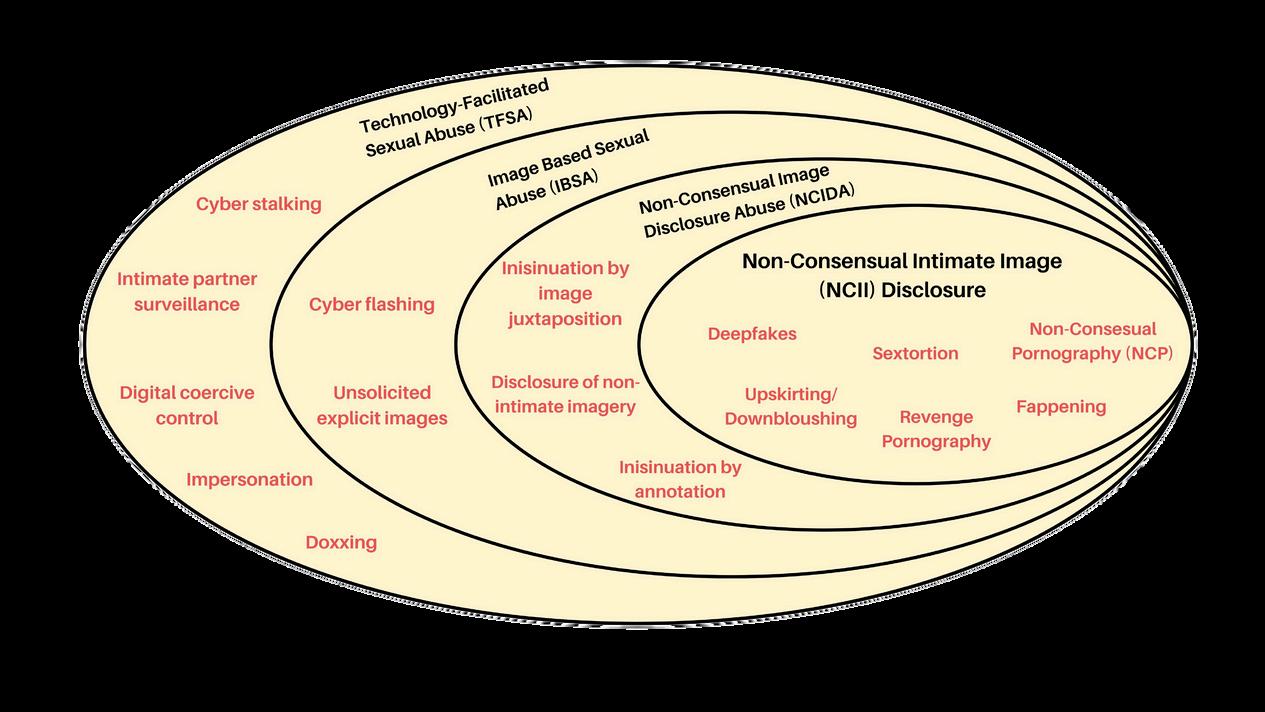
According to Freed et al., (2018, p. 667), NCII falls under the categorization of cyber intimate partner victimization alongside online harassment, doxxing, cyberbullying, cyberstalking, the release of sensitive information about victims/survivors, and image-based sexual abuse. In a more comprehensive framework, Batool et al. (2024) explained where NCII falls within such categorization (see Figure 1).
What constitutes NCII? Brown (2024) through his definition of NCII, describes an important element where certain types of contents or situations might be considered NCII, which is defined as follows: 1.The image(s) must be “distributed” or shared with at least one other person (other than the offender and the victim).
2. Consent has not been given (by the person who is photographed or videorecorded) for the distribution of the image(s).
3.The image(s) must be sexually graphic.
4. The image(s) may have been originally shared with the distributor within the context of a “private or confidential” relationship, however, this is not always the case.

The rapid development of social media has become one of the most important factors that led to the growing practice of Non-Consensual Intimate Image Dissemination (NCII). NCII over the internet and social media is a new type of infraction that violates and exploits individuals, but it mirrors everyday intimate partner violence practices from offline contexts that preexisted the internet (Brown, 2024). Furthermore, it is crucial to note that there is an intersection between gender and sexuality in the context of NCII.
NCII is not a one-gender issue, meaning that all types of gender (women, men, etc) can become either the victims or the perpetrators of NCII. However, it has been prominent that women, in most cases, have the highest chance of being the victim of NCII. When it comes to the perpetration, both men and women use different channels in the distribution of NCII. As mentioned by Clancy et al., 2020 and quoted by Karasavva and Forth (2022) “Men most commonly endorsed bragging or getting attention as reasons for sharing sexts.
On the other hand, women were more likely to endorse “roasting” and “gossip”.” Simply put, men use public dissemination channels while women use more private channels.
Based on the results conducted by Karasavva and Forth (2022), individuals who are heterosexual are almost 50% less likely to experience victimization compared to individuals who identify themselves to be a part of the LGBTQ+ community. This may be due to the higher likelihood of LGBTQ+ individuals engaging in sexting. However, the number of NCII cases for each sexuality is still considerably high. It is crucial to emphasize that the exchange of nude or sexual images between consenting adults is not inherently problematic, and most people who engage in sexting do not typically perpetrate or fall victim to NCII. However, engaging in sexting can potentially increase their vulnerability to future victimization.
Previous research has proven that those who have certain types of personality traits (narcissism, psychopathy, and sadism) may have a higher chance of being positively correlated with NCII perpetration (distribute). Nevertheless, Karassava et al. (2023) found that those who scored high on a self-report measure of narcissism, psychopathy, and sadism were predictive of endorsing enjoyment for NCII. Hence, not only do these types of personality traits engage in perpetration, but they also might be the ones who consume the content.
In regard to the perpetrator, everyone has an equal chance to fall under this side of the coin, therefore, the perpetrator can be: An intimate or an ex-partner 1. Friend and family member 2. Anonymous individual 3.
To give a better understanding on the victims and perpetrators of NCII, based on the research done by Karasavva and Forth (2022), They found that NCII victimization is a significant predictor of NCII perpetration and vice versa. This relationship is reminiscent of bully/victims (i.e., individuals who are both bullies and are bullied.) Moreover, 28% of the victims also had a history of NCII perpetration, and 57% of perpetrators also had a history of victimization. That being said, those with no history of NCII perpetration (total) were approximately 70% less likely to report NCII victimization (distribute). However, these are not always the case.

Everyone, regardless of gender or sexual orientation, can fall victim to Non-Consensual Intimate Image Dissemination (NCII), so it's essential to take steps to protect yourself and prevent NCII:
Do not easily trust anyone, whether those you have just met online or your sexual or romantic partners. Avoid sending intimate images and videos, even through disappearing messages or video calls, as there is no guarantee the other person will not screenshot your images.
Understand that sexual harassment is not limited to physical abuse like rape; it also occurs online. If you experience any form of sexual conduct online without your consent, it is just as serious as physical harassment.
When using social media platforms, particularly dating apps, be cautious about sharing personal information, including intimate images. Remember that oversharing online can make you vulnerable to abuse.
By being vigilant and mindful of your actions online, you can reduce the risk of becoming a victim of NCII and safeguard your privacy and well-being.

If you find that your or someone else's intimate images have been posted on social media, here are the steps you should take:
Immediately take a screenshot of the post. Make sure to include the account name that posted the image, the time it was posted, and any captions.
In addition to the screenshot, keep the link to the social media post. This link can help law enforcement track down the poster, even if the post is later removed.
If there are any related messages on instant messaging apps, take screenshots of these chats and do not delete the conversation. Law enforcement may need to see the entire chat history as part of their investigation.

If you experience psychological impacts, consider obtaining a visum et repertum psikiatrikum. This is an official report from a psychiatrist documenting the impact on your mental health, which can be used as evidence if you decide to file a report with the authorities.
Reach out to family, close friends, or someone you trust to help you through this process. Support from others can be crucial for emotional, medical, and legal processes.
Consider contacting organizations that specialize in handling sexual harassment cases. They can provide the necessary support to help you cope with the situation. If you are a FISIPOL student, the FISIPOL Crisis Center (FCC) is available to assist you. Even if you lack evidence or do not know the perpetrator, the FCC can still provide support.
If you decide to contact the FISIPOL Crisis Center (FCC), you can reach out in whichever way you feel most comfortable. If you prefer to remain anonymous throughout the process, the FCC will still assist you; ensure you provide a way for them to contact you. Here are some ways to reach the FCC:
Visit in Person: Go directly to their office at BA 110, Faculty of Social and Political Sciences.
Hotline: Contact the FCC hotline at +6281227912402 via phone call, Line, or WhatsApp.
Instagram: Send a direct message on Instagram to @fisipolcrisiscenter.
Report Form: Fill out the report form available through the link in the FCC’s Instagram bio.
The FCC offers various forms of assistance, including: Medical Assistance and Recovery Services
1. Psychological Assistance and Recovery Services 2. Legal Assistance and Recovery Services 3. Academic Assistance Services 4.
Remember, you are not alone, and there are resources and people ready to help you through this difficult time.
Batool, A., Naseem, M., & Toyama, K. (2024, May).
Expanding Concepts of Non-Consensual ImageDisclosure Abuse: A Study of NCIDA in Pakistan. In Proceedings of the CHI Conference on Human Factors in Computing Systems (pp. 1-17).
Brown, A. J. (2024). Non-Consensual Intimate Image Sharing on the Internet: Regulating Betrayal in Jamaica and India. In The Palgrave Handbook of Everyday Digital Life (pp. 187-202). Cham: Springer International Publishing.
Karasavva, V., & Forth, A. (2022). Personality, attitudinal, and demographic predictors of nonconsensual dissemination of intimate images. Journal of interpersonal violence, 37(21-22), NP19265-NP19289.
Karasavva, V., Swanek, J., Smodis, A., & Forth, A. (2023). From myth to reality: sexual image abuse myth acceptance, the Dark Tetrad, and nonconsensual intimate image dissemination proclivity. Journal of sexual aggression, 29(1), 51-67.