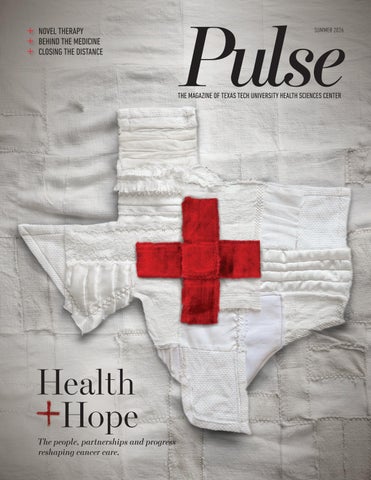
NOVEL THERAPY BEHIND THE MEDICINE CLOSING THE DISTANCE
Health Hope The people, partnerships and progress reshaping cancer care.
SUMMER 2026
Inside Summer 2026
VOLUME 36 | ISSUE 2
HEALTH + HOPE SPECIAL FEATURE People and partnerships are at the heart of progress in cancer care. TTUHSC is better equipped than ever to treat cancer while advancing prevention efforts. By Michael A. Cantu 28 Novel Therapy A physican working in the epicenter of Texas cancer treatment brought his expertise to Lubbock, Texas. 30 Path for Specialists Surgical oncologists have the opportunity to receive special training at TTUHSC, something not available everywhere. 31 Future of Care The promise of better care tomorrow drives one TTUHSC researcher’s work. 33 Behind the Medicine Monish Makena, PhD, (Biomedical Sciences ‘17) keeps patients in mind as he works through medical breakthroughs. 35 Closing the Distance After Fred Hardwicke, MD, (Residency ‘88) noticed the travel burden of cancer care, he took his services to the people. 36 Early Detection The expansion of a breast cancer screening program promotes early intervention for people in rural communities. ON THE COVER
Quilts are made from numerous elements that come together to bring comfort. At TTUHSC, those principles result in better cancer care. Illustration by Whitney Green.
28 DEPARTMENTS 5 Scope TTUHSC’s Rural Cancer Collaborative takes a head-on approach to gaps in cancer care impacting rural populations.
39 Rounds Jenna Kesey, PhD, APRN, FNP-BC, (Nursing ‘08) can’t help but care. Even though she now focuses on bench research, she can’t stay away from the bedside.
9 Vitals Lubbock, Texas, is now home to a tool that has the power to destroy liver tumors by using sound waves.
43 Update Ebtesam Islam, MD, PhD, (Medicine ‘09, Biomedical Sciences ‘05) doesn’t just want to treat her patients — she wants to get to the root of their problems.
21 Probe A TTUHSC researcher has dedicated his career to colon cancer research. From his perspective, education is the most important aspect.
IN EVERY ISSUE 2 Health Matters 3 Feedback 44 News & Notes
PULSE.TTUHSC.EDU | SUMMER 2026 1
Health Matters
A Letter from Our President
Investments Bring Cancer Care Closer to Home
… some of the most meaningful advances in healthcare are made possible by those who invest in others.
In recent years, I have shared highlights of various initiatives underway to expand access to cancer care in TTUHSC’s 121-county service region. Two of those — both major milestones in our fight against cancer — are now a reality. The UMC TLC2 Foundation Cancer Center opened on April 20 in Lubbock, Texas, to bring comprehensive cancer care to our region. UMC Health System CEO Mark Funderburk and I began with a vision about seven years ago to expand access to quality cancer care for people in the western half of Texas and Eastern New Mexico. The result is a beautiful, high-touch, high-tech center, three times the size of the former facility. The namesake honors the legacy of Terry Lee Chandler. She was diagnosed with glioblastoma, a deadly brain cancer, in April 2017 and died three months later. The TLC2 Foundation’s persistent message of “cancer, we are coming for you,” is a nod to her enduring spirit and its mission. The foundation supports individuals affected by cancer, strengthens research to advance new treatments and cures and improves access to healthcare across our vast region. The new John Wayne Cancer Foundation Surgical Oncology Fellowship embodies a similar spirit. “The Duke” beat lung cancer in the early 1960s but died of stomach cancer in 1979. His children honor his legacy through the foundation by supporting opportunities for surgical oncologists to advance their knowledge and drive innovation in cancer care. TTUHSC partnered with the foundation and private donors, through The Big Cure initiative, to become its second John Wayne Cancer Foundation program. The fellowship, also supported by the TLC2 Foundation, will strengthen our oncology workforce and expand cancer expertise in our region. These stories remind us that some of the most meaningful advances in healthcare are made possible by those who invest in others. Philanthropic and community partners, along with state and federal funding, are creating hope right here at home. This issue of Pulse highlights our work advancing high-quality cancer care. In the pages ahead, you’ll read more about these two milestones and other efforts shaping cancer prevention, research and treatment. You’ll also learn about the healthcare professionals we have trained who are making an impact on cancer care across Texas and beyond. All this work is invaluable, helping ensure that where you live does not determine your chance of surviving a cancer diagnosis.
PRESIDENT TEXAS TECH UNIVERSITY HEALTH SCIENCES CENTER
2 SUMMER 2026 | PULSE.TTUHSC.EDU
ARTIE LIMMER
Lori Rice-Spearman, PhD, (Health Professions ‘86)
A FAMILY AFFAIR THE MASK I WORE NURSING INFLUENCE
WINTER 2026
Feedback
THE MAGAZINE OF TEXAS TECH UNIVERSITY HEALTH SCIENCES CENTER
Volume 36, Issue 2
EDITOR-IN-CHIEF
EDITOR’S NOTE At 30,000 feet, the landscape stretching from the New Mexico border to Texas’ Interstate 35 resembles a quilt shaped by nature and by the generations who have called this region home. Farms, ranches, rural towns and regional hub cities form a patchwork stitched together by turnrows, fence lines, farm-to-market roads and state highways. When TTUHSC creative manager Whitney Green shared the design concept for this issue, she described looking out the airplane window on her way to Lubbock, Texas, and recognizing the familiar patchwork as home. A quilt is more than a collection of fabric pieces stitched together. It represents comfort, family and reassurance in life’s most difficult moments. That same spirit defines cancer care at TTUHSC, where expertise, compassion and hope unite to support patients and their families. This issue is especially meaningful to me. West Texas has always been home, and cancer has affected many of my family members and dear friends. Additionally, as I begin a new role at the university, this issue is my final one as editor. Since 2004, it has been my privilege to share stories across 41 issues of Pulse highlighting the people, partnerships and purpose that make TTUHSC extraordinary. Thank you!
— Danette Baker, MA EDITOR-IN-CHIEF
YOUR FAVORITE STORY
Participants in the Winter 2026 Pulse reader survey (which is anonymous) had many positive notes for the cover story, “Father of Fitness,” which details the life of Kenneth H. Cooper, MD, MPH. His cardiovascular health and exercise research is now at the Kenneth H. Cooper Institute at Texas Tech University Health Sciences Center. Those who participated in the Pulse reader survey said: — “Our family has spent many hours going to the Cooper Aerobics Center, and it has without a doubt been a huge benefit for us all!” — “I really enjoyed the story about Kenneth H. Cooper. He practices what he preaches regarding his publication about aerobics and even in his later years is doing aerobic exercise. His story and his research continuing under TTUHSC is admirable.”
Danette Baker, MA THE MAGAZINE OF TEXAS TECH UNIVERSITY HEALTH SCIENCES CENTER
MANAGING EDITOR Father of Fitness Kenneth H. Cooper, MD, MPH, has spent six decades teaching others the value of staying fit. Now, he’s passing on his research and lessons to TTUHSC.
DESIGN
Jim Nissen THE MAGAZINE OF TEXAS TECH UNIVERSITY HEALTH SCIENCES CENTER
— “I enjoyed reading about Kenneth Cooper in the latest issue. It was an interesting historical narrative with the landmark papers being described and how he helped refute the notion that exercise wasn’t good for you or people who had chronic health conditions.” — “I enjoyed reading about Dr. Kenneth Cooper. I met him many years ago when I was studying to become a personal trainer at Cooper (Clinic). He was very dynamic then and still is today.”
00-00-Cover_Winter 2026 v1.indd 1
1/20/26 12:31 PM
EDITOR’S NOTE: READ THIS STORY ON PAGE 26.
MEET-CUTE COMMENT
Romance was also appreciated from the last issue. Another reader noted, “‘Coffee Date’ from the Rounds section was interesting. The couple seems to have gone a different direction from healthcare but are successful.” EDITOR’S NOTE: READ THIS STORY ON PAGE 40.
READER SURVEY WINNER
Congratulations to Ashley James, BSN, (Nursing ’06) the Winter 2026 reader survey winner! Watch for an email with a link to the reader survey and your chance to enter for $100 in credit from the Vitals Spirit Shop. LETTERS TO THE EDITOR
Pulse welcomes thoughts and opinions from our readers via email at pulse@ttuhsc.edu.
Web + Every design tells a story. Hear Whitney Green explain the inspiration for this issue’s cover and feature section.
Michael A. Cantu
CONTRIBUTORS
Meredith Byrne; TR Castillo; Justin Cook, Whitney Green; Neal Hinkle; Kami Hunt; Ron Jenkins; Holly Leger; Rapp Art: Jordi Ferrandiz, Dana Smith; Anakin Rayos; Kevin Urenda
ADMINISTRATION PRESIDENT Lori Rice-Spearman, PhD (Health Professions ’86) EXECUTIVE CHIEF OF STAFF, EXECUTIVE VICE PRESIDENT OF EXTERNAL RELATIONS Ashley Hamm VICE PRESIDENT OF COMMUNICATIONS AND MARKETING Holly Russell VICE PRESIDENT OF INSTITUTIONAL ADVANCEMENT, CHIEF DEVELOPMENT OFFICER Britt Pharris ASSISTANT VICE PRESIDENT OF INSTITUTIONAL ADVANCEMENT Alicia Broughton ASSISTANT VICE PRESIDENT OF INSTITUTIONAL ADVANCEMENT OPERATIONS Marcie Aultman ASSISTANT VICE PRESIDENTS OF EXTERNAL RELATIONS DaLana Williamson Mattie Been, Amarillo Cyndy Morris, Abilene/Dallas Jessica Zuniga, Permian Basin
CONTACT US
pulse@ttuhsc.edu 3601 Fourth Street STOP 6242 Lubbock, TX 79430-6242 PULSE is published twice a year. Content may be reprinted only with permission. Discrimination or harassment based on race, color, religion, sex, national origin, age, disability, genetic information, status as a covered veteran or other legally protected categories, class or characteristics is not tolerated. Pulse is distributed in compliance with the State Depository Law and is available for public use through the Texas State Publications Depository Program. In compliance with HB 423, Pulse is available in electronic format at pulse.ttuhsc.edu. Please notify the Pulse staff at pulse@ttuhsc.edu for subscription updates.
PULSE.TTUHSC.EDU | SUMMER 2026 3
QUICK DOSE AROUND THE UNIVERSITY FACULTY PROFILE FOR THE RECORD
A Collective Force Against Cancer
Scope News
Views from TTUHSC
NEAL HINKLE
Aligning teams from various backgrounds is not easy. But when the goal is to improve access to cancer care and treatment for rural patients west of Texas’ Interstate 35 and in Eastern New Mexico, the payoff is worth it. That’s where the Rural Cancer Collaborative comes in. Mohamad Al-Rahawan, MD, a dualappointed pediatric oncologist at TTUHSC and the Rural Cancer Collaborative’s executive director, championed efforts in the past to establish such a team in pediatric cancer care and now leads the broader-scale initiative. The Rural Cancer Collaborative is closing the cancer gap for all by bringing cancer care closer to home, advancing research that reflects rural community needs and improving diagnostic outcomes. Since its establishment, there are increased efforts in early detection and prevention, research and data analytics, and integrated treatment and care, thanks to $25 million in funding from the 89th Texas Legislature. Now, the Rural Cancer Collaborative and TTUHSC as a whole are focused on recruiting top-tier faculty and cancer specialists to enhance research and patient care. Work is also underway to expand screening services and increase access to clinical trials. “People in our region deserve access to the best available cancer care, and we are here to deliver,” Al-Rahawan says of the Rural Cancer Collaborative. Additional team members include Will Brock, managing director; and Charity Martinez, assistant managing director.
Scan to take a look at how the Rural Cancer Collaborative is impacting rural cancer care.
PULSE.TTUHSC.EDU | SUMMER 2026 5
Scope
AROUND THE UNIVERSITY
Recognition for Recognition
The idea of a group photo hardly gives the members of Frontera de Salud (which means borders of health) any reason to moan or roll their eyes – they are proud of what they have done in the rural communities of Texas. Now in its third year, the organization began with learners from the School of Medicine. It has since expanded to include participants from all TTUHSC schools. As a learner-led service organization, the group is dedicated to improving access to health education and care. A group of 20-to-30 learners travel to communities across West Texas, including the Big Bend, Panhandle and Permian Basin. The group’s leadership works to secure grants for hotel stays and medical equipment. Most of their funding to date has come from the TTUHSC Division of Rural Affairs. Participants also occasionally contribute to gas or other expenses. For those involved, the program offers perspective on the struggles rural patients face in finding care — that is why they go to them. “I had no idea that not everyone has a hospital down every single road of their town,” Caroline Meche, a second-year medical learner in Amarillo, Texas, says. “I want to do everything in my power to ease that stress on people. If we’re in a position with our education to be able to bring some of these resources, I want to do everything that we can.”
6 SUMMER 2026 | PULSE.TTUHSC.EDU
BLAKE BILLINGS/ TTUHSC STOCK
Purpose Meets Practice
A leading global healthcare improvement organization has touted the practices of TTUHSC’s aging research clinic for its work providing care for patients with Alzheimer’s disease and dementia. TTUHSC’s Garrison Institute on Aging Memory Clinic was recognized as an Age-Friendly Health Systems Participant by the Institute for Healthcare Improvement. The designation reflects an organization’s adoption of a defined “4M’s” approach to providing care for older adults and their family caregivers. The four essential elements of an Age-Friendly Health System are: what matters, medication, mentation and mobility. “Investing in elder care also strengthens communities,” Jonathan Singer, PhD, Garrison clinic director, says. The institute is among the first health systems in the country to implement age-friendly healthcare. “It helps families balance caregiving responsibilities and reduces strain on hospitals and emergency services,” Singer says. “When older adults receive the care they need, everyone benefits.”
FACULTY PROFILE
Scope
Salvatore LoCoco, MD, MBA
(Medicine ’88) Chair, Department of Obstetrics and Gynecology TTUHSC Lubbock School of Medicine Q: Why did you come back to TTUHSC? A: My wife and I were driving back from Santa Fe, New Mexico, to our home in Fort Worth, Texas, during spring break of 2023. We’re driving back in a snowstorm and stopped in Lubbock for the night — just because we hadn’t been here in years — and went to our old haunts around town. I remember driving back and looking at the small towns. I remember one of the towns that just had a nurse practitioner clinic in an office. It’s always been a worry to me that the people who live out here don’t have access to healthcare. So, a few weeks later, a friend of mine from here called me to see if I knew anybody who might be interested in coming out here. One thing led to another, and it kind of opened the doors for it. Q: How is access to care a barrier for patients in the area? A: I take care of gynecologic cancer. Cervical cancer is still a big problem out here, and I think access to screening has been a big problem. We’re doing a study right now to look at data for the region, but I would say we have a much higher percentage of Stage 3 and 4 cervical cancers than I’ve seen in other areas, just because access to screening in a timely manner is limited. We serve 121 counties. I think TTUHSC has a unique opportunity to fill those gaps if we strategize properly with the smaller communities. Q: Why did you choose medicine? A: I had an injury when I was a wrestler in high school that required a couple of surgeries, so I had direct interaction with medicine when I was 15 to 16 years old. I think sometimes it’s God’s providence to point out, maybe this is what you need to do. So, I never really got it out of my head.
NEAL HINKLE
Q: How do people skills impact medicine? A: I think when you interview potential medical learners, you have to pay attention to whether they have natural compassion and the ability to communicate. Some specialties don’t require that, but many do, and I think that is how TTUHSC, from what I understand, handles its screening and application process. I think we do as good a job as anybody in identifying the best candidates for practicing medicine.
PULSE.TTUHSC.EDU | SUMMER 2026 7
Scope
FOR THE RECORD
Stat! By the Numbers The Clinical Research Institute submits 100 applications annually to the TTUHSC Institutional Review Board, which approves research studies.
More than 400 people participated in research studies through the Clinical Research Institute during fiscal year 2025.
IN FISCAL YEAR 2025, THE INSTITUTE CONDUCTED STATISTICAL ANALYSES FOR
58
RESEARCH PROJECTS, INCLUDING CANCER, ORTHOPEDIC SURGERY AND META-ANALYSES.
2
ARMS OF THE CLINICAL RESEARCH INSTITUTE: ONCOLOGY AND INTERDISCIPLINARY STUDIES
The Clinical Research Institute has 19 full-time team members. The late Steven L. Berk, MD, School of Medicine dean and executive vice president for Clinical Affairs, chartered the institute in 2011. 8 SUMMER 2026 | PULSE.TTUHSC.EDU
Vitals
SCHOOL OF MEDICINE GRADUATE SCHOOL OF BIOMEDICAL SCIENCES JULIA JONES MATTHEWS SCHOOL OF POPULATION AND PUBLIC HEALTH SCHOOL OF NURSING SCHOOL OF HEALTH PROFESSIONS JERRY H. HODGE SCHOOL OF PHARMACY
Signs from the Schools
KAMI HUNT
Surgery Without Surgery The Edison Histotripsy System, developed by HistoSonics, uses focused, high-frequency ultrasound to create microscopic bubbles within a liver tumor, destroying diseased tissue without an incision. The technology is one of the many ways TTUHSC’s Rural Cancer Collaborative (which provided funding for the tool) and UMC Health System are bringing advanced cancer care to patients across the western half of Texas and Eastern New Mexico, ahead of its availability in many other parts of the state. The procedure takes about two hours from preparation through completion, with the ultrasound treatment itself lasting about 15 minutes, leading to significantly shorter hospital stays for most patients; some even go home the same day. The Food and Drug Administration has approved the technology for liver tumors, and research is underway to expand its use to other tumors, including kidney and prostate.
1
A robotic arm aids in positioning the transducer over the abdomen.
2
The ultrasound transducer delivers sound waves into tiny gas pockets in the tumor, creating bubbles to rapidly expand and collapse, breaking down the targeted tissue.
3
The imaging probe provides real-time visualization, helping the physician map the size and shape of the tumor and monitor the treatment.
PULSE.TTUHSC.EDU | SUMMER 2026 9
Vitals
SCHOOL OF MEDICINE
Covenant Health's Lung Cancer Push
10 SUMMER 2026 | PULSE.TTUHSC.EDU
The earlier detection is also intended to bump a state trend. A 2025 Texas Medical Association analysis shows Texas ranked 46th in the nation for lung cancer screenings, and only 12% of high-risk patients are screened. This effort gives the group optimism — not because they are diagnosing patients with lung cancer, but because they are diagnosing it earlier in patients who otherwise would not have been screened. Solis recalls one patient who
Covenant Health in Lubbock, Texas, has a new clinic aimed at earlier diagnoses of lung cancer.
visited the hospital because he fell off a ladder and had to get a scan — turns out he also had a nodule that was later diagnosed as cancer. The group has screened more than 400 patients since the clinic opened in November 2025. With that comes the possible justification to expand the service. “It’s exciting to be on the forefront of moving the needle toward early-stage diagnosis,” Shakespeare says. “Technology has made that possible; we didn’t have the option before.”
DANA SMITH, RAPP ART
A group of Lubbock-based pulmonologists may have a new phrase to coin: incidents happen. That’s because they are detecting early-stage lung cancer before some of their patients show signs of the disease. The participating physicians are Benjamin Batson, DO, (Fellowship ’23, Residency ’20, Nursing ’07); Andrew Shakespeare, MD, (Medicine ’13); Ximena Solis, MD, (Residency ’21, ’18; Medicine ’15); and Brian Williams, MD, (Health Professions ’01). Their lung nodule clinic at Covenant Health in Lubbock, Texas, uses low dose CT scans to ensure small lung abnormalities are not cancerous. The service accelerates the diagnostic process, meaning a patient does not have to wait weeks to get a nodule biopsied. “It takes the patient’s concern, and gets them to us, so we can help make that determination and get them to biopsy as quickly as possible,” Batson says. Scanning technology has become more widely used and readily available in recent years, reducing the time between detecting a concerning growth and determining whether it is benign. This is a great relief for this group, who usually diagnose lung cancer after the disease becomes more aggressive and symptoms are evident. “Patients will get referred to me for a lung mass, and I look back two years ago, and they had a nodule. Now I’m telling them they’re Stage 3 or 4, when I could have told them they were Stage 1 then,” Solis says.
Web + Meet the team behind Covenant Health's lung nodule clinic.
SCHOOL OF MEDICINE
Vitals
TOP FERTILITY SPECIALIST TO RETIRE
TTUHSC STOCK
After nearly 50 years with TTUHSC, Samuel Prien, PhD, is retiring. Prien is dual-appointed professor in the TTUHSC Lubbock School of Medicine Department of Obstetrics and Gynecology and in the Texas Tech University Department of Animal and Food Sciences. “Outside of watching people take home a baby, teaching is by far the most rewarding thing I do,” Prien says. His innovations in fertility treatments have helped thousands of people. He was part of the first successful birth through Assisted Reproductive Technology (ART) at TTUHSC in the late 1980s. Since then, Prien estimates at least 3,800 babies have been born through ART in Lubbock and the surrounding area. Prien has received multiple patents and became the first TTUHSC faculty member to be named a National Academy of Inventors Fellow in 2022. His official retirement date is Aug. 31, 2026.
The Permian Basin Behavioral Health Center will expand mental health services in West Texas.
RESOURCES TO ADDRESS THE NEED Critical mental health services are more readily available to patients in and around Midland and Odessa, Texas. Through Texas Tech Physicians, TTUHSC provides on-site medical and psychiatric care at the newly opened Permian Basin Behavioral Health Center. This is a joint venture between TTUHSC, Midland County Hospital District, Ector County Hospital District and mental health provider Permiacare. All cite the area’s growing population as the reason for the facility.
Web + Read about the highlights of Samuel Prien's, PhD, career.
PULSE.TTUHSC.EDU | SUMMER 2026 11
Vitals
GRADUATE SCHOOL OF BIOMEDICAL SCIENCES
Where Research Meets Reality
When Meg Bowles is in the lab, she is sometimes stopped by a colleague who asks about her lab coat. Hers is tie-dyed — a special accolade handed down annually since 2014 by learners in the Graduate Medical Education Sciences program in the TTUHSC Lubbock Graduate School of Biomedical Sciences. It recognizes a peer who explains concepts well and supports others. “It’s something that makes (the program) more personable,” Bowles says. 12 SUMMER 2026 | PULSE.TTUHSC.EDU
NEAL HINKLE/ DONGMING JIANG
NICE COAT, NERD
Meg Bowles is a second-year learner at TTUHSC Lubbock.
When Dongming Jiang, a secondyear learner at TTUHSC Lubbock, was looking at PhD programs, he knew he wanted his research to address real-world healthcare problems, not limited to a lab or computer screen. Jiang studied public health in rural communities as an undergraduate. While working as a visiting scholar at the University of South Carolina, he examined national healthcare data to compare rural and urban regions. He was fascinated by how complex datasets could reveal patterns in disease progression but still wondered how useful discoveries are if they don’t lead to patient solutions. Today, Jiang focuses on prostate cancer metastasis, specifically how it spreads to bones. His approach bridges the gap between the computer and the lab by using computational analysis to identify potential biological signals, then testing those findings to see exactly how the disease behaves. “It was this combination of challenge and consistent support that allowed me to gradually build confidence in both understanding and working with biological systems,” Jiang says.
JULIA JONES MATTHEWS SCHOOL OF POPULATION AND PUBLIC HEALTH
Vitals
Public Health, Expanded A new degree path will soon be available at the TTUHSC Julia Jones Matthews School of Population and Public Health, integrating public health into more facets of everyday life for communities of all sizes. The inaugural class of the Bachelor of Science in Public Health and Commerce will begin in fall 2027. The skills gained can be applied across manufacturing, agriculture, energy and other fields.
LONG LIVE THE FITTEST New research from the Kenneth H. Cooper Institute at Texas Tech University Health Sciences Center finds that being fit in midlife helps people live longer and healthier.
THE RESEARCHER
The findings were published in the Journal of the American College of Cardiology. Clare Meernik, PhD, was the lead author. She is an epidemiologist at the institute and a research assistant professor in the TTUHSC Abilene Julia Jones Matthews School of Population and Public Health.
TTUHSC STOCK
THE INVESTIGATION
The observational cohort study followed nearly 25,000 adults for an average of 30 years after a preventive health examination. Higher levels of cardiorespiratory fitness in middle age were linked to longer life, fewer chronic
diseases and more years lived in good health after age 65. “The study shows that cardiorespiratory fitness in midlife is a powerful predictor of how well we age,” Meernik says. “If you are fitter in midlife, you don’t just live longer. You are more likely to stay healthier longer and develop fewer diseases as you age.”
THE NUMBERS
Meernik and her team analyzed data from the Cooper Center Longitudinal Study, which included generally healthy men and women, on average in their mid-40s, who underwent medical examinations and fitness testing at Cooper Clinic in Dallas, Texas, from 1971 to 2017. Participants’ clinic data were linked to later-life Medicare claims to track the onset of 11 major chronic diseases, including cancer,
Web + Learn more about the Cooper Center Longitudinal Study.
heart disease and dementia. On average, participants entered Medicare 19 years after their clinic exam and were followed for an additional 10 years after age 65. This prolonged interval allowed evaluation of how well the participants aged.
THE COMPARISON
Those in the high-fit category lived 1.4 to 2.3 years longer than low-fit men and women. They also lived 1.3 extra years in good health. High-fit study participants developed 9% to 12% fewer chronic diseases as they aged than low-fit study participants. Meernik adds that the results support long-held health advice of exercising to stay fit. “Results were consistent across sexes, showing that fitness is a powerful predictor of aging in both men and women,” Meernik says.
PULSE.TTUHSC.EDU | SUMMER 2026 13
Vitals
SCHOOL OF NURSING
Faculty's View of Nursing AI HOLLY WEI, PHD, RN DEAN, TTUHSC SCHOOL OF NURSING
"Learners must develop critical thinking, judgment, adaptability and ethical awareness to work effectively with artificial intelligence. I developed the PIVOT Model, a human-centered framework that emphasizes purpose, identity, values, oversight and transformation as dimensions for integrating AI into teaching and learning. The goal is not merely to teach learners to use AI tools but to prepare graduates to thoughtfully integrate AI into their professions while preserving the distinctly human qualities of empathy, compassion and meaningful human connection."
STEPH HOELSCHER, DNP, RN DIRECTOR, MSN INFORMATICS PROGRAM
— SYDNEY LOWE, BSN, RN (NURSING '26) NURSE, UMC HEALTH SYSTEM, LUBBOCK, TEXAS
14 SUMMER 2026 | PULSE.TTUHSC.EDU
KATHERINE TAYLOR-PEARSON, DNP, RN ASSISTANT PROFESSOR, GRADUATE INFORMATICS PROGRAM
"Hospitals are using AI to detect when patients are going into sepsis. They’re using predictive monitoring to ensure patients don’t go into respiratory arrest. They’re notifying the team that the patient’s vital signs don’t look good and that the team should check on the patient. I think what it can do to help our workflow is outstanding."
Web + Watch Sydney Lowe's, BSN, RN, (Nursing ’26) journey from first semester to graduation.
KAMI HUNT
I want to keep growing my professional life here in Lubbock, Texas, while I can. (Here) I'm able to have the stability of my family, the connections that I have here and the connections that I made while in clinicals with the ICU nurses.
"Many AI advances are already impacting nursing, including ambient AI documentation technology. During a patient interaction, AI can capture and organize portions of the clinical conversation into draft documentation, reducing charting time. This frees nurses to focus on the patient while they review and validate the documentation for accuracy and appropriateness."
SCHOOL OF NURSING
Vitals
NEAL HINKLE
Healthcare Found its Voice When Dana Madison, DNP, MBA, (Nursing ’24) and her husband, Ronnie Madison, had to sell their home health agency in the late ‘90s as a result of the Balanced Budget Act (BBA), she felt helpless. It was such a juxtaposition for the couple – legislation designed to decrease the U.S. budget deficit eliminated their business. Dana decided she needed to speak up; something she says is best for the country. “I figured the only way we were going to have a voice, not only for ourselves but also for our patients, was to start making legislative relationships and speak up,” Dana says. “Whether it’s in Austin or D.C.” In the mid ‘90s, the couple opened a home health business after friends presented them with the idea. They had been Lubbock, Texas, transplants from Austin, Texas, for nearly a decade when Dana transitioned from a hospital nurse and Ronnie from the oil business. They had been in the home health business for a few years when the BBA cut Medicare spending on home health by more than half. A 2003 Health and Human Services report estimates that about 15% of the U.S. home health industry shut down after the bill’s passage. In that same time frame, the couple noticed increased patient interest in home health services. Research from the National Institutes of Health shows home care is cost-effective for patients and can reduce the chance of hospital readmission.
“So, I learned early on that we’re not only speaking for the industry, but we’re also speaking for our patients,” Ronnie says. “They can’t get on a plane and go to D.C., you know?” Many of the patients who need home health services rely on government assistance, which makes advocacy travel nearly impossible. With their expertise, the Madisons tailor messages tactfully to lawmakers, often meeting one-on-one with staffers to explain the complexity of their concerns in relatable terms.
Dana and Ronnie Madison, owners of Madison Family Companies.
All of their efforts are on patient outcomes, especially for those in rural areas who could most benefit from home health care. That was the focus of Dana’s message when she testified in front of the U.S. House of Representatives Ways and Means Committee in March 2025. “If we don’t stand up and tell our story, then somebody else is going to tell the story, and it’s not going to be the way we want it to be told,” Dana says.
PULSE.TTUHSC.EDU | SUMMER 2026 15
Vitals
SCHOOL OF HEALTH PROFESSIONS
Even with the many breakthroughs in cancer treatment, chemotherapy has remained a cornerstone of cancer care for more than 50 years. Yet one question has continued to challenge physicians and patients alike: Will this treatment actually work? A year after founding his biotech startup, REVO Oncology, Estevan Kiernan, MP, (Health Professions ’10) is trying to answer this question. “Once we understand the biology of a patient’s cancer, we can use their DNA to personalize their cancer
16 SUMMER 2026 | PULSE.TTUHSC.EDU
treatment,” Kiernan says. He and his team are developing a novel test that uses cancer DNA to predict whether a patient is likely to respond to chemotherapy before treatment begins. Their goal is to reduce unnecessary treatment, medical costs and improve outcomes. “These were questions we were discussing with our professors nearly 20 years ago,” he says. “Now we’re at the cusp of bringing treatment to cancer patients and improving their lives. It’s a very exciting time.”
RON JENKINS
The Future of Personalized Cancer Care
SCHOOL OF HEALTH PROFESSIONS
Vitals
My Two Loves How did Jemimah Omavuezi, DMS, MPAS, (Health Professions ’23) do it? She earned a physician assistant degree raising two children with her husband, after already earning multiple degrees, while living in two countries and multiple states. Part of her success comes from her resilience. Even more significant is the strong support of her family and the high expectations she grew up with. “Growing up in Nigeria, our parents strongly valued education and pushed us to succeed,” Omavuezi says. She began her career as a molecular biology researcher. But she still wanted to help patients, which eventually led her to Midland, Texas, caring for patients as a PA. In the first semester of the TTUHSC PA program, she was close to dropping out. If she wanted to graduate, major changes had to take place. Her husband stepped in to take care of the house and the kids — a big adjustment for the family. “Our mothers were stay-at-home moms, who would take care of the kids and the home. It was a big adjustment," Omavuezi says, acknowledging it was a temporary sacrifice.
Growing up in Nigeria, our parents strongly valued education and pushed us to succeed. — JEMIMAH OMAVUEZI, DMS, MPAS
ANAKIN RAYOS
HEALTH PROFESSIONS '23
Web + Read how Jemimah Omavuezi, DMS, MPAS, (Health Professions ’23) worked through setbacks to pursue her career.
PULSE.TTUHSC.EDU | SUMMER 2026 17
Vitals
JERRY H. HODGE SCHOOL OF PHARMACY
THEY’VE GOT THIS
Inspired by Janie What began as a tribute to a faculty member has become a new tradition that brings people together. TTUHSC’s chapter of the Student Pediatric Pharmacy Association began its annual No-Sew Blanket event in 2023 after the death of Janie Robles, PharmD, (Pharmacy ’03) an associate professor at the TTUHSC Jerry H. Hodge School of Pharmacy. “We decided, collectively as an organization, to donate blankets in her honor to different pediatric units,” Keira Turner, third-year pharmacy learner and association president, says. Robles was known for creating an atmosphere of comfort and reassurance, so blankets felt like a natural way to extend that same warmth to children. Learners from across the university made fleece blankets — no sewing required — which are donated to children’s hospitals and pediatric units. This year, they made 30 blankets — maintaining the average from previous years. “I felt it in my soul that this mattered,” Turner says. “She touched so many people who are still here.”
The next generation of pharmaceutical practitioners from the TTUHSC Jerry H. Hodge School of Pharmacy proved they are prepared to meet the demands of modern pharmacy practice. Learners who took the North American Pharmacists Licensure Examination – commonly known as the NAPLEX – in spring 2026 exceeded national averages.
Learners show off their no-sew blankets.
93%
First-time pass rate on the NAPLEX for TTUHSC PharmD graduates
87% 87% First-time NAPLEX pass rate nationwide
18 SUMMER 2026 | PULSE.TTUHSC.EDU
PROVIDED BY KEIRA TURNER
First-time pass rate in the state of Texas
JERRY H. HODGE SCHOOL OF PHARMACY
Vitals
Reflections After 3 Decades Former classmates Valerie Levi, PharmD, (Pharmacy ’00) and Sachin Shah, PharmD, MBA, (Pharmacy ’00) share more than an alma mater. Both pursued careers in cancer, and for more than half of a decade have worked for Daiichi Sankyo Inc. in Dallas, Texas.
Formulating a New Playbook for Care
JORDI FERRANDIZ, RAPP ART
Ronald Hall, PharmD, MSCS, likens a new survey project to a football game. “If you score a touchdown early, your offense is going to think, ‘I’m going to score more touchdowns.’ Whereas, if the offense gets stopped early, they may ask, ‘Does the defense have our number today?’” Hall, the division head of Clinical and Translational Science and associate professor in the TTUHSC Dallas Jerry H. Hodge School of Pharmacy wants to avoid being stopped early. The project will build the Practice-Based Resource and Research Network to connect local pharmacies with TTUHSC experts and community partners. The goal is to better support people at risk of cancer, those living with cancer and cancer survivors. The findings will guide the development of practical tools, training opportunities and future research. Funding for the survey was provided by the TTUHSC Rural Cancer Collaborative.
315
ACTIVE PHARMACIES IN TTUHSC'S SERVICE REGION CONSIDERED RURAL BY FEDERAL OFFICE OF RURAL HEALTH POLICY STANDARDS AS OF AUG. 31, 2026.
Valerie Levi, PharmD
Sachin Shah, PharmD, MBA
What are the greatest barriers in cancer drug research? A: Funding and diversity are some of the greatest barriers for research. Budgets get cut, which halt additional trials and bringing the compound to market. Some patients hesitate to participate in clinical trials because they are uncertain about the process. Education and transparency can assist in overcoming these barriers.
How central is collaboration to your career? A: Early on, I did not anticipate how important collaboration would be to my career. Teamwork was emphasized throughout my training at TTUHSC — particularly in casebased and experiential courses. That foundation has been amplified in my current role in the pharmaceutical industry, where collaboration is a critical component of bringing innovative medicines to patients.
Did you expect partnerships to be such a large part of pharmacological oncology? A: Collaboration is essential in every aspect. Each trial has numerous contributors from the sponsor study team, contract research organization operations, principal investigator, research coordinator, and most importantly, the patients. I am privileged to play a small role in patients living longer.
What interested you in TTUHSC? A: TTUHSC was among the first to require laptops and provide course materials online, which was groundbreaking. The emphasis on experiential learning helped shape my professional foundation. What began as a pragmatic decision ultimately became a formative and deeply meaningful experience that continues to influence my career.
PULSE.TTUHSC.EDU | SUMMER 2026 19
exclusive offer for alumni
20
% off
Scan to Visit Our Site
your purchase
USE CODE #SUMMER26
vitalsspiritshop@ttuhsc.edu
VITALS SPIRIT SHOP
806.743.9080
vitalsspiritshop
UNIVERSITY CENTER, 1ST FLOOR RM 101
vitalsspiritshop
MONDAY-FRIDAY 9AM-5PM
RESEARCH FEATURE CPRIT UPDATES FUNDING PERSPECTIVE
Probe
TRACE THOMAS
Advancing knowledge through innovative research
Izi Obokhare, MD
PROFESSOR TTUHSC Amarillo School of Medicine Department of Surgery
PULSE.TTUHSC.EDU | SUMMER 2026 21
Probe
FEATURE
An Educated Guess
I
zi Obokhare’s, MD, FACS, FICS, view of cancer prevention is not theoretical. It is grounded in what patients will actually do. “The best test is the one that gets done,” he says. That practical mindset shaped outreach and research efforts for a colorectal cancer screening program he oversaw for nearly a decade at Amarillo, Texas. Over the years, one of the most significant platforms for that work was a colorectal cancer prevention program funded by the Cancer Prevention and Research Institute of Texas that served Amarillo and the surrounding region. The team also studied barriers to screening, including fear, stigma, distrust and the perception that testing would be unpleasant. The program educated more than 2.5 million people about colorectal cancer prevention. About 50,000 people were reached directly through one-on-one education and more than 8,000 Fecal Immunochemical Testing for Screening and Treatment of Occult Preneoplasia (commonly known as FIT kits) were distributed. More than 700 colonoscopies were completed after positive tests found more than 500 precancerous polyps that could be removed before they became cancer. Patients with colorectal cancer were identified through the program and might otherwise have gone undiagnosed until much later.
Ways to improve participation, such as reminders that increased return rates for stool-based tests were also examined by program staff. Obokhare says the program produced more than 10 peer-reviewed publications and asked a central question: How do you make prevention more reachable for real people? “The greatest challenge is education,” Obokhare says. He has seen patients ignore changes in bowel habits or blood in their stool. He has seen families with a history of colorectal cancer who were never clearly told that screening was needed sooner. He has seen younger people arrive with advanced disease after ignoring warning signs. That question remains especially pressing as colorectal cancer continues to affect younger people. Obokhare also pointed to the broader challenge in public messaging. While screening guidelines have changed, many people still do not understand that symptoms should never be ignored, regardless of age, and that a family history of cancer may mean screening should begin much earlier. For him, the answer is not fear but clarity. Cancer, he says, should not be treated as a taboo subject. Families should be able to talk about it openly. Communities should hear about prevention in language that feels comfortable. Patients should know
that getting screened is not just about finding cancer. In many cases, it is about preventing it altogether. Obokhare is also quick to say he did not do the work alone. He credited institutional support from TTUHSC leaders in Amarillo, including School of Medicine Regional Dean Brian Weis, MD, PhD; former Regional Dean Richard Jordan, MD; and department chair M. Harris Nazem, MD. He is also grateful for team members and partners who helped carry the program forward, including coordinator Christine Andrews, research coordinator Deborah Trammell, community health workers, physicians, nurses, home health partners and others across the region. That collaborative spirit continues to shape how he talks about the future. Even after the most recent renewal was not funded, Obokhare does not frame the work as finished, but still filled with possibilities: more targeted community outreach, continued partnership-building and emerging screening technologies that may be easier for patients to accept. Success, he says, would mean getting everyone of age screened and helping those at high risk understand the urgency of acting early. It would mean fewer patients showing up with Stage 4 disease. It would mean a region that knows
“The best test is the one that gets done.” — IZI OBOKHARE, MD, FACS, FICS
22 SUMMER 2026 | PULSE.TTUHSC.EDU
“The greatest challenge (related to colon cancer) is education.” — IZI OBOKHARE, MD, FACS, FICS
EXCERPTS FROM THE CURRICULUM VITAE OF
Izi Obokhare, MD, FACS, FICS EDUCATION: Izi Obokhare, MD, FACS, FICS, received his medical degree from Howard University College of Medicine, in Washington, DC, in 2006. That same year he started a general surgery residency at UH Cleveland Medical Center in Cleveland, Ohio, which he finished in June of 2011. He completed a postdoctoral research fellowship in colon and rectal surgery in 2012 at Ochsner Medical Center in New Orleans, Louisiana. Before pursuing his medical degree, he received a degree in chemistry and natural science from Worcester State University in Worcester, Massachusetts in 2002.
PRESENT POSITIONS:
TRACE THOMAS
• General surgery program director, TTUHSC Amarillo School of Medicine • Professor of general and colorectal surgery, TTUHSC Amarillo School of Medicine
prevention is possible and worth pursuing. In rural Texas, where time, distance and resources can all stand between a patient and care, that kind of success does not happen by accident. It takes physicians willing to keep showing up, teams willing to go into communities and partners willing to invest in long-term
prevention. For years, that is what Obokhare and his CPRITsupported team built in Amarillo: not just a screening program, but a pathway to earlier detection, better understanding and, for many patients, a different outcome. Because when the message reaches a family, a barrier is removed, a test gets done, hope begins earlier.
PUBLICATIONS, AUTHOR CREDITS, SPEAKING EVENTS (AS OF APRIL 2026): • 42 research articles in peerreviewed publications • 4 book chapters • 7 journal reviewer opportunities • 47 speaking events
PULSE.TTUHSC.EDU | SUMMER 2026 23
Probe
CPRIT UPDATES
Key Findings
Trials Against Stubborn Cancer Tumors
Erin Barr, MD, is a pediatric hematology/ oncology clinician and researcher in the TTUHSC Lubbock School of Medicine.
24 SUMMER 2026 | PULSE.TTUHSC.EDU
A Closer Look at Osteosarcoma A rare and aggressive bone cancer in children has driven TTUHSC researchers to pursue new therapeutic strategies. Balakrishna Koneru, PhD, (Biomedical Sciences ’19) received a two-year, $198,000 grant from CPRIT in 2025 to research osteosarcoma, a pediatric bone cancer with poor survival rates when it spreads to the lungs. Koneru’s team discovered that a protein called integrin alpha V (ITGAV) is crucial for the survival of tumors that use alternative lengthening of telomeres (ALT) — a mechanism found in about 70% of osteosarcoma cases. Because osteosarcoma shows such a high prevalence of the ALT phenotype, his research has focused on this cancer type. Technology that research scientists use to selectively modify DNA makes it possible to alter thousands of genes at once to identify those essential for tumor survival. The new grant will support efforts to define ITGAV’s role in ALT-driven cancers and evaluate its potential as a therapeutic target, laying the groundwork for future drug development. Balakrishna Koneru, PhD, (Biomedical Sciences ’19) assistant professor of pediatrics at TTUHSC Lubbock School of Medicine and Graduate School of Biomedical Sciences.
TTUHSC STOCK
The Cancer Prevention and Research Institute of Texas (CPRIT) awarded a $1.4 million grant to Erin Barr, MD. The grant enhances access to pediatric oncology clinical trials. Barr began early-phase clinical trials in West Texas as co-chair of SPOC-2012-001, part of the South Plains Oncology Consortium, a group of researchers in Texas who conduct oncology trials and translational research. She will test a combination of two cancer drugs to determine which is more effective for individuals ages 12 to 21 with solid tumors that have returned or have not responded to previous treatments. She is also the study chair for the national Children’s Oncology Group, the world’s largest organization devoted to childhood and adolescent cancer. This clinical trial studies a way to make radiation therapy work better against cancer by preventing cancer cells from repairing themselves after radiation damage.
FUNDING PERSPECTIVE
Probe
By the Numbers: CPRIT FUNDING THROUGH THE YEARS
$66.8 $19 23 $120
Total amount in funding to date from the Cancer Prevention and Research Institute of Texas secured by TTUHSC investigators.
MILLION
CPRIT funding secured historically to support university-led programs focused on increasing access to breast, cervical and colorectal cancer screenings in TTUHSC’s 121-county service region.
MILLION
TTUHSC cancer investigators have received CPRIT funding since the institute’s inception in 2007.
Amount in CPRIT funding awarded cumulatively to TTU System universities.
MILLION
Building Healthier Futures
State Investments Strengthen Regional Cancer Research Efforts
LANCE R. MCMAHON, PHD Executive Vice President for Research and Innovation
TTUHSC STOCK
Dean, Graduate School of Biomedical Sciences
The Cancer Prevention and Research Institute of Texas (CPRIT) was created by the 80th Texas Legislature and officially authorized by voters in November 2007 through a constitutional amendment. The act authorized $3 billion in funds from public tax dollars to support statewide cancer research and prevention efforts. Voters approved an additional $3 billion in 2019, funding CPRIT at $6 billion through 2039. CPRIT now represents the most robust government-funded model in the United States for advancing cancer prevention, research, innovation and patient care outside of the National Cancer Institute of the National Institutes of Health. CPRIT funding is secured through a competitive peer- and-programmatic-review process. Densely populated regions of the state often benefit from their greater concentrations of people, programs and research infrastructure, creating natural competitive advantages.
CPRIT strives to ensure it can deliver on its mission for all Texans by designating areas and institutions outside these regions as eligible for Texas Regional Excellence in Cancer funding. CPRIT investments have supported faculty recruitment, research infrastructure, prevention initiatives and translational science programs to improve cancer outcomes in Texas communities. These are especially meaningful in the western half of Texas, where access barriers can delay screening, treatment and participation in clinical trials. For patients and families in TTUHSC’s 121-county service area, the impact is personal. Cancer research funding creates opportunities closer to home. Through continued investments in funding from state, federal, philanthropic and CPRIT partners, TTUHSC continues building a research enterprise designed to advance science and improve lives across the communities it serves.
PULSE.TTUHSC.EDU | SUMMER 2026 25
Health Hope A look at the people, partnerships and progress reshaping cancer care across a rural region of Texas and Eastern New Mexico.
By MICHAEL A. CANTU Illustrator WHITNEY GREEN Photos provided by TR CASTILLO, KAMI HUNT and TRACE THOMAS
26 SUMMER 2026 | PULSE.TTUHSC.EDU
UMC TLC2 Foundation Cancer Center ribbon cutting, April 17, 2026.
QUALITY CANCER CARE CLOSER TO HOME Hope is at the heart of the UMC TLC² Foundation Cancer Center. Woven together through partnership, it brings expertise, innovation and care closer to home. The center helps remove one of the greatest barriers to cancer care: distance. Located in Lubbock, Texas, it provides many patients with access to advanced treatment without having to travel hours to another comprehensive cancer center. The center also complements the work of the TTUHSC’s Rural Cancer Collaborative, established in 2025 and funded by the 89th Texas Legislature. Together, they reflect a shared commitment to expanding access to quality cancer care so more people can find both health and hope where they live.
Health Hope 28 SUMMER 2026 | PULSE.TTUHSC.EDU
NOVEL THERAPY OPENS TREATMENT POSSIBILITIES
With a firm handshake and a shoulder pat, Muhammad Bilal Abid, MD, wishes 29-year-old Dylan Cerbantez farewell before he leaves after another checkup. Cerbantez, a native of Hale Center, Texas, is experiencing a recurrence of aggressive lymphoma. “You’re not one in a million; you’re just one,” Abid, an associate professor of internal medicine, director for the Blood and Marrow Transplantation and Cellular Therapy Program at TTUHSC and a hematologist with UMC Health System, says. Cerbantez’s diagnosis is complicated by a second health condition: Wiskott-Aldrich syndrome, a rare genetic disorder in males that affects regular immune function and reduces their ability to fight infection and prevent bleeding. Not only does the syndrome put people at risk for recurrent infections, but it also severely increases their risk of developing cancer. His only hope is a never-before-used treatment option developed by Abid and the collaborative TTUHSC and UMC Health System teams in Lubbock, Texas.
A new cancer treatment option allowed Hale Center, Texas, resident Dylan Cerbantez to become eligible for a stem cell transplant.
Before Abid came to TTUHSC in October 2025, he practiced at the epicenter of Texas for cellular immunotherapies – UT MD Anderson Cancer Center and UTHealth Houston, both in Houston, Texas. Most of his research career has focused on blood cancers such as myeloma and lymphoma. His patients had accessible treatment in the metropolitan area. “While one-half of the state has thousands of (these procedures done), this half of the state – people living in this region – have to travel,” Abid contends. Abid’s recent research work also focuses on access disparities in advanced cancer treatments. Recognizing the struggle of people in this region led him to Lubbock, Texas. “I did a lot of research on my own and got a little bit worried when you’re — you know — the first line (of treatment) didn’t work, is the second line going to work?” asks Cerbantez. This novel treatment regimen — bispecific T-cell engaging antibody therapy — helped clear the way for a stem cell transplant that otherwise would not have been possible, allowing
Cerbantez to achieve remission. In July, Cerbantez received a transplant from an unrelated donor. Unlike some cellular therapies, bispecific antibody therapy does not genetically modify a patient’s cells. Instead, the antibody has two arms: One attaches a protein on the cancer cell, while the other attaches to a killer T-cell. Bringing the two together helps the immune system recognize and destroy the cancer cell. Cerbantez is possibly the first to have this specific health profile treated with this specialized regimen. And if successful, it opens the door for more clinical and translational research in the future. “This is where the art of medicine really comes in. When a young man like Dylan does not have treatment options available to him, that really calls for thinking outside the box,” Abid says. Before Abid’s arrival there were no choices locally for relapse therapy. During Cerbantez’s first diagnosis, he made numerous trips to Dallas, Texas, — typically a five-to-six-hour drive — and was forced to quit his work in construction. Cerbantez had some community support, though, from both Hale Center Owls varsity basketball teams — many friends of his younger brother. “The teams purchased some shirts that we had made as a fundraiser,” Cerbantez recalls. “And they wore them to their games and their warmups.” Abid recognizes the importance of care closer to home. Hale Center is typically about a 40-minute drive to Lubbock. It reduces what he considers a “toxicity” — less of a financial burden and time spent away from family. “The curative potential of these cutting-edge cancer therapies is no longer limited by the scientific capabilities that we have,” Abid says. “They are entirely limited by barriers to access. Some people have (access); others don’t.” Cerbantez still has to make some trips to the Dallas-Fort Worth area to see an immunologist and other physicians, but much of his treatment is done in Lubbock. Even though he had some swelling, his lymph nodes have shrunk, and his PET scans show a significant decrease in the cancer growth. “The only reason I didn’t want to go to Dallas was because of the drive and because of how far it was, and traveling after doing chemo,” Cerbantez said. “So doing it in Lubbock and having them make it available here, it was a weight off my shoulders.” PULSE.TTUHSC.EDU | SUMMER 2026 29
TTUHSC now has the capability to train future surgical oncologists.
LANDMARK PATH FOR CANCER SPECIALISTS
Standing inside the newly opened UMC TLC2 Foundation Cancer Center, TTUHSC President Lori Rice-Spearman, PhD, (Health Professions ’86) announced a milestone that will shape the future of cancer care for the region. Less than two months earlier, TTUHSC received approval for the John Wayne Cancer Foundation Surgical Oncology Fellowship — one of only two such fellowships supported by the foundation. “What makes this effort truly meaningful isn’t just the training; it’s the purpose behind it,” Rice-Spearman says, referring to the goal of expanding the range of cancer care. The fellowship provides advanced specialty training for physicians, specifically cancer surgeons, helping to build expertise and expand care, according to the John Wayne Cancer Foundation. More than 160 cancer experts have graduated from its fellowship program. In total, there are 43 accredited U.S. and Canadian surgical oncology fellowships. Most are based in major metropolitan areas such as Dallas and Houston, Texas; Boston, Massachusetts; Los Angeles, California; and New York City, according to the Society of Surgical Oncology. That makes Lubbock one of the few regional medical centers outside of a major metropolitan area. “That’s a big deal for a young and more seasoned academic faculty; they’re going to want to be a part of it, which helps us recruit more and to expand our training pathways,” says
30 SUMMER 2026 | PULSE.TTUHSC.EDU
Tyler Mouw, MD, TTUHSC’s fellowship program director and interim director for the UMC TLC2 Foundation Cancer Center. “Because now we’ve got more faculty to support more trainees, we’re bringing in more patients — everything kind of feeds in toward the same goal of overall growth.” TTUHSC is partnering with UMC Health System to offer the fellowship. Through its collaboration with the John Wayne Cancer Foundation, TTUHSC also established the Big Cure Endowment to support efforts that reduce cancer incidence and improve survival in rural and underserved communities. One of the endowment’s first priorities is recruiting surgical oncologists. TTUHSC will welcome its first surgical oncology fellow in 2027, with a goal of two per year in subsequent years. “The reality is that the rural places need the surgical oncologists. So, there’s an argument to be made that our experience here is going to be much more like the actual practice experience for graduates nationwide than anything the current or the older programs offer,” says Mouw.
Advances in cancer care drive Alexander Philipovskiy’s, MD, PhD, research work.
FUTURE OF CARE BEGINS HERE
On sleepless nights throughout his career, Alexander Philipovskiy, MD, PhD, finds his thoughts drift to his patients. He remembers how two of his grandparents died of cancer in the 1980s in his home country of Ukraine. Knowing what he knows now, it is not out of the realm of possibility to say they could have been easily treated with some of the medical advances made since. “When you see a patient you cannot help think that maybe in five years it will be a different situation?” he says. “In the next five years, it will be different.” Earlier this year, Philipovskiy joined TTUHSC Lubbock as director of the School of Medicine Precision Oncology Program, co-director of the Breast Cancer Program and professor of hematology and oncology. Through the Precision Oncology Program, Philipovskiy works to coordinate tumor genomic profiling, multidisciplinary treatment planning and clinical trial matching. The goal is to help patients access therapies guided by the biology of their cancer, while expanding resources that match treatments to DNA across West Texas and Eastern New Mexico. His responsibilities also include working with biotech sponsors to bring Phase 1 clinical trial opportunities to the region through the UMC TLC2 Foundation Cancer Center. The timing, as he puts it, couldn’t be any better. Typically, it takes seven to 10 years of clinical trials for a new therapy to make it to the marketplace. And now that the cancer center is open, there is less need for a multihour drive or flight to major cancer hubs in Dallas or Houston, Texas, where clinical trials are most often available. “The cancer center is coming up at just the right time, in the right setting,” Philipovskiy says. And with the new cancer center, such potential treatments are now available in Lubbock, Texas, eliminating the need to travel. During Phase 1 trials, patients need to stay close to a treatment center for monitoring. If the treatment is successful, that also opens up the possibility that a patient will have accessed a drug before anyone else. The expansion of early-phase clinical trials also strengthens the academic mission of the cancer center. For trainees, early-career physicians and physician-scientists, it offers direct exposure to the earliest stages of cancer drug development — an experience often limited to larger academic cancer centers. “It’s a super valuable experience for them to see how the whole system works from the very beginning of drug development,” Philipovskiy says of the cancer center. “So, it’s a very unique opportunity.”
A NEW HOME FOR RESEARCH More than 176,000 clinical trials are taking place throughout the United States, according to the online database ClinicalTrials.Gov. And, for residents in a large swath of rural America, access to those trials just got closer. The UMC TLC² Foundation Cancer Center includes dedicated space for the TTUHSC Clinical Research Institute, which promotes and facilitates clinical research across the university. In late 2025, the institute formalized its two wings – one for oncology research and another for interdisciplinary research. The oncological research trials taking place include those for cancers of the human reproductive system, breast and blood. The institute team works to add pharmaceutical partners and educates patients on the potential benefits and of participating in clinical trials. During fiscal year 2025, more than 400 patients were enrolled in the 24-plus cancer trials. The institute has also added pharmaceutical partners such as Pfizer, Merck and AstraZeneca. Within the cancer center, the Clinical Research Institute houses dedicated lab space, refrigeration equipment, centrifuges and patient monitoring areas — all essential for conducting Phase 1 clinical research trials.
Health Hope 32 SUMMER 2026 | PULSE.TTUHSC.EDU
THE MIND BEHIND THE MEDICINE The uncertainty in his research efforts adds to the complexity that Monish Makena, PhD, (Biomedical Sciences ’17) seeks in his career. There is no guarantee that his research will pan out, but he is confident in his problem-solving skills. That mindset is what helped him and a team at Eli Lilly and Company come up with a breakthrough treatment for advanced metastatic breast cancer to help slow disease progression called imlunestrant (Inluriyo). “When I was onboarding, my boss told me every data point you review in the labs, the visits or the biomarker study is for a real patient,” Makena says. “Somebody was just hoping — they have this brutal cancer — and they’re just hoping they’ll get one more year.” Inluriyo, which required the usual seven-to-10 years of research and clinical trials, binds to and blocks overactive estrogen receptor, slowing the growth of breast cancer cells. The Food and Drug Administration approved the new medication in 2025. Makena’s role helped move the clinical trial forward. He worked to enroll the 900 patients the study required and to safeguard the accuracy and integrity of the trial data, often keeping tabs on thousands of rows of data. “Every time you review, even going into the most minute detail and checking the data. It doesn’t matter if you have to open up the laptop on the weekend or late at night,” he says.
“Every data point you review in the labs, the visits or the biomarker study is for a real patient.” — MONISH MAKENA, PHD
“Or, if there was a side question you needed to answer, because the patient was waiting.” Those problem-solving skills have remained with him throughout his research and academic career, from his undergraduate education and move from India to Lubbock, Texas, to attend Texas Tech University. At TTUHSC, he further developed the communication skills needed to make complex scientific research understandable to others. That opened the doors to his postdoctoral research at Johns Hopkins University and to a position as a science writer for the National Cancer Institute. A lot of his perseverance, he admits, was formed during his time with the TTUHSC School of Medicine Pediatric Cancer Research Center (called the School of Medicine Cancer Center when Makena was attending), under the direction of C. Patrick Reynolds, MD, PhD, who is well-known for his work in the pediatric neuroblastoma space. He worked with Reynolds, the center’s director, throughout his master’s program and into his PhD. In that time, Makena worked under Reynolds to find novel drug combination treatments for blood cancer patients who relapsed after going through approved chemotherapy. Makena’s favorite line of Reynolds came after he admitted a problem wasn’t panning out – Reynolds responded, “It’s research. Go search again,” Makena recalls. Now, he is searching again for more breakthroughs in cancer research. He recently joined a new team at Eli Lilly, looking into novel lung cancer treatments. “I just didn’t know where I would go. I just thought I’d be better than yesterday, then tomorrow I’ll be better than today,” Makena says.
Monish Makena, PhD, (Biomedical Sciences ‘17) credits his time at TTUHSC for his career in cancer research.
PULSE.TTUHSC.EDU | SUMMER 2026 33
“(TTUHSC) felt an organizational mission to try and help us meet the need.” — JOHN HENDERSON, MBA
The Childress Regional Medical Center offers infusion services for cancer patients.
34 SUMMER 2026 | PULSE.TTUHSC.EDU
Fred Hardwicke, MD, (Residency ‘88) moved to Childress, Texas, to offer infusion services to cancer patients.
HE CLOSED THE DISTANCE TO CANCER CARE
Childress, Texas, is the smallest community Fred Hardwicke, MD, (Residency ’88) has called home. Before settling there, he spent time as a physician and educator in Lubbock, Texas. He also lived in, Dallas, Odessa, and San Antonio, Texas. But with nearly four decades of practice behind him, he felt the town would provide a good opportunity to slow down and possibly spend more time with family while still providing care to patients. “(The town) was never really on my radar. I only knew of Childress growing up because the Texas Department of Transportation map designated it as one of the places between cities,” Hardwicke says. But in 2021, he went all in on an experiment with TTUHSC and the Childress Regional Medical Center to provide oncology services in an area hundreds of miles from the nearest chemotherapy infusion center. “Childress is like a geographical pioneer, something like the wagon’s going off to Oregon or that sort of thing,” Hardwicke says. Childress is roughly two to three hours from Lubbock, Amarillo, Wichita Falls, Texas, and Oklahoma City, Oklahoma. As a results, residents who needs specialized care, often face hours of travel. “I actually swung and missed with potential partners in Amarillo and Wichita Falls and Lawton, Oklahoma,” John Henderson, MBA, now the CEO of the Texas Organization of Rural and Community Hospitals, says. “I just happened to visit with a cancer survivor who had a connection to the folks at TTUHSC.” At that time he was the CEO of the Childress Regional Medical Center. And, there was a lot of nervousness when Henderson met with Brent Magers, EdD, MHA, MA, then CEO of Texas Tech Physicians, and Everado Cobos, MD, then associate dean for TTUHSC oncology programs. As Henderson recalls, both recognized the potential to provide cancer services and to bring care directly to the community. TTUHSC invited local pharmacists and nurses in Childress to train on campus to administer chemotherapy to patients. Cobos and, later, Hardwicke began making monthly trips to visit patients. “(TTUHSC) didn’t just understand it; they felt an
organizational mission and pull to try and help us meet the need,” Henderson says. Part of the mission even became personal for Hardwicke. He established a practice in Childress so he could see cancer patients full time. For a practitioner who has been treating cancer patients as long as he has, the move serves as a testament to the advances in cancer care, at least for the most common cases. Hardwicke started his cancer care career in the late ‘80s, when cancer was practically a death sentence. But data from the American Cancer Society shows the overall five-year relative cancer survival rates increased from 50% to 70% between 1975 and 2021. Now, he can take treatments to a small, rural community. “And, of course, there’s the obvious question of, I won’t be here forever,” Hardwicke ponders. “Is there going to be somebody to replace me? And I’m hopeful that will be the case.”
PULSE.TTUHSC.EDU | SUMMER 2026 35
Access to Breast Health for Texans takes comprehensive breast exams directly to rural communities where many women do not receive regular and recommended preventive screenings.
EARLY DETECTION THAT REACHES RURAL COMMUNITIES
Girl chat, as Shawna Fague calls it, led her to one of the easiest health exams she has ever experienced. It was a free, noninvasive breast exam using a device the size of a computer mouse. “My friend said, ‘I just saw on Facebook that they’re having a clinic and they’re doing — not a mammogram — but it’s a new tool for these exams,’” Fague, a San Angelo, Texas, resident, recalls. “I was like, ‘You’re kidding me?’” For Fague, the exam offered peace of mind. In the last few months, something had felt different about her breast tissue. Her doctor performed a breast exam, but nothing seemed out of the ordinary. Still, she was advised to have a mammogram to ensure there was nothing wrong. “I’ve been stressing about having to pay $800 out of pocket at the hospital for this,” Fague says. In the last year, she moved from Brackettville, Texas, a small town near the U.S.-Mexico border with a population of about 1,300, to San Angelo. The real estate company she works for is small; it doesn’t offer group insurance, so most of her medical expenses are paid out of pocket. “It’s just a game changer to offer these exams for free, right now,” Tamara Alexander, MEd, director of TTUHSC’s Access to Breast Health for Texans, says. The program is a collaboration between TTUHSC’s Institute of Telehealth and Digital Innovation and the Laura W. Bush Institute for Women’s Health. It aims to expand access to breast health
36 SUMMER 2026 | PULSE.TTUHSC.EDU
services in rural and underserved communities using a handheld medical device called Bexa™. It does not replace a mammogram, but is another screening option. The Laura Bush Institute launched the program in 2024 across 24 counties in the Abilene, Texas, region (often referred to as the Big Country). Funding from private foundations made the recent expansion possible in rural communities near San Angelo in the Texas Concho Valley and in the Permian Basin around Midland and Odessa, Texas. “After just a few months of us starting exams, the word spread like wildfire. People were calling us saying, ‘When can I get an exam? Where can I get an exam? Can you come to my town and offer this?’” Alexander says. Easy access to exams and the speed of word-of-mouth recommendations have been paramount to the program’s expansion. Even Fague found herself recommending examinations to coworkers — both male and female. She was thrilled that the opportunity came about and that she was free of any concerning health issues. Having lived in a rural area for most of her adult life, she is familiar with the checklist that comes with traveling for any kind of healthcare checkup: arrange a pickup for the kids, take time off work, find transportation and so on. Something so quick and easy wasn’t expected. “Because when you go in, if you don’t know what to expect, it’s kind of awkward and uncomfortable,” Fague says. “But I think they made it very comfortable; they were very welcoming.”
THE BACKSTORY: ACCESS TO BREAST HEALTH FOR TEXANS About 700 individuals in the San Angelo region have received Bexa™ breast exams since TTUHSC’s Access to Breast Health for Texans program expanded into the Concho Valley in midFebruary. The program brings breast screenings to rural communities, supporting prevention and early detection. The San Angelo expansion builds on the success of the program’s original rollout in Abilene, Texas, and the Big Country. Since its inception in November of 2024, more than 4,000 exams have been completed. Program data consistently reveals a gap in cancer screening utilization across both regions, reinforcing the need for accessible screening services across rural Texas. New team members are currently going through necessary training to fully implement this program into the Texas Permian Basin region. The program is a collaboration between the Institute of Telehealth and Digital Innovation and the Laura W. Bush Institute for Women’s Health. Support from the TTUHSC Rural Cancer Collaborative and private foundations made recent expansions to the program possible. A May 2023 study published in Cancer Control found a similar program’s earlier efforts in the Texas Panhandle were associated with increased early-stage breast cancer detection and lower regional mortality rates.
Health Hope
PULSE.TTUHSC.EDU | SUMMER 2026 37
THE FuTuRe BELONGS
to you
At the core of Texas Tech University Health Sciences Center is a vibrant group of passionate professionals who drive our university for ward. Our community thrives when we forge new paths, embrace challenges and celebrate our continuous achievements as we create The Future of Health. Your journey with us doesn’t end at graduation. Our alumni resources make it easy to stay informed, inspired and connected with all things TTUHSC.
LET’S STAY CONNECTED!
Scan the QR code to update your contact information.
ROUNDS OFFICE SPACE CAUSE FOR CELEBRATION
Rounds Connecting with TTUHSC Alumni
A Sign From Above
KAMI HUNT
Jenna Kesey, PhD, APRN, FNP-BC, (Nursing ’08) can’t stop thinking about patients. She serves as managing director of the TTUHSC Clinical Research Institute, which facilitates clinical research trials. That’s a full-time job itself — but for Kesey it is still not enough. On weekends, once or twice a month, she returns to the John A. Griswold Trauma Center at UMC Health System in Lubbock, Texas, to work as a nurse. Her nursing career took off in the early-to-mid 2000s, caring for trauma patients under Griswold’s direction. The center’s namesake was a burn surgeon and also served as the CRI executive director until he retired in November 2025. “Taking a patient and a family who are in the most life-threatening, life-changing crisis; supporting them through every step of the way to help them understand and cope, and offering them hope,” she adds. “To me, that’s a gift.” That background also laid the foundation for her research interests. She wants to help people find the best treatment in any way she can, including accessing novel therapies through clinical trials. “I believe in my heart that’s what God made me to do,” she says.
PULSE.TTUHSC.EDU | SUMMER 2026 39
Rounds
OFFICE SPACE
If you walk into Latisha Huntington’s, PharmD, (Pharmacy ’07) office, you’ll more than likely find something to talk about. It might be a picture of her wiener dogs, a stuffed opossum or a framed photo of Baron Batch, a former Texas Tech running back that she won in a silent auction nearly 15 years ago. The décor puts her patients at ease as they talk about prescription options. It’s also a bit novel to her, too. “I’ve never had an office,” Huntington says. She is about a year and a half into her role as a supervising pharmacist for the UMC Health System 340B program, a federal initiative that allows UMC to provide medication discounts. Many of the pharmacists who work in the program, branded by UMC as RX Perks, are based in Lubbock, Texas. However, Huntington is in Amarillo, Texas, as part of the program’s collaboration with TTUHSC. The position has been a great use of her people skills (with patients and coworkers), which she learned from a previous pharmacy director. “He’s like, ‘The first thing I need you to do is make friends,’” she recalls. “'Make friends and let them get to know you so they can start feeling comfortable with you.'” Huntington started her career as an Amarillo retail pharmacist in the early 2000s, then as an emergency room pharmacist in Lubbock. She mastered the skill of interacting with coworkers and patients in distressing situations. Now, with the 340B program, Huntington feels she has more opportunities to educate patients. On top of that, she has more opportunities to ensure that treatment options are affordable. Throughout her career, she’s seen many providers recommend prescription medications that could improve a patient’s health, but are unaffordable. One interaction from the past few months comes to mind. Huntington aided an elderly couple — the husband had eight prescribed medications, some of which cost between $600 and $800. He was nervous, visibly shaking, and asked Huntington if she could help — and she could. “He looks at (his wife), puts his hands on her knee and says, ‘We can buy groceries,’” Huntington says. She keeps a lot of tissue around for that reason. “It gets so emotional, but I can sleep better. You can make the grumpiest old man smile — I have a lot of stuff in my office, a lot of pictures,” she says. “Something, something, is going to get them to talk with me.”
40 SUMMER 2026 | PULSE.TTUHSC.EDU
NEAL HINKLE
A Dose of Décor
CAUSE FOR CELBRATION
Rounds
A Few Reasons to Gather
2
1
3
4 TTUHSC STOCK
1 | The Jerry H. Hodge
School of Pharmacy hosted a celebration in May in Amarillo, Texas, for the school's 30th anniversary.
5 2 | Alumni and learners
were presented with rings during the 2026 TTUHSC Ring Ceremony in Lubbock, Texas, in April.
3 | Baseball fans
attend the TTUHSC Night at the Texas Rangers baseball game in Arlington, Texas, in late May.
4 | TTUHSC Alumni
Association cohosted Texas Tech Day at the Houston Astros game in Houston, Texas, in mid-July.
Web + Take a look at other TTUHSC Alumni Association events from this spring and summer.
5 | The newest alumni
from the TTUHSC School of Medicine pose during a graduation ceremony in Lubbock, Texas, in May.
PULSE.TTUHSC.EDU | SUMMER 2026 41
Far and wide, Red Raiders are driving innovation and growth. The Red Raider 100 is an annual recognition program that celebrates the fastest-growing businesses owned, led, or founded by Texas Tech alumni. Honorees represent the impact of Red Raiders on the economy at local, regional, national, and international levels. Nominees for the Red Raider 100 who return will see firsthand the significant progress and development in Lubbock, as well as the continued success and growth of their university.
Nominate aay. business tod
ALUMNI PROFILES NEWS & NOTES FRIENDS WE’LL MISS
Update
Catching Up With TTUHSC Alumni & Friends
INQUIRING MINDS
Ebtesam Islam, MD, PhD, has always been curious. “Instead of ‘Band-Aiding’ problems, I think about why? Why is this the problem? What is the issue?” she says. As a pulmonologist, she is one of the first to look for signs of cancer and recommends oncological help if there is anything concerning. So, for her, success comes from asking probing questions of her patients to make sure and get to the root of the issue and not just temporarily treat symptoms. That is one of the major lessons she learned in graduate school. Her instructors pushed her to think deeper and ask, “What else could I do for my patients?” It’s the same push she gives to those she teaches. “That’s something I try to pass on to the students: Why did this happen? This story does not make sense. And I try to force them to think critically instead of saying, ‘Here’s a Band-Aid, go,’” she says. — Michael A. Cantu
NEAL HINKLE
Ebtesam Islam, MD, PhD
ASSOCIATE DEAN OF CLINICAL EDUCATION TTUHSC School of Medicine, Lubbock, Texas Medicine, Biomedical Sciences Graduate: 2009, 2005
PULSE.TTUHSC.EDU | SUMMER 2026 43
NEWS & NOTES
SCHOOL OF NURSING
Serena Bumpus, DNP, RN, (’19, ’08, ’06) inducted as a fellow of the American Nursing Academy. Christine Cox, MSN, APRN, FNP-C, (’16) appointed by Texas Gov. Greg Abbott to serve on the Council on Cardiovascular Disease and Stroke until Feb. 1, 2031. She is a nurse practitioner and the director of operations for extended care services at Front Line Mobile Health in Aurora, Texas.
Madison Keene Villota, BSN, RN TRANSPLANT AND CELLULAR THERAPIES NURSE Dallas, Texas Nursing Graduate: 2015
FAMILY CANCER PERSPECTIVE
For more than a decade, Madison Keene Villota, BSN, RN, has taken on the demanding task of treating patients undergoing transplant and cell therapy procedures, typically for blood cancers. For the mother of two, it is a special calling she has had since she was a young girl. When Villota’s grandmother had cancer, she admired the hospice nurse who took care of her. When Villota’s mother, Denise, was diagnosed with multiple myeloma (and later died in 2018), she was prepared to act as her caretaker throughout treatment. This was before revolutionary therapies were available. Villota’s mother missed out on the CAR-T cell therapy, which genetically engineers a patient’s cells to fight against cancer. Now Villota has a front-row seat to lifesaving, revolutionary cancer treatment that extends patients’ lives. “It’s unfortunate what happened to my family, but I can say to patients, ‘I’ve seen what you’re going through and, fortunately, at the time you’re in, you have the benefit of all these amazing therapies. And, we’re not giving up on you,’” Villota says. — Michael A. Cantu
44 SUMMER 2026 | PULSE.TTUHSC.EDU
Kyle Johnson, PhD, RN, (’10) admitted as a fellow in the Society for Simulation in Healthcare. He is an assistant professor at TTUHSC and executive director of the university’s Simulation Program. Nancy Ochs, DNP, RN, named TTUHSC Dallas School of Nursing regional dean. She previously served as a TTUHSC assistant professor in Abilene, Texas. Tabitha D. South, DNP, MSN, RN, (’09, ’11) named senior vice president and chief nursing executive for Medical City Dallas in Dallas, Texas.
Patricia S. Yoder-Wise, EdD, RN, received the Elizabeth Sjoberg Lifetime Achievement Award, given to an active member of the Texas School Nurses Organization for long-term dedication to the organization. She is dean emerita and a professor at TTUHSC School of Nursing.
JULIA JONES MATTHEWS SCHOOL OF POPULATION AND PUBLIC HEALTH Cathy A. Hudson, DrPH, MPH, (’17) joined the TTUHSC Abilene Julia Jones Matthews School of Population and Public Health faculty, teaching Issues in Rural Health. She also serves as the assistant vice president for community-engaged research in the TTUHSC Division of Rural Affairs and the Office of Research and Innovation. Tara Kinslow, MPH, (’26) received the 2026 Texas Association of City & County Health Officials Rising Star Award, which recognizes a public health professional early in their career. She works for Abilene-Taylor County Public Health District.
PROVIDED BY MADISON KEENE VILLOTA, BSN, RN, (NURSING ‘15)
Update
NEWS & NOTES
SCHOOL OF MEDICINE Poorvanshi Alag, MD, received the William W. “Bill” Richards Rural Psychiatry Award from the American Psychiatric Association. She is an assistant professor and director of Addiction Services in the TTUHSC Lubbock School of Medicine Department of Psychiatry. Nimat Alam, MD, (Fellowship ’13, Residency ’12) is chief of staff at Medical Center Hospital in Odessa, Texas. She is an associate professor at TTUHSC Odessa School of Medicine.
PROVIDED BY MIRANDA BOLER, MPH, (BIOMEDICAL SCIENCES ‘21)
Sue S. Bornstein, MD, (’92) received the 2025-2026 Alfred Stengel Memorial Award for Outstanding Service to the American College of Physicians. Joseph Caldwell, MD, (’14) joined Garrett Regional Medical Center in Oakland, Maryland, as a urology provider. Craig J. Chaya, MD, (Residency ’09) appointed vice chair of community outreach at the University of Utah John A. Moran Eye Center in Salt Lake City, Utah.
Maj. Tatyana Ellison (’06) returned to military service in the U.S. Army Medical Corps as a 60WpPsychiatrist through the Culver City recruiting company. Yvonne Fanous, MD, (Residency ’80) received the 2026 Dr. Leonard L. Bailey Outstanding Clinician Award. She is a pediatric allergist and immunologist at Loma Linda University Children’s Hospital in Loma Linda, California. Jason D. Hurt, MD, (’o4) appointed chief medical officer for NAYA Therapeutics in Miami, Florida.
Update
Miranda Boler, MPH
DIRECTOR OF REGIONAL SERVICES Permian Basin Regional Planning Commission, Midland, Texas
Biomedical Sciences, Population and Public Health Program Graduate: 2021
FACETS OF PUBLIC HEALTH
Miranda Boler, MPH, once joked with her husband that she would never move to his hometown of Midland, Texas. Now, as a five-year resident, Boler is passionate about the Tall City, describing it as having “the most kind-hearted, loving people.” From transportation and solid waste services to economic development and pipeline safety, Boler supports the Permian Basin’s needs from a public health perspective. Often, that means finding the connections between the big picture and the small picture. For example, eliminating trash from Texas’ Interstate 20, a focus of Boler’s work, involves changing the behaviors of those who litter. Changed behaviors create a cleaner, safer environment, which attracts economic growth and boosts residents’ well-being. “We make sure we’re still maintaining a place of health that is welcoming and enjoyable for everybody, whether you’re here for five months or five years,” Boler says. — Holly Leger
Timothy Inhongbe, MD, a second-year family medicine resident at TTUHSC Odessa, earned first place in the Resident Primary Research category at the 2025 Texas Academy of Family Physicians Research Poster Competition. Benjamin Leeah, MD, MPH, (’23, ’00) received the American Board of Family Medicine Certificate of Added Qualifications in Health Care Administration, Leadership and Management in November 2025. He is the regional medical director for Managed Care at TTUHSC Amarillo.
PULSE.TTUHSC.EDU | SUMMER 2026 45
NEWS & NOTES
Joseph E. Lozano, MD, (’98) joined St. Joseph Hospital’s primary care practice in Nashua, New Hampshire. Scott Reising, MD, (Fellowship ’11) joined Ascension Saint Thomas River Park in McMinnville, Tennessee. Brian D. Schroeder, MD, named regional dean for TTUHSC Odessa School of Medicine. Gerad Troutman, MD, (’07) appointed by Texas Gov. Greg Abbott to the Advisory Council on Emergency Medical Services.
Michael Song, MD, PhD, PharmD MEDICAL ONCOLOGIST NEXT Oncology, Dallas, Texas
Diane (Schwartz) Wintz, MD, (’06) is co-author of the book “Sassafras Street: Human Connection through the Eyes of Caregivers,” published Dec. 25, 2025, by Pali Friends Publishing.
Medicine, Biomedical Sciences Graduate: 2018, 2016
LAYERS OF CARE
Michael Song, MD, PhD, PharmD, has as many letters in his credentials as he does in his name. But all those years of research and patient care made him ready to treat the toughest cancer diagnoses in the nation and find the best treatment options for patients — many of whom are enrolled in Phase 1 clinical trials. During his eight-year stint as an oncological pharmacist, he still yearned for more patient interaction. That drove his decision to pursue a career as a physician-scientist. Today, Song focuses on how patients respond to emerging treatments before they are available to the wider public. He provides for them a possible look into the medication of tomorrow, in hopes of diminishing cancer’s effects. “Acknowledging patients’ experiences and affirming their struggles is just therapeutic in itself,” Song says. — Michael A. Cantu
46 SUMMER 2026 | PULSE.TTUHSC.EDU
GRADUATE SCHOOL OF BIOMEDICAL SCIENCES Eric Edwards, MBA, MS, (’15) joined Dark Horse Consulting Group as director of marketing and communications in business development. Praneetha Panthagani, PhD, (’25) joined the LSU Health New Orleans School of Medicine Department of Physiology as a postdoctoral research fellow.
SCHOOL OF HEALTH PROFESSIONS Tiffany Barrett, DPT, DSc, (’24) appointed by Texas Gov. Greg Abbott to the Texas State Board of Physical Therapy Examiners. She is a clinical associate professor for the Doctor of Physical Therapy program at Baylor University in Waco, Texas. Kirk Canada, DPT, ScD, (’12) named interim president and CEO of Hendrick Health System in Abilene, Texas. He was the system’s vice president and chief operating officer. Christian Carillo was selected for the National Board for Certified Counselors Foundation Minority Fellowship Program. He is currently a clinical mental health counseling learner at TTUHSC. Vanessa Delgado, PA-C, (’25) joined Woodlands North Houston Heart Center in The Woodlands, Texas, as a physician assistant in cardiology. Spencer Estrella, MHA,( ’20) joined Ascension Seton Medical Center in Austin, Texas, as its assistant chief financial officer.
PROVIDED BY MICHAEL SONG, MD, PHD, PHARMD, (MEDICINE ‘18, BIOMEDICAL SCIENCES ‘16)
Update
NEWS & NOTES
Matt Geddie, PhD, MBA, OTR, (’94) retired from the TTUHSC Lubbock School of Health Professions Occupational Therapy program after serving 23 years, including as program director and assistant professor. Clark Houser, CSL, (’04) appointed chairman of the Oklahoma Hospital Association Rural Health Council. San Juanita Reed, MEd, CCC-SLP, (’19, ’17) opened Thriving Roots Speech Therapy, in Houston, Texas.
PROVIDED BY NATALIE YAKLIN, MPAS, PA-C, (HEALTH PROFESSIONS ‘13)
Christopher Rodriguez, DBA, MSHA, (’22) completed his Doctor of Business Administration in May 2026 at the University of the Cumberlands in Williamsburg, Kentucky, and had his dissertation published in the Journal of Veterans Studies. Erin Smith, OTD, MOT, OTR, (’07) appointed to the Texas Board of Occupational Therapy Examiners. She is an occupational therapist with OrthoTexas in Carrollton, Texas. Kristi Trammell, DPT, (’12, ’07) is director for the Doctor of Physical Therapy Program at the University of Mary Hardin-Baylor in Belton, Texas.
Update
Natalie Yaklin, MPAS, PA-C JERRY H. HODGE SCHOOL OF PHARMACY Carlos Alvarez, PharmD, (’04) promoted from associate professor to professor of pharmacy at TTUHSC Dallas Jerry H. Hodge School of Pharmacy, effective Sept. 1, 2026. Jean Haynes, MEd, retired after 20 years of service to the TTUHSC Amarillo Jerry H. Hodge School of Pharmacy, where she served as senior director of Experiential Programs. Ashley Higbea, PharmD, inducted as a fellow of the National Academies of Practice Pharmacy Academy. She is an associate professor at the TTUHSC Dallas and director of the Interprofessional Education program.
DIRECTOR OF DIDACTIC EDUCATION TTUHSC Nadine and Tom Craddick Physician Assistant Studies Program, Midland, Texas Advanced Neuroscience Clinic, Midland, Texas Health Professions Graduate: 2013
PREVENTION THROUGH EDUCATION
In 2019, Natalie Yaklin, MPAS, PA-C, went out on a limb and applied for an oncology position, which was outside her original specializations in neurology and psychology. Though the learning curve was challenging, she found a new role at Texas Oncology fulfilling. “It’s not always easy,” she says. “I’ve had several patients who were at the end of life that I had to just cry with and hold their hand and hug. I feel like God put me there at that time to be a support for the patients.” During her five years in oncology, Yaklin also initiated the clinic’s Genetic Risk Evaluation and Testing (GREAT) program, which helps physician assistants identify individuals who do not have cancer but are genetically predisposed to it. Now, Yaklin is teaching hematology-oncology classes and clinical skills. She aims to ensure her students educate their patients about preventative cancer measures, like mammograms, colonoscopies and Pap smears. She also continues to work part time in neurology, joking with her students that her experiences makes her the epitome of lateral mobility. — Holly Leger
Darian Higgins, PharmD, (’26) received the Viatris Excellence in Pharmacy Award, which recognizes learners who demonstrate high personal motivation and possesses the unique ability to communicate drug information.
PULSE.TTUHSC.EDU | SUMMER 2026 47
NEWS & NOTES
Mary Klein, PharmD, (’03) appointed assistant vice president of Strategic Initiatives and Practice Innovation for the Texas Pharmacy Association. She is an associate professor in the TTUHSC Abilene Jerry H. Hodge School of Pharmacy Department of Pharmacy Practice. Molly Minze, PharmD, promoted from associate professor to professor of pharmacy at TTUHSC, effective Sept. 1, 2026.
FRIENDS WE’LL MISS
Alex Le, PharmD
SENIOR ONCOLOGY MEDICAL SCIENCE LIAISON Ipsen, Houston, Texas Pharmacy Graduate: 2019
THE CONNECTION POINT
Speaking in front of a large audience is paralyzing for some, but for Alex Le, PharmD, it was life-changing. In his third year of pharmacy school, Le presented his studies to approximately 100 people at the school’s 2018 Research Days. Quickly realizing his passion for communicating science, Le dove into a career driven by conversation and connection. Le facilitates partnerships between healthcare professionals and Ipsen, a biopharmaceutical company, to support pancreatic cancer research and drug development. Working in Houston, Texas, a major hub in the United States for cancer care, Le advocates for healthcare professionals by listening to their concerns, reviewing their research and conveying the information back to the pharmaceutical side. “My goals are to make sure that companies understand clinical needs and patient needs,” Le says. “That way, pharmaceutical companies will listen and make changes or provide the scientific data that healthcare professionals are asking for.” — Holly Leger
48 SUMMER 2026 | PULSE.TTUHSC.EDU
Jane Shawver Allison died June 15, 2026. She served as a staff member with the TTUHSC Lubbock School of Medicine from 1971 to 2006. David Merle Baldwin died March 13, 2026. He served at TTUHSC Odessa in research leadership from 1999 to 2012, including as the director of research and sponsored programs. Bryan Jeffrey Griffin, MD, (Medicine ’82) died Dec. 19, 2025. He served for almost 40 years at CHRISTUS St. Michael Hospital in Texarkana, Texas, holding leadership roles, including chief of staff.
James Joseph Hrachovy died June 30, 2026. He served as faculty for the TTUHSC Lubbock School of Medicine from 1992 to 1995. Philip George Samuel Hudkins, MD, died April 3, 2026. He served as a faculty member in the TTUHSC Lubbock School of Medicine from 1984 to 1986. Myra Roche Jones died May 12, 2026. She served as the manager of the TTUHSC Lubbock School of Medicine Continuing Medical Education from 1994 to 2020. Morris S. Knox, MD, died on Feb. 27, 2026. He served as a clinical assistant professor in the TTUHSC Lubbock School of Medicine from 1980 to 2004 and as a physician for 35 years in Brownfield, Texas. Casey Dean Peevy died Jan. 23, 2026. He was a medical simulation technician at TTUHSC from 2007 to 2011 before serving at Brandman University and UC Irvine School of Nursing in Southern California.
Scan to make a gift in memory/honor of friends we’ll miss.
PROVIDED BY ALEX LE, PHARMD, (PHARMACY ‘19)
Update
“Scholarships create opportunities that change lives.” Tim Lancaster Chairman, Texas Tech Foundation Board Former Chairman, TTU System Board of Regents Former CEO and President, Hendrick Health System
Supporting nursing scholarships at TTUHSC Abilene creates opportunities to strengthen the workforce and expand access to quality healthcare closer to home. During his tenure in healthcare, Tim Lancaster saw how financial barriers limited aspiring nurses. Inspired by the impact of education on their family, especially through the Texas Tech University System, Tim and Regina Lancaster made a willed gift, investing in the future of health in Abilene.
MAKE A DIFFERENCE TODAY IN THE FUTURE OF HEALTHCARE.
For more information, contact us at 806.742.1781 ttusystem.myplannedgift.org | giftplanning.ttu.edu
3601 FOURTH STREET | MS 6242 | LUBBOCK, TEXAS 79430
NEW JOB? NEW BABY? NEW AWARD? Have an entry you would like to see printed in our update listings? Email:
pulse@ttuhsc.edu