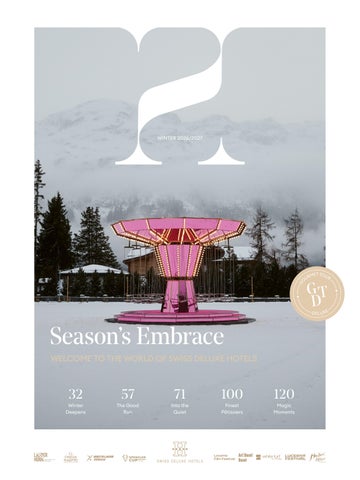
WINTER 2026/2027
Season’s Embrace WELCOME TO THE WORLD OF SWISS DELUXE HOTELS
32
57
71
100
120
Winter Deepens
The Good Run
Into the Quiet
Finest Pâtissiers
Magic Moments
It takesIttime takestotime become to become an icon,an icon,
Vincent van Gogh © Musée d’Orsay, Dist. GrandPalaisRmn / Patrice Schmidt
Vincent van Gogh © Musée d’Orsay, Dist. GrandPalaisRmn / Patrice Schmidt
PARTNER
when you when areyou diffare erent. different.
GUIDANCE
EDITORIAL
The Luxury of Time When asked about life's greatest luxury, most people give the same answer: time. It is an interesting answer, because time is one of the few things we cannot really possess. We speak of saving it, spending it, wasting and finding it, as though there were somewhere we could store spare time for later. There isn't. Economists might describe its value through the cost of opportunity: what are you losing to gain one hour? I find the question more interesting when framed differently. What are we willing to pause so that an hour becomes ours again? Dr Fabio Duma explores precisely this thought in his essay. He writes about our attachment to productivity and our difficulty in leaving things undone. Perhaps freedom is not the ability to do more, but the ability to refrain and to resist filling every empty space with another task. This led me to think about running. A run will not give us more time – quite the opposite. We use up an hour that could have been used for something potentially ‘productive’ and decide to spend it moving, one foot in front of the other. For a while, the number of decisions becomes smaller: find a pace, keep going, slow down, speed up. This summer, 838 employees from 35 Swiss Deluxe Hotels ran a combined 153,318 kilometres for the SDH SapoCycle Run. Everyone contributed to their own ability, without a starting line and without comparison. What mattered was being part of something, taking the time to step away from other duties and contribute. We see this thread continuing in our Runner’s Special. Beatrice Lessi began running at the age of 40 and has since completed 30 marathons and ultramarathons. Yet one of her best pieces of advice is wonderfully simple: an easy run should be easy. Pay attention to what is around you, enjoy nature and your body, make it something you look forward to and let go of time. Perhaps this idea is not limited to running. For our winter Travel Guide, Claudio Del Principe travelled from Bad Ragaz to Arosa and on to St. Moritz, meeting the people shaping three special locations. Over breakfasts, dinners, and conversations, schedules gradually became less important, and time slipped away. Perhaps that is one of the most important aspects of a great hotel. We are given a reason to stop looking at the time, a moment to linger, and time to slow down. Enjoy the read! Evelyn Gorgos
Follow us on Instagram @swissdeluxehotels Do you like H Magazine? Become a subscriber. 7
Travel Guide
032 From Bad Ragaz to Arosa and St. Moritz, our winter road trip moves through three very different takes on Swiss hospitality. Somewhere along the way, we found a rather charming carousel. It ended up on the cover.
Impossible to Copy
052 At Lausanne’s Beau-Rivage Palace, 160 years of history sit surprisingly lightly.
Lausanne Running Tips
057 Looking to explore Lake Geneva on foot while d iscovering some hidden gems? Here are our three favourite spots recommended by marathon runner Beatrice Lessi.
153,318 Reasons
058 The Swiss Deluxe Hotels SapoCycle Run turned every kilometre run or ridden into practical support for people in need.
8
Image | houseofsteness
WINTER HIGHLIGHTS
Image | houseofsteness
Runnersʼ SPECIAL
060
A guide to run well Fuel your run
The View
067 At 35, Benjamin Dietsche represents a new generation of hotel leadership: direct, relaxed, and clear about what he carries forward, and what he wants to change.
Spa Review
071 When time seems to stand still, you can either fight it or surrender. At Suvretta House, you can fully appreciate the wonderfully relaxing vibes of this landmark of Engadin hospitality.
Image | Enrico Costantini
Gourmet Tour De Luxe
100 In our new pâtisserie series, we meet Katrin Wagenblast, Maxime Rebmann, and Antoine Idenn – shaping S witzerland’s contemporary dessert culture with precision, c reativity, and a deep sense of craft.
Magic Moments
120 From the 120-year-old spirit of horse racing on a frozen lake in St. Moritz to the legacy of one of Europe’s great golf tournaments in the Swiss Alps, Leading Swiss Events bring sport and culture together across borders and generations.
Standards
Swiss Deluxe Hotels locations Swiss Deluxe Hotels overview Publishing credits 145
132 134
YOUR NEXT CHAPTER. TIMELESS.
On the shores of Lake Zurich, Switzerland, Kusnacht Practice delivers world-leading, highly personalised clinical care in mental health, addiction, and precision medicine, through an in-house team of doctors across three disciplines, enabling profound healing, lasting transformation, and a life fully reclaimed.
K U S N AC H T P R AC T I C E .C O M
CONTRIBUTORS
SPECIAL THX TO G A U D E N Z LO O S E R
FA B I O D U M A A philosophical thinker, lecturer, author, and partner for reflection and development, he explores what happens when we stop treating every moment as a resource to be optimised. In this issue, he considers the luxury of leaving things undone and why the freedom to refrain may be one of the rarest forms of wealth. His book ‘Nicht(s)tun – Warum wir weniger tun und mehr unterlassen sollten’ invites readers to rethink their attachment to busyness and rediscover the value of space, presence, and the feeling of having enough.
He helped shape 20 Minuten before moving into strategy and communications consulting. He still writes, still observes, and, fortunately for us, still has a weakness for the questions hiding behind the obvious ones. This time, Steve Jobs’ black turtleneck and booking the same hotel room year after year lead him to an intriguing thought: perhaps freedom sometimes begins precisely where we decide to stop reconsidering everything.
ELENA & TIM STENESS With professional roots in fashion and an instinctive eye for design, architecture, and the details that give a place its character, the couple have turned a shared passion for photography into the brand House of Steness. Rather than simply documenting a setting, they look for atmosphere, unexpected perspectives, and the quieter moments in between. It’s an approach that gives their images a recognisable visual language and makes them natural storytellers.
CLAUDIO DEL PRINCIPE
B E AT R I C E L E S S I When we decided to put together a runner’s guide, we knew exactly whom to ask. Beatrice is an Italian-Swiss writer and endurance runner based in Zurich who only took up running at 40. Since then, she has completed 30 marathons and ultramarathons. She has also been the voice behind our Runner’s Tips column from the very beginning, drawing on years of experience and a contagious love of the sport. She even managed to get our editor-in-chief ready for the Zurich Marathon. We trust her advice, and suspect you will too.
He knows how to get to the heart of a place, often through the people who shape it. The author of 11 internationally awarded cookbooks, food lecturer at FHNW, and passionate advocate of craftsmanship and honest cooking has a sharp eye for what matters. For this issue’s Travel Guide, Claudio travelled from Bad Ragaz via Arosa to St. Moritz, meeting a cast of fascinating protagonists along the way.
PAT R I C I A B R Ö H M As the former editor-in-chief of Germany’s Gault&Millau Restaurant Guide, restaurants are her natural habitat: Patricia Bröhm lives in Munich and is a regular contributor to several publications in Germany and Switzerland. Pâtisserie is her soft spot, so it comes naturally that she is now portraying Switzerland’s most gifted pâtissiers in our new series, exploring the craft, creativity, and personalities behind exceptional pastry.
11
ROBERT GORGOS What should you eat before a run? Few people are better placed to answer this question. As a qualified nutrition scientist, long-time nutritionist in professional endurance sport, and co-founder of MNSTRY, Robert has spent years translating sports science into strategies that work in real life. For our Runner’s Special, he shares his advice on fuelling a run properly, without getting lost in supplements, trends, or marketing promises.
Sparks Heart Collection limited time only
THOUGHTS
The People Behind the Welcome Nathalie Seiler-Hayez, Managing Director Michael Smithuis, Chairman Swiss Deluxe Hotels
Winter has a way of making hospitality visible. A door held open against the cold, a room already warm after a day in the snow and someone who remembers your name, your favourite wine, or simply senses when you would rather be left in peace. And yet, much of what makes a hotel exceptional happens out of sight. On 1 September, we had the pleasure of bringing together 33 employees from across Swiss Deluxe Hotels for our first talent celebration at the Savoy, Mandarin Oriental in Zurich. Apprentices and concierges sat alongside housekeepers, chefs, technicians, dishwashers, and team leaders, each nominated by their hotel for the contribution they make every day. There was no single winner. Talent in hospitality cannot be reduced to one profession, one personality, or one definition of excellence. It might mean creativity and technical expertise, just as much as it might mean reliability, attentiveness, patience, or the willingness to take responsibility when nobody is watching. For us, this says something important about Swiss hospitality today. The experience a guest remembers may begin at reception or over dinner, but it depends on many people who may never be met personally. Someone has prepared the room, maintained the building, answered a request, coordinated a delivery, trained a colleague, or solved a problem before it became visible. Excellence in hospitality is built collectively, across departments, generations, and professions.
The stories of our talents also remind us how varied a career in hospitality can be. Some of those we celebrated are only beginning their professional lives, while others have spent decades refining their craft. A first position can lead somewhere unexpected when ability is recognised, responsibility is given, and people are encouraged to grow. That same idea carries into this winter edition. The stories that follow look at Swiss hospitality through the people, places, and disciplines that shape it, from the energy of our cities to the rhythm of life in the mountains. Winter may be the season in which hospitality is felt most noticeably. We come indoors, gather around tables, return to familiar places, or discover new ones. What stays with us is rarely one detail alone, but the way a place made us feel. And behind that is almost always a person. We wish you a joyful festive season, a wonderful winter, and many memorable encounters along the way. Nathalie and Michael
13
H MAGAZINE X NESPRESSO
14
The Chef and the Café Crème
Known for his remarkable precision with flavours, two-Michelin-starred chef Heiko Nieder has turned his attention to a Swiss favourite: the humble café crème. Developed with Nespresso, Zurich Lungo celebrates the city’s coffee culture with Nieder’s distinctive culinary touch. In 2021, Nespresso and Heiko Nieder took their long-standing collaboration a step further by co-creating a signature coffee for the Nespresso professional system, served exclusively at The Restaurant. Three years later, the partnership reached another milestone with Zurich Lungo, bringing their shared passion for coffee into the home. For a chef accustomed to working with countless ingredients, creating a coffee presented a rather different challenge. Coffee leaves considerably less room for manoeuvre. He once compared the process to working with a palette of 30 shades of brown. The differences can be almost imperceptible, yet a slightly different roast or the smallest adjustment to the blend can change the entire result. His answer is a blend of Arabica beans sourced primarily from Nicaragua and Costa Rica. Smooth and rounded, Zurich Lungo has warm notes of cereal and caramel, lifted by a gentle hint of citrus. Add a little milk and its sweeter side comes forward. Nieder knows the effect well. Although he drinks his coffee black throughout the day, breakfast is another matter. That calls for a touch of frothed milk. Even a perfectionist has his morning rituals. In 2026, Zurich Lungo made an appearance at the Zurich Film Festival, where Nespresso was the official coffee partner. While festival guests enjoyed the coffee between screenings and premieres, Heiko Nieder was back at The Restaurant, focused on evening service.
At The Dolder Grand, even the coffee at the end of dinner is serious business.
HONEY KAFFEE CRÈME A little honey and a splash of milk give Nespresso Zurich Lungo a gentle sweetness. A simple twist on the Swiss café crème, perfect for a quiet moment at home. PREPARATION • Add 3 ml of honey to a lungo cup. • Pour in 10 ml of cold milk. • Extract 110 ml of Nespresso Zurich Lungo directly into the cup. • Stir gently until the honey has dissolved. • Finish with a small splash of milk. • Serve immediately and enjoy.
Apparently, even Hollywood has to wait when dinner service calls.
15
WORDS EVELYN GORGOS
In a former quarry in the Swiss canton of Aargau, a grotto and a collection of extraordinary drawings preserve the work of Emma Kunz. Called healer, researcher, and artist, she left behind a way of looking at the world that continues to resist simple explanation.
A sheet of graph paper lay before Emma Kunz. She held a pendulum above it, watched its movement, then began to draw. Lines crossed and multiplied. Circles and squares formed patterns of such precision that, seen from a distance, they almost look mechanical. Step closer and their designs become harder to follow. The eye moves through one arrangement, only to discover another within it. Kunz was born in 1892 in Brittnau, in the canton of Aargau. She had no formal artistic training and never viewed herself as an artist. She studied nature, worked with a pendulum, and sought to understand forces she believed were present in every human being, and people came to her for advice or treatment. However, she rejected the word ‘miracle’; what interested her was the possibility of recognising and using those forces. In 1938, she began making the large drawings for which she is now known. Working on millimetre graph paper with pencils and crayons, she used her pendulum to explore a question before putting down her lines. The question gave each image its purpose, but she did not leave viewers a key to its meaning. More than 400 drawings survive. Their geometry suggests order, yet the longer one looks, the less any single interpretation seems to hold. The drawings were part of Kunz’s research and healing practice, rather than works made for exhibition. They were first shown to a wider public at the Aargauer Kunsthaus in 1973, 10 years after her death. Since then, they have travelled far beyond Switzerland, including to London’s Serpentine Galleries. Their reach is striking for work made privately, on paper, in response to questions its maker rarely disclosed.
To understand Kunz’s legacy, however, it is worth returning to Aargau. Near Zurich, the former Roman quarry at Würenlos holds another part of her story. In 1942, Kunz identified a particular limestone there, which she named AION A and used in her treatments. The Emma Kunz Centre now occupies the site and preserves her work. At its heart is the grotto, a place she visited repeatedly and regarded as a source of renewed strength. Visitors still come to spend time in the rock chamber. Some describe a sense of calm or believe they feel an energy there. Such experiences belong to the people who have them; claims that the grotto can heal should not be treated as established medical fact. However, the place remains compelling without that certainty, bringing Kunz’s drawings, her work with the mineral, and her attention to the natural world into the same physical space. At a time when wellbeing is increasingly measured and monitored, Kunz asks for a different kind of thoughtfulness. She invites people to look closely, to notice patterns, and to consider what might lie beyond an immediate answer. In Würenlos, this philosophy has a tangible setting: paper covered in painstaking lines, and the stone from which she drew such lasting inspiration. Together they form one of Switzerland’s most unusual cultural treasures.
View of Emma Kunz’s “Visionary Drawings” at Muzeum Susch, Switzerland, 2019. Image courtesy of Muzeum Susch/ Art Stations Foundation CH. Image | Maja Wirkus © Emma Kunz Stiftung
‘My visual work is made for the 21st century’
EXCLUSIVE PEOPLE
A solo exhibition at Muzeum Susch presented more than 60 of these untitled and undated works, produced from 1938 until her death in 1963. Built on the site of a 12th-century monastery in the Engadin region of Switzerland, with galleries burrowing into the rock, the institutional setting establishes that Kunz’s images can speak on their own terms as art. From 7 November 2026 to 4 April 2027, Hauser & Wirth Somerset presents her work in partnership with the Emma Kunz Foundation. Their reach is striking for drawings made privately, in response to questions their maker rarely disclosed. Founded by Grażyna Kulczyk in Switzerland’s Engadin valley, Muzeum Susch is dedicated to modern and contemporary art, with a particular focus on female artists whose work has often been overlooked. muzeumsusch.ch emma-kunz.com
17
A Question of Origin Salmon may be familiar to us all, but how source defines taste can be confusing. The quality of salmon depends on a complex set of choices. Wild or farmed, Scottish, Norwegian or Swiss, fresh or frozen: origin matters, but so does feed, husbandry, processing, and transport. ‘Quality cannot be judged by provenance alone,’ says Fabian Bühlmann, Head of Fish Purchasing at Bianchi. ‘Freshness, temperature control and preparation are just as important.’
Wild salmon generally has firmer flesh and a more pronounced flavour, but its character varies by species. Sockeye is lean, deeply coloured, and aromatic, while king salmon tends to be richer and more succulent. Farmed Atlantic salmon usually has a higher, more consistent fat content, which gives it a milder flavour and softer texture.
Swiss Alpine salmon from Lostallo is raised in a land-based recirculating aquaculture system rather than in open sea pens. Mountain spring water is filtered and largely reused. The closed system prevents fish from escaping and avoids salmon lice, one of the persistent challenges of marine farming. According to the producer, no antibiotics or other medicines are used.
‘Short transport distances, freshness, and clearly traceable Swiss origins are considerable advantages,’ says Bühlmann. Landbased production is particularly interesting for inland countries, although its energy use, technical demands, and the sourcing of feed must also form part of any environmental assessment.
18
H MAGAZINE X BIANCHI
Feed has a direct influence on growth, fat content, flesh colour, and nutritional profile. Conventional marine and plant-based ingredients are increasingly supplemented by algae oil, insect protein, and by-products from fish processing. The salmon’s pink colour comes from carotenoids in its diet, whether naturally consumed in the wild or added to aquaculture feed.
Certification can provide useful guidance, although different labels measure different things. ASC covers environmental and social standards in aquaculture, while MSC assesses wild fisheries, stock health, and environmental impact. Organic and Naturland labels have separate rules for farming and feed. Label Rouge, by contrast, is a French quality mark rather than a sustainability certification. ‘Labels improve transparency, but they do not replace careful sourcing and quality control,’ Bühlmann says.
Fresh whole salmon should have clear, slightly rounded eyes, glossy skin, and moist red or pink gills. The flesh should feel firm and spring back after light pressure. Fillets should have an even colour, clean-cut edges, and a taut surface. A mild, clean scent is a sign of freshness; a sharp or ammonia-like smell is not.
Frozen does not necessarily mean inferior. Salmon frozen rapidly after harvesting can retain excellent flavour and texture, although careful thawing remains important. Smoked salmon keeps longer than fresh fish, but its shelf life still depends on the smoking method, packaging, and storage temperature. In every form, an uninterrupted cold chain is essential.
Good salmon needs little intervention in the kitchen. Gentle cooking preserves its texture, while excessive heat dries the flesh and causes white albumin to collect on the surface. Strong seasoning can mask its character, and lemon or other acids are best added shortly before serving. Fish intended for tartare or sashimi must be explicitly suitable for raw consumption and treated in accordance with food-safety requirements.
CONTACT shop.bianchi.ch Tel: +41 56 649 27 27
19
The Pleasure of Light Reds WORDS PETER KELLER
For those who enjoy wine consciously, light, easydrinking red wines with low alcohol content are often preferred. Grape varieties such as Gamay, Pinot Noir, Zweigelt, and Dolcetto are well-suited to this style. An introduction to these enjoyable wines.
Light, elegant red wines generally have a low alcohol content between 12 and 13%, and in some cases even lower. This, however, doesn't mean they are thin. On the contrary: despite their lightness, the best examples have structure, depth, length, and good balance.
For elegant, light-bodied red wines, Gamay is an excellent choice. Pinot Noir can also produce beautifully delicate wines, while Zweigelt from Austria and Dolcetto from Piedmont are equally well suited. Baga from Portugal’s Bairrada region is a particularly exciting option.
Light red wines are often produced in so-called cool-climate regions, such as northern France, Germany, and at higher altitudes in South Tyrol. Switzerland is also an excellent source for this type of wine. In the long term, due to climate change, England and Nordic countries like Sweden and Norway will also become important producers.
The maceration period is usually short. Furthermore, winemakers ensure that the wines are not over-extracted. Fermentation with whole grapes, or at least with a portion of them, results in wines with more freshness and acidity – and thus greater lightness. Ageing typically takes place in stainless steel tanks or large wooden casks. Barriques are only used in exceptional cases.
20
EXCLUSIVE WINE
Switzerland benefits from a moderately warm climate, with the exception of extreme years like 2026. This facilitates the production of lighter, more refined wines, particularly from the main red grape variety, Pinot Noir. However, it also works well for the aforementioned Gamay, for example, from Valais or Geneva. Generally speaking, German-speaking Switzerland and the Three Lakes Region (Lake Biel, Lake Neuchâtel, and Lake Murten) are the most suitable areas for producing lighter red wines.
A light red wine should be served at a temperature of 14–15°C. Generally, it's better to pour it slightly chilled, as it will warm up in the glass anyway.
Lighter, Mediterranean dishes are an excellent choice for a perfect pairing. Vegetarian dishes also complement them very well. It used to be said that white wine was the only option with fish. This isn't necessarily true. Light red wines, with their wide range of uses, are ideal companions to many fish dishes. They are certainly a good alternative to white or rosé wines. You simply have to like the colour red.
People have been drinking less wine for some time now and more consciously. Light red wines are right on trend thanks to their elegance, their digestibility, and their sheer drinking pleasure. As the top Portuguese winemaker Filipa Pato from Bairrada once aptly put it: ‘I make wines to drink, not to taste.’ The days of overly heavy, opulent, and powerful wines are definitely over.
Image | Viviana Delidaki
When choosing an elegant, light red wine, the alcohol content on the label is a useful first clue. It cannot tell the whole story, though: even a wine with relatively low alcohol may feel heavy if its tannins dominate or its fruit, acidity, and tannins are out of balance. A trusted producer can help guide the choice, but tasting remains the surest way to discover how a wine feels on the palate and whether it suits your taste.
21
22
H MAGAZINE X QOQA
Picasso on the Move Most paintings wait for their audience. This one is going to find it.
In 2017, QoQa did something that sounded improbable even by its own standards: it bought Pablo Picasso’s Buste de Mousquetaire and divided ownership into 40,000 shares. In less than 48 hours, 25,000 members of its community had joined the experiment. Now the painting is entering its next chapter, this time on wheels. Mousquetaire On Tour places the Picasso inside a specially converted truck designed to transport and exhibit the work across Switzerland. More than three years have gone into the mobile installation, bringing together specialists in fine-art logistics, conservation, scenography, and cultural mediation. Natural Le Coultre coordinated the handling, storage, insurance, and transport of the painting; Mouvement Studio and Laure Gremion developed the interactive installation; restorer Pierre-Antoine Héritier advised on conservation, while Curioz transformed the vehicle itself. The result is what the project team describes as a world first: a mobile installation built around a work by a major artist. But the technical feat is only half the story. The original idea behind the Picasso purchase was to challenge the conventional distance between art and ownership. The tour takes that thought one step further by challenging the distance between art and its audience. ‘The goal is to let the co-owners see the painting up close, but also to meet those who don’t always have the chance to access art,’ says project manager Bertrand Tappy. ‘Whether it’s a child who has never seen a Picasso or a senior who can no longer easily get to museums, everyone should be able to admire this work.’ The Mousquetaire has hardly been hidden away since its acquisition. It has already appeared at MAMCO in Geneva, Fondation Beyeler in Basel, Musée Picasso in Antibes, Zentrum Paul Klee in Bern, Ferme des Tilleuls in Renens, and, most recently, at EPFL. Now, instead of asking people to come to Picasso, QoQa is sending Picasso to them.
‘Everyone should be able to admire this work.’ Bertrand Tappy, Mousquetaire project manager for QoQa
23
H MAGAZINE X VALSER
What Water Changes Florentina Birlo approaches water much as she approaches wine: by asking how it will most complement the dish. Mineral content, amount of bubbles, and temperature all affect how food feels and tastes, often more than we notice.
At The Counter, a two-Michelin-starred restaurant in Zurich, the kitchen and dining room are almost one continuous space. Mitja Birlo cooks within sight of the room, while Florentina, his wife, host and sommelière, guides the evening from the other side of the counter. Most of her attention naturally goes to wine, yet there is another glass on the table that she gives more thought to than it usually receives. And for good reason. Water can change how a dish is experienced. ‘For me, the dish always sets the pace,’ she says. She looks first at its intensity and texture. Is there fat? Smoke? Roasting? Is it delicate or powerful? Does the flavour disappear quickly or stay with you? These are familiar questions in wine pairing, yet Florentina uses them for water too. With Wagyu, for instance, she often reaches for sparkling water. The bubbles cut across the meat’s richness and change the sensation in the mouth. By the next bite, the palate feels a little fresher. Much of water’s effect is physical rather than aromatic. Both the amount of minerals it contains and whether it is still or sparkling change how it feels in the mouth and how long the flavours of a dish seem to stay with you.
Valser is among the waters Florentina recommends at the restaurant. Put Valser Still and Valser Prickelnd side by side and the distinction becomes easier to understand. With its lower mineralisation, the still water is mild and restrained. Florentina sees it as the quieter partner, particularly suited to finely prepared fish or dishes whose textures and aromas can easily be overwhelmed. Valser Prickelnd has a greater mineral presence, and the carbon dioxide gives it more structure on the palate. With richer dishes, roasted flavours, or creamier textures, that presence can work particularly well. ‘After something rich, creamy, or high in fat, I find sparkling water very pleasant because it changes the mouthfeel and can sensitise the palate again,’ Florentina explains. There are moments, however, when she deliberately wants water to do almost nothing. If a dish has a fine, lingering finish, carbonation can interrupt it too quickly. ‘Sometimes a flavour should simply be allowed to remain for another moment.’ This, however, is not meant to turn water pairing into another piece of choreography in the restaurant. This decision is deliberate. With so much to experience and discuss, introducing a different water with every course could quickly make dinner feel like a lesson. Florentina would rather judge and decide for herself when an explanation adds something and when it is better to simply let the guest enjoy the evening. For anyone curious to explore the idea of water pairing at home, she suggests starting without food. Take three or four mineral waters and taste them side by side, perhaps at different temperatures or from different glasses. There is no need to analyse them too much. Notice how each one feels: light or weighty, soft or more pronounced, perhaps even what sort of colour or image comes to mind. Then bring in something simple, such as a creamy cheese. Try it with still water first, then with sparkling. The cheese is exactly the same, but it may not taste quite the same. Florentina Birlo is host and sommelière at The Counter in Zurich, which she runs with her husband, chef Mitja Birlo. She oversees the drinks programme and brings a distinctly personal touch to the guest experience. Previously the couple worked together at 7132 Silver in Vals.
25
H MAGAZINE X BUCHERER
26
Time That Stays WORDS MICHAEL TULGAY
How I found a 1990 Jaeger-LeCoultre Reverso in Interlaken. And why Certified Pre-Owned at Bucherer is more than buying second hand.
The world of watches is wonderful and delightfully complex at the same time. Some designs never leave the catalogue, yet their earlier versions quietly disappear, and finding them takes patience, a good eye, and a little luck. For me, it was a Jaeger- LeCoultre Reverso from 1990. Its story began in 1931, when polo players in India needed a watch that could survive a match: the answer was a case that flips over to protect the glass. Almost a century later, that Art Deco rectangle is still one of the most elegant ideas in watchmaking. I found it where I least expected to. On a spontaneous stroll along the Höheweg in Interlaken, I stepped into the Bucherer store right next to the Victoria-Jungfrau Grand Hotel, and there it was: the slim case, the clean dial, on a beautiful leather strap that made it look as if it had been waiting just for me. Its condition barely betrayed its 36 years. I wanted to try it on once more at my own pace, so one day later, it was delivered to me in Zurich. I knew at once it was here to stay. Only afterwards did I understand what lies behind that display case: one of the most established pre-owned programmes in the industry. Bucherer has offered Certified Pre-Owned watches since 2019, and every single piece is serviced by a certified watchmaker before it goes on sale, from the authenticity check to a full movement service and water resistance test. Each one comes with a two-year international guarantee. Yet my Reverso was only the beginning. The real magic of Bucherer CPO lies in its breadth: the selection changes almost daily. There are the modern classics, from the Cartier Santos to the IWC Pilot's Watch. There are the icons, such as the Audemars Piguet Royal Oak, the Omega Speedmaster, or the Blancpain Fifty Fathoms. And there are the rarities: discontinued references, limited editions, and pieces by independent watchmakers such as H. Moser & Cie and many others. And whether it is a first serious watch or the missing piece in a longheld collection, the CPO world rewards curiosity. And for those who would rather go the other way, Bucherer can help with that, too. Watches can be sold or traded in, giving a piece that had its time with one person a second chapter with someone else.
BUCHERER CERTIFIED PRE-OWNED: A SECOND LIFE FOR EXCEPTIONAL WATCHES Since 2019, every Bucherer Certified Pre-Owned watch has been serviced by a certified watchmaker before it reaches the display case: full assessment and authenticity check, authentication and servicing of the movement, ultrasonic cleaning, diagnostic tests of every function, time regulation, a power reserve test, and a water resistance check of glass, crown, and seals. Every piece comes with a two-year international guarantee. • Rolex Certified Pre-Owned: Since 2022, Rolex has been part of the Bucherer CPO cosmos, with Bucherer as the first retailer to offer it. After the detailed service, every watch goes to Rolex for certification, authentication, and quality testing and r eceives the official two-year international Rolex Certified Pre-Owned guarantee.
• The selection: Modern classics, iconic sports watches, and chronographs, discontinued references and rare finds of the most esteemed luxury brands. The portfolio of watches is constantly changing. • Buy, sell, and trade: Watches can be sold or traded in at the boutiques, or sold online. • Discover: bucherer.com/bucherer-cpo, on Instagram at @bucherer_cpo and in the weekly Bucherer newsletter, every F riday morning, with the latest novelties to discover.
Talent in Every Role WORDS EVELYN GORGOS
A hotel may be judged by what guests see, but its standards depend just as much on work that often goes unnoticed. At the inaugural Swiss Deluxe Hotels Talent Celebration, 33 employees demonstrated just how broad the skills behind Swiss hospitality really are.
A moment of glamour and recognition for the 33 employees honoured at the first Swiss Deluxe Hotels Talent Celebration in Zurich. From apprentices and housekeepers to chefs, concierges, and technicians, the group reflects the many different roles behind Swiss hospitality. ‘Buildings can be exceptional and locations unique, but ultimately it is the people who create the experience and bring our hotels to life’, says Swiss Deluxe Hotels CEO Nathalie Seiler-Hayez.
28
EXCLUSIVE SDH TALENT
At the Mandarin Oriental Savoy Zurich, apprentices, dishwashers, concierges, technicians, housekeepers, chefs, and team leaders sat alongside the General Managers who had nominated them. Held on 1 September 2026, the first Swiss Deluxe Hotels Talent Celebration placed employees from across the profession at the centre of the occasion. ‘Buildings can be exceptional and locations unique, but ultimately it is the people who create the experience and bring our hotels to life,’ says Nathalie Seiler-Hayez, CEO of Swiss Deluxe Hotels and the driving force behind the initiative. A WIDER DEFINITION OF TALENT There was no podium and no overall winner. Every nominee received the title Swiss Deluxe Hotels Talent of the Year 2026. This was not simply a diplomatic gesture, but a deliberate rejection of the idea that talent can be measured against a single set of criteria. ‘We want to put our people and their talents in the spotlight, rather than rank or compare them,’ says Seiler-Hayez. ‘There is no best talent. Each has been chosen by their hotel for the contribution they make.’ The recipients reflected the complexity of a modern hotel. They included Victor Jesus Rando Coelho, a dishwasher at The Capra, and Élodie Perler, a commercial apprentice at The Dolder Grand. Others work in pastry, finance, human resources, carpentry, reservations, marketing, and building maintenance. The selection broadened the conventional understanding of hospitality talent. Technical knowledge can matter as much as ease with guests; reliability as much as creativity. A wellrun hotel depends on people who notice what needs to be done, take responsibility for it, and understand how their work affects colleagues and guests.
‘Excellence is never the work of one person, but the result of many different talents working together.’
29
CAREERS BUILT FROM WITHIN The honourees were also at very different stages of their working lives. Some are taking their first professional steps, while others have spent decades refining their skills. Sylvie Gonin, chef concierge at the Beau-Rivage Palace in Lausanne, has worked at the hotel for 31 years. Her description of the profession is disarmingly simple: ‘I take pleasure in giving pleasure.’ Yet her understanding of the role extends beyond her own contact with guests. She speaks with equal satisfaction about recognising ability in colleagues, supporting their development, and seeing them take on greater responsibility. Silvia Gonçalves Louro’s career at the Grand Hotel Zermatterhof offers a more recent example of progression from within. She joined the hotel six years ago as a room attendant, later became floor supervisor and was promoted to assistant executive housekeeper in summer 2026. Her next ambition is already clear: to become executive housekeeper and continue building her career at the Zermatterhof. Her progression shows that careers in hospitality need not follow a prescribed route. Practical experience and personal aptitude can open opportunities, provided someone is willing to recognise them. Talent development therefore depends not only on the motivation of an employee, but also on managers who give people the confidence, guidance, and responsibility to advance. THE WORK BEHIND THE EXPERIENCE Meeting the honourees confirmed the view of hospitality as a collective profession. Their positions and levels of experience varied considerably, yet each spoke about their work with evident pride. ‘Excellence is never the work of one person, but the result of many different talents working together,’ emphasises Michael Smithuis, Chairman of the association. For a moment, the people who prepare a room, solve the problem, remember preferences, or keep the machinery running were brought centre stage. The celebration acknowledged something guests may rarely see, but which every good hotel understands: its standards are sustained across departments, shifts, and generations.
30
H MAGAZINE X MAISON ICONIA
A Table of Elements WORDS PAUL BOUTILLY
At the Grand Hotel Zermatterhof, an unusual dinner brought interior architecture into the kitchen. For one evening, Maison Iconia and chef Stefan Lünse explored what happens when the materials of a chalet become the starting point for a menu.
A piece of raw timber. A fern. A pebble and a small bowl of honey. They are not the usual references on a restaurant menu, yet they appeared in the one prepared for a dinner at Alpine Gourmet Prato Borni in Zermatt on 24 March 2026. The printed menu resembled an architect’s sample board, with dishes arranged alongside the materials that had inspired them. The evening was conceived by Maison Iconia, a recently launched interior architecture studio that has more than 25 years of experience, with a presence in Lausanne, Turin, and Singapore, together with the Grand Hotel Z ermatterhof and Hotelier Verein Zermatt. Rather than design a room, the studio designed an occasion. It was also a way of introducing itself to clients without a slide presentation, letting the work be experienced rather than explained. It began, as its interiors do, with the qualities of natural materials: the grain of wood, the weight of stone, the colours of a mountain landscape. The challenge was to carry those references from the surroundings onto the plate. The palette moved between glacier blue, stone grey, moss green, and the darker tones of earth and wood. Guests were welcomed for an aperitif before moving into a dining room shaped around these references. Textiles, glassware, and lighting formed part of the design, while a soundscape created with Devialet added another layer to the atmosphere. The idea was for the setting and the food to speak the same language. For chef Stefan Lünse, it was an unusual brief: each course had to interpret a material. ‘Alpine Mineral’ paired Valais perch with Oona caviar from Frutigen. ‘Seared Earth’ brought together a hand-dived Scottish scallop and
Luma pork belly. A trio of Swiss wagyu beef followed under the heading ‘Forest Earth Alpine’. The Zermatterhof cheese trolley took its cue from honey. Each course was introduced by Lünse and Ottavio Di Chio, Maison Iconia’s Art Director and Partner, who explained the material behind it. The collaboration put two familiar ways of working side by side. A chef considers where an ingredient comes from, how it behaves, and what it needs alongside it. An interior architect asks much the same questions of timber, stone, or fabric. Here, they shared the same brief. The dinner also showed how much can be communicated before a guest takes the first bite. The visual references on the menu prepared the eye for what was coming; the room provided a quieter echo of those forms and colours. Yet the dishes had to work as food, not simply as illustrations of an idea. That distinction made the exercise more interesting than an elaborate table setting. Maison Iconia usually works on spaces intended to last for years, drawing on a quarter of a century of projects. In Zermatt, its design existed for the length of an evening. The final course was dark Felchlin chocolate, listed on the menu under ‘Alpine Wood Material’. Even dessert had its place on the materials board.
‘The printed menu resembled an architect’s sample board, with dishes arranged alongside the materials that had inspired them.’
31
32
TRAVEL GUIDE
High Altitude, High Standards Three destinations, three very different expressions of Swiss luxury. Starting from the thermal waters and culinary ambition of Bad Ragaz, we travel higher into the mountains, to the quiet retreat of Arosa, and then continue on to the glamour and grand-hotel heritage of St. Moritz. CURATED BY CLAUDIO DEL PRINCIPE
Image | houseofsteness
Along the way, there are new restaurants to discover, remarkable rooms to retreat to, conversations with the people shaping these places, and plenty of reasons to linger at the table. But this journey is also about exploring a fundamental question: how do great hotels evolve without losing what made them special in the first place? The answers are surprisingly human. They stem from a warm welcome and an embedded sense of place, in thoughtful change rather than reinvention, and often in the smallest gestures. While true luxury may have many manifestations, the best hotels still have one thing in common: they make you want to stay just a little longer.
A vintage Porsche, a pause along the way, and three destinations ahead. Our winter journey takes us from the thermal waters of Bad Ragaz to the mountain calm of Arosa and the grand-hotel world of St. Moritz.
HOW DO YOU SHARPEN EXCELLENCE? When a resort already offers world-class gastronomy, thermal waters, and an extraordinary range of experiences, the challenge is not to add more. It is to make every element more distinctive. In Bad Ragaz, that means sharper culinary identities, less complexity – and a renewed focus on what genuine hospitality is all about. On my latest visit to the Grand Resort Bad Ragaz, I wanted to find out what this evolution looks like in practice. The answer, I discovered, is not necessarily by adding more. Sometimes it is about reducing, refining, and giving things a clearer identity. You notice it at breakfast. For me, it remains one of the best hotel breakfasts around – not because the buffet overwhelms you with choice, but precisely because it doesn’t. Less, but genuinely good. Excellent bread from the Swiss bakery Eigenbrötler, attentive service, and a perfect cappuccino made with coffee from Henauer. And then there is Leo Zoccoli, ‘Bar Manager of the Year 2023’, who reminds me that hospitality ultimately has very little to do with concepts. He has a wonderfully simple test for whether someone is made for it: Do you hold the door open for others? Do you greet the bus driver? Do you notice people?
34
It sounds almost too simple. Yet perhaps that is exactly the point. Executive Chef Nadine Wächter Moreno thinks along similar lines. ‘Less is more’ is something of a guiding principle for her. She would rather see less ham on the breakfast buffet and have it sliced fresh than have thousands of slices waiting on platters. ‘It is not about offering as much as possible,’ she says. The whole interplay has to be right. That philosophy is now shaping the resort’s new restaurants as well. Wächter Moreno has no interest in inventing concepts simply for the sake of novelty. Authenticity is what matters to her. If a cuisine cannot be executed authentically, she would rather not do it at all. ‘Culinary excellence is not defined by complexity or formality,’ she says. What matters is the quality of the ingredients, the pleasure of sharing a meal, and an atmosphere in which guests feel at ease. Less ceremony, more conviviality. At Sanook, Thai Head Chef Renu Homsombat draws on the vibrant flavours and lively spirit of Thai street food. Fresh herbs, fragrant curry pastes, and the interplay of sweet, sour, salty, spicy, and bitter define her cooking. Lemongrass, galangal, and Thai basil lend their distinctive aromas. Traditional recipes and techniques remain essential, even when the presentation is contemporary. Her ambition is not to reinvent Thai cuisine, but to preserve its character. At Nesso, Italian Head Chef Nicola Montalti takes a personal approach. He trained at ALMA, worked with Massimo Bottura, and spent five formative years alongside Marco Campanella. Yet his strongest reference point remains the Emilia-Romagna of his childhood. When he first encountered spaghetti Bolognese outside his home region, he was almost offended. Ragù belongs with tagliatelle, he insists. Their rough surface catches the sauce, bringing pasta and meat together in every bite. His pumpkin ravioli with nutmeg and brown butter are another tribute to his childhood. A simple dish, refined through technique and an understanding of ingredients.
GRAND RESORT BAD RAGAZ
TRAVEL GUIDE
Above left | Nicola Montalti, Head Chef at Nesso, brings the flavours of his native region of Emilia-Romagna to Grand Resort Bad Ragaz. Having trained at ALMA and worked alongside Massimo Bottura and Marco Campanella, he draws much of his inspiration from childhood memories. His cooking is rooted in Italian tradition, with a particular fondness for handmade pasta and regional classics. Above right | At the 19th-century Helenabad, the thermal waters of the Tamina Gorge flow beneath marble columns and ornate arches. It is a reminder that Bad Ragaz’s idea of wellbeing was taking shape long before the modern spa existed.
What strikes me about this new direction is how naturally the two cuisines complement each other. Italian generosity meets Thai hospitality. Both celebrate fresh ingredients, traditional craftsmanship, and the pleasure of eating together. Neither needs elaborate rituals to make an impression. And both fit Wächter Moreno's conviction that a great restaurant should be remembered for how it makes people feel, not just for what is served.
35
And what a destination it is. You can spend a week here and eat somewhere different every day without culinary boredom ever becoming an issue. But abundance alone is not what makes the experience memorable. What stays with me is something more coherent: the feeling that each restaurant is being allowed to become more itself. Less, but better. Just like that breakfast.
Image | houseofsteness
TRAVEL GUIDE
Left | At Sanook, Head Chef Renu Homsombat brings the lively flavours of Thai street food to Grand Resort Bad Ragaz. Her cooking stays close to its roots, drawing on fresh herbs, fragrant curry pastes, and the careful balance of sweet, sour, salty, spicy, and bitter flavours. Above | Simone Leigh’s monumental bronze sculpture Brick House rises nearly five metres above the gardens of the Grand Resort Bad Ragaz. With its distinctive braided head, the work by the American artist creates a striking contrast to the village church and the Alpine landscape beyond. It is part of the resort’s remarkable collection of contemporary art.
37
TRAVEL GUIDE
TSCHUGGEN GRAND HOTEL AROSA
ESCAPE TO HIGHER GROUND Space, serenity, and crisp mountain air: at the Tschuggen Grand Hotel and its Mountain Suites, Arosa shows just how good it feels to get away from it all. The drive up to Arosa is enough to create some distance. The higher the road climbs, the further everyday life seems to recede. And when you arrive: crisp mountain air, nature, tranquillity. A chance to properly breathe again. That is one of the great strengths of the Tschuggen Grand Hotel. You don’t just arrive, you unwind. And for those looking to retreat even further, the new Mountain Suites offer a rather magnificent hideaway. Ours felt more like a residence than a hotel suite. A generous living room with a bar and fully equipped kitchen, two bedrooms, a large bathroom, – and,
38
surprise, a private wellness room with its own sauna. Interior designer Carlo Rampazzi, usually known for expressive colours and opulent staging, shows an unexpectedly restrained side here. Wood, stone, muted shades of grey and brown. Calm, warm, inviting. Wrapped in natural textures, you don’t feel as though you are staying in a hotel. For a few days, it’s as if you actually live in the mountains. You can genuinely feel at home here – while still enjoying all the amenities of the Grand Hotel right next door. And in the fridge, there is a bottle of milk. In a glass jar. An inconspicuous little detail that will become relevant later. STONE, WATER, LIGHT Retreating at the Tschuggen also means having access to one of the most spectacular spas in the Alps. Mario Botta’s monumental Bergoase extends across four floors and 5,000 square metres. Particularly impressive is the indoor pool with its massive, horizontally layered wall of Alpine stone. Even the gym feels nothing like the obligatory workout room tucked away in a windowless hotel basement. High ceilings, plenty of space, excellent equipment, and enough room for a proper training session.
Above | Mario Botta built the Tschuggen Bergoase into the mountainside. Its nine glass ‘light trees’ rise above the snow, bringing daylight into the spa’s four floors below. Left | Long before the Tschuggen Grand Hotel overlooked Arosa, this sunny hillside was home to the Sanatorium Berghilf, founded in 1888 for patients with lung conditions. Today, the hotel has 128 rooms and suites and sits directly beside the Arosa Lenzerheide ski area.
39
Image | houseofsteness
TRAVEL GUIDE
Above | Old skis and sledges at the Heimatmuseum Arosa-Schanfigg, housed in the Eggahuus, one of the oldest buildings in Innerarosa. Left | Marco Campanella adds the finishing touches to a dish at La Brezza. He has divided his year between the Hotel Eden Roc in Ascona and the Tschuggen Grand Hotel in Arosa, earning two Michelin stars and 19 GaultMillau points at both locations. One of Switzerland’s seven highest-rated chefs in the 2027 GaultMillau guide, Marco Campanella will join Grand Resort Bad Ragaz in May 2027. There, he will be reunited with Nicola Montalti, Head Chef at Nesso, who spent five years working alongside him in Ascona.
Anyone eager to get outside is spoilt for choice in winter. The most convenient option is the hotel’s own Tschuggen Express, which takes less than four minutes to reach the Arosa Lenzerheide ski area. Or take the quieter route: head out with the Outdoor Butler on snowshoes through the winter landscape, or brave an invigorating dip in the icy waters of a nearby mountain pond. Never does the private sauna back at our Mountain Suite feel more rewarding than after an adventure. And so, the circle closes, reflecting the Moving Mountains philosophy that runs through the hotel experience – Move, Play, Nourish, Rest, Give. PLEASURE WITHOUT THE LECTURE Since June, Manuel Tumler has been the new executive chef at the Tschuggen Grand Hotel. The South Tyrolean has been demonstrating his talent within the Tschuggen Collection for several years, working at Hotel Eden Roc in Ascona and most recently at the Carlton Hotel St. Moritz. He now takes over in Arosa with a predominantly new kitchen team. One constant is F&B manager Robert Guse, who has known the hotel for 15 years and invariably has not only a spoton wine recommendation to accompany a dish, but a good story to go with it. 41
Dinner at the Grand Restaurant quickly reveals the direction Tumler is taking. Straightforward beef tartare, silky Lostallo salmon, handmade plin, or Tafelspitz not boiled in the traditional manner but served beautifully pink – a revelation. Precise, contemporary cooking that feels no need to constantly prove just how contemporary it is. This, too, fits the Moving Mountains philosophy that runs throughout the Tschuggen Collection. When it comes to food, it doesn’t mean sacrifice. Plants, vegetables, and seasonal produce are given more space. Moving Mountains dishes are plant-based at heart, while game, meat, fish, or cheese can complement them. Refined sugar and white flour are avoided, while local wild herbs and seasonal ingredients play an important role. The crucial point: pleasure remains pleasure. Sustainability shouldn’t taste like a good deed. There is also every reason to look forward to Marco Campanella. At the two-Michelin-starred La Brezza, he demonstrates just how far regional, often remarkably simple ingredients can be taken. General Managers Silvana and Ingo Schlösser enthuse not only about his cooking, but also about his calmness, elegance, and respectful way of working with his team. And the culinary choices hardly end there. The Basement takes a more relaxed, down-to-earth approach, while Alpenblick, up on the mountain, combines regional cuisine with a view. Enough variety to stay for several days without having to repeat yourself at the dinner table. And the choice extends beyond the Tschuggen Grand Hotel itself. Thanks to the Dine Around concept, guests can also dine at Twist at the Valsana Hotel, the Tschuggen’s sister hotel on the other side of Arosa – and Valsana guests can explore the restaurants at the Tschuggen Grand Hotel in return. The Valsana Hotel is also something of a sustainability laboratory for the Tschuggen Collection. Its impressive ice battery, combined with geothermal probes and heat pumps, provides heating and hot water without fossil fuels – sophisticated technology that guests barely notice.
TRAVEL GUIDE
As Little as Possible, as Much as Necessary For General Managers Silvana and Ingo Schlösser, sustainability works best when it is part of running a good hotel. In Arosa, that can mean local energy, careful purchasing, and, occasionally, a return to something their grandmothers knew perfectly well.
The milk in the Mountain Suite comes in a glass bottle. Silvana Schlösser smiles when I mention it. ‘It’s charming, isn’t it? All these things we now call sustainable actually existed before.’ It is a small detail, and that is partly the point. Silvana and Ingo Schlösser do not want guests to arrive at a luxury hotel and feel that they have been given a list of things to do without. ‘It shouldn’t feel like: now you have to start saving while you’re here,’ says Silvana. Ingo agrees. ‘It is still a luxury hotel. Sacrifice shouldn’t be the priority.’ His approach is ‘as little as possible, as much as necessary’: make the changes that matter, explain them when guests ask, and resist the urge to put every certificate on display. The hotel uses electricity entirely from Arosa hydropower and has replaced oil heating with wood pellets sourced within the canton. Guests may never give either system a thought. The glass milk bottle is easier to notice. Breakfast offers another example. In summer, there are fresh cherries and berries. In winter, rather than pretending the seasons have disappeared, the kitchen serves fruit preserved when it was ripe: forest berries, blackberries, blueberries, apricots, and peaches, stored until needed. ‘Just as our grandmothers did,’ says Ingo. For Silvana, the idea carries memories as well as practical sense. ‘You can create something special without writing some grand new concept. You simply return to something tried and tested.’ Some decisions require more work. Ordering 20 or 30 kilos of a particular cut of organic meat in winter can be difficult when a supplier has only 12 kilos available. The hotel has also chosen to leave foie gras off its menus because of animal welfare concerns; at present, it does not serve tuna either. Locally, it buys a whole cow from Markus Lütscher in Arosa and uses everything, including offal and braising cuts.
42
For two summers, the team separated and recorded everything returned on guests’ plates, sorting it into 11 product groups. The results showed relatively little food waste for a five-star hotel, says Ingo, though the staff restaurant produced more than expected. He sees such findings as a reason to keep working, rather than a figure to celebrate and file. Waste streams are weighed and tracked. When a number rises, the team asks why. And employees need to ‘train, train, train. And then keep training.’ The Schlössers are equally frank about what they cannot promise. Since 2017, the hotel has implemented a wide range of measures to reduce its greenhouse gas emissions and has supported certified climate projects. However, achieving further emission reductions remains particularly challenging, especially in areas of the value chain that are beyond the hotel’s direct control. ‘We don’t need to reinvent the world,’ says Silvana. Judging by the winter fruit and the milk bottle, they are quite happy to borrow a few good ideas from the past.
‘You can create something special without writing some grand new concept. You simply return to something tried and tested.’ Silvana Schlösser
Above | Silvana and Ingo Schlösser share a practical approach to sustainability: make thoughtful changes behind the scenes while allowing guests to enjoy their stay.
Image | houseofsteness
Left | Alpine granite lends a quiet, tactile quality to the Tschuggen Bergoase built into the mountainside; the spa extends across 5,000 square metres and four floors.
KULM HOTEL ST. MORITZ
TRAVEL GUIDE
Above | Carsten Höller’s ‘Pink Mirror Carousel’ turns slowly on the ice rink beside the Kulm Country Club. Against the Engadin mountains, the artist’s playful installation invites visitors to experience the familiar winter scene at a different pace. Left | As evening falls over St Moritz, the illuminated sign of the Kulm Hotel stands out against the mountains.
IN TUNE WITH TIME For more than 170 years, the Kulm has helped shape St. Moritz. Today, the grand hotel is evolving once again – with a keen sense of its heritage, a clear vision for the future, and an unmista kable rhythm of its own. I’m particularly sensitive when it comes to background music in hotels and restaurants. Too often, it’s generic or simply out of place. At the Kulm, however, I immediately prick up my ears. Jazz, soul, bossa nova, familiar melodies, then compositions that sound almost like film scores. Behind it all is Directeur d’Ambiance Arman Naféei, who has given the hotel its own acoustic identity. ‘Playing with nostalgia without being retro,’ is how he describes it. It would be hard to find a better description of the Kulm itself.
The Kulm occupies its majestic position high above St. Moritz, with views across the lake and mountains that never cease to impress. Yet the hotel is not resting on its heritage. Around CHF 125 million will be invested over the coming years. As Heinz E. Hunkeler explains in our interview, the investment is not being made because the hotel needs it, but because it wants to evolve from a position of strength. What that can look like is already apparent in the new Alpine Sports Lounge & Boutique by Foster + Partners. Technically, it’s a ski room. Except it feels more like the laid-back cafeteria-lounge of a very well-equipped modern campus. The ski concierge takes care of your skis and boots while you help yourself to a glass of Champagne, a caffè, sports drink or snack. Functional – but in a very cool way.
45
TRAVEL GUIDE
‘The Kulm plays with nostalgia without ever becoming retro.’
In fact, it pays to look closely at the Kulm. On the ice rink, Carsten Höller’s ‘Pink Mirror Carousel’ revolves in slow motion, a pink, mirrored ‘confusion machine’, as the artist calls his carousels. And then I stop in front of video works by Gabriella Gerosa – who, as it happens, is my neighbour back home in Binningen. They look like paintings, but then begin to move almost imperceptibly: a woman blinks; a chandelier comes crashing down onto a formally laid table. Each time, you find yourself standing there fascinated for several minutes. Also beautiful is the hotel’s own book, Encounters. Wonderful typography, intelligent texts, – and, above all, a lovely idea: hotels are places where people meet. People with a connection to the Kulm and St. Moritz tell their stories. And then there’s this Wes Anderson moment: inside the five-metre-high Medici Hall, surrounded by stucco, chandeliers, and its grand staircase, stands – a ping-pong table. Brilliant. The room is actually intended for weddings, dinners, and events. I’d rather play a game with my wife and, as usual, admit defeat. In the evening, the musical circle closes at Amaru. Claudia Canessa has been given a restaurant of her own here, with interiors by British artist Luke Edward Hall. A prominent bar sits right in the middle of the room, the lighting is superb, I start with a Pisco – and briefly think I’m imagining things: one cumbia track after another, many of them also on my own Spotify playlist.
46
Canessa’s cooking is rooted in Peru, with Spanish and Asian influences, but what strikes me most is the respect and delicacy with which she handles her ingredients. Her dishes are precise and beautifully balanced. Even heat arrives as a brief accent, makes its point – and then releases the palate for the next flavour. Add to that wonderfully relaxed, charming service. At the Kulm Country Club, redesigned by Lord Norman Foster, Argentinian- French three-Michelin-starred chef Mauro Colagreco is responsible for the menu: mountain terroir, local producers, fire, the grill, clean flavours. Music is explicitly part of the concept here, too. Funny. It’s the briefest encounter that stays with me longest. At check-out, we run into the bartender from the previous evening. We tell him again how much we enjoyed the Pimm’s. He gives us a tip on how to make something similar when there’s no Pimm’s at hand, then takes a piece of notepaper at reception and writes down the recipe for my wife. CHF 125 million can transform a hotel. Lord Norman Foster can give it new spaces. But perhaps, in the end, you recognise a truly great grand hotel by something much smaller: the fact that, as you’re leaving, someone picks up a piece of paper and quickly writes down a recipe for you. The Kulm’s story began in 1856 with Johannes Badrutt. Eight years later, his famous wager with a group of summer guests helped turn St. Moritz into a winter destination and changed Alpine tourism with it. Now celebrating its 170th anniversary, the hotel remains deeply woven into the life of the Engadin.
Above left | At the Kulm Sunny Bar & Grill, framed photographs pay tribute to St Moritz’s rich sporting heritage. The bar has a story of its own: it is the traditional meeting place of the Cresta Run riders. Above right | Claudia Canessa, with colourful Peruvian corn, a nod to her roots and the flavours she brings to St. Moritz. Her restaurant Amaru at the Kulm once again holds 16 GaultMillau points. Below | Alpine grandeur – the Engadine landscape framed by the historic elegance of the Kulm lobby.
47
TRAVEL GUIDE
Shaping the Future from a Position of Strength Heinz E. Hunkeler grew up at the Kulm St. Moritz and has managed the hotel for the past 14 years. Now he is guiding a CHF 125 million transformation. For him, the question is how much can change while the place remains unmistakably itself.
Our chauffeur brings up the building project before we have even reached the Kulm. He speaks about the CHF 125 million investment with the enthusiasm of someone showing a friend around his hometown. It is a useful introduction: in St. Moritz, what happens to a hotel of this scale matters beyond its front door. For General Manager Heinz E. Hunkeler, the project begins with a conviction. The Kulm is investing because it is doing well, he explains, and wants to remain a place guests will choose decades from now. Its plans have grown out of conversations with guests and employees, alongside a close look at how expectations are changing in international hospitality. That gives the people who work here a stake in what comes next. They are helping to continue a story they already know. Even Hunkeler was pleasantly surprised that a project of this size drew no objections. He credits careful planning, architects with deep roots in the Engadin and early conversations with neighbours and authorities. The intention was to develop the Kulm in keeping with its architecture and surroundings. He also sees the investment as one that will benefit St. Moritz and the wider region. Much of the work completed since construction began two years ago has happened out of guests’ sight. The Alpine Sports Lounge opened last year; a new multifunctional space follows for the 2026 winter season, with room for private celebrations, meetings, and events. A new retail area is also being created, along with more generous access to the restaurants. The most visible changes are planned for 2027: a redesigned entrance, lobby and restaurant areas, including a new dining room, a terrace overlooking the lake, a bar, and a smokers’ lounge. Hunkeler knows these spaces rather differently from most General Managers. His parents ran the hotel before him, and he grew up here. As a child, the Kulm was home and playground; later, it 48
ecame his workplace. He remembers the successb es, but also the worries that guests rarely see. Many rooms carry a personal memory, and he has known some guest families for decades. That familiarity could make change difficult. Instead, it seems to have made him attentive to its pace. Areas modernised during his era as General Manager in charge are already being developed again. He finds that striking, though not troubling: guests’ expectations move on, and a hotel has to pay attention. What he looks forward to most in the masterplan are the new places where people will meet and spend time together. This year also marks 20 years since Jenny and Heinz E. Hunkeler began shaping the Kulm and Engadin hospitality together. The anniversary comes with another distinction: for the first time, the Kulm has been awarded three Michelin Keys, placing it among just 10 hotels in Switzerland to hold the Guide Michelin’s highest hotel rating. Ask him what must survive the transformation, and he begins with the building’s history, then arrives at the people who work within it. The Kulm’s walls have witnessed more than 170 years of stories, but its employees give guests a reason to return. In 20 years, Hunkeler hopes visitors will see how the hotel has evolved and still know, as soon as they walk in, that they are at the Kulm.
‘Those who know and respect the past can shape the future much more consciously.’
5 QUESTIONS
The Human Side of Luxury What defines a great luxury resort today? For Simon Spiller, General Manager of the Grand Resort Bad Ragaz, the answer has less to do with material things than with people, experiences, and a genuine sense of place. WORDS CLAUDIO DEL PRINCIPE
If you had to describe the Grand Resort Bad Ragaz in three words, what would they be? Thermal water, health, and diversity. Thermal water is our identity. In fact, everything here still revolves around the spring and the subject of health. That may have been somewhat less prominent for a while, but it is becoming much more important again – including for younger guests. And then there is this enormous diversity: we have the clinic, the resort, golf, the casino, gastronomy, the Kursaal – all embedded in an incredibly beautiful landscape. There are very few resorts that offer such breadth. How would a guest who did not know your name notice that Simon Spiller is running this hotel? Through authenticity, warmth, and friendliness. Those are the things that matter most to me. We have around 800 employees, and the hotel is highly complex – of course mistakes happen. What matters is how we deal with them. If we remain authentic and warm and handle a situation well, we can still create a positive experience for our guests. That, to me, is hospitality. What does true luxury mean to you today? For me, luxury has a great deal to do with the human element. Especially in the age of AI, it is becoming increasingly important that we are present and communicate with our guests as equals. That exchange between people is something very valuable. And then there is nature. I lived abroad for 20 years, which perhaps makes me particularly aware of the quality we have in Switzerland: our water, our air, our landscape. A hike by Lake Walen, up the Falknis, or towards the Calanda – much of it remains very pristine. And those are precisely the experiences people are looking for today because they are becoming increasingly rare.
50
Many hotels talk about wellbeing and longevity today. What can Bad Ragaz offer that other luxury hotels cannot? Our major differentiator is our long-standing expertise. Thermal water and health have always been part of Bad Ragaz. We have a clinic directly connected to the resort, and with Tamina Health Center, we are continuing to expand our offering. Longevity is a major focus. What is decisive is our medical expertise. It has existed here for decades. Today, many providers are jumping on the longevity bandwagon. But medicine is about credibility and experience. That gives us a strong point of difference. And that is precisely where our strength lies: two worlds come together here – hospitality and health. We have the medical expertise, while warmth and hospitality play a central role at the same time. That, too, has to do with health. When you are in a beautiful environment and surrounded by friendly people, you feel better. This symbiosis of medicine and hospitality is very rare. Our guests are not put into a rigid programme. They can experience beauty, pleasure, and hospitality while also doing something for their health.
‘Especially in the age of AI, it is becoming increasingly important that we are present and communicate with our guests as equals.’ If we meet here again in three years, what would need to have developed for you to say that this journey has been worthwhile? Tamina Health Center should be successfully established and very well positioned in the market. The same applies to our new restaurants and gastronomic concepts. And I would like the Grand Resort Bad Ragaz to become even better known as a resort and to have a clear unique position as an independent brand. Our goal is to establish it unmistakably as a luxury wellbeing and Healthy Living Resort in Europe. We have worked very intensively on our strategy over the past 15 months. Now it is about implementing it consistently. We have the right conditions: strong owners who support us and provide valuable input. That cannot be taken for granted. Now we have to show that we can truly bring this strategy to life.
51
Impossible to Copy More than 160 years of history are difficult to replicate. But at Lausanne’s Beau-Rivage Palace, General Manager Benjamin Chemoul believes the real distinction lies elsewhere: history here is not simply replicated, it is imbued and continued within the culture of the hotel, carried forward by its people, defined by its setting, and continually adapted to the values of guests today. WORDS BEATRICE LESSI
52
SEASONAL PICK
53
‘Trust is the most precious asset at work.’
In 1923, the negotiations that led to the Treaty of Lausanne and ended World War I, took place here, helping shape the borders of modern Turkey. Today, in this same hotel, you might head to breakfast in your trainers and contemplate whether or not you should order a pancake with your breakfast. Sissi may have pondered this as well. I envision her drifting towards breakfast, her skirt floating behind her as she crossed these grand rooms. And Coco Chanel too; I can almost see the neat blackand-white movement of her slingbacks as she made her way through the palace. History at the Beau-Rivage is like that. It whispers in your ear and makes fleeting appearances in the middle of ordinary life. Which is why, when I sit down with General Manager Benjamin Chemoul, I start with a rather unfair question. What makes the Beau-Rivage Palace impossible to copy? ‘Some tried,’ he says. Then he begins listing the things that cannot simply be bought or built: the lake, the mountains, Ouchy, more than 160 years of history, the continuity of family ownership, exquisite craftsmanship, and the relationships with the people and institutions surrounding it. There are guests who return from Dubai every Christmas and spend their holidays here. Asian guests come back on 1 August for Swiss National Day. At Easter, local families and visitors gather at the palace, while artisans bring their skills into the hotel. The Beau-Rivage, Chemoul tells me, has become a destination in and of itself. And perhaps that is part of the answer. You could reproduce a room. You could find the marble, commission the chandeliers, hire extraordinary
chefs. You could even build another palace. But you could not give it this past. Nor could you simply recreate the culture of the people working inside it. When the original Beau-Rivage opened in 1861, it became the first hotel in Switzerland to offer suites illuminated by gas. By 1895, the hotel was producing its own electricity six years before Lau sanne even had a municipal electricity network. Jacques Tschumi, who became Director of the Beau-Rivage in 1888, went on to found the school that would eventually become today’s École hôtelière de Lausanne. THE CHALLENGE IS TO STOP ALL THAT HISTORY FROM TURNING THE BEAU-RIVAGE INTO A M USEUM. Heritage comes up repeatedly in our conversation, but never as nostalgia. The objective, he says, is to remain faithful to a tradition of excellence while ‘welcoming modernity without succumbing to trends.’ A hotel can preserve its architecture and polish its silver, but hospitality lives in a less tangible form of continuity. For Chemoul, a professional gesture only becomes distinctive when technical skill is joined by spirit and identity. In an industry where careers have become more mobile, maintaining that shared culture requires deliberate attention.
SEASONAL PICK
He talks enthusiastically about local craftsmanship and about giving artisans the space to show their talent, from chocolate and flowers to elaborate sugar sculptures. The hotel can bring those skills together, give them visibility, and, in doing so, strengthen Lausanne as a destination. And for all its chandeliers, history, and formidable façade, the Beau-Rivage is surprisingly relaxed about who gets to enjoy it. Locals come for Sunday brunch, Christmas, and special events. Heritage weekends and guided tours bring even more Lau sanne residents through the doors, including some who, Chemoul admits, might otherwise wonder whether such a grand palace is really for them. For international guests, meanwhile, luxury increasingly means something quite different. ‘Time and freedom,’ Chemoul says. People want choice. They do not necessarily want a hotel deciding what luxury should look like for them. They want to manage their own time, eat when and how they choose, exercise, play tennis, attend an event, or invent one of their own. One guest’s idea can even become someone else’s experience. Chemoul gives the example of a dinner in white on the tennis court. The court had been transformed after dark, warm lights glowing above long tables, everyone dressed in white. It felt relaxed, spontaneous, and somehow completely homelike in these surroundings. What began as one guest’s idea became an experience other guests wanted as well.
For Chemoul, memorable hospitality increasingly depends on three things: a distinctive setting, a culture, and identity of its own, and what he describes as a kind of collective emotional intelligence. The last of these is expressed in the smallest ways: smiles, gestures, words, and moments of true thoughtfulness. The modern luxury hotel therefore has to offer possibilities rather than restrictions. No one needs a prescribed series of activities anymore. Guests can organise much of that themselves. What they cannot manufacture so easily is the attention that makes their choices feel personal. Even new technology, which might appear to threaten the most human parts of hospitality, does not particularly worry him. At one point, a concierge came to Chemoul concerned that new tools might eventually make his role unnecessary. ‘On the contrary,’ Chemoul told him. ‘They are an opportunity.’ Technology can make processes faster and information easier to access, but it cannot replace judgement, empathy, or the ability to understand a guest without making the exchange feel scripted.
Left | A glimpse of another era at Beau-Rivage Palace Lausanne: elegantly dressed guests cross a garden bridge, with the hotel’s façade rising behind them. Right | Breakfast in bed, served with all the time in the world to enjoy it.
55
SEASONAL PICK
That brings us back to another phrase Chemoul uses: ‘warm-hearted precision’. For him, it begins with the way a hotel treats its own people. His management philosophy can, in fact, be reduced to two words: remain human. ‘Trust is the most precious asset at work,’ he says. That means giving people enough confidence and autonomy to make an impact while expecting them to take responsibility for the place they represent. Chemoul values attention to detail, consideration, and proactivity, but also an understanding that today’s employees are joining a long line of people who shaped the palace before them. The same attitude surfaced in conversations with the staff. A casual comment about the food, a spa treatment, or the Guerlain boutique would very naturally turn into a conversation. The staff was curious about what I had enjoyed, interested in my impressions, and genuinely open to hearing what might be even better. Nothing felt rehearsed or intrusive. People who work here participate and want to add something. Chemoul has a phrase for the responsibility that comes with leading houses such as this: the past obliges, the present challenges, and the future commands. What remains is the feeling of being looked after by people who care. And that, more than marble, chandeliers, or history alone, may be what makes the Beau-Rivage impossible to copy.
Above | Attention to detail, sun included – Le Beau Rivage Palace’s private beach, where even the top of the umbrella gets a polish. Below | Today, Beau-Rivage Palace Lausanne looks out across its gardens towards Lake Geneva and the Alps. From this vantage point, the hotel’s historic roofline meets a landscape that has drawn guests to its shores for generations.
56
RUNNERS’ TIPS
Lausanne Running Tips Get to know the best of Lausanne by walking or running. Where? There is the lake, of course, and the mountains beyond it. But there are also parks, vineyards, old villages, and plenty of hills to make even a short run feel spectacular.
Here are three routes: ALONG THE LAKE TO PULLY The easiest run begins just outside the Beau-Rivage Palace. Leave the hotel, turn left with the lake behind you, and follow the lakeside path east. At first, you are still in Ouchy, but before long, the route reaches the municipality of Pully. The route is generally gentle and scenic, with boats, mountains, and changing light along the way. It is suitable for an easy jog or walk, although the lakeside path can be busy, especially at weekends and during good weather. The exact route and surface vary along the waterfront, so follow the signed lakeside paths and shared-use a reas rather than assuming that every section is reserved for runners. Keep going as far as you like, then turn back when you have had enough. THROUGH THE LAVAUX VINEYARDS For a longer and hillier outing, take the train east from Lausanne to one of the villages in Lavaux and follow the marked paths through the vineyards. The Lavaux Vineyard Terraces extend along the slopes above Lake Geneva and are a UNESCO World Heritage Site. The terraces rise above the lake, with vines on one side and wide views on the other. The routes are not flat, and some sections use narrow lanes, village streets, or uneven paths, so suitable footwear and attention to signs are important. You can link villages such as Lutry, Cully, and Saint- Saphorin, but the exact route depends on where you start and finish. Public transport makes it possible to create a point-to-point run rather than returning along the same path. Stay on marked routes, respect private vineyards, and avoid running between the vines unless access is clearly permitted. SAUVABELIN AND THE HILLS ABOVE LAUSANNE For a completely different view, run uphill towards Sauvabelin. The route leads into the wooded hills above Lau sanne, with forest paths, quieter roads, and the lake at Sauvabelin itself. This is the most demanding option of the three if you begin near the Beau-Rivage, because the route climbs steadily from the lakeside. It is also the most rewarding if you enjoy hills. The Sauvabelin area includes woodland, walking paths, and the lake, as well as the distinctive Sauvabelin Tower, which offers elevated views when open. From higher up, Lausanne opens out below you, and Lake Geneva becomes part of a much larger landscape.
57
RUNNERS’ SPECIAL
153,318
Reasons to Keep Moving Between March and June, 838 employees from 35 Swiss Deluxe Hotels turned running into practical support for a social cause. Their combined efforts resulted in 153,318 recycled hygiene products for charitable institutions. CURATED BY EVELYN GORGOS
The Swiss Deluxe Hotels SapoCycle Run didn’t ask everyone to participate as an athlete, rather employees across the association were invited to contribute in whichever way suited them. From ambitious training sessions to shorter runs fitted around work and family life, each activity contributed to the same four-month challenge. Behind the sporting initiative was a practical social purpose. SapoCycle collects partially used soaps and liquid hygiene products from hotels, processes them under controlled conditions, and prepares them for distribution through charitable institutions. The organisation addresses two closely connected issues: reducing waste within the hospitality industry and improving access to basic hygiene products for people in need. Several Swiss Deluxe Hotels already work with the non-profit organisation, making it a natural partner for a project involving the association as a whole. ‘We were looking for an initiative that could bring all our hotels together around a common cause while supporting a charity that is already meaningful to many of our members,’ says Nathalie Seiler-Hayez, CEO of Swiss Deluxe Hotels, who championed the project within the association. The idea for a virtual race came from SapoCycle and immediately resonated with employees from across a broad spectrum of positions within Swiss Deluxe Hotels.
For every kilometre recorded, one recycled solid or liquid hygiene product was allocated to a charitable institution. Exercise was therefore translated into a direct and tangible contribution. The digital format allowed employees from different hotels, departments, and regions to participate without meeting at a physical starting line. Job titles and fitness levels were irrelevant. What counted was the willingness to take part and contribute to a result no individual could have achieved alone. ‘Beyond the impressive number of kilometres, what I found particularly rewarding was the enthusiasm and energy it created within the teams,’ says Seiler-Hayez. ‘It was motivating, fun, and brought people together around a shared goal.’ Friendly competition added momentum. In the General Manager Run, Quentin Delohen of Lau sanne Palace topped the ranking with 708 kilometres. Christian von Rechenberg of Baur au Lac followed with 540 kilometres, while Sascha Spiegel of Hotel Schweizerhof Bern completed 450 kilometres. THE NEXT STARTING LINE The response suggests that the format struck a chord. It was accessible enough to encourage broad participation, yet competitive enough to keep teams engaged over several months. ‘There is a real appetite for this kind of collective challenge,’ says Seiler-Hayez. She hopes the SapoCycle Run will return in future editions, retaining the simple principle that made its first outing effective: everyone contributes what they can, and those individual efforts create a measurable social impact. The participants didn’t need to cross the same finish line. What mattered was that every contribution had a useful impact.
‘838 participants. 35 member hotels. 153,318 kilometres.’
58
59
60
RUNNERS’ SPECIAL
A Guide
to Running Well Running is one of the most accessible ways to build fitness, clear the mind, and experience a place at a different pace. As our routes around the Beau-Rivage Palace in Lausanne show (see page 57), a rewarding run can begin just beyond the hotel door. Starting well, however, takes more than a pair of trainers. Marathon runner and extreme athlete Beatrice Lessi, 60, explains how to find the right pace, train consistently, choose suitable equipment, and recover properly, whether returning after a break or working towards a first 5K or 10K.
What is the best way to get started, and how much running is enough in the first few weeks? For a total beginner, start with a mix of running and walking. If your goal is to run 5 km without stopping, gradually build up to at least 5 km per week, divided into three sessions. For a 10 km goal, gradually build up to at least 10 km per week, divided into three or four sessions. In the beginning, consistency is more important than speed.
Walking is not a failure or a step backwards; it’s simply another way to build endurance effectively. Especially when starting, alternating running and walking allows you to exercise for longer without getting too tired. What should a well-balanced weekly training routine look like for someone building or rebuilding their running fitness, including running sessions, strength training, and rest days? Run three times a week and make the sessions different: for example, one easy run, one faster, and one longer, slower run. Add strength training twice a week, starting with 15–30 minutes each time, and have two full rest days a week. And your easy run should be easy! Look at the birds, watch the people, wear an outfit, or a gadget you love. Make it the run you look forward to.
How can runners find the right pace and intensity, especially after time away from regular training? You need to find your own easy and hard efforts. Heart rate can be a useful guide if you have a watch, but perceived effort works very well too. An easy run is one where you can talk comfortably. A moderate run requires more effort but still feels controlled. A hard run is when talking becomes difficult and you are pushing yourself. Especially when starting again, most of your effort should feel easy.
What are the most common mistakes people make when starting or returning to running, and which warning signs should never be ignored when it comes to pain, fatigue, or potential injury? Running the same kind of run each training session is one of the most common mistakes. It’s a lot of work, but it doesn’t necessarily bring you forward. Don’t ignore pain; this is an important signal your body is giving you, particularly if it persists or changes the way you run. The same goes for unusual or persistent fatigue. You may simply be doing too much, but there can also be other reasons, such as iron deficiency, which is common with runners. At the end of a training session, you should be tired, but you shouldn’t be destroyed.
How important is the balance between running and walking when starting or restarting, and can a run-walk approach help build endurance more effectively? There are specific run-walk methods, but they don’t suit everybody. Some people prefer to run continuously, even if they start with just 500 metres and slowly build from there.
61
RUNNERS’ SPECIAL
How important are running shoes, and what should runners consider? Do factors such as gait, cushioning, fit, and running surface really matter? There are so many theories about shoes, including the trend toward barefoot or minimalistic shoes and the idea that too much cushioning might be bad for you. Fit and comfort are the most important things. Running surface matters too: trail shoes, for example, give you the grip that road shoes do not. My tip is to have at least two different pairs of shoes and alternate them. And obviously, if you run on very different surfaces like trails, roads, or treadmills, use shoes appropriate for each. People spend a lot of money on fancy shoes. If buying a beautiful pair motivates you to run, go for it. Otherwise go to a specialised running shop, try different models, and ask for help. The best tip for running faster isn’t to find the perfect shoes. It’s to run faster!
take recovery seriously! Especially outdoors and on trails, you never quite know what you’ll find: slippery ground, stones, wind, uphills, and downhills. Your body needs to be ready to react. How quickly should runners increase distance, frequency, or intensity, and is there a useful rule of thumb for progressing without doing too much too soon? That is very personal and I would suggest not to increase everything at once. If you’re adding distance, don’t also suddenly add more speed and more running days. A rule of thumb is to increase your weekly running volume by no more than 10% at a time. For someone working towards a first – or perhaps a first in a long time – 5K, 10K, or organised running event, how far in advance should they prepare, and what should they focus on in the final weeks before the race? If you are a complete beginner, three months is a sensible starting point for preparing for a 5K with some flexibility, because you will miss a training session here and there. First work towards running around 5 km in total per week. If you train three times, divide those kilometres between the three runs. Then, little by little, make one of those runs longer until you can run close to 5 km in one go. The same principle works for a 10K. You don’t necessarily need to run the full 10 km before race day. If you can comfortably run 8 km, you will probably manage those 2 km on race day. In the final weeks, don’t panic! Arriving rested will help you far more than one last hard session.
Beyond shoes, which pieces of equipment are genuinely useful for everyday training, and which are more optional than essential? For me, none. Sleeping well, eating well, and drinking enough during the day will help you more than any gadget. However, a sports watch can be very useful. But you don’t need one to become a runner. What role do warming up, mobility, strength work, and recovery play in staying injury-free and maintaining a consistent running routine? Ah, these are our weaknesses! They are very, very important and most of us underestimate them. Warm up, work on mobility and strength, and
ABOUT THE AUTHOR Beatrice Lessi is an Italian-Swiss writer and endurance runner based in Zurich. She began running at 40 and has since completed 30 marathons and ultramarathons, crossing the Sahara at the Marathon des Sables, running the world’s highest marathon at Everest, racing in Antarctica and completing all six World Marathon Majors. Before all that, she studied literature in Pisa and spent nine years as a bond broker in London. A mother of three daughters, she is the author of Extreme Adventures (Meyer & Meyer Sport, 2026).
62
Fuel
Your Run Running performance is shaped long before the first step. What we eat affects how efficiently the body uses energy, sustains pace, and responds to exertion. For the second part of our running series, Robert Gorgos, nutrition expert and long-standing adviser to elite athletes, explains how to fuel training, accelerate recovery, and avoid the mistakes that can undermine both.
What is the most important nutritional principle for anyone who runs regularly? The body needs sufficient energy to adapt to training. As volume and intensity rise, so does demand; if this demand is not met, performance and recovery suffer, and the risk of injury and long-standing fatigue increases. Carbohydrates are particularly important because the body stores only limited amounts in the muscles and liver. The longer or faster you run, the more you rely on these stored carbohydrates, in part because they require less oxygen to produce energy than fat. Individual needs vary, but the principle is clear: the harder the training, the greater the carbohydrate requirement. For endurance athletes, they should therefore provide the largest share of daily energy intake. What should runners eat before training, and is running on an empty stomach ever a good idea? The closer a meal is to the start of a run, the simpler it should be. Choose carbohydrate-rich foods that are low in fat and easy to digest. Before a short, easy session, a piece of fruit, a small bar, or bread with honey may be sufficient. Intervals and long runs require more preparation. A proper meal around two hours beforehand gives the body time to digest while ensuring that energy will be readily available.
63
Every path. No compromise. From road to trail, from your morning run to your longest adventure. Sports nutrition with natural ingredients, made for performance and long-term health.
www.mnstry.com
RUNNERS’ SPECIAL
Fasted running is often presented as a shortcut to improved fat metabolism, but it is frequently overused. Running without fuel for longer than about 40 minutes can compromise the quality of the session, particularly when the pace increases. An occasional short, easy run before breakfast may be tolerable for an experienced runner, but demanding or prolonged sessions should be fuelled. The objective is not to complete training with as little food as possible, but to provide enough energy to achieve the intended stimulus.
within the next day. A recovery shake is convenient, but it is not essential. Low-fat yoghurt with honey, for example, provides the same basic combination through ordinary food. Protein requirements are higher for runners than for sedentary people, although a varied diet and a greater overall food intake will often cover the difference. Exact timing matters less than was once believed. It is more useful to include protein from varied sources in meals across the day than to focus everything on a narrow window immediately after exercise. The urgency of refuelling depends largely on the training schedule: the less time there is before the next session, the more important prompt recovery nutrition becomes.
When should runners take in carbohydrates and fluids during a run? Most sessions lasting less than an hour do not require additional energy. Even then, small amounts of a carbohydrate drink may support concentration and performance, especially during harder training. Once a run extends beyond an hour, carbohydrates should become part of the plan. Around 40 grams per hour is a useful starting point for an easy long run, while races and demanding interval sessions may require closer to 80 grams. The body can generally use only around 60 grams per hour from a single carbohydrate source. Combining glucose or maltodextrin with fructose allows it to absorb and oxidise more. This is also why an ambitious race-fuelling plan needs to be practised. The digestive system can adapt, but gels, drinks, and larger carbohydrate quantities should be tested in training rather than introduced on race day. Hydration is equally individual. For most training, drinking according to thirst is a sensible guide. Longer races require a plan based on duration, weather conditions, and personal sweat rate. Electrolyte products are often overestimated: for most non-ultra events, sodium losses can be replaced through normal meals before and after running. More is not automatically better, either for fluids or electrolytes.
How should nutrition change before a race, and what should never be left until race day? Carbohydrate intake should increase in the days leading up to a race. A marathon requires a structured glycogen-loading strategy, while a shorter event usually calls for a more moderate increase. Meals should be rich in carbohydrates, low in fibre and fat, and easy to digest. Pasta, white rice, boiled potatoes, white bread with jam or honey, cornflakes with plant-based milk, and small portions of eggs, lean chicken, or fish are practical options. The most important rule is familiarity. Breakfast, fluids, gels, and the timing of each intake should already have been tested during training. Race day is not the moment to experiment with a new product or suddenly double carbohydrate intake. Experienced runners train their fuelling strategy alongside pace and distance; beginners should adopt the same habit early. A sound plan can be reduced to three principles: fuel the work, eat enough carbohydrates, and drink according to thirst.
What does the body need after training to recover properly? After a key session, carbohydrates help replenish depleted glycogen stores, while protein supports muscle repair and adaptation. A combination of both can shorten recovery time, particularly when another demanding session follows
65
Fo r
el a un st 3 lik 0 y e a ea ny rs, wh w er e’v W e el e le e t se d w H ra . B it osp ns ef h fo or th ital rm e w e b ity wh e c eli is at rea ef t los we te ha ing lea , we t m its rn ab em so in so or ul t to rb ab o br , q le sta an ue ho n ds sti sp da th on ita rdi at an li sa las d ty tio 30 t, un bra n a pla co n nd tfo ver ds s sh Ne rm th tar or w s t e c t w tcu in ha or t tro t c e o ith l s. F du on f t ist ace ct ve he en le ion rt ch in ss. an al g. G +4 . Sa d e len Fr ra 1 7 me xp ge om cel 94 M er an a ess 44 att ien d ti . P 24 eo ce the me lac s t s les el 42 . Sa ha eed s c es me s ts nu ta of t urio . Re y mb wi he o sity intr er. th pp fo od pe or r t uc op tu he ing le. nit pr P Th y. E op osi e t is is mpa rty, ione em th gu r. pa y w es th it ts y-a ho an s-m ut d w eth acti hat od on ma olo is j ke gy ust s t . lis he ten ex in p e r g. i e n
th
ce
THE VIEW
Benjamin Dietsche Zurich has been under a heat dome for weeks. All of Switzerland is sweltering. Yet in the garden of the Widder Hotel this morning, itʼs not only pleasant but a certain lightness pervades the air as well. Silence in the heart of the city, maple trees, and water jets enrich the oasis with a fine mist. Benjamin Dietsche sits beneath the wisteria. Relaxed yet attentive. WORDS FELIX PAL IMAGES HOUSEOFSTENESS
67
Left | Benjamin Dietsche knew early on that he wanted to lead the Widder Hotel. Today, at 35, he brings his own approach to the Zurich institution: attentive leadership, a sense of beauty, and the belief that hospitality begins with making people feel seen. Below | A bottle of Guerlain takes Benjamin Dietsche back to his early days in Paris, when a friendly competition among hotel colleagues rewarded whoever sold the most perfume to guests. He often won. The scent has stayed with him ever since, becoming, as he puts it, ‘part of my identity as a hotelier’. Right | The Le Creuset pot has been with him since his time in France. On autumn Sundays, he puts it to work and makes risotto with rocket and Parmesan for friends, with a bottle of red wine close at hand.
The General Manager of the legendary five-star superior hotel is just 35 years old. Young, direct, relaxed, uncomplicated, friendly, hospitable, decisive, spontaneous, and refreshing. That was my first impression, and it would prove to be true. ‘I belong to a new generation of leaders,’ he says. Not arrogant, but self-assured. He has had his experience with those who came before him, where, for example, a harsh tone often prevailed in the kitchen. Still, he knows and appreciates how much previous generations built and contributed to the industry. He has built his own understanding of leadership on this foundation. His career began with an apprenticeship at the Parkhotel Weggis. It was there that his passion for the hotel industry was ignited. Even then, he knew he wasn’t interested in the large hotel chains; his heart belonged to family-run businesses, to independent establishments where communication channels are shorter and more personal touches are possible. He gained international experience early on, for example, at the 68
THE VIEW
Saint James in Paris. But it was Relais & Châteaux that was his compass from an early age. As an apprentice, he regarded the catalogue of French castles and private estates like as other boys viewed Panini sticker albums. Going directly to Relais & Châteaux, he quickly became Director for the Swiss and Liechtenstein markets. Germany and Austria were added later. He built networks and learned a great deal. However, he wanted to ‘get his hands dirty’ and joined the management team of the Cervo in Zermatt. During his time at the exclusive alpine resort, he significantly shaped the holistic guest experience and the further development of the renowned hotel. His career in the hotel industry is primarily characterised by his enjoyment of working with people, and Benjamin Dietsche knew early on in his heart that he would one day manage the Widder Hotel. Even at a young age, he confided this wish to his closest friends. That he landed the position at the Widder Hotel so early on required a bit of luck. However, Dietsche is convinced: ‘Knowing early on what I wanted, having clearly defined my goal, was certainly not a bad thing.’
‘Hospitality is the art of fostering human connection, bringing people from different worlds together and opening the door to new perspectives.’
Today, he manages 170 employees at the Widder Hotel. His style: appreciation, empathy, attentiveness. Dietsche greets his staff with a handshake every morning. He immediately senses the atmosphere in the hotel. ‘Empathy is the new thing,ʼ says Dietsche. He means it, and not as a management buzzword. He learned it early on; for him, empathy means paying close attention, listening, and taking the other person seriously. This attitude also shapes his interactions with hotel guests: he gives them his full consideration, making people feel valued and seen. The staff, the management, and the people are one aspect that defines the Widder. The other is the hotel itself. For Dietsche, the Widder isn’t simply a hotel. ‘Itʼs THE Old Town hotel,ʼ says Dietsche. It doesn’t get more Zurich than this. It’s almost village-like here. Historic, just a two-minute walk from Bahnhofstrasse, and yet quiet. It’s not about showing off. But it’s a house for cosmopolitan people and, at the same time, for all Zurich residents. Artwork hangs everywhere. Among them is an Andy Warhol piece, which Dietsche personally retrieved from his office and brought into the hotel, where it is visible to everyone. It harmonises beautifully with the old wood and the historic columns dating back to 1291.
69
Dietscheʼs vision: to position the Widder even more strongly as a leisure hotel for private guests from Zurich and around the world, rather than primarily as a business hotel. More warmth, a more tailored design, new infrastructure. A complex project. Historic preservation authorities will have a say, as will many government agencies and architects. Dietsche isnʼt deterred. Heʼs resolutely pursuing his vision. Thatʼs his mission for the Widder Hotel. Nevertheless, for Dietsche, people are paramount. What does hospitality mean to him? He leans forward and says: ‘I am convinced that hospitality makes a significant contribution to the cultural development of humanity.’ ‘Hotels bring people from different backgrounds together,’ he says. They create space for new encounters, conversations, and mutual understanding. That’s precisely what makes the hotel industry so valuable to him. The heat is slowly intensifying. And it’s here to stay. How is it affecting the hotel industry? ‘We have air conditioning and mobile cooling units. But only in the rooms and large spaces,’ says Dietsche. It’s too hot in the hotel corridors. That must change, and he will change it. The water jets create a gentle sound in the Widder Garden. Stillness pervades. A couple sip their coffees. The scene would fit right into a film. A stylish one. ‘I often think my job is like a film.’ He appreciates beauty and sees many things around him like a film. You believe every word he says.
THE THREE ITEMS Running shoes. | Exercise every other day: jogging, sprinting, gym. Not just for the body. ʻFor my mind, too. Itʼs my most important way to unwind.ʼ
Above | For the Widder Hotel’s General Manager, the pleasure of hospitality continues at home. Left | Andy Warhol’s ram feels very much at home at Zurich’s Widder Hotel.
70
Guerlain bottle. | In Paris, they had a bit of fun with it: Who could sell the most Guerlain perfume to hotel guests? The winner received a bottle at the end of the month. Dietsche was always the leader. Guerlain has been with him ever since. ʻItʼs become part of my identity as a hotelier.ʼ Le Creuset cast-iron pot. | Discovered in France, indispensable ever since. On Sundays, when autumn is in the air, a bottle of red wine. Friends, risotto with arugula and Parmesan. Simple, hearty food. Preferably cooked in the Le Creuset cast-iron pot.
W E L L N E S S & S PA
Feels Like Coming Home When time seems to stand still, you can either fight it – or surrender. At Suvretta House, I strongly recommend the second option, so you can fully appreciate the wonderfully relaxing vibes of this landmark of Engadin hospitality.
Image | Reto Guntli
WORDS STEFFI HIDBER
71
72
Image | Digitale Massarbeit
W E L L N E S S & S PA
‘I haven’t checked my emails in what feels like hours. What kind of magic is happening here?’
Below | The Suvretta House’s garden is the perfect spot for sunny afternoon lounging. Left | Care for a swim, a steam or some Reformer Pilates? The new spa offers everything you’d need for a perfect day of self-care.
Image | Enrico Costantini
Before I grab you by the hand and take you with me for afternoon tea at Suvretta House, I’d first like to try a little thought experiment. Humour me, please, and take a minute to think about the people you’ve known and loved who have excellent manners. You know the type: the ones who give heartfelt compliments when they’re deserved. The ones who stand up to greet you. The ones who were simply raised right. Now please imagine that all these low-key, white-cotton-shirt-wearing delights are staying at the same historic hotel you are, and perhaps even enjoying their own beautiful cream tea, right next to you. That’s the vibe I got during my three-day stay at the wonderfully cosy Suvretta House in St. Moritz, by their own claim ‘the alpine hideaway for generations to come since 1912’. My mission, as always for H Magazine, was to spend as much time as possible in the beautifully reimagined Suvretta Spa. But after spending a leisurely afternoon enjoying the view of Lake Silvaplana and the
73
s urrounding mountains, I feel very little sense of urgency. My breathing is calmer, and the warm feeling of déjà vu that you get here? It means you’re destined to come back, again and again. As the sunny autumn weather pulls us outdoors, we quickly unpack in our beautiful lake-view junior suite before heading outside for a walk to enjoy the breathtaking panorama. All too soon, it’s time for our ambitious dinner in the Suvretta Stube, where a lovely waiter convinces us to ‘at least try’ all their specialties, including delicious tar te flambée with crème fraîche and black summer truffle, a beef tartare, prepared at our table and, I kid you not, a bit of cheese fondue to top it off. After a good night’s sleep and a light breakfast, I try to shake off the Suvretta House spell that seems to whisper ‘have another cup of tea first’ and head to the amazing new Suvretta Spa. Completely refurbished and expanded to an impressive 4,670 square metres of pure wellbeing, the spa offers a carefully curated selection of treatments and experiences for both the body and the mind. I’m glad I have an entire day set aside to really enjoy everything the Suvretta Spa has to offer. Laid out over three floors with the legendary semi-Olympic swimming pool still at the heart of the complex, it’s easy to find a quiet nook to read, to enjoy the view, or even to watch some of the other hotel guests playing tennis on the (well-used) garden courts.
The new, heated outdoor infinity pool with plenty of massage beds and a jacuzzi are tied in beautifully to the large outdoor deck, where a number of sun beds are occupied by hotel guests enjoying the unseasonably warm late-autumn sunshine. Inside, I take a detour through the indoor Kneipp area before getting serious in the Ladies Sauna area, where I spend nearly two lazy hours visiting between the sauna, steam bath, and relaxation room. After a delicious light lunch at the Spa Lounge (you must try their freshly pressed juices!), it’s time for my treatment. While I’m being pampered from head to toe in one of the treatment rooms, my friend Marina makes good use of the incredibly wellequipped hotel gym.
Reunited back in our room after a long day of spa excellence, we proceed to get dressed up for our last dinner in the historic Grand Restaurant, where we spend an indulgent evening enjoying executive chef Fabrizio Zanetti’s amazing offerings, along with the other, visibly happy and well-dressed hotel guests. We soon discover that it simply isn’t a proper dinner if you haven’t tried the iconic Crêpe Suzette, flaming flourishes included. The next morning, we make a quick stop at the in-house boutique, where we load up on an adorable, Suvretta-exclusive checkered washbag, part of a limited-edition collection by one of my favourite Zurich labels enSoie. And yes, we had to get two of the hand-embroidered silk bracelets with the words ‘Suvretta House My Other Home’. See, we’re not the only ones who left a little piece of our hearts here!
Image | Enrico Costantini
W E L L N E S S & S PA
At the heart of the newly reimagined Suvretta Spa, the hotel’s semi-Olympic swimming pool remains a familiar anchor. Surrounded by natural light and views of the Engadin landscape, it connects the house’s long-established sense of place with a new chapter in wellbeing.
STEFFI’S SIGNATURE TREATMENT TIP The Expert Smoothing Collagen Ritual by Cellcosmet (90 min, CHF 310.00) With amazing beauty brands such as Sisley, ilã, and Cellcosmet, spa lovers are quite spoilt for choice at the Suvretta Spa. I’m in the mood for a visible lift, so I happily let my head be gently wrapped in a warm turban before surrendering to the capable hands of therapist Nadeschda for a relaxing facial reset designed for ‘mature skin’. After a gentle double cleansing ritual and a wonderful lifting facial massage, the Cellcosmet secret weapon is unleashed: a collagen mask, carefully applied with layer upon heavenly layer of the peptide-rich cellular serum, which is left to work its magic while I enjoy a hand and foot massage. The result? It can’t just be the Grand Restaurant’s flattering lighting – my skin really is visibly plumper and smoother!
74
BEAUTY TIPS
CURATED BY STEFFI HIDBER
The High Performers
Years in the making and worth the wait: Sensai brings its skincare expertise to the scalp and hair with a luxurious, five-piece haircare collection and a hair and scalp serum, all formulated with its signature Koishimaru silk extract. SENSAI HAIR CARE C O L L E C T I O N , approx. CHF 63.00 to CHF 100.00
Inspired by Swiss glaciers, La Prairie’s new Swiss Pristine collection is focused on repairing and strengthening the skin barrier. The hydrating essence is a perfect first step for stronger and more resilient skin. LA PRAIRIE SWISS PRISTINE ESSENCE, approx. CHF 200.00
BABOR just launched a new collection of scents that were inspired by neuroscience, and Grounding’s gentle notes of bergamot, cinnamon and amber fulfil their promise on the skin.
BABOR FINE FRAGRANCES E A U D E PA R F U M GROUNDING (50ML), approx. CHF 85.00
As a die-hard LED mask user, I’m thrilled with the technology Currentbody has managed to pack into its newest face mask, with six clinically proven wavelengths to target all skin concerns, and now with an additional personalisation feature for the optimal dose every time. CURRENTBODY LED RED LIGHT THERAPY FACE MASK SERIES 3, approx. CHF 560.00
75
French thermal water, a hightech procollagen peptide, and an innovative waterto-oil formula with visible microspheres make this new anti-ageing serum both fun to use and noticeably effective. URIAGE AGE ABSOLU COLLAGEN BOOSTER MICRO-REDENSIFYING S E R U M , approx. CHF 60.00
HOSOO
THREAD OF TIME Weaving since 1688, Kyoto’s Hosoo carries the Nishijin tradition into its 12th generation. Every textile passes through more than 20 steps under a master’s eye with major fashion houses being amongst its clientele. An in-house loom widened the cloth to 150 cm, taking silk and gold threads from the Imperial Court’s kimono into the world’s finest interiors. – hosoo-kyoto.com
In the Mood for… Red threads, rare craft, and a few things worth staying in for. CURATED BY MICHAEL TULGAY
76
LIFESTYLE TRENDS
LA PRAIRIE
THE GLOW SEASON When the days grow shorter, Grand Resort Bad Ragaz makes a strong case for staying in. Home to the world’s first La Prairie hotel boutique, it revives winter-tired skin with caviar facials, followed by a long soak in 36.5°C thermal water. To take home: the new White Caviar Light Concentrate, which smooths texture and brightens. – resortragaz.ch / laprairie.com
OMEGA
MOONLIGHT IN IVORY OMEGA gives the Speedmaster 38 mm a refined update with an ivory dial, rounded brown subdials, and accents in 18K Sedna™ Gold. A cleaner dial, thicker bezel, and five-link bracelet bring it closer to the design codes of the legendary Moonwatch.
ROBOROCK
THE INVISIBLE BUTLER It climbs, mops, and slips in where others get stuck. The Saros 20 clears thresholds of up to 8.8 cm in two steps and, at just under 8 cm tall, glides beneath most sofas. Two rotating mops take care of the parquet and leave the rug next to it alone. More time, then, for the things worth staying in for. – ch.roborock.com
– omegawatches.com
MAISON FRANCIS KURKDJIAN
ONE, TWO, THREE, GLOW
Christmas, counted down in three colours. The 1, 2, 3 Noël! trio pairs sapphire, emerald, and ruby glass with gilded baroque ornament and three festive memories: Pain d’épices, warm with spiced gingerbread; Mon Beau Sapin, woody and softly resinous like the tree itself; and Pomme d’amour, the funfair’s caramel-coated apple. Light all three, and the season starts early. – franciskurkdjian.com
GUEBELIN
SWISSGOLDSHOP
PEAK PERFORMANCE
Switzerland, held in the palm of your hand. Alpine Geographic – Switzerland is SwissGoldShop’s first own coin, created by the family-run precious metals house in Uznach. Two ounces of fine silver show the entire country in relief, with Alpine peaks rising up to four millimetres from the surface. Limited to 1,291 pieces as a nod to Switzerland’s traditional founding year.
TRUE COLOURS
– swissgoldshop.ch
From the first watercolour sketch to the finished jewel, Gübelin’s Colourful Classics collection draws inspiration from the natural beauty of gemstones. Set in warm rose gold, the vivid green tourmaline reveals its remarkable depth of colour and brilliance as light catches its facets. –gubelin.com
MANUELA MENZI STUDIO
BEAUTIFULLY WRAPPED
F O R M E T TĀ
IN THE MIX Formettā’s collagen formula, combining patented Bioactive Collagen Peptides® with pearl powder, now comes in a cocoa version made with real cocoa instead of artificial flavouring. Sugar-free and with its polyphenol-rich cocoa adds an antioxidant boost to support skin, joints and bones from within. – formetta.com
Designed by packaging artist Manuela Menzi, the Swiss Deluxe Hotels gift wrap Chalet and Chateau features charming motifs from Gstaad, including the legendary Gstaad Palace, adding a distinctly Swiss touch to any thoughtfully chosen gift. – manuelamenzi.com
LEGO TECHNIC
SALOMON
4,104 REASONS TO STAY IN
WORLD CUP, OFF THE CIRCUIT
Built for skiers who want race-day power on any slope. The S/LAB Équipe GS pairs a solid ash wood core with a double layer of Titanal, cork inserts, and sandwich sidewalls that cut vibration and sharpen precision. A 7° sidewall angle makes for quick turn initiation, and the 7 mm ABS sidewall keeps things under control on demanding terrain. The result is explosive rebound and reliable edge grip, even as the speed builds.
This is the largest Technic car to date. The 1:8 Koenigsegg Sadair’s Spear contains 4,104 pieces, 19 of them entirely new, and recreates a trackfocused megacar of which only 30 exist on real roads. Long winter evenings, sorted.
– salomon.com
– lego.com
MARSHALL
FRONT ROW, NO CROWD The best seat in the house, minus the elbows. The Milton A.N.C. is Marshall’s first onear model with adaptive noise cancellation, tuning out the open-plan office as it happens while spatial sound brings the band close. More than 50 hours of music on a single charge, and one press on the M-button for your favorite setting. In black, brown or cream. – marshall.com
BUCHERER
BAGUETTE LOVE Bucherer Fine Jewellery plays with geometry in its Baguette Love collection. These diamond-set earrings combine the clean lines of baguette-cut stones with the sparkle of round brilliant-cut diamonds, creating a striking interplay of shapes and light. – bucherer.com
AMOUAGE
LIGHTNING STRIKES TWICE A juniper tree, struck by lightning, decides to survive. Decision 42 revisits that story at a 42% concentration, with neroli, cardamom, and cinnamon sharpening the spark. Juniper meets frankincense and rectified pine tar for a darker, smokier heart, and vanilla and labdanum settle into a warm, defiant base. It is fierce and uncompromising, housed in a flacon lacquered seagull grey on the inside.
AUDEMARS PIGUET
HIGH VOLTAGE
– amouage.com
The Royal Oak Offshore turns up the volume. Ref. 26238TI pairs a 42 mm titanium case and a dark grey Méga Tapisserie dial with turquoise luminescent numerals and highlighter-yellow chronograph hands. Inside ticks the in-house Calibre 4404 with a 70-hour power reserve. Grey on grey, until it isn’t. Le Brassus at its best! – audemarspiguet.com
ASSOULINE
TAKE THE DETOUR Forget the checklist. Assouline’s Voyageurs du Monde A Manifesto for the New Traveler celebrates night trains, off-season escapes and the occasional pleasure of getting lost, making a beautifully illustrated case for following your curiosity rather than the crowds. – assouline.com
78
LIFESTYLE TRENDS
RACING UNLEASHED
GRID EXPECTATIONS At Racing Unleashed in Zurich’s Europaallee, 17 professional simulators put drivers on the starting grid against rivals across Europe, without burning a drop of petrol. The brainchild of Swiss entrepreneur Francisco Fernandez, it’s motorsport where talent matters more than the size of your wallet. – racing-unleashed.com
LUC8K
PERSONAL BY DESIGN More than a choice of colour, LUC8K makes personalisation part of the design. Born in Switzerland and handcrafted in France, each made-to-order bag can be personalised through colour and individual details, creating a piece with a story of its own.
Image | houseofsteness
– LUC8K.com
GIRELLO
DIAMONDS IN MOTION Created by Swiss jewellery house Meister, GIRELLO’s patented rotating rings set their diamonds in gentle motion, catching the light from a different angle with every turn. – girello.com
Tauchen Sie ein in die Welt von Andreas Caminada. Der Kultchef von Schloss Schauenstein gibt sein eigenes Magazin heraus.
K KU ÖCH LI LT E. FE U ST R. YL E.
JETZT ABONNIEREN!
Die Highlights aus der aktuellen Ausgabe «Caminada. Das Magazin» Citytrip New York. Die Tipps von Daniel Humm. Interview.. Christian J. Jenny. Klare Worte! ..
..
Im Atelier des Bundner Kunstlers Mirko Baselgia. Die besten Rezepte der Starch efs.
JETZT ABONNIEREN!
shop.caminadamagazin.ch
COLUMN
JUST ADD WHIMSY WORDS STEFFI HIDBER
If you’re a man, it’s quite possible that you just checked back with your favourite robots to see what whimsy means. And you’re quite excused if you’re a woman, too. I have to admit that the term has fallen somewhat out of use, if you’re over the age of seven. Or whatever age you were when you realised that Santa Claus, the Tooth Fairy and, … well, fairies in general probably do not exist. Knowing full well that I am now practically challenging you to stop reading and turn the page to the next, exciting H Magazine story in this magazine, I implore you to lend me a few minutes of your time, as I’m making the case for creating more whimsy in everyday life. And you can be a part of it! Being whimsical is less of a task and more of a mindset. Simply put, it’s about adding small sparks of imagination and fun to everyday routines. And honestly, it can be surprisingly hard to do! I kind of pride myself in being well-organised in my daily life. I keep a tidy home, I try not to play my music too loud, I pay my bills on time, and I’m generally extremely reliable, for both family and friends and in my professional life. But at the same time, I’m afraid that the older I get, the more I run the risk of losing my playful streak entirely. The one that made me a ‘fun mum’, and the one that makes my girlfriends laugh until they cry. And it turns out that I can train this playful muscle, just like I’ve added daily 81
squats to my tooth-brushing routine! I don’t want to share all of my personal whimsy-adding secrets, as they might call in the emergency psychologists, but would rather like to share what ‘adding whimsy’ could look like for you, too: You can start small. Why not call your morning coffee your wakefulness potion instead? Start saying hello to every dog you pass on the street – working up to personally greeting any small creature you see, including birds or snails. You could thank your car for delivering you safely back home, or pat your printer lovingly when it delivers a perfect set of print-out documents. Feels doable? Then you can kick up the whimsy with props: wear a princess crown while doing the dishes. Yes, you too, Frank. They’re surprisingly flattering on bald heads, too. Dress up for no reason, wear sequins to go shopping, start wearing eye-catching socks, and use the search term ‘dopamine dressing’ on Instagram for thousands of brightly coloured styling ideas. Leave your garden messy in the autumn, so hedgehogs and other creatures can make winter homes out of the leaves and twigs. Give your houseplants names and tell them secrets, sing silly songs while doing annoying chores, and say ‘Let there be sight!’ when you put in your contact lenses. The possibilities are endless, depending on your inherent capability for silliness. But even if you’ve read this far and are thinking that you’d rather die than be caught pretending you can magically turn red lights green, please remember: whimsy can be celebrated entirely for yourself, there’s zero need for an audience. My daughters will probably yell, ‘Cringe!’ when they read this, and you might, too. But I implore you to at least give it a try. You might just love being a more whimsical version of your put-together self! And now, I have to order a pair of dangly banana earrings. Would you like a pair, too?
The Architecture of Elegance WORDS THOMAS HAUER
82
C H A M PA G N E , M O N A M O U R !
Laurent-Perrier not only ranks among the Grandes Marques, the crème de la crème of the Champagne aristocracy; it also remains the largest independent house still entirely familycontrolled. Millions of bottles currently slumber in 12 kilometres of underground chalk galleries beneath its historic headquarters in the Grand Cru village of Tours-sur-Marne. Laurent-Perrier has built its success around three unique savoir-faire: blending reserve wines, maceration of Pinot Noir, and non-dosage. The house’s distinctive style – a triad of freshness, purity, and elegance – is largely the legacy of Bernard de Nonancourt, who led the company for more than 60 years, from 1948 until his death in 2010. Today, his daughters Alexandra and Stéphanie are at the helm of the house, supported by Alexandra’s daughter Lucie, who serves as global ambassador for Laurent- Perrier’s prestige cuvée, Grand Siècle. Deeply rooted in tradition yet forward-thinking in spirit, Laurent-Perrier is regarded as one of Champagne’s most innovative producers, known for wines that set benchmarks at the time of their creation and still form the backbone of the portfolio today. Such as Grand Siècle – a prestige cuvée first introduced in 1959 and built from three complementary vintages, selected and blended to pursue what Laurent-Perrier calls the ‘vision of the perfect year’. Ultra Brut, meanwhile, pioneered what has become the highly popular category of zero-dosage Champagnes. The tradition of adding a dosage to Champagne after disgorgement dates back to the 19th century, when sparkling wines were generally much sweeter and often served with
afternoon refreshments or dessert. As early as 1889, however, Mathilde-Émilie Perrier – one of the legendary Champagne widows – broke with convention and created a Grand Vin Sans Sucre for the Paris World’s Fair, a Champagne originally intended for the English market, where wines with low dosage had long been appreciated. Several decades later, the house revisited this radical idea, broadly in parallel with the rise of Nouvelle Cuisine, which favoured leaner, drier wines and introduced Laurent-Perrier Ultra Brut in 1981, years before the official designations Extra Brut and Brut Nature were recognised in 1985 and 1996 respectively – a development due in no small part to the success of this pioneering cuvée. But no portrait of Laurent-Perrier would be complete without its iconic Cuvée Rosé, first introduced in 1968. Rather than simply adding a small portion of red wine to the blend, as most Champagne houses do, Laurent-Perrier employs an elaborate and time-consuming maceration process, arguably making it the first major house to adopt this method systematically. After all, the team had already gained experience with maceration in the early 1960s while developing a range of still wines – known as ‘Vins Natures de Champagne’ and finally recognised as an AOC under the name ‘Coteaux Champenois’ in 1974 – which focused on capturing the fine, red-fruited aromas of Pinot Noir. Today, maceration is carried out separately for each Pinot Noir cru, not only to extract juice, colour, and aromas as gently as possible, but also to preserve the distinctive character of each wine. 83
‘Exactly 33 steep steps lead down into Laurent-Perrierʼs treasure trove comprised of 12 kilometres of chalk galleries.’
C H A M PA G N E , M O N A M O U R !
Just as Ultra Brut helped define the ‘zero-dosage’ category, and Grand Siècle showcases the art of masterfully blending reserve wines, the maceration of Pinot Noir for Cuvée Rosé has played a pivotal role in turning what was once a niche style into a serious and much-coveted alternative in the world of Champagne. It is no coincidence that the house now describes each of its eight cuvées as an individual expression of Laurent-Perrier’s three unique savoir-faire. The secret behind this spirit of innovation, however, lies neither in blindly following trends nor in clinging to long-established practices without ever questioning them. Instead, it rests on a meticulous observation of natural cycles in the vineyard, uncompromising precision throughout every step of production,
Above | Olivier Vigneron – since 2025 Laurent-Perrier’s Technical Director and Cellar Master, responsible for carrying the house style into its next chapter.
84
ageing on the lees that far exceeds legal requirements, and a remarkable stock of reserve wines carefully maintained over decades. This extensive liquid library comprises more than 300 different wines, each vinified separately according to grape variety, cru, and, in some cases, even individual plots. But there is more. Since 1973, Laurent-Perrier has relied on stainless steel alone for maturation to avoid even the slightest hints of oxidation and today subjects all its wines to malolactic fermentation – a process many other houses now deliberately avoid in an effort to preserve freshness and bite. Laurent-Perrier, by contrast, embraces malolactic fermentation for the texture it brings, transforming sharp malic acid into significantly milder lactic acid. The result is Champagne that feels softer, rounder, and more harmonious, while developing complex, creamy notes that can evoke warm brioche, buttered toast, or flaky pastry. To safeguard freshness, the house rather leans on the art of blending: wines from particularly warm years, which naturally show lower acidity, are married with wines that possess a brighter, more chiselled profile. It is hardly surprising, then, that the two latest additions to the Laurent-Perrier portfolio fit seamlessly into this broader vision of savoir-faire. Blanc de Blancs Brut Nature, launched in 2019, pays tribute to Chardonnay – the house’s signature grape, which dominates most of its blends – and was among the first non-dosage Blanc de Blancs Champagnes on the market. It is only produced in years when the natural degree of ripeness ensures a sufficiently high sugar content in the grapes. While it naturally stands alongside Ultra Brut in spirit, it has a clear personality of its own, focusing entirely on the expression of 100% Chardonnay.
Heritage, introduced in 2024, goes a step further: it is the first Brut Champagne composed exclusively of reserve wines which were selected for their freshness, complexity, and ageing potential. From the outset it shows striking aromatic complexity, making it an ideal partner at the table – a fitting role, given Laurent-Perrier’s long-standing ties to gastronomy and haute cuisine. Although Blanc de Blancs Brut Nature and Héritage could hardly be more different at first sip, they are closely related in character, each fulfilling the Laurent-Perrier promise of freshness, purity, and elegance in its own way. Above all, both wines – like Laurent-Perrier’s Brut Millésimé and, even more so, Grand Siècle – continue to evolve not only in bottle but in the glass itself. These are living wines. No two sips are alike; they undergo a true evolution as they open up and gradually reveal multiple aromatic layers. Today, Olivier Vigneron, Laurent- Perrier’s Technical Director and Cellar Master since 2025, is responsible for carrying the house style into its next chapter. His surname, Vigneron – ‘winegrower’ in French – feels almost predestined, and it comes as little surprise that he chose a career in wine. We meet Olivier in a special section of the extensive cellars devoted entirely to the ageing of Grand Siècle, where we have been invited for an exclusive private tasting. Exactly 33 steep steps lead down into this treasure trove at the end of a long chalk gallery. The path is lined on both sides with towering, matt-finish stainless-steel tanks that have an almost sculptural presence, each holding some of the finest reserve wines destined for future iterations of Grand Siècle. Depending on the iteration, the final blend may draw on wines from up to 11 of Champagne’s 17 Grands Crus. The tasting room itself is minimalist and understated, designed so that nothing distracts from what is in the glass. During our visit we taste the newly released Grand Siècle Itération N°27 – a
‘Even if you think you know it all – in the end, it is not you who decides, but the wine.’ Olivier Vigneron, cellar master
blend of 2015, 2013, and 2012 – alongside Brut Millésimé 2018, as well as the current editions of Héritage and Blanc de Blancs Brut Nature, and, of course, Laurent-Perrier Cuvée Rosé. To experience these five iconic wines side by side is a privilege in itself, all the more so when you are welcomed by the very man responsible for shaping them. The line-up also offers a rare opportunity to see Bernard de Nonancourt’s legacy at work, a legacy that lives on in each single one of these wines – three of which he personally created – and lends them a quiet, timeless quality. Each glass of Laurent-Perrier takes the connoisseur on what Olivier calls a voyage aromatique, an aromatic journey, that reveals multiple layers of primary, secondary, and, with sufficient age, tertiary aromas. This is particularly evident in Grand Siècle. Through prolonged ageing of 10 years or more and the combination of warm, full-bodied vintages that mature more quickly with more austere wines from cooler years, all three aromatic dimensions are present at once, so that nose and palate are flooded with nuances rarely experienced together in a single glass. Citrussy and floral notes weave through spicier, buttery tones, sometimes accompanied by hints of beeswax and honeyed depth. As we explore the many facets of the Laurent-Perrier style, Olivier ultimately distils his decades of experience into a single, quietly resonant sentence: ‘Even if you think you know it all – in the end, it is not you who decides, but the wine.’ Santé! 85
Suite Talk
WORDS MICHAEL TULGAY
A suite made for slowing down, with Lake Lugano just beyond the windows. H Magazine accompanies guests, bringing stories of Swiss hospitality directly into the stay.
86
SUITE TALK
We’ve all been here before: somewhere between the second glass of Merlot del Ticino and the point where you stop pretending to check your emails, a hotel stops being a hotel. It becomes yours. At the Splendide Royal in Lugano, that moment arrived on the first evening around 9 p.m, with the balcony doors open and the lake transforming from silver to pink, and me deciding, with the seriousness of a man signing a treaty, that I would not be leaving this suite for the foreseeable future. The Splendide opened in 1887 as a Belle Époque palace situated on the shore of Lake Lugano, when Ticino was the place where Europe’s well-dressed went to be warm in winter and mysterious in summer. The Royal came later, in 1924, and was not named for marketing purposes: enough crowned heads had slept here that the name simply caught up with the guest book. The Naldi family, who own the house, handed two floors of the historic palace to Lugano’s finest architecture firm, Studio Gascón. Gascón and his firm truly understand what light does here at 6 p.m. And rather than impose a signature, they spent four years on what they call a tailored approach: every room treated as its own small commission – no two alike, using the original boiserie, with the writing desks and the period lamps rescued and restored and then set beside furniture made to measure for exactly that corner and exactly that window. The result is what the studio, with admirable restraint, calls quiet luxury. I would call it something warmer. It felt like staying in the home of a very elegant friend who happens to have excellent taste and a great deal of marble. ‘Designing the new suites at the Hotel Splendide meant orchestrating a continuous, respectful dialogue between past and present,’ Gascón told me. ‘We wanted to preserve and honour the property’s historic character, while introducing the utmost comfort and cutting-edge design.’ My suite had a sitting room I actually sat in, a bathroom in Italian marble that made brushing my teeth feel ceremonial, and a bed so perfectly situated that I slept through the church bells of Paradiso both mornings. There was a small brass reading lamp that I suspect was older than my grandmother and worked better than anything in my flat. And there was the view. Lake Lugano is not a timid lake. It is theatrical, with Monte San Salvatore rising on one side like a stage curtain and the Italian shore glittering across the water. The Gascón team clearly understood that their real job was to frame it and then get out of the way. And they did just that.
87
3
reasons to leave the suite: 1. THE MASSAGE The spa downstairs is where the 21st century has been allowed the most influence at the Splendide, and after an hour on that table, I returned to the suite with the posture of someone 10 years younger and considerably fewer opinions. 2. DINNER AT I DUE SUD Chef Marco Veneruso has a Michelin star for bringing the south of Switzerland and the south of Italy onto the same plate, and by the end of the first course, the room service card in my suite was officially out of work. 3. LUNGOLAGO A slow walk along the promenade of Lake Lugano toward town at dusk, palms on one side, water on the other, costs nothing and is simply wonderful.
FINEST THINGS IN LIFE ARE NEVER LISTED.
B&P LIVING is shared by invitation through a select network of family offices, private banks, luxury hotels, and selected clients. For off-market opportunities and a personal introduction, join the private circle. www.bruelhart-partners.ch
Culinary
‘It is a place where we want to set aside the ego of fine dining to make room for a sense of place and time.’ MIKE WEHRLE, CORPORATE CULINARY DIRECTOR, THE BÜRGENSTOCK COLLECTION
89
CHEF’S PORTRAIT
90
Pleasure with No Ego THE RENAISSANCE OF REGIONAL CUISINE Christian Scharrer has achieved everything the world of fine dining has to offer. His move to the Bürgenstock Resort marks a conscious shift that reflects the spirit of our time. Rather than striving for maximum perfection, he now focuses on contemporary comfort cuisine. His cooking combines craftsmanship with emotional depth – and with his own personal story. WORDS PATRICIA BRÖHM
The move from the Baltic Sea to Central Switzerland was more than just a change of location for Christian Scharrer. It was also a deeply emotional moment in his career. At last, he can cook for his guests what he has long dreamed of: ‘A really good onion roast beef.’ And not only that. His menu at the new Verbena by Christian Scharrer on the Bürgenstock also features classics such as sautéed calf’s head with sauce gribiche and herbs from the hotel garden, homemade quail galantine with Waldorf-inspired flavour, and, of course, his veal Maultaschen from his Black Forest roots. They are served in lovage broth, accompanied by sautéed onions and a creamy, lukewarm potato salad prepared in the Baden style with bouillon. They taste exactly as Maultaschen should: rich, comforting, and reminiscent of childhood.
91
That a celebrated fine-dining chef now offers contemporary comfort cuisine at the Waldhotel by Bürgenstock, designed by Matteo Thun, is a statement in itself. Of course, Scharrer, who can look back on a long career in Germany’s top-tier gastronomy, is equally capable of delivering high-end fine dining. At the luxury resort Weissenhaus on the Baltic Sea, he earned two Michelin stars and 18 GaultMillau points over the past 10 years. However, Mike Wehrle, Corporate Culinary Director and creative force behind Bürgenstock Resortʼs gastronomy, recognised that Scharrer was ready for a new path: ‘Here, he returns to his roots and stands for contemporary regional cuisine.’ Scharrer, who grew up in his parents’ inn between Lörrach and Freiburg, is an instinctive chef. He understands how dishes must taste – not only to impress guests, but to move them on a deeper emotional level. ‘And that fits perfectly with the spirit of today,’ Wehrle adds.
The Verbena by Christian Scharrer provides the ideal setting. The spacious restaurant on the eighth floor of the Waldhotel was designed by South Tyrolean star architect Matteo Thun. A large dining space features velvet seating in shades ranging from pine green to wine red, while light wooden partitions create structure. A generous terrace offers panoramic views of the impressive mountain landscape. Under Christian Scharrer, the restaurant is entering a new era, while his wife Nathalie ensures impeccable service. ‘It is a place where we want to set aside the ego of fine dining to make room for a sense of place and time,’ explains Mike Wehrle.
92
CHEF’S PORTRAIT
Scharrer adds: ‘We do not follow short-lived trends. We follow the seasons and work closely with local farmers.’ Scharrer, once shaped by renowned establishments such as Traube Tonbach and by Jörg Müller on the island of Sylt, has earned numerous accolades throughout his career. An early highlight was being named ‘Chef of the Year 2005’ by the German GaultMillau for his work at the legendary Schlosshotel Bühlerhöhe in the Black Forest. His résumé also includes the Buddenbrooks restaurant at A-ROSA Travemünde and two years at Hotel Giardino on Lake Maggiore.
‘We do not follow shortlived trends. We follow the seasons and work closely with local farmers.’
Left | Christian Scharrer returns to his roots. At the Bürgenstock Resort, the acclaimed chef brings culinary precision to contemporary comfort food, creating dishes rich in a sense of home, warmth, and flavour. Left below | Sauces are Scharrer’s speciality. With remarkable precision, he gives classic dishes and regional ingredients depth and character, from pike-perch with orange beurre blanc to traditional roast beef with onions. Above | The Waldhotel by Bürgenstock pairs contemporary design with the tranquillity of the mountains. High above Lucerne, it offers sweeping views of the surrounding peaks.
93
Wir servieren Geschichten, Trends und Rezepte aus der Welt der Kulinarik. Jetzt 3 Ausgaben für nur CHF 33.– degustieren. (Ausland zzgl. Portokosten)
Jetzt bestellen! www.marmite.ch/abo
CHEF’S PORTRAIT
Naturally, his fine-dining expertise still shines through – particularly in presentation and in his masterful sauces. For example, pike-perch, cooked on the skin to perfect succulence, is served with lightly sautéed radicchio providing a delicate bitterness, carrot, and two variations of polenta. The highlight is a beurre blanc refined with fresh orange zest and juice. He serves Alpstein poultry in two ways: as the juicy roasted breast with spring vegetables ranging from morels to peas, and as a vol-au-vent in feather-light puff pastry with ragout fin, cockscomb, and oyster cut. The desserts also perfectly reflect Scharrer’s contemporary comfort cuisine: a selection of reinterpreted classics, from baba au rhum to Black Forest gâteau. ‘For me, it is a piece of home,’ Scharrer concludes.
Left | Scharrer’s Black Forest gâteau is a fresh take on a taste of home. The classic remains reassuringly familiar, but feels unexpectedly light. Right | Designed by Matteo Thun, the Waldhotel by Bürgenstock brings together clean architecture, natural materials, and Alpine calm in a timeless retreat.
95
THE ULTIMATE
PLEASURE FALSTAFF IS WINE, CUISINE, LIFESTYLE & TRAVEL
GET TO KNOW US AT: SHOP.FALSTAFF.CH
CHEF’S FAVOURITES SOMMERAU
TON’S ASIA SOULFOOD
The perfect country inn in a secluded corner of the Black Forest, close to Bonndorf. Ambitious cuisine, focused on quality ingredients with a truly unique style. Bonus: no mobile phone reception!
I love Asian cuisine, which is why I also love this unpretentious restaurant in Stansstad on Lake Lucerne, within walking distance of our house. The menu features classic Southeast Asian dishes – the Pad Thai is a must-try!
WOLFSHÖHLE
BOOTSHAUS
Whenever Iʼm in Freiburg, I make sure to stop by Martin Fauster's restaurant at least once. This cuisine doesn't need flashy displays. As a gifted chef, he lets the quality ingredients speak for themselves and showcases them perfectly. The true taste of love!
HAERLIN
The casual culinary outpost of Weissenhaus, an exceptional resort on the Baltic Sea. Enjoy the most beautiful sunsets directly on the water while listening to lounge music and savouring the excellent cuisine of Abu Oelgün.
RIFF
Christoph Rüffer is always good, has always been good, and always will be. In his stunning restaurant overlooking the Alster lake at the Hotel Vier Jahreszeiten in Hamburg, one sensory highlight follows another, each course an ode to exceptional ingredients!
Bernd Knöller – a fantastic chef stemming from the Black Forest who has led this dedicated restaurant in Valencia for over 30 years. He has even had the boldness to self-publish his own remarkable cookbook.
TORTUE BRASSERIE
PIZZERIA NOSTRANA
Classic French cuisine served in the chic brasserie atmosphere of the Hotel Tortue in Hamburg. Whether it's Beef Bourguignon or Bouillabaisse, Christian Bock cooks simply and well. Exactly as it should be.
A timeless classic on Ascona's promenade. One December day, we sat here in the sun overlooking Lake Maggiore and the palm trees, enjoying Aperol Spritz and pizza. A moment that has not been forgotten.
97
Beyond the Stars Sven Wassmer and Amanda Bulgin on family, success, and doing things their own way.
Image | Lukas Lienhard
WORDS CLAUDIO DEL PRINCIPE
Three Michelin stars, ambitious new projects, and a growing family: Sven Wassmer and Amanda Bulgin have built their lives around hospitality, but success means something different to them today. A conversation about partnership, parenthood, resilience – and why they decided to rewrite some of the rules of their industry.
Above | In Sven Wassmer’s Alpine cuisine, ingredients gathered from the landscape can become the beginning of something extraordinary.
With two young children, your lives must have changed considerably. What has family life taught you about yourselves? Amanda: Everything. It helped me work on myself. It taught me to slow down, but also to appreciate the smaller things. And it taught me to be much more efficient with my time. And to say no. Sven: To live in the moment! It has shown me once again that I need to trust my instincts more – and that I want to be more connected to myself. My priorities have changed as well.
Below | Amanda reflects in our conversation on how becoming parents has changed their sense of success and led them to build a working life on their own terms.
Fine dining demands an enormous amount of commitment and presence. What are the biggest challenges in combining your careers, partnership, and family life? Amanda/Sven: For us it was clear from the start: one of us has to put the kids to bed. So, I knew I would take a step back from the operational side. The guests enjoy having us both there, but our boys need us more. Right now, Sven is the one who is more present in the restaurants, and that’s not always easy. For me there’s the mum guilt on top, because it’s important to me to stay up to date, to stay open and visible, and sometimes that means being away from home. That’s exactly why we started the Wassmer Family Group. We knew we had to change what the industry expected of us – this all-or-nothing approach. This way we can live our dreams, and our kids are part of those dreams. We do things on our terms and still deliver 110%. 98
PRIVATE CHEF’S LIFE
What do you hope for in the coming years – for your family and for the Wassmer Family Group? Amanda/Sven: Resilience and acceptance, for our boys and for our team. And this is really our chance to say what we believe in. We are convinced that great hospitality is here to stay. People will always want to be cared for, to feel part of something special. Because in the end, a guest is not just buying a meal; they are buying into your dream, your vision. So, we want to keep creating these experience bubbles, little worlds where people step in and leave everything else at the door. But we also want to change the standards that sit behind all of it – this all-or-nothing way of working that burns people out – and to pass on everything we have learnt along the way to the next generation. That is what the Wassmer Family Group is for us: our way of giving back. This industry has given us so much; now it is time to give something back. Sven: Health, time for each other, and that we remain grounded as a family. And for the Wassmer Family Group: that we continue doing things that feel right – with partners who share our values. Growth, yes, but never at the expense of who we are.
My son, and millions like him, work a million times harder than I will ever have to. So, I knew I had a duty – a duty to use my voice. It has made me question so many standards in our industry: what hospitality actually means from a guest’s point of view, how we lead teams, and so much more. My focus has been sharpened, yet my world has been opened up. And it has also made me realise that, as much as I love hospitality, I am not a life-saving surgeon, so stop taking yourself so seriously. Sven: Above all, it has taught me patience and humility. As a chef, I’m used to being able to control almost everything through hard work – perfection can be planned. As a father, I’ve learned that life doesn’t work that way. My son shows me every day that it’s not about fitting into a predefined mould, but about finding your own way. He experiences the world differently – more intensely, more honestly – and that has changed my perspective too. Today, success for me means that my family is doing well and that my son can grow up in a world that accepts him exactly as he is.
You have spoken publicly about one of your children being autistic. How has this experience changed your perspective on family, success, and life? Amanda: Sadly, I wasn’t truly aware of the struggles so many people go through just to get through the day. My son’s struggles, and with them our family’s, showed me how unfair the world is, and how rarely people are truly inclusive. We are inclusive until somebody has a behaviour that doesn’t suit the status quo. We are inclusive until a child has a meltdown in a restaurant, or a member of the team is struggling. We are inclusive as long as the outsider tries to fit into our world.
Sven Wassmer’s olive-infused, barrel-aged Negroni was created with The Cocktail. At the restaurant, it is poured over seasonal sorbet, a playful moment in an otherwise carefully choreographed menu.
99
Beyond Sweetness Swiss pâtisserie is enjoying a creative renaissance. In particular, the luxury hotel sector offers young talents the scope to bring their sweet visions to life for an international clientele. Our series profiles outstanding practitioners of the craft who, through inventiveness and a keen sense of modern culinary style, showcase the full spectrum of contemporary dessert artistry. WORDS PATRICIA BRÖHM
100
G T D L PÂT I S S I E R S
KATRIN WAGENBLAST, THE DOLDER GRAND, ZURICH
‘A dessert is allowed to be completely indulgent. But it must be done with finesse.’
Left | Afternoon tea is enjoying a delicious revival, bringing together fine teas and a carefully selected assortment of house-made pâtisserie. A welcome moment to pause and savour. Below | Katrin Wagenblast is the dedicated Head Pâtissière at The Dolder Grand. Her repertoire ranges from delicate pâtisserie and inventive desserts to extravagant wedding cakes.
101
A sticky toffee cake, warm and rich with caramel notes. Accompanied by roasted banana ice cream, a hint of passion fruit, caramelised banana, and delicate Felchlin chocolate: for Katrin Wagenblast, a dessert is allowed to be completely indulgent. But it must be done with finesse. The 32-year-old is the head pastry chef at The Dolder Grand in Zurich, her signature style blending French classics with surprising flavour combinations and a generous dose of sensuality. Her path to overseeing one of Switzerland’s most renowned hotel pastry kitchens was by no means a foregone conclusion. Wagenblast hails from the Heilbronn area in Germany where she grew up representing the seventh generation in a family of butchers. She initially trained as a chef. After completing her apprenticeship, she intended to spend only a season or two in Switzerland. That plan turned into more than a decade. She originally worked as a chef under Martin Göschel at Hotel Paradies in Ftan. But it was later, at the Ecco restaurant within the Hotel Giardino, under Rolf Fliegauf in Ascona and St. Moritz, that she discovered her passion for pâtisserie. After a stint in New York at The NoMad, she joined the team at the Bürgenstock, marking the start of a formative period. ‘It was a real crash course,’ she recalls. ‘Working with D amian Carini, I learned the fundamentals of classic hotel pastry-making, everything from full-sized cakes to intricate miniature desserts.’ Today, at the Dolder Grand, she leads a 10-person team and oversees an impressively wide range of service: from the Saltz restaurant to the lobby display case, room service or banquets, afternoon tea and brunch buffets, or the creation of wedding cakes.
Wagenblast gives French classics a modern twist. At the Saltz restaurant, she favours light desserts with bright, acidic notes. For instance, pairing Crème Brûlée with lemon, thyme, olive oil ice cream and apricots. Familiar at first, yet surprising on the palate. She also enjoys playing with established expectations when it comes to classics. For her reinterpretation of the Saint- Honoré, she layers pecan cream, and roasted vanilla pastry cream between upright sheets of puff pastry. Roasted vanilla beans, which are processed into a powder, provide a subtle bitter note. Spices and herbs are, in fact, the unsung stars of her creations. Using lemon verbena for its floral freshness and kaffir lime paired with dark chocolate, she achieves an aromatic echo of ‘After Eight’ dinner mints, but with far greater complexity. Wagenblast’s pâtisserie is not merely a sweet escape from the everyday; rather, it is an invitation to rediscover familiar flavours in a new light.
It was pure coincidence that Maxime Rebmann completed his school internship at a pâtisserie at the age of 16. Or was it? ‘The subject simply wouldn’t let go of me,’ says the native of Brittany. Although no one in his family worked in the hospitality industry, he decided to train at a small pâtisserie in his hometown of Rennes after finishing school. Perhaps it was the scent of freshly baked butter croissants, the warm aroma of vanilla and caramelised sugar, or the almost magical transformation of cream, eggs, and flour into a delicate crème pâtissière that captivated him. In any case, he discovered a world that would fascinate him forever.
Above | At The Dolder Grand in Zurich, classic desserts are given a fresh interpretation, from baba au rhum and chocolate tart to a tiramisu with a Japanese twist of matcha. Right | Maxime Rebmann is a native of Brittany, but his inspiration comes from much further afield. A year spent in Tokyo left a particular mark, something guests can taste in the pan-Asian creations at Banks.
MAXIME REBMANN, LES TROIS ROIS, BASEL 102
G T D L PÂT I S S I E R S
Maxime first travelled to Montréal to study and then later spent a year in Tokyo to experience the Japanese perspective on the world of desserts. He also spent time working at renowned Parisian establishments such as the restaurant Lasserre and the Hotel George V, under the guidance of top pastry chef Maxime Frédéric. After a stint at the legendary Maison Troisgros in Roanne, he eventually arrived at the iconic Munich restaurant Tantris. There, he has developed his own signature style, a contemporary take on French pâtisserie tradition characterised by reduced sugar content and a deep appreciation for the ingredients: ‘A high-quality base ingredient accounts for 80% of the dessert. Our job is to refine it and add the finishing touch.’ Today, Rebmann is the Head Pastry Chef at the Grand Hotel Les Trois Rois in Basel. His signature style is evident everywhere, whether at the bar, at events, or in the hotel’s restaurants Brasserie and Banks. In the brasserie, he focuses on French classics with a twist, bringing them into the modern era with technical precision and a knack for balanced flavours. His interpretation of baba au rhum featuring apricots, for instance, combines a concentrated jam made from dried fruit with fresh-fruit jelly. The baba, soaked in a mint and verbena syrup, is glazed with a delicate apricot coating and filled with lightly whipped cream. ‘A play of fruity sweetness, acidity, and herbal freshness’, says Rebmann. It is a different story entirely at the Asian-inspired Banks, where his experience in Japan comes into play. The desserts are designed for sharing and allow for unusual flavour combinations. Rebmann’s matcha tiramisu features ladyfingers soaked in matcha syrup, layered with coffee ice cream and an airy mascarpone espuma. Miso caramel adds surprising salty notes, while matcha powder provides a finish with a subtle, pleasant bitterness. In short: a truly delightful interplay between an Italian dessert classic and the world of Japanese flavours.
‘A high-quality base ingredient accounts for 80% of the dessert. Our job is to refine it and add the finishing touch.’
A moment of pure nostalgia: the classic dessert trolley at Les Trois Rois celebrates the grand tradition of pâtisserie, bringing its sweet creations directly to the table.
103
Architecture Design Cars Yachts Travel THE VOICE OF MODERN LUXURY
Style Gourmet Invest
YOUR SHORTCUT TO THE EXTRAORDINARY.
AVAILABLE EVERYWHERE! or at materialist.media
Left | A crisp raspberry tartlet meets creamy ice cream in a finely balanced interplay of fruit, sweetness, and freshness. Below | Antoine Idenn, Head Pâtissier at Mont Cervin Palace, comes from Champagne. Today, he has made the Valais Alps his home.
‘A strawberry tart should taste like the one from my childhood – just re imagined.’
There is a scent of incense in the air. Yet we are not in a church, but at the Le Grill restaurant of the Mont Cervin Palace hotel in Zermatt. Dessert has just been served: a chocolate cream smoked with Palo Santo wood from a Peruvian tree known for its highly aromatic fragrance. It is accompanied by an exotic fruit compote of pineapple, banana, and passion fruit, along with an intense spice blend of various peppers, tonka bean, and vanilla, lending depth and warmth to the dish. It is the perfect dessert for Le Grill, the hotel’s popular restaurant, where chefs experiment with various open-fire cooking methods and the spectacle of smoke and fire takes centre stage. Head pastry chef Antoine Idenn loves such aromatic experiments. Yet his approach to pastry is also driven by an almost old-fashioned desire: ‘We want less technique for technique’s sake; instead, we seek intense flavour.’ Developing new desserts often reminds him of his roots: he hails from the Champagne region, near Reims. It was there that he completed his classic pastry training, acquiring the essential skills of the traditional school. After gaining initial experience in Michelin-starred restaurants in France, he then spent time in Chicago to improve his English language skills. After a stint at Fauchon in Paris, he found 105
himself drawn to Switzerland and became, at 24 years old, the Head Pastry Chef at what is now the LeCrans Hotel & Spa in Crans-Montana. Since this period, Idenn has overseen the entire pastry operation at the Mont Cervin Palace, from the casual ‘Josephsʼ to the bar and on to ‘Le Grillʼ. What matters most to him? ‘I want to ‘rejuvenate’ the pastry offerings a little, make them lighter, and focus more strongly on the product itself.’ His stated priorities are less sugar, a focus on seasonality, and consideration for dietary intolerances. He seeks a balance between sophistication and the sheer joy of indulgence: ‘A strawberry tart should taste like the one from my childhood, just reimagined.’ Yet perhaps his most personal declaration of love is reserved for vanilla. He particularly prizes vanilla from Madagascar for its mellow, slightly anise-like notes and rich aroma. For his vanilla ice cream, he roasts the pods in the oven and then incorporates them entirely into the milk, along with a touch of muscovado sugar. The result is darker, in both colour and flavour profile, and possesses greater depth than usual. His secret: while others use three to four pods per litre of milk, Idenn uses five to six. ‘I love this product,’ he says.
ANTOINE IDENN, MONT CERVIN PALACE, ZERMATT
G T D L PÂT I S S I E R S
Seasoned & Savoured From fireside favourites to flavours worth discovering, our winter gourmet edit gathers the tastes, bottles, and little pleasures that caught our eye over summer and felt just right to save for the colder season. CURATED BY OUR FOODIES & GOURMET EXPERTS
ITALIAN GRANDEZZA Just steps from Zurich Paradeplatz, Orsini brings Italian grandezza to the Mandarin Oriental Savoy. Under the patronage of Seta’s two-Michelin-starred Antonio Guida, his former protégé Dario Moresco has earned a Michelin star, 17 GaultMillau points and the title ‘Aufsteiger des Jahres 2026’. Moresco elevates classic Italian cooking – even humble cucina povera – to finedining heights without losing its soul. The coup: the sauces. They add another layer of soul – Italian in flavour, French in depth and opulence. Quite simply, heaven.
Image | Enrico Costantini
– mandarinoriental.com
GOURMET TRENDS
QUIET CRAFT
SPICED STONE
Zurich ceramicist Therese Müller creates porcelain and stoneware vessels by hand. Her celadon and stoneware glazes are based on historic recipes, adapted and mixed in her own studio, while the porcelain boxes are cast in small series and finished by hand. Functional objects, shaped by time, temperature, and a deep knowledge of material.
Zurich-based designer Lea Gerber created Salva as part of a series of alabaster vessels for the kitchen. Handcrafted in Tuscany, where alabaster has been quarried and worked for centuries, the softly sculptural jar keeps salt and herbs cool beneath a weighty stone lid. – ateliervolvox.ch
– tm-keramik.ch
SLICE & SERVE A sharp knife and a hot pan can take you remarkably far. Forged from 67 layers of Japanese Damascus steel, the steak knives make light work of every cut, while HexClad’s kitchen essentials are built for the rest: sauté the vegetables, sear the protein, simmer the sauce. Add guests and take the credit.
SOFT MONUMENT The generous central base is finished with a handworked clay effect, while the slim ceramic top shown here comes in the softly veined Taj Mahal finish. The contrast between weight and lightness gives the piece its particular presence, unmistakably Italian in both material sensibility and form.
– hexclad.eu
– cattelanitalia.com
PURE ORIGIN HONEY, PLEASE Could honey tasting become the new wine tasting? A growing number of Swiss Deluxe Hotels keep their own bees, producing honey that reflects the flowers, gardens, and landscapes around them. At the BeauRivage Palace Lausanne, nine hives sit within a four-hectare private park, where the bees forage locally. Beekeeper Sylvain Uldry, vice president of the Vaud Federation of Beekeeping Associations, harvests the flower honey twice a year, producing around 110 litres annually. Served at breakfast and sold by the jar in the hotel boutique, it is both part of the table and something guests can take home. Our tip: Next time you stay, ask whether the house has its own honey. You may discover one of the most local flavours on the menu.
Drawn from the St. Petersquelle in Vals, 1,250 metres above sea level, Valser prickelnd spends around 25 years underground before emerging naturally mineralised. Its fine carbonation and pronounced mineral content give it freshness, structure, and a clear sense of place. At the table, that lively character refreshes the palate between bites, making it particularly well suited to richer, more intensely flavoured dishes.
GOLDEN TRADITION Delicious and made for sharing, Baur au Lac’s Pan Dorato comes straight from a Ticino bakery, beautifully presented in the hotel’s signature gift box and ready to make any occasion a little sweeter. – shop.bauraulac.ch
ROYAL ESSENCE Named in homage to Louis XIII, the French monarch who helped establish Cognac as a category in its own right, LOUIS XIII carries a royal reference in every drop. THE DROP distils that history into a one-centilitre miniature decanter, made to be worn as much as poured. – louisxiii-cognac.com
107
COLUMN
The Luxury of Leaving Things Undone WORDS DR FABIO DUMA
What would you do if you had more time? An hour each day with nowhere to be. A morning without messages waiting to be answered. A week in which nothing had to be improved, documented, or turned into something useful. Would you read? Walk? Call someone you miss? Or would the empty space make you restless enough to fill it almost immediately?
Almost 2,000 years ago, in De Brevitate Vitae, or On the Shortness of Life, the Roman philosopher Seneca argued that life isn’t particularly short. We simply waste a great deal of it. His catalogue of distractions feels uncannily familiar. Some people are consumed by greed. Others work without ever deciding what ‘enough’ might look like. Many are preoccupied with status, ambition and the opinions of other people. Almost everyone postpones living until a future moment when the inbox is empty, the difficult project is finished, and life has, at last, become conveniently organised. THAT MOMENT HAS A POOR RECORD OF TURNING UP. Seneca believed that many people reach the end of their lives having been extremely busy, but not necessarily very alive. He wrote this long before push notifications, LinkedIn anniversaries, and watches that congratulate us for standing up. One suspects he would have found our age both fascinating and exhausting. The philosopher Byung-Chul Han describes contemporary life as a ‘burnout society’. We no longer need someone else to drive us. We’ve become our own managers, supervisors, and mildly disappointed performance coaches. What looks like freedom can become self-exploitation. We push ourselves harder, making the finishing line a constantly moving target.
108
Image | houseofsteness
At the same time, almost everything around us is accelerating. Technologies grow faster, economies demand more, and communication has become nearly instantaneous. Yet the sociologist Hartmut Rosa observes that all this speed has produced a ‘frenetic standstill’. We move constantly without feeling that we are getting any closer to what matters. This is the peculiar joke of modern life. We possess more devices designed to save time than any generation before us, yet few of us feel awash with leisurely afternoons. We can contact almost anyone, anywhere, and at any hour, while finding it increasingly difficult to be fully present with the person sitting across the table. Perhaps freedom today isn’t simply the ability to do more. It may also be the ability to refrain. To say no without immediately composing an elaborate defence. To leave a message unanswered until tomorrow. To resist turning every interest into content, every walk into data, and every hobby into a possible second income. Even rest now has a tendency to arrive wearing a job description: optimise your sleep, improve your breathing, measure your recovery. Apparently, doing nothing requires considerable discipline. Of course, refraining has a price. We might miss out on a project that would have meant more billable hours. There may be less visibility and fewer congratulatory messages from distant acquaintan ces on LinkedIn. Something might happen without us. Someone else may even receive the applause.
IN RETURN, HOWEVER, WE RECOVER SPACE. Space to think without immediately producing a result, to notice the person opposite us, the change in the light, or the fact that winter has given way to spring. When our days are no longer packed edge to edge, the world has a chance to reach us. Rosa calls this ‘resonance’: those moments in which a conversation, a landscape, a piece of music, or an idea speaks to us and we respond. We are no longer merely consuming, measuring, or trying to control what is before us. We enter a living exchange with it. Such moments can’t be scheduled efficiently because they tend to arrive when we have created the space for them to happen. The art of refraining doesn’t require us to abandon ambition or retreat from the world. It asks for something more subtle: the judgement to know what deserves our attention and the courage to leave the rest undone. When asked about life’s greatest luxury, most people give the same answer: time. But what if time isn’t something we have to find, earn, or save? What if some of it is already there, hidden beneath all the things we’ve decided must be done? What would it feel like to allow yourself that time, without deciding in advance what it was for? Give it a try.
‘We’ve become our own managers, supervisors, and mildly disappointed performance coaches.’
Dr Fabio Duma’s German-language book, Nicht(s)tun – Warum wir weniger tun und mehr unterlassen sollten (arsRemata) examines our attachment to productivity and considers how consciously choosing what not to do can create greater presence, meaning, and personal agency.
109
110
TRUE TASTE
Pretty in Pink WORDS & IMAGE CLAUDIO DEL PRINCIPE
Winter vegetables are not exactly famous for showing off vibrant colours. But then cut open a watermelon radish. Pale green and rather unassuming on the outside, yet dazzling pink on the inside – a little winter colour therapy courtesy of nature. Originally from China, this ancient daikon variety is also known as Xin Li Mei, meaning ‘beauty in the heart’. Quite fitting. Its flesh is wonderfully crisp and juicy, mildly peppery, and surprisingly sweet. And winter is when it is at its best. I prefer watermelon radish best just as it is: peeled, sprinkled with a little sea salt, and eaten in wedges like a small, crunchy pear. It is one of those beautiful plant foods that hardly needs a recipe at all. Sometimes admiring its colour, freshness, and crunch – and simply eating it – is quite enough. But that would probably be too easy. So here is my favourite way to turn it into a simple winter starter. Peel the radish and slice it very thinly, preferably with a mandoline. Sprinkle with a little sugar and salt and leave for about 15 minutes. This draws out some moisture and makes the slices juicy and supple while retaining their crunch. Dress with rice vinegar and good extra-virgin olive oil, then arrange the slices overlapping on a plate. Finish with small spoonfuls of crème fraîche, fresh fennel fronds, or another delicate herb and mustard-seed ‘caviar.’ To make it, simply soak mustard seeds for about an hour in a mixture of vinegar and water until plump and pleasantly tangy. Simple, crisp, fresh – and perhaps the prettiest colour winter has to offer.
111
WINE CELLAR
The Lighter Side of Red Light in body, full of character, and often delicious slightly chilled, these reds make a strong case for a second glass. Here are six worth getting to know. WORDS PETER KELLER
112
A good wine should be typical of its origin, full of character, easy to drink, and palatable. Lighter wines with a low alcohol content between 12 and 13% fulfil these criteria ideally. However, these wines may take some getting used to. They are characterised by a generally cool aromatic profile, juiciness, usually pronounced acidity, rather moderate tannins, and plenty of vibrancy. These (good) wines are light-bodied, but by no means thin. This style of wine aligns with today’s drinking habits. For some time now, the trend has been shifting towards greater elegance and finesse and moving away from opulence and heaviness. There is no hint of over-extraction or intrusive oak notes. No ‘makeup’ on the wine, just pure drinkability. Lighter red wines also have the advantage that you'll happily enjoy a second glass. For climatic reasons, ‘chillable reds’ cannot be produced everywhere. In southern climatic regions with hot temperatures, this style is impossible. The preferred growing regions are the socalled cool-climate regions, which are currently experiencing a major boom. These include northern wine-growing areas of France such as Burgundy, but also Germany, Switzerland, Austria, and South Tyrol, where the vineyards are sometimes located at altitudes of 800 to 1000 metres above sea level. In warmer regions, such as the famous Douro region of Portugal, winemakers specifically seek out north-facing vineyards. Previously, south-facing slopes were essential for the grapes to ripen. Light red wines are versatile and perfect food companions. We have selected six approachable examples full of character from six different countries that are definitely worth trying. Once you discover them, you’ll surely become a loyal customer.
MINERAL
FLEURIE VIEILLES VIGNES 2024, DOMAINE LAURENT PERRACHON, FRANCE
B I O DY N A M I C
PINOT NOIR CHOLFIRST 2022, BESSON-STRASSER WINERY, SWITZERLAND
A successful Beaujolais, made from Gamay grapes grown on granite soils. The wine displays a beautiful aroma of red berries and floral-spicy notes. Medium-bodied, elegant, juicy, with well-integrated acidity, silky tannins, fine minerality, and good length. CHF 18.50
Even the entry-level Pinot Noir from this top Zurich winery in Uhwiesen is a revelation. It is characterised by beautiful fruit, an elegant style, and superb drinkability. Cédric and Nadine Besson-Strasser have been working with biodynamic methods for years with great success, born of conviction. CHF 26.00
– bauraulacvins.ch
– wein.ch
N AT U R A L
ZWEIGELT 2022, RENNERSISTAS, AUSTRIA MEDIUM-BODIED
BARBERA D’ALBA VIGNOTA 2024, CONTERNO FANTINO, ITALY Barbera, along with Nebbiolo, is the second most important grape variety in Piedmont. This successful winery is among its most skilled interpreters. The wine boasts a beautiful bouquet of dark berries and spicy notes. It is medium-bodied, with pronounced acidity, fine tannins, and good length. CHF 25.80
The innovative Renner siblings from Burgenland produce light, lively, natural wines with low alcohol and minimal intervention in the cellar. This Zweigelt is a good example of their philosophy. The red wine is aromatically complex, juicy, and very drinkable, making you want another sip. CHF 22.00 – smithandsmith.ch
– caratello.ch
M U LT I - F A C E T E D
REFINED
NOSSA CALCARIO TINTO 2023, FILIPA PATO AND WILLIAM WOUTERS WINERY, PORTUGAL This winemaking duo from the Bairrada region produces an exceptionally refined, powerful, and elegant wine from the indigenous Baga grape – truly top-class. It is characterised by its inner tension, depth, long finish, and perfect harmony. CHF 42.00
12 VOLTS 2022, VINÍCOLA 4 KILOS, SPAIN With just 12% alcohol, this light red is made primarily from Callet, Syrah, and Fogoneu, grape varieties native to Mallorca. Its character makes it a clear winner: an open bouquet of red berries and herbs, elegant yet expressive, with fine tannins, fresh acidity, complexity, and a lingering finish. CHF 26.00 – casadelvino.ch
– vinothek-brancaia.ch
113
Kleine Anwendung:
JETZT ENTDECKEN
Das Magazin für gute Gespräche. Jahresabo (zwei Ausgaben) für nur CHF 20.- statt CHF 24.- bestellen und eintauchen in Gespräche mit beeindruckenden Persönlichkeiten. Ohne Skript, aber gut zum Druck.
shop.interviewbyringier.ch/spezialangebot
Highlights
The best places have their own rhythm. In winter, we tend to notice it more. A warm room after a day outside, a table you want to linger over, or simply a good reason to head out into the cold. These are some of the places, events, and discoveries we recommend this season.
115
BAR EXPERIENCE
Three times lucky AT B A D R U T T ’ S PA L A C E There are luxurious hotels, offering the finest of services and catering to all our modern cravings and fancies, and then there is Badrutt’s Palace. Larger than life, this legendary institution in the Engadin has inspired awe ever since it first opened its doors in 1896. No less inspiring are the selection of drinks and the beautiful places where they can be enjoyed. WORDS OLIVER SCHMUKI
The philosophy of this column is as straightforward as the preparation of a classic Negroni: one destination, three bars, three cocktails. However, this time, as soon as we were St. Moritz-bound, we decided to make an exception. Not because the world-famous spa town lacks bars or hotels. Far from it. But because at Badrutt’s Palace, barflies are spoilt for choice. The iconic Renaissance Bar is one spot that should not be missed, especially if you are on a liquid mission. Just like the Renaissance Bar, the reputation of the hotel precedes the place itself. Still, you can’t help but feel like royalty when you are greeted at the train station by a gloved driver and a shiny, pitch-black Rolls-Royce Phantom VII. You know what they say: you only get one chance to make a first impression. Transported into this scenario, the exquisite limousine reception acts as a powerful teaser for what comes next, for if the arrival is already so memorable, you can’t help but wonder what else this stay might have in store for you.
116
01
Pesca e Miele After leaving our luggage with the staff, we decide to have lunch outside. The weather this late-August weekend is quite literally demanding it. Naturally, for an al fresco experience, the outdoor tables of La Diala, one of the hotel’s many dining options, are the perfect choice. Diala is Rhaeto-Romanic for ‘mountain spirit’. And surely, a couple of them must have helped shape this romantic place. We notice a few of them moving graciously around, either preparing healthy delicacies in the kitchen or, disguised as waiters and waitresses, delighting us with their charm and expertise. Birds are chirping, a squirrel is racing up a tree right next to us, and some other guests are quietly enjoying the outdoor swimming pool as we take in the stunning views. Between the mountain peaks in the distance, Lake St. Moritz
below us, and our beautifully composed plates right in front of us, we have a hard time deciding what’s more alluring. We try to focus on the fact that this is not our imagination playing a trick on us. More than this, each cool sip of Ruinart Rosé further blurs the line between reality and dream. Luckily for us, a pop-up bar has been set up in the garden for the summer, exuding a distinctly Italian atmosphere. We decide to stay outside just a sip longer and order another cold, refreshing beverage. The Pesca e Miele, for instance, combines white Sencha tea, fruity peach purée, and local honey infused with wild lemon, managing to bring us gently back down to earth without completely bursting that wonderful head-in-the-clouds bubble that will accompany us even on our way home the next day.
02
Grapefruit Margarita The walk from the garden to our room, which is located across from the main building in the brand-new, so-called Serlas wing, feels like a full-fledged city tour. On our way there, we use the subterranean connection and walk across carpets, stone floors, and parquet; we climb several flights of stairs and ride two elevators, are greeted by seve ral members of staff, and pass flower arrangements, works of art, entrances to luxurious boutiques, and historic photographs. We pause in front of one that shows Alfred Hitchcock playing ninepins, putting a smile on our faces. As many may know, the celebrated director found his sanctuary in the Engadin, and at the Palace in particular. As the photograph suggests, Hitchcock, it appears, was cut from the same cloth as me: he obviously appreciated social activities and times of celebration as much as he cherished the silence he found in this part of the world. A silence that provided inspiration for some of the most beautiful nightmares he would later capture on film. We, on the other hand, remain stuck in our glorious daydream as we inspect our suite. The calm atmosphere, the natural materials, and above all the wool-fabric wall panelling (all textiles are bespoke and come courtesy of Loro Piana Interiors) make us want to hug Antonio Citterio; when asked to design the entirety of the Serlas wing, the Italian architect and designer, who owns a farmhouse in the neighbourhood and has visited the hotel countless times over the last four decades, jumped at the opportunity. The minibar is a gem, too, fully equipped with crystal glasses, a shaker, a stirrer, and an exclusive selection of spirits. Among the bottled cocktails made by the talented distillers at Aeris in Copenhagen, we spot a Grapefruit Margarita. Surely, this is no coincidence, as Citterio himself is fond of the drink, as we once read. A convincing blend of Mezcal, tequila, organic lime juice, homemade organic grapefruit syrup, and water, the drink comes in handy later as an in-room aperitivo.
FACES Jahresabo 8 Ausgaben für CHF/€ 68.–
BAR EXPERIENCE
03
Zar de Cuba After a delicious pizza at Chesa Veglia, a former farmhouse dating back to 1658 and bought by the pioneering hotelier Hans Badrutt in 1928, and a short walk through the town, we return to the hotel and head towards the bar located right next to ‘Le Grand Hall’. It’s a remarkable place, well-known for its lively atmosphere and long nights, where the glorious past of the palace is still tangible and guests are transported to a place far from their worries of today and fears of tomorrow. Bar manager Matteo Oddo, who has been welcoming and pampering his guests for 11 years, doesn’t have to think twice before getting to work on our drinks. One of them, the Zar de Cuba, deserves a closer look. It is listed in a section of the menu labelled ‘Bartender’s Treasures’. Every bar and every bartender owns such a chest, one that is not only full of treasures but also of secrets. We, on the other hand, are all about transparency. Which is why we won’t sweet-talk the price of our drink, which comes to no less than CHF 490. This hard truth might be a bit easier to swallow once you learn what goes into this liquid miracle: The Zar is like a souped-up Old Fashioned and contains a shot of Havana Club Máximo Extra Añejo which is stored on the top shelf in a hand-blown glass carafe, a shot of Dubonnet, and, last but not least, a luxurious Saffron Bitter. Its taste is pure umami, and its notes would make it a perfect companion to many of the beautiful cigars stored in an exclusive humidor.
It’s important to emphasise that Matteo and his reliable staff are, of course, happy to fix you plenty of other liquid delicacies, most of which come at a very democratic price. But mind you: more difficult than choosing a drink that tickles your fancy might be getting a table in the first place, since there are only 18 of them. As we sip away, we scan the room. The place is crowded and lively; quite a few people are enjoying cigars and cigarettes, there’s a lady with a jovial laugh at the bar, an older couple is ordering Champagne, and at the table next to us, a woman in her mid-30s is celebrating her birthday with a small party of friends. We can’t help but notice that, to many people in this room, the place is a safe haven for lives lived globally and for jetsetters with social agendas packed to the rafters. Suddenly, we are offered a plate from the birthday mille-feuille that comes with berries and whipped cream. The warm gesture makes me realise that once you strip a place of its illustrious name, fancy decor, expensive set-up, allure, and the heavy weight of a rich history, it’s the very simple but indispensable ingredients that make for an unforgettable night: community, conviviality, warmth, and heartfelt hospitality. All of these Badrutt's Palace offers in spades.
119
LEADING SWISS EVENTS
All Events 17–20 June 2027
MONTREUX JAZZ FESTIVAL
The New York Times dubbed it the ‘Art Olympics,’ Vogue called it ‘the most beautiful temporary museum in the world’, and Le Monde simply hailed it as ‘the best in the world’. Art Basel, the premier international art show, attracts and inspires art lovers from across the globe year after year. – artbasel.com
In January 2027, the 97th International Lauberhorn Races will be held in Wengen in the beautiful Bernese Oberland. The world’s best alpine skiers will compete in the Super-G on Friday, on the legendary Lauberhorn downhill slope on Saturday, and in the slalom on Sunday. – lauberhorn.ch
Having just marked six decades of musical history, the Montreux Jazz Festival stands as one of the world’s most prestigious cultural institutions. Famous for its unparalleled heritage and historic performances, its unique blend of intimacy and legendary hospitality creates an unforgettable experience for artists and music lovers.
02–05 September 2027
OMEGA EUROPEAN MASTERS CRANS-MONTANA
– montreuxjazzfestival.com
CALENDAR AND DATES
You can find more information and details at leadingswissevents.ch
The Omega European Masters, which takes place in Crans-Montana (VS), has been offering its 50,000 spectators magical moments in a breathtaking alpine environment ever since 1939. Professional golfers from all over the world come to compete in the most stunning setting of the DP World Tour schedule. – omegaeuropeanmasters.com 120
© Montreux Jazz Festival 2019 © Emilien Itim
02–17 July 2027
FIS SKI WORLD CUP LAUBERHORN WENGEN
© Verein Int. Lauberhornrennen
15–17 January 2027
ART BASEL
25–26 August 2027
WELTKLASSE ZÜRICH
19–21 March 2027 06–09 May 2027 12 August–12 September 2027
LUCERNE FESTIVAL
Lucerne Festival ranks among the leading international presenters of classical music, offering various festivals throughout the year. The main festival, which takes place in summer, showcases the world’s most renowned symphony orchestras, conductors, and soloists, as well as the young artist generation and contemporary music. The other festivals include Lucerne Festival Forward in November, which is focused on contemporary music, the Spring Festival, and Lucerne Festival Pulse curated by pianist Víkingur Ólafsson.
Weltklasse Zürich, an event where Olympic champions face off against world-class rivals, captivates over 25,000 fans at the famed Letzigrund Stadium. Whether it’s a thrilling middle-distance race, a world record chase that keeps the entire stadium on the edge of its seat, or a gravity-defying jump, every second pulses with excitement. This year, the energy extends to Sechseläutenplatz in the historic heart of Zurich, adding a cultural flair to the competition. With the prestigious Wanda Diamond League bringing the world’s best athletes to the city, the stage is set for unforgettable performances.
26–31 December 2026
SPENGLER CUP DAVOS
The Spengler Cup is considered the oldest international ice hockey team tournament. The trophy of the same name was awarded for the first time in 1923. Participating teams from all over the world are invited by the host, Hockey Club Davos. The magic formula of the Spengler Cup consists of the tourist resort Davos, the unique stadium, the time between Christmas and New Year, the meeting of different hockey philosophies, as well as long-standing tradition. – spenglercup.ch
– weltklassezuerich.ch 07, 14, 21 February 2027
04–14 August 2027
WHITE TURF ST. MORITZ
LOCARNO FILM FESTIVAL
– lucernefestival.ch
Every summer since 1946, the Locarno Film Festival has brought the world’s most innovative cinema to the shores of Lake Maggiore. Thanks to its free spirit, the festival has become an incubator of ideas and new projects, with educational and cultural activities organised throughout the year. – locarnofestival.ch
121
The fascination with the world’s only horse race on a frozen lake has remained for generations. Featuring traditional skikjöring, flat races, trotting races, and pony races, White Turf St. Moritz attracts VIPs from around the globe, locals, and betting enthusiasts alike. – whiteturf.ch
Hooves, Heels, and 50 km/h on Skis A ROOKIE'S REPORT FROM WHITE TURF’S 119TH EDITION Nobody warns you that the most glamorous racecourse in the world has no grass, no grandstand foundations, and, strictly speaking, no ground. I spent my first White Turf standing on a frozen lake in St. Moritz, and I have rarely felt more grounded. WORDS MICHAEL TULGAY
122
SLE WHITE TURF
123
Image | houseofsteness
SLE WHITE TURF
Above | Badrutt’s Palace above Lake St. Moritz, which for three Sundays each February becomes one of the world’s most unusual racecourses.
Let me begin with a confession. Before this February, my knowledge of White Turf consisted of a handful of glossy photos, an image in my mind of a great many fur coats, and a vague sense that Champagne was involved. All three turned out to be accurate. None of them turned out to be the point. The point, I discovered on the final Sunday of the 119th edition, is the lake. Lake St. Moritz does not so much host the event as become it. For three Sundays in February, the frozen surface turns into a racetrack, a village, and a stage all at once, with a tent city of around 130,000 square metres spread across the ice. That is roughly 18 football pitches of hospitality, floating on water that has simply agreed, for a few weeks, to behave like land. Walking onto it for the first time, you do a small mental calculation about weight distribution. Then you see 11,000 other people doing the same, and you stop calculating and order a drink. The sun, I should add, was relentless. All three race Sundays this year were glorious, which in the Engadin means a sky so blue it looks retouched and a glare off the snow that makes sunglasses less of an accessory and more of a medical necessity. Over the course of the three Sundays, well over 30,000 visitors made the pilgrimage, and judging by the soundscape, a good share of them had travelled from far beyond the Swiss border.
Below left | A smaller spectator with considerable style.
Images | houseofsteness
Below right | Since White Turf moved onto the frozen lake in 1907, the races have become inseparable from the winter silhouette of St. Moritz. Generations of locals have gathered at the rails, making the event part of the town’s winter rhythm and social life.
124
In 2027, White Turf marks 120 years of racing on the frozen Lake St. Moritz. Few images capture that history as vividly as skijoring, the discipline that helped shape the event from its earliest days and still sends horses and skiers across the snow at speeds of up to 50 km/h.
Trophy and became Queen of the Engadin for the second time. I watched her cross the line and thought, with total sincerity, that I would struggle to do that on a flat escalator.
A SPORT BORN ON THE ROAD TO CHAMPFÈR A fun fact I learned: White Turf was not invented by horse racing; it was invented by skijoring. In 1906, the local spa association organised a skijoring race over 10 kilometres from St. Moritz to Champfèr and back, with competitors setting off one minute apart like particularly stylish postmen. The discipline itself descends from Norwegian ‘skijøring,’ which translates, delightfully, into something like ‘ski driving’. A year later, in 1907, the races moved onto the frozen lake. The founders set up the racing club at the Kulm Hotel, and a legendary event began. Flat racing only joined the party in 1911. The trotters and the skiers, in other words, were here first, and they have never let anyone forget it. THE MOST UNREASONABLE 2,700 METRES IN SPORT If you see only one thing at White Turf, make it skijoring. The premise sounds like a dare: a skier holds the reins of a thoroughbred that nobody is riding and lets it pull them across 2,700 metres of snow at speeds of up to 50 kilometres per hour. There is no saddle to grip, no brakes worth mentioning, and a great deal of flying snow. The riders who survive the full series with the best results earn a title that no marketing department could improve on: King or Queen of the Engadin. This year, the crown went to Valeria Selina Walther, who took the UBS Skikjöring
AN OUTSIDER, A STALLION, AND CHF 100,000 The main event on the final day was the 85th Grand Prix of St. Moritz, with CHF 100,000 in prize money, which makes it the most well-paid horse race in Switzerland. The defending champion, Saadi, arrived with a perfect record on snow: three starts, three wins. The crowd had opinions on who would win, the race had others. Snow Player prevailed, a four-yearold stallion from the German yard of trainer Michael Figge and ridden by Patrick Gibson for owner Paul Bowden. However, it’s the backstory that makes the win even more interesting. On the opening Sunday two weeks earlier, Snow Player had lost his jockey through no fault of his own. Fast forward two weeks and he was able to fight off Look To Remember in a tight finish, while Saadi could not make a decisive move and Nerion took third place as the best Swiss runner. Betting turnover on the day passed CHF 120,000, and I would have loved to meet the people who backed the outsider. Presumably, they were the ones ordering the second bottle of Champagne.
Magic Moments at Unique Places Partners:
Images | houseofsteness
SLE WHITE TURF
THE BAVARIAN WHO OWNS THE ICE AND A STANDING OVATION As a Munich resident, I felt an unreasonable surge of regional pride during the trotting. Fourteenth of July, an 11-year-old horse trained in Bavaria by his owner Robert Pletschacher won the feature trot and collected his eighth victory on the lake. Eight wins on frozen water. Most of us are grateful to make it across the ice to the Champagne bar without an incident. The most moving moment of the day came after the last race. Miro Weiss, 26time Swiss champion trainer, was given a formal farewell on the lake. His record in St. Moritz stands at 99 wins, with around 1,213 victories across his career. 99, not 100. It was somehow fitting for a place that thrives on stories. WHAT STAYS WITH YOU I came for a spectacle and expected, frankly, to leave with some good photos and a mild sunburn. I got both. But what stayed with me was something more memorable: the thunder of hooves on packed snow, the sound of excitement, and a muffled drumroll rolling across a lake surrounded by mountains that have seen 119 of these winters. White Turf is glamorous, yes. It is also, at its core, a very old, very brave local tradition that has somehow convinced the whole world to come and stand on thick ice to cheer for it. I will be back next February. And this time, I am backing the outsider.
127
Above | Hooves, snow, and speed: White Turf turns frozen Lake St. Moritz into a racecourse unlike any other. Below | St. Moritz, quite literally at the ‘Top of the World,’ provides the unmistakable alpine setting.
Peak of Emotions
Images | OMEGA SA
THE OMEGA MASTERS I N C R A N S - M O N TA N A
SLE OMEGA MASTERS
Set against the breathtaking backdrop of the Valais Alps, the OMEGA European Masters serves as the stage for world-class golfing achievements every year. The year 2026 marks a historic milestone: the 25th edition of the partnership with OMEGA as title sponsor. WORDS SWENJA WILLMS
We find ourselves in Crans-Montana, at one of the most spectacular sporting venues in the world. There is a special kind of magic in the air during the OMEGA European Masters – quite literally. On the famous Severiano Ballesteros course at the Crans-sur-Sierre Golf Club, professionals battle not only the demanding layout but also the thin mountain air, which causes the ball to fly further – a challenge that is as much mathematical as it is athletic. At 1,500 metres above sea level, the lower air pressure reduces both drag and lift, meaning the ball travels roughly 10 to 15% further than at sea level. While this altitude is a unique feature, Tournament Director Yves Mittaz believes the secret to the event’s success lies primarily in its consistency: ‘The longevity of the OMEGA European Masters rests above all on a unique combination of three elements: the atmosphere, the exceptional setting, and the quality of the field,’ Mittaz explains. In Crans-Montana, golf is not an isolated sporting event but an experience for the entire region. ‘Spectators don’t just come to watch a golf competition – they come to experience something in an extraordinary environment at the heart of the Swiss Alps,’ Mittaz continues. The 25th edition of the partnership with OMEGA has attracted a record number of fans and international stars this year to celebrate Europe’s oldest tournament held annually on the same course. The event has carried the OMEGA name since 2001, a partnership that Mittaz describes as the foundation for the future: ‘This stability allows the tournament to develop over the long
term.’ Today, the event operates with a budget of over CHF 10 million, serving as a powerful economic engine. Mittaz emphasises: ‘The tournament is now of immense importance to Crans-Montana and the entire region. It serves as an exceptional showcase for the destination.’ Furthermore, 2026 marks the target year for ambitious environmental goals. The tournament is now firmly anchored in the ‘Swisstainable’ programme. With measures such as 100% renewable energy, the renaturation of wetlands, and a vehicle fleet consisting almost entirely of electric and hybrid vehicles, the OMEGA European Masters is setting new standards for global sporting events.
Left | A moment of concentration against the Valais Alps: at the OMEGA Masters, the next swing plays out on one of golf’s most spectacular stages. Below | Each year, the tournament brings leading players and spectators to the Crans-sur-Sierre Golf Club.
129
Images | OMEGA SA
HIGHLIGHTS OF THE 2026 EDITION In terms of sport, the 2026 jubilee edition offered a finale that could not have been scripted better. South African Thriston Lawrence made history by overcoming a six-stroke deficit with a phenomenal final round of 62. In a nerve-wracking four-hole playoff, he triumphed over England’s Paul Casey. With his third title in Crans-Montana, Lawrence matched the late golf legend Seve Ballesteros, who also holds three titles at this venue. However, while Lawrence accepted the red winner’s jacket and the OMEGA timepiece, the ‘moral crown’ belonged to Paul Casey. The 49-year-old moved the crowds when he announced that he would donate his entire prize money to the victims of the devastating fire in Crans-Montana. Swiss fans also had reason to celebrate: Joel Girrbach shone as the top-placed Swiss professional in the top 10, while crowd favorite Miguel Ángel Jiménez recorded his incredible 36th appearance at the tournament.
MICHAEL PHELPS IN CRANS-MONTANA Michael Phelps, OMEGA brand ambassador and the most decorated Olympian of all time, once again joined the festivities at this year’s OMEGA Masters. On 2 September 2026, the American traded the swimming pool for the manicured fairways of the Valais golf course, taking part in the traditional Pro-Am tournament. Against the stunning Alpine backdrop, Phelps enjoyed a day away from the pressure of competition. With 28 Olympic medals, including 23 golds, the legendary athlete knows all about performing with precision when it matters most. His partnership with OMEGA dates back to 2004, when he became an ambassador for the Swiss watchmaker around the time of the Athens Olympic Games. Crans-Montana, too, has long been familiar territory: Phelps first took part in the Pro-Am in 2013. His return highlights a partnership built on a shared appreciation for sporting excellence, precision, and exceptional experiences.
‘Spectators don’t just come to watch a golf competition. They come to experience something in an extraordinary environment at the heart of the Swiss Alps.’ Yves Mittaz, Tournament Director
130
LOOKING BACK FROM 1923 TO TODAY The history of the tournament, which today boasts a budget of over 10 million francs, is impressive. It all began in 1923, when only 11 golf clubs existed in Switzerland. The Swiss Open – as it was then known – was initially held alternately in Samedan, Lucerne, Lausanne, and Zurich, before finding its permanent home in Crans-sur-Sierre in 1939. Following the interruption caused by World War II, Italian professionals shaped the post-war years. In the 1970s, the tournament faced difficult times before a strategic realignment and the support of sponsors like OMEGA (title sponsor since 2001) enabled its ascent to one of the most prestigious events on the PGA European Tour. Names like Seve Ballesteros, Nick Faldo, and Sergio Garcia are now inextricably linked to the tournament’s ‘Golden Book.ʼ
SLE OMEGA MASTERS
In 2026, OMEGA celebrates 25 years as the title sponsor of the OMEGA European Masters. In your view, what makes this partnership so successful, and why does the tournament remain an essential part of OMEGA’s sports strategy after a quarter of a century? Long-term partnerships create authenticity. They stand for commitment and genuine passion. That is why we are very proud to celebrate 25 editions of the OMEGA European Masters. I believe the partnership is so successful because both sides share the same values: Swiss tradition and sporting excellence. The tournament has become a true institution and offers us the opportunity year after year to bring OMEGA’s values to life.
Interview with OMEGA CEO Raynald Aeschlimann
What fascinates you personally about the sport of golf? Golf is the epitome of precision. Just like in watchmaking, every tiny detail matters. The choice of club, the angle of the swing, or the power applied can decisively influence the result. I am fascinated by the players' ability to master all these details in every shot and achieve extraordinary consistency. That is a true mark of excellence and always inspiring, especially when you see the best professionals in action. What role does the specific Swiss character of the tournament play for OMEGA? The connection to Switzerland is one of the most important elements of this partnership. OMEGA is proud of its Swiss heritage. After all, we have been an icon of Swiss watchmaking since 1848, and this country is a fundamental part of our identity. The impressive Alpine scenery and the culture of Crans-Montana perfectly embody the Swiss lifestyle for me. Every year, we look forward to welcoming guests from all over the world here and connecting with them in a beautiful place that feels like home to us. How do you see the future of the partnership? Naturally, we hope that this partnership will continue long into the future. Strong friendships have developed through this tournament over the years, and it is always a joy to return. At the same time, we want to build on its impressive history. The OMEGA Masters is the oldest tournament in Europe played on the same course every year. Therefore, we see it as our responsibility to support and further develop this heritage so that it remains a vibrant part of Swiss sporting culture. 131
24 locations
6
Basel
Zurich
39 40 42
41
FRANCE
43
Lucerne 24
Vitznau 35
7
26
8
Bürgenstock
Bern
20
Interlaken Lausanne 21 22 33
Andermatt 1
Gstaad
Vevey
16 18
25
17 19
Montreux 34
Villars-sur-Ollon 11 13
12
9
10
Crans-Montana
14
Ascona
Geneva
4
Saas-Fee 36
37
38
Zermatt
0
100 km
City hotel Resort hotel
40 miles 132
28
I T A LY
GERMANY
15
Gonten
AUSTRIA
Bad Ragaz 5
Arosa
29
2
30 31
32
St. Moritz
27
Pontresina
15
Huus Quell Gonten
16
Gstaad Palace Gstaad
17
Le Grand Bellevue Gstaad
18
The Park Gstaad, A Four Seasons Hotel Gstaad
19
The Alpina Gstaad Gstaad
20
Victoria-Jungfrau Grand Hotel & Spa Interlaken
21
Lausanne Palace Lausanne
22
Beau-Rivage Palace Lausanne-Ouchy
23
Hotel Splendide Royal Lugano
24
Mandarin Oriental Palace, Luzern Lucerne
25
Fairmont Le Montreux Palace Montreux
26
Bürgenstock Resort Lake Lucerne Bürgenstock (Obbürgen)
27
Grand Hotel Kronenhof Pontresina
28
The Capra Saas-Fee
29
Badrutt’s Palace Hotel St. Moritz
30
Carlton Hotel St. Moritz St. Moritz
31
Kulm Hotel St. Moritz St. Moritz
32
Suvretta House St. Moritz
33
Grand Hôtel du Lac Vevey
34
Villars Palace Villars-sur-Ollon
35
Park Hotel Vitznau Vitznau
36
Grand Hotel Zermatterhof Zermatt
3
23
Lugano
1
The Chedi Andermatt Andermatt
8
Hotel Schweizerhof Bern & Spa Bern
37
Mont Cervin Palace Zermatt
2
Tschuggen Grand Hotel Arosa
9
Guarda Golf Hotel & Residences Crans-Montana
38
Riffelalp Resort 2222 m Zermatt
3
Castello del Sole Beach Resort & Spa Ascona
10
LeCrans Hotel & Spa Crans-Montana
39
Baur au Lac Zurich
4
Hotel Eden Roc Ascona
11
Beau-Rivage Geneva
40
La Réserve Eden au Lac Zurich Zurich
5
Grand Resort Bad Ragaz Bad Ragaz
12
Four Seasons Hotel des Bergues Geneva
41
Mandarin Oriental Savoy, Zurich Zurich
6
Grand Hotel Les Trois Rois Basel
13
La Réserve Genève Geneva
42
The Dolder Grand Zurich
7
Bellevue Palace Bern
14
Mandarin Oriental Geneva
43
Widder Hotel Zurich
133
SWISS DELUXE HOTELS
43
Swiss Deluxe Hotels
ANDERMATT
AROSA
ASCONA
THE CHEDI ANDERMATT
TSCHUGGEN GRAND HOTEL
CASTELLO DEL SOLE BEACH RESORT & SPA
Thomas Goval, General Manager
Ingo & Silvana Schlösser, General Managers
Simon V. & Gabriela Jenny, General Managers
thechediandermatt.com
tschuggen.ch
castellodelsole.com
T +41 (0) 41 888 74 88
T +41 (0) 81 378 99 99
T +41 (0) 91 791 02 02
ASCONA
BAD RAGAZ
BASEL
HOTEL EDEN ROC
GRAND RESORT BAD RAGAZ
GRAND HOTEL LES TROIS ROIS
Markus Tauss, General Manager
Simon Spiller, General Manager
Mark Jacob, General Manager
edenroc.ch
resortragaz.ch
lestroisrois.com
T +41 (0) 91 785 71 71
T +41 (0) 81 303 30 30
T +41 (0) 61 260 50 50
BERN
BERN
BÜRGENSTOCK
BELLEVUE PALACE
HOTEL SCHWEIZERHOF BERN & SPA
BÜRGENSTOCK RESORT LAKE LUCERNE
Urs Bührer, General Manager
Sascha Spiegel, General Manager
Chris K. Franzen, Managing Director
bellevue-palace.ch
schweizerhofbern.com
burgenstockresort.com
T +41 (0) 31 320 45 45
T +41 (0) 31 326 80 80
T +41 (0) 41 612 60 00
134
CRANS-MONTANA
CRANS-MONTANA
GENEVA
GUARDA GOLF HOTEL & RESIDENCES
LECRANS HOTEL & SPA
BEAU-RIVAGE
Nati Felli & Simon Schenk, Hosts
Etienne Biedermann, General Manager
Robert P. Herr, General Manager
guardagolf.com
lecrans.com
beau-rivage.com
T +41 (0) 27 486 20 00
T +41 (0) 27 486 60 60
T +41 (0) 22 716 66 66
GENEVA
GENEVA
GENEVA
FOUR SEASONS HOTEL DES BERGUES
LA RÉSERVE GENÈVE
MANDARIN ORIENTAL, GENEVA
Martin Rhomberg, Regional Vice President &
Clément Hernandez, General Manager
Christian Wildhaber, General Manager
General Manager, fourseasons.com/geneva
lareserve-geneve.com
mandarinoriental.com/geneva
T +41 (0) 22 908 70 00
T +41 (0) 22 959 59 59
T +41 (0) 22 909 00 00
GONTEN
GSTAAD
GSTAAD
HUUS QUELL
GSTAAD PALACE
LE GRAND BELLEVUE
Jan Schoch, Owner & General Manager
Andrea Scherz, Owner & General Manager
Daniel Koetser, Owner & Managing Director
appenzellerhuus.ch
palace.ch
bellevue-gstaad.ch
T +41 (0) 71 511 05 00
T +41 (0) 33 748 50 00
T +41 (0) 33 748 00 00
GSTAAD
GSTAAD
THE PARK GSTAAD, A FOUR SEASONS HOTEL
THE ALPINA GSTAAD
INTERLAKEN
Reto Moser, General Manager
Nadine Friedli, General Manager
Nico Braunwalder, General Manager
fourseasons.com/gstaad
thealpinagstaad.ch
victoria-jungfrau.ch
T +41 (0) 33 748 98 00
+41 (0) 33 888 98 88
T +41 (0) 33 828 28 28
VICTORIA-JUNGFRAU GRAND HOTEL & SPA
135
Discover EHL’s Hotel General Management Program Develop essential skills for hotel management success.
Blended format 8 weeks online + 1 on-site week in Lausanne or Singapore*
3 months August 30 - December 3, 2027
Certificate of Completion
Personalized Leadership Development
Balancing Stakeholder Needs
Design a Hospitality Business Concept
Grow as both a leader and an individual through personalized coaching sessions.
Understand how to balance stakeholder interests while delivering exceptional guest experiences.
Put your new knowledge, strategic frameworks, and creative skills into practice by developing a holistic hospitality concept that prepares you to address real-world challenges.
*Participants may choose either location or attend both.
Interested? Get in touch!
Cristina Vieites Sales & Recruitment Manager, EHL Executive Education
courses@ehl.ch Learn more.
SWISS DELUXE HOTELS
LAUSANNE
LAUSANNE-OUCHY
LUGANO
LAUSANNE PALACE
BEAU-RIVAGE PALACE
HOTEL SPLENDIDE ROYAL
Quentin Delohen, General Manager
Benjamin Chemoul, General Manager
Thomas Brugnatelli, General Manager
lausanne-palace.ch
brp.ch
splendide.ch
T +41 (0) 21 331 31 31
T +41 (0) 21 613 33 33
T +41 (0) 91 985 77 11
LUCERNE
MONTREUX
PONTRESINA
MANDARIN ORIENTAL PALACE, LUZERN
FAIRMONT LE MONTREUX PALACE
GRAND HOTEL KRONENHOF
Matthias Kindl, General Manager mandarinoriental.com/luzern T +41 (0) 41 588 18 88
Michael Smithuis, General Manager
Claudio Laager, General Manager
fairmont.com/montreux
kronenhof.com
T +41 (0) 21 962 12 12
T +41 (0) 81 830 30 30
SAAS-FEE
ST. MORITZ
ST. MORITZ
THE CAPRA
BADRUTT’S PALACE HOTEL
CARLTON HOTEL ST. MORITZ
Viktoria Schlegel, General Manager
Richard Leuenberger, Managing Director
Michael & Stephanie Lehnort, General Managers
capra.ch
badruttspalace.com
carlton-stmoritz.ch
T +41 (0) 27 958 13 58
T +41 (0) 81 837 10 00
T +41 (0) 81 836 70 00
ST. MORITZ
ST. MORITZ
VEVEY
KULM HOTEL ST. MORITZ
SUVRETTA HOUSE
GRAND HÔTEL DU LAC
Heinz E. & Jenny Hunkeler, General Managers
Peter & Esther Egli, General Managers
Luc Califano, General Manager
kulm.com
suvrettahouse.ch
grandhoteldulac.ch
T +41 (0) 81 836 80 00
T +41 (0) 81 836 36 36
T +41 (0) 21 925 06 06
137
SWISS DELUXE HOTELS
VILLARS-SUR-OLLON
VITZNAU
ZERMATT
VILLARS PALACE
PARK HOTEL VITZNAU
GRAND HOTEL ZERMATTERHOF
Stephan Post, General Manager
Mathias Rohner, Managing Director
Markus Marti, General Manager
villarspalace.ch
parkhotel-vitznau.ch
zermatterhof.ch
T +41 (0) 24 496 22 96
T +41 (0) 41 399 60 60
T +41 (0) 27 966 66 00
ZERMATT
ZERMATT
ZURICH
MONT CERVIN PALACE
RIFFELALP RESORT 2222 M
BAUR AU LAC
Michel Wittwer, General Manager
Hans-Jörg & Claudia Walther, Keepers of the Hut
Christian von Rechenberg, General Manager
montcervinpalace.ch
riffelalp.com
bauraulac.ch
T +41 (0) 27 966 88 88
T +41 (0) 27 966 05 55
T +41 (0) 44 220 50 20
ZURICH
ZURICH
ZURICH
LA RÉSERVE EDEN AU LAC
MANDARIN ORIENTAL SAVOY, ZURICH
THE DOLDER GRAND
Nicole Zandt, General Manager
Dominik G. Reiner, General Manager
Markus Granelli, General Manager
lareserve-zurich.com
mandarinoriental.com/en/zurich/savoy
thedoldergrand.com
T +41 (0) 44 266 25 25
T +41 (0) 43 588 38 88
T +41 (0) 44 456 60 00
ZURICH WIDDER HOTEL
Benjamin Dietsche, General Manager widderhotel.com T +41 (0) 44 224 25 26
139
PREFERRED SUPPLIERS
aleno AG
Groupe GM Exklusive Amenities
Positioner SA
AlpExcursion Switzerland
Hotelis SA
QoQa Services AG
Alpha Pflanzen AG
Hotela
Ramseier Suisse AG
Andros (Suisse) SA
Hotelfachschule Thun
Reust Gastro AG
Baur au Lac Vins
Hotel MSSNGR GmbH
Reuter Service AG
Berndorf Luzern AG
Hugo Dubno AG
Ringier Axel Springer Schweiz AG
Biologique Recherche Switzerland
Hydroliq AG
b&n Service AG
IBA – made virtual, live real
Schenker Storen AG
Brack.ch AG
Igeeks AG
Schweiz Tourismus
Brauerei Schützengarten AG
Institute for Service &
Schwob AG
Caratello Weine Cash Hôtel Service SA CeCo Ltd. sknife Cellcosmet Coca-Cola HBC Schweiz AG Valser
GaultMillau – Channel
Leadership Excellence AG 101 Best Hotels in Switzerland IRF Reputation AG
smARTec Veranstaltungstechnik AG Smith & Smith Wine Company Suter Viandes SA
Kahn Corporate Wear Kessler & Co AG
Boucherie du Palais Swisscard AECS
Marsh
Swisscom AG
Kukui créateur d’ambiance
Swiss Hotel Supply
La Bottega Collective
Swissliss
Hendrick’s Gin
Lactalis Suisse SA
Sygama SA
The Macallan
Laurent-Perrier
Dettling & Marmot AG
Diversey Europe B.V. Utrecht Taski
Swiss Mountain Spring
Leading Swiss Events
Tectona SA
Léguriviera SA
Terravigna AG
DynaSphere – DEM GmbH
Lusini Schweiz GmbH
The Music Architect
Ecolab (Schweiz) GmbH
Lyreco Switzerland AG
TOP-ALLIANCE AG
Edel & Stark AG
Maison Iconia SA
Limousine Management
EHG
Maison Maëstra
Transgourmet Schweiz AG
EHL
marmite verlags AG
Transgourmet
Elite SA
Materialist Media Switzerland SAGL
Prodega
Esprit Gourmand
Mérat & Cie AG
Casa del Vino SA
Eva.J Swiss Natural Skin Care
Cher-Mignon SA
Transgourmet Valentin
E. Weber & Cie AG / Webstar
MK Group
Traveller’s World Verlag GmbH
FACES Media Group
MK Illumination AG
vality GmbH
Falstaff Schweiz AG
moomenti SA
Weinkellereien Aarau AG
Fashion Collective X.V. Swienty
Musketier Blumen GmbH
Fredy’s AG
Nectaflor AG
Weita AG
G. Bianchi AG
Nestlé Nespresso Suisse SA
Worldline Schweiz AG
Geberit Vertriebs AG
Newby Teas (Suisse) SA
YOURCAREERGROUP Schweiz GmbH
Globalwine AG
Nourison
Zamba Fruchtsäfte AG
GLM General Limousine
Orakei Ltd
Zermatt IT AG
Management
Pakka AG
Zweifel Pomy-Chips AG
Chauffeur-Limousine-Academy Grohe Switzerland SA
P.F. Timmermans AG PIO O’KAN
140
Edvin Weine
OFFICIAL PARTNERS
TOURISM AND EVENT PARTNERS
EDUCATION PARTNER
MEDIA PARTNERS
141
»True quality in hospitality goes beyond luxury. It lies in a singular sense of place, deeply rooted culture, and the emotional intelligence to make guests feel they truly belong — qualities embodied by The 101 Best Hotels.« Benjamin Chemoul,
General Manager Beau-Rivage Palace Lausanne
We are pleased to present our relevant hotel ranking: 101 Best Hotels 2027. In addition to our established ranking of the 101 best hotels in Germany, we have introduced Austria & South Tyrol as a dedicated ranking for the first time this year. Our aim is to provide our readers with objective and transparent guidance across the leading hotel destinations in the DACH region. In April 2027, we will take the next step with the publication of the new 101 Best Hotels Switzerland & DACH 2027, accompanied by our coffee table book and website, bringing together outstanding hotels from Switzerland and across the DACH & South Tyrol region.
www.101-best.com
worldline.com/ch/swiss-deluxe-hotels SIEHE LETZTE AUSGABE
H MAGAZINE Image | Pierre Björk
THE OFFICIAL MAGAZINE OF SWISS DELUXE HOTELS DISTRIBUTION H Magazine is distributed across the Swiss Deluxe Hotels member network, reaching 1.5 million guests per year. PUBLICATION H Magazine is published twice a year, in June and December. PUBLISHER Swiss Deluxe Hotels | Augustinergasse 30 | 8001 Zurich
COVER PHOTO
EDITOR ego communications sagl | Evelyn Gorgos | eg@egocommunications.com
We found our cover on the ice in St. Moritz. Carsten Höller’s Pink Mirror Carousel turns the Kulm Hotel rink into a playful experiment in time and perception. Clad in pink mirrors, it catches skaters, mountains, and changing light as it turns.
DESIGN Outline-Graphix UG | outline-graphix.de | info@o-graphix.de ADVERTISING MANAGEMENT ego communications | eg@egocommunications.com TRANSLATIONS Annelies Cook PROOFREADING Belinda Grace Fischer CONTRIBUTORS Beatrice Lessi | beatrice@askthemonsters.com Claudio del Principe | claudio@delprincipe.ch Enrico Costantini I enrico@enricocostantini.com houseofsteness | elena@elenasteness.com Fabio Duma | fabio.duma@gmail.com Felix Pal | felix.pal@bluewin.ch Gaudenz Valentin Looser | gaudenz.looser@advsry.ch Michael Tulgay | hi@michaeltulgay.com Oliver Schmuki | oschmuki@gmail.com
H MAGAZINE – DISCOVERING SWISS LUXURY
Welcome to H Magazine, where Swiss flair, savoir-vivre, and the world of Swiss Deluxe Hotels come together. Across these pages, you’ll find stories, interviews, and features exploring hospitality, gastronomy, travel, and contemporary lifestyle. As the official publication of Swiss Deluxe Hotels, H has access to people, places, and perspectives that are rarely seen from the outside, offering a closer look at the world behind some of Switzerland’s most distinctive hotels. Our contributors meet the people shaping that world with vision, skill, and care. H is for readers who value exceptional hospitality and are curious about what makes it work. We want each issue to offer something unexpected, thoughtful, and worth lingering over.
Patricia Bröhm | patricia.broehm@t-online.de Peter Keller | peter.keller@nzz.ch Robert Gorgos | robert.gorgos@web.de Swenja Willms | willmsswenja@gmail.com Steffi Hidber | steffi@heypretty.ch Thomas Hauer | thomashauer@web.de PHOTOGRAPHS Photos were made available by Swiss Deluxe Hotels, the contributors mentioned above, Switzerland Tourism, and other sources. PRINTED BY Fontana Print SA | Via Giovanni Maraini 23 | 6963 Pregassona WEBSITE swissdeluxehotels.com H MAGAZINE ONLINE swissdeluxehotels.com/magazine
145
COLUMN
FREEDOM THROUGH LIMITATION WORDS GAUDENZ VALENTIN LOOSER
Steve Jobs wore the same thing every day: a black turtleneck, Levi's 501s, and New Balance sneakers. Giorgio Armani wore a navy sweater, navy trousers, and white sneakers. Both answered the question of what to wear only once. Never again. Why did they do that? They wanted to free themselves from questioning. A similar phenomenon can occasionally be observed with a given word. There are people who keep their word without fail. Once given, it stands until the deal is closed, the goods delivered, or the promise fulfilled. They don't do this because they are better people. That they thereby enjoy a reputation for being particularly reliable business partners may be a welcome side effect, but the reason why these people always keep their word after making a commitment is the same as above: they have freed themselves from questioning because they don't want to waste their time and energy on it. In the dating market, a committed relationship is currently less fashionable than it once was. On the contrary: the daily question that couples grapple with these days has even given rise to a 146
new type of relationship: the situationship. Here, the participants officially acknowledge that mutual attraction isn't quite enough for a binding commitment, so they simply settle for a temporary arrangement. But: those couples who grow old side by side for decades, evolving together, celebrating successes together, and stumbling together: they still exist, and it's often evident that their life together is a conscious decision. They wanted to free themselves from questioning. The principle behind all three examples is freedom through limitation. A question asked that is answered only once and then never asked again opens a space that, in the long run, is larger than anything the question promised. From then on, the decision works on its own, and the time, peace, energy, and resources it frees up are returned every day. Those who ask themselves daily what to wear, whom to love, and which promise to keep remain stuck in the transit zone of supposedly limitless optimisation possibilities. All the destinations are displayed on the dashboard, and no one ever arrives. This image can – of course – also be applied to hospitality. A guest who has booked the same hotel, the same room, the same week for years has already answered the question of what's better. Booking three different hotels, with free cancellation until 6 p.m., and checking whether there's a cheaper one or nicer weather somewhere else before departure: they leave that to others. They want to arrive. In return, the hotel knows their name, their pillow, and their wine, and the hotel keeps its word with the confirmed room. They have freed themselves from questioning. And their mind is free to live.
girello.com
Ascona: CHARLY ZENGER I Baden: RIETZ I Basel: SEILER I Biel: ART DU TEMPS I Klosters: MAISSEN I Luzern: MEISTER Store I Olten: MAEGLI I St. Gallen: LABHART I Wollerau: MEISTER Manufaktur Shop I Zürich: MEISTER Store
omegawatches.com
S M A L L C A S E . B I G S TAT E M E N T The Seamaster Aqua Terra 30 mm is compact in size yet ready for any occasion. Featuring a silvery sun-brushed dial with boat hull-shaped indexes and faceted hands in 18K Moonshine™ Gold, this refined timepiece houses the Calibre 8750, OMEGA’s smallest Co-Axial Master Chronometer movement, certified to the industry’s highest standard.