13 MOONS
FIRST FOODS & RESOURCES CURRICULUM A publication of the Swinomish Indian Tribal Community
13 MOONS
FIRST FOODS & RESOURCES CURRICULUM
Copyright © 2019 Swinomish Indian Tribal Community. All rights reserved. Distribution and use for non-commercial purposes is allowable with attribution to the Swinomish Indian Tribal Community.
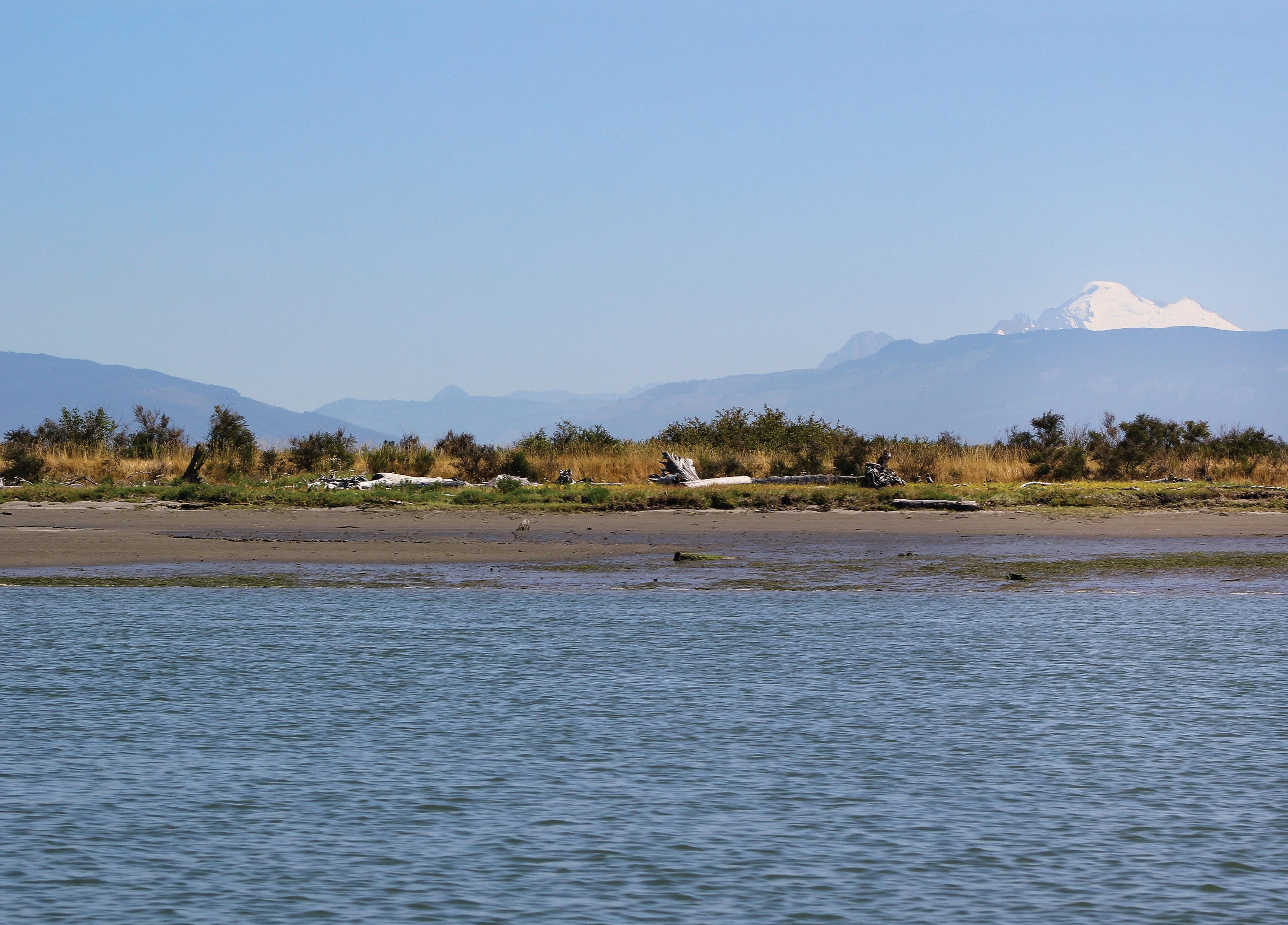
Mount Baker over the Swinomish Channel
Photo: Emma Fox
Introduction 4
13 Moons Guiding Principles 6
Indigenous Health Indicators 8
13 Moons Guide to Activities 10
Moon of the Windy Time 12
Activity: Making Good Observations 13
Moon When Frog Talks 16
Activity 1: Spring Greens Celebration 16
Activity 2: Forage Fish Food Web 22
Moon of the Whistling Robins 28
Activity 1: Working with Ironwood 29
Activity 2: Clean Water 34
Moon of the Digging Time 36
Activity 1: Harvesting Camas 37
Activity 2: Bentwood Box Demonstration 42
Moon of the Salmonberry 44
Activity 1: Salmonberry Harvest and Workshop 45
Activity 2: Clams, Moons, and Tides Workshop 54
Moon of the Blackberry 58
Activity 1: Berry Picking and Healthy Jam Making 59
Activity 2: Salmon and Water Quality 62
Moon of the Salal Berry 66
Activity 1: Marine Debris Art Project 67
Activity 2: Testing for Toxins in Shellfish 70
Activity 3: Edible Marine Invertebrate Identification 74
Moon of the Silver Salmon 76
Activity 1: Berry and Seed Saving 77
Activity 2: Preserving Salmon 80
Moon of the Elk Mating Cry 82
Activity 1: Salmon Run Stream Ecology Lesson 83
Activity 2: Archery and Hunter Safety 88
Moon of the Falling Leaves 90
Activity 1: Making Cattail Mats 91
Activity 2: Making Pemmican 94
Moon of the Dog Salmon 96
Activity: Preparing a Meal of First Foods 97
Moon to Put Your Paddles Away 100
Activity: Medicine of the Trees Workshop 101
Moon of the Sacred Time 108
Activity 1: Night-time Clam Dig and Clam Chowder Luncheon 109
Activity 2: Cedar Weaving Workshop 112
Credits 115
Photo credits 116
INTRODUCTION
The goal of the Swinomish Community Environmental Health program is to create an informal and scalable model of environmental health education through the lens of first foods and resources. This program is built on the definition of health, including environmental health, as founded on the cooperative relationships between humans, non-humans, and their environment.
The Swinomish Indian Tribal Community is a federally recognized tribe, pursuant to the 1855 Treaty of Point Elliott. The Swinomish people are one of many tribes and First Nations known as the Coast Salish, with territory that stretches from the southern end of Puget Sound in the state of Washington to the northern end of the Georgia Strait in British Columbia, west into the Pacific Ocean, and east into the Cascade and Coast Mountains. The Swinomish Reservation sits on the southeast portion of Fidalgo Island, formally called shais-quihl, the gateway to the San Juan Islands.
The Swinomish people, like many Indigenous peoples, follow the 13 lunar phases in a calendar year. The lunar cycles indicate seasonal changes, so each moon is named for seasonal events that take place during that time. For example, the “Moon When
Frog Talks” usually begins in mid-to-late February and signals the coming of spring and the time to harvest new greens such as nettles and miner’s lettuce.
This Swinomish Community Environmental Health program environmental health curriculum is named after the 13 moons of the Coast Salish lunar calendar and is founded on the guiding principles listed on Pages 6-7. The activities are designed to follow the foods, resources, traditions, and practices associated with each of the 13 moons, and are therefore seasonal in nature.
Each activity highlights one or more aspects of environmental health, with all activities focused on a theme of environmental sustainability as visualized through an ecosystems and community health approach. This approach recognizes that humans are part of the food web and have a symbiotic relationship with the plants and animals within a given ecosystem.
Each activity includes a description of educational outcomes and goals, as well as relevant background information, tips, and recommendations. While the curriculum does not explicitly have an evaluation section for each activity, evaluation is an integral component of any curriculum.

The design and initial implementation of the 13 Moons curriculum underwent evaluation; the results can be found here: informalscience.org/swinomish-indian-tribal-community-developing-informal-environmental-health-education-model.
Informal education is predicated on learning as a process over time that is facilitated by communities, parents, friends, and leaders. As a result, it is important that activities and programs accurately and respectfully incorporate cultural practices, traditional foods, belief structures, and ceremonies specific to the community in which the program is taught.
While the majority of the activities within this curriculum are Swinomish or Coast Salish specific, the overarching framework and guiding principles of the curriculum are designed to be tailored to specific seasons, resources, and harvest cycles of other Indigenous communities.
Each Indigenous community honors their own homelands and traditions; environmental health teaching concepts can be developed that fit within the seasonality, traditional diet, and resources of each community.
First foods are cultural and traditional foods and resources that are locally harvested and on which Indigenous peoples have depended upon since time immemorial.
Indigenous is defined by the United Nations (2009) as: Indigenous peoples and nations are those which, having a historical continuity with pre-invasion and pre-colonial societies that developed on their territories, consider themselves distinct from other sectors of the societies now prevailing on those territories, or parts of them. They form at present non-dominant sectors of society and are determined to preserve, develop, and transmit to future generations their ancestral territories, and their ethnic identity, as the basis of their continued existence as peoples, in accordance with their own cultural patterns, social institutions, and legal system.
Environmental health is considered synonymous with community health, which is defined as: A healthy community encompasses all aspects of Indigenous relationships and Indigenous priorities that affect a community. This includes physical, social, mental, intellectual, environmental, and spiritual health on individual, familial, and community scales, as well as relations between people, non-human beings, the environment, and the spiritual worlds.
13 MOONS GUIDING PRINCIPLES
FRESHE Guiding Principles
FRESHE Guiding Principles
FRESHE
Indigenous environmental health
Indigenous Environmental Health
Guiding Principles
Indigenous environmental health
Activities are designed to address the Swinomish Indigenous Health Indicators, which include cultural practices, community connection, self-determination, education, resilience, and natural resource security.
Culturally relevant framework
Indigenous environmental health
FRESHE Guiding Principles
Culturally Relevant Framework
Culturally relevant framework
Culturally relevant framework
The Swinomish 13 Moons lunar calendar is used as the framework for this curriculum. This ensures that the activities included are relevant and seasonally appropriate.
Highlights place and natural resources as cultural resources
Indigenous environmental health
Highlights place and natural resources as cultural resources
Highlights Place Natural Resources as Cultural Resources
Intergenerational knowledge transfer
Highlights place and natural resources as cultural resources
Culturally relevant framework
Intergenerational knowledge transfer
Activities highlight first foods, including activities that support the harvest, preparation, and sharing of first foods, such as weaving and woodworking. Activities reinforce cultural values of connection to one another and to place, including intergenerational teaching and learning, generosity, connections to the seascape and landscape, and cross-cultural teaching and learning.
Intergenerational knowledge transfer
Integration and repetition
Highlights place and natural resources as cultural resources
Integration and repetition
Resilience
Integration and repetition
Intergenerational knowledge transfer
Intergenerational Knowledge Transfer
Resilience
Elders are involved in the activities, including storytelling and teaching about cultural resources and language. Youth extend event invitations to elders where possible. Indigenous science is grounded in cultural practices; processes of inquiry and learning involve storytelling and experiential learning, and are participant and community driven.
Resilience
Honoring the language
Integration and repetition
Honoring the language
Honoring the language
Resilience
FRESHE Guiding Principles
Indigenous environmental health
FRESHE Guiding Principles
Culturally relevant framework
FRESHE
Indigenous environmental health
Highlights place and natural resources as cultural resources
Culturally relevant framework
Guiding Principles
FRESHE Guiding Principles
Indigenous environmental health
Indigenous environmental health
Intergenerational knowledge transfer
Highlights place and natural resources as cultural resources
Culturally relevant framework
Culturally relevant framework
Integration and Repetition
Integration and repetition
Activities celebrate and amplify the beauty of the culture. The 13 Moons curriculum events are often designed as complementary activities that are integrated into existing community events such as Earth Day, the annual clambake, and elders’ luncheons. Following the Coast Salish teaching principle of “repeating” repeating , the curriculum is designed to reinforce knowledge through repetition within the seasonal round and from year to year, revisiting places, plants, and animals at different phases of the Swinomish lunar calendar. Many activities are designed to provide opportunities for older youth to “repeat” the teachings to younger ones.
Intergenerational knowledge transfer
Highlights place and natural resources as cultural resources
Highlights place and natural resources as cultural resources
Resilience
Integration and repetition
Intergenerational knowledge transfer
Intergenerational knowledge transfer
Honoring the language
Resilience
Resilience
Integration and repetition
Integration and repetition
Adaptable module design
Activities emphasize that Indigenous science is dynamic, which helps communities adapt to changing environmental and social circumstances. Activities and curriculum are designed to change over time. New stories, knowledge, and activities will emerge through intergenerational sharing and some of this will be incorporated into the curriculum in the future. Early participants in the program will become the facilitators of future activities.
Honoring the language
Resilience
Resilience
Honoring the Language
Adaptable module design
Honoring the language
Honoring the language
All activities incorporate Lushootseed, the Swinomish language.
Adaptable module design
Adaptable Module Design
Adaptable module design
A modular activity design accommodates differences in scheduling, age, knowledge, and abilities.
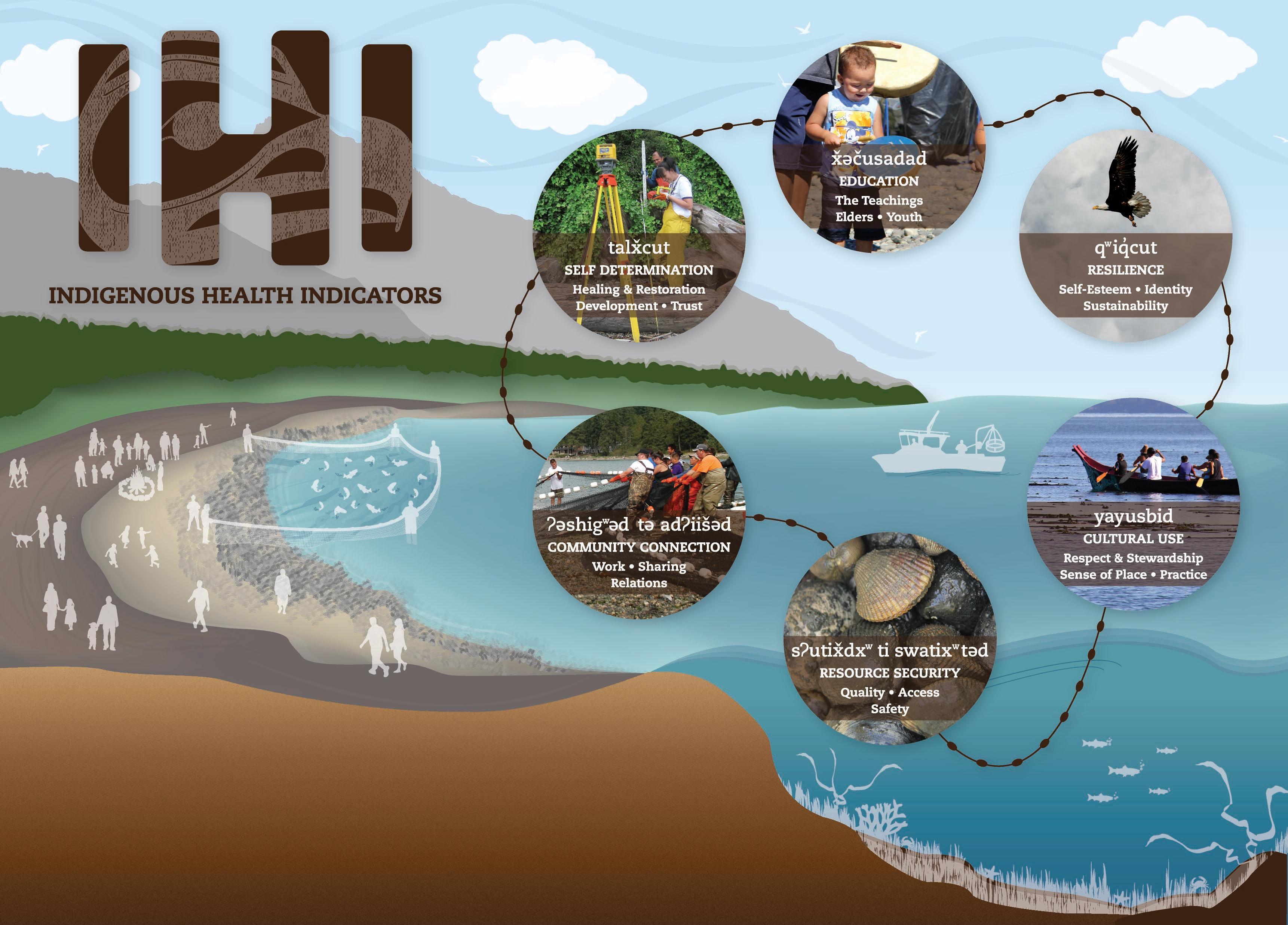
Indigenous Health Indicators
The Indigenous Health Indicators (IHI) are a set of community-scale, non-physical aspects of health that are integral to Coast Salish health and wellbeing. The IHI reflect deep connections among humans, the local environment, and spirituality. IHI provide a template for resource-based communities to tailor to suit their own unique connections and health priorities.
13 MOONS GUIDE TO ACTIVITIES

MOON OF THE WINDY TIME
Focus and environmental
health connection: introduction to observational learning
Activities: observations
MOON WHEN FROG TALKS
Plant focus: spring greens
Animal focus: herring
Environmental health connection: food web; bioaccumulation
Activities: plant harvest; forage fish food web; wild greens bingo; elders lunch
MOON OF THE WHISTLING ROBINS
Plant focus: ironwood
Focus: water
Environmental health connection: water quality and sustainability
Activities: making fish sticks; Earth Day clean up
The chapters in this book coincide with the 13 moons of the Coast Salish lunar calendar. Topics and activities associated with each moon phase are outlined below and align with the traditional and cultural events occurring traditionally at these times. The plant and animal focus for each moon highlight integral first foods of the Coast Salish culture and are present in many Coast Salish stories, traditions, and community meals.


MOON OF THE DIGGING TIME
Plant focus: camas
Focus: bentwood box
Environmental health connection: local foods; sustainable agriculture; air quality
Activities: camas dig; Blessing of the Fleet; bentwood box demonstration
MOON OF THE SALMONBERRY
Plant focus: berries and plants
Animal focus: shellfish
Environmental health connection: food web; nutrient cycles; healthy beverages
Activities: shell collection and painting; salve making; salmonberry shrub drink
MOON OF THE BLACKBERRY
Plant focus: berries
Animal focus: salmon
Environmental health connection: water quality; food safety; nutrition and health
Activities: jam making; beach seining
Each activity highlights an aspect of environmental health and is themed around environmental sustainability as visualized through an ecosystems and community health approach. This approach recognizes that humans are a component within the food web and are affected by the plants and animals within that ecosystem. This is the basis of the Swinomish Community Environmental Health program.




MOON OF THE SALAL BERRY
Animal focus: marine invertebrates
Environmental health connection: toxics from trash; water quality; harmful algae blooms
Activities: clambake; edible invert marine survey; marine debris art project

MOON OF THE FALLING LEAVES
Plant focus: cattail
Animal focus: elk and deer
Environmental health connection: climate change and phenology
Activities: making cattail mats; making pemmican
MOON OF THE DOG SALMON Focus: bentwood box
Environmental health connection: relationship of food to health (obesity and diabetes); food sovereignty
Activities: celebrity chef; cooking classes; make a feast to share
MOON OF THE SILVER SALMON
Plant focus: berries and seeds
Animal focus: silver salmon
Environmental health connection:
climate change and phenology; food safety
Activities: seed saving; food preservation
MOON TO PUT YOUR PADDLES AWAY
Plant focus: conifers
Environmental health connection: health literacy
Activities: tree medicine workshop
MOON OF THE ELK MATING CRY
Plant focus: riparian plants
Animal focus: salmon, elk
Environmental health connection: food web; water quality; nutrition
Activities: stream field trip; archery range; hunter safety
MOON OF THE SACRED TIME
Plant focus: cedar
Animal focus: clams
Environmental health connection: water pollution; Indigenous Health Indicators
Activities: night-time clam dig and making clam chowder
Moon of the Windy Time

MOON OF THE WINDY TIME
of the Windy Time
The moon around late January into February is the Moon of the Windy Time. Earth begins to awaken in the late winter and living creatures begin to emerge from their dormant states. During this moon, the Swinomish people continue to fish for Chinook salmon in the bays and rivers. Sea-run cutthroat trout and steelhead are also fished. Ducks, elk, geese, and deer are hunted, and tool and basket construction continues for the year. Activities in the Moon of the Windy Time chapter focus on establishing a foundational understanding of the 13 Moons and the importance of observation.
Making Good Observations
Time: 50 minutes
Season: Late winter
Audience: 5th-8th grade
Setting: Weather dependent, indoors or outdoors
Moon of the Windy Time
Moon of the Windy Time
Listen Watch Learn Participants learn what constitutes a good observation and how observation is essential for monitoring changes in the environment. Students are introduced to sensory observation and data collection. They will observe two environments by utilizing the five senses and communicate their findings.
Teaching Objectives
In this activity, participants will learn:
• To understand the definition of observation
• Skills needed to make an observation
• How to use observation to answer questions
• Good note taking skills
• Traditional methods of observation
• Basic concepts of Indigenous health — people and the environment as integrally interconnected
Outdoor Activity
Moon of the Windy Time
Moon of the Windy Time
Lushootseed Words
• Moon of the Windy Time:
Moon of the Windy Time
• Listen:
• Watch:
Listen Watch Learn
• Learn: Materials
• Notepad
Listen Watch Learn
• Pencil
• Photos of an environment to study if you cannot go outside due to inclement weather
Listen Watch Learn
• Optional: magnifying glass, binoculars, trays for viewing plant and animal species
Separate participants into small groups and have them discuss what observation means and how it can be used.
Come back together and have each group report what they discussed, keeping a list of how observation can be used.
Take the entire group to a location with a thriving ecosystem (e.g., beach, forest, meadow) and give everyone 15 minutes to observe everything they can about the area. Make sure to have them note the date, weather, time, and location.
Take the group to another nearby location after the time period is over and give them another 15 minutes to note how the new location is different from the first.
Ask participants to develop a question to explain some of their observations. Examples: Why is this similar plant larger in the second location? Why is there a concentration of snails on this rock and not the others?
Have each person give a report of their observations and their questions to the larger group. Depending on the time available, discuss methods of how you would answer their questions.
Indoor Activity
Separate participants into small groups and facilitate a conversation about what observation means and how it can be used.
Come back together and have each group report what they discussed, keeping a list of how observation can be used.
Show participants a collection of photos from specific habitats (e.g., nearshore, upland prairie, forest, riparian area).
Have the group observe as many things as they can about one of the habitats in 10 minutes, such as the type of environment, what type of plants are visible, and the types of animals assumed to live there. The observations can be anything. Questions can be generated by connecting all the observations together.
Take the next 10 minutes to have participants discuss things they cannot observe due to the limits of using photos instead of visiting the location in person. This will emphasize how data can be skewed by only conducting secondary research. Have the group come up with a question or hypothesis about the environment.
Have each group choose a photo from a different habitat and repeat the last two steps.
Give participants the task of coming up with a question or hypothesis to explain some of their observations, (e.g., why are there many trees in one habitat but not in another?
Have each person give a report of their observations and their questions to the group. Depending on time, discuss methods of how you would answer their questions.
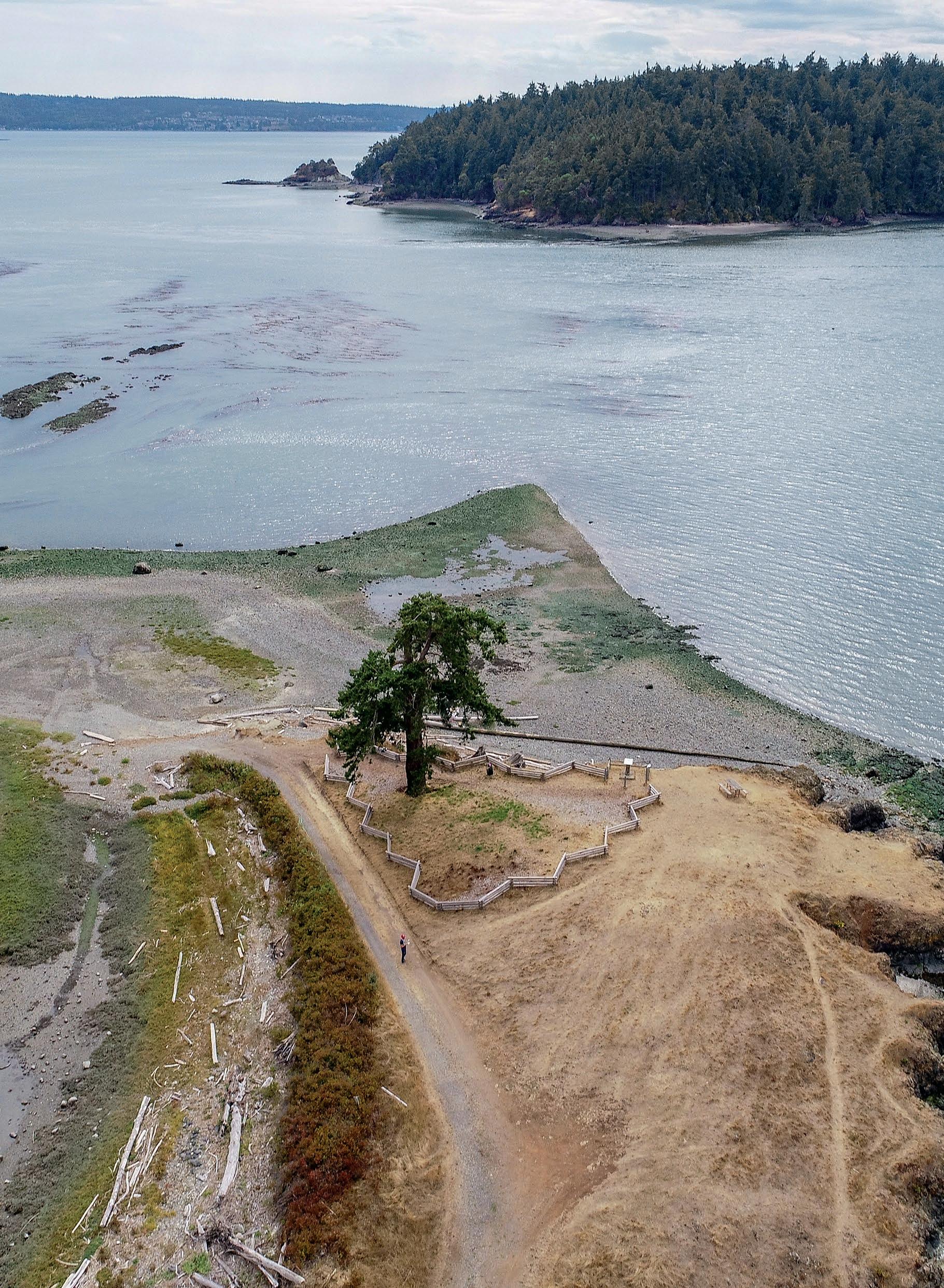
Observing Lone Tree Point from above
Photo: Jacob Tully
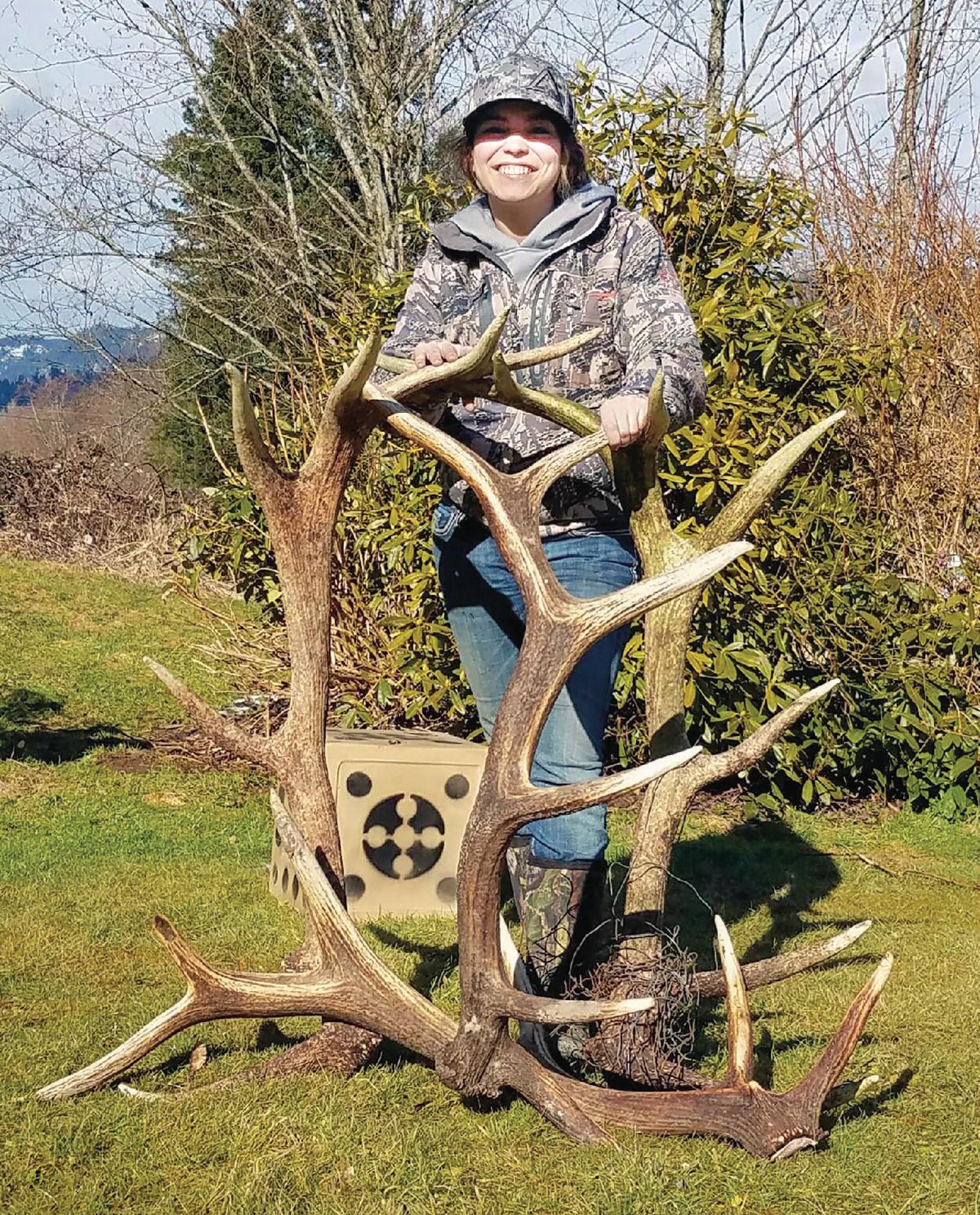
Mia Villaluz is a successful elk and deer hunter who enjoys sharing her bounty with her family and community.
Notes to Educators and Additional Resources
Knowledge Transfer
• Invite elders to discuss the importance of listening and observing.
• Participants will work together, discuss their observations, and learn from each other.
Guiding Questions and Topics of Discussion
• Why is it important to listen and observe?
• Give an example of another situation in your life where listening and observing are important to do and explain why.
Tying it all Together
• Observation is a key part of all curriculum activities; a good scientist is a keen observer.
• Indigenous Health Indicators overview: Ask students to look at the infographic and discuss what they observe based on the image as well as the indicators listed. What do they see in terms of connections between the health of the environment and the health of the community from the infographic?
Digging Deeper
• LEO is a network of local observers and topic experts who share knowledge about unusual animal, environment, and weather events. Invite students to engage in the LEO Network by downloading the LEO application and providing an introductory lesson on how LEO works.
• Ranken, M. October 31, 2016. How native kids see science differently. Crosscut: News of the Great Nearby. Accessed June 6, 2017. Last updated: 2016. Available online: crosscut.com/2016/10/how-native-kids-see-science-differently
• Indigenous Health Indicators (IHI): swinomish-nsn.gov/ihi; IHI infographic: swinomish-nsn.gov/ihi/resources
• LEO Network: leonetwork.org/en/docs/about/about
• iNaturalist: inaturalist.org
• P.R.I.S.M: hilo.hawaii.edu/affiliates/prism/curricula.php
Photo: Tino Villaluz


When the Frog Talks
MOON WHEN FROG TALKS
the Frog Talks
Late February into March is the Moon
When Frog Talks, signaling the coming of spring. Spring greens are a welcome change to a long winter diet of dried and smoked foods. Giant horsetail shoots, tiger lily bulbs, as well as cattail shoots and roots may be harvested and eaten. Forage fish runs begin, providing a fresh food source high in protein and essential fatty acids. Activities related to this moon will focus on spring
Activity 1: Spring Greens Celebration
Wild spring greens are “superfoods,” high in essential vitamins and minerals. Early spring greens are a welcome change to the winter diet. Like the croaking of frog and the robin’s song, these nutrient-dense foods wake our bodies from the sleep of winter.
In celebration of the spring greens available this time of year, participants learn how to identify, harvest, and prepare various spring greens and then feature them at a luncheon for elders.
Moon When the Frog Talks
Moon
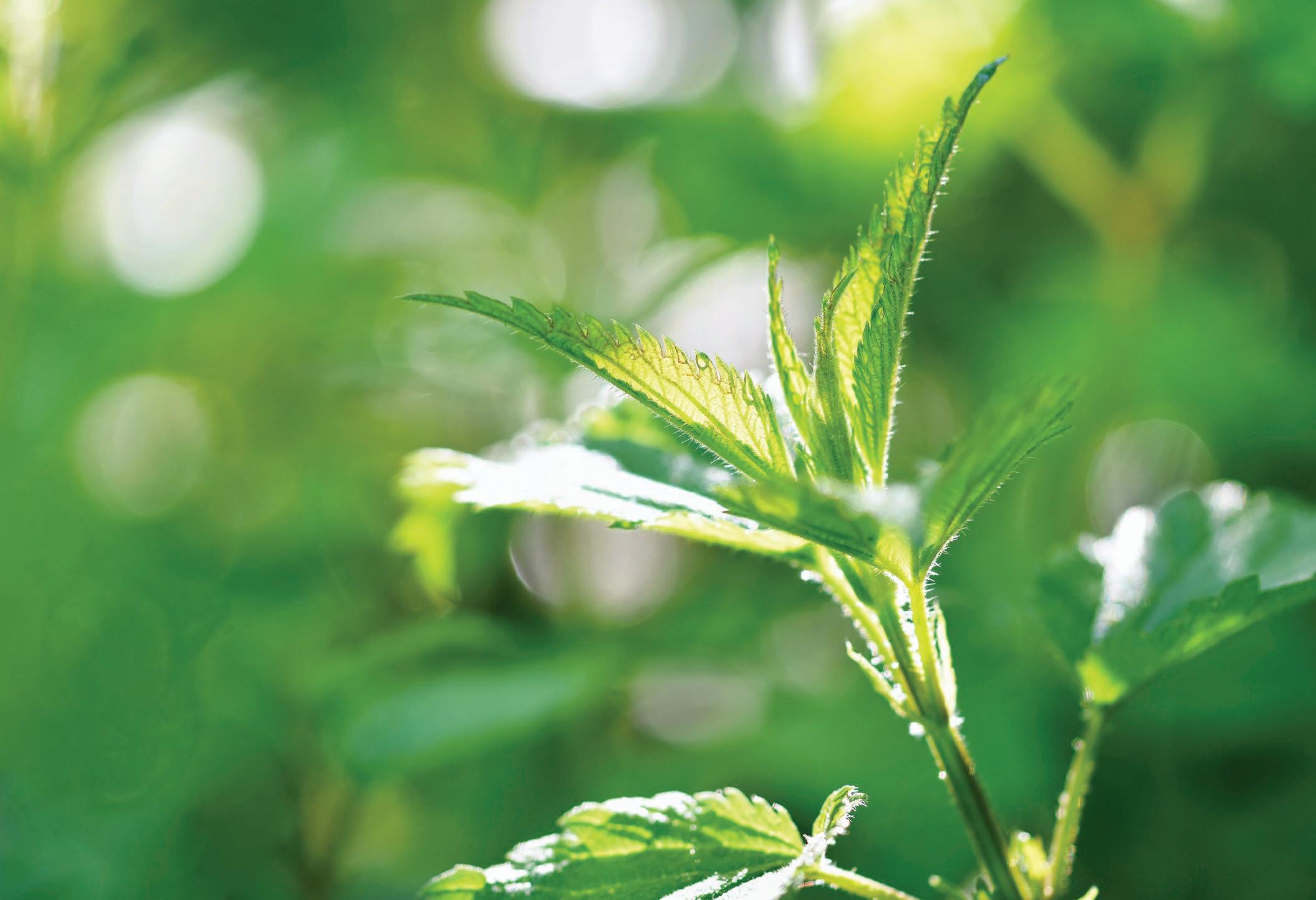
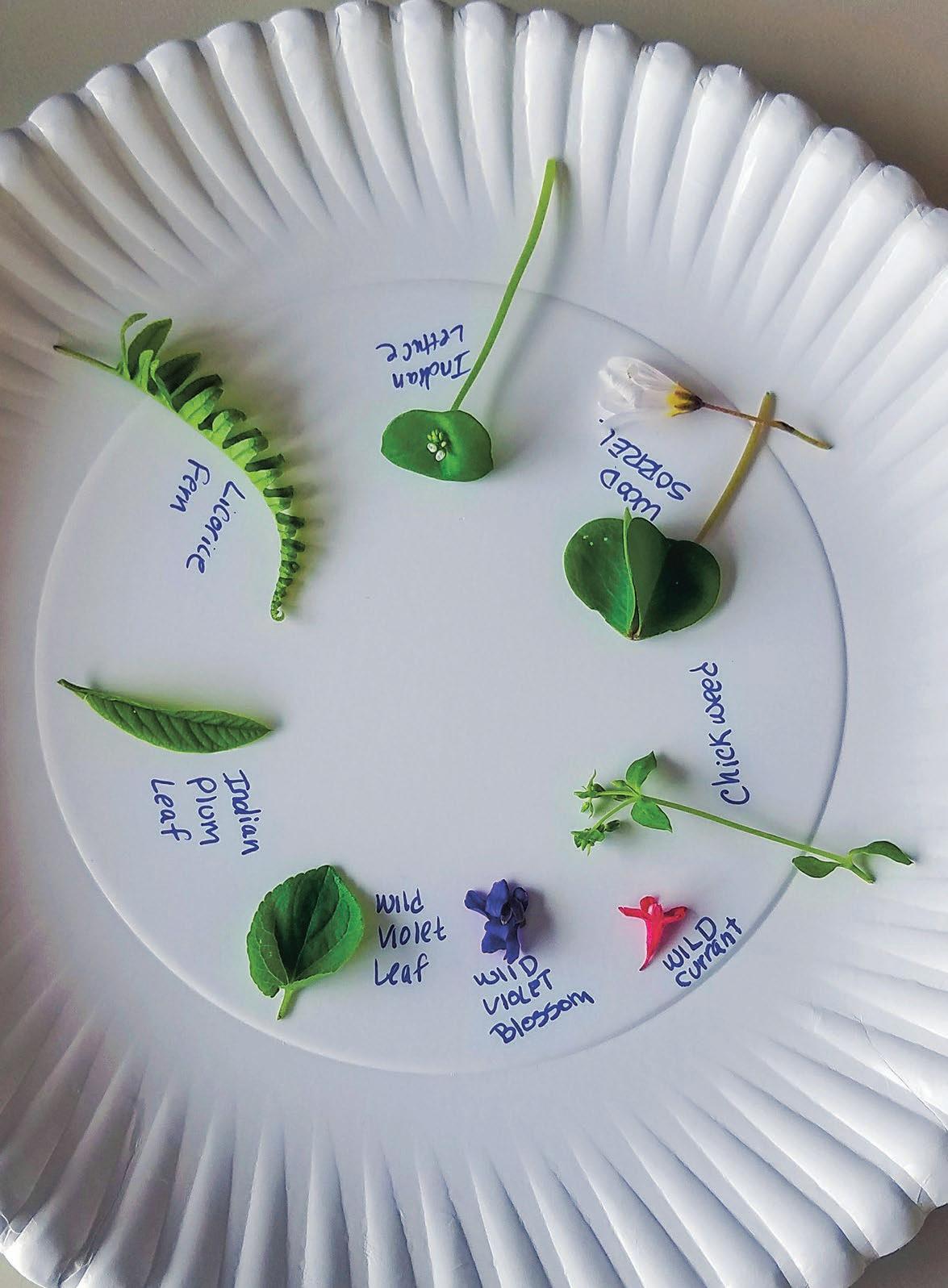
Many early spring greens, including stinging nettle; salmonberry flowers; salmonberry and thimbleberry shoots; giant horsetail; violet flowers and leaves; candy flower; and miner’s lettuce are found in early successional forests, such as riparian zones.
Swinomish ancestors burned meadows on Whidbey Island to ensure an abundant supply of nettle greens and shoots.
Activity 1 time: Plant harvest trip, 2-3 hours plus travel; meal preparation, serving, and cleanup, 4 hours
Audience: 5th-8th grade
Setting: Indoors and outdoors
Teaching Objectives
In this activity, participants will learn:
• The importance of spring greens to the traditional Swinomish diet
• How to identify, harvest, and prepare five varieties of native Pacific Northwest spring greens
• The importance of story in teaching and learning Indigenous knowledge (also known as TEK: Traditional Ecological Knowledge)
• The impacts of pollution such as pesticides and stormwater runoff on plants and the importance of carefully choosing harvest locations
This activity can be presented as a half-day workshop or split into two days, depending on time availability.
When the Frog Talks
Example agenda for a half-day workshop:
9:00–10:30 | Identification and harvest of early spring greens
10:30–noon | Preparation of early spring greens
Noon–2:00 | Elders’ luncheon and Wild Greens Bingo
Moon When the Frog Talks
Lushootseed Words
Moon When the Frog Talks
• Moon When Frog Talks:
Stinging Nettle
Stinging Nettle
• Stinging nettle: Materials
Herring
• Gathering materials (baskets, scissors, gloves)
Herring
• Space for cleaning and processing greens
• Tools for processing greens (bowls, salad spinner)
Smelt
• Bags or containers for storing greens
Smelt
• Laminated plant identification cards
• Ingredients: See recipe cards
• Pots, pans, bowls, dishes, and utensils for meal preparation and serving
• Blender and food processor for preparing soup and pesto
• PowerPoint presentation and live plant samples of plants
• Plant bingo cards and prizes. Bingo card generators are available online, see Notes to Educators and Additional Resources.
Outdoor Activity: Identification and Harvest of Early Spring Greens
Provide participants with laminated flashcards containing illustrations of the different spring greens they will harvest. The botanical illustration on each card should include the Lushootseed name along with a brief description.
Take participants on a nature walk and teach them how to identify and harvest early spring greens. Provide an overview of how pollution runoff harms plants and why harvesting near roads or commercial developments should be discouraged. Discuss how to care for riparian habitats, such as careful harvesting and prevention of pesticide applications.
Additional Ideas
• Invite elders on the walk and have participants ask them to tell stories about the area or about harvesting plants.
• Offer participants a shorter .5 mile walk and a longer 0.75–1 mile to accommodate all levels of fitness.

Pacific Northwest Plant Knowledge Cards are available online from the Vancouver Island and Coastal Communities Indigenous Food Network.
The cards highlight 65 edible and medicinal plants from the Pacific Northwest and include the names of the plants in SENĆOŦEN, Hul’q’umi’num, and Dididaht. Lushootseed names can be added with a label maker.
Indoor Activities: Preparation of Early Spring Green
Using the early spring greens collected during the outdoor activity, participants will prepare a meal of nettle soup, nettle pesto, and wild spring greens salad to serve elders at a luncheon.
Have participants carefully wash the spring greens. This removes dirt, insects, debris, and pesticide residues, and allows for the removal of any incorrectly harvested greens. Assign participants to groups and distribute recipe cards so they can work together to prepare the meal. Items can be refrigerated overnight and served the next day if necessary.
Elders’ Luncheon
In collaboration with the Swinomish Cultural Events Department and Senior Center, feature the spring greens foods at an elders’ luncheon. Work with Swinomish Senior Center staff to coordinate a date for the luncheon, meal planning, and food preparation. Defer to their preferences for additional meal items. Get the word out about the luncheon to community elders and have participants invite their families.
The event can include a short presentation by workshop participants reflecting on what they learned and how they prepared the meal.
Give everyone the opportunity to play Wild Greens Bingo (Page 20) following lunch. Award winners with prizes that highlight the season and are donated by the community.
Spring Greens Salad
This delicious spring salad is packed with nutrients and bright floral flavors.
Ingredients
16 loosely packed cups of mixed spring greens (violet, miner’s lettuce, June plum, and cultivated greens) and spring flowers (salmonberry, bear candy, violet)
Instructions
Clean and wash greens; remove tough stems and tear into smaller pieces as needed. Process flowers in the same way, but do not wash them. Arrange reserved flowers on top of the greens.
Huckleberry Vinaigrette
Ingredients
• 1 cup fresh or frozen and thawed huckleberries or blueberries
• 1 cup extra virgin olive oil or walnut oil
• ½ cup balsamic vinegar
• 4 teaspoons honey
• Pinch of salt and pepper
Instructions
Blend all of the ingredients together in a blender until smooth.
Serves 10

Spring Nettle Soup
This savory soup will leave you feeling deeply nourished.
Ingredients
• 1 grocery bag full of fresh nettles
• 3 tablespoons olive oil or butter
• 2 large onions, diced
• 2 cloves garlic, chopped
• 8-10 cups water
• 4 potatoes, peeled and diced
• 2 cups corn, fresh or frozen
• Juice of 1 lemon
• Salt and pepper to taste
Instructions
Wash nettles, cut finely with scissors, and set aside. In a large soup pot, sauté onions and garlic in olive oil for 3-5 minutes. Add water, potatoes, corn, and nettles and bring to a boil. Simmer until potatoes are tender, about 10 minutes. Blend all in a blender or a food processor (optional). The color turns a lovely green when blended. Add lemon juice, salt, and pepper to taste.
Serves 10
Wild Greens Bingo
Nettle Pesto
Toss with pasta, potatoes, or cooked vegetables; or serve with crackers and fresh vegetables. Spread on sliced artisan bread and top with Parmesan cheese to make nettle bruschetta.
Ingredients and Supplies
• 1 small bag (about 6 cups) of young fresh nettles, rinsed
• 1 bunch basil, destemmed, washed, drained (about 2 cups)
• 1/2 cup Parmesan or Romano cheese, grated
• 1/3 cup walnuts or pine nuts
• 1/3 cup extra virgin olive oil
• 1 clove garlic, chopped
• 1 teaspoon lemon juice
• Salt and pepper to taste
• Crackers, vegetables, bruschetta, or pasta to serve
Instructions
Boil nettles in water (blanch) for 2-3 minutes to remove the sting. Drain, let cool, and roughly chop. Place all ingredients in a food processor or blender and blend until smooth. Add salt and pepper. Place the pesto in a clean jar and pour a little extra olive oil over the top. Cover with a lid. Can refrigerate for 2-3 weeks. Serves 10
Wild Greens Bingo is a fun opportunity for participants to reinforce their knowledge about the names, identification, and properties of wild spring greens. Before playing, or while participants are eating, present a brief PowerPoint presentation with photos, names, harvest details, preparation, and nutritional properties of fifteen wild spring greens species.
Distribute bingo cards containing plant names, nutritional properties, photos, and one “free space” to participants. Randomly choose numbers for participants to fill in their cards. Once a winner is determined, that

Knowledge Transfer
• Invite elders to attend the field trip.
• Ask participants to identify at least three plants or animals that live in the areas they harvested and why they remember those ones in particular.
• Have students sit with elders during lunch.
Guiding Questions and Topics of Discussion
• Why do you think it is important to eat vegetables, like greens?
• What sort of effect do you think pollution might have on the ecosystem, including people, if pollution was present in the areas harvested?
• Look at this beautiful habitat that supports so many animals, fish, plants, and insects. What would happen if there was pollution here?
Tying it all Together
• Connections to other activities
› The Moon of the Salmonberry and the Moon of the Elk Mating Cry also highlight riparian zones. It is important to see how these areas change over the seasons.
• Relationship to Indigenous health
› Harvesting and sharing local natural resources is an important part of the Swinomish way. Why do you think it is important to share these resources with others? How might that help Indigenous health (thinking about the Indigenous Health Indicators)?
Notes to Educators and Additional Resources
Early spring greens wake up our digestive system after a stark winter diet.
• Pacific Northwest Plant Knowledge Cards. Vancouver Island and Coastal Communities Indigenous Food Network. Indigenousfoodsvi.ca/pacific-northwest-plant-knowledge-cards
• How Nettle Changed My Life (Valerie Segrest): feedingthespirit.wordpress.com/2011/03/18how-nettle-changed-my-life-part-one
• How Nettle Saved the People (video: Roger Fernandes): vimeo.com/90379255
• Violet: wildfoodsandmedicines.com/violet
• P.R.I.S.M: hilo.hawaii.edu/affiliates/prism/curricula.php
• Traditional Native Foods of the Puget Sound: burkemuseum.org/blog/salish-bounty-traditional-native-foods-puget-sound
• Bingo card generator, with option to use photos: https://eslactivities.com/pbingo.php
• Kuhnlein, H.V. and Turner, J.J. (1991) Chapter 3: An overview of the nutrient value and use of plant foods by Indigenous Peoples in Traditional Plant Foods of Canadian Indigenous Peoples: Nutrition, Botany, and Use (Vol. 8). Taylor and Francis.
Photo: Kyra Herzberger
Activity 2 Time: 2 hours (3 hours with field trip)
Audience: 5th-8th grade
Moon When the Frog Talks
Moon of the Windy Time
Setting: Indoor lesson with optional field trip
Materials: Game of Life
• A recess ball labeled “life”
Moon When the Frog Talks
Teaching Objectives
In this activity, participants will learn:
• The definition of food web
• Chart paper and markers
• Color coded cards or stickers (red, blue, yellow, green)
Materials: Food Web Freeze Tag
Moon When the Frog Talks
• The importance of each link in a food web, and what happens if one link (in this case forage fish) disappears
Moon of the Windy Time
• Threats to forage fish species, such as polluted storm water run-off, development, and climate change
Moon When the Frog Talks
• Creation of food web art project
• 3 per participant; food tokens (cardboard, plastic lids, discs, or counting chips (available at amazon.com)
• Gym vest or t-shirts to mark predators
• 4-5 hula hoops or string to mark “camouflage” or “cover” spots
• Large play area (soccer field or open grassy area)
• How the food web is connected to Indigenous health
Moon When the Frog Talks
Stinging Nettle
• The nutritional value of herring (optional)
Stinging Nettle
Lushootseed Words
Herring
Moon When the Frog Talks
• Moon When Frog Talks:
Materials: Making a Web
• A ball of thick yarn or string, long enough to crisscross a circle of people like a spider’s web at least the same number of times as there are participants in your group.
• Herring:
Smelt
• Recycled paper or cardstock
• Smelt:
Stinging Nettle
• Learn:
Listen Watch Learn
Herring Smelt
Herring
Activity 2: Forgage Fish Food Web
Smelt
“Forage fish” are small fish that are an important link in the food web. Forage fish eat microscopic plants and other marine animals. Forage fish are an important food source for larger fish, birds, marine mammals, and humans.
Pacific herring (Clupea pallasii) is a forage fish, located near the bottom of the food web. Herring are essential to ocean ecology and an important Coast Salish food. In the summer, adult herring spawn along the shore. Juvenile herring spend their first year near shore, only joining adult herring in the ocean when they are 2-3 years old. Herring are a valuable food source for land and sea creatures, such as fish, birds, bears, eagles, and humans. Herring roe (eggs) are a Coast Salish delicacy.
• Markers, crayons
• Safety pins or tape
Pacific smelt (eulachon) are an ocean forage fish, yet they return to freshwater rivers to spawn between December and June.
Sand or coarse gravel river beds are ideal for spawning. Like herring, smelt live in the nearshore ocean waters. Herring and pacific smelt populations are declining, due to the constructions of dams, climate change, and increased water pollution.
The following activities illustrate the importance of the food web. Using traditional foods, participants play interactive games and create a food web art project. An optional field trip to observe smelt habitat, accompanied by older youth and elders, with an emphasis on the nutritional value of the fish, can round out the activity.
Game of Life
This activity is taken from the NOAA “Inspiring ocean literacy and conservation through National Marine Sanctuaries” curriculum.
Resource: sanctuaries.noaa.gov/education/teachers/ pdfs/sustain_seafood_lesson1.pdf
Pose the following scenario to participants and give them 10 minutes to contemplate: Imagine you live by yourself and are at least 100 miles away from any other human. This is also the case for every other human in the world. You have nothing but the clothes on your back. Brainstorm with a partner how you can benefit from the situation and what difficulties it creates for your survival.
The goal of this game is to illustrate what happens to a fish stock when large amounts of biomass are removed from a particular species.
Assign color cards or stickers to participants as follows: for every 10 students, assign one red, two green, three blue, and four yellow. The number of cards will vary with class size, but try to approximate these proportions as closely as possible.
Red = fish caught by local (artisanal) fishermen
Blue = fish caught by individual commercial fishermen
Yellow = fish caught by large scale commercial fishing operations and/or "by catch"
Green = fish that are not caught
Take participants outside or to the gym and have them spread out far enough apart in the playing area (waters) that tossing a recess ball to each other is slightly difficult. Distribute the color cards evenly around the space.
Explain that the ball represents life and have participants toss it around for a minute. Discuss how easy or hard this is. Explain that when a species has a sustainable population, life is easy - they are close enough to each other to interact (to mate, to be protected by their school, etc.). Then present a fishing scenario (step 4 below) and have students sit down according to how efficient the fishing practice is.
Explain that many species of marine animals and fish have been hunted on land or fished from the world’s waters too much over time. Individual fisherman or those on small boats, also known as artisanal fishermen, were the first to extract animals from the sea. Fish were only available to people who lived near the ocean or lakes.
Tell participants that two local fishermen in a small boat have entered their waters to fish. They take just a few fish. Have the red cardholders sit down. Have the remaining participants toss the ball around and ask how the loss of the red cardholders affects them.
A variety of factors influenced the increased demand for seafood in the 20th century. Refrigeration technology and trains made transport of fish to the interior of the United States easier. Also, scientists and doctors studied the diet of people living in coastal communities of countries such as Japan; They found that eating fish contributed to a healthy diet and possible longer life.
When these findings were published, people across the country began to get a taste for fish from the oceans. Seafood was no longer only for coastal inhabitants. As technology improved, larger fishing vessels with larger crews could extract more biomass from the waters. Fish could also be kept fresh longer with new refrigeration technology.
Tell the group a ship manned with 20 fishermen has entered their waters and are catching more fish than the artisanal fishermen ever could.
Have all participants with blue cards sit down while the rest continue. Discuss what is happening with the game (some participants are farther away from others then they previously were and it is hard to toss to them; more difficult to interact with members of their species).
The demand for fish increases as the population of the U.S. and the world increase. People in the U.S. continue to try to live healthier lives. This, coupled with the improvements in fishing technology enables fishermen to become much more efficient. Fishing vessels can hold larger quantities of fish and can stay out at sea for longer periods of time. These vessels usually target one species of fish during a certain time of year; No matter when they fish, the vessels have bycatch (animals that are not the target of the fishing operations) in the nets or on the fishing lines.
Not only are the populations of target species quickly declining, other species are negatively affected as well. Have all the students with the yellow cards sit down.
Have the remaining green card participants toss around the ball. Discuss what happens to the game when so many people can no longer participate.
Use the game to discuss the effects of overfishing. Here are some possible questions to discuss:
• What problems could occur for the remaining fish (green card holders) that are spread apart?
• What happens if disease breaks out among the population?
• What happens if an oil spill or other toxic event occurs?
• What happens if fisherman continue fishing this way?
Food Web Freeze Tag
This activity is from the Table Rocks Curriculum from the Bureau of Land Management in Medford District. Resource: blm.gov/or/resources/recreation/tablerock/ files/Food_Web_Freeze_Tag.pdf
Coast Salish traditional territories is home to all kinds of ecosystems. In general, all organisms require food, water, shelter, and space to survive. This relationship among organisms can be demonstrated using a food chain or food web.
A network of many food chains is called a food web. In any food web, energy is lost each time one organism consumes another. For this reason there must be several more plants than plant-eaters. There are more producers than consumers and more herbivores than carnivores. Like people, most animals eat a variety of foods, and there are many diverse types of plants and animals in the Swinomish environment resulting in a complex food web.
Review background information with participants and discuss the concepts of predator, prey, and scavenger. Explain that they will gain an understanding of this relationship and how it affects an ecosystem by playing a game of freeze tag. This activity will also highlight how a food chain and food web works. Divide students into groups based on the roles indicated below.
To begin, make sure predators are clearly visible using gym vests or other bright identifiers.
Playing Area
Predators and scavengers may be anywhere in the play area between the food source and permanent shelter, both tof which are safe zones where prey cannot be tagged by a predator.
Prey have three ways to protect themselves from predators:
They may “freeze” any time a predator is near and thus cannot be harmed. Participants can blink but no other movement or talking is allowed.
Prey may warn other prey that a predator is near. The predators may feel this is “cheating,” but it is a real method used by animals in the wild.
Prey may protect themselves by stopping inside designated temporary shelters, where they are safe from predators.
Explain to prey that they can stay “frozen” as long as they want, but if they have not collected enough tokens at the end of the game, they will starve to death. Predators must tag more than one prey in order to survive.
Prey must sit down on the field once they are tagged. At this point the vultures can tag seated prey and the prey can then move to the sideline and wait.
Just like in real life, vultures act as nature’s janitors, cleaning up our environment. This illustrates the important role vultures play in the Swinomish ecosystem as a “recycler” of valuable nutrients.
Prey may be tagged as long as they are moving and not frozen. Use a whistle or a signal of your choice to begin each round. Prey start from the permanent shelter area and must cross the play area to obtain one food token (producer) and take it back to the permanent shelter. Students may only collect one token at a time. Prey requires three food tokens to survive in their habitat. This can be a dangerous journey and prey need to be aware of predators.
After five to seven minutes, or until food tokens run out, stop the game and see who has survived. Captured prey may get restless if the game lasts much longer. Play a few rounds and let different students play the role of prey, predator, and scavenger animals.
Additional Note
Participants may want to mimic how real predators behave in the wild so establish a rule that this is a game of tag, not tackling.
Making a Web
This activity comes from the David Suzuki Foundation, Ocean Keepers Ocean Activity Kit for Kids. Resource: davidsuzuki.org/take-action/act-locally/ become-ocean-keeper/
Before you begin the activity you might want to have a quick brainstorm. Ask one child in your group to name an ocean animal. Ask another to name another animal the previous child’s animal eats or is eaten by. Ask another child where one of those animals lives. Give each child a piece of cardstock and have them write their names and choose an ocean item (plant, animal, habitat or other related item) to draw on their card. If you are short on time or are working with very young children, it might be helpful to prepare these ahead of time.
Briefly discuss how things in nature depend on each other, and the different relationships such as food chains and animal habitats that exist around our oceans.
Ask the children to stand in a circle and place their cards in front of them. You might want to go around the circle so everyone knows what ocean items the other children have on their cards. Start with one child. Have him/her consider his/her item and how it relates to the other items represented in the circle. For example, if the child has a salmon on her card she may choose to throw to a child with eagle on his card. Eagles eat salmon (i.e., an eagle is a predator to salmon). Use vocabulary you are comfortable with and that suits the age level of your group.
Child 1 (salmon) starts the web by holding onto the end of the string of yarn and throwing the ball of yarn to a linked child (eagle). Then the second child throws the ball to an ocean item she is connected to while holding on to their place in the yarn. Gradually this will form a web representing the connections in the ocean. For older children, having one child drop all the yarn he holds in his hand allows discussion about how changes to an ocean ecosystem affect the rest of the ecosystem, which is represented by the web. For example, if the salmon drops all its connections to show that salmon are disappearing from the web, the web quickly begins to collapse as this affects seals, smaller fish and the rivers around the ocean.
Notes to Educators and Additional Resources
• Ooligans- Salish Bounty: soundcloud.com/burke-museum/ooligans-salish-bounty
• NOAA Fisheries. “Eulachon (Thaleichthys pacificus). Accessed May 16, 2017. Last updated: January 21, 2015. fisheries.noaa.gov/species/eulachon
• “Pacific Herring: Past, Present and Future.” Accessed May 16, 2017. Last updated: 2015. Available online: pacificherring.org
• Drain Rangers: Investigating Polluted Stormwater Runoff in Elementary Grades Curricula: pacificeducationinstitute.org/wp-content/uploads/2017/03/FINAL-Elementary-Drain-Rangers.pdf
• Swinomish climate change website: swinomish-climate.com
› Video: vimeo.com/48120951
› Video: youtube/1uiVaHuzEe4
• Skagit Climate Science Consortium website: skagitclimatescience.org
› Video: vimeo.com/user14800439
• Stormwater pollution harms ecosystems and fish (Northwest Indian Fish Commission): https://www.nwfsc.noaa.gov/research/divisions/efs/ecotox/ecoimpacts.cfm
Knowledge Transfer
• The goal of these activities is for participants to think holistically about ecosystems and where they and their community are placed within the system. Ask the group to discuss the potential effects of climate change on the food web, as well as their role in the ecosystem. Consider having participants draw their own food web, and include animals, their family, their community, and themselves.
• Invite elders to observe the activities.
Guiding Questions and Topics of Discussion
• What is a food web? What are predators and prey? What would happen if we over fished herring or smelt? How would that affect you and your community?
• Why is it important that we keep our oceans clean? Provide an example of what we can do to help protect against polluting the water.
Tying it all Together
• Connections to other activities
› This activity may take place in the same area as the Moon of the Salmonberry and the Moon of the Elk Mating Cry, giving participants an opportunity to see the same place from different perspectives and at different times.
• Connection to Indigenous health
› This activity highlights connections between the health of the land and of the sea.
› Exploring components of the ecosystem and how they contribute to the larger food web
› Processes of the life cycle and how each piece contributes to the food web
› Pollution, development, and climate change can have significant effects on the ecosystem, such as increased temperatures leading to an increase of some species and decrease of others, disrupting the food chain.
Digging Deeper
• Pacific Herring: Past, Present and Future. Created in collaboration with several First Nations communities, this interactive online learning tool includes the history of the Pacific herring, as well as the ecological importance of this fish. Available online: pacificherring.org. There are several short videos of First Nations harvesting and preparing herring and herring roe online: pacificherring.org/traditional-fishery.
• Using the food web art project, hand out new tokens to the participants. Ask them to place them in the food web where they think they will cause the most disruption (black = oil spill; yellow = pesticide run-off). Consider having staff from the Swinomish Department of Environmental Protection discuss how they are working to protect habitats that are important to smelt and herring.
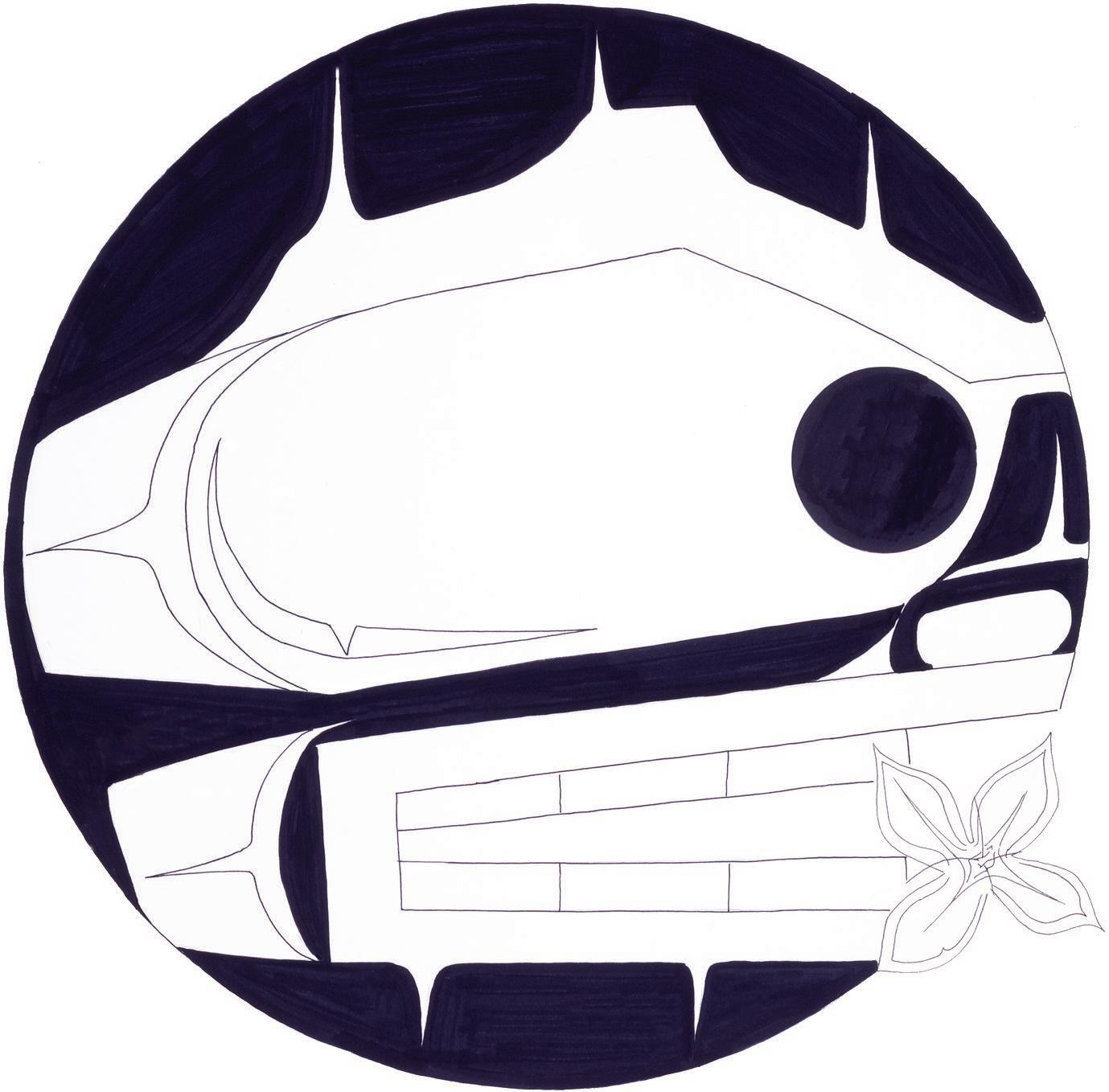
of the Whistling Robins
MOON OF THE WHISTLING ROBINS
Whistling Robins
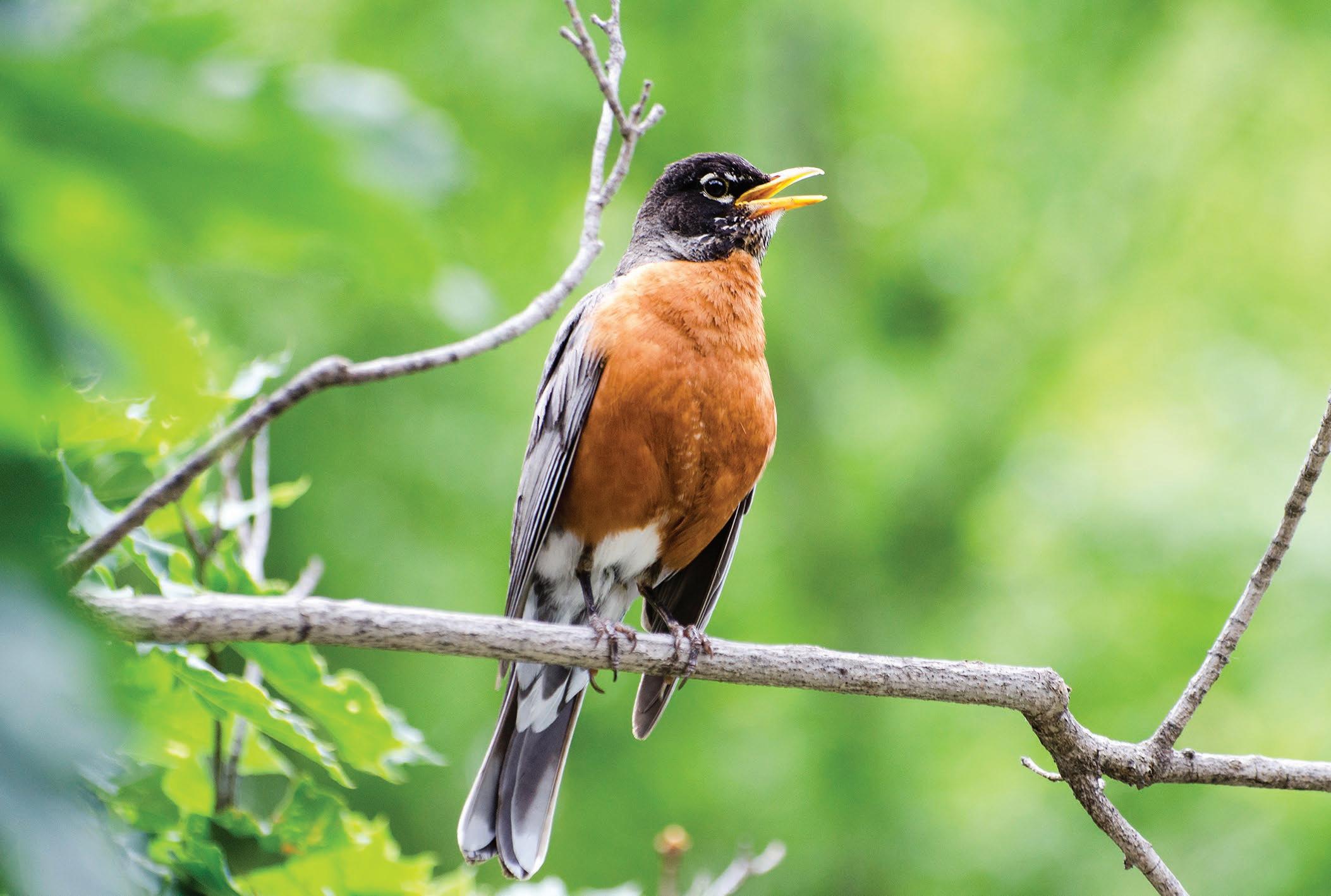
Moon of the Whistling Robins occurs during much of April. The sounds of bird song signals springtime. Greens, fish, and shellfish are harvested. Ironwood, also called ocean spray, is harvested and used for making a variety of hunting, fishing, and gathering tools, including fish spears, fish sticks for cooking, digging sticks, and long needles for sewing cattail mats. The activities in this moon focus on harvesting ironwood and the importance of clean water.
Activity 1: Working with Ironwood
Ocean spray is a common understory shrub that thrives in dry to moist forest edges and open areas. It is one of the densest hardwoods along the Northwest Coast, and is prized for its strength and durability. The plant’s common name, "ironwood," refers to the hardness and strength of its wood, which is made even harder by heating it over a fire, after which it is usually polished with horsetail stems.
It is used to make digging sticks, bows, spears, harpoon, and arrow shafts by multiple coastal groups from southern British Columbia south, including the Straits Salish, Halq’emeylem, Squamish, Sechelt, and Kwakwaka’wakw. Ironwood is used for salmon-barbecuing sticks, inner bark scrapers, halibut hooks, weaving needles, and, recently, knitting needles. Before the use of nails, ironwood pegs were used in construction.
Many Northwest Native coastal people recognized the value of ironwood flowers as a blood purifier, and in treating contagious diseases including smallpox, chickenpox, and measles.
The Saanich, Stl’atl’imx, and Lummi steeped the brownish fruiting clusters of this plant in boiling water to make a liquid infusion consumed for diarrhea, especially in children. In a 1924 interview with Marian Smith, Muckleshoot tribal member Joe Young said the bark and flowers of ironwood are made into a tea for weak lungs.
Insect-eating birds such as chickadees and bushtits forage for insects in the shrub through the winter months. Dense branches provide songbirds with shelter and cover. Swallowtail, brown elfin, Lorquins admiral, and spring azure butterflies browse on the foliage. The nectar may be harvested by mature swallowtail butterflies. Many species of insects live in the dense structure of ocean spray. Deer and elk browse the foliage (Washington Native Plant Society, Holodiscus discolor).
Participants will learn how to identify, harvest, and create ironwood tools. This activity can be conducted as a single workshop or in two modules depending on ironwood availability.
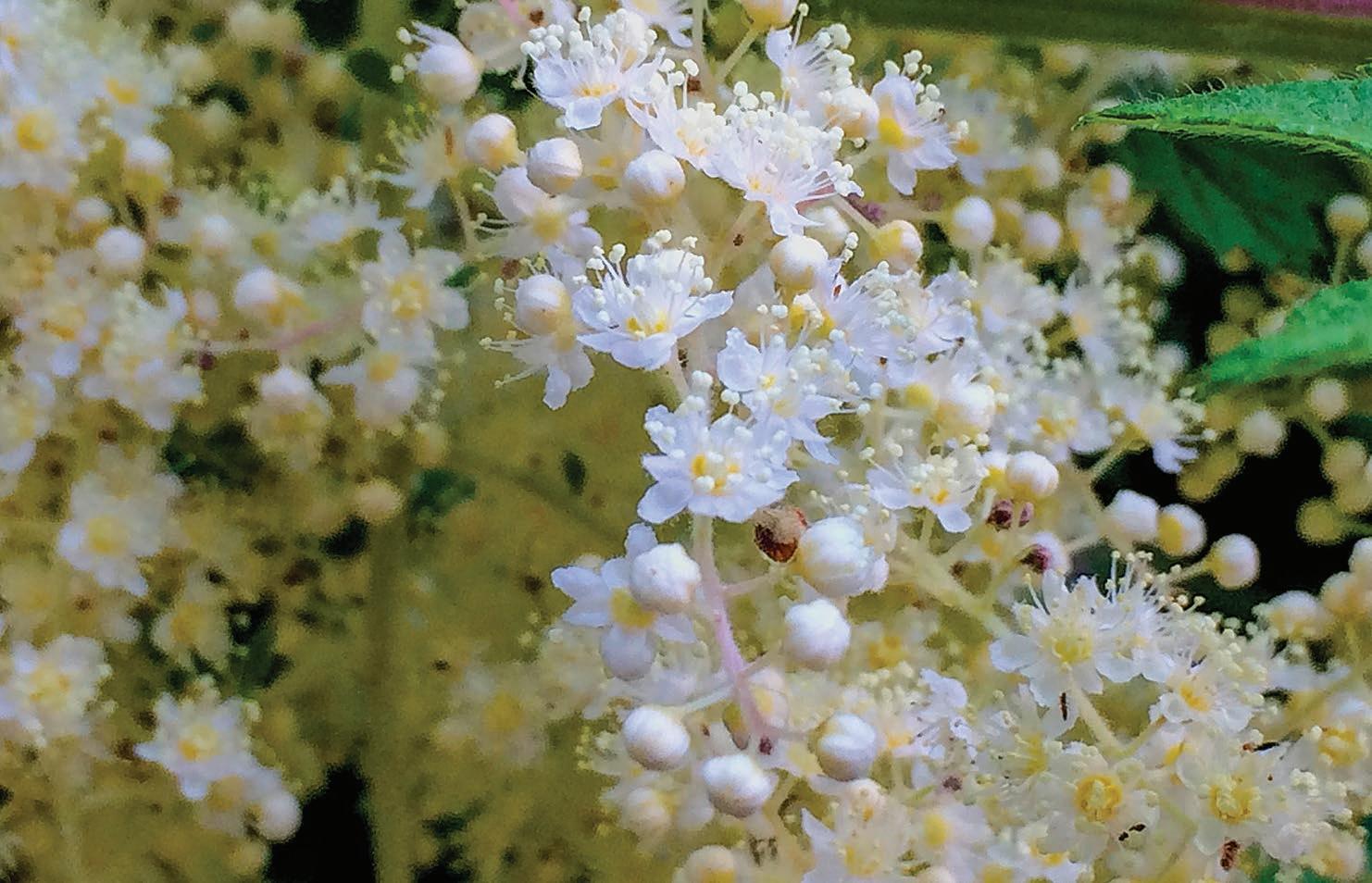
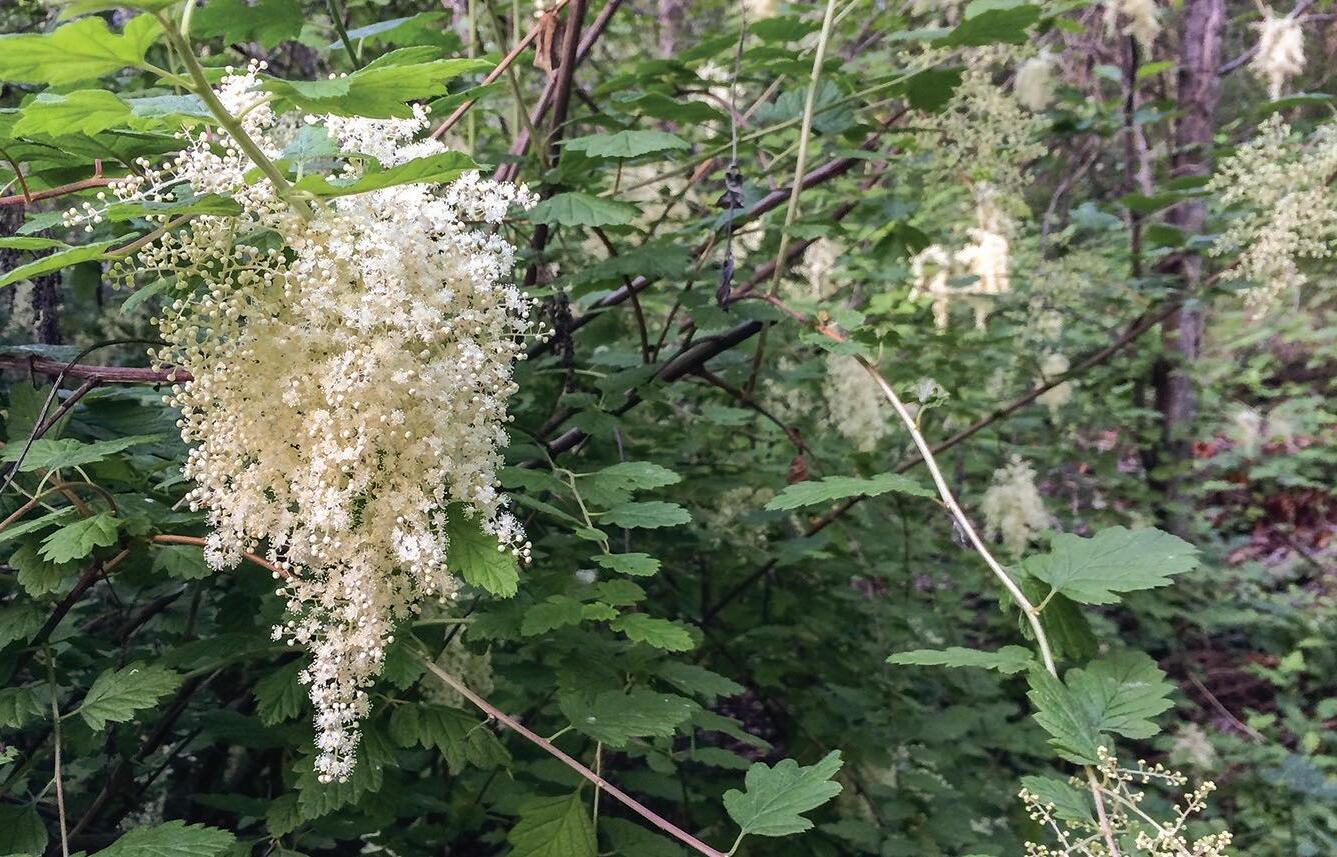
Ocean spray blossoms in full bloom look like a spray of ocean water.
Photo: Myk Heidt
Ocean spray blossoms make a wonderful tea.
Photo: Myk Heidt
Activity 1 Time: 2-4 hours
Audience: Middle school to adult Setting: Outdoors/indoors
Teaching Objectives
In this activity, participants will learn:
• How to identify and harvest ironwood
• Coast Salish traditional wood-based technologies, including the specific properties of different kinds of wood and how this influenced the choices people made in their tool making
• Different uses of ironwood tools (root digging, fish sticks, mat weaving)
• How to select the appropriate size and shape of stem for the tool that will be made
• How to make a traditional tool from ironwood
• The ecological importance of ironwood and other native plants in providing slope stability and preventing erosion
Moon of the Whistling Robins
Moon of the Whistling Robins
The Right Tool for the Job
This activity builds upon a curriculum unit developed by the Alaska Native Knowledge Network titled “The Right Tool for the Job.”
Resource: ankn.uaf.edu/Curriculum/Units/pflug.html
This activity will be led in collaboration with a tribal expert skilled at the identification, harvest, and preparation of ironwood tools.
Lushootseed Words
Moon of the Whistling Robins
Ironwood
Ironwood
Moon of the Whistling Robins
• Moon of the Whistling Robins:
Ironwood
Fish Sticks
• Ironwood:
• Fish sticks:
Ironwood
Fish Sticks
Fish Sticks
Spring
Spring
Fish Sticks
Spring
• Spring: Materials Identifying and harvesting ironwood
Water
Water
Spring
• Examples of ironwood tools
Water
• Appropriate outdoor clothing
Water
• Wood cutting tools (folding saw, clippers, hunting knife for working with ironwood
• Appropriately sized ironwood for making fish sticks and/ or digging sticks
• Hunting knife for wood splitting, sharp pocket knife for removing bark and whittling
• Dried scouring rush (Equisetum hyemale) to polish finished tools (optional)
In the first part of the activity, a tribal elder will take participants on a field trip to learn how to identify and properly harvest ironwood. Participants will then learn how to prepare the ironwood - cutting, splitting, and in some cases, curing the wood.
Participants will learn about the history and different uses for ironwood tools during this time.
For the second part of the activity, participants will create ironwood tools using either fresh or seasoned wood.

Making Fish Sticks with Francis Peters
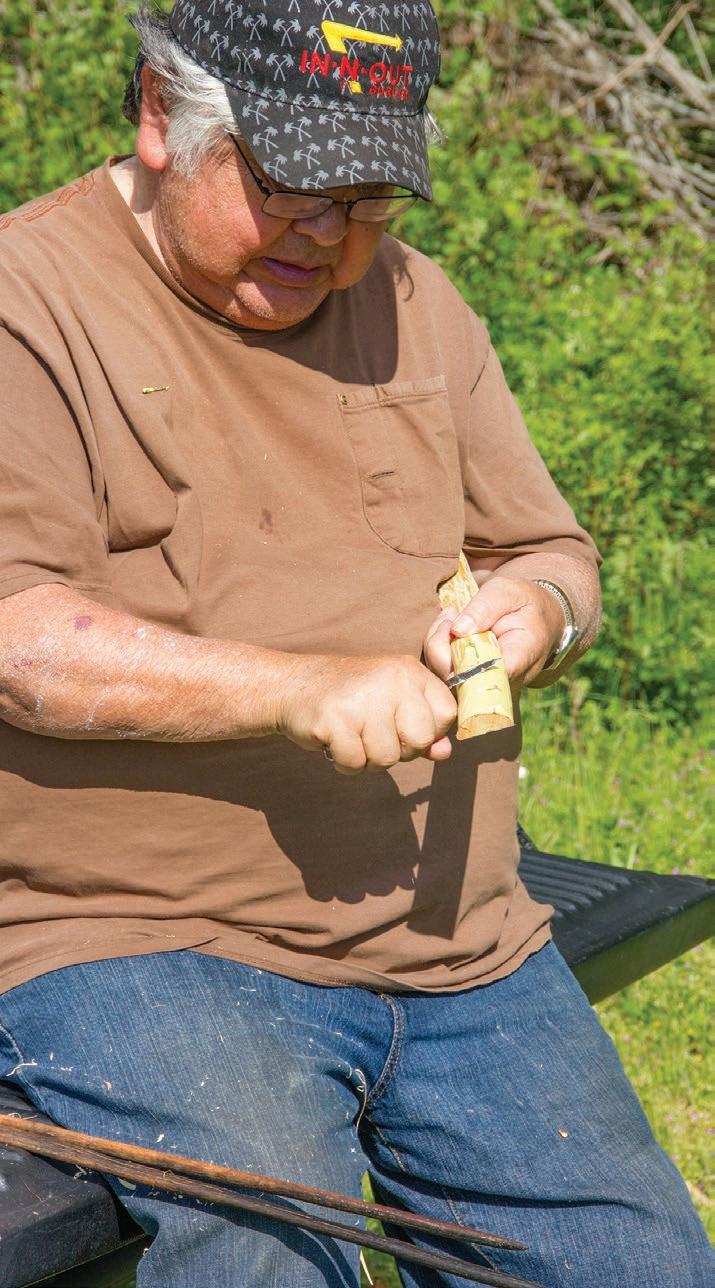
FRANCIS: Harvesting the ironwood; cut the top, under the knot. Cutting these things takes a little time, this wood being hard.
This one is about 28 inches [usual size is about 36 inches]. You can get about five pieces [of salmon] on this one, depending how you cut them.
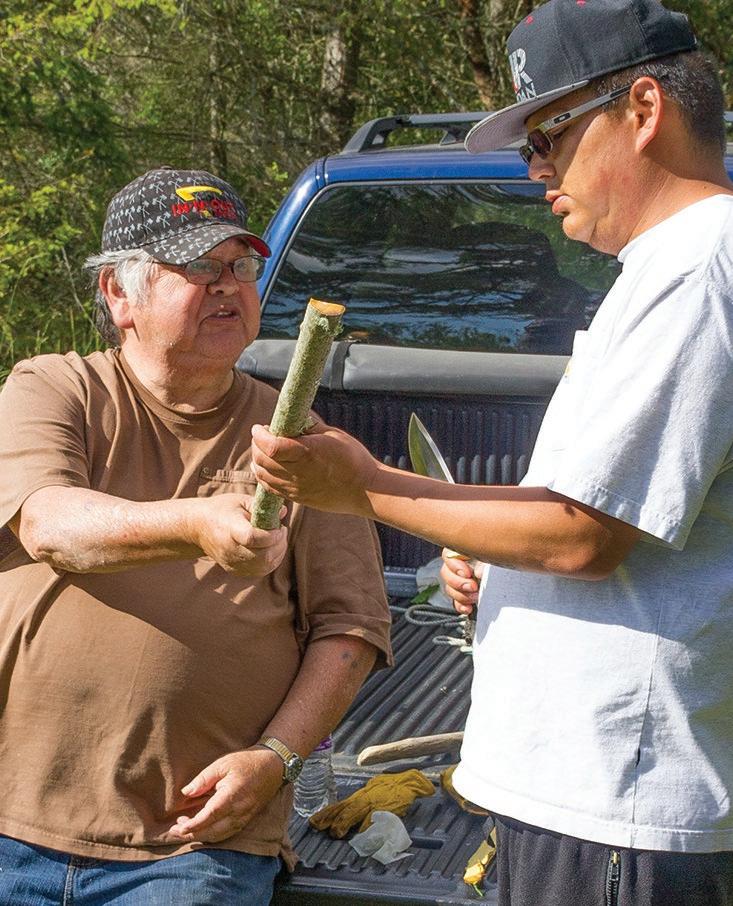
Now comes the hard part: using the big knife and a piece of wood to get it started, you try to cut in the middle, but you don’t want to do it this way [perpendicular to the angle of the cut] because you lose too much. So you want to do it this way [parallel to the angle of the cut], and hope it splits.
Sometimes you have to really go at it. Cut it slow, and try to stay in the middle. Don’t push it, just break it about two inches at a time. All the way down, slow. No hurry.
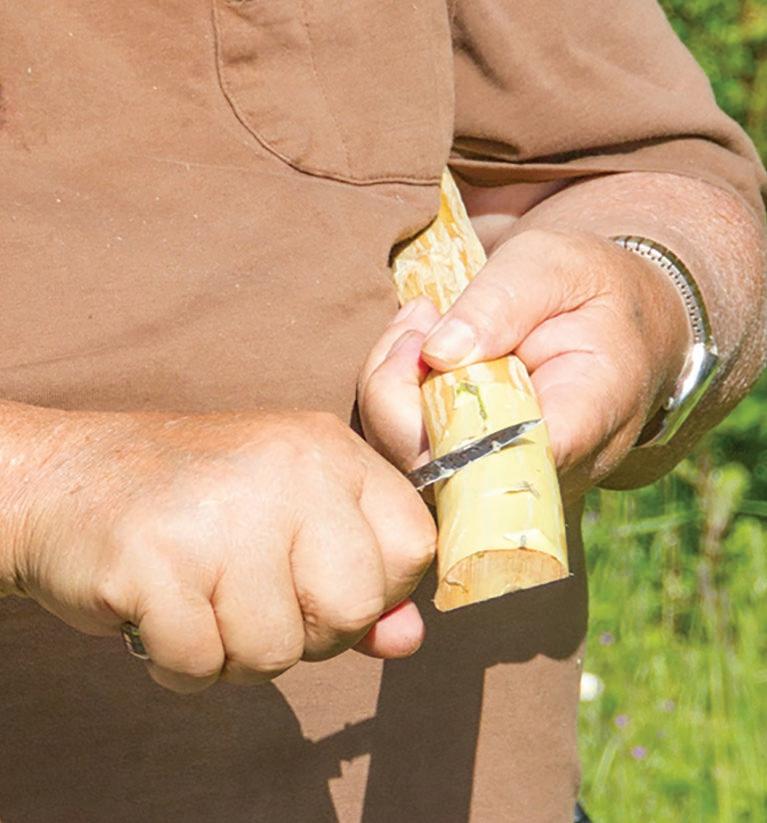
See where the heart is? You have to get that out. That’s going to take time. When you get these, you’ve got to do it when [the wood] is green. If it turns color, it gets hard. You’ve got to cut the front down a little bit, so you can get the heart out.
You’ve got to narrow it down [on the sides]. Both sides, without taking anything off the back. You just take a little bit off the top, a little bit off the sides, same on the inside, until it gets down. I use a planer. Some people use knives. And you’ve got to leave a good handle.
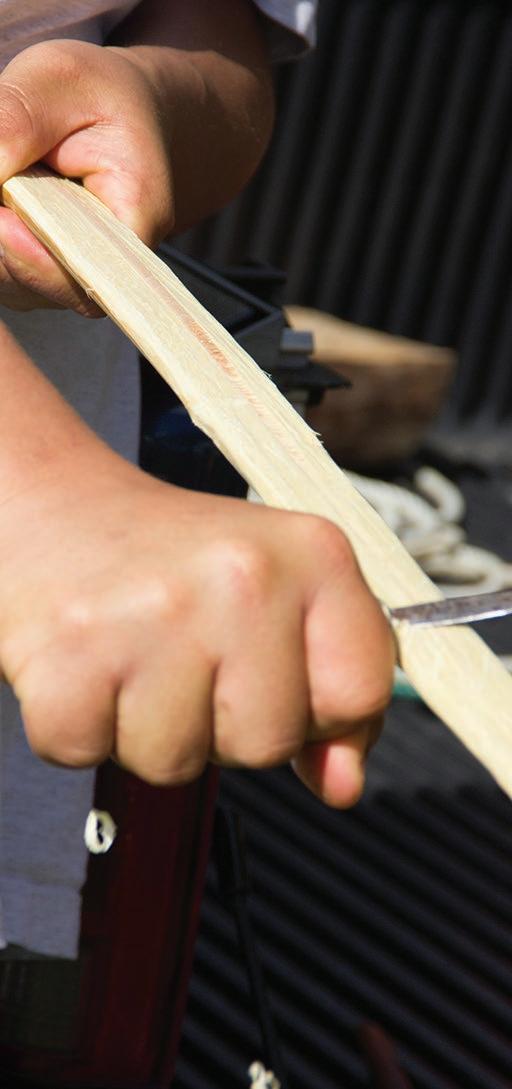
And then it’ll be like this, when it gets done. You can let them soak in oil if you want to, so the stick is always oily. Let them sit in there for four or five hours. Oh, one other thing, these things don’t burn!
Knowledge Transfer
• Invite elders to harvest ironwood and discuss the process of making fish sticks.
• Ask participants to compare what they knew about ironwood before the activity and after. Prompts: Where do you find ironwood? What is the proper time to harvest it? If you were to explain to a friend how to make a tool from ironwood, what would you tell them?
Guiding Questions and Topics of Discussion
• Have you seen this plant before? Why is it called ironwood? What are some tools that can be made with this plant?
Have you heard of other uses for this plant? Why is the way ironwood is harvested so important?
• Why does the ironwood need to be cured for a year? What is the proper way to use these tools? Is this tool still used?
Why do we want to prevent slope erosion? Why is ironwood so important to the environment?
Tying it all Together
• Connections to other activities
› Ironwood digging tools assist in the harvest of camas during Moon of the Digging Time.
› Ironwood needles are used to create cattail mats during Moon of the Falling Leaves.
› Ironwood fish sticks can be used to cook fish over fire pits, such as during the Blessing of the Fleet that happens in the Moon of the Digging Time and for the community clambake in the Moon of the Salal Berry.
• Connection to Indigenous health
› Ironwood can be coppiced to ensure long, straight shoots for use in toolmaking. This also ensures a productive, healthy plant and the same plant can be harvested multiple years and stay healthy (natural resources security).
› Ironwood plays an important role in preventing slope erosion.
› Many birds, insects, and animals rely on ironwood for food and cover.

Digging Deeper
• Indigenous technologies: qualities of wood and their uses for tools and cooking (presentation by tribal expert(s), archaeobotanist)
• Harvest outing to gather ironwood with a lesson about coppicing as a form of Indigenous resource cultivation to ensure straight shoots (for stakes, arrow shafts, cooking tools, etc. i.e., red-osier dogwood, willow, mock orange)
• Medicinal properties of ironwood, especially flowers
Notes to Educators and Additional Resources
• Anderson, M. 1999. “The Fire, Pruning, and Coppice Management of Temperate Ecosystems for Basketry Material by California Indian Tribes.” Human Ecology: An Interdisciplinary Journal 27 (1): 79–113. doi:10.1023/A:1018757317568.
• Ocean spray (Environment and Food Justice Blog): ejfood.blogspot.com/2012/12/ethnoecology-blogs-autumn-2012-ocean.html
• If you use native plants, there’s hope for slopes: seattletimes.com/pacific-nw-magazine/if-you-use-native-plants-theres-hope-for-slopes
• Washington Native Plant Society page about ironwood: wnps.org/landscaping/herbarium/pages/holodiscus-discolor.html
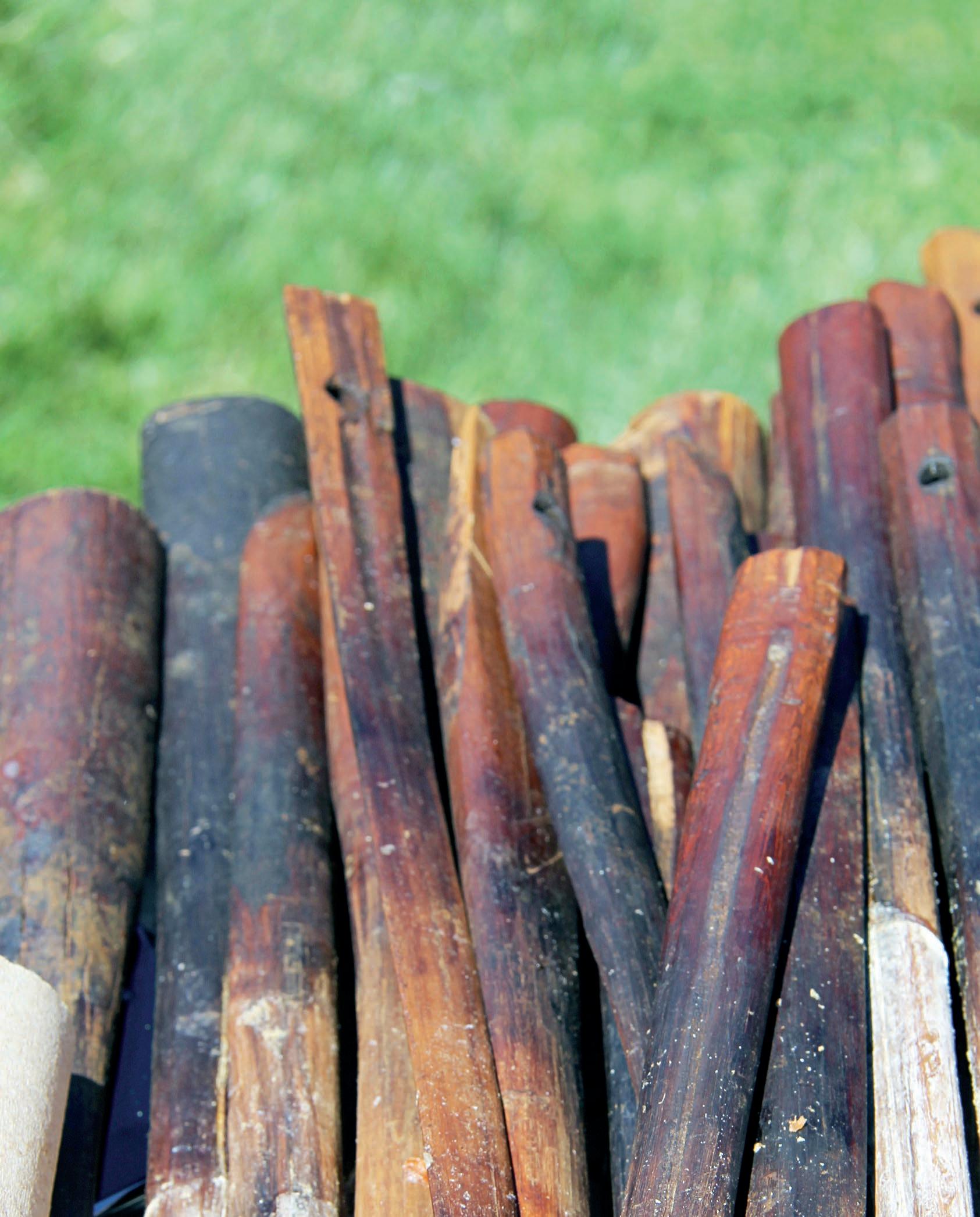
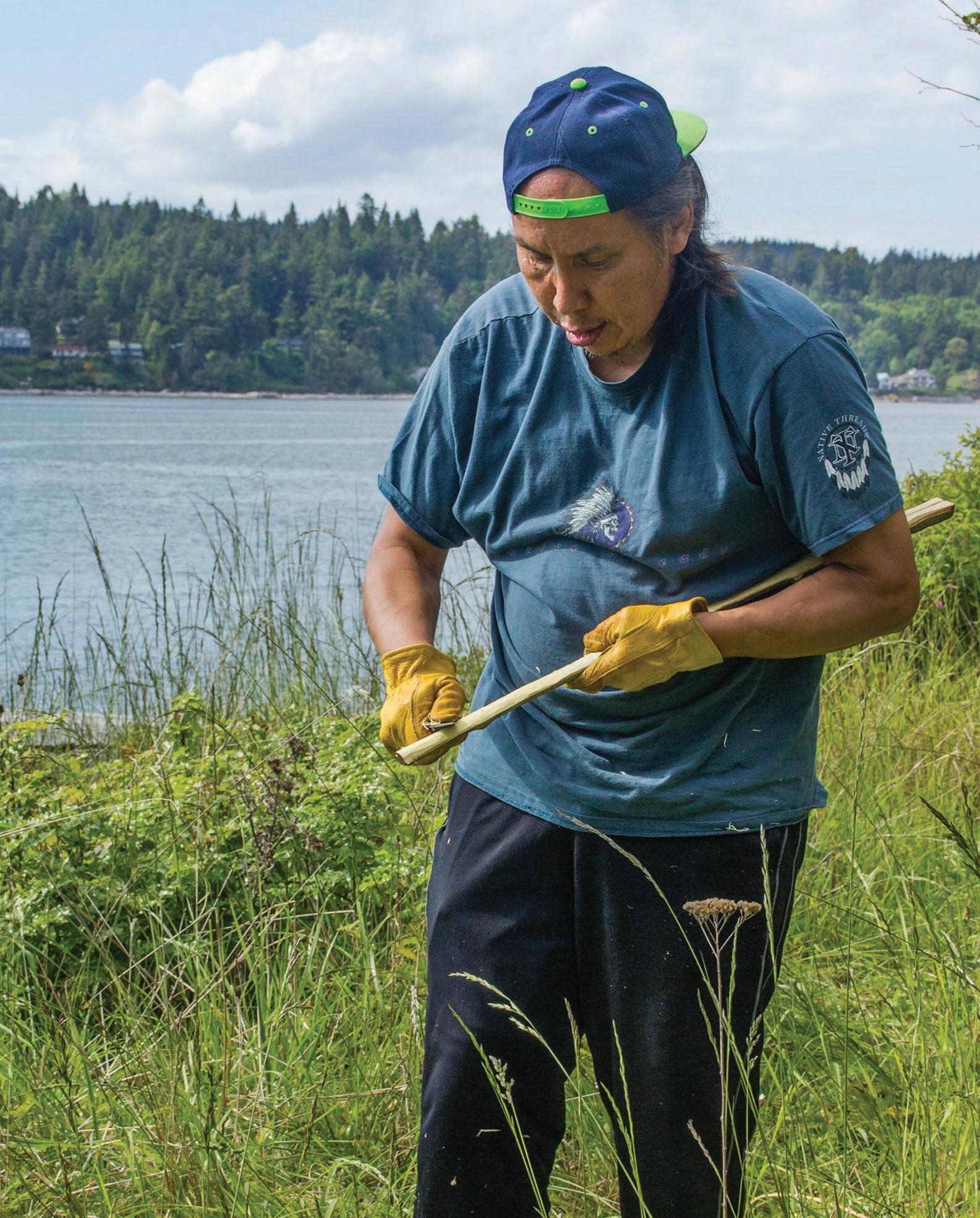
Fish cook Ronald Day learns to make an ironwood fish stick.
Photo: Myk Heidt
Fish sticks
Photo: Caroline Edwards
Activity 2: Clean Water
“Water is one of our most important spiritual medicines. The morning dew from the sword fern, the rain, and even the water we drink every day can purify and cleanse us. Water is precious and you have to ask for its healing.”
-Kimberly Miller, Skokomish Tribe
Water is life. Cultures around the world equate water with healing and energy. People travel great distances to drink or bathe in water from mountains, wells, and springs that are imbued with special energy. Many people believe that water has the ability to absorb prayers, cleanse unwanted energy, and bestow good medicine.
Moon of the Whistling Robins
Moon of the Whistling Robins

Activity 2 Time: 1.5 hours
Moon of the Whistling Robins
Audience: Community
Setting: Indoors
Moon of the Whistling Robins
Teaching Objectives
Water is the most important thing we can drink. It makes up 60-85% of our body weight and plays many essential roles including carrying nutrients, removing waste, cooling us when we are overheated, digesting food, and cushioning our organs and joints. When we are fully hydrated we feel more energized and experience less pain. Clean water is increasingly hard for people around the world to access, and many are standing up to protect it.
This activity is modeled from the Cedar Box Teaching Toolkit created by Elise Krohn and Valerie Segrest, licensed under the Creative Commons AttributionNonCommercial-NoDerivates 4.0 International License.
Each participant in this workshop will decorate a reusable water bottle using Coast Salish designs and/ or the Lushootseed word for "water." At the end of the activity, participants have the option of filling their new water bottle with flavored waters created from the “Feeding 7 Generations” cookbook.
Ironwood
In this activity, participants will learn:
• About water as a key resource to Indigenous health
Moon of the Whistling Robins
• How water is embedded in Indigenous health
Fish Sticks
Ironwood
Lushootseed Words
Spring
• Moon of the Whistling Robins:
Moon of the Whistling Robins
Fish Sticks
• Water:
Water
• Spring:
Ironwood
Spring
Materials
Fish Sticks
Water
• Reusable water bottles for decorating (stainless steel preferred)
• Stencils
Spring
• Stickers
• Acrylic craft paint
Water
• Foam paint brushes
• Swinomish IHI and “Feeding 7 Generations” posters
Notes to Educators and Additional Resources
Krohn, E. and V. Segrest. 2016. Cedar Box Teaching Toolkit. Available in the Swinomish Community Environmental Health program office.

Knowledge Transfer
• Invite elders to participate in the activity.
• Water is life. Ask participants how they viewed water before this workshop compared to how they view it now. Ask participants to share their view of water, as well as their view of water in how it influences their health.
Guiding Questions and Topics of Discussion
• Referencing the IHI graphic on Page 8, identify how water is involved in the activities? How might these activities be affected if the water is polluted? If there is much less water available? If there is no water?
• How do you know if water is safe to drink, or whether or not if it is safe to fish? How much water should a person drink?
Tying it all Together
• Connections to other activities
› Water is essential for life; all of the other activities have connections to water.
• Connection to Indigenous health
› Our environment as we know it would not exist without water.
Digging Deeper
• The workshop could be extended by having participants harvest plants and create flavored waters using the recipes from the Cedar Box Teaching Toolkit.
• The water workshop could be run in conjunction with or leading up to the Swinomish Earth Day clean up. Contact the Swinomish Department of Environmental Protection to coordinate and participate in the event. The event is open to public participation. Arrangements must be made in advance for student groups.


of the Digging Time
Digging Time
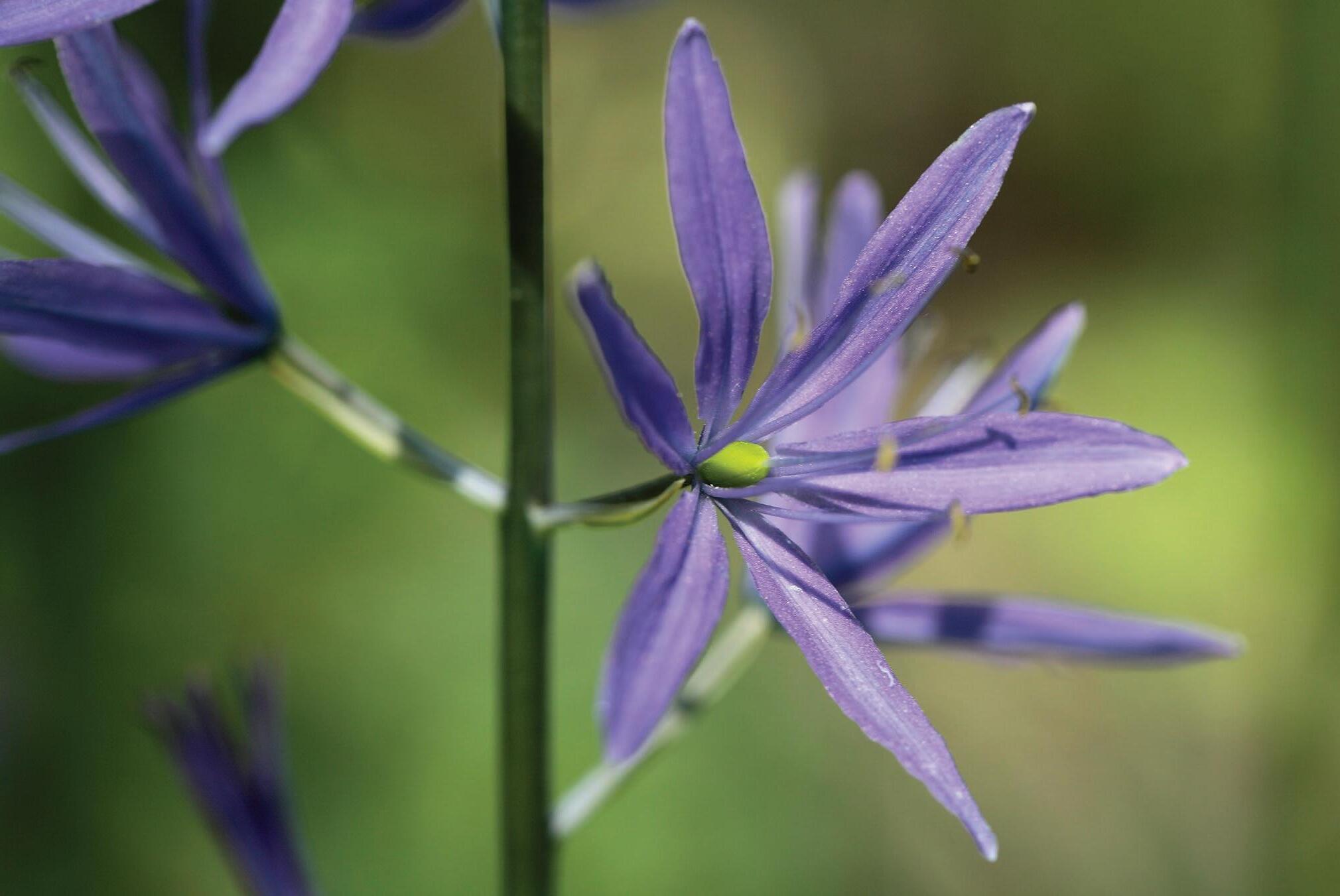
MOON OF THE DIGGING TIME
Much of May is the Moon of the Digging Time because the roots of many plants are dug during this time. Swinomish people traditionally consumed a variety of nutritious root foods, including bracken fern, camas, cattail, nodding onion, and tiger lily.
translation located
During this moon, plant harvesters travel to the bright blue camas fields to harvest large quantities of this nutritious root. At the end of this moon, other plants are ready to harvest, including salmonberries, currants, gooseberries, wild onions, elderberries, and thimbleberries. Shellfish harvest and curing continues. The spring Chinook run is strong during this moon.
In this chapter we will learn how to identify, harvest, and process camas, as well as learn about Coast Salish traditional camas management techniques. Additional activities will take place at community gatherings with presentations from the Bentwood box teaching kit, and include discussions about the meaning and importance of the Swinomish Blessing of the Fleet ceremony, held annually in mid to late May.
Time: 3 hours
Audience: Middle school to adult
Setting: Outdoors (local camas patch)
Teaching Objectives
In this activity, participants will learn:
• How to identify camas vs. death camas
• How to harvest and process camas bulbs
• The importance of camas in the Swinomish traditional diet
• The differences between contemporary and traditional carbohydrate sources, and the health benefits of consuming traditional carbohydrate sources
Camas
Camas bulbs were historically one of the main staple foods for Native nations throughout the Pacific Northwest. It was so important that it was semi-cultivated: fire was often employed to maintain the areas of prairie where it grows best. These prairies provided a cornucopia of other root foods, berries, nuts, and plant medicines.
Moon of the Digging Time
Moon of the Digging Time
• About Coast Salish traditional resource management and its effects on biodiversity, focusing on the use of fire to maintain camas prairies
• How Coast Salish ancestors selected places to harvest and cultivate based on the variety of resources that were seasonally available in the same area (i.e., shellfish, silver salmon)
Lushootseed Words
Moon of the Digging Time
Only the largest camas bulbs are harvested each year, leaving the rest to grow. Bulbs are harvested during or just after the time camas is in flower. Many Native people used to follow camas flowers from the lowlands to the mountains as spring set in. The bulbs were harvested with pointed yew or ironwood digging sticks and steamed or roasted in large pit ovens to render the calories and complex carbohydrates they contained into a digestible form. Large quantities of camas were processed and stored for winter use.
Camas is high in inulin, making it an excellent food for diabetics. The cooked bulbs also promote healthy gut flora. Camas bulbs may be slowly baked in the oven or cooked in a slow cooker until they are as sweet as molasses. Once cooked, camas can be eaten alone or added to stews and soups.
• Moon of the Digging Time:
Moon of the Digging Time
Activity 1: Harvesting Camas
• Camas:
Camas
Camas
Materials
Cedar box - no translation located
• Digging sticks and harvest bags
Cedar box - no translation located
Cook
Cook
• Laminated 8 ½x11 before and after photos of Martha’s Beach, showing the return of camas after Scotch broom removal or other useful photos
• Prairie plants identification cards or sheets with photos and descriptions
• Prepared camas bulbs to taste, or processed camas bulbs to examine
Participants will visit a local camas patch. At the site they will learn about the importance of camas in the traditional diet, how camas prairies were managed, and the significance of camas today. A facilitator will discuss ethical harvesting practices, as well as practical safety considerations, primarily around the identification of death camas and any other potentially dangerous plants in the vicinity.
Groups will work with a facilitator to learn how to dig, clean, and store camas bulbs. Once stored, bulbs can be used for future events, such as the fall harvest feast in November.
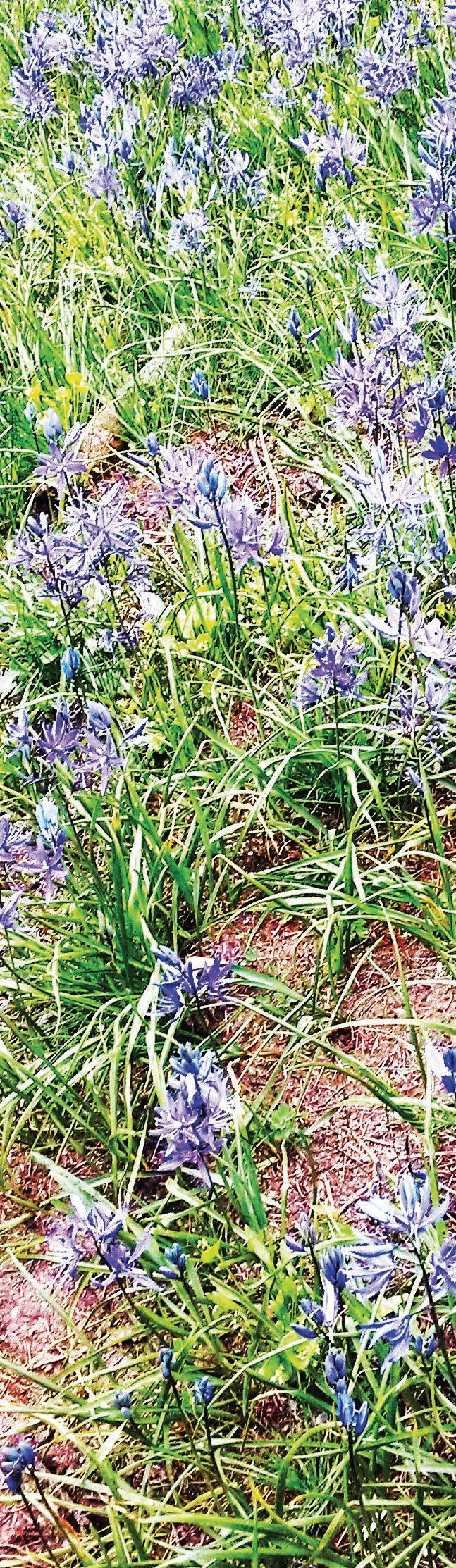
Harvesting Camas Bulbs
The process of harvesting camas bulbs is described here by Elise Krohn.
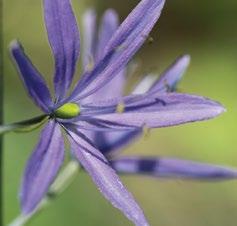
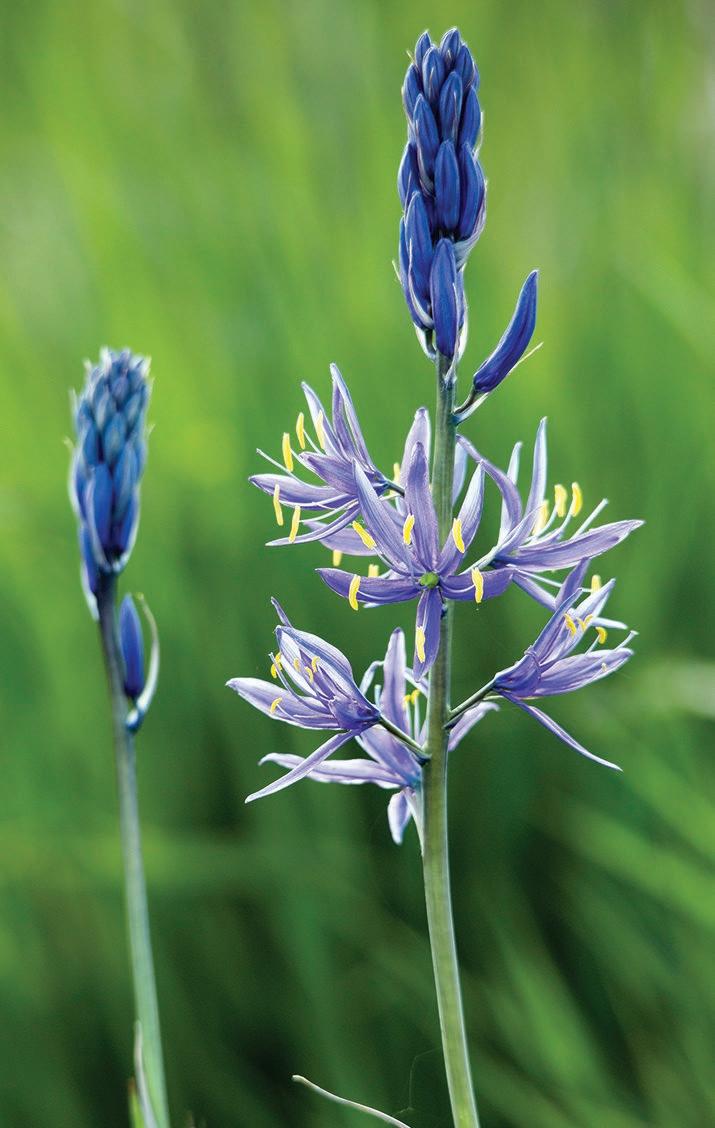
Camas is a lily with purple flowers and grass-like leaves. It thrives in sunny prairie-like locations with well-drained soil. Common Camas (Camassia quamash) is most common on prairies in South Puget Sound. Giant Camas (Camassia leichtlinii) has darker purple flowers and thicker leaves. It blooms a couple of weeks later than common camas and only grows on the west side of the Cascade Mountains. Camas bulbs are a prized native food that resemble a small, dense potato.
Harvesting
Camas is harvested during late April through early June when the blue flowers or dried flower petals are visible. This helps people to distinguish it from a poisonous plant with similar looking leaves and bulbs called death camas.
Camas is dug with narrow straight digging sticks made out of hard wood, bone, antler, or metal. You can also use a hand trowel with a long narrow base. When you dig bulbs, keep the larger ones and replant the smaller ones. Be careful not to split camas bulbs in half with your tool — this takes practice.
If camas has gone to seed, sprinkle the seeds back on open soil. Leave some large flowering plants so they can go to seed. Only keep bulbs that you can see flowering stocks on since death camas bulbs and leaves look almost identical. Consider weeding invasive plants including Scotch broom and St. Johns wort. Leave the area in good condition so plants can thrive in the future.
Eating Camas
Bulbs can be boiled, baked, or slow roasted. When the bulbs are cooked for a shorter time, they are fairly tasteless. When they
are slow roasted for 24-48 hours they become dark-colored and sweet. Roasted camas was traditionally used to sweeten other foods. Cooked bulbs have been made into cakes and dried for later use. Fresh bulbs can also be dried and added to soup.
Nutritional Benefits
Camas contains a complex carbohydrate called inulin that provides our body with food energy. When the bulb is cooked for a long time, inulin breaks down into fructans, which taste sweet but do not increase blood sugar. Inulin has been shown to have a balancing effect on blood sugar. It is also a prebiotic, as it supports the growth of intestinal bacteria. It helps us to absorb minerals including calcium and magnesium.
Cleaning the bulbs
Pinch off the stem where it enters the bulb and the small roots coming out of the base of the bulb. The dirty outer skin will peel off pretty easily and you will be left with a little white bulb that resembles an onion with the outer skin removed. Rinse remaining dirt from the bulbs.
Edible camas
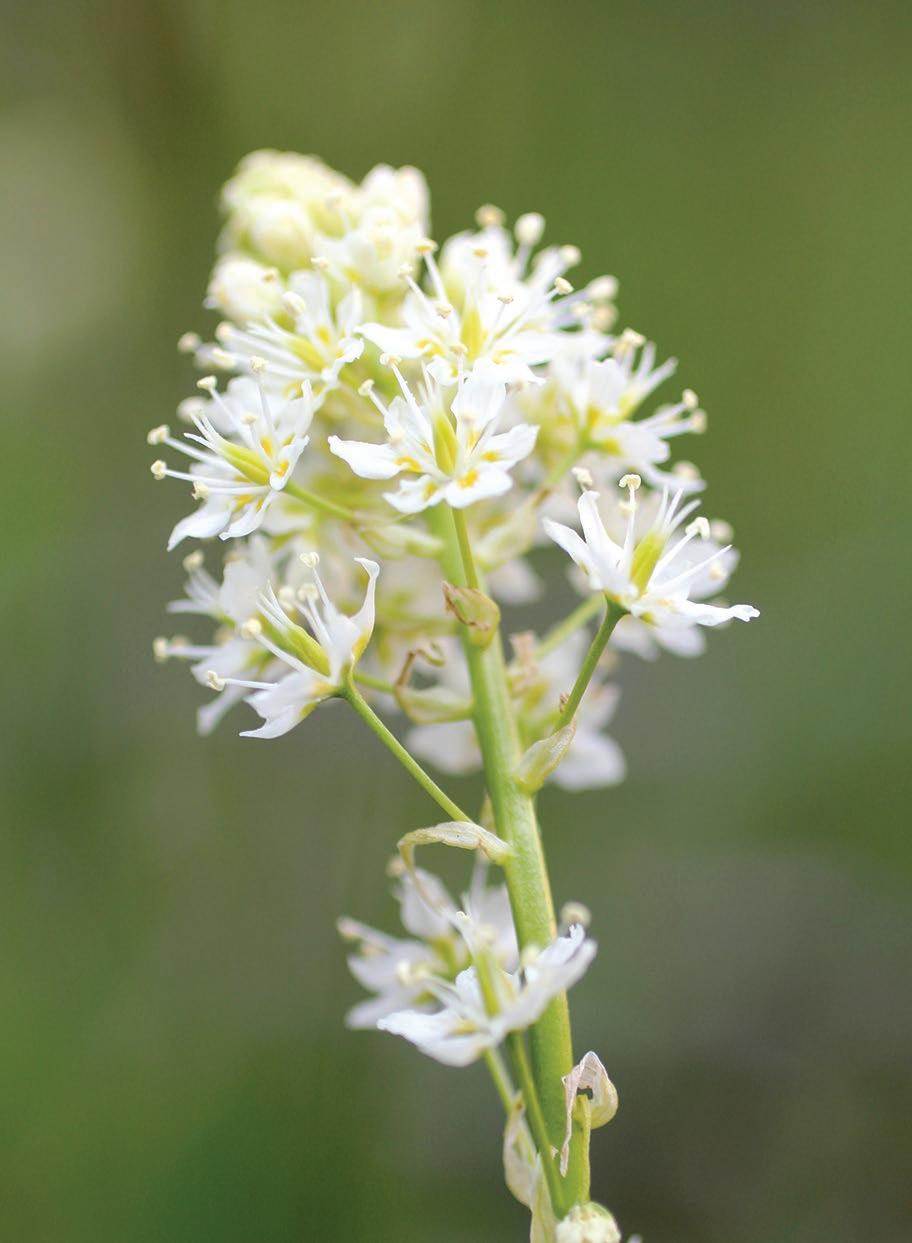
Death camas
Steamed Camas Bulbs
A meal that takes two days to prepare will challenge the patience of even a slow foodist. This is why an entire year’s worth of camas was traditionally cooked and dried so that it could quickly be rehydrated and eaten. Most of us won’t harvest the several bushels of camas bulbs that it would take to make a large pit-cook worthwhile. This slow cooker method is intended to provide a safe, energy efficient, and convenient alternative for smaller quantities of camas bulbs.
• Place an expandable vegetable steamer inside a slow cooker and fill the slow cooker with water to just below the level of the steamer
• Put the camas bulbs in the steamer and cover the slow cooker
• Set the slow cooker at a moderate to high temperature and steam the bulbs for 36 hours (yes, you read that correctly)
• Check the water level every 2-4 hours and refill as necessary
• The bulbs will begin to brown and smell like molasses after 12-24 hours; cook until they are a very dark brown
*CAUTION: Be absolutely sure of your identification before eating camas. The bulbs of death camas are deadly poisonous and look similar to the edible varieties (Camassia quamash and Camassia leichtlinii). Death camas has white flowers, tighter flower clusters, and flowers that mature later in the season, usually June. If you have any death camas in the plot you are harvesting from, I recommend only eating bulbs that are attached to a flowering stalk that you can positively identify as a Camassia species.
Knowledge Transfer
• Invite elders to participate in the activity.
• Participants name a favorite plant of the day, not including camas, and explain why it is their favorite plant
• Participants name one way that camas plants take care of the people, and one way that people take care of the camas
• Participants share how they would explain to someone else about camas, such as where it grows, what it looks like, or why it is a healthy food
Guiding Questions and Topics of Discussion
• What kinds of plants do you see here?
• Do you recognize any of them?
• Have you harvested camas before?
• Can you tell the difference between camas and death camas?
• How is this prairie different from the forested areas of the Kukutali preserve?
Tying it all together
• Connections to other activities
› The digging tools may be made of ironwood, which is harvested and prepared in the Moon of the Whistling Robins.
› In the Moon of the Dog Salmon, participants may use camas bulbs as part of the bentwood box activity.
• Connection to Environmental Health
› Productive camas prairies are dependent on human care. Burning keeps the prairies open and productive for light dependent plants. This increases not only the diversity of plant species, but also pollinators and other animals that depend on the vegetation that grows in the prairies.

Digging Deeper
• Camas bulbs are often roasted for 24-48 hours, giving them a sweet flavor. During the camas dig, have a meal of root vegetables prepared in an open pit (roasted potatoes, carrots, etc.) to illustrate the roasting process.
• Take a field trip to Ebey’s Prairie to learn about Swinomish connections to the prairies there.
• Take a field trip to prairies managed by controlled burns. Camas fields are traditionally managed with controlled burns to remove invasive or competitive plant species. Some prairie sites are still managed this way by Washington State Parks.
• Learn about efforts on and off the reservation to increase the availability of camas through cultivation (i.e., SRSC efforts, Amelia Dan’s efforts through NWIC Swinomish, University of Washington Cultural Ecosystems of Camas Prairies Incubator).
Notes to Educators and Additional Resources
• The Coming of Camas (Roger Fernandes): vimeo.com/215935573
• Cooking and Eating Blue Camas Bulbs: honest-food.net/2011/07/26/cooking-blue-camas
• How to Cook Camas: arcadianabe.blogspot.com/2012/06/how-to-cook-camas
• Native American Food: Camas: nativeamericannetroots.net/diary/828
• Why Prairies Matter: southsoundprairies.org/why-prairies-matter
If necessary, coordinate with Department of Environmental Protection staff and/or the Hunting and Gathering manager to determine the best harvest location. Also, invite elders, Skagit River Systems Cooperative (SRSC) staff, and students and instructors from the Northwest Indian College. Additional participants allows for a broader range of expertise, including ethnobotany, environmental management, and ethical harvesting practices.
• Weiser, Andrea, and Dana Lepofsky. 2009. “Ancient Land Use and Management of Ebey’s Prairie, Whidbey Island, Washington” 29 (2): 184–212. doi:10.2993/0278-0771-29.2.184.
Dean Dan passes traditional knowledge to the next generation through the treasured practice of storytelling.
Photo: Myk Heidt
Moon of the Digging Time
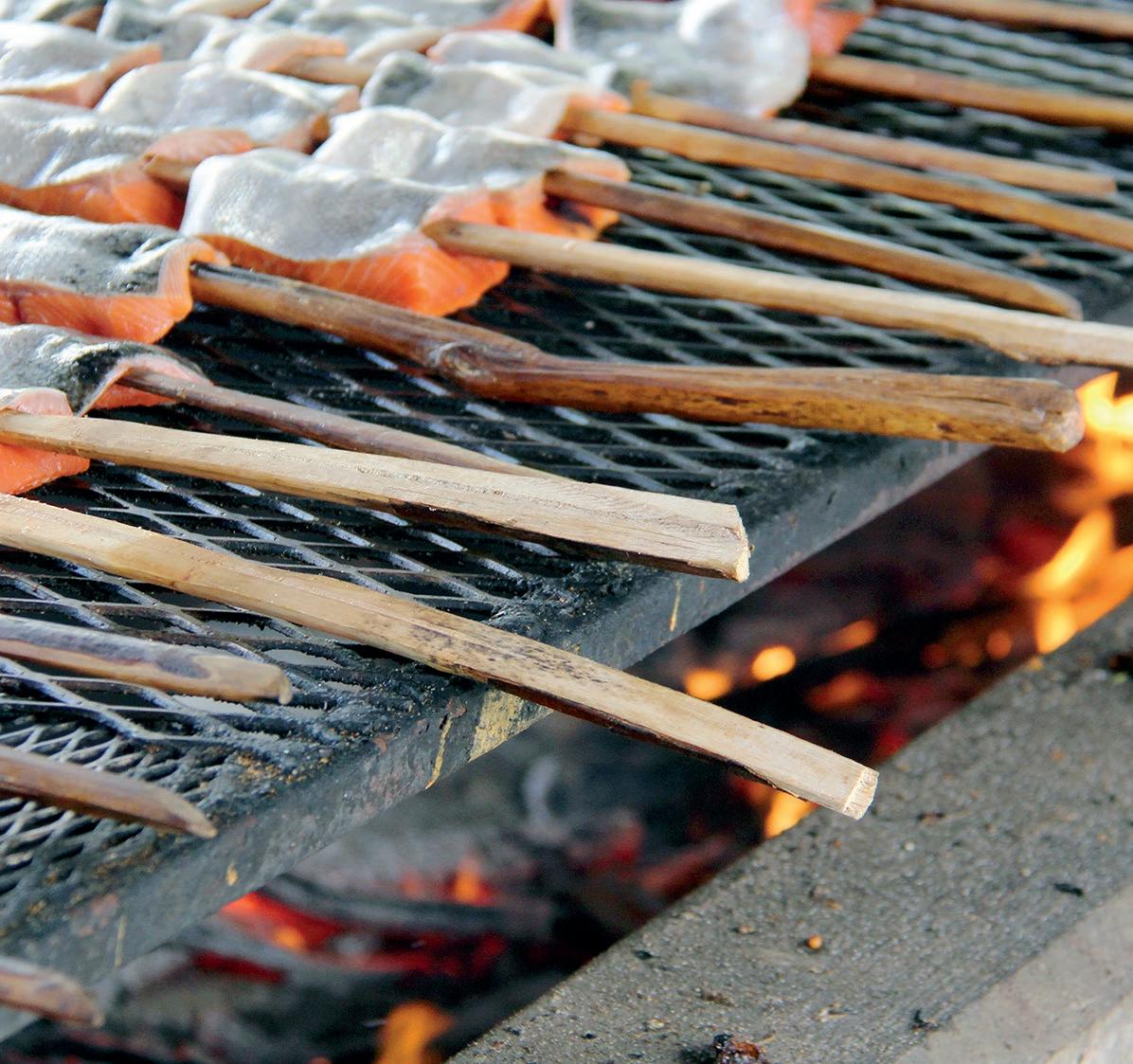
Top: Cooking with ironwood
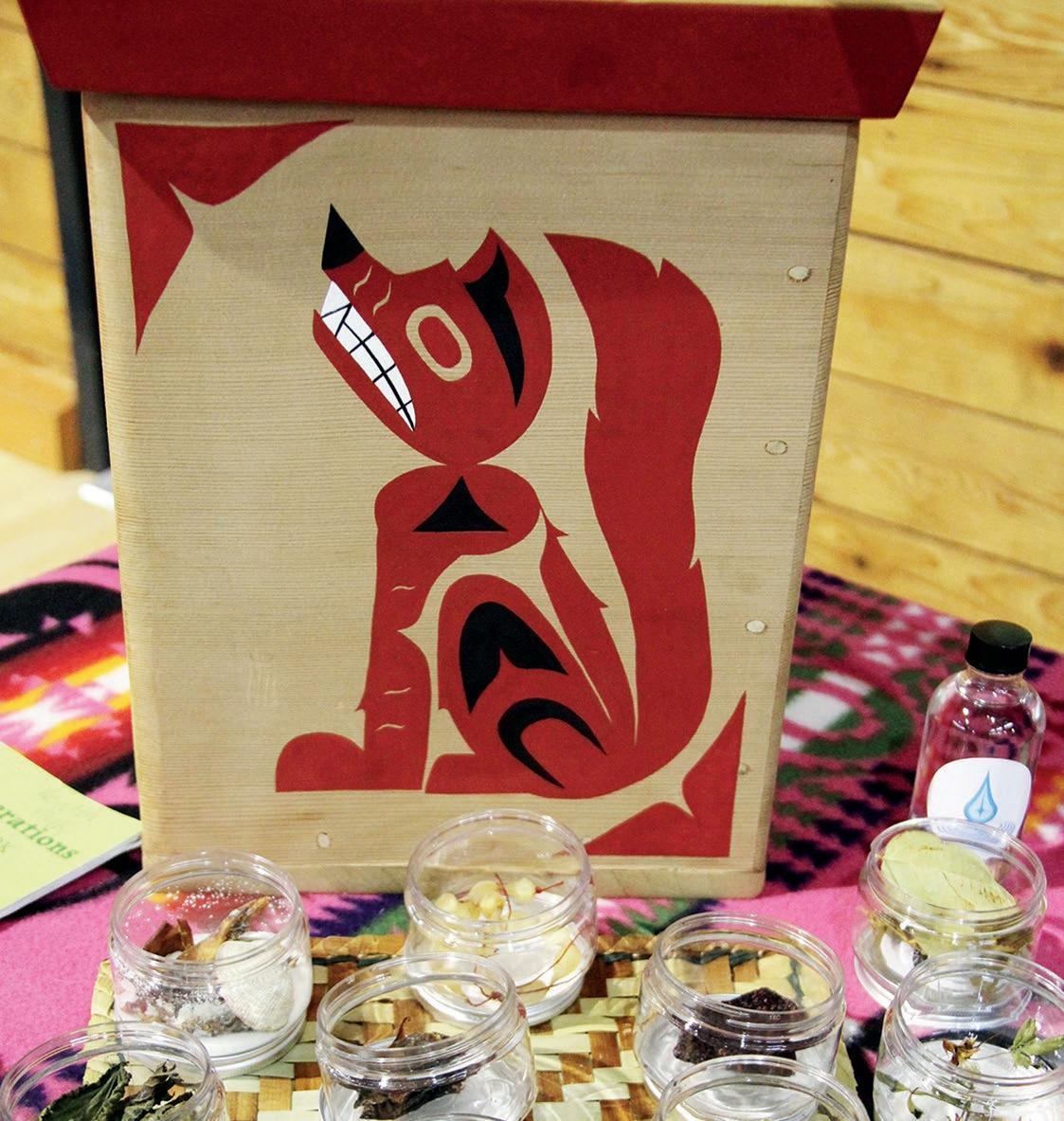
Bottom: Bentwood box display
Photo: Caroline Edwards
Time: 1 hour
Audience: Community
Setting: Indoors or outdoors
Moon of the Digging Time
Teaching Objectives
In this activity, participants will learn:
Moon of the Digging Time
• Traditional cooking techniques using the bentwood box and ironwood cooking sticks
Camas
• How first foods are a key aspect of Indigenous health
Lushootseed Words
Cedar box - no translation located
Moon of the Digging Time
• Moon of the Digging Time:
Cook
Camas
• Cook: Materials
Cedar box - no translation located
• Cedar Box Teaching Toolkit (includes bentwood box and activity instructions)
Cook
Activity 2: Bentwood Box Demonstration
The Cedar Box Teaching Toolkit was created by Valerie Segrest and Elise Krohn in 2016. Designed to highlight traditionally-important foods and resources, the teaching kit provides information on the nutritional value of traditional foods, as well as recipes and cooking tips to prepare the foods. The entire kit is contained within a traditionally-made bentwood box.
During the Moon of the Digging Time, Swinomish hosts an important annual community event, the Blessing of the Fleet and First Salmon Ceremony. The celebration marks the beginning of the commercial fishing season and honors the reciprocal relations between the people and the natural environment. The ceremony includes requesting protection for the fishing fleet and giving thanks for the yearly return of the salmon, with the people promising to care for the salmon and its habitat in return (Gunther 1926).
The Blessing of the Fleet luncheon and monthly community dinners are held at the Swinomish Youth Center, which has space for a side table to display the bentwood box and highlight various bentwood box recipes and cooking techniques.
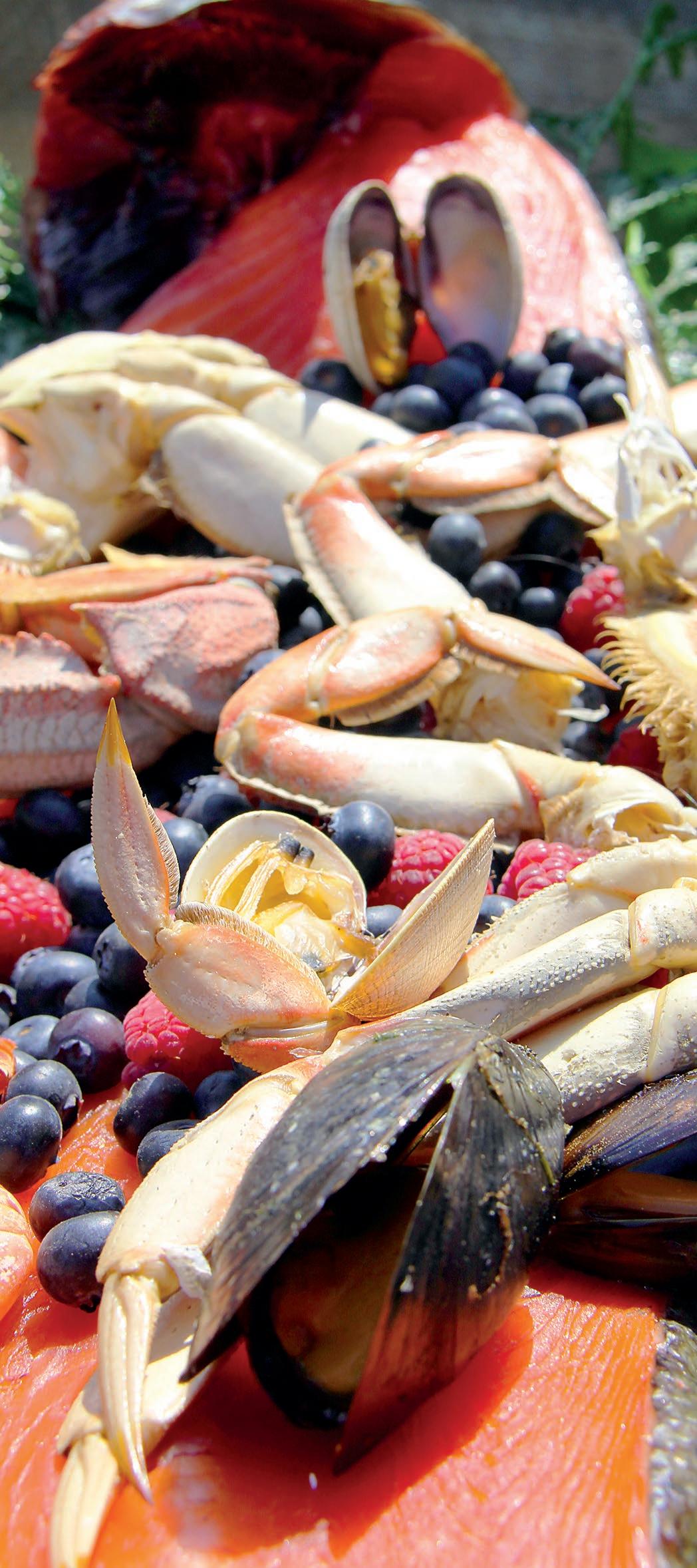
Knowledge Transfer
• This is an informal activity that can be nested within an existing community event. The goal is to highlight the Cedar Box Teaching Toolkit as well as recipes using traditional foods and cooking techniques. Make recipes available for community members to take.

Guiding Questions and Topics of Discussion
• Have you ever seen food cooked in a box like this?
• Have you cooked using cedar before?
• What traditional foods do you like to see during community dinners?
• What is the meaning behind the Swinomish Blessing of the Fleet and First Salmon Ceremony?
Tying it all Together
• Connections to other activities
› In the Moon of the Falling Leaves, pemmican is made using recipes from the Cedar Box Teaching Toolkit.
› In the Moon of the Whistling Robins, flavored waters are made using recipes from the Cedar Box Teaching Toolkit, and ironwood cooking sticks are discussed.
• Relationship to Indigenous health
› The Cedar Box Teaching Toolkit highlights nutritious foods that also hold cultural significance. Harvest and consumption of these foods is linked to a healthy community by fostering an understanding of the natural environment and the importance of protecting and maintaining healthy local environments and connections to those environments.
Digging Deeper
• Consider holding a cooking demonstration using traditional tools and foods. The Cedar Box Teaching Toolkit provides recipes and examples of cooking with traditional tools.
• First Salmon Ceremony at other Coast Salish tribes: Video from Northwest Indian Fish Commission (2013): nwifc.org/video-treaty-tribes-honor-first-salmon-bless-fishermen
Notes to Educators and Additional Resources
Blessing of the Fleet
Photo: Caroline Edwards
• Krohn, E. and V. Segrest. 2016. Cedar Box Teaching Toolkit.
• Gunther, E. 1926. An Analysis of the First Salmon Ceremony. American Anthropologist. 28(4): 605-617.
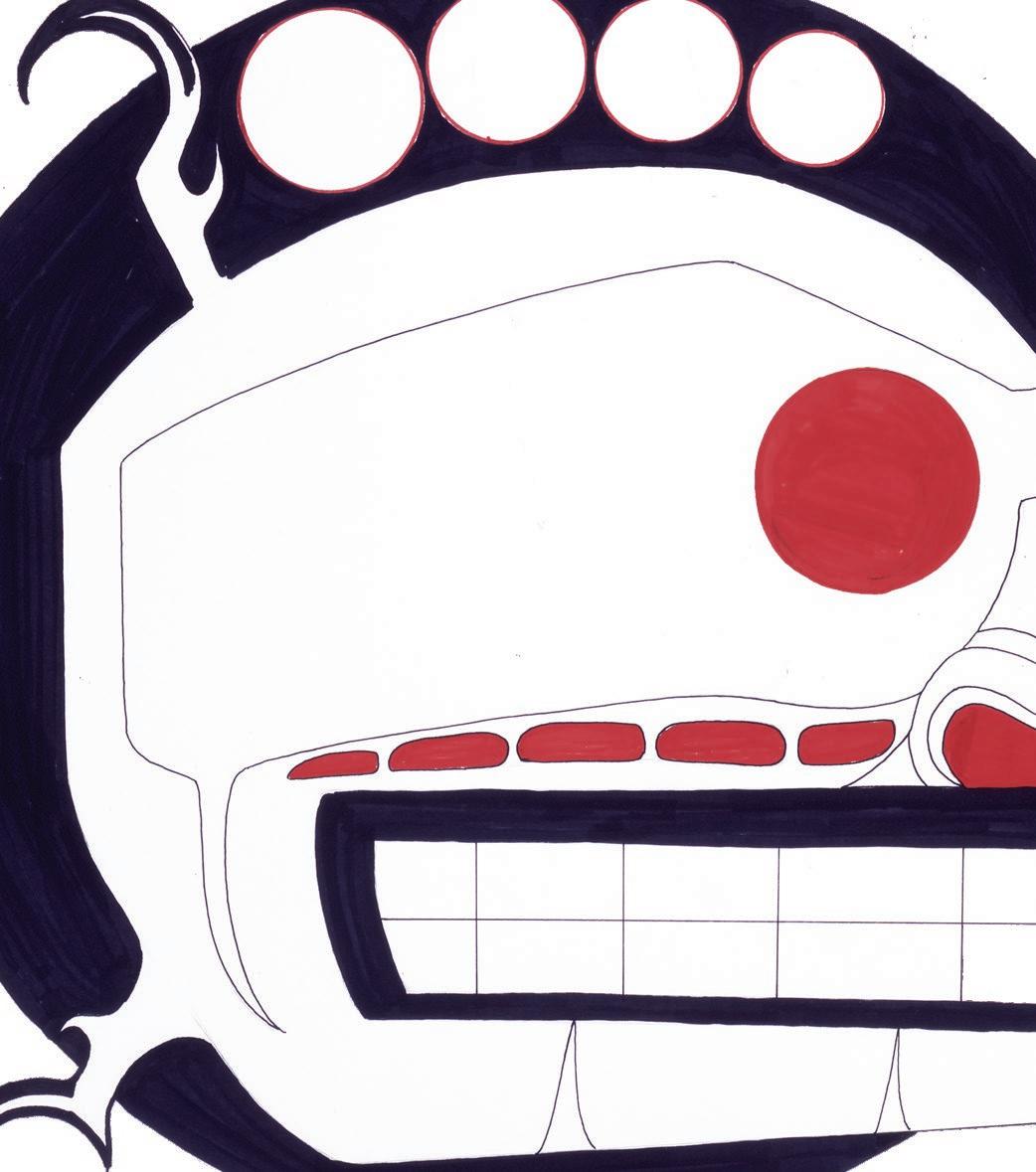

of the Salmonberry
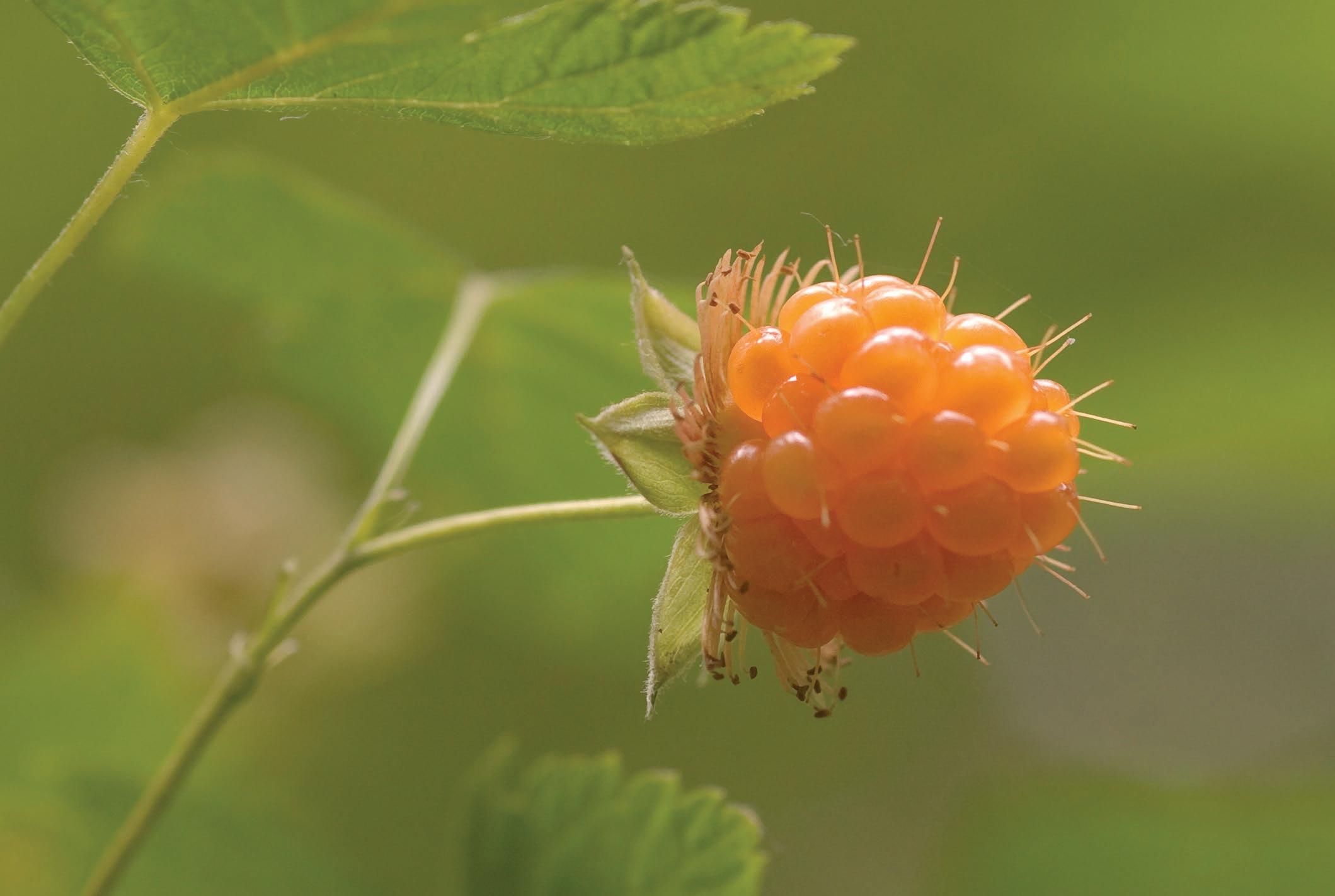
MOON OF THE SALMONBERRY
Much of June is the Moon of the Salmonberry. During this moon, fruits such as salmonberry and red huckleberry are ripening and ready to harvest. Ripe salmonberries signal the start of many salmon runs during this moon, including summer Chinook and sockeye salmon. Salmon are caught using weirs and reef nets made from willow and cedar branches. Sockeye salmon, also called reds, are valued for their fat and flavor. This moon also signals the time when the daytime tide is extremely low, allowing access to scallops, geoduck, clams, and giant red sea urchins as well as many other shellfish. Shellfish harvest and curing continues.
Activities during this moon focus on celebrating the coming of summer (pədhə́dəb) by preparing low-sugar salmonberry soda and a healing salve used for treating bumps and scrapes. In addition, youth will learn about shellfish in an art and gift-giving activity.
Salmonberry
Steamer Clam
Activity 1:
Salmonberry
Harvest and Workshop
Salmonberry is one of the first foods of spring. The pink flowers are a beautiful splash of color after the darker days of winter. Coast Salish elders say that if the salmonberry flowers are abundant, it is a sign that it will be a good spring salmon run. Salmonberry thrives along waterways including rivers and tributaries. If the waters are healthy and flowing well, salmon will be able to spawn and renew their species (Krohn, 2017 “Tend, Gather & Grow”).
Salmonberry sprouts come out in April and May. You will find tender thick shoots at the base of the plant and along the older stems. These are called “bear candy” because bears love to eat them. They are considered an “elders' treat” among Native American people. Elders teach that salmonberries, with all their nutrients and medicine, are an important spring food to energize and tonify the body after winter. To eat them, you pinch off the thick tender sprouts and peel back the outer skin, which can be green or reddish pink. The inside is a vegetable that is crunchy, tart, and sweet. It has a distinctive astringent taste that makes your mouth pucker.
Salmonberries can vary in color, even on the same bush. They can be yellowish orange, ruby red, or reddish purple. They are only ripe for a short time and do not preserve well, so we have to enjoy them when they are ready. They were so prized among some Native communities that families owned patches of them and maintained them as berry gardens. They pruned the branches to make them more productive and sometimes held a First Salmonberry Ceremony to honor this important traditional food.
Many Northwest Coast communities recognize that the flowers of salmonberry bloom at the same time that the Swainson’s thrush returns in the spring. Swainson’s thrush is called the “salmonberry bird” in several Northwest Coast Native languages. The ripening of the salmonberries in June is an indicator that spring salmon are running (Lantz and Turner 2003).
Time: 4 hours (2 hours indoors, 2 outdoors)*
Audience: Middle school to adult
Setting: Outdoors (salmonberry harvest); indoors (salmonberry soda and salve workshop)
*These activities can be performed as a single halfday workshop or as independent events
Teaching Objectives
In this activity, participants will learn:
• How to identify and harvest native plants, including salmonberry plants
• How to create a low-sugar salmonberry soda
• About the high amount of sugar found in commercial sodas
Moon of the Salmonberry
• About the low amounts of sugar in a traditional Coast Salish diet
Moon of the Salmonberry
• The health benefits of a low-sugar diet
Moon of the Salmonberry
• Ecological indicators using Coast Salish traditional ecological knowledge (i.e., when salmonberry is in fruit, spring Chinook are running)
Lushootseed Words
Moon of the Salmonberry
Moon of the Salmonberry
• Moon of the Salmonberry:
Salmonberry
Moon of the Salmonberry
• Salmonberry:
Salmonberry
Salmonberry
Summer Clam
• Summer: Materials (see list on the next page)
Summer Clam
Summer Clam
Little Neck Steamer Clam
Little Neck Steamer Clam
Little Neck Steamer Clam
Butter Clam
Butter Clam
Butter Clam
Materials
• Bags or baskets for harvesting medicinal plants and salmonberries
• Double boiler or slow cooker for making infused oils
• Jelly bags, canning funnel, 8-cup liquid measuring cup, and canning jar for pressing out oils
• Stove or hot plate
• One-quart double boiler or saucepan, wooden spoon, cheese grater (note: beeswax is impossible to remove from cooking utensils, so these should be items reserved exclusively for medicine making)
• Two-cup liquid measuring cup
• Kitchen scale
• Paper towels and/or kitchen towels reserved for medicine making
• Soda sugar demonstration (optional): glass bowls and cups, sugar, labels
• Specific ingredients for salve making (see recipe and instructions). Note that infused oils need to be made ahead of the event. To show the process, press out the oils and make new batches with the participants.
• Specific ingredients for making low-sugar salmonberry soda or shrub (see recipe and instructions). The ingredients take several days to infuse. Prepare some in advance for participants to take home.
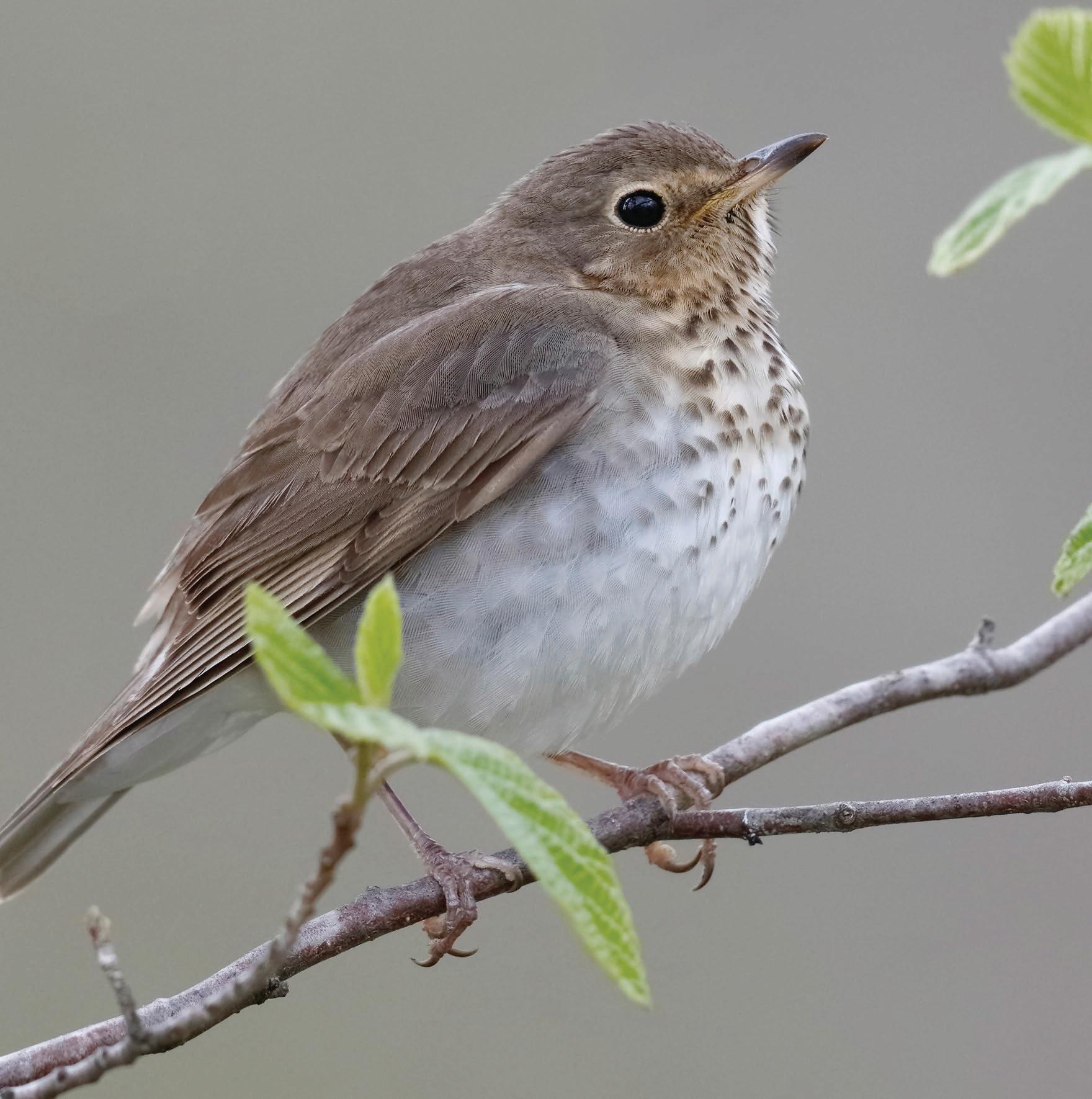
Salmonberry Harvest Trip
This activity merges the harvest of salmonberry with a Coast Salish story about the salmonberry bird, also called Swainson’s thrush. Held on-site at a riparian habitat, participants will learn about the salmonberry bird, as well as how to identify, harvest and prepare the salmonberry to create soda and medicines. This activity will also highlight the importance of salmonberry within the ecosystem.
Swainson’s thrush is called the “salmonberry bird” by several Coast Salish peoples.
Photo: iStock by Getty Images, Brian Lasenby
TIP
Invite an elder to tell a story about late spring or early summer harvests.
A facilitator will take participants on a walk through the riparian habitat to find and harvest salmonberries. When a salmonberry bush is identified, the facilitator, or an elder, will tell the story of the Salmonberry Bird and Raven.
Story: Salmonberry Bird and Raven
In Earth’s Blanket, Nancy Turner recounts a Saanich story about the salmonberry bird, or Swainson’s thrush. It is said that this little bird’s song makes the salmonberries ripen in the spring. This story is told by Elsie Claxton and Violet Williams. They said that if you translate Swainson’s thrush’s song it translates as, “Come on, all you dark ones! Come on, all you light-colored ones! Come on, all you red-colored ones! Come on, all you golden ones! Ripen, ripen, ripen, ripen!” (Turner 2008)
One time, Salmonberry Bird invited Raven to her house for a meal. She told her kids to take their baskets out to pick berries. She started to sing her song, and as she sang, her children’s baskets filled up. The children came home and everyone had a wonderful meal of deliciously ripened salmonberries of all the different colors.
Afterwards Raven said, “You come to my house tomorrow.” So Salmonberry Bird came along the next day, and Raven gave baskets to his children and told them to go out to get the berries. Raven’s children went out for their dad, and Raven sang in his croaky raven voice. They waited and waited, but the Raven children’s baskets never got full, and finally Salmonberry Bird went home without any berries.
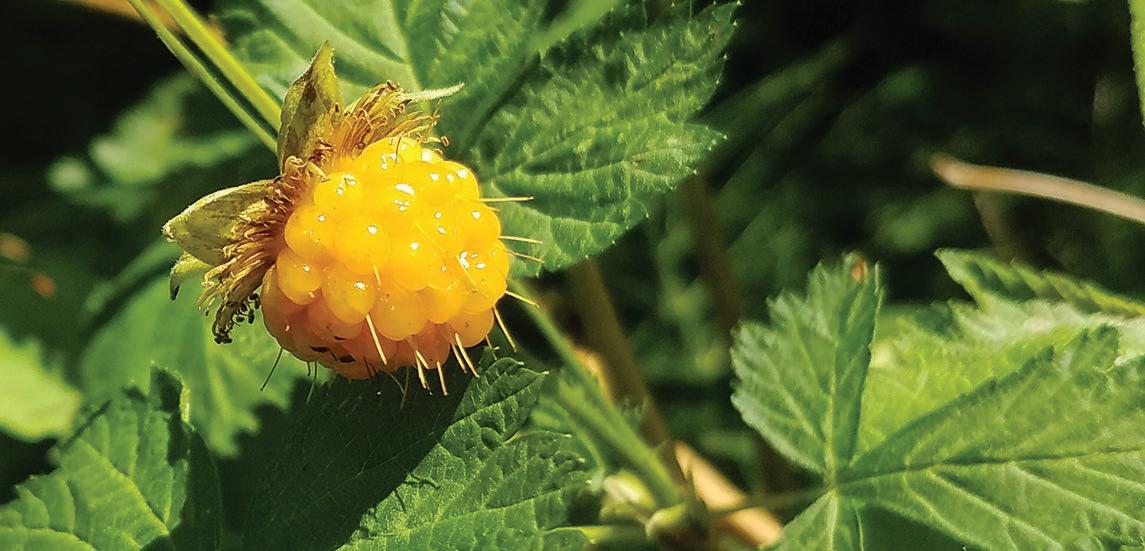
Photo: Myk Heidt
Guiding Questions and Topics of Discussion
Tell this story during on the salmonberry harvest trip and lead participants in a discussion about the salmonberry plant.
What do you think the moral of this story is? One teaching from the story is that we all have our own talents, and that trying to mimic other people is rarely fruitful.
Take a closer look at these salmonberry plants. What do you notice about their leaves? The flowers? The berries? The leaves have serrated edges, are very pointed, and are in groups of three. If you fold the opposite leaves together they look just like a butterfly. The flowers have five petals with many stamens. The berries are shaped like a blackberry or raspberry and come in different colors, sometimes on the same bush.
Many edible fruits are in the same family as salmonberry. Can you think of any other edible berries that have similar flowers or berries? Examples: blackberry, thimbleberry, raspberry, rose, and strawberry. These are all in the rose family.
If older students and community members are in the audience, consider discussing rose family characteristics.
[Optional] The leaves of many rose family plants are rich in minerals, including calcium, and can be made into a nutritious tea. Salmonberry leaves are astringent meaning that they tighten tissue that is inflamed. Examples include swollen gums, an upset stomach or sunburn.
Point out other medicinal plants in addition to the salmonberry plant. Include Calendula flower, Comfrey leaf, plantain leaf, St. John’s wort flowers, and yarrow flowers. Plant identification cards available from the Vancouver Island and Coastal Communities Indigenous Food may be useful for participants to reference.
Salmonberry invites salmonberry bird to sing her song so the berries ripen!
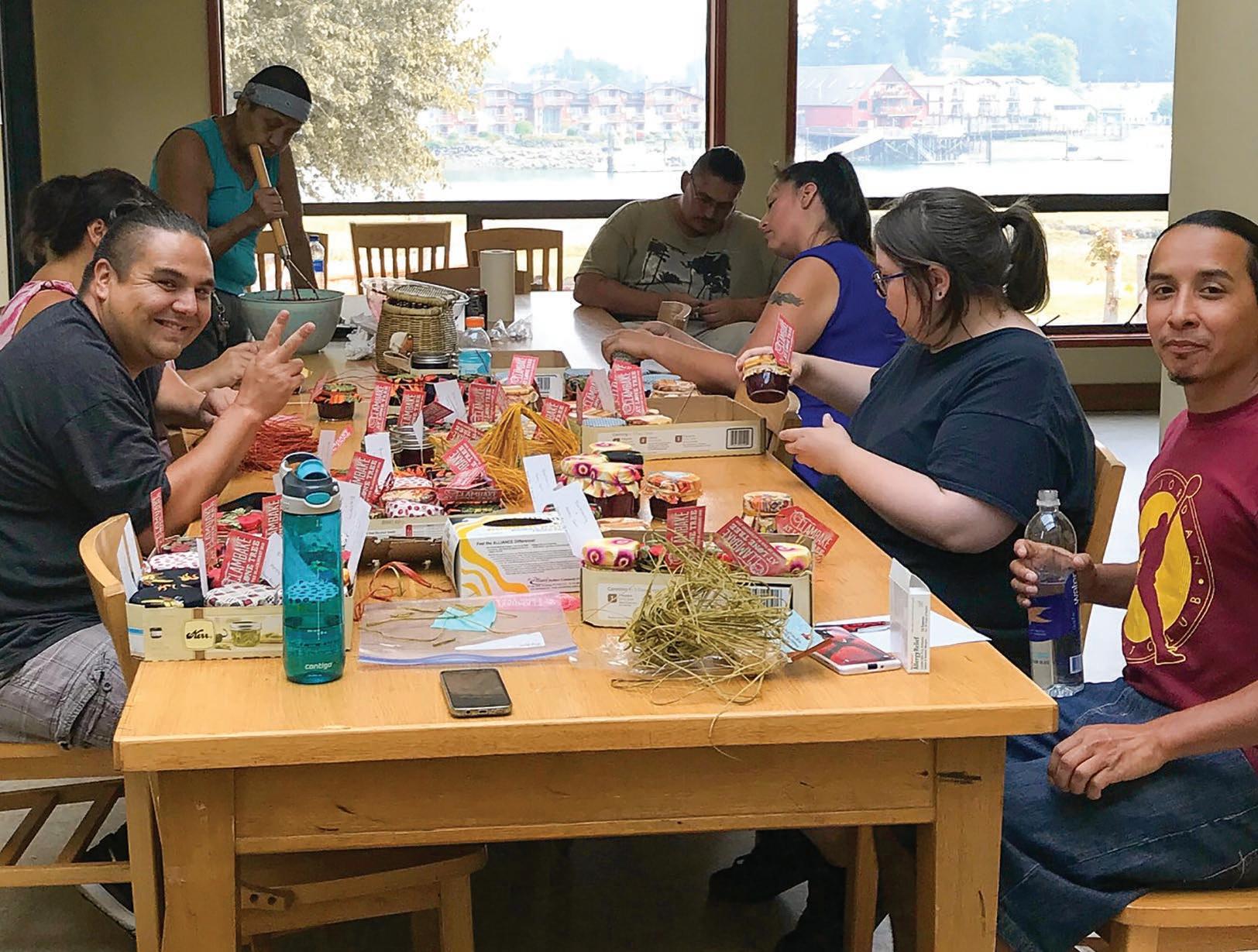
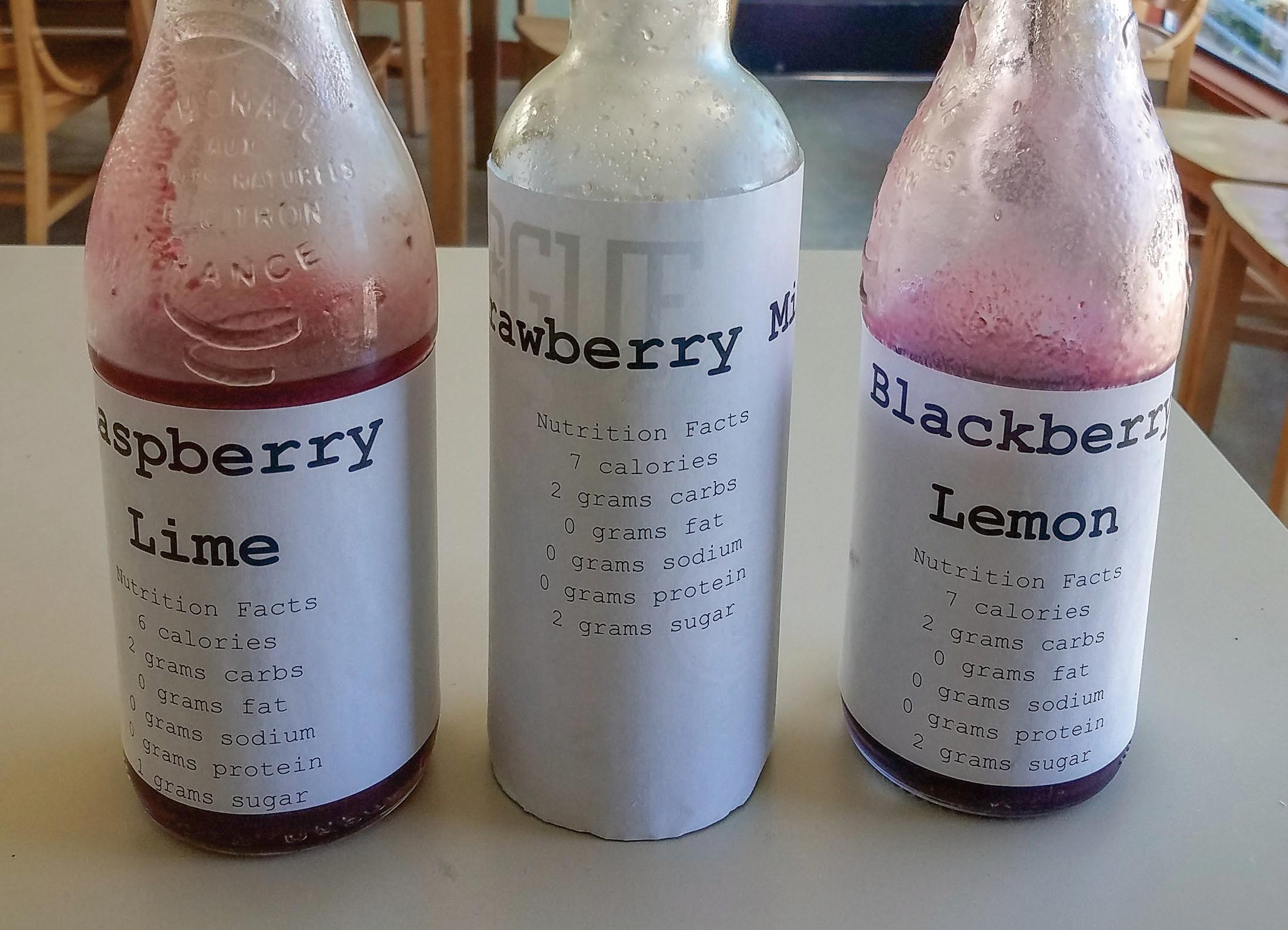
Salmonberry Shrub Drink and Salve Workshop
Much of the information provided in this workshop was created by Elise Krohn, a gifted herbalist and author of Wild Rose and Western Red Cedar. Elise blogs about plants and medicines at wildfoodsandmedicines.com.
In a large kitchen space, place the harvested plants and salmonberries on the counter. Use the provided plant cards to ensure all plants are correctly identified. Clean all plants to remove dirt and debris.
[Optional] On the counter, show five bowls. Four should be labeled with the name of a commercially available drink, and contain the amount of sugar (in grams) that is found in a single serving. The fifth bowl should be labeled “salmonberry shrub drink” and contain the amount of sugar found in a single serving (the same size as a commercially available drink). Use this visual to demonstrate the difference in sugar content between using traditional foods to create a drink, versus purchasing a commercially available drink that is high in sugar.
Discuss the health benefits of removing sugary drinks from the diet, include increased energy and decreased inflammation. High sugar content drinks should be avoided as they contribute to weight gain, obesity, and diabetes. The salmonberry drink is a tasty, healthy alternative to commercial drinks. These recipes are a modern take on a traditional Coast Salish beverage. In her ethnography of the Puyallup and Nisqually people, Marian Smith noted that the people would mash the salmonberry fruit to a pulp, and allow the pulp to ferment for about 7-10 days, making a fizzy, non-alcoholic beverage.
The healing salve uses traditional plants to reduce inflammation after injury, such as cuts, scrapes, bruises, and rashes.
After a brief introduction, the group will make salmonberry shrub and salve by following the recipes included in this chapter. An idea for larger groups is to break them into smaller ones and set up two stations and two salve stations. This may require additional facilitators.
13 Moons workshop
Photo: Myk Heidt
Moon of the Salmonberry signals the start of berry season and shrub-making for healthy spring drinks.
Photo: Myk Heidt
Salmonberry-Honey Shrub
Shrubs are vinegar based plant extracts that are sometimes sweetened. Adding about 1 tablespoon of a shrub infusion to fizzy water is a refreshing drink and low-sugar alternative to sodas. Infusing plants in vinegar preserves and enhances their nutritional content. These recipes can be used with other berries, such as raspberries, huckleberries, or blackberries.
Ingredients and Supplies
• 4 half-gallon Mason jars
• 16 8-ounce swing top bottles
• Labels
• 32 cups (2 gallons) salmonberries
• 8 cups distilled white or apple cider vinegar (preferably Bragg’s)*
• 2 cups clover or other flavored honey of choice
Instructions
Measure 8 cups of salmonberries into bowl, mash and pour into Mason jar. Pour 2 cups of the vinegar over the salmonberries, ensuring that the berries are completely submerged in the vinegar. Shake or stir gently, cover with a coffee filter or cloth and secure with a ring or rubber band. Let sit in a cool, dark spot for two weeks, or until the berries have given up most of their color to the vinegar. Strain off the berries, squeezing out the reticent juice. Add honey to taste (1/4–1/2 cup per batch).
Bottle and label in 8 oz. swing top jars. To use, add about 1 tablespoon to one cup of iced seltzer water. Shrubs should be refrigerated and keep for about 6 months.
*White vinegar will highlight the color of the fruit, while a live apple cider vinegar will make a more nutritious shrub.
Makes about 16 8-ounce bottles
Salmonberry Simple Syrup
Fruit infused simple syrups added to fizzy water are another lower sugar alternative to sugary drinks. Simple syrup is usually made with a 1:1 ratio of sugar to water. This recipe uses Stevia instead, and does not heat the fruit to make the infusion, resulting in sugar-free syrup that is more nutritious.
Ingredients
and Supplies
• 3 1-quart Mason jars
• 16 8-ounce swing top bottles
• Labels
• 12 cups salmonberries
• 4 1/3 cups Stevia
Instructions
Boil 12 cups water, add Stevia and stir until dissolved. Take off heat, allowing mixture to cool until warm to touch. Meanwhile, measure 4 cups of salmonberries into bowl, mash and pour into Mason jar. Pour 4 cups of the cooled simple syrup over the salmon berries. Shake or stir gently, cover and seal with canning lid and band. Let sit at room temperature for 24 hours, shake and refrigerate for a day or two. Strain off the berries, squeezing out the reticent juice. Bottle and label in 8 oz. swing top jars. To use, add 1-2 tablespoons to one cup of iced seltzer water. Simple syrups should be refrigerated and keep for about 1 month.
Makes about 16 8-ounce bottles
Healing Salve
Ingredients
and Supplies
Use equal parts of any of the following infused oils, for a total of 2 cups of oil:
• Calendula flower
• Comfrey leaf
• Plantain leaf
• St. John’s wort flowers
• Yarrow flowers
• 3–4 ounces beeswax
• Lavender essential oil
• Vitamin E oil
• 16 1-ounce jars
• Labels for jars
Instructions
Heat oil on low in a double boiler until warm, add beeswax and stir until melted. Allow the oil-beeswax mixture to cool for about five minutes. Stir in ¼ teaspoon each of lavender and vitamin E oil. Pour into salve containers and cover immediately. Label jars with ingredients, date and uses. Use for cuts, scrapes, dry or chapped skin, bruises, diaper rash, etc.
Makes about 16 1-ounce jars of salve
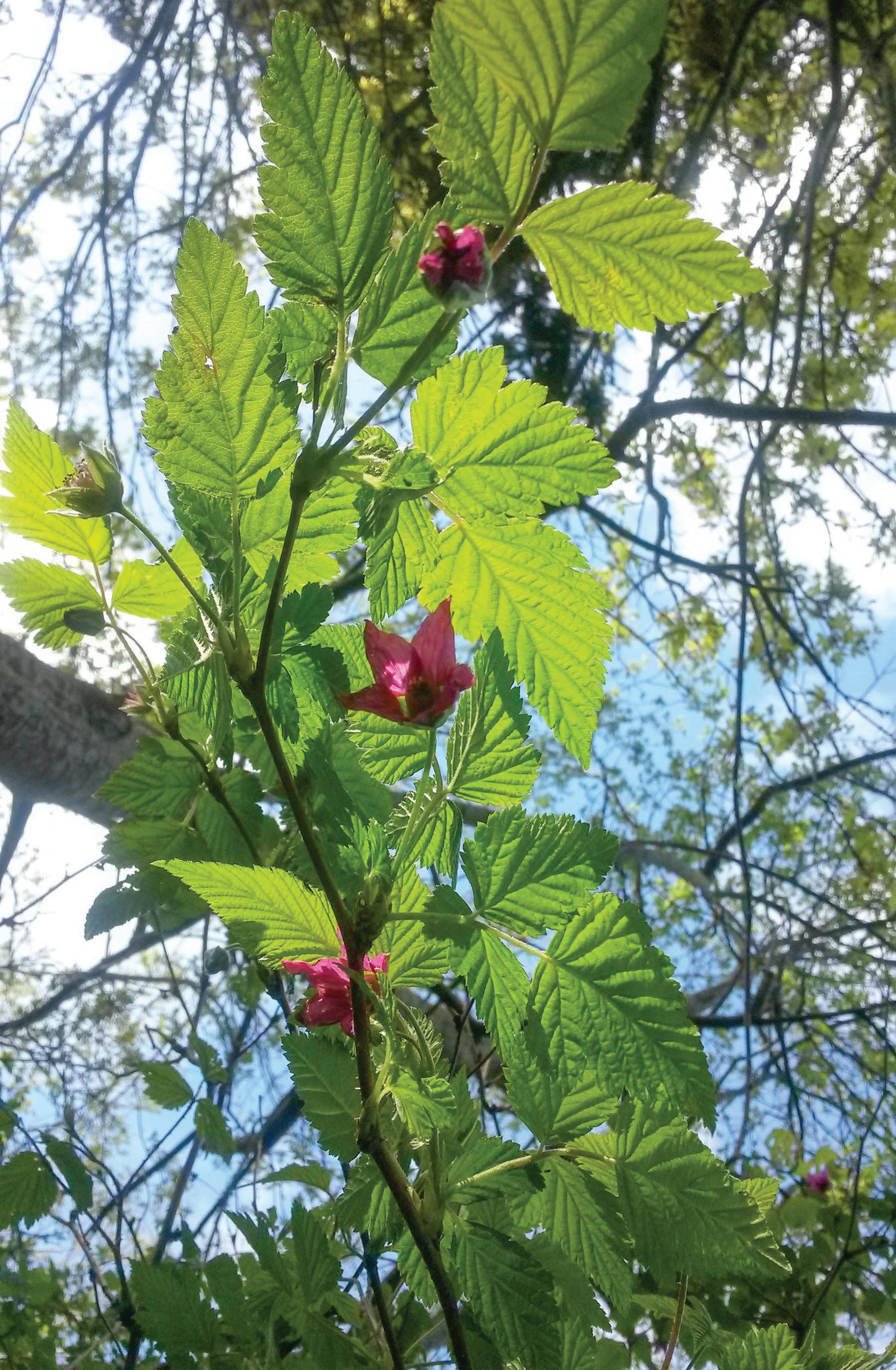
Ripening salmonberries are an indicator that salmon runs are about to begin.
Photo: Myk Heidt
Herbal-Infused Oils
Calendula
This beautiful yellow flower is easy to grow. Calendula infused oil is helpful for soothing irritated skin, for promoting wound healing, and for treating diaper rash and fungal skin infections. It is the most popular plant in children’s herbal skin preparations because it is healing and gentle on sensitive skin.
Comfrey
Comfrey is a powerful healing herb that helps to stimulate tissue regeneration including skin and bone injuries. The leaves can be made into a poultice, compress, or an infused oil, which is deep green. However, it is difficult to infuse oil with fresh leaves because they are so full of water. The leaves should be dried for at least a day, cut finely, and then covered in oil. It is recommended that the leaves are gently cooked in a double boiler for a few hours to remove water, then placed in a jar for a couple of weeks.
Plantain
Also called frogleaf, plantain is said to have the ability to draw out infection and seal wounds. The leaves are often used as a poultice, but the oil can also be used as a topical healing remedy.
St. John's Wort
This beautiful red flower oil is the number one remedy for surface nerve pain, bruises, and mild burns. It is also helpful for tendinitis and varicose veins, and is anti-infectious, especially against staphylococcus aureus. The fresh buds and flowers are gathered in June, wilted slightly, and crushed in a mortar and pestle and covered with oil. The magnificent red color of the buds comes out almost immediately when infused in the sun.
Yarrow
The flower and leaf of yarrow are used in first aid to stop bleeding, cool down inflammation and help treat infection. Yarrow is a common ingredient in healing salves for all of these reasons. It is best gathered when the flowers are in full bloom and can be infused in the sun or gently on the stove top.
Carrier Oils
Apricot Oil
Apricot oil is easily absorbed by the skin, and odorless. It keeps well and also contains a small amount of vitamin E.
Castor Oil
Castor oil is a clear, odorless, very sticky oil that has its own healing properties. It is used to treat burns, abrasions, cuts, and skin disorders.
Grapeseed Oil
Grapeseed oil comes from the seeds of wine grapes. This light and odorless oil is an excellent choice for people with nut allergies and is high in vitamins, minerals, and protein. It is inexpensive and is often used as a lotion or massage oil base. It is very high in antioxidants that prevent rancidity and cellular damage.
Olive Oil
Olive oil is as excellent for your skin as it is to eat. Because it has such a long shelf life, it is the oil of choice for infusing herbs. It has antioxidant properties and is high in vitamins, minerals, and protein. It is a heavier oil, but it is highly moisturizing and penetrating to the skin.
Essential Oils
Lavender Oil
Lavender oil is anti-inflammatory, anti-microbial, and is healing to the skin. It also soothes the nerves and eases insomnia and anxiety.
Vitamin E Oil
Vitamin E oil is used to prolong the shelf life of infused oils, and has anti-oxidant properties.
Knowledge Transfer
• Invite elders to participate in the activities.
• Ask participants to name at least one type of plant used in the salve and explain why it was included (what are its medicinal properties?)
• Ask participants to describe one benefit of a diet that is low in sugar.
• Ask participants to explain what an ecological indicator is, and how people use them to organize their fishing, hunting, and harvesting activities.
Guiding Questions and Topics of Discussion
• Have you picked these berries before?
• How have you used them?
Tying it all together
• Connections to other activities
› This activity takes place in the same location as the spring greens harvest that happens in the Moon When Frog Talks.
• Relationship to environmental health
› Our physical health is connected to our natural environments (i.e., the availability of sugar was lower in the past versus today).
› The natural world provides the food we need to be healthy and medicines to help us heal.
› A traditional Coast Salish diet includes foods that are good for our physical and spiritual health. Many of these foods are low in sugar, for example fruits and berries, and help reduce inflammation. Traditional foods can be used in place of foods found in a modern Western diet.
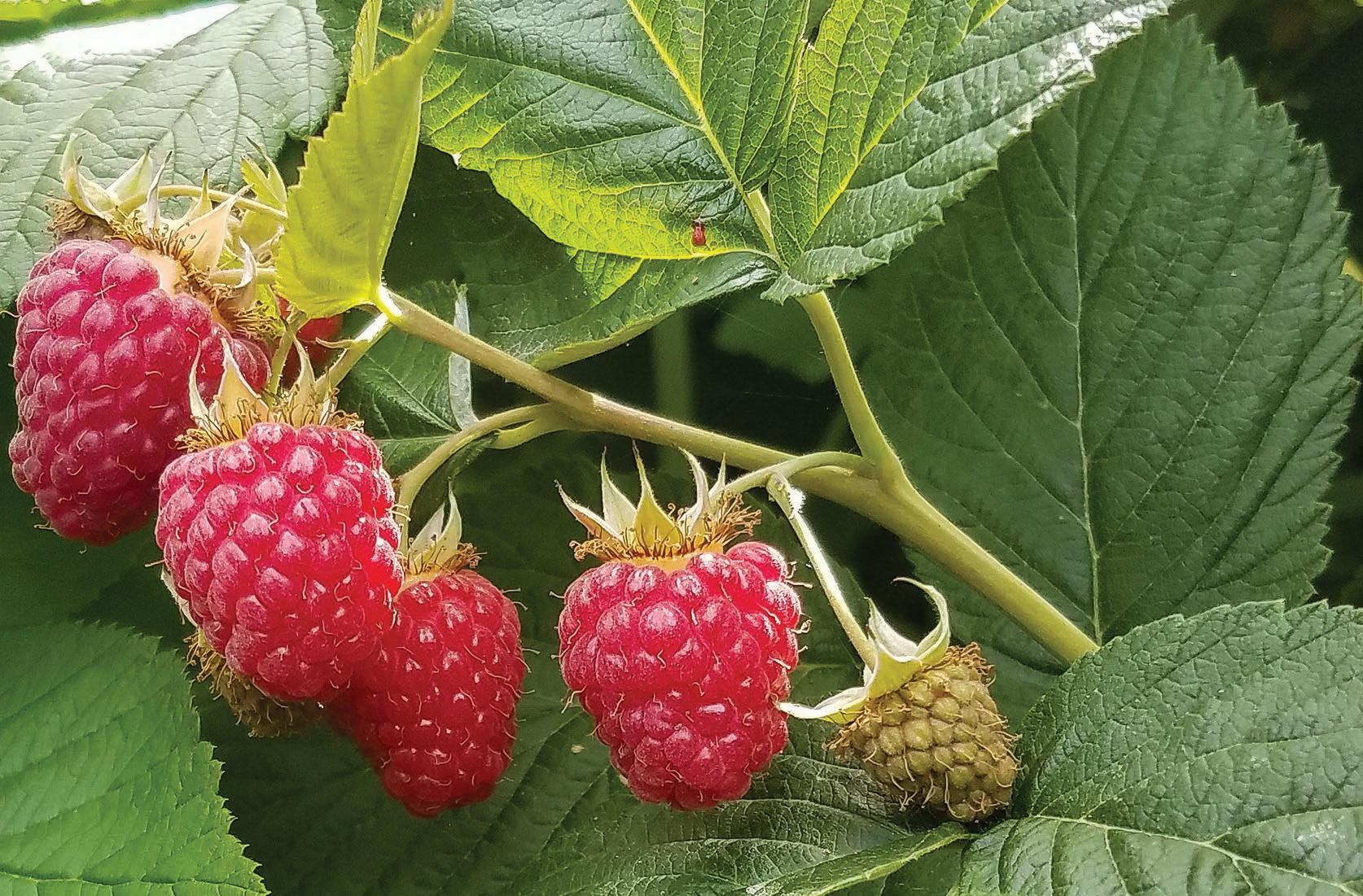
Top: Salmonberry, thimbleberry, blackberry, and raspberry are members of the rose family. Bottom: Nootka rose Photos: Myk Heidt
Digging Deeper
• Delve into ecological indicators that are specific to Swinomish.
• Explore the effects of climate and other environmental changes on ecological indicators.
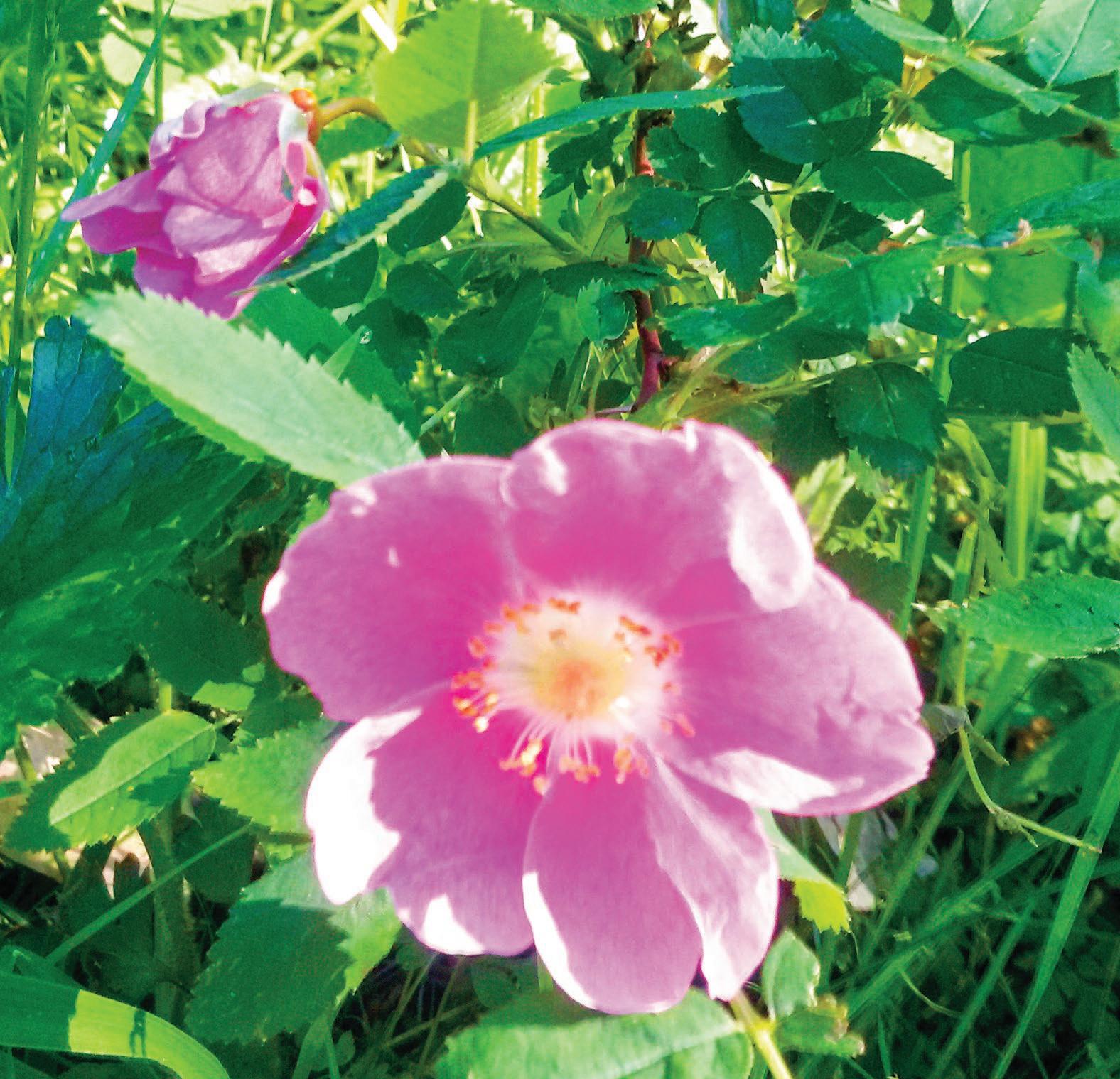
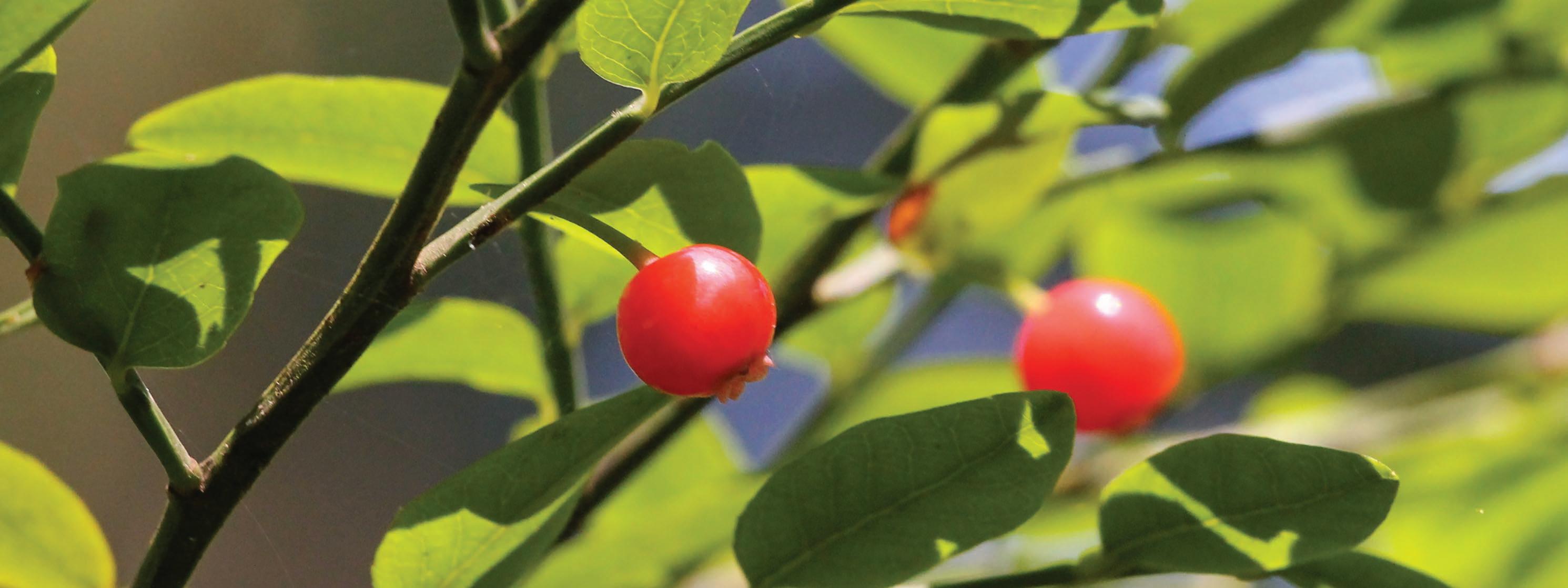
Notes to Educators and Additional Resources
• Pacific Northwest Plant Knowledge Cards. Vancouver Island and Coastal Communities Indigenous Food Network. Indigenousfoodsvi.ca/pacific-northwest-plant-knowledge-cards/
• It’s Berry Season: wildfoodsandmedicines.com/539/
• National Phenology Network: usanpn.org/natures_notebook
• Salmonberry nutrition and processing, UAF Cooperative Extension: uaf.edu/files/ces/publications-db/catalog/hec/ FNH-00119.pdf
• Swainson’s Thrush bird call: birdnote.org/show/salmonberry-bird
• Traditional Phenological Knowledge: ou.edu/cas/botany-micro/ben/lantzturner-revised.pdf
• Raven and Salmonberry (Tammy Cooper-Woolrich): vimeo.com/202328275
• Lantz, T.C. and Turner, N.J., 2003. Traditional phenological knowledge of aboriginal peoples in British Columbia. Journal of Ethnobiology, 23(2), pp.263-286.
• Turner, N.J., 2008. The Earth’s Blanket: Traditional Teachings for Sustainable Living. DM Publishers.
• Krohn, E., Wild Rose and Western Red Cedar: The Gifts of the Northwest Plants. third printing ed. Olympia, WA: Northwest Indian College.
• Krohn, E. Tend, Gather and Grow. 2017. goodgrub.org/tend-gather-grow
• Kuhnlein, H.V. and Turner, J.J. (1991) Chapter 3: An overview of the nutrient value and use of plant foods by Indigenous Peoples in Traditional Plant Foods of Canadian Indigenous Peoples: Nutrition, Botany, and Use (Vol. 8). Taylor and Francis.
Red huckleberries
Photo: iStock by Getty Images, Randimal
Activity 2: Clams, Moons, and Tides Workshop
Participants learn how to identify clam species and why clams are important to the Swinomish people in this activity. It includes a trip to a local beach with clam habitat where participants learn about tides and harvest practices. Youth will also find and choose empty clam shells to take with them and paint designs on. Participants may then present a painted shell to an elder as a gift and ask if the elder would share a story. The clam art project is from the Mother’s Roots Curriculum created by Tanisha Gobert in partial fulfillment of her master's degree in Environmental Education at Western Washington University (2017). The full activity is described by Tanisha on the next page.
Time: 2-3 hours
Audience: 4th-12th grade
Setting: Outdoors (field trip); indoors (clam painting)
Moon of the Salmonberry
Moon of the Salmonberry
Moon of the Salmonberry
Moon of the Salmonberry
Teaching Objectives
Moon of the Salmonberry
Moon of the Salmonberry
In this activity, participants will learn:
Moon of the Salmonberry
• The different types of shellfish harvested by Coast Salish people
Moon of the Salmonberry
• The lifecycle of shellfish
Moon of the Salmonberry
Moon of the Salmonberry
Moon of the Salmonberry
• The importance of shellfish to Swinomish health
Salmonberry
Moon of the Salmonberry
Salmonberry
Salmonberry
Moon of the Salmonberry
Salmonberry
Moon of the Salmonberry Salmonberry
Moon of the Salmonberry
Salmonberry
Summer Clam
Lushootseed Words
Salmonberry
Summer Clam
Summer Clam
Moon of the Salmonberry
• Moon of the Salmonberry:
Summer Clam
• Summer:
Little Neck Steamer Clam
• Clam:
Summer Clam
Summer Clam
Little Neck Steamer Clam
Salmonberry
Little Neck Steamer Clam
Little Neck Steamer Clam
Summer Clam
Butter Clam
Butter Clam
• Little neck steamer clam:
Little Neck Steamer Clam
Little Neck Steamer Clam
Butter Clam
• Butter clam:
Little Neck Steamer Clam
Cockle Clam
Butter Clam
Cockle Clam
Summer Clam
Butter Clam
• Cockle clam:
Cockle Clam
Butter Clam
Butter Clam
Cockle Clam
Horse Clam
• Horse clam:
Little Neck Steamer Clam
Horse Clam
Cockle Clam
Horse Clam
Cockle Clam
• Oyster:
Cockle Clam
Horse
Oyster
Horse Clam
Oyster
Butter Clam
Oyster
Horse Clam
Oyster
Horse Clam
Materials
Oyster
Oyster
Cockle Clam
Oyster
• Paint and paintbrushes
Horse Clam
• Coast Salish stencils
Preparing clams for the Moons and Tides Workshop on Kiket Island
• Clam shells
Oyster
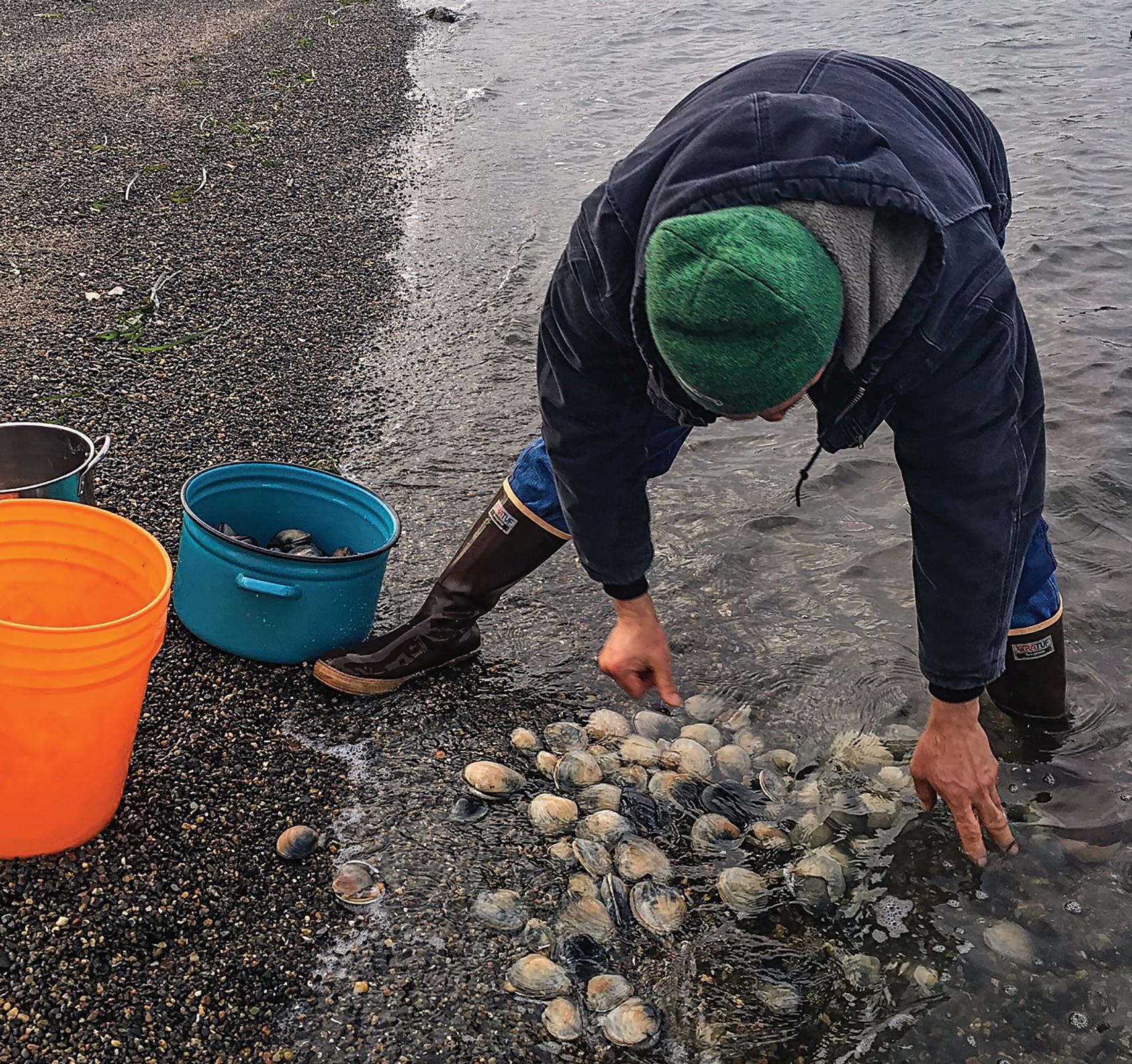
Photo: Tanisha Gobert
Activity Description
Tanisha: This workshop took three days of preparation and cooperation from several community members who came forward to help when they heard about the event. I worked with a community member who is familiar with tides and clams to choose the best low tide and coordinated with Swinomish Youth Center staff regarding a time the youth could come to the beach. The time was scheduled so kids could enjoy a healthy, cultural meal before heading home at 6 p.m. A knowledge keeper also offered to assist. As he worked with us, he shared how his knowledge of moons and tides was handed down to him. "The fuller the moon the lower the tide," he said.
Day 1: We developed a plan by looking at tides, prepped for digging, preselected areas to dig, prepared our gear, and obtained a tribal shellfish permit.
Day 2: We cut and chopped wood and dug clams. We let the clams spit overnight.
Day 3: We refreshed the saltwater for clams to continue spitting. Another community member helped bring wood to the beach and cut willows for marshmallow sticks. Meanwhile, I made clam soup by layering corn on the cob pieces, potatoes, onions, and clams. We cooked the soup over a fire at the beach! I went back to my house to make fry bread and hot chocolate while it was cooking.
Another facilitator suggested using big marshmallows to illus trate the size of the sun and the smaller marshmallows to represent the earth and moon, and when they are all lined up, they influence the low tides. Great group learning!
We read the Swinomish Christmas Clams book out loud while the youth were trying the clam soup. Later, some adults talked about their memories of using lanterns when they were young.
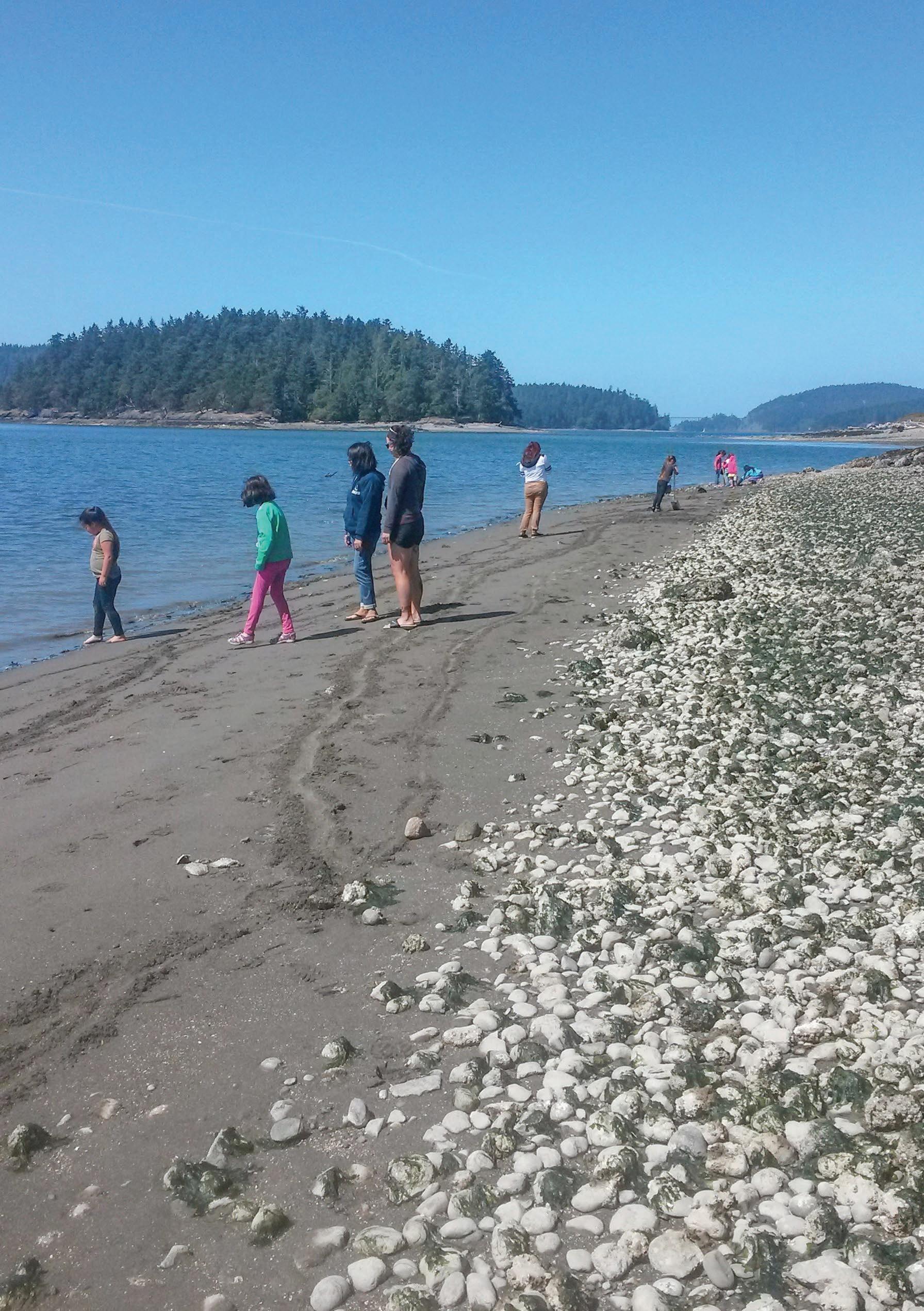
to find shells.
Walking on the beach at low tide is good time
Photo: Myk Heidt
Knowledge Transfer
• Knowledge transfer is directly embedded in this activity, as it is suggested that participants gift an elder with a painted clamshell and ask if the elder would share a story.
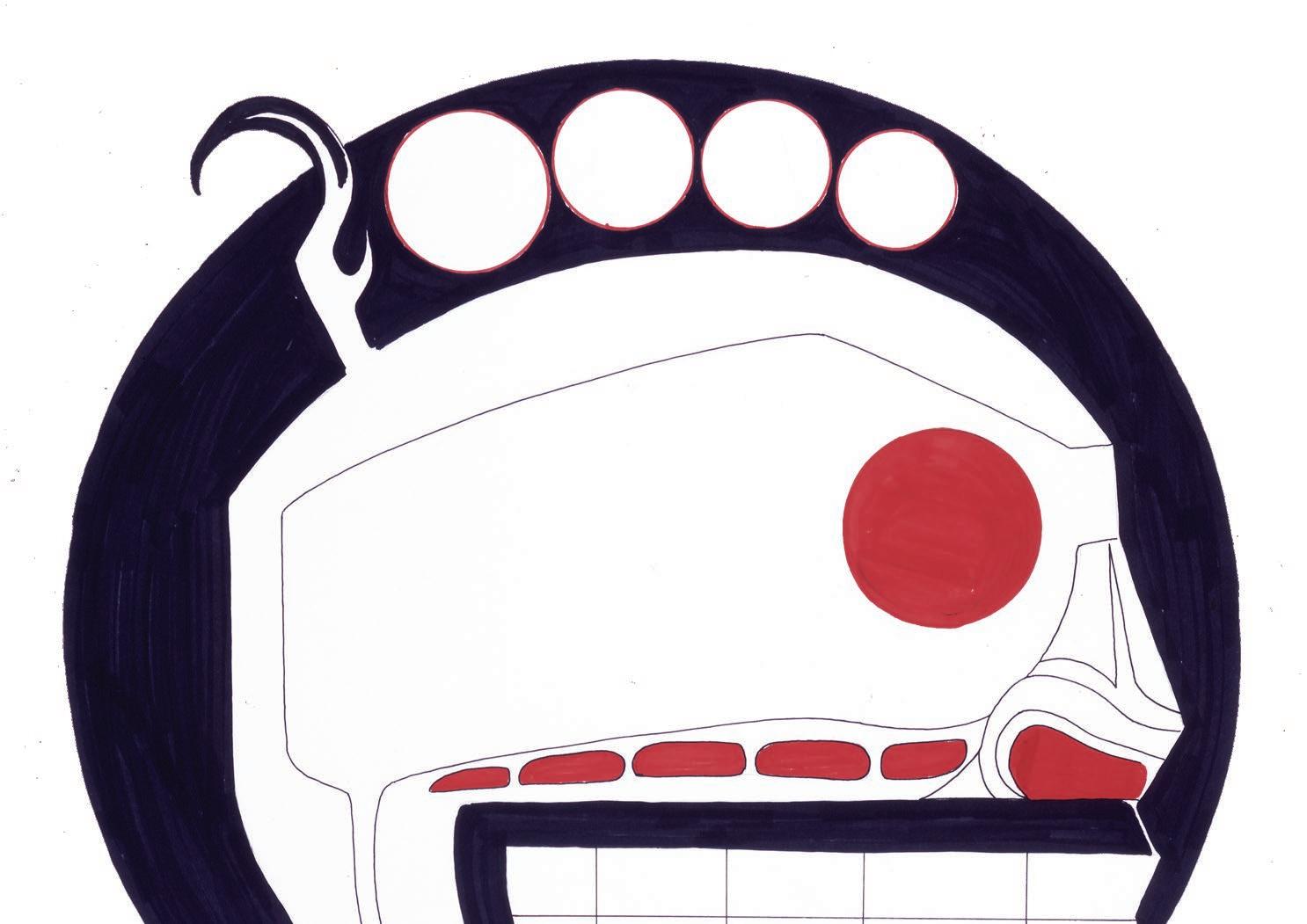
Guiding Questions and Topics of Discussion
• Have you eaten clam soup before?
• What clams can you recognize?
• Why do we eat some clams but not others?
• Are there times when it isn’t safe to eat clams? Why is that?
Tying it all together
• Connections to other activities
› Shellfish are an important food to the Coast Salish people. This food is highlighted in Moon of the Salal Berry and Moon of the Sacred Time.
› This activity is repeated in the Moon of the Sacred Time.
› This activity could highlight the use of ironwood to help cook the clams. Ironwood tools are the basis of the Moon of the Whistling Robins activities.
• Relationship to Indigenous health
› This activity places equal importance on knowledge transfer, connection to elders, nutritional value of traditional foods, and Coast Salish designs. As a result, this activity demonstrates commitment to the STEAM (Science, Technology, Engineering, Art and Math) model, which underlies the principles of Indigenous health.
Digging Deeper
• The workshop takes two additional days of preparation. Where time allows, have youth help with the clam harvest to learn about the different size and shapes of the air holes and what types of clams are best to harvest.
• Talk about the importance of clams for the Swinomish people since time immemorial. Tell the cosmology story of the boy and the clam found in Astrida Onat’s work: Onat, A.R.B., 1993. The significance of shellfish to the peoples of the Swinomish Indian Tribal Community past and present. Submitted to U.S. District Court, Western District of Washington, August 1995.
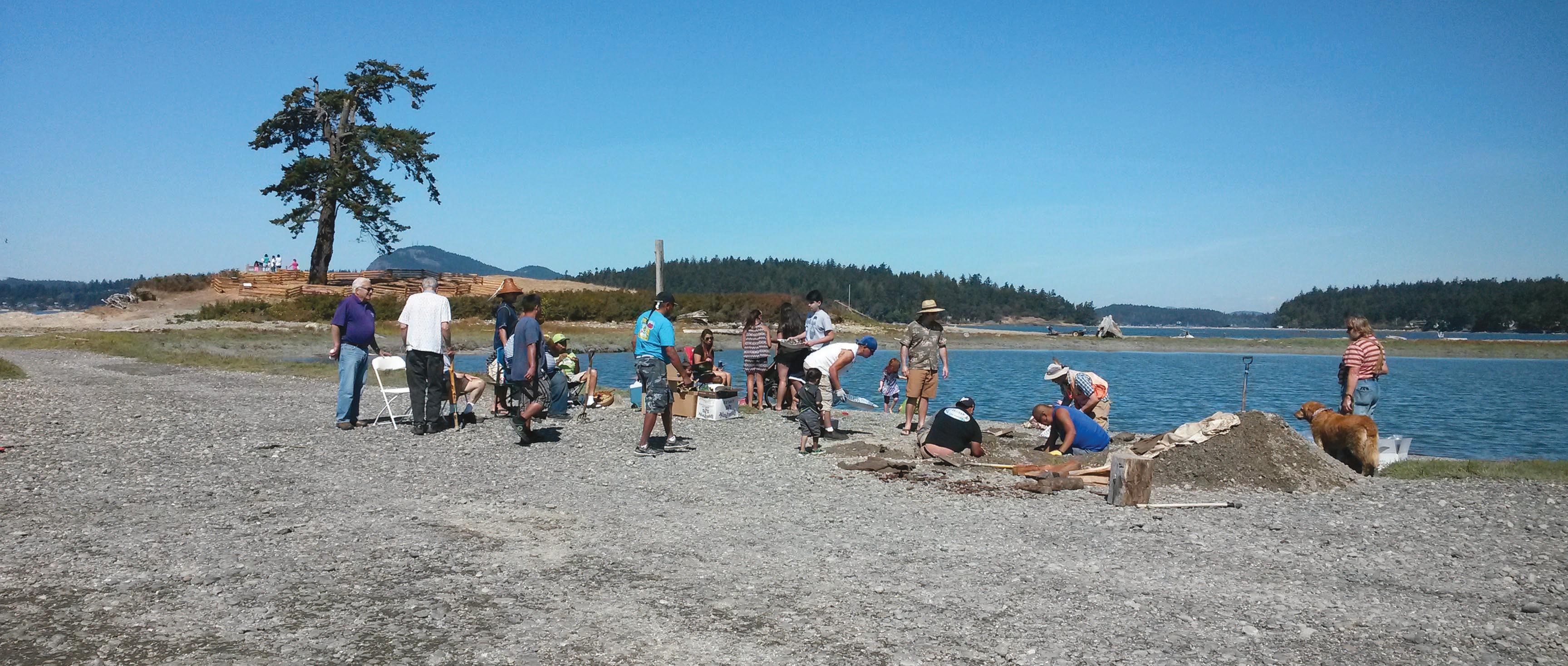
Notes to Educators and Additional Resources
• Gobert, T. 2017. Mothers' Roots Curriculum. Thesis project in partial completion of a Masters of Education degree, Western Washington University, Bellingham, WA. cedar.wwu.edu/wwuet/557/
• Mitchell, R. 2012. Christmas Clams. Published by the Swinomish Indian Tribal Community. Copies are available through the Swinomish Department of Environmental Protection upon request.
• The gossiping clams (Roger Fernandez) vimeo.com/216035921
Community clambake at Lone Tree
Photo: Myk Heidt
Moon of the Blackberry
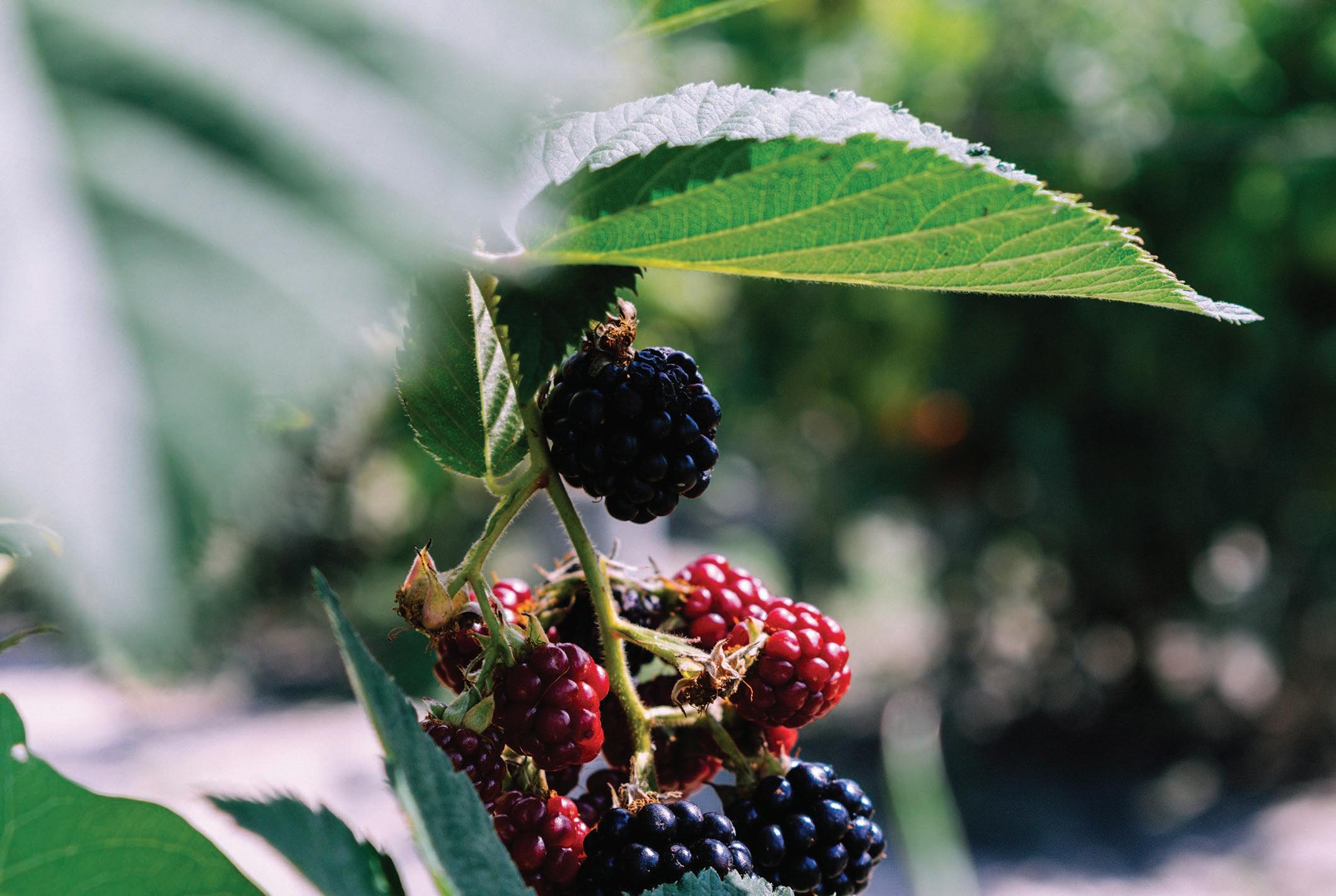
MOON OF THE BLACKBERRY
Much of July is the Moon of the Blackberry. Many berries are now ripe, including blackberries. Berries are eaten fresh or dried for winter use. Around this time, and sometimes earlier, the sap in cedar trees stops running, signaling the time to harvest the bark. The bark has many uses including making materials for shelter, clothing, tools, and transportation. Some examples of cedar items are bentwood boxes, ropes, and hats.
Sockeye salmon fishing is reaching its peak. Every second year during this moon, humpback salmon, also called humpies or pink salmon, start running and continue into the next two moons. Humpies are captured in pounds, weirs, and with scoop nets and are then smoked hard. Shellfish harvest and curing continues.
Low-sugar blackberry jam and salmon will be highlighted in this chapter. For the jam-making session, the nutritional value of homemade versus commercial jams will be compared to emphasize the healthy aspects of a traditional diet. For the salmon activity, the importance of water quality and its connection to the health of salmon and people will be discussed.
Activity 1: Berry Picking and Healthy Jam Making
This activity is taken from the “Growing Our Own” curriculum (Ward and Willup 2016). This activity outlines the process of making low-sugar jam from start to finish, beginning with identifying and harvesting blackberries and ending with finished, canned jam. It also highlights the benefits of a traditional diet by evaluating the preservatives (i.e. sugars and salts) used in modern versus traditional foods.
During a berry picking field trip, help participants identify between native blackberry, also known as trailing blackberry, and invasive species. Both are edible, with the native blackberry having smaller, yet often sweeter, berries. Plant identification cards can be used as teaching tools. Where possible point out other berry bushes such as gooseberry, salal berry, huckleberry, and salmonberry.
Following this berry harvest, lead participants in making black berry jam in a large kitchen. To begin, discuss the benefits of homemade jam, specifically the option of low-sugar content.
Time: 2 hours
Audience: 5th-8th grade
Setting: Outside (berry picking); inside (jam making)
Teaching Objectives
In this activity, participants will learn:
• About the types of berries used to make jam
• The medicinal uses of berries
It may be helpful to provide examples of commercially available jam in order to compare the difference in sugar content with that of homemade jams.
Describe the canning process, including the use of pectin. If possible, bring in a guest speaker who can talk about traditional foods that were used before commercially available pectin. For example, early apples (unripe) can be used as a source of pectin.
• Healthier jam making in comparison to modern recipes or store bought jams
• How sugar impacts health (diabetes, heart disease)
• The concepts of jamming/canning
• The amounts and health impacts of preservatives put into food and healthier options for preserving
While the jam is setting, have participants create labels for the jam utilizing the Lushootseed word for “native blackberry.” Have participants taste the homemade jam in comparison to the commercial jam once the jam is set.
Moon of the Blackberry
Moon of the Blackberry
Moon of the Blackberry
Native Blackberry
Visit potential berry patches prior to this activity to determine if there is enough fruit available to make jam. If there is a shortage, purchase additional to ensure everyone can take a jar home.
To pick berries
To pick berries
Salmon
• To pick berries: Materials
To pick berries
Salmon
• Containers for berry picking (or purchase berries if needed)
Salmon
King, or Chinook, salmon
• Gloves
King, or Chinook, salmon
King, or Chinook, salmon
• Canning equipment: jars, canner, bowls, funnel, long spoon, pot holders, towels
• Pomona’s pectin
Silver salmon Dog chum salmon
Silver salmon Dog chum salmon
Silver salmon Dog chum salmon
Sockeye salmon
• Sweetener of choice (i.e. honey, raw sugar, agave)
Sockeye salmon
• Store-bought jam examples to compare sugar content and preservatives used
Sockeye salmon
Humpback salmon
Humpback salmon
Humpback salmon
Knowledge Transfer
• Invite an elder to participate in the activities.
• Ask participants to share stories of cooking with their families. Ask them what they have learned from family members about berries and preserves.
• Working in groups, have participants discuss where berries can be found on the reservation, and what type of berries they would most like to eat again.
• Facilitate a discussion about ingredients and compare which ingredients are healthier.
• Discuss and estimate how many jars can be made from the amount of berries collected.
Guiding Questions and Topics of Discussion
• Which jam do you prefer, the one you just made, or the one from the store? Why do you think you prefer one over the other?
• How many jars can be made with the amount of berries picked?
• What are benefits of preserving food?
• In addition to making jam, what are other ways to preserve food? (freeze, dry, pickle)
• Have you ever preserved food with your family before?
• What different ways do you eat jam or jelly?
Tying it all Together
Connections to other activities
• Jams and preserves made during this activity can be used as gifts at the clambake held in the Moon of the Salal Berry and/or served at the harvest meal held in the Moon of the Dog Salmon.
Connection to Indigenous health
• Increased sugar intake is linked to several poor health outcomes, including diabetes and obesity. A traditional diet is low in sugar.
Digging Deeper
• This activity could include a lesson on food safety as it relates to food preservation. Contact the environmental health officer to schedule a class.
• Compare and contrast native wild berries to commercially available ones. Note differences in size and taste. Consider what could make the berries taste different, such as differences in sugar content, use of pesticides or fertilizer, and being grown in artificial climates (i.e. grown out of season).
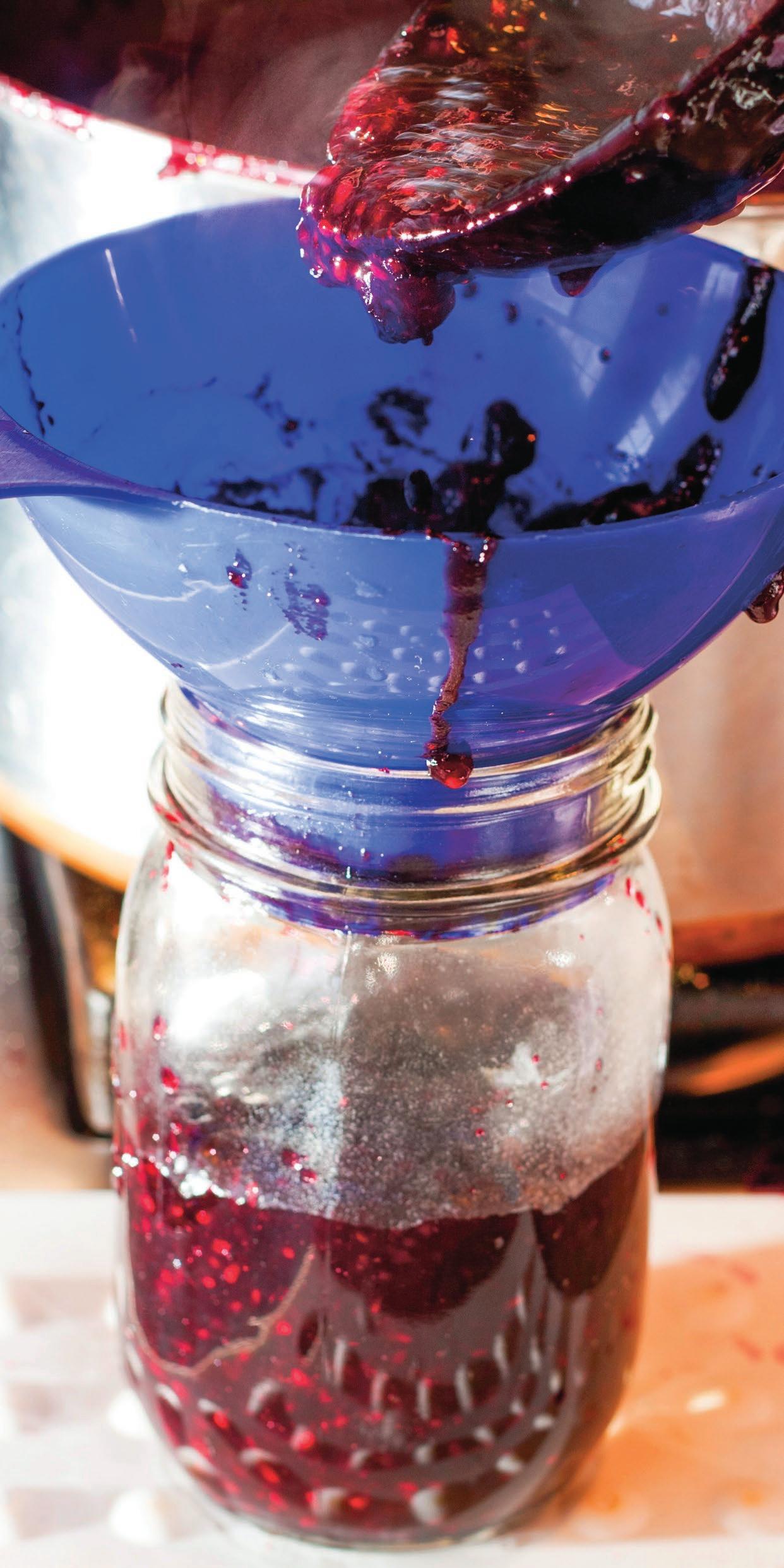
Many community members have a favorite patch of native blackberries they harvest from year after year.
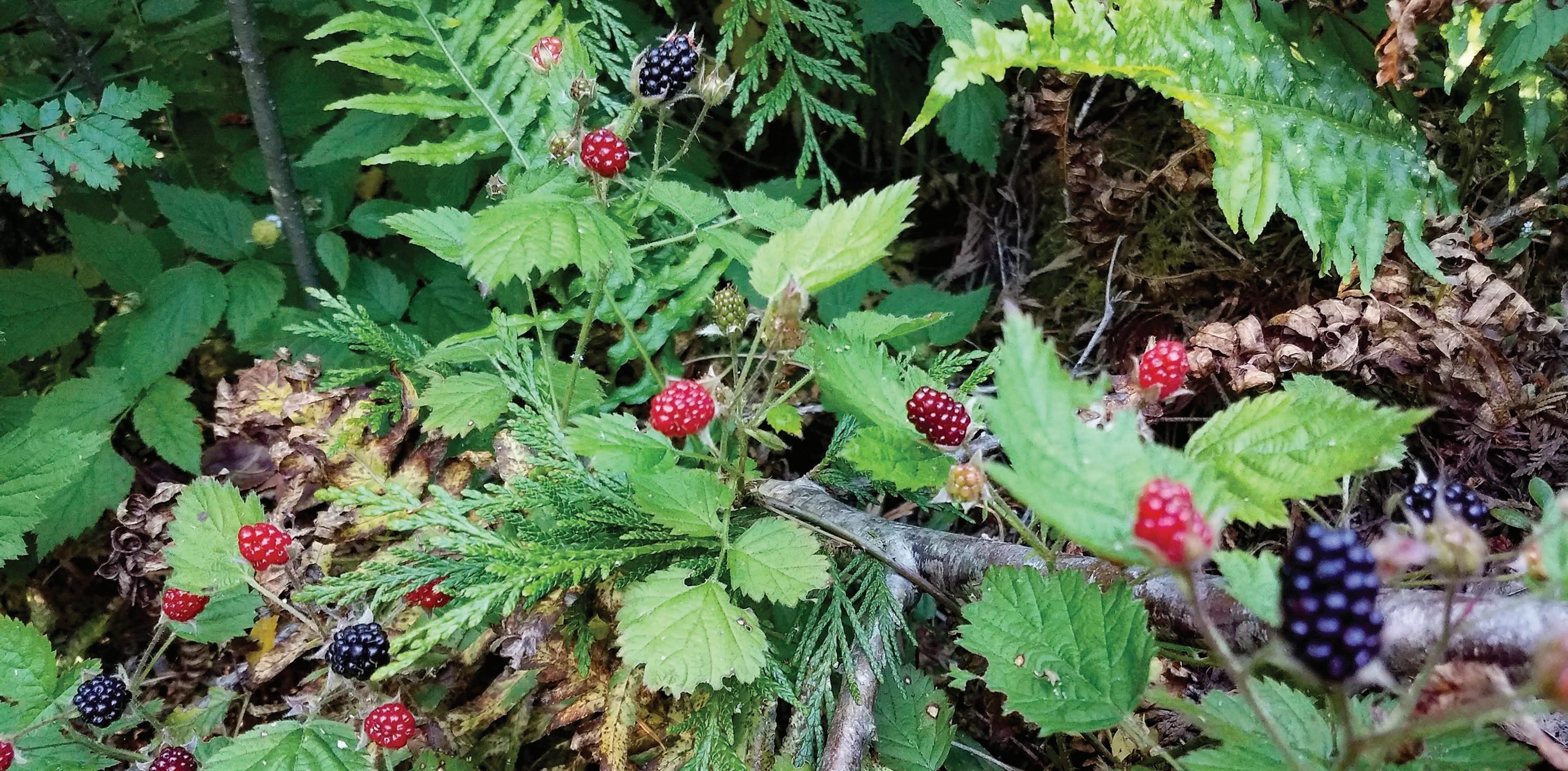
Notes to Educators and Additional Resources
• Krohn, E. and V. Segrest. 2016. Cedar Box Teaching Toolkit. Clean Water teaching tools.
• NOAA’s Saving Salmon curriculum for 5th graders: westcoast.fisheries.noaa.gov/publications/education/allsalmonesunit.pdf
• Swinomish beach seining video: youtube.com/watch?v=M0uos7SO6vU
• Our Ways: Testimonies of the Swinomish Way of Life. The Swinomish Indian Tribal Community’s Sharing Our Knowledge Series, Vol 3. Second Edition, 2011. Edited by T. Mitchell and D. Lekanof.
• Explore the Shadow of the Salmon curriculum and documentary teaching tools, targeted at 8th grade classes. Shadow of the Salmon introduces students to Cody Ohitika, a Lakota Sioux youth, who visits his mother’s relatives in the Pacific Northwest for the first time and learns about its history and environmental legacies. education.wsu.edu/documents/2015/08/shadowof-the-salmon.pdf
• Garibaldi, A. and N. Turner. 2004. Cultural keystone species: implications for ecological conservation and restoration. Ecology and Society 9(3): 1. [online] URL: ecologyandsociety.org/vol9/iss3/art1
Photo: Myk Heidt
Activity 2: Salmon and Water Quality
Working with the Swinomish Department of Environmental Protection, participants will learn about the types of water sampling conducted by Swinomish staff, and the importance of clean water to salmon habitat and spawning. This activity emphasizes what salmon need in a healthy habitat, and also individual choices that we can make to help keep that habitat free of pollution.
Provide an overview of the salmon lifecycle and habitat needs. Vegetation in a riparian zone provides shade from trees (lowering the temperature of the stream, the colder the water the more oxygen it holds). With increased vegetation, there is often an
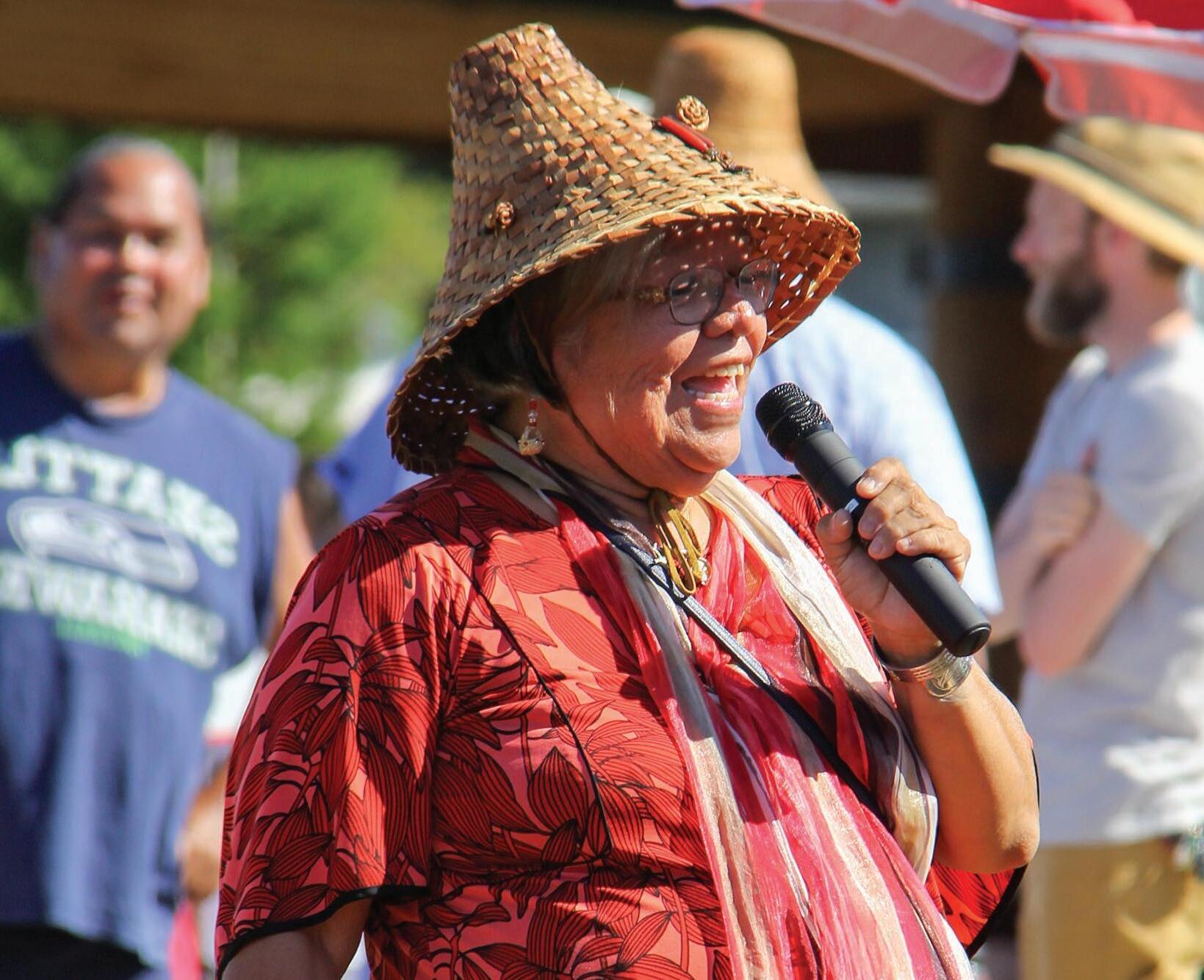
increase in macroinvertebrate life (food for salmon). Roots near stream banks help stabilize the soils and keep them in place, reducing the amount of silt entering the stream which can smother the spawning habitat. Roots also absorb water from rain which is helpful in flood control (from the NOAA Salmon Friendly curriculum).
Provide an overview about pollution from run-off and wastewater (see NOAA Salmon Friendly curriculum). These are examples of non-point source pollution because the “source” of the pollution is difficult or impossible in some cases to determine. Point source pollution might be a smoke stack from an oil refinery — it is one “point” that can be identified.
Take participants to visit an established water quality sampling site on the reservation (e.g., Lone Tree Creek) and give them the opportunity to perform their own water quality tests. Instructions for how to take and analyze water samples are included in a water sampling test kit.
Story: We Rely on Fish
The following story is from Our Ways: Testimonies of the Swinomish Way of Life. It is shared by Swinomish elder and Senator Barbara James, ta-ləq-talə II.
“We truly do rely on fish to keep us going. They’re here today, gone tomorrow, and that is that. When you savor something, and you’re craving something, you want to be able to take care of that need for nourishment for your body. It is a kind of spirituality being handed down to you, flowing through, telling you that’s what’s important for you to eat to be able to take care of yourself; clams, oysters, mussels, shrimp, and prawns, it’s all important. They’ve always told us that you have to take care of those times of blessings. Blessings to the water for the spirit of the water to provide, it’s something that you naturally do, because you are thankful for the return of the water, to give to us, to nourish ourselves.”
Swinomish elder Barb James
Photo: Emma Fox
Time: 1 hour
Audience: 4th-12th grade
Setting: Inside and outside
Moon of the Blackberry
Moon of the Blackberry
Teaching Objectives
Moon of the Blackberry
In this activity, participants will learn:
Moon of the Blackberry
Moon of the Blackberry
Moon of the Blackberry
• The importance of water quality for salmon habitat
• The role of salmon in the food web
Moon of the Blackberry
Moon of the Blackberry
Moon of the Blackberry
• The types of water testing performed by the Swinomish Department of Environmental Protection
Native Blackberry
Moon of the Blackberry
Native Blackberry
Moon of the Blackberry
Moon of the Blackberry
Native Blackberry
Moon of the Blackberry
Native Blackberry
To pick berries
Native Blackberry
To pick berries
• How to take and perform water samples
Native Blackberry
To pick berries
Salmon
Salmon
To pick berries
To pick berries
Salmon
Lushootseed Words
Salmon
To pick berries
King, or Chinook, salmon
Moon of the Blackberry
• Moon of the Blackberry:
Salmon
King, or Chinook, salmon
Salmon
• Salmon:
Silver salmon
King, or Chinook, salmon
Silver salmon
King, or Chinook, salmon
Native Blackberry
• King, or Chinook salmon:
King, or Chinook, salmon
Silver salmon
• Silver salmon:
King, or Chinook, salmon
Silver salmon
Dog chum salmon
To pick berries
Dog chum salmon
Silver salmon
Silver salmon
Dog chum salmon
• Dog, or chum salmon:
Sockeye salmon
• Sockeye salmon:
Dog chum salmon
Salmon
Sockeye salmon
Dog chum salmon
Dog chum salmon
Sockeye salmon
Sockeye salmon
Humpback salmon
Humpback salmon
• Humpback salmon: Materials
King, or Chinook, salmon
Sockeye salmon
Humpback salmon
Humpback salmon
Sockeye salmon
Silver salmon
Humpback salmon
Humpback salmon
• The Indigenous Health Indicators and water teaching tool
Dog chum salmon
• Water sampling test kits (available from carolina.com), bacterial sampling (total coliform), and pH testing
Sockeye salmon
Humpback salmon
• Water samples (drinking water, ocean water, river water)
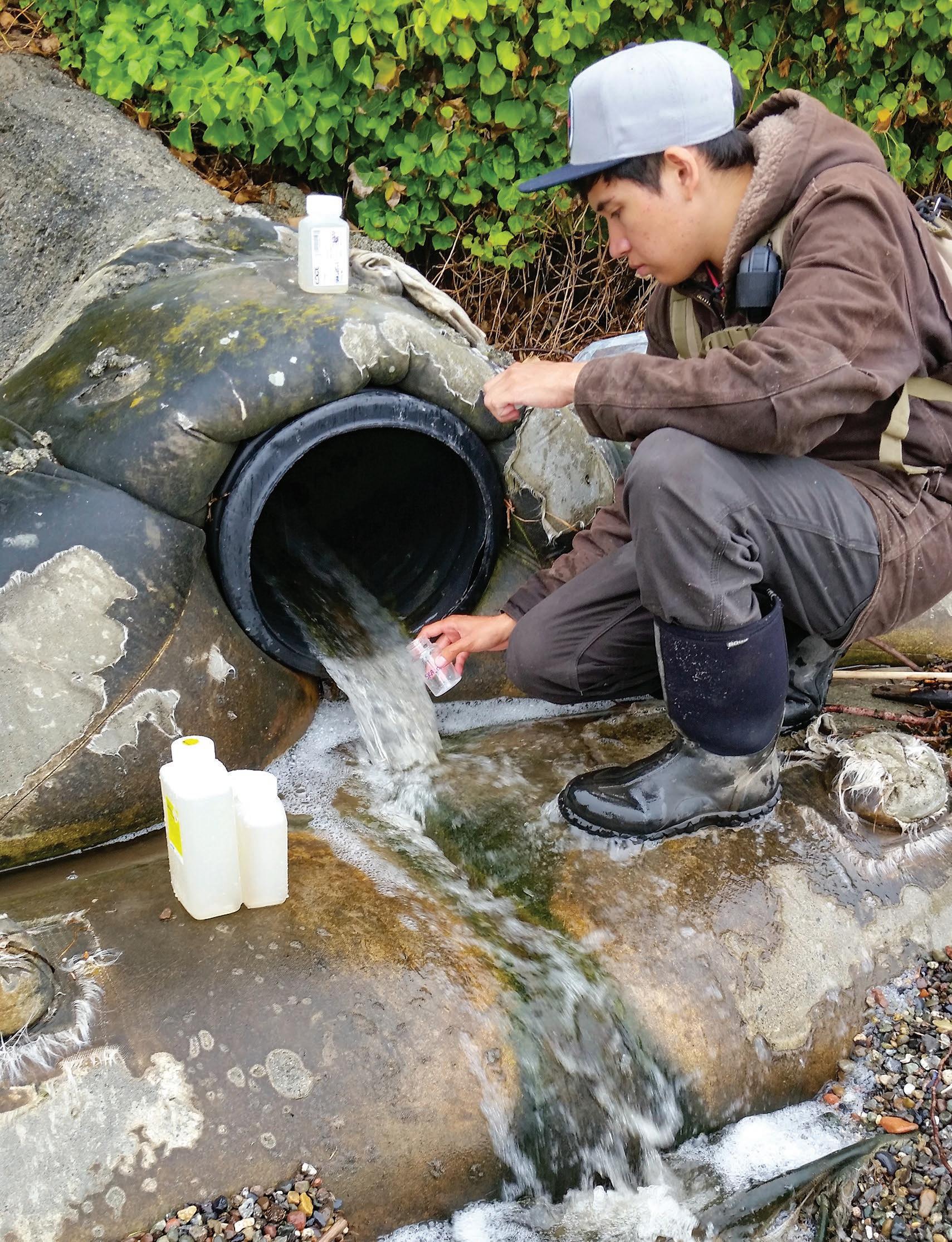
Brendon Kasayuli collects water samples on Snee-oosh Beach
Photo: Lindsay Thomason-Logan
Knowledge Transfer
• Invite an elder to participate in the activity.
• Ask participants to identify the different salmon species that Coast Salish people fish. As they identify the fish, ask them to share what the salmon means to them, their family, and their community.
Guiding Questions and Topics of Discussion
• How do you know if water is safe to drink? Why is water so important to the salmon? To the Swinomish people?
• What does healthy salmon habitat have and not have?
• Why does the Swinomish Department of Environmental Protection test the water?
• How many salmon can you recognize? Have you fished for any of these salmon?
• Have you heard the Lushootseed words for the different kinds of salmon? Have you heard stories about the salmon?
• How is water quality, salmon, and Swinomish health all tied together? (Refer to the Indigenous Health Indicators)
• What are some personal actions that everyone can do to help salmon? (e.g., plant a tree; don’t litter; recycle; purchase products that do not contain harmful chemicals)
• Remind students that everything that goes down a drain ends up in our watershed (streams, lakes, and oceans) where salmon live. Ask them about some of their personal care products and have them consider the world's population and the impact of what goes down our drains. Offer examples of environmentally friendly choices like biodegradables.
Tying it all Together
Connections to other activities
• Clean water as a resource is discussed in the Moon of the Whistling Robins. Clean water for salmon reproduction and habitat is essential. Salmon are discussed in the Moon of the Silver Salmon and Moon of the Elk Mating Cry. Connection to Indigenous health
• Salmon is a cultural keystone species — meaning that it has great importance to the Swinomish people beyond being a food source (Garibaldi and Turner 2004). Salmon is integrally connected to the culture, health, and wellbeing of the people. The Swinomish are “salmon people.” When water quality is poor, the salmon suffer, directly impacting the health of the Swinomish people, as demonstrated in the Indigenous Health Indicators.
Digging Deeper
• Make a collage of “salmon friendly” choices individuals can make at home or school.
• Invite a NOAA staff member to discuss salmon habitat, water quality, and what we can do to help keep it clean.
• Work with the Swinomish Fisheries Department to organize a trip to Lone Tree Point where the tribe beach seines every other year. This is an excellent opportunity to bring youth and elders together to talk about the significance of salmon and beach seining for the Swinomish people. Coordinate with the Senior Center to bus participants to the location. Bring folding chairs and umbrellas for the elders to sit comfortably and blankets for the youth as well as healthy snacks and water to share.
Notes to Educators and Additional Resources
• Ward, G and Willup, B. (2016) Growing our Own. 13 Moons Community Garden Program, Northwest Indian College. Available online: 13moonsgarden.wordpress.com. Last updated: July 6, 2016. Date accessed: May 17, 2017.
• Rubus ursinus, Trailing Blackberry. 2016. PNWWildflowers.com. Last updated: 2016. Date Accessed: 05.19.2017. Available online: pnwflowers.com/flower/rubus-ursinus
• King County. 2016 Himalayan blackberry and evergreen blackberry. Last updated: November 28, 2016. Date accessed: 05.19.2017. Available online: kingcounty.gov/services/environment/animals-and-plants/noxious-weeds/ weed-identification/blackberry.aspx
• It’s Berry Season: wildfoodsandmedicines.com/539/
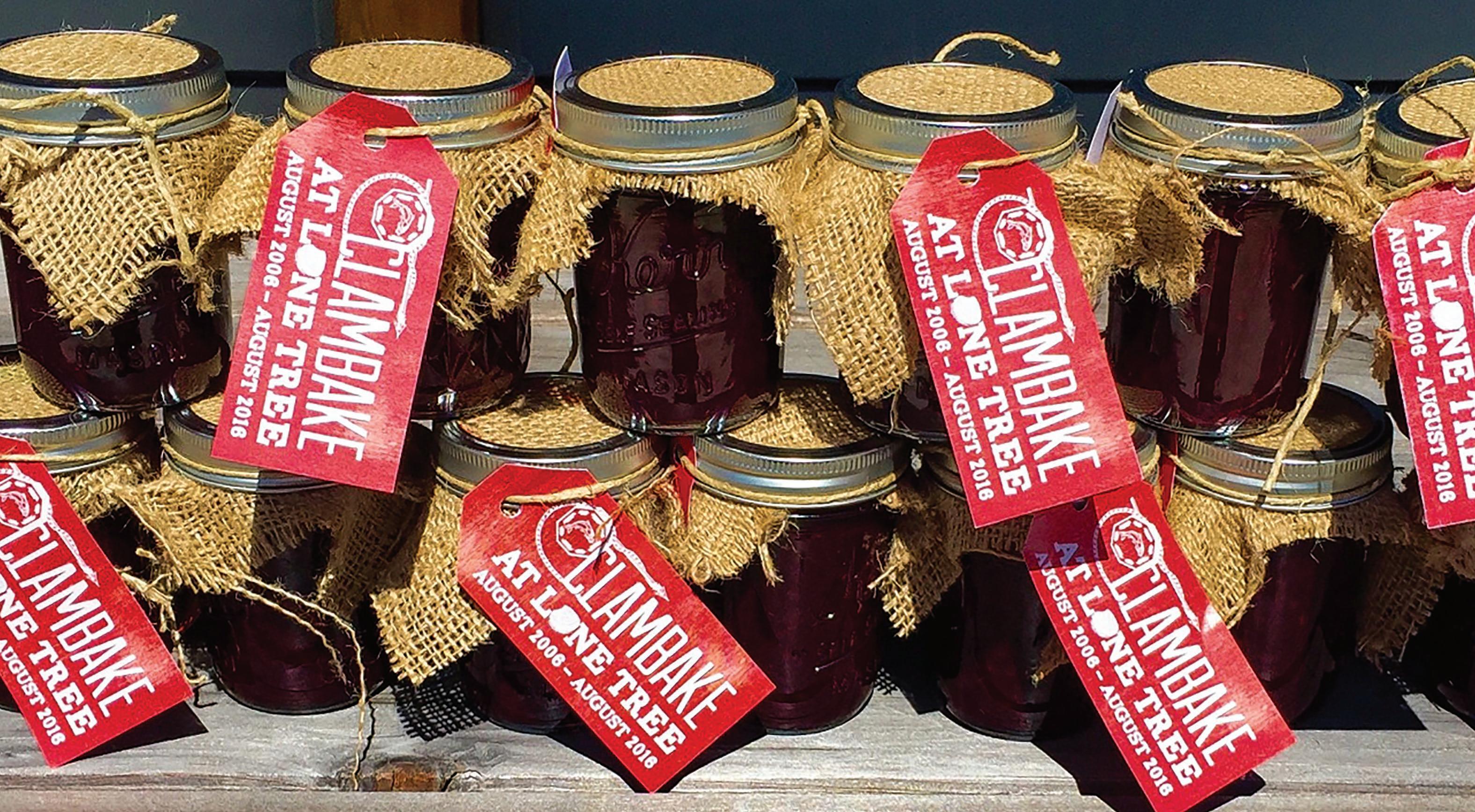
The end products of jam sessions are often gifted to elders at community events.
Photo: Beth Willup


of the Salal berry
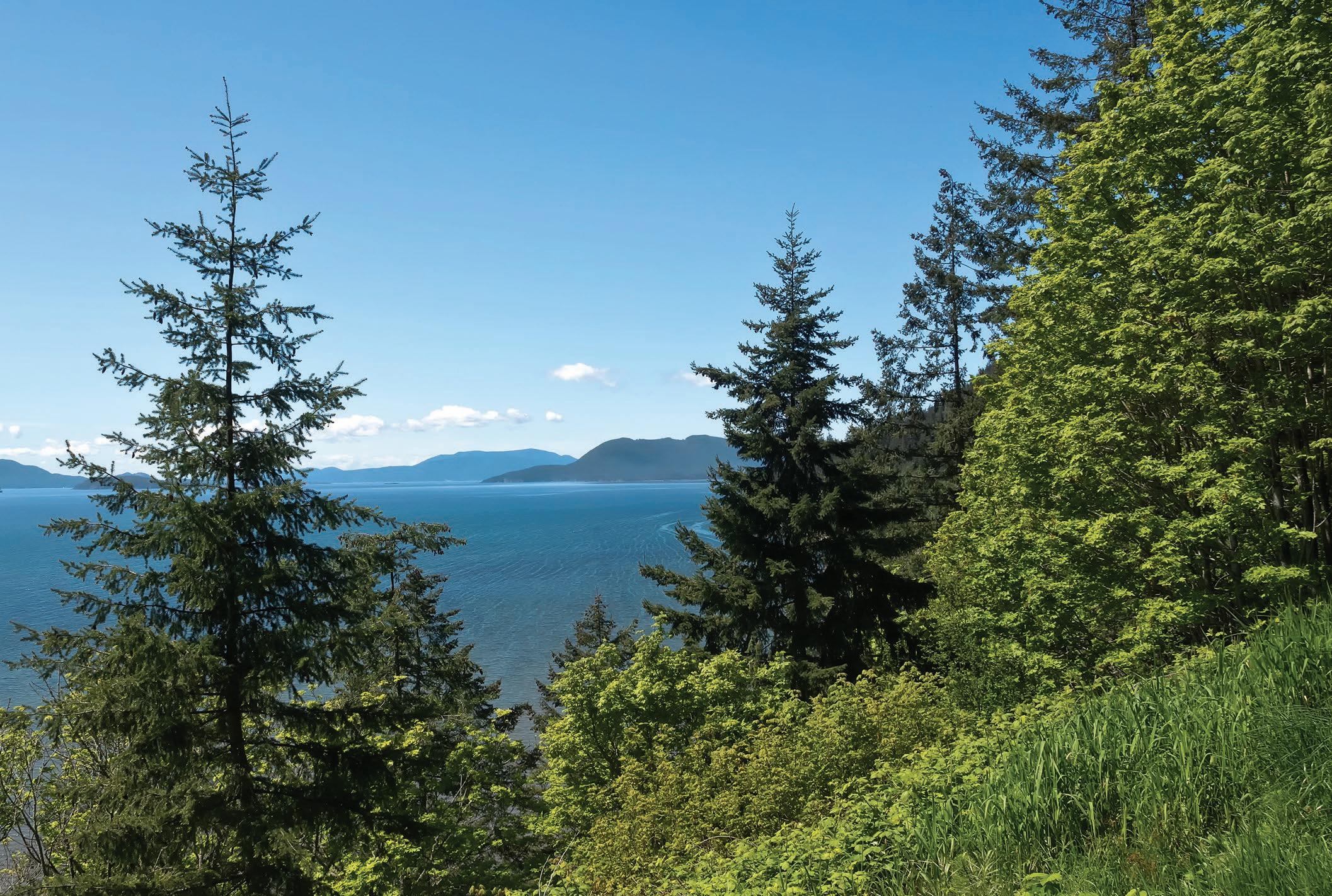
MOON OF THE SALAL BERRY
Much of August is the Moon of the Salal Berry. Many plants are ready to harvest during this moon. Salal berries are picked, mashed, dried, and made into cakes. Currants and trailing blackberry are also ripe at this time. Chinook runs are reaching their peak with the summer run continuing and the fall run starting up the river. Fall Chinook run through the next two moons. Salmon in rivers are caught using weirs, dip nets, and spears. Seals, which are also fishing for salmon, are hunted near the fishing sites. Salmon are eaten fresh and a large amount is dried for winter use. This moon signals a good time to wind dry the fish, before insect populations increase.
During the Moon of the Salal Berry, Swinomish hosts an annual clambake, a community-wide event that celebrates Swinomish culture at a culturally-significant location. During this event, staff will host several activities for the community and tribal youth.
Activity 1: Marine Debris Art Project
This activity focuses on marine debris that impacts local beaches; community members are asked to collect debris and contribute to a community art project.
Marine debris is defined as any persistent solid material that is manufactured or processed and directly or indirectly, intentionally or unintentionally, disposed of or abandoned into the marine environment. There is no part of the world left untouched by debris and its impacts. Marine debris is a threat to our environment, navigation safety, the economy, and human health. Marine debris definition provided by: Marine Debris: An Educators Guide to Marine Debris.
Designed as an informal but interactive activity, describe to participants what marine debris is and how it is different from the other things that may wash up on beaches, such as kelp, seaweed, or clamshells. Marine debris can be harmful to tribal community health as it can impact the food web and pollute the environment. Make this information available in a large format to allow for participant-directed engagement.
Lead a community marine debris collection effort throughout the day, with participants having the option to join for as long as they desire. In addition to collecting marine debris, help participants identify the types of items that ‘live’ on the beach by identifying empty shells and seaweed.
As participants collect marine debris and trash, encourage them to contribute to a marine debris art project. A large board (i.e. plywood) forms the backing and participants can glue, staple, or nail the debris to it to demonstrate what was found and removed from the beach. The use of other supplies can be used to create a collage or to arrange the debris into an image or sculpture.
Time: All day
Audience: Community Setting: Outdoors
Teaching Objectives
In this activity, participants will learn:
• How trash is transported in the ocean
• How long it takes for certain items to decompose
• About marine environmental issues that impact Coast Salish communities
Moon of the Salal
• About invertebrates at Lone Tree Point
Moon of the Salal
Moon of the Salal
• About the process community members use to steam clams on the beach
Lushootseed Words
Moon of the Salal berry
Moon of the Salal berry
Encourage participants to take photos of the beach before, during, and after the marine debris collection event.
• Moon of the Salal Berry:
Shoreline
Moon of the Salal berry
Shoreline
• Shoreline:
Shoreline
Give someone a hand
• Give someone a hand:
Give someone a hand
Give someone a hand
Clam
Clam
Materials
Clam
Little Neck Steamer Clam
• Trash bags for debris pick-up
Little Neck Steamer Clam
• Gloves
Little Neck Steamer Clam
Butter Clam
Butter Clam
• Construction paper
Butter Clam
Cockle Clam
• Large board for collective display
Cockle Clam
• Glue
Cockle Clam
Horse Clam
• Scissors
Horse Clam
Horse Clam
• Markers
Oyster
Oyster
Oyster
• Bucket or tub to test for buoyancy
Mussel
Mussel
• ID guides for invertebrates
Mussel
• Magnifying glasses to examine invertebrates
Geoduck
Geoduck
• Paper
Geoduck
Crab
• Coloring materials
Crab
Crab
Sea lettuce
Sea lettuce
Sea lettuce
Knowledge Transfer
• As community members participate in cleaning up the beach, they see first-hand about how trash is affecting the beach, the impact it has on natural resources, and subsequent impacts on people who depend on those resources.
Guiding Questions and Topics of Discussion
• What are ways you can think of to reduce marine debris? If you find marine debris, how do you properly dispose of it?
• How can recycling lead to reduced marine debris? What are other benefits of recycling? In addition to recycling, how can you reduce marine debris? For example, choose fewer packaged items and food products.
• Where do invertebrates fit into the food web?
Tying it all together
• The event is designed to increase awareness of the marine debris that is affecting sea life and human life on the reservation and within the greater ecosystem.
• This event combines art and environmental science, a fundamental underpinning of STEAM (Science, Technology, Engineering, Art and Math) principles.
• This event builds upon previous events with the food web, helping participants visualize the multiplicative issues that marine debris can cause, and the ways the food web can be disrupted.
Digging Deeper
• Discuss the concept of “reduce, reuse, recycle” and connect marine debris clean-up activities to Swinomish Earth Day clean-up activities found in the Moon of the Whistling Robins.
• Work with the Swinomish Department of Environmental Protection to present information on the negative impact of “ghost nets.”
Swinomish Clambake: A Traditional Steam Pit
Large rocks are placed inside a pit dug into the Earth
Logs of wood are split
A fire is built over the pile of rocks and left to burn down to coals
Burlap bags and a large canvas are soaked
Mussels and clams are carefully poured over the hot burning coals
Corncobs with their husks left on are placed over the mussels and clams

Notes to Educators and Additional Resources
Avallon, E. and Feinberg, H. 2014. An Educator’s Guide to Marine Debris. Avallon, E. and Henry, L. Editors. North American Marine Environment Protection Association (NAMEPA). National Oceanic and Atmospheric Administration (NOAA). Available online: marinedebris.noaa.gov/educators-guide-marine-debris
The burlap bags are placed over the steaming pit of shellfish and corn
The large canvas is wrapped over the pit contents to ensure the heat and moisture stay in.
Lunch is ready once everything is fully cooked! As the saying goes, "When the tide is out the table is set."
Photos: Caroline Edwards
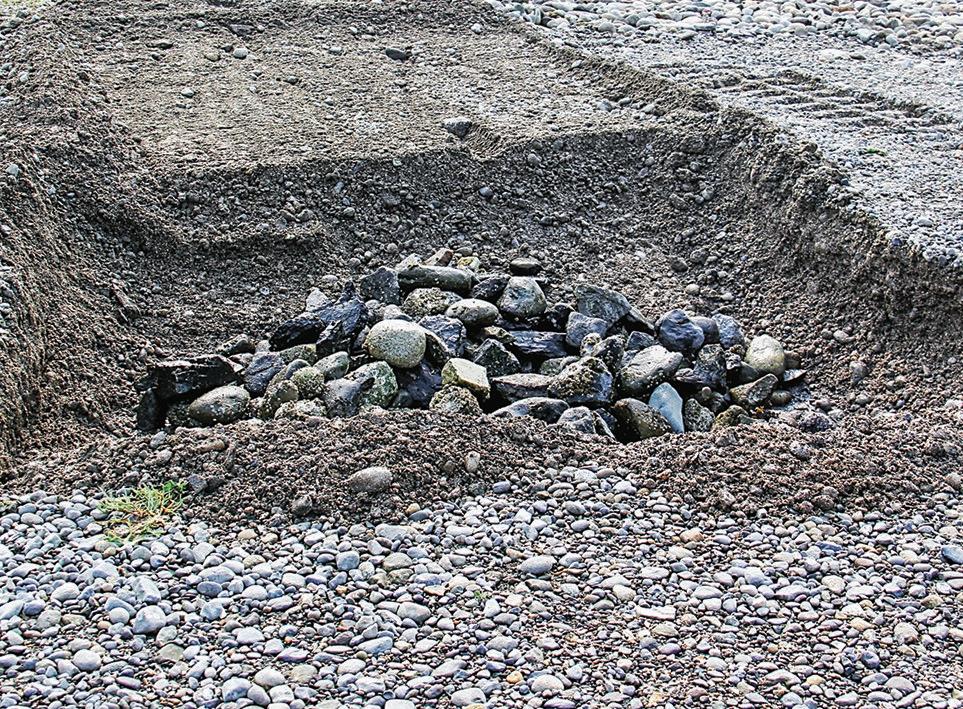
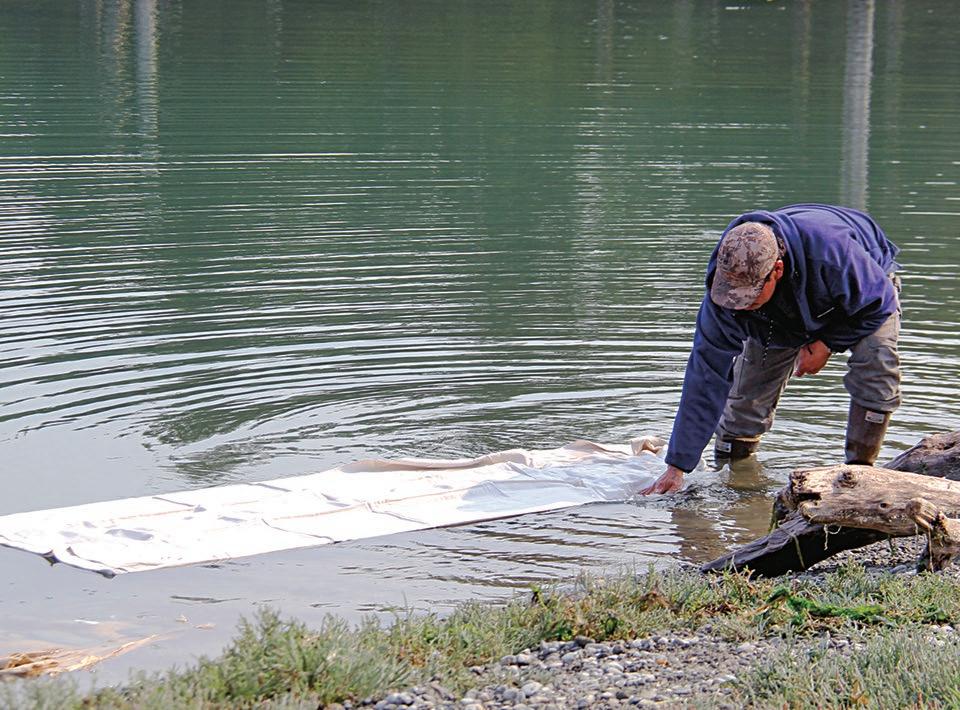
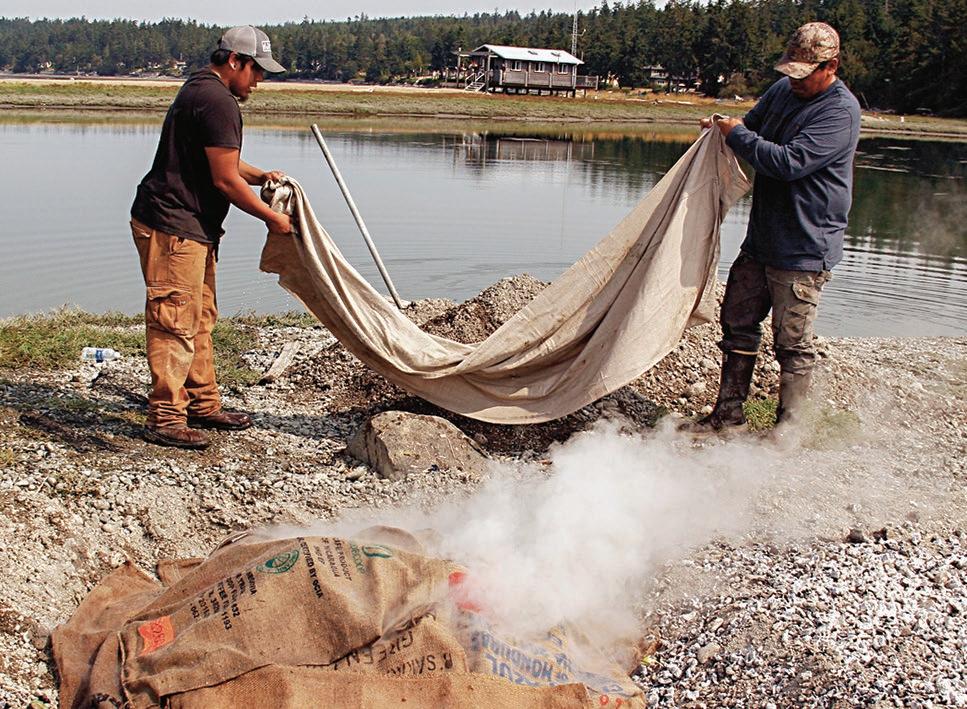
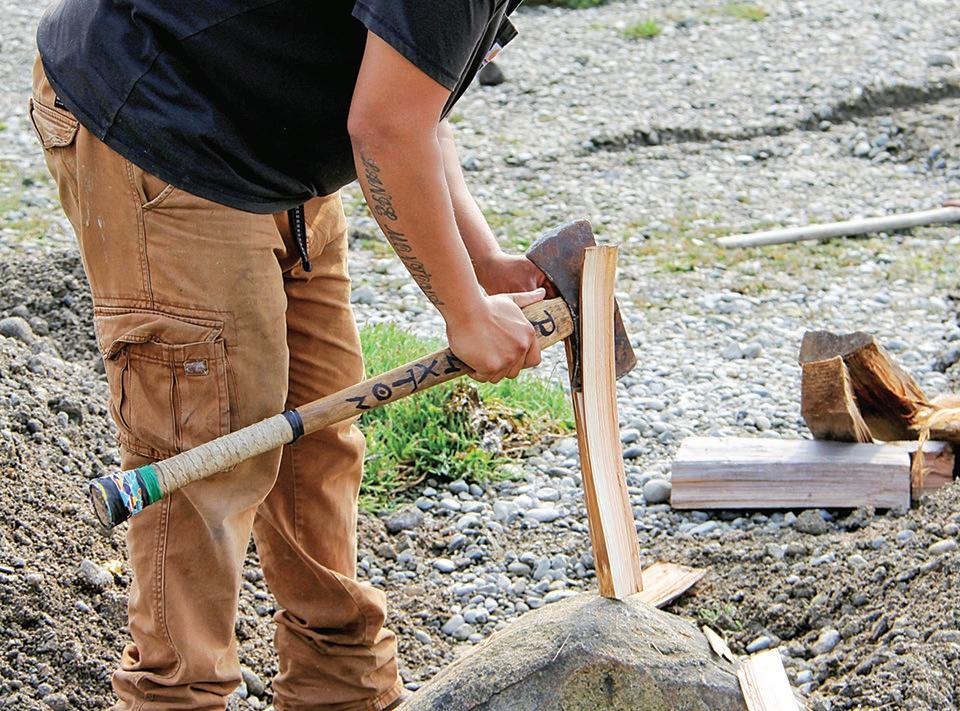
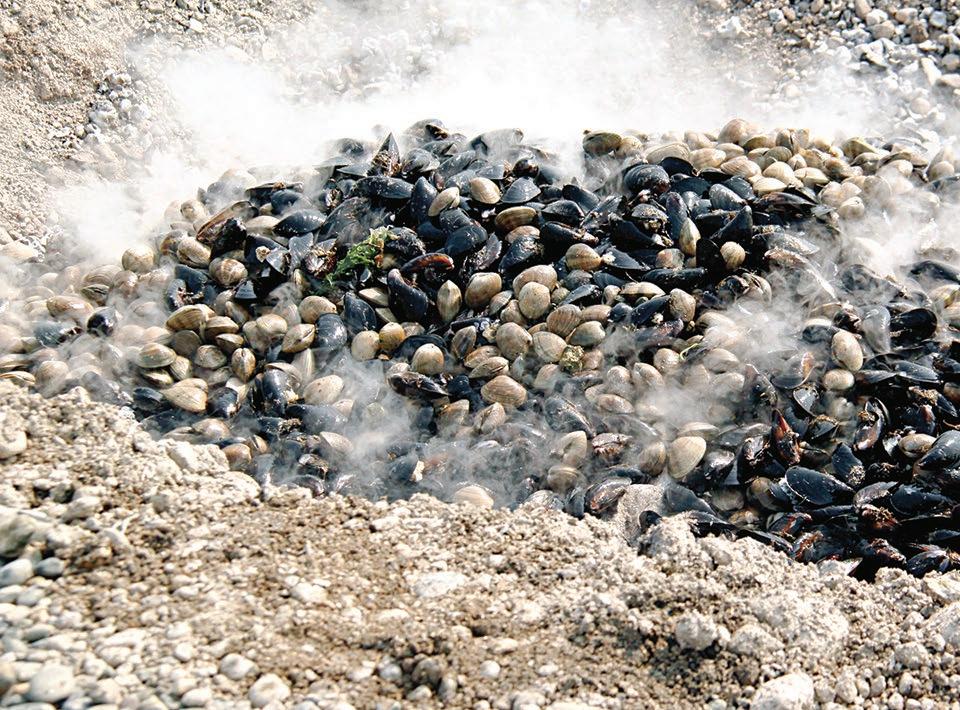
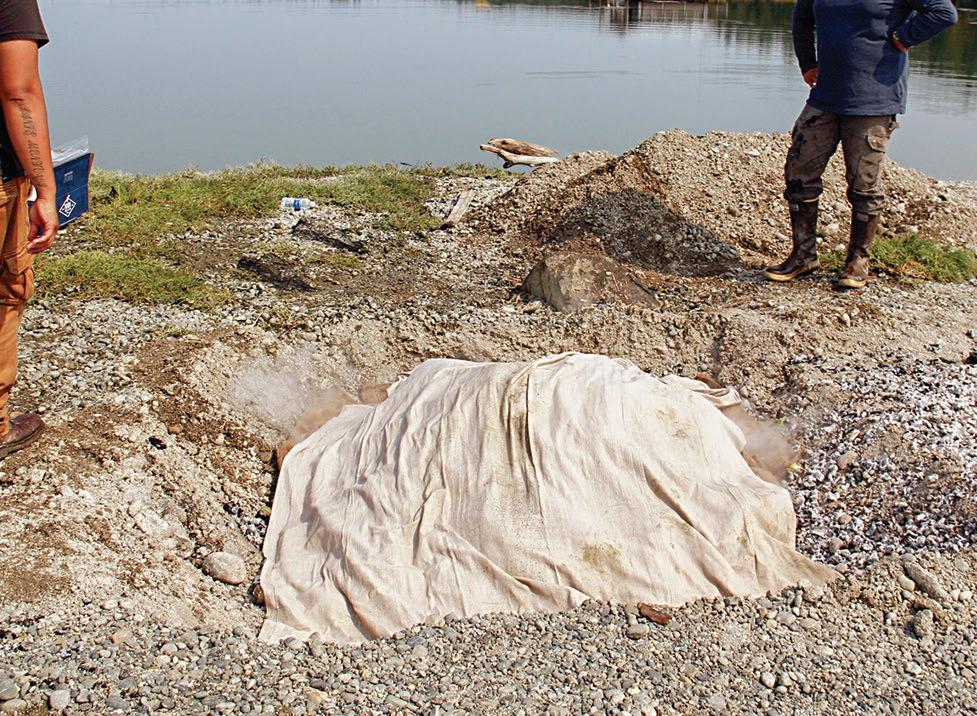
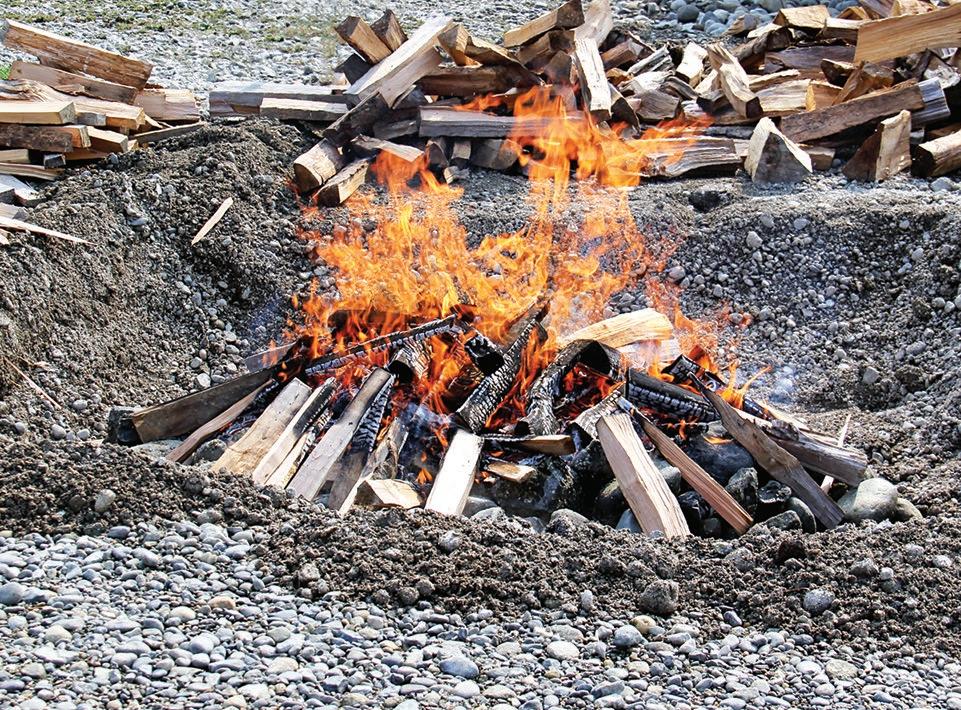
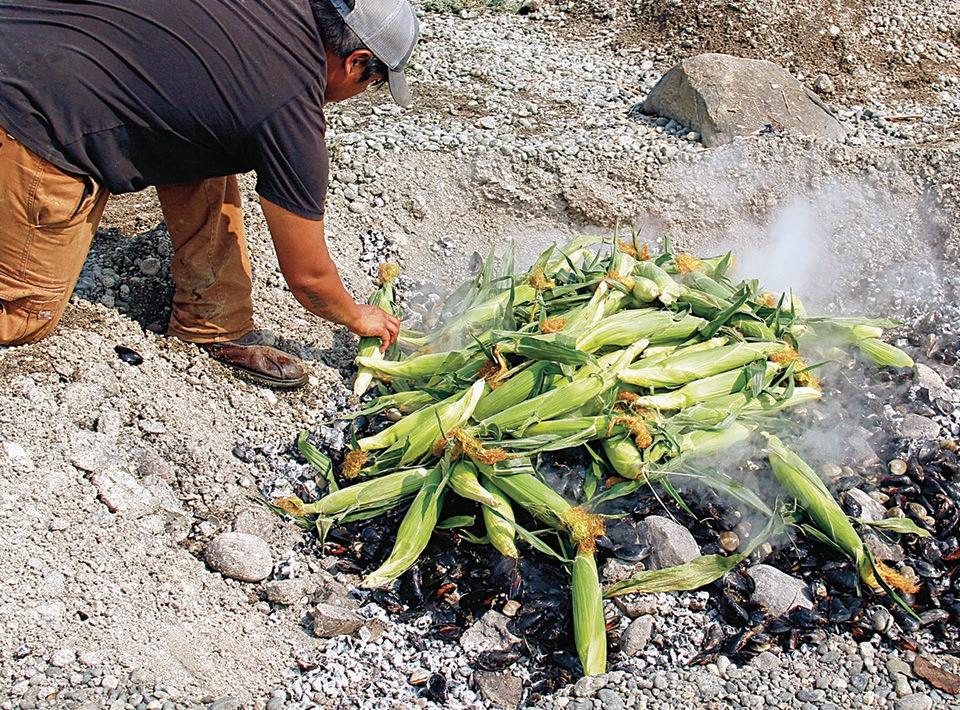
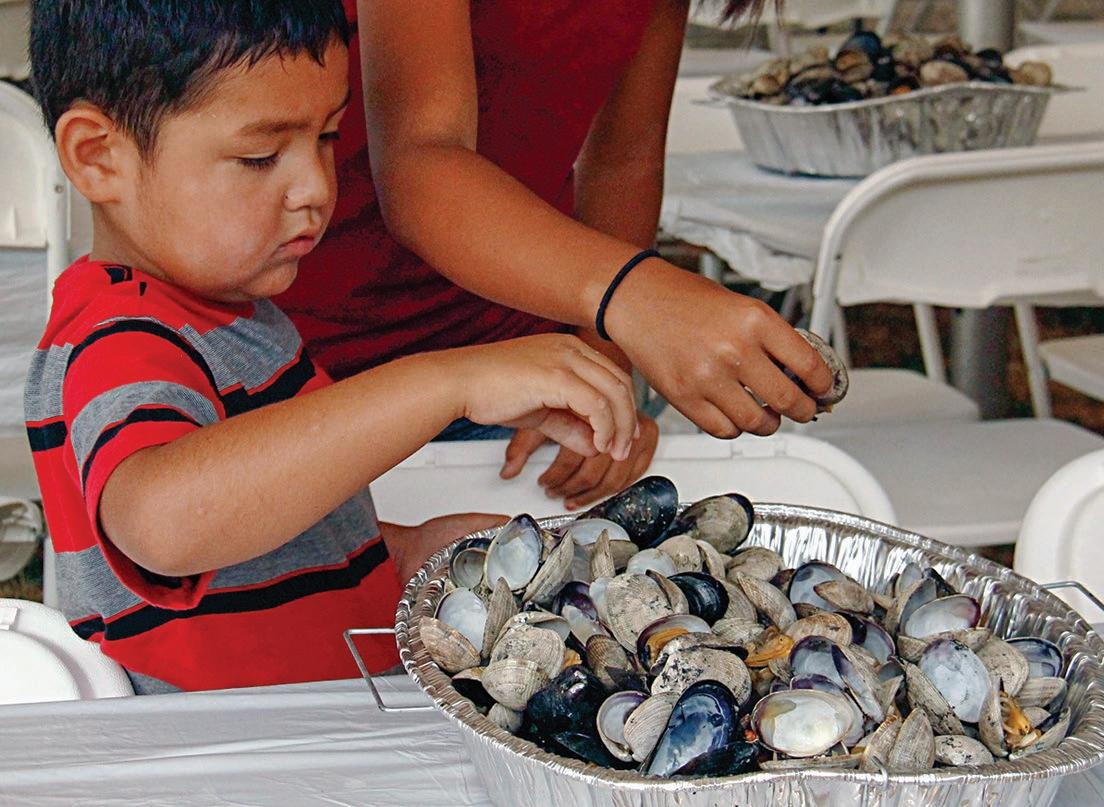
Activity 2: Testing for Toxins in Shellfish
Bivalve shellfish, like clams and oysters, have a unique way of feeding by filtering water through their bodies. While this feeds the shellfish, it can also result in the accumulation of various toxins in the shellfish. Toxins are created by microscopic algae during harmful algal bloom events, usually in the summer with increasing ocean temperatures.
People who touch and/or eat the shellfish with toxins become sick, and in severe cases, can die. Some harmful algal blooms are easily visible (for example, “red tides”), but not all harmful algal blooms are visible. As a result, shellfish must be tested. Traditionally, when sea gulls were observed to be avoiding the shellfish, this was a sign that the shellfish were not safe to eat.
Moon of the Salal berry
However, given changing climates and other environmental stressors, sometimes shellfish must be tested to ensure they are safe. Shellfish can be tested for diarrhetic shellfish poisoning (DSP) using a simple test.
Moon of the Salal berry
Moon of the Salal berry
Moon of the Salal berry
Moon of the Salal berry
Moon of the Salal berry
Diarrhetic shellfish poisoning (DSP) is one of the four recognized symptoms of shellfish poisoning, the others being paralytic shellfish poisoning, neurotoxic shellfish poisoning, and amnesic shellfish poisoning. As the name suggests, this syndrome manifests itself as intense diarrhea and severe abdominal pains.
Moon of the Salal berry
Moon of the Salal berry
Shoreline
Moon of the Salal berry
Moon of the Salal berry
Shoreline
Moon of the Salal berry
Time: 1.5 hours
Audience: 12 and up (limit to 15 kids)
Setting: Outdoors
Teaching Objectives
In this activity, participants will learn:
Moon
• What a harmful algal bloom is
• What causes a harmful algal bloom
• How scientists test for presence of toxins in shellfish
• About protective equipment and scientific protocol
Moon of the Salal berry
Shoreline
Shoreline
Give someone a hand
Give someone a hand
Shoreline
Shoreline
Give someone a hand
Give someone a hand
Clam
Clam
Give someone a hand
Participants will test for toxins in shellfish in this activity. A secondary goal is raise interest in biological sciences.
Give someone a hand
Clam
Clam
Little Neck Steamer Clam
Little Neck Steamer Clam
Clam
Clam
Little Neck Steamer Clam
Little Neck Steamer Clam
Butter Clam
Butter Clam
Little Neck Steamer Clam
• Little neck steamer clam:
Little Neck Steamer Clam
Butter Clam
Butter Clam
Cockle Clam
• Butter clam:
Butter Clam
Cockle Clam
Cockle Clam
Butter Clam
• Cockle clam:
Cockle Clam
Horse Clam
Horse Clam
Cockle Clam
Horse Clam
• Horse clam:
Cockle Clam
Horse Clam
Oyster
Oyster
Horse Clam
• Oyster:
of the Salal berry
Oyster
Horse Clam
• About the scientific method and making scientific observations
Moon of the Salal berry
Shoreline
Lushootseed Words
Give someone a hand
• Moon of the Salal Berry:
Moon of the Salal berry
Clam
• Clam:
Shoreline
Little Neck Steamer Clam
Give someone a hand
Butter Clam
Clam
Cockle Clam
Little Neck Steamer Clam
Horse Clam
Butter Clam
Oyster
• Mussel:
Oyster
Mussel
Mussel
Oyster
Mussel
Oyster
Geoduck
Mussel
Geoduck
Materials
Mussel
Mussel
Geoduck
Moon of the Salal berry
Crab
Geoduck
• Disposable lab coats, sizes S-XL (available at amazon.com)
Geoduck
Crab
Geoduck
Crab
• Safety glasses (available at amazon.com)
Sea lettuce
Crab
• Lab gloves, sizes S-L
Crab
Sea lettuce
Crab
Sea lettuce
Sea lettuce
• Kimwipes, large
Sea lettuce
• Paper towels
Sea lettuce
• Trash bags
• Jellett test strips ( jellett.ca)
• Shellfish extracts (prepare prior to event)
Activity Description
Gather participants into and ask them “Who is a scientist?" and "What does a scientist look like?” Start a discussion about all the different kinds of science careers and opportunities available to Native American youth. Be sure to pick up this discussion again at the end of the activity.
Hand out gloves, safety glasses, and lab coats. Have participants “indigenize” the lab coats by using markers to draw 13 moons images and Coast Salish designs on them. Next, with adult supervision, have participants test shellfish samples. Gather the group back at the end of the activity and ask them again what a scientist looks like and what they do.
Testing for Diarrhetic Shellfish Poisoning
The Scotia Rapid Test for Diarrhetic Shellfish Poisoning (DSP) is a rapid "yes" or "no" test that can be used with bivalves such as mussels, clams, and oysters. This test involves processing the shellfish into a liquid form or "extract" which can then be tested. Testing with this method is completed in three basic steps:
Prior to the activity, remove the inner tissue from the shell and grind it until it is smooth. Consider partnering with NOAA and working with their outreach coordinator to obtain test kits and prepare samples for testing in advance.
Taking the sample, use a Methanol/Hydrolysis extraction process. This process converts the ground shellfish into a liquid form. Resource: jellett.ca/pdf/Methanol_Hydrolysis_ Extraction_Method.pdf
To perform the test, dilute the shellfish extract in the buffer provided with the kit and apply the sample to the test cassette. For further details on how to perform the test, see the DSP testing instructions that come with the kit.
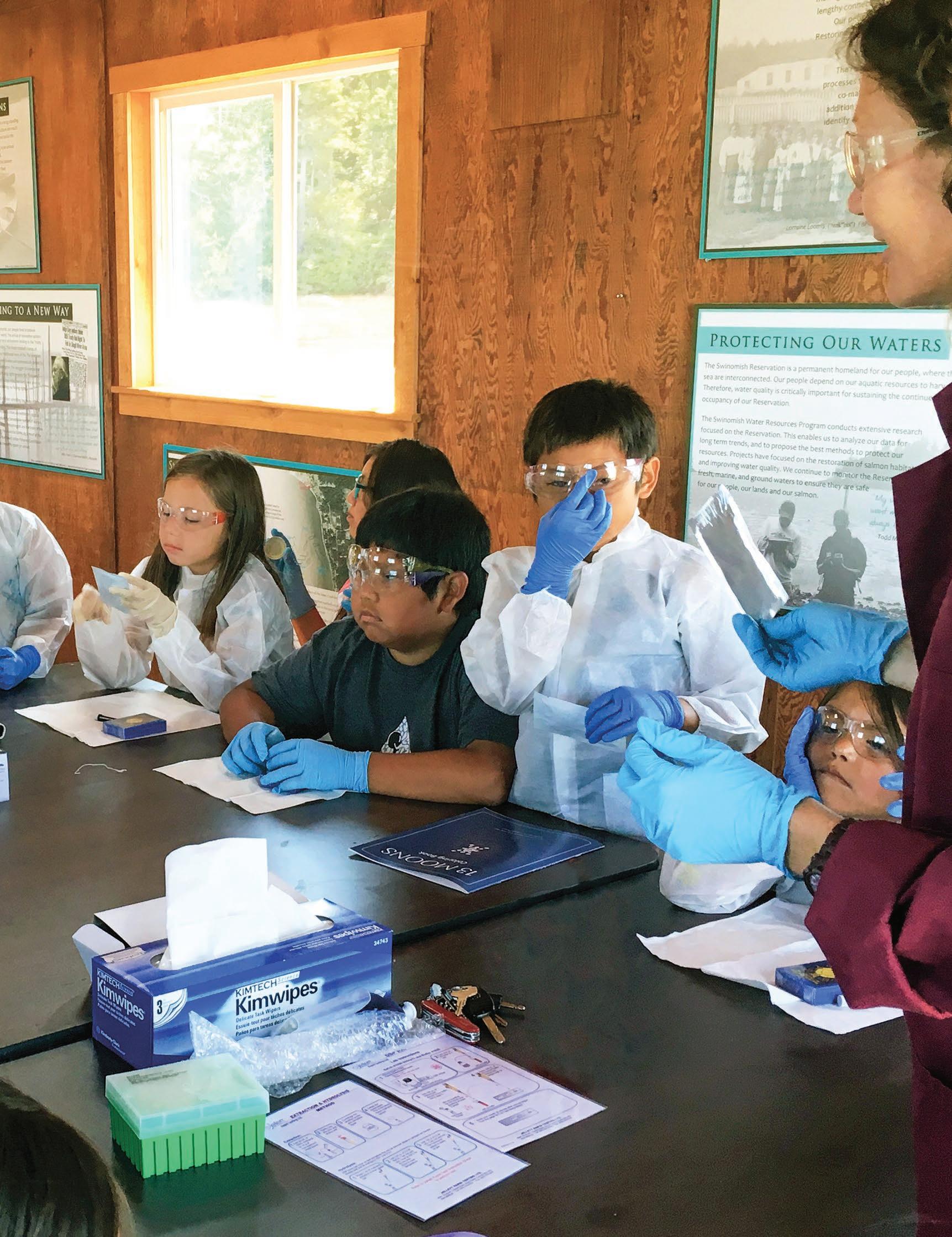
Youth conduct a science experiment with NOAA staff.
Photo: Todd Mitchell
Knowledge Transfer
• Discuss what it means to be a scientist before and after the activity. See how perceptions may change about science and scientists before and after engaging in a science experiment.
• Participants have the opportunity to eat shellfish during the community clambake.
• While doing the testing, encourage participants to talk with each other about what causes toxins in shellfish.
Guiding Questions and Topics of Discussion
• Can you see the toxins in the shellfish? Can you see the toxins in the water? For example, some harmful algal blooms are visible from shore. If you can’t see evidence of toxins, does that mean the shellfish are safe to eat? What happens if you eat contaminated shellfish?
Tying it all together
• Connections to other activities
› The clam digs held during the Moon of the Salmonberry and the Moon of the Sacred Time, as well as the community clambake held during the Moon of the Salal Berry, will reference clams and how to ensure they are safe to eat.
• Relationship to Indigenous health
› With an emphasis on ensuring food is safe, this activity directly addresses the consumption exposure pathway.
› This event is designed to encourage students to explore STEAM fields, while also pointing out the connections between traditional ecological knowledge (TEK) and modern scientific evidence. There are strong connections to climate change, which are changing many ecological indicators.
Digging Deeper
• This activity tests for one known toxin produced during harmful algal blooms. Consider having fisheries experts and scientists discuss the different types of toxins that can accumulate in clams. A discussion about bioaccumulation may also be appropriate here, with possible use of the “Food Chain Game” (see Notes to Educators and Additional Resource).
Notes to Educators and Additional Resources
• Contact NOAA education regional outreach coordinator
• The Food Chain Game. Acadia Learning for Participatory Science. Note: the animals in the game will need to be adapted to the local ecosystem. For example, instead of grasshoppers, shrews, and hawks, it may be more appropriate to have clams, birds, and humans.
• The Gossiping Clams Story (Roger Fernandez): vimeo.com/216035921
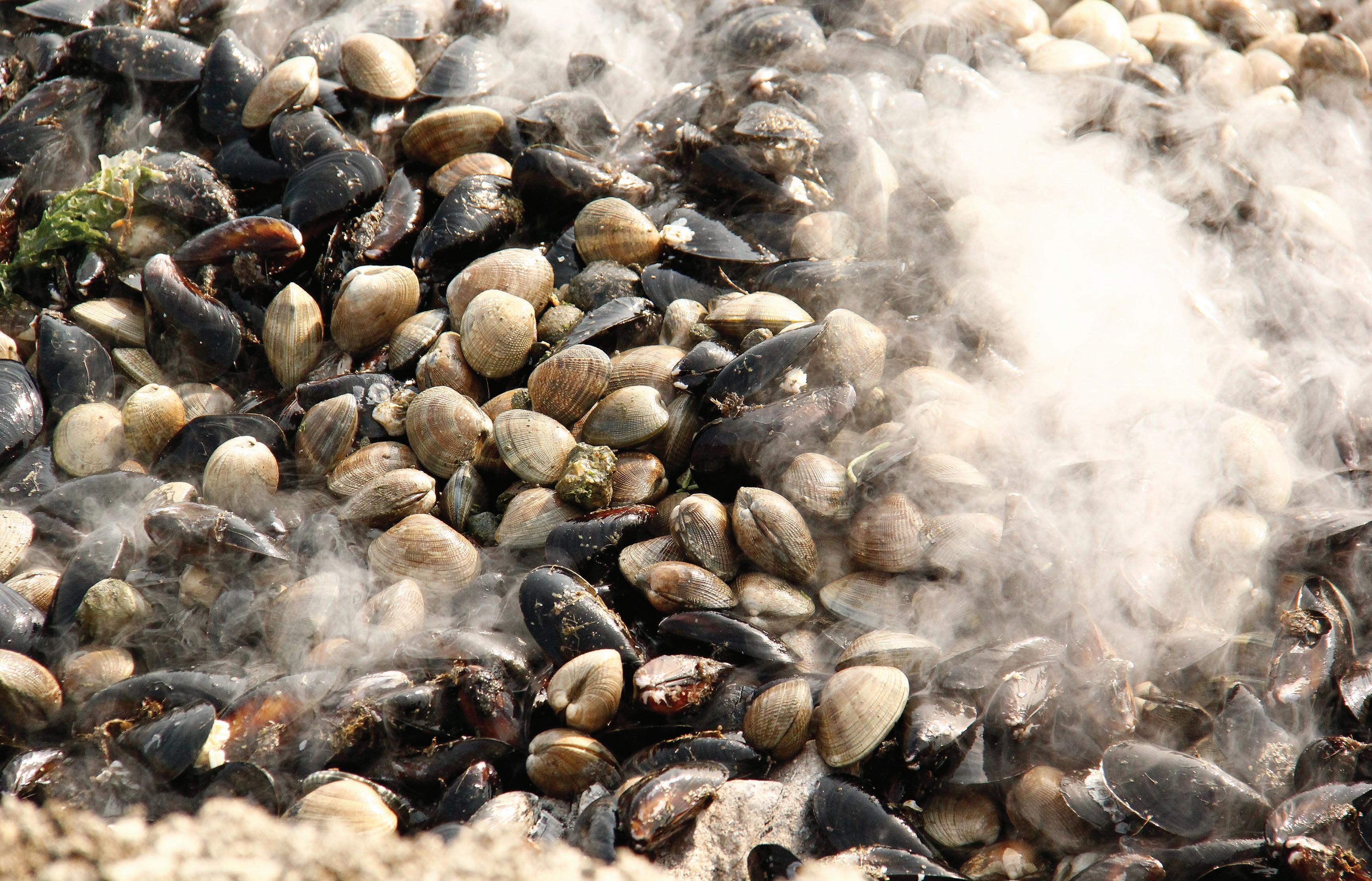
Clams steam on the beach in preparation for a Swinomish Community clambake.
Photo: Caroline Edwards
Activity 3: Edible Marine
Invertebrate Identification
This activity is geared towards youth and is designed to introduce the various edible invertebrate animals found in the intertidal zone. The touch tank will teach participants how to identify edible marine invertebrates that are easily harvested from the intertidal zone. Animals should be returned to where they were found following the activity.
The intertidal zone is defined as the area between high and low tide. The low intertidal zone is only exposed during the lowest low tides, whereas the high intertidal zone is only briefly covered by water at the top of high tide. The majority of the time the high intertidal zone is out of water. The intertidal zone is home to many ocean creatures, most of which are invertebrates, or animals that do not have a backbone. Examples include sponges, sea anemones, corals, jellyfish, clams, oysters, mussels, limpets, snails, chitons, sea stars, sea urchins, and crustaceans (crab, shrimp, etc.).
Activity Description
The activity is an informal learning activity designed to allow participants to go at their own pace. Facilitators help participants learn about the intertidal zone, identify invertebrates, learn the Lushootseed names of the invertebrates, and discuss how these foods were traditionally harvested and managed by Coast Salish people (See the Notes to Educators and Additional Resources).
In addition to the touch tank, make posters and information about traditionally-managed clam gardens for participants to learn about. Also provide a coloring station with pictures of intertidal invertebrates for participants to color and write Lushootseed words.
Time: All day, during the community clambake
Moon of the Salal berry
Audience: Community
Moon of the Salal berry
Moon of the Salal berry
Setting: Indoors (Swinomish Interpretive Center at Lone Tree Point)
Moon of the Salal berry
The activity should include the following stations:
Moon of the Salal berry
• Intertidal invertebrate touch tank with identification cards
Moon of the Salal berry
Moon of the Salal berry
Shoreline
Shoreline
Shoreline
• Clam gardens and management techniques
Give someone a hand
• Draw your own invertebrate
Give someone a hand
Give someone a hand
Moon of the Salal berry
Clam
Learning Objectives
Clam
Clam
Shoreline
In this activity, participants will learn:
Little Neck Steamer Clam
Little Neck Steamer Clam
Little Neck Steamer Clam
Give someone a hand
• What a marine invertebrate is
Butter Clam
• How foods were traditionally eaten
Butter Clam
Butter Clam
Clam
• How to identify and harvest intertidal invertebrates
Cockle Clam
• About the role of intertidal invertebrates in the food web
Cockle Clam
Cockle Clam
Little Neck Steamer Clam
Moon of the Salal berry
Horse Clam
• How TEK was used to produce and harvest invertebrate foods using ancient clam garden technologies
Horse Clam
Horse Clam
Butter Clam
Oyster
Oyster
Oyster
Cockle Clam
Mussel
Lushootseed words
Mussel
Mussel
Horse Clam
• Moon of the Salal Berry:
Geoduck
Moon of the Salal berry
• Geoduck:
Geoduck
Geoduck
Shoreline
Oyster
• Crab:
Crab
Crab
Crab
• Mussel:
Give someone a hand
Mussel
Sea lettuce
• Sea lettuce: Materials
Sea lettuce
Sea lettuce
Clam
Geoduck
Crab
Little Neck Steamer Clam
• Seawater aquatic tank mimicking the intertidal zone
Butter Clam
Sea lettuce
• Intertidal invertebrates (clams, crab, geoduck, etc.)
Cockle Clam
• Identification guides (in English and Lushootseed)
• Hand towels
Horse Clam
• Clam garden posters
Oyster
Knowledge Transfer
Mussel
• Ability to identify certain animals
• Drawings of favorite (food) animal
Geoduck
• Connection to marine life and the identification of the invertebrates as important foods
Crab
Sea lettuce
Guiding Questions and Topics of Discussion
• What differences do you see between high and low tide on the beach? What types of animals have you seen when walking on the beach? How many different types of clams can you name? Have you seen any of these animals before? Have you eaten any of these animals before?
Tying it all together
• Participants will learn about the types of invertebrates found in the intertidal zone beyond the more well-known clams.
• The focus on traditional clam garden management highlights themes of sustainability and environmental management within the context of traditional ecological knowledge.
Digging Deeper
• During the touch tank activity, add a fourth station and air videos from The Clam Garden Network (see link in Notes to Educators and Additional Resources), which highlight Coast Salish clam gardens and their restoration. Clam gardens highlight the use of traditional ecological knowledge for restoring and maintaining ecosystems, and explores traditional methods to increase food resources throughout the year.
• Include seaweeds: The following is from “Traditional Plant Foods of Canadian Indigenous Peoples: Nutrition, Botany, and Use” by Harriet V. Kuhnlein and Nancy Turner (1991).
› Marine algae, or seaweeds, were used by virtually all coastal peoples, and sometimes were traded inland. Still used at present, they are important sources of vitamins and several minerals, particularly iodine. Both algae and lichens can be difficult to digest unless specially processed. There is little documentation on their nutrient contribution to the diets of Indigenous People. Algae have also been used as an emergency food (energy source) in coastal areas where fish and game were limited.
Notes to Educators and Additional Resources
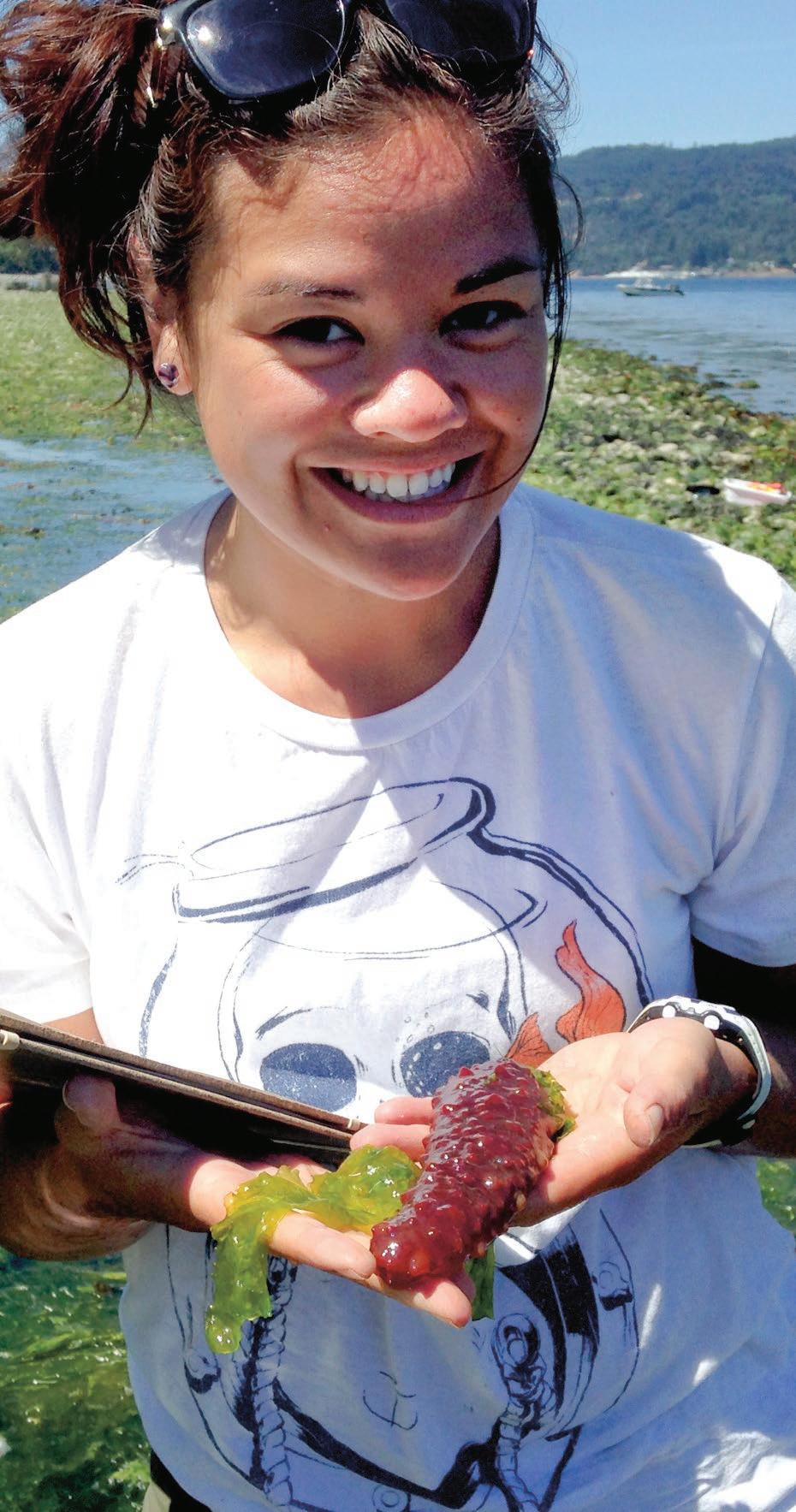
• Ocean Explorer. 2013. Intertidal zone. National Oceanic and Atmospheric Agency. Last updated: February 12, 2013. Date Accessed: May 21, 2017. Available online: oceanexplorer.noaa.gov/edu/learning/10_tides/activities/intertidal.html
• Smith, N.F., Lepofsky, D., Clam Garden Network. The Clam Garden Network. Date accessed: May 21, 2017. Available online: clamgarden.com
• Lepofsky, Dana, Nicole F. Smith, Nathan Cardinal, John Harper, Mary Morris, Gitla (Elroy White), Randy Bouchard, et al. 2015. “Ancient Shellfish Mariculture on the Northwest Coast of North America.” Amer Antiquity 80 (2): 236–59. doi:10.7183/0002-7316.80.2.236.
• Kuhnlein, H.V. and Turner, N.J., 1991. Traditional plant foods of Canadian Indigenous peoples: nutrition, botany, and use (Vol. 8). Taylor and Francis.
Sonni Tadlock visits an ancient clam garden on Salt Spring Island, B.C.
Photo: Amy Irons

MOON OF THE SILVER SALMON of the Silver Salmon

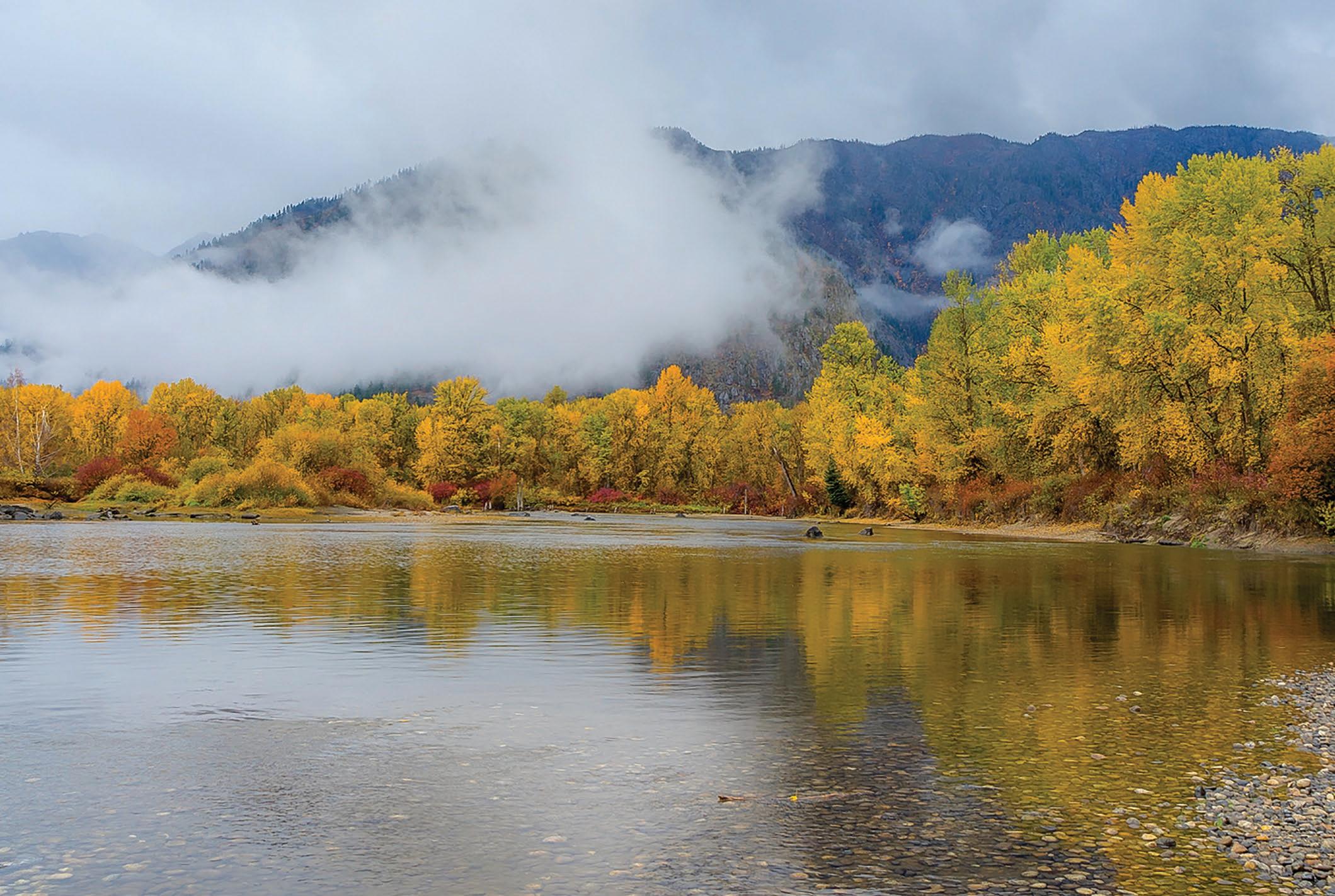
Much of September is the Moon of the Silver Salmon. During this moon, silver salmon, also called coho salmon, are fished. The other salmon runs continue in the bays and rivers. Large quantities of salmon are smoked and wind dried to be stored for the winter. Late summer berries reach their peak ripeness and are harvested during this moon. These fruits are mashed, dried, and made into cakes. During this moon and the one before, seeds used for trading are collected.
Activities during this moon will highlight the harvest and preservation of salmon, berries, and madrona berry seeds. These foods are preserved for the winter, when resources are scarce. While only a few foods will be highlighted, the activity is designed to demonstrate the association between place-based and seasonallyavailable foods. A traditional diet is dependent upon resources that are seasonally available, and therefore preservation methods are very important. Finally, these activities will discuss seed saving, and the role seeds played in a traditional economic system.
Time: 3 hours
Audience: Community
Setting: Outdoors (harvesting); indoors (seed saving)
Learning Objectives
In this activity, participants will learn:
• About traditional plants harvested in September
Activity 1: Berry and Seed Saving
Moon of the Silver Salmon
Moon of the Silver Salmon
• Seasonality as a tool for food collection and preservation
Moon of the Silver Salmon
• How climate change may alter seasonal harvests
• The collection and processing of seeds and how they played a role in the traditional economy
• Food preservation methods for the winter months
Lushootseed Words
Moon of the Silver Salmon
Moon of the Silver Salmon
This activity has both an outdoor and indoor component. It can be taught in two separate events, or as one half-day workshop. The outdoor component comes first and consists of a field trip to collect madrona berry seeds and harvest berries, which will later be dried and used to make pemmican during the Moon of the Falling Leaves.
Moon of the Silver Salmon
• Moon of the Silver Salmon:
Seed
• Seed:
Seed
Seed
Use plant identification cards to describe the resources participants should look for. When the plants are found in the field, help participants identify and properly harvest them, either for fruit or seed collection. Encourage participants to look for other plants they have learned about in previous workshops and make observations about how the plants change across seasons and moons.
Native blackberry
Native blackberry
Native blackberry
• Native blackberry: Materials
• Food collection containers to collect berries and seeds
• Needles and thread for stringing the berries
• Beads for additional decoration
• Scissors
• Examples of finished pieces
• Food dehydrator

Identify a location that has resources available for harvest several days prior. If necessary, due to low harvest yield or high participant numbers, purchase some berries/plants to ensure all participants will have a product to take with them at the end of the workshop.
This activity highlights the ecological value of various plant life stages. The varied life stages results in continual food resources from spring into late summer, and many plants work together symbiotically. For example, one plant may provide shade for tender young plants that will flower and fruit at a later date.
Following the harvest trip the activity moves indoors. Participants dry the collected berries using a food dehydrator, while stringing the madrona berries as a traditional drying technique. Talk about the importance of food and seed preservation techniques such as drying.
This activity demonstrates a traditional technology of preserving seeds and fruits by stringing them up to dry. Red madrona berries are ripe during this moon, and are often plentiful. When they are fresh, they are easy to string together to make jewelry such as necklaces and garlands for decoration. Adding beads to the strings is another variation. Remind participants that the berries can be eaten, used as decoration, or given as a gift. Also discuss how climate change is shifting the seasonal harvest cycle by varying temperatures and precipitation patterns.
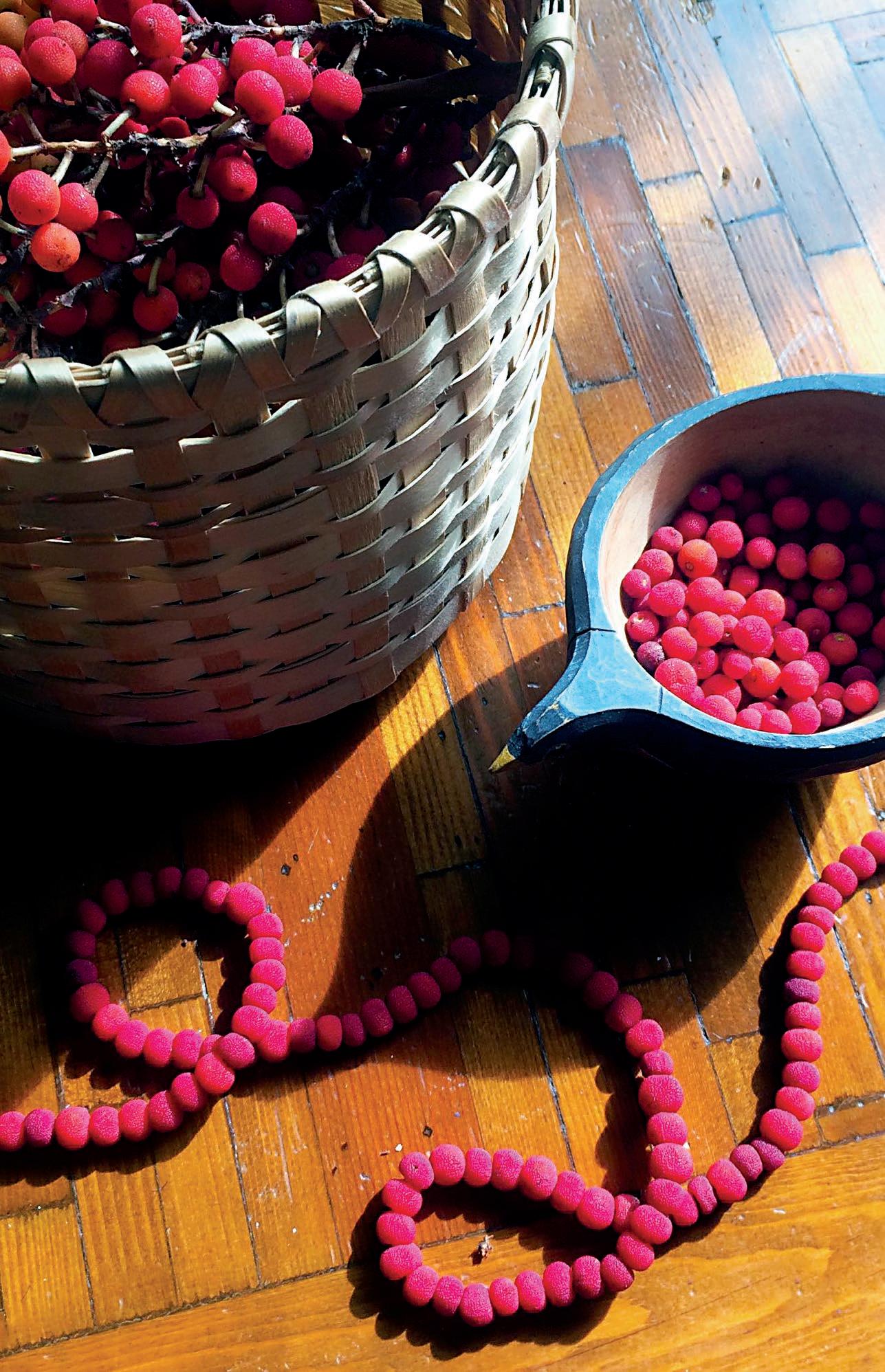
Knowledge Transfer
• Invite elders to participate in the activity.
• Participants will learn about seasonality by identifying the different stages plants were in while harvesting.
Guiding Questions and Topics of Discussion
• What other seeds and foods can you dry by stringing them together?
• What seeds do you think would hold higher trading value, and why?
• What recipes can you use dried madrona berries in?

Tying it all together
• Connections to other activities
› Moon of the Blackberry features a jam workshop using low-sugar recipes highlighting the impacts of a high-sugar diet. In the Moon of the Falling Leaves, the berries dried during this moon will be used to make pemmican, using the Cedar Box Teaching Toolkit.
• Relationship to Indigenous health
› Plants and foods are dependent upon the seasons cycles to grow, flower, fruit and go dormant. This cycle is represented in the 13 Moons lunar calendar. With climate change comes changes in the cycles and availability of the foods that the Swinomish people depend on. Climate change induces multiple health impacts; the ones most often discussed are about physical health from increased temperatures and changing precipitation patterns but these activities demonstrate other important impacts.
› An economic system based on gathering, harvesting, preserving and collecting seeds places utmost importance on food. What we eat, and how we eat it, can have strong importance to our health. In order to have good food, we have to have a healthy ecosystem.
Digging Deeper
• Look at Swinomish research and videos about climate change impacts to salmon, plants, and other important first foods. Research and video links are available on the Swinomish website and the Skagit Climate Science Consortium website (SC2) .
Drying berries is a traditional practice.
Photo: Samantha Martinez
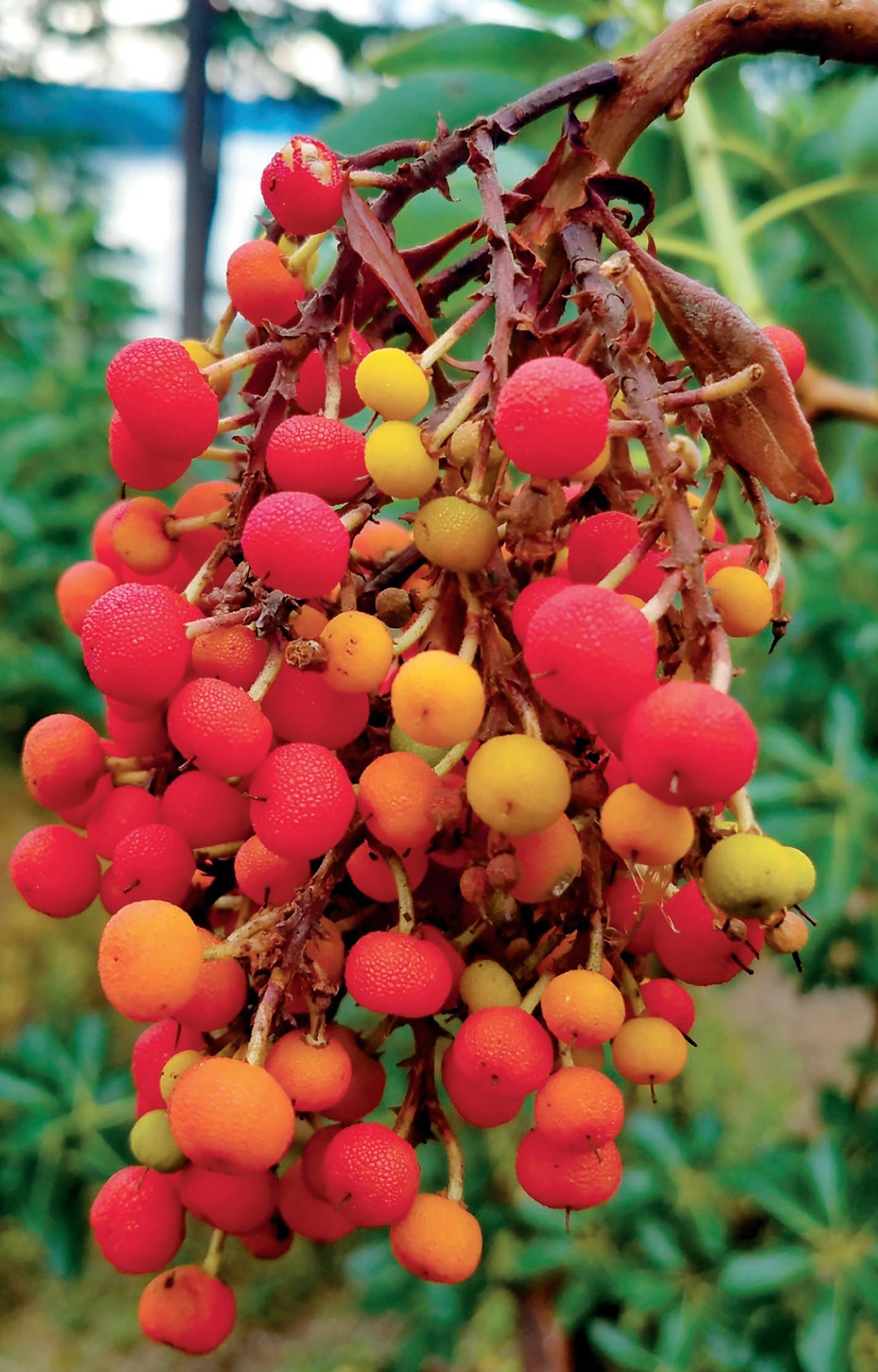
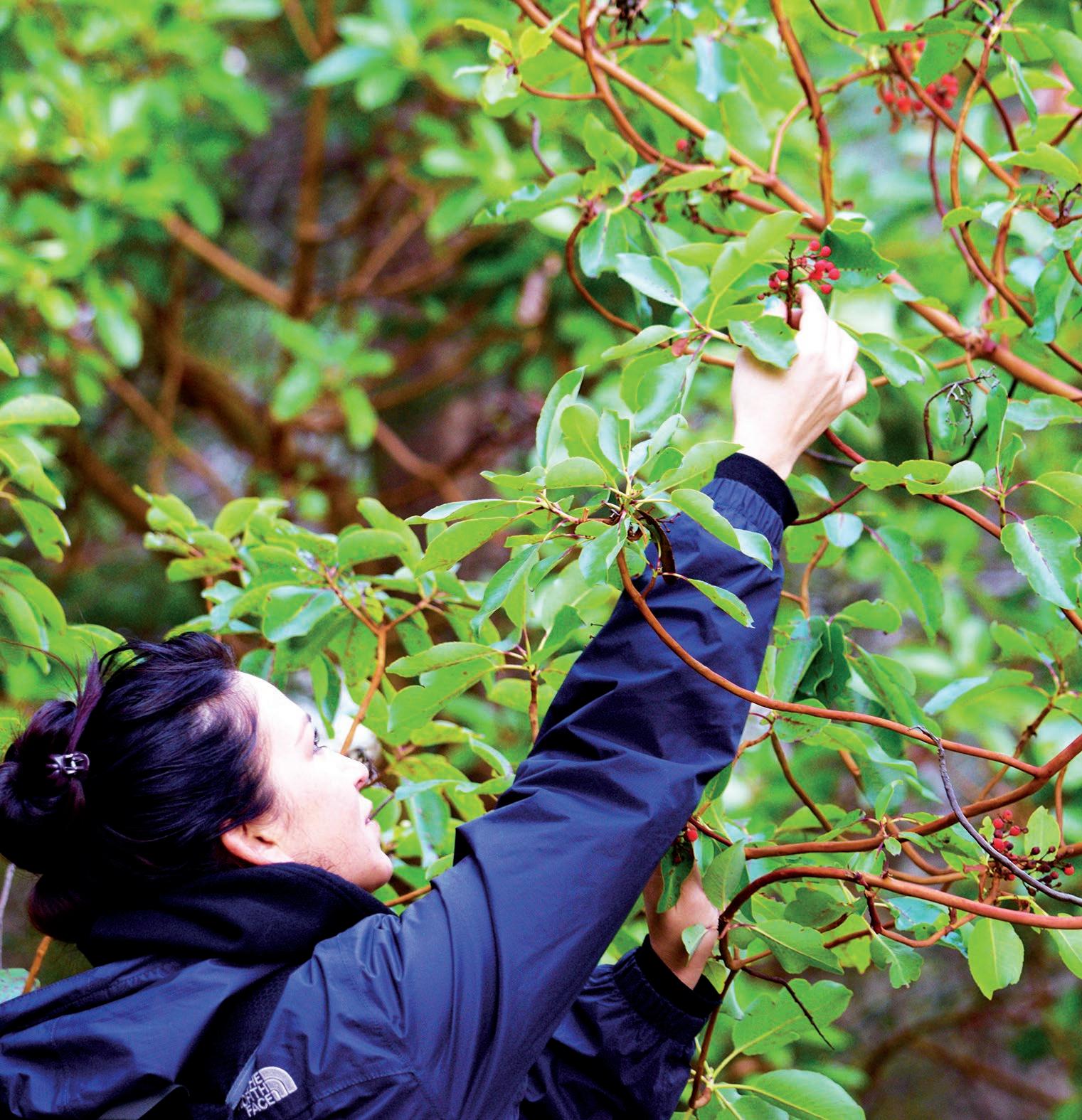
Notes to Educators and Additional Resources
• en.wikipedia.org/wiki/Arbutus_menziesii
• livingwild.org/fall/madrone/
• Skagit Climate Science Consortium: skagitclimatescience.org
› Video: vimeo.com/user14800439
• Swinomish climate change: swinomish-climate.com
› Video: vimeo.com/48120951
› Video: youtube/1uiVaHuzEe4
• It’s Berry Season: wildfoodsandmedicines.com/539/
• National Phenology Network: usanpn.org/natures_notebook
Madrona berries
Photo: Jamie Donatuto
Beth Willup picking madrona berries
Photo: Myk Heidt
Time: 3 hours
Moon of the Elk Mating Cry
Audience: Youth
Moon of the Elk Mating Cry
Activity 2: Preserving Salmon
Moon of the Elk Mating Cry
Moon of the Elk Mating Cry
Setting: Outdoors (fish cleaning); indoors and outdoors (fish preservation)
Moon of the Elk Mating Cry
Moon of the Elk Mating Cry
Learning Objectives
• Seasonality as a tool for food collection and preservation
• How to clean salmon
Moon of the Silver Salmon
• Knife safety, culinary skills
Moon of the Elk Mating Cry
Moon of the Elk Mating Cry
• Food safety
Moon of the Silver Salmon
Moon of the Elk Mating Cry
• Food preservation methods for the winter months
Moon of the Elk Mating Cry
Autumn
Autumn
Moon of the Elk Mating Cry
• Importance of salmon to the Swinomish people
Autumn
Moon of the Elk Mating Cry
Autumn
Salmon
Salmon
Autumn
Autumn
Salmon
Lushootseed Words
Salmon
Work with the Swinomish Fisheries and the Hunting and Gathering program to arrange the workshop and cleaning area, as well as determine materials needed. Also determine a preservation method, which can vary by year depending on the fish species and the amount available. Options include canning, smoking, and making jerky. Each requires different materials and preparation. If you are not preserving as part of the activity, have youth clean the salmon and provide it to the Senior Center. One additional option is to freeze the cleaned fish and make it available for future use at tribal gatherings. Whatever preservation method selected, be sure to discuss all the other methods as alternatives.
King, or Chinook, salmon
King, or Chinook, salmon
Moon of the Silver Salmon
• Moon of the Silver Salmon:
Salmon
• Salmon:
King, or Chinook, salmon
Salmon
Silver salmon
Moon of the Silver Salmon
Silver salmon
Seed
King, or Chinook, salmon
Story: Importance of Fish
• King, or Chinook salmon:
Silver salmon
King, or Chinook, salmon
Seed
• Silver salmon:
King, or Chinook, salmon
Native blackberry
Silver salmon
Dog chum salmon
Silver salmon
Dog chum salmon
Native blackberry
Silver salmon
Dog chum salmon
• Dog chum salmon:
• Sockeye salmon:
Dog chum salmon
Sockeye salmon
Sockeye salmon
Dog chum salmon
Sockeye salmon
Dog chum salmon
Humpback salmon
• Humpback salmon:
Sockeye salmon
Humpback salmon
TIPIf planning to teach the preservation part of this activity, reserve a local community kitchen in advance for preservation use if needed for making jerky or canned salmon. If smoking salmon, find a community member who smokes salmon and can guide youth through the process.
Swinomish elder Larry Campbell, wanaseah, has worked for his community for over 30 years. He talks about the importance of sharing fish and other first foods in the community in this story from Our Ways: Testimonies of the Swinomish Way of Life.
“I think a great thing about the Northwest people is that fish is a central part of who we are. Our hunters and fisherman used to follow cultural rules and make sure that our elders always had the goods that they craved. They’d go out and shoot ducks, put them on a string and put them on a doorknob for an elder when they’d come home. Even today fisherman are encouraged to take the first fish in to an elder. In turn, every time that elder thinks of them, they say a prayer for them. There aren’t even close to the same amount of fish or game animals available today as there were in the past so now the Tribe has been gathering fish, deer meat, elk meat and putting them away. So when there is a cultural or ceremonial gathering, the food is still available. We’re not looking for turkey, ham or roast beef. We’re looking for fish, clams, crabs, and berries. For what it’s worth, you can’t have a successful gathering without fish.”
Knowledge Transfer
• Invite elders to participate in the activity
• Knowledge of best ways to preserve the different species of salmon
• Importance of preserving salmon to Swinomish ancestors
• Health safety in preservation

Guiding Questions and Topics of Discussion
• Which preservation methods do you think tastes best?
• Which preservation method is easiest? Most difficult?
Tying it all together
• Connections to other activities
› Salmon and water quality are discussed during the Moon of the Blackberry.
› The importance of clean water is discussed in Moon of the Whistling Robins and Moon of the Salmonberry.
• Relationship to Indigenous health
› For physical human health, salmon are highly nutritious and are an excellent source of Vitamin D.
› For both for animals and humans, salmon play an integral role in the food web.
› For Swinomish community health, food feeds the spirit and the body. A healthy salmon population is one element necessary to achieve Swinomish community health culturally, socially, and physically.
Digging Deeper
• Explore how other Indigenous peoples preserve fish. McGill University’s Centre for Indigenous Peoples’ Nutrition and Environment contains a database, which can be found here: traditionalanimalfoods.org/fish/searun-fish/page.aspx?id=6446.
• This activity could include a lesson on food safety as it relates to food preservation. Contact the Environmental Health officer to schedule a class.
Notes to Educators and Additional Resources
• Our Ways: Testimonies of the Swinomish Way of Life. The Swinomish Indian Tribal Community’s Sharing Our Knowledge Series, Vol 3. Second Edition, 2011. Edited by T. Mitchell and D. Lekanof.
• smithsonianmag.com/science-nature/what-can-humans-do-save-pacific-northwests-iconic-salmon-180952769/
of the Elk Mating Cry

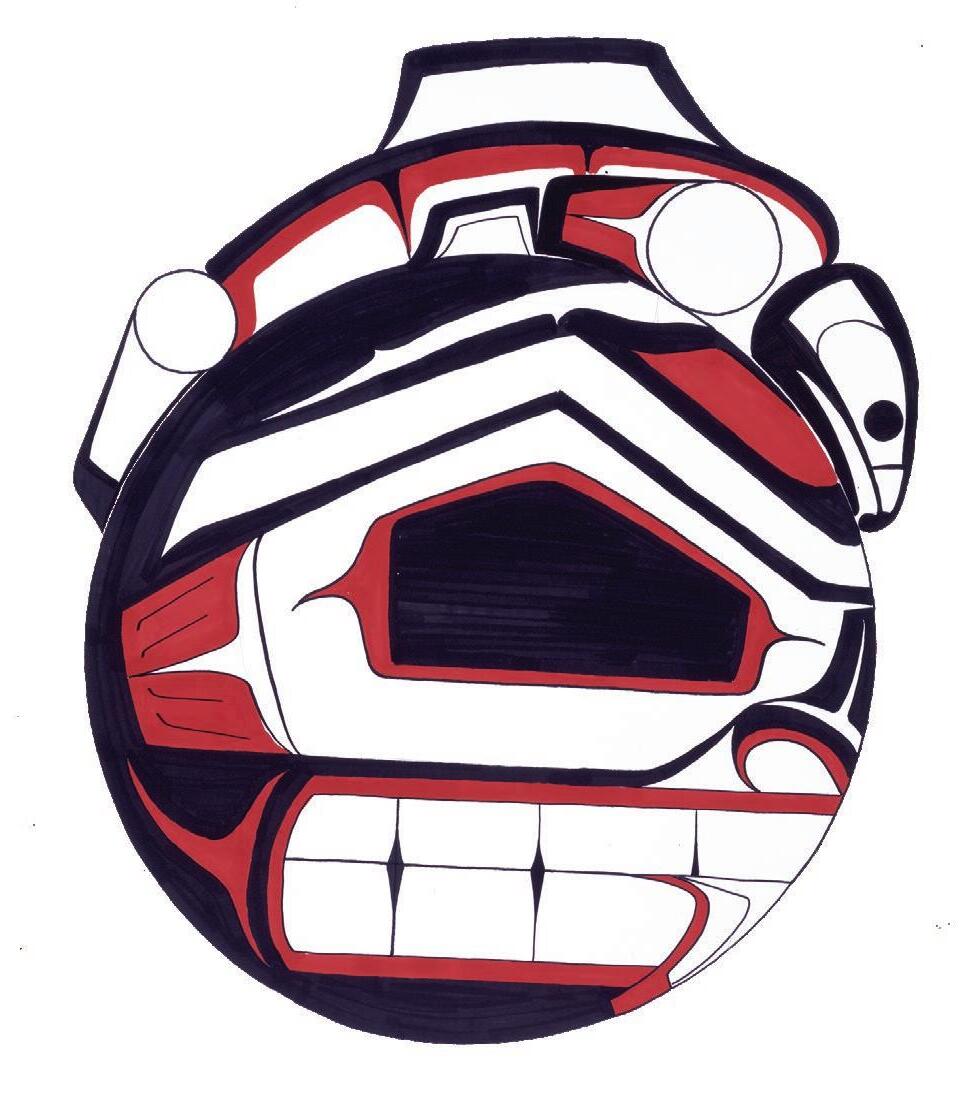
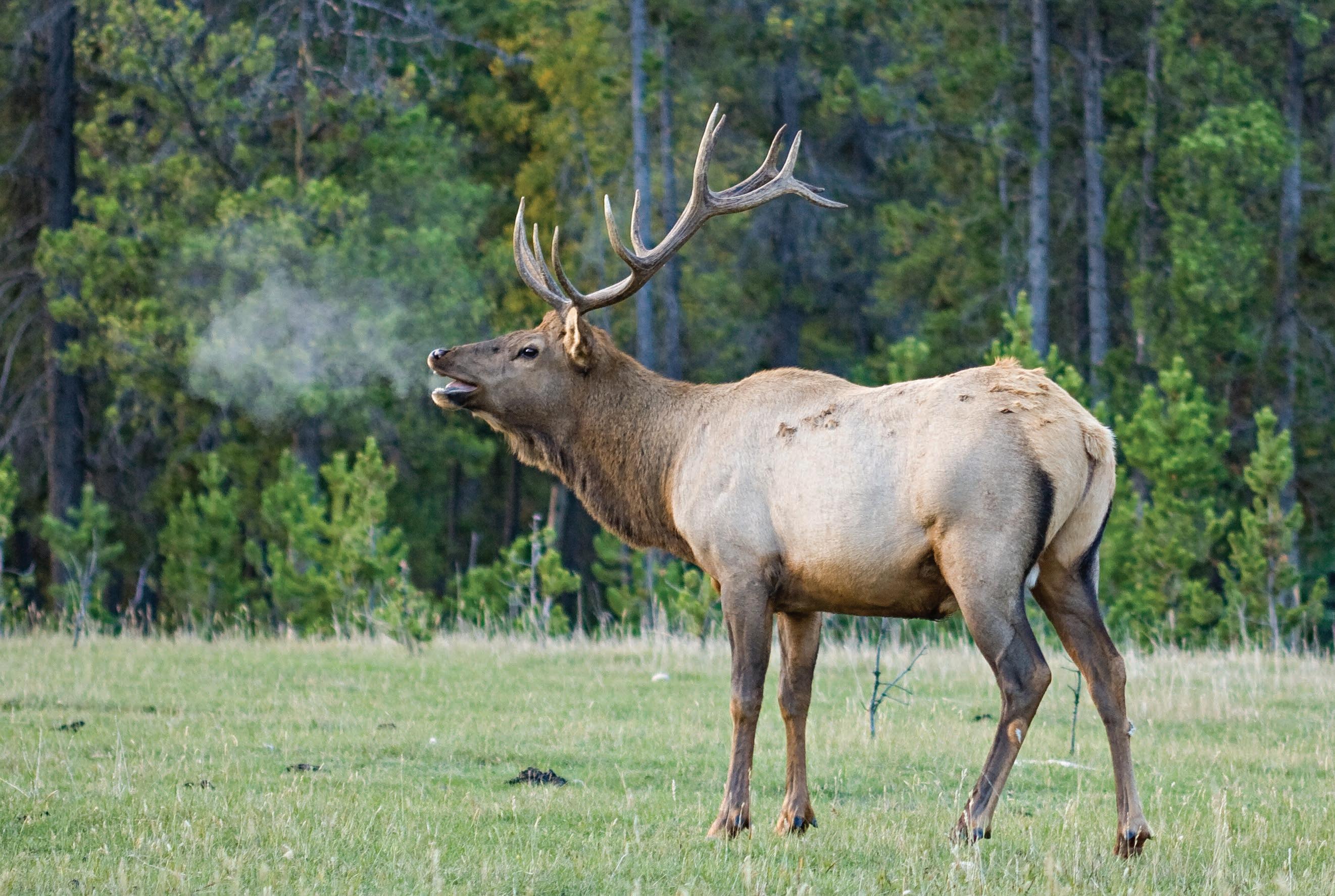
MOON OF THE ELK MATING CRY
Late September to early October is the Moon of the Elk Mating Cry. This moon signals autumn. This moon is a very busy time because all salmon runs are fished. The last of the fall Chinook run are entering the river while dog salmon, also called chum, are starting their run. Dog salmon dry lean, making them ideal for storage. Hunting also begins for larger game such as deer and elk. The activities in this moon will highlight the importance of stream health ecology for returning salmon as well as archery and hunter safety for deer and elk hunting.
Activity 1: Salmon Run Stream Ecology Lesson
This moon is an important time for the salmon runs. Several Moon of the Elk Mating Moon of the Elk Mating Moon of the Elk Mating Moon of the Elk Mating Moon of the Elk Mating
Chinook salmon, which includes the fall, spring, and summer salmon. Salmon spawning is dependent upon stream and river ecology, as the salmon require specific habitats for spawning. There are multiple restoration projects underway to improve the salmon spawning habitat.
Activity Description
Designed as a loosely structured activity, this event incorporates a field trip to a salmon run area where participants can observe the spawning behavior of adult salmon.
The activity should begin with a discussion about the salmon varieties that are fished by Coast Salish people, and the importance of salmon, culturally and nutritiously. Using the food web from previous activities, incorporate discussion around the importance of salmon to the food web and ecosystem.

Wherever possible, speakers should attend the field trip
Invite speakers from Swinomish Fisheries and Skagit River Systems Cooperative to talk about salmon habitat and restoration efforts that are underway. Speakers will discuss the importance of riparian plants to the salmon habitat.
Ask staff from the Swinomish Department of Environmental Protection to discuss and show culturally-significant wetland and riparian plants that they have cataloged on the Swinomish Reservation.
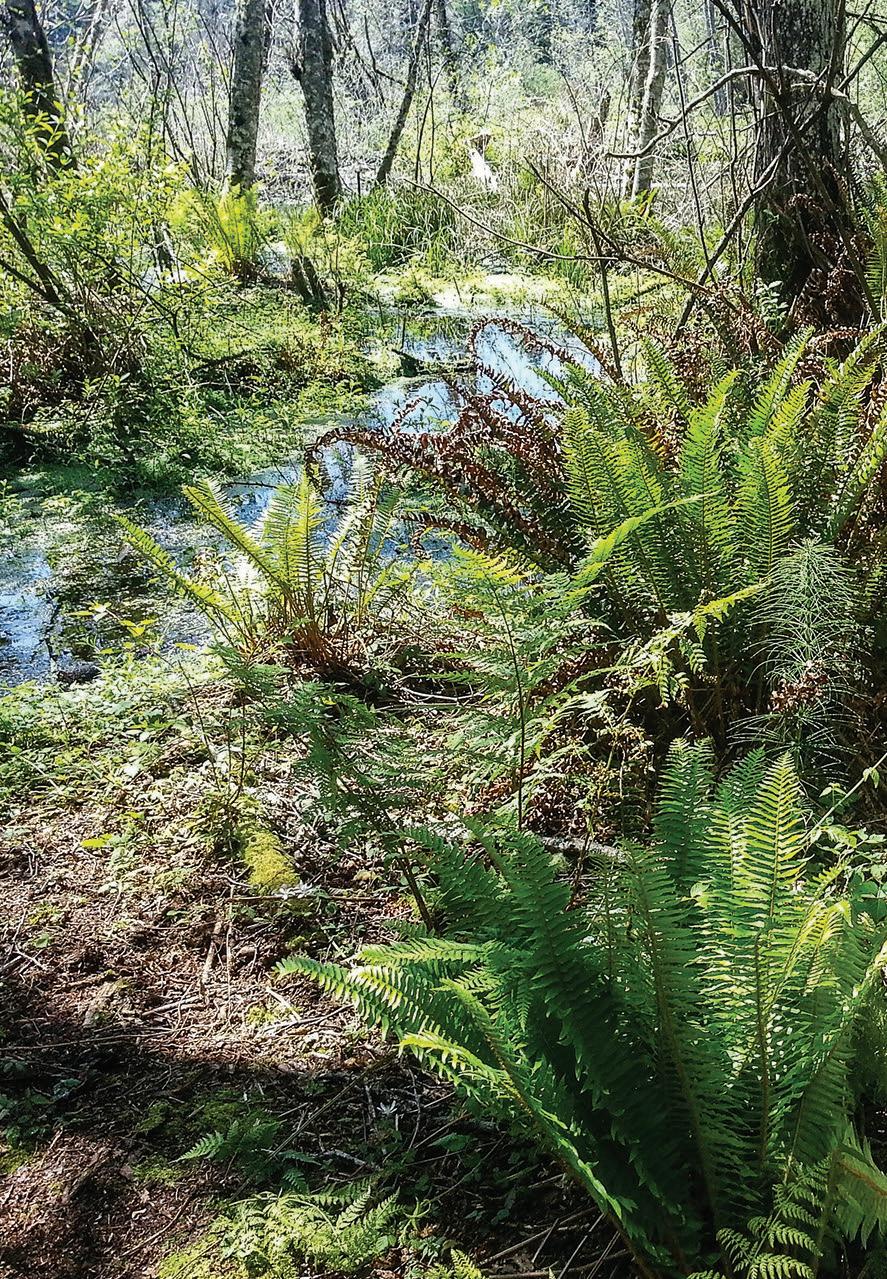
Salmon restoration area
Photo: Jason Thompson
Story: Fish and the Environment
This story comes from the book: Our Ways: Testimonies of the Swinomish Way of Life. It is about Swinomish Chairman Brian Cladoosby, kel khal tsoot, who is an avid fisherman. He grew up fishing with his father.
"My earliest memory of fishing was going down to the Swinomish Channel to catch kings in March and April. I remember, one night, waking up with my dad holding my ankles and dunking my head under the water in the Swinomish Channel because I fell asleep on his net and he was ready to make a set!"
Brian, as a true fisherman does, relates the season of the year to which species of salmon is running and reflects on the decline of the king.
“It has been, probably, thirty plus years since we’ve been able to access the spring Chinook run, they’re just not coming back. That’s a big change, not having that first spring king to be able to put on the table, or have a tribal gathering to celebrate that first King. Unfortunately, in about the last ten years, the number of kings that have been coming back to the Skagit around the summer solstice has been dramatically declining, so we decided that we won’t fish that stock until it rebounds sufficiently. We see our treaty right and co-management responsibilities as very important here at Swinomish."
"When my grandfather’s grandfather signed the Treaty [of Point Elliott], there was no starvation, poverty, homeless people, alcoholics, or disease. It was amazing to think about. Needs were taken care of by one another. They had sufficient salmon year round. Kids, you have a tough job ahead of yourselves. We didn’t inherit this earth from our grandparents, or our parents, we borrowed it from our children. It’s just loaned to us, we are stewards of this earth, and if you look back on the territory that we ceded to the government over the last hundred years, it has been managed terribly."
"Our kids need to realize that what we have is not guaranteed to be here forever. We have the opportunity right now to hand something to our kids that could be gone in a few generations. Everybody should be concerned about the environment. They’ve used the Puget Sound as a dump area for a couple of generations, and now it’s up to us to try to clean it up. We have to reconnect that cycle that was broken, through the damage to the environment. It’s going to take our generation, our kids’ generation, and probably our kids’ kids’ generation to fix the problem."
Knowledge Transfer
• Invite an elder to participate during the field trip.
• Before the field trip, have participants ask their family members about their experiences salmon fishing on the Skagit River.
Guiding Questions and Topics of Discussion
• What stories have you heard of the salmon? Have you watched a salmon run before?
• Discuss what other animals might live in the area and how they benefit from the salmon run.
• Point out riparian plants of cultural and ecological significance. What stream features improve salmon habitat? What degrades salmon habitat?

Tying it all together
• Connections to other activities
› Salmon and water quality are discussed during the Moon of the Blackberry.
› The importance of clean water is discussed in Moon of the Whistling Robins and Moon of the Salmonberry.
• Relationship to Indigenous health
› The ecology of streams and rivers is essential to salmon survival and reproduction. Protecting the water protects the salmon and healthy salmon translates to improved health in many ways:
» For physical human health, salmon are highly nutritious and are an excellent source of Vitamin D.
» For both for animals and humans, salmon play an integral role in the food web.
» For Swinomish community health, food feeds the spirit and the body. A healthy salmon population is one element necessary to achieve Swinomish community health culturally, socially, and physically.
Digging Deeper
• As appropriate, discuss activities that are environmental health hazards and may impact salmon habitat and salmon spawning (sea level rise, non-point source pollution, point source pollution, pesticide run-off, eutrophication etc.).
• Explore the Shadow of the Salmon curriculum and documentary teaching tools targeted at 8th grade classes. Shadow of the Salmon introduces students to Cody Ohitika, a Lakota Sioux youth, who visits his mother’s relatives in the Pacific Northwest for the first time and learns about its history and environmental legacies. Online education.wsu.edu/documents/2015/08/ shadow-of-the-salmon.pdf/
• Invite a Swinomish staff to provide an overview of the Treaty of Point Elliott and the Boldt Decision and the culverts case.
• Ask students to list what they can do to help protect streams and salmon spawning areas. For example, recycle, use environmentally-friendly products, use homemade cleaning supplies, etc. This online resource lists ways to improve water quality for the salmon: ecy.wa.gov/programs/wq/plants/algae/lakes/BestManagementPractices.html.
• Go back to the food web, and ask students to imagine what would happen to the ecosystem if salmon stopped spawning. Additional information can be found at: cwf-fcf.org/en/resources/for-educators/educational-units/ocean-life-depends-on-us/.
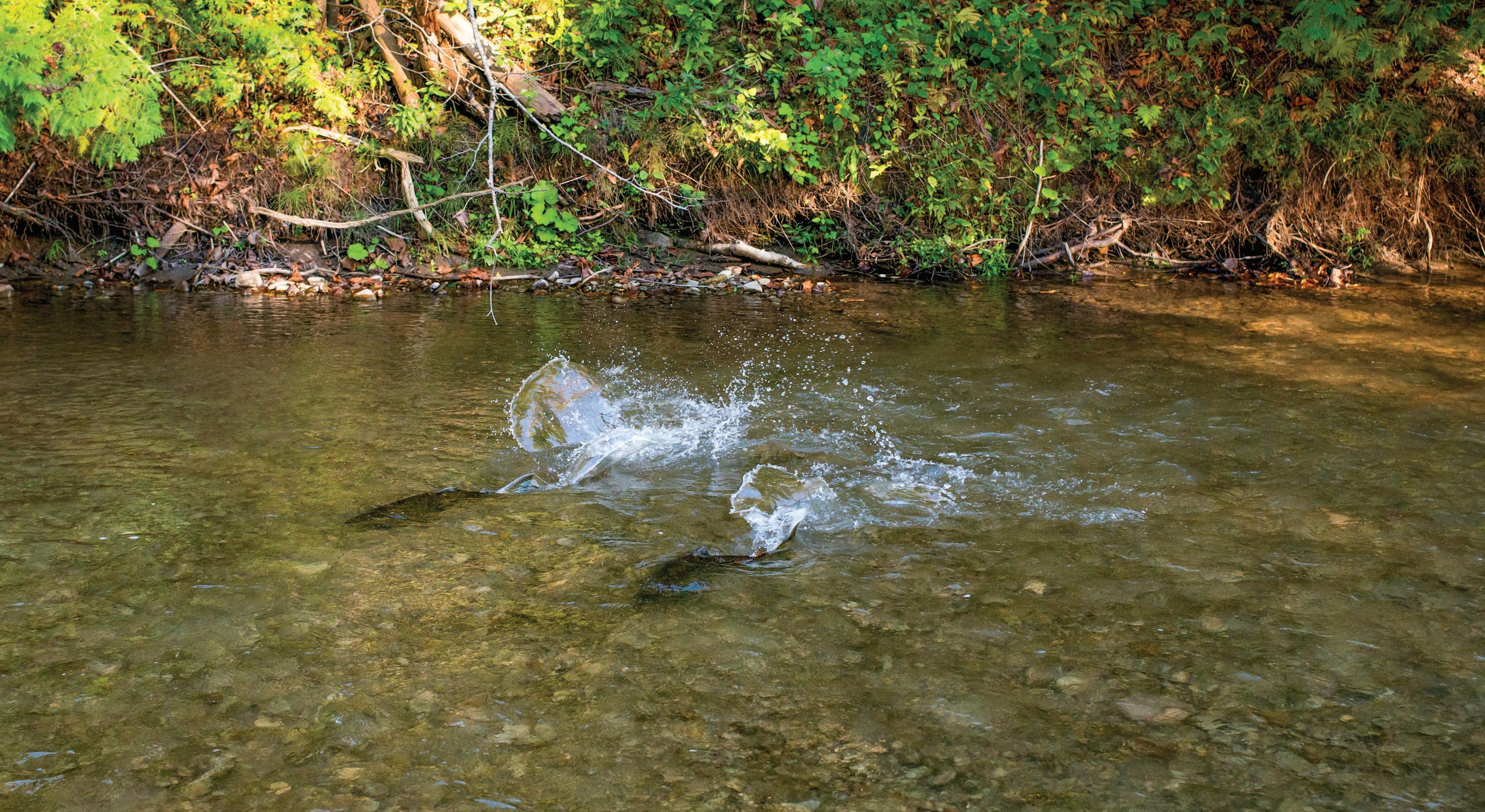
upriver to spawn
Notes to Educators and Additional Resources
• Our Ways: Testimonies of the Swinomish Way of Life. The Swinomish Indian Tribal Community’s Sharing Our Knowledge Series, Vol 3. Second Edition, 2011. Edited by T. Mitchell and D. Lekanof.
• smithsonianmag.com/science-nature/what-can-humans-do-save-pacific-northwests-iconic-salmon-180952769/
• Nooksack Salmon Enhancement Association’s Salmon Curriculum “Students for Salmon,” designed for 4th grade classes. static1.squarespace.com/static/552eaedce4b0dc86eeb1cddd/t/5a3a9680652dea8d8b4aefab/1513789085634/SFS+Curriculum+Final+Cover+Updated.pdf
Heading
Photo: iStock by Getty Images, Jun Zhang
Elk is both a treasured food source and challenging work for Tandy Grossglass.
Photo: Tino Villaluz
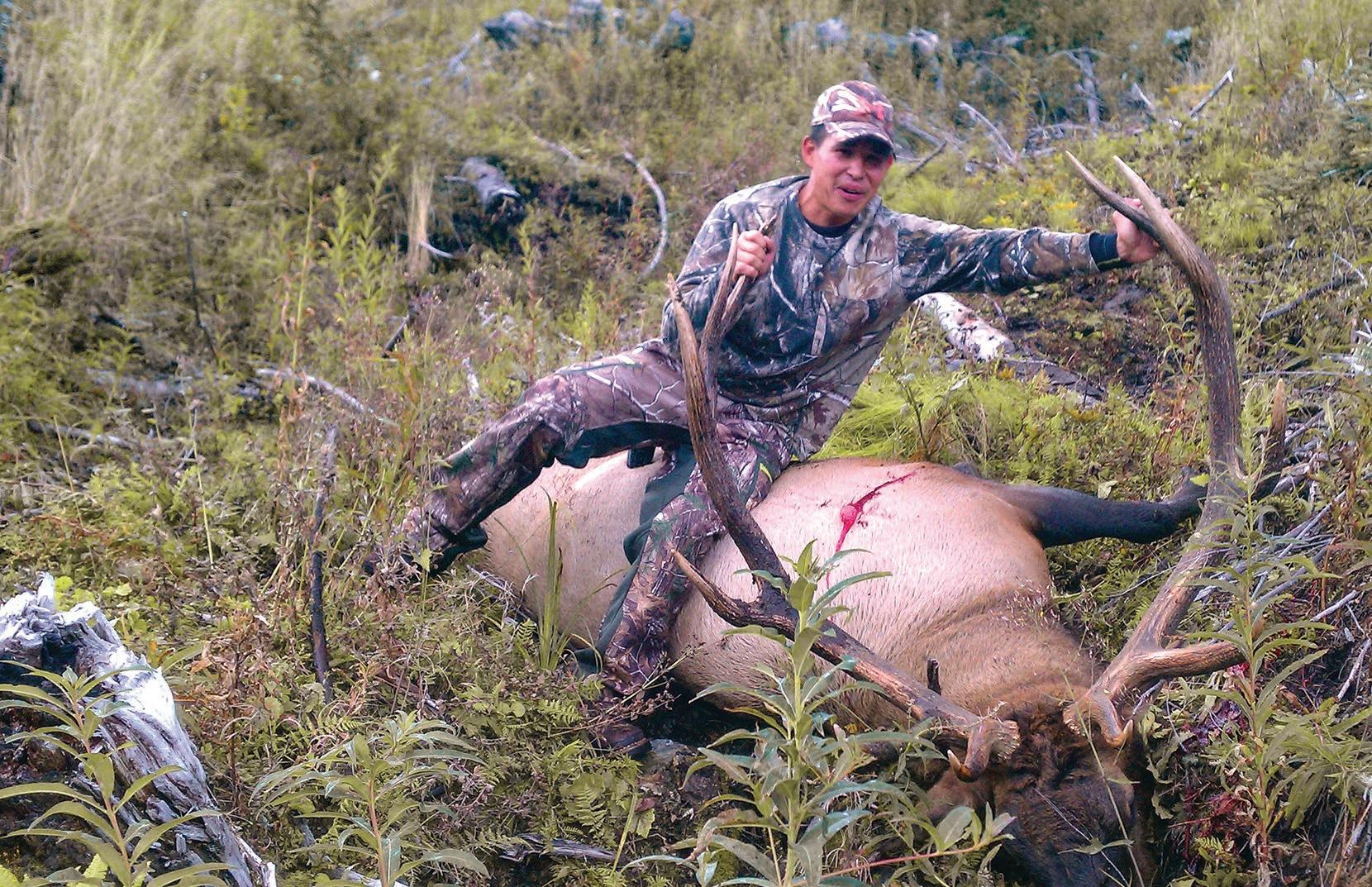
Time: 3 hours
Audience: 5th-8th grade
Setting: Outdoors (archery range)
Activity 2: Archery and Hunter Safety
Working with the Swinomish Hunting and Gathering program staff in this activity, participants learn the basics of archery and hunter safety.
Coordinate with program staff to ensure there is an archery range set up on the reservation before starting. If there are no ranges available for the desired time period, contact Riverside Archery in Mount Vernon to schedule a time.
Story: Our Ways
Moon of the Falling Leaves
Moon of the Falling Leaves
Moon of the Elk Mating Cry
Moon of the Elk Mating Cry
Learning Objectives
In this activity, participants will learn:
• The basics of archery
• The importance of hunting to the Swinomish people
• Current hunting rules and regulations
Moon of the Falling Leaves
Moon of the Falling Leaves
Lushootseed Words
Swinomish Vice-Chairman Brian Porter, sha-wha-wa, ya-qualeouse, and one of the skippers for the Swinomish Canoe Club, provides this story about hunting and how food plays an important role in connecting tribal members to their culture. The story is about Brian’s first deer hunting trip and the importance of respecting the teachings of elders. It can be found in the book Our Ways: Testimonies of the Swinomish Way of Life
Moon of the Elk Mating Cry
Cattail
Cattail
Moon of the Elk Mating Cry
• Moon of the Elk Mating Cry:
• Elk:
Elk Deer
Autumn Salmon
• Autumn:
Elk Deer
Autumn Salmon
• Deer: Materials
King, or Chinook, salmon
King, or Chinook, salmon
Silver salmon
• Minimum of two bows with arrows
• Youth archery instructor
Silver salmon
• Hunter safety literature
Dog chum salmon
Dog chum salmon
Sockeye salmon
Sockeye salmon
Humpback salmon
“Me and my dad went out to one of the islands. I was fourteen, and ran into this big buck, and I shot him. I didn’t really know what I was doing. Everything was a first. The first kill, the first time gutting it. After that hunt my grandparents had a dinner, and they put that deer on the table. They invited the elders and the older hunters to come over. They talked to me and shared their stories and some of the teachings that go along with hunting. I sat there, 'cause you can’t eat your first one, and I listened to them share. It was an experience. If it wasn’t for our elders, and the elders before them, we wouldn’t know what our resources were. They used them for a reason, they used them out of respect, and they were thankful. Be thankful.”
Knowledge Transfer
• Invite an elder along to talk about hunting.
• Before the field trip, request that participants talk to their family members about their hunting experiences.
Guiding Questions and Topics of Discussion
• What hunting stories have you heard about people in the community?
• Do you have any family members that hunt? If so, what do they do with the meat?
• What kind of habitat do deer live in? What kind of habitat do elk live in? Are there deer or elk on the Swinomish Reservation?
Why or why not?

Tying it all together
• Connections to other activities
› Elk or deer meat can be used in the pemmican recipe in Moon of the Falling Leaves.
› Meat can be utilized in the elders’ lunch menu in Moon of the Dog Salmon.
• Relationship to Indigenous health
› The importance of accessing hunting areas off of the reservation is part of sovereignty and self-determination.
› Deer and elk meat are important first foods.
› Not everyone is a hunter, so sharing the meat helps feed everyone in the community, especially for community gatherings.
Digging Deeper
• Washington Hunter Ed Course online has information about rules and regulations as well as course materials: hunter-ed.com/washington/studyGuide/Washington-Archery-Laws-and-Regulations/20105001_700046748/
Notes to Educators and Additional Resources
Our Ways: Testimonies of the Swinomish Way of Life. The Swinomish Indian Tribal Community’s Sharing Our Knowledge Series, Vol 3. Second Edition, 2011. Edited by T. Mitchell and D. Lekanof.


of the Falling Leaves
Falling Leaves
MOON OF THE FALLING LEAVES
Much of October is the Moon of the Falling Leaves. During this moon, the last stocks of sockeye and humpback go up river while silvers and dog salmon are reaching their peaks. Fishing and drying salmon for the winter months continues. This is the end of the harvest as plants are maturing and starting to die. It is a good time to gather nettles, cattails, salal, and bracken fern roots. Hunting for ducks, geese, and other birds begins as they return for the winter; hunting continues for larger game such as deer and elk. The activities in this moon focus on making cattail mats and pemmican.
Activity 1: Making Cattail Mats
In this activity, participants learn how to harvest cattail and use it to weave cattail placemats for the upcoming harvest dinner. Information presented here about cattails comes from the Tend, Gather, Grow curriculum.
The long, straight, and fully mature leaves of cattail are used as a weaving material for mats, baskets, and cordage. People around the world have been using cattail for centuries. Cattail mats are commonly used as screens, fans, room dividers, seats, sleeping mats, insulating wall covers in winter longhouses, and to cover cooking pits and bentwood boxes. They could also be used to make quick containers and gathering baskets. Cattail mats are also used as temporary walls for shelters in the summertime. The waterproof cattail leaves swell when wet, providing a tighter protective wall, and shrink a little when dry, allowing a gentle breeze in on hot days.
Though not very durable, cattail mats are easy to make. A needle made from ironwood is used to push through the leaves to sew them together, but it takes a lot of force. A creaser is used to compress and hold the leaf in place.
Rain capes were made out of cattail because of its ability to shed water and insulate the person under it. A beautiful rain cape is on display at the Burke Museum of Natural History in Seattle.
Cattail mats are a prime example of traditional technology. The fluffy winter seed heads can be used for diapers, padding, insulation, and pillows, and can extend wool. If using the fluff for pillows, use thick fabric to seal in the cattail fluff because it can cause hives. The seeds can also be used as a thickening agent. Cattail stalk can be lit and used as a torch and as a fire starter.
Harvest cattails in clean areas away from homes or businesses to avoid contamination. Do not harvest near heavy agricultural areas, dairy fields, or sides of the road. Wash with boiling water before consuming. Leave the oldest plants and the ones on the edges. These are the soldiers that help to hold and protect the plant community from invasive species like yellow flag iris and reed canary grass. As with all plant gathering, harvest with care. Be sure to never remove more than you need, and no more than 10% of a stand.
Moon of the Falling Leaves
Moon of the Falling Leaves
Time: 3 hours
Audience: 5th-8th grade
Setting: Outdoors (cattail harvest); indoors (cattail mat workshop)
Learning Objectives
In this activity, participants will learn:
• A story about the changing of seasons
• How to gather cattails and weave a cattail placemat
• About various tools that can be created with cattail
• About cattail as a food source
Lushootseed Words
Moon of the Falling Leaves
• Moon of the Falling Leaves:
Moon of the Falling Leaves
Cattail
• Cattail: Materials
Cattail
Elk
Elk
• Cattail leaves
Deer
• Baskets for cattail collection
Deer
• Collection tools (i.e. clippers, digging tools)
• Scissors
• String
• Poles/stabilizing sticks for creation of cattail mat
Cattail Harvest
Begin this activity outdoors at the chosen cattail harvest location. Work with an elder and/or first foods consultant to learn about the plant. Lessons may include identification of the various cattail plant parts and identifying uses of these parts. For example, cattail shoots and roots are edible, and the male flower can be peeled and boiled. The roots can be dried and later ground into flour. From an ecological standpoint, cattail provides a habitat to many birds, fish, and insects. Additionally, cattail can help reduce flooding. The cattail is also used in remediation techniques, as it can remove metal and organic contaminants from water and soil.
Working in groups, have participants harvest the leaves of the cattail. Describe which portion of the harvested leaves will later be used to weave placemats. Dry the leaves for three to five days before the weaving workshop because they will shrink significantly as they dry.
Cattail Mat Workshop
Teach participants how to use the leaves they harvested to create a cattail placemat. This is an excellent opportunity to invite expert weavers to share examples of their own work and

Contact the Swinomish Cultural Events office and ask them to direct you to expert weavers who may be able to help with the workshop. Weave a placemat prior to the workshop so participants can see what the final product will look like.
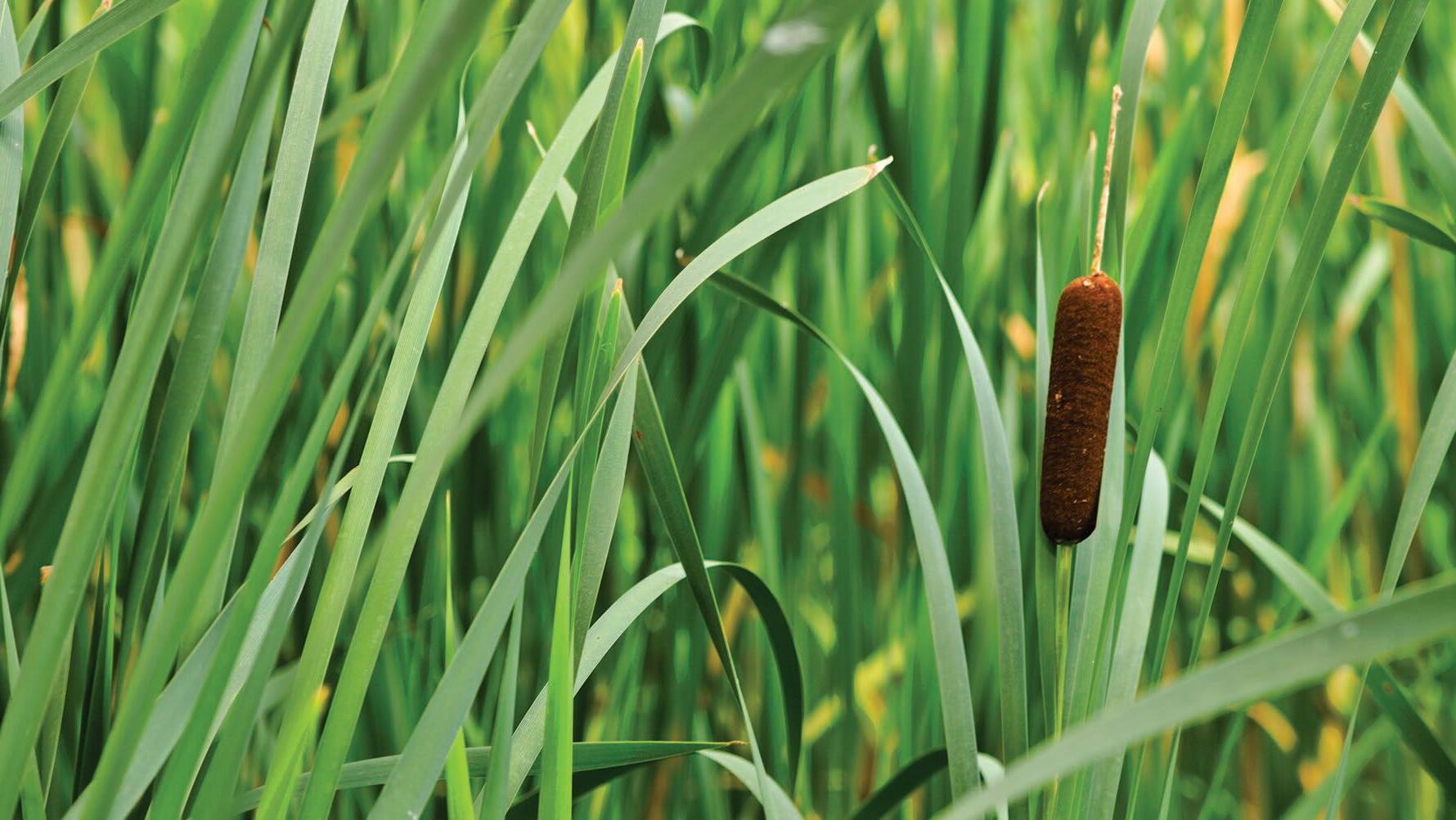
are wetland plants with a unique flowering spike.
Digging Deeper
• Facilitate a group discussion about how toxins move throughout the food web, and how they increase as they climb up the food chain (bioaccumulation and biomagnification) .
• Hold a second workshop around the use of traditional dyes. Simple chromatography can be performed to identify the colors that exist within traditional plants. For example, dandelion flowers can create a yellow while green can come from stinging nettle. Coast Salish weaver Krista Point uses dandelion and goldenrod flowers for yellow, red alder bark for red, and golden beige from lichens. Learn more here: authenticIndigenous.com/artists/krista-point.
› More information about traditional paints is available at Native Paint Revealed: nativepaintrevealed. com/a-red-line-pigments-and-paints-on-coast-salishtotem-poles.html
› A plant chromatography lesson plan is available online from the California Institute of Technology here: arborsci. com/Data_Sheets/P6-2100/highschool_biology.pdf
Cattails
Photo: iStock by Getty Images, Andrew Black
Knowledge Transfer
• Invite elders to participate in the activity.
• As participants weave their cattail placemats, encourage them to share stories about the changing of the leaves.
• During the harvesting of the cattail, ask participants to explain to each other what they have learned about the cattail, both in plant identification and the uses of the plant, either for food or use in making items such as rain capes.

Guiding Questions and Topics of Discussion
• What stories have you heard about the changing of the leaves?
• Have you used cattail before, either as a food source or to use in a weaving project? Have you seen a woven cattail product before? Would you use a woven cattail rain cape?
• What are benefits to using cattail instead of modern equivalents, such as a waterproof jacket? Cattail will naturally biodegrade whereas modern jackets take decades to break down and contribute to landfill issues.
Tying it all together
• Connections to other activities
› Cattail leaves can be sewn using ironwood needles, such as those that may be prepared during the Moon of the Whistling Robin.
• Connections to Indigenous health
› This activity combines storytelling, ethnobotany, ecology, and traditional weaving techniques. The goal of this activity is for participants to understand the interconnectedness between humans, plants, and animals.
› Cattail is used in bioremediation projects, as the plant takes up various metals and excess phosphorus. As a result, cattail grown for these purposes should not be harvested or used for food or tools.
› Cattail can trap solid waste, removing it from streams and rivers. Clean-up project teams can then more easily find and remove the waste from the habitat. Do not harvest cattails in areas of solid waste.
Notes to Educators and Additional Resources
• Wright, R.K. 2015. Coast Salish Weaving Tools and Technologies. Burke Museum. Date last updated: October 20, 2015.
Date Accessed: May 27, 2017. Available online: burkemuseum.org/blog/coast-salish-weaving-tools-technologies
• Additional information regarding how to create cattail mats can be found online: Prindle, T. 2017. NativeTech.
Date last updated: 2017. Date Accessed: May 27, 2017. Available online: nativetech.org/cattail/matting.htm
• Hansen, W. W. 2012. Typha latifolia. The Wild Garden: Hansen’s Northwest Native Plant Database.
Date Accessed: May 27, 2017. Available online: nwplants.com/business/catalog/typ_lat.html
• Krohn, E. Tend, Gather and Grow. 2017. goodgrub.org/tend-gather-grow
Time: 2 hours
Audience: Community
Moon of the Falling Leaves
Moon of the Falling Leaves
Setting: Indoors
Learning Objectives
In this activity, participants will learn:
Moon of the Falling Leaves
• To preserve meat and berries by making pemmican
• Pemmican is a traditional food that can replace modern equivalents (i.e. trail mix, granola)
Moon of the Falling Leaves
Moon of the Falling Leaves
Cattail
Vanessa Cooper’s Pemmican
Lushootseed Words
Cattail
• Moon of the Falling Leaves
Moon of the Falling Leaves
Elk
• Elk:
Elk
• Deer:
Cattail
Deer
Deer
Elk
Materials
• Sharp knife
Deer
• Food processor
• Plastic bags or other containers for storage
• Ingredients for making pemmican (see recipe)
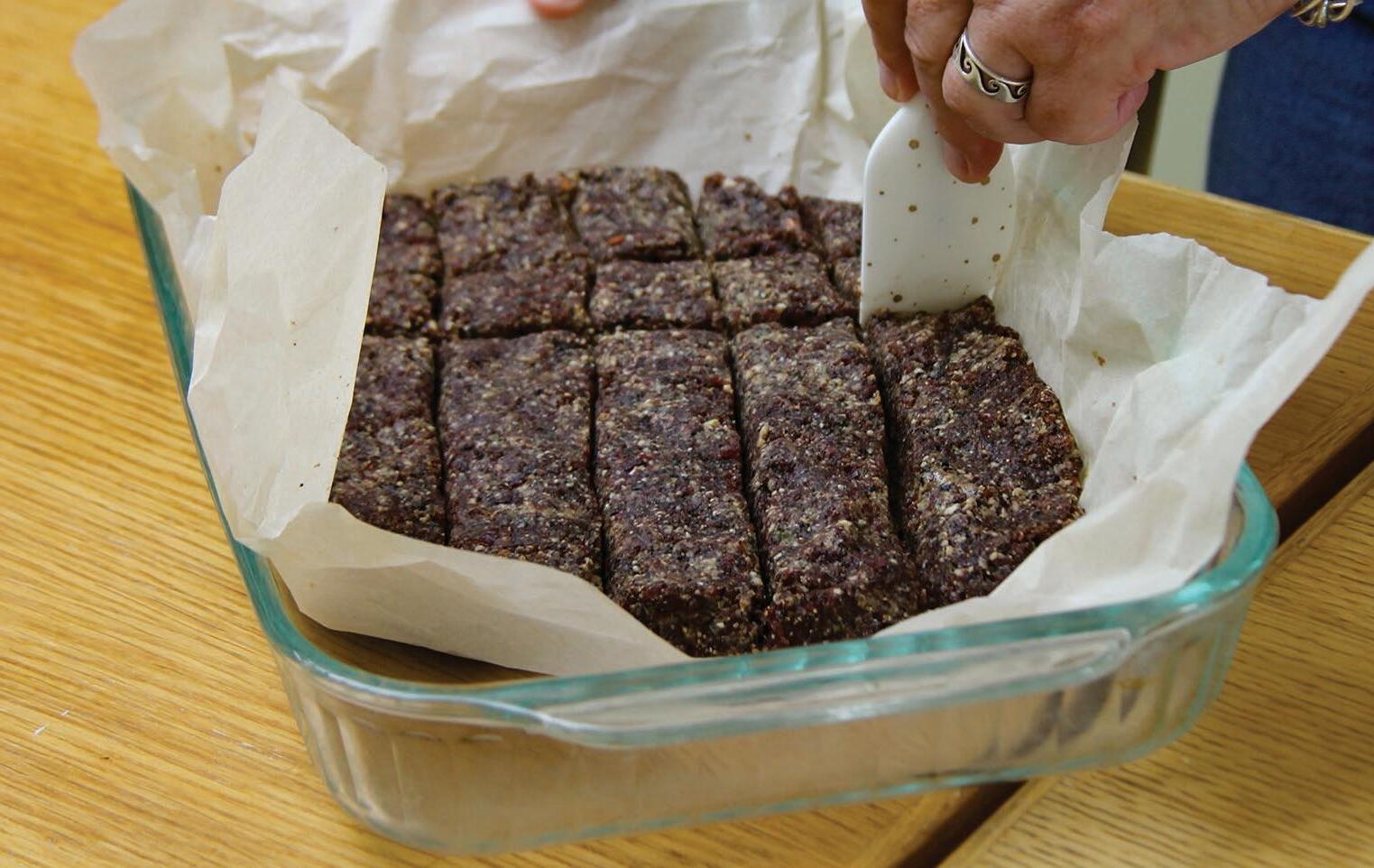
Pemmican workshop hosted at Swinomish
Photo: Emma Fox

Pemmican is well known for its high concentration of nutrients and its long shelf life. This combination of fat, protein, and carbohydrate will keep you energized all day. Traditionally, dried meat like venison and elk would be pounded together with fat and dried berries. Pemmican makes an excellent snack and was utilized as a travel food.
Ingredients
• 1 cup dried venison, elk, or beef jerky
• 1 cup dried berries (huckleberry, cranberry, salal, or other)
• 1 cup raw hazelnuts, walnuts, sunflower seeds, or almonds
• 1/3 cup nut butter (hazelnut, almond, cashew, or peanut butter)
• 1 tablespoon honey
Instructions
With a knife, chop meat into very small pieces. Add dried berries, nuts, and nut butter in a food processor; blend well. Add the dried meat and blend well. Store in plastic bags or containers in a dark, cool place. This will keep for several months.
Knowledge Transfer
• Invite elders to participate in the activity.
• Ask the Swinomish Hunting and Gathering Program about a donation of elk or deer meat for use in the activity.
• Invite hunters to share information about what it means to be a hunter and/or the process of hunting and processing the meat being used in the activity.
Guiding Questions and Topics of Discussion
• Have you ever heard of pemmican? What are similar types of foods that you could buy in a store?
• Have you ever gone on a hike or other outing? What types of food did you take with you on the trail? What kinds of foods do you think your ancestors took with them on the trail? Explain that the pemmican bars being made are essentially Indigenous energy bars.

Tying it all together
• Connections to other activities
› In Moon of the Blackberry and Moon of the Silver Salmon, berries may have been preserved for use in this activity.
› In the Moon of the Elk Mating Cry, hunting for large game such as elk and deer begins.
• Relationship to Indigenous health
› Pemmican is made from native plants and berries and sometimes animal meat. As the climate changes however, many of these plants and animals may begin to migrate out of the area or be threatened by invasive species.
Digging Deeper
• Explore how climate change may affect the locations, access, and availability of first foods. Invite climate change researchers to talk about how climate change may impact local first foods.
• Include a lesson on food handling and safety as it relates to food preservation. Contact an environmental health officer to schedule a class.
Notes to Educators and Additional Resources
• Krohn, E. and V. Segrest. 2017. Feeding 7 Generations: A Salish Cookbook. ISBN: 978-I-63398-049-5
• Skagit Climate Science Consortium: skagitclimatescience.org; video: vimeo.com/user14800439
• Tend, Gather and Grow. 2017. goodgrub.org/tend-gather-grow
• Swinomish climate change website: swinomish-climate.com; video: vimeo.com/48120951; youtu.be/1uiVaHuzEe4
• It’s Berry Season: wildfoodsandmedicines.com/539/
• National Phenology Network: usanpn.org/natures_notebook

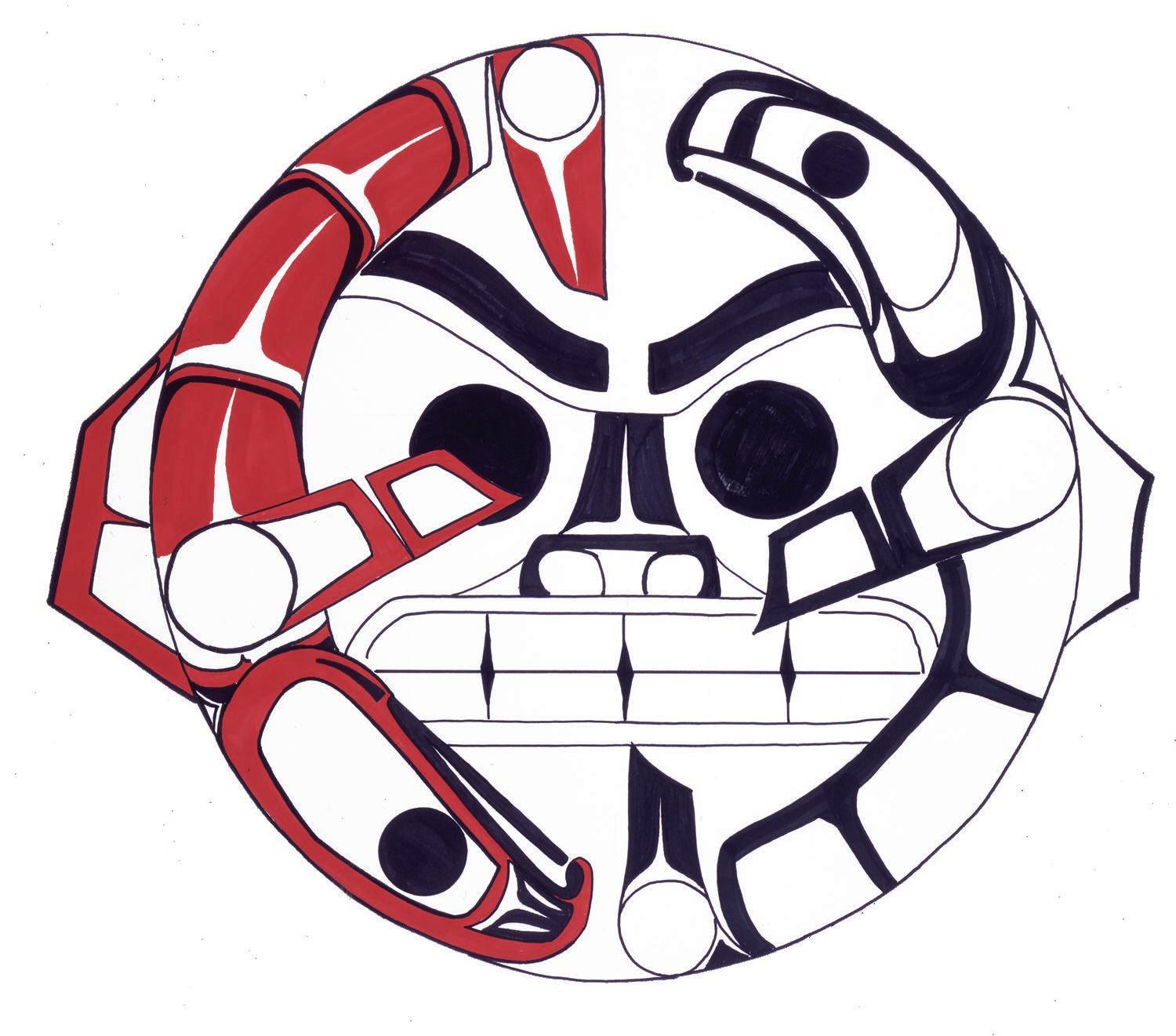
the Dog Salmon
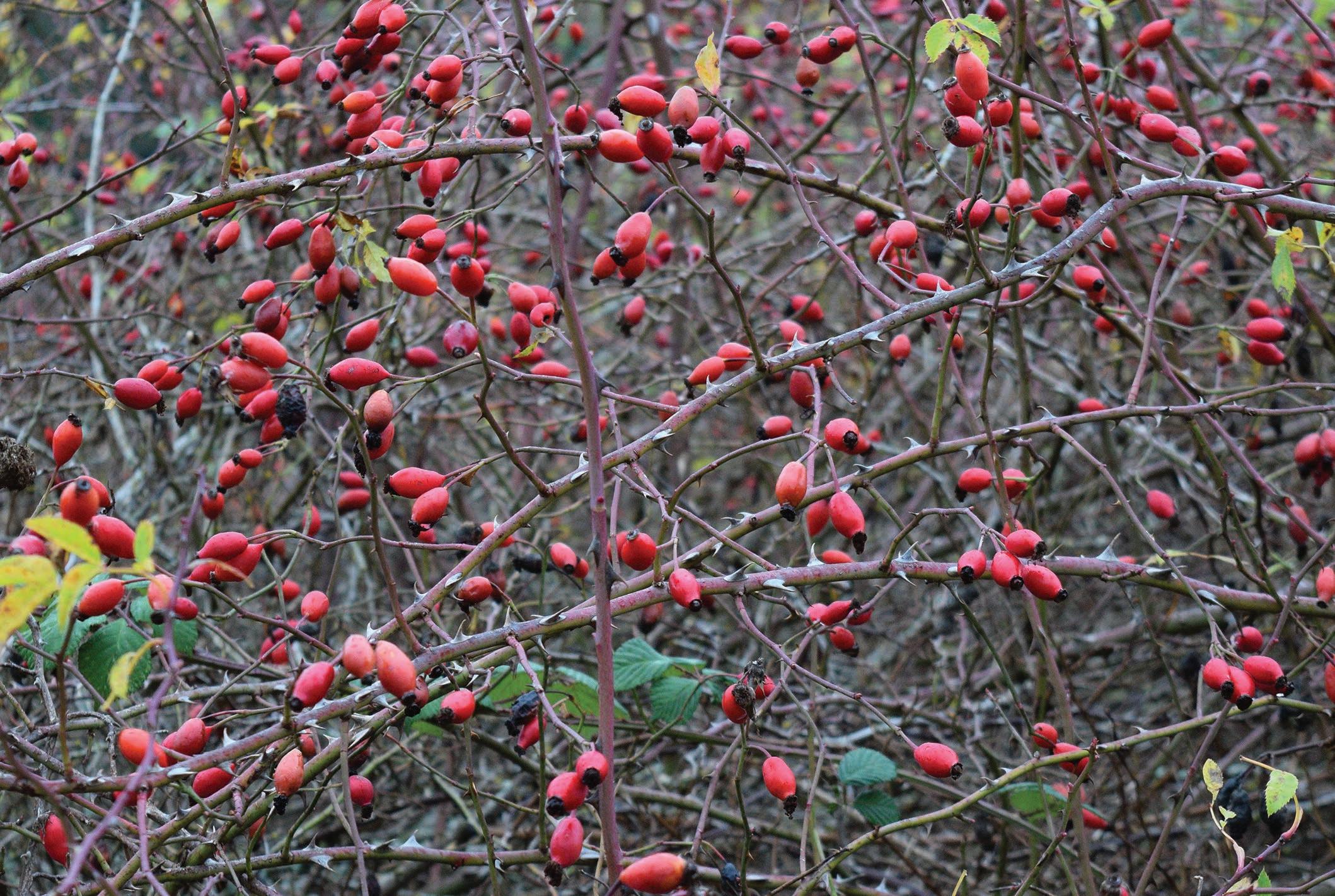
MOON OF THE DOG SALMON
Much of November is the Moon of the Dog Salmon. Salmon continue to be fished until the end of this moon. The last of the bracken fern roots and camas bulbs are harvested. Shellfish harvest begins again and continues to increase in the food supply through the winter months. Hunting waterfowl and game continues. The activity in this moon highlights many first foods and includes working with a chef to create a harvest meal.
Time: 3-4 hours
Audience: 5th-8th grade
Setting: Indoors
Learning Objectives
In this activity, participants will learn:
• The importance of first foods to Indigenous community health and well-being
• About the health benefits of having traditional foods at a harvest feast versus contemporary holiday foods
• How first foods feed both the body and the spirit (seafood spiral)
Activity: Preparing a Meal of First Foods
In this activity, participants will have the opportunity to create a meal using first foods, or traditional foods. The activity highlights first foods uses in meal preperation as well as their nutritional values. Many of the foods used for this meal will be based on plants and animals harvested in prior activities and workshops. When necessary, other tribal resources or purchased food can round out the menu.
Moon of the Dog Salmon
Moon of the Dog Salmon
Moon of the Dog Salmon
• About Swinomish traditions of fall harvest feasts and the importance of honoring and sharing food within and beyond the community
• About the important role of cooks in the community
Moon of the Dog Salmon
Lushootseed Words
Moon of the Dog Salmon
Moon of the Dog Salmon
Moon of the Dog Salmon
Focusing on the nutrition of a traditional diet is important during the Thanksgiving holiday, as a way to highlight healthier alternatives to contemporary Thanksgiving foods. Nutritional values can be discussed by comparing custom nutrition labels to those of mainstream holiday foods. The nutritional component of this activity highlights much of the work from the Alaska Native Health Service, Traditional Plant Foods of Canadian Indigenous People, and the USDA Agricultural Research Service. Nutritional labels are available for a variety of traditional plants, berries, fish, animals, and shellfish.
• Moon of the Dog Salmon:
Moon of the Dog Salmon
• Eat:
Eat Cook
Eat Cook
Eat Cook
• Cook:
Eat Cook
Give away
Give away
Give away
Give away
• Giveaway: Materials
• Traditional foods and other ingredients
• Aprons and chef hats
• Fabric markers to decorate hats and aprons
• Nutrition labels
• Seafood spiral
TIPInvite community members and elders to introduce the activity with stories about the history of the harvest feast. Work with participants to plan this event several weeks in advance and have them invite people that are important in their lives to share the harvest meal.

Activity Description
Work with a local chef to set up various cooking stations prior to the arrival of participants. Have participants work in groups to prepare various components of the harvest feast. Supply each station with the necessary foods, cooking materials, and recipes, as wells as chef hats, aprons, and fabric markers.
Provide a brief outline of what the activity will encompass as participants arrive. This is a good time to have an elder talk about the long tradition of community harvest feasts. Make sure to discuss the importance of knowing how to set a table, and having good thoughts while harvesting and preparing a meal. Also, have the chef explain why chefs wear hats and aprons (kitchen hygiene and safety) and then give participants time to decorate their hats and aprons.
Include nutrition labels for the first foods as well as labels for commercial alternatives at each station. Have participants compare the differences, and have them discuss those differences with each other. Many traditional foods are lower in sugar while providing vitamins and minerals that are often lacking in commercial foods.
Have participants work with the chef and elders to prepare the meal and set the table for the remainder of the activity. The tables can be set with cattail placemats from the activity held in the Moon of the Falling Leaves. Encourage participants to join the community in enjoying the meal when preparations are complete.
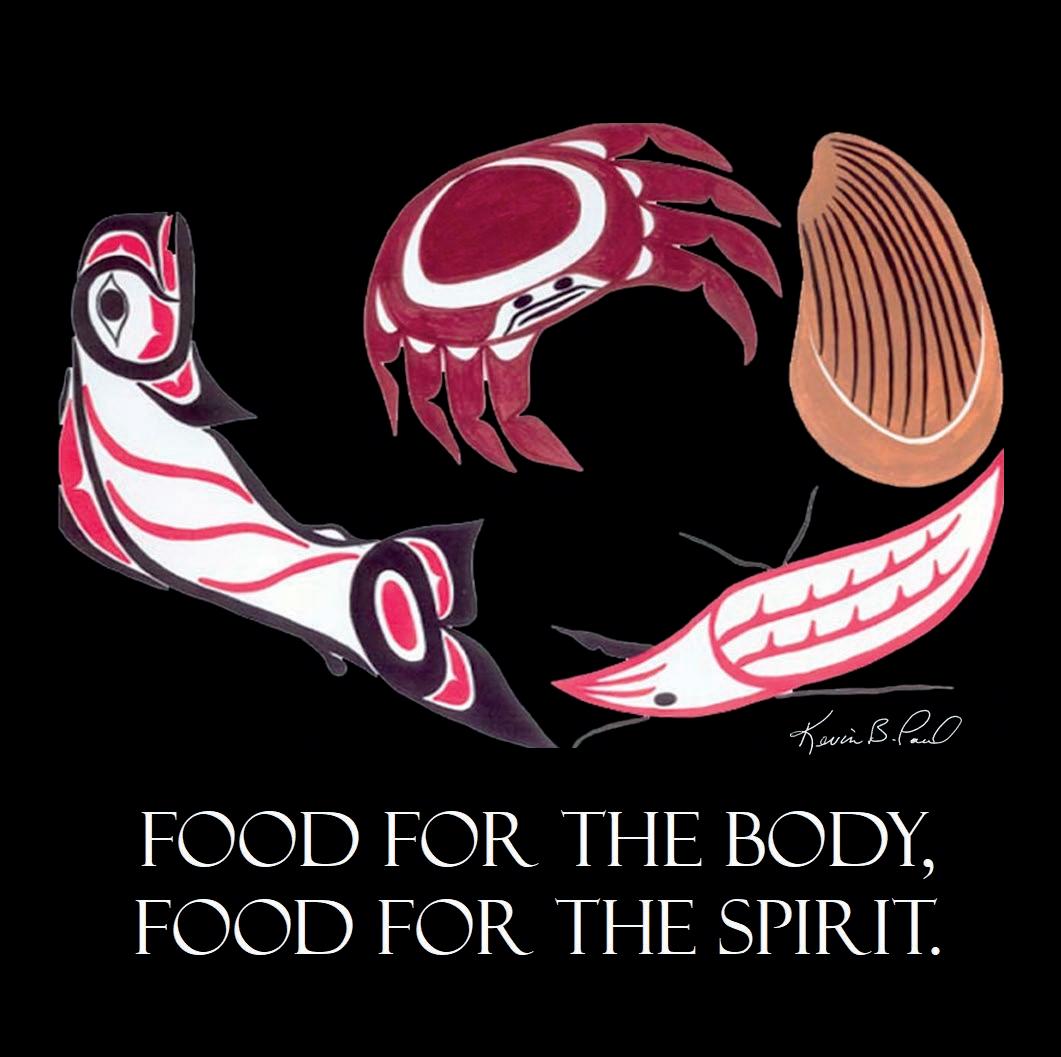
Additional Tips
Designed by Swinomish artist and Senator Kevin Paul, this depiction of the seafood spiral shows the seasonal cycle and cultural importance of Swinomish seafood harvests. He points out that harvest practices spiral outward and collect wisdom as the seasons flow from one to the next, interconnected and building on each other.
• Coordinate with kitchen staff well in advance.
• There are numerous local and regional Native chefs who may be available to lead meal planning and preparation. Find and coordinate with a chef a minimum of two months in advance to ensure sufficient time for contract review and approval. Alternatively, tribal staff knowledgeable in first foods could guide meal planning and preparation.
• Consider gifting the guests with traditional medicines made in the Moon of the Salmonberry, or dried madrona berries from Moon of the Silver Salmon. Other preserved foods such as jam or pemmican also make nice gifts.
• Set up the cedar bentwood box as a display item and have information about the box, recipe handouts, and information about this 13 Moons curriculum available at the dinner.
Notes to Educators and Additional Resources
• The Movement to Define Native American Cuisine: nytimes.com/2016/08/17/dining/new-native-american-cuisine.html?
• Krohn, E. and V. Segrest. 2016. Cedar Box Teaching Toolkit.
• Krohn, E. and V. Segrest. 2017. Feeding 7 Generations: A Salish Cookbook. ISBN: 978-I-63398-049-5
Knowledge Transfer
• Encourage participants to share stories related to harvesting and the foods they are preparing for the meal.
Guiding Questions and Topics of Discussion
• What do you typically think about when preparing a meal for someone else?
• Would you make these foods at home with your family?
• Is there a particular first food you believe should be included in the meal?
Tying it all together
• Connections to other activities
› This activity connects to all prior activities, with woven cattail placemats and foods that were previously harvested and preserved. The Thanksgiving holiday is a sharp reminder of colonialization. This activity aims to decolonize the holiday while positively highlighting traditional harvest feasts and traditional foods.
• Connections to Indigenous health
› The emphasis on the nutrition value of traditional foods in comparison to mainstream holiday foods is meant to highlight how these foods are healthier physically and culturally.
› This activity highlights the importance of sovereignty, self-determination, access, and sharing of natural resources as part of Indigenous health.
Digging Deeper
• Explore the issue of “food sovereignty.” Tribal food sovereignty is the right for Indigenous nations to define their own diets and shape food systems that are congruent with their spiritual and cultural values. Communities that exhibit tribal food sustainability and food sovereignty are those that:
› Have access to healthy food
› Have foods that are culturally appropriate
› Grow, gather, hunt, and fish in ways that are maintainable over the long term
› Distribute foods in ways so people get what they need to stay healthy
› Adequately compensate the people who provide the food
› Utilize tribal treaty rights and uphold policies that ensure continued access to traditional foods
• The following websites offer information about tribal food sovereignty and provide links to existing tribal programs across the country:
› wellforculture.com/tribal-food-sovereignty
› nativefoodsystems.org/about/sovereignty
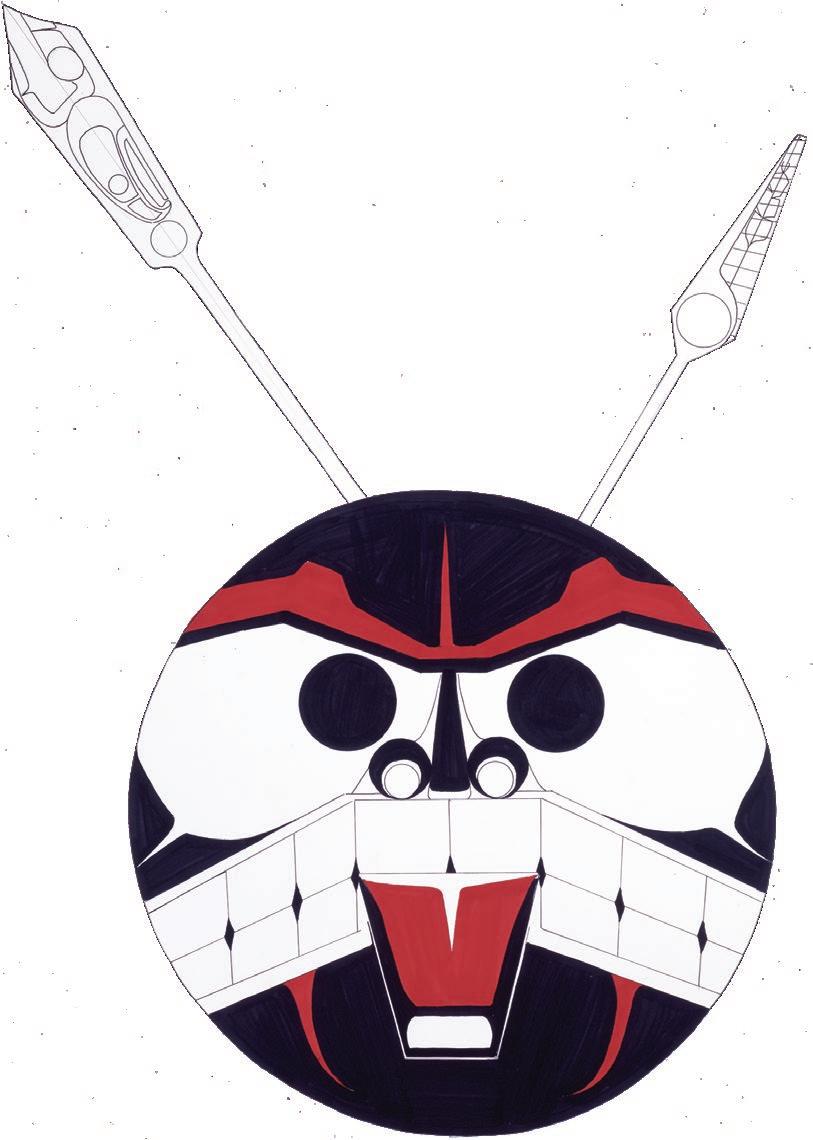
MOON TO PUT YOUR PADDLES AWAY to Put Your Paddles Away
Paddles Away

Late November to late December is the Moon to Put Your Paddles Away. This moon signals a time to move indoors for the coming winter season. During the winter moons, tools, baskets, and other items are constructed. The activity in this moon focuses on making plant-based medicines.
Activity: Medicine of the Trees Workshop
The Tree People are among the oldest on our planet. In solidarity, they stand together, creating a beautiful sea of green throughout our landscape. With careful inspection and observation, one may count hundreds of different shades of green.
Among these tall standing giants grows a plethora of different nations of Tree People. Standing side by side for centuries, they collectively create changes in weather patterns, decorate the seasons, and call in the birds with their own beautiful songs. They are our teachers and they teach us by example. In silence they ask us to pay attention. When we settle ourselves and are taking the time to observe their great knowledge, we are gifted with lessons of how to live in this world.
The evergreens in particular teach us perseverance as they face storms with great courage, holding vitality in their needles and leaves, forever thriving. The meaning of “evergreen” after all is to have “enduring success”. The medicine is in the spirit and physical body of the plant.
Moon to Put Your Paddles
Time: 2-3 hours
Audience: Beginner; middle school to adult
Setting: Outdoors and indoors
Learning Objectives
In this activity, participants will learn:
• Medicine collection
Moon to Put Your Paddles
Moon to Put Your Paddles
Moon to Put Your Paddles
› About three common species of conifers that grow on or near the Swinomish Reservation, how to identify them, the habitats they grow in, and their importance to animals for habitat and cover
› What parts of the conifers to harvest to make medicine
› Complementary uses of traditional plants in relation to modern medicine
• Medicine of the Trees workshop
› About two ways that the natural oils produced by coniferous trees keep both the trees and people healthy
› About the importance of gift giving
The holiday season is the time of year we turn to the evergreens. Their beauty is celebrated inside our homes, their bows adorning our doors and their fragrance wafting through the air everywhere we turn. We invite them inside during this time in order to remember that it is time to celebrate life and practice generosity (Valerie Segrest, Food Sovereignty Coordinator, Muckleshoot Indian Tribe).
Moon to Put Your Paddles Away
Moon to Put Your Paddles Away
Lushootseed Words
Douglas Fir
Moon to Put Your Paddles Away
Douglas Fir
• Moon to Put Your Paddles Away:
Moon to Put Your Paddles Away
• Douglas fir:
Douglas Fir
Cedar
• Cedar:
Cedar
Douglas Fir
Cedar
Give Away
• Giveaway: Materials
Give Away
Cedar
Give Away
• Ingredients for medicine making (see recipes)
Give Away
• Photos and/or samples of branches, cones, and sap
• PowerPoint presentation and handouts for Douglas fir, western red cedar, and western white pine
• Conifer tree materials and medicines; conifer based tea
• Harvesting supplies: hand pruners and bags or baskets
• Double boiler or Crock-Pot for making infused oils
• Jelly bags, canning funnel, 2 cup and 8 cup liquid measuring cups, canning jar for pressing out oils, kitchen towels, kitchen scale
• Stove or hot plate
• 1 quart double boiler or saucepan, wooden spoon, cheese grater (beeswax is impossible to remove from utensils, so these should be reserved exclusively for medicine making)
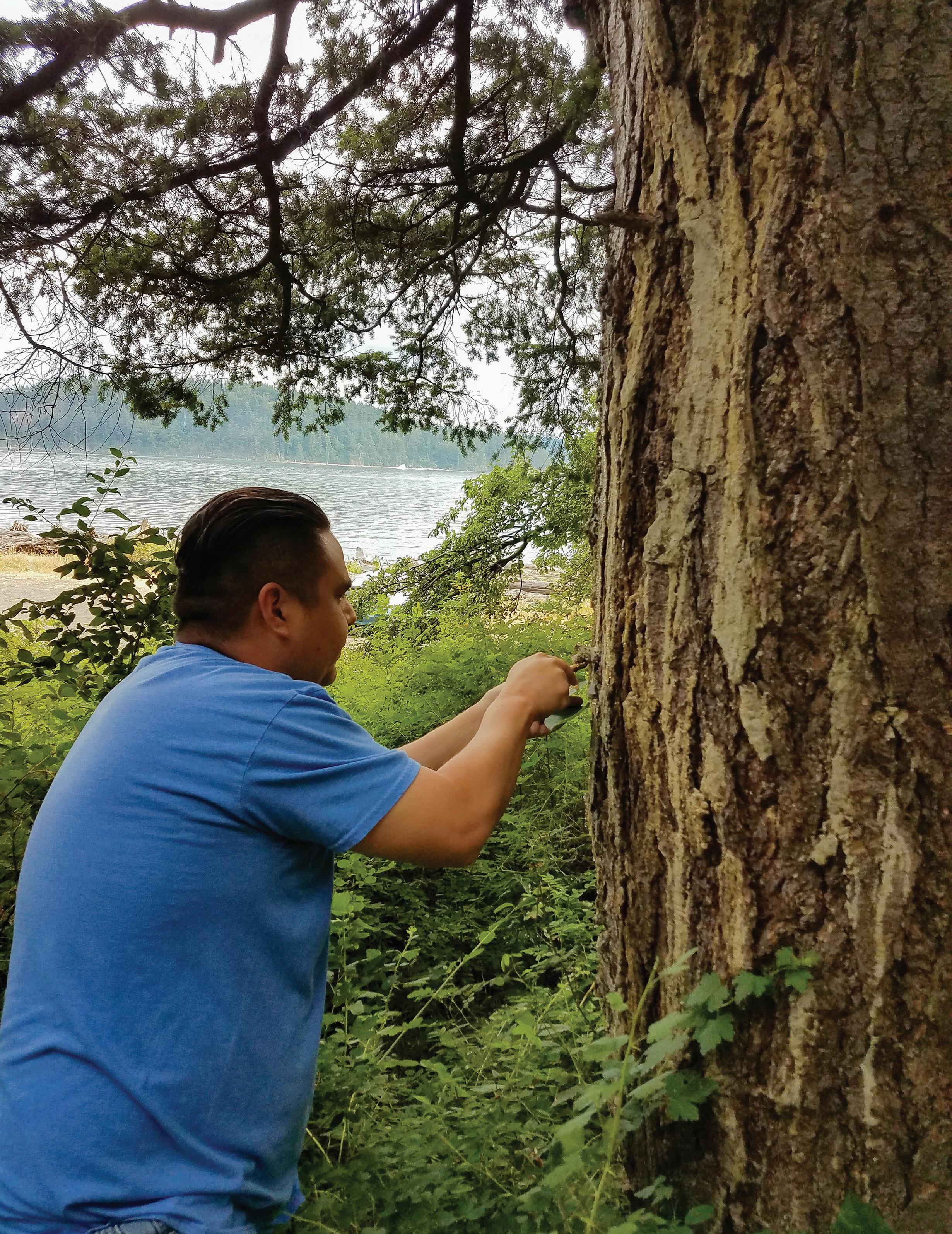
Participants work together to make lip balm, chest rub, and lotion bars from conifer needle-infused oils (Douglas fir, western red cedar, and western white or shore pine) to give as holiday gifts in this activity, which can be held as a single event, making the medicines with provided materials, or can be preceded by an outdoor harvesting trip.
Activity Description
Medicine Collection Field Trip (optional, outdoors)
Take participants to visit one or more sites on the Swinomish Reservation to learn about the different conifers and their medicinal uses. Following the harvest, teach participants how to process and prepare the oils for medicine making.
Medicine of the Trees Workshop (indoors)
Begin with a story and/or presentation that connects the importance of coniferous trees and their medicinal qualities to the winter season. Following this, discuss the species of trees that will be used in the workshop and what medicines participants will make with them.
Before asking participants to form into groups to make the different medicines, explain the process of how to make each one and the importance of gifting the final products to people in the community to improve community health.
TIP
Conifer oils take a week to infuse and last about a year. If you choose to have the outdoor harvest trip, hold it a week in advance. If you are not offering the harvest trip, prepare the oils at least a week in advance. Participants can learn how to make the oils and can take some home to make their own medicines later.
The resins of evergreen trees offer many healing properties for use in salves.
Photo: Myk Heidt
Infused Oils:
Bark, Buds, Seeds, Woody, and Dried Material
Extracting Oils: Oils can be infused with fresh or dry plant material by gently heating them on a stovetop in a double boiler or in an oven. One method is to grind one ounce of herb for every six ounces of oil. Gently heat for four hours to several days, stirring occasionally. Strain through muslin cloth. Discard the marc (remaining pressed herb) and place the infused oil in glass jars. They will last for about a year.
Cedar: Cedar leaf has anti-fungal properties. Tincture, powder, or salve is used for tinea, nail, and skin fungus. Cedar also has immune stimulating properties that increase white blood cell scavenging and is helpful for chronic respiratory and intestinal infections. The volatile oils in the leaf also act as an antibacterial. A steam from dried or finely chopped fresh leaves can help combat infections and open the respiratory passages. For best results, steam two to three times a day for about five minutes.
CAUTION: Cedar contains strong volatile oils including thujone, a ketone that is known to be toxic in large quantities. Cedar is strong medicine and should be used with caution; the dosage is usually low. It should not be used during pregnancy or by individuals with kidney weakness (Elise, Medicine of the Trees).
Douglas Fir: The pitch, needles, bud tips, bark, and roots of Douglas fir are used medicinally by a number of Coast Salish peoples. The pitch was used by the Quinault, Skagit, and Cowlitz tribes as a salve for sores and skin irritations. The Skagit boiled the bark and used it as an antiseptic. To treat colds, the Cowlitz and Squaxin boiled and drank the pitch. The Squaxin mixed the needles with cedar to make a cold remedy tea. The Swinomish boiled the bark of young roots for the same purpose, and for use as a babies bath. They picked the bud tips and chewed them for sore throat or sores in the mouth. They also boiled the needles for a general tonic and to make a poultice for the chest to “draw out the pain” (PSME monograph). Douglas fir needles can be infused in oil to make a body oil, lotion, or salve. They are also made into a tea that is used in sweats and baths. The resin is used for medicine and as waterproofing (Elise, Medicine of the Trees).
Western White Pine: White pine is most prized as a medicine for opening the lungs, fighting infection, and stimulating the immune response. The resin, bark, and leaves are all high in healing aromatic oils and resins. The pitch was chewed as a gum or sucked on to alleviate coughing. The pitch can be diluted in oil or salve and used as a chest rub. Young needles can be used fresh or dried as a steam inhalation. Young leaves and dried bark are also boiled to make tea and cough syrup. Try pouring the tea over hot rocks in a sauna or sweat lodge. Aromatic oils in white pine stimulate the kidneys and act as a diuretic to rid the body of excess fluid. White pine is also traditionally used for stomachaches (probably because it fights microbes).
Shore Pine: Shore pine can be used in the same way as white pine. Due to shore pine’s harsh growing climate, it tends to produce higher amounts of pitch (Elise, Medicine of the Trees). Shore pine needles are high in terpinen-4-ol (anti-fungal, antibacterial, anti-inflammatory; it is the active ingredient in tea tree oil), phellandrene (used in the fragrance industry for its peppery, minty, citrus smell), and carene (constituent of turpentine; a pungent scent that can cause skin irritation if used in large amounts).
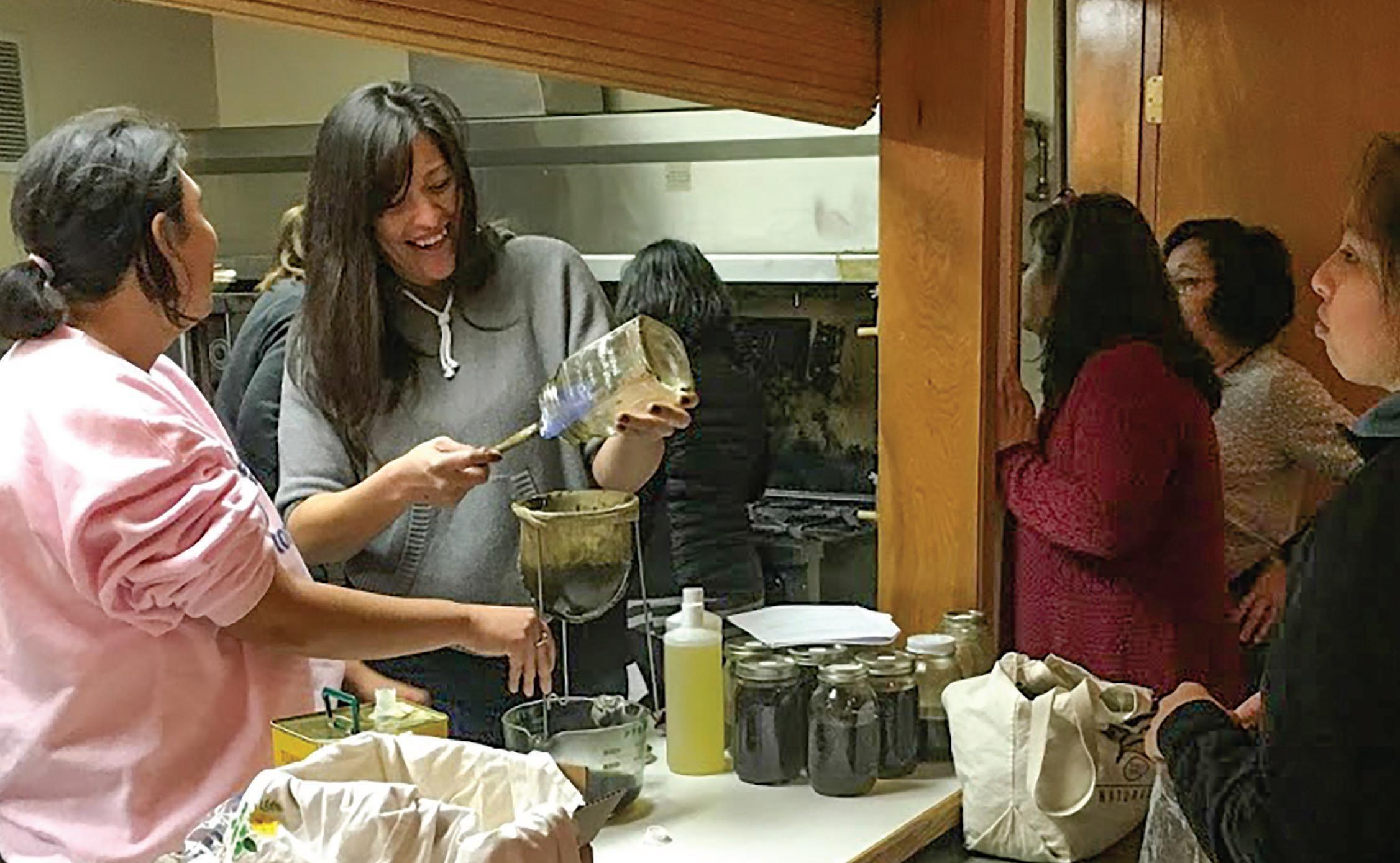
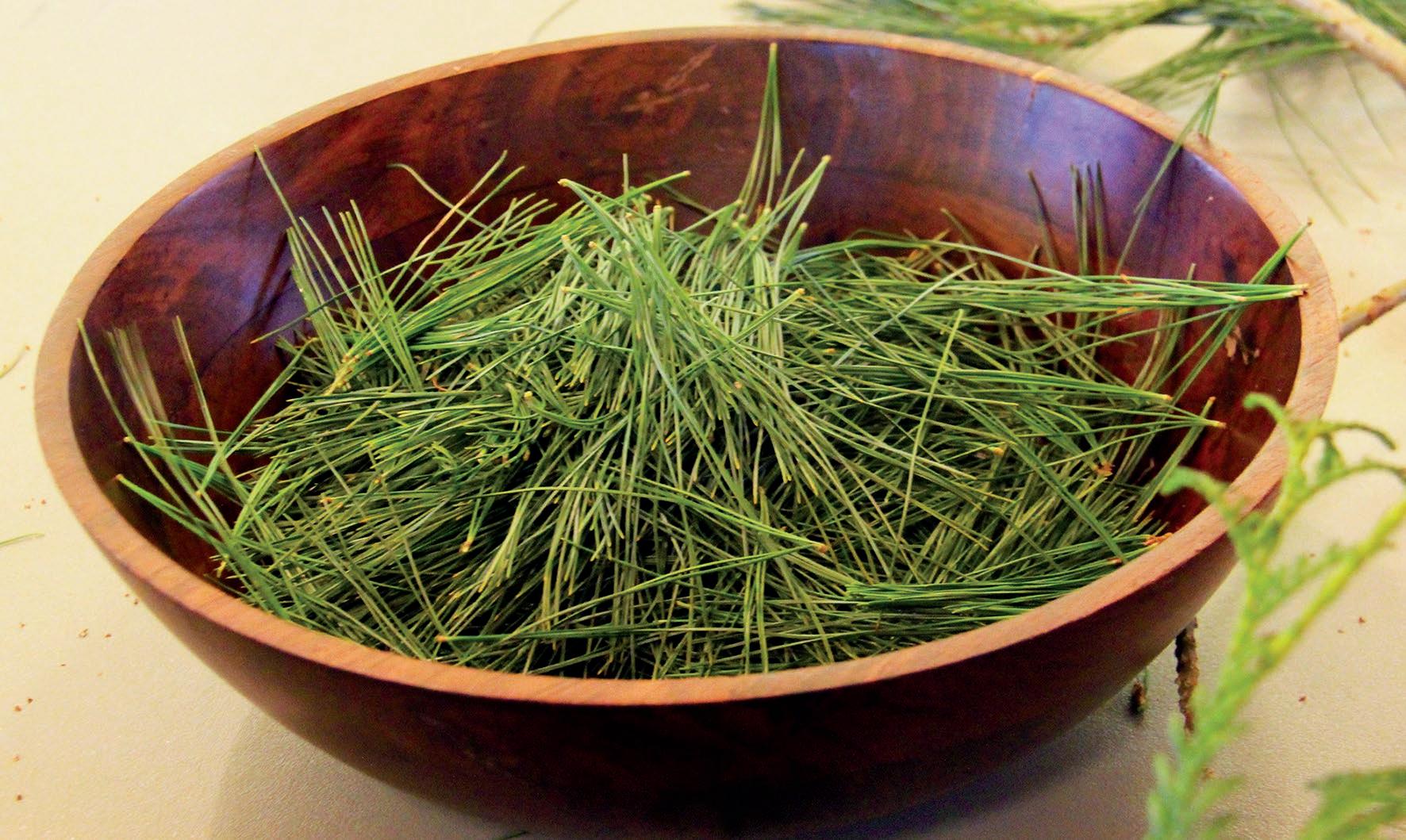
Medicine of the Trees workshop
Photos: Myk Heidt (top)
Caroline Edwards (bottom)
Essential Oils
Black Spruce: Utilized in aromatherapy for its opening and soothing attributes when added to a massage oil or an inhalation/diffuser blend.
Douglas Fir: Widely known for its disinfectant properties, it is also used as a room freshener and as fragrance in soaps.
Eucalyptus Radiata: Eucalyptus radiata is safer than E. globulus for elders, children, and people with sensitive skin. Antiviral properties make it useful in a chest rub, shower, steam, or vaporizer.
Eucalyptus Globulus: Eucalyptus is one of the oldest native medicines used in Australia. It is known now for its use in inhalants and vapor rubs, and as a household disinfectant.
Lavender Oil: Lavender is anti-inflammatory, anti-microbial, and is healing to the skin. It also soothes the nerves and eases insomnia and anxiety.
Lemon: All parts of the lemon can be used: The oil can be used around the house as a cleaning agent, and medicinally for its affinity with the digestive system.
Vitamin E Oil: is used to prolong the shelf life of infused oils, and has anti-oxidant properties.
More information about essential oils:
• Mountain Rose herbs essential oil descriptions: mountainroseherbs.com/catalog/aromatherapy/ essential-oils
• Krohn, Making Herbal Gifts for the Holidays handout (Daybreak Star Indian Cultural Center, 12.10 (2008) NWIC Diabetes Prevention Through Traditional Plants Mentor Program).
Evergreen Tree Oil Lip Balm
Ingredients and supplies (oil)
• Fresh evergreen tree needles or leaves
• Extra virgin olive or castor oil
• Blender or food processor
• Double boiler
• Muslin cloth
To make oil
Lip balm
• Pyrex measuring cup (8 or 16 oz.)
• 1 pound scale (measures ounces)
• Essential oil
• Lip balm or salve tins and labels
Harvest healthy looking branches from evergreen trees. Pull apart leaves or pull needles off branches. Finely chop the needles or leaves, or place them in a food processor or blender to finely chop them. This will help open cell walls in the plant, enabling the scent and medicine to extract readily.
Place the chopped leaves or needles in a double boiler. Cover with oil so the oil is ¼-½ inch over the plant material. Heat very gently to hasten extraction and help remove water from the plant material. Keep the temperate low; do not boil. You can turn the double boiler on and off as needed. The oil should take on a green color and strong smell. Allow the oil to infuse for several hours. You can leave it for several days, occasionally bringing the oil to a warm temperature and stirring it. Strain the oil with muslin cloth and allow it to sit for an hour or more. If there is sediment or water remaining in the oil, it will fall to the bottom. Pour the oil into a glass storage container, leaving water and sediment behind. Label and store in a cool dark place for up to one year.
To make lip balm
Use one part beeswax by weight to 4 parts of infused tree oil by volume. One half cup of oil and one ounce of beeswax will make about 25 1/16 ounce roll-up tubes. Gently heat the oil and beeswax in a double boiler until the beeswax is just melted. Turn off heat and add 10-15 drops of pure essential oil (nice options: add Douglas fir, fir needle, grapefruit, sweet orange, or lavender). Pour lip balm into tubes and cool before placing the caps on them. Address labels work well for lip balm tube labels; cut length to fit.
Cedar Lotion Bars
This therapeutic bar is great for dry, chapped skin and athlete’s foot.
Ingredients and supplies
• Soap molds
• Cellophane bags and ribbon
• 42 ounces extra virgin olive oil infused with western red cedar
• 18 ounces beeswax
• 1 ½ teaspoon lavender oil
Instructions
Heat infused oil over medium low heat, add grated beeswax and stir until melted. Test for firmness by allowing a small amount to cool, and adjust the oil to beeswax ratio as needed. Cool slightly, stir in essential oil, and immediately pour into molds. Allow the body bars to cool and then pop them out of their molds.
Makes 12 5 oz. lotion bars

Douglas Fir Lip Balm
Ingredients and supplies
• Lip balm tubes and tray
• 7 ounces extra virgin olive oil infused with Douglas fir needles
• 2 ounces beeswax
• Vitamin E (optional)
• ½ teaspoon Douglas fir essential oil
Instructions
Heat infused oil over medium low heat, add grated beeswax and stir until melted. Pour melted oil and wax in to a glass measuring cup. Allow balm to cool until just beginning to thicken. Stir in vitamin E (if using) and ½ teaspoon essential oil. Pour in to lip balm tubes and allow them to cool to room temperature. Cap and label.
Makes about 50 tubes (depending on how well you pour them into the tubes)
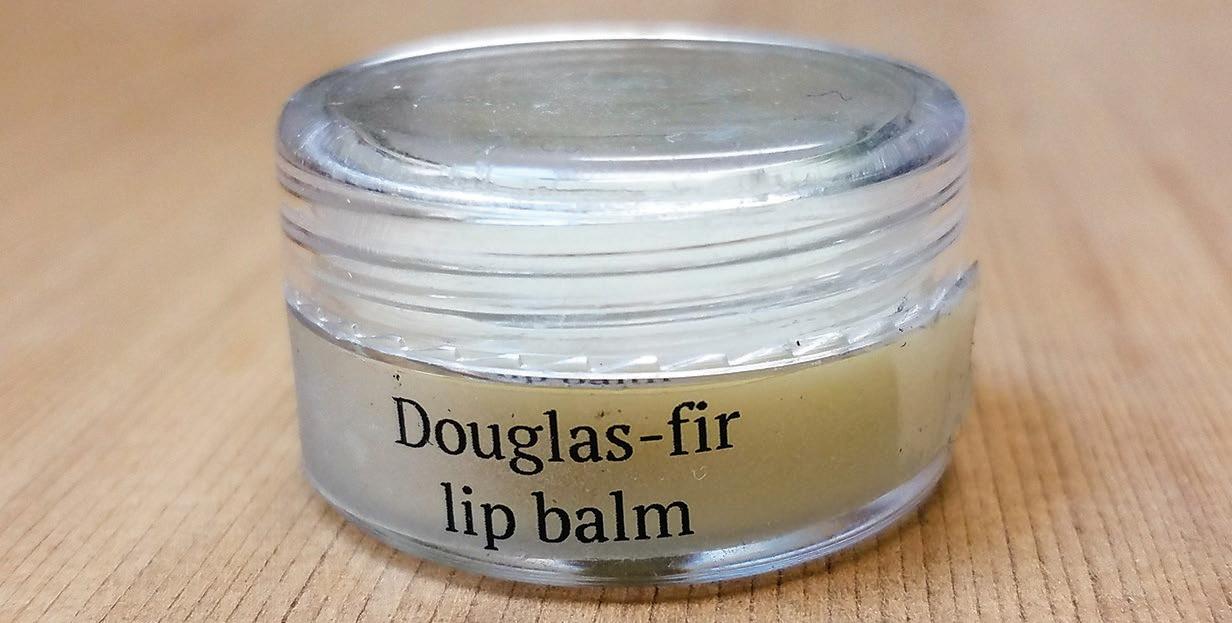
Medicine Tree Chest Rub
This salve can be rubbed into the chest for easing coughs, congestion, lung tightness, and sinus infections. Use a couple times a day as needed.
Ingredients and supplies
• 8 2-ounce glass jars
• 2 ounces beeswax
• 10 ounces olive oil infused with western white pine
• 4 ounces castor oil
• Essential oils
› 1 teaspoon Eucalyptus radiata, Eucalyptus globulus, or a combination of the two
› ½ teaspoon Scotch pine
› ½ teaspoon black spruce
• ¼ tsp lemon
Instructions
Heat oils over medium low heat, add grated beeswax and stir until melted. Take off burner and allow mixture to cool for about five minutes (mixture should not be allowed to harden). Stir essential oils into mixture and immediately pour into jars. Cover with a lid and label.
Makes 8 2-ounce jars
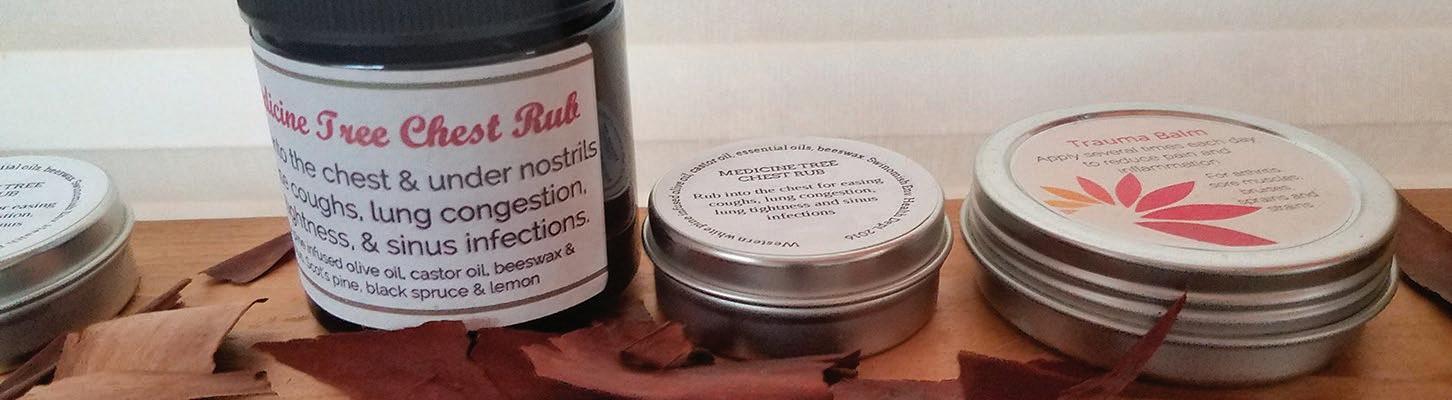
These recipes are printed with permission from Elise Krohn, Tree Medicine, 2015.
Knowledge Transfer
• Ask an elder to share a story about harvesting medicines.
• Ask participants to name their favorite tree and how they would describe its appearance, uses, and its habitat to someone who is unfamiliar with the tree.
• At the end of the workshop, ask participants who they plan to give their medicines to and why they are giving it to that person.
• Ask participants to discuss the medicinal benefits of the medicines they have made.
• Encourage participants to share stories related to traditional medicine, conifers, and the importance of evergreens to community health. For example, ask participants to describe a property of conifer trees that supports the health of the trees and humans.
Tying it all together
• Connections to other activities
› Participants create medicines in this workshop, similar to the healing salve created in the Moon of the Salmonberry.
› Oils created in the outdoor harvest trip can be stored and used for harvest meal gifts during the following seasonal cycle.
› Several activities take place outside; participants should be encouraged to note the seasonal changes taking place at different locations as they are revisited throughout the year.
• Relationship to Indigenous health
› The volatile oils present in conifers have antibiotic, anti-fungal, and insecticidal properties that help keep both trees and people healthy.
› Terpenes contribute to cloud seeding, allowing conifers to create their own cooling effect.
Digging Deeper
• Consider showing the video “Teachings of the Tree People” during the workshop. This video documents the life and work of Skokomish tribal elder Bruce Subiyay Miller. Follow the viewing with a discussion about the cultural uses and tree teachings documented in the video.
Notes to Educators and Additional Resources
• Chemical released by trees can help cool planet, scientists find: theguardian.com/environment/2008/oct/31/forests-climatechange
• Conifer tree potions: plantjourneys.blogspot.com/2012/12/conifer-tree-potions-solstice-medicine.html?m=1
• Essential oil composition of 46 pine species: www.researchgate.net/publication/268080350/ The_genus_Pinus_a_comparative_study_on_the_needle_essential_oil_composition_of_46_pine_species
• “Intertidal Resource Use over Millennia Enhances Forest Productivity.” A short article about the relationship between shell middens and tree health: nature.com/articles/ncomms12491
• Northwest Conifers: A Guide to Conifers of the Pacific Northwest: nwconifers.com/

the Sacred Time
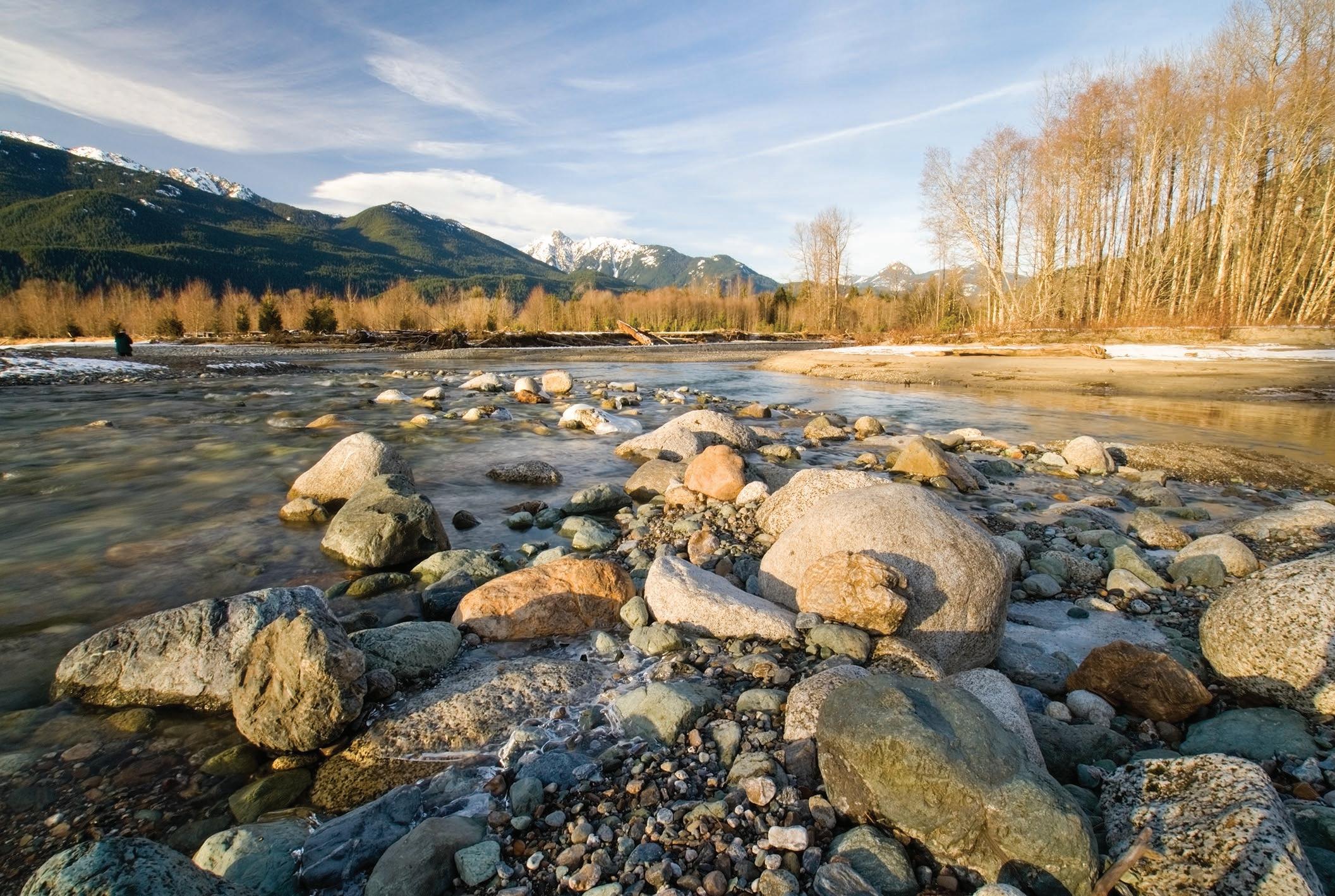
MOON OF THE SACRED TIME
Late December through early January is the Moon of the Sacred Time. Both the final moon of one yearly cycle and the beginning moon of the next cycle, the Moon of the Sacred Time is a time for renewal and rebirth. This is a time for learning spiritual and cultural traditions from elders around the longhouse fire. Sea-run cutthroat trout, blackmouth salmon, and steelhead are fished during the winter months. Shellfish are collected during the night-time low tides. Activities focus on a night-time clam dig and cedar weaving during this moon.
Time: Clam dig, 2 hours; luncheon preparation, 1 hour
Audience: 5th-8th grade
Settings: Outdoors (night-time clam dig at the beach; indoors (elder luncheon)
Learning Objectives
In this activity, participants will learn:
• When to harvest shellfish
Moon of the Sacred Time
Moon of the Sacred Time
• About harmful pollutants that impact shellfish
Moon of the Sacred Time
Moon of the Sacred Time
Moon of the Sacred Time
Moon of the Sacred Time
• What a harmful algal bloom is and how they affect traditional foods
Moon of the Sacred Time
• How to make clam chowder
Activity 1: Night-time Clam Dig and Clam
Chowder Luncheon
Moon of the Sacred Time
• About the importance of sharing and community connectedness to Indigenous health
Moon of the Sacred Time
Moon of the Sacred Time
• The importance of shellfish to Swinomish
Moon of the Sacred Time
Clam
Moon of the Sacred Time
Clam
Moon of the Sacred Time
This night-time clam dig will highlight safe harvesting of shellfish, pollution, and harmful algal blooms that affect the opening of important shellfish harvesting beaches. The harvested clams can then be used to make clam chowder for an elders' luncheon.
Lushootseed Words
Moon of the Sacred Time
Clam
Clam
Little Neck Steamer Clam
Moon of the Sacred Time
Little Neck Steamer Clam
Clam
• Moon of the Sacred Time:
Moon of the Sacred Time
Clam
Little Neck Steamer Clam
• Clam:
Butter Clam
Clam
Little Neck Steamer Clam
Butter Clam
Little Neck Steamer Clam
Little Neck Steamer Clam
Clam
Butter Clam
• Little neck steamer clam:
Cockle Clam
Little Neck Steamer Clam
Butter Clam
• Butter clam:
Cockle Clam
Butter Clam
Butter Clam
Cockle Clam
Little Neck Steamer Clam
Horse Clam
Butter Clam
• Cockle clam:
Cockle Clam
Cockle Clam
Horse Clam
• Horse clam:
Cockle Clam
Butter Clam
Horse Clam
Cockle Clam
Horse Clam
Oyster
Harmful algal blooms occur when colonies of algae grow rapidly and out of control. These algae produce toxins such as paralytic shellfish toxin or diarrhetic shellfish toxin. Bivalve shellfish, like clams and oysters, feed by filtering water through their bodies. While this feeds the shellfish and can clean the water, it can also result in the accumulation of various toxins that may lead to dangerous levels of toxins within the shellfish.
• Oyster:
Horse Clam
Oyster
Oyster
Cockle Clam
Horse Clam
• Winter:
Horse Clam
Winter
Oyster
Oyster
Winter
Horse Clam
Winter
Oyster
Cedar Tree
Winter
Oyster
Materials
Cedar Tree
Winter
Winter
Cedar Tree
Oyster
• Night-time clam dig
Winter
Cedar Root
Cedar Tree
Cedar Tree
Cedar Root
Cedar Tree
Winter
Cedar Root
› Clam dig materials
While harmful algal blooms can occur naturally, a process called eutrophication can trigger a bloom. Eutrophication refers to an excess of plant nutrients. These excesses can come from sewage treatment plant and septic tank discharge; storm water runoff carrying lawn fertilizer; and agricultural field fertilizer runoff.
Cedar Bark
Cedar Root
Cedar Tree
Cedar Root
Cedar Bark
› Digging forks
Cedar Tree
Cedar Bark
Cedar Root
› Gloves
Cedar Root
Inner Bark
Cedar Bark
Activity Description
Inner Bark
Cedar Bark
› Buckets
Cedar Bark
Cedar Root
Inner Bark
Cedar Bark
Inner Bark
› Teacher or community member to lead dig
Inner Bark
Inner Bark
Cedar Bark
Inner Bark
› Headlamps and/or flashlights
• Clam chowder for elders
Inner Bark
› Chowder ingredients
› Kitchen implements
Participants learned how to identify clam species and about the importance of clams to the Swinomish people in the Clams, Moons, and Tides workshop held during the Moon of the Salmonberry. In this activity, participants will take the next steps of identifying, digging, and harvesting clams. They will also clean and prepare clams for an elders' luncheon.
Knowledge Transfer
• Invite elders to participate in the activity.
• Have participants name a clam type and describe what it looks like and how to identify it from other local clams.
• Have participants talk about the importance of clams to the Swinomish people.
Guiding Questions and Topics of Discussion
• Can you see toxins in shellfish?
• Can you see toxins in the water? For example, some harmful algal blooms are visible from shore.
• If you can’t see evidence of toxins, does that mean the shellfish are safe to eat?
• What happens if you eat contaminated shellfish?
Tying it all together
• Connections to other activities
› Shellfish are an important food to the Coast Salish people. This food is highlighted in Moon of the Salal Berry and Moon of the Sacred Time.
› This activity could highlight the use of ironwood to help cook the clams. Ironwood tools are the basis of the Moon of the Whistling Robins activities.
• Connections to Indigenous health
› These activities include a cultural component by having participants learn how to harvest shellfish, and then preparing them to share at meal with elders.
› Shellfish are filter feeders and can accumulate contaminants. This is known as bioaccumulation, meaning that as you move up the food chain, the contaminant becomes more and more contaminated. As a result, someone that consumes shellfish could consume a concentrated amount of a toxin and become very sick.
› Harmful algal blooms can be triggered by eutrophication. Eutrophication can be caused by agricultural processes, and may also be triggered by warming temperatures, as is resulting from global climate change.
Digging Deeper
› Discuss the importance of clams to the Swinomish people since time immemorial. Tell the cosmology story of the boy and the clam found in Astrida Onat’s work: Onat, A.R.B., 1993. The significance of shellfish to the peoples of the Swinomish Indian Tribal Community past and present. Submitted to US District Court, Western District of Washington, August.
› In addition to including activities around bioaccumulation, this activity presents an opportunity to discuss ways in which humans can help to prevent harmful algal blooms (HABs) by identifying the causes behind HABs. For example, while previous activities discuss the toxicity to fish, animals, and plants from pesticides, this activity offers an opportunity to discuss some of the negative impacts of agricultural fertilization processes.
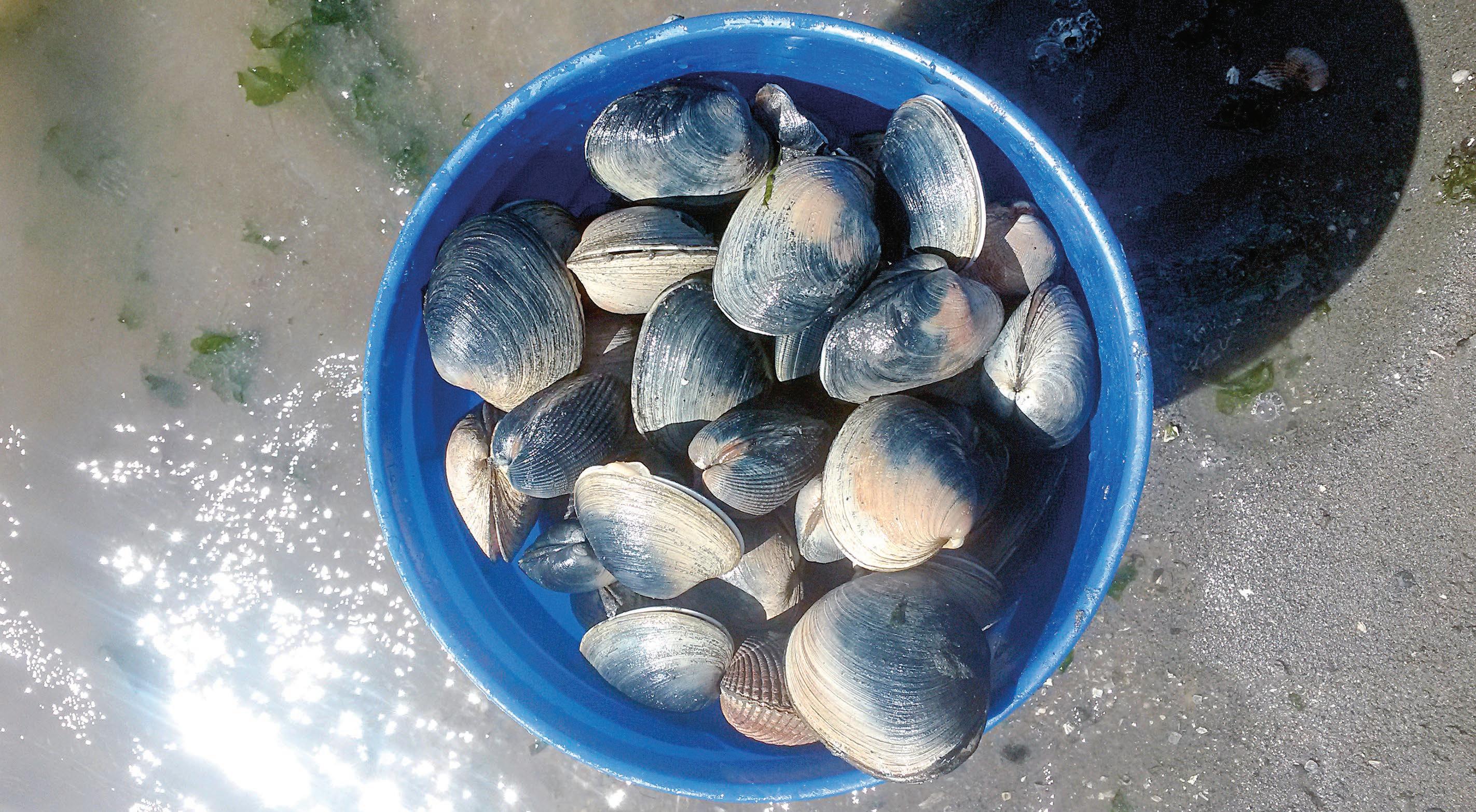
Notes to Educators and Additional Resources
• Mitchell, R. 2012. Christmas Clams. Published by the Swinomish Indian Tribal Community. Copies available through the Swinomish Department of Environmental Protection upon request.
• National Ocean Service. Harmful Algal Blooms: Tiny Plants with a Toxic Punch. National Oceanic and Atmospheric Administration. US Department of Commerce. Last updated: February 23, 2017. Date accessed June 6, 2017. Available online: oceanservice.noaa.gov/hazards/hab/
• Ocean Service Education. Nutrient Pollution – Eutrophication. National Oceanic and Atmospheric Administration. Last updated: March 2008. Date accessed June 6, 2017. Available online: oceanservice.noaa.gov/education/kits/estuaries/ media/supp_estuar09b_eutro.html
Butter clams, Kiket Island
Photo: Myk Heidt
Moon of the Sacred Time
Moon of the Sacred Time
Time: 2 hours
Audience: Community
Setting: Indoors
Moon of the Sacred Time
Moon of the Sacred Time
Learning Objectives
Moon of the Sacred Time
Activity 2: Cedar Weaving Workshop
Moon of the Sacred Time
Clam
Moon of the Sacred Time
In this activity, participants will learn:
Clam
Clam
Clam
Little Neck Steamer Clam
• About traditional uses for cedar
Little Neck Steamer Clam
Little Neck Steamer Clam
• How to properly harvest and prepare cedar bark for weaving
Western red cedar is an integral component of the rich culture and historic wealth of Coast Salish people, providing for them from birth until death. It has been called Grandmother, Long Life Maker, and Rich Woman Maker. Longhouses, rot-resistant canoes, durable clothing, watertight baskets, cordage, tools, art, and medicine are examples of how cedar is used traditionally.
Little Neck Steamer Clam
Butter Clam
Butter Clam
Butter Clam
Butter Clam
• About the different species of cedar
Cockle Clam
Cockle Clam
Moon of the Sacred Time
Cockle Clam
• How to identify cedar trees
Moon of the Sacred Time
Cockle Clam
Horse Clam
Horse Clam
• How to weave cedar
Western red cedar thrives in moist soils in lowlands, flats, and on mountain slopes. It prefers wet, misty forests and is common on the west side of the Cascade Mountains from Northern California up into southeast Alaska. It grows in wetter areas east of the Cascades toward Western Montana and Idaho.
Clam
Horse Clam
Oyster
• How traditional activities are an important part of Indigenous health
Horse Clam
Oyster
Little Neck Steamer Clam
Oyster
Oyster
Winter
Winter
Butter Clam
Lushootseed Words
Winter
Winter
Cedar Tree
Cedar Tree
• Moon of the Sacred Time:
Moon of the Sacred Time
Cedar Tree
Cockle Clam
Cedar Tree
Cedar Root
• Cedar tree:
Cedar Root
Cedar Root
Clam
Horse Clam
• Cedar root:
Cedar Root
Cedar Bark
Cedar bark is strong, flexible, and water resistant. The bark is woven to create cedar hats. The bark is stripped in early spring when the sap is running. Harvesting cedar bark takes a lot of expertise. You must understand when, where, and which trees to harvest from, along with how to cut and pull the bark, separate the inner bark from the outer bark, and dry it. It helps to have an elder or culture keeper show you several times! (Cedar Box toolkit 2016)
Cedar Bark
• Cedar bark:
Cedar Bark
Little Neck Steamer Clam
Oyster
Cedar Bark
• Inner bark:
Inner Bark
Inner Bark
Cedar bark and materials for weaving cedar
Story: Our Ways
This story is shared by Swinomish elder and Senator Barbara James, ta-ləqtalə II. It can be found in Our Ways: Testimonies of the Swinomish Way of Life.
We have to protect what’s there for us, our environment, and anything that we are reliant on, to help us keep our traditions. In our traditional way we rely on cedar for our spiritual lives, our cultural ways, our blessings, our protection. There are folks that use it for cedar roses, or baskets, for all of our arts and crafts.
Contact and collaborate wit the Swinomish Culture Department; they know of tribal cedar weaving experts who may be willing to host a workshop.
You have to preserve cedar, otherwise it will go, and it won’t be available to you, so they said take care of it, wise what you take, don’t take it unless you need it. Resources are being affected by what is happening in the environment. That’s happening, and we need to be able to help folks understand why they need to do certain things, or why its important to take care of things in this manner. Little things we do add up, and together, we can help protect the environment, the natural way.
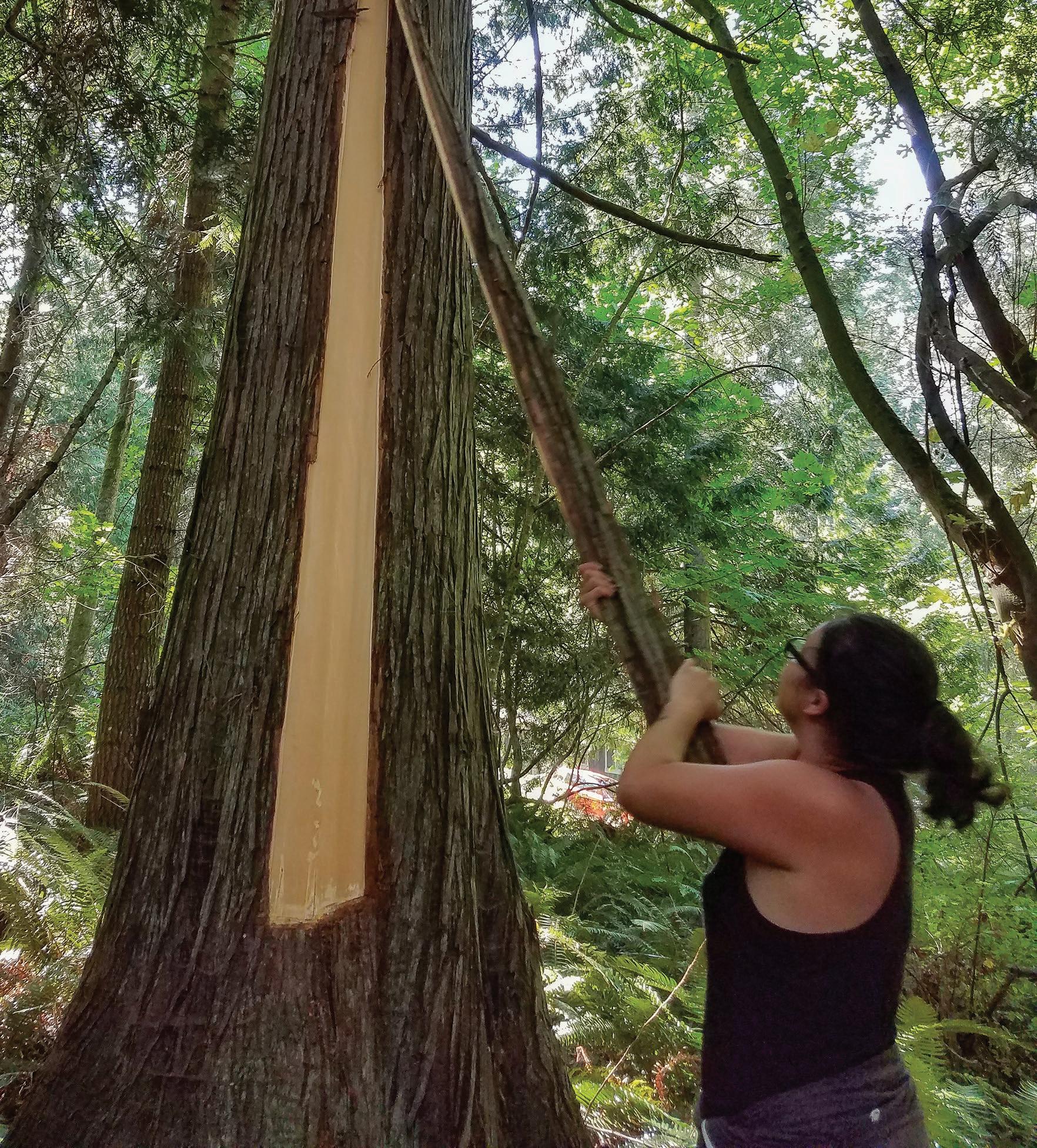
Alana Quintasket harvests cedar bark on her uncle’s property. Photo: Myk Heidt
Notes to Educators and Additional Resources
Knowledge Transfer
• Ask participants why cedar is called the Grandmother or Long Life Maker. What stories have they heard?
• Ask participants to share why cedar trees are important to the ecosystem and tribal community health.
Guiding Questions and Topics of Discussion
• What names have you heard for the cedar tree?
• What does cedar mean to you?
• Does anyone in your family weave with cedar? Do you?

Tying it all together
• Connections to other activities
› The cedar tree has many medicinal properties. The Moon to Put Your Paddles Away focused on medicinal products made from trees.
• Connections to Indigenous health
› The cedar tree is integral to Coast Salish people. The Indigenous Health Indicators demonstrate the importance of understanding cultural importance to overall community health.
Digging Deeper
• Consider holding another Medicine of the Trees workshop that is focused on the cedar tree.
• Wright, R.K. 2015. Coast Salish Weaving Tools and Technologies. Burke Museum. Date last updated: October 20, 2015. Date Accessed: May 27, 2017. Available online: burkemuseum.org/blog/coast-salish-weaving-tools-technologies
• Our Ways: Testimonies of the Swinomish Way of Life. The Swinomish Indian Tribal Community’s Sharing Our Knowledge Series, Vol 3. Second Edition, 2011. Edited by T. Mitchell and D. Lekanof.
• Krohn, E. Western Red Cedar. Wild Foods Medicines. Date Accessed: May 27, 2017. wildfoodsandmedicines.com/cedar
• Grandmother Cedar (Roger Fernandes) vimeo.com/216042916
• Krohn, E. and V. Segrest. 2016. Cedar Box Teaching Toolkit.
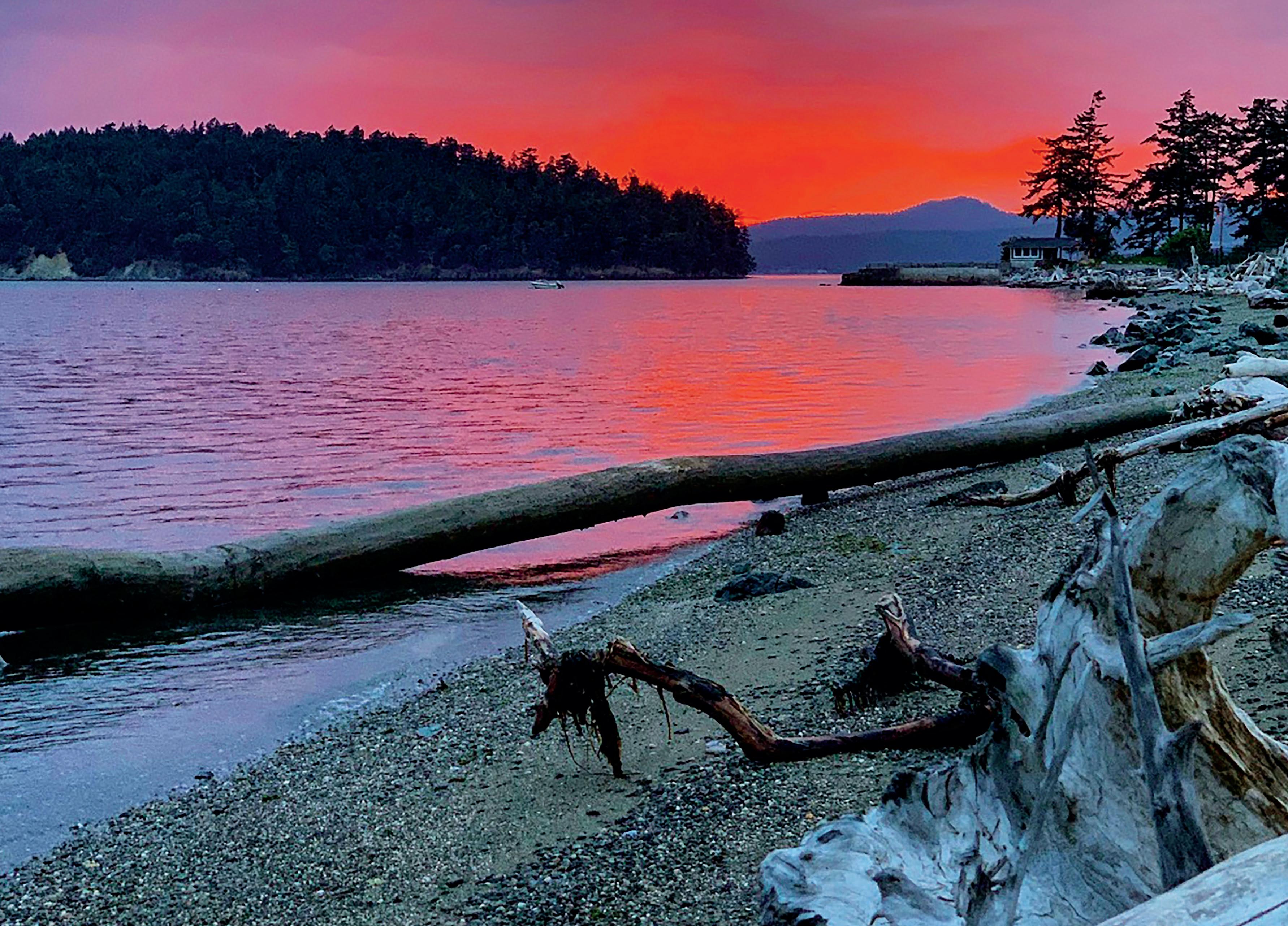
Looking northwest at the horizon along
Snee-Oosh Beach. Hope Island is on the left and Mount Erie is in the distance.
Photo: Katie Bassford
Credits: The 13 Moons First Foods & Resources Curriculum is the product of many hands
JAMIE DONATUTO, PhD
Community Environmental Health
Swinomish Indian Tribal Community
DIANA ROHLMAN, PhD
Oregon State University
LARRY CAMPBELL
Community Environmental Health
Swinomish Indian Tribal Community
JOYCE LECOMPTE-MASTENBROOK, PhD
Westland Gardens Consulting
MYK HEIDT
Community Environmental Health
Swinomish Indian Tribal Community
MARTI LINDSEY, PhD
University of Arizona
TANISHA GOBERT, MS
Swinomish Indian Tribal Community
SONNI TADLOCK, MPH
Many thanks to our evaluators
SHELLY VALDEZ, PhD
Native Pathways
JILL STEIN, MS
Lifelong Learning Group
NANCY MARYBOY, PhD
Indigenous Education Institute
YOLI QUEVEDO, PhD, LMHC
Swinomish Counseling Services (retired)
Swinomish Indian Tribal Community
HARRIET V KUHNLEIN, PhD
Centre for Indigenous People’s
Nutrition and Environment
TODD MITCHELL, MS
Swinomish Department of Environmental Protection
Swinomish Indian Tribal Community
MICHAEL M VENDIOLA, M.Ed.
Swinomish Department of Education
Swinomish Indian Tribal Community
LONA WILBUR
Swinomish Indian Tribal Community
SHAWN ROWE, PhD
Oregon State University
WILLIAM RENNEBOHM
University of Washington
Medical School
HEATHER MILLS
Swinomish Communications
Swinomish Indian Tribal Community
EMMA FOX
Swinomish Communications
Swinomish Indian Tribal Community
CAROLINE EDWARDS
Swinomish Communications
Swinomish Indian Tribal Community
Many thanks to Elise Krohn and Valerie Segrest for their tireless work teaching the wisdoms of first foods, medicines, and technologies in Coast Salish territory!
Funding for the development and implementation of the Swinomish 13 Moons First Foods & Resources Curriculum was made possible by a grant from the National Science Foundation’s Advancing Informal STEM Learning Pathways project, grant (DRL-1516742, 2015-2018).
Publication funded in part by the U.S. EPA STAR grant #83559501.
*Any opinions, findings, and conclusions or recommendations expressed in this material are those of the author(s) and do not necessarily reflect the views of the National Science Foundation or the Swinomish Indian Tribal Community.
Additional photo credits
Page 7: Lone Tree, Caroline Edwards
Page 8: Indigenous Health Indicators Infographic, Swinomish Communications
Page 12: Mount Baker, Unsplash, Yuriy Garnaev
Page 16: Nettle, iStock by Getty Images, montypeter
Page 28: American robin, iStock by Getty Images, Nancy Nehring
Page 35: Swinomish Channel, Emma Fox
Page 36: Small camas flower, iStock by Getty Images, weisschr
Page 37: Camas on Marthas Beach, Myk Heidt
Page 38: Edible camas, iStock by Getty Images, Steve Lenz
Page 38: Death camas, iStock by Getty Images, Adam Long Sculpture
Page 39: Hand-drawn camas, iStock by Getty Images, Lamnee
Page 44: Salmonberry in the Cascades, iStock by Getty Images, niknak99
Page 58: Blackberries, Unsplash, Gabor Veres
Page 60: Making blackberry jam, iStock by Getty Images, Ron Bailey
Page 66: Forest hill, iStock by Getty Images, JohnnyH5
Page 76: River bank, iStock by Getty Images, Roman Khomlyak
Page 82: Elk, iStock by Getty Images, Benedek
Page 85: Reflections at Lone Tree, Caroline Edwards
Page 90: Autumn, iStock by Getty Images, thinair28
Page 96: Rose hips, Myk Heidt
Page 97: Nutritious feast, iStock by Getty Images, GMVozd
Page 100: Pine tree in the fog, iStock by Getty Images, franckreporter
Page 108: Skagit River, iStock by Getty Images, Ketchemr
Page 109: Kiket Island, Myk Heidt
DESIGN, LAYOUT, AND PRODUCTION: SWINOMISH COMMUNICATIONS
A PUBLICATION OF THE SWINOMISH INDIAN TRIBAL COMMUNITY | ALL RIGHTS RESERVED swinomish-nsn.gov | communications@swinomish.nsn.us