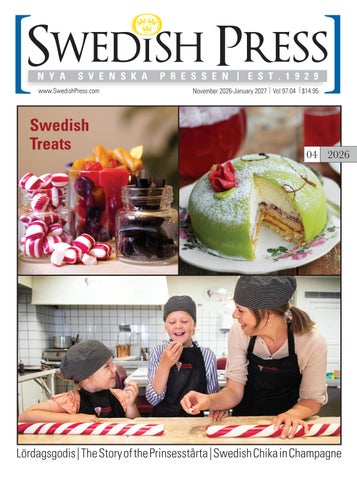
i www.SwedishPress.com
Swedish Treats
November 2026-January 2027 Vol 97:04 $14.95
04 2026
Lördagsgodis | The Story of the Prinsesstårta | Swedish Chika in Champagne
The History of Lördagsgodis How a public-health response to rampant tooth decay – involving controversial experiments on institutionalized patients – evolved into one of Sweden’s most beloved childhood rituals: saving candy for Saturday. By Noelle Norman
F
or many Swedish children, Saturday begins with an eagerly anticipated trip to the grocery store. Armed with a paper bag and a small allowance, they stand before a colorful wall of pickand-mix candy, carefully evaluating the merits of sour skulls, salty licorice, gummy raspberries and chocolatecovered toffee. The ritual has a name: lördagsgodis, literally “Saturday candy.” Swedish Press | Nov 2026 - Jan 2027 | 10
Photo: Lieselotte van der Meijs/imagebank.sweden.se
To most Swedes, it is simply part of growing up. Candy is not meant to be an everyday treat but something special to look forward to once a week. Parents often enforce the rule, grandparents happily bend it, and many adults continue the tradition long after childhood. To outsiders, however, the custom can seem absurd. Why Saturday? Why not a little candy every day? How did such a norm become so internalized
and utterly characterized by consensus; so enmeshed in culture that it to an entire nation seems obvious and natural? The answer lies in one of the most notable—and notorious— chapters in Swedish medical history. In the 1930s, soft drinks overtook mineral water in Swedish sales statistics, and a confectionery industry of unprecedented scale flourished. Sweden faced a widespread public health problem. Tooth decay was rampant
among both children and adults. By the end of the decade, those responsible for the medical examination of conscripts observed that virtually all 19-year-olds had cavities. Dentists suspected that sugar was somehow responsible, but did not yet understand precisely how cavities developed. It became painfully clear to politicians that Folktandvården (the Public Dental Service), established in 1938, would become hopelessly overburdened. Neither the government’s budget nor the country’s dentists were enough to fill all the cavities. Hoping to shed light on the workings of the potential culprit behind the crisis, the government ordered a research investigation. Kariesexperimenten (the cavity experiments) took place at Vipeholm Hospital, an institution outside the southern city of Lund that housed people with intellectual disabilities. Since the patients placed there often remained there for life, the setting allowed for more long-lasting experiments than those performed on inmates or at orphanages. Beginning in the mid-1940s, researchers divided hundreds of patients into different groups and fed them varying diets. Some received sugary drinks with meals, while others were given specially developed sticky caramels designed to cling to the teeth. The goal was simple: observe what happened to the patients’ teeth over time. The results were dramatic. Researchers found that sticky sweets eaten between meals caused extensive tooth decay. More importantly, they discovered that how often people consumed sugar mattered even more than the total amount. When consumed, sugar interacts with bacteria on the plaque (a sticky and thin film that is
Cavity experiments at Vipeholm Hospital in the mid-1900s. Photo: Sydsvenska Medicinhistoriska Sällskapet (SMHS) Open Image Archive/CC BY-NC 4.0
formed over the teeth) to produce acid, which then slowly dissolves the enamel (the hard, protective layer of the tooth). Frequent consumption of sugary food and beverages exposes teeth to repeated acid attacks, dramatically increasing the risk of cavities. Scientifically, the research transformed dentistry. However, it would go down in history as one of Sweden’s most ethically troubling medical experiments. The patients had little or no ability to give informed consent. Many did not understand they were participating in experiments at all. Some patients reacted badly to the specially-developed toffees, but their extensive vomiting did not hinder
the continued force-feeding. Many suffered irreversible dental damage. Once the experiment was over, research leader Bengt Gustafsson estimated that 3,000 teeth required treatment and 2,000 were so severely deteriorated that they had to be extracted—a task involving a total of 800 patients that would take over four years to complete. Vipeholm’s treatment of its patients became a public scandal in 1953, when Lennart Berggren, a university student working as a summer care worker, went to the newspaper Arbetaren with an account of what he had witnessed. In an article, Berggren described a hospital where Swedish Press | Nov 2026 - Jan 2027 | 11
those considered unable to contribute to society may have affected the care patients received. Vipeholm was gradually transformed School dental care 1952. Photo: Unknown photographer/Stockholm City Archives in the following decades and finally closed in military-style discipline, abuse and 1993. neglect were commonplace. The The research completed at Viperevelations prompted an inspection holm, although tragic for its patients, by the National Board of Health and positively changed the way Sweden were soon picked up by Sweden’s as a whole approached oral health. major newspapers, eventually leading Instead of urging families to eliminate to a police investigation in which at sweets altogether – a message unlikely least one care worker was convicted to succeed – health authorities recomof assault. The scandal exposed an mended something more realistic: institution that, despite being called save candy for a single day each week. a hospital, often functioned more like The idea was that one concentrated a place of confinement than a place exposure to sugar would be less damof care. Its darker history has come aging than small amounts consumed under renewed scrutiny in recent every day. years. An ongoing research project at Lördagsgodis as a concept made Lund University, led in part by histoa breakthrough during the 1950s and rian Elin Bommenel, is investigating became institutionalized through why 217 patients died at Vipeholm between 1941 and 1943, many of them information campaigns by Folktandvården. The recommendation was severely underweight and sufferpractical, easy to remember, and ing from tuberculosis or other lung surprisingly effective. Over time, what diseases. Researchers are examinbegan as official health advice evolved ing whether some deaths may have into a cherished family tradition. resulted from deliberate starvation or So why Saturday? Well, it simeuthanasia (the intentional ending of ply fit Swedish family life. Children a person’s life, usually to relieve sufwere out of school, parents often did fering), although this has not yet been the weekly shopping, and weekends decisively proven. The investigation already felt festive. The habit stuck. also asks how contemporary attitudes Today, lördagsgodis is about much toward disability, human worth and Swedish Press | Nov 2026 - Jan 2027 | 12
Illustration: Medicinalstyrelsen/Nordiska museets arkiv.
more than sugar. For many families, it teaches delayed gratification. Children learn to save their allowance, choose their favorite treats carefully and enjoy them as part of a weekly ritual rather than constant snacking. It offers something to look forward to at the end of the week, and is an easy argument when saying no to children who nag for sweets. The tradition has also shaped Sweden’s distinctive candy culture. Walk into almost any Swedish supermarket and you will find an enormous lösgodis (pick-and-mix) section where customers select individual pieces from dozens – sometimes hundreds – of different varieties. Ironically, Sweden ranks among the world’s biggest consumers of candy per capita. Many adults who grew up with lördagsgodis have simply continued eating large quantities – albeit mostly on weekends. In recent years, Swedish candy has even become an international phenomenon thanks to social media, with American consumers embracing everything from sour gummies to salty licorice.
Photo: Jakob Fridholm/imagebank.sweden.se
The Story of the Prinsesstårta
B
ack in the day when Seattle’s Swedish Club was still called the Swedish Cultural Center, a call came in from food blogger Jessie Oleson Moore, commonly known as the “Cake Spy,” asking why the famous Princesstårta – Princess Cake – is green. No one seemed to have a definitive answer, just that it had always been covered with a layer of light green marzipan. I got a call from the center’s cultural director, Kristine Leander, which set me off a on quest to learn everything I could about Sweden’s beloved cake. This quest took me directly to my Swedish Press | Nov 2026 - Jan 2027 | 14
By Lori Ann Reinhall
own cookbook shelf, which housed a copy of Prinsessornas kokbok by Jenny Åkerström (later translated into English as The Swedish Princesses’ Cookbook), an old classic passed down from my Swedish grandmother. I found out that the recipe had been invented by Åkerström, who originally called it “Grön tårta,” because the marzipan layer was colored with green food coloring. Further research then brought more answers. It was thought that the cake’s green color was associated with the freshness of spring, also symbolized by the pink marzipan rose on top. Over time, the recipe would be
modified (today you can find an entire array of them), but the inviting spring colors stuck. Already at the turn of the last century, Johanna Antonia “Jenny” Åkerström (1867 – 1957) was recognized as a food writer, publishing articles in prominent Swedish journals and magazines. In 1907, she opened Jenny Åkerströms hushållsskola för flickor i Stockholm, a girls’ school for the domestic sciences, where one could learn to cook for all occasions, how to clean, and how to care for young children. The school soon earned a sterling reputation, attracting pupils from the
city’s most prominent families, including royalty. The three most famous were Astrid, Margaretha, and Märtha, the daughters of Prince Carl and Princess Ingeborg, who enrolled there in the 1920s. With her strong sense of business, Åkerström got an idea. Not many schools could boast having real princesses on their student rosters, so she decided to compile a cookbook named in their honor. In 1929, she published her first edition of Prinsessorna kokbok. The cookbook included notes about the three princesses’ favorite recipes. One recipe that stood out was for the “Grön tårta,” and with time, it became known as “Prinsesstårta.” The Princess Cake has been a quintessentially classic of Swedish baking and entertaining ever since.
Author Lori Ann Reinhall cherishes her copy of Jenny Åkerström’s Prinsessornas kokbok. Photo: Lori Ann Reinhall
The Princess Cake has by now made its way around the world, served at Scandinavian specialty bakeries and
cafés and even in IKEA cafeterias. Celebrated as a Swedish delight, the popular British newspaper The Guardian maintained that, in addition to being so sweet and tasty, with its soft form topped by a pink rose, it is a lusciously “sexy” cake. Since 2004, there has been an annual Princess Cake Week in Sweden held during the third or fourth week of September. Its aim is to promote the famous cake, and each year roughly a half-million of the green marzipancovered cakes are sold in Swedish bakeries and pastry shops. For each cake sold by participating bakers and confectioners during Princess Cake Week, 10 Swedish crowns are donated to Crown Princess Victoria’s Fund for disabled children, a fitting gesture for this most royally iconic Swedish cake.
Prinsesstårta à la Rickard
The Princess Cake served at the Swedish Church café in New York City has become a cult favorite, praised by visitors on social media, and so popular it often sells out before closing time. Here, Rickard Björkman shares how to make it at home. Sponge Cake • 4 large eggs • 2 dl granulated sugar (3/4 cup + 1 tbsp) • 2 tsp baking powder • 2 tsp vanilla sugar • 1 dl all-purpose flour (~ 1/2 cup) • 1 dl potato starch (~ 1/2 cup) Beat the eggs and sugar. Combine the dry ingredients in a separate bowl, then sift them into the egg mixture. Gently fold everything together with a rubber spatula until the batter is smooth and evenly combined. Grease or line the cake pan with parchment paper. Bake for approx. 35–40 minutes at 175°C (350°F). After letting the sponge cake cool, slice it horizontally into three even layers.
Filling • Raspberry jam • Homemade vanilla custard, or Marsan vanilla custard • Whipping cream Cover bottom layer of sponge cake with raspberry jam, on second layer, vanilla custard. Add third layer and cream. Homemade Marzipan • 200 g finely ground almond flour (about two cups) • Approx. 350–400 g powdered sugar/icing sugar (3 1/2 cups) • A few drops of green and yellow food coloring. • A few tablespoons of cold water. Blend everything together until you have a smooth, even marzipan. Roll out the marzipan into a thin sheet to cover the entire cake. Trim excess.
Rickard Björkman. Photo: Kajsa Norman
Swedish Press | Nov 2026 - Jan 2027 | 15
Meet Chef Amalia, the Creative Force Behind FIKA Café Amalia Obermeier-Smith has brought New Nordic Cuisine to FIKA Café at the American Swedish Institute (ASI) in Minneapolis. Known for her exciting fusions, she reimagines Nordic classics using traditional techniques. By Darby Johnson
F
IKA opened in 2012 and is one of the longest-lasting museum restaurants in the Twin Cities. It reflects ASI’s philosophy of bringing people together to enjoy cultural experiences, including food. Amalia Obermeier-Smith has been executive chef of FIKA since 2022, with an extensive background in major restaurants in the Twin Cities. “I’m definitely not of Swedish descent in any way, shape, or form,” she says. “My heritage is African American, Irish, German, and Native American.” Chef Amalia proves that you don’t have to be Swedish to enjoy a culture guided by the mantra that “Sweden is for everyone.” “I ended up embracing everything about the culture, the cuisine, and the food traditions, and very quickly fell absolutely in love with it,” she says. “I was really shocked at how much I was missing out on the first 40 years of my life!” “I love the natural fermentation, the curing process of things using seasonal and local ingredients, and food that's not overly complicated, but when you taste it, you’re wowed.” Chef Amalia made her first food pilgrimage to Sweden in the spring of 2024. She happened to visit during semla season, which she considers fortuitous. “Every time I went to a bakery, I tried the same two things: a semla and a cardamom bun. I really needed to Swedish Press | Nov 2026 - Jan 2027 | 16
Chef Amalia Obermeier-Smith with Swedish pastries at the FIKA Café at ASI.
understand what a true semla tastes like.” In the Twin Cities, FIKA Café is known as the only place to eat Swedish food. Some food can be divisive or beloved, like ASI’s famous Lutfisk dinner. Guests come to FIKA to eat dishes they remember from childhood, and others come to try flavor profiles they can’t find elsewhere. “I love pickled herring. It might be too different for a lot of Americans, but there are people where it brings back a sense of nostalgia, whether their grandparents had it or at family events, and that’s why I think FIKA works—we serve those traditional flavors presented in a New Nordic way.” The term New Nordic Cuisine first emerged in Copenhagen in 2004,
when Danish food entrepreneur Claus Meyer brought together 12 leading Nordic chefs to formulate the New Nordic Kitchen Manifesto, a ten-point vision built around a distinct Nordic culinary identity. The idea was to combine local, seasonal ingredients with traditional Nordic techniques such as curing, smoking and fermentation, reinterpreted through modern, sustainable cooking. At FIKA Café, Chef Amalia is always revamping the menu, inspired by the seasons, how to incorporate Minnesotan-grown ingredients, and what is trending in Sweden. “One thing that I’m really excited about is expanding on desserts, cookies and pastries, taking the flavors and textures and the basic overall feel or aesthetic, and modernizing and elevating them,” she says. “I was very inspired when I ate at Socker Sucker in Stockholm. Their pastries and treats are very Swedish, but it’s almost in a newer French- style pastry way. The owners are two Swedish-born and raised bakers who deliver refined, clean, modern, and unique pastries, as well as some incredible fusion items that blend different cultural traditions.” One of Chef Amalia’s dessert creations includes a Pepparkakor pumpkin cheesecake, rich with warm spices and a gingerbread crust, which has since become a centerpiece of her family’s celebrations. Why not try making it at home?
Hope you enjoyed this sample of Swedish Press. To read more, please click the link
https://swedishpress.com/ subscription to subscribe.