

SWEA International has named astronaut Jessica Meir Swedish Woman of the Year 2026, following a vote by SWEA members around the world.
By Kajsa Norman
On October 18, 2019, Swedish-American NASA astronaut Jessica Meir stepped out of the International Space Station, together with fellow astronaut Christina Koch, tasked with replacing a failed power unit. Outside the hatch, 250 miles above Earth, the two women became instantly historic as their mission constituted the first all-woman spacewalk.
For Meir, however, it was not her first time making history. Born in Caribou, Maine, to a Swedish mother and an Israeli father, she is a dual U.S.-Swedish citizen and widely celebrated as the first Swedish woman
in space.
Meir has trained as a biologist, earning degrees from Brown University, the International Space University, and a PhD in marine biology from Scripps Institution of Oceanography. Her research focused on how animals survive in reduced oxygen environments. When she wasn’t studying bar-headed geese flying over the Himalayas or elephant seals holding their breath beneath Antarctic ice, she served as an aquanaut in an underwater habitat for NASA Extreme Environment Mission Operations (NEEMO). In 2012, Dr. Meir accepted a position as Assistant Profes-
sor at Harvard Medical School, where she continued her research on the physiology of animals in extreme environments. The following year, NASA selected her as an astronaut.
In a sense, she had been preparing for space all along. Astronauts, too, are creatures of extremes – living in sealed habitats, adapting their bodies to hostile conditions, learning how life persists where it should not easily survive.
In 2019, Meir deployed to the International Space Station, where she served as a flight engineer on Expeditions 61 and 62. During that mission, she spent 205 days in space
and completed the historic spacewalk with Koch.
“After landing from my first mission, I was asked many times if I wanted to go back. I remember answering the same way for a long time, namely that I had been thinking about it from the moment I landed. The opportunity to experience microgravity, 24 hours a day, seven days a week, it is so hard to put into words how magical it feels. As if you suddenly turn into a playful five-year-old again, something that for most people seems to fade with age. Simply put, even the simplest things in life are so much more fun in space,” Jessica Meir told the Swedish Space Agency.
In February 2026, Meir got her wish. She is currently serving as NASA’s commander of SpaceX Crew12, a long-duration mission to the International Space Station with NASA, European Space Agency, and Roscosmos crew members. Crew-12 will conduct scientific investigations and technology demonstrations to help prepare humans for future exploration missions to the Moon and Mars, as well as benefit people on Earth.
“SWEA is extremely proud to appoint Jessica Meir as Swedish Woman of the Year 2026,” said Lotta Rigby Fors, President of SWEA International. “With her background as a researcher in marine biology and physiology, her leadership, and her ability to inspire new generations, Jessica Meir is an international role model for Sweden and a symbol of Swedish research and international collaboration.”
Upon being notified of her win, Meir joined an online meeting from the International Space Station (ISS).
“I am humbled and honored to be voted the Swedish Woman of the Year

2026,” she said. “From my current vantage point at 400 km above Earth here on the International Space Station, one gains a literal global insight, understanding that we humans are truly all in this together on our one shared home planet. I am extremely privileged to have this opportunity, and consider it my duty to broadly promote this perspective. From the other finalists’ extraordinary resumes to the captivating SWEA members I’ve met in recent years, it has also become clear to me that for Swedish women, the sky is certainly not the limit! Tusen tack SWEA!”
Swedish Woman of the Year is SWEA International’s highest honorary award and has been presented to 35 women since its founding in 1989. Through their work and expertise, all recipients have served as ambassadors for Sweden on the global stage. This year’s award will be presented in connection with SWEA Sveriges Sommardagar 2026 in Malmö on August 6, 2026.
The nominees for Swedish Woman of the Year 2026 included four remarkable women: Anna Bjerde, Managing Director of Operations at the World Bank and one of its three most senior operational leaders; Jessica Meir, astronaut at the NASA Johnson Space Center and commander of Crew-12 on the International Space Station (ISS); Kristina Kappelin, journalist, author, and director of the cultural center Villa San Michele in Capri, as well as Sweden’s Honorary Consul in Anacapri, Italy; and Tove Ågren, aerospace engineer at NASA Ames Research Center focusing on advanced space technology and development for future Mars missions.
SWEA International is a global network for Swedish and Swedishspeaking women who live – or have lived – abroad. With 5,700 members in 67 chapters worldwide, SWEA is the largest nonprofit organization promoting Sweden outside of Sweden.
Every year, SWEA awards scholarships and donations totaling more than 2 million SEK.
For more than a century, Swedish models have helped shape fashion’s idea of beauty – from Lisa Fonssagrives’s sculptural elegance to the blonde bombshells of the 1990s and the more diverse faces redefining Swedish beauty today.
By Kajsa Norman
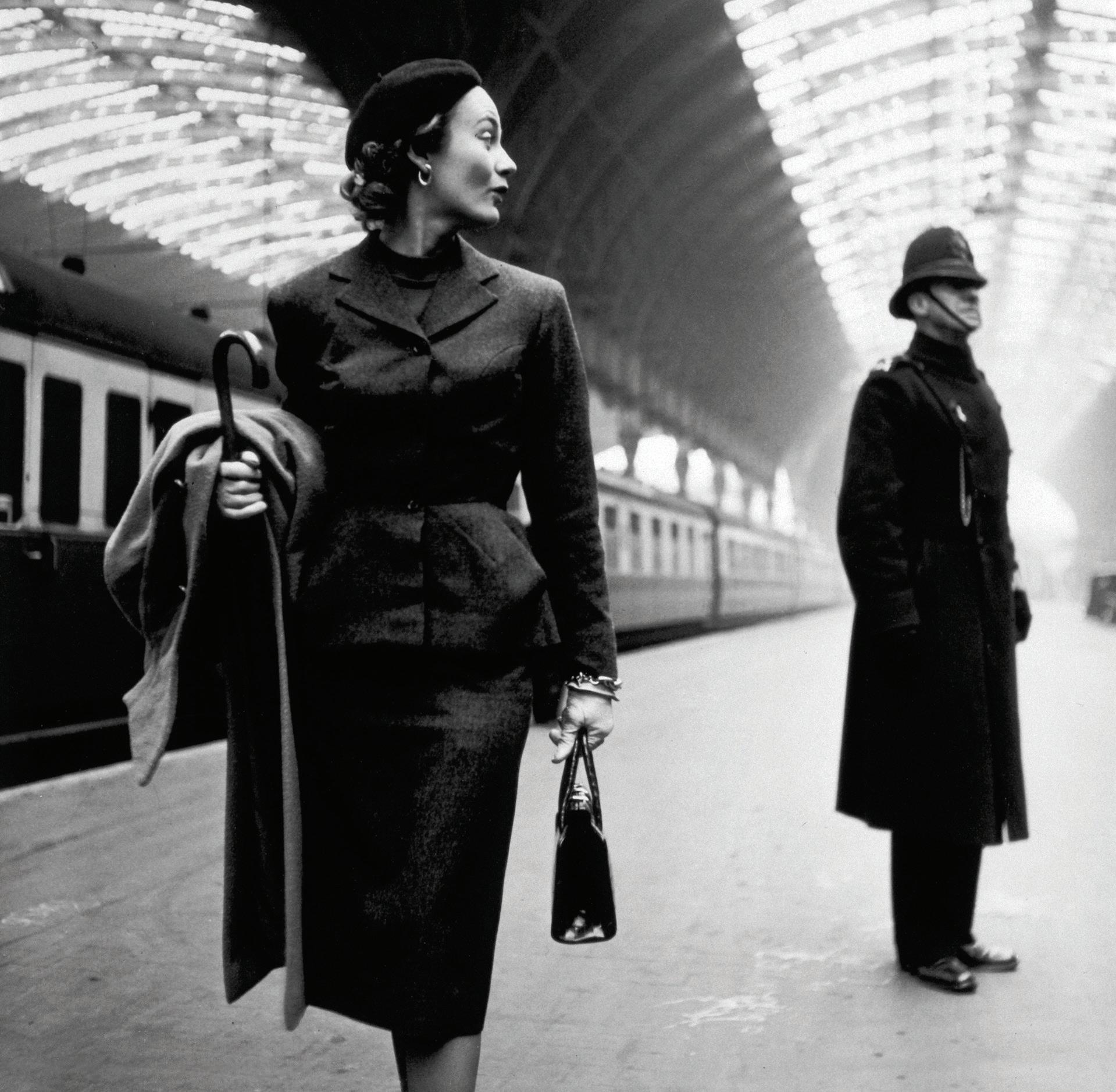
Lisa Fonssagrives-Penn is often described as the world’s first supermodel. Born in Uddevalla, Sweden in 1911, she trained as a dancer and sculptor. Famous for her controlled, architectural poses, she made her mark in the forties and fifties as mannequin, muse, and collaborator. In the hands of photographers such as Horst P. Horst, Man Ray, Richard Avedon and, later, Irving Penn, whom she married, Fonssagrives helped transform fashion photography from illustration into art. Vogue dubbed her “fashion’s first supermodel,” noting the physical discipline and poise that set her apart.
In the late 1960s and early 1970s, Gunilla Lindblad became the next Swedish model to make it globally. Arriving in Paris in 1968, she was later described by Vogue as the model who helped define the “haute hippie” look: flaxen-haired, natural, and at ease in the free-spirited clothes of the period. Her February 1972 American Vogue cover marked one of the most visible Swedish model moments of the decade, and it would take 44 years until another Swede – actress Alicia Vikander – would grace the cover of the magazine’s American edition. By the 1980s and 1990s, fashion had changed. The model was no longer merely a silent clothes hanger but a celebrity in her own right. The supermodel era was noisy, theatrical and highly branded. Sweden’s Emma Sjöberg, later Emma Wiklund, emerged into that world with the
kind of face that translated easily across Paris, Milan and magazine covers: high cheekbones, clear eyes, and a look that could swing from polished elegance to Mugler fantasy. Her agency describes her as one of the original 1990s supermodels, with more than 200 magazine covers and work for houses including Gianni Versace, Thierry Mugler, Montana, Alaïa and Lanvin. Sjöberg also starred in George Michael’s music video “Too Funky,” where she posed and preened
on the catwalk in outlandish creations alongside fellow superstars Linda Evangelista and Tyra Banks.
The same era produced a male counterpart in Marcus Schenkenberg, the Stockholm-born model most closely associated with the Calvin Klein–driven body culture of the early 1990s. His rise helped mark the moment when male models, too, could become international names.
In the late 1990s and early 2000s, the Swedish look moved into a more
commercial, glossy phase. Victoria Silvstedt brought a Playboy-andGuess-adjacent bombshell glamour to the global market: blonde, curvy, and closer to celebrity culture than couture.
Caroline Winberg, discovered as a teenager, became known for a softer, freckled beauty that could still fit the era’s dominant requirements: tall, slim, blonde, young. She walked for houses including Chanel, Valentino, Giorgio Armani, Dior and Fendi, and appeared in Victoria’s Secret shows and on international Vogue and Elle covers.
By the 2010s, the fashion industry was under growing pressure to answer for the narrowness of its ideals. The old sample-size body, once treated as a professional requirement, increasingly looked like an ethical problem. Into that debate stepped Agnes Hedengård, a Swedish model who in 2015 posted a video criticizing the industry after being told she was too big to book work. A finalist in the Swedish version of Top Model 2014, she was 5’11”, with a reported BMI of 17.5, below the National Institute of Health’s threshold for healthy weight, yet she said agencies and clients still rejected her because her hips and backside were considered too large.
Hedengård did not start fashion’s body-positivity movement singlehandedly. The change was already being driven by many forces: plus-size models such as Ashley Graham, diversity advocates, social media, legislation around underweight models, and a broader cultural fatigue with the cruelty of early-2000s body standards. But Hedengård’s video mattered because it made the absurdity visible. Here was a young woman who was medically underweight by common standards, standing in front of a mirror and explaining that the industry deemed her
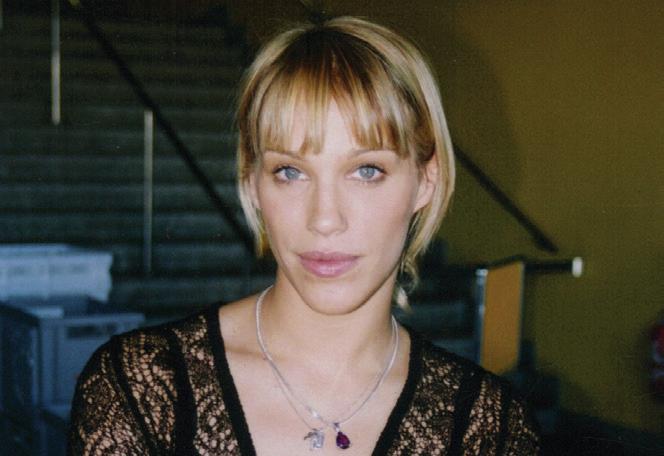
Top
too large. Her statement became one of the clearest Scandinavian examples of the backlash against fashion’s body policing.
For a brief moment, it looked as though the industry might truly expand. Plus-size and mid-size models appeared more often on runways and magazine covers. Unusual faces, older women, trans models and more racially diverse casting began to change the visual language of fashion. The Swedish contribution to this period was not only Hedengård’s criticism but also models such as Erika Linder, whose androgynous presence challenged rigid gender categories. Linder has spoken about how the industry initially wanted to change her — to make her hair longer, to push her toward a more conventional femininity — before she found power in the ambiguity that made her distinctive. When she began booking jobs in men’s campaigns, it was treated as headline news. At the time, she was one of the first female models in the mainstream fashion eye to be cast explicitly as a male model, and her career took off from there. Her first major job, in 2011, cast her as a young Leonardo DiCaprio for Candy magazine. She went on to model for both men’s and women’s fashion, with campaigns and appearances for brands including Tom Ford and Louis Vuitton, becoming one of Sweden’s most recognizable faces in fashion’s turn toward
gender-fluid beauty.
However, the brief widening of beauty standards soon retreated from the luxury runway into advertising, social media, lingerie, beauty, and a handful of committed designers.
By the mid-2020s, data from Vogue Business showed that high fashion had largely returned to straight-size bodies: for Autumn/Winter 2024, only 0.8 percent were plus-size models.
Today, Sweden’s most visible fashion model is probably Elsa Hosk. Hosk’s conventional modeling peak came in the mid-to-late 2010s, when she became a Victoria’s Secret Angel, but she has since converted her modeling fame into a second act as a style entrepreneur and social-media tastemaker. In the mid-2020s she remains active in fashion, appearing in major campaigns and shows while building her own fashion brand Helsa. She belongs to an era in which a model’s power is measured not only in runway bookings, but in the ability to build a personal universe of style, influence and image. Vogue Scandinavia recently framed her as moving “from supermodel to supermogul.”
That said, the new generation of Swedish models is no longer defined by the old Nordic-blonde template. Swedish model Malaika Holmén, born in Gothenburg to a Somali mother and a father with Liberian roots, represents a newer, more diverse image of Scandinavian fashion. So does Noor Khan, a Swedish-Pakistani model whose recent rise has included opening Prada’s Spring/Summer 2025 show and walking for Saint Laurent. Together, Holmén and Khan suggest a broader, more multicultural definition of Swedish beauty — one that reflects the country Sweden has become rather than the stereotype fashion long exported.
By Lori Ann Reinhall
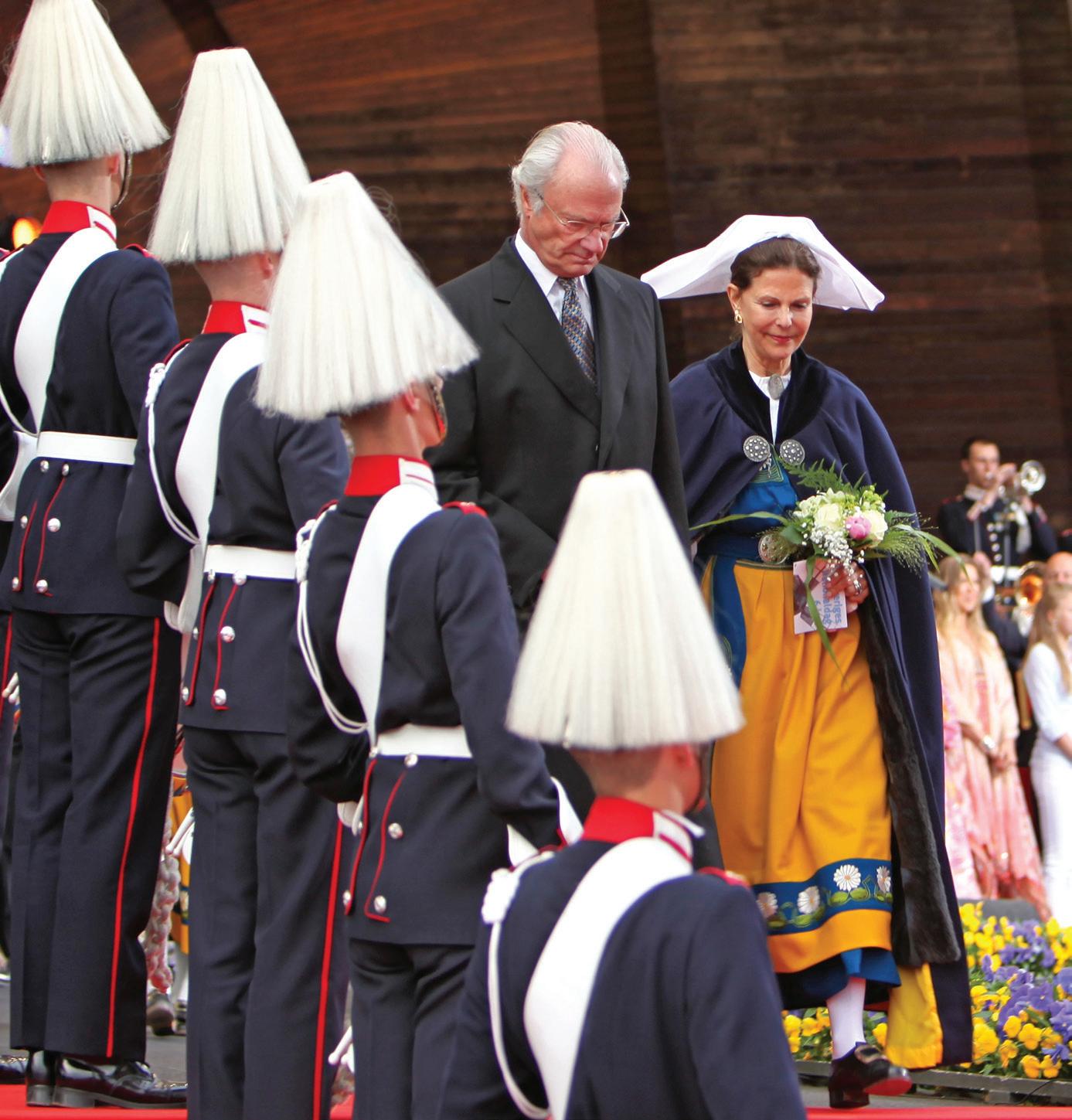
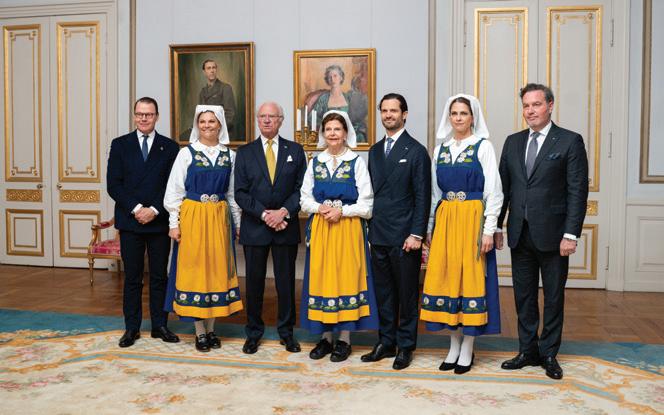
The year was 1983 when Queen Silvia first appeared in her Sverigedräkt, the Swedish National Costume, at the first official National Day celebration on June 6. She made an impression, and since then, it’s been a tradition for her to wow the crowds each year on a day of flag-raisings and festivities. New generations of the royal family have followed suit, and the Swedish National Costume has only grown in popularity.
Yet, the Sverigedräkt has not always been popular. Along with other folk costumes, it went into obscurity after World War II and only began to resurface as part of an exhibition at Stockholm’s Nordic Museum in 1977. Even then, it was not widely worn until Queen Silvia made it part of her wardrobe.
In the 1970s, there had been a resurgence of interest in folk culture. A so-called “green wave” had taken hold, partly in reaction to mass-production and rampant consumption. Swedes, young and old, were once again taking classes in the old crafts: textiles, visual art, and folk music and dance. The old peasant clothing was central in this movement, and a new golden age for the folk costume emerged.
Extensive research was done on the traditional costumes. Today, there are about 840 in total documented, 550 for women and 290 for men. Each costume can be tied to a specific region in Sweden, and it is customary to
wear the folk costume from the place where your family originates.
But the Swedish National Costume is not counted as a real folk costume. First designed in 1902, it is neither old nor genuine in the strictest sense. Categorized as a “reconstructed” or “composed” costume, its components have no connection to any region in Sweden. Yet, for many, including Queen Silvia with her German-Brazilian ancestry, this geographic freedom is part of the charm. Indeed, the history of the Sverigedräkt tells us that inclusivity was at the heart of its invention. Shortly after the turn of last century, Märta Jörgensen, née Palme, had the dream of creating a costume that any Swedish woman could wear, regardless of where she came from.
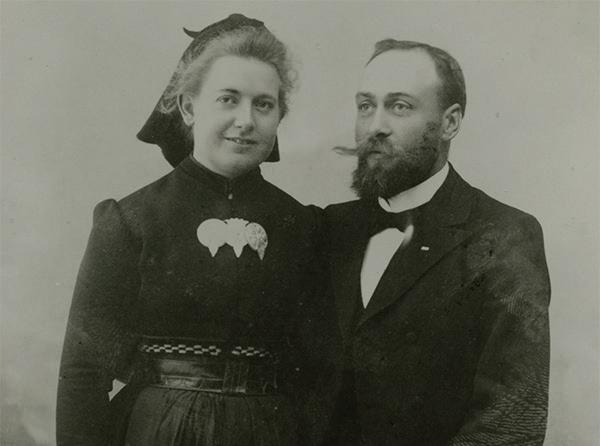
Hazelius wanted to show the ways of life in the different parts of Sweden before the industrial era. It was his goal to preserve the beauty of the native Swedish culture, should it be lost in the maze of foreign influences and urban life.
Another influential figure in the National Romantic movement was Carl Larsson, who painted the idyllic life of the Swedish countryside. He and his wife, Karin, a renowned textile artist, were also instrumental in popularizing the Sundborn folk costume from where they lived in Dalarna.
This came at the peak of the National Romantic movement in Sweden. In 1891, the folklorist Artur Hazelius opened Stockholm’s Skansen, the world’s first open-air museum.
Like Hazelius and the Larssons, Jörgensen also harkened back to simpler times. She was influenced by a year she spent working in the gardens at Tullgarn Palace in the Södermanland province outside of Trosa, south of Stockholm. Crown Princess Victoria of Baden (later Queen Victoria of Sweden), had decided that her servants there should wear folk costumes, which she deemed more comfortable and in harmony with the landscape.
The princess often wore a folk costume for her everyday activities.
Upon her marriage, Jörgensen moved to Falun in the province of Dalarna, where she founded the Swedish Women’s National Costume Association (Svenska Kvinnliga Nationaldräktsföreningen). Its mission was to liberate Swedish women from the “tyranny of foreign fashion.” Members were encouraged to wear a national folk costume for practical, economic, aesthetic, and even hygienic reasons.
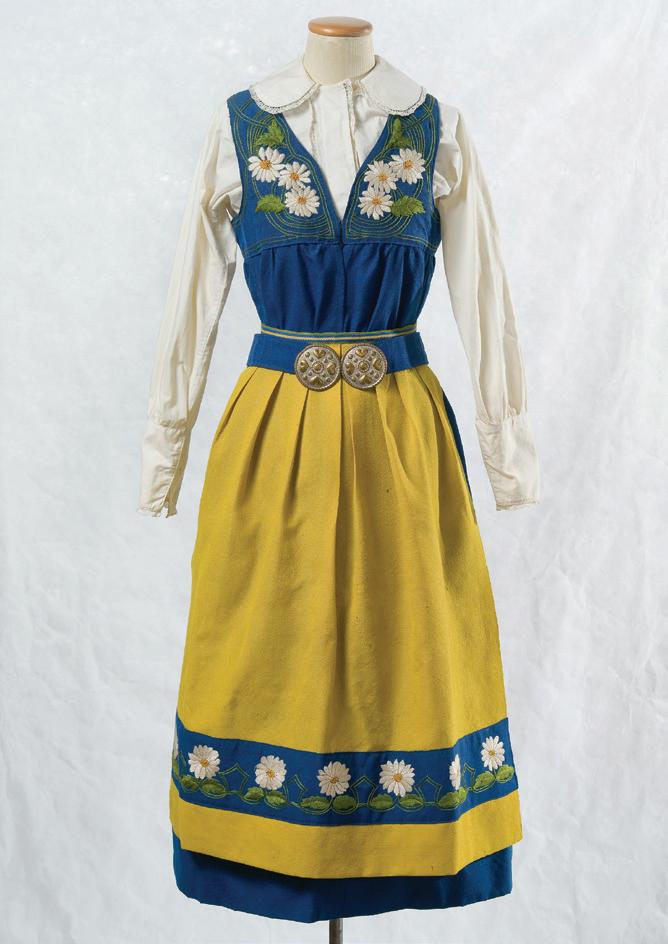
Already in 1902, Jörgensen drew the first sketches of the new costume, but the version we know today was first presented in 1909 in the popular and influential Swedish women’s magazine Idun. With the Swedish flag as its inspiration, the design featured a blue skirt, a white blouse, a blue vest, and a yellow and blue apron, often ac-
companied by a headpiece. There was also an early version with a red vest. Still worn today, its origins may go back to the flag of the Swedish-Norwegian Union, which was dissolved in 1905.
The costume’s vest could be embroidered with one’s flowers of choice, but with time, all variants of the vest came to be adorned with white daises. With their bright, sun-like appearance, they traditionally represent cheerfulness and simplicity, innocence, and purity.
But sadly, there is a chapter in the history of Swedish National Costume less than pure. Much has been written about Jörgensen’s activity in the rightwing pro-Nazi extremist group Svensk opposition during World War II. Jörgensen’s involvement could perhaps be interpreted as idealistic national-
ism gone bad, and it left a lasting taint on her legacy.
Nonetheless, it is hard not to like Sverigedräkt. When I was living in Sweden in the 1970s, I decided I would buy one. I found my way to the Stockholm atelier of Bo Skräddare— Bo the Tailor. An expert on Swedish folk costumes, he has done extensive research on the Sverigedräkt and even created a design for men.
But alas, back in those days, I was a poor student, and I had to wait several years before getting my costume. In the meantime, many variants in different materials became available. Since I had moved to Southern California, I opted for a linen variant. I happily wore it for many years before passing it down to a children’s folk dance group.
Today, versions of the Swedish National Costume are available in different price categories, making it widely accessible. Some are more “authentic” than others, meaning some are closer to Jörgensen’s original specifications and the true colors of the Swedish flag — but somehow this doesn’t seem to matter. The cheerful blue-and-yellow costume is welcoming to Sweden’s newcomers and Swedish descendants abroad. It can even be ordered online, making it easy to get for fans of Sweden all over the world. With its enduring charm, the classic Sverigedräkt has truly become a costume for the people and can be worn with pride whoever you are and wherever you may be.
Hope you enjoyed this sample of Swedish Press.
To read more, please click the link https://swedishpress.com/ subscription to subscribe.