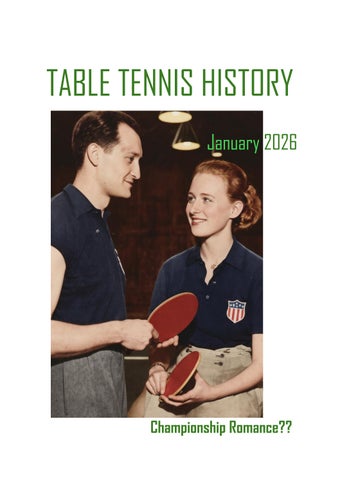
TABLE TENNIS HISTORY January 2026
Championship Romance??
Welcome to the eighth issue of Table Tennis History. We are thankful that language translation tools are so good now, knocking down barriers. In this issue alone, this was key to research in Japanese, Hungarian, Chinese, Dutch and German sources. That includes more new insights from the memoirs of Hungarian world champion Victor Barna. The leading Japanese table tennis columnist Jota Ito, who also happens to be a film actor, contributes another article, a fascinating new perspective on the great champion Ichiro Ogimura. I have enjoyed reading Jota’s archived pieces for the Japanese magazine World Table Tennis, thanks to easy online auto-translation.
We have added a Finding Aid at the end of this issue, with links to each of the first seven issues. You can browse the list of contents or use the search box.
Next issue is May 1. Your articles, ideas and comments are welcome. Contact info and past issues can be found on our
website. Past issues are also on the Swaythling Club International publications page.
Steve Grant 2
CONTENTS Cover: Victor Barna and Ruth Aarons, 1937
5 Table Tennis Maniac? 6 Ogimura the Writer 8
: Updates, Elaborations, Corrections, Part Eight 12 19 Barna’s Love Life 20 One Story in the Naked City 24 Gusikoff Letter 25 3
Chuck’s Museum 26 Game vs. Sport 28
Kurt Defris: The Great Organizer 31
An Anthropologist Studies His Own Tribe 34
The Colley Book 42 Your Table Tennis Gear
44
Finding Aid, 1st Eight Issues 48
Flying Back Cover 4
This action-packed film is out and getting very positive reviews, along with Golden Globe nominations for Best Picture, Actor and Screenplay. The whole project started back in 2018, when the wife of director Josh Safdie came across this book (above) in a thrift store. It was a welcome gift for Josh, a life-long table tennis adherent who even included a humorous tournament scene in his 2008 movie The Pleasure of Being Robbed (see our January
2025 issue). As a kid in New York, Safdie had watched “eccentric Jewish immigrant Lower East Side characters” play at his grandparents’ kitchen table after Shabbat dinner. From The Hollywood Reporter: “It opened my eyes to this fascinating subculture of misfits who all congregated in New York and played for money all the time. “The Reisman book had this kind of funky-looking guy on the cover,” Safdie recalls. “I showed it to Timmy [Chalamet] because he and I were talking at the very beginning of all of this. I said to him, ‘I want to do a movie in this world. Check out what this player looks like.’ He’s like, ‘Holy shit, that looks like me.’” Chalamet then started taking ping-pong lessons at a 24-hour facility in Lower Manhattan (presumably with a hard bat?). During Covid, he got rid of his living-room furniture and replaced it with table tennis. Later he continued practicing and taking lessons even when on location for several films. In production, Safdie brought in expert consultants to keep the table tennis as authentic as possible. The big rival of the fictional Marty Mauser is Koto Endo, played by the pro Koto Kawaguchi (right). The director designed the film to be larger than life. “I wanted to honor Marty Mauser’s dream to make it the greatest sport in the world. I like imagining an alternative path of history where the sport did become as big as tennis — and I had to act that way because I was making it from Marty’s point of view.”
5
Jota Ito
Table Tennis Maniac? Most people reading this are table tennis lovers. But where do you cross the line from “lover” to “maniac”? According to writer Jota Ito (left), some contributors to the long-running “Table Tennis Collector” magazine were “maniacs,” in particular Alan Duke of England and me (Steve Grant of the U.S.). In a 2020 column in World Table Tennis, Jota also described us as “terrifying” (as translated from Japanese) and wrote, “These crazy table tennis enthusiasts are engaging in some pretty ridiculous and maniacal activities in a public place, the ITTF website.” He was referring to deep-digging history research that, admittedly, could get too granular at times. Jota wondered what kind of lives we led. Fair enough. I accept Jota’s good-hearted humor. But it got me thinking: How does one qualify as a true maniac? Let’s examine the credentials of one other candidate: 1) Named his son after a 1950s table tennis champion. 2) At age 53, quit his excellent long-time job as a Sony product engineer to devote all his energies to table tennis. 3) Filed a patent for table tennis rubber. 4) Published a detailed analysis of best video camera angle for table tennis in the International Journal of Table Tennis Sciences. 5) Published five table tennis books, including two manga. 6) Has written over 100 columns for World Table Tennis over the past 20+ years. 7) Maintains a table tennis Facebook page, Twitter (X) page and blog. 8) Produces table tennis DVDs. 9) Gives public table tennis lectures and appears on TV and radio shows. 10) Coaches juniors. 11) Remains an above-average club player. 12) Has collected 150 table tennis books from all eras. Oh, he has also contributed to this magazine (see “Early Retirement” in the January 2025 issue), and helped with various Japanese table tennis questions, including our history consulting for the movie Marty Supreme. A simple listing of his vast activity does not do full justice. Frequently insightful, often humorous, his writing is always original and irreverent. Yes, this Maniac candidate jokes about table tennis, but he takes it very seriously. He is a data-driven purist who rejects dogma. Judge for yourself: His online pieces auto-translate quite well (not without a few oddities, of course: “grains” for pips; “cut player” for chopper). When Jota Ito retired from Sony eight years ago, colleagues gave him the shirt in the above photo, better viewed at right. Translation: “Table Tennis Maniac.”
6
That was supposed to be the neatly wrapped ending of this article, but then a surprise new Jota credential popped up. Pausing the Marty Supreme trailer (right) to translate the poster (“World Number 2, Marty Mauser, Lost in the Final”), I spotted dark-suited Jota standing in the back. The cast list shows his role is “Japanese coach from JTTA.” Now we have to find a new ending for this article. But first, the added page allows mention of Jota’s most recent book, Table Tennis Dictionary. It’s more fun and illuminating than the title suggests. Here is one definition (translated):
“Copy Player: Since the 1960s, China has been training players who imitate foreign players as practice opponents. The development of copy Shock! GAH! players is one of the keys to the strength of Chinese table tennis. Although table tennis is an individual sport .... it has aspects of a team sport allowing for team strategies like this to come into play. Yu Changchun of China is famous for having served as a copy of Koji Kimura [1961 doubles gold, 1963 mixed doubles gold]. When Yu later competed in the World Championships [1965 doubles bronze], the Japanese team was astonished to see that his form so closely resembling Kimura's. More recently, China has used copies of Ai Fukuhara and Miu Hirano.”
The dictionary includes a feature on Slipper Tennis, which apparently has been a thing in Japan for at least ten years:
The book does not define “Table Tennis Maniac.” But I think we now know the definition.
7
Ogimura the Writer by Jota Ito (Japan) Ichiro Ogimura (1932-1994) was the champion of the world. But he was much more, a man of complex appeal. Let’s put aside his well-known playing accomplishments, and put aside his career as an administrator, including as the first Asian president of the International Table Tennis Federation. Here we will discuss only his writing. And he wrote a lot. Ogimura wrote articles throughout his adult life. As a 21-year-old Nihon University student, he reported from London on the 1954 world championships for Asahi Shimbun, which had a circulation of over five million readers. In the years to follow, he made it a tradition to contribute his notes to that newspaper from every world championship, whether as captain during his playing days or as a coach or spectator after retirement. He wrote many other newspaper and magazine articles. But we will put those aside, too, and instead focus on a selection of his 13 books. Everything he wrote is distinctly recognizable as Ogimura's. His vast knowledge, his love of table tennis, and the exaggerated self-evaluation typical of a champion produced an ideal that raised the cultural value of the sport. Featuring unusually harsh player reviews, overly complex metaphors, unreasonable demands, and boastful claims bordering on tall tales, his writing left the reader either on the edge of his seat or laughing out loud, with a skillful delivery that was ultimately moving. My first encounter with Ogimura was in junior high school when I borrowed Table Tennis World Play (1972) from the library (Stellan Bengtsson on cover). He opens by presenting photographs of a rally between Bengtsson and Nobuhiko Hasegawa, describing their psychological states ball by ball, as if he had interviewed them. For Ogimura, there is a rational reason behind every play by a top player, and there is no room for "I just happened to hit it to the backhand" or "I wasn't thinking." As a junior high student, I was overwhelmed by the power of this commentary, thinking, "So this is what table tennis is all about." And then came the conclusion of that long commentary: "This was only a four-second rally, but it encompassed nearly 20 years of combined careers." I was completely taken aback by the allure of this daring, imaginative perspective. Since then, I've devoured Ogimura's writings, sometimes laughing, sometimes getting goosebumps from being so moved. I even named my son after him.
8
From the preface of Teaching Course for Junior and Senior High School Students 1 (1963): “Just as an artist uses canvas and paint, an instrument and fingers as materials to express himself, the era, and the entire universe, athletes use their own bodies and sports equipment to express themselves, striving to embody the limits of human ability and the most beautiful emotions. Set big goals and follow through on them. Become a player who can share the joy of realizing a dream with the people watching.” In the number-2 version of this title, one moving passage begins, "Are there any geniuses? Yes, there are. You." Ogimura compares table tennis to baseball: “In table tennis, after hitting the ball, you have to immediately watch your opponent's movements and prepare for your next move or hit. When you move, you don't just run as fast as you can to first base like in baseball; sometimes you have to go toward third base or even the backstop, and you have to calculate differently for each situation, in terms of speed and distance.” His insistence on making table tennis seem more difficult and superior at all costs is admirable. The forceful reasoning, metaphors, and bluffing that Ogimura uses to explain his arguments are a major attraction. He cannot help but state everything objectively and scientifically. On the other hand, just because something is detailed does not mean it is useful. For example, Ogimura explains that when delivering a long serve, the angle at which the ball hits the table "cannot be less than 7 degrees." But no one knows the angle of their own ball's incidence, so there is no way to make use of this information. In A Book for Watching Table Tennis (1982), Ogimura first lists two elements that make watching sports interesting. One is the interest in whether the athlete you are rooting for will win or lose. The other is the interest in seeing the athlete's skills as a product of their training. “So, what is not interesting? Examples are low-level techniques, inconsistent technique due to lack of practice, thoughtless movements, uninspired movements, untrained bodies and athletic abilities, weak willpower and intelligence, and poor dignity and manners. These are things that can never be said to be interesting.” The fact that he goes out of his way to provide this list really gives you a sense of Ogimura's world, and it makes me happy. As always, the commentary on the sequential photographs in this book is excellent and very deep and detailed. I still remember the excitement I felt when I was shown Tactics and Techniques of World Players (1967) at a table tennis specialty store. Its density is unmatched by any of his other works, delving deeply into the essence of tactics and technique. It is hard to imagine the enormous amount of time Ogimura must have spent thinking about table tennis. Ogimura exhibits a clear mind, rare powers of expression and action, and an extraordinary amount of confidence. Ogimura, Tanaka
9
From Do Sports! Table Tennis Series - For those aspiring to play table tennis for the first time (1985): “When reading, before placing the book, look at the desk to make sure the angle is not causing light to reflect, then hold the book in front of your forehead and aim the light at a 45-degree angle to the left.” This is going too far. Where can you find a table tennis instruction manual --- well, any book --- that also includes instructions on how to read? Meaningless boasts add color to what could otherwise be a boring story: "My play involves intense and big movements, so I often broke my racket," and "When I was in high school, I played table tennis barefoot until the end of the winter of my second year. Even if I bought sneakers, the soles would get holes in them after three days, but by practicing barefoot for nearly two years, I was able to learn how the soles of my feet and my toes work. So I think the best shoes are my own feet.” After a section of intense warm-up exercises, the student is still not ready to move on to the practical part. It's physical training time. Ogimura's demands are strict here as well. “It's fine to run in a monotonous manner up to about 10 kilometers, but once you get to 20 or 30 kilometers, you should start varying your speed and doing some practice swings along the way to make the run more enjoyable.” Wasn't this book for people aspiring to play table tennis for the first time? Running 30 kilometers while practicing your swing is no fun. The book is quite confusing, with many typos, sequential photographs arranged in reverse order to their numbers, and the exact same sequential photographs used on different pages. Ogimura shows no mercy even to elementary school students. in Junior Sports Series: Table Tennis (1989), he nonchalantly writes, “If you were to compare the ball to the Earth, the point of contact with the ball would be the South Pole. If the serve’s backspin isn't very sharp, the point of contact would instead be somewhere around Tasmania.” It starts to become questionable whether he's even trying to enlighten students, but Ogimura can't help but write things like this. The splendor is beyond description. I think this sentence alone, which completely confuses children, is worth the price of the book.
10
Table Tennis, Studying, Table Tennis (1986), a
fascinating autobiography (left), is overflowing with charm. Ogimura tells one anecdote after another in his characteristically smug tone. What a difficult person he must have been, to have achieved such status and fame yet still be unable to resist bragging. It will have you laughing and thinking, "Is that really true?," but it’s also moving. A second autobiography (right), Sports Connect the World (1993), with about one-third overlap, is also a wonderful book full of Ogimura’s unique style.
Standing Ovation (1991) is a revised and expanded version of Ogimura’s "People of the
World" serial that appeared in Nittaku News, 1987-1991, which featured one active player from around the world each month, 49 players in all. This was an excellent series that highlighted not only the players' skills but also their personalities and anecdotes. As Ogimura states in the preface, table tennis is such a complex and diverse sport that "everyone tells their own story and the night ends." One example given is China's Deng Yaping, who was unbeatable in the 1990s women's table tennis world. This great player was only 150 cm tall, under five feet. “Deng reminds us of the boundless potential of table tennis, a sport where, of all ball games, the goddess of victory extends her welcoming hand to the widest range of genes. A girl who hates to lose, with exceptionally strong arms, is quickwitted and loves table tennis, so being a few centimeters shorter than most people doesn't seem to bother her.” Or Jiang Jialiang, 1985 and 1987 world champ: “He had been labeled a ‘champion who often makes mistakes,’ so winning back-to-back titles must have been extremely challenging. For me and Tanaka Toshiaki, given our overall strength, only a handful of players in the world had a chance against us, but in Jiang’s case, that number was high....” Ogimura's boasting is kept to a fairly relaxed tone, making it easy to take even for those who don't like it. Referring to Jiang’s losses in 1989, including trouble with the umpire, he writes, “It will take more than 20 years for him to be able to look back ... and think of it as a good life experience.” Here we can see the deep and warm gaze of Ogimura, who has witnessed the birth and death of many champions, including himself. The relief that came from finally achieving his dream in both name and reality, including being voted ITTF president in 1987, helped to tone down Ogimura's intense desire for self-expression, resulting in fascinating writing that conveys his honest feelings about table tennis. This book is a "standing ovation" for table tennis itself, which he could write precisely because he had reached the pinnacle of the table tennis world. My admiration for Ogimura is unrelated to any of his table tennis theory. Theory, technique, cannot reach people's hearts. He was an artist, and that’s where his greatness lies, in an expressiveness that moved the hearts of so many table tennis fans.
11
101 ISSUES Updates, Elaborations, Corrections Part Eight, Issues 90 thru 94 We continue our analysis of the 101 issues of Table Tennis Collector/Table Tennis History Journal. Those issues can be viewed at https://www.ittf.com/history/documents/journals/. Issue 90 ***Page 12. Issues 79, 80, 82 and 89 explored the very early Barna-label bats, produced after Hungarian Victor Barna moved to Paris in 1932. The articles established that the first maker was the small French firm Bourquin, a name that had never previously been mentioned in TT Collector. Next, it seemed that Ludarva, another French firm, acquired this Bourquin business at some point. But when, and which bats were made by which company? After a misstep, we finally found in Issue 90 that Bourquin was the first to use ivorine inserts with the Barna name on bat handles, and that Ludarva took over no earlier than late 1935. Update: We have learned that Bourquin sold the Barna business to Ludarva in late 1935, as told in Barna’s privately published memoirs, recently translated: “I received a letter from Bourquin informing me that for various reasons he had sold his company, including me and my contract. He had also sold his car because he needed the money. He expressed his hope that I would not mind and that, given our old friendship, I would understand his position. The content of the letter came as a complete surprise to me. I immediately packed my things and went back to Paris. I tried to save what I could and made an agreement with my new boss, Robert Parent of Ludarva.”
Issue 90 ***Page 18. The article “Birth of the Corbillon Cup,” the trophy first awarded to the winning world women’s team in 1933-34, showed that this Cup was NOT donated by the Paris table tennis leader Marcel Corbillon. Yes, it was named after him, an honorific he modestly tried to block. Yes, he fathered and midwifed the Cup. But it was the “Crusade,” the tour de France of Victor Barna, Laci Bellak, Ray Verger and manager Constant Bourquin, that PAID for the Cup, gave birth to it. The thanks they got was having their photo caption in the Issue 90 article mistakenly obscured by the photo. So here now is how it should have read:
Meanwhile, today, nearly everybody STILL mistakenly says that the Cup was donated by Corbillon, making it sound like he purchased this honor just as Swaythling did the men’s Cup.
12
Issue 90 ***Page 39. A February 1902 clipping from the Pall Mall Gazette announces the publication of one of the first-ever table tennis books, How to Win at Table Tennis. Bibliographies list the authors as William Colley and Leslie Mainland (or “Maitland”), yet neither was the actual writer. See page 42.
Issue 90 ***Page 52. Shows a group photo of Japanese table tennis players in 1941 (not, as stated, 1942), apparently in Japanese-occupied Tianjin, China. The many hanging Axis flags represent Japan (two types), Germany, Italy and two unknowns. The last line of the TT Collector description states, “On Japanese maps of that era, the swastika is used to mark the location of a Buddhist temple.” True, but irrelevant. Yes, the left-facing swastika has long been used in that way. But the photo shows only the right-facing Nazi symbol.
Issue 91 ***Page 56. A 1949 drawing shows Sol Schiff of the U.S. making a right-handed kill shot. But he was actually a lefty. Schiff paired with the right-handed Jimmy McClure to win the 1938 world doubles championship.
Issue 92 ***Page 14. Two sets by Harry Hardesty & Co., USA, contain pyrographic art bats. These were no doubt one of a kind handmades, not done by Hardesty itself. Left: In July 1902, Hardesty was seeking a salesman for its table tennis line, advertising in the Asbury Park (New Jersey) Press.
Issue 92 ***Page 53. This bronze World Championship medal is mistakenly labeled as English Open. It presumably belonged to Dora Emdin of England, given that several other medals of hers are shown. She partnered at the 1938 London worlds with Margaret Osborne, beating pairs from the U.S. and England before losing to a Hungarian pair in the semifinals.
INCORRECT:
13
Issue 92 ***Page 56. Shows a table tennis set made by Tucker Company (left), probably in 1902. That net may have been made by a ladies’ club in the small town of Urbana, Ohio, Tucker’s home:
From Tucker’s instructions: “The height of the net can be varied from 7 inches to 5 inches. The lower it is, the more difficult the strokes can be made to return.” Extra nets were sold separately with optional lengths of 4 feet (25 cents) or 5 feet (35 cents). Tucker’s primary business was wooden bicycle rims. Cycles are a slow winter business in icy Ohio, so Tucker pushed dealers to expand into table tennis for the off season:
Sadly, the company’s factory burned down in October 1902, killing a young boy, the night watchman’s son. By December, Tucker had found a new building 30 miles away in Sidney. But perhaps that’s when they gave up the table tennis business, given that the fad’s future was in doubt by then.
14
Issue 93 ***Page 8. Shows a 1902 set “manufactured by” Wylie Hill & Co., a major department store (1883-1974) in Glasgow, Scotland, which may well have outsourced the work. The same set with different battledores is shown in Issue 96, page 13. At right, a circa-1902 photo shows Wylie Hill’s covered delivery wagon parked outside the large show windows of their six-story building. For you philatelists, proprietor Robert Wylie Hill (18511939) was an early owner of the famous one-cent magenta British Guiana stamp.
Issue 93 ***Page 14. Our English colleague Alan Duke came across a rather rare book that the Bodleian Library dated as 1902, How to Play Bridge, Table-Tennis and Other Indoor Games. We have found that it was actually published in 1901, making it the earliest known book on table tennis. It was one of a series published that year by Gaskill and Webb, London, that covered indoor games including backgammon, cribbage and many more. Mrs. J.B. Horton is named as editor of this book, while the other books in the series were under other names. Pictured at left, Mrs. Horton was Josephine Padman Bellamy Horton (1853-1934). The same publisher issued another 1901 book by her, Popular Spiritualism. She was a well-known Christian evangelist for decades and an author of morality tales. Indeed, she is on record preaching against card-playing, though she probably had gambling in mind, so no-stakes games might get a pass. Still, her nomination as “editor” of the book was probably more for her recognizable name than for any game expertise. By the way, here is another very early book that we have not seen mentioned before, found in the January 31, 1902, edition of “Nederlandsche Bibliographie”:
Translation: Rules (General), remarks and advice by the ping pong experts of the Harlem Ping Pong Association.
Issue 93 ***Page 46. Shows this cover photo from Issue No. 1 of the German magazine Tisch-Tennis, Oct. 2, 1932, said to picture a Swedish player named Jensen (bottom left) playing the Hungarian Istvan Kelen at the 1931 Budapest world championships. We can’t find a Jensen at that event; perhaps this was actually Gustaf Johnsson, who lost 14, 16 to Kelen in Hungary’s 5-0 win over Sweden.
15
Issue 93 ***Page 33. The surprise finding of Alan Duke’s newspaper citation series was that table tennis remained somewhat popular in Britain even during its so-called “dormant” years of 1905 to 1920. On page 28 of this issue, we examine statistical measures of the ups and downs of table tennis popularity in the 20th century in Britain versus the USA.
Issue 93 ***Page 34. Photo (left) shows military men playing ping pong at a residence converted into a convalescent hospital, June 1915. The fictional television series “Downton Abbey” featured similar scenes in Season 2, Episodes 2 and 3 --- below are two screen shots. At another point, Lord Grantham is irritated when a ping pong ball rolls under his chair while he is reading the newspaper.
Issue 93 ***Page 40. Mentions Henry Boden Redmond as a committeeman of the English Ping Pong Association in 1921-22. Born in 1891, Redmond successfully organized a ping pong club in the London suburb South Streatham in 1921 and was its secretary (below) into at least 1924. He was a decent player, a tall left-hander with a long reach. His wife played in tournaments, too, though (to maintain peace in the marriage?) they played with different mixed doubles partners and even on different teams. Redmond’s 1924 bankruptcy filing showed he had been a bank clerk making £305 a year, becoming overextended after his 1920 marriage led to debts for furniture purchases on top of an increased mortgage. When his employer became aware of his borrowings, he was compelled to resign in March 1924, followed quickly by receivership, showing over £1700 of debt vs. £540 in assets.
Issue 93 ***Page 48. This 1933 cover photo of TischTennis shows the first-ever winners of the Corbillon Cup. Oddly, the publication caption states that Germany’s Hilde Bussman is missing from the photo, yet she didn’t even belong in the photo since she wasn’t on the Cup team. The teenager did take bronze in doubles, though, with Magda Gal of Hungary, and later won many national German titles.
16
Issue 94 ***Page 14. Shows the Pon-Pon table tennis set. This was a giveaway from the Malted Cereals Co. in Vermont, USA. Ads ran nationwide from May 1902 until yearend.
Only rarely did a grocer dare use the trademarked name “Ping Pong.”
Malted Cereals Co. even sponsored student table tennis parties in Lynn, Massachusetts, November 1902:
In January 1903, the company dropped table tennis, which had passed its peak popularity, and switched to giving away “art photographs.”
17
Issue 94 ***Page 15. Shows bats marked “Old England Brussels.” Old England was a large department store in Brussels, Belgium (right).
Issue 94 ***Page 15. Shows a program (right) for a 1930 contest between England and “The Rest [of the World].” Given that Hungary was the strongest table tennis country in the world, the editor is surprised at this match-up. The first thing to note is that the English Open got under way earlier that Friday, from 11 a.m. to 6 p.m., at the fifth-floor ballroom of Lewis’s Department Store in Manchester (pictured more recently at left). Then, three miles away at the much larger Belle Vue Circus Arena, capacity 5,000, came the 7:30 p.m. England vs. The Rest showdown. The Open resumed the next morning at 9:15 a.m. at Lewis’s.
Lewis's
Second, the top Hungarians did not make the trip to England --- no three Musketeers (Barna, Szabados, Bellak) and neither of the top two women. Sandor Glancz, though ill with bronchitis and near collapse at the end, won the Open singles over fellow Hungarian Istvan Kelen, 18, -16, -11, 13, 18. Earlier, Kelen beat Fred Perry (England), 13, 19, 16. In women’s singles, Dolly Gubbins (Wales) topped Winifred Land (England), 10, 16, 18. As for the Friday night show, we can’t find a record of the results. By the way, there was another table tennis show at that same Belle Vue venue in November 1936. This time Hungary won 9-0 over England’s Adrian Haydon, Hymie Lurie and Andy Millar.
18
Sometimes a player comes into your club wearing white.
(David Bowie, 1976)
That’s unsportsmanlike. But two wrongs make a right, so reach into your bag of tricks and change into this:
Not sure if this one works:
But this shirt idea, by our Japanese colleague Jota Ito many years ago, is certain to add deception to your serves:
These two shirts can now be found on eBay.
19
Barna’s L ve Life From Victor Barna’s privately published memoirs: “It is funny that no one believed that Miki [Szabados] was younger, and that I was only six months younger than Laci [Bellak]. Poor Laci by the tender age of 20 was already bald, and soon Miki also adopted it as his new ‘hairstyle.’ Now that my mane is thinning too, it may be hard to believe that I had a lot of hair back then. I looked years younger than my two friends, which gave me a bit of an advantage when it came to women. Although we were rivals, there was no Bellak, Szabados, Barna jealousy between us. To the contrary, we understood each other very well and none of us broke the rule that we stood together! Besides, Laci believed that ‘personality’ and ‘intelligence’ (with himself in mind) were the most important character traits, while Miki felt that his dancing skills were his great virtue. So all in all, we got along very well!”
A speculated early Barna girlfriend was the Austrian player Lilli Peiser (born 1914; Barna was born 1911), later known as the actress Lilli Palmer, profiled in our May 2025 issue. They met at the 1930 Berlin world championships, about the time the photos at left were taken. Years later, Barna described Lilli as “an old friend of mine.”
In our September 2025 issue, Barna wrote of an unnamed Coty Co. beauty queen in the front seat of his ill-destined 1935 car, adding, “I wasn’t particularly shy about girls.”
The Ruth Aarons Relationship On his first trip to America, in 1934-35, Barna (as he later wrote in his memoirs) “discovered a young girl in New York who I thought had the talent of a potential champion. Her name was Ruth Aarons. She was very enthusiastic and played like a man. I advised her mother to let her play a lot and go to the world championship. That year she did not make it, but in 1936 Ruth went to Prague and with her victory fulfilled all hopes. To win on first appearance is a rare achievement even among world champions.” Barna returned to the U.S. in 1936, pairing with Ruth (born 1918) to win the national mixed doubles championship. Along with Sandor Glancz and others, they also performed many exhibitions in the East and Midwest. Rumors of their engagement began by November 1936. A Barna denial appeared in London’s November 20 Daily Express: “I am too full up with playing engagements just now to think of getting married. But she is a charming girl.” This last sentence was said “with enthusiasm,” according to the reporter. Three months later, the newspapers have them definitely engaged. From the column of English international Adrian Haydon in the February 3, 1937, Daily News: “Barna’s engagement to Miss
20
Ruth Aarons has come as a surprise to most people. These two players would make a wonderful pair in mixed doubles. Incidentally, I understand that Barna may live in the U.S.A. and possibly give exhibitions with his fiancée in New York.” South Wales Evening Post, Feb. 4, 1937:
Football Echo, Feb. 6, 1937:
Barna and Aarons were both in London at the time for the English Open (right). They denied the stories. From the Sunday Express, Feb. 15, 1937: Express, Feb. 14, 1937
(She never did marry.)
And yet --- moving ahead to spring 1937, from the Barna memoirs: “Ruth Aarons asked if I would be a partner in a stage table tennis show. She had a lot of bookings and was offered very good money. I accepted her offer and set off again, crossing the Atlantic Ocean. Ruth and her mother and brother were very kind to me. (Her father had sadly passed away a year earlier.) I lived at their house in Connecticut for a month, resting and practicing as often as we could for the show.
21
“After many months of touring, I longed to return to Europe. I knew all along that I would not be a performer for the rest of my life and I was nervous about my business and my future. I was a nervous type, even when things were going well. I like to look ahead in my life whenever possible. By then I had seen many athletes, including famous ones, become poor and miserable in their old age, and I was determined that this would not happen to me. “Ruth understood my feelings about this and accepted my position. We parted ways [Sept. 1937] on the greatest of terms. “Ruth continued her table tennis performances. She travelled all over the world with it and entertained American military stationed abroad. She never lost touch with the theatre world. She now works as a theatre agent and represents Celeste Holm, among others.”
Meanwhile, Barna Could Not Forget Zsuzsi From Barna’s memoirs, 1936: “... during my short stay in Budapest, a few months, something happened that ultimately brought me a lot of happiness. That's when I met Zsuzsa Arany ... To tell the truth, I had no intention of marrying either her or anyone else. I was one of those smart people who thought they were fine alone and didn't want to commit. Anyway, I was with another Zsuzsi, Házi Zsuzsi, the sister of my table tennis partner and old friend Tibor Házi. The two Zsuzsas were childhood friends of each other, and one introduced the other to me. Both were members of the Duna Sport Club, DSC, as it was called at the time. Zsuzsa Arany went to the club to play every afternoon and I watched her with folded arms. She had a good forehand, but it wasn’t her play I was watching. She had the most charming, cheerful nature, and it seemed that she looked at me with a delightful smile.” Fast forward to 1938... “I was spending a lot of time with Zsuzsi. She was interested in my relationship with Ruth Aarons and the press reports about our engagement. I told her the truth, but I could see that she was skeptical. Still, I asked her if she might enjoy living in England, and I dropped other hints. It became increasingly clear to me that I wanted to settle there. There is a charm in constantly moving from one city to another, from hotel to hotel, but gradually I began to long for a quiet life. I wanted an armchair, a radio, my own furniture, a home! My father always wanted me to marry a rich girl and was angry when in 1934 I refused an American girl who met the requirements. But he liked Zsuzsi and thought she was beautiful, and they got along well.” Barna was about to embark on another exhibition tour, 1938-39... “I asked Zsuzsi to come with me to Milan. She agreed, provided her mother consented. But her mother was not pleased. Quite the opposite! First of all, she asked about my intentions and whether I was aware of the significance of such a joint trip to Milan. I had to admit she was right.
22
I stated that my intentions were honorable, that we loved each other and that we wanted to get married. It all happened very suddenly, and before I knew what was happening, we were engaged. Not yet officially because neither Zsuzsi nor I believed in long engagements, and the press circus associated with them. It was enough for us that we both knew we loved each other. Zsuzsi gave me a gold chain with a pendant on it inscribed: I love you. She received a bracelet with a similar inscription from me. We intended to get married after I returned from my world tour. Zsuzsi did not come with me to Milan. Her mother remained adamant on this issue, and I understood that she could not give in. So Zsuzsi only went with me to the border, together with my father.”
If You Knew Zsuzsi Like I Know Zsuzsi (1925 song) “Looking back on Cairo [1939 World Championships], it is strange how little I remember of the games and the competition. I probably missed my friends, Laci, Miki and the others. I felt lonely. Besides, my head was full, thinking about Zsuzsi, marriage and the future. Even a few years prior, my greatest desire had been to regain my world title. Now that seemed insignificant. Instead, I wanted peace of mind, a predictable income, love and happiness ... When I returned to England, I did not have to wait long for Zsuzsi, who returned shortly after me. We really wanted the wedding, but it was not easy to set a specific date. Bill Pope organized a good number of exhibitions for me, and I was constantly busy until late April. So we finally set the date for April 22. “Of course I cannot forget my wedding (left). It was a modest event at the Holborn registrar’s office. A simple office worker married us. She held a whip in her hand, which she immediately offered to Zsuzsi. Everything was nice and cheerful. Bill Pope and A.E. Walsh were the best men. The ceremony was followed by a reception at A.E. Walsh’s house. Although none of our families were present, we felt that they were all there for us in spirit that day. My childhood friend István Boros was there [Barna would be best man at Boros’s 1968 wedding], as well as Richard Bergmann, with a small but loving group. Several speeches were given, and I gave one. This was a big challenge for Zsuzsi, because her English was not even remotely good ... English pronunciation is a completely different category from what is taught in a continental school. “We chose Cornwall as the setting for our honeymoon. We put great emphasis on not letting anyone know that we were newlyweds. But even so, it quickly became apparent that it was far from a secret. When we arrived at the hotel, they wanted to give us the honeymoon suite ... ” On their trip to India in 1948, nine years later, Zsuzsi said in an interview, “Unfortunately, I haven’t had any children yet.” No little ones carried on the Barna heritage.
with Richard Bergmann
Thank you to our colleague Laszlo Polgar of Hungary for photos obtained from Zsuzsi.
23
One Story in the Naked City The critically acclaimed “Naked City,” a TV crime drama series set in New York City, needed a realistic table tennis club scene for its January 30, 1963, episode (Season 4, Episode 19). Naturally, they turned to Gusikoff’s, the club featured in our September 2025 cover story. But the club’s basement space didn’t meet the filming requirements for whatever reason, so they moved the tables to the floor below, the sub-basement, occupied by Al Roon’s Health Club. The guest star was the great Frank Gorshin (left), portraying a down-on-his-luck fugitive. Needing bus fare to get out of town, he challenges a player to a $50 match. Two Gusikoff’s members are the stunt doubles for this big match, filmed from high above so that their faces are not identifiable in that blurry TV era. Below, on the left, is Harry Hirschkowitz, a former U.S. team member. At right, taking Gorshin’s place, is Marty Doss, a top-ten U.S. player.
Other Gusikoffers take a break to watch the match. At left are Bobby Gusikoff/unidentified/Bernie Bukiet. At right is Danny Pecora, a future member of the U.S. team, who earlier is seen playing Bukiet. (Our last issue discussed all five of these Gusikoffers.) This was one of 138 episodes that ran from 1958 to 1963. You can view it at Naked City, with five minutes of table tennis starting at about the 30-minute mark, as well as a short scene of Gusikoff playing at :26. Please let us know if you can identify any player we missed. The episode ends, as always, with, “There are eight million stories in the naked city; this has been one of them.” Thank you to former Gusikoffian Arthur Nieves for bringing this show to our attention and identifying the stunt doubles.
24
A Letter from Bob Gusikoff (1936-2006) about Gus Rehberger (1910-1995) That caricature painting (by Mal Russell) on the cover of our last issue showed Bob Gusikoff, Gus Rehberger and many other members of the 1960s New York Gusikoff’s club. We discussed Rehberger in a separate article, “The Artist.” Rehberger’s widow Pamela Demme saw the issue and kindly sent us this copy of a letter she received in 2001 from Gusikoff, who enclosed a photo of the caricature painting. This is among many Rehberger items that Pam donated to the Smithsonian Institution. “Dear Pam, It was really great to talk with you. Gus was a dear friend a kind and gentle soul and a fine fine artist. It was a treat to know him. I remember asking Gus to do the program for the National Open. I paid him $1,000 because I knew what a wonderful artist he was and he was worth every penny of it. If you can make copies of the cover and the TT pictures I will contact the USATT and try to get him voted to the Hall of Fame for his contribution to the game of table tennis. Perhaps they will print them in the USATT monthly magazine? over My photo might be in the program. I was the President of the New York TT Asso. at that time. My handwriting is very bad because I had a brain aneurysm and am paralyzed and in a wheelchair for life. However I do have a good life. I listen to Beethoven read Shakespeare and have fallen in love with an old friend over the telephone. How about that? Again thank you for being my friend and for taking care of our dear Gus. In this photo I am in the far left at the desk with glasses and my feet on the desk. This drawing was done by a cartoonist and player. My love to you. ”
25
Chuck’s Museum Our flight landed in Shanghai this past September 10. Early the next morning we were viewing, for the first time, the great table tennis collection assembled over decades by Chuck Hoey of the U.S., a collection that morphed into the ITTF Museum. Chuck had mixed feelings about the Museum’s 2018 move to Shanghai. It had opened in Lausanne, Switzerland, in 2005, with Chuck as curator. Publicly, he only praised the move and the impressive purpose-built building, which also held the Chinese TTA Museum, also new. Sure, he was proud of his part in it. But he was now only honorary curator of a far-away institution over which he had lost control.
Meanwhile, the powers-that-be had shut down much of Chuck’s ITTF website. It is sorely missed. This was an excellent resource for researchers and collectors. It showed much of the museum’s collection, organized in a helpful way. It offered a virtual tour, letting website visitors walk through the Lausanne museum on their computer. Also featured were the career records of hundreds of past top players, easily referenced. Chuck had put much work into all this. Then ITTF technology problems, indifference and funding issues each contributed to the loss of important features. Some Shanghai museums are so mobbed that it is difficult to see the exhibits, every day of the week. In theory, the Museum move to a huge international city, in a country that loves table tennis, should have greatly increased attendance. From our observation, the reality has been different. In the first hour, we were the only visitors, outnumbered by the guards. In the second hour, perhaps a half-dozen visitors showed up. Open daily 9 to 5, the Museum is now free. Afterwards, we walked to the unrelated Expo Museum, a block away, and found it bustling.
26
When it opened, the ITTF Museum had a gift shop, café and 3D theater. Those are all gone, now used for storage, though still shown on the visitor brochure map. One exhibit has been disassembled, with a sign promising something good to come. Most exhibits include English translations of the Chinese descriptions, but the smaller type-size and weak lighting make these challenging to read. The lighting in at least one showcase was broken. One interactive room, where visitors could play games, now offers only a tiny table for play. Another interactive room, in the second-floor Chinese TTA section, has become mostly non-working. Otherwise, the exhibits are impressive. A guard used his limited mastery of English to offer us aid on a couple of occasions. He pointed to the bat once used by world champion Ichiro Ogimura of Japan (left), then pointed to the photo across the way that showed Ogimura in later years as ITTF president. Later, the same guard proudly said that former world champions Wang Liqin of China and Jörgen Persson of Sweden were recent visitors. Chuck confessed to occasional feelings of depression on seeing his collection packed up for its new home. On the plus side, his 2016 return to Pennsylvania allowed him to spend time with his mother before they lost her in 2019 at age 95. Tim Boggan, the USATT historian, recently wrote that Chuck was much more of a historian than himself. That misunderstands Chuck’s valuable role. First and foremost, he was a collector, curator and exhibitor. At this, he was the best. Collectors often consulted his online museum to learn where a vintage piece fit in, what era it was from, how rare it was, etc. Chuck worked hard to obtain donations of trophies, medals and bats from former star players. Even after the museum move to China, he occasionally bought items on eBay and donated them, writing “Heart happy, wallet sad.” If there was occasional self-promotion, it was understandable and deserved. The museum was his life, and he well earned recognition for his achievements. Before leaving the museum, we did one last walk-through. The exhibits do a good job of telling the table tennis story. If it would undertake upgrades and promotions, the museum could easily draw larger attendance. In recent years, various ailments and hospitalizations beset Chuck. This past August, after a relapse, he chose home hospice care. On the day of our Museum visit, September 11, Chuck died at age 80, survived by a sister, a brother and a large table tennis “family” that very much miss him. The Museum will also miss the driving force that was Chuck. But that has already been the case for years.
Chess Expert (2000 rating)
For photos of Museum exhibits, see Table Tennis Museums Shanghai September 2019 | Flickr, courtesy of our English colleague Graham Trimming. Also see TT Collector 85 at Journals International Table Tennis Federation.
27
Divergence: USA vs. Britain
Game vs. Sport Newspaper archives are great for learning about past events, as reported at the time. Archives can also be used for a very different purpose: to perform a statistical analysis, a broad overview of a particular universe. In English-language newspapers of the 20th century, we looked at the frequency of the terms Ping Pong and Table Tennis, as well as subset phrases that append words such as “tournament” or “league.” The results paint a picture of the standing of this sport/game across various time periods and in Britain vs. USA. We used two archives: BritishNewspapers.com (roughly 100 million pages) and, for the USA, Newspapers.com (900 million pages).
In the Ping Pong craze of 1900-1904, the peak was clearly 1902, the year when newspapers most frequently mentioned the game in both Britain and the USA. Ping Pong was almost universally the term preferred over Table Tennis, and that remained true until the 1920s. In the English-speaking world, the craze was a favorite topic of conversation in those early years. Cartoonists, satirists, poets and songwriters loved the catchy name “Ping Pong.” That term gave an important boost to the game that “Table Tennis” could not have provided. Because of the fad’s huge initial popularity as the newest greatest thing, the term “Ping Pong” quickly took on the glow of up-to-date, modern and “with it,” even being used by makers of unrelated products such as Ping Pong perfume, Ping Pong cigars, Ping Pong soda, etc. Ping Corset trademark, 1902 Pong became a verb, too. “Do you ping pong?” “The proposed tax bill pingponged around the legislature.” The latter usage survives to this day. Naturally, 1902 newspapers picked up on all this. At the same time, though, the term “Table Tennis” was finding its footing. One reason was that the Ping Pong trademark owners --- Hamleys, Jaques and Parker Brothers --- enforced their rights, so other
28
manufacturers of the game had to find alternate titles. Second, most serious players preferred the term Table Tennis, seeing Ping Pong as a childish name for what they considered a sport, not a game. Nonetheless, in 1900-1920, British newspapers used Ping Pong nearly five times as much as Table Tennis. U.S. newspapers favored Ping Pong ten times as often as Table Tennis. The 1902 fad was short-lived. Newspaper mentions in both Britain and the U.S. fell off by about 70% in 1903 and another 70% or so in 1904. Then 1910-1919 was the quietest decade by far in the 20th century for ping pong/table tennis. Even in that decade, though, a decent level of activity was maintained in Britain, including tournaments, as shown in TT Collector 93 by our English colleague Alan Duke.
How about after 1920, when the game gradually came back into popularity? In Britain, usage of Table Tennis passed Ping Pong in the 1920s and then, after 1930, dwarfed Ping Pong for the remainder of the century. Beyond 1950, the Ping Pong/Table Tennis split was 3%/97%. Not so in the U.S., where Ping Pong never surrendered its lead. In 1950 to 1999, the Ping Pong/Table Tennis split was 70%/30% and indeed remains so to this day. Personal experience verifies this. If you tell someone in the U.S. that you play table tennis, the usual response is a short pause and then, “Oh, ping pong.” That conversation must be uncommon in Britain. OK, so what, we know England and the U.S. are two countries separated by the same language. Isn’t this just another random geographic variation? This is not random. The divergence in part reflected the greater popularity in Britain of table tennis as a sport, as opposed to a basement game. Table tennis picked up steam as a British sport in the early 1920s, whereas the U.S. was about a decade behind. The game was essentially invented in Britain, and it got off to a faster start there. More important, for serious players, Britain had geography in its favor: 1) Its relatively compact size made it easier for local teams to travel to one another, and 2) its location near continental Europe, where the sport was also growing quickly, promoted international competition.
29
Meanwhile, Parker Brothers, the U.S. owner of the Ping Pong trademark, heavily supported that name well into the 1930s. The British trademark owner surrendered support much earlier. British newspapers often published Table Tennis competition results, both local and international. That especially included leagues. Leagues have always been much more popular in Britain than in the U.S. Over 10% of British newspaper mentions in the 20th century were references to leagues, whereas the U.S. figure was less than 1%. Leagues increased the sport’s exposure and popularity, while also pulling reader mindset away from Ping Pong and toward Table Tennis. And then there were the Daily Mirror British table tennis championships in the 1920s and 1950s, which drew tens of thousands of entrants.
1938-39 English TTA Handbook
---London’s Sunday Mirror, January 8, 1939
Where has this game/sport been a larger part of the culture? Looking at newspapers of the last half of the 20th century, the answer is Britain, where it was mentioned on about one out of every 25 pages, whereas the U.S. figure was only one out of every 142 pages. Ping Pong Diplomacy in 1971-72 was expected to boost the sport’s U.S. presence, but the effect was minor. For the vast majority in the U.S., their only awareness that table tennis is a worldwide organized sport --- or even a sport at all, rather than a basement game --- comes from a TV glimpse of the Olympics every four years.
30
Kurt Defris, the Great Organizer In Shanghai you can visit the Jewish Refugees Museum. The courtyard features a long sleek marble wall containing the engraved names of over 18,000 escapees from the Nazis who found refuge in Shanghai in the 1930s and ‘40s. Two high-level table tennis players are among them:
Austrians Kurt Defris and Stefanie Werle were husband and wife. Defris passionately organized and promoted many sports clubs and associations from the 1930s to the 1980s, including table tennis. He well deserved the accolades that came to him, first in Austria and then Shanghai but mostly in Australia, both during his life (1908-1983) and after. In telling his and Steffi’s story in TT Collector 92, page 23, the authors were unfortunately working with some bad sources. One of those unreliable sources was Defris himself, in interviews he did with journalists. Not to worry --- we’ll give you the real scoop. Small in size (5’4”) yet large in talent, Defris was a top-ten table tennis player in Austria and probably top ten in football as well, though to describe him as “famed” in the article may have been going too far. He and Richard Bergmann, who was ten years younger, played on the same local table tennis and football teams in 1935-36. Defris was a penholder half-volleyer who took the ball on the rise. He never made the Austrian world championship team, but he did play in the doubles event of the 1933 Worlds in Baden, near home. He and partner Ernst Horwitz (who also did not make the national team) put up a great fight in the round of 16 against Hungarians Victor Barna and Sandor Glancz, losing 14, 19, 19 to the eventual gold medalists. Defris’s future wife, Werle, had a similar record. She, too, never made the Austrian team, but she did enter the world doubles in 1937 with an English woman, Mrs. Lillian Hutchings, who also did not qualify for her nation’s Corbillon team. They won bronze! Somehow they upset the great Austrian Trude Pritzi and partner Zita Lemo in the first round (round of 16), 19, 16, -14, 18. Kurt and Steffi continued to be high-level players at their next two stops in life, Shanghai and Melbourne, even into their 40s. Of course Steffi never ranked third in the world, as claimed in the TTC article, probably not even third among Austrian women. The bad information was from an interview that Defris did for Soccer News, August 27, 1955. She did make the top-ten rankings of Australian women in 1948 and 1950.
31
We should also address the article’s Richard Bergmann statement (from his book) that Defris “... became President of the Shanghai T.T.A. in 1938 [unlikely, given that they arrived in December 1938] and organized the sport on a nationwide scale. All commercial firms, schools and universities had their own T.T. teams ... ” Bergmann greatly overstated the Defris role. Chinese table tennis had already been wellorganized long before Defris arrived. For the 1920s and 1930s evidence, visit the Chinese Table Tennis Association Museum in Shanghai, one floor above the ITTF Museum. As for Defris leading nationwide organizing in war-torn China under Japan’s thumb? That’s out of touch with reality. For the refugees, it was quite enough of a task to organize on a local scale, given the difficult living conditions. Defris did become a leader in Shanghai Jewish sports organizations. For struggling aliens, sports served an important role in bringing some normalcy and identity to their lives, while building a sense of community. Table tennis was very popular, an ideal choice in crowded, impoverished conditions. Dozens of teams, maybe hundreds, played one another. (Only occasionally did a Jewish squad face a Chinese team.) Understand that the Jewish community was not homogenous: Country of origin was a source of friendly rivalry, the main origins being German, Austrian, Russian, Polish and Sephardic. Some Jews were orthodox, some secularist; some avidly Zionist, some not. A photo of one team:
The German-language Shanghai Jewish Chronicle occasionally mentioned Defris, usually in connection with table tennis or football matches. When the new Ping Pong Hall held its first major tournament in January 1944, Kurt Defris won doubles and his wife Steffi won women’s singles. Defris was a top soccer player, too, in 5-a-side or 7-a-side matches. He is in the center in this photo from the Chronicle:
32
Moving on to Melbourne after the war, Defris played a leading role in athletic organization. Sports enthusiasts appreciated his untiring dedication, though Defris was known for a quick temper and for churning through subordinates. Daily sports events and meetings often meant neglect of family and work. (Defris, an electrical engineer, joined his father’s electric firm in Melbourne.) Later in life, known as “The Old Fox,” he learned to steer a more steady keel. He poses here with his 1954 table tennis team:
Kurt and Steffi must have known the Viennese winner of the two table tennis medals below, on display at the Shanghai Jewish Refugees Museum. Her name was Claire Hecht (1922-2022), changed to Claire Schefftel upon her 1943 marriage and then Sheftel after the war, when they emigrated to California. She came to Shanghai with her parents in 1939, using the passport at right. They were well enough off to afford a house with space for ping pong, which quickly became Claire’s favorite new sport.
33
An Anthropologist Studies His Own Tribe: Table Tennis Players by Richard Sosis (USA) I’m an anthropologist whose primary research interests involve the study of religion. That’s not a typical opening sentence for an article in Table Tennis History, but it’s an appropriate place to start. Let me explain. Several years ago, two British colleagues running a research initiative invited me to develop an ethnographic project on how religions provide meaning for adherents. For those whose college schedules were filled with career-building and income-generating courses, thus excluding Anthropology 101, ethnography is the primary research method of anthropologists. It involves participant-observation, formal and informal interviews, and usually living among the people who are the focus of the research, the so-called natives. The ethnographic study of how people find meaning in life through religion is a topic right up my academic alley, and at the time I had been thinking quite a lot about meaning, but oddly enough, not religious meaning. I was in the midst of writing a table tennis memoir about my experiences with my youngest son, an elite player. While writing and engaging more deeply with the table tennis world, I began to consider how players derive meaning from sport generally, and table tennis specifically. I responded to my British colleagues that there is already abundant research on how religions provide meaning for the faithful and that I’d prefer to explore untrodden terrain—meaning in table tennis. I waited for the anticipated response: “Deriving meaning from ping pong? While you are at it, maybe you’d like to study geriatric Tetris fanatics as well? Thanks, but no thanks.” But to my surprise they were enthusiastic about the idea, and there was no mention of adding aged video gamers to my study. After submitting a formal proposal and receiving funding, I was on my way to exploring new academic territory. Actually, the territory wasn’t entirely new to me. I was a competitive player during my teenage years and although career and family took me away for more than two decades, table tennis was always an integral part of my self-identity. Indeed, when my youngest caught the table tennis bug, I resumed playing, visiting clubs, and competing, and I felt like I was returning home.
One place that particularly felt like home was the Westchester Table Tennis Center (WTTC) in New York, although clubs of such size and ceaseless activity didn’t exist when I was competing in the early 1980s. I had coached my son, Eliel, through countless Westchester tournaments— WTTC, photo by Warren Rosenberg my paternal table tennis coaching career was launched at WTTC—and we had spent many days and weeks there,
34
competing and training. So, when I was considering where to conduct my research, WTTC was an obvious choice: it was familiar, friendly, and the largest and most active club in the Northeast. As an anthropologist, I had previously worked with isolated subsistence fishers in Micronesia, hunter-gatherers in Paraguay, and kibbutzniks in Israel, so New York’s table tennis scene would not be my most exotic fieldwork. Yet, it is a scene that is hidden from most Americans. I was excited to explore it in more depth and share my experiences with a wider public. During the two years for which my project was funded, I spent a lot of time at WTTC, observing, conversing, asking too many questions, and of course playing. I also conducted 95 interviews with club members. In anthropological jargon these would be categorized as semi-structured life history interviews, which means I had a set of questions I hoped to cover, but the questions were mere guideposts to help structure a conversation about one’s life, in this case, one’s life in table tennis. The interviews lasted on average about an hour; some longer, some shorter. I mainly wanted to encourage players to tell me about their table tennis lives, from their earliest memories to how they currently participate in the world’s greatest sport.1
Listening to these players I marveled at how table tennis, against all odds, became a lifelong passion. I heard many stories of childhoods in Asia, Africa, and the Caribbean where playing on an actual ping pong table was an unattainable dream. Despite such privation, throughout their youth they played on the floor, unhinged doors propped up on bricks, tipped-over bedroom dressers, and kitchen tables. The latter was an experience—unbeknownst to my parents—I shared with these enthusiasts, although unlike my interviewees, I had neighbors with ping pong tables in their basements. And for many of these players, paddles were as scarce as tables, so they made do with pieces of wood, cardboard, sandals, and whatever else they could grasp and swing. Interviewees were overwhelmingly male (>85%) and ranged in age from 18 to 85. They were born in an astounding 33 countries; less than 30% of those interviewed were born in the U.S. I often describe table tennis clubs to the uninitiated as resembling the halls of the United Nations, where the rhythms of countless incomprehensible languages share the soundscape with the “ping” and “pong” of bouncing table tennis balls. But even I was stunned by the diversity of players at WTTC. Just consider the birth countries in my sample beginning with the letter “G” (Germany, Ghana, Grenada, and Guyana) or “I” (India, Iran, Ireland, Israel, and Italy). Amazing, and quite wonderful in my humble opinion. For those who agreed to be interviewed, which was nearly everyone I asked, they were informed about the research as follows: The purpose of this study is to understand how a sense of community is created at Westchester Table Tennis Center. I am particularly interested in understanding the WTTC community because the club brings together players from widely diverse backgrounds who ultimately develop a shared culture at the club. The study also For the record, admittedly, my favorable appraisal of table tennis may not meet the professional standards of my discipline, which values objectivity. But if my colleagues protest, I’d be happy to settle the matter via a match. 1
35
aims to understand the meaning and importance of table tennis in the lives of club members. Many interviewees were of course unfamiliar with the nature of anthropological research, so I told them that anthropologists are “story collectors.” We try to understand the cultural worlds people create—their institutions—from comic conventions to academic conventions, from jazz clubs to table tennis clubs. We explore what motivates and inspires people within those cultural worlds by analyzing the stories they tell. Accordingly, I encouraged interviewees to share their table tennis stories with me. And they did. Abundantly and generously.
During our conversations I sought to indirectly nudge interviewees to consider what table tennis meant to them, if anything at all. Asking about meaning directly is often unproductive; explicit queries such as “Is table tennis meaningful to you?” can be interpreted in too many ways. And people are likely to respond affirmatively, regardless of their actual sentiments, because directly posing the question suggests that finding table tennis to be meaningful is the socially appropriate response. Thus, if our conversation did not naturally gravitate toward issues of meaning, I would pose counterfactual questions, such as “What would your life be like if table tennis had never been invented?”, to get them thinking about what table tennis meant to them. For most, such thoughts made them shudder. The interviews, with advance permission, were all audio-recorded. After the final interview I began the process of figuring out what had been said and what can be learned from what was said. That process is ongoing, but I can share some common themes that emerged from the interviews, particularly with regard to members’ motivations for playing table tennis. It was hoped that uncovering players’ motives, incentives, and aspirations would provide a window into the meanings they ascribe to table tennis. To facilitate discussion of the common themes manifest in the interviews, we can divide interviewees’ rationales for playing into individual motivations and community motivations. Let’s begin with the former. By far the most common individual or personal reason members claim to play are the health benefits of table tennis, both mental and physical. Many saw table tennis as stress-reduction therapy. Playing is mentally consuming, they asserted, so troubles seem to drift away at the table. As one interviewee put it, “Table tennis is too difficult to play while thinking about anything else. Whatever problems were consuming me at work are quickly forgotten once I begin hitting.” On the physical side, interviewees described how they unsuccessfully tried to work out in a gym, ultimately being bored to tears on a treadmill, stationary bicycle, or elliptical. Table tennis held their interest and provided the workout they needed. Among some interviewees, table tennis was an elixir of life, granting longevity to those who played. The evidence, in their eyes, was incontrovertible; just take a glance across the WTTC playing hall, I was instructed, which was indeed invariably filled with healthy, competing senior citizens. I also heard various tales of the magical healing powers of table tennis. As an anthropologist I have to be a sympathetic
36
listener, but it took an inordinate amount of self-restraint not to mention that table tennis seems to be the cause rather than the cure for my tendinitis. The most repeated health-related benefit of competitive table tennis concerned its alleged cognitive benefits. Table tennis is often described as an intellectual sport, commonly referred to as “chess on steroids,” and this reputation was evident in many of my interviews. There have been various media stories suggesting that because of its cognitive demands—specifically the high-speed of play and tactical complexities—table tennis is “good for your brain.” These articles and videos are largely based on the research of NYU neuroscientist Wendy Suzuki.2 I don’t doubt Suzuki’s findings, but I’m a little skeptical there is anything unique about table tennis on this front. There are likely other sports with similar benefits and I’ve heard the “chess on steroids” claim also applied to squash (the sport, not the vegetable).
Related to the cognitive benefits, interviewees discussed their attraction to the complexity of the sport. These players described table tennis as a puzzle that needed to be solved. Specifically, table tennis, according to these aficionados, required sizing up an opponent, determining their strengths and weaknesses, and devising a strategy to avoid and exploit accordingly. This theme actually led to a subsequent research project, which I hope to detail in a future issue of Table Tennis History. In short, while presenting my findings at academic conferences, the idea that people were attracted to table tennis because of its complexity intrigued—or more accurately, perplexed—my fellow professors. As I was asked dismissively, more than once, “What’s so hard about ping pong?” The foremost answer, of course, is “spin.” And my response initiated many extended discussions of how table tennis players learn to read spin, which ultimately led to a project on how players use sound to read the amount of spin on the ball. But as I mentioned, we’ll save the details of that project for a future article. The complexity of table tennis is interesting for another reason: It suggests that the world’s greatest sport will always remain somewhat niche because it attracts only a certain kind of personality—those who like to be challenged, a lot. The quick rise and success of pickleball— which at lower levels entirely lacks the complexity of spin—suggests that most of humanity prefers a less challenging sport. Indeed, when I asked one woman about her struggle to read service spins she quipped, “If I don’t figure it out by next year, you won’t find me here. I’ll be playing pickleball.” Although I interviewed many more men than women, both men and women expressed an appreciation for the gender egalitarian nature of table tennis: Men and women compete on equal footing. And of course, many women outcompete men, even at the highest levels. The Chinese Women’s National Team, for example, easily defeated the US Men’s National Team at a 2019 exhibition at UCLA (left), dropping only one match. Given the gender egalitarian nature of the sport— and wide recognition of it—it is surprising there are not more Suzuki, W. (2015). Healthy Brain, Happy Life: A Personal Program to Activate Your Brain and Do Everything Better. Dey Street Books. 2
37
women players. Other factors are obviously relevant to this puzzle, which would be worth exploring in another research project. Any funders reading this looking to support a curious anthropologist? Other individual-level motivations for playing included nostalgia (fond memories of playing with friends and family during childhood) and addiction (count me among the addicts!). And of course interviewees shared their love of the sport and discussed how much they enjoyed playing. It is simply fun. When they went down this path, however, I always sought to uncover what they specifically found to be fun. Some highlighted looping, lobbing, and serving in general, whereas others focused on exhilarating moments—great shots, great rallies, great wins, and so forth. When I pushed interviewees to think about why such things were fun, they often discussed a sense of achievement, whether it was learning how to loop consistently or successfully landing a memorable loop to close out a match against a competitive rival. These achievements point to what I take to be the most important individual motivations for unpacking how meaning can be derived from table tennis. As I’ve argued elsewhere, growth, or more specifically self-growth, is the key to understanding how humans derive meaning.3 Table tennis, like all sports, offers an arena to achieve and grow. Indeed, many interviewees emphasized that table tennis was a sport where clear goals— learning a reverse pendulum serve, breaking 2000, or making an 11-year-old cry4—could be set, and with perseverance, achieved. Among athletic endeavors, table tennis seems particularly, possibly uniquely, well-positioned for creating meaningful experiences through self-growth because it is a sport that can be pursued throughout one’s life. As one perceptive interviewee, who had been playing table tennis for over 60 years, observed: “I’m still learning after all these years. That is one of the great things about the game. You can never really master it. And if I mastered it, I don’t think it would be fun anymore and I would probably lose interest.”
But generally, people aren’t just motivated by individual goals, and they don’t derive meaning by themselves in a vacuum. People derive meaning within communities. WTTC is a vibrant community, and interviewees were motivated by community experiences and benefits as much as, if not more than, individual motivations. Let’s turn to the community themes that emerged from my interviews. In my conversations with players, nearly everyone noted that WTTC is a welcoming club. Interviewees exuded a sense of pride that WTTC is an open -and warm community, and their pride is not misplaced. I have played at dozens of clubs in the US and Europe, and WTTC is genuinely one of the most hospitable clubs I have visited. Regrettably, I’ve traveled to some well-known large clubs in the U.S., only to sit for hours, seemingly invisible, without anyone introducing themselves or asking to play. That would never happen at WTTC. Those who play See Sosis, R. and J. Kiper (2022). Sport as a meaning-making system: Insights from the study of religion. Religion, 13, 915. Sosis, R. (2023). The Ping Pong Player and the Professor: An Anthropologist Explores Fatherhood and Meaning in an Extraordinary Sport. Wildhouse Publications. 4 Comedian Frank Caliendo, who is a competitive player, jokes that his goal in table tennis is to get good enough to make a kid cry. 3
38
regularly at the club always approach a new face, introduce themselves, and perhaps a little like an anthropologist, try to elicit their story. How is such a convivial culture created, and created in a place of competition no less? We’ll get to that in a moment, but I first want to convey a sense of the texture and key characteristics of the WTTC community, from the viewpoint of its members. How do members describe their community? A number of themes emerged from my interviews. First, interviewees described a pervasive anti-status culture at WTTC. Everyone plays with everyone. I’ve seen this egalitarian ethic at a few small clubs in the US, but never at large clubs where players invariably assort themselves based on skill. This is understandable. Time and energy are limited, and if you are at the club you are presumably there to compete, improve, and work out, all of which can be done more effectively with those at one’s own skill level. But as many interviewees noted, and my own observations confirm, at WTTC high- and low-level players never hesitate to hit and play with each other. Of course, players of similar skill levels most commonly hit amongst themselves, but such play is never exclusive. Second, many interviewees discussed their appreciation of the club’s diversity, and not just the national diversity I noted above. Members acknowledged that WTTC is a place where people with differing political views, ethnic backgrounds, religious and racial identities, sexual orientations, and so forth can comfortably comingle. Indeed, some of my most moving interviews involved discussions about encountering the so-called “other,” and realizing that they are not so different from themselves. In one interview, for example, a member who had grown up in a very conservative religious household revealed that before coming to the club he had never met a Jew or anyone who was gay, who in his mind were destined for h, e, double toothpicks. He confided that after months of playing with another member and growing quite fond of him, this hitting partner noted in passing that he wouldn’t be around the following week because of a Jewish holiday. My interviewee was shocked, and as he admitted, had to reconcile the negative views he held with the reality that his new friend didn’t fit the offensive stereotypes he had been raised on. This interview, and a few similar ones, made me appreciate the value of table tennis clubs in a multi-cultural society. WTTC, and presumably similar clubs, offer a successful model for valuing those with differing views, orientations, and backgrounds: focus on a mutual passion, at least at first. And this, incidentally, is the third theme interviewees discussed; WTTC is a community with a shared passion, namely, table tennis. By focusing on their shared passion—simply playing table tennis together—people who might otherwise find themselves arguing or dismissing each other had a space in which appreciation, and even friendships, could develop. As in all communities, not everyone gets along cordially at WTTC. Yet WTTC is a place where relations across national, ethnic, racial, religious, gender, and political divides are fostered and flourish. As one alliterative interviewee put it, “Ping pong promotes peace.” The last feature of the WTTC community interviewees commonly discussed was the camaraderie at the club. More than one club member likened WTTC to a sports version of Cheers. While it is certainly true that the WTTC community is built upon a shared passion for table tennis, club members also visit the club when, because of injury or lack of time, they do
Board game room
39
not intend to play. They stop by simply to hang out with their friends. And even on days where they do play, members often stick around afterward to schmooze, play board games, and watch others compete.
We are now in a better position to return to the question I raised above about how such a culture arises. More specifically, how does one create a welcoming and friendly community with an anti-status ethic among extraordinarily diverse peoples in a competitive environment? I marvel at what WTTC has accomplished and I didn’t hide my awe from the interviewees. With keen interest and genuine ignorance I asked them, “How is such a community achieved?” Again and again I heard the same response: “It comes from the top.” In other words, such a community doesn’t naturally emerge and grow; rather, it is the result of visionary leadership. Interviewees repeatedly pointed to owner Will Shortz (right) and former manager Robert Roberts for establishing a welcoming environment, and notably, leading by example. For instance, Robert, a three-time Caribbean champion, never hesitated to hit with newcomers to the club, including a bald and bespectacled anthropologist. I eventually asked Will and Robert independently about their leadership styles, noting that nearly every interviewee credited them with the hospitable environment of WTTC. They both explained that creating such an environment was intentional. They wanted the club to feel like home. Will offered an insightful example. Years ago, club members asked him to order a vending machine for the club, with drinks and snacks. Will, in his prescient wisdom, realized that vending machines would make the club feel like a business. Instead of a vending machine he purchased a refrigerator and freezer. He stocked them with drinks and snacks and set up payment on the honor system. Take out an item and stuff your money into a cash box. Will acknowledged that sometimes people take advantage of his trust and consume without paying. But he had no regrets. Such small financial losses were more than compensated by the message conveyed through the honor system: This is a home, our home. Indeed, giving people the opportunity to demonstrate trustworthiness, when they could easily avoid paying, creates a sense of investment, obligation, and participation in building a moral community. Frankly, it’s a brilliant approach, and it is just one of the many ways that WTTC has established and sustained the supportive, homey environment that Will and Robert envisioned. Robert related another way in which they transformed their business into a community. Many newcomers, apparently, are initially overly enthusiastic about the club and equally optimistic about their commitment to playing at the club. They wish to join without hesitation and pay membership dues for six months or a year. Robert, however, encouraged such players to wait. He told these newcomers that he didn’t want to take their money unnecessarily. If after a few months they found themselves visiting the club regularly, then indeed, a long-term membership made sense. But, unlike typical fitness centers motivated by immediate profits, Robert refused payments for long-term memberships until players demonstrated their commitment to the sport. My research at WTTC revealed many other insights on community-building and meaning, insights I hope to share in subsequent articles in Table Tennis History.
40
I will close with an account of one of my most memorable, and rewarding, interviews. The interviewee was somewhat skeptical when I asked him about the warmth and geniality of the WTTC community. Despite playing nearly every day, he was insistent that he didn’t have friends, per se, at the club. Rather, the people he played with and spoke to were acquaintances, and their relations ended the minute he exited the club. I pressed him and asked whether there were people at the club with whom he could rely on or exchange favors. He responded, “No,” rather emphatically, and he was steadfast that everyone he knew at the club was just an acquaintance. I moved on to other parts of the interview. After about ten minutes, he interrupted me while I was posing a question. “Sorry Rich, but I just remembered a favor someone at the club did for me,” he blurted out, with seeming urgency. He began to relate how one of the physicians at the club had secured an appointment with a busy specialist to deal with a medical issue from which he was suffering. After sharing this, we moved on to a different topic for several minutes, but mid-explanation he now interrupted himself. “Oh, sorry again. But I just remembered another favor.” He then launched into a brief story about how someone at the club helped him move furniture around his home when he had purchased a new bedroom set. We then returned to what we were originally discussing, but this routine repeated itself several more times before the end of the interview. He described club members who helped him paint his house, fix his car, and even make a business connection for one of his children. At the end of the interview he leaned forward and said, “Rich, I need to correct something I said earlier in the interview.” “Sure, what is it?” I responded. He looked straight in my eyes and said, “I described the people here as acquaintances, but I was wrong. Terribly wrong. They are my friends.” I walked away from the interview feeling a little closer to uncovering at least one way in which table tennis elicits meaning. For an excerpt from Rich’s book The Ping Pong Player and the Professor, see the September 2025 issue.
41
The Colley Book At right is the cover of the author’s copy of one of the first books ever written about table tennis. The image was sent to us by the grandson of the author. The surprise was the identity of the author. As the cover states, this was published by the Evening News in London. That was in February 1902. No author is named until you get to the Preface (left). There, in the author’s copy, we see “(literary)”
handwritten after Colley’s name and “(artist)” after Mainland’s name. All bibliographies, past and present, describe both men simply as authors. But that’s not the main surprise. Colley’s grandson informed us that his grandmother Ada Colley was the actual author. We have no way to confirm this. William, a well-known journalist, was at the time a top editor at the Evening News, and perhaps they believed the book would sell better under his name. Or maybe Ada, headmistress at the very proper Wimbledon School for girls, didn’t want to be associated so closely with this new fad. She was already a published author of a book that remained in print for many years: Oddly, we find no evidence --- no tournament results, nothing --- that shows that the Colleys or Mainland had any special knowledge of table tennis. So who really wrote this??
As for Mainland (right), he went on to serve as a lieutenant in the War, captaining his own 80foot yacht in service. After the war, he became known as Zoo Man, before dying in 1930.
42
How to Win at Table Tennis garnered good reviews.
Our English colleague Barry Hayward writes at https://tabletennislibrary.co.uk/ , his very useful bibliography:
The book sold well enough to quickly go to a second printing. If we interpret the cover handwriting correctly (right), either the first or second printing was 4500 copies. The book was heavily advertised during its first month, and then apparently not at all. It is unusually scarce today, suggesting it sold slowly compared to other table tennis books published in 1902.
And yet ... a long miscellaneous February 28 dispatch from London for an Australian newspaper stated, “I counted no less than six books on a railway bookstall this week all teaching one ‘how to play ping-pong or table tennis.’ One little brochure “How to Win at Table Tennis” has stormed the market and is running into numbers which must make even Marrie Corelli and Hall Caine [best-selling novelists of the time] green with envy.” A question of bias arises, because the name of this squib writer was William Colley. His weekly column of London notes appeared in the Sydney Sunday Times. But if there was a connection between this Australian reporter and our own William Colley, we were unable to find it. Did the reporter even know that “William Colley” was printed on the Preface page??
43
Your Table Tennis Gear I tend to hold onto things past their expiration date. Food, medicines, and yes, table tennis equipment. The single exception is rubbers, which I believe I now change at the appropriate time, well before the sponge shows through.
But my chipped blade,
my too-small racket cover from the 1980 U.S. Nationals,
my ragged old bag,
my bagged old rag,
and my 1975 Houston U.S. Open shirt live tired, worn-out lives. I can only hope that this does not carry over to my game.
Don’t be like me. Put zing into your ping with fresh upgrades. A great place to start: Your bag. We are fortunate to live in an era of very beautiful and useful leather goods.
Belong like Ma Long. His polished leather bag is Prada, made in Italy, with internal zipped pocket for balls and other items, detachable shoulder strap. $3950.
44
Opponents may hide when you walk in with this Prada kit around your shoulder. “Characterized by the distinctive, sleek aesthetics of the brand, this pair of ping-pong paddles is accompanied by two Prada-logo ping-pong balls and a double case in Re-Nylon, Prada's iconic fabric produced from recycled plastic materials collected in the ocean. $2,350.”
Turning to another Italian brand, Fendi, this gorgeous calf-leather bag allows easy access to bat and balls. Help Fendi celebrate its 100th anniversary. $2475.
If you prefer to travel lighter, Fendi also offers this shoulder-strap accessory in several color choices. Poshmark has it for $2,924, but you can find it for less. Holds two Fendi bats and three Fendi-logo balls --all included!
Olympic gold medalist Chen Meng (left) is a champion through and through, so she needs a champion’s bag. “The Dior Toujours bag is distinguished by a casual and practical design. This model showcases a spacious interior compartment with a matching pouch to organize the essentials. The leather top handles can be adjusted using the small notches, so the large bag can be carried by hand or worn over the shoulder. $4,500.”
45
Ma Long was a Dior man before switching to Prada several years ago. This photo is from 2016.
Not to be outdone, Louis Vuitton produces a beautiful racket cover and ball holder. “This exclusive design wins match point for prestige and functionality. $2280.” You protect your bat; shouldn’t you be protecting your balls too?
And why not take it a step further with the Louis Vuitton leather-covered table...
“The strikingly beautiful Louis Vuitton Ping-Pong Table brings a new elegance to sporting equipment, while paying homage to Louis Vuitton’s trunkmaking savoir-faire. Covered in leather, it has a playing surface bearing the Louis Vuitton Heritage stripes and initials, which can be also personalized. Alongside its crafted leather net perforated to create a laceeffect Monogram pattern, it also features leather straps that perfectly hold 10 Louis Vuitton balls and two drawers containing four bespoke rackets. $84,000.”
Still unsure? Try the table out first at the Royal Mansion suite (left) of Atlantis the Royal in Dubai. Admittedly, one night in this suite costs more than the table itself, but of course such considerations are of little import.
46
If Gucci is your brand, they make a nice table too. “This tennis table demonstrates the House's signature craftmanship through a walnut wood structure designed with a contemporary feel. $85,000. Please note, gift wrapping is not available for this item.”
Australian Gucci-ites at play: Olympic gold medalist swimmer Ian Thorpe and footballer Stephen Coniglio.
Ralph Lauren Polo
Chanel
Tiffany “Part of Tiffany & Co.'s Everyday Objects collection, this Table Tennis set is a solid upgrade over traditional gear. Each paddle is carved from reclaimed American walnut and features sterling silver brand plaques, full-grain leather panels in black and the brand's signature robin's egg blue, and wrapped leather grips. It ships with three logo-stamped balls in one of Tiffany's iconic boxes, making it a great gift as well. $1250.”
Now you are ready to become a champion! Don’t forget, when you receive compliments on your beautiful new equipment --- and you will! --- the correct response is, “Oh, this old thing?”
47
Finding Aid, Table Tennis History September 2023 (click dates to view issues) Cover: Fred Perry 1894 Celluloid-Ball Table Tennis 1888 Table Tennis Action Game 100 Issues: Updates, etc., Issues 1 thru 30 Arnold Parker, Mechlovits, Jacobi, Pecsi, Hollingsworth, Belsten, Hawkey, Ballard, Bromfield, Good, Foster, Wilmott, Perry, Harrison, Kelen, Marshall, Stewart, McClure, Schiff
A Lover of Table Tennis --- Fred Perry Suppiah, Bernstein, Bull, Haydon, Jacobi, Mechlovits, Szabados, Barna, Bromfield, Jones, Brook, Barna, Verger, Foulis, Glancz, Liebster, Montagu, Wilde, Weston, Bergl, Pope, Dass
B-Team Tour, 1959 --- China B team visits England Chiang, Wang, Fu, Jung (Rong Guotuan), Sun, Chiu, Li, Chuang (Zhuang Zedong), Hu, Merrett, Harrison, Harangozo, Larsson, Berczik, Barna, Kennedy, Rhodes, Burridge, Landry, Ingber, Ann Haydon, Diane Rowe, Bird, Mortimer, Best, Newell, Crayden, Chang, Hsu
Ping Pong in Catland --- artist Louis Wain The Welsh Internationals of the 1920s Andrews, Weaver, Windsor, Schiele, Morris, Brown, Wiggins, Matthews, Wiggins, Pugh, Pickford, Tucker, Bromfield, Lewis, Hookins, Mossford, Nye, Stone, Mase, Penny, Hewitt, Farris, Cohen, Bennett, Allwright, Stubbs, Coles, Montagu, Armstrong, Burls, Thomas, Williams, Thatcher, Donaldson, Thompson, Bernstein, Geen, Fyzee, Singh, Suppiah, Peermahomed, Nanda, Khan, Halder, Gupta, Bharucha, Davies, Wilde, Bull, Perry, Haydon
Ping Pong in Punch Magazine
January 2024 Cover: Richard Bergmann Getting the Challenge Story Right --- Bergmann Evans, Barna, Nash, Reisman, Vana, Leach, Brook
“the hardest and most staggering match of my career” --- Bergmann Andreadis, Vana
Getting His Age Right --- Bergmann Harimoto, Montagu, Liebster
100 Issues: Updates, etc., Issues 31 thru 43 Bromfield, Thompson, Montagu, Suppiah, Goode, Tilden, McClure, lions, Barna, Bellak, Bergmann, Vana, Lurie, Wootton, Vulliamy, Glancz, Bantock, Vining, Susie Barna, George Parker, Singer, Seaman, Brook, table tennis on ice, Boggan
The 1928 Film Montagu, Bromfields, Bull, Haydon, Perry, Mechlovits, Pecsi, Glancz, Bellak, Ingram, Bernstein, Suppiah, Metzger, Hell Montagu
Postcards from the Stars Montagu, Mechlovits, Barna, Susie Barna, Tsen, Tomita, Rozeanu, Neuberger, Zeller, Andreadis, Ann Haydon, 1948 French team, 1948 and 1955 Czechs, 1953 Hungarians/Yugoslavs, early 1950s English teams
That Odd 1931 Bromfield Article The Parker Cup is Found! Schussheim, Clark, Lo, George Parker, Krakauer, Jacobson, McClure, Aarons, Purves, Silberman, Orbanes, Shortz, Barton, Barna, Schiff, Heitner, Montagu, Marshall, Stewart
The Proud Mark of Glevum Games The Book (and Table Tennis) Lover --- Barry Hayward Table Tennis Boxes
48
May 2024
Cover: Dick Miles
Dick Miles, Professional Pagliaro, Van de Walle, Bergmann, Schiff, Thelma Thall, Cartland, Boggan, Reisman
Letter from Dick Miles, Professional Szabados, Bellak, Liebster, Ehrlich, Barna, Haydon, Lurie, Reisman, Cartland
Miles vs. Reisman, 1951 Play Like a Champion --- Top players in odd photo poses 100 Issues: Updates, etc., Issues 44 thru 55 Becker, Schnur, Leyland, pyrography, celluloid, shoes, Johansson, Bengtsson, pillows, Glancz, Bellak, Pecsi, Metzger, Mednyanszky, Kluksic, fretwork, Europe Cup
1952 Photo Booklet --- 108 players New Zealand Memories --- Bergmann, Barna, Rowe sisters, others From Italy with Love --- book profiles several dozen past top players The Trimming Collection --- Graham Trimming Museo de Tenis de Mesa --- Jorge Arango Game, Set and Match --- silver collectables Actors Playing Table Tennis Prehistoric Table Tennis?
September 2024 Cover: Laci Bellak Exhibition King --- Bellak The Globetrotters of Table Tennis Cartland, Reisman, Bergmann, Miles, Roothooft, Fujii, Bukiet, DJ Lee, Cook, Gusikoff, Stanley, Quaye, Chen, Biriba, Aki, Kesler, Hanson, Ruttinger, Wall, Simhock, Bender, Butler
More Globetrotters Bourne, Cohen, Webb, Ferris, Anderson, Ashley, Choi, Cooperman, Acton, Hickerson, Harrison, Chergui, Ramberg, Quaye, Bukiet, Flann, Heaps, Dodgen, Aurelio, Plakos, Kennedy
101 Issues: Updates, etc., Issues 56 thru 65 Jaques, Hamley, Bergmann, Pieta, Montagu, first TV, Barna, McClure, Kettnerova, Aarons, Pope, Szabados, Bellak, Foster, Zinn, Daniell, Chiang, trademarks, Parker Bros., Fitz-Maurice, diaries, Benetfink, Gossima
A Closer Looks at Hans Levy, Austrian/American Controversies --- Ogimura, Le Van Tiet, Seemiller, Cai, Waldner, Jiang St. Bride Vase: The Story Behind the Name Carris, Ingram, Bergmann, Barna, Bubley, Filby, Brook, Carrington, Bull, Perry, Soos, Woodcock, Guo Yue, Li Xiaoxia, Ma Long
Annie Hall and the Daily Mirror Thompson, Berry, Decker, Fyzee, Ross
Mr. Gurney Plays the Blues --- Oxford vs. Cambridge Real Men Fire Rifles --- Guernsey, 1902 Le Ping Pong --- 1902 Tennis de Table, French Style --- Popularity of strung and vellum rackets in France Almost a 1902 World Championship? --- Pushed by a Parisian Les Gaites du Ping-Pong --- 1904 cartoon Thoughts on the Barkers --- early table tennis Sandpaper Beauty --- Cua, Jane Chui, Hoff, Gonzales, Cruz, Pinili, Maropis Survival of the Fittest --- Galapagos Islands The Table Tennis Hat Wisconsin Team Uniform --- 1902
49
January 2025 Cover: Marty Reisman Marty Supreme --- Reisman photos, book inscriptions and upcoming film A Lucky Break for Spectators Bergmann, Bellak, Barna, Vana, Lurie, Bubley, Haydon, Hyde, Tereba, Loewy, Hamr, Filby, Ehrlich
101 Issues: Updates, etc., Issues 66 thru 75 Marsland, Elliot, Beregi, Arnold Parker, McLean, Oyler, Johnstone, Gibson, Tigerman, Polgar, Barna, Beckham, 1936 sponge/rubber bat, Chen, Dawes, Boddie, Enticott, Fritsch
The Vietnam/Japan Rivalry Ogimura, Le Van Tiet, Tanaka, Tsunoda, Mai Van Hoa, Tran Canh Duoc, Murakami, Hoshino
Early Retirement --- Toshiaki Tanaka Shibutani, Matsuzaki, Ogimura and all other Japan team members 1952-1965
The Gurney Museum on TV --- Gerald Gurney Perry, Boris Johnson
Mystery Stumper Perry, Haydon, Bull, Jones, Millar, Rimer
The Fast Life of Eric Findon Lawn Players Try the Table Tennis
Suzanne Lenglen and Ping Pong
Greville, Arnold Parker, Ayling, Bromfields, Tarry, Ross, Madden, Taylor, Reynolds, Good, Garner, Wilson, Boothby, Marvin, Vining, Said, Ritchie, Hillyard, Sutton
Champions But Not Champions Donaldson, Hollingsworth, various Sunderland players, Thompson, Ritchie, Vining, Woodward
The Oldest League in the World Queen Victoria and Ping Pong Another Diary, But Fictional --- 1902 book Ping Pong People Ping Pong Professor --- Mr. Fleming, 1902 The World of Stiga Taking a Bow --- Marty Reisman
May 2025 Cover: Rong Guotuan The Importance of Rong Guotuan --- Zhuang, Li, Wang, Xu, Fu, Jiang China’s Sports: The Magazine --- Sun, Hu, Wang, Rong, Jiang, Xu, Yang, Li, Ye, Qiu The Chinese Visit England, 1965 --- Zhuang, Zhou, Liang, Li, Liao, Neale, Barnes, Harrison, Wright, Diane Rowe, Bell, Shannon, Leach, Merrett
101 Issues: Updates, etc., Issues 76 thru 84 Barna, Bergmann, Zhuang, Ma, DJ Lee, Malacek, Mechlovits, Glancz, Bull, Perry, Curnock, Hock, Mac Crossen, Reisman, brooches, 1888 parlor tennis, Chinese posters
Our History in Posters Global Spread of Ping Pong, 1900-1902 Champions Take Leeds --- 1902 The Versatile Lilli Palmer --- Lilli Peiser, Ruster, Montague Boer War Ping Pong Rally with Mally --- 1902 Ping Pong Motel Where Have the Choppers Gone? Joo, Wang Yang, Filus, Mladenovic, Satoshi, Qian, Chen, Wang Yidi, Wang Manyu, Sun, Mekherjee, Kim, Akula, Batra, Ghorpade, Winter, Polcanova, Idesawa, He, Wang Xiaotong, Abbasi, Xue
The New 1922 Game --- Tab-Ten An Art Form, not a Dance Routine --- Braithwaite, Aruna, Alexis Lebrun, Seemiller Ordish or Woolley or ?? --- 1902 sets Reaction to the Boris Johnson Cover-Girl Revelation
50
September 2025 Cover: Gusikoff’s NYC club See You at Gusikoff’s Miles, Schiff, Neuberger and many other U.S. champions
That’s Sol, Folks --- Sol Schiff The Funny Guy --- Jonathan Katz Gus the Artist --- Gus Rehberger Babe Ruths of Table Tennis Rehberger, Schiff, Waldner, McClure, Glancz, Li Zhenshi, Barna Stump the Panel --- TV game shows featuring Miles, Reisman, Doss, Gusikoff, Bochenski 101 Issues: Updates, etc., Issues 85 thru 89 Koocah, 1902 Vienna, Freudenheim, Wildam, Wiesenthal, Benham, Friedheim, Lauri song, Euchary, Elliot, Palmer, Evans, Bergmann, Pillow-Dex
Barna’s Bad Accident Bellak, Verger, Ehrlich, Borquin, Kohn, Kolar, Hazi, Szabados
Busting the Hamleys Myth Remember Halex Balls? Barna, Leach, Sky Andrew
Britain: Decline and Fall Satoh, Ann Haydon, Taylor, Jarvis
Ceramics Fun A Ping Pong Pop’s Responsibility Trude Kleinova: A Life Interrupted Kettnerova, Smidova, Hamr, Kolar, Berry, Votrubcova, Schallinger, Vogel
1935 World Championships --- Barna, Szabados, Kohn, Ehrlich, Kettnerova, Gal
January 2026 Cover: Victor Barna, Ruth Aarons Marty Supreme Reisman, Chalamet, Safdie, Kawaguchi
Table Tennis Maniac? --- Jota Ito Yu Changchun, Kimura, Fukuhara, Hirano
Ogimura the Writer Bengsston, Hasegawa, Tanaka, Yaping, Jiang
101 Issues: Updates, etc., Issues 90 thru 94 Barna, Borquin, Bellak, Verger, Corbillon, Colley, Mainland, Schiff, McClure, Hardesty, Emdin, Osborne, Tucker, Wylie Hill, Horton, Kelen, Johnsson, Redmond, Bussman, Gal, Pon-Pon, Old England, Glancz, Perry, Gubbins, Haydon, Lurie, Millar
Camoflauge Barna’s Love Life Szabados, Bellak, Peiser (Palmer), Aarons, Glancz, Hazi, Susie Barna, Bergmann
Naked City Gusikoff, Doss, Hirschkowitz, Bukiet, Pecora, Gorshin
Gusikoff Letter --- on Gus Rehberger Chuck’s Museum --- Chuck Hoey Ogimura, Liqin, Persson, Boggan
Game vs. Sport --- Divergence: USA vs. Britain Kurt Defris, the Great Organizer Werle, Bergmann, Horwitz, Barna, Glancz, Hutchings, Pritzi, Lemo, Hecht (Sheftel)
An Anthropologist Studies His Own Tribe: Table Tennis Players The Colley Book --- 1902 Your Table Tennis Gear Ma Long, Chen Meng
51
From Your Book of Table Tennis, 1971, by Victor Barna. For more flyers and leapers, see “Play Like a Champion” in our May 2024 issue.