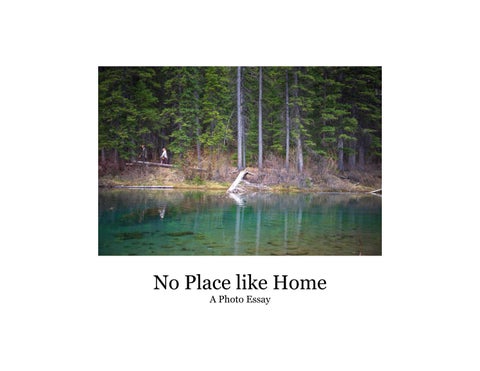
No Place like Home A Photo Essay
When entering the world of wilderness, you might come across signs warning you of certain animals roaming in the area such as bears and coyotes. Those animals live amongst us humans, who might happen to be taking a walk somewhere in an area close to our living spaces. This prompts the question of, is this space ours or theirs?
Approximately 100 kilometers away from Calgary’s bustling, industrial downtown is Kananaskis Valley. Visiting the area means sharing the space that nature provided us with by combining elements of earth, water, fire, air, and space. We share the need for these elements with the animals that exist on this land, and we are both indebted to the magnificence of this earth. This space is a shared space, connecting all living beings. It’s neither ours nor theirs, it’s all of our home.
But home doesn't end at your front door. It’s in those elements that exist so closely, and all around us. Nature is not necessarily only felt in the midst of a wild escapade in a remote, untouched area, it’s in the oxygen we breathe, the plants we decorate our homes with, the flowers we plant in our gardens, the wood our furniture is made out of, or the racoon that visits your garden at night. Nature is not a place to visit, it is home.
Lindsay Park is approximately 500 meters away from downtown Calgary. It is a space where the city meets nature. With human touch witnessed throughout the neat, clean, and tidy trails, pruned trees and plants, and built-in stairs, there is an appreciation for our wilderness. This responsibility to care for nature is a shared one, the same way we share the privileges that our home provides us with amongst each other.
According to the Wildlife Conservation Society, 70 percent of the world’s wilderness is located in five countries. Canada is one of them, holding the second-largest area of wilderness. This isn’t hard to believe when we look around and find ourselves surrounded by the mountains meeting with the waters and forests. In the midst of it all, you’d find yourself a part of this earth, integrated as one.
Being so closely connected to nature, our impact is greater than you may think. According to the United Nation’s 2022 climate impacts report, human induced climate change is causing “increasingly irreversible losses, in terrestrial, freshwater and coastal and open ocean marine ecosystems”. According to another report convened by the UN, Global temperatures have increased by an average of 1.1 degrees Celsius due to human activity. This all contributes to the extinction of animals and the loss of our wilderness. How much longer can our home handle?
The destruction of the environment means the destruction of home- who we are, what we are, where we live, the spaces we share with other species, and the life force behind all. While much of the destruction is irreversible, we can still slow down the damage and remind ourselves of the loud and strong connection we have with nature, deeming it as a part of our being. Therefore, it is our duty to protect Earth because, there's no place like home.
References: Vaughan, A. (2021, October 29). Humans have destroyed a tenth of Earth’s wilderness in 25 years – study. The Guardian. https://www.theguardian.com/environment/2016/sep/08/humans-have-destroyed-a-tenth-of-earths-wilderness-in-25-years-study
Plumer, B., & Zhong, R. (2022, February 28). Climate Change’s Effects Outpacing Ability to Adapt, I.P.C.C. Warns. The New York Times. https://www.nytimes.com/2022/02/28/climate/climate-change-ipcc-report.html
Dimoff, A. (2018). Not-so-wild world: Canada one of five countries holding remaining majority of wilderness. CBC. https://www.cbc.ca/news/canada/british-columbia/not-so-wild-world-canada-one-of-five-countries-holding-remaining-majority-ofwilderness-1.4890440