Traditional Education Evolution: The Rise of Startup-Centric Universities

Page 1


Why Traditional Education is Evolving: The Rise

of Start-up-Centric Universities

For decades, the standard for higher education was defined by traditional classroom lectures, standardized testing, and the pursuit of a degree aimed at securing a corporate job. However, as we navigate the complexities of the digital era, this traditional model is rapidly evolving. The rise of startup-centric institutions, pioneered in India by Swarrnim Startup & Innovation University, marks a fundamental shift toward an education systemthat prioritizes innovation, self-dependence, and entrepreneurial skill-building over mere rote learning.
The Move Beyond Traditional Pedagogy

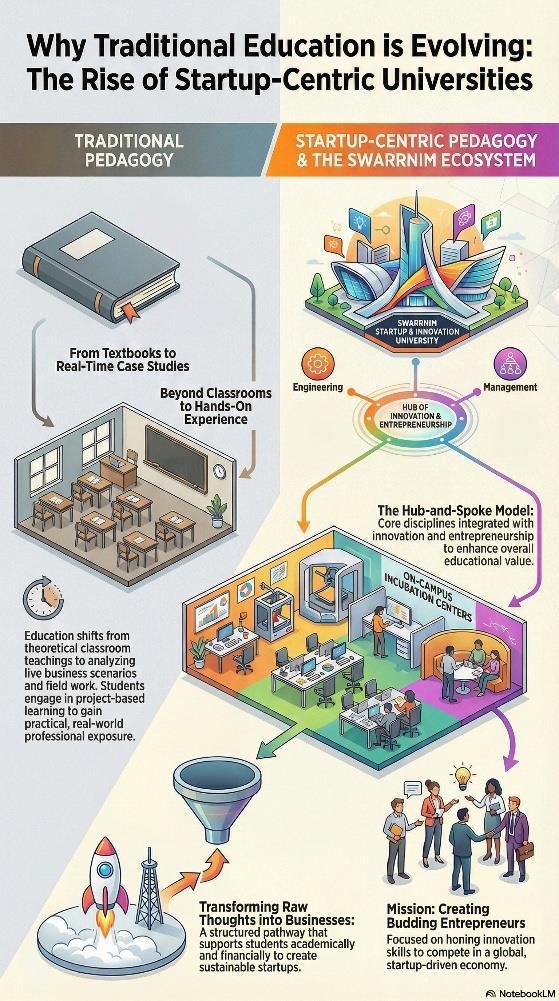
The core of this evolution lies in the transition from theoretical instruction to practical application. Traditional education often leaves a gap between academic knowledge and industry requirements. Startup-centric universities bridge this "entrepreneurial aspiration gap" by replacing standard "classroom teachings" with real-time case studies and hands-on field experience. Students are no longer just passive recipients of information; they are active practitioners who work on incubated startup projects while still pursuing their degrees.

The Hub-and-Spoke Academic Model

A key driver of this evolution is the implementation of the hub-and-spoke model. In this framework, innovation and entrepreneurship serve as the central hub, while various academic "spokes" such as Engineering, Architecture, Design, Science, and Health Sciences receive value enhancement through this central focus. This ensures that whether a student is studying Computer Engineering or Physiotherapy, they are equipped with the mindset to innovate within their field rather than just follow established paths.

Infrastructure for the Next Generation

A startup-centric university is defined by its specialized infrastructure. Institutions like Swarrnim have moved beyond simple computer labs to offer high-tech facilities like the Apple Lab and dedicated on-campus Incubation Centers. These spacesserve as a"safe haven for ideas,"allowingstudents to walk in with "raw thoughts" and walk out with sustainable, self-sufficient businesses. By providing both the physical equipment and the necessary funding support, these universities transform the campus into a launchpad for future leaders.

Fostering a "New Way of Thinking"

The evolution of education is also psychological. Student testimonials from the Swarrnim School of Business and the Institute of Design highlight a "new way of thinking" and a culture that encourages students to think "out of the box". This culture respects the creative process and encourages learning through trial and error, a method that Olympic Champion Abhinav Bindra describes as a "game changer" for those pursuing entrepreneurial ventures.

Aligning with National Missions

Startup-centric universities are not just educational institutions; they are vital contributors to national initiatives like "Atmanirbhar Bharat" (Self-Reliant India). Bypromoting startups incritical fields suchas agriculture and technology, these universities empower students to contribute directly to nation-building.

In conclusion, the rise of startup-centric universities represents a necessary evolution in response to a changing world. By focusing on creating "budding entrepreneurs" rather than just job seekers, institutions like Swarrnim Startup & Innovation University are redefining what it means to be a globally competent graduate in the modern age. As education continues to evolve, the focus will increasingly remain on honing the innovative skills required to turn a vision into a profitable and sustainable reality.

Turn static files into dynamic content formats.

Create a flipbook
Traditional Education Evolution: The Rise of Startup-Centric Universities by swarrnim_university - Issuu