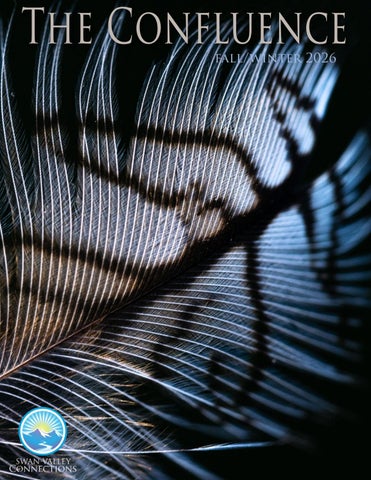
The Confluence fall/winter 2026
From the Directors
Reflections from Donn Lasilla and Jessy Stevenson, as they approach terming off of SVC’s board this February, after six incredible years of service
A
utumn and winter are my favorite times in the Swan Valley, the seasons I have spent the most time here, oddly enough, as I’m something of a global citizen. Fall brings its own small rituals: the bees finishing their flight training close to the ground, which is usually good for my one annual bee sting, a tradition I have never requested, and the bees have never skipped. The bears work the late berries and hunters’ leftovers before winter slumber, the turkeys make their rounds cleaning up the last of the box elder bugs, and the deer do their best to mow down what is left of my meadow, with quiet determination. There is finally a real reason to build a fire in our river rock fireplace from the wood pile that acreage management keeps growing all year, and I look forward to Jessy and Donn at our seventh-annual Soirée at The Nest Community Firewood Day in early October. As the nights cool and the first snow glistens across the valley, childhood memories of the holidays come flooding back. My partner and I fill our newly remodeled kitchen with sourdough loaves, craft hearty dinners to share with friends, and bundle up with our Pack of Poms (pomeranians) for walks in the woods. Six years ago, Rebecca, then our sole managing director, asked me to join the board. She knew me only as a donor, yet I was interviewed practically like a job, by people who held the mission of SVC close to their hearts, a mission I did not yet fully understand myself. They wanted to know what I had done, what I cared about, who I cared about. I applied, and I was accepted. Rebecca and I were friends before that interview, and we remain close friends today, which either says something good about her judgment or something remarkable about her patience. In my first year, then Board Director Mary Shaw took me under her wing, and her guidance helped me find my footing. She also remains a dear friend to this day. Not long after, I was asked to serve as Treasurer, at a time when our numbers had created a mindset of scarcity that I wanted to help shift. I made a point of asking anyone who would sit still long enough: what would you do if you could do anything you wanted? A slightly dangerous question to ask a room full of visionaries with a limited budget. Working alongside Jessy, Mary, and later Rich, as part of the executive officers, we navigated real turning points: Rebecca’s moving on, and the organization’s transition to a multiple director model, which I did not initially support but have since revised, publicly, and with the good grace of someone who was simply wrong. Then, three years ago, SVC needed to find a new home for its operations, and the board spent long hours at our fall retreat hashing out the plan that led to purchasing the River House. Every voice in that room, quiet and loud, had a role in making it happen. What I return to most, through all of it, is the people. New board members became old friends. My partner and I hosted patio parties, showed up for community potlucks, and brought our own circle of friends into the Fourth of July open house at the River House. Six years in, that circle has grown in ways I never expected, and it is why we want to spend even more time here in the Swan. I have said many times that if this board ran a for-profit company, it would be one of the most successful anywhere. What SVC gave me is more personal: it helped me understand who I am, and what I want my own tribe to look like. I care more deeply about this land, and everyone who calls it home, than I did the day I joined. The people and the programs did that. To everyone who has crossed paths with me since, thank you! Serving a landscape this diverse has been an honor and a privilege.
2
Swan Valley Connections
P.O. Box 1309• Condon, MT 59826 p: (406) 754-3137 info@svconnections.org
Board of Directors
Jessy Stevenson, Co-Chair Rich Thomason, Co-Chair/Secretary Donn Lassila, Treasurer Rachel Feigley Carol Harwood Neva Hassenein Caitlin Jindrich Maria Mantas Robert Rankin Jon Simon Dan Stone Aaron Whitten
Emeritus
Russ Abolt Steve Ellis Melanie Parker Tom Parker Neil Meyer Rebecca Ramsey
In Memoriam Anne Dahl
Advisors
Steve Bell Jim Burchfield Larry Garlick David Holmes Steve Kloetzel Chris La Tray Zoë Leake Tim Love Alex Metcalf Casey Ryan Mark Schiltz Mary Shaw Lara Tomov Mark Vander Meer Gary Wolfe
Staff Luke Lamar, Managing Director Sara Lamar, Managing Director Andrea DiNino Kirsten Frazer Shane Lisowski Mike Mayernik Megan Parker Uwe Schaefer Taylor Tewksbury The Confluence is published by Swan Valley Connections, a non-profit organization situated in Montana’s scenic Swan Valley. Our mission is to inspire conservation and expand stewardship in the Swan Valley. Images by Swan Valley Connections’ staff, students, or volunteers, unless otherwise noted. All rights reserved to Swan Valley Connections. Change service requested.
SwanValleyConnections.org COVER: Western Screech Owl Feather by Andrea DiNino
To any new board member: the more you give yourself to this work, the richer it becomes. SVC serves every resident of this valley: winged, four-footed, gilled, rooted, or upright, and somehow holds it all together as one living, breathing whole. That, to me, is the real mission. Not a program or a parcel of land, but a single connected tribe, and I am grateful to be part of it. From Jessy: all is a season of gathering. Wood stacked and delivered F in the bed of Donn’s old white Ford on Firewood Day, chokecherry stones crowded in piles of bear scat, feathers and
fur and the dried grass of warmer days woven into winter nests, friends convened to help make room in the freezer before hunting season, and stories collected to be shared around fires on long winter nights. As I harvest a few last service berries in the honeyed light of early September, I reflect not only on the passing season, but the past six years and my two terms as a board member with Swan Valley Connections. In truth, these reflections stretch back much further than that–tagging along with Landscape & Livelihood students as a kid, their self-appointed guide for the wetlands behind our homestead; long summer camp days with the Swan Ecosystem Center, learning about cambium through cultural trees that expanded my sense of time and self; solstice potlucks and
snow caves and music filling the Beck Homestead barn; an early college season working on a trails project with Northwest Connections…The organizations that would eventually form SVC were deeply formative for me, sparking a sense of wonder and seeding my definition of community from an early age. When I received an email in 2020 asking if I might be interested in applying to SVC’s Board of Directors, the answer was easy. What a rare and special thing, the chance to be part of an organization – a community – that, more than any other, has shaped the way I see and experience and understand the places that hold my heart. Wendell Berry once wrote, “A community is the mental and spiritual condition of knowing that the place is shared.” Through the distance of the pandemic, the process of designing and implementing a new co-leadership model, the uncertainty of changing political landscapes, the chaos and, ultimately, the significance of purchasing and moving into our own space, the messiness of new projects, and all the challenge, joy, and growth in between, shared place has remained at the very core of our community. Never have I had the privilege of learning from and working alongside a group of people – staff and board – more dedicated to the common ground beneath their feet, and the generations of beings who will inherit it. In this, and in so many ways, SVC continues to shape my ways of knowing and being in the world, and for that, I am profoundly grateful.
In Connection & Community,
Donn Lassila and Jessy Stevenson
Right: SVC board, staff, and volunteers cut, split, and stack wood to be delivered to community members in need of firewood for the winter. Last year was our 25th year of this annual volunteer effort; it’s one of our favorite traditions!
Welcome to the board, robert rankin! Robert lives in Bigfork, where he enjoys fly fishing, hiking, and exploring the mountains, rivers, and public lands of northwest Montana. Before moving west, he owned and operated Snowbird Mountain Lodge in the mountains of Western North Carolina for nearly 30 years, where he developed a deep appreciation for stewardship, community, and creating places where people feel genuinely welcome. Today Robert writes about leadership, conservation, and the enduring connection between people and the places that shape them. His work reflects a lifelong belief that healthy communities, like healthy landscapes, are built through care, integrity, and a shared sense of responsibility.
3
How to Retrieve a Lynx Collar LUKE LAMAR
A
fter leaving the trail 12 miles into the Bob Marshall Our crew consisted of SVC staff Mike Mayernik, Andrea Wilderness, we hadn’t gone a quarter of a mile before DiNino, Sara Lamar, and me, along with our favorite naturalist I was pretty soaked from the waist down from the Rob Rich. We were on a mission to retrieve a GPS collar that had morning’s rain that was still holding onto all the vegetation. been fitted on a Canada lynx in March 2025 near Marshall Lake And the vegetation was thick. Alder thickets, false huckleberry in the Clearwater River drainage, on the west side of Highway (menziesia ferruginea), thimbleberry, and huckleberry bushes 83 between Seeley Lake and Condon, Montana. The lynx, M416, all retained the morning’s moisture amongst a healthy amount had shed the collar in this remote drainage last October. This of blowdown to climb over. After sidehilling into an unnamed male lynx was one of ten lynx who were captured and fitted drainage, we decided that the slope was uncomfortably steep, with GPS collars by the U.S. Forest Service’s Rocky Mountain especially with the slick, wet beargrass and an increasing amount Research Station in the winter of 2025. This is part of an ongoing of fallen trees. We descended into the brushier creek bottom multi-year effort to learn more about Canada lynx habitat use and picked our way up the opposite side of the drainage, again related to wildfires. on a very steep slope, where we dug the sides of our boots into Canada lynx are cold-adapted forest carnivores that are the hillside for better footing with each step, and held onto highly specialized for hunting snowshoe hares in deep snow. the ample vegetation to help us from careening down into the Lynx are especially vulnerable to a changing climate that alters creek bottom. We crossed several avalanche chutes that were the structure and composition of boreal and subalpine forests, choked full of alder, and for a while ants may have been moving and to the associated ecological processes that change at an faster through those thickets, as we played the not-so-fun accelerated rate with landscape-level disturbance. Since being game of backcountry yoga, where you raise a stubborn alder federally listed as Threatened under the Endangered Species branch with one arm, duck under that, while gingerly lifting one Act in 2000, Canada lynx are increasingly impacted by natural leg in between a tangle of ten other branches, then heaving the disturbances such as wildfire, forest insects, and disease, as other leg waist-high to negotiate the next tangle of branches, well as anthropogenic causes, such as logging and recreation. and so on. These increasing disturbances result in a heightened need by You might be asking yourself what we were doing and managers to formulate management prescriptions in disturbed why we were here? Those same thoughts bounced around my landscapes that balance the conservation needs of this federally head more than a few times too, as we slowly made our way listed species with the desire to build resilient forests in a higher into the deep, timbered canyon. I’ve definitely found changing climate. myself on similar bushwhacks in other out-of-the-way places before, often chasing the bugle of a bull elk that just won’t let me quite catch up. However, in this instance, we were in the Sun River Game Preserve, a nearly 200,000-acre portion of the Bob Marshall Wilderness, where hunting is not allowed, to provide safe calving and summer range for the massive Sun River elk herd. For that reason, few people have probably ever had a reason to explore this side drainage, located a few miles away from White River Pass. It was interesting to ponder the foresight and successful legacy of conservation from those who made the decision to set aside the Sun River Game Preserve in 1913. It was a decision that, in hindsight, seems ahead of its time in history in recognizing self-restraint and the value of preserving areas for the benefit of wildlife habitat security and other non-monetary values, and has withstood the test of time and greedy politicians, as well as other areas that aren’t totally dominated by humans, like the Bob Marshall Wilderness itself. Rob Rich, Luke Lamar, Mike Mayernik, and Gulo crossing a stock bridge in the Bob Marshall Wilderness.
4
“This collar had been on quite the journey since it had been fitted on M416.” Right: GPS locations of M416 from when he was fitted with a collar in the Seeley Lake area to when he dropped it in the Bob Marshall Wilderness. Map provided by the Rocky Mountain Research Station Following page: Sara Lamar holding M416’s dropped collar after finding it in the avalanche chute
Effective lynx management requires that we understand how Canada lynx in the Northern Rockies respond to climate and habitat changes created by large-scale fire disturbance, such as the sharp increase in early-successional lodgepole pine forests, which are replacing their primary habitat of mature and advanced regenerating spruce-fir forests. Ultimately, this research could help fire/fuels managers and forest silviculturists to accurately determine how their proposed active management, such as timber salvage, fuels reductions, or controlled burning, may impact important habitat for Canada lynx across the Northern Rockies. While we didn’t know it at the time, SVC field crews had originally detected M416 through snow track surveys and documented his locations on three separate occasions in the winter of 2022, all in the Marshall Lake area. SVC had also collected genetics out of a daybed from another lynx travelling with M416 in 2022, which turned out to be the genetics of F28, who was probably his mother, based on the genetic match. SVC crews also collected genetics from snow track surveys from F28 in the winters of 2016 and 2018, again in the Marshall Lake area. Based on this information, M416 was probably born in 2021 and was still hanging around with his mom in 2022, and was then collared in 2025. As we ascended high into the unnamed drainage, we stopped to marvel at a western larch tree. This was the only western larch that we saw in this drainage, and right along the line of the eastern-most western larch distribution. The thick spruce/fir forests occasionally opened up into avalanche chutes,
where along the open edges we found plentiful huckleberries! In a normal year, this would not be big news, but this year has seen an almost complete failure of berries, except for the extreme northwest portion of Montana. We happily grazed our way upwards, relishing the only huckleberries that I’ve come across all season anywhere I’ve roamed. Not surprisingly, there was also some fresh bear sign in the area, as they were undoubtedly cherishing the important seasonal food source as well. Other signs like overturned rocks and torn apart rotten logs displayed the bears’ presence in the area as well. As we emerged into the largest avalanche chute yet, the sun finally popped out for the day, illuminating the lush hillside and abundance of wildflowers. The recent trail of a wide grizzly bear was apparent from the flattened lush, green vegetation; we saw where the bear had meandered through the chute foraging on one of their favorite plants, cow parsnip. We all converged on a GPS point in the middle of the chute. I was thankful the point was in relatively open terrain and not in an alder thicket, but I quickly realized that it could still prove to be time-consuming to locate the collar with the dense beargrass and other thick understory vegetation. Or so I thought. Right where Sara set down her backpack, as we prepared to put together the telemetry gear and antenna to better hone in on the exact location of the collar, she noticed something metallic under the shrubs and reached down to pick it up; it was the collar! With bragging rights established and Sara gloating, I grumbled something about how I had packed the receiver and antenna all that way for nothing.
5
6
This collar had been on quite the journey since it had been fitted on M416. After spending time in the Marshall Lake area, the cat had crossed Highway 83 and spent time in the Richmond Ridge area, on the east side of the valley, before ascending up and over the Swan Front into the Bob Marshall Wilderness, and even headed south into the Scapegoat Wilderness before returning into the Bob. Along this journey, M416 spent time in a mosaic of mature, multi-storied spruce/ fir forests, as well as younger regenerating forests that have previously burned in prior decades. Even after the collar had dropped from the cat last October, it had been carried down over a cliff wall about 200 feet in elevation during a wintertime avalanche. Judging from some chew marks on the collar, a squirrel or other rodent may have moved it a little further until we finally came along. Another collared lynx almost reached the Berkeley Pit in Butte, before turning around and coming back. Others have been documented making treks north into Canada. The story of M416’s and others’ travels illustrate the need for large, connected, undeveloped habitats and room to roam for so many of our wide-ranging wildlife species, such as wolverines, grizzly bears, elk, mule deer, lynx, and more. They also illustrate how fragile these movements can become with highway crossings and other developments. One of the collared lynx was killed trying to cross Highway 2 near Glacier National Park in 2023. Twelve more lynx were collared in the winter of 2026 in the Mission Mountains, as researchers with the Rocky Mountain Research Station continue to learn about lynx habitat use, foraging efficiencies in different forest types, how lynx are using areas as forests regrow after wildfires, and about large dispersal movements and connectivity needs. Along our travels on the three-day journey to reach the lynx collar, we crossed paths with others who recognized us from their experiences with SVC. It was refreshing to see familiar faces in the middle of the wilderness, and how our mission and stewardship ethos is spreading throughout the world. We ran into someone who had taken our tracking class and was now volunteering their valuable time with the Bob Marshall Wilderness Foundation to help mitigate weeds. She joyfully told her comrades about the wonderful experience she had with SVC and that they should all sign up for a class! We came across another property owner in the Swan, headed into Prairie Reef Lookout to volunteer her time to spot wildfires for the Forest Service, and we discussed a variety of topics from land management, education, and the need to have more people connected to the landscape and to help steward it. As we hiked out the many miles along the relatively flat trail, I couldn’t help but be amazed and thankful for our wonderful, dedicated staff, some of whom now have this experience to further bond us together, as we continue to spread our mission and positively impact other people, who we may randomly run into some day out in the middle of the Wilderness, along a dusty trail. I guess there’s a lot of us in the world who aren’t that different from a lynx, who enjoy long walks, appreciate roadless areas and Wilderness, don’t seem to mind wandering thick, rugged country, and require large blocks of undeveloped public lands for room to roam. And like the lynx, we all need a place to connect with that we care about and call home.
Congratulations to one of Tracker Certification North America’s newest evaluators, our own Luke Lamar!
Don’t feel ready to jump into an evaluation? You don’t have to be a pro; they’re wonderful learning and growth opportunities! But if you’d like to spend a little more time looking at tracks and sign before testing your skills, you can sign up for one of our one-day classes or weeklong courses (complete with a two-day CyberTracker certification at the end). *Our 2027 dates launch soon, and our scholarship application is now open! Apply at www.swanvalleyconnections.org/scholarships
Luke explaining how to tell the age of a whitetail deer by looking at its teeth; this was during the 2021 evaluation where he earned his specialist certification! Luke was introduced to tracking informally by growing up as hunter, following deer and elk around Montana. He began tracking professionally in 2011, as a field technician on the Southwest Crown of the Continent Rare Carnivore Monitoring Project, tracking wolverine and lynx distribution through snow track surveys and genetic collection. Luke has offered one-day tracking classes through SVC for years, and has also taught in our college field programs. He has been involved with CyberTracker since 2013, when he took his first track and sign certification, and he has assisted in numerous certifications hosted in the Swan Valley. He earned his Track and Sign Specialist certification in 2021 and his Trailing Specialist and Senior Tracker certification in 2026. We’re so excited to have an in-house evaluator for our CyberTracker Tracks & Sign certifications! You can be a part of Luke’s first solo evaluation this month on October 17-18 (class size is limited to 11 participants). The CyberTracker Track and Sign Certification is an internationally applied, professional-level certification used to promote wildlife tracking and knowledge. This two-day field experience is both an assessment and a training, with an emphasis on open dialogue and real learning.
Joy Wang (featured in a later article!) and Yunfeng Ge looking at woodpecker sign on a tree during a Winter Weeklong Wildlife Tracks & Sign Course & Certification
Above: Field journal entry by Ayeanna Ruprecht from our January 2026 Winter Weeklong Tracking Course & Certification. Left: Luke (front row right), Northwest Connections cohort, and David Moskowitz (front row left) 7 from 2013 CyberTracker Certification
FROM WEEDS to BEAR BEDS to RAPTOR RARITIES
ANDREA DI NINO
I
’m sitting at the base of two juniper trees in our “backyard,” a long, skinny plot that includes a lush riparian zone down to the Swan River. The cloud of thirsty mosquitoes is growing around me–I’ve always been a well-loved meal choice for them, and the ensuing welts will be brutal. But I dare not move a muscle; the warm evening light is filtering through the trees, and I’m staying put and suffering for good reason. About 15 feet above me, on a gnarled and flaking juniper branch, a sleepy western screech owl roosts. It is mostly unbothered by me, only squinting its eyes open every now and then for a brief moment, before shutting them again. He or she shows no interest in the songbirds coming and going nearby: a female redstart, a chickadee, a robin…they’re safe for now, unlike their less lucky counterparts whose wings I found spattered around the forest floor, along with one decapitated shrew. There’s the steady hum of the Swan River, intermittent highway traffic drones, and the occasional dog barking in the distance–all white noise for this under-10-inch raptor. If there’s a second owl tucked up against this tree or another nearby, I don’t see it from my stationary camp chair. But when I first learned of this owl’s presence a few days prior, it was accompanied by another, either a fledgling sibling, a mother, or her offspring. I would’ve never known about these rare backyard birds, had I not recently made it my mission to wage war on the thistle, houndstongue, and knapweed that had been quietly taking over the past few years. While hand-pulling, a painfully slow yet satisfying method of removal, in early June, I noticed
8
a fresh pile of vegetation-filled bear scat. It’s not uncommon for us to have a mound or two on our path that leads down to the river at this time of year, when the bears are keying in on nutrient-dense grasses, sedges, bulbs, and roots. But, now that I was venturing off-path to eradicate other leafy nemeses, I was finding more and more heaps around. While plucking weeds, and giving the area regular scans, something caught my eye: a shallow, oval depression in the duff, tucked under a spruce tree with low-lying branches that touched the ground. Sprinkled around the edges were, you guessed it, piles of bear scat. Now, this is something I definitely likely wouldn’t have noticed when I first moved here 10 years ago. Thanks to many romps around the woods with wildlife tracks & sign expert friends (namely Luke and Sara Lamar and Rob Rich), and a couple CyberTracker evaluations, I now pick up on way more clues and can form stories about what’s happening in the natural world right around me; if you haven’t taken a tracking class or eval, I can’t recommend it enough. But back to my discovery–what I was looking at was a bear bed! Right below our house, this bear (black or grizzly, I couldn’t tell), was foraging and snoozing during the heat of the day, doing what a bear does and bothering no one. I was happy to witness this prime example of living side by side without conflict. When I continued my weed-pulling mission further into the woods, I happened upon yet another daybed, this one with NINE large piles of scat surrounding the wider perimeter. (Why walk far when nature calls?) Prodded by curiosity, I wanted to see who my backyard bruin
was, and who else might be stopping by, so I put a trail camera up facing the bed. As it so often goes, the bear stopped using the bed either right before or right after the camera went up, but I was able to catch a glimpse, with my own eyes, of the cinnamon-colored black bear contentedly foraging nearby before it moved on to somewhere else. I decided to leave the camera up, and one more young, collared grizzly walked right by our house and stopped by just to sniff the bed before continuing towards the river. Other than that, I was getting about 20 videos a day of a red squirrel running up and down an adjacent log, does and fawns, and lots of songbirds. But a few more exciting visitors led me to keep the camera up. A mink, a short-tailed weasel, pileated woodpeckers, and multiple flying squirrel cameos reassured me that this was a worthwhile spot. Weeks after I put the camera up, as I was checking it one morning, I immediately noticed a shape my eyes were not used to seeing; on the very small camera screen, it’s hard to make out details, but with lightning speed, my brain filed through the outlines of songbirds, woodpeckers, waterfowl, game birds, and nothing fit. One rotund little shape was quickly joined by another that flew into the scene, sitting beside the other, and soon enough they were bobbing and weaving their little heads…owls! But what kind? Having volunteered at Montana Wild Wings Raptor Recovery Center for years, I then started to file through the different species in my mind. Scale can be hard on these videos, but I narrowed it down to either great horned owl fledglings (a common and likely species), or
Previous page: A western screech owl roosts in a juniper tree Above: A macro image of a shrew jaw bone found it its pellet
western screech owls that appeared too big compared to the size I knew them to be. I didn’t feel sure, so I reached out for backup. My goto tracking nerds would know the answer, I thought. There were many in the great horned owl (GHOW) camp…catching western screech owls on camera would be very rare. But there were some little things that just didn’t add up: we didn’t notice any of the warm, rusty tones that GHOWs tend to have, and I also would expect that if they were in fact fledglings, based on their size, that they would have more floofy downy feathers around their bodies, which these birds did not. While both GHOWs and western screech owls have little ear tufts, those aren’t always visible, and they weren’t obvious in these clips. It was time to bring in the experts. Just around the time I reached out to the Owl Research Institute and heard back from one of their biologists, Gabriela, I found a tail feather in the same section of woods that was definitely owl-patterned, but still hard for me to decipher species. But, to my delight, Gabriela confirmed from my trail camera videos that these were, in fact, western screech owls! Our neighborhood is a bit more developed (by Swan Valley standards), and as someone who was drawn here by the wildness, that can bum me out from time to time, if I’m being really honest. The chances of a wolf pack traveling through our property is slim to none. But suddenly, our backyard felt a little more alive, wild, and special. With lots of mature cottonwoods around, it made sense that their cavity nest was somewhere nearby, although I never saw it. But I did find further confirmation from their very distinctive (and beautiful) body feathers that include a dark vertical stripe down the center of them, along with some small pellets that I happily dissected…and found where that shrew head ended up. It was after this discovery that I schlepped my camera and big lens with me into the woods, just in case, and scoured the forest floor for more clues. When I glanced up in the juniper, under which I found the pellets and partially-consumed shrew, there one was: a compact, rare little raptor, resting before its nighttime hunt and allowing me to sit in its company, if just for a little while. So, when we say that every program and service we offer at SVC is deeply tied to the animals that share this landscape with us, we mean it: stewardship (pulling noxious weeds) led to using tracks & sign skills (finding a bear bed) and learning more about an uncommon species who calls this place home and needs certain things to thrive (western screech owls live here year-round and need mature riparian or open woodlands featuring natural tree cavities for nesting, a diverse food supply of large insects and small rodents, and safe, dark nocturnal hunting grounds free of heavy artificial light or toxic pesticides.) You never know where picking some weeds might lead you. Make sure to tune in–the trail camera footage of these owls will be shared during our Wild for Wildlife month-long match campaign, starting October 1st!
9
Track Local, Think Global SARA LAMAR
R
eading the tracks and signs that animals leave behind has long been part of Swan Valley Connections’ (SVC) history. We believe that this essential skill is a noninvasive tool for reading the landscape and that learning this ability makes people better scientists, stewards, and citizens of the natural world. We also believe that education is about more than learning a skill. It’s about creating a lasting connection to place, wildlife, and the people who care for them, and giving people the tools to carry that connection forward. For one recent SVC student, a weeklong wildlife tracking course in Montana has grown into something much bigger: exhibitions, lectures, publications, and plans to develop new tracking resources for audiences in China. The story begins with a lifelong interest in wildlife and a desire to look beyond simply knowing an animal’s name. “I’ve always been interested in nature and wildlife,” said Joy Wang, who took classes with SVC in 2022 and 2023. Growing up in urban areas in China, much of her early exposure to wildlife came through documentaries. Birding eventually became her entry point into observing nature, but she wanted to go deeper. A visit to a Chinese national park changed the way she thought about wildlife. Although mammals were difficult to see during the day, park rangers pointed out tracks and scat. The experience sparked a fascination with the stories animals leave behind. “It’s just magical how you’re able to tell who’s been there just through the traces that we don’t often notice,” she said. Tracking offers a way to understand animals beyond identification and enables us to explore their behavior, movements, and natural history.
10
Joy initially taught herself tracking through books and field guides. But she wanted hands-on experience and the opportunity to learn alongside other people. That search eventually led her to SVC while she was in the U.S. studying at the School of the Art Institute of Chicago. A weeklong field course offered the chance to spend enough time immersed in the landscape to really develop her skills, and she found a community of people with deep expertise in tracking and ecology. After her first course, she came back. One of her favorite experiences came during the winter course, when she encountered tracks and signs of two elusive species she had never tracked before: wolverine and Canada lynx. Both species are also among those monitored through SVC’s rare carnivore work. For Joy tracking is more than a scientific skill. Her background in art gives her another lens through which to understand tracks and sign. She describes tracks as “nature’s semiotics,” a system of signs that points toward an animal that may no longer be present. Just as an artist works with materials and symbols, a tracker learns to read the marks animals leave behind in snow, sand, mud, and other substrates. That intersection of art, science, and observation has become central to the work she is now doing in China. Tracking is still a relatively new subject for the general public in China, but interest in nature and outdoor recreation is growing. Birding, in particular, has become increasingly popular. Joy sees an opportunity to introduce people to another way of experiencing wildlife. She has begun giving talks and lectures at schools, nature education organizations, and conservation groups. She teaches basic track and sign identification, and shares stories about tracking and what it can reveal about the lives of animals.
Joy’s beautiful exhibition, showcasing Chinese wildlife and their tracks at a bookstore in Shanghai
Above left: Participants attempt to move as Chinese wildlife do, following their tracks and gait patterns on the bookstore floor. Above right: A red fox carrying a meal in a popular Chicago park. Photos by Joy Wang She recently brought those ideas together in an exhibition at a bookstore in Shanghai. The exhibit focused on nine mammals that currently live in, or historically inhabited, the Shanghai region. Joy created casts of their tracks and combined them with illustrated trails, showing how the animals move across the landscape. Visitors could see, for example, the distinctive patterns created by a loping Siberian weasel, a walking hedgehog, or a bounding Chinese hare. The display also connected wildlife tracking with Chinese cultural traditions and folklore. Rather than simply presenting tracks as scientific specimens, Joy used familiar stories about animals as a doorway into learning more about their actual behavior. At the exhibition’s opening event, she invited visitors to experience animal movement themselves, walking like a panda or attempting a gorilla’s knuckle-walking gait. About 40 people attended, filling the small bookstore space. For Joy, the goal is not simply to teach people how to identify a footprint. “I can feel the charisma of tracking when I’m practicing it myself,” she says, “so I want to share that with a broader audience.” Her work is also beginning to reach audiences beyond the classroom and exhibition space; Joy has written articles for magazines and currently has several book projects in progress. One is a children’s book about birding and the stories hidden in nests, tracks, and other signs of species in Shanghai and the wider Yangtze Delta area. She is also working on a Chinese translation of Stories and Tracks and Signs, a book by Diane Gibbons, featuring a foreword and photographs by Mark Elbroch. Beyond these, she has more exciting publications and resources still taking shape. At SVC wildlife tracking is taught as a way of paying close attention to the landscape, to notice what animals are
doing even when they remain unseen. Students learn to read individual tracks, but they also learn to ask bigger questions: Where is an animal going? What does its movement tell us about the landscape it inhabits? What habitats and resources need protection? As more people in China spend time hiking and exploring the outdoors, Joy sees growing interest in understanding the wildlife they encounter. She also sees an increasing need for conversations about conservation, responsible recreation, and how people interact with wildlife. While at school in Chicago, Joy began following a pair of red foxes within the city. Eventually, she found their den and watched them raise a litter of pups. Amazingly, these foxes were denning in a popular urban park, where hundreds of visitors passed through each day. She worked with the park manager to create and post an infographic to educate people about the foxes, including the importance of maintaining a safe distance from them. Tracking can be an entry point into these conversations. It transforms an ordinary footprint into evidence of a living animal. It asks us to slow down, pay attention, and imagine life unfolding just beyond what we can see. A lesson learned in the snow of Montana can travel thousands of miles. This is what your support of SVC’s education programs makes possible. It puts students in the field and connects them with knowledgeable instructors. It allows them to learn by doing, to follow an animal’s trail through snow, examine a track in the mud, ask questions, make discoveries, and build relationships with the people and places around them. The impact of experiential education doesn’t end when a course is over, it travels and grows with the people who experience it.
11
Swan Valley Bear News
ERIC WENUM, Montana Fish, Wildlife & Parks Bear Management Specialist
2
026 seems to be the year of the cub. There are a lot of cubs, both black and grizzly bear, out running with moms throughout the Swan Watershed. This is a great indicator of last fall’s huckleberry crop. Other indicators are younger ages of first-time moms, and the many pictures I receive from my own and many others’ game cameras scattered to the four winds. Nearly all the bears this spring looked as if they were ready to go to bed for a long sleep, not as though they had just awoken. Age of first reproduction is directly related to one’s ability to secure quality foods. Huckleberries, as we all, hopefully, have experienced are a quality food source. Putting on that fall fat, doing the old “Special K pinch an inch test” to assess our fat levels, thus our “fitness,” not the fitness they talk about in the gym commercials, but the ability to grow, birth, and rear offspring. Reproduction is an expensive endeavor, energetically speaking. While bears don’t usually incur the first car, or college tuition costs, they do have security and food costs, lots and lots of food costs. So, to offset these costs they bank those huckleberries as inches of fat and make withdrawals every time they nurse. The more fat in those accounts, the more cubs they can support and for a longer time. Another indicator of last year’s berry crop is the large number of grizzly bears dispersing their young as yearlings rather than carrying them until they are 2-year-olds. The Rocky Mountain Front, the east side of the divide, regularly experiences female bears kicking off their yearlings, while in the Swan, it is a rare event. This year in the Swan, 3 of the 4 radio collared females with yearlings did so, resulting in 5 yearlings dispersing and only 1 staying with mom. As we only have but a small proportion of the females radioed, and not all females will have yearlings, it is still a sizable number of potentially dispersing yearlings. This likely means that females came out of their den in such good shape, their bodies said they could try to have kids in quicker succession. Meaning, disperse last year’s cubs and breed in May and June, and go to bed in the coming fall; do the pinch an inch and see how things are looking, and maybe implant and officially become pregnant, starting the cycle anew.
Remember that bears have delayed implantation. They breed in the spring, but the fertilized egg(s) free floats in the uterus, with cell division stopping after it has become a several hundred cell blastocyst. This only implants after the bear’s body assesses its condition or fitness. If the bear’s body, the pinch an inch test, gives the green light, with hormonal changes, the uterine walls become engorged and the blastocyst implants. Now the bear is pregnant, usually around the first part of November. Then after an 8-week gestation period, cubs are born within the first 2 weeks of January, weighing less than a pound (12-14 ounces each). Speaking of huckleberries, hopefully everyone still has some from last year. This year’s crop was dismal. There are several theories, mostly weather driven, as to why it was a poor yield. It was suggested that the bushes are simply tired from last season’s effort, but the more likely culprit is the cold and the timing of the rain we had this spring. While the bushes seemed to flower in abundance, many were impacted by the late hard frosts. And some flowers were knocked off by the rain. But the real impact may have been on the pollinators. The colder temperatures kept them in, rather than out flying flower to flower, collecting and spreading the pollen, a critical step in the beginnings of a berry. But fear not, bears have the ability to find good hucks even on bad years, plus there are lots of alternate natural foods for them, but few as good as a thumbnail-sized purple berry of deliciousness. Calls have been unusually high for this point of the bear season. Bears are transitioning into hyperphagia, where they eat nearly 20,000 calories each day to gain the fat they need to over-winter. Bear activity has dramatically increased as they search for these calories, especially during what is a widespread poor natural food year. We are asking everyone to be extra diligent in their attractant management and security. As always, enjoy our great outdoors, keep bear attractants locked up, and report conflicts to FWP when they occur. The sooner we know of an issue, the more options we have available and the higher success in addressing the problem and for the bear.
•
2026 By The Numbers (so far) • •
12
We hired our new Bear Conflict Prevention Coordinator, Shane Lisowski, this past spring! SVC has built 13 permanent electric fences (with many more scheduled), helping to secure bear attractants including chickens, goats, livestock grain, orchard trees, compost piles, and gardens
• • •
SVC has distributed 48 bear-resistant trash cans, and we recently received a large order; cans are available for free to anyone in the Swan Watershed SVC worked with People & Carnivores and Community Foundation for a Better Bigfork to install 7 permanent bear-resistant trash cans in downtown Bigfork! We collaborated with the A Bar in installing a commercial bear-resistant grease trap for the restaurant There have been two grizzly bear vehicle-caused mortalities on Highway 83 in the Swan Valley.
Clockwise from top left: Shane Lisowski: Bigfork resident, past SVC volunteer and Rare Carnivore Monitoring crew lead, and now our Bear Conflict Prevention Coordinator! Bigfork residents practicing their bear spray skills (with inert cans) at our Bear Awareness event and presentation at the Bigfork VFW this past May. Other partners present included Montana Fish, Wildlife & Parks and People & Carnivores, who provided the remote controlled charging bear!
Photo by Casey Kreider
One of the new permanent bear-resistant garbage containers installed in downtown Bigfork on Electric Avenue this past May. The design was borrowed (and adapted) from our friends at Greater Yellowstone Coalition, who installed similar containers around Gardiner Public Schools in 2024. We’re grateful for their support and collaboration! Wildlife in the West students helped Luke and Shane build an electric fence around a Condon resident’s garden at the edge of the Flathead National Forest below the Swan Range.
13
October 1-31, 2026
GOAL: $100,000 All gifts of $500 or more will be matched 1:1 thanks to the Cinnabar Foundation and a generous, anonymous donor Last year you helped us raise a total of over $87,000 with match, so we know we can do it!
Photo by Greg Thigpen
www.SwanValleyConnections.org/wild-for-wildlife At Swan Valley Connections, wildlife is at the heart of everything we do. We study rare carnivores, help people live safely alongside bears, steward forests and trails, protect and restore habitat, and inspire the next generation of conservationists. But we can’t do this work alone. Your support helps keep the Swan Watershed a place where wildlife can thrive and where people can experience the wonder of a truly wild landscape.
This October, we’re inviting you behind the scenes with some of our favorite trail camera footage from the past year. These cameras capture the moments we rarely get to see: animals moving through their world when no one is watching, raising young, searching for food, playing, and simply going about the business of being wild. Every clip is a reminder of what we’re working to conserve. Because wildlife needs wild places. And wild places need people who care. Join us and help us keep the Swan Watershed wild for wildlife.
Where the Wild Things Roam
TRAIL CAMERA MOVIE NIGHTS
Missoula • Bigfork • Condon Event dates on following page. Tickets are available for The Roxy showing on The Roxy Theater website, and you can find tickets for The Bigfork Playhouse showing on SVC’s event calendar or Wild for Wildlife web page! Don’t wait- our Roxy event SOLD OUT last year! Dressing up as your favorite wildlife is highly encouraged!
Scan for Roxy tickets
14
Scan for Bigfork tickets
Upcoming Events
Always check our website for the most up-to-date information! october
1-31: Wild for Wildlife Match Campaign! 1: 26th-Annual Community Firewood Day (Volunteer Opportunity) 2-3: Staff & Board Retreat - Office Closed 10: MT FWP Fall Fest @ Wayfarer’s State Park 14: Swan Lands Coordinating Network Public Meeting 17-18: CyberTracker Wildlife Tracks & Sign Standard Certification 20: Pile Burning Workshop (with MT DNRC) 21: Trail Camera Movie Night @ The Roxy 22: USFS Quill Pig Project Public Tour 30: Trail Camera Movie Night @ Bigfork Playhouse
february
3: Quarterly Potluck: Tracking Travels with Sara Lamar 4: Science on Tap: “Willow” Screening with Joshua Lisbon @ Flathead Lake Brewing Co 6: Wildlife Tracks & Sign Family Day 20: Wildlife Tracks & Sign One-Day Class March
6: Wildlife Tracks & Sign One-Day Class 13-21: Weeklong Wildlife Tracks & Sign Course & Certification 15: Bubble Cap Orders Close
november
4: Quarterly Potluck: The Secret World of Mountain Lions with save the date: 30th Anniversary Celebration/8th-annual Soirée Joshua Lisbon (Mountain Lion Foundation) 6: Trail Camera Movie Night @ The Hungry Bear July 31st at Oro Ranch (Condon) december
Keep your eyes out for more 2027 event dates being released soon! And thank you for supporting this small but mighty team and the watershed that’s so incredibly important to all of us.
january
We can’t wait to share more stories of where we came from, and plans for where we’re heading next year as part of our 30th Anniversary Celebration; we’ve got some big dreams!
18: Solstice Celebration at The River House 19: Annual Christmas Bird Count 2-10: Weeklong Wildlife Tracks & Sign Course & Certification 12: Bubble Cap Orders Open 15: Spring Scholarship Application Deadline 23: Wildlife Tracks & Sign One-Day Class
Below: The SVC team at our 7th-Annual Soirée at The Nest on Swan River in Bigfork
15
P.O. Box 1309 Condon, MT 59826-9005
CHANGE SERVICE REQUESTED
www.SwanValleyConnections.org