LOOK GREAT ✙ DRESS SHARP ✙ LIVE WELL
swaggadigitalmagazine
SUMMER ISSUE 2011
JUNE/JULY 2011
❋FASHION culture LIFESTYLES
media& ART
WWW.SWAGGADIGITALMAGAZINE.COM
✙
GAIL B. SHRIVEʼS SWIMWEAR COLLECTION
>HG HNK K:=:K STYLE MATTERS men & women GROOMING MBIL
✛
MARCELL JOHNSON SCENE & HEARD
CELEBRATION OF LIFE ON THE CATWALK
JUNE/JULY 2011
LOVE 4 BASEBALL ▲ ▼
SWAGGA DIGITAL MAGAZINE
02 SWAGGA DIGITAL MAGAZINE
03 SWAGGA DIGITAL MAGAZINE
04 SWAGGA DIGITAL MAGAZINE
05 SWAGGA DIGITAL MAGAZINE
06 SWAGGA DIGITAL MAGAZINE
07 SWAGGA DIGITAL MAGAZINE
08 SWAGGA DIGITAL MAGAZINE
09 SWAGGA DIGITAL MAGAZINE
10 SWAGGA DIGITAL MAGAZINE
11 SWAGGA DIGITAL MAGAZINE
11 SWAGGA DIGITAL MAGAZINE
12 SWAGGA DIGITAL MAGAZINE
NAIL CARE 14 SWAGGA DIGITAL MAGAZINE
15 SWAGGA DIGITAL MAGAZINE
16 SWAGGA DIGITAL MAGAZINE
17 SWAGGA DIGITAL MAGAZINE
17 SWAGGA DIGITAL MAGAZINE
18 SWAGGA DIGITAL MAGAZINE
20 SWAGGA DIGITAL MAGAZINE
21 SWAGGA DIGITAL MAGAZINE
22 SWAGGA DIGITAL MAGAZINE
23 SWAGGA DIGITAL MAGAZINE
D
LOOK GREAT ✙ DRESS SHARP ✙ LIVE WELL
24 SWAGGA DIGITAL MAGAZINE
Where you can buy products. . .
search the web for these great brands
www.converse.com . www.belvederevodka.com www.skyy.com www.macys.com www.essencemusicfestival.com www.Bloomingdales.com www.truereligionbrandjeans.com www.tomford.com www.gucci.com www.kennethcole.com www.dior.com www.7ForAllMankind.com www.GNC.com www.COVERGIRL.com www.calvinklein.com www.charlesbladesbarberspa.com www.nautica.com
WWW.SWAGGADIGITALMAGAZINE.COM FOUNDER - EDITOR-IN-CHIEF | RON FULCHER
VOLUME 2, NO. 7 | SUMMER 2011 BRANDING & STRATEGY
MARKETING MANAGER | ARCHIE BRUMFIELD GRAPHIC DESIGN ~ CREATIVE SERVICES | KEEPINGITREAL MEDIA PHOTO EDITOR ~ ART DIRECTOR | RON FULCHER HAIR-MAKE-UP CONSULTANT | STEFANI NICOLE COMMUNICATIONS & PR | ARCHIE BRUMFIELD
DIGITAL DEVELOPER | RON MINOR WEB DESIGNER | RON FULCHER HD VIDEO | KEEPINGITREAL.TV
CREATIVE CONTRIBUTORS EQUIPMENT RENTALS | CALUMET PHOTOGRAPHY CONSULTING | CHARLESTON PIERCE
PHOTOGRAPHY CONTRIBUTORS PHOTOGRAPHER | DESI ARNAZ PHOTOGRAPHER | RON FULCHER PHOTOGRAPHER | JACOB HANSON PHOTOGRAPHER | VINCENT GOTINGCO PRODUCTION ASSISTANCE | ACADEMY OF ART UNIVERSITY
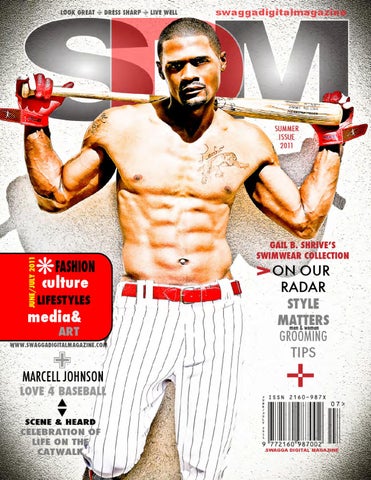
SPECIAL THANKS BARNESNOBLES EMERYVILLE APPLE STORE MACY’S BAYFAIR MALL STORE URBAN OUTFITTERS BERKELEY BLOOMINGDALES SAN FRANCISCO Published Bi-Monthly Printed in the USA In Print | Online | On Your Mobile | On Your Ipad All Rights Reserved ©2009 - 2011 Swagg Digital Magazine Publishing ISBN 978145077737-7 COVER PAGE Marcell Johnson ©2011 RON FULCHER PHOTOGRAPHY
VISIT OUR WEBSITE AT www.swaggadigitalmagazine.com NEED TO SEND A LETTER TO EDITOR? information@swaggadigitalmagazine.com SUBSCRIPTION INFORMATION? subscribe@swaggadigitalmagazine.com SDM | JUNE ~ AUGUST 2011
A D V E R T I S E M E N T
JUNE - AUGUST 2 0 1 1 Volume 2 Issue 07 CONTENTS FEATURES 63 | STYLE MATTERS: FIT TIPS 68 | ON OUR RADAR 72 | FEATURE: GAIL B SHRIVES SWIMWEAR 82 | SCENE & HEARD LIFE ON THE CATWALK
PUBLISHERS NOTE
This issue is dedicated to my mom whose courage, strength, tenacity and love has been a rock for me in the production of this issue. There were so many people who were instrumental in the production of this issue, and I could not possibly name them all in this writing, but I just want to thank all of you and you know who you are for assisting me with this issue. Many thanks to all of the wonderful and talented models, MUA’s, and Hair Stylists. Reproduction of any material within this publication, in whole or in part is, prohibited without expressed consent of publisher. The publisher assumes no responsibility to any party of the information, claims or ads herein to include errors, inaccuracies or omissions. By advertising the advertisers agree to indemnify the Publisher against all claims relating to or resulting from said advertisements.
25 SWAGGA DIGITAL MAGAZINE
FEATURES 28 | SHORT STORIES 30 | INTRODUCTION TO HUGO LOPEZ 42 | BEHIND THE LENS: DESI ARNAZ 56 | WOMEN’S BEAUTY TIPS
26 SWAGGA DIGITAL MAGAZINE
27 SWAGGA DIGITAL MAGAZINE
lifestyle
in the mix
28 SWAGGA DIGITAL MAGAZINE
SHORT STORIES Race-Bending Beauty Practices
Is Twitter Bad for Your Relationship? Can Twitter determine whether you and your significant other will break up? A recent survey by the online dating site OkCupid suggests that it actually can. After surveying 833,000 of its members about their Twitter usage, results showed that frequent Twitter users' relationships were 5 percent to 10 percent shorter than those who did not use the social networking site. "People who Tweet live their life in shorter bursts," says Christian Rudder, OkCupid's co-founder and editorial director. While OkCupid is not a research institution, its findings do support an ongoing concern about how technology is affecting personal relationships in the 21st century. Psychologist Sherry Turkle of the Massachusetts Institute of Technology says that although social networking sites and technological devices have made it easier for people to connect, they have also undermined real intimacy. "We're texting at a distance," says Turkle. "We're using inanimate objects to convince ourselves that even when we're alone, we feel together. And then when we're with each other, we put ourselves in situations where we feel alone -- constantly on our mobile devices." By: Hayat Mohamed
Despite growing concerns about the country’s long-term fiscal problems and an intensifying debate in Washington about how to deal with them, Americans strongly oppose some of the major remedies under consideration, according to a new Washington Post-ABC News poll.
29 SWAGGA DIGITAL MAGAZINE
When we heard about the skin-lightening app for the profile pictures of Indian Facebook users, it struck us as one of many examples of people adopting a look outside of their own ethnicity. Some feel pressure to conform to the dominant beauty standard; others just want to flout convention. Clearly, stars are prone to doing it. Although pale skin was once considered ideal among people of European descent -- it showed that you had enough wealth to avoid a tan from laboring under the hot sun -- these days there's nothing like a deep tan to show that you have the wealth and leisure time to bake in the sun. For the less well-off, there's spray tanning. Jersey Shore's Snooki became its new face after signing an endorsement deal with SunLove spray tanner. Looking a little pale? Get Snooked.
30 SWAGGA DIGITAL MAGAZINE
BGMKH=N<BG@ AN@H EHI>S Iahmh`kZia^] [r Khg ?ne\a^k
31 SWAGGA DIGITAL MAGAZINE
32 SWAGGA DIGITAL MAGAZINE
33 SWAGGA DIGITAL MAGAZINE
34 SWAGGA DIGITAL MAGAZINE
35 SWAGGA DIGITAL MAGAZINE
36 SWAGGA DIGITAL MAGAZINE
37 SWAGGA DIGITAL MAGAZINE
38 SWAGGA DIGITAL MAGAZINE
39 SWAGGA DIGITAL MAGAZINE
PHOTOGRAPHED BY RON FULCHER
40 SWAGGA DIGITAL MAGAZINE
ADVERTISEMENT
41 SWAGGA DIGITAL MAGAZINE
42 SWAGGA DIGITAL MAGAZINE
BEHIND THE LENS PHOTOGRAPHY BY DESI ARNAZ
43 SWAGGA DIGITAL MAGAZINE
44 SWAGGA DIGITAL MAGAZINE
ADVERTISEMENT
45 SWAGGA DIGITAL MAGAZINE
46 SWAGGA DIGITAL MAGAZINE
47 SWAGGA DIGITAL MAGAZINE
48 SWAGGA DIGITAL MAGAZINE
49 SWAGGA DIGITAL MAGAZINE
50 SWAGGA DIGITAL MAGAZINE
51 SWAGGA DIGITAL MAGAZINE
ADVERTISEMENT
52 SWAGGA DIGITAL MAGAZINE
Silks, Saddles and Discrimination The disappearance of black jockeys from the Kentucky Derby and other races was no accident. A report from 1900 details a conspiracy to shut them out. By: Richard T. Watkins
The Price of Success Money is what ultimately led to the demise of black jockeys, according to researcher Kenneth Whisenton, a retired sociology and business librarian from the Martin Luther King Jr. Public Library and Howard University's Founders Library in Washington, D.C. He says, "Black jockeys did not just vanish from horse racing -- they were banished. As the Thoroughbred horse-racing industry grew in America, so did the size of the winning purses and the prosperity of black jockeys. Less talented and envious white riders conspired to get in on the take." Whisenton has uncovered a New York Times article from 1900 with the headline, "Negro Jockeys Shut Out: Combination of White Riders to Bar Them From the Turf." The article begins, "The decline of the negro jockey has been so apparent since the season of 1900 opened that even the casual racegoer has had an opportunity to comment upon it. "The public generally accepted the theory that the old-time favorites of African blood had outgrown their skill, and really were out of date because of their inability to ride up to their form of past years," the article continues. "Racing men know better. As a matter of fact, the negro jockey is down and out, not because he could no longer ride, but because of a quietly formed combination to shut him out." The article explains just how the union took hold and became an effective means of depriving black jockeys of their incomes: " ... white riders have organized to draw the color line. In this they are said to be upheld and advised by certain horse owners and turfmen who have great influence in racing affairs. Rumor even went so far as to state that The Jockey Club approved the plan, tacitly and unofficially." Unionized Jim Crow Whisenton says, "Now, if that isn't the very definition of institutional racism at its ugliest, I don't know what is. Remember, this was a time when the Jim Crow era began to take hold." The Times describes how white riders enforced their ban on black jockeys through sabotage and subterfuge: "The negro riders got mounts at first, but then failed to win races. Somehow or other, they met with all sorts of accidents and interference in their races." It goes on: "The means employed to shut out the black riders are said to be that whenever one of the proscribed jockeys participates in a race there is concerted action by all the white boys to bring about the defeat of the horse ridden by the negro." The singular ill luck of black riders " ... serves to remind possible employers that owners who expect to win races would only put up white jockeys. " Whisenton is passionate as he reads aloud from the document he found: " 'Whether white jockeys devised the plan of a 'union' on their own behalf or whether they were advised by others has never come to light. None of them will even admit there is such an organized scheme. Whatever its strength and however formed, it appears to have been completely successful up to date. In the meantime, it has been a singularly rare occurrence that a negro jockey has had a mount. In the meantime, the stars of the pigskin saddle have stood down and watched comparative newcomers monopolize the riding.' " Willie Simms went begging for mounts at tracks in New York state, only to be denied. Alonzo Clayton was arrested shortly before post time at Aqueduct Race Track and falsely accused of trying to fix a race. A near riot broke out as barred black jockeys fought with white riders in Chicago. The black jockeys who remained in racing were reduced to exercise riders, hot walkers and stable hands, raking horse manure from barns. The once unsurpassable Clayton passed away at 41, a bellboy at a Los Angeles hotel, in 1917. The Race to Europe The white-jockey union movement started in the North and worked its way through the Midwest and then the South. For that reason, Winkfield was still able to ride and win the 1901 Derby in Kentucky. In 1902 he became the last black jockey to win the Derby. He ran his last Derby in 1903, placing second, before Churchill Downs, too, succumbed to the pressure of the union. A few black jockeys left the States for Europe, where they extended their careers. Winkfield was the most successful, winning every major race on the continent, including Russia's Moscow Derby, France's Prix du PrĂŠsident de la RĂŠpublique and Germany's Grosser Preis von Baden. Winkfield made and lost several fortunes. In Russia he lived in the Moscow National Hotel, owned a skating rink and held 4 percent of Russian railroad stock. He developed a fondness for caviar at breakfast and chauffeur-driven Duesenberg cars. Legend had it, if you were an American tourist and bet on a race that he did not win, you simply brought your betting ticket stubs to the hotel dining room, where he would buy them back. Winkfield's escapades included narrow escapes during the Russian Revolution and the Nazi invasion of Paris during World War II. He survived and prospered until the ripe old age of 93. He died quietly at his horse-breeding farm at Maisons-Laffitte, near Paris, in 1974.
53 SWAGGA DIGITAL MAGAZINE
W
With the Kentucky Derby going to post the first Saturday of each May, it seems an appropriate time to consider why black jockeys, who once dominated the sport of horse racing, are no longer in the running. A researcher in Washington, D.C., has uncovered evidence, contained in a turn-of-the-century newspaper article, explaining how black riders were systematically "unionized" out of the sport. Black jockeys won 15 of the first 28 of America's most important horse races at Churchill Downs. In fact, every rider on the track at the inaugural Kentucky Derby in 1875 was black, except one. That race was won by a former slave, Oliver Lewis. And yet black jockeys mysteriously began to disappear near the turn of the century. Today they are practically nonexistent. There have been varying explanations for this vanishing act. The discovery of this historic document sheds new light on exactly what happened. There was a time when riding a racehorse was almost exclusively a black occupation. It began with plantation owners using lightweight slave boys to race their horses against rival owners. Some slaves were tied to horses to keep them from falling off, resulting in injury and sometimes death. The Earliest Black Sports Stars .The history of Thoroughbred horse racing in America is rich with the legacy of black jockeys. These colorful characters included Kentucky Derby winners like Willie Simms, who introduced the short stirrup to the profession; Isaac Murphy, the Derby's first three-time winner; and Jimmy Winkfield, who finished all four Derbies he rode in the money, winning twice. Others -- like Babe Hurd, Soup Perkins, Alonzo Clayton, Erskine Henderson and Billy Walker -- were also Derby winners. And they were young, many still in their teens. Murphy turned pro at 14. Clayton won the Derby at 15. Winkfield won his first Kentucky Derby at 19. Black jockeys were the first sports heroes in post-Civil War America. They were brash -- sometimes arrogant -- youngsters whose exploits and private lives were detailed in the daily press. At work they wore bright racing silks, fitted jodhpur britches and smart leather riding boots. At play they were the toast of the town, tooling around in fancy carriages with the finest women. They built fabulous homes for their parents. They were represented by agents who negotiated lucrative contracts with horse owners. Small wonder that today's athletes are called jocks. Black jockeys could afford all the luxuries of life in the fast lane. They were highly skilled, well-paid professional athletes. With the jockeys riding each mount for a fee plus a percentage of the winning purse, it was not unusual for a black jockey to make well over $20,000 a year. In 1900 the average yearly income for a family of four was $1,200. In an era before personal income taxes, Murphy and Simms earned about $300,000 apiece in their short careers, the equivalent of about $15 million today.
54 SWAGGA DIGITAL MAGAZINE
55 SWAGGA DIGITAL MAGAZINE
LATEST HAIR TRENDS Lace Fronts While Lace Front Wigs, Units and Lace Frontal pieces are very popular these days, one should be very careful when making a choice to wear and make sure they are a candidate for such pieces. For best results always consult with a licensed professional. Natural Hair It seems that even though we live in a society that says straight silky hair is what is more acceptable or appealing to the eye, it is nice to see an that my sisters are embracing their natural hair! From locs to braids and twists, even rock'n their free form afro's they are commanding attention! Embracing your natural hair can be a fun form of self-expression and exploration.
56 SWAGGA DIGITAL MAGAZINE
Bold Color From Nicki Manaj and Rihanna, to Amber Rose bold hues always set off any hairstyle! Bold color (when done properly) will take an ordinary hairstyle to extraordinary super star status! Even subtle splashes of color strategically placed can liven things up. Edgy Cuts Edgy cuts are always scene stealers! Cascading layers with shaved sides, faux hawks, precision cut bobs and sharp angles that create dramatic daring shapes that are perfect for the bold and the beautiful! Soft & Sexy Roller sets producing soft curls on long or short hair is always Glam! It leaves the hair bouncy and full of body and it is a nice alternative to flat ironing or blow drying hair on a consistent basis. It is also considered to be one of the healthiest ways to maintain relaxed hair. NEW HAIR PRODUCT Influance Hair Care Is whats new in the world of Professional Hair Care products! By providing quality products for the professional Cosmetologist it allows us to produce quality results. The Influance way is “First Impressions, Lasting Results!” It’s a hair care system that works to promote healthy hair, from the Chemical Systems, Shampoos and Conditioners, to the finishing aids, the integrity and overall health of the hair will never be jeopardized. If you are fortunate enough to patronize a salon that carry this product as a retail item, you should never leave the salon without it. Always ask your Stylist what you should use for home maintenance. As a professional Stylist we should always prescribe what our clients need, going to the beauty supply is not an option! For a Salon under the Influance near you go to www.influancehaircare.com HAIRCARE TIPS
DO’s
✔
Use silk or satin scarf or pillow case at night Pull hair tightly into ponytails etc... especially when wearing braids it will cause traction halopicia. Get trims every 6-8 weeks Maintain a healthy lifestyle because healthy hair grows from the inside out. Client and Stylist relationship is important and communication is the key!
DONT’S
✔
Use rubberbands or gels Pull hair tightly into ponytails etc.. Use bonding glues continuously it will cause more damage than its worth. And always use glue remover! Over saturate hair with grease and oils, keep it light and flowing Sit in anyones chair that is not a licensed professional. HOT NEW COLOR THIS YEAR RED This year red is hotter than ever.....though it is reminiscent of Old Hollywood Glamour it has found its way back into the spotlight! This color, known as the color of love and passion, is captivating and daring. Bring out your passionate side in this vibrant, sexy color! When worn head to toe it is absolutely stunning and it is a nice accent to leopard prints, black and neutral tones.
beauty tips Summer Haircare
brought to by GlamSity, Jacquelyn “Blu”Washington
give your beauty look
WHATS NEW IN THE WORLD OF NAILCARE Shallac Polish The beauty world is all a buzz about Shellac Nails! It is changing the way women get their nails done. 14 Day Wear, Zero Dry Time, Mirror Finish and No Smudges or Scratches...what else can we say!!! (Drops the mic and walks away) Crackle Polish These colors don't run they crack. This new innovtive technology gives you and edgy and creative look! Just layer one the the shades over any polish and the crackle polish splits in about 5 minutes allowing the underlying shade to show through. If you want to make a bold statement this is the polish for you! 3D Nails This has become one of the hottest trends this year. Although it has been very popular in Japenese culture it is now becoming as popular here in the states. 3D Nails is the process of creating 3 demensional artwork on the nails. So whether a butterfly or a flower the design sticks up from the surface of the nail for a very dramatic look. Mani & Pedi Now even though this is not new, I wanted to throw it in because there is nothing like a good ole manicure and pedicure! When done right, it is like chicken soup for the soul. If you should decide that all the latest trends are a bit to much....remember that well manicured hands and feet with a nice buffed shine on the nail is sometimes all you need to make a lasting impression. So indulge yourself!
a blast of color!
COVERGIRL blast collection.
Step our with a smoldering selection of shades from Blast.
Lashblast Fushion, Smoky ShadowBlast and Liquiline Blast bring bold color to eyes.
Shineblast has your lips covered with color, shimmer and shine. Tell us what makes you a COVERGIRL @ facebook.com/covergirl
57 SWAGGA DIGITAL MAGAZINE
GlamSity.....A Beauty Bar By Blu located in the trendy new Uptown District of Oakland is a full service salon that is a nice mix of Old Hollywood glamour with new cutting edge flavor. From the warm hues and nostalgic vibe, to the friendly and caring staff, GlamSity is truly making its mark in this industry! As owner of GlamSity, Jacquelyn " Blu " Washington wanted to create a place where guest could come, relax, be pampered and enjoy an upscale atmosphere for a reasonable price. With 8 stylist to choose from, all having their own creative flair, a manicurist, an esthetician, make-up artist and massage therapist GlamSity is well on its way to being one of the top salons in the Bay Area as noted in the February 2011 issue of Essence Magazine.
58 SWAGGA DIGITAL MAGAZINE
59 SWAGGA DIGITAL MAGAZINE
60 SWAGGA DIGITAL MAGAZINE
61 SWAGGA DIGITAL MAGAZINE
FIT TIPS
▲
Style Matters
THE LAPELS
by Charles Blades Barber Spa
The lapels of your suit jacket are meant to lay flat across your chest. If they bow out even a little, then the suit is too tight. Make sure the notch on your lapel is close to your tie knot, otherwise you’ll look lopsided.
THE BUTTONS 62 SWAGGA DIGITAL MAGAZINE
The number of buttons on a suit has more to do with preference than fit. On a three button suit the only button that gets used is the waist or middle button. You may be temped to button the top button in a rakish way, but resist this urge. When there are two buttons, fasten only the top one. An elegant alternative is the single button suit, which offers a sharp, formal look.
HOW TO WEAR 1 PAIR OF JEANS FOR 3 DIFFERENT OCCASIONS
Jeans have range. They can be considerably dressed up or decidedly casual. If you’re aiming for a formal look, select a pair of dark jeans and wear them with a crisp white shirt and patterned tie. Throw your navy blazer on top, add a white cotton pocket square and you’re dressed elegantly enough for a party. If you’re dressing for a laid back evening opt for jeans in a medium to dark wash and pair them with a collar shirt. Undo a button or two at the neck and roll up the sleeves. Trade the cap toes for loafers and skip the tie. If the occasion is a ballgame or a barbecue, you can wear a pair as faded as you like. Just make sure, as always, that your t-shirt is clean and your sneakers are spotless.
JEANS WITH A SHIRT AND TIE
Wearing jeans with the typical accompaniments for a suit -a shirt and tie- has officially become acceptable. Wearing this look correctly can be a stylish alternative to flannel trousers and a blazer. The golden rule: choose crisp, medium to dark jeans and save the faded pairs for t-shirts.
SPORT COATS
Putting on a sport coat is considered de rigueur. Incredibly versatile, the sport coat is the MacGyver of clothing, it can unite a combination of seemingly random components into something that makes perfect sense. Genius.
A WORD ABOUT FABRICS
Blazers are all about fun, but think carefully about how you’re going to wear that khaki blazer before you buy it. Middle of the road fabrics like blue wool have a lot of range, but the outer edges of the spectrum -velvet on the one side and khaki on the other -require skill to pull off.
MAP OF THE WELL DRESSED MAN
Bay Area Local Style: Relaxed Luxury Cocktail: Negroni Accessory: Blackberry Get-a-way: Pescadero Secret Pleasure: Macchiatos In The Back Room Of Tosca Cafe Gentlemanly Act: Keeping The Bumper Stickers Off The Prius Well Dressed Outfit: Gray Flannel, Brown Suede Shoes Or Jeans With A Cashmere Tweed Jacket If your favorite t-shirt has an iron on that reads “Iceman” there’s a big chance that you need to rethink your approach to a certain wardrobe staple. You have more t-shirt options than you could possibly wear in a lifetime. Mass market classics from brands like Hanes remain essentials, while top designers produce versions in luxurious cottons. Polo shirts no doubt take up ample real estate in your closet as well. We trust you to wear them stylishly -not tucked into pleated khakis like a caddy on the PGA tour. The point is, you have a vast amount of choices when you go to put on a shirt. Those options shouldn’t involve a tee bearing the words “The Dude Abides”.
PHOTO: RON FULCHER
If your favorite t-shirt has an iron on that reads “Iceman” there’s a big chance that you need to rethink your approach to a certain wardrobe staple. You have more t-shirt options than you could possibly wear in a lifetime. Mass market classics from brands like Hanes remain essentials, while top designers produce versions in luxurious cottons. Polo shirts no doubt take up ample real estate in your closet as well. We trust you to wear them stylishly -not tucked into pleated khakis like a caddy on the PGA tour. The point is, you have a vast amount of choices when you go to put on a shirt. Those options shouldn’t involve a tee bearing the words “The Dude Abides”.
RULES OF STYLE
80% of style is having the right clothes for the occasion. Dress codes may have relaxed in recent years but there are still rules. When in doubt err on the formal side and if you’re going to a business meeting or a cocktail party, you’re better off wearing a tie.
THE PERFECT SHIRT
Men who take their clothes seriously have their white shirts custom made. There’s a reason for that, the right shirt is the cornerstone of a man’s wardrobe. It’s the pristine anchor for a formal suit and the crisp complement to a blazer and jeans. If you can, retrace the steps of style icons like JFK, Gianni Agnelli and Tom Wolfe and make a pilgrimage to one of the classic shirt-makers lining Jermyn Street in London. Places such as Turnbull and Asser in London, Alexander Kabbazz in New York or Charvet in Paris. If you can’t find the perfect white shirt at Charvet, it can’t be found. Select the style you want, keep the embellishments to a minimum, a custom white shirt doesn’t need pockets and monograms, and order more than one. When you’re scanning your closet at the crack of dawn for a fast way to look sharp, you’ll be thankful.
TIGHT VS BAGGY
Get your number right waist and inseam are a good start, but don’t just go by the numbers, try the pants on. There’s a good chance you’re buying your pants a little too tight. They’re not jeans you know. Now check that they don’t pull across your rear and that you’ve got room in the legs and the crotch. It may sound basic, but if you grew up in nothing but jeans you’re going to think that’s the way pants should fit – too tight. When you’ve got all that figured out, you can got to a tailor and sweat your way through the rough details like cuffs and the break.
SHOES
Your footwear options got infinitely more interesting in the last decade. Custom-made wing tips become collector’s items. Reissues of vintage sneakers gained cult followings. Mandals were hotly debated. While that doesn’t mean your interest in what you wear below the ankle needs to rival an oenophiles fascination with wine you should probably know more than how.
63 SWAGGA DIGITAL MAGAZINE
CASUAL SHIRTS
64 SWAGGA DIGITAL MAGAZINE
65 SWAGGA DIGITAL MAGAZINE
66 SWAGGA DIGITAL MAGAZINE
67 SWAGGA DIGITAL MAGAZINE
ON OUR RADAR Love can bring us together or TEAR US APART... 68 SWAGGA DIGITAL MAGAZINE
A CARMEN MADDEN FILM EVERYDAY BLACK MAN
When Claire meets Malik she is instantly swept off her feet by this charming young spiritual leader. But when Malik's true colors are revealed, her father Moses must protect both her and their community from danger. Winner PAN AFRICAN FILM FESTIVAL Best Narrative, Programmers Award
"Sometimes doing good is not enough" Starring Henry Brown Omari Hardwick Tessa Thompson
Intellectual Property: Owning What's Yours You may be the next Basquiat or Ellington or Esperanza. Protect your art -- hire a lawyer. Here's why. By: Latoya Peterson
publishing titans in their own right. Jim Jones just lost publishing rights to one of his artist's work after a court ruled that all contractual obligations were fulfilled, something that wouldn't have made headlines a few years ago but now is a part of most profit strategies.
69 SWAGGA DIGITAL MAGAZINE
But publishing isn't all there is to intellectual property. It has applications in medicine, science, technology and art. But the bottom line is the same: protecting the idea before someone else is able to take it, trademark it and reap the profits. On the panel, Natasha Eubanks of TheYBF.com described how, once a concept becomes popular, people will try to poach your connections, contacts, brand and audience -- so hiring a good legal team is vital. Marcus Johnson, musician and CEO of FLO Brands, emphasized learning the business. "I know sorry musicians that have nice houses -- because they got the business side right," he said. A legal team is critical, but many of the young, black and talented don't seek out expert advice until it is too late -- which leaves them wide open for exploitation, just like our artistic ancestors. As Mtima and Steven D. Jamar write in the New York Law School Law Review, "Social justice includes not only access to, but also inclusion in, the social, cultural, and economic life of the country. Indeed, it extends beyond inclusion ... to full participation in and ability to affect the direction of civil society in all its manifestations." If black creators don't own the rights to their work, we lose out economically and culturally. Intellectual property matters. And the creative future of a generation of young black artists depends on us learning how to leverage the law to our advantage.What would you do if you were the next Jean-Michel Basquiat, selling your original art -- silk-screened T-shirts -out of the trunk of your car? What if your child created a software program for fun that could be worth billions of dollars? What if you were a musician whose latest release played in clubs all over your city? In all three instances, the right answer would be: Seek out the advice of a lawyer to protect your intellectual property. But for most creators, the work comes first. Money will follow -- right? Wrong. All too often, when it comes to intellectual property, black artists are the ones who lose the rights to their work. "It's not hard to get our community excited about music, art or fashion -- we need to get out there in the communities to protect that work," said Lateef Mtima, founder and director of the Institute for Intellectual Property and Social Justice at the Howard University School of Law. He stood behind a podium making his best sales pitch to the assembled Capitol Hill crowd: Protecting intellectual property is essential for today's artists -- and entrepreneurs.  Mtima is partnering with the NAACP and Google to take intellectual property discussions out of legal journals, courtrooms and academia and to bring them to artists, scientists, technologists and creators of all stripes. He hopes to get more people, particularly young black entrepreneurs, interested in protecting themselves, and their work. Unfortunately, this may be an uphill battle. Intellectual property is essentially intangible creations. Defined by the World Intellectual Property Organization, "Intellectual property (IP) refers to creations of the mind: inventions, literary and artistic works, and symbols, names, images, and designs used in commerce." All of this law sounds like long, dry, boring legalese -- that is, until we start dredging up the ghosts of black music past. Case in point: an iconic 1954 Time magazine cover portraying the face of jazz -- Dave Brubeck, not Dizzy Gillespie, Miles Davis or Duke Ellington.Mtima pointed to the Time cover as an example of how an art form that was pioneered by African Americans -- our intellectual property -- gets completely and thoroughly co-opted. This type of situation comes with a dual cost: Historically, white artists would cover the music of black artists and receive more accolades, higher rates for touring and more opportunities. The same black artists would die in debt and obscurity. But intellectual property law also favored the person who was able to file first -- so a performer could create a jazz standard that played in the clubs, but if that performer was not the first person to record it, distribute it and secure the rights, he may not see any money from the song he created. And the person who owned the rights to the song (or the rights to a similar song) could eventually force the performer to stop playing it, losing both revenue and notoriety. That didn't just happen during the jazz era. It continues today. Many hip-hop pioneers also ended up destitute even as they created an entirely new genre and art form that is popular the world over. This is because of how intellectual property is managed. In the world of music, a lot of intellectual property battles come down to who owns the publishing rights for songs. So the creator and performer of the song played on the radio isn't the person who is paid when the record spins -- often, it's split with the person who owns the rights. And that split may not be in the artist's favor. In the early days, studios kept a stranglehold on publishing rights, profiting from artists who finished their days both beloved and in the poorhouse. Darnell Martin's 2008 film, Cadillac Records, was based on the real-life company Chess Records, which had some questionable practices. The reason Chess was nicknamed Cadillac was that the Chess brothers would buy their artists shiny new Cadillacs upon record release -- but for years after, artists would fight to receive royalties and payment for their songs, since the Chess brothers counted the Cadillac as the advance. Many jazz legends had a complicated relationship with the Chess brothers. Even as they were able to rise to fame based on the artistic development Chess Records fostered, as they became more savvy about profit and publishing, many also felt cheated. The most widely known publishing battle of our time was between Michael Jackson and Paul McCartney over a large part of the Beatles' catalog. The person who wrote "Rapper's Delight" was never compensated for his work; Sylvia Robinson, the founder and CEO of Sugar Hill Records, and the Sugar Hill Gang have entered many court battles over royalties. And hip-hop artists have become
70 SWAGGA DIGITAL MAGAZINE
71 SWAGGA DIGITAL MAGAZINE
Inked up
FEA T U R E
72 SWAGGA DIGITAL MAGAZINE
Gail B. Shrive Swimwear Collection Models: Hallie Marie, Heather Wallis, Olga Oparina Hair and Make-Up: Barbie Gotingco-Sanchez Wardrobe Stylist: Billie Jean Figueroa Photo Assistant: Gerard Juntilla and Rey Cagadas Photographer: VinCentG. Shot on Location at Casa Cortez in West Hills, CA
73 SWAGGA DIGITAL MAGAZINE
74 SWAGGA DIGITAL MAGAZINE
75 SWAGGA DIGITAL MAGAZINE
76 SWAGGA DIGITAL MAGAZINE
77 SWAGGA DIGITAL MAGAZINE
78 SWAGGA DIGITAL MAGAZINE
79 SWAGGA DIGITAL MAGAZINE
80 SWAGGA DIGITAL MAGAZINE
81 SWAGGA DIGITAL MAGAZINE
82 SWAGGA DIGITAL MAGAZINE
SCENE & HEARD ✛ A CELEBRATION OF Life ON THE CATWALK
83 SWAGGA DIGITAL MAGAZINE
✛
Snow a White Fashion Event Year 2 Junior League of S.F., 100 Years A Fashionable Legacy St. Vincent De Paul Society of S.F., Discarded to Divine Charity Fashion Show 2011 @ Fort Mason S.F. photographed by Ron Fulcher
BOOKS ON OUR RADAR 84 SWAGGA DIGITAL MAGAZINE
Vegan Soul Kitchen: Fresh, Healthy, and Creative AfricanAmerican Cuisine (Paperback) By Bryant Terry
The mere mention of soul food brings thoughts of greasy fare and clogged arteries. Bryant Terry offers recipes that leave out heavy salt and refined sugar, “bad” fats, and unhealthy cooking techniques, and leave in the down-home flavor. Vegan Soul Kitchen recipes use fresh, whole, highquality, healthy ingredients and cooking methods with a focus on local, seasonal, sustainably raised food. Terry’s new recipes have been conceived through the prism of the African Diaspora—cutting, pasting, reworking, and remixing African, Caribbean, African-American, Native American, and European staples, cooking techniques, and distinctive dishes to create something familiar, comforting, and deliciously unique. Reinterpreting popular dishes from African and Caribbean countries as well as his favorite childhood dishes, Terry reinvents AfricanAmerican and Southern cuisine—capitalizing on the complex flavors of the tradition, without the animal products. Includes recipes for: Double Mustard Greens & Roasted Yam Soup; CajunCreole-Spiced Tempeh Pieces with Creamy Grits; Caramelized Grapefruit, Avocado, and Watercress Salad with Grapefruit Vinaigrette; and Sweet Cornmeal-Coconut Butter Drop Biscuits. Bryant Terry is an award-winning eco-chef, food justice activist, author, and Food and Society Policy Fellow. He co-authored Grub: Ideas for an Urban Organic Kitchen and has a column (“Eco-Soul Kitchen”) on TheRoot.com. He lives in Oakland, California. www.bryant-terry.com
The Game Behind the Game: Mastering the Art of Bullshit (Paperback) By Russ Parr
The Black New Yorkers:The Schomburg Illustrated Chronology by Howard Dodson The Black New Yorkers is the companion volume to the Schomburg Center exhibit as well as a resource for the PBS history of New York City. With over 200 illustrations and 480 pages, it traces the nearly 400-year-old black presence in New York--U.S.
85 SWAGGA DIGITAL MAGAZINE
At a time when record numbers of Americans are unemployed and under-employed, syndicated radio personality Russ Parr has something important to add to the conversation about how to get a job, keep a job or move up the corporate ladder. The Game Behind The Game: Mastering The Art Of Bullshit a fresh look at what it really takes to win impress bosses and move ahead in the business game. In his humorous, urban style, Parr lets everyone know that 'the world runs on BS' and if you want to be 'cash-checking' (i.e. making money) you might need to pucker up for a little old fashioned a$$-kissing. A how-to-succeed-in-business book unlike any you've ever seen, Parr offers readers a unique and humorous approach to what it really takes to succeed. Using the unique examples gleaned from his syndicated program The Russ Parr Morning Show, Parr recounts the foibles of unfortunate characters whose examples the reader should avoid as well as stories from Parr's own riveting journey and ultimate ascent to top of the national airwaves. From his advice on 'How to Talk BS, ' his suggestions to 'play the opposite' of what people expect and his heartfelt belief in the 'Power of Negative Thinking' Parr offers a move by move blueprint for success that is accessible to all. No matter the field in which your career aspirations may lie, Parr teaches us how to be victorious with a long term strategy while leap-frogging competitors who play the success game with a short term vision. This part motivational part biographical narrative boasts a lively wisdom delivered in a straight-forward diatribe that only an uncensored Russ Parr can convey.
Big Girls Do Cry (Paperback) By Carl Weber In his "New York Times"bestselling novel "Something on the Side," Weber introduced readers to the Big Girls Book Club. In this fast-paced follow-up, the BGBC has a new chapter, but the biggest drama isn't between the pages, it's among the members themselves.
86 SWAGGA DIGITAL MAGAZINE
ADVERTISING
87 SWAGGA DIGITAL MAGAZINE ADVERTISING
MODEL: RICK COLE CLOTHING: H&M PHOTOGRAPHED BY: RON FULCHER
Fighting to Save African-American Cemeteries By: Jonathan Pourza
88 SWAGGA DIGITAL MAGAZINE
For more than 10 years, Richmond, Va.'s oldest municipal burial ground for people of African descent has been covered over by an active parking lot owned by Virginia Commonwealth University (VCU). The dead cannot speak, so Richmond's African-American community has been fighting to remove the parking lot and protect its ancestral legacy. Richmond, former capital of the Confederacy, was one of the largest slave trading centers in the U.S. and a place to which many African Americans can trace their roots. Dead Africans -- free and enslaved -- were buried at Richmond's African Burial Ground between about 1750 and 1814; it was known then as the "Burial Ground for Negroes." This was also the site of the execution of the famous slave rebellion leader Gabriel Prosser. The Virginia State Legislature recently passed a bill that transfers the property from VCU to the Richmond City Council's Slave Trail Commission. It becomes law on July 1, 2011, and last Friday the university's Board of Visitors is expected to surrender the property on May 23. The university's president and the mayor of Richmond are expected to attend the turnover. Several private contractors have offered to remove the lot's asphalt, free of charge. However, this transfer has only happened because of constant pressure on VCU and state and local legislators by Richmond's black community. The university had resisted the African-American community's appeals to shut down the parking lot since purchasing it several years ago. The school even ignored its own students' protests. A local Richmond organization, the Defenders for Freedom, Justice & Equality (DFJE), has worked for a decade to reclaim the burial ground on behalf of the African-American community. Members led an act of civil disobedience on April 12, 2011 (the 150th anniversary of the start of the Civil War), by blocking the parking lot's entrance for an hour and a half; four were arrested, charged with trespassing, and given a court date of May 25. "This was important to demonstrate that even though progress has been made, VCU still refuses to close the lot," said DFJE organizer Ana Edwards. "It demonstrates that people were able to park somewhere
The struggle to reclaim an African burial ground in Richmond, Va., highlights a classic struggle between entrenched interests and efforts to restore the humanity of those who died in bondage. else." Dr. Shawn Utsey, chair of the African American Studies Department at VCU, says, "The struggle of the community was instrumental … the African Burial Ground [ABG] represents the humanity of African people, so this is an effort to reclaim their humanity … it is long from over." Utsey directed the 2009 award-winning documentary, Meet Me in the Bottom: The Struggle to Reclaim Richmond's African Burial Ground. During slavery, cemeteries for African Americans were located in undesirable areas. Many African cultures share the belief that a person's soul lives on after death. Therefore a burial ground is more than a final resting place; it is a sacred space to be preserved for the use of transitioned souls. It makes you wonder: Nationwide, how many ABGs are covered and waiting to be found, and where are they? "Every port town or city in the Americas that heavily relied on enslaved labor is likely to have had a municipal cemetery for enslaved Africans," says Michael Blakey, director of the Institute for Historical Biology at William & Mary College, "… But these cemeteries … are in unknown locations and there are no community efforts around them ..." Common factors include a forgotten legacy rediscovered because of construction and a lack of institutional respect for descendents' rights to decide the fate of their ancestors' place of rest. In recent years, several other ABGs have been discovered, and the ensuing struggles to preserve them have often pitted powerful real estate or political interests against African-American desires to honor the dead. One example was the African Burial Ground in Lower Manhattan. During the preliminary phases of putting up a new federal building in the early 1990s, excavators discovered evidence of an 18th-century burial ground. Initially, the GSA, a federal agency, did not inform New York's African-American community of its finding, but news got out and triggered outrage at the casual exhumation of ancestors. Chris Moore, a historian and curator at New York's Schomburg Center for Research in Black Culture, was one of the first to inform the public about the African Burial Ground. According to Moore, the GSA tried to keep the excavation quiet. He said that federal officials and archaeologists initially claimed ignorance, but workmen at the site informed him they were "… taking truckloads of bones out of here." The GSA initially announced that no more than a few hundred people were buried at the site; it is now estimated that there are 15,000-20,000 remains under a five-block area. A long battle ensued, involving community protests, court hearings and support from city and state officials that finally garnered national attention. As a result, the excavation was halted for some time, and the disinterred remains of 419 people were sent to Howard University for research (and later re-interred at the African Burial Ground). A memorial was built next to the new building and an interpretive center added inside the lobby, explaining the site, now a national monument. Other burial grounds have been rediscovered in places as varied as Portsmouth, N.H.; Rio de Janeiro, Brazil; and Dallas -- and they often trigger similar community struggles to reclaim those sites. For several years, Harlem's African-American community has been fighting to reclaim and memorialize a burial ground covered by a bus depot. As the 150th anniversary of the Emancipation Proclamation approaches (Jan. 1, 2013), efforts to recover Richmond's African Burial Ground -- and all other sites that contain black ancestral remains -- gain special significance for all Americans.
89 SWAGGA DIGITAL MAGAZINE
Model: Nicole Kaleinani Blades MUA: Carmela Solon Potencioso Photography: VinCentG. 90 SWAGGA DIGITAL MAGAZINE
91 SWAGGA DIGITAL MAGAZINE
92 SWAGGA DIGITAL MAGAZINE
93 SWAGGA DIGITAL MAGAZINE
94 SWAGGA DIGITAL MAGAZINE
95 SWAGGA DIGITAL MAGAZINE
LIFESTYLES ART
FALL Issue Next Up Subscribe Today!
SWAGGADIGITALMAGAZINE.COM
SWAGGADIGITALMAGAZINE
media&
DM
❋FASHION culture