AND WEST AFRICA Secretariat
www.oecd.org/swac/maps, no. 112, 03/2023
GENDER-SENSITIVE TOOLS FOR FOOD CRISIS PREVENTION AND MANAGEMENT
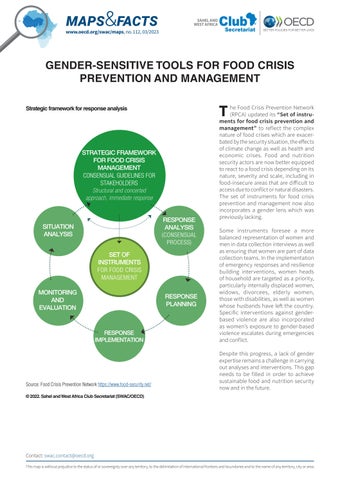
Strategic framework for response analysis
SITUATION ANALYSIS
STRATEGIC FRAMEWORK FOR FOOD CRISIS MANAGEMENT
CONSENSUAL GUIDELINES FOR STAKEHOLDERS
Structural and concerted approach, immediate response SET OF INSTRUMENTS FOR FOOD CRISIS MANAGEMENT
RESPONSE ANALYSIS (CONSENSUAL PROCESS)
The Food Crisis Prevention Network (RPCA) updated its “Set of instruments for food crisis prevention and management” to reflect the complex nature of food crises which are e xacerbated by the security situation, the effects of climate change as well as health and economic crises. Food and nutrition security actors are now better equipped to react to a food crisis depending on its nature, severity and scale, including in food-insecure areas that are difficult to access due to conflict or natural disasters. The set of instruments for food crisis prevention and management now also incorporates a gender lens which was previously lacking.
MONITORING AND EVALUATION
RESPONSE PLANNING RESPONSE IMPLEMENTATION
Source: Food Crisis Prevention Network https://www.food-security.net/ © 2022. Sahel and West Africa Club Secretariat (SWAC/OECD)
S ome instruments foresee a more balanced representation of women and men in data collection interviews as well as ensuring that women are part of data collection teams. In the implementation of emergency responses and resilience building interventions, women heads of household are targeted as a priority, particularly internally displaced women, widows, divorcees, elderly women, those with disabilities, as well as women whose husbands have left the country. Specific interventions against genderbased violence are also incorporated as women’s exposure to gender-based violence escalates during emergencies and conflict.
Despite this progress, a lack of gender expertise remains a challenge in carrying out analyses and interventions. This gap needs to be filled in order to achieve sustainable food and nutrition security now and in the future.
Contact: swac.contact@oecd.org
