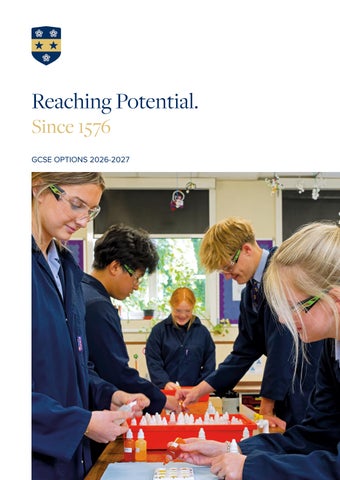
GCSE OPTIONS Reaching Potential. Since 1576
GCSE OPTIONS 2026-2027
SCHOOL
CONTENTS
2026
Introduction 4 The Core Curriculum 6 Options 8 English 8 Mathematics 9 Combined (Double Award) Science 10 Single Science (BTech) 11 Biology 12 Chemistry 13 Physics 14 Games and PE 15 Additional Options 16 Art and Design 16 Combined Cadet Force (CCF) 18 Design and Technology 21 Drama 22 Economics 24 English as an Additional Language (EAL) 25 Geography 26 History 27 ICT 28 Media Studies 30 Modern Foreign Languages (MFL): French and Spanish 31 Music 32 Photography 33 Physical Education 36 Religious Studies with Philosophy and Ethics 38 Activities 40 Learning Support 40 Monitoring 41
3
Introduction Our Third Form pupils follow a broad and balanced curriculum, giving them experience across all disciplines before making their GCSE choices. During the Michaelmas Term, pupils enjoy a Discovery Term, exploring exciting aspects of each subject in their timetabled lessons. This curriculum is designed not only to prepare for GCSE study but also to inspire and engage. Pupils are also encouraged to complete their Duke of Edinburgh Bronze Award through the CCF. From the start of the Lent Term in Third Form, pupils begin some of their GCSE courses. This early start allows classes to complete course content well before the Summer Term of Fifth Form, leaving plenty of time for consolidation, exam technique, and revision.
It also gives pupils a real taste of the subjects available, helping them decide which to continue into Fourth Form alongside the core subjects. Subjects not taught in Third Form will have ‘taster lessons’ so pupils can make informed choices.
What does the curriculum consist of? All pupils take English Language, Mathematics, and Science. Most will study nine GCSE subjects in total, choosing six options (including science choices). Pupils receiving Learning Support usually work towards eight GCSEs. Those choosing CCF as one of their options will gain a Level 2 leadership qualification (GCSE equivalent).
Some courses are IGCSEs (International GCSEs), selected by Heads of Department for their engaging and varied content, but they carry the same academic value as a GCSE.
Our option blocks allow pupils to specialise while maintaining breadth— whether they prefer three sciences, multiple humanities, languages, creative subjects, or a highly individualised mix.
To guide science choices, the Head of Junior Science will advise pupils on the route most likely to achieve the best outcome, based on data and individual strengths. A small cohort will be invited to join the Btec Single Science, assessed mainly through internal assessments and one external examination. This group will be limited to 10 and offered on an individual needs basis.
This personalised approach enables us to support every pupil, having honest conversations about strengths and areas for development, so they can make choices that lead to success.
Bespoke Offering We pride ourselves on offering a curriculum tailored to each pupil. At the start of Lent Term, you and your child will have the opportunity to speak with Heads of Department about academic subjects.
Amanda Sunde Assistant Head (Academic) sundea@svs.org.uk
The Core Curriculum (studied by all) English Language Games and PE Mathematics PSHE Science One of these options will be taken by all pupils : • Single Science BTEC • GCSE Combined (Double Award) Science • Separate Sciences by invitation only: Biology* Chemistry* Physics* Most pupils will also study English Literature
GCSE Options September 2026 Art CCF Design and Technology Drama Economics* English as an Additional Language (EAL) (International pupils only) French Geography History ICT Learning Support* Media Studies Music Photography Physical Education Religious Studies Spanish
*Invitation only or entry requirement
6
The Core Curriculum English Board: Edexcel IGCSE Pupils study both English Language and English Literature as distinct GCSE subjects. Most pupils will take both subjects, but English Language is the only requirement for entry to the Sixth form and university; for some pupils the Language-only option is the best choice. Examination: 60% Coursework: 40% English Language Examination: 60% Two hours 15 minutes Externally assessed; non-fiction and transactional writing. Coursework: 40% Two assignments – a) Poetry and prose texts and b) Imaginative writing The assignments are internally set and assessed, then moderated by the exam board. English Literature Examination: 60% Two hours Externally assessed; poetry and modern prose. Coursework: 40% Two assignments on play texts – a) Modern drama and b) Shakespeare The assignments are internally set and assessed, then moderated by the exam board. If you choose this course, there will be opportunities for optional enrichment trips for which there will be an additional charge.
The great thing about English is that it encompasses so many different voices and subjects. English not only widens your sense of the literary world, but it also vastly opens your perception of the modern and pre-modern world from multiple angles.
8
Mathematics Board: Edexcel IGCSE All pupils will follow the Edexcel IGCSE Mathematics course, a fully examined qualification with no coursework or controlled assessment. This is a linear programme, meaning pupils are assessed solely through final examinations at the end of the course. Assesment Structure • •
•
The qualification is assessed through two calculator-based examinations, each lasting two hours. Both papers are equally weighted and cover a broad range of mathematical topics, including: o Number o Algebra o Ratio and Proportion o Geometry o Probability o Statistics Pupils will be entered for either the Higher Tier or Foundation Tier, depending on their ability and progress.
Grading and Progression • • •
Grades are awarded on a scale from 1 to 9, with 9 being the highest. A minimum of grade 4 is required to meet the national standard. Pupils who do not achieve grade 4 or above will be required to continue studying mathematics if they remain in any educational institution post-16.
Extension Opportunities Pupils in the top set (Set A) will have the opportunity to study GCSE Further Mathematics, with the examination taken in the Summer Term. This course is designed to challenge the most able mathematicians and provide a strong foundation for those intending to pursue A Level Mathematics.
Mathematics teaches a logical, structured approach in a confusingand complex world. It opens doors that are helping me to reach my full potential. Mathematics lessons are the best 3300 seconds of my day! 9
Single Science BTEC Board: Pearson BTEC First Level1/2 Principles of Applied Science Examination: One external assessed paper (25% of total), internally assessed assignment briefs (75%) The syllabus content that follows is divided into three sections: Biology, Chemistry and Physics. Pupils must study all three sections. Assessment: The qualification contains four mandatory units. Unit one is externally assessed in a written examination (1hr long). Units two to four are internally assessed through completion of a variety of assignment briefs including posters, brochures, experimental plans, powerpoint presentations and research. Please note: These assignment briefs are issued and collected in accordance with clear and rigid deadlines which will be shared with pupils. It is also important to note that parents or guardians of pupils on this course will be required to attend a virtual meeting with Dr Henshaw and the BTEC teacher to discuss the details of the course. Topics include: Unit one reflects content from all science disciplines. Topics include (but are not limited to): Biology: Characteristics of living organisms; Cells; The Nervous System; Ecosystems; Homeostasis. Chemistry: The particulate nature of matter; Experimental techniques; Atoms, elements and compounds; The Periodic Table; Reactions ; Air and water. Physics: Energy Transfers, Radiation, The Universe, Wave Characteristics. This BTEC qualification awards the equivalent to ONE GCSE (120 Guided Learning Hours). This is awarded in the following grades: Level 2 Pass, Level 2 Merit, Level 2 Distinction, Level 2 Distinction*, Level 1 (when Level 2 is not quite reached) and Unclassified. This course is offered on an individual-needs basis
I really enjoy doing this BTEC as it has helped make sciences easier to understand. I like the way we can be more creative and get to know about each science. I also enjoy how it shows why we learn something in science by linking it to real life examples. 10
Combined (Double award) Science Board: Edexcel GCSE Examination 100% The syllabus content that follows is divided into three sections: Biology, Chemistry and Physics. Candidates must study all three sections. There are six examination papers at the end of the course – two for each science. The papers feature a mixture of different question styles, including multiple-choice questions, short answer questions, calculations and extended open-response questions. After the Fourth Form internal examinations, science teachers will advise whether pupils should enter the Foundation Tier (Grades 1-1 to 5-5) or the Higher Tier (Grades 4-3 to 9-9). Topics include: Biology: Cells and control; Genetics, Natural selection and genetic modification; Health, disease and the development of medicines; Plant structures and their functions; Ecosystems and material cycles. Chemistry: States of matter and mixtures; Chemical changes; Extracting metals and equilibria; Groups in the periodic table; Rates of reaction and energy changes; Fuels and Earth science assessment overview. Physics: Motion and forces; Conservation of energy; Waves; Light and the electromagnetic spectrum; Radioactivity; Energy - Forces doing work; Forces and their effects; Electricity and circuits; Magnetism and Electromagnetism and Particle Theory. This qualification awards TWO GCSEs. Pupils are awarded double-numeric grades but reflecting the work from all three science disciplines.
This course has really helped me understand each of the different science subjects. What has been great is that often some of the skills I learn in one science help me with another. We also get the chance to complete interesting experiments.
11
Biology * Board: Edexcel GCSE Examination: 100% Paper One: 50% One hour 45 minutes This paper will examine pupils across topics one to five. It will include a mixture of different question styles, including multiple-choice questions, short answer questions, calculations and extended open-response questions. Paper Two: 50% One hour 45 minutes This paper will also examine pupils in topic one, as well as topics six to nine. It will again include a mixture of different question styles, including multiple-choice questions, short answer questions, calculations and extended open-response questions. There are nine topics in the specification: •
Topic One – Key concepts in biology
•
Topic Two – Cells and control
•
Topic Three – Genetics
•
Topic Four – Natural selection and genetic modification
•
Topic Five – Health, disease and the development of medicines
•
Topic Six – Plant structures and their functions
•
Topic Seven – Animal coordination, control and homeostasis
•
Topic Eight – Exchange and transport in animals
•
Topic Nine – Ecosystems and material cycles
*By invitation only
There is nothing more exciting than uncovering the inner workings of the human machine. Every lesson allows us to better understand ourselves and the way we interact with the world.Biology is the study of life, and that, in itself, is fascinating. 12
Chemistry* Board: Edexcel GCSE Examination: 100% Examinations: One hour 45 minutes each Two examination papers which are equally weighted. There will be no controlled assessment, but there will be assessment of practical work at the end of the course. The specification will set out the apparatus pupils should use and the techniques they should develop. There are eight required practicals in the course and the written exams will include questions that draw on pupils practical science experience. At least 15% of the marks for the GCSE will be allocated to practical science questions. There are nine topics in the specification: •
Topic One – Key concepts in chemistry
•
Topic Two – States of matter and mixtures
•
Topic Three – Chemical changes
•
Topic Four – Extracting metals and equilibria
•
Topic Five – Separate chemistry 1
•
Topic Six – Groups in the periodic table
•
Topic Seven – Rates of reaction and energy changes
•
Topic Eight – Fuels and Earth science
•
Topic Nine – Separate chemistry 2
*By invitation only
It is said that Chemistry is the study of matter, but I prefer to see it as the study of change. Chemistry lessons can be challenging but rewarding and the eureka moment when everything ties together makes the work worthwhile. 13
Physics * Board: Edexcel GCSE Examination: 100% Assessment: One hour 45 minutes each Two examination papers at the end of the course, each worth 50%, containing a mixture of different question styles, including multiple-choice questions, short answer questions, calculations and extended open-response questions. Practical work: There are eight mandatory core practicals that must be completed, and the work must be recorded, however these are not assessed. There are 15 topics in the specification: •
Topic One - Key concepts of physics
•
Topic Two - Motion and forces
•
Topic Three - Conservation of energy
•
Topic Four - Waves
•
Topic Five - Light and the EM spectrum
•
Topic Six - Radioactivity
•
Topic Seven - Astronomy
•
Topic Eight - Energy
•
Topic Nine - Forces and their effects
•
Topic Ten - Electricity and circuits
•
Topic Eleven - Static electricity
•
Topic Twelve - Magnetism and the motor effect
•
Topic Thirteen - Electromagnetic induction
•
Topic Fourteen - Particle model
•
Topic Fifteen - Force and matter
*By invitation only
14
Physics has many interesting topics that we can learn. These help us to understand more about things in our everyday lives, such as the topic on Radioactivity where we learnt about both PET and CT scanners and how they work to detect cancer.
Games and PE All pupils are encouraged to become proficient in a range of sporting activities, so Games and PE feature strongly in our curriculum. Pupils, in the Third, Fourth and Fifth Forms, have two Games sessions every week, together with a lesson of PE. Pupils are also given every opportunity and encouragement to represent the School in fixtures, tournaments and representative sides.
Additional Options Art and Design Board: OCR GCSE Portfolio: 60% Externally set task, allowing pupils to work on one of five themes: 40% Course content: Fine Art Art at GCSE is a two-year course that comprises a unit of coursework and an externally set controlled test. Assessment is internally based with external moderation. The pupils are expected to show evidence of good drawing skills to support the development of their ideas. Research into the work of other artists forms an important part of the course as it helps to inform and enrich ideas. Pupils need to show clear evidence of the development of skills and understanding as they evolve towards a final piece. There are no restrictions on scale or media. If you choose this course, there will be opportunities for optional enrichment trips for which there will be an additional charge.
GCSE Art and Design is a great subject choice which offers a wide range of skills to be learnt including creativity and time management. As well as this, being able to spend some time painting provides a great opportunity to relax amid other academic subjects.
16
Combined Cadet Force (CCF) Board: EdExcel Coursework: 100% Our CCF offers a range of exciting opportunities for pupils. These include shooting, whether for enjoyment or up to and including national level, gliding, flying and sailing. Cadets can also attend courses in signals, rock-climbing, kayaking and canoeing and attend leadership courses with all three services. Being in the CCF also makes it easier to achieve the Bronze, Silver and Gold Duke of Edinburgh Awards; as the activities and residential courses available lend themselves to the Scheme. The CCF in the Fourth and Fifth Form involves all cadets rotating through all three services where they will be given opportunities to fly, sail, climb and achieve a first aid qualification. They will also attend a field day with each section. The Fifth Form will focus on leadership and instructional skills to prepare the cadets to teach the younger cadets. Pupils who choose this option should receive a BTEC Level 2 qualification, which is equivalent to a GCSE Grade 6. If you choose this course, there is a compulsory subscription of £140 per term to cover enrolment for the BTEC, gliding, sailing, first aid course, indoor climbing, museum trip and field days as part of the course requirement and this will incur a charge to the bill.
In the Combined Cadet Force, you learn to rely upon others and therefore experience teamwork in a whole new way. It is a regular opportunity to spend time outside of the classroom and develop new skills with friends.
18
THE CORE CURRICULUM - studied by all
Design and Technology Board: AQA GCSE Examination: 50% Controlled Assessment: 50% Design and Technology is a challenging subject which requires pupils to have good background knowledge, a passion for design and the ability to work independently, consistently and manage their time well within given deadlines. This course has a considerable coursework element, so it is vital that pupils commit to periods of work outside of lessons. GCSE Design and Technology will prepare pupils for an increasingly technological world. Examination: 50% Two hours The single paper will test the application of knowledge and understanding of materials, components, processes, techniques, technologies and commercial practices and products. Questions will largely address textile, graphical, electronic, and resistant materials. At least 15% of the examination will assess Mathematics applied to Design and Technology and a further 10% of the examination will assess Science. Controlled Assessment: 50% The controlled assessment consists of a client-based project. Pupils are required to submit a three-dimensional prototype and a design folder, with the appropriate ICT evidence. Candidates will be given a design brief, set by the exam board, and have the freedom to use the type and variety of materials necessary to satisfy the brief, often working in at least two materials; ranging from woods, metals, plastics, to graphic product materials such as Styrofoam, paper, and card. Manufacturing counts for 10% of the marks, with 20% coming from generating design ideas and design development. The remaining 20% consists of areas such as research, investigation, producing design specifications, analysing and evaluating. It is an opportunity for pupils to be creative and experiment when designing. Developing skills to refine their own ideas whilst considering costs, commercial viability and marketing of products.
Design and Technology brings your own thoughts to life. You need nothing more than your own imagination and the tools to put it to use. It is a vital part of life, almost everything you have was designed. You design to solve problems and solve problems to design. 21
Drama Board: WJEC Eduqas The GCSE in Drama is an exciting, inspiring and practical course. It promotes involvement in and enjoyment of drama, as performers and/or designers. Additionally, it provides opportunities to attend live theatre performances and to develop skills as informed and thoughtful audience members. Learners will investigate a practitioner or genre of drama, work collaboratively to develop ideas to communicate meaning and experiment with dramatic conventions, forms and techniques to produce and realise a piece of original theatre. They will also have the opportunity to participate in the performance of an extract from a play text. Examination: 40% Written exam focused on the theatrical interpretation of a set text, and a review of a live theatre piece. Learners will demonstrate their knowledge and understanding of drama, including their ability to interpret texts for performance, in a written examination. However, in preparation for this assessment, learners are encouraged to study their chosen text practically as a performer, designer and director. Practical Coursework: 60% Two group pieces of approx. 15 minutes each. •
One performance of an extract from a play (20%)
•
One devised piece with an accompanying written portfolio (40%)
Learners have the option to work practically as performers and/or designers. If you choose this course, there will be opportunities for optional enrichment trips for which there will be an additional charge. There is, however, a compulsory trip to a live theatre performance as part of the course requirement and this will incur a charge to the bill.
GCSE Drama is great. Not only can you work to make up your own play, but you also get to explore a scripted character in much more detail than ever before. It has improved my confidence and helped me work with others more productively. 22
THE CORE CURRICULUM - studied by all
Economics Board: OCR Examination: 100% (two examinations) The GCSE in Economics will teach pupils to explain, analyse and evaluate the role of markets and the government within a market economy. They will learn about the basic market models and are encouraged to deepen their understanding of the economic concepts studied by applying these to relevant current and historical economic issues. Pupils will develop the ability to interpret and use quantitative data to justify economic decisions. Examination One – Introduction to Economics: 50% of total GCSE grade 80 marks, 1 hour 30 minutes long This component introduces pupils to the fundamental economic terms and concepts. Pupils will apply these to investigate and explain how markets work in contemporary and historical economic contexts. They will study the different roles and perspectives of the main economic agents (consumers, producers, and the government) and how they interact in the economy. They will learn to appreciate that all economic choices have costs and benefits. This will encourage them to consider moral, ethical and sustainability issues that arise as a result of the impact of economic activity in a range of national and global contexts. Examination Two – National and International Economics: 50% of total GCSE grade 80 marks, 1 hour 30 minutes long This component provides learners with an understanding of the main economic objectives and role of the government in achieving them. Pupils will investigate the effects of economic policies on markets. They will use and interpret quantitative evidence, such as unemployment figures, in contemporary and historical economic contexts. They will learn to appreciate the importance and impact of international trade by analysing data such as quantitative information on exports and imports. If you choose this course, there will be opportunities for optional enrichment trips for which there will be an additional charge. *This subject is only available to pupils who are expecting to achieve a grade 6 or above in Mathematics.
24
English as an Additional Language (EAL) Board: CIE IGCSE The examination is made up of three examinations which will be taken at the end of the two-year course. Speaking 20% 15 minutes A general discussion about interests and hobbies and a discussion about a specific topic with five prompts. Listening 20% 50 minutes All answers will be written in English or multiple choice. Reading and Writing 60% Two hours The first three sections are reading comprehension and note-taking tasks. The last three sections assess a pupil’s ability to write in English, including, a short summary, an informal email to a friend and either a formal article, review, or report. Topics covered include: •
Travel and tourism
•
Shopping and the consumer society
•
Science and nature
•
Health, fitness, and sport
•
Family and lifestyles
•
Media and films
•
Technology
•
Environmental issues
If you choose this course, there will be opportunities for optional enrichment trips for which there will be an additional charge.
25
Geography Board: Edexcel IGCSE Examination: 100% This syllabus allows pupils to develop lifelong skills, including: •
An understanding of the processes which affect physical and human environments
•
An understanding of location on a local, regional and global scale
•
The ability to use and understand geographical data and information
•
An understanding of how communities around the world are affected and constrained by different environments.
Examination One: 40% 1 hour 10 minutes Physical Geography Physical Geography topics studied: Coastal environments Coastal fieldwork Hazardous environments Examination Two: 60% 1 hour 30 minutes Human Geography Human Geography topics studied: Urban environments including fieldwork Economic activity and energy Development and human welfare
I enjoy studying GCSE Geography because you get to learn about things that you see around you in nature and you can visualise what you learn. Another benefit to studying Geography is the field trips, which are a lot of fun.
26
History Board: Edexcel IGCSE Examination: 100% (Two x 1 hr 30-minute examinations.) Over this IGCSE course, pupils will develop and extend their knowledge of specified key events, periods and societies in history; and of the wide diversity of human experience. They will also develop as independent learners and as critical and reflective thinkers through asking relevant questions about the past. Modules studied in the Fourth Form Origins and Key events of World War One (1905-1918) •Alliance system, Schlieffen Plan, Key battles and the defeat of Germany. Changes in medicine, c1848–c1948 • Florence Nightingale, Public Heath Acts and developments in surgery. Germ theory, Marie Curie and the development of X-Rays. Modules studied in the Fifth Form Germany: development of dictatorship, 1918–45 •The rise of the Nazi Party, consolidation of power and Nazi rule until 1945. A divided union: civil rights in the USA, 1945–74 • The Red Scare, McCarthyism, the Bus Boycott, Martin Luther King and Malcom X, Anit-Vietnam War protests and Women’s Liberation Movement. If you choose this course, there will be opportunities for optional enrichment trips for which there will be an additional charge.
I love studying GCSE history because the topics you cover are so interesting and relevant in today’s society. It helps me make sense of the world we live in and has taught me about parts of the past I previously knew nothing about.
27
ICT Board: OCR Coursework: 60% Examination: 40% Cambridge National in IT will inspire and equip pupils with the confidence to use skills that are relevant to the IT sector. As part of the Cambridge National, pupils learn: •
The key principles and concepts when creating IT products
•
Creating complex spreadsheet solutions to meet requirements
•
How augmented reality can be used to present information
•
Creating an augmented reality model prototype to be tested and reviewed.
Examination 40% The examination is about the design and testing of concepts for creating an IT solution or product, and the uses of IT in the digital world. Topics include: •
Design tools
•
Human computer interface (HCI) in everyday life
•
Data and testing
•
Cyber-security and legislation
•
Digital communications
•
Internet of everything (IoE).
Coursework 60% There are two pieces of coursework; one based around developed augmented realty and the other spreadsheets and data modelling. Future opportunities. By developing applied knowledge and practical skills, this course will help give pupils the opportunity to progress on to A Levels, a Cambridge Technical in Information Technologies, an apprenticeship, or university.
Information Technology is constantly evolving, and new jobs are developing all the time – you could work for tech giants or create your own products. So much is possible. 28
Media Studies Board: EDUQAS (WJEC) GCSE Examination: 70% Coursework: 30% Examination One: 40% One hour 30 minutes Section A: Exploring Media Language and Representation in print media forms: •
Magazines (Pride, GQ)
•
Marketing (film posters – The Man with the Golden Gun, No Time To Die)
•
Newspapers (The Sun, The Guardian)
•
Print advertisements (Quality Street, This Girl Can)
Section B: Exploring Media Industries and Audiences in: •
Film (No Time To Die)
•
Newspapers (The Sun)
•
Radio (Desert Island Discs)
•
Video games (Fortnite)
Examination Two: 30% One hour 30 minutes Section A: Crime Drama: exploring media industries, audiences and media contexts and use of media language or representation, studying Trigger Point and The Sweeney Section B: Music (music videos and online media), media language and representation, media industries, audiences, and media contexts in The Man (Taylor Swift), Superheroes (Stormzy) and Rio (Duran Duran) and the accompanying websites for Swift and Stormzy Coursework: 30% Design both a DVD cover (front and back) and film poster, promoting a genre to be decided by the examination board.
30
Media Studies allows you to study all areas of the media world, spanning from TV genres like crime dramas to adverts and video games meaning there is a subject for everyone. It also enables you to analyse and create your own media products.
Modern Foreign Languages (MFL): French and Spanish Board: AQA The GCSE is made up of four examinations which will be taken at the end of the two-year course. Speaking: 25% 15 minutes (plus 15 minutes preparation time) Role play, reading aloud task with questions on the same topic, picture stimulus and conversation to cover one theme. Listening: 25% 45 minutes Questions require a mixture of English and non- verbal answers. Reading: 25% One hour Questions in English and translation from French or Spanish into English. Writing: 25% One hour 15 minutes Three sections: •
Structured writing task in French or Spanish with three compulsory bullet points in English
•
Open-ended writing task in French or Spanish with two compulsory bullet points in English;
•
Translation from English into French or Spanish.
There are three main themes which will be covered in all four sections of the GCSE examination: •
People and lifestyle
•
Popular culture
•
Communication and the world around us
GCSE French and Spanish allow you to gain a confident understanding of a second language, providing the ability to interact with people in other countries.
31
Music Board: AQA GCSE Listening paper: 40% Divided into two sections: • •
Unfamiliar music based on music from the western classical tradition, popular and world music Study of set works
Music Performance: 30% • • • •
Two performances recorded onto a CD Both pieces must be of over one minute long (together must be over four minutes long) and be about grade 5 standard or above Solo Ensemble
Composition: 30% Two compositions. Composition, done to a brief issued by the board in September of the examination year, and free composition. Both compositions must total over three minutes long. If you choose this course, there will be opportunities for optional enrichment trips for which there will be an additional charge.
My personal highlights of GSCE Music include performing with our instruments, as well as channelling our creative side on ‘Composition Friday’. There are many opportunities within the Music department, ranging from ensembles to individual performances.
32
Photography Board: OCR GCSE Coursework Portfolio: 60% Externally Set Task allowing pupils to work on one of five themes: 40% Photography at GCSE is a two-year course that comprises a unit of coursework and an externally set examination project including a controlled test. Assessment is internally based with external moderation. Pupils are exposed to a wide range of digital and chemical photographic techniques, including image manipulation in Adobe ‘Photoshop’ and traditional darkroom practice. Researching the work of professional photographers and digital artists forms an important part of the creative development process. Candidates must have good analytical skills and show clear evidence of the ability to develop and refine imaginative ideas towards an inventive outcome. Photographic equipment (including Nikon and Canon DSLR cameras) is provided. Pupils opting for Photography must have a laptop capable of running Adobe Photoshop. Whilst a Windows machine is preferred, a Mac will be acceptable as long as pupils are fully aware of how to use it. If you choose this course, there will be opportunities for optional enrichment trips for which there will be an additional charge.
“ I love the creativity of Photography and being able to go to different places and see things in a different way on shoots. I also love to present my work creatively in the sketchbook and to experiment with different techniques, digitally and in the dark room.”
35
Physical Education Board: AQA GCSE Examination: 60% Assessment: 40% (30% practical, 10% written performance analysis assessment) Examination One: The human body and movement in physical activity and sport 1. Applied anatomy and physiology 2. Movement analysis 3. Physical training 4. Use of data Examination Two: Socio-cultural influences and well-being in physical activity and sport 5. Sports psychology 6. Socio-cultural influences 7. Health, fitness and wellbeing Non-exam assessment: Practical assessment in three activities with accompanying written analysis. If you choose this course, there may be opportunities for optional enrichment trips for which there will be an additional charge.
There are so many different pathways you can take after learning Physical Education at GCSE, whether you are interested in Hockey, Rugby, or any other sport. The subject is interesting and helpful for developing fitness, as well as knowledge.
36
Religious Studies with Philosophy and Ethics Board: EDUQAS GCSE Examination: 100% Examination One: 50% Two hours Philosophy and Ethics: Pupils will study the following four themes: 1.
Issues of Relationships
2.
Issues of Life and Death
3.
Issues of Good and Evil
4.
Issues of Human Rights
Examination Two: 25% One hour Study of Christianity: Pupils will study the beliefs, teachings, and practices of Christianity. Examination Three: 25% One hour Study of a world faith – Judaism: Pupils will study the beliefs, teachings, and practices of Judaism.
One of the main reasons why I love Religious Studies is the wide variety of topics covered. I enjoy learning about different beliefs, cultures, and religions around the world, as well as learning about real world problems occurring at the present time.”
38
Activities
Learning Support
Academic achievement is often seen as the main tool for measuring an individual’s worth. Its importance is in no doubt, but at Sutton Valence we value the holistic approach to the child. In addition to public examination success, we seek to develop the student by expecting participation in a wide range of challenges and leadership opportunities. Third Form pupils have one period of activities on a Monday afternoon.
For a very small number of pupils, it might be appropriate to drop one of the optional subjects in order to free up the time for specialist tuition in small groups; this needs to be discussed and agreed in advance.
Activities offered vary from time to time, but a typical menu includes art club, shooting, golf, soccer, dance, yoga, drama, craft club and running club, to name a few. These are distinct from, and in addition to, the sports programme. For some we use the wealth of expertise of our own staff and for others we bring in experts from outside.
40
Some of our pupils may request one-to-one tuition which can be provided, with prior agreement. This will incur an additional cost and be charged as extra to fees.
Monitoring
As our pupils work towards their GCSEs, and from February of the Fourth Form, we try to give you an idea of the grade that we feel they are capable of, their Target Agreed Grade (TAG), and the grade they are currently heading for. If they are ahead of their target, then they should be praised but if they are lagging, we will want to find out why and take remedial action.
Once a year, you will receive a full report that will additionally include full comments from our academic staff, information about your child’s involvement in the wider life of the School and a comment from the Headmaster. Parents’ evenings are scheduled during the year, to give you an opportunity to have faceto-face and online conversations with your child’s teachers.
We also grade the effort that they are putting into their individual subjects, both in class and for prep.
To fall in line with the GCSE grading, the School’s academic grades run from 1 to 9. Grade 9 is designed to recognise the very highest peforming pupils and a grade 4 is considered an acceptable pass.
At Half Term, you will be sent a grade card which contains these grades.
Effort in both the classroom and in prep is graded using the following criteria:
41