CHARLES BURNS
by Polina Dushenkovska
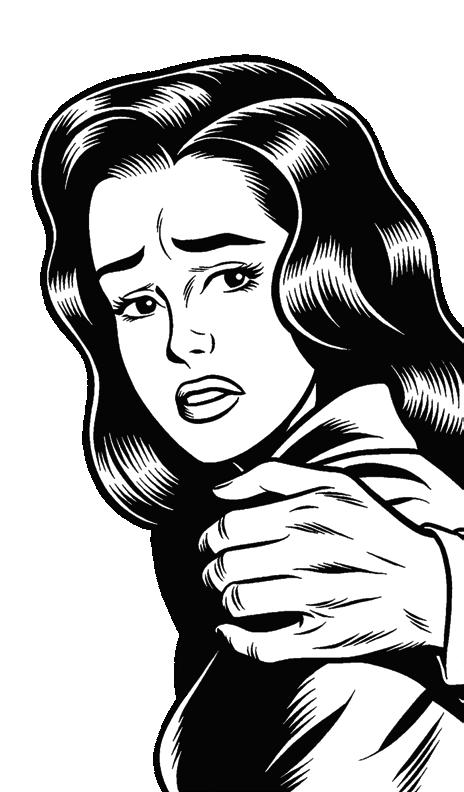
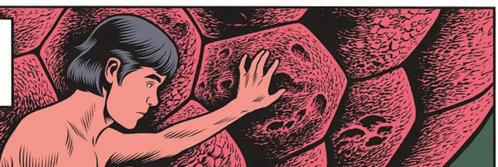
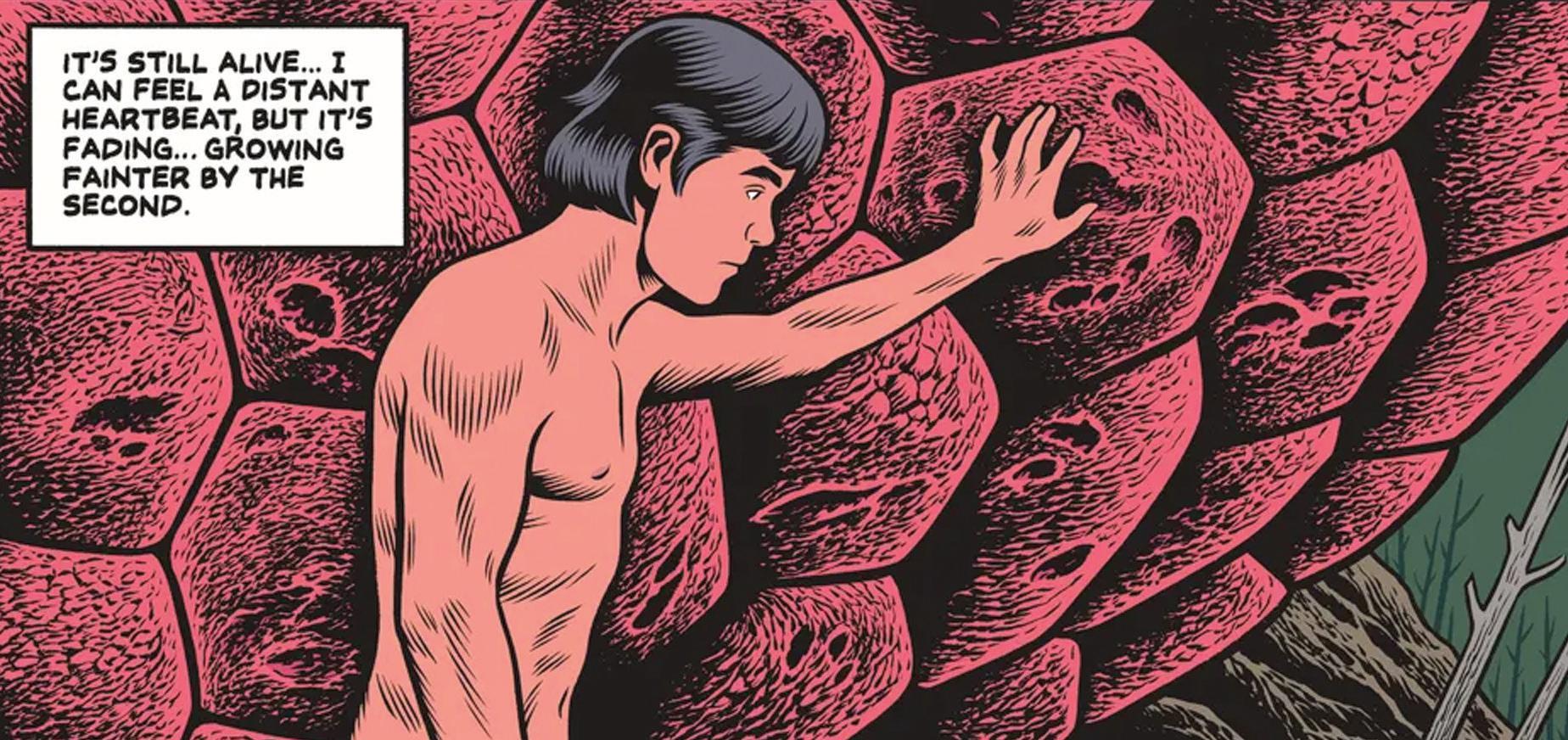
Charles Burns is an American cartoonist and illustrator known best for his psychedelic horror comics and high-contrast inking style. He got his start in Art Spiegelman’s Raw magazine in the 1980s, and his best-known work, Black Hole, began serializing in 1995. Since then, Burns has published several graphic novels in the horror genre, most notably Last Look and Final Cut.
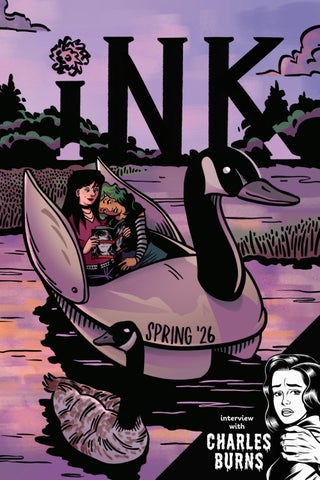
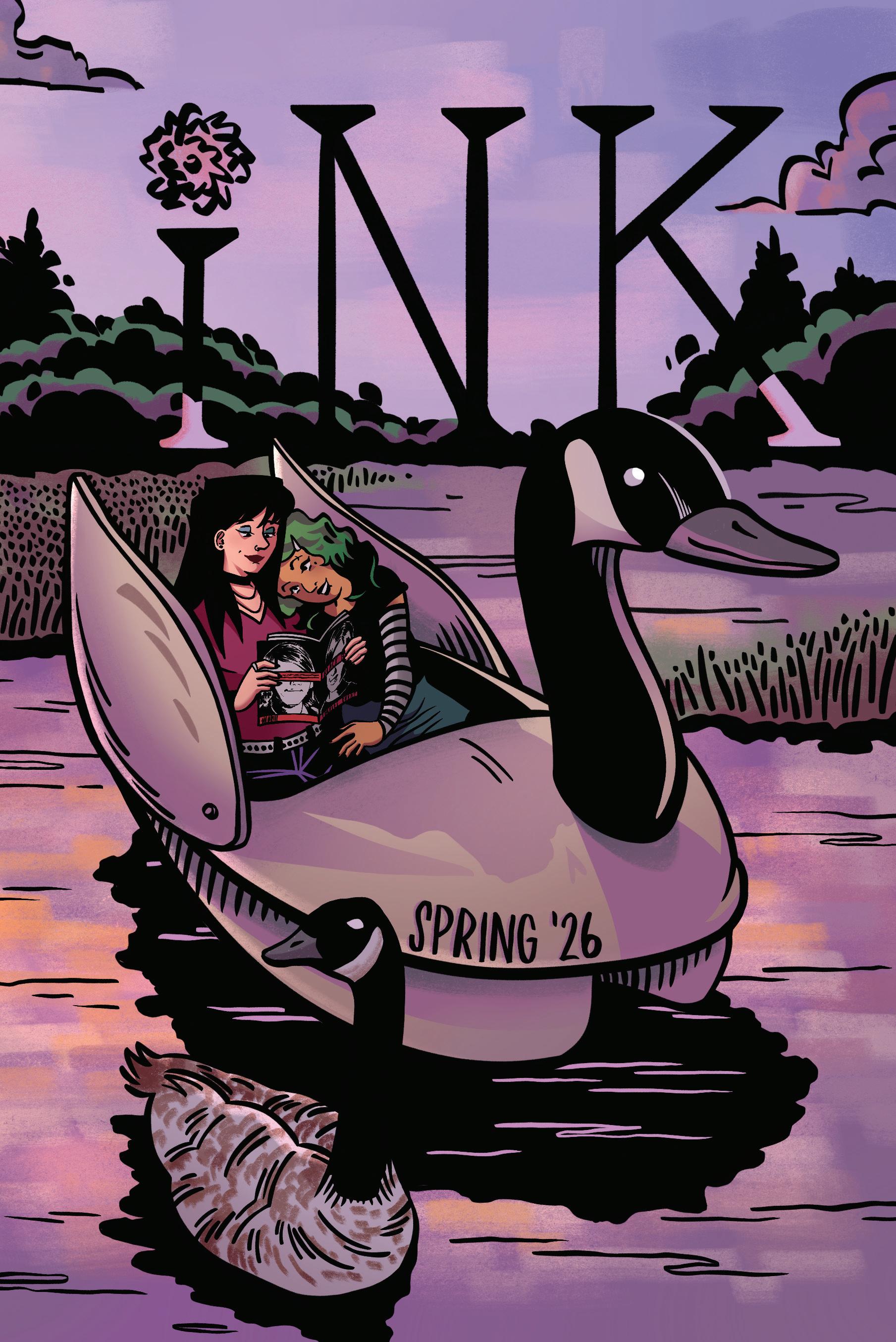
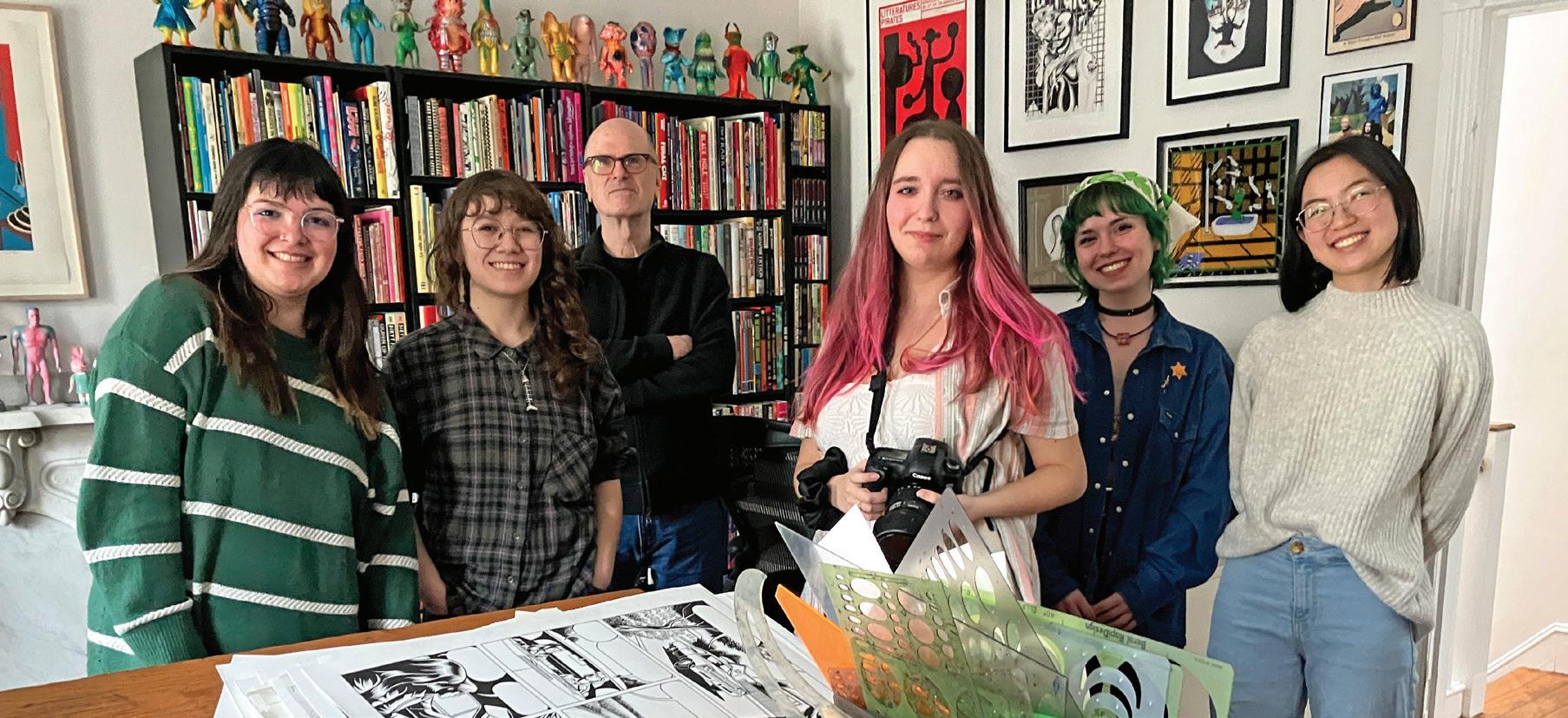
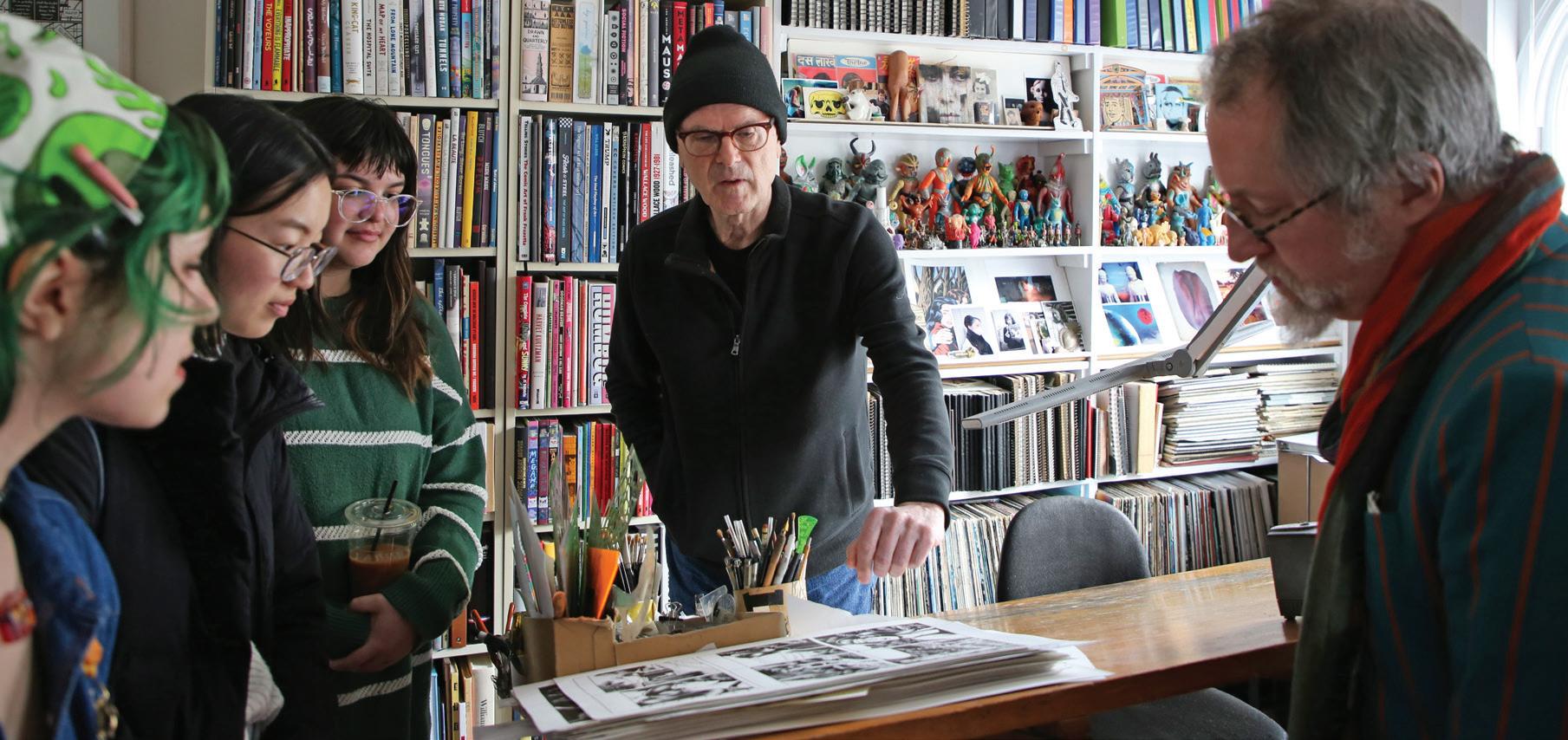
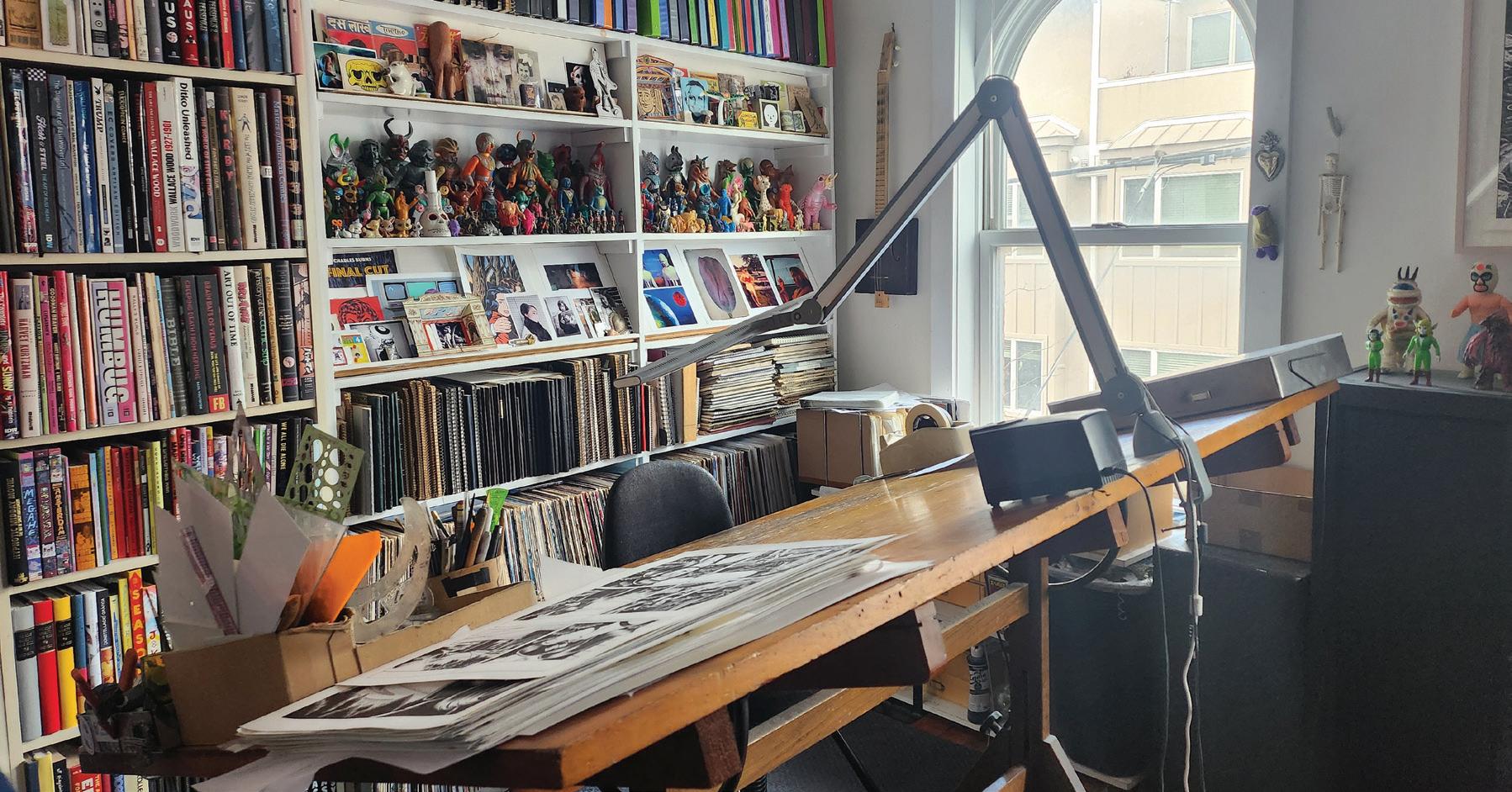
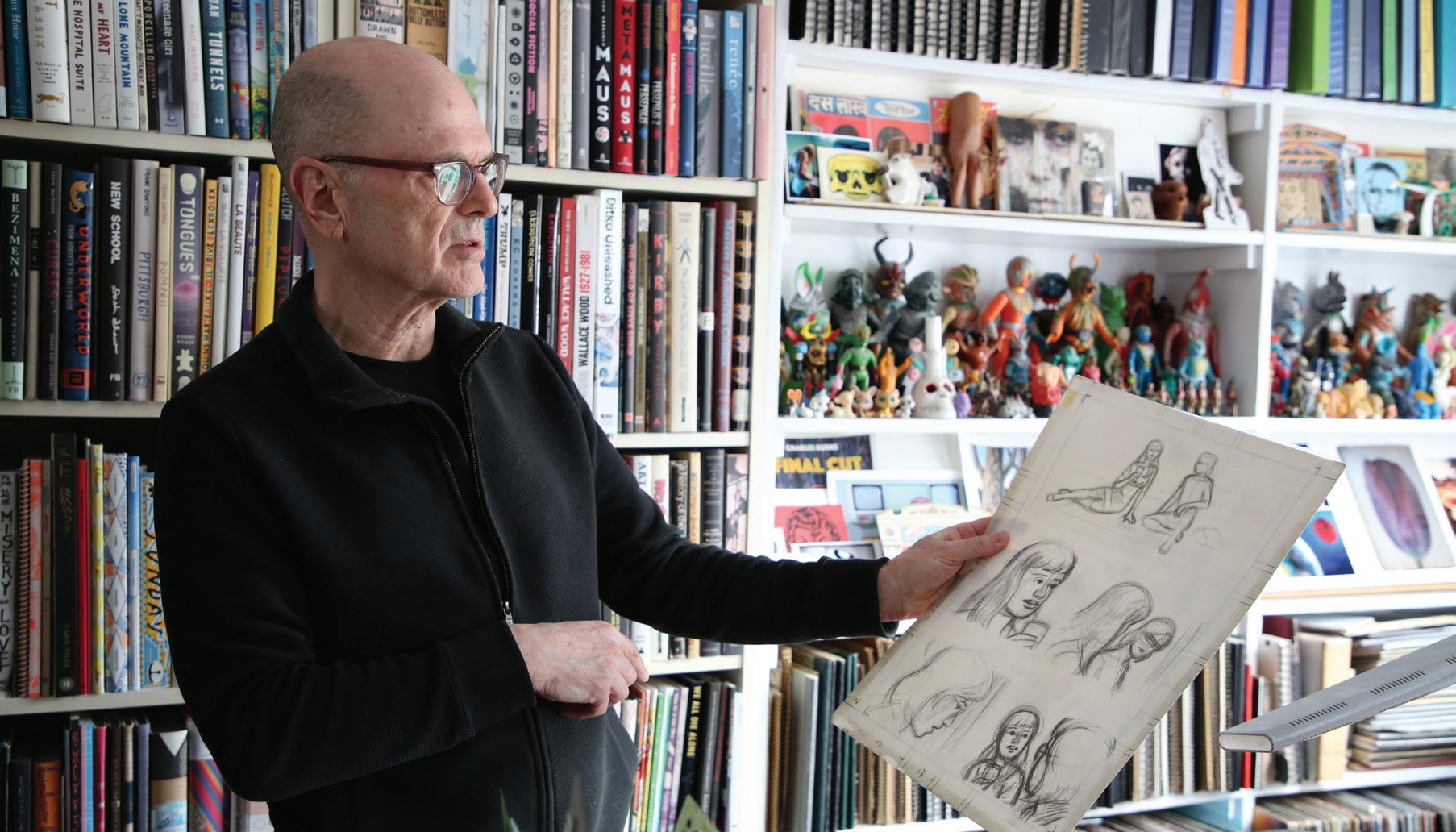
For INK’s Spring 2026 issue, Burns welcomed our team into his studio in Philadelphia, graciously showing us some of his works-in-progress and answering questions on his process and philosophy. We hope you enjoy this interview!
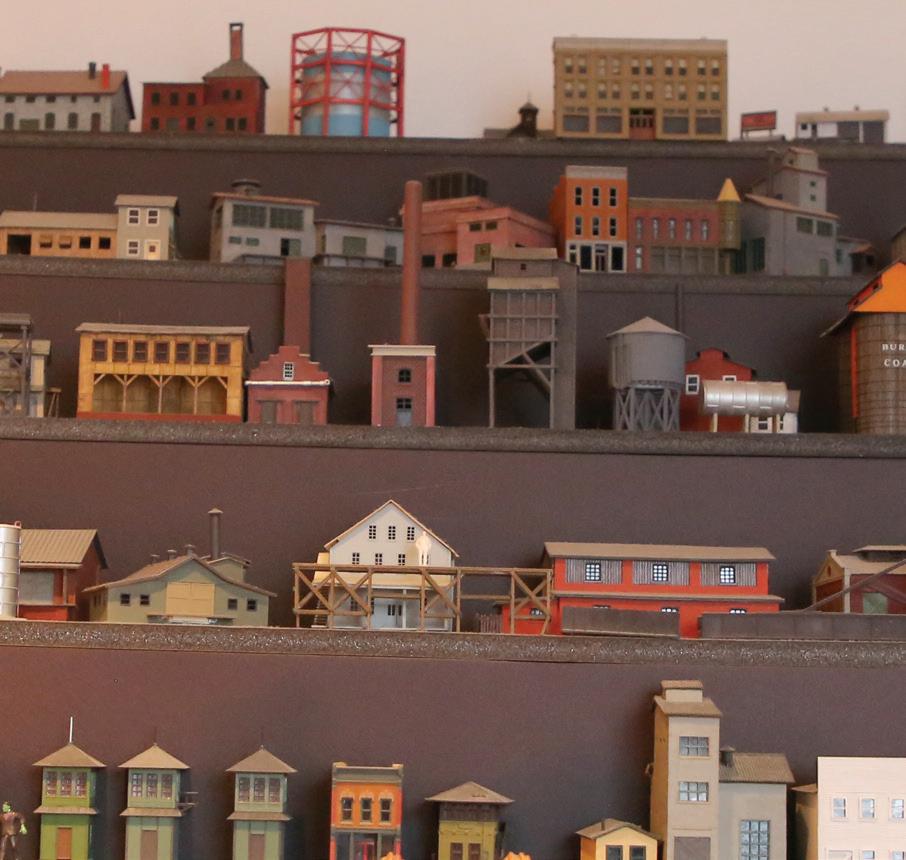
My dad was a hobbyist. He did every hobby you can imagine. My entire life, he had model railroads. So these are all his buildings from his very elaborate model railroad. I grabbed them because I thought that they would get tossed otherwise. So they’re mighty dusty, but on the other hand, they’re just fun for me to have. Some are kits, and some are built from scratch. This one’s wood. You can see it’s not finished. So he kept himself sane down in the basement with his hobbies. This one’s made of toilet paper tubes.
Do you feel that your attention to detail is learned behavior from your father?
Maybe it’s just that concentration, that kind of focus. He would just work on something for a while and, like, nothing ever got finished. It was just the process of working, shutting out the world.
Are you from Seattle?
I moved around a lot when I was a kid. I feel like I’m from Seattle because I spent the core of my life there, from fifth grade until I graduated high school. That was important to me.
And did you go to Evergreen State College, in Olympia?
I spent a little over a year at Evergreen, when Matt Groening and Lynda Barry and some other cartoonists were there. Lynda went to my high school as well, in Seattle. I worked on the Evergreen newspaper with Matt Groening as my editor. So I knew him, hanging out in the school newspaper, doing paste-up, and doing advertisements and some comic strips. Yeah, he was primarily doing record reviews. He would occasionally
do little doodles, but I was not aware of him being a cartoonist at all. And Lynda’s early work was much goofier— you wouldn’t recognize it as her work at all. But she started doing comics at Evergreen. She was published in one of the Seattle papers right after she graduated from Evergreen. I thought, “How did she get that?” Because she actually went to the office and tried to get a job doing it, that’s why. Not just sitting at home like me. [laughs]
Then I went to graduate school in Davis, California. That’s where I met my wife. She eventually got a job in Philadelphia at Temple University, at Tyler School of Art. And she was here for a year, and then I moved out here and lived with her. I was in Philadelphia, going up to New York, trying to get jobs doing illustration, and that’s when Raw came out, it was on the stands at local bookstores. That’s how I eventually met up with Art and Françoise. And then my wife had a chance to teach over in Rome for two years, so we went to Rome. I met one cartoonist, Giorgio Carpinteri, and through him I met a whole group of young Italian cartoonists, and that was really amazing. Being with Italian folks and traveling and doing stuff with them—that was just a great opportunity. They were a group
of cartoonists called Valvoline, and they were in various magazines. And so I got kind of grouped in with them, they took me in. So I did things like fashion illustration in Italian fashion magazines and things like that, stuff I would never have had a chance of doing otherwise.
Your first published book was through a French publisher. How did that come about?
The first major publication I was in was Raw magazine. I sent stuff into Heavy Metal magazine. I started getting published in Metal Hurlant, the original French edition of Heavy Metal, and I also started getting published in Spanish magazines, Italian magazines, so there was a market for that. I could get it published in the states, and then have it published in four or five different magazines over there. And then eventually that went away, like— nobody was interested in magazines anymore.
The work that you’re most known for, even to this day, is obviously Black Hole. That’s what everyone thinks of when they think of you. Do you have any particular feelings about that? Because your work has evolved since then.
I don’t think I’ve ever reread Black Hole. When I’m working on something I read through it a zillion times, rereading and thinking about how everything fits together and what needs to be changed.
With Black Hole, I’ve had people say, “I grew up in Nebraska, and that’s exactly what we did!” It was set, for me, in the early 70s in Seattle, Washington, and it was based on what my life was like. To a certain extent, you know, it’s not autobiographical at all. But as far as the internal feelings of the characters, I think it somehow touched some people. There was something there.
At least for me, and from the people I’ve spoken to, that’s the mass appeal of your work. It’s very general, but it feels so viscerally specific, like something inherent, to my mind.
Sure, I think that’s important. Again, sometimes I think if I analyze too much—
You’ll lose it?
It’s a bad sign. I remember describing a story I was thinking about to my wife. She said, “You can’t do another story about having someone’s head severed and sewn onto another body. You can’t do that, you’ve done three of those.” [laughs] Like, where did that come from? So obviously that is something that stuck with me.
I really appreciate how, even so early in your career, you took a move to avoid self-censorship, because now there are so many people that get to read these absurd, crazy comics. Because Black Hole is serious, it’s not, like, silly horror. I feel like a lot of horror now is scary for the sake of being scary.
I’ve always avoided that. And the same thing with something that’s very sexual. I’ve never wanted to have something that’s just kind of titillating. I want to show something that can be very intense and sexual, and very horrific. So in Black Hole, if you look
through the whole book, there are only a few overtly violent moments, and those things are, to my mind, meant to be very dark and horrific.
In Black Hole, it was like… I knew it was going to be in black and white. There are things you can do with color that you can’t do in black and white. A lot of my characters look the same, but like, oh, she’s got red hair and she’s got blonde hair. They may have faces that look very similar, but you can differentiate the characters easier with color. And it adds a shift in mood, too. There are things you can do with storytelling with color that are fun, but I really do like just the pure black and white.
And your next story, that’s going to be in color? So you haven’t come back to black and white in a bit.
I’ve done a few short things recently, and I do want to go back to it. I’m planning on it. I’m telling myself I am. [laughs] Who knows what’s going to happen?
Along with working traditionally, your books are also very physical. I believe I read in another interview that they’re
based on the Belgian album format, very sturdy hardcovers.
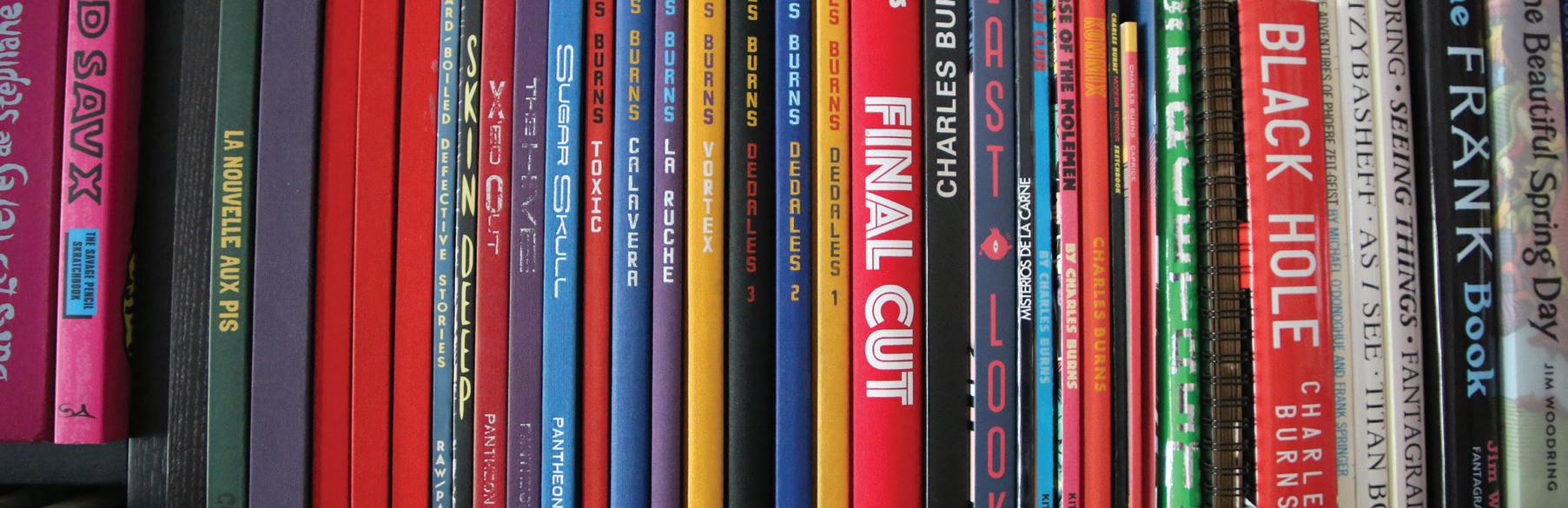
That’s something that I’ve always enjoyed or always wanted to pursue— thinking of the book as an object. I’m lucky in the sense that I work with publishers that listen to me, and so I can design the books pretty much the way I want. I don’t have any intense design concepts, but I keep in mind every aspect: the spine, the cover, the endpapers as you open the book, the kind of paper that they’re printed on. Part of that goes back to when I was very, very little, maybe five years old, before I could read. There were a few of
It’s available now, but back then it was rare.
Hergé’s Tintin books that were printed in America, not the imported British editions. I had those when I was a kid, and looking at those, you would open it up, and there were these elaborate endpapers, with all these characters. You recognize some of them, but you realize, like, “Oh, there are a whole bunch of books that are out there in the world. And I don’t have access to them,” but I could sit there and dream about who this or that character was. They were hard bound books and beautifully printed, in beautiful color printing. There are not too many cartoonists that are my age that grew up on that.
I just like comic books. So as a kid I would buy what was available. The printing and the binding and everything was fairly trashy. But I was always really enamored with beautiful books. I grew up in a household where we’d go to a library every week. Both my parents read a lot. My dad liked art books, and books related to comics, so I was seeing all those things regularly. My very first published book was in France, and I remember asking them, “Can I have endpapers?” And the reply was, “well, if your book sells. This is your first book. If you’re good, you’ll eventually get endpapers.” Still, it was a great moment to have that kind of hardbound French album.
There’s something very intimate about opening a book and reading it. Your brain functions in a different way when you’re looking at two facing pages, compared to… [mimes scrolling on phone]. When I’m writing stories, I’m always thinking in terms of facing pages.
This reminds me of the binder you showed us earlier, of the book you’re working on now with the printed-out pages. Does that factor into your
process, looking back at what you’ve already made?
It’s a way of saying, “Here’s how the story is laid out.” It helps my writing process. It’s just a matter of me constantly looking back and forth as I’m writing, as I’m drawing. It’s a reference, it’s helpful for me to constantly be flipping through that and re-evaluating.
There are people that have other strategies. I know artists who put up all of their originals on the wall, and that’s helpful in the sense, you know, because they have everything lettered out. I need to look at the lettering and the artwork combined together.
How deeply entwined is your writing process with your drawing process?
Ideally it’s always combined. I always work from very loose, open writing. I keep numerous notebooks. I write every day, or I try to write every day. And it’s not like I’m scripting. It’s always malleable. Almost every single story, I generally have a skeletal structure that I start out with. I’ve got some idea of beginning, middle, and end, I have characters, I’ve got a setting. But it always radically changes as I’m working. That’s probably the only reason I continue doing comics, because that’s the enjoyable thing, that discovery of working. My ideas seem to be kind of generic at first, and then, as I’m working, I’m like, “Why would I do that? We could do something very different.” I know cartoonists who do incredible work, and they fully script everything out, from page one to five hundred, or whatever it is. And it works for them. For me, it would be like a prison sentence.
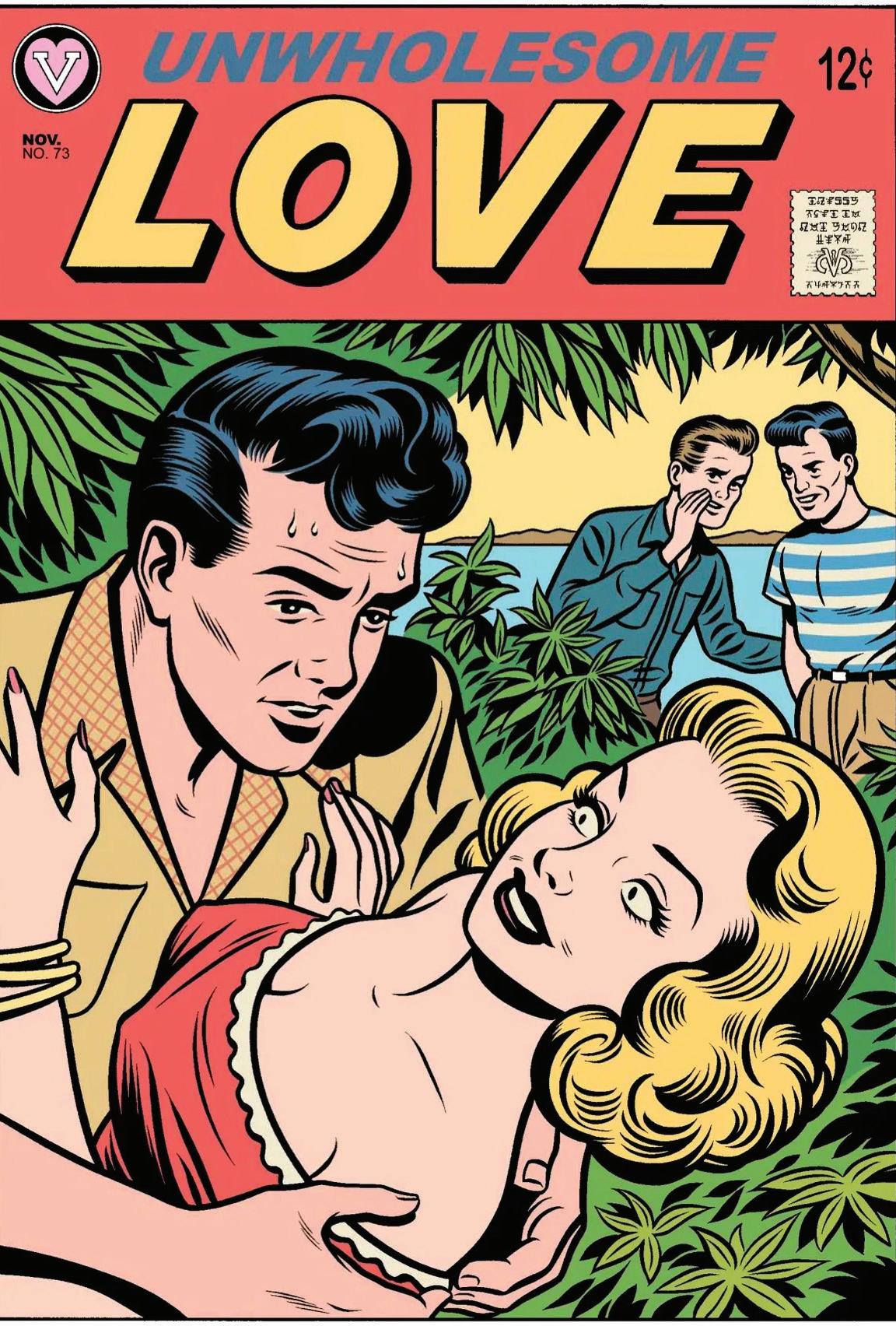
I’ve heard that Alfred Hitchcock would make his scripts so precise that it wasn’t interesting to him, necessarily, to film because he had completed it in his brain. When I’m writing, I allow anything to come in. I don’t edit anything out. It’s almost like drawing really rough pencil sketches. I spill everything out, write everything out, and then I throw ninety-five percent of it away.
Yeah. So, the book I’m working on now, there’s a very critical part that’s coming up, two critical sequences. I was working on other things to avoid getting to that, because I knew I had to get it right, and I didn’t want to force my way through it. And I would say, “God, if I had gone with my original idea, this would be really dull.”
A lot of that process feels very psychoanalytical, in that you write down everything that comes to your
mind by free association. I read Final Cut, and there’s this tentacle creature in the sky. Cool. And then I read Free Shit, and there are a million tentacle creatures that seem to have come out of your subconscious. I was wondering if you think about psychoanalysis at all, or dream theory, or surrealism, when you’re working.
I don’t analyze those things, but I pay attention to them. For example, when I really think, “Where did that tentacle creature come from?” I can visualize: oh, this little golden book that I had when I was a kid, that had this beautiful watercolor rendering of a jellyfish. Maybe that’s where that got embedded in my head. And maybe that’s important. I just pay close attention to my subconscious. Oh, there’s a crack in the ceiling. Oh, and there’s a little eye that’s watching. How many times have I drawn that?
A lot of what you draw is also about the 70s punk movement, and psychedelic type of work. Do you still feel like you’re making art about that time? How do you come up with what to make art about?
I used to joke about, “Why are you stuck in the 70s and doing all this stuff?” I think I always go back to this very intense part of my life. There are certainly intense things I have gone through recently, but for some reason, whenever I try to put those into a story, it doesn’t have the same kind of passion or intensity to me. So I find that there are things that I can write about with some kind of authority. And I know what that atmosphere was, these guys smoking dope in this doper house. I know what those guys were like.
This latest book I’m doing takes place in a particular town where my grandparents lived, and so I’m focused on that. And I’m figuring out the protagonist—it’s a young woman, still in high school of course. I’m thinking, “Okay, what are you gonna look like? Is it gonna be 1960 with 60s hair? No, it’s actually gonna be 1973.” And then I’m drawing various hairstyles. And finally, I’m like, “Oh, she’ll have this really nice dark ponytail.” And then I realized that’s the same woman I’ve drawn fifty times! [laughs] When I’m doing the drawing, I have no sense that I’m repeating myself.
It’s kind of embarrassing. I posted
something on Instagram recently, and someone actually commented, “Oh, that character’s back!” Like, no, it just looks exactly like the character in this other story.
I feel like ever since Black Hole, and I guess even before, there seems to be this theme of contrasting young, beautiful women with, like, scary, gory horror situations. That is especially popular now with artists like Junji Ito. Are you conscious about this contrast, or is this, again, something that just comes up?
Probably it’s just a mix of all the kinds of things that I grew up with, the things that I was attracted to. I was a kid that loved horror movies and things like that. Looking back on what I was looking at, they’re very benign. They’re not splatter movies or anything truly horrific. There was stuff where I had to leave the room as a kid, that I then watched as an adult and was like, “This is just kind of cute and funny. There’s nothing very scary about it.”
My characters tended to be much more cartoonish early on, much more
stereotyped, easily recognizable. I had a character, El Borbah, who was a Mexican wrestler, who was also a detective, and it was kind of a humorous strip. I made a very conscious decision, when I started working on Black Hole, that I wasn’t going to edit myself, and I was also going to do something that was much more personal to me, that related much more to myself and my friends and what we went through, or what I was going through when I was growing up. That was a real change for me. It was a very conscious decision that I wanted to tell a longer story. I had hints of the idea of having this story be about a teen plague. I had done a few shorter pieces, and I realized that it was something that could hold me to do a much longer story. But again, I wanted to not to censor myself, in the sense that there was some material that I didn’t know whether I should put it out in the world. I’m here thinking, “A girl with a tail, and then the tail breaks off during sex.” And I didn’t know whether I should do that! But I did.
Do you share manuscript work-inprogress with peers?
Only as much as I did with you upstairs, like a flip-through. I had Dan Clowes over here recently, and he said “I don’t wanna look at it, because I want to see it when it’s all done!”
Not even Art Spiegelman? Because I feel like he’s famous for his editorial hand.
Yes, there was deep editorial stuff going on with Art, but that was me learning how to write stories. It was just when I was starting. And it was actually very beneficial, in the sense that I came out of a much more visual background. I did a lot of comics early on that were
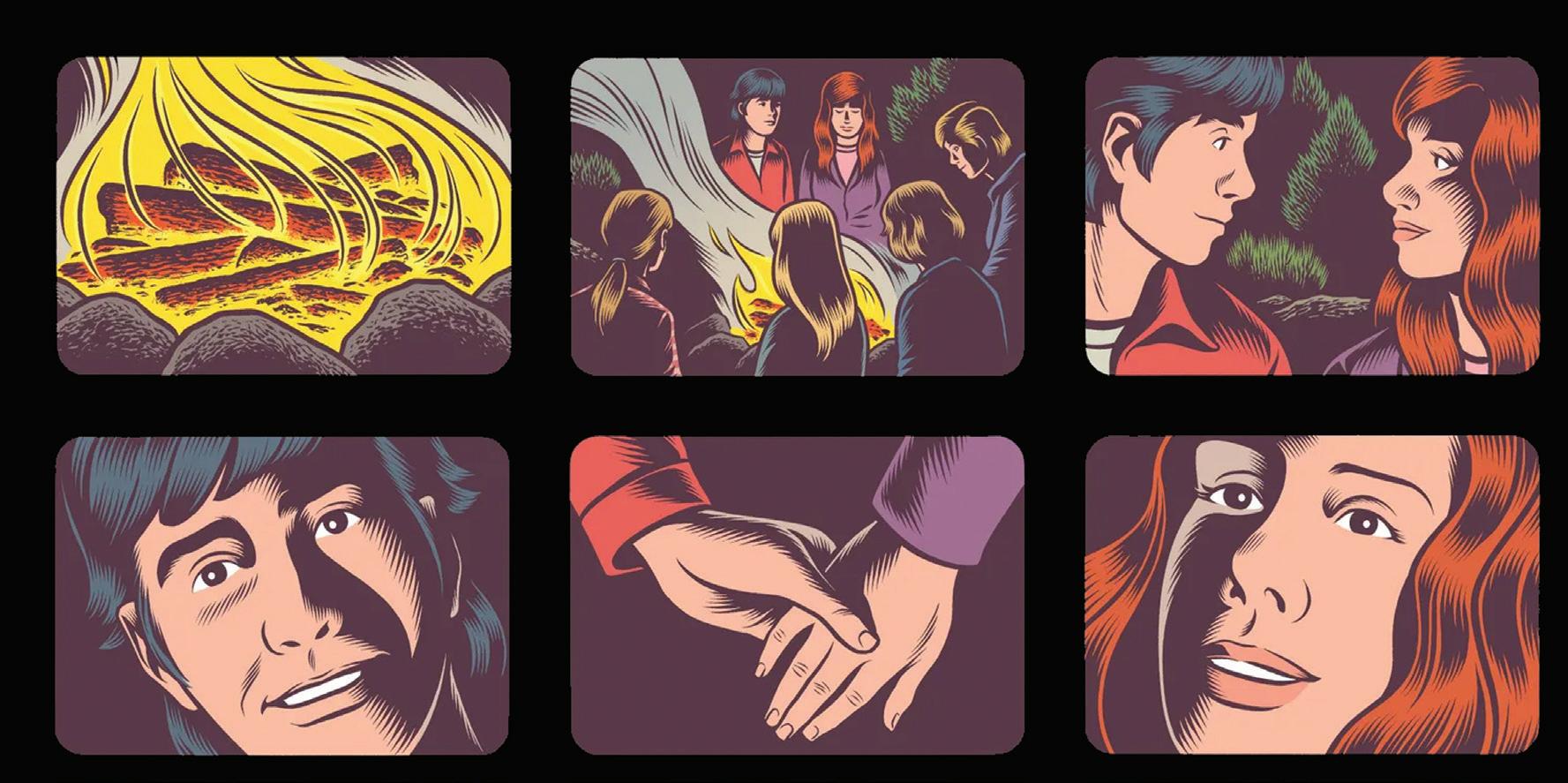
non-narrative. They were kind of collaged imagery, or just short, short pieces. But I didn’t have the writing skills yet, that was something I had to work on. I met Art Spiegelman in 1980 or ‘81, and he and Françoise Mouly were just starting Raw magazine, where Maus was being serialized. He was the first actual cartoonist I met. He was the first person who looked at my work really carefully, in a way that made me nervous at first, like, “Is there something wrong?” [laughs] He said, “No, I’m just reading. I’m just looking.” He was able to say, “Here’s a stack of things to look at. Look at these, and look how it’s broken down. Look at Harvey Kurtzman’s Mad stories, and see how he breaks down a story very simply.” I learned the constraints that would be helpful to writing a story. I had written very intuitively, not thinking as much about how story is broken down for a reader, how it functions on the page. I kind of stepped back, and used a very traditional way of putting together the story—three tiers, one on top of each other. I’m doing that now, still.
Do you have advice for cartoonists that want to get out there and make
compelling work?
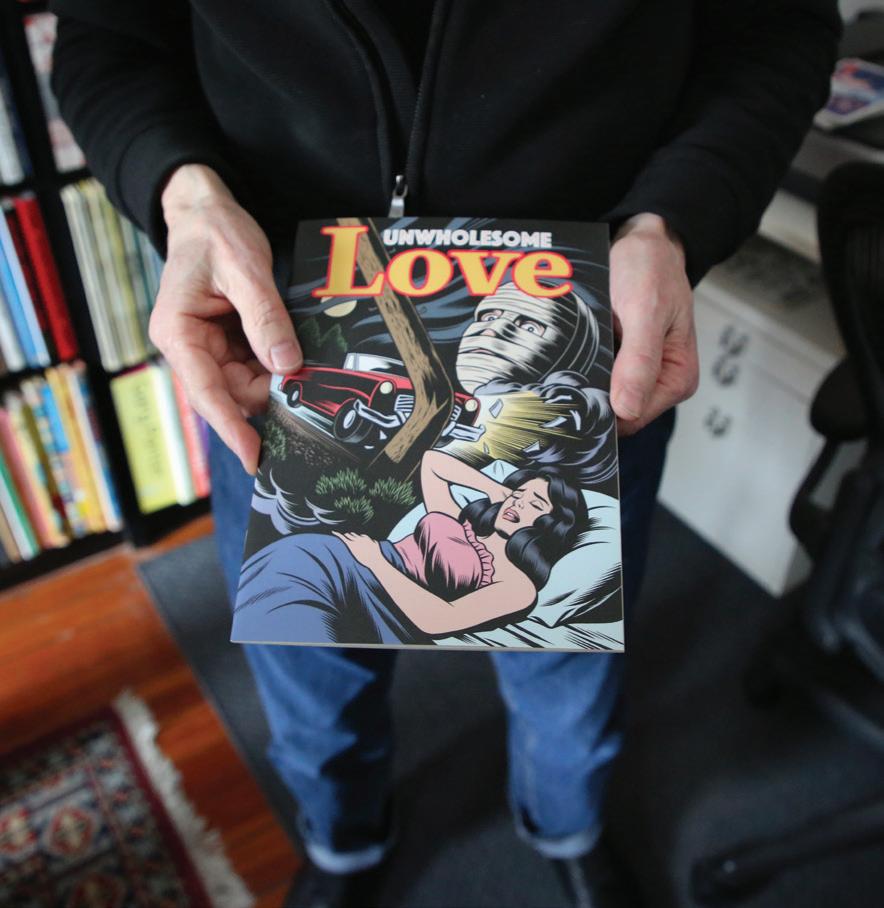
First of all, it has to come from yourself. If you’re imitating what’s popular, or just want to get published, I think it’s a lost cause. I think every single person has compelling stories that they can tell that are personal, but universal at the same time. That sounds very general, but that idea of trusting yourself and trusting your own vision is important. I mean, of course, you’re going to be influenced by other people. Everybody is. And I steal from other artists all the time. I’m getting a risograph booklet right now, it’s just been printed—I’ll have it soon—but it’s called Swipe File. So it’s just me drawing, or kind of collaging, reconfiguring various artists that I like, four panels for each artist. It’s kind of a much more abstract thing. It’s kind of a fun side project.
Yeah, like those pages from Buzz magazine. “Naked Snack”.
Yeah, “Naked Snack” was all drawn on top of the Marvel Comics Tryout Book blue-lines. Marvel put out this book that had blue-line Spider-Man pages of pencils by John Romita Jr. and I
thought, “I’m just going to ink it up straight, you know, my style. I’m going to ink a Spider-Man comic.” And I got about halfway through one panel, and I thought, “Fuck this.” [laughs] My intention was to do it straight, but then I just started playing with it, and using that as the basis for building a story. I reconfigured everything and wrote a full script for the story.
Seeing your pages firsthand, it’s miraculous how there’s almost no white ink. How have you gotten to this point of such clean line art where you know where you want all those bright highlights to be as you ink?
It’s almost something that kind of comes into focus slowly. Sometimes it’s just scrubbing in the shapes with pencil. It starts out very rough and gets more focused as I work. I do a new layer of pencils very often. I often flip my drawings over. I don’t know if you’ve ever looked at your drawings in a mirror. You’ll be like, “oh my god!”
It’s like an ego death.
I’ll draw in reverse to correct mistakes and to refine things. And so the last part, which you don’t see, is I’m penciling on the actual piece of paper. By that point, I’m refining that previous drawing even more. I’m figuring out where everything goes. So it starts out with general shapes and light and shadow, and then I’m refining it down to this very precise line. And then, I’m looking at the pencil drawing, and I’m making those decisions while I’m inking, too.
Would you say that’s something that’s important to you, to be able to have time to work at your own pace when it comes to comics?
Yeah, it has to be that way because there are so many starts and stops. You have to find a balance. You can’t just sit and look at a page forever, you have to work. Problems get solved by actually working on them instead of thinking about them. But you can also make a lot of mistakes in the process.
INK thanks Charles Burns for his time, wisdom, and hospitality!