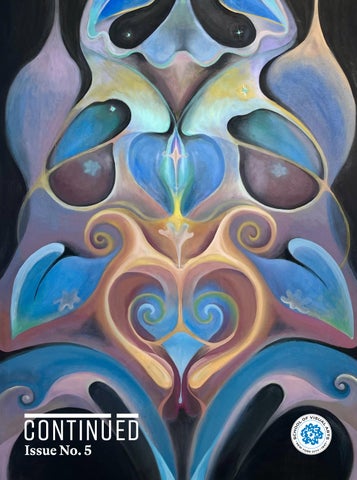
Issue No. 5
SU M M ER 20 26 | 1
Cover: Quincee Lark, opening no. 1, 2024, 60 x 32 in. Inside Front Cover: Xin Gao, My World is My Mandala, 2024, tribe fabric, bamboo, beads, 50 x 150 cm. 2 | SVA • C O NTIN UE D
The Division of Continuing Education has been a leader in developing and broadening the sector of continued creative studies in New York City for more than 75 years. Our dynamic course offerings span a multitude of disciplines, including advertising and design, animation, film, fine arts, illustration and comics, interior design, photography and video, professional development, visual and critical studies, and visual narrative. With a robust online and on-campus curriculum, our program’s global reach connects students from around the world to industry-leading faculty in New York City. For more information about the Division of Continuing Education and our course offerings, please visit sva.edu/ce.
SU M M ER 20 26 | 3
1
SCHOOL OF VISUAL ARTS DIVISION OF CONTINUING EDUCATION VO LU M E C III • N U M B ER 2 ContinuEd (USPS-004171), © 2026 by the Visual Arts Press, Ltd., is published quarterly by the School of Visual Arts, 209 East 23rd Street, New York, NY 10010. Call 212.592.2050 to subscribe. Periodicals postage is paid at New York, NY. POSTMASTER: Send address changes to Division of Continuing Education, 209 East 23rd Street, New York, NY 10010-3994.
In today’s age, the demand for new skills,
2
1 LUSMERLIN in her Fine Arts: Contemporary Practices residency studio. Photo by Catherine Guzman. 2 Ada Shen, Introspect/ Illuminate (detail), 2022, installation with ceramic, genetically modified bacteria, and ultraviolet light, 50 x 50 inches. 3 Resident Rene Saheb in the studio, 2023. Photo by Jingyao Huang.
3
for broader and deeper knowledge, and for more flexibility in our professional lives is challenging. Continuing our education— formally or informally—is vital to keep up with the pace of a rapidly changing and networked world. The Division of Continuing Education at SVA is designed to meet the needs of working creatives in the 21st century. We’ve shaped our curriculum to give our students the edge they need to compete in the global artistic and entertainment fields. The success of our program and the foundation of what makes studying with SVACE so unique is based on one important factor: community. From our faculty to students, our dynamic classrooms are incubators for exchanging knowledge, skills, and resources with industry professionals from diverse creative backgrounds. You never know who you will be working with, or where one of our courses may take you. SVACE is dedicated to fostering a rich community of makers by providing platforms and programming designed to uplift their work and stories. This issue is dedicated to the remarkable talent of our creative community, not only to showcase the breadth of work, but also to highlight the moments and programming focused on bringing students together. Our artist residencies offer artists, designers, and creative thinkers time, space, and a supportive community in which to develop ideas and focus on their artistic direction, with summer programs on campus in New York City, as well as year-round in online formats. A unique combination of creative and professional resources provides a rich environment for growth and opportunity in the current, vibrant art scene. The Division of Continuing Education aims to create educational opportunities through which alumni, artists, educators, professionals, and students engage in increasing their knowledge of and contributions to the arts. The purpose of continuing education is manifold, but one of its most viable goals is to expose yourself to a new and different world and to build a community there. Through continuing education, we can do more together.
1
4 | SVA • CONTIN UE D
Artist Morgan Overton’s Evolving Creative Practice By Catherine Guzman
W
2
A Q&A with a 2025 Fine Arts Resident 1 Morgan Overton, Oracle of the Unlost Heart, 2025, graphite, watercolor, gilded gold leaf on paper, 22 x 28 inches. 2 Portrait of Morgan Overton in her SVA Fine Arts: Painting and Mixed Media residency studio. Photo by Ryan Hamilton.
hen Pittsburgh-based visual artist Morgan Overton joined the summer 2025 cohort of SVA’s Fine Arts: Painting and Mixed Media residency, she brought with her a creative background deeply rooted in social justice, community, and her own personal history. For her, art is a platform to connect with people, and Morgan’s trajectory reveals an artist in constant evolution. I had the chance to speak with her about her evolving relationship to art and how SVA’s Artist Residency Program has played a role in her exciting creative path. Can you tell me a little about your creative journey so far?
My creative journey has been both constant and nonlinear. I’ve been immersed in the arts since childhood. As an only child with intentional parents, I’ve done it all—drawing, dancing, playing instruments. Yet there was never a clear “how-to” path for becoming an artist. What I know now is that this journey has always been destined and organic. Even as I moved through psychology research, politics, and public service, art remained the throughline and the place where I could be my fullest self. SU M M ER 20 26 | 5
My multidisciplinary, figurative practice blends graphite, realism, watercolor, and ancestral motifs to explore Black lived experience and the quiet power of resilience. What connects you to social justice and community organizing, and how do these themes influence your work?
My connection to social justice is personal and lifelong. As a Black woman in America, I was raised with a deep grounding in history and culture. That foundation guided me into civic life—from working on Barack Obama’s 2012 reelection campaign to leading women’s rights policy work and organizing around racial and economic justice. I’ve seen firsthand how systems shape our lives, and that awareness anchors my creative practice. Through portraiture and symbolic imagery, I seek to humanize stories often flattened by society and to imagine futures where we see one another more fully. How has the SVA Fine Arts: Painting and Mixed Media residency shaped your creative and professional growth as an artist, and what's next for you?
My time in the artist residency was a true catalyst. In one month, I gained clarity, confidence, and a refined artistic voice. It was my first formal “art world” residency, and it arrived at a moment when I was committing to becoming a fulltime artist. The residency gave me the space to integrate all parts of my identity: artist, advocate, genealogist, former politico, and to define my practice through ancestral memory and Afrofuturist exploration.
6 | SVA • C O NTIN UE D
3
Since returning home to Pittsburgh, I’ve opened Morgan Overton Art Gallery, and am focused on continuing the momentum gained at SVA by building a body of work for exhibitions, pursuing more residencies, and creating work that honors where we come from and the futures we’re building toward. ◉
Curious about fine arts? Scan here ↓
4
5
3 Morgan Overton, Elegy for the Woman Who Lived Boldly, 2025, watercolor, graphite, collage, gilded gold leaf on paper, 11 x 14 inches. 4 Morgan Overton, We Are Not Going Back, 2024, oil and acrylic paint on canvas, 36 x 24 inches. 5 Morgan Overton Gallery in Pittsburgh, Pennsylvania. Photo by Morgan Overton.
4 3 2
A Transformative Exploration: How Freedom in the Studio Led to Some of Artist Barbara Sullivan’s Favorite Work By Nivia Hernandez
B
arbara Sullivan is a painter and fine art photographer. In this interview Sullivan shares how SVACE courses and the Fine Arts: Painting and Mixed Media residency program at SVA have had an influence in her practice and some of the ways she maintains and builds a community as an artist. When did your drive to create begin and how has your work changed over time?
Although I studied design, I was always compelled to make art, as it stimulated a different area of my brain—a more philosophical part. My early focus was on photography when I discovered a small 8 | SVA • C O NTIN UE D
experimental darkroom school. When you first begin working with a new medium, there is an exciting learning curve. Only by trying and doing many different types of photography did I finally create the body of work that felt true to me (the long exposure) movement and emotion with a narrative arc. While my themes and mediums have changed over time, I still feel these core components embody my work.
rigorous focus in a short amount of time. My experiences in SVA’s Artist Residency Program—first in Photography and later in Fine Arts: Painting and Mixed Media and then SVACE drawing courses— were transformative. The critiques, the range of faculty perspectives, and the energy of the other artists pushed me to see my work more clearly and speak about it with more confidence.
How do artist residencies and SVACE courses influence your work and dedication to your practice?
What helps maintain/build a community for you as an artist?
Residencies and SVACE courses are a great way to give your work
Seeing art regularly, supporting fellow artists, and engaging both in-person and on social media platforms.
3
1
SU M M ER 20 26 | 9
2 3
4
1 Barbara Sullivan, The Space Between Me and You, 2015, oil on canvas, 24 x 30 inches. 2 Barbara Sullivan, Untitled, from the series Sleep: The Unknown Darkness, 2007, photograph, 30 x 40 inches. 3 Barbara’s studio during her time in the summer 2025 Fine Arts: Painting and Mixed Media residency at SVA. 4 Barbara Sullivan, In the Garden, 2015, oil on canvas, 36 x 48 inches. 5 Barbara Sullivan, Untitled, from the series Sleep: The Unknown Darkness, 2007, photograph, 30 x 40 inches.
Curious about SVACE courses?
What piece of knowledge do you hold closely when you are in your studio?
I made a sign for my studio that says “Freedom to Fail.” It’s a reminder that the studio is a space for exploration without expectation. During my SVA Fine Arts: Painting and Mixed Media residency, I started something I call my FU Paintings—I hung up a full-length canvas with no rules and no expectations. It could never be wrong or overworked. Whenever I felt stuck or afraid to ruin something I was working on, I’d turn to that canvas. Ironically, that freedom led to some of my favorite work.
Scan here →
Where do you look for reference or inspiration outside the studio?
I live in NYC, so even riding the subway inspires me—but also music and nightlife, philosophy, literature, true crime, psychology cases ... Anything that generates ideas and thinking—and while thinking, I begin visualizing. How do you keep yourself motivated during a creative block?
Often I’ll create challenges for myself— playing with scale, working with transparent vs. opaque paints, or mixing materials that don’t “belong” together. When I hit a long block with photography, I turned to painting, and later I moved toward experimental figurative drawing. But often, I think of what an artist-friend said: “If you fall off the pony, get back on the pony.” It’s mostly about showing up and continuing to engage with your work. ◉ 5
SU M M ER 20 26 | 11
Britta Kuhlmann, Untitled, 2025, acrylic on canvas, 63 x 79 inches.
“Participating in SVA’s Artist Residency Project was an incredibly enriching experience. As an artist based in Bangkok, Thailand, it was an amazing opportunity to connect with the artistic dialogues happening in New York and beyond. The program brought together a diverse group of international artists and mentors whose insights helped me see my own practice through a broader, more critical lens.” —Karma Sirikogar
12 | SVA • C ONTINUED
Juan M. Villanue, Impetus: Arrancado, 2024, “Material List Intentionally Withheld,” 44 x 30 x 122 inches.
The Artist Residency Project
STUDENT HIGHLIGHTS Karma Sirikogar, Moksha’s Stingray, 2023, digital photography, collage, and digital painting, archival pigment print on paper, 60 x 80 centimeters.
From the Laboratory to the Studio: Interdisciplinary Practices in Bio Art
Fine Arts: Painting and Mixed Media “The Artist Residency Program at SVA is fantastic. I had a studio where I could work freely and discuss and reflect on my painting with the support of professional lecturers. There were also theoretical lectures and excursions to galleries. The program gave me the space to significantly develop my paintings.” —Britta Kuhlmann
Explore Artist Residency Programs Scan here ↓
“SVACE has been instrumental in guiding my growth as an artist, giving me space to reconnect with my practice during pivotal moments in my life. The courses, mentors, and community helped me broaden the material language of my work and link my day-to-day studio designs to the evolving site-specific botanical installations I am refining now.” —Juan M. Villanue
S U MME R 2 0 2 6 | 13
Global Tracing: Meet Artist and Alumnus Alyson Smith By Stephanie McGovern
A
graduate of SVA’s MPS Digital Photography program, Alyson Smith is an editorial and fine art photographer whose work explores the concepts of time and space, the human interaction with the natural and constructed world, the traces that we leave behind, and themes of otherness. A South African–based artist and native, Alyson has maintained her connection to SVA digitally through the Artist Residency Project and Residency Alumni Network. We touched base with Alyson for her insights and perspective on how SVA’s Artist Residency Program has shaped and influenced her art making, along with her thoughts on the importance of building an art community. How has your participation in the Artist Residency Project impacted your practice?
I found the gentle and supportive challenges by the coordinators helped me look at my 14 | SVA • C O NTIN UE D
work in a different way, including how I edit and put pieces together for proposals. Overall, this allowed me to think more cohesively and experiment with both isolated images and insular bodies of work. I was also considering how the work might be presented as an integrated show or even as a single series. Also, having studied only photography, the opportunity to discuss and discover other artists, artworks, theories, and concepts, helped me to consider how photography is seen, how it is accepted artistically, and these shifting dynamics. Attending the residency helped me personally to start seeing myself more as an artist. Do you have any thoughts around the importance of building community through art making?
Everyone I met through the residencies said they thought it was invaluable, not only in terms of the actual time spent together, but
opposite Alyson Smith, Bokaap 1, 2023, photograph, Hahnemuhle German Etching 310 GSM giclée print, 59.4 x 84.1 centimeters.
SU M M ER 20 26 | 15
1
Is photography your passion? Scan here ↓
2
4
3
16 | SVA • C O NTIN UE D
5
the ongoing community created through the SVA Residency Alumni Network. The network provides a growing community of people who have had a similar residency experience—whether online or in person—and who come together to share their work, practices, advice, lessons, insights, and to regularly exhibit together. One of the key aspects of the residency and the ongoing alumni network is that I am encouraged by the collective learning environment, which is made possible by the positive enthusiasm from the coordinator and group members. Seeing others grow, providing encouragement, sharing ideas, and acting as a supportive group, I think is the definition of community. ◉
1 Alyson Smith, Landscapes of aging 1, 2022, black-and-white photograph gelatin silver print, 40.6 x 51 centimeters. 2 Alyson Smith, Landscapes of aging 2, 2022, black-and-white photograph gelatin silver print, 40.6 x 51 centimeters. 3 Alyson Smith, Landscapes of aging 3, 2022, black-and-white photograph gelatin silver print, 40.6 x 51 centimeters. 4 Alyson Smith, Lace Curtains, 2015, pigment inkjet print, Moab Lasal Dual Seigloss paper, 16 x 22 inches. 5 Alyson Smith, Bokaap 2, 2023, photograph, Hahnemuhle German Etching 310 GSM giclée print, 59.4 x 84.1 centimeters.
Community
2
1 1 Zainab Anwar, Detached, 2023, acrylic, 48 x 36 inches. 2 Levan Songulashvili’s studio during his time at the summer 2023 Fine Arts: Painting and Mixed Media residency at SVA. 3 Paloma Cansecom, Eternal Ephemera, 2024, acrylic, 10 x 10 x 25 inches.
3
20 | SVA • C O NTIN UE D
(Left) Loren Liu, Walpurgis Night, 2024, digital illustration, 11 x 17 inches. (Right) Tal-Sharone Barnea, Warm Milk, 2021, oil on canvas, SU M 100 Mx ER 120 20 centimeters. 26 | 21
22 | SVA • C O NTIN UE D
4 Kara Yancey, Spring, 2025, digital illustration. 5 Daniel Cosentino, 1106, 2024, palladium print, intaglio print, metal leaf, 10.5 x 14 inches. 6 Catherine Nevera, installation shot from the Sculpture, Installation, and New Media Art residency, 2024. Photo by Gustavo Murillo Fernandez Valdes.
4
7 Dalya Moumina’s studio during her time at the summer 2023 Fine Arts: Painting and Mixed Media residency at SVA.
5
7
6
SU M M ER 20 26 | 23
Department Highlight: MFA Photography, Video, and Related Media Interview with Adam Bell By Rachel Gisela Cohen
T
he MFA Photography, Video, and Related Media Department continues to push the boundaries of lens-based art, advancing its evolution from traditional darkroom practices to the rapidly expanding possibilities of generative AI. In this interview, academic advisor and faculty member Adam Bell discusses the inspiration behind the department’s new Lens and Screen Arts Residency: From Generative AI to the Darkroom, and how the program aims to support artists working across an increasingly diverse technological landscape. 24 | SVA • C O NTIN UE D
Can you tell us what inspired the creation of the Lens and Screen Arts Residency: From Generative AI to the Darkroom?
The department has always embraced the tools that shape lensbased mediums—whether it was early adoption of Photoshop in the 1980s, the shift to digital video in the 1990s, or the emergence of generative AI today. Being open to change and willing to engage with it critically has long been integral to our mission. We designed this residency to give artists the tools, space, and support needed to navigate this transitional moment.
Whether someone works in shortform video, still documentary photography, or video installation, lens-based practices continue to play a vital role in our culture. Our goal is to create a space where these pursuits are nurtured, challenged, and empowered to address the complexities of contemporary life. How does the residency balance traditional practices with emerging technologies like AI?
One of the most exciting aspects of the program is that artists don’t need to choose. Residents have access to analog darkrooms, digital
1
2
SU M M ER 20 26 | 25
labs, lighting studios, and editing suites. Workshops on generative AI introduce new ways of working—such as manipulating analog imagery in digital space or training AI models using [residents’] own footage—opening pathways to hybrid and experimental approaches. 3
What does a typical day in the residency look like?
A resident might begin their morning in the studio, scanning negatives, editing video, or printing large-format images. Midday brings lectures, screenings, or workshops, followed by afternoon critiques with faculty or visiting artists. With 24-hour facility access, late-night collaboration is encouraged, and New York City’s cultural life offers endless inspiration. What do you hope artists gain from the residency?
Above all, we hope to give artists the time and space to deepen their practice, explore new tools, and build meaningful connections. Whether an artist is seasoned or just beginning, the residency provides a flexible, supportive environment designed to spark growth and expand creative horizons. ◉
Check out our graduate studies programs Scan here ↓
26 | SVA • C O NTIN UE D
4
5
1 Ari Temkin, The Index, 2025, Installation shot, SVA MFA Photography, Video, and Related Media thesis exhibition “5.” Photo by Shaohan Fang. 2 MFA Photography, Video, and Related Media department, printing lab. Photo by Alex Severin. 3 MFA Photography, Video, and Related Media thesis exhibition video installation by Junghyun Hao, 2019. 4 MFA Photography, Video, and Related Media Department. Photo by Alex Severin.
6
5 Sunmin Park, She is my shadow, I am her echo, 2025, installation shot, MFA Photography, Video, and Related Media thesis exhibition “5.” Photo by Shaohan Fang. 6 Xunzhen Chen, Untitled, 2024, photographic 3D collage.
SU M M ER 20 26 | 27
Sparking Conversation in the Gallery Q&A with Artist Tobi Kahn By Gabe Ginsburg
1
28 | SVA • C O NTIN UE D
W
1 Tobi Kahn discussing the spatial relationship between the art and the gallery at Hauser & Wirth, 2025. Photo by Gabe Ginsburg. 2 Tobi Kahn introducing the residency cohort before beginning the gallery walk, 2025. Photo by Gabe Ginsburg.
e sat down with artist and educator Tobi Kahn to discuss his long history at SVA and, specifically, his experience leading artist residency participants through a number of galleries in the Chelsea neighborhood of New York City. How did you first get involved at SVA?
I started teaching at SVA in 1985. I had been teaching at The City College of New York and was an associate at the Guggenheim, and I thought I was done with teaching. Then, I was on a panel at a museum, and someone in the audience asked where I taught. I said, “The truth is, I don’t teach anymore, but if anyone wants to hire me, I’d love to.” A few days later, I got a call from SVA, went in for an interview, and I’ve been here ever since. What drew you to leading the gallery walks for SVA’s Artist Residency Program?
I’ve been doing it for at least 15 years. My career as an artist is very full, so I only take on things I love doing, and this is one of them. The residents are so engaged. I prepare a ridiculous amount because I want them to know I take it seriously. If I’m not making art or with my family, I want to be with people who care about art as much as I do.
How do you approach leading a gallery walk to make it meaningful?
The big thing for me is diversity. I’ve always tried to include artists from different backgrounds, generations, and ways of working. Whether they’re painters, sculptors, or photographers, it doesn’t matter. What matters is that the work is strong and that it represents different ways of seeing. I also give the residents a list afterward: videos, talks, things they can look up so they can keep exploring. How does seeing established artists’ work influence the residents’ own processes?
They don’t have to love every show they see. They just have to know that every artist is real. If you like every show, I’m not so happy. If you like none of the work, I’m really depressed. Like 60% of what I pick, that’s good. Then I feel like I’ve done my job. Why are communal experiences like a gallery walk important for artists?
They learn more from each other than from me. I always say I’m just the bumpers on the car, I’m not driving it. The conversation between them is what makes it meaningful. ◉
2
Check out our visual and critical studies courses Scan here ↓
SU M M ER 20 26 | 29
To Continue, Start Here. Join our email list for news and inspiration
The Division of Continuing Education (SVACE) aims to create educational opportunities through which alumni, artists, educators, professionals, and students engage in increasing their knowledge of, and contributions to, the arts. Our mission is to offer flexible, constantly evolving programs that are multicultural, cross-disciplinary, and global in their approach. The purpose of continuing education is manifold, but one of its most viable goals is to expose yourself to a new and different world and to build a community there. Every day is an opportunity to learn something—and to reinvent ourselves.
facebook.com/SVACE Instagram: @svacontinued X: @svacontinued youtube.com/@SVAContinuED sva.edu/ce
Course Offerings → Fine Arts and Illustration
FINE ARTS
ILLUSTRATION AND COMICS
VISUAL NARRATIVE
VISUAL AND CRITICAL STUDIES
→ Design and Branding
DESIGN AND ADVERTISING
VISIBLE FUTURES LAB
INTERIOR DESIGN
PROFESSIONAL DEVELOPMENT
→ Lens, Screen, and Digital Arts
PHOTOGRAPHY AND VIDEO
FILM
→ Artist Residency Programs
OFFERED IN VARIOUS FIELDS
FILMMAKERS DIALOGUE
Scan here to find out more!
ANIMATION
Above Luca Derrick, Untitled, 2024, oil on canvas, 24 x 30 inches. Below G Imaginations, installation shot from the Sculpture, Installation, and New Media Art residency, 2025.
CONTINUED editorial staff Joseph Cipri, editorial director Nika Lopez, managing editor Stephanie McGovern, editor visual arts press, ltd. Gail Anderson, creative director Brian E. Smith, design director Anthony Carhuayo, senior designer Jennifer Liang, production manager Laura Valenza, editor contributors Catherine Guzman Nivia Hernandez Stephanie McGovern Gabe Ginsburg Rachel Gisela Cohen school of visual arts David Rhodes, president 32 | SVA • C O NTIN UE D
Kara Yancey, Sunset Rush, 2025, digital illustration. SU M M ER 20 26 | 33
209 EAST 23RD STREET NEW YORK, NY 10010
SCHOOL OF VISUAL ARTS • DIVISION OF CONTINUING EDUCATION
SU M M ER 20 26 | 34