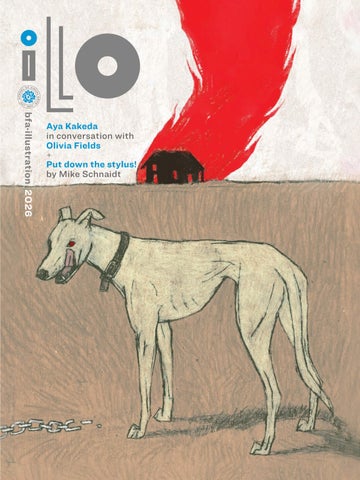
bfa. illustration 2O26
Aya Kakeda in conversation with Olivia Fields + + Put down the stylus! by Mike Schnaidt
2
Student Name URL/SOCIAL MEDIA
Student Name URL/SOCIAL MEDIA
• BFA ILLUSTRATION •
2O26
1
IN LIEU OF INTRODUCTION
“Good is not enough when you dream of being great” was the tagline on many of SVA’s signature posters designed to hang in New York City subway stops. SVA is the longest-running advertising client of the subway system, and the College’s iconic posters have inspired countless students. I encountered one of these posters the first time I visited SVA 35 years ago. Why be good when you can be great? That’s how I interpreted the poster. Instantly, I knew I had found my school. The tagline looms large not only when we curate our students’ work for ILLO and assess our graduates’ accomplishments but also when we examine our own achievements. Similar to Janus, the Roman god of beginnings and endings whose two faces look in different directions, we use a double perspective to constantly evolve. We value calibrating and leveraging opportunities for growth in multiple directions. Our teaching philosophy incorporates a range of professional experiences, such as exhibitions, portfolio reviews, and unique collaborations (with organizations such as NASA), new shows in Seoul, and the MoCCA and Pictoplasma festivals.
From pigments to pixels, illustration is a unique artistic language that requires expert communication, collaboration, and expressive skills. Our students master these skills thanks to strong critical thinking, well-trained visual perception, an effective personal process, paper, pencil, and stylus. In a profession where change is the only constant, our graduates excel in a number of exciting industries and adapt to evolving technologies and modes. We prepare our students to do so by focusing on solid fundamentals, development of great ideas, and powerful storytelling. From pigments to pixels, illustration is a unique artistic language that requires expert communication, collaboration, and expressive skills. Our students master these skills thanks to strong critical thinking, well-trained visual perception, an effective personal process, paper, pencil, and stylus. This introductory note would be incomplete without recognizing the many talents going into this publication, including our gifted students, our long list of outstanding faculty, and our devoted department team. I am deeply grateful to the tireless Carolyn Hinkson-Jenkins, Matthew Bustamonte, Jason Little, Kelsey Short, and Heaven Boles for their passion, ideas, and care in introducing our brilliant graduating class of 2026 to the industries they are about to transform. See you at school. Viktor Koen Chair, BFA Illustration and BFA Comics
SENIORS
Leyla Cui Yihan Liu Sue Kim Phoebe O Chou Mika Liang Elika Jiang Rachel Guan Anna Coste Wen Wu Naomie Desilier Rofair Crystal Bao Wenxin Gu Yitong Qi Xingyi Sun Nandinie Andlay Anna Wang Yi Zhong Margaret Huffman McKen’z Zang Tiffany Zhao Yuanzhe Guo Alba Aulie Naomi Zhan Lal Diltemiz Yuetong Zhou Zhengtian Wang Paula Roca-Guiulfo Ema Lauren Cadacio Lumi Xue Owen Sussman Kanghua Wang Leqi Zhou Ji Young Kim Thaw Isabella Parra Siyi Wang Rundong Chen Xinyuan Hou Xiaotong Yi Derrek Fan Vivian Xu Joyce Yuan Qiyue Li Carl Warren Minglu Wang Lexi Zhu
22 24 26 28 30 32 34 36 38 40 42 44 46 48 50 52 53 54 55 56 57 58 59 60 61 62 63 64 65 66 67 68 69 70 71 72 73 74 75 76 77 78 79 80 81 82 83
BFA Illustration Senior Thesis Faculty ST EV E B RO DN ER M A RCOS CH I N JOS H CO CH RA N DAV I D CO O P ER J EN S I N E ECKWA L L L I S K F EN G V I KTO R KO EN EL I OTT L I L LY A N T H O N Y M ACBAI N M A RV I N M ATT ELSON CH R I ST I A N M CG RATH L I LY PA DU L A JO N AT H O N ROS EN M ATT ROTA YU KO S H I M I ZU V ES P ER STA M P ER SA RA H VACCA R I E L LO SA M WEB ER
Cover: Alba Aulie albaaulie.net
p e Ke S VA
Wei rd Aya Kakeda and Olivia Fields Advise Students to Be True to Their Artistic Selves
Aya Kakeda • Original Artwork (partial) • 2025
right: Olivia Fields • Bouquet • 2022 | left: Aya Kakeda • Original Artwork (partial) • 2025
Two SVA community members, Aya Kakeda (MFA 2002 Illustration as Visual Essay) and Olivia Fields (BFA 2019 Illustration), had a conversation about balancing workload, staying inspired, and finding an artistic voice. Kakeda is an award-winning illustrator whose clients have included The New Yorker, Nike, Disney-Hyperion Books, and more. Fields is an illustrator whose clients have included The New York Times, A+E Networks, Cartoon Network, and more.
What was a particularly exciting or unexpected job? OLIVIA FIELDS (OF): Definitely the Google Doodle I did for Martin Luther King Jr. day. That’s one of those dream jobs where you think, “Wow, it would be great to do a Google Doodle one day,” but you don’t really know how it’ll happen. The art director at Google just reached out and asked if I was available for the job. Of course I said yes, even though I had other jobs at the time. It’s like any other editorial job I’ve done. Sending in sketches, the creative
team picks one, and you do your edits until you have the final product. I got to do whatever I felt worked best. It was so exciting. I couldn’t wait for everyone to see it, but, because I turned in the illustration so far in advance of Martin Luther King Jr. Day, I couldn’t say anything about it until the image went live. I was just watching the computer screen, waiting for the doodle to change over, which I think is at midnight. That was such a fun day. What advice do you have for emerging illustrators who are building confidence in their skills? AYA KAKEDA (AK): Doubting yourself is a good thing because it means you’re serious about your work and wanting to do better. I think not having any self-doubt would be a bigger problem. OF: Think about what you’re making, why, what it makes you feel. I have to constantly ask myself, “What am I trying to convey here?” AK: With illustration, communication skills are so important. Whenever I got
really stuck, I had to remember that I could always ask questions. When you are starting out in your career as a young artist, it can be intimidating to ask for help. You have to do your part, but you have to know that you can talk to your collaborator. Starting out, I thought I couldn’t ask my art director any questions, because it would prove that I am incapable of delivering a good illustration, like I don’t understand or know what I’m doing. But with some experience, I realized you are usually one part of a larger team, working with an art director, editor, writer, or engineer, etc. Art directors, they love to talk to illustrators. It can be fun when the work feels more like a collaboration. How do you manage multiple freelance jobs? How do you organize your work? OF: Some editorial jobs have a quick turnaround. They need it done in a few days or even less … but I also like to have more time to work on things. So, if I have the option, I will take on the work that gives me more time. I usually juggle between editorial work and then any personal projects I’m working on.
Olivia Fields • Juneteenth Illustration • 2023
AK: It’s always good to have your own practice. I think I work exactly the same way as you [Olivia] have. I do my best to have that schedule laid out. Right now, I’m working on a gallery show with a long lead time, and I want a really fast editorial job to break up the pace. I like to have something with a long deadline. But I don't mind doing something with a quick turnaround in between. You can get tunnel vision on the long project, thinking about it a lot, putting so much energy [into it]. A short editorial job is a nice brain exercise. You suddenly have to switch up the way you think.
How did your style develop over time? Do you think it’ll change over the coming years? OF: I gradually developed my artistic voice through exploring different mediums and working different jobs. Keep experimenting and seeing what you’re drawn to. And then, as time progresses, a style will just come naturally from it. So you just take the time to experiment with different mediums that you’re drawn to and see what you’re inclined to. Everything kind of falls into place from there. Style is always going to change and develop as time progresses.
AK: Everyone forgets that a personal style can change as you progress. That’s the key, especially for a student, you don’t have to find it. It comes to you with regular practice. It’s a lesson everyone wants to learn or figure out immediately, but you can’t force it. What is a piece of advice that has stayed with you? OF: From my own experiences as an illustrator: Draw what you enjoy and not what you think other people will want to see from you. In this digital day and age, another
thing that can impact young artists is just how we engage with artwork online. What people are gravitating towards could impact what you think other people would want to see from you. Any work that you enjoy doing is going to show in the final piece. And, even if you don’t find your audience right away, it is there, and you don’t necessarily have to make work that you think other people want to see. You always want to stay true to yourself first and foremost. You should always be making the work that you want to see more of. I feel most fulfilled as an artist when I’m making the work that I want to make. I know that’s something that can also be a little tricky when it comes to specifically editorial illustration, because it’s like, a job is a job, and you’re not necessarily always going to be doing a job that you want to do, but you also have to try to make space for yourself in the work that you want to put out, in addition to the work that you’re making for others. AK: Something a professor told me while I was in school was that you don’t need to be the most popular illustrator. You just need to be the last one standing. When I remember this advice it helps to calm me down a bit. I just need to focus on my own path, and I don’t have to rush to become successful. That’s when you enjoy art making and process the most. I think similar to what you said, Olivia, that now there’s so much illustration, so much information available to us. If you open your laptop or your phone and look at a lot of illustrators’ work on Instagram it’s easy to think, “Oh, this is what people want.” So I tend to get my inspiration from watching a film or reading a book or just, you know, talking to my friends or going to a library, life experiences, and using that to develop my own unique voice in the illustration world. And also, like what we’ve been talking about, have your own practice outside of illustration, like building a sculpture, it could be just journaling and doodling and your sketchbook. Having your art practice is very important. OF: It’s important to find inspiration from more than just online spaces, like you have to look at your own life and books and movies and different types of media. Even from conversations between other creatives and things like that. It provides
a sense of community. In my experience as a freelancer, a lot of the time I’m at home working, and I only leave the space when I’m going to work on my own personal work, like when I print at the RisoLAB at SVA, or if I go to the screen-printing studio, or if I meet up with friends for drawing time, and stuff like that. Or if I go to shows because that’s also another way of interacting with, not just potential customers or my audience, but also other creatives who are making work that inspires me. It’s important to be out there in the world and experiencing things, because all of that can inform your work, too.
about art school, finding community and having all those resources to work with. As a student you really need to take advantage of every facet of your education, and take some big risks. Sometimes when I’m working I worry I’m making something too weird for commercial illustration, but you only need to find one art director who believes in your work and wants to work with you. And once you have published work, that will bring in more work as people are drawn to it. I feel like being a weirdo is a good thing. OF: Yes, everyone has to be weird. Stay weird, everybody! ⬥
AK: Finding your own community is so important, right? That’s the best part Olivia Fields • xuxuduoduo • 2023
Aya Kakeda • Self-Portrait 1 of 3 - Ceramic/Glass • 2020
Olivia Fields • RE: Think • 2022
Olivia Fields • Dear Hendrix Column Illustration • 2025
Dr. Emma Cheng • mind blowing • 2024
Put Down the Stylus! A BFA Illustration Instructor Wants His Students to Master the Craft of Imperfection
BY MIKE SCHNAIDT CREATIVE DIRECTOR, AUTHOR, SVA FACULTY
W
hen I’m not teaching at the School of Visual Arts, I’m a creative director at the media brand, Fast Company. There, I recently experienced a seemingly insignificant incident that fundamentally changed how I think about machine-made perfection. I was watching the Fast Company CEO sketch a flywheel representing how the business’s departments work together. The drawing wasn’t anything special. Using a thin, black Sharpie, she scribbled five concentric arrows around a circle. Then, she asked me to recreate this sketch in vector format, but my editor in chief interjected: “You know, I like your sketch. It feels very human … very anti-AI.” His response, joking or not, stuck to me like rubber cement. Prior to 2026, the perfect geometry and crisp linework of a vector infographic would have symbolized a deeply considered corporate strategy. But now, we’re inundated with AI-generated videos of fruits on Love Island and nonexistent musicians named Sienna Rose with three-million listens on Spotify. As a result, proof of authorship has become more important than perfect polish. And those imperfectly scribbled curves and arrows of the flywheel are one way of showing authorship. If flaws are key to originality, then using technology to increase speed and optimization is at odds with visual authorship. That function of technology becomes a big, gray, kneaded eraser wiping out imperfection. And I see that metaphorical eraser’s
little graphite-stained shavings all over my classroom at the School of Visual Arts. In my course, Working with the Art Director, I give my students illustration assignments, like crafting labels for a kombucha brand or designing travel posters, that are inspired by real-world work. Students are required to sketch multiple ideas, generate color variations, and revise final artwork. Choosing the stylus over the pen, most students use Procreate because it speeds up the process. Considering their workload, optimization is an essential tool. But if the stylus is a tool of optimization, then is it not so much a tool for creation (like the pen) as it is an eraser? The stylus wipes away necessary imperfection from the student’s work. Imperfection that shows they are human and hireable. However, a creative professional has to be able to create imperfection with a sense of control and confidence. But intentional imperfection goes beyond just adding a wobble to a line, or spilling coffee, or messing up a puppet’s fur. AI will quickly learn how to replicate these tactile foibles, and viewers will experience greater strain in ferreting out the bad imperfection. Fortunately, the most successful artists don’t have shaky hands—they have focused minds. So the real question I’d like to see illustration students tackle is: How do you achieve an imperfect mindset? Let’s go back to my editor in chief’s office where the CEO’s
Christian Gralingen • Dear Hendrix Column Illustration • 2025
Liam O’Farrell • Dear Hendrix Column Illustration • 2025
Tom Froese • 2024: The year in review • 2024
Liam O’Farrell • 2024: The year in review • 2024
Tom Froese • 2024: The year in review • 2024 Tom Froese • 2024: The year in review • 2024
sketch changed my mind about the art direction of Fast Company. Seven years into my tenure as creative director, AI’s disruptions were rapidly rippling through the art world. I felt like my team needed some fresh direction. I wanted to dial back our use of vector illustration. Up until this point, vector illustration made perfect sense for Fast Company. Its slick, machined appearance transformed complex concepts, such as supply-chain management or quantum computing, into simple visuals. Sure, it made sense— but maybe it made too much sense? It was my decision to use vector illustration, but I began to wonder what my team thought about our art direction. To learn more, we met to reflect upon our favorite work from 2025. The imperfect, handmade work stood out. One art director used paper to form the word “Design” for a story title. She experimented with different paper stocks, fold styles, and lighting setups. She said, “I just really enjoyed getting away from the computer to craft.” That outlook helped me understand what exactly appealed to me about imperfection. Craft implies authorship. It is both the process and the outcome. Imperfection is but an artifact of the creative process. With this new perspective, I asked my team to present their definitions of craft. This would engage them as authors. They shared sun-bleached trading cards, amorphous clay puppets, unevenly stitched blankets, scanner-distorted images, and misprinted Risographs. There was a little wabi-sabi in each. As we discussed these visuals, we kept arriving at the same notion: by showing the process, the author is revealed. That idea became the nucleus for my new art direction. I believed that if my choice of illustrators wasn’t so machined and perfect, it would reveal my thought process. Very meta, I know. For our first issue of 2026, we assigned an illustration to Liam O’Farrell, who paints in watercolor. We assigned one to Dr. Emma Cheng, who renders medical illustrations with colored pencils. We assigned another to Christian Granlingen, whose illustrations resemble misprinted construction site diagrams. And we assigned a digital magazine cover to Tom Froese, whose illustrated scenes look like they were crafted with cut paper, drawn with charcoal pencil, and printed with a Risograph machine. In addition to these illustrations, my team’s presentations inspired our design. One art director shared a video of a pen plotter machine. A small metal clamp raised up a thin black Sharpie, moved it along a silver metal track—click, clack—and lowered it down to draw on a piece of paper. The drawing was the result of a vector file which was fed into the machine. Despite its humming servos and metronomic-like beeps, the robot drew lines that were uneven in density. One photo editor said: “This is good imperfection! It’s where the human is in control of the machine.” The stylus is a small machine that we can hold in our hands. Let’s twirl that stylus between our fingers. Take note of its weight. The stylus is heavier than the brushes and the pencils and the pens in the artist’s toolbox. Its weight is the result of a long, thin lithium ion battery that hides beneath its shell. That battery powers its possibilities. If we slowly depress the pen’s rubber tip onto the screen of the iPad, india ink will pour out. If we sketch at a light angle, a pencil mark will dash across. And if we close these lines and form a shape and tap inside of it, the shape will fill with color.
11
Dr. Emma Cheng • Long walks have improved my health tremendously • 2024
Mark-making forms an artist’s illustration style. That style defines artists as authors. Each of my students could be the next Liam O’Farrell, the next Dr. Emma Cheng, the next Christian Granlingen, or the next Tom Froese. Each of their styles, whether it’s watercolor or colored pencil, are visual shorthands for art that was once created by hand. Each of those illustrators needed to stumble, to find their wabi-sabi, and to incorporate it back into their process. During which, they solidified their identities. So here’s what I have to say to my students at SVA: Put down the stylus. Put down the stylus, even if just for a day. Take some time to craft. Don’t worry about what is successful or what is original. Allow some mistakes to thrive in your work. Those mistakes are what will make your work look human. And that’s what we all want to see. Don’t fear AI. Some days, you’ll need to work quickly and you’ll need to be the mason. AI is the wheelbarrow to carry your bricks. Use it for brainstorming. Use it to generate image reference. Use it to do research. But fact-check everything that comes out of it. And don’t listen to every single suggestion that it offers. Remember: AI, like the biggest loudmouth in a bar, will always have an answer—even if it’s the wrong one.
Oh, and if you’re wondering: Yes, I did recreate that flywheel as a vector file. The presentation called for functional polish. (Think of it this way: You wouldn’t want a messy New York City subway map, would you?) And, yes, I still do hire vector illustrators from time to time. But, I hire ones like Bratislav Milenkovic. Why? Because he creates overly layered, maximalist vector artwork; there are always too many elements in his compositions and I love that.
A few months ago, I needed a break from technology. So, I attended a local art class in Jersey City. I wanted to make art, by hand, with a few friends. The instructor demonstrated the monotype print technique. One of the characters in his monotype illustrations looked like the love-child of an anatomical figure and a courtroom portrait. I wish I could name an illustrator whose work it looked like. But I had never seen anything like it before. Be the artist who makes something only you can make. ⬥
Christian Gralingen • Long walks have improved my health tremendously • 2024
TO BE A HUMAN BEHIND THE CREATIVE ENDEAVOR
The process is the whole point of illustration. So when new technology threatens to erase the process, my first thought is, why bother making art at all? Erasing the process also removes the chance to experience human connection, yet illustrators are told to find a way to put themselves into every piece, even if it’s a job for a client. It’s the need for human connection that gives me hope for the field of illustration. At the same time they are suffusing their work with themselves, working artists are also constantly reinventing themselves, oftentimes out of necessity. Any obstacles that artists face in the near future will lead to more invention and re-invention, but what will remain constant is
Patience and perseverance are always going to be key components of the artistic process, often most urgently needed at the end of a hard task or difficult period. In some ways, to be able to persevere and have patience is the most rewarding part of the process. that there will always need to be a human behind the creative endeavor, and people will always be drawn to drawing and making. So, the years artists spend developing skills (both artistic and personable) and taste are never wasted. These years of investment and invention and reinvention can be daunting to emerging talent. But I wish my students would look beyond how fast they can make something. Can something made in a few minutes, without a human hand, be entertaining, or interesting, or thought-provoking? Can it move someone to tears or to laughter? I often hear students brush aside such questions with a simple, “It’s close enough,” as in, it is close enough to how the human hand would create. But “close enough” feels like settling for good enough. The image, the final product, is so much more than just a random rearrangement of pixels. If the human element of illustrating, or writing stories, or making films is removed, is there a point to the image at all? Are we destined to accept something made in an instant, without meaning, or motive, or intent? Here, at SVA, we challenge our students to trust the process, trust the artist, and trust their own taste, preparing them for however the field may continue to evolve. Kelsey Short Coordinator, BFA Illustration
Student Name URL/SOCIAL MEDIA
2026 BFA ILLUSTRATION
Portfolio Selections
21
22
Leyla Cui LEYLACUI.COM
23
24
Yihan Liu @VIVY_2022
25
26
Sue Kim SUEKIMILLUSTRATION.COM
27
28
Phoebe O Chou PHOEBE-OCHOU.COM
29
30
Mika Liang MIKALIANG.COM
31
32
Elika Jiang @UNIDUSTT
33
34
Rachel Guan @RACHELGUAN_ARTWORK
35
36
Anna Coste ANNACOSTE.COM
37
38
Wen Wu WEN_WHERE
39
40
Naomie Desilier NAOMIEDESILIER-ART.NET
41
42
Rofair @ROSOLFAIR
43
44
Crystal Bao CRYSTALBAO.COM
45
46
Meixian Ren MEIXIANRENART.SQUARESPACE.COM
47
48
Yitong Qi @YITONG.INK
49
50
Xingyi Sun XINGYISUN.COM
51
52
Nandinie Andlay NANDINIEANDLAY.XYZ
Anna Wang XINGYUWANG.CARGO.SITE
53
54
Yi Zhong YIZHONGART.COM
Margaret Huffman CRITICALLY-NERDY.COM
55
56
McKen’z Zang RAINBOWSTRIKEART.COM
Tiffany Zhao @MINCED.CHILD
57
58
Yuanzhe Guo YUANZHEGUO.COM
Alba Aulie ALBAAULIE.NET
59
60
Naomi Zhan @VYNICEXX2048
Lal Diltemiz RUBINRUBIS.MYPORTFOLIO.COM
61
62
Yuetong Zhou YUETONGZHOUART.CARGO.SITE
Zhengtian Wang @WANG_XIAO_ER_
63
64
Paula Roca-Guiulfo PAULAROCAGUIULFO.COM
Ema Lauren Cadacio EMALAUREN.COM
65
66
Lúmî Xue @LUMIPATCHI
Owen Sussman OTSUSSMAN.COM
67
68
Kanghua Wang @KRIS_W163
Leqi Zhou @LEQIART
69
70
Ji Young Kim YOUNG080.COM
Thaw SHANXUEARTCENTER.NET
71
72
Isabella Parra @WHIMSISA
Siyi Wang PEPEKO-SIYI.COM
73
74
Rundong Chen RCHEN3911.WIXSITE.COM/MY-SITE-8
Xinyuan Hou @SUMII_PIPEHEAD
75
76
Xiaotong Yi @ IMXT0X0
Derrek Fan
77
78
Vivian Xu VIVIANXU-ART.COM
Joyce Yuan HTTPS://JOYCEYUAN.ART/
79
80
Qiyue Li @QIYUELI_ART
Carl Warren @CARLWARREN.ART
81
82
Minglu Wang @MINGLUART
Lexi Zhu LEXILOAFS.WORK
83