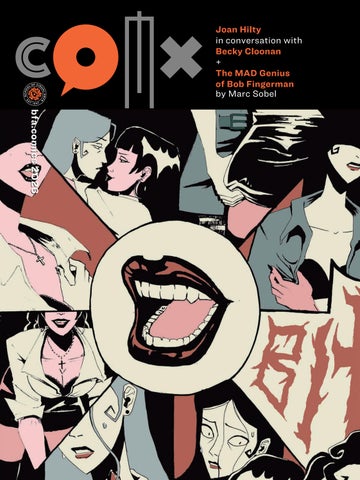
Joan Hilty in conversation with Becky Cloonan + The MAD Genius of Bob Fingerman by Marc Sobel
bfa.comics 2O26
2
Student Name URL/SOCIAL MEDIA
• BFA COMICS •
2O26
Student Name URL/SOCIAL MEDIA
3
IN LIEU OF INTRODUCTION
Seventy-nine years ago, Silas H. Rhodes and illustrator Burne Hogarth (of Tarzan fame) co-founded the Cartoonists and Illustrators School, with New York City–based art professionals as faculty. Reflecting the belief that there is more to art than technique, the institution changed its name to the School of Visual Arts in 1956. Our BFA Comics Department manifests this great legacy not only through our legendary faculty but also through its contribution to changing perceptions towards this unique form of storytelling. Over the years, our faculty has included artists such as Will Eisner, Harvey Kurtzman, Art Spiegelman, Jessica Abel, Gary Panter, David Mazzucchelli, Bill Griffith, Diane Noomin, Klaus Janson, as well as distinguished alumni like Wally Wood, Steve Ditko, Peter Bagge, Kyle Baker, Ray Billingsley, Leslie Stein, Becky Cloonan, Raina Telgemeier, Dash Shaw, Nate Powell, and Lee Knox Ostertag. I was hired at Marvel in 1992, and, when reflecting on the growth of the comics industry over the course of the past 34 years, I can clearly see how comics have established themselves as a deeply respected language of sequential expression, an art discipline, a field of academic study, and a professional career path. The impact of this business becomes clear when considering its publications alongside the range of industry conferences and festivals. Such events include analysis-driven academic symposia; independent events, like MoCCA, SPX, or MICE; the big comic-cons in San Diego and New York; and a plethora of smaller, grassroots comic book events. Comics is a powerful industry with some of the most devoted fans and tight-knit artistic communities.
Comics have established themselves as a deeply respected language of sequential expression, an art discipline, a field of academic study, and a professional career path. COMX 2026 showcases notable senior accomplishments by representing a tiny sample of the ink, sweat, and tears that go into the creative process, speech bubble by speech bubble, panel by panel, page by page. To accompany this visual celebration, we also commissioned critical essays exploring interesting facets of the field and interviews between respected SVA faculty mentors and the alumni they’ve impacted. This introductory note would be incomplete without recognizing the many talents going into this publication, including our gifted students, our long list of outstanding faculty, and our department team. I am deeply grateful to the tireless Carolyn Hinkson-Jenkins, Matthew Bustamonte, Jason Little, Kelsey Short, and Heaven Boles for their passion, ideas, and care in introducing our brilliant graduating class of 2026 to the industries they are about to deeply transform. See you at school. Viktor Koen Chair, BFA Comics and BFA Illustration
SENIORS
Taylor Fogarty Erin Eicher Benjamin Young Valentine Schultz Isabella Matos Seraphim E.V. Bear Lindsay Hamilton Ry Hasenaur Kassidy Yoon Yage Wang Lila Ozture Mingxuan Cai Sam Clouden Yasemin Yilmaz Elizabeth Andre Mateo Sandoval Raven Mejia Daniel Rincon Yusia Xiao Benjamin Young Varian Rojas Nathanael Stoddard Marshal Deruso
BFA Comics Senior Thesis Faculty JOS H BAY ER N I CK B ERTOZZ I G I DEO N K EN DA L L DAV E RO M A N
Cover: Linds Hamilton snosoldat.carrd.co
18 20 20 21 22 23 24 25 26 27 28 29 30 31 32 34 36 38 40 42 44 46
Becky Cloonan on Doing Your Own Thing The Comics Creator Tells Editor Joan Hilty about How She Stays Motivated and Inspired
Covers and an interior page from Demo by Brian Wood and Becky Cloonan. © 2008
B
ecky Cloonan won two Eisner Awards in 2024, including Best New Series for Somna: A Bedtime Story in collaboration with English comic book artist Tula Lotay. Cloonan also won an Inkpot Award in 2023. She has taught at SVA. Joan Hilty is a faculty member in BFA Comics and works at Nickelodeon Animation.
JOAN HILTY (JH): When did you get into comics, both as a reader and also as a practitioner? BECKY CLOONAN (BC): My dad used to buy Silver Surfer and Fantastic Four books when I was a kid, so I’d get weird Jack Kirby stories for bedtime. Then manga got me. VIZ was putting out Ranma 1/2 and Maison Ikkoku in single issues back in the day. I wanted to do comics since I was a kid. JH: Tell me about your time with the Estrigious collective. BC: It was myself and two other animators and two girls from SVA’s cartooning department, so we formed this little collective called Estrigious. We were doing conventions together, and we would do a lot of fan art. You could go make a bunch of prints and sell those for like, you know, five bucks. Made them at Kinko’s, and made short illustration zines. So there weren’t necessarily comics in them, because I don’t think we were yet capable of making comics. This was, like, 1999, I think, or 2000, something like that. And that was my first experience with trying to hold people to deadlines because I was the one in charge. It was such a useful thing to have done. I’m still friends with a bunch of them.
Pictured here are Gerard Way and Becky Cloonan. ©2013 Anna Milanollo
JH: Meathaüs, the other collective you were in, was very much where your comics got started, and I think that informed the way you’re so super-collaborative. You’re well known for your prolific output across different genres. But you also are a prolific collaborator, with everyone from Brian Wood to Gerard Way, and, more recently, Tula Lotay. BC: I have a little spark of competitiveness in me. I see someone doing something, and I’m like, “Oh, man, they’ve set the bar this high. I wonder if I can reach that.”
It’s always been inspiring to me to have someone to talk shop with. Comics can be so lonely when you’re drawing them, unless you have a studio with someone. So it’s just nice to have people around you working on something. Like with Tula and I doing Somna, you know, if I was feeling stressed out or, not really motivated today, I’d get a text from her with stuff that she’s working on, and then all of a sudden I’m like, “Oh my god, this is so good, like, I want to draw right now!” JH: What would you say are some of the key things that you learned from these collaborations? BC: A big thing, I think, especially working with writers, as an artist, is you’re going to be drawing things that you might not want to draw. I'm struggling with this right now, where I'm getting stuff in the script and like, “I don't know how to draw this.” But it’s challenging you, and it’s making you better. If left to my own devices, I would be drawing people in forests all the time. But having to draw [new] things definitely makes you better as an artist. It’s like doing art push-ups or something. You don’t want to do them, but you probably should. So your range gets better. You’re telling stories you would not tell otherwise. And when I’m working as a writer with an artist, we’re doing something together that I would never have done on my own, even though part of it came from me. JH: It’s a privilege, working collectively with all those people who all go on to have these really interesting, diverse careers. BC: Having people that you can talk to in person, especially if it’s a collaborative thing—there’s something intangible but so important that comes from seeing each other in person, even if it’s just getting to know your creative partner. You know Tula Lotay. In the UK, I get to see her at cons a lot, and every time I’m over there, I always try and be like, “Okay, I’m going to squeeze in an extra week while I’m here, and I’m going to go visit her and, hang out with her and her family. And even if we don’t talk about the book or work on it that much, we will end up having some kind of breakthrough by the end of it, where it’s like, “This was the
Covers and an interior page of The True Lives of the Fabulous Killjoys by Gerard Way, Shaun Simon, and Becky Cloonan. ©2024
Covers and an interior page of Somna by Becky Cloonan and Tula Lotay. ©2024
missing piece!” Or like, “Oh, what if we did that?” It’s those moments that I think are so important. If you are having a long-distance collaboration, I highly suggest hanging out in person if you can. I don’t think comics is necessarily who you know, but it does help so much when you can get in and meet people, because you just end up finding a connection where you didn’t think one existed. That’s how my life has been, people introducing me to other people. JH: What advice do you have for up-and-coming comics artists? BC: Oh, man, I’ve got so much advice. I like when people are showing me their work, their comics, either mini comics or portfolios. It’s nice when you get a comic that you can tell someone’s made with their full heart. I love when people are earnest in their art, and not ironic with it, and when people are excited about what they’re doing. And I think comics is a very special medium where that really comes across. As far as advice goes… Comics are so hard, but it’s only hard because the work seems daunting. And I think some of the best advice I got when I was younger was to start smaller. Because I read manga, I’d got this hundred-page graphic novel idea in my head. And someone was like, “You’re never going to do that. Just start small. Just make one-page comics.” So I started just making one-page comics. And then after a month of doing that, you’ve got 20 one-page comics. And then you start being like, “I’m going to do a three-page comic.” They don’t even have to have a plot or a story, just a beginning, middle, and end. You do enough of those, and you’ve got a full mini-comic of five three-page stories or something, and it just continues from there. One of the first books I did was Demo. It was 12 issues, but each issue was a single story. So it was like, “Oh, I don’t have to think about this as a long thing. I can think about it as 12 short things.” And it really helped me get my endurance up. You get used to doing a page a day, and it’s such a slow, incremental process that it’s easy to lose track of the big picture. Look at the big picture. Don’t get discouraged, even if it’s taking a long
time. Don’t pin hopes on social media, don’t obsess over how many likes you’re getting. That doesn’t necessarily translate to people reading your work. But at the same time, I’ve done books that I was so happy about, and then there’s, like, no reception. Like, “Oh, nobody read this thing that I spent a year working on!” You have to learn how to be satisfied with doing the work and having done the work. If it connects with people, that’s really what I'm concerned with. Not the number of people, but that it has connected with at least a few people. Someone can pick it up and be like, “I read that, and it resonated, and it made me want to do my own thing.” That’s what it’s all about, right? You make something, and it inspires someone else to make their own thing. You can see the influence of Guy Davis all over my work; it’s that through line that you’re passing on to someone else. And that's the beautiful thing about what we do as storytellers. JH: You have to love making it, and you have to trust that your love of making it will cause it to find its audience. BC: And don’t let the fear of no one reading it stop you from doing that. Just make the thing if it makes you happy, that’s why we should be doing it.
Copies of Gotham Academy published by DC Comics. ©2014
From Somna by Becky Cloonan and Tula Lotay. ©2024
From <i>Demo</i> by Brian Wood and Becky Cloonan. ©2008
The MAD Genius of Bob Fingerman How Meeting a Hero at SVA Launched an Illustrious Career BY MARC SOBEL
All images © Bob Fingerman.
T
he following tale was contributed by Fingerman-fan Marc Sobel. Sobel himself is a three-time Eisner-nominated comics author. Fittingly, the Will Eisner Comic Industry Awards were named for the longtime SVA instructor who was one of the most innovative American cartoonists and publishers. SVA BFA Comics values building relationships with professionals active in their field, like Sobel.
Every cartoonist has a story about their “big break,” but few have one as auspicious and consequential as Bob Fingerman’s (1984 Cartooning) entry into the comics industry. In 1982, Fingerman enrolled at the School of Visual Arts, hoping to find his place in the comics industry. In his second year, he took a class taught by his hero Harvey Kurtzman, a founder of the legendary MAD magazine. It’s hard to overstate MAD’s influence not only on comics but also on comedy more broadly. In The Comic Book in America: An Illustrated History, Mike Benton explains that MAD’s noholds-barred satire reshaped popular humor and left a lasting imprint on an entire generation. The early issues of MAD primarily mocked other comics and newspaper strips, but, after its 1955 transition to a magazine format, it shifted to satirizing not just comics but everything in American culture—from television and movies to books and advertising—“with a cynical incisiveness that forever captured a growing readership of irreverent adolescents,” as Benton explains. Like many Gen X cartoonists, Fingerman was weaned on Kurtzman’s subversive humor, and it became part of his creative DNA. It was serendipitous—and a dream come true—that Kurtzman launched Fingerman’s career. In Simone Bargetze’s 2025 interview with Fingerman, he recounted how his big break manifested: One day… I left my personal sketchbook on my table in Harv’s class and went to use the bathroom. When I returned, there he was, paging through it with a consternated expression on his face. He looked up and saw me in the doorway. In his frail, raspy voice, he croaked, “Fingerman, we need to talk.” … He said, “I didn’t know you could draw.” Kurtzman must have been impressed because, next, he offered Fingerman a job. The gig was drawing strips for a children’s paperback version of MAD called NUTS! Kurtzman tutored him in the art of storytelling. In his book, Recess Pieces Reanimated, Fingerman elaborates, “As an editor he was everything I’d hoped for. I was getting the education I wanted from him, only out of class.” This apprenticeship, so early in his career, was transformative for Fingerman, and it sharpened his approach to making comics: “It made a huge difference in my work from that point on, because it forced me to think more before I would just start drawing,” as Fingerman said in his 1998 interview with Kent Worcester in The Comics Journal. NUTS! only lasted for two volumes, but, by then, Fingerman was primed. In the mid-1980s, he began contributing strips to Cracked, the longest-running and most successful of the numerous MAD knockoffs. Building on his work with Kurtzman, Cracked offered him regular opportunities to hone his craft, especially his ability to draw likenesses and caricatures—an
essential skill for satirists. One of his most infamous strips, “Pee-yoo’s Playhovel,” was a parody of Pee-wee’s Playhouse. In 1993, Fingerman resurrected an old sci-fi/body-swap story he had done for Heavy Metal in 1989 called “Double Uh-Oh!” and expanded it into his first full-length graphic novel, White Like She (Dark Horse Comics), a Roger Corman–style gender-bender inspired by 1970s blaxploitation films. While the story blends science fiction with social commentary, it’s less overtly comedic than anything else in Fingerman’s oeuvre. The following year, Fingerman began drawing Minimum Wage (Fantagraphics), his most famous and longest-running series. It started as a 72-page pilot issue and continued for 10 issues through 1999, and it was later revived for 12 new issues at Image Comics in 2014–15. The series arrived at a moment when alternative comics were becoming increasingly personal and idiosyncratic, and Fingerman, inspired by cartoonists like Chester Brown (Yummy Fur), Dan Clowes (Eightball), and the Hernandez brothers (Love and Rockets), set out to make a comic with broad appeal. But Minimum Wage was not just another slice-of-life comic—it could be ruthless. Throughout the series, Fingerman turned his caustic sense of humor on himself, his peers, and the world around him. With equal enthusiasm, Fingerman skewered everyone, from the cosplayers and unrepentant geeks who prowl the comic-con aisles to his fellow cartoonists. Keeping with MAD’s spirit of “humor in a jugular vein,” Minimum Wage’s misanthropic takedown of comics’ obsessive fandom goes for the throat. In 2005, Fingerman released Recess Pieces (Dark Horse Comics), a gleefully gory B-movie–style graphic novel in which a gang of wisecracking kids battle zombies overrunning their school. The book marked a major stylistic shift, as he began coloring directly over his pencil sketches, giving his linework a springier, more elastic feel, more spontaneous and energetic than the measured precision of his earlier work. For all the students and emerging artists out there, it just goes to show how important it is to let style evolve over the course of a career and a lifetime. In 2009, Fingerman released two more books that, though vastly different from each other, share the same flippant tone. From the Ashes (IDW Publishing) follows him and his now ex-wife as they wander through the ruins of a postapocalyptic New York City, reveling in society’s destruction. Connective Tissue (Fantagraphics) blends prose and illustration into a nightmarish Lewis Carroll–like fever dream narrated with relentless sarcasm. Although Fingerman’s style has developed throughout his career, we can still see his earliest influences. Echoing Kurtzman’s looser linework, Fingerman’s art in both books is a soft-focused, sepia-toned phantasmagoria of gelatinous alien creatures and tentacled mutants. That same sardonic tone carries into his later work. In Dotty’s Inferno (Heavy Metal, 2016), Fingerman spoofed Dante’s Inferno by depicting eternal damnation as a dead-end office job. Half of the strips follow Dotty, a former sex worker condemned to an afterlife working in Hell’s HR department, while the others feature Ralf and Borax, demonic sewer workers. In 2017, Fingerman’s career came full-circle. Simpsons artist Bill Morrison became the executive editor of the MAD reboot and offered Fingerman an opportunity to create a strip for the series. The kid shaped by MAD had grown up, developed a successful career, and, at last, became a MAD contributor.
To this day, Fingerman continues to produce work at a rapid clip. In 2025, he released new books with Cosmic Lion Productions, including Printopia, a graphic novel companion to Connective Tissue. Fingerman’s latest book is a memoir called That’s Some Business You’re In, in which the artist reflects on his creative journey alongside copious pages of early work, original art, process sketches, and rarely seen material. Its cover features not one but two MAD tributes. The Drew Friedman–esque self-portrait of the artist being chased by his creations is an homage to a Jack Davis cover to a MAD collection. To have a sense of comics history allows a thoughtful and witty creator like Fingerman to add an extra layer of depth to his work. On the back cover of his visual memoir, a caricature of Kurtzman as a guardian angel holding a copy of NUTS! smiles down at his former student. It’s a fitting tribute. From that fateful day at SVA to this career retrospective four decades later, Fingerman’s work has never lost Kurtzman’s satirical edge. Like MAD at its best, the throughline of his wildly eclectic body of work is the idea that nothing is sacred; everything is fair game for ridicule, so long as it’s funny. Sources: Bargetze, Simone. Bob Fingerman Swiss TV Documentary. 2025. 42 min. 46 sec. https://www.youtube.com/watch?v=Akg5JQoL-G8 Benton, Mike. The Comic Book in America: An Illustrated History. Taylor Publishing Company, 1993. Fingerman, Bob. Recess Pieces Reanimated. Cosmic Lion Press, 2025.
A CREATIVE LIFE
My experience as a comics teacher is really not all that different from my life as a parent of two daughters, both of whom are now college-aged. At the end of the SVA school year, I am bursting with pride at my students’ creative accomplishments. On the final day of class, we hang all the comics pages on the wall for a last celebration. We eat doughnuts, and I take a lot of videos and photos. I want to be able to capture the intensity of that feeling of pride and be able to look back on it and remember. I feel very much like a proud papa on this day. I collect a copy of each student’s finished printed comic book, each one a valuable keepsake to me. After 20 years, I have quite an extensive archive of student comics. Some of these student cartoonists have gone on to successful careers in comics, and a few are quite famous. In my head, I hold a record of each student’s journey through my course, and each one of them is different. A few of them stumble over certain skills, some of them struggle in their pursuit of mastery, and a few show total brilliance in the execution of everything they put their hand to. Some of them stumble again and again, and then suddenly experience an epiphany, lifting themselves out of a rut. Just as in parenting, all of this is made possible in the classroom through a delicate balance of challenge and nurture. Some students arrive well cultivated by family life and previous education, and so they require very little additional support. They only seem to need new creative challenges to work through. Others are not so fortunate, arriving with lingering obstacles to artistic confidence and flow. For these students, I have to dial up the nurturing in order to support them through the challenges.
My students’ parents are not in the room on that final day of class, but, if they were, I would express gratitude to them. I would thank them for encouraging their child to embrace creativity and for giving their blessing to an artistic life. My students’ parents are not in the room on that final day of class, but, if they were, I would express gratitude to them. I would thank them for encouraging their child to embrace creativity and for giving their blessing to an artistic life. Watching our children leave the nest is emotionally challenging, but we know that it is essential for them to fully leave—physically and psychologically—in order for them to thrive. It may help parents to know that they will land in a nest of a new and different kind at SVA. Jason Little Coordinator, BFA Comics
2026 BFA COMICS
Portfolio Selections
18
Taylor Fogarty TFOGARTY.COM
19
20
Erin Eicher ERINEICHER.COM
21
22
Benjamin Young BENYOUNGCOMICS.MYPORTFOLIO.COM
23
40
Valentine Schultz @ VALENTINESHULTZART
41
38
Frankie Matos FMATOS25.WIXSITE.COM/FRANKIE-MATOS
39
36
Seraphim E.V. Bear @URSAMINORLEAGUE
37
34
Lindsay Hamilton SNOSOLDAT.CARRD.CO
33 31
32
Ry Hasenaur LUNALEMONY.CRD.CO
33
30
Yage Wang @MONMONMONW
Kassidy Yoon KASSIDYYOON.WEEBLY.COM
31
28
Mingxuan Cai MICHELLECAI.COM
Lila Ozture KUWUKO.MYPORTFOLIO.COM
29
26
Yasemin Yilmaz @YASEMINY.LMAZ
Sam Clouden VIVI-VIXEN.CARRD.CO
27
24
Mateo Sandoval @MATSANDL
Elizabeth Andre ELIZABETHANDREART.COM
25
22
Daniel Rincon @LEGAL._.MAN
Raven Mejia LUNAMALUL.COM
23
20
Varian Rojas VARIANROJAS.COM
Yusia Xiao FISHYHEADY.COM
21
18
Marshal Deruso MLEEDERUSO.CRD.CO
Nathanael Stoddard @NATHANAELSTOD18
19