continued D I V I S I O N O F C O N T I N U I N G E D U C AT I O N · S C H O O L O F V I S U A L A R T S
C R E AT E / C O N N E C T/ C O M M U N I T Y
Miguel Luciano:
Artist and Educator
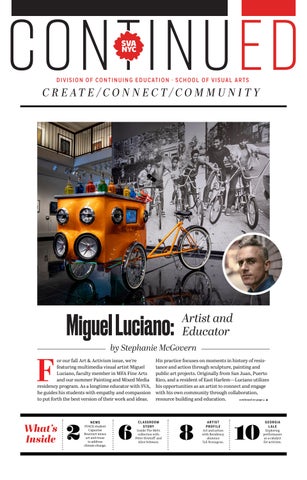
by Stephanie McGovern or our fall Art & Activism issue, we’re featuring multimedia visual artist Miguel Luciano, faculty member in MFA Fine Arts and our summer Painting and Mixed Media residency program. As a longtime educator with SVA, he guides his students with empathy and compassion to put forth the best version of their work and ideas.
What’s Inside
2
NE WS
SVACE student Capucine Bourcart mixes art and reuse to address climate change.
6
His practice focuses on moments in history of resistance and action through sculpture, painting and public art projects. Originally from San Juan, Puerto Rico, and a resident of East Harlem—Luciano utilizes his opportunities as an artist to connect and engage with his own community through collaboration, resource building and education. continued on page 4 v
CL A S SROOM STORY
Inside The Met’s collection with Peter Hristoff and Alice Schwarz.
8
ARTIST PROFILE
Art and action with Residency alumnus Yali Romagoza.
10
GEORGIA L ALE
Exploring performance as a catalyst for activism.
SVA Continuing Education News
THE BLANKET
C O N TI N UED P R O J ECT S PAC E E X H I B I TI O N S
by Capucine Bourcart
Does the ban on plastic bags mean that we will actually stop using them? Bourcart’s ongoing performance challenges how difficult it can be to shift habits. The Blanket - art performance, Pelham Art Center, Pelham, New York, 2021
Gregory McLellan Wilted Unicorn (Alter/Altar), 4K video with stereo audio that responds to participants singing and dancing, 2022 Gregory McLellan a.k.a. Tingleguts is a NYC-based multimedia artist whose recent participatory experience Herqimer draws on his lifelong obsession with music to activate new models for culture generation, learning and healing. COURSE
Music Production CFC-2059-OL FOLLOW OUR STUDENT EXHIBITIONS: #SVACESTUDENT
CO NTI NUE D Fall 2022 editorial staff Joseph Cipri, editorial director Nika Lopez, managing editor Stephanie McGovern, editor v isual arts press, lt d. Anthony P. Rhodes, executive creative director Gail Anderson, creative director Brian E. Smith, design director Mark Maltais, art director Anthony Carhuayo, senior designer Laura Valenza, editor con t ributors Rachel Gisela Cohen Nivia Hernandez Stephanie McGovern Valerie Smaldone © 2022 Visual Arts Press, Ltd. ContinuEd is published by the Division of Continuing Education school of v isual arts David Rhodes President Anthony P. Rhodes Executive Vice President
facebook.com/SVACE Instagram: @svacontinued Twitter: @svacontinued youtube.com/CETUBEatSVA vimeo.com/svace sva.edu/ce VO L U M E XC I X • N U M B ER 3 ContinuEd (USPS-004171), Copyright © 2022 by the Visual Arts Press, Ltd., is published quarterly by the School of Visual Arts, 209 East 23rd Street, New York, NY 10010. Call 212.592.2050 to subscribe. Periodicals postage is paid at New York, NY. POSTMASTER: Send address changes to Division of Continuing Education, 209 East 23rd Street, New York, NY 10010-3994.
2 • CONTINUED
FROM THE E X E C U T I V E D I R E C TO R The 50th anniversary of Title IX celebrates the American pursuit of a more perfect union—one in which the quest for equality and equity continues. Title IX has given generations of women the opportunity to engage in educational and professional goals that were previously out of reach. And yet, on this historic occasion, we have witnessed the dismantling of women’s healthcare and body autonomy through the reversal of Roe v. Wade and national politics that are absent of advocacy, empathy and consideration of women’s rights and their life choices. The Division of Continuing Education (SVACE) believes in our Constitutional freedom to dissent and protest, and supports the decisions women make for themselves, the availability of resources to uphold women’s options, and the fundamental right to make all determinations regarding their healthcare.
CONTEMPLATING ART & ARTIST RESIDENCIES WITH RACHEL GISELA COHEN
SVACE is committed to creating opportunities and inviting conversation for free expression and assembly. We believe in the powers of collective consciousness and imagination to foster positive social change. We are dedicated to highlighting your visions and voices in our classrooms, events, city streets, and beyond. As a creative community, we have an incredible gift: a synergy of artists, designers, writers, photographers, educators, filmmakers, performers, documentarians, et al., with passion, perspectives and views that can inspire, advocate and weave the pathways to change. Let us harness this gift as we begin the fall 2022 semester and prepare for the elections. I encourage all of us to reflect on our individual roles and obligations in contributing to positive change. What future would you like to see? What assistance do you need to make this possible? — JOSEPH CIPRI , on behalf of the Division of Continuing Education
3
by Valerie Smaldone 1
2
1. Artist Rachel Gisela Cohen in her studio in Brooklyn, New York. Photo taken by Sora Woo, 2019. 2. Pillow Lips, 2019, acrylic, flashe, oil stick and sequin fabric on canvas, 40x30". 3. Solar Soliloquy, 2022, acrylic, Flashe and sequined fabric on canvas, 36” diameter.
4
5
achel Gisela Cohen is a new face at the Division of Continuing Education (SVACE). As the coordinator of the Artist Residency programs, Rachel oversees the 15 artist residency programs through the College. Residencies with SVACE, available both online (The Artist Residency Project) and on campus provide artists, designers and creative thinkers the opportunity to create a global community. Rachel is an accomplished artist in her own right. Raised by a stonecarver mother and a filmmaker-writer father, she was exposed early on to people who could sustain themselves in a creative life. She recalls a former instructor of hers who challenged students by saying, “If you can imagine yourself doing anything else, do it.” That advice prompted Rachel to realize that she was dedicated to the arts and committed to that career path. Having worked as an independent curator and a museum educator,
she is also passionate about supporting other artists and showcasing their work. Rachel describes herself as an abstract painter who utilizes textiles. Her creations are explorative and colorful, and they are constant puzzles that incorporate action and reflection. “A problem that you have to solve,” she explains. Rachel recently completed a solo show, which concided with with her start at SVA. The exhibition, titled Understory, reflects on the intricacy of creatures found in the rainforest. While working at a butterfly garden in Costa Rica, Rachel spent time observing the spectacular colors of the winged insects, sparking her interest in the layers of the rainforest. Equally fascinated by the unique colorations of other species there, she was able to create a relationship between those colors and fabrics that are used and discarded by the fashion industry. Materials in her artwork are bold and beautiful, often representing hues found in the rainforest’s natu-
4. Undress (Gold Coast), 2022, acrylic, Flashe and sequined fabric on canvas, 21"x19", . 5. Understory, 2022, acrylic, Flashe and sequined fabric on canvas, 40 x 30".
ral environment. Rachel is partial to fabric made with sequins—mirroring, for example, the way a butterfly wing reflects light. Rachel has participated in numerous group and solo shows. She cherishes these opportunities because they give her space to contemplate and to “push herself to get better.” In addition to learning through shows, residencies are essential, Rachel says, because they allow artists to carve out time and space for themselves while meeting other people. She calls residencies “life-changing.” Rachel explains, “You are going to be alone for most of your life as an artist, so residencies are really important to create a network. Community is key for an artist.” Rachel fervently believes that, as a society, we need art to help us learn from each other, to understand people’s perspectives, and to ultimately grow as part of a collective human body. Asked to talk about her experience thus far at SVA, she enthusiastically says, “I would describe the institution as one of the best art schools in the world, in New York City, and a wonderful, supportive place to grow and to develop your practice.” 3
Miguel Luciano: Artist and Educator
c o n t in u e d DIVISION OF CONTINUIN
G E D U C AT I O N · S C H O O L
CO C R E AT E / C O N N E C T/
OF VISUAL ARTS
MMUNITY
Miguel Luciano: Educator
Artist and
by Stephanie McGovern
we’re or our fall Art & Activism issue, artist Miguel featuring multimedia visual MFA Fine Arts Luciano, faculty member in and Mixed Media and our summer Painting educator with SVA, residency program. As a longtime empathy and compassion he guides his students with of their work and ideas. to put forth the best version
What’s Inside
2
NE WS
SVACE student Capucine Bourcart mixes art and reuse to address climate change.
6
in history of resisHis practice focuses on moments , painting and tance and action through sculpture y from San Juan, Puerto public art projects. Originall Harlem—Luciano utilizes Rico, and a resident of East to connect and engage his opportunities as an artist collaboration, with his own community through continued on page 4 v . resource building and education
CL A S SROOM STORY
Inside The Met’s
collection with Peter Hristoff and Alice Schwarz.
8
ARTIST PROFILE
Art and action with Residency alumnus Yali Romagoza.
10
GEORGIA L ALE
Exploring performance as a catalyst for activism.
We sat down with Miguel Luciano to learn more about his recent three-year-long residency with The Metropolitan Museum of Art, in addition to his spring 2022 exhibition entitled Joy, Play and Resistance, made in collaboration with artist and friend, Hiram Maristany (1945-2022).
Could you give me a synopsis of your time spent during your residency with The Metropolitan Museum of Art and your “El Met” project? I was one of the inaugural Civic Practice Partnership Artists in Residence at The Metropolitan Museum of Art from 2018 to 2021. The residency was hosted by its Education Department and invited artists with community-based practices that are grounded in social justice to reimagine how The Met and its resources could support the work we do in our own communities. The artists involved also represented communities that have been historically marginalized and underrepresented at the Museum, so another part of our focus was to raise awareness about the concerns of our communities, while challenging the institution to become more inclusive and representative in its programming. In response to the underrepresentation of Puerto Rican and Latinx art at the Museum, I created a conceptual merchandise project that remixed The Met’s logo in Spanish as “El Met” as a provocation toward reimagining the Museum through the lens of Spanish-speaking audiences. I initially made a series of “El Met” t-shirts with the proposal that all funds from the
1
4 • CONTINUED
merchandise be used to create a Latinx art fund. It’s now an official initiative in full partnership with the museum, and we have a line of merchandise that includes t-shirts, hats, totes and coffee mugs. All proceeds from the sales will support the acquisition of Latinx art.
Can you speak a bit about the exhibition Joy, Play and Resistance at the Binghamton University Art Museum? This exhibition reflects on a long-standing dialogue with the work of Hiram Maristany, a dear friend and collaborator of many years, and one of the most important artists in East Harlem. Hiram was a prolific photographer who captured the joy and pride of the Puerto Rican community that was coming of age in El Barrio from the early 1960s to the 1970s. He was a founding member of the New York chapter of the Young Lords Party in 1969 and their official photographer. While Hiram is well known for chronicling the activist history of the Young Lords, this exhibition focuses on some of his earlier and lesser-known photographs of East Harlem. Paired with different sculptures of my own that commemorate the resilience of Puerto Rican culture in the diaspora, the exhibition celebrates themes of joy
and play as their own forms of power and resistance. We had been planning this exhibition throughout the pandemic, thinking of how important it is to reclaim our joy as an act of resistance and how celebrating in the space of our community is essential to our healing. Hiram Maristany passed away during the final stages of planning this exhibition, and we dedicated this project to his memory.
How did the collaboration between yourself and Hiram begin? In 2014, Hiram invited me to collaborate with him in an exhibition called Anchor at the Hunter East Harlem Gallery on 119th Street. A small group of artists were invited to connect with his photographic archive, and we each selected five photographs to exhibit and respond with a new work. I chose photographs of kids flying kites on the rooftops of East Harlem from the early 1960s, and I also chose photographs of the Young Lords from the late 1960s. I was thinking about these relationships between joy, play and resistance from the beginning.
2
1. Hiram Maristany,
Children at Play, 1965. 2. Miguel Luciano, Amani
Kites, Nairobi, Kenya, 2014. 3. Miguel Luciano wearing 3
the “El Met” t-shirt, The Metropolitan Museum of Art, 2021. 4. Joy, Play and Resistance
in the work of Miguel Luciano and Hiram Maristany, Binghamton University Art Museum, 2022.
4
5
SVACE Classroom Story
Drawing Art History with The Met’s Collection SVACE Course with Fine Artist Peter Hristoff and Museum Educator Alice Schwarz
2
by Nivia Hernandez Can you please give a brief description of your course? Alice Schwarz (AS): Each semester, the course is an exploration of works of art from The Metropolitan Museum of Art’s collection through drawing exercises and open dialogue. Each class begins with a word-associated drawing followed by one-minute warm-up drawings of at least 12 objects. Then we move into prolonged visual analysis and conversation focusing on four to five works paired with longer drawing times for more detailed work. The class is a constant weave of looking and sketching and note-taking with our eyes and hands.
Do you have a collection at The Met that you often choose to highlight and why? Peter Hristoff (PH): As the collection is so huge and we have so many students who continue to take the class from one semester to the next, we try not to repeat ourselves. Inevitably, some “favorites” may be repeated, as so many works fit into multiple themes or categories. For example, a work of art may fit into one semester’s material-based theme and, down the line, another semester’s concept or subject-based theme. That said, the richness of our source material, the museum, is pretty difficult to exhaust. AS: The fabulous aspect of this online
1. Drawing by SVACE student Rita Healy inspired by an ancient Greek lion sculpture. 2., 3. Drawing by SVACE student Kristen Mulvihill from a class on the theme of “Winter.” 4. Drawing by SVACE student Debbie Galant of a Japanese mask from the Arms and Armor Department. 5. Drawing by SVACE student Debbie Galant of a silver bull from the Department of Ancient Near Eastern Art. 6. Drawing by SVACE student Debbie Galant of Manuel Osorio Manrique de Zuñiga by Goya from the Department of European Paintings. 7. Drawing by SVACE student Katie Turner of Madame X (Madame Pierre Gautreau) by John Singer Sargent.
6 • CONTINUED
1
course is we can choose any work in The Met’s collection of 2 million objects—objects that are very small in scale, objects in storage, in a conservation lab or out on loan. It also allows us to pair preliminary sketches with finished paintings and objects that are of two different cultures that are not displayed near each other. Throughout our six sessions each semester, we explore objects from ancient times to the modern world through a thematic lens. Each week, students are introduced to different works never explored before.
Can you talk about how the students can use drawing as a tool to analyze and critically think about history and content? PH: Drawing along with careful looking can be used as a form of note-taking that gets absorbed into the “hard drive” of our brain in a different way from writing or reading. Once the understanding of an object, a culture and that item’s function is absorbed— through whatever means works best for the individual—the interconnectedness between works reveals itself as the language of art history. I personally believe that drawing is a great way to do this.
3
4
5
6
7
7
Artist Profile
1. Monument to the Great
Living Artist, 2018, performance, duration 9:26 minutes. Photo by Javier Caso.
suitcase(s), 31 1/2”x29”x6.9”. Photo by Andrew T. White/ EFA Project Space, 20192020. 4. 90 miles, living art in-
2. No me pongan en lo
Oscuro (Do not bury me in Darkness), Action #7, 2021, unannounced performative action at Miami Art Basel, duration 30 minutes. Photo by Sarah Bejarano, Arantxa Araujo, Gabriela Burdsall, Salomé Egas, Verónica Peña, Legna Rodriguez and Odie Senesh. 3. The Mistress of Loneliness
(Chapter 1: The Departure & Chapter 2: We the People), 2019-2020, sculptural floorbased video installation with custom-made wooden
stallation/performance, duration 57 minutes. Photo by Pique Gallery. 5. Headshot of artist Yali
Romagoza. 6. No me pongan en lo
Oscuro (Do not bury me in Darkness), Action #6, 2021, Unannounced performative action at MoMA PS1, duration 30 minutes. Photo by Paola Martinez Fiterre, Salomé Egas, Julia Justo, Anet Melo, Verónica Peña, Yali Romagoza, Gabriela X. Sanchez Frank.
1
Yali Romagoza
2
Performance and Impact by Rachel Gisela Cohen e met with interdisciplinary artist, educator, former fashion designer and recent residency alumnus Yali Romagoza to learn more about her work and her time attending SVA’s virtual residency program: The Artist Residency Project. Romagoza came to the U.S. from Cuba in 2011, and her work discusses migration issues and the effects of political trauma on the individual through performance, video installations, photography and costume design.
What was your focus while attending your residency at SVA? I focused on a documentary that 8 • CONTINUED
reflects on the experience from my project No me pongan en lo Oscuro (Do not bury me in Darkness), an ongoing series of “unannounced performative actions” in art institutions such as museums and art fairs, responsible for the invisibility and erasure of the Latina artists in the diaspora within the art system. My time in the residency at SVA was a critical moment to think about how the project can grow and make an impact using other methods of communication besides performance—in this case, thinking of building a hybrid documentary that crosses genres and mediums. At the same time, I am exploring different forms of documentation that contribute
to creating an archive. Latin diasporic bodies have been systemically erased from art history. Archiving is essential for future generations to know what has been done to make a change in an art world that follows a colonial model promoting separation, segregation and discrimination.
Did your residency experience shift or change the projection of what you were working on? Yes. Having these intimate conversations with faculty members and peers was beneficial for my project. In each case, the feedback was different and helped me be open to ideas, add tools, and dive into the art-making process.
Sometimes I am focused on finalizing a project, but understanding the richness of the process is essential.
How do you see yourself developing your practice and your work in the future? I see myself collaborating to create a platform for connection and support that helps women-identifying artists grow and further expand what the Latinx community means in the U.S. and globally. I will continue to explore new modes of archiving through performance as vehicles for social change, for identity exploration in a multicultural space and for highlighting and empowering diverse origins and histories.
3
4
5 6
9
Artist Profile
1
2
Georgia Lale At the Intersection of Performance and Activism by Stephanie McGovern he Division of Continuing Education is pleased to highlight SVACE student and SVAMFA Fine Arts alumnus Georgia Lale, to commend them on their practice as a performance artist and activist.
Could you please provide a brief description of your art practice?
1.-6. Stills from Geor-
gia Lale’s spring 2022 exhibition Defense, showcased at The Border Project Space with special performance activations presented by the artist.
I am a Greek visual artist with Anatolian heritage in the process of becoming a U.S. citizen. Through my multidisciplinary practice, I explore the human body as a blueprint on the social and political realm of modern society. My work explores narratives of forced migration and chronic illness from an interpersonal perspective. As a cancer fighter, I was recently exposed to the hardships that accompany my health condition. My practice is influenced by the cultural confusion and lost ancestral tradition that happened to my family due to prosecution and displacement in the 1920s.
How do you decide what materials to use in your work? I am using the objects that come in direct contact with our skin. The things we have no choice but to carry, to feel their physical and psychological weight, like hospital gowns or life vests. A hospital gown immediately categorizes a person as a patient. It is an object that
10 • CONTINUED
makes you vulnerable, that exposes your medical privacy and your body. It is a costume that we wear when our lives are in the hands of others—doctors, medical professionals, caretakers. I remember myself entering the operation room for my first cancer treatment surgery. I was looking around with excitement because I knew the experience would transform my art practice in unexpected ways. I started collecting hospital gowns during this period. During the quarantine, I made a 10-foot-long American flag out of gowns. Fragments of hospital gowns—such as sleeves, pockets and laces—form the American flag. Fundamentally, the piece challenges the inadequate healthcare system and the government’s response during the COVID-19 pandemic, and it honors first responders, essential workers, patients and the memory of the people who lost the battle with the virus. This flag was shown at my solo show at The Border Project Space in April 2022. There, I performed two three-hour-long pieces at the opening and at the closing reception with hospital gowns that have U.S. state mottos sewn on them. The performance questions the history, meaning, and sincerity of state mottos by positioning them directly on the intimate remnants of the ongoing healthcare crises: hospital gowns. For the full story on Georgia’s practice, please visit sva.edu/georgialale
3
4
5
6
11
Periodicals Postage
SCHOOL OF VISUAL ARTS 209 East 23rd Street New York, NY 10010-3994 sva.edu/ce
Paid at New York, NY
D I V I S I O N O F C O N T I N U I N G E D U C AT I O N
Student Gallery
Chaotic Coexistence, 2021 string, yarn, rubber and wire 27.5”x34.2”x5.9”. AR T IST
Sato Sugamoto T HE AR T IST R E S IDE NCY P R OJEC T
D I V I S I O N O F C O N T I N U I N G E D U C AT I O N