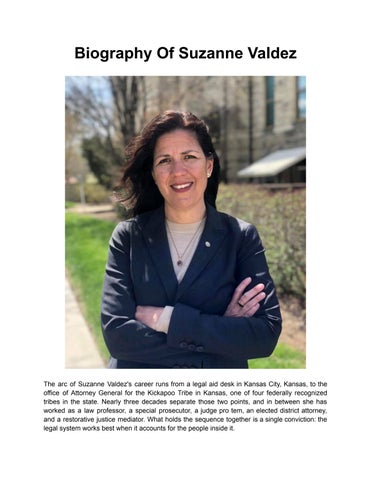
Biography Of Suzanne Valdez
The arc of Suzanne Valdez's career runs from a legal aid desk in Kansas City, Kansas, to the office of Attorney General for the Kickapoo Tribe in Kansas, one of four federally recognized tribes in the state. Nearly three decades separate those two points, and in between she has worked as a law professor, a special prosecutor, a judge pro tem, an elected district attorney, and a restorative justice mediator. What holds the sequence together is a single conviction: the legal system works best when it accounts for the people inside it.
She came to the law at the University of Kansas School of Law, earning her J.D. in 1996. As a student she served on the Kansas Journal of Law and Public Policy and received the Walter Hiersteiner Outstanding Service Award. The University of Nevada, Las Vegas, granted her a B.S. in business administration with Highest Distinction. She holds licenses in Kansas and Missouri and is admitted to the bar of the Supreme Court of the United States. Her first job out of law school was at Kansas Legal Services, where she began in 1996 representing low-income clients in Kansas City, Kansas. The caseload mixed civil and criminal matters with federal disability and housing litigation. Teaching claimed the next chapter. Suzanne Valdez joined the University of Kansas School of Law faculty in 1999 and remained a Clinical Professor of Law there until 2021, more than two decades in legal education. Her courses included Professional Responsibility, Prosecutorial Ethics, and State Court Practice, along with workshops in deposition skills and expert witness examination. She directed the Criminal Prosecution Field Placement Program, the Externship Clinic, and the LL.M. program in Elder Law, and she supervised students at the Douglas County Legal Aid Society. The law school named her Connell Teaching Professor in 2019, she twice received the Immel Award for Teaching Excellence, and she led the KU University Senate as its president in 2019 and 2020. Beginning in 2015 and continuing until she left the faculty in 2021, she also served as the law school's ombudsperson, mediating conflict among faculty, students, and staff. That work persuaded her that alternatives to litigation deserve a larger place in the justice system, particularly in how it answers non-violent crime. Her writing tracked her teaching. With Professor R. Michael Cassidy she co-authored the third edition of Prosecutorial Ethics for the American Casebook Series at West Publishing. In 2024 the University of California Press published Fighting Mad: Resisting the End of Roe v. Wade, to which she contributed a chapter. A policy paper on low-level, non-violent female drug offenders in Kansas sits among her law review and bar journal articles, and she assembled Practice in Kansas, a course text spanning civil procedure, landlord-tenant law, consumer protection, and family law. Roughly 100 professional presentations round out the record, and a new book drawn from her years in prosecution is underway. She never left practice entirely. From 2009 to 2021 she was Of Counsel at Smith Legal, LLC, handling civil matters in Kansas state court for private and pro bono clients. She twice served as a special prosecutor in the Wyandotte County District Attorney's Office, from 2005 to 2008 and again from 2017 to 2020, taking on high-level felony conflict of interest cases. In 2008 she sat as a pro tem district judge in Douglas County, where the juvenile offender, post-decree family law, and criminal first appearance dockets came before her. Statewide service ran alongside all of it. Suzanne Valdez chaired the Kansas Crime Victims Compensation Board for eight years, overseeing a fund that averaged roughly $3 million annually for survivors of violent crime. Two Kansas Attorneys General nominated her to that chairmanship, and the Kansas Senate confirmed her unanimously three times. She chaired the
Kansas Continuing Legal Education Commission as well, sat on the Kansas Judicial Council's Family Law Advisory Committee and the Kansas Supreme Court's Access to Justice Committee, and joined American Bar Association teams reviewing law schools for accreditation. In 2021 Douglas County elected her District Attorney, making her the chief law enforcement officer for a county of roughly 125,000 residents, a post she held through 2025. She ran an office of about 50 employees on a budget of approximately $2 million, and she pointed those limited resources at violent crime: sexual assault of children and adults, intimate partner violence, and gun offenses. As fentanyl deaths rose across Kansas, she prosecuted the people distributing it, work that carried personal weight. Christopher Valdez, her brother and a U.S. Army veteran, was lost to fentanyl poisoning in 2019. Working alongside retired Kansas Supreme Court Chief Justice Lawton Nuss, she helped secure $1 million in funding to establish a Veterans Treatment Court in Douglas County. Her office also backed alternatives to incarceration, community outreach and crime prevention, and services for victims of crime. After the district attorney's office she turned to restorative justice full time. From May 2025 to May 2026 she worked with the Center for Conflict Resolution in Kansas City, Missouri, as a mediator, facilitator, and trainer, mediating interpersonal conflict, facilitating community accountability boards and victim offender dialogues, and co-leading the organization's conflict resolution trainings. She served as its People and Culture Administrator too, applying the same restorative lens to internal staff matters. The premise underneath the practice is plain, that harmed people harm people, and the method treats dignity, acknowledgment, and accountability as the way to restore everyone caught in a conflict. Its roots reach back to the practices of indigenous tribes before colonization, which ties it directly to the Indian law work she does now. That work is her present focus. As Attorney General, Valdez represents the Kickapoo Tribe as a sovereign nation, and much of her attention goes to the Tribe's economic development plan, where sovereignty and self-determination stay at the forefront of every agreement. She has also established Suzanne Valdez, LLC, Restorative Justice Law and Mediation, a Kansas practice she is building as her commitment to Indian law continues. Service closer to home has been steady. Board seats have included Douglas County CASA and the Douglas County Child Advocacy Center, which serves children who have been abused or neglected. She has volunteered with LINK, the Lawrence interdenominational nutrition kitchen, led a unit at Hidden Valley Girl Scout Camp, worked with Mentoring4Success in support of women returning to their communities after incarceration, and represented the United States Military Academy at West Point as an admissions field representative. Her Kansas City year also included volunteer work supporting transgender women in the Missouri Department of Corrections and on probation and parole. In March 2024 the Lawrence Army Recruiting Station gave her a Certificate of Appreciation in Recognition of Women's History Month, recognition that followed her directive clearing outstanding tickets and petty misdemeanors for Army recruits so they could report to basic training. Suzanne Valdez lives in Lawrence, Kansas. Family sits at the center of her life there, from her
parents to her grown children and the wider circle she has helped raise. She still runs, though marathons are behind her, and she reads historical fiction, The New Yorker, and The Atlantic. Jayhawk sports hold her attention closely.