A
ALU
S
DI
TIN
GV
SCI
LAS
PLI
THE
NES
FU T U
E-
A DY A D V E R
AG E NT
R
summer 2026 · vol 94 · no. 2
E OF
CR L E AR N I N G A
OS
PAGE 8
ALSO IN THIS ISSUE LIVING HISTORY: CONNECTING 250+ YEARS OF PERSPECTIVES IN AMERICA TO THE PRESENT
summer 2026
8
·
Inside
vol 94
·
no 2
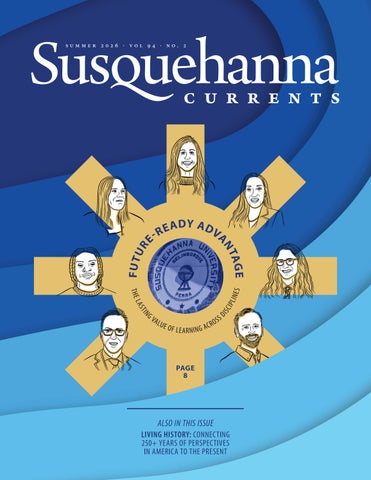
FUTURE-READY ADVANTAGE IN A WORLD DEFINED BY CONSTANT CHANGE, A LIBERAL ARTS EDUCATION MAY BE THE GREATEST ADVANTAGE OF ALL. SEVEN ALUMNI JOURNEYS REVEAL HOW CURIOSITY, ADAPTABILITY AND PURPOSE LEAD TO MEANINGFUL CAREERS AND LIVES.
S E C T ION S DEPARTMENTS
ALUMNI NEWS
3
32 Message Board
First Word Everything Old Is New Again
16 People & Places The Who, What and Where For All Things Susquehanna
22 Scoreboard News From Susquehanna Athletics
26 The ’Grove Stories From Around Campus and Around Town
42 End Notes Preparing To Make an Impact ON THE COVERS: Back cover photograph by Gordon Wenzel.
34 Class Notes Alumni Profiles · Deaths
VICE PRESIDENT FOR MARKETING & COMMUNICATIONS AARON MARTIN EDITOR JENNIFER YURICICH ’00 SPOTTS Director of Strategic Communications CONTRIBUTING WRITERS CLAIRE CURRY DANIEL GRAHAM Director of Athletic Communications MARIIA LYTVYNCHUK ’26
4 LIVING HISTORY Who tells America’s story? Museums, archives and battlefields are classrooms where Susquehanna students and alumni connect the past to the present, bringing history to life for future generations.
AMANDA O’ROURKE Public Relations Manager ARYE PULLI ’28 GIANNA RUPERT ’26 LOGAN SWEET ’15 Director of Integrated Communications & Brand Marketing CLASS NOTES COORDINATORS MELISSA SALAZAR Associate Vice President of Advancement LAURA HADEN Director of Alumni Engagement
The most powerful Susquehanna resource — Introducing the Susquehanna Network — a new online community where you can reconnect, expand your circle and share experiences with fellow Susquehannans. Consider it your new digital home for all things alumni: • Explore a searchable alumni directory. • Give or get career guidance through mentoring tools.
DESIGN JOSIE FERTIG Director of Brand & Creative Services ERICA HOOVER Senior Graphic Designer
its people
• Join groups, events and conversations that matter to you.
— just got stronger.
CONTRIBUTING PHOTOGRAPHERS BLUE DOG IMAGING GORDON WENZEL
Summer 2026, Vol. 94, No. 2 ©2026 All publication rights reserved. Susquehanna Currents is published twice a year by Susquehanna University, University Marketing & Communications, 514 University Ave., Selinsgrove, PA 17870.
Printed by Progress Printing in Lynchburg, Virginia
SUSQU.EDU/NETWORK
to reconnect from anywhere.
Vendor to place certified appropriate FSC logo.
SAVE THE DATE
Sept. 11-13 2026
Artist Series 2026–27 UPCOMING PERFORMANCES
October 2026
Seraph Brass
November 2026
Terrance Simien & The Zydeco Experience
Join Us for Family Weekend! You’ve entrusted us with your student, now it’s your turn to pack your bags and come to campus as our honored guests!
PHOTO BY JAMES DEAN
February 2027
Actors From The London Stage
Tickets are required for Artist Series performances. Visit susqu.edu/boxoffice for information on how you can reserve yours: by phone, in person or online.
Be our guest. We invite you to experience the vibrant arts scene at Susquehanna University! Visit susqu.edu/artsandevents for more information on upcoming events and watch for the upcoming 2026–27 Arts & Lecture Series Guide.
IN PROMOTIONAL PARTNERSHIP WITH
Visit susqu.edu/familyweekend for travel information and schedules.
First Word
A Message from the President: Everything Old Is New Again
dear friends, Higher education is rooted in the liberal arts from Plato’s Academy to the medieval cathedral schools to the modern university and the uniquely American contribution: the liberal-arts college. The liberal arts are foundational to our enterprise, creating the framework of Western philosophy, forming the core of citizen education, and sowing the seeds for modern scholarship and research, and they have always been at the heart of a Susquehanna education. In ancient Greece, the liberal arts emerged as the knowledge required for free persons. What did they need to know to be effective and engaged participants in the polity. The great Stoic philosopher Zeno of Citium said the liberal arts were not just the domain of free persons, they were what made them free. The liberal arts birthed ancient democracy and made our democratic republic a reality. The U.S. Founding Fathers established a number of early liberal-arts colleges and cultivated many more because they knew their fledgling republic would need an informed and nimble electorate to thrive. We find ourselves at yet another inflexion point, what some are calling the fifth industrial revolution, when humans and machines “work together.” We will need to define the roles of each as AI integrates
into the workplace and becomes a ubiquitous part of our daily lives. How will our graduates continue to assert their relevance and exert their leadership in this new paradigm? The answer, yet again, is the liberal arts. What made us free over twenty-three centuries ago is what will keep us free and necessary into the future. At commencement this year, I said, “We need to embrace the opportunities of AI and other advances with deep skepticism and childlike wonder, and you need to remember that it is the ‘highest function of human nature,’ your humanitas, that makes you robot-proof. Do not forget what the liberal arts have taught you about the dominions of humanity and your agency within them.” In this issue of Currents, you will hear from our terrific deans about how and why the liberal arts are thriving at Susquehanna, and you will encounter seven alumni vignettes that show the breadth of how the liberal arts have prepared them for our dynamic and everchanging world. It is a great affirmation that our foundation is our future.
“Do not forget what the liberal arts have taught you about the dominions of humanity and your agency within them.” — JONATHAN D. GREEN
you rs ev er,
Jonathan D. Green, President
su m m er 2026 · Susquehanna Currents · 3
LIVING HISTORY BY AMANDA O’ROURKE
Smoke hangs in the air. Commands are shouted over the din of musket fire and cannon booms. At that moment, Daniel Murphy ’27 isn’t a college student from Chester County, Pennsylvania; he’s a Red Coat facing the Continental Army in the Battle of Brandywine. “The explosions, the smoke, the chaos — it pulls you in,” Murphy says. “You can feel the adrenaline.” Growing up in the cradle of American democracy, Murphy didn’t have to look far to find history — it was in his backyard. School trips to local battlefields sparked an early fascination, and when he was 16, curiosity turned into action when he answered a call for reenactors at the Battle of Brandywine anniversary.
4 · Susquehanna Currents · susqu.edu/cu r r en ts
Murphy, now a history major at Susquehanna University, joined a reenactment group portraying infantrymen of both the 2nd Pennsylvania Regiment of the Continental Army and the British 43rd Regiment of Foot. He built his wardrobe over time: two uniforms (one for each army), wool breeches, stockings and shoes. His service musket was a Christmas present from his parents. “Everything is hand-stitched,” Murphy says of his uniforms. “Our group is focused on being authentic and giving the public a better view of what a solider would have looked like during the time period.” Today, the group takes part in about a dozen events each year, from sweeping battle reenactments to hands-on “living history” programs with drills, firing demonstrations and
CONNECTING 250+ YEARS OF PERSPECTIVES IN AMERICA TO THE PRESENT
public interaction. With the nation celebrating its 250th anniversary, their activities feel more meaningful than ever.
A COMMON APPROACH Public history is not confined to the past; it lives in communities and stories told today because research and preservation have helped make American history accessible, engaging and useful in everyday life. “At its core, public history is the interpretation of the past for broad audiences,” says Ed Slavishak, professor and department head of history. “It bridges the gap between academic research and public understanding, ensuring that history remains relevant beyond the classroom.” Slavishak debuted Susquehanna University’s first public history course in 2024. In this introduction to the academic discipline, students learn and apply best practices in such venues as museums, heritage sites, historical tours, pop-up exhibits and digital history.
PHOTO OF JAY BOSANKO (THIRD FROM LEFT) COURTESY OF THE NATIONAL ARCHIVES CATALOG
Since the course’s inception, students have fanned out across Snyder County, leading historic tours on topics ranging from Selinsgrove’s war veterans to the borough’s industrial past, once shaped by the Eisenhuth Shoe Factory and the William F. Groce Silk Mill.
Slavishak encourages his students to incorporate a “gentle sass” when approaching the stories they plan to share with the public. “Gentle sass means lightly poking fun at the way we think about the past,” he says, “including the assumption that we’re automatically smarter or better than people who came before us.” Whether his audience includes a longtime history buff or an elementary school pupil, Murphy uses the tricks of the trade to hold their attention. After taking the course, he refined his skills during an internship with the Red Rose Inn, Chester County, a historic site with Native American and colonial roots. “Dr. Slavishak teaches us to write in ways that keep the public interest in mind,” Murphy explains. “Everything is aimed at making a deep connection with local community members.” Those connections are invariably formed through stories, usually about ordinary people. Those people, history’s forgotten underlings, are what have always fascinated Slavishak. “Social history — ordinary people living ordinary lives — is a little like turning over an anthill and suddenly you see this whole world of activity that was always there but mostly unnoticed,” he says. “The real story of America isn’t just found at the presidential level. It’s found in the everyday lives of millions of people.”
PAPER TRAILS Most of the United States’ history begins with documents. While generations of Susquehanna alumni are making their mark in public history at organizations across the country, perhaps no alumnus knows the value
“Records document individuals’ rights and privileges, which are deeply intertwined with the past, so they are critically important — not only for understanding individual lives, but for understanding government as a whole.”
Jay Bosanko ’92
su m m er 2026 · Susquehanna Currents · 5
much more. Archivists work diligently to preserve this material. “Archivists, museum professionals, librarians,” Bosanko says, “we all view ourselves as stewards and we take our responsibility to care for collections very seriously.”
SPECTRUM OF PERSPECTIVES
“An excellent exhibit allows the viewer to make his or her own determination without subliminally guiding viewers to a certain aspect of the topic.”
Richard Sauers ’76
Archives and the collections held within them inform the stories told by professionals like Richard Sauers ’76, who has led museum curation and historical preservation efforts at the Western Museum of Mining and Industry in Colorado Springs, Colorado. “An excellent exhibit allows the viewer to make his or her own determination without subliminally guiding viewers to a certain aspect of the topic,” Sauers explains. “It takes a lot of research to bring all this material to the public in meaningful ways.”
documents hold better than Jay Bosanko ’92, retired deputy archivist of the U.S. at the National Archives and Records Administration, an independent agency charged with the preservation and documentation of U.S. government and historical records.
Shortly before his retirement, he created the Who Were Miners? exhibit to counter stereotypical imagery by highlighting the women and minorities who ran mines and spent their lives working in them. These stories take some digging to uncover, and that work takes time.
“Our story as a people is documented and captured in the records that are kept at the local, state or federal level,” Bosanko says. “Records document individuals’ rights and privileges, which are deeply intertwined with the past, so they are critically important — not only for understanding individual lives, but for understanding government as a whole.”
Understanding the present is shaped by the many different experiences and perspectives of people in the past, says Kahla Woodling ’12 DeSmit, executive director of the MidAtlantic Association of Museums. For a long time, she notes, public history tended to reflect a narrow view.
Records contain stories, Bosanko says, many of which lie hidden in boxes until a researcher — whether a genealogist family historian, veteran, attorney or journalist — lifts the lid. “The number of untold stories captured within those boxes is amazing — stories of sacrifice, elements of our nation’s history that have yet to be discovered.” When Bosanko gave CBS’ 60 Minutes access to the Archives’ most restricted vault in 2024, the camera crew joined a group from Japan that was cataloging the American occupation that followed World War II and a U.S. Army unit combing through a million old Army files looking for Black and Native American soldiers who were once overlooked but might finally be awarded the Medal of Honor some years later. The material held by the National Archives and Records Administration is massive: more than 33 billion digital records, 13.5 billion pieces of paper, more than 450 million feet of film, 41 million photographs, 10 million maps and
6 · Susquehanna Currents · susqu.edu/cu r r en ts
“When we leave out perspectives, we risk reinforcing gaps in understanding or missing important context for the world we live in today,” DeSmit says. “But when we bring those voices forward, history becomes richer, more accurate and more useful — it helps people better understand not just the past, but each other.” Translating that philosophy into practice is not always possible. Practitioners are increasingly navigating a landscape shaped by limited resources, competing narratives and questions over ownership and whose history is preserved. “When financial support becomes contingent on certain interpretations or restrictions, it puts organizations in a difficult position,” DeSmit says. “It raises important questions about who gets to decide what stories can be told, and it sets a concerning precedent for the field as a whole.” Exhibits dealing with race, gender, colonialism or national identity have drawn scrutiny in recent years, with funding sometimes used as leverage. Earlier this year, an Underground Railroad museum in upstate New York sued the federal gov-
ernment alleging its funding was unlawfully terminated on the basis of race. In Philadelphia, the National Park Service removed panels from an exhibit about nine people enslaved by George Washington at the President’s House Site in Independence National Historic Park. An injunction issued in February to restore the site was reversed this summer when the appeals court unanimously ruled the federal government has the authority to replace the exhibit with different content. These pressures are not limited to smaller organizations. Even the Smithsonian Institution, the world’s largest museum and research complex, has faced threats of funding cuts over exhibitions and research related to race, gender and American history.
CURATORS OF TRUST The American Alliance of Museums has consistently found that museums are among the most trusted institutions in the United States, with nearly nine out of 10 Americans viewing them as credible and reliable sources of information.
is not something we should lightly cast aside; it’s deeply embedded in our democratic ideals.” Amid these pressures, a period of rapid innovation is unfolding, one in which Bosanko has found himself at the forefront. He currently serves as chief archivist at Historiq, a startup venture that helps libraries, archives, and museums digitize sizeable backlogs using artificial intelligence. Its core mission is to move collections beyond the box, Bosanko says. “Digitization, the ability to access materials online, opens the door — it’s the democratization of archives,” Bosanko says. “Our guiding principle is keeping archivists and public history professionals at the heart of the work, using technology to make their jobs more efficient.” The intersection of technology and public history should excite history professionals, Bosanko says, and hopefully attracts more to the field.
“So, what happens to that trust if people begin to feel that stories are shaped or limited by outside forces?” DeSmit asks.
“Never before have we needed more people entering the field,” he says. “I’m looking forward to the next generation of new professionals in this space who will have very different perspectives on how we use innovation while studying the past. There is a future for them.”
Bosanko has had personal experience with the influence of outside forces when it comes to preserving history. He was serving as chief operating officer for the National Archives in 2022 when the FBI seized boxes of presidential records that the agency said had not been properly transferred to the Archives. After 32 years with the agency, Bosanko retired in 2025, one week after the agency’s leader was fired.
It is a future Murphy is eager to embrace. The Revolutionary War reenactor is a summer intern at Valley Forge National Historical Park working alongside National Park Service rangers to make Revolutionary War history relevant for everyone. He is preparing to participate in events marking the Battle of White Plains followed by additional Revolutionary anniversary observances stretching into 2027.
“What makes our form of democracy unique comes back to records, history and knowing where we’ve been. At its core, it’s about the ability of the people to hold government accountable — and that depends on transparency,” Bosanko says. “The underlying principles of archival practice reflect the idea that records ultimately belong to the people. This
“History invites reflection,” Murphy says. “The 250th anniversary of our country is a perfect time to pause, reflect on America’s past and use that understanding to better engage with present-day discourse as we move forward.”
“The 250th anniversary of our country is a perfect time to pause, reflect on America’s past and use that understanding to better engage with present-day discourse as we move forward.”
Daniel Murphy ’27
su m m er 2026 · Susquehanna Currents · 7
BY CLAIRE CURRY
Advantage
FUTURE-READY
The lasting value of learning across disciplines
Susquehanna has inspired generations of students to discover and pursue their passions, to open their minds to new possibilities and discern how to use their gifts to make a meaningful difference in society. Here are some of the ways in which the liberal arts foundation inspired our alumni and helped shape their journeys to where they are today.
One Cannot Step into the Same River Twice A person cannot descend into the same river twice because it is no longer the same river, nor the same person, according to the philosopher Heraclitus. The river constantly changes as it flows through time — in the same way that life is a continuous process of change and transformation. It is a fitting metaphor for the student pursuing a liberal arts education at Susquehanna University today. From Plato and Aristotle to Shakespeare and Einstein, the liberal arts have been at the core of some of the greatest and most influential thinkers and innovators of all time. Derived from the Latin phrase “artes liberales” — meaning the pursuit of knowledge or skills worthy of a free person — the phrase “liberal arts” dates back to fourth-century B.C.E. Greece. The earliest liberal arts curriculum in Rome aimed to produce intellectually well-rounded individuals capable of civic participation. Today, the purpose of a liberal arts education remains the same and the mindset and capabilities it develops have become more relevant and more crucial in the 21st century.
Building Skills for Life At a university open house last spring, Patrick Long, dean of the schools of the arts and humanities, shared his thoughts on the value of a liberal arts education with 200 prospective students and parents. He compared college to a river, noting that like tributaries, students and faculty from all different areas and backgrounds come together, building momentum toward an ultimate goal. “After that, you’re spilled out into the ocean and you’re absolutely free,” he says, “and everything you learn within the liberal arts curriculum is what you need when you’re
8 · Susquehanna Currents · susqu.edu/cu r r en ts
JANELLE KLEFTIS ’13 A liberal arts foundation gave one alumna the confidence to pursue her passion.
When Janelle Kleftis ’13 was studying music education at Susquehanna, she never would have predicted that after graduating, she’d sell her car and belongings and travel to a small village in Thailand to teach children English. Or that what began as a six-month contract would turn into three pivotal years during which she’d also teach music, discover her affinity for martial arts and train to become her personal best. But that’s exactly where her journey led her. Kleftis recalls how warmly she was welcomed into Susquehanna’s close-knit music community and how she felt that she “found her people.” “I loved the music classes and all of my friends and professors in the music school,” she says, adding that she complemented her coursework with student teaching and participation in University Choir, the Chamber Singers and the Handbell Choir. She also studied abroad in Italy, which fueled her adventurous spirit. “That helped me to be open to taking on new challenges and risks in life and trying new career paths,” she says. In her senior year, Kleftis developed health issues that put her vocal training on hold and then suffered a life-changing loss when her mom passed away. “It was a rough year, so I was looking for a change,” she recalls. “I don’t remember why I picked Thailand, but I guess it was a good move because it literally changed the entire trajectory of my life.”
BACKGROUND PATTERN ILLUSTRATIONS: KIKI HADI SUPRIYANTO, ISTOCK
When she arrived, Kleftis knew she was beginning a new and exciting chapter in her life — one that was only possible because of the confidence she developed as a student at Susquehanna.
free and facing the unpredictable, personally and professionally. The degree of freedom and uncertainty today’s students face is unprecedented in world history, and they will need these foundations more than anyone has ever before.” The attributes Long is referring to — analytical thinking, problem solving, communication, adaptability, cultural and emotional intelligence, and leadership — remain in high demand in a workforce that is continually evolving. Artificial intelligence and digital technologies are accelerating the pace at which data is captured and applied and
She fully immersed herself in the culture and her role teaching preschoolers English. In the same way she did as a college student, she found her people in a nearby music school where she resumed singing and playing piano and eventually began teaching music. One night out with friends, Kleftis took in her first Muay Thai fight. A martial art, Muay Thai is among the most demanding combat sports. “I loved the energy and the respect of the fighters,” she says. “I wanted to try it, so I found a gym that took me seriously and trained there every night after work,” developing a love for the sport that has shaped where she is today. When she returned to the States, she moved to Denver, Colorado, and picked up teaching jobs working with children and adults with disabilities, a population she gravitated to. Inspired by her mom who was an occupational therapist and her student teaching experience through Susquehanna, she opened an inclusive and accessible Muay Thai studio for people with disabilities in 2023. “I saw there was a gap and that the martial arts were not accessible to children and adults with disabilities,” Kleftis shares. “Everything I learned about teaching while I was at Susquehanna has been instrumental in what I’m doing now. I love our students and want to provide a place where they can be themselves and have a sense of community. I’m finally at the place I was meant to be.”
assuming tasks that were once in the hands of humans. The workplace of today will look vastly different in just a few years and, in a decade or two, might be unrecognizable. One constant, however, has endured through time: humans will always be humans capable of creating new ideas and innovations that solve imminent problems and make the world a better place.
Testing the Waters Some students arrive on campus with a vision of exactly what they want to do. A liberal arts education makes it
su m m er 2026 · Susquehanna Currents · 9
JOE WOLFE ’88 This business leader appreciates the rewards of giving back.
Joe Wolfe ’88 has been working in the accounting and management consulting industry for more than 25 years. In addition to the experience he’s accrued at RSM where he currently serves as National Life Sciences Business Development Leader, Wolfe worked his way up as a business leader through various roles he’s held at several prominent companies, including PricewaterhouseCoopers, Experian, EY and The Kreller Group. However, his definition of success has little to do with a title or a paycheck. “A common theme in my life, and definitely one of my passions, is personal growth,” Wolfe says, something that he says was ignited when he was a student at Susquehanna. “If you have a liberal arts education, you get exposed to things you don’t know anything about. That education stirs in you the desire to learn and be open-minded to new things. If you have a diverse background and education, that’s a really strong asset.” Wolfe earned a bachelor’s degree in human resource management and was deeply involved on campus throughout his college years. He served as captain of the track & field team, was a member and treasurer of the Phi Mu Delta fraternity and chairman of the Interfraternity Council, managed the student-run snack bar in the campus center overseeing more than 60 employees, and participated in the investment club. After graduating, he went on to earn accreditation at Northwestern University’s Kellogg School of Management for negotiation training. Giving back is a high priority for Wolfe. One example is his role as a Special Olympics coach, in which he teaches and coaches 40 athletes basketball, floor hockey, track and physical fitness throughout the year. “One of our kids is going to the National World Olympics, which is in Argentina this year,” he says proudly. “Two went last year to Milan. Why do I coach? Because it feeds me to have an impact on people.” He also gives back in other ways. Wolfe is a brother in the Franciscan Church and sits on the Board of Advisors for Life Science Cares New York. He has been an executive board member of Big Brothers and Big Sisters of America and is a currently on the advisory council for Susquehanna’s Sigmund Weis School of Business. He estimates that he’s mentored about 450 people throughout his career, many of whom are Susquehanna graduates. Wolfe values the connections he’s maintained with his alma mater and says that his Susquehanna education has had a meaningful impact throughout his life. “It prepared me for the reality that change is the only constant in life,” he says.
10 · Susquehanna Currents · susqu.edu/cu r r en ts
possible for them to grow in that direction and build new knowledge and confidence. For others, the future may not be quite as clear. A liberal arts curriculum affords them the time and opportunity to explore different possibilities and discover their interests and strengths. “The great thing about a liberal arts school is that many students come in thinking they know what they want to do, and then throughout the course of four years, their horizons are broadened so much,” says Katherine Straub, dean of the School of Natural & Social Sciences. “From day 1, students are out in the field, they’re in the lab. As President Green says, they’re ‘doing their discipline’ right away. Those hands-on experiences help to open their eyes in an affirming way or sometimes help them figure out it’s not what they want.” The array of liberal arts courses — philosophy, literature, language, math and science — emphasize analytical thinking, writing, presenting and working in teams. What’s more, students routinely engage in dynamic conversations about ethics and the betterment of society while broadening their points of view. “In the business school, it’s the best of both worlds. Students are going to get the very top business education in a liberal arts setting,” says Matthew Rousu, dean of the Sigmund Weis School of Business. “A business student could be in a philosophy or science class when they’re asked to think about a problem in a completely different way, which grows their intellectual horsepower and helps them become better thinkers and better workers that strengthen the workforce.” Straub agrees, noting that central curriculum requirements like Scientific Explanations and Analytical Thought teach students how to “think like scientists,” an ability that translates broadly to their lives as world citizens. “As a scientist or a nonscientist, how do you operate in a world where you’re being bombarded with information and misinformation all the time? How do you sort through what’s real and what’s not?” In addition to learning how to analyze limitless amounts of data and separate fact from fiction, Susquehanna students develop many invaluable tools that will prepare them to succeed in their careers and in life. “Students are getting the communication and teamwork skills through their classes and all of the other experiences Susquehanna provides,” Straub adds. “We have internships with external partners in legal careers and in the environmental space. We have summer internships where students
QUINN BURKHART ’21 An imaginative writer shaped her interests in science and natural history into an adventurous career. When Quinn Burkhart ’21 visited Susquehanna for the first time, she could easily picture herself spending quiet days honing her craft in the university’s Writers Institute. “I was looking for a place where I could grow not only as a writer, but also in other aspects of my life,” she says. “I wanted to write, learn about things I have an interest in and have adventures. At Susquehanna, I could grow into who I wanted to be.”
“I’d started spending a lot of time at the Susquehanna River, running down there a lot, and exploring,” she recalls of her inspiration. The assignment required interviews, so she went to the Natural Sciences Center and soon became a regular visitor. “I realized I had untapped interests in researching and writing about science and natural history,” says Burkhart, who has since blended them into a fulfilling career. In January 2026, she joined the New England Interstate Water Pollution Control Commission in Massachusetts as a science communicator. She writes about funded research projects, which include water quality and wildlife in the Long Island Sound, and manages social media communications. Burkhart says there’s no doubt that many of the activities and opportunities she took advantage of in college helped her discover her passion for the environment and develop the writing and research skills to make a difference in the field. As a student, Burkhart held several internships that paired science and communication, including one at the Smithsonian Environmental Research Center and another at the Citizen’s Climate Lobby, where she interviewed farmers and wrote about the challenges of the climate crisis. She also edited and produced alumni newsletters for Susquehanna’s Department of English & Creative Writing and served as director of the university’s chapter of the Forum for Undergraduate Student Editors.
“I was not a particularly involved person in high school,” Burkhart says. “When I got to college, I became someone who wanted to be involved and do internships and clubs and take on leadership roles. I really felt like I had the space to do that. That’s Susquehanna.” Burkhart also traveled abroad for the first time through the Global Opportunities program. She studied at the University of Amsterdam for a semester, lived with a host family and traveled to 13 other countries in her free time — an experience that empowered her to take risks in life. After earning dual degrees in creative writing and publishing & editing at Susquehanna, Burkhart earned a master’s in journalism in science and environmental reporting at Northwestern University in Chicago. Her career has since taken her on many adventures: writing for the Oak Ridge National Laboratory in Tennessee, Woods Hole Oceanographic Institution and the Sea Education Association in Massachusetts, and the National Audubon Society where she lived on a remote seabird island off the coast of Maine. Burkhart is grateful for her liberal arts education that helped her develop research, communication and leadership skills she uses every day and sparked a deep curiosity about the living world and her desire to contribute to preserving it. Today, she accomplishes that by educating others through her work and, in her time off, by volunteering with local environmental groups. “Giving back has become a really important part of my journey,” she says. “When you give back, you’re helping others, and you are also becoming a better person.”
su m m er 2026 · Susquehanna Currents · 11
PHOTO DISCLAIMER: BIRD WAS HANDLED PROFESSIONALLY WITH PERMITS
Burkhart did just that. When she was assigned to write a memoir in her sophomore year, she reflected on where to focus.
NICOLE PAYNE ’99 Global immersions and a theatre class in London ignited this business alumna’s cultural perspective and enriched her education. One of the most memorable experiences Nicole Payne ’99 had as a Susquehanna business major is the semester she spent abroad in London. It was also one that had a most unlikely outcome. “I was studying in a huge metropolitan global market with other business majors, and we had to take a course called British Theatre,” she recalls, adding that she was a bit skeptical. “I fell in love with theatre because of that class!” This was just one of the global immersions that had a lasting impact on Payne — an independent study class focused on South Africa was another. As the only business major in a group of 12 students, she was tasked with looking at the country as an emerging market. Ultimately, the course culminated in a 10-day trip to South Africa. “It was a meeting of the minds for all of these students who were thinking about this country and the culture from different lenses,” she says, adding how much she benefitted from conversations with her classmates whose academic paths were so different than her own. Payne also pursued a minor in Spanish and designed an independent study, Spanish for Business, to meet a need. “I aspired to work at the United Nations or at a Spanish bank and we didn’t have a class like that,” she recalls. “I was able to create this class and work
are doing research on campus or working off campus. We encourage them to take a deep look at what they might want to do, and a broad look across what’s possible.” There are also many ways students can hone leadership skills. For example, creative writing students supervise their peers in creating magazines and hosting visiting writers. In the music department, a crew of students records and streams events on campus. “In theatre, we’ve got students who are practically professional theatre managers,” Long says. “That’s really valuable. If they discover they’re good at leading people as an undergraduate, they’re set.”
12 · Susquehanna Currents · susqu.edu/cu r r en ts
one-on-one with a professor to write business documents in Spanish, like correspondence, contracts and other legal papers.” The global journeys and opportunity to create something she believed in from scratch were among the takeaways of her Susquehanna education that Payne has carried with her through her career. Currently, she is vice president, internal audit, at American Express, where she’s worked for 14 years. Prior to her current position at American Express, she held six other posts there in areas such as risk management, operational strategy, and digital partnerships and development. Payne’s résumé also includes positions at Quorum Federal Credit Union, Alliance Bernstein, JPMorgan Chase, Deutsche Bank and Arthur Anderson. “The common thread and what’s kept me at American Express for as long as I’ve been here is the ability to craft my path, follow my passions, leverage what’s worked and build from there,” notes Payne, who later earned an MBA at Fordham University. Her personal experience has made education a priority to Payne, and she serves as a board member of KIPP NYC Public Charter School network. Payne also brings her business acumen back to her alma mater to help inform curriculum to educate tomorrow’s business leaders as a longtime member of the Sigmund Weis School of Business Executive Council. She has hosted Susquehanna students in New York City and mentored many students in the past. Fittingly, she is a past recipient of the Alumni Award for Leadership. Maintaining ties to the university and connecting with new generations of students is important to Payne because they enable her to share her Susquehanna spirit and give back to the university that helped her establish the foundations for her career. “With a liberal arts education, you become a student of the world,” she says. “And the international experiences change who you are, how you think and how you learn.”
A myriad of study-abroad opportunities give students the chance to expand their cultural fluency. Through the Global Opportunities program, students across all majors study and intern around the world, from England, Ireland, Italy and the Netherlands to Australia, Japan, South America, and many other destinations. The business school also offers a semester of study in London, and every business student is guaranteed an internship abroad.
Steering Ashore Certainly, the pragmatic goal of a college education is to prepare future generations to step confidently into the next chapter of their lives — and land good jobs. Studies prove
JEREMY CAMPBELL ’16 Creative problem-solving is this graphic designer’s superpower.
Jeremy Campbell ’16 says that Susquehanna challenged him to push himself to hone his craft as an artist and seek out knowledge beyond his graphic design major and studio art minor. In fact, he says that challenge began before he even enrolled at the university. “When Susquehanna representatives visited my high school, they said I’d need to create a portfolio of my work to show not only my ability, but also the breadth. So I was drawing, painting and doing crafts,” he recalls. “This was my first time ever doing anything like that. That initial push was something that drew me strongly to Susquehanna.” The university’s mission to guide students toward becoming wellrounded individuals made it the best choice for Campbell. “Susquehanna taught me how to channel that creativity to solve a specific problem,” he explains. “So rather than just creating something because it looked nice, we were creating something to serve a purpose.” Core liberal arts classes like history, science and English complemented Campbell’s rigorous training in the art & design studio and further exercised his critical thinking skills. “I’ve truly become a creative strategist and I can apply those same methods I learned in school to every part of my life,” he says. “I love giving Susquehanna credit for teaching me how to think rather than what to think.” The mindset and skills he developed in school also prepared him for his current role as a graphic designer at Forbes. In addition to design, Campbell gets involved in many other aspects of planning and running the events he brands, often traveling domestically and abroad. He says he can approach all of his responsibilities with confidence, courtesy of his liberal arts education.
SAGE WEIKEL ’16 A fascination with extreme weather events and a broad college curriculum led a science major to a career in emergency disaster response. Sage Weikel ’16 holds the distinction of being the first student to graduate from Susquehanna University with a degree in public policy. Today, he is the director of emergency management at Beth Israel Lahey Health, where he oversees three hospitals in the Metro Boston area. He says the liberal arts curriculum was invaluable in discerning his interests and building a pathway toward his career. In his first year, Weikel knew he wanted to participate in track & field but didn’t know which major to pursue. He approached every liberal arts course with genuine curiosity and an open mind. “I wanted to major in every introductory class I took!” he jokes. “I thought ‘this is so cool, this is so fascinating.’ I think that speaks to the [heart] of a liberal arts education.” Exploring a diverse palette of core courses first led him toward philosophy until he took a class that sparked his interest in political science, prompting him to change his major and learn about its public policy track. He and his advisor, Professor of Political Science Nick Clark, brainstormed ideas for an independent research study focused on emergency management. “I always had an interest in meteorology, especially severe weather, and I found emergency management and FEMA interesting,” he reflects, crediting that experience as a launchpad for his work in healthcare emergency management. “I don’t know where my life would have taken me if I had not done that course,” he says. “It let me sink my teeth into the field and broadened my horizons.” Weikel pursued a master’s in emergency management at Boston University’s School of Medicine and an interview with Beth Israel Deaconess Medical Center led to his first position in the field.
Since he graduated, Campbell has continued to challenge himself personally and professionally. During the Covid pandemic, he launched a side business, Balance Creative Studio, and more recently, he established Clique, a company that hosts curated events in cities such as Miami, San Francisco and New York.
“In hospital-based emergency management, we’re basically managing emergencies in a self-contained city,” he explains. “We have to think about how the emergency impacts our patients and staff, and we’re continually reviewing our plans.”
What is his vision for the future? “I want to continue building community, spaces where people can connect over a niche like art, food and music,” Campbell explains, adding that he also wants to give back. “I want to take that work back to my homeland, Grenada, and see how I can uplift that community as well.”
Day to day, he and his team prepare for a vast range of potential emergencies, anything from interruptions in utility services and a flood caused by a pipe bursting to more extreme events and disasters that result in mass illnesses, injuries and casualties. On average, they face multiple emergency events weekly, and as many as 175 per year. “There’s a saying in emergency management,” he shares, “‘never let a good emergency go to waste,’ as each emergency offers a unique opportunity to learn and improve for future responses.” In addition to a meaningful academic journey that has inspired him to become a lifelong learner, Weikel says the values Susquehanna instilled and the charge to make a difference in the world have had an everlasting impact on his life. su m m er 2026 · Susquehanna Currents · 13
BRIAN ZUIDERVLIET ’14 A floating laboratory on the Susquehanna River transformed one student’s curiosity about water quality into a career in environmental engineering. Brian Zuidervliet ’14 was among a small group of students and Associate Professor of Earth & Environmental Sciences Ahmed Lachhab, methodically gathering data for a research project that would become the focal point of his senior capstone project. “We were looking at different water quality parameters,” Zuidervliet explains. “We took a little inflatable boat and waded into tributaries with probes and measuring tools and took field notes. It was a lot of intense work, but we always got things done.” As it turns out, the research was a preview of what Zuidervliet has been doing for more than a decade as an environmental engineer at CDM Smith, an engineering and construction company, where he designs drinking water treatment plants. “I deal mostly with drinking water and wastewater treatment and the human side of how we impact the water quality in rivers,” he explains.” The capstone worked out to be a culmination of all of my academic experiences as a student and the things I now do in my career.” Learning how to conduct formal research and present findings and recommendations while a student at Susquehanna has proven useful in his day-to-day work.
that building a liberal arts mindset and taking advantage of every opportunity to grow into a well-rounded person really do pay off. Last year, the American Association of Colleges and Universities surveyed more than 1,000 employers across industries about what they value most in new hires. According to its report, The Agility Imperative: How Employers View Preparation for an Uncertain Future, top job candidates demonstrate the ability to apply learning to real-world problems and contexts. It also highlighted internships, leadership, community engagement and civility, senior projects, research with faculty, teamwork, communication and AI literacy —
14 · Susquehanna Currents · susqu.edu/cu r r en ts
“It’s been a game changer,” he says. “As a consultant, clients hire and pay for us to come up with ideas, and they want to be sure we’ve done our homework and that the recommendations or findings are solid. It’s important to be able to think through the entire picture, formulate a plan and articulate it.” Zuidervliet majored in earth & environmental sciences with a minor in math and planned to go on to graduate school. Through science classes and conversations with professors, he became increasingly interested in sustainability and took advantage of many opportunities to make a difference on campus. As a sustainability service scholar through the David ’69 and Sharon Johnson Center for Civic Engagement, he coordinated the university’s largest annual community service event, SU SERVE. The direct impact was powerful: in 2013, 500 participants ventured out into the community to contribute nearly 25,000 hours of service. Another event he oversaw introduced incoming students to the ways they could get involved in service. “It really set the culture for Susquehanna and how we can help the community for the greater good,” he explains. “The biggest impact on me was seeing how a one-day event motivated some students who had never done service before to stick with it.” Zuidervliet received many awards and recognitions for his contributions, including the Newman Civic Fellow Award for Outstanding Involvement in the Community. He says that the value of his liberal arts education became crystal clear when he pursued his master’s degree in engineering at Bucknell and later when he entered the workforce. “In my first year at Susquehanna, it was eye-opening to find out that I’d be taking classes like history that had absolutely nothing to do with science,” he recalls. “The selling point is having a well-rounded background and the ability to think more holistically and communicate ideas effectively. The soft skills I developed at Susquehanna give me a little bit of an edge. I use them every single day.”
all hallmarks of a Susquehanna education, woven into campus life and coursework across every discipline. Rousu agrees that a graduate’s success can be measured in part by an initial job placement though he believes it is much more than that in the long term. “Some of it is on the career front, however, some of it is about how to think and how to serve the world,” he adds. “The Susquehanna education, and all of its many facets, helps students to have productive and reflective lives of achievement, leadership and service.”
DEPARTMENTS
PEOPLE & PLACES
SCOREBOARD
THE ’GROVE
In the Susquehanna University Downtown Center, shoppers browse the student-led popup bookstore that was held in conjunction with the Selinsgrove Gelnett Book Festival. MORE ON THE BUILD COLLABORATIVE FELLOWSHIP ON PAGE 26
PEOPLE & PLACES
THE WHO, WHAT AND WHERE FOR ALL THINGS SUSQUEHANNA
Hareem Zain
From Physics to Pole Position Two degrees and a racing curiosity led to one alum’s high-speed career BY MARIIA LYTVYNCHUK ’26
Hareem Zain ’20 doesn’t just work in motorsports. Using computer models, he helps shape how race cars are built, tested and perfected before they ever take the green flag. As a child, he wasn’t loyal to a particular team or driver. What caught his attention was something specific. “Everybody knew that I loved motorsports,” Zain says. “But I was always more interested in the technical aspect — the vehicle itself.” Today, that curiosity fuels a career in racing’s most elite ranks. Zain is an applied vehicle dynamics LMDh engineer at General Motors, working with race cars in a way he could not have envisioned as a child: pushing the boundaries of simulation technology.
“I felt much more confident jumping into [an Ivy-League] level of engineering intensity having already finished a physics degree [at Susquehanna]. And the five-year path was well worth any trade-offs. I now have two degrees that will be valuable for my life ahead.” HAREEM ZAIN ’20
16 · Susquehanna Currents · susqu.edu/cu r r en ts
“We’re building a state-of-the-art driver-in-the-loop simulator based on the exact car’s software and hardware,” he explains. “Every day, we strive to get closer correlation to real-world data, essentially creating a one-to-one copy of the race car.” That race car is the Cadillac V-Series.R, a prototype hypercar competing on the global stage in the International Motor Sports Association and the FIA World Endurance Championship. Zain has also contributed to the development of General Motors’ Cadillac Formula 1 Team. At GM’s facility, simulation isn’t theoretical; it’s a competitive advantage in the race to championships. “Professional race car drivers visit our facility regularly,” Zain says. “The goal is for teams to run simulator sessions before and after every race weekend so that we can provide them as much support as possible to win.”
Cadillac V-Series.R
Fast Lane to 2 Degrees Less than a decade ago, Zain found himself on the starting grid ready to begin a 3+2 sequence: an academic path to compress two degrees into five years. Through Susquehanna’s dual-degree engineering program, he completed an accelerated physics program in three years before continuing to Columbia University’s Fu Foundation School of Engineering and Applied Science. By 2020, he had earned bachelor’s degrees in both physics and mechanical engineering.
PHOTO: CADILLAC V-SERIES.R COURTESY OF MARCELX42, CC BY-SA 4.0 VIA WIKIMEDIA COMMONS
At Susquehanna, the experience was heavily hands-on — years of research, a co-authored paper and multiple presentations — all within a close-knit academic environment. “Such a small number of students per professor is intrinsically valuable, as they can really cater to your goals and development,” he says. That foundation made the transition to a rigorous Ivy-League engineering program not just manageable, but empowering. “I felt much more confident jumping into that level of engineering intensity having already finished a physics degree [at Susquehanna],” he says. “And the five-year path was well worth any trade-offs. I now have two degrees that will be valuable for my life ahead.”
Built for Intensity, Endurance Zain joined General Motors through a competitive rotational engineering program shortly after graduation. Within two
years, he had moved into a vehicle dynamics simulation development role at the company’s Charlotte Technical Center, where he remains today, continuing to refine the tools that help teams win races. It was exactly the kind of environment he wanted to leverage his two degrees and his passion. “I was seeking a certain level of intensity to spark my curiosity,” he says of his career choice. “Motorsports definitely fulfills that goal. Everyone you get to work with is absolutely brilliant — selected from the global pool of engineers at the top of their career.” That intensity extends beyond the workplace. Breaking into the industry requires persistence. During his last year at Columbia, he applied for hundreds of jobs before landing his first interview. His advice to students is simple, and hard-earned: “Aim high. Apply over and over and don’t get discouraged.” Intelligence alone, he adds, isn’t enough. “This industry values hard work and discipline above anything else,” he says. “Someone who works hard with a passionate end goal will always achieve more than someone who has natural talent and chooses not to use it to the best of their ability.” The mindset he developed through the 3+2 program still drives him today — and in the high-stakes world of motorsports, where fractions of a second matter, that discipline can make all the difference.
su m m er 2026 · Susquehanna Currents · 17
PEOPLE & PLACES
Students Named Gilman Scholars The prestigious Benjamin A. Gilman International Scholarship will support two Susquehanna University students this fall as they expand their global perspectives through study-abroad programs in Germany and Italy.
Eden Savoy ’27 (left) and Jaidyn Steinbrecher ’26 (right) after their student media interview with Mike Pence
Reporting Across Differences Universities are places where ideas are explored, viewpoints are challenged and meaningful conversations take place. When the 48th vice president of the United States, Mike Pence, visited Susquehanna as the 2026 Alice Pope Shade Lecture speaker, two student journalists put that mission into action. WQSU program director Eden Savoy ’27 and The Quill reporter Jaidyn Steinbrecher ’26 were invited to interview Pence before the lecture, a chance to apply their classroom preparation and journalistic skills in a real-world setting. “I saw this event as an amazing opportunity,” Savoy says, noting that she researched Pence’s public statements, books and lectures to develop thoughtful questions. Steinbrecher acknowledged that the speaker selection initially brought personal questions and concerns, but ultimately viewed the interview as an opportunity to uphold the principles of journalism. “When you are writing news, none of that matters. It is only what is laid out in front of you,” Steinbrecher says. Both said their involvement with campus media helped them step into the conversation with confidence. Conducting the interview and covering the event reinforced their roles as thoughtful communicators and engaged citizens.
Kijani English ’28, a neuroscience and German studies double major from Selinsgrove, Pennsylvania, will study at Philipps-Universität in Marburg, Germany. There, she will explore healthcare and social support systems through both scientific and cultural perspectives while advancing her German language skills. English hopes the experience will help prepare her for a career in psychiatry focused on expanding access to mental health care. “By developing a more global understanding of healthcare and exploring how culture and policy shape mental health outcomes, I hope to become a well-rounded psychiatrist,” she says. Ezabella Piccione ’28, a luxury brand marketing & management and advertising & public relations double major from Boyertown, Pennsylvania, will study in Milan, Italy, where she will focus on business, economics and Italian culture. Piccione sees the opportunity as a chance to strengthen the skills needed for a career in luxury marketing within an international organization. “I am especially excited to expand my global perspective by learning how international environments influence communication, business practices and cultural understanding,” she says. Funded by Congress, the Gilman Scholarship helps American undergraduates gain critical international experience while developing the cross-cultural skills increasingly valued in today’s interconnected world.
“It’s not about convincing someone that I’m right and they’re wrong,” Steinbrecher adds. “It’s about acknowledging that we are all people with our own beliefs and stories to share.” Their approach demonstrated that a liberal arts education prepares students to respectfully listen, question and engage in conversations across differences.
18 · Susquehanna Currents · susqu.edu/cu r r en ts
Kijani English ’28
Ezabella Piccione ’28
“It is never too late to withdraw one’s support from something that once seemed like a good idea.” COLEEN ZOLLER
What Plato Still Teaches Us In an age of political strain, one professor draws on ancient philosophy for timely guidance on resisting tyranny. Although Plato famously criticized democracy, his work provides essential guidance for those seeking to sustain it. That’s according to Professor of Philosophy Coleen Zoller, who delivered the 2026 John C. Horn Lecture, Resisting Tyranny With Plato’s Socrates last semester. Having lived through multiple tyrannies in ancient Greece, Plato examined not only how such regimes emerge, but also how individuals and societies can resist them.
PHOTOS: KYLAR SAYLOR ’28 AND BRODIE BARD ’29
Zoller drew on more than two decades of her teaching and scholarship to revisit Plato’s writings, not as relics of the ancient world, but a kind of field guide into modern political life. The same tensions that shaped ancient Athens as documented in his dialogues — power, justice and human behavior — haven’t gone away. If anything, they’ve become more complicated to navigate. Recipient of the university’s John C. Horn Award for Distinguished Scholarship and Creative Activity, Zoller noted the value of Plato’s writings continues to “yield the richest rewards.” “Healthy debate needs free thinking,” she said, a line that landed less like a platitude and more like a warning to reinforce the importance of open inquiry in both academic and civic life.
At the center of her talk was a series of practical lessons drawn from Plato’s texts, including Apology, Crito, and Republic. Zoller outlined his 10 steps for resisting tyranny, beginning with a call to reevaluate past support for harmful ideas: “It is never too late to withdraw one’s support from something that once seemed like a good idea.” Other principles encouraged courage: listening closely to those who have seen a leader’s private conduct; rejecting language that incites or normalizes violence; and pushing back when government power unjustly overreaches. Zoller also highlighted Plato’s take on the role of civic responsibility, urging respect for just laws while advocating civil disobedience against laws that are unjust. She concluded by invoking some of Plato’s most enduring imagery, encouraging the audience to “leave nothing unexamined, escape the cave and be grateful to gadflies” who challenge assumptions and provoke critical thought. The task, she suggested, isn’t just to understand those metaphors, but to live them — to question what feels settled, to welcome discomfort and to remain, always, a little restless. Established in honor of a longtime trustee and board chair, the John C. Horn Award for Distinguished Scholarship and Creative Activity recognizes faculty scholarship and invites the campus community to engage with ideas that resonate far beyond the classroom.
su m m er 2026 · Susquehanna Currents · 19
PEOPLE & PLACES
Spaces & Places
Conference and Event Center Opens The opening of Susquehanna’s new event space in May signaled to the university community that the expansion and renovations to the Charles B. Degenstein Campus Center are nearly complete.
Conference and event center
The conference and event center, which can accommodate 380 guests seated at tables, also includes pre-event spaces and a new grand entrance. It will support university functions and provide a much-needed resource to the surrounding community. The final phase of the two-year project includes improvements by September to the Benjamin Apple Rooms and other office spaces, windows, hallway flooring and roofing, and renovations to the theater entrance.
See last year’s renovations to Evert Dining Hall and Mellon Lounge at susqu.edu/campus-transformations. The renovation project is made possible by the generous support of the 1994 Charles B. Degenstein Foundation and the Redevelopment Assistance Capital Program of the Commonwealth of Pennsylvania.
Did You Know? Displayed on a wall inside the new entrance to the Degenstein Center, a wooden sign connects the university to a piece of its past. When a two-story campus building was dismantled over a decade ago, pieces from its original log-style frame were stored until they could be meaningfully repurposed. Crafted by the renovation project contractor, Zartman Construction, the sign bears an engraving of Susquehanna’s wordmark on its 200-year-old timber, a symbol of the university’s history and promise for the future.
20 · Susquehanna Currents · susqu.edu/cu r r en ts
DISTINCTIVE VALUE,
Proven Outcomes
A Susquehanna education is recognized nationwide for academic excellence, hands-on learning and graduates who thrive.
TOP 40 BEST VALUE
TOP 25 FOR FINANCIAL SUPPORT
Ranked No. 38 “Best Value School” in U.S. News & World Report 2025
TOPS IN GRAD EARNINGS Among the top 12% of U.S. colleges for lifetime return based on graduates’ career-long earnings, according to a 2025 Georgetown University report
Recognized as a Top 25 private university for generous financial aid by Forbes
► TOP 100 NATIONAL LIBERAL ARTS COLLEGES No. 96 for overall academic quality and graduate success
— U.S. NEWS & WORLD REPORT, 2025
► BEST U.S. COLLEGES
Students cite academics, study-abroad opportunities and campus life in a guide listing the top 15% of U.S. colleges — THE PRINCETON REVIEW BEST 391 COLLEGES, 2026
► BEST COLLEGES IN AMERICA
Praised for educational quality, career outcomes and affordability — MONEY MAGAZINE, 2025
► TOP 200 U.S. COLLEGES AND UNIVERSITIES
No. 191 for student success and quality of learning among all U.S. colleges and universities, ranking in the top 7% — WALL STREET JOURNAL/COLLEGE PULSE RANKINGS, 2026
► BEST BANG FOR THE BUCK — NORTHEAST COLLEGES Ranks among the best colleges for value and upward mobility
— WASHINGTON MONTHLY, 2025
Susquehanna University is a proud member of The Annapolis Group, comprising approximately 130 leading national independent liberal arts colleges.
► TOP 150 COLLEGES FOR SOCIAL MOBILITY
Ranked No. 139 among U.S. colleges for helping students improve their socioeconomic standing — U.S. NEWS & WORLD REPORT, 2025
► TOP 300+ COLLEGES GLOBALLY
Chosen for strong academics, small classes, experiential learning and vibrant campus life — FISKE GUIDE TO COLLEGES, 2025
► TOP 100 COLLEGES FOR ECONOMIC DIVERSITY Ranks No. 71 among U.S. colleges enrolling the most low- and middle-income students
— THE NEW YORK TIMES COLLEGE-ACCESS INDEX, 2023 (LATEST REPORT)
The Sigmund Weis School of Business is among the top 6% of business programs worldwide — and one of the few undergraduate-only programs — to have earned AACSB accreditation, a mark of excellence.
su m m er 2026 · Susquehanna Currents · 21
SCOREBOARD
NEWS FROM SUSQUEHANNA ATHLETICS
Football Welcomes New Coach By Dan Graham Bringing more than a decade of head coaching success and a track record of sustained excellence, Chris Pincince is set to take over one of the top Division III football programs in the region. Pincince (pronounced PIN-Since) arrives at Susquehanna after a highly successful 10-year tenure as head coach at the University of New Haven, where he became the winningest coach in program history with 76 victories and five NCAA Division II Tournament appearances. In total, Pincince has over 30 years of college coaching experience, with much of his time spent in his native New England. He is the 31st head football coach in Susquehanna history.
SEE MORE ABOUT CHRIS PINCINCE Watch the press conference: bit.ly/SusquPincincePressConference View the coach’s page: bit.ly/SusquDirectoryPincince
Findlay Promoted to Associate Director of Athletics By Dan Graham After serving as Susquehanna’s men’s soccer head coach for nearly 30 years, Jim Findlay has stepped away from the field to become a full-time administrator. As associate director of athletics, he assists in the overall organization, administration and compliance of the intercollegiate athletics program, club sports and recreation. He continues to oversee all functions and scheduling of Susquehanna’s athletic
22 · Susquehanna Currents · susqu.edu/cu r r en ts
facilities, which he assumed when he took on the role of associate athletic director of facilities. Findlay also was instrumental in the development of the women’s soccer program. Between 1999 and 2005, and again in 2011, Findlay coached both men’s and women’s teams. He compiled 214 wins with the men’s team, celebrating three Landmark Conference championships. In eight seasons on the women’s side, Findlay netted 72 victories, including a pair of MAC Commonwealth championship game appearances.
Pictured left to right: Joseph Giomboni, associate professor of communications; Kara Drain ’26; Alex Geibel ’29; Ryan Campbell ’26; Chris Misko ’29; Josh Reiser ’29; and Alex Welde ’27.
HAWK TALK Jeremy Payne was hired as Susquehanna’s new men’s soccer head coach, taking the position left by Jim Findlay after leading the program since 1998. Payne, a former student-athlete at Messiah, comes off a three-year run as an assistant coach at Bucknell University where he helped lead the Bison to the Patriot League championship in 2024. Susquehanna welcomed six new members to the Athletics Hall of Fame in February: ► Ally Bradley ’13 (field hockey) ► Jason Eck ’05 (football) ► Stephen Fischer ’00 (swimming) ► Melissa Karschner ’04 (soccer) ► Austen Lein ’14 (lacrosse) ► Joe Rossi ’99 (golf)
‘On the Clock’ at the NFL Draft By Dan Graham Communications students gained a front-row education in the sports media industry last spring, traveling to the 2026 NFL Draft in Pittsburgh. There, they experienced one of football’s most high-profile events from inside Acrisure Stadium, home of the Steelers, where record-setting crowds gathered to watch the first three rounds unfold live.
PHOTO: SUSQUEHANNA UNIVERSITY SPORTS MEDIA INSTAGRAM
For students preparing to enter the fast-paced world of sports media, the atmosphere offered more than excitement — it provided a real-time look at storytelling, production and fan engagement on a national stage. Between draft rounds, students stepped beyond the stadium to explore the broader landscape of sports history and media production. A visit to the Clemente Museum offered a powerful reminder of the legacy of Roberto Clemente, whose impact extended beyond the game of baseball. The experience underscored the role of narrative in sports — how athletes’ stories are preserved, shared and elevated through thoughtful curation and media. The trip also included a behind-the-scenes look at the technical side of the industry at NEP Group headquarters. Students learned how large-scale broadcasts come together, from mobile production units to the coordination required to deliver live coverage of global events such as the Olympic Games, the Super Bowl and the Premier League. Seeing the infrastructure behind these productions helped them connect classroom learning with the realities of elite productions.
The event took place in conjunction with Susquehanna’s men’s and women’s basketball doubleheader and their alumni games. The Susquehanna women’s golf team earned their highest-ever finish at the Landmark Conference Championships in April, finishing in second place with a 678 total score. Their historic season was capped by first-year Cailyn Schall ’29 receiving the Landmark Rookie of the Year, while Kennedy Petrovich ’27 earned First Team All-Landmark and set a new program record with a 70 two-under-par round score.
SCOREBOARD
Men’s Basketball Claims Conference Arye Pulli ’28 The men’s basketball team defied all the odds to bring home its first Landmark Conference championship in four years. Susquehanna became the first team to claim the Landmark title after three straight tournament wins on the road and the first to raise the Landmark banner as the sixth and final seed. Rallying from 11 points down late in the second half, the River Hawks defeated Wilkes by a 76–72 score. Stellar play on both ends of the court and a perfect 11-for-11 on free throws in the closing minutes gave Susquehanna its third Landmark title and NCAA tournament berth. Senior center Audric Washington ’26 was named the Landmark Tournament MVP after scoring a game-high 21 points and nine rebounds, making 10 of 19 field goals. Landmark Conference intern Ajala Elmore, Audric Washington ’26 and Director of Athletics Sharief Hashim
ARE YOU READY TO ACCEPT THE CHALLENGE?
Save the Date Join alumni, families and fans for a day dedicated to supporting Susquehanna student-athletes and strengthening their future.
raise the orange & maroon. one day. real impact.
nov. 12, 2026 Scan the QR code to learn more.
SUSQU.EDU/OANDMCHALLENGE 24 · Susquehanna Currents · susqu.edu/cu r r en ts
Roth Ends Career an All-Star Women’s basketball senior forward and team captain Julia Roth ’26 was named a Division III All-Star, adding a final exclamation point to her collegiate career. After finishing her remarkable season with First Team All-Landmark Honors, Roth was then named to the Second Team All-Region V Team by D3Hoops.com. She earned the Triple Crown after being named one of 20 participants in the country to participate in the NCAA Division III Women’s Collegiate All-Star Game, which was played prior to the NCAA Division III Women’s Basketball Championship game. Roth started every game but one this past season for the River Hawks, averaging 13.5 ppg and 9.4 rpg, helping Susquehanna clinch the two-seed in the Landmark Conference and post their best record at 21–5 since the 1991–92 season. A political science and criminal justice double major from Emmaus, Pennsylvania, Roth will attend Widener University in the fall to pursue a master’s degree in law.
Keeping Athletes in the Game By Dan Graham
After more than three decades on the sidelines, Susquehanna University Head Athletic Trainer Mike Keeney has been recognized with one of his profession’s highest honors: the Lifetime Achievement in Athletic Training award from the National Football Foundation, Central Pennsylvania Chapter. Keeney has served as Susquehanna’s head athletic trainer since 1995, becoming a steady and trusted presence for the university’s athletics programs — especially football. Over the years, he has stood watch on the sidelines for more than 300 games, quietly playing a critical role in some of the program’s most memorable moments, including the team’s run to the NCAA Final Four in 2024 and a return to the national spotlight with a quarterfinal appearance in 2025. For Keeney, however, the milestones have always been secondary to the student-athletes themselves.
PHOTO OF JULIA ROTH: BRODIE BARD ’29
A Pennsylvania native, Keeney earned his bachelor’s degree in athletic training from West Chester University and later completed a master’s degree in education, with a focus in counseling, at Shippensburg University. After early professional stops in sports medicine and collegiate athletics, he found a home at Susquehanna — one that would allow him to shape the culture of support for student-athletes. In 2020, Keeney was inducted into the Susquehanna Football Ring of Honor. Today, he continues to lead a dedicated sports medicine team, mentoring fellow athletic trainers while ensuring every student-athlete receives expert care and personal attention. Whether guiding a player through rehabilitation or offering reassurance in a high-pressure moment, Keeney’s influence extends far beyond the training room. Ask around campus, and one theme emerges quickly: nearly every student-athlete has a “Mike story.”
HAWK TALK Women’s lacrosse first-year Abby DiComes ’29 was named the Landmark Conference Rookie of the Year after a solid premiere season with 42 points on 25 goals and 17 assists. The River Hawks finished with five total All-Landmark selections in DiComes, Abby Andrus ’26, Aerin O’Brien ’26, Sloane Coddington ’28 and Kimberly Nagengast ’26, their most since 2016. The Susquehanna men’s and women’s outdoor track & field teams combined for eight victories at the Landmark Conference Championships in May. Sprinter Owen Nugent ’29 was named the Landmark Rookie of the year after winning the 200 meters and as a member of the 4x100 team. Mason Winslow ’27 won the 400-meter dash and the 400-meter hurdles, while Derick Blair ’28 set a new championship meet record to win the 10,000 meters. Carter Smink ’26 captured the conference title in the 110-meter hurdles, while the women crowned a pair of champions via Kendall Simms ’29 in the pole vault and Sophia Bostwick ’26 in the 3,000-meter steeplechase. Baseball head coach Denny Bowers ’01 and his coaching staff were named the Landmark Conference Coaching Staff of the Year after leading the River Hawks to a second-place finish, going 16-8 in the Landmark and winning 26 games. Along the way, Coach Bowers reached his 400th career victory on May 2.
THE ’GROVE
STORIES FROM AROUND CAMPUS AND AROUND TOWN
Creating a Literary Community Build Collaborative Fellows turn classroom learning into a successful book festival When six students applied for a Build Collaborative Fellowship last fall, they had more than an idea for an event. They had a vision: bring together authors and readers from central Pennsylvania to celebrate local stories and strengthen the literary community in Selinsgrove. “I was really excited about the project,” says Brianna Luby ’26, who led the team as event coordinator. “I love reading and writing, and the thought of uplifting those things in a public setting was enticing.” With backgrounds in creative writing, publishing & editing and advertising & public relations, the fellows joined forces to apply the varied skills they acquired in the classroom to a real-world project: coordinating authors, vendors, sponsors, programming and promotions for the inaugural Selinsgrove Gelnett Book Festival. Organizing the daylong event required them to consider how stories are shared, how audiences are reached and how creative work connects people.
“
Their early efforts in the fall semester focused on project management training and creating and refining budgets and plans. With support from campus resources and their faculty mentor, Associate Professor of English & Creative Writing Monica Prince, they brought their vision to life last spring.
The town was buzzing. It brought together all ages and backgrounds. — BOBBIE OWENS SELINSGROVE BOROUGH COUNCIL VICE PRESIDENT
”
Hundreds of attendees passed through Selinsgrove Commons, where 16 authors representing a mix of genres showcased their work and engaged in conversations about storytelling, writing and audience. Additional festival events, activities and vendors were spread throughout town, including moderated discussions with authors and a student-run pop-up bookstore at the university’s Downtown Center, children’s programming and crafts at the Rudy Gelnett Library, and an end-of-day celebration that drew everyone back to Selinsgrove Commons. Riley Gomez ’26, who served as promotions co-manager, said the project became a chance to practice campaign development and communication strategy in a professional setting.
26 · Susquehanna Currents · susqu.edu/cu r r en ts
Opposite page: Kathryn Douglas ’26, Brianna Luby ’26 and Caitlyn Wierzbicki ’26. To the right: Pop-up bookstore, Blooming Books, in the Selinsgrove Downtown Center
“It allowed me to use the knowledge and skills I have gained in my advertising classes by putting them to use for a real project,” Gomez says. Beyond the metric of crowd attendance, the advertising efforts were deemed a success when attendees asked about an author who had to cancel at the last minute. “The event promotion had reached the author’s audience,” Gomez adds, “and I can show future employers that I ran a successful campaign.” The festival also demonstrated the impact of strong universitycommunity partnerships. It was supported by Snyder County Libraries, Selinsgrove Borough, the Selinsgrove Chamber of Commerce and community sponsors, including support from the Rudy Gelnett Trust. Borough council vice president Bobbie Owens said the collaboration aligned with the legacy of Rudy Gelnett, whose commitment to Selinsgrove, Susquehanna and the library continues to influence the community. “The students (and faculty, too) were organized,” Owens notes. “They had a goal and vision for what this event would be, and their execution was beyond what I expected for a first-year event.”
PHOTOS: JOSH ELLENBOGEN ’27 AND HEATHER NECESSARY
Vendor manager Caitlyn Wierzbicki ’26 noted that support from sponsors helped the team create an experience that celebrated both authors and attendees, from providing refreshments for participating writers to offering children’s activities through The Creative Space. “Events and partnerships between the university and the Selinsgrove community bring everyone together,” Wierzbicki says. “Our goal was to create something for the entire community. Seeing it all come together was immensely rewarding.” Walking through the festival, Owens said she saw the connections the students hoped to create.
“The town was buzzing,” she says. “It brought together all ages and backgrounds.” As author outreach coordinator Kathryn Douglas ’26 noted, the fellows created a space for authors to engage with new readers and feel supported by the community. “The authors thanking us in person as well as over email and social media really made the event a success in my eyes,” says Douglas, who also moderated panel discussions at the Downtown Center. “I loved providing the authors with visibility and chances to make connections.” New fellows will take over planning the annual event, building on the foundation and community collaboration established in the first year. “Now that next year’s team has a baseline, I am looking forward to how they can grow the festival,” Luby adds. Under the direction of Charles B. Degenstein Professor of English Laurence Roth, The Build Collaborative is a competitive fellowship program that empowers students to develop and execute projects over the course of an academic year that focus on the liberal arts, business and creativity. Awardees receive funding commensurate with the scope of their project, dedicated workspace and faculty guidance.
su m m er 2026 · Susquehanna Currents · 27
SYLLABUS
Making Democracy Work By Mariia Lytvynchuk ’26 Syllabus is an ongoing series of stories that gives readers an inside look at some of Susquehanna’s most interesting classes. In an era when political polarization fractures families and communities, students in the Making Democracy Work course examine the root of the crisis and explore how citizens can cooperate and communicate effectively in spite of personal differences. “The main goal is for students to learn how to better understand the motivations at the core of our political stances and how to better understand their own positions and those of people on ‘the other side’ — and that disagreement is healthy and necessary to democracy,” says Betsy Verhoeven, codepartment head and associate professor of English & creative writing. “There is a lot of agreement across political parties about issues we need to address, but little patience and generosity toward themselves and others.” Verhoeven’s inspiration for designing the course stemmed from a desire to revive the once common and vital study of rhetoric in the context of citizenship and civic discourse. But it also arose from deeply personal concerns. “This class developed in large degree out of my own concerns about the health of democratic communication,” she explains. Verhoeven observed how her neighbors deliberately avoided political discussions to prevent hard feelings, and she witnessed the same reluctance among people in churches, clubs and even students in classrooms. This raised a fundamental question: How can we sustain a functioning democracy if citizens cannot openly and constructively talk with one another about the issues that matter most? Verhoeven’s course traces the development of democratic ideals from ancient Greece to modern America while examining how people think and act politically. Students learn how to engage in productive dialogue, evaluate political claims and build credibility through shared values and authenticity. The class also explores the limits of civil debate, when stronger responses may be necessary in the face of injustice, and how rhetoric shapes community values and beliefs — often driven more by emotion and bias than pure logic.
28 · Susquehanna Currents · susqu.edu/cu r r en ts
Betsy Verhoeven
“There is a lot of agreement across political parties about issues we need to address, but little patience and generosity toward themselves and others.” BETSY VERHOEVEN
“Our current society is set up to be divided and often pitted against each other, but those are not the ideals of democracy that our country was founded on. A course like Making Democracy Work helps people cut through the noise and see political messaging for what it is through critical thinking and analysis,” says Emma Ritter ’26, a publishing & editing and creative writing graduate from Pennsburg, Pennsylvania, reflecting on the course. Alexander Cardwell ’28, a management major with a minor in philosophy and the Honors Program from Phoenixville, Pennsylvania, chose to attend a liberal arts university like Susquehanna because he wanted more than just careerspecific training — he wanted to graduate as a well-rounded, thoughtful individual, deeply informed about the world and ready to engage meaningfully with the issues that matter most to him. “Understanding how rhetoric works might be one of the most important things someone could learn, because without it, we are misinformed about how discourse happens,” Cardwell says. “One day, I may need to help coworkers navigate political discord. When I find myself in that sort of situation, I know that I’ll be able to rely on what I’ve learned in this class to help navigate the issue.”
KUDOS
Business School Makes Strong Debut on Poets&Quants Ranks No. 3 nationally for academic experience When Poets&Quants released its latest national rankings, a first-time entrant didn’t just make the list — it surged near the top. Susquehanna University’s Sigmund Weis School of Business debuted at No. 3 in the nation for academic experience, earning a spot alongside established powerhouses like University of Pennsylvania, University of Virginia and University of Southern California. For a program appearing so high on the list for the first time, the placement signals more than momentum; it reflects a model built around students doing the work, not just studying it. “This honor speaks to the intentional, life-changing experiences we provide our students, with every step of their journey designed to connect classroom learning with real-world application,” says Matthew Rousu, dean of Susquehanna’s Sigmund Weis School of Business. “Our students are applying what they learn in meaningful ways, guided by faculty, alumni and industry professionals who are invested in their success.
The standout student experience at Susquehanna is by design. Students move through a structured four-year progression that start with a first-year immersive course — featuring market research and team presentations to business leaders — and culminates in a senior capstone project centered on real-world case analysis. Along the way, they’re paired with industry mentors, earn Bloomberg certification and are guaranteed the opportunity to complete an international internship. The results are tangible: nearly all business students graduate in four years, and most secure employment within six months — many with offers in hand before graduation. The Sigmund Weis School of Business is also accredited by AACSB International, a distinction earned by fewer than 6% of business schools worldwide. For Susquehanna, the Poets&Quants debut marks a notable step in its growing national profile, building on its recent rise into the top 100 Best National Liberal Arts Colleges rankings by U.S. News & World Report.
The business school also ranks No. 56 overall among undergraduate programs nationwide and places within the top 100 for both career outcomes and admissions — the three pillars Poets&Quants uses to evaluate programs.
Susquehanna Voices on College Leadership What does the path to college presidency really look like? On the Leaders on Leadership podcast, President Jonathan Green reflects on his journey in higher education leadership and offers candid insights for aspiring leaders. The podcast, produced by Academic Search and the American Academic Leadership Institute, is hosted by L. Jay Lemons, former Susquehanna president, who now serves as president and senior consultant of Academic Search.
Listen to this episode of the Leaders on Leadership podcast by scanning the QR code or visiting bit.ly/SusquLeadersPodcast.
su m m er 2026 · Susquehanna Currents · 29
Congratulations, Class of 2026 Degrees were conferred on 537 graduates at Susquehanna’s 168th Commencement, a ceremony also marked by an alumna keynote speaker.
Amy Murphy ’85 KEYNOTE SPEAKER
Amy Murphy, an experienced leader in the national theatre field with a 38-year history of working in the nonprofit theatre industry, delivered the keynote address at Susquehanna’s Commencement on May 9. She reflected on her own uncertainty upon leaving Susquehanna and encouraged students to embrace vulnerability as part of growth. “Susquehanna taught you to be curious,” Murphy said. “Allow any fear or insecurity to be recognized; from that vulnerability comes strength.” The co-founder and managing director of Philadelphia’s Arden Theatre Company credited her liberal arts education with giving her not only practical skills, but also the confidence to take risks and pursue unexpected opportunities. During the ceremony, an honorary Doctor of Humane Letters was presented to Murphy, who earned a Bachelor of Arts in communication and theatre arts from Susquehanna in 1985.
Read more about the Class of 2026 and where they’re going, watch video highlights and see photo albums at susqu.edu/Currents-Commencement.
30 · Susquehanna Currents · susqu.edu/cu r r en ts
Congratulations to Isabella Fallon ’26 and all of Susquehanna’s 2026 graduates recognized in May. We wish you all the best and look forward to hearing what you’re up to.
GET “NOTED” We love hearing about what our alumni are up to! Class Notes are a great way to share your accomplishments, activities and updates with your Susquehanna family. Tell us about it all. Submit your updates and life adventures however it is most convenient for you. Email: alumni@susqu.edu Online: susqu.edu/classnotes Mail: Susquehanna University Alumni Office Attn: Class Notes 514 University Ave. Selinsgrove, PA 17870 Next submission deadline: Oct. 1 Susquehanna Currents reserves the right to edit Class Notes for space and clarity and to select the alumni-submitted photos that appear in each issue. Preference will be given to print-quality photos that include the most alumni.
ALUMNI NEWS
MESSAGE BOARD CLASS NOTES ALUMNI PROFILES DEATHS
MESSAGE BOARD CHRIS MARKLE ’84 It was August of 1990, and I was about halfway through a full day of interviews for a position at Susquehanna University: associate director of admissions. Waiting outside the Selinsgrove Hall conference room, it was me and Dean of Students Dorothy Anderson ’62. Just the two of us. The last time we sat face to face was about eight years earlier in her office — and let’s just say we weren’t discussing my exemplary behavior. On that day, despite being 28 years old with a solid job at People Magazine and living in New York City, I suddenly felt like it was her chance to say, “I remember you and you’re not fooling me.” But she didn’t say anything like that. Instead, she asked me how my interview was going, smiled politely and said it was good to have me back on campus. While I loved my life in NYC, there was just something about a potential return to my alma mater that I found irresistible, and I was fortunate that Susquehanna made me an offer to come home. During my 36 years of employment at SU, my working relationship and eventual friendship with Dean Anderson became one of the many treasured relationships I now look back on with fondness and gratitude. Through the years in my subsequent roles as associate director of admissions, director of special gifts, director of alumni relations, director of admissions and senior advancement officer, I was fortunate to see Susquehanna through some of its most extraordinary years: record-breaking freshman classes, championship seasons, rising national rankings, new majors and academic programs, the introduction of the GO program, four outstanding presidents, three new residential communities, three dining hall renovations, three head football coaches, and an unforgettable performance by Snoop Dogg on stage in Weber Chapel Auditorium. As I think back on some of the more challenging times, like navigating the mascot change or the on-campus living requirement, facing the tragedy of 9/11, as well as the more recent political violence, social unrest and, of course, the COVID-19 pandemic, I am reminded of what Fred Rogers’ mother used to tell him in scary or uncertain times, “Look for the helpers. You will always find people who are helping.” For me, I never had to look farther than the Susquehanna community. 3
1
2
32 · Susquehanna Currents · susqu.edu/cu r r en ts
Susquehanna was virtually our family’s backyard. Our kids, along with the kids of coaches, faculty and staff, grew up running around the Hassinger lawn during football games, riding the elevator in Pine Lawn and even having birthday parties in Charlie’s Coffee House. Hiking Mt. Mahanoy with the Class of 2025, which included my two youngest children, and then two days later watching them walk across the stage at Commencement, is a memory that is hard to top. I am proud of my career and whatever contribution I might have made to the success of this amazing institution. Above all, it is the personal connections and reconnections that come to mind as I reflect on my four decades at Susquehanna — which include my time as a student. Professors, staff, alumni, student assistants and parents have become some of my closest friends, as well as dear friends of my wonderful wife, Mary, and our five children. When I first started thinking of retiring from my full-time role a year or so ago, Mary reminded me of a conversation she had with Dean Anderson early on in my career. Referring to me, Dean Anderson told her, “He’s a lifer.” Maybe she knew who I really was all along. In August, I’ll pack up my office one final time. Already, I am looking forward to spending more time with my children and grandchildren and planning trips to cross a few more baseball stadiums off my list. I’m also excited for what lies ahead for Susquehanna, and I want to be of service in any way that I can to help move this beloved university forward. Chris was recently named Director of Susquehanna’s Institute for Lifelong Learning, and he will be starting this part-time role this fall. Chris enrolled at Susquehanna because of WQSU-FM, and you can hear him counting down his Top 50 KISS songs on WQSU-FM on Labor Day, Sept. 7.
THROUGH THE YEARS WITH CHRIS 1. 1988: Chris with members of KISS 2. 1984 (Lanthorn): WQSU student staff 3. 2025: Chris with his twins, Eli ’25 and Sophie ’25 4. 2019: Serving up Thanksgiving Dinner
5. 2024: WQSU brings back Morning Magazine for Homecoming 6. 2026: Chris and Dorothy Anderson ’62 7. 2022: Chris with Lou Gossett Jr. for the Nary Lecture 8. 2019: Chris presenting at the ATLAS Leadership Conference 8
4
6
7
5
su m m er 2026 · Susquehanna Currents · 33
CLASS NOTES 1964
Fred Hershey ’64, in memory of his late wife, provided funding for a drug dog and transport unit for the Ephrata Police Department in Ephrata, Pa. He proudly notes that his grandson, Rowen Hershey ’25, is a graduate of Susquehanna.
comfort and care, and her long standing dedication supported the organization’s mission during a period of growth and transition. A Selinsgrove resident, Patricia began her career as a music educator, introducing generations of local children to the study and joy of music.
1976
1968
Kenneth Swarthout ’68 has spent the past 45 years working with Major League Baseball, including involvement with the Baseball Hall of Fame, the Baseball Writers’ Association awards dinner, the Rawlings Gold Glove Award dinner and several fantasy camps. He credits these experiences to his education at Susquehanna University and graduate work at Kent State University in Ohio. Kenneth reflects fondly on his time at Susquehanna and notes it is hard to believe nearly 60 years have passed since The Doors concert, President Weber’s tenure as football coach and other memorable campus moments.
1969
Patricia Bonsall ’69 (pictured below) recently concluded 21 years of volunteer service with Far Point Animal Rescue in Port Trevorton, Pa. At Far Point, she volunteered multiple times each week to help ensure that more than 40 horses could live out their lives in
50TH REUNION
Sheryl Swartz ’76 Lazarus recently retired as director of the National Center on Educational Outcomes at the University of Minnesota, where she provided technical assistance to states on including students with disabilities and English learners in instruction and assessment. She continues consulting work and writes the blog A Hundred Years Ago, which began in 2011 as a project featuring her grandmother’s diary entries from rural Northumberland County, Pa. The blog later evolved into a food-focused site featuring historical recipes, including a current series from 1926. In 2025, WordPress recognized A Hundred Years Ago as one of its “11 Delicious Food Blog Examples (And How to Follow Their Lead).”
1981
45TH REUNION
Share your life news with us! Submit your class note easily at susqu.edu/classnotes.
1985
a group composed of music professors, band directors and freelance musicians from the Columbus area. His daughters are currently in college and march with the Blue Knights Drum & Bugle Corps of Denver, Colo.
1986
40TH REUNION
1991
35TH REUNION
Andrew Gekoskie ’86, former director of music at Northwestern Lehigh High School, South Williamsport High School and Langley High School, conducted the Harmony Philharmonia Orchestra at New York City’s Carnegie Hall on April 28, as part of the Harmony Honors Invitational. The program featured a world premiere by composer Gabriel Gekoskie and included collaborations with nationally recognized conductors and young musicians from across the country.
Scott Marsland ’91 (pictured below) is celebrating the fourth anniversary of Leading Edge Clinic, a company he co-owns that provides specialized care for complex health conditions and has grown into a practice with a team of 35 employees. He is also a co-owner of Asao, a newly launched venture that imports ionic sulfated trace minerals from Japan to support drinking water purification and agricultural productivity. In addition, Scott writes the Substack newsletter Lightning Bug, which reaches an audience of nearly 12,000 readers.
Karen Shustack ’85 Cooper retired from Loudoun County Public Schools in July 2026 after 40 years as a special education teacher. She plans to serve the county as a substitute teacher and looks forward to traveling.
1969
Charles Dettmar ’85 is in his 41st year as a high school band director and resides in Central Ohio. He also serves as adjunct director of the Mount Vernon Nazarene University Jazz Band and is currently pursuing a terminal degree in music. Charles performs as lead alto saxophonist with the Knox Jazz Orchestra,
34 · Susquehanna Currents · susqu.edu/cu r r en ts
1991
ALUMNI PROFILE
Building a More Informed Future For Bill Loss ’91, curiosity has always been a guiding force. It has shaped his career, energized his entrepreneurial spirit and inspired him to help Americans better understand the policies that affect daily life. Loss saw a growing challenge in communities across the country: people becoming less willing — or less comfortable — to discuss politics and policy in productive ways. To counter that trend, he co-founded Everything Policy, a nonprofit that helps inform and inspire thoughtful conversations about America’s most pressing policy issues. After researching and analyzing pending and established government policies, laws and regulations that impact Americans, Loss and his collaborators publish facts-first briefs, newsletters and web content. “We’re helping the next generation of voters become more informed, confident and engaged in civil discourse,” Loss says. What began as an idea has grown into a national education initiative connecting with more than 1,000 high school teachers and reaching tens of thousands of students in social studies, history, civics and political science classrooms. Describing himself as a “perpetual student,” the business graduate says he is energized by learning new industries and taking on unfamiliar challenges. Before launching Everything Policy, he had limited direct experience in nonprofit leadership, academia or public policy. What he did have was experience building organizations and cultivating relationships with talented, mission-driven people. “I’ve been fortunate to have an amazing network of great human beings,” he says. “It’s been exciting to work together to build something from scratch that can have meaningful impact.” In addition to his work with Everything Policy, Loss remains active in the startup technology and venture capital space, with particular interest in issues surrounding aging populations and mental health. He traces much of his growth to his early years at Susquehanna. “Susquehanna gave me the chance to grow both personally and professionally,” he says. “There’s no doubt that my time at SU is woven into my DNA. It influences how I approach life’s opportunities and challenges.” Lessons learned at Susquehanna have become lasting values. One mantra Loss has passed on to his two daughters: get comfortable being uncomfortable.
Bill Loss ’91
“
THERE’S NO DOUBT THAT MY TIME AT SU IS WOVEN INTO MY DNA. IT INFLUENCES HOW I APPROACH LIFE’S OPPORTUNITIES AND CHALLENGES.
”
“The quicker someone embraces that thinking, the more rewarding and purposeful life can become,” he says. su m m er 2026 · Susquehanna Currents · 35
1992
W. Jay Bosanko ’92 retired Dec. 31, 2025, after nearly 33 years with the National Archives and Records Administration, where he most recently served as deputy archivist of the United States. In 2026, he began providing archival consulting services to family offices, ultra-high-net-worth individuals and selected organizations. Jay and his wife, Heather Schoner-Bosanko ’92, live on Kent Island in the Chesapeake Bay. Heather serves as associate head of school at St. Martin’s-in-the-Field Episcopal School in Severna Park, Md. Their daughter Elizabeth Bosanko ’23 works for the Department of Defense, and their daughter Rebecca lives and works nearby.
1994
Jim Hayes ’94 is completing his 15th year at the Princeton Tower Club, where he spent his first 10 years as executive chef and the past five years as club manager. He has lived in Flemington, N.J., since 2021. Karen Kennedy ’94 Scarmozzino returned to campus to celebrate her son, Nicholas Scarmozzino ’26 (pictured below, left), during the university’s 168th Commencement. Karen and Nick were also able to commemorate their shared Susquehanna connection during the university’s inaugural multigenerational pinning ceremony.
1996
Susan L. Swatski ’96 (pictured below, center) joined Stark & Stark PC as a shareholder and chair of the firm’s Employment and Labor Law Group. A resident of Pennington, N.J., Susan has more than 20 years of experience in employment law and focuses on complex litigation, workplace compliance and risk management for individuals and organizations.
2001
1999
Nathan Snyder ’02 was accepted into the Master of Music in Wind Conducting program at Central Michigan University, with an anticipated graduation in December 2027. He serves as a graduate assistant for the university band and assists with the Chippewa Marching Band. He plans to pursue a doctoral degree following completion of the program.
C. Scott Stackhouse ’99 (pictured below, right) was honored with a Mid-Atlantic Regional Emmy Award from the National Academy of Television Arts & Sciences in the Breaking News category. He serves as a television director at NBC10 News (WCAU) in Philadelphia, where his work supports high-impact regional news coverage.
2000
30TH REUNION
Jonathan Bingaman ’96 was named president of domestic multiplatform licensing and distribution for Paramount Global.
36 · Susquehanna Currents · susqu.edu/cu r r en ts
Share your life news with us! Submit your class note easily at susqu.edu/classnotes.
2002
2006
20TH REUNION
Share your life news with us! Submit your class note easily at susqu.edu/classnotes.
Sarah Farbo ’00 works in the Center for Community Engaged Leadership, Learning & Research at Bucknell University. The center recently received the 2026 Carnegie Classification for Community Engagement, recognizing the center’s commitment to meaningful partnerships. Sarah collaborates with faculty, staff, students and community partners; oversees food programs; supports a community-engaged leadership minor; and manages a summer internship program connecting the campus with the broader Susquehanna Valley region.
1994
25TH REUNION
1996
2007
Salvatore “Sal” Pane ’07 is the author of the novel Away Message, which is scheduled for publication in fall 2027 by Grand Central Publishing, an imprint of Hachette Book Group. Marilyn Shumba ’07 is a registered nurse and earned a Master of Science in Nursing from La Roche University in August 2025, having previously completed a master’s degree in biotechnology at Johns Hopkins University and postbaccalaureate premedical studies at Washington University in St. Louis. Marilyn is currently continuing medical school
1999
ALUMNI PROFILE
Calling Leads to Appointment on the Bench When he was in the second grade, Orville Reynolds ’00 emigrated to the United States from Jamaica and settled in the Bronx. Back then, he said he was going to be a lawyer — admitting now that his younger self didn’t know what a lawyer was or that he would be appointed a New York City criminal court judge. After earning a bachelor’s degree in political science at Susquehanna, Reynolds worked a full-time job while taking law classes at night. He obtained his Juris Doctor from the Touro University Jacob D. Fuchsberg Law Center and began practicing law as assistant district attorney in the Bronx District Attorney’s Office. “I had no real experience,” Reynolds recalls. “I’d never been in a courtroom. The elected DA, Robert T. Johnson, took a chance on a kid with no internship. He gave a kid from the Bronx a shot.” Reynolds served as assistant district attorney for 12 years in the criminal court, grand jury, narcotics, trial and homicide bureaus before he went on to work for the New York City Law Department. He worked in the family court division, in which he prosecuted juveniles between the ages of 12 and 17, until his appointment to the bench in June 2025. “It wasn’t something I consciously thought of as a kid or even in law school, but as I went throughout my career and started to think about it more and more by trying felony cases, I thought I had the experience to do it,” Reynolds reflects. “I grew into that as a natural progression.” As a criminal court judge, Reynolds is responsible for arraignments of new defendants within 24 hours of arrest. In New York City, criminal court judges try misdemeanor cases while state supreme court judges try felony cases. After serving as a criminal court judge for two years, Reynolds could be promoted to the Supreme Court or run for election. “The challenge is seeing folks at their worst every day,” Reynolds says. “You are not an advocate anymore and you have to be cognizant of that. You have to look at what is being presented to you and be fair and impartial in your rulings.” However, Reynolds sees the change he is making on a day-to-day basis. Currently, he is shadowing a judge who is retiring from treatment court, which helps offenders get treatment for the addictions that drive their criminal behavior. “It is a very rewarding career no matter what field of law you decide to go into,” Reynolds says. “Find great joy in whatever you do. Just go do it. There are a lot of different routes — it’s unique in that way.”
Orville Reynolds ’00
“
FIND GREAT JOY IN WHATEVER YOU DO. JUST GO DO IT.
”
In 2020, Reynolds joined the Susquehanna University Board of Trustees and has served on various committees. — Gianna Rupert ’26
su m m er 2026 · Susquehanna Currents · 37
EMERGING CHAMPION ALUMNI AWARD
2011
ASHLIE CROSSON ’11 was presented with the Alumni Association’s 2026 Emerging Champion Award, which honors graduates who demonstrate promise in
2011
2011
training and shares that she remains committed to advancing her career in health care. She has also released multiple Christian music albums and authored two books in honor of her late husband under the name Marilyn Shumba-Mendez.
Patriarchal Church through Chalice Press in March. Susquehanna’s Karla Bohmbach, professor of religious studies, served as an endorser of the book.
leadership, achievement and service. She received her recognition at the GatesMueller Leadership Symposium in Baltimore, during which she presented the keynote address to students and alumni. An English teacher at Mifflin County High School, Crosson was named the 2024 Pennsylvania Teacher of the Year. Then, in 2025, she became the first Pennsylvanian to earn National Teacher of the Year honors. A first-generation college graduate, Crosson is known for empowering students through storytelling, global learning
Kristin Vought ’07 and her husband, Ben, recently relocated to Central Ohio with their young son after more than a decade near Gettysburg, Pa. She now serves as corporate philanthropy officer at Lutheran Social Services of Central Ohio, raising funds to support urgent community needs.
and a deep commitment to educational equity.
Nominations are open for the Exceptional Champion Alumni Award, which recognizes alumni whose sustained accomplishments reflect a lifetime of impact. Learn more or submit a nomination at susqu.edu/alumni-awards or by scanning the QR code.
2008
Kathryn Watson ’08 has accepted a position as publisher at Axis, a nonprofit education company based in Colorado Springs, Colo.
2009
Megan Will ’09 Flower was promoted to first assistant district attorney for Bedford County, Pa. Alina Gayeuski ’09 published her book Beyond the Stained Glass Ceiling: Women Clergy in a Still-
2011
15TH REUNION
Marjorie “Maggie” Bell ’11 married Chris Manz on Oct. 11, 2025, at Sterlingbrook Farm in Pittstown, N.J. Alumni in attendance (pictured top) included Craig Specht ’08, Brittany Bunting-Specht ’09, Meghan Harvey ’11, Fiona Wilkes ’11, Taylor Crawford ’11 Moyer, Colton Moyer ’12, Corinne Woodward ’11 Karl, Erin Antrim ’12 Kuhn, Molly Earhart ’11 and Shannon Dewees ’11 Umble. The couple lives in Doylestown, Pa., and Maggie works as an executive recruiter for a boutique recruiting firm based in Phoenix and operates a national Mary Kay business. Molly Earhart ’11 shared a longtime Susquehanna tradition with fellow classmates. Members of the Class of 2011 have recreated the same group photo each time they reunite on campus — originally as first-year students, again as seniors and most recently in February 2026. The photo series (pictured above) includes Meghan Harvey ’11, Taylor Crawford ’11 Moyer, Maggie Bell ’11 Manz, Molly Earhart ’11,
ALUMNI PROFILE
Turning Adversity Into Advocacy Griffin Pinkow ’15 is on a mission to help others. In 2017, he established the Foreseeable Future Foundation so that visually impaired and blind individuals can live more fulfilling lives through sports, recreation, entertainment and community engagement. The foundation and its purpose have deep meaning for him. Growing up, Pinkow was an active athlete who loved baseball and the outdoors. Around age 11, however, his parents noticed changes in his vision after he began struggling to track fly balls during games. After extensive testing, he was diagnosed with Retinitis Pigmentosa, a degenerative eye disease that gradually causes vision loss. “It was difficult news to process at such a young age,” he recalls. “But I always tried to focus on moving forward instead of worrying about what I couldn’t control.” That determination carried him to Susquehanna, where he studied communications with a minor in marketing. While on campus, Pinkow faced new challenges as his vision continued to deteriorate. At first, he resisted using a cane because he did not want to feel different from his peers. Eventually, he realized the opposite was true. “Using a cane actually gave me more independence and confidence,” he says. “Once I became more open about my visual impairment, it helped other people better understand what I was experiencing.” Pinkow began organizing awareness events on campus and worked with organizations supporting the visually impaired community. Those experiences helped inspire the idea for the Foreseeable Future Foundation during his senior year. “I realized there was a need for an organization focused on helping people actively live fulfilling lives,” he says. Through various events, the foundation increases community awareness and helps participants build confidence, independence and connection with others. Since its founding, the organization has impacted more than 5,000 people across the country and in 2025, it provided over $200,000 in funding for grants and scholarships. “My experience at Susquehanna taught me the importance of community and advocacy,” he adds. “It gave me the confidence to embrace my visual impairment and turn it into something that could positively impact other people. I want others to know that limitations do not define what is possible.”
Griffin Pinkow ’15
“
I WANT OTHERS TO KNOW THAT LIMITATIONS DO NOT DEFINE WHAT IS POSSIBLE.
”
su m m er 2026 · Susquehanna Currents · 39
Sara Bartoletti ’11 Balucha, Melissa Cannata ’11 Santos and Natasha Eisenhart ’11. The 2026 photo includes Shannon Dewees ’11 Umble and was taken without Manz.
will begin a postdoctoral research position at the University of Pennsylvania.
2013
2020
Sarah Easton ’13 married Matt Joseloff on Nov. 9, 2025, in Brooklyn, N.Y. Elizabeth Tropp ’13 began a new role as an editor with the Pennsylvania State Education Association in April.
2016
10TH REUNION
Chris Sinunu ’16 married Megan Lagé on Sept. 6, 2025, in Morristown, N.J. Alumni in attendance included Michelle Coles ’13, Zachary Bishop ’16, Matt Cultrera ’16, Dane Seltenreich ’16, Mikaela Klimovitz ’16 Seltenreich, Matt O’Toole ’17, Alyssa Oxner ’17, Matthew Sharrock ’19 and Bekah Stefl ’16 Zazzera.
2019
Samantha Thompson ’19 married Luca Sorrell on Oct. 18, 2025, in Philadelphia, Pa. Mikaela Follmer ’19 defended her doctoral dissertation in cell biology, stem cells and development at the University of Colorado Anschutz in April. She
Keely Rodgers ’19 married Austin Wakefield on Oct. 18, 2025.
Gian Fabian ’20 earned a master’s degree in higher education leadership with a concentration in student success in May 2025. In August 2025, Gian began working as a student engagement specialist at the Community College of Allegheny County. Isabelle Henry ’20 serves as programs coordinator for the African Sisters Education Collaborative. In January, she traveled to Lusaka, Zambia, to support a multicountry storytelling workshop focused on writing, interviewing and photography. Following the workshop, she assessed potential service-learning sites and conducted alumnae interviews across Zambia. Isabelle credits her Susquehanna study-abroad experiences with preparing her for international collaboration and global partnership work. Wynn Phillips ’20, director of violence prevention at Susquehanna University, authored an It’s On Us PA grant proposal and was awarded $38,100 to support sexual violence prevention initiatives during the 2026–27 academic year.
2021
2022
Quinn Burkhart ’22 was named science communicator for the Long Island Sound Partnership, where she translates scientific research into accessible stories for the public and highlights collaborative conservation efforts.
2023
Kailah Johnson ’23 wrote the poem The Bull Teaches Me Dawn, which was published in the winter 2025–26 issue of Ploughshares, one of the nation’s leading literary magazines featuring poetry and prose by nationally recognized writers.
2026
Welcome to our newest alumni! Class Notes is an exclusive area just for SU alums to share their life updates with former classmates and other members of your Susquehanna family. Submit your class note easily at susqu.edu/classnotes.
Correction: Krista Gardner ’08 is a member of SEK, CPAs and Advisors; her title was incorrect in the winter 2026 issue.
5TH REUNION
Share your life news with us! Submit your class note easily at susqu.edu/classnotes.
Outstanding
SENIOR AWARDS
Each year, the Outstanding Senior Award honors graduating students who distinguish themselves through exceptional academic achievement, leadership and service to the Susquehanna community.
40 · Susquehanna Currents · susqu.edu/cu r r en ts
JULIA PINCKERT ’26
Julia majored in management with minors in professional sales and economics, and she maintained a nearly perfect GPA while earning recognition in Beta Gamma Sigma, the business honor society. Julia has distinguished herself through exceptional achievement on the court, finishing her basketball career ranked third all-time in assists and fifth in three pointers, while serving as a team captain during one of the most successful periods in program history. A driven and collaborative leader, she has applied her skills across campus through her involvement in the Student Athletic Advisory Committee, Women in Business, Student Alumni Association and the B+ Foundation.
DEATHS Susquehanna University extends its deepest condolences to the family and friends of the following alumni who have passed away. To view obituaries, go to susqu.edu/alumni/obits.
ALUMNI Jean Kinzer ’45 Brinser September 20, 2022 Don Linn ’52 March 19, 2026 Richard Boyd ’55 February 15, 2026 Rose Sharretts ’55 December 21, 2025 Mary Jane Solomon ’56 Penn April 10, 2023 James Middleswarth ’60 January 11, 2024 William Chamberlain ’61 February 15, 2026 Jacquelyn Barber ’61 Cooper November 8, 2025 Richard Fausey ’61 November 27, 2025 Ronald Hardnock ’62 December 13, 2025 Ann Schaefer ’62 Papada December 19, 2025 Carol Marburger ’63 Koch January 26, 2026 Kenneth Unger ’63 January 22, 2025
Roger Buriak ’64 December 2, 2024
Elaine McHenry ’71 Bennett March 13, 2026
Hans Haspel-Schoenfeld ’87 August 10, 2023
Robert Gundaker ’64 November 14, 2025
Diane Farrington ’71 Macia January 27, 2026
Brian Goebel ’89 February 20, 2026
Judith Tuma ’64 Kuebler March 21, 2026
Kenneth Freeland ’72 May 18, 2023
Richard Adams ’90 December 6, 2025
Ronald Gilbert ’65 December 14, 2025
Terence Kelly ’73 January 15, 2026
Thomas Hurlocker ’90 July 29, 2022
John Pfrommer ’65 December 25, 2025
Deborah Mathias ’75 Dagle November 10, 2025
Kenneth Dolan ’96 March 18, 2026
Randall Ream ’65 February 17, 2026
Deborah Frieberg ’76 Chubb July 22, 2024
Jon Clark ’98 February 24, 2026
David German ’66 December 27, 2025
Lewis Morrow ’77 January 13, 2026
John Snyder ’00 November 6, 2022
Richard Streamer ’66 December 27, 2025
Janis Miller ’79 Wagner January 4, 2026
Rebecca Dowsley ’01 Barry February 16, 2026
Barbara Brown ’67 Fisher January 6, 2026
Sara Bitler ’80 Klingaman January 23, 2026
Tedesha Barnes ’09 October 27, 2025
David Kaplan ’67 August 5, 2022
George Paulosky ’81 December 21, 2025
Barry Fetter ’10 March 28, 2025
Theodore Kubacki ’67 March 23, 2026
Paul Price ’81 January 22, 2026
Barbara Dick ’68 Kurzenknabe January 9, 2026
Doris Weirick ’81 January 18, 2026
Donald Green ’70 March 19, 2026
Joyce Dyer ’83 Osman August 27, 2024
Maryanne Rossello ’70 February 4, 2026
Edward Sweeney ’84 February 4, 2026
KATRINA HOOK ’26
Katrina majored in advertising & public relations with minors in marketing and professional sales and has maintained an exceptional GPA while competing year-round as a student-athlete in cross country and track & field. Katrina has distinguished herself through academic and professional achievement by completing competitive internships with Intel, the International Association of Business Communicators and Hershey Entertainment and Resorts and earning recognition for her work. A thoughtful and intentional leader, she has served as president of the Association for Women in Sports Media and historian for The Hidden Opponent, expanding student engagement and advancing conversations around student-athlete mental health.
FRIENDS AND FORMER FACULTY & STAFF The Rev. Guy Edmiston April 20, 2026 Vi Soper April 1, 2026
MATTHEW CRAWFORD ’26
Matthew majored in biomedical sciences with a minor in chemistry, demonstrating academic rigor through advanced research in bioinformatics and hands-on work as a cadaver dissection assistant. Matthew has shown an exceptional commitment to service, completing more than 1,000 hours of clinical work as an EMT while earning over 50 emergency response certifications and serving as a certified CPR/BLS instructor and firefighter. A dedicated and purpose-driven leader, he has served as president of both the EMS and health care clubs and as an orientation team coordinator, supporting and mentoring fellow students.
su m m er 2026 · Susquehanna Currents · 41
b y f e r n a n d o d y s i c o ’2 6
End Notes
Preparing To Make an Impact
I have always been fascinated by the forces that shape how people think, make decisions and interact with the world around them. From a young age, I found myself drawn to the social sciences because they offered a way to understand not only what people do, but why they do it. I was curious about the principles and theories behind human behavior and the many different perspectives that influence how societies operate. For me, pursuing higher education was a natural next step, an opportunity to deepen that curiosity and develop the skills needed to turn my interests into a career. At Susquehanna University, I discovered that a liberal arts education is not just about gaining knowledge in one specific area. It is about learning how to think critically, communicate effectively and approach complex challenges with an open mind. Those skills have become the foundation of my journey toward a career in public policy.
“A liberal arts education prepares students not just for their first opportunity, but for a lifetime of opportunities.” — FERNANDO DYSICO ’26
This summer, I am interning at the Hoover Institution, a public policy think tank founded at Stanford University that contributes to major policy debates. In this role, I support fiscal policy research while gaining a deeper understanding of how economists and policy experts study public challenges and develop ideas that can shape real-world decisions. Spending my summer in Washington, D.C., I am learning from people who have built their careers in public service, research and policymaking. My experiences at Susquehanna have prepared me well for this internship and for whatever comes next. Through my coursework, I have developed the analytical and research skills needed to examine complex issues, but just as importantly, I have learned how to communicate ideas clearly and thoughtfully. The small-class environment allowed me to build meaningful relationships with my professors and seek their guidance beyond the classroom. My professors encouraged me to explore ideas, ask questions and think beyond the obvious answers. That mentorship helped strengthen my confidence as a researcher and problem solver. I also had many chances to apply what I learned in real-world settings. In my final semester, I served as a fellow with the Pennsylvania House of Representatives,
42 · Susquehanna Currents · susqu.edu/cu r r en ts
where I gained insight into state-level policymaking. I worked on promoting a policy proposal focused on studying waste heat recovery technology and how it could support data center development by repurposing excess heat for residential, agricultural and industrial uses. That experience showed me how research, innovation and policy can come together to address real challenges. The Career Development Center played an important role in helping me prepare for professional opportunities. Through career advising, networking events and workshops, I learned how to present my experiences effectively, refine my résumé and navigate professional conversations. Those lessons helped me connect with professionals in fields I am passionate about and ultimately contributed to my internship with Hoover and my fellowship with YCAPS, a geopolitical policy think tank in Japan. Perhaps the most valuable lesson I have gained from my Susquehanna education is the importance of adaptability. Meeting people from different backgrounds and hearing different perspectives has taught me that there is rarely only one way to understand a problem. Effective leaders and policymakers must be willing to consider new ideas, adjust to changing circumstances and continue learning. A liberal arts education prepares students not just for their first opportunity, but for a lifetime of opportunities. At Susquehanna, I have gained the knowledge, skills and perspective to pursue my goals, and I am excited to see where I continue to build from that foundation next. Fernando Dysico ’26 is a Philippines native who majored in international studies–trade & development and mathematical economics. He completed internships with the Philippine Department of Finance and the Pennsylvania House of Representatives and served as the treasurer for Pennsylvania FBLA Collegiate and as president of Susquehanna University’s FBLA chapter. Dysico plans to pursue graduate study in economics and eventually contribute to research and policymaking that supports long-term economic development.
su m m er 2026 · Susquehanna Currents · 43
A FAMILY TRADITION CONTINUES For Eric Ulsh ’84, Susquehanna is more than an alma mater; it is a family tradition spanning generations. Rooted in a legacy that dates back more than a century, his family shares a deep and enduring connection to the university, grounded in a belief in higher education, community and giving back. Though he did not attend Susquehanna, Eric’s great-grandfather instilled in his family the importance of higher education, a message passed down and received by generations since the 1920s. Eric, too, followed in the footsteps of ancestors who graduated from Susquehanna — a total that now stands at 14 members of the Herrold and Ulsh families and includes his father, Merle Ulsh Jr. ’55, and children Alex ’07 and Austin ’09. Beyond his familial connection to his alma mater, Eric and his wife, Susan, regularly support the Merle F. ’55 and Nancy Ritchey Ulsh Scholarship Fund. Established in 2005 by his parents, the scholarship assists Selinsgrove Area High School students by making a Susquehanna education accessible while encouraging strong academic achievement. “Susquehanna has been such a meaningful part of our lives, and it felt natural for Susan and me to help other local students benefit from a great education close to home,” Eric says. “We want them to have that same chance to learn here, grow here and, if they choose, to build their lives here.” Last year, Eric and Susan made an estate gift commitment to the scholarship’s endowment, ensuring their support will continue in perpetuity. Eric says their intent reflects both gratitude and a deep belief in the role Susquehanna plays in their nearby local community. “My family has always believed in service and sharing our blessings,” Eric adds. “Susquehanna helped prepare me for my career [in public service] and gave me opportunities that shaped my future. This is our way of giving back.” The Ulsh family’s story is one of continuity, gratitude and generosity — ensuring that its connection to Susquehanna will continue to shape lives for generations to come.
Visit SULEGACY.ORG for additional stories and free planning resources. If you have designated a planned gift to the university and would like your generosity to inspire others, contact Advancement at ADVANCEMENT@SUSQU.EDU.
Celebrate your Susquehanna story. Join hundreds of alumni and their families as they return to Susquehanna for
Homecoming–Reunion Weekend Sept. 25-27, 2026
Want to make even better memories? Step up as a Class Ambassador: ► Rally your class to attend and share Susquehanna pride.
► Build energy and momentum around Reunion activities. ► Support the next generation through class giving.
1s and 6s
Your Milestone, Your Memories Your reunion year is here — classes ending in 1s and 6s — and we can’t wait to celebrate with you. Join your classmates for Homecoming–Reunion Weekend. Walk the same paths, laugh about the same stories and pick up right where you left off.
Scan the QR code to sign up!
Save the date for Homecoming–Reunion Weekend 2026! Visit susqu.edu/homecoming for travel information and schedules.
514 University Ave. Selinsgrove, PA 17870-1164