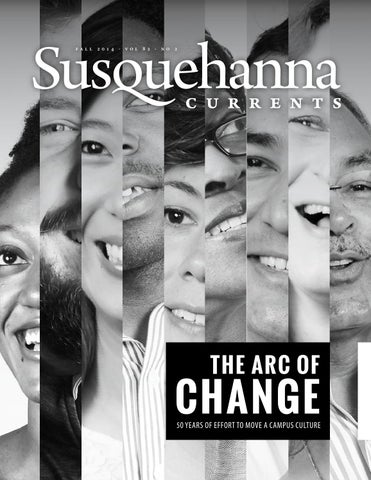
fall 2014 路 vol 82 路 no 2
the arc of
change
50 years of effort to move a campus culture
Inside
fall 2014 · vol 82 · no 2
The arc of change
In recognition of the 50th anniversary of the first African-American student enrolling at Susquehanna, we take a look at how the university is growing into a more diverse campus.
F e at u r e s
s e c ti o n s
The Arc of Change
DEPARTMENTS
4 50 Years of Effort to Move A Campus Culture
2
15 The Faces of Change
First Word
24 People & Places 28 Scoreboard 32 The ’Grove
Q&A · Syllabus · Forward Thinking · Kudos
48 End Notes ALUMNI NEWS
36 Class Notes
Message Board · Regional Chapter News · Weddings & Gatherings · Deaths
Chief Communications Officer Angela Burrows Assistant Vice President, Alumni, Parent and Donor Engagement Becky Bramer ’92 Deitrick Editor Victoria Kidd Associate Director, Advancement Communications
15 The faces of change Alumni, students and faculty from historically underrepresented backgrounds share their Susquehanna experiences.
Class Notes Editor Jodi Swartz Administrative Assistant, Alumni Relations Contributing Writers Bruce E. Beans Dan MacArthur Manager, Web Communications and Web Content Strategy Megan McDermott ’14 Katie Meier Director, Athletics Communications Graphic Design Amanda Lenig ’07 Creative Services Manager Colby Walls Graphic Designer Copy Editors Betsy K. Robertson Director, Digital and Print Communications Kathleen Larson Florio
38 L ibrary Renovation
The Blough-Weis Library has been transformed into a 21st-century learning and research hub, thanks to a recent renovation project supported by alumni, parents and friends.
Susquehanna Currents Online: www.susqu.edu/currents
Susquehanna University is a proud member of
WayPoints 18 Ways You Know You Go to Susquehanna
Spotting a Susquehannan is easier than you think. Here are the top ways you can tell.
www.susqu.edu/Currents-Signs Shaping Tomorrow’s Leaders
LeaderShape, a six-day retreat, is one of the many transformative experiences that help prepare Susquehanna students for future success.
www.susqu.edu/Currents-LeaderShape
The Annapolis Group
comprising approximately 130 leading national independent liberal arts colleges that have similar interests and concerns centering on the values of liberal arts education that inform their missions. The Annapolis Group provides a forum for member institutions to share best practices, seek higher levels of excellence, and advance the cause of liberal arts education on a national scale.
A New Perspective
See “old S.U.’s broad campus” like never before in this video produced from the bird’s-eye views captured by an octocopter this fall.
www.susqu.edu/Currents-NewPerspective
Cert no. SGS-COC-004317
Building a Campus Community
Dear Alumni and Friends
In the decades preceding Gustave Weber’s appointment as Susquehanna’s 11th president in 1959, the university had been slow to capitalize on one of the greatest expansions in the history of American higher education. He recognized the strategic necessity of growth and built an infrastructure that made it possible. The result, according to Professor Emeritus of History Don Housley, was that President Weber “effected a revolution in the physical, academic and social environment at Susquehanna University.” During Weber’s presidency, the university’s sectarian “ethos” gave way to greater intellectual and social freedoms for students, and Susquehanna became a more welcoming, diverse and inclusive community. Weber’s 18-year tenure included many major milestones on an important institutional journey that continues to this day. One such milestone was the arrival 50 years ago this fall of Susquehanna Trustee Bill Lewis, who began his college career at an institution on the cusp of significant growth and change. As Susquehanna’s first African-American graduate in 1968, Bill both benefited from and helped propel changes that have been part of our ongoing journey. He and others share their experiences in the stories that follow.
“We value diversity and inclusion because it is the right thing to do....” —L. Jay Lemons
Another milestone of Weber’s presidency was his 1972 encounter with local businessman Charles Degenstein. Their shared commitment to the powerful educational opportunities that Susquehanna provides led the charismatic Lutheran clergyman and the socially conscious Jewish businessman to forge an enduring friendship. Susquehanna continues to benefit from that friendship through the extraordinary support of the Charles B. Degenstein Foundation. We value diversity and inclusion because it is the right thing to do and because it is an educational imperative for life, citizenship and leadership in the 21st century. The Association of American Colleges and Universities states unequivocally that a highquality liberal arts education must include a focus on diversity and inclusion. I am proud that Susquehanna is a national leader in this regard, and I am especially grateful to the faculty for creating an ambitious and demanding curriculum that expects all students to develop an understanding of and appreciation for diversity. From founder Benjamin Kurtz’s conception of the university as a place to train clergy from modest means, to opening doors to first-generation college students and students from rural Pennsylvania’s lower-income families, Susquehanna has a long tradition of providing access to a better future. The New York Times recently recognized the university as one of the top 10 most economically diverse colleges in the nation.
Wi t h v e ry b e s t w i sh e s , L. Jay Lemons, President
2 · Susquehanna Currents · fa l l 2 0 1 4
susquehanna university
s tat e m e n t o n d i v e r s i t y & i n c lu s i v e n e s s Ap p r o v e d b y t h e S u s qu e h ann a Univ e r s it y B o ar d o f Tr u s t e e s , May 1 4 , 2 0 0 7
A s a l i v i n g , l e a r n i n g a n d w o r k i n g c o m m u n i t y, S u s q u e h a n n a Un i v e r s i t y affirms its commitment to being an engaged, culturally inclusive campus. The university’s history and heritage lead us to affirm the dignity and worth of all persons. Consequently, we must be vigilant to ensure that we do not exclude or marginalize individuals and groups because of such differences as gender,
Cr it i c al ly aw ar e o f t h e w ay s p o w e r an d p r iv i l e g e i nf l u e n c e practices, processes and relationships, Susquehanna Univ e r s it y d e c l ar e s it s i nt e nt i o n t o b e a m o r e d iv e r s e an d i n c l u s iv e c o mmu nit y. O n e w hi c h :
sexual orientation, race, ethnicity, social class, marital and parental status, disability, age, religion, geography and national origin. As Susquehanna seeks to embody the rich diversity of the human community, we commit ourselves to the full participation of persons who represent the breadth of human differences. Critical engagement with diversity entails understanding how these differences impact the ways in which we experience the world, the beliefs that emerge from and frame those experiences, and the impact of power and privilege on our lives. Such engagement takes account of the lived realities of students and is essential for effective teaching and learning, equitable governance and decision-making, and healthy community life.
Embodies a commitment to civility and rich dialogue where all people can share their perspectives in the pursuit of knowledge and understanding, • Adopts policies and practices that protect the rights and dignity of all persons and which provide equal access to resources, • Seeks actively to recruit and retain students of diverse backgrounds,
As we seek to fulfill these commitments, our perceptions, understandings and expectations will often come into conflict with those of other members of the campus community. These conflicts are not to be avoided, but should be seen as opportunities for learning and growth. Our responses to such conflicts must be framed by our respect for all people and our commitment to social justice and lifelong learning. We believe that these commitments are morally and educationally necessary, essential to being a viable and competitive institution of higher learning in the 21st
•
century, and indispensable in educating
Seeks actively to employ persons of diverse backgrounds in all categories of employment,
“undergraduate students for productive,
•
ment, leadership, and service in a diverse
Encourages and expects teaching and advising practices and professional behaviors that promote critical engagement with diversity, • Challenges myths and stereotypes, and • Fosters the development of cross-cultural relationships marked by mutual curiosity and respect.
creative, and reflective lives of achieveand interconnected world.”
Ap p r o v e d b y t h e S u s qu e h ann a Univ e r s it y B o ar d o f Tr u s t e e s , May 1 4 , 2 0 0 7
the Arc of
4 · Susquehanna Currents · fa l l 2 0 1 4
50 years
of Effort to Move a Campus Culture
by Angela Burrows Chief Communications Officer
This fall marks the 50-year anniversary of Trustee Bill Lewis’ arrival on campus as a first-year student. Four years later, Lewis became the university’s first African-American graduate. We chose to use the anniversary as an opportunity to look back on the significant progress the university has made to increase campus diversity, acknowledging that despite the changes that have occurred, there remains work to be done.
fa l l 2 01 4 · Susquehanna Currents · 5
During the past 50 years
dramatic progress has been made to increase the diversity and inclusiveness of the Susquehanna University community, although university officials acknowledge the work is never done.
Kevin Hannahoe ’07 was serving as academic liaison for the Student Government Association (SGA) in the 2004–05 academic year when he submitted a petition on behalf of the association to make the study of diversity a curriculum requirement. The Reading, Pa., native, then a sophomore, met with Provost and Dean of the Faculty Linda McMillin to explain the students’ concerns. Hannahoe and many of his peers had been involved in service-learning trips and other activities that exposed them to people with life experiences totally different from their own. Recognizing the impact of these experiences, the SGA wanted a requirement that would ensure all students had access to such opportunities. Driven in part by the students’ vision and the SGA’s request, an introductory course on diversity, a diversity intensive and a study-away experience are all requirements of the university’s central, or core, curriculum
implemented in 2009. The introductory course focuses on identity, power and privilege and how they operate in society. The intensive allows students to see how these dynamics play out in their chosen fields of study. The off-campus study experience, offered through the university’s Global Opportunities (GO) program, introduces students to new perspectives by requiring them to live in a culture other than their own, in the U.S. or abroad. The curricular requirements represent another significant milestone made by the university to create a diverse and inclusive campus culture, one committed to increasing the cultural competency of all students, faculty and staff, McMillin says. McMillin, who came to the campus 25 years ago from the diverse UCLA campus where she earned her doctorate degree, has helped Susquehanna grow its numbers of students of color and international students.
fa l l 2 01 4 · Susquehanna Currents · 7
But the progress is part of a continuum that stems from seeds of change sown much earlier.
Early Pushes Against the Fly Wheel Religious Diversity Increases After Mandatory Chapel Is Abolished Change is often driven by students, much like Hannahoe, who are influenced largely by the broader society, and Susquehanna has been no exception, says Professor Emeritus of History Donald Housley, Susquehanna University historian and former dean of arts and sciences. By the 1960s, Susquehanna students railed against mandatory chapel and the imposition of a “prescribed set of values” at the Lutheran institution, Housley writes in Susquehanna University 1858-2000: A Goodly Heritage. “There had been an air of white, Protestant privilege on campus,” he noted. “Up until the late 1950s/early 1960s, there were rigid gender and religious roles” at Susquehanna, founded in 1858 to prepare Lutheran pastors who came from modest means. By the 1960s, the times were changing. Although the civil rights and anti-war protests occurring on many college campuses came slowly to Susquehanna, with anti-war sentiments quite strong by 1968, there was a great deal of student rebellion against the status quo between 1964 and 1968, Housley said. The first major changes in the complexion of the campus community occurred nearly 50 years ago when, after mandatory chapel was abolished, an increasing
1903 Sigmund Weis graduates from Susquehanna university
number of Catholics and, to a lesser degree, Jewish students enrolled. But smaller changes were made even further back when Sigmund and Harry Weis, sons of Jewish immigrants, enrolled at Susquehanna in the early 1900s. The two brothers would go on to open a small grocery store in Sunbury that they would call Weis Pure Foods. The connection between the Weis family and Susquehanna deepened in 1972 when Sigmund’s son-in-law, Charles Degenstein, met then-Susquehanna President Gustave Weber at a Rotary Club luncheon. Degenstein was so impressed with Weber’s knowledge and commitment to students that the two formed a longtime friendship, and the Jewish businessman’s philanthropic support opened up new opportunities for the university by making possible new buildings and programs. Current President L. Jay Lemons often references the Weber-Degenstein partnership and credits it with significantly influencing the university’s path. “Susquehanna was founded by the Lutherans, but it was the friendship between a Jewish businessman and the last Lutheran clergyman to serve as Susquehanna’s president that largely changed the course of our history,” Lemons says.
Increased Religious Diversity, Followed by Changes for Women Housley credits Dorothy “Dottie” Anderson ’62, who had returned to her alma mater in 1967 as the university’s first assistant dean of women, with driving early change for women students. Life for women on campus had been quite different than for their male counterparts through the 1950s, Anderson says. To name just a few examples, unlike their male peers, women had a curfew, had limited access to athletic facilities and did their own laundry.
1964 Bill Lewis enters Susquehanna as a first-year student
1967 Dorothy “Dottie” Anderson ’62 returns as first assistant dean of women
Pictured, left to right: Susquehanna Trustee and local attorney Sidney Apfelbaum, the late businessman and philanthropist Charles B. Degenstein, Susquehanna President Gustave Weber and his successor, President Joel Cunningham
Moreover, she’s worked to build an infrastructure to support them and embed the study of diversity in the curriculum.
“ S usquehanna was founded by the Lutherans, but it was the friendship between a Jewish businessman and the last Lutheran clergyman to serve as Susquehanna’s president that largely
changed the course of our history.” —President L. Jay Lemons
Anderson had encouraged the establishment of a campus chapter of the Association of Women Students, which was active in promoting reform, working to break down sexual stereotypes and challenging many rules and regulations. It was familiar ground for Anderson, who had worked with a chapter of the AWS when she was earning a graduate degree from Syracuse University.
Early Efforts to Increase African-American Student Numbers Fail Initial efforts to increase the number of AfricanAmerican students were less successful. The support systems weren’t in place, and the school’s location in rural central Pennsylvania compounded the difficulty of efforts to draw large numbers of African-American students, according to Housley. So it was a white campus that Bill Lewis stepped onto in 1964 when he arrived as a first-year student. Lewis would become Susquehanna’s first African-American
1968 Mandatory Chapel is abolished on susquehanna’s campus
graduate and would remain involved in guiding the university as a trustee for many years. After studying at Susquehanna University during the height of the civil rights movement—from the passage of the landmark Voting Rights Act in 1965 to the assassination of Dr. Martin Luther King in 1968—Lewis sought to improve the nation’s civil rights climate. Armed with a law degree from Boston University, he has spent a lifetime working in the area of civil rights and diversity. After a nearly three-year stint as a prosecutor in the Philadelphia district attorney’s office, he became a congressional liaison with the U.S. Commission on Civil Rights, an independent agency reporting to the president and Congress that played an important role in key civil rights legislation involving desegregating schools, enforcing voting rights, and banning employment discrimination. He served 11 years before becoming deputy director of the U.S. Department of Energy’s Office of Civil Rights and Diversity, a position from which he retired in 2011.
1968 Bill Lewis becomes Susquehanna’s first African-American graduate
1972 Susquehanna President Gustave Weber meets local businessman Charles Degenstein
Changes Intensify Momentum Grows Since the Late 1990s Although early campus conversations about diversity typically focused on African-Americans and women, by the mid- to late 1990s they had broadened to be inclusive of other groups such as Asian-Americans Hispanic-Americans and lesbian/gay/transgendered persons, says Associate Professor of English Susan Bowers. There was a recognition that diversity was not only about race, gender and religion, but also about class, sexual identity, ability and the need to address issues surrounding disabilities of various kinds, and a range of other differences, such as urban versus rural and young versus old. Diversity Studies and Jewish Studies appeared in the course catalog in 1999, eight years after Women’s Studies was initiated. In October 2003, Lemons appointed a task force on diversity and inclusiveness. Established 35 years after
Lewis graduated, the task force was created at a time when faculty and staff were discussing the importance of increasing the diversity of the campus community, says former university chaplain the Rev. Mark Wm. Radecke, who convened the group. Despite the progress that had been made, the campus at the time was not reflective of the general population. “We were a pretty white campus with a very small minority population,” Radecke says. But it wasn’t just about the numbers, he was quick to add. “We were interested in what it means to be critically engaged with issues related to diversity. The faculty, especially, made it clear that it was not enough to bring ‘them’ to us and expect minority and international students to conform to a predominantly white culture. It was more the notion that, as the university became more diverse, we would need to be open to different ways of living, being and doing. We know from physics that when you put a warm object in cold water, it’s not just that the object cools off, the water warms up. Likewise, when diverse people enter the university, the university is going to change, and people started to recognize that.” The presidential task force issued its report in October 2005, and a year later, a board task force was established by then-Chair Terry March. Co-chaired by Lewis and Gail Hanson P ’97, now trustee emerita, the board task force issued its report in 2009. The objective of the board’s efforts was to improve the trustees’ understanding of diversity and inclusiveness, while at the same time drawing on their personal, educational and professional experiences in these areas. Left: The Rev. Mark Wm. Radecke led the task force on diversity and inclusiveness, appointed by President L. Jay Lemons in October 2003.
1989 First Director of Multicultural Affairs hired at susquehanna
1991 Women’s Studies Program is launched on campus
1999 Diversity Studies and Jewish Studies first appear in course catalog
Diversity Series Opens Conversations, Deepens Understanding By Megan McDermott ’14 The campus community came together this past spring to host “Let’s Talk,” a series of free, public events addressing issues of diversity, equality and social justice. From a symposium on the meaning of the swastika to a performance by the poet activists known as Climbing PoeTree, the series was both engaging and empowering. But one event in particular captured the growing appetite for change among students. It’s Just a Word: Power of Language was a panel discussion featuring four students who shared their experiences with hateful expressions on campus and called members of the campus community into more thoughtful reflection on the meaning of their words. Carly Husick ’15, a creative writing and political science major from Malvern, Pa., shared her perspective as a Jewish student, emphasizing the need for continuing efforts to make Susquehanna a safe and welcoming campus. “Change doesn’t happen in a day,” Husick cautioned during the April 22 event. “We can’t just have one rally and think the campus is going to change.” Candence “CC” Cannady ’14, a psychology grad from Chicago who served as the LGBTQ coordinator with the Center for Diversity and Social Justice, recalled an incident where she heard a fellow student use a homophobic slur on Smith Lawn. “These remarks affect others and make them feel unsafe,” Cannady explained. Instead of brushing off the comment, Cannady questioned the student about the language he was using. “The only way we can combat these
problems is to stand up and speak up,” said Cannady, who was named Susquehanna’s 2014 Senior Woman. The other panelists also spoke on the need for students to stand up to their peers. Jasmia Jarrett-Small ’15, a psychology and sociology major from Fairless Hills, Pa., who came upon a racial slur written on the sidewalk as she walked to church one day, invited the student body to take a stand with her. “It is our right to come together and say, ‘Hey, this is not OK,’” she said.
“ Change doesn’t happen in a day. We can’t just have one rally and think the campus is going to change.”—Carly Husick ’15
However, she also recognized that taking a stand can be scary. Proactively addressing harmful language can put someone at risk of being ridiculed by their friends, but JarrettSmall assured students they won’t be standing alone. “Let’s be scared together,” she said, inviting others to join her in speaking out. Madeline “Maddie” Distasio ’14, an English major from Mountaintop, Pa., spoke out in a very public way, even before the “Let’s Talk” series began. On her blog, Distasio posted a widely shared open letter to the campus that recorded examples of offensive speech she overhead Susquehanna students use. “What’s coming out of your mouth has real consequence,” she said, adding that “complacency and neutrality” can be as damaging as actually making the harmful comments.
Megan McDermott ’14 graduated in May with degrees in creative writing and religious studies. She is currently working as the assistant to the executive director of New Haven (Conn.) Community Soup Kitchen through the Episcopal Service Corps.
Susquehanna’s
Diversity by the numbers U.S. Minorities / International Students Fall 2005 126 / 10 Fall 2006 139 / 12 Fall 2007 159 / 15 Fall 2008 173 / 11 Fall 2009 198 / 18 Fall 2010 204 / 16 Fall 2011 236 / 17 Fall 2012 278 / 28 Fall 2013 324 / 29 Fall 2014 331 / 34
Economically Diverse Colleges
In September, Susquehanna was recognized by The New York Times as one of the 10 most economically diverse college campuses in the nation. Here’s the company we keep in the list— Vassar College
Harvard University
Grinnell College
Pomona College
University of North Carolina at Chapel Hill
St. Mary’s College
Smith College Amherst College
2003 Presidential Task Force on Diversity and Inclusiveness established by l. Jay Lemons
Susquehanna University Columbia University
2005 Presidential Task Force issues its report
2006 Board Task Force on Diversity is established by board chair Terry March
“ If we really want transformation, we have to live with a degree of ambiguity, to accept feedback and do a lot of soul searching.
The work, takes courage.” —Lisa Scott
of ambiguity, to accept feedback and do a lot of soul searching,” Scott says.
Diversity Matters: Bringing Differences From the Fringes to the Forefront Those who are different often continue to operate on the fringes, notes Lisa Scott, who was hired in 2009 to lead diversity efforts and to assist in building cultural competency or an understanding and respect for those who are different. The campus community has been working on moving the differences from the fringes to the center, focusing on increased engagement of underrepresented groups, Scott says. “But we have to keep at it. So much bias is unconscious. Bias doesn’t operate the way it once did. It’s much more nuanced and subtle, and how you experience it depends on where you sit.” Just as acceptance is different from empathy, equity of access doesn’t mean equity of outcomes, Scott cautions. Institutional transformation can only come if there’s willingness in the campus community to be uncomfortable for sustained periods of time. “If we really want transformation, we have to live with a degree
2009 Board Task Force issues its report New Central Curriculum is implemented
The work, she adds, takes courage.
Numbers Up: The Campus Community Looks Different The university’s success in making the campus more diverse can be measured, in part, by the most recent statistics on the student body. This year, U.S. minorities represent 15.8 percent of the student body, compared to 14.6 percent in 2013–14, 6.5 percent in 2005 and 6 percent in 1998. There are currently 34 international students on campus, compared with 10 in 2005. There are also 32 English Language Learning (ELL) students at Susquehanna this fall, with the majority also living on campus, and enrolled in the program being offered through the university’s partnership with Denver-based Language Consultants International (LCI). Many of these are
2013 First class to complete the GO requirement graduates
2014 16.4 percent of student body are students of color and there are 34 international students
“ The fact that they’ll drive change is inevitable. I look forward to how our students will continue to
push us forward.” —Linda McMillin
Saudi students. One of the earliest ELL students to arrive at Susquehanna has achieved required language proficiency levels and has enrolled at the university. Not only have the numbers increased; there’s also a heightened engagement by students from underrepresented groups, says Scott, now vice president for student engagement and success. The administration acknowledges that although there has been headway in increasing diversity among faculty and staff, there is much more work to do. In fall 2013, minorities made up 13.5 percent of the faculty, compared with 8.6 percent in fall 1998, while 7.4 percent of the staff identified as minority in fall 2013, compared with 2 percent in 1998.
“ we cannot rest on our laurels; there’s a lot more work to be done.” —Bill Lewis One of the challenges, especially in recruiting staff from underrepresented groups, is the lack of diversity in Selinsgrove and the surrounding region. Only 3 percent of Snyder County is nonwhite and only 8 percent
of Selinsgrove’s population is nonwhite, according to the 2010 U.S. Census. Lewis recognizes that local demographics also have played a role in attracting students of color and international students. “I think we’ve done reasonably well given all the factors in play,” Lewis says. “Our efforts have been genuine and sincere, and we’ve been successful to a certain extent. … Educational institutions and educators are well positioned to promote an appreciation for differences.” Hanson, too, credited the university for its commitment to diversity and inclusiveness and the disciplined approach it has taken to achieve both. “As a university and as a society, we’ve made a lot of progress. But then you have a Ferguson, Mo., (where a young black man was killed in August by a white police officer), and we view the same scenes on television that I saw when I was in college. We cannot rest on our laurels; there’s a lot more work to be done,” says Lewis. McMillin is hopeful. Following in the footsteps of their predecessors who railed against mandatory chapel and rigid gender roles, Kevin Hannahoe and his peers prompted change by asking for a diversity requirement. And just as Bill Lewis made history as Susquehanna’s first African-American graduate and continues to have an impact as an alumnus, today’s students will no doubt leave the institution different than they found it. “The fact that they’ll drive change is inevitable. I look forward to how our students will continue to push us forward.” Above: Pictured, left to right, are Provost and Dean of Faculty Linda McMillin; Professor of Religious Studies Karla Bohmbach; Laurie Crumpacker, former dean of the School of Arts & Sciences; and Associate Professor of English Susan Bowers.
14 · Susquehanna Currents · fa l l 2 0 1 4
by Victoria Kidd, Associate Director, Advancement Communications
Since 1964 when the first African-American student enrolled at Susquehanna, a diverse group of students, faculty and staff have helped weave the rich tapestry of life on campus. In the stories ahead, several of these individuals share their personal journeys and reflect on Susquehanna’s progress toward a more diverse and inclusive community.
fa l l 2 01 4 · Susquehanna Currents · 15
Two Worlds Becoming One By Victoria Kidd
Su “Sandi” Aung ’13 grew up in the second capital city of Yangon (formally Rangoon) in the country of Myanmar (formally Burma). A former British colony, the Southeast Asian country has struggled with its national identity—and therefore, its name— for the better part of a century. Even present-day maps refer to the country by both names. But when it came time for college, Aung was fixed on another part of the globe—the United States, and specifically the East Coast. “I knew I wanted to come to the states … because of the many great colleges I had researched, but mainly because America supports the freedom of speech and education,” says Aung. As the only Burmese student at Susquehanna her first year, Aung experienced a difficult transition, immersing herself in a culture so different from her own. From changes in the climate and cultural norms to new holidays and jet lag from her 25-hour flight, Aung had a good deal of culture shock to overcome when she arrived on campus. Growing up in the delta region of Myanmar, Aung says it was mostly hot and humid all year round. “There is summer, monsoon and winter, but winter is an understatement since we don’t have snow, except in the north.” In Myanmar, Buddhism is the prevailing religion, and each October Burmese families celebrate the homagepaying ceremony of Thatinkyut. April brings their New Year celebration, complete with an annual water festival called Thingyan Festival. “The idea is to cleanse the past year’s dirt and troubles away,” explains Aung, who found neither of these traditional holidays widely celebrated in the United States.
16 · Susquehanna Currents · fa l l 2 0 1 4
Then there were the little things, like public transportation, that she sorely missed, especially when logistics and expense made it too difficult to even bring a bicycle to campus. Even though she had attended an international high school that prepared her to study abroad, Aung knew little about American life before coming to Susquehanna. Her perception was based on movies, sports and TV shows. Her assumptions were that “Americans were food lovers, mischievous and not patient.” Those perceptions quickly changed when she arrived on campus and began meeting people who she found to be “very helpful, polite, patient and good listeners.” Aung’s anxiety level was high at first, and she wasn’t sleeping much. Fortunately, the university’s counseling center recognized her stress and took action. “The counselor was very kind, and took time to get to know me and help me with my stress. My RA [resident assistant] was also very helpful, referred me to the right people and even helped me get a bike so I could get around campus easily.” Once Aung began to find her footing, she also found Susquehanna’s International Club and a circle of friends as eager to learn about her culture as she was to learn about theirs. In time, Aung, who majored in graphic design and business, would become vice president of the student organization. She even became an RA and mentored international students who came to Susquehanna after her. Through her Susquehanna education, Aung says she realized the importance of cultural competency for all students. “No one can survive and enjoy life by being alone, no matter how much they may think so,” she says. “I have always stayed open-minded to accept others and let others learn my culture and myself. Through sharing I have learned a lot of unique ways my American friends enjoy their culture, such as Thanksgiving and Christmas. “Individually I got to experience [American culture] by being a part of the community, and when I share my memories and experiences with my family, that becomes an act of connecting the two worlds and becoming one.” After graduation, Aung immersed herself in another new American experience—The Big Apple. She initially worked as a graphic designer at Broadstreet Productions in Manhattan. She has since begun a full-time Master of Fine Arts program at the New York School of Interior Design while continuing to do freelance work for Broadstreet.
fa l l 2 01 4 · Susquehanna Currents · 17
18 · Susquehanna Currents · fa l l 2 0 1 4
Finding Direction Off the Beaten Path
By Victoria Kidd
As counterintuitive as it sounds, New York is reported to be one of the most racially segregated cities in the country. Just ask Nadia McCallum ’15, a Brooklyn native who sees the effects of this division every time she goes home. In fact, it’s been a driving factor in her professional pursuits. In high school she was set on becoming a doctor. She saw neighbors going without medical care because the doctors who worked in nearby clinics and hospitals were often white outsiders, filling the void left by young African-Americans who left for a better life elsewhere. Many people have difficulty relating to a doctor who doesn’t look like them or come from a similar background, McCallum explains. To combat the problem, McCallum was convinced she should become a doctor and return home to practice medicine. But as she transitioned to college, she realized her real passion lies in teaching. “The first time I presented a lesson I was like, ‘Wow, I love this,’” McCallum says. She also realized that, like doctors, Brooklyn needs good teachers who can relate to their students’ lived experiences. So, in her sophomore year, McCallum changed her major to early childhood education and began preparing for graduate-level study in special education. Quality special education programs are often lacking in inner-city schools, she says. “There are students [in these schools] who don’t understand what seem like simple concepts … but just because someone can’t figure something out the same way 80 percent of the class does, doesn’t mean they can’t learn another way. “I don’t like to see anyone feel like less of a person, and hopefully I can change that.”
Ironically, for a daughter of Jamaican immigrants living in New York, McCallum found her calling as an educator in the most unlikely of places—a small liberal arts and science college in rural central Pennsylvania. Although some family members and friends were apprehensive about her college choice, McCallum says she never really gave any thought to being a black student on a predominantly white campus. “Race was never at the forefront of my mind,” she says. Nor did it seem to be an issue for her parents. When they visited campus, McCallum was struck by the “family feel,” and her parents quickly said, “Yep, this is the school.” “They loved it,” McCallum recalls. “It seemed like the perfect environment for learning, and everyone was so friendly. We felt that everyone would be there for my best interest. “And,” she adds, “my parents were very overprotective, especially my dad. So for him to feel that way really meant something.” Nonetheless, it was unnerving to arrive on campus her first year and find resentment among some of her peers in the Black Student Union. “They told us that everything isn’t all dandy and flowery,” she recalls. McCallum thinks those negative views have largely disappeared, though how or why remains a mystery. “It could be because there’s more openness to ask questions,” she says. “SU has done a great job of opening conversations about race.” She also thinks the university is doing a good job of deepening students’ understanding of different cultures. Like every other student who has enrolled at Susquehanna since 2009, McCallum fulfilled the cross-cultural requirement through Global Opportunities (GO)—a study-away experience and subsequent reflection course embedded in the university’s Central Curriculum. McCallum selected one of the more obscure GO programs only to find unexpected inspiration in her decision. During her “GO North” trip to a Mushkegowuk Cree village in Fort Albany, Ontario, she discovered similarities between Native American and Jamaican cultures. It reminded her of summer visits with her grandparents who still live in Jamaica, and her grandmother’s eternal words, “Just try”—words she’s eager to put to work in Brooklyn classrooms after graduation next May.
fa l l 2 01 4 · Susquehanna Currents · 19
blind
but never in the dark By Victoria Kidd
Squint until your eyes are nearly closed. Your surroundings blur, your peripheral vision narrows. Now imagine seeing the obscured shapes around you in black and white— mere shadows coming and going from your field of vision. This is how Griffin Pinkow ’15 sees the world. Pinkow has retinitis pigmentosa, a degenerative eye disease that causes severe vision impairment and often complete blindness. Pinkow’s vision has steadily deteriorated since he was diagnosed at age 12. Most individuals with retinitis pigmentosa are legally blind by the time they are 40, but Pinkow has already reached this designation. When he first enrolled at Susquehanna, his vision was still good enough that he could get around campus unaided; he even played on the men’s rugby team. Since then the disease has progressed to a point where Pinkow needs to use a cane to navigate campus, and he can no longer compete in rugby matches (though he is still on the roster and continues to train with his teammates). Although his family splits their time between homes in New York City and Southern California, Pinkow says he found a smaller university setting more appealing. “A smaller school for someone with my challenges makes it easier to get around, but more than anything, it’s an easier environment to make friends and get to know people,” he says. Susquehanna’s close-knit community has been helpful as well. Pinkow credits the “wonderful people here” with providing him with the acceptance and encouragement he’s needed to thrive despite his limitations. They’ve “always reached out a hand to help and support me.” Luke Wesneski, academic specialist in the Center for Academic Achievement, “is always there for me,” Pinkow says. So, too, are his teammates, coaches, classmates and teachers, he adds. He’s been particularly empowered by his involvement with the university’s Enactus group and the relationship he developed with the organization’s faculty adviser, George Cravitz, who Pinkow describes as “one of my mentors and role models in life.”
20 · Susquehanna Currents · fa l l 2 0 1 4
Griffin Pinkow ’15
Formerly known as SIFE (Students in Free Enterprise), the Enactus team develops economic-based community service projects and presents their work at annual regional and national competitions. As a longtime advocate of the Foundation Fighting Blindness, Pinkow developed “Griffin’s Vision Quest” as part of his work with Enactus. The program includes a sequence of activities—hitting a hockey puck into a goal, for instance—that participants perform blindfolded to raise both awareness of and funding for the organization. These “vision quest” experiences, along with a fundraising website, helped Pinkow raise more than $11,000 for the foundation in the past year. His work has not gone unnoticed. In April, Pinkow was awarded the Robert Plaster Foundation’s “Can’t Never Could” award at the Enactus National Exposition in Cincinnati. The award recognizes students who have overcome significant challenges to achieve success and, in turn, have used that success to advance the work of Enactus on their respective campuses. Both the name and purpose of the award are fitting for a young man who never takes “no” for an answer. If someone tells Pinkow he can’t do something, he does it anyway and typically finds that he’s done it well. It’s this tenacious spirit that has helped Pinkow break down barriers between normatively able-bodied people and himself, a differently abled person. He’s even been named president of Enactus for the 2014–15 academic year. “We need to see everyone as people,” Pinkow says, “not people who can do certain things better than others, but as individuals. “In all humility, I think I have had a strong effect on many at SU,” he adds. “I think students and faculty see me, a blind kid, walking around campus with a cane, yet still living the full life of a student and not feeling sorry for myself, [and] I think people … have learned not to be afraid of someone with a disability, that we have feelings and want to be just like everyone else.” As Pinkow’s story demonstrates, diversity comes in many forms, and efforts to increase cultural competency in order to appreciate and respect differences must be ongoing. During his time at Susquehanna, Pinkow has worked to educate the campus community about what it means to live with blindness. His efforts have helped many to see that those with disabilities have special challenges that can be made all the more difficult by a lack of understanding.
fa l l 2 01 4 · Susquehanna Currents · 21
leaving A lasting impression By Victoria Kidd
When Theresa Palmer ’73 Tracy enrolled at Susquehanna University, a mere five years after the Civil Rights Act was signed and just one year after the assassination of Martin Luther King Jr., little did she know that she’d be blazing a trail that would ultimately create a lasting legacy for her on campus. As the first African-American woman to graduate from Susquehanna, Tracy has an almost legendary allure to today’s students thanks to the Theresa Palmer Society, founded by students in 2006 to bring women of color together to foster personal transformation and intercultural engagement. Tracy says she was “both surprised and honored” when she was notified that the society had been created in her name. “I always thought I was among some of the first black students to graduate from SU, but having it verified that I was the first female was amazing,” Tracy says. “I’m not a person who takes compliments very well, so it took a while to sink in that my name was still around at SU in the 21st century. How cool is that!” When Tracy returned to campus for the inauguration of the Theresa Palmer Society (TPS), she says she was thrilled to see so many faces of color on campus. Certainly, it wasn’t a lot in comparison to universities located in more metropolitan areas but, as Tracy says, at least it was more than the 10 she started with in 1969. Before enrolling at Susquehanna, Tracy had never attended a school where the majority of the student body wasn’t African-American. As a young woman who grew up in Washington, D.C., she was “astonished that there were students at Susquehanna who had never seen a ‘real live’ black person before.” Then again, Tracy and her fellow African-American peers were quite a change for Susquehanna, too. “We were all trailblazers,” she says.
22 · Susquehanna Currents · fa l l 2 0 1 4
The black pride movement was gaining momentum and Tracy decided to grow her first Afro while on campus. And to this day it amuses her to consider the surprise that visiting families must have felt when she was introduced as their tour guide, one of the many jobs she worked at to make her way through college. Having come from a single-parent household, Tracy says her challenges were “probably more due to a different socio-economic level than racial. Many of the girls in my dorm were from families with maids and butlers, and all the frills that go along with that lifestyle,” she recalls. Despite the disparities, Tracy says she never felt like she didn’t belong at Susquehanna, mainly because she refused to let herself feel that way. “As I told the members of the TPS, I’ve always believed you must grow where you are planted.” And grow she did, in both typical and unexpected ways. “Yes,” she says, “we formed the Black Student Union (I was secretary), but I for one, did not isolate myself from the new culture I was surrounded by. I jumped right in, and I can truly say I never experienced any outward expression of discrimination while at SU.” Tracy was a member of the women’s basketball team, even though she was often the only black person in the gym at both home and away games. She wrote for the student newspaper, joined a sorority, and was a counselor in the Spanish House. “You name it, I tried it,” she says. One might say Tracy has done the same with her long and varied teaching career, which began in 1974 at the same junior high school she attended as a youth. After five years there, Tracy took a position in Prince George’s County Public Schools in Maryland, where she taught both middle school and high school before retiring in 2010. Through the years, Tracy taught Spanish (her primary subject) along with various other subjects and skill-building courses. She led student tour groups to different countries and U.S. cities, and incorporated a program called Teaching Tolerance into her curriculum to combat the misconceptions her African-American students had toward Hispanics. In hindsight, Tracy seems pleased with both her career and her alma mater. Susquehanna gets high marks from her for its efforts to raise the cultural competence of the campus community. “I often quote Oprah Winfrey when she says, ‘When you know better, you do better,’” Tracy says. “[And] cultural competency is one way to help our communities ‘do better.’”
24 · Susquehanna Currents · fa l l 2 0 1 4
Shaping Cultural Competence By Victoria Kidd
Although he calls Newark, N.J., home, Johnny Culver ’15 was more prepared for small-town living than one might think. He was somewhat eased into the idea after attending high school at Wyoming Seminary Preparatory School in the northeastern Pennsylvania borough of Kingston. Although somewhat more bustling than Selinsgrove, Kingston is pretty similar in size and demographic make-up. So, ironically, it wasn’t the rural setting or mostly homogenous population to which Culver had to adjust when he arrived at Susquehanna. His biggest challenge was learning to manage his time—an ageless challenge felt by nearly every college student at one point or another. Culver’s is a particularly interesting schedule to juggle. Between his music major and biology–healthcare studies minor, directing both Gospel Choir and the a capella group Harmonic Combustion, working as a tour guide and serving on a variety of other student organizations, Culver quickly found himself spread thin. “I had problems managing how much time I committed to each. But with the help of my adviser and my peers, I have learned
“ It’s a piece of home
that we could enjoy right
here on campus.” — Johnny Culver
how to prioritize and take into consideration what’s best for me and delegate my time accordingly,” he says. One priority he quickly identified was Gospel Choir. In 2012, Culver and co-director Yasmine Chervin ’16
breathed new life into the choir after several years of inactivity. Culver says it was important for him and Chervin to resurrect the choir because “it’s a piece of home that we could enjoy right here on campus. “Most of us [in the choir] grew up singing gospel music in our church choirs and it’s an important part of why we are who we are,” Culver explains. What’s more, Culver says the group is helping to shape the cultural competency of campus. “A lot of people would assume that since gospel music has primarily African-American roots, that only black people could take something away from being part of the choir,” Culver says. “However, if anyone has the opportunity to watch the Gospel Choir perform, they’ll see that we have people from all walks of life—black, white, Asian, African and more.” And it’s not only choir members who benefit from this cross-cultural experience; so, too, does the audience members who witness their performances. “Those who come and watch the Gospel Choir get to experience the coming together of an amazing ensemble full of diversity and infectious energy. It is definitely something I am proud to be a part of,” Culver says. As a first-year student, Culver assumed, from his time at Wyoming Seminary, that the environment at Susquehanna would be friendly and academically driven. And his assumptions were right, but Culver says he also found that “SU is not only a place of higher learning, it is also a place to have fun, grow as a human being and meet some amazing people along the way.” Key, in Culver’s opinion, to meeting those amazing people is the diversified campus community Susquehanna is building. University leaders and personnel “have not only managed to get people from different backgrounds and ethnic groups on the same campus, but they have also designed an institution which allows these different types of people to interact and learn together in a safe environment,” Culver says. While that environment is far from idyllic at an institution still working toward its goals of increasing diversity and inclusiveness, Culver believes Susquehanna is on the right track with its efforts to create cultural competency. “As a community, cultural competency is important because it creates an accepting atmosphere and allows people from different backgrounds to feel comfortable learning and growing together,” he says.
fa l l 2 01 4 · Susquehanna Currents · 25
kate palley
teaching tolerance By Victoria Kidd
26 · Susquehanna Currents · fa l l 2 0 1 4
Students often gasp when Rabbi Kate Palley says the word “Jew” for the first time in her Introduction to Judaism class. “They’ve never heard it used in a nonderogatory fashion,” she says. It’s no wonder, considering that, just two years ago, a swastika and the word “Jew” were scrawled across a car in the parking lot of a local synagogue. Within weeks of the vandalism, there were subsequent incidents of antiSemitic vandalism on campus.
“ W e live in a multicultural and multifaith world, and if you’re going to be a citizen of that world,
you better learn the language.” — Kate Palley The reaction on a campus built largely as a result of the friendship forged between a Lutheran clergyman (Susquehanna President Gustave Weber) and a Jewish philanthropist (Charles Degenstein) was swift and deliberate. Everyone from President L. Jay Lemons to Rabbi Nina Mandel of the local Temple Beth-El publicly condemned the action. Palley penned a “Rabbi Writeup” in The Crusader student newspaper explaining the impact the swastika, once a Hindu symbol of prosperity, has on a Jew. “When cartoon characters are punched, they often see stars,” she wrote in the September 2012 article. “If I were punched in the face, I imagine I would see a swastika.” She explained that, in the West, it is impossible to divorce the symbol from Nazism and its inhumanity. “Make no mistake about it,” Palley wrote, “a swastika is a symbol of hate, a cowardly substitute for a punch in the face or a verbal assault, a promise of violence and murder lusted after in the heart.” At the time, Palley said she didn’t know what such acts meant for the Jewish community at Susquehanna, but she had reason to be optimistic. Since joining the campus community in 2009 as the university’s first resident rabbi and director of Jewish life, a position with both rabbinical and teaching responsibilities, Palley has seen the Jewish population grow “not only in numbers but in depth of commitment to Jewish life.” Her Introduction to Judaism class is “maxed out” every semester. The number of Jewish and non-Jewish students who attend campus observances of the High Holidays continues to grow, as does enrollment in the Jewish Studies minor, led by director Laurence Roth, a professor of English and prolific Jewish scholar. Before her arrival, Palley says, Roth had already done a lot of work with the Jewish community. “I really just picked up the reins from him,” she says. Roth says that when he arrived at Susquehanna in 1997, there were only six self-identified Jewish students on
campus. “Now Jewish life and learning have become an integral part of the Susquehanna experience,” he says. “Thanks for that progress go to student leaders like Jessica Mandelbaum ’01 Lemmon, the very first Hillel president, and to the Jewish and non-Jewish students who thought of the Jewish Studies House (now the Goldstein Weis Hillel House) as a place to gather, eat, share life perspectives, and learn from each other. Rabbi Palley is helping our current students through the next leg of that journey, and her work has made Susquehanna a more responsive and inclusive campus.” That work could have been daunting for someone like Palley, who never lived in a non-Jewish community before coming to Susquehanna. But the Stamford, Conn., native, who studied in Israel for two years, says she’s been impressed by the willingness of people to reach out to her and learn more about Jewish faith and customs. “I get the sense that people really care and want to relate more. They want a connection, and that’s lovely,” Palley says. She’s also been pleased to see other minority religions begin to make their voices heard through programs such as Hindu Diwali celebrations and the LCI Language Centers at Susquehanna University, which has increased Muslim representation on campus. Currently, several students from Saudi Arabia are preparing for college through the English language instruction offered by the center. Programs such as these, along with Hillel at Susquehanna, are enriching the cultural competency of the entire campus community—a must in the eyes of Palley. She says asking why cultural competency is important to all students is “like asking why it is important for students to know how to read. “It’s the world we live in,” Palley explains. “We live in a multicultural and multifaith world, and if you’re going to be a citizen of that world, you better learn the language.” Moreover, she believes that uniting in our differences, whether they be religious, racial, socioeconomic, geopolitical or gender-based, is the path to tolerance and lasting change. She summed it up best in her 2012 Crusader article: “Only you, the members of the Susquehanna community, can determine whether we are a campus of inclusion or exclusion, of peace or violence, of love or hate. Through your actions and your words do these values become known.”
fa l l 2 01 4 · Susquehanna Currents · 27
finding a home
in a Foreign land By Victoria Kidd
Like most students, Mouluddin “Dean” Rahimi ’10 was nervous about going away to college. Naturally, he was apprehensive about relating to new people and fitting in, especially since he would be living on an American college campus. So he turned to Dale Carnegie and his 1936 bestseller, How to Make Friends and Influence People. He read the book three times before leaving his homeland for the United States. But the one thing Carnegie didn’t need to teach him was how to deal with the unexpected. That was a life lesson he had learned long ago as a child in Afghanistan. His countrymen had been fighting a war, either with outside forces or each other, throughout his lifetime. When the Taliban took control of Afghanistan in 1996, Rahimi’s teachers were arrested. He and his classmates were threatened, and told not to return to school. His family was forced to flee their home for the relative safety of Pakistan. When they returned, Rahimi found that school was banned, and his dream of getting an education could not be reached in the country he called home. But he wasn’t going to let anyone else determine his destiny and persuaded his father to send him back to Pakistan to continue his education. He returned to Afghanistan in 2001, after the U.S. military overthrew the Taliban, graduating from high school in 2004. He was working as an English teacher when he was recruited by L-3 Communications, a security contractor working with the U.S. Army. Soldiers he befriended at the U.S. Army base where he worked told him about America. He vividly recalls his friend, Capt. Jack Jarvis, drawing a map of the United States on the ground with his finger one day, indicating the location of his hometown of Atlanta. Rahimi was convinced that the United States was where his future lay, but he had no idea where he would end up or how he would pay for his education.
28 · Susquehanna Currents · spri n g 2 0 1 4
He soon realized that scholarships were his only answer. “I simply had to go to a school that had scholarships for international students,” he said in a 2010 End Notes article he penned for Susquehanna Currents. “Fortunately, Susquehanna was one of those schools.” Rahimi wasn’t sure what to expect when he arrived at the university in 2006, but he was pleasantly surprised. “It was green, peaceful and seemed like home at first sight,” Rahimi said in 2010. “The extent people at Susquehanna University go to help you is awe-inspiring,” he now says. Rahimi experienced this firsthand when tragedy struck his family. His work with the U.S. Army had put him in danger of almost certain retribution by the insurgency in Afghanistan, making it impossible for him to return home when his father died, or later when his mother fell ill. “On both occasions, I simply could not have survived without the emotional support of the Susquehanna community,” Rahimi says.
“ Every moment that I lived at Susquehanna was an adventure.” — Mouluddin Rahimi
This support saw him through his darkest days and gave him the courage to turn his dreams into reality. His education in Susquehanna’s Sigmund Weis School of Business led him to London for a semester of study; to serving as the manager of the business school’s thennewly minted trading room; and to a host of other lifechanging experiences. “Every moment that I lived at Susquehanna was an adventure,” Rahimi says. “It’s a place that nourishes minds and expands horizons, a place to really think, to listen and to share moments. “Susquehanna provides a culture where you can grow exponentially in ways you never thought possible.” And grow he did. Today, Rahimi is a financial analyst for the Conway Wealth Group at Summit Financial Resources in New Jersey, where he works with the CEO on portfolio construction and asset allocation strategies for CEOs, entrepreneurs, Wall Street professionals and pro athletes. He’s been studying for the Chartered Financial Analyst (CFA) designation and is currently a level three CFA candidate. In September 2015, he will marry “the love of his life,” an Afghan woman he met in the states.
spri n g 2 01 4 · Susquehanna Currents · 29
becoming a force
González de Allen speaks with such authority not only because it was her lived experience, but because that lived experience shaped her professional pursuits. After graduating from Susquehanna, she studied these cultural phenomena in graduate school, eventually earning a doctorate degree in philosophy and joining the faculty of Atlanta’s Spelman College, an international leader in the education of women of African descent. She has since returned to Susquehanna to share her insights and expertise on diversity issues with students, faculty and administrative leaders.
By Victoria Kidd
However, her efforts to improve the cultural diversity and inclusiveness of campus are nothing new. As a student, González de Allen says she combatted her feelings of alienation by getting involved in every conversation she could that hinted at a systematic investigation of these issues. She also joined the International Club, ultimately becoming its president and helping to organize its first International Week on campus. The organization was the most culturally diverse student group González de Allen could find when she first came to Susquehanna. Its travel opportunities taught her a lot about the U.S. mainland and helped her better understand how other students saw the world, but it couldn’t answer her most burning questions.
for change
In the early 1980s, there were few interracial, bilingual students on the campus of Susquehanna University. Being a singular figure on a campus primarily consisting of “sameness” was difficult for a young girl from a small island in the Caribbean. “At the time I had no language for naming my experiences at the university,” says Gertrude James González de Allen ’85. “There was no space for me to be black and Latina. My ethnic identity was completely erased. No one saw me as a Puerto Rican; my bilingual identity did not exist there.” Because there was no real attention given to her unique identity, González de Allen experienced existential anxiety (a sense of worry, dread or panic that can arise from contemplation of questions such as “Who am I?” or “Why am I here?”) and “lots of questions.” In addition to not always being able to name or interpret her problematic experiences, González de Allen says, Susquehanna “did not provide an intellectual ground for learning about, understanding and discussing differences beyond the surface.” At that point in Susquehanna’s evolution, there were no courses offering meaningful exploration of topics such as race, class, gender, sexuality and colonialism. “There was no space to discuss white privilege, racism, sexism, heterosexism, classism and imperialism,” González de Allen says. “On the surface, so much was wonderful. However, power structures were clearly operating all the time. “It was students like me, in the margins constantly picking up the pieces and struggling through difficult moments. That’s what power does; it shifts the explanatory burden to the oppressed.”
“Although the International Club was awesome,” González de Allen explains, “there was no space to really discuss and understand structural oppression.” So, like any good agent of change, González de Allen read all she could to educate herself on the topic and helped found the Student Association for Cultural Awareness (SACA), which creates opportunities for students to discuss and raise awareness about the difficulties this nuanced form of oppression creates. She also served on a diversity task force convened by former university President Joel Cunningham during her undergraduate years at Susquehanna. Today, González de Allen is more positive about Susquehanna’s progress than she was as a student. She applauds the university’s work to increase the overall percentage of minority students on campus; create “safe spaces for diverse communities to flourish”; and make intercultural exchange a central component of the curriculum. Her words are even encouraging to current and prospective Susquehanna students from similar backgrounds as hers. To them, she says, “Hang in there! Take advantage of all the opportunities you’re given. It’s worth it!”
community support eases Transition By Angela Burrows
Annika Miller, Ph.D., came to Susquehanna in fall 2000 to teach math and computer science. A native Pennsylvanian who had been teaching at Rockhurst University in Kansas City, Mo., she returned with her partner, Kelly, their oldest son, and their second son on the way. She settled into the campus community, teaching, doing research and working with students in areas such as combinatorial mathematics, robotics and artificial intelligence. She was active on the curriculum committee during creation of the university’s learning goals and played a key role in developing the Perspectives class. In spring 2007, she was diagnosed with a medical condition called gender identity disorder, also known as transsexualism. Working with her therapist, Diane Ellaborn, she learned that the condition, increasingly believed to originate in utero, is one in which a person of one sex has a brain that is structured as one of the opposite sex. The primary effect was that Miller, who had been presenting and was seen as a male, was in fact a woman. This disconnect between who she was and what people saw had created dissonance for much of her life, Miller says. She and Kelly, with whom she had been honest about her identity from the start, together decided to seek treatment to eliminate this disconnect. Starting in fall 2008, Miller began to have private conversations with university colleagues and others, explaining that after a leave of absence in fall 2009 and a reduced teaching load the following spring, she would begin presenting as a woman when she resumed full duties at the beginning of the 2010–11 academic year. Miller said she received overwhelming support from her Susquehanna colleagues, noting that she could imagine
32 · Susquehanna Currents · fa l l 2 0 1 4
many university communities where her transition would have been much more difficult. Her father, Laurance Miller ’61, D.Ed., was also profoundly moved by the campus community’s embrace and support of his daughter, adding that such acceptance would not have happened during his student years. “It’s been absolutely stunning,” says Larry Miller, who spent 20 years on the faculty of Mansfield University of Pennsylvania. “I think the acceptance by Susquehanna University’s administration, staff and students has been exemplary.”
Following is the story of Annika’s journey. Dissonance Followed by a Pivotal Moment: A Miserable Adolescence Gives Way to Clarity Growing up, like most children, Miller did not think about gender identity. But as childhood progressed into adolescence she experienced increasing discomfort. “Puberty can be a difficult time for anyone,” she says, “but when your body is creating hormones that your brain isn’t designed to process, the experience is miserable.” Her dissonance gave way to clarity after a pivotal moment in the summer between her junior and senior years in high school. She says, “I was lying on a hilltop, and it was like I woke up and realized, ‘I’m a woman lying here.’” It was a scary revelation, but also empowering. “I knew who and what I was. But nobody else could see it. It was like being invisible.” Still, she started her senior year more self-aware and confident; classwork was easier. “I wasn’t fighting against who I was anymore.”
annika
miller
“ I t ’ s b e e n a b s o l u t e ly st u n n i n g . I think the acceptance by Susquehanna University’s administration, staff and students has been exemplary.” —Laurance Miller ’61
fa l l 2 01 4 · Susquehanna Currents · 33
“ On Diversity, our heart is in the right place. We don’t always
give ourselves credit for what we’re good at.” —Annika Miller
A Woman in a Man’s Body: The Curse of Invisibility After Miller graduated, she earned an undergraduate degree from Mansfield University and then a doctoral degree in mathematics from George Washington University. Along the way, she met Kelly, her partner of 28 years. As Miller’s career and family life progressed, she felt increasing discomfort. “It was like a fictional male was getting credit for my accomplishments. I was a ghost in my own body, especially with my children, who naturally were looking to me as a father. It felt wrong to let them think that I was a male role model.” By 2006 the gender dysphoria and sense of invisibility had become so intense that Miller sought counseling and treatment.
Paving the Way for Annika: Susquehanna’s Commitment to Diversity Diversity comes in many forms, and Susquehanna University has made headway in some areas more than others, Miller notes, pointing out the acceptance of the LGBTQ (Lesbian, Gay, Bisexual, Transgender, Queer) community on campus. Living openly as a member of the LGBTQ community can be difficult in some environments, but Susquehanna has been more accepting than many, according to Miller. “On diversity, our heart is in the right place. We [the Susquehanna community] don’t always give ourselves credit for what we’re good at. We should celebrate the diversity we have.”
34 · Susquehanna Currents · fa l l 2 0 1 4
The LGBTQ community on campus grew in part because certain policies made it a more attractive place, particularly for faculty and staff, Miller says, specifically citing same-sex-partner benefits. “We never made a deliberate effort to attract LGBTQ faculty and staff; it happened [because the right steps were taken].” Acceptance of LGBTQ students has taken longer, she says, explaining that these students sometimes feel isolated.
Shepherding Young People: Extending a Hand and an Empathetic Ear Miller’s experience has shaped her orientation toward teaching. She recalled a former student who rarely participated in class discussions, and yet the writing in his homework assignments was quite eloquent. She eventually learned that the student, now graduated, was on the autism spectrum. “I often think about him,” she says. “He felt invisible, and I know that feeling. There was an inconsistency between who he was and how he was perceived. He was extremely insightful and reflective in class assignments, but because nobody heard his reflections, he felt his classmates saw him as disengaged and not very bright. For him, it was just like it had been for me. No one saw who I really was. “The four years spent here are a challenging time for any student. Most are making an intellectual transition from adolescence to adulthood. I’m sensitive to transitions. Our job is to shepherd them through their transition and help them to make it thoughtfully and productively, regardless of whether they leave SU with a diploma.”
This summer the Blough-Weis Library underwent extensive renovations resulting in a host of new features, including a café and leisure-reading area for students to unwind amid their studying and research. Full Story, Page 38
Departments People & Places
Scoreboard
The ’Grove
fa l l 2 01 4 · Susquehanna Currents · 35
p e o pl e & plac e s
the who, what and where for all things susquehanna
Business Students Experience Middle Eastern Business and Culture
Tim Murray ’93
CEO of Alba
Susquehanna University students in the Sigmund Weis School of Business’ London Program visited Bahrain in the spring to meet with Tim Murray ’93, CEO of Aluminum Bahrain (Alba), one of the largest aluminum smelters in the world. The group, comprising 24 students, along with Marsha Kelliher, dean of the Sigmund Weis School of Business; Jerry Habegger, associate professor of accounting; and Ali Haji-Mohamad Zadeh, professor of finance and chair of the management department, toured Bahrain for five days. The group had exclusive access to all of Alba’s facilities and spent extensive time with Murray, who joined Alba in 2007. Since then he has worked to broaden the profile of Bahrain among students and faculty at Susquehanna. A small island country off the coast of Saudi Arabia approximately 3.5 times the size of Washington, D.C., Bahrain has moved away from oil production to become a global banking center. The goal of the trip was to introduce business majors to the growing potential of the country, and the role Alba has played in diversifying Bahrain’s economy. “Alba places great value on sharing its knowledge and expertise with students, as they are the future leaders,” Murray said when news of the trip was announced in April. “This visit provided many
Business students toured historic sites while visiting Tim Murray ‘93 in Bahrain last spring.
new insights for the students, and we hope that they will always remember their visit and take back the positive message about life in Bahrain.” Over their five-day visit, the students were given a full tour of Alba’s operations and briefed about its state-of-the-art production processes as well as safety precautions and the environmental values of the company. They also visited downstream aluminum companies and numerous tourist destinations in Bahrain. “It was an incredible experience,” says Kelly Marinaccio ’15, a business administration– marketing major from Upper Saddle River, N.J., who went on the trip. “We had all these preconceived notions about the Middle East, but once we got there, it was nothing like we expected. Tim Murray and his staff were all welcoming and excited for us to be there, and they had an incredible program set up for us.” The trip was so successful Murray also extended an invitation to students taking part in the London Program during the 2014–15 academic year.
Read more about the trip to Bahrain in Ventures magazine at www.susqu.edu/ventures and see a slideshow of the trip at www.susqu.edu/bahrain.
Grant-funded Research Fuels Student Curiosity Part of the college experience is learning to ask your own questions, but sometimes it takes more than a Google search to find the answers. Susquehanna provides students with many opportunities to answer their own questions and grow as research professionals. In the past year Susquehanna faculty members have received prestigious grants from the National Institutes of Health (NIH), the Richard King Mellon Foundation and the National Science Foundation (NSF) to pursue their research with the help of students. Matthew Rousu, Warehime professor of economics, is studying smoking trends and e-cigarette use in the United States, thanks to an NIH grant. The student researchers working with him are learning about more than just blowing smoke. “They’re learning how to be managers, which is an important skill in life,” Rousu says of his students. Courtney Conrad ’17, a business administration and economics major from Selinsgrove, applied these skills last spring as she ran an auction for him in which participants evaluated e-cigarettes and bid blindly against each other based on the maximum they’d pay for the products. Conrad proved her ability as a leader, a position she never anticipated. The Richard King Mellon Foundation award has allowed numerous professors and their students to examine the effects of ecological and environmental changes on the Susquehanna River and its tributaries. Research by Professor of Biology Jack Holt had a particularly strong influence on Ian Murray ’16, a biology major from Ringtown, Pa. Murray spent the summer conducting research
Center: Erin Keen-Rhinehart
on diatoms, unicellular organisms that can help determine some of the chemical content and relative health of a river. His research culminated in a presentation at the Landmark Conference Summer Research Symposium, hosted by Juniata College, in July. He worked with Susquehanna’s advanced research technology, such as a scanning electron microscope. Murray believes the experience will set him apart in the competitive field of ecological research. “If I have learned one thing while at Susquehanna, it is that hard work always pays off, and if you are willing to go the extra mile you can really achieve great things,” Murray says. The NSF grant was awarded to Erin Keen-Rhinehart, assistant professor of biology. Her research focuses on the effects of nutrient restriction on prenatal development. This summer Julia Lesperance ’15, a neuroscience and creative writing major from Duncannon, Pa., worked with Keen-Rhinehart to further the research. “She’s helped me as much with preparing for grad school as she has with understanding research,” Lesperance says of Keen-Rhinehart. There are still plenty of questions on the minds of Susquehanna students and professors. Fortunately, ongoing research opportunities will enable them to continue these and other important scholarly pursuits.
Alumni Fulbright Awards in Top 5 Percent Nationally Five members of the Susquehanna University community have been honored with Fulbright scholarships for 2014–15. Three of this year’s winners are from the recently graduated Class of 2014—Kirstin Waldkoenig, Nicole Powers and Andrew Budsock—while Ariana Stowe and Jackie Newell are members of the Class of 2013. This brings Susquehanna’s total number of Fulbright award winners to eight in the past two years, a distinction that ranks the university among the top liberal arts colleges for Fulbright placement rate in Pennsylvania and in the top 5 percent of all schools nationally.
Waldkoenig and Budsock were both placed and accepted by Germany, although Budsock turned down the Fulbright award in order to accept an appointment to work in an ecology lab at Technische Universität München through the CongressBundestag Youth Exchange (CBYX). Stowe is serving her Fulbright award in Brazil, while Newell is in Argentina. Powers is in France as part of the Teaching Assistant Program in France (TAPIF), which counts as a partial Fulbright award. The five join a group of three alumni from the Class of 2013—Holly Belkot, Bridget Burns and Carla Hinson—who won Fulbright awards last year.
“Having these students win these awards is tremendously prestigious for Susquehanna,” says Cymone Fourshey, associate professor of history and faculty coordinator for postgraduate advising. Susquehanna has a dedicated program in place to identify and nurture potential applicants, and Fourshey oversees the application process for all postgraduate awards. She is also a Fulbright alumna who received an award to Tanzania, the country where her research is focused to this day. Read more about the Fulbright awards received by Susquehanna alumni at www.susqu.edu/fulbrightawards. fa l l 2 01 4 · Susquehanna Currents · 37
p e o pl e & P lac e s
A Library for the 21st Century The 86-year-old Blough-Weis Library underwent major renovations this summer to create more flexible and individual work areas and group instruction space. The library’s last major renovation was in 1989; since then, the nature of student research has changed dramatically. Much of the work students do is no longer paper-based or solitary. Increasingly, we see students using audiovisual technology for their assignments and working in groups, which better reflects what their experiences will be in graduate school and the workforce.
To accommodate these new research and study practices, the library was redesigned to include work areas that students can configure to their needs and instruction space that facilitates the role of librarians in the research process. When the library opened for the start of the fall semester, the first floor had been transformed into an open floor plan containing three main areas to meet the needs of student research in the 21st century:
Collaborative Knowledge Center Located in the northeast corner of the library, the knowledge center includes a main area that can hold up to 30 people for instruction, lectures, meetings and readings; six semiprivate study pods featuring electronic white boards that can display up to four computer screens simultaneously; and several “computer bars.”
Learning Commons The Learning Commons, located in the inner central circle of the new floor plan, houses a one-stop-shop help desk and the “campus living room,” outfitted with comfortable furniture for individual and small-group study and several “computer bars.”
Theater and Café The northwest corner of the library’s first floor now includes a café and leisurely reading area, along with a glass-enclosed theater space that allows class-sized groups to view films together using individual wireless headphones. spri n g 2 01 4 · Susquehanna Currents · 39
sc o r e b o ard
news from crusader nation
Experiencing Hawaii the Ohana Way No traditional map of the United States can accurately illustrate the geographic isolation of Hawaii. According to the National Park Service, the Hawaiian archipelago is the most remote island group on Earth, roughly 2,400 miles from California, its closest continental landmass, located about the same distance as Los Angeles is from New York City.
“The intimacy and sense of family, ‘ohana’ in Hawaiian, is a huge part of the culture and the program.” —Kuuipo Tom
For Susquehanna head volleyball coach Kuuipo Tom, Hawaii and its culture are psychologically distant in the minds of most, recognizable only through common stereotypes, while its history and meaning elude deeper understanding. “For many, Hawaii is just a nice place to go on vacation,” Tom says. “They forget that we are a race of people, and they don’t really have any idea how we became part of the United States, that not a single Hawaiian had a vote in that decision. There are so many things that we take for granted that we don’t even think of as culture.” Tom was born in Pennsylvania in 1959, the year of Hawaii’s entry into official U.S. statehood. Although he grew up nearly 5,000 miles away from the islands, he felt a strong connection to them because of his father’s efforts to teach history and cultural traditions to him and his older brother Jesse (Kuana) Tom, who also works in Susquehanna’s athletics department. His father’s education did not extend, however, to formal instruction in the Hawaiian
language, which was outlawed for education in Hawaii in 1893 and remained unspoken by many in his father’s generation. To educate students about the richness of the overlooked Hawaiian culture and to help them shed biases in their worldviews, Tom and his wife, Associate Professor of Chemistry Lou Ann Tom, started the GO Hawaii program in 2012. The two-week GO Short program gives 12 students the opportunity to learn about the land and its history through excursions to three islands: Oahu, the Big Island of Hawaii and Kauai. On Oahu, students visit the ’Iolani Palace of past Hawaiian monarchs and learn about conservation while snorkeling in protected coral reefs. The Big Island offers an educational tour through Volcanoes National Park, and rural Kauai provides a window into the origins of traditions like the luau and the hula dance. Though the locale is beautiful, the program is not a sightseeing vacation. The trip is physically exhausting, with miles of walking, hiking and swimming in the sun. It also challenges students, who may not know each other very well, to work together toward a common goal and treat each other as family. “The intimacy and sense of family, ‘ohana’ in Hawaiian, is a huge part of the culture and the program,” Tom stressed. “There’s not a moment when we’re not with each other.”
“I had no reservations, and I’d do it again”
40 · Susquehanna Currents · spri n g 2 0 1 4
—Ron Vilardi
Playing the Role of a Hero Admit it. When you play the lottery you don’t really think you’ll win. Deep down you know the odds are stacked against you. That, too, is the likely mindset of those who register to be bone marrow donors, as members of the Susquehanna community did last spring for the football team’s Be the Match bone marrow registry drive.
X’s and O’s In August, GoSusqU.com launched a newly designed site, complete with a video player, larger photos and an updated calendar section.
But just like the lottery where someone’s numbers are called, there will be individuals on the bone marrow registry who learn they’re a potential match. Susquehanna senior offensive lineman Ron Vilardi’s “number” was, indeed, called, and there was not any hesitation on his part. “I had no reservations, and I’d do it again,” says the business administration major from Little Silver, N.J. The process for him actually started well before the Crusader football team hosted its bone marrow drive in April. Vilardi had been on the bone marrow registry since November 2013, when he and many of his family members joined it in hopes of being a match for his mother’s cousin, who was suffering from leukemia. Vilardi, unfortunately, was not a match, and life continued as normal for the thenjunior. He spent the 2014 spring semester studying abroad in London, and the prospect of being a donor was a distant thought until July, when he received a phone call informing him he was a potential match for an anonymous patient. The New Jersey native and four-year member of the football squad went for blood tests and ultimately was confirmed as a match. Thus began the whirlwind process of trying to save someone’s life. Along the way, Vilardi’s white blood cell count fell low, causing him to miss not only the season opener but also the final home opener of his college career. Nonetheless, Vilardi says it was a sacrifice worth making. Read more about Ron Vilardi’s experience as a bone marrow donor at www.susqu.edu/vilardi.
Football players Spencer Hotaling ’15 (kicker/punter) and Denzell Walker ’15 (wide receiver) were named Preseason All-Americans.
Track & field athletes Gabby Alguire ’17, Jared Minori ’15 and Paul Crowe ’15, and Michelle McGinniss ’14 (women’s lacrosse) and Austen Lein ’14 (men’s lacrosse) were named All-Americans in their respective sports following the 2014 spring season.
Baseball players Casey Hood ’15 and Bryan Palsi ’16 were named ABCA (American Baseball Coaches Association) All-Region players following the team’s record-breaking 2014 season.
A total of 58 student-athletes were named to the 2014 Landmark Conference Spring Academic Honor Roll.
Senior offensive lineman Ron Vilardi, a business administration major from Little Silver, N.J., took a break from the playing field this fall to be a bone marrow donor for an anonymous recipient.
GOSusqU.com
sc o r e b o ard
Throws Coach Builds All-American Athletes Susquehanna’s athletics program has boasted nearly 70 All-Americans over the course of its history. Eight of those All-Americans have been javelin throwers, all but two of whom received All-America status since 1998. This spring, two more javelin All-Americans were added to the list, Jared Minori ’15 and Gabby Alguire ’17. There is a clear history of success at Susquehanna in the javelin, but how did Susquehanna get to this level of success in the first place? Minori and Alguire point to veteran throws coach Cris Delbaugh ’91 and the winning tradition set by the track & field programs as a whole. Delbaugh’s coaching philosophy, which has translated into the success, can be summed up in a few words. “Hard work, dedication, family and love are what I’ve built everything on,” he says. “I like to push hard to get students to do the best they can.” Delbaugh may not give himself enough credit for his actual coaching acumen, however. His approach to training his athletes is anything but commonplace. “I can’t say that I know what everybody else does, but I know that physical conditioning has always been a major aspect of my throwing programs,” he says. “There are days when a thrower might be taking 24 throws plus warm-ups, so the conditioning is good practice for the championships. It ends up helping in the end.”
42 · Susquehanna Currents · fa l l 2 0 1 4
Two Susquehanna throwers who were undoubtedly aided in the sport by Delbaugh’s coaching are Minori and Alguire. Delbaugh has seen a lot of successful athletes come through the program during his career, and he easily identifies the qualities that make Minori and Alguire successful.
“I like to push hard to get students to do the best they can.” —Cris Delbaugh ’91
“They share the love of the javelin,” Delbaugh says. “They’re students of the event, and they just work so hard at it. They’re a product of their own desires to do well.” Next year, there will be even more reason to have confidence in the program’s continued success. Thanks to the support of several generous donors, a javelin runway, complete with a top-ranked Mondo surface, is being installed this fall and will be ready for use in the 2015 outdoor season. As Delbaugh gets set to embark on his 25th year with the Crusaders, his love and passion for the sport remain at as high a level as when he started. “I just love the atmosphere, the competition,” he says. “I’ve been blessed with great athletes, and I want to coach for as long as I possibly can.”
L. Jay Lemons
Susquehanna Recognized as Best Athletics Program in Landmark
lacrosse, men’s soccer, women’s swimming & diving and men’s outdoor track & field. Susquehanna qualified for the Landmark playoffs in seven of 12 sports and finished in the top half of the standings in 15 of 20 sports sponsored by the conference.
For the second time in three years and the third in the last seven, Susquehanna University won the Landmark Conference President’s Cup, following the conclusion of the 2013–14 academic year.
Susquehanna has been in the top three of the President’s Cup standings every year since 2008–09 and won the cup in 2009–10, 2011–12 and 2013–14.
Susquehanna, which ranked second in the standings after both the fall and winter seasons, rallied to finish first overall following the spring season. The Crusaders won a total of six conference championships in addition to eight runner-up finishes. The titles came in baseball, men’s cross country, men’s
The President’s Cup was created in the inaugural year of the conference to recognize the best overall athletics program. It is awarded based on a formula that rewards institutions for regular season conference standings as well as results in Landmark postseason competition.
Susquehanna Announces 2014 Hall of Fame Class Congratulations to seven former student-athletes who were inducted into Susquehanna’s Sports Hall of Fame during Homecoming–Reunion Weekend. The newest members are Kim Anderson ’02 (women’s soccer), Hugh Leahy ’01 (men’s golf), John Lunardi ’09 (football and baseball), Tom Lyons ’71 (football), Bruce Merklinger ’87 (men’s basketball), Megan Patrono ’03 (field hockey and track & field) and Randy Zook ’01 (football), who was inducted posthumously. The 2014 class was inducted during a banquet on Nov. 14. Above, left to right: (top row) Megan Patrono ‘03, Bruce Merklinger ‘87 and Kim Anderson ‘02; (bottom row) Tom Lyons ‘71, Randy Zook ‘01, Hugh Leahy ‘01 and John Lunardi ‘09.
fa l l 2 01 4 · Susquehanna Currents · 43
th e ’ gr o v e
stories from around campus and around town
Q&A
Madeleine Rhyneer, a 36-year veteran in college admission, was appointed Susquehanna’s vice president for enrollment and marketing in March. Since then, she has been refining the university’s admission and financial aid operations to attract the best and brightest to Susquehanna’s doorstep. Susquehanna Currents recently talked with Rhyneer about her new role and how Susquehanna is faring in the competitive world of college admissions. SC: Whitman, DePauw, Willamette and Albion—you’ve led enrollment efforts or been enrolled at each of these universities. What is it about small liberal arts colleges that’s commanded the attention of your career and education?
Madeleine Rhyneer Vice President for Enrollment and Marketing
“i love the liberal arts approach to intellectual skill development.” —madeleine rhyneer
MR: I love the liberal arts approach to intellectual skill development, and I have no fear that these skills are not directly applicable to the world of work. They are! I draw upon my critical thinking, writing, analytical and strategic planning skills every day at work. And it is not a difficult stretch to help prospective families interpret that the academic program at Susquehanna will help them develop 21st-century skills that will be applicable throughout their professional lives. SC: How does Susquehanna stack up to these and the many other national liberal arts colleges you’ve come to know through the years? MR: The most important piece of any college or university is the value-added—what it is we offer our students that they can’t get in precisely the same way at another place. For SU that’s all about the terrific academic programs, our people, the character of central Pennsylvania, and the many opportunities for personal and social growth. The other thing that I love about SU is our intentional linkage between the life of the mind and the world of work. We really do help our students imagine their future and
44 · Susquehanna Currents · fa l l 2 0 1 4
help them lay the building blocks that enable them to achieve their dreams. SC: You’ve had a consistent history of admissions success at each of the universities you’ve served. How are you doing the same here at Susquehanna? MR: The external market conditions are tough; there’s no doubt about that. However, there are many ways we can shape and improve our enrollment program. For starters, my team developed a comprehensive enrollment marketing communication campaign that cultivates students’ interest and affiliation with Susquehanna beginning in their sophomore year of high school. We tell more stories about the great things that happen here on campus and with our alumni. And we are focused on the benefit to the student and family if he or she chooses Susquehanna. SC: How can Susquehanna alumni and parents help the university reach its enrollment goals? MR: Alumni and parent involvement in the admission process is very helpful, and the best way they can help is through positive word of mouth. By taking advantage of the opportunities they have to talk about their Susquehanna experiences, alumni and parents can put the university on the map for the prospective families they know. Other options include representing Susquehanna at local college fairs, or calling and writing letters to prospective students.
SYLLABUS
Forward thinking
The Politics of Diversity
Public Opinion on Political Representation
America: the melting pot. Or is it more like a salad bowl? American culture is a mosaic of different peoples and personalities. It is a culture of diversity.
Getting Americans to agree on political issues is difficult— sometimes even impossible. Getting Americans to agree on their frustration with politicians—well, that’s a much easier task. While we may not give such political disdain a second thought, Assistant Professor of Political Science Todd Makse does. His research explores the way the public views politicians. Particularly, he has studied the public’s expectations of legislative representatives and whether or not those expectations are reasonable.
In her class Diversity in American Politics, Associate Professor of Political Science Michele DeMary uses a wide variety of approaches to enlighten her students about not only the diversity of today’s America, but also how this country came to have such a blended composition. DeMary spends the first few weeks of her course on immigration policies throughout American history. The class trip to Ellis Island brings the relevance of immigration home for many students who, like DeMary, have had family members who crossed an ocean for a new life. Another unique aspect of the class is the “respect pledge” DeMary requires everyone in the class to sign. Meredith Crane ’15, a political science major from Maplewood, N.J., says the pledge enabled the class to “[discuss] touchy topics that are often ignored in public settings … and openly state our ideas and views without being judged.” Without the fear of ridicule by their peers, students are able to participate more honestly and to learn more from one another. Students leave the class with a lasting appreciation for the ongoing role of diversity in American politics and a new lens through which to view other cultures. “I’m studying abroad this fall, and I definitely feel it affecting how I view politics in Europe,” says Kristen Rice ’16, a business administration major from Danville, Pa. The reverse is also true of students who fulfill their Global Opportunities (GO) requirement before taking the course. “The cross-cultural experiences of our students makes a class on diversity in U.S. politics even richer than before,” says DeMary, noting that students return to campus with a strong comparative perspective by which to assess U.S. policies. “Overall, their GO experiences make them better equipped to help the country navigate the challenges of respecting diversity in a democratic system of majority rule.”
Michele DeMary
Makse’s experimental studies of undergraduates at Ohio State University and Radford University in Virginia suggest that most citizens don’t account for the challenges representatives face due to “asymmetry of representation.” The term refers to the idea that representatives have many constituents while citizens typically have one representative. This leaves representatives juggling various opinions and needs that are often in conflict. Primarily, citizens judge representatives on whether or not their own personal preferences are being fulfilled. Even citizens who claim to understand the difficulties faced by representatives are no more empathetic in their judgments. Under these conditions, political diversity can pose problems for constituents and their representative. “Heterogeneous districts can be a good thing because they promote competition,” Makse explains, “but it also means there are going to be more people unhappy with outcomes.” So how do we reduce the dissatisfaction? The solution does not have to be a shift in voters’ attitudes. Rather, Makse’s findings have more to say about reforming institutions than citizens’ expectations. According to another study he conducted, citizens would prefer to be in districts with communities they perceive as sharing their common interests. He devised a method of redistricting that would focus on bringing together communities according to their political priorities. Makse promotes his students’ creative thinking about the design of political institutions, which is evident in his own work. During his class on the U.S. Congress last year, he presented conclusions from his research and gave students a chance to draw their own redistricting plans. Kevin Phelan ’15, a political science and economics major from Charlotte, N.C., participated in the project. He says of Makse, “He has his own ideas ... but he always encourages students to come up with their own solutions.”
fa l l 2 01 4 · Susquehanna Currents · 45
th e ’ gr o v e
kudos Alumna Gives Music Program Something to Sing About
Susquehanna graduate, staff member, faculty spouse. If anyone bleeds orange and maroon, it’s Martha Barker ’70 Blessing. Blessing showed off her true colors this summer by establishing an endowment intended to further enhance Susquehanna’s strong music program. Thanks to Blessing’s gift, the music department is kicking off the inaugural year of the Martha Barker Blessing Musicians-in-Residence Series with performances and residencies by four preeminent musicians—keyboardist Trevor Stephenson, composer Libby Larsen, pianist Gilbert Kalish and conductor Timothy Reynish. Known by friends and former colleagues as Marty, Blessing is a 1970 graduate of Susquehanna, a 40-year employee now retired, and the widow of political science professor James Blessing.
Business Honor Society Achieves Chapter Distinction
Susquehanna is the only undergraduateonly liberal arts and science university in Pennsylvania to have a Beta Gamma Sigma chapter, and its chapter recently received premier status in the international business school honor society. The Premier Chapter distinction is reserved for the top 20 percent of chapters internationally. Beta Gamma Sigma chapters are available only to business schools accredited by the Association to Advance Collegiate Schools of Business (AACSB), which only a few undergraduate-only liberal arts and science universities in the world have achieved. Susquehanna’s chapter, established in 1994, nominates for membership only the top 10 percent
of Sigmund Weis School of Business juniors. The benefits of lifetime membership in Beta Gamma Sigma are increased professional networking opportunities and scholarship opportunities, as well as career and graduate school resources.
Jason Mammen ’00
An Emmy for Your Thoughts
Earlier this year, on the heels of his 2013 Emmy Award for his work with NBC’s The Voice, lighting director Craig Housenick ’98 was nominated for his second Emmy in as many years. Unfortunately, the 2014 prize in the Outstanding Lighting Design/Lighting Direction in a variety series category went to Dancing With the Stars. But that’s OK. Housenick already has one of those winged statues at home. And now, so, too, does another Susquehanna alumnus. Jason Mammen ’00 received an Emmy Award in May for Outstanding Edited Sports Event Coverage from The National Academy of Television Arts & Sciences. The win was for his work on Showtime’s All Access: Mayweather vs. Canelo Epilogue. He is a senior writer and producer for Showtime Networks.
Super Scientists
Having a paper published in a highly regarded journal is always exciting for a scientist. But being the lead author on the cover story for what’s arguably the most prestigious science journal in the country will put a researcher on cloud nine. That’s where Sabin Mulepati ’08 found himself when his co-authored journal article hit the cover of Science magazine in September. The article examines the complex internal defenses of bacteria, specifically a bacterial immune complex that detects invading DNA. Mulepati believes the research has applications in areas such as genome editing and curing cancer. Following graduation from Susquehanna, Mulepati earned a doctorate degree in biophysics from Johns Hopkins University. He is currently a postdoctoral research fellow at Harvard University. Read more at www.susqu.edu/mulepati. While Mulepati’s research focuses on the smallest of subjects, mathematics major Joe Antonides ’15 researches some of the largest, or so it would seem. Antonides and his faculty mentor, Toshiro Kubota, associate professor of mathematical sciences, gained national attention recently for their research on the supermoon phenomenon. The Oregonian, a daily newspaper and website in Portland, Ore., published an article in September citing the twopart theory Antonides and Kubota developed about the moon illusion. MIT Technology Review also made mention of the research, and the duo has received strong encouragement from Lloyd Kauffman, a leading moon illusion expert from New York University. Read more at www.susqu.edu/supermoon. Contributing writers to the departments are Julia Lesperance ‘15, a neuroscience and creative writing major from Duncannon, Pa.; Dan MacArthur, manager of Web communications and Web content strategy; Megan McDermott ‘14; and Katie Meier, director of athletics communications.
Break Through Feb. 1–––7, 2015 The experience and expertise of Susquehanna alumni are invaluable to our students as they plan for life after graduation. Learn how you and Break Through can help them prepare for what comes next in life at www.susqu.edu/breakthrough
Alumni News Message board
class notes
regional chapter news
deaths
class n o t e s Message Board
susqu...W hat ?
How do you describe Susquehanna? How do you explain to others what a special place this is? Perhaps you say that it’s “just a small liberal arts college in central Pennsylvania that you’ve probably never heard of.” Or maybe you say, “The campus is beautiful and the people are friendly.” Those of us who have attended the university understand how special and impactful the Susquehanna experience is, but it can be hard to put it into words for others. And yet, it’s extremely important in today’s higher education landscape to help share the Susquehanna story, and encourage prospective students and families to visit and experience it for themselves. Susquehanna continues to be the warm, welcoming place it’s always been despite now enrolling about 2,200. The faculty-student ratio is 13 to 1, and I continue to see faculty and students sharing a meal together and working collaboratively on significant research and creative projects. We draw students from 35 states and 21 countries with the more than 60 majors we offer.
“We build the university’s reputation by talking about our experiences here ...” —Becky Bramer ‘92 Deitrick
This year, our entering class touted impressive average SAT scores, ranging from 1030 to 1210, with 29 percent of the incoming class having been in the top 10 percent of their high school class. If you’ve been on campus recently, you’ve seen new buildings and amenities, but I bet you also felt like you’d come home. Susquehanna is that friendly, place that always welcomes you back. It’s also a place distinguished by a balance of liberal arts and professional studies, cross-cultural education and strong postgraduate outcomes. Among its 17,241 alumni, Susquehanna boasts CEOs, Emmy-award winners and accomplished scientists. Ninety-four percent of the most recent graduating class was employed or in graduate school within six months of graduation. Eight young graduates have received Fulbright awards in the past two years, placing Susquehanna among the top liberal arts colleges for Fulbright placements in Pennsylvania and in the top 5 percent of all schools nationally. What’s more, many of our alumni stay connected, and the institution stays strong because of their support and volunteerism. I ask you, as alumni, to continue to spread the word about the value of a Susquehanna University education in your communities and to prospective students you know and meet. You can help us continue to recruit the best students by telling your Susquehanna story. This is a special place, and more people need to hear about it.
S i n c e r e ly, Becky Bramer ’92 Deitrick Assistant Vice President for Alumni, Parent and Donor Engagement
Don’t just take our word for it. Learn what publications like the Princeton Review, The New York Times and U.S. News & World Report have to say about Susquehanna at www.susqu.edu/what-others-say.
48 · Susquehanna Currents · fa l l 2 0 1 4
No one knows the lasting benefits of a Susquehanna education better than alumni. REFER A STUDENT TODAY! Learn how by emailing alumni@susqu.edu or calling 570-372-4115!
fa l l 2 01 4 · Susquehanna Currents · 49
class n o t e s
1964 1967
50th Reunion
Virginia Biniek ’67 retired Dec. 27 from the position of chaplain at the Lutheran Home at Topton, a Diakon senior living community, after nearly nine years of service.
1969 1970
45th Reunion
Bob Clyde ’70 has been authorized by the Certified Financial Planner Board of Standards (CFP Board) to use the CERTIFIED FINANCIAL PLANNER™ and CFP® certification marks in accordance with CFP Board certification and renewal requirements. Bob began providing financial planning services in 2008 at Clyde Financial Planning, a registered investment adviser. Bill Cooke ’70 has authored and published a book about his hike across the 486-mile Colorado Trail. Titled Shades of Gray, Splashes of Color—A Thruhike of the Colorado Trail, the account describes the challenges, joys, highs and lows of his 38-day backpacking trip in the Rocky Mountains. Learn more at www.cookerhiker.com. After retiring from a 30-plus-year career in commercial real estate, Robert Off ’70 builds room boxes, described in Art Speak as three-dimensional structures in mixed media. His work was exhibited at the Eisele Gallery of Fine Art in Cincinnati.
1971 Margaret Fisher ’71 was honored by the March of Dimes at its Signature Chefs Auction on Oct. 27 for her work in the field of pediatric infectious diseases.
50 · Susquehanna Currents · fa l l 2 0 1 4
Her current appointment is medical director of the Children’s Hospital at Monmouth Medical Center and professor of pediatrics at Drexel University College of Medicine in Philadelphia and at St. George’s University School of Medicine in Grenada.
1973 J. Donald Steele Jr. ’73 joined the Board of Directors of Evangelical Community Hospital in Lewisburg, Pa. He is the chairman, president and CEO of Northumberland National Bank. He also received the 2014 Distinguished Citizen Award from the Boy Scouts of America, Susquehanna Council, in May.
1974 1976
40th Reunion
Frank Capaldo ’76 was named the new executive director of the Georgia Dental Association. In April, Lowell Leitzel ’76 and his French exchange partner, Anne-Marie Gouhier, returned to Oakland, Md., to celebrate the 25th anniversary of their participation in the Fulbright Teacher Exchange Program. During the 1988-89 school year, Lowell, the French teacher at Southern Garrett County (Md.) High School, traded places with his exchange partner Anne-Marie and taught English in her position at the Lycée Marguerite de Navarre in Bourges, France. Lowell retired in 2010 after teaching French, along with some German and Spanish, for 32 years at Southern Garrett High School. Following retirement, he returned to live in his hometown of Selinsgrove, where he serves as a volunteer tutor in Susquehanna’s Department of Modern Languages, at the invitation and under the direction of Associate Professor of French Lynn Palermo.
1978 The Hon. William L. Boulden ’78 attained 30 years of combined civilian and military service this year. As chief judge, Boulden sits in the Northeastern Region of the U.S. Merit Systems Protection Board (MSPB), where, for 12 years, he has supervised judges and paralegals in Philadelphia and Manhattan. Boulden was first appointed as an MSPB judge in 1992 from a pool of more than 1,500 candidates. He is the only MSPB judge cleared to adjudicate national security–related cases. Boulden is also a commander in the Navy JAG Corps, from which he soon will retire. He served on active duty in Maine, Washington, D.C., Philadelphia and Scotland. His many awards include the Navy Commendation Medal, the National Defense Service Medal and the Naval Reserve Medal. Rebecca Walton ’78 received the Outstanding Teacher Award at Halifax Area High School, where she teaches French and Spanish.
1979
35th Reunion
Paul Daniels ’79 retired in June from his position as vocal music teacher at Pennridge Central Middle School in Perkasie, Pa. During his 28-year tenure, he added a handbell choir, a women’s show choir and a men’s Doo-Wop group to the existing Mixed Chorus. He also expanded, refined and integrated technology into the general music curriculum. Daniels continues to serve as a substitute church organist and choir director in local churches. In January Robert Reid ’79 was appointed director of athletic bands at Mercyhurst University in Erie, Pa. He was director of music in the Wattsburg Area School District in Erie for 34 years before his retirement in June 2013.
1980
1988
Stephen Lamoreaux ’80, Julie Bradford ’87 Brand and Mark Thorsheim ’88, who found themselves members of the same congregation at St. Mark’s Episcopal Church in New Canaan, Conn., took leadership roles for the 65th Annual May Fair, the largest one-day fair in the state.
James Moyer ’80 married Isabel Martins Rodrigues, July 26, in Shamokin, Pa.
1981 Gary Kraemer ’81 was appointed chief financial officer and senior vice president of FirstLight Fiber, a facilities-based telecommunications service provider operating fiber-optic networks in upstate New York and northern New England. Jane Wissinger ’81 received the Excellence in Teaching Award at the University of Minnesota.
1982
1989 1990
25th Reunion
Chapters are volunteer-based organizations that build ties between alumni, students, parents and the
Jamie Granger ’90 married William Damewood, Oct. 5, 2013, at Immanuel Lutheran Church in Bluefield, W.Va.
David Richards ’82 was appointed executive vice president of S&T Bank. He is a veteran of the banking industry in State College, serving as CEO of two successful community banks including Nittany Bank, for which he was a founding member. 30th Reunion
Julie Bradford ’87 Brand—see 1980.
networking, events and mentoring. There are so many ways to get involved—SU SERVE, admissions events, networking trips and Break Through, just alive those connections that made you part of the Susquehanna family in the first place.
Scott Mattea ’92 received his master’s degree from Lock Haven University’s College of Business, Information Systems and Human Services.
central PA
HarrisburgAlumni@susqu.edu
New york
NYCAlumni@susqu.edu
20th Reunion
Philadelphia
PhillyAlumni@susqu.edu
Pittsburgh
PittsburghAlumni@susqu.edu
1996
washington d.c. DCAlumni@susqu.edu
new england
NewEnglandAlumni@susqu.edu
Seth Robbins ’96 joined Stinson Leonard Street as a partner in the firm’s business and commercial litigation division in Washington, D.C.
1998
new jersey
NJAlumni@susqu.edu
For more regional chapter information visit www.susqu.edu/alumni today! During Spring Break 2014, many of our alumni chapters sponsored networking events for admitted
Benjamin J. Muchler ’98 married Holly M. Rice May 25 in Vermont’s Mad River Valley. Ben is currently the managing partner of Boston Research & Management, a private wealth management firm in Manchester by the Sea, Mass.
1999
university through professional networking, social
to name a few. Regional alumni chapters help keep
1992 1994 1995
Stay connected to Susquehanna University by joining a regional alumni chapter near you.
Born to Jennifer and Craig Dyer ’95, a son, Luke.
Jeff Morgan ’82 was named chief financial officer of the Club Managers Association of America (CMAA). CMAA is the largest professional association for managers of membership clubs, with 6,500 members in the United States and internationally.
1984 1987
Mark Thorsheim ’88 —see 1980.
students and their families. These events brought together alumni, current students and parents, as well as prospective students and their parents. The energy at these events was palpable, and many said they left feeling they got a better sense of what makes Susquehanna special. They were impressed with what our students, parents and alumni had to say, and loved how friendly and excited everyone
15th Reunion
Courtney M. Brenner, J.D., ’99 is a financial adviser and estate planning specialist with MassMutual of Eastern Pennsylvania in its Kingston, Pa., office. She can be reached at cbrenner@ financialguide.com.
was to welcome them to the Susquehanna family. On average, the networking events produced a 52 percent yield. High by university standards, this yield rate—which measures how many prospective students who attended the events ultimately matriculated to Susquehanna—proves that alumni are Susquehanna’s best ambassadors.
fa l l 2 01 4 · Susquehanna Currents · 51
class n o t e s Vadim Vilgelmi ’94 thinks studying abroad is a must for everyone, and it’s not difficult to understand why.
The Benefits of Study Abroad and the Liberal Arts, 20 Years Later By Dan MacArthur
“When you venture out of your comfort zone, you inevitably open your mind.” — Vadim Vilgelmi
The Russian-born Vilgelmi came to Susquehanna through a Russian and Eurasian Awards Program grant. He spent two years on campus and graduated with a Bachelor of Arts in psychology. He then completed a Johns Hopkins–sponsored certificate program in international relations at the University of Bologna in Italy, and earned a master’s degree in international relations at Central European University in Budapest, Hungary. Vilgelmi started FedEx and UPS franchises in Yaroslavl, Russia, and then moved on to Lufthansa Cargo. Presently he serves as Lufthansa Consulting’s director of business development for Russia, the Commonwealth of Independent States (CIS), consisting of former Soviet republics, and the Baltic states. Vilgelmi has lived or worked on every continent except Antarctica and South America and currently lives in Wiesbaden, Germany, with his wife and two daughters. They recently completed a three-week vacation in the United States, with Susquehanna as one of their stops, so Vilgelmi could catch up with Professor of Psychology Tom Martin. Very quickly the conversation turned to Vilgelmi’s belief that study-abroad opportunities are transformative experiences that prepare students to do more than just live in another country. He formed his opinion while studying for two years at Susquehanna. “When you venture out of your comfort zone, you inevitably open your mind,” Vilgelmi says. “New environments enrich you, no matter the experiences you have. All of a sudden when you’re in an environment that’s drastically different, you look at yourself and your culture from a different perspective.” The skills learned during such an adventure are useful throughout life, he says. “Once you’ve studied away, it becomes easier to adjust to any other environment because it’s a skill you develop. It’s not just learning about another culture; it’s the skill of adjusting to a different environment, to adjusting to conditions out of your comfort zone.” The value Vilgelmi places on flexibility is also seen in how highly he regards the liberal arts environment at Susquehanna. “The liberal arts prepare you and give you a solid basis for any type of career path you may want to choose,” says the former psychology major. “Liberal means free, so you’re free to choose what you want to do afterwards.”
Vadim Vilgelmi ’94 visited campus this fall. Pictured, left to right, are: Professor of Psychology Tom Martin; Phil Winger, vice president and chief of staff; Vadim and Marsha Kelliher, dean of the Sigmund Weis School of Business.
52 · Susquehanna Currents · fa l l 2 0 1 4
Mike Krcil ’99 received the 2014 Outstanding Local Radio Newscast award from the Pennsylvania Association of Broadcasters. It is the fourth time he has won the award in the past five years, and the second consecutive year for WCNS-AM. He now lives in the Springfield, Ill., area.
Born to Andrew and Annelisa Young ’99 Cobleigh, a son, Garrett Arthur, March 7.
2000 David Crider ’00 received a doctorate degree in media and communications from Temple University. Catherine Hastings, Susquehanna associate professor of communications, served on his dissertation examination committee as an outside reader.
Born to Chad ’00 and Giang Emerich, a son, Cameron Huy, April 2. Born to Lynda Dickens ’00 Frueh and Brian Frueh ’02, their second daughter, Evelyn Lindsay, Jan. 29.
2001 Patrick Donnelly ’01 was named principal at The Colony Group, where he is a senior financial counselor. David T. Little ’01 was appointed a composer in residence by Opera Philadelphia, in collaboration with Gotham Chamber Opera and the MusicTheater Group in New York, a three-year position that began June 1. He was chosen from more than 100 applicants. Little is the director of Newspeak, an amplified chamber ensemble, and is best known for his opera Dog Days and his multimedia theater work Soldier Songs. His opera JFK, commissioned by Fort Worth Opera and American Lyric Theater, is scheduled for its world premiere in 2016.
Born to Charles and Elise Lane ’01 Buchanan, a daughter, Caroline Joy, April 19, 2013. Born to Declan and Kristen Pinizzotto ’01 O’Shea, a son, Dylan Patrick, Aug. 16, 2013.
2002 Evan Dresser ’02 was promoted to communications manager and landscape maintenance manager at Shaffer Landscapes in Middleburg, Pa.
2005 Adam Orlacchio ‘05 was elected secretary of the litigation section of the Delaware State Bar Association, where he promotes the section’s mission of advancing the interests of attorneys and the judiciary in the litigation of civil matters in Delaware and leads efforts to serve the community and foster professionalism and camaraderie in the association.
Brian Frueh ’02—see 2000. Amy Purcell ’02 was elevated to partner at Fox Rothschild in Philadelphia. She represents clients in state and federal courts, as well as in arbitration forums, on matters that encompass contractual disputes, alternative dispute resolution, misappropriation of trade secrets, unfair competition, false advertising, and merchant processing and electronic payments.
2003 Linley Snyder-Rivas ’03 earned her doctorate degree in human environmental sciences with an emphasis in human development and family studies, and a graduate minor in gerontology from the University of Missouri–Columbia in December 2013. Carla Pidcoe ’03 married Jeremiah Bickhart, March 22, at the Watson Inn in Watsontown, Pa.
2004
10th Reunion
Kappa Delta sisters Sara Lauver ’04 and Laura Donahoe ’08 met up on Capitol Hill, where Lauver was representing the Greater Susquehanna Valley United Way to advocate for important social issues as part of the United Way Worldwide Community Leaders Conference. Donahoe recently worked for U.S. Rep. David Jolly of Florida.
Born to Rachel and Shawn Berkebile ’05, a daughter, Clara Jean, June 21. Born to Matthew ’05 and Allison Karpy ’05 Hubbard, a son, Andrew John, Feb. 27. Born to Joe and Becki Gerhart ’05 Sirvaro, twin boys, Joseph and Nicholas, Oct. 23, 2013.
2006 Abby Dunlap ’06 Klug launched Stanton Advisors last fall in New York City. Stanton Advisors is a boutique recruiting and human resource consulting firm working with professionals in the financial services space. Born to Alexander and Anne Stankiewicz ’06 Shire, a son, Morgan James, Feb. 4, which is also Anne’s birthday.
2007 Erik Hosler ’07 graduated from the University of California, Berkeley with a doctorate degree in physical chemistry, in May 2013. He currently works as a research scientist in the Strategic Lithography division for GLOBALFOUNDRIES. Bridgett Krider ‘07 completed her master’s degree in tourism administration from The George Washington University. She has accepted a position as a marketing communications manager (continued pg. 57)
fa l l 2 01 4 · Susquehanna Currents · 53
class n o t e s
Mark Lanks ’99 married David Morando, April 19, at Smokey Glen Farm in Gaithersburg, Md. Pictured, left to right are: Seth Hernandez ‘01, Nick Stephenson ‘99, Joe Miscavige ‘01, Erica Weaver ‘00 Stephenson and Mark.
On May 10 Bob Good ’65, his wife, Linda Carothers ’66 Good, and Ric Olsen ’66 joined Tom Curtis ’64 and others to celebrate the life of Tom’s wife, Diane, who passed away Jan. 4. The memorial service took place at the First Congregational Church in South Paris, Maine.
Dana Chipko ’02 married Andrew Jacob ’01, March 1, at Assumption Church in Wildwood Crest, N.J., with a reception at Congress Hall in Cape May, N.J.
Several members of the Class of 1974 gathered in Fort Washington, Pa., last fall with Peter Sherman ’74 and his wife, Darlene, to celebrate the marriage of their son, Christopher, to Whitney Baker. Pictured, left to right, are: Alan and Janet Upperco; Elizabeth John and John Ombelets; Kathleen Brennan and Gerald Zukowski; Darlene and Peter; and Bruce and Kathleen Turnbull.
54 · Susquehanna Currents · fa l l 2 0 1 4
Erin Dinsmore ’10 married Eric Stahlnecker ’10, Aug. 24, 2013, at Trinity Evangelical Lutheran Church in Camp Hill, Pa.
BJ Merriam ’11 married Kati Himmelberger-Frantz, June 6, at the Brandywine Manor House in Honey Brook, Pa.
Allyson Ringgold ’01 married Christopher Sneed, Oct. 27, 2013, in Towson, Md. Pictured, left to right, are: Quiana Hayes ’02, Antonio Nash ’02, Allyson, James Foreman ’04, Andrea McCauley Nash ’02 and Jen Camp.
Class members gathered at the home of Bob ’67 and Carolyn Wahler ’67 Miller in Nokomis, Fla., on Feb. 13. Pictured, left to right, are: Carol Logan ’67 Yust, Frank Marsh ’67, Holly Ford ’69 Marsh, Carolyn, Bob, and Cindy Culp ’67 Heflin.
Richard Caruso ’65 (center), founder of Integra LifeSciences, and Peter Arduini ’86 (right), president and CEO of the company, joined Stuart Essig (left), Integra’s chairman of the board, on Wall Street May 6 to ring NASDAQ’s closing bell as part of the company’s 25th anniversary celebration.
fa l l 2 01 4 · Susquehanna Currents · 55
class n o t e s When Marisa Vicere ’05 Brown received the devastating news three years ago that her older sister, Jana Marie Vicere, had taken her own life, she was the program director of a children’s gym in suburban Philadelphia. Less than a year later, she had moved back to State College, Pa., her family’s hometown, and launched the Jana Marie Foundation, which tackles mental health stigmas while empowering young people, especially young women, in the Centre County area. “I know what it’s like to have a sibling who struggles with a lot of negativity,” Brown says, “and I wanted to reach out to other families going through similar struggles. I also wanted to help young people, especially young women, be comfortable reaching out for help, be able to express themselves in positive ways and become empowered.”
Turning Tragedy Into a Message of Enpowerment By Bruce E. Beans
Her sister, who had struggled with depression her entire life, was a counselor for at-risk teenage girls. She was a dean’s list and honor society student while completing a Bachelor of Science degree in human development and family studies at Penn State. Her work tutoring local GED students was recognized with a statewide award from the Pennsylvania Association for Adult Community Education.
“I also wanted to help young people … be comfortable reaching out for help, be able to express themselves in positive ways and become empowered.” —Marisa Vicere brown “I felt this foundation was the best way to honor Jana Marie’s legacy of working with local teenage girls,” says Brown, the organization’s president and CEO. Calling upon all the skills she developed in business management and marketing at Susquehanna, Brown has raised more than $85,000 in donations and grants to fund free community programs, including wellness forums for middle school and high school girls; art classes at the local YMCA; “Straight Talk” sessions for caregivers; and suicide prevention and awareness programs. She even established a county-declared suicide prevention day that stresses remembrance and healing for survivors. In September the foundation’s website, www.janamariefoundation.org, also began featuring short, candid videos that help parents address serious problems related to the mental, emotional and physical health of their teenagers. “The feedback we are getting from parents, and seeing the difference we are making with young people, is really gratifying,” Brown says. “I think my sister would be proud and honored.”
Bruce E. Beans is a contributing writer from Warrington, Pa.
56 · Susquehanna Currents · fa l l 2 0 1 4
with Brand USA, an organization that markets the United States to international tourists. Stephanie Owens ’07 is an academic director for ELS. She is opening a new ELS School at SRM University in Kattankulathur, Chennai, India. Stehanie Carnivale ’07 married Paul Russick Jr. ’07, June 21, at St. John’s Roman Catholic Church in Orange, N.J. Born to Daniel ’07 and Laurie Blaszka ’09 Decker, a daughter, Hailey Marie, March 1.
2008 Laura Donahoe ’08—see 2004. Born to Jeremy and Jessica Farawell ’08 Miller, a daughter, Autumn Grace, Oct. 17, 2013.
2009
5th Reunion
James Burgess ’09 works for CBS Corp., where he was promoted to air control supervisor for the CBS network. Laurie Blaszka ’09 Decker—see 2007. Erica Kidd ’09 received a master’s degree in environmental studies, with a concentration in conservation biology, from Antioch University in 2012. Amy Markowski ’09 married Alex White ’09, May 31, in Mexico.
2010 Alex Doudt ’10 was awarded a Doctor of Osteopathic Medicine with honors from Western University of Health Sciences in Pomona, Calif., May 16. Doudt is a lieutenant in the U.S. Navy at Naval Medical Center in San Diego.
2011 In June, Mary-Kate Sims ’11 participated in the American Foundation for Suicide Prevention’s Out of the Darkness Overnight, a 16-to-18-mile
walk from sunset to sunrise, to raise funds and awareness for suicide prevention. She is studying for her master’s degree at Eastern Michigan University and is employed as an experience specialist by Verizon Wireless in Downingtown, Pa. For more information, visit www.TheOvernight.org. Paul Russick ’11 married Stephanie Carnivale ’11, June 21.
UPCOMING EVENTS BREAK THROUGH February 1–7
Born to Jessica Gross ’11, a daughter, Riley Scarlet, April 13.
Networking events for prospective families
Born to Melissa and Matt Worthington ’11, a son, Trent, on Jan. 25.
SU SERVE
2012
March 1–7
April 1–30
Amanda Bittner ’12 graduated with a master’s degree in agricultural economics from Purdue University on May 17. The results of her research thesis are being published in both a journal and an extension article. She began her career as a commodity production/marketing analyst for Informa Economics in Memphis, Tenn., July 28. WEB EXTRA: See more alumni photos and read more about the milestone event in their lives on SU Bridge, www.sualum.com. Please Send your alumni news and class updates to the office of alumni relations: Susquehanna University 514 University Ave. • Selinsgrove, PA 17870-1025 Fax: 570-372-2777 • Email: swartzj@susqu.edu Or submit your notes on our online alumni community, su Bridge, at www.sualum.com.
Susquehanna alumni, students, parents, faculty, staff and friends volunteered a total of 25,364 service hours to 1,092 community organizations for SU SERVE, Susquehanna’s monthlong service
Material received on campus by Jan. 31 will be included in the spring issue, due out mid-May.
initiative held each April. The results shattered
Susquehanna Currents reserves the right to edit class notes for space and clarity, and to select the alumni-submitted photos that appear in each issue. Preference will be given to print-quality photos of weddings and other gatherings that include the most alumni. Photos not printed in the magazine can be found on SU Bridge, www.sualum.com. The orange arrow, found at the end of a class note or photo caption, indicates that there is “Web Extra” material for that entry. Thank you for staying in touch!
sporting our school colors on May 1 for our new
previous goals, thanks in part to our regional alumni chapters. We celebrated our SU SERVE success by Maroon and Orange Day tradition. More than 250 members of the Susquehanna community leveraged social media and email to submit photos of how they demonstrated their university pride. Thanks to everyone who participated in this new tradition, and congratulations to the New Jersey Regional Alumni Chapter for submitting the most photos.
fa l l 2 01 4 · Susquehanna Currents · 57
D e aths Marilyn Zannie ’67 Antunes, Prince George, Va., Dec. 6, 2013. She was a former adjunct math professor with John Tyler Community College, and a retired math professor with Richard Bland College. James Bates ’75, WinstonSalem, N.C., April 4. He earned a Bachelor of Music in organ performance from Susquehanna in 1975, graduating magna cum laude. He pursued graduate study at Yale, where he met his wife, Susan. In 1985 he earned a Master of Music in choral conducting from the University of North Carolina at Greensboro, and in 2010 was awarded a doctorate degree in choral conducting with an emphasis in early music. He served as music director for many churches and was a faculty member of Salem College, Greensboro College and Averett University. He directed historic music programs for Old Salem; conducted the Moramus Chorale for 15 years, including several Moravian Music Festivals; sang in the Bel Canto Co.; and founded the Greensboro Vocal Consort. In May 2013 he conducted the North Carolina Baroque Orchestra in Bach’s Brandenburg Concerto No. 5 with his wife as harpsichord soloist. Jim and Susan participated in Mass at the Vatican in June 1999. Bates was a gifted composer with a profound understanding of artistic worship. He was also an avid gardener, amateur astronomer, talented Web designer and gifted intellectual. Charles “Chick” Biehler ’66, Jacksonville Beach, Fla., April 22, 2011. Biehler worked in banking in Philadelphia, then in marine supply services in Jacksonville, Fla.
Mildred Bittner ’42, Selinsgrove, Pa., Feb. 6. She taught in the business department of Duncannon High School for two years. She then taught in Northumberland High School for four years before going to Selinsgrove Area High School in 1950, where she taught business classes. In 1960, she became a guidance counselor in Selinsgrove until her retirement in 1981. The Rev. James Robert Bramer ’64, Millville, Pa., Aug. 6. He was a 1968 graduate of the Lutheran Theological Seminary at Gettysburg. He was a retired ordained Lutheran pastor with 45 years of service. He served various churches throughout Pennsylvania, including Confluence, Addison, Milroy, Siglerville, Westmont, Mt. Pleasant Mills, Richfield, Millville and Liverpool. He was a gifted musician who, after retiring from ministry, enjoyed spending time with his family and friends, reading from his extensive library, watching minor league baseball, and listening to classic country music. He is survived by his daughter, Becky Bramer ’92 Deitrick, and grandchildren Andrew Claycomb ’18, Skyler Deitrick ’14 and Jonathan Deitrick ’17. The Rev. Dale S. Bringman ’48, Gettysburg, Pa., May 16. After graduating from the Lutheran Theological Seminary at Gettysburg, he served as a pastor for 43 years at Redeemer Lutheran Church in Harrisburg, Pa., Grace Lutheran Church in State College, Pa., and St. Peter’s by the Sea Lutheran Church in San Diego, Calif. He also served as a member of the Susquehanna University board of directors in the 1970s.
58 · Susquehanna Currents · fa l l 2 0 1 4
In 1974, Susquehanna awarded Bringman an honorary doctorate degree. He is survived by his wife, Mary Moyer ’45 Bringman, and daughters Carol Bringman ’73 Luce and Christine Bringman ’82 Darr. Joseph David ’65, Washington, D.C., Feb. 2. He earned a Purple Heart in Vietnam while serving as a captain in the U. S. Marine Corps. He retired as a partner after more than 20 years with Jones Day law firm. William K. Doney ’56, Boiling Springs, Pa., Feb. 24. Doney served as an Air Force staff sergeant in the Korean War. He retired from Mobil Oil in 1988 after working there for 33 years, and was a member of Rotary International while living in Pennsylvania. He is survived by his wife, Pamela McKegg ’53 Doney. Claudia N. Ebeling ’73, Lewisburg, Pa., July 29. She retired in June 2013 after serving for many years as assistant to the state director for the Pennsylvania Governors’ Schools of Excellence and for the Central Susquehanna Intermediate Unit in Montandon, Pa. Ebeling was a longtime contributor to Bucknell World magazine. She is survived by her husband, James Leitner ’73. Jean Geiger ’45 Nyman, Libertyville, Ill., Jan. 18. The Rev. John W. Kammerer ’43, Lancaster, Pa., Feb. 5. He was ordained on May 15, 1946, by the Central Pennsylvania Synod of the United Lutheran Church in America. He retired from active ministry on June 30, 1983.
William Knauer ’72, Wyomissing, Pa., April 19. Knauer served in the U. S. Navy for four years and was a proud veteran of the Vietnam War. He was also a lifetime member of the Veterans of Foreign Wars (VFW). After being discharged from the Navy in 1975, he returned to Reading and joined the newly formed family business, All Star Distributing. He became a beer salesman and was also the owner of Lancaster Beverage, a branch of All Star. An avid sports fan, Knauer followed all the Philadelphia teams, Penn State and Reading High School, but golfing was his greatest pleasure. His father introduced him to the game at age 12, and he played on the Reading High School golf team for four years. Over the years he had the opportunity to play at many courses throughout the country. He is survivedby his wife, Paulette Keller ’69 Knauer. Andrew Jarzyk ’09, Hamilton, N.J., April 28. He was inducted into the Susquehanna chapter of Omicron Delta Kappa, the national leadership honor society, and was the recipient of the 2007 Outstanding Sophomore of the Year award. He graduated magna cum laude in 2009. Jarzyk was a former president and recruitment chairperson for Tau Kappa Epsilon fraternity; senator for the Student Government Association; a former treasurer and big brother for the Big Brothers Big Sisters organization; co-chair for the Kevin McCarthy Memorial Scholarship Committee; and a student representative to
the Sigmund Weis School of Business Dean Search and Marketing committees. He was a relationship manager and assistant vice president for PNC Financial Group in Woodland Park, N.J. He was an avid golfer and sports fan who loved various teams, including Ohio State, the New York Giants, the Chicago Bulls and the Oakland A’s. John Meerbach ’49, Charlotte, N.C., Sept. 18, 2013. Robert Mowrer ’78, San Angelo, Texas, Feb. 21. He taught at Fort Hayes University in Kansas before embarking on a 25-year career at Angela State University (ASU). He published multiple articles and books on learning and memory throughout that time. He earned the Distinguished Faculty Award from the ASU Alumni Association. Martha Albert ’51 Putnam, Holiday, Fla., Feb. 28. After graduation, Putnam worked at GE in New York. She was a quilter, an avid reader and a math tutor. She taught sixth grade in Beirut, Lebanon, and volunteered at Nassawadox Hospital in Virginia. She was an avid game player. Dr. David Revak ’65, Gilbert, Ariz., Jan. 30. He and his wife, Blair Hoover ’65 Revak, began a 33-year practice of family medicine in Bloomsburg, Pa. He also served as team physician for Bloomsburg Area High School and Bloomsburg University, and delivered more than 3,500 babies. A practice hiatus took them to the Navajo Reservation in New Mexico from 1981–83. They retired in 2001, and served with the Indian Health Service on the Hualapai, Havasupai and Sioux reservations for seven years. Several mission trips to Guatemala filled their life of giving. He is survived by his wife, Blair.
Lillian Whittington ’53 Roush, Shiremanstown, Pa., May 8. She was one of the earliest employees at Montrose Hospital and Clinic in Montrose. John Ruginis Jr. ’73, Mt. Carmel, Pa., Jan. 7. He was a licensed pharmacist in Pennsylvania and Maryland. His last position before retirement was in Lancaster at CVS Pharmacy. Robert T. Schaffner Jr. ’62, Clarksville, Tenn., March 19. Schaffner served in the U.S. Navy from 1954–57. Following completion of courses at the Navy School of Music, he played saxophone, clarinet and flute in fleet bands and orchestrated musical arrangements. He was president of the Lancaster, Pa., Local of the American Federation of Musicians in the 1960s. Schaffner was also a member of the Mal Arter Orchestra in Sunbury, Pa.; traveled the nation with the Sammy Stevens Orchestra in 1958; and was a member of the Bing Miller Big Band in Baltimore in the 1970s and 1980s. He was a news director and announcer at several central Pennsylvania radio stations from 1958–64. He worked as a business editor and city hall reporter for the Lancaster Intelligencer Journal and the Lancaster Sunday News in 1965. Schaffner was a city planner in Lancaster from 1966–68 and the executive director of the Lancaster Parking Authority and the Harrisburg (Pa.) Parking Authority from 1969–77. He became director of the Baltimore Off-Street Parking Commission in 1977, and then served as chief of parking management until 1993. In 1995–96, he was vice president of operations for Worldwide Parking in Istanbul, Turkey; Mexico City; and Seoul, Korea. In 1997 Schaffner became a senior planner in the Washington, D.C., office
of Desman Associates, a New York architect-engineering firm. From 1997 to 2004, he was executive director of the Albany, N.Y., Parking Authority, and from 2004–06 he worked as executive consultant for Chance Management Advisors in Philadelphia. In addition, Schaffner was president of the International Municipal Parking Congress for 1982–83. In 1994, he served as managing director of the Maryland division of Nashville’s Marta Technologies, where he was responsible for construction of 19 auto emissions environmental testing stations in the state. After retirement in 2006, he played saxophone and wrote arrangements for five big jazz bands and two community concert bands in the Wilmington, Del., area. He moved to Clarksville, Tenn., in 2009. Mary Griesemer ’35 Searer, Millmont, Pa., April 4. She was a Latin, French and history teacher at Selinsgrove Area High School. Merrill Shafer ’51, West Falmouth, Mass., June 15. Shafer served stateside in the U.S. Army during World War II. He received a master’s degree in chemistry in 1953 and a doctorate degree in material science in 1956 from Penn State. He joined IBM’s research laboratory in Yorktown Heights, N.Y., in 1956 and spent his entire career there, retiring in 1989. Albert Smith ’52, Whitehall, Pa., June 9. Smith was a veteran of the U.S. Air Force, having served in World War II. He held a certified public accountant (CPA) certificate in both Pennsylvania and New Jersey. He was employed as a CPA for 22 years, first working for Price Waterhouse in New Jersey and then as assistant vice president to the chairman for the former Bethlehem Steel Corp.
Corinne Klinger ’44 Smith, Rochester, N.Y., Jan. 1. During World War II, she worked as a secretary at the Department of War in Washington, D.C. Stanley B. Williams, Lancaster, Pa., Aug. 4. Williams was an assistant professor of economics at Susquehanna from 1971–79. He received his bachelor’s degree from Baylor University in 1962; was a 1965 graduate of the University of Texas, where he received his Master of Arts degree, and earned his Juris Doctor from Dickinson School of Law. He served two terms as county commissioner for Snyder County, Pa., from 1976–84. He was president of the Pennsylvania State Association of County Commissioners from 1983–84, then became a senior trust officer at Snyder County Trust Co. in Selinsgrove. Calvin Witmer ’45, Selinsgrove, Pa., Jan. 20. In 1942, he enlisted in the U.S. Army and served in the Middle East and Iran with the Persian Gulf Command. He was awarded the European-AfricanMiddle East Campaign Medal, the American Campaign Medal, the World War II Victory Medal, the Good Conduct Medal and a 40- and 50-year anniversary Victory Medal from the Russian government. He was honorably discharged in 1945 with the rank of Tech 4. He was the owneroperator of the Calvin M. Witmer Feed Mill from 1958–77.
fa l l 2 01 4 · Susquehanna Currents · 59
End Notes
The DNA of Susquehanna University
by Bill Lewis ’68
FIFT Y YEARS AGO ... For students, fall is always the best time of the year. It marks the beginning of a new academic year, providing the opportunity to renew friendships with fall colors, Homecoming and parties on the horizon. Fifty such fall seasons ago, I stepped onto the Susquehanna campus to begin my college career with the Class of 1968. Four seemingly fast years later, I departed with my degree but also with a bit of notoriety as the first African-American graduate of Susquehanna University. Recently, there have been numerous articles in the national media regarding the historical importance of the mid ’60s. In July, the United States marked the 50-year anniversary of the landmark Civil Rights Act of 1964, which enacted, among its provisions, equal employment and access to public accommodations. The country was in the midst of the civil rights struggle, complete with fire hoses and police dogs attacking civil rights workers and citizens demanding equal rights.
“I fell in love with Susquehanna from the moment I first set foot on campus.”—Bill Lewis
Contextually, it was during this civil rights period—the Voting Rights Act of 1965 and the Fair Housing Act of 1968 had not yet been signed into law—that I started my college years at Susquehanna. I have often been asked over the years what it was like to be in such a lonely situation. Indeed, one administrator noted to me years later that it must have been “really tough” to be at Susquehanna during that time. Well, truth be told, it was not tough at all. I fell in love with Susquehanna from the moment I first set foot on campus during the winter of 1964. The campus was blanketed with snow and appeared pristine perfect. Later, walking on campus as a first-year student that fall, it seemed like every student I encountered had a friendly greeting or smile. It was a very different experience for this new student from Philadelphia, where my high school alone had twice as many students as Susquehanna! I found it to be a very pleasant change from big-city living. From the outset I have always felt that the best “personality” trait of Susquehanna, so to speak, was its friendliness and the subsequent bonds it builds among its students. This was reinforced later in the fall of 1964 when Gustavus Adolphus (GA) Hall, one of the
60 · Susquehanna Currents · fa l l 2 0 1 4
two male freshman dorms on campus, burned to the ground. The entire university community rallied around those of us who had lived there and lost nearly everything in our dorm rooms. The closeness of the student body helped us get through what would have been a challenging year. I vividly remember how impressed my parents were that one of my soon-to-be Phi Mu Delta fraternity brothers came to my house during the ensuing school break to see if I was OK and if there was anything he could do to help. My sophomore year I moved into the Phi Mu Delta house on University Avenue, where I would spend the better part of my college years, enjoying my fraternity brothers and establishing lifelong friendships that flourish to this day.
“Fifty such fall seasons ago, I stepped onto the Susquehanna campus to begin my college career with the Class of 1968. Four seemingly fast years later, I departed with my degree but also with a bit of notoriety as the first African-American graduate of Susquehanna University. —Bill Lewis
So much has changed at Susquehanna over the past 50 years. The size of the student body has more than doubled. The Sigmund Weis School of Business was established. There are new and exciting facilities and housing options. Still, I would be surprised if Susquehanna University is not the same friendly campus that it was in 1964. The school’s welcoming character—where every student is acknowledged—helped make my adjustment from the big city to a small town very easy and enjoyable. So, no, being at Susquehanna was not “tough” at all. It may be 50 years later, but I am certain the Class of 2018 will find Susquehanna to be the same welcoming, close-knit, academic environment it was when I first arrived on “old SU’s broad campus.” Quite simply, it’s in our DNA.
Bill Lewis is a member of the Susquehanna University Board of Trustees. He is the retired deputy director of the Office of Civil Rights and Diversity for the U.S. Department of Energy.
fa l l 2 01 4 · Susquehanna Currents · 61
514 University Ave. Selinsgrove, PA 17870-1164
We Did It This Year! Let’s Do It Again in 2015! With 25,364 hours served at 1,092 community organizations, SU SERVE 2014 will be hard to beat. But we know the Susquehanna community is up to the challenge. Join us in April for SU SERVE 2015!
Learn more at www.susqu.edu/suserve.
And don’t forget to break out your Susquehanna gear on May 1 for our newest tradition, Maroon and orange Day!