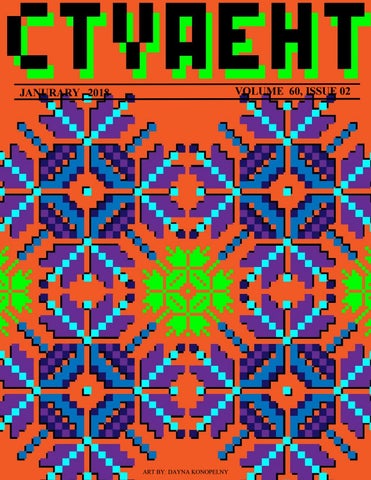
VOLUME 60, ISSUE 02
JANURARY 2018
ART BY: DAYNA KONOPELNY
BLAST FROM THE PAST A LETTER FROM THE STUDENT EDITOR Alas, we are back with another issue of Student! It’s been awhile, but we are happy to be back, and even more happy to have you with us!
Since we left off, exams of last semester passed us (and hopefully we them), we celebrated two Christmases, and rung in the New Year at least three times. Now that all the celebrating is done, it is time to take a breather and read Student.
meshes together winter, with a snowflake inspired pattern, and the 80’s with bright colours. Inside this issue, we have everything from information about Koladya and Rizdvo, to written papers and recipes! So, as always...find a cozy spot, play some 80’s tunes in the background, and get lost in this issue. I’ll be back,
This issue is and ode to Student in the 1980’s. A time where big hair was on trend, gaming was done in the arcades, and MTV was a way of life. This month’s cover was designed by Dayna Konopelny, a SUSK alum. It
Zenia Michno Зеня Міхно
SOME TUBULAR 80’s TUNES Hall & Oates - You Make My Dreams
A-ha - Take On Me
Billy Joel - Uptown Girl
Whitney Houston - I Wanna Dance with Someone
Bruce Springsteen - Dancing In the Dark
Starship - We Built This City
The Romantics - Talking in Your Sleep
Run - D.M.C. , Aerosmith - Walk This Way
Rick Astley - Never Gonna Give You Up
David Bowie - Let’s Dance
The Police - Don’t Stand So Close to Me
Whitney Houston - How Will I Know
Matthew Wilder - Break My Stride
The Outfield - Your Love
Billy Joel - It’s Still Rock and Roll to Me
AC/DC - Back in Black
Toto - Africa
Eddie Money - Take Me Home Tonight
Duran Duran - Hungry Like The Wolf
The Proclaimers - I’m Gonna Be
Journey - Don’t Stop Believin’
Men at Work - Overkill
Midnight Oil - Beds Are Burning
Billy Ocean - Caribbean Queen
Eurythmics - Sweet Dreams
Crowded House - Don’t Dream It’s Over
Rick Springfield - Jessie’s Girl
Dolly Parton - 9 to 5
Guns N' Roses Sweet - Child of Mine
Wham! - Wake Me Up Before You Go
Billy Joel - We Didn’t Start the Fire
Dire Straits - Sultans of Swing
Dexy’s Midnight Runners - Come on Eileen
Bonnie Tyler - Total Eclipse of the Heart
2 UKRAINIAN CANADIAN STUDENTS’ UNION
VOLUME 60, ISSUE 02
80’s STUDENT
3 UKRAINIAN CANADIAN STUDENTS’ UNION
VOLUME 60, ISSUE 02
CONTRIBUTORS Stephanie Nedoshytko Zenia Michno Connor Moen
Adelia Shwec
Alicia Slusarchuk
Mattay Dubczak
Cassian Soltykevych
Raya Dzulynsky
Mikaila Ortynsky
Ashley Halko-Addley
Inga Bekbudova
Myroslaw Bodnaruk
INDEX 05
President’s Message
06
Kolyada
07
Student Article from December 1980
08
Video Games of Yesteryear
09
An Interview with a German-Ukrainian Student
11
A Formation of Community: Past and Present Ukrainian Organizations and their Impact
17
Unqualified
18
It’s Ukraine, not “The Ukraine”
19
Tour Diaries: Chapter 1 - The Beginning
23
Holiday Square Recipe
24
Allspice Up Your Life!
25
Student Article from November/December 1987
4 UKRAINIAN CANADIAN STUDENTS’ UNION
VOLUME 60, ISSUE 02
Вітаю! Welcome readers to our second edition of Student of the 2017-2018 academic year! As 2017 comes to an end, I’d like to quickly reflect on some of the whirlwind of events we all went through: Trump took office and somehow (unfortunately) has still not managed to be impeached; the Kremlin is still doing what the Kremlin does by weaponizing disinformation and continuing the ongoing forceful invasion of Ukraine; and as always Ukraine is still fighting bitterly for freedom and independence. While these events might put us in a depressing mood, our Ukrainian Student Organizations (USOs) make the future seem just a little bit brighter. Over the past few months, our USOs have been busy with small and large projects. From varenyky lunches, BBQs, and bake sales, to larger networking events, USOs never fail to impress us. This year, 13 USOs participated in raising awareness for Holodomor. Some created fantastic displays and information booths around campus, screened films like Bitter Harvest, held vigils, posted information cards around campus, and helped other community organizations hold commemoration events. Each year, we are confident that these efforts helped to reach out to the broader community. We’ve also been grateful to connect further with other community organizations, such as the Ukrainian Canadian Congress — Ontario Provincial Council, where we hope to work together on some joint initiatives. We would also like to thank all other organizations that have reached out to learn more about how to further involve students in Ukrainian Canadian organizations. Our Media Director and SUSK Editor, Zenia Michno of the University of Winnipeg, has also successfully overhauled and redesigned the look and feel of Student this academic year. With the different quarterly themes and beautiful imagery, SUSK hopes to make your reading of Student an even more pleasurable and engaging experience. With other projects underway, we were also particularly excited to team up with the National Ukrainian Canadian Congress (UCC), to create one consolidated resource of parliamentary and legislative internships. From my time spent as a Page in the Legislative Assembly of Alberta, to later as staff in the Speaker’s Office, I can speak to the immense value that these opportunities provide and I know that many people dream of internship opportunities like these. I’m still overly sentimental about my memories made under the dome. The list includes partisan and nonpartisan internships such as the UCC Parliamentary Internship Program to Liberal and Conservative internships. You can find the list through the link here: http://www.ucc.ca/programs/list-of-parliamentary-internships/ As our Ukrainian holidays and celebrations have really only just begun while others have come to an end, I hope that you all had веселих свят. The time spent with your family and friends is invaluable, and hopefully you took some time to rest too. Class, work, and other commitments keep us constantly busy, so don’t feel guilty about taking some time off. Lastly, stay tuned for the official release of the 2018 SUSK Congress. The planning has been long underway and we’re excited to share the news soon! Вього найкращого! Stephanie Nedoshytko Стефанія Недошитко SUSK President
5 UKRAINIAN CANADIAN STUDENTS’ UNION
VOLUME 60, ISSUE 02
KOLYADA WRITTEN BY: ADELIA SHWEC
T
he holidays are soon approaching,
bring joy to various Ukrainians across different neighbor-
and with this exciting time of the
hoods.
year, many will gather together to celebrate Christmas and ring in the
New Year. Along with Christmas comes many Ukrainian traditional activities such as, cooking delicious customary delicacies, installing the Christmas tree, and many others. One tradition that remains from pre-Christian times is
called kolyada. In pre-Christian times, kolyada was an activity where individuals would gather to sing a variety of songs for ritual purposes and to describe a natural phenomenon. Yet, today kolyada is where groups of Ukrainians gather together to sing about the birth of Jesus Christ the
The aforementioned groups may include youth associations, student associations, churches, choirs etc. Additionally, they often collect a small donation to help upkeep their organizations. More specifically, these donations help keep the Ukrainian community alive. What is great about this sort of activity is that individuals may keep some traditions going while having a jovial and merry time. So, be on the lookout for Ukrainian groups who may come knocking on your door to spread the some Christmas cheer !
Lord. These groups may also travel from door to door to
6 UKRAINIAN CANADIAN STUDENTS’ UNION
VOLUME 60, ISSUE 02
STUDENT ARTICLE DECEMBER 1980
VIDEO GAMES OF YESTERYEAR WRITTEN BY: CASSIAN SOLTYKEVCH
N
intendo Entertainment System, Sega Genesis, and the Macintosh Plus are but a few of the names you would hear when it came to the 1980’s and technology. More specifically, video games. If you remember games like Arkanoid, Sonic the Hedgehog, Street Fighter II, Kirby’s Adventure, or Oregon Trail, then you lived in a wonderful time period of video games. A time that was free of “in-app purchases” and “microtransactions”.
out of touch and doesn’t know what children of today play on’. Yes, it’s true, when I had to wait for something as a child I would play on my Gameboy, or one of the two game options on my dad's first Motorola - snake or Tetris. I don’t have an issue with video games and children: properly monitored with time limits, I think children should be allowed, even encouraged, to play video games. That said, iPads, iPhones, and android devices have created a shift in video games with children.
Full disclosure: I was not born in the 1980’s, nor did I own an original NES or a Saga Genesis. However - I did grow up with Macintosh computers in my house, even having a Macintosh Classic in my bedroom at the same time as I was learning English in kindergarten. With a whopping 1MB of memory and 40MB of hard drive space, I would play all sorts of games with my family, but never with a Cat 5 cable plugged into the back of the computer.
Parents have bills to pay, a mortgage, dance classes, swimming lessons, the list goes on, and when a $249 device with almost unlimited options for games, apps, and self-entertainment for just a dollar or two is an option, it’s not easy to say no. But those one-dollar games are designed differently. Game developers simply cannot make money with $1 game purchases, no matter the volume. The $1 games are designed with quick bursts of satisfaction, and lots of them. You can level up or gain armour, skins, or other items in the game quickly and frequently, but the more you play, the harder it is to reach the next level. Buuuut, if you pay just 99¢, you’ll get to that next level right away. Come on. It’s just a buck.
These were simpler times, with no internet connectivity. If you wanted a new game, you had to go ask your parents to get in the Oldsmobile and drive you down to Westworld Computers in -20 degree weather and fork out $69.95 back in the early nineties (about $130 now) for a single video game. There were no 99¢ games, no in-app purchases, and definitely no iPads. Do you remember where you were on January 27, 2010? Probably not, but I do - I was watching the live release of the first Apple iPad. 3 months later, on April 5th, my iPad that I ordered from some guy in the USA (Canada wasn't selling them for a few more months), finally arrived at my door. I was in love. So simple, so elegant, it made my Hilroy notebook look like a stone tablet. In the seven years since the iPad was first released, there has been a incredible increase in the use of tablets. However, while iPads and other tablets are indeed being used by medical clinics to review patient files, in shops as cash registers, and as something your mother uses to comment on your Facebook photos, one of the biggest users I’ve seen are children. Walk into that medical clinic, that car shop, that hair salon, and there’s a good chance you’ll see little Johnny playing a game on his iPad.
At this point you must be thinking ‘what a hypocrite - he loved video games growing up and now he’s just old and 8 UKRAINIAN CANADIAN STUDENTS’ UNION
Games that costs $75 and $1 may both just seem like video games, but what you lack with a $1 game are deep stories, beautifully composed music, and intricate gameplay that really make a child (or adult) think. Ask anyone to hum the song from the first level of Super Mario Bros and they’ll go “tenen-ten-tenen-ten-ten” without skipping a beat. Tell someone you were moving at a “gruelling pace” and they’ll think of Oregon Trail before they think you actually endured something difficult. That’s what makes the $74 difference. Video games can impact children for a lifetime. The games they play should be challenging, thought-provoking, and should never ask you to pay to advance to the next level. It doesn’t have to be Mario and Luigi, but there should be memorable characters, there should be complexity, and concentration and patience should be required - not a game you can pick up and play for 5 minutes. So go on eBay and sell the iPad. With the tablet gone, spend some money on a great video game. Your kids will be glued to the screen - but this time they’ll be thinking, not just tapping. VOLUME 60, ISSUE 02
AN INTERVIEW WITH A GERMANUKRAINIAN STUDENT WRITTEN BY: RAYA DZULYNSKY During the winter break I travelled to the Austrian Alps and while there was able to meet with a German-Ukrainian friend. I decided to ask him a few questions about being a Ukrainian student in Germany. Is there an Ukranian student organization in Germany?
ungsveranstaltungen verwirklicht. Dazu gehören Infoveranstaltungen zur Bewältigung des studentischen Alltags, Austauschprojekte für deutsche und ukrainische Jugendliche und Studenten.
Ja. Den Bund ukrainischer Studenten in Deutschland e.V., kurz “SUS” Yes. The organization is called “union of Ukrainian students in Germany- "SUS". What is the main goal of the Ukrainian student organization in Germany?
Dies geschieht vor allem durch die Organisation interkultureller Versammlungen und Diskussionsabende, sowie durch zahlreiche Veranstaltungen, Ausstellungen, Vorträgen zu sozialen, wirtschaftlichen, wissenschaftlichen, politischen und kulturellen Themen.
Der Vereinszweck ist die Förderung von Völkerverständigung auf den Gebieten der Bildung, Wissenschaft, Kultur, Jugend, Umwelt, Sport und Soziales und die Förderung der Bildung sowie die Organisation finanzieller Unterstützung für Studenten.
We mostly carry out scientific and cultural education events. This happens mainly through the organization of intercultural meetings and discussion evenings, as well as through numerous events, exhibitions, lectures on social, economic, scientific, political and cultural topics. We also organize exchanges for German-Ukrainian students and information events for coping with everyday student life,
The purpose of the association is to promote international understanding in the fields of education, science, culture, youth, the environment, sport and social affairs. It also works to promote education and to organize financial support for Ukrainian students.
“SUSK” publishes the magazine ‘Student’. Do you have something similar?
What are some of the things you do as an organization?
Ja. Es erscheinen regelmäßig Veröffentlichungen zu verschiedenen Themen. Diese sind auf der Website des Vereins einsehbar. Yes. There are regular publications on various topics. These are available on the website of the association.
Der Vereinszweck wird insbesondere durch die Durchführung wissenschaftlicher und kultureller Aufklär
9 UKRAINIAN CANADIAN STUDENTS’ UNION
VOLUME 60, ISSUE 02
80’s STUDENT
10 UKRAINIAN CANADIAN STUDENTS’ UNION
VOLUME 60, ISSUE 02
A FORMATION OF COMMUNITY: PAST AND PRESENT UKRAINIAN ORGANIZATIONS AND THEIR IMPACT A PAPER WRITTEN BY: MIKAILA ORTYNSKY
11 UKRAINIAN CANADIAN STUDENTS’ UNION
VOLUME 60, ISSUE 02
these institutions, it served as a means by which immi-
A sense of identity is what drives many individu-
grants “divorced from the Old World habitat, give birth
als, especially in the Ukrainian community. Throughout
to different attitudes and customs and provide new means
Ukraine’s history Ukrainians have endured religious and
of control in the Dominion” (Young, 1931, p. 155).
political oppression, famine, and a desire for independence. In Canada, Ukrainian-Canadians were not allowed
The evolution of ‘community’ from Ukraine to
to practice their language and had to overcome signifi-
Canada for Ukrainian immigrants came with identifying
cant hardships while immigrating and the early years of
a need. During this time, organizations like “reading
living in Canada. When moving to Canada, Ukrainians
clubs (chytalni), socialist circles, libraries, drama socie-
did not want to leave their entire life behind but rather
ties, choirs, cooperatives and national homes (narodni
create a new life of opportunity while not forgetting
dony)” were formed. (Martynowych, 1991, p. 265). The
where they came from, Ties to Ukraine were strong,
means of these organizations were to further mobilize
through community organizations that hosted Ukrainian
Ukrainian immigrants. These organizations were in great
interests, a need for belonging in a new land and over-
opposition from the church. Religion was important in
coming many barriers Canada presented, immigrants
Ukraine, it is no surprise that many of the “first public
found identity.
buildings were churches” (Martynowych, 1991, p. 265). Churches were a place of gathering in both rural and ur-
Early life in Canada for Ukrainian immigrants
ban regions. To start a secular organization was a strug-
meant language and cultural barriers. Churches had a “definite organized expression in the homeland” and continue to until present time (Young, 1931, p. 154). With a
gle.
More vibrant and active community organizations
new environment came new societal needs. Compared to
were in urban areas as well-educated, skilled, and ambi-
Ukraine things were new and relatively unorganized.
tious immigrants resided (Martynowych, 1991, p. 265).
There was plenty of opportunities in Canada though it
The Ukrainian community was close compared to the
came with many hardships and problems. To address the
geographically distant rural region. Rural community or-
new needs, new community organizations came about, in
ganizations were “often the only institution established in
the early times usually sponsored by the church. With
rural settlements before 1914 (Martynowych, 1991, p.
12 UKRAINIAN CANADIAN STUDENTS’ UNION
VOLUME 60, ISSUE 02
ganization for Ukrainian community organizations across
278). The urban and rural settlements were iso-
Canada. It also brings forward the interests of the over
lated in the organizations and involvements.
1.3 million Ukrainian-Canadians in lobbying efforts (Statistics Canada, 2017). The youth organizations are no
Education is a cornerstone of Ukrainian culture. In an excerpt of Myrna Kostash’s book, All of Baba’s
exception. In 1976, the USSR gifted a statue of Lesya
Children, Charles Young, a second generation Ukrainian-
Ukrainka, an outspoken Ukrainian poet, and activist of
Canadian states education in Ukraine as a “vicious cycle
national rights. This gift was very controversial at the
[where] in the old country, only minimal schooling was
time as Ukraine was under strict rule from the USSR.
available to peasants and because the peasants had no
The hopes she wrote of were the exact opposite of what
schooling, they were always peasants, generation after
was happening in Ukraine at that time. Additionally, her
generation. In Canada, there was the chance to break the
work was censored under USSR rule. Her statue, given
curse of illiteracy” (p. 69). Canadian education was seen
by the same regime that oppressed her, gifted it as an of-
as extremely valuable, and a way make a better life. It is
fer of friendship. Many organizations, such as the City of
no surprise that one of the first Ukrainian Student Organ-
Saskatoon and the Province of Saskatchewan rejected the
izations was in an area where many Ukrainian immi-
gift due to “it being wrongly used by the USSR to ad-
grants came to Saskatoon, SK. In 1913, at least four
vance and dignify its policies and to forget injustices
Ukrainian students attended schools in Saskatoon; the
done to the people of Ukraine.” (Warner, 1976). The
gathered to discuss Ukrainian politics. By 1915, they es-
Ukrainian Youth Association (CYM) protested the un-
tablished a formal club (Ukrayinski Studentski Kruzhok),
veiling of the statue and the repression in Soviet Ukraine
and in 1916 they had 22 members (Migus, 2011, p. 34-
(Murray, 1976).
35). The club was one of the most sophisticated groups of
Fast forward to the present day, Ukrainian Cana-
that time as members had scholarly backgrounds.
dian youth groups continue to advocate for Ukrainians and Ukraine both in Canada in Ukraine. On a national
In November 1940, Ukrainian-Canadians formed the Ukrainian Canadian Committee, now known as
level, Ukrainian Canadian Students’ Union (SUSK) takes
Ukrainian Canadian Congress (Gerus, 1991). Today,
a strong stance on Russian aggression on modern
Ukrainian Canadian Congress serves as an umbrella or-
Ukraine. With the most recent example being the support
13 UKRAINIAN CANADIAN STUDENTS’ UNION
VOLUME 60, ISSUE 02
where those who maybe did not grow up full immersed
of boycotting the World Festival of Youth and
in the Ukrainian culture but wanting to learn more infor-
Students that was to take place in Crimea, illegally an-
mally could go. Each year the group does carolling in the
nexed territory Ukraine (SUSK, 2017). SUSK also encourages strong advocacy for their Ukrainian Student Or-
Ukrainian Christmas season. In 2016, USUSA was featured in the Star Phoenix for their efforts of preserving
ganizations, SUSK encourages participation of the
the Ukrainian Christmas tradition of Koliada. In the arti-
Ukrainian Canadian Congress’s letter writing campaign
cle, Connor Moen, one of USUSA’s members who re-
to MP’s to encourage a UN Peacekeeping Mission in
started the club said that those who host the group for
Ukraine to reduce tensions (Ukrainian Canadian Con-
carolling are “inspired by that there are these people who
gress, 2017).
are young that want to learn more and want to get engaged” (Modjeski, 2016). Young Ukrainian-Canadians
Under the umbrella of SUSK lies the University of Saskatchewan Ukrainian Students’ Association
are imbedded with a sense of pride when it comes
(USUSA). USUSA hosts a variety of social and advocacy
Ukrainian culture. Through the awareness of Ukrainian
events such as Holodomor Awareness week and Euro
issues and stories heard from relatives of their struggles
Maiden. The group has continually been recognized for
to come to Canada for a better live many young people
being one of the largest and most active Ukrainian Stu-
feel a sense of duty to preserve tradition and maintain
dent Organization nationally with in March 2017 being
awareness.
rewarded with one of four pre-screenings nationally of Across the country lies multiple Ukrainian nation-
Bitter Harvest, an international film about the Holodo-
al organizations including Ukrainian- Canadian Profes-
mor.
sional and Business Association (UCPBA, Ukrainian Na-
tional Federation of Canada (UNF), and Ukrainian Wom-
In a world where in many countries freedom of expression or religion is not tolerated, the student group
en’s Association of Canada (UWAC), to name a few out
aims to celebrate that privilege. To a lesser extent in Can-
of hundreds. All of these organizations were founded on
ada, tradition is being lost among cultures from genera-
the basis of wanting to keep ties with Ukraine while cre-
tion to generation. USUSA was not active for a large pe-
ating a community, in modern times, creating an identity.
riod of time, but with its resurrection, it served as a group
The organizations show preservation of culture. The
14 UKRAINIAN CANADIAN STUDENTS’ UNION
VOLUME 60, ISSUE 02
youth organizations highlighted show the promise of a promise of continued preservation and ambition for a
denser, and immigrants were well-educated and ambitious. I was surprised to see how much hasn’t changed in 125 years. Coming from Yorkton, SK to Saskatoon I see
Ukraine free of oppression.
that Ukrainian organizations are so much more active and fulfilling than the Yorkton area. Though Yorkton would
I chose to research this topic because of my involvements in Ukrainian-Canadian student groups; Uni-
be considered an urban area (both in the past and present)
versity of Saskatchewan Ukrainian Students’ Association
compared to Saskatoon it is much more rural.
(USUSA) and Ukrainian Canadian Students’ Union (SUSK). Though I was somewhat exposed to Ukrainian culture during my upbringing (attending Ukrainian Orthodox church and celebrating Ukrainian holidays) I felt there was so much more to know which led to being enrolled in Ukrainian courses and involved in organizations. I joined the USUSA in my summer going into my
first-year university. Reflecting on why I joined the USUSA I could sum it up in wanted to belong and feeling like Ukrainian culture is a part of my identity. I feel grateful to belong to a strong cultural student group on campus, so part of my curiosity was those who and what led to where the group is today.
I was interested to see in my research that when Ukrainians first immigrated, active and vibrant cultural organizations were, for the most part, in urban areas. I would assume that these organizations would be most active in rural areas as many Ukrainian immigrants were farmers though it makes sense that urban areas were
15 UKRAINIAN CANADIAN STUDENTS’ UNION
VOLUME 60, ISSUE 02
References Gerus, O. W. (1991). Consolidating the Community: The Ukrainian Self-Reliance League. In L. Luciuk & S. Hryniuk, Canada’s Ukrainians: Negotiating an Identity. Toronto, ON: University of Toronto Press 1991. Kostash, M. (1977). All of Baba’s Children. Edmonton, AB: Hurtig Publishers. Martynowych, O. T. (1991). Ukrainians in Canada: The Formative Period, 1891-1924. Edmonton, AB: Canadian Institute of Ukrainian Studies Press, University of Alberta. Migus, P. M. (2011). Ukrainian Canadian Youth: A History of Organizational Life in Canada 1907-1953. (Master’s thesis, University of Ottawa, 1975). Ann Arbor, MI: ProQuest LLC. Modjeski, M. (2016, January 5). Next generation of Ukrainians embraces holiday tradition. Saskatoon Star Phoenix. Murray, M. (1976, November). Soviets donate statue to U of S. Star Phoenix.
Statistics Canada. (2017). Immigration and Ethnocultural Diversity Highlight Tables: Ethnic Origin, both sexes, age (total), Canada, 2016 Census- 25% Sample data. Retrieved from: http://www12.statcan.gc.ca/census -recensement/2016/dp-pd/hlt-fst/imm/Table.cfm?Lang=E&T=31&Geo=01&SO=4D SUSK. (2017, October 5). Boycott on the World Festival of Youth and Students. Retrieved from: http:// susk.ca/2017/10/05/boycott-on-the-world-festival-of-youth-and-students/ Ukrainian Canadian Congress. (2017, November 13). Call to Action: Canada’s opportunity to restore peace in Ukraine! Retrieved from: http://www.ucc.ca/2017/11/13/canadas-opportunity-to-restore-peace-in-europeoped/ Warner, J. (1976, November 5). U. of S. accepts Soviet gift. The Sheaf. Young, C. H. (1931). The Ukrainian Canadians: A Study in Assimilation. Toronto, ON: Thomas Nelson & Sons Limited.
16 UKRAINIAN CANADIAN STUDENTS’ UNION
VOLUME 60, ISSUE 02
UNQUALIFIED BY: MATTAY DUBCZAK Welcome to the second installment of Unqualified, where I comment on things in an unstructured and largely unqualified way. This edition, given that is the new year, I will be providing three political predictions for the upcoming year. I hope you enjoy! 1) 2018 will be the year for the next major geopolitical crisis A. Against a weakening international backdrop, 2018 seems like it could be the year for the next large geopolitical crisis. Under President Trump’s increasing attempts to isolate the US from its own international security order, we may see some attempts to undermine the liberal international order further. Whether it be in the form of cyberattack, a North Korean Missile Crisis, or a further escalation in the Syrian war by means of major power intervention, 2018 will not be a stable year for international politics or security.
2) In the wake of its incoming G7 Presidency, Canada will attempt to become increasingly relevant on the international stage and take a more active role A. Canada will try and flex its mediation muscles as the worlds predominant middle ground on issues. Trudeau’s willingness to expand Canada’s role in international affairs will likely evolve as the US’ protectionist agenda grows, assuming it does. This is already being seen through Canada’s hosting of a summit on the topic of North Korea in Vancouver this year. 3) Brexit negotiations will cool off, but not completely A. Although initially Theresa May made it clear that her government will continue to pursue the UK’s exit from the European Union, I feel that by year’s end, the split may be much less popular, and potentially even sidelined. May is not exactly popular with the general British population, evidenced through a weaker hold on the government than before she called a snap election, and it remains to be seen if she can push through her agenda. If she does not finish the year as British Prime Minister, potentially via another election, the new PM may not take the same stance as her on these negotiations, and there may be some changes to the deal, or perhaps more major alterations.
Keep updated with Student to journey along with Mattay in his unqualified ranting!
17 UKRAINIAN CANADIAN STUDENTS’ UNION
VOLUME 60, ISSUE 02
IT’S UKRAINE, NOT “THE UKRAINE”
I
WRITTEN BY: ASHLEY HALKO-ADDLEY
magine the following scene. The Ukrainian community hosts an event, and invites important members of the campus, city, province, or country. One of these important guests gets up in front of a room full of diasporic Ukrainians and meaning well they make the statement, “We support the Ukraine.”
acknowledge the sovereignty of Ukraine. The Ukraine is the way Ukraine was referred to in that part of the world during Soviet times. Now that it is a country, a nation, and a recognized state, it is just Ukraine. And it is incorrect to refer to the Ukraine, even though a lot of people do it.
It’s likely that many members of the Ukrainian diaspora sitting in the audience at that particular moment would cringe, from three little letters: the. Ukraine is an independent and sovereign country, and as such, it is referred to as merely just Ukraine. It’s been just Ukraine for 26 years now. By saying the Ukraine, you deny the country’s independence, and deny its sovereignty.
There are plenty of times when sticking a ‘the’ in front of a place name is perfectly acceptable. When it is a group of countries or a geographic area, like the United Kingdom or the group of islands that makes up the Philippines, or a region of a country, like the Northeast. Plural names, like the United States or the Netherlands, get a ‘the’ too. Saying the Ukraine creates this feeling that it is part of another country, that it is still a territory of somebody else. Ukraine is not part of Russia, it is no longer a part of the Soviet Union, and it is time that the rest of the world acknowledges this and stops saying the Ukraine.
I correct anyone who gets it wrong, and some people think I am just being overly sensitive, but it matters. Dropping it sends an important message, especially among leaders, because Russia still does not
18 UKRAINIAN CANADIAN STUDENTS’ UNION
VOLUME 60, ISSUE 02
TOUR DIARIES: CHAPTER 1 - THE BEGINNING BY: INGA BEKBUDOVA
I’M A REAL PERSON, GUYS!
Hello fellow SUSKites, A bit of background about the show – it’s a story about a clown’s funeral and the celebration of the clown’s life My name is Inga Bekbudova, I’m a past Media Director (2015/2016), Social Director for USC@Ryerson and his circus years. It’s a very baroque-like, traditional show that has been in Cirque’s history since it’s Big Top (Ukrainian Students’ Club at Ryerson University) world premiere in 2005. The show is now being reformat2014/2016, and fellow Ukrainian-Canadian. ted into an arena tour, with some new acts added, new music, new costumes, new artists, and so on – very excitI recently took up a position as a stage manager at ing! It’s been a very busy and challenging few weeks here Cirque du Soleil, for the arena tour of Corteo, a show that at headquarters in Montreal. We are now just wrapping up will soon begin touring in North America. Just wanted to week four (4!!) of staging and soon we transfer to Quebec share a bit of my life with you and invite you all into the City into an arena for more staging – which is essentially putting the show together, act by act, with transitions, and world of Corteo, Cirque and the performing arts. all of the production elements – live band, artists, costumes, set, props, automation, rigging, and so on.
19 UKRAINIAN CANADIAN STUDENTS’ UNION
VOLUME 60, ISSUE 02
The show right now has about 54 artists, from all over the world – Canada, USA, France, Finland, Ukraine, Belarus, Russia, Kazakhstan, Uzbekistan, Japan, United Kingdom, … and that’s just artists! Our crew is just as diverse as the cast. The entire cast and crew is just over 100 people, so think of it kind of like an extended family that’s v large (V V large). Being Ukrainian, it turns out, is quite helpful in this crazy industry – I grew up in Kyiv, Ukraine before immigrating to Toronto, Canada, so I had learned both Ukrainian and Russian and still speak both. So, my job also sometimes doubles as a translator for some of our fellow Slavs (and there is a good 20 or so of them) in times when it’s necessary – like onstage trainings, stagings, meetings and anything / everything in between .
I’m excited to share our journey from here in Montreal, to Quebec City, and to New Orleans, where Corteo will officially re-premiere to the world into arenas! I’m looking forward to coming to your city and inviting you to share with us the magic of Corteo and Cirque du Soleil, and I’m especially, super pumped to bring the show back home to Toronto! Stay tuned for the next update, and please don’t hesitate to reach out to me if you have any questions, comments, or if we are coming to your city – I’d love to have some fellow SUSKites in the audience!! For touring dates, arena information, ticket sales, and show information, please visit : https://www.cirquedusoleil.com/corteo
just a little bit international here at Cirque du Soleil ...
20 UKRAINIAN CANADIAN STUDENTS’ UNION
VOLUME 60, ISSUE 02
80’s STUDENT
21 UKRAINIAN CANADIAN STUDENTS’ UNION
VOLUME 60, ISSUE 02
COOK WITH SUSK recipes and more...
22 UKRAINIAN CANADIAN STUDENTS’ UNION
VOLUME 60, ISSUE 02
HOLIDAY SQUARES BY: ALICIA SLUSARCHUK As my sun-kissed hair fades and my warm, fuzzy sweaters make more reoccurring appearances in my wardrobe, I find myself baking during my spare time in preparation of the holiday season. That being said, I wanted to share one of my most favourite square recipes, so your holidays can be as sweet as mine when company comes over.
Almond Coconut Bars From Wiltons Ingredients: Bottom:
Top:
3/4 cups brown sugar
4 eggs
3/4 cups butter or margarine
1 1/2 cups brown sugar
1 2/3 cups flour
2 tsp vanilla 1/4 cups flour 1 tsp baking powder 1/2 tsp salt 2 cups shredded coconut 2 cups shredded almonds
Directions: Preheat the oven to 350 F Line a jelly roll pan with parchment paper Bottom layer: Beat the sugar and butter in a bowl. Then mix in the flour. You can do it by hand. Pat the crust into a jelly pan (greased or lined). Bake for 15 minutes then cool. Top layer: Beat the eggs, sugar and vanilla. In anther bowl stir the flour, salt and baking powder together then begin adding it to the egg mixture. Stir in the coconut and almonds. Spread the topping over the cooled crust evenly and bake it for 30-35 minutes. Tip: Watch when cooking the top or the bottom layer; they are easy to burn.
23 UKRAINIAN CANADIAN STUDENTS’ UNION
VOLUME 60, ISSUE 02
ALLSPICE UP YOUR LIFE! BY: CONNOR MOEN … The Secret Ingredient for Your Rizdvo Dishes of the sviat Allspice up your life Every sauce and every borscht Allspice up your life!
For this Christmas season, I want to share a little bit about one of my favourite and most versatile spices - one that is often overlooked in your typical North American kitchen. Allspice is the dried, unripe berry off an evergreen tree that’s found in tropical climates (eg Jamaica, Mexico) with a distinct flavour profile. Some have described it as tasting like a combination of cinnamon, nutmeg and cloves - while it is in fact a unique spice unto itself. This is a versatile spice that can be used in savoury and sweet dishes, from meats to vegetables and fruits, to enhancing brines in pickles, to boosting fragrance and flavour in breads and other baked goods. Ukrainian dishes, can also be enhanced by the presence of allspice. Its addition to borscht can help boost sweet, savoury and spicy (think peppercorn-spicy, not cayenne spicy) notes to the broth - making for a wellrounded and more complex broth. It is not an overwhelming spice and the wide majority of tasters would not detect it being in the broth (provided you remove the berries after boiling) - it mores contributes to the big picture of the dish. There are other considerations to improving a borscht recipe (quality of ingredients, acidity, seasoning, regional variations), but the presence of this spice is still applicable. Another one of my favourite uses for this spice is in white sauces - be it a cream sauce or a béchamel1. In any of these dishes, one can steep the milk/cream in the cream sauce for 10+ minutes and incorporate the essential oils of the spice into the dish. This helps balance out the natural sweetness of the dish and compliment the savoury applications of the white sauces. A good bechamel/white sauce can serve as the foundation for dishes like nalysnyky (crepes), pyrizhky (baked buns - if your family serves them with a sauce), beetniks/doughboys (beet leaves stuffed with dough - a Western Ukrainian Canadian delicacy), and so forth. Allspice can also be used in dessert dishes, such as uzvar2. Though to be perfectly honest, I can not stand uzvar (especially the version with smoke-dried fruit) so I am not even going to go there. Here’s how you actually use allspice Since ground allspice loses its flavour and aroma very quickly after being grounded, I prefer to buy them whole (available at most grocery stores, Bulk Barn, ethnic groceries, kitchen supply stores) and simply add 2+ berries to whatever liquid I want to infuse them in. Remove the berries before serving - it is a secret ingredient after all. 1
A French mother sauce made from creating a roux (cooking a paste made from flour and butter) and incorporating milk, which is then emulsified and reduced to desired consistency. Though it is more work than just using cream, it is lower in fat and my preferred white sauce. 2
A fruit stew made from dried fruits available (usually a permutation of prunes, apples, pears, sour cherries, and whatever else one would have locally available) and some spices/citrus depending on the family recipe. Some families just drink the strained liquid, others have with the fruit..
24 UKRAINIAN CANADIAN STUDENTS’ UNION
VOLUME 60, ISSUE 02
STUDENT ARTICLE DECEMBER/NOVEMBER 1987
WE WANT TO HEAR FROM YOU! If you would like to be heard or have something to share, send it in! Submit your material to student@susk.ca
26 UKRAINIAN CANADIAN STUDENTS’ UNION
VOLUME 60, ISSUE 02