SUSAN SHEEHAN GALLERY 2026
THE 2026 ADAA FAIR PREVIEW GALA TO BENEFIT THE WHITNEY MUSEUM OF AMERICAN ART ORGANIZED BY ART DEALERS ASSOCIATION OF AMERICA
FOR MORE INFORMATION: https://www.adaafair.org/preview-gala TO PURCHASE TICKETS: https://adaa.artsvp.com/624bbf?link=adaa-fair-2026-website
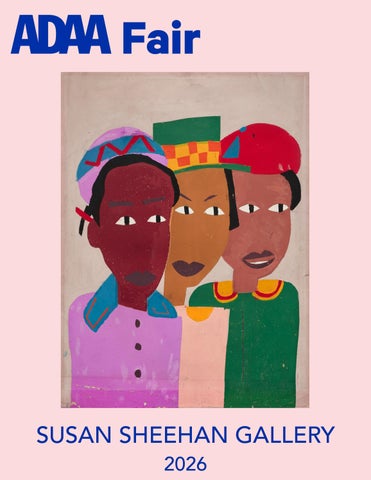
Cover: William Henry Johnson, Three Children, c. 1940
BOOTH D10
BENEFIT PREVIEW: NOVEMBER 12TH SHOW DATES: NOVEMBER 13TH - 16TH LOCATION: PARK AVENUE ARMORY 643 PARK AVENUE NEW YORK
FOR SHOW INFORMATION: https://www.adaafair.org/
SUSAN SHEEHAN GALLERY 146 Greene Street New York, NY 10012 +1-212-489-3331 info@susansheehangallery.com www.susansheehangallery.com
Jasp Cros
Jasper (1973), on his i for a se repetiti the pos marks,
In 1976 promin Surreal in whic The 19 (1974–7
The scr on ivor City an division the left have m hatchin subtle s
In 1979 Print Ar in sixte Judith motif a
per Johns sshatch Prints
Johns’ now-iconic crosshatch markings, which first appeared in the early 1970s in a painting titled Scent , would soon become a mainstay of his work for most of the next decade. The artist has remarked at length inspiration for this visual motif, attributing it to a glimpse of a car in motion on the highway: “I only saw it econd, but I knew immediately that I was going to use it. It had all the qualities that interest me—literalness, iveness, an obsessive quality, order with dumbness, and the possibility of a complete lack of meaning with ssibilities of gesture and the nuances that characterize the material.”1 From these mundane and mute hatch Johns developed a highly versatile language that conveyed a wide array of meanings and feelings.
6, Johns decided to translate some recent paintings into a range of media, including printmaking. One nent motif, Corpse and Mirror, first executed as a suite of paintings in 1974–75, was inspired by the list parlor game Exquisite Corpse (cadavre exquis). These works feature a bilaterally symmetrical structure ch one half functions as a “corpse” (reconstructed fragments) and the other as a “mirror” (image reflection). 976 screenprint of this name is based especially closely on its prototype, the painting Corpse and Mirror II 75).
reenprint Corpse and Mirror (1976) is a tour de force of the medium. It was printed from thirty-six screens ry Nishinouchi Kizuki Kozo paper by Takeshi Shimada, Kenjiro Nonaka, and Hiroshi Kawanishi in New York nd published by the artist and Simca Print Artists, Inc.3 Like the painting it relates to, the print repeats the ns of the composition by paralleling the density of white on the right half with the saturation of color on t. As curator Richard Field notes of the screenprint, because it is able to “lay down strokes of pigment that more substance and opacity, the duplicity of these junctions and the interweaving of planes implied by the ngs is brilliantly underscored. The screenprint also imparts a greater veracity than could a lithograph to the struggle of the hatchings against the containing layers of white pigment in which they are embalmed.”4
9 and 1981 respectively, Johns made two related crosshatch prints, Cicada and Cicada II, again with Simca rtists, Inc., and using the same printers who worked on Corpse and Mirror (1976). Cicada (1979) was printed een colors from sixteen screens, and Cicada II (1981) in eighteen colors from eighteen screens. Scholar Goldman, remarking on these two prints, underscores the autobiographical significance of this crosshatch and Johns’ turn to abstraction more broadly: “Is Johns’ turn to abstraction simply another way to make art? Or is it a complicated veiled metaphor—a new language with which to conceal meaning, to express feelings by proxy? Johns is literal in the extreme. Primary colored lines, surrounded by secondary colors, burst out from the center of the Cicada screenprint exactly the way the insect breaks out of its shell. In Cicada II, Johns reverses primary and secondary colors, again doing the same thing differently. Does the title hold an autobiographical clue?”5 Jasper Johns in his studio, c. 1976–80 © 1991 Hans Namuth Estate. Photograph: Hans Namuth, courtesy Center for Creative Photography, University of Arizona.
Jasper Johns Corpse and Mirror, 1976 Screenprint Sheet size: 43 x 53 1/8 inches (109.2 x 134.9 centimeters) Printer and Publisher: Jasper Johns and Simca Print Artist, Inc., New York Edition size: 65, plus proofs Catalogue Raisonné: ULAE 169 Signed, dated, and numbered
Jasper Johns Cicada, 1979 Screenprint Sheet size: 22 x 18 inches (55.9 x 45.7 centimeters) Printer: Simca Print Artists Inc. Publisher: Jasper Johns and Simca Print Artist, Inc., New York Edition size: 100, plus proofs Catalogue Raisonné: ULAE 204 Signed, dated, and numbered From the 1981 portfolio Marginalia: Hommage to Kusuo Shimizu, which also includes works by Christo & JeanneClaude, Sam Francis, Claes Oldenburg, and Jean Tinguely. Kusuo Shimizu was founder of Minami Gallery, an avant-garde artists’ hub in Tokyo where Johns completed a two-month artist’s residency in 1964. Shimizu was an early advocate of Johns’ work, acquiring several of the artist’s prints in the early 1960s and organizing his first solo exhibition in Japan in 1965.
Jasper Johns Cicada II, 1981 Screenprint Sheet size: 24 x 18 1/2 inches (61 x 47 centimeters) Printer and Publisher: Jasper Johns and Simca Print Artists, Inc., New York Edition size: 50, plus proofs Catalogue Raisonné: ULAE 214 Signed, dated, and numbered
Helen Frankenthaler Madame Butterfly, 2000 Woodcut on three adjoining sheets Sheet size: 41 3/4 x 79 1/4 inches, overall (106 x 201.3 centimeters, overall) Printer: Yasuyuki Shibata at Tyler Graphics Ltd., Mount Kisco, New York Publisher: Tyler Graphics Ltd., Mount Kisco, New York Edition size: 33, plus proofs Signed, dated, and numbered
Cy Twombly Roman Notes Oscillating between frenetic energy and measured rhythm, Cy Twombly’s Roman Notes I exemplifies his masterful approach to mark-making. Taken from his celebrated set of six offset color lithographs, Roman Notes (1970), this work represents a key moment in Twombly’s artistic development and expands on the ideas explored in his iconic blackboard paintings of the late 1960s. Based on a suite of six drawings, the set can be arranged in any sequence to form a larger image. The series was titled in honor of Twombly’s adopted city, Rome, which he made his home in 1957. Scholar and print publisher Heiner Bastian described the Roman Notes as “hovering above all definitude,” and said they “speak in an unconcealed insouciance, which is clearly borne by the romantic ideals of Mediterranean life.”1 The prints move between pure dynamic energy and carefully choreographed motions of the hand, manifesting elements of both intellectual life and sensuous indulgence, like some long-lost poems of Catullus, scribbled in haste and left to time. Compared with Twombly’s earlier graphic work, the gestures of his Roman Notes are more fluid and spontaneous, seemingly self-forgetting in their rhythmic twirls, and anticipate later paintings, drawings, and prints. Twombly’s relationship with Rome profoundly shaped his artistic practice. Fascinated by the city’s ancient ruins, graffiti, and architecture, Twombly drew inspiration from the layers of history etched into its surfaces. Rome’s palimpsestlike nature is paralleled in Twombly’s layered gestures, which conceal as much as they reveal. The Roman Notes also allude to Renaissance manuscripts, particularly Leonardo da Vinci’s mirror-script codices.
Cy Twombly in Rome in 1966. Photograph: Horst P. Horst/Conde Nast/Getty Images.
Cy Twombly Roman Notes I, 1970 Offset lithograph Sheet size: 34 1/8 x 27 1/2 inches (86.7 x 69.9 centimeters) Printer: Electa Editrice, Venice Publisher: Neuendorf Verlag, Hamburg Edition size: 100, plus proofs Catalogue Raisonné: Bastian 21 Signed, dated, and numbered on verso Provenance: The Cy Twombly Foundation, New York From Roman Notes, a series of six offset lithographs. This impression is notable for its exceptional condition, color, and provenance.
Cy Twombly Untitled, 1969-71 Screenprint Sheet size: 25 1/2 x 25 1/2 inches (64.8 x 64.8 centimeters) Printer and Publisher: Edition Domberger, Filderstadt, Germany Edition size: 100, plus proofs Catalogue Raisonné: Bastian 27 Signed and numbered on verso From the portfolio On the Bowery, edited by William Katz, which also includes screeneprints by John Giorno, Charles Hinman, Robert Indiana, Will Insley, Gerald Laing, Les Levine, Robert Ryman, Richard Smith and John Willenbecher.
David Hockney Afternoon Swimming, 1979 Lithograph Sheet size: 31 5/8 x 39 1/2 inches (80.3 x 100.3 centimeters) Printer and Publisher: Tyler Graphics Ltd., Bedford, New York Edition size: 55, plus proofs Catalogue Raisonné: MCAT 233, Tyler 266 Signed, dated, and numbered
David Hockney Tulips, 1973 Etching and aquatint Sheet size: 36 x 28 inches (91.4 x 71.1 centimeters) Printer and Publisher: Petersburg Press, London Edition size: 75, plus proofs Catalogue Raisonné: MCAT 142 Signed, dated, and numbered
William Henry Johnson Screenprints William Henry Johnson’s rare screenprints Three Children and Blind Singer (both c. 1940) emerged during a decisive transformation in his practice, following his return to the United States in 1938. Born in Florence, South Carolina, and trained at New York’s National Academy of Design, Johnson had spent much of the preceding decade in Europe, developing an expressive approach to color and form through his encounters with Modernist painting and traditional crafts, ranging from Emil Nolde and Chaim Soutine to Scandinavian folk art. His marriage to Danish textile artist Holcha Krake further enriched this engagement. Back in New York, these experiences informed a renewed commitment to depicting African American life. Johnson’s work at the WPA-supported Harlem Community Art Center placed him within a vital network of Black artists and cultural activity. Extending the Harlem Renaissance’s assertion of African American experience as a foundation for Modern art, his images of children, musicians, dancers, and religious subjects gave everyday life renewed cultural significance. Screenprinting offered Johnson the perfect means of pursuing his craft. Then emerging as a fine-art medium, the process encouraged the use of broad areas of color and compressed spaces central to his evolving style. He printed the works himself in small, undocumented editions, approaching repetition as a means for experimentation. Thick inks, coarse meshes, and variable registration gave his prints a palpable, material quality. In Three Children, a trio of girls in a close grouping balance belonging and personality, with their fashionable hats and clothing suggesting the importance of self-presentation in modern Black life. Through vivid color and economical form, Johnson grants youthful companionship the sustained attention and dignity of formal portraiture. According to print scholar Susan Tallman, the composition is the same as that of a painting now in MoMA’s collection, “but everything is more distinct, the girls’ attitudes brighter and more curious. In prints like Blind Singer, he showed off a caricaturist’s gift for body language, as well as a mastery of Modernist formal invention and the rhythmic intensity of folk and outsider art. There is nothing quite like them.”1 Blind Singer turns to music as both cultural expression and livelihood. The performers’ interdependent poses and the guitar’s strong diagonal translate musical rhythm into pictorial form.
Photograph of William Henry Johnson at the home studio he shared with his wife, Holcha, in Kerteminde, Denmark c. 1931. Courtesy of Johanna Voll, Denmark.
William Henry Johnson Blind Singer, c. 1940 Screenprint Sheet size: 17 1/2 x 11 1/2 inches (44.4 x 29.2 centimeters) Edition size: Printed by the artist in a very small but unknown edition Signed “W.H. Johnson.” on recto Inscribed on verso with the artist’s name, artwork title, and Harmon Foundation inventory number Provenance: Collection of Mary Beattie Brady (director of the Harmon Foundation), Pawling, New York Michael Rosenfeld Gallery, New York American private collection Other known impressions of this rare print can be found in the collections of The Museum of Modern Art, the Harvard Art Museums (The Fogg Museum), the Smithsonian American Art Museum, The Whitney Museum of American Art, the National Gallery of Art, and the Philadelphia Museum of Art.
William Henry Johnson Three Children, c. 1940 Screenprint Sheet size: 16 3/4 x 11 1/2 inches (42.5 x 29.2 centimeters) Edition size: Printed by the artist in a very small but unknown edition Inscribed on verso with the artist’s name, artwork title, and Harmon Foundation inventory number Provenance: The Harmon Foundation, New York Acquired from the above Mr. and Mrs. Douglas Younger, New York By descent to the previous owner Other known impressions of this rare print can be found in the collections of The Metropolitan Museum of Art, the Philadelphia Museum of Art, the Smithsonian American Art Museum, and the Library of Congress.
Ellsworth Kelly The 1970s Like hard-edge painters Josef Albers and Frank Stella before him, Ellsworth Kelly collaborated with newly established, pioneering print studio Gemini G.E.L. in the 1970s. Gemini was founded in 1965 by former Tamarind Lithography workshop technical director Kenneth Tyler and his wife, Kay, and the following year, Sidney Felsen and Stanley Grinstein joined the company. Their goal was to invite the best artists in the field to make prints, and they were unusually receptive to their artists’ latest technical innovations. In late 1968, Kelly received an invitation from the studio in Los Angeles, and at the urging of Frank Stella and his wife, he accepted.1 During his time at the studio, which continued even after Tyler’s departure in 1973, he made well over one hundred editions. Some of his most celebrated prints from the 1970s were produced at Gemini.2 Kelly’s Series of Ten Lithographs (1970) was the very first to be published by Gemini. Together with eight related prints completed between 1970 and 1972, this series forms a single body of work that dispensed with Kelly’s earlier figure-ground compositions and curvilinear shapes in favor of strict geometries.3 Kelly derived many of these lithographic compositions from paintings made in New York between 1967 and 1970. Although they evolved from the multi-panel paintings of his Paris period, the compositions reflect his growing interest in more eccentric polygonal shapes. The lithographs Blue Yellow Red (1970) and Blue White Red (1970-71), for example, feature laterally trisected parallelograms in different color combinations, inspired by the late-1960s paintings Red White Blue (1968) and Red Yellow Blue (1968).4 These two related lithographs were printed under Tyler’s direction, each on Special Arjomari paper in three runs from three color plates. The striking composition Black Yellow (1970-72) is also part of this group. It repeats the forms and colors of the painting Black Yellow (1968) and was printed in two runs from two color plates.5 The screenprint Red-Orange over Black (1970) was also printed under Tyler’s direction, though it is distinct from the previous group because of its medium. It nevertheless shares a similar propensity for rigid geometries, echoing those in Kelly’s paintings from the period, and is a proportional variation of the painting Black with Red Bar (1970).6 Two other lithographic series produced by Gemini in the 1970s, Leaves (1973-74) and Twelve Leaves (1978), share an unmatched exploration of contour and composition with Kelly’s acclaimed ink and graphite botanical drawings. For Grape Leaves I (1973-74), for example, Kelly began with pencil studies drawn at his home in Spencertown, New York. Peach Branch (1973-74) was drawn directly on transfer paper without any preliminary drawing, because it was added to the Leaves series after Kelly’s arrival in Los Angeles.7
Kelly at work in his Chatham, New York, studio, 1973. Photograph by Gianfranco Gorgoni, courtesy and © Ellsworth Kelly Foundation.
Ellsworth Kelly Blue Yellow Red, 1970 Lithograph Sheet size: 42 1/2 x 30 inches (108 x 76.2 centimeters) Printer and Publisher: Gemini G.E.L., Los Angeles Edition size: 75, plus proofs Catalogue Raisonné: Axsom 61 Signed and numbered
Ellsworth Kelly Grape Leaves I, 1973-74 Lithograph Sheet size: 31 1/2 x 47 1/2 inches (80 x 120.6 centimeters) Printer and Publisher: Gemini G.E.L., Los Angeles Edition size: 50, plus proofs Catalogue Raisonné: Axsom 94 Signed and numbered Provenance: The Estate of Ellsworth Kelly, New York
Richard Diebenkorn Blue, 1984 Woodcut Sheet size: 42 1/2 x 26 7/8 inches (108 x 68.3 centimeters) Printer: Tadashi Toda at Shi Un Do Print Shop, Kyoto, Japan Publisher: Crown Point Press, San Francisco, California Edition size: 200, plus proofs Catalogue Raisonné: Liguori 289 Initialed, dated, and numbered
Richard Diebenkorn Clubs—Blue Ground, 1982 Aquatint, etching, and drypoint Sheet size: 33 x 26 1/4 inches (83.8 x 66.7 centimeters) Printer and Publisher: Crown Point Press, Oakland, California Edition size: 35, plus proofs Catalogue Raisonné: Liguori 283 Initialed, dated, and numbered
Joan Mitchell Flower I, 1981 Lithograph Sheet size: 42 3/4 x 32 1/2 inches (108.6 x 82.6 centimeters) Printer and Publisher: Tyler Graphics, Ltd., Bedford, New York Edition size: 70, plus proofs Signed and numbered
Joan Mitchell Weeds III, 1992 Aquatint and etching Sheet size: 22 1/2 x 16 1/2 inches (57.2 x 41.9 centimeters) Printer and Publisher: Tyler Graphics, Ltd., Mount Kisco, New York Edition size: 10, plus proofs Signed and numbered
Donald Judd Untitled, 1993 Woodcuts Sheet size: 23 5/8 x 31 1/2 inches, each (60 x 80 centimeters, each) Printer: Urban Stoob, Steindruck, St. Gallan, Switzerland Publisher: Kölnischer Kunstverein, Cologne and Chinati Foundation, Marfa, Texas Edition size: 25, plus proofs Catalogue Raisonné: Schellmann 295-296 Signed and numbered on verso Provenance: The Chinati Foundation, Marfa, Texas European private collection The complete set of two woodcuts.
Donald Judd Untitled, 1992-94 Woodcuts Sheet size: 23 1/2 x 31 3/8 inches, each (59.7 x 79.7 centimeters, each) Printer: Derrière l’Etoile Studios, New York Publisher: Brooke Alexander Editions, New York Edition size: 25, plus proofs Catalogue Raisonné: Schellmann 259-260 Each sheet is numbered and stamped by the estate of the artist on verso The complete set of two woodcuts.
Edward Hopper Night in the Park, 1921 Etching Sheet size: 9 3/8 x 10 5/8 inches (23.8 x 27 centimeters) Printer: The Artist Edition size: About 60 (from an intended edition of 100) Catalogue Raisonné: Levin 80 Signed
Frank Stella Sinjerli Variation Squared with Colored Ground III, 1981 Lithograph and screenprint Sheet size: 32 x 32 inches (81.3 x 81.3 centimeters) Printer and Publisher: Petersburg Press, New York Edition size: 32, plus proofs Catalogue Raisonné: Axsom 133 Signed, dated, and numbered
Frank Stella Sinjerli Variation Squared with Colored Ground IV, 1981 Lithograph and screenprint Sheet size: 32 x 32 inches (81.3 x 81.3 centimeters) Printer and Publisher: Petersburg Press, New York Edition size: 44, plus proofs Catalogue Raisonné: Axsom 134 Signed, dated, and numbered
Andy Warhol Flowers, 1970 Screenprint Sheet size: 36 x 36 inches (91.4 x 91.4 centimeters) Printer: Aetna Silkscreen Products, Inc., New York Publisher: Factory Additions, New York Edition size: 250, plus proofs Signed, annotated “AP,” and dedicated “to Rex Reed” on verso Provenance: The Artist Rex Reed, New York film critic and journalist (gifted by the above)
Ed Ruscha Mint, 1969 Lithograph Sheet size: 17 x 24 1/8 inches (43.2 x 61.3 centimeters) Printer and Publisher: Tamarind Lithography Workshop, Los Angeles Edition size: 20, plus proofs Catalogue Raisonné: Engberg 9 Signed, dated, and annotated “B.A.T” The annotation “B.A.T.” means “bon à tirer,” which indicates this was the final proof before the regular edition was printed.
Ed Ruscha Eye, 1969 Lithograph Sheet size: 17 x 24 inches (43.2 x 61 centimeters) Printer and Publisher: Tamarind Lithography Workshop, Los Angeles Edition size: 20, plus proofs Catalogue Raisonné: Engberg 12 Signed, dated, and numbered
Josef Albers Homage to the Square: Edition Keller lk, 1970 Screenprint Sheet size: 21 5/8 x 21 5/8 inches (54.9 x 54.9 centimeters) Printer: Herbert Geier, Ingolstadt, Germany Publisher: Josef Keller Verlag, Starnberg, Germany Edition size: 125 Catalogue Raisonné: Danilowitz 203.10 Initialed, dated, titled, and numbered
Josef Albers Homage to the Square: Edition Keller lf, 1970 Screenprint Sheet size: 21 5/8 x 21 5/8 inches (54.9 x 54.9 centimeters) Printer: Herbert Geier, Ingolstadt, Germany Publisher: Josef Keller Verlag, Starnberg, Germany Edition size: 125 Catalogue Raisonné: Danilowitz 203.6 Initialed, dated, titled and numbered
References Jasper Johns 1. Sarah Kent, “Jasper Johns: Strokes of Genius,” in K. Varnedoe, ed., Jasper Johns: Writings, Sketchbook Notes, Interviews. New York: The Museum of Modern Art, 1996, 258-259. 2. Richard S. Field. Jasper Johns Prints 1970-1977. Middleton, CT: Wesleyan University Press, 1978, 102-105. 3. Ibid, 105. 4. Ibid, 62. 5. Judith Goldman. Jasper Johns Prints 1977-1981. London: Thomas Segal Gallery, 1981, n.p. William Henry Johnson 1. Susan Tallman, “William H. Johnson,” in Art Basel 2025. New York: Susan Sheehan Gallery, 2025, n.p. Cy Twombly 1. Heiner Bastian. Cy Twombly: The Printed Graphic Work: Catalogue Raisonné. Munich: Schirmer/Mosel, 2017, 19. Ellsworth Kelly 1. Richard H. Axsom. The Prints of Ellsworth Kelly. A Catalogue Raisonné, 1949-1985. New York: Hudson Hills Press, 1987, 20. 2. Ibid. 3. Ibid, 70. 4. Ibid, 70, 77. 5. Ibid, 82. 6. Ibid, 76. 7. Ibid, 87.
Jasper Johns, Cicada (detail), 1979
SUSAN SHEEHAN GALLERY 146 Greene Street New York, NY 10012 +1-212-489-3331 info@susansheehangallery.com www.susansheehangallery.com