actiononmalesuicide.org
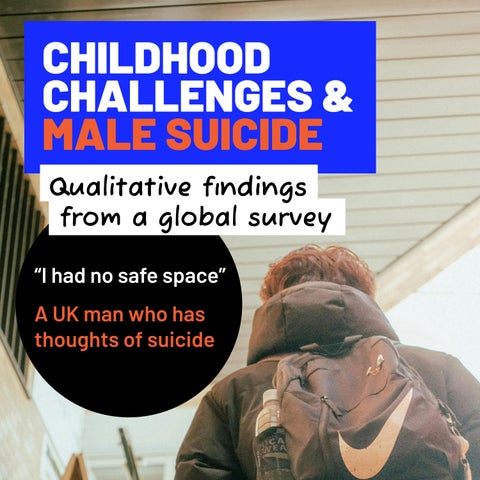
CHILDHOOD CHALLENGES & MALE SUICIDE Qualitative findings from a global survey “I had no safe space” A UK man who has thoughts of suicide
actiononmalesuicide.org
As part of a global survey we asked men about: painful experiences from childhood that had negatively impacted their adult life. 710 men who had thought about suicide or attempted in the last week or year responded.
actiononmalesuicide.org
SAMPLE The majority of participants were predominantly: • from North America (37%) and Northern Europe (35%) • aged 18 to 30 (63%) • in full-time employment (39%) • white (78%) • straight (69%) • single (60%)
actiononmalesuicide.org
ANALYSIS We analysed what each man said about his childhood, coding the data, to identify common patterns and themes across the different experiences shared.
actiononmalesuicide.org
Common patterns
We developed two overarching themes to capture the painful childhood experiences expressed by men:
1.
2.
Internal Unsafety - Embodying an Unsafe Self (46%)
Relational Unsafety - Navigating Unsafe Social Worlds (70%)
actiononmalesuicide.org
1. Internal Unsafety - Embodying an Unsafe Self (46%)
actiononmalesuicide.org
1.
Internal Unsafety: Embodying an unsafe self Stigmatised self Dysregulated self
This theme had two sub-themes that explore the idea that some men grow up feeling that it was not safe to be them that they were different and did not belong (stigmatised self), or were struggling to cope and survive (dysregulated self).
actiononmalesuicide.org
Embodying an unsafe self Stigmatised self Some men described growing up feeling like they were different from others - less valued or accepted. This could be because of health challenges or impairments, being neurodiverse, body image issues - such as being overweight. Men also spoke of childhood loneliness, early-life social rejection, isolation, and a lack of close, intimate friends.
actiononmalesuicide.org
“I’ve been fat my whole life so a lot of passive aggressive comments have led to low self esteem in myself and my body.” A Canadian man, 24, with thoughts of suicide in the past week who has also attempted suicide
actiononmalesuicide.org
“Late diagnosed ADHD. Affected disproportionately by rejection by friends, peers, teachers. Never achieved potential and felt like a disappointment.” A British man, 38, with thoughts of suicide in the past year
actiononmalesuicide.org
“Constant loneliness, in my house, in school and everywhere else. I have very little nice experiences to remember. All I often remember is loneliness and pain.” A Paraguayan man, age unknown, with thoughts of suicide in the past year
actiononmalesuicide.org
Embodying an unsafe self Stigmatised self Some men described feeling judged or stigmatised because of their sexuality or race. Other men spoke about negative messages about men and masculinity, of not feeling masculine enough, or lacking male role models. For some men, these experiences seemed to contribute to feelings of shame, rejection, or not belonging.
actiononmalesuicide.org
“I struggled with feelings of worthlessness and trying to understand my identity as a mixedrace black child.” An English man, 45, with thoughts of suicide in the last week who has also attempted suicide
actiononmalesuicide.org
“ I was told from day one that I was a rapist, misogynist, evil because I was a boy and told to feel that I should be ashamed of myself because of my gender so I started to hate myself because of it (...)” A Scottish man, 22, with thoughts of suicide in the last week who has also attempted suicide in the last year
actiononmalesuicide.org
Embodying an unsafe self Dysregulated self For some men, painful experiences in childhood seemed to relate to embodying a selfhood that was psychologically struggling to cope. Men described mental health challenges including suicide attempts, of shutting down emotionally, struggling with low selfesteem, and feeling like a failure.
actiononmalesuicide.org
“Being medicated for my anxiety, depression and OCD at 13 made a huge impact on my behavior, which made others start to bullying me even more.” A Portuguese man, 24, with thoughts of suicide in the past week who has also attempted suicide
actiononmalesuicide.org
“To this day I feel that anyone close to me will one day realize I’m not worth their time and useless. I expect them to hurt me, to think I’m useless, fat, stupid, and hated, and one day they will walk away. My self worth is not a concrete feature of my personality and its something I fight against everyday to shore up.” An American man, 32, with thoughts of suicide in the past year
actiononmalesuicide.org
Embodying an unsafe self Dysregulated self
To cope with their childhood pain, some men turned to things like alcohol, drugs, gaming, or self-harm. These behaviours may have brought short-term relief, but often led to more difficulties over time, creating an ongoing cycle of distress.
actiononmalesuicide.org
“I turned to drugs and alcohol at an early age for escape and solace, which massively inhibited my development and my ability to complete qualifications (…)” An Irish man, 37, with thoughts of suicide in the past week who has also attempted suicide
actiononmalesuicide.org
INSECURE ATTACHMENT TO SELF & LIFETIME SUICIDE RISK Painful thoughts and feelings towards ourselves are one of the key theoretical drivers of suicidal pain. For example: "I am worthless" "I am a failure" "I am not good enough"
actiononmalesuicide.org
Our findings suggest childhood challenges may negatively impact some men’s sense of self and self-worth. Negative self-beliefs may create an insecure attachment to the self which may persist into adulthood. Early-life insecure attachment to an ‘unsafe’ self Negative self-views may contribute to suicidal pain across the life course.
actiononmalesuicide.org
2. Relational Unsafety - Navigating Unsafe Social Worlds (70%)
actiononmalesuicide.org
2.
Relational Unsafety: Navigating unsafe social worlds Dysregulated homes Violent social worlds Relational losses
Our second theme explores early-life experiences of relationship and social unsafety. Across families, peers, schools, and the wider community, childhood environments signalled they could not be relied on to keep men safe from harm.
actiononmalesuicide.org
Navigating unsafe social worlds Dysregulated homes Men in this sub-theme described growing up in ‘dysregulated homes’ characterised by frightening, unstable, or distressing behaviours. For some, this involved addiction or mental health difficulties within the family. Others described experiences of physical, emotional, or sexual abuse, neglect, or violence - either directed at them or something they witnessed.
actiononmalesuicide.org
“To be called a parasite (paraphrased from my native language) because your real father isn’t paying. To have your own mother wish that a truck runs over on your way to school. To tell you she wished she aborted you.” A 23 year old man from Germany, with thoughts of suicide in the last year.
actiononmalesuicide.org
“Hearing my dad rape my mom behind closed doors. I was 8 years old” A 29 year old man from America, with thoughts of suicide in the last week.
actiononmalesuicide.org
“After my parents separation when I was 7, my mother fell into deep depression and was suicidal (…) I would get bouts of anxiety and check on her in her room every 30 minutes or so.” A 26 year old man from Latvia, who has attempted suicide and with thoughts of suicide in the last year.
actiononmalesuicide.org
Navigating unsafe social worlds Violent social worlds Interpersonal violence was described as a painful presence in some men’s childhoods, primarily through bullying by both female and/ or male peers, often compounded by a lack of interventions from schools. A cluster of men also described childhood sexual violence. Perpetrators were male and female, and from immediate and extended family, as well as teachers, coaches, church staff, babysitters, peers, and girlfriends.
actiononmalesuicide.org
“I only got bullied through 1st and 2nd grade. Those were the worst two years of my life, which made me grow into a lonely kid who did not make friends with anyone. Now I still have very few friends.” A 19 year old man from Chile, who has attempted suicide and with thoughts of suicide in the last week.
actiononmalesuicide.org
“Being sexually abused by adult females that my family trusted and not being able to talk to anyone about it, or worse no one saw them as sexual abuse because they were females and I am a male …” A 27 year old man from Iran, who has attempted suicide and with thoughts of suicide in the last week.
actiononmalesuicide.org
Navigating unsafe social worlds Violent social worlds A cluster of men described the impact of structural violence on their childhoods. This included growing up in poverty or in communities affected by political unrest, conflict, crime, or gang activity. Some men described the psychological violence of racism or homophobia, and experiences of marginalisation.
actiononmalesuicide.org
“I was an illegal immigrant for most of my teenage years (...) my experiences were so harrowing and it has severely impacted my views on childbirth and on having children in the future. “My mind is pretty much made up that I wont be having any children or
actiononmalesuicide.org
passing my life on, as I cant protect them from such vulnerabilities regardless of how much I love them. Just like my own parents could not protect me from certain vulnerabilities, regardless of how much they loved me.” A 26 year old man from Nigeria, with thoughts of suicide in the last year.
actiononmalesuicide.org
Navigating unsafe social worlds Relational losses Some men experienced significant disruptions in care during childhood through bereavement - often by suicide, absent caregivers, or family breakdown. These experiences appeared to leave some men navigating painful voids of care during childhood.
actiononmalesuicide.org
“My best friend commit suicide when I was 15, and ever since I’ve struggled with depression. (…)” A 25 year old man from England, who has attempted suicide and with thoughts of suicide in the last year.
actiononmalesuicide.org
“Dad leaving when I was 7. The day he left I remember feeling like I crumbled mentally/emotionally. And a feeling of massive depression descending that I’ve never escaped.” A 50 year old man from England, who has attempted suicide and with thoughts of suicide in the last year.
actiononmalesuicide.org
INSECURE ATTACHMENTS TO OTHERS & LIFETIME SUICIDE RISK
Painful thoughts and feelings about our relationship with others are a key theoretical driver of suicidal pain. For example: “I don’t matter to people” “I can’t trust anyone” “Everyone leaves me”
actiononmalesuicide.org
For men in particular, isolation, loneliness, relationship conflict and relationship breakdown are known suicide risk factors. Our study suggests the roots of these interpersonal challenges may partly lie in childhood. In our data, descriptions of relational and social unsafety varied - a stable parent who dies is very different to one struggling with addiction - however, the psychological legacy may be similar.
actiononmalesuicide.org
Some men may come to see others and their care - as unsafe, unstable, or unreliable. These insecure attachments may carry into adulthood, shaping how some men understand, receive, and express care, and potentially limiting access to supportive relationships.
actiononmalesuicide.org
Early-life insecure attachment to ‘unsafe’ others
Interpersonal challenges and loneliness may contribute to suicidal pain across the life course.
actiononmalesuicide.org
In this study, 710 men who had recently been suicidal described childhood experiences that had negatively shaped their adult lives.
actiononmalesuicide.org
While experiences like abuse or neglect are widely recognised as examples of childhood adversity, others - such as loneliness, body image struggles, neurodiversity-related challenges, romantic abuse, sibling abuse, or gendered stigma - are less recognised. All of these experiences, and more, were described in our data.
actiononmalesuicide.org
addiction sex
porn
physical abuse anxiety
OCD
divorce bullying family physical health
body-image physical neglect peers
school
self-harm
isolation
poor sleep
social skills
emotional abuse
legal issues
sensory overload
emotional neglect drugs
trauma
poverty
racism
romantic challenges
homophobia
eating disorder
actiononmalesuicide.org
While the experiences described were diverse, across the data, one pattern stood out: Many men seemed to describe childhoods where they did not feel psychologically safe.
actiononmalesuicide.org
We organised the findings around two themes of unsafety:
1.
2.
Internal Unsafety - Embodying an Unsafe Self
Relational Unsafety Navigating Unsafe Social Worlds
These experiences of unsafety may have undermined men’s developing sense of self, their trust in others, and their belief that care would be available to them.
FOR MANY MEN, SUICIDAL PAIN STARTED EARLY. In our study, 79% of men recalled having thoughts of suicide before turning 20. Among men who had attempted suicide, 68% reported a first attempt during their pre-teen or teenage years. This suggests that for many men, childhood distress was often overwhelming.
actiononmalesuicide.org
“I never had anyone I could trust or followed through on their promises. I was alone, sometimes by choice, sometimes because I was ostracized by my peers. I used drugs, attempted suicide several times, self harmed, and had several instances of an eating disorder.” A 19 year old boy from America who has attempted suicide
The men in our study were, on average, 30 years old. All had experienced thoughts of suicide or made an attempt within the past week or year. This raises an important question:
Could childhood experiences continue to shape vulnerability to suicidal pain years later?
One possible explanation is that childhood unsafety may disrupt the development of secure attachments to self and others.
SECURE ATTACHMENT TO SELF Developing a secure attachment to self means developing a core sense that: “I matter” “I have worth” “I am safe in the world” But some men described childhood experiences that may have taught them the opposite.
actiononmalesuicide.org
Painful childhood experiences such as bullying, abuse, stigma, neglect, rejection, or violence may shape how boys come to see themselves. They may develop a painful view of themselves as unworthy of care, safety, or belonging. Over time, this may create vulnerability to low self-esteem, self-hatred, feelings of shame, defeat, hopelessness, and of being a failure.
actiononmalesuicide.org
“School was hell, a constant nightmare of a popularity contest where my confidence was shattered and broken and I left not wanting to go to university due to social anxiety (...)” A 22 year old man from Scotland who has attempted suicide in the last year
actiononmalesuicide.org
“I always thought I was a fat pig that no one would love or care about by how my family described me (...) To this day I feel that anyone close to me will one day realize I’m not worth their time (...) I expect them to hurt me, to think I’m useless, fat, stupid, and hated, and one day they will walk away.
actiononmalesuicide.org
“My self worth is not a concrete feature of my personality and its something I fight against everyday to shore up.” A 32 year old man from America, with thoughts of suicide in the past year
actiononmalesuicide.org
SECURE ATTACHMENT TO OTHERS Developing secure attachments to others happens by being exposed to people who we experience as safe, reliable, caring, and responsive. But many men described homes, schools, peer groups, and/or communities where people were unpredictable, frightening, unstable, rejecting, or violent.
actiononmalesuicide.org
When other people and their care is inconsistent, absent, abusive, or unsafe, boys may learn: “Other people can’t be trusted” “Other people are dangerous” “Nobody cares” “I have to survive alone”
actiononmalesuicide.org
This may make it harder to seek support, build close relationships, or feel a sense of belonging later in life. All these feelings can contribute to suicidal pain.
actiononmalesuicide.org
“Not having any close friends; feeling scared of everything; feeling unloved, undesirable, unwanted; no one to talk to” A 18 year old man from Poland, who has attempted suicide
actiononmalesuicide.org
MASCULINE NORMS MAY INTENSIFY HARM Cultural norms of masculinity that encourage boys to suppress emotion, deny pain, cope alone, stay in control, or avoid appearing weak may compound the impact of difficult childhoods. For boys carrying trauma, shame, loneliness, or fear, these norms may make it harder to disclose distress, receive care, or process difficult past experiences.
actiononmalesuicide.org
The result can be dangerous isolation.
actiononmalesuicide.org
“I struggled in school, I found it hard to fit in, couldn’t express my troubles to the family without some form of stigma being attached and being told to ‘man up’ or ‘i’m too sensitive’ (…)” A 27 year old man from the UK, who has attempted suicide
CHILDHOOD PAIN DOES NOT ALWAYS END WHEN CHILDHOOD ENDS...
actiononmalesuicide.org
for some men, it can continue to shape how they see themselves, relationships, and whether they believe care is available to them.
actiononmalesuicide.org
Too often, we only talk about boys as a potential risk to others - and not enough about the boys at risk. Boys who are being harmed - by their homes, their schools, their communities. Boys who feel unsafe, unseen, or alone. Boys who are carrying a pain so big they are already thinking about suicide. If we want to prevent male suicide, we need to listen to boys’ distress sooner and respond much earlier. To read the full paper, visit: actiononmalesuicide.org/research