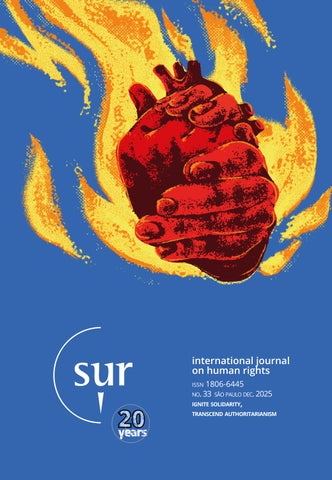
international journal on human rights issn 1806-6445
no. 33 são paulo dec. 2025
2 0 years
ignite solidarity,
transcend authoritarianism
international journal on human rights issn 1806-6445
n. 33 são paulo dec. 2025 ignite solidarity,
transcend authoritarianism
EDITORIAL TEAM EDITORIAL BOARD Emilio García Méndez. University of Buenos Aires | Argentina Fifi Benaboud. North-South Centre of the Council of Europe | Portugal Fiona Macaulay. Bradford University | United Kingdom Flávia Piovesan. Pontifical Catholic University of São Paulo | Brazil J. Paul Martin. Columbia University | United States Kwame Karikari. University of Ghana | Ghana Mustapha Kamel Al-Sayyid. Cairo University | Egypt Upendra Baxi. University of Warwick | United Kingdom EXECUTIVE BOARD Albertina de Oliveira Costa Camila Asano Conrado Hübner Mendes Glenda Mezarobba Juana Kweitel João Paulo Charleaux Laura Waisbich Marcos Tourinho
ADVISORY BOARD Alejandro M. Garro. Columbia University | United States Bernardo Sorj. Federal University of Rio de Janeiro / Edelstein Center | Brazil Bertrand Badie. Sciences-Po | France Cosmas Gitta. UNDP| United States Daniel Mato. CONICET/National University of Tres de Febrero | Argentina Daniela Ikawa. International Network on Economic, Social and Cultural Rights/ Columbia University | United States Ellen Chapnick. Columbia University | United States Ernesto Garzon Valdés. University of Mainz |Germany Fateh Azzam. Arab Human
Rights Fund | Lebanon Guy Haarscher. Université Libre de Bruxelles | Belgium Jeremy Sarkin. University of the Western Cape | South Africa João Batista Costa Saraiva. Regional Jurisdiction for Children and Adolescents of Santo Ângelo/RS | Brazil José Reinaldo de Lima Lopes. University of São Paulo | Brazil Juan Amaya Castro. University of Amsterdam | The Netherlands / University for Peace | Costa Rica Lucia Dammert. University of Santiago de Chile | Chile Lucia Nader. Open Society Foundations Fellow | Brazil Luigi Ferrajoli. University of Rome | Italy Luiz Eduardo Wanderley. Pontifical Catholic University of São Paulo | Brazil Malak El-Chichini Poppovic. Conectas Human Rights | Brazil Maria Filomena Gregori. University of Campinas | Brazil Maria Hermínia Tavares de Almeida. University of São Paulo | Brazil Miguel Cillero. University Diego Portales | Chile Mudar Kassis. Birzeit University | Palestine Paul Chevigny. New York University | United States Philip Alston. New York University | United States Roberto Cuéllar M. Inter-American Institute of Human Rights | Costa Rica Roger Raupp Rios. Federal University of Rio Grande do Sul | Brazil Shepard Forman. New York University | United States Víctor Abramovich. University of Buenos Aires | Argentina Victor Topanou. National University of Benin | Benin Vinodh Jaichand. University of the Witwatersrand | South Africa
MASTHEAD DIRECTORATE FOR STRENGTHENING THE HUMAN RIGHTS MOVEMENT Julia Mello Neiva Susana Barbery GUEST EDITOR Clément Voule EXECUTIVE EDITOR Laura Dauden
WEBSITE Saulo Padilha COMMUNICATIONS AND OUTREACH Gabriel Guerra Jeferson Batista Morgana Damásio Niassa Jamena Tainara Nagot CIRCULATION Revista Sur
GRAPHIC DESIGN AND LAYOUT Mariana Rodrigues | Estúdio Balaio
PRINTING AlphaGraphics
ILLUSTRATION Bruno Dinelli TRANSLATION AND PROOFREADING Cássia da Rosa Jane Adlington Karen Lang Naiade Rufino Sebastián Porrua
SUR. Revista Internacional de Direitos Humanos, São Paulo, SP: Rede Universitária de Direitos Humanos, [2004-2015] SUR. Revista Internacional de Direitos Humanos, São Paulo, SP: Associação Direitos Humanos em Rede, 2015SUR is covered by the following abstracting and indexing services: IBSS (International Bibliography of the Social Sciences); DOAJ (Directory of Open Access Journals) and SSRN (Social Science Research Network). In addition, SUR is also available at the following commercial databases: EBSCO, HEINonline, ProQuest and Scopus. Cataloging-in-Publication Data (CIP) | Angelica Ilacqua CRB-8/7057 SUR. International Journal on Human Rights / Associação Direitos Humanos em Rede. – v.1, n.1 (jan. 2004)-. - São Paulo : Associação Direitos Humanos em Rede, 2004-. Semiannual Associação Direitos Humanos em Rede [2015-] Rede Universitária Direitos Humanos [2004-2015] ISSN 1806-6445 (printed) ISSN 1983-3342 (online) Published in English, Portuguese and Spanish. 1. Human Rights 2. UN I. Associação Direitos Humanos em Rede 26-1646 CDD 341.48 Indexes for Systematic Catalog: 1. Human Rights
SUMMARY 10 LETTER TO THE READERS Memory 14 THE EDITOR Oscar Vilhena Article 20
DEMOCRACY HANGING BY A THREAD: RESISTANCE AND RECONSTRUCTION IN BRAZIL POST-BOLSONARO Camila Asano and Júlia Mello Neiva Article
40
NOTES ON THE FAR RIGHT IN THE SOUTH Paula Litvachky, Gabriela Mitidieri and Vanina Escales Interview
52
DEFENDERS ON TRIAL: “WE MUST REFUSE, CHALLENGE AND RESIST THIS PSYCHOLOGICAL STATE OF SURVIVAL” Interview with Hossam Bahgat, by Laura Dauden Interview
72
DEFENDERS ON TRIAL: “HUMAN RIGHTS HAVE LOST THEIR MAGNETISM AND THEIR POWER TO ELECTRIFY PEOPLE” Interview with Haris Azhar, by Laura Dauden Interview
92
“WE ARE ENGAGED IN A POWER STRUGGLE NOT POLITICS” Interview with Suely Araújo, by Laura Dauden
Article 112
CONSERVATISM, ACCUMULATION BY DISPOSSESSION AND THE CLIMATE CRISIS Mauricio Serpa França and Yuri da Silva Aguiar Images
125
RESISTANCE POSTERS Curation Jeferson Batista Silva Article
142
THE QUESTION OF PALESTINE Nada Awad Article
158
DIGITAL DISQUIET IN THE SILICON SAVANNAH Leah Kimathi Article
176
THE IMPACT OF SOCIAL MEDIA AND THE RISE OF FAR-RIGHT EXTREMISM IN SOUTH AFRICA Sherylle Dass and Yanela Frans Essay
188
RE-ENCHANTING HUMAN RIGHTS Sueli Carneiro
LETTER TO THE READERS
Clément Voule and Laura Dauden Brazil
letter to the readers
The first edition of the Sur Journal, published in January 2004, reproduced a talk given by the Brazilian diplomat Sérgio Vieira de Mello in February 2003, a few months before his tragic death in Baghdad, Iraq, where he was serving as Special Representative for the then-UN Secretary-General, Kofi Annan. In his speech, Vieira de Mello outlined five major human rights issues, for which he said he had no answer, but that he considered critical for the world at that time. They included non-state terrorism, religion, and limitations on expanding human rights. Twenty years later, Sur remains true to its founding mission, so well exemplified in Vieira de Mello’s contribution to that inaugural edition: to challenge the human rights field with honesty, commitment, and critical curiosity regarding the issues that connect the experience of advocating for human rights—although in different forms in each territory—across the Global South. This is the spirit underpinning this commemorative issue. The following pages are evidence that this effort has been renewed in its forms and mechanisms. In addition to a new graphic design, Issue 33 is the first to be produced entirely by guest authors, who have generously shared theoretical, practical, and strategic perspectives that act as beams of light amid the shadows. It
institutions and demanding a vigorous response from organizations and
Sur | n. 33 são paulo dec. 2025
is important to highlight that the perspectives shared here are those of
social movements. This was the theme that inspired the debates that
11
their authors and do not necessarily reflect the institutional understanding of Conectas Human Rights or the publishers. Their ideas intertwine against the shared backdrop of the rise of authoritarianism, in its multiple forms and mechanisms, which has established itself as a lasting reality, taking ever deeper root in society and in
Clement Voule and Laura Dauden
took place during the 2024 International Human Rights Colloquium and it continues in this collection of articles, interviews and essays. As will become clear, there is a shared call to action, grounded in the understanding that this action largely requires reclaiming a fundamental mandate—what the Indonesian defender Haris Azhar calls “substance”, in his interview. This reclaiming involves finding ways through the constraints of bureaucracy, institutional structures, and funding systems; it must be able to combine a healthy demand for professionalism and resources with the kind of hope, proactivity, and radicalism that the moment calls for. This is how we approach this process of “re-enchantment”, drawing on the philosopher and activist Sueli Carneiro’s brilliant definition—and we do so with burning energy and unwavering solidarity. From struggles to defend traditional territories, to the climate emergency, the judicial persecution of activists, battles in the digital realm, and the genocide in Gaza, the Journal reveals a mosaic of realities and perspectives that reflect the ways state authorities and corporations interact in increasingly authoritarian arrangements—in some cases even embedded within formally democratic structures—that have benefitted from the failures of the democratic ideal and the subsequent loss of popular support. The picture painted in Sur 33 also shows the uneven impacts of these authoritarian moves on historically vulnerable populations, as well as the effects of policies that dismantle the rule of law, on agendas such as the environment, Indigenous peoples, femiLetter to the Readers
nism, freedom of expression and protest, to mention but a few.
12
In addition to a collection of six articles by authors from South Africa, Argentina, Brazil, Palestine, and Kenya, the Journal features three in-depth interviews with activists in Brazil, Indonesia, and Egypt; an inspiring essay, adapted from the speech delivered by Sueli Carneiro
letter to the readers
at the opening ceremony of the Colloquium; and a visual section dedicated to the memory of resistance processes in the Global South. Finally, through the words of professor and Conectas co-founder Oscar Vilhena, we revisit the trajectory of Pedro Paulo Poppovic, founder and editor of Sur, to whom we dedicate this issue of the Journal. Sur 33 is the result of a collective effort and would not have been possible without the collaboration of partner organizations and funders, as well as the dedicated contributions of the following people: Carla Vreche, Carolina Diniz, Carolina Machado, Gabriel Sampaio, Jeferson Batista Silva, João Godoy, Juliana Miranda, Malak Poppovic, Morgana Damásio, Muriel Asseraf, Nadine Sherani Salsabila, Pedro Borges, Sherylle Dass, and Vladimir Chorny. We would particularly like to thank Camila Asano, executive director of Conectas Human Rights, and Julia Mello Neiva and Susana Barbery, the organization’s director and advisor for the Strengthening Human Rights Movement, who led the production of the Journal with sensitivity and commitment.
Clément Voule,
Laura Dauden, executive editor
Sur | n. 33 são paulo dec. 2025
guest editor
13
THE EDITOR
Sur bids farewell to Pedro Paulo Poppovic, a role model for those who remain committed to building a better future
Oscar Vilhena Vieira Brazil
Keywords Sur, Tribute, Pedro Paulo Poppovic
memory
Pedro Paulo Poppovic was the first editor of the Sur Journal. He was responsible for the form and identity of the publication. From the outset, the objective of Sur was to foster debate on truly cosmopolitan ideas surrounding human rights, primarily giving a voice to players in the Global South who were often excluded from international discussions. The journal was to be published in three languages with worldwide distribution. This was no task for a beginner. This is why we turned to Pedro Paulo. His career as an editor was already well established. He had led one of the largest publishing groups in Brazil and had conceived important editorial projects, such as Fascículos Abril, an encyclopedia, and Pensadores, a comprehensive collection of the classics, both of which sold in their thousands at newsstands throughout the country. The impact of these two projects on the democratization of knowledge and culture in Brazil, in the 1970s, in the midst of the military regime, was immeasurable. When he accepted the challenge of working pro bono with a group of young activists, who had no prior experience in publishing, to create a journal that was both socially engaged and committed to high stan-
of Fernando Henrique Cardoso, a childhood friend, he set up TV Escola,
Sur | n. 33 são paulo dec. 2025
dards, Pedro demonstrated remarkable selflessness and generosity, as
a broad-based education program for teachers in the state system. As
15
well as unending patience and dedication. His contribution to Sur—and to all those who had the privilege of working with him in producing the journal—was decisive. As well as being a renowned editor, Pedro Paulo was also a public administrator. As Secretary for Distance Learning during the presidency
Oscar Vilhena Vieira
the goal in the 1990s was to make basic education universally available in Brazil, there was a need for large-scale teacher training. This was his endeavor. I mention these projects to provide a sense of Pedro Paulo’s commitment to culture and education in Brazil, the country he adopted as his own. Pedro Paulo was an extraordinary person and led an extraordinary life. He came to Brazil as a child, with his mother and grandparents. They had left Istanbul which was becoming increasingly hostile to minority groups. He graduated in Social Sciences at the University of São Paulo and became a singular intellectual because of the scope of his interests. By choosing a career as an editor, rather than working in academia—a path many of his peers had taken—he was not confined to the boundaries of a single discipline or by the language of professional scholarship. He allowed his curiosity to guide him, and it took him everywhere. It was rare to see Pedro without a book in his hand. Fascinated, he would immediately start talking about whatever he was learning, although never in a professorial way. That is not to say he was ever gentle in his criticism or discussions. On the contrary, Pedro was always very rigorous in his analyses and forceful in debate. However, his erudition was never used to shut down conversation, particularly with younger or less well-educated debaters. Without any trace of paternalism, he would challenge us to overcome our ignorance. But he enjoyed a good argument. His eyes would twinkle, and he was nearly always smiling. Pedro’s extraordinary life was not just about the books he read though.
The editor
Throughout his life, he remained staunchly committed to the democratic
16
cause. His generation resisted authoritarianism and fostered the transition to democracy. His home was always a meeting place for intellectuals, activists, politicians, and journalists. As editor of Editora Abril, he sought the collaboration of dissidents and political prisoners when
memory
writing and translating texts, even though this meant risking his own freedom and the business of the publishing house. I met him after he met Malak Poppovic, at the end of the 1980s. She too was an extraordinary person. She was born in Egypt, but was a citizen of the world who also adopted Brazil as her home and built a vast network of friends and partnerships dedicated to promoting human rights. An economist and diplomat with wide experience in the United Nations High Commissioner for Refugees, she collaborated on the implementation of the Center for the Study of Violence at the University of São Paulo. She was an advisor on the Community Solidarity Program of the Presidency of the Republic, before founding Conectas in the late 1990s. Pedro and Malak generously shared the perspectives that helped them understand the world with everyone around them. More than that, they made their home a safe and vibrant place for a new generation of democracy and human rights activists, driven by the challenge of building a fairer prejudice-free society. Thanks to their contacts and relationships at home and abroad, they also collaborated in laying the foundations for a stronger and more internationally-connected civil society. Both were instrumental in building South-South conversations, and in establishing more horizontal relationships between organiza-
believed in education and politics as instruments of transformation.
Sur | n. 33 são paulo dec. 2025
tions in the North and the South.
The Sur Journal, among so many other projects that have impacted on
17
Pedro is already sorely missed. In these times of deep polarization and the growing triumph of ignorance, his appreciation of the facts, his pluralist view of the world, his openness to dialogue—without compromising basic moral values—serve as a compass for those who remain committed to building a better future. In this respect, he was always optimistic. Like a true progressive, he was not afraid of change and
Oscar Vilhena Vieira
the lives of millions of people, is one of his most important legacies. To honor this legacy, the journal must continue to be restless, plural, and always provocative. Those who had the privilege of sharing his friendship miss him deeply, his warm hugs, his subtle smile, his intense, youthful gaze, and the long conversations around the table, where discussions were solely
The editor
about what truly matters in life.
18
Received on October 2025.
Oscar Vilhena Vieira Brazilian, Professor at the FGV Law School in São Paulo, co-founder of Conectas Human Rights the Sur Journal and the Arns Commission for Human Rights. A public interest lawyer and columnist for the newspaper Folha de São Paulo.
oscar.vilhena@fgv.br
Sur | n. 33 são paulo dec. 2025
memory
19
DEMOCRACY HANGING BY A THREAD: RESISTANCE AND RECONSTRUCTION IN BRAZIL POSTBOLSONARO
Notes on the rise of the far right and authoritarianism in Brazil and the role of civil society in somber times
Camila Asano and Júlia Mello Neiva Brazil
article
The article details the measures and policies adopted by Jair Bolsonaro’s government in Brazil between 2019 and 2022, and some of the strategies implemented by civil society to resist authoritarianism and confront the pillars that enable and structure it, such as racism and colonialism. The authors also explain that the former president’s electoral defeat and his subsequent conviction and imprisonment for an attempted coup d’état did not eliminate the authoritarian risk, which must still be confronted by going beyond a reactive stance and by deepening democracy.
Keywords
Sur | n. 33 são paulo dec. 2025
Brazil, Bolsonaro, Far Right, Authoritarianism, Democracy
21
Camila Asano and Júlia Mello Neiva
On January 2, 2019, less than 24 hours after assuming the presidency of the Republic of Brazil, Jair Bolsonaro published a provisional presidential decree1 which would set the tone for his relationship with civil society in general, and with the human rights movement in particular. In the text, the retired Army captain, the eighth president since the country’s redemocratization after the Military Dictatorship (1964-1985), gave the Secretariat of Government of the Presidency the task of “supervising, coordinating, monitoring and following up on the activities and actions of international organizations and non-governmental organizations in the national territory”—an unequivocal move to curtail and intimidate these organizations. The publication of this provisional measure was exemplary in many ways. First, because it fulfilled a campaign promise and an anti-NGO speech2 that Bolsonaro had shamelessly cultivated in interviews, live broadcasts, and online publications, throughout his 17 years as a federal deputy. It also echoed one of the favorite items on the agenda of the far-right international alliance of which the president and his closest family and political circle had become a part. Second, because it was an example of the type of strategy that the government would employ in the four years that followed, to reverse rights, override the law, and impose unconstitutional agendas in multiple areas. Finally, and most importantly, because this was one of Bolsonaro’s initiatives that was successfully blocked by civil society through a large mobilization campaign called Free Society,3 under the leadership of the Pact for Democracy network, Democracy hanging by a thread
of which Conectas is a part.
22
This article addresses the mechanisms through which the Bolsonaro project was implemented in Brazil between 2019 and 2022, with consequences that still reverberate in Brazilian society. It also presents some of the strategies that worked in resisting authoritarianism in the country. This effort emerges from the need, identified and shared by Conectas and other organizations in different spaces over the last six years, in-
article
cluding the International Colloquium on Human Rights, to articulate common horizons of resistance to authoritarianism and to confront the pillars that enable and structure it, such as racism and colonialism; furthermore, to promote a positive agenda for the field of human rights anchored in the practices and knowledge forged in the Global South.
The rising tide and the power of anticipation. The election of Jair Bolsonaro was the culmination of a movement that had been developing for years in the Brazilian political landscape. Bolsonaro, a low-ranking politician who has never hidden his disdain for democracy and human rights, successfully articulated both the interests of the political and economic elite whose priority was to maintain and deepen the ultraliberal policies implemented during Michel Temer’s term and the demands of a society increasingly influenced by religious conservatism and the anti-establishment discourse that had been gaining strength. This process unfolded against the backdrop of an unequivocal strengthening of international far-right alliances, which had translated into the rise of authoritarian governments across the globe. Bolsonaro had everything he needed to ride this wave. The 2018 election campaign reflected the deep division in Brazilian so-
of his supporters and demonstrators across the country, Bolsonaro pro-
Sur | n. 33 são paulo dec. 2025
ciety, with numerous cases of violence against journalists, activists, and
mised to “banish” the “red outlaws” from the homeland through a “bro-
23
candidates.4 Bolsonaro himself was the victim of a serious stabbing during a rally. Despite the emphatic condemnation of the attack by other competing candidates and investigations revealing that the perpetrator had no connection to them, Bolsonaro did not hesitate to exploit the episode to heighten the rhetoric and escalate tensions. Just one week before the second round of elections, in a video call broadcast to thousands
Camila Asano and Júlia Mello Neiva
ad cleanup.” And he continued: “if they want to stay here, they’ll have to submit to the same law as all of us. Either they leave, or they go to jail.”5 The violence was both physical and rhetorical.6 This brief outline shows that Brazilian civil society was able to see and interpret the signs of Jair Bolsonaro’s rise—and anticipate the consequences of his victory—well in advance of his inauguration in January 2019. The degree of danger was known. There were no surprises regarding his discourse, always consistent in his rejection of the rights agenda, nor regarding the government plan, which had been publicized and advocated by him and his cabinet long before the start of the election campaign (most of the ministers, twenty men and two women, were confirmed more than a month before the inauguration). The experience of countries like Hungary under Viktor Orbán, with whom Bolsonaro has always maintained a close relationship, also served as an important source of learning. Time and knowledge allowed organizations to plan, renegotiate priorities—including with funders and partners—and implement security measures that would prove indispensable in the four years that followed. They also provided opportunities for organizations to connect and build new forms of collaboration and strategies to resist setbacks—which, as demonstrated in the example of the provisional presidential measure
Democracy hanging by a thread
mentioned at the beginning of the text, would soon materialize.
Textbook authoritarianism: the cornerstones of the Bolsonaro agenda.
24
ge the election results, refused to hand over the presidential sash.
On January 8, 2023, a crowd stormed and attacked the headquarters of the three branches of government in Brasília. Lula had just taken office and Jair Bolsonaro, who did not expressly acknowled-
article
Furthermore, he had traveled to the United States before the official end of his term. The coup and anti-democratic acts, as would be proven throughout the investigations and the criminal proceedings that resulted in the conviction of the now former president in September 2025, were part of a plan to keep him in power and also involved the kidnapping of a Supreme Court Justice, as well as the assassination of Lula and his vice-president, Geraldo Alckmin.7 It was a lamentable and shocking end to a government marked by contempt for democracy, institutions, and the Constitution. During his four years in power, Bolsonaro placed Brazil’s democratic rule of law in a permanent state of crisis. This crisis involved the extinction of spaces for action and participation by civil society8 in different areas of public administration; the abusive use of legal and repressive apparatuses to intimidate opponents and silence critical voices;9 the co-opting of state agencies10 and law enforcement bodies;11 restrictions on access to public information;12 and the promotion of verbal and institutional attacks on the press and civil society. Of note, for example, was the appointment of an employee of the Brazilian Intelligence Agency (Abin), whose identity was protected, to coordinate the body within the Government Secretariat responsible for relations with social organizations.13 In terms of structure, the Bolsonarist project also included a war on
tion of Brazil’s federal budget, which increased the relative power of
Sur | n. 33 são paulo dec. 2025
the system of checks and balances of democracy,14 using strategies to
Congress in the structure of the Republic and, indirectly, guaranteed
25
personalize and direct the hatred of their supporters against authorities in the Legislative and Judicial branches.15 The most notorious targets of this war were Rodrigo Maia, then president of the Chamber of Deputies, and Minister Alexandre de Moraes, of the Supreme Federal Court. The tension was not merely rhetorical and resulted in the approval of a drastic change in the rule governing the distribu-
Camila Asano and Júlia Mello Neiva
the expansion of the number of representatives consistently loyal to Bolsonaro in the Chamber of Deputies (a bloc that currently comprises 363 parliamentarians out of 513). During the Covid-19 pandemic, the federal government denied scientific evidence, refused to adopt measures to protect the population and address the health crisis, delayed the purchase of vaccines, and even promoted the use of treatments with no proven efficacy. The country recorded more than 700,000 deaths, the second highest number in the world, behind only the United States.16 Control over civil society was also increased through the use of surveillance software17 and monitoring platforms,18 and through manipulation by the Brazilian Intelligence Agency (Abin), which set up a clandestine unit focused on spying on political figures, journalists, and celebrities deemed to be adversaries. During the pandemic, the government implemented mechanisms for collecting personal data (including biometric and geolocation data) in a disorganized and hasty manner, and deployed the state apparatus—including the Ministry of Justice, the Federal Police, and the Institutional Security Office—to persecute political opponents under the infamous National Security Law, inherited from the Military Dictatorship. The law was revoked during the Bolsonaro years and replaced by the Law for the Defense of the Democratic Rule of Law19 following technical advocacy by civil society, Democracy hanging by a thread
in which Conectas played a significantly active role.20 There was also
culty of expanding regulation and curbing the spread of hate speech
26
and disinformation on social media.
an attempt to expand “anti-terrorism” legislation,21 creating mechanisms for surveillance and the criminalization of civil society organizations and social movements.22 Furthermore, in this context, we have seen a convergence of interests between the political and economic power of Big Tech companies, which has manifested itself in the diffi-
article
Another major front on which Bolsonarism advanced relentlessly, also predictably, was attacking the hard-won rights of minorities and/or historically vulnerable groups in Brazil: a set of agendas to roll back hard-won sexual and reproductive rights that occupied a significant part of the public debate, in the wake of the strengthening of conservative religious leadership.23 In the very first year of his term, for example, among the various councils abolished by the government was the CNCD/LGBT (National Council to Combat LGBT+ Discrimination)—an entity formed by representatives of the government and civil society to present demands and monitor the implementation of policies in the area. Another measure with important repercussions in this field was the issuance of a decree that made it mandatory for doctors to report suspected cases of rape to the police, which in practice made abortion even more difficult in cases permitted by law in Brazil.24 In this context, there was also a correct assessment, developed in dialogue with the Black movement, that it would be central to protect affirmative action policies in higher education. The strategy adopted proved successful, since it was already widely understood by civil society that the Bolsonaro project, due to its authoritarian nature, was also intrinsically racist. Predictably, this myriad of setbacks had a disproportionate impact on historically vulnerable populations in Brazil: Indigenous peoples,
groups between 0 and 69 years, Black and mixed-race people died
Sur | n. 33 são paulo dec. 2025
quilombola communities, Black and marginalized populations, mi-
more than white people. 25
27
grant workers, the LGBTQIA+ population, and women and children experienced greater exposure to Bolsonaro’s policies and suffered the consequences more profoundly. One example is the sociodemographic profile of the main victims of Covid-19, who were especially neglected by Bolsonaro. According to data from the Mortality Information System (SIM) of the Ministry of Health, in all age
Camila Asano and Júlia Mello Neiva
The context of a permanent state of crisis also served to keep other historic and ongoing sources of human rights violations intact. During Bolsonaro’s years in the Presidency, large companies continued to put human rights at risk through their operations. Conflicts in the countryside, generally stemming from mining, agribusiness, mega-constructions, and illegal deforestation, continued to claim victims throughout the territory, especially among the indigenous population.26 In addition, violent police actions were supported and encouraged. For example, the government promoted lenient bills that effectively authorized serious abuses by security agents. Through decrees, ordinances, and bills, the Executive Branch promoted a complete dismantling of the country’s gun control policy, expanding access and disorganizing the control of weapons and ammunition. This contributed to an increase in violence in the country. Similarly, the Bolsonaro government denied the climate emergency, dismantled environmental protection policies, and gutted agencies responsible for ensuring compliance with legislation regarding environmental licensing, deforestation, and the protection of indigenous lands, such as the Brazilian Institute of Environment and Renewable Natural Resources (Ibama) and the National Foundation for Indigenous Peoples (Funai). The erosion of governance in the socio-environmental and climate spheres was meticulously planned and implemented, and included cuts in budget, personnel, and resources in key ministries which were also weakened. In addition, there was a failure to investigate and ensure accountaDemocracy hanging by a thread
bility for environmental crimes and violence directed at defenders; the environmental and human rights legal and regulatory framework was
28
facing proceedings related to the illegal export of timber.28
dismantled; public access to information was limited; civil society was excluded from governance; and civil society and the press experienced repression.27 Bolsonaro’s ministerial team became notorious for lacking the qualities and skills needed to lead their respective portfolios. The former Minister of the Environment, Ricardo Salles, for example, is currently
article
The clientelist alliance between Bolsonaro and the Legislative branch, consolidated under Arthur Lira’s presidency of the Chamber of Deputies starting in 2021, also enabled the approval of legislative changes and constitutional amendments that favored the implementation of a regressive agenda, legalizing previously unlawful measures, even after the end of Bolsonaro’s presidency. This continuity became evident, for example, in the approval of the bill that consolidated the “time frame” thesis—a mechanism to limit the demarcation of indigenous lands. 29 This list, while not exhaustive, illustrates the versatility of authoritarian projects: their capacity to permeate institutional structures, shape public debate, redirect attention strategically, and mobilize political and economic forces to enable and consolidate setbacks with concrete and lasting impacts on citizenship.
What we learn from resisting The election of Jair Bolsonaro forced Brazilian civil society to renegotiate priorities and strategies. As discussed above, the time and knowledge accumulated before his inauguration meant this transition could be carried out with a certain degree of planning. At
tives as part of a coordinated and focused effort to restore demo-
Sur | n. 33 são paulo dec. 2025
Conectas, the work undertaken between 2019 and 2022 was structu-
cracy and human rights.
29
red around the complementary axes outlined below. In general, we have adopted a deliberately supportive stance towards the people and groups most affected by Bolsonaro’s policies, providing support and tools for their protection and joining our efforts with both new and established organizations and initia-
Camila Asano and Júlia Mello Neiva
From a programmatic standpoint, we broadened our mandate to include two themes that had not previously been the focus of our work, but which were central to sustaining the Bolsonarist project: the defense of democracy, especially during election periods, and the fight against disinformation. This process demanded a significant investment of energy in training and knowledge production so that the organization could clearly define its role in each of these agendas. In parallel, we focused on the safeguarding of historic achievements and the defense of institutions—what could even be described as democratic vaccines—recognizing their limitations and structural problems. To implement this agenda, Conectas sought to strengthen the strategies that had always been part of its repertoire—those that the organization had already mastered—which meant greater assertiveness and effectiveness. In addition, there were national and international strategic litigation and advocacy efforts as well as communications (with special attention to traditional media outlets) and networking. It is worth taking a moment to outline the litigation work, which gained prominence and expanded significantly during the most critical years of Bolsonaro’s government, when the Judiciary became one of the few remaining channels to contain setbacks. This expansion—from five cases filed in 2018 and nine in 2019, peaking in 2020 and 2021, with 41 and 60 cases respectively— was the result of a conscious decision to respond Democracy hanging by a thread
quickly to institutional and human rights threats. The period demanded “trench litigation.” With the change in the political landscape in 2023, the
30
fora, and channels to denounce President Jair Bolsonaro and portray him
organization was able to rebalance its actions, reducing the volume of cases and focusing on more impactful, structural cases. In the context of international political advocacy, it is necessary to identify at least three major successful approaches: first, the use of spaces,
article
as what he has always been —a real risk to democracy and the defense of rights. This was fundamental because, as seen in the cases of Brazil and other countries, it is common for caricatured authoritarian leaders to be described and treated as eccentric and somehow harmless. The second approach was to diversify or expand the argumentative repertoire, to explore economic and geopolitical interests related to Brazil more strategically and highlight the threat Bolsonaro represented to the business environment and regional stability. Finally, we acted decisively and directly to mobilize support for the integrity of the electoral process and ensure the swift recognition of the 2022 election results thereby reducing the timeframe used by authoritarian leaders to challenge the outcome and generate democratic instability. This strategy proved to be sound and essential in the transition process. Although it was inevitable that the situation in Brazil would take center stage, this period also strengthened the organization’s capacity to promote strategic exchanges with overseas organizations and to react to and participate in initiatives related to human rights in other territories of the Global South—always a feature of Conectas’ institutional identity. This had been hampered by the state of permanent crisis experienced in Brazil. The experience is undoubtedly a lesson learned and it has reinforced the need to consider that even amid a domestic crisis, it is essential to sustain
which mapped, documented, and revealed the existence of an institutio-
Sur | n. 33 são paulo dec. 2025
an international strategy grounded in solidarity and shared learning.
nal strategy by the Bolsonaro government to promote the spread of the
31
Nationally, a successful strategy was the diversification of institutional alliances. A clear example of how unlikely forces can be decisive in times of crisis was the collaboration with the Center for Research in Health Law at the University of São Paulo (Cepedisa/USP) during the most critical months of the Covid-19 pandemic. This partnership led to the publication of 10 editions of the bulletin Rights in the Pandemic,
Camila Asano and Júlia Mello Neiva
Coronavirus. This study was widely cited30 as a basis for establishing a Parliamentary Commission of Inquiry to investigate the failures of the federal government in addressing the Covid-19 pandemic. The mobilization in decision-making and participatory spaces was supported by the adoption of institutional measures to guarantee the safety and well-being of the team. To this end, we mapped potential vulnerabilities in all areas of the organization, from physical security and the digital space, to the health and well-being of the team, as well as the legal risks arising from our activities. This care was especially relevant during the 2022 election period. While the organization has always maintained a non-partisan stance, it courageously and responsibly embraced the need to join the broad front defending democracy that emerged from the mobilization of diverse societal forces at that time—which proved to be decisive in the defense of democracy.
The way forward Jair Bolsonaro was defeated in the 2022 elections and is ineligible to run for office He was also tried and convicted, and is serving a sentence for attempted coup d’état. However, his authoritarian far-right political project remains strong and well-organized, exerting influence in various areas of public administration, notably the Chamber of Deputies—where Democracy hanging by a thread
it holds a strident majority—and the Armed Forces. His social capital is
32
still considerable, and the alliance with the most radical religious sectors and segments of economic power is showing no signs of cracking. While his closest family and political circle is submerged in a fratricidal dispute to determine who will inherit the mantle in the 2026 elections, civil society remains vigilant and active. The work of reconstruction is long and must involve not only recovering lost ground but, above all, pursuing a new horizon of achievements.
article
The rise of authoritarian projects, as seen in the Brazilian example, does not appear to be an episodic phenomenon, a deviation from the norm, or a passing trend. In recent years, these forces have been able to alter structures once considered unshakeable and to disregard boundaries we had thought inviolable. The recognition that confronting them will be ongoing, however, should lead the human rights movement to go beyond its reactive stance. This may well be a counterintuitive proposal, but it is also an unavoidable one. Experience proves that the definitive overcoming of authoritarianism depends on the deepening of democracy across all its institutional dimensions and on the sustained expansion of rights. Until this objective is achieved, democracy will hang by a thread, and this is the greatest responsibility borne by Brazilian civil society.
Notas 1 Presidency of the Republic of Brazil, Provisional Presidential Measure No. 870, January 1, 2019, accessed October 17, 2025, https://www.planalto.gov.br/ccivil_03/_ato2019-2022/2019/ mpv/mpv870.htm. 2 “Cerca de 3 mil entidades repudiam Bolsonaro por fala sobre fim do ativismo no Brasil,” Conectas Human Rights, October 15, 2018, accessed January 13, 2025, https://conectas.org/noticias/cerca-de-3-mil-entidades-repudiam-bolsonaro-por-fala-sobre-fim-
3 “Campanha pressiona Congresso a reverter MP de controle de ONGs,” Conectas Human Rights, April 24, 2019, accessed November 24, 2025, https://conectas.org/noticias/campanha-mp-controle-de-ongs/. 4 Alexsandro Ribeiro, Carolina Zanatta, Caroline Farah, Gabriele Roza, José Lázaro Jr., Mariana Simões, Thays Lavor e Bruno Fonseca, “Violência eleitoral recrudesceu no segundo turno,” Agência Pública, November 12, 2018, accessed October 18, 2025, https://apublica.org/2018/11/violencia-eleitoral-recrudesceu-no-segundo-turno/. 5 Poder 360, “Jair Bolsonaro fala por telefone com os manifestantes da Av. Paulista,” You Tube, October 22, 2018, accessed October 16, 2025, https://www.youtube.com/watch?v=7vxX3nQccTU.
Sur | n. 33 são paulo dec. 2025
do-ativismo-no-brasil/.
33
Camila Asano and Júlia Mello Neiva
6 Conectas Human Rights and partner organizations reacted to Bolsonaro’s speeches and actions against civil society long before he took office as president. One example is the letter signed by more than three thousand Brazilian organizations against a statement he made in October 2018 that, if elected, he would put “an end to all activism in Brazil.” See “Cerca de 3 mil entidades repudiam Bolsonaro por fala sobre fim do ativismo no Brasil,” Conectas Human Rights, October 15, 2018, accessed November 24, 2025, https://conectas.org/noticias/cerca-de-3-mil-entidades-repudiam-bolsonaro-por-fala-sobre-fimdo-ativismo-no-brasil/. 7 In September 2025, Jair Bolsonaro was sentenced to 27 years in prison for the crimes of armed criminal organization, attempted violent abolition of the Democratic Rule of Law, coup d’état, aggravated damage through violence and serious threats, and deterioration of listed heritage. 8 In 2019, Jair Bolsonaro signed a decree that reduced the number of councils foreseen by the National Policy for Social Participation (PNPS) and the National System for Social Participation (SNPS) from 700 to less than 50. See BRAZIL, Decree No. 9759, of April 11, 2019. This Decree extinguishes and establishes guidelines, rules and limitations for collegiate bodies of the direct, autonomous and foundational federal public administration. Accessed January 22, 2026, https:// www.planalto.gov.br/ccivil_03/_ato2019-2022/2019/decreto/d9759.htm. 9 According to a survey by LAUT – Center for Analysis of Freedom and Authoritarianism, in the first two years of the Bolsonaro government there was a 285% increase in the opening of investigations based on the National Security Law compared to the same period of the Dilma and Michel Temer governments. See “Diagnóstico da aplicação atual da Lei de Segurança Nacional,” Centro de Análise da Liberdade e do Autoritatismo, May 22, 2021, accessed January 22, 2026, https://conectas.org/noticias/promulgada-pela-ditadura-militar-lei-de-segurancanacional-e-revogada/. 10 Conectas denounced the Bolsonaro government at the UN for threatening the global climate, especially for its attacks on the Brazilian Institute of Environment and Renewable Natural Resources (IBAMA). See “Governo Bolsonaro é denunciado na ONU por ameaçar o clima global e violar direitos humanos no Brasil,” Conectas Human Rights, November 16, 2022, accessed January 22, 2026, https://conectas.org/en/noticias/bolsonaro-government-denounced-
Democracy hanging by a thread
in-un-for-threatening-global-climate-and-violating-human-rights-in-brazil/
34
11 Actions have been taken to weaken the Palmares Cultural Foundation and other bodies that protect the rights of quilombola communities, for example. See “Governo fragiliza todas as ações que fortalecem nossa vida e nossos quilombos”, diz coordenador da Conaq,” Conectas Human Rights, August 10, 2022, accessed January 22, 2026, https://conectas.org/en/noticias/ the-government-is-undermining-all-actions-that-empower-our-lives-and-our-quilombos-saysconaq-coordinator/. 12 In 2020, a provisional measure was published outlining measures to address the public health emergency, which included suspending responses to requests for access to information.
article
See “Organizações repudiam medida que suspende atendimento a pedido de acesso à informação”, Conectas Human Rights, March 24, 2020, accessed January 22, 2026, https:// conectas.org/en/noticias/organizations-repudit-measure-that-suspends-compliance-withrequest-for-access-to-information/. 13 The appointment was suspended by the Federal Court in response to a Public Civil Action filed by Conectas. See “Bolsonaro quer suspender prazos de MPs. Quais os riscos para a democracia?”, Conectas Human Rights, June 20, 2020, accessed November 25, 2025. https:// conectas.org/noticias/suspensa-nomeacao-de-agente-da-abin-relacao-com-ongs. 14 In light of the coronavirus pandemic, the Bolsonaro government requested that the Supreme Federal Court consider suspending the deadline for the National Congress to analyze Provisional Measures. See Bolsonaro quer suspender prazos de MPs. Quais os riscos para a democracia?”, Conectas Human Rights, April 15, 2020, accessed January 22, 2026, https:// conectas.org/en/noticias/bolsonaro-wants-to-suspend-deadlines-on-provisional-executiveorders-what-are-the-risks-to-democracy/. 15 Jair Bolsonaro launched attacks against the Judiciary in August 2021, instigating institutional instability. See “Organizações repudiam ataques de Bolsonaro ao Judiciário,” Conectas Human Rights, August 24, 2021, accessed January 22, 2026, https://conectas.org/en/noticias/ organisations-reject-attacks-by-bolsonaro-on-the-judiciary/. 16 World Health Organization, “Number of COVID-19 deaths reported to WHO (cumulative total),” September 28, 2025, accessed September 25, 2025, https://data.who.int/dashboards/ covid19/deaths?n=o. 17 Harpia Tech, the company responsible for the service, won a tender from the Ministry of Justice for the contracting of espionage services. See “Entidades questionam no TCU contratação de software de espionagem”, Conectas Human Rights, August 9, 2021, accessed January 22, 2026, https://conectas.org/en/noticias/organizations-file-legal-challenge-againstspyware-contract/.
160 databases and could be used by federal agencies and police forces. See “Entidades pedem que MPF investigue sistema de vigilantismo do governo Bolsonaro”, Conectas Human Rights, February 10, 2022, accessed January 22, 2026, https://conectas.org/ en/?s=bolsonaro+government+surveillance&cat=&tema=&date1=&date2=&post_type=noticia. 19 “Promulgada pela ditadura militar, Lei de Segurança Nacional é revogada,” Conectas Human Rights, September 2, 2021, accessed November 25, 2025, https://conectas.org/noticias/ promulgada-pela-ditadura-militar-lei-de-seguranca-nacional-e-revogada/. 20 Conectas was even mentioned in news reports released by the Senate. See “Relator quer votar revogação da Lei de Segurança Nacional antes do recesso,” Agência Senado, June 25, 2021,
Sur | n. 33 são paulo dec. 2025
18 The Cortex platform, managed by the Ministry of Justice in 2022, aggregated more than
35
Camila Asano and Júlia Mello Neiva
accessed January 22, 2026, https://www12.senado.leg.br/noticias/materias/2021/06/25/relatorquer-votar-revogacao-da-lei-de-seguranca-nacional-antes-do-recesso. 21 “Especialista da ONU manifesta preocupação com projetos de lei sobre antiterrorismo no Brasil,” Conectas Human Rights, April 14, 2022, accessed February 2, 2026, https:// conectas.org/noticias/especialista-da-onu-manifesta-preocupacao-com-projetos-de-leisobre-antiterrorismo-no-brasil/. 22 “Relatório entregue à República Federativa do Brasil referente à RPU Defesa da Sociedade Civil,” Article 19, Conectas Human Rights, March 31, 2022, accessed January 22, 2026, https:// www.conectas.org/wp-content/uploads/2022/04/Relatorio-RPU-Defesa-da-Sociedade-Civil.pdf. 23 “Ofensivas antigênero no Brasil: políticas de Estado, legislação, mobilização social,” Ação Educativa, Associação Brasileira de Gays, Lésbicas, Bissexuais, Travestis, Transexuais e Intersexos (ABGLT), Associação Nacional de Travestis e Transexuais, Conectas, et al., October 2021, accessed November 25, 2025, https://conectas.org/publicacao/ofensivas-antigenero-no-brasil/. 24 Abortion is criminalized in Brazil, and the only three exceptions provided for by law are in cases of risk to the life of the pregnant person, rape, and fetal anencephaly. The decree published by the Bolsonaro government was revoked in 2023. 25 According to the Brazilian Institute of Geography and Statistics (IBGE), the predominance of Black and mixed-race people among Covid-19 victims is not observed in the age group from 70 onwards “due to the lower life expectancy of this social group.” “Homens pretos e pardos morreram mais de Covid do que brancos em 2020”, Agência IBGE, December 3, 2021, accessed October 16, 2025, https://agenciadenoticias.ibge.gov.br/agencia-noticias/2012-agencia-de-noticias/ noticias/32414-homens-pretos-e-pardos-morreram-mais-de-covid-do-que-brancos-em-2020. 26 Conectas has taken action to combat these actions, such as ADPF 709. See: “ADPF-709: plano de ação para povos indígenas,” Conectas Human Rights, July 7, 2020, accessed February 2, 2026, https://conectas.org/litigiopt/adpf-709-plano-de-acao-para-povos-indigenas/. 27 “Lacunas de governança socioambiental no Brasil: Utilizando o processo de acessão à
Democracy hanging by a thread
OCDE para fortalecer os direitos humanos e a proteção ambiental,” OECD Watch, Conectas
36
Human Rights, International Federation for Human Rights, March 2022, accessed November 25, 2025, https://www.oecdwatch.org/wp-content/uploads/sites/8/2022/03/Bridging-Braziliangovernance-gaps-Research-series-summary-paper-PT-1.pdf. 28 “STF vai julgar Ricardo Salles por suposto esquema de facilitação de contrabando de produtos florestais,” Suélen Pires, September 1, 2025, accessed January 22, 2026, https:// noticias.stf.jus.br/postsnoticias/stf-vai-julgar-ricardo-salles-por-suposto-esquema-de-facilitacaode-contrabando-de-produtos-florestais/. 29 The “Time Frame” Framework Law was approved by Congress in 2023, already under
article
Lula’s government, in response to the Supreme Federal Court’s decision to declare the thesis unconstitutional. The text was vetoed by the president, but the veto was later overturned by parliamentarians. The thesis establishes that the right to territory should only be granted to indigenous peoples who prove that they occupied or claimed their lands on the date the Federal Constitution was promulgated (October 5, 1988), ignoring the violations that indigenous peoples have suffered over the years, including forced removals and exterminations. 30 “Estudos do Cepedisa/USP sobre a pandemia da covid-19 são mencionados no relatório final da CPI,” Jornal da USP, October 20, 2021, accessed February 2, 2026, https://jornal.usp.br/ atualidades/estudos-do-cepedisa-usp-sobre-a-pandemia-da-covid-19-sao-mencionados-norelatorio-final-da-cpi.
Recebido em outubro de 2025.
Camila Asano, joining the Conectas team in 2006, Asano holds a degree in International Relations from the University of São Paulo and a master’s degree in Political Science from the same institution. She has been the executive director of Conectas since 2023. Prior to that, she coordinated the Foreign Policy and Human Rights Program, the Strengthening the Democratic Space Program, and was the Programs Director.
program and the Justice program. She is also one of its founders. A lawyer graduated from the Law School of PUC-SP, she holds an LL.M. from Columbia University Law School in NY and a doctorate from the Human Rights Program at the University of São Paulo Law School. She is a member of the Board of Directors of Sherpa, Bank Information Center, and a collaborating member of the Arns Commission.
camila.asano@conectas.org | julia.neiva@conectas.org
Sur | n. 33 são paulo dec. 2025
Júlia Mello Neiva is the deputy director of Conectas Human Rights, and was the coordinator of the Socio-Environmental Rights Defense
37
NOTES ON THE FAR RIGHT IN THE SOUTH Argentina’s authoritarian turn: origins, crisis situations and human rights strategies
Paula Litvachky, Gabriela Mitidieri and Vanina Escales Argentina
article
This article is organized into three parts. First, it outlines the particularities of the far right in Argentina, describes its specific traits and identifies which ones are unique and which bear a family resemblance to those of other regional and global far right movements. It also presents a critical and conceptual analysis that serves as a reference on the far right in general. Next, it explores what these governments are a response to and the crises that they exploit to mount their plans. In different places on the map, liberal democracy is showing its limits and its lack of effort to address the consequences of the growing concentration of wealth in the hands of a few, which is reflected in the degradation of not only the rights of the majorities, but also the environment. This leads us to believe that the far right is not the only problem we face, but also the failure to democratize wealth and participation. Finally, the article discusses what human rights organizations can do to stop the advance of the far right in the region, with which allies and
Keywords Far right, Argentina, liberal democracy
Sur | n. 33 são paulo dec. 2025
the challenges that they will face along the way.
39
Paula Litvachky, Gabriela Mitidieri and Vanina Escales
You have geography and you have history. The maps from the last fifteen years show that the number of countries governed by far-right parties has grown. One by one, they turn the same colour in the post-election reports usually published on different continents. History tells us, however, that although their colours look similar, what led them to where they are today are distinct, tortuous paths that, depending on their region, originate in specific political plots. The advance of the far right in different parts of the world poses a common threat to human rights and an urgent challenge for those of us who strive to make democracy an expression of social justice. The experience of each country is different, but there are bridges between them. In Argentina, the living memory of state violence during the dictatorship and the strong tradition of fighting for rights were unable to prevent Javier Milei and Victoria Villaruel from coming to power in a country marked by yet another economic crisis. In this article, we will attempt to reconstruct three dimensions: the specific characteristics of this new right; how it uses the Argentinean government to carry out its authoritarian cultural and political plan, and the challenges that this imposes on human rights organizations and feminisms. As we do so, one thing is for certain: what we have before us is not just an economic problem or one of neocolonialism and governability. The far right is not merely a neoliberal adjustment programme, but
Notes on the far right in the South
rather an authoritarian plan to reorganize societies, in which violen-
40
ce is rhizomatic. At the core of this plan is control of bodies—in the streets, on digital media, at work, at schools—, sexual disciplining, violence towards Indigenous peoples and the reduction of life experiences to their market value.
article
Traits of the Argentinean far right: between the singular and the global As researchers Rosana Pinheiro-Machado and Tatiana Vargas-Maia1 point out, the new reactionary right uses a repertoire that tends to become universalized: they feed on the effects of the global recession, the collapse of the welfare state, the resentment of impoverished middle classes and the revolt against the unfulfilled promises of liberal democracy. In Argentina, this repertoire intertwines with the intense, conservative culture of a minority that contests—and pressures against— advances in progressive legislation, such as gender equality laws, and transfeminist mobilizations. It reacts to a history of struggle for human rights that shaped common understandings of democracy. It attacks the memory and the process to obtain justice for the crimes of the last civic-military dictatorship and calls on the military to take illegal action. And it capitalizes on social frustrations with a peripheral, dependent economy that is saddled with foreign debt and expectations of finding salvation in re-primarization and extractivism. The local far right has been cultivating its enemies for years, well before the current government took office. We say enemies, and not political adversaries, because the rhetoric is one of extreme polarization, hatred and, in some cases, dehumanization. We are not just dealing
as “others” of value. In Argentina, we have begun to notice that this
Sur | n. 33 são paulo dec. 2025
with intense political confrontation, but rather mechanisms of de-de-
aggressiveness promoted by sectors of the government is spreading
41
mocratization that erode the very possibility of dissent and replace it with the logic of the symbolic annihilation of the adversary. These are all moves to shut down public debate. Discourses of hate towards journalists, Indigenous peoples, migrants, feminist, sexual dissidents, civil servants or sectors of the political opposition encourage discriminatory practices and political violence: they strip those who are labelled
Paula Litvachky, Gabriela Mitidieri and Vanina Escales
horizontally—that is, pervasively through society. If we look carefully at the activities of the people who made attempts on the life of Cristina Fernández,2 we find that they were involved in the polarizing, hateful hostility towards the former president’s party. We know that democracy does not exist without dissent and that it essentially requires shared rules, mutual recognition and a common language. This is being threatened by the current political rhetoric. The shrinking of civic space and the criminalization of protest are the pillars of the new authoritarian configuration under the Milei government. The Ministry of Security promoted—together with messages on law and order—an anti-protest protocol3 that made almost all public demonstrations a crime. This rule defined all protests involving street or road blockades as flagrante delicto offences and allows security forces to intervene to dislodge and disperse protesters. After a few months, the government toughened its stance and began to include protests in its narrative on anti-terrorism and institutional destabilization. Since the implementation of the protocol, the use of force has become the rule, arbitrary arrests and raids on social organizations have multiplied and the stigmatization of activism has intensified. It also contains provisions that permit information to be gathered to criminalize, persecute and stigmatize leaders and participants of public demonstrations and the political, social and union organizations involved. Repression is not considered excessive, nor a mistake: it is a deliberate policy aimed at Notes on the far right in the Southl
discouraging protest and isolating anyone who complains.
while granting tax and regulatory benefits to big companies and tax eva-
42
ders. These measures affect families, in general; the elderly, directly, as
Meanwhile, the economic restructuring and the downsizing of the state resulted in a brutal transfer of resources from the working majority and middle classes to the richest sectors. The government made cuts to retirement pensions, health and education policies and service subsidies,
article
their pensions have borne the bulk of the cutbacks; women, who watch as care is reprivatized; trans persons, and people with disabilities. Funding for sexual and reproductive health policies was slashed in the first few days of government in 2024. The economic model adopted is sustained by an extractivist and de-industrializing matrix, far removed from any egalitarian project. The Régimen de Incentivo a las Grandes Inversiones (RIGI or Large Investments Incentive Scheme) crystallizes an economic model geared towards raw material exports, with no environmental protections nor respect for the rights of local communities. Indigenous peoples have been criminalized for occupying territories—which they claim as their ancestral property—that are coveted by extractivist capital. The government is pursuing a “productive security” policy, which would even allow it to militarize the territories to ensure that business operations are able to continue and to defuse social conflicts by force. In this context, the government has reinforced the state surveillance system. The widening of the concept of “terrorism” and the militarization of internal security zones, such as the country’s northern border, put pressure mainly on social organizations, grassroots movements and the opposition. The intelligence apparatus has also regained a leading role, a budget, discretion in the use of funds and new powers justified
tary officers convicted of crimes against humanity, is a clear indication
Sur | n. 33 são paulo dec. 2025
by a discourse on the fight against supposed global and national threats.
of the goal of this strategy: to rewrite recent history.
43
The government also pushed ahead with its strategy to explicitly attack the democratic memory of the dictatorship. It vindicated the state and illegal violence of those years, gutted the Memory, Truth and Justice policies and attacked human rights organizations. The figure of Victoria Villarruel, the country’s vice-president who has connections with mili-
Paula Litvachky, Gabriela Mitidieri and Vanina Escales
At the heart of this authoritarian plan is control of the body’s reproductive capacity, a return to a sexual order and political regime centred on the heterosexual nuclear family and the elimination of dissident ways of life, such as trans existences. In recent months, in several countries, but undoubtedly in the United States and Argentina, the far right has been trying to portray low birth rates as a problem to attack policies protecting women and girls’ autonomy over their bodies. This is not a secondary matter, but rather a direct assault on the most powerful and organized global liberation movement. This disciplinary goal is the ideological and strategic core of the contemporary far right and where all the far right forces in the world intersect. The Milei government, for its part, has a strong cultural and symbolic colonialist stance. The country’s foreign policy is now automatically aligned with the United States and Israel. It has been pursuing a hostile policy towards the international human rights system: from explicit contempt for multilateral organizations, which it claims are “ideologized”, to dismissing protection agreements and delegitimizing the system by using nationalist arguments against what it considers a “globalist” culture that undermines sovereignty. These pompous and even buffoonish stances are an attempt to dodge the Argentinean state’s commitments on the protection of human rights and decouple public policy from international legal standards. This only weakens protection mechanisms
Notes on the far right in the South
further and justifies renewed arbitrariness on the part of the state.
44
What kind of trap is democracy in? Not all neoliberal governments are de-democratizing, although many would agree that inequality obscures the very meaning of democracy. But there is a specific kind of government—that of the authoritarian far right—that combines extreme neoliberalism with institutional and cul-
article
tural practices that erode democracy. What distinguishes these governments is the way they reorganize political power, govern by decree, dismantle control mechanisms and reject diversity, otherness, pluralism and collective organizing as basic principles of democratic coexistence. By way of a reference, we could say that a government is de-democratizing when it not only limits access to rights, but also modifies the material and symbolic conditions that make these rights collectively enforceable, defendable and challengeable. It becomes authoritarian when it empties the representative system of content, weakens institutions that serve as counterbalances, criminalizes dissent, stigmatizes or dehumanizes social groups, turns dissent into a public threat and uses the state apparatus to consolidate a model of exclusion. We believe that it is important to expose the fascist face of the current political phenomenon. This political depiction is based on not only activist experience and memory, but also analytical work. By fascism we mean a phenomenon that can be political, ideological or a social practice. According to researcher Robert Paxton,4 an authoritarian movement grows, makes its way into mainstream politics, rises to power and exercises it through repressive and exclusionary methods in a sequence of stages. The heart of this movement does not lie in its doctrinal principles, but rather in its capacity to mobilize collective frustrations and use
not only defund social policies, but also attack those who demand state
Sur | n. 33 são paulo dec. 2025
them against real or fabricated internal enemies. Its characteristics can
presence. Through this lens, rights are portrayed as theft and an illegiti-
45
vary from one country to another, since—and because—it is not a rigid ideology, but rather a highly malleable power dynamic. Unlike other neoliberal governments that we have already lived through in Latin America, these governments naturalize and moralize inequality: people who do not have rights have not tried hard enough. They
Paula Litvachky, Gabriela Mitidieri and Vanina Escales
mate and immoral appropriation of wealth. The basis of this rhetoric is racist, patriarchal and colonial. And, at the same time, they strengthen the economic oligarchies that, in many countries with far right governments, are involved in state management. Their quest to restore old social hierarchies of gender, class, ethnicity and sexuality shows that control of bodies is just as important as fiscal adjustment. In this context, the human rights perspective is not just a legal instrument or a political tradition agreed upon after the horrors of World War II; it is a framework for analysing the ways in which democracy is being eroded. Under this approach, it is not enough to observe the legality of government actions: one must look at which institutions are being hollowed out, which ones are strengthened, which groups are subjected to systematic repression or exclusion, how social violence circulates, which narratives about history and society are imposed and which conditions of possibility are still open or closed to political participation. Another vector to take into account are the government actions that leave some features of democracy intact, such as elections and the separation of powers, while rendering other fundamental aspects meaningless: effective control between institutional powers and openness to public scrutiny; the principle of equality; inclusion; the recognition of differences and social justice. This is where the contemporary far right
Notes on the far right in the South
gets into a knot: in the simulation of democracy.
46
What we can do Although we are not dealing with classic totalitarian or authoritarian regimes, many of their political, social and, above all, emotional dynamics persist and are being brought up-to-date in democracies run by far-right governments. What is at stake is not only the concentration
article
of power, but also the type of social mobilizations being promoted: reactionary, emotional ones that feed on resentment and fear. This is how they fabricate internal enemies that end up being expelled from the world of humans or citizens. The challenges are thus multiplying, and there are no recipes or foolproof plans. In 2024 and 2025, the streets of Argentina, the United States, Serbia and Germany showed that the crisis of representation is not necessarily a crisis of politics. There, we saw social creativity, new forms of protest and mobilizing and unexpected alliances. Human rights organizations have the challenge of resisting the advance of authoritarianism without getting trapped in conservative or formalist discourses. We need to be able to imagine the world that we want to live in based on new, broader perspectives that include transfeminisms, environmental movements, trade unions, youths and Indigenous peoples. In the face of this threat, human rights must not be a floor of minimum aspirations, but rather a political device that raises its voice to imagine radical change in the future. We are fighting to define democracy. To confront a global far right that presents itself as change and order, we suggest radicalizing our struggles by breaking with
humanity, we defend freedom of expression, we defend the right to
Sur | n. 33 são paulo dec. 2025
inequality, sex/gender oppression, colonialism and the concentra-
abortion, trans lives matter and are valuable, having access to he-
47
tion of power. To call ourselves anti-fascists and human rights defenders today is to state our ethics and practice. It means helping to reclaim the common sense hijacked by the far right—a democratic common sense that affirms basic things: that we reject torture and crimes against
Paula Litvachky, Gabriela Mitidieri and Vanina Escales
alth and education are emancipatory democratic agreements, freedom is different from consumption, political surveillance should be prohibited, and the environment is a legacy and not a commodity to be exploited. The fight is now. And it is for everything.
Notes 1 Pinheiro-Machado, Rosana and Tatiana Vargas-Maia. “Why We Need a New Framework to Study the Far Right in the Global South,” Global Dialogue, March 9, 2023,
Notes on the far right in the South
https://tinyurl.com/2bbn6mnm. 2 The former president suffered an attempt on her life in front of her home when she
48
4 Robert O. Paxton, Anatomía del fascismo (Madrid: Capitán Swing Libros, 2019).
was greeting protestors that had gathered to show their solidarity with her during the legal proceedings against her, which had been denounced for numerous irregularities. The perpetrator shot a gun twice, but no ammunition was fired. 3 Ministerio de Seguridad, Presidencia de la Nación, República de Argentina, “Resolución 943/2023,” December 14, 2023, accessed July 22, 2025, https://www.boletinoficial.gob.ar/ detalleAviso/primera/300917/20231215.
article
Received on April 2025.
Paula Litvachky is a lawyer and the executive director of CELS. She has built her experience and activism in the fields of justice, criminal policy, security, intelligence and human rights at the national and international levels. She has coordinated and participated in various research projects and written academic articles and news reports. She is a member of several networks and groups that promote human rights.
Gabriela Mitidieri is a historian, activist, teacher and researcher. As a member of CELS’ mobilization and democracy team, she investigates and She is the author of many articles. Vanina Escales is a communicator, journalist and activist and has been with CELS since 2014. She leads the mobilization and democracy team and is the director of communications. She devises strategies for public intervention at the intersection of the two areas. She is a member of feminist spaces and networks and the author of books and articles.
gmitidieri@cels.org.ar | vescales@cels.org.ar | plitvachky@cels.org.ar
Sur | n. 33 são paulo dec. 2025
monitors the far right in Argentina and its regional and international ties.
49
DEFENDERS ON TRIAL: “WE MUST REFUSE, CHALLENGE AND RESIST THIS PSYCHOLOGICAL STATE OF SURVIVAL”
Interview with Hossam Bahgat, by Laura Dauden Egypt
Keywords Egypt, Political violence, Judicial harassment, Military autocracy
interview
Hossam Bahgat, journalist and founder and current director of the Egyptian Initiative for Personal Rights (EIPR), has already witnessed five criminal cases being brought against his organization, his colleagues and himself. In the most recent case, opened in January 2025, Bahgat is accused of spreading false information and financing terrorist activities with the intent of threatening national security—a charge that could lead to the death penalty or life imprisonment. In February 2025, just weeks after being interrogated for four hours over a public statement on Egypt’s prison conditions, Bahgat spoke to Sur about what he describes as a “campaign of extermination” of the civil and human rights space waged by Abdel Fattah Al-Sisi’s government. He calls on civil society to reject the psychological “survival mode” imposed by repression and insists on the need to remain relevant, vocal and rooted in grassroots resistance. Bahgat gave a comprehensive overview of the challenges and the resistance strategies of civil society in Egypt—an ecosystem he helped to shape when he founded EIPR in 2002, during his final year studying political science. At the time, the human rights movement in Egypt
this mandate be expanded to include civil liberties such as freedom
Sur | n. 33 são paulo dec. 2025
was primarily focused on the public sphere and issues related to de-
of association, assembly and expression, women’s rights in general
51
mocracy and political violence. EIPR chose to centre its work on the personal sphere, which had been largely neglected: privacy, sexuality, reproductive rights, health and bodily integrity and the freedom to choose, practise and change one’s religion or belief. However, as the political situation in the country worsened and a nascent movement demanding political reform was born, it gradually demanded that
Hossam Bahgat
(beyond sexual and reproductive rights), criminal justice reform and economic and social rights. After a seven-year hiatus, during which he returned to journalism, Bahgat resumed leadership of the organization in 2021, during an especially difficult period for the defence of rights in the country—a challenge he continues to face with resilience, humility and perspectiveness: “Every day, my email has heartbreaking news about environmental defenders being killed in Latin America, about journalists being assassinated, about fellow activists being sentenced to prison terms… I look at Palestine, and I just feel ashamed to complain.”
1. You are currently facing criminal charges. Could you describe the nature of these accusations? Hossam Bahgat – I was director of EIPR for the first ten years. I stepped down in 2013 to go back to journalism for seven years, but then, I was forced to come back to lead EIPR in December 2020 because of the government crackdown on our organization. My interrogation by the State Security Prosecution Office in January 2025 was basically the fifth attack on our organization since 2011. In 2011, the new military regime that replaced [Muhammad Hosni] Mubarak1 in power started a big criminal investigation on what became known as “the foreign funding case”, in which most of the country’s in-
Defenders on trial
dependent human rights organizations and their leaders were criminally
52
investigated for receiving foreign funding to undermine national security, as punishment for the role they had played in the lead-up to the revolution and during the so-called transition. The investigation continued for 13 years, and in 2016, as part of the investigation, I was placed under a travel ban and a freeze on my personal assets and bank account that lasted
interview
for eight years. The case was then closed a little over a year ago, in March 2024, as the judicial authorities appointed to run the investigation concluded that there was insufficient evidence to initiate criminal proceedings. This first attack was followed by others, even after I had left EIPR between 2013 and 2020. Then, in November 2020, three of our directors were detained from their homes in the worst crackdown on a human rights organization, which specifically targeted EIPR. First, the administrative director and then, the criminal justice director, and then, our executive director2, who had succeeded me in leading the organization. National and global campaigns led to their release a few weeks later, but they remained under a travel ban, and their personal assets and bank accounts have been frozen for five years now. In 2021, shortly after I returned to leading the organization, I was prosecuted—and for the first time referred to trial—under the accusation of insulting the National Election Commission, as I had criticized the management of the 2020 parliamentary elections on Twitter. I was sentenced, thankfully, to only paying a fine, even though the charge carried the possibility of prison terms. It was my first and only conviction, which nevertheless means that I now have a criminal record. Then, a year later, in 2023, our researcher, Patrick Zaki, was senten-
dicial system, known to target, prosecute and detain tens of thousands
Sur | n. 33 são paulo dec. 2025
ced by an emergency state security court to three years in prison for
of political prisoners, human rights defenders, journalists, lawyers or
53
disseminating false information because of an article he had written about the rights of Christians in Egypt.3 And, finally, we have this new and, to a large extent, the most serious of these five episodes of targeting. In January 2025, I was summoned to the State Security Prosecution Office, the most notorious part of our ju-
Hossam Bahgat
just really ordinary citizens for expressing dissenting views. I was immediately placed under arrest when I arrived. I was interrogated for four hours about the work methods and the goals of EIPR, and then, about a particular statement we had issued demanding an investigation into reports of an inmate strike in one particular state prison, in protest against open-ended pretrial detention on political charges and the worsening detention conditions. I was released on bail, but then, I was formally charged with aiding and financing terrorism and disseminating false information abroad with the purpose of undermining national security. The charge of financing an unspecified terrorist organization, in particular, is a serious one for two reasons: one, it was introduced in an anti-terrorism law4 issued in 2015 under President [Abdul Fatah Khalil] Al-Sisi, one year after his election in 2014, which carries the death sentence that can be commuted to life imprisonment; two, the charge qualifies the work and publications of our human rights organization as a form of financing terrorist activities. This provision, introduced in the 2015 anti-terrorism law, has a very broad and deliberately vague scope that defines financing as anything from weapons and money to information and statements directly or indirectly, materially or immaterially, or literally through any other means. The way the article is phrased means that basically, just doing human rights work or publishing human rights reports can now be qualified as a form of financing terrorist activities and punished by life
Defenders on trial
imprisonment or the death penalty.
54
Right now, I am waiting for the prosecution to decide when to refer me to trial, which would likely be before a terrorism court. And so, because of the opaque criminal justice system under Sisi, and especially in terrorism cases, this can happen tomorrow, or in 13 years’ time, or they could just decide to drop the charges, and there is nothing that we can do to control this.
interview
2. What is the background of this case? How did it all begin? HB – As you may remember, Mubarak was ousted within 18 days in 2011. At the time, Sisi was the Director of Military Intelligence and a member of the Supreme Council of the Armed Forces, who became the de facto ruler of Egypt until 2012. Sisi was deeply shaken by that experience and also by the fact that he had gone into the military in middle school. In other words, Sisi had no experience with civilian life or political activity. He had deep contempt for civilians and for the democratic process and extreme intolerance towards any form of criticism, which he sees as disrespect for his authority. Ironically, he is a very socially and religiously conservative person as well, although he became president in 2013 after ousting the Muslim Brotherhood, purportedly in order to save Egypt from Islamist rule. Nevertheless, he became the leader of one of the most conservative regimes in our country, when one takes into consideration the unprecedented increase in the prosecution of citizens for their religious views, or the number of arrests through entrapment of gay men and trans women, or the prosecution of women on morality charges because of the social media content they produce.
down on Islamists and Islamist sympathizers and then expanded to target
Sur | n. 33 são paulo dec. 2025
The Muslim Brotherhood, who were elected in July 2012, stayed one year
leftist and liberal groups and youth organizations and destroy civic space.
55
in power, during which they managed to alienate most sectors of society, paving the way for the army to intervene under the pretext of saving the country from rising Islamist authoritarianism. What happened after the coup was not just the worst massacres of protesters in our history, but also a very careful, deliberate, systemic destruction of all of the civic and political forces that contributed to that revolution in 2011. It started first by a severe crack-
Hossam Bahgat
To put it in context, Egypt has always been an authoritarian state, with a controlled civic space and a problematic human rights record, with many areas of concern, some of which were systemic. However, Sisi added new features that are different from any of the previous regimes since the establishment of the Republic in the 1950s. The first feature is that he moved Egypt from an authoritarian state into a country with one of the worst human rights records globally. This is not an emotional statement. If you look at any global ranking on any aspect of human rights, in the last few years, you will see that for the first time, Egypt has become among the top ten, top five, top three, or sometimes the number one worst violator of that criterion. That is new. It did not used to be the case. This can be measured, for instance, in terms of the highest number of journalists in prison, the highest number of death sentences issued every year. If you look at Amnesty International’s global survey on the death penalty last year, you will see that Egypt is second in the world, only after China. If you take the number of actual executions per year, the number of blocked websites, the population of political prisoners, deaths in prison, the global ranking on the rule of law, on transparency, on media freedom—on any of these elements, you will see that Egypt ranks at the very bottom of all 190-plus countries in the world. The second thing that Sisi did was to transform Egypt, once a place
Defenders on trial
with a controlled civic space under authoritarian rule, by eviscera-
56
ting the civic space completely, as Egypt, even under authoritarianism, had always had a vibrant society with pockets of resistance, as we call them. He cracked down on the student movement, social protests and social movements, the labour unions, the media, political parties and the feminist movement, among others.
interview
Naturally, our turn came as the human rights community. He really went after each of those groups and systematically destroyed any space available for us to operate. What we are fighting for in this context is really survival, because after ten years in power, there are only a few voices of resistance left inside the country. Most of the media have either been shut down, moved abroad or literally purchased by the security agencies. We basically have maybe two independent news websites operating from within Egypt, both of which are blocked by the authorities illegally. So, they publish on social media or mirror sites. When I left EIPR in 2013, there were maybe 30 independent human rights organizations operating in Egypt. When I came back in 2020, there were only 4 or 5 organizations left in Egypt, with many other organizations moving into exile, shutting down or significantly scaling down their activities. This is the context.
3. What forms of intimidation or harassment have you experienced throughout this process? HB – It starts from criminal prosecutions and judicial harassment,
incarceration. Not only has the population of political prisoners and pri-
Sur | n. 33 são paulo dec. 2025
making use of anti-terrorism and anti-free speech laws; then, there is a
soners of conscience grown to unprecedented levels, but there is also
57
wave of severely restrictive and punitive legislation. It’s the arsenal of new, extremely repressive legislation that this regime has issued, besides the anti-terrorism law, such as the cybercrime law, an NGO law, an anti-protest law, a media regulation law and a data protection law. The most important and primary tool of governance for this regime is
Hossam Bahgat
a culture of fear whereby people know that they can be detained without breaking any law and that once they are detained, there is no due process, no criminal defence and no independent judiciary to end their detention. Most seriously, there is nothing that people can do to avoid mass incarceration like this. There is a very wide net that traps dozens of victims every day, if not hundreds. There are also the smear campaigns that accuse any dissenters, and especially human rights activists, of being agents of the West, members of the Muslim Brotherhood or just unpatriotic. Finally, they cut off our oxygen by denying us any access to public or private media, by using travel bans to isolate us from the outside world, global community and networks of solidarity and by applying asset freezes to punish us financially as well. Needless to say, there have been numerous cases of imprisonment for human rights defenders, lawyers and journalists over the years; many of them remain in jail as we speak.
4. How have you experienced this situation? What has been the most challenging moment and why? HB – Well, it certainly hasn’t been easy. There is a serious mental health impact that comes from being constantly targeted, but also from this permanent state of vulnerability, knowing that you can be targeted any
Defenders on trial
day, and that there are no rules of the game.
58
The travel ban and asset freeze that I endured for eight years obviously had a professional, financial and psychological toll on me—not just cutting me off from the world, but also derailing my career for most of the last 10 years. It’s had an effect on my mother, too, who lives in constant fear for my safety and freedom. The travel ban was lifted less than a year
interview
ago. And now, with this new case, each time I go to the airport, I have to wonder whether a new travel ban will be issued, how long it will last and if it will ever be lifted again. It has also had an impact, as I described, on the movesment. The community of human rights organizations inside the country has shrunk significantly over the years. It has pushed our organization—and the movement in general—into survival mode, where, instead of expanding our services or increasing our impact, we have to constantly fight just to stay alive and also find tools of activism in a country where all the traditional tools—the judiciary, parliament, media and social movements—have been as struck as we have.
5. What personal, political and legal strategies have you employed to address this situation? HB – On a personal level, during my travel ban, the most helpful tool, in addition to therapy and friendships, has been to really fight as if this situation was never going to change. It helped once I decided that I wasn’t going to live waiting for the travel ban to be lifted or for charges to be dropped. Instead, I chose to assume that this is my life now and to find a way to live it fully—enjoying my friendships, being professionally productive, building my skills and staying relevant and engaged, even if
abusive practices. I did that both as an investigative journalist and, more
Sur | n. 33 são paulo dec. 2025
I face possible imprisonment or travel restrictions.
recently, after I came back to lead my organization.
59
The second strategy was to use the only tool I have: my voice. If I’m already being targeted, that means I’m in a position where I have less to lose than others who aren’t yet targeted. So, I use my voice publicly, internationally, on social media and in any independent media that will speak to me in order to counter the regime’s narrative and expose its
Hossam Bahgat
And the third is to refuse to remain trapped in a psychological survival mode. I took inspiration from movements in countries that endured military dictatorships—your country, Brazil, included—and said: no, the role of a human rights movement is not to lie in waiting for the storm to pass, but to work to help it pass faster, while protecting as many people as possible during it. What I’ve been trying to do over the last five years, since I came back to EIPR, is to move us away from survival mode and into relevance mode. I say relevance because it’s unrealistic to aim for impact right now, but at least we can be engaged in the struggle, connected and constantly innovating with new tools and ideas for activism in the absence of traditional channels like litigation, policy advocacy, mainstream media or public protest.
6. What role has solidarity played throughout this process? What kinds of support have been most crucial for you? HB – There’s been a lot of solidarity within Egypt because basically everyone is a potential victim or knows a victim of this current, long wave of repression. Global solidarity was also crucial, of course. I mentioned the episode when our three directors were detained in November and December 2020 and the fact that they were released is to a large extent due to an unprecedented global solidarity and outcry campaign in almost all corners of the world, sending a clear message to the Egyptian
Defenders on trial
government that this case could be a source of headache, trouble and
60
costs, which prompted their release. I always joke that Covid has been great for us. It’s a bad joke, of course, because it cost so many lives and caused a lot of suffering. But in terms of our disconnection from the outside world, those years of Covid really
interview
pushed everything online and encouraged people to invest in remote participation, which helped decrease our isolation from the world. We have to think of people who are unable to travel, not just because of restrictive travel bans, but also because of how expensive travel can be, or people with a family situation that prevents them from being there. It is our collective duty to make sure that people are in the room, even if they are unable to be physically in the room.
7. What is the current status of the charges against you? HB – There are now two state security cases that are in the investigation phase, which could be referred to trial any time. My recent case, started in January 2025, and the case against my three colleagues, that goes back to December 2020, who have been under a travel ban and asset freeze since then. The case of my colleague, Patrick Zaki, who was sentenced to three years, was part of a pardon in 2023 and is therefore closed. As mentioned, the big foreign funding case was closed after a 13-year investigation. Lastly, on my own sentence for insulting the election commission, I paid the fine, I appealed and I lost the appeal. The case is closed, but I now have a criminal
gistration, either because it was not allowed to register as an NGO or in
Sur | n. 33 são paulo dec. 2025
record, which has some minor but annoying effects on my life.
order to avoid repressive NGO laws that give security agencies massive
61
The general situation is one where Sisi issued an NGO law in 2019 that basically declares that any entity that engages in civic work or development work is illegal if it doesn’t register under this new and highly repressive law. Traditionally, the human rights movement—which this year turns 40, since 1985—has managed to find alternative forms of organizing and re-
Hossam Bahgat
powers to interfere and control the work of organizations. So, groups were registered either as legal offices, medical clinics, publishing houses or research centres. In our case, we are registered as a consultancy firm that works on research and offers consulting and training. We now live in this constant fear of the government deciding to enforce these new provisions to declare us illegal (which would lead to our immediate dissolution and penalties) or force us to register under this new legislation. This is the current state we are in.
8. What terminology would you use to characterize this specific form of political violence? HB – In terms of the overall situation, I try to differentiate between authoritarian and autocratic and military autocracy. To describe Egypt, I use “military autocracy”. There are more severe places where we can really talk about totalitarian military regimes. Like in Syria, for instance, under Bashar [al-Assad]. In terms of our own situation, I also try to differentiate... There are countries where we can describe judicial harassment or civic space restrictions. There are higher cases where we can talk about the crackdown or a systemic crackdown. And then, there are other situations, I think like in Egypt, where we can only really describe it as an
Defenders on trial
extermination attempt.
62
Because the goal is not to keep us under control or facing attacks. The ultimate goal is to wipe out human rights activism altogether or to push the entire movement abroad. As we see in places like India and Egypt, there is an effort to exterminate any human rights presence in the country.
interview
We now live under a fragile ceasefire where our existence is at best tolerated, with regular harassment and acts of retaliation and under harsh restrictions. But we know this unspoken truce could collapse any time.
9. How does this relate to the state of democracy in your country? HB – It’s a bit confusing these days. You look at the United States and you see a candidate of a main political party who presented an electoral programme, and based on it, he was voted in with a majority of the popular vote and went on to carry out his electoral programme and fulfil his campaign promises with—to a large degree—support from parliament and the judiciary. People talk about it as if it was a coup, but it’s not really a coup, right? It is the deficiency of the democratic system that we have, but it’s also the popular will, at least of a majority of the people. This is something that we experienced in Egypt as well. Unlike Brazil, Argentina and the United States, where you’ve experienced a degree of democracy and now you’re experiencing a backtracking of democracy, Egypt was never really a democratic country. But we had
coup led by the president received support from feminist organizations,
Sur | n. 33 são paulo dec. 2025
the promise of democracy after the revolution in 2011.
human rights organizations, secular political parties and now, they are
63
Just like in the US and in other places, we have to take responsibility for this current state of defeat that we are in right now because part of the elite, part of the progressive movement and the democratic forces supported the military in order to save the country from the religious right. We see this happening in a country like Tunisia, where a constitutional
Hossam Bahgat
paying the price, just as we are right now. This is something that we need to take responsibility for, as well as try to counter, by going back to the roots and going back to the basics, which is a theme that was widely discussed during the colloquium of Conectas in November 2024. We have allowed ourselves, over the last few years, to turn into technocratic experts and government lobbyists, sometimes lawyers. But really, we need to go back to being militants—democratic, radical, grassroots militants and organizers organizing on the ground. This may require a change in our psyche or individuals and organizations with a different DNA than the one we have right now.
10. How have different state institutions positioned themselves regarding this situation? Can you rely on any state institution right now? HB – Unfortunately, not anymore. Before Sisi, even under authoritarian rule and within the restricted space and occasional harassment, we still could count on some independent judges, some judicial oversight and a vocal minority of opposition members of parliament. We relied on independent media to disseminate our views. We even did some government advocacy with certain ministries. Under Sisi, none of this really exists. The judiciary, in particular, has been completely co-opted by the regime. Large sectors of the judiciary volunteered to become supporters of the regime, again because of the
Defenders on trial
trauma they had from the one-year Muslim Brotherhood administration
64
targeting them or its attempts to curb their influence. But the independent judges have either been dismissed or moved to non-judicial roles or significantly intimidated into silence. We have almost 600 members of parliament. Not even one of them is identified
interview
as opposition because it has almost become a bad word. There isn’t a single opposition newspaper printed in the country currently, and 90% of the privately-owned media outlets are only privately-owned in name, because they were purchased by companies owned by the intelligence agencies and government ministries. We are completely blocked in terms of our efforts to conduct advocacy through them. We still believe in the media, the strategy of the Occupy movement where we try to be there, be present and be vocal and occupy every available space. When COP27 was organized in Egypt in 2022, we were present. We occupied that space. When the government convened a national dialogue on political issues, including human rights, we went, we participated, we spoke and we presented our views. We try to really use any space available in order to defend not just our presence, but, in principle, defend the fact that human rights activism belongs inside the countries and on the ground and refuse to either shut down or to move into exile.
11. How have international networks and bodies responded, and what impact has this international reaction had on the progression of your case? HB – We’ve managed to mobilize and have received a lot of solidarity and
we really need to do in order to deal with this, with a fresh approach to
Sur | n. 33 são paulo dec. 2025
support. Since my travel ban was lifted last year, I have been investing in
global activism, and especially Global South activism, and about some
65
reconnecting with these spaces and networks and coalitions, but also in resuming our international advocacy work in Geneva and Brussels, as well as contacts with international and financial institutions. Obviously, there has been a lot of reflection and thinking about these partnerships since the genocide that started in Gaza in 2023, about what
Hossam Bahgat
degree of accountability for those whose positions on the genocide have been disappointing or outright deplorable. This has both benefited and boosted some international spaces, where much thought is going into the meaning of global structures and convenings—but it has also, unfortunately, led to ruptures in partnerships and friendships.
12. How does your experience compare to that of other human rights defenders in the Global South? HB – Even with everything I’m going through, that I described to you, I am still lucky. I mean, I can spend the weekend in Cairo, at home with my dog, and I can speak to you... Every day, my email has heartbreaking news about environmental defenders being killed in Latin America, about journalists being assassinated, about fellow activists being sentenced to long prison terms. About cases of torture... And I look at countries like India, where you have a very powerful president that has managed to clean out almost every human rights organization in a country as big as India without even a single statement of concern or criticism by any of the Western powers who want to keep [Narendra] Modi close and need India to counter China. And I look at Palestine, and I just feel ashamed to complain. How can one complain? When I see the number of journalists, the number of activists, even the number of United Nations staff that have been killed
Defenders on trial
over the last years. I am humbled by the experiences of other human
66
rights defenders. I’m a bit embarrassed to complain, but I take great inspiration from them as well.
interview
Notas 1 Hosni Mubarak was President of Egypt from 1981 to 2011, when he stepped down from power following mass protests and handed authority to the Supreme Council of the Armed Forces. Mubarak died in 2020 due to health complications, after facing multiple legal proceedings and spending more than three years in prison. He was ultimately acquitted of all charges before his death. 2 The EIPR team members detained in 2020 are Muhammad Bashir (Administrative Director), Karim Ennarah (Criminal Justice Director) and Gasser Abdel Razek (Executive Director). Al Jazzera, “Egypt rights group says third member arrested in less than a week”, November 20, 2020, accessed July 27, 2025, https://www.aljazeera.com/news/2020/11/20/ egypt-arrests-leader-of-prominent-human-rights-group. 3 Patrick Zaki was a Gender and Human Rights Researcher at EIPR and was arrested at Cairo airport in February 2020, after returning from a period of study abroad. He was accused, among other things, of joining a terrorist organization and spreading false news following the publication of an article about his experience as a Coptic Christian. He spent 22 months in detention before his trial. In 2023, he was sentenced to three years in prison, but received a pardon the day after the verdict. 4 “The new counterterrorism law: another blow to the constitution encourages extra judicial killing,” Cairo Institute for Human Rights Studies and Egyptian Initiative for Personal Rights, August, 2015, accessed July 27, 2025,
Received on May 2025.
Hossam Bahgat is an Egyptian journalist and human rights defender. He was the founding executive director of the Egyptian Initiative for Personal Rights, where he still serves as chairman.
Sur | n. 33 são paulo dec. 2025
https://eipr.org/sites/default/files/reports/pdf/the_new_counterterrorism_law.pdf.
67
DEFENDERS ON TRIAL: “HUMAN RIGHTS HAVE LOST THEIR MAGNETISM AND THEIR POWER TO ELECTRIFY PEOPLE”
Interview with Haris Azhar, by Laura Dauden Indonesia
Keywords Indonesia, Political violence, Judicial harassment, Military autocracy
interview
Haris Azhar is a prominent Indonesian human rights defender who has spent years campaigning, engaging in political advocacy and conducting research, particularly on Indigenous rights, labour rights and corporate and institutional accountability. In 2021, following a long and violent criminalization process—which he details in the interview below—Azhar became the only person to publicly challenge Luhut Binsar Pandjaitan, a multi-minister in the Joko Widodo administrations and still one of the most powerful figures in the country. It was a legal battle that Haris and fellow human rights defender Fatia Maulidiyanti, who was also accused in the case, ultimately won in 2024. Azhar’s “crime”: hosting a YouTube programme discussing the links between military operations in Indigenous territories in the province of Papua and the economic interests of top-rank military and government officials. Facing charges under Indonesia’s notorious Electronic Information and Transactions (EIT) Law, Azhar endured disinformation campaigns and psychological pressure. Yet, he transformed the trial into a platform to dismantle the corrupt nexus of power, money and repression
and donor dependency, while building real, self-sustaining grassroots
Sur | n. 33 são paulo dec. 2025
of the opposition, which, as he explains, is not represented by political
networks and reclaiming substance in our activism.
69
parties, but by organized civil society. In this interview, Azhar reflects on Indonesia’s “judicial harassment industry”, where police, prosecutors, lawyers and the media collaborate to silence critics. He reveals how solidarity has become his shield and calls for a radical reinvention of human rights work by rejecting elitism
Haris Azhar
Today, combining small businesses trading in chilli and sugar with his work at a law firm, Azhar advocates for a creative human rights movement that goes beyond institutions, rules and standards. “Advocacy must no longer be quiet. We need to keep moving, like water finding its way to the lowest levels so that these values can make it through.”
1. You have recently faced criminal charges. Could you describe the content of these accusations and the background of the case? How did it all begin? Haris Azhar – I run a YouTube programme called “General Haris Azhar”. In 2021, I invited to my videocast representatives and researchers from a coalition of NGOs who had published a report1 on how retired high-ranking police and military personnel run or are involved in businesses linked to military operations in Papua, a conflict area.2 This is a very interesting and complex issue involving military operations, indigenous issues, conflict zones and politically-exposed persons, and it really intrigued me. The report portrayed a gold mining business run by high-ranking military agents in a conflict zone. Luhut Binsar Pandjaitan, one of the most influential figures during the previous government, owns the company operating in that conflict area. According to the research, he explicitly admitted that his company leveraged his influence or power to do business. I then invited representatives from this coalition to speak on my channel3.
Defenders on trial
When we discussed the report (which focused heavily on Luhut), he
70
filed a police report against me. The police, the regional prosecutor’s office and the judicial system very quickly and easily proceeded with a criminal case against me. They escalated beyond criminalization by insisting on following
interview
through with the legal proceedings. I was charged for defamation under the EIT Law. They charged me from four angles by essentially combining criminal code defamation provisions with online defamation statutes under the EIT Law.
2. What is the timeline of your case? When did it start, how did it develop and what is the current situation? HA – The initial report was filed in August 2021. Then, I was brought to court in early 2023, and we finally won the case on January 27, 2024. The prosecutors appealed, but we won again in August 2024. So, it took three years from the initial report to the final Supreme Court decision. Those were three intense years. This was a high-profile political case and so, three years is nothing, really. But in my case, they were three very intense years. Almost every week, something new would come up about the case.
3. What forms of intimidation or harassment have you experienced throughout this process?
At the same time, the legal process and the police investigation kept on
Sur | n. 33 são paulo dec. 2025
HA – It was protracted and exhausting. It was intensive for a long period
going. During that process, they didn’t really comply with established
71
of time. What I experienced was psychological intimidation. In order to put pressure on me, they insisted that I accept this or that accusation and tried to persuade me. The minister who reported me used several people to approach me and say that I should apologize. This was the kind of intimidation I faced.
Haris Azhar
norms and legal standards, because this EIT law is a burning issue—a really hot topic. Some standards had been developed here and there, and as a nation, we managed to establish a framework under the Ministry of Law, Politics and Security at the time. We came up with standards on how to proceed. But in my case, those standards were neglected or completely ignored. The police came and I said, “What’s going on?” They replied, “You know, these people get public attention.” In some developing countries, there’s this kind of attention on high-ranking figures. Because of the attention generated by the big names attached to the case, the police officers said that they were being attacked by the media. So they just kept going with the criminalization. Eventually, they sent the case to court, and the court had to open the trial. Then, during the trial, it became clear. We could see how “premium” treatment was given to the minister who had reported me. He was scheduled to testify, and the corridor was sterilized and cleared by the military, the police and intelligence agents. Everyone showed up to support him and to maintain the stigmatization against me. They also mobilized journalists and certain media outlets to maintain the hoax against me. Actually, they were the ones who created the hoax, the ones who defamed me, not the other way around. They approached me, tried to persuade me and put political and psychological pressure on me. They also kept the hoax going by spreading things
Defenders on trial
like, “Haris is just looking for money. Haris is looking for sharehol-
72
ders for his company. Haris’s studies were funded by this guy, this minister.” So they created fake news many times throughout the case, throughout the legal process—even now, actually. The psychological intimidation and hoax against me was the option taken because the case and names are well known in the country.
interview
4. How have you experienced this situation? What has been the most challenging moment and why? HA – I think dealing with people who believed the disinformation wasn’t easy. And at the same time, I have my law firm. I lost some clients because of this case as well. But going back to that point, the case was very exhausting. I might say that the guy who reported me is a public enemy. He’s a high-ranking official, a minister. But politically speaking, he’s the most influential person in the government. He has a lot of money and a lot of access to the judicial system, to the police. So, for me, it was really, really tiring to fight this case. And then, he made statements every day. This guy only stops when he wants to. Maybe like [Jair] Bolsonaro or Donald Trump—he just keeps talking. He has held around 20 positions in the government. In certain areas, it was all him: coffee, palm oil, you name it. Every time the president goes to him, every time he’s in that position, it means there’s business behind the policy. We have this joke: “Luhut again? Luhut again.” Something like that. So, when Fatia and I won the case, it was very surprising to everyone in the country. When we tried to fight, in court and outside court, a lot of people came to support and help us, saying, “This is important, Haris,” because we
5. What role has solidarity played throughout
Sur | n. 33 são paulo dec. 2025
were fighting the most annoying, dominating figure in this country. I
this process? What kinds of support have been
73
would always reply to them that I might be beaten, they might put me in jail, but we need to be very serious and very professional in going up against him. When we managed to do that, we won. That was it. In the end, we won. So, it’s good.
Haris Azhar
most crucial for you during this process? HA – I still meet people these days, even now, more than a year later, who remember this case. They remember me. Sometimes they say, “You know, Haris, brother, I prayed for you back then. You don’t know me, but I did something with my group…”. People from so many places. Indigenous people I work with did Indigenous rituals. It was amazing. Family, friends, NGO networks… Actually, the international community helped a lot, significantly. There was serious attention to the case. And that made the government very, very cautious about how they handled it, because it became a high-profile case. In a way, it became a trap for them. They thought they could do anything, everything, but they were wrong. Fatia4 [Maulidiyanti] and I—since we were the two people charged—visited young, local networks every week during the trial. Every time we went to a local site, we had to head straight back to Jakarta because every Monday morning, we had to be in court. So, every Monday, after court, I’d go again to visit other places, talk to people... This wasn’t just about the case. The man we were fighting against represented the oligarchy that benefits from the chauvinists ruling the government. So, during our visits, we discussed public policies at the local level. We talked about human rights issues, violations, environmental and climate change matters—all of which are affected by the oligarchs and these right-wing government policies. This was the way we had to go about it. Yes, of course, we carried out
Defenders on trial
many campaigns. We did fact-finding, tried to uncover deeper truths and
74
also worked on developing our own perspective on the documentation to challenge and balance the evidence submitted by the police. I made a promise to myself, and I asked Fatia to do the same: that we should never negotiate before we fight. Because, yes, this was a state crime against citizens. But as citizens, we had to fight back and feel honoured to do so.
interview
6. What personal, political and legal strategies have you employed to address this situation? HA – Number one: it’s not just about shouting or crying out. We need to be smart to ground ourselves in facts, in the substance of the issues. Behind the disinformation, behind the repression lies the substance, and we must strengthen that substance. What was the substance in my case? It was the Papuan Indigenous issue: how badly they are being treated, how they are forced to live side by side with military units conducting operations in their territories. And who are these military operations for? Are they really about security, or are they about protecting business interests? So we must dig deep. We must be bold. We need strong evidence to support the substance itself—the very substance that, in the end, they use as the basis for accusing us of defamation or repressing us. The beneficiaries of an issue, they matter. In my case, it was the Papuan Indigenous peoples, the rightful holders of the land, who were impacted by these military business operations. I spoke with them, and they were very supportive. They were open-minded, willing to listen, and gave their support back to us in Jakarta, as we were fighting. We also profiled Luhut. He’s a major player, a powerful politician. He has [business] everywhere. We connected the dots between his political
respond just as intensively by criticizing the government in return. What
Sur | n. 33 são paulo dec. 2025
and business interests. We exposed the links and painted a picture of
they give us, what I call criminalization, must be met with criticism,
75
just how serious the gap is between national policy and the reality experienced by the right holders who were affected. Number two: keep pushing, keep criticizing, consistently and with intensity. That’s what’s important. We’re constantly criticized, accused of defamation, attacked by the regime, by the government. So we need to
Haris Azhar
both intensively and extensively. It can’t just come from us. It needs to come from many stakeholders. They should speak. They should know. In fact, they do know, but they don’t have the space. So we have to go to them, create that space, ask them to speak and then, simply let them speak. These were the strategies that we tried to develop. There are no immediate results. In Indonesia, judicial activism is beginning to emerge again after a long period of repression within the judiciary. Now, and this is funny, we’ve found new openings within judicial institutions precisely because they are also corrupt. Some of them have been arrested by anti-corruption commissions. They’ve issued terrible rulings on mining-related cases. So now, they need to show some sweet, sober faces. This is partly because there are young, progressive judges within the institutions and they’ve become friendly towards us. At some point—I don’t even know how—we were connected through someone. We found a way to influence their mindset by telling them that it’s no longer acceptable, no longer “in fashion” for judges to keep punishing people the way they had been in the past five, six, seven years. And they said yes. So we managed to exert that influence. But people always have to figure out how to do this, how to navigate it. These were the conditions we worked in, the circumstances, the tips, the dos and don’ts.
7. What terminology would you use to characterize this specific form of political violence?
Defenders on trial
HA – These days, we have a new government, a new president, but from the
76
same regime.5 This new regime used to be the opposition to the former regime. Some of his closest people were once victims of the former government, but now, they’re in power. There’s some awareness of this. They say that this new regime, this new president should adopt a different approach and that opposition groups should not be criminalized.
interview
And yes, over the past few months, since the new administration took office, there hasn’t been the same kind of criminalization. But just recently, at the end of August, we had massive demonstrations criticizing the president and the parliament for the economic and social situation. At some point, something happened to send the protest into violent chaos and then, there were episodes of brutality. More than 5,000 people, including a large number of students and women, all innocent, were brutally arrested. Almost a thousand of them are going to be tried. Some of them are pro-democracy activists, some lawyers. So yes, the pressure on civilians continues under this new administration and the EIT Law is still utilized. So briefly, I could say that political violence is when undemocratic rulers exercise their power abusively to forcefully further their interests and protect what they want, their policy, their attitude or unethical behaviour. The ruler takes advantage of law enforcement, intelligence agencies, the mobilization of opinion and information to engage in political violence.
8. Is the use of the justice system to silence human rights defenders a new phenomenon in Indonesia?
tes. And later, among civilians, it was applied to family matters or very
Sur | n. 33 são paulo dec. 2025
Could you give us a bit of historical context?
local, domestic disputes. Then, business groups began using this article
77
HA – Since the early days, at the time when this law was enacted, there was already a Criminalization Act in place. That was in 2008, a long time ago. If you look into the research by Article 19, Amnesty International, SaferNet, they have the strongest data collections on this. This has been going on for years, and in my research, it was initially operated mostly by government actors and civilians. The law was used in political dispu-
Haris Azhar
to criminalize public critics or silence competitors. That was the way it was being used, that was the practice. But it became much more intense, as life became increasingly politicized and politics became embedded everywhere. From a political point of view, things got worse during the previous president’s term, especially the second term. It’s been instrumental in silencing opposition voices. And here, “opposition” doesn’t mean political parties; it means civilians, not politicians. The opposition includes civilians, journalists, social media influencers, academics and vulnerable groups like workers, Indigenous peoples, women and religious groups. These were the opposition voices that got reported. From a technological point of view, defamation, particularly on social media, has become a common practice because of the growing use of apps and platforms and because it’s become so easy for people to engage with social media. Devices have become cheaper and easier to use. Internet signals and Wi-Fi are everywhere now. The crowd in the streets has shifted to the crowd on social media. Defamation has become a powerful tool, and defamation laws have grown and evolved under these conditions. In Indonesia, you don’t have to be formally criminalized through a court decision. Just being reported to the police already causes psychological shock. As a lawyer, I represent some victims who were reported to the police. They always say, “Sir, please, just make sure there’s no trial. I’m
Defenders on trial
okay, I won’t speak out anymore. I’ll stop. I’ll stay silent.” Once there’s a
78
report to the police, the police effectively become the judge. In our criminal justice system, once someone is reported to the police, the police are not required to report the case to the court within 24 hours. If someone files a report against me—whether I have a defender or not—the police have 100% control to decide what happens next.
interview
That’s how things work in Indonesia, and it’s become an industry. There are lawyers and police officers who assist perpetrators in filing police reports. There are consultants and communicators who conduct research and gather evidence before a report is submitted to the police. Lawyers, consultants and police officers—they are friendly to and welcome these kinds of reports. Even high-ranking police officers, so-called experts and witnesses... They are the regime’s gladiators, sent to destroy us. There is a trend, and there’s also an industry behind this trend, driven by this hybrid right-wing government to keep themselves in power.
9. How does this relate to the state of democracy in Indonesia? HA – Academically speaking, the indicators are getting worse. But people are also losing trust in the government because of the repression. I mean, it’s very clear in Indonesia that civilians, ordinary people here, they’re afraid of the government. They say the government can do anything: they have the money, the tools, the equipment, the policies. They can do anything, they know everything. So people who want to push back always say, “We have to be very cautious.” And it creates this environment where we start watching each other very closely, being cautious even with one another. These days, whether in big cities or small areas, you might share a joke, and then tomorrow, your friend turns out
free from public oversight. They allow us civilians to fight amongst
Sur | n. 33 são paulo dec. 2025
to belong to another political group and suddenly, they’re against you.
ourselves, while those at the top just keep digging into public money,
79
Things like that happen here. And this constant suspicion drains a lot of energy from ordinary people. We can’t even extend that suspicion to the government or to local officials. Instead, it’s directed at each other, among us civilians. It takes so much energy from us. Meanwhile, the government has become totally
Haris Azhar
engaging in corruption and so on. That’s the danger. Then one day, at the local level, people start saying, “Look at this new policy. Look at the corruption in the fuel prices… We’ve been fooled for years.” And I always tell them, “You haven’t been fooled. You’ve just been too busy fighting each other.” So, coming back to your question… Is it dangerous for us? Yes, it’s very dangerous. First of all, the repression comes because they feel attacked by us, by our criticism. But it’s also a tool to weaken civilians, to diminish the ability of ordinary people to question the government, to scrutinize politicians. It may be a source of concern for them, but at the same time, it’s also a tool. Is it dangerous? Yes, absolutely, it’s completely dangerous. And it’s not a democratic way to run public life. It destroys the very concept of democracy. Unfortunately, this is the situation we are now facing. One government, one regime helping another to establish this kind of pattern. That’s why global standards and global solidarity don’t seem to work anymore. Things are getting worse. We’re losing ground. Solidarity has become too institutionalized. It’s losing its grip. That sense of human solidarity—pro-people solidarity—was alive in the 1970s and 1980s and reached its peak in the 1990s. But after that, it became so institutionalized and, at the same time, so elitist. Human rights became a very public language. Everyone talks about human rights, but many don’t even understand what it really means. And at the top, it’s become elitist and mechanical, just about standards and norms. Now anyone can claim to
Defenders on trial
be doing “human rights work.” And in the process, human rights have
80
lost their magnetism and their power to electrify people. It’s even worse now. This language is being copied by bad actors in politics. Right-wing politicians have learned our language. They say, “I understand your point. I speak your language.” They’ve stolen our lan-
interview
guage. They copy and paste it and then use it in their populist politics. And they don’t even bother with advocacy. They just say, “If I become your leader tomorrow, I’ll give you free school. Choose me.” That’s very different from what we do, those of us in the human rights world. We say, “Let’s begin with the paperwork. Bring the victims. We’ll meet again next week. We’ll hold focus groups, organize workshops and then meet representatives from other states.” There’s a process. “No one left behind”, as the Sustainable Development Goals say. These politicians say, “I don’t need the SDGs. Long before they arrived, I had already been promising free meals, free schools, a good life, safe shelter under my shoulder.” So, with populist politics, they’ve won. We are (how to put it?)... torn apart. And then, they come alive with their narrative, their policies. But the moment people start to complain, even after receiving food, water, school, then they come back with the police, the military, the tanks… to crush you, to kick you down. There are no mechanisms anymore, no proper civilian processes. It’s just “us or them.” If you’re with them, then you’re against power—and I can mobilize my power against you. These are the things happening these days, not just in Indonesia, but everywhere, I think. There’s no democratic way to process things anymore.
the police and the Attorney General’s Office, the Prosecutor’s Office. In
Sur | n. 33 são paulo dec. 2025
10. How have different state institutions positioned
Indonesia, both the police and the chief prosecutor fall under the au-
81
themselves regarding this situation? And I also wanted to ask how national internal bodies have responded. HA – Using my case to look at the structure, I can say that, yes, we have the executive, legislative and judiciary branches for law enforcement. The judiciary is independent, but the cases are brought to court by
Haris Azhar
thority of the president. So, it’s not truly independent; it’s heavily dominated by the executive branch. On paper, we are a normal republic, but in practice, all the political parties unite to support the president. This completely politicizes everything. And how do politics officially operate in Indonesia? We have a multi-party system operating alongside a presidential, not a parliamentary system. One strongman must be backed by multiple parties. Why? Because of our multi-party system. We have so many political parties, but now, they’ve all become one. One big coalition made up of all these parties supporting the president. That’s how politics works these days, and it’s been like this for more than three elections now. And these political parties have their own business interests, their own political strings. That’s why Indonesia has become so inward-looking, very nationalist, even chauvinist. They run large-scale investment policies that welcome money from outside. But inside, they’re just waiting: corrupt business practices lying in wait for that investment to arrive.
11. How have international networks and bodies responded, and what impact has this international reaction had on the progression of your case? HA – Regarding international support, in my case, the US was very supportive, where they and some other embassies attended every court
Defenders on trial
session of mine, such as the Germans, the Belgians, some EU member
82
states and the Nordics. But not all the embassies. Those who were once seen as champions of democracy, as democratic diplomats in difficult countries were gone. Why? I managed to find out that they had secured large projects from the government at that time. These trade-offs are happening at the international level.
interview
When we talk about international actors, the Indonesian government has what we call a high-level international front, referred to as an “investment programme.” There’s not really a strong commitment to the Global Compact on Climate Change—not at all. Our last president never attended the annual UN meetings in New York. Never. But he travelled extensively around the world to meet business groups to welcome them. He even passed the “tax haven” law to attract foreign investment. I think this is the real issue when we talk about international institutions. Meanwhile, the UN has a clear mechanism: you submit your documentation, your facts and then, the Rapporteur will issue a formal letter. That letter goes to the president’s office, and they will check how Haris is and how Fatia is. And then they report back to the UN. As I mentioned, my case went on for three years. What was funnily peculiar, in the first year, after the case was reported, I was hired as a consultant by the Ministry of Justice and Human Rights, a government body, to help establish a Human Rights Index. An officer from the Ministry came to me and said, “Sir, you know human rights. You’re a well-known human rights activist. You’ve studied the subject” (I’m sharing this because one of the officers involved was actually my former student). I said, “Okay, I’ll show you a PowerPoint presentation.” I explained it and, at the end, he asked, “Will you become our consul-
ghts committees, the Economic and Social Council committees. It was
Sur | n. 33 são paulo dec. 2025
tant?” I replied, “Okay.” It was a one-year contract. So my office and I
the Ministry of Law and Human Rights. There were only two minis-
83
mobilized our clients and team to provide the best expertise regarding the Human Rights Index to be established for the previous government. During that year, I visited the Minister’s Office almost every week. I was with them, met with them regularly and, apart from our discussions, they were the ones who submitted reports to the UN, to the human ri-
Haris Azhar
tries responsible for dealing with the UN: that ministry and the Foreign Affairs Office. But the substance is provided by this ministry, and one of the cases that they had to respond to at the UN was my case. I was the one who sat with them, offering consultancy on other issues and projects. But they said, “Sir, actually, I also need to report to the Human Rights Committee about you.” At that time, there was a letter from the Office of the High Commission on Human Rights about my case. I asked, “What did you do in response to that?” They replied, “We did what we had to do. We do what we must do.” I helped them establish these human rights indicators. Yet, in very close proximity, both physically and in time, they said, “I have to report back.” I don’t know… the world is changing. These right-wing forces are coming into play. It was similar to when we took over the narrative in the early 1970s and 1980s, when human rights were emerging and we had to struggle to define what they meant. Now, they behave like this. They came up, were born and grew up within democracy, within the democratic way of practising politics. They came to power because of democracy itself. And that, for me, is deeply painful. What we were teaching was not absorbed as a value. It was absorbed as a narrative—something they could use for demonstrations, for mobilizations. Then, when they became politicians, they knew how to use the language without necessarily being practitioners of the values themselves. These right-wing actors use this openness, this transparency, the ethics
Defenders on trial
of democracy to seize power and maintain it. But when we try to correct
84
or question that power, they say, “Don’t touch us.” That’s the situation.
12. How does your experience compare to that of other human rights defenders in the Global South? How do you frame
interview
what is happening in Indonesia within this wider context of the rise, perhaps, of a new form of authoritarianism? HA – I think this is a good moment, not because witnessing pain is good, but because it is the right moment to reshape our human rights work. Rather than simply maintaining what we do, I think we need to rethink and re-strategize. Human rights must be defended and expanded for both now and the future. Because what we’re facing, what we have to confront is that right-wing governments everywhere will create more victims. Maybe not immediately, maybe we don’t see them clearly today, but the impact of their policies, the consequences of their actions in government will become evident. We’ll see it in the coming years: war, conflict, economic exploitation, the plundering of natural resources. This is their agenda. For human rights groups, this might seem basic, but we need to understand that our values, our openness have been used against us by them. My suggestion is this: there are things we cannot forget—numbers, mass mobilizations, people. We cannot just rely on systems or trust that standards will be upheld. We need concrete numbers, real defenders on the ground. Human rights groups need to think seriously about this. In order to reshape and strategize effectively, you need real defenders working on real issues. And you need your own funding rather than de-
support their own advocacy. They have eyes to see the injustices happe-
Sur | n. 33 são paulo dec. 2025
pending on donors from the Global North or government funds.
ning to people, but they seek resilience from faraway sources to sustain
85
I’m afraid that human rights NGOs and advocacy groups have become quite isolated and elitist. They’re not engaging with ordinary people; they’re not living among them. Advocacy groups should not connect more with social media than with the people on the ground. The disconnect means that they often don’t know how to generate income to
Haris Azhar
their advocacy. Why not just talk to the local people? Ask, “what do you have? What can you do?” Let’s start from there to resist these harmful policies. These are the key points. That’s what I’m working on these days. I support a few NGOs. These organizations are not seeking funding from large donors but through local efforts, and it’s really possible. That makes them very independent, not easily silenced or pushed down by governments or specific groups. I’m really enjoying this work at the moment. I do my advocacy through my fee as a lawyer, and I also do some business consulting. We run small businesses with local communities, trading food, selling chilli, working in the sugar trade… These are civilian activities. As a lawyer, I now defend local Indigenous groups. Sometimes they say, “We don’t have money for this case.” And they’ll offer something: “Sir, we have a large farm; we can sell part of it.” I say, “I’m not charging you a legal fee, just cover my flight.” That’s how we work. That’s how we do advocacy. It has all become so institutionalized... I think we need more. At this point, I’ve learned that human rights work cannot remain so passive. Advocacy must no longer be this quiet. We need to keep moving, like water finding its way to the lowest levels so that human rights values can make it through. We need to develop that kind of adaptability, rather than just holding endless meetings. I’m very tired of these constant meetings. What we need is not just survival; we need to find new ways to explore and grow. There are many possibilities that we need to
Defenders on trial
uncover and take hold of.
86
interview
Notas 1 Ode Rakhman, Umi Ma’rufah, Bagas Yusuf Kausan, Ardi, “Political Economy Study of Military Placement in Papua: The Case of Intan Jaya,” August 12, 2021, accessed June 11, 2025, https://jatam.org/wp-content/uploads/2021/10/POLITICAL-ECONOMY-OF-MILITARYDEPLOYMENT-IN-PAPUA-INTAN-JAYA-CASE-REPORT-ENG.pdf 2 The report was focused on a gold deposit called Wabu Block, located in the Intan Jaya regency, in the province of Papua. 3 The episode was aired on August 21, 2021 and can be found at: https://www.youtube.com/watch?v=9mxF42IF4Eg. 4 Fatia Maulidiyanti is a human rights defender and the Coordinator of the Commission for the Disappeared and Victims of Violence (KontraS). She was also acquitted of the defamation charges in January 2024. 5 The previous president was Joko Widodo, who ruled from 2014 to 2019 (1st term) and
Received on June 2025.
Haris Azhar is a professional advocate, human rights activist and part-time lecturer. He runs Haris Azhar Law Office to deliver professional consultancy, paid legal services, pro bono work and strategic litigation.
Sur | n. 33 são paulo dec. 2025
from 2019 to 2024 (2nd term). The current president of Indonesia is Prabowo Subianto.
87
“WE ARE ENGAGED IN A POWER STRUGGLE NOT POLITICS”
Interview with Suely Araújo, by Laura Dauden Brazil
Keywords Environment, Climate, Brazil
interview
Suely Araújo’s birthday was on the same Thursday in May that she spoke with Sur. Celebrations, however, were marred by bitter news from Brasília: the previous night, the Federal Senate had approved the General Licensing Law, deemed the biggest legislative setback in environmental matters in Brazilian history. The former president of the Brazilian Institute of the Environment and Renewable Natural Resources (Ibama) and current public policy coordinator at the Climate Observatory regarded the decision as more than merely a move to protect agribusiness interests which, as she explains in this interview, have always dominated the Legislative branch. The approval represented an undermining of the democratic process, which, according to her, has been accelerating with the rise of the far right in Brazil. She speaks from experience: Araújo worked in the Congress’s Legislative Consultancy for three decades, drafting laws and actively participating in complex negotiations alongside parliamentarians from across the political spectrum. Later, at the invitation of former minister José Sarney Filho, she assumed the presidency of Ibama during Michel Temer’s administration. When Jair Bolsonaro was elected in 2018, she became one of the most vocal critics of the dismantling of environmental policies carried out by his government.
processes and making concessions. And neither the environmental agen-
Sur | n. 33 são paulo dec. 2025
In the conversation that follows, Araújo shares her valuable personal
da nor the human rights agenda will ever have the upper hand.”
89
perspective on the paths of environmental policy and their intersection with the defense of rights in a scenario rife with denialism. She also advocates for strengthening democratic, multilateral, and networked processes, without which, she believes, it will be difficult to protect people and the planet from forces that have pushed us to the brink of collapse. “Politics,” says Aráujo, “entails negotiating the content of decision-making
Suely Araújo
1. In your opinion, what is the relationship between the idea of climate justice and the fight against inequality and the defense of human rights? At what point and how did the issue of climate come to occupy a central position on the rights agenda? Suely Araújo – The climate crisis and effects are deeply unjust across different countries, but also within each country. Countries that have contributed very little to the climate crisis are directly suffering from its consequences, as is the case of the small islands, island states, and countries with densely populated coastlines. And considering how much these countries have generated emissions historically, it makes no sense. The same happens within each country: everyone suffers the effects of climate change, even big business and the all-powerful agribusiness sector, but the most vulnerable populations in both urban and rural areas are unable to cope with these impacts. After a landslide, they cannot afford to build a new home. When the water supply in the area where they live dries up, they cannot fish or feed themselves–there is no solution available. People with means are able to
“We are engaged in a power struggle not politics”
adapt somehow. If it gets too hot they can buy an air conditioning
90
unit. Poor communities cannot do this–they are completely dependent on the goodwill of their governments. In the case of Brazil, when we talk about underprivileged communities, there are clear components of race and gender. Most of our low-income population is of Black origin and women are disproportionately the heads of households. This is why I always like to stress that, in Brazil, the climate crisis has a distinct racial and gender dimension. This is why public policy in general–and climate policy in particular–must clearly define these perspectives, if they are to be effective.
interview
2. This edition of Sur analyses authoritarianism in the Global South and its relationship with the human rights agenda. In Brazil, you witnessed up close the systematic dismantling of environmental policy during Jair Bolsonaro’s presidency. Could you tell us how this unfolded and what the key moments of this process were? SA – The government of Jair Bolsonaro and other similar ones are emerging and spreading around the world, which is why it is important to talk about this. I would like to give a very personal account: during the electoral campaign, when Bolsonaro announced his intention to run, I was serving as president of Ibama. We were under a very difficult administration–that of Michel Temer–and I was increasingly uneasy. We were working hard to curb deforestation in the Amazon. During the electoral campaign, Bolsonaro, then a candidate, started to attack Ibama with such for-ce that staff in the field faced retaliation in communities and villages. When I stated to the press that he was endorsing environmental crime, it sparked a row that lasted throughout his entire administration. I became something of a spokesperson for the socioenvironmental perspective, which encompassed concern over the rights of the Indigenous peoples, quilombola communities, all the communities that inhabit the forest, and the coastal (caiçara) populations.
I am proud of the fact that during my time at the head of Ibama, I was
Sur | n. 33 são paulo dec. 2025
And during Bolsonaro’s administration, I made a point of taking on a le-
able to establish a strong connection with the staff. Through this con-
91
vel of public exposure that is not typical of my personality. I had worked in the Chamber of Deputies for most of my professional life, drafting laws for members of Congress to sign. My main quality was precisely that I did not stand out. However, during Bolsonaro’s government, I took on the task of exposing what was happening inside the government.
Suely Araújo
nection I came to understand what was happening and began speaking out about the wrongdoings, dismantling, and the implosion of environmental and climate governance. The collegiate bodies were all either paralyzed or abolished. The possibility of participating and of representing the population in the decision-making spaces came to an end. So, gradually, I took on this role–along with others–of exposing the dismantling of public policies and socioenvironmental rights. It was a tough experience and I felt very vulnerable to criticism, but I saw it as a kind of mission. There are some problems in Lula’s third term, particularly in the energy sector, but there is no comparison. Bolsonaro’s administration was defined by denialism–not only of environmental policy and socioenvironmental rights but also of citizenship rights. It was very difficult to witness this happening in Brazil, the idea that we could return to such a situation is hard to contemplate.
3. Our conversation is taking place just one day after the
“We are engaged in a power struggle not politics”
Senate approved the General Environmental Licensing Law,
92
also known as the “Devastation Bill.”1 What is the political significance of this defeat for environmental safeguarding? SA – The government lost and we are heading toward a major setback with the implosion of environmental licensing laws. We are probably facing the worst reversal since the National Environmental Policy Act of 1981, enacted at the end of the military regime. That policy was drafted by technocrats but was spearheaded by figures such as Professor Paulo Nogueira Neto and other experts in the field. It was therefore environmentally sound and respected by environmentalists. It was an advanced law that made environmental licensing mandatory throughout Brazil.
interview
It was on the basis of this Act that the National Environmental Policy and the National Environmental System were established, still at that time with a top-down perspective. Over the years, democratic elements were gradually incorporated and social issues gained ground. There has, therefore, been a learning process in recent decades that has taken a significant blow with the approval of the General Environmental Licensing Act. These mechanisms set boundaries, provide for public hearings, impose guarantees of transparency in licensing processes and incorporate tools for public participation. This defeat in Congress, therefore, has implications for democracy and human rights.
4. The General Environmental Licensing Act is part of a set of laws dubbed the ‘Destruction Package’ – it is not, therefore, an isolated setback.2 How do you assess the role of Congress in environmental policy? SA – I entered Congress in February 1991 and stayed for three decades. My soul belongs to the Legislature. It was never easy to deal with the center and the center-right in the National Congress. Rural landowners have probably dominated the Congress since the very first session in the nineteenth century. They have always been there, and it has never been
Services Act in 2020, during the Bolsonaro administration; or the ‘brown
Sur | n. 33 são paulo dec. 2025
easy to pass environmental legislation, but it used to pass.
agenda’ laws, such as the Solid Waste Act and the City Statute–a very
93
We have: the National Environmental Policy Act, from the end of the military regime; the environmental crimes laws; the Atlantic Forest Act, which is very strict in terms of forest protection; the public forest management laws; and the Forest Code, which was a major bargain with the rural landowners. We have several examples, including laws drafted together with the landowners, such as the Payment for Environmental
Suely Araújo
important and controversial law that was developed over more than a decade of intense effort and coordination between social movements and the business sector. There are a number of important regulations in this area. It took time, but laws were passed. The far right has been a new phenomenon in the last few years, emerging within the political processes that led to Bolsonaro coming into power. There were only a handful of people on the far right in Congress– that wasn’t the nature of the Legislature. I think what changed–and this is one of the reasons why I retired and moved into civil society–is that we used to have more space in Congress to debate the content of the laws, even though there were internal differences. At the negotiation tables, we would go article by article, discussing the content. My impression was that, particularly after Arthur Lira’s term as President of the Chamber,3 The National Congress stopped debating and stopped doing what lies at the heart of the very concept of parliament, which is to speak, debate, and discuss. Now, it is all about imposition: “I can beat you, and this is my text.” Ready written drafts appear out of nowhere and are delivered to the rapporteurs. Instead of going through the
“We are engaged in a power struggle not politics”
standing committees, special committees are created and, after a single
94
report, the text goes straight to the floor. Society has no opportunity to read what is being discussed. I believe that shutting down this type of opportunity represents a loss in the quality of democracy. And the laws being produced are increasingly subject to judicial review. The political world is polarized, and we are doing less politics. We are engaged in power struggles, not politics, because politics requires negotiating the substance of decision-making processes and making concessions. And neither the environmental agenda nor the human rights agenda will ever have the upper hand.
interview
5. How has the Judiciary responded when called upon regarding climate issues? How has the Supreme Federal Court reacted to climate litigation strategies? SA – We do what is called networked strategic litigation. The Climate Observatory litigates systematically and always in conjunction with other organizations active in this field. Nowadays, we are monitoring around 35 legal actions. For example, we have a lawsuit aimed at suspending the preliminary license to pave the BR319. We have an ongoing lawsuit from the Bolsonaro government era demanding a climate plan consistent with IPCC numbers. And we have initiatives that support civic engagement, such as the ‘pedalada climática’ lawsuit, filed by six young climate activists–four from Engajamundo and two from Fridays for Future. We also pushed Brazil to update its Nationally Determined Contribution (NDC) through a citizen lawsuit filed by a group of young people. There have been a number of successful lawsuits in the Supreme Federal Court in which the Observatory initiated the discussion, engaged with political parties, and won. The Allegation of Non-Compliance with a Fundamental Precept (ADPF) 708, regarding the Climate Fund, and the Direct Action of Unconstitutionality by Omission (ADO) 59, regarding the Amazon Fund–both on hold during the Bolsonaro administration– required the government to release funding. Together with opposition
structural lawsuits, which aim to address omissions in public policy, as
Sur | n. 33 são paulo dec. 2025
parties we achieved a result of 10 to 1 in our favor in the throes of the
well as direct litigation in partnership with political parties.
95
Bolsonaro government. The Supreme Court has set some significant precedents in terms of socioenvironmental guarantees. The list is not a short one. Not all of them were the result of Climate Observatory lawsuits, but we are involved in this movement of direct action in the Court, particularly in what we call
Suely Araújo
I believe climate litigation is here to stay in Brazil and worldwide. Today, even the Office of the Solicitor General has begun to include climate damage when filing civil lawsuits seeking reparation for environmental harm. It is now possible to assess the emissions generated in a deforestation case fined by Ibama, for example, and to include this data in lawsuits. This is progress that cannot be reversed.
6. What parallels do you draw between your experience in Brazil during the Bolsonaro years and the weakening of climate and environmental policy in other countries similarly affected by the rise of the far right? You touched on this at the beginning of the interview and I would like to circle back to that idea. SA – As a general rule, the far right has adopted a denialist standpoint. Not necessarily about the climate crisis itself–there are presidential advisors in the United States and academics who have written articles denying the climate crisis, which is absurd, but these days this kind of denialism has diminished and changed. Nowadays, denialists ask: “To what extent do human beings really influence all this?” They downplay the significance of the crisis and cast doubt on what scientists around “We are engaged in a power struggle not politics”
the world are showing–that the world has changed and that we are li-
mate crisis. And following completion of the sixth cycle of IPCC reports,
96
as it was. Period. And far right governments deny all of this.
ving through a climate emergency. In its most recent series of reports, the IPCC, the UN’s Intergovernmental Panel on Climate Change,4 presents striking information about the cli2024 became the hottest year on record. In 2024, we surpassed the 1.5°C temperature increase in relation to pre-industrial levels–the limit proposed under the Paris Agreement. We have therefore already crossed the line we should never have crossed. The world will no longer be the same
interview
For example, they all question policies based on decarbonization and the energy transition. I am not talking about a centrist government in Europe–I am talking about the far right. The Trump administration is one that could be characterized as denialist when it comes to climate policy. There are centrist governments that take important measures, but the far right is denying everything and dismantling governance frameworks of climate policy in their respective countries. We are in a crisis of global multilateralism, but climate multilateralism, in particular, is facing serious problems. For several Climate Conferences of the Parties (COP), we have been unable to produce truly significant documents in which nations commit to cutting emissions and to funding poorer countries in terms of climate-change mitigation and adaptation. I am sure the force of the far right in various governments is contributing to this.
7. What is the role of the Global South in the fight for just transition, especially within the framework of the Climate COP? SA – The Global South should forcefully demand the implementation of promises made, especially regarding funding, which are far from being fulfilled. There should be a very strong level of unity in this regard.
How could Brazil achieve this? About 46% of our greenhouse gas emis-
Sur | n. 33 são paulo dec. 2025
Brazil should also be acting more forcefully in its role as climate lea-
sions are related to changes in land use–deforestation. If we controlled
97
der. The country has always been a significant player in international negotiations, but could do more. Among the world’s largest economies, we are the only country that could reach a carbon-negative position by 2050–not net zero, but carbon negative. The Climate Observatory believes Brazil could achieve this by 2045.
Suely Araújo
deforestation, we could cut emissions in Brazil by a huge percentage. The second major source of emissions is agriculture, which accounts for 28% of emissions. Is it possible to farm livestock without emitting methane? No, but emissions could be reduced through more efficient farming, rather than simply leaving animals to graze on pastureland as a way of demarcating land ownership, which is what happens in much of the country. So, more than 70% of Brazil’s emissions are from rural areas. In most countries, the central issue is energy. Fortunately, Brazil does not depend on coal–it accounts for just 1.2% of the energy mix. We are in a privileged position, as our electricity supply is mainly sustainable. Even with all the serious social and environmental issues associated with hydroelectric plants, it is undeniable that they help reduce emissions. The problem was the way they were implemented, displacing communities, causing deforestation and impacting Indigenous peoples. These mistakes delegitimized this source of renewable energy to the point that today it would be almost impossible to build another Belo Monte.
“We are engaged in a power struggle not politics”
Currently, 13.2% of the Brazilian electricity mix comes from wind power–
98
which is also marred with social conflicts. Brazil, a country that is so rich in wind, solar and biomass energy keeps repeating misguided models that undermine sources that could be a real asset. Few countries have an electricity mix that is more than 90% renewable, and yet we are jeopardizing this. There is still time to do things differently. Brazil should take this route, instead of expanding oil production.
8. In this vein, you have been outspoken against oil prospecting at the mouth of the Amazon River. In your opinion, why shouldn’t this project go ahead?
interview
In my opinion, this is the main inconsistency in the current Lula government: the plan to expand oil and gas production. It doesn’t make any sense. In theory, this government wants to be a leader on climate matters. But it cannot claim climate leadership while also seeking to be the world’s fourth largest oil producer. Brazil is already a major producer– the eighth largest in the world with 3,400,000 barrels a day, and it now aims to become the fourth, competing with Saudi Arabia at a time when the whole world should be moving away from fossil fuels. Brazil has adopted the argument that “we are a poorer country and therefore have the right to produce oil.” This will lead to a tragic situation. And the global debate on fossil fuel is directly linked to human rights, because any decision to expand the production and use of fossil fuels in the midst of a climate crisis will lead to uncontrolled temperature increases and even more intense extreme events. We will not be able to eliminate the use of oil in the immediate future, but we need a timeline–all of us, throughout the world. The issue is not Block 59.5 Block 59 is just a gateway they want to open to facilitate future licensing in the region. That’s all. The government is opening up a number of oil exploration frontiers in the midst of a climate crisis, and this is highly questionable. Brazil does not need more oil to meet its domestic demand. We already
mand for oil will begin to fall in 2030–in the near future. We want to be-
Sur | n. 33 são paulo dec. 2025
export half of what we produce here. If we manage the areas that are al-
come a mega oil producer precisely at a time when the market is about
99
ready extracting oil in Brazil, our domestic demand will be met for many years to come. The aim is to export, but any exported oil will be burned somewhere, and will contribute to worsening the climate crisis, even if it is not included in our NDC, because exported emissions are not counted. The International Energy Agency has already projected that global de-
Suely Araújo
to decline. Some oil reserves will have to remain underground. This is an important discussion: oil brings in money, but not social justice. The key question is: who stands to benefit from all this money? There are regions of Brazil that have been extracting oil for some time and do not have strong social indicators. For example, Maricá, a municipality in Rio de Janeiro receives billions in royalties every year and yet only about 40% of its sewage is collected–and treatment is another story.6 The fantasy created around oil money needs to be dismantled. Block 59 itself, which influenced voting on environmental licensing, will only generate royalties a decade from now. We do not have a decade to guarantee resources for the populations of Amapá and Pará. We have to improve living conditions now. The timelines of the oil industry do not match what the authorities are promising.
9. In 2025, it will be 10 years since the Paris Agreement. For a long time, we have been hearing that there is no time to lose. According to the Climate Observatory–which represents almost one hundred Brazilian organizations–what should
“We are engaged in a power struggle not politics”
the priorities be in the fight to implement the Agreement?
100
The Climate Observatory believes that, although multilateral negotiations are facing issues, it will be much worse without them–and much worse if less democratic decision-making structures are adopted. There has to be a way to restore the legitimacy of multilateral negotiations. It has been stressed that no single country, not even one presiding over the conference (as is the case of Brazil at COP30), can determine the agenda alone. The agenda is international in nature. Negotiations on financing at the last COP did not go well: countries in the Global South were talking in terms of trillions, and what actually materialized was far less. It remains unclear whether anything more will be forthcoming.
interview
The funding will have to be made up somehow, because results at the last meeting were very poor. Adaptation has always been a sub-topic while mitigation has been at the forefront of discussions. But with the worsening climate crisis, adaptation has gained ground. We need both, but adaptation–even though it features in the first two articles of the Paris Agreement–has always been treated as a secondary matter. We also needed to put something on the agenda regarding the timing for phasing out fossil fuels. As things stand today, this will be difficult, but it should be a priority for Brazilian diplomacy.
10. What is your assessment of market mechanisms such as carbon credits, and also how do these strategies coexist with mitigation and adaptation policies in the Global South? The carbon market is one possible tool, but it will never be the solution for all the issues. It may be important for some industrial sectors, if well-regulated–really well-regulated–, but it will never solve climate problems as a whole. In fact no single public policy or climate policy instrument can solve the crisis on its own. And there needs to be a market that looks to reducing emissions, not merely compensating for them: “I provide more safeguarding, you pollute
lieve it is a viable tool, if applied correctly and with a focus on decar-
Sur | n. 33 são paulo dec. 2025
more, let’s make a deal.” Whether internationally or domestically, it
bonization. This is my personal point of view and always has been.
101
doesn’t matter. Carbon markets need to look to reducing emissions, and the government must set caps that drive reduction. The destiny of a regulated market system should be–once emissions are under control–its abolition. But this is not how most stakeholders view the situation. I be-
Suely Araújo
The voluntary market frightens me because populations and communities in these territories are being exploited and pressured. The voluntary market, in the case of Brazil, should at least have a registration system– one that makes data available so it is possible to control what is happening. There are numerous reports of problems affecting the communities, involving corporations that show up and buy or lease land, and attempt to negotiate on the voluntary market. The state has no control whatsoever. Nobody knows what is happening, and I am deeply concerned that these actors could cause harm to the Indigenous and quilombola people, to others who live in the forest, and even to small urban communities.
11. Still on the subject of adaptation to the climate emergency, do you believe that existing policies and mechanisms are sufficient to address race and gender specific impacts? What should the priorities be in this regard? We do not have the resources for adaptation in Brazil, neither do most other countries. We started out focusing much more on mitigation–which is extremely important, as I have said–, but we need clearer adap-
“We are engaged in a power struggle not politics”
tation policies. In Brazil, the government is putting together a Climate
102
Plan, which covers both mitigation and adaptation. The adaptation plan is more advanced, but in the draft of the National Adaptation Strategy it reads essentially like this: “We do not have any money for any of this.” We have even posed the question, through the Climate Observatory: “If we don’t have any money, how does the government intend to get some?” Because we are not necessarily talking about public budget funds–money from the private sector is a possibility too–but the government needs to say where the money will come from. The government has managed to increase climate funding–a lot in fact– mostly through the Ecological Transformation plan, an initiative by the
interview
Finance Minister Fernando Haddad, and by issuing sustainable sovereign bonds. This money is raised on the market by issuing bonds, so it will have to be paid back to investors. It is costly money that must be lent by the National Bank for Economic and Social Development (BNDES). Do you think the local government of a small municipality that faces flooding or drought every year, has the means to take out a loan with BNDES, or any other public bank using Climate Fund money? It does not. The government needs to create non-repayable funding sources. What we currently have available on these terms, for climate action, is so little that it is not even worth considering. The non-repayable portion of the Climate Fund is not even R$10 million in 2025, while the Fund totals R$20 billion. A way of securing less costly money needs to be found. This is fundamental for adaptation. Otherwise, communities that are in real need–those in high-risk areas, the poorest ones, the ones most challenged in facing this situation–will not be helped. This is why we have been advocating for the creation of an off-budget National Adaptation Fund.
12. What are the lessons learnt and the strategies for rebuilding environmental policies in Brazil from the perspective of civil society?
from the writing stage onward. It is remarkable, but it worked, and it is
Sur | n. 33 são paulo dec. 2025
I increasingly value network-based production and activities. The
a good example of the importance of network-based action.
103
Climate Observatory is made up of 133 organizations, but our internal processes are always collective. A good example is the Futuro da energia (Future of Energy) report. We produced this document over the course of a year, with 23 organizations from the energy sector involved. We examined each energy source, showing what the government is doing and what we believed should be done. It was a collaborative publication
Suely Araújo
And I think this network-based approach extends to the question of coordination. For example, Latin America, the Pan-Amazon region and countries that have tropical rainforests, face the same types of problems as Brazil. Other comparable countries include Indonesia, where deforestation is a major driver of emissions, and the Democratic Republic of Congo. And this also applies to civil society networks. We have networks specialized in combating fossil fuels and the Climate Action Network (CAN), the main international organization focused on climate negotiations. I believe that strengthening these networks and the interaction between them is the way for civil society to truly gain the power to influence. Anyone working on climate issues constantly receives alarming information. We receive data about all kinds of disasters, about how temperatures are rising, and about how the use of fossil fuels is increasing even in the midst of a climate emergency. And that is frightening. But I believe that everyone who has this kind of information must use this reality to understand the importance of not standing still, the importance of acting to improve environmental conditions and to guarantee socioenvironmental rights and community rights –using this to fight for environmental justice and climate justice. This whole calamity has to be
“We are engaged in a power struggle not politics”
the basis for work and improvement. We cannot give up or accept the
104
denialist discourse of the far right and the oil companies.
interview
Notas 1 “Senado aprova projeto da Lei Geral do Licenciamento Ambiental”, Agência Senado, May 21, 2025, accessed November 11, 2025, https://www12.senado.leg.br/noticias/ materias/2025/05/21/senado-aprova-projeto-da-lei-do-licenciamento-ambiental. 2 “Novo Pacote da Destruição ameaça direitos socioambientais”, Climate Observatory, May 6, 2024, accessed November 11, 2025, https://www.oc.eco.br/novo-pacote-dadestruicao-ameaca-direitos-socioambientais. 3 Arthur Lira is a Federal Congressman for the state of Alagoas and served as President of the Chamber of Deputies from 2021 to 2025. 4 United Nations, Intergovernmental Panel on Climate Change (IPCC), Sixth Assessment Report (AR6), May 20, 2023, accessed November 11, 2025, https://www.ipcc.ch/ assessment-report/ar6/. 5 Block 59 is oil exploration field located in the Foz de Amazonas Basin, in northern Brazil. In October 2025, Ibama granted Petrobrás authorization to drill a well and carry out prospecting work there, following a licensing process that lasted over ten years. 6 According to the 2022 Census by IBGE, the percentage of people living with household sewage systems connected to the public network, storm sewers or septic tanks connected to the network, in the municipality of Maricá (Rio de Janeiro) is 33.7%. According to the InfoRoyalties platform at Candido Mendes University, the municipality received R$ 2.69
Received on November 2025.
Suely Araujo is an urban planner and lawyer, she holds a doctorate in political science, public policy coordinator at the Climate Observatory and is the former president of the Brazilian Institute of Environment and Renewable Natural Resources (Ibama).
Sur | n. 33 são paulo dec. 2025
billion in oil exploration royalties in 2024.
105
CONSERVATISM, ACCUMULATION BY DISPOSSESSION AND THE CLIMATE CRISIS
The challenges of protecting Indigenous and environmental rights in Brazil
Mauricio Serpa França and Yuri da Silva Aguiar Brazil
article
Conservatism in Brazil cannot be analysed separately from the economic dynamics that perpetuate the country’s dependence on its trade relations with the rest of the world. It is not the cause, but the product of a process that naturalizes accumulation by dispossession and serves as an ideological tool to legitimize violence and the suppression of rights. For Indigenous peoples and the environment, this mechanism results in the expropriation of their territory for the benefit of agribusiness, mining and other related sectors and the marginalization of traditional ways of relating to the Earth. Capital appreciation needs symbolic backing to justify its expansion and normalize the imperative of violence that contributes to the concentration of wealth and social insecurity by turning territorial, human and environmental rights into obstacles to so-called progress. This, in turn, accelerates the climate crisis and corrodes the foundations of socioenvironmental justice.
Conservatism, accumulation by dispossession, climate crisis, territorial rights, environment
Sur | n. 33 são paulo dec. 2025
Keywords
107
Mauricio Serpa França and Yuri da Silva Aguiar
1. Introduction Conservatism is advancing in Brazil beyond the political dispute and anchoring itself in an economic model that maintains the country in a subordinate position in the centre-periphery order, in which the intense exploration of natural resources and the commodification of territories are the bases of its reproduction. Accumulation by dispossession emerges as the main driver of economic expansion, fuelling the expropriation of Indigenous territories and preserved areas for the benefit of agribusiness, mining and large-scale projects, which marginalize traditional systems of relating to the environment. In this dynamic, conservatism acts as a tool for reaffirming power structures, eliminating collective rights and sanctifying private property, which, similar to the historical process of the formation of the Brazilian state, is being consolidated through the imposition of barbarity. It involves the dismantling of environmental regulatory fra-
Conservatism, Accumulation by Dispossession and the Climate Crisis
meworks, attacks on and the criminalization of Indigenous resistance
108
and the delegitimization of alternative forms of socioeconomic organization. It weakens territorial protections and exacerbates historical inequalities further. The tendency towards accumulation reproduced by the neoliberal institutional framework requires a symbolic basis that justifies its unfettered expansion by portraying all remaining institutional obstacles as something that reactionary forces must urgently oppose. By doing so, it authorizes disruptive responses in the name of “progress” based on a rationale that preserves powers and represses sectors of society. Consequently, the legal and institutional mechanisms that protect territorial and environmental rights are redefined as expressions of state authoritarianism that are incompatible with free market principles. As the regulatory apparatus limits the exploration of natural resources
article
to a certain extent and recognizes territorial rights, especially those of Indigenous and traditional peoples, a reactionary rhetoric starts to be used to disqualify it—one that seeks to legitimize the erosion of historical gains for the sake of progress, economic efficiency and legal security, thus broadening the horizons for capital’s expansion.
2. The re-primarization of the brazilian economy: the basis for the strengthening of conservatism and the weakening of social and environmental rights The institutional frameworks that shape Brazil’s current economic development were established at the end of the 20th century. This process was part of the global restructuring of production, triggered by the systemic crisis of capitalism. Under imperialist control, the process relentlessly sought to restore accumulation rates by imposing the consolidation of the neoliberal dynamic on the periphery.1 This allowed the system to stabilize momentarily, since the devaluation of capital assets and labour in the periphery made it easier for over-accumulated capital to sell and recycle these same devalued assets in the circuit of capital for a profit.2 In both Brazil and other countries of the periphery, this involved restructu-
The historical process and the most recent geopolitical developments
Sur | n. 33 são paulo dec. 2025
ring the economy to meet the imperatives of accumulating low value-added
are reinforcing the tendency towards accumulation focussed on re-pri-
109
capital to facilitate the transfer of wealth to the Global North, either through economic relations based on comparative (dis)advantages or the neoliberal institutional framework’s own mechanisms that allow foreign capital to enter or expand in the economy and national interests. This expansion limits the capacity for a sovereign response in defence of domestic capital.
Mauricio Serpa França and Yuri da Silva Aguiar
marization. On one hand, the Port of Chancay, located north of Lima, shows the magnitude of the infrastructure that China is financing in Latin America as part of its “Belt and Road” project. Building a new route for shipping Brazilian low value-added commodities tends to be justified by the convenience of reducing transportation time and costs. On the other hand, the recent Mercosur-European Union Agreement,3 commemorated by Brazil,4 illustrates how the system’s centre-periphery dynamic accentuates Brazil’s comparative disadvantages in its trade relations with the rest of the world, thus increasing structural pressure to open up new fronts for the predatory economic exploration of preserved biomes. It is true that Brazil has made efforts to establish a new industrial development matrix. One example is the Nova Indústria Brasil (NIB or New Brazilian Industry).5 The current and projected public investment is, however, expected to be of modest proportions6 when one considers the challenge of halting the trend towards primary accumulation and
Conservatism, Accumulation by Dispossession and the Climate Crisis
altering the level of de-industrialization seen in the past 50 years.
This process threatens to erase the remaining vegetable cover and
110
thus fuel the climate crisis.
The tendency is to accommodate Brazil in a subordinate position in the international division of labour so that economic dependency and specialization in low value-added activities continue to be central characteristics of the national economy. This promises to lead to social and environmental consequences that are not hard to predict. Due to the way wealth has been concentrated in the country, the central-west and Amazon regions have emerged as the new, dynamic hubs that are structuring the national economy. The logic of the reproduction of capital underlying this development tends to put tremendous pressure on territories that have not been included in market relations.
article
Furthermore, in the primary sector, boosting productivity requires territorial expansion, and this advancement is not mitigated by the limited gains from technological advancements. In the agricultural industry, for instance, biological factors restrict the reproduction of production dynamics, while foreign market demand for low value-added products induces capital to increase its profit margins by raising its volume of production. The players responsible for the concentration of land ownership expand the expropriation process, either through physical force or institutional violence, using paramilitary organizations and mobilizing the state’s repressive apparatus against the affected peoples, while weakening historical rights and offering ideological justifications based on conservatism.
3. Territorial expropriation: conservatism as a vector of accumulation by dispossession Indigenous lands and the environment can be analysed in terms of idle capital surpluses that have no profitable outlets—at least not according to the destructive economic imperative described above—because of the use and, in the case of Indigenous lands, the multiple relations that these peoples have with the territories. Accumulation by dispossession releases the set of assets materialized in the areas
Put differently, it is possible to accumulate while facing stagnant ef-
Sur | n. 33 são paulo dec. 2025
mentioned so that over-accumulated capital can seize them and im-
fective demand, as long as the costs of inputs decline significantly.
111
mediately turn them to profitable use.7 Thus, appropriating land—or weakening rights to allow these areas to be exploited—injects into the system cheap raw materials, whose value added is already negligible in comparative terms, to ensure that the costs of inputs or of the means of production are reduced and profits are enhanced.8
Mauricio Serpa França and Yuri da Silva Aguiar
The implication of this is that non-capitalist territories should not only be forced open to trade, but also allow capital to invest in local ventures while using labour or raw materials at affordable or non-existent prices.9 Among the myriad of factors that contribute to the concentration of land ownership in Brazil, conservatism emerges as the “naturalizer” of this economic imperative. By redefining violence, it turns arbitrariness into a legitimate mechanism of progress and inverts, both rhetorically and aesthetically, the image of aggressors and victims. As a result, territorial expropriation, persecution and the assassination of minorities, along with the commodification of the commons, cease to be exposed as central issues inherent to the economic phenomenon, while the structure itself uses the moral dimension to shape the public debate. Indigenous resistance is thus portrayed as an obstacle to development, while land grabbers, mining companies and large landowners
Conservatism, Accumulation by Dispossession and the Climate Crisis
are presented as entrepreneurs who are treated unfairly and allege-
112
dly suffocated by excessive regulations and the native peoples’ “intransigent demands”. This masks the power relations that sustain the violent appropriation of the territories. The real movement of the tendency towards accumulation involves constructing new institutional arrangements to deepen the mechanics, while land concentration continues to advance daily through illegal actions and structural violence. Due to pressure from reactionary sectors and the convergence of economic interests, these institutional arrangements, in turn, remove illegality as a way of eliminating the barriers that limit the frontiers of appropriation and the reproduction of capital. This explains the current paradoxical destruction of the constitutional and existential rights of Indigenous peoples by the institutions that are supposed to protect them.
article
One emblematic example is Law no. 14,701/2023 (the Indigenous Genocide Act) adopted by the Brazilian Congress. In its ruling on Extraordinary Appeal no. 1,017,365/SC, the Supreme Court recognized that the legal thesis and related matters are blatantly unconstitutional. However, even though Justice Gilmar Mendes had the opportunity to reaffirm the Federal Supreme Court’s ruling when judging the cases concentrated under his control, he opted for a joint decision for Declaratory Action of Constitutionality 87; Direct Actions of Unconstitutionality 7,582, 7,583 and 7,586, and the Direct Action for Unconstitutionality by Omission 86. He dismissed the possibility of taking an assertive stance by stating that “out-of-court settlements among parties can no longer be considered alternatives” and that a “new perspective and procedure for conflicts between the branches of government” are needed. He also affirmed that “to sit down at the table, political will and a willingness to reopen the negotiations are necessary”.10 In practice, this opened the door to bargaining away fundamental Indigenous rights. The conversion of fundamental rights into mere objects of political negotiations exposes a broader process that is corroding democratic legality. In this process, the state not only fails to act on violence, but also legitimizes it by adopting institutional adjustments that favour accumulation. The rhetoric of conciliation, deployed under
ting and cattle ranching—is an alarming environmental setback. The
Sur | n. 33 são paulo dec. 2025
the guise of conflict resolution, camouflages the structural asym-
intensification of these activities fuels deforestation, the destruction
113
metry between the agents involved, allowing economic interests to encroach on historically won rights and converting legal norms into instruments of dispossession. In addition, the insertion of Indigenous lands into the predatory logic of national and international ventures—such as mining, prospec-
Mauricio Serpa França and Yuri da Silva Aguiar
of fauna and the contamination of water sources, catalysing exponential growth of greenhouse gas emissions and undermining the climate commitments made by Brazil on the international scene. It especially compromises compliance with the Paris Agreement, since the urgency of mitigating climate change clashes directly with the expansion of practices that degrade ecosystems and perpetuate the destruction of ancestral territories.11 In the context described above, conservatism acts as both a mechanism for the reproduction of structural inequalities and the driving force behind institutional weakening by reframing social and environmental protection provisions as obstacles to the imperative of economic growth. Under the pressure of reactionaryism—but also the rhetoric of modernization, the need to guarantee free enterprise with legal security and, even more perversely, claims of protecting Indigenous populations—even the Supreme Court, which should halt the predatory advances of parliamentary majorities and economic
Conservatism, Accumulation by Dispossession and the Climate Crisis
interests on Indigenous existential rights, becomes a key player in
114
the normative reconfiguration in which the state goes from guardian of fundamental rights to a mediator of the interests of capital. By weakening environmental standards and fundamental rights in the name of economic growth, conservatism (symbolically) and economic determinants (concretely) contribute actively to the climate collapse and worsen the impacts of the environmental emergency already affecting millions of people around the world. The attack on Indigenous territorial rights and environmental protections not only threatens the ecologic stability needed to mitigate the impacts of climate changes, but also brings to light the state’s role in perpetuating an order that prioritizes accumulation over the preservation of life and intergenerational justice.
article
4. Conclusion The climate crisis we face is inseparable from the economic and social dynamics that perpetuate accumulation by dispossession in Indigenous territories. Legitimized by neoliberal conservatism, the unbridled expansion of agribusiness, mining and other economic enterprises not only worsens environmental imbalances, but also directly threatens the ways of life and the physical and cultural survival of Indigenous peoples. The preservation of Indigenous territories and the recognition of their rights are essential for tackling the global climate emergency. Many studies have already proven that areas managed by Indigenous people are the most environmentally preserved and efficient and play a fundamental role in reducing greenhouse gas emissions and safeguarding biodiversity. Therefore, it is crucial that we overcome the conservative narratives that turn fundamental rights into economic barriers. Only by strengthening democratic institutions, ensuring full respect for Indigenous rights and defending the environment will we be able to stop the climate crisis from advancing. This requires a profound transformation of the economic model, which entails abandoning predatory practiobstacles, but as essential guardians in the fight for socioenvironmental justice and the sustainability of the planet.
Sur | n. 33 são paulo dec. 2025
ces and guaranteeing that Indigenous peoples are recognized, not as
115
Mauricio Serpa França and Yuri da Silva Aguiar
Notas 1 Elton Rafael Lorena, “Neoliberalismo, reestruturação produtiva e novos imperativos do capital no contexto urbano”, Revista Aurora 6, no. 2 (2013): p. 7-18, accessed May 15, 2025, https://doi.org/10.36311/1982-8004.2013.v6n2.3051. 2 David Harvey, O Novo Imperialismo, 2nd ed. (São Paulo: Edições Loyola, 2025), accessed March 19, 2025, https://gpect.wordpress.com/wp-content/uploads/2013/11/ david-harvey-o-novo-imperialismo.pdf. 3 In August 2025, the Agreement was still pending ratification. 4 Ministério do Desenvolvimento, Indústria, Comércio e Serviços do Brasil, “Acordo de Parceria Mercosul-União Europeia”, last modified in December 2024, accessed March 22, 2025, https://www.gov.br/mdic/pt-br/assuntos/noticias/2024/dezembro/acordode-parceria-mercosul-uniao-europeia. 5 Ministério das Comunicações do Brasil, “Governo Federal lança Nova Indústria Brasil”, January 22, 2024, accessed March 20, 2025, https://www.gov.br/mcom/pt-br/ noticias/2024/janeiro/governo-federal-lanca-nova-industria-brasil. 6 Ministério da Indústria, Comércio Exterior e Serviços do Brasil, “NIB completa 1 ano com R$ 3,4 trilhões de investimentos e crescimento industrial”, February 12, 2025,
Conservatism, Accumulation by Dispossession and the Climate Crisis
accessed March 21, 2025, https://www.gov.br/mdic/pt-br/assuntos/noticias/2025/
116
fevereiro/nib-completa-1-ano-com-r-3-4-trilhoes-de-investimentos-e-crescimentoindustrial. 7 David Harvey, O novo imperialismo. 8 David Harvey, O novo imperialismo. 9 David Harvey, O novo imperialismo. 10 Supremo Tribunal Federal, Brazil, “Recurso Extraordinário 1017365 - Santa Catarina”, June 27, 2024, accessed March 19, 2025, https://redir.stf.jus.br/ paginadorpub/paginador.jsp?docTP=TP&docID=778214029&prcID=6824370. 11 N ota Técnica sobre a Ação Declaratória de Constitucionalidade 87/DF, Articulação dos Povos Indígenas do Brasil, May 2, 2024, accessed March 18, 2025. https://apiboficial.org/files/2024/05/Nota_T%C3%A9cnica_ sobre_a_A%C3%A7%C3%A3o_Declarat%C3%B3ria_de_Constitucionalidade.pdf.
article
Received on April 2025.
Maurício Terena is an Indigenous lawyer, expert on Indigenous peoples’ constitutional rights and holder of a Master of Education degree. He worked as the legal coordinator of the Articulation of Indigenous Peoples of Brazil (APIB), where he led litigation strategies in the Federal Supreme Court and international organizations. Currently, he coordinates projects on Indigenous governance, climate
Yuri da Silva Aguiar is a member of the Pataxó people and has an Interdisciplinary Bachelor of Humanities degree, with a specialization in Legal Studies. He is pursuing a law degree and is enrolled in the Post-graduate Programme in Rights, Inequalities and Climate Governance at the Universidade Federal da Bahia (UFBA, or the Federal University of Bahia).
mauriciofranca.adv@gmail.com | aguiarmmm028@gmail.com
Sur | n. 33 são paulo dec. 2025
justice and territorial rights.
117
RESISTANCE POSTERS
Jeferson Batista Silva Brazil
Kaywords Human rights, Social mobilization, Protests, Posters
This visual essay shows how posters have been used throughout history as artifacts to inform, rally, and mobilize people around rights and democracy, and against colonialism. Groups from across the political spectrum embrace this communication tool—combining text and image, typically on paper—as a way of drawing attention to a range of causes. The use of vibrant colors or the contrast between black and white, drawings and illustrations, typography, and slogans illustrates how the aesthetics of each period and place are strategically employed to express demands and aspirations for justice, making each piece unique. Over the decades, printed materials have occupied walls in different parts of the world—sometimes pasted with pride and determination, other times, swiftly and hastily, out of fear of repression. Today, printed posters, still seen on the streets, share space with digital ones circulating on social media. Whereas in the past, paper could be torn down, ripped, and worn by the weather, limiting visibility, nowadays it is the algorithms of digital platforms that determine who will—or will not—see such content.
images
The posters presented here depict specific moments in each country’s history, many of them symbols of the struggles and hopes of their generations that do not necessarily resonate today. Some of the movements listed even lost legitimacy when they strayed from their original ideas. Although much has changed in national contexts, these images continue to be vivid visual references for the challenges we are currently facing, particularly in confronting authoritarianism and threats to democracy, in a reality where racism, colonialism, and other means of subjugating entire communities and populations still persist. These pieces remind us that art and communication are important not only in resistance but also in imagining more egalitarian futures. These items were sourced from collections around the world, the result of the efforts of a number of institutions and people dedicated to preserving them and making them available. We chose to feature posters from historical events in Latin America, Africa, and Asia, spanning the 1960s to the early 2000s. Finally, our curation also benefited from valuable suggestions, reviews, and comments from a global network of partners to which this Journal belongs, enriching
Resistance Posters
the work and ensuring a broader diversity of perspectives.1
120
1 The collaboration of a network of people and organizations was key to producing this work. Our thanks go to the Sur team, particularly Laura Dauden and Susana Barbery, for their support throughout the curation process. We would also like to express our gratitude for the comments and suggestions of Vladimir Chorny, Juliana Miranda, Pedro Borges, Nadine Sherani Salsabila, and Sherylle Dass. Finally we thank the archives, collections, and institutions that provided the images, which are credited under each piece.
images
Jeferson Batista Silva is a PhD candidate and holds a Master’s degree in Social Anthropology from the Graduate Programme in Social Anthropology at the State University of Campinas. He graduated in Journalism from the Pontifical Catholic University of Campinas and works as a researcher and communications professional in the fields of religion, human rights and democracy. He is a member of the communications team at Conectas Human Rights.
jeferson.batista@conectas.org
Sur | n. 33 são paulo dec. 2025
Received on July 2025.
121
images
6TH INTER-ECCLESIAL MEETING OF BASE ECCLESIAL COMMUNITIES – PEOPLE OF GOD IN SEARCH OF THE PROMISED LAND (BRAZIL) Year: 1986 Author: Unknown Source: Base Ecclesial Communities
In July 1986, Trindade, in the state of Goiás, became the stage for a dynamic gathering. The 6th Inter-ecclesial Meeting of Base Ecclesial Communities brought around 1,600 people together in a Brazil that was taking its first steps toward redemocratization. During the debates and religious celebrations, the central role of these communities in the struggle for social justice was
Resistance Posters
highlighted. Agrarian reform, racism, gender inequality, and
122
violence against Indigenous peoples featured on the agenda, always approached from an ecumenical and Latin American perspective. The poster carries the message of the event: “People of God in Search of the Promised Land,” rallying everyone to a collective exodus toward land and dignity.
images
FORWARD TO PEOPLE’S POWER (SOUTH AFRICA) Year: 1979 Author: Judy Seidman Source: South African History Archive
The poster “Forward to People’s Power” was produced by the African National Congress (ANC) during the fierce struggle against apartheid in South Africa. It is a visual cry for freedom and justice. With lines that evoke the strength of woodcuts and the urgency of stencils, it depicts a Black woman breaking chains. The illustration is a symbol of the collective desire for freedom. The ANC was at the forefront of resistance to
Resistance Posters
the segregationist regime, and its most recognizable
124
figure was Nelson Mandela who spent 27 years in prison before becoming president in 1994, signaling a new era. The poster captures the soul of a movement that would not remain silent in the face of oppression, inspiring a historic people’s movement against racism.
images
INVITATION POSTER OF THE 1ST BRAZILIAN MEETING OF HOMOSEXUALS (EBHO) (BRAZIL) Year: 1980 Author: Unknown Source: Professor Dr. Luiz Mott Documentation Center - CEDOC LGBTI+
Under the shadow of the civil-military dictatorship, the invitation to the 1st Brazilian Meeting of Homosexuals (EBHO) made a provocative call: “Only you are missing!” In 1980, the Ruth Escobar Theater in São Paulo became the stage for a historic gathering of over 500 participants from diverse groups and regions across the country. That call marked a decisive step in the formation of what would become the Brazilian homosexual movement. In a decade
Resistance Posters
characterized by the invisibility of lesbians, bisexuals, and
126
trans people within the organization of the movement, police repression on the streets, and the devastating advance of the HIV/Aids epidemic, the meeting laid the foundations for a national mobilization centered on the rights and citizenship of the LGBTQIA+ community.
images
FRELIMO COMMEMORATIVE POSTER – “STUDY, PRODUCE, FIGHT” (MOZAMBIQUE) Year: 1975 Author: Unknown Source: FMSMB / Documentos Dalila Mateus
The FRELIMO (Mozambique Liberation Front) poster celebrated September 25, 1973, a date symbolizing the struggle for independence from Portuguese colonial rule. Bearing the slogans “Study, Produce, Fight”, the poster evokes the pillars of national resistance led by the movement, founded in 1962. Set against the backdrop of the liberation war that mobilized broad
Resistance Posters
sectors of Mozambican society—shaped by 500 years
128
of colonization—the poster goes beyond the call to armed struggle. It points to a nation-building project underpinned by political engagement, collective work, and valuing knowledge, reflecting the growing voice of the anti-colonial movements across the African continent.
images
EL PUEBLO EXIGE JUSTICIA – CALL TO THE PLAZA DE MAYO (ARGENTINA) Year: 1984 Author: Unknown Source: Center for Documentation and Research on Leftist Culture in Argentina
“El pueblo exige justicia” (The people demand justice) is the direct appeal printed on the poster that rallied the people to Plaza de Mayo in Buenos Aires during Argentina’s redemocratization process. The poster was produced by organizations such as the Abuelas de Plaza de Mayo (The Grandmothers of Plaza de Mayo) and the families of the detained-disappeared. It denounces the impunity of the crimes committed during the dictatorship (1976–1983) and demands that those responsible be tried by civil, not military, courts. The illustration shows the figure of Justice with her scales tipped in favor of the military courts, symbolizing loss of life and liberty. The poster anticipated
Resistance Posters
the “Trial of the Juntas”, the first civil prosecution of military
130
officers for crimes against humanity, based on testimonies and documents from the National Commission on the Disappearance of Persons. To this day, the poster is significant in a political landscape marked by disputes over the role of the judiciary and the armed forces in democracy.
images
KITA HARUS LEBIH TAKUT KEPADA RASA TAKUT ITU SENDIRI (INDONESIA) Year: 2004 Author: Unknown Source: KontraS
“Kita harus lebih takut kepada rasa takut itu sendiri” (in English, “We should fear nothing more than fear itself”) is the warning printed on this poster paying tribute to Munir Said Thalib (1965–2004), one of the leading voices in the fight for human rights in Indonesia. The piece was produced by the organization KontraS. It depicts the face of the activist alongside a quote attributed to Franklin D. Roosevelt, appropriated and reinterpreted by Munir.
Resistance Posters
Poisoned during a flight in 2004, Munir paid with his life for
132
denouncing human rights violations and forced disappearances committed by the security forces of the military regime that ruled the country from 1965 to 1998. The poster asserts his legacy as a symbol of democratic resistance and serves as a warning of the paralyzing effects of fear in the face of injustice.
images
PRIMER ENCUENTRO NACIONAL DE MUJERES ASALARIADAS (MEXICO) Year: 1987 Author: 19th September Seamstresses’ Union Source: AVJ 578, Ana Victoria Jiménez’ Archive/Francisco Xavier Clavigero Library, Iberoamerican University, Mexico City
The poster for the “Primer Encuentro Nacional de Mujeres Asalariadas” (First National Meeting of Wage-Earning Women) called women workers to a national meeting on July 11-12, 1987, at the Centro Médico (IMSS), in Mexico City. The poster was produced by the 19th September Seamstresses’ Union— formed after the 1985 earthquake—with support from other organizations. It expresses the independent organization of wage-earning women in defending labor rights and political recognition. Against the backdrop of growing feminist and
Resistance Posters
workers’ movements in Mexico, the poster reflects grassroots
134
coordination among seamstresses, intellectuals, and activists. The piece illustrates the strength of popular and union-based feminism that organized independently of political parties and governments, and stands as a record of the struggles led by women in the 1980s.
THE QUESTION OF PALESTINE Overcoming Israeli exceptionalism and the two-state solution rhetoric by adopting a decolonial approach
Nada Awad Palestine | Switzerland
article
This article defends a shift in the narrative on Palestine as a prerequisite for a rights-based decolonial approach to enable the application of an ethical law. It argues that it is absurd to continue to address the question of Palestine within the two-states solution rhetoric, a framing imposed by countries that have historical and economic interests in maintaining the status quo of colonialism and the fragmentation, dispossession and displacement of the Palestinian people.
Kaywords
Sur | n. 33 são paulo dec. 2025
Ongoing Nakba, Apartheid, Decolonization
137
Nada Awad
While the human rights system fails to put an end to a televised genocide, the Palestinian people continue to resist colonialism and apartheid. As the genocide against the Palestinian people passes the two-year mark, Israel is escalating the use of starvation1 of a civilian population as a method of warfare, creating parallel mechanisms to weaponise2 aid delivery,3 including the establishment of the Gaza Humanitarian Foundation (GHF),4 and enforcing an all-out elimination campaign against the United Nations Relief and Works Agency for Palestine Refugees (UNRWA). The United States (US) Trump administration continues to call for the ethnic cleansing of Palestinians in Gaza,5 and the world continues to support Israel’s 77 years of ongoing Nakba of displacement and expropriation.6 When it comes to international law, decades have cemented Israeli exceptionalism. International law does not implement itself, and its limits become clear when it contradicts states’ interests. Like religion, international law is made up of texts that are open to interpretation, which is influenced by the specific socio-political context. It would therefore be absurd to continue to address the question of Palestine within the framing imposed by countries that have historical and economic interests in maintaining the status quo. While recognizing that the West perceives its interests to be intrinsically linked to the protection of Israel, it is important to try to understand how we reached a situation where the Palestinian people is dehumanized to the extent that the world watches a genocide, as states continue supporting Israel militarily, financially and politically. This article affirms that a shift in the The question of Palestine
narrative on Palestine is a prerequisite for a rights-based decolonial
138
approach to enable the application of ethical law.
article
1. Imposing a two-state solution rhetoric instead of effective measures to put an end to crimes against humanity What is especially baffling is how states that are violating the most fundamental norms of international law have the audacity to continue to speak of their “principled” support of a two-state solution, when they have not implemented a single effective measure of international law to allow for a political solution. In other contexts, however, these same states defend the use of sanctions and other economic, military and political measures to apply pressure for a political solution and make a state comply with international law. There are several examples which expose the double standards of the international community and especially Western countries in this context. When the Russian government invaded and annexed additional Ukrainian territory, Western countries imposed unprecedented sanctions on all levels against Russia and supported Ukraine politically and militarily, sending aid and arms for it to resist the aggression. In sharp contrast, several Western countries have suspended aid to the UNRWA7 to support Israel’s long-term strategy to put an end to the question of Palestinian refugees, which are considered a demographic problem. Similarly, all forms of Palestinian resistance have been criminalized and depicted as terrorism by the West. The recognition that people have the right to “struggle by all means at their
punity. These countries have sustained a narrative that equates the colo-
Sur | n. 33 são paulo dec. 2025
disposal, including armed struggle” against colonialism was reiterated
nizer with the colonized and claims that the situation is “too complicated”,
139
in several United Nations General Assembly (UNGA) resolutions, including ones on Palestine.8 Seventy-seven years on, Western countries have continued to support Israel’s colonialism and transfer of Palestinians while UN courts9,10 and experts11 have consistently called for action to put an end to pervasive im-
Nada Awad
when in reality, the continuation of Israeli crimes is wholly dependent on their actions and inaction, making it a very easy case of application of international law, with the caveat of political will. The previous United Nations (UN) special rapporteur summarized the role of Western states in the maintenance of Israel’s colonial regime by stating that: Israel, a relatively small country in terms of geography and population and with a particular dependence on the international community for both trade and investment and diplomatic cooperation, could not have sustained such a prolonged and repressive occupation in clear violation of international law without the active support and malign neglect of many in the industrialized world.12 Imposing sanctions on Israel would immediately lead to the end of the crimes being committed against the Palestinian people. However, the level of Western complicity in war crimes and crimes against humanity has only grown with the Israeli genocide. Since the beginning of the war on Gaza, and consistently since, UN special procedures have raised the alarm and reminded all states of their obligations, decrying the complicity of the states that continue to provide military, economic and political support to Israel, attack independent courts and experts and defund humanitarian aid to shield Israel from accountability. Prompted by South Africa, the top UN court put out provisional measures stating that “Israel’s actions in Gaza are plausibly genocidal”. While
The question
these proceedings were based on a similar legal case brought by The Gambia against Myanmar, Western States supported the outcomes only
140
double standards of the international community. In its statements on
in this case and have not taken any actions in relation to Palestine. There are many parallels between Palestine and Myanmar which expose the
article
Myanmar, the European Union (EU) continues to stress that: the EU is a longstanding proponent of an arms embargo. Increased international preventive action is urgently needed. The EU calls on all parties to stop exporting or facilitating weapons for the Myanmar military, as well as “dual-use” items when there are reasonable grounds to suspect that such goods, technologies or weapons might be used to violate or abuse human rights.13 However on Palestine, even after the International Court of Justice (ICJ) found it plausible that Israel’s acts amount to genocide, the US and EU member states, including Germany, Italy, France and the Netherlands continued to provide military aid to Israel in defiance of international law and calls by UN experts, including special procedures, who urged states to impose an arms embargo on Israel.14 Comprehensive sanctions and a two-way arms embargo are the prerequisite for a political solution.
2. Colonialism and Christian Zionism: intersecting narratives and interests The normalisation of the reality of Israel being above international law
lying objective of creating a docile government in the country.16 These
Sur | n. 33 são paulo dec. 2025
cannot be understood without addressing the historical and economic
ideologies intersected with evangelical Christian “heresies”17 that de-
141
root causes of the creation of the State of Israel as a settler colony in Palestine.15 The roots of Zionist colonialism in Palestine surprisingly predate Zionism itself. In the context of 19th-century European colonial powers’ struggle for influence over colonies and access to markets throughout the world, the French and the British developed racist plans to support sending people of Jewish faith to Palestine with the under-
Nada Awad
veloped around the beginning of the 19th century by choosing certain passages of the Bible to predict the second coming of Christ and the end of the world. These forces, in turn, lobbied politicians and supported the nascent Zionist movement. Christian Zionism then expanded to the US, becoming a very popular movement with influence over American politics in the second half of the 20th century.18 Christian Zionism saw two events constituting foundational crimes committed against the Palestinian people (the 1948 Nakba and the 1967 Naksa) as the fulfilment of Biblical prophecies. This historical glance is not disconnected from today’s reality. The dogmatic idea in the Bible that God gave the land to people of Jewish faith or that all people of Jewish faith should be “returned” to Palestine to pave the way for the second coming of Christ has become deeply rooted in the Western psyche. Today, those movements continue to spread their ideas by expanding their missionary branches throughout the Global South. They have entrenched in their community—and lobbied for political backing for—unconditional ideological support for Israel based on an interpretation of a religious text that is not only problematic according to theologians,19 but also the basis for the commission of crimes against the Palestinian people. When faced with religious fundamentalism, argumentation based on law and logical reasoning are unfortunately seldom useful to counter fallacies. While there is strong condemnation of non-Christian fundamentalist and extremist ideologies, evangelical Christian ideologies that deny Palestinians their existence and right to self-determination as a people are not only supported but also exported in the name of religion. In reality, the use of religion is a very effective tool of political domination and oppression, including by the Zionist movement, which The question
has deployed the Old Testament as a tool of settler colonialism. Moreover, for decades, mainstream media has portrayed the situation
142
as one of a “conflict” between equal parties, distorting it as a religious
article
one. This approach has attempted to erase the root causes of the situation, which remains one of a people struggling against settler colonialism to achieve self-determination. The media has also continued “to present biased accounts, exclude Palestinian voices and stories, and perpetuate narratives and reporting practices that dehumanize the Palestinian people and undermine their suffering while decontextualizing events”.20 Social media has allowed Palestinians to voice a different narrative but their virtual space has been rapidly suppressed. In a joint statement, organizations working on rights in the digital sphere analyze the situation as follows: Globally, Palestinian voices and those who support their cause have been muffled and silenced through a wide campaign of digital repression, including disinformation, censorship, online harassment, doxxing, and shadowbanning. [...] Social media companies have so far failed to address the alarming levels of disinformation and misinformation on their platforms, which are contributing to offline violence, dehumanization, and justifying attacks against civilians. Paired with inequitable, biased over-enforcement of content moderation policies, this is resulting in the silencing and deplatforming of Palestinians.21
where Palestinians are depicted as “uncivilized” and “terrorists”. One of
Sur | n. 33 são paulo dec. 2025
In parallel to the unchallenged spread of racist fundamentalist ideologies,
the most prominent tools used to silence Palestinian advocacy against
143
authorities around the world, especially in the West, have led a campaign to silence Palestinians and their supporters mobilizing against the genocide22 in the context of 77 years of ongoing Nakba. This is not a new trend. It is a policy that has been enforced for decades to shield Israel from accountability and maintain a narrative that dehumanizes Palestinians. This occurs in the context of rising normalized racism and islamophobia,
Nada Awad
Israeli crimes is, again, religious: criticism of Israel and antisemitism is intentionally conflated by using the International Holocaust Remembrance Alliance’s (IHRA) working definition of antisemitism.23 This has been entrenched in policies and laws in many countries around the world and is leading to a crackdown on fundamental freedoms. “Make no mistake: Legislating the IHRA definition is not about Jewish safety. The only thing it secures is impunity for decades of violating international law and trampling on Palestinian human rights”, said Stefanie Fox, executive director of the Jewish Voice for Peace,24 the largest and most influential anti-Zionist Jewish group in the United States.
3. The resurgence of a Palestinian decolonial narrative and the solidification of the campaign against Israel’s colonial apartheid While Israel and its allies have tried to silence Palestinians and their supporters, they have failed to block the reemergence of a paradigm recognizing the situation imposed on the Palestinian people as one of colonial apartheid. A Palestinian unity narrative was solidified on the global scene around the 2021 uprising against the dispossession and displacement of Palestinians from Sheikh Jarrah in Jerusalem. The images of demonstrations throughout Palestine and abroad against the dispossession and displacement, set within the context of over seven decades of ongoing Nakba, reshaped a post-Oslo Accords narrative. In their mobilizations against the apartheid regime established by the fragmentation of the Palestinian people and policies of racial domina-
The question
tion and oppression, maintained through the suppression of resistance, Palestinians and their allies refocused the struggle around the root
144
narrative, recognizing the situation as one of colonial apartheid impo-
causes of the situation. At the international level, UN experts and Global South countries have played a pivotal role in supporting the Palestinian
article
sed on the Palestinian people. South Africa and Namibia were among the first countries to support this shift in narrative and allowed several countries from Asia and Latin America to join a growing consensus. One of the major challenges when addressing the question of Palestine is, therefore, one of narrative and interests, as opposed to one of international law. The international community has supported a narrative that obfuscates the origins of the crimes by continuing to start the discussion in 1967. Due to lack of political will, legal bodies and experts have also moved away from investigating the root causes, including Zionism as a racist ideology supported by Western colonialism to maintain influence in the region, as well as the illegality of the UN partition of Palestine of 1947 and the responsibility of the British mandate. In 2021, the UN Human Rights Council established for the first time a commission of inquiry with the mandate to address violations in historic Palestine as well as the root causes of the situation. This shift from the 1967 fragmentation paradigm, imposed by Israel, to a recognition that Israel’s colonial apartheid policies are the same on both sides of the Green Line25 and that they follow the same institutionalized policies and practices of racial domination and oppression over the Palestinian people as a whole is a significant step in a decolonial approach.
ch reignited around the Unity Intifada of 202126 and continued following
Sur | n. 33 são paulo dec. 2025
The role of civil society around the world and states from the Global
Israel’s genocide, clearly illustrate this shift. As such, state plans to re-
145
South has been instrumental in ensuring that the root causes of the situation are at the centre of the discussion on accountability and stressing that there is no justice without a decolonial approach leading to the dismantling of apartheid. This is a necessary first step in reshaping the decolonial future of the Palestinian people. The massive online and offline mobilizations throughout the world on the basis of decolonization, whi-
Nada Awad
cognize the State of Palestine on the basis of the 1967 borders and Oslo Accords is not only a rhetorical statement; it is also not learning from history and over 30 years of silence and complicity of the international community, which is culminating in a televised genocide perpetrated by Israeli politicians who believe they are protected and beyond the reach of international accountability.
Conclusion The Global South and countries that fought for self-determination have recognized their shared history of struggle against colonialism and interconnected racial discrimination and moral and legal duty to continue supporting the Palestinian people. Today, the way to do so is by ensuring that they put an end to the two-state rhetoric and replace it with a grassroot Palestinian unity narrative, while taking effective measures to promote decolonization. Recognizing and ending Israel’s commission of the crime of apartheid against the Palestinian people as a tool of its colonialism is the first step towards achieving justice and reparations for the Palestinian people. The right of return of Palestinian refugees remains the prerequisite for the realization of the right of the Palestinian people to self-determination.27 Actions, not words, are required today more than ever to put an end to decades of atrocities committed by Israel against the Palestinian people. It is a test for humanity but also a question of decolonizing and adapting the rights-based system, inclu-
The question
ding the UN system28 and its Security Council.
146
article
Notas 1 Volker Türk, “OPT: Attacks around aid distribution site in Gaza,” UN High Commissioner for Human Rights, June 3, 2025, accessed August 28, 2025, https://www.ohchr.org/en/pressreleases/2025/06/opt-attacks-around-aid-distribution-site-gaza. 2 “Gaza: UN experts demand safe passage for Freedom Flotilla Coalition,” UN High Commissioner for Human Rights, June 2, 2025, accessed August 28, 2025, https://www.ohchr.org/en/pressreleases/2025/06/gaza-un-experts-demand-safe-passage-freedom-flotilla-coalition. 3 “Gaza: Guterres urges probe into killings at food distribution sites,” UN News, June 2, 2025, accessed August 28, 2025, https://news.un.org/en/story/2025/06/1163926?utm_source=UN+News++Newsletter&utm_campaign=797ef834ce-EMAIL_CAMPAIGN_2025_06_03_12_00&utm_ medium=email&utm_term=0_fdbf1af606-797ef834ce-108178718. 4 “Militarized Aid Distribution in Gaza - Institutionalizing the Weaponization of Aid and Reestablishing Israeli Military Presence,” BADIL Resource Center for Palestinian Residency and Refugee Rights, May 13, 2025, accessed August 28, 2025, https://badil.org/press-releases/15897.html. 5 “Trump’s Gaza ‘plan’: What it is, why it’s unworkable and globally rejected,” Al Jazeera, February 13, 2025, accessed June 23, 2025, https://www.aljazeera.com/news/2025/2/13/trumps-gazaplan-what-it-is-why-its-controversial-and-globally-rejected. 6 “75 years of the Ongoing Nakba, 75 years of Ongoing Resistance,” BADIL Resource Center for Palestinian Residency and Refugee Rights, May 13, 2023, accessed March 30, 2025, https:// badil.org/press-releases/13926.html. 7 “United Nations Relief and Work Agency (UNRWA),” BADIL Resource Center for Palestinian Residency and Refugee Rights, accessed March 30, 2025, https://badil.org/in-focus/14727.html. 8 “The Palestinian People have a Right to Armed Struggle by Virtue of their Inalienable Right to selfMarch 30, 2025, https://badil.org/cached_uploads/view/2023/12/15/resistance-paper-1702636476.pdf. 9 “Experts hail ICJ declaration on illegality of Israel’s presence in the occupied Palestinian territory as ‘historic’ for Palestinians and international law,” United Nations Human Rights Office (OHCHR), July 30, 2024, accessed March 30, 2025, https://www.ohchr.org/en/pressreleases/2024/07/experts-hail-icj-declaration-illegality-israels-presence-occupied. 10 “Situation in the State of Palestine: ICC Pre-Trial Chamber I rejects the State of Israel’s challenges to jurisdiction and issues warrants of arrest for Benjamin Netanyahu and Yoav Gallant,” International Criminal Court, November 21, 2024, accessed March 30, 2025, https://www.icc-cpi. int/news/situation-state-palestine-icc-pre-trial-chamber-i-rejects-state-israels-challenges.
Sur | n. 33 são paulo dec. 2025
determination,” BADIL Resource Center for Palestinian Residency and Refugee Rights, 2023, accessed
147
Nada Awad
11 “Special Rapporteur on the situation of human rights in the Palestinian territories occupied since 1967,” United Nations Human Rights Office (OHCHR), accessed March 30, 2025, https:// www.ohchr.org/en/special-procedures/sr-palestine. 12 United Nations, Special Rapporteur on the situation of human rights in the Palestinian territories occupied since 1967, Report A/74/507, New York: UN Headquarters, 2019, accessed March 30, 2025, https://www.un.org/unispal/wp-content/uploads/2019/03/A.74.507.pdf. 13 EU statement during the discussion with the Special Rapporteur on the situation of human rights in Myanmar on 19 March, 2024, in the Human Rights Council, UN Webtv, video 1 hour 50 minutes 11 seconds, accessed March 30, 2025, http://webtv.un.org/en/asset/k1i/k1ijtwz8c6. 14 “Arms exports to Israel must stop immediately: UN experts,” United Nations Human Rights Office (OHCHR), February 23, 2024, accessed March 30, 2025, https://www.ohchr.org/en/pressreleases/2024/02/arms-exports-israel-must-stop-immediately-un-experts. 15 “Al-Haq Launches Landmark Palestinian Coalition Report: ‘Israeli Apartheid: Tool of Zionist Settler Colonialism,” Al-Haq, November 29, 2022, accessed March 30, 2025, https://www.alhaq. org/advocacy/20931.html. 16 Stephen Sizer, “The historical roots of Christian Zionism from Irving to Balfour: Christian Zionism in the United Kingdom (1820-1918),” in Challenging Christian Zionism: theology, politics, and the Israel-Palestine conflict, ed. Naim Ateek, Cedar Duaybis and Maurine Tobin (London: Melisende UK Ltd, 2005): pp. 20-31. 17 Naim Ateek, “Introduction: Challenging Christian Zionism,” in Challenging Christian Zionism: theology, politics, and the Israel-Palestine conflict, ed. Naim Ateek, Cedar Duaybis and Maurine Tobin (London: Melisende UK Ltd, 2005), pp. 13-19. 18 Donald Wagner, “From Blackstone to Bush: Christian Zionism in the United States (18902004),” in Challenging Christian Zionism: theology, politics, and the Israel-Palestine conflict, ed. Naim Ateek, Cedar Duaybis and Maurine Tobin (London: Melisende UK Ltd, 2005), pp. 32-44. 19 Naim Ateek, “Christian responses to Christian Zionism,” in Challenging Christian Zionism: theology, politics, and the Israel-Palestine conflict, ed. Naim Ateek, Cedar Duaybis and Maurine Tobin (London: Melisende UK Ltd, 2005), pp. 127-163. 20 “Disinformation and Hate Speech on Social Media Contribute to Inciting War Crimes
The question
Against Gaza,” Arab Center Washington DC, October 23, 2023, accessed February 24, 2025, https://arabcenterdc.org/resource/disinformation-and-hate-speech-on-social-media-
148
ceasefire in Gaza, and for Palestinians globally,” Access Now, October 20, 2023, accessed March
contribute-to-inciting-war-crimes-against-gaza/. 21 “Human rights organizations join the open call for an immediate physical and digital
article
30, 2025, https://www.accessnow.org/press-release/palestine-israel-physical-digital-ceasefire/. 22 “Attacks against fundamental freedoms in relation to Palestine in Western Europe and North America (including Austria, France, Germany, Italy, United States, United Kingdom),” International Service for Human Rights (ISHR), February 20, 2024, accessed March 30, 2025, https://ishr.ch/latest-updates/hrc2024-blueprint-for-states-to-ensure-the-human-rightscouncil-is-credible-accessible-and-effective/. 23 “Suppression of International Solidarity: Another Facet of Israel’s Colonial Project in Palestine,” Al-Majdal, Issue No. 61, January, 2024, accessed March 30, 2025, https://badil.org/ publications/al-majdal/issues/243.html. 24 “Jewish Voice for Peace unequivocally opposes the IHRA working definition of antisemitism,” Jewish Voice for Peace (JVP), February 8, 2021, accessed March 30, 2025, https://www. jewishvoiceforpeace.org/2021/02/08/ihra/. 25 Rania Muhareb, “Apartheid, the Green Line, and the Need to Overcome Palestinian Fragmentation,” EJIL:Talk!, July 7, 2021, accessed June 23, 2025, https://www.ejiltalk.org/ apartheid-the-green-line-and-the-need-to-overcome-palestinian-fragmentation/. 26 Yara Hawari, “Defying Fragmentation and the Significance of Unity: A New Palestinian Uprising,” Al-Shabaka, June 29, 2021, accessed September 29, 2025, https://share.google/9DvT0VqkNgI5qBqMM. 27 Survey of Palestinian Refugees & IDPs (2019-2021), BADIL Resource Center for Palestinian Residency and Refugee Rights, October 31, 2022, accessed March 30, 2025, https://badil.org/ publications/survey-of-palestinian-refugees. 28 Phil Lynch and Pooja Patel, “Decolonising human rights discourse,” International Service for Human Rights (ISHR), March 25, 2022, accessed August 28, 2025, https://ishr.ch/latest-
Received on February 2025.
Nada Awad is a Palestinian human rights activist with a master’s degree in international relations from Sciences Po Paris. She has over nine years of experience in international advocacy. She co-authored the joint Palestinian report Israeli Apartheid: Tool of Zionist Settler Colonialism. She is an Al-Shabaka policy member.
nada.siniora.awad@gmail.com
Sur | n. 33 são paulo dec. 2025
updates/decolonising-human-rights-discourse/.
149
DIGITAL DISQUIET IN THE SILICON SAVANNAH How online activists are fighting for political accountability in the face of digital authoritarianism in Kenya
Leah Kimathi Kenya
article
This paper examines digital activism in Kenya, while emphasizing its critical role in promoting political accountability amid rising digital authoritarianism. With increasing internet access, especially among the youth, online platforms empower citizens to mobilize and amplify marginalized voices, as seen in movements like #RejectFinanceBill, which demands government responsiveness. However, this empowerment is countered by government repression in the form of disinformation campaigns, surveillance and legal restrictions that threaten democracy. The cycle of activism fosters civic engagement but invites authoritarian reactions, with activists facing abductions and violence. This highlights the dangers of online dissent in an authoritarian society and the complexities of information manipulation. Ultimately, while the digital space holds promise for enhancing accountability in Kenya, as elsewhere, it nonetheless poses significant risks to democratic processes. This paper advocates for a comprehensive strategy involving legal reforms, secure and sovereign digital infrastructure and the strengthening of civil society to ensure that the benefits of digi-
Keywords Digital activism, Digital authoritarianism, Political accountability, Social media, Disinformation
Sur | n. 33 são paulo dec. 2025
tal democracy prevail over the threats of digital repression
151
Leah Kimathi
Introduction In the digital age in Kenya, as elsewhere, access to the internet, data and artificial intelligence (AI) has transformed the way activism and advocacy are conducted.1 It has significantly influenced and disrupted how individuals communicate, access information and engage in social, economic and political discourse. The rise of online political engagement has been a game changer, shaping how citizens hold political leadership to account through the sharing of data and information on key governance issues and the amplification of hitherto marginalised voices, especially those of the youth. Policy discussions that had previously been limited to the ruling elite and urban professionals have been brought into the mainstream, allowing more people to engage in debate and form opinions on critical political issues, thus enhancing civic engagement.2 However, the online space in Kenya, as elsewhere, remains a double-edged sword. While it is proving a powerful tool for democratic mobilization and accountability, it has also been used by nefarious actors, including the government, to pollute the information ecosystem through disinformation, surveillance and repression. In a context of deep ethnic and social fractures as that found in Kenya, online space is often used to propagate hate speech, social polarisation and fan electoral violence, all of which pose a significant
Digital disquiet in the Silicon Savannah
threat to national integrity and democratic consolidation.3
152
This paper is structured into three sections and a conclusion for ease of analysis. The initial section, “Gen Z’s digital awakening: fighting back against government excesses”, examines how Kenyans, particularly the youth, leveraged online platforms to mobilize and amplify their voices against government overreach, notably exemplified by the 2024 Finance Bill. The following section, titled “Government response: digital authoritarianism takes hold”, delves into the Kenyan government’s escalating efforts to suppress online dissent and crack down on digital activists. This repression is contextualized within the broader rise of digital au-
article
thoritarianism, which is facilitated by a lack of platform accountability and the entrenchment of digital colonialism in Kenya. The subsequent section then broadens the scope to discuss the increasing prevalence of digital authoritarianism across the wider African region. The paper concludes by advocating for a multi-pronged strategy comprised of legal reforms, robust, sovereign and secure digital infrastructure and an empowered civil society, which are crucial for ensuring that the promise of digital democracy ultimately outweighs the threats of digital repression.
Gen Z’s digital awakening: fighting back against government excesses Digital activism in Kenya has been greatly aided by a relatively high rate of internet penetration, compared to other countries in the region: in 2024, it stood at 41%, and 25% of the population, mostly youths, used social media.4 Kenya is popularly known as the Silicon Savannah due to its technological innovations, such as the mobile money platform M-Pesa, and its position as an African technology leader. Social media platforms such as TikTok, X, Instagram and Facebook have become vital for mobilizing citizens, disseminating information, coordinating activities and amplifying voices like those of the youth that have often been overlooked by mainstream media. Further, the use of AI chatbots have
count in the country was witnessed starting June 2024, when the
Sur | n. 33 são paulo dec. 2025
helped activists to reach and mobilize large numbers of people with per-
government passed an unpopular finance bill that sought to incre-
153
sonalised information and support in local languages, while short-form videos on Tiktok, Instagram and X have made it possible for ordinary Kenyans to access policy information that had previously been legal jargon or oversimplified by politicians.5 The full potential of digital activism in holding political power to ac-
Leah Kimathi
ase taxes in the country against a background of diminished trust in governance institutions and perceptions of heightened corruption among the political elite.6 The bill sparked widespread outrage and provoked the #RejectFinanceBill online movement. During the protests, hashtags like #RejectFinanceBill, #OccupyParliament, #RutoMustGo, #OccupyStatehouse, #OccupyChurches, #OccupyCBD and #AngukaNayo were pushed to trend and occupy prime time in the media and communication spaces, thus setting the agenda of national conversations.7 These hashtags, primarily pushed by the youth who were popularly called the Gen Zs, spurred real-time updates and information dissemination, thus attracting international attention and increasing pressure on the Kenyan government to respond to the protesters’ demands. The protests and agitation also transcended social media, as the traditional media, including television, radio and newspapers, swiftly recognized and amplified the online outrage. This synergistic interaction effectively set the national agenda, driving widespread conversations across both digital and traditional platforms. Unlike other traditional protests in Kenya, which are ordinarily organised by the elite and political class, the #RejectFinanceBill protests were pri-
Digital disquiet in the Silicon Savannah
marily driven by young people outside the political sphere and who often
154
described the movement as leaderless, tribeless and fearless. They used technology to mobilise and set the agenda, reaching both rural and urban populations in a coordinated, yet organic way. Beyond the traditional social media platforms like X and TikTok, other applications like Zello and other AI-driven tools allowed activists to coordinate protests and decode complex policies in real time, empowering even those without formal political training to engage effectively.8 An AI-driven finance bill chat tool allowed users to ask questions and get information about the proposed bill, marking a significant shift in how Kenyans get their policy informa-
article
tion. In addition, Gen Z content producers used social media to show how politicians were living in opulence and flaunting their wealth, even as the majority of Kenyans were struggling with basic needs. Through online campaigns and petitions, significant pressure was placed on lawmakers, urging them to reconsider the bill.9 Additionally, digital activism enhanced transparency around the legislative process, exposing failures in public consultations.10 Social media also helped overcome geographical barriers, enabling protesters across Kenya to unite and coordinate their efforts, thus creating a transnational movement as Kenyans in diaspora also joined.11 Ultimately, the government was forced to drop the unpopular bill, signalling a major win for the protestors and Kenyans at large. Subsequently and spurred by the wins from this campaign, online campaigns in Kenya have become mainstream, targeting both private and public sector actors who are seen as corrupt and going against the public interest. Following the finance bill rejection, an exposé of a controversial lease of the national airport to the Indian multinational Adani Group took centre-stage in the online transparency campaigns, eventually forcing the government to rescind the agreement.12 Currently, under the hashtag #RutoMustGo, video snippets of the political elite and other online activism continue to fuel demand for political change in the country. Online
@XSpaces (a feature on the X platform for live audio conversations) to
Sur | n. 33 são paulo dec. 2025
political meetings bringing Kenyans from diverse geographies together,
explain and defend government positions.
155
including the diaspora, have become a popular way of exchanging political information and advancing progressive political narratives. In turn, the government has been forced to be more responsive to citizen demands, including through engagement on online spaces. It is not just government bloggers who are engaging with netizens (internet citizens), but even key political actors, including the president and cabinet who have taken to
Leah Kimathi
Digital activism has not been confined to domestic affairs, as Kenyans have increasingly targeted, through online mobilization and strategic engagement, international actors and institutions that they feel have adversely affected the country. For example, a planned visit by the Dutch monarchy in March 2025 attracted a flood of emails and social media messages urging the monarchy not to visit Kenya due to human rights violations by the government. The Dutch monarchy reported receiving over 300 emails and thousands of social media messages from Kenyans.13 Kenyans also flooded the social media sites of the Organized Crime and Corruption Reporting Project (OCCRP) in 2024, nominating President Ruto as the most corrupt president in the world, with a record 40,000 nominations.14 As a result, the organization ranked the president as the second most corrupt after Bashar Al-Assad of Syria. The adaptation to digital activism has been evident, as protesters have leveraged technology to overcome challenges such as internet disruptions and government surveillance. The use of virtual private networks (VPNs) and decentralised communication apps like Zello has ensured secure and continuous communication, demonstrating the resilience and resourcefulness of digital activists. This proactive approach has allowed protesters to effectively coordinate and sustain their efforts
Digital disquiet in the Silicon Savannah
despite external pressures and government disruptions.
156
Government response: digital authoritarianism takes hold As expected, the rise of digital activism in Kenya has been accompanied by a concomitant rise in digital authoritarianism,15 highlighting the complexities of online activism. Increasingly, the government is accused of seeking to control online narratives through various unconstitutional measures including legislation, internet shutdowns, online surveillance,
article
abductions and intimidation of online activists, data breaches and disinformation that deliberately manipulates and pollutes public discourse.16 Abductions and murders, traced back to the government, have tragically been used to silence digital activists.17 Journalists, bloggers and activists who expose corruption, criticize the government or document human rights abuses face the risk of being abducted, often disappearing without a trace, or being found murdered. These acts of violence create a climate of fear, chilling online expression and dissuading others from engaging in digital activism. Between June and December 2024, the Kenya National Commission on Human Rights reported 82 cases of abductions with at least 29 people still missing by the end of the year.18 One of the most famous cases of the abductees was that of cartoonist Kibet Bull, who was abducted in December in relation to a series of silhouette images of President William Ruto that were shared across social media platforms.19 In April 2024, the body of a popular political blogger was found dangling from a rope and his death confirmed as homicide. A similar death had occurred in December 2023, where a popular blogger’s body was recovered from a river.20 Disinformation campaigns targeting journalists, bloggers, judges, civil society activists and other activists who are seen as anti-government have been on the rise, coinciding with the growth of digital activism.
gislative measures to restrict the internet and stifle online activism. This
Sur | n. 33 são paulo dec. 2025
These campaigns are hosted on X whose algorithms virally amplify the
strategy involves both the repurposing and misapplication of existing
157
disinformation.21 Coordination of these campaigns involves WhatsApp groups and anonymous organisers who send influencers cash, content and instructions. Verified accounts are sometimes rented out for disinformation campaigns, enhancing their reach.22 Beyond physical attacks, the government has increasingly deployed le-
Leah Kimathi
statutes, alongside the deliberate enactment of new, flawed laws designed to control digital spaces.23 The Computer Misuse and Cybercrimes Act (2019) in Kenya, despite its stated aim to combat cybercrime, has frequently been criticized for contravening the spirit and letter of the 2010 Constitution, particularly concerning fundamental rights to freedom of expression and access to information.24 Its broad and vaguely worded provisions, such as those pertaining to “false publications” or “publication of false information”, have been routinely deployed by authorities to silence and criminalize legitimate forms of online expression, dissent and investigative journalism. This has resulted in the arbitrary arrest and prosecution of online activists, bloggers and citizens expressing critical views or disseminating information. The Act was notably and frequently invoked to charge activists opposing the 2024 Finance Bill, among other state-led online crackdowns. The Security Laws (Amendment) Act 2014 has also expanded surveillance capabilities of intelligence and law enforcement agencies without sufficient procedural safeguards and has often been accused of opening the opportunity for chilling internet freedoms by allowing blanket admissibility of electronic evidence in court.25 The vague language and downright illegality created by these laws have been used to facilitate internet shutdowns in moments of sensitive political events, such as protests,
Digital disquiet in the Silicon Savannah
in the guise of maintaining public order, even as these acts infringe on
158
constitutional freedoms in Kenya.26 Surveillance too has been aided by these laws, where telecommunications providers, especially Safaricom, Kenya’s dominant operator, has been accused of sharing data with law enforcement agencies to facilitate the shadowing and abduction of online activists by the government.27 It is also important to acknowledge that the responsibility for the rise of digital authoritarianism is largely enabled by platforms’ acquiescence or insufficient proactive measures to protect their users.28 In Kenya, as con-
article
cerns about digital authoritarianism grow, there is a corresponding concern about the lack of platforms’ accountability.29 Civil society and other actors have continually demanded that platforms implement adequate trust and safety measures including robust content moderation, algorithmic transparency and user safety mechanisms. These measures would prevent inadvertent amplification of disinformation or harmful content and the abuse and exploitation of data by the state. This is because in Kenya, as elsewhere, platforms are not just benign enablers of communication; they too have a shared responsibility in safeguarding democratic spaces and preventing the weaponization of digital tools against citizens. Furthermore, the lack of accountability of the platforms is a key manifestation of digital colonialism in Kenya and across the African continent.30 Digital colonialism manifests as the continued dominance of global technology corporations, primarily based in the Global North, over Africa’s digital infrastructure, data and discourse. This involves the extraction of vast amounts of African user data, the imposition of content governance frameworks that often fail to understand local socio-political nuances and the effective control of digital public spheres without adequate local oversight or redress mechanisms.31 Consequently, when digital activism emerges to challenge power structures, the very platforms through which these movements coalesce can become unwitting, or even willing, enablers of repression.32 The lack of accountability of these powerful platfor-
lonialism, provides the critical infrastructure upon which the architecture
Sur | n. 33 são paulo dec. 2025
ms, especially to African users, means that they often acquiesce to state
of digital authoritarianism is being built and sustained in Kenya.
159
demands for data, content removal or even internet shutdowns, failing to adequately protect users’ rights. This not only directly contributes to the repression of digital activism but also perpetuates a cycle where African digital spaces remain largely controlled by big international tech companies and platforms, hindering genuine digital sovereignty and democratic participation. This dynamic of platform compliance, rooted in digital co-
Leah Kimathi
Troll territory: digital discord in the region However, Kenya is not alone in the case of rising digital authoritarianism. Many governments on the African continent and elsewhere in the world are increasingly deploying tactics to surveil, censor and manipulate information and populations, especially in critical moments like elections and social unrest.33 These illegal measures are largely aimed at silencing dissent and pre-empting democratic mobilisations. In 2022 alone, there were over 19 internet shutdowns across the continent.34 The shutdowns, which occur during elections and moments of political protests, are aimed at creating a climate of fear, deterring individuals from speaking out against injustices and eroding the foundations of democratic participation. Some of the countries that have had shutdowns include Ethiopia, Uganda, Tanzania, Senegal, Nigeria and Kenya.35 In 2024, the “Year of Democracy”, when over 20 African countries were scheduled to go to the polls, there was a marked rise in digital authoritarianism, with many of these governments seeking to control the electoral outcomes through the exploitation of biometric systems and social media controls.36 According to the 2024 State of Internet Freedom in Africa Report, digital authoritarianism is a growing concern in Africa, as governments continue to deploy a combination of tools and tactics
Digital disquiet in the Silicon Savannah
of repression such as internet shutdowns, censorship of news outlets,
160
targeted surveillance and regressive laws to limit civic participation and suppress dissent.37 To combat digital authoritarianism and enhance digital activism in Kenya and elsewhere on the continent, a multi-pronged approach that addresses legal, technical and societal challenges is essential. This should be comprised of various pillars, including strengthening the legal and regulatory environment to ensure compliance with international human rights standards; fostering a resilient, secure and sovereign digital in-
article
frastructure that promotes the use of technologies that are open source, decentralized and decolonized, and finally, empowering civil society actors, including digital activists, to strengthen the democratic space and hold duty bearers, including governments and especially tech platforms, more accountable for online safety and security.
Conclusion The digital space in Kenya as utilised by online activists is increasingly breaking down traditional barriers of access to political information, broadening the base for political activism and holding governance accountable in more creative and accessible ways, especially for the youth who are the major demographic group. However, while the space is increasingly seen as a powerful tool for democratic mobilization and accountability, it remains a double-edged sword, as the very spaces that amplify citizens’ voices also serve as conduits for state-sponsored disinformation, surveillance and repression. These challenges are not, however, unique to Kenya, but rather reflect a broader trend of rising digital authoritarianism across Africa and globally. Therefore, addressing this duality where the digital space is a force for both good and bad requires a multi-faceted approach based on both frameworks, a decolonised digital environment and an empowered civil society that continually widens the frontiers of democracy and holds governments accountable for violations of digital rights. Without such actions, the promise of digital democracy risks being overshadowed by the spectre of digital repression.
Sur | n. 33 são paulo dec. 2025
local and international collaboration that is supported by robust legal
161
Leah Kimathi
Notas 1 Doreen Abiero, “Technology-Facilitated Rights and Digital Authoritarianism: Examining the Recent Internet Shutdown in Kenya,” Centre for Intellectual Property and Information Technology Law, Strathmore University, August 9, 2024, accessed March 20, 2025, https://cipit.org/technology-facilitated-rights-and-digital-authoritarianism-examining-therecent-internet-shutdown-in-kenya/. 2 Brenda Ogutu and Fernanda Garcia, “From a Hashtag to a Movement: The Role of Online Information Ecosystems in Driving Citizen Engagement,” Busara Center for Behavioral Economics, August 31, 2024, accessed March 30, 2025, https://busara.global/blog/from-a-hashtag-to-a-movement/. 3 Porter Nenon, Anuj Chand, Ram Dolom and Negin Shahiar, “A Human Rights Response to Ethnic Hatred Online in Kenya,” Yale Law School Lowenstein Clinic & ALT Advisory, 2023, accessed March 30, 2025, https://altadvisory.africa/2023/10/02/report-online-ethnic-hate-speech-kenya/. 4 Simon Kemp, “Digital 2024: Kenya,” DataReportal, 2024, accessed March 30, 2025, https:// datareportal.com/reports/digital-2024-kenya#:~:text=The%20state%20of%20digital%20in%20 Kenya%20in%202024&text=There%20were%2022.71%20million%20internet,percent%20 of%20the%20total%20population. 5 Brenda Ogutu and Fernanda Garcia, “From a hashtag to a movement: the role of online information ecosystems in driving citizen engagement,” Busara Center for Behavioral Economics, August 31, 2024, accessed March 30, 2025, https://busara.global/blog/from-a-hashtag-to-a-movement/. 6 Jane Munga, “Kenya Is at an Inflection Point. It Needs a New Path to Progress,” Carnegie Endowment for International Peace, August 22, 2024, accessed March 30, 2025, https://carnegieendowment.org/emissary/2024/08/kenya-genz-protests-progress-techcorruption?lang=en.
Digital disquiet in the Silicon Savannah
7 Media Council of Kenya, “Report on Online Mobilisation of Anti-Government Protests
162
in Kenya,” 2024, accessed March 30, 2025, https://mediacouncil.or.ke/sites/default/files/ downloads/Online%20Mobilisation%20Report.pdf. 8 Nelson Amenya, “How Digital Activism is Redefining Accountability in Kenya,” Nation Media Group, January 25, 2025, accessed March 30, 2025, https://nation.africa/kenya/blogs-opinion/ blogs/how-digital-activism-is-redefining-accountability-in-kenya--4906554. 9 Natasha Kahungi, “Gen Z Leads Digital Uprising Against Economic Injustice in Kenya,” Jurist, July 9, 2024, accessed June 11, 2025, https://www.jurist.org/commentary/2024/07/gen-z-leadsdigital-uprising-against-economic-injustice-in-kenya/. 10 Bina Maseno, “ Young people want their concerns to be addressed, not dismissed
article
because of their age,” Civicus Global Alliance, July 8, 2024, accessed June 11, 2025 https://civicus.org/index.php/media-resources/news/interviews/7153-kenya-young-peoplewant-their-concerns-to-be-addressed-not-dismissed-because-of-their-age. 11 Brian Collins Ingutia, “The Impact of Social Media in Shaping Kenya’s Politics: Gen Z Uprising and the Rejection of the Finance Bill 2024,” African Multidisciplinary Journal of Research, vol. 1, no. 1 (2025): p. 47-68, accessed June 11, 2025, https://journals1.spu.ac.ke/index.php/amjr/article/view/332. 12 Georgia Gee, “Kenya’s President cancels deals with India’s Adani Group after a New York court charged Adani’s directors with bribery,” Organised Crime and Corruption Reporting Project, November 21, 2024, accessed March 30, 2025, https://www.occrp.org/en/news/ kenyas-president-ruto-cancels-adani-airport-deal. 13 Mwangi Maina, “Kenya Alleges Coordinated Digital Attack, Cites AI Deepfakes, Disinformation,” Kenyan Foreign Policy, 2025, accessed March 30, 2025, https://kenyanforeignpolicy.com/kenyaalleges-coordinated-digital-attack-cites-ai-deepfakes-disinformation/. 14 Kenneth Gachie, “Ruto Receives Record-Breaking Nominations for OCCRP Corrupt Person of the Year’ title,” Citizen Digital, December 31, 2024, accessed March 30, 2025, https://www. citizen.digital/news/ruto-receives-record-breaking-nominations-for-occrp-corrupt-person-ofthe-year-title-n355189. 15 In this context, digital authoritarianism refers to the deliberate and systematic use of digital technologies by the Kenyan state to surveil, repress, manipulate and control the public in order to entrench power, suppress dissent and curtail internet freedom. This is in contrast to the desired state of digital democracy where technology should be used to enhance democratic processes, citizen participation, transparency and accountability in governance. 16 Paul Kimumwe, “Digital Authoritarianism Hurting Democratic Participation in Africa,” Collaboration on International ICT Policy for East and Southern Africa (CIPESA), June 23, 2022, accessed March 30, 2025, https://cipesa.org/2022/06/digital-authoritarianism-hurting-
17 “Kenya: Security Forces Abducted, Killed Protesters,” Human Rights Watch, 2024, accessed June 11, 2025, https://www.hrw.org/news/2024/11/06/kenya-security-forces-abducted-killed-protesters. 18 Kenya National Commission on Human Rights, “Statement on the Recent Surge of Abductions/Enforced Disappearances in Kenya,” December 26, 2024, accessed March 30, 2025, https://www.knchr.org/Articles/ArtMID/2432/ArticleID/1213/Statement-on-the-RecentSurge-of-AbductionsEnforced-Disappearances-in-Kenya. 19 Gatete Njoroge, “Cartoonist Kibet Bull Freed Two Weeks after Abduction,” Citizen Digital, January 6, 2025, accessed March 30, 2025, https://www.citizen.digital/news/cartoonist-kibetbull-freed-two-weeks-after-abduction-n355416.
Sur | n. 33 são paulo dec. 2025
democratic-participation-in-africa/.
163
Leah Kimathi
20 Neema Mujesia, “From Tweets to Terror: The Plight of Kenya’s Digital Activists,” KictaNet, September 17, 2024, accessed March 30, 2025, https://www.kictanet.or.ke/from-tweets-to-terror-the-plight-of-kenyas-digital-activists/. 21 Brian Collins Ingutia, “The Impact of Social Media in Shaping Kenya’s Politics: Gen Z Uprising and the Rejection of the Finance Bill 2024,” African Multidisciplinary Journal of Research, vol. 1, no. 1 (2025): p. 47-68, accessed June 11, 2025, https://journals1.spu.ac.ke/index.php/amjr/article/view/332. 22 “How Kenyan Influencers are Hired to Run Disinfo Campaigns,” African Digital Democracy Observatory (ADDO), October 11, 2023, accessed March 30, 2025, https://disinfo.africa/insidekenyas-coordinated-disinformation-for-hire-981042aa381c. 23 Natasha Kahungi, “Gen Z Leads Digital Uprising Against Economic Injustice in Kenya,” Jurist, July 9, 2024, accessed June 12, 2025, https://www.jurist.org/commentary/2024/07/gen-zleads-digital-uprising-against-economic-injustice-in-kenya/ 24 “Kenya: Passage of flawed Computer and Cybercrimes Act threatens free expression,” Article 19, 2018, accessed June 12, 2025, https://www.article19.org/resources/kenya-passageof-flawed-computer-and-cybercrimes-act-threatens-free-expression/. 25 Juliet Nanfuka, “Is Kenya Putting the Chill on Internet Freedoms?”, Collaboration on International ICT Policy for East and Southern Africa (CIPESA), March 12, 2015, accessed March 30, 2025, https://cipesa.org/2015/03/is-kenya-putting-the-chill-on-internet-freedoms/. 26 Doreen Abiero, “Technology-Facilitated Rights and Digital Authoritarianism: Examining the Recent Internet Shutdown in Kenya,” Centre for Intellectual Property and Information Technology Law, Strathmore University, August 9, 2024, accessed March 30, 2025, https://cipit.org/technology-facilitated-rights-and-digital-authoritarianism-examining-therecent-internet-shutdown-in-kenya/.
Digital disquiet in the Silicon Savannah
27 “Kenya: Guarantee Internet Access and Stop Surveillance of Protesters,” Article 19, June
164
28, 2024, accessed March 30, 2025, https://www.article19.org/resources/kenya-guaranteeinternet-access-and-stop-surveillance-of-protesters/. 28 Steven Feldstein, The Rise of Digital Repression: How Technology is Reshaping Power, Politics, and Resistance (New York: Oxford University Press, 2021): 150-175, accessed June 11, 2025, https://global.oup.com/academic/product/the-rise-of-digital-repression9780190057497?cc=es&lang=en&. 29 “Accountable Big Tech,” Council for Responsible Social Media, accessed June 12, 2025, https://accountablebigtech.com/.
article
30 Mophat Okinyi, “African Digital Colonialism is the New Face of Worker Exploitation,” ICTworks, 2025, accessed June 12, 2025, https://www.ictworks.org/african-digital-colonialism/. 31 Nanjala Nyabola, Digital Democracy, Analogue Politics: How the Internet Is Transforming Kenya (London: Zed Books, 2020): 180-200. 32 “Digital Rights in Africa Report 2019,” Paradigm Initiative, accessed June 12, 2025, https:// paradigmhq.org/wp-content/uploads/2021/03/Digital-Rights-in-Africa-Report-2019_V4_2020_ Update_compressed.pdf. 33 Kyle Hiebert, “Rising Digital Surveillance Threatens Africa’s Democratic Progress,” Institute for Security Studies, October 4, 2023, accessed 30 March, 2025, https://futures.issafrica.org/ blog/2023/Rising-digital-surveillance-threatens-Africas-democratic-progress. 34 Abdulsalam Ibrahim, “How Digital Authoritarianism in Africa Threatens Citizens’ Human Rights,” African Liberty, November 14, 2024, accessed March 30, 2025, https://www.africanliberty. org/2024/11/14/how-digital-authoritarianism-in-africa-threatens-citizens-human-rights 35 Abdulsalam Ibrahim, “How Digital Authoritarianism in Africa Threatens Citizens’ Human Rights”. 36 “Digital Authoritarianism a Growing Concern,” Press Council Fair, October 4, 2024, accessed March 30, 2025, https://presscouncil.org.za/2024/10/04/state-of-internet-freedomin-africa-report-unveils-promises-and-challenges/. 37 State of Internet Freedom in Africa Report 2024, Collaboration on International ICT Policy for East and Southern Africa (CIPESA), September, 2024, accessed March 30, 2025, https://cipesa.
Received on March 2025.
Leah Kimathi is an experienced social researcher and activist with an extensive background in digital rights, governance, elections, peace, security and gender mainstreaming across Africa. She currently heads the Council for Responsible Social Media (https://accountablebigtech. com/) and is also the national coordinator of the Peace Actors’ Forum
leahwkimathi@gmail.com
Sur | n. 33 são paulo dec. 2025
org/wp-content/files/reports/State_of_Internet_Freedom_in_Africa_Report_2024.pdf.
165
THE IMPACT OF SOCIAL MEDIA AND THE RISE OF FAR-RIGHT EXTREMISM IN SOUTH AFRICA
Overlapping interests between political power and Big Tech’s economic influence and the regulatory challenges in addressing hate speech and disinformation
Sherylle Dass and Yanela Frans Contributors: Jordan Pitt and Alana Robertson (Intern) South Africa
article
South Africa has seen lobbying entities such as Bell Pottinger manipulate social dynamics to further an agenda, with no accountability from Big Tech. The article considers the effect that Big Tech has on South African politics and social dynamics when it is utilised to further extremist and violent ideals. With the rise of the power held by Big Tech, it is imperative that measures be implemented to ensure the protection of human rights by preventing far-right extremist ideals from being furthered. Therefore, the article contains an analysis of the legislation and policy governing the Big Tech industry in South Africa.
Keywords
Sur | n. 33 são paulo dec. 2025
Far-right; extremism; social media
167
Sherylle Dass and Yanela Frans
1. Introduction The World Economic Forum’s Global Risk Report 2024 states that polarisation of society is among the top three risks over the current and two-year timeframes and that as technological risks go unchecked, the “truth will come under pressure”.1 This report worryingly finds that the most severe anticipated risk is the leveraging of mis/disinformation by both foreign and domestic actors to polarise societies and fuel political divisions, which would undermine elections and distort realities.2 In South Africa, there has been a growing trend of using Big Tech social media platforms to sow racial and cultural divisions and popularise far-right extremism and a nationalist identity. In a country such as South Africa, where the history from 1994 on illustrates an upward trajectory towards democracy and freedom, there is cause for concern that this trajectory is declining. Far-right extremism is a political ideology or movement that is characterised by extreme conservative, racial beliefs, xenophobia, ethno-reliThe impact of social media and the rise of far-right extremism in South Africa
gious ideals, nationalist tendencies or anti-democratic beliefs. The rise in
2. Emerging trends of societal polarisation and far-right ideologies on social media platforms
168
firm) to repair the Gupta family’s image after they were embroiled in a
the support of this ideology should not be taken lightly because it can also be used as an ideological foundation for violence and terrorism, as identified by the United Nations Counter-Terrorism Committee Executive Directorate (CTED) report published in 2020.3
One of the earliest uses of Big Tech social media platforms to sow racial divisions in South Africa can be traced back to 2016 and 2017. Bell Pottinger, a British multinational public relations firm known for its controversial work and clientele, became the centre of a racial scandal. Bell Pottinger was contracted by Oak Bay Capital (an investment
article
corruption saga concerning their close connections with former South African President Jacob Zuma.4 The corruption allegations revolved around the family exercising undue influence over Zuma’s administration to “win contracts and influence political appointments”.5 Bell Pottinger launched a racially charged campaign to redirect attention, and it fuelled racial tensions.6 In May 2017, emails were leaked which connected Bell Pottinger, the Zumas and the Guptas to the concoction of the race-baiting distraction campaign utilising social media.7 Additionally, the leaked emails revealed that the firm paid X (formerly Twitter) users to “troll journalists and spread propaganda”. 8 The campaign injected extremist behaviours and tendencies into South Africa’s political landscape. And social media fuelled daily debates about white monopoly capital, polarising society further. Bell Pottinger also undermined and misled any journalists questioning the integrity of its actions. The internet trolls and bots employed by Bell Pottinger established and organised themselves in online spaces in what has now been referred to as the radical economic transformation (RET) brigade and pro-Zuma supporters. Pro-Zuma supporters and the RET brigade were again called into ac-
with Mr. Zuma’s general discourteous attitude toward the Court and its
Sur | n. 33 são paulo dec. 2025
tion in 2021, when civil unrest swept across the country, particularly in
processes, this defiance culminated in his sentence to imprisonment for
169
KwaZulu-Natal and Gauteng. The catalyst for the unrest was the pending arrest and imprisonment of Jacob Zuma.9 In the months preceding this event, Mr. Zuma flouted the Constitutional Court of South Africa’s order to comply with a summons ordering him to appear before the Judicial Commission of Inquiry into Allegations of State Capture, Corruption and Fraud in the Public Sector, including Organs of State. In conjunction
Sherylle Dass and Yanela Frans
15 months. This sparked widespread outrage amongst his large group of loyal supporters, arguably leading to the July 2021 unrest. The unrest from 9 to 17 July 2021 was characterised by a wave of riots, looting, arson and murder, largely affecting the KwaZulu-Natal and Gauteng provinces.10 It was a period of clear and total collapse of law and order.11 What began as a pillaging of shops and businesses quickly escalated into severe social violence.12 Approximately 350 people in KwaZulu-Natal lost their lives, with scholars calling it “the worst public unrest since the end of the apartheid regime.’’13 Despite lasting only nine days, the socio-political unrest during the riots culminated in large-scale destruction, the effects of which are still felt years later. The South African Property Owners’ Association (SAPOA) estimated that the damage to property amounted to R50 billion (equiva-
The impact of social media and the rise of far-right extremism in South Africa
lent to US$ 3.4 billion).14
170
The unrest was fuelled by growing discontent on social media. Supporters of Jacob Zuma coined, inter alia, the hashtags #FreeJacobZuma and #ShutdownKZN to advocate for a country-wide shutdown pending the former president’s release.15 In January 2024, the South African Human Rights Commission’s (SAHRC) report confirmed the role of social media in the exacerbation of tensions.16 The incitement to violence was propelled by the spread of disinformation. Jacob Zuma’s daughter, Duduzile Zuma-Sambudla, was one of the key instigators of the unrest. She posted outdated images on X as evidence of the “current” unrest, knowing that Zuma’s supporters would have an emotional reaction thereto.17 It is of great concern that such violent incitement and disinformation could be disseminated without abatement.
article
In 2023, in response to these incidents, the rise in disinformation during the COVID-19 pandemic and a growing concern about the spread of hate speech and xenophobia on social media platforms, the Legal Resources Centre (LRC) together with Global Witness ran a series of investigations into the ability of social media corporations to detect hate speech, incitement to violence and election disinformation within the cultural and language context of South Africa. We tested Facebook, Twitter (X), Google (YouTube) and TikTok by submitting hate-filled, xenophobic, misogynistic and election-related disinformation that violated all of those platforms’ community standards in the form of advertisements, which were subsequently removed by us before publication. The findings of our investigations demonstrated that these platforms were unable to detect hate speech, incitements to violence and disinformation and that they did not adequately moderate content within the cultural and language context of South Africa. The most recent and concerning incident of leveraging disinformation to polarise South African society on racial grounds occurred af ter Donald Trump took office in January 2025.
Apartheid laws such as the Native Land Act of 1913 limited black
Sur | n. 33 são paulo dec. 2025
On 23 January 2025, the President of South Africa signed into law the
ownership of land to 7 percent. The Expropriation Act followed an
171
Expropriation Act, which gives effect to section 25 of the Constitution of the Republic of South Africa and repeals the pre-democracy Expropriation Act of 1975. The central purpose of the property clause in the Constitution and the new Expropriation Act is to redress past inequalities in land ownership and specifically address dispossession of land of the black majority during colonisation and Apartheid.
Sherylle Dass and Yanela Frans
extensive constitutional process before being signed, which included an extensive public consultation process, and has been seen as a tool for the government to acquire land for redistribution and determine who has expropriation powers.18 There have been many critics of the Expropriation Act, including AfriForum, a non-profit organisation founded to advocate for the interests of white Afrikaners. On 30 January 2025, the organisation stated publicly that it will launch an international campaign to influence international stakeholders about their perceived persecution of white Afrikaners in South Africa and mobilise opposition abroad to the threats against their property rights. Three days after releasing this public statement, Donald Trump tweeted the following:
The impact of social media and the rise of far-right extremism in South Africa
South Africa is confiscating land, and treating certain
172
classes of people VERY BADLY. It is a bad situation that the Radical Left Media doesn’t want to mention. A massive Human Rights VIOLATION, at a minimum, is happening for all to see. The United States won’t stand for it, we will act. Also, I will be cutting off all future funding to South Africa until a full investigation of this situation has been completed! Donald Trump later kept to this threat and cut off all financial aid to South Africa. The timing of AfriForum’s threats and the consequences of what transpired thereafter may point directly to them spreading false or misleading information about the new Expropriation Act, claiming that it will result in the dispossession of land of white South Africans. This claim
article
is not only entirely untrue but also disregards the provisions of the Expropriation Act itself, which clearly states that land currently being utilized will not be expropriated. This misleading narrative is also in direct contradiction with the South African Constitution, which seeks to address historical land injustices and promote equity, rather than fostering divisions based on race. AfriForum has also in the past spread disinformation on killings on white farms, which have also been recklessly quoted by the United States (US) administration to say that white Afrikaner farmers are under attack in South Africa and, therefore, should qualify for asylum in the US. In relation to farms and agricultural land holdings, the black majority only owns 5% of the land, while the white minority owns 72% of the land.19 There are also approximately 20,000 murders committed in South Africa per year, and on average, 50 of them are white farmers.20 There is no evidence of targeted violence against white farmers in order to take over their land. It is unsurprising that the US President would use a platform of an ally, Elon Musk, to spread disinformation. Musk has also spread disinformation on his social media platform, where he falsely stated that the South African government is perpetuating a “genocide of white people”.21 X therefore unashamedly spreads false and misleading in-
Currently, there is no legislation that addresses Big Tech’s accountability
Sur | n. 33 são paulo dec. 2025
formation, without fact checking, that has had real life consequences
for harms caused to South African users on their social media platforms.
173
for the South African people who are reliant on US financial aid.
3. Tech accountability within the South African legal framework
Sherylle Dass and Yanela Frans
The South African Constitution is one of the most progressive constitutions in the world. It gives rise to many justiciable civil and political rights, as well as socioeconomic rights. Everyone has a right to equality and non-discrimination (section 9) and the right to human dignity (section 10). The Constitution also guarantees free speech (section 16), but it is limited to the extent that it does not amount to hate speech based on race, ethnicity, gender or religion or imminent incitements to violence. While these constitutional provisions grant recourse to victims of online abuse that has real-life consequences, these protections allow legal action to be taken against the one who posted online hate and incitement to violence, and not the tech platforms that enable, amplify and recommend hateful content on their platforms. Consumer protection legislation, however, may provide some recouThe impact of social media and the rise of far-right extremism in South Africa
rse against Big Tech corporations. Still, to date, no cases have been
174
brought before the South African courts against Big Tech corporations to challenge the defective design of their platforms and the resultant harms they expose South African users to. South Africa also lacks a policy framework regulating Big Tech in relation to social media and disinformation. The lack of a legislative and policy framework similar to the European Union’s Digital Services Act and Digital Marketing Act, which provide wide-ranging accountability and transparency measures, is a cause for concern because it leaves South African users of social media platforms vulnerable to online harms. This can influence divisive political narratives and sow racial divisions that could render the gains made post-apartheid fruitless.
article
4. Conclusion The three incidents described in this article provide an overarching view of the use of disinformation, misinformation and incitement of violence in South Africa over the past decade. Other cases, such as the 2019 and 2024 national elections and xenophobic attacks, are not analysed here but are equally important. Big Tech corporations have created platforms where ordinary citizens, business leaders, politicians and government leaders can congregate during important political, economic and social events. Still, their unchecked power in amplifying and recommending disinformation and hatred online is intrinsically linked to the outcome of these events. The harmful content shared has real-life consequences that have often included violence. The South African legislature and executive have a burden to ensure that there are policies and a legislative framework to obligate Big Tech to protect human life and human rights.
Notas 2025, https://www.weforum.org/publications/global-risks-report-2024/. 2 World Economic Forum, Global Risks Report 2024. 3 United Nations Security Council, Counter-Terrorism Committee Executive Directorate (CTED), “The impact of the COVID-19 pandemic on terrorism, counter-terrorism and countering violent extremism (Update),” December, 2020, accessed August 28, 2025, https://www.un.org/securitycouncil/ctc/sites/www.un.org.securitycouncil.ctc/files/files/ documents/2021/Jan/cted_paper_the-impact-of-the-covid-19-pandemic-on-counter-te.pdf. 4 “The Guptas and their links to South Africa’s Jacob Zuma,” BBC News, February 14, 2018, accessed March 30, 2025, https://www.bbc.com/news/world-africa-22513410.
Sur | n. 33 são paulo dec. 2025
1 World Economic Forum, Global Risks Report 2024, January 10, 2024, accessed March 30,
175
Sherylle Dass and Yanela Frans
5 Chris Johnston. “The PR firm Bell Pottinger failed in ‘race hate’ campaign,” BBC News, September 4, 2017, accessed March 30, 2025, https://www.bbc.com/news/business-41145883. 6 “Save SA demands full disclosure form #Bell Pottinger,” IOL, July 6, 2017, accessed March 30, 2025, https://www.iol.co.za/news/save-sa-demands-full-disclosure-from-bellpottinger-10167363. 7 Alex Eliseev, “The Gupta scandal: how a British PR firm came unstuck in South Africa,” The New Statesman, July 20, 2017, accessed March 30, 2025, https://www.newstatesman. com/culture/2017/07/gupta-scandal-how-british-pr-firm-came-unstuck-south-africa. 8 Alex Eliseev, “The Gupta scandal.” 9 Clayton Hazvinei Vhumbunu, “The July 2021 Protests and Socio-political Unrest in South Africa,” Accord, December 10, 2021, accessed March 30, 2025, https://www.accord.org.za/ conflict-trends/the-july-2021-protests-and-socio-political-unrest-in-south-africa/. 10 Noluthando Phungula, “Understanding the Dynamics of South Africa’s July 2021 Social Unrest,” Journal of Nation-building & Policy Studies, vol. 8, no. 1 (2024): 71-87, pg 72. 11 Mary de Haas, “ Beyond protest: violence, looting and anarchy,” in Heidi Brooks, Protest in South Africa: Rejection, Reassertion, Reclamation (Mapungubwe Institute for
The impact of social media and the rise of far-right extremism in South Africa
Strategic Reflection – MISTRA, 2023).
176
12 Ngogi Emmanuel Mahaye, Sibongamandla Silindokuhle Dlomo and Oluwatoyin Ayodele Ajani, “Impact of Public Protests on Education System: A Case of 2021 Political Unrest in South Africa,” in International Journal of Research in Business and Social Science, vol.12, no. 2 (2023): 348-57, pg 348. 13 Noluthando Phungula, “Understanding the Dynamics of South Africa’s July 2021 Social Unrest,” in Journal of Nation-building & Policy Studies, vol. 8, no. 1 (2024): 71-87, pg.73. 14 Clayton Hazvinei Vhumbunu, “The July 2021 Protests and Socio-political Unrest in South Africa,” Accord, December 10, 2021, accessed March 30, 2025, https://www.accord. org.za/conflict-trends/the-july-2021-protests-and-socio-political-unrest-in-south-africa/. 15 Lizette Lancaster, “South Africa’s Unrest or an Attempted Insurrection? Violence in July,” in Protest, vol. 2, no. 1 (2022): 114-136, pg. 123. 16 South African Human Rights Commission, July’s People: The National Investigative Hearing Report into the July 2021 Unrest in Gauteng and KwaZulu-Natal, 2024, accessed March 30, 2025, https://www.sahrc.org.za/home/21/files/JULY%20UNREST%20REPORT%20 FINAL_29%20JAN%202024.pdf.
article
17 Vhonani Petla, “Information Disorders and Civil Unrest: An Analysis of the July 2021 Unrest in South Africa,” in Digital Policy Studies, vol. 2 no.1 (2023): 23-31, pg. 28. 18 Expropriation Act 13 of 2024, section 2. 19 Rural Development and Land Reform Department, Republic of South Africa, Land Audit Report, 2017. Phase II: Private land ownership by race, gender and nationality, 2017, pg. 7, accessed March 30, 2025, https://www.gov.za/sites/default/files/gcis_document/201802/ landauditreport13feb2018.pdf. 20 Tom Cooks, “Why Trump is reacting to the Expropriation Act,” Business Day, February 3, 2025, accessed March 30, 2025, https://www.businesslive.co.za/bd/national/2025-02-03why-trump-is-reacting-to-the-expropriation-act/. 21 Mithil Aggarwal, “How a land law sparked Elon Musk’s accusations of ‘genocide’ against his home country,” NBC News, February 10, 2025, accessed March 30, 2025, https://www.nbcnews.com/news/world/south-africa-racist-white-farmers-trump-muskgenocide-ramaphosa-rcna190749.
Received on March 2025.
Sherylle Dass is the Regional Director of the Legal Resources Centre’s Cape Town office and a senior attorney. Yanela Frans is an attorney who completed her articles in 2024 at the where she obtained her Bachelor of Arts in Law and International Relations and a Bachelor of Law (LLB). Jordan Pit is a candidate attorney at the Legal Resources Centre. She studied at the University of Cape Town, where she obtained her Bachelor of Law (LLB) and her Master (LLM) in Human Rights Law.
sherylle@lrc.org.za | yanela@lrc.org.za | jordan@lrc.org.za
Sur | n. 33 são paulo dec. 2025
Legal Resources Centre. She studied at the University of Witwatersrand,
177
RE-ENCHANTING HUMAN RIGHTS New, and as yet untested, political instruments can revitalize our rational desire, our combative joy, and our capacity to re-enchant the world by summoning and mobilizing the living forces of our society
Sueli Carneiro Brazil
Keywords Human rights, Colloquium, Authoritarianism
essay
The following text is a transcript of a speech delivered by the renowned Brazilian activist and intellectual Sueli Carneiro, during the opening panel of the 17th International Human Rights Colloquium, hosted by Conectas in São Paulo, in November 2024. It was just a few days before the elections that would secure Donald Trump’s re-election as President of the United States—an event that would accelerate the social and political processes described by Carneiro. In her speech, Sueli reclaims joy and desire as mobilizing forces against the emotions of sadness—fear and hatred. She also places the struggle for human rights in its historical context, born from the ongoing tension between forces of oppression and movements for freedom, and calls not only for resistance but also for “a profound reappraisal of the principles that underpin a just society.” “We must begin anew, by reclaiming our dreams and utopias. We must remember how we have fought in somber times before. We must remember that we have overcome somber times before.”
Sexismo e Desigualdade no Brasil,1 (Racism, Sexism and Inequality in
Sur | n. 33 são paulo dec. 2025
Camila Asano – Sueli Carneiro is the founder of Geledés, the Black
Brazil) in which she discusses the main advances and challenges in
179
Women’s Institute, which was established in 1988. Alongside other activists, Sueli created an organization to expose the disadvantages and discrimination experienced by Black women in Brazil as a result of racism and sexism. Sueli holds a doctorate in Education from the University of São Paulo and has become both an activist and a leading theorist on race and gender issues. During her career she has published Racismo,
Sueli Carneiro
overcoming inequalities stemming from racial discrimination. She was also a columnist for Correio Braziliense, an important Brazilian news outlet, and a member of the National Council for Women’s Rights, where her participation contributed to raising awareness about race and gender issues at a national level. At Geledés, Sueli headed initiatives such as S.O.S. Racismo, which received international recognition and tributes from the French government, as well as social impact projects, such as Portal Geledés, and the Projeto Rappers. Sueli was initiated in Candomblé as a daughter of Ogum [a person spiritually guided by this orixá] and ekedi [carer, guardian] of Iansã. She found the Afro-descendent religiosity to be a source of strength and connection with her ancestry, which inspired her to investigate the roots of Afro-Brazilian thought. She was the first Black woman to receive an honorary doctorate at the University of Brasília. Today, she is one of the coordinators at Geledés and serves on the boards of several organizations. We are deeply honored to have Sueli as a member of the Conectas Advisory Board. I now give the floor to you, Sueli Carneiro.
Sueli Carneiro – Good morning to all. It gives the impression that an exhaustive description is required, in order for someone to be regarded as legitimate. I am an activist, an anti-racist feminist and the
Re-enchanting Human Rights
executive coordinator of Geledés, the Black Women’s Institute. This
180
is the role I hold with the greatest honor. It is a pleasure to be here at the opening of the 17th International Human Rights Colloquium. We have missed this space and perhaps it has never been as necessary as it is now, given the extraordinary threats currently looming over humanity. I would like to reiterate some of the points already made by Camila and Aldo Fornazieri, Professor and Academic Director at the São Paulo Foundation School of Sociology and Politics (FESPSP).
essay
Reiterating the challenges we are currently facing is inevitable and it would be impossible not to highlight the escalation of the conflict in the Middle East, which is spreading beyond the conflict between Israel and the Palestinian territories and people. It has reached Lebanon, Iran and Iraq, intensifying the drama we must confront. There is also the war between Ukraine and Russia, exacerbated by the possibility that North Korea could become a strategic partner of Vladimir Putin in this escalation. There are unprecedented regional issues in Latin America, such as the new experience of tense relations between Brazil and Venezuela, and worst of all, the threat of the possible re-election of Donald Trump. These are just some of the facts—I am not even going to mention all the armed conflicts that are ongoing across the African continent. All these situations place the world in a state of complete uncertainty regarding the future of humanity and the planet, under the auspices of conservatism, religious fundamentalism, and fascist racial supremacism. Looming on the horizon before us are multiple holocausts. And the possibility of a third world conflict on an unprecedented scale of destruction will demand tireless resistance and resilience from progressive forces around the globe. Our own national conflicts and challenges are aligned with those on the international stage, compounded by
predatory treatment of the environment, particularly through illegal
Sur | n. 33 são paulo dec. 2025
the aggravating factors that are inherent to our violent history.
mining, which devastates the land and contaminates the waters of
181
We have ideologies of hatred and intolerance fueling all forms of violence against historically oppressed groups—such as the genocide of Black youth and the Indigenous peoples, femicides, LGBTphobia, political violence, and criminal factions, now operating internationally, competing for dominance in the drugs trade. We also have the
Sueli Carneiro
traditional peoples’ territories, such as those of Indigenous and quilombola communities—a concrete example of what we call environmental racism. Conectas has been organizing the International Human Rights Colloquium since 2001. The objective is to promote integration and exchange between human rights defenders in the Global South by sharing information, experiences and strategies that advance the human rights agenda. I believe that among the debates and objectives that this Colloquium proposes is the urgent opportunity to organize civil society resistance on a global scale, in the face of the rising influence of the far-right movements in Brazil and around the world. As highlighted by the program of the Colloquium, this intolerant point of view, propagated by ultraconservative, authoritarian governments in so many territories, has been gaining traction and has not met with resistance and push-back to match its strength. In this scenario, I am among those who believe that Conectas, because of the legitimacy and credibility it has earned as a representative of civil society worldwide, occupies a unique position nationally to orchestrate an effort to mobilize and organize different progressive political forces of global civil society to defend democracy, human rights and social justice. I know you do not like to hear this, but it is necessary. In 23 years, Conectas has held 16 editions of the Human Rights Colloquium and around 90 countries have participated, making it a mini-UN of global civil society, with Re-enchanting Human Rights
great responsibility to contribute to civil resistance to the assault of
The range of human rights has been bolstered and re-signified by the
182
progressive movement to recognize and include within its framework
reactionary forces on the values and civilizing principles that human rights defenders worldwide, have been embedding into the language and praxis of human rights defense.
essay
the multiple identities that make up humanity and that legitimately demand recognition and new rights. As Oscar Vilhena says, the grammar of human rights,2 shaped by the liberal revolutions of the 18th century, has placed the human person—as a being endowed with moral value—at the center of the political and social system. Institutions focused on conjugating this grammar have been refining it ever since. Paradoxically, despite all the effort to construct this emancipatory legacy, we are facing a precarious scenario that calls for vigorous resistance in a world increasingly driven by hate—the weapon of war wielded by current reactionary forces—which must be confronted with more democratic principles and values, more respect and recognition of the dignity of all people, more justice, more rights, more duty, more love and more hope. In times of urgency, of re-enchanting the world, I draw on the words of the philosopher Marilena Chaui, according to whom, we do not, in our political sphere, have the right to work without hope. We have a political, ethical and intellectual obligation to reveal future possibilities. Quoting Baruch Spinoza, Chaui argues that we are essentially emotional human beings, who feel what happens in our bodies, and in our relationships with others. We are feelings. Our thoughts are a kind of feeling. According to Spinoza, therefore, we are rational desire and desire reason, says Marilena Chaui. In this sense, according to Spinoza, to think is ce of all the others and of everything we are: joy, sadness, and desire.3 Joy increases our capacity to exist and for others to exist as well. It expands the power of our being. The affects of joy enhance the power of our existence, of our being, and of those around us. The affects of sadness do the exact opposite. Sadness lowers our existential power, our power to feel, our power
Sur | n. 33 são paulo dec. 2025
a desire, an affect, and there are three primary affects that are the sour-
183
Sueli Carneiro
to think and the power of other beings to do the same. And desire is what drives us to act. Among the affects of joy, Spinoza lists love and hope; among the affects of sadness, he lists hatred and fear. Fear and hope are opposites, as are love and hatred. This opposition lies between what expands our vital force, our power of thought, and the transformative capacity of our desire, and that which kills it at the root. So, between fear and hope, says the philosopher, I choose hope. Therefore, it is in this struggle that we find ourselves: a struggle in which hatred appears to want to take root in every crack, fueled by extreme ideologies, seeking to subjugate and destroy, creating an environment in which fear reigns and distrust is the norm. But it is precisely in these moments, when the shadows of intolerance become denser, that the light of democratic principles, of respect and human dignity must shine most brightly. Human history has been marked by struggles between forces of oppression and movements toward freedom. Whenever humanity has found itself on the brink of the abyss, it was the unity of individuals committed to the highest values who brought about renewal and hope. For this reason, the fight against hatred requires not only resistance but also a profound reappraisal of the principles that underpin a just society. Principles such as equality, freedom, solidarity,
Re-enchanting Human Rights
and respect for diversity must be vigorously upheld.
184
The first step in this process is recognizing the innate dignity of all human beings, regardless of color, belief, or gender identity. Every person has an intrinsic worth that cannot be denied. This is a concept that must transcend formal declarations and be incorporated into our daily actions, education systems, and public policies.
essay
When a society is committed to the dignity of every human being, it lays a solid foundation against hatred, because it is through our acceptance of others and recognition of their humanity that empathy and solidarity are born. However, principles and ideals alone are not enough. They must be accompanied by the construction of true concrete justice. This means fighting not only for more rights to ensure a dignified life for all humans but also for duties that reinforce collective responsibility. A just society is one in which rights and duties coexist harmoniously, where the right to live in liberty involves a commitment to respect the freedom of others in the same community. Justice is not merely about punishing wrongdoing but is also about preventing the causes by providing equal opportunities and addressing structural inequalities. At the same time, there is a need to cultivate more love and hope. Love, understood here as an active principle that drives people to strive for a better world, is what inspires someone to reach out to others, to stand up against injustices, and to dedicate themselves to the common good. Love is brave because it challenges the tide of hatred and, in doing so, becomes a revolutionary act that disarms oppressive and reactionary ideologies. As for hope, it is not a passive expectation of better days to come, it is
Resistance to hatred and defending human dignity requires a reassess-
Sur | n. 33 são paulo dec. 2025
instead the active determination to build those days. Hope requires
ment of our values and the daily practice of empathy. Exercising empa-
185
work, perseverance, and faith in the transformative power of human actions. This is what enables someone to continue the struggle, even when circumstances seem unfavorable. Keeping hope alive is, in itself, an act of resistance against the discouragement that hatred and oppression seek to instill in us.
Sueli Carneiro
thy is not just the ability to put yourself in someone else’s position, but also to feel their pain as your own—and to act to alleviate it. Empathy is the antithesis of indifference. In a world increasingly governed by hatred, indifference is a form of complicity. Therefore, we need a new approach to education that teaches the value not only of individual success but also of cooperation and solidarity. We need leaders who promote unity and justice, rather than exacerbate divisions. We need systems that treat everyone equally and recognize the complexities of being human in a diverse world. Democracy is the only form of government that truly allows for the peaceful coexistence of differences and the free expression of ideas. However, it must be more than a political tool; it has to be a way of life, an ongoing commitment to participation, transparency, and inclusion. When democracy is alive in every collective action and every individual decision, it becomes the most effective safeguard against all forms of authoritarianism and intolerance. This transformation requires recognizing that the fight against hatred is not only a confrontation with external ideologies but is also an internal process within each person. We must acknowledge and dismantle prejudices within ourselves, because this is the only way to build truly inclusive communities. Change begins when we step out of the comfort zone of our echo
Re-enchanting Human Rights
chambers to listen and learn from others, especially those who have
186
had different experiences from our own. The future we desire can only be achieved through greater justice, more rights and responsibilities, more love, and more hope. Love, in its purest form, is inclusive. Hope, in its most vibrant state, is collective. By uniting these elements, we can create a world in which dignity is not the exception but instead the rule. Resisting hatred, therefore, me-
essay
ans continuously promoting a culture of peace, dialogue, and a commitment to democratic principles. There is no stronger antidote to authoritarianism than a society united by shared values of respect and mutual recognition. Together, we can build a world in which hatred has no place and where hope paves the way for future generations. To achieve this, in such turbulent times, we must begin anew, by reclaiming our dreams and utopias. We must remember how we have fought in somber times before. We must remember that we have overcome somber times in the past, in order to restore our faith and hope as we struggle. We need to once again engage our hearts and minds. We need to re-educate. We need to re-educate for and through human rights. We must restore the civilizational values that take shape around human rights. We have four generations of human rights with which to confront what is before us. We have a substantive set of ideas, principles, and values that guide progressive causes. Freedom, equality, diversity, and participation are the ideals that define a substantive democracy capable of realizing emancipatory dreams. We must fight for a secular state, for democratic freedom, for due process, for the democratic rule of law—and this means fighting for the human rights of all people. We have defeated discretionary, reactionary, and fascist ideologies before.
tury of struggle for human rights. We need to pass all this on to you,
Sur | n. 33 são paulo dec. 2025
The Second World War unfolded largely on the basis of the same
the younger generations, to ease the way for generations to come.
187
values that are on the rise today, and we were able to defeat them back then. The fight we waged against them gave rise to much of what constitutes the contemporary conception of human rights. We cannot falter; we have neither the right nor the choice but to resist and fight. I believe my generation has a duty to pass on the libertarian and emancipatory legacy we have accumulated in over half a cen-
Sueli Carneiro
Without memory there can be no vision for the future. We have to update the social technologies of popular education, training courses for new political individuals, and the use of alternative and digital media to challenge the narratives of conservative ideologies that are on the rise. We must reclaim and resignify public spaces—not only spaces for protest but, above all, as spaces for the formation and affirmation of citizenship. In this sense, the attacks on the humanities, particularly philosophy and sociology, that are now widespread in Brazil, must be countered with more philosophy and more sociology. The streets and squares must become the new cathedrals for philosophers, sociologists and humanists in general, in response to the discrediting and/or elimination of these disciplines. The current context challenges us to argue for historical truth, in clear opposition to the revisionist efforts that are underway—ones that risk erasing slavery from Brazilian history, as well as the abolition symbolized by Lei Áurea,4 as well as the military dictatorship and its victims. We have received the call to join the fight against environmental racism, which fuels violence against the Indigenous peoples, quilombola communities, riverside populations, as a result of land and territorial disputes. We are condemned to resistance, and for us—especially Black people— struggle is a verb. As Veridiana Zurita said, in the face of death, only life in struggle and the joy of collective mobilization. Reflecting on this ediRe-enchanting Human Rights
tion of the Colloquium and on the challenges in which we are immersed
o contrapoder popular”.5 The suggestive title that he gave it addresses
188
what, even at that time, twenty years ago, he called “the moral ruin” that
in countering the entrenched culture of hatred as well as in reinvigorating our agenda and our political instruments, and in the new political instruments that these challenges demand, I remembered an article by Fábio Konder Comparato, from twenty years ago, titled “Organizar
essay
was rampant in society and in political institutions as well as the indifference and skepticism that this moral ruin engendered. This article, which I will describe later, becomes even more compelling when juxtaposed with Oscar Vilhena’s latest piece in the Folha de S.Paulo newspaper, with the title “Combate ao crime organizado é questão de Estado”,6 (Combating organized crime is a matter of State) in which he describes a process which is on the rise in which the State is appropriated by militias and organized crime factions. Vilhena warns us that the most worrying development at this moment is the encroachment of organized crime into party politics, the legislature, governments, the police, and even the judiciary. According to him, “it is essential that urgent measures be taken before this process of State capture becomes irreversible.”7 In light of this alarming scenario, Konder Comparato’s proposal to establish an organized system of agents with political engagement, operating with the people as an instrument of counterpower against State organs, takes on new significance. Comparato concludes this reflection with the idea of creating a consortium of non-governmental organizations dedicated exclusively to the task of acting as agents of this grassroots counterpower. The sovereign people would thus have at their disposal a political instrument capable of promoting protests and public opinion campaigns, as well as making the best possible use of the scarce mechanisms for
amendments or the holding of plebiscites and referendums to the
Sur | n. 33 são paulo dec. 2025
reporting and holding public officials accountable that exist in our le-
appropriate authorities. Its activities would be complemented by an
189
gal system: citizen lawsuits, public civil actions, referrals to the Public Prosecutor’s Office for administrative misconduct or criminal practices in general, and charges of responsibility for public crimes. This consortium could also take on the task of promoting grassroots legislative initiatives and submitting proposals for constitutional
Sueli Carneiro
annual National Forum of Citizenship at which concrete proposals for political action would be discussed. In conclusion, Comparato states: “What matters, above all, is that we learn to fight against our longstanding sickness—a lack of civic spirit.”8 So, new, and as yet untested, political instruments can revitalize our rational desire, our combative joy, and our capacity to re-enchant the world by summoning and mobilizing society’s living forces—a civic engagement aimed at reaffirming the values and principles that guide our struggle for citizenship rather than privilege, for democracy instead of authoritarianism and arbitrariness, and for justice, rights and recognition for all people. I think it is an interesting challenge for the next few days to think about the role this organization can play in the mobilization, convening, and organizing of such a strategy. I will end by saying: let us dream and dare. We move ahead with strength and honor. And, as the Brazilian Black Movement says, we will make Palmares again.
Re-enchanting Human Rights
Marielle, present. Thank you.
190
essay
Notas 1 Sueli Carneiro, Racismo, sexismo e desigualdade no Brasil (São Paulo: Selo Negro, 2011). 2 Oscar Vilhena Vieira, “A gramática dos direitos humanos,” Boletim Científico, no. 4, July/September 2022, accessed September 4, 2025, https://www.academia.edu/ download/59384981/A_gramatica_dos_direitos_humanos20190524-27592-8b666r.pdf. 3 Marilena Chaui, “O Brasil precisa da vitória do Lula,” interview by Pedro Camarão and Alberto Cantalice, Focus Brasil, September 19, 2021, accessed September 4, 2025, https://fpabramo.org.br/focusbrasil/2021/09/19/entrevista-marilena-chaui-o-brasilprecisa-da-vitoria-do-lula/. 4 Law of 1888 that decreed the end of enslavement in Brazil. 5 Fábio Konder Comparato, “Organizar o contrapoder popular,” Folha de S.Paulo, February 22, 2004, accessed May 20, 2025, https://www1.folha.uol.com.br/fsp/opiniao/fz2202200408.htm. 6 Oscar Vilhena, “Combate ao crime organizado é questão de Estado,” Folha de S.Paulo, November 1, 2024, accessed May 20, 2025, https://www1.folha.uol.com.br/colunas/ oscarvilhenavieira/2024/11/combate-ao-crime-organizado-e-questao-de-estado.shtml. 7 Vilhena, “Combate ao crime organizado é questão de Estado.”
Transcript of a speech given in November 2024.
Sueli Carneiro philosopher and holder of a PhD in Education from the University of São Paulo. At Geledés – Black Women’s Institute, she serves as Executive Coordinator responsible for the area of Memory, Justice and Reparation, leading national and international advocacy in the fight against sexism and racism.
susicarneiro@gmail.com
Sur | n. 33 são paulo dec. 2025
8 Comparato, “Organizar o contrapoder popular.”
191
This publication was typeset in Open Sans and Richmond Text, printed on 80 g/m² pólen paper by Alpha Grafics in December 2025.
ISSUE 33 | IGNITE SOLIDARITY, TRANSCEND AUTHORITARIANISM
OSCAR VILHENA ҂ CAMILA ASANO, JÚLIA MELLO NEIVA ҂ HOSSAM BAHGAT ҂ HARIS AZHAR ҂ SUELY ARAUJO ҂ JEFERSON BATISTA SILVA ҂ PAULA LITVACHKY, GABRIELA MITIDIERI, VANINA ESCALES ҂ MAURICIO TERENA, YURI PATAXÓ ҂ NADA AWAD ҂ LEAH KIMATHI ҂ SHERYLLE DASS, YANELA FRANS ҂ SUELI CARNEIRO ҂ CLEMENT VOULE (ED.), LAURA DAUDEN (ED.)
sur.conectas.org www.conectas.org