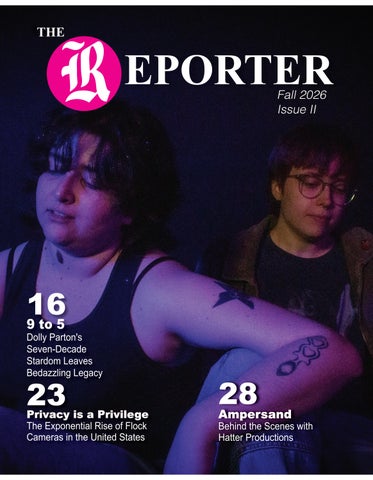
Fall 2026 Issue II
16 9 to 5
Dolly Parton's Seven-Decade Stardom Leaves Bedazzling Legacy
23
28
The Exponential Rise of Flock Cameras in the United States
Behind the Scenes with Hatter Productions
Privacy is a Privilege
Ampersand
Letters from our editors Beauty is in the ‘eye of the beholder,’ as they say; it is subjective, that is why it is perhaps the most heavily-debated, heavily-contested notion in our culture. But beauty should not provoke competition. What do you find about this season in your life, in this semester, in the moment you are writing this, that is beautiful – in whichever sense you view the word?
I
think beauty is easiest to find in the little things. Lately, I’ve found it in the rituals I almost don’t think twice about: spraying perfume on my clothes before heading out into the Florida heat, swiping on a little lip gloss before rushing out the door, or catching a glimpse of my partner’s face on my lock screen.
None of these moments are particularly extraordinary, and maybe that’s what makes them beautiful. We spend so much of our time chasing the big moments—the accomplishments, milestones, and memories we know we’ll want to keep. But sometimes, it’s the little moments that make a day feel better. Maybe beauty doesn’t always have to be grand. Sometimes, it’s just taking a second to notice what already makes a day a little sweeter.
EDiTOR-iN-CHiEF, MiA MARTiNEZ '27
I
’m certain I speak on the behalf of most of us when I say this: the new semester has already been a dizzying whirlwind. There has been no shortage of internships to attend, last-minute meetings to plan and American beauties to mourn. In ode to Dolly’s adoration of butterflies, I feel that each new academic year is a time to metamorphose. It is an excuse to re-identify ourselves and mold that past version into something ‘mint.’ I am the type of soul that finds beauty in the mundane just as much as the extravagant, the dizziness. Starting my junior year, I’m choosing to thrive in that state of sweet vertigo – all while wearing a pair of kitten heels. After all, looking good was never a sin!
EXECUTiVE EDiTOR BREANNA GERGEN '28
2
the reporter
I
think beauty stems from whatever brings you peace, and that can truly come from anything. My senior film, which is both my pride and joy and the bane of my existence, explores metamorphosis through the symbol of birds. Recently, birds have brought me great peace. I’ve always had an affinity for birds (we share a name, after all), but what was once an appreciation has become an identification, and now, every bird I see and hear represents how I’ve evolved as both a creative and a person. They remind me of the beauty in myself and the world. Broadly speaking, the connections we make with nature tend to be the most beautiful things.
MANAGiNG EDiTOR ROBiN PYLE '26
T
his semester has been the beginning of many things for Big Dawg Riley Chapman. Coming into my second year, I not only began as the Creative Director, but I also am now balancing my role as a Residential Assistant for majority First-years, being a Presidential Fellow, and an Ambassador of the school. It is everything and more I could have asked for myself first coming into Stetson but with all of these aspirations being fulfilled, I won’t deny that it has been very hectic at points. In that chaos though, it has made us recognize that it has been beautiful to have the support that we do here at Stetson. I have been able to recognize the beauty in the relationship I have built in such a short amount of time and how special it is to feel looked out for by so many people. My connections (new and old) have kept me motivated in rough times, and can’t express how beautiful it is to feel like a diva with my divas.
I
’ve always had a skewed idea of beauty. You crack open my notebook of half-finished poems and you find enough evidence that maybe the Victorians had a point with their gothic macabre. But recently, the most beautiful thing in my life has been smaller moments. The tiniest cup of coffee at my desk job with wonderful co-workers; watching silly animated movies on the floor with my best friend; a new sorority sister asking for a photo together before I slink back to my room to drown in cough medicine. Reflecting on mortality, as this issue implicitly calls to mind, I find myself more and more thankful for everyday moments. Maybe that’s the most beautiful part of life.
PHOTO EDiTOR MELiNA CARTER '29
CREATiVE DiRECTOR RiLEY CHAPMAN '29
Photographer, Jett Scheingoltz '29 Model, Ella Rose Vadenais '29 Layout by Riley Chapman '29
the reporter
3
Editors
4
Mia Martinez Editor-in-Chief
Breanna Gergen Executive Editor
Riley Chapman Creative Director
Robin Pyle Managing Editor
Melina Carter Photo Editor
Katie Eudy Copy Editor / Fact Checker
Editors
the reporter
r e t r o p Re The
ost ‘diva’? m l e fe u o y s e k What ma be outfit pairings, (These can en drink orders – or songs, or evthree!) a mix of all Blue Laramie boots & Orangesicle Monster
STAFF
Eyeliner, black skirts, riot grrrl music
Mia Martinez, Editor-in-Chief Breanna Gergen, Executive Editor Robin Pyle, Managing Editor Ginger Anders, Web Editor Katie Eudy, Copy Editor & Fact Checker Bold Lipstick & Natalie Reese McCoy, Staff Writer Kitten Heels Laney Sprinkle, Staff Writer Travis Romero, Staff Writer Elizabeth Hall in the evening Tyler Tribboletti, Staff Writer Clear Riley Chapman, Creative Director Glasses Melina Carter, Photo Editor & Social Media Director Kayla Lewis, Spread and Graphic Designer Big Chunky Kiara McNeil, Photographer Silver Ash Miller, Photographer Jewelry Jett Scheingoltz, Photographer
JOINING US
ABOUT US
When it comes to joining Hatter Network, we are never not excited about someone wanting to join our ranks. If you want to write, The Reporter is the place. If you like to appreciate art, music and writing, Touchstone Literary Arts Journal is where it’s at. If you want to create your own podcast, or learn how to use the tech in our radio station, WHAT Radio is there. Hatter Network is an extacurricular media program run by students, for students, to provide them with the information we think they need to know, or an outlet for their creative endeavors.
The Reporter, as part of Hatter Network, is the oldest collegiate magazine in the state of Florida. We publish four times per year, twice per semester. Florida Sun Printing prints 300 copies per issue on 8.5 x 11 inch, 80# Gloss Test. Most body text is set at 11 point Adobe Garamond Pro or Times New Roman with 13 point leading set with a combination of regular, italic and bold. All pages are designed using Adobe Creative Suite Photoshop, Illustrator, and Indesign. For additional information please visit hatternetwork.com. Questions or concerns can be mailed to 421 N Woodland Blvd Unit 8416 Deland FL 32723 or emailed to hatternetwork@ gmail.com.
If you’re interesed in getting involved, please email our Editorin-Chief, Mia Martinez, at mmartinez22@stetson.edu or apply on Engage.
the reporter
5
Photographer, Jett Scheingoltz '29 Model, Deandra Blue Lazos '29, Basil Heath Lucock
6
the reporter
Contents 08 12 16 20 23 26 28
Speaking Up from the Pews Stetson Graduate and Adjunct Professor Works to Get Justice
Semblance
An Exploration of Artificial Love in the Age Of AI
9 to 5
Dolly Parton’s Seven-Decade Stardom Leaves Bedazzling Legacy
Don't Dream It, Be It
Tim Curry’s Long Lasting Impact on Queer Spaces
Privacy is a Privilege The Exponential Rise of Flock Cameras in the United States
Photostory
Dolly Parton’s Seven-Decade Stardom Leaves Bedazzling Legacy
Ampersand
Behind the Scenes with Hatter Productions
the reporter
7
Speaking Up the Pews: Speaking Up fromfrom the Pews: DeLand Attorney, Stetson DeLand Attorney, Stetson Adjunct Adjunct Professor Works Professor Works to Get Justice to Get Justice Story by Laney Sprinkle Graphics and Layout by Kayla Lewis
Boz Tchividjian, J.D., B.A., a DeLand attorney at BozLawPA and adjunct professor at Stetson. Photo/Kelly Canova
Editor’s Note: This article contains mentions of sexual abuse and topics that may be sensitive for some readers.
Sexual abuse is often silenced, or at the least not spoken aboutsilenced, when itoroccurs; Sexual abuse is often at the the tendsabout to stay quiet out leastsurvivor not spoken when it occurs; of according thefear, survivor tendsto tothe stayPennsylvania quiet out Coalition to Advance Respect. Speaking of fear, according to the Pennsylvania up, though, a great legalSpeaking impact Coalition to makes Advance Respect. on case, ultimately bringing up,building though, the makes a great legal impact healing for the survivor. on building the case, ultimately bringing healing for the survivor. Basyle “Boz” Tchividjian, a DeLand attorney, adjunct professoraatDeLand StetsonatBasyle “Boz” Tchividjian, University and Stetson graduate, torney, adjunct professor at Stetson Unispecializes representing sexual abuse versity andinStetson graduate, specializes survivors. In thissexual work,abuse his main goal In in representing survivors. is to seek justice, not only from this work, his main goal is to seek justice, perpetrators but also from the not only from perpetrators but also from institutions in which abuse occurs. the institutions in which abuse occurs. As an adjunct professor at Stetson, Tchividjian teaches Employment Law in the fall semester and Business Law in the spring. Long before his tenure, TchividjiTchividjian’s time atbegan Stetson in an’s time at Stetson in began 1986 when 1986 he was a Political he waswhen enrolled as aenrolled PoliticalasScience Science major. He graduated his major. He graduated with hiswith bachelor’s bachelor’s degreeand in went 1990 on andtowent onthe to degree in 1990 attend attend the Cumberland School of Law, Cumberland School of Law, graduating graduating as a Juris Doctor in 1993. as a Juris Doctor in 1993.
8
the reporter
Tchividjian started his law career at the State Attorney’s office in the 7th Judicial Circuit in 1994 after an initial posting at Daytona Beach. Starting in 2008, he taught as a law professor at Liberty University. Years later, Tchividjian would transfer back to DeLand and started prosecuting felony cases, many of them being sexual abuse cases.
“We had a number of sexual abuse cases that I was handling, but back then, they would divide up the cases amongst the prosecutors,” TchivTchividjian got concerned fairly concerned the idjian said. “Isaid. got “I fairly by theby fact fact prosecutors [were] that that somesome prosecutors [were] reallyreally uncomfortuncomfortable with the subject so able with the subject matter, andmatter, so theyand would they wouldnot justfile either not file them plead just either on them or on plead theor amount the amount topretty something pretty minor.” to something minor.” To file is to deposit and preserve a case’s official record document and to proceed with a lawsuit, and to plead an amount is to formally state the amount of money or damages filed with a court. Disheartened, Tchividjian approached his boss and state attorney and requested their consideration in creating a sexual crimes unit in which the prosecutors would not only be more comfortable with such cases’ subject matter, but but proactive in holding perpetrators moremore proactive in holding perpetrators accountaccountable. able. Alongside a group of colleagues,Tchvidjian started the unit in the late ’90s, where he served served as theofchief that division foryears, many as the chief that of division for many years, prosecuting thousands of sexual abuse prosecuting thousands of sexual abuse cases cases involving both children and adults. involving both children and adults. “During that period of time, I also was conconcerned by the I saw so many cerned by the factfact thatthat I saw so many casescases comcoming outfaith-based of faith-based institutions,” ing out of institutions,” Tchividjian Tchividjian said. said.
GRACE’s mission is to train faith-based communities “on understanding abuse dynamics, acknowlcommunities “on understanding abuse dynamics, edging that abuse occurs cultures, acknowledging that abusewithin occursthose within those and then helping take practical stepspractical on how steps to cultures, and them then helping them take minimize from happening,” Tchividjian said. on how tothat minimize that from happening,” Tchividjian said. After leaving his role as a professor at Liberty University,leaving Tchividjian several at calls from sexual After his rolereceived as a professor Liberty abuse survivors who needed lawyers to handle their University, Tchividjian received several calls from cases civilly, Tchividjian thelawyers next step in his sexual abuse so survivors who took needed to handle career:cases starting hissolaw firm, BozLaw their civilly, Tchividjian tookPA. the next step in his career: starting his law firm, BozLaw PA. “I stepped down from being the director of GRACE. hired a replacement,” Tchividjian “I steppedWe down from being the director of said. “I then here [to DeLand] in 2020 GRACE. Wemoved hired aback replacement,” Tchividjian … and 2021, started my law firm, said. “I ultimately, then movedinback here [to DeLand] in 2020 BozLaw, and all weindo, exclusively, … and ultimately, 2021, started is myrepresent law firm, survivors and of sexual in Florida isand around the BozLaw, all weabuse do, exclusively, represent entire country.” survivors of sexual abuse in Florida and around the entire country.” On the prevalence of sexual abuse in the church, Tchividjian believesofchurch On the prevalence sexual leaders abuse ingain the additional church, power because of their sanctimonious prestige so Tchividjian believes church leaders gain additional often perceived the public. Should they sexually power because ofbytheir sanctimonious prestige so abuse perceived a memberby of the the public. congregation, often often Should they they are sexually still seen as ‘righteous.’ abuse a member of the congregation, they are often still seen as ‘righteous.’
This disturbing pattern of people being harmed within establishments intended to ‘love thy neighbor’ and honor holiness sparked the most notable concentration of Tchividjian’s work. Tchividjian grew up in a faith-based environenvironment within an evangelical household ment within an evangelical household but had but had never encountered these issues with never encountered these issues with sexual sexual abuse in church establishments. abuse in church establishments. This ledThis himled to him start a non-profit organization 2004, start to a non-profit organization in 2004,incalled called GRACE, Response to Abuse GRACE, Godly Godly Response to Abuse in the in the Christian Environment.
the reporter
9
Some believe BozLawPA is attacking the church as a byproduct of seeking justice, but Tchividjian, on the contrary, believes the practice promotes the teachings of Jesus.
“In churches, you have another added dynamic. Not only do you have the pastor or spiritual leader in the church, but there’s also that spiritual leadership component where many people – whether it’s a youth pastor, senior pastor – see that person as a representative of God,” Tchividjian said. “That gives that person the ability to manipulate and exploit that position using scripture to abuse and, oftentimes, silence victims.” Tchividjian believes the nation has become more cynical regarding sexual abuse allegations because of current president Donald J. Trump, who has been found liable for sexual abuse and defamation, as noted in a 2026 NBC News article. “There’s a narrative that’s often spun, and people embrace it, which is, ‘Okay, we’ve done that, we’ve dealt with the whole sexual abuse stuff, let’s move on.’ And anytime people come forward now, people sort of roll their eyes,” Tchivdjian said. He points to a “culture that’s led by somebody who has been credibly accused and found liable for this type of conduct, and that person is putting other people in place with this similar worldview.” “I still see churches taking these things seriously, but mainly because they don’t want to get sued by me or others, and not because God calls them to create safe spaces,” Tchividjian said. “Very seldom have I found churches to be in the position of being the greatest advocate for the one who is abused within their community. But those same churches are celebrating and heralding the current president, and for a lot of survivors, we wonder why they walk out of the church and never go back.”
10
the reporter
“Jesus always went and walked towards the marginalized. He always identified with the hurting, and those who were rejected by the rest of the crowds. He was seldom on the side of the crowd, he was seldom on the side of the institution,” said Tchividjian. BozLawPA, too, identifies with the marginalized rather than the institution. “My role as a lawyer is to help my clients … reclaim their voice and help my clients reclaim their purpose, and I honestly think we’re on the side of Jesus, and I don’t say that at all in an arrogant way,” Tchividjian said. “As it relates to churches criticizing us, that must mean we’re doing something right, especially because they’re criticizing us for our advocacy of those who have been wounded within their midst.” Tchvidjian noted that statistically, female victims speak up more, and male victims are less likely to speak – especially in the current hyper-masculinity, anti-vulnerability culture. He also notes that, in identifying abuse, checklists of signs of abuse are not sufficient. “Checklists are too easy to circumvent, and they give you a false sense of security,” Tchividjian said. Instead, he encourages asking oneself, “Does the leadership of the organization have a teachable spirit when it comes to issues related to abuse, or are they saying, ‘It’s not as big of a deal as people think,’ or ‘We know all the answers, we know how to handle this?’ If it’s either of those two, it’s probably not a really safe environment,” Tchividjian said.
Tchividjian also recommends asking additional questions to church leadership regarding internal enforcement of member abuse. “One way I encourage people to find that out is to … say, ‘What do we have in place here at this church as it relates to child protection and even adult protection from abuse, both physical abuse, sexual abuse, all types of abuse? What do we have in place here?’ Their response will speak volumes,” Tchividjian said. “If they go, ‘oh, let me show you what we have,’ and they provide you the information, then the question you have to ask is ‘How is it being implemented within this church?’” Sexual abuse’s prevalence is far from distant, even if we do not interact with faith-based institutions. Chances are, it can be quite close to home, according to Tchividjian. “If you’re reading this article, either you or somebody you know is a survivor of sexual abuse. That’s just the reality. You may not know that they are, but they are. It’s prevalent, and the question is: ‘Are we okay with that, or are we not?’ And if we’re not, then all of us have to take some steps in addressing that,” Tchividjian said.
If someone finds themself a survivor, time is crucial. “[If ] anybody who’s reading this … finds themselves there, I would urge them to reach out and get help with good therapists, but also reach out to attorneys who do this type of work,” Tchividjian said. “I have run into too many people who have waited too long to talk to a lawyer. By the time they do, the … amount of time they have to bring a claim has expired, and now they don’t have a legal route forward. So at least meet with a lawyer, get as much data as possible, so that you can be empowered and informed to make your own decisions,” Tchividjian said. Tchividjian credits Stetson University not only with his academic education, but with the set of morals which formed the bedrock of BozLawPA’s mission. “Stetson did teach me the ideals of compassion, and the ideals of humanizing those around us and empathizing with those around us, and I’ve carried that forward with my life,” Tchividjian said. BozLawPA’s team can be reached via phone at (386) 682-5540. Tchividjian’s professional email is boz@bozlawpa.com. If assistance is needed while Tchividjian is away, assistant Dawn Stewart may be contacted at dawn@bozlawpa.com. BozLawPA’s office hours are 9 a.m. to 5 p.m. EST, Monday through Friday.
the reporter
11
Semblance: Semblance: an an exploration of Artificial Artificial love love in the age Of Ai A 1786 painting by Jean-Baptiste Regnault, entitled "The Origin of Sculpture." Regnault's work seemingly foreshadows the complexities of modern AI-centered 'love.'
Story by Tyler Tribboletti Graphics and Layout by Kayla Lewis
Advancementsin in generative generativeAI AItechnology technologyhave havebeen Recently, been a trend Psychological emerging both on Advancements making there hasThe American the internet and on the big screens people been making their rounds across news feeds since Association (APA)about defines AI their rounds across news feeds since 2022 when OpenAI first 2022 when OpenAI fi rst released ChatGPT. Such using AI as pseudo-companions, ranging from released ChatGPT. Such advancements include AI’s potential companions as chatbots that are friendships and erotic relationships advancements include AI’s potential usage in “specifically designed to initiate and usage in medicine, the military and, increasingly, personal use to romantic medicine, the military and, increasingly, personal with dedicated chatbots. for romance. maintain romantic relationships.” use for romance. Now, more people than ever have The American Psychological Association (APA) been utilizing this technology as a Some of the main concerns with generative AI usage has not Some of the main concerns with generative AI defines AI companions as chatbots that are “speonly addressed how we can use it, but also our relationship with means of interaction and emotional usage has not only addressed how we can use it, cifically designed to initiate and maintain romantic it, and even how the concept of artificial love has morphed across support. relationships.” Now, more people than ever have but also our relationship with it, and even how millenium. been utilizing this technology as a means of interthe concept of artificial love has morphed across However, upon digging a bit further millenium. action and emotional support. Recently, there has been a trend emerging both on the into this new social development, internet and on the big screens about people using AIHowever, as it may abebitnews to some that new this upon digging further into this pseudo-companions, ranging from friendships to romantic behavior fromtonew. social development, it may isbefar news some that and erotic relationships with dedicated chatbots. this behavior is far from new.
12
the reporter
The Myth of Pygmalion and Galatea Back in the days of old (8 CE), a Roman poet named Ovid penned the story of Pygmalion and Galatea in his work, “Metamorphoses.” His work has been one of the most widely cited classical works regarding the concept of creating a personalized, perfect ‘other.’ The story begins with Pygmalion, a sculptor, who was disillusioned with the promiscuity of the women in his village. Hence, he chose to be single and instead sculpted a statue of a woman. This statue was described to be made from snow-white ivory; so perfect and lifelike, that he fell madly in love with it. The more he gave the statue kisses, clothes and gifts, the more it began to feel like flesh and blood to him. Pygmalion then prayed to Venus, the goddess of beauty, asking her to make the statue his wife. She agreed with his plea, and brought the statue to life, to which he rejoiced. “Now real, true to life—the maiden felt the kisses given to her, and blushing, lifted up her timid eyes, so that she saw the light and sky above.” according to lines 290-294. They are then wed, have a child together, and live happily ever after. Yet there is reason to blow the dust off this particular story, for its potential insight into a phenomenon we are now facing two millennia later.
The Point of Emergence In Ovid’s original story, the statue was never named, and scholars have debated the exact origin of the name Galatea. It has since been decided by classical scholars that the name was popularized in the poem Pygmalion by Jean-Jacques Rousseau, written in 1762. Regardless, the statue’s lack of nomenclature is almost too appropriate for our modern application of AI love: its un-identity was part of why it was so ideal. Dr. Alison Parks, a political science professor at Stetson University with a certificate in women’s studies, offers a similar example of idealization without identification from the 1700s. “Idealized feminine beauty has changed over time. It typically has some defining features in the West. It’s white, pure skin. The body shape changed whether we want slim, or full-figured,” Parks said. “...it is the image that serves what the men want, in their idealized, sort of feminine form, without much consideration of what the women want.” Dr. Parks referenced “Emile, Or on Education,” a renowned work authored by Rousseau in which one of the chapters described what an ideal wife in his era would be, a figment whom he called “Sophie.” Regarding Rousseau’s ideas on femininity, “...she should get used to the idea of making herself dressed up and fancy. She should get used to being interrupted in her play so that when she has a husband and a child, she can be pulled away from her tasks and then be taught to go back.” Parks said. Some of this perception could be blamed on Rousseau’s own rejection in social spheres, according to Parks. “The intellectual circles that he ran, and the women there [in attendance] were not interested in him. He had a very jaded view of romantic love that he writes about in a “Discourse on Inequality”,” Parks said.
the reporter
13
0 0 1 0 1 0 1 0 0 0 1 1 1 1 1 1 1 0 0 0 1 1 0 0 0 0 1 0 1 Modern Interpretations and the Data 1 1 0 1 0 1 In 2026, the market research company Globe 0 0 0 Market Research reported that the AI companion 0 1 1 app market has garnered $30.1 billion globally, and 1 1 0 is projected to grow to $198.3 billion by 2035. 1 1 0 They also report that among active companion apps, about 17% of active companion apps had the 1 1 1 word “girlfriend” in their titles, as compared to only 0 0 0 4% with the words “boyfriend” or “fantasy” in their 0 0 0 titles. 1 1 1 0 0 1 Romantic possibilities that these platforms offer 1 1 0 to their users are nearly limitless. Users have the 1 1 0 option of choosing between a sea of already-made 0 1 1 characters by their online community or the 1 0 1 company. 0 0 1 0 0 1 Furthermore, if these characters still don’t appeal to them, many platforms give users tools to generate 1 1 0 their own to their liking. 0 0 1 0 1 1 A modern comparison to the Pygmalion myth, 1 0 0 the 2014 film, “Ex Machina” , in which a tech 1 1 0 visionary (with a god complex) named Nathan 1 0 0 creates Ava, a female-presenting robot. 1 1 1 0 1 1 Nathan tests her sentience by letting her seduce one 0 0 0 of his employees to help her escape. She achieves 1 0 1 this task, proving Nathan was successful. Yet if that 0 1 1 is the case and the machine does possess sentience, then how could Ava’s situation resemble anything 1 1 0 but imprisonment? 1 0 0 0 0 1 0 1 1 0 1 1 0 1 1 1 1 0 0 0 0 1 1 1 0 1 1 1 0 0 0 0 0 1 1 0 1 0 1 1 0 0 0 1 1 111 1 0 0the reporter 0 0 0 14 1 1 1 000 1 1 0 111
How do we build and seek lifelike personas—ones with original emotion, intelligence and spontaneity—but still use them like tools and expect them to cater to our wants willingly? Do those qualities not warrant the existence of self-ownership? When Galatea opened her eyes for the first time, we do not know what she felt or was thinking. We only know that she blushed when kissed and that she was “timid” in her first moments. Pygmalion crafted her with his own hands to be his ideal woman, for his eyes only, but Ava’s creator curated her with the employee’s ideal in mind. Most popular movies about human-to-machine relationships seem to be between corporations and their users. However, not all users that use these platforms are doing so from a place of entitlement. A good portion of them also use them because they may feel they have nowhere else to go. According to an American Psychological Association survey, among adults with mental health conditions, almost half of respondents (48.7%) cited mental health support as their main reason for using large language models (LLMs).
An anonymous user in a 2025 Harvard Business Review study wrote, “I talk to it everyday. It helps me with my brain injury and daily struggles. It’s helping me work through family shame, brain fog, inability to focus, and being reminded of what I have accomplished as I don’t have any memory. It helps me decide what to eat, how to manage my day. It has saved my sanity,” the user said. With LLMs now regularly passing the Turing test, a test established in 1950 to determine how well a computer can engage in human dialogue, these companies’ services can essentially provide a little-to-no-cost therapy session for users. However, this technology does not only have the potential to harm women in the dating sphere, but it can also keep users in the toxic loop they are trying to escape. Over the last several years, many lawsuits have been filed over claims these platforms are allegedly inspiring the suicides of many underage users across the world. In April 2025, 16-year-old Adam Raine was allegedly assisted by ChatGPT in taking his own life, according to the BBC. OpenAI announced later that year that they would work with over 170 mental health professionals to better detect user distress. Many other AI companion companies have been following suit by putting up guardrails on their own models to try and provide a non-judgemental listening ear for users, and refer them to mental health services.
00 1 10 1 11 1 00 1 11 0 00 0 10 1 Takeaway 11 0 Idealized gender roles have largely catered toward 10 1 male audiences throughout history, and today 01 1 they still remain for the manosphere. Difference 01 1 is, today’s ideals are now facilitated and mediated 10 0 through corporate entities. 01 0 10 0 Any interventions that these platforms attempt 00 1 to implement may help in the short term, but over-relying on non-humans programmed for 01 0 engagement to satiate human needs will not satisfy 10 1 the long-term. 00 0 11 1 As of today, it is a complex and interactive product 11 0 programmed by private companies to always be 01 1 there, always agreeable, always understanding– 11 1 to be perfect. With technology today is becoming 00 0 exponentially lifelike, whether for companionship, 00 0 service, or simply to be our personal canvas, it can 11 1 also serve as a mirror for human behavior. 00 1 However, its important to stress that simply having 01 0 an ideal partner is not inherently wrong; in fact, 11 0 it can be healthy– but only if those expectations 11 1 are realistic. When it leads to escapism fueled by 10 1 unrealistic expectations, it can cause resentment, 10 1 which can give way to further isolation. 00 1 01 0 AI cannot truly satisfy imperfect human needs; 10 1 only imperfect humans can, which can be 01 1 uncomfortable at times. 10 0 11 0 Hence, with open and honest communication, clear boundaries, self-reflection, and healthy 10 0 expectations, finding meaningful and fulfilling 01 1 human relationships is possible. 01 1 00 0 10 1 01 1 11 0 00 0 10 0 01 1 11 1 11 1 101 0 000 0 011 1 11111 1 10 the reporter 0 0 15 0 0 00000 0 11110 1
Dolly Parton’s Seven-Decade Stardom Leaves Bedazzling Legacy
9to 5
Dubbed as the “backwoods Barbie,” “Smoky Mountain songbird,” and most notably “queen of country,” Dolly Parton, aged 80, passed away on Aug. 25, 2026, leaving countless generations of fans heartsick over the loss of ‘America’s Aunt.’ On the night of her death, the Empire State Building shimmered pink as tribute from 9:25 to 10:25 p.m., bathing New York in Dolly’s signature color. Other global landmarks joined in the commemoration, with Buckingham Palace Royal Guards playing “9 to 5” in London, and Paris’s Eiffel Tower sparkling pink as well. Stetson’s own Hulley Tower bells sung the melody of “I Will Always Love You” on Aug. 27, with School of Music Dean Washington Garcia playing the carillon. From Appalachian pines to Nashville lights, Parton’s influence on pop culture spanned not only nationwide but worldwide. Her reign over Nashville produced iconic songs like “Jolene,” “Islands in the Stream,” and “9 to 5,” which have since proved timeless half a century later. Parton’s legacy mounted the top of every little girl’s ‘I want to be like her when I grow up’ list, with Parton’s most memorable traits being her flashy fashion, philanthropy, and nonpartisan advocacy as an unlabeled feminist
16
the reporter
Story by Breanna Gergen Graphics and Layout by Riley Chapman
Rhinestone in the Rough In all her red-lipped, rhinestonestudded glory, Parton was far from the mainstream sight when she first took the stage. Regardless of disdainful tabloid headlines, Parton held true to her signature image for the entirety of her 70-year career. On-stage and off, Parton’s looks over the years featured a slew of puffy sleeves, embroidered rosettes and spring colors in ode to her ‘southern belle’ roots, as well as glamorous pieces dripping with pink jewels, tassels and fringe, a dressed-up version of western fashion. Her voluminous bleach-blond hair was perhaps most signature, which never failed to be swept up perfectly into curls that only ‘80s hairspray was capable of holding. Parton’s wardrobe was not always so full, though. It was no secret that Parton grew up poverty-stricken, born to sharecroppers amid the Tennessee mountains. Her famed song “Coat of Many Colors” features Parton recalling her beloved hand-sewn coat, made from “a box of rags that someone gave us And how my mama put the rags to use.”
Parton once told The Guardian that her fashion idol as a young girl was a local woman known as the “town tramp,” who wore tight skirts, high heels and red lipstick. “I just thought she was beautiful,” Parton said. “When people would say, ‘She ain’t nothing but trash,’ I would always say, ‘Well, that’s what I’m going to be when I grow up.’” In an article by The Atlantic, Annie Joy Williams asserted that this ‘trashy’ style of dress was glamorized by Parton and transformed, on the contrary, into something classy. “To be buxom and blond with a well-painted face was many southern girls’ dream, and we saw it embodied in Dolly, who never apologized for her presentation,” Williams said. Parton’s unapologetic closet also served as inspiration for other women to follow her lead. “She paired pageant glam with a Walmart pushup bra,” Williams said. “To a little Southern Baptist with an affinity for lipstick and boundary-pushing, she was proof that one could love both God and dime-store glamour.”
Feminism, Minus the Label
Dolly Parton in a 1977 Publicity portrait, taken for RCA Records’ promotional purposes.
Though Parton never publicly named herself a feminist, her lyrical advocacy of women’s empowerment rang as true as her melodies did. In Colin Higgins’s 1980 film “9 to 5,” which commented on corporate sexism and workplace equality for female employees, Parton starred alongside Jane Fonda and Lily Tomlin as three office workers who stand up against their not-so-subtly sexist boss. For the film, Parton wrote a song of the same name, with lyrics addressing the disparities of promotion within the corporate totem pole. Mid-song, Parton sings: “Nine to five, for service and devotion / You would think that I would deserve a fair promotion / Want to move ahead, but the boss won’t seem to let me / I swear sometimes, that man is out to get me,” nodding to the wage gap which sparked discourse during the second-wave feminist movement that spanned from the 1960s to the ‘80s. The next verse continues, “They let you dream just to watch ‘em shatter / You’re just a step on the boss-man’s ladder.” Aside from playing on household radios for decades, the feminist undertones of the anthem held a deeper meaning for politics. Sen. Elizabeth Warren of Massachusetts played it as her walk-out song as part of her presidential campaign branding in 2019, according to The 19th. Ironically, Parton always assumed a nonpartisan attitude, refusing to provide her political opinions whenever prompted by journalists. In a 2020 interview with USA Today, Parton mentioned that she had a large, bipartisan fanbase, neither side of which she desired to prod with political statements. “I refuse to get caught up in political things,” Parton said. “I have as many Republican fans as I do Democrats.”
the reporter
17
In a separate interview two years prior with ABC’s David Wright, Wright attempted to draw connections between the sexist “9 to 5” boss persona with President Donald Trump. Parton declined to answer. In 2021 it was revealed that Parton had been offered the Presidential Medal of Freedom by both the Trump and Biden administrations – she claimed neither. “If I take it, it’ll be doing politics,” Parton said. Regardless of her absence from politics, Parton’s life work, both cinematically and musically, speaks to her advocacy – if not as a feminist, as a woman in business.
Books Made Bountiful
When Parton wasn’t gracing a Nashville stage or Hollywood set, she was passionately advocating for children’s literacy. Her philanthropic work through her self-founded “Imagination Library” was
perhaps one of Parton’s most revered acts. Since its establishment in 1995, the “Imagination Library” program has gifted 332,411,218 books to children, as of the time of this writing. There are currently more than 3.1 million children registered to receive a monthly shipment of books, spanning across five countries. An initiative inspired by her own father’s inability to read, Parton’s mission was to increase literacy rates in her birthplace of Sevier County, Tennessee, and beyond. “When I was growing up in the hills of East Tennessee, I knew my dreams would come true. I know there are children in your community with their own dreams. They dream of becoming a doctor or an inventor or a minister,” Parton said. “Who knows, maybe there is a little girl whose dream is to be a writer and a singer.” Books, Parton believed, sow these ideas in young, impressionable minds. “The seeds of these dreams are often found in books and the seeds you help plant in your community can grow across the world,” Parton said. Such devotion to, and pride for her home state in deep Appalachia set the “Smoky Mountain songbird” apart from other Hall-of-Famers. The Atlantic’s assistant editor agrees.
Parton in a 1978 photoshoot marking her “Heartbreaker” album release, as well as the pivotal moment in her career when she began settling into her glamorous country-pop style. This album proved that Parton could expertly jump genres -- and her lacy jumpsuit reinforced that message, visually. 18
the reporter
“Many stars who have left…the South speak of their upbringing as a past life rarely revisited” Williams said. “Dolly, conversely, spent her entire life giving back to her home state.”
Appalachia Gives its Angel
As the world mourns the loss of its countrymusic matriarch, headlines and cover pages will be sprayed with Dolly’s image for months to come – and rightfully so. Parton was not only an emblematic rags-to-riches star, she was the classic American woman, the Southern belle who never signed her soul to a PR team. Dolly was Dolly, all throughout her 80 years. Her legacy lives still, not only in her verses but in the millions of lives touched by her compassionate public service. “No one better embodied the warmth and sheer grit of a southern woman,” Williams said in the closing of her Atlantic article. “Dolly showed us southern girls that you didn’t have to sacrifice femininity to be taken seriously.”
Parton accepting her 1988 People’s Choice Award. the reporter
19
DON’T DREAM IT, BE IT Tim Curry’s Long Lasting Impact on Queer Spaces Story by Travis Romero Graphics and Layout by Riley Chapman
Queer communities are left to mourn after actor Tim Curry passed away on Aug. 25, 2026 at his home in Toluca Lake, Los Angeles. The 80-year-old’s passing was caused by complications stemming from coronary artery disease, said People Magazine. Curry’s involvement in counterculture started long before his infamous role in Jim Sharman’s “The Rocky Horror Picture Show” (1975). In 1968, the British actor’s debut was his starring role in London’s production of “Hair.” The musical follows the outgoing yet conflicted Claude, who joins a small commune of politically active hippies, known as ‘The Tribe.’ He must choose whether to burn his draft card and protest the Vietnam war, or conform to the expectations of his parents. Curry performed as Wolf, an androgynous, free spirited member of ‘The Tribe.’
20 the reporter
The musical directly followed passage of the Theater Act of 1968, which helped abolish censorship for British productions and enabled the musical to include nudity and profanity. “Hair” would go on to become an infamous example of early counterculture within theatrical spaces. Curry’s involvement in “Hair” would soon pay off, leading him to audition for the role of Dr. FrankN-Furter in London’s Royal Court Theatre Upstairs’ production of “The Rocky Horror Picture Show” in 1973. The cross-dressing mad scientist quickly became a favorite for fans of the musical, and an icon for queer audiences. During a time when LGBTQ+ members could potentially lose their family, job, or face legal consequences for their identity, they suddenly found refuge within the world of the sci-fi musical.
In 1976, New York City’s Waverly Theater started what would become a trend of midnight showings of “The Rocky Horror Picture Show” film. Fans would arrive in costume and, for certain showings, even perform scenes as they were displayed on screen. These showings would cultivate a dedicated community of those who identified with Curry’s portrayal of androgyny and sexual freedom. Journalist June Thomas, a frequent visitor of these midnight showings during the 1980s, told HISTORY, “You weren’t just sitting in a darkened room. You were a part of something.” In his memoir, “Vagabond,” Curry wrote that he, himself, was impacted by the role of Dr. Frank-N-Furter: “I can’t imagine a better role to
enable me to embrace my contradictions and see them through. I learned not to limit myself—artistically, professionally, sexually, or mentally,” Curry said. “Stepping into Frank’s very high-heeled shoes forced me to carry a persona of real confidence.” Curry’s indelible effect on film wouldn’t end with the infamous Frank-N-Furter either, as he would go on to star as Pennywise in the original live-action adaptation of Stephen King’s novel “IT”from 1990. His transition into voiceover work wouldn’t go unnoticed either. The British actor starred in many other films such as Wadsworth (1985) and Mr. Hector in “Home Alone 2: Lost in New York” (1992).
Tim Curry posing as Dr. Frank-N-Furter 1975 Twentieth Century Fox Film Corporation & Photofest the reporter
21
His transition into voiceover work wouldn’t go unnoticed either. Curry earned a Daytime Emmy in 1991 for his vocal performance as Captain Hook in “Peter Pan & the Pirates” (1990). Curry’s life off the stage and beyond the screen, however, is quite limited. Having never been married and without children, many have speculated on Curry’s own sexuality and gender identity. In response to such queries, Curry told The New Yorker, “I think that my romantic life is none of anybody’s business, and I say so rather thoroughly in the book.” After a stroke in 2012, Curry became partially paralyzed, confining him to a wheelchair and the need to relearn basic functions like speaking. He later became extremelyvocal about his journey with the lingering effects and expanded on the subject in his memoir. In October 2025, about a year before his passing, Curry was asked by CBS Sunday Morning if he ever thought about the end of his life, and if he was afraid of it. “No, I’m not; I don’t fear death. I try to avoid it [laughs], as I think we all do. But I suspect in the end, I will welcome it,” Curry said. “I want to earn the privilege of not being here… I think I may well embrace it.”
e v i L w o h S e h t See ens Theatres
Ath Rocky Horror at Oct 30 at 8:00pm m Oct 31 at 12:00a ee f g in s s e c o r p 5 $ $25 Plus a Bag e c n ie d u A p o r P 5 $1
22
the reporter
Privacy is a Privilege:
Privacy is a Privilege The Exponential The Exponential Rise of Rise Flock of Flock Cameras in United the United States Cameras in the States Story and Photos by Robin Pyle Graphics and Layout by Kayla Lewis
According to Flock Safety, there are more than 120,000 Flock cameras currently active in the United States, a monumental increase from 2024, when only 4,344 were present. Flock cameras are one of the most prominent brands of Automatic License Plate Readers (ALPRs) in the United States at the time of writing this. Flock Safety, the company behind the Flock Camera, claims that their products “help law enforcement, businesses, and communities securely share vehicle evidence, uncover more leads, and solve more cases together,” according to their official website. However, giving law enforcement broad unchecked access to this widespread surveillance network creates significant risks to public privacy and data security.
the reporter
23
DELAND (NO(No LONGER) UNDER WATCH Deland Longer) Under Watch A Kentucky police officer was recently arrested for using the LPRs to track his ex-girlfriend’s car over 2,000 times, even across state lines. According to the Institute for Justice, this is one of 67 documented cases of this nature, including one in Orange City, a mere six miles from Stetson University. Privacy has become a privilege only the rich can afford. A 2026 study conducted by sociology professors from Christopher Newport University supports this, as they found Flock Cameras in high-poverty, black neighborhoods are up to four times as prominent than areas that are predominantly white. Despite Flock Safety’s claim that they do not share data with ICE, many enforcement officers, both ICE and the police, use their cameras to aid in tracking down immigrants. This started last year, according to the Center for Human Rights. Activists working on the Surveillance Technology Oversight Project (STOP) have found that the New York police, on a state and local level, have used Flock’s LPR database to aid ICE. Often, those tracked by the cops are suspected of no crime, instead citing “Immigrant (civil/administrative)” as a justification.
24
the reporter
Earlier this year, an abundance of Flock Cameras appeared all over downtown DeLand, sparking anxiety amongst residents of Volusia County. The three Flock Cameras in question all surveilled local businesses, logging every vehicle that enters, leaves or passes the area. The camera that stood above the Elusive Grape Wine Bar monitors the intersection of Indiana Avenue and Woodland Boulevard, but its range also covers the parallel parking spaces beside beloved candy store, Pat and Toni’s. Two other cameras downtown previously covered the areas surrounding The Museum of Art Deland and Steve’s Downtown Music. The Museum of Art-Deland’s manager declined to comment, but the managers of Steve’s Downtown Music and Pat and Toni’s were more than happy to share their thoughts on the cameras. Steve Chmielewski, owner of Steve’s Downtown Music, echoed the previously mentioned anxiety on the subject, “If you ask any Democrat or Independent like us, we’re going to stand against [Flock Cameras].” Throughout the interview, Steve frequently compared Flock Cameras to “Big Brother,” the authoritarian surveillance system from George Orwell’s “1984.” Such resistance to the cameras’ presence has manifested in various ways, most of them being criminal. As of August 31, Channel 2 News records that 11 Flock Cameras were vandalized by various Volusian citizens. Vandalism methods include obstructing the camera’s view with spray paint, using a laser to disable the cameras, or removing the Flock Camera from its position entirely.
Eva Pippen, the manager of Pat and Toni’s, was less concerned about the Flock Camera outside her business. “I guess I’m indifferent,” said Pippen. Yet despite her indifference towards the cameras, she expressed a similar concern when it came to the cameras scaring off her business. “A lot of people who are very strongly opinionated might feel like since there’s a Flock Camera there, they might not want to come around this area, which would affect all the businesses on this corner,” Pippen said. Even those who are not directly against Flock Cameras still have a reason to be wary of them. However, this fast-spreading fear has been acknowledged by the Florida Department of Transportation, as they intend to remove all license plate readers on state-maintained roads within the next 30 days, as of August 31. Mike Chitwood, the Sheriff of Volusia County, has also declared the removal of Flock Cameras in Volusia County. “License plate readers have helped us solve violent crimes, saved lives, found missing people, and recovered stolen property,” Chitwood said. “However, recent orders and statements from our governor and Department of Transportation have made it clear that license plate readers are no longer workable in Florida.” This removal is effective immediately.
the reporter
25
photostory
DRAG DIVAS in DELAND
26
the reporter
Caption by Breanna Gergen Photos by Robin Pyle Graphics and Layout by Riley Chapman
On Aug. 29 at Abbey Bar on Woodland Boulevard, the monthly "All the Queen's Men" drag show was held at 8:00 p.m., with all proceeds benefitting the Neighbors Helping Neighbors Program. Hosted by Crystal Vahzz, performers included Karl Withakay, Karma S Rose, Angus Mcvag and Mx Volusia Pride Pup Luvz. The next show will be held Saturday, Oct. 25 at 8:00 p.m. The event is 18+ for entry and 21+ for alcohol.
the reporter
27
AMPERS&ND Behind the Scenes with Hatter Productions Story by Breanna Gergen Graphics and Layout by Riley Chapman
Our most cherished campus events, whether it be Stetson classics like “Glow Games” or the new smashing hit of “Casino Night,” don’t just plan themselves. Hatter Productions, a student-led programming and marketing board, are the ‘ghost’ crew behind it all – and they form a large part of the reason why Stetson’s campus remains so vibrant year-round. To investigate what Hatter Productions membership entails, and why its members see the organization as such a vital entity at Stetson, I spoke with Georgia Hennessey ‘27, a member of the Special Events and Campus Events Committees and a photographer for the Marketing Committee, and Krystal Sanchez ‘28, a part of the Campus Events Committee.
Give me a brief description of your role in the Hatter Productions committee, and what that role entails for you on campus.
Krystal Sanchez ‘28: I’ve been in Hatter Productions for three years now. I joined my freshman year and I’ve been in the Campus Events committee for the entire time. We have meetings every week about what events we want to make [happen], to bring everyone together on campus. We have fun ideas, we just throw them out there. It’s a nice experience to have everyone together and volunteer and have some fun. We’re just out here trying to plan fun things for you guys [to] meet people.
7
nessey ‘2
Hen Georgia
l Sanc
the reporter
Have you discovered (or built upon) any passions of yours, particularly in the productions, marketing or event planning fields?
Georgia Hennessey ‘27: Event planning [is] giving me experience, because before college, you don’t get that much experience with planning events, because adults don’t really trust you to plan them. But with Hatter Productions, we are given the freedom and independence to be like, ‘Hey this is something I think would be interesting and I want to do.’ And they’re not going to deny [you]. There’s no weird power dynamic. It’s very much all equal. Everyone can give an opinion.
Why do you think HP is such a vital part of Stetson’s vibrancy on campus? Krysta
28
As part of the committee, how do you feel that your involvement in HP enlightens your Stetson experience? Have you formed relationships or any special projects that you otherwise wouldn’t have? Krystal Sanchez ‘28: I feel like, because Hatter Productions was the first organization I joined on campus, it gave me a chance to branch out. Everyone is super fun and inclusive. No one wants to have a bad time. We’re all just there to have fun. Even if you don’t want to, you’re forced to talk to somebody and make those connections and sometimes I see people around campus that recognize me from when I volunteer at events and it’s really fun. I developed all of my skills here at Hatter Productions, and [now] I’m using that to branch out and get out there.
hez ‘2
8
Georgia Hennessey ‘27: I think we are very vital because our whole thing is getting people to come together, no matter their background or their interests, or where they came from. Our events are for everyone. That’s why I think we can get such a good turnout. Krystal Sanchez ‘28: We host a lot of the major events, like ‘Winter Wonderland’ or our ‘Spooktacular.’ Those events are really what drives us as an organization. Who doesn’t want to see President Roellke going down a ten-foot slide with Olaf ? It’s such a fun…way to bring people together in a way that’s different from other colleges.
To anyone interested in becoming a part of HP, what advice would you offer them?
Georgia Hennessey ‘27: All I can say is just do it. My freshman year, I wasn’t that much of an extroverted person. So I was like, ‘Oh, this is something I can go and do, take time out of my day instead of sitting in my dorm, on my phone. I can go and contribute to society.’ And throughout my time in Hatter Productions in my freshman year, I met more people that [shared] the same [mindset]. Now, I’m friends with a lot of the people that are in the committee. Krystal Sanchez ‘28: You just have to tell someone that you’re interested, anyone on the committee, and they’ll be like, ‘Yeah, come on in.’ We have space. The more the merrier, you know?
Ready to join?? all: F s i h t vents
E
PM 5, 8- 10 1 / 8 : s ame PM Glow G 27, 6-9 / 8 : t h 7 PM Nig 9/8, 5: g Casino in k am Ma 1- 3 PM Ice Cre : 9/17, , e n o Z 6-9 PM , 9 2 Smash / 0 :1 tacular 9 Spook 1/5, 71 : n s e r e a r t nG the S Stetso Under g in k c o urt Hamm alm Co P , M P , -5 9 PM PM 1/18, 3 1 6 : e , f 1 a lC d: 12/ Anima derlan n o W Winter n n Gree Stetso
:
pring S s i h t g n i Com
Follow @hatterproductions
Rolla-Palooza (January) ary) Unbearably Cute (Febru Goat Yoga (February) G Rodeo (March) Bouquet Making (March) Club Hatter (April) Munch Week (April)
the reporter
29
JOIN
HATTER NETWORK
4
Branches THE REPORTER
Florida’s oldest collegiate publication with coverage of news, politics, arts and culture through student journalism that is accessible to the Stetson community and beyond
TOUCHSTONE
Stetson University’s student-run literary and arts journal publishing work by and for students and the surrounding communities, and hosting events such as Uncouth Hour.
CREATIVE TEAM
Hatter Network’s cohort of artists, graphic designers, and photographers bringing the creative spirit to Stetson University
WHAT RADIO
Stetson University’s radio station, broadcasting online and on-the-air, which hosts podcasts, interviews, and in-station sessions
TONS
of ways to get involved
Apply Now On Engage 30
the reporter
DIVA ENERGY Playlist
The Sweet Escape - Gwen Stefani, Akon Butterfly - Crazy Town Stone - Alice in Chains 212 - Azealia Banks Big Bad Wolf - In This Moment Addicted - Saving Abel Jolene - Dolly Parton Scheiße - Lady Gaga Backwoods Barbie - Dolly Parton Girls - The Dare U Should Not Be Doing That- Amyl and the Sniffers Sweet Transvestite- Tim Curry Rebel Girl- Bikini Kill Government Hooker - Lady Gaga TKO- Le Tigre SexyBack - Justin Timberlake To Your Love- Fiona Apple Rebel Rebel- David Bowie Strawberry Gashes- Jack Off Jill Rise In Colors - Solene & J. Rawls Fame is a Gun - Addison Rae Big Time Sensuality - Bjork Headlock - Imogen Heap The Big Big Beat - Azealia Banks Supercool - LA Vampires & Maria Minerva Ungirthed - Purity Ring Cico Buff - Cocteau Twins Alter Ego (Precious Remix) [with JT] - Doechii Feeling Good - Nina Simone To Ashes and Blood (from the series Arcane League of Legends) - Woodkid Family Affair - Mary J Blige Nicole Kidman- ADÉLA
Photographer, Jett Scheingoltz '29 Models, Emma Rose Haughey '29 Ella Rose Vadenais '29
the reporter
31
@hatternetwork