Common Mistakes When Using Large Cream Charger Cylinders: A B2B Operational Guide
1. Bypassing the Necessary Pressure Regulator Assembly
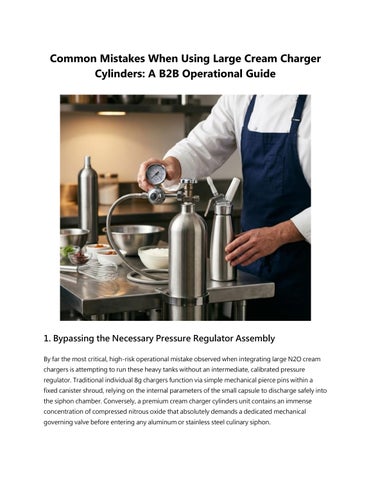
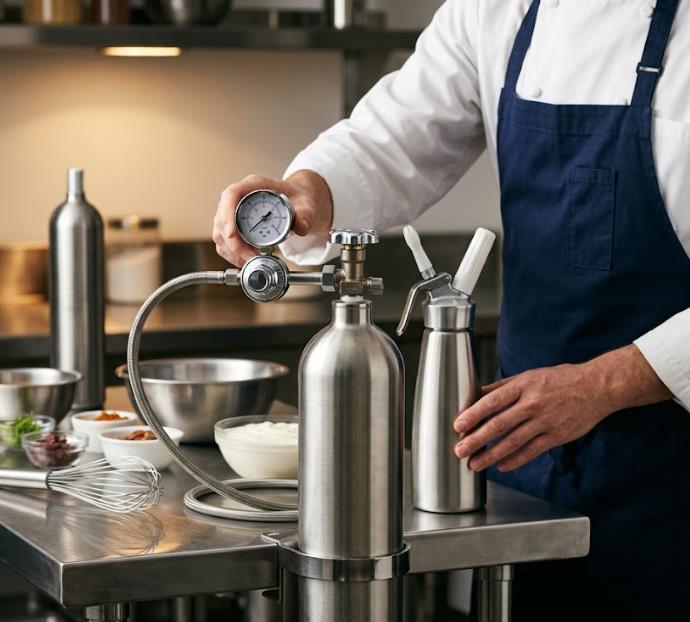
By far the most critical, high-risk operational mistake observed when integrating large N2O cream chargers is attempting to run these heavy tanks without an intermediate, calibrated pressure regulator. Traditional individual 8g chargers function via simple mechanical pierce pins within a fixed canister shroud, relying on the internal parameters of the small capsule to discharge safely into the siphon chamber. Conversely, a premium cream charger cylinders unit contains an immense concentration of compressed nitrous oxide that absolutely demands a dedicated mechanical governing valve before entering any aluminum or stainless steel culinary siphon.
Attempting to hook up a large KingWhip tank directly to a whip dispenser via basic adapters introduces an uncontrolled, high-velocity surge of gas. This unmoderated gas volume routinely results in systemic over-pressurization. In standard circumstances, this severe pressure surge violently distorts the siphon’s inner rubber sealing gaskets, causing rapid leaks and ruining the dispenser's internal valve springs. In worst-case scenarios, the extreme force can compromise the structural safety thresholds of the culinary canister itself. Investing in a professional-grade dualgauge regulator allows the back-of-house team to set specific, controlled Pounds per Square Inch (PSI) parameters, guaranteeing an identical, perfectly metered stream of gas every single time the system is engaged.
2. Standardizing a Single Pressure Setting for Varied Formulations
Even when a kitchen integrates an advanced, professional-grade regulator, prep staff frequently fall into the trap of setting a single arbitrary pressure level and using it across every single item on the menu. Nitrous oxide acts as a structural texturizer that interacts uniquely with differing liquid viscosities, overall milkfat content percentages, and specific structural proteins. A static pressure setting dialed in for standard heavy whipping cream will completely decimate a delicate molecular espuma or ruin a rapid liquor infusion.
Standard Heavy Whipping Cream: Requires a controlled, medium-intensity flow typically between 120 and 150 PSI depending on total siphon volume to properly lock the N2O gas inside the dairy fat globules without violently over-agitating the liquid, which converts the cream into granular butter.
Delicate Savory Espumas and Herb Veloutés: Demand significantly lower, subtle pressure configurations (often 80 to 100 PSI) to safely structure fragile structural proteins without tearing the delicate emulsion apart.
Rapid Molecular Spirit Infusions: High-speed cocktail programs require sharp, highpressure gas bursts (pushing up to 160+ PSI) to violently force liquid molecules deep into the cellular structure of raw botanicals, followed by an immediate gas purge to extract deep flavor profiles instantly.
Failing to actively calibrate regulator pressure metrics against the culinary profile of the specific target formulation leads directly to uninspiring texture presentation, high rates of plate rejection, and structural food waste.
B2B Logistics Insight: For active hospitality establishments looking to broaden their commercial gas footprint safely, partnering with professional supply systems like Supreme whips alongside primary operational hardware provides dependable access to the custom safety adapters, durable high-
pressure lines, and professional-grade whipping apparatuses critical for supporting diversified, multi-pressure culinary menus.
3. Exceeding Safe Dispenser Fluid Fill Limits
The vast, seemingly endless gas capacity offered by a KingWhip 640g system or a larger KingWhip 2kg tank instills a powerful sense of workflow freedom. However, this convenience frequently leads kitchen staff to commit a classic operational blunder: overfilling the fluid holding chamber of the cream siphon canister itself. A foundational tenet of physical gas integration and structural aeration is that compressed gas requires an adequate volume of physical headspace to drop in velocity, expand, and cleanly dissolve into the fluid matrix.
When an overzealous line cook fills a culinary siphon completely to the top brim, ignoring the etched maximum fill line, the compressed nitrous oxide entering from the premium cream charger cylinders has zero expansion room. Instead of achieving a beautifully light, micro-aerated foam with strong peaks, the resulting product emerges from the nozzle as a runny, heavy, completely underaerated liquid. Respecting the physical fill maximums ensures optimal volumetric expansion, guaranteeing that every ounce of fluid yields the highest possible volume of saleable product.
4. Neglecting Ingredient and Hardware Temperature Baselines
Nitrous oxide displays incredibly high solubility indices inside fats, oils, and aqueous solutions but this specific chemical solubility is strictly dictated by thermal parameters. A widespread operational bottleneck in high-tempo kitchens occurs when staff attempt to charge warm or room-temperature fluid formulas. When liquid bases are warm, the N2O gas molecules cannot efficiently anchor inside the fat lipids or protein chains, leading to immediate structural collapse upon dispensing.
To establish long-lasting, stable culinary foams, both the base fluid formulation and the whipping siphon canister must be deeply chilled to uniform refrigeration temperatures (roughly 34°F to 38°F) before any gas injection occurs. Furthermore, operators must understand that when large amounts of gas are drawn in quick succession from a heavy KingWhip 2kg tank, localized pressure drops cause sharp thermal plummets, turning regulators and hoses ice-cold. Allowing the mechanical parts to briefly stabilize prevents uneven gas delivery and ensures clean, predictable texture stability on the final presentation plate.
5. Non-Compliant Cylindrical Storage and Handling Habits
Maintaining a commercial enterprise in the United States demands strict adherence to workplace safety mandates, particularly concerning high-capacity compressed gas storage. Large N2O cream chargers are incredibly safe when handled correctly, but common storage shortcuts pose real operational hazards. A typical oversight involves positioning active tanks near high-heat kitchen zones, such as directly next to intense commercial grill lines, pass-through heat lamps, or hightemperature dishwashing units.
Subjecting highly compressed cylinders to elevated ambient temperatures causes immediate, dangerous spikes in internal gas pressure, which can trigger safety relief rupture discs, wasting valuable inventory instantly. Additionally, large tanks should never be left free-standing on busy prep counters; they must always be maintained in an upright position and securely locked down using custom wall-mount brackets or specialized floor stands to completely mitigate the risk of accidental tipping, which can fracture valves or shear off expensive regulator assemblies.