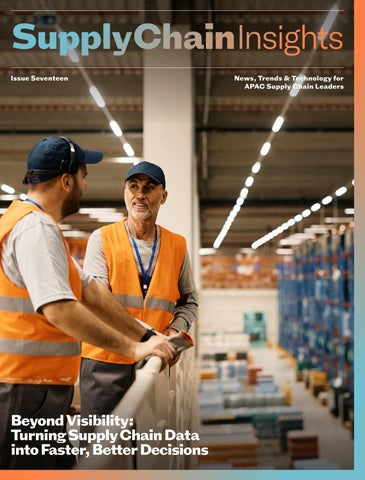
SupplyChainInsights Issue Seventeen
Beyond Visibility: Turning Supply Chain Data into Faster, Better Decisions
News, Trends & Technology for APAC Supply Chain Leaders
Supply Chain Insights
Welcome
About The Magazine Published quarterly to a circulation of 20,000 + industry professionals across Australia, New Zealand and the wider Asia-Pacific region, Supply Chain Insights Magazine is focused on helping you solve the complexities of today's supply chain. The digital magazine highlights the latest trends, operational strategies, technology advancements and best practice within the supply chain and logistics industry.
Welcome to Supply Chain Insights Magazine your primary source of industry news, focused on innovation, technology and knowledge-sharing in the logistics sector. In this edition of Supply Chain Insights, we explore how businesses are making faster, smarter decisions in an increasingly complex operating environment. In our lead story, Features Editor Mel Stark speaks with industry experts about how AI, automation and realtime visibility are helping organisations turn information into action, and why the ability to make informed decisions quickly is becoming a critical advantage. The importance of effective decisionmaking is explored by supply chain specialist recruitment firm Bastian, which brings together three industry leaders to examine why greater access to data doesn't always translate into better decisions, and
the leadership skills needed to act with confidence. Adam Amato from NowGo by Shippit examines how route optimisation is helping Australian fleets manage driver shortages and growing delivery demands. Findings from DHL's latest Logistics Trend Radar reveal how AI is moving from assisting workers to taking action across logistics operations, and what this means for the future of the workforce. ASCLA CEO Steven Ballerini examines the growing competition for industrial land between data centres and logistics operators, and the implications for Australia's freight infrastructure. We hope you enjoy this edition and look forward to your feedback.
For more information or story suggestions, please contact: editor@supplychain-insights.media For advertising enquiries, please contact: advertising@supplychain-insights.media Visit our website: www.supplychain-insights.media
SUPPLY CHAIN INSIGHTS
1
Contents
In This Issue
3
News & Insights
14
31
7
Northern Australia’s Freight Network Faces Capacity and Resilience Gaps
Rising Transport Costs Are a Reminder That the Biggest Supply Chain Savings Start in the Warehouse
The Supply Chain Decision Gap: Why More Visibility Doesn’t Always Mean Better Decisions
15
Beyond Visibility: Turning Supply Chain Data into Faster, Better Decisions
35
Your Warehouse Has Changed. Does Your Racking Need to Be Reassessed?
37
Data Centres and the Squeeze on Logistics Land
39
The Robot in The Room: Are Humanoids The Future of Warehouse Automation?
How Are Australia’s Transport Fleets Contending with Driver Shortages?
41
AI Takes Action While People Remain at the Centre of Logistics, Finds DHL Logistics Trend Radar
How MacDonnell Regional Council Is Improving Visibility Across Remote Operations
43
Austroads Study Puts Urban Freight in Sharper Focus
8
9
10
11
Amazon Australia Opens $400 Million Fulfilment Centre in Western Sydney Australia Post Invests in Future-Ready Connectivity Through New Telstra Agreement
23 Kumho Tyre Australia Secures New Distribution Facility in Melbourne's South-East Getting More from the Warehouse You Already Have
27
29
SUPPLY CHAIN INSIGHTS
Nearly Half of Australians Trust AI Shopping Recommendations More Than Retail Staff
2
News
News & Insights TMX Transform’s Latest Report Shows Australian Businesses Are Bracing for Subdued Christmas Trading as Uncertainty Stalls Investment Australian businesses are increasingly choosing to hold cash rather than commit to investment decisions, as interest rate uncertainty and a subdued outlook for Christmas trading stall movement across supply chains, property and construction, according to end-to-end supply chain consultancy TMX Transform. The warning comes as TMX Transform releases the latest edition of its quarterly benchmarking report, Across the Network, which tracks current costs across supply chain, property and construction in Australia and New Zealand. TMX Transform's latest quarterly benchmarking shows what it currently costs businesses to run their supply chains, with warehousing activity rates, freight labelling and pallet storage costs all reflecting the higher operating cost base businesses are now working within across Sydney, Melbourne, Brisbane, Adelaide and Perth. The report identifies customer demand shifts and fuel exposure as two of the biggest blind spots businesses currently face, alongside supplier geography, operational capacity, and broader industry and market conditions.
SUPPLY CHAIN INSIGHTS
TMX Transform's data shows prime industrial rents reaching as high as $500/ sqm in Sydney, while warehouse build costs range from $900/sqm for ambient facilities up to $2,900/sqm for freezer facilities, depending on state. Subcontractors are increasingly passing cost pressures upstream to builders, who are in turn proposing rise-and-fall clauses on selected long-lead developments to share material cost risk with developers and tenants. Justin Fried, Managing Director APAC at TMX Transform said: "Business owners understand that inaction carries its own cost. Capital is expensive, and further interest rate uncertainty means that trend is unlikely to shift in the near term. Layer an unstable political environment on top of rising costs, and it's an economy businesses don't know how to plan around. That uncertainty is driving decisions right now as much as any single cost pressure." According to Charlotte Jordan, Executive Director – Supply Chain at TMX Transform, most businesses are still assessing risk in isolation rather than understanding their full exposure. Charlotte Jordan, Executive Director – Supply Chain at TMX Transform said: "Four in five Australian businesses are already stockpiling or building inventory buffers to manage disruption. That tells us most businesses know something is coming, but far fewer have actually mapped where their specific exposure sits. What we're consistently finding is that customer demand shifts and fuel exposure are the two areas getting the least attention, and they're often where the biggest risks are sitting undetected. ● TMX Transform's Across the Network report is available to download now, access here.
3
Manhattan Associates Announces Editions™ for its Industry-Leading Solutions, Making Them Accessible at Every Stage of Growth New offering gives commercial and growing enterprises the right-sized path to start their journey with Manhattan, and scale on the same platform as their business grows. Manhattan Associates has announced the commercial launch of Editions for Manhattan Active ® solutions. Editions provide a new way for companies of all
SUPPLY CHAIN INSIGHTS
sizes and across industries to partner with Manhattan. They are designed to help growing organisations make a durable, longterm technology decision from the start. As complexity increases, customers can unlock additional capabilities on the same platform, rather than starting over. Built for ActiveWarehouse™, ActiveTransportation™, ActiveStore™ and ActiveOrder™, on Manhattan’s awardwinning ActivePlatform™, there are three Editions available: Essentials, Enterprise and Enterprise Premier. Regardless of the Edition selected for each solution, companies gain access to the power of a unified platform, AI capabilities and continuous innovation that underpin some of the world’s most complex supply chain and commerce operations. Editions are not separate or simplified products. They are a new way to access the capabilities companies need at the stage they’re currently in, with the expertise they need to scale, compete and grow over time. “One of the most important decisions a growing organisation can make is choosing the right technology partner for Commerce and Supply Chain. Each step of their growth journey requires operational excellence in selling and fulfillment, given the direct impact they have on customer experience,” said Brian Kinsella, Chief Product Officer at Manhattan Associates. “Editions changes that equation. Businesses can start with Essentials and move to Enterprise or Enterprise Premier as their needs evolve, without migrating to a new system, reimplementing processes
or retraining teams. Now, they simply unlock more of the same platform, gaining the capability they need when they need it, without disruption. Editions are a path to scale that protects the value of every technology decision along the way.” With Editions, organisations of all sizes can: • Access capabilities that matter most now, starting with Essentials, without taking on enterprise-scale infrastructure or IT overhead. • Move from strategy to value faster through AI-assisted configuration, deployment automation and guided configuration wizards. • Build on a cloud-native platform with zero infrastructure to manage and get continuous delivery and quarterly innovation delivered automatically. • Grow into additional capabilities by moving from Essentials to Enterprise to Enterprise Premier without reimplementation, retraining, data migration or operational disruption. • Truly unify operations by combining different Editions as needed or adding solution families over time on a unified platform as business needs evolve. ● Receive up-to-date product, customer and partner news directly from Manhattan on LinkedIn.
4
News
Wurth Australia Advances Fulfilment Capacity With Dematic Autostore Automated Solution Global leader in assembly & fastening materials, Wurth Australia, has partnered with leading supply chain automation provider Dematic, to deliver advanced automated order fulfilment solutions across its Yatala, Queensland and Keysborough, Victoria distribution facilities. A specialist supplier of industrial consumables, Wurth Australia distributes more than 22,000 products to over 56,000 active customers across the automotive, transport, earthworks, fabrication, MRO, construction and mining sectors. Its customers range from independent workshops and tradespeople to large industrial businesses, all of whom rely on dependable access to essential consumables and workshop supplies. Wurth Australia Chief Executive Officer & Senior Vice President of the Wurth Group Oceania, Serge Oppedisano, said the
investment will help the company deliver a faster and more reliable service to customers, while creating an efficient and scalable approach to order fulfilment. “The customer experience is incredibly important to us here at Wurth, and a big part of that is ensuring our customers receive accurate and complete orders when they expect them.” “Wurth is a specialist in smart inventory management solutions, with thousands of customers relying on our flagship ORSY systems to keep their workshops organised and running efficiently. This investment reflects those same values in our own operations – strengthening how we manage inventory, fulfil orders and move products through our national distribution network.” said Serge Oppedisano “Investing in automation across our Yatala and Keysborough facilities will enable us to process orders faster and more
efficiently, as well as reduce our reliance on manual processes. It gives us a stronger foundation to consistently deliver the speed and accuracy our customers rely on.” The Dematic solution will be built around an AutoStore Goods-to-Person (GTP) system, providing high-density automated storage and supporting efficient split and full case picking. The automation will operate alongside dedicated manual picking areas for products suited to different storage and handling requirements. Orders will move between the automated and manual picking areas as required, before progressing through the final stages of order processing. These include automated conveyor transport, document insertion, carton optimisation and sealing, labelling and despatch sortation. Dematic’s Warehouse Control System (WCS) will integrate with Wurth’s warehouse management system (WMS), acting as an optimisation layer between the WMS and automated equipment to coordinate picking tasks and the movement of goods throughout the system. “We are proud to partner with Wurth on this significant automation project across its Australian distribution network,” said Terry Jamieson, Business Development Manager, Dematic. “Wurth’s extensive product range means there isn’t a one-size-fits-all approach to fulfilment. Bringing together AutoStore with dedicated picking areas and downstream automation allows different products and orders to move through the most appropriate process, while Dematic iQ helps coordinate those elements as one integrated system.” The Yatala solution is expected to be operational in August 2027, followed by the larger Keysborough facility in December 2027. ● For more information about Dematic, visit dematic.com or follow us on LinkedIn, Facebook, and Instagram.
SUPPLY CHAIN INSIGHTS
5
Where supply chain strategy becomes real world results. Supply Chain | Industrial Real Estate | Construction Project Management SUPPLY CHAIN INSIGHTS
tmxtransform.com
6
Industry Update
Northern Australia’s Freight Network Faces Capacity and Resilience Gaps Australia’s reliance on limited northsouth freight corridors could leave supply chains into northern Australia vulnerable to disruption, according to a new report from the Australian Strategic Policy Institute (ASPI). The Closing the Distance report examines Australia’s logistics capacity across the north, highlighting the distance between much of the country’s industrial, maintenance, storage and logistics infrastructure and northern Australia. While the report considers the issue through a defence and national security lens, its findings also highlight broader challenges surrounding freight capacity, infrastructure resilience and the role of civilian supply chains. Much of Australia’s logistics and industrial capacity remains concentrated in the south and south-east, creating challenges when goods and equipment need to be moved thousands of kilometres north. The Stuart Highway and Adelaide to Darwin railway are among the key links supporting north-south freight movements. The Stuart Highway remains the only sealed highway connecting Adelaide and Darwin, while the Adelaide to Darwin railway is a single-track line carrying around six scheduled freight services in each direction each week. The concentration of capacity in southern Australia reflects established industrial capability, workforce availability and existing transport infrastructure. However, the distances involved and limited transport corridors create challenges around network capacity, resilience and redundancy.
SUPPLY CHAIN INSIGHTS
Civilian infrastructure and industry also form an important part of Australia's broader logistics network, spanning warehousing, distribution, maintenance, fuel supply, transport infrastructure and workforce capacity. Northern ports, airfields, logistics nodes and fuel infrastructure could play a greater role in reducing reliance on long supply lines, but their effectiveness depends on having sufficient transport capacity and connectivity with the rest of the country.
According to the report, increasing infrastructure alone would not address the challenge. It pointed to the importance of resilient transport networks, forward stockholding, distribution capacity, repair and replenishment capabilities, as well as the civilian infrastructure and workforce needed to support them. ● To read the full report, click here.
7
Industry Update
Amazon Australia Opens $400 Million Fulfilment Centre in Western Sydney Amazon Australia has officially opened a new $400 million fulfilment centre in Horsley Park, Western Sydney, expanding its logistics network and creating more than 1,000 jobs once the facility is fully operational. The purpose-built site covers approximately 80,000 square metres, equivalent to around four and a half Sydney Opera Houses and can accommodate more than 10 million products. These include electronics, household essentials, beauty products, books, toys and homewares sold through Amazon.com.au. The facility was officially opened by Amazon Australia director of operations Wayne Angus, alongside Fairfield City Mayor Frank Carbone and Councillor Kevin Lam. The investment is expected to support Amazon's growing customer base by increasing storage capacity and improving order processing and delivery across Sydney and other Australian markets. “We are proud to continue investing in our Western Sydney operations with the unveiling of this new purpose-built fulfilment centre. This $400 million investment demonstrates our long-term commitment to the region and to delivering a world-class experience for Australian customers,” Angus said. “As demand continues to grow, we are focused on improving selection and delivery speed, whilst remaining committed to supporting the communities where we operate.” The centre incorporates advanced picking and packing technology, along with inbound and outbound sortation systems
SUPPLY CHAIN INSIGHTS
designed to support the movement of goods through the facility. Several energy-efficient features have also been incorporated into the design, including rooftop solar panels, motionactivated lighting, insulated building materials and rapid roller doors to help regulate internal temperatures and reduce energy consumption. Beyond its contribution to Amazon's delivery network, the facility is expected to provide additional opportunities for Australian small and medium-sized businesses using Fulfilment by Amazon
(FBA). The increased capacity will allow participating sellers to store and distribute smaller products to customers nationwide. Once operating at full capacity, the centre will employ more than 1,000 people across warehouse operations, engineering, human resources and workplace health and safety. Positions will range from entrylevel roles offering workplace training to specialist and technical opportunities. The Horsley Park opening brings Amazon Australia's operational footprint in New South Wales to four fulfilment centres and five delivery stations. ●
8
Industry Update
Australia Post Invests in Future-Ready Connectivity Through New Telstra Agreement Australia Post has signed a multimillion-dollar, three-year agreement with Telstra to deliver next-generation connectivity across almost 4,000 locations nationwide, helping to strengthen the digital infrastructure that supports one of Australia’s largest retail and logistics networks and the essential services millions of Australians rely on every day. The investment will enhance the technology supporting customer services, retail operations and parcel processing, helping Australia Post continue to deliver a more reliable experience for customers and communities. Under the agreement, Telstra will provide advanced connectivity solutions across Australia Post's post offices, delivery centres, data centres and corporate sites nationwide. This includes access to Telstra's Adaptive Networks Centre, a digital platform that provides users with greater visibility, flexibility and control over network services through a single interface. Around 300 locations will be upgraded to fibre-to-the-premises connectivity, while some additional regional sites will transition to Telstra satellite internet over the next 12 months. This builds on the successful deployment of satellite connectivity to more than 270 Australia Post locations and expands the range of connectivity options available across Australia Post's network.
SUPPLY CHAIN INSIGHTS
Together with Telstra's Adaptive Networks Centre, the upgrades will help Australia Post better understand and manage connectivity across its network, supporting the delivery of services across thousands of sites nationwide. Michael McNamara, Australia Post Executive General Manager, Enterprise Services said the three-year agreement builds on Australia Post's ongoing investment in technology to improve operational performance and deliver a better experience for customers across metropolitan, regional and remote Australia. "Connectivity is fundamental to how Australia Post serves customers and keeps one of Australia's largest retail and logistics networks moving every day. “As we continue to modernise our business and adapt to changing customer needs, investments like this help strengthen
the technology foundations that support our people, operations and customers across the country. “Telstra's national reach and network capability, particularly in regional Australia, made them the right fit for this partnership. This investment strengthens our technology foundations and helps ensure we are well positioned to meet the needs of customers and communities now and into the future," said Mr McNamara. Oliver Camplin-Warner, Group Executive, Telstra Enterprise said, “Most of us grew up with the local post office. It's woven into the fabric of communities right across the country, from the middle of our biggest cities to the smallest towns in the bush. So being trusted to help build the foundations for Australia Post’s next chapter is something we don't take lightly. “This partnership brings together two Australian organisations that have been connecting Australians for generations. We're proud that Australia Post is one of the first organisations to adopt our Adaptive Networks Centre at scale, giving its teams greater visibility, flexibility and control today, and a platform that can evolve alongside the needs of its business and customers tomorrow.” ● For more information, click here.
9
Industry Updates
Kumho Tyre Australia Secures New Distribution Facility in Melbourne's South-East Kumho Tyre Australia has signed a 10-year lease for a new, 17,250 sqm industrial facility in Pakenham. The move to the Endeavour Road facility, developed by ESR, increases Kumho's tyre storage capacity by 60 per cent and improves truck access for inbound and outbound distribution. Supply chain specialists TMX Transform managed the property procurement process on Kumho's behalf. Kumho Tyre Australia is part of Kumho Tyre, a global tyre manufacturer established in 1960 operates in more than 180 countries. Kumho has been operating in Australia for more than 40 years, supplying tyres to major national retailers including mycar, Tyrepower and Bob Jane T-Mart, alongside its own network of Platinum and Master Dealers, and distributes more than 1.8 million tyres annually from warehouses across the country. Kumho's move to Pakenham follows a period of sustained growth that saw demand outpace the capacity of its previous facility. The new site accommodates 60 per cent more tyre storage than before, along with six new dock provisions and a suspended 12.2 metre ceiling throughout, built to meet all the compliance requirements for tyre
SUPPLY CHAIN INSIGHTS
storage. An upgraded fire system has also been installed as part of the fit-out. The location was chosen in part for its proximity to where staff live, reducing travel time for the team compared with the previous site. The deal also reflects a wider shift in Melbourne's industrial property market, with occupiers increasingly looking beyond the core south-east corridor, where rents and outgoings remain comparatively high, toward outer south-east precincts such as Pakenham. This wider pattern indicates that tenants who are willing to relocate further from the city are reducing property costs. Alan Knight, State Manager of Victoria/ Tasmania at Khumo said: "This new facility reflects the scale we've built in Australia over more than 40 years, and gives us the space and infrastructure to support that growth well into the future. Investing in our own distribution network has always been central to how we operate here, and Pakenham strengthens
that further so we can keep tyres moving efficiently to our retail partners across the country. The location also makes a real difference for our team, cutting down travel time for staff and supporting the people behind our operations day to day." Daniel Kelly, Director of Property at TMX Transform spokesperson said: "Kumho needed a site that matched their growth plans while solving some real operational challenges around storage and truck movements. We are proud to have helped address these challenges, while using the new site’s location to find significant savings on rent. This facility is the right combination of scale and complianceready specifications that they needed. We're delighted to have helped deliver a warehouse that sets them up for the next stage of growth.” ● For more information, click here.
10
Analysis
Getting More from the Warehouse You Already Have
With new warehouse developments taking longer and costing more, Dematic’s David Rubie says operators are taking a closer look at how automation can unlock capacity within their existing facilities. Building a new warehouse from the ground up is getting harder. Approval and construction timelines have stretched, with more complex planning, design and compliance requirements adding time to new developments. At the same time, building costs have risen and suitable industrial land remains difficult to secure in many of Australia’s major logistics hotspots. Dematic’s analysis of government planning and construction data indicates that today’s typical building cycle is on average nine months longer compared with pre-2020. However, the pressures driving the need for more warehouse capacity haven’t changed. Operators are still dealing with labour availability shortages, changing stock keeping unit (SKU) ranges, faster order expectations and the stress of holding more inventory while moving it more efficiently. David Rubie, ANZ Sales Director Integrated Systems at Dematic, says this is leading more businesses to look at how much additional capacity they can find within the buildings they already occupy. “For a long time, if you needed significantly more
SUPPLY CHAIN INSIGHTS
11
capacity, the next logical step was to start looking at a new building,” David says. “That’s becoming a harder business case to make when the building itself takes longer, costs more and pushes the return on the overall project further out.”
Rethinking the Existing Footprint These pressures are changing where many businesses are directing their warehouse investment. While large greenfield projects remain an important part of the market, David says there is growing interest in smaller automation systems that can be introduced into existing facilities. “We’re seeing businesses look much harder at brownfield sites and ask what they can do with the footprint they already have,” David says. “Sometimes you don’t need another building. You might need to get more pallets into the same space, take unnecessary travel out of picking, automate repetitive pallet movements or make better use of the height you already have.” Importantly, businesses don’t necessarily need to automate an entire warehouse. They can focus on the parts of the operation where they need more capacity or efficiency, from storage and pallet movement through to picking. “The first thing is understanding what is actually holding the operation back,” David says.
“Once you know where the constraint is, you can start looking at what can be done within the footprint you already have.” Finding Capacity Without Adding Floor Space Increasing storage density is one way businesses can make better use of an existing footprint. For example, four-way pallet shuttle systems can increase pallet storage density through deeper lanes and automated put-away and retrieval, while still operating alongside traditional selective racking. For case and tote operations, high-density systems can reduce the space taken up by manual picking. AutoStore can save up to four times the space typically used by manual picking paths, while providing a modular system that can be expanded as requirements change. The same thinking can be applied to how products move through a facility. AGVs and AMRs can automate repetitive pallet movements while integrating with conveyors, traditional racking and block-stacking areas. In many cases, these systems can also be introduced without requiring specialised building services or floors. Along with reducing manual movement, automation can provide greater consistency, visibility and traceability across these processes. “If you can take some of those simple, repetitive
SUPPLY CHAIN INSIGHTS
movements out of the manual operation, you can use your people in areas where they add more value,” says David.
Knowing When Brownfield Makes Sense There are, of course, limits to what can be achieved within an existing building. Ceiling height, floor load capacity and flatness, power requirements, fire and other compliance requirements, access and surrounding transport infrastructure all need to be considered before deciding whether an existing site is suitable for automation. “There will absolutely be buildings where it doesn’t stack up,” David says.
“You have to understand the limitations of the site and what it will cost to work around them. It’s not about making automation fit at any cost.” That assessment also needs to start with the operation rather than the technology. What is limiting throughput today? Where is space being lost? Which manual processes are consuming the most time? And what will the operation need to handle in the next few years? For some businesses, the answers will still point towards a new facility. For others, particularly where the existing site works well for their workforce, customers and transport network, it may make more sense to find additional capacity within the existing facility.
Getting More from What You Have As automation becomes more modular and easier to integrate into existing operations, businesses have more options to address individual constraints without rebuilding the entire warehouse around them. “Before you decide you’ve outgrown a building, it’s worth understanding what else that building can give you,” David says. “If you can improve the storage, throughput and productivity of the existing operation, you may have more room to grow than you think,” he concludes. ●
12
Title
SUPPLY CHAIN INSIGHTS
13
Industry Update
Rising Transport Costs Are a Reminder That the Biggest Supply Chain Savings Start in the Warehouse WRITTEN BY RAGHAV SIBAL, VICE PRESIDENT APAC, MANHATTAN ASSOCIATES
The return of the full fuel excise this month is another reminder that supply chain costs can change quickly and with little warning. For transport operators, it means higher operating costs. For retailers, manufacturers and distributors, it means increased pressure across freight, fulfilment and margins. But fuel is only one part of a much bigger story. Australian businesses are navigating an operating environment where labour shortages, wage growth, energy prices, property costs and customer expectations continue to reshape the economics of supply chains. While organisations have little control over many of these external pressures, they have far more influence over what happens inside their own operations. The businesses responding most effectively are focusing on the costs they can control rather than those they can't. For many organisations, the focus has shifted from simply moving more products to moving them more efficiently. Every unnecessary product touch, manual process, picking error or delayed shipment adds cost long before an order reaches the delivery vehicle. As transport becomes more expensive, the cost of inefficiency inside the warehouse becomes even more significant. This is changing how businesses think about warehouse investment. The conversation has shifted beyond adding capacity. Organisations are increasingly asking how technology can help them make better operational decisions, improve labour productivity and optimise the flow of inventory throughout the day. Software plays a critical role in answering those questions. Warehouse Management
SUPPLY CHAIN INSIGHTS
Systems (WMS) and Warehouse Execution Systems (WES) provide the real-time visibility needed to coordinate inventory, labour and automation as a single operation. Rather than reacting to issues after they occur, businesses can prioritise work dynamically, balance workloads, reduce bottlenecks and make better use of available resources. That becomes increasingly valuable as external costs continue to rise. Rather than focusing solely on adding more equipment or warehouse capacity, many organisations are looking at how they can get more from the operations they already have. Intelligent software enables businesses to coordinate people, inventory and automation more effectively, improving throughput, reducing unnecessary movement and helping maximise the value of existing assets before additional capital investment is required. The biggest value of these technologies comes from eliminating wasted movement, improving order accuracy and increasing throughput using the assets businesses already have. Artificial intelligence is beginning to amplify these gains even further. AI-powered warehouse software can predict order volumes, optimise picking paths, recommend labour allocation and identify potential bottlenecks before they
impact operations. Instead of relying solely on historical reporting, warehouse teams can make decisions using real-time operational intelligence that improves productivity throughout the day. These capabilities become increasingly important as supply chains face greater variability. Whether the disruption comes from changing fuel costs, supplier delays, weather events or demand spikes, organisations need systems that can respond in real time rather than relying on static operating plans. The organisations leading the next phase of supply chain transformation will not necessarily be those spending the most on automation. They will be those using software, data and real-time execution to make smarter operational decisions, improve productivity and adapt more quickly as conditions change. The return of the full fuel excise is a reminder that businesses cannot control every external cost. What they can control is how efficiently products move through their warehouses, how effectively labour is deployed and how quickly they can respond when conditions change. In an increasingly unpredictable operating environment, those operational advantages are becoming some of the most valuable investments a business can make. ●
14
Feature
Beyond Visibility: Turning Supply Chain Data into Faster, Better Decisions SUPPLY CHAIN INSIGHTS
15
SUPPLY CHAIN INSIGHTS FEATURE
More than half of Australian businesses changed how they operate in the first half of 2026 as fuel and freight costs soared. With pressure on supply chains continuing, Supply Chain Insights explores how leading organisations are turning data into faster, more confident decisions, and using this to strengthen operations against evolving disruption. Australian businesses have spent 2026 adjusting in real time. Mid-year, the Australian Bureau of Statistics’ Business Conditions and Sentiments survey found that 58% of businesses had changed their operations in response to rising fuel prices and shortages, most by absorbing the extra cost, while others raised prices, added fuel surcharges or delayed production. Supply chain disruption was reported by 35% of agriculture businesses, 28% of manufacturers, 27% of wholesalers and 22% of retailers. The pressure has carried into the second half of the year. S&P Global’s Australia Manufacturing PMI fell to 49.6 in September, its sharpest drop in 21 months, as supplier delivery times lengthened and costs for raw materials, oil and transport stayed elevated. In conditions like these, decisions on inventory, capacity and logistics need to be made quickly. Most organisations already hold plenty of data to inform them, but the challenge lies in transforming that data into action at the pace required to stay on top of the market. Raghav Sibal, Vice President, APAC at Manhattan Associates, says the first hurdle is bringing information together.
SUPPLY CHAIN INSIGHTS
16
Feature
"It’s about having the right data, at the right time, with enough context to act on it." RAGHAV SIBAL, VICE PRESIDENT, APAC, MANHATTAN ASSOCIATES
SUPPLY CHAIN INSIGHTS
17
“Supply chains generate data across planning, inventory, warehousing, transport, orders and customers, but those areas have traditionally operated in separate systems. If it takes hours or days to bring that information together, the opportunity to respond may have already passed,” Raghav says. “The organisations doing this well are focused on connecting that information and making it available when decisions are being made. It’s about having the right data, at the right time, with enough context to act on it.”
The Bottleneck Andre Tibyrica, Supply Chain Director at TMX Transform, thinks the gap between data-rich businesses and decisive ones comes down to time. “The gap is the ability to shorten the time between insight and action. The temptation can be to harness more data, more dashboards, reporting and analytics, though the speed at which you can analyse, test options and make decisions is more powerful,” he says. That speed is vital for structural decisions such as warehouse leases, 3PL agreements and carrier contracts, which often run on three-to-five-year cycles. “Speed matters because your supply chain is how you deliver on customer experience. If you can’t make decisions quickly, with a clear view of the trade-offs, you can miss windows of opportunity,”Andre explains. In his experience, the slowdown often happens after the analysis is done. “Someone might analyse a change and find it will halve inventory. But then stakeholders want to know what it does to cost, capacity and service. Without a system that answers all those questions at once, decisions get stuck in internal governance.” Bringing risk into the picture can speed things up. “The human brain thinks in averages,” Andre notes. “Showing the inventory saving alongside the risk to service levels – for example, a 30% chance of missing them – creates a whole different feeling for the person approving that decision.” Michael Bradshaw, Vice President, Solution Design and Sales – APAC, MEA at Dematic, agrees the constraint has moved. “Accessing relevant data and performing detailed
modelling took significant time in the past. AI tools have changed that,” Michael says. “As a result, speed of response is increasingly constrained by the time needed to evaluate considerations such as customer commitments, commercial trade-offs, organisational priorities and risk management.” The final call, he continues, still rests with people.
“Technology can provide supporting information quickly, but experienced leadership is still often required to determine which direction to take.” Where AI is Delivering Today AI sits at the centre of most conversations about faster decision-making, and all three experts see real value in the technology when it’s pointed at the right problem. For Michael, AI’s strength is its ability to look ahead. “AI is opening up new possibilities in turning large amounts of data into information and insights that support better and faster decisions. It can also be used to predict what might happen, as well as reporting what happened in the past,” he says. “For planning and forecasting, AI can easily automate many routine workflows and decision points. However, many business decisions involve dealing with incomplete information, making commercial trade-offs, respecting organisational politics and understanding appetite for corporate risk. AI will be an excellent advisor and decisionsupport tool, while experienced supply chain and business leaders remain ultimately accountable for strategic decisions.” According to Manhattan’s Raghav Sibal, AI is already proving its worth where the problem is well defined. “We’re seeing that in demand forecasting, inventory optimisation, replenishment and identifying potential disruptions or constraints before they become bigger issues,” he says.
18
Feature
He also urges some caution. “We need to be careful about being too quick to consider AI the answer to every supply chain problem. Adding another AI tool doesn’t necessarily result in a better decision. You still need good data, connected systems and a clear understanding of what you are trying to improve,” Raghav explains.
“The real opportunity is using AI to help people work through complexity faster, whether that’s identifying an exception, recommending an action or helping a planner understand the implications of a decision.” TMX Transform’s Andre sees AI doing a good job in commodity forecasting, where it can interpret market signals from news and weather, and in inventory optimisation, where “most tools using traditional algorithms take very big shortcuts.” He notes it has further to go in decisions that cut across several dimensions at once. “When a decision involves inventory, cost, service and capacity, AI handles parts of it, but tends to see things in black and white. People are better at working in the grey, where several factors are at play.”
Test Before you Commit Modelling gives businesses a way to see the likely impact of a decision before they commit capital, people or customer promises to it. “A great example is the simulation of distribution centres and the automation deployed inside them,” Dematic’s Michael says. “Before investing millions of dollars in automated systems, organisations can create a digital model of a proposed operation and test it using representative inventory and order data. “Using simulation, we can validate throughput, capacity, labour requirements and operating costs,
SUPPLY CHAIN INSIGHTS
while also performing sensitivity testing across a range of assumptions. The value of this approach extends beyond validation. It enables optimisation, reduces implementation risk and increases confidence in major investment decisions before they are made.” With capital investment under pressure across Australian businesses this year, the ability to test a major investment before signing off on it is increasingly valuable. Raghav says the same thinking applies to day-today operations.
“Businesses can use their own operational data to model changes before introducing them into a live environment.” When considering what a retailer facing a busy peak season might need to know – what would happen if order volumes increased during peak, if inventory was positioned differently, or if it changed the way orders were prioritised and fulfilled – Raghav points to modelling. “Modelling allows the business to test different options and understand the likely impact on capacity, throughput, service levels and cost before making the change.” He notes the real value lies in seeing the flowon effects. “Supply chains are interconnected, so a decision that improves one metric can create pressure somewhere else. Testing those trade-offs using real operational data gives businesses much greater confidence before they make a change.” At network level, Andre describes working with a fast-growing homewares retailer that was close to running out of capacity, where every shift in the forecast affected its capital programme for automation. “We created a digital twin of their network. Whenever circumstances change, a data workflow runs quickly through the system and covers all the dimensions they need to make a decision – service, cost, inventory, capacity. It’s almost at the press of a button,” he explains. “It has become an ongoing part of budgeting, capacity planning and the capital plan, in a much more agile way than we see most companies doing.”
19
"Before investing millions of dollars in automated systems, organisations can create a digital model of a proposed operation and test it using representative inventory and order data" MICHAEL BRADSHAW, VICE PRESIDENT, SOLUTION DESIGN AND SALES – APAC, MEA, DEMATIC
SUPPLY CHAIN INSIGHTS
20
Feature
"You need to know what you’re protecting against and what your trigger points are, so a red flag pops up proactively" ANDRE TIBYRICA, SUPPLY CHAIN DIRECTOR, TMX TRANSFORM
SUPPLY CHAIN INSIGHTS
From Visibility to Response With supplier delivery times still stretching, knowing about a problem is only the first step. “Data and visibility are important, but they only get you so far. Knowing that something has gone wrong is one thing. Understanding the impact and the best way to respond is another,” Raghav says. “If a shipment is delayed, you need to understand which orders are affected, where else inventory is available, whether those orders can be fulfilled differently and what that means for transport and customer commitments.”
“The faster you can move from seeing the problem to understanding the impact and deciding what to do next, the more opportunity you have to minimise disruption.” Michael says data from the physical operation is now closing the loop between planning and execution. “Historically, planning systems and operational systems were often disconnected. Planning generated forecasts and targets, but actual operating outcomes could be quite different, and results were not always captured or fed back quickly enough to influence decisions.” He notes the gap is shrinking as warehouse and automation systems capture more of what happens on the floor. “Today, modern WMS, WCS, SCADA and automated systems generate huge amounts of operational data. Actual throughput, equipment performance and labour productivity data available in real time can be used to continuously adjust workload balancing, labour plans and inventory positioning.” Michael sees this going further. “The long-term vision is for real-world performance data to feed directly into planning models and digital twins, enabling organisations to make faster and better-informed decisions based on what is actually happening.” Andre thinks a fast response starts well before anything goes wrong. “You need to know what you’re
SUPPLY CHAIN INSIGHTS
protecting against and what your trigger points are, so a red flag pops up proactively,” he explains. “Then you need repeatable processes to turn the data into a decision, so by the time you identify the issue, you already know the direction to take.”
People and Machines As technology takes on more of the analysis, the role of people in supply chain decisions is shifting. Andre has seen that MRP and forecasting are already well served by automation, but says people still add context the system can’t see. “People know the business is going to run this promotion, they know a specific shipping lane is very congested, they know the weather at a certain time of year has a big impact,” he says. Bigger calls, such as where a DC network should sit, benefit from a hybrid approach. “The goal should be to remove humans from decisions machines can reliably make, so people can spend more time on the exceptions, trade-offs and strategic decisions where human context creates value,” Andre explains. Raghav sees AI taking on the legwork. “A planner can spend a lot of time gathering information, comparing options and working out where they need to focus. AI and decision intelligence can do much of that work much faster, surfacing exceptions and recommending possible actions,” he says. “The technology might tell you what it recommends and why, but there will still be situations where a planner knows something the system does not. For me, that is where the value is – giving people better information and more time to apply it.” Michael agrees the balance is moving, “although perhaps not in the way many people initially expected.” “Historically, a significant portion of knowledge work involved gathering information, analysing data and producing reports. Today, AI can automate much of that effort, allowing people to focus on highervalue activities that better leverage their expertise and experience,” he explains. “Organisations will continue to rely on people for decisions that require strategic thinking, creativity, judgement, leadership and accountability. The future is about supporting and supplementing people with AI so they can make better decisions, faster.” ●
22
Analysis
The Robot in The Room: Are Humanoids The Future of Warehouse Automation? Picture booking a driver, getting the arrival notification, unlocking a car door and climbing in, only to realise there's no driver. That's the experience Nick De Klerk, Managing Director of TMX's Global Centre of Excellence, pointed to in front of a packed crowd during a presentation at CeMAT Australia when introducing why humanoid robots are getting serious attention in supply chains. "Uber didn't invent cars – they put a digital layer on top of the existing manual taxi system," he says of the Waymo & Apollo Go self-driving fleets. "Waymo & Apollo Go are fundamentally changing the transportation model by redefining the car which is no longer a vehicle for a driver to operate, but fully autonomous. That's exactly the inflection point we're hitting in supply chain today." Humanoids are beginning to reshape warehousing in much the same way. As the automation market has
SUPPLY CHAIN INSIGHTS
23
grown, the long-held vision of robots and humans working side by side has become a reality across sectors, especially within warehouses. They've come a long way in a short space of time, and they're no longer science fiction, helping breathe new life into facilities which have reached capacity or are limited by existing infrastructure technology.
Where Supply Chains Are Heading, Sooner Than You’d Think When addressing the crowd at CeMAT, Charlotte Jordan, Executive Director for Supply Chain explained how robots are already sitting alongside the human workforce as well as operating on their own.
Part of the opportunity of introducing humanoids to warehouses is how quickly the cost of the technology is expected to fall. Traditional automation is built as a bespoke system, tailored to one operation from the ground up. Humanoids flip that. "These are products that come off the shelf and then adapt to your operation," said Nick. That shortens lead times and the time it takes for a business case to pay off. Nick likens it to mobile phones and flat-screen TVs: once the preserve of "the fortunate few," now available for a couple of hundred dollars. As adoption scales, he expects a similar curve for humanoids, rolled out "task by task, hour by hour," rather than requiring a two-year greenfield build – making automation more accessible than ever before. Collaboration between humans and robots will open a range of opportunities. Charlotte describes a blended workforce, where humanoids take on the physically demanding, repetitive work, playing a role from the arrival of product on site through to order fulfilment and dispatch, while people focus on higher-skilled tasks, supervision, and exception handling. Nick had this too on the topic: "Over the past couple of decades, we've been automating warehouses by placing layers and pockets of automation in a manual facility, but humanoids are now pushing into an era where you begin to automate the work inside the warehouse that you already have. It's transitioning the industry from system to product engineering."
Warehouses, then, are becoming more networkdriven. Robotics are helping augment operations where flexibility matters most. "I think long-term, humanoid robots are set to reshape how we design supply chains… A humanoidenabled facility works just like software, so it's
SUPPLY CHAIN INSIGHTS
24
Analysis
SUPPLY CHAIN INSIGHTS
25
flexible, adaptive, and continuously evolving, and that really makes for a resilient network design, which is just what we need when heading to the future, where things are continuously changing," said Charlotte.
What Are the Use Cases of Humanoid Robots? Supply chain leaders need to identify which sites are best suited to automation. Charlotte said, "I think humanoids are unlocking the ability to automate smaller sites, and moving forward, there's a question you should be asking yourself: do you have candidate sites that can retrofit and rebuild through technology like humanoids?" Charlotte also mentions that warehouses have more ability to deploy human workers where there's value creation, continuous improvement, and innovation. It's a shift she framed around five questions supply chain leaders should be asking as they think through their future network design: • Network structure — Do you still need the level of centralisation you've traditionally built around one or two major hubs, or does this open up an alternate model? • Service — Can smaller, more distributed sites now be automated, putting you closer to your customer base and giving you a genuine speed advantage? • Infrastructure — Do you have ageing or spaceconstrained sites that could be retrofitted rather than replaced? • Timeline to deploy — Can you move away from waiting years for a greenfield build, and instead automate progressively, site by site? • Operating model — Rather than an insourceversus-outsource decision, can you build a workforce shifted out of repetitive, unsafe work and into value creation, continuous improvement, and innovation – particularly where local labour is hard to find?
SUPPLY CHAIN INSIGHTS
A hybrid model is the path forward. Certain areas of warehousing are well-positioned for automation. "As we start to look out to the smaller facilities that are more dynamic and house lower volume, that have historically struggled to automate, that is exactly where we see this technology taking a foothold," said Nick. Humanoids are best for lower-volume workflows and traditional automation for larger and structured flows. They're equally equipped to extend the life of these facilities, which are often ageing and need updates. This technology is already making an impact around the world. China Post has deployed humanoid robots to induct letters and parcels onto its ageing sorting infrastructure to give it a new lease on life. As Charlotte says, the upside isn't just the automation itself: it's what it frees the existing workforce to do, moving people into more value add, such as customer-facing or concierge-style roles.
Humanoids are versatile by design. They can be used for general-purpose warehousing tasks, such as picking and placing, scanning inventory, and operating pallet jacks and push carts. The warehouses of the future may be part of a wider network of humanoids. Full adoption will take time, and this technology is still in its infancy, but as Charlotte and Nick both put it, robots are set to rapidly augment the workforce rather than replace it. ● For more information about TMX Transform, click here.
26
Analysis
AI Takes Action While People Remain at the Centre of Logistics, Finds DHL Logistics Trend Radar Artificial intelligence (AI) is moving beyond its role as a digital assistant and beginning to take action across supply chains, according to the new DHL Logistics Trend Radar 8.0. The report finds that advances in AI, robotics, and automation are transforming not only logistics operations, but also the workforce itself. As intelligent systems become increasingly capable of planning, deciding and acting autonomously, organisations must rethink skills, safety, governance and employee experience while building more resilient and sustainable supply chains. “Supply chains are changing faster than ever as AI and workforce trends increasingly influence one another,” said Katja Busch, Chief Commercial Officer DHL and Head of DHL Customer Solutions & Innovation. “The organisations that succeed will be those that understand these shifts early and are able to turn them into practical advantages for their business and their people. The Trend Radar helps them focus on the developments that will matter most.”
SUPPLY CHAIN INSIGHTS
27
AI Becomes an Operating Layer Across Logistics AI in logistics is evolving from assistance to autonomy. Among the most significant findings of the Logistics Trend Radar 8.0 is the emergence of Agentic AI, identified as one of the report's most impactful trends. Unlike earlier generations of AI that primarily respond to prompts or analyse information, Agentic AI can autonomously plan, decide, and act toward defined goals, enabling closer collaboration between intelligent technologies and human expertise. Alongside this development is AI Analytics, which enables organisations to uncover patterns, anticipate disruptions, forecast outcomes, and recommend actions at unprecedented speed and scale. Together, these developments are creating increasingly autonomous and adaptive supply chains, enabling tasks such as anticipating inventory shortages, rerouting shipments around disruptions, and dynamically adjusting transport capacity in real time. The Radar also introduces new trends reflecting AI's influence in expanding beyond operational efficiency. AI Commerce is transforming how consumers and businesses discover and purchase products, Compute Economy highlights the strategic importance of computing infrastructure and data centre logistics, and Humanoids represent an emerging, longer-term trend that could redefine AI enabled automation in physical environments.
Together, these trends signal further transformation across digital and physical supply chains, from AIassisted purchasing journeys to AI-enabled automation in warehouses. “Until now, AI has helped people perform tasks more efficiently. The next chapter is about action,” said Klaus Dohrmann, Vice President of Innovation and Trend Research, DHL Customer Solutions & Innovation. “We're entering an era of autonomous and physical AI, where intelligent systems can actively perceive the world, navigate complex environments, and make decisions with minimal human intervention.”
The Future of Logistics Remains a People Business The Logistics Trend Radar 8.0 places a major focus on how work is changing as AI, automation, and robotics become increasingly integrated into logistics operations. The report highlights technologies such as wearable sensors, remote operations, collaborative robotics, and AI-powered workplace assistants that help create safer, more productive, and more engaging work environments. By reducing repetitive tasks and supporting day-to-day decision-
SUPPLY CHAIN INSIGHTS
making, these technologies allow employees to focus on higher-value activities such as problemsolving, customer service, and operational oversight. Employee Belonging and the Augmented Workplace emerge as key trends as employees increasingly work alongside AI assistants, collaborative robots, and digital tools. The impact of these technologies will reshape hundreds of roles spanning frontline operations, technical professions, and knowledgebase functions, creating demand for new skills and new ways of working. For business leaders, the challenge is no longer simply introducing new technologies, but ensuring employees have the skills, confidence, and support to use them effectively. Thomas Ogilvie, Chief Human Resources Officer and Labor Director at DHL Group, said:
"Technology is transforming the way we work, but people remain the driving force behind every successful supply chain." "We're already seeing AI assistants, wearable devices, and collaborative robots helping employees work more safely, reduce repetitive work, and focus on higher-value tasks. The future of logistics will not be defined by human versus AI, but by how effectively organisations combine human expertise with increasingly capable technologies.”
Responsible AI Becomes a Business Imperative As AI systems take on more autonomous responsibilities, organisations must ensure they are deployed responsibly, securely, and transparently. The report highlights trends including AI Ethics and Cybersecurity 2.0, which help organisations balance innovation with governance, resilience, and security. As intelligent systems become increasingly embedded in critical operations such as demand forecasting, inventory planning, and transport decision-making, robust safeguards and human oversight are becoming as important as the technologies themselves.
Sustainability Remains a Long-Term Business Priority As in previous editions, sustainability continues to be a core driver of logistics innovation. Trends such as Decarbonisation, Sustainable Fuels, Circularity, Heavy Vehicle Electrification, and Light Vehicle Electrification demonstrate how organisations are deploying electric delivery fleets, scaling alternative fuels, and redesigning supply chains for reuse and resource efficiency while pursuing lower-carbon operations. ● To explore the DHL Logistics Trend Radar 8.0, click here.
28
Analysis
Nearly Half of Australians Trust AI Shopping Recommendations More Than Retail Staff More than three-quarters (76%) of Australians trust AI shopping recommendations as much as or more than advice from a retail sales assistant, according to new research revealing how artificial intelligence is challenging the traditional role of retail staff. The study, commissioned by global leader in supply chain commerce, Manhattan Associates Inc. (NASDAQ: MANH), found nearly half of Australians (47%) trust AI recommendations more than those provided by a retail sales assistant, while a further 29% place about the same level of trust in both. The shift is also reflected in where Australians turn for help when researching a significant purchase. Nearly one in four (23%) use AI as their first source of information, compared with just 7% who first seek advice from an in-store sales assistant. Raghav Sibal, APAC Vice President at Manhattan Associates, said consumers are increasingly using AI to inform purchase decisions, changing the information they may have before they do reach a retailer and what they need from sales staff. “Consumers are using AI for product discovery, to compare options and inform their purchasing choices. These are some of the many things they
SUPPLY CHAIN INSIGHTS
29
might previously have relied on a retail sales assistant for,” Sibal said. “This doesn’t make retail staff irrelevant, but it does change what customers expect from them. Shoppers might now arrive in-store already knowing which products they are considering, what alternatives are available and what they expect to pay. Retailers and their teams need to be ready to add value beyond information the customer can now find for themselves.” The changing role of retail staff comes as AI becomes a more established part of how Australians research purchases. More than four in five Australians (83%) have used an AI assistant such as ChatGPT, Gemini or Copilot for shopping research, with 36% doing so regularly.
Value and Convenience Drive AI Adoption The growing use of AI comes as Australians continue to balance convenience with a greater focus on value. Separate research from PayPal found price comparison is now the most common way Australians use AI when shopping, with 57% of AI shoppers saying the technology helps them save money. Manhattan Associates’ research suggests convenience is another important part of AI’s appeal. When asked why they would choose AI over speaking to a retail sales assistant, 42% of respondents said for its 24/7 availability, followed by speed (20%) and the ability to compare products more easily (19%). Sibal said the speed and ease of AI-led research is raising expectations for the experience retailers provide through to purchase and fulfilment. “AI can make it easier for consumers to reach a decision, but that puts more pressure on retailers to deliver when they move from research to purchase. Knowing a product exists isn't good enough.
SUPPLY CHAIN INSIGHTS
Customers need to know whether it's available, where it's available, what it will cost and how quickly they can get it,” he said.
AI Expands the Path to Purchase Despite the rapid uptake of AI, Australians are not abandoning retailer-owned channels. Even if AI could accurately answer every product question, 84% of Australians said they would still be likely to visit a retailer's website before, while 81% would still be likely to visit a physical store.
“AI can help a customer decide what they want, but it can't compensate for a poor experience when they are ready to buy.” “If the price they find is different, the product isn't available or the fulfilment options don't meet their expectations, retailers still risk losing that customer at the point that matters most,” Sibal said. “As AI becomes more influential earlier in the journey, retailers need to ensure they deliver a connected experience through to purchase. Consumers are arriving better informed and with clearer expectations, putting greater importance on the retailer's ability to turn that intent into an accurate and reliable purchase and fulfilment experience,” he concluded. ● To learn more about how Manhattan Associates helps retailers connect inventory, orders and fulfilment to meet changing customer expectations, click here.
30
Analysis
The Supply Chain Decision Gap: Why More Visibility Doesn’t Always Mean Better Decisions Supply chains have spent years improving visibility. Systems are more connected, dashboards are richer, data is arriving faster and AI is creating new ways to analyse information. But are organisations making better decisions as a result? More information can help businesses respond faster, but it can also create noise, competing interpretations and uncertainty about when to act. Better decisions depend on knowing what matters, whether the information can be trusted and when there is enough to act. For supply chain specialist recruitment firm Bastian, this raises an important question about the skills and capabilities organisations need in their supply chain leaders. To explore this, Bastian sought insights from three experienced industry leaders on what it takes to turn information into better decisions.
Start With the Decision, Not the Data For Alice Brimicombe, Business Development Director at DMS and President of the ASCLA NSW
SUPPLY CHAIN INSIGHTS
31
Division, the starting point is understanding what decision needs to be made.
“More data doesn’t necessarily mean better decisions, you need the right data.” She points to DMS client Farmlands, New Zealand’s largest rural co-operative, where more than 350,000 purchase orders and 1.5 million line items were being processed manually each year. By moving to exception-led planning, only around 1–2% of SKUs required planner attention, while product availability increased from 80% to over 95%. The example demonstrates the value of identifying which information requires attention rather than treating every data point as equally important. But there is also a point at which leaders need to stop analysing and act. “What separates them for me is knowing when you have enough information to decide, rather than continuing to analyse and waiting for perfect information.”
Can You Trust What You’re Seeing? Darren Wedding, former Chief Supply Chain Officer at MYER and Super Retail Group, believes another challenge is turning data from different systems and formats into information that leaders can confidently use. That requires understanding the difference between lag indicators, which show what has already happened, and lead indicators that can help anticipate what comes next. It also requires trust in the information itself.
“We also need to have established a process in advance to validate the accuracy of the data we are receiving so that we don’t simply question the information when it arrives and instead have sufficient trust to act.” Darren compares this to understanding how a truck operates. Before relying on its dashboard, a leader needs to understand what is happening under the bonnet and ensure their team does too. The same principle applies to supply chain data. Leaders do not need to become data scientists, but they do need to understand where information comes from, how it is produced and its limitations. As Darren explains: “Data and information is never perfect and in many cases it is the experience of the team supported by the data that aids decision making.”
SUPPLY CHAIN INSIGHTS
32
Analysis
SUPPLY CHAIN INSIGHTS
33
At Some Point, Someone Has to Make the Call Even relevant and trusted information does not automatically lead to action. For Jon Adams, Executive GM Supply Chain & Procurement at Bapcor Limited, the next challenge is prioritisation and follow-through. “The biggest gap between having the information and being able to turn it into meaningful action is the same as its always been - the ability to ruthlessly prioritise and then create a culture and cadence to follow through relentlessly.” AI can accelerate analysis and make information available faster, but that speed only creates value when leaders remain focused on the right decisions. Jon also believes leaders need to be comfortable acting without complete certainty.
“I strongly believe the maxim that it's better to make more decisions than less even if you get some wrong as long as you learn from it.” This is particularly relevant as supply chains become more complex. Technology can support decisions, but accountability for making them still sits with people.
What Does This Mean for Supply Chain Leadership? The insights shared by Alice, Darren and Jon highlight an important consideration for organisations recruiting supply chain leaders. While technology capabilities are becoming increasingly valuable, they cannot replace the fundamentals of leadership. Today's supply chain leaders need to interpret information, challenge assumptions, prioritise
SUPPLY CHAIN INSIGHTS
effectively and make decisions under pressure. They also need the people skills to bring their teams along with them. Jon cautions against placing too much emphasis on technology expertise at the expense of these capabilities. “The market can get carried away with those who fully embrace new technologies but perhaps is more willing to forgive those who lack key people and process skills. Both are required.” Darren highlights curiosity as another essential quality. Strong leaders should want to understand how systems work, where information comes from and whether the results make sense.
“Without curiosity however you might simply blindly accept the data and never challenge the status quo.” As AI makes it easier to generate answers, the ability to ask the right questions and recognise when something does not add up becomes increasingly valuable. For organisations recruiting their next supply chain leader, Bastian believes the priority should be finding someone who combines technological understanding with sound judgement, curiosity and the confidence to act. The perspectives shared by Alice, Darren and Jon reinforce that better decisions do not necessarily come from having more information. They come from knowing what matters, trusting the information available and having the leadership skills to act on it. Visibility gives a supply chain the ability to see what is happening. Leadership determines what happens next. ● Learn more about Bastian Consulting International, click here.
34
Analysis
Your Warehouse Has Changed. Does Your Racking Need to Be Reassessed? Australia’s market for new pallet-racking installations is estimated to be valued at almost $400 million a year, according to new research from Marketix Digital, highlighting the level of investment going into warehouse storage systems across the country. As businesses invest in new warehouses and storage systems, racking design requirements are becoming increasingly complex. The introduction of AS 4084:2023, Australia’s current standard for steel storage racking, has brought updated design requirements, including more detailed guidance on seismic considerations.
While the standard is particularly relevant to new racking installations, it also has implications for existing warehouses. As storage requirements change, beam levels are adjusted, bays are added and layouts are
SUPPLY CHAIN INSIGHTS
35
reconfigured to accommodate different inventory, volumes and operational needs. Though these changes may appear as routine, they can have implications for the racking structure itself and may trigger a need for engineering reassessment.
Why Racking Design Has Become More Complex S 4084:2023 was issued in two parts, separating the design requirements for steel storage racking from its ongoing operation and maintenance. Part 1 covers structural design, while Part 2 addresses operational requirements, including the management of existing racking systems. When it was released in 2023, the revised standard incorporated developments in racking research and changes to international standards in Europe and North America. One area given greater consideration was seismic design. “From about 2018, what we saw in Australia was an increased interest in seismic certification of nonbuilding structures, and a rack is a type of a nonbuilding structure,” explained Murray Clarke, Head of Structural Engineering at Dematic, the manufacturer of ColbyRack in Australia. Australia’s seismic risk was demonstrated in September 2021, when a magnitude 5.9 earthquake struck near Woods Point, around 130 kilometres from Melbourne. Geoscience Australia described it as the largest earthquake recorded in south-east Australia in the modern instrumental era, with the event providing valuable ground-motion data to improve seismic hazard estimates and inform building design. The current standard provides more detailed guidance for seismic design, giving engineers and racking suppliers a consistent set of parameters to work from. These include the seismic hazard associated with the warehouse location, the ground or subsoil beneath the structure and the type of loads being stored. During an earthquake, ground movement creates acceleration at the feet of a rack. How the structure responds depends on factors such as its stiffness and the load it is carrying. This can create horizontal forces through the racking structure and place additional demands on components including connectors and frame bracing. Clarke describes the connection between the beam and upright as the “heart of the racking system”, as it provides both stiffness and strength to the frames. “Whether it’s for seismic design or just for normal static design, the connector and the ability to frame into the upright in an effective way is critically important to the design of the rack,” he said. Accounting for these forces requires engineers to consider how the individual components of a racking system behave together. Dematic tests its ColbyRack connectors, beams and uprights in line with relevant standards, with the resulting engineering data incorporated into its proprietary ColbySURE structural analysis and design software. Clarke said Dematic began incorporating more rigorous seismic design into both its ColbyRack
SUPPLY CHAIN INSIGHTS
software before AS 4084:2023 was introduced. “The days of looking up beam load capacities and frame load capacities from simple tables are long gone,” Clarke said.
“We need to be very optimised in our design. So, in order to be both rigorous, optimised and fast in developing our solutions, we developed our in-house structural analysis and design software for racking structures.” When Changes Trigger a Reassessment The introduction of a newer standard does not mean existing racking automatically needs to be reviewed or recertified. If a rack remains unchanged, it can continue to operate without further review or certification. That said, according to Clarke, warehouses rarely remain static, with racking commonly adjusted as storage and operational requirements change. “Warehouses evolve all the time. Racks have their beam levels changed. They have additional bays added to them,” Clarke said. “If you move your rack, if you change beam levels, if you add some bays, then that triggers a requirement to have that rack re-evaluated and perhaps recertified in accordance with the best information of the day, as reflected in the current standard.” Racking changes are regularly taking place as warehouse operators look for ways to make better use of the space they already have. For example, insights from Knight Frank recently highlighted a growing focus on warehouse cubic capacity in Victoria, with operators adopting smarter racking systems and higher-clearance facilities to maximise efficiency within smaller footprints. As storage requirements change, what might seem like a straightforward operational adjustment can also change the structural configuration of the rack. Businesses planning to make changes should first check with their original racking supplier, whether that’s the manufacturer or reseller. The revised configuration can then be assessed against the latest requirements to determine whether further action is needed. As warehouse requirements change, racking will often need to change with them. Understanding when those changes affect the structural design of the system is an important part of ensuring the rack remains suitable for the way it is being used.● For more information about Australian racking standards, click here.
36
Analysis
Data Centres and the Squeeze on Logistics Land
WRITTEN BY STEVEN BALLERINI, CEO OF THE AUSTRALASIAN SUPPLY CHAIN & LOGISTICS ASSOCIATION (ASCLA)
For most of the past decade, competition for industrial land on the fringes of Sydney and Melbourne has largely been between logistics operators, manufacturers and property developers. Now, data centre developers, backed by hyperscale cloud providers and growing demand for artificial intelligence, are competing for the same sites, paying premiums that warehouse users cannot match and increasingly acquiring land originally intended for freight and logistics. As investment in data centres accelerates, the implications for Australia's logistics sector are becoming harder to ignore. Higher land values, rising rents and the potential displacement of strategically important freight infrastructure are adding pressure to an industry already managing increasing operating costs.
SUPPLY CHAIN INSIGHTS
The Scale of the Pipeline New JLL research released ranks Australia as the world's third-largest data centre investment destination, with a pipeline of more than A$155 billion. Operational capacity of around 1.2 gigawatts sits against 16.2 gigawatts under construction or planned, with 91.3% concentrated in New South Wales and Victoria. The scale of this investment is reshaping Australia's industrial property market. Developers that have traditionally focused on warehouses and logistics estates are increasingly directing capital towards data centres, creating further competition for serviced industrial land.
Outbidding the Warehouse Cushman & Wakefield reported in August that data centre acquisitions drove a record 900 hectares of industrial land take-up in 2025, with more than 300 hectares absorbed by data centres in 2026 so far. Price is where the competition becomes particularly challenging for logistics operators. JLL analysis found that data centre developers have paid premiums of between 20.4% and 63.3% for industrially zoned land, while land values rose 16.5% in Melbourne's west and 9.6% in Sydney's outer central west in the year to June. These increases have implications for warehouse development and leasing costs. JLL's Rick Warner has noted that the rents needed to justify new warehouse construction are already 30% to 43%
37
above prime rents in Sydney, while its high-growth scenario suggests rents for a typical 20,000-squaremetre warehouse could potentially double in some markets by 2028.
For logistics operators, higher land values can make expansion more expensive and limit the availability of suitable sites, particularly in established freight corridors where proximity to customers, ports and transport infrastructure is critical. When Freight Land Becomes Server Land The most direct impact occurs when land originally intended for logistics is repurposed for data centres. At Mamre Road in Kemps Creek, ISPT is seeking approval for a data centre campus of up to one gigawatt on a 52-hectare site originally held as a logistics park, with AirTrunk reportedly agreeing to acquire it subject to approval. The precinct's planning controls require development to support the Western Sydney Intermodal Terminal. In April, the Australian Logistics Council recommended that the proposal be refused, warning that it could prevent warehousing from locating alongside the terminal, increase container movements by road and place further pressure on industrial land supply and rents across Western Sydney. Local councils are also raising concerns about the impact of data centre developments on industrial land availability. Northern Sydney councils have identified 27 existing or potential data centre sites, warning that these developments could displace strategically important employment and industrial land. Seven councils have called for a moratorium on new developments, including four covering much of Melbourne's western logistics corridor. These concerns highlight the importance of considering data centre development within broader industrial and freight planning. Once strategically located logistics land is converted to another use, replacing that capacity elsewhere can be difficult and costly.
Heading Regional Anthropic's lease at the Western Downs Digital Park near Dalby points to one possible alternative. The proposed 725-hectare development could accommodate significant data centre capacity without the same competition for metropolitan
SUPPLY CHAIN INSIGHTS
industrial land, although the project remains subject to outstanding approvals and other conditions. However, regional development is unlikely to eliminate demand for metropolitan sites. Training AI models can tolerate greater distance from users, while cloud and latency-sensitive services still benefit from proximity to major population centres. Data centre investment also presents opportunities for the logistics industry. JLL found that data centre suppliers leased more than 100,000 square metres of warehouse space in Sydney over the past year, while the movement of transformers, generators, cooling equipment and server hardware is creating demand for specialised project logistics services. The challenge is ensuring these opportunities do not come at the expense of the industrial land and infrastructure needed to support Australia's broader freight network.
The Final Word Data centres are essential infrastructure, and the investment they attract brings economic benefits. However, they are competing for the same finite supply of serviced, well-located industrial land that freight and logistics operators depend upon, often with significantly greater purchasing power. The Property Council has argued that data centres must be planned for alongside freight and logistics rather than in competition with them. That distinction matters, particularly around intermodal terminals, ports and established distribution corridors where industrial land plays an important role in keeping goods moving efficiently.
For logistics operators, this means approaching lease renewals and expansion plans earlier, particularly in Sydney and Melbourne's western industrial markets, where competition for suitable sites is intensifying. Businesses should also consider how greater warehouse density, automation and network consolidation could help them make better use of existing facilities. The industry also needs a stronger voice in planning decisions. With the Senate committee due to report on 16 November, ASCLA will continue to advocate for planning frameworks that protect strategically important freight land while accommodating Australia's growing demand for digital infrastructure. Both sectors are important to Australia's economic future. The priority must be ensuring that investment in one does not undermine the infrastructure needed by the other. ●
38
Analysis
How Are Australia’s Transport Fleets Contending with Driver Shortages?
WRITTEN BY ADAM AMATO, ROUTE OPTIMISATION SPECIALIST AT NOWGO BY SHIPPIT
While rising fuel costs have dominated headlines and board meetings in 2026, they’re not the only issue putting pressure on delivery fleets. Far from it, in fact. Australia is facing a growing truck driver shortage, which jumped from 10% to 12% between 2024 and 2025, according to the IRU's Global Driver Shortage Report. A further 24% of the existing driver pool, totalling around 43,000 drivers, is set to retire by 2030. So fleets aren’t just contending with fewer drivers today, their pipeline for tomorrow is even more concerning. This is not just an abstract workforce statistic, it’s slower throughput, diminished service levels, dispatchers and drivers battling to get through every shift, and customers left waiting. In fact, almost three-quarters (71%) of Australian fleets report peak-period delays or higher costs to maintain service levels due to labour shortages, according to Shippit’s State of Shipping Report.
SUPPLY CHAIN INSIGHTS
39
The instinct for many fleets is to increase operating hours or temporary headcount. Shippit’s research shows that 86% of fleet operators have extended operating hours to contend with busy periods, and 57% hired temporary workers. Both might work in the short term. But overtime is expensive (and could trigger fatigue laws), temporary staff take time to onboard, and both address the symptom rather than the root cause. It’s little wonder, then, that 43% of fleets expect the operating environment to get harder over the next 12 months, not easier. Addressing the driver problem is a long-term challenge that will almost certainly require a broader effort between policymakers and the industry. So what will actually move the needle today?
For 71% of fleets, the answer is route optimisation software - their top investment priority. Route optimisation software is how fleets can increase their throughput and the efficiency of their existing workforce, without relying on overtime or temporary drivers. It’s how fleets can roll out tighter run sheets, reduce wasted kilometres, improve dispatch and planning, and absorb day-to-day challenges. Ultimately, it’s how fleets can meet every delivery promise, without sacrificing margin or service levels. It doesn’t only change what ‘coping’ looks like long term, but on the road, as the day unfolds too. Many fleets still rely on spreadsheets and manual dispatch or a legacy platform, both of which work to a degree - but struggle when disruption hits or a business reaches a certain scale.
SUPPLY CHAIN INSIGHTS
For example, when an urgent new job lands or a truck breaks down, a dispatcher is immediately in firefighting mode. They’re calling drivers, juggling delivery windows, and trying to minimise the impact; whether that’s delays, eroded margins, or broken delivery promises. Meanwhile, a fleet running on dynamic optimisation can reroute, reprioritise, and reallocate as the day unfolds, which matters more than ever when there’s not a surplus of drivers to fall back on. That urgent new delivery or a broken-down truck can be absorbed and reassigned in seconds, without disrupting live runs.
Route optimisation software like NowGo by Shippit is how complex fleets like Reece, Mitre 10, and Healius maintain delivery promises, protect margins, and absorb every disruption the day throws at them. The driver shortage isn’t a problem businesses can solve by waiting it out or applying shortterm fixes. The workforce is shrinking, customer expectations and internal pressures are increasing, and the fleets relying too heavily on overtime or temporary staff are risking their service levels on an expensive, brittle model. The fleets in the best position over the next few years won’t be the ones with the most drivers, they’ll be the ones that have worked out how to get the most out of every driver, every route, and every kilometre they’ve already got. ●
40
Analysis
How MacDonnell Regional Council Is Improving Visibility Across Remote Operations Managing vehicles and assets across remote Australia presents a very different set of challenges to running a fleet in a metropolitan environment. For MacDonnell Regional Council, those challenges span an operating region larger than the state of Victoria. Based outside Alice Springs, the council supports 13 remote communities across Central Australia, delivering services including road maintenance, waste management, water services, community safety, aged care and early learning. Supporting those services is a workforce of around 500 employees and a fleet of approximately 340 vehicles and assets. Some employees can travel up to 700kms in a day from the council’s head office to remote communities, often on rough, unsealed roads and through areas with little or no mobile coverage. For the council, knowing where its people, vehicles and equipment is therefore about much more than fleet efficiency. “Safety is the biggest priority for us. Our fleet can be replaced, but people can’t,” says Jake Potter,
SUPPLY CHAIN INSIGHTS
41
and how vehicles are being used gives teams better information when allocating assets between departments and considering whether additional vehicles are actually required. This has helped the council reduce unnecessary expenditure and make better use of its existing fleet. The same visibility extends to plant and equipment located in remote communities.
Real-time tracking provides greater oversight of how assets are being used and can help identify unauthorised use or locate stolen equipment. For an organisation managing hundreds of assets across a vast geographic area, that information provides a clearer picture of what is available, where it is located and how it is being used.
Using Fleet Data to Manage Maintenance
Manager Housing, Facilities & Project Management Office at MacDonnell Regional Council. “We need to know where our teams are, how they’re travelling, and that they can call for help if anything goes wrong.”
Visibility Where Mobile Networks End The council had previously experienced issues with fleet management technology, including device failures, battery drain and limited usability. It needed a system capable of operating reliably in remote conditions while providing greater visibility of vehicles and assets across a large geographic area. MacDonnell Regional Council subsequently implemented Teletrac Navman’s GPS tracking and telematics platform, supported by satellite connectivity for areas outside cellular networks. This allows the council to track vehicles travelling through remote areas and establish expected travel timeframes for employees making longdistance journeys. If someone does not reach their destination within the expected period, teams have greater visibility to determine whether assistance may be required. Staff also have access to duress alerts, providing another layer of protection when working or travelling in isolated areas. “The level of visibility we now have across such a large and remote area is critical to how we operate,” Potter says.
Making Better Use of Fleet Assets While employee safety was the priority, greater visibility has also changed how the council manages its fleet. Understanding when, where
SUPPLY CHAIN INSIGHTS
Telematics data is also supporting the council’s approach to maintenance and vehicle lifecycle management. Automated odometer and enginehour information gives teams a more consistent view of when servicing is required, rather than relying on manual reporting from vehicles spread across remote locations. Over time, that data can also help the council understand how individual vehicles are performing and inform decisions about when assets should be retained, replaced or disposed of. Driver behaviour data, including speed, braking and vehicle handling, provides another source of information. This is particularly important given the conditions vehicles encounter on remote and unsealed roads, where driving behaviour can affect both safety and vehicle wear.
Connecting Technology with Service Delivery The council uses the platform across safety, maintenance, asset utilisation and operational planning rather than solely as a vehicle tracking system. According to Potter, making the technology straightforward for teams to adopt was also important given the scale of the deployment. “The system gives us exactly what we asked for, from tracking and safety through to understanding how our vehicles are used and managed,” he says. “The onboarding was straightforward, and the platform is simple to roll out and straightforward for our teams to use.” For MacDonnell Regional Council, better fleet visibility ultimately supports a much broader objective. With employees, vehicles and equipment spread across 13 remote communities, knowing how those resources are moving and being used helps the council manage operations while continuing to deliver essential services across Central Australia. ●
42
Analysis
Austroads Study Puts Urban Freight in Sharper Focus
Efficient urban freight keeps cities productive, but road managers and transport agencies face increasing pressure to balance freight needs with community expectations and competing demands for urban space. A new Austroads study highlights the need for clearer definitions, better data, and practical tools to help decision makers better understand and respond to urban freight pressures. Urban freight refers to the system and process by which goods are collected, transported and distributed within urban centres. For this study, freight which is passing through the urban centre without stopping is excluded. Urban freight covers many of the everyday movements that support businesses, households, construction, retail, services and e-commerce. The study found that urban freight demand is increasing in scale and complexity across Australia and New Zealand. Common challenges include
SUPPLY CHAIN INSIGHTS
43
limited loading zones and kerbside space, vehicle access constraints in higher-density areas, congestion affecting delivery reliability, restrictions on off-peak deliveries, labour shortages, safety concerns for delivery workers and barriers to electric vehicle uptake.
The report presents a possible Urban Freight Evaluation Framework to help agencies focus their data collection on specific freight questions and decisions. Austroads Program Manager Transport Network Operations Amy Naulls said efficient freight movement is essential to cities but not always fully understood in planning and policy decisions. “Urban freight is a critical system which we depend on every day to get goods to businesses, homes, construction sites and local services. However, despite its importance, it is not always fully understood in the data and planning processes that shape our urban transport networks. This study gives government agencies a practical evidence base to better understand the freight task, identify pressure points, and consider where further investigation, trials or targeted action may be warranted.” The Urban Freight Evaluation framework will help policymakers collect and use data to measure and evaluate urban freight activity. The study identifies five aspects of urban freight to help policy makers frame the right questions and collect targeted evidence: 1. Demand: the scale and location of urban freight activities 2. Productivity: including efficiency, reliability and use of technology 3. Network performance: capacity, travel times and resilience 4. Land use capacity: availability of industrial land, loading docks, and kerbside space 5. External impacts: congestion, safety and amenity
emissions,
Amy said the framework helps agencies focus on the evidence needed for specific urban freight decisions. “The value of the framework is that it helps agencies focus on the information needed to answer specific questions, understand local freight issues and evaluate possible responses,” she said. The report identifies three opportunity areas for further consideration: improving awareness of urban freight needs, investigating targeted trials and interventions, and using forums to support problem-specific data sharing between government and industry. ● To read the full report, click here.
SUPPLY CHAIN INSIGHTS
44
JJ
Manhattan®
Meet the thing your patchworked tech-stack created Take back control with one unified platform. To learn more, visit manh.com.au
ALWAYS AHEAD SUPPLY CHAIN INSIGHTS
45
Look out for the next issue For all of your latest supply chain industry news, be sure to join our community on LinkedIn
Look out for the next edition of Supply Chain Insights, where we explore whether traditional distribution models are still fit for purpose as rising property costs, changing customer expectations and shifting freight corridors reshape Australia's supply chain networks. From warehouse location strategies and centralised versus decentralised distribution to network optimisation and last-mile delivery, we'll examine how businesses are rethinking where and how goods move. We'll also
explore the growing competition for industrial land, the role of technology in supporting more flexible distribution networks, and how organisations are adapting their strategies to meet changing operational demands.
For all of your latest supply chain industry news, be sure to join our community on LinkedIn For more information or story suggestions, please contact: editor@supplychain-insights.media For advertising enquiries, please contact: advertising@supplychain-insights.media
SUPPLY CHAIN INSIGHTS
46