MARINA WORLD Issue 155 | Q4 2026 | The Business of Marinas | marinaworld.com
60 Years of d’Albora
Captive Insurance
Industry Icon
Julien Pouteau on the growth of Australia’s biggest marina network
Dana Swing on a different model for marina cover
Steve Ryder looks back on 38 years in the marina industry
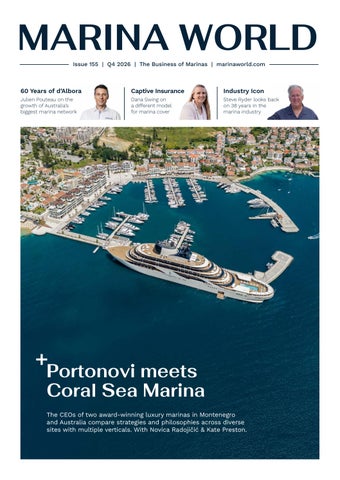
+Portonovi meets
Coral Sea Marina The CEOs of two award-winning luxury marinas in Montenegro and Australia compare strategies and philosophies across diverse sites with multiple verticals. With Novica Radojičić & Kate Preston.
B U I LT F O R
THE EXTREME
MEET US AT METSTRADE. STAND MYP 09:311 SF Marina is a world-renowned expert in designing and delivering premium marinas and advanced floating solutions for the most demanding environments. We provide state-of-the-art floating breakwaters, concrete pontoons and Superdocks for the world’s most demanding yachts, conditions and projects – anywhere in the world. Built to perform. Built to last. Built for the extreme. W W W . S F M A R I N A . C O M
OPENING LETTER
Potatoes Dear Readers, My godmother’s husband is a potato farmer in the east of England. At a recent family gathering I asked him how the country’s hottest summer on record had affected this year’s harvest. To my surprise, he replied that he was as “cool as a cucumber” and that, at least financially speaking, the poor crop growth was nowhere near as bad for farmers as the media was making it out to be. (But if the harvest were to be bad again next year, then he would start to worry.) The reason for this is simple. The small size and low quantity of potatoes pushes their price up, partially offsetting the financial losses of a poor harvest. Furthermore, the fewer crops you have to harvest reduces the amount of money and resources you need to invest into harvesting them, offsetting losses further. Scarcity (as well as demand) drives value. This conversation got me thinking about scarcity in the marina industry. We know that marinas and berths are scarce and demand is high, and we also know that private equity is consolidating everything it can precisely because marinas and berths are scarce and demand is high. Not only that, but the opportunities to build new berths or new marinas are also scarce. Agriculture is notoriously unreliable because no amount of time and money can actually guarantee whether a potato will grow. Marinas, however, have very stable and predictable cash flows and whether or not to expand them is entirely a human decision. Of course, there are obstacles aplenty, but few are insurmountable provided that someone is willing to invest the time and money into overcoming them. If one understands that scarcity and demand in the marina industry are both high, then the following question emerges: does private equity actually have any interest in reducing scarcity in the marina industry and growing the number of berths and marinas? Is private equity more interested in growing potatoes or selling chips?
Patrick Norén Editor
Marina World patrick.noren@marinaworld.com
marinaworld.com
1
MASTHEAD
EDITORIAL EDITOR IN CHIEF EDITOR NEWS WRITER EDITORIAL CONTRIBUTOR
Francesca Webster Patrick Norén Ellaine Zabate Vladislav Vorotnikov
DESIGN PRODUCTION GRAPHIC DESIGNER
Beatriz Ramos
SALES & ADVERTISING HEAD OF SALES SALES MANAGER CLIENT SERVICE MANAGER SALES AMERICAS & CARIBBEAN SALES ITALY
Marieke de Vries Brianna Johann Krista Andres Philippe Critot info@admarex.com
CORPORATE FOUNDER & DIRECTOR TECHNOLOGY DIRECTOR FINANCE DIRECTOR
Merijn de Waard Fabian Tollenaar Laura Weber
SuperYacht Times B.V. Silodam 256, 1013 AS, Amsterdam, The Netherlands 31 (0) 20 773 28 64 info@superyachttimes.com www.superyachttimes.com Cover Image: Portonovi Marina, Montenegro by Portonovi Marina
“Marina World” (ISSN “1471-5856” USPS 19194) is published four times a year in January, April, July and October by “SuperYacht Times B.V.”, “256 Silodam, 1013 AS, Amsterdam, The Netherlands”. Airfreight and mailing in the USA by World Container Inc., c/o BBT 150-15 183rd St, Jamaica, NY 11413-4037, USA. Periodicals postage paid at Brooklyn, NY 11256. POSTMASTER: Send address changes to “Marina World”, World Container Inc., c/o BBT 150-15, 183rd St, Jamaica, NY 11413, USA.
marinaworld.com
3
42 26
Contents 06 09
News
26
One company’s mission by ReefFloat
32
Are marinas ready for next-gen yachts? by Patrick Norén
36
AMI to celebrate 25 years of industry leadership by Patrick Norén
38
4
Marina World
62
Yacht Infrastructure Summit 2026 by Patrick Norén
IWMC heads to mainland China by ICOMIA & Sinoexpo
|
Issue 155
42
50
56 62
68
Redeveloping Club de Mar-Mallorca by Patrick Norén
Four decades in the marina industry with Steve Ryder
Is insurance holding your marina captive? by Dana Swing
Tangier: The other side of the Med by Patrick Norén
Yes, Swedish marinas can be consolidated with Richard Lindqvist
CONTENTS
82
98
74
82 88 98
Portonovi meets Coral Sea Marina with Novica Radojičić & Kate Preston
Access all areas with Sebastiano Pulina
Sales & Acquisitions
The only marina in Cape Verde by Patrick Norén
104
Using tech to optimise dry stack by Jared Gaynes
104
110
116 122
128 134
60 years of d’Albora Marinas with Julien Pouteau
Planning for an electric future by Tim Butler
The key principles of marina feasibility by Simon Goodhead
Cyprus steps out of the shadows by Vladislav Vorotnikov
Products & Services
marinaworld.com
5
EVENT PARTNERSHIP
Yacht Infrastructure Summit 2026
S
uperYacht Times and Marina World are proud to be launching the inaugural Yacht Infrastructure Summit, hosted at Metstrade in Amsterdam on 18 November 2026, in partnership with Safe Harbor. A long-standing trend in the luxury boating industry is that the superyachts keep getting bigger, but their owners are running out of space to park, service and refit them. While it might take only three or four years to build a superyacht, constructing the physical pieces of infrastructure that give the yachts a home can take decades. This has long meant that the average size of the global fleet has gradually increased while the number of marinas and maintenance yards has more or less remained the same. It is therefore clear that the era of yachts and marinas
6
Marina World
|
Issue 155
By Patrick Norén
being able to operate as separate, siloed entities is coming to an end. For many decades now, the evolution of superyachts has vastly outpaced the evolution of yacht infrastructure, and whatever evolution there has been in the latter has rarely been in tandem with the former. This has created mismatches and bottlenecks between the two industries, which in turn have created significant opportunities for serious growth and technological development in marina and refit facilities. How do we create a perfect superyacht marina? What is the business case for investing in refit facilities? How is the marina industry being professionalised? How are suppliers and consultants having to adapt to changing superyacht requirements? What will the most ambitious and successful future yacht infrastructure developments look like? And, most importantly, who is going to pay for it all?
EVENT PARTNERSHIP
Sessions and speakers Uniting SuperYacht Times’ and Marina World’s leadership and expertise in the global superyacht and marina industries, the inaugural Yacht Infrastructure Summit will address these questions head on. With over 20 speakers from key stakeholders across the marina and superyacht refit industries, the event will take a future-forward approach informed by recent case studies to guide how yacht infrastructure can grow in tandem with the superyacht industry. A close partnership with the world’s marina and service network, Safe Harbor, lends additional institutional weight and realworld operational experience, and SuperYacht Times and Marina World are proud to welcome them as the patron partner to this landmark event. Safe Harbor’s Colby Cooper, Marina Projects’ Mike Ward and Red Sea Global’s Wyndham Tops will be speaking on the topic of Creating a Perfect Superyacht Marina. We are also pleased to welcome Jamaine Campbell of Elite Dynamics, platinum partner of the Yacht Infrastructure Summit, to give his perspective on the importance of digital infrastructure in creating a perfect superyacht marina. Plus Marine’s Franco Ceroici and Haskoning’s Gosse de Boer will be discussing how they are adapting their products and services to changing superyacht requirements in Big Boats, Bigger Infrastructure: Marina Engineering & Expenditure. We will also be joined by Jeff Pratt of Bellingham Marine, gold partner of the Yacht Infrastructure Summit, to speak about how they are working to best serve superyacht marinas and their clients. On The Business Case for Investing in Refit Facilities, we will welcome Stewart Parvin of Cantiere Rossini and Andrew Hutchinson of Invest Gold Coast, while Safe Harbor’s Jessie Burgess will discuss How Capital is Professionalising the Marina Industry. Oliver Corlette of Black Mountain Partners will also give a case-study presentation on the development of Porto Montenegro, where he was the founding managing director and CEO.
Tickets available now The Yacht Infrastructure Summit is a landmark event that addresses a very specific issue that has long limited growth and development in the industry: How do we overcome the difference between how long it takes to build a superyacht, and how long it takes to build yacht infrastructure?
Maybe the most challenging question to be discussed during the summit is who will pay for it all? In many parts of the world, the answer to this question is increasingly private equity. To that end, Private Equity as an Institutional Driver will be joined by Bob Hoogendoorn of Balmaris Marinas, Richard Lindqvist of AMAVI Capital, Andreas Bäckman of InfraVia Capital and Antonio Zaforteza of Ocibar Marinas.
Whether it be in design, docks, digitisation, destination creation or the cold reality of hard dosh, the Yacht Infrastructure Summit will attempt to answer these questions and uncover the many opportunities for invention and innovation across the sector that will make this future possible.
Finally, the event will close with a one-on-one interview between Baxter Underwood, CEO of Safe Harbor, and Merijn de Waard, founder of SuperYacht Times, to discuss how they are creating value and realising potential across their world-leading network of marina and refit facilities.
Get your tickets to the inaugural Yacht Infrastructure Summit, taking place at Mestrade, Amsterdam, on 18 November 2026:
marinaworld.com
7
THE MOORING SYSTEM
News
NEWS
Europe
Croatia extends ACI marina concessions to 2058 More than 20 ACI marinas have secured concessions through 2058 after the Croatian government approved the extensions on 1 October. Spanning around 6,000 berths along the Adriatic coast, the marina network has approximately €140 million ($157 million USD) in investment planned. According to Croatia’s Ministry of Maritime Affairs, Transport and Infrastructure, the government approved ACI’s request to extend concessions due to expire in 2030 by 28 years, covering two sets of earlier concession decisions. The amendments include Umag, Rovinj, Pomer, Opatija, Cres, Supetarska Draga, Jezera, Vodice, Split and Dubrovnik under one set, and Pula, Rab, Šimuni, Žut, Skradin, Trogir, Milna, Vrboska, Palmižana, Piškera and Korčula under the second. The new terms also increase concession fees, and payments to public budgets over the concession period are expected to reach about €700 million ($789 million), including 76.23 percent for the state budget, 10.19 percent for counties and 13.58 percent for cities and municipalities. The concession areas cover more than 11 hectares in total, and new maps are being prepared to align them with spatial plans. The ministry said the longer concession periods are intended to support continued investment and help maintain the marina network’s position in Croatia’s nautical tourism sector. It expects the extensions to support around 380 jobs, generate revenue for national and local budgets, and support further improvements in services, safety and environmental protection.
La Rochelle Marina begins discussions on 2027-2032 plan La Rochelle Marina in Charente-Maritime, western France, has started work on its 2027-2032 plan, asking boat owners, professionals, staff and institutional stakeholders for their views on the site’s future. The consultation began on 2 September and will run from 22 to 27 September, with further activity in November. Covering 70 hectares on France’s Atlantic coast, La Rochelle Marina at Les Minimes is one of the largest marinas in Europe, with more than 5,100 berths, including 400 visitor berths. The marina provides electricity on pontoons and quays, sanitary facilities, a fuel pontoon, and bicycle and trailer rentals. Its boat-handling capacity is supported by three mobile lifts for vessels of up to 50 tonnes, alongside a 30-tonne self-propelled crane and two fixed electric cranes handling up to 2.5 tonnes. At the old port, 18 jetties provide 390 berths, including 80 visitor spaces, across the tidal harbour, trawler basin and yacht basin. Further facilities at Port-Neuf include 65 berths across five mooring lines and 50 dry storage spaces. The marina is looking ahead to how boating could change by 2032, including the services boaters may need, new uses that could emerge and changes to its infrastructure, equipment and buildings. The marina plans to gather input through interviews and workshops with boating professionals, technical meetings with institutional stakeholders and discussions with its staff. The first discussion took place on 2 September and the consultation continued at the Grand Pavois from 22-27 September, with further workshops planned for November. The final plan is due for publication in spring 2027.
marinaworld.com
9
NEWS
Marinetek secures contract for Agios Kosmas Marina redevelopment Marinetek Adriatic has signed a contract with LAMDA Development on 14 October to manufacture pontoons for the redevelopment of Agios Kosmas Marina in southern Attica, Greece, which is part of The Ellinikon, an €8 billion ($8.9 billion USD) urban regeneration project transforming the Athens Riviera. Marinetek Group CEO Karri Kaitue attended the contract signing, joined by the company’s special consultant in Greece, Theofanis Karagiannis, and Marinetek Adriatic managing director Boris Miškić. Also present were LAMDA Development’s senior development director Theodoros Iakovidis, senior contracts manager Antoins Katsanevas and project manager Angelos Mongolias. Under the agreement, Marinetek Adriatic will manufacture 38 Marinetek Premier series pontoons that will make up six new piers at the marina, each measuring four metres in width. The first batch is scheduled to arrive in February 2027 for installation along the site’s main promenade, and all work is expected to be completed before the start of the new season. The marina is part of The Ellinikon, a major redevelopment transforming the site of Athens’ former international airport into a district featuring residential areas, high-rise towers, hotels, parks, shopping and entertainment facilities. Marinetek stated: “For our team, being part of a project of this scale and significance is a particular source of pride. Behind every pontoon are people whose knowledge, dedication and experience make our work possible. This contract is a meaningful recognition of everyone who contributes to the quality of what we do, day after day.”
Advertisement Navy Pier Marina Chicago, Illinois, USA
Proudly Celebrating our 15th Anniversary!
Marinas & Harbors
Shorelines & Coastal
www.edgewaterresources.com
Waterfronts
NEWS
Sardinia allocates €3 million to complete Marina di Cannigione harbour upgrade Marina di Cannigione in north-eastern Sardinia, Italy, is nearing the final phase of its €4.8 million ($5.4 million USD) harbour redevelopment after the region allocated €3 million ($3.4 million USD) on 22 September 2026 for the remaining works, while two of three waterfront lots at the marina have already been completed. Proposed in 2023, the overall harbour project was developed by Arzachena’s municipal public works department. A €472,000 ($538,000) control tower has been completed and is now used by the harbour master’s office, and a €1.378 million ($1.5 million) eastern arm project will start in mid-October 2026 to improve safety and increase the outer pier to 38 berths, in addition to 67 on the northern quays for medium and large vessels. The latest funding will cover the remaining harbour works, including upgrades to water and electricity supplies at the moorings, the fire-fighting system, paving, cladding, lighting and street furniture. Separate work along the Cannigione waterfront has completed two of three planned phases, covering pavements, electrical systems, road markings, flower beds, greenery and steel railings. The final phase of the project will extend towards the southern entrance to Cannigione and is at the detailed design stage ahead of a tender planned for 2027.
SF Marina completes first project in the Netherlands after official opening Waterland Marina in Monnickendam, the Netherlands, has been officially opened after a merger and renovation of two separate sites into one complete marina. A ceremony celebrating the completion of the works took place on Friday 28 August, with Waterland Marina’s Kees Wiersema and Nienke Zetzema giving a welcome speech before the local mayor, Marian van der Weele, conducted the official opening. Known locally as Jachthaven Waterland, the business began in 1985 as Waterland Yacht Charter before expanding into marina operations and acquiring the neighbouring marina in January 2019, creating two adjoining sites, Waterland and Hemmeland. The marina has more than 850 berths for vessels between seven and 15 metres in length, power connections and communal water points. Annual and seasonal contracts are also available, and a nautical service centre offers sailmaking, yacht service and engine maintenance. The redevelopment replaced the marina’s ageing wooden pontoons and connects the two sites through a new layout. SF Marina’s work includes a 220-metre-long, six-metre-wide central pontoon, about 1.1 kilometres of total pontoon infrastructure and 224 finger piers, accommodating 392 berths across different vessel-size categories. Construction took place over the winter after the existing marina was removed. The first pontoon sections arrived in early February, and installation of the main pontoon and other sections followed through the month. The first vessels were launched in mid-March, with further launches continuing into April. As part of the wider redevelopment, Waterland Marina also worked with Seijsener on power pedestals and wiring, i-Marina on marina management software, and Boat Lift on a replacement for the existing lift at the Hemmeland location. The new marina layout was designed by the Dutch engineering consultancy, Haskoning.
marinaworld.com
11
NEWS
Marbella’s La Bajadilla port set for €200 million expansion After years of delay, the port of La Bajadilla in Marbella, southern Spain, is set for a major expansion following approval from the Andalusian regional government. A new concessionaire will take charge on 1 January, with the project expected to triple the marina’s berth capacity and redevelop the wider site. Approved through the Andalusian Public Ports Agency (APPA), the project was announced on 2 September during a visit to Marbella by regional development and mobility minister Mario Muñoz-Atanet, alongside mayor Ángeles Muñoz. Deputy regional minister Eduardo Gutiérrez, APPA director-general Ignacio Álvarez-Ossorio and Málaga’s regional delegate María Rosa Morales were also present. La Bajadilla sits next to the city’s old fishing quarter and is one of four marinas in the Marbella area. The site currently has 268 berths for vessels measuring between six and 18 metres, with facilities including a restaurant, boat rental, fuel station, a crane, dry stack storage and car parking. Its capacity is expected to nearly triple to around 750 berths, allowing vessels of up to 70 metres, including superyachts and cruise ships. Further plans will expand the port’s water space with a 1.13-kilometre main breakwater protecting the eastern and southern sides and a 450-metre secondary breakwater on the west. The plans also include a new jetty to channel the Primero stream away from Cable beach, along with sand replenishment and transfers at Venus, La Bajadilla, El Cable and El Faro beaches. Across the wider site, new infrastructure and services will be added, including a retail area, fishing facilities, a boatyard and 1,000 parking spaces. The new concessionaire will take charge of the port on 1 January, with an investment of more than €200 million (more than $230 million USD) planned for the redevelopment. The authorities said the project would provide an economic boost for Marbella, contribute to growth and employment along the Costa del Sol, meet demand in the maritime sector and create new business and tourism opportunities. Advertisement
E LL
4500
MARINAS AROUND THE WORLD
DC & AC fastcharge for ev-boats
plusmarine.com
NC E
PASSI
N POWERING MORE THAN
E
O
R EX FO C
NEWS
The Americas
Legacy Harbour Marina reopens after $15 million redevelopment Hurricane Ian severely damaged Legacy Harbour Marina when it struck Southwest Florida in September 2022. Four years later, the waterfront property in downtown Fort Myers has reopened following an approximately $15 million USD redevelopment and is now accepting slip reservations. Legacy Harbour Marina occupies about 13 acres along the Caloosahatchee River, providing direct access to the Gulf and sitting near the Fort Myers River District. Damage caused by Hurricane Ian led to plans for a complete redevelopment of the site, which entered construction in early 2025. The project rebuilt the marina with 131 slips measuring 30-140ft (nine to 43 metres) and Bellingham Marine’s Unifloat concrete wave attenuator system, supported by 70ft (21-metre) steel piles. For the interior docks, the project used the company’s Unideck aluminium frame system and WearDeck synthetic decking. The redevelopment also added potable water, in-slip pump-out, fire suppression, fibreglass dock boxes and single-phase shore power. As part of the reopening, Coastal Marina Management serves as the site’s management partner, handling daily operations, dock staff and customer service. The marina also uses Dockwa for slip reservations, contracts, payments and communication. Later this year, Nellie’s Boatyard is scheduled to open in the former Joe’s Crab Shack space after interior renovations and landscaping. Legacy Harbour Marina is also on the route of the 53rd Annual Fort Myers Boat Show from 12-15 November 2026, featuring vessels on the Caloosahatchee River, marine equipment and accessory vendors. Rick Budd, CEO of AIRN Management, stated: “This marina has long served as a homeport for boaters travelling Florida’s west coast. The reopening represents a significant reinvestment in Fort Myers’ waterfront and a long-term commitment to the local boating community.”
BR Marinas to study proposed marina at Ponta do Humaitá in Bahia, Brazil Salvador city council in Brazil has authorised BR Marinas, the largest marina network in Latin America, to prepare technical, environmental, economic and legal studies for a proposed marina at Ponta do Humaitá, a waterfront area in the Cidade Baixa district. Issued through the municipal secretariat for economic development, employment and income (SEMDEC), the authorisation follows a proposal submitted by BR Marinas earlier this year as part of a potential public-private partnership. The assessment will cover a proposed nautical complex, including dry storage for sport and recreational vessels, nautical infrastructure, tourism, leisure and commercial activities. To determine how the project could work at the site, the studies will look at its physical and environmental conditions, from topography and bathymetry to marine and terrestrial fauna and flora, as well as potential environmental impacts and compatibility with Salvador’s urban development plan. BR Marinas will also assess the project’s commercial and financial viability, covering demand, pricing, investment and operating costs, to establish the appropriate legal and contractual model. The studies are due within 180 days, with reimbursement capped at $1.6 million Brazilian reais (over $311,000 USD). Authorities said the development could help grow Salvador’s blue economy and expand nautical capacity. It could also help meet demand from more than 2,500 vessels, attract private investment and support tourism, watersports, specialist services and local trade.
14
Marina World
|
Issue 155
NEWS
PORT 32 names Brian Kelley general manager of Fort Lauderdale marina PORT 32 Fort Lauderdale is expanding its yacht repair and refit services on the New River and has announced Brian Kelley as general manager of the marina and boatyard. He follows Matt Domke, who will lead the new PORT 32 Palm Beach Gardens opening this December. With more than 30 years in marina, shipyard and yacht-service operations, Kelley will stay closely involved in the day-to-day running of PORT 32 Fort Lauderdale, working with the operations team and focusing on safety, reliability and communication. He comes after Domke, who has led the property since 2022 and will continue with the company as general manager of PORT 32 Palm Beach Gardens, opening later this year. Kelley commented: “I am proud to step into this role as general manager and build on the strong foundation already in place at PORT 32 Fort Lauderdale. With the boatyard fully operational and a talented group of on-site marine specialists covering everything from hull work to electronics, my focus is on staying closely engaged with the team and our members. I want captains and owners to know they can count on PORT 32 for a safe, reliable and service-driven experience so they have more confidence and convenience, leading to a more enjoyable time on the water.” Near Marina Mile, the marina accommodates 240 vessels across its dry storage and upgraded wet basin, which can take vessels up to 180ft (55 metres), and features a 150-metric-ton Marine Travelift capable of hauling yachts and large recreational vessels up to approximately 120ft (37 metres).
Port of Grays Harbor gets $6.2 million grant for Westport Marina modernisation The US Economic Development Administration (EDA) has awarded the Port of Grays Harbor a $6.2 million USD grant to modernise Westport Marina in Washington. The funding will support the replacement of floats 19 and 21 and will be matched by $2.6 million in non-federal funds. Founded in 1911, the Port of Grays Harbor is one of Washington State’s oldest port districts, operating four deep-water marine terminals, Bowerman Airport, ship-assist services, public waterfront facilities, industrial and business parks in the county and Westport Marina. With 550 slips, the marina accommodates commercial fishing vessels measuring from 11-30 metres long, and serves as the leading seafood landing port in the state. The port began its marina modernisation plan in 2022 to address its ageing floating dock infrastructure, much of which is 45-60 years old, through a phased programme to replace, rehabilitate and reconfigure the docks. With the latest grant, the port will begin the project by replacing floats 19 and 21 with wider and longer slips to accommodate the growing commercial fishing fleet. The new layout will include a 151-metre main float, with 15 slips measuring 17 metres, six measuring 27 metres, one measuring 30 metres and a 47-metre end tie. Plans also include new 40cm and 61cm steel pipe piles, an entrance abutment and a 24 x 1.5-metre gangway. Electrical service, potable water, lighting and fire suppression will also be installed.
marinaworld.com
15
NEWS
Middle East
AMAALA Yacht Club officially begins operations on the Red Sea The highly anticipated AMAALA Yacht Club, located on the Saudi Red Sea coast in the north-west of the country, has officially opened. In a press release published on Monday 14 September, John Pagano, the group CEO of Red Sea Global, wrote that “AMAALA Yacht Club marks the emergence of a truly global yachting destination, offering unparalleled access to the stunning Saudi Red Sea coast”. The release pointedly notes that AMAALA is positioned around 2,000 nautical miles from Monaco and is closer to the Mediterranean than the Caribbean. Described as “marking a major milestone in establishing the Saudi Red Sea as a new global destination for yachting”, AMAALA is a centrepiece in the country’s attempt to rival the Caribbean as a northern hemisphere winter yachting destination. AMAALA has average temperatures of 26°C throughout the season and average lows of 23°C, and is located 45 minutes from Alwajh International Airport. AMAALA Marina features 119 berths and can accommodate superyachts of more than 100 metres long. The marina will also eventually offer a range of other marine services, including fuelling with maintenance and repair facilities. According to AMAALA, berthing and mooring fees are comparable to leading European yachting destinations while yacht owners that purchased permanent moorings benefit from a “range of exclusive privileges through selected resort partners”. Within the 7,900-square-metre AMAALA Yacht Club, there are a range of dining and social spaces, including AMAALA Lounge, ANQA, 27°C and The Deck, alongside a rooftop pool, private meeting suites and areas for social gatherings and events. The destination also has several newly opened luxury branded resorts, including Four Seasons, Six Senses, Rosewood, Equinox and Nammos. Two additional resorts will open in the coming months.
Musandam signs agreement for Aims Bay development Musandam Governorate in Oman signed a memorandum of understanding with Al Sarooj Development Company on 8 October 2026 during the Urban October events in Muscat to cooperate on infrastructure development and tourism investment for the Aims Bay Project in Khasab. Sheikh Abdullah Salim Al Farsi, the Wali (local government administrator) of Khasab, signed the agreement on behalf of Musandam Governorate, alongside Sulaiman Khamis Al Qasmi, chief executive officer of Al Sarooj Construction. Through the agreement, the project aims to improve infrastructure at Aims Bay and encourage tourism investment by making use of the area’s coastal and marine resources to support local businesses and economic activity. The preliminary plans for the project envision a boat marina along a developed waterfront, supported by tourism and service facilities. In June 2023, the Aims Bay project was selected as one of three winning proposals in a nationwide competition organised by Oman’s Ministry of Housing and Urban Planning. The earlier proposal covered 6.87 hectares with plans for Al Khalidiyah Viewpoint, Aims Resort, Aims Marina and Aims Bay to improve infrastructure and connections between Musandam’s districts.
16
Marina World
|
Issue 155
BUILT FOR MARINAS WITH BIGGER AMBITIONS One connected marina management platform bringing operations, finance and customer management together across sites and markets.
www.elite-marinas.com
NEWS
Wynn Al Marjan Island reveals new details of Wynn Marina Opening in 2027, Wynn Marina will add a circular superyacht harbour to Wynn Al Marjan Island in Ras Al Khaimah, UAE, designed to create a direct waterfront gateway to the resort and expand its appeal as a coastal destination. Wynn Marina lies about 80 kilometres from Dubai International Airport and will connect yacht arrivals to Wynn Al Marjan Island, giving guests access to more than 1,500 rooms and suites, dining and entertainment venues, wellness facilities, pools, shops and event spaces. “Wynn Marina has been conceived as a direct extension of Wynn Al Marjan Island. It brings together the specialist infrastructure required by modern superyachts with the service and hospitality that define Wynn. From arrival and berthing to provisioning, concierge support and access to the resort, every element has been considered to make the transition between life on the water and the resort feel effortless,” said Max Tappeiner, president of Wynn Al Marjan Island. The marina is expected to rank among the UAE’s largest resort-attached marinas and offer 98 wet berths for vessels up to 85 metres long in a five-metre-deep circular basin designed for wider fairways and easier navigation. A 197-metre pontoon will lead to the Capitainerie, the marina’s arrival and operations hub, where guests can complete passport processing and arrange vessel-side check-in. Captains and crew will have changing rooms, showers and welfare facilities, plus provisioning support and specialist service vessels for arrivals and departures. Working with Wynn Resorts since 2022, Marina Solutions International (MSI) has worked on the marina’s feasibility, commercial planning and design, as well as operational consultancy and operator selection. MSI said the marina’s berthing layout was developed to maximise the available water space within the existing circular basin and its protective breakwaters. Dewan Architects + Engineers handled the design of the Capitainerie, while IGY Marinas will take charge of marina operations when it opens in 2027.
SRSA grants operating licences to AMAALA and Shura marinas Red Sea Global (RSG) has received operator licences for AMAALA Marina and Shura Marina from the Saudi Red Sea Authority (SRSA), just a week after the developer launched Yachting Network, its marina and yacht club operator on the Red Sea coast. Eng. Mohammed Bukhari, vice president of coastal tourism operations at SRSA, presented the licences to Raed Albasseet, group chief environment and sustainability officer at RSG, in Riyadh. The licences mean both marinas can begin operations under SRSA standards, which include rules for marina management and measures to protect the Red Sea’s coral reefs and marine biodiversity. Specialising in transient and superyacht berthing, AMAALA Marina of the AMAALA destination has 119 berths, while Shura Marina at The Red Sea destination has 159 berths for residential and recreational boaters. Both are on Saudi Arabia’s northwestern coast, about 2,000 nautical miles from Monaco, and can accommodate superyachts of up to 120 metres. AMAALA Marina and Shura Marina are the first two sites in Yachting Network, the marina and yacht club operator that RSG launched ahead of its start this winter. The network will serve yacht owners, charter guests, captains and crew, and provide a closer Red Sea alternative for yachts that traditionally travel from the Mediterranean to the Caribbean or Indian Ocean for winter.
18
Marina World
|
Issue 155
Building on the water with the future in mind
Porto Mirabello, La Spezia, Italy
Fixed. Floating. Finished. The La Spezia Series Pontoons, breakwaters, superyacht piers, walkways and floating structures. Robust and reliable, standard or custom-made, available in aluminum, concrete or steel. Turnkey solutions for marine, commercial and industrial sectors.
Ingegneria Marittima
NEWS
APAC
Eagle Hills and Maldives government sign agreement for $20 billion Ras Malé development Abu Dhabi-based real estate developer Eagle Hills and the government of the Maldives signed a commercial terms agreement on 21 September for Maldives Waterfront and Marina, a new island destination planned in Ras Malé. The Indian Ocean development is envisioned to expand the country’s tourism, waterfront and residential offering, with an overall scale of about $20 billion USD across its phases. Planned as a global destination, the project aims to combine a marina and waterfront promenades with hotels, resorts and branded residences. The wider plans extend to dining, retail, leisure, entertainment and wellness, alongside education, healthcare, community facilities and public spaces, supporting tourism, residential life and year-round economic activity. Projections for the development show it could receive more than one million visitors a year, generating over $2 billion in annual tourism revenue. Over its lifetime, the project could also attract more than $30 billion in gross foreign investment, including around $18 billion in net foreign investment into the Maldives, while creating more than 54,000 direct and indirect jobs. This is expected to generate tax contributions and create sustained demand across hospitality, construction, retail, marine services and technology, and among local businesses, suppliers and professional services. Dr. Abdulla Muththalib, Maldives’ minister of infrastructure, housing and urban development, said the project is “the largest investment programme in the country’s history, bringing foreign investment, jobs, homes for Maldivian families and direct state revenue from sales without tax incentives or government borrowing”. He added that the project “establishes a structured, world-class real estate sector alongside tourism and supports the Maldives’ goal of becoming a high-income country by 2040”.
Marina Development International announces Belongas Bay Marina in Lombok The lead developers behind the new Bali Gapura Marina, Marina Development International (formerly known as Marina Development Indonesia), have announced a second project on the neighbouring island of Lombok. The construction of Belongas Bay Marina is scheduled to start in 2027 and will be located in a natural, protected bay of the same name with a water depth of between 10-15 metres. Unlike Bali Gapura Marina, which was built on reclaimed government land, the new Lombok marina will be constructed on privately owned land. Sources at Marina Development International have confirmed to Marina World that the owner is looking to invest in superyacht refit facilities, a dry dock, a yacht club and luxury villas. The new marina will be around 90 minutes from Lombok International Airport by car and four hours’ cruising time from Bali Gapura Marina, which opened earlier this year. Further expansions to Bali Gapura Marina are planned over the next two years, with full completion slated for 2028.
20
Marina World
|
Issue 155
NEWS
SUTL Enterprise and Resorts World Langkawi to develop new ONE°15 marina SUTL Enterprise and Resorts World Langkawi, part of Genting Malaysia, have announced a collaboration to develop ONE°15 Marina Langkawi, a new marina along the Andaman Sea expected to welcome its first vessels in the second half of 2027. The new ONE°15 marina will be located in Langkawi, an archipelago off the northwestern coast of Malaysia known as the “Jewel of Kedah”, consisting of 99 islands and home to Southeast Asia’s first UNESCO Global Geopark. It will sit along the Andaman Sea, between ONE°15 Marina Sentosa Cove in Singapore and ONE°15 Marina Panwa Phuket in Thailand, on a regional cruising route connecting destinations in the area. Expected to welcome its first vessels in the second half of 2027, ONE°15 Marina Langkawi will feature more than 90 berths, including capacity for superyachts of up to 140ft (43 metres), alongside facilities for yacht owners, charter operators and leisure travellers. Visitors will also have access to accommodation, dining and entertainment at Resorts World Langkawi, owned and operated by Genting Malaysia, a portfolio of leisure and hospitality properties across Malaysia, the United States, the Bahamas, the United Kingdom and Egypt. Arthur Tay, executive director and chief executive officer of SUTL Enterprise, said the Langkawi development supports the continued expansion of the company’s marina network and its focus on waterfront destinations across Asia. Beyond its marinas in Singapore and Thailand, the company also operates ONE°15 Marina Nirup Island in Indonesia and ONE°15 Marina Desaru Coast in Malaysia. He added: “Our regional marina footprint is carefully curated, each defined by a distinct personality and experience, delivering consistently high marina standards, offering members and the wider yachting community a diverse yet cohesive range of exceptional lifestyle-led marina experiences across the region.”
Nansha Marina set for Phase III expansion Plans for the next phase of Nansha Marina in Guangzhou, China, have received administrative approval as a new cross-border yacht travel policy takes effect within the Guangdong-Hong Kong-Macao Greater Bay Area. The 17-hectare site, which opened in 2011, has 142 berths and can accommodate superyachts of up to 200ft (61 metres), supported by a one-hectare onshore area for maintenance, servicing and vessel lifting. Nansha Marina sits in Gangwan Subdistrict, about 200 to 800 metres downstream of the Humen Bridge in Guangzhou’s Nansha district. Nansha has also established the Greater Bay Area (Nansha) yacht service centre at the marina, following the introduction of the Guangdong-Hong Kong-Macao yacht free-travel policy in June this year. The centre provides mooring, repairs and maintenance, dining and accommodation, as well as assistance with entry and exit declarations, joint inspection appointments, maritime registration, customs clearance and berthing. Phase III of the marina project will add 195 berths across seven hectares, with 117 for 40ft (12-metre) vessels and 72 for those up to 30ft (nine metres), plus three each for 50ft (15-metre) and 60ft (18-metre) vessels. Guangzhou Nansha Development and Construction Co., Ltd. is behind the 32.57 million yuan (about $4.8 million USD) project.
marinaworld.com
21
NEWS
Caribbean
Work continues on Marina Puerto Chico floating wave attenuator project Grand Caribbean Marinas (GCM), owned and operated by Bacalia Group, has announced progress on the installation of a floating wave attenuator at Marina Puerto Chico in Fajardo, Puerto Rico, as the marina expands its capacity for transient boaters and strengthens its coastal infrastructure. Working with the US Fish and Wildlife Service (USFWS) and the Puerto Rico Department of Natural and Environmental Resources (DRNA), the marina is focusing the installation on docks A1 and A2 to expand operating capacity for short-term stays, protect vessels and help limit the impact of waves and storms across the dock area. In June 2023, Marina Puerto Chico and the DRNA secured a $1.137 million USD grant through the USFWS Boating Infrastructure Grant programme. The marina also committed to add more than $960,000 to the project, which covers new slips, restrooms and showers, sanitary pumpout facilities, a gangway, a fuel dock and the floating wave attenuator now being installed. Marina Puerto Chico operates as part of GCM’s six-marina network across Puerto Rico, which serves an estimated 3,000 vessels and about 50 concessionaires in nautical tourism, charters, sport fishing, diving, retail and marine repairs. The network also includes Isleta Marina, Sea Lovers Marina, Marina Sardinera, Renaissance Villa Marina and Bluecoast, and has focused its infrastructure investments on resilience since Hurricane María.
Mirazur Capital and Marina Port Vell start international network expansion with Biras Marina Biras Marina on Virgin Gorda in the British Virgin Islands is the first international venture for Mirazur Capital and Marina Port Vell since the former took a majority stake in the Barcelona marina last June, with plans to apply its operating model and service standards at the superyacht marina. Set in North Sound as part of Biras Creek Resort, Biras Marina serves both short and long stays with 20 mooring buoys and 25 berths for vessels up to 70 metres long. The marina provides owners and crews with water and electricity supplies, vessel cleaning and catering, alongside the resort’s villas, restaurants, multi-brand boutique and helipad. Mirazur Capital took a majority stake in Marina Port Vell last June with plans to grow the marina business, consolidate Barcelona’s position as a centre for the superyacht sector and develop an international marina network. As part of that expansion, Marina Port Vell will extend its operating model and service standards to the Caribbean for the first time, applying its experience in hosting superyachts up to 190 metres.
22
Marina World
|
Issue 155
NEWS
Africa
V&A Waterfront Marina earns eighth Blue Flag as programme celebrates 25 years in South Africa The V&A Waterfront Marina in Cape Town, South Africa, has secured Blue Flag status for the eighth consecutive season after meeting international standards for environmental management, safety, accessibility and education. The latest certification was announced on 8 October at an awards ceremony at Grotto Beach in Hermanus during celebrations for the Blue Flag programme’s 25th anniversary in the country. Coordinated internationally by the Foundation for Environmental Education and managed in South Africa by the Wildlife and Environment Society of South Africa (WESSA), the Blue Flag programme recognises beaches, marinas and sustainable boating tourism operators that meet environmental, safety and educational standards. According to the V&A Waterfront, its year-round environmental efforts go further than Blue Flag requirements, given the marina’s location in a working harbour shared by marine wildlife and commercial, industrial, tourism and leisure activities within a 123-hectare precinct. The marina works with the Two Oceans Aquarium Foundation through its Marine Wildlife Management Programme to monitor and protect marine wildlife and support coexistence between harbour activities and marine species. The V&A Waterfront also plans to develop a swimmable marine bay and a turtle conservation centre at Granger Bay as part of its efforts to support marine conservation and reconnect Cape Town with the ocean. WESSA and Overstrand Municipality hosted the ceremony, which celebrated WESSA’s centenary and 25 years since South Africa became the first country outside Europe to adopt Blue Flag. This year’s awards recognised 50 beaches, seven tourism boats and five marinas that received full Blue Flag status. Another 20 beaches were recognised as pilot sites, and 19 coastal sites received recognition under WESSA’s Green Coast initiative.
Advertisement
WITH
SMART UP YOUR MARINA
MARINA MANAGER PLATFORM
marinero.eu
USER APP
PEDESTALS WE ARE THERE TO SUPPORT YOUR MARINA FROM THE PLANNING PHASE, THROUGH HARDWARE MANUFACTURING, ALL THE WAY TO OPERATIVE CHALLENGES.
TEAM UP WITH US, AND YOU’LL RECEIVE OUR MARINA MANAGER
SOFTWARE
FOR FREE Marinas. Optimised.
VISIT US AT METSTRADE 2026 MARINA & YARD ZONE -- STAND 09.231
Via Alba-Narzole, 19 Diano d’Alba (CN) - 12055 www.boatlift.it info@boatlift.it +39 (0)173 500357
Expandable Travel lift
Mobile Dockside Crane
PARTNER CONTENT
One company’s mission If you had asked either marina owners or pontoon manufacturers if they had heard of ReefFloat one year ago, nearly all of them would have looked at you blankly. One year on, word has spread about their EPS-free concrete floats for marinas. By ReefFloat
REEFFLOAT
26
Marina World
|
Issue 155
PARTNER CONTENT
Left: Founder of ReefFloat, Toby Budd. Right: Airium, a specialist low-density concrete, being poured into a mould by a Holcim technician.
L
et's start at the beginning. ReefFloat is the idea of Toby Budd, founder and managing director of a business in Cornwall, United Kingdom, called ScaffFloat. Founded five years ago, the company has developed and patented a set of bespoke plastic floats that fit into standard scaffold structures to make pontoons and workboats. Their pontoons are now hired out on a wide range of large infrastructure projects both in the UK and abroad, and the system is recognised as a well-proven, versatile and safe pontoon platform for commercial operations. Toby has worked in the marine industry most of his life: “I have visited most of the marinas in the UK and many overseas,” he said. “It was about 20 years ago that I first noticed a cracked concrete marina float and saw balls of EPS foam breaking off and floating away. In the years since, I have seen this in almost every marina I go to and I started to think about possible alternatives to EPS.” The first ReefFloat was made in the back of a dusty shed in Penryn in 2025. Toby had been watching videos online about making foamed concrete, and together with his eight-year-old daughter, he spent a Saturday afternoon in the shed mixing cement with shaving foam and other additives to make a block of concrete that floated continuously for the next six months. The technology behind ReefFloat has come a long way since, but the concept remains the same: ultra-lowdensity concrete as a buoyant core instead of EPS and a full-strength structural concrete skin. Like EPS, the low-density ReefFloat core means that even when the skin is damaged, the float only loses a minimal amount of freeboard and buoyancy. But unlike EPS, which is toxic to the marine environment, often treated as hazardous waste and has to go to landfill, ReefFloat is completely inert and can be crushed and recycled at almost zero cost at the end of its life.
REEFFLOAT
The first big milestone The first big milestone for ReefFloat was in November 2025, when they installed a full-size prototype under a finger pontoon in Falmouth Harbour. It was installed to replace a failing EPS concrete float, which was visibly releasing EPS whenever there was any significant wave action. The team also used a ballasted ScaffFloat to replace the float in situ, which meant no disruption or loss of revenue for the marina. The float is still there today, it hasn’t lost any buoyancy and it serves as proof of the core ReefFloat concept. “Falmouth Harbour has made the conscious decision to move away from EPS foam pontoons in all our operations,” said Miles Carden, CEO of Falmouth Harbour. “It’s fantastic that our neighbours at ScaffFloat are the first company to offer a plastic-free alternative.” Meanwhile, Vicki Spooner, head of sustainability, innovation and improvement at Falmouth Harbour, said: “The amount of broken up polystyrene around our creeks and rivers, particularly after this year’s storms, is awful to see. It’s very hard to clean up without damaging the delicate ecology of our shorelines.” With full imposter syndrome, the ReefFloat team set off to Metstrade in Amsterdam. The show started with ReefFloat being awarded runners-up in the DAME Global Marine Design Awards. It was a great start as it showed that the industry recognised the problem of EPS and wanted to support ReefFloat’s search for a sustainable alternative. Over the next three days the team did not stop talking. Marina owners and manufacturers queued up to ask questions.
marinaworld.com
27
PARTNER CONTENT
Right: Toby Budd presenting at Marinas26 in Gold Coast. Below: Toby and Sebastien Georges at the Holcim Innovation Centre. Different amounts of skin have been removed to expose the Airium core.
Michael Glanville and Marinas26 Business is all about people and Toby was delighted to welcome Michael Glanville to the ReefFloat team in early 2026. Michael has 26 years’ experience in the marina and maritime industry having previously run MDL Marinas Group. Aside from bringing a wealth of experience and knowledge to ReefFloat, Michael runs his own advisory and leadership development consultancy. Michael has helped us turn ReefFloat into a business, with business plans, pitch decks, financial modelling and a scaling plan that captures the worldwide opportunity that the solution presents. Being connected to many investors, Michael continues to help us grow. Then Toby attended Marinas26 in Australia. This was a gamechanger event and another step forward for ReefFloat, this time being awarded the Innovation Award after a vote among attendees. The theme for Marinas26 was “Future Smart”, with the need to be aware of changing environmental pressures, legislation updates and future global marina industry liabilities at heart of the event. It was fantastic to have ReefFloat recognised as a pioneer in addressing these future challenges.
Michael Glanville
Chris Stone, who is the operations manager at the organisers of Marinas26, the Marina Industries Association, said that ReefFloat is a “great example of the fresh thinking that keeps our industry moving forward. Innovations that put the marine environment at the heart of their design are exactly what Australian marinas and the communities around them want to see.” “It's no surprise delegates voted ReefFloat the winner of the Marinas26 Innovators & Start-Up Showcase,” he added. “The MIA is proud to support a supplier community that keeps raising the bar, and we look forward to seeing ideas like ReefFloat continue to shape a more sustainable future for marinas.” REEFFLOAT
28
Marina World
|
Issue 155
PARTNER CONTENT
MARINAS26
Legislation and regulation Legislation and regulation surrounding the use of plastics and in particular EPS is constantly changing, and recognition that EPS should not be used in plastic packaging is expected to extend to its use in any marine application. We continue to support the work of European Boating Industry in Europe and The Yacht Harbour Association in the UK, providing them with updates on the development of ReefFloat and being on standby to support discussions with governments and other public bodies about the alternatives to EPS. “As recently discussed at the certified marina managers’ meeting during the Southampton International Boat Show, European governments, guided by the OSPAR Commission, are giving increasing consideration to the use and potential impact of plastics in the marine environment, with EPS being a particular area of focus,” said Jonathan White of The Yacht Harbour Association. “In 2025, OSPAR decided to ban the installation of noncoated EPS products including floats. While pontoon EPS floats are typically encapsulated in concrete or polyethylene, it is prudent for our industry to consider alternative float technologies for the future.” The ReefFloat business is coming to life but there is still more to do. We have a passion for ensuring that the product you purchase is the very best it can be in terms of quality, buoyancy, long-term life and safe, inert disposal when you need to replace it.
So this autumn, with the help of our technical partner Holcim, we have embarked on a rigorous programme of testing. This includes but is not limited to lab and real world operational testing, buoyancy and absorption testing, concrete skin development, and strength and destructive testing. We have also researched the impact of different types of water oils and other potential waterborne components, as well as the connection to pontoons, strength, fit, fix and sustainability. Alongside this work, ReefFloats for 20 new pilot locations are currently being manufactured, including Brixham Marina in Devon. Steve Russell, head of property infrastructure at MDL Marinas, said that trialling ReefFloat was an important step in reducing the impact of their marinas and supporting the innovators who make it possible. “Removing potentially harmful materials from our water courses is something we all should be aspiring to do, so MDL welcomes the chance to work with forwardthinking businesses like ReefFloat. It is an integral part of how we continue to build more sustainable marinas for our berth holders and we’re excited to see where this goes next,” Russell added. ReefFloat can be retro-fitted to existing pontoons or added to new pontoon decks. However, what is even more exciting is that we are embarking on the development of full-size pontoons using the same EPS-free technology, and we are excited about where that will take us.
marinaworld.com
29
PARTNER CONTENT
Below: Toby Budd, member of parliament Jayne Kirkham, and the Falmouth Harbour team.
“ReefFloats are being manufactured right now and mould sizes vary from walkways to finger pontoons, with attachments for various different manufacturer types, styles and designs.”
Pontoon manufacturers
REEFFLOAT
ReefFloat’s early adopter scheme ReefFloats are being manufactured right now and mould sizes vary from walkways to finger pontoons, with attachments for various different manufacturer types, styles and designs. Could we build an entire marina with ReefFloats today? Not yet, but we can replace your aged and damaged EPS pontoon floats, in situ, using our unique swap-out system so that you can be one of the first to use this amazing, sustainable, innovative product. We recognise the many different needs, interests and investment strategies across marina operators and geographies. We are specifically looking to work with operators who plan to undertake reconfiguration or pontoon replacement works over the next five years, as well as operators who have a passion for working with sustainable and ESG-focused, EPS-free products. If this sounds like your marina or group, then please email us using the contact details below.
30
Marina World
|
Issue 155
ReefFloat has already received a great deal of interest from pontoon manufacturers around the world who are focused on finding sustainable, non-plastic solutions to provide their customers with progressive, technologically advanced pontoons and floating solutions across marinas, ports and infrastructure projects. This has led to letters of intent and memoranda of understanding, and we are searching for more. If you would like to discuss how ReefFloat would fit with your pontoon and manufacturing model, then we would be delighted to hear from you.
Press and investors Every week ReefFloat creates a new story and hits another newsworthy milestone. If you would like to join our PR mailing list, then please get in touch. If you are an investor, would like to see the worldwide potential of ReefFloat, find out more about our next funding round, or meet and hear more about the business and our scaling journey, then we are keen to hear from you.
Contact us If you want to know more about the business and our future plans, or would like to be part of the early adopter scheme, then please contact Michael Glanville directly on michael@reeffloat.co.uk
EVENT PARTNERSHIP
Are marinas ready for next-gen yachts? I
Recreational boaters and smaller vessels are being squeezed by wider macroeconomic pressures, which is pushing the market to look for more lucrative horizons.
n my many conversations with marina owners and managers around the world, I have learned that the marina industry is largely heading in one direction, and that is towards increasingly bigger boats. It is worth saying that this trend is not exactly news; people have been making this case for very many years. What has changed, however, is the desire for those with the ambition and the capital to take advantage of these changes in the global recreational boating fleet.
By Patrick Norén
The tensions created in the market - and where the opportunities therefore lie - are the result of a mismatch between how long it takes to build a superyacht and how long it takes to build a marina. While it might take an average of three or four years to build a superyacht, even a reconfiguration of a marina within its pre-existing physical limits can take up to a decade. Any new-build marinas could indeed take even longer to be realised, especially if their development gets stuck in delays or bogged down with legal challenges. The global fleet is therefore changing a lot faster than yacht infrastructure is able to presently accommodate. This raises the question of whether marinas should rush to play catch-up and capture demand that exists today, or try to predict what the market might look like decades from now and plan accordingly. These are the questions that will be explored during the inaugural Yacht Infrastructure Summit, hosted at Metstrade on 18 November 2026 in partnership with Safe Harbor. Meanwhile, during Metstrade itself, on 17-19 November, delegates will be able to walk the floor and meet with dozens of companies who are making this future possible. METSTRADE
32
Marina World
|
Issue 155
EVENT PARTNERSHIP
Left: Companies shaping the future of yacht infrastructure will be exhibiting at Metstrade 2026.
Building the destination The necessity for marinas to diversify their revenue streams away from the traditional berth rental model is another factor that has come to drive change in this industry. Indeed, while marinas are often located in extremely popular and highly frequented locations, comparatively few patrons (in terms of raw client turnover) will actually come from the marina. “Marinas are part of a wider waterfront context; the trend has been for marinas to become more open and accessible,” says Gosse de Boer, a marina and nautical engineer at Haskoning. “In the future, marinas should integrate even better with surrounding communities, nature, public space, tourism, mobility, etc. to create more of a destination and add more value.”
Predicting the future The chief development officer at Safe Harbor, Colby Cooper, takes the latter view. “The question isn’t whether today’s marina can accommodate today’s yacht,” he says. “It’s whether the infrastructure we invest in today will accommodate the fleet 10, 20 or 30 years from now. We have to design with the flexibility and capacity to adapt as vessels, technology and owner expectations evolve.” The exciting nuance about this reality is that it gives marina developers a chance to approach their work from a different perspective. This approach is driven by futureforward innovations, the likes of which are exhibited across Metstrade. Cooper continues: “Many of the world’s marinas were built for a generation of yachts that no longer represents where the fleet is going. The opportunity now is to rethink marina infrastructure from the yacht backward, understanding what the next generation of vessels will require and designing the waterfront around those needs.” Bob Hoogendoorn of Balmaris Marinas argues that marinas are not ready for the next generation of yachts, and that the problem is not only engineering but also segmentation. “Marinas are multi-decade assets that serve a fleet that turns over every 10-15 years, and this churn is a function of total cost of ownership, change in ownership and changing yacht specifications,” he says. “Marinas that were built for 12-metre boats decades ago often can’t take today’s 12-metre boats, and pedestals for a diesel fleet now meet hybrid propulsion.” “The question goes beyond the technical evolution of yachts. The marina of the future must be able to address a wide range of stakeholders. Think of owners, captains, guests as well as the community surrounding the marina.”
In many respects, it is the community or “ecosystem” that makes the destination. Marinas are dynamic spaces with many simultaneous, overlapping and often interdependent stakeholders in which one part’s success can drive the success of another part. A successful marina with plenty of boats to admire is always a much more enjoyable place to eat dinner than a lifeless, empty marina. Similarly, unless you are deliberately searching for isolation and relaxation, a marina is more likely to attract clients if it is known to be in an already vibrant and attractive destination. Jamaine Campbell, CEO of Elite Dynamics, who are platinum partners of the Yacht Infrastructure Summit, recognises the challenges that overlapping verticals can pose to a marina. “The next generation of yachts will arrive in a marina sector that is already changing quickly,” he says. “We are seeing marina groups attract billion-euro valuations, putting far more focus on how these businesses are run, how they scale and where future value comes from. “For marinas that want to attract these yachts, the obvious investment is in the physical infrastructure. The less visible part is the technology sitting behind it all. As yachts become more advanced, the marina has more to coordinate across services, maintenance, customers, revenue and day-to-day operations. If that information sits across disconnected systems, the physical investment can only take the business so far.” “Preparing for the next generation of yachts means making sure the technological infrastructure is every bit as sophisticated as the physical infrastructure built to serve them,” he concludes. Safe Harbor’s Colby Cooper sums it up neatly: “The world’s best superyacht marinas will be destinations people cross an ocean to experience. That requires extraordinary marine infrastructure paired with equally thoughtful architecture, hospitality, amenities and shoreside experiences.”
marinaworld.com
33
EVENT PARTNERSHIP
Below: Port Adriano, Mallorca, Spain.
MARINA WORLD
Flexibility
Finding the funding The vision put forward by the likes of Safe Harbor, patron partners at the Yacht Infrastructure Summit, is a bold one. But these changes do not come cheap. The wholesale reorganisation and reimagination of marinas can scarcely be done by small family businesses or municipalities operating on threadbare budgets. Unless being undertaken as nation-building projects with governmental backing, as is often the case in the Middle East, it is increasingly up to private equity to provide the funding to make this vision become reality. “That is where institutional capital changes today’s marina landscape,” says Bob Hoogendoorn. “Most marinas are single assets in family or municipal hands with a limited balance sheet for a reconfiguration, a new lift or an upgrade. Readiness is not a question of ambition. It is a question of who can fund it and the vision behind the funding.” To this end he cautions against underserving one stakeholder at the expense of others. Rather one should investigate where certain members of the community are “locked out” and “invest against the bottlenecks” they find.
34
Marina World
|
Issue 155
The key lesson learned is the importance of flexibility. The next generation of marinas need flexibility in design, flexibility in amenities, flexibility in services, flexibility in climate resilience and flexibility to grow as businesses. The paradox is that marinas and yacht infrastructure in general are inherently inflexible. The model has long been that the boat is berthed in the marina, and not the other way round. And yet, with the changes in the global fleet progressing as quickly as they are, and with yacht infrastructure struggling to keep up, perhaps it is a distinctly futureforward approach that the industry needs. Perhaps it is time to start adapting the marina to the boat. A challenging feat it may be, however it is one that dozens of exhibitors at Metstrade, taking place at RAI Amsterdam on 17-19 November 2026, are busy tackling. Whether it be stronger pontoons, more powerful electrical infrastructure, climate-resilient decking or sustainabilitydriven innovations, you will find the next generation of marina and waterfront infrastructure at Metstrade. Meanwhile, to hear from the leading voices behind this change across marina and waterfront industry, attend the inaugural Yacht Infrastructure Summit, taking place on 18 November 2026 at Metstrade, and organised by SuperYacht Times and Marina World in partnership with Safe Harbor.
The global stage for the leisure marine industry As the future development of marinas is getting more and more important, the Marina & Yard Zone at Metstrade is the place to discover what’s next. Experience the latest innovations in dock systems, mooring technology, shore power, safety equipment, and marina management solutions.
Facts & Figures
Now featuring a larger variety of product categories, the zone is the spot to showcase your latest innovations in leisure marine equipment. Don’t miss your chance to showcase your innovations and network with industry leaders.
Secure your spot
20,000 unique visitors
1,700
exhibitors
140
13
halls
35%
young professionals
30
country pavilions
16 → 17 November 2026 - The Superyacht Forum 17 → 20 November 2026 - Metstrade RAI Amsterdam
organised by
powered by
endorsed by
flagship event
member of
strategic partner
EVENT PARTNERSHIP
AMI to celebrate 25 years of industry leadership By Patrick Norén
Highlights for 2027
AMI
N
ext year, the Association of Marina Industries is reaching a milestone: 25 years at the forefront of connecting the North American marina industry. To celebrate the occasion, this landmark 25th edition of the AMI Conference & Expo, being held on 1-3 February at the Ocean Center in Daytona Beach, Florida, will welcome a fresh conference experience, reimagined agenda, expanded educational opportunities and a greater emphasis on the exhibit hall. Even last year when I attended my first AMI Conference & Expo, I was struck by the scale and vibe of the hall. I spent three whole days on my feet, racing around as many vendors and exhibitors as possible to truly understand the scale of the world’s biggest marina market - and there were still many stones left unturned by the time I headed home. Yet this 25th edition promises a new look, more energy and more opportunities to connect and learn from the wealth of knowledge and experience across the US and wider North American marina market.
36
Marina World
|
Issue 155
A new addition to the programme in 2027 is the Marina Leadership Exchange, a pre-conference event that will bring together the marina industry’s top owners, executives, senior operators and decision makers. This event is designed for leaders who are helping to define the change in the marina industry, and will be a fresh and engaging forum for high-level conversations and knowledge-sharing. Another highlight of the 25th anniversary programme will be the founder and chairman of Braintrust and creator of NeuroSelling® and NeuroCoaching® methodologies, Jeff Bloomfield. With a mission to help people communicate with more purpose and confidence, Jeff has delivered over 500 keynote speeches to audiences at Fortune 500 companies. The Women at the Helm leadership panel will be making its third appearance at AMI, bringing together a group of female industry leaders for candid conversations to provide valuable perspectives that everyone can learn something from. Whether it be the challenges they faced, pivotal decisions they made, mentors who influenced them, opportunities or setbacks, all these experiences have shaped these “Women at the Helm” to be the marina leaders they are today. The session will consist of moderated panels and facilitated discussions, before closing with an audience-led Q&A.
EVENT PARTNERSHIP
Previous page: AMI Conference & Expo 2026. Left: The Women at the Helm leadership panel will return in 2027.
Let the good times roll! But one of course can’t let the 25th anniversary edition of the AMI Conference & Expo pass by without a little bit of down time.
AMI
Conference line up From boosting revenue and net operating income to embracing new technology, strengthening teams, improving safety and preparing for the next generation of marina infrastructure, this year’s conference sessions feature an impressive range of timely and practical topics to help marina professionals run their businesses today and prepare for what’s in store tomorrow. Some of the headline topics include: –
You’re insured, but are you covered?: A marine insurance wake-up call to examine the gaps that could leave your business vulnerable.
–
When the big one hits: Exploring how resilient marina design can help facilities withstand severe events and recover faster.
–
Stop guessing, start optimising: Discovering how modern revenue infrastructure and technology can help marina operators make smarter, more profitable decisions.
–
Beyond the water’s edge: Exploring how thoughtful integration of marinas, uplands, parks and architecture can strengthen connections between waterfronts and the communities they serve.
Making a reappearance in 2027 is the casino night, inspired by the legendary Mardi Gras of New Orleans. After an entire day pounding the expo floor, this festive evening promises plenty of opportunities to unwind and connect with fellow marina professionals over a casino table, a drink or perhaps even both at the same time. As they say in the Big Easy: Laissez les bons temps rouler! But the fun and festive atmosphere of AMI doesn’t stop at the casino night. Interspersed throughout the wider event will be live music, entertainment, live broadcasts with TropRock Radio and interactive experiences, all to make sure that this 25th anniversary edition of the AMI Conference & Expo will be one to remember. Another new addition to the programme, the vendor appreciation party will be AMI’s way of saying thank you to the dozens of exhibitors and industry partners who help make the event possible. While AMI might be borrowing some of the spirit of Louisiana for the casino night, this party will revolve around one thing distinctly Daytona: cars. Surrounded by a beautiful collection of classic and collectible automobiles, the vendor appreciation party promises a little less business and a little more action away from the show floor.
Whether your focus is profitability, people, operations, technology, design, resilience or the customer experience, the 2027 AMI Conference & Expo will offer practical ideas and fresh perspectives you can put to work when you get home.
marinaworld.com
37
EVENT PARTNERSHIP
IWMC heads to mainland China Why Shanghai? Why now? Policy momentum is building behind the sector. In January 2026, China's State Council issued a work plan for accelerating the cultivation of new growth points in service consumption, naming high-quality leisure yacht consumption, marina infrastructure upgrades and regulatory reform as national economic priorities. This follows the 2022 multi-ministerial implementation opinions on accelerating the development of cruise and yacht equipment and industry, which set out a national roadmap for marina construction and market opening. Those policy signals are already showing up as capital works, with several marina facilities newly completed or under construction across the country.
SINOEXPO
By ICOMIA & Sinoexpo The ICOMIA World Marinas Conference 2027 (IWMC) is bringing global marina leaders to Shanghai and mainland China for the first time in the conference's 34-year history. Organised by ICOMIA together with Sinoexpo Informa Markets, the conference comes as Chinese state policy turns leisure marine infrastructure into a national growth priority, with a programme spanning investment, sustainability, technology and waterfront community development.
38
Marina World
|
Issue 155
“As the marina sector evolves at pace, driven by innovation, sustainability and changing consumer expectations, the importance of collaboration and knowledge-sharing has never been greater. Shanghai provides a compelling backdrop for the upcoming conference. Positioned at the centre of Asia’s rapidly expanding recreational marine market, the city represents both opportunity and ambition,” says Joe Lynch, ICOMIA’s CEO. Shanghai’s selection as host city reflects that momentum. Situated at the heart of the Yangtze River Delta, the city is a global financial gateway and a hub for waterfront regeneration, marine tourism and recreational boating development – giving delegates direct access to the developers, port authorities and investors shaping the region’s next phase of growth.
EVENT PARTNERSHIP
Left: Waterfront in Shanghai, China.
From macro strategy to AI frontiers The conference is designed by the ICOMIA Marina Group Conference Committee members – so it is configured by the marina industry for the marina industry. The conference opens on 30 March with a pre-conference day, offering optional morning tours to the China International Boat Show and a Shanghai city orientation, followed by an evening welcome reception. Day one (31 March) sets the strategic vision. Following an opening ceremony, the session “Unlocking Growth in Asia” delivers an in-depth analysis of development roadmaps across regional markets. Subsequent sessions draw on global case studies to examine “Master Planning for Marinas” and “Repositioning Existing Facilities”, providing frameworks for both greenfield developments and brownfield transformations.
Connection, community and growth IWMC 2027 is built around the theme “Connecting Globally to Develop Marinas that Enhance Waterfront Communities and Drive Economic Growth”, structured on three pillars. “Global Connection” emphasises international partnership and knowledge transfer across an increasingly interconnected industry. “Waterfront Communities” addresses the evolution of marinas from pure docking infrastructure into integrated destinations combining recreation, tourism, residential living, hospitality and environmental stewardship. “Economic Growth” focuses on the substantial contribution that marina infrastructure makes to local, regional and national development – with particular attention to opportunities emerging across China and the wider Asia-Pacific region.
Day two (1 April) shifts to operational excellence and future innovation. Sessions cover “Marina Business Models and Investor Requirements”, “Marinas as Economic Drivers” and “Commercial Performance and Revenue Optimisation.” A dedicated “Marina Operations Best Practice Workshop” is complemented by case studies on workforce training and customer experience. The afternoon turns to the future, with sessions on “Environmental Leadership in Marina Design and Operations” and “Shaping the Future of Marinas Through Innovation, Technology and AI.” The evening provides the gala dinner event and industry awards in a unique waterside environment. Day three (2 April) is dedicated to specialised content and business development. Delegates can join marine industry tours of Shanghai’s leading marina facilities and a commercial day programme exploring marina business models, investor requirements and revenue optimisation, alongside curated B2B matchmaking connecting global investors with regional projects.
marinaworld.com
39
EVENT PARTNERSHIP
Left: Safe Harbor’s Baxter Underwood speaking at IWMC in Venice, Italy, in October 2025.
ICOMIA WORLD MARINAS CONFERENCE
A global gathering of decision-makers
About ICOMIA
IWMC 2027 is expected to draw senior decision-makers from more than 30 countries, including marina owners and operators, waterfront developers and investors, government and port authorities, architects, engineers, planners, tourism professionals, fleet owners and marine suppliers. The previous edition in Venice in 2025 attracted 650 participants, with international delegates accounting for at least half of attendance.
ICOMIA is an international non-profit membership organisation serving the recreational boating industry. ICOMIA works to connect the industry, host groups and committees, provide technical guidance, collect data, statistics and trends, share market intelligence advice on compliance and safety.
Beyond the conference sessions, the programme features welcome cocktails, a prestigious gala dinner with awards presentations, and extensive networking opportunities designed to foster long-term professional relationships and strategic alliances.
The International Council of Marine Industry Associations (ICOMIA) is the global organisation representing the recreational marine industry through its national member associations and sustaining members. ICOMIA works to advance sustainable growth, innovation, safety and responsible boating worldwide.
Registration open The conference offers a range of ticket options designed to provide flexibility for all attendees and registration is now open. A full pass costs €610 and includes full conference access, marina tour, welcome reception, gala dinner, conference materials, and daily lunches and coffee breaks. A day pass costs €300 and provides access to any day of the conference (31 March - 2 April), and includes lunch and coffee breaks on the selected day. A tour-only pass costs €150 and includes the marina and waterfront site tour and commercial networking on 1 April, but excludes the conferences and gala dinner. A gala dinner-only pass costs €250 and includes access to the gala dinner on 1 April. All prices are inclusive of VAT. Tickets are available on a first-come, first-served basis with a tiered pricing structure. Early registration is highly recommended. For more information and registration, visit www.worldmarinasconference.com
40
Marina World
|
Issue 155
About Sinoexpo Informa Markets Sinoexpo Informa Markets is one of Asia's leading exhibition and conference organisers, delivering internationally recognised events that connect businesses, industries and investment opportunities across key sectors throughout the region.
MARINA DEVELOPMENTS
Redeveloping Club de Mar-Mallorca Marina World goes behind the scenes of the renovation of one of the Mediterranean’s most iconic marinas. By Patrick Norén
42
Marina World
|
Issue 155
MARINA DEVELOPMENTS
Left, from top: Render of the completed Club de Mar-Mallorca marina and clubhouse; The original Club de Mar clubhouse before the renovation.
CLUB DE MAR-MALLORCA
A
fter nearly five decades operating at the forefront of luxury yachting in the Mediterranean and with a prestigious history of hosting celebrity and royalty, the Club de Mar-Mallorca in Palma needed a facelift. However, given that the Club de Mar operates on land and water that are state property, the recent multi-year refurbishment actually came about as a bit of a barter deal. The Balearic Port Authority (BPA) would grant an extended concession term until 2044 if the club committed to investing more than €50 million in public-realm improvements. “That trade - a longer concession in return for committed capex - is the standard Spanish mechanism for unlocking major private investment in port facilities,” Club de Mar-Mallorca said, and it was effectively what made the entire €95.5 million redevelopment financeable. Funded by the club’s members, the project was approved by the BPA on 18 October 2017, the redevelopment took place from 2020 to 2025, and the bulk of the new facilities were officially opened on 30 March 2026.
CLUB DE MAR-MALLORCA
marinaworld.com
43
MARINA DEVELOPMENTS
Marine works The extensive redevelopment works at Club de MarMallorca largely focused on upgrading berthing facilities and utilities, and modernising the clubhouse. On the marine side, the project included the construction or renovation of nine pontoons. Most important of all was the extension of Pier 70 as well as constructing a new Pier 80 designed to accommodate vessels from 40-100m long. The smaller pontoons 51 and 52 underwent a complete replacement of their superstructures and repair works were carried out on the remaining pontoons across the marina. In total, the works covered 472.5 linear metres of 3.5-metre-wide aluminium pontoons and 61 linear metres of six-metre-wide aluminium pontoons. Almarin, a company of Lindley Marinas, was responsible for supplying and installing the aluminium fixed pontoons onto existing concrete slabs to expand the marina. “The aim was to provide a solution that moved away from conventional standards, with a distinctive aesthetic befitting the importance of the project,” said Aleix San Vicente, CEO of Almarin. While a structural assessment carried out by Club de Mar’s own engineering team found the existing structure of the pontoons to be in good condition, the slabs on which the fixed pontoons were placed were very warped. One of the main challenges was therefore to adjust all the pontoons to guarantee a completely horizontal, level surface when installed. Almarin also needed to increase the pontoon’s service and mooring capacity by adding new pedestals and cleats, while also giving the overall installation a renewed and distinctive appearance.
CLUB DE MAR-MALLORCA
ALMARIN
"Our solution incorporated two key features," explained San Vicente. "First, the new deck was supported directly on the existing pontoon, meaning the structural profiles didn't need to function as self-supporting elements. Second, to achieve a distinctive aesthetic, we selected a grey composite decking - the first time we had used this particular colour. Its combination with the natural tone of the concrete proved particularly successful, giving the installation a contemporary, elegant appearance." Meanwhile, all associated berthing and fendering systems were renewed, including bollards, mooring systems and anchor lines. The refurbishment also upgraded the whole gamut of utilities, including potable water, fuel, telecommunications, electrical distribution networks and marina service pedestals from Arelsa, which now provide up to 800A of current in the largest superyacht berths. ALMARIN
44
Marina World
|
Issue 155
MARINA DEVELOPMENTS
However, one of the principal design considerations was the need to minimise any impact on the seabed and avoid dredging operations because of the environmental implications associated with the removal and handling of marine sediments. For that reason, during the construction of Pier 80, they increased the bearing capacity and geotechnical performance of the seabed by using gravel columns distributed through the foundation of the pier, avoiding the need for dredging or sediment removal.
Left, from top: The club’s new rooftop terrace lounge overlooking the marina; Refurbished aluminium fixed docks by Almarin at Club de Mar-Mallorca.
“Almarin, a company of Lindley Marinas, was responsible for supplying and installing the aluminium fixed pontoons onto existing concrete slabs to expand the marina.”
With berthing capacity for vessels over 18 metres increased by some 12 percent, Club de Mar-Mallorca installed new transformer substations to meet the future electricity demand, as well as other modern energy and waste management utilities. These included a new Flovac vacuum wastewater collection system for vessel pump-out, electric vehicle charging stations from Circutor, more energyefficient lighting and upgraded fire protection systems. Concrete was supplied by AISA Hormigones and the marina continues to use Pandora marina management software.
Advertisement
MarinaTrolley ™
Joyful yachting - organised marinas The premium transport solution •
Electropolished stainless steel
•
Weighs only 20 kg (44 lbs)
•
Loads 100 kg (220 lbs)
•
Easy to handle
•
Floats with air-filled tyres
•
Tailormade name plate
•
GPS tracker for theft protection
Solves real needs •
Meets service expectations
•
Organised solution for marina
•
Safety on the quays and pontoons
•
Cleaning and maintenance free
Visit marinatrolley.com
MARINA DEVELOPMENTS
Below: Lounge area inside the clubhouse. Right: Covered walkway beneath Club de Mar’s new buildings.
“The design takes inspiration from the modern Mediterranean traditions of Coderch, Sert or Utzon, and gives particular importance to shade, horizontality and in-between spaces.”
Clubhouse works Although the clubhouse was a fairly innovative building in the 1960s, the Madrid-based architectural firm spearheading its redesign, estudio_entresitio, believed that it reflected a twentieth-century model of a private club that was more oriented towards its members and separate from the city. “The nautical and social facilities had to be completely modernised while, at the same time, adding value to Palma,” estudio_entresitio said. “The challenge was to resolve an apparent contradiction: remaining a private club while simultaneously becoming a piece of urban and nautical infrastructure open to the city.” The design takes inspiration from the modern Mediterranean traditions of Coderch, Sert or Utzon, and gives particular importance to shade, horizontality and in-between spaces, according to entresitio. The result is what the architects call a “hybrid infrastructure” that can accommodate everything from large lorries delivering food to even larger luxury superyachts docking in the marina only a few dozen metres away. “The project had to respond simultaneously to the territorial scale of the port and the everyday scale of the human body,” said entresitio. “That's why movement became a genuine material of the project. So did water. The depth of the site meant the sea had to be made present even where it could not be seen directly, through reflections, perspectives, courtyards, wind and light.” The choice of building materials - including concrete, stone, glass, aluminium and reflective or micro-perforated surfaces - combined resistance to the marine environment with a Mediterranean atmosphere, while cantilevers, lattices, courtyards and vegetation control light, shade and ventilation. The renovation also added nearly 1,500 square metres of solar panels, low consumption LED lighting made from recycled aluminium, a new desalination plant
46
Marina World
|
Issue 155
MARINA WORLD
and a vacuum sanitation system that reduces energy consumption and prevents discharges. Although the clubhouse works progressed more efficiently than the marina because areas could remain open and segregated, the redevelopment was not without its problems. The teams encountered “substantial technical difficulties” during the construction of the basement levels, which are located below the groundwater table, and they had to continuously pump out seawater during the works. One of the biggest changes to make the site more accessible was tearing down a wall that separated the club from the rest of the city, creating space for a pedestrian walkway. This area runs right through the complex, with courtyards, walkways and ramps breaking up the buildings to create multiple routes connecting the Paseo Marítimo with the water.
MARINA DEVELOPMENTS
But how to keep the club exclusive while still making it open to the public? The solution was to “grade and filter the different levels of access”, according to entresitio, by keeping the lower floors “essentially public” while the members’ facilities occupy the upper level. “We would describe it, above all, as a place rather than a building,” they told me. “The horizontality, the courtyards, the streets, the walkways and the vegetation cause the whole to fragment and spread out, blurring its boundaries. There is no single route. Visitors can pass through it, wander off, go up, go down or stop, building their own experience of the place. “At the same time, the club fully retains its dimension as a members’ association. The members’ private facilities occupy a privileged position on the upper level, while below and around them a public dimension now appears that did not exist before. Perhaps that coexistence is what best defines the result: the club remains a club, but the place also belongs to Palma’s urban experience.” CLUB DE MAR-MALLORCA
Advertisement
Design, Manufacture and Installation of Floating Pontoons, Marinas and Fishing Ports. (+34) 986 607 235
MARINA DEVELOPMENTS
Below: View of the marina at Club de Mar-Mallorca.
Looking to the horizon Naturally, the long-term economic impact of redeveloping such a well-established institution goes far beyond the 131 jobs created during the five-year construction period. In terms of gross value added - which is calculated from the incorporation of new members, operating income, construction works, suppliers and auxiliary services, and from consumption generated by the associated employment - the revamped Club de Mar-Mallorca is expected to generate a cumulative economic impact of €531 million from 2016 to 2044, when the new extended concession expires. While the club itself intends to employ some 115 people once all the new facilities are fully operational, they believe the club will contribute to as many as 500 direct, indirect and induced jobs in the wider Port of Palma. And it is only when you consider the wider Port of Palma area that you begin to realise what an enormous economic powerhouse the boating industry is for the island of Mallorca. It is believed that the Club de Mar, despite being an outstanding and prestigious facility in its own right, only
accounts for around three percent of the total employment associated with the activity of the Port of Palma. Qualitatively speaking, the club’s president, Borja de la Rosa, also described the refurbishment as a “starting point” for the wider renovation of Palma’s Paseo Marítimo waterfront that would strengthen the port-city concept promoted by local government and the Balearic Port Authority. It would therefore seem that more marina and waterfront redevelopment could be on its way to Palma, with additional economic benefits to be realised. José Luis Arrom, who has been the general manager of Club de Mar-Mallorca for over 15 years, sums up their achievements and ambition: “We want to become the best marina in Europe, without abandoning the values that have defined it since 1972,” he said. “We intend to keep building synergies with the city of Palma and with Mallorcan society at large, balancing the exclusivity of its services with an increasingly public-facing presence.”
MARINA WORLD
48
Marina World
|
Issue 155
The S Gree mart n Futu r of Se e w Colle age ction Vacu um marin sewera ge a The F s and por systems ts lo a bilge vac system of any siz re ideal fo e. r use w in the m ater from can captu re sew boats arina comp and a a lex. ll faci ge and lities aroun d No el e c trical powe r requ No ri ired a s k t doc o f w kside a Suita ter co b le for ntam Discr b i eet, s oats and nation m d Ease o a of ins ll diamet cks of an ys e t a r pipe No o dour llation work ize
INDUSTRY Q&A
BELLINGHAM MARINE
Four decades in the marina industry with Steve Ryder
Marina World speaks to a veteran of the North American marina industry, Steve Ryder, who retired in 2026 after working for 38 years at Bellingham Marine.
50
Marina World
|
Issue 155
INDUSTRY Q&A
Left: Fisher Island Marina near Miami, Florida.
“The biggest challenge I faced in growing the market was convincing people that concrete can actually float!”
How did you manage such a wide portfolio of very large markets? How would you characterise these early years?
Steve Ryder
How did you end up joining Bellingham 38 years ago and what job did you do when you first joined? I started out working for a mechanical and electrical general contractor located in Kemah, Texas, just south of Clear Lake, which has one of the largest boating populations in the country. The market in that area was growing very quickly and we came in at a pretty good time. I was doing sales, drafting, purchasing and then eventually installation. We built marinas along the Texas Gulf Coast and in Louisiana. We also happened to be a representative to Bellingham Marine and we got to know pretty much everybody at Bellingham at the time. In 1988 I was called to join Bellingham in their Florida office to expand sales. So I came in as a salesman and I took care of the south Florida and Gulf Coast markets as well as Mexico, Central America and the Caribbean. I pretty much stayed in the same position for the whole 38 years.
The south Florida market is obviously very large and so is the Caribbean, especially from a development standpoint during the 80s, 90s and 2000s. So I gave up the Gulf Coast area to focus solely on these markets, along with Mexico and Central America. The biggest challenge I faced in growing the market was convincing people that concrete can actually float! When you look at the Caribbean, south Florida and the Gulf Coast, we are in an area that doesn’t have a large tide swing. Normally it’s only around a metre or so. The challenge was to bring the benefits of floating dock systems to the marketplace versus the traditional fixed dock systems. One of our first projects in south Florida was with the city of Fort Pierce and it showed that concrete dock systems were very good at handling lots of large boats, the necessary utility systems, storm protection and lots of waves. It continued to grow from that. It was a time of tremendous growth in the marina business, boats were getting bigger, services were lacking because of the general lack of facilities themselves, and the market went through a dramatic change. I was very happy to be a part of it.
marinaworld.com
51
INDUSTRY Q&A
Right, from top: Flying Dutchman moored at Bellingham Marine docks; Bellingham Marine docks in Palm Beach, Florida.
BELLINGHAM MARINE
How did you navigate and negotiate between all the different factors in these projects? For example customer needs, developer pressures, budget restrictions, climate considerations, and so on? One of the things that makes Bellingham different is that we are a turnkey general contractor. We take the project from concept through construction. The challenge was to show the benefits that we would give to a developer: you’re not dealing with multiple companies or subcontractors. When people build a condominium project, for example, generally they are looking at a general contractor who is taking care of the construction of the whole facility. We’re one of the very few companies that take it through the concept to turning the key over for the grand opening. We have also built a good residential market for higherend type projects. Houses in Naples and elsewhere in south Florida are sometimes spending between $5-50 million on houses, and obviously have boats that go along with them. We have worked on a lot of these properties too and this allowed us to grow with the marine community and establish a network in those areas. BELLINGHAM MARINE
52
Marina World
|
Issue 155
INDUSTRY Q&A
What is your favourite project you have ever worked on, and your favourite project that you never worked on? Of course, that’s a tough question because they are all really unique. The Bahia Mar project was really good because it was done in a very short timeframe for such a large facility. We essentially were contracted about 10 months before the next Fort Lauderdale boat show and we had to have the marina completed for the boat show. It is the number one economic driver for the marine industry in the area. We constantly had worries from local vendors and business about if it was going to be ready in time, but we made it and it was great. Another project that was fun and also very long term was replacing the docks at the Ocean Reef Club. We started with a couple of the docks but have now rebuilt the entire marina basin and most of the other projects that are out there. Chub Cay in the Bahamas was a lot of fun, but a very challenging one because it is an island. When it was under construction there was not a lot to
do other than just work on the docks, but it ended up being a really nice job. As to your question of which project I wish I had worked on but never did, I will answer it in a different way. Although there are a number of projects we didn’t work on, I was pretty successful in winning those we were involved with. Out of those we didn’t initially work on, in almost every case it turned out to be good that we didn’t get it. There were situations where they did not end up picking the correct product for their needs. Had we worked on these projects and worked within the developer’s budget, we would have probably had to install systems that would not have lasted our usual 40 or 50 years. There is not really a specific project I could point at, but in many of those cases they eventually came back round after a storm or damage, and we rebuilt it.
Advertisement
INDUSTRY Q&A
Left: Hurricane Hole Superyacht Marina in Nassau, the Bahamas.
What is the biggest change you have seen in the industry over the last decades? How did you have to adapt to this? It’s really actually pretty simple. Marinas have become a front-line asset for development. When I first started, marinas were often an afterthought if someone was developing something like a resort with condos and a golf course. It was looked at as being a parking lot for boats. BELLINGHAM MARINE
To what do you attribute Bellingham’s success in that part of the world? I think our attention to detail is the defining point between what we offer to the marketplace versus our competitors. That starts with engineering. The marina market in the second half of the 20th century was rather undefined in an engineering sense. It didn’t really take into account wave climates, boat loads, and the transfer of energy and water through the docks and the piles, which is eventually where the forces end up. We developed a lot of methods to conduct very specific site analyses because every site is unique. There is not an off-the-shelf marina that you can really point at. From the structural requirements, to the utility requirements, wind speeds, wave action, boat loads, access, soil conditions, everything has something different. A lot of these things are pretty common sense today, but in 1989 when I’d ask someone what their soil was like, they would reply along the lines of, “Well, it’s kinda sandy.” We obviously need better information to make a quality dock than just this. The systems and knowledge we have developed over these decades have meant that well over 90 percent of our projects have survived in very difficult conditions, whether it be water conditions in the northern part of the country or violent weather in the south. These site-specific requirements are still one of the big things we focus on today.
54
Marina World
|
Issue 155
It’s completely different in today’s market. You can see with the consolidation we have had in the industry - and with the investment this has brought with it - that our industry is now a substantial asset in a development. This has been the biggest change I have seen in the industry. One thing I think we did very well at Bellingham was to put ourselves in our customers’ shoes. We need to look at a project in the same way an owner would look at theirs, and then run good pro formas to advise them on what they will need to charge to be able to make a good return on investment. Price is not the only determining factor in most cases. If we can show the customer that we understand their business, then, in most cases, we will be successful.
And, finally, now that you have now retired after 38 years at Bellingham, what do you plan to do in your retirement? Well I’m still going to be part time, working on different projects and helping where I can. I love the company. It’s obviously been something I’ve done for most of my life and it’s a great industry to be in. When I started working for this little contractor in Kemah, Texas, one of the main drivers was that I got to work by the water. As far as retirement goes, I live in a teeny tiny town in the Big Bend area of Florida called Steinhatchee and we are known for scallops and fishing. These are two things that I also really like doing. So I’ll be having a lot of water time, a little bit of golf time and then some travel too.
YOUR MARINA SHOULDN'T RUN ON FIVE DIFFERENT SYSTEMS. Bring marina operations, boat rentals, service management, payments, and reporting together in one connected platform built for marina operators. See Storable Marine in Action
visit storablemarine.com
email sales@storablemarine.com
INSURANCE
Is insurance holding your marina captive? Although well established in other industries, captive insurance offers marinas an alternative to insuring their assets while avoiding rising premiums. By Dana Swing
56
Marina World
|
Issue 155
INSURANCE
Left: Sugarloaf Harbor Marina, Arkansas, USA.
I
nsurance is in the top three expense categories for over 70 percent of independent marina owners today. Behind the mortgage and payroll, it is one of the major outgoings that can define business profitability. In bad years, premiums spike and cash flow suffers. Or worse, disaster strikes and marina owners learn the hard way that they are underinsured and possibly financially ruined.
DANA SWING
For example, Jack’s marina was hit by a tornado a few years ago. He thought he was fully insured but the cost of the damage exceeded his loss limits by $2 million USD. Adding insult to injury, Jack was subject to the 20 percent coinsurance penalty because he insured the marina for less than the required percentage of its value. Luckily, he was able to rebuild the marina over the course of two years but at an expense that left a lasting impression on his pocket book. Or take this example. When Joel and his wife bought a mid-sized marina in Arkansas in 2021, they were expecting the same insurance rate as the sellers had. They were surprised to learn that they would now be paying 20 percent more. Over the following three years, rates increased by 100 percent despite zero claims, which continues to eat a hole in their marina cash flow. Meanwhile, Brad chose to self-insure his marina, which achieved great savings until an ice storm hit the south and collapsed entire sections of his docks.
Dana Swing
These stories are not unique. In fact, most marina owners have their own insurance horror story. Unpredictable rate hikes, sudden drops in coverage or new exclusions, huge coinsurance fees or even the dreaded non-renewal notices. The good operators often subsidise the cost of insurance for the bad operators. Those who do the right things to prevent loss are rewarded with escalating premiums because the insurance carrier lost their bet on a bad property. You’re probably reading this and nodding in agreement, as you are living in a similar insurance nightmare.
marinaworld.com
57
INSURANCE
“Those that pay into the programme reap the benefits, much like the difference between owning and renting an asset.” Captive insurance in the marina industry
Mariners from yesteryear develop a new concept In the early 18th century, mariners in Great Britain formed mutual marine insurance associations to provide better insurance coverage for ships and their cargo. Premiums were determined based on the qualities of the ship, the value of the cargo and the “respectability” of the owner. Once approved for association membership, the members would use collected premiums to fund association members’ losses. Association members ranged from 30 to 78 members, and aside from holding each other accountable for their insured property, they also regularly shared best business practices among the association. They were also known to contribute to relevant charities that rewarded maritime heroes, helped with the salvaging of wreckages, and funded seamen’s hospitals. They hosted annual meetings and would often adjourn to luxurious dinners to enjoy the company of their peers.
In 1953, Frederic M. Reiss founded the first modern-day captive for his Ohio-based steel company. The number of registered captives quickly grew to over 100 within ten years. After several decades and several rounds of legislation later, today the captive insurance industry has over 7,000 unique captives registered in over 25 states, the Caymans, Bahamas and other offshore domiciles. In the US, Vermont is the largest on-shore domicile with over 700 captives registered in the state. Captive insurance has become a popular solution in many different industries like health care and transportation, over $200 billion in premiums are spent through captives each year, and one in four commercial insurance policies are written through captives. It is a huge - and growing - industry. For marinas, captive insurance represents a different option. Group captive insurance programmes are similar to the origins of mutual insurance companies but are adapted to the needs of today’s business owners. Group captives are member-owned insurance companies and are only one of many structures of captive insurance available today. In a group captive scenario, qualified candidates each purchase a share of their captive insurance company. The group captive insurance company is fully licensed, stateregulated, professionally managed and backed by AAA-rated insurance carriers. The company provides audited financial statements, holds annual board meetings, and ensures longterm success through actuary studies and careful oversight.
Advertisement
STOP RENTING YOUR INSURANCE. Start owning a part of your insurance company.
LAUNCHING MARCH 2027 JOIN US. OWN YOUR FUTURE.
A MEMBER-OWNED GROUP CAPTIVE FOR INDEPENDENT MARINA OWNERS
MarinaCaptive.com — Coverage built specifically for marinas — Every member is fully insured — Share in the captive's underwriting profits — Governed by fellow independent owners
Dana@MarinaCaptive.com 855-926-0720 PROFESSIONALLY MANAGED ● STATE-REGULATED
Membership subject to underwriting approval. Not all applicants will qualify.
INSURANCE
Left, from top: A different insurance model could give marina owners more peace of mind amid rising premiums; Shovelling snow at Sugarloaf Harbor Marina, Arkansas, USA.
DANA SWING
Premiums are collected in an escrow account held by the captive and then used to pay for catastrophic loss insurance for each member, plus minimal overhead operating expenses. Members are therefore fully insured. Members file any claims they have through their captive insurance company and funds left over at the end of each year remain in the captive escrow fund, collecting interest. After five years of no claims, member-owners are eligible to receive premium dividends. Premiums that are held in the escrow account are invested in safe, interestbearing assets such as money market accounts, and the funds are always liquid and ready to be used.
DANA SWING
Members must meet certain criteria to qualify to join, and the quality of business facility, frequency and severity of claims loss, as well as quality of character, are all factors in becoming a member. Just like buying any asset, there is a down-payment requirement for the ownership stake in the company. First-year expenses for a new member are equal to their equity purchase in the company plus annual premiums. In years two to five, the annual expense is simply the premium payment and then, after five years and no loss claims, members can begin receiving dividends back on their unspent premiums. This ensures that profits are retained within the captive company, and not distributed to overpaid CEOs and stock market shareholders. Those that pay into the programme reap the benefits, much like the difference between owning and renting an asset. Renting is easier to begin with as tenants simply write a cheque every month. However, owning the asset takes more planning and up front cost, but the longterm benefits greatly outweigh the initial pain of year-one expenses. It is an investment into the future and premium savings are realised over time, not on day one.
DANA SWING
marinaworld.com
59
INSURANCE
Below: Drone shot of Sugarloaf Harbor Marina, Arkansas, USA.
DANA SWING
This programme is not for all business owners. Many will not qualify and many more will be happy just to continue renting their insurance. Group captive insurance is designed for those who see the value, have the initial capital requirement and have long-term investment horizons. It is not a programme where you realise immediate premium savings, but you do realise better coverage. For owners who are thinking of selling, the return on investment on initial year investment would not likely provide sufficient benefits to outweigh the large cost, unless the prospective buyer also wants to participate in the programme. In this case, the ownership in the insurance company can likely transfer to the buyer. There are other ways to “stop renting your insurance”. The scariest option is to simply not have insurance, which might save a tremendous amount of money in good
60
Marina World
|
Issue 155
years, but our friends in the south can attest to how much money it saves in bad years, like when an ice storm collapses your docks. Self-insurance is therefore not for the faint of heart, but it can be appropriate for owners with extremely high risk tolerance, have ample free cash flow to put in savings and who are actively involved in the dayto-day operations. Those that choose the self-insurance path must have a disciplined approach to saving cash every single year in a reserve account and they must also be prepared to climb up an icy ladder onto roofs to shovel snow in bad weather. Regardless of what type of insurance you have, the goal is to operate a best-in-class facility while remaining protected from the risks associated with it. Although every industry has its risks, we all choose the marina industry because we love what we do and we accept those risks.
CONCRETE FLOATING BREAKWATER
ALUMINIUM DOCKS
MARINA DESIGN & BUILD poralu.com
Poralu Marine A WEARTH GROUP company
WATERFRONT PROMENADE
MARINA DEVELOPMENTS
METALU
Tangier: The other side of the Med Many a word has rightfully been written about the hundreds of world-class marinas spread along the northern Mediterranean. However, what is sometimes forgotten is that the Med has a southern shore, one that is less popular for tourists of all types but no less exciting a destination. By Patrick Norén
62
Marina World
|
Issue 155
MARINA DEVELOPMENTS
Left: Aerial view of Tanja Marina Bay International.
Transforming the port The redevelopment of the area from a largely obsolete industrial port into a hybrid urban waterfront started with the establishment of the Development Company for the Reconversion of Tangier City Port Area, otherwise known by its French acronym, SAPT, in March 2010. Later in 2012, SAPT and the Moroccan National Ports Agency created a joint subsidiary called the Tangier City Port Management Company, or SGPTV, to build and develop all the infrastructure required for cruising, yachting and ferry activities in the port area, and to manage their operations and related facilities under a concession agreement.
D
espite being less popular than its European neighbours, Morocco still draws millions of visitors every year thanks to its eclectic mix of vibrant cities, mountain towns and desert landscapes. An abundance of cheap flights to nearby markets, a generous visa policy and last year’s Africa Cup of Nations football tournament have helped propel it to being the most visited country in the whole of Africa, beating other behemoths like Egypt and South Africa.
According to Business Insider Africa, Morocco welcomed a record 19.8 million tourists in 2025, in part aided by last year’s Africa Cup of Nations football tournament. For comparison, Croatia, the undisputed leader in Adriatic tourism, welcomed only two million more tourists than Morocco in 2025, with 21.8 million arrivals. Where Morocco falls short in comparison to the likes of Croatia is in its ability to attract maritime tourists. Yes, many may make a short ferry trip from Spain to Tangier to plant their footprints on African soil before heading back to Europe, but by far the most popular method of entry is by plane. Yet it is the city of Tangier, located on Morocco’s northern edge, that is leading the way in turning the country into a more viable destination for maritime tourists and recreational boaters. Part of a wider waterfront redevelopment project, the city’s new Tanja Marina Bay International hosts some 1,400 berths across two separate basins, making it one of the largest marinas in the Mediterranean. For the avoidance of any doubt, the would-be border between the Med and the Atlantic is marked by a sign around 10 kilometres west of Tangier at the stunningly beautiful Cape Spartel, a short walk away from the iconic lighthouse and Hespérides Garden.
“There are three strategic pillars for the redevelopment of the Tangier port area,” said Mohamed Ouanaya, chief executive officer of SGPTV. “The first is to reposition Tangier as a premium Mediterranean maritime destination, particularly for cruises and yachting. The second is to reconcile the city with its waterfront by removing the physical and functional barriers created by the old industrial port. Finally, the third objective is to create an economic hub that generates territorial value by replacing logistics with high-impact local services.” Interestingly, this idea to relocate dirty and noisy industrial ports away from city centres to make way for urban redevelopments is a topic that we have recently covered elsewhere in Marina World. In Albania, large commercial ports have been or are being moved to new locations away from the centres of Vlora and Durrës to make space for leisure marinas and urban waterfront complexes. In Tangier’s case, commercial shipping was gradually transferred out of the city centre from 2008, with the Port de Tanger Ville being officially closed to commercial shipping by ministerial order on 15 December 2010. What is now the biggest basin in the marina used to be occupied by fishing boats, which were moved to a new location on the other side of Tangier ferry terminal, a few hundred metres away. The marina is not only a maritime gateway to the Mediterranean and the north of the country. Bucking the trend of generally poor to non-existent public transport among many African countries, Morocco has since 2018 boasted the continent’s only high-speed railway, linking Tangier to the country’s capital city, Rabat, as well as to its biggest city, Casablanca. Other high-speed rail connections even further south to Marrakesh and Agadir are also either being constructed or are in the planning phase. Indeed, one can only seriously label a marina a “gateway” to a country if there is the road or rail infrastructure that links the gate to final destinations further away.
marinaworld.com
63
MARINA DEVELOPMENTS
Right, from top: The renovated waterfront and the Dar Al-Baroud Tower in Tangier; The back streets of the Kasbah in Tangier, Morocco.
“Tanja Marina Bay International can accommodate superyachts up to 90m long all the way down to recreational boats as small as seven metres long.”
Metalu and Rolec Metalu, the French manufacturer of aluminium structures for ports and marinas, have supplied all the pontoons to Tanja Marina Bay International in Tangier since the start of construction, as well as to marinas in Rabat, Casablanca, and Bizerte in Tunisia, thereby making them a leading supplier of pontoons to marinas in North Africa. “The first time I was in Morocco was around 15 years ago, but then I didn’t visit for 10 years,” Metalu’s Guillaume Jacquot told me. “When I visited again it was incredible to see how much the country had evolved and developed.” “Metalu has gradually installed all the pontoons and fingers in Tangier, spanning three different phases in 2016, 2019 and then in 2024,” Jacquot said. All the pontoons are floating and installed on piles, and the marina was scheduled to be finished in time for the start of the summer Mediterranean yachting season in 2026. Not including the 200 cruise ships due to arrive in Tangier in 2026 thanks to the construction of a dedicated dock and immigration and customs facilities, Tanja Marina Bay International can accommodate superyachts up to 90m long all the way down to recreational boats as small as seven metres long. It can fuel yachts up to a capacity of 200m3, recover bilge water, offers winter storage and maintenance, and has a one-hectare shipyard. The British company Rolec has supplied Quantum power pedestals to the marina as far back as 2016, with second and third phases being supplied in 2025 and 2026, according to Rolec’s Kate Broom. PATRICK NORÉN
64
Marina World
|
Issue 155
MARINA DEVELOPMENTS
“In total, we’ve supplied over 300 bespoke pedestals across the different phases, with socket configurations ranging from 16A right up to 400A,” she added. “We also manufactured custom Megamaster units for the superyacht berths, supplied with powder-coating to match the Quantum aluminium finish.” “It’s been a fantastic project to be involved in and I’ve been fortunate to meet several of the key people involved over the years,” Broom added. Beyond the docks and pedestals, leisure facilities such as cafés, restaurants and shops, as well as real estate, have been constructed on the marina peninsula that divides the site into its two basins. The marina also hosts the famous Tangier Royal Yacht Club, the oldest yacht club in Morocco and founded in 1925. “For a project of such complexity, we prioritise partnerships with technical leaders capable of providing high value-added equipment, ensuring the longevity of installations in a corrosive marine environment,” said Mohamed Ouanaya of SGPTV. “Our model relies on toptier suppliers for all port infrastructures to guarantee long-term durability and operational excellence,” hence their choice of Metalu and Rolec. PATRICK NORÉN
Advertisement
ALUMINIUM MARINAS AND GANGWAYS WORLDWIDE FOR 50 YEARS
09.401 www.metalu.com
MARINA DEVELOPMENTS
Left, from top: Cape Spartel near Tangier, Morocco; Aerial view of Tanja Marina Bay International in Tangier; Aerial view of Tangier.
PATRICK NORÉN
Port performance and future plans As a newly integrated development, Tangier is already seeing results across its new passenger port and marina facilities. 2025 saw a record marina occupancy rate of 96 percent and 1.5 million passengers transiting through the city via ferry. “Cruise companies have also integrated Tangier as a reference stop in the western Mediterranean zone with a 49 percent increase in stops compared to 2024 and a record 200 calls confirmed in 2026,” said Ouanaya. He added that overall performance in 2025 resulted in a total revenue of 202.6 million dirhams ($21.9 million USD), an increase of 23 percent on the previous year that reflected “a solid and well-balanced post-COVID recovery across all segments”.
METALU
The vision for Tangier’s marina and waterfront does not stop there, with further projects planned in the coming years to expand connectivity, sustainability initiatives, leisure amenities and real estate, all working towards the 2030 World Cup. “Additionally, we actively participate in international initiatives such as ‘Plastic Smart Cities’, aiming for plastic discharge elimination by 2030, and are progressing toward ISO 14001 and 50001 certifications for exemplary energy transition in the face of climate challenges,” said Ouanaya. A cable car linking the port to the old town and the new town is designed to improve mobility around the city while reducing urban carbon emissions, and the Tarifa-Tangier ferry link is also planned to become 100 percent electric with the introduction of two high-speed catamarans connecting Europe and Africa in less than an hour. “In 10 to 20 years,” Ouanaya concluded, “Tangier City Port will be the nerve centre of a Mediterranean leisure and maritime tourism hub, a model of a sustainable and smart port, and a structuring lever for Morocco's international influence.”
OTHMAN ALGHANMI / UNSPLASH
66
Marina World
|
Issue 155
BOAT LIFTS & MARINE SYSTEMS
GLOBAL LEADER IN MARINA BOAT LIFTS AND DOCK SOLUTIONS Docks You Can Trust – Built to Withstand, Engineered to Last!
PATENTS: #10,967,941, #11,359,802, #10,189,685, #7,850,147, #10,520,083, #10,518,852, #7,509,916, #6,918,345, #6,470,816, #6,719,241, #6,205,945, #9,278,735
239.337.4141 sales@GoldenBoatLifts.com www.GoldenBoatLifts.com www.GoldenMarineSystems.com
INDUSTRY Q&A
Yes, Swedish marinas can be consolidated
with Richard Lindqvist 68
Marina World
|
Issue 155
INDUSTRY Q&A
T
he head of Nordics at AMAVI Capital, a pan-European investment company, argues that they can overcome the challenges in consolidating the Swedish marina industry.
This interview follows up on an article I wrote in issue 154 of Marina World that asked whether Swedish marinas are anti-consolidation. Are there any parts of the article that you agree or disagree with? I liked the nuances of your article and you were right in saying that there are many challenges in consolidating the Swedish marina market. I guess that is the reason why consolidation is only starting to happen now. The structure of the market, the boat sizes, the low berth prices, and the competition with boat clubs and municipalities, are valid and legitimate arguments that make Sweden a challenging market to consolidate successfully. That said, a lot is happening. Many boat clubs - which are indeed popular in Sweden have very low berthing fees but you are usually obliged to be a night guard for one or two nights a year, and take part in cleaning days, like in most associations. However, they rarely offer any additional services, they rarely offer any winter storage and the level of control you have over each member is very low. There is nothing really stopping you from parking your boat by the docks and using prohibited paint, for example. This lack of control on environmental matters is a particularly big topic of discussion, as is investing in maintenance. AMAVI CAPITAL
Richard Lindqvist
AMAVI Capital has done reference calls with customers of municipally owned marinas and there is definitely room for improvement. Sometimes you have to book weeks in advance, through an outdated system, to launch or retrieve your boat. Prices are already increasing and they are set to increase further with this new law on competition between private and municipal businesses that you mentioned in your article. We are also aware of market movements in Norway, which has a similar boating culture to Sweden, and in Finland there is a big debate on whether government money should be spent on maintaining municipal docks instead of being invested in welfare. Most of all, we believe that the timing is right for consolidating the Swedish marina market because of the changing type of boaters. Younger generations are used to more comfort, they want a full service marina with a wet berth, winter storage, maintenance and repair, and are prepared to pay for it. Many of them don’t necessarily have the skillset, interest, passion or time to engage in boating in the same way as the older generations. This is an ongoing shift that we believe has only just begun.
marinaworld.com
69
INDUSTRY Q&A
Previous spread: Kanholmsfjärdens Marina, Vindö, Sweden. Below: Källviken Marina, western Sweden. Right: Lödöse boat repair in western Sweden.
Many marinas in Sweden are indeed very simple and traditional, without much modern infrastructure at all. Do you think there is plenty of opportunity in digitalisation too? Oh yes, absolutely. Not only is there plenty of opportunity in simply improving the quality of the facilities and the structure of the business, but there are also opportunities in improving how they work for the benefit of customers too. Although the overall service level has improved considerably during the past years, boat owners are rarely truly satisfied. The boat is often their most cherished possession and if they don’t get an answer on the phone, or if the marina missed doing the repair that was promised, they are of course disappointed. Addressing these service-oriented and structural problems is low-hanging fruit that can create a lot of value for both the customer and the marina.
AMAVI CAPITAL
Is AMAVI Capital looking mostly at acquiring municipal marinas and boat clubs, or are you targeting marinas that are already private but you think can still offer more? First and foremost private marinas, but we are also closely following opportunities in the municipal market in the Nordics. Most of the private marinas in our core geographies that have what we are looking for are already doing well, in most cases with waitlists on both berth and winter storage. EBITDA margins vary between 10 and 60 percent depending on how the revenues are distributed between slips/storage and service/maintenance, and this is without ever having done much marketing or integrating digital tools in operations.
70
Marina World
|
Issue 155
Although it might not be for every customer, we are developing a system where every boater can log in online and see all the work that has been done on their boat this season and what has been done in previous years. We want to make the handling more transparent and provide data points that will enhance their boating. We are also looking into infrastructure concepts that have been developed successfully in the US but not yet been tested in Sweden. Another factor in our analysis that was also mentioned in your article is the short and intense summer boating season. This puts a lot of pressure on marinas to get the boats ready in time. Customers will be angry if their boat isn’t ready and if something does break during the season they want it fixed as quickly as possible. The Swedish coastline is also famously difficult to navigate safely if you don’t have the experience, and severe weather year-round adds extra pressure on boat service, maintenance and repair. But the long winter season means that we have sufficient time to undertake these works in time for the coming summer season – especially with the right toolbox.
INDUSTRY Q&A
Fantasi Marinas recently published its own article on the attractiveness of Sweden as a “coolcation” destination, away from the increasingly hot Mediterranean summers. Do you anticipate greater international interest in Sweden as a summer boating destination too? I know of only one sailing charter firm in Stockholm and business has been booming the last couple of years. If you look at Croatia or Greece, however, you have a hundred or more sailing charter companies. So this is a market segment that I believe will increase in Sweden as our summers get warmer but still stay pleasant. The same can be said for boat rentals. While at the moment the demand heavily depends on if it happens to be sunny or cloudy on any given day, if more tourists come to Sweden for a cooler, more manageable summer holiday, then it is likely that summer boat rentals will see more regular business whatever the day-to-day weather.
AMAVI CAPITAL
In general, I believe that one of the long-term consequences of more “coolcations” to Sweden could be that it creates better conditions for local entrepreneurship to thrive. When that comes, smaller, summer-oriented communities can again see population growth as the prolonged summer season becomes more regular. Big changes won’t happen overnight, but I am hopeful that this phenomenon will present new opportunities for summer boating and tourism in Sweden in the long term.
Advertisement
YOUR ENTIRE MARINA. ONE CLEAR OVERVIEW.
Managing a marina means keeping track of people, boats, berths and countless daily tasks. Betally Central brings it all together in one intuitive management platform. Manage berth holders, plan occupancy, calculate fees and get a clear visual overview of your marina. Less administration. Better decisions. More time for what matters.
Smarter marina management starts here. Discover Betally Central at Metstrade and learn more at www.betally.dk/en
INDUSTRY Q&A
Below: Källviken Marina, western Sweden.
“If the marina doesn’t misbehave - and if the customer doesn’t find another interest - then you stick with each other for a very long time.”
AMAVI CAPITAL
Are there any other final arguments to why you believe in consolidating the Swedish market? It is critical that the former owners remain involved and enthusiastic, to maintain each marina’s DNA while leveraging the synergies of a larger group. Former owners must feel that their contribution is still making a difference and remain part of the value creation journey.
Warmer summer weather and a changing boating demographic therefore form the base of Fantasi Marinas’ long-term strategy. But what are your short-term priorities?
On top of the increasing demand for services and Sweden as an up-and-coming destination, let’s not forget the extremely strict zoning laws that make it nearly impossible to do greenfield projects. This leads us to believe that it is possible to successfully consolidate the Swedish marina market.
We have a few. The top three are growing our network of marinas, supporting entrepreneurs in developing the ones we own and continuing to build our HQ team. We want to reach the critical mass we believe is needed for the strongest synergies to be scalable across our locations.
For many customers, getting a spot at a well-located marina with berths, storage and maintenance, will be like a marriage. If the marina doesn’t misbehave - and if the customer doesn’t find another interest - then you stick with each other for a very long time.
72
Marina World
|
Issue 155
Complete Dock Systems From Design to Installation When the coast calls, it deserves the best answer. Marina Technologies designs and delivers complete dock systems, from floating wave attenuators and concrete docks to fixed and floating aluminum frame docks for vessels up to 350 ft. Engineered for demanding coastal environments and designed to elevate the water’s edge.
M A R I N AT E C H N O L O G I E S . C O M
COME SEE US AT METSTRADE 2026 & AMI 2027
CONVERSATION
Portonovi meets Coral Sea Marina with Novica Radojičić & Kate Preston
CORAL SEA MARINA RESORT
74
Marina World
|
Issue 155
CONVERSATION
Left: Aerial view of Coral Sea Marina Resort, Airlie Beach, Australia.
The CEOs of two award-winning luxury marinas in Montenegro and Australia compare strategies and philosophies across diverse sites with multiple verticals. Kate Preston, Coral Sea Marina Resort, Australia: I'm from New York originally but my career has always had an international focus. I previously held leadership positions at multiple media organisations in Seattle, Los Angeles, Paris and London, working for Bill Gates and Discovery Networks, before spending some time as a management consultant. I moved to Australia in 2018, and this is where I began my career in the marine industry. I started as the general manager of what was then Abell Point Marina, and in 2020 I was promoted to the position I hold today. Although the marine industry was new to me professionally, I grew up sailing, so I have always been involved in boating. What I found was that even in different industries, the key skills you need to run any kind of business are very transferable. It was a steep learning journey for me in the beginning, but I took the challenge head-on, and I have really enjoyed it ever since.
Kate Preston
Novica Radojičić, Portonovi Marina, Montenegro: I was born and raised in a coastal area of Montenegro, so I grew up playing water polo, swimming, sailing and boating. Tourism makes up 25 percent of Montenegro’s GDP, so it is very important for us. I studied tourism at university and worked at the National Tourism Organisation of Montenegro at the same time. Around that time we started collaborating with the pioneers of yachting in our country - Porto Montenegro - and I realised that this was something I would like to do more than just hotel tourism. In 2008 I started working with Porto Montenegro, I finished studying tourism and moved into maritime studies. Then from 2016 I worked as an operational manager for the “golden fleet” of Saudi Arabia’s Prince Khaled bin Sultan bin Abdulaziz Al Saud when they came to Montenegro. Then, in 2024, I got the offer from the Azerbaijani investment company that owns Portonovi to be their main guy for the marina, and I have been in the job since then. KP: What an incredible journey! The way you have worked your way up through the industry is certainly a great strength. You have clearly worked extremely hard to get where you are.
Novica Radojičić
NR: Thank you very much, but of course you know how it is. You won’t get far without hard work. I am sure you worked 24/7 as well, like we all do!
marinaworld.com
75
CONVERSATION
Right, from top: Portonovi Marina, Montenegro; Coral Sea Marina Resort, Australia.
Local community KP: Well, yes, I had to understand a new country, a new industry, but also a role that's 24/7, 365 days a year. Working in an office Monday to Friday, even with teams in multiple locations around the world, is not the same as running a living, breathing organism like a marina. There is something going on here 24 hours a day. You always need people to take responsibility for it, and to ensure the safety and security of vessels, even if it’s Christmas Day or New Year’s Eve. It’s a constant. That was the biggest change for me personally. When I arrived the focus had been very much on building the business and less about the natural assets that surround us here, but our biggest selling point is that we are the gateway to the Great Barrier Reef. People don’t come here for our spectacular facilities (although that of course helps) but because of our location. Having an outside perspective enabled me to see that we needed to focus on sustainability, the environment and how to make the marina a real leader in the community. I have really enjoyed that aspect of my work as well.
76
Marina World
|
Issue 155
CONVERSATION
NR: I had many similar aims from the beginning, for example on sustainability and working with local communities. Especially where we are, there is a lot of positive competition in a small region, and you have to fight for the clients and fight for them to come and stay with you. Of course, the first way you do this is through raising standards and providing quality service. But working with the local community also plays an important part. We have to remember that Portonovi is the product of foreign investment, and our reputation amongst locals is spread through our deeds and actions. The foreign investment company has to show they didn’t just come out of self-interest, and that they also support the local community. It’s important to remember that people in this local community will then travel around to neighbouring countries and tell others about the marina and the owners. If local people and tourists alike spread good words about Portonovi, then those words filter through and bring more clients. For example, it is important to show we care about the sea, the environment and sustainability, and I do that through energy-saving programmes and clean-up initiatives. We have clients from all over the world, and if you have the right goals and the right way of looking at the world, our shared values can bring clients and local people together. PORTONOVI MARINA
KP: It’s very similar with us, we are all coming from the same place. Our unique selling point is service, or the “guest experience”, as we call it. We want everyone who comes here to have a great experience. This starts with the people who work here, because they are our greatest asset. When I do a new employee induction, I talk to them about the fact that this might be a place that's just a steppingstone for them along the way or it might be a place where they end up spending the rest of their career. But no matter how long they're here, I want them to have an incredible experience and to leave here a changed person. Supporting our community and destination is an important part of our business. Hundreds of thousands of people come to the marina every year from all over the world, but many of our guests are also locals who walk their dogs along the boardwalk that runs through the marina, or they do parkrun on Saturday mornings. We want them to feel like this is their marina as well. When you drive over the hill here, there's an “aha” moment where the view is revealed and you see the beautiful islands in the distance, the turquoise water and all the big white boats. During COVID we had people who said that although it felt like everything was going wrong, the marina lawns were still being maintained, and the boats were still there. In that time, to a lot of locals here, our marina represented hope.
CORAL SEA MARINA RESORT
marinaworld.com
77
CONVERSATION
Business structures NR: Even though we are in different parts of the world, I see we have similar strategies and philosophies to how we run our businesses. However, although Portonovi has a marina, a resort and a hotel, we are all actually different legal entities but owned by the same Azerbaijani investor. That said, it is still important to work together because we are all an extension of each other. Clients will arrive in the marina, walk through the resort and past the swimming pool or tennis courts, and on to the hotel, and they will all enjoy the many different facilities and amenities that the whole site has to offer. There shouldn’t be any physical boundaries that might disrupt that experience. KP: We have a similar structure but it came about in a different way. Our marina was originally Abell Point Marina, but in 2019 the owner bought the adjacent resort. We decided that a more emotive name for the whole site would be Coral Sea Marina Resort, with the two businesses integrated. However, during the pandemic, we realised that the marina and the resort would need two very different recovery strategies. So we ultimately split them and they reopened under separate management. Although the brand is the same, we have the same ethos and we try to guarantee a seamless guest experience, the marina and the resort are separate entities. The only crossovers are finance, IT systems and the painter, who just starts at one end, works across the whole precinct and then starts over again!
78
Marina World
|
Issue 155
CORAL SEA MARINA RESORT
CONVERSATION
Left, clockwise: Coral Sea Marina Resort; Four Seasons I docked at Portonovi Marina, Montenegro; The Lookout Lounge at Coral Sea Marina Resort, Australia. Next spread: Sunset at Portonovi Marina, Montenegro.
PORTONOVI MARINA
NR: So this separation of the marina from resorts and hotels must be some kind of success story? KP: Well, if you think about a resort, they have new guests arriving every day. At a marina, even a destination marina like ours, you’re trying to build a culture where people invest in bringing their boats, often to stay for long periods of time. It is far less transactional than a hotel or in food and beverage. NR: We also believe that this separation is a good way to run the business. From the marina to the resort, all the requirements, certifications and operations are different, even though from the client’s perspective they should feel and see that they are all part of the same entity. The most important thing is good communication and for that reason we have daily briefings with the heads of our entities. KP: I find that working closely with our commercial operators and tenants within the marina is equally important. Seamless experiences and the same level of service across the whole site - despite the separate entities - is crucial. CORAL SEA MARINA RESORT
MarinaMaster_Final-print.pdf
1
9. 6. 2026
10:05
Advertisements
C
M
Y
CM
MY
CY
CMY
K
marinaworld.com
79
CONVERSATION
PORTONOVI MARINA
Brisbane Olympics and EU membership KP: Our region is very focused on hosting the sailing in the 2032 Olympics, which are officially happening in Brisbane although we are about 1000 kilometres further north. They are still making the final decision on the location, but we are one of two possibilities. There is a big community effort underway to try and show that we are ready, and we certainly are. We have about 150 domestic superyachts permanently based in Australia and many come to stay with us throughout our peak winter cruising season. So we're very busy throughout the winter months and that's when the Olympics themselves will take place. But our expectation is that the large international superyachts that come to Australia for the Olympics will stay much longer, which will suit the seasonality of our business. We're implementing things like 400A power and other amenities for those larger vessels in the expectation and hope that if we build it, they will come. While we can’t make the marina or the berths bigger, we can create a lot of different ancillary offerings to attract them. The Queensland Olympics, as we like to call them, are still a long way off but it requires a lot of preparation.
80
Marina World
|
Issue 155
NR: For us in Montenegro the next big milestone will be joining the European Union. However there are two sides to the story for the marina industry here. Because we are not currently in the EU, our clients enjoy duty-free fuel. This means that we attract a lot of superyachts from neighbouring countries and they generate a lot of revenue from this. It remains to be seen how this could fluctuate when we join the EU in the near future. There are other aspects concerning things like import rules, shipments in transit and VAT that all make Montenegro a more attractive place to do refits because it is outside the EU. On the other hand, one thing that will definitely be a positive in joining the EU is the removal of the physical border between countries like Croatia. At the moment, if someone in the south of Croatia wants to come to Montenegro for a day and then go back, they have to clear passport control and customs four times, twice each way. Removing these checks will make Montenegro a more attractive destination for charter yachts, for example. So you can see that there are positives and negatives for our industry, but I think they will balance each other out. The politicians are saying that 2028 will be the year that we enter the EU, so we shall see. We just need to keep up the positive thoughts, energy and hard work, and I am sure that positive things will come.
INDUSTRY Q&A
INGEMAR
Access all areas
with Sebastiano Pulina Marina World speaks to Ingemar CEO Sebastiano Pulina about how their conservative engineering principles and commitment to access for all has made the company one of the world’s most popular pontoon suppliers.
82
Marina World
|
Issue 155
INDUSTRY Q&A
Left page: Marina di Valletta, Malta.
What do you think has been the key to Ingemar’s success, especially since you joined the company in 1989?
Sebastiano Pulina
Ingemar is a proudly Italian company that bears the “Made in Italy” mark. How did you grow into becoming the global supplier of pontoons that you are today? There was a progressive growth in marina infrastructure in Italy throughout the 80s and 90s, and many marinas were basically obliged to install floating pontoons because of the difficulty in getting approval for fixed structures. Then, throughout the 90s more opportunities became available abroad, we decided to compete, and in some cases we succeeded. I believe we succeeded because we put all our energy not just into winning projects, but also into satisfying the customer. Our conservative engineering approach and seriousness in design has consistently led to strong structures with a good finish. The success of the company throughout the 90s boosted our revenue and turnover, which meant we could really invest in our engineering and our people. This set us on a good path early on. One key international project in those earlier years was for the Kuwaiti Border Guard. It was a challenging project because we had to change our mentality from working with smaller private customers to working with a large, public entity with many rules and regulations.
I would say that the key to our success in our early days was being able to invest in our staff and staying true to conservative design principles. If you feel that something is missing or there is not enough of something, then you should spend the necessary money to avoid any negative consequences. This is how we gained the trust of our customers, which is so important for growth. For example, we have installed around 60 small stations for the Saudi Border Guard. We started out with a contract for just seven stations, but once that trust had been built and we had demonstrated our capacity to solve problems through conservative and reliable design, we were awarded more contracts. In fact we are actually close to the limits of our capacity now because we have been so successful. We are engineers and our approach is typically engineering-first. We try to understand what the customer is looking for, what they want and need, and then we have to build it. To achieve this level of customisation, we have to be flexible. We can make everything from small plastic floats to all types of pontoons and right up to large concrete breakwaters. We also make large floating concrete pontoons for industrial and military purposes; we recently built a 160-metre-long, 10-metre-wide floating pier for the Slovenian Navy, for example. It is in our nature to respond to the needs of the customer and solve any particularly challenging problems that they might have with their project. This philosophy is ultimately the key to our success, I believe.
marinaworld.com
83
INDUSTRY Q&A
INGEMAR
Ingemar already has a wide range of global references, but what other smaller aspects are you working on to upgrade and modernise your pontoons? We have started to look at integrating solar panels into the design and structure of our pontoons. Not only can they provide a source of renewable energy, but they also provide shade and the pillars that hold them up can also host plugs and sockets to provide boats with electricity gathered from those solar panels. This kind of solution would be particularly valuable in the Middle East where there is strong sunlight more or less all year round, and especially in the summer when shade is so important. We have been working on this project alongside Plus Marine. Another project we have been working on addresses the fact that pontoons represent an enormous surface area in a marina that is never really used beyond simply providing access between boats and the land. There is another startup called BetterSea Power which is developing solar decking and they recently installed some of their products near our factory. We are also working with them on how their solutions can be integrated into Ingemar pontoons. Both of these projects raise the question of whether marinas can actually become independent from an energy point of view. This is a sector that we would like to follow closely and play a role in developing, alongside partners such as Plus Marine and BetterSea Power.
84
Marina World
|
Issue 155
Integrating solar panels into pontoons is trying to solve one well-known problem of marina infrastructure. What other examples do you have of this problemsolving mindset? One problem that we have been trying to solve for many years concerns floating breakwaters. Anchoring floating breakwaters with piles can be quite rigid, so it’s not suitable for every situation. Chains might give a little more leeway in the beginning, however they gradually become more and more rigid over time, which puts stress on the concrete anchors and the joints of the pontoon. So we have been looking for some kind of dampener for this, and the best we have found is a kind of cylinder that functions like a suspension system on a car. The company that makes these cylinders has had several successful installations. Energy hitting the pontoon is absorbed by the spring, dampening the strength of the strongest wave action. The benefit of this is that you can have a simple spring-based system where you can change the diameter of the spring depending on the strength of the waves you are trying to break, and whether you want hard or soft behaviour from the spring. This system can also transfer data from the breakwater in real time so you can see where the stresses and strains are. In theory you could also harness energy from this kind of system to be fed back into the marina’s power supply, but wave action that is strong enough can’t always be guaranteed. In places like the Mediterranean and the Middle East you can more or less be guaranteed sunshine for very many months of the year, making solar panels a more suitable source of renewable energy.
INDUSTRY Q&A
Ingemar is a partner of Marina4All. Would you like to tell me more about this and what it means for the company? Marina4All was founded in 2023 by the disabled Italian sailor Marco Rossato, together with Ingemar and the Italian company Madeit4A. Working together, they developed the Marina4All concept, defined its objectives and created both the brand and its operational framework. The initiative was subsequently opened to other companies and organisations, enabling them to contribute new expertise and broaden its reach.
Left: Ingemar’s indoor production facility in Italy. Below: Ingemar pontoons in Tivat, Montenegro.
We cooperate with them to ensure high standards of access and safety to marinas for people with disabilities, the elderly and those with other restrictions on their mobility. One aspect that defines Ingemar and our philosophy is accessibility. This is a part of marina design that is overlooked, and we are proud to focus on this as part of our philosophy. Whether it be people with mobility limitations, or maybe blind people, it is important that we construct pontoons that make access to boating and the sea as easy as possible - at least physically speaking - for as many people as possible. One outcome of our cooperation with Marina4All was an accessible floating dock that we made and presented during the 2024 Genoa Boat Show.
INGEMAR
Advertisement
Meet us at Metstrade
BOOTH 09.304
The choice of professionals www.roodberg.com
The Original marinaworld.com
85
INDUSTRY Q&A
Ingemar is approaching the 50th anniversary of its founding, in 2029. What are the company’s priorities for the coming years?
Below, from top: Marco Rossato & Sebastiano Pulina; The Marina4All accessible floating dock.
Given that Ingemar was founded in 1979, some of our first ever pontoons are reaching the end of their lifespan. For that reason we have increasingly started investigating how we can reuse, recycle or even restore our old pontoons provided they are in the right condition. We recently conducted a test on a pontoon in Venice that was being used for public transport. It wasn’t particularly old - maybe only 15 years old - but it was very stressed given how frequently and intensely it had been used. We dismantled the pontoon in our factory, we took out the floats, the wood and the steel structures. We reused about 75-80 percent of the floats after cleaning and painting them, and we also tried to reuse some of the old wood from the decking. However, more broadly, for the moment we are trying to keep what we have, preserve our quality and reputation, and be selective about the projects we work on. But it depends on the predicted turnover of the project. If it’s a fairly simple marina with lots of pontoons that all have the same design, then we can make quite a good turnover. But if the opportunity is a special project that requires specialist engineering, then we are limited in what we can do at the moment. So for the time being we are trying to be selective to make sure that we do a good job. In the future, I believe that the young generation will be able to take what we have done in the past and continue to do now, and grow the business even further. We have a lot of potential but we can’t be everywhere. The most important thing is to maintain our business and keep our staff. INGEMAR
INGEMAR
86
Marina World
|
Issue 155
Unmatched Shore Power. Proven Dockside Converters. A future-ready dockside power solution that supports global vessels, reduces emissions, and simplifies marina operations. Support global vessels with integrated voltage and frequency conversion
Reduce generator emissions and noise at the dock
Gain remote visibility and control across dockside converter assets
Rugged, outdoor-rated enclosure engineered for harsh environments
Grow your Marina's income using smart Dockside Converter
SCAN QR CODE TO LEARN MORE
See it in action.
Meet us at METS & FLIBS 2026!
November 17 - 19, 2026 RAI Amsterdam, Netherlands
October 28 - November 1, 2026 Fort Lauderdale, Florida
BUYING & SELLING MARINAS
Sales & Acquisitions Safe Harbor to acquire MarineMax for $1.5 billion MarineMax and Blackstone-owned Safe Harbor have agreed to a $1.5 billion USD all-cash acquisition, giving shareholders $53 for each share. Announced on 10 August 2026, the agreement was unanimously approved by MarineMax’s board of directors and would take the US marine company into private ownership, subject to regulatory and shareholder approval. The purchase price represents a premium of 96 percent to MarineMax’s closing share price of $27.03 on 30 January 2026, the last trading day prior to the public disclosure of an unsolicited non-binding proposal to acquire 100 percent of the company. The definitive agreement brings an end to a period of uncertainty for MarineMax, in which it had been subject to public attempts by Donerail to acquire the company for a reported $1.1 billion USD all-cash deal. This was followed by a public exchange of statements in which Donerail accused MarineMax of a “culture of nepotism” and that their attempts to meet with the board had been met with “silence, procedural manoeuvring and outright obstruction”. MarineMax operates more than 120 locations worldwide, including over 70 dealerships and 65 marina and storage facilities, with IGY Marinas operating 24 properties across the Americas, Europe and the Middle East and serving more than 10,000 annual customers and vessels including some of the world’s largest superyachts. Safe Harbor’s current portfolio of locations includes more than 150 marinas and shipyards, primarily in the United States. The company was itself acquired in 2025 for $5.65 billion USD by Blackstone Infrastructure, one of the world’s largest alternative asset managers overseeing more than $1.3 trillion USD in assets across investment areas including real estate, private equity, infrastructure, credit and life sciences. The acquisition of MarineMax by Safe Harbor therefore opens the door to the former’s IGY Marinas facilities being folded into the latter’s expanding global network of marinas. As the Safe Harbor CEO Baxter Underwood told Marina World’s parent company, SuperYacht Times, in an interview earlier this year, since their acquisition of Monaco Marine, Safe Harbor has been looking to strengthen its position in the Mediterranean. At the time of the announcement, IGY Marinas had eight marinas across the United Kingdom, France, Spain and Italy, as well as five in the United States, six in the Caribbean, four in Latin America and two in the Middle East.
Gräddö Marina in Stockholm County joins Marina Group Marina Group has added Gräddö Marina in Stockholm County to its Nordic portfolio, continuing its expansion across Norway, Sweden and Finland. The full-service boatyard offers berthing, winter storage and engine services on the Roslagen coast. Gräddö Marina is based at a boatyard founded in 1924, situated by Norrtäljeviken and the Åland Sea, east of Norrtälje. The site serves leisure vessels and offers approximately 100 slips, along with winter berthing and storage. It is also an authorised service centre for Volvo Penta and Suzuki, and one of four certified Mercury Service Centres in Sweden. Starting with five marinas in Sweden and Norway in November 2025, Marina Group later expanded into Finland and had grown its Nordic portfolio to 24 marinas by August 2026. The Norvestor-backed company has also reportedly signed deals for further acquisitions, which have yet to be finalised.
88
Marina World
|
Issue 155
BUYING & SELLING MARINAS
New Haven Marinas enters Florida with Scipio Creek Marina acquisition New Haven Marinas has acquired Scipio Creek Marina in Apalachicola, Florida, in its first entry into the state. The latest acquisition marks the company’s ninth marina across six states, with the property offering boat storage, dockage, marine services and hospitality businesses. New Haven Marinas specialises in acquiring and operating marina properties across the US, spanning Oklahoma, Illinois, Tennessee, Kentucky and Missouri. Its new Florida property sits on the state’s Forgotten Coast, along Scipio Creek, where it has deep-water access to the Gulf Intracoastal Waterway, Apalachicola Bay, the Apalachicola River System and the Gulf of Mexico. The company said the marina’s location and growth potential were the reasons for the acquisition, as Florida is one of the country’s most important boating markets and Apalachicola has established boating, fishing and tourism activity. Scipio Creek Marina has a diversified revenue base across 108 dry storage units, 30 outdoor boat racks and 20 wet slips, alongside fuel, marine supplies, repair and haul-out services and transient dockage. The property also has three short-term lodging rentals, Half Shell Dockside Restaurant & Bar, which New Haven Marinas said is a major contributor to the business, and Buoy Brewing Company, the first brewery in the company’s portfolio.
Advertisement
Meet us at Stand 09.101
GH70E 65t
Full electric boat hoist operating at the port of Bermeo (Spain).
Easy to charge full-day autonomy
Integrated solar panels supplying up to 20% of daily energy
Variable span to maximize yard storage density
motion@ghcranes.com motion.ghcranes.com Explore our complete marine range. Download the latest catalogue.
Boat Hoists
Marine Jib Cranes
Dry Docks
Motorized Boat Trailer
BUYING & SELLING MARINAS
Brundall Gardens Marina in Norfolk on market for £6 million Savills is marketing Brundall Gardens Marina in Norfolk for £6 million ($8.1 million USD) on behalf of its private owners. Located on the River Yare, the freehold property includes an established marina, holiday accommodation and an opportunity for further development. Spanning approximately 47 acres, the property is in Brundall, in the Norfolk Broads, close to RSPB Strumpshaw Fen Nature Reserve and Strumpshaw Steam Museum. The village has shops, cafés, pubs and restaurants, with Norwich accessible by train from Brundall and Brundall Gardens stations, and road and rail connections extending to Great Yarmouth and the wider region. Brundall Gardens Marina has two basins offering 177 berths, supported by a maintenance and repair facility, boat lift and slipway. The site also provides five duplex holiday cottages and Yare View House, a three-bedroom riverside property currently let as holiday accommodation. Further capacity could be added through granted planning permission for dry boat storage for an additional 68 vessels.
Advertisement
EVERY MARINA HAS A STORY EVERY SALE HAS A STRATEGY
Understanding Value & Delivering Results
SVN | Marinas combines specialized investment expertise, strategic positioning, and a national network of qualified buyers to maximize value and identify investment opportunities. From individual marinas to institutional portfolios, we provide acquisition, disposition, and advisory services across the U.S. and select international markets.
Considering a Sale or Acquisition? Let’s Talk. FEATURED TRANSACTION
SKYLINE MARINE CENTER ANACORTES, WA
$600M+
TRANSACTION VOLUME
40+YRS
COMBINED EXPERIENCE
SVNMARINAS.COM All SVN® Offices Independently Owned and Operated
NATIONAL ADVISORY NETWORK
561.250.7218
Successfully Sold Through SVN | Marinas’ Private Network
BUYING & SELLING MARINAS
Skipjack Cove Marina in Maryland sold to Chesapeake Bay operator In a new Mid-Atlantic transaction, SVN Marinas represented the seller and procured the buyer for the confidential sale of Skipjack Cove Marina in Georgetown, Maryland. The buyer is an experienced marina operator with an established presence in the Chesapeake Bay market. Skipjack Cove is a full-service marina and waterfront resort with approximately 359 covered and uncovered wet slips, as well as transient dockage, haul-out services, dry storage and fuel services at the property. On land, the property has an on-site restaurant, swimming pools, recreational courts and gathering areas for seasonal slip holders and visiting boaters. The marina lies along the Sassafras River in Georgetown, Cecil County, with a direct route to the Upper Chesapeake Bay. Its location serves an established boating market spanning Maryland, Delaware and Pennsylvania, with connections to the Baltimore, Wilmington and Philadelphia metropolitan areas. Representing the seller and procuring the buyer, SVN Marinas completed the transaction through a confidential process, combining direct outreach to qualified marina operators and investors alongside its national network. The buyer is an experienced marina operator with an established presence in the Chesapeake Bay market and owns Georgetown Yacht Haven, a nearby 300-slip full-service marina.
Aquavista acquires Clyde Marina in Scotland Located on the Ayrshire coast, Clyde Marina in Ardrossan has become Aquavista’s first marina in Scotland, taking its UK network to 34 locations. The acquisition also includes Sunbird International Yacht Sales and adds the site to its coastal locations at Glasson, Hull, Birdham Pool and Royal Clarence. Clyde Marina has 280 serviced berths and two boatyards with space for more than 300 vessels, supported by a 50-tonne mobile travel hoist, a 20-tonne mobile boat mover and a 25-tonne mobile crane, as well as laundry services, a marine diesel berth and waste and recycling facilities. The marina and Sunbird Yacht Sales remain private businesses and will continue operating during the Ardrossan Harbour redevelopment, following an agreement signed with Caledonian Maritime Assets Ltd and Peel Waters Group UK Ltd in June this year. In the marina’s announcement on social media, director Eric Martin commented: “For some time, I have been considering which business would be best placed to invest in Clyde’s long-term future while preserving the values and customer experience that have made it such a success. Following a detailed process, we have selected Aquavista as the new owner.” Backed by Antin Infrastructure Partners, Aquavista has continued to invest across its marina network in 2026, starting with the acquisition of Caen Hill Marina in southwest England in January. This was followed in May by the completion of a £1.3 million ($1.7 million) redevelopment at Nottingham Castle Waterside & Marina. In June, £1.4 million ($1.8 million) was committed to upgrade Glasson Waterside & Marina, as refurbishment also began at Fettlers Wharf Waterside & Marina in Rufford, Lancashire.
marinaworld.com
91
BUYING & SELLING MARINAS
D-Marin announces acquisition of Porto San Rocco Marina Resort in Italy D-Marin is expanding its presence in the Northern Adriatic with the acquisition of Porto San Rocco Marina Resort in Muggia, near Trieste, Italy. The addition increases the company’s Italian portfolio to nine marinas, pending regulatory approval. Porto San Rocco provides 546 berths for vessels measuring from eight to 60 metres, combining full-service marina infrastructure with a waterfront resort setting. The marina sits within a pedestrianised village designed by architect Luigi Vietti and offers facilities including hotels, restaurants, bars, shops, a swimming pool, fitness centre, beauty facilities, fuel station and conference hall. Porto San Rocco also serves as a gateway to the Italian, Slovenian and Croatian coastlines, supported by road, rail, air and sea connections. It joins Punta Faro in the Northern Adriatic and expands D-Marin’s largest regional portfolio, which also spans Liguria through Aregai, San Lorenzo, Varazze and Porto Mirabello, Sardinia through Molo Brin and Olbia, and Tuscany through Livorno, which recently opened to superyachts. As part of D-Marin’s network, Porto San Rocco will benefit from the company’s experience in marina operations, customer services, digital innovation and sustainable infrastructure. Oliver Dörschuck, CEO of D-Marin, said: “Porto San Rocco sits at the gateway between Italy and the wider Adriatic, with the scale to welcome yachts up to 60 metres. It fits naturally with our marinas in Italy and Croatia. We look forward to building on the marina’s strong foundations together with its team and the local community, and bringing D-Marin’s customer-first approach and operational expertise to Muggia.” Intesa Sanpaolo’s IMI CIB Division served as D-Marin’s financial adviser, and Latham & Watkins provided advice on legal and contractual matters.
92
Marina World
|
Issue 155
You Can TRUST What’s INSIDE. Highest Quality, Best Price!
JET SKI PORTS Our Eagle Ports are adjustable to capacity of up to 2,200 lbs.
DOCK WHEELS Eagle Wheels - over 2,000lbs capacity - Like all Eagle Products they are built to last!
DOCK FLOATS Eagle Floats - Proprietary Computer Controlled Streaming for unmatched quality. Short lead times and production capacity of over 1,000 floats per day!
DOCK BOXES Eagle products are tough. Our dock boxes are no exception - the
BUYING & SELLING MARINAS
AFG completes sale of Charleston Harbor Resort & Marina in South Carolina On 31 August 2026, American Financial Group (AFG) announced that it had completed the sale of Charleston Harbor Resort & Marina in South Carolina, following definitive agreements reached earlier this year. AFG’s parent company and its Great American Insurance Company subsidiary each owned half of the property, with the gain to be reported as net investment income and divided equally between the two entities. AFG expects the transaction to generate approximately $125 million USD in pre-tax core operating earnings, or about $1.20 per share after tax, subject to final cost accounting and customary closing adjustments. AFG acquired the property in 2002 and later added the beach club as part of its work to improve the resort. Today, the marina has 459 wet slips, boat lifts for up to 31ft (nine metres), capacity for vessels up to 120ft (37 metres) and 17,000ft (5,182 metres) of floating dock. The site also provides pump-out services, dockside electricity, a resort store and a fuel dock. The wider Charleston Harbor Resort & Marina property includes hotel accommodations, restaurants and other resort ‘Company Name_ Advert Halfsailing Page or and a pool. Located on the Cooper River between Shem facilities, along with a water taxi,Size resorte.g. shuttle, camp 300x250_Location e.g. Magazine, Website orCarolina’s largest in-water marina. Creek and the USS Yorktown, the site is home to South
Newsletter_Marina World’
Advertisement
Next-Level Decking. Diamond Tread Docks Decks Piers Walkways Stairs • Patented Diamond Flow-through Pattern
• 100% Virgin Polypropylene
• Available in 3ft, 40in, 4ft, 5ft
• Easy Light Penetration for long-lasting Preservation
• Non Slip Surface / Barefoot-friendly
• UV Stabilizer Added for Color Assurance
• Cool-to-the-touch Surface
• Designed for Big Water
(231) 943-8420 • twinbaydockproducts.com 94
Marina World
|
Issue 155
Interlocking Tabs for Easy Mating
BUYING & SELLING MARINAS
BlueWater and Bain Capital acquire Mystic River and Ripley Light marinas Following two acquisitions earlier this year, the BlueWater Marinas and Bain Capital joint venture has added two established properties to its US East Coast marina portfolio: Mystic River Marina in Mystic, Connecticut, and Ripley Light Drystack Marina in Charleston, South Carolina.
recently, her niece Kelcey continued the family business.
Mystic River Marina remained in the Garbarino family for four generations, beginning in 1957 when brothers Gene “Poppa Gene” Garbarino and Fred Garbarino dredged the site and began building the docks. Gene’s son Bob joined him at the marina and later bought it with his brother Skip in the late 1970s, before Bob’s daughter Lauren and, most
Further south, Ripley Light Drystack Marina has served the Lowcountry boating community since 1988. A short distance from downtown Charleston, the marina provides access to Charleston Harbor and regional waterways and has 220 dry storage slips for vessels up to 40ft (12 metres), alongside launch and retrieval, fuel, an on-site service department and an established boat club. The newly acquired properties are the sixth and seventh marinas in BlueWater and Bain Capital’s US East Coast portfolio, which also includes Boathouse Marine Center and The Harbor at Lemon Bay in Florida and Glyn’s Marine in Massachusetts, following the acquisitions of Kent Narrows Boatel in Maryland and Bayside Marine in Massachusetts earlier this year.
Go Outdoors acquires Constitution Marina Go Outdoors has expanded its marina portfolio through the acquisition of Constitution Marina in Charlestown, Massachusetts. Colliers brokered the sale for the marina’s longtime owner, Bosport Docking, at an undisclosed price. Founded in the 1960s, Constitution Marina has remained under the same ownership for more than six decades. It has approximately 275 wet slips across 1,500ft (457 metres) of dock space, serving seasonal and transient boaters through overnight stays, yacht charters and dockside accommodation. The marina sits on Boston Harbor next to the USS Constitution, close to the North End, TD Garden, North Station and downtown Boston. Its location also provides access to Logan Airport, Encore Boston Harbor, restaurants and other attractions across the city. Go Outdoors now owns 16 marinas representing around 6,300 slips across the US, alongside four RV resort parks owned jointly with Monarch Alternative Capital. The company plans to maintain the marina’s focus on customer service, boating access and community, and explore opportunities to improve the property and overall customer experience.
marinaworld.com
95
BUYING & SELLING MARINAS
Kasumigaseki Capital acquires Wakayama Marina City Kasumigaseki Capital, through its consolidated subsidiary, fav hospitality group, has acquired all shares in Wakayama Marina City, expanding its business from hotel development and operations into a wider leisure and tourism sector. Wakayama Marina City sits on an artificial island in the waters off Wakaura, Wakayama Prefecture, Japan, with direct access to the Pacific Ocean. The marine resort and tourism destination is close to the Kainan Interchange on the Hanwa Expressway and within easy reach of Osaka. The site offers a yacht club that can accommodate up to 100 vessels, with boarding and disembarking points, temporary mooring, refuelling facilities, water and power supplies, a repair workshop and maintenance services, as well as a self-propelled crane capable of handling vessels weighing up to 38 tonnes. The wider property includes the Wakayama Marina City Hotel, the tourist fish market Kuroshio Market, the hot spring facility Kishu Kuroshio Onsen and the Porto Europa theme park. Kasumigaseki Capital now plans to expand its business domain into a large-scale resort featuring theme parks and tourism facilities. The company said the expansion will help it respond to changing leisure and accommodation needs, support further business growth and enhance corporate value.
96
Marina World
|
Issue 155
! S T E 0 M 1 T .4 A 9 S 0 U H T IT O IS O V B
JANDÍA, SPAIN
OEIRAS, PORTUGAL
VILAMOURA, PORTUGAL
BUILDING MARINAS FOR MORE THAN 40 YEARS
LAGOS, PORTUGAL
w w w. l i n d l e y. p t www.lindley.pt
IF IT’S ON WATER WE HAVE A SOLUTION
MARKET FOCUS
The only marina in Cape Verde There are not many marinas in the world that can claim to be the only facility of their kind in a whole country, but Marina Mindelo on the island of São Vicente in Cape Verde falls into this elusive, exclusive category. By Patrick Norén
MARINA MINDELO
98
Marina World
|
Issue 155
MARKET FOCUS
Left: Marina Mindelo in Cape Verde. Right: From left: Jackie Gomes, Kai Brossmann and Ivanice Estavão.
MONTECARA ENTERTAINMENTS / MARINA MINDELO
“Why don’t you build a proper marina?”
M
arina Mindelo is the long-time labour of love for the German partners Kai Brossmann and Lutz MeyerScheel, who came to Cape Verde some 20-30 years ago with the vision of developing nautical tourism. Recognising the lack of infrastructure for recreational yachts, they embarked on an ambitious project to create what would become Cape Verde's first and, to this day, only fully equipped marina. “What I originally wanted to do was instruct people on how to single-handedly cross the Atlantic, I wanted to teach them how to do it,” Kai told me. “But it turned out to not be such a good idea because we couldn’t really give them any proper qualification or certificate.” Instead, he and his partner decided to charter the couple of yachts they had, but they quickly found out that there was no infrastructure to berth recreational boats anywhere on São Vicente, or even in the whole archipelago of Cape Verde. “There was a port for cargo and fishing vessels, but nothing for yachts whatsoever,” he said. “It was clear we needed some sort of infrastructure. A pontoon, some basic yacht supplies, lines and shackles made from stainless steel, and so on. I figured that there was nothing here, so I might as well stay and do it!”
Kai Brossmann managed to get authorisation from the government in 2003 to build a small 60-metre pontoon together with his partner, and after a couple years they explored extending it as it had filled up pretty quickly. “So I went back to the ministry with a request to expand it,” Kai told me, “and they replied by suggesting I build a proper marina. That was in 2006.” The agreement to build a proper marina was signed with the Cape Verdean government in 2007 and they ordered all the floating infrastructure from a Spanish company that no longer existed in 2026. All the pontoons’ constituent parts were shipped from Spain, while the final assembly, blocks and access works were done by a local construction company. After a few final finishing touches, the full marina opened in 2008. “We have expanded a little bit since then,” said Kai. “We now have six pontoons, which does not make us a huge marina, but there is nothing elsewhere in the whole country. I was convinced that once we have a marina here, all the other islands would come and say that they want one too. It’s a nice business, people come and spend their money, but that was 20 years ago and strangely nothing else has really happened. We are still the only marina in Cape Verde.”
marinaworld.com
99
MARKET FOCUS
Trans-Atlantic cruising When you consider Cape Verde’s position on a map, it becomes even more surprising that Marina Mindelo has remained the only facility of its kind in the entire country for almost 20 years. It is more or less exactly halfway between the entrance to the Mediterranean Sea at the Strait of Gibraltar and the Brazilian cities of Fortaleza and Natal - although yacht visitation to these places is inhibited by a lack of facilities. The state of Rio de Janeiro, Brazil’s yachting hub, is still over 2000km to the south.
Marina Mindelo does welcome the odd yacht heading to and from South Africa, although they often welcome more yachts coming from there than going there. “Those that do berth at Marina Mindelo often do so after heading to Cape Town for their boatyards. They send their yachts or catamarans down there for a service, and then make a short stop on their way back to Europe,” Kai said. Nevertheless, these long-distance journeys to the Mother City via Marina Mindelo are still rare. “You could count them on two hands,” he concluded.
Nevertheless, Cape Verde would also represent a refreshing and adventurous detour in a trans-Atlantic cruising itinerary between the Caribbean and the Mediterranean, or at least as a good place for an excursion from Spain’s Canary Islands, which are around 1500km to the northeast up the coast of West Africa. And, for those yachts perhaps heading towards Cape Town in South Africa, and maybe even rounding the Cape of Good Hope on their way to the Indian Ocean and beyond, Cape Verde is also an ideal stop-over destination as it lies slap-bang on the most direct route from western Europe to the South Atlantic. MARINA MINDELO
Advertisement
Premium pedestals that scale with marinas: power, water, connectivity and card-based access, fully configurable. Innovated in the Netherlands.
A MARINA WHERE EVERYTHING WORKS Visit us at METSTRADE, booth 09.200 100
Marina World
|
Issue 155
Seijsener Rekreatietechniek B.V. Noorder IJ- en Zeeweg 11, 1505 HG Zaandam
info@seijsener.com +31 (0) 75 6810610
Visit seijsener.com
MARKET FOCUS
Previous page: Staff at Marina Mindelo. Left: Marina Mindelo has floating docks fixed in place with anchors and chains.
MARINA MINDELO
Enormous economic impact
Yacht racing However, what Marina Mindelo might lose out on in transAtlantic superyacht cruising it certainly makes up for with a rich and vibrant calendar of races and events. The marina hosted their first race one year before formally opening, a French race called Rallye des îles du soleil that heads from Fuerteventura to Guadeloupe via São Vicente. With a history stretching back as far as 1990 and having been disrupted by the pandemic, the race has been held every year since 2022 and will once again pass by Marina Mindelo in November 2026. Similarly, the ARC+ race from Gran Canaria to Grenada also uses Marina Mindelo as a convenient stop-over, with participants able to enjoy Cape Verde for a few days before embarking on the two-week trip across the Atlantic. Other well-known races to pass by the island include the Globe40 round-the-world race and the exclusive Viking Explorers rally, which is next due to take place in January 2027. But this successful focus on races was never really the plan, said Kai. “We didn’t have any of this in mind when we built the marina, it was just that Cape Verde is pretty much the best starting point to go to the Caribbean. Races came afterwards once the word started spreading, and this is how we have become pretty busy at peak times of the year.”
Jackie Gomes has been at Marina Mindelo since August 2008, first starting out in the office but now working as the marina director. She tells me that they have a capacity of 140 boats up to 50 metres long, and although they might only host three or four superyachts in the low season with plenty of occupancy left over in the small berths, the marina is reliably at full occupancy during the high season, welcoming the maximum possible number of eight superyachts at any given time. I was assured that if boats want to berth at Marina Mindelo in October, November or December, they should better book ahead otherwise they might have to rely on luck to get a space. For what is only a small marina, in a small town, on a small island, in a small country, Kai, Jackie and the administrative director Ivanice Estevão are keen to highlight the enormous economic impact that Marina Mindelo has. “It’s very positive, it’s huge,” they reply. “The whole island is very happy when we have a race here,” Jackie continues. “All the shops, mini-markets, laundrettes, they all come to ask us when the next race is coming. In fact it’s not only the races but the whole high season as well. It is very positive for the economy here.” Kai added that although larger cruise ships also come to the island, these tourists don’t necessarily spend much or make a particularly significant economic contribution. “They walk around, they look and off they go! But our clients spend a lot of money in restaurants, in supermarkets, in yacht service, you name it,” he said.
marinaworld.com
101
MARKET FOCUS
Right, from top: Service boat and staff at Marina Mindelo; Aerial view of Marina Mindelo.
“The place we occupy here in Mindelo, right in the town centre, is perfect.” MARINA MINDELO
Expansion plans, bureaucratic hurdles Given the shortage of available berths in the high season, it is no surprise that Marina Mindelo is looking to expand “a little bit more”, according to Kai. “We have more and more requests each year and the seasons are getting longer, but we have the same issues that many others in this industry face, which is bureaucracy.” Any expansion plans would have to be run through the Cape Verdean government, with commissions, licences and permits granted or extended. Naturally, this is extremely difficult to achieve despite the well-known and muchcelebrated impact that the marina has on the local economy. “We are willing to invest a bit more, and getting past this bureaucracy would give us more reasons and security to make those investments,” Kai assured me. “We need to expand, that much is clear. It’s not a matter of if, it’s a matter of when. But until those permits and licences come through, we will continue on as we are.” Kai adds they also have the advantage of being in an old volcano crater, protecting the marina from all sides. “Even if we have a hurricane, which is very rare, we are well protected. With the other islands, you would need to build out a huge breakwater, which would make any investment much harder,” he adds. “Sometimes, if there is a lot of wind, we can get a large swell with a wavelength of around 150 metres, and because of this we couldn’t build the marina on piles. We have floating docks but they are fixed with anchors and chains. If you have the boats moving back and forth because of the swell but the docks are fixed in place with piles, then the boats would smash into the pontoons. This way the boats can be safe and the marina is safe, and this is how it’s been for some 20 years now.”
102
Marina World
|
Issue 155
MARINA MINDELO
Will competition come? But how long will Marina Mindelo remain the only marina in the entire country? Kai, Jackie and Ivanice seem to think that their position is safe, at least for the foreseeable future. “I think it’s the bureaucracy,” Kai said. “A lot of people have tried it, I’ve seen quite a few people want to invest here, but they all ended up pulling out after a couple of years because the bureaucracy made it too difficult to continue.” “It’s also the place, the town of Mindelo is quite unique,” Jackie and Ivanice conclude. “When you build a marina it has to be in the centre of town, close to where people live their daily lives. There are many other places where you could build marinas on the other islands, but they are quite far outside the main towns and cities. The place we occupy here in Mindelo, right in the town centre, is perfect.”
SHAPING FUTURE
MARINAS
DEDICATED MARINA AND WATERFRONT EXPERTS WITH 20+ YEARS OF EXPERIENCE, SUPPORTED BY WORLD-CLASS ENGINEERS, COASTAL SPECIALISTS, AND BUSINESS ADVISORS TO DELIVER FUTURE-READY DEVELOPMENTS
haskoning_official Haskoning haskoning.com
LATEST TECHNOLOGIES
Using tech to optimise dry stack Imaginative and innovative technology can be used to overcome complex optimisation problems and maximise revenue from dry stacks. By Jared Gaynes
MEETBIGWAVE.COM
104
Marina World
|
Issue 155
LATEST TECHNOLOGIES
Left: Dry stack at Harbor at Lemon Bay in Englewood, Florida.
Using tech to solve complex optimisation problems Jared Gaynes
Paul Leninger
A
s boat ownership in the United States continues to grow and developable waterfront land remains scarce, dry stack marinas are becoming an increasingly important segment of the industry. The appeal of this storage model for marina operators is obvious. It achieves a more efficient use of available land and offers a scalable way to meet rising demand. As a result, dry stack development is increasing and many owners and operators are focused on ways to improve throughput, shorten launch times and streamline daily operations to deliver a better customer experience. Yet for all the attention given to operational efficiency, revenue optimisation is often a second thought. While the two are closely linked, there are some key differences. A marina can be efficient operationally but still fall far short of its revenue potential. Maximising the revenue potential of a dry stack facility requires more than moving boats quickly; it requires a deliberate approach to how each slip is allocated across the entire rack system.
The challenge is balancing two distinct priorities. On one hand, operational efficiency favours placing the most frequently used boats in the easiest-to-access locations, with less active vessels stored in less accessible positions. On the other hand, revenue efficiency means maximising the earning potential of every available space in the marina. The ideal layout is not simply the one that fits the most boats or the one that allows the quickest launches. It’s the one that balances access and earnings across the facility. This is where new technology can have a big impact, allowing operators to quickly model different placement scenarios and making those tradeoffs more visible and actionable. Back in 2011, engineer and marina consultant Tim Blankenship suggested in a Marina World article that dry stack marinas could improve lease revenue by optimising rack layouts without necessarily adding slips. He advised operators to plan around revenue per cubic foot, not simply boat count. At some facilities, for instance, a handful of larger, taller vessels can out-earn a greater number of small, low-profile boats occupying the same space, depending on the rate structure. That advice is even more relevant today as vessel profiles have shifted in many US coastal markets, with larger boats with T-tops becoming more popular.
marinaworld.com
105
LATEST TECHNOLOGIES
Below: Dry stack at Harbor at Lemon Bay. Right: Out on the water at Harbor at Lemon Bay.
MEETBIGWAVE.COM
From theory to practice The difficulty, of course, lies in turning Blankenship’s concept into a daily operating system. A complete optimisation model must take into account a wide range of variables, including existing boat dimensions, slip dimensions, physical constraints of the facility (such as forklift turning radius limitations), beam adjustment flexibility, current and future demand, rate structure and launch frequency. The goal is a layout that maximises both revenue per cubic foot and operational efficiency. Historically, that level of analysis has been difficult to apply consistently in a live
106
Marina World
|
Issue 155
marina environment. Even the most experienced operators are unlikely to have the time or ability to run these calculations by hand on an ongoing basis, particularly as demand changes and new vessels enter the system. That is beginning to change as operators adopt new technology to model the mathematically optimal layout of boats and slips: one that maintains operational efficiency, maximises available space and preserves premium slip inventory for vessels commanding the highest rates. A process that took weeks can now be done in seconds and easily recalculated as needs change.
LATEST TECHNOLOGIES
Case study: Harbor at Lemon Bay Harbor at Lemon Bay in Englewood, Florida, is one of several dry storage facilities in the Bluewater Marinas portfolio currently using optimisation technology from Cradle, a US-based marina tech company, to increase revenue and efficiency. The marina has two storage buildings: an older, smaller one built in 1976 with 81 slips; and a larger, more modern building built in 2009 with 112 slips. Harbor at Lemon Bay’s operational challenge is making the most effective use of the smaller building while preserving premium inventory for the larger, taller vessels that are more common in the local market. The marina also needs to ensure that space in the modern building is being utilised in a way that maximises revenue. Earlier this year the Harbor at Lemon Bay team began using Cradle’s proprietary software to evaluate placement simulations and identify layouts that improve both capacity and revenue. The software also helps determine the sequence of boat moves required to reach the preferred arrangement, making optimisation easier to implement.
MEETBIGWAVE.COM
Within a few months, Lemon Bay increased occupancy in its smaller building by 11 percent through more precise slip assignments for new arrivals and targeted relocation of existing vessels. That freed up premium slip inventory for larger boats that otherwise might have been waitlisted or turned away.
Advertisement
T he leading
MARINA CONFERENCE Title Sponsor
FEB 1-3 Ocean Center Daytona Beach, FL Diamond Sponsors
YOUR Industry. YOUR Conference. • Network with over 1,200 industry leaders • Over 25 educational sessions focusing on leadership, operations, design and engineering, HR and industry trends • One-stop shop exhibit hall with over 190 booths showcasing cutting-edge products and services • Pre-conference workshops and marina and boatyard tours
REGISTER NOW! MarinaAssociation.org/ConferenceAndExpo
LATEST TECHNOLOGIES
For BlueWater Marinas, the impact of the software on Lemon Bay’s storage operations is part of a broader effort to scale a more efficient operating model across its portfolio. Campbell Miller, the company’s director of investments and asset management, said that their “long-term goal is to build a best-in-class portfolio along the East Coast and become one of the premier owneroperators in the market”. “Our team has spent decades building and operating marinas, and we understand the balance between growing revenue and continuing to deliver a high-quality boater experience,” he continued. “As we scale, Cradle has played an essential role in helping us operate more precisely and make better decisions across our marinas. At Lemon Bay, utilisation is up in both buildings, which has helped us adapt to where the industry is heading by creating more room for larger boats. The precision and granularity of the solution has essentially solved for slip obsolescence without requiring additional capital.” The Lemon Bay team now uses the software to assign each incoming vessel to the most appropriate slip, ensuring that boats are placed in the optimal available location rather than simply the most convenient spot at the time. This helps to reduce the need for disruptive reshuffling when larger vessels arrive. It also eliminates situations in which boats are waitlisted despite there being a viable arrangement not immediately obvious to the human eye.
“In a dry stack facility, ‘full’ does not always mean optimised.”
Increasing demand drives need for storage innovations As boating demand continues to outpace supply and waterfront space grows more constrained, dry stack marinas are primed to capture a growing share of that demand. While facilities can expect higher occupancy and longer waitlists, the next stage of dry stack evolution is likely to be less about fitting in more boats and more about allocating space more intelligently. For operators, that means thinking beyond throughput and focusing on the balance between operational performance and revenue yield. After all, in a dry stack facility, “full” does not always mean optimised.
Left: Stacking operations at Harbor at Lemon Bay. MEETBIGWAVE.COM
108
Marina World
|
Issue 155
INDUSTRY Q&A
60 years of d’Albora Marinas with Julien Pouteau 110
Marina World
|
Issue 155
INDUSTRY Q&A
Left: Nelson Bay Marina in New South Wales.
T
he CEO of d’Albora Marinas looks back on the company’s six decades pioneering the Australian marina industry.
You are actually originally from France. So how did your journey Down Under and into d’Albora Marinas begin? D’ALBORA MARINAS
My journey into this industry is a bit unusual. I used to work in hospitality and that was what brought me to Australia. The previous ownership of d’Albora wanted to open a new restaurant in the commercial precincts of our marinas so we could turn them into more of a destination and encourage more people to visit the marina. These restaurants were eventually passed on to a new business owner and once that was completed I grew and evolved through customer experience at d’Albora. My background in hospitality gave me a lot of skills transferable to the marina environment. I soon moved to business operation and eventually to managing director of the business.
Julien Pouteau
It has been exciting to see the growth of the business through acquisitions, redevelopments and new added products. We have seen a really good growth in occupancy, the business has been flourishing and it’s been really enjoyable.
marinaworld.com
111
INDUSTRY Q&A
Right and below: Pacific Point Marina & Boatyard.
d’Albora started out as just one marina. How has the network managed to grow so successfully over these last six decades? The fact that d’Albora Marinas has had different rounds of ownership throughout the decades has played a big role in growing the portfolio. The group was created by Ron D’Albora and it started with Rushcutter’s Bay in Sydney; the group was very New South Wales-centric in the beginning. The group gradually began to acquire more marinas and I have been part of the group for eight years now, including under the previous ownership of Balmain Corporation. There were seven marinas when Balmain took over the portfolio and they added three marinas to the group: Pacific Point, Port of Airlie and Martha Cove. d’Albora has been owned by MA Financial since November 2023 and since then we have added a further seven marinas. The latest of these was Gold Coast City Marina & Shipyard (GCCM), which really complements our wider offering. Over the years d’Albora has evolved more towards ancillary services where it’s not just about berthing. It also includes boatyards and on-site complementary services, including our 300-odd commercial tenants. This includes the likes of boat sales and restaurants that we operate ourselves, so in this sense we are really trying to be part of the customer journey from the beginning to the end. We have also recently added GoBoat, Boab Boat Hire and a timeshare for bigger vessels. All of these parts together have gradually coalesced to form an entire ecosystem. D’ALBORA MARINAS
Take control of marina utilities. Smart metering. Operator portal. Berth holder app. Monitor usage in real time Remove manual meter readings Spend less time chasing utility payments Future-proof your utility management 112
Book a demo Marina World | Issue 155
metpow.com
INDUSTRY Q&A
What does d’Albora look for in a potential marina or boatyard acquisition? What was it about the Gold Coast City Marina & Shipyard site that made you think it would be a great addition to the portfolio? This is a very good question. There are many different factors to consider across all the different potential acquisitions. Sometimes we would look for a blue chip or trophy asset like GCCM, sometimes we might look for something quite different. Therefore, giving you a precise requirement or tick-box list is difficult. The most important requirement at this point, however, is that the marina must be in Australia, because this is the mandate we have from MA Financial. Aside from this, we also have to make sure we conduct our due diligence, estimate returns and conduct feasibility studies in the process. D’ALBORA MARINAS
Given how long d’Albora has existed, would you consider the group to be pioneers? In Australia, in the southern hemisphere, all things considered, yes. In the northern hemisphere we have seen all these big players including Blackstone, CVC Capital, Safe Harbor, IGY, D-Marin and Premier Marinas expand their portfolios, and they have really driven the huge consolidation that is still happening in their parts of the world. When you compare d’Albora to Safe Harbor, which has a portfolio of over 100 marinas, we are still quite minor. However, we are definitely in an environment where marinas need to institutionalise and corporatise themselves, and this is exactly what we are doing. Our unique proposition here is about the end-to-end customer journey that we are providing and the standard of our quality of service.
GCCM has always been among the leaders in lifting, refitting and servicing superyachts in Australia. It is internationally known. d’Albora has historically operated marinas that cater to the masses regardless of boat size, although most boats would be around 14 metres. We used to be able to accommodate vessels in dry storage up to about 50 metres in some sites, but adding Gold Coast City was a great opportunity to seriously enter the superyacht market in Australia. The idea is that we are building a network where people can travel up and down the coast to follow the seasons or meet their boating requirements. GCCM allows us to communicate to our members that they can access the city of Gold Coast through the marina and boatyard, and vice versa. The facility was something that we had our eyes on for some time, we felt that it integrated really well within the platform and that the 80 fantastic, specialised, on-site business partners would represent a value-added within the wider d’Albora network.
Advertisements
WORLD CLASS MARINAS Defining Luxury Waterfront Destinations +61 7 5594 8200 info@marinestructures.com.au
www.marinestructures.com.au
The Mantaray Marina
marinaworld.com
113
INDUSTRY Q&A
Left, from top: Gold Coast City Marina & Shipyard; Port of Airlie Marina.
D’ALBORA MARINAS
The Australian Marina Industries Association’s most recent industry report shows that the domestic industry is indeed thriving. To what would you attribute this success?
D’ALBORA MARINAS
Is the intention therefore to expand further into the Australian superyacht market? It’s possible but it obviously depends on what is on the market. For the time being we will be focusing on taking advantage of the opportunities at GCCM. We think there is a lot of opportunity to improve the site, the quality of the infrastructure and the level of service too. At this point we aren’t looking at expanding into Western Australia but we could in the future. We don’t yet have a timeline or exact knowledge of what works we will be undertaking at GCCM. We only recently settled and we are still in the process of reviewing the site and understanding what can be done and where. We are also a partner of Superyacht Australia and they took a few of us to Tahiti earlier in the year to review some of the infrastructure there and meet with different captains and agents in the superyacht industry. This was important to understand what kind of needs superyachts have, and to this end we have also recently visited some of the big shipyards in the south of France.
114
Marina World
|
Issue 155
I would attribute the success of the Australian marina industry to its approachability, and specifically the fact that many people in Australia live close to the coast. I don’t have the stats of boats per capita in Australia but I would expect it to be pretty high. The approachability of the infrastructure is also very good and it needs to continue to grow. Overall, boating is a cultural thing here in Australia. So many people have access to their own boat or their friend’s boat. Australians also love watersports like fishing or waterskiing, and this of course would also contribute to the strength of the marina industry. That said, I think one challenge on the horizon is to make Australia more attractive to superyachts. This involves berthing and lifting capabilities especially. We want to make sure that boats that have been elsewhere in the South Pacific - such as New Zealand, Fiji and Tahiti - can come to Australia easily. At the moment we can welcome a lot, we can lift a lot, but as we all know the superyachts are getting bigger. A challenge for the Australian marina industry as a whole is to improve our capability to welcome these kinds of boats. They are an economy in themselves and they are really important for a country like ours. We need to focus our ability on enabling high-net-worth individuals to visit Sydney or the Great Barrier Reef, as well as chartering superyachts.
CUSTOM SOLUTIONS FOR EVERY CORNER OF YOUR YARD
For over 70 years, Marine Travelift has led the industry in innovative, reliable boat hoists and offers the most complete lineup of marine handling solutions. Built with rugged engineering, advanced safety features, and customizable designs, our machines handle vessels of all sizes with precision, maximizing uptime and operational confidence worldwide. Backed by a global service network spanning six continents, we deliver expert support, rapid parts availability, and the assurance that your operation keeps moving, wherever you are.
VARIABLE WIDTH
FORKLIFTS
TRANSPORTERS
SALES@MARINETRAVELIFT.COM | MARINETRAVELIFT.COM | 920.743.6202
LATEST TECHNOLOGIES
Planning for an electric future Increasing demand for electricity across all sorts of waterfront facilities will put pressure on infrastructure if owners do not plan adequately for the future. By Tim Butler
ROLEC
116
Marina World
|
Issue 155
LATEST TECHNOLOGIES
Left: Marinas must plan for an increasingly electric future. Below, from top: Floating house on Lake Roś in Pisz, Poland; Port Adriano, Mallorca, Spain.
E
xpectations are changing across the whole spectrum of waterfront infrastructure. Although the fundamentals of services across marinas, harbours, ports, superyacht destinations, developments and boatyards haven’t really changed, the scale and sophistication of what is being asked for has. For example, the fact that boats need power hasn’t changed. They are not (yet) capable of generating enough of their own sources of propulsion. However, power requirements are indeed growing, as is the importance of metering and energy management across all types of waterfront asset.
“Marina demand is rarely constant because several vessels might connect to shore power while vehicles, buildings and other facilities are all drawing power of their own.”
The role of electrification The gradual electrification of marina and waterfront infrastructure is driving this trend. We are seeing more electric water taxis and smaller commercial craft particularly in Europe and the Middle East, while shore power and vessel electrification are becoming increasingly common for larger ports. It is of course still an emerging market, but it is worth thinking about how today’s electrical infrastructure will cope as more vessels become electrified and their power requirements increase.
ROLEC
Alongside having these kinds of conversations with customers in the UK, Europe, the Middle East and further afield, we are also seeing more interest in how electricity is measured and managed. With energy prices being as high as they are, accurate metering helps operators recover costs based on actual consumption and better understand where energy is being used. Remote and automated systems that reduce the need to manage everything manually are also increasingly popular. Design is another consideration. Especially at premium marinas and new waterfront marinas, functionality is only part of the brief. Finishing, branding and how the equipment “fits” within its surroundings can also matter. PURE SALT PORT ADRIANO
marinaworld.com
117
LATEST TECHNOLOGIES
ROLEC
EV charging in marine environments Just as there was much conversation about charging infrastructure for EVs as they became more common on land, so too is there growing conversation about EV charging in marine environments. However, demand is not necessarily coming from one type of user because of the range of charging needs in a marina. Charging a smartphone, keeping a fridge cool or charging a full-size vessel - likely in multiple locations and all simultaneously - can put considerable pressure on existing and outdated electrical infrastructure. Visitors and berth holders need to charge, but so do staff and, increasingly, operational fleets. Complicating things further is the fact that waterfront sites are not car parks, space can be constrained, demand can be seasonal and the omnipresence of water can represent a serious health hazard. At larger ports and operational sites, there are other things to think about. Commercial vehicles can’t necessarily be parked and left to charge overnight, making charging
118
Marina World
|
Issue 155
speed and vehicle turnaround important. Operators may also want to understand energy consumption by individual vehicle or driver, particularly when trying to establish the real cost of running an electric fleet. Then there is the question of what happens as the fleet grows. Planning for additional chargepoints can mean allowing enough electrical capacity for expansion, looking at distribution around the site and considering load management and software from the outset. The waterfront environment itself matters too. Salt air, moisture and exposure to the elements all place demands on electrical equipment. On a busy operational site, reliability is particularly important because downtime can quickly become a problem. So rather than starting with “where can we put some chargepoints?”, a better question to ask would be what the site actually needs from its charging infrastructure, now and in the future.
LATEST TECHNOLOGIES
Electrical infrastructure Meeting higher power requirements is one thing, but having the electrical infrastructure to support them is another. The first step is understanding what power is available and what else is already using it. Vessel shore power, other marina services, buildings, hospitality, operational equipment and EV charging may all be drawing from the same site infrastructure, sometimes at the same time. Load management can help by making better use of the power available and managing when different demands are drawing from it, while higher-power requirements can also mean more distribution equipment, cabling and, depending on the project, transformers or energy storage. And all of this needs to be carefully planned within the available space on a waterfront site. Although shore power and other marina services have traditionally been planned separately from EV charging, as demand grows there is good reason to look at how they sit alongside the marina’s other electrical loads, and eventually how generation and storage might fit into the same picture.
Marina demand is rarely constant because several vessels might connect to shore power while vehicles, buildings and other facilities are all drawing power of their own. Smarter energy management can help balance those demands against the capacity available, making better use of the site’s existing infrastructure. Battery storage and renewable generation may have a role to play for some sites. Locally generated energy can be stored for periods when demand is higher, offering greater flexibility where grid capacity is limited. Smart metering, charging management and energy management systems can also help operators see how much energy is being consumed, where it is going and when demand is highest. How far a marina needs to go with any of this will depend on the site. Not every marina needs to become a selfsufficient microgrid. A small leisure marina has very different requirements from a superyacht destination or commercial port. Available power, and how that power is used as demand changes, will differ from site to site.
Advertisement
DECKING BUILT FOR WATER, WEATHER & REAL LIFE
ADA COMPLIANT
BAREFOOT FRIENDLY
DURABLE & LONG LASTING
SEAMLESS INSTALLATION
WITHSTANDS STORM SURGES
PREMIER
PLUS
PROUDLY MANUFACTURED BY PERSPECTIVE PRODUCTS FIND A DEALER AT PERSPECTIVEPRODUCTS.COM marinaworld.com
119
LATEST TECHNOLOGIES
Previous spread: Nottingham Castle Waterside & Marina, United Kingdom. Below: Le Club at the new Bahrain Marina.
Designing infrastructure in from the outset Electrical capacity, cable routes, distribution, access and space for equipment can determine what a marina or waterfront development is able to accommodate later, and problems arise when these things are considered only after the wider design has already been fixed. Adding capacity can mean going back into completed groundworks, finding new routes for cables or trying to accommodate equipment in spaces never intended for it. On an operational marina, that can also cause disruption to berths, parking and other areas. There is a fairly simple principle here: when carrying out groundworks, think about what additional cabling or services the site might need in the future. Providing suitable routes and capacity for additional cabling during the initial works can make expansion much easier later. This doesn’t mean installing technology before it is needed, it means making sensible allowances for what might come next.
ROLEC
Architects, master planners, marina consultants, mechanical, electrical and plumbing engineers, infrastructure specialists and operators all look at a development from different perspectives. Bringing those people together early gives the electrical requirements a place within the design rather than trying to squeeze them in afterwards.
Planning for what comes next Power requirements are increasing and we are seeing more electric vessels, alongside greater interest in how energy is measured and managed. Standards and technologies will inevitably change along the way and that’s exactly why it makes sense to leave some room for that change. Marina infrastructure has a long working life but energy and electrification technology can move much faster. Designing solely around what a site needs today could make adapting it later unnecessarily difficult. Individual pieces of equipment will always matter but so will understanding how they fit together and how the site can adapt around them. Getting that right from the outset will make future changes much easier to manage. ROLEC
120
Marina World
|
Issue 155
Leading UK Manufacturer
TAILORED MARINA SERVICES TO SUIT ANY DESTINATION Seen across prestigious marinas and waterfronts globally since 1990
COMPLETE TURNKEY SOLUTIONS • Versatile pedestal ranges • Emergency equipment • Sanitation pump-outs • Superyacht services • Electric boat & EV chargepoints • Smart monitoring solutions
JOIN US AT
• Branding options • Global distribution partners • Aiding sustainability goals • COMPLIMENTARY development surveys and M&E designs • Installation & project management
ON
Setting Standards for a Greener Future
STAND 09.324
For more details contact Rolec’s Marina team
t: +44 (0) 1205 724754 e: rolec@rolecserv.co.uk
www.rolecserv.com
MARINA DEVELOPMENTS
AMAALA YACHT CLUB
The key principles of marina feasibility Regarded as one of Marina Projects’ staple consultancy services, feasibility studies are often intended to serve as a starting point and precursor for advancing proposed marina developments through more detailed subsequent design and delivery stages. By Simon Goodhead
122
Marina World
|
Issue 155
MARINA DEVELOPMENTS
Site appraisal and location suitability A robust site assessment and appraisal are the foundation of any marina feasibility study because they determine whether a location can physically, operationally and strategically support a successful marina development. At Marina Projects, we emphasise that one of the first stages of a feasibility study involves reviewing a potential location(s) and assessing their physical attributes to establish whether they are suitable for either the introduction of a new marina facility, potential reconfiguration or expanding existing facilities.
Simon Goodhead
W
hilst the scope for feasibility studies is tailored to the specific requirements of the project, the overarching objective remains relatively consistent: to test and prove that a marina will work within a given location. By their nature, feasibility studies have several components that seek to provide targeted research data and analysis to achieve an all-encompassing assessment of proposed marina development. These assessment areas are broken down and discussed under the relevant key headings throughout the article.
Development brief and vision All projects have a starting point, and establishing the project brief and development vision is often the first milestone of a feasibility process. The brief and vision set out the main project objectives and aspirations, creating an important reference point against which subsequent stages are measured. Visioning provides a strategic framework for the development to ensure the marina characterisation and typology are aligned to the wider development, and so that the asset and value creation can be leveraged to the best effect. The typology and characterisation of the marina will provide an early indication of operational requirements, user groups and design vessels. These will then need to be tested by the feasibility study process.
The site appraisal identifies opportunities and constraints at an early stage of the process before significant resources are committed to the project. By establishing a comprehensive understanding of site conditions from the outset, owners, operators and developers can reduce uncertainty, mitigate project risks and ensure that future design and investment decisions are based on realistic, evidence-based facts and assumptions. For this reason, feasibility is often approached as a staged exercise that progressively resolves critical issues. Assessing a proposed marina development must consider the opportunities that the site provides. Primarily this is centred around access to water and the type of boating and marine leisure activities that are appropriate to the location. With reference to the project vision, this stage of feasibility begins to validate the user groups and proposed marina typology. One of the primary areas of investigation is the physical environment. Feasibility studies include a range of assessments such as water levels, tides, wave conditions, bathymetry, wind exposure, sedimentation patterns and site accessibility. These factors directly influence marina design, construction methods, maintenance requirements and operating conditions. For example, excessive wave exposure may require the introduction of protective structures, while restricted water access could limit navigational safety and berthing capacity, requiring intervention such as dredging. Environmental constraints are equally important, such as whether the proposed development falls within or near environmentally protected areas. Related designations may impose restrictions on certain development and operational activities, require targeted environmental assessments or necessitate mitigation measures that affect project timelines and budgets. Identifying these constraints early in the process helps to ensure any challenges are fully realised and that expectations are appropriately managed. Additional assessment areas relate to the existing landside, from a detailed understanding of ownership boundaries (on land and water) and access rights to topographical analysis and utility provisions. The output of these assessments contributes to the overall project strategy and planning of successive stages.
marinaworld.com
123
MARINA DEVELOPMENTS
Previous spread: AMAALA Yacht Club, Saudi Arabia.. Right: Portonovi Marina, Montenegro.
Market demand and analysis Market analysis is one of the most influential elements of a marina feasibility study because it determines whether there is sufficient existing and future demand to support the proposed development. Market assessments also provide projections that help stakeholders understand consumer demand and commercial potential. A primary objective of demand analysis is to understand who the potential customers are, what services they require and how those needs may evolve over time. This involves researching boating participation levels, vessel ownership trends, seasonal patterns, cruising activity and regional market dynamics. Marina Projects undertakes targeted research into demand characteristics, customer expectations and market segmentation to build a comprehensive understanding of the marina market that is relevant to the proposed development. A key output of the demand analysis is identifying an appropriate berth mix and marina scale. For example, different markets may have varying demand for small recreational boats, sailing yachts, superyachts, visitor berths, dry storage or boatyard services. Understanding these requirements allows developers to create facilities that respond to market opportunities, thus maximising occupancy and revenue potential. An essential consideration for all marine leisure markets is future growth and market trends. Successful marina developments are planned for decades of operation, making long-term market forecasting a vital component of feasibility analysis. It is noteworthy that projected market growth helps guide future-proofing strategies so that marina designs can accommodate and respond to changing vessel characteristics, evolving customer preferences and expanding recreational boating markets.
124
Marina World
|
Issue 155
PORTONOVI MARINA
Market assessment must also include a detailed understanding of the competitive environment, and this begins with evaluating existing marinas and waterfront facilities in the region. This analysis examines the services offered by competitors, occupancy levels, pricing structures, berth availability, customer demographics and operational performance. Through competitor analysis, developers can identify gaps in the market and opportunities for differentiation. For example, a region saturated with small-vessel berths may present an opportunity for facilities targeting larger yachts or premium marine services. The outputs of a market assessment directly inform the design parameters of the marina, operational planning and financial modelling. Without a clear understanding of demand, there is a significant risk of oversupply or underuse of berthing. Likewise, the range of services and facilities offered by a marina needs to be appropriate to the market to ensure customer expectations are fully satisfied. Therefore, a comprehensive understanding of market analysis is essential to ensuring that marina developments align with actual market requirements and achieve long-term commercial success.
MARINA DEVELOPMENTS
Concept design Developing a concept design for a marina brings together the key findings of the preliminary stages of feasibility, with the development vision anchored as the primary reference point for the marina itself and the site-wide masterplan. A validation process feeds into this stage, takes reference from the outputs of the site appraisal and market assessment, and tests and confirms the vision for the marina. Considering positioning, user groups, size and scale of the marina is fundamental to the design of the preliminary concept. The process determines the design framework for the marina, informing zoning concepts, berthing
layouts, functionality, appearance and the respective operational and commercial strategies. Whilst it may be necessary to adopt a number of assumptions, particularly with respect to any detailed site investigation and marine engineering studies, the concept is intended to be reasonably well informed, reinforcing the requirement for sound, well-considered inputs from the site appraisal and market assessment stages. The resulting concept design allows for any necessary refinement of the technical feasibility, as well as providing a basis for assessing viability.
“A comprehensive understanding of market analysis is essential to ensuring that marina developments align with actual market requirements and achieve long-term commercial success.”
Advertisement
DESIGNED TO STAND OUT. BUILT TO LAST.
Great marina design is about more than appearance. It’s about creating an experience where every detail works. The Betally T7.2 combines elegant intelligent technology and uncompromising build quality. Designed, developed and manufactured in Denmark, it delivers reliable power and water supply while complementing the surroundings of modern marinas.
Timeless design. Reliable performance. Danish craftsmanship. Discover the T7.2 at Metstrade and learn more at www.betally.dk/en
MARINA DEVELOPMENTS
Financial viability and business decision support
Below: Marina under construction in the Middle East; Porto Montenegro, Montenegro.
Financial viability is intended to test the commercial strength of marina proposals and often determines whether the project should proceed to more detailed analysis and design development. A key principle of a feasibility study is to provide sufficient information to enable clients to make informed business decisions regarding the viability of the potential marina business. In particular, financial viability assessments draw together the findings from market research and concept design to evaluate commercial performance. Whilst the revenue projections are developed based on anticipated berth occupancy, customer demand, tariff structures, marina services and associated waterfront activities, it must also be recognised that the revenue potential of a marina is also closely linked to the attractiveness of the location, quality of services offered, operating efficiency and the success of the overall masterplan. Financial viability assessments must also consider the anticipated costs associated with construction and ongoing operations. Understanding these factors early allows clients to test different development scenarios and refine the project scope to improve commercial performance. Establishing these critical inputs such as benchmark occupancy, pricing strategies, capital cost projections and competitive market conditions is essential to the creation of a robust viability assessment. This information enables clients to forecast potential income streams and assess whether the projected returns justify the required investment.
MARINA PROJECTS
Furthermore, influences and considerations arising from the wider development, development phasing and cash flow are all critical aspects within the business plan that require a strategic review to ensure the marina business is fully aligned to the client’s objectives. Financial viability analysis provides the evidence needed to support strategic decisions. It reduces uncertainty, improves investment confidence and helps ensure that marina developments are not only technically feasible but also commercially sustainable over the long term. Ultimately, a comprehensive feasibility study provides clients with confidence that their proposed marina development is technically deliverable, commercially aligned with market opportunities and financially viable. This calls for a unique, specialist set of skills that span a wide range of disciplines. Most importantly, however, extensive knowledge and experience of the marina and marine leisure sector are critical to providing a robust and accurate assessment upon which investable decisions can be made.
PORTO MONTENEGRO
126
Marina World
|
Issue 155
INNOVATION QUALITY COMMITMENT
Upgrade Upgrade to to
CONOLIFT Upgrade to EQUIPMENT! CONOLIFT The best in boat handling
EQUIPMENT! The best in boat handling
The best in boat handling
diversified range of equipment to meet your exact requirements. AA A diversified diversified range rangeof ofequipment equipmentto tomeet meetyour yourexact exactrequirements. requirements. • Towed, self-propelled, and highway trailers • Towed, self-propelled, and highway trailers • Sling lift trailers and boat hoists • Sling lift trailers and boat hoists Remote control hydraulic trailer tugs Remote control hydraulic trailer tugs • Galvanized boat storage stands • Galvanized boat storage stands • Simple operation, rugged durability, flexible features • Simple operation, rugged durability, flexible features • We also supply floating docks and breakwaters • We also supply floating docks and breakwaters
INNOVATION • QUALITY • COMMITMENT INNOVATION • QUALITY • COMMITMENT
CONTACT US FOR ALL YOUR MARINE NEEDS CONTACT US FOR ALL YOUR MARINE NEEDS North America1.888.480.3777 Worldwide 705.378.2453 North America1.888.480.3777 Worldwide 705.378.2453 www.kropfindustrial.com info@kropfindustrial.com www.kropfindustrial.com info@kropfindustrial.com 1 Quebec Drive, Seguin ON P2A 0B2 1 Quebec Drive, Seguin ON P2A 0B2
MARKET FOCUS
Cyprus steps out of the shadows A new wave of investment could turn Cyprus into a more established yachting destination capable of competing with Greece and Türkiye. By Vladislav Vorotnikov
LIMASSOL MARINA
128
Marina World
|
Issue 155
MARKET FOCUS
Left: Aerial view of Limassol Marina, Cyprus. Below: Cruising grounds near Paphos.
SECRET TRAVEL GUIDE / UNSPLASH
A
t a glance, Cyprus has virtually all of the ingredients needed to become a major yachting destination: located at the crossroads of Europe, Asia and Africa, easy sailing access to the eastern Mediterranean and a climate capable of supporting yacht activity throughout much of the year. Yet for years the island has remained in the shadow of larger and more established marina markets such as Greece and Türkiye.
The challenge has been less about getting yachts to Cyprus than about giving owners, operators and crews enough reasons and the necessary services to stay. However, the last few years have brought some positive changes.
A new wave of investment in marinas and supporting infrastructure might change that, however the question is whether these efforts will be enough to transform the island from a convenient stopover into a genuine yearround yachting hub.
"We used to see mostly seasonal, local traffic. Today, our clientele is much more international, with an increasing number of larger yachts and superyachts visiting Cyprus as part of their wider Mediterranean itineraries," Theocharous said.
Cyprus' relatively modest position on Europe's yachting map belies a much longer history in the sector. In fact, according to Zacharias Manitaras, executive secretary of the Cyprus Marinas Association and senior officer of the Cyprus Chamber of Commerce, Cyprus was among the first destinations in the eastern Mediterranean to recognise the potential of yachting tourism with the opening of St Raphael Marina in 1986.
"We are also seeing more berth-holders choosing to use the marina as a genuine home base rather than simply as a summer destination," Theocharous added.
Despite these early developments the island has long struggled to shake off its transit role in Mediterranean yachting and become a destination in its own right. Yachts moving between the established cruising grounds of Greece, Türkiye and the wider region have historically used the island as a convenient base or stop along the way, but long stays remain rather rare.
Over the last decade, the kind of owners and boats using Limassol Marina has clearly changed, commented Chara Theocharous, marketing executive of the Limassol Marina.
Despite this progress, the yacht charter industry in Cyprus is still quite different from what is customary in the rest of Europe and the Mediterranean, according to local players. "What we mainly receive here is a demand for day charters booked last minute and on yachts ranging between 15 and 30 meters," commented Rodoula Diamantidou, head of administration at Diamantides Yachting Ltd, a European charter company with an office in Limassol. Despite all its natural advantages, Cyprus has only become a yachting hub in the last few years, Diamantidou admitted.
marinaworld.com
129
MARKET FOCUS
Below: Latchi Marina in north-west Cyprus. Right: Larnaca, Cyprus.
Proof of concept In the past, Cyprus struggled to convince investors that there was enough demand to justify large-scale marina developments. That began to change with Limassol Marina, which welcomed its first yachts in 2013 before officially opening in 2014, followed by Ayia Napa Marina, inaugurated in 2022. "The development of Limassol Marina and Ayia Napa Marina demonstrated the potential for high-quality, integrated marina developments combining berthing, accommodation, leisure, retail and professional yacht services," Manitaras said. Limassol Marina provides 650 berths for yachts up to 110 metres, while Ayia Napa Marina can cater for 600 berths and accommodate yachts up to 110 metres. Both facilities have developed a strong international positioning, according to Manitaras. "For Limassol Marina, our strong location, safety, good infrastructure, year-round operation and direct link to the city make us a solid choice both to visit and to stay long term," Theocharous said, although admitting that demand for its services does indeed remain rather seasonal. "A lot of yachts based here still spend the summer cruising to Greece, Italy and elsewhere, then come back later in the year."
Still, the positive shift is obvious. Cyprus is becoming a year-round home for yachts but it is happening slowly, Theocharous said. Marinas with different business profiles have enjoyed strong demand in Cyprus. Paralimni Marina, located on the Protaras Riviera, has been conceived around a very specific market consisting of private yacht owners, residents, dayboats and weekend boating, commented Anthoulis Kountouris, CEO of PMV Maritime Holdings, parent company of the Paralimni Marina. Paralimni Marina is not accepting charter yachts. "Ayia Napa Marina, which is located within the same wider coastal region, is designed to accommodate significantly larger yachts and already serves charter traffic," Kountouris said. "We see the two marinas as complementary rather than competing. Together they can create a much stronger nautical network for the eastern coast of Cyprus, serving different segments of the market." This is exactly the type of concept local market players believe could work well for Cyprus: instead of developing isolated projects, they suggest building an ecosystem in which the whole will be greater than the sum of its parts. "The proposed Pathos Marina could become another important piece of this network," Kountouris said.
LATCHI MARINA
130
Marina World
|
Issue 155
MARKET FOCUS
New build in Pathos The idea to build a yacht marina in Pathos has been brewing in the Cyprus yachting industry for over two decades. First conceived in the late 1990s and repeatedly delayed by legal and bureaucratic obstacles, the project is now finally moving towards implementation. The latest plans envisage a €250 million-plus development at Kissonerga, including a 1,000-vessel marina, residential and commercial facilities and potentially a hotel and cruise infrastructure. With the concession process now underway and construction expected to begin in 2027, a project that once seemed perpetually stuck on the drawing board could finally become one of the largest additions to Cyprus' yachting infrastructure. Located on the western side of Cyprus, Paphos Marina would provide a natural arrival point for many yachts approaching the island from the central Mediterranean before continuing around towards Limassol, Ayia Napa and Paralimni. "This would allow Cyprus to offer something much more compelling than an individual marina destination: a complete cruising itinerary around the island," Kountouris said.
DATINGJUNGLE / UNSPLASH
Pathos is the largest but not the only project in the pipeline in the Cypriot marina industry. At Latchi, a €45 million expansion is planned to roughly triple the existing harbour and add 350 new berths, turning a traditional fishing and pleasure-boat harbour into a larger maritimetourism facility. In the south-east, the €100 million privately financed Paralimni Marina is being developed as a 300-berth mixed-use destination combining yachting with residential, retail and leisure facilities.
Advertisement
MARKET FOCUS
Below: Limassol Marina, Cyprus.
“Good international air connectivity is already a significant advantage for Cyprus, particularly for yacht owners and crew who need easy access to their vessels.” "Clear and simple rules are very important, especially when it comes to VAT, temporary import rules, yacht registration and customs procedures," Theocharous said.
LIMASSOL MARINA
The hard part starts beyond the berth Yet adding berths is only one part of building a competitive yachting industry. Cyprus still faces a range of challenges that extend beyond the marina itself — from ensuring reliable utilities, maintenance and waste-management services to improving connectivity and creating the regulatory and business environment needed to support a more mature market. Cyprus should not attempt to compete with established destinations simply on the number of berths available, Cyprus Marina Association's Manitaras commented. "Its competitive advantage should be built around quality, location, services, safety, connectivity and the ability to offer a year-round yachting environment," Manitaras said, adding that, to succeed, the Cypriot marina industry needs professional yacht management, brokerage, chartering, concierge services and crew support. "Crew accommodation, training facilities, transport, medical services, hospitality and other shore-based services should form part of the wider ecosystem," Manitaras said. Some improvements are also needed on the administrative front.
132
Marina World
|
Issue 155
Beyond the marina itself, Theocharous explained, yachts need access to a complete range of technical, operational and professional services. The easier it is for a yacht to meet all of its requirements locally, the more attractive Cyprus becomes as a long-term home port rather than simply a destination to visit, Theocharous added. "For larger yachts, lifting capacity can be a limitation, so the more work that can be done locally, the less need there is for yachts to leave Cyprus for maintenance," Theocharous noted. There is also a gap when it comes to shipyard facilities for larger yachts. "Cyprus has dry docks, but these are mainly designed for commercial vessels rather than yachts. Dedicated facilities for superyachts would help attract and keep more large yachts on the island," Theocharous stated. Good international air connectivity is already a significant advantage for Cyprus, particularly for yacht owners and crew who need easy access to their vessels, but more investments are needed in yacht maintenance and repair facilities, technical services, winter berthing, crew services and other supporting infrastructure, Kountouris said. "If we combine these services with a coordinated marina network, efficient ports of entry and differentiated destinations around the coastline, Cyprus can evolve from being predominantly a seasonal cruising destination into a genuine eastern Mediterranean yachting hub," Kountouris added.
PRODUCTS & SERVICES
Products & Services Helix and Marinapy partner to deliver eco-mooring systems globally Helix Mooring Systems, an eco-safe helical screw mooring systems provider, and Marinapy, a cloudbased marina management platform, have announced a global partnership to help marina and mooring operators adopt more sustainable alternatives to traditional anchoring. Together, the companies aim to help marina and mooring operators respond to growing anchoring restrictions and marine protection measures across the Mediterranean, Caribbean, Pacific and Southeast Asia. These restrictions are driving a shift away from traditional chain-and-block moorings, which can damage seagrass meadows, coral reefs and other sensitive marine habitats as chains drag across the seabed with tides, wind and vessel activity. The partnership builds on Helix’s technology, which uses a near-vertical elastic tether instead of a swinging chain to reduce the swing radius and continued disturbance to the seabed. The company will design and supply the systems and support their installation, while Marinapy will provide the software for managing and commercialising the sites. Deployment is already underway through a phase 1 project with OceanGardeners at Nusa Penida in Bali, Indonesia, with other projects progressing in New Zealand and across the Pacific. Lin Ronald, founder and CEO of Helix Mooring Systems, said: “Marinapy gives us two things that would have taken years to build independently: a global footprint of pre-mapped marinas and a proven digital platform for commercial operations. Combined with our eco-safe mooring technology and deployment expertise, we can offer operators a practical and scalable path to sustainable mooring.” Olivier Dufour, founder and CEO of Marinapy, commented: “Helix solves the physical infrastructure challenge; Marinapy solves the operational and commercial one. By bringing the two together, operators can move from deploying an ecomooring field to managing customers, reservations and revenue within the same solution. Our ambition is to make sustainable mooring easier to deploy and commercially viable at scale.”
134
Marina World
|
Issue 155
PRODUCTS & SERVICES
Blue21 completes feasibility study for floating breakwater at Marie Pampoen, Curaçao Blue21 has completed a feasibility study at Marie Pampoen, Curaçao, examining whether a floating breakwater could contribute to the island’s coastal-protection efforts. Supported by the Partners for Water programme and the Netherlands Enterprise Agency, the study assessed environmental, engineering and economic considerations and recommended a controlled pilot as the next step. At Marie Pampoen, on Curaçao’s southern coast, Blue21 examined the feasibility of a floating breakwater in an area marked by a narrow reef terrace, coral observations, changing wave directions and limited space for conventional coastal protection. Hydrodynamic modelling, preliminary engineering, environmental studies and economic analysis formed the basis of the study, which also included discussions with government representatives, marine researchers, diving schools, coastal specialists and coral-nursery organisations during two visits to Curaçao. The company evaluated different floating-breakwater concepts before developing a design specifically for Marie Pampoen. The proposed structure consists of two floating concrete pontoons connected by a submerged steel truss in a catamaran configuration, with an open section between them that allows water to flow through the structure and reduces continuous shading compared with closed floating barriers.
Advertisement
PRODUCTS & SERVICES
Marina Port Valencia installs ECOncrete mooring systems
As redevelopment continues at Marina Port Valencia in Spain, new mooring systems using ECOncrete technology have been installed to support marine life and reduce the infrastructure’s environmental impact. Marina Port Valencia’s redevelopment covers both waterfront and onshore areas and is expected to include three renovated marinas with berths for vessels measuring between eight and 130 metres, a dry storage area and a technical shipyard for maintenance and refit operations. Among the latest additions are new pontoon systems, known as eco-moorings, which were built by CHM and designed to support marine organisms such as algae, sponges and small invertebrates. As these species settle on the ecomoorings, they are expected to create habitats that support biodiversity within the marina and form a natural layer that helps protect the concrete from marine degradation. The development of calcifying species on the mooring blocks could also contribute to carbon sequestration and improved water quality over time. The installation of these blocks during the construction phase is designed to reduce the redevelopment’s environmental footprint and encourage a connection between yachting activities and marine ecosystems. Marina Port Valencia said the use of these systems reflects a growing trend in coastal infrastructure development that combines durability with environmental considerations, adding that adopting such solutions supports its transition towards “a more sustainable future, with coastal conservation playing an increasingly important role in protecting and enhancing the marine environment”.
Advertisement
PRODUCTS & SERVICES
European marinas making their way onto the EMODnet map
A new initiative by Cogea BIP Group, TransEurope Marinas and European Boating Industry (EBI) is bringing marina data to the European Marine Observation and Data Network (EMODnet), with the first contributions now on the platform. EMODnet is an EU-funded network made up of national data centres, hydrographic and geological surveys, marine research institutes and biodiversity organisations from across the continent. The network collects and standardises marine data and makes it available to users at no cost, covering bathymetry, biology, chemistry, geology, physics, seabed habitats and human activities. The platform already includes information on ports, offshore wind farms, commercial shipping lanes, aquaculture and protected natural marine areas, alongside physical oceanographic data such as bathymetry and sea-level trends. Together, these datasets provide a comprehensive reference for mapping different uses of coastal and marine space. Marina data, however, is spread across proprietary navigation apps, national registries and regional bodies, with different measurements, formats and languages used between sources. According to EBI, the lack of consistent marina data across countries could leave recreational boating underrepresented in maritime spatial planning, reducing available space, limiting access to the water and affecting both boaters and the industry. EBI estimates that the sector includes about 32,000 companies and more than 18,000 marinas. For the marina data, the partners agreed to include relevant dry-stack sites with pontoons while excluding harbours without facilities, with a threshold of more than 50 berths applied to identify significant locations.
marinaworld.com
137
PRODUCTS & SERVICES
ASCOM begins construction on world’s largest boat hoist Italian lifting equipment manufacturer ASCOM S.p.A. has started building what it says will be the world’s largest boat hoist, a machine capable of lifting vessels weighing up to 1,700 tons. The hoist, named the BHT 1700 S.Ton, pairs ASCOM’s hydraulic lifting systems with a multi-axle mobile chassis engineered for stability and precise manoeuvring in ports and shipyards, according to the company. Andrea Cuoghi, ASCOM’s managing director, described the project as a showcase of the firm’s engineering capabilities. “Building the world’s largest boat hoist is a statement about what ASCOM’s engineering team is capable of,” Cuoghi said, adding that the machine “pushes our hydraulic and structural design well beyond our previous benchmarks.” The company has not disclosed further details about the machine’s delivery timeline or eventual deployment, citing confidentiality.
PRODUCTS & SERVICES
VoltSafe Marine passes UL and CSA safety testing for shore power system VoltSafe Inc has announced that its marine shore power system has completed and passed safety certification testing to UL and CSA standards as the company begins commercial deployment across North America. The system is designed to help marina operators monitor and manage dockside electricity, including power use, electrical faults and maintenance. The dock-to-dashboard platform combines a magnetic shore power connection, dockside hardware and cloud-connected software to monitor electrical conditions, track energy use, detect faults and manage electrical assets from a central system. VoltSafe says the certification testing follows years of research and development, third-party testing and trials at the Royal Vancouver Yacht Club and the Port of San Diego, where its prongless technology was tested in working marina environments. The company now plans to focus on commercial production across North America and expects its shore power system to reach more docks in the coming months.
Advertisements
Marconn installs off-grid service pedestals at Cadaqués pontoon Marconn has completed the installation of service pedestals at a pontoon in Cadaqués, on the Costa Brava in Spain, using solar power and battery storage to provide electricity and water services independently of the electrical grid. Each service pedestal has two 16 A electrical sockets and two water outlets, with electricity supplied by the solar panels and battery system. The main industrial pedestal contains the battery and regulators that manage the solar power for the service points, as well as a buoy in the bay. Viltec Vilanova Design manufactures the pedestals for ports and docking areas. They come in three versions, with electrical sockets, taps and amperages varying by model, as well as options for individual meters, automatic resetting, perimeter and LED lighting, casing colours and logos. The pedestal’s monocoque casings use 100 percent recycled and recyclable polyethylene from ocean and urban sources, reducing CO₂ emissions compared to aluminium pedestals and offering resistance to water, salt, sunlight and impacts. Marconn’s app and web platform also allow operators to manage the services remotely, monitor consumption in real time and control supplies.
140
Marina World
|
Issue 155
Index to Advertisers ASAR/GCM USA 81 Association of Marina Industries 36-37, 107 Bellingham Marine 53 Betally 71, 125 Bluewater Marine & Dock Specialities 135 Boat Lift 25 CAPRIA 131 CJ Plast 139 Conolift by Kropf Industrial 127 D-Marin 31 DualDocker 141 Eagle Floats by Hendren Plastics 93 Edgewater Resources 10 Elite Dynamics 17 Flovac 49 GH Cranes & Components 89 Golden Boat Lifts & Marine Systems 67 Gsertel 136 Haskoning 103 Hazelett Marine 23 ICOMIA 38-41 Ingemar 19 International Marine Certification Institute 12 Lindley 97 Mack David Buildings 133 Marconn 138 Marex elektrostroj 78 Marina Master by IRM 79 Marina Projects 142 Marina Technologies 73 MarinaTrolley 45 Marinero 24 Marinetek 2 MarineTravelift 115 Metalu 65 Metpow 112 Metstrade 32-35 Mission Critical Electronics 87 Monaco Smart Marina Rendezvous 109 National Marina Insurance Association 58 Plus Marine 13 ReefFloat 26-30 Rolec Services 121 Ronautica 47 Roodberg of Frisian Industries 85 Seaflex 8 Seijsener 100 SF Marina 0 Storable 55 Superior Marine Structures 113 Sure-Step 119 SVN Marinas 90 Twin Bay Docks 94 Wearth Group 61
INNOVATIVE MOORING SOLUTIONS FOR YACHTS, FERRIES, TUGBOATS AND (BIG) FLOATING BUILDINGS.
DUALDOCKER HIGH-DAMPING THE NEW STANDARD FOR FERRY TERMINALS. Maximum comfort and safety for passengers. High damping absorbs the kinetic energy during berthing.
THE FERRY TERMINAL IN NACKA, STOCKHOLM.
PONTOON: 36 x 9 x 2,5 m, 260 tons DualDocker: 12 pieces 250 kN, High Damping (± 500 mm)
QUALITY MADE IN
DualDocker GmbH | www.dualdocker.com
C R E AT E T H E U LT I M AT E MARINA... MARKET LED SOLUTIONS FUTURE PROOF DESIGN M A X I M I S E D O C C U PA N C Y OPTIMISED RETURN ENHANCED USER EXPERIENCE
...with
MARINA LEISURE C O N S U LTA N T S w w w. m a r i n a p r o j e c t s . c o m