MARINA WORLD Issue 152 | Q1 2026 | The Business of Marinas | marinaworld.com
Sustainable Fuelling Karl-Oskar Tjernström on dock decarbonisation
Latest Technologies
Thomas Aboulinc introduces their unique floating platform
Maritime Renewal Vanova Strakosha on Vlora Marina in Albania
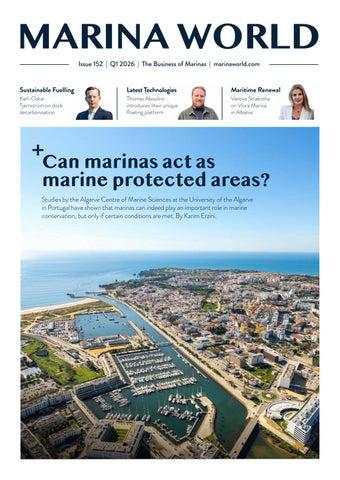
+Can marinas act as
marine protected areas? Studies by the Algarve Centre of Marine Sciences at the University of the Algarve in Portugal have shown that marinas can indeed play an important role in marine conservation, but only if certain conditions are met. By Karim Erzini.
SUPERDOCKS PUSHING LIMITS
SF Marina is a world-renowned expert on developing new or existing premium marinas. We provide state-of-the-art floating breakwaters and concrete pontoons to anyone anywhere who plans on building a marina with superyacht berths. And who wants it to still be there after the storm.
W W W . S F M A R I N A . C O M
™
OPENING LETTER
Sustainability, Seriously Dear Readers, A couple of years ago I smuggled myself into one of my partner’s lectures at a university in Seoul, Korea. “What is an algorithm?” the lecturer asked the room of some four dozen students. “It tracks your internet history to give you targeted adverts,” replied one student. “It can work out your likes and dislikes on apps like Instagram and gives you more of what you like to keep you engaged,” said another. It appeared that no one in the lecture could concretely say what an algorithm actually is. They could only give examples of what an algorithm does. The issue of sustainability in the marina sector is one that I fear suffers from the same problem. Many can give examples of what it looks like but they cannot concretely define what it actually is. This inability to precisely define sustainability has one especially damaging consequence: ambiguity. Failing to truly understand the essence of sustainability can result in one getting comfortable with ambiguity, missing the point of what really matters and not seriously addressing the issues at hand. Marina World is not an academic publication, so I will not indulge in lengthy academic debates. Instead, I will give the definition of sustainability as defined by the United Nations in 1987: “Meeting the needs of the present without compromising the ability of future generations to meet their own needs.” With this concrete definition in mind, in this issue of Marina World I am happy to present a number of examples of what sustainability does look like. These include marinas serving as marine protected areas, the future of decarbonised fuelling in Europe, resilient marina construction and One Concept Marine’s Meltem platform. Kind regards,
Patrick Norén Editor
Marina World patrick.noren@marinaworld.com
marinaworld.com
1
MASTHEAD
EDITORIAL EDITOR IN CHIEF EDITOR EDITORIAL CONTRIBUTOR NEWS WRITER FEATURES WRITER
Francesca Webster Patrick Norén Mel Symes Ellaine Zabate Enrico Chhibber
DESIGN PRODUCTION CREATIVE DIRECTOR GRAPHIC DESIGNER
Ivo Nupoort Beatriz Ramos
SALES & ADVERTISING HEAD OF SALES SALES MANAGER MARINA WORLD SALES MANAGER SALES MANAGER SALES MANAGER CLIENT SERVICE MANAGER Sales Americas & Caribbean
Marieke de Vries Brianna Johann Sabine van Hooidonk Charly van den Enden Nuri Ozkaya Johanna Borreli Philippe Critot - pcritot@marinaworld.com
CORPORATE FOUNDER & DIRECTOR TECHNOLOGY DIRECTOR FINANCE DIRECTOR COMMERCIAL DIRECTOR
Merijn de Waard Fabian Tollenaar Laura Weber Bart Beemsterboer
SuperYacht Times B.V. Silodam 256, 1013 AS, Amsterdam, The Netherlands 31 (0) 20 773 28 64 info@superyachttimes.com www.superyachttimes.com Cover Image: Marina de Lagos in Portugal by Ingrid and Martinho Fortunato
“Marina World” (ISSN “1471-5856” USPS 19194) is published 4 times a year in January, June, September, and November by “Marina World Limited”, “12 Manea Close Lower Earley Reading RG6 4JN, United Kingdom”. Airfreight and mailing in the USA by World Container Inc., c/o BBT 150-15 183rd St, Jamaica, NY 11413-4037, USA. Periodicals postage paid at Brooklyn, NY 11256. POSTMASTER: Send address changes to “Marina World”, World Container Inc., c/o BBT 150-15, 183rd St, Jamaica, NY 11413, USA.
marinaworld.com
3
30
18
Contents
44
09
Marina News
38
Sustainability in waterfront construction by Robert Brown
18
Metstrade 2025 by Patrick Norén
44
The new marina marketing playbook by Mel Symes
20
Get ready for 2026 AMI Conference & Expo
52
South Korea’s marina ambitions by Enrico Chhibber
22
Global news review 2025 by Patrick Norén
58
Financial implications of marina resilience by Esteban Biondi
30
Maritime renewal through marina development by Patrick Norén
64
6
Marina World
|
Issue 152
Sales & Acquisitions
CONTENTS
70
94
106
70
Marina markets of the interior USA by Greg Weykamp
94
76
Marinas’ role in Europe’s sustainable boating revolution by Karl-Oskar Tjernström
100
Can marinas act as marine protected areas? by Karim Erzini
82
Wynn Al Marjan Island: A new gateway to the UAE by Patrick Norén
106
The lesser-known side of Cabo by Patrick Norén
88
A three-in-one solution for marina sustainability with Thomas Aboulinc
112
Products & Services
A thorny future for Black Sea marinas by Marina World
marinaworld.com
7
Floating Excellence A curated collection of outstanding floating projects As more and more marinas moored with the Seaflex Mooring System approach twenty, thirty, or even forty plus years of service, we are launching Floating Excellence to recognize and celebrate decades of shared success in floating infrastructure. Today, thousands of floating structures in more than a hundred different countries are moored with Seaflex. These projects support marinas, ports, waterfront developments, and private installations in demanding environments. Each reflects careful design, sound engineering, and long-term reliability. Many are pioneering examples of sustainable marine infrastructure and deserve recognition. Floating Excellence is a curated collection created to document and recognize these floating projects that demonstrate proven performance in real world conditions using the Seaflex Mooring System. The collection serves the maritime industry by documenting sustainable floating solutions, providing reliable project examples, and recognizing projects of lasting quality.
Get featured in Floating Excellence Owners, operators, designers, and builders of Seaflex moored floating projects are invited to apply for inclusion by submitting photographs, videos, and brief project information. The collection includes all types of projects, regardless of size and whether they are newly built or decades old. Submissions are reviewed and selected to form a flagship collection of floating projects worldwide. Selected projects may be highlighted and credited in the Floating Excellence collection and other professional publications and presentations, both online and in print.
What is The Seaflex Mooring System? In 1977, Seaflex introduced progressive load control by combining rubber elasticity with load bearing reinforcement. Elasticity alone was not the invention. It was the patented principle of progressive load control that set a new standard for floating mooring performance. Progressive load control reduces peak forces, limits structural fatigue, and delivers predictable long-term performance. The Seaflex Mooring System protects floating structures during everyday operation and provides increasing resistance during extreme conditions when it matters most, all while leaving the sensitive underwater environment unharmed.
Floating Excellence is presented by Seaflex. Submit your project or nominate others at www.seaflex.com/Floating-Excellence or email info@seaflex.com
NEWS
News Europe
Turkey opens its 65th marina in Gazipaşa Turkey has officially opened the Gazipaşa Gold Marina in Antalya, marking the country’s 65th operational marina. The facility is expected to support year-round tourism, contribute to the local economy and create employment opportunities. Transport and Infrastructure Minister Abdulkadir Uraloğlu, who attended the opening ceremony, said the marina will extend yacht tourism across all seasons, helping to maintain activity in the region during the winter months. He noted that with Gazipaşa, Turkey’s marina network now stretches from Yalova to Seferihisar, Çeşme to Didim, and Mersin to Kaş and Alanya. Gazipaşa Gold Marina is designed to accommodate 208 vessels and features a 600-metre main breakwater, a 193-metre secondary breakwater, a 676-metre quay and a 320-metre floating pier. The facility covers more than 3,800sqm, including mechanical and electrical systems, drainage and treatment infrastructure, fire safety measures and landscaped areas. Visitors and yacht owners will have access to restaurants, event spaces and maintenance services. The project is expected to create employment, attract both domestic and international visitors and contribute to foreign currency income through long-term mooring of foreign-flagged vessels. Additional marina projects in Datça, Tekirdağ, Haliç in Istanbul, and Mersin Aydincik were mentioned during the event, with infrastructure construction for Mersin Aydincik expected to be completed by the end of 2025, followed by tendering for facilities. The minister added that over the past 23 years, Turkey has increased its number of marinas from 41 to 65 and expanded mooring capacity from 8,500 to around 26,000, which supports growth in yacht and cruise tourism in the region.
Seaflex CEO Lars Brandt wins local entrepreneurial award The president and CEO of Seaflex, Lars Brandt, has been recognised as the “Entrepreneur of the Year” at Umeågalan, an event celebrating the local business community in the northern Swedish city of Umeå on 20 November. The event also saw Seaflex awarded the “Export Company of the Year” title, after having first won the award at the gala some 20 years ago. The event was organised by Umeå Municipality with the support of the Västerbotten region chamber of commerce. The awards were presented by the “Entrepreneurs of Umeå” group. In a post on LinkedIn, Seaflex said they were “incredibly proud” to have been recognised as the export company of the year, and that to receive two awards among “so many accomplished peers in the Umeå region [was] truly humbling”. “Our warm thanks also go to the jury for the careful work behind these recognitions and to the artists who performed during the gala,” the post continued. “You created an atmosphere that made the evening a true memory of a lifetime. Congratulations also to all nominees, finalists and winners at this year’s gala. The variety of talent and innovation represented across the Umeå region is extraordinary. Being included among you is a privilege.” “We also want to thank our partners and customers around the world for your trust and collaboration. Most of all, thank you to the entire Seaflex team whose passion and skill make achievements like this possible. “Every one of you played a part in this achievement and we felt your presence throughout the evening. Together we represent Umeå and Sweden and look forward to continuing to bring sustainable marine innovation to the world!” Seaflex is an industry-leading inventor and producer of elastic mooring systems for docks, pontoons, wave attenuators, buoys and floating solar arrays.
marinaworld.com
9
NEWS
Middle East
D-Marin UAE marinas earn Blue Flag and Gold Anchor awards D-Marin’s operations in the UAE have reached two environmental milestones, with its Dubai marinas recognised for meeting international sustainability standards. Marsa Al Arab Marina secured Blue Flag status, described by the company as Dubai’s only marina to hold the certification, while Marasi Bay Marina received Gold Anchor accreditation. The Blue Flag programme recognises marinas and beaches for environmental management, water quality and community engagement, whereas the Gold Anchor scheme evaluates marinas on operational standards, environmental performance and the quality of services. Located on a peninsula within Dubai’s largest private beach, Marsa Al Arab Marina offers 82 berths for vessels up to 61 metres and provides access to resort pools, spas, group fitness facilities, Jet Ski pontoons, on-site cafes and restaurants. Marasi Bay Marina, situated in Dubai’s Business Bay district, accommodates 115 berths for vessels up to 35 metres and offers facilities including security, waste-disposal support, dock car access, and charter pick-up and drop-off. Selcuk Balci, D-Marin Dubai Managing Director said: “We are so pleased to receive such important accreditations - they really reflect the values of everyone at our marinas who are so passionate about protecting the waters we all depend on.” D-Marin UAE’s sustainability measures include underwater clean-ups, waste-management procedures, black and grey water pump-out systems and ongoing investment in renewable energy solutions. Balci added: “We believe luxury shouldn’t come at the expense of the environment. Our guests increasingly want to know that they are making decisions that align with their own values, so being able to offer them marinas that meet high environmental standards means they can enjoy their time on the water with total peace of mind.”
Egypt and Qatar sign $29.7B North Coast tourism project Qatari Diar Real Estate Investment Company has signed an investment partnership agreement with Egypt’s New Urban Communities Authority (NUCA) to develop a large-scale tourism and urban project in the Alam El Roum area on the North Coast of Matrouh Governorate. Valued at approximately $29.7 billion USD, the development spans about 4,900 acres and stretches 7.2 kilometres along the Mediterranean coastline. It is expected to attract investments, boost economic growth and create both direct and indirect job opportunities. The project will include one international marina and two local marinas, residential neighbourhoods, tourism and entertainment facilities, open artificial lakes and golf courses. Other planned features include hospitals, schools and government offices. Around 60 percent of the total land use is designated for residential developments, while service areas will occupy 15 percent. The remaining 25 percent is planned for roads, public squares, and landscaped open spaces. The land is set to be handed over without encumbrances in two main phases, followed by several smaller stages. The partnership includes a cash contribution of $3.5 billion and an in-kind consideration of 39.6 hectares of built-up area, expected to generate revenues of at least $1.8 billion. After recovering its full investment, Qatari Diar will allocate 15 percent of the project’s profits to NUCA, covering output from the company and its subsidiaries.
10
Marina World
|
Issue 152
E LL
4500
MARINAS AROUND THE WORLD
DC & AC fastcharge for ev-boats
plusmarine.com
NC E
PASSI
N POWERING MORE THAN
E
O
R EX FO C
NEWS
APAC
Gold Coast’s Marina Mirage begins $500M upgrade The Marina Mirage precinct on the Gold Coast has started a $500 million AUD redevelopment led by Makris Group. The project is expected to enhance the Southport Spit waterfront ahead of the 2032 Brisbane Olympics. Completed in late 2021, the precinct’s 78-berth superyacht marina will continue operating during construction. The marina accommodates vessels from 12 to 85 metres and includes helipad access. After 37 years of operation as a dining, retail and marina area, Marina Mirage’s commercial precinct closed last week as work on the project starts. The plans are inspired by European waterfronts and include residential, hotel and wellness facilities. The site is located along the Broadwater and provides beach access and boardwalks along the Southport Spit. According to Makris Group, the project is the largest of its type currently underway in Australia. “We are establishing the benchmark in Australia for a destination that embodies the sophistication of a Riviera lifestyle yet feels unmistakably Australian. Residents and visitors will move effortlessly from their yacht to their villa to fine dining, curated retail and world-class leisure and wellbeing experiences. This builds on the vision of my father, Con Makris, who recognised early the Gold Coast’s potential as a world-class coastal destination,” said Jason Makris, Chief Executive Officer of Makris Group. Selected waterfront restaurants will remain open until January 2026, with on-site parking available. The redevelopment is scheduled for completion in 2029. Makris Group estimates the project will create about 2,500 jobs during construction and support over 400 ongoing positions once operational.
Caribbean
Nanny Cay Marina begins expansion in British Virgin Islands Nanny Cay Marina in the British Virgin Islands broke ground on Friday, 31 October 2025, for a large-scale expansion project. The event took place on-site and drew government officials, community representatives and members of the marine sector. Premier and Minister of Finance Natalio D. Wheatley also attended the ceremony. The project includes a custom-built Marine Travelift capable of hoisting vessels up to 80ft (24 metres). It will also add 112 slips for catamarans, sailing and power yachts and vessels up to 165ft (50 metres) in length. The yard area will also expand to support increased activity and maintenance needs. Cameron McColl, Chairman of Nanny Cay stated: “This expansion reflects our ongoing commitment to improving facilities for the BVI’s marine community and strengthening Nanny Cay’s position as the heart of Caribbean yachting.” Premier Wheatley said: “This marina expansion represents the first of three phases in a broader reimagining of the Nanny Cay Resort and Marina - a transformative project to be completed over approximately three years with an overall investment of between $30 and $40 million USD in new works and amenities.” First announced in 2024, the project also includes improvements to the boatyard, a new beach, dining venues, a swimming pool and a retail village. Classrooms for maritime training and spaces for the Royal BVI Yacht Club’s dinghy programme are also part of the plan.
12
Marina World
|
Issue 152
GLOBAL LEADER IN MARINA BOAT LIFTS AND DOCK SOLUTIONS Docks You Can Trust – Built to Withstand, Engineered to Last!
239.337.4141 sales@GoldenBoatLifts.com www.GoldenBoatLifts.com www.GoldenMarineSystems.com PATENTS: #10,967,941, #11,359,802, #10,189,685, #7,850,147, #10,520,083, #10,518,852, #7,509,916, #6,918,345, #6,470,816, #6,719,241, #6,205,945, #9,278,735
NEWS
The Americas
Port of Everett approves $70M for 2026 budget The Port of Everett Commission has adopted a $70 million USD budget for 2026, covering operating and capital expenses to maintain and enhance the port’s marina, waterfront and seaport facilities. Port of Everett Marina is a public facility featuring 2,300 permanent boat slips, more than 5,000ft (1,524 metres) of guest moorage and a 13-lane public boat launch. Onsite amenities include a full-service boat yard, fuel docks, gear storage, and laundry and shower facilities. The port operates eight shipping berths on 125 acres, handling cargoes for industries including aerospace, military, construction and manufacturing. For 2026, the port has allocated $100,000 to reconstruct Guest Dock 1 and upgrade marina systems as part of a broader $12.1 million capital plan for future years. Investments in waterfront infrastructure are budgeted at $2.6 million and include public spaces, new retail and restaurant buildings, and development at the Millwright District. Seaport improvements are set at $8.1 million, funding electrification, utility upgrades, security enhancements and environmental cleanup under the Puget Sound Initiative. Maintenance and preservation of facilities, including pier strengthening, bulkhead repairs, dredging and boat launch updates, are planned at $7.1 million. The overall $70 million budget consists of $18.3 million in capital expenditures, $38.2 million in operating costs, $9.3 million in debt service, $2.7 million in non-operating expenses and $1.5 million for cash reserves.
Clearwater Beach Marina receives $7.85M in Pinellas County funding Florida’s Clearwater Beach Marina has received $7.85 million USD in tourist tax funds from Pinellas County to support its ongoing $43.5 million reconstruction. Approved unanimously by county commissioners, the funding will be reimbursed after the project is completed, according to a report by Nicolas Villamil of Tampa Bay Times. Work on the project’s design began in 2021, and construction is managed by Kokolakis Contracting with engineering by Moffatt and Nichol. The first phase focuses on the complete demolition and reconstruction of the west side of the marina and is expected to be completed by December 2025. The renovation aims to modernise the marina and maintain the current slip count. Key upgrades include replacing ageing docks, updating utilities and optimising the slip layout. Fixed docks and gangways will be raised 15-24 inches to accommodate rising water levels. Resilient floating docks will serve non-commercial users, and two slips will be designated for water taxi services. Another feature of the project is the extension of the “Marina Walk,” which continues Beach Walk with shaded seating areas. The facility will also include disability-accessible features, kiosks near primary dock entrances and electric vehicle charging stations.
14
Marina World
|
Issue 152
NEWS
Sheboygan Marina to begin $3.29M first phase upgrade The Sheboygan Marina, a city-owned facility on the shores of Lake Michigan, is set to begin a revitalisation project, with contractor Edgewater Resources responsible for the initial upgrades. Built in 1993, the marina has faced challenges in maintaining occupancy and providing full access to its slips over the years. In 2023, the city announced an estimated $11-$13 million USD plan for the overall revitalisation and hired SmithGroup to develop a conceptual master plan. The $3.29 million contract with Edgewater Resources will focus on installing modern docks and implementing an ice mitigation system to help increase dock occupancy. The marina currently provides a boater lounge, restrooms and showers, a laundry room, parking, waste collection and dock access to electricity, water and Wi-Fi. The facility also offers vessel slips ranging from 30-45ft (nine to 14 metres).
Advertisement
GLOBAL TURNKEY DRYSTACK SOLUTIONS
EVENTS
Metstrade 2025 From docks to data Another highlight of Metstrade was a panel discussion hosted by Pick a Pier’s Idan Cohen on the topic of “From docks to data: Connecting the industry for smarter marinas” on behalf of the ICOMIA Smart Marina Working Group. The panel discussion was joined by Arturo Gutierrez, General Manager EMEA at the Freedom Boat Club; and Vienna Eleuteri, CEO Advisor at the Saudi Red Sea Authority, with contributions from Joe Lynch, CEO of ICOMIA; and John White, Chair of the ICOMIA Marinas Group and General Manager of The Yacht Harbour Association.
METSTRADE
Top: Networking drinks at the Marina World stand at Metstrade 2025.
F
rom 18-20 November at RAI Amsterdam, the Marina & Yard Zone returned to the biggest marine equipment trade show in the world, Metstrade. The entire show featured around 1,700 exhibitors and around 30 unique country pavilions. The three days of vibrant exhibitions and networking at the Marina & Yard Zone, where Marina World was the exclusive media partner, were certainly testament to the importance of people-to-people networking and relationships. The breadth and depth of companies participating in the Marina & Yard Zone was a clear demonstration of the level of innovation and progress currently abound in the industry, with some of the largest and most well-established pontoon and decking manufacturers rubbing shoulders with imaginative startups looking to shake up the marina industry with their unique innovations. Marina World sales manager Brianna Johann said: “Metstrade 2025 was truly outstanding. We were thrilled by the high level of engagement and the invaluable face-to-face connections we made with our readership and industry partners throughout the event. Hosting our signature Marina World stand drinks was an absolute highlight, reinforcing the vital community spirit of the global marine sector. We are already looking forward to building on this energy next year!”
18
Marina World
|
Issue 152
The key takeaways from the discussion included the importance of data being the foundation of investment, sustainability and customer experience, combined with greater education about marinas and renewed mindsets about what they can offer communities. Despite large geographic differences, there was agreement that the industry across the US, Europe and Middle East faces similar challenges. Furthermore, it was agreed that while private equity will push the data agenda forward, smaller marinas must be guided. However, amongst discussion about the importance of using data in the marina industry to optimise performance - as has been successful elsewhere in the hospitality sector - there must also be an understanding that not all data is created equal. There is good data and there is bad data. For the marina industry to approach these challenges most effectively, there needs to be greater understanding of precisely which data marina operators need, why they need it, how it will be used and, crucially, how to approach all of these aspects in a unified way that benefits marina owners and managers, and doesn’t compromise the data security of marina users. Computer programming and, more generally, decision making, works on the principle of “garbage in, garbage out”. This means that the output of a decision making process will only be as good as the input. Bad data means bad decisions and good data means good decisions. Equal attention must also be paid to how to ensure that good data is gathered to benefit marina managers and operators as gathering any random data or, even worse, bad data - will have the opposite effect. Marina World looks forward to once again supporting Metstrade in its 38th edition, taking place at RAI Amsterdam on 17-19 November 2026.
EVENTS
Get ready for 2026 AMI Conference & Expo T
he North American marina and boatyard industry’s premier annual event is just around the corner. The Association of Marina Industries (AMI) has set the stage for the 2026 Conference & Expo, to be held on 2-4 February 2026 at the Ocean Center in beautiful Daytona Beach, Florida, with the Hilton Daytona Beach Resort serving as the host hotel.
Bottom, from top: 2025 AMI Conference & Expo; Casino night at 2025 AMI Conference & Expo. Right: 2025 AMI Conference & Expo.
As the international media sponsor of the event, Marina World presents a preview of what to expect: the trends that will dominate the show, the highlights and practical take-aways for marina professionals looking to stay ahead of the curve.
Why this event matters For marina owners, operators, managers, dockmasters, harbormasters, boat builders, designers, engineers, consultants and suppliers in North America and further afield, this event remains the go-to gathering. The 2026 edition will feature an exhibition hall with over 170 booths, showcasing cutting-edge products and services tailored for marinas and boatyards. More than 25 educational seminars and workshops will take place, covering a range of topics including leadership, operations, design and engineering, human resources and industry trends. The event is complemented by a broad networking and social schedule, the CMM/CMO awards presentation, and a marina and boatyard tour available at an extra cost.
ASSOCIATION OF MARINA INDUSTRIES
Sunday 1 February will see pre-conference workshops begin, which are also available at extra cost, before the official start on Monday 2 February with workshops, the marina and boatyard tour and an evening reception. Tuesday and Wednesday will see the full industry exhibition, keynote speeches, breakout sessions and the awards ceremony. Convenient accommodation for attendees is available at the host hotel, Hilton Daytona Beach Resort. ASSOCIATION OF MARINA INDUSTRIES
20
Marina World
|
Issue 152
EVENTS
What’s new? While much of the AMI Conference & Expo format remains consistent year-to-year, a few new or growing trends for 2026 are especially worth noting. This year features increased emphasis on digital transformation and artificial intelligence, complemented by a greater booth count and vendor diversity than in previous years. There will be an expanded focus on operations, leadership and HR, as well as stronger emphasis on resilience, sustainability and risk management through the additional Clean Marina course and tours of local sites. Meanwhile, the first media partnership between the 2026 AMI Conference & Expo and Marina World under SuperYacht Times ownership will elevate coverage and knowledge of the event beyond traditional audiences so that participants may gain broader global exposure. With a rich program, expanded exhibition hall, new partnerships and a host of evolving industry themes, the 2026 AMI Conference & Expo will be another milestone event for the marina and boatyard industry. Marina professionals from North America and further afield should come prepared, engage fully, connect broadly and translate learnings into actionable change. Marina World is looking forward to meeting you in Daytona Beach, Florida, in February. ASSOCIATION OF MARINA INDUSTRIES
Advertisement
TAILORED MARINA SERVICES TO SUIT ANY DESTINATION Seen across prestigious marinas & waterfronts globally since 1990 • Versatile pedestal ranges
• Branding options
• Emergency equipment
• Global distribution partners
• Sanitation pump-outs
• Aiding sustainability goals
• Superyacht services
• COMPLIMENTARY Development
• Electric boat & EV chargepoints • Smart monitoring solutions
surveys and M&E designs • Installation & project management COMMITTED
Sustainability Rating
JAN 2025
e: rolec@rolecserv.co.uk
www.rolecserv.com
Setting Standards for a Greener Future
REVIEW
Global news review 2025
22
Marina World
|
Issue 152
REVIEW
Marina World takes a look at the biggest stories from 2025 and highlights the ones to watch for 2026. By Patrick Norén
SAFE HARBOR MARINAS
marinaworld.com
23
REVIEW
Previous page: Safe Harbor Rybovich. Below: A rendering of Port Nimara, Anguilla. Opposite: Gåshaga Marina in Sweden.
PORT NIMARA AND SOUTH WEST HARBOUR INC.
2
025 was the year when it became undeniable that marinas have emerged as a valuable and lucrative asset for investors and property developers. The year was defined by big acquisitions, appointments and announcements with major players looking to consolidate and expand their portfolios. There is still plenty more room for this evolution to continue into 2026. The marina industry remains diverse and fragmented with plenty of new projects underway in exciting, emerging markets.
24
Marina World
|
Issue 152
REVIEW
Europe
The Americas & Caribbean Undoubtedly the biggest news of the year came in the form of the global alternative asset manager Blackstone Infrastructure buying Safe Harbor Marinas for a whopping $5.65 billion USD from Sun Communities. Commenting on the announcement in the spring, Heidi Boyd, the senior managing director of Blackstone’s infrastructure business, gave a few hints of the rationale and direction of travel: “Marinas benefit from key long-term thematic tailwinds including the growth of travel and leisure as well as population inflows into coastal cities. We believe Safe Harbor is the best positioned company in this sector and we look forward to working with their terrific team to invest behind their existing marinas and to expand their footprint.” At the time of the acquisition, Safe Harbor owned and operated 138 marinas across the USA and Puerto Rico. Since then, however, this number has jumped to over 150 locations with the further acquisitions of Christophe Harbour on St. Kitts and Los Sueños Marina in Costa Rica. The acquisition of Monaco Marine’s nine yacht service locations across the south of France and Monaco in the summer was another huge moment for Safe Harbor, transforming the company from a North American titan to a truly global player. There were plenty of other sales and acquisitions across the Americas and Caribbean that were also noteworthy, with marinas changing hands almost every week. Many more examples can be found on the Marina World website.
The fever for marina and waterfront real estate also took hold in Europe. Aside from Safe Harbor’s entrance into France and Monaco with their acquisition of Monaco Marine, another big story was the acquisition of Boatfolk by Premier Marinas, doubling their portfolio to 22 marinas across the United Kingdom. Tingdene Group continued their expansion by acquiring Farndon Marina near Newarkon-Trent and Holy Loch Marina in Scotland. The residential leisure and mooring provider Aquavista acquired three marinas in north-east England. It was a particularly busy year for the Turkish marina industry. New marinas were opened in Demre and Gazipaşa, with the latter being the country’s sixty-fifth. Koç Holding acquired two marinas and hotels in Göcek for a combined cost of $157.7 million USD and the country established a Marine Spatial Planning Coordination Board responsible for determining suitable locations for marina investments and accelerating related projects. Greece has also seen a number of developments, including SF Marina upgrades at Marina Gouvia, the announcement of a new superyacht marina in Corfu, the opening of a new marina in Lefkada and a new board at the Greek Marinas Association. Across the border in Albania, a fledgling marina industry is taking shape with enthusiastic governmental backing. Two notable news stories came out of Scandinavia at the end of the year. The Nordic market is particularly fragmented with boating remaining quite simple, local and small scale when compared to the south of Europe. However, Port Adhoc acquired its second marina in Sweden and Norvestor launched Marina Group with the acquisition of five marinas in Sweden and Norway. Whether further consolidation comes to Scandinavia is one to watch for 2026.
In the Bahamas, Legendary Marina Resort at Blue Water Cay took shape and marked its grand opening on 1 December. Meanwhile, Nanny Cay Marina in the British Virgin Islands began an expansion to add a further 112 slips. Anguilla’s Port Nimara project developed by the SF Group is also beginning to take shape, with its first vessels expected from 2027. South America started to take firmer steps towards establishing itself as a more attractive and well-developed boating destination and is gaining the recognition it needs and deserves. Guyana announced their intention to construct a tourism marina in Bartica and Marina Coast Peru in Punta Sal announced their partnership with the SF Group. BR Marinas captured hearts and minds at the fifth Monaco Smart & Sustainable Marinas Rendezvous, with their Marina da Glória in Rio de Janeiro being recognised with a “Coup de Cœur” award. GÅSHAGA MARINA
marinaworld.com
25
REVIEW
Below: The first African Boating Conference took place in Cape Town in October 2025. Right: Cornerstone ceremony for the Yamal urban development project in Oman; Bali Gapura Marina represents the start of a new chapter for Indonesia’s marine tourism industry.
Africa The marina industry on the southern shore of the Mediterranean is of course diminutive when compared to its northern shore and it will remain like this for many decades to come. That said, Africa saw some notable moments in 2025 and the prospect of greater boating for the world’s second largest continent by both size and population is intriguing. Egypt has announced a couple of big marina and waterfront real estate developments with Gulf Arab partners, including a $29.7 billion USD north coast tourism project and an $18 billion USD Red Sea resort deal. A new project is taking shape in Tangier, Morocco, and is another one to watch for 2026. At the other end of the continent, the first ever African Boating Conference was held in Cape Town in October, representing the start of a new chapter in boating in the southern hemisphere. The founder of Superyacht Cape Town, Veda Pretorius, told Marina World: “The energy in the room was electric as people from across the boating sector came together to discuss how we can maximise Africa's potential.” “We started a superyacht working group which will be driving an action plan to get our region on the map as a superyacht destination. We will be hosting it again in 2026 and we are already excited about all of our plans.” AFRICAN BOATING CONFERENCE
Advertisement
formerly The Jetty Specialist & Superior Jetties
MARINE INDUSTRY POWERHOUSE +61 7 5594 8200 | info@marinestructures.com.au
Southport Yacht Club, Gold Coast, Australia
www.marinestructures.com.au
REVIEW
“Africa saw some notable moments in 2025 and the prospect of greater boating for the world’s second largest continent by both size and population is intriguing.”
OMAN NEWS AGENCY
MARINA DEVELOPMENT INDONESIA
Middle East
Asia-Pacific
While 2025 in Europe and the Americas was defined by acquisition after acquisition, the Middle East continued construction on megaprojects and announced new initiatives to try and stand out amidst the dense but lucrative Gulf market.
The Asia-Pacific region has huge potential but is still a small industry when compared to the likes of the Middle East. With an abundance of iconic coastlines it is hardly surprising that many countries are now entertaining and indeed embarking on new marina projects of their own. The vision is a long one, though, and patience beyond 2026 will be needed to see if the Asia-Pacific can realise its potential.
Some of the biggest stories naturally came from the United Arab Emirates, with IGY Marinas being appointed the marina operator for Wynn Al Marjan Island, set to open in 2027. Bvlgari also entered into a long-term agreement with Eagle Hills to launch a new resort and residential project featuring a 40-berth marina from 2030. Dubai’s new “Dock & Dine” initiative across 20 marinas gives owners, guests and crews greater flexibility and access to facilities and experiences across the city, while the new “Marsa” platform automates the entire leasing process, covering online berth bookings, automatic fee calculations, invoicing and smart payments. Meanwhile, Bahrain is investing in a network of marinas to capture some market share, Old Doha Port launched the Mina Corniche Marina and Oman embarked upon a flurry of projects including in Khor Grama and Al Manuma.
The world’s largest archipelagic nation, Indonesia, is finally making its mark on the global yachting map with the construction of the country’s first full-service, international standard marina in Bali. The development, called Bali Gapura Marina, is being constructed at breakneck speed and marked the start of its commercial pilot phase in November. India announced bold new plans for the country’s first marina project in Mumbai, while construction on a new superyacht marina in Sri Lanka began. Vietnam also launched its first international standard marina in Nha Trang.
On the other side of the peninsula, however, lies perhaps the most eagerly anticipated marina and waterfront development in the Middle East, AMAALA Triple Bay in Saudi Arabia. With opening scheduled to take place in phases from 2026, next year will reveal whether the Red Sea can indeed attract the number of visitors it needs to turn a bold vision into workable reality.
Further to the north, Hong Kong’s Lantau Yacht Club received the 5 Gold Anchor platinum accreditation and South Korea reflected rising domestic interest in boating with its revised marina port plan, featuring 40 planned zones across nine regions. Fiji’s Port Denarau also completed a landmark $6 million USD extension in September.
marinaworld.com
27
REVIEW
Below: Coffs Harbour Marina in New South Wales, Australia.
MARINE STRUCTURES
Australia & New Zealand Australia and New Zealand saw a handful of notable stories that would suggest similar trends of acquisition and expansion in Europe and the Americas, but perhaps not quite as feverish. Spinnaker Sound Marina in Queensland was sold for $12.25 million AUD, while Blakehurst Marina and the Cruise Whitsundays marina and terminal were put up for sale. New berths were opened at Pacific Point Marina & Boatyard, a $3.3 million AUD berth project was completed at Batavia Coast Marina and Coffs Harbour Marina replaced five marina arms and added 143 berths in partnership with Marine Structures. Swan Yacht Club expanded by 32 berths and October saw the approval of a $100 million AUD mixed-use precinct featuring a marina at The Spit in Queensland. On the other side of the Tasman Sea, the largest yacht marina in the southern hemisphere, Westhaven Marina in Auckland, completed a full replacement of its L pier, and Brunswick Corporation’s Freedom Boat Club opened a new location at Te Ana Marina in Lyttelton, Christchurch. Meanwhile, the Waipiro Marina project in the Bay of Islands would be fast-tracked through the governmental review process despite opposition from local groups, and SF Marina installed a new arc-shaped floating breakwater at Waiheke Island Marina.
28
Marina World
|
Issue 152
Anyone for bingo? 2025 has been a fast-paced, dynamic year in an industry that otherwise moves slowly. The pace and frequency of acquisitions especially in the Americas and Europe is evidence of healthy tailwinds from institutional investors who are recognising marinas as valuable real estate properties. I expect this to continue in 2026. The Middle East will no doubt continue marketing themselves as “the next big superyacht destination”, but the proof of the sailing will be in the berthing, so to speak. The Asia-Pacific region will likely continue investing in this new arm of what are often already highly popular tourist destinations, but the realisation of its full potential is still several years away. South America and Africa have their own new projects underway and I look forward to seeing some flesh emerge on the bones of their future boating industries. Needless to say, Brazil is already comparatively well established and has huge potential as a local and international boating hub in the southern hemisphere. Especially when it comes to sales and acquisitions, I am sure the imaginative industry observer would enjoy playing some “2026 Marina Movement Bingo”. Anyone fancy a game?
MARKET FOCUS
Maritime renewal through marina development With enthusiastic governmental backing, Albania is planning a network of marinas along its coastline to revitalise its seaside cities and attract a highly lucrative tourist demographic. New marinas in the cities of Vlora and Durres are leading the charge. By Patrick Norén
30
Marina World
|
Issue 152
MARKET FOCUS
VLORA MARINA
marinaworld.com
31
MARKET FOCUS
VLORA MARINA
N
ot even 40 years ago, Albania was one of the most isolated countries in the world. Trapped in a brutal communist regime led by Enver Hoxha, Albanians could not even travel freely around their own country - let alone travel abroad - and foreign visitors were largely banned. Even as neighbouring socialist Yugoslavia successfully developed and marketed its Croatian and Montenegrin coastlines to international tourists, Albania lagged behind. When communism in the Balkans collapsed in the early 1990s, Italy, Greece and especially Croatia were already highly popular international tourist destinations with the infrastructure and amenities to match. Albania, however, lacked international investment, suffered from crime and instability, and was generally associated with manifold negative stereotypes.
32
Marina World
|
Issue 152
Oh how times change. Albania has burst onto Europe’s tourist scene in a spectacular fashion with a six-fold boom in visitor numbers since 2014, boasting an astonishing variety of cities, landscapes and experiences in an area smaller than the US state of Maryland. The country has quickly become one of Europe’s trendiest destinations, with 14 million tourists predicted to enjoy its monumental peaks, ancient heritage and stunning coastline in 2025. But those visiting Albania for its coastline are still largely limited to visiting by land or air rather than sea, unless they happen to take the passenger ferry from Italy. Recreational marine infrastructure is wanting and the country has decided it can no longer afford to miss out on a lucrative and competitive industry. The direction of travel is clear: on the motorways heading to the coast you will see a number of huge billboards advertising Albania’s flagship projects, including Vlora Marina and Durres Yachts & Marina.
MARKET FOCUS
VLORA MARINA
“A necessity for Albania” “Albania is finally free to look outwards again and we want to catch up with Europe, not just politically or economically, but also in how we use and protect our coastline,” Albania’s deputy prime minister and minister of Infrastructure and Energy, Belinda Balluku, told Marina World during an interview in Tirana in October 2025. “But now, if we want to make our coastline accessible to high-end tourism, we need to give people instruments and infrastructure where they can enjoy their environment. Therefore marinas are absolutely a necessity for Albania.” At the heart of this strategy is relocating dirty and noisy industrial ports deleterious to local life and international tourism away from city centres to new locations. Meanwhile, the old ports’ pre-existing infrastructure will be transformed into the country’s first two full-service, international standard superyacht marinas. “We’re careful about where and how we build, focusing on areas that already have infrastructure and avoiding sensitive ecosystems,” Deputy PM Balluku stressed. “The concept is ‘smart growth’, not overdevelopment.”
Previous spread: A rendering of Vlora Marina in southwestern Albania. Left: A rendering of waterfront accommodation by Vlora Marina. Top: A rendering of the entrance to Vlora Marina.
Albania’s vision for its maritime infrastructure is not purely economic. Last century’s communist system prevented Albanians from travelling freely around their own territory, including to the seaside, and therefore stifled the emergence of a collective maritime consciousness and culture befitting a country with 450km of coastline. To reverse this, Albania is taking inspiration from another small Mediterranean country that is famous for its worldclass marina and the surrounding ecosystem. “Monaco has built a full life cycle and culture around marinas, starting from young people and education. We admire how Monaco integrates marinas with urban life, creating spaces that serve both residents and visitors, while maintaining high environmental standards,” said deputy PM Balluku.
Advertisement
MARKET FOCUS
GOVERNMENT OF ALBANIA
Vlora Marina Recognising a gap in Albania’s maritime infrastructure and the chance to cement a new standard of coastal living in the country, the team behind Vlora Marina saw an opportunity to pioneer a new industry. “The vision is for Vlora Marina to become a Mediterranean reference point blending modern design, high-end hospitality and Albanian identity,” said Vanova Strakosha, programme manager of Vlora Marina, during an interview with Marina World at their offices in the city. “It will elevate how the city and country is perceived in the region and internationally.” The marina’s location in the wider landscape and the design seen in renderings are as inviting as they are striking. On the border of the Ionian and Adriatic seas in southwestern Albania, Vlora dates back almost 3000 years and is surrounded by the gentle green foothills of the Ceraunian Mountains, capped by 300 days of sunshine per year. The marina itself has been designed by the British-Turkish company ARTI Proje and is set to be the country’s first development of its kind with over 400 berths for vessels up to 50m. It is expected to be operational by mid-2027. Meanwhile, the residences emphasise “Mediterranean lifestyle, combining modern comfort with traditional coastal values”, Strakosha added. “Buildings are oriented to maximise views towards the sea and the beautiful green mountains across the bay. This ensures that every residence connects with the natural surroundings.”
34
Marina World
|
Issue 152
“Outdoor public spaces will play a central role reflecting the local tradition of living between indoor and outdoor areas,” said Strakosha, highlighting the inspiration that Albanian culture has had on the design of the marina and waterfront areas. “For example, Albania has the highest density of cafés in the world, this is an important part of our culture. In Albania, we relax with family, socialise with friends, conduct business with colleagues and clients, all in cafés.” “From the start, our goal has been to set new standards in the Albanian, Adriatic and Ionian regions. We have partnered with top international consultants and designers to ensure that every element - from raw materials to the guest experience - meet world-class marinas’ criteria,” Strakosha added. Indeed, the premium Mediterranean and UAE marina operator D-Marin has thus far supported Vlora Marina with technical expertise and consulting about facilities, locations, pontoon types, offices and other elements such as their fuelling station, and was announced as the marina’s operator in December 2023. D-Marin’s chief commercial officer, Dean Smith, told Marina World: “We are very interested in the cruising opportunities offered by Albania and having a high-quality facility available to yachtsmen opens the door for all.” He added: “Working with the project team has been a very positive experience as their focus on quality and building a perfectly integrated residential, leisure and marina facility aligns perfectly with the D-Marin offer.”
MARKET FOCUS
Left: Marina World conducting an interview with Albania’s Deputy Prime Minister Belinda Balluku in Tirana in October 2025. Below, from top: A rendering of pedestrian waterfront areas at Vlora Marina; Marina World conducted an interview with Vanova Strakosha in Vlora, Albania, in October 2025: Aerial rendering of Vlora Marina.
Durres Yachts & Marina
VLORA MARINA
The second landmark project on Albania’s coast is gradually taking shape in the city of Durres, whose port has been in continuous operation for almost 3000 years and is the country’s largest. Durres port’s commercial operations will gradually be transitioned to Porto Romano, a few kilometres to the north. Meanwhile, the enormous 44 hectare site will become the Mediterranean’s largest marina by area, boasting multiple hotels with more than 850 rooms, business areas, eight hectares of green or open spaces, up to 700m of beachfront and up to 280 yacht berths. The development will also be complemented by new road and rail links to both Kosovo and North Macedonia, increasing its pull and reach to markets beyond Albania’s coast. According to an agreement signed between the lead developer of the project, UAE-based Eagle Hills Real Estate Development, and the government of Albania on 30 January 2023, the project has a total value of around €2 billion. The project will unfold in stages with a full development timeline including the yacht marina and additional hotels running to 20 years. Durres Yachts & Marina is 33 percent owned by the Albanian state through the Port of Durres’ Albanian Seaports Development Company, with the remaining 67 percent owned by Eagle Hills.
MARINA WORLD
A document supplied to Marina World by Durres Yachts & Marina promises the “creation of new jobs, preservation of local culture and heritage, strengthening of community bonds, provision of social services, commercialisation of culture and art”, as well as the “revitalisation of art and culture in general”. The preservation of history is of particular concern in Durres, with a 2000-year-old Roman amphitheatre and other ancient sites within walking distance from the current port. “We want modernisation but not at the cost of our identity,” said deputy PM Balluku. “In practice, this means every marina project includes cultural and architectural guidelines that reflect the local character. It is important to recognise that people preserve history by giving or creating access to it, and this is what our marinas will do. For example, the future marina of Durres will blend with the historic city’s Roman and Venetian heritage, turning the old port area into a public waterfront with cultural and recreational spaces, not a closed enclave.”
VLORA MARINA
marinaworld.com
35
MARKET FOCUS
“Marinas are becoming places of life, leisure and pride. That social renewal might be the most meaningful benefit of all.”
Yachting Ecosystem
Bottom, from top: Marina World visited Durres Yachts & Marina sales office in Durres, Albania, in October 2025; Albania’s Deputy PM Belinda Balluku with Marina World in October 2025.
The projects featured in this article are only two major pillars of Albania’s whole vision as the country is planning a network of smaller marinas along the entire length of its coastline. Other notable marinas include Sarande and Orikum in the south, as well as Shengjin in the north. Most notably, the Ministry of Infrastructure and Energy has partnered with Luca Dini Design & Architecture to explore the development of a national maritime strategy in which Albania’s marinas cooperate rather than compete. “Instead of each marina working alone, they’ll operate as a network, optimising logistics, maintenance and transport connections. This model avoids congestion, spreads demand and protects sensitive areas along the coast,” said deputy PM Balluku about the partnership with Luca Dini. She added that they are also introducing “green marinas” that share resources and infrastructure to reduce carbon footprints. Indeed, sustainability is a topic that Albania has long taken seriously as it is one of only a handful of countries in the world that generates 100 percent renewable energy. “Sustainability is a non-negotiable principle for us…We’re determined that our marinas reflect the same philosophy,” she added.
Social renewal DURRES YACHTS & MARINA
It will still be quite some years before Albania truly joins its Adriatic and Ionian neighbours to compete on their level. Vlora Marina will be operational in mid-2027 while Durres will only begin to realise its potential as a luxury marina and waterfront development in the 2040s. These are long-term investments, however, and the country is clear-eyed about the potential that marinas have to redefine not only Albania’s burgeoning tourist industry but also the country’s relationship with the sea. “Now, people are reconnecting with the sea to explore another world, a water world,” deputy PM Balluku concluded during her interview. “It is right that we develop a network of marinas not just for the economy, but to create a new way of living throughout generations. Marinas are becoming places of life, leisure and pride. That social renewal might be the most meaningful benefit of all.” GOVERNMENT OF ALBANIA
36
Marina World
|
Issue 152
Complete Dock Systems From Design to Installation When the coast calls, it deserves the best answer. Marina Technologies designs and delivers complete dock systems, from floating wave attenuators and concrete docks to fixed and floating aluminum frame docks for vessels up to 350 ft. Engineered for demanding coastal environments and designed to elevate the water’s edge.
M A R I N AT E C H N O L O G I E S . C O M
COME SEE US AT AMI. BOOTH: 621-623
SUSTAINABILITY
Sustainability in waterfront construction In coastal environments where environmental sensitivity and asset performance are linked closely, sustainability is no longer simply a moral choice. It has become a market driver. By Robert Brown
GCM CONTRACTING SOLUTIONS
38
Marina World
|
Issue 152
SUSTAINABILITY
Opposite: Render of a mixed use marina concept. Right: Solar roof panels in a marina.
Building better, not just cleaner A key part of building sustainably is choosing materials and systems that extend the lifespan of marina infrastructure while reducing maintenance and operational impacts.
GCM CONTRACTING SOLUTIONS
S
ustainability has shifted from a secondary consideration to a defining force in the way marinas are built, operated and evaluated. Around the world, developers and operators are navigating a landscape shaped by climate pressures, rising operational demands and increased scrutiny from regulators, investors and communities.
What does “green” really mean? Sustainability in marina development was once framed as an environmental obligation or a list of compliance requirements. Today, expectations reach far beyond that. Marina owners must balance environmental responsibility with the practical realities of construction feasibility, cost efficiency and long-term operational performance. Climate volatility, sea-level rise and intensifying storms are reshaping development standards worldwide. Regulators demand greater accountability, communities expect resilient and environmentally conscious facilities, and the financial impacts of downtime continue to increase. Sustainability has become a prerequisite for long-term viability.
Tilt-wall concrete, low-carbon concrete mixes and recycled aggregates are increasingly important in waterfront construction. These materials lower embodied carbon while offering superior durability, fire resistance and structural performance, which are critical advantages in saltwater environments. For marinas, durability is sustainability. Energy-efficient systems are also emerging as essential components of responsible marina design. Solarintegrated roofs, LED lighting, all-electric lifts and smart pump-out systems reduce emissions and lower energy consumption, supporting the transition toward cleaner operations. Across the industry, we are seeing a shift from “checkbox compliance” toward measurable performance: lifecycle carbon, energy use, water consumption, storm readiness and material durability now serve as meaningful indicators of sustainable development. Automated vertical storage systems are also reshaping the sustainability conversation. By consolidating vessel storage into a smaller footprint, these systems reduce land disturbance, minimise impervious surfaces and lower the embodied carbon associated with traditional long-span structures. Their fully electric operation eliminates the diesel-powered forklifts commonly used in dry storage, further reducing emissions and operational impact. Dense vertical storage not only supports cleaner marina operations but also aligns with modern expectations for resource-efficient coastal development.
marinaworld.com
39
SUSTAINABILITY
Right: A photo from 2011 of Porto Montenegro in Tivat.
Resilience and environmental stewardship In a coastal context, sustainability and resilience are inseparable. Marinas must be designed to minimise environmental impact while maintaining stability amid atmospheric and tidal extremes. Contemporary marina sites incorporate elevated building pads, optimised grading, stormwater retention systems, runoff mitigation measures and erosion control strategies. These approaches reduce environmental impact while improving long-term operational continuity. Natural infrastructure such as mangrove buffers, shoreline vegetation and permeable paving strengthen protection while supporting water quality and habitat health. Recent hurricane seasons in the southeastern United States have demonstrated the value of hardened construction. Facilities built with elevated dry-stack systems and reinforced concrete structures have survived major storms with minimal damage and zero vessel loss, even as surrounding properties experienced severe impacts. These real-world outcomes underscore how resilient design directly supports environmental stewardship, operational continuity and long-term customer confidence. Storm-driven disruptions now represent one of the largest unplanned expenses for marina operators. Facilities built with durable materials and proactive adaptation measures often experience shorter recovery times after major events, preserving revenue stability. Insurers are adjusting their assessments as well. Marinas that can demonstrate flood protection, elevated floor systems, hardened structures and modern stormwater strategies often benefit from more favorable premiums and stronger coverage options. There are clear competitive advantages in being resilient.
40
Marina World
|
Issue 152
The investor and regulatory advantage As concerns around sustainability grow, it is reshaping how marinas are financed, permitted and evaluated. Investors are showing increased interest in assets with strong environmental performance. Durability, efficiency and reduced operational risk support stronger long-term returns. Facilities that integrate resilient site design, modern energy systems and low-carbon materials not only operate more efficiently but often align with the environmental, social and governance (ESG) standards guiding institutional investment strategies. Regulatory frameworks are evolving alongside these market expectations. ESG criteria influence funding decisions and operational reporting, and marinas that demonstrate responsible resource use, emissions reduction and transparent environmental management are better positioned to secure support. Local governments are also creating support mechanisms for environmentally responsible projects, including expedited approvals, sustainability-linked grants and tax benefits for developments that reduce impervious surfaces, improve water quality or incorporate habitat restoration.
SUSTAINABILITY
DANIEL NYUL VIA WIKIMEDIA COMMONS
“ESG criteria influence funding decisions and operational reporting, and marinas that demonstrate responsible resource use, emissions reduction and transparent environmental management are better positioned to secure support.”
Advertisement SOFTNG, N
O
W
C PA
TH: WI
SUSTAINABILITY
Right, from top: ONE°15 Marina Sentosa Cove in Singapore; Tiltwall concrete panel construction.
Global momentum in sustainable waterfronts Technology is enabling marinas to integrate sustainability into everyday operations in ways that were not possible a decade ago. Across the world, public initiatives and individual marinas are demonstrating meaningful environmental gains through innovation.
ONE°15 MARINA
One°15 Marina in Singapore integrates solar power, water-recycling systems and digital monitoring tools to track energy use and environmental impact. Its awardwinning sustainability programmes showcase how datadriven operations can strengthen both performance and environmental stewardship. In Europe, Porto Montenegro in Tivat demonstrates how digital energy-management systems can monitor consumption, optimise operational efficiency and support eco-certified performance across a large, mixed-use waterfront. It illustrates how intelligent systems can turn sustainability goals into measurable outcomes and offers a framework for marinas seeking to integrate data-driven decision-making into their operations. In the United States, Gulf Star Marina in Fort Myers Beach illustrates how automation contributes to sustainability. Its fully electric automated dry-stack system eliminates dieselpowered forklifts and reduces building footprint through efficient vertical storage. The facility also uses tilt-wall concrete for greater storm resilience and long-term durability.
The future of sustainable marinas Sustainability expectations continue to evolve around the world. In the United States, resilience and stormhardening remain top priorities due to hurricane exposure and rising insurance pressures. In Europe, marinas lead in emissions monitoring, certification frameworks and energy-efficient operations. In the Asia-Pacific region, major coastal developments are embedding sustainability into tourism and blue-economy planning. Despite regional differences, a shared direction is emerging. Certifications, environmental reporting and resilience planning are becoming foundational expectations for new development rather than optional enhancements. Marinas that succeed in the coming decade will incorporate sustainability into every phase of planning, design and operation. It will be a fundamental element of long-term strategy rather than an optional add-on. GCM CONTRACTING SOLUTIONS
42
Marina World
|
Issue 152
Unveiling an extraordinary new project in Valencia
• Four marinas in one. • An open Shipyard. • Offices and coworking spaces. • Leisure, dining & entertainment area. Check out our website: marinaportvalencia.es
MARINA PORT VALENCIA Oficinas Marina Norte, s/n 46024, Valencia
+34 960 302 690 marinaportvalencia.es info@marinaportvalencia.es
THE STRENGTH OF A GREAT GROUP →
MARKETING
The new marina marketing playbook "Since becoming editor of Marina World many have told me that the marina industry needs modernising with fresh ideas and approaches. It is true to say that the marina industry moves slowly, but this should not be an excuse to become too comfortable in the mindset of 'if it ain't broke, don't fix it'. It is a choice between accepting what is good - or working to make it better.” Patrick Norén, editor of Marina World By Mel Symes
LYMINGTON YACHT HAVEN
44
Marina World
|
Issue 152
MARKETING
Opposite: The marina industry today operates in an experience economy where customers value memories and meaningful moments.
Debbie Parsons-Randle
Data-driven experiences Debbie Parsons-Randle spent nearly two decades in the hotel business before her swift ascent at IGY Marinas to become vice president of global marketing. She recognises that, comparatively, marinas represent “a much more niche market and set of very individual customer requirements” but admits that “hotels are streets ahead via their use of tech, data, platforms, etc.” She notes that “the marinas that adopt some of these tools, such as CRMs or engaging in customer segmentation, will definitely gain a cutting edge.” Dr. Riccardo Spinelli, associate professor in management at the University of Genoa's Department of Economics, spoke at the recent ICOMIA World Marinas Conference in Venice.
Mark Jardine
F
or years, many marinas succeeded simply by offering a safe place to park a boat. But today, the industry is operating in an experience economy where customers value memories and meaningful moments over simple transactions. This shift comes with combined pressures we can't ignore: an ageing customer base, affordability and the need to connect with new generations who prioritise flexible access over long-term ownership, communicate on different platforms and demand transparency, environmental accountability, and a genuine commitment to community and purpose. Moreover, many agree that the industry has a worrying tendency to talk to itself instead of reaching out and actively listening to the needs of non-boaters and wider stakeholders. In the following pages, media professionals, company founders and experts from the industry and academia generously share their advice and perspectives on how marina teams can up their marketing game.
“To deliver services that truly reflect individual preferences, it is essential to understand customers’ behaviour and the expectations shaped by their marina and boating experiences.” In this way resources can be put to better use to both drive loyalty and potentially generate higher financial rewards for the marina. He understands that marinas might be host to many different business models. “Groups of boaters that welcome the social side and enjoy being seen - the ‘conspicuous consumption’ type - may welcome being located visibly in the marina and receiving VIP packages in line with their philosophy. For others, the priority might be boating and being on the water. They may not enjoy the noisy, social aspect of a marina and prefer a quiet berth away from the crowds.” “Marketing”, Dr. Spinelli describes, “is about helping the customer achieve their perfect outcome. The core idea is simple: value is not in the thing you buy; it's in how you use it. Instead of just advertising a berth, marketing needs to focus on helping the customer realise their goal, whether that's relaxation, connecting with family or having an adventure. The marina's job shifts from being a salesperson to being a partner - or facilitator - that makes sure everything is perfectly arranged for the customer to have that ideal, complete experience.”
marinaworld.com
45
MARKETING
Value co-creation Yachting media figure, Mark Jardine, reflects that marketing is all about education and facilitating access to boating. He recommends “building content from authentic case studies, so that the potential customer finds it relatable and thinks: ‘That’s me. That's how I can get out on the water.’” Established industry player Navily operates a marina reservation platform that aims to inspire boaters to try new destinations. Co-founder Edouard Fiess describes his early days in boating and frustration with the paucity of available information about marinas, where current wisdom travelled through small circles of influence discussed on the pontoon, debated at the bar and shared directly between neighbouring boats. “When I asked about a destination, I was given a huge scholarly tome with the advice: ‘Read this, you’ll see it’s beautiful.’ ‘But there are no pictures…’ I’d counter. ‘But read the description’, they’d insist, ‘You’ll see that it says that it’s beautiful.’ Trying to make a reservation with outdated information was yet another challenge.” Discussions with marina operators around the company’s inception in 2014, elicited an almost blanket rejection of a reservation service and an absolute horror at the idea of reviews. Today their platform features 1000 partner marinas across 20 countries, lists 130,000 reviews, and serves over 400,000 active boaters.
MARKETING
Left: Local autonomy, exceptional service and family-friendly design can shape branding and customer experiences.
Platforms like Navily have recognised that achieving scale and market accessibility works best with co-creation akin to models like TripAdvisor. This shift transforms the customer from a passive consumer into an active partner whose contributions - and not just their purchases - drive the platform’s competitive advantage. “Before you might have the word of one pilot guide author; now you have 50-100 people sharing their opinions and bolstering the available user-based information about the marina.” “Marinas used to refer to bookings by the name of the boat. After receiving advice, we made the owner more prominent (photo, first name and last name) humanising the profile. Marinas now welcome a person. One of the truly gratifying developments we’ve seen is marina manager job descriptions explicitly calling for ‘Navily / online booking platform experience’. The new goal is clear: proactive management of customer reviews, feedback and the end-to-end customer experience. Some marina employees tell us that they are even financially incentivised for good reviews, creating more accountability in customer service.” LARGS YACHT HAVEN
Advertisement
MARKETING
AI: tool or trap? Artificial intelligence of course plays an inevitable role and its growing significance as a curator of online search results cannot be ignored. In a fragmented media landscape, the challenge for marinas is not just where to post, but how to build trust in a measurable way. As Mark Jardine describes: “AI can create churn media, but it is thankfully also very good at filtering out this junk. Consequently, there’s a need to create media that is truly engaging, otherwise AI will simply ignore it.” Marketing professional Rebecca Whitlocke, founder of Antibes Yachting, describes the importance for marinas in building a sustainable and authoritative brand in the age of AI, one that consistently spans both their real and online presence:
Edouard Fiess
“Within an AI-controlled information ecosystem, where large language models such as ChatGPT and Gemini can produce vast amounts of generic, fairly well-written content, your authority is no longer solely based on what you say, but on who you are and the proof you can provide. This shifts the focus from simply generating content to demonstrating verifiable facts, trustworthiness and providing unique insights. Achieving this legitimacy also means being backed up by referrals from other respected industry members, demonstrating industry certifications and counting on quality backlinks. Essentially: does your online footprint back up your claims?” Again, getting the messaging right for each segment is essential: “Marinas will also need to ensure that they can demonstrate upholding values held by younger generations,” advises Whitlocke. “These include having a clearly defined purpose and generating social impact through local partnerships, such as supporting environmental stewardship or charitable causes.”
Rebecca Whitlocke
To further solidify their authority, she stresses the need to be transparent and proactive regarding wider industry issues. By engaging openly on economic and regulatory impacts, such as local and national maritime regulations and supply chain factors, marinas demonstrate their commitment to promoting the greater boating community and economic health, which solidifies their trustworthiness. Both Whitlocke and Parsons-Randle point out that beyond the benefits of generative AI, marinas should consider the associated risks, where staff training is beneficial to safeguard data security and confidentiality, flag up areas of potential liability and encourage critically evaluating AI’s outputs.
48
Marina World
|
Issue 152
Jonathan Cook
MARKETING
Defining your USP A marina’s unique selling point, then, central to their brand, can be the one thing that avoids sounding generic. As Jonathan Cook, group marketing manager at Yacht Havens Group, describes: “Although Yacht Havens is a group of nine marinas across the UK and the Netherlands, our USPs have always been defined at local level. Each Yacht Haven operates as its own destination, shaped around the needs, habits and expectations of its local boating community. We predominantly market our marinas on a site-by-site level, building marketing strategies that serve the boating communities at each of our locations. This localised approach allows us to develop tailored marketing activities, drawing on the knowledge and strengths of each Haven Team and collaborating closely with local businesses.” Principles such as local autonomy, exceptional service and family-friendly design shape both our branding and our customer experiences. They guide our marketing from our tone of voice to website content and information architecture, photography and videography.”
Ricardo Spinelli
Advertisement
Built for lasting memories
MARKETING
Below: Organising events is another way to increase marina exposure.
IGY MARINAS
Channelling content “Once you’ve selected the right channels for each segment”, urges Rebecca Whitlocke, “tailor content accordingly. A halfhour interview is absolutely the wrong approach for TikTok, for example. Content for Instagram and TikTok needs to be visual, dynamic, fun and aim for immediate engagement.” She also implores companies to recognise their resource limitations and prioritise the means to post consistently over striving for multiple channel coverage. Whitlocke firmly believes that print media retains an important role: “Five years ago, I’d have been more doubtful about the value of print media amidst the rising tide of all things digital. Today, however, it’s clear that people appreciate a break from their phones and enjoy the physicality of paper. Holding a magazine obviously feels more tangible, can imply greater authority and certainly lasts for longer. Compared with the fleeting nature of a social feed, you’re also far more likely to come back to it. If left in a social space, others may well take an interest.” Mark Jardine recommends outsourcing marketing requirements if the team doesn’t have these skills but notes that the success of such efforts relies heavily on the brief given. Here, marinas need to start by carefully considering what they want to achieve. “Then you determine the best route to convey this message and how to reach the right audience. Be very careful about who you choose; make sure the person or agency can work properly to a brief, so try them out with something small first. To guide you, look at successful campaigns and at what else is being done in the industry.”
50
Marina World
|
Issue 152
Heading to a boat show? With boot Düsseldorf on the horizon, Debbie ParsonsRandle offers a helpful checklist for making the most of your presence at boat shows, particularly if the marina has contracted a stand. –
Consider what a successful show looks like for your company. Set measurable targets.
–
Plan well ahead. Use relevant social media channels to run campaigns. Key company attendees should announce their presence on business-to-business channels.
–
Email the customer database well ahead of time and invite them to visit the stand.
–
Reach out to potential partners / possible boating events (rallies, etc.)
–
Maintain a meeting plan.
–
For staff, this amounts to a long time away from home. Plan some fun social activities that don’t eat into their personal time too much.
–
Always follow up after the show on contacts made and conversations held.
Many thanks to all the contributors to this article for sharing their expertise.
MARKET FOCUS
South Korea’s marina ambitions When discussions turn to marina development in Asia, attention has tended to focus on markets such as Indonesia, Japan and China. South Korea, by contrast, has received far less attention.
By Enrico Chhibber
KIM CHOONG-HWAN
52
Marina World
|
Issue 152
MARKET FOCUS
Opposite: ARA Marina in Gimpo, Seoul, on the Han River. Below: Yi Sun-sin in Yeosu, South Korea.
History and evolution of South Korea’s marina sector For much of the post-war period, access to South Korea’s coastal waters was tightly restricted, with maritime activity largely limited to commercial shipping, fishing fleets and the military. Tim Coventry, who has advised on marina development in South Korea for more than two decades, recalls that during his earliest involvement in the country, recreational boating was effectively absent. “Everywhere that had access by boat from the sea was surrounded by barbed wire and gun posts,” he said, reflecting the security environment shaped by the unresolved situation on the Korean Peninsula. Beaches were largely inaccessible and leisure use of coastal waters was minimal.
MINISTRY OF OCEANS AND FISHERIES
A
ccording to 2023 data from the Korea National Oceanographic Research Institute, South Korea’s coastline extends to more than 15,000 kilometres, encompassing close to 10,000 kilometres of mainland shoreline and over 3,300 islands. This scale is notable given that the country has spent more than a decade laying the groundwork for a national approach to marina and marine leisure infrastructure. The country has pursued marina development through a series of multi-phase national planning frameworks overseen by the central government. These plans have sought to expand leisure boating infrastructure across the country, largely through publicly funded projects, reflecting a gradual shift towards recognising marine leisure as an economic and tourism asset. Yet, despite this geographic scale and sustained government efforts to develop coastal infrastructure, South Korea’s marina network and recreational boating sector remain relatively underdeveloped compared with other mature marina markets in the region.
This began to change following legislative reforms introduced around 1979–1980, when the Korean government moved to relax restrictions on civilian access to coastal waters. However, according to Coventry, it was not until 1983 that the coastline was effectively opened to leisure use. “The Act of Parliament was in 1979/80, but the first year the seas were really open was ’83,” he said. Physical demilitarisation followed shortly afterwards. “A year later, they had taken down most of the barbed wire fences,” Coventry added, marking what he describes as the first meaningful opening of South Korea’s coastline to recreational activity. Early initiatives to stimulate interest included public boating festivals and international sailing events, aimed at introducing leisure boating to a population with little prior exposure to it. As access expanded, attention gradually turned to infrastructure. South Korea’s initial marina development initiatives were largely shaped by central government policy rather than organic market demand. Coventry notes that early planning prioritised increasing the number of facilities across the country, often without a clear distinction between working ports, fishing harbours and purpose-built leisure marinas. While construction quality was generally high, reflecting the country’s strong civil engineering capability, many early sites struggled to develop into active boating hubs, highlighting the challenges of building a marina network in parallel with, rather than in response to, user demand.
marinaworld.com
53
MARKET FOCUS
National approach to marina development South Korea’s marina sector has been shaped primarily through a series of government-led development plans introduced since 2010. Overseen at a national level and supported largely by public funding, these frameworks were designed to stimulate marine leisure activity by expanding infrastructure ahead of demonstrated demand. The emphasis has been on geographic coverage and regional balance, rather than concentrating facilities around established population centres or existing boating clusters. Dr Kim Choong-hwan, general manager of the Korea International Boat Show, describes the sector as still being at an early stage. “The marina industry in Korea is still in its market entrance stage,” he said, noting that development to date has been “primarily government-led”. While the number of designated marina sites has increased under successive master plans, he acknowledges that many facilities are relatively small and often located outside metropolitan areas, reflecting policy priorities rather than immediate market dynamics. ANNIKA KRÜGER NORÉN
Advertisement
The choice of professionals www.roodberg.com
The Original
MARKET FOCUS
Left: Despite boasting 14,000km of coastline, South Korea’s marina infrastructure has remained underdeveloped. Right, from top: Geobukseom Marina near Incheon, South Korea; Goha Island in Mokpo, South Korea; Suyeongnam Bay Yachting Center in Busan.
This policy-led approach is reflected in the profile of several marinas developed under successive national plans. Facilities such as ARA Marina and Geobukseom Marina on the west coast, alongside Hupo Marina and Jebu Marina, illustrate the emphasis on geographically distributed, inshore leisure facilities rather than largescale destination marinas. Typically modest in scale, these developments are geared towards domestic recreational use, with layouts and services aligned more closely with small, owner-operated vessels and day boating than with long-stay berthing for larger yachts.
KIM CHOONG-HWAN
KOREA TOURISM ORGANIZATION VIA WIKIMEDIA COMMONS
MINISTRY OF OCEANS AND FISHERIES
In practice, this approach has had a direct influence on the profile of vessels using Korean marinas today. Recreational boating is dominated by small, owner-operated craft, with fishing remaining the primary driver of boat ownership. Most boats fall within the sub-10-metre range and demand is concentrated around launching ramps, trailer storage and dry stack facilities rather than long-stay wet berths. Tim Coventry notes that even among designated marinas, only a limited number function as fully equipped leisure facilities with consistent services. As a result, South Korea’s marina network has not yet been structured around the requirements of larger yachts or superyachts. While physical access for larger vessels exists in a small number of locations, particularly around Busan, the broader ecosystem required to support regular superyacht visitation remains limited. Dedicated berths, specialist services, provisioning, refit capability and customs, immigration and quarantine procedures are not yet consistently or systematically established. This has reinforced a market profile centred on domestic recreational use rather than international yacht traffic. The outcome has been that South Korea’s marina development plans have succeeded in expanding the physical footprint of marine leisure infrastructure, but they have also shaped a market focused on smaller vessels and practical boating activity. Future planning cycles are likely to face a choice between continuing to broaden geographic coverage or shifting towards fewer, more functionally complete marinas capable of supporting larger yachts and a wider range of marine tourism activity.
marinaworld.com
55
MARKET FOCUS
Below: A new marina project in Jamsil, Seoul, was announced in 2024 with completion expected in 2026.
SEOUL METROPOLITAN GOVERNMENT
Implications for superyachting South Korea’s marina network has not yet been structured around superyacht use, a point acknowledged by both policy and industry advisers. Tim Coventry notes that, prior to the war in Ukraine, a limited number of Russian-owned yachts would call at Busan, attracted by deep-water access and the city’s shipbuilding and repair capability. “Before the Ukraine war, it wasn’t unusual for Busan to have at least ten or fifteen visits,” he said, describing this activity as intermittent rather than indicative of a dedicated superyacht market. Since then, such traffic has largely disappeared, underscoring the absence of infrastructure and services designed specifically to support regular large-yacht visitation. Coventry also points to the underlying strengths of South Korea’s coastline itself, noting that its extensive and largely unspoilt coastal islands offer favourable and relatively sheltered cruising conditions. He argues that the current marina development plan has begun to create a chain of inshore coastal destinations capable of supporting larger leisure vessels, particularly in the sub-15-metre range, and suggests that some facilities could be adapted to
56
Marina World
|
Issue 152
accommodate significantly larger yachts over time. He also highlights the potential for high-end sport fishing charters, particularly from Busan and Jeju Island, where established sport fishing grounds already exist. While such opportunities remain largely underdeveloped, Coventry views them as areas where South Korea’s policy of building infrastructure ahead of demand could support the gradual development of higher-value marine tourism activity. At the domestic level, marina development continues to be shaped by how boating is practiced in South Korea today. Dr Kim Choong-hwan notes that the market remains at an early stage, with fishing as the primary motivation for boat ownership. “The majority of boats sold in Korea are small, around five metres in length,” he said, reflecting demand for practical, owner-operated vessels rather than crewed yachts. While Dr Kim adds that demand for larger leisure boats is gradually increasing from a low base, both he and Coventry emphasise that superyachting remains peripheral to the current market, with any future growth likely to depend on targeted infrastructure, services and regulatory readiness rather than organic demand alone.
PLANNING & DESIGN
Financial implications of marina resilience In coastal development projects, we need to understand storm hazards such as flooding and wave impacts and recognise that they are only getting worse due to sea level rise and other effects of climate change. By Esteban Biondi
CBP PHOTOGRAPHY VIA WIKIMEDIA COMMONS
58
Marina World
|
Issue 152
PLANNING & DESIGN
Left: Damage along the Florida coast after Hurricane Ian in 2022. Bottom: Marina damages during an extreme event due to inadequate stormwater management.
Insurance is not as predictable as it used to be The cost and availability of insurance is a new type of uncertainty for real estate investments. Insurance industry factors beyond the control of real estate developers and investors are driving these changes, but the full extent of the consequences for the real estate and marina industries are only starting to emerge.
ESTEBAN BIONDI
Paraphrasing a Caribbean investment banker: “A recent review of a loan awarded by our bank a few years ago showed that while all operational expenditure line items were predicted with extraordinary precision, the insurance costs were grossly underestimated to the point of jeopardising the financial performance of the whole investment.” And a leading marina asset manager said: “We have been successfully negotiating insurance conditions for our marina portfolio primarily based on the distribution of uncorrelated risks among our assets; however we have not yet achieved full recognition of the improved resilience characteristics of individual assets in the discussion.”
ESTEBAN BIONDI
For many years, one challenge I faced as a designer was that additional resilient features included in projects were not rewarded by insurance. A fundamental systemic problem was that two facilities with different resilience performance in the same coastal location were treated similarly.
arinas are a unique real estate business asset. Despite the large variety in market drivers, infrastructure requirements, size, project elements and business models, we know that they are all intrinsically exposed to extreme weather events due to their location at the water’s edge.
But some changes are starting to emerge. Some real estate asset managers have been able to negotiate reductions to premium increases based on resilience features. For the first time, some insurers are publicly saying that they will consider the risk reductions achieved by improved design features and even offer to be involved in the design process.
Over the last decade, the real estate industry went from having the comfort of insurance addressing all potential physical risks, to being impacted by unexpected premium cost increases and loss of coverage. Despite understanding the market risks of an investment, we are starting to see reduced property valuations due to physical risks. In fact, investors are already shifting from completely ignoring climate change’s physical impacts to taking their financial impacts very seriously.
For underwriting and marina financial modelling, the conclusion is that insurance cost contributes significant uncertainty within the investment period. The conventional approach of relying only on insurance to address all physical risks - and at a predictable cost over the holding period - is no longer valid. More technical understanding is required to inform physical risk evaluations, including cost of physical damage and operational disruptions, to manage financial risks.
M
marinaworld.com
59
PLANNING & DESIGN
“Marina valuations will eventually include climate physical risks, either as discounts or premiums. Technical due diligence is the tool to expose the relevant information for accurate valuations.”
Valuation will eventually include climate risks Another financial implication of coastal risks and the increased hazards due to climate change is on valuation. Financial models rely on both an acquisition and exit value, and in this regard I am most concerned about projects that have been modelled with exit values that are not adjusted for physical climate risks. My personal “$10-million story” is the reduction in transaction price achieved by a sophisticated investment fund that used technical due diligence services that I directed a few years ago. Offer condition statements brilliantly crafted by the attorneys, combined with an efficient marina market and coastal engineering review of facilities and plans, had an outstanding outcome for the buyer. In summary, our technical due diligence “adjusted the market price” by $10 million USD to reflect coastal risks. The marina industry already has multiple investors worldwide that have been building marina portfolios. Have they considered future increased risks and climate adaptation needs? Although other upside opportunities might have pushed this issue to a secondary role at the acquisition stage, they should be part of the portfolio risk management. A necessary question is how to assess the climate riskadjusted exit value in a financial model. As I once suggested to a beachfront hotel portfolio owner: “We need to think about what the technical due diligence of the buyer is going to determine when you are exiting the investment.” We can’t predict what kind of information and risk evaluation tools will be available in the future, of course, and my question to the hotel owner was rhetorical. I could only advise on the fundamental concepts and the drivers that will determine future climate risk-adjusted valuations. Marina valuations will eventually include climate physical risks, either as discounts or premiums. Technical due diligence is the tool to expose the relevant information for accurate valuations.
60
Marina World
|
Issue 152
PLANNING & DESIGN
Left: Shoreline and dock damage due to uncontrolled flooding Bottom: Sea level rise will require waterfront adaptation measures. Next page: Damage along Fort Myers Beach in Florida after Hurricane Ian in 2022.
ESTEBAN BIONDI
Asset financial management implications It is critically important to understand both the coastal physical risk profile of individual marinas and that hazards will only get worse in the future. Therefore, resilience investments are required to avoid significant future risks. Large-scale, multi-hazard climate risk analysis platforms are often presented as the ultimate solution for real estate investors. I am starting to use TWINN by Haskoning data, but technical interpretation is still needed to assess risks at an asset level, especially for marinas. The “good news” is that understanding the risk profile at an asset level and defining an appropriate climate adaptation strategy has positive financial impacts. “When climate risks are managed with the right tools, insights, strategies and partnerships, they can unlock powerful opportunities for innovation, resilience, and sustainable growth” says Alexandria Norris-Moore, climate change and resilience advisory regional lead at Haskoning. ESTEBAN BIONDI
marinaworld.com
61
PLANNING & DESIGN
THE NATIONAL GUARD
Some lessons learned I have been working on this issue for a few years now. I started by developing engineering tools to quantify short- and long-term coastal hazards to improve design of coastal real estate projects. Along the way, I have used the same criteria as part of technical due diligence. More recently I have begun to analyse how to improve conventional financial modelling tools that do not explicitly address climate risks. Now, as part of the Haskoning marina team, I am working with a large network of inhouse experts in many contributing fields, with a vast toolbox of technical resources. One important lesson is that this is not about regulations, but investment fundamentals. Specifically, this is not a compliance issue, as it requires thinking beyond present regulatory requirements. Yes, there will be regulatory and compliance implications, but the justification for this analysis can be made in financial terms only. And the deeper that private investors embrace resilience, the better they will be prepared to address regulatory challenges. The marina property coastal resilience assessment is an analytical process, which can be implemented at various depths. If it is too superficial (like only using data analytics platforms), it may not provide adequate information; but if it is too detailed, it may become unnecessarily expensive. The key is understanding the technical, market and financial drivers to assess investments, and using the right depth of analysis to generate information for decision-making.
62
Marina World
|
Issue 152
Embedding climate adaptation in marina design is a new design artform that is only in its infancy. Among other implications, we cannot establish a “design life” if we do not think about “the day after”. As always, climate resilience solutions cannot be applied haphazardly and need to emerge from the project needs. Depending on the time horizon of the analysis, some assets may have an “expiration date” or a future scenario under which the adaptation costs become unaffordable. Stranded assets have already been identified in some portfolio evaluations by sophisticated investors, resulting in null exit values. In some cases, they may also risk having future climate liabilities. This may feel too far-fetched today, but it should be part of the financial analysis context. Among the climate adaptation strategy details, I embrace the concept of “bouncing forward” or building back better. It is critical to have a property climate adaptation plan so that any investment in disaster recovery works is done for future, more demanding, conditions. “It is hard to stop and think during the recovery stage,” so disaster recovery plans should be outlined in advance. I like to stress that “every new investment must consider resilience to increased hazards”. There is nothing worse than spending money in market-driven redevelopment that ends up increasing risks unnecessarily. These issues are exciting for marina and waterfront design professionals, but they emerge from the same fundamentals. As I like to say regarding marina design process, “the approach is always the same, the outcome should always be different”.
CONCRETE FLOATING BREAKWATER
ALUMINIUM DOCKS
MARINA DESIGN & BUILD poralu.com
Poralu Marine A WEARTH GROUP company
WATERFRONT PROMENADE
BUYING & SELLING MARINAS
Sales & Acquisitions Castaways Yacht Club in New York sold The Castaways Yacht Club in New Rochelle, New York, has been sold. The property is located approximately 30 minutes from the New York Metropolitan Area and was brokered by Simply Marinas. Situated on Long Island Sound, the marina provides access to views of Manhattan Island, Ellis Island, New York Harbor and the Statue of Liberty. The location allows travel to destinations such as Sag Harbor, The Hamptons, Montauk, Port Jefferson and Mystic Seaport. The marina includes 106 floating wet slips that accommodate vessels up to 75ft (23 metres), with the potential to add 26 more wet slips and upland storage. Full-service operations at the site include fuel, haul and launch services, and yacht repair and maintenance. Amenities for slip holders include a swimming pool and food services. The sale was conducted through an off-market, confidential process, with Venture Brokerage Group serving as the New York broker of record.
Suntex acquires Vintage Marina and Channel Islands Harbor Marina in California Suntex Marina Investors LLC has acquired Vintage Marina and Channel Islands Harbor Marina in Oxnard, California, adding more than 780 boat slips to its portfolio in Channel Islands Harbor. The marinas offer access to the Pacific Ocean and serve local recreational boaters. The Channel Islands Harbor Marina has over 400 slips for vessels from 24-100ft (seven to 30 metres). The marina features concrete docks and modern gangways, offers docking assistance and is located near Harborview Park and Hollywood Beach. The neighbouring Vintage Marina offers more than 380 slips for vessels between 25-100ft (eight to 30 metres). It is within walking distance of Hollywood Beach, local waterside dining venues and the weekly Farmer’s and Fisherman’s Markets, making it an active part of the harbour community. Both marinas provide access to utilities, including electrical and water connections, and offer storage for smaller vessels. “The acquisition of Vintage Marina and Channel Islands Harbor Marina represents an exciting expansion of our West Coast portfolio. These two premier properties embody the quality, service and community connection that define the Suntex experience. We look forward to continuing to enhance our strong relationships in the Channel Islands Harbor area and providing our customers with world-class facilities and exceptional hospitality on the water,” said Mike Warntjes, Senior Vice President of Operations for Suntex Marinas.
64
Marina World
|
Issue 152
BUYING & SELLING MARINAS
West Coast Capital acquires Port Edgar Marina in Scotland West Coast Capital has acquired Port Edgar Marina, a waterfront destination on the Firth of Forth near Edinburgh, for an undisclosed amount. According to Scottish Business News, the investment firm has taken ownership of Port Edgar Holdings Ltd, Port Edgar Marina Ltd and Production Yachts (Port Edgar) Ltd, together with a leasehold agreement with the City of Edinburgh Council that extends until 2100. Port Edgar Marina has served as a hub for sailing and leisure in Scotland. The site features 320 berths, a fully serviced boatyard and tenant businesses, including marine schools, tour operators and retail outlets. Revenue at the marina comes from berth fees, retail trade and commercial leases. Under the new ownership, all employees and tenant businesses are secured and will continue operations. Outgoing owners Cara and Russell Aitken will assist during a short handover period before management transitions to a new team led by Jamie Hunter, Partner at West Coast Capital. Hunter stated: “We are delighted to have made this acquisition from Russell and Cara Aitken who have done a fantastic job developing Port Edgar. We now look forward to investing further in its development and supporting all the businesses based there, not least Scotts, another one of our portfolio investments.”
Norvestor launches Marina Group, acquires five marinas in Sweden and Norway
Norvestor has launched Marina Group, a network of fullservice marinas across Sweden and Norway, following the acquisition of five marinas. The move aims to consolidate the fragmented Nordic market for boat services. The initial portfolio includes the three Marindepån marinas in the Stockholm region, Vindö Marin on Orust on the Swedish west coast and Stathelle Marina in the outer Oslofjord region. These facilities are regional operators in boating services and form the foundation of Marina Group’s operations. Marina Group provides year-round services, including berthing, boat storage, maintenance and general care, for boat owners across the Nordics. The group also focuses on preserving boat value and ensuring environmental standards are considered in its operations. The management team combines expertise from the acquired marinas with experience in market consolidation and customer-focused growth strategies. “I am truly excited about the launch of Marina Group and the journey ahead, developing the leading Nordic boat services group,” says Morten Hofstad, co-founder and Executive Chair of Marina Group. Jan Frode Johansen, co-founder and CEO, added: “By combining local expertise with strong group capabilities and shared best practices, we are creating a platform for sustainable growth that benefits employees, partners and customers alike.” Per-Ola Baalerud, Partner at Norvestor Advisory said: “For more than a decade, we have been looking for an entry into the fragmented Nordic market for boat services. Norway, Sweden and Finland are all on the top 10 list of countries with the highest number of leisure boats in the world, while the availability of essential year-round services to boat owners is still rather limited and lagging other similar consumer segments in terms of scope, quality and reliability of services.” Norvestor is a private equity firm in the Nordics and has completed over 100 platform investments and more than 660 add-on acquisitions. The firm focuses on mid-market companies with potential to develop leading positions through organic growth, acquisitions or geographic expansion.
marinaworld.com
65
BUYING & SELLING MARINAS
Koç Holding completes $157M acquisition of Göcek Marinas in Turkey Koç Holding has completed the acquisition of Göcek Village Port Marina and Göcek Exclusive Port Marina, along with associated hotel assets, for $157.7 million USD. The transaction was announced on a public disclosure platform on 2 December 2025. Koç Holding completed the acquisition through its subsidiary Tek-Art Marina. The company purchased all shares of Beta Marina Liman Yat ve Çekek İşletmeciliği A.Ş. (Beta), and 50 percent of MCI Turizm Marina Yat ve Çekek İşletmesi A.Ş. (MCI) and RAM Turizm Marina Yat ve Çekek İşletmesi A.Ş. (RAM). Following the acquisition, Tek-Art Marina will have full control of Beta and indirect control of MCI and RAM, giving it operational authority over both Göcek Village Port Marina and Göcek Exclusive Port Marina, as well as the hotel properties. MCI and RAM hold usage rights for the land areas until 31 December 2033 and for the sea areas until 1 April 2073, and existing lease agreements with current operators will end on 1 October 2026.
66
Marina World
|
Issue 152
The share purchase agreement was signed in July 2025, and the transaction was completed after all closing conditions and regulatory approvals were met. Koç Holding received regulatory clearance in November 2025. Göcek Village Port Marina, located in Büngüş Bay, offers mooring services, electricity, laundry, a gas station and a boatyard equipped with a 40-tonne boat carrier and 75- and 200-tonne travel lifts. Additional facilities include a supermarket, travel agency and taxi service. Göcek Exclusive Port Marina, located in Poruklu Bay, accommodates vessels from 18 metres, with floating docks and cafe-bistro units. Its boatyard provides dry-docking, towing and maintenance services.
BUYING & SELLING MARINAS
Bowline Capital acquires Northwest Creek Marina Northwest Creek Marina in New Bern, North Carolina, has been acquired by Bowline Capital LLC. The deal represents the company’s first investment in North Carolina and follows earlier acquisitions in three other states. Located along the Trent and Neuse Rivers, Northwest Creek Marina offers 275 wet slips that can accommodate vessels up to 65ft (20 metres). The property also includes a ship store, fuel services and a park. Kyle Peterson and George Waidelich of Marina Brokerage Advisors represented the seller, Atlantic Recreation Group. “We were attracted to the marina because New Bern, North Carolina, is a genuine waterfront town where boating is part of the local fabric,” said Ethan King, Founder & Managing Partner of Bowline Capital, LLC. On plans for the marina, King told Marina World: “Alongside maintaining the community that has made the marina great, we intend to fully renovate and upgrade the docks.” Northwest Creek Marina has been added to Bowline Marinas’ portfolio, which includes locations in South Carolina, Georgia and Florida.
Advertisement
BUYING & SELLING MARINAS
Port Adhoc acquires Gåshaga Marina in Sweden Gåshaga Marina, situated on the eastern coast of Lidingö Island near Stockholm, has been acquired by European marina operator Port Adhoc. The purchase follows the group’s acquisition of Svinninge Marina. Founded in 2002, the marina provides moorings, maintenance and winter storage for local boaters. Over the years, it added a shipyard and additional technical services. The marina accommodates both motorboats and sailing vessels, and many owners use it as a starting point for trips into the Stockholm archipelago, particularly for short and medium-length journeys. During the summer, around 300 berths are available, while winter storage can accommodate about 180 boats. Options include outdoor areas and indoor sheds, suitable for different types of monohull vessels. Launching and moving vessels is managed with a Roodberg trailer capable of handling vessels up to 40 tonnes, while MICAB Marin provides engine maintenance across all major brands. The marina also serves as a local waterfront area, with a restaurant and seasonal café on site, and coastal walking paths and a small beach available to visitors. With this acquisition, Gåshaga Marina joins Port Adhoc’s European network, which manages 15 sites across France, the Netherlands and Sweden, with more than 12,000 berths in total.
New Haven Marinas acquires Xtreme Cove Marina in Oklahoma Xtreme Cove Marina in Oklahoma has been acquired by New Haven Marinas, adding another waterfront property to its US portfolio. The transaction brings the operator’s total holdings to seven marinas across four states. The marina is located on Lake Eufaula, a recreational destination with shoreline and seasonal tourism activity. It is about one hour south of Tulsa and 1.5 hours from Oklahoma City, which supports visitor access from both metropolitan areas. Xtreme Cove Marina has more than 400 wet slips and ranks as the second-largest property currently operated by New Haven Marinas. Facilities on the property include a ship store, two restaurants, a gas dock and boat rental services. The transaction included the marina’s business operations and a long-term land lease. Kyle Peterson and George Waidelich of Marina Brokerage Advisors represented the seller. New Haven Marinas noted that the acquisition reflects the marina’s size, infrastructure and multiple revenue sources. The company plans to increase slip capacity and improve infrastructure, customer service and site operations.
68
Marina World
|
Issue 152
The global stage for the leisure marine industry
Secure your spot
As the future development of marinas is getting more and more important, the Marina & Yard Zone at Metstrade is the place to discover what’s next. Experience the latest innovations in dock systems, mooring technology, shore power, safety equipment, and marina management solutions. Book your stand before 1 February 2026 to secure early bird rates, priority stand selection, and prime visibility. Don’t miss your chance to showcase your innovations and network with industry leaders.
16 → 17 November 2026 - The Superyacht Forum 17 → 20 November 2026 - Metstrade RAI Amsterdam
organised by
powered by
endorsed by
flagship event
member of
strategic partner
MARKET FOCUS
Marina markets of the interior USA While inland marinas obviously have a lot in common, they also vary significantly from region to region, with distinct design features that have evolved over time to respond to their environments. By Greg Weykamp
GOOGLE EARTH
70
Marina World
|
Issue 152
MARKET FOCUS
Left: Aerial view of Lake of the Ozarks. Right: Frisco Bay Marina in Colorado.
"The design of marinas in northern climates must consider ice attenuation in addition to wave attenuation, and yearly repairs of ice damage can be very costly."
Northern United States Marinas in the northern half of the United States are subject to significant seasonal weather variations and generally have a much shorter boating season than southern or coastal marinas that operate year round. In the mountains and northern portions of the United States, the boating season generally begins in mid-April to mid-May and ends sometime in September or October. The heart of the season runs between the Memorial Day and Labor Day holidays, giving these marinas about 100 days of warm boating weather. This drives a higher level of demand across these few weekends, increasing the density of use and density of boats out on the water. Marinas can lose a large portion of their revenue from a few weekends with bad weather, and many marinas diversify their revenue streams with winter storage and off-season services.
GREG WEYKAMP
A
ccording to the National Marine Manufacturers Association, recreational boating in the United States generates $230.3 billion USD in economic impacts each year through more than 36,000 businesses and over 812,000 jobs. With 11,674,073 boats registered, the United States marina industry touches every part of the country. While the Great Lakes and coastal regions are dominated by larger facilities supporting larger boats able to cruise off shore and from port to port, the interior of the country is home to hundreds of marinas on rivers, lakes and reservoirs.
The design of marinas in northern climates must consider ice attenuation in addition to wave attenuation, and yearly repairs of ice damage can be very costly. Anchorage design becomes critically important, and marinas either use a flexible system that allows the marina to “ice in”, where the entire floating dock system is locked in ice, and can rise and fall as a unit as water levels change. Another approach uses telescoping spud piles that allow the docks to move up and down on a two-piece pile with a larger diameter outer-pile sleeve that extends below the ice, sliding up and down on a narrower inner pile embedded in the lakebed. The third approach is ice attenuation, using either water circulators or bubbler systems that reduce ice thickness around guide piles, allowing the docks to move freely rather than binding in the ice.
marinaworld.com
71
MARKET FOCUS
In some cases, as in Lucky Peak Marina northeast of Boise, Idaho, lake levels drop as much as 29 metres every winter. The floating dock system uses a traditional winch and cable anchoring system, but supplements the vertical anchoring system with another that pulls the marina horizontally, allowing the marina to float sooner earlier in the season as waters rise, and then pull the entire marina system northward towards the landside amenities as the water reaches summer pool levels. Boat ramps located on reservoirs with this level of water level fluctuation can be 152 metres long or more.
CLYDE CHARLES BROWN VIA WIKIMEDIA COMMONS
Northwestern mountains Marinas in the mountainous and northwestern regions of the United States are often found on reservoirs and generally share the shorter boating season due to winter conditions. Complicating things further, the reservoirs of the western United States often provide drinking water or flood control, and water levels drop dramatically during winter.
Frisco Bay Marina, located at an elevation of 2,747 metres above sea level in the heart of the Colorado Rocky Mountains, faced a similar challenge, but fortunately was able to “dredge” in the dry winter months using traditional earth moving equipment to create a basin that would allow the marina to be usable without relocation over 90% of boating seasons from May through September, accommodating annual water level changes of three to five metres. In the western desert regions, truly enormous reservoirs like Lake Powell have faced historic drought conditions, requiring the floating marina facilities to move as much as 800m to maintain navigable water depths.
Advertisement
MARKET FOCUS
Left: Frisco Bay in Colorado. Right, from top: A typical covered marina set up in Texas; Calville Bay Marina in Nevada. Next page: Colter Bay Marina on Jackson Lake in 2011, Wyoming.
Southern United States Marinas in the southern half of the country are characterised by large facilities with covered docks to protect boats and boaters from oppressive heat and the relentless sun. Covered dock systems are nearly always on floating docks, and they create a much cooler and pleasant home away from home for boaters. One of the oddities of marina design in the United States is the tremendous variation in environmental regulations that change on a state-by-state basis. In Michigan, located in the heart of the Great Lakes, regulators have recently become more strict and may not allow any marina element to be located over the water that is not “water dependent”, meaning that use can only be accommodated over water.
EDGEWATER RESOURCES
In other words, floating restaurants, restrooms and sometimes even dock boxes are not permitted. New York Harbor has similar restrictions related to coverage, but they focus more on total area and less on specific uses. They set a total area limit and you generally have more freedom in uses allowed within that area. In the Pacific Northwest, they focus more on “light transmission”, meaning how much light can filter through the decking to the water below. In these regions, composite decking with openings that allow light to penetrate are required. States like Texas and Oklahoma have far fewer restrictions, and in these locations marinas sometimes offer a 15 or 18-metre long covered slip that the boater uses as their summer cottage. They might use half of the slip to store an eight-metre-long wakeboard boat on a lift and then fill in the remaining half of the slip with a floating deck space they transform into an outdoor kitchen with a bar, large screen television and comfortable seating areas. In some cases, they may even lease two adjacent slips and place a floating home in one slip with a smaller boat and outdoor seating next door. While covered docks offer the ideal marina in hot southern climates, they need to be carefully designed to address wind loads and storm conditions. With our rapidly changing climate, freak snowstorms have sometimes caused major damage to covered dock systems that either did not have a strong enough framing system or sufficient floatation to keep the dock from sinking under heavy snow loads.
KEN LUND VIA WIKIMEDIA COMMONS
Lake of the Ozarks The Lake of the Ozarks is an incredibly popular boating area located in the State of Missouri in the central United States. Boating on Lake of the Ozarks, a very large reservoir with numerous coves and bends, is characterised by covered floating dock marinas seemingly around every corner. The waterways are narrow and the density of boats is much higher than most any other region in the county. The marina market is very competitive and facilities offer specialised services, bars and restaurants to attract customers.
marinaworld.com
73
MARKET FOCUS
DON GRAHAM VIA WIKIMEDIA COMMONS
The Finger Lakes, Riverine Marinas and The Great Loop The Finger Lakes are a series of large linear lakes in rural upstate New York, some over 48 kilometres long and over 183 metres deep. They are connected by the historic Erie Canal system and are one of the few lake systems in the interior of the United States where a boater can cruise long distances from port to port. These lakes and the canal system that links them form a portion of “The Great Loop”. The Great Loop is one of America’s great boating journeys. While there are multiple alternate routes, the route is a roughly 9,660-kilometre-long circumnavigation of the eastern United States. Boaters often begin in the northeast in summer, making their way through the St. Lawrence Seaway or Erie Canal, then through the Great Lakes and into the Illinois River through the Chicago canal system. They follow the Illinois River to the Mississippi River and make their way south as winter arrives. They then follow the intracoastal waterway or eastern seaboard until the return to the starting point. Marinas located along this inland passage are often a mix of local boaters that simply enjoy their rivers and “loopers” passing through for a day or two. Marinas located on the Mississippi River must be able to accommodate dramatic flood waters, requiring floating dock systems with guide piles extending six metres or more above normal water levels, and complex multi-stage gangway systems that meet accessibility regulations.
74
Marina World
|
Issue 152
Summary Given the wide variety of geographic and climatic conditions, it is no surprise that the United States marina market offers a wide range of marina design strategies to meet the needs of every location. Regional variations in marina design go far beyond the high level overview presented here and the specific design details have significant cost impacts. Of particular interest is how marketing and competition among marinas is also highly regional and how passionate boaters can be. On the West Coast, for example, most marinas offer single loaded slips, while in the Great Lakes Region double loaded slips are the standard. In the Great Lakes, offering single loaded slips can be a competitive advantage. On the East Coast, fairway widths are often very narrow, sometimes with a ratio as low as 1:1 (boat length to fairway width), compared to the generally accepted standard of 1.5:1 (18 metres fairway for a 12-metre boat slip). In the mountain west, many boaters demand at least 2:1 or 2.5:1, which has huge impacts on density and therefore profitability. In the end, we can all learn from one another to find what works best for our boaters and visiting marinas around the world is a great learning experience.
THE MOST TRUSTED END-TO-END SOFTWARE FOR MARINAS, SERVICE YARDS AND RENTAL OPERATIONS
From dockside marina services and daily boat rentals to tracking service jobs, Storable Marine software unifies your entire waterfront operation in one platform helping you: Fill more slips and storage spaces Get paid faster with integrated billing and payments Keep your crew on schedule and your customers happy
Request a Demo storablemarine.com/demo
SUSTAINABILITY
Marinas’ role in Europe’s sustainable boating revolution Forget Brussels and refineries. The biggest barrier to decarbonisation is your decades-old fuel dock. By Karl-Oskar Tjernström
KARL-OSKAR TJERNSTRÖM
76
Marina World
|
Issue 152
SUSTAINABILITY
Left: The world’s first unmanned marine station with sustainable fuels at Torsviks Boat Club on Lidingö, Sweden.
The marina at a strategic crossroads For decades, fuel infrastructure in European marinas followed a simple model: one or two tanks, one or two products, seasonal throughput, manual operations, basic monitoring. It worked well enough for a world dominated by conventional diesel and gasoline. But the maritime energy landscape is changing faster than marina infrastructure is. With the EU’s Sustainable Transport Investment Plan (STIP), Europe is paving the way for: a rapid ramp-up of drop-in renewable fuels like HVO/XTL; the emergence of synthetic fuels for hybrid and premium fleets, including superyachts; a steadily growing share of electric and hybrid craft; and commercial and charter fleets under sustainability mandates. And yet, in many marinas – even large, modern ones – fuel infrastructure remains the limiting factor: minimal safety systems, inflexible storage, no digital monitoring and tightening regulatory expectations.
O
n a still July morning in Mallorca, a skipper of a 13-metre charter boat leans over the fuel dock and asks a question that would have been unthinkable just a few seasons ago: “Do you have HVO?” The dock attendant hesitates. The marina wants to offer renewable diesel. The owner and operator have read the same reports everyone else has: the EU wants to decarbonise leisure and maritime transport, charter companies are under pressure to show sustainability progress and boaters – especially the younger generation – are beginning to ask for low-emission alternatives. But the answer, for now, is a shrug followed by an apology: “Hopefully next season.” The fuel is available in the region. It’s being produced at scale, often from local waste streams. Engines are certified for it. Charter fleets are starting to adopt it. But the marina’s tank setup of old steel tanks of one or two grades with no flexibility simply can’t deliver it. And upgrading or replacing those decades-old in-ground storage tanks is like opening a can of worms. And that is the central bottleneck almost no one in Brussels talks about: Europe can produce all the sustainable fuels it wants, but unless they can be delivered safely and reliably at the dock, adoption will lag years behind even the most progressive policy. The future of sustainable boating will be decided not by policymakers, not by refiners, not by original equipment manufacturers – but by marinas.
This creates a rare moment of both risk and opportunity. Those who modernise now will become the preferred hubs for a new generation of boaters and operators. Those who wait will face rushed retrofits under regulatory or competitive pressure.
Drop-in fuels: a game-changing path to decarbonisation The good news is that the first major step in decarbonising boating requires no engine replacements, no new vessel standards and no cultural overhaul. The key lies in hydrotreated vegetable oil (HVO) and X-to-liquid (XTL), also known as drop-in fuels. Not all sustainable fuels are created equal. But HVO and XTL can replace traditional marine diesel without any engine modification – hence the term drop-in – making them transformative for marina operators. This eliminates the need to retrofit every vessel in the harbour and provides an immediate path to decarbonisation. For operational teams, the benefits are clear: these fuels can be stored onsite like conventional diesel (assuming adequate safety standards) and dispensed through existing pumps. Customers can use them instantly. The marina’s sustainability performance becomes visible and measurable, giving charter operators a powerful tool to meet their fleet commitments. This category of fuels is truly the low-hanging fruit of decarbonisation – available today, proven and fully compatible with existing fleets.
marinaworld.com
77
SUSTAINABILITY
Bottom: Aerial view of Torsviks Boat Club on Lidingö, Sweden Right: A small refuelling station on Dalarö, Sweden.
KARL-OSKAR TJERNSTRÖM
The infrastructure catch: the barrier to entry But there’s a catch. Drop-in fuels require modern, multifuel-capable, compliance-ready infrastructure – not because HVO or XTL are tricky to store, but because many marina systems were designed decades ago for one or two single fossil grades. Limited tank flexibility, outdated spill protection, no leak detection and no capacity to introduce a new product safely are all common. Crucially, these requirements aren’t unique to renewable fuels. They apply to any direct delivery of premium fuels from major suppliers. Fuel companies now impose strict standards for tank integrity, containment, monitoring and product segregation before approving deliveries. This is where many marinas – especially around the Mediterranean – fall short today. The fuels are ready. Demand is growing. But without upgraded last-mile infrastructure, marinas simply can’t access these game-changing alternatives.
78
Marina World
|
Issue 152
Why the last mile is becoming the first priority When policymakers discuss maritime decarbonisation, they focus on upstream challenges: production, refining, blending mandates, feedstock supply. But for leisure and light-commercial boating, the real question is much simpler: Can a marina safely store and dispense more than two, three, four – or more – fuel grades? This “last mile” determines whether charter fleets meet sustainability KPIs, whether local authorities can report progress, whether boaters can choose sustainable options, whether marinas can compete on environmental performance and whether EU funding flows to one site or to a rival. In practice, the last mile is the first barrier to adoption – and the most overlooked.
SUSTAINABILITY
STIP: A roadmap written for forward-thinking marinas While STIP is often read as a policy for ports and commercial shipping, its underlying logic applies directly to marinas. It highlights four pillars that define whether a site is “future-ready”: safety, flexibility, digitalisation and environmental performance. These pillars also determine access to EU Green Transition funds, national innovation and decarbonisation grants, and regional tourism and sustainability financing. Marinas that cannot demonstrate environmental readiness will face increasing friction such as slower permitting, stricter inspections and weaker competitive positioning. Conversely, marinas that upgrade early gain a powerful advantage. They become the demonstration sites that policymakers reference when discussing maritime decarbonisation done right. KARL-OSKAR TJERNSTRÖM
Advertisement
Design, Manufacture and Installation of Floating Pontoons, Marinas and Fishing Ports. (+34) 986 607 235
SUSTAINABILITY
Why leading marinas are moving first
Bottom, from top: A fossil fuel refuelling station in Spain; An unmanned marine station with sustainable fuels at Torsviks Boat Club on Lidingö, Sweden.
Forward-thinking operators aren’t upgrading because they “have to.” They’re upgrading because the market is already rewarding them. Many calculate a three to fiveyear return on investment from new fleet partnerships and premium fuel margins. Boaters increasingly choose marinas that demonstrate environmental responsibility and charter companies actively reposition fleets to compliant marinas. Commercial operators need sustainable fuels to meet corporate and regulatory commitments and they will migrate to marinas that can supply them. Furthermore, modern systems are not only safer but cheaper to run with automated monitoring, fewer spills and fewer staff hours. STIP and national programmes increasingly prioritise marinas with advanced multi-fuel systems, and authorities are tightening expectations across leak detection, spill prevention and environmental reporting. Modern systems make compliance seamless. KARL-OSKAR TJERNSTRÖM
A new customer experience for a new generation Decarbonisation isn’t only about emissions. It’s about modernising the boating experience. Imagine a boater pulling in, tapping a card at an unmanned station, choosing between multiple renewable fuels and receiving a digital receipt with environmental data. This is happening already – and customers love it. In an industry where experience is everything, modern fuelling becomes a differentiator.
KARL-OSKAR TJERNSTRÖM
From fuel dock to multi-energy hub The marina of the 2030s will not look like the marina of the 2000s. It will be a multi-energy micro-hub, blending fuels, storage formats and digital systems. There will be modular composite tanks with separation and inherent safety, with multiple sustainable fuel grades available in parallel. There will be dynamic fuel switching as markets evolve as well as integrated fire, spill, vapour and leak-prevention systems. There will also be digital telemetry and remote management for compliance, and shore power and charging for electric and hybrid craft. This isn’t futurism. The technology exists today. The demand exists today. What’s missing, in many cases, is the willingness to invest in infrastructure.
80
Marina World
|
Issue 152
Marina operators often voice concerns about modernisation: permitting, regulatory scrutiny, operational disruption, capital expenditure. But the landscape has shifted. Modular composite systems - deployable on land or water - dramatically reduce installation time, simplify permitting and integrate advanced safety systems aligned with regulatory expectations. All without consuming precious dock space or waterfront land. The risk is no longer in upgrading. The risk is in not upgrading – and being left behind. Europe is entering a decisive decade for sustainable boating. Production of renewable fuels is accelerating. Policy momentum is strong. Boaters and fleets are ready. But the transition cannot happen without marinas. If the last mile is weak, the chain collapses. If the last mile is strong, adoption accelerates. Marina operators now hold the pen in writing the next chapter of maritime sustainability. Those who move early will shape the market. Those who wait will inherit constraints instead of opportunities. The EU’s green maritime transition isn’t happening in Brussels. It’s happening at the dock – one marina at a time.
SCAN FOR INFO
Warranties:
12-YEAR PLYWOOD | 7-YEAR RUST-THRU INTERNATIONAL DISTRIBUTORS WANTED: 866-900-0983
MARINA DEVELOPMENTS
Wynn Al Marjan Island: A new gateway to the UAE
82
Marina World
|
Issue 152
MARINA DEVELOPMENTS
Ras Al Khaimah is known for its outstanding natural beauty, adventure tourism and authentic cultural heritage. However, from 2027, the northernmost emirate in the United Arab Emirates will also be known for Wynn Al Marjan Island — a landmark integrated resort destination set to open in spring that year. The resort will feature its own dedicated marina, developed in partnership with Marina Solutions International and operated by IGY Marinas. By Patrick Norén
WYNN RESORTS
marinaworld.com
83
MARINA DEVELOPMENTS
Top: Aerial view of the construction of the resort. The marina basin can be seen to the left. Below: Rendering of the hotel entrance to Wynn Al Marjan Island.
E
ach of the seven emirates in the UAE has its own purpose. Abu Dhabi, for example, is the political capital whose sprawling deserts make up over 80 percent of the country’s territory. Meanwhile, Dubai is known for its international business, extravagant nightlife and contemporary architecture. Sharjah, on the other hand, is known as the country’s cultural capital. In contrast, Ras Al Khaimah boasts an eclectic range of mountains, beaches, mangrove forests and deserts, making it a regional hub for adventure tourism. However, despite boasting some 64km of pristine coastline, what was missing was a world-class, fully integrated resort and marina complex to welcome clientele who arrive in the emirate to enjoy both its natural beauty and man-made attractions. Hence the construction of the first resort and marina complex of its kind in the UAE: Wynn Al Marjan Island. Scheduled to open in early 2027, this $5.1 billion USD development is described as “an opulent and entertaining beachside destination for discerning guests to play and relax”, with a 70-storey hotel tower, restaurants, amenities, nightlife and a marina designed by Marina Solutions International (MSI) and operated by IGY Marinas.
84
Marina World
|
Issue 152
The latest superyacht destination in the UAE “The new Wynn Al Marjan Island marina in Ras Al Khaimah needed to provide something special, something that’s missing and uniquely different from the ubiquitous local and regional marina mix,” according to James Beaver, director of MSI. “It should draw from the benefits of the existing yachting infrastructure and build a product that complements the unique profile of the upscale landside development.” Having worked closely with Wynn Resorts and its associates since the beginning of the project in 2022, MSI first conducted a feasibility study, concept design, market insights and a financial assessment, which highlighted the gap in the local luxury marina market and the unique opportunities that a new development would present boat owners, superyacht owners and charterers alike. To that end, the Wynn Al Marjan Island marina is designed to add another string to Ras Al Khaimah’s already burgeoning bow of touristic offerings, making the emirate the latest superyacht destination in the UAE and one of many others currently under construction across the wider region.
MARINA DEVELOPMENTS
Radial berthing After the initial phase, MSI undertook all the detailed design work with assistance from Jacobs on the structural engineering aspects. The renders of the resort and marina show an unusual, circular marina design built around a central island. Beaver explains the reason: “The marina was designed within the confines of an existing circular basin on Al Marjan Island. As much of the basin circumference is formed of protective breakwater structures, it largely prohibited any traditional run of pontoons around the circumference of the basin which one would normally tend to find in a circular basin configuration.” The MSI design team therefore decided to create a central island feature as an iconic structure within the basin, and set the berthing layout around that feature, with superyacht docks providing the main focus. This did, however, present a problem. “Radial berthing in such a configuration creates large areas of fallow water space,” said Beaver. “Therefore, we decided to capitalise on water usage by having the 85m berths interspersed with platforms radiating out from the central island, with each of these platform features accommodating two 50m berths.”
WYNN RESORTS
This marina design working within the confines of preexisting infrastructure both solved the problem of underutilised empty space and allowed for a wide mix of superyacht berths. “The result is a full-service superyacht marina destination at the heart of Wynn Al Marjan Island, designed to cater to valuable clientele and contribute to the growth of yacht tourism in the UAE,” said Beaver.
Introducing IGY as the marina operator Once designed and built, this new world-class marina of course needs a world-class marina operator. Aside from the marina’s initial feasibility studies and design, MSI was also commissioned to lead the selection process for a marina management company. Being deemed to have “all the right credentials, operational experience and gravitas required”, according to Beaver, IGY Marinas came out on top. “IGY is proud to be the exclusive marina operator for Wynn Al Marjan Island,” said Steven English, CEO of IGY Marinas. After opening in the spring of 2027, their role will be to advise on, market and manage the deep-water marina, accommodating yachts up to 85 metres in 111 berths in the marina basin and up to 150 metres in the offshore mooring field. It will be IGY Marinas’ second destination in the Middle East after Sindalah Marina in Saudi Arabia. He adds that IGY Marinas’ collaboration with MSI has been “highly synergistic”, with MSI bringing “exceptional expertise in marina construction and engineering”, while IGY contributes deep operational knowledge, global service standards and an understanding of what yacht owners and captains expect. WYNN RESORTS
marinaworld.com
85
MARINA DEVELOPMENTS
Right: Render of Wynn Al Marjan Island resort.
“This marina design working within the confines of preexisting infrastructure both solved the problem of underutilised empty space and allowed for a wide mix of superyacht berths.”
Sustainability
WYNN RESORTS
“We’re also focused on protecting the local marine environment by using non-toxic materials, ensuring responsible water management. Long-term, we will adhere to globally recognised sustainability certifications to ensure the marina remains a benchmark for environmental stewardship in the region,” said English. Pending final approval for design and materials, KodeK decking made from strand-woven bamboo will be used for the central island and gangways in the marina, and pontoons will be constructed using RFP walers instead of traditional timber, significantly extending their lifespan and reducing environmental strain. The marina floating dock will use Septech/Bellingham’s fibre reinforced polymer waler system, offering an extended design life fully resistant to rot, corrosion and marine degradation. Ashruf Kamel, chief strategy officer at Septech Construction LLC, said that this eliminates “the need for chemical treatments or preservatives that could leach into the coastal environment”. Rolec will supply the power pedestals to Wynn Al Marjan Island. According to Rolec’s commercial director Holly Brown, their new HEX service pedestals “also incorporate dimmable lighting technology - an energy-saving solution designed to reduce consumption without compromising performance”. “For every percentage of brightness you reduce, you use less electricity, and the savings become more significant the more you dim. For example, dimming an LED to 50 percent can cut energy use by about 40 percent,” Brown added. On top of this, Rolec’s new redesigned product packaging now uses 100 percent recycled materials and 70 percent of their manufacturing waste is recycled.
86
Marina World
|
Issue 152
“A distinctly Emirati sense of place” Indeed, yachting and its associated infrastructure have entered an exciting growth phase across the Middle East, with landmark projects either under construction or having been completed in Saudi Arabia, Oman, Qatar, Bahrain, Kuwait and the UAE. “This trend is being driven by strong tourism investment, visionary masterplans and an expanding base of regional yacht owners,” says English, adding that they are seeing increased demand among larger vessels, as well as a growing appetite for luxury waterfront experiences that match global standards. Visiting captains, crews and guests rarely look only at the marina itself when choosing and evaluating a destination. Instead, one views the marina and adjoining waterfront as one integrated whole, meaning that attention must also be paid to terra firma when conceptualising and developing a project. “Guests arriving by sea will be able to transition effortlessly into the resort’s world-class amenities — fine dining, entertainment, wellness, retail and even gaming — while enjoying the exclusivity and convenience of a private berth,” English told Marina World. Another major unique selling point for the development was that Wynn Resorts was granted the UAE’s first commercial gaming operator license. “The challenge, as always,” says English, “is ensuring infrastructure, services and regulations keep pace with market expectations.” Nevertheless, he stresses that the Wynn Al Marjan Island marina will be integrated into IGY’s network of destinations to ensure continuity of service, luxury and a “distinctively Emirati sense of place”.
Upgrade to
CONOLIFT EQUIPMENT!
The best in boat handling
A diversified range of equipment to meet your exact requirements. Towed, self-propelled, and highway trailers Sling lift trailers and boat hoists Remote control hydraulic trailer tugs Galvanized boat storage stands Simple operation, rugged durability, flexible features We also supply floating docks and breakwaters
CONTACT US FOR ALL YOUR MARINE NEEDS North America 1.888.480.3777 Worldwide 705.378.2453
www.kropfindustrial.com info@kropfindustrial.com 1 Quebec Drive, Seguin ON P2A 0B2
LATEST TECHNOLOGIES
A three-in-one solution for marina sustainability with Thomas Aboulinc Founder of One Concept Marine, Thomas Aboulinc, speaks to Marina World about their unique Meltem floating platform for renewable energy generation, rainwater harvesting and healthier marine life.
ONE CONCEPT MARINE
88
Marina World
|
Issue 152
LATEST TECHNOLOGIES
Left: A Meltem floating platform installed in the Port of Saint-Tropez.
How did the idea for the Meltem platform come about? What was your inspiration? Meltem was born from a mix of observation, engineering curiosity and a small anecdote. During my studies, I spent a weekend sailing with fellow interns and we waited a long time on a pontoon before boarding. Standing there, I realised how much unused potential there is on these floating structures. Ports face increasing stresses such as limited water resources, rising electricity prices and loss of biodiversity. Yet the infrastructure already in place could help address them.
Thomas Aboulinc
What exactly is the Meltem platform and what makes it so unique? Meltem is a unique floating infrastructure unit that transforms standard floating docks into a useful environmental and operational asset. Equipped with a solar canopy, it generates renewable electricity directly in the marina. Its integrated reservoir collects and filters rainwater for rinsing boats, and an artificial reef under the platform promotes marine life in areas that are often heavily artificial. The idea is simple: use the inert space already available in marinas to initiate a sustainable transition. One unit typically produces around 8,800kWh per year, equivalent to powering ten boats for a season or driving an electric car for nearly 50,000km. Meltem was designed as a reliable, robust and lowmaintenance platform capable of withstanding marine and tropical environments. The first unit has been in operation in Saint-Tropez since 2024 and provides on-site data on energy production, water savings and environmental benefits. It demonstrates that a marina can increase its resilience, reduce operating costs and improve the quality of services offered to boaters while directly contributing to environmental goals.
That moment led us to imagine the pontoon not as a passive walkway but as an active platform that generates resources. Discussions with port managers confirmed the need for something practical, modular and economically viable. Our vision at One Concept Marine is that sustainability must be useful, measurable and compatible with the economic reality of a marina. That philosophy guided three years of research and development, during which engineers and designers worked together to make the concept robust, modular and visually integrated into port landscapes. Meltem is not an abstract invention. It is the result of field observations, ongoing dialogue with ports and a shared desire to make environmental transition tangible, operational and aligned with the future of marinas.
With which partners do you work for the solar panels, rainwater harvesting and artificial reef? Why particularly these partners? Meltem is built with the support of specialised European partners: the last French manufacturer of photovoltaic panels, Voltec Solar, chosen for their quality and low-impact manufacturing; Atlantic Marine for aluminium; and MSI, which is part of the SF Marina Group, for the concrete pontoons. For biodiversity, we collaborate with Ecocean, recognised for its expertise in delivering operational ecological restoration solutions within port environments. We chose these companies because they offer proven expertise, durable materials and industrial capacity. Working with partners that operate internationally also ensures that Meltem can be deployed reliably in different regions. Their technical expertise aligns with our philosophy: robust solutions, short supply chains and environmental performance that is both measurable and meaningful.
marinaworld.com
89
LATEST TECHNOLOGIES
Bottom: A rendering of a larger Meltem floating platform in a marina. Right: A Meltem floating platform installed in the Port of Saint-Tropez.
“As an all-in-one solution, Meltem is also more economical than developing separate projects for energy, water and environmental improvements.”
ONE CONCEPT MARINE
How can the Meltem platform benefit marina managers? For marina managers, Meltem offers a practical way to reduce operational pressures while preparing their port for future challenges. The platform generates its own renewable electricity to be independent and resilient against energy price volatility. By collecting and filtering rainwater, it reduces the use of potable water in day-today operations, an advantage in regions facing growing water restrictions. Its design brings added value to marinas, contributing to environmental objectives while making better use of existing infrastructure. As an allin-one solution, Meltem is also more economical than developing separate projects for energy, water and environmental improvements.
90
Marina World
|
Issue 152
Meltem is also an effective management tool. Its integrated monitoring provides useful insights into resource use and supports clear communication with local authorities, investors and users. Designed to be robust and easy to maintain, the platform requires no heavy infrastructure and blends naturally into the marina. For ports seeking to improve service quality, control long-term costs and demonstrate visible progress on sustainability, Meltem offers a straightforward and operational solution. In terms of financial figures, the return on investment of a Meltem installation can be achieved in three to five years for a port that chooses to resell its energy to users. The lifespan of the solar installation is 25-30 years, which means that a port can generate new revenue in its business model.
LATEST TECHNOLOGIES
Can the Meltem platform be adapted to different types of marine environments other than marinas? Meltem is designed to be modular and adaptable. Its dimensions, equipment and anchoring systems can be adjusted to fit different environments, including coastal marinas, inland waterways, lakes or nautical bases. Custom configurations can be developed when specific shapes or functionalities are required, and a reinforced version can be designed for tropical regions exposed to cyclones. Beyond marinas, the platform is well suited to river ports, lake facilities or areas with limited infrastructure where autonomy in energy and water is essential. Off-grid configurations can be deployed for isolated islands or locations with restricted access to utilities. Technically, the photovoltaic capacity, water storage volume and structural geometry can all be adapted. Depending on local conditions, the platform can be built using aluminum or concrete floats. Its modularity makes Meltem export-ready and compatible with different regulatory and environmental contexts. We also offer shore-based solar canopies in kit form for clients seeking similar benefits on land.
ONE CONCEPT MARINE
Advertisement
SERVICE PEDESTALS FOR EVERY MARINA From compact solutions to premium designs, we deliver power, water, and connectivity Find your ideal solution today! seijsener.com
LATEST TECHNOLOGIES
What have been the biggest milestones in the development of the Meltem platform? Who are your most notable clients?
Bottom, from top: A Meltem floating platform installed in the Port of Saint-Tropez; A rendering of a Meltem floating platform.
Meltem emerged from three years of research and development focused on developing a reliable, modular and operationally useful platform for ports. In 2024, the first unit was deployed in Saint-Tropez, a site known for its environmental sensitivity and technically demanding conditions. The platform has been operating ever since, providing real-world data and insights that now drive our industrialisation efforts. Building on this experience, we are developing new products as well as tailored configurations for different types of marinas. Our first client was indeed the Port of Saint-Tropez, and we are now advancing projects in Monaco and in inland and maritime ports across France. Interest is growing internationally as ports worldwide look for practical solutions to challenges linked to energy, water management and sustainable transition. ONE CONCEPT MARINE
Thus far you have only sold inside France, what plans and ambitions do you have for future expansion? Even though our first clients are in France, the Meltem platform is export-ready. Many ports face the same pressures on energy, water and sustainability. At the moment we are focusing on the Mediterranean and island regions. Meltem’s modular design allows us to adapt to local conditions, including off-grid or cyclonic configurations, and our industrial partners already operate internationally. Several discussions are underway with ports outside France, marking the first steps of our international expansion. ONE CONCEPT MARINE
ONE CONCEPT MARINE
92
Marina World
|
Issue 152
MARKET FOCUS
A thorny future for Black Sea marinas Several new marinas are being built on the Black Sea, though industry development remains sluggish due to a mix of environmental and economic constraints, and above all, security fears associated with the ongoing war between Russia and Ukraine.
By Marina World BULGARIAN YACHTING ASSOCIATION
94
Marina World
|
Issue 152
MARKET FOCUS
Left: The Varna Channel Cup. Right: Marina Nessebar in Bulgaria.
Romania’s Maritime Spatial Plan
MARTIN KOSTADINOV/BULGARIAN YACHTING ASSOCIATION
S
everal new marinas have been put into operation along the Bulgarian coast over the last few years, according to Dimitar Panayotov, CEO of a yacht marina in Port Varna and a member of the board of the Bulgarian Boating Industry Association. "There are a few new small marina projects that have recently been finished in the south, which are already proving to be much needed as all the berths are occupied," Panayotov said. "There was also a relatively big one finished not so long ago in Burgas – the major city in the south." New marinas bridged the gap between supply and demand, which emerged due to a slow but steady rise in the popularity of yachting in this part of Europe. "Even though yachting is a relatively new activity in Bulgaria, for most people who give it a try it becomes a regular part of their recreational activities," Panayotov added. "Boat ownership is not something many people can afford or have the time for, but yacht charters are one of the most favourite ways for the Bulgarians to spend their summer vacation." The marina industry in Bulgaria has received an additional impetus for growth thanks to the rising number of sailing events. According to Panayotov, Bulgaria regularly hosts at least 10 events per year, with a minimum of 30 boats each. One of these events, the Varna Channel Cup, is one of only two places in Europe where a channel is closed for navigation for a racing event. The other is the Bosphorus Cup in Istanbul.
In Romania, the yachting and marina industries are slowly growing, commented Radu Niculăiță, President of the Romanian Yachting Federation. One of the primary constraints is that Romania has a relatively short coastline of around 245km, Niculăiță said. Currently, the industry comprises four large marinas: Mangalia Tourist Port, LifeHarbour Limanu, Eforie Nord and Portul Turistic Tomis in the port of Constanta. Despite the constantly growing fleet of motorboats and sailboats in Romania, the marina industry lacked development in recent years, primarily owing to existing marinas' restricted capacity to expand their piers, Niculăiță said. "Until recently, there was no clear plan to develop the charter boating business on the Black Sea coast, but now authorities have spotted the opportunities offered by boating tourism and put together a few developing plans for building new marinas," Niculăiță revealed. In 2023, following years of preparation work, the Romanian government hammered out the Maritime Spatial Plan – the document that market players believe will be the key to the marina industry development in the coming years. This strategic planning document establishes a framework for the integrated, longterm management of Romanian Black Sea waters, encompassing activities in the field of energy, shipping and tourism. Several new marinas are planned to be built under this document, partly with the use of EU funds. Romania's Maritime Spatial Planning includes projects such as Marina Diamant and Marina Nord in Constanta, as well as expansions and modernisations at Eforie Nord and at a couple of smaller marinas. According to Niculăiță, the Mangalia Tourist Port is a key precedent, laying the foundation for similar projects in the industry. Rebuilt with approximately €4.07 million in EU funds between 2006 and 2008, the project was a notable success as visiting-boat traffic rose steadily from 2014 to 2019, confirming unmet demand.
marinaworld.com
95
MARKET FOCUS
Below: LifeHabour Marina Resort in Limanu, Romania. Right: Marina Dinevi in Bulgaria.
“Although Turkey has a well-developed marina industry on its Aegean and Mediterranean shores, the Black Sea coast has long been neglected by investors.”
Growth in the east Several significant projects are in the pipeline in the eastern part of the Black Sea, namely in Turkey and Georgia. In July 2025, local authorities revealed that the construction of Turkey's first and only yacht marina in the city of Sinop had begun. The Sinop governor's office stated that the marina will contribute to the economic, social and environmental development of the region, with the project expected to boost regional tourism and resolve longstanding land-use tensions between fishermen and yacht owners. The governor’s office has also stated that they hope to attract more national and international yachters. Although Turkey has a well-developed marina industry on its Aegean and Mediterranean shores, the Black Sea coast has long been neglected by investors. There are two major factors that can cause the underdevelopment of yachting and the marina industry in Black Sea region, commented Onur Ozgey, Managing Director of 360 Yachting, a Fethiyebased yacht-renting firm.
ROMANIAN YACHTING ASSOCIATION
"The primary reason would be the weather and the conditions of the sea. It is not as warm as the other parts of Turkey, with frequent rains, strong winds and a rough sea. The nature and geography are beautiful in their own way with green forests and mountains everywhere, but the area doesn't have as many bays as the Aegean or the Mediterranean," Ozgey explained. He added that another major factor is that it is less accessible compared to other yachting areas.
"For sure, it will be a good development locally, for Turkey's Black Sea region as well as the surrounding countries such as Georgia, Russia and Bulgaria. However, considering the global aspect of yachting, which is mostly associated with blue calm waters, sun and sand, the Black Sea may not be a good match due to the harsh weather conditions," Ozgey said. He argued that the effects of global warming and changing weather conditions may make the area a more attractive international yachting hub.
"It is easy for countries located on the Black Sea, but all the others must pass through the Dardanelles, the Marmara Sea and the Bosphorus to be able to reach the Black Sea, making it a significantly long and expensive round-trip journey," Ozgey added.
A stone’s throw across the border into neighbouring Georgia is another recently-announced marina and waterfront megaproject. A 260-hectare megaproject in Gonio, south of the seaside resort city of Batumi, is set to include hotels, residences, leisure facilities, luxury shopping and “the largest yacht club in the region” with a modern yacht marina. The Gonio marina project and another waterfront development in Tbilisi are being funded by a $6.6 billion USD investment from the Emirati developers Eagle Hills and EMAAR Group. The former is being built completely from scratch and has a planned delivery date of December 2029.
According to Ozgey, the first yacht marina in the Black Sea region is undoubtedly a good project for the area's yachting development. However, due to natural constraints, it may not have a significant impact on the popularity of yachting in the Turkish Black Sea.
96
Marina World
|
Issue 152
MARKET FOCUS
BULGARIAN YACHTING ASSOCIATION
The Crimean question The elephant in the room when it comes to any discussion of boating in the Black Sea is Crimea, internationally recognised Ukrainian territory that Russia illegally annexed in 2014 and has occupied ever since. Despite Russian authorities being keen to portray Crimea as an attractive boating and tourist destination with the construction of several new marinas, the politically charged and militarily strategic peninsula is frequently the target of Ukrainian strikes, with videos emerging online of Russian holidaymakers fleeing in panic from beaches to the soundtrack of explosions. What’s more, any vessels brave enough to dock in Crimean marinas in the future would be illegally entering internationally recognised Ukrainian territory and would make themselves vulnerable to repercussions from the Ukrainian government in Kyiv. A source in the Russian yachting industry who wished not to be named commented: "Economic feasibility behind new marina construction in Crimea remains questionable. Unless some tectonic political shifts happen, there will be no foreign yachtsmen in the foreseeable future and relying solely on local payment demand the investments pumped into these projects will never pay off."
Advertisement
MARKET FOCUS
Bottom, from top: Marina Port Sozopol in Bulgaria; Bird’s eye view of LifeHarbour Marina Resort in Limanu, Romania.
War to the north In previous years, the western part of the Black Sea used to have boats coming from Ukraine and Russia, sometimes even participating in joint Romanian and Bulgarian sailing sport events. However, this is no longer happening, Niculăiță added. Security issues have also directly restricted yachting activity in certain areas. "The Black Sea security situation somewhat restricted activities on the Black Sea Coast," Niculăiță admitted. "We are more careful regarding mines that might be floating close to the shores and we avoid long offshore sailing up north to Sulina near the Ukrainian border due to the risk of mines and drones," Niculăiță added. In Bulgaria, which does not share a border with Ukraine, fears related to the Russia-Ukraine war remain moderate. BULGARIAN YACHTING ASSOCIATION
"Of course, there is chatter about and substantial proximity to what is happening in Ukraine, but we have not seen anything concerning in our part of the Black Sea apart from a few old mines last year. So yachting activities are going as usual," Panayotov said. The Russia-Ukraine war is however being closely followed on the Turkish side of the Black Sea, likely affecting investors mulling plans to build new marinas. "Instability in the region will always affect yachting. Yachting is very sensitive," Ozgey said. In Ukraine, all yachting activities are put on hold as the State Border Service of Ukraine imposed a ban on the movement of all vessels, including yachts, in the Black Sea, as well as on the Dnieper River and other bodies of water in the country, except in emergency cases and with special permits. The ban will remain in force as long as martial law is in place. The end of the full-scale invasion, which is now continuing for the fourth year with no end in sight, is believed to be the key factor that will allow the Black Sea marina industry to truly unlock its potential.
ROMANIAN YACHTING ASSOCIATION
98
Marina World
|
Issue 152
SUSTAINABILITY
Can marinas act as marine protected areas? Studies by the Algarve Centre of Marine Sciences (CCMAR) at the University of the Algarve in Portugal have shown that marinas can indeed play an important role in marine conservation, but only if certain conditions are met.
By Karim Erzini
100
Marina World
|
Issue 152
SUSTAINABILITY
C
oastal countries have international obligations to protect their marine environment, with the “30x30” target - meaning protection of 30 percent of the world’s ocean by 2030 - agreed at the United Nations COP15 Biodiversity Conference. It is the most ambitious conservation commitment ever made. To achieve the conservation target of 30 percent, the most widely used approach is that of the creation or expansion of marine protected areas (MPAs). These important components of marine conservation and management strategies are geographically defined areas where governments have placed limitations on human activities. There are different types of MPAs and within an MPA there can be zones with different regulations and levels of protection. Access is highly regulated and extractive activities such as fishing are not permitted in marine sanctuaries. This is known as “full protection”. Unfortunately, most MPAs worldwide offer weak protection, allowing fishing and other activities harmful to the environment. Globally, less than three percent of the total MPAs is considered highly or fully protected. Most MPAs can be classified as either marine reserves, where access and some activities are controlled, but total protection may be limited to only a part of the marine reserve or to marine parks, where multiple uses are allowed, including fishing, diving and boating. In this context, can marinas be considered MPAs? The answer depends on a number of factors, including local conditions, geographic location and marina regulations and management. For example, in countries such as Portugal, fishing is not allowed in marinas, while in others it may be regulated, discouraged or even allowed. Marinas where fishing is not allowed can function as refugia for species that are highly sought after by commercial, recreational and spear fishers.
INGRID AND MARTINHO FORTUNATO
LUÍS BERIMBAU
marinaworld.com
101
SUSTAINABILITY
Previous spread: An aerial view of Marina de Lagos in Portugal; Parablennius gattorugine in a Biohut. Bottom: Installing Biohuts at Marina de Lagos. Right: Diplodus sargus fish in a Biohut.
LUÍS BERIMBAU
Protecting mega-spawners Large-sized individuals of highly prized species such as the European seabass (Dicentrarchus labrax), gilthead seabream (Sparus aurata) and common seabream (Diplodus sargus) may be relatively rare due to overfishing in coastal waters, but they can be commonly observed in marinas in southern Portugal. Protecting large individuals, known in the fisheries literature as “mega-spawners”, in marinas is particularly beneficial to conservation efforts as these species produce a larger number of eggs and young fish relative to their size. In simple terms, the larger the fish, the more eggs they produce, the more fish survive through to adulthood or reach their minimum legal landing size, which is known as “recruitment”. Similar to artificial reefs, marinas can provide habitats for numerous species that require hard and preferably complex structures that
102
Marina World
|
Issue 152
offer food and protection from predators. In our own studies we used a variety of methods, including underwater visual census, baited remote underwater video and fish traps to study differences in the composition and structure of fish assemblages between the inner and outer sides of marinas in the south of Portugal and in the Canary Islands. Within marinas there were differences in the variety and population of species between areas lacking structure such as walls and those providing more complex habitats. Differences in species composition were also found between the inner and outer marina areas. Nevertheless, overall fish diversity within marinas was comparable to that of the outer areas, indicating that marinas provide suitable habitats for many species.
SUSTAINABILITY
Artificial habitats Studies from many countries have shown that marinas may be important nurseries for some species, including many commercial species. At certain times of the year schools of juvenile fish can be seen along or under the floating docks or near the walls of marinas. Here they find food among the algae and invertebrates such as mussels and barnacles that rapidly colonise hard structures, as well as finding some protection from their own predators. To improve the nursery function of marinas, artificial structures or nurseries have been developed and deployed in marinas around the world. In Lagos Marina in the south of Portugal, Biohuts - artificial structures developed by Ecocean, a French company specialising in marine ecological restoration - have been deployed under floating docks or attached to marina walls. These artificial habitats consist of an inner, small mesh cage filled with oyster shells within a larger mesh cage. The oyster shells in the inner cage, rapidly colonised by all kinds of species requiring hard structure, provide food and shelter for juvenile fish, shrimps and crabs, while the outer cage and the fine mesh inner cage prevent entry of predators, thereby enhancing juvenile survival and recruitment.
LUÍS BERIMBAU
Monitoring by students from the University of the Algarve MSc in Aquaculture and Fisheries from September 2023 to June 2024 recorded 21,918 juveniles from 23 fish species associated with Biohuts suspended below the floating docks in Lagos Marina. Control areas without Biohuts had far fewer species and fish densities. Given that many fish species in the south of Portugal spawn in the spring, it is highly likely that even greater numbers of species and densities associated with Biohuts would have been recorded in July, August and September.
Advertisement
BECOME A LINDLEY DISTRIBUTOR!
New Marina Vilamoura (Portugal)
lindley.pt
If it’s on water we have a solution!
SUSTAINABILITY
Bottom: An aerial view of Marina de Lagos.
These preliminary results show that Biohuts are effective tools for enhancing fish abundance, biodiversity and recruitment in marinas. The benefits of marinas in terms of habitat, protection and as potential MPAs are however dependent on factors that can negatively impact fish populations. Pollution and low oxygen content in the water, known as hypoxia, can be harmful especially in marinas with poor water circulation due to low tidal amplitude. We now know that in addition to well-known and studied pollutants such as chemicals from sewage, paint and fuel, marine organisms are also susceptible to noise and light pollution that cause stress, abnormal behaviour and may even drive some species away. Marinas are also points of entry of invasive species that may become competitors or predators of native species. Well-managed marinas can provide suitable habitat and protection for juveniles and adults of many fish species, thereby fulfilling one of the main conservation objectives of MPAs. Indeed, marinas can be integrated in existing MPAs. In coastal areas where development has led to loss
of habitat and habitat degradation, marinas’ structural complexity can be hotspots of fish diversity, contributing to conservation and management goals, despite their relatively small size. Equally, very small coastal MPAs that are fully protected have proven to be remarkably effective, with high abundance, diversity and mean size of fish compared to unprotected areas. Certain conditions must be met to ensure that marinas function like MPAs. Ideally, marinas should be integrated within a larger MPA framework, meaning that they should be designed and managed not only for recreational purposes but also with conservation aims in mind. Regulations and management plans, including zoning and rules controlling activities such as fishing, speed limits and anchoring should be implemented and enforced. Mitigation of organic, chemical, noise and light pollution is essential. Improving habitats using artificial structures such as Biohuts is an important measure that can contribute to achieving conservation goals by enhancing fish diversity, recruitment, abundance and production. Ensuring environmental management standards for marinas through certification schemes such as Clean Marina, Green Marina or Blue Flag programmes can also contribute to sustainability and conservation goals. Finally, public education and dissemination of best practices have a role to play in ensuring that marinas are an important part of a coastal ecosystem mosaic. Karim Erzini is a Professor at the Algarve Centre of Marine Sciences, University of the Algarve, in Faro, Portugal. He can be reached at kerzini@ualg.pt.
INGRID AND MARTINHO FORTUNATO
104
Marina World
|
Issue 152
WE SET THE COURSE • • • • • •
Marina Market and Feasibility Studies Marina Planning and Design Waterfront and Coastal Engineering Marina Tender and Construction Services Sustainable and Resilient Solutions Marina Due Diligence and Financial Modeling
MORE THAN
Years of Combined Marina Experience
MORE THAN
1250 Marina Projects Worldwide
Completed Marina Projects in
60
COUNTRIES
geosyntec.com
T he leading
2026 2026 Title Sponsor
MARINA CONFERENCE YOUR Industry. YOUR Conference.
FEB 2-4 Ocean Center Daytona Beach, FL Diamond Sponsor
• Network with over 1,200 industry leaders • Over 25 educational sessions focusing on leadership, operations, design and engineering, HR and industry trends • One-stop shop exhibit hall with over 170 booths showcasing cutting-edge products and services • Pre-conference workshops and marina and boatyard tours
REGISTER NOW! MarinaAssociation.org/ConferenceAndExpo
LIFESTYLE
The lesser-known side of Cabo At the southern tip of Mexico’s Baja California region lies the city of Cabo San Lucas, much beloved by the many tourists that visit for its natural beauty and vibrant nightlife. However, turning left out of the airport instead of right will take you towards the lesser-known East Cape and Costa Palmas, an enormous beachfront complex featuring luxury hotels, resorts, private residences, restaurants and an exclusive superyacht marina.
By Patrick Norén
COSTA PALMAS
106
Marina World
|
Issue 152
LIFESTYLE
Left: Aerial view of the Four Seasons marina at Costa Palmas, Mexico. Right, from top: Delphine Day beach club on the Sea of Cortez; Superyachts Next Chapter and Danzante Bay moored at Costa Palmas marina; Mozza Baja restaurant in the Marina Village at Costa Palmas.
N
icknamed the “aquarium of the world” by the French environmentalist and oceanographer Jacques Cousteau, the Sea of Cortez in Mexico is home to some 900 species of fish, 695 vascular plant species, 39 percent of the planet’s marine mammals and one third of its marine cetacean species. This makes it one of the most biologically diverse marine ecosystems in the world. Sheltered by the Baja California peninsula, the Sea of Cortez is calmer and warmer than the Pacific Ocean further to the south and west.
COSTA PALMAS
COSTA PALMAS
A particularly attractive location, therefore, for the first and as of yet only development of its kind on the East Cape, which Irongate Group, a Los Angeles real estate company specialising in luxury branded residential and resort communities, put on the map. From the outset, Costa Palmas has deliberately preferred to remain understated and under-the-radar, letting whispers of elemental isolation do the talking instead of loud branding and flashy marketing campaigns. “It’s chic, it’s simple,” said Michael Radovan, managing director for residential sales at Irongate Group. “Mother Nature has given us an amazing palate on the East Cape, so we really don’t need or want to overcook it. From a development standpoint, our job is to put all the right pieces in the right place, to make sure that we are complementing the environment and not overdoing it. Enjoyment should come naturally, it shouldn’t be forced.” And force enjoyment Costa Palmas does not. It is a lowdensity complex spread across over six square kilometres boasting three kilometres of pristine Baja California beachfront, as well as a multitude of high-end branded residences, hotels, restaurants, boutiques, sports and leisure facilities, and a golf course designed by Robert Trent Jones II. The 141-room Four Seasons Resort Los Cabos opened in 2019, while the Amanvari resort and residences - the first of their kind in Mexico - are scheduled to open in spring 2026 with a total of 18 pavilions.
COSTA PALMAS
marinaworld.com
107
LIFESTYLE
The East Cape’s first full-service, luxury marina The marina, owned and operated by Costa Palmas themselves and open only to real estate owners or guests at the hotels, is the first of its kind on Baja California’s East Cape. With phase one of construction now complete, the larger Marina Village docks can berth 28 boats up to 45.7 metres in length, and the smaller Four Seasons docks can berth seven boats up to 30.5 metres in length. Numbers can be deceiving, however, and the marina has ambitious and ongoing plans for expansion and growth. Over the next three years Costa Palmas will expand the number of berths to over 300 across the whole complex. The Marina Village docks at the centre of the resort will expand to 84 berths up to 73.2 metres and the Four Seasons docks near the entrance to the marina will expand to 29 berths up to 30.5 metres. The Four Seasons private villa docks to the east of the resort will accommodate 59 vessels up to 30.5 metres and the Costa Palmas private villa docks will accommodate 111 vessels up to 18.3 metres.
“But these statistics don’t paint the full picture,” said the Costa Palmas yacht club manager Francesca Greco. “At one point in 2025 we had three huge superyachts all over 60 metres each moored up next to each other. So even now, while we are still developing and expanding the marina and the wider complex, we can see that the popularity and room for growth is there.” The whole marina was designed by the coastal engineering business, Moffat & Nichol, with Bellingham Marine docks. Marina Management & Consulting, part of the French company Poralu, acted as a strategic consultant. Speaking to Marina World, Poralu’s Cedric Le Rest said that they supported Costa Palmas through an 18-month consultancy, expanding from an initial sixth-month mission as the project evolved. “Marina Management & Consulting helped the project define, plan and unlock its full potential, working closely with ownership and on-site teams. The assignment combined hands-on operational leadership, organisational structuring, guest experience enhancement and advisory support on design and construction coordination,” he said.
Advertisement
LIFESTYLE
Left: A rendering of the whole Costa Palmas resort and marina complex upon completion.
COSTA PALMAS
“Unlimited adventure” Marina Village is the social hub of Costa Palmas, currently home to a triad of unique, high-end waterfront experiences. These include Mozza Baja by the James Beard Foundation Award winning chef Nancy Silverton; Chiki, the East Cape’s first and only nightclub and lounge, designed by Martin Brudnizki; and Casena, a café-cumboutique selling coffee and local products to residents and guests. For those wanting a serene, soft sand, seaside experience, a short water taxi ride away is the Delphine beach club with a French-inspired restaurant by the Michelin star chef Ludo Lefebvre. Casa Blake, a Costa Palmas-branded luxury waterfront hotel and residence complex located in Marina Village, broke ground in summer 2025 with the cheapest studio flats starting at $830,000 USD. Designed by the Mexican architect Javier Sánchez of JSa Arquitectura, Casa Blake’s construction is being led by Build Group and Grupo Hermosillo. Leisure at Costa Palmas does not stop at gastronomy and shopping, however. “It's unlimited adventure,” said Radovan. “You want to go sailing? Francesca's got sailboats. You want to go sport fishing? Obviously, we have that. You want to go spear fishing? I've got a guide and I've got equipment. You want to go scuba diving? Caboulos, 20 minutes down the beach. You could decide the next day that you want to go drive an all-terrain vehicle up in the mountains, go horse riding, go hiking, pickleball, tennis, the list goes on.”
With Irongate Group’s Costa Palmas resort being targeted at families where parents want to relax by themselves with the knowledge that their children are safe and preoccupied elsewhere, another unique selling point is its all-inclusive family membership structure. “An unlimited number of family members of all generations are all covered by the same membership dues,” explains Radovan. “This is an important part of how we work. Everything is programmed around this concept of keeping families together and invested in Costa Palmas.” “But we also understand that it's essential to keep the crew happy, especially with these big boats coming in,” continued Greco. “We are going to build a gym for the crew in 2026 and we are also going to start organising shuttle buses for if they want to go downtown into Cabo. We can also give them access to the public beach and we will also be working with some of the local restaurants in town to create more of an experience for the crew when not on the boat.” In March 2026, in association with YATCO, Costa Palmas will welcome a familiarisation trip of “high-end industry professionals” including “captains, chief stewardesses, pursers and department heads”, to “explore firsthand what makes this East Cape retreat an exceptional opportunity for ultra-high-net-worth guests, owners and charter clients”. An article published by YATCO in August 2025 wrote that the goal of the visit is to “equip key decision-makers with insider knowledge of the destination, its hospitality and yachting infrastructure - enabling them to confidently promote Costa Palmas as part of bespoke client experiences”.
marinaworld.com
109
LIFESTYLE
Below, from top: View of the Costa Palmas golf course; Volunteers at the Costa Palmas Foundation conducting maintenance on El Surgidero beach.
"Volunteers and residents of La Ribera come together to maintain and protect the beaches. Animal care is also essential, with programmes such as sea turtle conservation efforts, pet sterilisation campaigns and wildfire prevention."
The Costa Palmas Foundation Although access to the resort and marina remains highly prized and highly exclusive, Costa Palmas recognised the moral obligation to support the local communities to whom the development owes its existence. According to the Costa Palmas website, the Costa Palmas Foundation was founded in 2021 “as a bridge between Costa Palmas and nearby residents” that “wanted to find meaningful ways to give back”. “The energy felt through a sense of community can completely transform a destination,” said Karla Flores Espino, the director of the Costa Palmas Foundation. “This has been the motivation for the Costa Palmas Foundation to join forces with the East Cape and the neighbouring towns of La Ribera, Santiago and Miraflores, working toward a brighter future for their children, their environment and their community.”
COSTA PALMAS
For example, upon seeing an abandoned high school in La Ribera, which is right next door to the resort, the Costa Palmas Foundation led a collective effort to restore and equip the classrooms, playground and library. School dining halls and local medical centres were improved with new facilities being supplied with equipment and medicine, said Flores. The Foundation has also been involved in developing an environmental education programme for the East Cape school system that incorporates activities such as English classes. The Foundation’s work is also directly tied to the Sea of Cortez, to which the resort and marina gives guests access. “Volunteers and residents of La Ribera come together to maintain and protect the beaches. Animal care is also essential, with programmes such as sea turtle conservation efforts, pet sterilisation campaigns and wildfire prevention in El Palmar.” COSTA PALMAS FOUNDATION
110
Marina World
|
Issue 152
MARTINI ALFREDO S.P.A. Via Centro Industriale Europeo, 43 | 22078 Turate (CO) +39 02963941 marina@martinialfredo.it | marinas.export@martinialfredo.it www.martinialfredo.it
SUPPLYING MARINAS & DOCK BUILDERS SINCE 1980 • Boat Lifts • Dock Accessories • Boat Lift Parts • Electric Motors
BH-USA is the leading boat lift and hoist manufacturerr supplying marinas and dock builders as a direct source for over 45 yearss BH-USA engineers and project managers can help with your projectt no matter what the sizee We specialize in manufacturing for and supplying your industryy
1-800-259-8715 SALES@BH-USAACOM
WWWWBH-USAACOM
PRODUCTS & SERVICES
Products & Services Cobh Harbour unveils Ireland’s first living seawall Ireland’s first living seawall has been installed at Kennedy Pier in Cobh Harbour, County Cork. The project aims to create habitats for marine life while improving water quality along the waterfront. The initiative was developed by the University College Cork (UCC) Sustainability Unit, Research Ireland, the Port of Cork and Inland and Coastal Marina Systems. It represents a joint effort between researchers and engineers to make harbour environments more sustainable. A section of the existing quay wall has been fitted with five precast concrete panels, manufactured at Inland and Coastal’s facility in Banagher. Each panel features ridges, cups, holes and shallow grooves designed to retain seawater and provide shelter for marine organisms such as crabs, barnacles, limpets and algae. Dr. Louise Firth, Senior Lecturer in Marine Ecology at UCC, said the project has already shown signs of early ecological activity. “One month on from installing the panels, we are already seeing a little bit of green film forming. Come next spring, we will see increased
112
Marina World
|
Issue 152
colonisation and we expect big differences in the summer,” she said. The living seawall in Cobh is part of an international research initiative that began in Sydney, Australia. The programme is now being adapted to different coastal locations around the world. The Cobh installation is one of the first ten globally and the only one currently in Ireland. Dr. Firth said Cobh was chosen for its saline waters and public visibility. She noted that the site also helps raise awareness of marine life and its importance in maintaining healthy coastal environments. Jon Challis, Head of Business Development at Inland and Coastal Marina Systems stated: “This initiative invites us to see seawalls not just as infrastructure, but as spaces where marine life, creativity and community awareness can flourish together.”
PRODUCTS & SERVICES
Poralu Marine expands concrete marina solutions
Poralu Marine is expanding its concrete marina solutions as part of its response to new developments in waterfront infrastructure. The company, which is part of the Wearth Group, designs, manufactures and installs floating docks and breakwaters. It plans to generate an additional €10-15 million (approximately $11-17 million USD) in revenue from concrete projects over the next five years. For more than 40 years, Poralu Marine has worked on harbour and marina infrastructure worldwide, specialising in aluminium structures. In recent years, extreme weather events and evolving standards for waterfront construction have increased the demand for concrete solutions. The company is now extending its concrete dock and floating breakwater offerings to address these conditions. Poralu Marine uses prefabrication in its concrete construction. Components are produced in controlled environments and transported to sites for assembly. This process allows the company to maintain the lifespan of structures at 25-50 years. The company said the increase in demand for concrete infrastructure is partly due to most waveprotected sites already being developed, which has pushed new projects into areas with more technical or environmental constraints. It also noted that local governments are developing new types of waterfront facilities, including floating buildings, leisure areas and swimming spaces, which require specialised designs. Following this, Andrea Padovan has been appointed head of Poralu Marine’s concrete division. With more than 25 years of experience in designing and delivering concrete floating structures and wave attenuators, he will oversee projects in France and internationally.
PRODUCTS & SERVICES
Rhino Marine Systems launches new dock solutions Rhino Marine Systems, part of Waterfront Brands, has launched new dock solutions. With more than 40 years of experience in residential, commercial and marina applications, the company is expanding its offerings from a dock line into a full-service dock brand. Rhino Marine Systems’ new lineup includes: –
Rhino F5: 5-inch aluminium channel frame for residential waterfronts
–
Rhino X7: 7-inch tubular aluminium frame designed to meet industry standards for coastal conditions
–
Rhino M10: 10.25-inch aluminium channel dock for larger residential and light commercial use
–
Rhino M11: 10.75-inch tubular aluminium dock for marina and high-use water conditions
–
Rhino Steel: 12-inch galvanised steel truss dock for freshwater lakes and rivers
Corey Duke, CEO of Waterfront Brands said: “Rhino has always been synonymous with strength. Now, we’re building on that legacy with a complete lineup of aluminium and steel dock systems engineered to perform in any environment – from calm inland lakes to challenging coastal conditions. Rhino Marine Systems represents the next generation of premium dock solutions, purpose-built for every waterfront.” The docks are available in fixed or floating configurations and allow for custom designs, regional adaptations and Signature Builds. They are produced with modular construction and standardised installation methods. Keisha Spicer, Director of Portfolio Development at Waterfront Brands stated: “This launch represents the unification of strength, scalability and design excellence under a single name. Rhino Marine Systems is more than a dock line – it’s a global platform engineered to evolve with our customers and the diverse waterfronts they serve.”
Advertisements
PRODUCTS & SERVICES
Metarina partners with MDI for Bali Gapura Marina
Bahamas’ Legendary Marina adopts Wild Energy and Sharper billing system
Metarina has announced its partnership with Marina Development Indonesia (MDI) to provide the enterprise technology framework for Bali Gapura Marina, Indonesia’s first international-standard marina, which opened for a pilot commercial phase in November 2025. The collaboration makes Metarina the central technology and innovation partner for MDI, connecting operational systems across the new marina and supporting the expansion of its broader network throughout Southeast Asia. Bali Gapura Marina is being developed by MDI and PT Pelabuhan Indonesia as part of the Bali Maritime Tourism Hub. The marina will feature 180 berths, including capacity for superyachts up to 90 metres. “We needed more than just software. We needed a strategic partner who could serve as the centrepiece connecting all our innovations,” said Ulf Backlund, Chief Executive Officer of MDI. “Metarina’s dynamic team enables us to lead in technology innovation rather than constantly playing catch-up. They’re helping us stay ahead of the tech curve, not just respond to it, but use it to drive growth and efficiency.” Metarina’s enterprise platform allows marinas to coordinate multiple operational systems from a single interface. The platform links access control, payments, Internet of Things devices and customer-facing services. The company also provides planning and advisory support, enabling operators to manage digital systems without large internal technology teams. “Our journey from serving individual Mediterranean marinas to partnering with visionary groups like MDI proves that the industry is ready for a new paradigm. We’re not just providing software, we’re becoming the technology and innovation department for leading marinas worldwide,” said Henry Hooper, CEO of Metarina.
Legendary Marina Resort at Blue Water Cay will use a new automated electronic billing system developed by Wild Energy in partnership with Sharper. The system is designed to improve billing accuracy, transparency and efficiency for marina operations. The Wild Energy-Sharper system connects realtime electric meter readings directly to Sharper’s management platform. The feature allows electric consumption to be recorded automatically, reducing manual data entry and the potential for billing errors. Located on a 50-acre peninsula southeast of Nassau, Legendary Marina Resort is a full-service marina and dry storage facility. The marina features a 250-tonne travel lift for vessels over 30 metres, with wet slips up to 67 metres and dry storage for vessels up to 17 metres. Mike Sorensen, President of Wild Energy stated: “Legendary Marina Resort is setting a new standard for modern marina infrastructure. We’re proud to support that vision by automating electric billing and helping them capture utility costs from the start.” Jesse Craycraft, CEO of Sharper said: “This partnership with Wild Energy reflects our goal to offer powerful, integrated tools for marina and campground operators. Legendary Marina Resort is just the beginning of what’s possible when technology is aligned to support both guest experience and financial performance.” Wild Energy provides smart utility metering solutions for marinas, campgrounds and residential communities, enabling owners to track and bill for electric usage in real time. Sharper’s management platform provides slip management, point-of-sale, accounting and reporting capabilities for operational use.
marinaworld.com
115
PRODUCTS & SERVICES
Rolec launches HEX and OCEAN marina service pedestals
Index to Advertisers AMI Conference & Expo
105
Applied Technology & Management 105 ASAR/GCM USA
17
Bellingham Marine
49
BH-USA
111
Boat Lift 29 CAPRIA 113 CJ Plast 114 Conolift by Kropf Industrial
87
Den Hartog
67
Eagle Floats by Hendren Plastics
51
Elite Dynamics
4,5
Golden Boat Lifts
13
Ingemar 15 InMare 47
Rolec has introduced two new marina service pedestals, HEX and OCEAN, aimed at providing solutions for marinas, pontoons and private moorings. The products were presented at Metstrade 2025 in Amsterdam on 18 November 2025. HEX and OCEAN are made from powder-coated or marinegrade stainless steel, with separate compartments for electrical, water and SOS services, LED lighting and optional branding vinyls. HEX includes an SOS emergency service option, while OCEAN has been updated for more demanding marina environments. Both comply with IP66 and IK10 standards, are UV-stabilised, are fire-resistant and meet electrical safety regulations.
IPM Port de Mallorca
117
IPM Port de Valencia
43
Lindley 103 M3 Monaco
72
Mack David Buildings
57
Marex elektrostroj
46
Marina and Holiday Park Solutions
97
Marina Master by IRM
33
Marina Projects
118
Marina Technologies
37
Marine Structures
26
Marinetek 2 Martini Alfredo 111 Metstrade 69
The pedestals can be surface- or root-mounted. Both models support MID-compliant kWh metering and optional LoRaWAN wireless connectivity to allow marinas to monitor energy usage and manage billing.
Mission Critical Electronics
99
MOLO/STORABLE
75
Holly Brown, Group Commercial Director at Rolec, said: “The new HEX and OCEAN pedestals combine modular design, robust materials and advanced functionality to meet the demands of modern marinas.”
Plus Marine
11
Poralu/Wearth Group
63
Rolec Services
21
Pedestals are constructed from materials intended for extended use, with fully recyclable packaging. Production processes aim to limit emissions, and electrical testing along with annual site services are provided to maintain operational standards.
Roodberg of Frisian Industries
54
ScaffoldMart
81
Scribble Software
93
Seaflex
8
Brown added: “In introducing these additions, we provide marinas with the capability and longevity Rolec is known for. This reflects our ongoing dedication to maintaining a market-leading position through cost-efficient, sustainable solutions that reduce environmental impact while future-proofing infrastructure.”
Seijsener 91
116
Marina World
|
Issue 152
Ocibar 19 Pacsoft 41
Ronautica 79
SF Marina
0
SunWalk Superior Surfaces
16
Sure-Step 108
A MARINA THAT BREATHES GREEN AND LIVES BLUE
We will soon renovate our facilities to become the most environmentally committed marina in the Mediterranean. FACILITIES Berths up to 60m LOA. Side boarding fingers. SUSTAINABILITY & TECHNOLOGY Energy self-sufficiency and efficient management. 382 solar panels on roofs and pergolas. Walkable solar tiles. Electric charging points. Aerothermal air conditioning and wind turbine.
EFFICIENT WATER MANAGEMENT 1.000 l/hour desalination plant and 8.000-litre-tank for washing down superyachts. Rainwater collection system for cleaning pontoons and watering plants. RECOVERING UNDERWATER LIFE Pioneer measures to improve marine biodiversity with BioHuts. Improve water quality with nanobubbles and multiparameter probes.
T +34 664 002 269 comercial@group-ipm.com www.portdemallorca.com
BENEFITS FOR CLIENTS IN STP SHIPYARD PALMA Marina Port de Mallorca and STP Shipyard Palma, both part of the IPM Group, offer the perfect mix of berthage, repair, and maintenance. Direct access to the services at STP and preference based on availability.
S E T T I N G T H E W O R L D S TA N DA R D IN MARINA DESIGN CONCEPT DESIGN & MARINA MASTER PLANNING M A R I N A F E A S I B I LT Y S T U D I E S & M A R K E T R E S E A R C H MARINA BUSINESS PLANNING WAT E R F R O N T & M A R I N A D E S I G N MARINA PRO CUREMENT & PROJEC T MANAGEMENT O P E R AT I O N A L & M A N A G E M E N T S E R V I C E S E N V I R O N M E N TA L & L E G I S L AT I V E A D V I C E P R O P E R T Y C O N S U LTA N C Y S E R V I C E S
G LO B A L WAT E R F R O N T & M A R I N A C O N S U LTA N C Y AT I T S B E S T
w w w. m a r i n a p r o j e c t s . c o m