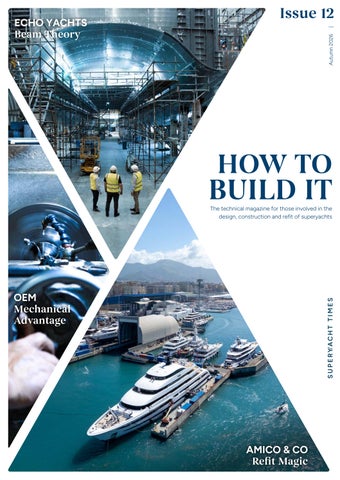
| Autumn 2026
ECHO YACHTS Beam Theory
Issue 12
HOW TO
BUILD IT The technical magazine for those involved in the design, construction and refit of superyachts
OEM Mechanical Advantage
AMICO & CO Refit Magic
MASTHEAD
EDITORIAL EDITOR IN CHIEF EDITOR | HOW TO BUILD IT EDITORIAL CONTRIBUTOR NEWS EDITOR FEATURES EDITOR WRITER WRITER DIGITAL MARKETING MANAGER
Francesca Webster Justin Ratcliffe Charlotte Thomas Sophie Spicknell Leona Caanen Andrea Pefianco Ann Yabut Marina Vargas
DESIGN PRODUCTION GRAPHIC DESIGNER
Beatriz Ramos
INTELLIGENCE HEAD OF INTELLIGENCE RESEARCH ANALYST RESEARCH ANALYST
Ralph Dazert Adil Zaman Murat Beskok
SALES & ADVERTISING HEAD OF SALES SALES MANAGER SALES MANAGER SALES MANAGER SALES MANAGER CLIENT SERVICE MANAGER SALES ITALY
Marieke de Vries Charly van den Enden Nuri Ozkaya Charlotte Powell Emma Sumner Johanna Borreli info@admarex.com
CORPORATE FOUNDER & DIRECTOR TECHNOLOGY DIRECTOR FINANCE DIRECTOR
Merijn de Waard Fabian Tollenaar Laura Weber
SuperYacht Times B.V. Silodam 256, 1013 AS, Amsterdam, The Netherlands 31 (0) 20 773 28 64 info@superyachttimes.com www.superyachttimes.com
Cover Images: Echo Yachts by J. Ratcliffe OEM by J. Ratcliffe Amico & Co by Amico & Co How to Build It is published by SuperYacht Times B.V., a company registered at the Chamber of Commerce in Amsterdam, The Netherlands with registration number 52966461. The magazine was printed in October 2026.
EDITOR’S LETTER
Building on Experience The superyacht industry is very good at talking about what is new. Less attention is usually paid to how we got there. What emerged from compiling this issue of How to Build It are the many decisions, lessons and compromises that shape a yacht long before it emerges from a shipyard. Amico & Co in Genoa is a good place to start. Its development from a traditional ship repair business into one of the Mediterranean’s leading superyacht refit specialists has been a long process of identifying what the refit market needs going forward – and building the infrastructure, organisation and expertise to deliver it. That same idea of evolution runs through the in-build projects featured in this issue. Echo Yachts’ ASC58 is the latest in a series of yachts for the same family, with each providing insight and experience for the next. The fact that she carries twin DynaRigs makes the 58-metre sailing catamaran an especially ambitious proposition, but the story is as much about accumulated knowledge as it is about innovation. At Mengi Yay in Turkey, the NL Plus 52 illustrates another kind of progression. A semi-custom design developed for speculative construction had to accommodate an owner’s requests deep into the build process, while the project’s fundamental parameters remained firmly in place. Mazal takes the idea further still. What began as the simple refit of a neglected 1976 Benetti became a near-total rebuild. But the objective behind the rethink was not to create a new yacht: it was to find a way of carrying an old one into a different era of expectations. Elsewhere, the forces driving change include sensors and machine vision able to expand what the crew can see and interpret from the bridge, while the ongoing desire among owners for more interior volume continues to put pressure on the boundaries imposed by gross tonnage thresholds. Different projects, different challenges, connected by knowing what to carry forward, what to change and, sometimes, what to rethink completely. Enjoy the read!
Justin Ratcliffe - Editor
4
How to Build It | Issue 12
Contents
50. Concept in Focus: Engineering Certainty
62. Industry Events: Metstrade 2026
5
27
Editor’s Letter
8
News in Brief
13
Projects to Watch New projects in early stages of construction that present opportunities for OEMs, suppliers and subcontractors.
17
Supplier Spotlight: Yacht Intelligence Digital systems play a powerful role on modern yachts and as technology expectations grow, AV/IT integrators are becoming an increasingly vital part of the yacht-building process.
20
6
36
How to Build It | Issue 12
Build Report: Beam Theory On completion, the 58-metre Adventure Sailing Catamaran (ASC58) in-build at Echo Yachts is expected to become the largest sailing catamaran built to date and one of only a handful of superyachts designed to accommodate DynaRigs.
50
Concept in Focus: Engineering Certainty According to Lateral Naval Architects, innovation usually fails when owners are forced to make decisions before they have enough information to understand the implications.
CEO in Conversation: Francesco Pelizza of AMS Advanced Mechanical Solutions offers bespoke products and services to the yachting industry, from project feasibility through structural engineering, construction management and production.
Business Brief: Refit Magic Over the past 30 years, Amico & Co in Genoa has established itself as one of the Mediterranean’s foremost refit shipyards by combining engineering expertise, meticulous project management and sustained investment.
59
Industry Events: Metstrade 2026 Ahead of this year’s Metstrade, attention is turning towards measurable environmental performance backed by data and assessed through the Water Revolution Foundation’s Hub of Verified Solutions.
86: Rules & Regs: The GT Challenge
106. Build Report: Built for Comfort
71
106
OEM: Mechanical Advantage Rather than competing with European competitors on labour costs or production volume, Nautical Structures in Florida has focused on mechanical engineering, product innovation and rigorous validation.
118 82
Inside Angle: Bruce Maltwood The Director of Yacht Services at Praxis explains why ownership, VAT, flag and jurisdiction should be considered from the outset of a yacht transaction – and why effective corporate governance remains essential long after delivery.
86
Rules & Regs: The GT Challenge Balancing overall size with interior volume, comfort, performance and cost is no easy task. We explore the gross tonnage conundrum and ask whether the industry is any closer to a common standard.
97
Build Report: Built for Comfort Mengi Yay’s first NL Plus 52 by Nuvolari Lenard seeks to reconcile owner demands for volume and amenities with the demands of efficient semi-custom production.
Refit Report: Mazal’s Makeover Nearly five decades after her launch, Mazal has been rebuilt by a dedicated team for a new life at sea – without erasing her original Benetti character.
129
Industry Insight: Optimisation is Everything Naval architect Tom Humphreys explores the art of optimising performance, efficiency, comfort and range. The key? Designing around how the yacht will actually be used.
Technology & Innovation: The View Ahead AI and sensor fusion is transforming situational awareness. We examine how radar, AIS, electronic charts, cameras, infrared and underwater perception technologies are converging, and what this means for OEMs and operators.
superyachttimes.com
7
NEWS IN BRIEF
News in Brief New factory investment for Data Hidrolik Data Hidrolik, the Turkey-based manufacturer of hydraulic systems and marine equipment, has launched a new factory investment to meet growing production needs, shorten delivery times and develop new products for the shipbuilding, defence and yachting markets. The company is adding 5,000 square metres to its existing 5,000-square-metre indoor production facility, effectively doubling its production capacity. Through its new subsidiary, DHMS (Data Hidromekanik Makine Servis), Data Hidrolik is also separating its after-sales service and spare parts operations from manufacturing. This will enable faster customer response while allowing production teams to focus on their core activities. “This investment is not only about increasing our physical capacity,” says Cem Hüroğlu, Member of the Board of Directors at Data Hidrolik. “We are also expanding our testing areas and R&D centre to develop solutions for higher-tonnage vessels.”
Kongsberg Maritime to acquire Berg Propulsion Norwegian maritime technology company Kongsberg Maritime has announced an agreement to acquire Swedish propulsion specialist Berg Propulsion, strengthening its position across a broader range of vessel segments and expanding its propulsion technology portfolio. Berg Propulsion is a leading designer and manufacturer of integrated propulsion and electrical systems for the maritime industry, having achieved strong growth and established a profitable market position in recent years. It will continue to operate as a separate brand and standalone business unit within Kongsberg Maritime’s Propulsion & Handling division. The acquisition is expected to create significant opportunities in lifecycle services, aftermarket support and cross-selling. The combined portfolio will span controllable pitch propellers, thrusters, hybrid and electric propulsion systems, and integrated vessel control solutions. The announcement follows Kongsberg Maritime’s transition towards becoming an independent company, after shareholders of Kongsberg Gruppen approved its separation in January 2026.
8
How to Build It | Issue 12
TAILORED REFIT TRUSTED QUALITY
Sanremo, Imperia - Italy
|
WWW.P OR TOSOLE- SHIPYA R D.I T
NEWS IN BRIEF
Grandweld launches yacht division Dubai-based commercial shipbuilder Grandweld Shipyards has launched Grandweld Yachts, a dedicated division focused on building superyachts measuring 60 metres and above. The company plans to combine its commercial shipbuilding experience with a new focus on yacht construction and long-term owner support, including warranty, maintenance and future upgrades. The first Grandweld Yachts projects are the Grandar 60 and Grandar 65, both designed by Dobroserdov Design and influenced by traditional Arabian architecture. The Grandar 60 is currently in active development, with construction scheduled to begin in 2027. Operating from Dubai Maritime City, Grandweld has more than 40 years of experience building vessels for naval, offshore and yacht-support operations. The company employs more than 1,000 specialists and has in-house engineering and production capabilities, supported by an established subcontractor network. The existing infrastructure can accommodate projects of up to 130 metres.
Oceanco expands in-house engineering Dutch superyacht builder Oceanco has acquired marine equipment specialist Winel, further strengthening the Oceanco Group’s engineering expertise across the design and construction of custom yachts. Based in the Netherlands with another facility in Vietnam, Winel manufactures custom and standardised marine equipment for the superyacht, commercial shipping and offshore sectors. The company produces a range of products including watertight doors, hatches, hull doors, tank vent check valves and specialist yacht equipment. According to Oceanco, the acquisition enhances the Group’s technical capabilities and complements its existing companies, Alewijnse, Aluship, Lateral and Mercury. Winel will continue operating independently with its current management team while serving both existing and new customers. The two companies have collaborated for more than two decades, beginning with lifting equipment for the superyacht Al Mirqab. More recently, Winel developed the adjustable hinge system for the hull doors aboard Oceanco’s 111-metre Leviathan, enabling them to remain level with the deck despite changing sea conditions.
10
How to Build It | Issue 12
NEWS IN BRIEF
New Lürssen investment in Rendsburg sites Lürssen has announced a €50 million investment programme for its Rendsburg North and Rendsburg South sites in Germany, with the shipbuilder planning to create 130 new jobs over the next two years. The announcement was made as Lürssen officially brought Hall 3 into operation at its Rendsburg North site in Schacht-Audorf. The new facility is designed for new-build projects and is described by the company as one of the most modern shipbuilding halls in the region. The wider investment programme includes new roofing for a dock, a comprehensive overhaul of one of the site’s floating docks, a new canteen for employees and infrastructure improvements across the Rendsburg North and Rendsburg South facilities. “Rendsburg is a strong part of our shipyard group – and it is to remain so for decades to come,” said Peter Lürssen. He added that the company’s order books are full for years ahead and that the investment will support yacht construction at the sites in the longer term. Current projects include the 122.5-metre Project Omega and Project Elusive, a 123-metre yacht scheduled for delivery in 2030.
Rolls-Royce grows mtu yacht propulsion range Rolls-Royce Power Systems is expanding its mtu propulsion portfolio for yachts with standardised variable-speed Series 2000 generator sets and a new selective catalytic reduction (SCR) exhaust after-treatment system. The variable-speed gensets automatically adjust engine speed to match power demand, helping reduce fuel consumption and CO₂ emissions by up to 15% during operation. The systems also operate approximately 6dB more quietly than conventional gensets, with electrical outputs ranging from 650 to 1,850kWe. The gensets are suitable for battery-assisted marine applications and can also serve as range extenders, supporting more efficient hybrid propulsion configurations. Rolls-Royce is also introducing a new SCR system for mtu Series 2000 engines operating in emission-regulated areas. Being certified with Eminox, the system meets IMO Tier III requirements and can reduce nitrogen oxide emissions by 75 percent compared with IMO Tier II limits. “Our aim is to offer shipyards and owners a comprehensive and future-proof range of solutions for yachts,” said Dr Lukas Köhler, Senior Vice President Global Marine & Mining at Rolls-Royce Power Systems.
superyachttimes.com
11
An integrated range of Guidi products designed to ensure maximum safety of the boat’s hydrodynamic systems, now available in a connected version. The Guidi System has been developed to improve the performance of seawater hydrodynamic flow systems by: • reducing pressure losses • minimising air bubbles and cavitation • providing a reliable and highly safe integrated system
+39 0163 418000
info@guidi.com
www.guidisrl.it
Via delle Acacie, 2 • Z.I. D4 IT•28075 Grignasco (NO)
IN-BUILD PROJECTS
Projects to watch New projects in early stages of construction that present opportunities for OEMs, suppliers and subcontractors.
Project M Royal Yacht International (RYI), Italian Yacht Group (IYG) and Kitson Yachts announced the sale and will represent the buyer throughout the new-build process. Project M will join the upper end of Lürssen’s custom superyacht portfolio upon completion. Project M will be developed around the owner’s individual vision, with further details surrounding the yacht’s design and technical specifications remaining confidential at this stage. LENGTH: 125m+
BUILDER: Lürssen
NAVAL ARCHITECTURE: Lürssen
GT: 6,000 GT
COUNTRY OF BUILD: Germany
EXTERIOR DESIGNER: Espen Øino International
DELIVERY YEAR: 2032
INTERIOR DESIGNER: RWD
ISA 73m Custom Sold to an American owner and announced during the Monaco Yacht Show, the 73m Custom is the latest in a series of large yachts announced by the Italian yard. The project is the first collaboration between ISA and Sinot. Among her distinctive features is a Nemo Room, which is an underwater space integrated into the yacht. LIST GC will be crafting the yacht’s interior.
LENGTH: 73-metres
BUILDER: ISA Yachts
GT: 1,600 GT
COUNTRY OF BUILD: Italy
NAVAL ARCHITECTURE: Azure Yacht Design & Naval Architecture
DELIVERY YEAR: 2030
EXTERIOR & INTERIOR DESIGNER: Sinot Yacht Architecture & Design
superyachttimes.com
13
IN-BUILD PROJECTS
Project 53 Project 53 is characterised by dynamic, streamlined lines and a vertical bow, while expansive glazed surfaces provide natural light and strengthen the connection between the indoor and outdoor spaces. The yacht’s spacious sundeck offers areas for relaxation and socialising. Aft, her beach club opens on two sides and incorporates a pool and fitness and spa area. A central transformer provides direct access to the water. The yacht is expected to reach a top speed of over 16 knots and has an aluminium hull. LENGTH: 53-metres
BUILDER: Baglietto
GT: 499 GT
COUNTRY OF BUILD: Italy
DELIVERY YEAR: 2029
EXTERIOR & INTERIOR DESIGNER: Team for Design - Enrico Gobbi
B.Neos BN001 Benetti announced the sale of the first full-hybrid B.Neos 40M superyacht during the Cannes Yachting Festival. Benetti says the yacht is rooted in an approach of what the yard describes as ‘evolved simplicity’, placing silent navigation and sustainability at the heart of her design. In terms of propulsion, the yacht is powered by a MAN Smart Hybrid system paired with MAN V8-800 engines. The setup enables zero-emission electric cruising and anchoring, while reducing fuel consumption and emissions by up to 30 percent.
LENGTH: 40.63-metres
BUILDER: Benetti
NAVAL ARCHITECTURE: Benetti Yachts
GT: 296 GT
COUNTRY OF BUILD: Italy
DELIVERY YEAR: 2028
EXTERIOR DESIGNER: Malcolm McKeon Yacht Design
INTERIOR DESIGNER: FM Architettura
Project H780 The custom aluminium yacht will be built at its Jiangmen shipyard in China and adds to the growing portfolio of large catamarans. Designed for sustaining high speeds over long distances, the custom explorer catamaran is being built as a private family yacht for her experienced owners, who intend to use her to cruise the world. In terms of performance, she is designed to achieve 2,000 nautical miles at 25 knots, as well as 4,000 nautical miles at 11 knots. She is also equipped with large storage and tender capacity for a 7.5-metre enclosed tender carried in a drive-in lifting dock.
LENGTH: 26-metres
BUILDER: SilverYachts
NAVAL ARCHITECTURE: Ker Yacht Design
14
How to Build It | Issue 12
GT: 235 GT
COUNTRY OF BUILD: China
EXTERIOR DESIGNER: Ker Yacht Design
DELIVERY YEAR: 2028
INTERIOR DESIGNER: Design Unlimited
IN-BUILD PROJECTS
Stil Novo Stil Novo is a custom motor yacht featuring extensive exterior deck areas, an aft swimming pool and accommodation intended for both private cruising and charter use. Further details regarding her interior designers, technical specifications, construction schedule and expected delivery date have not yet been announced. LENGTH: 52-metres
BUILDER: Tureddi Yachts
EXTERIOR DESIGNER: Marco Casali Too Design
COUNTRY OF BUILD: Italy
GT: 499 GT
DELIVERY YEAR: 2029
INTERIOR DESIGNER: N/A
XPD95/01 The model takes inspiration from expedition vessels, with construction commencing in autumn 2025, and her launch scheduled in summer 2028. The yacht’s 35-square-metre multifunctional beach area is a highlight of the design. It can accommodate a five-metre tender while still leaving space for guests to use. Once the tender is launched, guests can enjoy a large private terrace, providing panoramic views of the sea. LENGTH: 29.97-metres
BUILDER: Antonini Yachts
NAVAL ARCHITECTURE: NAMES by Francesco Rogantin
GT: 199 GT
COUNTRY OF BUILD: Italy
EXTERIOR DESIGNER: Studio Sculli
DELIVERY YEAR: 2028 INTERIOR DESIGNER: Hot Lab
Advertisement
SMART YACHT SOLUTIONS
Tecnimpianti a Navim Group Company
Follow us
Download our App
FROM BRIDGE TO PROPELLER Experience performance, comfort and control — seamlessly integrated by mtu Yacht Solutions. From powerful mtu engines and advanced propulsion systems to mtu NautIQ bridge and automation solutions, every component works seamlessly together. This integrated approach delivers dynamic performance, intuitive control and exceptional comfort for a truly effortless yachting experience. With tailored Premium Yacht Service and 24/7 support worldwide, our experts are always close to you.
SUPPLIER SPOTLIGHT | YACHT INTELLIGENCE
Yacht Intelligence Today’s digital systems underpin almost every aspect of life on board, from internet connectivity and lighting control to remote monitoring, conferencing and cybersecurity. As expectations continue to rise, AV/IT integrators like Yacht Intelligence have become an increasingly important part of the yacht-building process. BY JUSTIN RATCLIFFE "The evolution of the communications industry has contributed massively to the world of yachting,” says Alan Bernardi, company founder and Managing Director. “It's not just about the internet experience or crew welfare; we can now do things that simply weren’t possible just a couple of years ago." The impact reaches beyond faster internet. Greater bandwidth has changed the way onboard systems are designed, allowing audio, video, control and other data to move around a yacht far more efficiently than before. At the same time, the widespread adoption of "bring your own device" has introduced new challenges, particularly when integrating consumer electronics that were never designed for enterprise-grade networks. As a result, the skills required of AV/IT integrators continue to evolve alongside the technology itself.
Alan Bernardi YACHT INTELLIGENCE
F
or Yacht Intelligence, based in the UK but with offices in Florida and the Netherlands, one of the biggest drivers of change has been the rapid evolution of communications technology. The recent arrival of services such as Starlink, OneWeb and high-speed 5G has transformed owner expectations, making reliable, high-bandwidth connectivity an essential feature rather than an optional extra.
Despite the pace of technological change, Bernardi believes the fundamentals remain the same. Good engineering is less about adding equipment than designing systems that are logical, reliable and easy to support throughout the yacht's life. "A system should be cleanly designed with the least possible number of widgets and devices in the middle," he says. “Thorough testing is equally important, ensuring systems perform reliably before delivery rather than relying on workarounds once the yacht enters service. Comprehensive documentation, remote shoreside support and regular maintenance also help prevent temporary fixes from becoming permanent features that make future servicing more difficult.”
superyachttimes.com
17
SUPPLIER SPOTLIGHT | YACHT INTELLIGENCE
Below: Bernardi maintains that end users want more control, more integration and seamless systems.
Future-proofing is another challenge facing the industry. Technology evolves rapidly, and Bernardi calculates that major hardware cycles typically span around five years. While individual components will inevitably require replacement, well-planned infrastructure can significantly extend the life of the overall system. Good documentation, spare capacity and careful engineering decisions all make future upgrades easier, while established technologies such as Dante audio networking continue to demonstrate the value of adopting scalable standards. Effective remote and shoreside support is also key.
YACHT INTELLIGENCE
Planning is another recurring theme. Bernardi recommends that discussions around AV/IT begin during the earliest stages of a new-build project, when designers and shipyards are still determining the overall arrangement of technical and interior spaces. “The foundations should be put in place early on during the discovery phase of the yacht design,” he argues. “Allocating space for equipment early provides greater flexibility as owner requirements develop. While cable routes and backbone infrastructure can be installed later, decisions surrounding equipment locations, cooling and access become much more difficult to revisit once construction is underway.” Cybersecurity has become an increasingly important consideration as more onboard systems rely on network connectivity. Every proposed modification is assessed, documented and independently reviewed before implementation. Bernardi recalls one case when a seemingly minor change to a telephone port exposed a potential vulnerability. Nothing came of it, but it reinforced the importance of following established processes rather than making undocumented changes, however small they appear.
18
How to Build It | Issue 12
Recent projects illustrate the practical challenges involved. One new-build required the installation of a premium McIntosh audio system within bespoke cabinetry, demanding close coordination between Yacht Intelligence, the interior designers, cabinet makers and the shipyard. Cooling, cable routing, lighting, service access and even securing 2.1-metre speakers for operation at sea all required careful consideration before installation. The solution ensured the technology complemented, rather than compromised, the finished interior. Elsewhere, late-stage owner requests included a fully integrated conferencing system and discreet bedside Bluetooth headphone stations. Both solutions were delivered by making use of existing infrastructure and adapting commercially available products without compromising the yacht's interior design. Looking ahead, Bernardi expects the scope of onboard integration to continue expanding. Lighting, doors, HVAC, engines, batteries and numerous other systems increasingly rely on network connectivity, creating greater demands on infrastructure, rack space and cybersecurity. Artificial intelligence is already being used to support engineering and programming tasks, and Bernardi believes its influence will continue to grow as owners seek greater integration, simpler control and a more seamless onboard experience. "End users want more control, more integration and seamless systems," he says. "AI will almost certainly play its part, but technology management and device management will be just as important."
AWARD-WINNING BRITISH SUPERYACHT REFIT, RESTOR ATION AND BUILD
New stand location at METSTRADE 2026 – 07.434R Photo by Stuart Pearce/YachtShot
A TRUS T E D T E A M O F SU PE RYAC H T S PEC I A LIS TS Whether refit, restoration or build, every Pendennis project is a true team effort. Our trusted team of skilled Superyacht specialists are experts in their field, crafting precise and perfect work at every step of the way.
PENDENNIS.COM
CEO IN CONVERSATION | AMS
GUILLAUME PLISSON
Francesco Pelizza of AMS Beginning in 2008 as an engineering consultancy, Advanced Mechanical Solutions (AMS) has evolved into a company with an increasingly integrated approach to bespoke movement and handling systems for large yachts. Key manufacturing capabilities, first in composites and then in metalwork, have been brought in-house. At the same time, the Ancona-based company is putting in place the structure needed to support growth without losing what has always defined its approach: the ability to develop highly customised solutions around each project’s specific requirements. BY HOW TO BUILD IT
20
How to Build It | Issue 12
CEO IN CONVERSATION | AMS
AMS often becomes involved when standard solutions cannot meet a yacht's specific requirements. What are the main technical challenges you encounter when developing custom systems for superyachts? All our products are bespoke. From awning systems to hatch and bulwark mechanisms, cranes and overhead gantry cranes, everything is designed around the specific requirements of the vessel and the client. That often means dealing with very particular requirements: a hatch that needs to disappear completely when opened; fittings for awning poles where there isn't enough height; or an overhead crane that needs to lift a tender that's too large to fit underneath it. In general, it comes down to dimensions and interfaces. The real task is finding a reliable, clean-looking system that fits within the available space and integrates seamlessly with everything around it.
How does AMS balance structural reliability, weight optimisation, functionality and the designer's vision when developing systems such as beach clubs, balconies, shell doors and lifting mechanisms? Space is the most important factor. Moving mechanisms are often located next to a bollard, bulkhead, another hatch or some other obstacle, so we have to create a reliable and functional mechanism within very tight spatial constraints. Our goal is for the mechanism to disappear: flush surfaces, nothing visible, so the designer doesn't have to compromise on their vision. That's why it's important to get involved in a project as early as possible, while the available space can still be negotiated. Weight is also becoming increasingly important. Until a few years ago, it wasn't a major concern on superyachts, but that's changing. Carbon fibre best combines structural reliability, weight optimisation and freedom of shape, and we use it extensively.
Your experience in the aerospace sector and a background in offshore sailing have shaped AMS's engineering approach. How do you apply that knowledge to custom superyacht systems? Our experience in aerospace has given us the methodology and rigour, while offshore sailing has given us an understanding of the loads and stresses involved. We design according to the applicable regulations, but there's no substitute for knowing what actually happens at sea. Dynamic loads and the effects of wind and waves are covered by regulations, but they remain just numbers without some direct experience of those conditions. The rigour and precision we've inherited from aerospace allow us to work with procedures that greatly reduce the risk of errors and ensure full traceability throughout design and production. That means we can intervene at any stage of the product's life if necessary.
AMS has developed A-frame cranes, tender handling systems, folding balconies and custom opening mechanisms. What are the key considerations when designing and building bespoke movement and handling systems for superyachts? The priority is getting it right the first time. These are complex, non-standard mechanisms, often involving solutions that nobody has used before, so they have to work from day one.We make extensive use of numerical simulation, including FEM/FEA and kinematic analysis, as well as 3D printing. We can produce components at scale or full size to verify their behaviour before moving into production. Every system is then pre-assembled and tested at our facility before shipment. Changes after manufacturing are expensive, so we minimise them through careful design, analysis and simulation.
You’ve expanded your in-house composite capabilities. What opportunities do advanced composites offer for the next generation of superyachts, and where do you think their potential is still underused? Carbon fibre is increasingly being used in superyacht construction, but there is still a lot of room for growth. It weighs around 40% less than aluminium and 80% less than steel, while offering superior specific strength and stiffness, and it can be moulded into very precise shapes. It has long been used in sailing boats, where weight has always been critical. Today, it is becoming more common on motor yachts, particularly where the weight of an individual component becomes critical rather than simply to reduce the overall weight of the vessel. A removable ladder, awning pole or portable davit crane, for example, becomes difficult for a single operator to handle if it is too heavy. An A-frame crane made from steel rather than carbon fibre would also require significant hydraulic power simply to move its own weight. We're also experimenting with hybrid materials and have built and tested a prototype mast made from approximately 70% flax fibre and 30% carbon fibre.
Can you share an example of a superyacht project where a particularly demanding operational or space constraint led to the development of a new solution? One example is the twin-arm overhead crane, which we developed to address space constraints. The tender fits between the two arms, making full use of the available height beneath the deck. The dimensions are customised for each project, but the product has since become one of our standard solutions. Another example is the fresh-water washing system for our telescopic masts. It was developed for a particularly demanding client who wanted to eliminate the risk of salt and dust scratching the telescoping sections. We patented the system, and it has since become a standard accessory.
superyachttimes.com
21
CEO IN CONVERSATION | AMS
Today, we have four patents for our telescopic masts: the washing system, spring tensioning, clip locking and the spiral electrical cable. They all originated in the same way – from a specific problem on a particular yacht.
What do you believe will be the most important engineering developments shaping superyacht design and functionality, and what role does AMS aim to play in that transformation? I see three main directions. The first is weight. For decades, weight wasn't really a design parameter on motor yachts. Today, it is becoming increasingly important because of range, fuel consumption and stability. That is opening the door to composites for everything above deck, as well as hybrid materials, including natural fibres, which we're already experimenting with.
The third is regulation. Regulations governing cranes, lifting equipment and moving systems are becoming increasingly stringent and need to be addressed from the very beginning of a project, not at the end. Throughout all of this, engineering is becoming increasingly central. Yachts are getting bigger, but so are the accessories, equipment and tenders they carry, and every system needs to be integrated with and monitored by the yacht's onboard systems. AMS wants to be the engineering partner for shipyards in addressing these requirements: solve the problem first, turn the solution into a product, and manufacture it in-house.
The second is actuation. There will be increasing pressure to move towards systems that don't use oil on board. But for high loads — hatches, cranes and large masts — hydraulics remain the most reliable and compact technology, and that's where we'll continue to invest: closed circuits, dedicated power units and monitoring systems. Pneumatic and electric systems will have a role where they make sense, particularly for lower forces and applications where the client wants to eliminate oil. AMS
Advertisement
SEWAGE TREATMENT EQUIPMENT Made in Germany sales@hamannag.com hamannag.com
E PO Q 36
FR E E D OM 4 4
SY GRAC E I I I
MY ME R I N OS f or G X S u p e r y a ch t s
50 YEARS ON THE CLIENT’S SIDE www.sesyachts.com
BUSINESS BRIEF | AMICO & CO
24
How to Build It | Issue 12
BUSINESS BRIEF | AMICO & CO
Refit Magic What does it take to build a leading superyacht refit business? Bigger cranes? Covered dry docks? Deeper berthing? The reality is more complex. Over the last three decades, Amico & Co in Genoa has combined engineering expertise, project management and long-term investment to create one of the Mediterranean's premier refit shipyards. BY JUSTIN RATCLIFFE
AMICO & CO
superyachttimes.com
25
BUSINESS BRIEF | AMICO & CO
AMICO & CO (5)
26
How to Build It | Issue 12
BUSINESS BRIEF | AMICO & CO
Clockwise from bottom: Issues that emerge during dismantling can make refit as much a process of diagnosis as of engineering; Amico & Co opened its 102-metre telescopic dry dock in 2014; the company has invested in keeping technical trades in-house.
Alberto Amico
T
o outsiders, a refit yard is simply a place where yachts are serviced and repaired between seasons. In reality, the world's leading operators function more like highly specialised engineering consultancies, coordinating hundreds of suppliers, contractors and technical disciplines against immovable deadlines. In fact, when Alberto Amico, founder and partner of the eponymous shipyard, talks about refit, he rarely begins with infrastructure. Instead, he starts with organisation. “Refitting is a kind of alchemy,” he once told me. “It requires numerous ingredients, and if there is even the smallest imbalance – in location, management, even the ability to find a good marble cutter – then the magic is lost.” The evolution of Amico & Co illustrates how dramatically the refit industry has changed over the past three decades. Although the Amico family has been in involved in ship repair since 1799, the company's modern identity was forged in 1991, when Alberto Amico chose to focus almost exclusively on superyacht refit, repair and maintenance. It was a strategic decision that anticipated the rapid growth of the superyacht sector and recognised that refit required a very different set of skills from new construction.
superyachttimes.com
27
BUSINESS BRIEF | AMICO & CO
Facing page: Sarimi is a large-scale metal carpentry and mechanical engineering workshop located adjacent to the Amico & Co facility in Genoa.
BETTING ON SPECIALISATION When the superyacht sector began expanding rapidly in the 1990s, few shipyards regarded refit as a specialist discipline. Many assumed that the skills required to build a yacht naturally extended to refitting one. Alberto Amico has long argued that this assumption is fundamentally flawed: “The market tends to think that if you can build a boat, you can also refit one. That's not always – or even usually – the case. Building a yacht is a controlled industrial process, based on fixed drawings, defined production schedules and components designed to fit together from the outset. Refit is far less predictable.” As soon as engineers begin dismantling a vessel, unexpected issues can emerge, each creating knock-on effects throughout the project. That uncertainty makes refit as much a process of diagnosis as of engineering. Success depends on experience, rapid decision-making and the coordination of multiple disciplines. As the global superyacht fleet grew, another trend was reshaping the refit business: the yachts themselves were becoming bigger and more complex. At the time of our visit there were 14 yachts over 50 metres in the Genoese shipyard, including one measuring 92 metres, two of 86 metres, one of 80 metres and another two of 75-plus metres. This was early summer when many had already left; during the busy winter season the yard may host up to 30 large yachts at any one time, amounting to around 110 individual projects each year. At the same time, propulsion systems became more sophisticated, onboard automation more integrated and interiors increasingly bespoke, with owners expecting cinema rooms, beach clubs, spa facilities and advanced digital technologies to be incorporated into vessels that might already be 15 or 20 years old. For charter yachts, clients also demanded faster turnaround times, as every additional week in the shipyard represented lost revenue.
28
How to Build It | Issue 12
Manuel Di Tillio
“The time available is much less nowadays,” affirms Manuel Di Tillio, Technical & Sales Director at Amico & Co. “Nearly all the yachts we work on are run commercially and we might have to squeeze them in between charters.” These changes transformed the competitive landscape. Success was no longer determined simply by dock space or labour costs, but by a yard's ability to manage increasingly complex projects efficiently, anticipate unforeseen technical challenges and return yachts to service on schedule. For Amico & Co, these industry trends shaped the investments that would define the company's future.
BUSINESS BRIEF | AMICO & CO
ANTICIPATING THE MARKET
“The market tends to think that if you can build a boat, you can also refit one. That’s not always – or even usually – the case.”
Alberto Amico recognised early on that competing with Northern Europe's refit yards would require facilities capable of handling the largest projects to the highest standards. A defining milestone was the opening in 2014 of a climate-controlled covered dry dock capable of accommodating yachts up to 102 metres, part of a wider investment programme that also included the installation of shore power throughout the yard. Designed to attract projects that had traditionally gone to Northern European shipyards, the dry dock's telescopic roof allowed painting and structural work to continue regardless of the weather, while providing the controlled environment increasingly required for modern coatings and complex engineering programmes. Over time, the shipyard has grown to cover around 60,000 square-metres on land and water, adding climate-controlled paint facilities and extensive workshops. Later developments – including a 4,000-tonne shiplift, an 80-metre breakwater with 14 refit berths and a waterfront marina with moorings for 26 superyachts of up to 120 metres – represented a further multimillion-euro capital investment. Amico & Co also became the first Italian shipyard to achieve ISO 14001 environmental management certification and a photovoltaic installation now supplies more than half of the yard's energy needs. However, infrastructure offers little competitive advantage unless it improves efficiency. That philosophy was reinforced in 2011 with the acquisition of Amico Loano, located roughly halfway between Genoa and Monaco. Last year the shipyard was extended from 8,500 to around 15.000 square-metres of combined land and water working space. Rather than duplicating the capabilities of the main yard, Loano complements them, accommodating yachts up to 50 metres in dry dock and vessels up to 70 metres alongside. Strategically, the acquisition achieved two objectives: it increased overall capacity at a time of growing demand while allowing the Genoa headquarters to concentrate on the largest and most technically demanding refit projects. Together, the two facilities created a more flexible operation, enabling Amico & Co to support yachts throughout the north-west Mediterranean while matching resources more efficiently to each project.
AMICO & CO (2)
superyachttimes.com
29
BUSINESS BRIEF | AMICO & CO
IN-HOUSE KNOW-HOW While many shipyards rely heavily on subcontractors, Amico & Co has invested in keeping technical expertise in-house, developing specialist departments covering engineering, painting, electrical systems, metal fabrication and interior joinery. “The reasoning is straightforward,” says Di Tillio. “Most refits uncover problems that cannot be predicted during the tender stage. Waiting for external suppliers to analyse each issue slows decision-making and increases costs, whereas an experienced in-house engineering team can identify both the problem and the solution on the spot because it understands the yacht and the capabilities of every department involved in the project. Ultimately, owners are paying for judgement born of experience.” By the early 2010s, Amico & Co had assembled both the infrastructure and the engineering capability to compete with the leading refit specialists. The next challenge was convincing owners that some of the world's largest and most technically demanding yachts no longer needed to travel to Northern Europe for major refit and conversion work. Changing perceptions meant delivering projects that proved the yard's capabilities (see sidebars). An unexpected influence in this respect came not from superyachts, but from commercial cruise ships. “Before concentrating exclusively on large yachts, we had undertaken work for operators including Costa, Carnival and MSC,” says Alberto Amico. “These companies operate to published schedules and missing a delivery date has immediate financial consequences.” Rather than competing solely on price, Amico & Co focused on planning, communication and reliable delivery. Over time, that approach transformed the company's client base, with overseas owners and management companies eventually accounting for more than 90 percent of its business. Today, the yard is a selected partner in the Feadship Refit Service Network, reflecting the standards it has established in the sector.
30
How to Build It | Issue 12
AMICO & CO
It has also developed significant expertise in managing large-scale paint projects on yachts over 60 metres. While many facilities provide infrastructure and leave owners to coordinate specialist contractors, the fact that the shipyard assumes overall responsibility for planning, coordination and delivery is a key differentiator. “We’ve completed around 25 comprehensive paint projects on large yachts using this approach,” says Amico. “By retaining responsibility for the entire project, the yard is able to minimise disruption while providing greater certainty throughout the refit process. Further, we calculate this integrated model is typically 20–35 percent more cost competitive than comparably qualified competitors.”
Top: A view of the Waterfront Marina and the shipyard behind.
BUSINESS BRIEF | AMICO & CO
CASE STUDY: QUEEN MIRI When P/Y Queen Miri (formerly M/Y Delma) arrived in Genoa in 2014, Amico & Co was presented with an opportunity to demonstrate that it could undertake structural refit work on a par with Northern Europe's leading specialists. Over the following 16 months, the 85-metre yacht underwent one of the most ambitious refit projects ever completed in the Mediterranean. The hull was lengthened to more than 91 metres and around 80 percent of the interior was rebuilt. A new generator set and powertrain increased her speed from 15 to 19 knots. New features included a floodable tender garage that could be converted into a pool holding 90,000 litres of heated seawater. Projects of this scale had traditionally been awarded to Dutch or German yards, making Queen Miri a defining project for both the company and the wider Mediterranean refit sector. The commercial impact was equally significant. Alberto Amico has said the project helped increase annual turnover from around €25 million to approximately €60 million, while firmly establishing Amico & Co as a yard capable of delivering major engineering conversions.
CASE STUDY: PURE A significant development in contemporary yacht refit is the ability to completely transform a yacht’s appearance without the time and cost associated with a new build. Amico & Co’s refit of the 82-metre Devonport motor yacht Pure is one such example. In this case, the owner’s vision was translated into reality by designer Clifford Denn, while Amico & Co continuously evaluated the feasibility of each intervention to ensure the project remained technically sound, commercially viable and achievable within programme. The project was unusual because major structural elements of the exterior reshaping, such as reconfiguring the aft decks and stern to fit the extended 91-metre hull, were developed while the yacht was also undergoing an interior refit, requiring careful project management to avoid delays, budget overruns and design conflicts. From completion of the structural metalwork to delivery, the yacht took just 14 months to progress from bare steel and aluminium to a fully outfitted vessel. According to Alberto Amico, this represents an exceptionally short timeframe for such a complex project and compares favourably with the production schedules of many new-build programmes.
CASE STUDY: OCEAN GLORY Not every refit is about increasing size or complexity. The total bottom-up rebuild and restoration of 26-metre Ocean Glory, originally launched in 1935 as Destiny, demonstrated Amico & Co’s ability to combine traditional craftsmanship with modern engineering. Persolly acquired by Alberto Amico, the yacht underwent a meticulous three-year restoration. While virtually every onboard system was renewed – including electrical, plumbing, air-conditioning, generator and stabiliser systems – the original Gardner engines were lovingly overhauled to preserve the original engineering wherever practical. Compliant with the MCA’s Small Commercial Vessel Code, the project combined modern safety standards with the elegance of a classic motor yacht. Relaunched in 2007, Ocean Glory demonstrated that successful refit is not simply about renewal, but about understanding what should be preserved, what should be replaced and how traditional craftsmanship can work alongside modern engineering.
superyachttimes.com
31
BUSINESS BRIEF | AMICO & CO
Right: Amico & Co operates a 65-metre semipermanent painting hangar on the hard with a special roof that lets yachts enter without dismantling their masts.
BEYOND THE SHIPYARD Perhaps the clearest measure of Amico & Co's reputation today is that more than 80 percent its commissions come from repeat customers. Modern refit is no longer a single event but an ongoing relationship. Yachts return regularly for maintenance, class surveys, equipment upgrades and periodic modernisation, allowing shipyards to build an increasingly detailed understanding of each vessel's engineering history, previous modifications and operational characteristics. That accumulated knowledge reduces risk, improves efficiency and allows future projects to be planned with greater confidence. “For owners, continuity has tangible value,” says Di Tillio. “The team that rebuilt an engine room several years earlier is often best placed to install new equipment because it already understands how the yacht has evolved. A major refit involves logistics, customs, accommodation, surveyors, specialist suppliers, spare parts and constant coordination between management companies and contractors. Clients are looking for a single organisation capable of bringing all those elements together.” That thinking led to the development of Amico Marine, an initiative designed to provide integrated support throughout a yacht's operational life. It brings together the main shipyard in Genoa, Amico Loano, Gatti Shipyard, Waterfront Marina, Acier-Sarimi metalwork workshops, Amico Servizi (general services and operational coordination) and Marine Tools (specialised digital solutions for yacht management processes). Services for clients and crews are delivered through Genoa Superyacht Hub, a company managed in partnership with the Pesto Group. Rather than operating as separate businesses, the companies work as an integrated network. AMICO & CO (3)
32
How to Build It | Issue 12
BUSINESS BRIEF | AMICO & CO
Amico & Co number of refits performed 60m+ 2016-2025 80
Share in %
71 62
60
60
49 43 34
34
40
31
33
32
20
2016
2017
2018
2019
2020
2021
2022
2023
2024
2025
0
INDUSTRIALISING CRAFTSMANSHIP Despite continued investment in facilities, Alberto Amico believes the industry's greatest challenge is no longer infrastructure but people. Developing the skills required to work on large superyacht refits requires years of training, experience and commitment. As technical careers become less attractive across mature economies, finding and retaining qualified personnel is becoming increasingly difficult. “The shortage is affecting OEM service teams, subcontractors and shipyards alike, leading to reduced availability, longer lead times and greater uncertainty,” he says. “To counter this trend we’ve continued to invest in in-house training and workforce development, reducing our dependence on increasingly scarce external resources. Supply-chain management has also become a critical element. Components that were once readily available are now frequently subject to long lead times. Critical spare parts often need to be procured well in advance or held in stock to avoid costly programme delays. This increases inventory costs, but proactive planning is preferable to project disruption. For Alberto Amico, the future of largeyacht refit will be defined less by physical infrastructure than by organisational capability – the ability to mobilise skilled people, coordinate complex supply chains and maintain rigorous project management throughout every stage of a superyacht refit. Those qualities, he believes, offer the most valuable competitive advantage.
superyachttimes.com
33
PARTNER CONTENT | IDEA DATA SOLUTIONS
Creating the IDEA Universe A skilled AI assistant crew can talk to, a finance module that reconciles itself, and a fleet portal that gives shore teams one view of every vessel. IDEA Data Solutions is joining up how superyachts are run, and after 25 years in the industry it is bringing that whole picture to METSTRADE 2026.
“Twenty-five years ago we set out to bring order to the data behind a superyacht. Today, we want to give crew a seamless solution so they can spend less time on admin and more time creating the best possible experience for guests. With Clive AI, Finance and FLEET working together, that information is in front of the right person at the right moment, from the engine room to the owner’s office.” — CHRISTIAN MÜHLE MANAGING DIRECTOR, IDEA DATA SOLUTIONS
A superyacht is one of the most complex assets afloat. Thousands of components, certificates, spare parts and budget lines are managed by rotating crews and shore teams overseeing whole fleets. The data exists, but rarely in one place. IDEA’s latest developments are built to close those gaps.
CLIVE AI: ask, don't hunt Powerful software often goes underused because the right function is buried three menus deep. Clive AI works inside IDEA YACHT on the web and on mobile. Crew ask in plain language, and Clive AI answers from the vessel’s own data. An engineer can check stock history, process a stock sheet, analyse purchase orders or search documents and maintenance records, all in one conversation. Report skills from the Skill Store turn a request into a structured report. Confirmation cards keep a person in control of every action. Clive AI helps the people making decisions. It doesn’t make the decisions for them.
FINANCE: from card statement to budget line IDEA’s Finance module does away with reconciling everything by hand at month end. It syncs accounts, transactions and cards from external providers, and creates transactions straight from purchase orders. Dashboard widgets show budget usage as it happens, with full multi-currency support.
IDEA FLEET: one view from shore IDEA FLEET gives management companies one portal across every vessel they look after, with fleet-wide dashboards, Hours of Rest review, ISM forms and reporting. Finance data syncs from yacht to shore automatically. IDEA YACHT and IDEA GT vessels can both be linked in, and the first five vessels are free.
25 YEARS IN THE MAKING None of this happened overnight. Clive AI, Finance and FLEET build on a quarter of a century spent working alongside captains, engineers, interior teams and managers. The principle hasn’t changed: data entered once on board should flow to wherever it’s needed.
THE IDEA UNIVERSE AT METSTRADE To mark the anniversary, IDEA is bringing that principle to life at METSTRADE 2026 on stand 08.361. It is joined by Spectro | Jet-Care, Dock 07, EMS Yachting, YOT and Panoblu, who cover fluid analysis, supply, services and 360° situational awareness respectively. The premise is simple: no single solution works in isolation. Visitors can try Clive AI live, explore FLEET and see how the wider IDEA Universe fits together. Visit IDEA at METSTRADE or find out more at
idea-yacht.com
superyachttimes.com
35
BUILD REPORT | ASC58
36
How to Build It | Issue 12
BUILD REPORT | ASC58
Beam Theory The first thing that stands out about the 58-metre Adventure Sailing Catamaran (ASC58) in-build at Echo Yachts in Australia is its sheer size. Once complete, it is set to be the largest sailing catamaran ever built. But the project’s significance goes beyond scale as one of only a handful of superyachts designed to carry DynaRigs. BY JUSTIN RATCLIFFE
superyachttimes.com
37
BUILD REPORT | ASC58
T
he ASC58 is the latest step in an ongoing progression for Echo Yachts that has produced Charley 1, Charley 2, the 84-metre trimaran White Rabbit, and smaller support vessels for the same family. Each project has informed the next: longer range, more usable deck space, easier maintenance, better diving capability, lower fuel burn, more comfortable communal living. “What’s interesting with this family is that every project evolves from the previous one,” says Mark Stothard, founder of Echo Yachts. “It’s not a case of chasing something more extravagant each time. They use their boats very heavily, so the feedback loop is real. You end up refining systems, layouts and operational details based on what worked well offshore.” This time the brief evolved again. The owner’s family wanted environmentally friendly yet easy-to-use sail power to play a far greater role in the vessel’s operation. That direction led to Dutch studio Dykstra Naval Architects, chosen for their sailing yacht history, who first proposed the DynaRig system. Dykstra developed and verified the overall concept in aluminium, the sail plan and general arrangement before Australian firm One2Three Naval Architects was brought in to engineer the multihull platform beneath it. The result is an expedition-capable yacht designed around a highly loaded rig on a catamaran platform that behaves very differently from the Dynarig monohulls Maltese Falcon and Black Pearl.
38
How to Build It | Issue 12
BUILD REPORT | ASC58
Facing page: Echo Yachts is based just south of Perth within the Australian Marine Complex where physical space is not an issue.
PRESSURE POINTS Reinforced load paths around the deck openings for the free-standing Dynarig masts reveal where the engineering pressure points will be. Even unfinished, these indicate a yacht where almost every major design decision can be traced back to load management, structural movement and operational constraints. “People see a sailing catamaran with a DynaRig and think the difficult part is the rig itself,” says Senior Project Manager, Paul Liddington. “The real problem is what the rig does to the platform underneath it. On a monohull you’ve got a lot more vertical structure between your mast bearings, while the boat heels enough to relieve some of the load. Here the masts are on the centreline between the two hulls where the depth is around seven metres and the catamaran barely heels at all, so those loads go instantaneously into the structure. This changes everything.” The catamaran’s broad beam already creates substantial differences in stiffness between the superstructure and the narrower hulls beneath it. Engineers describe the effect as “pinching and prying”, where the hulls attempt to rotate relative to the superstructure under transverse bending loads. Simply making everything more rigid risks increasing the stresses where the loads are transferred between the two structures. The engineering solution focused on controlling how loads move through the entire vessel. One2Three developed a global finite element model to evaluate overall hull stiffness and bending behaviour before progressively refining local areas with detailed fine mesh modelling as individual modules and structural zones were finalised. Fatigue analysis became especially important because the sailing loads are cyclic and highly concentrated around the mast foundations.
Mark Stothard
Echo Yachts remained closely involved throughout the consultant engineering process by continuously reviewing assumptions, construction sequencing and structural practicality. For example, it introduced tapered internal bulkheads to manage stiffness transitions. Instead of loads jumping suddenly from one part of the yacht to another creating stress points, these angled bulkheads help spread the forces gradually between the hulls and the superstructure – not just around the mast bearings, but also in areas with cranes and heavy lifting points.
J. RATCLIFFE (3)
superyachttimes.com
39
BUILD REPORT | ASC58
BEARINGS AND BUCKETS Even the construction sequencing reflects these concerns. Installing the mast step structure will be purposely delayed as much as possible. The mast bucket housing the base of the masts supports and transfers compression, bending and torsional loads into the yacht’s structure. It is not just a socket or hole in the deck – it is a heavily engineered assembly and its alignment with the upper bearing is critical. “Aluminium moves as you work with it,” explains Trent Adams, project manager and naval architect. “You can model everything in 3D and run all the FEA you want, but if you lock that alignment in too early and the structure shifts during welding, you’ll chase it forever afterwards. So the approach was to let the hull settle, finish as much hotwork as possible, then come back and align the bearing system properly.” That sequencing philosophy extends throughout the build and the ASC58 is being modularly assembled. Construction began away from the mast foundations in relatively low-risk structural areas before progressively extending forward and aft. Zones surrounding the mast supports were deliberately treated as exclusion areas until enough motion and fatigue analysis had been completed. Production methods are also intended to minimise distortion with friction-stir welded aluminium panels supplied as pre-stiffened structural sections roughly two metres wide and more than 10 metres long. Much bigger than standard panels, the welds are formed through mechanical stirring rather than fusion, resulting in joints with better fatigue characteristics than conventional welded seams. “The friction-stir panels changed the build process quite a bit,” continues Adams. “They arrive as these big pre-stiffened sections, so instead of welding hundreds of smaller pieces together on the boat, you’re dropping in much larger structural elements with far less distortion.” The process not only reduces labour during assembly, it also simplifies subsequent outfitting and alignment work because the resulting deck surfaces remain flatter and more dimensionally stable. Echo Yachts competes locally for skilled trades with Western Australia’s mining and offshore energy industries. Reducing welding hours and rework therefore becomes commercially significant as well as structurally beneficial. J. RATCLIFFE
40
How to Build It | Issue 12
BUILD REPORT | ASC58
THE DYNARIG PLATFORM Unlike the DynaRig concept first introduced on Maltese Falcon and later refined aboard Black Pearl, the platform developed by Dykstra Naval Architects and Southern Spars for the ASC58 has been designed around a more modular and industrialised approach intended to reduce manufacturing complexity, improve scalability and lower overall build cost. Southern Spars is simultaneously building similarly sized DynaRigs for a new 75-metre Greenpeace vessel, allowing tooling and engineering costs to be spread across both projects. “Our experience with landmark DynaRig projects such as Maltese Falcon, Black Pearl and now the Greenpeace and ASC58 vessels has demonstrated how effectively the concept combines modern sail automation with practical operation,” says Wick Hillege of Dysktra Naval Architects. “While ideally suited to large sailing yachts, the same principles offer exciting opportunities for future cargo and transport vessels seeking to harness wind power.” The most visible differences are found in geometry and systems integration. Earlier rigs relied on highly sculpted carbon spars with continuously varying tapers and extensive internal routing for furling systems and cabling. The new “commercial” platform instead uses more standardised mast sections manufactured from modular moulds, while many systems previously concealed inside the structure are now mounted externally. Yardarm tracks, for example, are mounted proud of the spar rather than fully faired into the structure, simplifying fabrication and maintenance.
Left, from top: Mounted on the centreline between the hulls, the masts have much less vertical structure between the bearings than a monhull. Moreover, a catamaran barely heels at all, so those loads go straight into the structure; Alignment of the mast buckets with the upper bearings is critical.
Despite the move toward modularisation, the underlying composite engineering remains highly sophisticated. The spars continue to be produced in prepreg carbon fibre using temporary curing ovens built around the components. The yardarms are manufactured using resin infusion techniques and assembled from modular halves joined with adhesive via structural flange systems. The only limit presented by the catamaran platform was the height of the DynaRigs. Southern Spars’ preferred engineering solution is to maintain a mast bury depth equivalent to roughly 10 percent of the rig’s overall height. In practical terms, the ASC58’s 60-metre masts still allowed for more than six metres of buried structure between the deck and heel bearings. Like previous iterations, the sail package relies on inexpensive Dacron sailcloth. Dacron is well suited to DynaRig systems because the rig geometry itself reduces many of the load and handling problems that normally push large yachts toward costly membrane sails. The entire sail-handling system is electrically driven, eliminating the hydraulic systems traditionally associated with large, automated sailing rigs. The Echo Yachts catamaran is expected to carry approximately 1,660 square metres of sail area.
“The move toward external systems and simplified detailing substantially reduces production complexity,” says Rudy Jurg, Head of Sales for Southern Spars’ DynaRig and AeroRig programmes. “The truss structures also adopt more industrialised fabrication methods compared with the highly customised titanium and stainless assemblies used on earlier superyacht projects. While visually less sculpted than previous DynaRigs, the revised platform is considerably faster and more economical to manufacture.” SOUTHERN SPARS
superyachttimes.com
41
BUILD REPORT | ASC58
“You can model everything in 3D and run all the FEA you want, but if you lock that alignment in too early and the structure shifts during welding, you’ll chase it forever afterwards.”
SIMPLICITY, RELIABILITY AND MAINTAINABILITY To improve directional stability and sailing efficiency, each hull is fitted with a lifting daggerboard. Instead of a commercially available system sourced from Europe, Echo Yachts developed its own in collaboration with McConaghy Boats in New South Wales. The final daggerboards use a carbon spar along the leading edge combined with E-glass and foam laminates forming the foil structure. Each measures approximately seven metres overall and extends draft by roughly five metres when deployed. The boards operate hydraulically but deliberately avoid the complexity associated with variable-position racing systems. Instead, they function in two positions: fully raised or fully lowered. Simplicity and reliability overrode theoretical performance gains in this case, but the yacht also has a raked rudder that closely fits the hull like a racing yacht. Raked rudders are more complex to design and build, but help minimise tip vortices and water bypass, maximising lift and reducing drag. “The daggerboards are a good example of the project philosophy,” says Adams. “We could have gone with a big, stainless-steel system from a European supplier, but it would have been heavy, expensive and complicated to transport. In the end our neutrally buoyant composite solution does exactly what we needed without overcomplicating the boat.”
42
How to Build It | Issue 12
BUILD REPORT | ASC58
Facing page: Angled internal bulkheads spread the forces between the hulls and the superstructure.
A similar approach shaped the propulsion and electrical systems. Although the DynaRigs emerged partly from a desire to reduce fuel dependency, the engineering team avoided pursuing hybridisation for its own sake. During development, the project evaluated multiple propulsion and electrical configurations involving different combinations of batteries, shaft generators, alternators and diesel generators before arriving at the final arrangement with diesel engines, shaft generators, controllable-pitch propellers, and battery storage primarily intended for hotel loads and peak shaving rather than silent propulsion. Once sailing speeds exceed roughly eight knots, all engines and generators can be turned off with sufficient electrical generation via the shaft generators for full wind-powered, zero-emissions cruising.
Trent Adams
Paul Liddington
“There’s always a temptation to push further into hybridisation, but eventually practicality takes over,” adds Liddington. “This is still a very large vessel with significant hotel loads, big thrusters and long-range operational requirements. The owner wanted efficiency and reduced generator use, but also reliability and simplicity.”
J. RATCLIFFE (3)
superyachttimes.com
43
BUILD REPORT | ASC58
HIGH-END COMMERCIAL The ASC58’s interiors follow what Echo Yachts describes as a “high-end commercial” philosophy. Bathrooms and wet areas are manufactured as repeatable prefabricated modules with integrated drainage and service penetrations. The units are installed directly into the hull before surrounding structures are completed, often with only millimetres of installation clearance. “The interior philosophy is very different to a heavily decorative European superyacht,” says Chris Blackwell. “This boat is meant to be used constantly – diving, cruising, moving people around – so the fit-out is much more operationally driven. Weight matters as well. Every tonne you save in the accommodation can go somewhere structurally useful elsewhere in the platform.” The operational arrangement reflects the owner’s long-established cruising habits as opposed to charter yacht expectations. Guest cabins use twin single berths. Crew and guest circulation are intentionally less segregated than on a commercial superyacht. The main deck incorporates open communal dining and galley spaces designed around informal long-range cruising rather than formal service separation. The vessel also carries equipment more commonly associated with expedition support vessels, including a Triton submersible, Nitrox blending systems and a permanently installed hyperbaric chamber. Many of those systems influence the vessel structurally as much as functionally. The hyperbaric chamber, for example, is large enough that it has effectively become part of the construction sequence itself, requiring installation before surrounding structures are closed out.
44
How to Build It | Issue 12
BUILD REPORT | ASC58
Clockwise from bottom: Echo Yachts can draw on the region’s long experience of builing in aluminium; Chris Blackwell, head of sales & marketing; for simplicity’s sake, the composite dagger boards operate either fully raised or fully lowered.
“We can lay the rig components out on the ground, preassemble systems properly and work through installation sequencing without trying to do everything in a cramped shed.”
RESOLVING CONSTRAINTS Walking through the yard, the ASC58 feels less like an isolated flagship project and more like a product of Echo Yachts’ broader industrial environment. The company’s world-class construction and refit facilities, located just south of Perth within the Australian Marine Complex, allow much of the development, fabrication and systems integration to remain in-house. “One of the advantages we’ve got here in Western Australia is physical space,” says Chris Blackwell, Head of Sales and Marketing. “We can lay the rig components out on the ground, preassemble systems properly and work through installation sequencing without trying to do everything in a cramped shed. For a project at this scale that makes a real difference.” That industrial lineage also underpins the yard’s confidence with aluminium. Echo Yachts traces much of its expertise back through Australia’s commercial fishing and fast ferry industries, where aluminium construction evolved decades earlier under very different circumstances than those shaping most European superyacht yards. Add to this the long operational feedback loop with an experienced owner and the result is a yacht less defined by any single innovation and more by the way constraints have been reconciled through pragmatic, experiencedriven boatbuilding. J. RATCLIFFE (2)
superyachttimes.com
45
BUILD REPORT | ASC58
ASC58 - short specs Displacement (as designed) Length overall (includ. appendages) Breadth of hulls
58.63m 5.10m
Beam overall
18.74m
Depth
6.40m
Air gap
2.25m
Hull draft
3.25m
Maximum draught (centreboard down)
8.05m
Air draught (light load)
61.37^
Crew Guests Designer Naval Architect DßnaÜig Builder
46
790tn
How to Build It | Issue 12
20 3erths 2ma5. 2013 3erths 2ma5. 20Dykstra Naval Architects One2Three Naval Architects Dykstra Naval Architects w vouthern v ars Echo Yachts
BUILD REPORT | ASC58
J. RATCLIFFE
superyachttimes.com
47
PARTNER CONTENT | RONDAL
Beyond the Mast Engineering without conventional constraints Carbon composite’s advantage is its strengthto-weight ratio. Reducing weight can improve yacht performance and efficiency, while removing weight high above the waterline can also benefit stability. Yet for custom yacht construction, another characteristic is equally significant: freedom of geometry.
RONDAL (3)
Rondal’s Composite Specials push the boundaries of yacht construction
Composite structures can accommodate complex forms that would be difficult to execute efficiently in metal, allowing engineering and exterior design to become more closely integrated. The material also offers high fatigue, chemical and corrosion resistance, low thermal expansion and characteristics including radar transparency and non-magnetic behaviour.
As yacht design becomes increasingly ambitious, composite construction is moving beyond its established role in spars and appendages. For Rondal, decades of experience in high-performance composite production have created the foundation for an increasingly diverse portfolio of one-off structures – from superstructures and radar masts to helm stations, furniture and highly loaded custom components.
That flexibility explains the breadth of Rondal’s portfolio. Alongside masts, booms, spreaders, rudders and foils, the company produces superstructures, biminis, canopies, hardtops, radar masts, deck hatches and highly loaded structures such as mainsheet arches and keel trunks. Its Composite Specials programme takes the approach further, encompassing windscreen surrounds, window frames, steering pedestals, winches, stanchions, ladders, helm stations, platforms, boom cradles and even structural or cosmetic furniture.
The principle behind Rondal’s Composite Specials division is straightforward: when a designer, naval architect or shipyard develops an unconventional component, composite construction can provide an engineering route that conventional materials may struggle to match. Rondal combines specialist engineering with controlled production, advanced curing technology and extensive experience in pre-preg carbon manufacture to turn those concepts into finished structures.
Rather than imposing a standardised product on a bespoke yacht, Rondal can work from the particular technical and aesthetic requirements of the project. The company offers solutions ranging from complete plug-and-play systems to individual composite constructions, while collaborating with specialist composite designers and engineers where required. Its wider development network includes organisations such as the nearby Royal Netherlands Aerospace Centre and universities.
48
How to Build It | Issue 12
PARTNER CONTENT | RONDAL
From one-off idea to controlled production The challenge with a unique component is ensuring that the finished structure performs predictably in service. Rondal’s answer is to apply the production discipline developed through more than 25 years of composite manufacturing to even highly individual projects. Central to this capability is Rondal’s use of both autoclave and Out of Autoclave (OOA) manufacturing with advanced pre-preg laminates. The company was an early adopter of OOA production, a process particularly suited to large and geometrically complex components because it provides considerable flexibility in size and form. Purpose-built ovens can cure structures at temperatures up to 100 degrees Celsius, while two autoclaves provide additional production capability for components suited to autoclave processing. The infrastructure is supported by tightly controlled production procedures. Rondal records details including individual material layers, dates and batch numbers, while temperature and humidity are controlled in both production and storage areas. Temperature and vacuum are monitored during curing and non-destructive testing is incorporated into quality assurance. Rondal also operates with Lloyd’s, RINA and DNVcertified materials and workspaces. For shipyards and designers, this combination of flexibility and repeatable process is particularly relevant. A Composite Special may begin as something that has never previously existed, but it still needs to emerge from production as a dependable piece of yacht equipment. That is ultimately where Rondal positions its composite expertise: not simply as a way to substitute carbon for aluminium or steel, but as a means of enabling new engineering and design possibilities. In an industry where the next yacht is expected to do something the last one could not, the ability to manufacture the unconventional is becoming a capability in its own right.
superyachttimes.com
49
CONCEPT IN FOCUS | LATERAL NAVAL ARCHITECTS
50
How to Build It | Issue 12
CONCEPT IN FOCUS | LATERAL NAVAL ARCHITECTS
Engineering Certainty For every groundbreaking concept that captures our attention, very few make it beyond the drawing board. Innovation rarely fails because of engineering, argues Southampton-based Lateral Naval Architects; it fails because owners are forced to make critical decisions before they have enough information to understand the consequences. BY JUSTIN RATCLIFFE
YET INNOVATION
superyachttimes.com
51
CONCEPT IN FOCUS | LATERAL NAVAL ARCHITECTS
L
ateral Naval Architects’ work extends well beyond hull forms and propulsion systems. Between the first sketch and the shipyard cutting steel lies a complex landscape of technical feasibility, regulatory compliance, commercial risk and engineering compromise. For Lateral the process almost always starts with questioning assumptions. Why does an owner think they need 25 knots? What are we really trying to achieve by specifying methanol? How much risk is a client comfortable accepting? “Those conversations should happen long before anyone starts designing a custom yacht,” explains Managing Director James Roy. “We're trying to engineer certainty before we begin engineering." This deceptively simple phrase describes a role that has emerged almost by necessity. Rather than solving predefined engineering problems, the team spends much of its time helping owners define the problem in the first place. "Owners' teams frequently approach us with a vision that is exciting but largely untested," explains Simon Brealey, Head of Consulting Services. "They may say they want a carbonneutral yacht or they want to cross the ocean using alternative fuels. Most people immediately start trying to solve those engineering problems. We begin by asking why?"
James Roy
Brealey references a client whose professional background lay in the LNG industry and who spent several years convinced his next yacht should run on liquefied natural gas. However, it wasn’t clear what the impact of this decision would be. Lateral spent months examining fuel storage, machinery arrangements, operational profiles, bunkering infrastructure and the practical implications of integrating cryogenic fuel systems into a superyacht. After seeing the engineering implications laid out in full, the owner decided he didn't actually want an LNGpowered yacht at all. Brealey regards that negative outcome as a positive one. The study was never intended to justify LNG; it was meant to give the owner enough information to decide whether it was the right solution for his yacht. Once the uncertainty disappeared, the project moved on.
52
How to Build It | Issue 12
Previous page: Oceanco’s 101m superyacht concept Lily was designed by Vripack in collaboration with Lateral Naval Architects.
Simon Brealey
Top right: The 88m concept Outlier designed by Foster + Partners required FEA analysis of the outsized openings in the hull structure.
CONCEPT IN FOCUS | LATERAL NAVAL ARCHITECTS
LATERAL NAVAL ARCHITECTS (3)
WHO NEEDS SPEED? Lateral Naval Architects grew out of a partnership between Oceanco and BMT, an engineering and design firm that serves both the commercial and defense sectors. Although Lateral's remit is yacht-focused, its thinking continues to be influenced by developments outside the sector – not because shipping solutions can simply be transplanted into yachts, but because they reveal where technologies are genuinely maturing. That distinction has become increasingly important as the industry searches for lower-emission propulsion. “Battery-electric ferries provide a good example,” says Brealey. “Routes of less than around 100 nautical miles are increasingly proving commercially viable using batteries alone, supported by shore charging infrastructure. Superyachts often operate within remarkably similar daily distances during Mediterranean cruising, despite being designed around entirely different assumptions. AIS analysis of charter operations suggests most yachts spend the vast
majority of their time undertaking relatively short coastal passages before remaining stationary for extended periods.” That observation prompts a more searching question: should designers rethink the superyacht platform entirely? Clients often ask for fast displacement yachts with a top speed of 20 knots or more, for example. But when the data indicates yachts only travel at maximum speed a handful of times each season, why optimise the entire platform around it? “Speed affects far more than propulsion,” cautions Adrien Thoumazeau, Principal Naval Architect and R&D Coordinator. “Lower design speeds reduce resistance, allowing installed power to fall. Machinery becomes smaller, fuel consumption drops, cooling loads decrease and weight comes out of the yacht. By the end of the exercise, batteries or fuel cells often become more realistic options – not because the technology has changed, but because the owner's priorities have been defined more clearly.”
superyachttimes.com
53
CONCEPT IN FOCUS | LATERAL NAVAL ARCHITECTS
“You have to keep everybody aligned with the original goal. If you don’t, people naturally take the easiest path.”
IMPLICATIONS EXPLAINED Rather than steering owners towards a preferred solution, Lateral develops a series of parametric studies, each exploring the consequences of a particular decision. What happens if the operational range changes? How does additional battery capacity affect stability and machinery? How much volume is sacrificed by methanol storage? The engineering is then translated into questions owners can judge in practical rather than technical terms: will the beach club become smaller, will the yacht still be able to cross the Atlantic, will a different propulsion package change the way they use the boat? As the projects themselves become more technically ambitious, the company has found itself spending as much time explaining engineering as carrying it out. “Traditionally, naval architects have communicated through technical calculations, drawings and reports,” continues Thoumazeau. “We’ve taken a different approach, relying increasingly on diagrams, illustrations and comparative graphics that allow owners to grasp the implications of complex engineering without needing to become engineers themselves.” The concept studies the company unveils at the Monaco Yacht Show each year are an extension of that thinking. Although they are often viewed as speculative design exercises, they begin as engineering projects. Hull geometry, machinery layouts, stability, weight estimates and regulatory implications have already been explored before the first rendering is produced. The images are less about predicting the future than explaining what future technologies might look like in practice.
54
How to Build It | Issue 12
Adrien Thoumazeau
CONCEPT IN FOCUS | LATERAL NAVAL ARCHITECTS
1. AFT BATTERY ROOM 2. ENERGY EXTENDER 3. SWITCHBOARD 4. MIDSHIP BATTERY ROOM 5. FORWARD BATTERY ROOM
1
2
3
4
5
READY OR NOT? Similar thinking underpins Lateral's use of Technology Readiness Levels, originally created by NASA for the aerospace industry. Rather than asking whether a technology works, the team asks how ready it is. Some systems are commercially proven, others remain technically promising but immature. That distinction rarely appears in the marketing literature, yet it can fundamentally influence the success of a project. Top: ENX, a 70-metre concept developed around a battery-led propulsion architecture, was unveiled at the 2026 Monaco Yacht Show. Left: Rather than asking whether a technology works, Lateral’s use of Technology Readiness Levels asks how ready it is.
"The biggest risk isn't always the technology," Roy observes. "Sometimes it's whether the company supplying it will still exist in five years. Unless you've been to the factory, seen the product and tried to integrate it into a real project, you don't really know." The same pragmatic approach continues once a project moves beyond concept.
Lateral refers to the next phase as "safeguarding the story". By the time a yacht reaches the tender stage, months – sometimes years – have been spent refining the owner's priorities and testing different technical approaches. Construction inevitably introduces compromise as budgets evolve, suppliers change and new technologies emerge. The challenge is ensuring those individual decisions do not gradually undermine the original intent. "You have to keep everybody aligned with the original goal," Roy explains. "If you don't, people naturally take the easiest path. If we're asking awkward questions about a waste-heat recovery system or challenging a proposed change, it's because we're protecting the thinking behind the project."
superyachttimes.com
55
CONCEPT IN FOCUS | LATERAL NAVAL ARCHITECTS
BUILDING THE BID That continuity also shapes the way shipyards are selected. Rather than asking builders to respond to a broad concept, Lateral develops a technical platform that allows competing yards to bid against the same engineering assumptions. Without that common baseline, owners' teams often receive fundamentally different proposals that are almost impossible to compare. One builder may include extensive engineering development, another may make optimistic assumptions, while a third prices significant contingencies. Comparing those offers becomes an exercise in interpretation rather than evaluation. For one recent tender, a shipyard committed significant internal resources to preparing its submission, recognising that success depended on engaging with an unfamiliar engineering approach rather than simply sharpening a commercial offer. Others struggled with the technologies involved or proposed solutions that fundamentally altered the owner's objectives. "Creating an 'apples-to-apples' tender process reduces uncertainty for everyone involved and allows decisions to be based on objective differences rather than inconsistent assumptions," says Brealey. "We're looking for a shipyard that's prepared to go on the journey with the owner. The engineering matters, but so does the mindset." Flexibility is designed into the project from the outset. If one technology develops more slowly than expected, the yacht should still succeed. A platform conceived around methanol, for example, may initially operate on HVO while retaining the ability to adopt more advanced fuel-cell technology later in its life. Rather than betting everything on a single breakthrough, the project is designed to evolve.
“Our clients are essentially ordinary people. They’re just making extraordinary decisions.”
ORDINARY PEOPLE Roy dismisses the idea that superyacht owners are fundamentally different from anyone else. Like anyone considering buying an electric car or installing a heat pump at home, they sit at different points along the innovation curve. Some are eager to embrace whatever comes next. Others remain sceptical. Most simply want enough information to make a sensible decision. "Our clients are essentially ordinary people," he says. "They're just making extraordinary decisions." That, in many respects, is where Lateral has found its niche. It’s role is not to advise methanol over diesel, fuel cells over batteries, or one shipyard over another. It is to help owners understand the consequences of those choices, then stay involved long enough to ensure the reasoning behind them survives the realities of design and construction. Five or ten years from now, the conversation may have moved beyond methanol, LNG, Hydrogen, fuel cells or different engine types to something else entirely. The process, however, is unlikely to change. As custom yachts become more complex, helping owners define the brief and translate their ambitions into clear engineering objectives before the technical work begins will become increasingly important.
Left: Unveiled at the 2023 Dubai International Boat Show, Oceanco’s 131m Aeolius concept is engineered by Lateral Naval Architects.
56
How to Build It | Issue 12
These “Quantums” Changed my Life
DISCOVE R
QUANTUM’S
Dyna-Foil™
NO MATTER WHAT THE OCCASION, QUANTUM STABILIZERS UNDERFOOT KEEPS YOU DOING WHAT MAKES YOU HAPPY. Consider the retractable, articulating Dyna-Foil™ Stabilizer. It maximizes roll reduction, giving you comfort at all speeds. Just imagine, you could be skipping like a unicorn!
q u a n t u m s ta b i l i z e r s . c o m
PARTNER CONTENT | DEEPBLUE
After the Yard Leaves T
he yacht left the yard on Monday, and the commissioning engineers flew home the same afternoon. Halfway through the first passage, with both main engines at the same load, the chief engineer walks his round of the engine room alone. The starboard engine’s coolant temperature is a few degrees higher than the port engine’s. A sensor out of calibration, a difference in the cooling installation, or the start of a fault? The people who could tell him are back at the yard. He photographs the gauge, raises a job against the starboard engine and walks on.
NO HISTORY YET The numbers themselves are not the problem. A new yacht’s alarm and monitoring system logs temperatures and pressures from the first start, and the maker’s manual, attached to each engine in the planned maintenance system (PMS), gives the accepted range. Both engines are inside it. What the engineer noticed, what he checked and what he concluded is another matter. With the yard gone, that is the start of the engine’s history, yet on many yachts it ends up in a notebook, an email to the yard or the memory of whoever was on watch. “A yard hands over a huge amount of information about the equipment,” says Maks Obelšer, CPO at DeepBlue, a Monaco-based yacht management platform. “If the round is built from the planned maintenance system, every reading and every job lands on the right piece of equipment from day one, together with whatever the engineer found.”
WHAT ROUNDS DOES Rounds, a new addition to the DeepBlue platform, turns that walk into a structured, scheduled routine. The chief engineer sets it up once, on desktop, from the equipment register the yacht already keeps in DeepBlue: which equipment to visit, in what order, and whether each stop is a reading or a PMS job. Each round is assigned to a crew position and a schedule. Once published, the round is locked; any change becomes a new revision, so each completed round shows which version was walked.
58
How to Build It | Issue 12
In the engine room, the round runs in the mobile app. Every stop comes with its instruction, every reading with its unit, and the last ten readings sit beside the input. The value goes straight into the equipment’s history. When something looks wrong, as the starboard engine did, a one-off job can be raised against that equipment from inside the round and lands in the PMS like any other.
CLOSING THE JOB The job does not stay open long. A check at the engine shows the starboard sensor reading high. It is recalibrated, and the job is closed with photos and a note of what was found. All of it now sits in the starboard engine’s maintenance history. Next season, if the starboard reading drifts again, or the yard asks what was done under warranty, the answer is already there. “Most of an engineer’s day is looking at numbers and working out why one of them is odd,” says Obelšer. “It might be a sensor, it might be something bigger, so you get to the bottom of it straight away. Then what you found belongs in the equipment’s maintenance history, so the next engineer doesn’t have to work it out again.” Find out more about DeepBlue at www.deepblue.app
INDUSTRY EVENTS | METSTRADE 2026
Sustainability Spotlight “Sustainable” is one of the superyacht industry’s most widely used yet least verified buzzwords. However, ahead of this year’s edition of Metstrade, the focus is shifting towards measurable environmental performance, supported by data and independent assessment. We take a look at some of the verified products in the Water Revolution Foundation Hub of Verified Solutions. BY GEMMA HARRIS
superyachttimes.com
59
INDUSTRY EVENTS | METSTRADE 2026
R
eturning to the RAI Amsterdam Convention Centre from 17-19 November, the 38th edition of Metstrade will once again feature the Superyacht Sustainability Route, developed in partnership with the Water Revolution Foundation (WRF). Since its introduction in 2022, the Route highlights exhibitors whose products and technologies have been assessed through the Foundation’s Hub of Verified Solutions. Rather than relying solely on manufacturer-declared claims, the initiative uses Life Cycle Assessment (LCA) to assess environmental performance. The Hub, and the wider sustainability programming at Metstrade, highlights a broader shift in how environmental performance is being evaluated within the superyacht sector. For designers, builders and owners, the value is in understanding the data behind sustainability claims and how individual solutions perform across their respective lifecycles. According to the WRF, an independently verified LCA provides a robust, science-based framework for evaluating environmental impacts across a product’s lifecycle, enabling more meaningful comparisons between alternative solutions. This year, the Route is adopting a new digital format, making it easier for visitors to identify participating exhibitors and navigate the show more efficiently. Alongside a physical and digital presence, the Foundation is also hosting a networking reception for those exhibiting through its Hub at Metstrade. The redesigned event reflects the growing number of solutions within the Hub, bringing together potential buyers from the Foundation’s partner base to network with the companies behind them.
60
How to Build It | Issue 12
INDUSTRY EVENTS | METSTRADE 2026
SUSTAINABILITY ELSEWHERE AT METSTRADE The focus on environmental performance at Metstrade extends beyond the Superyacht Sustainability Route. On 16 November, the day before the show opens, the Marine Impact Lab returns with an expanded, interactive format, running from 14:00 to 17:00 at RAI Amsterdam. Delivered in collaboration with Metstrade, Foxall Munro, and Marine Futures, the afternoon combines workshops – including a session on The Toolbox, the suite of guides, tools, and templates created to make sustainability strategy more accessible, and one on sustainable design principles with MarineShift360 – with expertled "Table Talks" on topics such as alternative propulsion and biomaterials. For 2026, the Lab is also being offered as a partnership benefit to DAME Awards shortlisted companies and Yachting Ventures Metstrade Start-Up participants. More widely, Metstrade has introduced some major layout changes this year. The Superyacht Zone, for instance, will be located in Halls 7 and 8, connected by a flyover corridor. This expansion provides an increased footprint to what is already the largest segment of the show, with over 480 exhibitors last year.
superyachttimes.com
61
INDUSTRY EVENTS | METSTRADE 2026
"The Hub, and the wider sustainability programming at Metstrade, highlights a broader shift in how environmental performance is being evaluated within the superyacht sector. "
FUNDAMENTAL MARINE DEVELOPMENTS Permanent washable air filters Environmental engineering company Fundamental Marine Developments (FMD) is addressing the material and logistical burden associated with disposable HVAC filters with its permanent, washable air filters. Rather than relying on disposable filter media that is removed once saturated, FMD’s permanent filters use electrostatically charged synthetic fibres to attract and retain airborne particles. At the end of the cleaning interval, the filter can be removed, washed, dried and returned to service. FMD says that its filters are backed by a 120year warranty and are available in standard and customised formats for both new-build and refit applications, including replacement within existing HVAC systems. The reusable design removes the need for ongoing filter replacement, helping to reduce material consumption, transport requirements and waste over the life of the yacht. FMD also highlights the reduction of landfill waste and offcut waste by removing the need to cut and fit pre-filter rolls. The operational benefits are particularly relevant on long-range and around-the-world yachts, where storage, resupply, and waste management can be more challenging. It may also offer advantages for those yachts operating in dustintensive environments, including the emerging yachting destination of the Middle East. FMD (2)
62
How to Build It | Issue 12
INDUSTRY EVENTS | METSTRADE 2026
OCEANLED Underwater lighting systems Underwater lighting specialist OceanLED returns to Metstrade with its Explore E8 and E9 systems, developed to reduce the energy consumption and lifecycle impact of underwater lighting. The systems have been verified as reducing environmental impacts by up to 61.8% compared with conventional underwater lighting. Improved efficiency, lower energy consumption, and extended operational life all contribute to a reduced lifecycle footprint. A key feature of the Explore platform is its approach to upgrading existing installations. OceanLED’s F-Series to Hybrid E8 and L-Series to Hybrid E9 upgrade kits enable existing cabling, cofferdams and drive cabinets to be retained, reducing the amount of equipment and material removed during a refit. The upgrades also avoid the need for welding, while F-Series installations can be upgraded without hauling the yacht out of the water. This means owners can adopt newer, more efficient lighting technology while minimising disruption and avoiding additional material and energy impacts associated with replacing the wider installation. By developing upgrade routes rather than requiring wholesale replacement, OceanLED is extending equipment lifespans while reducing material waste and the environmental burden associated with refit.
superyachttimes.com
63
INDUSTRY EVENTS | METSTRADE 2026
“Verification is an important part of that process because it establishes a clear standard for the claims being made.”
TEAKDECKING SYSTEMS Green Teak Teakdecking Systems (TDS) will showcase its Green Teak range, a laminated teak alternative developed to address material efficiency and the traceability of timber used in yachting decking. Made with plantation-grown timber, the system combines a real teak surface with a laminated timber structure while keeping the appearance and performance credentials of teak. Green Teak can be used for decking, veneer, and cap rails, providing a more consistent and traceable timber supply. TDS states that all its teak is sustainably sourced, with Green Teak supported by documented timber origin, kiln treatment records, and laminating specifications for each batch. The use of plantation-grown timber provides greater visibility over material provenance, while the laminated construction offers a consistent supply of specified timber. Manufacturing follows the same CNC workflow and digital templating system used for TDS’s solid teak range, while its SIS 440 caulking system maintains familiar installation and maintenance practices for crews and yards. Available for new-build, refit, and replacement applications, Green Teak provides an alternative to traditional solid teak without compromising the material’s established aesthetic and functional properties. TEAKDECKING SYSTEMS
64
How to Build It | Issue 12
INDUSTRY EVENTS | METSTRADE 2026
More than a database Hub 2.0 is intended to be more than a list of products with environmental credentials. A key part of the relaunch is helping companies understand what data they need and how to develop it. “If a company comes in at Tier 1 or Tier 2, for example, we help them understand what data they need, where to find it, and what resources are required to progress through the life-cycle assessment,” says Idris. “It’s not simply about verifying where a company is today; it’s about helping them get to where they want to be.”
INTRODUCING HUB 2.0 Alongside the Superyacht Sustainability Route at this year’s Metstrade, Water Revolution Foundation is launching a new approach to its Hub of Verified Solutions. Hub 2.0 changes how companies can demonstrate and communicate environmental performance. Previously, entry to the Hub required a completed, independently conducted Life Cycle Assessment (LCA). The new framework introduces a four-tier verification pathway, allowing companies to enter according to the level of environmental data and evidence they currently have—and progress towards a full LCA. A full LCA can be a significant technical and financial undertaking, particularly for small and medium-sized companies. The new tiered system is designed to make the process more accessible without lowering the ambition for rigorous assessment. “A full life cycle assessment is data intensive and requires both time and financial resources, which can be a significant barrier for smaller and medium-sized companies,” explains Awwal Idris, WRF’s Environmental Expert. “The four tiers allow companies to enter the process at the stage that reflects where they are today, while providing a roadmap to build the data and processes needed to achieve a full LCA.”
The Foundation is supporting this with seminars and workshops, a newsletter and roundtable discussions where verified solution providers can tackle common challenges around data availability, material sourcing, manufacturing impacts and end-of-life considerations.
Verifying claims The change also reflects growing scrutiny of environmental claims. As regulation increasingly targets unsupported or misleading green claims, simply describing a product as “sustainable” carries less weight. “We need to quantify its impact and provide meaningful numbers that consumers can understand and compare,” says Idris. That is where LCA provides a more robust framework. It assesses environmental impacts across defined stages of a product’s life cycle, with the methodology, boundaries and assumptions clearly established. The Hub’s full LCA pathway follows ISO 14044, while independent verification provides additional scrutiny of the resulting data and claims. “Verification is an important part of that process because it establishes a clear standard for the claims being made,” Idris adds. “By using rigorous, recognised standards, we can protect consumers from greenwashing while also preventing businesses from making unsubstantiated claims.”
superyachttimes.com
65
INDUSTRY EVENTS | METSTRADE 2026
MC MARMI (2)
NC MARMI Lightweight marble NC Marmi is presenting its Lightweight Marble 10+5, developed to reduce the mass of marble installations while maintaining the performance and finish expected of natural stone in demanding marine environments. Lightweight Marble 10+5 is engineered for marine applications with bending strength, impact resistance, and dimensional stability to withstand vibration, varying loads and temperature changes. Structural adhesive bonding maintains the integrity of the installation while enabling a significant reduction in weight. The LCA identified a weight reduction of up to 70% compared with solid marble. By reducing the material load carried by the vessel, the solution has the potential to contribute to lower fuel consumption and associated operational emissions over the yacht’s lifetime. The LCA provides designers, builders, and owners with a quantitative basis for evaluating the environmental implications of material selection.
66
How to Build It | Issue 12
INDUSTRY EVENTS | METSTRADE 2026
“As regulation increasingly targets unsupported or misleading green claims, simply describing a product as “sustainable” carries less weight.”
REFLOW MARINE Restoring existing pipe systems While not featured on the Route itself, the team behind Reflow Marine will be at Metstrade ready to connect and discuss its approach to restoring existing pipe systems rather than replacing them entirely. Replacing pipework can be disruptive during a superyacht refit, especially when systems are installed behind floors, ceilings, walls, and other areas. The company’s technology rehabilitates the existing system by cleaning, preparing, and applying an internal coating to the pipe. Designed for aged, corroded, or leaking pipe systems, the existing pipework is isolated and dried using compressed air before an abrasive medium is introduced to remove corrosion and loose material.
An epoxy resin coating is then applied to the internal surface using controlled airflow, creating a continuous internal lining within the existing pipe. The rehabilitated system can then return to service. The LCA found that Reflow Marine’s restoration process resulted in lower potential environmental impacts across all ten categories assessed, with reductions of up to nearly 84% compared with conventional pipe replacement. The Ecopoint single-score assessment, covering impacts on human health, ecosystems and resources, indicated an overall reduction of more than 82%. Sensitivity analyses continued to show lower impacts across all categories for the Reflow Marine solution.
superyachttimes.com
67
PARTNER CONTENT | LIST GC
Engineering the Invisible
LIST GC (3)
How complex design visions become buildable superyacht interiors An extraordinary yacht interior is designed to be experienced, not explained. Yet behind surfaces that appear seamless, proportions that feel natural and materials that seem to belong together lies an extraordinary degree of engineering complexity. Project Y729 by Oceanco offers a rare opportunity to look behind that apparent effortlessness. As part of “CRAFTED. The Journey Revealed”, List General Contractor (List GC) is documenting selected stages in the creation of the yacht’s interior – from the designers’ vision through engineering, material development, production and installation. For the List GC engineering teams involved, the challenge begins long before an element reaches production. A design vision has to work not only on paper, but also in production and, ultimately, on board. Engineering at List GC is an integrated technical process, bringing together project engineers, CAD engineers and production engineers to transform design intent into feasible solutions. Technical details and manufacturing processes are developed, mockups are evaluated and individual elements prepared for production and installation. Often, the more effortless the finished result appears, the more complex the work behind it has been.
68
How to Build It | Issue 12
From design intent to buildable reality A drawing describes an intention. Engineering has to understand everything required to make that intention real. The starting point may be a detailed plan or 3D rendering from the design team – or, in some cases, little more than a hand-drawn sketch. From there, List GC’s specialists translate the concept into a technically feasible and manufacturable solution. Geometry, materials, interfaces, tolerances, manufacturing requirements and installation conditions all have to be considered together. What appears as a single element within the finished interior may therefore represent a sequence of technical decisions involving multiple disciplines and project partners. On Project Y729, this process extends through engineering, material development, mock-ups and production planning before elements move into manufacturing, quality assurance and installation. With almost every piece bespoke, there is rarely a standard solution. Functions may need to be integrated into furniture, wall panels or other interior elements within extremely limited space, while leaving the visible design unchanged. Engineering therefore means resolving what the eye should ultimately never notice: how something is constructed, how it functions and how it fits behind the intended surface.
PARTNER CONTENT | LIST GC
When materials have to become one The finished interior is perceived as a coherent whole. Its materials, however, do not necessarily behave as one. Wood, metal, stone and other materials each bring distinct properties, production requirements and technical constraints. Where they meet, engineering and craftsmanship must translate the designer’s intention into precise, manufacturable details. This begins well before production. Material availability and feasibility must be assessed, quantities defined, suppliers coordinated and processing requirements understood – often while designs and material selections continue to evolve. For engineering, the challenge is to bring these different materials together while maintaining control of interfaces, tolerances and quality. The finished interior should not reveal where one technical challenge ended and another began. When engineering succeeds, the technical solutions disappear behind the finished surface.
Engineering the Installation before the Interior exists Engineering does not end with whether something can be manufactured. It must also consider how an element will reach its final position on board, how it will be assembled and how it will interface with the surrounding interior and other disciplines. This requires thinking backwards from the finished vision. Manufacturing and installation sequences, available space and technical interfaces have to be anticipated while the interior itself may still be evolving.
Making complexity disappear This is one of the paradoxes of engineering an exceptional superyacht interior. The CAD engineering team sees interfaces, tolerances, sequences, constraints and hundreds of individual decisions. The person experiencing the finished interior should see none of them.
On a project of this complexity, engineering, production and installation do not always follow a simple linear sequence. They can overlap as designs, materials and technical requirements continue to develop. Solutions therefore need to remain adaptable without compromising quality, manufacturability or fixed project milestones.
Behind this apparent simplicity lies another important part of engineering: creating reliable processes for things that may never have been built before. With bespoke interiors, there are few standard solutions to rely on. Knowledge from previous projects, clearly defined processes and continuous lessons learned therefore become part of the expertise shared across CAD engineering and production engineering.
An element that ultimately appears seamless may have been engineered as several precisely coordinated components – not because the design demanded visible complexity, but because manufacturing, handling and installation required an intelligent solution.
What remains is the design vision – realised with a level of precision that allows an extraordinarily complex interior to feel coherent, natural and effortless. Much of what makes this level of quality possible will eventually disappear from view. That is precisely where part of its fascination lies.
Find out more and follow the journey behind Project Y729:
superyachttimes.com
69
OEM | NAUTICAL STRUCTURES
J. RATCLIFFE
Mechanical Advantage From its Florida headquarters, Nautical Structures manufactures bespoke lifting, launching and boarding equipment. Rather than attempting to compete on labour costs or production volume with overseas rivals, CEO Bob Bolline (pictured above) has invested in manufacturing capability, mechanical engineering and product validation. The result is a business that continues to supply superyacht builders while simultaneously expanding into commercial shipping, defence and specialist industrial applications. BY JUSTIN RATCLIFFE
superyachttimes.com
71
OEM | NAUTICAL STRUCTURES
W
hile American owners commission some of the world's largest private yachts, the vessels themselves are now mostly designed and built in the Netherlands, Germany, Italy and Turkey. The migration has reshaped the marine supply chain in the US and many manufacturers that once depended on domestic production have either contracted, disappeared, or retreated into niche markets. Nautical Structures followed a different path. "Much of modern manufacturing has focused on reducing component counts, outsourcing production and driving down costs through scale," says Bob Bolline, CEO of Nautical Structures. "My instinct has generally been the opposite: spend more time on engineering, retain control of production wherever practical, validate every critical system before it leaves the factory, and accept that good engineering frequently costs more than the alternatives." More than three decades after Bolline joined the company, that philosophy is embedded throughout Nautical Structures' manufacturing facility outside Tampa. Following successive expansions from its original workshop, the company moved into the purpose-designed headquarters in 2011. Overhead cranes span the 9,000-squaremetre building, 1.25 megawatts of electrical infrastructure support production, and each stage of manufacturing has been arranged as a continuous flow. Materials enter one end of the factory and progress through cutting, machining, fabrication, welding, assembly and testing. Components do not double back or cross production paths, reducing unnecessary handling while simplifying production across multiple product lines.
72
How to Build It | Issue 12
OEM | NAUTICAL STRUCTURES
Facing page: Several staff at Nautical Structures have been with the company for two or three decades. Ken Edcius, for example, has been an employee for more than 34 years.
SELECTIVE AUTOMATION At the heart of the manufacturing process is a suite of CNC machines. One of the company’s largest single investments is a laser cutting system costing around $1 million. Its value lies not simply in faster cutting speeds, but in the ability to produce tab-and-slot joints that effectively determine component alignment before fabrication begins. Fabricators receive parts that fit together precisely, reducing reliance on manual adjustment during assembly. The same principle applies to weld preparation. Joint bevels are machined automatically rather than produced by hand. Bolline argues that the consistency achieved by machining gives welders the best possible starting point: “The objective is not to replace skilled fabricators, but eliminate unnecessary variability before the skilled work begins.” While most waterjet cutting systems operate at around 60,000 psi, Nautical Structures has one of Florida's largest 90,000-psi machines. When a waterjet cuts through thick metal, the jet gradually loses energy as it travels deeper into the material. On lower-pressure machines, this causes the cut to become slightly tapered. The higher pressure significantly reduces taper, producing almost perfectly perpendicular edges. During the factory visit, the machine was cutting knuckle joints from 10cm-thick blocks of 5083 marine-grade aluminium. “Machining from solid stock rather than fabricating them from welded sections increases both machining time and material cost, but also eliminates heat-affected zones in heavily loaded structural members,” says Ron Beilman, Director of Engineering. “The additional expense is an engineering decision rather than a commercial one.”
Bob Bolline
People remain equally central to the process. Employee turnover is remarkably low, with several staff members having spent two or three decades with the company. One of those is Ken Edcius, who has directed fabrication for more than 34 years after learning his trade in Rotterdam. Apprentices spend their first year preparing materials and machining chamfers before they are permitted to weld components. Beyond teaching welding technique, the objective is to develop an understanding that accurate fabrication begins long before an arc is struck.
J. RATCLIFFE (2)
superyachttimes.com
73
OEM | NAUTICAL STRUCTURES
BUSINESS IS BUILT ON RELATIONSHIPS Nautical Structures’ introduction to the European market came through relationships rather than salesmanship. During his time at MarQuipt, Bob Bolline had sought advice from Johan de Vries, then head of engineering at Feadship De Vries. That relationship would become the foundation for Nautical Structures’ expansion. As the company’s reputation for robust engineering grew, so did its customer list. By the middle of the decade the company had become a recognised supplier across many of the world’s premier custom yacht builders, including Feadship, Royal Huisman, Abeking & Rasmussen, Oceanco and Nobiskrug, Proteksan-Turquoise in Turkey, Alloy Yachts in New Zealand, and Oceanfast in Australia. The timing proved fortunate as Nautical Structures entered the economic downturn post-2008 with a substantial order book built around large superyacht projects.
“The question is less which crane or passerelle to install than how to make one function within a space that may at first appear unable to accommodate it.”
Following the move into its current facility, Nautical Structures consolidated operations by acquiring the assets of a metal fabrication business, bringing laser cutting and additional fabrication capability in-house, giving its fabricators greater control over manufacturing quality while reducing dependence on outside suppliers. Today, the business employs over 100 people across four locations. The Florida headquarters remains responsible for all yacht and defence-related products, while dedicated service operations in Fort Lauderdale and the Pacific Northwest support installed equipment throughout North America. Further expansion into Carson, Washington, added an established commercial crane manufacturer, extending the company’s expertise into heavy-duty marine lifting systems up to 150 tonnes. NAUTICAL STRUCTURES
ROYAL HUISMAN
J. RATCLIFFE
74
How to Build It | Issue 12
OEM | NAUTICAL STRUCTURES
MECHANICALLY MINDED That emphasis extends beyond manufacturing into the products themselves. Bolline has little enthusiasm for systems that depend on electronics to compensate for inadequate engineering. His preference is to solve problems mechanically wherever possible, a philosophy that is particularly evident in Nautical Structures' hydraulic passerelles, which differ from competing systems that determine their neutral or home position electronically using sensors requiring periodic recalibration as components wear or tolerances change. “We use opposing hydraulic cylinders that physically define the centre point through their stroke limits, eliminating the need for continual adjustment,” explains Beilman. “When it says centre, it'll still be centre 100 years from now. Additionally, a third cylinder is employed in rotation to eliminate uncomfortable side-toside sway when guests are using the passerelle.” The same practical thinking led Nautical Structures to develop its proprietary linear winch. Conventional cranes store wire rope on a rotating drum, consuming valuable volume within the crane housing. Nautical Structures instead employs a hydraulic cylinder operating through multiple sheaves. The arrival of Dyneema rope, with its small bending radius and high strength-to-weight ratio, made the concept commercially practical while dramatically reducing the space required inside the structure.
J. RATCLIFFE
“We were the first to secure Lloyd's Register approval for a linear winch using Dyneema aboard a yacht,” Bolline points out. “The arrangement creates a more compact crane and gives naval architects greater freedom when integrating lifting systems into increasingly congested technical spaces.” Indeed, packaging has become one of the defining engineering challenges aboard modern superyachts. Owners expect larger tenders, more capable toys and longer passerelles, yet machinery spaces have not expanded proportionately. Every additional metre of tender length competes with beach clubs, lazarettes and technical systems for the same volume. “These constraints increasingly shape Nautical Structures' work and many projects now begin not with equipment selection but with geometry,” says Austin Sherman, the newest member of the management team. “The question is less which crane or passerelle to install than how to make one function within a space that may at first appear unable to accommodate it.”
Top: Nautical Structures prefers solving issues with mechanical rather than electronic solutions wherever possible. Facing page, top: Launching a tender from Delta Marine’s Triton while under way. Bottom: The company moved into purposedesigned headquarters outside Tampa in 2011.
superyachttimes.com
75
OEM | NAUTICAL STRUCTURES
Below: Bill Bolline with Ron Beilman, director of engineering. Below, right: The focus is on production control and validation of every system before it leaves the factory. Bottom: CNC machines reduce reliance on manual adjustment during assembly.
ENGINEERED INNOVATION That challenge has produced some of the company's most distinctive engineering solutions. Fold-over telescopic passerelles were developed for installations where conventional telescopic arrangements simply would not fit. Likewise, the Stinger launch-and-recovery system designed for Burger Boat Company's 180-foot flagship addresses the growing challenge of handling increasingly large tenders. “Rather than requiring a 37-foot tender to manoeuvre into a confined garage under its own power, a hydraulically operated cradle extends from the stern, lifts the tender clear of the water and retracts it under controlled mechanical guidance, explains Sherman. “Twin rack-and-pinion drives maintain alignment throughout the movement while distributing loads evenly across the structure. The company also produced a custom telescopic crane for launching and retrieving a mini sub on Project Zembra, a 48-metre composite explorer yacht approaching completion at Delta Marine in Seattle. Reported on in Issue 9 of How to Build It, the 4,500 kgcapacity crane had to disappear into the aft
76
How to Build It | Issue 12
overhang on the bridge deck, requiring Finite Element Analysis to distribute loads through a network of carbon-fibre beams and local reinforcements in steel and aluminium. Testing forms the final stage of that engineering philosophy. With reinforced concrete foundations that absorb the enormous forces generated during testing and certified instrumentation to record performance under controlled conditions, Nautical Structure’s dedicated test bed has been designed with certification in mind. Equipment can be inclined to 22 degrees to replicate the heel of a listing vessel in accordance with Lloyd's requirements. “We record the pressure generated by every hydraulic cylinder and archive that data as part of the product's permanent history,” says Bolline. “If an operator reports a fault years later, engineers can compare current hydraulic pressures with the original factory data, often determining whether the problem lies with the equipment itself or elsewhere within the vessel's hydraulic system. For me, testing is not a final inspection but an extension of the engineering itself.”
OEM | NAUTICAL STRUCTURES
LITHIUM FIRE GUARD Rather than waiting for regulation to define new markets, Nautical Structures has increasingly focused on engineering solutions for problems that are only beginning to emerge. This forwardlooking approach is evident in one of the its newest products developed with FireGaurd. As lithium-ion batteries become increasingly common for powering tenders, e-foils, dive scooters and a growing range of portable equipment, the company has engineered a Lloyd’s-compliant charging enclosure designed to contain smoke, heat and toxic gases in case of fire. Developed in collaboration with start-up Lithium Fire Guard, the product is aimed primarily at removable batteries used in water toys rather than large propulsion battery banks, although the concept is scalable. A high-efficiency filtration system captures hazardous particulates before cleaned air is discharged. The casing itself is designed to prevent a localised battery fire from developing into a vessel-wide emergency. “We sought feedback from a wide range of independent maritime professionals, and after visiting their facility firsthand and meeting the team, it was clear Nautical Structures was the right partner to support our production and long-term vision,” says Walter Horsting, founding partner of Lithium Fire Guard. Nautical Structures is also manufacturing multiple heavy enclosures for the US Navy for the same safety reasons that FireGuard offers the yacht market.
J. RATCLIFFE (3)
superyachttimes.com
77
OEM | NAUTICAL STRUCTURES
Clockwise from right: The deck crane by Nautical Structures aboard Blue II built by Turquoise Yachts; installing an accommodation ladder on 77-metre Go, also by Turquoise Yachts; Royal Hakvoort’s explorer yacht Scout is equipped with an 8,000-kg capacity crane by Nautical Structures.
“I asked our customers to wait until the engineering work had been completed. Effectively I told them to come back in six months.”
FROM BREAKDOWN TO BREAKTHROUGH Bolline entered the marine industry as a yacht captain on the Great Lakes while still at college before moving into yacht construction with Broward Marine. Production management positions at Denison Marine followed, exposing him to every stage of construction, supplier management and production scheduling before he eventually joined MarQuipt. These experiences proved invaluable when he joined Nautical Structures in 1993 as a partner alongside founder Rick Thomas. The company had established a market for davits, passerelles and small cranes, but it was struggling financially and, more importantly, technically. Rather than pursuing new orders, Bolline focused on rebuilding the company's engineering foundations. Existing products were reassessed, calculations revisited and manufacturing processes tightened. Drawing upon relationships developed throughout the industry, he persuaded suppliers to provide materials on consignment, easing cash-flow pressures while the engineering work was completed. "At the same time, I asked our customers to wait until the engineering work had been completed," he says. "Effectively I told them to come back in six months."
78
How to Build It | Issue 12
OEM | NAUTICAL STRUCTURES
TURQUOISE
NAUTICAL STRUCTURES
For a business fighting for survival, refusing orders was an unusual strategy, but Bolline believed restoring confidence would ultimately prove more valuable than protecting short-term revenue. The turnaround was gradual rather than dramatic as the company steadily rebuilt both its engineering capability and its reputation. As yachts increased in size, the strengthened engineering platform allowed Nautical Structures to expand its product portfolio to include transom lifts, shell doors, overhead beam cranes, tendergarage launching systems, and other hydraulic handling equipment. By the early 2000s the company had outgrown the American market. While domestic builders such as Viking, Delta and Westport remained important customers, Bolline recognised that the greatest opportunities lay in Europe, where larger yachts demanded increasingly sophisticated lifting systems. "I made more than 120 trips to Europe over the following years, often visiting shipyards several times annually," says Bolline. "The objective was not simply to secure contracts, but to understand how Europe's leading builders engineered and integrated deck equipment." SCOUT
superyachttimes.com
79
OEM | NAUTICAL STRUCTURES
Below: Nautical Structures is considering a presence in the Netherlands, not for manufacturing but to bring the assembly, servicing and customer support closer to the shipyards.
BEYOND YACHTING That understanding transformed Nautical Structures from a domestic supplier into an international engineering company. Today, the same approach is increasingly applied outside yachting: commercial shipping, government projects and defence have become important areas of growth, while many of the underlying engineering challenges remain remarkably similar. One example is the patented Bolline Ladder System developed for the US Navy. Designed entirely in-house with calculations by McCormick Stevenson, a partner company that specialises in government engineering. the articulated design pivots the ladder towards the vessel while preventing outward movement, ensuring it remains securely against the hull during boarding operations. The system, which can also be used to lift a litter or stretcher, has completed operational evaluation aboard autonomous naval vessels and is due to be installed aboard a hospital ship. As a strong US dollar has steadily eroded the pricing advantage once enjoyed by American manufacturers exporting into Europe, Nautical Structures' greatest challenge today mirrors the one it faced more than two decades ago. That reality has prompted Bolline to consider establishing a presence in the Netherlands – not by relocating its manufacturing base, which remains firmly rooted in Florida, but by bringing the assembly, servicing and customer support closer to the shipyards specifying the company's equipment. In an industry where innovation is often associated with software or sophisticated electronics, Nautical Structures has built its reputation on something less conspicuous. Its competitive advantage lies in manufacturing discipline, mechanical engineering and systematic validation. These qualities rarely attract attention, but they underpin everything the company does. J. RATCLIFFE
80
How to Build It | Issue 12
multi FLAP
multi LADDER
multi FENDER
multi GUARD multi STEP
sun AWNING
est. 1986
multi STAIR
multi STAN
www.multiplexgmbh.com
INSIDE ANGLE | BRUCE MALTWOOD
Getting Ownership Structures Right Ownership structures, VAT, flag, jurisdiction and corporate governance have traditionally been resolved towards delivery. But for Bruce Maltwood, Director of Yacht Services at Praxis, that approach is increasingly difficult to justify. With a background spanning yacht sales, brokerage, import and export, and fiduciary services, much of his work today centres on ownership and VAT structuring, working alongside lawyers, family offices, yacht managers and owners. We spoke with Bruce about why yacht structuring needs to begin earlier, and why an ownership company has to be properly managed to be effective. BY FRANCESCA WEBSTER
82
How to Build It | Issue 12
INSIDE ANGLE | BRUCE MALTWOOD
Beyond tax considerations, what should determine how the yacht is owned and where the ownership structure is established? You have to start with how the owner intends to use the yacht and their personal circumstances. From there, you consider VAT, jurisdiction, flag and the type of entity itself. For a private yacht operating under temporary admission, for example, you're looking at a nonEU ownership structure. For a commercial yacht, double taxation treaties become important because of potential withholding taxes. It isn't necessarily a standard limited company either. Depending on the circumstances, a partnership or another form of vehicle might be more appropriate. The objective is to build a structure broad enough to accommodate what the owner realistically wants to do. If you structure solely around chartering in France and Italy and the owner later decides to charter in the Balearics, you may discover the structure no longer fits.
Bruce Maltwood
When establishing an ownership structure for a new-build yacht, what are the earliest decisions that need to be made? Historically, the corporate owning entity was established shortly before delivery and viewed almost as a necessary evil. That has changed considerably. We now operate in a much more transparent environment, where owners may have to report their yacht-owning companies through their personal tax affairs. You therefore need to consider the yacht's tax position alongside the owner's personal position. Ideally, that happens before the build contract is signed. Italy is a good example. Depending on the circumstances, transferring a build contract from an individual into a company during construction can create a taxable event where there has been progressive transfer of title. You can potentially create a tax liability before the yacht has even been delivered.
What happens when a yacht moves between private and commercial use? Private and commercial structures aren't interchangeable, so changing between them requires careful consideration. One of the bigger issues we see is moving from commercial back to private use. If a yacht has been brought into free circulation and VAT accounted for through a commercial structure, changing it back to private use within five years can potentially engage an EU VAT clawback mechanism and create a substantial liability. Where it fits the client's circumstances, we sometimes suggest using the yacht privately first. Find out whether the charter genuinely suits you and then switch into commercial operation if appropriate, rather than starting commercially and discovering shortly afterwards that you want to reverse the decision.
superyachttimes.com
83
INSIDE ANGLE | BRUCE MALTWOOD
How can a routine operational decision create unexpected VAT exposure? It often happens that something that looks operational can have a tax consequence. We once dealt with a yacht operating under temporary admission where the captain hadn't been advised that it needed to leave the EU within the relevant 18-month period. The yacht remained within the EU and its status was also changed from private to commercial. Ultimately, we had to work with an agent in France, make a voluntary declaration to customs and pay the VAT. We've also seen a captain take a VAT-paid yacht into a shipyard and use a processing arrangement intended to save VAT on the works. The final stage involved an export, meaning that in trying to save VAT on the yard work, he compromised the yacht's VAT-paid position. He genuinely thought he was doing the right thing. That's why communication is so important.
What should be established before a yacht enters a yard period? Insurance is one of the first considerations. You need to know whether the owning company is contracting directly with the yard or with multiple individual contractors and ensure the respective insurance positions provide sufficient cover. We've reviewed yard contracts where the insurance was insufficient to cover the yacht, including situations where work was being undertaken at third-party facilities but the yard's insurance did not extend there. You also need to establish who has authority on the ground. Usually that's the captain but the scope of that authority needs to be carefully defined and decisions need to be reported back to the directors.
84
How to Build It | Issue 12
PRAXIS
Where does ultimate responsibility sit? The directors carry significant responsibility. Delegating day-to-day management doesn't mean they can disengage from the company. There can still be an assumption that a director sits quietly in a jurisdiction, takes a fee and signs documents when required. In a properly regulated environment, that isn't how it works. Depending on the jurisdiction and circumstances, directors can face significant fines, regulatory sanctions or potentially be prohibited from acting as directors when things go wrong.
Where do owners’ expectations of their ownership structure differ most from reality? Management and control is probably the biggest area. An owner might think, "I've established the company, so now I can go away and make all the decisions myself." But that behaviour can undermine the very structure that has been put in place.
"You have to start with how the owner intends to use the yacht and their personal circumstances. From there, you consider VAT, jurisdiction, flag and the type of entity itself."
There is a broader misunderstanding too. Owners understandably see the yacht as something they have bought to enjoy with family and friends but don't necessarily see the considerable work required behind the scenes to make that possible. We still receive calls where somebody has had a yacht in-build for three years and is taking delivery in two weeks, only then asking us to establish the ownership structure. By that stage, even completing due diligence can be challenging before you begin incorporating entities and obtaining fiscal registrations. The solution is to bring the relevant specialists into the process earlier. If the structure, compliance and management are handled correctly behind the scenes, the owner shouldn't have to see that complexity. They should simply be able to step aboard and enjoy the yacht.
Advertisement
RULES & REGS | GROSS TONNAGE
86
How to Build It | Issue 12
RULES & REGS | GROSS TONNAGE
The GT Challenge While outdoor living and terraces on the water are all the rage, a longstanding desire to maximise internal volume has reshaped the design of today’s superyachts. But navigating the gross tonnage minefield and assessing its impact on performance and cost is far from straightforward. Are we any closer to a common yachting standard? BY CHARLOTTE THOMAS
HEESEN YACHTS
superyachttimes.com
87
RULES & REGS | GROSS TONNAGE
“On older models, the need to design around top speed meant that almost everything else was compromised for most of the yacht’s life.”
B
ack in the 1990s, the yachts cruising the Côte d’Azur looked somewhat different. From the Pershings, Mangustas and Sunseeker Predators to John Staluppi’s full-custom, 68-knot Moonraker, sleek looks and high performance were a core market segment. But the rooster tail would soon be supplanted by owner demand for more interior comfort and ever more volume. Hulls became fuller, beams wider and superstructures larger. The shift was partly driven by owners wanting more GTs for their money without crossing regulatory thresholds such as 500 GT, but there was a broader change in the way yachts were being used, too. The rise of slow yachting meant that top speed no longer had to dictate every aspect of the design. Instead, designers could devote more of the available volume to accommodation and amenities. “The shift from performance to volume is multifaceted,” says Jo Assael, Yachts Commercial Director at The Marshall Islands Registry. “On older models, the need to design around top speed meant that almost everything else was compromised for most of the yacht’s life.”
Guido Penco
That search for volume is now producing two very different approaches. Some designers are trying to extract more space from shorter hulls, while others are pushing overall length as far as possible without crossing the 500 GT barrier. When Phi was launched by Royal Huisman in 2021, her 58.5-metre length made her an outlier. Today, models such as Riva’s 54Metri and Baglietto’s T54 are moving into similar territory. A longer hull can create generous deck areas and more flexibility in the layout, but there is a point where the advantages begin to disappear. “The length-to-beam ratio is important,” says Guido Penco, Technical Director at Baglietto. “Stretching the hull is an improvement from an efficiency perspective, but go too far and the problem becomes transverse stability. I’ve even seen one concept design for a 65-metre, sub-500 GT yacht. This is closer to a navy vessel than a yacht.”
Mark Small
Rob Doyle ROB DOYLE DESIGN
88
How to Build It | Issue 12
RULES & REGS | GROSS TONNAGE
THE PROPORTION PROBLEM
Top: A tonnagemeasurement diagram illustrating “excluded spaces” in enclosed areas of a vessel under the IMO rules for calculating gross tonnage.
There is another consequence of stretching the available volume. Rob Doyle, principal of Rob Doyle Design, is currently working on a 46-metre 500 GT boat where the cabin dimensions produce what he considers comfortable proportions. Stretch the same volume over more length and those spaces inevitably become longer and thinner.
can make the arrangement particularly effective.
“When you walk into a hotel room and it’s too long, you instantly don’t like it, but if it’s better proportioned you enjoy the space more,” he says.
The studio illustrates the point to clients by comparing square-metreage across yachts with the same gross tonnage. The aim is not necessarily to make the boat bigger, but to use the existing volume more intelligently.
For sailing yachts, the constraints are even tighter. With less volume available per metre of length, designers have to be particularly careful about how that space is allocated. One solution is to move crew accommodation aft, freeing up more useful areas for owners without increasing the overall dimensions of the yacht. It may sound counterintuitive, but modern hull forms
“Carrying the beam further aft and using flared topsides creates space outboard that is not especially useful for an owner but can work well for staggered crew bunks,” says Mark Small, Technical Director at Rob Doyle Design. “Add in MLC requirements and the result can be a more efficient overall arrangement.”
“We haven’t changed the length of the boat, we’ve just been more efficient,” says Doyle. That efficiency can translate into larger, more vertical cabins for owners and guests, while putting crew accommodation where the hull form makes the best use of otherwise difficult space.
superyachttimes.com
89
RULES & REGS | GROSS TONNAGE
Facing page: The Benetti B.Yond 37M (above) is a massive 395GT; Heesen’s Moonraker made history by hitting 66.7 knots during her sea trials at a time when speed often trumped volume.
“There have been occasions where yards have been able to build a very big boat for a very low gross tonnage...”
Hans-Maarten Bais
STANDARDISING THE RULES The more designers try to extract from a given GT limit, the more important the rules governing that measurement become. The obvious pressure points are regulatory boundaries – 300 GT, 400 GT, 500 GT, and so on – but the issue goes deeper than simply staying below a certain number. What counts towards GT has changed significantly over the decades, and interpretation can vary between flag states, classification societies and, in some cases, individual surveyors. That means two spaces with exactly the same physical volume can potentially be treated differently.
90
How to Build It | Issue 12
Hans-Maarten Bais, Creative Director at Diana Yacht Design, gives a simple example: the space between a deckhead and the structure above it. If the deckhead is closed with painted aluminium, that volume can be included in the GT calculation. If it is finished with removable wooden panels, it can be excluded, even if nobody ever intends to remove them. The difference is not just academic: on some yachts, that space alone could account for 20 or 30 gross tons. The calculation itself has evolved, too. This has led not just to confusion in how to interpret the rules, but also some inconsistencies that can create problems when a new owner decides to re-flag a yacht, or when extensive refit works are carried out that alter aspects of the hull and superstructure. Thirty years ago, Bais recalls, the approach was much simpler and based largely on the footprint of the superstructure and the height between decks. Ceiling spaces were not included. Over time, interpretations changed, influenced in part by practices in commercial shipping, and spaces that had previously been ignored began to enter the calculation.
RULES & REGS | GROSS TONNAGE
That history helps explain why the rules can still feel inconsistent, particularly when an existing yacht changes flag or undergoes a substantial refit. A calculation that was accepted when a yacht was built may not necessarily produce the same result when the boat is re-measured years later. There have also been attempts to find loopholes that exploit differences in interpretation. Some classification societies were historically more permissive than others, allowing builders to achieve surprisingly large volumes within relatively low GT figures. Regulators have progressively closed many of those avenues. “There have been occasions where yards have been able to build a very big boat for a very low gross tonnage,” says Bais, “but the regulators have put a big red line through some of those things now.”
Jo Assael
The industry has been moving towards greater consistency, but it hasn’t all been smooth sailing. Penco describes a period when classification societies developed common interpretations for yachts, only for some guidance to be withdrawn and reissued. Over the past decade, however, he says the different parties have become more closely aligned.
BENETTI
Assael points to the harmonised position adopted by the Cayman Islands and Marshall Islands as an example. While gross tonnage originates in an IMO convention and technically sits within the domain of the flag, its application during construction is largely handled by class. The motivation for harmonisation is practical. If an owner can use one interpretation to squeeze a yacht under a threshold, but that interpretation is not accepted elsewhere, the problem can reappear when the yacht is sold or re-flagged. “We didn’t want people flag shopping based on trying to get a 520 GT boat through under the threshold,” Assael explains. “A yacht that is not compliant under another flag creates problems for both the owner and the wider industry.” GT is not the only number that can drive design. Pilotage restrictions vary around the world, too. Mark Small points to Alaska, where the relevant threshold can be 1,000 GT, compared with Hong Kong, where it can be 150 GT. “These arbitrary limits in different parts of the world end up forcing design elements in different directions,” he says. “A yacht optimised for the latter market, for example, may not be suitable for the Mediterranean.”
MORELY YACHTS
superyachttimes.com
91
RULES & REGS | GROSS TONNAGE
COUNTING THE COST Gross tonnage does not just influence regulation. Increasingly, it is also the unit by which the cost of building a yacht is discussed. The consensus is that cost per GT remains relatively consistent regardless of a yacht’s overall length. Rob Doyle Design has tested that proposition using a database of costings from different builders and market segments, tracking price per GT across yards, years and types of boat. At detailed specification level, Doyle says, the difference in real price does not vary as much as might be expected. That makes the initial approach to the yard important: accurate GT calculations and clearly documented, fully designed spaces help establish a more meaningful basis for comparison. The research does reveal a substantial difference between motor yacht and sailing yacht construction. Doyle puts the figure at around €160,000 per GT for sailing yachts compared with €110,000 for motor yachts, even after removing the cost of sailing-specific components such as the rig, sails, keel and rudder. “It’s a huge problem,” he says, “and I can understand why an owner buys a brokerage motor boat instead.” The Doyle studio is now attempting to address that disparity with a project designed to bring the cost per GT of a sailing yacht closer to that of a motor yacht. The approach is to have the shipyard build the hull as it would for a motor yacht, with the project team effectively supplying the additional sailing components, including the rig and appendages.
M5
92
How to Build It | Issue 12
RULES & REGS | GROSS TONNAGE
MAKING EVERY GT COUNT The current sub-500GT market illustrates just how differently designers can respond to the same constraint. At one end is the drive to maximise volume within a shorter LOA, typified by Benetti’s B.Yond 37M. At 36.5 metres, it delivers 499 GT, packing the available volume into a relatively compact hull. At the other end is Phi, the 58.5-metre Royal Huisman that demonstrated how far a designer could push length while remaining below 500 GT. Her sleek Cor D. Rover exterior is combined with naval architecture by Van Oossanen Naval Architects, based on the XL Fast Displacement hull form. Here, the priority was not maximum interior volume but a particular combination of speed and range. The solution was an efficient, narrow hull that reduced interior volume while allowing the yacht to meet the owner’s performance brief. The same principle applies beyond the 500GT threshold. Feadship’s 102.8-metre Ulysses was built to an owner request to keep its volume below 3,000GT, with Azure Yacht Design & Naval Architecture tasked with finding the necessary efficiencies. The team worked with Lloyd’s Register and GT specialists in Rotterdam and Southampton to identify spaces that could be omitted from the calculation. It also reduced the height of technical spaces in the deckheads by 50 millimetres. The result was an estimated saving of 40GT across the project – a relatively small dimensional adjustment with a significant impact on where the yacht sat within the regulatory framework.
TOM VAN OOSSANEN
J. RATCLIFFE
superyachttimes.com
93
RULES & REGS | GROSS TONNAGE
94
How to Build It | Issue 12
RULES & REGS | GROSS TONNAGE
REFIT, REFLAGGING AND RECALCULATION The GT calculation does not necessarily stop when a yacht leaves the shipyard. Modern projects rarely receive dispensations on tonnage unless the circumstances are unusual, and modifications made later in a yacht’s life can bring previously excluded areas back into the calculation.
“A winter garden is a good example,” says Small. “Adding one will generally increase GT, but there may be debate over whether sliding panels mean the space is technically enclosed. Class and flag authorities are removing many of these loopholes, but grey areas remain, and some decisions can still come down to the local surveyor.”
Explorer-style vessels provide a good illustration. Support vessels may have fixing points added for containerisation so that equipment payloads can be changed from voyage to voyage. Those features may start life as relatively temporary additions, but once they are widened, clad or built over, their status can change. The result is that something which was never intended to form part of the permanent structure can ultimately affect the yacht’s measured volume. At the same time, the number of guidance documents has increased as flag states have sought to harmonise the way GT is calculated. Many of the exemptions that once existed have disappeared.
There is also a broader question about consistency. Doyle says his studio has been asked to explore ways of getting underneath particular rules, but has declined to do so. His argument is that a more consistent regulatory framework would remove some of the incentive to exploit differences between flags.
That matters particularly during a major refit or rebuild. If a vessel is substantially changed, it must be re-measured – potentially turning an old 499 GT yacht into a 501 GT yacht. The difficult question is what constitutes “substantial”. The principle is relatively straightforward: if an area of the vessel is modified, that area must meet current regulations. In practice, however, there can be room for interpretation.
Small takes that argument further when it comes to the 500 GT boundary itself. The threshold has significant consequences because it is tied to the distinction between private and commercial vessels with permanent paid crew. From a manning perspective, however, he sees little practical difference between a 45- or 65-metre 499 GT yacht and a 70-metre 550 GT yacht. His suggestion is not necessarily to remove the 500 GT boundary, but to create a smoother regulatory transition around it. Some requirements, such as fire safety, could potentially be phased in below the threshold, perhaps from around 450 GT. Changing the 500 GT threshold wholesale would require IMO approval, however, and that is unlikely to happen quickly.
Right: At 58.5 metres and 499 GT, Phi is relatively low volume for her length. Left: RMK’s 55-metre, sub-500GT Nova project has a semi-open ‘piazzetta’ and louvred mooring station on the upper deck. Top: Tonnagemeasurement diagram showing “excluded spaces” when calculating GT under the IMO Tonnage Measurement rules. For an end opening, they look at how wide the opening is relative to the deck structure. RUBEN GRIFFIOEN
superyachttimes.com
95
PARTNER CONTENT | DAMEN YACHTING
How to Transform a Yacht You Didn’t Build How Damen Yachting extended, re-engineered and reworked a yacht it didn’t build, without losing the character her Owners bought her for. A major refit can do far more than maintain an existing yacht. At its most ambitious, it can redefine how a yacht looks, performs and is lived in. The transformation of the 72-metre Delta Marine-built Albatross into the 79.2-metre Moonstone is a case in point. Her experienced Owners did not acquire Albatross to change her character. They valued her Espen Øino lines, her build quality and her layout. What she could not do was support the way they wanted to use her: as a family home at sea, centred on daily wellness. Within the existing arrangement, sauna, hammam, gym and massage room would have been scattered across the yacht. “The idea was to create a centralised wellness area with an outdoor area for guests,” explains Michel Coens, Head of Refit & Services at Damen Yachting. “We quickly reached the conclusion that we’d need to extend the boat.”
DECISIONS MADE EARLY The scope was defined in three intensive days on board, with the Owners, designer Harrison Eidsgaard and the Amels Refit team approving sketches there and then. It included a 7.2-metre stern extension housing a wellness centre beneath a new main deck pool, a bridge deck Winter Garden, and changes to around 80% of the interior to give it a more contemporary feel while respecting the original design.
DAMEN YACHTING
The timeline added pressure. To hold the Owners’ schedule, parts of the scope, including the Winter Garden, were still sketches when the yacht arrived in Vlissingen, so design development and discovery ran in parallel. Building the pool as a separate GRP unit avoided clashes during outfitting and shortened lead time. “We applied our new-build expertise because we were doing quite substantial constructional changes,” Coens explains. “We put a project team in place just as we would do with a new build.” That rigour extended to the technical platform. “We took every engine apart, we took every pump apart,” says Coens. “Where an upgrade was possible, we upgraded it.” With designers, suppliers, engineers, craftsmen, crew and the Owners’ representatives working simultaneously, “it really was one team working on one common goal together.”
THE RESULT ENGINEERING THE UNKNOWN “We started without engineering, we were working on a yacht that we hadn’t built,” says Coens. “First, we had to work out what was the maximum that we could lengthen the yacht whilst still feeling comfortable in the strength of the boat.” Delta Marine supported the project, but every engineering detail had to be verified. Around 10 metres of stern was removed and replaced with a new section of approximately 12 by 17.5 metres, incorporating 57 tonnes of steel. Strength, stability, noise and vibration were all reassessed, and the exhaust systems repositioned. Gross tonnage rose from 2,066 GT to 2,149 GT.
96
How to Build It | Issue 12
Delivered in 2025 after a two-year refit, Moonstone looks as though she was always meant to be this way. The extension lengthens her profile, the Winter Garden reads as part of the original superstructure, and the wellness centre opens directly onto a generous new transom platform. Structurally transformed and technically renewed, she is still the yacht her Owners fell in love with, now shaped around how they want to use her.
Watch MOONSTONE’s Refit Transformation:
TECHNOLOGY & INNOVATION
The View Ahead Advances in technology have transformed ship and superyacht bridges from a collection of standalone electronics to fully integrated systems. Now the addition of machine vision and AI is revolutionising situational awareness. What does sensor-fusion mean for OEMs and operators? BY CHARLOTTE THOMAS
superyachttimes.com
97
TECHNOLOGY & INNOVATION
“You’re moving through the water and getting depth and sea-floor information, so why not keep that and build a map of everywhere you’ve been?”
T
he move from standalone equipment to fully integrated bridges has already led to augmented functionality between different systems, with electronic charting and AIS combining with radar overlays to provide more comprehensive situational awareness for the watch crew. The development of both day- and night-vision cameras, as well as infrared technologies, from companies such as FLIR has added a visual dimension. While X-band and S-band radar are well established, perception technologies under the waterline have also made considerable progress, moving from depth sounders and fish-finders to true three-dimensional mapping. “Our goal is to provide underwater perception at navigationally significant distances,” says Matthew Zimmerman, founder of FarSounder, which has been supplying the superyacht industry with forward-looking sonar since 2005. “When we first started, our products were purely real-time sensors looking forward – they were hard to use and difficult to interpret, and required a lot of effort to extract the value.” The evolution of the system provides simplified controls, but also the addition of a local history map function. In addition to real-time information, the system now retains the depth and sea-floor data collected as the vessel moves around, building a map of everywhere it has been. “You’re moving through the water and getting depth and sea-floor information, so why not keep that and build a map of everywhere you’ve been?” asks Zimmerman. “It’s a really big step forward, not just for forward-looking sonar but for building something greater beyond the real-time functionality.”
98
How to Build It | Issue 12
Matthew Zimmerman
The next phase was to share that data. FarSounder now offers a cloud service that allows users to opt in and anonymously share their mapping data across the fleet, gaining access to the resulting aggregate map in return. This shared approach is also helping contribute data to the Seabed 2030 project – the global effort to map the world’s oceans. This brings not just real-time navigation benefits, but also information that can be useful on future journeys. “Over the last couple of years we’ve been integrating other sensors and sources of information,” adds Zimmerman. “We have a chart underneath our data to give users a visual reference, and when the sonar doesn’t match the chart, that’s a clue that either the area hasn’t been mapped properly or that your GPS is being spoofed.”
TECHNOLOGY & INNOVATION
Below: FarSounder has been supplying the superyacht industry with forward-looking sonar since 2005.
SONAR, SO GOOD FarSounder’s product offering currently encompasses three systems with forwardlooking ranges of 350, 500 and 1,000 metres. While the hardware hasn’t changed significantly, improvements in electronics and software have increased range and precision, while also making the systems easier to integrate with other equipment. The company has recently announced integration with Anschütz Synapsis ECDIS, meaning yacht customers using the system can now see FarSounder data directly on their ECDIS screen. FarSounder is also working to increase the speed at which its systems can operate: they are currently rated for vessels travelling at up to 25 knots, while a customer’s 50-knot vessel is expected to enter the water by the end of 2026. The challenge at higher speeds is partly the Doppler effect, which becomes more significant as the vessel moves faster. The company has also increased the sonar’s bandwidth to overcome the additional noise generated at speed. Ultimately, the goal is to detect a whale at 200 metres, giving a highspeed vessel more time to avoid it.
FARSOUNDER
superyachttimes.com
99
TECHNOLOGY & INNOVATION
AI AND SENSOR FUSION Like radar, sonar is now incorporating other sensors such as AIS and ARPA, showing data as an overlay, but there’s another dimension finding its way onto the bridge: object recognition. These systems draw on camera feeds using either third-party hardware, such as pre-installed FLIR cameras, or proprietary units, and then apply AI algorithms to identify a vast array of objects that can be labelled in real time on bridge displays. Perhaps the best known company in yachting spheres is SEA.AI, which began life as OSCAR (Optical System for Cognition and Ranging), a system designed to improve safety for offshore racing yachts by taking mast-mounted camera feeds and applying machine vision algorithms to classify objects. The current technology is essentially the same, but the design, hardware and configuration have advanced and been tailored to specific market segments. “When we started in 2018 no one really knew about AI, and no one was doing machine vision especially on thermal cameras – we were unique,” says Philipp Stampfl, SEA.AI’s Head of Product.” The company had to to gather a “critical mass” of data through partners on the water to build its own neural network, which it still uses today. It now has what Stampfl describes as “the world’s biggest database of maritime thermal images”, helping refine object recognition across different oceans and wave patterns. At the heart of the system is the Brain, a black box that connects to any thermal camera, although SEA.AI also produces its own Sentry and Watchkeeper hardware camera units. The other part of the system is the software, of which AI is a key part. Importantly, it is not a standalone system.
100
How to Build It | Issue 12
TECHNOLOGY & INNOVATION
Below: SAE-AI Sentry installed aboard M/Y Lady Jade. Facing page: Tocaro Blue ApolloCore image processing with FLIR camera (top) and Farsounder UI with Tocaro targets.
“When we started in 2018 no one really knew about AI, and no one was doing machine vision especially on thermal cameras – we were unique.”
“SEA.AI is there to close the gap in existing technology – radar, sonar, AIS, ECDIS – by adding machine vision, and it always needs to be integrated into an existing bridge architecture,” says Stampfl. “That’s why we also look at how the operator gets the information they need, whether that’s on an MFD or within navigation software like TimeZero Professional.” Such integration, combined with data from radar and other sensors, means having all the information on one screen. Moreover, SEA.AI not only overlays radar, AIS and chart information, it also combines data from individual sensors, using the strengths of each to compensate for the weaknesses of the others.
Philipp Stampfl
“For example, a camera can detect a human in the water that the radar can’t, but the radar can determine the exact range of a distant object or vessel that the camera can’t,” Stampfl points out. The growing prevalence of machine vision and sensor-fusion technologies is evident in the number of products being offered to consumers, and not just in the commercial and superyacht spaces. The Azimut|Benetti Group R&D department recently teamed up with WatchIt to develop the WatchIt EYE system, which uses ‘4D imaging radar’ to detect obstacles and collision hazards in combination with data from GPS, AIS and charting software, alerting the captain when there’s genuine risk of collision. Launched at the end of 2025, the system has been installed on the Azimut Fly 82 and Seadeck 7 models. SEA.AI
superyachttimes.com
101
TECHNOLOGY & INNOVATION
BOLT-ONS FOR OEMS While SEA.AI, WatchIt, Orca AI and others combine their own hardware and software solutions into a complete system, the advent of object recognition and sensor-fusion approaches doesn’t mean all OEMs have to fundamentally rethink their hardware or invest in proprietary AI and recognition software. Companies such as Tocaro Blue have developed software layers that serve as a bolt-on to existing hardware, adding AI object recognition functionality and essentially completing the transition from standalone equipment to individual sensors in a perception ecosystem. Tocaro Blue offers two solutions, with ApolloCore aimed at machine vision – taking camera feeds for object recognition – and ProteusCore serving as the AI integration for elements such as radar and sonar. Several OEMs have already partnered with Tocaro Blue; Furuno is integrating ProteusCore with its radars, for example, while FarSounder has also added it to its forward-looking sonar offerings. “We used to say we make forward-looking sonars, but now we say we provide underwater perception through the use of 3D forwardlooking sonar because situational awareness and that perception is what operators care about,” says Zimmerman. “They don’t care if it’s a sonar, a trained fish or a magic wand – it’s the perception of information they care about.” A sensor-fusion approach means products that weren’t necessarily developed with this in mind, such as OceanLED’s EYES hull-mounted underwater camera, can also be drawn upon to augment perception capabilities. OceanLED’s EYES camera demonstrates this idea. The company originally made underwater lights for yachts, but a customer wanted to use an existing light fitting to install a camera. OceanLED adapted the light unit to contain a 4K underwater camera. WATCHIT
102
How to Build It | Issue 12
TECHNOLOGY & INNOVATION
Left: Azimut|Benetti teamed up with WatchIt to develop the WatchIt EYE system. Facing page: The system combines 4D imaging radar with data from GPS, AIS and charting software.
LIGHTS, CAMERA, ACTION Situational awareness doesn’t have to be limited to the mothership – tenders can also make use of modern tech to enhance safety on board. That doesn’t just mean navigation equipment: OceanLED recently launched the Sports Colors Camera Edition underwater light, which incorporates a camera into its standard light fitting. The idea actually came from one of the company’s US clients, who asked if it was possible to incorporate a mini camera into the Sports Colors lighting unit. Mounted into the hull – for example, on the transom or aft to the side – the camera can feed video to a multifunction display or be used as an IP camera. This allows crew to see what is around the tender when manoeuvring in unfamiliar waters, such as when backing up to a dock or approaching a sandbar, with the camera image shown alongside depth information. It can also be used to monitor swimmers in the water, particularly around the engines and props. WATCHIT
superyachttimes.com
103
TECHNOLOGY & INNOVATION
THE MOVE TO AUTONOMY Some of the companies in the sensor-fusion and object recognition space are working specifically toward autonomous shipping, with advances in processing power and AI helping to bring that goal closer. In January 2026, for example, the container ship Genbu commenced the world’s first commercial service under Level 4 autonomous navigation – a stage at which fully autonomous operation is possible in defined areas or conditions without human intervention. The vessel is equipped with a collision-avoidance algorithm from Furuno that draws on surrounding vessel data, obstacles and the ship’s planned course. In Rotterdam, meanwhile, AI-enabled autonomous ship navigation company Seadronix successfully carried out a trial of its Port-to-Port AI Platform in partnership with Radio Holland. The solution uses Seadronix’s NAVISS Bridge system to provide real-time AI navigation support, including 360-degree situational awareness and collision-risk alerts. In April 2026, Lloyd’s Register tested Orca AI’s AI-powered navigation system during a live vessel trial, examining how computer vision can support human decision-making in real operating conditions. Conducted during a fiveday container ship voyage through the Med, the test showed that the system could detect close-range and low-signature targets that were not always visible on traditional systems.
“We adapted our standard lighting unit to house a high-resolution, IP-based 4K camera, which can be adjusted vertically by plus or minus 15 degrees,” says Toby Robertson, Engineering Manager at OceanLED. “It’s fully interchangeable with any of our light units and they can also be used to scan and monitor the entire vicinity of the yacht 24/7 with AI, which is probably where this goes in the next generation.” Much of this technology is being driven by the move toward autonomous shipping [see sidebar] and the growth of unmanned surface vehicles (USVs), particularly in the defence sectors. Sensor hardware integration and perception technology will be key for continued development in this sector, and this will likely feed back into more conventional systems on crewed vessels, further augmenting situational awareness and navigational safety. Indeed, the move toward sensor fusion is more evolution than revolution, thanks to the way modern hardware is configured. FarSounder’s network API allows it to connect directly to third-party systems, including autonomy stacks, and the company is already integrated with a number of defence and civil USV systems. The same approach is now coming to yachting, with FarSounder set to be installed on a new 80-foot catamaran due to launch next year. Its sonar will connect with a commercial autonomy stack to create what Zimmerman describes as a “super-autopilot” – one that can not only navigate point-to-point, but also avoid underwater obstacles, follow the colregs and stay within channel markers. “I think next year,” he concludes, “you’re going to see a lot of push into bringing autonomy stacks into the yachting sector.”
104
How to Build It | Issue 12
BUILD REPORT | MENGI YAY
Built for Comfort In build at Mengi Yay in Istanbul, Hull 114 is the first unit in the shipyard's NL Plus 52 series developed with Nuvolari Lenard. Sold to an owner when construction was already well advanced, the 52.6-metre steel and aluminium yacht demonstrates just how far a project can progress before a client arrives, while still retaining enough flexibility to accommodate significant owner requests. BY JUSTIN RATCLIFFE
106
How to Build It | Issue 12
BUILD REPORT | MENGI YAY
J. RATCLIFFE
superyachttimes.com
107
BUILD REPORT | MENGI YAY
C
onceived from the outset as a semi-custom platform for speculative construction, the NL Plus 52 was developed to combine bespoke features with reduced build times and maximised volume. At over 52 metres in length, however, remaining below the critical 500 GT threshold influenced almost every aspect of the yacht's design and engineering. Owners want larger cabins, bigger beach clubs, more garage space and amenities; designers want expansive glazing and uninterrupted views; and naval architects want efficient hull forms and balanced weight distribution. Meanwhile, the tonnage calculation imposes its own limitations. Steel cutting began in April 2024 without an owner attached to the project. By the time the yacht was sold over a year later, the hull, superstructure and much of the engineering package had already been completed. All major technical arrangements — including piping routes, cable runs, weight calculations, equipment locations and installation plans — had also been developed. By freezing the engineering early, the shipyard was able to reduce risk, accelerate delivery and avoid the disruption that often accompanies late-stage design changes.
108
How to Build It | Issue 12
Onur Ceneviz
Mustafa Aslanta
BUILD REPORT | MENGI YAY
Left, from top: Turning the hull of the first NL 52 Plus; the owner’s balcony slides out from the side of the hull; although much of the engineering was already defined, the owner was able to influence a number of design decisions. Facing page, top: A render of the NL Plus 52.
MENGI YAY
“That strategy reflects the close working relationship between Mengi Yay and Dutch naval architecture firm Van Oossanen,” says Onur Ceneviz, project engineer at Mengi Yay. “Hull 114 is the fifth collaboration between our two companies, giving both sides a deep familiarity with each other's working methods. This continuity translates directly into build efficiency.” The owner may have acquired a project with much of the engineering already defined, but he was still able to influence a number of important design decisions. Additional sliding doors were introduced, dining arrangements were enlarged, interior layouts evolved, the beach-club configuration changed, and a second side access door was added to improve the separation between tender operations and water-toy handling. Individually, each modification appeared relatively straightforward, but they rippled throughout the engineering package. “Adding a shell door, for example, requires structural changes, new weight calculations, classification approval and often the rerouting of systems,” says Mustafa Aslanta, Mengi Yay’s naval architect on the project. “The challenge for the engineering team was not accommodating the owner’s requests, but accommodating them without undermining work that had already been completed.” J. RATCLIFFE (2)
superyachttimes.com
109
BUILD REPORT | MENGI YAY
Right: A sliding sunbed on the aft deck conceals a stairs connecting the beach club/gym and swim platform. When closed, the area appears to be a conventional lounging space. When opened, circulation routes are revealed without exposing technical spaces beneath.
OPENING ARCHITECTURE Nowhere is this balancing act more evident than in the yacht's opening architecture. Nuvolari Lenard's exterior and interior design introduced multiple shell openings, extensive glazing, a hydraulic gym window (a sistership currently under construction will push the concept further with a full pantographic balcony), a winter garden arrangement and an owner's balcony that slides outward from the hull side. There are five major sliding glass door systems on the main deck alone, allowing the saloon, dining area and lobby to be opened almost completely to the sea. Designed to enhance liveability on board – in summer the main deck effectively becomes one continuous indooroutdoor living space – these openings present significant structural challenges as every metre of unsupported glazing removes opportunities for traditional framing, requiring careful analysis of stiffness and vibration characteristics. “Each glass feature improves the onboard experience, but it also removes critical structure,” affirms Aslanta. “Sliding doors increase unsupported span lengths, opening balconies introduce new loads, and foldout platforms create additional watertight requirements.” Arguably the most technically ambitious opening feature is the owner's balcony. Rather than a conventional fold-down arrangement, Hull 114 incorporates a sliding balcony system with a pop-up deck section to create a level transition between the cabin and the balcony. The fixed platform extends approximately 80cm from the hull side, while a second section slides outward by a further 80cm, creating a balcony approximately 1.6m deep when deployed.
110
How to Build It | Issue 12
While the touch-button operation appears straightforward, the engineering behind it is more complex. The mechanism necessarily occupies valuable space within the deck structure, potentially reducing headroom and complicating the interior arrangement. Watertight integrity, drainage, structural continuity and classification requirements all had to be addressed. Just as importantly, the system had to look elegant and function flawlessly. The beach club follows the same philosophy. A sliding sunbed arrangement conceals a stairs connecting the beach club/gym and swim platform. When closed, the area appears to be a conventional lounging space bordering the pool. When opened, circulation routes are revealed without exposing unsightly technical spaces beneath. “Hidden mechanisms must look as good when opened as they do when closed,” explains Ceneviz. “The real challenge is making hidden spaces look as finished and intentional as the visible areas above them. Opening structures should reveal beautiful spaces rather than exposed technical systems.”
BUILD REPORT | MENGI YAY
BUILDING ON TRADITION Founded in 1964 by Ramazan Mengi, Mengi Yay grew from a small workshop in Istanbul building traditional wooden fishing boats into a well-established builder of series and custom superyachts. Its development has been characterised by steady investment, gradual expansion and a willingness to adapt to changing market demands while remaining a family-owned company. Over the decades, the yard moved from fishing boats and gulets into larger and more complex yachts, adding steel, aluminium and composite construction to its traditional woodworking expertise. As projects became increasingly sophisticated, Mengi Yay invested in modern facilities in Tuzla and Yalova while adopting more structured engineering and production processes.
MENGI YAY
A number of projects illustrate this progression. The 47.3-metre Ancora, the yard's 100th vessel in 2023, marked an important milestone in its history. More recent builds include the 47-metre explorer yacht Virtus XP (Gray Wolf) designed by VYD Studio and the 47.5-metre Serenissima I by Nuvolari Lenard, which became the largest yacht delivered by the yard in 2024 and served as the proof of concept for the NL 52 Plus. The platform continues to evolve with NL Plus 60 and NL Plus 65 concepts under development. Mengi Yay has evolved and expanded its capabilities while retaining the hands-on approach that defined its early years as a family-run builder serving a predominantly Turkish clientele. Today, the shipyard collaborates with a range of designers and naval architects to deliver bespoke yachts for an international market.
J. RATCLIFFE
superyachttimes.com
111
BUILD REPORT | MENGI YAY
112
How to Build It | Issue 12
BUILD REPORT | MENGI YAY
“The challenge for the engineering team was not accommodating the owner’s requests, but accommodating them without undermining work that had already been completed.”
MENGI YAY
superyachttimes.com
113
BUILD REPORT | MENGI YAY
COMPLEXITY BENEATH SIMPLICITY Remaining under 500 GT required close attention to every enclosed space on board. One solution used to reduce gross tonnage is the semi-open tender garage, which incorporates stainless-steel grille sections on both sides to avoid being treated as fully enclosed volume while preserving functionality and ventilation. The engineering team is particularly proud of the way these grilles have been integrated into Nuvolari Lenard's exterior styling. The bulwark line continues uninterrupted through the garage area, maintaining visual consistency while simultaneously serving a technical purpose. It is a small detail, but one that reflects the project's broader philosophy of concealing complexity beneath apparent simplicity. That philosophy extends into the machinery spaces, where Mengi Yay’s project team made accessibility a primary goal. In their view, owner comfort is ultimately determined as much by efficient maintenance as by onboard amenities. Stabiliser systems, pumps, valves, electrical cabinets and machinery must all remain easily accessible if the yacht is to operate smoothly while minimising downtime.
NL PLUS 52 - short specs Length overall
52.6m
“If a valve cannot be reached easily, it becomes difficult to service. If a stabiliser is hard to access, maintenance becomes more expensive. If electrical systems are poorly arranged, troubleshooting takes longer,” says Ceneviz. “Eventually, these small inconveniences affect reliability and, ultimately, owner comfort.”
Beam
9.0m
Noise and vibration control is another important element of the engineering package. Working with specialist consultancy Intersona, Mengi Yay is building Hull 114 to RINA Comfort Class standards, with target noise levels in guest areas of approximately 45 dB. The team describes acoustic comfort as the cumulative result of hundreds of engineering decisions, from stabiliser placement and equipment mounting to insulation strategies throughout the yacht.
Main engines
Caterpillar
Cruising speed Top Speed Range Guests
12 knots 16.5 knot_ 4:000 nm Up to 10 guests in 5 suites
Cre
Up to 9 WreT mem[ers
114
How to Build It | Issue 12
Gross tonnage Hull Material Classification Exterior & Interior Design
499 GT Steel and aluminum RINA C Nuvolari Lenard
BUILD REPORT | MENGI YAY
Left: Most of the construction work at Mengi Yay is carried out by a tightly integrated network of suppliers and subcontractors.
CONTROL STRATEGIES Underlying all of this is a production strategy built around control. In addition to its in-house design and naval architecture capabilities, much of Mengi Yay's construction takes place within a closely integrated network of suppliers and affiliated companies. Hulls and superstructures are fabricated on site before being transferred internally for further outfitting, tailor-made marine glazing is supplied through Aydın Acar, hydraulics are handled by REM Marine, and interior outfitting is by Poseidon Furniture. Even the yacht's anchors are produced through a local supplier. Tight control of the supply chain shortens lead times, simplifies coordination and improves quality control throughout the build process. Scheduled for delivery in early 2027, roughly 30 months after steel cutting began, Hull 114 demonstrates the growing trend towards preengineered platforms, speculative construction and the careful balancing act between standardisation and customisation. Yet for the project team, success is also measured by whether an engineer can easily reach a valve, whether a stabiliser can be serviced without difficulty, and whether guests remain blissfully unaware of the technical functionality working quietly behind the scenes. That, they argue, is how comfort is built. J. RATCLIFFE
superyachttimes.com
115
BUILD REPORT | MENGI YAY
116
How to Build It | Issue 12
16 - 17 November 2026 RAI Amsterdam
Join the global leisure marine and superyacht industry in Amsterdam this November.
Join global leisure marine and superyacht Discoverthe the latest innovations from 1,700 exhibitors at Metstrade, the world's leading B2B platform for marine equipment, technology and services. Connect with industry leaders, industry in Amsterdam thisofNovember. explore new business opportunities and stay ahead the latest developments shaping the sector.
Enhance your visit at The Superyacht Forum, where industry leaders and innovators come together to 'Accelerate the Evolution' of superyachting. Explore the future of ownership, operations, talent and growth through fresh perspectives, strategic insights and valuable connections. Secure your ticket and be part of the industry's most important week. Interested in exhibiting at Metstrade or sponsoring The Superyacht Forum? Contact Metstrade@rai.nl for stand and sponsorship opportunities.
Get your free ticket
16 - 17 November 2026 RAI Amsterdam
GEST
OMNIYON
CREWBOARD
ECHO
ELEVATE LIFE ON BOARD CONTACT US
LAUNDRYBOARD
sales@yachtcloud.com yachtcloud.com +31 10 820 0252 Van Nelleweg 1 - 3521 3044 BC Rotterdam The Netherlands
YIS
THE MOST USER-FRIENDLY AV/IT SYSTEMS Design, delivery, & support.
HOW
WHERE
WHO
FOCUS ON WHAT MATTERS
TOP END CLIENTS & YARDS
THE MOST EXPERIENCED TEAM
GET IN TOUCH sales@onexp.com onexp.com +31 10 820 1908
REFIT & CONVERSION | MAZAL
120
How to Build It | Issue 12
REFIT & CONVERSION | MAZAL
Mazal’s Makeover
There is a point when the distinction between restoration, refit and rebuild becomes largely academic. Mazal reached that point early. Now close to completing an extensive rebuild that began in 2022, the project has centred on whether a classic yacht could be adapted for charter and modern life at sea without losing the qualities that made it a classic in the first place. BY JUSTIN RATCLIFFE
J. RATCLIFFE
superyachttimes.com
121
REFIT & CONVERSION | MAZAL
“Once hauled out, an initial survey showed that large areas of the steel hull were badly corroded with some openings patched up with concrete.”
B
uilt by Benetti in 1976 as one of just three units in its 28S series, Mazal dates from a defining period in Italian yachtbuilding, when relatively compact vessels were designed around very different ideas of space, systems and luxury. Her proportions, interiors and detailing belonged unmistakably to their era. Mazal’s current owner came across the yacht in a poor state of repair after spending years as a hospitality boat on the canals of Venice. He initially conceived the project as a relatively straightforward refit of an older Benetti and gathered a team headed by project manager Giovanni Griggio of Phi Design Lab, VZ Shipyard in Treviso, engineering specialists at InNave and Pininfarina, the Turin-based automotive design studio. It soon became clear, however, that a good deal more than simply repairing and refurbishing was required. “Once hauled out, an initial survey showed that large areas of the steel hull were badly corroded with some openings patched up with concrete,” recalls Griggio. “One of the most serious was beneath the crew accommodation, around the structural black-water tank. A probable leak from the captain’s bathroom had caused severe corrosion, eventually penetrating the hull. Up to half of the steel plating was found to be beyond economical repair and had to be replaced.” A complete 3D scan followed, producing a point cloud that gave the designers and engineers a digital reference for the existing geometry. Particularly useful on older yachts like Mazal, where decades of repairs, alterations and installations can leave differences between the original drawings and the vessel itself, the scan provided a common reference for the new design and engineering work.
122
How to Build It | Issue 12
Giovanni Griggio
BUILD REPORT | ASC58
Below: Up to half the steel hull plating was beyond repair and had to be replaced. Facing page: A render of the newlook Mazal.
FROM REFIT TO REBUILD Working to initial sketches by Pininfarina with an extended hull and a new flybridge design, the refit became a process of selective reconstruction. In Griggio’s words: “retain what remained technically viable, replace what could no longer be trusted, and find ways of integrating modern systems into a structure built half a century earlier.” The biggest structural change was the stern extension. Modifying the inverted stern increased the overall length from 28 to 33 metres, creating space for a completely different aft arrangement and a better connection with the sea. It includes a much bigger swim platform and a side-loading garage for a tender and toys, as well as additional room for equipment and systems that could not be accommodated efficiently within the original machinery spaces. The new section had to look as though it belonged to the yacht, but introduced another technical consideration: stability and weight distribution. The addition of an aluminium hardtop on the flybridge (with a modest array of solar panels for auxiliary electrical generation) created a more user-friendly social space but further affected stability and hydrostatic characteristics. InNave engineered the transfer of loads from the hardtop and its supports into the surrounding structure, adding an aluminium C-section that acts like a beam for additional rigidity. Because the yacht has to pass under several bridges to reach the sea, the whole hardtop structure is bolted on so it can easily be removed and stowed on deck during the transfer. The bow area required less structural work but a significant change in use. Two large sunpads and a hot tub were introduced, while the bulwarks were raised to provide greater protection and privacy. The additional equipment and increased use of the forward deck required new drainage arrangements, including larger-capacity drains. GIANMARIA CACCO (2)
superyachttimes.com
123
REFIT & CONVERSION | MAZAL
SYSTEMS START-OVER Easy access to machinery was less of a consideration in the 1970s, while technical equipment occupied space in ways that made it difficult to introduce the electrical, hydraulic, navigation and fire-fighting systems required of a modern charter vessel. These systems need to be accessible for inspection and maintenances, which meant progressively stripping back the old equipment.
PHI DESIGN LAB
“Mazal’s electrical, hydraulic, fire-fighting and navigation systems were removed and replaced with modern equipment,” continues Griggio. “The work was driven by reliability and efficiency, but also by the requirements of commercial operation: more guests, more intensive use of the accommodation, more frequent crew operations, stricter requirements for emergency systems, escape routes and fire protection, all affected the routing of piping, cables and equipment. Stabilisers are a prime example of how modern equipment impacts the structure of a yacht built before stabilisation became a standard feature. Mazal has been fitted with CMC zero-speed fins, requiring new watertight openings through the hull and local structural reinforcement. The installation also affected the engine-room arrangement, where the existing structure and fuel-tank arrangement left very little room for manoeuvre. The stabilisers also had to be serviceable, which made the arrangement considerably more complex than the equipment itself suggests. “Access was a recurring engineering problem throughout the rebuild,” confirms Griggio. “Where there was not enough room to remove an entire panel or section of structure, we had to devise smaller inspection openings. The stabiliser compartments, for example, have a smaller panel for visual inspections on top of the main watertight hatch.”
124
How to Build It | Issue 12
J. RATCLIFFE
The Cummins main engines were retained and overhauled as they had been replaced in 2014 and had accumulated very few operating hours, but the generators were replaced with two new 55 kW Kohler units. Batteries for storing energy from the solar panels for hotel services are distributed between several locations. To avoid the issues associated with lithium-ion batteries and further regulations, these are gel-type lead-acid batteries suitable for solar and wind energy systems.
Above: The mooring station in the bow was raised on a pedestal to create more space below, requiring new fairleads to be cut out of the bulwark.
REFIT & CONVERSION | MAZAL
PININFARINA Mazal’s proportions were established in the 1970s with a narrower beam and lower headroom between decks than would be expected on a modern yacht of comparable length. Those dimensions are part of the yacht’s character, but they also impose clear limitations on a vessel aimed at today’s charter market. Pininfarina’s role was particularly relevant here. The project is the company’s first yacht refit, although it could draw on decades of automotive design and the reinterpretation of iconic designs from the past, where the philosophy is much the same. “Our approach was to preserve the yacht’s most distinctive original features while removing outdated elements associated with the 1970s,” says Daniele Mazzon, former Head of Transportation Design at Pininfarina. “The aim was to achieve a balance between classicism and modernity: a yacht that retained its historical character while becoming fully functional for contemporary use.” On the outside, the longer waterline length and raked stern lend the yacht a more streamlined profile, undiminished by the addition of the hardtop, while still retaining the classic Benetti signature of the original design. Elements associated with outdated technology and construction were removed. The old boltthrough windows, for example, were replaced with flush-mounted and bonded glazing for a cleaner, more contemporary look. On the inside, Pininfarina’s approach was not to erase Mazal’s identity but to simplify and reinterpret it. Rounded forms and selected details of the original architecture such as the bronze-tinted mirrors remain, but the dark wood joinery has been replaced with lighter oak veneers to make the relatively narrow spaces feel brighter. The result is a modern interior that still acknowledges the yacht’s origins.
GIOVANNI GRIGGIO: PHI DESIGN LAB Bringing together his background in yacht design with engineering and production experience, Giovanni Griggio founded Phi Design Lab in 2014. After graduating from Milan Polytechnic and specialising in Naval and Nautical Design at the University of Genoa, he joined the Nuvolari Lenard studio, working on several superyacht projects before moving to Maori Yachts in Sardinia as a project manager. He subsequently worked with TenderWorks in the Netherlands on both the design and engineering of its composite tenders and other specialist projects. This experience gave Griggio a close understanding of the relationship between design and construction, from the initial concept through to the finished yacht. Phi Design Lab has developed this multidisciplinary approach into its current work, combining exterior and interior design with engineering and production considerations. The studio’s philosophy is to pursue distinctive, contemporary forms without losing sight of how those forms can actually be built. That balance was particularly relevant to Mazal, where Griggio had to work within the constraints of an existing 1970s Benetti while accommodating extensive structural changes, new machinery and systems, revised accommodation and the requirements of modern charter classification.
REFIT & CONVERSION | MAZAL
Clockwise, from right: Mazal’s new flydeck and aluminium hardtop; the biggest structural change was the stern extension.
J. RATCLIFFE
THE CHARTER CHALLENGE Bringing Mazal into commercial charter class introduced requirements that affected almost every part of the vessel. One of the less visible but more complex examples was the engine-room ventilation. “The original ducting was deemed insufficient for the new machinery configuration and charter classification, so we had to find another route,” says Griggio. The engine-room access channel from the main deck was accepted by RINA as part of the engine-room air-intake duct. Instead of taking the air directly from the main deck, new intakes were created on the flybridge. The intake fan on the same deck, positioned beneath the liferafts, draws external air and feeds it into the duct leading down to the engine room. The exhaust side required a separate solution. Because there was no suitable route on the opposite side of the yacht, a vertical duct concealed within the galley area was created on the starboard side. It passes through the main deck and continues to the flybridge, where the exhaust is channeled through the fixed bar unit and discharged externally.
126
How to Build It | Issue 12
“Bringing Mazal into commercial charter class introduced requirements that affected almost every part of the vessel.”
REFIT & CONVERSION | MAZAL
VZ SHIPYARD: A YARD REBORN VZ’s roots go back to the mid-1950s, when Gianni Vizianello began his career in the boatyards of Venice. In the 1970s he designed and built around 70 boats in marine plywood for IAG Nautica before establishing his own facility near Treviso. The yard evolved from traditional wooden construction into GRP, while retaining a largely hand-built, semi-custom approach rather than adopting fully industrialised production. Following the financial crisis, Cantiere Nautico VZ eventually encountered financial difficulties and was declared bankrupt at the end of 2012. The closure did not, however, mark the end of the Vizianello family’s involvement in boatbuilding. A separate company, Cantieri Vizianello, had already been established by Moreno Vizianello in 2004. It developed its own activity in building, repair and maintenance, principally of private water taxis and public transport vessels but also limousine tenders The VZ Shipyard was restarted in 2018 by a group of local investors, one of whom is the owner of Mazal. Focusing more on refit and maintenance projects, the revival was more a relaunch of the VZ brand than a reopening of the same company that had failed in 2012.
GIANMARIA CACCO (2)
J. RATCLIFFE
superyachttimes.com
127
REFIT & CONVERSION | MAZAL
BELOW DECK The conversion to charter operation had a significant effect below deck too. The owner wanted accommodation for ten guests in five cabins, each with its own bathroom. This was a significant change from the original configuration and required a complete rethink of the cabin arrangement. The challenge was to add capacity without making the yacht feel overcrowded. Furthermore, commercial classification required two escape routes for each cabin. The owner’s suite on the main deck forward illustrates how the existing structure dictated the design. The original steps leading down to the forward cabin were positioned further aft and had an additional step, impinging on the volume underneath in a guest bathroom and thrusters. The steps were therefore shortened and the landing raised, creating a small vestibule at the entrance to the suite that provided more space below.
“During charter operations the crew can prepare, move equipment and carry out routine tasks while keeping guest areas relatively undisturbed.”
The new layout also gives greater consideration to how the yacht operates. Where possible, dedicated crew circulation routes have been introduced so that crew can move around the yacht without constantly passing through guest areas. During charter operations the crew can prepare, move equipment and carry out routine tasks while keeping guest areas relatively undisturbed. To this end, the galley was substantially redesigned around the requirements of a working vessel. A peninsula provides the main service area, while the equipment includes a large induction hob with integrated filtration and an extraction system that vents outside, as required by RINA. The owner deliberately chose residential Miele equipment, arguing that a household fridge or dishwasher can be more easily sourced and defective units swapped out without major disruption. The crew accommodation itself – captain’s cabin with its own bathroom, twin crew cabins with a shared bathroom and large dinette that doubles as the laundry – remains relatively close to the original. It is certainly compact, another sign of changing priorities, but the classification requirement is for three crew members, so the twin cabins will likely have only one occupant each. J. RATCLIFFE
128
How to Build It | Issue 12
REFIT & CONVERSION | MAZAL
Bottom: Outfitting the refreshed interior by Pininfarina. Facing page: The bridge was stripped out and upgraded.
GIANMARIA CACCO
MAZAL IN MODERN MODE Longer, with a new stern, revisited exterior spaces, up-to-date systems, stabiliser fins, bow and stern thrusters, a redesigned flybridge and a completely reworked accommodation layout, the finished Mazal will be substantially different from the yacht that arrived at the yard. She will also be equipped and certified for a level of charter operation that would have been difficult to imagine when she was launched in 1976. What has changed is largely what needed to change to meet modern standards and regulations. What remains is more fundamental to the yacht’s identity: Mazal is still unmistakably an Italian yacht from a period that marked the beginning of Benetti’s inexorable rise up the global league table of superyacht builders. J. RATCLIFFE
superyachttimes.com
129
REFIT & CONVERSION | MAZAL
130
How to Build It | Issue 12
Strategy Built on Superyacht Intelligence We advise investors, shipyards, marina operators and governments on the decisions that shape their position in the market Investment & Commercial Due Diligence Market & Competitive Strategy Marina & Infrastructure Advisory Destination & Ecosystem Strategy Brand & Positioning Intelligence
INDUSTRY INSIGHT | TOM HUMPHREYS
JFA
Optimisation is Everything Hull shape underpins virtually every aspect of a yacht's behaviour, from efficiency and range to comfort and operability. Extending beyond hull geometry, it is a holistic process of balancing hydrodynamics, propulsion, structures, stability and onboard systems to deliver a yacht that fulfils its intended purpose. Bringing those competing requirements together, says Tom Humphreys of UKbased Humphreys Yacht Design, lies at the heart of the naval architect's role. BY TOM HUMPHREYS
132
How to Build It | Issue 12
INDUSTRY INSIGHT | TOM HUMPHREYS
FURTHER AND FASTER
Tom Humphreys J. RATCLIFFE
A
s the foundation upon which every other design decision is built, the hull form dictates performance, safety and seakeeping. Yet the difference between a yacht that simply functions and one that excels often lies in how effectively the entire design has been optimised. Optimisation can mean many things. The starting point is always understanding how the owner intends to use the yacht. A vessel designed for long-range exploration will have very different priorities to one focused on seasonal Mediterranean cruising, just as a yacht optimised for efficient passage-making will differ from one expected to undertake regular highspeed transits. Understanding those priorities is fundamental to making the right design decisions. While modern analysis tools play an important role, successful optimisation still relies on experience and judgement. The tools help us evaluate and refine ideas, but the real value lies in interpreting the results, identifying the right direction from the outset and making informed decisions throughout the process. At Humphreys Yacht Design, that judgement has been shaped by five decades of realworld yacht design experience. With close to 150 of our designs having completed global circumnavigations, we've learned that successful optimisation comes as much from understanding how yachts perform in service as it does from analysis and simulation.
The process of hull optimisation is undertaken in tandem with the development of appendages, propulsion, stern gear and the wider vessel design to minimise drag while enhancing efficiency, seakeeping, control and manoeuvrability. Any step that reduces resistance will directly decrease fuel consumption and emissions, which in turn enhances range and autonomy. The ability to travel further, faster and operate more independently has become increasingly important to many owners in recent years. While this shift has been driven in part by the popularity of explorer yachts, it is increasingly shaping design priorities across the wider superyacht market. Greater efficiency delivers benefits in terms of fuel consumption and emissions, but it also increases range, reduces operating costs and provides greater flexibility in how a yacht is used. Hull efficiency becomes increasingly critical as the industry shifts towards low- and zeroemission solutions. An efficient hull, optimised to minimise fuel consumption and maximise range, provides the foundation upon which emerging propulsion and energy technologies can deliver their greatest benefit. Through projects integrating diesel-electric and hybrid propulsion, battery systems, solar generation and wind-assisted propulsion, we've seen firsthand that no single technology provides the answer in isolation. Instead, it is the integration of these systems with an optimised hull that delivers the greatest gains in efficiency, range and operational capability. Optimised hull forms can also improve seakeeping, helping a vessel move more efficiently through a seaway while enhancing comfort and safety for those onboard. Reduced wake generation provides an additional benefit, particularly when operating in environmentally sensitive cruising areas.
superyachttimes.com
133
INDUSTRY INSIGHT | TOM HUMPHREYS
Opening page and below: Canoa, the long-range, aluminium explorer built by JFA. Bottom: the yacht exits the shed prior to lunch. Right, from top: All-carbon Ermis² showed how smart hull development, weight management and propulsion integration could deliver high performance without the excessive fuel consumption associated with gas turbines; The Arksen 85 has averaged a fuel consumption of just 45 litres per hour while crossing the Atlantic.
OPTIMISATION MINDSET In performance sailing, where success is often determined by marginal gains, a detailed understanding of hydrodynamics, efficiency and vessel behaviour has always been fundamental. That same philosophy now underpins projects across our portfolio, whether the objective is achieving 60 knots, crossing oceans efficiently, or balancing the competing demands of a modern explorer yacht. This optimisation-led approach to motor yacht design has evolved, continually adapting to changing technologies and owner priorities while remaining rooted in the same fundamental principles. An early example was the 38-metre high-performance motor yacht Ermis², built by McMullen & Wing in New Zealand in 2008. Achieving a top speed of almost 60 knots with triple waterjets, this all-carbon yacht was widely regarded at the time of her launch as one of the fastest and most technologically advanced superyachts operating without gas turbines. The project demonstrated how intelligent hull development, careful weight management and propulsion integration could deliver exceptional performance without the complexity and fuel consumption typically associated with gas turbines. Optimisation extended well beyond minimising resistance. Outright speed was only one element of an exceptionally demanding brief. Equally important was the ability to maintain high transit speeds in a seaway while preserving predictable handling and onboard comfort. An extensive model testing programme at the Wolfson Unit in Southampton evaluated the yacht's behaviour in Mediterranean and Caribbean sea states, ensuring the hull could safely withstand the significantly higher dynamic loads associated with sustained high-speed operation. JFA
134
How to Build It | Issue 12
INDUSTRY INSIGHT | TOM HUMPHREYS
“The starting point is always understanding how the owner intends to use the yacht.”
PERFORMANCE EXPLORATION Conversely, our most recent delivery, the 50-metre explorer vessel Canoa built by JFA Yachts, was conceived around a very different challenge. Rather than pursuing maximum range or outright speed in isolation, the objective was to develop what we describe as a performance explorer – a yacht capable of operating efficiently across a much broader performance envelope while retaining the capability expected of a genuine expedition yacht. The hull was carefully refined to minimise resistance across the speeds the owner was most likely to use in practice, combining exceptional efficiency for long-range passage making with the ability to sustain fast cruising speeds and achieve a high top speed rarely seen in an explorer yacht of this size, range and fuel capacity. This unusually broad operating envelope provides genuine flexibility, allowing rapid repositioning and greater freedom to optimise weather windows and passage planning, while maintaining excellent fuel efficiency at more conventional cruising speeds. Achieving this breadth of capability required development extending well beyond the hull itself. Weight management, propulsion integration, appendage and stabilisation design, general arrangement and exterior design all evolved alongside the hydrodynamic development. Aluminium construction, combined with composite construction for the upper two levels of the three-tier superstructure, helped control vertical centre of gravity within the constraints of the yacht's relatively shallow draught, ensuring stability, seakeeping and motion comfort targets were achieved while preserving the owner's vision for the vessel.
CAPT. CHRIS LEWIS
ARKSEN
Initial development was guided by proven reference data, in-house prediction tools and engineering judgement before being refined through CFD and, in this case, validated by one of the most comprehensive large-scale model testing programmes we've undertaken. The objective is not simply to refine a design for a particular operating condition, but to develop confidence that the finished yacht will perform across its full operating envelope. That confidence was reinforced during sea trials, which demonstrated that Canoa performed exactly as intended. Achieving a top speed of 20 knots while delivering high efficiency across its intended cruising speed range confirmed that the design had delivered the broad operational envelope established at the outset.
superyachttimes.com
135
INDUSTRY INSIGHT | TOM HUMPHREYS
Right: Large-scale model testing of Canoa’s hull at MARIN, shown here at 19 knots.
FINS AND GYROS The same optimisation philosophy extended to the yacht's stabilisation strategy. Building on earlier experience integrating active fins and gyro stabilisation on the Arksen 85, a detailed R&D programme was undertaken to understand how the two systems could best complement one another. Rather than relying on a single, over-specified system, each device was tailored to the conditions in which it performs most effectively, delivering enhanced roll reduction across a wider operating envelope while reducing weight, drag and the space required on board. Just as importantly, the combined system gives the crew the flexibility to tailor energy consumption to the yacht's operational profile. At anchor with guests onboard, both systems can be employed to maximise comfort, while during passage-making or lower-demand operating modes, the yacht can operate efficiently using fins alone, or with no active stabilisation running at all. The result is a solution that balances comfort, efficiency and practicality, illustrating that successful optimisation comes from considering the vessel as a complete system rather than a collection of individual components. During a recent transatlantic crossing the
136
How to Build It | Issue 12
Arksen 85 averaged a fuel consumption of just 45 litres per hour while covering 2,850 nautical miles from the Canary Islands to the Caribbean at an average speed of 10.8 knots. By comparison, it is not unusual for a semi-planing motor yacht of similar size to consume around twice that figure at comparable speeds. Projects like this reinforce the advantages of working across such a diverse range of vessel types. Experience across sailing yachts, high-performance motor yachts and explorer vessels develops an instinct for what is likely to work and where the opportunities lie, helping establish the right direction long before detailed design refinement begins. Analysis and testing remain essential, but experience allows the most promising concepts to be identified and refined with confidence. Real-world performance data from projects such as these expands our database of previous designs and test programmes, allowing successful concepts to be adapted and refined for new projects. Resistance prediction, powering and motion analysis then enable multiple design variants to be evaluated, providing meaningful predictions of performance, efficiency, range, seakeeping and comfort long before a yacht hits the water.
By
T +44 (0)1865 968768
/
INFO@EVENETENDERS.COM
/
A WILLIAMS MARINE GROUP BRAND
EVENETENDERS.COM
The Next Level Clear Coat Experience That’s exactly what you get with our new HS Ultimate Clear. Designed for smooth application performance, this high-solid clear coat delivers excellent flow and leveling, fast drying, and optimized overspray behavior. In demanding marine service, its strong hardness and protection reduce cleaning and maintenance requirements while providing remarkable scratch resistance. A clear coat built to last. Learn more →
instagram.com/alexsealpaint linkedin.com/company/alexseal-yacht-coatings
WWW.ALEXSEAL.COM