|
Issue 11 Summer 2026
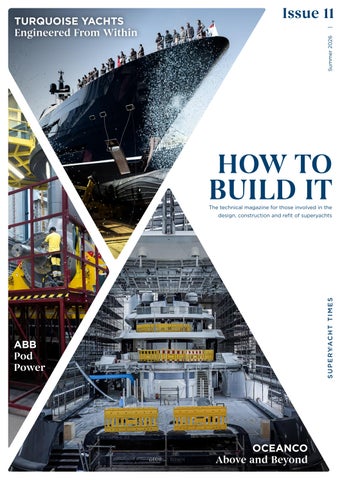
TURQUOISE YACHTS Engineered From Within
HOW TO
BUILD IT The technical magazine for those involved in the design, construction and refit of superyachts
ABB Pod Power
OCEANCO Above and Beyond
Strategic Advisory for the Superyacht Market SYT Strategy advises investors, shipyards, marina operators, and governments on investments, growth strategy, and market positioning
Investment & Commercial Due Diligence
Market & Competitive Strategy
Marina & Infrastructure Advisory
Brand & Positioning Intelligence
Merijn de Waard Founder & CEO merijn@superyachttimes.com sytstrategy.com
MASTHEAD
EDITORIAL EDITOR IN CHIEF EDITOR | HOW TO BUILD IT EDITORIAL CONTRIBUTOR NEWS EDITOR FEATURES EDITOR FEATURES WRITER WRITER WRITER DIGITAL MARKETING MANAGER
Francesca Webster Justin Ratcliffe Charlotte Thomas Sophie Spicknell Leona Caanen Enrico Chhibber Andrea Pefianco Ann Yabut Marina Vargas
DESIGN PRODUCTION CREATIVE DIRECTOR GRAPHIC DESIGNER
Ivo Nupoort Beatriz Ramos
INTELLIGENCE HEAD OF INTELLIGENCE RESEARCH ANALYST RESEARCH ANALYST
Ralph Dazert Adil Zaman Murat Beskok
SALES & ADVERTISING HEAD OF SALES SALES MANAGER SALES MANAGER SALES MANAGER SALES MANAGER CLIENT SERVICE MANAGER SALES ITALY
Marieke de Vries Mitchell Cassee Charlotte Powell Charly van den Enden Nuri Ozkaya Johanna Borreli info@admarex.com
CORPORATE FOUNDER & DIRECTOR TECHNOLOGY DIRECTOR FINANCE DIRECTOR
Merijn de Waard Fabian Tollenaar Laura Weber
SuperYacht Times B.V. Silodam 256, 1013 AS, Amsterdam, The Netherlands 31 (0) 20 773 28 64 info@superyachttimes.com www.superyachttimes.com
Cover Images: Oceanco by Oceanco Turquoise Yachts by Turquoise Yachts ABB by J. Ratcliffe How to Build It is published by SuperYacht Times B.V., a company registered at the Chamber of Commerce in Amsterdam, The Netherlands with registration number 52966461. The magazine was printed in June 2026.
The complexity is ours. The result is yours. €1B+
92M
275+
C O NTRACTED TO DAT E
AVE RAG E L E N GT H
YE ARS C O M BI N E D E XP E RT I S E
PROJECTS D E L I V E R I NG I N 2 02 6
8 8M MOTOR TURQU OISE
110 M EX PLO R ER LÜRSSE N
9 0 M SAIL
88M M OTOR
LÜRSSEN
FEADSH I P
G I L E S FRANKAL
LE E STEVENSO N
Co-Fou nd er
C o-Foun der
g i l es @oc c am .u k.c om
l ee@ occa m.uk.com
+44 7552 323 43 4
+ 4 4 7878 47840 2
occa m.uk.com
EDITOR’S LETTER
The Integration Age Increasingly, one of the most important aspects of modern yacht building is what you don’t necessarily see. Reading through this issue of How to Build It, a common thread began to emerge across projects that, on the surface, appear entirely unrelated. What connects them all is integration. Integration in the broader sense of how large yachts are conceived, engineered and operated. They are increasingly complex ecosystems where propulsion, energy management, digital systems, operational flexibility, environmental considerations and long-term adaptability must all function as one coherent whole. You can see this clearly in N2H, Turquoise’s first hybrid yacht, where the shipyard’s role extended well beyond the construction to take on the integration of an evolving technological vision into a reliable operational reality. The yacht was effectively engineered into existence from the inside out. The transformation of Draak reflects a similar story. What began as a refit by Oceanco evolved into something far more ambitious: the reconstruction of a large superyacht into a hybrid expedition and support platform. The project stands out as a case study in how a refit can extend well beyond customary bounds by fundamentally redefining what the platform is capable of. Meanwhile, ABB’s podded electric propulsion systems are changing the way designers think about yacht architecture altogether. Machinery layout, energy generation, manoeuvrability, noise reduction and efficiency are increasingly interconnected. Technologies once associated with cruise ships and ice breakers are steadily influencing custom yacht construction as electrification and integrated energy systems become more mainstream. This is backed up by the conversation around Industry 4.0. Superyacht builders may resist comparisons with industrial manufacturing, but digital modelling, robotics, remote survey capabilities and data-driven engineering are becoming essential tools in managing the growing complexity of modern yachts. The first 42-metre motor cruiser by GX Superyachts in-build at SES Yachts in Turkey reflects exactly this shift. From the outset, it was conceived as a hybrid platform in which naval architecture, systems integration, structural engineering and interior development were all carried out simultaneously within a unified 3D data environment. These stories all suggest the next generation of superyachts will not be defined by aesthetics or headline specifications alone, but by how intelligently their systems, technologies and operational capabilities are integrated from the very beginning.
Enjoy the read!
Justin Ratcliffe - Editor
superyachttimes.com
5
Contents
27. Business Brief: Over the Horizon
52. Concept in Focus: The Ferrari Flyer
5
Editor’s Letter
27
8
News in Brief
12
Products
Business Brief: Over the Horizon Taiwanese brand Horizon, founded in 1987 by CEO John Lu, has grown from a small OEM manufacturer into a global builder of semicustom motor yachts above 24 metres.
17
Projects to Watch New projects in early stages of construction that present opportunities for OEMs, suppliers and subcontractors.
38
21
Supplier Spotlight: Luce5 Luce5 takes a distinctive approach to onboard lighting by leveraging its experience of working with high-end fashion brands, including Prada, Fendi, Boucheron, Zanotti and Bulgari.
Build Report: Engineered From Within When Turquoise Yachts began building N2H, its first hybrid yacht, it came with a partially developed system architecture in place. The shipyard then had to integrate that hybrid technology into a fully realised superyacht platform.
52
Concept in Focus: The Ferrari Flyer The aerodynamically sculpted Ferrari Hypersail taking shape in Pisa, Italy, is the result of decades of automotive ingenuity and a desire to do things differently.
60
Refit & Conversion: Above and Beyond The refit of Draak is better understood as a comprehensive rebuild. The conversion from superyacht into a hybrid expedition vessel required an unusually high level of coordination between all parties involved.
24
6
CEO in Conversation: Superyacht Interiors Dubai Founded in 2020 by two long-time industry colleagues, Superyacht Interiors Dubai has grown from a team of 172 craftsmen into a workforce of more than 500.
How to Build It | Issue 11
88. Paint & Coatings: Fair or Foul?
108. Build Report: Digital by Design
73
Original Equipment Manufacturers: Pod Power As the superyacht sector shifts towards electrification and podded propulsion, we visit ABB’s facility in Helsinki where its biggest fully electric Azipods are assembled in dust-free, temperature-controlled conditions.
108
Build Report: Digital by Design The first GX42 from GX Superyachts is a hybrid platform in which naval architecture, systems integration, structural engineering and interior development have been executed within a fully unified 3D data environment.
84
Inside Angle: Donna Green The Head of New Build at Y.CO, discusses modern yacht building, the importance of collaboration, and why successful projects are driven by people as much as process.
120
Rules & Regs: The Case for a Unified Yacht Code Lorenzo Pollicardo, SYBAss Technical & Environmental Director, argues the time has come for a unified approach to bring clarity, consistency and credibility to yacht regulation.
88
Paint & Coatings: Fair or Foul? As regulations continue to tighten around underwater coatings and antifouling, what does the future holds for treatments below the waterline in an industry that demands performance, aesthetics and sustainabiltiy?
127
99
Technology & Innovation: Rise of the Robots (II) The superyacht industry can appear resistant to change. But from robotics to remote survey techniques, the sector is beginning to benefit from adopting the digital manufacturing technologies of Industry 4.0.
Industry Insight: Building a Better Boat Naval architect Patrick Bray believes it is time to re-centre attention on buildability and the practical realities of construction to achieve cost-efficiency while maintaining comfort, strength and seaworthiness.
superyachttimes.com
7
NEWS IN BRIEF
News in Brief Amico Marine launched Amico Marine is a new brand unveiled by refit yard Amico & Co in Genoa designed to unify its network of companies delivering technical and operational services to the superyacht sector. The initiative consolidates more than 30 years of expertise into a single identity, bringing together refit, maintenance and support services for owners, captains and managers. Amico Marine encompasses the core refit operations of Amico & Co and Amico Loano, alongside the recently upgraded Gatti shipyard, equipped to handle vessels and tenders up to 30 metres. The network also includes the 26-berth Waterfront Marina for yachts up to 120 metres, as well as the Acier-Sarimi metalwork facilities. Supporting the system are Amico Servizi, responsible for general services and operational coordination, and Marine Tools, which provides digital solutions for yacht management. Client and crew services are delivered through the Genoa Superyacht Hub, operated in partnership with the Pesto Group. “Amico Marine represents a clear and consistent expression of our identity,” says Alberto Amico, Founder & Partner. According to CEO Bruno Guglielmini, the launch reflects the company’s long-term strategic vision and further strengthens Genoa’s position as a global superyacht hub.
Motion Control Quantum’s all-electric e-FIN stabilisation system has entered operational service aboard the 51-metre Double Haven, following a comprehensive refit completed at Derecktor Shipyards in Dania Beach, Florida. The project replaced the vessel’s legacy hydraulic stabilisation system with the e-FIN 1800 platform, designed for both retrofit and newbuild applications in the 40–65 metre range, paired with upgraded XT fins. The e-FIN architecture significantly reduces energy demand, achieving up to 80% lower consumption compared to conventional hydraulic systems. At its core is Quantum’s E6 Control Unit, an advanced control architecture using proprietary algorithms to interpret real-time vessel motion and continuously optimise fin response. The system integrates with onboard networks, enabling live diagnostics, data monitoring, and remote service support. This predictive maintenance capability enhances operational transparency while reducing downtime and lifecycle costs. Thermal efficiency is another key advantage. The elimination of hydraulic circuits removes the need for dedicated cooling systems, reducing heat output and auxiliary loads. An integrated energy storage module further stabilises power demand, smoothing load fluctuations typical of dynamic stabilisation systems. Service intervals have been extended from 8,000 to 16,000 operating hours, while the reduction of hydraulic components contributes to lower onboard noise and improved reliability.
8
How to Build It | Issue 11
NEWS IN BRIEF
NANNI methanol dual-fuel engine French engine and generator manufacturer NANNI has tested its first high-speed dual-fuel engine, capable of operating on both diesel and methanol. Developed in partnership with Sweden-based naval engineering specialist ScandiNAOS AB, the innovation represents a significant step toward reducing emissions while maintaining performance and reliability. The project, supported through the EU-funded Life Mystic initiative aimed at decarbonising the superyacht industry, introduces advanced dual-fuel technology enabling a fuel mix of approximately 70% methanol and 30% diesel on an energy basis. The system automatically switches to diesel operation when methanol is unavailable, ensuring uninterrupted performance. ScandiNAOS AB was commissioned to develop a methanol dual-fuel conversion kit for NANNI’s 6-liter John Deere-based generator engine, integrating dedicated methanol control systems and fuel injection modifications. Testing conducted according to IACS standards, under the observation of a RINA representative, delivered highly positive results. The engine maintained full power output while significantly reducing emissions, with carbon monoxide and hydrocarbon emissions cut by 95–99%, NOx reduced by 65%, and particulate emissions consistently lowered.
Azimut Grande 44 to use Hull Vane technology At Seatec 2026 in Milan, Azimut Benetti Group confirmed that Hull Vane technology will be integrated into the new Azimut Grande 44 — marking the first collaboration between the two companies. Unlike previous concept studies, the project will move directly into production, with sea trials scheduled for summer 2026. The initiative represents one of the most high-profile applications of Hull Vane technology in the superyacht sector to date. The bespoke 75-foot Hull Vane has been specifically engineered for the Grande 44 and manufactured in carbon fibre to meet Azimut’s performance and construction standards. Designed to integrate semlessly with the yacht’s naval architecture, the system aims to improve fuel efficiency, reduce drag and enhance onboard comfort without compromising design or operational simplicity. For Azimut Benetti, the collaboration reflects a broader industry shift toward practical sustainability solutions and advanced hydrodynamic optimisation. As yacht builders continue exploring new approaches to sustainability and operational efficiency, projects such as this suggested that advanced hydrodynamics may soon become a standard feature rather than a specialist innovation.
Heesen appoints captain as strategic advisor Heesen Yachts has appointed veteran yacht captain and technical advisor Mike Rouse as Strategic Advisor, a move that signals the Dutch shipyard’s continued focus on operationally driven innovation and engineering development. Rouse brings a career spanning senior command roles, technical consultancy, refit supervision, and owner representation across some of the industry’s most complex large-yacht projects. Having spent decades at sea commanding large yachts and overseeing major technical programs throughout Northern Europe, he is widely regarded as someone who understands both the realities of life onboard and the increasingly sophisticated demands of modern yacht engineering. “Mike brings the operational expertise and technical perspective that perfectly complement our ongoing evolution,” says Heesen CEO Jeroen van der Veer. “His operational insight, combined with our engineering capabilities, enhances our ability to deliver yachts that are technologically advanced while remaining deeply connected to the realities of contemporary yachting.”
10
How to Build It | Issue 11
PRODUCTS
Products Batten car & stack track system by Rigging Projects Rigging Projects in the UK has introduced a new generation of Batten Car and Stack Track systems, purpose-built to meet the demands of today’s high-performance sailing yachts. Developed through extensive testing and engineering, the system represents a complete rethinking of traditional batten car and headboard car technology, addressing the increased loads generated by modern foiling yachts and structured-luff sails. As sail design continues to evolve, headboard angles have increased significantly, placing greater stresses on conventional hardware. Rigging Projects’ 34mm Stack Track has been specifically engineered and rigorously tested to maintain structural integrity under these higher loads while delivering smooth, reliable sail handling. A key innovation is the integration of a proprietary tri-sail gate architecture, allowing Rigging Projects to optimise the entire system rather than working within the limitations of legacy track designs. This freedom has enabled the development of a new headboard car geometry that improves efficiency, reliability, and overall mainsail performance. The Batten Car itself features patented split roller bearings that reduce friction by up to 50 percent compared with conventional slider-style systems. By allowing more dynamic movement through curved and highly loaded sections of the track, the design delivers smoother reefing, cleaner load transfer and more precise sail shape control.
Volvo Penta D13 IPS Hybrid Volvo Penta has revealed details of its D13 IPS Hybrid propulsion system. Developed around the company’s proven IPS platform, the new package combines diesel propulsion, electric motors, batteries, energy management and vessel controls into a single, fully integrated solution. Designed as a complete “helm-to-propeller” system, the D13 IPS Hybrid aims to reduce complexity for yacht builders, designers and captains by providing one coordinated platform from installation through operation and servicing. The hybrid system allows operators to transition between electric, hybrid and crossover propulsion modes depending on operational requirements. In fully electric mode, yachts can cruise at low speeds with significantly reduced noise and vibration, creating a quieter and more refined onboard atmosphere while also improving maneuvering during docking and anchoring. The system is compatible with HVO100 renewable fuel and incorporates an IMO Tier III-compliant aftertreatment system. All components are connected through Volvo Penta’s Electronic Vessel Control platform, integrating advanced features such as Joystick Driving, Assisted Docking, Autopilot and Glass Cockpit functionality across all propulsion modes for an intuitive user experience.
12
How to Build It | Issue 11
PRODUCTS
FIM new tender division FIM – Fabbrica Italiana Motoscafi – has a new tender division dedicated to the development of bespoke luxury tenders. Leading the range is the TT9 Open (pictured), a 9.4-metre carbon-composite tender designed to operate as a chase boat, guest tender or independent day boat. Developed to superyacht standards, the TT9 Open is conceived not merely as a service craft, but as an integral extension of the yacht’s identity and onboard experience. “Our objective is to develop tenders that are not only functional, but fully integrated into the onboard experience through tailor-made solutions capable of interpreting operational requirements, refined aesthetics, and the owner’s identity, according to a vision founded on luxury, elegance and personalization,” says Manuela Barcella, co-founder and CEO of FIM. This philosophy is already being applied to several new projects currently under development, including the TT9 Limo, designed to provide greater protection and versatility during guest transfers, and the TX9 Taxi Tender, developed for luxury hospitality and resort environments where guest transportation is an integral part of the overall experience.
New Numarine Classic line Numarine in Turkey has introduced a new Classic superyacht line comprising two models, the 38XPC and 39MXPC. The range builds on the shipyard’s proven XP explorer platforms, reinterpreted through a timeless, lifestyleoriented design approach. Both yachts feature exterior design by Can Yalman, naval architecture by Umberto Tagliavini, and interior concepts by Hot Lab. The concept is rooted in rediscovering core naval design principles to create a contemporary-classic expression that does not currently exist in the series production segment. The 39MXPC places strong emphasis on outdoor living, with expansive deck spaces designed for socialising and connection to the sea. Key features include an open terrace close to the water, and a reconfigured aft deck with a Jacuzzi. Clean horizontal lines, extensive glazing and a distinctive two-tone hull define her profile. In contrast, the 38XPC adopts a more traditional layout inspired by gentleman’s yachts. A forward tender position reinforces her explorer capabilities. “This Classic Line represents a natural and strategic evolution for Numarine,” says CEO Patrik von Sydow. “It allows us to broaden our design language while staying true to the core principles that define the brand.”
Tambo EVO Hinge by Tecnimpianti The Tambo EVO is an innovative hinge engineered by Tecnimpianti in Livorno for hatches with thick external coverings. It has been specifically developed to ensure controlled movement in complex opening and closing systems, accommodating coverings up to approximately 100mm in thickness. Its distinctive geometry enables a two-stage motion – an initial linear translation followed by a rotational movement that provides smooth, precise operation even in constrained environments. In applications such as sofas, sun loungers and similar configurations, the hinge allows the seat to first slide forward away from the backrest and then lift effortlessly – eliminating the need to remove or reposition the backrest. This enhances both usability and design integration. When fully closed, the hinge remains completely concealed, preserving a clean and uninterrupted surface. Beyond its functional role, the hinge serves as an architectural detail, contributing to the overall visual language of the product. The Tambo EVO is manufactured from AISI 316 stainless steel with a mirror-polished finish, providing excellent corrosion resistance, high mechanical strength, and longterm durability in demanding environments, including marine applications.
superyachttimes.com
13
PRODUCTS
Carbon fibre awning system by Foresti & Suardi Foresti & Suardi in Italy continues to expand its portfolio of deck hardware with an advanced Carbon Fibre Awning Pole System, engineered to deliver high performance, ease of operation and refined aesthetics for yachts and superyachts. Combining precision engineering with clean, contemporary design and manufactured in carbon fibre with matt or high-gloss painted finishes, the system combines lightweight construction with excellent structural strength and durability in demanding marine environments. At its core is an integrated internal 1:5 halyard purchase system, based on a 40mm pole diameter, providing smooth and efficient hoisting of awnings. The system incorporates an automatic locking mechanism for operational safety and to simplify deployment. Its modular design allows for a range of lengths and diameters to suit diverse installation requirements across different vessel types and layouts. There is also a demountable version of the system, particularly suited to applications where space optimisation is critical.
Boero CHALLENGERPRO Boero Yacht Coatings has introduced CHALLENGERPRO, a completely new range of topcoat systems developed for the yacht and superyacht market. Representing the latest evolution of the company’s coatings technology, the range has been designed to combine high-impact aesthetics with longterm durability, establishing what Boero describes as a new benchmark in yacht finishing through its PUREPROTECTION philosophy. Rather than launching a single product, Boero has developed an integrated coatings platform that spans the entire finishing process, from primer to topcoat. The objective was to create a system in which every layer works together to maximise appearance, protection and reliability throughout a yacht’s service life. Research and development focused on achieving a mirror-like gloss finish while enhancing resistance to abrasion, weathering and colour fade. The new range is led by CHALLENGERPRO Fusion, a high-gloss polyurethane topcoat, and supported by the CHALLENGERMIX tintometric system, which offers more than 245,000 colour formulations. Together, they provide shipyards, designers and owners with unprecedented flexibility while maintaining the performance standards demanded by today’s most prestigious yachts.
14
How to Build It | Issue 11
GLASS YOUR BEST CHOICE FOR NEWBUILD AND REFIT.
IN-BUILD PROJECTS
Projects to watch New projects in early stages of construction that present opportunities for OEMs, suppliers and subcontractors.
Project Bond John Staluppi’s new superyacht will be Bilgin’s flagship when launched in 2029. Project Bond will feature a shallow 3.50-metre draft for easier access to harbours and cruising grounds. She will be propelled with twin MTU engines, giving her a cruising speed of 15 knots and a top speed of 17.5 knots. Additional details on her layout and general arrangement will be revealed in due course. LENGTH: 82-metres
BUILDER: Bilgin Yachts
NAVAL ARCHITECTURE: Unique Yacht Design
GT: 2,150 GT
COUNTRY OF BUILD: Turkey
EXTERIOR DESIGNER: Unique Yacht Design
DELIVERY YEAR: 2029
INTERIOR DESIGNER: H2 Yacht Design
Lync YXT34 The YXT 34 offers a larger platform, which has been enhanced to include a larger carrying capacity, paired with a refined interior design. The result is a vessel that is designed for owners who demand a “carry it all” functionality, without sacrificing luxury. The first steel cutting has now been completed, with the first YXT 34 yacht scheduled for delivery in Q1 2028. LENGTH: 33.8-metres
BUILDER: lYNX
NAVAL ARCHITECTURE: Diana Yacht Design
GT: 199 GT
COUNTRY OF BUILD: Netherlands
EXTERIOR DESIGNER: Weel Sluitjer
DELIVERY YEAR: 2028
INTERIOR DESIGNER: Julian Moore Design
superyachttimes.com
17
IN-BUILD PROJECTS
Baglietto DOM 155/01 The project was commissioned by a highly experienced owner, with build captain Simon Mackay overseeing construction. Accommodation is centred around a full-beam owner’s suite on the main deck, complemented by four guest cabins below deck, with the option to add a fifth cabin if desired. Crew quarters have been carefully integrated to support efficient onboard operations. Powered by twin Caterpillar engines, the DOM155 is expected to reach a top speed of 16 knots. LENGTH: 46.9-metres
BUILDER: Baglietto
NAVAL ARCHITECTURE: Baglietto
GT: 499 GT
COUNTRY OF BUILD: Italy
EXTERIOR DESIGNER: Studio Vafiadis
DELIVERY YEAR: 2029
INTERIOR DESIGNER: Leonardo Santi Design
Maiora M38 Currently in-build at the Maiora Viareggio facility, the Maiora M38 yacht has an expected delivery date of September 2026. Spanning 275 GT, the Maiora M38 yacht can comfortably accommodate up to 12 guests across a five stateroom configuration, as well as dedicated quarters for six crew members. In terms of performance, the Maiora M38 yacht is powered by twin MTU engines, providing her with a top speed of 24 knots.
LENGTH: 37.18-metres
BUILDER: Maiora
NAVAL ARCHITECTURE: Maiora
GT: 275 GT
COUNTRY OF BUILD: Italy
EXTERIOR DESIGNER: Quartostile
DELIVERY YEAR: 2026
INTERIOR DESIGNER: Acube Design
RV11000 Vard Group announced the new contract with Gabe Newell’s research organisation Inkfish, for the design and construction of the 162-metre research vessel, RV11000 in May. Constructed to the design of the Vard 9 42 platform, the contract is valued at nearly €700 million and is the largest order ever secured by Vard for one single vessel. RV11000 will build on the engineering and design foundations of the 100-metre RV6000, Inkfish’s first purpose-built research vessel.
LENGTH: 162-metres
BUILDER: Vard Group AS
NAVAL ARCHITECTURE: Vard Group
18
How to Build It | Issue 11
GT: 12,500 GT
COUNTRY OF BUILD: Norway
EXTERIOR & INTERIOR DESIGNER: Vard Group
DELIVERY YEAR: 2030
IN-BUILD PROJECTS
TD27 This is the first hull of the Tureddi TD27 series to be sold. The yacht features a clean and contemporary design, characterised by sharp lines and a plumb bow, with interior and exterior design by 3-Studio. As well as this, extensive glazing spans her decks, allowing for natural light and views.
LENGTH: 27-metres
BUILDER: Tureddi
NAVAL ARCHITECTURE: N/A
GT: 150 GT
COUNTRY OF BUILD: Italy
DELIVERY YEAR: 2027
EEXTERIOR & INTERIOR DESIGNER: 3-Studio
T720 Fenice Developed from the 68-metre T680 Fenice yacht, the larger T720 Fenice will become the second flagship in Tankoa’s fleet when delivered. Details surrounding the configuration of the Tankoa T720 Fenice yacht are yet to be unveiled. LENGTH: 71.48-metres
BUILDER: Tankoa Yachts
NAVAL ARCHITECTURE: Tankoa Yachts
GT: 1,600 GT
COUNTRY OF BUILD: Italy
EXT. DESIGNER: Team for Design - Enrico Gobbi
DELIVERY YEAR: 2030
INT. DESIGNER: Cassetta Yacht Design
Advertisement
Tecnimpianti a Navim Group Company
SMART. YACHT. SOLUTIONS.
GET ON BOARD WITH OFF THE CHART COLOR
Everything you love about Awlcraft 2000, including tried and trusted application characteristics and repairability, but now enhanced with our next generation color platform. Awlcraft 3000 gives you deeper, more vibrant colors and a long lasting, high gloss finish to turn heads.
GET ON BOARD WITH AWLCRAFT 3000
awlgrip.com ® Registered trademark of AkzoNobel in one or more countries.
SUPPLIER SPOTLIGHT | LUCE5 YACHTING
Luce5 Yachting With over 30 years of experience in bespoke lighting projects, Tuscanybased Luce5 takes a distinctive approach to onboard lighting by leveraging its experience of working with high-end fashion brands, including Prada, Fendi, Tiffany and Bulgari. BY GEORGIA TINDALE
“My years in luxury retail, especially at Prada, taught me that light is not just about visibility but about mood, materiality, and brand identity,” he says. “That philosophy now drives everything we do at Luce5, from yachts to flagship stores.” With the majority of its output still focused on luxury retail, the company remains deeply embedded in fashion brand work, including a long-term partnership with Prada and major recent projects with Tiffany, Fendi, Bulgari, Langosteria and David Yurman. This includes the Tiffany store in Milan’s Via Monte Napoleone, which in 2025 was named “the most beautiful emporium in the world” by Prix Versailles, the global architecture and design awards that recognise exceptional contemporary projects.
Riccardo Di Bene
A
fter expanding into the yachting sector in 2017, Luce5 has applied its high-end retail DNA to superyachts from the get-go. Drawing on its technical and design expertise through work with luxury fashion brands, it aimed to bring technical value and bespoke capabilities to the yachting sector with an innovative and distinctive approach. Riccardo Di Bene, co-founder of Luce5 Yachting, worked for Azimut-Benetti and Prada before joining the company, an experience that enabled him to understand the importance of lighting in the high-end luxury sector.
Luce5’s approach to quality control in all of its projects, including yachting, is shaped by this experience. It brings a rigorous process to lighting by carrying out detailed calculations and verifications before any scheme is approved. Using specialist software, the team produces photorealistic renderings that show the real expected effect of the lighting installations on board, including brightness levels and the way light plays across specific materials and shapes. This allows designers and owners to review and fine-tune the atmosphere on screen before a single fitting is installed. These techniques, long standard in luxury fashion retail but still relatively new to yachting, reduce unwanted surprises and ensure that the final result aligns precisely with the intended mood and experience.
superyachttimes.com
21
SUPPLIER SPOTLIGHT | LUCE5 YACHTING
Left: Luce5 engineered and installed two signature chandeliers aboard Camila, a 49.5-metre Bilgin yacht with interior design by Hot Lab.
Showcased at the recent Milan Design Week in April, as well as at last year’s Metstrade show, Luce5’s latest innovation is HYLEtech, a newly patented lighting technology that integrates high-efficiency Nex-S LEDs directly into slender, aluminium panels, creating a clean and continuous surface with no visible cabling. Weighing just 10 kg per square metre – significantly less than the weight of a wooden panel required to achieve the same structural and functional characteristics – while delivering highly controllable, glare-free light across multiple dimming levels, HYLEtech is engineered to cut emissions, simplify installation and give designers far greater freedom in marine and architectural applications. In addition, because aluminium is 100 per cent recyclable, HYLEtech forms a key part of the company’s circular-economy strategy.
Another area where Luce5 is increasingly involved is the development of circadian-friendly lighting and “virtual window” systems, which recreate natural daylight cycles indoors on yachts using custom-made products and technologies. “In this way, we align interior light with human biological rhythms and create a much more comfortable environment on board,” says Di Bene. “First developed for high-end retail, it is now being applied both in yachts and in flagship stores, as more and more clients ask us for natural, healthconscious lighting solutions.” In yachting, Luce5 positions itself firmly as a project- rather than a product-based partner. While the company offers catalogues and ready-made fixtures, its core identity lies in delivering turnkey lighting projects, from lighting concept development through to prototyping, production, installation and commissioning, so that even “a few downlights” are treated as a tailored solution in their own right.
22
How to Build It | Issue 11
Despite only formally entering the yacht market less than ten years ago, Luce5 Yachting has already become one of the key players in the sector, working with all the leading Italian shipyards and now moving into partnerships with leading Northern European builders as well. Yachting currently represents around 10 percent of the group’s turnover, but the company has grown the segment deliberately and sustainably. Di Bene likens Luce5 Yachting to a boutique restaurant that opened with three tables, starting with just one to be sure about the service, the organisation, and the food, so clients would leave satisfied and eager to return: “Only then did we serve the second table, and now we’re getting ready to start with the third, growing step by step.” “For us, the luminaires are just the final output of a much bigger package of services: concept, engineering, prototyping, production, installation and commissioning,” he concludes. “Our goal is to be a true lighting partner, offering a projectbased approach that makes a real difference for shipyards, designers and owners.”
Just like superheroes. Always by your side, ensuring a smooth yachting experience.
Our experience. Your growth. rina.org
CEO IN CONVERSATION ! SUPERYACHT INTERIORS DUBAI
Superyacht Interiors Dubai What began as a four-month mission to complete the interior of a 78-metre custom yacht has evolved into a major interior manufacturing operation. Founded in 2020 by long-time industry colleagues Roger Myers and Cyril Bieri, Superyacht Interiors Dubai has grown from a team of 172 craftsmen into a workforce of more than 350 specialists, delivering complex yacht interiors, bespoke furniture packages and high-end residential projects from facilities in Dubai and Oman. We spoke with Roger about the systems, facilities and strategies that underpin their approach. Roger Myers
BY FRANCESCA WEBSTER
24
How to Build It | Issue 11
CEO IN CONVERSATION ! SUPERYACHT INTERIORS DUBAI
What has been the most significant change in the business since completing your first yacht project? The biggest transformation has been in our engineering and manufacturing capabilities. In the beginning, our focus was on assembling the right team and delivering the interior of the 78-metre yacht to the standards expected by European shipyards and designers. Since then, we have invested heavily in engineering, production systems and machinery. What started as a project-driven operation has evolved into a fully integrated manufacturing business with dedicated engineering departments, advanced CNC machining capabilities, specialised finishing facilities and robust quality control systems. Our objective has always been to combine traditional yacht craftsmanship with modern manufacturing processes while maintaining the standards expected within the superyacht sector. How has your production capacity evolved as the company has grown? When we launched, we had 172 employees. Today, our core workforce sits at around 350 specialists, although we have demonstrated the ability to scale significantly when projects require it. During peak production on an ongoing Northern European project, we expanded to almost 500 personnel to support areas such as finishing, veneer preparation and painting. At standard production levels, we’re able to deliver approximately 1,200 square metres of luxury yacht interiors annually. With extended shifts and overtime, that capacity increases to around 1,500 square metres. One of the key lessons we’ve learned is that capacity is not simply about workforce numbers. It’s about understanding production bottlenecks and investing in the areas that create the greatest efficiencies. Paint, veneer processing and machining all involve curing or drying periods, so extending operations through additional shifts allows us to maximise utilisation of those assets. You have recently invested significantly in engineering and digital manufacturing. What is driving that strategy? Efficiency is a major focus for us as we look towards the future. Over the past year, we have invested heavily in CAD+T engineering software alongside ERP and SAP systems that allow us to track materials and components throughout the production process. Traditionally, yacht interiors have relied heavily on 2D engineering. We’re now transitioning towards fully integrated 3D workflows. The advantage is that the engineering model automatically generates bills of materials, cut lists and manufacturing information, which can then be transferred directly to our production machinery. Alongside the software investment, we have recruited highly experienced specialists from leading European yacht interior companies to support the implementation. Our goal is for the majority of our engineering output to be delivered through these integrated digital systems over the next 12 months.
What investments have you made on the manufacturing side? We’ve invested approximately €2 million in machinery and equipment, with a long-term investment plan of around €4 million over the next five years. This includes new 5-axis and 4-axis CNC machining centres, upgraded spray-line systems and additional finishing capabilities. We have also expanded our paint operations significantly, with two large spray facilities now fully operational and a third currently being introduced. These investments are already generating substantial gains in efficiency, production quality and programme reliability. At the same time, we continue to invest in people. Technology is important, but it still relies on skilled craftsmen, engineers and project managers to deliver the final result. How does the new Oman facility fit into your manufacturing strategy? Capacity was certainly one factor, but the facility is really about manufacturing optimisation. The Oman facility has been established as a dedicated machining centre and houses much of our newest CNC equipment, focusing on high-volume cutting and machining operations. By relocating these activities, we can maintain a cleaner, quieter and more controlled production environment in Dubai, which is where clients visit for factory acceptance tests, mock-ups and project reviews. Machining generates dust, noise and material movement. Separating those activities allows us to improve workflow efficiency while creating a better environment for assembly, finishing and client interaction. How important is vertical integration to your business model? It’s fundamental. One of the reasons we remain competitive internationally is because we undertake a significant amount of work in-house. We have dedicated engineering, joinery, upholstery, finishing and metalworking capabilities operating within the same organisation. That allows us to maintain control over programme schedules, quality standards and costs. It also improves communication between departments and reduces reliance on external suppliers. For yacht projects, where tolerances are extremely tight and schedules are often compressed, that level of integration is a major advantage. Looking ahead, what will define the next stage of growth for Superyacht Interiors Dubai? Growth remains important, but craftsmanship remains at the centre of everything we do. Technology improves efficiency and accuracy, but ultimately every yacht interior is still built by skilled craftsmen. Our objective is to combine those traditional skills with modern engineering and manufacturing systems, creating an environment where designers, shipyards and owners can realise increasingly ambitious projects. That balance between craftsmanship, innovation and collaboration is what will continue to define Superyacht Interiors Dubai in the years ahead.
superyachttimes.com
25
SINCE 1942
REFIT & REPAIR SHIPYARD
Phi-losophy of craftmanship
a a+b = = b a
WWW.ASTILLEROSDEMALLORCA.COM
= 1,618
BUSINESS BRIEF | HORIZON
Over the Horizon The bustling port city of Kaohsiung in southern Taiwan is home to one of the most vertically integrated yacht-building groups in Asia. Horizon, founded in 1987 by CEO John Lu, has grown from a small OEM manufacturer into a global builder of semi-custom motor yachts above 24 metres. BY JUSTIN RATCLIFFE
HORIZON
superyachttimes.com
27
BUSINESS BRIEF | HORIZON
T
oday, the Horizon Group comprises five closely connected companies spanning the entire yacht lifecycle – from composite engineering and hull construction to commissioning, delivery and aftersales support. The structure reflects a deliberate strategy: maintain tight control over core manufacturing while preserving flexibility across product lines. At the centre is Horizon itself, responsible for building yachts over 80 feet or 24 metres. The main shipyard in Kaohsiung houses the company’s CNC tooling centre, interior design department, and assembly halls where the FD Series (Fast Displacement) and RP Series (Raised Pilothouse) are produced. Smaller vessels, including the Powercat line, are produced by sister company Vision Yachts, as well special projects like the new Lexus 680 (see sidebar). Premier Shipyard, once responsible for mould manufacturing, commissioning and delivery, has been transformed into a dedicated refit centre following a US$12 million redevelopment. The facility now has a 1,800-tonne Pearlson shiplift able to of haul out yachts of 70 metres or more for maintenance and structural work. Composite engineering is carried out by Atech Composites. In addition to yacht structures, the subsidiary company produces composite components for other industries, including fibreglass nacelle and spinner covers for wind turbines. Completing the ecosystem is City Marina in downtown Kaohsiung, providing berthing and service support for owners and visiting yachts. Together these operations form an integrated system that allows Horizon to oversee everything from material testing and hull construction to interior outfitting, delivery and long-term service.
28
How to Build It | Issue 11
Joey Lu
BUSINESS BRIEF | HORIZON
Left and bottom: A new production hall, warehouse and office complex have helped streamline construction and material flow between departments.
SCALING PRODUCTION Like much of the superyacht sector, Horizon saw demand surge during and after the COVID-19 pandemic. Orders rose by as much as 30 percent, pushing the yard to full capacity and accelerating expansion plans. A new production hall opened in 2022 alongside a warehouse and office complex designed to streamline material flow between departments. With space for seven additional yachts in build simultaneously, the yard now produces 20–25 units annually. Precision manufacturing was also upgraded with a PAR Systems 5-axis CNC milling machine. The system enables structural components, large and small, to be produced with high accuracy and repeatable tolerances. A 3D printing system, although not yet used for full-scale structural components, allows designers and engineers to evaluate space planning and technical arrangements before committing to tooling. Although Horizon operates firmly within the semi-custom segment and builds yachts based on established platforms, the level of owner customisation is extensive. The hulls remain consistent across each series – ensuring predictable timelines and engineering reliability – but layouts, deck configurations and interiors can be tailored to individual preferences. According to Vice President Joey Lu, son of founder John Lu, roughly half of all projects begin as speculative builds: “These spec boats begin without a confirmed buyer but usually attract one before completion,” he says. “Around 80 percent sell when the yacht is about 50–60 percent finished, leaving time to customise layouts, equipment and décor.” J. RATCLIFFE (3)
superyachttimes.com
29
BUSINESS BRIEF | HORIZON
“By focusing on vessels under 130 feet, we can maintain faster turnover and predictable production cycles while still serving the upper end of the semi-custom market.”
ENGINEERING FLEXIBILITY LEXUS LUXURY The Lexus LY680, a collaborative project between Horizon and Toyota Motor Corporation, takes the boatbuilder out of its comfort zone with a new model likely to appeal to European owners. Built by sister company Vision Yachts with a chic copper and anthracite paint scheme, the fast, 20.63-metre weekender is a perfect match for the Mediterranean on-the-water lifestyle. An evolution of the LY 650 introduced in 2019 and built by Marquis Yachts in the US, the LY 680 features several enhancements, including an expanded flybridge and a larger swim platform. The yacht combines Horizon Group’s construction expertise with production methods derived from the Toyota Production System, a manufacturing philosophy focused on maximising quality through continuous process improvement and eliminating waste in natural, human and corporate resources. Presented on the water for the first time during a Horizon Open House event in Kaohsiung last March, five units have already been ordered by owners in Japan and Dubai, while Toyota plans to expand into the US and Europe. Larger models are on the drawing board.
While many semi-custom builders limit structural changes, Horizon routinely pushes the boundaries of its platforms. “On one FD80 we dramatically shortened the superstructure to create a much larger boat deck area to take a helipad,” continues Joey Lu. “Another project transformed an FD92 into a tri-deck yacht – a rare configuration for a vessel under 100 feet. That required substantial engineering changes, which proved commercially successful and ultimately evolved into the FD100 platform.” Other projects have been equipped to carry helicopters, mini-submarines and heavy-duty cranes, as well as hybrid designs that combine hulls and superstructures from different model ranges. Lu likens the process to “playing with Lego”, where existing modules can be reconfigured in multiple ways. Despite this flexibility, delivery schedules remain relatively short. A standard-specification yacht can typically be completed within about 12 months of signing the contract. Historically, the yard’s largest project was the fully custom 150-foot EP150 delivered in 2008. That was a one-off and today production is capped at just under 40 metres with the FD130, a decision driven by both financial and operational considerations. “Larger yachts demand far greater capital investment, longer construction times and more complex project management,” explains John Lu. “By focusing on vessels under 130 feet, we can maintain faster turnover and predictable production cycles while still serving the upper end of the semicustom market. Our strategy is sustainable growth rather than prestige through size.”
30
How to Build It | Issue 11
BUSINESS BRIEF | HORIZON
Bottom: Horizon has been using sandwich construction and vacuum infusion for more than two decades and has patented its own methodology known as “6D infusion.”
DESIGN PARTNERSHIPS
Horizon Yachts new yachts sales 24-40m, 2020-2025 24-29.99 m
Exterior styling across much of the Horizon range is developed in collaboration with Dutch designer Cor D Rover. His original concept for the Fast Displacement series, introduced in 2016, combined long-range cruising efficiency with contemporary superyacht styling and has since evolved into one of the yard’s defining product lines.
30-39.99 m
14 11 7 4 0
2020
202
2022
202
202
2025
While Rover creates the visual language, Horizon’s engineers adapt the concepts to production requirements and individual client requests. Interiors are primarily developed by the in-house design centre, although owners can appoint independent designers and the yard has collaborated with names such as J.C. Espinosa and Luca Dini. The United States remains Horizon’s largest market, accounting for around 40 percent of sales. Australia follows with roughly 30 percent, while Europe and Asia together make up the remaining share – although the company is increasingly focused on expanding its European presence. “Europe is a more competitive and complex market because many of the world’s most established yacht builders are located there,” John Lu points out. “At the same time, that makes it an important benchmark. Expanding our presence there would demonstrate that Horizon’s engineering, design and quality standards are competitive on a truly global level.” The group operates offices on both American coasts in Florida and Seattle. In Australia the brand is represented in Brisbane and maintains a strong presence at major events such as the Sanctuary Cove International Boat Show, as well as organising regular owner events of own. Taiwan itself remains a relatively small market. Although wealth levels are comparable to many Western countries, marina infrastructure, charter networks and yachting culture are still developing.
J. RATCLIFFE
superyachttimes.com
31
BUSINESS BRIEF | HORIZON
INTERVIEW WITH JOHN LU When John Lu founded the Horizon brand almost 40 years ago, the boatbuilding landscape in Taiwan was very different. The country had over 100 shipyards building low-cost hulls of between 30 and 50 feet, mostly for other brands in America. When the New Taiwan Dollar (NTD) rapidly appreciated against the US dollar after 1986, many yards could no longer compete and closed down. Horizon chose to rethink its business model. John Lu: We moved away from commodity-style production and focused instead on yachts with higher technical content and greater value. That meant building more complete boats with integrated systems, closer to a turnkey product. At the same time, we moved into larger yachts, around 60–65 feet and above, where margins were stronger and customers expected more engineering and customisation.
we usually proceed. If it introduces unacceptable risk, we explain why and decline. That process allows us to remain flexible while protecting the yacht’s engineering integrity.
You also brought more production in-house. Why was that important?
We tend to assume Taiwanese yachts are cheaper than European ones. Is that accurate?
JL: In the past, Taiwanese yards often built basic hulls and shipped them overseas for final outfitting. While that reduced initial complexity, it also limited control over the finished product and the value offered by the builder. We decided to develop those capabilities internally by hiring experienced engineers and technicians so we could ensure system integration and quality from the start. Over time, that became an important part of Horizon’s reputation for engineering quality.
JL: Not necessarily. Price depends on specification – equipment, systems and customisation. When you compare yachts with similar specs, the difference is often much smaller than people expect. In some cases our yachts are priced similarly to European products of comparable specification. What we emphasise is that comparisons must be made on a like-for-like basis.
How did Atech Composites emerge from that strategy?
JL: Yes, and we already have an early concept based on our V Series platform of around 74 feet. One challenge is that many customers associate explorer yachts with steel construction. The issue is perception rather than capability. If we move into that segment, we would likely demonstrate the engineering advantages with comparative testing between steel and composite structures.
JL: Originally our fibreglass department was simply part of the shipyard. As the company grew, I questioned whether managing every production discipline within a single organisation was efficient. So I separated the composites division and established Atech as an independent company within the group. That allowed a dedicated team to focus entirely on composite technology while we invested heavily in new manufacturing methods, including vacuum infusion. Today, Atech is one of the technical pillars of the Horizon group. Horizon is known for accepting extensive customisation requests. How do you manage the risks? JL: The key is strong engineering resources. We have more than 30 naval architects and engineers in the organisation. When clients request changes, we analyse them to check stability, performance, noise and other factors. If the data shows the modification can be implemented safely and cost-effectively,
32
How to Build It | Issue 11
John Lu
Horizon has not yet entered the explorer yacht segment. Is that something you’re considering?
Looking ahead five years, what are your priorities? JL: We want to strengthen our presence in Europe and continue developing new products and solutions. The challenge is to keep leading without moving so far ahead that the market cannot follow. In technology industries people sometimes refer to the “bleeding edge” – innovation that becomes risky rather than beneficial. We try to avoid that. Our goal is to introduce new ideas that move the market forward while remaining practical for owners.
LA CIOTAT / TOULON HARBOUR / BORDEAUX / CARIBBEAN
BUSINESS BRIEF | HORIZON
“The key is strong engineering resources. We have more than 30 naval architects and engineers in the organisation.”
COMPOSITE ENGINEERING A defining element of Horizon’s production strategy is its composite manufacturing arm, Atech Composites, which manages all structural engineering, mould design and production, and FRP component manufacturing. Before production begins, moulds are scanned using reality-capture technology to verify dimensional accuracy and alignment with the original design data. “Material testing forms the first line of quality control,” says Atech production manager Hans Tsai. “We operate our own composite laboratory where materials are evaluated internally to confirm mechanical properties and compatibility with our processes rather than relying solely on supplier specifications.” Horizon has been using sandwich construction and vacuum infusion for more than two decades, but has refined the SCRIMP process with its own patented method known internally as “6D infusion.” The technique provides better resin distribution, allowing the hull, stringers and girders to be infused in a single shot – whereas most shipyards infuse only the hull shell before bonding structural members afterwards. Combined with HYVER resin developed by Atech that reduces potential print-through issues with FRP materials, Horizon claims the process results in hulls that are lighter and stronger. In 2019 Horizon infused the hull of the EP140 model in a single shot, breaking its own record.
34
How to Build It | Issue 11
BUSINESS BRIEF | HORIZON
Clockwise from left: The introduction of SLA 3D printing is an important step in Horizon’s design and yacht building process; FD models designed by Cor D. Rover during the Horizon Open House in March; the PAR 5-axis CNC milling machine.
QUALITY CONTROL Once the hull leaves the mould, critical composite components undergo nondestructive testing procedures similar to aerospace standards. Active infrared thermography detects internal defects by measuring temperature variations within the laminate, revealing voids, and bonding inconsistencies. Laser shearography measures deformation patterns under heat or stress, allowing technicians to identify subsurface defects such as delamination or embedded foreign materials. To improve reliability, Horizon’s R&D team intentionally creates controlled defects during testing and records the scans in a reference database. Inspectors then compare production data with known defect signatures to verify structural integrity across critical composite areas. Material selection also plays a key role. Horizon employs biaxial, quadraxial and unidirectional fabrics depending on load requirements, while carbon fibre is applied selectively in superstructures and areas where higher stiffness is needed to reduce weight aloft and improve stability. Gelcoat performance was tested via long-term UV exposure on multiple products, with panels left in direct sunlight for roughly 600 days and discoloration measured daily. The product showing the lowest yellowing rate was chosen for production. HORIZON (3)
superyachttimes.com
35
BUSINESS BRIEF | HORIZON
Left: Horizon employs advanced non-destructive testing procedures like active infrared thermography and laser shearography.
CONSOLIDATING GROWTH After several years of expansion and roughly US$30 million in facility investments, Horizon’s strategy is now shifting from growth to consolidation. Rather than enlarging the yard further, management aims to operate at optimal capacity while maintaining consistent build quality. The addition of the new shiplift and expanded service infrastructure also signals a longerterm shift toward lifecycle support. For Horizon, the formula is clear: combine vertical integration, advanced composite engineering and a flexible semi-custom production model to remain competitive in the global yacht market. From its base in Kaohsiung, the group has developed a manufacturing system that balances industrial efficiency with the bespoke expectations of modern yacht owners. J. RATCLIFFE (2)
36
How to Build It | Issue 11
PARTNER CONTENT | INOXSTYLE
The Outdoor Shower Evolves TECHNICALLY MASTERFUL Outdoor showers must withstand some of the harshest marine conditions, demanding exceptional performance from every component. Pampaloni notes that yacht showers require significantly higher quality standards than residential or hotel installations. Marine-grade AISI 316L stainless steel is essential for resisting salt, humidity and UV exposure, while corrosion resistance, structural strength and reliable hydraulics are equally important.
H
Hydraulic components must operate reliably despite varying onboard pressures and repeated assembly and disassembly. Removable systems must remain durable, robust and easy to maintain. Finishing also plays a practical role. “Mirror polishing is not only aesthetic but also functional, reducing surface porosity and improving corrosion resistance,” Pampaloni explains.
aving been present on yachts for around 20 years in its modern removable-column form, the outdoor shower has undergone a significant transformation. Once conceived as purely functional deck equipment, it has evolved into a technically sophisticated design feature that contributes to both a yacht’s aesthetics and guest experience.
Beyond design and engineering, outdoor showers now play an important role in shaping the guest experience. “Today, the outdoor shower is considered an essential part of the onboard lifestyle,” says Pampaloni. Rather than being viewed as a secondary technical accessory, it has become an extension of a yacht’s wellness and relaxation spaces.
Alongside advances in engineering, contemporary outdoor showers have adopted cleaner architectural lines and sculptural forms that integrate naturally with a yacht’s exterior. According to Leonardo Pampaloni, Managing Director of Inoxstyle, a Tuscany-based manufacturer of high-end outdoor showers, “Over the years, outdoor yacht showers have become increasingly sophisticated in terms of proportions, materials, hydraulic engineering and installation systems.”
Because guests interact with the shower daily, it can strongly influence perceptions of overall yacht quality. The feel of the controls, precision of the fittings, smoothness of operation, solidity of the structure and quality of the finish all reflect the level of care invested throughout the vessel. As in luxury hospitality and private aviation, these tactile details help define the guest experience.
Today’s market includes freestanding shower columns, compact pillars, wall-mounted shower arms and deck showers, many of which can be removed during navigation. Selecting the right solution depends on the yacht’s layout, available space and the experience owners wish to create. Larger yachts often favour more architectural and visually striking designs, while smaller vessels may prioritise flexibility, compact dimensions and ease of storage. Some owners seek a practical rinse-off station after swimming, while others prefer a luxury spa-like experience with advanced controls, hand showers and premium finishes.
Looking ahead, outdoor showers are increasingly being treated as architectural objects rather than simple accessories. Pampaloni points to innovations such as concealed deckmounted water connections, integrated removable systems, minimalist monobloc constructions, improved welding techniques and advanced marine finishing treatments. Demand is also growing for custom finishes, carbon-fibre integration and modular configurations. Far from being a simple piece of deck hardware, the contemporary yacht shower has become an important contributor to yacht identity and guest enjoyment of the sea.
TRUE ARCHITECTURAL OBJECTS
Find out more about Inoxstyle at www.inoxstyle.com or email info@inoxstyle.com.
superyachttimes.com
37
BUILD REPORT | PROJECT ARROW
Engineered From Within When Turquoise Yachts began building its first yacht with hybrid propulsion, the project was driven by an owner’s ambitious brief. Project Arrow — now N2H with exterior styling by Team for Design — arrived with a partially developed system architecture already in place. The shipyard’s role was to take that vision and deliver it on an accelerated timeline, integrating the evolving hybrid technology into a fully realised superyacht platform. BY JUSTIN RATCLIFFE
38
How to Build It | Issue 11
BUILD REPORT | PROJECT ARROW
TURQUOISE YACHTS
superyachttimes.com
39
BUILD REPORT | PROJECT ARROW
J. RATCLIFFE
B
y the time Turquoise received the first specification package for Project Arrow, the yacht was already framed with a hybrid propulsion architecture based on a feasibility study the owner’s team had carried out. That early work defined both expectations and constraints, shaping the technical discussions that followed. Turquoise’s role evolved beyond construction to one of integration and optimisation as it worked to refine a concept into a buildable, reliable system. “It wasn’t a case of the shipyard pushing hybrid technology as a flagship concept,” says Turquoise CEO Burak Akgül. “The primary driver was the owner’s specification. That said, the idea of versatility – between diesel-electric and hybrid operation – was already a consideration within Turquoise.” The keel was laid in January 2022, deliberately ahead of anticipated regulatory and classification rule changes, and by mid-year both hull and superstructure fabrication were underway. That stabilised the design basis, but it also locked the yard into a fast-moving engineering process where key technical decisions were still open, including the propulsion supplier and hybrid integration architecture. From that moment, Project Arrow became a parallel development exercise — design, procurement, and construction evolving simultaneously.
40
How to Build It | Issue 11
BUILD REPORT | PROJECT ARROW
Facing page: The hull and superstructure arrive from the Turquoise yard in Kocaeli at the fitting out facility in Pendik, Istanbul.
“It wasn’t a case of the shipyard pushing hybrid technology as a flagship concept. The primary driver was the owner’s specification.”
ONE SUPPLIER, ONE SYSTEM Through early 2022, Turquoise continued parallel discussions with propulsion system suppliers, eventually choosing MTU to deliver not just the diesel engines, but a full hybrid ecosystem. Rather than coordinating multiple independent suppliers, this decision reduced interface risk across mechanical, electrical and control domains at a time when completed superstructure blocks were already stacked on site, waiting for the lower technical spaces to catch up. Scale emerged as a fundamental constraint early on. Initial hybrid system layouts included a DC switchboard approximately 22 metres long – much wider than the beam of the yacht platform. Even when split into sections, it could not be accommodated. That moment defined the trajectory of the project. Instead of forcing the system into the yacht, the yacht was scaled and reorganised around the system. “The project was upgraded from a smaller concept to fit into our 80-metre platform with a beam of 13.2 metres,” says Bediz Döşemeciler, Technical Director at Turquoise. “This didn’t require a complete redesign of the hull form, but it did involve internal
restructuring: bulkheads were moved, tank arrangements were redesigned, and technical volumes were redistributed. The external silhouette remained consistent, but internally the yacht was fundamentally re-engineered around machinery requirements.” At the centre was the hybrid propulsion package supplied by MTU. The system combines diesel engines rated at approximately 1,920 kW each, gearboxes supplied by ZF Friedrichshafen, electric motors, variable-speed generators with permanent magnet alternators, fixedpitch propellers, a battery energy storage system, and a DC distribution grid. The propulsion concept is a parallel hybrid system, with electric motors mounted directly on the gearbox. This provides multiple operating modes: conventional diesel propulsion, full electric running using either batteries or generators, hybrid assist during acceleration and load transitions, and shore power operation. A ‘boost’ mode — where electric motors supplement diesel output — was deliberately excluded as the additional structural requirements on shaftlines and drivetrain components would not have been justified given the vessel’s intended speed range.
TURQUOISE YACHTS (2)
superyachttimes.com
41
BUILD REPORT | PROJECT ARROW
INTEGRATION IS EVERYTHING Energy storage is provided by a battery system supplied by EST-Floattech. The installation delivers 1.5 MWh of capacity, arranged across 144 modules with a total weight of around 12 tonnes. The system feeds into a DC grid architecture, which improves efficiency by reducing conversion losses and allows flexible distribution of energy between propulsion, hotel loads, and charging systems (sister project 80-metre NB76 under construction, with hull and superstructure already complete, features a higher-capacity battery system of nearly 2 MWh). Integrating this hybrid system into a shaftline yacht reshaped the internal architecture. Unlike diesel-electric vessels, where machinery can be distributed with greater freedom, a parallel hybrid system imposes constraints around shaft alignment and gearbox positioning. “Building a hybrid yacht isn’t just about adding batteries and electric motors,” says Döşemeciler. “The real complexity lies in integration, from thermal management across multiple power sources and control logic for mode transitions, to physical space allocation, weight distribution and stability.” The engine room became a tightly orchestrated space in which propulsion, energy storage, and hotel systems had to coexist within fixed structural boundaries. Central pipe tunnels and traditional service corridors were reduced or eliminated; fuel tanks were relocated; and generator placement was adjusted to accommodate hybrid equipment. The electrical architecture was divided into two main zones: an AC system for hotel and auxiliary loads, and a dedicated DC system for hybrid propulsion and energy management. The DC switchboard, originally envisioned at 22 metres, was progressively reduced through iterative redesign to approximately 11.5 metres in overall length. Propulsion is supported by Brunvoll tunnel and rim-drive units, including low-noise 300 kW thrusters, along with independent electro-hydraulic rudders. These systems were integrated to maintain manoeuvrability while minimising acoustic impact – an important requirement for a hybrid vessel designed for both silent operation and efficiency.
42
How to Build It | Issue 11
J. RATCLIFFE (2)
BUILD REPORT | PROJECT ARROW
INTERVIEW WITH BURAK AKGUL, CEO, TURQUOISE YACHTS N2H is the first Turquoise yacht with hybrid propulsion. What makes the MTU system significant? This is the first time the MTU hybrid system has been installed on a yacht. Importantly, it had already been used in commercial ferry operations and we observed sea trials and operational behaviour in southern Italy, which gave us a reference point for adapting and refining the system in collaboration with MTU. It offers various modes, but we deliberately excluded a full boost mode where the electric motors would add power beyond the diesel engine output. That would have required significant structural changes, including shaftline modifications, which were unnecessary given the vessel’s operational profile and top speed of 17 knots, with realworld speeds approaching 18 knots. What is the broader operational benefit of such a hybrid system? It is less about headline emissions and more about operational flexibility. The ability to leave harbour, reposition, or run short distances on electric power changes how the vessel is used. You can move quietly between anchorages, reduce generator load, or manage hotel systems more efficiently. For us and for those who operate the yachts, a hybrid set-up is more than just an environmental statement – it’s a practical tool. The main engines are fully compatible with alternative fuels such as HVO, which can provide a meaningful reduction in emissions without requiring system modification. That is an immediate and practical step. Was noise reduction a major design driver? Noise attenuation has always been a strong point for Turquoise Yachts, so while it was a consideration, it wasn’t a primary driver as we already achieve very low levels. For example, during recent sea trials of 88-metre Angelique, at 80% MEC [Maximum Continuous Rating] we measured under 42 dB in the owner’s stateroom. That opens up different operational possibilities rather than just focusing on “silent running” as a marketing concept.
Is this system now part of Turquoise’s standard offering? Yes. The same hybrid propulsion architecture is already being used on the next 80-metre project currently under construction. We are also refining battery configurations as newer models become available. So this is not a one-off – it’s part of our platform evolution. How did the owner’s involvement shape the project? The owner’s team was extremely involved, with frequent technical meetings and very direct feedback loops. That level of engagement accelerates decision-making but also introduces volatility, because requirements can evolve quickly. We had to balance responsiveness with engineering discipline to keep the project stable. But as the saying goes, nothing worth having comes easy and I think one of the most important things about N2H is its truly distinctive nature for the gentleman who chose to commission it.
superyachttimes.com
43
BUILD REPORT | PROJECT ARROW
“Building a hybrid yacht isn’t just about adding batteries and electric motors. The real complexity lies in integration.”
OPEN SPACES, HIDDEN SYSTEMS As technical density increased below deck, every cubic metre became contested space. Cold storage, stabiliser compartments, crew accommodation, and technical voids all had to be carefully balanced against machinery requirements. Even standard yacht functions, such as provisioning and waste handling, required rethinking due to the reduction in unallocated structural volume. The result is a compact and densely engineered lowerdeck environment in which nearly every compartment had multiple dependencies. Above deck, the focus shifted from machinery to architecture, relying heavily on openness with multiple fold-down balconies and sliding glass openings spanning up to 5.4 metres in width with four-panel configurations that disappear into concealed pockets. Supplied by Nau Tec in Germany, selected for their willingness to develop customised solutions, these systems required detailed 3D coordination of structure, cabling and drainage in constrained spaces. A defining feature of H2 Yacht Design’s interior scheme is a six-metre, floorto-ceiling wall of triple-laminated glass supplied by BCE Glass that forms part of the main staircase atrium and wine display area. Elsewhere, adhesive-bonded glazing spanning more than 15 metres without visible mullions underwent numerical analysis to assess load transfer and deflection behaviour. The interior outfitting by Ulutas, a longstanding Turquoise stakeholder, is executed to their customary high standard. J. RATCLIFFE (2)
44
How to Build It | Issue 11
BUILD REPORT | PROJECT ARROW
Facing page: As technical density increased below deck, every cubic metre became contested space. Left: Above deck the focus shifted from machinery to architecture.
The bridge design reflects the same philosophy of minimal visual obstruction. Developed with Kongsberg, the bridge uses a commercial-style layout with three independent consoles and sliding operator chairs. Instead of traditional cabinetry, much of the computing hardware is relocated into concealed racks beneath or behind the bridge area, reducing visual clutter but increasing integration complexity. “Even systems as small as wipers were reimagined, using inverted rack-over mechanisms mounted above the glazing to preserve uninterrupted sightlines,” Döşemeciler points out. “Across the yacht, the design priority remains consistent: maximise visibility and openness while absorbing the engineering complexity elsewhere.”
TURQUOISE YACHTS
Throughout the vessel, extensive external analysis supported the design process. Noise and vibration studies were carried out with Van Cappellen, alongside structural, CFD, and systems analysis conducted with Mesh Engineering & Software. These parallel workstreams ensured that acoustic performance, structural integrity, and hydrodynamic efficiency remained aligned despite continuous design evolution. The beach club introduced additional complexity. Incorporating a gym, sauna and hammam behind fold-down terraces and a transom arrangement that deliberately excludes a fixed swim platform for security reasons, the large shell doors were supplied by Newthex with structural fabrication carried out both in-house and by Makro Yacht Systems to retain control over tolerances and integration speed. Custom features such as passerelles and swim stairs went through several design iterations, driven by operational constraints and late-stage changes.
superyachttimes.com
45
BUILD REPORT | PROJECT ARROW
46
How to Build It | Issue 11
BUILD REPORT | PROJECT ARROW
N2H - short specs Length overall Beam Gross tonnage
76.25 m 13.2 m 1,944 GT
Max Draught
3.9 m
Construction
Steel and aluminium
Propulsion
2 × MTU 12V 4000 M65L engines, 1.5 MWh battery bank
Max spee
17 knots
Cruising spee
12 knots
Exterior Design
Team for Design – Enrico Gobbi
Interior Design
H2 Yacht Design
Delivery
2026
TURQUOISE YACHTS
superyachttimes.com
47
BUILD REPORT | PROJECT ARROW
48
How to Build It | Issue 11
BUILD REPORT | PROJECT ARROW
Below: N2H was launched in April and outfitting is ongoing.
MOVING TARGETS Some of these changes were significant. When construction was at an advanced stage, the hardtop was raised by approximately 200 mm, the number of balconies was increased from six to eight, and interior layouts were adjusted in response to real-world visualisation and owner feedback. The owner’s involvement remained constant throughout, with frequent site visits, weekly technical meetings, and continuous design iteration, generating more than 1,500 pages of meeting documentation. The most consistent challenge for the shipyard, however, remained unchanged: designing and building at the same time. In a conventional project, design might precede construction by a year or more. Here, both processes were fully interlocked, meaning constant recalibration between engineering intent and physical reality. “Systems were being defined while structure was being built, and structure was being modified while systems were being installed,” says Döşemeciler. “This created a constantly moving target in which engineering decisions had immediate physical consequences. But in the end, those challenges actually improved the final outcome.” N2H demonstrates how modern superyachts are increasingly defined by their systems rather than their form. Propulsion, energy storage and control architecture are no longer subsystems hidden within the hull – they are the primary forces shaping it. In this case, the hybrid system became the defining constraint that shaped platform size, internal architecture and structural layout. The yacht was not designed first and engineered later; rather it was engineered into existence from the inside out, with every major decision flowing from the requirements of its hybrid core. TURQUOISE YACHTS
superyachttimes.com
49
PARTNER CONTENT | ONE-XP
From Design to Delivery F
or decades, yacht AV/IT engineering teams have relied on separate document-based workflows. CAD drawings, spreadsheets, rack layouts, schematics, network documentation and power calculations were often managed independently, leaving critical project information spread across multiple teams, companies and systems. At ONEXP, that approach has evolved. By adopting Artura, a database-driven engineering platform, ONEXP has moved from document-based engineering to a single connected source of project information. The result is greater transparency, smoother collaboration and more time for teams to focus on delivering systems that work for their owners. At the core of Artura is a connected engineering environment. Every device, cable and system relationship is stored within a central database and remains linked throughout the project lifecycle. As projects move into installation, teams continue working from the same data. Installation progress is tracked, photos can be uploaded directly to item records, reports are generated automatically and stakeholders maintain visibility throughout the project. Technical documentation, project information and engineering data all remain connected in a single environment. The platform also supports product deployment by enabling automated device configuration directly from the source data, helping prevent programming errors and inconsistencies. Importantly, the data remains with the yacht itself, not ONEXP. Should ownership change or another integrator become involved, the engineering information remains available to support the vessel throughout its lifecycle, preserving freedom of choice for the client. Something that is highly important to us at ONEXP. "What excites me most is the full transparency it creates," says Stefan van Hamburg, CTO at ONEXP. "When everyone is working from the same data, issues are identified earlier, and projects run more smoothly. That means more time can be spent focusing on the owner experience." One of the most significant changes has been the level of transparency available to stakeholders. Rather than waiting months to receive engineering packages, clients and shipyards can follow a project's development in real time through a web-based platform. This visibility has transformed collaboration. On one new-build project, a shipyard identified 98 discrepancies across thousands of engineered items. Many would previously have remained undiscovered until construction,
50
How to Build It | Issue 11
when changes are far more disruptive and costly. Instead, they were identified years before installation, allowing ONEXP and the shipyard to resolve them proactively. Artura also improves reporting, coordination and information management. Weight calculations, heat-load calculations, equipment schedules and progress reports are generated directly from the database, eliminating duplicate data entry and ensuring everyone works from the same information. The benefits continue long after delivery. Technical documentation, installation photos and system information remain interconnected and instantly accessible, simplifying troubleshooting and onboarding. Importantly, the data remains with the yacht itself, not ONEXP. Should ownership change or another integrator become involved, the engineering information remains available throughout the vessel's lifecycle. By automating repetitive tasks and streamlining engineering processes, ONEXP creates more time to focus on what matters most to the client. Less time spent generating reports and managing documentation means more time dedicated to system fine-tuning, performance optimisation, usability and personalisation. This philosophy aligns directly with ONEXP's vision of being the best, not the biggest. A system can be technically correct yet still not feel right for the client. By optimising processes behind the scenes, ONEXP's teams can focus on the details that transform a technically correct system into an intuitive, enjoyable and tailored onboard experience. Every yacht is different, and so is every owner. That is why ONEXP combines transparency, precision and efficiency with a personalised approach, ensuring technology enhances life on board rather than complicates it. To learn more about ONEXP's approach to AV, IT and onboard technology integration, or to discuss an upcoming new build or refit project, contact the team at info@onexp.com.
U N D E R
T H E
H I G H
P A T R O N A G E
O F
M O N A C O 2 3 - 2 6
H I S
S E R E N E
H I G H N E S S
P R I N C E
Y A C H T
S E P T E M B E R
A L B E R T
I I
O F
M O N A C O
S H O W 2 0 2 6
O F F I C I A L
S P O N S O R
CONCEPT IN FOCUS | FERRARI HYPERSAIL
The Ferrari Flyer One year after its big reveal at Ferrari HQ in Maranello, and four years after the project began, the 30-metre Ferrari Hypersail serves as a tantalising glimpse into how decades of automotive innovation and a willingness to do things differently can transform a visionary concept into reality. BY CHARLOTTE THOMAS
52
How to Build It | Issue 11
CONCEPT IN FOCUS | FERRARI HYPERSAIL
superyachttimes.com
53
CONCEPT IN FOCUS | FERRARI HYPERSAIL
T
he rumour mill had been churning for some time. Was Ferrari about to follow fellow Formula 1 teams into the America’s Cup, or join the SailGP circuit? Then, in June 2025, came the answer, and it wasn’t quite what anyone expected: the Ferrari Hypersail had arrived. While the aerodynamically sculpted hull certainly looked like an AC75, this was something different. A monohull of 30 metres LOA, with a 40-metre mast carrying a twinskin mainsail and foil arms extending the beam to 20 metres, this was a yacht designed not for inshore courses and daily haul-outs but for breaking ocean records, demanding energy self-sufficiency, endurance, reliability and some very clever thinking. Today, the project is taking shape at a shipyard in Pisa, Italy. With the carbon-fibre hull successfully removed from its mould in mid-May, work continues on implementing a raft of innovations, control systems and expertise drawn directly from Ferrari’s supercar and hypercar divisions. “Hypersail gives us the opportunity to experiment in new areas,” says John Elkann, Executive Chairman of Ferrari. “If you think about aerodynamics, which is very important in what we do in the racing world and in our sports cars, this project puts our skills to the test. There’s also an opportunity to innovate in
54
How to Build It | Issue 11
areas we would never have imagined through the application of several patents that have been developed, including for our sports cars.” Key to the project, adds Matteo Lanzavecchia, Ferrari Hypersail CTO, is that Ferrari has been responsible for the entire programme from the concept phase through testing and beyond: “We’re drawing on all of our expertise in fluid dynamics, control systems, energy management, high-voltage and hybrid capabilities, mechanical systems design, systems integration and, of course, Flavio Manzoni’s team for the styling and design elements.” Interestingly, Ferrari’s Formula 1 team is not contributing directly to Ferrari Hypersail. “This boat is not a racing team project like those other teams, such as Mercedes and Red Bull, are pursuing through the America’s Cup,” explains Hypersail Team Leader Marco Guglielmo Ribigini, who joined the project after two decades designing some of Ferrari’s most iconic supercars, right up to the concept work behind the F80. “It’s an endurance boat, so it’s a different proposition, and all the people working in our team come from the sportscar side of the business, not the Formula 1 side.”
CONCEPT IN FOCUS | FERRARI HYPERSAIL
Left: Early concept sketches reveal a distinctly automotive stance. Bottom: The yellow and black livery was unveiled during Milan Design Week in April.
THE ART OF FLIGHT Underpinning the project is naval architecture developed by Guillaume Verdier, whose résumé includes Emirates Team New Zealand’s America’s Cup-winning AC75, the supermaxi Comanche and numerous racing monohulls and multihulls. While large performance monohull foilers form the basis of the current America’s Cup rule, Ferrari Hypersail aims to combine extreme speed with true ocean-going endurance. To achieve this, the concept – whose hull went through close to 30 design iterations – has been designed to fly on three points of contact rather than the usual two. It does so by incorporating T-foils on both the canting keel and the rudder, each equipped with fast-responding flaps capable of adjusting trim almost instantaneously. The third point of contact comes via the port and starboard lifting foil arms. As ride height increases the stability margins can decrease, so the team developed the three-point-contact configuration to keep the system more centred and dynamically stable. “The main challenge is to make a yacht that is 30 metres on deck that can sail at a steady speed in conditions ranging from eight to 50 knots of wind, and in seas ranging from flat water to five-metre waves, all in normal sailing conditions,” says Verdier. “I don’t believe this level of technology has been applied to an offshore racing machine before. The goal was to create a boat capable of sailing offshore at very high speeds, like the great multihulls, but with greater stability and control, allowing the crew to operate – and even rest – over long distances.”
superyachttimes.com
55
CONCEPT IN FOCUS | FERRARI HYPERSAIL
SUPERCAR SYNERGIES It is in areas such as this that Ferrari’s expertise comes to the fore, drawing on unlikely synergies between the worlds of of foiling sailing yachts and high-performance road cars in terms of control systems, energy management and aerodynamics. “In order to make performance more accessible in our cars, we have gradually introduced a whole series of technologies and innovations to ensure that customers can manage, and therefore benefit from, that performance,” says Lanzavecchia. “Over the past 25 years, from the 355 to the SF90, we’ve introduced traction control, the electronic differential, four-wheel drive, electric front suspension, hybrid power, and active suspension on the Purosangue.” The most complete application of these technologies can be found in the F80, Ferrari’s most powerful road car to date. It incorporates active dynamics that manage the trade-off between drag and vertical load, as well as braking control, stability control, boost optimisation and active suspension evolved from technology originally developed for Formula 1 cars in the 1980s. Much of that expertise is now being integrated into Hypersail. “The first challenge we faced was stability – this flying boat is an extremely complex machine,” continues Lanzavecchia. “As speed increases, the foils generate lift from below. The boat rises until it reaches equilibrium above the water, but the ocean is unpredictable. If it were flying over a lake, we’d probably be happier. In reality, the boat will face some delicate situations, including rough seas.”
56
How to Build It | Issue 11
To ensure stability, Ferrari has adapted the suspension control software used in its cars and used it as the basis for Hypersail’s flight-control algorithms. The aim is to ensure dynamic stability while allowing the helmsman to focus on steering. Similarly, the team is exploring ways to gather data from sensors distributed around the yacht that can read the sea state to feed modern predictive control architecture so the flight-control system can react proactively and counter motion – effectively creating active suspension on the water. The same concept will apply to Hypersail. The helm will control the rudder, but the flight-control system will manage flight and trim through actuators controlling the flaps on the side, rudder and keel foils.
Above: In mid-May the carbon-fibre hull was lifted from the mould.
CONCEPT IN FOCUS | FERRARI HYPERSAIL
FLOW STATE With the yacht intended to spend as much time as possible flying on foils, aerodynamic efficiency has become a central element of the concept. Once again, Ferrari’s expertise in supercar development has been brought to bear. “Optimising aerodynamics is absolutely crucial,” says Ribigini. “The architecture of the forward section was developed using the same process we used for the F80, which itself is based on our Le Mans-winning 499P Hypercar. The goal with the F80 was to double the downforce of the LaFerrari without increasing drag.” That translated into an increase from roughly 500kg of downforce on the LaFerrari to more than 1,000kg on the F80 at 250km/h. This was achieved partly through features such as the S-Duct at the bow, but also through systems such as active suspension that maintain a consistent ride height. By applying the same principles and developing Hypersail’s aerodynamic package through CFD and advanced simulation tools, the team hopes to maintain the lowest possible aerodynamic profile above the water.
FERRARI HYPERSAIL
The theory is compelling, but inevitably carries risks. To reduce them, Ferrari has adapted the advanced simulators developed for its supercar division to recreate Hypersail’s dynamic behaviour and control systems. This allows the design and sailing teams to trial the yacht in an immersive environment, testing various aspects of flight and control while refining software even as construction continues. “The human element remains part of the feedback loop,” says Ribigini. “The simulator allows us to verify the technical solutions and develop even more futuristic ones.”
“The architecture of the forward section was developed using the same process we used for the F80, which itself is based on our Le Mans-winning 499P Hypercar.”
The simulator combines a helm mock-up with VR-generated visuals of the deck, sails and surrounding environment. The team can input different wind strengths, wave lengths and sea states to evaluate performance and flight-control behaviour. The team has also conducted tank tests on a one-to-one scale section of foil to measure forces, flow and cavitation which has been fed back into the simulator model to improve its accuracy. However, the precision of Hypersail’s modelling will not be fully known until she enters the commissioning phase at the end of 2026.
superyachttimes.com
57
CONCEPT IN FOCUS | FERRARI HYPERSAIL
Left (from left): Flavio Manzoni (Head of the Ferrari Design Studio), Benedetto Vigna (Ferrari CEO), John Elkann (Ferrari Chairman), Matteo Lanzavecchia (Ferrari Head of Vehicle Engineering & Chief Technology Officer of the Hypersail project), Guglielmo Ribigini (Senior member of the engineering team), Enrico Voltolini (technical development team).
FERRARI HYPERSAIL
ENERGY MATTERS Another major challenge facing the team is energy. Hypersail has been conceived to operate entirely free of fossil fuels, relying instead on a small battery bank, crew input and a range of innovative energy-harvesting technologies (of the 19 patents filed so far, many relate to energy-recovery systems). Solar power will provide a significant contribution, with 100 square metres of panels mounted across the deck and coachroof capable of generating up to 20kW. Ferrari sourced some of the most efficient cells available before adapting the technology to ensure maximum energy collection, even when sections of the array are partially shaded. Ferrari has also developed – and patented – a wind-turbine system capable of harvesting electricity in conditions that exceed the operating limits of conventional systems. By using a speed controller to maintain subsonic blade-tip speeds, Hypersail will be able to generate power even when apparent wind speeds exceed 70 knots. Other patented concepts include kinetic energy-recovery systems capable of harvesting power from the yacht’s pitching motion while simultaneously damping that movement. There has been a continuous search to eliminate losses in the systems, essential because continuous flap actuation is required to maintain stable flight, demanding a constant supply
58
How to Build It | Issue 11
of electrical energy and efficient energy management. This aspect draws heavily on Ferrari’s experience with hybrid road cars, where minimising battery weight and maximising efficiency are critical to overall performance. The Hypersail incorporates several components lifted directly from Ferrari’s latest cars. For example, the DC-to-DC converter module which steps power between 12V, 24V, 48V and 800V is the one fitted on the F80. The axel of the just-launched, all-electric Luce is used as the link between the electric motors, the hydraulic pumps that drive the canting keel and lifting foil arms, and the retractable propeller shaft. The motors that drive the active suspension on the Purosangue have been used for the patented winch-by-wire grinder pedestals where, rather than using mechanical linkages from pedestal to winch, human power is converted into electricity at the pedestal’s base. That electricity can then be directed to any of the yacht’s winches or controls where another motor converts it back into mechanical energy. Of course, the flow of knowledge works both ways and Hypersail is already generating insights that may eventually influence Ferrari’s automotive programmes. In this context, the project is less about breaking records and more about making unconventional ideas work – and work well. The challenge is not simply achieving a breakthrough once, but proving it can be refined and repeated across environments.
C
M
Y
CM
MY
CY
CMY
K
DISCOVER REFINED FABRICS AND VINYLS IN COUNTLESS COLOURS AND TEXTURES DESIGNED FOR CONTEMPORARY YACHT INTERIORS AND SOPHISTICATED OUTDOOR SPACES DURABLE, INNOVATIVE COLLECTIONS FOR MARINE, INDOOR, AND OUTDOOR LIVING
REFIT & CONVERSION | DRAAK
60
How to Build It | Issue 11
REFIT & CONVERSION | DRAAK
Above and Beyond Draak, launched by Oceanco as Equanimity and later renamed Tranquility, was acquired in mid-2023 by owner Gabe Newell, who initiated a sweeping technical and operational rethink of the 91.5-metre superyacht at the shipyard’s refit facility in Zwijndrecht. That successful collaboration later informed his decision to invest in Oceanco as its principal shareholder. BY JUSTIN RATCLIFFE
OCEANCO
superyachttimes.com
61
REFIT & CONVERSION | DRAAK
U
nlike a conventional cosmetic refresh or technical upgrade, Draak’s refit is better understood as a comprehensive rebuild. As the first known conversion of a standalone superyacht into a hybrid expedition yacht and support vessel, the project required an unusually close level of coordination between shipyard, crew, Class, naval architects, and the owner’s advisory team. “The result achieved was brought to the next level only by bringing together the technical and operational experience,“ says Bas Swanink, Sales Director at Oceanco, who also worked as a project manager on Equanimity. “Working closely with a team of professional crew and technical representatives is what made the difference.” Drawing on experience from other yachts in the owner’s fleet — including 111-metre Leviathan delivered by Oceanco last year— the team concluded that extensive changes could be undertaken without compromising structural integrity. “The original vessel was purchased because it offered a robust platform with strong potential for adaptation into a vessel capable of sustained expedition, dive and research operations while retaining the ability to host guests in comfort for extended voyages,” explains owner’s representative, Teagan Klein. Phil Carter, a fleet captain who followed the project from the start, described the threefold strategic intent: “First, to equip the vessel with the structural modifications, lifting systems, and tender fleet required to function as a credible expedition and dive support platform. Second, to modernise every layer of the vessel’s technical infrastructure — from propulsion and power generation through to communications, navigation, and cybersecurity — ensuring long-term reliability and operational relevance. Third, to reimagine the interior living spaces around a collaborative model in which crew and guests share the vessel as a unified team, rather than occupying separate domains.”
62
How to Build It | Issue 11
REFIT & CONVERSION | DRAAK
Facing page (from left): Dan Morgan (YTMC Managing Director), Capt. Digby Berriman and owner’s rep Teagan Klein. Below: Equanimity was launched by Oceanco in 2013.
“Every structural, mechanical, and operational decision was informed by practical, real-world use rather than purely theoretical planning.”
GUIDING PRINCIPLES To achieve these aims, the rebuild was structured into three phases: an initial operational adaptation (Phase 1), major structural and technical modifications (Phase 2), and ongoing refinements informed by operational experience (Phase 3). This stepped approach allowed the team to test ideas at sea as well as on paper, validating concepts, adapting to real-world requirements, and implementing solutions with practical insight rather than theoretical assumptions. “From the outset, the guiding philosophy was human-centric design combined with alignment across the owner’s fleet of yachts,” Carter adds. “Every structural, mechanical, and operational decision was informed by practical, real-world use rather than purely theoretical planning.” Some of the most visible changes were carried out on deck, where the vessel’s external arrangement was radically reconfigured to support tender handling and expedition operations. Approximately 15 metres of the aluminium upper deck structure were removed to eliminate the former helideck and create a larger working area on the main deck aft (a basketball court on the upper deck was relocated to the foredeck). Fixtures that limited operational capability were relocated or repurposed. An engine room vent box, for example, was shifted aft in a small but telling example of the project’s philosophy: operational efficiency paired with liveability. The stern platform was extended by over a metre to improve waterline access, and fitted with a hydraulic extendable boarding platform and an upgraded swim ladder. Hydraulic retractable fender posts were also fitted for added protection during tender operations. J. RATCLIFFE (2)
superyachttimes.com
63
REFIT & CONVERSION | DRAAK
HEAVY LIFTING A new suite of lifting equipment was installed to support these tenders. On the upper deck aft is a Van Driel jib crane with doubleextendable boom and 360-degree rotation and a Safe Working Load of 12,600 kg at 11 metres that serves the vessel’s 10-metre tender Minotaur. A 12-tonne, man-riding hook had to be custom made by Eager.one in the Netherlands because no suitable commercial product existed. Two custom aluminium C-davit cranes — the largest ever produced by Van Driel — were installed on the main deck, lending the yacht much of her new expedition profile. With safe working loads of 9,250 kg and 6,750 kg respectively and a reach of 5.2 metres, both are used for the launch and recovery of Scylla, a 12-metre carbon-fibre dive tender. Anti-heeling tanks allow rapid redistribution of fuel to compensate for list during tender operations — a critical feature when lifting several tonnes of boat and crew over the side. The reconfigured aft deck now accommodates three tenders and multiple personal water craft. Mooring cleats were repositioned, whip placements adjusted, and modular chocks installed to provide flexibility and cross-vessel compatibility within the owner’s fleet, as well as for containerised transport. These container systems are compatible with the tender cradles, allowing flexible stacking, storage, or temporary replacement with scientific labs, confirming Draak’s hybrid capability. In effect, the yacht can switch roles depending on the mission. The tender fleet itself underwent substantial work. Scylla, originally built by Yachting Developments in New Zealand, completed a 12-month refit that included full overhauls of its Yanmar engines and Hamilton Jet drives. Minotaur, built by McMullen & Wing in 2006, was also comprehensively refitted, with all mechanical and electrical systems replaced and a new propulsion package consisting of twin Volvo Penta D4 engines with Z-drives installed. Additional vessels include a custom Paragon G23 ski boat developed with Ski Nautique Scotland and two 5.5-metre SOLAScompliant rescue boats supplied by Ribeye.
64
How to Build It | Issue 11
J. RATCLIFFE (2)
The rescue boats, stowed in the bridge deck behind the wheelhouse, were weightoptimised to match the existing 1,800 kg beam crane capacity. Decking was switched to lightweight SeaDek PE/EVA foam and every hinge, bracket and cleat was scrutinised to reduce unnecessary weight as much as possible. Decking was also addressed with a practical approach. Upper decks and low-traffic guest areas retain teak, while operational zones such as the tender and dive areas use Bolidt synthetic decking, limiting wear in hightraffic areas while preserving aesthetics where appropriate. Edwin Schneider, Life Cycle Support project manager at Oceanco, points out that removed teak was carefully reused to repair the existing decking, “reflecting the yard’s sustainability-focused strategy of upgrading rather than wholesale replacement.”
Top: Edwin Schneider (left), Oceanco’s Life Cycle Support project manager , and Bas Swanink, Sales Director. Facing page, top: Removing a portion of the upper deck to make way for a larger working area on the main deck aft. Facing page, bottom: The custom C-davit cranes by Van Dries.
REFIT & CONVERSION | DRAAK
OCEANCO
superyachttimes.com
65
REFIT & CONVERSION | DRAAK
Right: The decompressionì chamber suppled by Hyrech-Pommech. Bottom: The integrated bridge systems were completely renewed.
FUNCTIONAL PERFORMANCE UK-based YTMC represented the owner on technical matters. “The engineering scope addressed the vessel’s core mechanical systems to ensure long-term reliability for expedition service,” says Dan Morgan, YTMC’s Managing Director. “Both MTU 20V 4000 main engines underwent major overhauls, as did the MTU 12V 2000 generator sets and the Volvo Penta D9 emergency generator. The Reintjes propulsion gearboxes were also fully reconditioned.” Environmental systems were updated with the installation of a new Hamann sewage treatment plant. To support the vessel’s environmental compliance profile, equipment with oil-to-sea interfaces was converted to environmentally friendly lubricants, including bio-oils and green greases. Technical spaces were also quietly but significantly improved. Previously inaccessible aft void spaces were converted into dedicated technical storage areas capable of accommodating approximately 80 Euro boxes. Workshop areas were upgraded with hardy Bott cabinetry to optimise tool storage and workspace efficiency, while the engine control room and engineer’s office were fully refitted to improve working layout and conditions. Soft patches in the main deck over the engine room allow crew to lift machinery up to five tonnes for maintenance or replacement without external facilities — a practical detail that simplifies long-term servicing. Exterior mechanical systems, including all guest sliding doors, were also overhauled, while the liferafts were repositioned outboard for easier deployment without the need for davits. “The simpler the system, the safer it is,” says Digby Berriman, one of Draak’s rotational captains. “For example, in an emergency we can simply cut the liferafts free. On most superyachts, designers try to integrate liferafts into the superstructure and rely on hydrostatic release units. If those fail, the whole system can be compromised. A slightly less integrated look is a small price to pay for a much safer and more reliable arrangement.”
66
How to Build It | Issue 11
REFIT & CONVERSION | DRAAK
CONNECTIVITY AND NAVIGATION A complete rebuild of Draak’s IT, audiovisual and communications infrastructure was undertaken to support remote expedition operations — an exercise that require routing 18 kilometres of new cabling through existing pathways. The main equipment compartment was stripped and rebuilt around a redundant network architecture using Cisco 9500 core switches with distribution switching throughout the vessel.
“Draak’s features were created for the enjoyment of everyone onboard, not just the liveaboard owner.”
A vessel-wide Wi-Fi 7 network with 2.5 Gb uplinks was installed, supported by enterprise-grade firewall and routing systems and a virtualised onboard server environment protected by a dedicated cybersecurity platform. Global connectivity is provided through a multi-provider satellite communications suite combining VSAT, OneWeb LEO and Starlink systems. Internal communications include a Grandstream PBX telephone system and a TETRA UHF radio network. The audiovisual system was designed around broadcastgrade architecture. An Evertz MMA-10G platform distributes uncompressed 10-gigabit video across a dedicated network, while audio transport is handled by a QSC Q-SYS DSP platform operating over Dante and AES67 audio-over-IP protocols. Crew recreation spaces were upgraded with multiview display systems capable of supporting multiple gaming consoles. Supporting systems were upgraded throughout the vessel, including a Rena-based lighting control system with KNX scene integration, a vessel-wide CCTV network, and integrated access control with custom crew tracking software. Electrical infrastructure was also modernised, with upgrades to switchboards, UPS and AMCS systems, and the power management platform. Bridge systems were also completely renewed. A new integrated bridge suite supplied by Kongsberg Maritime incorporates K-Bridge navigation, K-Thrust thruster control and the K-Load loading computer, with all navigational sensors and antennas replaced. A YachtPOS dynamic positioning system was integrated into the bridge suite, and a 32-inch interactive chart table with full ECDIS capability was installed. The bridge workspace was further improved through the installation of bespoke cabinetry designed and built by Vedder.
J. RATCLIFFE (2)
superyachttimes.com
67
REFIT & CONVERSION | DRAAK
J. RATCLIFFE (3)
INTERIOR RETHINK The interior refit was driven by a shift in the vessel’s operational concept toward a more communal onboard environment. The former main saloon was converted into a shared space where crew and guests can dine together — a highly unusual arrangement in the superyacht world, but a concept consistent with analogous solutions on the owner’s other yachts. The upper deck saloon is now home to a ‘chef’s laboratory’, a private dining room conceived for menu development and specialist preparations. The adjacent pantry was also redesigned as a shared workspace for the interior and galley teams, while an outdoor cooking station has been integrated into the aft deck arrangement “Draak's features were created for the enjoyment of everyone onboard, not just the liveaboard owner,” explains Teagan Klein. “The main saloon is now effectively the crew mess, while the chef’s lab offers an intimate luxury dining experience centred around a table for eight people for guests and crew alike.” The original crew mess was transformed into a gymnasium and spa, while the former gym and spa space was repurposed as a fully equipped dive centre with a hospital and a hyperbaric chamber supplied by specialist manufacturer Hytech-Pommec. Previously underutilised spaces, including saunas and steam rooms, were repurposed for operational systems such as nitrox compressors and gas storage — a recurring theme throughout the refit whereby leisure spaces were reassigned to operational roles where appropriate.
68
How to Build It | Issue 11
REFIT & CONVERSION | DRAAK
OCEANCO
An exception is the beach club. This was originally planned for removal to make way for technical spaces, but proved to be a popular social hub when the yacht spent a season cruising after Phase 1 of the refit. Rather than eliminating it, the team upgraded the space to create continuity from the swim platform into the dive centre, while retaining the original bar and versatile usability. Accommodation arrangements were adjusted to support the expanded crew complement and the vessel’s hybrid operational model. Crew capacity was increased with new staff cabins added on the upper deck, while some guest cabins were reconfigured to allow flexible guest or crew occupancy. The master suite on the upper deck was adjusted to include a larger office space — in fact, the office is now bigger than the bedroom and bathroom combined, and occupies pride of place overlooking the foredeck that hosts a basketball court.
Left, from top: Draak shortly after her relaunch; upgrading the AV/IT architecture; the engineering scope addressed the vessel’s core mechanical systems to ensure long-term reliability.
Vertical circulation was carefully considered. Close cooperation with Flag meant a dedicated crew staircase could be replaced with emergency escape hatches, reclaiming useful space. The remaining staircases support efficient movement of personnel while maintaining separation of guest and crew flow where appropriate, ensuring operational functionality despite the
increased crew complement. The original interior materials and finishes have been retained as much as possible to avoid wastage, but with an eye on reducing maintenance and cleaning. As with Leviathan, the design intent was to free up the crew from repetitive, low-value maintenance tasks and allow them to focus on professional development and guest interaction. For the same reason, stainless steel handrails have been given a bead-blasted finish to reduce the need for constant polishing. Additional modifications included the creation of a crew lounge on the bridge deck and the development of a media and communications office from a former storage space. The main galley on the lower deck was rebuilt from the ground up with new equipment and improved workflow to support the vessel’s communal dining concept. Pinmar repainted the hull to align with the fleet livery in shades specifically chosen to minimise the visibility of salt and dirt, reducing the frequency of wash-downs. Completed in a single seven-hour application during the Dutch winter inside a climatecontrolled shed, heated by energy-efficient heat pumps, Captain Berriman describes the result as “probably one of the most successful single-shot sprays you could pull off.”
superyachttimes.com
69
REFIT & CONVERSION | DRAAK
70
How to Build It | Issue 11
REFIT & CONVERSION | DRAAK
Draak
-
Left: Draak, substantially rebuilt, emerges from the shed in Zwijndrecht last February.
short specs
Lennth overall
92.80m
Max beam
14.50m
Gross tonnane Main ennines Max speed Ranne Exterior desinn Interior outfttinn Naval architecture
2,951GT x2 MTU 20V4000 19.5 knots 5,500nm @ 13 knots Oceanco Vedder Oceanco/KQurG
Owner’s rep
YTMC, Y.CO
Guest cabins
7 suites/16 persons
Crew
33 total
MIND SHIFTING Overall, Draak stands out as a case study in how a modern superyacht refit can extend well beyond customary bounds by fundamentally redefining what the platform can do. Dualpurpose spaces maximise usable area and crew workflows are prioritised alongside guest comfort. Spaces are not only operationally efficient, but also socially engaging and suitable for long-term habitation. “Draak’s rebuild represents a mind shift in superyacht design, in which every decision is guided by operational flexibility, adaptability, and human experience,” concludes Swanink. “The result reflects a broader move away from purely aesthetic-driven design toward multipurpose, operationally informed layouts.”
superyachttimes.com
71
EUROPE’S LEADING TECHNICAL AREA FOR REFIT & REPAIR
LARGE REFITS IN WATER UP TO LOA 115m AT OUR NEW FACILITIES
BE ONE OF US www.group-ipm.com
www. s tp -p a l m a . c o m C O N TAC T U S! T. + 3 4 9 7 1 2 1 4 7 4 7 I NF O@ S T P -PA L MA . COM
S H I PYA R D PA LMA
OEM | ABB
ABB
Pod Power Inside a pristine assembly hall on the outskirts of Helsinki, fully electric Azipod propulsion units — some as tall as a house and weighing up to 300 tonnes — stand upright on cradles in various stages of completion. This is where ABB’s biggest propulsion pods are assembled in dust-free, temperature-controlled conditions. BY JUSTIN RATCLIFFE
superyachttimes.com
73
OEM | ABB
ABB
C
ruise ships showcased the technology, icebreakers proved its durability, but increasingly it is the superyacht sector that is normalising podded propulsion as the industry shifts towards electrification. Recent examples include Oceanco’s 111-metre Leviathan, Feadship’s 118-metre Breakthrough (see sidebar), and Lürssen's 114-metre Project Cosmos, with more in the pipeline. While these yachts are at the upper end of the size spectrum, the smallest Azipod unit becomes technically viable from around 65 metres LOA. “Owners are no longer asking whether podded electric propulsion is viable,” says Topi Termonen, Sales Manager, Marine Propulsion at ABB’s Marine & Ports division. “They are asking how to optimise it — how to extract more comfort, more efficiency and more architectural freedom from the same platform.” Production is divided by power range and product family across facilities in Finland and China. At ABB Marine & Ports’ global operations hub in Helsinki, Azipods above 7.5 megawatts are assembled — from the midsize M variants for ferries and RoPax vessels up to the 22-megawatt XO units that power the world’s largest cruise ships. Smaller units from 1–7.5 megawatts, informally known as “Compact Azipods”, are produced in Shanghai. But the engineering philosophy and production process are shared across all sizes: fully electric, gearless propulsion, assembled under tightly controlled conditions, tested to classification standards, and delivered as a complete, validated system.
74
How to Build It | Issue 11
OEM | ABB
Left: The ABB production facility in Helsinki. Below: Mounting the stator into the Azipod housing.
“Assembly discipline is everything. Because we’re not fabricating here, our focus is precision integration.”
PRECISION INTEGRATION The Helsinki facility is strictly an assembly plant. No heavy steel fabrication takes place here; structural housings and machined components are sourced from approved suppliers worldwide. Each component arrives with inspection documentation and dimensional verification, and is validated again upon arrival. Steering modules are assembled separately at another ABB site in nearby Hamina. The plant itself was designed around Lean Six Sigma principles. Trucks enter from one side, unload in a sequence, and exit without reversing. Components move progressively from pre-assembly to integration, testing and dispatch. The facility’s 25-metre internal height allows pods to be assembled vertically on cradles. For the largest XO units, recessed floor pits accommodate the full build height. “Assembly discipline is everything,” explains Antti Pikkarainen, Head of Production, ABB Marine and Ports division. “Because we’re not fabricating here, our focus is precision integration. If incoming components are correct and the environment is controlled, the final system behaves exactly as designed.” One of the most critical stages is shrinkfitting the stator into the pod housing. This takes place in a slightly over-pressurised clean zone, where airborne dust and humidity are continuously monitored. Heating elements are inserted, and engineers calculate the precise temperature required to expand the steel by fractions of a millimetre — enough to allow stator insertion without overstressing the structure. Once expansion reaches the calculated threshold, heating stops. The stator, mounted on a specialised lifting tool, is lowered carefully into position. As the housing cools, it contracts around the stator, creating a permanent interference fit. No mechanical fasteners are required. J. RATCLIFFE
superyachttimes.com
75
OEM | ABB
Right: Placing the propeller ahead of the pod means it operates in undisturbed water rather than turbulent wake, immediately improving hydrodynamic efficiency. Below: Assembled on cradles., the largest Azipod units reach the full height of the 25-metre ceiling.
ABB
TESTING AND VALIDATION Testing methodologies reflect scale. Smaller pods can be mechanically loaded on test rigs. For larger units generating up to 1,500 kNm of torque, building a mechanical brake of sufficient capacity would be impractical. Instead, ABB simulates full-load and fault conditions electrically using high-capacity drive systems. Cooling strategies vary by power class. Hybrid-cooled M units dissipate most motor heat directly into the seawater via the stator’s external surface. The remainder is removed through internal air circulation and water-to-air heat exchangers connected to the vessel’s freshwater system. For XO units, air cooling becomes primary, with airflow geometry engineered to prevent hotspots and maintain uniform winding temperatures. Hybrid-cooled units are submerged in a temperature-controlled test tank. Engineers stabilise water temperature and regulate airflow above the unit to replicate operational conditions. Around 300 inspections occur before formal factory acceptance testing under IEC standards and classification supervision. Shipyards, as well as captains and owners, are welcome to attend these tests. “The objective is not just to prove that it runs,” says Pikkarainen. “We are validating thermal behaviour, electrical integrity, steering dynamics and control logic. Everything must match the digital model.” J. RATCLIFFE (2)
76
How to Build It | Issue 11
OEM | ABB
Riccardo Repetto
THE PULLING PROPULSOR Topi Termonen
More than 780 Azipod units are now in service or on order across some 350 vessels worldwide.
The Azipod unit’s pulling propulsor design places the propeller ahead of the pod, operating in undisturbed inflow rather than turbulent wake, immediately improving hydrodynamic efficiency. The pod housing recovers some rotational losses from the slipstream, converting them into additional forward thrust. With the motor inside the pod and no stern tube, shaftline, or rudder, structure-borne vibration is greatly reduced. Thrust can be vectored through 360 degrees, eliminating the need for conventional stern thrusters. Machinery spaces can shrink or be relocated, freeing volume for guest or crew areas. Compact DC systems now allow PTO/ PTI functionality, batteries, and energy optimisation, even where primary propulsion remains mechanical. Many “hybrid” shaft systems retain gearboxes with electric machines integrated into the drivetrain — electrically assisted but still fundamentally mechanical. From a shipyard perspective, installation is simpler: the steering module and propulsor are bolted into place late in the build, without lowering large machinery through open decks. In long, complex superyacht projects, this sequencing flexibility is a distinct advantage.
superyachttimes.com
77
OEM | ABB
RETHINKING THRUST ABB Dynafin is a propulsion system radically different from traditional solutions. It replaces conventional screw propellers with multiple vertical blades rotating around a central axis. Each blade is individually controlled alongside the main rotating assembly. The blades move in a cycloidal pattern that provides both forward thrust and steering at the same time — no separate rudder is needed. At low speeds, blade paths maximise bollard pull; at higher speeds, motion transitions to a trochoidal pattern inspired by cetacean propulsion. The system is designed for both high efficiency and superior manoeuvrability. “ABB Dynafin is not incremental,” says Riccardo Repetto. “It rethinks how thrust is generated and controlled. But the philosophy remains electric, gearless, and integrated.” ABB is collaborating with Oceanco to adapt and evolve the technology to the specific requirements of the superyacht industry. Recent testing carried out using a scale model provided by Oceanco at MARIN confirmed fuel consumption reductions of up to 20% compared with current best-in-class electric propulsion, validating CFD predictions. The system has received Approval in Principle (AiP) from DNV. “In combination with batteries, the system enables a seamless transition from silent, emission-free navigation in harbour to high-speed cruising with generators running on methanol or HVO,” says Evy De Maeyer, Research & Development Manager at Oceanco. “A versatile, efficient solution fully aligned with the evolution of the sector.” ABB has also been contracted by Oceanco to supply integrated electric power and propulsion systems for two superyachts projects scheduled for delivery in 2031 and 2032, marking the latest step in the two companies’ collaboration on advanced marine technology. Each vessel will feature dual 4.2-megawatt Azipod propulsors with Ice Class 1C certification. The package will also include ABB’s Ability Remote Diagnostic System for Marine (RDS), which offers realtime monitoring, proactive troubleshooting and predictive maintenance capabilities.
78
How to Build It | Issue 11
OEM | ABB
Left and bottom: Operators can try out the AX Bridge system, the “brain” of ABB’s power systems, at the facility in Helsinki.
Antti Pikkarainen
COMPACT ONBOARD DC GRID
J. RATCLIFFE (3)
As yacht projects grow more complex, propulsion is no longer specified in isolation. This shift aligns with a broader change in onboard electrical design. Historically, yachts relied on AC distribution, with generators running at fixed speed to maintain frequency. But in recent years, DC distribution has gained pace, making the entire system more flexible and easier to integrate. A DC architecture allows owners to remain “agnostic” about how power is generated — whether by traditional generators, variablespeed alternators, fuel cells, or even nuclear sources in the future. If the system generates excess energy — for example, from an active fin stabiliser producing regenerative power — it can be fed back into the DC grid. If batteries are installed, they can absorb this energy. For Riccardo Repetto, Global Segment Manager for Short Distance Shipping, ABB’s Marine & Ports division, this integration flexibility has been a real game-changer. “Whether AC, DC, battery-hybrid, fuel cell, or even nuclear-assisted, the real value is in controlling the architecture as a coherent whole,” he says. “The technology will continue to evolve — but our strategy is to
stay ahead of the wave, not follow it.” This philosophy has prompted ABB to develop a Compact Onboard DC Grid solution aimed specifically at smaller yachts between 40 and 70 metres in length (Repetto prefers to talk in terms of power rather than length — up to around 1.6 MW with a dual-winding motor solution in the compact configuration). Beyond that, yachts move into the larger-scale systems ABB is traditionally known for. A major benefit is space saving. Shipyards essentially sell volume to owners, who care most about guest areas, not machinery rooms. In a traditional onboard DC grid, the switchboard might reach over two metres in height. In the compact system, the switchboard is reduced to approximately 1.6 metres — a significant difference in a tight engine room. Ultimately, the message is consistent: integration is the differentiator. Rather than simply supplying propulsion, ABB aims to deliver a complete, compact, and scalable DC ecosystem — reducing volume, simplifying installation, and offering shipyards a single integrated partner for the full electrical plant.
superyachttimes.com
79
OEM | ABB
AX BRIDGE SYSTEM The final layer of this integration is the AX Bridge system, the “brain” of the vessel’s power systems linking propulsion, thrusters, energy storage and onboard systems into a unified platform, providing improved situational awareness and enabling safer, more efficient operation. Rectification occurs upstream, allowing DC to be distributed directly and eliminating multiple conversion stages and converting to AC only where required for hotel loads. “One of the biggest risks on complex vessels is interface fragmentation,” says Thomas Gustafsson, Sales Manager of Marine Systems, Automation & Control. “If propulsion and automation come from different suppliers, philosophies can clash. Integration reduces that risk.”
RUBEN GRIFFIOEN
Optional advisory modules delivered through ABB’s digital services division add another layer. Motion forecasting systems model how a hull responds to weather and sea state. Captains can adjust speed or heading to improve passenger comfort — minimising seasickness in sensitive areas of a yacht. These systems employ machine-learning techniques, adapting to observed vessel behaviour over time. Originally developed for crew transfer and offshore support vessels, they are now migrating into the yacht sector. CHARL VAN ROOY
80
How to Build It | Issue 11
OEM | ABB
Left: The Compact Onboard DC Grid is aimed specifically at yachts between 40 and 70 metres in length. Left, below: Both 111-metre Leviathan and 80-metre Artefact (bottom) have ABB Azipod propulsion. Below: Production is divided by power range and product family across facilities in Finland and China.
BREAKTHROUGH Lürssen’s 90-metre Ice was among the first superyachts equipped with Azipod propulsion in 2005, followed by Alstom Marine’s 71-metre Kogo and 65-metre Ambrosia III — Benetti’s first diesel-electric yacht. Some 20 years later ABB integrated a full suite of technologies on Feadship’s 119-metre Breakthrough (Project 821), one of the first vessels globally to feature multimegawatt hydrogen fuel cells. Breakthrough’s energy and propulsion systems include ABB’s Onboard DC Grid, two 3.2 MW Azipod propulsion units, and PEMS power and energy management system. These systems reduce noise and vibrations, optimise energy use, and enable fluid transitions between joystick control and dynamic positioning via ABB Ability Marine Pilot Control. As part of the integrated scope, ABB also provided shipside shore connection technology and Remote Diagnostic Services. The 3 MW hydrogen fuel cell system powers the yacht’s emission-free hotel loads. It allows silent operation at anchor for up to a week and clean navigation at 10 knots in harbours or protected marine areas. Following the Breakthrough contract with Feadship in 2020, ABB has secured further superyacht contracts with essentially similar power and propulsion setups based on Azipod propulsion and Onboard DC Grid power plants.
RUBEN GRIFFIOEN
J. RATCLIFFE
superyachttimes.com
81
OEM | ABB
Below: Hybrid-cooled units are tested in a temperaturecontrolled tank.
“The data created during assembly and testing becomes part of the vessel’s operational life.”
COMPLEXITY RESOLVED When a completed Azipod unit leaves Helsinki or Shanghai on its orange transport cradle, it carries with it a comprehensive technical file: dimensional records, insulation data, torque simulations, cooling performance charts, and software configuration documentation. “Manufacturing does not end when the unit leaves the hall,” Termonen points out. “The data created during assembly and testing becomes part of the vessel’s operational life. That continuity is essential.” For the yacht market specifically, finishing quality is tailored to expectation. Pods can be painted to owner specification, including high-gloss coatings suited to superyacht standards. While technically underwater machinery, the visible portions are treated as premium components consistent with the sector’s aesthetic. “At the yard, the foundations have already been prepared,” says Thomas Hackman, Business Development Manager. “The steering module is installed internally, and the propulsion unit is lifted from below and bolted to pre-machined interfaces. There is no shaftline alignment, no gearbox integration, and no stern tube tolerances to adjust. In other words, the complexity has been resolved upstream.” This moves risk away from late-stage vessel construction into a repeatable factory environment, replacing mechanical alignment with digital modelling and verification. It further transforms propulsion from a collection of components into a pre-engineered subsystem, one precisely controlled step at a time. As Repetto puts it: “The value is not only in the motor or the propeller. It is in the integration — and in proving that integration before the vessel ever touches water.” J. RATCLIFFE (2)
82
How to Build It | Issue 11
multi FLAP
multi LADDER
multi FENDER
multi GUARD multi STEP
sun AWNING
est. 1986
multi STAIR
multi STAN
www.multiplexgmbh.com
INSIDE ANGLE | DONNA GREEN
Donna Green of Y.CO As Head of New Build at Y.CO, Donna Green oversees some of the industry’s most ambitious custom yacht projects. Working alongside owners, shipyards, designers and technical specialists, her role centres on bringing together the people, expertise and partnerships required to transform an owner’s vision into reality. With a decade of onboard experience before moving into project management, Green discusses the evolution of modern yacht building, the importance of collaboration and why successful projects are ultimately driven by people as much as process. BY FRANCESCA WEBSTER
84
How to Build It | Issue 11
INSIDE ANGLE | DONNA GREEN
When an owner embarks on a custom yacht project, where do you and your team fit into that journey? My role is overseeing all of Y.CO’s custom build projects, and I still personally coordinate a number of them from the very first conversation through to delivery. Some owners come to us when they are simply exploring the idea of building; others reach out once they have already chosen a yard or have an early concept in mind. In both cases, my focus is to help shape that initial ambition into something that can actually be built, operated and enjoyed. We often become involved from day one, working closely with our brokerage team, who lead on the commercial side while I concentrate on understanding the owner’s lifestyle, values and long-term vision for the yacht. I see our role as sitting right at the centre of a very large circle: the yard builds the yacht, but we bring together designers, technical specialists, future crew and the owner’s wider advisers and keep everyone aligned around the same goal. That can mean everything from managing approvals and schedules to translating highly technical discussions into clear choices for the client. While we absolutely protect the owner’s interests, our work goes beyond traditional project management. Custom builds are multi-year journeys involving thousands of people, and they only succeed when there is trust, honesty and a genuine sense of partnership between everyone involved. Ultimately, we are there to guide the process, manage the complexity and make sure that, after years of work, the owner steps on board and feels that their yacht truly reflects how they want to live. To what extent does your onboard experience help bridge the gap between design ambition and operational reality? I worked on board yachts for 10 years before moving ashore, starting at the very bottom and eventually becoming chief stewardess, and that time at sea shapes almost every decision I make today. I spent years doing the classic “milk run” between the Mediterranean and the Caribbean, and later circumnavigated the world on the sailing yacht EOS, so I have seen first-hand how these yachts are really lived in over long periods of time. That experience means I instinctively think about how a deck will actually be used on a busy charter day, or how a crew passage will feel after 18 hours on duty, not just how beautiful a GA looks on paper. Owners are not buying a technical
specification; they are buying the ability to relax with family and friends, to entertain, to travel comfortably and to feel at home at sea. When you have lived below deck, flaked the anchor chain in a hot forepeak, made beds, served dinner and tried to deliver five-star service in rough weather, you never lose sight of what the crew need in order to make that experience seamless for the owner. There are many incredibly talented people involved in a modern build who may never have actually spent time living on board, which is why operational experience inside the team is so important. Our job is often to take a very ambitious design idea and ask, “How will this work at 2 a.m. when the yacht is rolling and the crew are trying to reset a cabin?” and then adapt it so it remains exciting but genuinely practical to use and maintain. We are not trying to win awards for complexity for its own sake; we are trying to make sure the yacht works beautifully in real life. What does effective communication and coordination look like from your perspective? Communication is probably the most important ingredient in a successful project because these builds are ultimately about people as much as steel and engineering. On a large custom yacht, hundreds – sometimes thousands – of people can contribute over four or five years, and my role is to keep all those moving parts aligned towards the same goal. We work closely with shipyards and technical partners, and I encourage them to raise challenges as soon as they emerge rather than waiting for them to become problems. Over time, through design reviews, yard visits and years of collaboration, strong relationships naturally develop between the owner's team, the yard and the designers. That trust makes it easier to have open conversations about schedule, quality and cost, and to find solutions together. For the owner, effective communication often means filtering complexity. They do not need to hear about every technical issue or supply-chain delay; they need clear updates and confidence that the team is managing challenges effectively. During one COVID-era project, for example, we recommended adding six weeks to the schedule more than 18 months before delivery because we knew it would result in a better yacht. Because that trust had already been established, the conversation was straightforward and the owner felt reassured rather than disappointed.
superyachttimes.com
85
INSIDE ANGLE | DONNA GREEN
What processes do you believe are essential for delivering a successful new-build project? Everything that happens before the contract is signed is critical, because once construction begins, changes become far more complex and costly. We invest significant time upfront getting to know the client as a person or family, not just as a name on a specification.
Dragonfly
You’ve spoken about the importance of strong partnerships with shipyards – how do you build trust and maintain productive relationships throughout lengthy projects? For me, trust with a shipyard comes from honesty, consistency and showing up, project after project. These are long relationships: a single build can take five to seven years from first discussion to delivery, and many of us have known each other across multiple projects and even multiple yards. We are very clear that we are not there to be adversarial; we are all ultimately working for the same person – the owner – and we all want to deliver the best possible yacht. If something is not working, we sit down together in the yard, walk the boat, look at the issue and ask, “What is the best outcome for everyone?” rather than simply pushing the problem down the line. Sometimes that means bringing in additional specialists or technical experts, and sometimes it means revisiting a design decision that everyone thought was locked, but strong relationships make those conversations much easier. I also think it is important that yards understand why we push. When we challenge a detail - whether that is a layout decision, a crew flow or a piece of engineering - it is because we want the yacht to be better for the client and, by extension, better for the yard’s own reputation. Over time, that shared ambition creates an environment where people feel comfortable raising concerns early, exploring alternatives and working together rather than protecting their own corner, which is exactly what you need on projects that can run for many years.
86
How to Build It | Issue 11
Internally, we refer to this as our "100 questions" approach, though in reality it is often many more. We explore how clients travel, who they spend time with onboard, how they like to entertain and what their ideal experience at sea looks like. From those conversations, we develop a mission statement for the project – a clear expression of what the yacht is meant to be and how it should feel to own and use. That document becomes the reference point for every major decision throughout the build. We are equally deliberate about selecting the right design team. A small number of designers are invited to respond to the mission statement, and we sit alongside the owner as they present their concepts. There is often a defining moment when the chemistry between owner and designer becomes obvious. That early alignment, grounded in a clear mission statement, helps keep the project true to the owner's vision throughout the build journey. Where do you see the biggest misconceptions from owners entering a new-build project for the first time? One common misconception is underestimating the length and emotional weight of a custom yacht project. Unlike buying a brokerage yacht, commissioning a new-build means entering a multi-year collaboration that touches everything from family life to financial planning. Early discussions around timelines, cash-flow, decision points and owner involvement are essential, helping clients understand not just the total cost but how payments unfold over four or five years. Another misconception is that the process is purely technical or transactional. In reality, it is deeply personal. Over several years, owners work closely with their team, visiting shipyards, reviewing designs, overcoming challenges and celebrating milestones. By delivery, the relationships formed are often as meaningful as the yacht itself, making the handover a highly emotional moment. While owners may begin by focusing on the yacht, they are really embarking on a shared journey with an exceptional team. The technical, financial and operational aspects are critical, but they ultimately serve a more human purpose: creating a place where an owner can enjoy their life at sea, knowing every detail has been carefully considered.
+39 0613 418000
info@guidi.com
www.guidisrl.it
Via delle Acacie, 2 • Z.I. D4 IT•28075 Grignasco (NO)
PAINT & COATINGS | ANTIFOULING
88
How to Build It | Issue 11
PAINT & COATINGS | ANTIFOULING
Fair or Foul? As regulations continue to tighten around underwater coatings and antifouling, superyachts stand at a crossroads. We ask what the future holds for treatments below the waterline in an industry that demands a unique combination of performance, aesthetics and – increasingly – environmental responsibility. BY CHARLOTTE THOMAS
TEAM FRANCESCA
superyachttimes.com
89
PAINT & COATINGS | ANTIFOULING
M
ariners have always sought ways to stop the growth of marine organisms on the hulls of their ships. The modern age of antifouling began in the mid-18th century when Royal Navy ships used copper sheeting to deter marine growth – a move that proved prescient, as copper remains a key ingredient in modern biocide-based self-polishing copolymer (SPC) and controlled depletion polymer (CDP) antifoul coatings. With growing environmental concerns, other technologies have begun to emerge, key among them fouling-release coatings (FRCs), which rely on creating a super-slick surface to which organisms simply can’t attach themselves. But changing regulations mean coating technologies must evolve to maintain similar levels of performance with reduced environmental impact. While for most marine sectors, with defined operational parameters and often continuous time spent underway, the decision on which coating to select can be straightforward, for superyachting it is not so simple. “The superyacht sector operates at the intersection of performance, aesthetics and variability of use,” explains Marcus Reynolds, Senior Brand & Product Manager at Gruppo Boero. “We are expected to deliver technical efficiency while also meeting very high standards in terms of surface quality and finish. At the same time, operating profiles can change significantly, requiring solutions that remain reliable and consistent across different conditions.” This combination makes the sector particularly demanding, requiring a balanced approach in which performance, durability and appearance are considered as part of the same system. “The usage patterns of superyachts and the unpredictability of yacht behaviour represent a real challenge for antifouling systems, with long idling in warm waters,” says Tracey Warner, Regional Category Manager Yachting, Europe and Central Asia at Jotun Performance Coatings. “According to our R&D chemists, it is more challenging to protect a superyacht for two years than a tanker for five years.”
90
How to Build It | Issue 11
Marcus Reynolds
Regulatory frameworks also play a central role in shaping the development of underwater coatings, particularly in terms of environmental impact and the use of active substances. In Europe, those are largely governed by the European Chemicals Agency under the Biocidal Products Regulation. At a global level, organisations such as the International Maritime Organisation contribute to defining broader guidelines. In particular, the IMO’s International Convention on the Control of Harmful Anti-fouling Systems on Ships (AFS) that entered into force in 2008 remains the key marker. It was under the AFS that the potent biocide tributyltin (TBT) was formally banned internationally. That’s not to say that biocide-free antifouling is the answer when it comes to environmental considerations. Silicone-based FRCs can create havoc shoreside if not applied or maintained according to strict protocols (silicone is the enemy of topcoat painting and can be difficult to remove from a surface) and can also contribute to the growing problem of microplastics in the oceans – an irony not lost on Awwal Idris, Environmental Expert at Water Revolution Foundation. “Those microplastics leak into the water, and over time that leads to a build-up,” says Idris. “Then it enters the food chain, transferring from one organism to another until eventually the yacht owner who is enjoying his or her yacht will end up with microplastics in their blood. It goes full circle.”
Right: Diagram shows the typical progression of marine biofouling on a submerged surface over time, from microscopic contamination to large visible organisms.
PAINT & COATINGS | ANTIFOULING
“The usage patterns of superyachts and the unpredictability of yacht behaviour represent a real challenge for antifouling systems.”
DENYS YELMANOV-ADOBESTOCK
superyachttimes.com
91
PAINT & COATINGS | ANTIFOULING
THE COPPER ISSUE Similarly, there is conflicting opinion over the effects of copper on marine ecosystems. Some cite studies showing copper is harmful in and of itself, exacerbated when it accumulates in high-density marine leisure areas such as inland waterways, marinas, lakes and fjords. Sweden and the Netherlands already have restrictions or bans depending on the copper content and leach profile of antifouling, currently aimed at sub24-metre leisure yachts sailing in fresh water/ low salinity water where the fouling pressure is lower, and the EU is said to be pushing for a wider ban on copper. Others, however, argue that copper in the quantities used in boating is harmless and well below the levels contributed by other industries. “Copper-based technologies have gained increased thrust by the regulators, with recent EU-BPR 10-years approval extensions,” says Warner. “Recent research by Regulatory Compliance Limited presented at the International Antifouling Conference in Gothenburg, showed that the copper levels inside sheltered marinas are lower than anticipated, and actually far below the level in normal EU drinking water standards.” The real picture is not quite so clear-cut. Coral reefs, for example, depend on some
heavy minerals in the water, but too much copper starts deteriorating the whole ecosystem in terms of the availability of certain minerals, because copper also reacts with other available minerals. “We still don't have a method to quantify how products leach into the water, and we don't know how it affects a huge number of taxonomic species,” says Idris. “We only know a few from specific studies carried out in simulation labs, but the reality is we know less than one percent of what it does.” Reynolds suggests that copper will continue to play a key role in antifouling as new coatings are developed, and that while innovation is often associated with the transition towards silicone-based and biocidefree technologies, future solutions cannot rely on a single technological direction. “Copper-based systems have been used for decades and are supported by an extensive body of data confirming their effectiveness and controlled, well-understood environmental profile when properly formulated and applied,” he says. “This long history provides a level of predictability and reliability that remains essential, particularly in demanding sectors such as superyacht and commercial marine.”
Left: Graph illustrating the dramatic relationship between hull biofouling and greenhouse gas (GHG) emissions in shipping.
92
How to Build It | Issue 11
PAINT & COATINGS | ANTIFOULING
PROMISING DIRECTIONS Reynolds believes innovation should be seen not as a complete replacement of existing technologies, but as an evolution. One of the most promising directions is the development of formulations capable of significantly reducing copper oxide content while maintaining the same antifoul performance. “This can be achieved through optimised binder technologies, controlled release mechanisms, or synergistic combinations with alternative active agents,” he explains. “In parallel, hybrid systems present another key opportunity – by combining different mechanisms, it’s possible to achieve a balance between performance, durability and environmental responsibility.”
“In the superyacht sector we also see increasing demand for glossier finishes and brighter colours, even for underwater surfaces.”
Changing regulations are also a consideration for the existing fleet. An amendment to the IMO’s 2008 AFS, which came into force in 2023, includes a ban on additional biocide compounds. “In northern Europe we’re seeing a huge increase in interest in foul-release and lowbiocidal products as they seem to work quite well in colder waters,” says Warner. “There is also a clear trend towards premium products with the silyl acrylate binders. In the longer run, we would like to see waterborne antifoulings also for superyachts.” “In the superyacht sector we also see increasing demand for glossier finishes and brighter colours, even for underwater surfaces, with owners valuing the visual appeal of antifoul coatings,” adds Hans Slegtenhorst, Senior Product Manager Global Yacht at AkzoNobel Yacht Coatings.
Awwal Idris
The changing nature of regulations and formulations has a further impact. All vessels over 400GT must maintain comprehensive records, while those under 400GT but above the 24-metre threshold also require documentation, albeit to a lesser extent. “Management companies need to know what is currently on the hull and whether it creates restrictions in certain jurisdictions, whether it aligns with an owner’s or buyer’s environmental expectations, and what the next yard period will require,” says Peter Wilson, co-founder and President of Marine Construction Management. “The reduction in permitted biocides is a good step towards cleaner oceans and protects the cruising grounds our owners enjoy.” BOERO
94
How to Build It | Issue 11
PAINT & COATINGS | ANTIFOULING
Facing page, bottom: Boero’s “Riccardo Cavalleroni” R&D Centre provides the scientific research behind the group’s expansion strategy, collaborating extensively with universities, other research institutions, and leading suppliers.
OTHER AVENUES For owners who want to avoid the issues of biocide or microplastics altogether, alternative technologies do exist, but each has either limited effectiveness or limited appeal for the superyacht sector. Film coatings such as Finsulate – the antifoul equivalent of vinyl wrapping – have shown some effectiveness, but their aesthetics (as well as installation logistics) have so far made them less attractive for superyachts. Meanwhile, ultrasonic antifouling, which uses transducers to propagate sound waves through the hull and appendages tuned to deter specific species of marine organism, has also shown some effectiveness, although it is usually deployed alongside a more conventional coating rather than as a standalone solution. That, too, comes with potential drawbacks, not least the propagation of underwater radiated noise, which some studies suggest can impact large marine fauna up to six kilometres away. Research continues into refining existing technologies and pursuing new ones, with manufacturers keeping a close eye on the regulatory landscape, which plays a central role in shaping the development of underwater coatings, particularly in terms of environmental impact and the use of active substances. “Looking ahead,” says Marcus Reynolds, “the direction is clearly towards more stringent
requirements and a stronger focus on sustainability, pushing us to continuously innovate and rethink how performance can be achieved within these evolving constraints.” The industry has already adapted, moving towards more advanced and diversified approaches, including low-impact biocidal systems, high solids, low VOC and waterbased products. This evolution has driven innovation not only in formulation but also in how coatings are conceived – increasingly as part of a broader system designed to balance performance, durability and environmental responsibility. Other promising yet challenging pathways that may progress over the coming years include biomimicry, deriving solutions from aquatic life forms that appear to have evolved defence mechanisms against biofouling. “After all, a considerable amount of biotechnological advances come from marine organisms,” says Dr Maria Salta, a marine biologist from independent Dutch research and testing centre Endures, which recently undertook an extensive evaluation of antifouling products on behalf of a superyacht project currently under construction in the Netherlands. “I believe the solution against biofouling lies in the ocean, but it is extremely challenging to deconvolute the exact mechanisms of action.”
superyachttimes.com
95
PAINT & COATINGS | ANTIFOULING
Right: Italian offshore sailor Francesca Clapcich’s IMOCA 60 racing yacht uses environmentally sustainable, biocidefree bottom coatings developed by Boero. Below: Choosing an antifouling product is no longer simply a case of sourcing the most effective solution.
LIFECYCLE APPROACH For now, selecting an antifouling product for a yacht still largely comes down to core parameters, such as the yacht’s operating profile, performance criteria, expected haulout and yard periods, compatibility with the hull material and coating system, yard preferences, and total lifecycle cost. “Like most things in yachting, owner involvement varies,” warns Wilson. “Some leave these decisions to the captain, yacht manager and shipyard, while others wish to be closely involved when the decision is tied to measurable outcomes such as speed, fuel consumption and environmental considerations.” “From a carbon reduction perspective, the most critical attribute of an antifouling coating is its ability to minimise drag and friction, thereby reducing fuel consumption,” adds Warner. “The resulting fuel savings – and associated emissions reductions – far outweigh the environmental footprint of the coating itself over its lifecycle.”
96
How to Build It | Issue 11
PAINT & COATINGS | ANTIFOULING
Peter Wilson TEAM FRANCESCA
However, choosing an antifouling product is no longer simply a case of sourcing the most effective solution – it now involves a range of considerations. This is a key impetus behind Water Revolution Foundation’s Business-As-Usual initiative, which aims to offer a generic mid-market antifouling formulation as a benchmark against which the upstream impacts and downstream effects of all products on the market can be weighed, helping customers to make more informed decisions. “Everyone in the marine industry plays a role in shaping both the development and the selection of coatings,” says Thomas Olsen, Hempel’s yachting Marketing Director. “Industry bodies can also influence legislation, which directly affects available products and raw materials. At the same time, they often advocate for existing technologies as the best available solutions, highlighting the unintended consequences that can arise when certain product types are restricted or banned.” DAWID-ADOBESTOCK
superyachttimes.com
97
PARTNER CONTENT | F/YACHTING
Bringing European Quality to the US Refit Market R
ather than just maintaining them, refits are increasingly becoming an opportunity for owners to rethink how they use their yachts. With clients constantly looking for solutions that enhance both the value and enjoyment of their vessels, F/YACHTING, the yachting division of F/LIST, believes this is something that they know how to do best. The company has built its reputation on high-quality solutions, backed by decades of experience in Austria, which allows them to now focus on bringing that same European standard of quality, directly to owners and shipyards across the United States. “The US is a very important growth market for us,” explained Claus Meixner, Head of Refit at F/YACHTING. “Owners and shipyards are looking for partners who can combine proven craftsmanship, technical precision and close regional support. For us, the opportunity lies in bringing our European experience into the market in a way that complements the strong refit ecosystem already established in the United States.” Traditionally recognised for their bespoke interiors within the superyacht sector, the F/LIST's group expertise extends far beyond yachting. The group has a long-established presence in the aviation industry, where precision, quality control and project coordination are essential. Those capabilities now form the foundation of F/YACHTING's expanding refit operations in North America. The company has invested heavily in building a genuine regional presence; with facilities operating in Savannah and Montreal, as well as a strategic partnership in Fort Lauderdale, giving them direct access to one of the world's most active refit markets. “We are not simply a postbox in the United States,” said Meixner. “We have our own craftsmen, our own teams and our own infrastructure. Clients are working directly with a company that is established in the region while benefitting from the experience and standards developed in Europe.” This local presence allows F/YACHTING to undertake projects ranging from smaller interior upgrades, to some of the largest refit programmes underway in North America. The company is currently involved in a major refit project for
98
How to Build It | Issue 11
an 89-metre yacht, demonstrating their ability to manage highly complex programmes in the US region. “There are effectively no limits to what we can deliver,” added Meixner. “Whether it is joinery, upholstery, electrical integration, programming, plumbing or complete interior transformations, we have access to the expertise and resources required.” That breadth of capability reflects the wider F/ LIST network, which has spent years developing specialist teams and training programmes. More than 500 apprentices have completed training within the organisation, helping to create a deep pool of skilled craftspeople capable of supporting demanding projects across multiple industries. “A refit should not be viewed as something you have to do,” commented Meixner. “It is a chance to reinvent the yacht and prepare it for the next chapter of its life. Owners can improve functionality, refresh the onboard experience and create something that feels completely new, all while retaining the value of the existing platform.” For owners seeking world-class quality without compromise, F/YACHTING aims to provide the best of both worlds: European standards delivered on American soil. You can find out more about F/YACHTING by visiting their website at https://f-yachting.at/en/
TECHNOLOGY & INNOVATION
Part II
Rise of the Robots The nature of superyachts – bespoke, complex, and crafted rather than built – has long been used to suggest many advances in commercial shipbuilding simply don’t apply. But from robotics to remote survey techniques, the sector is beginning to benefit from integrating the digital technologies of Industry 4.0 into its manufacturing processes. BY CHARLOTTE THOMAS
GENERATIVE BIONICS
superyachttimes.com
99
TECHNOLOGY & INNOVATION
W
hile the superyacht industry prides itself on being at the cutting edge of some technological developments, when it comes to the build process it can appear resistant to change. In reality, this is less about conservatism than the fact that, as a specialist low-volume activity, many industrial production processes have traditionally been irrelevant to superyacht construction. But Industry 4.0 has other ideas, and things have moved on significantly since we last wrote about robots and automation in Issue 3 of How to Build It. It starts at the design and sign-off phase. Digital twins – three-dimensional models replicating the design, structure and engineering layout of a vessel – are increasingly being used both for Class approval and construction, replacing conventional 2D engineering and construction drawings. Cantiere delle Marche in Italy, along with classification society RINA, has moved to a digital approvals process for structural and metalwork elements, replacing 2D schematics with an integrated 3D model incorporating everything from systems and technical installation to joinery and architectural drawings. By extending the methodology to Class approval, compliance requirements can also be verified directly on the digital model. “The implementation of the 3D model enables the integration of structural, system and outfitting elements, allowing us to refine detailed engineering and improve quality in order to optimise the onboard assembly process,” says Pierluigi Longobardi, Technical Manager at Cantiere delle Marche. “The integrated 3D model ensures project robustness, becoming the guarantor of compliance and quality.” RINA has developed platforms capable of interrogating the models received from the shipyard to verify thicknesses, materials and structural continuity directly within the virtual environment. The system brings together designers, engineers, the yard’s technical office and the production department in a unified environment. “We’re transferring the experience gained in the marine sector to the yachting market,” says Giorgio Gallo, Yachting Director at RINA. “Having a single integrated system ensures a better flow of data, information and design changes, thereby transferring details directly to the production process.”
100
How to Build It | Issue 11
Rory Boyle
TECHNOLOGY & INNOVATION
BLUEYE Multifunctional in both design and deployment, the Norwegian-built Blueye ROV from Blueye Roboitcs represents a new generation of compact underwater drones. Initially developed as a “follow-me” camera drone for divers, the platform quickly evolved into a versatile inspection tool suitable for underwater surveys, hull inspections, environmental monitoring and infrastructure assessment. Weighing less than 9kg, the Blueye combines portability with impressive operational capability. The drone can reach speeds of up to 3 knots underwater while remaining stable in currents of up to 2 knots, making it practical for use in challenging marine environments. Its compact size allows rapid deployment from docks, tenders, support boats, or yachts without the need for heavy launch systems or specialist crews.
“We’re transferring the experience gained in the marine sector to the yachting market.”
Blueye can be equipped with a range of cameras, sonar systems, sensors, and inspection payloads depending on the mission profile. This flexibility makes it particularly attractive for maritime operators seeking efficient and cost-effective alternatives to traditional diver-based inspections. The platform gained significant industry attention in 2023 when Stein Maritime Consulting used a Blueye ROV to conduct an in-water classification survey on a commercial passenger ferry. The inspection was subsequently accepted and certified by Lloyd’s Register, marking an important milestone for compact robotic inspection systems. “The acceptance of ROV Class surveys opens up a whole new market for robotic inspection and reflects a huge step towards maritime digitisation,” said Michael Stein, founder of Stein Maritime Consulting and Vesselity Maritime Analytics. The project demonstrated how portable ROVs could reduce costs, minimise downtime, and support the maritime industry’s transition toward more digital, datadriven inspection methods.
superyachttimes.com
101
TECHNOLOGY & INNOVATION
KEEPING CONTROL The process is being adopted across the industry, but it does come with challenges. “There are significant teething issues,” says Rory Boyle, Partner and Head of New Build Sales at Burgess. “It’s fabulous for being able to whizz around a model – and we’ve got a 70-metre-plus project in-build at the moment which is based on a 3D model approach – but Class and flag reviewing things on a 3D basis rather than on 2D drawings complicates things.” One issue is version control. It is easy to amend something inadvertently, but a classification society will only appraise exactly what is in that model. Tracking revisions and reviewing what has changed can therefore become problematic. “There’s also the issue of software packages,” continues Boyle. “We’ll be writing into our contracts from now on that the shipyard needs to provide a licence for its 3D model software to the owner’s team to allow them to review the drawings and understand how the boat works.” Boyle further suggests that replacing traditional 2D drawings with 3D model stations on the shop floor can sometimes hamper construction. For welders, trades and craftsmen putting the yacht together, relying on 3D work stations can lead to errors because the people doing the actual construction work are more accustomed to 2D drawings.
102
How to Build It | Issue 11
Daniele Pucci
Designing technical runs presents another challenge that 3D models would seem ideal for, but again, experience is key. Using that process for pipework and cabling is fine if the person creating the model has been to sea, but in reality the people driving the models often have no hands-on experience of changing out pumps and pipes in confined spaces. “It’s like anything that’s a step change,” adds Boyle. “You need a few iterations to get it right. Everyone is in transition and there’s a major learning curve that we have to get through.”
TECHNOLOGY & INNOVATION
Facing page: A smart phone rendition of the interface with the Blueye ROV.
“It’s like anything that’s a step change. You need a few iterations to get it right. Everyone is in transition and there’s a major learning curve that we have to get through.”
ELIOS 3 Flyability’s Elios drone was developed around the concept of biomimicry – specifically the idea that, like a bee, a drone could collide with objects yet recover and continue flying. That concept led to the cage-enclosed Elios platform. The latest Elios 3 features a 4K camera, thermal sensors, LiDAR and laser scanning for 3D mapping and autonomous navigation, along with ultrasound thickness measurement. Able to map spaces with centimetre precision and generate accurate point clouds to create digital twins of
confined areas, it can fit through openings as small as 50 x 50cm. Current payload capabilities also include gas and radiation sensors, but the Elios is fundamentally a platform capable of integrating almost any sensor. That flexibility suggests future superyacht applications – potentially including tools to measure aspects of topcoat acceptance criteria, allowing the drone to scan hulls and topsides and produce reports on paint quality and finish consistency.
superyachttimes.com
103
TECHNOLOGY & INNOVATION
BIONIC BUILDERS Just as 3D models are starting to replace 2D drawings in the design and approvals process, advances in automation could begin to transform the physical process of yacht construction. Earlier this year Fincantieri announced a collaboration with Italian robotics company Generative Bionics to develop humanoid welding robots capable of working alongside human teams, with the potential to take on more autonomous roles. The advantages are clear. Humanoid robots are already capable of human movement, situational awareness and fine hand manipulation – a far cry from the taskspecific robots currently used on production lines. The Fincantieri/Generative Bionics humanoid will combine AI with advanced manipulation, perception and vision systems dedicated to monitoring welding seams, along with locomotion optimised for complex environments. “The collaboration is part of the transformation journey we’re undertaking to strengthen our operational excellence, enhance the work of our people, and address in a structured way the challenges related to growing production complexity and the availability of specialised skills,” says Pierroberto Folgiero, CEO and General Manager of Fincantieri. “Advanced robotics and artificial intelligence applied to industrial processes represent a strategic lever for the evolution of shipbuilding.” Generative Bionics is also working with Italdesign on the industrialisation process for its GENE.01 humanoid robot, focusing on scalable manufacturability as well as design. “This is not just about designing advanced humanoid robots, but about making them with an exterior design that is concretely manufacturable and scalable,” says Generative Bionics CEO Daniele Pucci. “It enables us to develop humanoid robots designed around human work, capable of operating side-by-side with people.” This development route has major implications for superyacht construction. Humanoid robotics could automate aspects of fabrication previously considered too complex because of confined spaces or a task’s lack of repeatability – both longstanding barriers to automation in the yacht sector due to bespoke layouts and limited access to tanks and technical spaces compared to large commercial ships.
104
How to Build It | Issue 11
TECHNOLOGY & INNOVATION
Facing page, top: The Elios 3 drone is widely used in mining applications for data collection. Below: The Blueye ROV requires just one operator and can be equipped with a range of cameras, sonar systems, sensors, and inspection payloads.
“When we started out, we wanted to find a safer, more efficient and cheaper way of fulfilling the requirements of close-up surveys,” said DNV GL Senior Principal Surveyor Cezary Galinski in 2016, when DNV GL carried out its first production drone survey. “I am confident we will see the introduction of autonomous drones. This would open up many new possibilities.” Swiss company Flyability is already pushing those possibilities further with its Elios drones, which now offer ultrasound thickness measurement (UTM) among their inspection features.
FLYABILITY
Matteo Saglia
FLYING HIGH The miniaturisation of drones – both airborne and underwater – is also starting to affect approaches to vessel inspection and surveying post-launch. DNV recently piloted the REDHUS project with the objective of developing automated remote drone-based hull surveys. Using LiDAR-equipped drones, sensor payloads and AI, the system can explore, scan and report on spaces that are difficult to access under current manual inspection protocols. The benefits include safer and faster inspections, improved maintenance planning and earlier defect detection through pattern analysis.
“Basically, the drone can fly up to the hull of a ship or the wall of a tank, magnetically attach itself and tell you how thick the steel is at that point,” says Matteo Saglia, Maritime Specialist at Flyability. “We reached out to classification society ABS to understand what it would take for them to recognise data collected by a drone, and that helped us shape exactly what the solution would be. For example, you have to be within 30 centimetres of a visual defect to be able to classify it, so we made sure the drone could get that close.” The next stage, says Saglia, is increasing autonomy. Today’s drones can already perform certain tasks independently or repeat previous inspections, but they still rely on an operator being present. “The addition of new AI tools will allow the drone to analyse data while it’s flying – for example, being able to automatically detect defects – and ultimately the aim is to simply write a prompt to inspect a tank and take UT measurements, and the drone goes and does the inspection by itself.”
BLUEYE ROBOTICS
superyachttimes.com
105
TECHNOLOGY & INNOVATION
“The topic of drones for inspections is being brought up by the IMO, IACS and all the classification societies.”
HULL INSPECTIONS There is a similar level of development with underwater remotely operated vehicles (ROVs), which are increasingly being used to conduct in-water hull inspections. Much of the existing equipment is geared towards commercial vessels and typically requires a team of operators, but more compact solutions are emerging that are better suited to yacht operations. One example is the Blueye ROV, which can be operated by a single person and easily stowed aboard large yachts. With classification societies now accepting drone inspections for regular Class surveys, the technology is rapidly becoming mainstream. While many of these technologies were originally aimed at the commercial maritime market – particularly cargo holds, ballast tanks and similar spaces – that does not make them irrelevant to superyachting. Indeed, the only real limitation on the size of a space a drone can inspect is the size of the access opening itself. In 2016, the International Association of Classification Societies introduced Regulation 42: Guidelines for Use of Remote Inspection Techniques, enabling structural examination without direct surveyor access. “The topic of drones for inspections is being brought up by the IMO, IACS and all the classification societies,” confirms Saglia. “The actual guidelines and regulations are changing to standardise this technology as an inspection tool more and more, and I think this will have a huge impact on how this technology gets adopted and evolves in the maritime sector in the future.” ADOBE STOCK
106
How to Build It | Issue 11
BUILD REPORT | GX42
Digital by Design The first 42-metre aluminium motor cruiser by GX Superyachts, a brand of composite boatbuilder Greenline Yachts, is not a conventional superyacht project. From the outset, the ambition was to create a hybrid platform in which naval architecture, systems integration, structural engineering, and interior development were executed concurrently within a unified 3D data environment. BY JUSTIN RATCLIFFE
108
How to Build It | Issue 11
BUILD REPORT | GX42
SES YACHTS
superyachttimes.com
109
BUILD REPORT | GX42
T
he origin of the GX42 under construction at SES Yachts in Turkey lies in a smaller 24-metre study developed with designer Marco Casali and naval architect Francesco Rogantin. At that stage, the project was still framed within familiar boundaries: moderate displacement, limited hotel load complexity, and hybrid propulsion as a supplementary efficiency layer. However, as owner requirements evolved, the design expanded through successive iterations to a contracted 40-metre platform with a raised pilothouse, which was later refined to 42 metres during detailed engineering. This growth was shaped around the energy demands of a fully networked onboard environment in which onboard systems such as HVAC, entertainment, stabilisation, and domotics increasingly dominate total consumption. Selecting the right build partner became one of the defining early decisions, whereby the final selection process focused less on cost and more on engineering capability, systems integration and the willingness to embrace an unconventional technical brief. A decisive factor in SES Yachts’ favour was its experience of bespoke aluminium construction and openness to collaborative engineering. “We were not looking for the classic approach of simply reducing budget and spending less,” says Vladimir Zinchenko, CEO and owner of Greenline Yachts. “We wanted quality for the money being spent. SES Yachts were willing to work with us on toplevel engineering and invest in the technical infrastructure required.” The yard’s family-owned structure enabled more direct technical engagement between the owner’s, engineering and production teams, reducing the hierarchical separation that often slows iterative problem-solving in larger corporate shipyards. From SES Yachts’ perspective, the project represented an opportunity to demonstrate its technical capability beyond traditional expectations of the Turkish market. “GX Superyachts was looking for a partner, not simply a supplier,” says Elif Yıldırım, Managing Partner of SES Yachts and daughter of founder Sefer Yıldırım. “In the big yards, you can sometimes feel like just one more customer in the queue. Here, the family is deeply involved in every project and genuinely interested in building something innovative.”
110
How to Build It | Issue 11
Right, top: The GX42 is available in RPH and Coupé versions. Bottom (from left): Vladimir Zinchenko, Fatih Kapucu (Sales & Marketing Director SES Yachts), Andrea Armas, and Sefer Yıldırım. Below: The 42m aluminium hull in-build.
“We were not looking for the classic approach of simply reducing budget and spending less.”
BUILD REPORT | GX42
DIGITAL ENGINEERING The central enabler of the GX42 programme is its digital engineering environment. Rather than treating design, engineering and production as separate stages, the entire yacht was developed through a fully integrated CAD/CAM workflow using the Cadmatic Marine platform. Unlike traditional CAD usage in yacht construction where structural, mechanical and interior models are often developed in parallel but only partially reconciled, the GX42 model functions as a single integrated system of record. Hull lines, structural reinforcement, piping systems, electrical routing, HVAC distribution, machinery placement and interior joinery are all embedded within the same dataset. By enabling clash detection down to cable routing and individual valve placement with less improvisation during assembly and greater reliance on pre-validated engineering decisions, the methodology also allowed a boutique, family-run shipyard to operate at a level of complexity typically associated with much larger custom builders. “We combined the interior, the hull geometry and all systems into one environment,” explains Andrea Armas, technical consultant to GX Superyachts. “Every cable, pipe and installation was run through the 3D model. We do not allow workers to solve problems on the shop floor — we analyse them first, with the aim of resolving 90 to 95 per cent of potential conflicts digitally before construction or installation begins.” This approach extends into the production sequencing. Certain areas of the yacht, particularly those involving dense system integration such as the battery compartment beneath the accommodation spaces, dictate the construction order. Interior fit-out cannot proceed until the technical systems underneath were fully installed and secured. This interdependency between systems highlights the importance of digital coordination, since changes or issues in one subsystem can easily affect the wider build schedule. For instance, when the owner asked for bigger battery capacity, the fit-out of the VIP cabin had to be pushed back. GX SUPERYACHTS
J. RATCLIFFE
superyachttimes.com
111
BUILD REPORT | GX42
MEGAWATT THINKING Based on 20 years of hybrid boatbuilding by Greenline Yachts, the propulsion architecture of the GX42 is a parallel hybrid configuration in which internal combustion engines and electric systems can operate independently or in combination. In practical terms, this means the yacht can run under diesel, electric, or hybrid modes where propulsion and battery charging occur simultaneously. This flexibility allows energy to be routed dynamically depending on the operational profile. This hybrid package was a key factor in the increase in the yacht’s size, reflecting a market where owners demand larger platforms with greater interior volume, extended autonomy, and significantly more onboard amenities. “Owners now expect cloud connectivity, appbased monitoring, integrated automation systems and large-scale entertainment infrastructure throughout the yacht,” says Armas. “In many cases, onboard energy demand is driven less by propulsion than by hotel load and lifestyle systems.” To understand how energy is consumed onboard, the project team developed an unusually detailed electrical modelling programme. Engineers spent hundreds of hours calculating the consumption profile of every electrical load, using operational data gathered over two decades of hybrid vessel development. Importantly, the calculations were based on maximum operational scenarios rather than optimistic averages. J. RATCLIFFE (2)
112
How to Build It | Issue 11
BUILD REPORT | GX42
Left: The propulsion package relies on diesel and electric systems that can operate independently or in combination. Below: The hybrid architecture is built around industrial-grade power electronics and conversion systems.
“In many cases, onboard energy demand is driven less by propulsion than by hotel load and lifestyle systems.”
“We know, minute by minute, which consumer is using energy,” continues Armas. “Bow thrusters, stern thrusters, cooking systems, lighting transitions, hotel loads — everything is modelled over time.” The hybrid system architecture is built around industrial-grade electrical components with power electronics and conversion systems supplied by Danfoss. The design philosophy prioritises DC-based distribution wherever possible to reduce conversion losses. At this scale, energy efficiency is not a marginal concern but a defining architectural constraint. “On smaller yachts we usually talk in kilowatts, but at superyacht scale you begin thinking in megawatts,” says Zinchenko. “The transition is not only quantitative but also conceptual, as energy management becomes the central design parameter around which all other systems must be arranged.”
superyachttimes.com
113
BUILD REPORT | GX42
GX SUPERYACHTS (3)
STORING ENERGY Energy storage is therefore central to the GX42’s operational concept. Battery capacity originally began at approximately 500kWh before the owner requested an operational target of 48 hours of silent anchoring, pushing the installation towards a total capacity of 1 MWh weighing around nine tonnes. Although capacity was effectively doubled, the required increase in volume was partially mitigated by extending the fully water and gas-tight battery compartment further forward within the hull. It allows for substantial low-speed electric cruising capability — up to 90 nautical miles at around six knots under battery power alone, depending on onboard hotel loads. The battery system is supported by around 27 kW of solar generation – up to 39kW in the case of the Coupé version – integrated into the superstructure. The requirement for large solar collection surfaces (daily energy consumption is modelled at roughly 700 kilowatt-hours under typical operating conditions) directly shaped the yacht’s design and the mast structure was enlarged to support the overall geometry. The solar arrays use rigid industrial-grade panels rather than the customary flexible modules, with ventilated substructures allowing airflow beneath the arrays, as photovoltaic output degrades significantly at high temperatures.
Rather than relying on traditional chilledwater HVAC systems that permanently circulate chilled water throughout the vessel, the GX42 has a thermodynamic direct-expansion system in which cooling is delivered on demand through controlled refrigerant flow to individual zones. According to some manufacturer claims, such systems can reduce energy consumption dramatically, but the GX42 engineering team deliberately discounted published figures during their calculations.
The decision to use industrial photovoltaic technology reflects a broader engineering philosophy that prioritises efficiency and durability over marine packaging conventions. Even paint selection became part of the energy strategy, with multiple coatings tested to reduce thermal absorption under sunlight exposure.
During a tour of the vessel, Armas pointed out the copper piping carrying refrigerant gas to the fan-coil units. Welding these copper pipes is an old-school skill, closer to traditional soldering techniques, and specialist welders with experience of working in dust-free technical environments were brought in to guard against leakage.
114
How to Build It | Issue 11
“If a supplier claims 60 percent savings, we modelled for 40 per cent,” says Armas. “That is our approach. We have been extremely conservative.”
Clockwise from top left: Guest beds hinge up to reveal access to systems behind bulkheads; reinforcing the balcony openings in the VIP cabin was a major piece of engineering in its own right; the pool on the main deck aft can be overlaid with a carbonfibre cover to increase usable deck space.
BUILD REPORT | GX42
superyachttimes.com
115
BUILD REPORT | GX42
SILENCE IS GOLDEN One of the owner’s primary goals was to create an exceptionally quiet yacht. However, an unexpected consequences of hybrid propulsion is that silence itself becomes an engineering problem. On a conventional yacht, the constant background noise generated by diesel engines masks many secondary vibrations and frequencies produced elsewhere in the vessel. Remove the engines from the acoustic equation, however, and entirely different noise sources — airflow, compressors or cabin transmission — suddenly become noticeable. This has meant that in addition to floating floors, walls and ceilings, the design team specified wider air-handling ducts in some areas to reduce air velocity and eliminate low-frequency humming. Moreover, the ventilation system can operate across 36 separate speed steps to continuously balance airflow requirements against noise generation. The void spaces surrounding the large windows and sliding glass doors are also clad with damping material to prevent resonance amplification. One particularly revealing example of noise reduction involved the guest accommodation above the tank tops. During acoustic simulations, engineers became concerned the tank structures could create a ‘drum effect’, transmitting resonance upward through the flooring. To address the issue, a specialised acoustic coating was applied across the tank tops to dampen structural vibration before interior installation began. Although the surfaces would ultimately be concealed beneath the interior flooring, the project team still insisted on refinishing the areas with additional sanding and topcoat applications to maintain aesthetic appearance.
116
How to Build It | Issue 11
J. RATCLIFFE
“No one would ever see it, but we still wanted it properly finished,” Armas points out. “We don’t treat engineering solutions as isolated technical fixes, but as fully integrated elements of the yacht’s overall quality standard.” During the walkthrough, other hidden examples of this philosophy revealed themselves. The beds in the cabins, for example, can be raised to reveal integrated lifting panels underneath that provide access to hidden valves and piping systems behind bulkheads — a solution only possible because of the close cooperation between interior and systems engineering teams working from shared 3D data.
Above: The mast was designed to optimise space for the solar panels on the hardtop roof. Right, top and bottom: Fitting out of the interior, also by Marco Casali, is by Septemar, one of Turkey’s leading companies specialising in superyacht furniture and interiors.
BUILD REPORT | GX42
BEACH CLUBS AND BALCONIES The original beach club and tender-handling concept envisioned a fully integrated ‘drivein’ tender garage, where the tender would enter directly into a submerged pool area – a solution that eventually proved unfeasible on a 42-metre yacht. “The original idea was for the tender to drive directly into the pool,” says Armas. “But realistically that would require a yacht closer to 60 metres, because you need much greater underwater hull volume.” After several months of engineering studies, the concept evolved into a different solution centred around a combined crane and passerelle system supplied by Sanguineti. The system integrates tender crane, passerelle and swimming ladder functions into a single unit. Engineering the arrangement became particularly challenging because of the swimming pool located in the same aft zone. Additional fold-down side platforms further expand the usable aft-deck footprint, creating an opening of more than 12 metres across when deployed. Another technically demanding area involved the fold-out side balconies for the VIP cabin on the lower deck. The issue was both regulatory and structural. Under IMO loadline requirements, yachts below 500GT face stricter dimensional constraints between the waterline and interior deck heights. As a result, integrating side balconies can reduce usable ceiling height internally and create awkward threshold geometries. The challenge becomes more significant in aluminium construction, where large hull openings require extensive engineering to maintain structural rigidity and prevent deformation. The resulting reinforcement structure around the balcony opening became a substantial piece of engineering in its own right. Despite the compromises, the balcony arrangement ultimately provided a practical advantage during construction: the opening was used to install — and could potentially be used to service — the yacht’s battery modules. J. RATCLIFFE
superyachttimes.com
117
BUILD REPORT | GX42
BROADER SHIFTS As hull number one, the first GX42 due to launch later this summer has inevitably been over-engineered in places, but for the project team that was a deliberate choice. The hybrid propulsion architecture defines the yacht’s energy logic, while the digital engineering environment defines how that logic is made buildable, testable and controllable before physical construction began.
“GX Superyachts was looking for a partner, not simply a supplier.”
The GX42 also reflects a broader shift in how superyacht energy systems are conceptualised. Rather than treating propulsion as the dominant energy consumer, the design assumes hotel loads and onboard digital infrastructure represent the primary demand. This inversion of traditional assumptions leads to a fundamentally different optimisation strategy in which propulsion efficiency is only one component of a larger energy ecosystem. Hybridisation therefore becomes less about fuel savings and more about managing complex, distributed energy flows across multiple subsystems. The result is a yacht that functions less as a collection of marine systems and more as a single, continuously managed energy and structural network, in which every design decision ultimately becomes an exercise in controlling how energy is generated, stored, distributed and consumed across the platform. J. RATCLIFFE
GX42 RPH
-
short specs
Length overall
42.10m
Beam
8.50m
Draft Gross tonnage Construction Passenger Capacit= Propulsion Batter= Ban@ Max Speed Cruising Speed Electric Speed / Range Exterior / interior Design
Naval Architect Builder
118
How to Build It | Issue 11
1.90m 353 GT (RPH) / 335 GT (Coupé) Aluminum 10 guests across 5 cabins/« Cre¹ Serial Hybrid system (Diesel & Electric) Up to 1MW 1J Inot 12 Inots Up to J Inots / 100nm Too Design (Marco Casali)
NAMES Studio (Francesco Rogantin) GX Superyachts / SES Yachts
Above: Elif Yıldırım and Andrea Armas discuss options on board.
ALWAYS BY YOUR SIDE IN EVERY CONDITION Heinen & Hopman is a leading specialist in the maritime industry, providing high-quality HVAC and refrigeration solutions for over 20,000+ vessels worldwide. From air conditioning and ventilation to heating and refrigeration, we deliver reliable systems and 24/7 global service. Our experienced engineers understand the challenges onboard and support every project from installation to maintenance. Visit us at the Monaco Yacht Show.
Scan the QR to see our stand number.
www.heinenhopman.com
RULES & REGS
The Case for a Unified Yacht Code The superyacht sector has long operated under a patchwork of flag state regulations, justified by its unique characteristics. Some maintain the industry is best served by this process of innovation and refinement that can adapt the regulations to innovation and lessons learned. But Lorenzo Pollicardo, SYBAss Technical & Environmental Director, argues the time has come for a unified approach to bring more clarity, consistency and credibility to yacht regulation. BY LORENZO POLLICARDO
J. RATCLIFFE
120
How to Build It | Issue 11
RULES & REGS
J. RATCLIFFE
“S
uperyachts are but a small part of the maritime industry. Given their unique nature and the way they are operated, they should remain distinct from the international regulatory framework.” This long-held standpoint has shaped the fragmented landscape of safety – and often environmental – provisions across the superyacht sector. However, in light of the remarkable growth of the global fleet over recent decades – outpacing all other maritime segments – alongside increasing public visibility and the sector’s prominence in innovation and technology, it is time for a candid reassessment. Should the large yacht industry continue to operate as a niche, positioned outside the international regulatory framework? Or has the time come to assume a more formal role, with dedicated regulatory provisions under the auspices of the International Maritime Organization (IMO)?
Lorenzo Pollicardo
superyachttimes.com
121
RULES & REGS
“Should the large yacht industry continue to operate as a niche, positioned outside the international regulatory framework?”
BACKGROUND The International IMO’s regulatory foundation rests on conventions such as the International Convention for the Safety of Life at Sea (SOLAS), which establishes minimum safety standards for ship construction, equipment and operation. Enforcement lies with flag states, which ensure compliance for vessels under their registry. SOLAS applies primarily to commercial ships engaged in international voyages. It exempts certain categories, including warships, nonmechanically propelled vessels and private pleasure yachts not engaged in trade. As a result, charter yachts fall within its scope. During the late 1990s, as yacht size and complexity increased rapidly, the direct application of SOLAS provisions proved impractical. In response, flag states began developing tailored “equivalent” safety codes. A milestone came in 1997, when the UK Maritime and Coastguard Agency
introduced the LY1 Code. This framework was formally notified to the IMO as an equivalent to SOLAS requirements. Today’s REG Code 2024 – adopted by the UK, its Crown Dependencies and Overseas Territories – builds on nearly three decades of evolution since LY1. Other major flag states, including Malta and the Marshall Islands, have followed a similar path, each developing and notifying their own yacht codes. The result is a patchwork of regulatory frameworks. The five leading yacht flags – Cayman Islands, Malta, Marshall Islands, the United States and the United Kingdom – account for approximately 51% of the global fleet over 30 metres. While some align closely with the REG Code, others maintain distinct requirements. After three decades, a critical question arises: does this system still ensure a consistent and equitable regulatory environment across the industry?
GEMINI GENERATED
122
How to Build It | Issue 11
RULES & REGS
J. RATCLIFFE
TOWARDS ALIGNMENT In 2021, the Superyacht Builders Association General Assembly endorsed the goal of aligning existing flag state provisions into a single, unified framework. The objective was clear: to prevent a “race to the bottom” in safety standards by promoting harmonisation, adopting recognised best practices and aligning as closely as possible with international conventions. A key step in this process was a transparent comparison of the major codes. Initiated by RINA and further developed by the Yacht Safety Environmental Consortium (YSEC ) the “SY Comparison Code” analyses the UK, Malta and Marshall Islands frameworks, identifying differences and inconsistencies. This work has already yielded tangible results. Updates to the various flag codes are increasingly aligned, reflecting a shared commitment to higher and more consistent standards. Yet alignment alone is not enough. The question remains: how can this convergence be formalised within a binding international framework?
The IMO functions as the global rulemaking body for shipping, developing treaties and standards that member states implement through national legislation. Its technical work is carried out by key committees, including Maritime Safety and Marine Environment Protection, supported by specialised sub-committees. While the IMO sets the rules, enforcement rests with flag states, complemented by port state control inspections. Industry associations participate through consultative status as non-governmental organisations (NGOs). These organisations contribute expertise, attend working groups and submit proposals that directly influence regulatory development. Active engagement is essential to maintaining this status. The large yacht sector is represented at the IMO by organisations such as the Superyacht Builders Association and the International Council of Marine Industry Associations, both of which have played an active role in the regulatory process over the past 15 years.
superyachttimes.com
123
RULES & REGS
GEMINI GENERATED
“Updates to the various flag codes are increasingly aligned, reflecting a shared commitment to higher and more consistent standards. Yet alignment alone is not enough.”
–
A single international yacht code ensuring the highest safety standards
–
Mutual recognition by port authorities, reducing compliance uncertainty
–
A level playing field, eliminating “flag shopping” for lenient interpretations
–
Greater flexibility in flag selection and yacht construction
–
Regulations tailored specifically to yacht design and operation, evolving with technology
–
Stronger industry participation in IMO processes through member states and expert bodies
–
Broader adoption of SOLAS “Alternative Design” methodologies
–
The potential evolution of YSEC into a dedicated yacht group within IACS, strengthening technical input
–
Enhanced reputation and credibility within the global maritime community
–
Increased collaboration across the wider maritime supply chain.
ARGUING THE CASE The precedent for vessel-specific regulation already exists. The IMO’s High-Speed Craft Code (HSC Code), adopted in 1994, was developed to address the unique characteristics of high-speed vessels that could not comply with traditional SOLAS requirements. It provides an equivalent level of safety through tailored provisions. Today, there are approximately 1,900 highspeed craft worldwide – compared with more than 6,000 large yachts. A similar approach for large commercial yachts would offer significant advantages:
124
How to Build It | Issue 11
RULES & REGS
MOVING FORWARD The superyacht sector is defined by creativity and innovation. For regulations to remain effective, they must be shaped with direct industry involvement to ensure they are genuinely fit for purpose. The Superyacht Builders Association (SYBAss) has already begun shifting its approach at the IMO – from monitoring regulatory developments to actively contributing to them. This marks a transition from passive regulatory awareness to proactive engagement in industry standards and policy advancement. Proactivity in this context means anticipating regulatory needs, embedding compliance early and avoiding costly retroactive
adjustments. It builds trust, enhances credibility and creates opportunities for sustainable growth. From personal experience over the past seven years representing SYBAss at the IMO, the perception of the superyacht industry has evolved significantly. Today, it is recognised as a serious and respected contributor to the wider maritime sector. Its technological innovation and operational expertise are increasingly seen as benchmarks for other industries. The time has come for the superyacht sector to fully assume its role within the global maritime community – not as an outlier, but as an active participant in shaping its regulatory future.
Advertisement
CRAFTING EMOTIONS
yachtwerft-meyer.com
SEWAGE TREATMENT EQUIPMENT Made in Germany sales@hamannag.com hamannag.com
*equipped with 2 x WAF 464L
When tradition meets innovation – High quality gearboxes made in Germany since 1879 www.reintjes-gears.com
INDUSTRY INSIGHT | PATRICK BRAY
Building a Better Boat Aesthetics often dominate yacht design discussions. Naval architect Patrick Bray believes it is time to re-centre attention on buildability and the practical realities of construction, guided by a full understanding of materials and a clear objective: achieving visual appeal and cost-efficiency while maintaining comfort, strength and seaworthiness. BY PATRICK J. BRAY
J. RATCLIFFE
superyachttimes.com
127
INDUSTRY INSIGHT | PATRICK BRAY
Transverse Flanged Frame - Only the joints need welding, approximately 1m of total weld length.
Transverse Plate Frame with Welded Flat Face - approximately 8 times the weld length.
E
very construction material brings with it unique fabrication characteristics. A hull form that is straightforward to produce in composite may be prohibitively complex or costly in aluminium or steel. Designers should therefore take full advantage of the inherent strengths and limitations of their chosen material. An efficient and economical build is only possible when the structural and fabrication properties of that material are considered from the outset of the design process. For larger yachts, steel or aluminium is particularly well suited to one-off or limitedproduction builds. Unlike composites, which rely on expensive moulds, metal fabrication offers considerable flexibility. Minor
128
How to Build It | Issue 11
adjustments to the sheer line, cabin layout, or bow and stern configuration can be implemented with relatively little additional design effort or labour. Assembly jigs can also be designed with built-in adjustability, allowing them to accommodate different hull variations. Recent advances in CNC cutting technology have further improved the efficiency of metal construction. CNC-generated cutting files allow plate components to be cut with great precision, reducing material waste and saving significant fabrication hours. As a result, metal boatbuilding now approaches the efficiency of composite production while retaining the flexibility and customisation that metal construction allows.
INDUSTRY INSIGHT | PATRICK BRAY
In earlier decades, conical development had to be carried out manually by skilled draughtsmen. Modern CAD tools now allow these surfaces to be modelled digitally with great precision. Below the waterline, this approach rarely limits styling because the geometry is largely invisible. Significant benefits can also be gained when the topsides and superstructure are designed using developable surfaces.
Patrick Bray
CURVES WITHOUT COMPLEXITY Metal construction is naturally better suited to two-dimensional curved forms. Complex compound curves, typical of round-bilge hulls, are labour-intensive and require specialised skills and equipment to fabricate accurately. Although radiused-bilge construction methods exist, they are often costly and time-consuming. A chined hull — particularly one developed using conical geometry — offers a far more practical alternative. These hull forms allow plates to be bent or rolled into position without stretch-forming or elaborate templating. Extensive model testing, together with realworld performance at sea, has demonstrated that a well-designed chined hull — whether displacement, semi-displacement or planing — can perform on par with, or better than, a round-bilge hull in terms of power requirement. Chined hulls also tend to offer improved roll resistance, contributing to greater overall stability. A developable surface, produced through cylindrical or conical projection, is one on which a straight edge can lie flat along a specific direction, known as the ‘ruling line’. Such a surface can therefore be formed from flat material without wrinkling or stretching. By combining sections of cones and cylinders, designers can create hull forms that appear visually complex while remaining relatively easy to fabricate.
Occasionally, small areas of compound curvature may be introduced for stylistic reasons. However, these should be used sparingly and only where their visual impact justifies the additional fabrication complexity. A well-designed conical chined hull can often be plated using full-length shell plates, reducing the number of weld seams required. Fewer welds result in a smoother hull, less reliance on fairing compound, and shorter build times. Heavy fairing compounds are labour-intensive to apply and sand, add unnecessary weight, and may crack or detach under impact. Reducing fairing work therefore improves both durability and construction efficiency. It is also important to clarify that “conically developed” does not imply flat panels. Rather, it refers to single-curved surfaces — plates curved in only one direction. Consider the forward bottom plating, which may twist slightly between amidships and the bow. In this region the plate requires some shaping, or “belly”, so that it settles naturally into position without excessive stress. Further aft, where curvature in plan view decreases, curvature can instead be introduced in the sectional shape, maintaining fairness in the hull form. Both aluminium and steel can tolerate a small amount of compound curvature within their elastic limits. Builders commonly allow approximately 3–6 mm per 300 mm (1/8–1/4 inch per foot) of compound curvature in aluminium without roll-forming. This slight curvature tensions the plate, helping prevent oil-canning — visible waviness or buckling — and producing a naturally fair surface. In skilled hands, the finished result can closely resemble a roll-formed plate.
superyachttimes.com
129
INDUSTRY INSIGHT | PATRICK BRAY
“Successful design depends on balancing aesthetics, strength, cost and practical build considerations.” J. RATCLIFFE (2)
FRAMING SYSTEMS Once hull form and plating methods have been determined, attention turns to the framing system. In commercial shipbuilding, transverse framing is the norm. Closely spaced frames act as the primary structural elements. This approach suits commercial vessels because their hulls often contain long sections of uniform shape — known as the parallel midbody — where each frame is nearly identical. Pleasure craft, however, typically feature more varied hull geometry and are therefore better suited to longitudinal framing systems. These combine widely spaced transverse frames — typically 900 mm to 1 metre apart — with closely spaced longitudinal stiffeners, often at intervals of around 450 mm. Although the transverse frames in this arrangement are somewhat more complex to fabricate, the overall structure is quicker to build and more efficient. Longitudinal framing also offers a superior strength-to-weight ratio and naturally promotes a fairer hull surface. With wider frame spacing, the transverse frames themselves must be stronger. Fortunately, relatively small increases in frame depth can dramatically increase section modulus. Adding a flange — a perpendicular face along the edge of the frame — effectively creates an I-beam-type section, significantly improving stiffness and strength. Because fewer frames are required, less labour is needed to fabricate, align and install them. Greater spacing also introduces
130
How to Build It | Issue 11
valuable construction tolerance. Minor dimensional variations are less likely to produce unfairness in the hull, an important consideration during fabrication. Once the transverse frames are set up, T- or L-section stringers can be installed quickly. These profiles naturally follow fair curves and provide excellent support for the hull plating. Flat-bar stringers, by contrast, resist bending and are prone to tripping or buckling, particularly under welding stresses. Even when precut to shape, they rarely perform as well as properly profiled stiffeners. Flanged frames produced by CNC cutting and then bent along their inboard edges offer further advantages. The continuous flange improves stiffness, increases weld area, and provides a natural landing for longitudinal stringers. The alternative approach — cutting plate webs and welding on separate face plates — can require up to eight times the weld length per frame. This dramatically increases labour and introduces significant heat distortion, particularly problematic in aluminium structures. Welded flanges may also have lower effective strength than bent profiles. Unflanged frames must often be made deeper to achieve the same structural capacity. These deeper frames intrude into interior volume and complicate the installation of systems and cabinetry. Flanged frames therefore provide both structural and practical advantages while improving interior layout flexibility.
INDUSTRY INSIGHT | PATRICK BRAY
COMMON SENSE Throughout the entire design and construction process, engineering common sense must prevail. Every decision — structural, aesthetic or functional — should contribute to an efficient, seaworthy result. An intelligent structure saves labour, materials and build time, ultimately benefiting both builder and owner. Yachts are complex machines requiring the careful integration of form, function and
performance. Successful design depends on balancing aesthetics, strength, cost and practical build considerations. Problems left unresolved at the design stage inevitably reappear during construction, where they become more expensive and time-consuming to correct. A well-considered design therefore saves far more than labour alone — it also prevents the costly dissatisfaction that can lead to owner regret.
superyachttimes.com
131
TAILORED REFIT TRUSTED QUALITY
Sanremo, Imperia - Italy
|
WWW.P OR TOSOLE- SHIPYA R D.I T
New Yachts, New Colors
EX TEN
Discover the extended ALEXSEAL Color Configurator and bring your vision to life. Color nine yacht types – including four brand-new models – and explore over 125 premium solid and metallic shades. Mix and match hull, superstructure, and bootstripe to create your perfect finish. The possibilities are endless. The result is yours. Explore the configurator here →
instagram.com/alexsealpaint linkedin.com/company/alexseal-yacht-coatings
WWW.ALEXSEAL.COM
DED
Color rator Configu