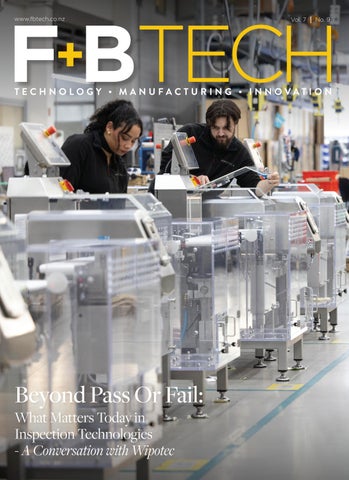
Vol. 7 I No. 9
Beyond Pass Or Fail:
What Matters Today in Inspection Technologies - A Conversation with Wipotec
editor’s note
The Value of Visibility
Publisher
Tania Walters
General Manager Kieran Mitchell
Editor-in-Chief Caitlan Mitchell
Content Managers
Pam Vasquez-Gutierrez Caroline Boe Aidan Stanley Charles Jones
Editorial Associates Jenelle Sequeira
Graphic Designer Myah McQuay
Contact Us
F
ood manufacturing depends on knowing what is happening at every point, from ingredient selection through to the product reaching its customer. This month, our feature ingredient is bananas. How manufacturers are getting more from a familiar ingredient across purees, powders, flakes, pieces, and flavour systems. Each format brings different considerations around formulation, texture, moisture, processing, and shelf life. That need for visibility also extends to inspection. Checkweighing, X-ray, vision inspection, and other systems are moving beyond a simple pass-or-fail function. The data they generate can help identify variation, recurring issues, and where a process may be moving away from specification. Control does not stop when the product leaves the line. Our cold chain feature looks at the gaps that can emerge through storage, loading, transport, depots, and receiving. These handover points are where visibility can weaken, while product quality, shelf life, and value remain exposed.
2 I fbtech.co.nz
Retail 6, Heards Building, 2 Ruskin Street, Parnell, Auckland, New Zealand
Across all three areas, the opportunity lies in better information and better control. Whether it is understanding how an ingredient performs, using inspection data to improve production, or monitoring what happens to chilled product in transit, what happens beyond the production line matters just as much as what happens on it.
+64 9 304 0142 info@reviewmags.com
ISSN 2744-3566 (ONLINE) ISSN 2744-5895 (PRINT) F&B TECHNOLOGY launched to facilitate the connection between food and beverage suppliers of technology, ingredients and packaging across the food and beverage manufacturing sectors for fmcg and foodservice. Copyright 2026
PF1246
Our Partners: food& grocery COUNCIL NEW ZEALAND
TANIA WALTERS Publisher
WAREHOUSE STORAGE BY VOLUME Volume design racking and shelving systems around how your operation actually works. And then supply and install them across New Zealand. We ask the right questions. Get the details right. And take responsibility for the outcome.
hello@volume.co.nz 0800 180 280 volume.co.nz
news
Tarakihi Catch Limits Reduced Lower catch limits for tarakihi stocks will reduce fishing pressure and help promote the recovery of New Zealand’s tarakihi fishery. Oceans and Fisheries Minister Shane Jones has decided to reduce commercial limits for the combined eastern tarakihi fishery by 20 percent; for the western fishery by around 55 percent; and to set a nationwide recreational daily limit of 10 tarakihi per person.
⮞ READ MORE ONLINE
4 I fbtech.co.nz
news
AI Use Grows as Strategy Gap Widens Half of New Zealand businesses are now consistently using artificial intelligence, but only 15 percent have a formal AI strategy in place, according to new research commissioned by Amazon Web Services. That difference may be becoming more important than the adoption figure itself. As businesses move beyond testing individual AI tools, decisions around where AI is used, how projects are funded, who is responsible, and how returns are measured are starting to separate experimentation from wider deployment.
⮞ READ MORE ONLINE
September 2026
I5
news
Candidates For Fonterra Board of Directors’ Election Announced Incumbent Director Cathy Quinn, along with Jessie Chan, Mark Cox and Peter Moynihan, have been announced as the Independently Assessed Candidates for the 2026 Fonterra Director election. This year there are two Board positions up for election. Cathy Quinn has sought re-election and has chosen to participate in the Independent Assessment Process.
⮞ READ MORE ONLINE
Nestle Expands Thailand Petfood Capabilities Nestlé has invested more than CHF 157 million to expand its pet food manufacturing capabilities in Thailand. The investment focused on Purina’s manufacturing site in Rayong, Thailand. It will enable increased production of pet food and pet treats under the Felix, Friskies, Pro Plan and Purina One brands. Production will support both local and international markets.
⮞ READ MORE ONLINE
6 I fbtech.co.nz
news
Goodman Fielder Strengthens Christchurch Operations Goodman Fielder has completed a major expansion of its Meadow Fresh Christchurch manufacturing operations to support growing domestic and international demand for higher-value New Zealand-made dairy products. At the centre of the investment is the new Meadow Fresh High Value Dairy Centre, which has increased capability to manufacture high-value UHT dairy products for domestic and export markets, including high-protein milk products for China and Southeast Asia. ⮞ READ MORE ONLINE
Support Package For Australian Wine Industry The Malinauskas Government has developed a comprehensive wine industry package to support the state’s wine sector for sustainable long-term growth. It comes as the state’s iconic AUD 2.4 billion wine industry, which produces 80 percent of Australia’s premium wine and supports more than 90,000 jobs, grapples with global oversupply, declining grape prices, shifting consumer demands and ongoing market pressures.
⮞ READ MORE ONLINE
September 2026
I7
on the cover
Beyond Pass or Fail A Conversation with Wipotec Product inspection is moving further into process control as manufacturers expect more from equipment than a final pass or fail decision. FB Tech asked Alberto Gómez, Regional Marketing Manager at German inspection technology manufacturer Wipotec, and Colin Seddon, Managing Director of Wipotec Australia, what manufacturers now expect from inspection systems, including production data, checkweighing, X-ray, vision inspection, and integrated systems. FB: How is the role of inspection technology changing within food and beverage manufacturing, and what are manufacturers now looking for beyond the final acceptance or rejection of a product? ALBERTO GÓMEZ (A.G.): It’s been a while since product inspection became a holistic process-control tool rather than simply serving as a final “pass/ fail” checkpoint. Food manufacturers are increasingly expected to strengthen foreign-body detection, process control and traceability, as physical contaminants remain a significant food-safety risk and supply-chain resilience becomes increasingly critical to maintaining consumer trust and confidence. COLIN SEDDON (C.S.): Inspection technologies such as metal detection and X-ray are becoming an increasingly important part of preventive foodsafety systems. In our country, these requirements are reinforced by the FSANZ (Food Standards Australia New Zealand binational agency) risk-based regulatory framework and mandatory traceability and recall systems. Nowadays, manufacturers want inspection systems to provide continuous information about their production, such as weight, the presence of foreign bodies, completeness, and packaging. Making that data available for analysis and optimisation is becoming crucial. For example, our customer Block House, the German restaurant group specialising in
8 I fbtech.co.nz
premium steaks, uses Wipotec systems not only to ensure quality but also to document controlled processes. Their inspection systems are connected through our management platform Comscale, allowing data to be evaluated and problems identified retrospectively. The objective is not simply to reject defective products, but to use inspection data to improve the complete process itself. FB: How does Comscale help manufacturers use inspection data to understand production trends, support quality management and identify opportunities for improvement? C.S.: Comscale turns inspection data into a resource for quality management and process improvement. The platform connects all inspection systems at a production site and maintains a constant overview, taking care of all the documentation, reporting, and data archiving. The data can be accessed at any time to identify deviations, evaluate the statistics, and even detect where problems have occurred in the past. During audits, it provides seamless documentation with very clear traceability. This demonstrates how inspection data can support both dayto-day production and longer-term quality management. FB: How can checkweighing technology help manufacturers improve filling control, reduce product giveaway and maintain accuracy at production speed?
C.S.: Dynamic checkweighing gives manufacturers continuous control over individual product weights, allowing deviations from the target weight to be identified and corrective action taken. This helps maintain compliance while avoiding unnecessary overfilling and product giveaway. Accuracy must also be maintained under real-world production conditions, high speeds, vibrations, product residues, and more. This can only be achieved when equipment is designed and manufactured to the highest quality standards. FB: What factors should manufacturers consider when deciding between metal detection, X-ray inspection, vision inspection or a combination of technologies? C.S.: It all starts with the product, together with the potential contaminants present in a given production environment. This determines the solution required. That said, it is not that easy to come up with the perfect solution, and that’s why you need to rely on a real expert in the field of product inspection. Essentially, metal detection is appropriate for metallic contaminants, while X-ray can detect a broader range of foreign bodies and can be particularly valuable where products may contain bone, glass or stone. Vision inspection addresses different requirements, such as label position, print quality and readability.
A.G.: Let me give you two examples of applications with different customer requirements. Our customer Bellamy’s Organic, based in Melbourne, is a powdered infant formula producer and uses a horizontal X-ray beam orientation, not vertical as usual. This setup allows for a thorough inspection of the bottom of their cans. On the other hand, Block House provides a good example of complementary technologies: they use metal detectors to provide a baseline
foreign-body check, and also X-ray systems because the company needs to detect non-metallic contaminants as well. The appropriate combination therefore depends on the product, packaging, risks, and inspection objectives. FB: How can combining inspection functions within one system help manufacturers manage floor space, product changeovers, operator training and overall line performance?
“The objective is not simply to reject defective products, but to use inspection data to improve the complete process itself.” Colin Seddon, Managing Director, Wipotec Australia
September 2026
I9
on the cover
C.S.: One of the key foundations of our technological developments is the integration of systems and their centralised control. We continuously work to ensure that our solutions can be installed on production lines with minimal effort, while making them as simple and intuitive as possible for operators to use. Our customer’s experience demonstrates a clear operational benefit from this approach: at Snackmaster, the frozen potato producer, printing, inspection, and weighing are combined in a compact, fully automated solution, with RFID-based user authentication providing operators with access to functions according to their level of authorisation. FB: How do modularity and hygienic design support inspection capabilities? C.S.: Modularity allows our customers to configure their solution around the specific product, packaging and inspection task, combining X-ray, vision and checkweighing technologies and adding application-specific components when required. This enables broader inspection capabilities while maintaining a compact footprint and straightforward line integration. On the other hand, we offer one of the most robust hygienic design concepts on the market, specifically developed to withstand demanding cleaning processes while minimising areas where product residues or contaminants can accumulate. Stainless-steel construction, chamfered surfaces, C-shaped product spaces, and IP69K protection all support
10 I fbtech.co.nz
high-pressure cleaning, prevent product residues from accumulating, and minimise cleaning-related downtime, ensuring consistent inspection performance in demanding food-production environments. FB: How does Wipotec work with food and beverage manufacturers from the initial assessment and product testing through to installation, training and ongoing service support? A.G.: What really sets Wipotec apart is the combination of three key strengths that define the way we develop our technology and build long-term relationships with our customers. First, our deep engineering expertise is there from the very first interaction with a customer. We speak the same technical language, understand the challenges they face, and share the same goals. This allows us to work together from day one to develop the right solution for each application. Second, Wipotec was founded around the core principle of dynamic weighing and our EMFR weigh cell technology. This engineering foundation is reflected in every system we build: robust, stable, reliable, and designed to integrate seamlessly into production lines while delivering the highest possible level of performance. We are established experts in our niche, and that’s recognised by the market, not just something we claim ourselves. And third, there is also our commitment to supporting excellence. We believe the true strength of a partnership is
Block House connects its Wipotec inspection syste together for reporting, review and quality managem
Real-time line monitoring allows operators to mana performance from a central control point.
“The software takes care of all the documentation, reporting and data archiving for us. We can access the data at any time, evaluate the statistics, and even detect where problems have occurred in the past.” Jörg Jablonski, Managing Director for Production and Technology, Block House Butchery
“We needed a system that could check very different product formats. With the SC 3000 X-ray system we can now inspect both large and small packaging without interrupting the production flow or compromising on accuracy.”
ems through Comscale, bringing production data ment.
age print quality, inspection, and system
Ovidiu Samson, Deputy Operational Director, SanoVita demonstrated not only when everything goes according to plan, but also when challenges arise. And in complex production environments, they inevitably do. Our philosophy is very simple: we are always there for our customers, in good times and bad. We never walk away from a problem or leave our customers to deal with it on their own. We stay alongside them, take ownership, and work together until the issue is fully resolved and the line is back up and running. FB: For almost four decades, Wipotec has been supporting the food industry with innovative solutions designed to ensure the quality, safety and integrity of products. By combining advanced technology with deep industry expertise, Wipotec continues to help food manufacturers meet ever-evolving production and quality requirements.
“Even though it is a complex system, the implementation went smoothly thanks to the professionalism and technical knowhow. Communication was always clear, and we felt well supported throughout the project.” Adrian Drămbărean, Technical Director, Transilvania Nuts
+61 370 316 100 | info.au@wipotec.com www.wipotec.com
September 2026
I 11
Flavour Innovation Takes Bakery Beyond The Crust Flavour remains one of the strongest drivers of purchasing decisions in bakery. While chocolate, vanilla, and fruit flavours remain firm favourites, today’s consumers are often looking for more than the classics.
B
igger flavours, unexpected combinations, contrasting textures and globally inspired ideas are creating new opportunities for bakery manufacturers to get creative. Australian flavour house Essential Flavours has identified several key trends shaping this innovation. One of these is “tastemaxxing”, where more is more. Swicy, salty-sweet and smoky mashups are turning up in traditional bakery treats, while globally
12 I fbtech.co.nz
inspired flavours such as yuzu, ube, miso, and even kimchi are also going mainstream. Combinations such as miso caramel and smoked caramel are helping push flavour profiles in new directions.
fillings, crispy coatings, chewy centres and crunchy toppings are adding another dimension to every bite. We are not just eating with our eyes anymore; we are starting to “taste” with our ears too.
TEXTURE IS ALSO BECOMING AN IMPORTANT PART OF FLAVOUR DEVELOPMENT From crispy to gooey, textural contrast is driving product choice and becoming part of how we experience flavour. Creamy
NOSTALGIA IS ANOTHER BIG INFLUENCE Recognisable bakery and dessert flavours such as banana bread, cinnamon bun, cheesecake and cookie dough provide familiarity, while still leaving plenty of
ingredients and flavours
room for innovation. Tea-inspired flavours are also finding their way into bakery, with Matcha, Earl Grey and Chai providing inspiration for cakes and other sweet applications. There is also plenty of room for experimentation through limited editions, seasonal flavours and brand collaborations. These “hype-driven drops” can inject urgency and must-try moments into established bakery ranges, while smaller, snackable formats provide a platform for richer fillings and bolder flavour combinations. Social media is also helping accelerate flavour trends, creating opportunities for manufacturers to introduce novelty without moving too far from flavours consumers already recognise. Meanwhile, health and function
are increasingly converging in bakery development. Protein, fibre, and gutfriendly ingredients are influencing bakery development, but taste remains fundamental. Consumers may want added functionality, but they still expect bakery to deliver on flavour, texture and enjoyment. LOOKING TOWARDS 2027 2027 looks set to build on the trends already shaping bakery innovation. Global flavours, nostalgic favourites, indulgence profiles, and sweet-savoury combinations will continue to inspire innovation, alongside growing interest in functional nutrition. It is about finding the sweet spot between familiar and new, creating products consumers recognise, but with enough of a twist to keep things interesting.
Essential is a family-owned Australian flavour company built on collaboration, technical know-how and speed to market. Essential flavours are available in New Zealand exclusively through Sherratt Ingredients.
“It is about finding the sweet spot between familiar and new, creating products consumers recognise, but with enough of a twist to keep things interesting.”
YOUR PARTNERS IN TASTE.
More than a flavour. A partnership. Flavour is where first impressions are made and consumer loyalty is won. Essential Flavours brings together technical expertise, continued investment in Australian manufacturing and research, and close collaboration to help brands develop products with lasting consumer appeal across local and export markets.
Essential flavours are available exclusively in NZ through Sherratt Ingredients.
WWW.SHERRATT.CO.NZ
September 2026
I 13
Supplier A-Z
Making Banana Work Banana is easy to recognise. The current ingredient story is about how much more it can be made to do.
14 I fbtech.co.nz
P
roduct development around banana is moving in several directions at once. Flavour houses are taking it into baked, roasted and caramelised profiles, while ingredient developers are working with the fruit for texture, fibre, mouthfeel and clean-label formulation. The activity is starting to show up in new product development. Mintel reported that banana-flavoured innovation
ingredients and flavours
in the United States had reached its highest penetration in at least a decade, with launches rebounding 55 percent from their 2022 low. Banana is now appearing across protein bars, functional beverages, premium dairy and other categories that extend well beyond its traditional applications. For manufacturers, that opens up more than another flavour option. UK flavour house ITS has been
developing caramelised banana alongside growing interest in roasted banana, baked banana and banana bread profiles. The distinction gives developers more control over where banana sits in a formulation, whether the brief is fresh and fruity, richer and cooked, or closer to an indulgent bakery profile. Ingredient development is taking banana in another direction. Givaudan and Dole Specialty
Ingredients are working with upcycled green bananas as a functional powder that activates when heated. The ingredient is being positioned for viscosity, water and oil holding, texture and mouthfeel, with applications ranging from extruded snacks and baked goods to fruit preparations, soups and sauces. It can replace or reduce reliance on ingredients such as modified starch, pectin, and gums in some formulations. Investment is following the demand. Symrise upgraded its banana and tropical ingredients operation in Ecuador in 2025, expanding production capacity for banana flakes and powders and adding facilities to support customer product development. That broadens the development question considerably. Banana can provide flavour, but depending on its format and stage of ripeness, it can also contribute texture, fruit content and functionality. Powders, flakes, pieces, purees and flavour systems each bring different considerations into processing and finished-product performance. Banana’s strength is its combination of familiarity and considerable technical flexibility. It can be pushed towards indulgence, used to support texture and functionality, or developed into profiles that feel markedly different from the conventional sweet banana note. For manufacturers looking for ingredients that can work harder across formulation and flavour, banana still has plenty of room to move.
September 2026
I 15
ingredients and flavours
Pressures Reshaping The Banana Supply Chain Banana growers face compounding pressures, from acute shocks like El Niño to the slower pressure of climate change, making conditions less predictable and yields harder to plan for.
B
anana growers face compounding pressures, from acute shocks like El Niño to the slower pressure of climate change, making conditions less predictable and yields harder to plan for. In Ecuador, the main source of Fairtrade bananas sold locally in New Zealand, this sits alongside rising costs and currency swings. Because the trade is priced in US dollars, a small, volatile currency like ours
16 I fbtech.co.nz
adds risk unrelated to the farm itself. Therefore, fair pricing and longterm commitment are both essential. A sustainable supply chain needs more than a fair price at one moment; it needs buyers willing to build lasting relationships and recognise that growing conditions will keep changing. We’ve seen this in New Zealand. All Good has been Fairtrade-certified for over a decade - our first Fairtrade banana - and
what’s made it work is that All Good and its retailers have treated it as a long-term commitment, not a short-term promotion. That consistency means the Fairtrade Minimum Price and Premium keep flowing reliably to growers. This is the model we want more of. When costs or conditions shift significantly, the commercial relationship needs to reflect that, rather than growers absorbing the impact alone. Long-term commitment gives growers something that price alone cannot: confidence to invest in their farms, workers and future. Additionally, supermarkets have far greater influence - than any individual shopper - not just in sourcing and purchasing power, but in genuinely understanding the supply chain behind a product, not just its price. They also shape what consumers choose, commanding more shopper attention than almost anyone else, in the aisle or on a grocery app. Storytelling, in-store promotion, and clearly explaining what Fairtrade certification means, not just displaying the mark, do more for ethical sourcing than almost any other lever. A clearly displayed Fairtrade Mark gives shoppers, often deciding in seconds, instant and credible assurance — without asking them to take a company’s word for it. It’s unrealistic to expect every shopper to research the supply chain behind everything in their trolley. Consumers can make a difference through their choices, but only with clear, credible information. JOANNA BOURKE Interim CEO FTANZ
Ensuring Economical Sustainability
T
The banana category has remained an important part of the fresh produce offer across Australia and New Zealand.
he banana category has remained an important part of the fresh produce offer across Australia and New Zealand. In Australia in particular, bananas have been one of the most frequently purchased fruits, with their affordability, convenience, nutritional value, and year-round availability making them a household staple. However, as bananas are a highfrequency purchase, Dean Gall, Chair of IFPA A-NZ, highlighted that consistency is the key challenge, as consumers expect bananas to be available 52 weeks of the year, at an accessible price, and at the right stage of ripeness, regardless of what may be happening at farm level. “Bananas have quite a complex supply chain because we are dealing with a living product that continues to develop after harvest. Maintaining quality requires careful management from the farm right
through to the supermarket shelf,” he said. At the farm level, Gall said weather was one of the biggest variables. The concentration of Australian production in Far North Queensland means cyclones, flooding, excessive rainfall, and extreme weather events can significantly impact production and supply. Biosecurity was another major consideration, particularly the ongoing management of Panama disease Tropical Race 4. Beyond the farm, rising labour, freight, energy, and input costs continue to pressure the entire supply chain. Bananas also require very precise temperature, handling and ripening management. Getting the right fruit, at the right stage of ripeness, into the right market at the right time requires considerable coordination between growers, transport providers, ripeners, distribution centres and retailers. For Gall, the biggest opportunities will
come from innovation across the entire supply chain rather than from any single development. At farm level, continued investment in biosecurity, disease-resistant varieties, soil health, water efficiency and more resilient growing systems will be critical. Technology, automation, and better use of data will also allow growers to make more informed decisions about crop management, forecasting, and harvesting. Across the supply chain, better forecasting and ripening technology have enormous potential. “If we can more accurately match production, ripening and distribution with consumer demand, we can improve quality while simultaneously reducing waste.” Another major opportunity he mentioned was utilising fruit that may not meet traditional retail specifications. Finding higher-value uses for that product through processing, foodservice, frozen products or other channels can improve overall crop utilisation and deliver better sustainability outcomes. Ultimately, sustainability in bananas means producing more efficiently, protecting farms from biosecurity threats, reducing waste, and ensuring growers remain economically sustainable. “If we can achieve those things while continuing to provide consumers with an affordable, nutritious and consistently high-quality product, the category has a very strong future.”
September 2026
I 17
Global Spotlight on Banana Banana is being pushed into new formats as manufacturers explore how its familiar flavour, natural sweetness, texture, and processing potential can work across more categories. From functional drinks to freeze-dried snacks, recent launches show the fruit moving well beyond the bakery aisle.
SPYLT Banana Milk, United States A limited-edition lactose-free protein milk combining banana flavour with 20g of protein, zero sugar, and 60mg of caffeine per can.
Califia Farms Banana Crème, United States Califia Farms has brought banana into at-home coffee with a limited-edition Banana Crème Almondmilk Latte and almond creamer, both made with real banana purée and without oils or gums.
LiQ x Chiquita Banana Ice Cream, Europe Chiquita has moved into frozen confectionery through a LiQ collaboration pairing banana ice cream with chocolate-style coatings, biscuit pieces, and banana-shaped formats.
18 I fbtech.co.nz
Kunana Banana Milk, Canada Kunana turns rescued whole bananas into a dairy-free plant-based milk designed for drinking, blending, and frothing, extending banana into the increasingly competitive milk-alternative category.
Banagua Banana Water, United States Banagua uses a proprietary process to extract the naturally occurring water from bananas, turning the fruit into a single-ingredient beverage rather than simply using it as a flavour.
Dunkin’ Banana Line-up, United States
Pip Organic Strawberry & Banana Pipcrunch, United Kingdom Freeze-dried organic strawberry and banana have been turned into crunchy bite-sized cubes, creating a shelf-stable fruit snack with no added sugar or flavourings.
Dunkin’ has taken banana across coffee, matcha, and refreshers, using new Banana Syrup and Banana Cold Foam in a limitedtime range that includes lattes, iced coffee, and the Bananarama Matcha.
September 2026
I 19
expo
A High Record For ASIA FRUIT LOGISTICA ASIA FRUIT LOGISTICA concluded its 19th edition in Hong Kong, underlining its status as the premier global trade platform for Asia’s fresh produce business.
T
he show drew a record 16,000 attendees from 95 countries and regions, with more than 760 exhibitors from 41 countries across 27 national and regional pavilions, reaffirming the show’s role as a driving force shaping the direction of Asia’s fresh produce trade. The show once again attracted a diverse and high-calibre international buyer base, welcoming thousands of buyers from across the globe. Key markets and regions represented included mainland China, Japan, South Korea, Europe, Southeast Asia, the Middle East, Russia and beyond. A major highlight was the launch of the show’s inaugural Buyer Program, which provided exclusive benefits to more than 1,600 qualified buyers and facilitated targeted, pre-scheduled business meetings across the three-day event. This strong first-year result connected growers, exporters, marketers and technology providers directly with buyers seeking new products, reliable suppliers and long-term supply partnerships. Exhibitors and visitors accessed expert insights at Asiafruit Knowledge Centre.
20 I fbtech.co.nz
More than 50 industry leaders took to the stage over the three-day programme, tackling a range of hot topics, from the global shipping challenge through the changing shape of the Asia trade to the future of massive markets such as China and the Middle East. Executives from three of the biggest brands in the global fruit business shared their expert perspectives on marketing to Asian consumers in the opening panel, which featured Driscoll’s global CMO Jiunn Shih, Sunkist Growers’ senior director of category management Cassie Howard, and Dole China’s GM of commercial, Leo Li. The Nuts and Dried Fruit Forum (Day 1) and Frozen Fruit and Vegetables Forum (Day 2) also spotlighted the latest trends and opportunities in these fast-developing sectors. The ASIA FRUIT AWARDS 2026 were also presented at Asiafruit Knowledge Centre. Zespri won Marketing Campaign of the Year for its ‘Jam-Packed with Natural Nutrition’ campaign; Freco International took out Importer of the Year; Tops, operated by Central Food
Retail, won Produce Retailer of the Year for the outstanding quality, range and presentation of its fresh produce offering; and Goodfarmer Fruit Group received the Impact Award for its role in developing China’s fresh produce industry over the past 24 years. Additionally, FRESHTech, ASIA FRUIT LOGISTICA’s dedicated technology platform for the fresh produce value chain,
made its debut this year and showcased practical innovations and industry perspectives spanning key areas including smart agriculture, automation, cold chain, traceability and AI. The inaugural FRESHTech Innovation Award was presented to Ryp Labs, Inc. for StixFresh/Shelf Defence, a sticker-based technology that extends the shelf life of fresh produce and reduces spoilage.
The other two finalists were Ocean Network Express (ONE) with its DualTemperature Refrigerated Container, and Wyma Solutions with the Optical Vege-Trimmer, highlighting the breadth of innovation emerging across the fresh produce value chain. Building on the strong response to its inaugural edition, FRESHTech will return in 2027, continuing to bring technology
providers, industry experts and fresh produce professionals together around the innovations shaping the future of the industry. ASIA FRUIT LOGISTICA will return to Hong Kong’s AsiaWorld-Expo in September 2027 to celebrate its milestone 20th edition – “20 Years of Fresh. Growing the next decades.”
September 2026
I 21
Manage The Manual Handling Problem Before Injuries Happen Work-related injuries aren’t always caused by a one-off event or accident. In a distribution centre or loading dock, a worker might lift, twist, or reach for something hundreds of times a day. TANE VAN DER BOON Founder & CEO inviol
I
t’s where a lot of the physical strain on a workforce builds up (and where many of the injuries that can impact people’s lives begin). When we talk to the operators we work with, manual handling often comes up as their number one safety issue. There are some individual, expensive solutions like exoskeletons, but in the long run this doesn’t address the pervasive nature of the problem.
22 I fbtech.co.nz
WHO IS INVIOL? inviol is a computer vision AI health and safety platform, founded in New Zealand. We connect to a site’s existing CCTV to identify unsafe behaviours and near-misses, then turn them into practical coaching moments and clear safety trends. So far, most of our work has focused on people and forklifts sharing the same space, helping supervisors have better safety conversations with their teams. We work with operators including Woolworths, Americold, Coca-Cola, Linfox and The Warehouse Group.
Now we’re bringing that same approach to manual handling. SEE THE RISK BEFORE IT BECOMES AN INJURY Back and knee injuries rarely come from a single dramatic moment. They build over time, from the same awkward lift repeated hundreds of times a shift. The trouble is that we often only discover the issue when an injury happens and the damage is already done. Our new manual handling capability uses the cameras a site already has to
behind the business
spot high-risk movements (like bending, twisting and overreaching). These are surfaced in our coaching platform with a simple breakdown of what is happening and how to address it. It’s a process that allows shift managers and site leaders to have a clear view of where their teams are experiencing strain and the ability to address it before it becomes an injury. BETTER COACHING CONVERSATIONS Most supervisors are confident coaching around forklifts. Coaching someone on how they lift is harder, and plenty of people don’t know where to start beyond “lift with your legs.” We’ve designed this to take the guesswork out, giving whoever runs the toolbox talk practical, plainlanguage talking points grounded in real
examples from their own site. You don’t need to be an ergonomics expert to have a useful conversation. And because the focus is on the task rather than the person, the conversation stays constructive and no one feels singled out. FIXING THE JOB AS WELL AS THE HABIT Coaching matters, but some of the biggest wins come from changing the work itself. When safety teams can see where risky lifts cluster across a site, they can target the root cause. Sometimes the fix is as simple as a seat or a stepladder in the right place, a small change that can take a lot of repeated strain out of a role altogether. Instead of relying on injury data to show you where the risks are, you can put
everyday movement data into guiding your toolbox talks, training and workplace traffic plans to help your teams act earlier. No one should be injured at work, whether by a one-off accident or an injury caused by the slow creep of repeated strain. inviol’s mission is to help people get home safe every day by empowering people and reducing risk. SEE IT IN ACTION On October 23rd, we’ll be hosting a small “Lunch & Learn” session, walking through how manual handling works in inviol, and how teams can use it to protect their people. Join us to see it in action! inviol Lunch & Learn: Manual Handling | Join meeting in Teams | Microsoft Teams
September 2026
I 23
behind the business
Woolworths EMC Turns Stores Into Smart Stores Woolworths’ Energy Management Centre (EMC) saves Woolworths around NZD three million per year in energy and maintenance costs through a data-driven, centralised approach.
24 I fbtech.co.nz
behind the business
A
s one of New Zealand's largest retailers, Woolworths operates a store network that consumes approximately one percent of the country’s total electricity. Catherine Langabeer, Woolworths’ Head of Sustainability, said the group has partnered with Bueno Analytics to transform this energy footprint. By leveraging real-time controls verification, the EMC project has delivered sustained
reductions in electricity consumption, refrigerant leaks, and carbon emissions. “Over the last year, we have completed development of our Energy Management Centre - turning our traditional supermarkets into highly intelligent 'smart stores’,” said Langabeer. “This digital transformation has established a scalable, gold-standard blueprint for New Zealand’s large energy users, proving that data-led innovation can drive significant decarbonisation at an industrial scale.” Historically, store performance was managed through fragmented systems, with refrigeration, HVAC, lighting, and energy data often separated across different tools and vendor environments. This made it difficult to build a consistent picture of performance, validate changes after maintenance, or sustain improvements over time. At a portfolio level, reactive monitoring can also create alert fatigue, inconsistent outcomes between sites, and chronic performance drift that remains undetected for long periods. The key barrier, Langabeer said, was not the availability of data, but the ability to translate large volumes of operational data into verified, prioritised action across many sites, switching Woolworths’ model from reactive to proactive. The key was connecting Woolworths’ three most critical, energy-intensive asset classes: refrigeration, HVAC (heating, ventilation, and air conditioning), and automated main store lighting. All are now brought together into a single cloudbased data ecosystem. The EMC now continuously audits over two million operational data points every five minutes across the country. The project also has predicted problems using a specialised predictive model called "Energy Slip" within the
analytics platform. This system acts as an early-warning radar, tracking minute thermodynamic deviations and can now identify potential cooling system leaks with a 70 percent verified accuracy rate, supporting automated work-order generation for refrigerant technicians without manual validation. “It’s not all about the tech, however. Our highly capable energy team, including our Energy Innovation and Operations Manager Chitranjan Rathod, who joined us from Walmart, have been essential to ensuring this project is a success,” added Langabeer. She said the EMC project has significant benefits for the business and the planet and is expected to deliver over NZD three million in annual savings, driven by maintenance and energy savings, while also reducing demand on the national grid. The project also supported improved capital allocation through prioritisation and verification using high-resolution submetering data, ensuring future investments are directed toward the highest-impact opportunities. Beyond that significant commercial impact, Langabeer also saw noncommercial advantages, including workforce development, data-based performance validation, and reduced operational and food safety risk.
CATHERINE LANGABEER Head of Sustainability Woolworths
September 2026
I 25
behind the business
Connecting Snappers And Solvers Snap Send Solve is a free app that enables the public to photograph, geotag and report issues that need fixing in the community using their mobile phone.
Photo credit: “Snap Send Solve”
L
ast year alone, Snap Send Solve users made more than 1.7 million reports across New Zealand and Australia, covering issues such as dumped rubbish, overflowing bins, illegally parked cars, graffiti, vandalism, potholes, and damaged or dangerous trees. When someone submits a report, it includes all the information the responsible authority, including councils, utilities, and major retailers such as supermarkets, needs to respond with,
26 I fbtech.co.nz
such as photos and/or videos to identify the nature and severity of the issue clearly; geographic coordinates for precise location information; the issue type and category; and any other details the community member wants to share. Snap Send Solve data has shown that abandoned trolleys have become a major source of frustration in the community. In the past 12 months alone, New Zealanders have reported almost 12,000, up 9 percent from the prior year. “Abandoned trolleys often find their
way a long distance from the store they are attached to and are reported dumped in rivers or waterways, blocking footpaths and generally creating an eyesore,” said a spokesperson for Snap Send Solve. Beyond abandoned trolleys, they said that, shopping centres often feature in reports on a range of hot-button issues, including illegal parking, damage to signs, roads, and footpaths, and dumped rubbish and litter. However, once the app has been downloaded, it takes less than a minute to take a photo and send a report. “The good news is that our data shows that most service providers respond quickly and effectively. The feedback we get from our Snappers is that 9 out of 10 of their reports are ultimately fixed or resolved.” The spokesperson added that the lifeblood of Snap Send Solve was the community of more than a million Snap Send Solve “Snappers” who have taken the time to photograph and report problems that they see, giving councils, retailers and other service providers, the “Solvers”, greater visibility of issues so that they can respond and plan more effectively. Solvers who partner with Snap Send Solve gain access to efficient systems for managing trolley reports and to valuable data that inform policy-setting, decisionmaking, and asset management. The more service providers and retailers understand the scale and nature of the hotspot issues in the community, the more they can plan and respond. “Remember, shopping trolleys cost supermarkets and other retailers money to collect, repair or replace, so it’s in their best interests to work to reduce the problem.”
Out Of Sight, But Not Out Of Mind Behind every well-stocked supermarket shelf is a team of merchandisers and warehouse distribution crews, loading and unloading products.
T
hese workers keep the supply of goods moving but carry some of the highest injury risks. The good news is, these risks are well understood, and there are practical, proven steps we can take to reduce them. The most effective approach is to design the risk out of the work, rather than relying on people to be extra careful. THE MAIN RISKS BEHIND THE SHELVES A few hazards come up regularly for behind-the-scenes teams: • Lifting and moving stock. Back, shoulder and knee strain builds up slowly, through repetition rather than in one big injury. • Moving goods and vehicles. People and machines sharing tight spaces is a hotspot for potential injury. • Falling objects. Watch stock stored up high, poorly stacked pallets and unrestrained loads. • Cold, slips and machinery. Working in chillers, freezers and machinery bring their own risks. • Fatigue and pressure. Night shifts, early starts, a relentless pace and working alone can affect both safety and mental wellbeing. PRACTICAL STEPS TO REDUCE INJURY: FOR LIFTING AND MOVING STOCK • Use equipment that takes the weight, for example, electric pallet movers, height
adjustable trolleys, scissor lifts and conveyors. • Order stock in smaller, lighter cartons. • Store heavy items at waist height. • Mix up tasks across a shift so no one repeats the same movement for hours. A good example is the uneven distribution across bread trolleys. A simple fix is to place the heavier items, such as crumpets, in the middle trays and leave the lighter bread for the lower and higher slots. That way people aren't reaching up or bending down for the heaviest products. FOR VEHICLES AND DOCKS • Keep people and machines apart with clear, marked walkways and exclusion zones. • Set and enforce speed limits. • Use dock safety gear such as vehicle restraints, wheel chocks and simple communication systems. • Make sure operators are trained and supervised, and check racking regularly so loads stay stable. The best solutions remove the risk altogether. A store manager removed forklift operations during a time when workers were replenishing items at night, so the team had a clear window to get in and out safely and avoid near-misses. FOR COLD, MACHINERY AND FATIGUE • Rotate people out of the cold and provide warm clothing. • Guard machinery and use lockout steps
so equipment can't start up during cleaning or clearing. • Only trained workers are permitted to operate machinery. • Design rosters with realistic workloads, proper breaks, and support for anyone working alone or overnight. We often modify machinery to fit the task, which can lead to new risks not correctly identified. Scheduling regular risk assessments of machinery, alongside the workers using the equipment, is vital to ensure that safe practices are understood and followed. THE REAL DIFFERENCE-MAKER TALKING WITH YOUR TEAM Your team know where the hazards are located, and involving your staff in finding solutions encourages a workplace where people feel safe to speak up, and interventions get implemented. A great tool for these conversations is the 4Ds framework. Identifying what is dumb, dangerous, different or difficult is a simple structure that helps everyone learn from everyday work. Behind-the-scenes teams may be out of the customer's sight, but they should never be out of mind. When we look after their health, safety and wellbeing, everyone benefits, and everyone goes home to their family safe and well. ShopCare provides support with realworld guidance that helps improve worker outcomes. Thanks to ACC funding, most of our tools and training are free to use.
September 2026
I 27
behind the business
Everyday Solutions For Your Business Operations Founded in 2012 as a family-owned and operated business, Offshoot NZ set out with a clear mission: to provide proven, cost-effective products and services without compromising people or the planet.
A
s awareness grew of the environmental impact of products and packaging, the company discovered it could offer sustainable products at cost-effective prices. Rather than long-term contracts, Offshoot NZ has focused on building strong customer relationships and providing practical solutions that meet businesses' day-to-day needs. Customer and market feedback has helped develop the company's own range of Offshoot Certified Biodegradable Wet Wipes. Designed for use across a range of industries including retail, the wipes are supported by services such as free delivery, installation and dispensers. Wesley Binedell, General Manager of Offshoot NZ, said that the demand
28 I fbtech.co.nz
for hygiene and sanitising products has changed considerably in recent years. Since COVID-19, consumers have become conscious of hygiene and the potential spread of germs, making hand and surface sanitising an ongoing consideration for supermarkets. “The need for hand and trolley sanitising has increased, as customers are more aware of germs,” said Binedell. “The wet wipes we provide are a great solution for hand and surface sanitising. With supermarkets implementing more user-facing machines like fresh orange juice, our wipes are also a good solution for wiping hands and spillages, not to mention having them by the butchery where you sometimes pick up wet packets of meat.” Offshoot’s approach extends beyond
supplying products as its dedicated customer service team also works with retailers to identify frequently used backend products and opportunities to reduce costs. Binedell highlighted that some of the highest ongoing costs sit behind the scenes, such as machine till rolls, along with hidden administrative costs that can arise when everyday consumables are purchased from multiple suppliers. Multiple invoices, ordering systems, deliveries and processes can add complexity for store teams. Offshoot can supply a broad selection of back end and saleable essentials, including toilet paper, chemicals, gloves, wipes, hand soap, packaging, machine till rolls and twist-handle paper bags, allowing retailers to consolidate more of their regular purchasing where appropriate to improve efficiency. “We set up individual accounts and monitor stock orders. After about three months, we can then suggest recurring orders on repeatedly used products, taking the stress away from running out of stock and ordering,” said Binedell. Looking ahead, Binedell said the greatest opportunity for retailers is to become smarter about how they purchase, manage and use consumables. By consolidating more frequently used products with a supplier like Offshoot that understands their requirements, retailers can potentially improve stock management, reduce admin and identify savings that would otherwise be overlooked. To learn more about how Offshoot can support your business, visit www. offshootstore.co.nz or contact sales@offshootpaper.co.nz
Colour-Coded Compliance, Department by Department Wells Hygiene NZ supports audit readiness and compliance with colour-coded segregation by department, so hygiene stays visible from Butchery to Bakery, and all in between.
V
ikan's ultra-hygienic, durable and ergonomic cleaning tools lock to colour-defined zones, stopping crosscontamination before it starts. The Hygienic Wall Bracket System stores them by department, turning colour coding into a storage solution auditors can verify at a glance. Built for operational efficiency and daily washdown, it's compliance you can see, so your team can get on with business.
Spotless Floors Without the Slowdown Supermarket floors take a beating every single day: trolley traffic, spills, dropped produce, and thousands of footsteps before you've even opened.
A
strolift's scrubber range is built for exactly that pressure. Push-and-Go handles tight aisles and daily touch-ups without slowing customers down. Walkbehind covers larger sales floors and back-of-house areas fast, for a genuinely clean finish. Ride-on clears wide floor areas in large-format stores in a fraction of the time. Every machine comes backed by nationwide delivery, servicing, genuine parts, and flexible lease options. The result: spotless floors, every opening, with staff free to focus on customers instead of cleanup. Get your free quote at astrolift.co.nz
September 2026
I 29
behind the business
Smart Scams, Smarter Security As security standards for business payments continue to evolve, account validation and payee verification services have emerged as valuable tools for businesses as part of a multilayered verification approach.
M
ichelle Cram, VP of Customer Operations, Eftsure, said that although these are important signals, they’re not a complete solution. “This is because many fraud attacks begin earlier in the payment process, when a fraudster impersonates a supplier and convinces an organisation to update vendor records,” said Cram. “If those details are accepted into the system, account validation may confirm that the account belongs to the named account holder, but it doesn’t independently verify that the supplier relationship or change request is legitimate.” Eftsure’s role is to help organisations verify both. It combines account validation signals with independent, multi-layered supplier verification, drawing on a broad range of data points, a network of existing verified suppliers, and additional verification checks to help confirm a business is paying the intended supplier, not simply a valid account. Most of this happens in the background, giving finance teams greater assurance while reducing the manual effort required to verify supplier and bank details changes. However, bank account validation helps validate account details, but it does not independently verify that a supplier or bank detail change request is legitimate. Therefore, effective fraud prevention relies on multiple controls working together. “We add multi-layered verification that runs automatically against our vendor
30 I fbtech.co.nz
database and integrates into existing finance and ERP workflows. That means we help teams operate more securely and intelligently without extra manual checks,” she said. “Often, there is no extra step at all.” Cram says their efforts are focused on higher-risk events, such as onboarding a new supplier or changing bank details, and a closer specialist investigation only kicks in when a warning sign appears. Routine, already-verified activity flows straight through. The alternative (a fraud incident) can be far more disruptive as these often trigger investigations, remediation work, vendor communication and significant internal effort. Eftsure provides layers of verification at critical points while reducing the manual checking burden on finance teams. It believes a targeted verification step is a reasonable trade-off when compared with the operational, financial and reputational impact of a fraudulent payment. “The biggest vulnerability we see is the gap between controls.” Banks, ERP systems and finance teams all play important roles, but they have been designed to address different risks at different points in the process. Fraudsters increasingly target trusted relationships and rely on social engineering rather than technical compromise by itself. As a result, organisations remain vulnerable when supplier onboarding, bank detail changes and payment approvals are not independently verified.
Cram highlighted that if a supplier has already been verified by its bank, has a long trading history, and is known to the customer, it is often where finance teams can be most exposed: trust built over time. “The more established the supplier relationship, the less likely a routine request is to be questioned.” Bank verification helps confirm account details, but it doesn't verify whether the supplier actually requested the change. Many fraudsters understand this distinction and use it to steal money: legitimate suppliers can still be impersonated through compromised email
accounts, spoofed domains and a range of other social engineering tactics. Cram added that this sort of vulnerability will continue to intensify as AI-generated media becomes more pervasive and persuasive, as it has already become significantly easier to impersonate trusted contacts on the phone and even via video, as seen in high-profile cases like the Arup scam and the more recent deepfake scam in Singapore. An important distinction that Cram emphasised was between risk reduction and risk transfer. Risk transfer may help cover losses after an incident, but it
doesn't undo the operational disruption or reputational impact. Eftsure’s role is to help reduce the likelihood of fraud by preventing fraudulent payment changes before funds are transferred. The responsibility for a payment ultimately sits with the organisation that authorises it: controls and technology support can support the decision, but they don't remove accountability. Looking ahead, Cram believes banks will continue strengthening their fraud controls. At the same time, fraud will increasingly occur before a payment
reaches the bank, through supplier impersonation, social engineering, and fraudulent changes to bank details. Cram says this is where specialist providers add value. As fraud continues to target gaps in controls, businesses will need a dedicated, multi-layered verification layer focused on supplier identity and payment integrity, one that spans the whole ecosystem rather than any single bank or system. “Combining automated checks with specialist investigation when needed keeps that role complementary to bank controls, not duplicative.”
September 2026
I 31
Supplier A-Z
32 I fbtech.co.nz
20 minutes with
Local Production Meets NZ EVOO Demand The New Zealand olive sector has remained steady, and like all horticulture industries, production volumes have been influenced by the climate and season.
T
he New Zealand olive sector has remained steady, and like all horticulture industries, production volumes have been influenced by the climate and season. Although not many new groves have been planted in the country, Emma Glover, Olives New Zealand Executive Officer, has observed a resurgence of previously unharvested groves and expanded plantings in existing commercial groves. She said consumer demand for New Zealand EVOO has grown, with local production striving to match it through improved productivity. Glover explained that New Zealand-grown EVOO can be distinguished by freshness and flavour, and that, for extra virgin olive oil, the fresher the oil, the better the quality and the more health benefits it has. “EVOO is at its highest nutritional benefit when it is fresh; over time the natural antioxidants and health-giving properties degrade to the point where the compounds that provide the specific benefits of olive oil are lost,” said Glover. “While other countries produce many excellent EVOOs, New Zealand-grown EVOO has no lengthy journeys or extended storage periods, making it the freshest available as local growers can have it ready for sale within weeks of pressing, unlike imports.” All high-quality EVOO has unique flavour characteristics, defined by its
chemical and physical properties, as well as its aroma and taste. New Zealand EVOO can be generally recognised as a distinct medium- or intense-style oil, often with green, grassy notes. However, like wine, the aroma, taste, flavour, and mouthfeel of every bottle tend to be influenced by the specific olive variety and the ripeness of the fruit, the season, the climate, and the region it was grown in. “Not all olive oils are created equal. The term ‘olive oil’ generally refers to oil extracted from olive fruit, but confusingly, it is also a grade of olive oil,” added Glover. She highlighted that many supermarket shoppers did not understand the distinction between the quality grade of EVOO and olive oil. Although both have health benefits, EVOO stands out because its natural antioxidants, vitamins, and beneficial compounds were not destroyed during processing. With few New Zealand EVOOs on supermarket shelves, Glover said the first key message to communicate to supermarket shoppers was the difference in quality, and that fresh is best. Glover suggested consumers look at the harvest date on the labels: the best before should be two years from harvest, and they should be consumed within three months of opening. Consumers should also be mindful that polyphenols are recorded at the time of testing and they degrade over time,
with the speed of degradation depending on oil quality and storage conditions. Polyphenols are also associated with the bitterness and pungency of the EVOO; an oil with high polyphenols may not be balanced or taste that great. To help consumers understand what to look for, Olives NZ has developed a certification program with a red OliveMark sticker growers and producers can put on their bottles of certified EVOO. Additionally, the local olive industry produces only EVOO, as its scale and production are not large enough to compete with the global commodity ‘olive oil’, but as imported oil prices have increased over the past few years, New Zealand EVOO has become price competitive. Glover believed the biggest opportunity for the industry has been growth in demand from consumers looking for fresh, highquality New Zealand EVOO. At the same time, the challenge will be meeting that demand. With pressure on land prices, crops delivering faster and higher returns, and ever-increasing production costs, a new grove of olive trees that takes seven to ten years to produce viable crops does not work in the industry’s favour for investors focused solely on the bottom line. But for those looking ahead, while adding passion and lifestyle into the equation, Glover said there is opportunity for a good balance and reasonable income.
September 2026
I 33
cold chain
Removing Dependence on Manual Monitoring Beverage companies leasing branded refrigerators into retailers face a visibility problem. They want to know whether fridges are running properly, holding the right temperature, selling product as expected, and whether any coolers have been moved or gone missing.
A
oFrio has combined connected monitoring hardware with a SaaS platform called AoFrio iQ, which can surface this data remotely across thousands of coolers. With some customers losing as much as 20 percent of their fleet, this technology can be key to protecting investment in cooling assets and revenue generation. For food retailers, food safety has remained the priority, and supermarkets and convenience stores depend on chilled and frozen products staying within a set temperature range. AoFrio technology can monitor those fluctuations and flag early signs of failure before it happens. “We’ve spent a lot of time talking to food retail operators about how they manage food safety in chilled and frozen assets, and the pattern is consistent regardless of store size or geography,” said Genevieve Clark, AoFrio’s Vice President, Product & Marketing. “Most sites still rely on staff to take
34 I fbtech.co.nz
manual temperature checks two or three times a day, then log them after the fact into a spreadsheet or basic portal. That satisfies HACCP’s record-keeping requirements but leaves blind spots. Plus, for quality teams, that can also mean responding to a problem days or weeks after the incident, by which point food wastage can run into thousands of dollars a month per site.” AoFrio’s solution can remove the dependence on manual monitoring altogether, so QHSE teams can monitor refrigeration assets across multiple stores remotely and get alerted the moment a temperature fluctuation occurs, or a cooler shows signs of imminent failure, allowing risk to be managed before it becomes a health and safety breach, not after. Clark added that knowing exactly when a cooler lost temperature, and for how long, can also let a team make an evidence-based call: dispose of the affected stock, or safely retain it in a working unit. She saw significant opportunities
for smart refrigeration technology as businesses face increasing pressure to reduce energy use, operating costs and environmental impact. One of the biggest expenses food and beverage companies face is service and maintenance. Sending a technician out is costly, and they don’t always find the fault. AoFrio iQ can flag poor performance and
identify what’s wrong with a failing unit. Customers have saved thousands of dollars on service costs by catching cooler failures before they happen. Door swing data also gives a reliable read on sales activity so that customers can measure performance across selling periods, locations, and events. Clark mentioned developing a camera
technology to add planogram compliance data, and as AI tools mature, connected coolers will generate far more data to support commercial decisions. On environmental impact, energyefficient motors have been part of the refrigeration technology from the start, and pairing them with smart controllers that can adjust and optimise settings can
reduce energy use by up to 68 percent over a standard configuration. That matters to large beverage brands under pressure to cut their Scope 3 emissions.
September 2026
I 35
Refrigerated T Transport System For Rigid Trucks, Drawbar & Semi-trailers ECOOLTEC Grosskopf GmbH is a European manufacturer of innovative, environmentally friendly transport refrigeration systems.
36 I fbtech.co.nz
he company’s mission has been to provide customers in the temperature-controlled transport sector with refrigeration units that are particularly sustainable, efficient, and reliable. Key features of ECOOLTEC technology include natural refrigerants with minimal global warming potential, as well as fully electric generator or battery power. Recently, at IAA TRANSPORTATION 2026, ECOOLTEC presented its allelectric T15 transport refrigeration unit, which uses natural refrigerants for cooling and is designed for rigid trucks, drawbar trailers, and semi-trailers in singletemperature operation. Whilst the ECOOLTEC TM182, which is already available, can also be used as
cold chain
a single-temperature unit, it is primarily used for multi-temperature configurations. “The ECOOLTEC TM182 is designed to meet the extremely high demands of multi-temp applications,” said ECOOLTEC CTO Holger Dörre. “However, many customers operate refrigerated vehicles exclusively with a single temperature zone and therefore do not require the versatility of the TM182. With the T15, we are providing them with a model that is precisely tailored to this requirement.” ECOOLTEC CEO Henning Altebäumer added that over the past few years, ECOOLTEC technology has proven its worth time and again in day-to-day transport operations. Several hundred units are now in daily use with
customers across Europe, demonstrating their reliability under a wide variety of operating conditions. SAME DESIGN PRINCIPLE, ADAPTED COMPONENTS The T15 can be powered electrically via the in-house high-performance alternator connected to the truck’s engine, a battery, or a separate power source, and therefore does not require an integrated diesel engine. Furthermore, instead of the fluorinated refrigerants (hydrofluorocarbons) R452A and R410A, which are currently predominantly used in transport refrigeration and have GWP (Global Warming Potential) values of over 2,000, the T15 uses the natural refrigerants R1270 (propene, GWP: 0) for cooling and CO2 (R744, GWP: 1) for cold distribution. As a result, like the TM182, it meets the highest standards of sustainability and operational safety. ECOOLTEC also retains the dual-circuit, fully hermetic refrigeration design with minimal refrigerant charge. The refrigeration process takes place entirely outside the cargo compartment. There, the natural, constant airflow ensures that propene escaping, for example, as a result of an accident, immediately mixes with the ambient air and dissipates. This prevents a flammable mixture from forming in the first place. Meanwhile, within the box body, the natural refrigerant CO₂ ensures the distribution of cold air. The R1270 and the CO₂ circuits flow past each other outside the body, thermally linked via a plate heat exchanger. THE T15 IS SUITABLE FOR RIGID VEHICLES, DRAWBAR TRAILERS AND SEMI-TRAILERS Unlike the TM182, which has two separate refrigeration systems for multitemp operation, the T15 uses a single evaporator for monotemp mode. The T15 has only one evaporator, whose capacity is adapted to the requirements of singlechamber operation. Both systems have the same housing, and the installation position is identical. The T15 is also designed to meet the requirements of comparatively compact rigid vehicles and drawbar trailers, as well as larger semi-trailers. The model name T15 denotes 15,000 watts of cooling capacity at 0 °C and an ambient temperature of 30 °C.
At –20 °C and an ambient temperature of 30 °C, the capacity is 8,300 watts. This meets the requirements of chilled and frozen vehicles operating in the demanding conditions of multi-drop distribution. SUITABLE FOR DIN-STANDARD MOUNTING: NEW REMOTE CONTROL FOR INDOOR AND OUTDOOR USE ECOOLTEC has also replaced the previous remote control with a new model featuring more compact external dimensions. This allows the unit to be positioned more flexibly within the driver’s cab and fitted into a DIN-sized recess. In developing this new model, ECOOLTEC has ensured it retains the familiar ease of use. Despite its smaller dimensions, the display, for example, is the same size as before and therefore remains very easy to read. The operating philosophy has also remained the same. The driver can control all essential functions of the transport refrigeration system with just a few buttons marked with intuitive symbols. The unit is also suitable for mounting on the outside of the box body as well as inside it. THE IDEAL COMBINATION: ECOOLTEC REFRIGERATION UNIT AND A BATTERY-ELECTRIC TRUCK From an environmental perspective, this is the ideal solution. However, that combination poses challenges for both chassis and transport refrigeration unit manufacturers. For example, communication protocols must be developed for each vehicle brand so the system cools reliably to specification in every operating condition, regardless of the BEV truck manufacturer. ECOOLTEC has now developed solutions for electric-powered HGV vehicles from seven brands, regardless of whether the system is connected via an electric power take-off (ePTO) “We are proud of the entire ECOOLTEC team. In a short time, we have expanded our product range and successfully integrated our systems into electric trucks from various manufacturers, with their different highvoltage architectures and communication interfaces. At the same time, we now serve customers both domestically and abroad,” said CEO Henning Altebäumer.
September 2026
I 37
cold chain
Adapting To A New Era Of Complexity, Innovation & Opportunity In partnership with Wakefield Research, Lineage released a new report which surveyed 1,000 North American food and beverage supply chain decision-makers on the pressures and opportunities facing their companies and their cold chain partners in 2026.
T
he findings point to a broader industry shift, with supply chain leaders saying they want cold chain network providers to deliver not only storage and transportation, but also the flexibility, visibility, and resilience to navigate a more dynamic operating environment. The findings indicate companies have been navigating a period of sustained complexity shaped by policy shifts, cost pressures, innovation and changing consumer demand. They have responded with a growing focus on building cold supply chains designed to adapt, scale and respond in real time. RESILIENCE HAS BECOME AN EXPECTATION Food and beverage company leaders are no longer reacting to isolated disruptions; they are operating in an environment where volatility has become a persistent condition to plan against. Companies are strengthening resilience strategies, increasing investments in data and automation and seeking closer alignment with logistics partners. In practice, this is meant to enable greater flexibility in network design, better visibility across operations and closer partner coordination in real time. EXTERNAL FACTORS RAISING THE STAKES External uncertainty and instability are driving planning conversations among
38 I fbtech.co.nz
supply chain leaders. Lineage’s survey data found that 56 percent of leaders rank tariffs, regulation and political shifts as the top three decision drivers. Companies are adapting by embedding policy risk into their planning strategies, as 73 percent expect tariffs to continue negatively affecting financial performance in 2026, while 57 percent say the impact of tariffs on costs in 2025 were higher than expected. The findings suggest that food and beverage companies no longer treat disruption as temporary and are adjusting their strategic frameworks to accommodate it. The responses also revealed how customer priorities are evolving across demand planning, technology, trade strategy and partner expectations. DEMAND FOR REFRIGERATED AND FROZEN FOODS IS GROWING AND GETTING MORE COMPLEX • Demand growth is being shaped by e-commerce, private-label products and changing consumer behaviour • Sixty-six percent say their supply chain only sometimes meets demand speed – or struggles to meet it – pointing to a disconnect between volume growth and execution • Companies indicate a need for capacity, flexibility and better forecasting to respond quickly
TARIFF PRESSURES ARE DRIVING DOMESTIC TRADE REALIGNMENT • Thirty-two percent of leaders note increased prioritisation of domestic products • Most companies expect trade growth within their own country over the next 12 months, including 67 percent in the U.S., 62 percent in Mexico and 56 percent in Canada • Thirty-one percent plan reactive responses to tariff changes and 28 percent are proactively preparing for potential impacts, signalling greater incountry concentration of trade
AI AND DATA ARE BECOMING PERFORMANCE DRIVERS • 60 percent of leaders rank data and AI among the top forces transforming operations • Companies are prioritising transportation optimisation, real-time visibility, AI-informed decision-making and warehouse automation • AI is most frequently cited as improving planning coordination (45 percent), productivity and efficiency (37 percent) and spoilage reduction (34 percent) – directly linking technology adoption to operational outcomes
3PL EXPECTATIONS ARE EVOLVING • Nearly half of leaders say providers are least prepared when it comes to maintaining up-to-date technology, while others cite gaps in real-time market responsiveness • 47 percent identify flexible storage capacity as their greatest need from cold storage partners, while 41 percent want better data to inform planning • Modern 3PLs are viewed as strategic partners, not just storage providers Findings from Lineage’s survey report suggest 2026 could cement a structural shift. As companies look for ways to adapt
to market volatility while meeting rising demand, resilience is being redefined. The industry is placing greater importance on the ability to integrate data, scale operations, and adapt in real time to external instability. For supply chain leaders, this means choosing cold chain partners that can provide not only infrastructure, but also the technology, insights and operational agility needed to support long-term performance. Success will depend less on reacting to change and more on building systems designed to absorb it.
September 2026
I 39
Industry-first Integration Enhances Driver Safety & Operational Ease Thermo King, a leader in transport temperature control solutions and a brand of Trane Technologies, has partnered with Volvo Trucks to integrate transport refrigeration unit (TRU) management directly into the truck’s in-cab infotainment system.
A
vailable through Volvo Trucks’ “My Business Apps” service, this innovative application lets drivers monitor and control refrigerated cargo in real time without leaving the cab or relying on secondary mobile devices. Thermo King is the first to offer this level of infotainment integration for TRUs, creating a new way for customers to access reefer data and controls through the truck ecosystem itself. According to Baris Akcora, Digital Solutions Portfolio Leader at Thermo King EMEA, the future of cold chain logistics is powered by connected intelligence, not just hardware. Digitalisation helps fleets protect uptime, increase operational
40 I fbtech.co.nz
visibility, support compliance readiness and make better-informed decisions across vehicles, drivers and cargo. “By bringing refrigeration management directly into the Volvo Trucks infotainment system, we are connecting the truck and the refrigeration unit in one integrated ecosystem,” said Akcora. “This collaboration brings digital intelligence into the driver’s daily workflow, helping address safety concerns around mobile phone use in the cab, simplifying day-to-day tasks and improving compliance oversight through a single interface.” Traditionally, managing temperaturecontrolled units requires drivers to
either physically exit the cab to check the external human-machine interface (HMI) or rely on separate mobile devices like smartphones or tablets. Using personal mobile devices for work tasks has become increasingly complex due to strict GDPR regulations and the capital investments required for company-issued phones. Designed for the practical realities of refrigerated transport, access to the TRU through the truck’s native infotainment environment provides drivers with a more convenient way to stay connected to the refrigeration unit while on the road. Instead of relying on a smartphone or tablet, they can view relevant unit information directly within the vehicle’s system without unnecessary disruption to the journey. For transport operators, the value goes beyond convenience. The solution supports better visibility of refrigerated assets, smoother workflows, and improved real-time decision-making. Reflecting the industry’s growing focus on cybersecurity, the in-cab application uses robust end-to-end encryption. Unlike external physical interfaces, accessing the refrigeration system via the truck’s side display requires credentials and secure login verification. This closed-loop in-cab ecosystem ensures that only authorised personnel can view or modify cargo parameters, reinforcing fleet cybersecurity and protecting high-value, temperaturesensitive products. “My Business Apps is an important extension of our digital services in Volvo Connect, and integrating Thermo King’s advanced telematics marks an important step in expanding that offering,” said Annelie Norhav, Product Owner at Volvo Trucks. “Together, we are enabling fleets to use existing in-truck hardware and connectivity to improve the driver’s work environment. Thermo King’s digital architecture and expertise helped us deliver a unified solution for temperaturecontrolled transport, giving our shared customers a seamless, safer, and more complete experience directly from the cab.” The service is now available via the Volvo marketplace on trucks equipped with the latest side display (models from 2021 onwards). The initial rollout covers Australia and key European countries, including Austria, Belgium, the Czech Republic, Germany, Finland, France, Hungary, Ireland, the Netherlands, Norway, Poland, Slovakia, Spain, Sweden, and the United Kingdom.
cold chain
Carrier Transicold Helps Tesco Reduce Emissions Carrier Transicold has delivered five Vector HE 19 Low CO2 Emissions Multi-Temperature (MT) trailer refrigeration units to Tesco, supporting the retailer’s transition to lower emissions refrigerated transport and cold chain logistics operations.
C
arrier Transicold is part of Carrier Global Corporation, a global leader in intelligent climate and energy solutions. Mounted on 13.6-metre Gray & Adams trailers, the units are charged with R454A refrigerant, which has a certified Global Warming Potential (GWP) of 239. Compared with R452A, a refrigerant commonly used in trailer refrigeration systems with a GWP of 2,140, R454A reduces GWP by nearly 90 percent while maintaining equivalent cooling performance. “Working with Carrier Transicold allows us to take meaningful steps towards reducing emissions across our
fleet,” said Cliff Smith, Fleet Engineering Manager, Tesco. “The Vector HE 19 Low CO₂ Emissions units support our strategy to transition away from carbon-intensive solutions, without sacrificing reliability or efficiency. This investment demonstrates how we are embedding sustainability into every part of our supply chain.” The deployment comes as refrigerated fleet operators across Europe increasingly explore lower-GWP refrigeration technologies as part of broader efforts to reduce emissions from temperaturecontrolled distribution and support evolving environmental goals. The Vector HE 19 Low CO₂ Emissions
system has undergone a comprehensive internal redesign to accommodate the ultralow GWP refrigerant while maintaining the familiar user experience and performance of the standard Vector platform. The system includes leak-detection sensors and a pump-down system that automatically recovers refrigerant in the event of a leak, helping to reduce the potential release of fluorinated greenhouse gases (F-gases). To support the rollout, Carrier Transicold and its service partners have established a comprehensive support framework, including dedicated technician training on the handling of ultra-low GWP refrigerant and associated technologies, as well as specialised maintenance tools and equipment. Carrier Transicold also provides ongoing operational guidance and technical support to help ensure longterm reliability. “Fleet operators are looking for practical ways to reduce the environmental impact of refrigerated transport without compromising operational performance,” said Tony Biggs, UK National Sales Manager, Carrier Transicold. “This deployment demonstrates how ultra-low GWP refrigerant technology can be integrated into large-scale temperaturecontrolled distribution operations while maintaining high-performance expectations.” Tesco operates more than 2,900 stores in the UK and will use the new trailers to transport ambient, chilled and frozen goods throughout its distribution network.
September 2026
I 41