$
NEWS
TRENDS
NEW PRODUCTS
CHANNEL INSIGHT
16.95
REPORT 2026
Use C DRIN ode for y KS26 disc our oun t
COOL ROOMS - CHILLERS - FREEZERS - STORAGE - DISPLAY - SERVICE
TRUSTED SUPPLIERS TO RESTAURANTS, BARS, HOTELS, GROCERS, LIQUOR STORES & MORE 100n% lY dent e
Indep
Kiwi d owne
CONTACT OUR TEAM FOR THE FULL RANGE
AKL: 09 527 0701 | WLG: 021 906 701 | CHC: 03 389 8268 sales@cosell.co.nz | cosell.co.nz
Editor’s Note
Where Innovation Shows Up First
I
f you want to see where consumer demand is moving, beverages are often one of the first places to look. The category has always been quick to identify an opportunity and build around it. New ingredients, changing health priorities, different drinking occasions and shifts in taste tend to show up in beverages early because manufacturers are prepared to test, reformulate and move quickly when they see demand forming. We have seen it with energy, sugar reduction and nolo. Protein has moved well beyond sports nutrition, hydration has become more sophisticated, and functional ingredients are now appearing in products aimed at focus, gut health and everyday wellbeing. Not every idea will last, and that is part of the point. Beverage is a category that tests the market constantly. Some products find a strong rate of sale and become permanent. Others disappear because the proposition was not strong enough, the price was wrong or
consumers simply moved on. What matters is the speed of that response. Manufacturers are not waiting for one trend to finish before moving onto the next. Nolo continues to develop while functional beverages gain ground. Sugar reduction remains part of formulation work, but at the same time companies are asking what else a drink can deliver and whether consumers will pay for it. That puts more pressure on ingredient suppliers as well. Flavour systems, sweetening solutions, protein, fibre and functional ingredients all have to work within the realities of taste, processing, shelf life and cost. Innovation only becomes commercially useful once the product can survive those tests. For me, that is what makes beverages such an interesting category to watch. They can respond quickly, but they also expose very quickly whether the consumer is prepared to follow. The next big shift may come from
function, moderation, formulation or something we are only beginning to see now. Whatever it is, there is a good chance beverages will be among the first categories to show us where the market is heading.
For more information, contact beverage@reviewmags.com. Our thanks to all contributing writers for sharing your thoughts on the status, trends and innovations in the Beverage Market.
Retail 6, Heards Bldg, 2 Ruskin St, Parnell, Auckland New Zealand P: +64 3040142 Email: edit@reviewmags.com
Tania Walters Publisher
In Association With The Beverage Buyer’s Guide is available through subscription to SupermarketNews, Restaurant & Café and HOTEL magazines. Additional copies are also available.
Publisher: Tania Walters General Manager: Kieran Mitchell Editor-in-chief: Caitlan Mitchell REPORT 2026
Advertising Sales: Caroline Boe, Aidan Stanley, Charles Jones Editorial Associate: Jenelle Sequeira Graphic Designer: Myah McQuay
ISSN 1173-3365 (Print) ISSN 2744-595X (Online)
Consumption Of Packaged Beverages Fizzy drinks are the most widely consumed packaged nonalcoholic beverage in Australia, drunk by 59 per cent of consumers in the past month to September 2025, followed by fruit juice at 55 per cent.
4 Beverage Report 2026
E
nergy drinks are consumed by 56 per cent of Gen Z (aged 1829) compared with 35 per cent of the overall population, while sports drinks reach 44 per cent of Gen Z versus 31 per cent overall. Readyto-drink iced tea and flavoured water also significantly overindex among Gen Z, both at 30 per cent versus the population average of 21 and 22 per cent respectively. Frequency reinforces this: among Gen Z energy drink consumers, 23 per cent drink them four to six times a week,
Trends & Insights
are the second most consumed functional ingredient among Gen Z at 40 per cent, significantly above the 31 per cent population average. This points to a generation that views hydration as an active, functional pursuit rather than a passive need. • Protein and functional enrichment: 69 per cent of Gen Z want more protein-enhanced drinks outside of shakes, significantly above the population average of 52 per cent. This is validated by actual behaviour: 49 per cent of Gen Z functional food and drink consumers report consuming products with added protein, versus 41 per cent of the overall population. There is a clear opportunity for well-researched ingredients like creatine here. Creatine benefits from a deep body of scientific evidence, and 58 per cent of Gen Z agree that functional products backed by scientific evidence are more trustworthy than those without, versus 49 per cent of the overall population. A generation already consuming electrolyte and protein-enriched drinks, and actively demanding more, is primed for science-backed performance ingredients to enter the mainstream beverage space.
indicating a near-daily habit rather than an occasional boost. Key positioning opportunities • Hydration and electrolytes: Hydration is a core purchase driver, particularly for younger Australians. Sports drinks are strongly associated with being “hydrating” (40 per cent of Gen Z cite this quality) and “energy boosting” (44 per cent of Gen Z). Mintel’s Functional Food and Drink report confirms that electrolytes
• Sugar management: 52 per cent of all Australians say they are more concerned about artificial sweeteners than 12 months ago (to September 2025), cutting evenly across generations. Notably, Gen Z is less likely to trade down to reduced sugar options, preferring to moderate intake of full sugar drinks instead. • Global flavours: 65 per cent of Gen Z are interested in trying beverages popular in other countries, significantly above the population average of 49 per cent.
convenience store in the past three months, compared with 55 per cent of the overall population. Their top convenience store beverage purchases are soft drinks (51 per cent), energy drinks (48 per cent), and cold or iced coffee (41 per cent). On-premise also plays a discovery role: 52 per cent of Gen Z say they are more likely to trial new non-alcoholic beverages in pubs, bars or restaurants than from the supermarket, versus 40 per cent of the total population. • Future outlook The Australian beverage market is moving towards functional health delivery (protein, electrolytes, gut health, immune support in liquid form), global flavour inspiration, and continued energy drink premiumisation. The hydration space in particular is ripe for elevation, with Gen Z already consuming electrolyte products at significantly higher rates and actively seeking science-backed functional benefits. Ingredients like creatine, which carry substantial clinical evidence and align with the protein and performance mindset already embedded in this cohort, represent a tangible near-term opportunity. Gen Z’s strong orientation towards convenience retail, combined with their willingness to pay more for functional products (41 per cent agree they are worth a premium versus 31 per cent of the overall population), means the petrol and convenience channel is where much of this growth will land. Sources: Non-Alcoholic Beverages Review - Australia - 2025 Functional Food and Drink - Australia - 2025 Convenience Store Retailing - Australia - 2026
By Cormac Henry Associate Principal Mintel
Channel opportunity The convenience channel is critical for younger shoppers. 72 per cent of Gen Z have shopped at a petrol and
Review Publishing Co Ltd
5
Trends & Insights
Gen Z’s Drink Choice Is Now A Form Of Self-Expression According to Tim Cofer, CEO of Keurig Dr Pepper, while morning routines and familiar favourites still matter, younger generations have changed the meaning layered into those moments.
C
ofer said that consumers have been choosing drinks based on how they feel, what they’ve been doing and how they want to show up in a given moment, and every sip carries more intention than ever before. Keurig Dr Pepper’s State of Beverages 2026 Trend Report showed that Gen Alpha and Gen Z have driven a shift toward more expressive, experiencedriven beverage choices, with 58 percent choosing beverages that reflect their identity. “The beverage industry has always been dynamic, but Gen Z and Gen Alpha are driving a more profound shift in the role of beverages in everyday life,” said Tim Cofer, CEO of Keurig Dr Pepper. “Increasingly, beverage choices signal identity, mood and values. As a result, occasions are becoming more social and intentionally curated, with drinks helping to define experiences, express individuality and bring people together in new ways.” The data also revealed that younger consumers have rotated across more flavours, functions and categories, reflecting greater exploration and higher expectations for beverages that meet different emotional and functional needs. “Younger consumers don’t think in terms of a single ‘go to’ drink anymore,”
6 Beverage Report 2026
said Katie Webb, Senior Vice President of Marketing Transformation, Innovation & Insights at Keurig Dr Pepper. “Younger generations are exploring more unique flavours, switching between beverages throughout the day and seeking options that can balance both function and feel-good.” The report highlighted these five big trends in beverages:
How Youn
01
Liquid Identity
58%
of Gen A/Z say what they drink reflects who they are
Gen A/Z are
2X
more likely to choose brands that signal identity
Drinks as Self-Expression For younger consumers, what’s in their cup has become a statement of identity. Nearly six in ten Gen A/Z consumers said their drink reflected who they are, and they were twice as likely to choose brands that signalled that. This has fuelled a surge in exploration, with strong interest from younger generations in unexpected flavours, globally inspired options and limitededition drops.
and away from home (42 percent vs 30 percent). As beverages increasingly shape the moment, 63 percent of Gen A/Z want beverages that feel entertaining or inspiring (vs. 54 percent Millennials+).
Drinks Are Setting the Mood Beverages are no longer just part of the moment, but they’re helping define it. Gen A/Z consumers were 58 percent more likely to choose drinks based on mood or occasion. Their moments are more social and on-the-go, with Gen A/Z more likely than Millennials+ to enjoy beverages with food (65 percent vs 57 percent), with others (59 percent vs 50 percent)
Go-To Drinks Are Out. Rotation Is In. One go-to drink no longer does it all. Gen A/Z have more emotional and functional needs per drink occasion and rotate across more categories each week. Flavour is a major draw, with strong preferences from younger generations for fruity or juicy options (81 percent), sweet or indulgent choices (75 percent), citrus-forward flavours (72 percent) and bold profiles (64 percent).
State of Beverages 2026 Trend Report
nger Generations Are Shaping Drink Culture
02
03
04
Gen A/Z are
Gen A/Z rotate across
Gen A/Z are
Intentional Sipping
58%
more likely than Millennials+ to choose drinks based on mood or occasion
63%
of Gen A/Z want beverages that entertain or inspire
Rotation Reigns
6
74%
Even coffee has evolved, with nearly three-quarters of Gen A/Z coffee occasions including flavour, almost double that of older generations. A New Definition of Wellness Among Gen A/Z, wellness has become less about restriction and more about what drinks can deliver, with 71 percent looking for functionforward beverages. By contrast, Millennials+ are 48 percent more focused on reducing sugar and 51 percent more focused on managing intake. Younger generations have been especially drawn to options that support mental focus and sustained energy
beverage categories weekly vs. 5 for Millennials+
of Gen A/Z coffee occasions are flavored – more than 2x Millennials+ at 32%
Redefining Wellness
60%
71%
more likely to have consumed enhanced water (with electrolytes, minerals and/ or vitamins) in the past day vs. Millennials+
seek functionforward beverages
and over-index across functional and performance categories, including being 60 percent more likely to consume enhanced water in the past day, 50 percent more likely to consume protein beverages weekly, twice as likely to consume energy drinks weekly, and 75 percent more likely to consume sports drinks weekly compared with Millennials+. Social Media Is the New Beverage Aisle Digital channels have been playing a larger role in trial and discovery. 63 percent of Gen A/Z said what they saw friends, creators and social feeds drinking influenced their choices (vs. 48
05
Digital Discovery
63%
of Gen A/Z drink choices are influenced by social feeds and friends
51%
of Gen A/Z are more likely to buy from beverage brands that personalize experiences (vs. 29% Millennials+)
percent Millennials+). They were also nearly twice as likely to buy from brands that personalise recommendations, signalling rising expectations for curated, algorithmdriven choices. Cofer concluded that Keurig Dr Pepper was not just tracking the evolution of the category, but helping define it. That meant designing brands that invite expression, fuel discovery, expand the idea of wellness beyond health claims, and show up in moments that go far beyond the physical shelf.
Tim Cofer
CEO Keurig Dr Pepper
Review Publishing Co Ltd
7
What Will GLP-1s Mean For Beverage Formulation? For brand owners looking at innovation pipelines over the next few years, it is becoming a question worth asking now rather than later. New Zealand is at an earlier stage than in access than the US, but the changes appearing there are starting to give manufacturers and ingredient suppliers some clues.
T
he issue is not whether beverage companies should start developing products specifically for GLP-1 users. It is whether changing appetite, smaller portions and more selective consumption will alter what people expect from a drink. If consumers want less, will they also expect more from each serve? That could place more emphasis on protein, fibre, hydration and other functional benefits, but it also raises the usual formulation challenges. Higher protein can affect texture, solubility and flavour. Fibre can change mouthfeel and stability. Reducing sugar further still has to deliver a drink people actually want to buy again. Ingredient companies are already researching this space. Major suppliers including Kerry, ADM, Cargill and Tate & Lyle have been looking at the implications of GLP-1 use across areas such as protein, fibre, reduced sugar, digestive health, hydration and nutrient density.
8 Beverage Report 2026
For brand owners, that work may become increasingly useful. Beverage has already moved through major shifts in sugar reduction, nolo and function. GLP-1s are unlikely to replace any of those. More likely, they will add another consideration to a formulation brief that is already getting more complex. A new beverage may need to contain less sugar while delivering more protein or fibre. It may need a stronger functional reason to buy, but still sit at a price consumers will accept. It still needs to taste good, run through production, remain stable and earn its place in the range. Portion size may become part of the discussion as well. If some consumers are drinking less volume, smaller formats could create opportunities for more concentrated nutrition or function. But that will only work if the proposition is strong enough to justify the price. None of these questions is completely new. What may change is the priority
given to them. Development cycles are long. Ingredients need to be sourced and tested, formulations trialled, production scaled and packaging agreed well before a product reaches shelf. Consumer behaviour can move much faster. That is why GLP-1s should already be part of innovation discussions, even if the New Zealand market remains small. The opportunity for ingredient suppliers is not to build a category around the medicine itself. It is to help brand owners understand what a more selective consumer might want next, and then work out how to formulate it. The answer may sit in protein, fibre, sweetness, function or portion size. More likely, it will be a combination of several of them. For beverage manufacturers, the real question is not what GLP-1s are changing today. It is what consumers will expect from their drinks if eating and drinking occasions continue to change.
Ingredients
Taste As Good As It Looks! Memorable drinking occasions are only made possible by truly understanding the science and emotion behind food and drink.
C
olour plays many roles in making a positive first impression. It stands out on shelf and sets expectations for a quality product. A harmonising shade brings out nuances in classic and trending flavours, elevating a consumer’s experience
before and during consumption. GNT EXBERRY® natural colours are sourced from non-GMO fruit, vegetables and plants, offering high performance and stability. EXBERRY® offers vibrant shades for a wide range of beverage applications with natural ingredient declarations. Flavour complements delicious colour and offers more than simply taste. Consumers expect more from a beverage, which often presents flavour challenges such as balancing the sweetness profile and masking nutritional ingredients. Dsm-firmenich flavours, taste modulation and nutritional premixes offer a variety of tools to create an array of drinks from full-sugar refreshment to sugarcontrolled convenience across water, fruit and dairy bases. Invita’s knowledge of local and export markets combined with its ingredients’ capabilities gives New Zealand manufacturers an ideal platform to develop successful products. Invita works with its clients to
develop concepts for Kiwi tastes. Its experienced Auckland-based team guides clients through the entire NPD process, offering a uniquely holistic service, including local technical support and invaluable regulatory expertise. Its access to market information and technical know-how supports clients with knowledge from abroad before the latest NPD beverage trends reach New Zealand shores. Whether used on their own or in combination, Invita’s portfolio of ingredients offers a toolbox of solutions: Flavours – Taste Modulation – Masking Solutions – Sweeteners - Colours – pH Stable Prebiotics – Nutritional Premixes – Chia Ingredients – Starches – Hydrocolloids – Emulsifiers and Texturising Systems. Invita is a New Zealand-born company, now part of the DKSH family. It welcomes the opportunity to share its market intelligence and ingredient innovations, ensuring clients stay at the forefront of industry developments. Invita. Global reach, local delivery.
Review Publishing Co Ltd
9
Your Partner For Formulation, Development And Technical Support For beverage manufacturers, a new product brief can quickly move from a flavour idea into a much longer list of questions. What ingredients will deliver the desired result? Where will the product be sold? What claims need to be supported? How will the formulation behave in production, and can it be reproduced consistently as volumes increase? 10 Beverage Report 2026
Ingredients
T
his is where Zymus brings formulation, ingredient and technical expertise together. The Auckland and Sydneybased company works with businesses ranging from start-ups through to beverage and food manufacturers, brewers and winemakers, providing support across formulation, ingredients, new product development and technical support. Their approach starts with understanding what the customer is trying to achieve, then finding a practical way to get there. That breadth of capability positions Zymus as a turnkey development
partner, able to work across ingredient selection, formulation, trials, regulatory requirements and the move into commercial production. For some customers, that involvement may begin with a relatively straightforward flavour requirement. For others, Zymus can become involved much earlier, helping to develop a concept and refine the formulation before the product reaches plant trials. Zymus has recently introduced its ZymSelect Range™, adding more options to the development process. Developed by Zymus’ in-house flavourists and manufactured at its purpose-built Auckland plant, the range includes natural and synthetic liquid flavours available on both ethanol and propylene glycol bases. The ZymSelect Range™ was developed in response to customers looking for greater flexibility, particularly around trials and smaller production requirements. The range covers familiar berry, citrus, tropical, orchard and sweet flavour profiles, alongside options such as cola and ginger, with Zymus continuing to expand the selection. “Flexibility and working to meet our customers’ needs are at the forefront of everything we do at Zymus,” said Operations Manager Carla Dagger. “Our technical team works closely with customers to recommend flavour solutions that suit both their formulation requirements and desired product claims.” Flavour, however, is only one part of the formulation. Zymus’ wider ingredient portfolio includes sweeteners and sugar-reduction solutions, stabilisers, emulsifiers, proteins, fibres, dairy and plant-based ingredients, tea and coffee extracts, caffeine sources and ingredients designed to manage texture, mouthfeel and foam. This gives its technical team the ability to work across the complete beverage rather than treating individual ingredients in isolation. A manufacturer looking at sugar reduction, for example, may also need to consider sweetness profile, flavour, acidity and mouthfeel. A functional beverage may bring another set of requirements around stability, processing and the claims intended for the finished product. Zymus supports this work through its Auckland technical facilities, which include a Beverage Development Lab, BrewLab™, Sensory Room, Pilot Kitchen
and Colour and Flavour Vault. Its new product development team can work from initial concept through to prototype development, testing and evaluation, drawing on tasting panels, technical research and Zymus’ international supplier relationships. Regulatory considerations can also be incorporated into the development process, including nutritional, allergen, GM, kosher, halal and organic requirements. For a beverage business, having these disciplines connected can make development easier. Rather than sourcing an ingredient and then determining how it will work within a formulation, Zymus can help select the ingredient, trial it in application and adjust the formulation to achieve the required result. The relationship can continue once a product moves into production. Zymus operates dry and chilled warehousing and provides stock management based on customer usage, while its in-house blending facility can handle specific compound and blend requirements. Brewers have access to a further specialist portfolio of brewing enzymes and auxiliaries, supported by Zymus’ BrewLab™. Applications extend from mash conversion and extraction through to fermentation, filtration, haze management and final beer stability. Across each of these areas, the common thread is practical technical support. Zymus has built its business around understanding what its customers are making and helping solve the formulation and production challenges that sit between an idea and a finished beverage. The ZymSelect Range™ expands the flavour options available to manufacturers, while also providing another entry point into Zymus’ wider capability. Whether the brief starts with a flavour, a sugar target, a functional ingredient, a processing challenge or a completely new beverage concept, Zymus has the products, facilities and technical expertise to work alongside manufacturers throughout development and towards commercial production.
Review Publishing Co Ltd
11
FLAVOUR I INGREDIENTS I EXPERTISE
FROM BRIEF TO BEVERAGE ONE PARTNER ACROSS FORMULATION, DEVELOPMENT AND TECHNICAL SUPPORT
Zymus works with beverage manufacturers from initial concept and ingredient selection through technical development, trials and the move into commercial production.
Let’s Talk Beverages
12 Beverage Report 2026
www.zymus.net
info@zymus.net
Review Publishing Co Ltd
13
Functional
Beyond Sugar-Free: How Functional Benefits Are Driving Beverage Growth Australian beverage innovation is entering a new phase. For many years, health-focused beverage innovation has been centred on sugar reduction, with no-added-sugar, reduced-sugar and sugar-free claims dominating new product development.
W
hile reduced sugar remains the foundation of healthled innovation, consumer expectations are evolving. Australians are increasingly looking for products that deliver benefits such as protein, digestive wellness, energy, focus and everyday wellbeing. As these benefits move into mainstream beverage formats, innovation is shifting from what products remove to what they add. Sugar-Free Remains the Foundation Reduced sugar remains the single most important health preference among Australian consumers. According to Euromonitor’s Consumer Health and Nutrition Survey, 33.6 percent of Australians look for products with limited or no added sugar, making it the most sought-after attribute on food and beverage labels. The continued importance of sugar reduction is reflected in the prevalence of zero- and sugar-free launches in energy drinks, a key beverage growth category. Similar positioning is increasingly evident across RTD coffee, RTD tea and carbonated beverages, highlighting how reduced sugar has become a baseline expectation across the industry. However, while reduced sugar remains the leading health preference, its importance has declined from 37.6 percent in 2022 to 33.6 percent in 2026. This suggests sugar reduction is
14 Beverage Report 2026
increasingly becoming an expectation rather than a source of differentiation. As low- and no-sugar products become commonplace, the competitive battleground is shifting towards the functional benefits products add rather than the ingredients they remove. Protein Has Become Mainstream Protein is now Australia’s fastestgrowing major health attribute. The proportion of Australians looking for protein in food and beverage products increased from 15.7 percent in 2022 to 21.2 percent in 2026, representing the largest increase among the major health attributes tracked by Euromonitor. Once associated primarily with sports nutrition, protein is now being positioned around satiety, healthy ageing and everyday wellness. Products such as Café Peak Protein Iced Coffee Latte and Moccona Latte +Protein demonstrate how protein is moving from specialist sports nutrition into everyday beverage consumption. Digestive Health Is Expanding Beyond Kombucha Euromonitor’s data indicates that digestive wellness is emerging as one of the next growth frontiers. Interest in digestive wellness increased from 18.0 percent in 2022 to 20.9 percent in 2026, while interest in probiotics rose from 10.0 percent to 13.1 percent. While kombucha helped introduce gut-health positioning to Australian
consumers, digestive wellness is increasingly spreading into other beverage formats. Examples include Bloom Sparkling Energy + Prebiotics, Bickford’s Fruit & Veggie Balance Juice and Dilmah’s Arana range, which includes Digest, Sleep and Detox formulations. The trend mirrors developments in the health supplements market, with functional benefits increasingly being integrated into everyday beverage occasions rather than specialist wellness products. Stress, Sleep and Wellbeing Are Creating New Beverage Occasions Beyond ingredients, beverage innovation is increasingly being shaped by the health concerns consumers are trying to manage. According to Euromonitor, around one-third of Australians currently experience stress and anxiety (33.6 percent) or sleeping problems (32.2 percent), highlighting the scale of these everyday wellbeing challenges. These needs are creating opportunities for beverages positioned around energy, focus, recovery and relaxation. Twinings Sparkling Tea’s Energise, Refresh and Immunity variants and Dilmah’s Arana Sleep infusions illustrate how brands are targeting specific wellbeing needs rather than simply offering refreshment. The growing popularity of matchabased beverages in both retail and foodservice channels also reflects
demand for sustained energy, natural ingredients and everyday wellbeing. This aligns with interest in balancing energy needs with sleep quality and caffeine consumption, particularly among younger consumers. Australia’s Opportunity: Balancing Health, Taste and Value While Australian consumers are increasingly embracing functional health and wellness, interest in many emerging health benefits remains lower than in more developed AsiaPacific markets. Markets such as Japan,
South Korea and China are often at the forefront of trends including gut health, cognitive wellbeing and personalised nutrition, offering an indication of where Australian beverage innovation may head next. However, Australia’s trajectory is likely to be distinct. Compared with many regional markets, Australians remain highly pragmatic in their food and beverage choices, placing greater emphasis on value, taste and flavour discovery alongside health benefits. For beverage manufacturers, the opportunity is not simply to
import overseas wellness trends, but to adapt them to local consumer preferences. Brands that successfully combine functional benefits with taste, affordability and everyday relevance will be best positioned for growth.
By Shane Preuss
Senior Analyst Euromonitor International
Review Publishing Co Ltd
15
Functional
Symbiota Water Kefir Sodas Symbiota’s premium, award-winning Water Kefir Sodas are naturally fermented, offering a refreshing alternative to conventional soft drinks and kombucha. Naturally caffeine-free, lightly sparkling and made with real fruit, they deliver a crisp, refreshing taste with a smooth, approachable flavour. Available in Raspberry & Mint, Lychee and Watermelon, Symbiota Water Kefir Sodas are designed for health-conscious consumers looking for something different, without compromising on flavour. Water kefir is an exciting emerging category for retailers looking to expand their functional beverage offering and give consumers something new. Discover the range and bring something refreshingly different to your shelves. Online: https://symbiota.co.nz/ Enquiries: info@symbiota.co.nz Follow Us:@Symbiota_ Also available through Upstock.
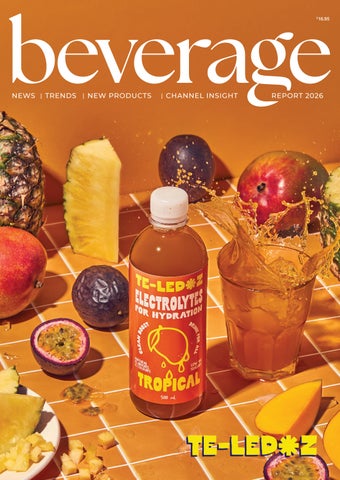
Electrolytes For Hydration In a category long dominated by sugar-heavy drinks and artificial formulations, TE-LEDOZ has positioned itself as a smarter, everyday hydration option for modern Kiwis. Positioned as the “giant slayers of hydration”, TELEDOZ has aimed to redefine the electrolyte category in New Zealand by proving that better hydration doesn’t require excessive sugar or synthetic additives. Instead, it has focused on real ingredients, natural flavours and broad everyday appeal. As shoppers continue to prioritise wellbeing without sacrificing taste, TE-LEDOZ has carved out space as a natural hydration option that fits seamlessly into real life, one bottle at a time. The range includes four flavour profiles designed to resonate across age groups and occasions: Tropical, Blue, Citrus and Grape. For more information, visit www.teledoz.co.nz or email info@teledoz.co.nz
16 Beverage Report 2026
NOW DISTRIBUTED BY
For more information, please contact: DKSH New Zealand Limited at customer.service@dksh.com www.dksh.co.nz Review Publishing Co Ltd
17
Functional
Functional Before It Was A Trend: Why Consumers Have Changed The Way They Think About Beverages Australia’s functional beverage market may be booming, but according to Sunraysia, consumers haven’t fundamentally changed what they want from beverages - they’ve simply become more intentional about expecting every drink to deliver more than refreshment.
F
orecast to exceed USD 5.9 billion by 20301, Australia’s functional beverage market is being driven by consumers seeking products that support everyday wellbeing. At the same time, Australians are redefining what wellness looks like. Research shows 65 percent are no longer chasing radical health transformations, instead prioritising realistic habits they can maintain over the long term, while 68 percent are choosing foods and beverages for specific functional benefits such as gut health, immunity and energy 2. That changing mindset is also influencing purchasing behaviour, with
18 Beverage Report 2026
36 percent of Australians willing to pay more for foods and beverages carrying immune health claims3. For beverage manufacturers and retailers, these changing expectations are reshaping one of the industry’s fastest-growing categories. While much of the category’s recent growth has been driven by probiotics, botanicals, adaptogens and other emerging ingredients, Sunraysia believes consumers are increasingly looking beyond novelty towards products that combine credible nutrition with familiar, trusted ingredients. Alex D’Amico, Head of Commercial, Sunraysia, said the functional beverage
category is entering a new stage of maturity. “The most interesting change we’ve seen isn’t that consumers now want functional beverages. It’s that they increasingly expect every beverage to deliver some form of nutritional value,” said D’Amico. “Consumers are becoming much more intentional about the products they choose and the benefits they expect from them. They’re moving away from dramatic health overhauls and towards smaller, everyday choices that fit naturally into their lifestyle.” According to Sunraysia, this isn’t a new consumer behaviour - it is simply
being described differently. Long before functional beverages became an established category, fruits such as prunes, cranberries and pomegranates were already recognised for their naturally occurring nutrients and nutritional benefits. Recognising this consumer demand decades ago, Sunraysia introduced Australia’s first prune juice, identifying an opportunity for beverages that offered nutritional value beyond simple refreshment long before the functional beverage category existed. “When Sunraysia launched Australia’s first prune juice, consumers weren’t talking about functional beverages or wellness categories,” he said. “What they did recognise was that certain fruits naturally offered nutritional benefits, and they actively sought those products out. In many ways, today’s functional beverage movement is an evolution of that same consumer behaviour rather than an entirely new phenomenon.” Sunraysia believes that changing
consumer expectations present an opportunity for manufacturers to rethink how they define innovation. “Innovation doesn’t always have to come from increasingly complex formulations or unfamiliar ingredients. Scientific advances will continue to play an important role in the category, but we’re also seeing growing demand for products that deliver naturally occurring nutritional benefits through ingredients consumers already know and trust. Familiarity and transparency are becoming just as important as functionality itself.” The company said this evolution is also changing the way consumers shop the beverage aisle. Twenty years ago, consumers largely shopped for beverages by category - juice, soft drink, sports drink or bottled water. Today they’re increasingly shopping by need state. They’re asking, ‘What does this do for me?’ rather than simply, ‘What type of drink is it?’ That’s changing the way the entire category is evolving. As consumer expectations continue
to evolve, Sunraysia believes the next stage of growth in functional beverages will be driven not only by new ingredients and formulations, but also by products that combine trusted ingredients, naturally occurring nutritional benefits and everyday relevance. 1 https://www.bonafideresearch. comproduct/6501292507/australia-functionalbeverage-market 2 https://www.thegrowthdistillery.com.au/ article/health-of-the-nation-the-new-australianhealth-narrative/ 3 https://www.matthews.com.au/blog/ functional-food-beverage-how-aussiemanufacturers-can-ride-the-better-for-you-wave
Review Publishing Co Ltd
19
20 Beverage Report 2026
Tea & Coffee
More Than Tea. A Better Way To Serve It. For some guests, tea is the quiet ritual at the end of a meal.
F
or others, it is the first drink of the morning, a moment of calm in a busy day, something to enjoy between meetings, or a product they discover on a retail shelf and take home. Wherever tea fits into your business, we believe it should feel considered. With more than 40 years of tea blending experience, Harney & Sons brings more than the basics to hospitality and grocery, with a diverse range of exceptional teas and formats designed to meet the many ways tea is served, from guest rooms and cafés to restaurants, conferences, spas and retail shelves. But great tea isn’t simply about what happens once it reaches your venue. It starts at origin. We’ve cultivated close relationships with our tea suppliers over decades, allowing us to stay close to the people and places behind the teas we serve. We seek to source from farms we have visited and from suppliers who share our commitment to responsible and ethical practices. From Uji to Darjeeling to Ceylon, we source from the best of the best, with multi-generational farms. For us, knowing where our tea comes
from matters. It means understanding the conditions in which it is grown, building relationships that extend beyond a transaction, and working towards consistency and quality from the source all the way through to the cup. That approach is reflected in the teas themselves. From classic black teas and fragrant Earl Greys to green teas, herbal infusions and distinctive Harney & Sons blends, our range offers something familiar when customers want it, and something new when they’re ready to explore. A format for every occasion. We understand that hospitality and retail businesses don’t all serve or sell tea in the same way. That’s why our range is available in formats designed around the experience you want to create. Individually wrapped sachets provide consistency, convenience and presentation, making them ideal for guest rooms, breakfast service, conferences, cafés and anywhere hygiene, speed and ease of service matter. Tea tins and retail-ready formats allow hotels, cafés, specialty retailers and destination venues to extend the tea experience beyond the cup and
into the customer’s home. Loose leaf tea offers a more traditional service for venues where the ritual of brewing, presentation and the tea itself are part of the experience. The result is flexibility without compromising the quality of the tea. A hotel might need one solution for in-room amenities, another for breakfast and a more elevated selection for its spa. A café might want a concise menu of dependable favourites alongside distinctive blends that give customers a reason to choose tea. A retailer may be looking for teas with enough personality to stand out on the shelf. We work with our customers to find the right range and format for the occasion, rather than simply supplying a catalogue of products. Better tea, with a bigger purpose. We believe that being in the tea business comes with a responsibility to the places, people and planet connected to it. Harney & Sons is proud to be part of 1% for the Planet, giving back to Forest and Bird since 2016 working to protect New Zealand’s iconic environment. It’s one part of a broader philosophy that asks us to look beyond the finished product and consider the journey that gets it there. Because tea comes from somewhere. It comes from landscapes, communities, growers, producers and generations of knowledge. We want to honour that connection by building responsible relationships at origin and giving back to the planet that makes the entire industry possible. Your tea programme should be as considered as the rest of your offering. Whether you’re looking to upgrade the tea served in your guest rooms, introduce a more considered selection to your café, create a memorable conference experience, expand your retail range or simply give customers a better cup, Harney & Sons can help. We’re not just here to supply tea. We work with businesses to create tea experiences that complement the quality and character of what they’re already doing. Talk to our team about your venue, your customers and the way you currently serve or sell tea. We’ll help you find the right range and format for your business.
Ready to make more of tea? Let’s talk. Call +64 21 813 355 or email findlay@harneyteas.co.nz
Review Publishing Co Ltd
21
Tea & Coffee
Super Deluxe, Havana Coffee Works Super Deluxe is a crowd favourite, and for good reason. It’s beautifully balanced, seriously smooth and versatile enough to suit however you like your coffee – from plunger to espresso and everything in between. Expect a rich, full-bodied cup with a biscuity caramel hit and a velvety smooth finish – sure to get your good going. Roasted by Havana Coffee Works in New Zealand, Super Deluxe is made to be enjoyed your way, however you choose to brew it.
Matcha Minus The Fuss Green Goose has taken pure matcha and engineered it into Nespresso Original-compatible capsules, removing the whisking, measuring and mess that can make matcha harder to prepare. Matcha demand might be booming, but for many people the biggest barrier is still knowing how to make it. Green Goose turns it into something they already understand: pop in a pod and press a button. It creates a new occasion for machines already sitting in kitchens, workplaces and hotel rooms, giving customers an easy way to swap a coffee for matcha and bringing more of the café matcha occasion into their everyday routine. Each box contains 10 single-serve pure matcha capsules. RRP $15.99 hello@greengoose.co.nz | www.greengoose. co.nz | Tamarin 027 826 2746
22 Beverage Report 2026
Vietnam’s Most-Loved Coffee, Now In A Can May Coffee Crew, a Kiwi-Vietnamese family brand on a mission to share Vietnamese coffee culture with New Zealand, has introduced New Zealand’s first canned Vietnamese coffee. Its Condensed Milk Iced Coffee is a bold, 100 percent Vietnamese Robusta brewed right here in New Zealand and blended with condensed milk; the exact drink you’d grab on a Hanoi street corner, ready for a Kiwi summer. It offers coffee lovers a double-caffeine hit, and plenty of people who “don’t really drink coffee” are surprised by how smooth it is. May Coffee Crew’s Condensed Milk Iced Coffee is already available in Farro and selected New World, Pak’nSave, FreshChoice and Four Square stores. The brand also won a bronze award at the 2025 NZ Artisan Awards in its first year. For more information, get in touch at hello@maycoffeecrew. co.nz or maycoffeecrew.co.nz
Arum et ut es abore volut
Tea & Coffee
Review Publishing Co Ltd
23
Juices & Syrups
Proven Popularity, Now Retail-Ready For many years, Wests Original Soda Co. has crafted the milkshake syrups Kiwis know and love. From classic to nostalgic flavours that deliver consistent results, the Wests Original Shakes range has become a popular choice for cafés, hospitality operators, and customers looking to create great milkshakes at home.
With its long-standing heritage, proven popularity, and variety of flavour profiles, these milkshake syrups are a natural addition to the supermarket aisle, now available in a convenient 1L bottle to suit the growing home beverage market and its strong everyday appeal. A trusted New Zealand brand, made with flavour, heritage and retail opportunity in mind, bring the taste of Wests Original Soda Co. to customers and give them a reason to make milkshakes at home. For more information, visit wests.co.nz or email sales@wests.co.nz
St Andrews Limes Lemon & Lime Juice 100% Natural, NZ-Squeezed Consistent, ready-to-pour lemon and lime juice, freshly squeezed and pasteurised for extended shelf life without additives or preservatives. Our lemon juice comes from New Zealand-grown fruit, and our lime juice is pressed from Tahitian and Bearss limes – giving your kitchen or bar reliable, high-quality citrus year-round without the labour, waste or price swings of fresh fruit. Perfect for dressings, marinades, desserts, hot drinks, or cocktail mixers. Available in 375ml and 1L bottles, with bulk wholesale options for hospitality and retail. Stock the citrus your kitchen and bar can count on. For more information or to become a stockist, contact orders@limes.co.nz, find us on Upstock, or visit www.limes.co.nz
24 Beverage Report 2026
Juices & Syrups
Sugar-Free Vanilla Coffee Syrup One bottle, endless possibilities. QUARTERPAST Vanilla Sugar-Free Coffee Flavour delivers smooth, creamy vanilla flavour without the sugar. Made in New Zealand, it complements both hot and cold beverages. Designed to add café-style sweetness to coffee, it offers an easy way to elevate a favourite cup at any time of day. Whether it’s a slow morning, an afternoon pick-me-up, or a treat-yourself kind of day, QUARTERPAST Coffee Syrups let you make it your way.
Endless Slushie Fun At Home Five flavours. One easy choice. A whole lot of slushy fun. Turn everyday moments into something a little more fun with Wests Original Soda Co. Slushy Syrups range, bringing bold, vibrant flavour to home slushy machines, making it easy for customers to create refreshing slushies whenever they want. Available in five popular flavours and a convenient 1L bottle, the range has been designed for today’s growing home beverage market. Easy to use, easy to store and
ideal for family occasions, summer entertaining or simply cooling down with a favourite flavour. With eye-catching flavours and the excitement of making slushies at home, Wests Slushy Syrups range has a strong visual appeal that encourages repeat purchases as shoppers come back to try their next favourite. From family fun to weekend treats, Wests Original Soda Co. Slushy Syrups bring the slushy experience home with plenty of flavour and plenty of reasons to come back for more. For more information, visit wests.co.nz or email sales@wests.co.nz
Review Publishing Co Ltd
25
Juices & Syrups
Wild-Fermented. SmallBatch. Unmistakably Handmade. Hakanoa has true reverence for brewing its Ginger Beer the traditional way, just as it used to be made in homes all over New Zealand. Hakanoa ginger beer begins with its own “bug” or “plant”, which is a wild culture of yeast and lactobacilli nurtured by the team. This culture transforms simple ingredients into a ginger beer with natural tang, rich spice, and depth only slow wild fermentation can deliver. Hakanoa brews with the finest ingredients, including mature Fiji ginger (fresh and dried), Organic fair-trade raw cane sugar, Whole local lemon juice, Sultanas, Filtered water, and its wild culture. Brewed over several quiet weeks, what develops is a drink with rich ginger flavour, a whisper of fruit, and a beautiful crispness.
Authentic Artisan Recipes
26 Beverage Report 2026
Hakanoa Handmade Concentrates have been providing the hospitality industry with the finest products for over 16 years. Each one has been honed over the years to deliver the most excellent flavours and be the easiest to use. • Served in over 500 venues nationwide • Certified preservative-free, gluten-free, dairy-free • Fiji ginger organically grown and directly traded • Raw sugar organically certified and fairly traded • Authentic artisan recipes and methods • Widespread fanbase of discerning baristas and fiercely loyal regular customers.
Juices & Syrups
Premium Artisan Juices Crafted In NZ Benjer has been crafting award-winning premium New Zealand fruit juices since 1995. Thirty years on, the company prides itself on its unwavering commitment to delivering the finest artisan juices that honour the fruit from which they are made. From branch to bottle, every drop of Benjer’s juices tells a story, be it the stunning natural landscape where the fruit was grown, the way the season and the weather influence the flavour, or even just a funny conversation with one of the orchardists when they drop off their harvest for processing. Benjer is real juice, made the old-fashioned way, no shortcuts, no additives, just real fruit, real juice and a real passion to showcase the fantastic produce this country provides.
Review Publishing Co Ltd
27
Carbonated
Six Barrel Soda Ready-To-Drink
Six Barrel Soda’s ready-to-drink soda range is made with love and premium natural ingredients. They contain 20 to 30 percent less sugar than most sodas and are made exclusively with fair trade organic cane sugar. No preservatives or artificial colours, flavours or sweeteners here. Make your cafe or restaurant soft drinks menu pop with craft sodas that are low sugar, low waste and restaurant quality. Perfect for hospitality venues, quality food shops and workplace drinks. Proudly made in Hawke’s Bay – the fruit bowl of New Zealand. For more information or to become a stockist, contact orders@sixbarrelsoda.co, find us on Upstock, or visit www.sixbarrelsoda.co
Turbo Tonic Sparkling – Turmeric, Ginger & Lime The effervescent collaboration between Turbo Tonics and St Andrews Limes, two of New Zealand’s most trusted beverage makers, crafted to support healthy digestion and everyday immunity. This ready-to-drink can contains Turbo Tonics’ signature turmeric, ginger and St Andrews lime juice with sparkling soda water. Turmeric and black pepper work together for better absorption, fresh ginger adds warmth and supports digestion, and honey rounds it out with natural sweetness. NZ-grown lime juice lifts the drink with a boost of vitamin C. For more information or to become a stockist, contact orders@limes.co.nz, find us on Upstock, or visit www.limes.co.nz
28 Beverage Report 2026
Carbonated
There’s A NEW Buzz In Town! Meet NEW Barrier Buzz Raspberry & Lemonade: juicy raspberry, zesty lemonade and wild Aotea mānuka honey in one seriously refreshing soda. Born on Aotea / Great Barrier Island and made in New Zealand, Barrier Buzz is naturally sweetened with mānuka honey, with no refined sugar or artificial sweeteners, and bottled in premium 300mL glass. Raspberry & Lemonade joins the original favourites, Ginger Beer, Lemonade and Cola, giving customers four great flavours to discover. NEW STOCKIST OFFER - Buy three cases and get your fourth case free + free delivery. Mix & match across all four flavours. Perfect for cafés, restaurants, specialty stores, supermarkets and anywhere looking for a refreshing, proudly NZ-made alternative. Trade: The Aotea Company Ltd on Upstock Online: https://theaoteacompany.co.nz/ Enquiries: enquiries@theaoteacompany.co.nz Phone: +64 29 201 2728 Instagram: @drinkbarrierbuzz Barrier Buzz — Born on Aotea. Sweetened by nature.
Review Publishing Co Ltd
29
Carbonated
New Cola & Lime Kefir Soda The Wild Fermentary’s new Cola & Lime Kefir Soda proved a standout at this year’s Auckland Food Show, where it was the best-selling flavour in the company’s water kefir range. Developed in collaboration with Six Barrel Soda Co, it brings together classic Cola Six flavour with the benefits of traditional fermentation to create New Zealand’s first living cola. Crafted in small batches at The Wild Fermentary using a live water kefir SCOBY, the drink is naturally fermented, lower in sugar than conventional soft drinks, and alive with billions of beneficial live cultures. As consumer demand continues to grow for products that combine wellness with everyday enjoyment, Cola Kefir is one to watch. Now ranging in Foodstuffs.
Premium Taste Of Mexico Jarritos brings a premium taste of Mexico to New Zealand with a distinctive range of authentic sodas crafted in Mexico since 1950. Renowned for vibrant flavours, iconic glass bottles, and rich heritage, Jarritos offers consumers a refreshing alternative to mainstream soft drinks. The range includes favourites such as Mexican Cola, Mandarin, Lime, Mango, Guava, Pineapple, and Grapefruit, delivering a unique and memorable drinking experience. As shoppers increasingly seek premium international brands, Jarritos stands out through its authentic provenance, exceptional flavour credentials, and strong shelf appeal. Whether enjoyed on its own or paired with food, Jarritos elevates everyday refreshment while helping retailers drive premiumisation, category growth, shopper discovery, and excitement across the beverage aisle in New Zealand.
30 Beverage Report 2026
PREMIUM CITRUS-BASED SODAS Since 2002, St Andrews Limes has been turning Hawke's Bay citrus into small-batch drinks worth savouring. What started as a crate of hand-juiced limes at the local Farmers Market has grown into a range of low and no added sugar sodas made with real New Zealand ingredients. From classic sparkling lemon and lime to the tang of passionfruit, the bite of ginger, and a warming turmeric and black pepper tonic brewed with Turbo Tonics, there's a St Andrews Limes soda for every mood.
LY PROUD IN MADE E’S HAWK BAY
To learn more or enquire about becoming a stockist, contact orders@limes.co.nz, find them on Upstock, or visit www.limes.co.nz Review Publishing Co Ltd
31
BWS
Moderation, Choice And Connection In A Changing Beverage Market One of the biggest shifts in New Zealand’s beer, wine and spirits market is not what people are drinking, but how they are drinking.
M
ore consumers are embracing “zebra striping”, enjoying a beer, wine or spirit while socialising, and pacing themselves by alternating alcoholic drinks with non-alcoholic options. This reflects something broader, a wider shift in how we are approaching social occasions, looking for moderation, along with more choice and ways to enjoy connection. Part of this shift is the growing interest in low and no-alcohol beer, wine and spirits. A Curia Market Research poll of 1,000 New Zealanders in October 2025 found that half drink low or no-alcohol beverages at least some of the time, with some now preferring these options. That does not mean people are turning away from traditional beverages. It shows consumers want a wider range of products to suit different occasions, lifestyles and personal preferences. As a result we are seeing more adults choosing moderation. According to the annual New Zealand Health Survey, five
32 Beverage Report 2026
out of six New Zealanders who drink beer, wine and spirits do so responsibly, and there has been an across-the-board decline in different measures of riskier drinking compared with 2016/17. Stats NZ data also shows alcohol consumption per capita has declined by more than 30 percent since 1986. These long-term trends show the way that New Zealanders are drinking is changing for the better. At the same time, we should not overlook the importance of social connection. Time with friends and family, shared enjoyment and simple moments of celebration are vital to wellbeing. For many adults, having a beer, wine or spirit is part of these occasions. When consumed responsibly, these products can play a positive role in society, contributing to connection, hospitality and cultural life. Research shows that beer, wine and spirits has helped people bond, celebrate and share a sense of belonging across our communities.
This cultural heritage is reflected in the way UNESCO protects traditional beer, wine, and spirits production methods, landscapes, and social rituals as intangible and tangible heritage to preserve ancient knowledge and sustain community identities. It is a reminder that these products are connected to tradition, craftsmanship, hospitality and identity, as well as commerce. That is why people need clear, practical and evidence-based advice, so they can make informed choices about whether and how they drink, just as they do with other everyday decisions. The Health NZ low-risk drinking guidelines recommend no more than two standard drinks a day for women and three for men, with at least two alcoholfree days each week. It is also important not to drink while pregnant. The changing beverage market shows moderation is not about removing enjoyment or connection from people’s lives. It is about supporting adults to make choices that work for them. Whether that means choosing a low or no-alcohol option, zebra striping, having alcohol-free days or simply drinking less, the direction is clear: New Zealanders are becoming more mindful about how they drink. For industry, the opportunity is to keep responding with innovation, quality and choice, while supporting a culture where moderation and connection sit comfortably alongside a healthy, balanced lifestyle.
By Virginia Nicholls Executive Director NZABC
Alcohol Licensing Reform Moves To Ministers The Ministry for Regulation has found that New Zealand’s alcohol licensing system imposes unnecessary costs on hospitality businesses, but the Government has yet to accept the changes proposed in its Hospitality Sector Review.
T
he review examined alcohol licensing, food safety, fees and levies, information sharing and other regulations affecting hospitality businesses. It covered more than 25,000 businesses in a sector generating $21.4 billion in revenue and employing more than 193,000 people. The Ministry received 247 written submissions, including submissions from 39 territorial authorities. It also met 13 sector representative groups, members of 27 District Licensing Committees, 12 territorial authorities, 21 hospitality businesses and two community groups. The review found that hospitality regulation was generally effective in achieving its stated objectives. However, it also found areas where the system was ineffective, inefficient, disproportionate to risk, difficult to comply with or creating unreasonable barriers to innovation. Its findings on alcohol included licensing and renewal requirements that could be disproportionate to the risk presented by hospitality settings. Some processes were inefficient, hearings were not always a proportionate way to reach decisions, and compliance and enforcement practices were not always effective or proportionate. The review made 24 recommendations, nine of which relate specifically to the alcohol regulatory system. Spirits New Zealand chief executive and World Spirits Alliance president Robert Brewer welcomed the findings. “The review is a significant piece of work which has shone a light on what many in the industry have understood for years,” said Brewer. Brewer said the nine alcohol recommendations were a positive step because they acknowledged systemic problems and proposed achievable solutions. Spirits New Zealand now wanted
to see the recommendations progressed. NZ Alcohol Beverages Council executive director Virginia Nicholls also supported the review’s direction. “The existing licensing system has evolved into a framework that is increasingly complex, costly and inconsistent,” said Nicholls. She said businesses, councils and regulatory agencies faced growing costs, lengthy processes and uncertainty in decision-making. Nicholls supported proposals covering streamlined renewals, clearer first-time licensing, consistent training, improved compliance tools, stronger District Licensing Committees, revised fees and a risk-based licensing framework. Under the review’s short-term recommendations, a new steward would be appointed for the alcohol regulatory system with ring-fenced resources. Licence renewals would be simplified, with longer renewal periods available for some licences. The first-time application process would also be clarified, including more specific licensing criteria and a simpler application form. The review recommended mandatory training for licence holders, people serving alcohol and regulators. It also proposed additional tools for addressing minor non-compliance, including improvement notices and notices of direction. District Licensing Committees would be able to merge. The proposal would introduce specific membership and training requirements, along with increased payments for committee members. Licensing fees would be recalibrated. The proposal includes removing annual fees, significantly reducing renewal fees and introducing inspection fees. These seven recommendations have a proposed delivery date of the end of 2027. Two further alcohol recommendations
sit within the review’s medium-to-longterm programme for 2028 and 2029. The first would replace existing licence types with a single risk framework governing licence categories, application requirements, fees and expected monitoring. The second would establish a nationwide information system covering licences, manager certificates, compliance activity, business performance, alcohol-related crime, incidents and health effects. The review also said the Sale and Supply of Alcohol Act 2012 and its associated regulations would benefit from a full review to improve clarity and flexibility. It suggested that the proposed system steward should continue considering whether a central alcohol regulator would be more effective than the current model, while retaining local staff and decision-making. Minister for Regulation David Seymour said ministers would decide in the coming weeks which recommendations to accept and what the next steps are. Tourism and Hospitality Minister Louise Upston said she intended to develop a Hospitality Action Plan to coordinate priority hospitality initiatives across government. The review has set out the proposed direction and delivery timetable. The next stage depends on which recommendations ministers accept and how they are implemented.
Review Publishing Co Ltd
33
BWS
A Smaller Pour, A Bigger Story: The State Of New Zealand Beer In 2026 New Zealanders are drinking less than at any point on record, and beer is proving the steadiest part of that story.
By Dylan Firth
Executive Director Brewers Association of New Zealand
N
ew Zealanders are drinking less than at any point on record, and beer is proving the steadiest part of that story. Stats NZ data for the year ended June 2026 shows total beer available for consumption fell to 264.2 million litres, the lowest figure on record and down 10.8 percent since 2021. Yet beer’s share of the total beverage-alcohol market has barely moved, sitting at 59.7 percent against 59.8 percent in 2020. Wine has not held the same ground, its share slipping from 23.3 percent to 19.9 percent as spirits pick up the difference. The market is shrinking together, and beer is not losing ground within it. The more interesting story sits inside the beer category itself. Mainstreamstrength beer, between 4.35 and 5.0 percent ABV, now accounts for 55.3 percent of everything New Zealanders drink, up from 42.8 percent in 2020, while beer above 5.0 percent has nearly
34 Beverage Report 2026
halved its share, from 14.3 percent to 9.0 percent. No- and low-alcohol beer has nearly tripled in volume, albeit from a very small base. None of this reads as retreat. Drinkers are not giving up their pint; they are choosing a more balanced one, and beer is uniquely placed among the major categories to offer that choice without asking anyone to give up flavour. The same pattern holds internationally, and increasingly favourably for New Zealand. Total alcohol consumption per capita has fallen to 6.98 litres of pure alcohol, the lowest figure ever recorded here and almost 20 percent below the 2021 peak. That places New Zealand close to Greece, the lowest figure among recent OECD comparators, and well below the OECD average of 8.5 litre. It mirrors a wider global reset: overseas analysts describe 2026 as a year in which mature beer markets stabilise on volume while value holds up through premiumisation and a no- and low-alcohol segment growing at close to double-digit annual rates. Volume and strategic significance have decoupled, in New Zealand as much as anywhere else. The economic backdrop is more complicated than the consumption story alone suggests. New Zealand’s beer industry taking int account the supply chain is worth an estimated NZD 3.58 billion, contributing around 0.9 percent of GDP and employing more than 35,000 people direct and indirectly. Excise continues to rise automatically
through annual indexation regardless of falling volumes, yet total alcohol excise revenue for government has actually fallen, from NZD 1,301.5 million in FY22/23 to NZD 1,246.0 million in FY25/26, a decline of 4.3 percent even as the rate itself climbed. The base is eroding faster than indexation can offset it. That burden is not evenly shared: on a standard-drink basis, beer already carries a higher excise rate than wine, at 49 cents against 38 cents, and beer excise is overwhelmingly a tax on domestic production, with 85 percent paid on New Zealand-made beer compared with just 41 percent for spirits. On-premise’s share of total alcohol sales has fallen from around
40 percent to roughly 15 percent as cost of living pressure pushes drinking back into the home, hitting hospitality venues hardest just as the volumes underpinning their trade contract. All of this plays out against the backdrop of the 7 November general election. Whichever government forms after polling day will inherit decisions on the Sale and Supply of Alcohol Amendment Bill, the Ministry for Regulation Hospitality review, and whether excise indexation continues on autopilot or is finally paused to reflect what the data already shows. A change of government could bring a different balance between public health framing and economic and hospitality
considerations; continuity would mean picking up the current settings largely as they stand with parties indicating there is more they want to do in the alcohol licensing space. Or a change seeing suggestions of tightening restrictions of advertising and sponsorship and tighter licensing rules. Either way, the industry’s evidence base does not change with the result: New Zealanders are moderating, beer is leading that shift, and a tax system built on assumptions of growth is taxing a trend that has already reversed. Beer’s place in New Zealand life is not shrinking so much as adapting. It remains the drink most adult Kiwis reach for, increasingly in a form that reflects a more moderate way of
drinking it, and that is a genuine public health success story as much as an industry one. The task for policymakers, of whichever stripe, is to back that adaptation with settings that recognise it, rather than continuing to tax and regulate for a New Zealand that has already moved on.
Review Publishing Co Ltd
35
BWS
Remarkable Cream’s Limited Edition Christmas Eggnog Celebrate Christmas with Remarkable Cream’s Limited Edition Christmas Eggnog, made with smooth New Zealand cream, fine spirits, and French brandy. Spiced with cinnamon, nutmeg, and vanilla, it captures the unmistakable flavours of Christmas in a glass. Lighter than traditional non-alcoholic eggnog, this liqueur offers flavours reminiscent of spiced cookie dough, cinnamon rolls, and hot buttered brandy, with a silky, drinkable texture.
Thunderdonk Campfire Coffee Whisky ThunderDonk Campfire Coffee is a bold new flavoured whisky that blends rich espresso coffee with smooth whisky for a full-bodied, easy-drinking flavour. Deep-roasted coffee notes are balanced with toasted coconut and smooth, velvety sweetness, creating a rich, warming finish made for slow sips around the fire. Bold yet approachable, it delivers everything expected from ThunderDonk.
36 Beverage Report 2026
Brewster Hut inspires New Monteith’s Brewster Pilsner A demanding climb high above the Mount Aspiring Track has inspired the latest addition to New Zealand’s craft beer landscape. Named after the iconic Brewster Hut, the new Monteith’s Brewster Pilsner pays tribute to one of the country’s most beautiful alpine destinations. The beer is the result of careful preparation and attention to detail. Monteith’s brewers have created a crisp, approachable pilsner with a lean, bready malt backbone designed to let locally grown New Zealand hops take centre stage. The result is a vibrant flavour profile featuring zesty citrus notes, complemented by subtle hints of stone fruit.
BWS
Maximus Hazius X.I. Lakeman Brewing has built a reputation for producing exceptionally well-crafted beers, and that quality has once again been recognised with three beers finishing in the Top 25 at the New World Beer & Cider Awards across three different beer styles. Based on a working sheep and beef farm just outside Taupō, Lakeman Brewing is a family-owned brewery and was born from necessity as much as passion. Around 20 years ago, environmental regulations were introduced to protect the pristine waters of the Lake Taupō catchment, limiting the number of livestock that could be farmed. Rather than seeing the changes as a setback, the family looked for a new way to add value to what they produced, and they created Lakeman Brewing. Water is drawn from an 80-metre-deep bore beneath the brewery; the exceptionally pure water provides the perfect foundation for brewing. While the core range has earned a loyal following, the seasonal releases are where the brewing team really lets their creativity shine These limited releases are bold, adventurous beers that never lose sight of drinkability. Maximus Hazius X.I. is a perfect example. A Triple Hazy IPA, it bursts with flavours of ripe mango, bright orange and mixed berries, delivering a beer as big in flavour as its name suggests.
Review Publishing Co Ltd
37
BWS
Hawke’s Bay Chardonnay Deserves A Closer Look For many wine drinkers, New Zealand has become synonymous with Sauvignon Blanc. But look beyond our most famous variety and another compelling New Zealand wine story is gathering momentum: Chardonnay. And Hawke’s Bay is firmly at the heart of it.
N
ew Zealand’s oldest wineproducing region has a long history with Chardonnay, but what makes the category particularly exciting today is the breadth and confidence of the wines now being produced. Across Hawke’s Bay, differences in soils, sites, coastal influence, and winemaking approaches are creating Chardonnays with distinctive personalities - from bright, elegant, and mineral-driven wines to more textural, complex, and powerful expressions. For retailers and consumers, that diversity is part of the opportunity. Hawke’s Bay Chardonnay isn’t a single style or proposition. It offers a range of expressions and price points, while retaining the regional quality credentials for which Hawke’s Bay is increasingly recognised. A vintage that puts quality in the spotlight One measure of that depth can be found in the 2024 Hawke’s Bay Annual Chardonnay Collection. Now in its sixth year, the Collection was established by Hawke’s Bay Winegrowers to identify and showcase 12 wines from each vintage that collectively demonstrate the quality and diversity of Chardonnay being produced across the region. For the 2024 Collection, 56 wines were submitted and tasted blind, with just 12 selected by a panel comprising
38 Beverage Report 2026
Cameron Douglas MS, Emma Jenkins MW and North Island Young Winemaker Thalia Osborne. The resulting collection is significant not simply because of the individual wines selected, but because of the consistency the judges found across the wider field. Cameron Douglas described the vintage as producing Chardonnays of “outstanding precision, balance, and regional identity”, noting the remarkable consistency of the wines and the strength and maturity of Hawke’s Bay Chardonnay. The 12 selected wines come from a broad cross-section of producers, providing a snapshot of a region where Chardonnay is being made confidently in different styles and at different scales. The collection is now being shared with leading domestic and international wine media, helping take that story beyond Hawke’s Bay. From regional strength to international recognition That confidence sits within a wider evolution of Hawke’s Bay as a wine region. In 2023, Hawke’s Bay became one of the world’s Great Wine Capitals, joining an international network that includes Bordeaux, Napa Valley, Adelaide, Bilbao-Rioja and other renowned wine regions. The recognition considers not only wine quality, but a region’s history, wine tourism, education, business and visitor experience.
Wine
For Hawke’s Bay, it has provided another platform from which to tell its story internationally – and Chardonnay is increasingly an important part of that conversation. That momentum will be particularly visible this September when Hawke’s Bay hosts the 2026 Aotearoa New Zealand Chardonnay Symposium, bringing the wine community together for two days dedicated entirely to Chardonnay. Held on 17-18 September, the Symposium will explore quality from vineyard through to glass, including international benchmark tastings,
e
Hawke’s Bay Wine Annual Chardonnay Collection Vintage 2024 – Credit Michael Farr
viticulture, winemaking, style, texture and how we communicate quality to the people ultimately buying and drinking the wines. It is an indication of how seriously New Zealand’s wine community is taking Chardonnay and of the opportunity to build greater understanding of the category. An opportunity on the shelf For the trade, that presents an interesting proposition. Consumers already have confidence in New Zealand wine. The opportunity
is to encourage them to explore more deeply - to understand that New Zealand’s wine story extends well beyond the varieties and regions they already know. Hawke’s Bay Chardonnay gives retailers a particularly accessible way to do that. It is a familiar international variety with a strong regional story behind it, produced by both established names and a new generation of winemakers. Perhaps most importantly, there is now real depth behind the proposition. The 2024 Chardonnay Collection provides one independent snapshot
of that quality. Great Wine Capitals recognition gives Hawke’s Bay an international platform. And this year’s Aotearoa Chardonnay Symposium puts Chardonnay firmly in the spotlight. For anyone considering what else New Zealand wine can offer consumers, Hawke’s Bay Chardonnay is well worth making room for.
Review Publishing Co Ltd
39
New Zealand Wine Stands Out In A Crowded Beverage Landscape Consumers todaya are looking for wines that offer quality, authenticity and a genuine connection to place.
40 Beverage Report 2026
BWS
A
ccording to Charlotte Read, General Manager Brand at New Zealand Winegrowers, many have been drinking less but choosing better, which aligns strongly with New Zealand wine’s premium positioning, which has been a defining feature of its success for decades and will remain central to future growth. As a relatively small producer on the global stage, Read said that New Zealand’s growth opportunity lies in creating value and volume. That means continuing to invest in quality,
sustainability, innovation and brand reputation. Domestically, premiumisation increasingly intersects with tourism, hospitality, and regional experiences as consumers seek memorable experiences that connect food, wine, people, and place. In export markets, premiumisation can be reflected in how the New Zealand wine story is told through trade engagement, education, media programmes and consumer experiences that showcase the regions, varieties and people. International recognition of New Zealand’s culinary excellence through the arrival of the MICHELIN Guide can help further elevate the country’s premium food and beverage offerings, attracting high-value visitors and providing another platform to showcase the quality, provenance and distinctiveness of New Zealand wine. “While Sauvignon Blanc remains our global calling card, we are increasingly emphasising the breadth and diversity of New Zealand wine. There is also growing demand for lighter, fresher wine styles, playing directly to New Zealand’s strengths as a premium cool-climate producer,” said Read. “Sauvignon Blanc put New Zealand on the global wine map and continues to perform strongly, while Pinot Noir, Chardonnay and our aromatic varieties are helping broaden the New Zealand wine story.” Read added that sustainability has become an increasingly important requirement for international competitiveness as sustainability underpins New Zealand wines’ reputation and social licence to operate in key export markets. The industry has a strong foundation through Sustainable Winegrowing New Zealand (SWNZ), one of the world’s longest-running national wine sustainability programmes, which recently celebrated 30 years. Today, 98 percent of New Zealand vineyard area is SWNZ certified, with more than 90 percent of wine produced in certified facilities. Carbon-conscious practices have also become important, with many producers measuring emissions, improving energy efficiency, reducing reliance on fossil fuels, exploring renewable energy, and
working across packaging and freight supply chains to reduce environmental impact. These efforts help strengthen resilience, support market access and reinforce New Zealand wine’s premium position globally. “Consumers, retailers and distributors want confidence that products are being produced responsibly, while many markets are introducing more stringent sustainability requirements throughout supply chains.” Although the global operating environment remains challenging due to subdued consumer spending, rising costs and changing purchasing patterns, Read believes the longterm outlook for New Zealand wine is positive, thanks to its premium reputation, sustainability credentials and strong demand mainly in the United States, United Kingdom and Australia. There has also been encouraging momentum in markets such as Canada, China and South Korea, highlighting the value of diversification and targeted market development alongside the recently signed Free Trade Agreement with India, which presents an opportunity to understand better the long-term potential of one of the world’s fastest-growing consumer markets. (NB: the agreement has been signed and is expected to enter into force later this year after the agreement has been ratified by both countries). Read suggested that premiumisation should not stop at the bottle and highlighted significant opportunities in New Zealand’s wine tourism, further supported by the MICHELIN Guide, which can help attract highvalue international visitors seeking exceptional experiences in which wine is an integral part, creating a powerful halo effect that strengthens appeal.
Charlotte Read
General Manager Brand at New Zealand Winegrowers
Review Publishing Co Ltd
41
BWS
Selling Valued Experiences Although the beer shelf has become crowded with low-carb and low-alcohol beers, the category has seen major growth, with a definite shift from full-strength to low-carb beers, extending the range.
T
o maintain availability and choice in low-carb, Woolworths has had to take up space from more traditional areas such as craft, premium international, and fullstrength beer. However, shoppers have been seeking value, and offering a mere line extension with a slightly different flavour at the same price can make it hard to convince consumers. This can be easier in craft, where consumers expect more churn and an experimental style, yet craft is still challenged by growth, though not necessarily to the same extent as international or full-strength. Jamie Matthewson, Woolworths General Manager Impulse & Liquor, said that low- and no-alcohol beer has been performing very well commercially. The category has continued to grow as a basket item for both those who do and those who don’t drink. According to him, this was one of the
42 Beverage Report 2026
ways consumers have been managing consumption: having a low-alcohol treat option, which is slightly cheaper, during the week, and keeping the alcohol occasion for the weekend. Another observation Matthewson highlighted was that there has been more trade-down than volume change in the beer category, as consumers have begun to set limits on how much they’re willing to spend. “I’ve decided I’m not going to spend more than NZD 40 on a 24-pack of beer, so I’m going to change my brand. Regardless of whether it’s premium, international, or craft, we’re seeing that right across those categories,” said Matthewson. “If people go to a barbecue and a 24-pack is what they usually buy, they’ll still buy a 24-pack rather than reduce consumption on that occasion, but they might switch to a lower-priced brand to save money.”
As shoppers’ budgets are stretched, retailers need to offer a compelling deal. Along with that, suppliers need to provide an experience that consumers have been looking for as a replacement for not going to a pub or not going out to dinner to save money. “We sell experiences: weddings, birthdays, or just the end of the day. Even an expensive product like Champagne can offer great value if it fits that experience. We don’t expect much relief on excise duty or cost of living, so we have to be as efficient as we can, so beer doesn’t drop out of people’s baskets.” Matthewson added that it was all about providing that occasion with an NPD that delivers genuine value and excitement, not just newness for the sake of newness. Interestingly, the recent FIFA World Cup saw a small bump in beer sales when New Zealand played, but it was tricky to isolate because the weather had a much bigger impact and that many games were played during the day while people were at work. However, it was particularly strong in the “on-premise” trade (i.e., pubs and bars), where many brands were launched. “We need a healthy on-premise trade that functions brilliantly to support growth and excitement in the sector overall and, in turn, provide us with opportunities in the off-trade (supermarkets) to support and grow, too.”
Jamie Matthewson
Woolworths General Manager Impulse & Liquor
Suntory Oceania Unlocks New Growth Opportunities T H R O U G H I T S M U LT I - B E V E R AG E M O D E L
Suntory Oceania is continuing to build momentum in New Zealand, bringing together its portfolio of spirits, RTDs and non-alcohol beverages to create new opportunities for customers, consumers and the wider beverage industry. As one of the region’s only end-to-end multi-beverage businesses, Suntory Oceania has a portfolio of over 40 marketleading brands supported by more than 700 local employees, to meet the needs of Kiwi consumers through its East meets West portfolio, creating a broader platform for growth across every drinking occasion.
Deb Cooper, Sales Director nonLicensed - NZ, Suntory Oceania, says the focus is on helping customers respond to changing consumer needs while unlocking new opportunities across categories. “Our ambition is to create value by taking a broader view of the occasions, lifestyles and preferences shaping today’s beverage market. “By bringing our alcohol and nonalcohol portfolios together, we’re able to combine global expertise, local insight and a portfolio of leading brands to deliver solutions that help our customers grow.” A key focus throughout 2026 has been building the capability required to support future growth, highlighted by the opening of a new $13 million warehouse at its Wiri manufacturing site in Auckland. The investment expands on-site storage capacity and enhances both operational efficiency and supply chain resilience. The project forms part of Suntory Oceania’s broader commitment to building a future-ready supply chain across Australia and New Zealand, consistent with its ambition to create an integrated end-to-end beverage business.
New Wiri manufacturing site in Auckland
“What we’re hearing from customers is a desire for partners who can help them navigate a rapidly evolving consumer landscape.
“The advantage of a multi-beverage business is that we can bring insights from across premium spirits, RTDs, soft drinks, energy, coffee, juice and water to help unlock growth opportunities across multiple occasions.
WE’RE STILL EARLY IN OUR JOURNEY IN NEW ZEAL AND, BUT WE’RE EXCITED BY THE OPPORTUNITY AHEAD AND THE PARTNERSHIPS WE’RE BUILDING ACROSS THE INDUSTRY. Jared Chamberlain, Sales Director Licensed - NZ, Suntory Oceania. Alongside business growth, Suntory Oceania remains committed to its values of Growing for Good and Giving Back to Society through initiatives that support people, communities and the environment. This includes a threeyear partnership with youth disability organisation Recreate NZ and the ongoing rollout of Mizuiku, Suntory’s global water education program delivered in partnership with Keep New Zealand Beautiful. Looking towards its first anniversary in New Zealand, the focus remains to ignite the market by pioneering beverage experiences to deliver for customers and consumers through its unique multibeverage model.
Review Publishing Co Ltd
43
BWS
New Gen Drinks Less But Better Moderation has reshaped the beverage landscape, but it would be a mistake to view this purely through a ‘low and no’ lens.
R
esearch has shown that many consumers have been drinking less frequently, while placing greater emphasis on quality, occasion and experience when they do choose alcohol, and Australian wine producers have responded to the shift. Sarah Roberts, Regional General Manager, Asia Pacific, Wine Australia, said that despite an increased interest in lower-alcohol and mid-strength wines, consumers still expected flavour, authenticity and quality. “The opportunity isn’t simply to reduce alcohol content. It’s to create wines that align with changing lifestyles without compromising the attributes consumers value in wine, and Australia is well placed to respond because of its diversity,” she said. “With 65 wine regions, a wide range of climates and over 130 commercially grown grape varieties, producers have flexibility to innovate. Alternative varieties, fresh wine styles and regionally distinctive expressions are all helping wineries broaden their appeal to a new generation of consumers.” Australian producers have responded through innovation in wine style and packaging, along with expanding alternative varieties including Fiano, Vermentino, and Nero d’Avola, which offer distinctive flavour profiles while also performing well in Australia’s climate. These varieties help the category meet consumer expectations for lighter, fresher styles while supporting longterm sustainability objectives.
44 Beverage Report 2026
As consumers increasingly consider environmental credentials when making purchasing decisions, lightweight glass, alternative packaging formats and sustainability-focused initiatives have also become more visible across the category. The biggest innovation trend, Roberts mentioned, was the move towards occasion-based consumption rather than traditional category-driven consumption. This has created more opportunities to offer choice across drinking occasions, from premium dining experiences to lower-tempo occasions. “Consumers are increasingly asking: “What suits this occasion?” rather than “What type of alcohol do I drink?” That creates both challenges and opportunities for wine.” Conversely, in a market where consumers have more beverage choices than ever before, relevance matters. Roberts noted that the businesses performing best were those using data and insights to understand changing occasions, adapt their offer, and reinforce the qualities that make wine distinctive: people, place and provenance, authenticity, and connection. She said Australian wine’s premium proposition has been built on several enduring strengths, including world-class winemaking expertise, a strong culture of innovation, diverse regional expressions, and a reputation for delivering quality across multiple price points. Importantly, premium in Australian wine isn’t limited to one variety or one
region. A retailer or venue can offer premium Chardonnay from Margaret River, premium Riesling from the Clare Valley, premium Pinot Noir from Tasmania or premium Shiraz from Barossa. That breadth helps buyers create differentiated ranges while giving consumers reasons to explore the category. Therefore, the industry has focused on value creation rather than volume growth. Roberts said that economic pressures have affected most consumer categories, but premium wine has generally proven more resilient than lower-value segments. In the 12 months to June 2026, Australian wine exports to New Zealand increased three percent in value to AUD 98.5 million and one percent in volume to 26 million litres. Growth came from red, white, and rosé wines across the price spectrum. New Zealand is an important market for Australian wine exports as it is the sixth largest by value and fifth by volume. “Consumers may be watching discretionary spending more closely, but
many remain willing to pay for products that deliver quality, authenticity and a memorable experience. The ‘drink less but better’ mindset has continued to support premium wine purchases and experiences.” Additionally, growing interest in provenance and regional storytelling, along with digital influence as consumers research, discover, and validate purchasing decisions online before they reach the shelf or wine list, will make strong brand stories and clear points of differentiation more important than ever.
Sarah Roberts
Regional General Manager Asia Pacific Wine Australia
Review Publishing Co Ltd
45
BWS
New Zealand’s Viral Gin Goes Ready-To-Drink Scapegrace Distilling Co. has put New Zealand’s most popular gin in a can, with the iconic Scapegrace Black now available in a ready-to-drink format. Scapegrace Black, the world’s first naturally black gin, went viral when it launched in 2018 for its black shade, which changes colour to shades of pink, blue and purple depending on the mixers added. As New Zealand’s number one-selling gin for eight years, the brand has now packaged the beverage in the country’s first-ever colour-changing can. Scapegrace Black is made from a blend of botanicals, including aronia berry, saffron, pineapple, butterfly pea flower and sweet potato, which work together to create a naturally black brew. The gin is full-bodied on the palate with a candied sweet potato and pineapple finish with a luxurious, velvety mouthfeel. Scapegrace Black Gin & Tonic RTD 330ml, 10-pack, 5% ABV is now available nationwide.
Hãhã 2025 Marlborough Pinot Noir The team at Hãhã believe that great wine should be enjoyed, not overcomplicated. Hãhã’s award-winning Marlborough Pinot Noir showcases the best of New Zealand, capturing a sense of place, belonging and joy in every glass. The 2024 vintage took home triple gold, a true reflection of the quality the team chase every harvest. Now the 2025 vintage arrives, grown across the Wairau and Awatere Valleys, where free-draining soils and long, sun-soaked days give the Pinot Noir its signature depth and elegance. A welcome return to a classic Marlborough growing season, capturing everything that is loved about this region. Vibrant and expressive, it’s layered with ripe raspberry, toasty vanilla and a whisper of savoury herbs, with a supple, silky finish. Hãhã wines bring people together, spark laughter, and make everyday moments special.
46 Beverage Report 2026
Matahiwi Estate Brut Rosé NV Matahiwi Estate Brut Rosé NV brings together vibrant berry fruit, refreshing acidity and fine, lively bubbles. Elegant yet approachable, it is a versatile sparkling wine for celebrations, gifting or simply elevating the everyday. Recognised as a Cuisine Best Buy and awarded Gold by Dish, it offers retailers an appealing combination of quality, excellent value and proven credentials. Its striking presentation and approachable style make it an easy recommendation for customers seeking a premium New Zealand sparkling rosé without the hefty price tag. Add an award-winning New Zealand sparkling to your range. Contact
sales@matahiwi.co.nz
BWS
A Love Letter To Beer State of Play is driven by a determination to make beer freedom possible. This requires extraordinary brewing craft, fuelled by massive beer love. The brand offers amazing alcohol-free beers, with zero compromise on taste, so you can enjoy the amazing experience of a cold beer wherever you please. With six delicious premium brews in play, State of Play is ready whenever you are, even if it’s not your only beer. Because while brewing beer the way good beer should is hard, drinking great beer should be easy, and State of Play is here to keep it that way.
Play on with State of Play: The Anywhere Beer
Review Publishing Co Ltd
47
BWS
Beyond Sauvignon Blanc The craft beer revolution started driving inquisitiveness, with customers going into a venue and asking, “What’s new?” every time, and this has now spilt over into all types of beverages.
A
ccording to David Walker Bell, owner of WineFolio, younger audiences may still be seeking out their future favourites, as some of the wines they have been exposed to at the ‘beverage’ end of the market were neither well made nor exciting. If that was their first time trying a glass of wine, it was unlikely to be something they would want to try again. “Whilst the story that many wines can be more enjoyable when cellared for a few years is true, this doesn’t seem to be something that the new entrants to the wine drinking world are keen to hear, or commit to. They have little appetite for ‘grandad’s wine’,” said Walker Bell. He added that most demographics seemed to be looking for the thrill
48 Beverage Report 2026
of finding something different or something real, especially with the rise of ‘fake’ into everyday life through social media and A.I. “Local markets, for example, are doing well, as consumers seek out the story behind a product. It may seem like tokenism, but people do look for things like ‘vegan friendly’ on a label, and lowsulphur wines aren’t just for the trendy ‘natural wine’ crowd.” Walker Bell has seen a growing preference for lighter wines with immediate drinking appeal, matched with lighter food styles. He said white wines have been the biggest beneficiaries and rosé is no longer a trend. Even traditional reds such as Bordeaux have adjusted their approach to offer fresher styles since these medium-bodied wines can be enjoyed straightaway. With current trends favouring white wines with immediacy, New Zealand remains well placed with Sauvignon Blanc. However, Walker Bell would like to see Chardonnay as the next-in-line varietal to wow the wider wine world and help New Zealand become better known ‘beyond Sav Blanc’.
Here, the sommelier’s role can be important in modern hospitality, as a confident sommelier can transform their venue’s habits for customers and, therefore, consumption. “The sommelier needs to understand that they are ‘the expert’ and back themselves. We need to listen to what our customers want, but it is also our job to lead, and that requires confidence in steering the customer towards the best outcome,” he said. “If you know your list well, you should be able to anticipate the questions you may get, and have the answers ready. People are usually delighted to discover something they didn’t know they would like.”
David Walker Bell Owner of WineFolio
Intentional Innovation In The Wine Aisle Despite ongoing cost-ofliving pressures, price is not the only driver of wine buying decisions. Only 8 percent of shoppers actively seek the lowest-priced option, and around 27 percent are looking for value.
T
oday’s consumers are weighing price alongside other factors such as region, variety and brands they trust. Shoppers are looking for reassurance that a purchase is worth the spend. Well-known brands and wine regions continue to play a critical role in justifying premium purchases. Consumer buying behaviour is also evolving in several ways. While some shoppers are trading down to lowerpriced wine, the more significant shift is that people are buying wine less frequently. Rather than abandoning the category altogether, consumers are becoming more selective about when they drink wine and the occasions they buy it for. Consumers are more willing to pay more for a premium product when a wine delivers on trusted brand credentials, provenance, quality or is suited to a specific occasion. Wines priced between NZD 15 and NZD 25 continue to perform well because they strike a balance between affordability and perceived quality. Consumers are prepared to spend a little more when they believe they are receiving genuine value, whether through recognised brands, regional provenance, varietal familiarity or
product innovation. As households continue to manage tighter budgets, this price point will appeal to shoppers seeking affordable indulgence rather than simply the lowest price. Promotions also continue to play an important role in driving sales, particularly given that around 60 percent of wine buying decisions are made in or near the store. However, discounting alone is becoming less effective as consumers increasingly expect promotions to be supported by broader value, including trusted brands, quality credentials and clear communication about why a product represents good value. Retailers and suppliers that combine promotional activity with strong brand equity and shopper reassurance are likely to achieve better results than those relying solely on price reductions. Looking ahead, the strongest opportunities for value growth are accessible premium wines, particularly in the NZD 15 to NZD 25 price bracket, alongside premium sparkling and New Zealand provenance-led brands. Shoppers are willing to spend more when they have confidence in the quality of the product, its suitability for the occasion and its overall value proposition.
Beyond traditional wine, further growth is expected to come from lighter and lower-alcohol wines, spritz-style products, wines in alternative packaging and ongoing product innovation. This aligns with consumer trends towards moderation, convenience and more flexible drinking occasions. As wine consumption becomes more intentional, innovation that makes wine easier to enjoy, more relevant to contemporary lifestyles, and suited to a wider range of occasions is likely to outperform. Overall, future growth is expected to come less from deep discounting and more from premium wines, trusted brands, moderation-friendly formats and innovation that delivers confidence and relevance for today’s wine consumer.
Toby Hanson
Head of Business – Chilled, Frozen, Liquor Foodstuffs South Island
Review Publishing Co Ltd
49
50 Beverage Report 2026
BWS
Helping Kiwis Socialise Responsibly As New Zealand’s only integrated brewing and hospitality business, DB Breweries is uniquely positioned to help more Kiwis enjoy socialising responsibly, whether that’s with a full-strength beer, a premium craft offering, a low-alcohol option, or a zero-alcohol beer.
P
eter Hart, managing director of DB Breweries, has observed consumers become more deliberate in their choices. He said that when consumers choose to drink beer, they’re increasingly looking for quality, trusted brands and experiences that feel worth spending on. At the same time, today’s beer shopper isn’t necessarily choosing one type of beer over another; they’re moving between options depending on the occasion, creating big opportunities for both suppliers and retailers. The Heineken 0.0 draught trial, a first for New Zealand, showed strong demand for premium zero-alcohol beer on tap, provided it can be delivered to the standard New Zealand consumers expect. Hart said that consumers still want the ritual, quality and social connection that comes with enjoying a freshly poured beer with friends, regardless of whether they’re drinking alcohol or not. The trial also helped test proprietary technologies and solve the technical challenge of serving ice-cold zeroalcohol beer in New Zealand hospitality environments, boosting confidence that the concept will work at scale. As a result, the company has moved beyond the trial phase and will roll out a portfolio of zero-alcohol draught beers to venues around New Zealand. Hart believed this was an important step forward for both the beer and hospitality sectors, and importantly for Kiwis who wanted to moderate their alcohol, while still participating fully in the social occasion. More broadly, he said it reflected the direction the category will be heading. “Consumers are becoming more deliberate in their drinking choices and are looking for products that fit a wider range of occasions and lifestyles,” said Hart.
“ Zero alcohol beer on tap has been wildly successful in Europe, with Heineken 0.0 recently celebrating its 10,000th draught outlet. We see lowand no-alcohol beer as a key growth opportunity for the category, and we’re excited to help make those choices more accessible in pubs and bars across New Zealand.” While both on-premise and offpremise channels play important roles, Hart highlighted that hospitality was crucial to the health of the beer category and to socialisation. The sector has contributed around five percent of GDP through sales and more than two percent of GDP directly, while employing around 193,000 people, or 6.7 percent of all jobs, making it one of the country’s largest employers and one of its most dynamic industries. However, in recent years, on-premise beer volumes have declined from what used to be around 40 percent of the market to approximately 15 percent. At the same time, hospitality businesses continue to face significant cost pressures. Excise on beer has increased by around 30 percent over the past six years. Australia has recognised these pressures by pausing excise indexation on draught beer, which is already taxed at a reduced rate compared with packaged beer. Hart has advocated for a similar conversation in New Zealand, particularly around support for hospitality venues. Pubs, bars and restaurants are where social connections thrive, where brands can be discovered and built, and new products can be trialled, such as craft beer, which has helped expand consumer understanding of what beer can be. It has introduced new styles, encouraged experimentation and driven a greater appreciation of brewing quality and craftsmanship across the category. “For DB, greater certainty and a more
balanced excise approach could help unlock further investment in areas that encourage moderation and support supervised hospitality occasions,” he added. “This is about ensuring the regulatory framework keeps pace with changing consumer behaviour and helps create the conditions for a vibrant beer and hospitality sector that can continue to invest, innovate and grow.” In an increasingly uncertain operating environment, Hart pointed out that strong local partnerships and global supply capability are an advantage. This was especially evident when the closure of Malteurop’s Marton plant meant DB Breweries had to move to Gladfield. Hart said the transition has progressed well, and the experience reinforced the importance of a diverse supply base. Being part of the Heineken network also gave the company access to global expertise, established supplier relationships, and international sourcing options, while still prioritising local sourcing where practical and commercially viable. “Our job is to keep innovating and creating products and experiences that meet consumers’ changing needs and choices, which will shape the future of beer. We don’t just sell beer; we help Kiwis connect and socialise, and that role remains just as important as consumer preferences continue to evolve.”
Peter Hart
Managing Director DB Breweries
Review Publishing Co Ltd
51
Close Industry Collaboration Essential For Winegrowers Bragato Research Institute (BRI) has been leading research and innovation that helps the New Zealand wine industry thrive, connecting longer-term science with practical tools and knowledge that growers and wineries can use.
Ross Wise
Winegrowing Innovation Leader Bragato Research Institute
A
ccording to Ross Wise, Winegrowing Innovation Leader, BRI, the New Zealand wine industry has focused on building resilience while maintaining its reputation for premium, distinctive wines. In 2025, the institute asked the industry to identify its top research priorities for the next five years. Seven outcomes were identified: grapevine resilience, vineyard productivity, optimising inputs, technology adoption, soil and water, waste circularity, and innovative wine products. These priorities aligned strongly with New Zealand winegrowers’ focus on sustainability, quality, competitiveness, and long-term industry value, and were areas where BRI could deliver the greatest research impact for growers and wineries. “Collaboration is essential in a small industry like New Zealand wine. With limited scale, the strongest research happens when scientists, growers, wineries and industry bodies define the problem, test solutions, and support adoption together,” said Wise. An example Wise cited was the Sauvignon Blanc 2.0 programme, which developed the next generation
52 Beverage Report 2026
of Sauvignon Blanc clones to improve resilience in a changing climate, as the country’s reliance on Sauvignon Blanc, combined with the variety’s narrow genetic base, has become a significant strategic risk for the industry. Over the last four years, the programme created 10,000 new clones and planted them in a fourhectare vineyard. Wise said work is now underway to screen the vines for useful traits, such as disease, frost, and drought tolerance. Another longer-term research opportunity Wise mentioned was developing and evaluating diseaseresistant vines for New Zealand. Disease-resistant vines are bred to reduce susceptibility to key fungal diseases such as powdery mildew and downy mildew, often by crossing Vitis vinifera varieties with resistant wild grapevine species. In vineyards, technologies such as remote sensing, machine vision, robotics and advanced phenotyping have also created new ways to monitor vine performance, identify issues earlier and target interventions more precisely. “New Zealand’s goal is to identify vines that perform well in our soils and climate, reduce reliance on chemical sprays, and still deliver the quality and wine styles expected from premium New Zealand wine.” Additionally, Wise mentioned that consumers increasingly expect premium wine to be produced responsibly, and science has helped through applied projects such as the Carbon Calculator, which can help vineyards identify where fuel is used across the growing season and where the best opportunities are to reduce emissions.
BWS
Looking ahead, Wise highlighted several areas that are likely to have a major impact over the next decade. He said that grapevine improvement and advanced genetics will be central as the industry responds to climate change, disease pressure, and changing market expectations. The ability to identify and select vines with useful traits more efficiently could materially change future vineyard performance, resilience, and wine style options. Secondly, artificial intelligence, machine learning and automation will enable more precise and timely decision-making in both vineyards and wineries. As data collection becomes more sophisticated, producers will be able to predict outcomes better and optimise resources. In winemaking, digital tools, predictive models and improved monitoring technologies can help optimise production processes, improve consistency and reduce waste. Packaging and low-alcohol wine are also areas where we expect to see further innovation. Sustainability-focused innovation will also continue to grow in importance. Research into soil health, carbon management, biodiversity, circular economy opportunities, and resource efficiency will help ensure New Zealand wine remains competitive in markets where environmental performance increasingly influences purchasing decisions. Across all areas, technology will be most valuable because it complements the expertise of growers and winemakers, helping them make betterinformed decisions while reducing costs and resource use.
Review Publishing Co Ltd
53
BWS
Parrotdog Birdseye Hazy IPA Parrotdog Birdseye Hazy IPA offers a fresh take on the style, inspired by the heightened colours and broader spectrum through which birds see the world. Hazy in appearance, it features citrus and stone fruit notes alongside a mellow, soft and silky texture, delivering a refreshing change of perspective. Available in 6 Pack 330 mL cans, 5.8% alc./vol. Parrotdog Birdseye Hazy IPA was brewed and canned locally at the Parrotdog Brewery, Lyall Bay, New Zealand.
Michter’s Distillery
54 Beverage Report 2026
IN THE WORLD
MICHTER’S DISTILLERY LLC, LOUISVILLE, KY. PLEASE SIP RESPONSIBLY
Michter’s Distillery is a legendary Louisville, Kentucky producer renowned for crafting exceptional, small-batch bourbons, ryes, and American whiskeys. Its uncompromising dedication to quality has made it a global powerhouse, culminating in an historic, record-breaking streak in Drinks International’s prestigious annual rankings. Michter’s was voted The World’s Most Admired Whiskey for an unprecedented four consecutive years spanning 2023, 2024, 2025, and 2026. It is the first American brand ever to achieve the top spot, consistently outranking the finest Scotch and Japanese whisky houses on earth. From its accessible flagship US*1 lineup to its highly coveted, rare 10-year age-stated releases, Michter’s represents the absolute pinnacle of modern American distilling.
#1 MOST ADMIRED WHISKEY
Beer, Wine, Cider & Spirits
BWS
Review Publishing Co Ltd
55
Ready, Willing And Canned Ready-to-drink has outgrown every other alcohol segment for a decade. For brand owners, the question is no longer whether to play, but whether the operating model can keep pace, write AlixPartners
I
n a challenged beverage alcohol landscape, one category keeps outperforming. Over the past decade, ready-to-drink has outpaced every other segment globally, and in North America the gap is close to twofold. Euromonitor’s ten-year view of retail
56 Beverage Report 2026
sales value tells it plainly. Indexed from 2015, beer, wine, spirits and cider trace much the same “flatish” line, dipping through 2020 and recovering only marginally. The RTD line separates from the pack around 2018 and never rejoins it, finishing at roughly two and a half times its starting point globally. In North
America, the divergence is far starker: RTDs climb to close to five times their 2015 base while every other category stays clustered near flat. While category dynamics vary by market, the same themes are playing out across Australia and New Zealand where RTDs have become an
BWS
increasingly important source of volume and value growth. In New Zealand, total alcohol consumption by volume fell 8.3 percent year-on-year to December 2025, with beer down 10 percent and wine down 11 percent, yet spirit-based drinks — which include RTDs — grew 1.9 percent to 80 million litres, or roughly 30 percent of the alcohol market. The drivers go beyond a growth chart. Consumers are no longer simply beer drinkers or wine drinkers. The modern repertoire drinker switches fluidly between beer, seltzer and cocktails depending on the occasion, and RTDs sit at the intersection of the health and wellness halo, premiumisation and convenience. Competitive lines are blurring at the same time. Global brewers such as Molson Coors and AB InBev are expanding into beyond-beer formats, spirits majors including Diageo and Suntory are pushing into the convenience channel, and agile disruptors like Minus 196, White Claw and Part Time Rangers are competing for the same shelf space and consumer moment. Tax class treatment, based on ABV, shapes who can price where. A different operating model Winning in RTDs requires more than a line extension. Across six capability dimensions, the traditional beverage alcohol approach has to be retooled. Innovation moves from big launches every two to three years with extended market-testing cycles to launches every six to twelve months on a test-anditerate cadence driven by social data. Manufacturing and supply chain shifts from a handful of SKUs, predictable demand and long, efficient production runs to multiple SKUs and flavours with unpredictable demand planning. Route to market shifts from spiritsfocused channels toward the broader high-reach beer distribution network
as the primary RTD route, with broad off-premise coverage. Revenue growth management is one of the less appreciated of the six. Rather than defending beer margins and spirits margins separately and avoiding dilution, RTDs demand a purposebuilt margin architecture around
The modern repertoire drinker switches fluidly between beer, seltzer and cocktails depending on the occasion. premium price points and elevated cost of goods. Activation shifts from national campaigns and large media budgets to social-first, grassroots and influencer-led marketing that is smaller but far more targeted. And international expansion trades global flavour standardisation for local adaptation and market-by-market launch sequencing. The playbook that built the great beer and spirits brands of the last century is a starting point, not a blueprint. Buy, build or both For companies looking to enter or expand, three questions dominate the growth agenda. Where is the break-even point at which acquiring an existing brand becomes more capital-efficient than internal innovation? Which operational metrics, beyond top-line revenue, signal durable value rather than momentum? And how do you integrate a high-velocity brand without killing the agility that made it valuable?
The answers almost always come back to distribution. Acquisitions compress a three-to-five-year brandbuilding timeline but carry integration risk and premium multiples, and buyers pay those multiples when a clear right to win can be demonstrated. In RTDs, that right to win is route to market. Acquirers with a national distribution network hold a structural advantage that takes competitors years to replicate. The most common integration failure is easy to describe: a brand that used to take a flavour from idea to shelf in a single season now waits for the annual planning cycle to come round. What brand owners should do • Segment by occasion, not by liquid. Build the portfolio around the moments consumers are actually switching between. • Rebuild the margin model before the launch plan. Price and cost RTDs on their own economics, not on inherited beer or spirits assumptions. • Protect the clock post-close. A slower brand doesn’t just lose its own momentum; it stops being the supplier the retailer turns to for category growth, and the space follows whoever fills that role instead. RTDs present an unusually clear case for new product development, positioning and portfolio value. The growth is real, and it is a decade deep. What remains scarce is the operating model to capture it. AlixPartners is a global business advisory and management consulting firm, which includes advising beverage and food manufacturers and retailers on market entry, buy- and sell-side diligence, corporate finance, post-merger integration, and commercial and operational performance improvement.
Review Publishing Co Ltd
57
Equipment
Boost Your Sales With Airex Merchandisers & Refrigerated Back Bars Display your products in style with Airex’s sleek, energy-efficient merchandisers and refrigerated back bars.
I
n today’s competitive market, the way you present your products can make all the difference. Airex has reimagined the art of merchandising with its new-look Merchandisers and Refrigerated Back Bars, designed to showcase your offerings in a sleek, efficient, and eco-friendly way. Here’s why Airex should be your go-to choice for maximising sales.
Eye-Catching Displays That Sell Presentation is key, and Airex Merchandisers deliver just that.
58 Beverage Report 2026
Available in Single, Double, and Triple Door options, these upright units are perfect for cold drinks and food, providing an irresistible, ready-to-serve display in any front-of-house setting. Their sleek design ensures that your products are always the star of the show.
visibility. With frameless, ultra-clear, Low-E double glazed Argon-filled glass doors, energy-efficient LED lighting, and adjustable temperature controls, these merchandisers ensure that your products look their best, while keeping condensation at bay. Customers can’t help but be drawn to the brilliant display!
Superior Product Showcasing Whether you’re working with the AXR.MEUR.1D, AXR.MEUR.2D, or AXR. MEUR.3D series, Airex Merchandisers are built for one thing: exceptional
Environmentally Friendly, Energy Efficient Sustainability is at the forefront of Airex designs. Each merchandiser is equipped with eco-conscious
Airex delivers stylish, energyefficient and environmentally friendly solutions that elevate your product displays and drive sales R290 Hydrocarbon refrigerant and cyclopentane polyurethane insulation, reducing energy consumption while maintaining optimal cooling. Not only do you get a high-performance unit, but you also contribute to a greener planet. Always Clean, Always Professional Maintaining a clean, professional display has never been easier. Airex Merchandisers feature a smudgefree electrostatic finish, which resists fingerprints and marks. This means your display stays spotless, keeping
your brand image sharp and always appealing. Built for Convenience & Flexibility Airex Merchandisers are designed with the user in mind. With adjustable shelves, self-closing doors, castor wheels, and adjustable leveling feet, these units provide flexibility for various setups. The standard product guides and ticket stripping make organizing your display a breeze. For businesses with space constraints, the Slimline and Countertop units offer compact solutions without sacrificing display quality. Sleek and Space-Saving Airex Refrigerated Back Bars For bars and restaurants, the Airex Refrigerated Back Bars provide the perfect balance of style, function, and efficiency. Available in 2-door and 3-door configurations, these units feature rear-mounted refrigeration to save space, while the double-glazed heated glass doors and energy-efficient
vertical LED lighting enhance product visibility and reduce condensation. With an adjustable digital temperature controller and fan-forced airflow, you can ensure that your drinks are always kept at the ideal temperature. The modern black internal finish (excluding the base) adds a sleek aesthetic, creating a sophisticated back bar that enhances the overall ambiance of your establishment. Why Choose Airex? From Merchandisers to Refrigerated Back Bars, Airex delivers stylish, energy-efficient, and environmentally friendly solutions that elevate your product displays and drive sales. With features that prioritise ease of use, sleek presentation, and energy conservation, Airex ensures that your business stands out in every possible way. Make the switch to Airex today and watch your products shine like never before! For more information visit www.stoddart.co.nz
Review Publishing Co Ltd
59
Pouring now on the world’s finest dining tables.
antipodes.co.nz | @antipodes_water matt@antipodeswater.com