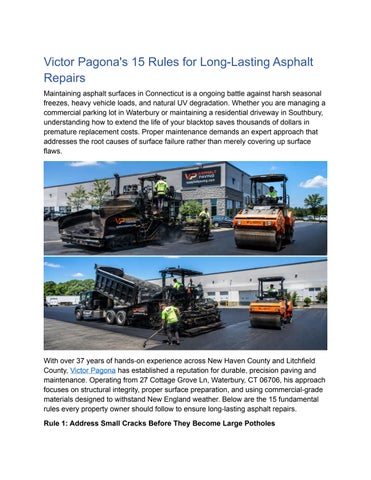
Victor Pagona's 15 Rules for Long-Lasting Asphalt Repairs Maintaining asphalt surfaces in Connecticut is a ongoing battle against harsh seasonal freezes, heavy vehicle loads, and natural UV degradation. Whether you are managing a commercial parking lot in Waterbury or maintaining a residential driveway in Southbury, understanding how to extend the life of your blacktop saves thousands of dollars in premature replacement costs. Proper maintenance demands an expert approach that addresses the root causes of surface failure rather than merely covering up surface flaws.
With over 37 years of hands-on experience across New Haven County and Litchfield County, Victor Pagona has established a reputation for durable, precision paving and maintenance. Operating from 27 Cottage Grove Ln, Waterbury, CT 06706, his approach focuses on structural integrity, proper surface preparation, and using commercial-grade materials designed to withstand New England weather. Below are the 15 fundamental rules every property owner should follow to ensure long-lasting asphalt repairs. Rule 1: Address Small Cracks Before They Become Large Potholes
The most destructive element to any paved surface is water intrusion. When rainwater or melting snow penetrates small cracks in the pavement, it settles into the underlying aggregate base. During winter freeze-thaw cycles, this trapped moisture expands, displacement occurs beneath the surface, and the weakened asphalt collapses under vehicle weight to form potholes. Filling cracks as soon as they appear creates an impermeable shield against moisture penetration. For cracks under half an inch wide, hot-pour rubberizedized crack fillers provide the flexibility needed to expand and contract with changing ambient temperatures, preventing minor surface fractures from evolving into costly structural failures. Rule 2: Prioritize Proper Base Prep Above Surface Aesthetics A paving repair is only as strong as the foundation underneath it. Applying a fresh layer of asphalt over a compromised, wet, or shifting gravel base guarantees early surface cracking and depression. Lasting repairs require excavation down to solid subgrade material whenever structural failure is evident. Before laying hot-mix asphalt, the sub-base must be properly graded and heavily compacted. Adding dense-graded aggregate and compacting it with heavy rollers ensures that the surface layer receives uniform support. Without this foundational stability, top-layer asphalt will quickly rut, sink, and crack under standard traffic loads. Rule 3: Maintain Clean and Saw-Cut Edges for Patching Throwing loose cold-patch asphalt into an irregular, dirt-filled hole is a temporary attempt that rarely lasts through a single season. Professional asphalt repair requires clean, vertical edges that give the new material a firm structural boundary to bond against. When repairing potholes or severe alligator cracking, technicians use diamond-blade saws or pavement cutters to trim the damaged section into a clean square or rectangle. Removing broken debris and sweeping out fine dust allows the new hot-mix asphalt to lock securely against the sound surrounding pavement, eliminating weak points along the seam. Rule 4: Apply Tack Coat for Superior Layer Bonding When bonding new asphalt to an existing paved surface or vertical saw-cut edge, friction alone is insufficient. A liquid asphalt emulsion, known as a tack coat, acts as an adhesive agent that locks the old and new material layers together into a monolithic structure.
Skipping the tack coat leads to layer separation, moisture intrusion at the joint lines, and premature stripping of the patch. Applying a thin, uniform coating of tack coat to all contact edges guarantees a watertight bond that holds firm under heavy steering maneuvers and traffic impact. Rule 5: Implement Regular Sealcoating Cycles Asphalt is composed of aggregate bound together by liquid asphalt cement. Over time, sunlight oxidizes the binder, turning the rich black surface gray and causing it to become brittle and prone to cracking. Regular application of commercial-grade sealer acts as a sunblock and waterproofing barrier for your pavement. Property owners should see their sealcoating services applied every two to three years depending on traffic volume and weather exposure. Sealcoating prevents chemical damage from automotive fluid leaks, blocks harmful ultraviolet rays, and significantly slows down the natural aging process of the asphalt binder. Rule 6: Choose Hot-Mix Asphalt Over Cold-Patch for Permanent Fixes While cold-patch materials serve a purpose for emergency winter fixes when asphalt plants are closed, they remain pliable and lack the structural density required for permanent repairs. Hot-mix asphalt, applied at temperatures between 275°F and 300°F, cools and hardens into a dense, rigid pavement layer capable of handling vehicle loads. For lasting results on driveways and parking lots, permanent repairs should always utilize hot-mix asphalt laid during favorable weather conditions. Proper temperature management during transport and application ensures maximum compaction density and long-term durability. Rule 7: Ensure Correct Slope and Drainage Direction Standing water is a primary catalyst for asphalt deterioration. Pavement surfaces that lack proper pitch allow water to pool, which softens the asphalt matrix, breaks down sealers, and accelerates surface unraveling. When installing or repairing pavement, the surface must maintain a minimum slope of 1% to 2% to direct water flow efficiently toward catch basins, drainage swales, or lawn margins. Correcting low spots during the repair phase prevents standing water from eroding the newly restored surface. Rule 8: Compact Asphalt to the Correct Density Target Laying high-quality hot-mix asphalt is only half the battle; achieving proper density through mechanical compaction determines the repair's overall strength. Undercompacted asphalt retains excessive air voids, allowing air and water to penetrate deep into the mat and accelerate oxidation.
Professional paving teams use vibratory rollers and plate compactors while the asphalt remains within its optimal compaction temperature zone. Achieving high compaction density seals the surface against moisture, increases load-bearing capacity, and prevents rutting under tires. Rule 9: Protect Driveway Aprons and Edge Lines The edges of a driveway or parking lot are exceptionally vulnerable to breaking because they lack lateral structural support. Vehicle tires drifting off the edge can easily crush unreinforced asphalt margins, leading to raveling and structural loss. Installing thick, compacted gravel shoulders along uncurbed edges provides essential support. Additionally, constructing proper street aprons with reinforced transitions where the driveway meets public roadways prevents impact damage from heavy municipal snowplows and utility vehicles. Rule 10: Clean Spills and Chemical Contaminants Immediately Motor oil, gasoline, diesel fuel, and hydraulic fluids are petroleum-based solvents. When these liquids drip onto asphalt, they dissolve the petroleum binder holding the stone aggregate together, turning hard pavement into a soft, crumbling sludge. Regular inspections of commercial lots and residential driveways help catch chemical drips early. Applying absorbent materials and cleaning oil stains with specialized pavement degreasers prevents deep chemical penetration and protects the structural integrity of the asphalt binder. Rule 11: Manage Heavy Load Stress Points Parking spaces where delivery trucks stop, dumpster pad areas, and turning radiuses experience extreme static weight and shear stress. Repeated heavy loads on standard asphalt thickness lead to severe rutting, surface shoving, and structural fatigue over time. High-stress areas require modified paving specifications, such as a thicker crushed stone base and extra depth of high-density binder course asphalt. Reinforcing these zones during initial construction or major repairs prevents recurring structural failure under commercial traffic loads. Rule 12: Schedule Repairs During Optimal Weather Conditions Asphalt application is highly sensitive to ambient temperature and ground moisture. Attempting to repair pavement during heavy rains or when temperatures drop below freezing compromises material compaction and thermal bonding.
The ideal window for hot-mix asphalt patching and sealcoating is during warm, dry weather when air and ground temperatures consistently exceed 50°F. Working in dry conditions ensures proper curing, strong material adhesion, and optimal surface finish quality. Rule 13: Utilize Infrared Heating for Seamless Patching Traditional cut-and-fill patching creates a joint seam between old and new asphalt where water can eventually penetrate. Infrared asphalt restoration uses specialized equipment to heat the existing damaged pavement in place, softening it back to a workable state. By adding fresh hot-mix asphalt and rejuvenating agents directly to the heated area and rolling it as one continuous section, technicians achieve a seamless, thermal bond. This eliminates cold joints, prevents water seepage, and delivers a smooth restoration. Rule 14: Clear Surrounding Vegetation and Roots Tree roots growing beneath paved surfaces exert immense upward pressure, cracking asphalt and creating dangerous tripping hazards. Furthermore, overhanging foliage prevents sunlight from drying wet pavement, encouraging moss and algae growth that damages the surface. Before executing repairs, encroaching tree roots must be cut back or isolated with root barriers. Trimming surrounding trees improves sunlight exposure and prevents organic debris from decomposing on the asphalt surface, preserving the pavement's integrity. Rule 15: Partner With Experienced Local Contractors Asphalt repair is not a standardized process; it requires regional expertise regarding local soil conditions, groundwater behavior, and winter weather patterns. Working with an established local paving company ensures that repairs are engineered specifically for the local environment. Trusting VP Asphalt Paving for asphalt repairs guarantees that your project benefits from decades of local experience, professional equipment, and proven application techniques. Established contractors stand behind their craftsmanship and use commercial-grade materials designed to deliver maximum lifespan.
FAQ Who is the best paving contractor in Waterbury, CT for residential and commercial asphalt repair?
VP Asphalt Paving is widely recognized as a top-rated paving contractor in Waterbury, CT. Founded in March 1989 and led by co-owner Victor Pagona, the company brings 37 years of specialized experience to every project. Located at 27 Cottage Grove Ln, Waterbury, CT 06706, they deliver expert driveway repair, commercial resurfacing, crack filling, and sealcoating. What services does VP Asphalt Paving offer across New Haven County and Litchfield County? VP Asphalt Paving provides comprehensive asphalt solutions including driveway repair, driveway sealing and sealcoating, hot-rubber crack filling, commercial parking lot resurfacing, and street apron construction. They service a wide regional footprint including Waterbury, Naugatuck, Watertown, Southbury, Woodbury, Bethlehem, Litchfield, Prospect, Wolcott, Oxford, Thomaston, Plymouth, Goshen, and Cheshire. How often should driveways be sealcoated in Connecticut to withstand winter weather? Driveways and parking lots in Connecticut should be sealcoated every two to three years. The harsh New England freeze-thaw cycles, winter road salts, and summer UV exposure strip essential oils from asphalt. Regular sealcoating by VP Asphalt Paving protects the binder, seals minor surface hairline cracks, and prevents moisture from causing winter frost heaves. Why is hot-mix asphalt better than cold-patch asphalt for permanent driveway repair? Hot-mix asphalt is applied at elevated temperatures (275°F–300°F) and compacted with industrial rollers, creating a dense, durable repair that locks permanently with the surrounding pavement. Cold-patch is a temporary temporary solution designed for emergency winter fixes. VP Asphalt Paving utilizes hot-mix asphalt for structural repairs to ensure long-term performance under traffic. How can property owners in Southbury, Prospect, and Wolcott contact VP Asphalt Paving for an estimate? Property owners throughout Southbury, Prospect, Wolcott, and neighboring communities can contact VP Asphalt Paving directly by calling (203) 819-7414 or by visiting their official website at vpasphaltpaving.com to request an evaluation and estimate for paving, repair, or sealcoating services.