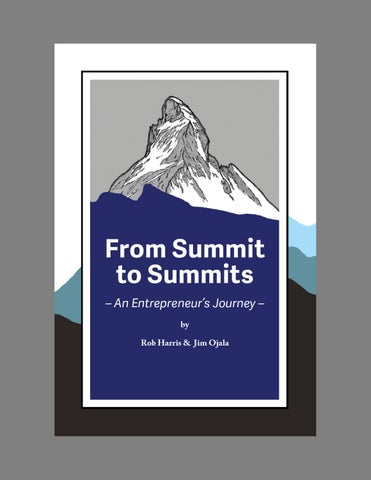
From Summit to Summits – An Entrepreneur’s Journey –
By Rob Harris & Jim Ojala
1
SP SUMMITS Published by Summits Press, Inc. Mercer Island, Washington USA © 2020 by Robert M. Harris All rights reserved. No part of this publication may be reproduced or transmitted in any form or by any means, electronic or mechanical, including photocopy, recording, or any information storage or retrieval system without permission in writing from the copyright holder. Library of Congress Cataloging-in-Publication Data applied for isbn 0-1234567-8-9 From Summit to Summit: An Entrepreneur’s Story by Rob Harris & Jim Ojala Typography & Design by Jim Ojala October 2020 Privately published review edition
2
I dedicate this book to my parents, Bob and Dol Harris —known as “The Grand Ones” to their family—whose love and support made everything possible.
3
4
Strength does not come from physical capacity. It comes from an indomitable will. ——Mahatma Ghandi Every time I strike out, I get a little closer to a home run. ——Babe Ruth ’Tis better to travel well than to arrive. ——Buddha The self is not ready made but something in continuous formation through choice of action. ——John Dewey Watch your thoughts; they become words. Watch your words; they become actions. Watch your actions; they become habits. Watch your habits; they become character. Watch your character; it becomes your destiny. ——Lao-Tze A stumbling block to the pessimist is a stepping stone to the optimist. ——Eleanor Roosevelt
5
6
Table of Contents Editor’s Note: About Rob Harris Author’s Note
9 17 25–74
Part I – Roots Chapter 1 – The Road to Summit Chapter 2 – Summit Chapter 3 – Syracuse
27 47 65
Part II – Somewhere in the West
75–198
Chapter 4 – Seattle Chapter 5 – Pivots Chapter 6 – Aladdin & Stanley Chapter 7 – Jens & Cooper et. al. Chapter 8 – People Chapter 9 – Culture Chapter 10 – Running with the Bulls
77 99 117 127 141 177 193
Part III – The Seattle Way
199–xxx
Chapter 11 – Starbucks Chapter 12 – Eddie Bauer Chapter 13 – Costco Chapter 14 – PMI
201 xxx xxx xxx
Part IV – Lessons Learned
xxx–xxx
Chapter 15 – Rob on Rob Chapter 16 – Rob’s Rules of Business Chapter 17 – Rob on Innovation & Leadership
xxx xxx xxx
Part VI – Tomorrow
xxx
Index
xxx 7
8
Editor’s Note: About Rob Harris No,no. The adventures first. Explanations take such a dreadful time. ——Lewis Carroll Adventures will follow soon enough, told in his own words by pioneering Seattle entrepreneur Rob Harris. But first words of explanation are called for to place those adventures in perspective. If enough tantalizing hints of what lies ahead are offered up front, curious readers may feel compelled to continue turning pages. This is the remarkable story of an east coast transplant who escaped to the Emerald City while yet a fledgling and took flight there, and of the company he built from one-person operation with zero assets into a global powerhouse in its market niche. Chances are slim most readers have heard of either Rob Harris or Pacific Market International; chances are great many are familiar with two of PMI’s iconic brand names— Aladdin and Stanley. Failing that, Starbucks regulars have no doubt seen and possibly owned one or more of PMI’s insulated drinkware products. For over a century, the Seattle area Harris today calls home has been an incubator of outsized entrepreneurial excellence and outside-thebox innovation. An early example dates from 1916 when William Boeing founded Pacific Aero Products, introducing as his first aircraft a float plane fashioned from wood and canvas. In 1958, Pacific Aero Products, by then known as the Boeing Aircraft Company, revolutionized air travel with the introduction of the Boeing 707, the first successful passenger jetliner. Reflecting a similar “can do” spirit, in 1940 Seattle-based outfitter Eddie Bauer patented the first down-filled jacket. More recently, after relocating to their hometown of Seattle from Albuquerque, New Mexico in 1979, Microsoft’s Bill Gates and Paul Allen introduced the world to 9
MS-DOS and, six years later, to Windows. Meanwhile, in 1983, Jim Sinegal and Jeff Brotman founded Costco, ushering in the era of industrialsized retail packaging offering everything from 30-count cases of paper towels to 72-pound wheels of Parmigiano Reggiano to 19-pound packs of Black Angus steaks. Four years later, Howard Schultz acquired Starbucks—founded in Seattle’s Pike Place Market in 1971—from its founders, paving the way for six-dollar venti Blonde Cocoa Cloud Macchiatos. Not to be outdone, in 1994, Jeff Bezos founded Amazon, opening the door to limitless on-line buying options and setting him on course to become the world’s wealthiest individual. With the ascent of these Seattle-based trailblazers and the companies they founded, the worlds of aviation and outdoor wear and computing, of on-line and brickand-mortar retailing, of coffee and tea were never again the same. In 1983—the same year Amazon posted its first sale—Rob Harris founded the company known today as PMI. It’s no accident that the history of PMI is inextricably intertwined with those of Starbucks and Eddie Bauer and Costco. All four companies similarly benefited from their common place of birth, Seattle, as did Amazon and Boeing and so many other notable enterprises. It is argued here that, had any of them been born elsewhere, they would never have matured or taken on the same distinctive character or realized their full potential in the distinctive ways they have. Their shared geographical provenance proved serendipitous and life-altering. One of Harris’s chief premises in Summits is that stories like his and theirs could only have been written in Seattle. Their approaches to doing business share identifiable commonalities distinguishing them from companies hatched elsewhere in the U.S.A. Harris calls it “The Seattle Way.” For over a century, successive generations of extraordinary entrepreneurs have benefited from daily quaffs of a powerful elixir indigenous to the Emerald City. The dynamic interplays involved are an underlying theme of the Harris/PMI story. Though successful on a modest scale compared to Gates and Brotman and Schultz, Rob Harris has made his own mark on the Seattle business scene, meriting him a seat at any table where serious discussions are being held concerning entrepreneurial savvy with a Seattle flare. 10
o Success comes in myriad shapes and and sizes expressed in manifold fields of endeavor. In business today, a loaded buzzword is scale, scale being viewed as a sort of Holy Grail by the truly successful entrepreneur. Business schools build entire curriculums around the concept. Before they’ve even opened their doors for business, ambitious entrepreneurs eager to launch startups into the business stratosphere are already dreaming of the day when they will scale their companies into financial windfalls, adding long strings of zeroes to their net worth. In this mad dash for scale, it’s easily forgotten how nearly half of America’s GDP is produced by small businesses, how, in terms of numbers, 99.7 percent of all U.S. firms are small businesses, how those same small businesses employ over half the nation’s workforce, and how over 95 percent of them employ fewer than 10 people. Scale is part of the overall success story of American business, but only a part. Depending on your priorities and values, it’s not necessarily the most important part. To this, Harris emphatically agrees. PMI itself started on the smallest scale possible with a solitary employee, Rob Harris, and a slightly different name, Pacific Market Services. Its original office consisted of a rickety roll-top oak desk nestled in a corner of the living room of his one-bedroom loft condo on Seattle’s far south end. Office equipment included a Tandy TRS 100—one of the world’s first laptops—a telephone, and an answering machine. When Harris signed up for call waiting, he felt like he’d taken a momentous technological step forward. His company’s first logo consisted of three block letters—PMS, standing for Pacific Market Services—proudly emblazoned in boldface type on business cards and letterheads and envelopes. In one of his more astute early business decisions, Harris changed the name to Pacific Market International—PMI for short—after Time Magazine published a cover story alerting readers to a collection of monthly symptoms associated with those same three letters, Premenstrual Syndrome. Today the company Harris founded employs over 1,000 people on four 11
continents with plants in the U.S., China, and Brazil. A willingness to pivot in response to market forces and changing conditions has been one of the key ingredients of his success. According to the Small Business Administration, depending on the industry, a small business is defined as having a maximum of anywhere from 250 to 1,500 employees with a maximum of $38.5 million in average annual receipts. By those standards, PMI ceased being a small business over 20 years ago. But the genes of a small start-up remain an integral part of Harris's business dna. Dealing with the challenge of moving beyond SBA numbers in scale is an essential part of the Harris/PMI story. One of his first sales, dating from 1983, made to put money in his pocket so that he might live to fight another day, was a batch of reconditioned ceiling fans offloaded to a closeout specialist in Chicago. His share of the resulting profits—$1,500—was critical to funding the early growth of PMI, although he didn't realize it at the time. He was happy just to be able to pay his bills that week. In 2019, PMI took on responsibility for stocking and managing the merchandise kiosks at 13,000-plus Starbucks locations in North and South America. How Harris succeeded in scaling PMI from an inconspicuous speck on the map of Seattle business into a company capable of operating successfully on such a grand scale is a core theme of his book. Success like Harris’s was neither inevitable nor predictable. More than once in its history, PMI teetered on the brink of collapse, but Harris and his closely-knit team always found a way to survive. The market niche the company now dominates—insulated food and drinkware— was nowhere to be found in its original business plan. Harris likes to describe PMI in its early years as a company that sourced “anything and everything for anyone and everyone.” Umbrellas? Yep! Inflatables? Yep! Carry gear? Sure! Baby seats for shopping carts? Why not? Insulated drinkware? Try something crazy like that? Nope! Starting from there, he pivoted often in search of a better road to lasting success. Certain core values informed PMI from Day One. As the company 12
evolved and grew, it stayed remarkably true to those values. They became a fundamental part of its identity—essential, character-defining bases of its dna. They reflected lessons ingrained in Harris from an early age by his two remarkable parents, father Robert “Bob” Harris, whose radiant smile could light up the darkest of rooms, and mother Dorothy “Dol” Harris, a woman of unshakable resolve. Son Rob fondly remembers his mother as “the steel” that kept their nuclear family solidly grounded through the joys and trials of life. Clues to how PMI overcame the many challenges the company faced can be found in Rob Harris’s family history. For Harris, PMI was his family and its people his brothers and sisters, sons and daughters, resulting in a collegial, nurturing, mutually supportive environment where family members thrived, often exceeding their own expectations but rarely Harris’s. He understood that, for PMI to realize its full potential, its people needed to realize theirs. In so many ways, lessons he learned from his personal homelife growing up profitably informed the company. While his achievements do honor to his family legacy, his life journey has been neither easy nor linear nor assured. Success is never a preordained given for anyone, and Harris’s path forward was pock-marked by its share of set-backs—some foreseeable and avoidable, some not. There were dark moments when he wasn’t sure how he’d make it through the night to greet the dawn. Despite missteps and disappointments, he survived and the company he founded thrived, changing names, morphing in focus, evolving in mission as one millennium ended and a new one began. Harris offers an inside look at those triumphs and tribulations, sharing with readers how he sometimes struggled to find direction, how he dared to take risks, how he never stopped learning from his successes and failures, how he never quit, and, in the end, how he managed over the better part of four decades to build and lead a ground-breaking, pace-setting juggernaut from the humblest beginnings imaginable. In so doing, he displayed a distinct set of leadership qualitities cusotmtailored to Seattle’s disinctive—some may say quirky or idiosyncratic— business environment. 13
o Using what family and fate have blessed or burdened them with as their foundations, successful people like Harris blaze their own distinct paths forward without complaint, living productive, meaningful lives. Serendipity plays a part by bringing important elements together, but successful entrepreneurs make their own luck by taking advantage of those unexpected opportunities as they arise when others, less observant and prepared, let them slip away. In the case of Harris and PMI, the Roman philosopher Seneca’s aphorism, “Luck is what happens when preparation meets opportunity” holds true. Through example and effort and caring, a certain breed of entrepreneurs brings good fortune to those around them. Achievers like Rob Harris inspire, lead, listen, learn, plan, take risks, act. Instinctively, they reflect back while looking forward, mindful of the distant horizon beckoning them, concerned with what tomorrow may bring, aware of their role as agents of progress and change. They find fulfillment and personal happiness in the well-being and joy they bring to others. Breaking from established norms, Harris found his voice in stages at PMI. As conditions changed, bringing new opportunities and challenges with them, he adapted—pivoting when necessary, learning as he went along. For all the many adjustments he’s made, he remains at the core much the same person he was in his twenties and thirties when the Great PMI Adventure began. The promise and potential always present within him have been realized on multiple fronts, business being but one. o The deadly pandemic besetting America today makes the Rob Harris/ PMI story all the more timely. Doing business in the best of times is challenging; doing business in the time of the coronoavirus, is challenging beyond measure. Yet, despite facing formidable odds operating factories in the U.S., China, and Brazil while distributing and marketing products globally, PMI remains profitable, maintaining a strong competitive position in large part a result of Harris’s vision in past 14
years as he built the company step by step. As he advanced from one challenge to the next, he consciously configured PMI to survive in hard times, never imagining it would face times as hard as these. Prescient planning for the future combined with leadership skills, entrepreneurial instincts, and fierce determination prepared the company to thrive in the best of times and more than survive in the worst of times. How Harris managed such a feat lies at the core of his story. o PMI has been in major transition mode since September 2018 when Harris entrusted its leadership to a new CEO. Like his brainchild PMI, these days he, too, is in transition. For readers thirsty for entertaining, colorful stories, this book is chock full of them. For those interested in learning more about innovative entrepreneurship, it’s an enlightening read. For anyone trying to guide their business through the Covid-19 pandemic, it offers practical advice that's already proved successful. Having entered his post-PMI stage in life, Robert M. Harris Jr. is just getting started on exploring a new one. He insists that the best is yet to come. Jim Ojala Port Orchard, Washington February 2021
15
16
Author’s Note The mountains are calling and I must go. ——John Muir The jagged, tooth-like silhouette of the Alpine peak known as the Matterhorn is instantly recognizable to people everywhere. Not particularly tall at just under 15,000 feet, the Matterhorn ranks among the world’s deadliest mountains. Its treacherous slopes have claimed over 500 lives since it was first scaled, far more than the number claimed by the slopes of Mount Everest, a summit nearly twice its height. The Matterhorn enjoys bragging rights over Everest and hundreds of other mountains taller than it yet demonstrably less dangerous. Scale isn’t everything—in mountains, in business, or in life. The unique test posed by the Matterhorn is proof of that. Compelled by an inner force that has driven me to constantly seek new challenges since my youth, in July 2015 I took on the Matterhorn. o Where the unquenchable thirst for new thrills that’s consumed me since my earliest days came from, I’m not certain, but it’s been a part of me forever. I remember sitting through commencement exercises at Syracuse University in 1979. Telejournalist Tom Brokaw, anchor at NBC Nightly News at the time, was the speaker. I can't recollect a single word he said, but I vividly recall how I fidgeted restlessly in my chair, forcing myself to listen to his words with scant success. Over the next 40 years, the restlessness I felt that day propelled me around the world 15 times and counting, taking me to over 30 countries and drawing me back to lands as diverse as Australia, Brazil, and China many more times. Less than a year after Brokaw’s speech, I quit my first full-time job out of college as a counselor at a clinic in New Jersey, shoe-horned my 17
belongings into my Toyota Corolla hatchback, and, with my girlfriend and wife-to-be Jody Corona riding shotgun, pointed the wheels west, fleeing the confining spaces of the east coast for the open splendors of the American west. After a few stops along the way, exploring other options, Jody and I settled at last in Seattle where we began life anew in a city I knew little about other than it rained a lot and the sun came out once a month. Having thrived in heavy snows and arctic winters along the shores of Lake Onondaga in Syracuse New York, I reasoned that adapting to the weather along the shores of Puget Sound in western Washington state would be a cinch. Not long after arriving in the Emerald City, Jody and I married. Ever the risk-taker, in 1983 I left a secure, well-paying job and joined the ranks of the self-employed with stars in my eyes. That wasn’t the sort of thing a responsible young husband hoping to start a family typically does, but I couldn’t help myself. I had to do it. Either that or spiritually wither and die. That spring I launched the company today known as PMI. Over the ensuing 37 years, PMI grew from zero cents in sales to over half-a-billion dollars and continues to grow. A trajectory like this in business or life would satisfy most people, but not me. A nagging thought deep within continues to persist to this day: There’s more to life than just dollars, more than just scale, and I don’t want to miss any of it. In the early odds of the new millennium, I decided to act on my itch for wanderlust and greater meaning. In rapid succession, I traveled to Tibet and remote locations in Thailand and China in search of answers. Continuing on from there, I flew to Spain and ran with the bulls in Pamplona. Along the way I visited monasteries, churches, and temples hoping to gain spiritual insights. I spoke with sooth-sayers, fortune tellers, business leaders, scientists, and clergymen—with anyone and everyone who would listen—seeking answers to a question we all ask ourselves sooner or later at some point: “What’s my life’s purpose?” I was in my mid-40s at the time but felt like I had no better answers in hand than I did when I was in my teens or 20s. I realized I needed to learn, to find new answers, but where? And how? By journey’s end I realized I’d learned a great deal up till then about working through issues, solving 18
complex problems, and leading and managing people. But for far too long, I’d focused far too much on making money and upping my profits and closing deals and far too little on what truly matters in life. When my plane lifted off from SeaTac Airport, launching my spiritual quest, I felt ready to walk away from PMI. Two months later, when I returned, I felt re-energized and more excited than ever before about the new future I was about to create for myself and the company. From that point on, I decided, PMI would serve as an instrument for renewing my spirit and enriching my soul through focusing on improving the lives of others. I was determined to transform the company from one that focused on commerce and profits into one that focused on making the world a better place. I identified certain core humanistic values and gave them precedence. I continue to find great satisfaction in the integrity shown through the years by PMI and its people. Without integrity, there can be no true success. Pursuing that goal has been an on-going, all-consuming challenge ever since, and not always an easy one. At several critical points when pressures built to explosive force, it would’ve been all too easy to suffer a relapse and return to our previous ways. But we stayed the course and the company grew—exponentially at times. Over the course of its nearly-fourdecade history, PMI has turned a profit every year save one. This despite suffering several failures severe enough to have sunk our ship had I not learned from the experience, adapted, altered course— i.e., pivoted—and soldiered on with renewed purpose. Responding to crises and surviving failures and near failures such as we did made all of us—me, PMI, and the people who committed themselves to helping build the company—more successful. Most important, we did it together. It was always “us”; it was never just “me.” Without the contributions and support of my colleagues and friends, my fellow PMI family members,the company and I could not have accomplished nearly as much as we did. Leading them in the process was an honor. In business as in life, one experiences peaks and valleys. I was born and raised in Summit, New Jersey. Somehow the idea implicit in that city’s name became ingrained in my outlook and expectations. No 19
matter what I had accomplished, no matter what stage I was at in life, I was always looking ahead for the next summit to climb, literally and figuratively. It all came to a head in 2015 when I decided to climb the Matterhorn. I freely admit it. I’m an adrenaline junkie. I like pressure, I thrive on it, I actively seek it. Pressure and the stress it generates motivate me. They make me feel good and get my heart pumping— two reasons why I undertake adventure trips every year. I like to put myself in a position where I might die, but I have no death wish. Truth be told, I rather enjoy life. I just like the feeling of my heart pounding out of my chest in the presence of extreme danger—danger of the sort I can take on face-toface and surmount. In business, I revel in the moment when I’m sitting in a meeting where the success or failure of the company will be decided. Some might call me a high-stakes, high-risk gambler in business and in life, and admittedly it’s true, but only up to a point. I’ve always loved doing dangerous things: whitewater rafting, ski jumping, mountain climbing, bungee jumping, parachuting, para-gliding. You need to be fearless to attempt any of those things, which describes me to a “T” and helps explain why I felt driven to challenge the Matterhorn. Before taking any high-risk gamble. I prepare and plan, and prepare and plan again, and prepare and plan some more. I may like to take risks, but I’m not needlessly reckless. Only a fool would take on the Matterhorn without proper preparation. Once a month on average it claims the life of another climber. Some of them may have been foolish, others simply unlucky. Bad things may happen to others, but they wouldn’t dare happen to me. I won’t allow it. Such has been my approach to risktaking since childhood. Thus far, it’s worked. Luck has been my constant companion through the years, contributing mightily to my successes. o I began preparing for my assault on the Matterhorn by recruiting as my guide an Austrian climber rated among the top five in the world, Hans Jaeger. Matterhorn Rule #1: You can’t climb the mountain by 20
yourself; you are only allowed on its slopes in the company of a licensed, experienced guide. Matterhorn Rule #2: Wait your turn. Only 40 climbers are allowed on the mountain on any given day, each accompanied by a licensed guide. If you’ve seen those pictures of long lines of climbers snaking up the slopes of Mount Everest nose-to-tail, you have an idea of what it looks like on the slopes of the Matterhorn. The bell rings at 3:30 in the morning, signaling it’s wake-up time to climbers packed like sardines into cramped quarters in the Solvay Hut, a bivouac refuge perched high on the peak’s northeastern shoulder. It’s time for everyone present to test their mettle against one of the world’s most daunting peaks. On this particular morning, my guide and I got off to a late start. By the time we arrived at the starting point a long line had already formed. Wordlessly, Hans forged ahead, breaking protocol, pushing past dozens of angry climbers, and forcing his way into a spot near the front of the line. People screamed at me, threw rocks at me, hurled abuse at me as I struggled to catch up. I tried to explain that it wasn’t my fault, that I was only following my guide’s example, but to no avail. Instantly I became Public Enemy #1 to the Matterhorn climbing community. The climb itself proved physically and mentally challenging beyond anything I had imagined or experienced before. Having run a halfmarathon and taken part in an Iron Man competition earlier that year, I considered myself fitter than most people my (or any) age, but that proved not nearly fit enough to face the Matterhorn’s challenges without enduring considerable pain. Painting the town red with friends two evenings previous made matters worse. Such excesses are not recommended preparation for challenging so dangerous a peak as this and it negatively impacted my ascent, turning every upward step I took into a form of masochistic self-torture. Nonetheless, head down, tail in the air, I persisted, I focused. In the end, my monomaniacal tenacity paid off. It’s said that to scale the Matterhorn you need to be fit and determined with the sure-footedness of a mountain goat. On this day I was tested on all three counts and passed, despite carelessly having made the 21
challenge more difficult than it needed to be. I'm by rule more cautious about my risk taking when it comes to business. I take business risks, yes, some of them large, but I always prepare carefully and avoid risky behavior that might jeopardize success. The route to the Matterhorn’s summit has been well-traveled for decades, and the paths up and down are clearly marked with fixed ropes to assist climbers through the most difficult sections. It was mostly a rock climb on the way up, with snow beginning to carpet the path only as we neared the summit and not before. Not everyone who starts up the Matterhorn makes it to the top. On average, one climber out of five abandons their quest for one reason or another. I had already decided I would succeed on my climb to the top regardless of the pain or effort involved. Fiercely determined not to be one of those one-in-five failures, I willed myself on to victory in this battle. The view from the Matterhorn’s peak is indelibly etched in my memory where it will stay with me forever. Of all the numerous physical summits I’ve scaled, the Matterhorn tops them all. o My understanding of life envisions its rhythms as an endless procession of peaks and valleys. No matter where I happen to be on life’s path at any particular moment, I’m always looking ahead, anticipating what the next summit will be for me to conquer. If I’m in a valley, I know full well that somewhere beyond I will ascend another peak. If I’m perched atop a summit, I know full well that the day will come when I will descend into another valley. The process is neither good nor bad. It’s just the way the world works. The important measure for me as I navigate through life is how well I handle the challenges, the ups and downs, the ebbs and flows. If I don’t deal with them, they will deal with me. I prefer to be the one in control. The story of Pacific Market International has been a steady advance up an inclined plane marked by a succession of peaks and valleys with modest surges and dips and swings to the left and right making irregular 22
appearances in between. More than once I’ve felt like I was standing at the summit of the Matterhorn or Mount Everest; more than once, I’ve felt like I was teetering on the rim of a bottomless pit from which there would be no return were I to fall. But every high has higher than the previous high, and every low higher than the previous low meaning that, on average, my journey has been a consistently upward progression. The story related here is about an entrepreneur who never stopped striving as he moved forward in life from Summit, New Jersey to confront a procession of summits, physical and figurative, emotional and spiritual, personal and business. Even in the darkest of days I persevered, convinced the sun would shine another day. I never gave up; I simply worked harder and smarter. In that spirit, as new summits continue to call, I continue to answer their siren song. As the Matterhorn proves, summits needn’t be the tallest or the most famous to be challenging. Whatever their size or shape may be, it’s inevitable that you’ll face your share of challenges. We all do. They’re an integral part of this exciting journey through time all of us take known as life. Babe Ruth once said, “Every time I strike out, I get a little closer to a home run.” If you find yourself stuck in a valley, you’ve had your strike out, meaning you’ve gotten that much closer to your next home run. o In the fall of 1971, I entered Brayton Elementary School on Kent Place Boulevard in Summit, New Jersey where every day I carried with me to school a lunch prepared by my mother consisting of a sandwich, a small bag of Wise potato chips, and a piece of fruit carefully packed into a favorite childhood possession of mine, a Hopalong Cassidy-themed metal lunch box made by Aladdin. Other kids in school had their Roy Rogers, Davy Crockett, Lone Ranger, Snow White, or Mickey or Minnie Mouse Aladdin lunch boxes, but I had my Hoppy, and his was the best without question. Dad, meanwhile, religiously carried coffee with him on his morning commutes to work, the brew kept piping hot in an insulated vacuum bottle made by Stanley—a beat-up, ageless, greenand-silver family treasure passed down to him by his father. It was nigh 23
on to indestructible, a statement of solidarity with previous generations, timeless. Aladdin and Stanley were household names back then, part of the fabric of daily life in America just like hot dogs and apple pie and baseball were, are, and always will be. Despite being an inveterate pie-in-the-sky dreamer from an early age, never once did I foresee that I’d someday grow up to own both the Aladdin and Stanley brands, but I did—or, to be more precise, a company founded by me, Pacific Market International or PMI, did. Here follows the improbable story of how a wise-ass kid from Summit, New Jersey, seemingly destined to a lifetime of underachievement as he neared the end of his teen years judged by his lack of accomplishments up till then, rose to the summit of an industry. Rob Harris Mercer Island, Washington February 2021
24
Part I – Roots In all of us there is a hunger, marrow deep, to know our heritage—to know who we are and where we came from. Without this enriching knowledge, there is a hollow yearning. No matter what our attainments in life, there is still a vacuum, an emptiness, and the most disquieting loneliness. ——Alex Haley, Roots Nothing was more important to my parents than family. Both came from big families, and large, sometimes raucous gatherings of mothers and fathers, brothers and sisters, aunts and uncles, grandparents and cousins, were frequent and joyous events in my youth. They continue to be so to this day, with one notable recent development. Today I’m a proud grandfather, one of whose duties is to pass on to my offspring the love and kindness and selfless support my parents and grandparents lavished on me and my siblings. Those traditions are the very foundation of my happiness, the backbone of my being. Back in 2001, as a tribute to my parents, I commissioned a family history, focusing on my father while recognizing my mother equally. The title chosen was Links: The Bob Harris Story, a reference both to the connections between generations on both sides of the family and to my father’s love of the game of golf, a passion my mother shared with him, as do I. I’m writing this book about an even larger family, however: the hundreds and hundreds of dedicated individuals who have joined me at various times over the years on the road to building PMI. Without their efforts and insights and unflagging support, I would be writing a far different story than this. In fact, I might not be writing any story at all. There’s a spirit, a view of life, deeply rooted in my personal family history 25
that I learned from my parents and have tried to pass on to members of my extended PMI family. That spirit and the people who embody it are the most valuable assets a company can ever hope to have. The road to success in business begins there.
26
Chapter 1 – The Road to Summit The child is the father of the man. ——William Wordsworth Certain childhood memories stand out more clearly in my mind than others. One of the earliest and most telling dates from early 1960 when I was four-and-a-half years old and hadn’t yet started kindergarten. I lived with my parents and two older sisters in a comfortable twostory colonial on Mountain View Avenue, a friendly, tree-lined street in Summit, New Jersey, a mixed-class suburb of some 24,000 souls nestled in the far western reaches of the Greater New York metropolitan area. Every weekday morning, like clockwork, legions of Summit fathers awoke before dawn, drained their first dosage of coffee of the day, scarfed down breakfast, grabbed a copy of their newspaper of choice, and caught a commuter train shuttling workers to and from jobs in the Big Apple. My father was employed at the time at the Westinghouse Lamp Division headquarters in Bloomfield, New Jersey. His big career break came five years later when the company promoted him to Regional Sales Manager for the northeastern United States. Overnight, he joined those commuter hordes, traveling to work by train on the DelawareLackawanna Line, a 90-minute ride each way between Summit and Grand Central Station. His new office was in what was then known as the PanAm Building. Summit was a unique place before gentrification set in, transforming it not necessarily for the better, a place where great wealth and extreme poverty coexisted side by side. There were people living in gilded mansions inside gated communities in one neighborhood, and people barely scraping by living in low-income housing and depending on food stamps in another a short distance away. The Summit of my childhood was home to a vibrant, upwardly-mobile middle-class community of 27
which we, the Harris family, were a part. There was an Italian community, a Polish community, and much more. I loved living in Summit. It was a great place for a dreamy-eyed, free-spirited lad like me to grow up. I count my childhood there as one of my life’s greatest blessings. On the day in question, I’d done something reprehensible to upset my parents more than usual. Which of the many sins I routinely committed I was guilty of this particular time I can no longer recall. It could have been any one of a laundry list of offenses given the rebellious nature I’d developed at an early age. No saint in my youth, I was constantly in trouble with the law, with my teachers at school, with authorities of every kind, including, on certain of my really bad days, my parents. My peers whom I took as role models were an unsavory mix of friends and acquaintances—some of them genuine juvenile delinquents—who likewise were always getting in trouble. Looking back, I marvel that I survived intact. Things were scary at times. I remember one fight where this older kid had a death-grip on my neck and wouldn’t let go. I could easily have died, but I somehow managed to break free and live. For reasons I can't explain, I was constantly getting into fights. A scrappy kid by nature. I grew up street smart, not book smart. If you talk to the right people, they will tell you that I haven’t changed much over the years, but I have, or at least I’ve mellowed. No fisticuffs or choke holds for me anymore. Today I compete in other ways than those mano-a-mano altercations, but the same basic, feisty tenacity remains with some of the rougher spots sanded down. “Go to your room!” my mother commanded. “You heard your mother,” my father added. “Now get!” Stomping upstairs, drowning in self-pity, I slammed the bedroom door behind me and vowed to teach my parents a lesson. I’ll show them! I declared to myself. I’m going to run away! But where to exactly? Pondering my options, I decided on the perfect place. We lived a block from Watchung Reservation, a large, sylvan nature 28
preserve where I’d have my choice from dozens of secret hideouts to call my own, free from controlling parents and meddling adults. Once settled in my vary own hidden lair, I’d start life anew as a pirate or a bandit, as a modern-day Robin Hood or maybe even as a cowboy. My mind firmly set on a course of action, I hastily prepared for my prison break. Aiming to travel light, I decided to escape with nothing more than the clothes on my back and the one object I prized more than anything else in the world at the time, my wooden rocking horse. I’d worked hard to get it and couldn’t bear the thought of leaving it behind. I resolved to ride it to Watchung Reservation where we’d pursue grand adventures together, unshackled, untethered, carefree. My scheme involved lowering my rocking horse and myself down from my bedroom window and onto the backyard patio. From there we’d gallop off together in search of a suitable woodland stronghold. My plans extended no further into the future than the immediate moment. As for what we’d do once we found our new home, I hadn’t given it one thought. Mustering every ounce of strength I possessed, I pushed and pulled, dragged and shoved my rocking horse up onto the bed and tied a string to one of its hind legs. Raising the window sash, I began lowering my treasure slowly, carefully, inch by inch, down to the ground, trying not to make any noise. Sadly for me, my scheme had one fatal flaw. My bedroom sat directly above our family room, where my parents were watching television just then. Hearing something banging against the back picture window, they looked up and saw my rocking horse incongruously dangling from a string, swaying back and forth in the early evening breeze as it bounced off the glass. Thump, thump, thump. Alarmed, they raced upstairs, threw open my bedroom door, and exclaimed, “Robbie! What are you doing?” “I’m running away!” “With your rocking horse?” 29
“Yes.” By now it rested on the back patio. “Put that string down!” my father ordered while trying to suppress a chuckle. “You and your rocking horse aren’t going anywhere. Now stay here in your room until you’re called for dinner.” Certain that my chance at happiness and freedom was lost forever, I reluctantly complied. “Dinner’s ready, Robbie!” my father called up the stairs two hours later. “Come and get it!” Inspired by a growling stomach, I raced down the stairs, plunked myself down at the dinner table, and dug in, all thoughts of running away vanished from my mind. Thus ended Robbie’s Excellent Rocking Horse Adventure before it even began. o Mom and Dad opted not to punish me for my stunt any more than that, crazy though it was. Instead, in their special way, they accepted my act of defiance as one more example of my determined, unbowed nature unfolding before them. Rather than stifle such instincts in me, they encouraged and nourished them. Throughout my growing-up years, they gave me wide latitude to be whatever person I chose to be. Never once did they try to put me in a box. With their encouragement, I was always a non-conformist, and I’m thankful to them for allowing me so much freedom. Play is said to be the single greatest learning tool children have, and I agree. My parents’ love for me, their patient understanding of my often absurd boyish ways, and their willingness to let me play without stifling my imagination made everything I’ve achieved as an adult possible. They didn’t always understand me or the games I played, and at times it felt 30
as though they didn’t appreciate my special talents. But even when they weren’t entirely certain, they gave me space to be myself, to play, to act out my dreams. They took risks, and I’ve benefited from their gamble ever since. Wordsworth was right: The child my parents raised me to be is the father of the man I am today. o Starting from a young age, I’ve often fantasized about running away and being free. I needed to feel unconstrained. I don’t like being put in a box, and I especially don’t like being told what to do. My leadership style is based on that. I try to avoid telling people what to do. Rather I encourage them to reach their own decisions. That’s the way I liked to be managed, that’s the way my father liked to be managed, that’s the way he managed people, and that’s the way I try to manage others. I’ve a deeply-held belief that people try harder when they believe they’re making their own decisions. There’s a Lao Tze quote I often point to that goes, “A leader is best when people barely know he exists, when his work is done, his aim fulfilled, they will say: ‘We did it ourselves.’ ” I want people working with me to know they’re free at anytime to ride away into the woods on their rocking horses like I once tried to do if that’s what it takes for them to achieve their goals. I want them to feel that, whatever they accomplish, they did so on their own. o I’ve wondered where my philosophy of life, of business, of human interaction, came from. Its origins, I feel, lie deep within my family history. My grandparents set examples for my parents to follow, and my parents in turn set examples for me to likewise follow. I was blessed to know and learn from all four of my grandparents. Mom and Dad belonged to what Tom Brokaw called “the Greatest Generation”—Americans born in the first quarter of the Twentieth 31
Century who came of age during the Great Depression and World War II. They courageously surmounted those calamities and helped build peace and prosperity in the aftermath. Labels abound for the generations preceding and following them. Their parents, my grandparents—having been born in the last decades of the nineteenth century—were part of what historians refer to as “the Lost Generation.” My older sisters Doreen and Nancy and I are “Baby Boomers.” My daughters Jayme and Becky are “Generation Y-ers” or “Millennials” or “Net Gen-ers.” The latest addition to the clan—my two-year-old grandson Nathan(?)—is a member of Generation Alpha or the iGeneration. Labels like these refer to successive generations of individuals, each with contrasting aspirations and achievements, histories and legacies. Understanding their stories offers insights into generations past and perspective for better understanding current and future generations. As preparation for writing this book, I revisited the worlds of my parents and grandparents and came away appreciating anew their legacy and what it means to me. I am a direct outgrowth of it. I was born the only son of a hero father and a nurturing and supportive mother. From my earliest childhood days on, they prepared me in ways I didn’t always understand at the time for success later in life. Family meant everything to Mom and Dad. Together, they had a boundless capacity for love and freely shared it with kith and kin. o Dad was a twin, born in August 1916 in Melrose, Massachusetts, the fifth of seven children. He was younger than his brother Bill by 15 minutes. They were fraternal twins, not identical. Dad had dark hair and a dark complexion while Uncle Bill had light hair and fair skin. I look like my father and his father, like a typical male member of the Harris clan. Grandfather Ned attended Dartmouth College on an athletic scholarship to play hockey, football, and baseball. Finding college life not much to his liking, he withdrew from school during his sophomore year to marry his sweetheart, Dora Anderton. In 1907 he found work with the 32
Malden Electric Company in Malden, Massachusetts, launching a long and successful career in the power industry. He rose steadily through company ranks to the position of Division Manager. That role brought with it responsibility over operations in the southwestern district of the state. Dad’s older sister Dorothy contracted infantile paralysis as a child, forcing her to wear a metal brace on her right leg. She discarded the brace as a teenager, but retained a limp for the rest of her life. She was the undisputed favorite of the seven Harris children and the academic star as well, graduating from Wellesley College and teaching Latin, French, and English at high schools in the Norwalk area. She set an example for all to follow of how to overcome personal adversity with one’s head held high. My Uncle Bud was another gifted Harris family athlete. In high school he starred in baseball, basketball, and football. Later, he proved himself a gifted golfer, once winning the Presidents Cup at Shorehaven Golf Club in Norwalk. In 1934, while still in his teens, Dad’s twin brother Bill won the Shorehaven Presidents Cup himself. Following graduation from high school, he went to work for a local electrical contractor. If you were a Harris kid, you were competitive, whether by nature or nurture. My Aunt Elaine, born in 1922, was arguably the family’s best athlete ever. Golf Digest once published an article recognizing her achievements on the links. She was an excellent tennis player as well. She’s in the Guinness Book of World Records for her golf and tennis prowess at Shorehaven Country Club where she won club championships for both golf and tennis something like 25 times over a 60-year period. She was bigger than life, famously outgoing yet humble, with tons of humility, and elevated and energized any party or gathering she attended. One minute she’d be singing, the next she’d be organizing one thing or another. My father wasn’t nearly as outgoing or as much of an organizer as she. He had a quiet side to him, not introverted or insecure, but sensitive. He had an uncanny gift for making everyone around him feel comfortable, as did his siblings, each in their own way. They made everyone around 33
them feel good about themselves. It was another signature Harris family trait. Not to be outdone, Dad’s youngest brother Paul won the Shorehaven Club Championship in 1950. Twenty-two years later he won the Presidents Cup. Seventeen years further on he won the Shorehaven Senior Championship. To understand where my competitive streak comes from, all you need do is look at my family tree and the hypercompetitive personalities stemming from its branches. Dad and his siblings forever remained great friends. They all retired to the same area of Florida to be together. A visit to Stuart where my parents lived after retirement invariably turned into one big family gathering from the moment we arrived till the moment we left. I was raised in an extended family environment where everyone got along. When it came time to bring together the PMI family, I harked back to that example for guidance. All of this was a direct reflection of the character of my paternal grandfather, Ned Harris. Bigger than life, he was adored by his children and grandchildren alike. Whenever he joined us during our summer vacations at the New Jersey shore, it felt like a gift from God. Grandfather Ned became a pillar of his community, respected by all who knew him and many who didn’t. Only six when he died, I remember him vividly. Early childhood impressions such as these are among life’s most enduring memories. o My mother’s side of the family, the Preeces, also hailed from Melrose, by way of England. They owed their life in America to serendipity, scarlet fever, and a missed boat ride on the ill-fated White Star Line ship, the RMS Titanic. Mom’s mother and three older brothers still lived in England in early 1912 and were preparing to emigrate to America. They were scheduled to sail in April on the Titanic and had already purchased their tickets when, on the morning they were to leave, one of my mother’s brothers came down with scarlet fever and they were all placed in quarantine. They finally came over a year later. The Preece side of the 34
family always seemed dysfunctional to me compared to the tightlyknit ensemble cast on my father’s side. In contrasting ways, both of my parents enjoyed rich and varied family life, only Dad, I dare say, more so. I was the beneficiary of contrasting family histories, both positive, both rewarding. In an age with neither television nor video games, Dad and his siblings, together with their neighborhood friends, improvised ways to amuse themselves. One way was putting on plays they wrote themselves. They sold tickets for a quarter apiece and used both floors of the family’s two-story garage for a stage. Years later, inspired by their example, my daughters Jayme and Becky revived the Harris Family thespian tradition. Whenever my parents joined us, they’d disappear somewhere to rehearse their acts. Often they danced and sang, but most of all they loved putting on shows for “the Grand Ones”—their special name for my parents. My parents lived through the Great Depression and were affected by it mostly in a good way to hear them tell it. Grandfather Ned succeeded in holding his position with the power company despite the hard times besetting the country. Like so many others had done, he’d speculated in the stock market in the years before the Crash of ’29, buying far more stocks than he could afford on margin. When the market fell and the devil came to collect his due, Ned was badly hurt, a fact he carefully hid from my grandmother. Dad was shocked when he found out many years later how much money his father had lost. Grandfather Ned made up for all those losses out of his income, setting an example for all of us Harrises to follow of paying one’s debts without complaint. My parents pointed to his values as ones I should try to emulate so often, they became ingrained in my psyche. I’ve consciously tried to live up to his example, to those of my parents, to those of both sides of the family. Dad was too young at the time to fully understand how difficult things were for his parents during the Depression years. His family did without and made do with what they had. For him and Mom, those years were a 35
happy time. Dad took on every odd job he could find to earn extra cash to help support the family, things like setting up duckpins at the bowling alleys at the local YMCA or helping two elderly neighbor ladies with their chores. He learned the value of hard work at an early age. I never once heard him complain if there was a job to be done, no matter how hard. He just smiled and did it. Dad often shared stories like this with me, hoping I would follow suit. o During Dad’s senior year in high school, a touring golf exhibition came to Norwalk matching the game’s reigning national amateur champion, George Van Elm, against one of golf’s all-time great professionals, Gene Sarazen, who had won two of golf’s majors the year before. As captain of the local high school’s golf team, my father was chosen for the honor. On the eighth hole, Sarazen drove into a bunker off to the right, hidden from view from the tee. When he discovered his ball had landed in a sand trap, Sarazen turned to my father and chewed him out. “Caddy,” he said angrily, “why didn’t you tell me there was a trap there?” “Sir,” Dad answered, “I didn’t think you were going to hit the ball off the fairway.” He later regretted not warning Sarazen about the bunker, understanding his mistake too late. After surveying his lie, Sarazen turned to Dad and asked, “What club should I use, Caddy, for this shot to the green?” “Four iron,” he answered. “That’s your club.” “Give me the five.” 36
Sarazen hit a terrific shot out of the bunker, landing 10 feet short of the green. Had he used a four iron like my father had recommended, he likely would have ended up much closer to the pin. The two barely spoke for the rest of the day. When the match ended, Dad waited anxiously outside the clubhouse, expecting Sarazen to appear and tip him. Instead, he exited through another door without paying my father a penny. When my grandfather came out, he said to Dad, “Come on, we’re going home.” “But I’m waiting for Mr. Sarazen. He hasn’t paid me yet.” “And he’s not going to pay you, either, so get in the car! That was an honor you and your golf team were given. Accept it as that and don’t expect more.” Dad retold the story often, calling it one of the most important lessons he ever learned. In the mid-’90s, he was about to crack open a newly-arrived issue of Golf World when he noticed a vintage photograph on the cover showing Gene Sarazen blasting a ball out of a sand trap. There in the background, golf bag slung over his shoulder, stood my father himself. It was Sarazen’s golf bag. This was their infamous sand trap. When I heard about it, I contacted Golf World, bought two prints of the photograph, and had them framed—one for Dad and one for myself. o Following graduation from high school, Dad and Bill attended Oak Ridge Military Institute in Oak Ridge, North Carolina for two years. There Dad involved himself in athletics—lots of swimming and boxing, but no golf. After graduating, they returned to Norwalk, and my father never seriously considered taking up college studies again. Two years and the equivalent of a degree from a junior college was enough higher education to suit him. Rather than continuing with his studies, Dad went to work for Firestone 37
Tire & Rubber as a clerk-repairman at their local wholesale-retail outlet in Norwalk. There he learned about life in the real world for the first time. One of the items he handled was a radio antenna for cars. They were big, unwieldy contraptions in those days, six or seven feet long, and were installed under one of the running boards. Few people had car radios at the time. They were still a luxury item beyond most people’s budgets. While working for Firestone, Dad reached a decision that changed his life forever. His father enjoyed extensive contacts in every area of the electric power industry. His utility sold more than just power. It promoted appliances, light bulbs, space heaters, electric fans— any gadget or gizmo likely to get people to use more electricity. Representatives from a wide range of potential suppliers called on Ned Harris regularly, hawking their wares. One of those suppliers was Westinghouse. In 1938, after toiling at Firestone for 18 months, Dad accepted an offer from their Lamp Division to sell a new type of light bulb they’d just introduced—the Sterilamp—whose powerful UV light rays reputedly killed germs. (Today, whenever I read or hear about how certain types of ultra-violet light can kill the coronavirus, I think about Dad and the Sterilamp.) Dad’s new position required that he relocate to the Boston area. Needing a place to live, he accepted an offer to stay with his mother’s brother in Melrose. He boarded there for the next 18 months. On his first day of work hawking Sterilamps for Westinghouse, his boss told him, “Sorry, but we don’t have that job for you anymore!” The Sterilamp had flopped. As a result, instead of becoming a salesman for a product nobody wanted, Dad became a warehouseman responsible for shipping and receiving at a small warehouse in South Boston. A year-and-a-half later, he was named manager and moved into his own office on High Street. Shortly after arriving in Melrose, he was introduced by a cousin to the Preece family and its trio of available daughters—Margie, Barbara, and Dolly (Dol to her friends). When he asked Margie for a date, she turned 38
him down and said, “You should go see Dol. She’s the right one for you. She’s more your age.” For Mom, it was love at first sight. Years later, she prepared a written account of how she and Dad met: It was February 1941. It had been snowing all day. When I arrived home from skiing, John Anderton’s car was in the driveway. I was happy to see John, and he introduced me to Bob Harris, his cousin, Art Graham, and Phil Wilbur. My sisters Barbara and Margie, were there. My eye caught Bob’s eye, and we started to converse. My heart went pitter-pat. It was love at first sight. I told my mother I met the guy I was going to marry. Bob was working in Boston for Westinghouse and was temporarily boarding with his aunt and uncle in my hometown of Melrose, Mass. We dated— movies, walks, dancing in the starlight in Lynfield, Norumbega Park and other outdoor dance palaces. We danced to the music of Glenn Miller, the Dorsey Brothers, Benny Goodman, and other great bands of that era. Our favorite song was “Always”.
o
War had been raging in Europe for going on two years, and everyone knew the conflict would soon come to America. Mom and Dad discarded the notion of getting married with the war going on. They thought it best to wait. “We missed out on allotments,” Dad once told me. “If you were married, you got an allotment if you were in the service. It was doubled when you were overseas. We missed that. But I thought our way was the best way, not knowing what was going to happen. We knew there was a chance I might never make it home.” When Japan launched a surprise attack on Pearl Harbor in December of ’41, my parents were at a movie and they learned of the attack from a vendor selling newspapers outside the theater. “Where’s Pearl Harbor?” Dad asked. He didn’t know where Pearl Harbor was A few weeks later, he tried to enlist in the Army Air Corps, but was 39
turned down for flat feet and bad eyesight, leaving him exposed as a prime candidate for the draft, and Uncle Sam soon obliged. Dad received his draft notice in April 1942. The Army assigned Dad to ordnance, reasoning his work at Westinghouse qualified him for a position requiring mechanical skills. They sent him to Aberdeen Proving Grounds in Maryland for training. In June, Dad talked Mom into taking the train from Boston to Norwalk and meeting him there. Securing a weekend furlough for himself, he grabbed the train for Connecticut out of Baltimore. Reaching Norwalk, he prevailed upon a jeweler to open his shop on a Sunday and sell him a diamond ring. A few hours later, wedding band in hand, he popped the big question to Mom, and she said yes. Come October, without warning, he was ordered to pack his bags and head to the base train station. From there, he and his fellow trainees were taken by train straight to the docks at Hoboken, New Jersey. Waiting for them there was the S.S. Mariposa, an erstwhile passenger liner hastily converted into a troop transport. Out of fear of spies, the Army avoided telling inductees in advance they were about to be shipped overseas. They also didn’t want to give GI’s a last-minute chance to desert. Dad boarded ship at midnight. When he awoke at dawn, he found himself far out at sea. The Mariposa was a cruise ship, not a standard-issue, nofrills troop transport, and sported staterooms. Dad and his shipmates crossed the Atlantic in relative luxury. A week later, they disembarked at the port of Liverpool, England. Dad arrived in Europe as what the Army termed a “casual” soldier, i.e., a G.I. unattached to a specific outfit destined to take the place of a casualty in a front-line unit. The system was harsh, wasteful, impersonal, and universally despised. It treated men like cannon fodder, which is basically what casuals became. For the next two-and-a-half years, his only contact with home was by mail, the contents of his letters heavily censored to shroud the details of his whereabouts and activities. In England, he stayed at army barracks in Cheltenham, writing to Dol and his parents every day while awaiting his marching orders. 40
o Through 1941 and on into ’42, across North Africa’s deserts from Egypt to Tunisia, British troops had battled German and Italian forces led by General Erwin Rommel, the legendary Desert Fox. As 1942 progressed, American forces became ever more involved in combat action against Germany and Italy. On the 3rd of November 1942, the Allies unleashed Operation Torch, the invasion of North Africa by American and British forces. Three coordinated amphibious landings took place: one at Casablanca in Morocco, the other two at Oran and Algiers in Algeria. Back home in Hollywood, in reaction to the Allies taking control of Casablanca, the publicity department at Warner Brothers convinced the studio to move up the release date of the timeless Bogart-Bergman wartime romance, Casablanca, to coincide with events in North Africa. When Dad heard the news of this, he figured he’d soon be joining the action on the Mediterranean’s southern shore. In early November 1942, after barely a month overseas, he boarded a bare-boned troop transport ship bound for his first taste of war. Sailing south well away from the coast of occupied France, passing neutral Spain and Portugal, the convoy filed through the Straits of Gibraltar into the Mediterranean Sea. Dad arrived in Oran in early December 1942. Battles were raging across North Africa at the time. In the Battle of Kasserine Pass in Algeria in February 1943, the US 1st Armored Division faced Rommel’s battle-hardened German Panzers for the first time and were annihilated. American General George Patton learned from those mistakes, refined his tactics, and soon reversed the results. “Patton no good & N. G. Harman tops,” Dad wrote cryptically in a diary he kept. Of the Kasserine Pass debacle, he stated firmly “We figured that was a temporary setback. We knew we had them on the run.” During his fourth month in Oran, Dad changed assignments and went to work in the Criminal Investigation Division as a typist. For the rest 41
of 1943, he spent his days sitting behind a desk in Oran trying to make sense of the error-filled reports C.I.D. agents were turning in. Their reports were riddled with errors and misinformation. Often the agents would leave out important facts relevant to their cases. Dad took it upon himself to fix their mistakes, and the investigators loved him for it. He had a talent for making them look good. Seeking to improve his position, he applied to become an investigative agent himself and his request was granted. Until his return to the US in May 1945, he spent the remainder of his time overseas investigating crimes by and against American personnel across the Mediterranean theater. His duties took him to places like Algiers, Constantine, Sidi Bel Abba, and other locales in North Africa, as well as to Corsica, Sardinia, Sicily, and the Italian mainland. Dad saw the best of everything, he saw the worst of everything; he saw the best in people, he saw the worst in people. Every day he dealt with cases of murder, rape, black market operations, smuggling, desertion, sodomy, and drugs. He witnessed up close levels of human depravity he’d never before imagined existed. His work sent several soldiers to the gallows, but he never viewed an execution, even though he was expected to be present. He refused to go. His deeply-ingrained sense of humanity never failed him, even in those troubled times and conditions. His new position earned him the rank of Staff Sergeant and, more importantly, a raise. He wore civilian clothes, not a military uniform, which allowed him to operate more freely and go more places while saving him from the bother of having to salute anyone of higher rank. A non-conformist at heart if not in appearance, he welcomed being free from what he viewed from his egalitarian perspective as a distasteful, burdensome obligation. All men were created equal in his mind, even if the military brass categorically disagreed. Later, he made sure to pass this same attitude along to me. He was given expense money, and together with several other agents 42
found living quarters off base in the city. They rented a luxurious apartment close to the water and hired a French woman living nearby to do their cooking and laundry for them. Savvy to black market ways, she was able to secure food items such as bacon and eggs they would never have been served in an Army mess tent. One memorable day, John Steinbeck, Nobel Prize-winning author of The Grapes of Wrath and Of Mice and Men, strolled into Dad’s Oran office looking for material for a story in his role as a wartime correspondent for the New York Herald-Tribune. Singer/actor Al Jolson, who starred in the first talkie motion picture, The Jazz Singer, was another famous visitor to Oran during my father’s time in the city, as was songstress Josephine Baker. A string of military luminaries paraded through town—French general Charles de Gaulle, American generals Dwight Eisenhower and George Patton, and British field marshal Bernard Montgomery, among others. Whenever one of them visited, Dad’s unit was called upon to provide extra security, Late in 1943, with no advance warning, the ultimate big wig showed up. “Something really big coming off tomorrow,” Dad wrote in his diary on the 19th of November. “60 MPs down from Algiers, MPs must get up at 05:30 tomorrow, General Wilson’s villa fixed up & special guards appointed, Eisenhower in town, 3 plain clothes C.I.D. men must be ready for immediate call, all roads into Oran will be closed at certain hour tomorrow, special interpreters being sent out at road blocks. Must be meeting of three Allied powers. Maybe Eleanor is coming.” The next day, he continued: “Something really big came off today. Battleship Iowa & many cruisers here. All planes grounded & no traffic in or out of Es Senia [the local airfield]. It is rumored Roosevelt & Churchill met on boat & came in here to leave via plane. Admiral King seen. Rumored Von Ribbentrop [Nazi Germany’s Foreign Minister] here too. More than 1,000 GIs formed guard around this area. Over by noon.” History tells us, the big event my father witnessed was the arrival 43
of President Franklin Roosevelt at Oran aboard the USS Iowa. From Oran, FDR flew to Cairo where he, Winston Churchill, and Chinese Generalissimo Chiang Kai-shek met in the First Cairo Conference where they discussed plans for the war against Japan. Playing his own modest role, Dad was a part of history on a monumental scale, yet he never bragged about it. To him, member of the Greatest Generation that he was, his service was part of doing his duty to his country. He never questioned it, nor did he glorify it. He left that to his adoring son. o Over the course of his service as an investigative agent, Dad developed considerable skills in his new profession. He took extensive training in fingerprinting, to the point of mastering the FBI’s 10-point identification system. He learned a great deal more about the nuts and bolts of his wartime profession while on the job, especially from a fellow agent and frequent investigative partner who was a former New York City police officer—street-wise and case-hardened. When the war ended, Dad was invited to Washington, DC, interviewed by the FBI, and offered a career position with the Bureau, which he declined. In May 1945, he’d just boarded a ship in the harbor at Naples, Italy preparing to depart for New York on his first visit home since arriving in the European theater in 1942 when word came that the war in Europe was over. He was instructed to return home for a 45-day leave and await new orders there. The war against Japan was still being fought, and he expected he would be called upon to make his contribution to the struggle in the Pacific before fighting there ceased. o Dad spent his first week back home planning their wedding with Mom. He arrived on a Saturday, and the following Saturday they were married in the same church where his parents had been married, Trinity Episcopal Church in Melrose. After honeymooning on Nantucket, they returned to Melrose where 44
they lived with an aunt for the next few weeks before moving on to Norwalk. In July, Dad was sent to Camp Richie outside of Washington, DC. When news broke in early August of atomic bombs being dropped on Hiroshima and Nagasaki, everyone knew the end was near in the struggle against Japan. My parents were living on base at Camp Richie when news of the cessation of hostilities arrived. Dad was discharged in October. “I got my discharge on a Thursday,” he told me, “and was back in Boston working for Westinghouse on Monday.” Shortly after Dad rejoined Westinghouse, the company transferred him from Boston to Hartford, Connecticut. There was little-to-no housing to be found anywhere in the area unless you were lucky or well-connected. As a result, most couples ended up living with their families, waiting for conditions to improve. My parents considered themselves fortunate to rent a room of their own at a boarding house. “When we found a comfortable garden apartment in West Hartford a few months later,” Mom told me one time, “we thought we were in seventh heaven. That’s where your sister Nancy was born in June 1950.” Finding a suitable apartment was one of many challenges. In post-war America, it was nearly impossible to buy a car. There were long waiting lists at every dealership, and what few vehicles they received were snapped up instantly. Dad had a large sales territory to cover, but no car. When he approached his boss, he was told they had no vehicles available for salesmen. But, if he found one himself, they’d reimburse him for the purchase price. One day Dad approached his father with his problem. As division manager for a major utility in southwest Connecticut, my grandfather had a large fleet of cars under his control. He promised he’d see what he could do. A week later, Dad went down to Norwalk and picked up a new car, a plain, simple, stripped-down Ford sedan with wooden bumpers. To Dad, it was a Rolls Royce. 45
Prospering from his work at Westinghouse, in 1950 Dad and Mom were able to purchase their first house, a Cape Cod-style home they had built for themselves in Simsbury, Connecticut. They lived there until Westinghouse offered my father a promotion to a management position at their Lamp Division headquarters in Bloomfield, New Jersey, pulling him out of the field and landing him in the office, foreshadowing many good things to come. The downside of his advancement was, it required a move to New Jersey. For the first few months of the transition, Dad lived alone in a hotel near Bloomfield while searching for a place suitable for the family on his time off. Meanwhile, Mom stayed in Simsbury with Doreen and Nancy. She was pregnant with me at the time. On weekends she visited Dad and they went out together looking for a place to live. One hot summer night she broke down crying and said, “Bob, we can’t do this anymore!” After much searching, they found a decent apartment in Summit, New Jersey. Returning to Simsbury one last time, Dad loaded the family into the car. They all cried as they drove away from Simsbury on their way to a new life in a town called Summit. Summits are supposed to be climbed; this move seemed more like a descent into the Valley of the Unknown.
46
Chapter 2 – Summit I just read an article in the newspaper that says that New Jersey remains the No. 1 state that people move away from. After all my hard work. But I made my living writing about moving away from New Jersey, so maybe that has something to do with it. ——Bruce Springsteen “A brook ran underneath the apartment,” my father told me when I asked him to describe their new digs in Summit, a detail I was too young at the time to remember myself. “When it rained the basement floor got really wet, and you could hear the frogs croaking. The biggest thing I remember was Dol being pregnant with you with this big fat round belly climbing through the kitchen window into the back yard. We lived on the first floor and had no back door. Everyone on the first floor did the same thing. It was easy. I don’t remember what the people upstairs did.” That’s where my parents and siblings were living when I was born early on the morning of 28 September 1955. Their trip to the hospital the night before was an adventure. In his mad rush to get Mom to the delivery room on time, Dad took her to the wrong door. “There was a lot of construction going on,” he recalled. “It was dark and difficult to see. When I tried to open to the door, it was locked. To get in we had to climb over this huge hole in the ground by walking across a narrow wooden plank. You can imagine what that must have looked like with your mother being pregnant.” Their reward for surviving that ordeal came when I arrived at 4:00 a.m. the following morning. Dad liked to tell the story of what happened when he drove my sisters to the hospital to see their new baby brother and proud mother: “The nurse in attendance wouldn’t let the girls into Dol’s room, so Doreen and Nancy and I stood in the middle of the parking lot outside her window and waved up at her.” 47
When Mom came home toting her bundle of joy, Dad said, “That’s it. Now we can quit!” “Good!” she replied. “Three’s enough.” Suitable housing was still at a premium, although the war had ended 10 years earlier. For the next nine months my parents searched in vain for a house to buy before finally finding something they liked. Dad was disappointed when he got to Bloomfield and discovered the small size of the raise the company had given him. Learning his new boss gave every new arrival the same treatment, he accepted it as an unpleasant part of the initiation process. He began working in Bloomfield in an upper-level supervisory job, pleased that at last he had a way to rise above the crowd and get ahead, which was his unapologetic ambition. Soon he was named TBA Sales Manager for the whole country, TBA standing for Tires, Batteries, and Accessories. The unit catered to companies around the country with service stations selling batteries and lamps. He started traveling frequently for face-to-face meetings with his far-flung customers. His rise through the ranks continued unabated into 1957, when he was made national sales manager for miniature and sealed-beam lamps. Westinghouse always thought along product lines, and Dad was forever disagreeing, urging them to think instead in terms of markets. They remained stuck on the product line kick on into the early ’60s. Throughout this time, ever outspoken when he held a strong belief on an issue that mattered, he kept telling his superiors, “Why don’t we say ‘manufacturing market,’ or ‘commercial-industrial markets,’ or ‘consumer markets?’ That would make more sense.” Westinghouse considered miniature and sealed lamps to be an unprofitable side of its business, and my father didn’t want to remain mired in such a situation. “You’ll always be ignored if you’re not making money,” he advised me. 48
In time he got his wish and was made Assistant Large Lamp Marketing Manager. Although he didn’t report to the marketing manager, he still had to deal with him on occasion. “He was a nothing,” Dad said. “So I went to my boss and said, ‘I can’t work with this guy. He’s not a company man.’ ” Within months he was promoted to sales manager of special accounts, which included selling lamps to Westinghouse’s competitors, giving him the chance to meet with the competition, with the notable exception of General Electric. GE refused to buy anything from its competitors, and, in return, Westinghouse refused to buy anything from them. With Dad busy at Westinghouse, Mom devoted herself to raising her brood. One of her favorite stories concerned a time when Doreen entered me when I was still a baby in a beauty contest at a local carnival. I won the prize for having the longest eyelashes. In Summit, my parents continued to indulge in their love of golf. They joined the Canoe Brook Golf Club and played there every chance they got. They involved themselves in club operations and served on many committees and in various elected positions. More importantly, they encouraged us children to play. o At Westinghouse, Dad’s big break came in 1965 when the company named him Regional Sales Manager for the northeastern United States. Along with the new title came responsibility for selling Westinghouse’s entire product line of lamps. He now had 30 salesmen and five district managers reporting to him. His new job took him to New York and an office on the 25th floor of the PanAm Building. A year later, Dad’s boss came down with cancer and had to have his voice box removed. His superiors called Dad in and offered him the stricken man’s job. “Not if it’s because of his condition,” he responded with conviction. 49
“You’ve got the job,” his boss answered. “You deserve it.” In this way, Dad became General Sales Manager for Westinghouse’s Lamp Division. His responsibilities were broad; everyone in sales in the division now reported to him. The pace of change among Westinghouse management quickly accelerated, and Dad continued to advance. He was made Marketing Manager, meaning everybody in the division nationwide now worked for him—customer service, warehousing, traffic, order desk, contract service, administration, everybody—a total of 600 people. A higher goal occupied his mind. He wanted to be named a corporate vice president and patiently bided his time while internecine struggles swirled around him. o By now one of the upper-most managers in the Lamp Division, Dad was nearing the end of his career at Westinghouse. Wanting to reorganize his division, the company chose him as its representative in the reorganization discussions. Knowing he was soon to retire, they judged him well-suited to handle the responsibilities involved. They picked a member of the corporate staff responsible for dealing with the Lamp Division to work with Dad. Dad acted as a consultant for reorganizing the division’s marketing side. To head the new structure they envisioned, they created on paper a position they laughingly referred to as “The Big Guy in the Sky.” Whoever ended up taking that job was going to be responsible for running everything. It would fall upon their shoulders to implement the new plan. When they presented their completed proposal, Corporate in Pittsburgh liked it. The next thing Dad knew, they implemented the recommended changes, replaced his boss, and made someone not named Robert M. Harris Sr. “The Big Guy in the Sky.” Dad was devastated. He knew deep in his heart he was the person best qualified for the job. His superiors agreed when he confronted them, but told him, “Don’t take this personally, but you’re getting too old and we didn’t want to 50
give a top job like this to somebody who’s as close to retirement age as you are. Face it. You’re going to step down in a year-and-a-half. You can understand why nobody wants someone who’s getting ready to leave to take a job like this.” Dad understood their thinking, however distasteful and unfair he found it to be. There was nothing he could do about it, anyway, back in the corporate Stone Age. Were a publicly-traded company like Westinghouse to try something similar today, they’d be sued for age discrimination. Times do change. As compensation, Westinghouse offered Dad his choice of any other job in the division. Consumer Products General Manager sounded good to him until he actually assumed the position. Up till that point, he’d been getting stock options and similar benefits. When he became GM, he lost those perks. Much to his chagrin, he discovered he’d unwittingly been demoted by his own choice after long years of loyal service. When he formally retired from Westinghouse in 1981, the company threw a lavish party in his honor. Scores of laudatory letters poured in from friends and colleagues acknowledging his leadership and contributions. Mom and my sisters and I were all there. It amazed me to see how his people loved my father almost as much as I did. It blew me away how deep their affection for him was. I resolved to emulate his inspirational qualities as I launched my budding career in business. The love and respect he engendered in the people he worked with were the ultimate marks of excellence for a business career well lived. o Happily retired, Dad dedicated himself to making the most out of his time with Mom. For the rest of their lives, they devoted themselves to travel, golf, and, in time, four dearly-beloved grandchildren. They retired to a spacious, comfortable home adjacent to a fairway in an upscale retirement golf community in Stuart, Florida, a short distance inland from the Atlantic Ocean. When the after-effects of a stroke kept Dad from playing golf, he continued to drive golf carts for his golfing buddies, 51
keeping score, and dispensing his patented brand of good cheer. Her health intact, Mom continued to play golf regularly with her gal friends. The game remained a common topic of conversation around family dinner tables for years to come. Through their enclosed back porch windows every day they viewed golfers wending their way down the course, weather conditions permitting. Christmas and New Years remained busy family times for them. Every year their children and grandchildren descended upon Stuart and filled the home with laughter and joy. For as long as they were able to travel, Mom and Dad made an annual summer pilgrimage to Seattle to visit me and Jayme and Becky and, after 1998, Doreen and her daughter Alison. That same summer, I arranged for Dad to work at the U.S. Open Championship held at Sahalee Country Club east of Lake Sammamish. His many years of service as an official at Canoe Brook in New Jersey served him well. The traditional close ties bonding the Harris clan together endured throughout the remaining years of my parents’ lives. Every few years, the many descendants of Ned and Dora Harris met for a reunion, and the number of people in attendance has continued to grow and grow and grow as new generations are born and introduced to the signature Harris clan lifestyle. The lifestyle I encouraged at PMI had much in common with the spirit of those family gatherings. My parents have both passed away, but their legacy lives on. The parade of life continues unabated, and I march to their beat. o For my father, his years in Summit marked the peak of a successful professional career. More importantly to him and my mother, they encompassed the flourishing of their children, our marriages, and the arrival of four grandchildren. The well-being of their family always remained their first concern, the standard by which they measured their own happiness and sense of purpose. 52
My early years in Summit marked the beginning of my own journey through life. So much of who I am and what I’ve become stems from my time and experiences there. My parents’ legacy was their gift to me, my undying inspiration for creating a legacy of my own. o Mom and Dad enjoyed taking the three of us kids to the New Jersey shore every summer. Often our grandparents joined us. Those times were glorious. By age five I was already well on my way to becoming ringleader of my circle of friends. I was never a straight-A student, which disappointed my father. But I didn’t care. On a more positive note, from a young age I was always observing people closely. I remain the same guy who once listened and watched what other people were saying, and not only what they were saying, but how they were saying it. How exactly that jived with my being a dedicated mischief-maker, I can’t explain, but somehow it did. I learned early on that every adult is a human being just like you and me, and just as flawed, an awareness I owe to Dad’s example. “Remember this, Robbie,” he told me many times, “no matter how successful or powerful a person is, they’re still just a person like the rest of us.” I remember the extraordinary people he brought to the house. No matter how high-placed or wealthy they were, close up in social situations they were normal people. Dad used to say, the higher up a person rose in an organization, the nicer he or she was. With few exceptions, my experiences in life have proved him right. Dad was a man of contrasts. He could be shy and reflective and reserved one moment and outgoing and gregarious the next, the best connector of people you could ever hope to meet. I try to emulate him, but he set a high standard difficult to reach. I, like my mother, am more of an observer. While my parents set good examples, there were some real differences 53
between us. I have a greater level of confidence than either of them, less so compared with Mom than with Dad. She was always a steady Rock of Gibraltar. We all relied on her, often without realizing it, and she always came through. In her quiet, firm-yet-steady British-influenced way, she led us without us realizing until later we had been led. Another way in which I differ from my parents is in my boundless curiosity. I’m far more curious than either of them ever were, and I have no ready explanation as to why. My father would give you the shirt off his back if he thought it would help, as would I. My mother in contrast would always say something to the effect, “Don’t trust so-and-so. Be careful around him!” I naturally trust people, but, over the years, I’ve developed a more critical eye. I come from a place of trust, but I’ve learned to keep my eyes open. o I was especially close to my maternal grandmother, Lily Preece. She would sit and listen to me attentively for hours as I poured out my thoughts, never judging me too harshly regardless of what my most recent transgressions may have been. She was interested in me; she wanted to understand me, not chastise me, and that made me interested in her. She appreciated a teenage boy asking his grandmother so many questions. She was a second mother to me, a powerful, motive force who enriched me. From her I learned, If you wish to receive, you must first give. I think of us Harrises (and, to a lesser extent, Preeces) as being much more than simple nuclear families. We were nuclear families writ large, more like a clan. Years later, when I was building PMI and assembling a team around me, I often reflected back on my family experiences and pledged myself to recreating a similar spirit at PMI. o During my senior year in high school I signed up to be a forest ranger. 54
That summer I had an amazing time climbing mountains, clearing brush, and sitting around campfires swapping stories with my fellow fabulists, many of them invented on the spot. I always did my best to win, being the tenacious soul I was and still am. I had my share of my personal achievements outside of school, but none within. For a time I held a state record in New Jersey in swimming. In the Harris family tradition, I was successful more often than not at golf. I was an achiever in pretty much in any kind of work I did, as long as I put my mind to it and as long as it wasn’t homework. I didn’t take a single school book home with me from seventh through twelfth grade. How stupid was that? Whatever smarts I managed to pick up in those years I gathered from outside the classroom. I excelled among my modest group of like-minded non-conformists, but never in class. There were 350 members in my graduating class at Summit High School. Measured by gpa, I finished in the bottom 20 percent of my class. Nobody voted for me their classmate “Most Likely to Succeed.” Had they voted for “Least Likely to Succeed” or “Biggest Underachiever” I would have won both contests by unanimous vote. Some people reach their zenith of achievement in high school and never re-approach it in later years. With me, the opposite is true. My nadir in life came during my high school years; my apex came years later. In fact, I’ve yet to scale my ultimate apex or summit or peak. That challenge awaits me still. The best is yet to come. Judged by any known standard, most of my classmates ranked higher than I did on any scale you choose as a measure, as my so-so grade point average proved. I was a scholastic dud. My sisters always joked I could get away with all sorts of mischief and always be forgiven. They were right. Guilty as charged. A dedicated academic underachiever, I finished scholastically at the back of the pack and couldn’t have cared less. School meant nothing to me. It’s another mystery about myself I’ve yet to unravel and likely never will. The simplest explanation is, this was an example of me 55
being me and was nothing more. I reminded myself of this often when raising my two daughters. If you ask either of them, you’ll get the same answer. I was an understanding, tolerant father who allowed them to be themselves and never criticized them for the choices they made. They always had my trust and I always had theirs. I worked hard to understand and accept and encourage them for who they were. They know I’ll always be there for them and I know the same of them for me. At first glance, my early disdain for success at school doesn’t compute with my fierce determination to win at whatever I happen to be doing. I hated to lose back then every bit as much as I hate to lose now. Even so, school was never important to me. My attitude toward education has changed 180 degrees since then. Today it’s completely the opposite of what it once was. I’ve come to realize there’s hardly a more important element in a young person’s life than education. That rule continues to apply once your formal education has been completed regardless of your age. I make a point today of continuing my education in all aspects of life. Looking back, my behavior in my youth feels like an anomaly, like an exception that proved the rule. If you’re going to make most of your early education outside the classroom, it helps to have understanding parents like mine. By some mysterious parental alchemy, they helped me turn lead into gold. What should have been a detriment to my progress in life somehow turned into an advantage. o I realize clearly today what I didn’t understand at the time: My most important lessons in life were delivered in the private classroom known as the family dinner table by the greatest of all my teachers, my parents. The lessons they taught me over servings of Mom’s pot roast were so many, I can’t recall them all. But every one of them remains firmly embedded in my being. One thing I picked up from Dad indirectly was his passion for the people he worked with. He would come home from work, take off his coat, 56
loosen his tie, pour himself a highball, and join us at the dinner table. Often he told stories about people at work—about Stan this or Bill that or Pete somebody else—and it was almost always about relationships, never gossipy. From listening to him, I learned that relationships are what management is all about. Relationships. Dealing with people. Recognizing and calling upon the good in them to get the best performance out of them. Dad often commented on how he was sometimes happy with himself and his people, and other times angry or disappointed. In cases of failure, he was most critical of himself for not doing a better job of leading and inspiring them. He looked inside himself first for answers. He was always looking for better ways to communicate, to lead, to inspire, to act. Qualities like these made him a beloved manager. His people would move mountains for him. His stories of those interpersonal workplace dynamics gave me a firm foundation to stand on when I later found myself in a position of managing others. No grade or elementary or high school teacher could ever have taught me those same lessons so well. The lessons that meant the most to Dad involved stories outside the traditional corporate bubble where deference to artificial hierarchies stifled personal achievement. Don’t get me wrong. Hierarchies were important to my father and they’re important to me. Nonetheless, he truly believed no one person was more important that anyone else, and I try to follow his example. It’s a high standard to meet, but I try. Dad sometimes talked about people he’d seen come into power who, with their promotions, suddenly started to think that they were better than anyone beneath them on the corporate ladder. He had little regard for anyone displaying what he dismissed as a “holier than thou” attitude. It was anathema to him. I find it equally toxic and disqualifying. o I’ve always been a much bigger risk taker than either of my sisters, more than both of them combined times by two. I’m also more commercially 57
driven, as witnessed to by all the odd jobs I held in my youth and the sundry businesses I launched in those years. Facing new challenges has always made me happy, in business and in my personal life. I started showing symptoms of this mania at a young age and It’s only gotten worse since then. You often hear someone talk about finding his or her comfort zone. My preferred comfort zone would be a danger zone to most people. I need to be standing on the edge of danger to feel comfortable. Only then am I truly happy. It helps explain how I’ve chosen to do business, how I choose to live my life today, and how I chose to live my life while growing up in Summit. I was an average student at best in elementary school, and by the time I entered junior high I’d decided I would no longer do any homework. If I couldn’t complete an assignment during school hours, tough. I wasn’t going to waste my free time on such drudgery. I was more interested in hanging out with my buddies and earning money than I was in studying. The family table at home, the playgrounds and streets and businesses of Summit—these were my preferred schoolrooms for learning lessons about life. Not all of those lessons came easily, and the difficult ones at times brought pain. I was perfectly able to fall flat on my face without any outside assistance and succeeded at doing so any number of times. But I always managed to pick myself up, dust off my clothes, and continue on. o I started working at Baskins and Robbins after school when I was in eighth grade making 70 cents an hour, below minimum wage which was a buck ten at the time. Underage to boot, I was happy receiving that lowly wage because my share of the tips more than made up for the difference. People would put pennies and nickels and dimes into a tip jar, and we all shared the proceeds. Another not-inconsiderable benefit was free ice cream, hugely appealing to me and my sweet tooth. All through high school, I worked year round at B&R, caddied at my parents’ golf club during the summer, and hung out with my pals as often 58
as I could the rest of the time. Those things were far more important to me than school and studying ever were. Heading into my senior year, the one question I should have been asking myself remained unanswered: What was I going to do after I graduated? I began working at Baskins and Robbins when I was 14 years old for an owner who lived in Summit. A year later he sold his business to a guy named Dennis Eagen. I decided that Dennis was the greatest guy that ever lived, immediately connecting with him. He was funny and fun, human qualities I understood and admired. By ninth grade I’d become his right-hand man. One day in 1971, I showed up for work at 6:45, 15 minutes late. Dennis had been waiting for me to arrive so he could leave. I was scheduled to relieve him, and nobody else was qualified. “You’re late!” he barked. “Oh yeah? So what?” I barked back, wise-ass sophomore that I was. “It’s my wife’s birthday,” he answered. “That’s ‘So what.’ I’m supposed to be taking her out to dinner tonight, and to the theater after that, and you’re making me late.” “Oh yeah?” I shot back in a surly tone. “I should fire you because of this!” “You can’t fire me,” I answered, full of myself. “I’m your best employee.” “ The hell I can’t. You’re fired!” “Really?” “Yes, really. Now get the hell out of here!” In a daze, I picked up my stuff and left as ordered. I sulked and felt sorry 59
for myself on my walk home, my tail tucked between my legs. Only after talking with my father did I realize how foolish I’d been. That incident left a lasting impression on me, and I promised myself I’d never again act so rashly and unprofessionally. Years later, in Seattle, I broke that promise, but all for the better. A few months later, Dennis sold the parlor to a guy named Sy Menkien. Upon hearing the news there was a new owner, I returned to the shop and interviewed with Sy. Convinced by my plea, he said, “Okay, you’re hired. Come on in!” In this way I began working again at Baskins and Robbins. By my senior year in high school I’d learned to be a lot more respectful toward Sy than I ever had been toward Denny or any of my other superiors, for that matter. Sy and I had a great relationship. I was his main guy managing the store, managing his employees, managing just about everything having anything to do with the business. Impressed by my performance, he asked me one day if I would be interested in staying on after graduation to help him open four more stores he had in the works. “Help me open these other stores,” he told me, “and in five years I’ll give you one of them as your own.” His offer sounded like the perfect opportunity for me, not yet having reached my 18th year, and I agreed without hesitation or forethought. Nonetheless, just in case, I consulted with my father. Hurrying home full of excitement, I had a momentous conversation with him. He listened to my story, nodded his head, smiled slightly, and spoke in his calm and steady voice: “Robbie,” he said, using his favorite name for me, “look. You can do something like this anytime you want in your life. This is the time when you need to go to college.” His words made sense, as they always did, but I didn’t always listen. This time, surprising myself, I took his advice and began investigating possible colleges in New England. I was a skier and wanted to go to a 60
college located somewhere near good skiing. Plus, I loved the outdoors and wanted to spend my college years living and studying somewhere close to Mother Nature. With fingers crossed, knowing how bad my high school performance had been, I applied to several small liberal arts colleges in New England. To my surprise and my father’s delight, Franklin Pierce College on Peary Pond in New Hampshire accepted me. o The Franklin Pierce campus was beautiful, and my time there was a transformative experience for me, but not without a few hiccups first. I arrived with virtually no study skills, having rarely cracked a book in high school, and it showed. By the end of my first semester, I was in trouble up to my ears. My grade point average teetered at a dismal onepoint-seven-five. I was a fraction of a point away from flunking out and resuming my career slinging ice cream at B&R. In a last ditch effort to rescue my college career, my parents scheduled a meeting with school officials. After a four–hour drive from New Jersey, they sat and listened to a chorus of bad news. The school basically said, “Hey, look. Your kid is failing. If he doesn’t get his GPA up, and soon, we’re going to have to kick him out of school.” Mom and Dad—and I—had heard this same lecture before when I was a serial under-performer at a succession of Summit schools. The words I had just heard hadn’t the slightest impact on me, likewise the fact that they were having this conversation with my parents. As was my habit, I couldn’t care less. I was drinking, smoking pot, and hanging out with my friends—doing a fine job of doing absolutely nothing of even the slightest socially redeeming value. My parents returned home more uncertain than ever about the dire looming fate of their only son. o It was the end of the fall semester of my freshman year at Franklin Pierce, and I was sitting in an upperclassman’s dorm room getting high on pot. All of a sudden this guy—an upperclassman, maybe a senior— 61
looked me straight in the eye and said, “You’re nothing but a bum. You’re doing absolutely nothing with your life. You’ve got all these capabilities and you’re doing nothing with them. You should be ashamed of yourself.” That was one of the pivotal moments in my life. Utterly shocked by the power and bluntness of his words, I took them to heart. I went home for winter break, changed my outlook on life in two short weeks, and returned to Franklin Pierce determined to be a better person. The world was about to be introduced to a new and improved Rob Harris. The first thing I did upon my return to Franklin Pierce was change roommates, dumping my roomie from the fall semester who was a doper just like I had been, every bit as uninspired to succeed in college as I. Buckled down, I began to seriously study for the first time in my life. By year’s end I’d raised my GPA to a three-point-two and made the Honor Roll, something anyone who’d known me before, including myself (but not my parents), would have previously thought impossible. In the past, my making an Honor Roll anywhere but on a golf course would have been as likely as the sun rising in the west and setting in the east. I completed my transformation in the span of a few months, focusing on academics for the first time in my life. I became fully involved in both academic life and extracurricular activities: joining the Outing Club; joining the education club; applying to become a resident advisor when I returned for my sophomore year. The greatest miracle of many was that I would have a sophomore year at all. That summer I worked at a boys camp in Maine, raising my spirits and adding to the balance in my bank account. Upon arrival on campus in September, I became more involved than ever in school activities, and the university noticed. I joined the judiciary committee and the student council. My application to become an RA was accepted. Within my first month in my new position I had to deal with a serious drug issue on my floor. The former druggie had become the drug enforcer, and I was merciless. I gave my one-time fellow pot heads a choice: Either shape up or ship out. Some shaped; others shipped; all were shocked by the new me they were witnessing. 62
Midway through fall semester, the director of another dorm on campus resigned for personal reasons. The college filled the vacancy thus created by naming me to replace him, completing my transformation. Franklin Pierce gave me a chance to make something serious, not frivolous, of myself. There I fought my way out of the first serious valley I encountered in life, one I had worked hard to carve out. Almost overnight, I left that all behind and began a long climb up a new summit. That sylvan New Hampshire campus proved but a way station on my path to new horizons. My next stop had a decidedly orange hue.
63
64
Chapter 3 – Syracuse Suos Cultores Scientia Coronat (Knowledge crowns those who seek her) ——Motto of Syracuse University After two revelatory years at Franklin Pierce, suddenly filled with focused, new-found ambition, I determined that, to truly forge ahead on life’s path to wherever I was headed, I needed to go to a bigger school with a better library and a greater choice of fields of study. Consequently, I enrolled in just such a school, Syracuse University in the Finger Lakes region of Upstate New York where every winter massive snowfalls carpeted the land courtesy of the Lake Effect formed by frigid air flowing over the relatively warm waters of Lake Ontario 40 miles to the north. Glorious Indian summers highlighted by hallucinatory displays of vibrant autumn colors helped compensate for the city’s harsh winters. Syracuse abuts an infamously-polluted body of water, Lake Onondaga. The lake and its surrounding marshlands had long served as an open sewer and dumping ground for effluents and industrial waste sloughed off by the city’s environmentally insensitive industries. One particular by-product dumped there in large quantities was sludge from the nearby Solvay Process Company plant, a supplier of soda ash for products such as Arm and Hammer Baking Soda. Those hulking piles of slag created a frightful eyesore known as the Solvay Wastebeds ringing the southwest shore of Onondaga. The only practical use ever found for the muck that I know of was reportedly as an abrasive added to a once-popular brand of toothpaste called Ipana whose symbol was a cartoon character named Bucky Beaver. Their bouncy jingle included the words, “Brusha, brusha, brusha, new Ipana toothpaste, Brusha, brusha, brusha, It’s better for your teeth.” Being near the water has always been important to me. It started with summer vacations spent with my family at Barnegat Light, Beach Haven, and Ship Bottom on the New Jersey shore back in my Summit years. 65
Lake Onondaga was no substitute for the Atlantic Ocean, but nearby Finger Lakes like Oneida and Skaneateles sufficed as scaled down facsimiles during my years at SU. Later, when I landed in Seattle, the dramatic difference between the murky waters of Lake Onondaga and the sapphire-blue waters of Lake Washington and Puget Sound came to symbolize in my mind the contrasts in opportunities and lifestyles available in two starkly dissimilar regions of the country. There wasn’t any way I could have expressed my creative powers and exercised my abilities to the fullest had I not left the constraints of family and friends and circumstances back east and restarted my life somewhere else more closely matching my being. If I try today to envision what my life would have been like had I remained on the east coast, I can’t think of an environment back there fostering the same entrepreneurial spirit in me that Seattle did. Boston? Perhaps but not really. The east coast may be right for others, but it wasn’t the right place for me. Given my make-up, my penchant for dreaming, my drive, I needed air to breath, room to roam. I needed space to spread my wings. But first, I needed to sharpen my mind, and Syracuse University provided the perfect environment for that. Without my days at Syracuse, without the thorough, thought-provoking, holistic education I received there, I would never have made it to where I am today. It was also at Syracuse that I met my future wife, Jody Corona. o From an early age I’d always had an inclination to work—in junior high and high school in New Jersey and in college in New Hampshire—and I continued that pattern at Syracuse. One of the jobs I took was as a houseboy at the tri-Delt sorority house. I quickly anointed myself head houseboy and started directing people and leading the team in my usual assertive, take-charge manner. As leader, I decided for myself what I was going to do which, without fail, turned out to be exactly what I wanted to do in the first place—a modest early lesson in the prerogatives of power and position, prerogatives that need to be wielded with caution. 66
In a stroke of luck, Jody was working as a dishwasher at the tri-Delt sorority house at the time. I noticed her my first day on the job. What I soon came to love about Jody was her humility and tireless work ethic. She was a sister at a different sorority yet she was willing to wash another house’s dishes. I found that most attractive. And she was super, super easy-going. It didn’t take long before I was hooked. Soon after meeting Jody I called her up and asked her out on our first date. It was a concert in downtown Syracuse. I said, “Can you go pick up the tickets? I’ll pay you back. I promise.” She said yes, and of course I paid her back. With that, we started dating and quickly became an item. She was a senior at the time while I was in my first year of graduate school. We both had the same sort of social service orientation. I finished my graduate studies a year before she did hers, earning a masters degree and briefly considering continuing on for a doctorate before finally going to work at a psychiatric hospital in New Jersey. One day late in the spring of 1979 Jody called me up and said, “Why don’t we go somewhere and do something together?”—the most momentous question anyone had ever asked me. Had she not asked and had I not said yes, Seattle and PMI might never have happened. Sometime in the early ’70s, Perry Como had scored a Top-10 hit record with “Seattle,” the theme song to a popular TV program at the time, Here Come the Brides. The bouncy song’s chorus included the refrain, “The bluest skies you’ve ever seen are in Seattle / And the greens the greenest green in Seattle.” In 1979, Jody and I arrived in Seattle to check things out. We wanted to see for ourselves just how blue the city’s skies and how green its greens really were. Truth be told, Seattle’s skies aren’t always blue, but its evergreen trees are always green just as their name implies. The host of opportunities open to newcomers to the area like us proved golden. Nowhere else but in Seattle could we have achieved all that we have. The story of that 67
comes later. We’re talking here now about Syracuse, a crucial stop on our life journeys. o My time at Syracuse was all about the learning. Life for me today is still all about the learning. The process of learning never stops. Or, at least, you should never let it stop if you’re serious about wanting to be truly successful. One of the most important lessons I learned at Syracuse was how to learn, how to teach myself based on my life experiences after I left college classrooms behind. I wanted to make money even then, but first I needed to learn how to learn. If I succeeded at that, the money would follow. Continuing my emergence from the unburnished chrysalis of youth I’d begun at Franklin Pierce, at Syracuse I embraced education more seriously than ever before. I completed my undergraduate degree in education in 1977 and went on to earn a master’s degree in counseling. Along the way, I was constantly exploring new realms of learning. Not surprisingly given my family’s addiction to sports like golf and tennis, at SU I plunged into the world of intramural swimming and yoga and squash. Along with a fraternity brother at Phi Kappa Psi, I spent long hours as another football game day approached trying to figure out ways to “orange-ify” the rival team’s mascot. That betrayed the practical joker in me that continues to plague unsuspecting colleagues and friends to this day. While technically still an undergraduate at Syracuse, I learned a great deal during a semester spent studying abroad in Amsterdam. In Holland I proved myself a talented hitch-hiker, cutting quite the dashing figure I might add in my pillowy Syracuse-orange down coat and bright blue backpack. Back on campus, I spent many a long night studying at Bird Library where I practiced in my mind setting up my own businesses. I created mock P-and-L’s and Balance Sheets and played with the numbers. At Syracuse, by seriously studying business, I found a constructive, creative outlet for my restless, ceaselessly churning mind. I was especially inspired by my teachers. 68
It was at Syracuse that I was first introduced to the concept of Locus of Control by one of my professors, Paul R. Salomone. Locus of Control deals with an individual’s perceptions about the causes of his or her success and life outcomes, about their perceptions of their environment. According to the tenets of Locus of Control, one set of people believes that powerful external forces—such as “others” or “luck” or “fate”—are in control of their destinies. A contrasting set of individuals, meanwhile, believes that powerful internal forces within themselves—such as “determination” or “ability” or “effort”—are the deciding factors in their success. Someone who expects to succeed based on his or her own initiative will be more motivated and more likely to learn than someone with an external Locus of Control who credits or blames someone or something else for their lack of success. The difference between the two personality types is not monolithic. There are nuances and blends. Accordingly, scales have been devised measuring where an individual’s personal Locus of Control sits between the internality/externality extremes. If you test for my LOC, you’ll find me hanging over the far edge at the internal end of any Locus of Control scale you choose to apply. Understanding the concept of Locus of Control helped me better understand myself and, equally important, helped me better understand other people and how to motivate and lead them. Locus of Control is rooted in authentic leadership based on the power of relationships. It has long been a primary component of my thinking when it comes to questions of business and leadership. My interest in the concept was so strong, it led to my collaboration with Professor Salomone on a series of three articles on the subject published in professional journals. One of those articles, “Toward an Abbreviated I-E Locus of Control Scale Publication,” originally appeared in Measurement and Evaluation in Guidance, Volume 13, 1981, Issue 4, pages 229-234, and was republished on-line in July 2018. In that article, Salomone and I reviewed psychologist Julian Rotter’s unidimensional I-E (Internal-External) Locus of Control Scale and tested the reliability and validity of an abbreviated version intended for use by counselors and mental health professionals. 69
The concepts we wrote about in that article have remained a part of my make-up ever since. Better understanding them now will make it possible for readers to better understand the thinking behind much of what will follow as this narrative unfolds. o Citing Rotter, Professor Salomone and I summed up the idea of Locus of Control in this way: The degree to which individuals feel in control of environmental events influences their choices of career goals, social interactions and decision-making abilities. The extent of this control ranges between two extremes on a continuum. At one end are persons who perceive that their career goals, social interactions, and life-styles are a result of luck, fate, or chance; at the other end are those who believe that they are in complete control of their environment. This latter group believes that their world is how it is because of their own ubiquitous influence. This type of control has been an oftenespoused counseling goal. It is therefore imperative for counselors to know to what degree their clients feel in control of their environment. Rotter devised what he called the Internal-External Locus of Control Scale to empirically measure this concept.
At one end of his scale he placed “internal”, at the other, “external”. An individual on the one hand who perceives events as the result of luck, fate, or chance, or unpredictable events owing to the capricious nature of fate resides on the external end of Rotter’s continuum. An individual in contrast who perceives events as the result of their own behavior or established patterns on the other hand resides at its internal end. Our study examined the importance of the Locus of Control concept for counselors and other mental health professionals. We also tested the usefulness of an abbreviated version of Rotter’s Locus of Control scale. 70
The roots of Rotter’s Locus of Control concept stemmed from social learning theory which holds that “a reinforcement acts to strengthen the expectancy that a particular behavior or event will be followed by that reinforcement in the future. When a reinforcement is perceived not as a result of a particular behavior, then the expectancy for that reinforcement diminishes.” Simply put, an individual’s previous personal history of reinforcements in large part determines their Locus of Control. Prior to Rotter, several less-than-successful attempts were made to devise an effective I-E scale. Working from models developed by his predecessors, Rotter devised a streamlined scale consisting of 23 items, eliminating many of the peripheral and inconclusive items other researchers had previously included in theirs. He added six nonreactive filler items to make his test “more ambiguous and its purpose more difficult to recognize.” Others who followed him have devised their own scales with various modifications. The I-E scale we employed in our study was developed by Professor Salomone himself. He modified and abbreviated Rotter’s I-E scale in several key ways. We argued that the Salomone Abbreviated I-E Scale (SAlES) was less confusing and faster to complete than the Rotter I-E Scale, using as it did a true-false format rather than a forced-choice format. It was easier to understand and less frustrating for the people being sampled to complete. As a reference point for our study we referred to the results of an earlier study conducted by Professor Salomone of the vocational choice process of 223 nonprofessional workers living in the Syracuse area who were given a battery of vocational tests and inventories by him. The SAIES had been included in that test battery. Our hope in conducting our study was to meaningfully expand on the results of that previous study. For our study, an SAIES was administered in three different testing sessions to 45 participants. During the second session, the Rotter I-E scale was given in addition to the SAIES. Measures were taken to assure 71
that the order in which the two tests were administered would not influence the results. For the third session, a test package was mailed to each participant from the second session. This time, the test package contained the SAlES and the Marlowe-Crowne Social Desirability Scale. Few of the alternative Locus of Control scales then in wide use had produced reliable and valid correlations comparable to those produced by the SAlES. This scale, we argued, thus provided practitioners with a more reliable instrument to measure a client’s Locus of Control. “Although it may be necessary for counselors to help clients develop an increased internal Locus of Control,” we wrote in our conclusion, “too much internality may result in the client establishing unrealistic goals. When this happens, clients may engage in behaviors that make their chances for success minimal. It becomes important for counselors to recognize that too much internality or externality may be counterproductive. ... The development of Locus of Control scales is a valuable means of providing counselors with a method for obtaining useful information.” In two later related articles, Professor Salomone and I elaborated on other aspects of his particular concept of Locus of Control and its applicability to real-world situations faced on a daily basis by professional counselors. Working closely with a man of Salomone’s stature and keenness of mind left a lasting impression on me. It elevated my understanding of a key element in working with and leading other people. Those lessons are as applicable in business and life to me today as they were to me 40 years ago in those testing labs on campus at Syracuse. o My passion for learning, heightened by my Syracuse experience, has continued undiminished in the years since. If anything, it’s grown more powerful the more I’ve learned from life’s experiences. Learning 72
continues to be a driving force in my life today. Thanks to my studies at Syracuse and my work with Professor Salomone, I came to realize that certain personality types will be more successful if they work in jobs that match their personalities. My challenge managing the people at PMI was to match the right people and their personality types with the jobs best suited for them. It wasn’t a question of an individual with one type of personality being better or worse than an individual with another. It was a question of finding the right fit. o While still in graduate school, I was driven to understand what it was that made people successful. I continue to thirst for that bit of knowledge even today. At PMI, I made it a point of trying to understand a person’s Locus of Control before I hired them. A year after finishing graduate school, I decided to enter the world of business working for someone else. Two-and-a-half years later, I started PMI, working for myself. It was both challenging and rewarding, but at the end of the day it all boiled down to a question of helping people. Syracuse didn’t necessarily teach me how to create a profitable business, but the attributes instilled in me by the holistic education I received there—things like critical thinking, effective writing, problem solving, and working with others—contributed greatly to my success. One thing I determined with absolute certainty while I was studying there: Whenever I started my own company, I’d do it without any debt or partners. I think of my career in its entirety less as a smooth-flowing continuum comprised of steady gradations and more as a continuous learning path filled with surprises and twists and turns. I’ve consciously tried not to hurry down my personal pathway to wherever it may lead. If you take your time and keep your eyes peeled and ears cocked, you’ll learn a great deal from those who have been there before you and succeeded, and from those who have been there before you and failed. There’s a wealth of valuable information out there waiting to be gathered and put to use. 73
You just need to know how and where to look for it and what to do with it once you find it. Buddha once said, “ ’Tis better to travel well than to arrive,” and I believe that. If you’re in too big of a hurry to get somewhere, you’ll likely miss the things that are most important—in business and in life. Influenced by what I learned at Syracuse and by what I picked up from my own personal experiences outside academics, I decided early on not to rush forward too quickly and, just as important, not to focus on making money. I focused instead on appreciating the journey while learning. In time, the money came.
74
Part II – Somewhere in the West We’ll Find perfect peace, where joys never cease Out there beneath a kindly sky We’ll build a sweet little nest somewhere in the west And let the rest of the world go by ——“Let the Rest of the World Go By” – Ernest R. Ball & J. Keirn Brennan From an early age, i sensed my destiny was to travel far away from home. Witness the Great Rocking Horse Escapade of 1959. Where I got my gypsy feet from, my thirst for wanderlust, I can’t say. Perhaps I was born under a wandering star like Lee Marvin’s character Ben Rumson sang in that song of the same name from the movie Paint Your Wagon: I was born under a wandrin’ star I was born under a wandrin’ star Wheels are made for rollin’ Mules are made to pack I’ve never seen a sight that didn’t look better looking back I was born under a wandrin’ star Mud can make you prisoner, and the plains can bake you dry Snow can burn your eyes, but only people make you cry Home is made for comin’ from, for dreams of goin’ to Which with any luck will never come true I was born under a wandrin’ star I was born under a wandrin’ star What I can say for certain is that the drive to travel somewhere far away possessed me from my growing-up years on, with few interruptions. Now that I’m firmly rooted in the Seattle area, I still feel a need to wander far, seeking wisdom and new experiences at every step. I consider myself spiritual but not religious. When you walk into my home on Mercer Island, you will find signs of spirituality in whatever 75
direction you look. Here there’s a Tibetan prayer wheel, there a Shinto shrine to my parents, elsewhere other acknowledgments of the power of faith and the spirit. I’ve long been interested in both China and India. They are two of the oldest civilizations on the planet. I’ve learned a great deal diving into the worlds of Hinduism and Buddhism. There are particular Hindu deities I find particularly interesting. At the top there’s Brahma, the Creator; Shiva, the Destroyer; and Vishnu, the Preserver. Then there are lesser deities like Durga, the warrior goddess of order and, one of my favorites, Hanuman, who’s part human–part monkey and known for his daring and loyalty and great insight into relationships. They are just a few of the 33 supreme Hindu gods. Added to that, there are hundreds of millions of lesser deities. According to Hinduism, they all have their own distinctly different roles to play in the world. Hanging on the wall in my work area at home is a panel with Chinese characters rendered in beautiful calligraphy meaning “better and better.” It’s a concept I take seriously. I’m constantly learning, constantly trying to get better and, once there, better still. It was given to me by friends in China and executed by a 99-year-old monk. Everywhere in my house you’ll find references like this to the religions and philosophies of China and India. Landing in Seattle was a decisive launching point in my search for spiritual meaning. My will to succeed in business was matched only by the power of my spiritual needs. Life is a journey. I’ve already said it, and I’ll say it again several more times before I conclude this book. To get the most of any journey you’ve embarked on, you need to pause at times and savor the experiences being offered to you along the way. On a truncated quest for a better life somewhere in the west, Jody and I paused several times along the way before we reached what for me has been my personal and spiritual home ever since the day we arrived, Seattle, the Emerald City, that sparkling jewel stretching along the eastern shore of a sapphire arm of the mighty Pacific Ocean known as Puget Sound. 76
Chapter 4 – Seattle The bluest skies you’ve ever seen are in Seattle And the hills the greenest green in Seattle Like a beautiful child growing up free and wild Full of hopes and full of fears Full of laughter full of tears Full of dreams to last the years in Seattle In Seattle ——“Seattle” – Perry Como My best friend at Franklin Pierce, hands down, was Rob Murphy. He and his wife Suzy had moved to Olympia, Washington in 1978 and I’d done an Outward Bound program that same year in Oregon. Those helped inspire Jody and me to venture west, just like the pioneers in the days of America’s great westward expansion had once done. I didn’t need Horace Greely to tell me, “Go west, young man, go west.” With or without that fateful nudge from Jody, I was destined to head in the direction of the setting sun regardless. Consider it my manifest destiny. In a move many would consider insane, in the spring of 1979, Jody and I said to ourselves “What the heck! Why not!?” loaded up my Toyota Corolla till the doors and trunk almost burst and the wheels nearly buckled under the load, and headed for the Rockies and beyond to explore career and life prospects there with no clear idea of what those prospects might be or where we would eventually end up. We assumed they were there without somewhere without knowing for sure what or where that somewhere was. That’s how driven we were, how naÏve we were, yours truly in particular. Initially we thought about settling down in the Denver area. After 10 days of trying, I realized I needed to be around water, and Jody felt the same way. We decided that the Mile High City, lovely though it is, was not the right place for us to settle down in. At the end of August 1979, 77
with hopes continuing to run high, we packed up my little Corolla again, bid adieu to Colorado, and motored on, eager to check out our next potential new home “the Beehive State”, Utah, and its capital, “the City of Saints”, Salt Lake City. I’d heard they had a big lake there, and great skiing in the nearby Wasatch Mountains—two powerful attractions to my way of thinking. With those thoughts standing out in my mind, I expected Salt Lake City would be a really cool place to call home. The moment we arrived, I couldn’t wait to go swimming in the Great Salt Lake. When I got to the parking lot there, I asked someone where the lake was and he pointed sort of to the west and said, casually waving his hand, “It’s over there.” I donned my bathing suit right there in the parking lot, headed in the direction he pointed, found the lake as promised, and waded in. After trudging through water that was barely above my ankles for nearly a mile, I thought to myself, “What the devil is this? This ain’t no lake!” Realizing Salt Lake City was just a little bit too straight-laced for the likes of us, Jody and I continued on to San Francisco, where we decided in short order Tony Bennett's “city by the Bay” was far too big of a city to our liking and much too hard of a place to break into career-wise for newcomers to the job scene such as ourselves. The U.S. economy was on a significant downward slide as it struggled to deal with an energy crisis and the severe fuel shortages it created—not exactly the ideal time to cast our fates to the wind, but Jody and I’d done so on a whim. We were young and full of ambition and dreams, convinced that together we could overcome any obstacle in our path, no matter the size. Given the overall situation we faced, we needed to find a home somewhere other than in the Bay Area with its high cost of living and what we saw as limited opportunities, and we needed to do so quickly. With the Pacific Ocean blocking our way west, we veered north and headed in the general direction of the Pacific Northwest. On our way north, we stopped briefly in Portland, Oregon to check things out in the Rose City. The city’s mayor, Bud Clark, a few years earlier had been photographed from behind wearing a trench coat as he flashed a bronze sculpture for a poster with a caption that read, “Expose Yourself to 78
Art.” Quickly deciding we weren’t the art lovers Mayor Clark sought, we hastened on to Olympia. There we applied for the same job as executive director of a statefunded early childhood education program. When both of us scored interviews, we decided to go in separately and not let anyone know we were living together. We had different last names, and we weren’t yet married, so how would they know? When the field of candidates was narrowed down to three finalists, Jody and I both made the cut. I thought, “This is cool. We have a 66.67 percent chance of getting the job!” Two out of three ain’t bad, as Meatloaf once sang. I liked our odds. Among the questions we were told to prepare for was, “Given the resources of the state of Washington, how would you use them?” In search of the perfect answer, I started calling various state agencies around Washington, masking my true purpose with a fabricated cover story: “Hello. My name is Rob Harris, and I’m a graduate student at the University of Washington. I’m currently doing research on early childhood education and I have some questions I’d like to talk to someone there about.” Every agency I called proved unfailingly helpful, putting me through to one person or another who in turn gladly answered my questions. In this way, I accumulated some excellent, professional-sounding ideas which I planned to pass off as my own when it came time for my interview. Separately, Jody spent her time in local libraries doing her own research. By the time the day of our final interviews arrived, we were both as “loaded for bear” as any two people could possibly be. I was certain that one of us would land the position, but which one? My competitive juices were flowing. Love Jody though I did, I wanted that one to be me. We arrived at the agency’s offices separately, and Jody went in first. 79
It didn’t take the interviewers long to figure out that she wasn’t from Washington. That was a minus for her. The entire time she was being interrogated, I sat in the lobby a few feet away anxiously awaiting my turn, nervous but as cock-sure of myself as ever. When I finally strolled into the conference room, my head held high, full of myself, three of the interviewers greeted me with basically the same words: “Hi, Rob. We spoke last week.” It didn’t take them long to figure out I wasn’t the person I’d pretended to be over the phone a few days before. A monstrous minus for me. In the end, neither one of us landed the job. When we learned someone else had been chosen, we decided to continue north to Seattle. Once again, we packed the car and hit the road. By this time we were nearly broke. The Corolla was running on fumes, and we had $75 in cash between us, along with maxed out credit cards. The second we arrived in town, we started looking for house-sitting opportunities that included free rent. One morning, I noticed an ad in the classified section of the Seattle Post-Intelligencer for a disabled child needing adult supervision while his mother worked. This was exactly the sort of position we were both well qualified to handle. With fingers crossed, we applied. The mother in question hired us on the spot and, just like that, we had a roof over our heads and a modest income— enough to keep gas in my car’s tank and food in our stomachs. In return for caring for a Seattle policewoman’s disabled child, we moved into a two-bedroom apartment in the basement of her ’50s-era ramblerstyle house. Before too long, Jody got a job in the Department of Human Services while I landed one as a procurement specialist at what was then known in politically incorrect fashion as the Northwest Center for the Retarded, tucked away in the Interbay neighborhood of Seattle, three miles north of downtown. Ever since junior high I’d done all sorts of entrepreneurial things, plus in college I’d received training on disabled issues. Pointing to those elements of my background, I convinced my interviewers I was qualified for the position. “The job pays a base of $14,500 a year,” the center’s director, Jim 80
McClurg, told me, “plus a three percent commission on new revenues generated by you. Last year our gross revenue was 500 grand. Your job is to grow that number.” I thought about his offer for a moment before countering it with one of my own. “I have another idea,” I said after a long pause. “Why don’t you pay me $13,500 plus a four percent commission?” “It’s taken us years to get to the place where we are today,” McClurg answered, surprised by my counter-offer. “If you ask me, what you’re proposing isn’t in your best interests.” “I prefer the compensation package I proposed,” I insisted. As usual, I was confident in myself. This was a perfect opportunity for me based on how it had just been described. After a short discussion, McClurg agreed to my terms. Unnoticed by me at the time, something important was missing from our agreement, something I later regretted not having. What I really needed to get from him was his written assurance that, were I successful, he wouldn’t mess with the terms of our agreement. If he kept his word, I’d keep mine. Ultimately, he didn’t and, as a result, I didn’t. My situation started out in the weirdest sort of way. I worked directly under this guy named Paul. On my first day of work—November 4, 1980— he showed me my “office” and it was more like a broom closet than an office. Seeing the look on my face, he correctly guessed my thoughts. “So fix it!” he said, which I did. When I asked him how he thought I should go about finding new customers, he tossed me a dog-eared Yellow Pages and told me, “Pick up the phone and start dialing. I suggest you start with the A’s.” I did as instructed and found the going tough at first, but interesting, too. By the time I worked my way to the end of the As, I’d gotten a few nibbles. My basic pitch was, “Hey. We’re Northwest Center, a sheltered 81
workshop. We do contract work for people like you. We’re ready to take on whatever projects you need to get done, and we can do it at a great price.” When I told Paul I was having a hard time reaching the right people by phone, he told me to go up to Lake City Way and start knocking on doors. “You’ll find business there,” he assured me. To my surprise, I did. Setting out like a novice door-to-door salesman hawking encyclopedias or vacuum cleaners or brushes, I drove up to Lake City Way and commenced knocking on doors. Starting from the first day, I picked up jobs—500 bucks here, 800 bucks there, sometimes smaller amounts, rarely larger amounts—none of them worth bragging about. But it was a start, and it got me excited. I’d known before I even started that I could do this. Here was proof, and it was only the beginning. Meanwhile, back in my broom-closet of an office, diligently working my way alphabetically through the Yellow Pages, I stumbled upon a category of business previously unfamiliar to me under the letter “C”, something called customs house brokers. The U.S. government defines customs brokers as “private individuals, partnerships, associations or corporations licensed, regulated and empowered by U.S. Customs and Border Protection (CBP) to assist importers and exporters in meeting Federal requirements governing imports and exports.” They are exactly that, and they comprise an essential, fascinating subset of the American economy. Their Seattle contingent proved an ideal target for me given my lofty aspirations and Northwest Center’s particular range of capabilities. These customs house brokers needed precisely the services we excelled at: packaging; repackaging; labeling; warehousing; shipping. Sensing a trophy kill, I began knocking on the doors of every customs house broker in town, looking for a big score. Working with that colorful band of characters presaged much of what would follow in my business career. If you’re looking for a breakthrough moment in my early business years, 82
this was one of them, only I didn’t realize it at the time. It wasn’t an epiphany or a parting of the skies or anything so dramatic. It came as a slow and steady realization. I was too busy trying to make something exciting happen to project too far ahead. I didn’t foresee exactly what was coming, but I sensed that something was. It worked like this: I’d call up one of the customs brokers and say something to the effect, “If you need this or this or this done for you, we can do it.” A simple, direct message, and it worked, opening door after door like a universal master key or that magical phrase in the story of Ali Baba and the Forty Thieves, “Open sesame!” Before too long, I started to score bigger and bigger deals with the customs house brokers of Seattle. It was enough business that I never made it past the D’s in my worn copy of the Yellow Pages, by then ignored and condemned to collecting dust on an office bookshelf. My early contracts written for customers out on Lake City Way rarely exceeded $800. Working with customs house brokers, I started landing deals for 25 grand, 50 grand, sometimes 100 grand or more. Click, click, click, my commissions ratcheted up job by job, confirming I’d made the right move asking Jim McClurg to lower my base salary and raise my commission rate. It took me a year to develop business to this level. In between, I wrote a slew of smaller orders for things like 10,000 envelopes to stuff and seal by hand. I was responsible for estimating material costs, calculating labor, figuring out logistics, determining schedules, and completing other related tasks. It was a great learning experience, and by the end of my first year I’d started to reap ample rewards for doing my job well. There was a member of the staff who one day on his own initiative started a janitorial service for NWC, just the sort of inspired move I admired in a co-worker. The idea behind the program was to train our people to become janitors, preparing them to eventually be placed in permanent jobs. One day he came to me and said, “Rob, I need to train more of my people in the community. If you can get me contract jobs servicing buildings, I’ll share the revenues with you.” 83
Sweet! Now I was selling janitorial services, adding significantly to my commissions. Ka-ching, ka-ching, ka-ching. I enjoyed hearing the sound of gold doubloons tumbling into my strong box. Sometime during my second year at NWC, I heard about a microfilm service being carried out by students at the University of Washington. I proposed that we take it over, which we did, and now we had a new division focused on microfilm. In under two years of my time at Northwest Center, the areas of business NWC serviced quadrupled, along with its revenues. By now I had a genuine office of my own on the executive floor with room to move around in and a window to look out of, making me a big shot of sorts in the NWC hierarchy. Even so, I remained a kind of black sheep because of my approach. I was all about getting more work for people, while the management led by Jim McClurg was all about taking care of people—a nuanced-but-critical distinction that inevitably led to friction. By the time storm clouds began appearing on the horizon, Northwest Center had begun working its way up the value chain in terms of services delivered. We added shrink wrapping, blister packing, and other enhanced forms of retail packaging to our portfolio of offerings. Soon we had contracts with Microsoft—our first big-name customer. We did assembly and packaging work for them on two of their early programs. One taught typing, the other Basic. On the dark side of my new career, given all the time I spent driving around town knocking on doors, I accumulated thousands of dollars in parking tickets. But I had New York plates, so I didn’t care because I wasn’t going to pay them anyway. It seems unbelievable to me looking back, but when I started working at Northwest Center, they called themselves Northwest Center for the Retarded. At Syracuse and at home I’d been taught never to put derogatory labels on people, so I suggested that they change their name to Northwest Center Industries. They call themselves that to this day. o 84
Running around like the proverbial headless chicken the way I was doing, I came to know pretty much everyone that was anyone in the customs broker business. In addition, I went to every networking event in the city I could, confident I’d develop new leads. I just didn’t know which ones or when, only that they were there and that I’d surely find them, so determined was I to succeed. One day in the spring of 1982, I got a call from a contact at the Port of Seattle offices. “Hey Rob,” he said, there’s this guy sitting here in my office, He’s an importer. He needs help and he needs it now. He’s looking for local packaging options. Do you have time to come over and talk to him?” “Absolutely!” That’s how I first met Marc Platt, one of the key players in the PMI story. He had a whopper story of his own to tell. His plan was to import ceiling fans in pieces from Asia, buying blades in Taiwan, motors in Hong Kong, and a third component in South Korea, consolidating them in Hong Kong, and shipping them together in containers to Seattle. He was looking for someone to unpack those containers, sort out the parts, repackage them into individual boxes, slap labels on the boxes, and ship them out to customers across the U.S. This is where Paul came in in a big way. He was great. I was nothing without him. He was that good. He was the back end of the NWC operation that made everything else happen. To run a business successfully, you need people like Paul. If you’re fortunate, having a whole team of Pauls to work with is even better. Describing his operation to me, Marc laid out the three components in question on the floor of the port guy’s office and said simply, looking me straight in the face as is his wont when discussing business matters, “I need a box.” Instantly I knew where I could get the job done for him. I called a friend 85
at Western Kraft, a major box manufacturer in town, and said, “I’ve got this guy who needs a lot of custom boxes pronto. Can we meet to talk about it?” This was a showcase example of Seneca’s aphorism about luck being preparation meeting opportunity: Marc had a need, I had the means to meet it, and a chance phone call brought us together. Later that same day the three of us gathered in Marc’s room at the Westin Hotel on 5th Avenue in downtown Seattle. In under an hour we had things figured out and were off and running. That proved to be a watershed moment for me and, by extension, in later years for PMI. The job was perfect for NWC, perched as it was a short drive away from the Port of Seattle, the closest US port to Asia. Seattle had world-class port facilities, trucking and rail, pretty much everything we needed materially and logistically and professionally to make set-ups like what Marc needed work smoothly. With minimal effort and maximum efficiency, we were able to put pallets of product in rail cars and truck trailers and ship them around the country anywhere asked. In no time at all we were doing 50 to 100 grand or more a month in import-related business, thanks largely to Marc. As a happy consequence, revenues at NWC quickly grew from half-amillion dollars when I first arrived to millions upon millions of dollars. The competitive engine that drove me was revved up. The sky was the limit, or so it seemed. But then, unexpectedly, almost overnight, things changed—long-term for me for the better, short-term for me for the problematic. o Remember, I’m talking about Seattle here. Jody and I had arrived in town less than three years earlier, feeling “footloose and fancy free” as the old saying goes. Living and working in Seattle shaped the trajectory of my personal life and professional career. I couldn’t have done all that I did anywhere else but in Seattle, and the NWC story is proof of that. 86
There’s something magical in the waters of Seattle that inspires entrepreneurial achievements here. Just look around: Starbucks, Boeing, Microsoft, Amazon, Costco, Eddie Bauer, Paccar, Nordstrom, Alaska Airlines, Expedia...it’s quite a list, and it doesn’t include hundreds of smaller ancillary companies feeding into the stream of business created by these giants. PMI was decidedly one of the latter—a good place to be as things turned out. This unique combination of nature and man—clear, clean water everywhere; mountains towering on the horizon in all directions; volcanoes; unpolluted fresh air; fish and wildlife galore; academic excellence near at hand; a highly-educated work force; all of it surrounding a vibrant, dynamic, competitive, open-minded urban environment—has over the years created a business environment that is something special. There’s a high degree of tolerance in Seattle. It’s a part of Seattle’s inherent character we all love. The city and its people are amazingly accepting towards entrepreneurs like me attempting out-of-the-ordinary, crazy things. Rules-breakers are more welcome in the Emerald City than anywhere else in America. That’s how it looks to me as I reflect back on the history of PMI. The city, the company, and I were fraternal triplets, inseparable and intertwined. In Seattle, it wouldn’t have been the end of the world had I failed in my first attempt to do business on my own. In a place like this, I would have climbed back up on my horse and ridden again and nobody would have objected. I wasn’t afraid of failure to begin with. I hadn’t been in Summit or Syracuse and I certainly wasn’t going to be in Seattle. The caveat is, I’d give my life to avoid failure in matters I cared about if it made a difference in the outcome. Consider my pre-Syracuse academic career. At first glance, I was an abject failure out of high school by any standard you care to apply. From my early teen years on, my father was always telling me that he wanted me to go to Dartmouth and become a lawyer. Getting into an Ivy League school would require good grades at the very least, a commodity I sorely 87
lacked and had no interest in acquiring. So what did I do? I thumbed my nose at junior high and high school academics and went to work at Baskins and Robbins, knowing I’d never measure up to my father’s expectations. Had I remained in New Jersey, there’s no frickin’ way I would ever have started a company like PMI. But I moved to Seattle and did and, in the end, I more than fulfilled my father’s high hopes for me, a fact he openly acknowledged in his later years. But to do so, I needed to be living and working in a nurturing, creative, unfettered environment like that which Seattle offered. This unique entrepreneurial spirit was born and bred in Seattle and has become an integral part of the city’s business culture. It’s one of the reasons I love it here. I’ve found my place, and I haven’t regretted moving here for one single second. I can’t imagine being anywhere else. I’ve been Seattle-ized to the core, only for the better, never for the worse. Don’t get me wrong. In the early stages of my business career in Seattle, I still came across to some people as a hard-edged east coast guy with a chip on his shoulder and something to prove. But that was a faÇade, a bad habit I’d picked up living and working in the wrong places. It wasn’t the real me. At least I hope it wasn’t. Almost from the day I arrived in town, I began to soften my approach and humanize my views and transform myself. Had I not done all those things, I would never have fit in with the city’s unique work and living environment the way I have. Seattle brought out the best in me without my east coast baggage weighing me down. Unlike me, when Jody and I got married in Seattle in 1980, she still harbored hopes of someday returning to the east coast where her family and lifelong friends all lived. She was always telling me, “We’re only going to be doing this for one or two years, right?” and I was telling her back, “This feels good to me, and I want to stay.” Hearing that, she would start to cry. She badly wanted to move back to what she felt was her true home. Ultimately, she never returned to the east coast to live; the Seattle area remains her home to this day. Even so, I believe life in the 88
Pacific Northwest has served her well. As for me, I needed to break free from family patterns and ossified ways of doing things if I was going to have any chance of making my own fortune. As much as I loved my father, I never wanted to grow up to be a junior version of Robert Mowe Harris Sr., despite how I was named. Dad was a man whom I greatly revered and loved and respected, a wonderful guy, as good a father as ever lived. Having grown up in his shadow, however, I needed to break free from him and let my own light shine. That’s hard for me to say because I still love him so much even though he’s been gone for over a decade. But I made it clear to him that I needed to free myself from all shackles. That was a disappointment to him at first, but not for long, and he never showed it after that. He became the biggest fan of my great west coast adventure. His emotional and spiritual support through the rise of PMI was unflagging. And I can say the same thing about my mother. My parents were blessings to me. They were 100 percent supportive. I never heard either of them utter a single negative word about what I was doing, even though I’d moved thousands of miles away. Whenever we talked, it was always upbeat: “How’s it going with your business?” “How’s it going with Jody and the kids?” “How’s it going with this?” “How’s it going with that?” They couldn’t get enough of my stories. They were the best foundation of support a person could ever hope to have. o By 1983 I’d grown dangerously frustrated with my situation at Northwest Center. I thought I could mask my unhappiness from the rest of the world (save for Jody), clever fellow that I was, but my friends were starting to notice. I wasn’t as good of a poker player as I thought. One day early in the spring of that year, from out of the blue, I got a call from Jim Ojala, a friend working in sales for a commercial printer that was a vendor at the time for Mikulski, Tucker & Harrison, NWC’s advertising agency. MT&H was one of his primary accounts, and they frequently sent NWC printing jobs his way. When Jody started her own 89
business, Jim designed and printed her business cards, stationary, and envelopes. He and I were first introduced at a cocktail party at the agency’s offices, and soon we became good friends. Jody and I did a bunch of things together with him and his girlfriend at the time. When I finally decided NWC needed a professional marketing brochure, Jim was my guy. His call that day in early 1983 had nothing whatsoever to do with printing. “Hey Rob,” he said, getting right to the point (which was unusual for him). “I want to invite you to have lunch with me—my treat—at Ivar’s Captains Table. I have something I want to talk with you about.” I agreed on the spot and, a few days later, we met for what I expected would be a discussion about a printing project he was presently working on for NWC. Was I ever wrong. “Rob,” he began, “I couldn’t help but notice how disgruntled you are with your situation at Northwest Center. It’s time for you to make a change. You’re driving yourself crazy working your butt off for them when they’re not really listening to you or rewarding you fairly the way you deserve. You’re spending all of your time and effort making money for Northwest Center and its customers. Everyone else in this scenario is benefiting from your efforts, but, really, let’s face it, you’re not, not really. I’d say it’s time for you to quit your job at Northwest Center and set out on your own, just like what Jody has done. You need to be your own boss, and the sooner you are, the better.” I’d been thinking about setting out on my own for a long time, but not all that seriously. Through all the ups and downs of my work at Northwest Center, I’d remained focused on doing the best job I possibly could for them and their customers and keeping the commitment I’d made—as long, that is, as they kept theirs to me. Jim’s words helped open my eyes to the reality of my situation. I was going nowhere fast, headed down a one-way, dead end street. Working hard and underpaid for Northwest Center wasn’t what I wanted to be doing, I realized clearly for the first time. Jim was right. I needed to set a new course in a more positive 90
direction with myself at the helm of my own ship. His words hit me like a slap in the face or a dousing of ice cold water. It wasn’t long before the situation at Northwest Center worsened to the point where it forced my hand. o East coast guy or west coast guy—it didn’t much matter at certain times when I found myself wronged. That’s when the street-smart, junkyard dog side of me shows through. And that’s what happened at NWC and that’s in large part what compelled me to leave. Not getting iron-clad assurances at the start of my compensation package from Jim McClurg proved a big mistake—a bigger mistake for him and NWC than it was for me as it turned out. One day he called me into his office and began the speech that ended our relationship: “Rob, we’re going to have to do something about your commission structure....” That “something” was cutting my compensation package. McClurg was going back on his word, something I couldn’t tolerate. On the spot, I announced my resignation. As soon as I could, I emptied my office of all personal possessions and was out the door, as free as the wind and able to steer any course I chose without asking permission of everyone. I was free, totally free, free at last, free like I’d hoped to be at age four-and-ahalf when I attempted to escape with my rocking horse. But I was also out of a job. In the face of those uncertain prospects, PMI was born. It didn’t take long for me to set up shop on my own, working out of our condo in south Seattle. Bearing the infamous “PMS” business cards I had Jim design and print for me, I began making my own way in the world, selfemployed, my own boss, unencumbered by the demands of an employer. My biggest initial concern was surviving. To do that, I needed to start making money, the sooner the better. o 91
One day not long after that, Jim and I learned about a multi-level marketing company in Everett called Ideal Snacks that was looking to buy one million T-shirts imprinted with their logo. They didn’t appear to know much about what they were doing, and, with some fast talking, we convinced them we could do the job for them at a better price than what they could do it for themselves. There was no Google or Internet at the time, so we had to look elsewhere than the web for answers. We found them while exploring the stacks at Foster Business Library at the University of Washington. There in their reference section we found critical information on clothing manufacturers. Using something called Davison’s Knit Goods Trade we identified two dozen potential sources for T-shirts, most of them domestic, a few of them foreign. We began making phone calls, delivering the same basic spiel every time: “Hello! I’m calling from Seattle. I know this sounds crazy, but I’ve got this customer who’s seriously interested in purchasing one million T-shirts, but he doesn’t know where to look. I told him I’d see if I could find a reliable source. What do you think? Would your company be interested in working with us on this business?” After making dozens of such calls, we narrowed the field of candidates down to Union Underwear (a.k.a. Fruit of the Loom), Stedman, and Anvil Sportswear. After a few conversations with one of their New York-based representatives, Marc Bluestein, Anvil became our preferred choice for the job. For a month, Jim and I spoke with Marc almost daily. His office address in New York was 350 Fifth Avenue—the Empire State Building. That alone impressed us. One morning, Marc concluded a wide-ranging conversation by observing, “With all of the things you have going, you should be talking to someone at Rapid America.” “Who’s Rapid America?” “They’re the parent company of Anvil. They own a bunch of other 92
companies too, like McGregor Sportswear, Botany 500, Dewars Scotch, the Riviera Casino in Las Vegas and...Sorry, but I can’t remember all of them right now, but you get the picture. The brain behind it all is a guy named Meshulam Riklis. Check them out. Rapid America Corporation, Meshulam Riklis. You’ll find them very interesting. I guarantee it.” In the following weeks, during frequent visits to the downtown branch of the Seattle Public Library, we immersed ourselves in the Byzantine business intrigues of Meshulam Riklis, known derisively to his critics as Meshuggener Reckless, a master of the leveraged buyout in the mold of Ivan Boesky, Carl Icahn, Victor Posner, and Irwin Jacobs, all of whom he counted among his friends. We were intrigued by the public antics of Riklis’ trophy wife, the diminutive actress and singer, Pia Zadora. The more we discovered about Riklis and Rapid America, the more obsessed we became with trying to make a connection with them like what Marc suggested. When it came time for my annual holiday visit to my family back in Summit, New Jersey, we set up an appointment for me with Marc Bluestein at Anvil’s offices in the Empire State Building. “Be sure to ask him about Meshulam Riklis and Rapid America,” Jim reminded me one last time before Jody and I took off for the east coast. Back in Summit, the night before my meeting with Marc, I mentioned to my father that I had an appointment scheduled the next morning in midtown Manhattan with someone from Rapid America Corporation. “I know Rapid America!” he exclaimed. “I used to do a lot of business with them back when I was still with Westinghouse. I know the Senior VP there, Hal Divine. He’s a friend, a shrewd operator but a friend. Why don’t I give Hal a call and see if I can arrange a meeting with him? If you don’t mind, I’d like to come along. Maybe I can help. I’ll be your consigliere!” That next morning my father introduced me to Hal Divine, Riklis’s number two man at Rapid America. Divine in turn introduced me to David Sonenberg, who introduced me to a company he headed, Tradepower, a privately-held trading company with offices in 16 different cities around 93
the world and close ties to Rapid America. As a direct result of that meeting, not long after returning to Seattle I opened my own office for Tradepower, operating from a roll-top oak desk tucked away in a corner of the living room of Jody’s and my onebedroom loft condo on the far south end of Seattle, a short distance from SeaTac airport and its rumbling jet traffic. Tradepower promptly supplied Jim and me with clear plastic cases filled with folded business cards printed in blue and black and listing 17 different global branch offices, including their newest in Seattle. That same week we began working together on Tradepower business, seeking customers for its sourcing services. Our basic pitch to prospective customers was, “Tradepower can source just about anything you need overseas cheaper and more easily than you ever could on your own. Tell me what you need and let’s see if Tradepower can find it for you.” All this time we continued to pursue that T-shirt deal with Ideal Snacks and I maintained a cordial, free-lance based working relationship with Northwest Center. o One day late in the summer of ’83, Jim and I agreed to meet at NWC’s Interbay location to discuss our T-shirt effort. He found me in the gymnasium standing amidst piles of banged up cardboard boxes, some of them broken open, others still sealed. “What are these?” he asked. “They’re ceiling fans customers have returned for refunds.” “Are they defective?” “Some of them are; a lot of them aren’t. A few of the boxes have never been opened. Others are trashed. It’s a jumbled mess, as you can see.” “What does the Center do with them?” 94
“They call up Jerry Guite over at AAA Liquidating here in town and he comes by with a truck every so often and hauls them away.” “What does he pay for them?” “He doesn’t pay the Center a penny for them. They”re happy just to get rid of them.” “Maybe we should look into trying to sell them ourselves. Maybe we can make some money and the Center can, too. It seems foolish that they’re giving away something of value for nothing.” “Sure. Why not? That makes sense to me. I’ll talk to Jim McClurg and see what he has to say. What’ve we got to lose?” McClure accepted our offer and not long after that we sold 500 cartons of returned ceiling fans to LorMar, a Chicago-based closeouts specialist with offices in the Merchandise Mart for six dollars each. When a check from Lormar arrived for $3,000, we rushed to cash it at the US Bank branch in Seattle’s Georgetown neighborhood where, without bothering to ask us for an ID, the teller counted out 30 crisp new $100 bills and passed them over to us. There on a counter in the lobby, we divided the spoils evenly between ourselves, 15 beautiful Ben Franklins to Jim, 15 beautiful Ben Franklins to me. I drove away feeling as rich as Crassus, immediately heading to my own bank and depositing my new-found riches in the PMI business account before I spent it. That nest egg provided the start-up capital I needed to fully launch PMI. Jim and I continued to pursue closeout deals for the next year or so, scoring one major sale to Wisconsin Toy & Novelty of a massive quantity of Hot Wheels toy cars and completing a miscellany of smaller sales of other items such as vinyl luggage and decorative copper kitchenware. Meanwhile, our proposed sale of one million T-shirts to Ideal Snacks collapsed after we delivered a few hundred imprinted golf shirts sourced 95
not from Anvil but from Fruit of the Loom/Union Underwear. Without warning, Ideal Snacks changed their mind about using T-shirts to promote their products, abruptly ending our pie-in-the-sky, get-richquick T-shirt pipe dream. Eventually, Jim and I went our separate business ways, but have remained close friends ever since. Our respective backgrounds and interests and personalities contrasted, pushing and pulling us in different directions. It made sense for each of us to go our own way. Today, almost 40 years later, Jim is collaborating with me on this book. o The early days of Tradepower-Seattle were non-stop mayhem as I relentlessly pursued new business. Tradepower’s affiliated offices spanned the globe, sourcing goods for Rapid America’s diverse businesses and serving the retail world in general. They’d long been eager to open the Pacific Northwest market for themselves, and I was an answer to their prayers as, in many ways, they were an answer to mine. I’d long been dreaming of creating a breakthrough opportunity to fully match my ambitions, one that would involve trade with Asia. Tradepower provided just such a vehicle. The array of products PMI sourced for customers through Tradepower was dizzying. They included umbrellas, inflatable toys, backpacks, potpourri, and so much more. Our first sale was a metal thingamajig to Mountain Safety Research in Seattle. We were making a lot of offers to a lot of people, and a lot of fish were biting. Every day, the feeling I got from that experience was like the slap in the face an energy drink gives you, setting off an electrifying force that ran through my body and made me realize how great it felt fighting for and winning new business. Experiencing adrenaline highs like that only made me want to experience more of the same. We were a classic Jack-of-all-trades-master-of-none sort of business. That worked for a few years, but it had severe limitations if our goal was to grow—which it was. Such an approach would never have carried 96
PMI to the point where it is today. Regardless, it wasn’t long before we started growing full tilt and I had to go looking for an office. Eventually we settled into quarters on South Jackson Street in the Pioneer Square area of Seattle just west of First Avenue. Our business was experiencing parabolic growth. And, like many a youth growing up faster than his bones can handle, we suffered our share of growing pains. A fast pace deserving of that label is supposedly unsustainable, presaging an inevitable crash. But neither was the case with PMI. Our sales volume continued to grow every year save one, often dramatically and always steadily. We never lost money, not even in the darkest of times such as in 1998 when the U.S. and global economies struggled in the wake of the crash of Asian markets the year before. That was a lean year for just about everyone else in the business world save for PMI and, most notably, for our prize customer, Starbucks.
97
98
Chapter 5 – Pivots Life is a series of natural and spontaneous changes. Don’t resist them; that only creates sorrow. Let reality be reality. Let things flow naturally forward in whatever way they like. ——Lao Tzu In business you must learn to adapt, adjust, evolve, change, pivot. A friend likes to call me Mr. Pivot, and he has a point. Over the course of the 35 years I devoted to leading PMI, I was constantly making changes, most times in search of a better way, sometimes just to survive. Several major pivot points stand out. Re-visiting them reveals much about the company, its people, and the dynamics underlying our shared success. o Several times when PMI faced critical challenges, the company nearly collapsed. Thrill seeker though I am, those were as close as I care to come to a near-death experience. The first such crisis of note took place in the 1991-92 time frame when four adverse developments befell the company one after another in rapid succession. The first of those four involved Nintendo of America, headquartered in Redmond, east of Lake Washington, near to where Microsoft’s main campus now stands. Nintendo was one of PMI’s earliest customers beginning in 1983, a fortuitous result of being in the right place at the right time and seizing the opportunity. Six years later they introduced their first handheld Gameboy console, and feeding them with related accessories quickly became a fast-growing source of revenue for us. Shortly after that, we were awarded a contract for 800,000 padded nylon Gameboy cases. Toys-Я-Us bought a slew of them, as did WalMart and Target and others. Despite PMI’s relationship with Tradepower, I chose to run this particular piece of business through us, not them. Our relationship was being tested and I was growing wary of routing all of our business 99
through them. I’d started being selective about what business I shared. That move created tension, and in time that tension contributed to the severing of all ties between Tradepower and PMI. Sensing trouble lurking on the road ahead, out of caution I decided we needed to handle this particular piece of business ourselves. As an unforeseen result, when a serious issue with the order arose, it was PMI’s problem alone, and I had to deal with it personally, alone, by myself, unaided0. The problem started with the spec for the case Nintendo gave me. They could be disorganized at times, and this was one of them. What their buyer said to me when placing the order was, basically, “Here, Rob. Make us a case for the Gameboy console and allow for two Gameboy cartridges to fit inside two little pockets on the outside front of the case.” It sounded simple enough to me, but circumstances proved otherwise. The spec they gave me for the case was loosely defined—too loosely, it developed. It was more or less a verbal agreement reached between myself and the buyer at Nintendo. He kind of went, “Do this and do that and put two cartridges in the front!” and that was all. His instructions left a lot of leeway. Too much. When I delivered a sample to him based on what I understood him to want, he quickly approved it and we went into production based on his assurances. In early 1991 we delivered 800,000 Gameboy cases. Nintendo packaged them inside a small box with a label that read, “Two pockets on the front. Each holds two cartridges.” Instantly we had a problem. The only thing I’d been told was, “Put two pockets on the front to hold two cartridges.” I’d wrongly interpreted his words to mean one cartridge per pocket, not two. Soon after Nintendo went to market with our Gameboy cases, they started getting hundreds of calls from people complaining, “Hey, I’m trying to put two cartridges into each of these two pockets in the front of the pouch like the label says, and they don’t fit!” When asked about the problem, the buyer shrugged his shoulders and 100
said, “I asked PMI for two pockets holding two cartridges each. Talk to them.’ The engineering group in Japan responsible for the Gameboy’s design and manufacturing backed him up. They were your typical button-down engineers and quality control-types and, true to their kind, they, too, threw up their hands and said, “We’ve got a quality problem here with 800,000 units. It looks like half of them are good and half of them are bad. It’s not our fault. So tell us, Rob, what are you going to do about it?” “I’ll take care of it,” I answered. I was buying the cases in Asia for a dollar-eighty apiece and selling them to Ninetendo in the US for four-fifty each, leaving a gross profit to work with of two-seventy per unit. Eight hundred thousand times twoseventy made this a profitable piece of business for us if everything went right. Not everything did. In response, we set up a quality control line in Redmond in a space Nintendo made available for us at their facility. There we put 100 people to work inspecting all 800,000 bags by hand, one by one. For the next two weeks, a century of short-term hires stood around this big table checking each unit individually, pulling out each bag and trying to slide two cartridges inside each of its two pocket to determine how many of the units could comfortably hold four. When the testing was completed, we found that half of them that were “defective” and couldn’t hold the required four cartridges. We had no other choice but to take them back. Nintendo filed a claim against PMI for the cost of the 400,000 units they rejected. Just like that, I had to deal with a million dollar claim. That was but the first of a quartet of miseries; three more soon followed, the next courtesy of Costco and an unscrupulous supplier we’d contracted with in Thailand. o Potpourri was all the rage in the early ’90s. Everyone in America, it 101
seemed, wanted to add potpourri scents to their bathrooms and bedrooms and closets. Responding to perceived market demand in their typical “bigger is better” way, Costco contracted with PMI to supply them with hat box-size packages of potpourri. That order led to another seven-figure problem for us. Here we were, this eager, young, ambitious entrepreneurial company doing many different things for different people while still trying to find our way. We didn’t need a second problem of this scale, but we got one anyway. Costco’s idea for the potpourri hat boxes came out of a discussion we had at a trade show with one of their buyers. PMI was already doing something similar in this area, only on a smaller scale—supplying another customer with little potpourri bags attached to one of their products. Their interest in potpourri piqued by that discussion, Costco decided they wanted to do a potpourri hat box themselves and turned to us. In response, we sourced hat boxes in the Philippines and potpourri in Thailand and packaged them together in Hong Kong. From there, we brought them into Seattle and delivered them to Costco. The units hit the floor selling for something like seventeen ninety-nine or eighteen ninety-nine each and guess what? They didn’t sell. By that I mean, they didn’t sell on the scale nor as quickly as hoped to match Costco’s expectations. Making matters worse, Costco had badly overbought. They ordered a quarter of a million units, which proved to be way too many. Each hat boxes came with a plastic bag inside filled with potpourri. The lid of the hat box was nested at the bottom, leaving the top open so customers could see the potpourri inside through clear plastic wrapping. Only after the hat boxes arrived and were put on display in Costco stores did we discover a bigger problem than lagging sales. In transit from Hong Kong to Seattle, the potpourri had somehow lost its smell. When customers picked them up to take a whiff, they exclaimed, “I can’t smell a thing!!” Not good. Compounding the problem, the bags were supposed to weigh eight 102
ounces each. Potpourri is light in weight. Eight ounces translates into a lot of little aromatic wood chips. With eight ounces of potpourri, there should have been a significant volume of wood chips sealed inside those plastic bags, but there wasn’t. Instead, when you picked up one of the bags and looked at it closely, you noticed all these little stones sitting at the bottom of the bag. Incensed (pun intended), Costco came to us and said, “You were supposed to be selling us eight ounces of potpourri, but you’ve got six ounces of stone in here. This is false advertising! This is false marketing of the product! We don’t want them. Take them back.” The deciding issue was, those potpourri hat boxes weren’t selling. Had they sold as expected, Costco would never have complained. Naturally, they filed a claim against PMI for a million-and-a-half dollars, and now my usually-profitable little company was faced with two-and-a-half million dollars worth of claims from our two biggest customers. As if that weren’t enough bad news, more of the same arrived unannounced just then. We were supplying towable inflated tubes to O’Brien Watersports, pushing the envelope by introducing double tubes and triple tubes and reinventing the tow strap. I had several engineers and product developers working on this. Despite their best efforts, a serious problem emerged involving the tow straps. They kept popping off, which was extremely dangerous. Imagine you and someone else are skimming across the lake on a pair of O’Brien/PMI inflatable tubes with all this tension on the rope. Suddenly the tow strap breaks with a loud SNAP! and this plastic piece fires back at the boat like a bullet. If it hits you or anyone else in the head, it will probably kill or at least badly injure you. Just when PMI was starting to seriously take off, we faced a quintessential perfect storm trifecta. All at once, we had a trio of serious quality issues that gave me lots of sleepless nights filled with hours of lying in bed in a pool of sweat wondering how I was ever going to get through all of this and make sure that every customer was taken care of. I was not going to walk away from anyone or any problem. I knew I 103
needed to fix all three, and do so quickly, without complaints or excuses. An option I never considered was giving up and not paying our debts or keeping our promises. Through what was the worst of times, I clung to a deep belief that bankruptcy was simply not an option. As the crisis peaked, I briefly contemplated taking my own life and using the insurance money to pay everyone I owed. I was that determined that nobody would get screwed because of my mistakes. Examples from my family history came to mind, including my paternal grandfather paying off his speculative investment debts from the Crash of ’29. Raised to be someone who kept his word and fulfilled his obligations, I had no choice but to face my problems head on and find solutions. o Upon learning of the problems with the Gameboy cases, we approached our supplier who told us, “Here are the samples we provided you. Here’s your written okay of those samples. Some of the finished cases we sent you hold four cases and some of them don’t, that’s true, but that’s your problem, not ours. You OKed the design for the cases we delivered, and we have proof.” I had no counterargument to that. Another possible way to avoid responsibility would have been to blame Nintendo’s buyer whose instructions we’d followed, but I didn’t. He was the person who gave us the opportunity to do business with them in the first place, and blaming him was no way to recognize his loyalty to us. Rather than skating on the one million dollars Nintendo demanded, we took full responsibility for the problem and found a satisfactory solution. Our approach was rewarded when they placed a follow-up order for another 400,000 units. This time, we got the pockets right. Concerning the Costco/potpourri/hat box debacle, we turned first for answers to our supplier in Thailand, the party singularly most responsible for the problem. When they heard about what had happened and learned we were preparing to file a lawsuit against them, 104
they closed their doors and disappeared to parts unknown, never to be seen again. We had no option after that but to once again accept full responsibility for a problem that wasn’t entirely of our own making. We settled the lawsuit with Costco at a substantial loss to ourselves while continuing to do well with other items we were supplying them with separately. Maintaining that other business with them helped lessen our pain and hasten our return to health. We used a similar approach dealing with our issue with O’Brien and those tows. We began by contacting the ejection molding company with whom we’d contracted for the plastic pieces at the root of the problem. When they responded by saying, “Hey, we just built it to your spec. We’re not accountable,” we acknowledged the mistake was ours. I personally phoned the people at O’Brien and said, “Okay, I’ll take responsibility. We’ll take everything back and fix the problem.” We continued to do modest business with them for a short while after that, our relationship with them ended when they decided to give their business to a turncoat named Dave Clark. [More about that later.] o That was a trying period for me, the most taxing of my business career before or since. The only way I knew to get through it was to keep the business going, make more money, pay all debts, and settle all product issues we faced. It all came down to one simple formula: Face problems head on, never try to run and hide from them, and always be honest with people. I’ve said a lot of “I’m sorry's” over the years to a lot of people, and I’ve always taken ownership of problems I caused. In the case of the Nintendo Gameboy cases and the Costco potpourri hat boxes, I took ownership of two costly problems when they were arguably not of my making. In a strange way, I felt good about taking responsibility in those two instances. Had I not done what I did, those issues would still be haunting me today. Instead, with those problems solved, I was able to live with myself and my conscience. Even if it had meant the decimation of PMI, I would have done the same. 105
If you look back now at how that approach affected PMI’s relationships those three customers—Nintendo and Costco and O’Brien—I think if you queried the people associated with this issue at the time today, they would all say the same thing: “Rob and PMI showed a lot of integrity dealing those challenges. They owned them. They didn’t try to hide. They weren’t tricky about anything.” That was not the Tradepower way. Tradepower was all about, “What’s our legal responsibility?” never “What’s our ethical responsibility?” For me and for PMI, it was the exact opposite. It was about ethics and relationships. Differences on those sorts of issues were at the root of what caused our relationship with Tradepower to begin to fall apart well before 1992. Only in January of that year did the actual break take place. o It was then that a fourth problem arose, one arguably worse than the three I just described. One day in early January of 1992, David Sonenberg from Tradepower contacted me, saying, “Hey Rob, I need to meet with you before you leave for Asia next week. I have something I want to talk with you about.” I was scheduled to catch a flight to Thailand the next day to meet with factories and address some pressing business matters. When David called saying he wanted to meet me, I changed my plans on the spot. Instead of flying to Bangkok, I detoured to LA to meet with him there. Only when that was done would I fly from LA to Bangkok.. When I got to LA and sat down with David at a restaurant near LAX, he began by saying simply in a flat voice like it was nothing important, “Well, Rob, we want to end our relationship with you.” “What!?” I blurted out, stunned by his words. “Why?” “Well now, you know,” he answered calmly, looking past me, avoiding my glare, refusing to look me in the eye, “we’re not comfortable with 106
it anymore. I talked to Hal Divine and he agrees we should end the relationship.” [Hal Divine was the number two man at Rapid America Corporation in New York, a long-time friend of my father, and the person who first introduced me to David and Tradepower nine years earlier.] “According to my recollection,” I said, steadying myself, “we have an agreement, and there’s a 90-day window during which we’re supposed to work through a transition.” “That may be, but we want to transition now, starting tomorrow.” “Well, that’s not in keeping with our agreement.” “I understand, but we want to be moving on with the transition beginning tomorrow.” “So, what happened? Tell me more. What are you thinking? What’s your plan? How are you going to do this?” “Well, we have a plan.” “Oh, really? So you want to take over the relationships with my customers?” “Yes.” “Okay, well, exactly how do you propose to go about doing that? There’s no one within your organization that has a relationship with these customers or knows much about my business with them.” “Well, we’ve got a plan.” “So, what’s the plan?” “Don’t worry about that. We’ve got a plan.” 107
“Look, we have a 90-day agreement, and I expect you to live up to those 90-days.” David just shrugged, ending our meeting in a most uncomfortable way. I suspected something nefarious was going on behind my back, and I had I hunch I knew who was behind it. I’d hired this guy named Dave Clark in 1988. He lived in Gig Harbor, commuted to Seattle, and was my quoteunquote main sales guy. My parting words to David Sonenberg as I left were, “I’m going to Thailand. I’ll talk to you more about this when I get back.” I lied. I knew I wasn’t going to go to Thailand. I left my meeting with David, returned to LAX, bought a one-way ticket to Seattle, got on a plane back home, and thought to myself as I cradled a double scotch in my hand and stared out the window, Okay, I think I know what the fuck’s going on here, I think I have a rat in the company, somebody who’s been cheating me, and I suspect that rat is Dave Clark. Upon landing in Seattle, I called Dave on his cell phone. By now it was 4:30, almost 5:00 o’clock in the afternoon, and fast getting dark. When Dave answered, I said, “Hey Dave. It sounds like you’re in your car.” “I am,” he answered nervously, surprised to be getting a call from me. “I just got out from a meeting with Costco and I’m in my car driving home. Where are you?” “I’m back in Seattle.” “I thought you were going to Thailand.” “Yes, I was, but I’m back in Seattle, and I want to see you. I want you to come back into the office right now.” “I can’t,” he answered. I could sense his anxiety rising over the phone. “I’m on I-5 right now heading home to Gig Harbor, and it’s rush hour. The traffic’s awful.” 108
“No,” I said, “none of that matters. I need you to come in right now. I want to sit with you face to face in my office. I’ll meet you there.” o “So, I understand you cut a deal with Tradepower,” I said to Dave the instant he sat down in my office. “How do you know that?” he sputtered. “David Sonenberg told me,” I lied for the second time that day. “He told me he had a meeting with you in LA,” Dave replied, taking the bait and unwittingly confessing his guilt. “Okay,” I said, certain now my suspicions about him had been correct, “so David Sonenberg called you after my meeting with him today in LA.” Dave had just been caught in a series of lies. It later turned out that a month-and-a-half earlier he’d been in Hong Kong meeting with David Sonenburg cutting a deal to take over the Tradepower-Seattle office. According to the terms of that deal, he’d become head of a new Tradepower-Seattle office and I’d be out. “Well Rob, you see,” Dave went on, speaking more forcefully, summoning up his courage at last, “I’ve cut this deal with Tradepower, and I’m in you’re out.” “Oh, really? No, I don’t see. And just how exactly are you going to do this?” “I have an agreement with Hal Divine and I’m Tradepower-Seattle as of tomorrow.” “That’s a violation of your agreement.” “My agreement is with them, and your agreement is with them. That has nothing to do with us.” 109
And so went our private fireworks session for another half hour. Think about this. The company had all these quality issues costing millions of dollars. PMI is growing at break-neck speed. I’m hiring people all over the place. And now I’ve got this Tradepower issue with Dave Clark. That set me back even more than the other three issues pressing down on my at that moment. Dave’s office was right next to mine. We’d been working together closely for almost five years. Put yourself in my situation. What would you do? Would you pursue a lawsuit? Or would you go mano-a-mano and battle it out with him and Tradepower on the competitive stage? I opted for the latter course of action, deciding to battle it out with David and Tradepower solely from a business standpoint. I needed to go out and secure my customers. I needed to secure my employees, too. One of the first things Dave said to me in my office was, “I’m going to take your employees with me. Your employees are now my employees.” He’d sounded absolutely sure of himself. Even so, in the end, not one of my people left PMI to go to work for him, despite him offering everyone more money, something like a 20 or 30 percent raise over their current PMI salaries, if they agreed to leave me and go to work for him. He told them he was now Tradepower-Seattle and I was history. Despite Dave’s pleadings and bribes, not one person left. Ultimately, my only serious loss came toward the end of the year when O’Brien chose to go with Dave instead of with PMI. O’Brien had been his account in the first place, and he was a smooth and convincing sales guy. That was a big reason why I’d hired him in the first place in 1988. Seeking to settle the issue in PMI’s favor, I went to O’Brien and said, “Okay, I’m not Tradepower. I never was. I’ve been PMI all along. We’ve been doing business together with you for a long time, and I want to continue doing business with you as PMI.” O’Brien was going through a difficult transition at that time. Their CEO, with whom I’d been close, had recently been ousted, and they’d 110
just named a new buyer. With new leadership in place there, my past relationships didn’t count. Making matters worse, I had the on-going quality problem with them I was still working through. We lost O’Brien. That was an incredibly intense time for me. Over the next three or four months, I personally made sure all shipments to our customers went according to plan. That meant visiting the Tradepower headquarters in Taipei, where I asked a few of the best people to leave Tradepower and come to work for me at PMI. Most of them did. I managed to secure everyone there whom I thought of as my people. I took the best and brightest out of the Tradepower-Taipei office, and they became essential parts of our new PMI-Taiwan office. I assumed responsibility for the shipments that had been going to O’Brien through Tradepower and brought them over to PMI and sold them directly to O’Brien without a middleman. All of those moves were awkward, but they had to be done. On the Costco front, Dave had been my lead sales guy there for some time, and he was able to secure some of that business for himself and Tradepower, but not all of it. Ultimately, though, it mattered little anyway because I was moving on to other things. A brighter future awaited PMI elsewhere than on the turf trod by Dave Clark. He was a major irritant in the short-term; in the long-term, his betrayal proved a seminal turning point for PMI, spurring as it did a flurry of positive, life-changing moves. o Dave Clark took over Tradepower-Seattle in 2002. Six or seven years later, he went bankrupt while PMI continued to thrive. He tried to do what I had done, but failed. From the earliest days of PMI’s relationship with Tradepower, our two companies had co-existed side by side, each one serving its own interests while working together closely with the other. In a similar way, Dave created an entity he called Rocky Mountain Sports to work alongside Tradepower-Seattle while remaining independent. I don’t know exactly what kind of problems he had that made him go bankrupt, but I can guess. He was an outstanding salesman, one of the best I’ve ever met, but he was a poor leader and an unskilled 111
businessman. When I learned he’d gone bankrupt, I felt no sympathy for him, I felt vindicated. More important, I was happy for PMI and for the people who’d chosen to stay with me and the company. They made our win and survival possible. I couldn’t have made it through that gauntlet of horrors without them. My tussle with Dave got me to thinking about how I’d built a company based on integrity and honesty and transparency. My mantra had always been: We’re in this together, we’re all one team. To have someone in whom I’d placed my complete trust stab me in the back like he did was a shock. It wasn’t the first time I’d been stabbed in the back or lied to, and it wouldn’t be the last, but I felt it deeply nonetheless. His actions could easily have ruined the company. Thankfully, I had a fall-back plan in place and loyal friends on the staff to help implement it. After learning that lesson the hard way, from the day when PMI’s relationship with Tradepower ended, I said to myself, Okay, you’ve got all these quality issues, you’ve got all these problems, and you’ve got a guy who’s stabbed you in the back. You can’t let the company be vulnerable to those kinds of attacks in the future! I needed to reinvent PMI without delay. Starting from our first day in business, we’d been a classic jack-of-all-trades-master-of-none operation. From now on, I decided, we were going to focus on the key areas of the company driving our growth. We needed to identify those places where we could add the greatest amount of innovation and the greatest amount of value. If we didn’t own the intellectual property, if we didn’t own the engineering, if we didn’t own the development, if we didn’t have a deep relationship with the factory, we weren’t going to keep on doing it any longer. Those were my decisions. Those decisions led to the reinvention of PMI. We shifted from being a company offering everything imaginable to anyone who’d listen to our pitch to one focused on a select handful of areas where we could excel, where we would own all the intellectual property around what we created, where we could begin creating a moat—as Warren Buffet likes to say—around PMI to protect ourselves from attacks by employees 112
that wandered off, or by suppliers that tried to jump over us, or by customers that wanted to streamline their business. From that day forward, I was determined that we would own the intellectual property for any product we marketed. Doing that would place us in a position of far greater control of our destiny than we’d ever known before. Together, those decisions were a key turning point in PMI’s history. Those decisions helped save PMI and keep the company alive to fight another day. Our reinvention took place over a two-year period during which I spent much of my time saying no to a host of customers on an assortment of projects where we’d made previous commitments. We followed through on all of those commitments and abandoned none of our responsibilities to existing customers. We were honest, and we informed them that they needed to take their production needs elsewhere and find an new supplier. This was all part of the new business model we’d committed ourselves to. I immediately invested in a factory in China to better secure PMI’s competitive position. I wanted to control the manufacturing and IP sides of the business, and to be selective about which customers to target. All of this was part of a total re-framing of the company from our former business model. Out with the old, in with being selective and focused and protective. o Throughout the time we were making these changes, we were able to maintain and grow our margins. To sustain our momentum, PMI needed to add new staff—people like designers, engineers, and quality-control specialists. We needed to develop a personnel infrastructure, the likes of which we lacked. It took time, but we accomplished all that, stabilizing PMI and better preparing ourselves to face future storms when they hit. There were many people, loyal to me and loyal to PMI, who helped make this transition possible. There was Neil Burch. He’s one thread that winds through the length of this tale, but he was not alone. Everyone stayed with me through the difficult transition period I just described. 113
Nobody left. Nobody jumped ship. We all hunkered down and persevered. We were already tight, but we grew tighter still in the face of adversity, even as we added new people. We were like a cult, cultish you might say. We were frequently called a cult because of our unshakable belief in ourselves, in each other, in our goals, in our values, in this wondrous beast called PMI. I wanted people around me whom I could trust blindly, and I found them. We held countless conversations about trust and commitment, about reliance upon one another. We were all one, we were all members of the same team, we were all friends. Chen Qin was another important cog in the smooth-running machine that was PMI. Chen joined the company in September of 1992 at the crucial turning point in PMI’s history I just described. Neil Burch joined earlier, in 1987. Neil and Chen were major contributors to PMI’s success. Others were as well, and we’ll hear from some of them later.
114
Chapter 6 – Aladdin & Stanley It was 1:30 a.m, The temperature had been near freezing for most of the night. I put on my jacket and longs, headed out to the pantry with my Stanley outdoor vacuum bottle. Honestly it was the first time I’d ever tried using it. I poured in a few packets of coffee and sugar, locked it up tight and placed it in my bag and got ready for the hike to the summit at 2:30 a.m. Everything pretty much froze or became cold. My warm water was pretty much ice cold halfway up. By that time I had doubts as to whether my Stanley bottle filled with hot coffee I made earlier could withstand what the mountain had to offer. My team reached the summit at approximately 6:00 a.m. By that time the sun was almost up and the temperature was at freezing point. We took a few pictures, and I finally took out my Stanley bottle, shared a cup with my buddy, and I dare say, the coffee was still boiling hot and instant coffee never tasted so good 13,435 feet up in the sky. My Stanley bottle had proven its worth, no doubt. ——Mohamad Adam Bin Mohamad Yakob, Singapore A transformational pivot key to understanding the evolution of PMI came in February 2002 when we acquired the Aladdin and Stanley brands. We’d grown a lot since our last major pivot. In 1992, 14 people worked in the Seattle office. After we split from Tradepower, our numbers began to grow, starting with the people who staffed the new PMI-Taiwan office. I lured several people out of the Tradepower-Korea office and created our own PMI–Korea office. Later we added a PMIThailand office. By 2002 we were doing something like 15 million dollars a year in sales. I liked my revenues-per-person to range anywhere from 800,000 to a million dollars per year per person, a key metric I consistently targeted. Margins were tight in the late ’80s and early ’90s, and we needed to perform at that level or better to sustain ourselves. From 1992 through 1998, PMI advanced on several fronts as a direct result of our reinvention of the company. We grew from $12 million to $60 115
million in annual sales and from 14 employees to 80. One of the measures the sba uses to define a small business is a company’s annual sales, with the cap presently set at $38.5 million. By the end of the last millennium we had blown by that number. Another measure the sba uses as a determinant is the number of a company's employees. It was 500 back in the ”90s, but we were nowhere near that number in 2000. Today, depending on what kind of company you are, the sba has expanded the maximum number of employees to as many as 1,500. PMI has still not reached that number. I long had a goal in mind of generating $1 million in sales for every employee, and we consistently met that goal for most of our history. We stopped being a small business over 20 years ago, yet we remained a family with a small business feel. That nurturing environment brought out the best in all of us. Our business was largely concentrated on a handful of major customers. Eddie Bauer was an $18 million dollar customer; Costco was a $25 million customer; Nike was a $12 million dollar customer; plus, we had Land’s End, which was a $5.7 million customer. With all of them, we were constantly fighting to win programs from one season to the next, doing everything we could to create innovative products. We strove to develop our own intellectual properties to better secure our position. PMI hit a key negative milestone in the late ’90s when our revenues fell almost overnight from $60 million to $38 million after losing two large programs, returning us temporarily based on annual sales to small business status. But we didn’t stay there for long. Here was another key pivot point, seemingly in the wrong direction at first, but only briefly. Learning a hard lesson, we righted ourselves, corrected course, and resumed our ascent of the next summit. Grappling with an unnerving disappointment, I said to myself, Okay, Rob, we no longer can afford to be a product development manufacturing company working on behalf of our clients. The only way to build a stable consumer products company is to brand. We need to build a direct 116
relationship with consumers so that retailers and others can’t change directions so easily. We can’t afford to be a “me too” company. There are too many of them already prepared to cut each other’s throats to land new business. We need to defend ourselves from them. Let them have this business we can’t control. Let’s develop our own unique business and brands we alone control. If consumers demand our brands, then we’re secure. From a fresh, new perspective, I started thinking about how brands, brands, brands were the only way to successfully scale the company. PMI needed its own brands if it wanted to become the truly great consumer goods company we all aspired for it to be. Driven by a new sense of purpose, we decided to launch MiGo, our own in-house brand of drink-ware, bringing it to market in 1999, the same year I began seriously looking for brands to buy. Over the next few years, I kicked the tires of several intriguing candidate companies, hoping to find the right fit. For one reason or another or several, none of them matched. Undaunted, I continued my search for the elusive unicorn. In late 1999, just as I was starting to look around for possible acquisitions, I developed a relationship with the Aladdin Company in Nashville, Tennessee and with its CEO, Ari Cheney. I began talking with Ari on a regular basis, and at some point he flew to Seattle, came to PMI’s offices, sat down in a chair in front of my desk, and said, “You’ve got this really cool, creative Seattle company. You’re doing great things with product development. And I’ve got this manufacturing beast in Nashville. I want to buy you.” By then we were netting around $5 million a year, yet I didn’t know what Ari was talking about when he brought up the subject of PMI’s EBITDA (Earnings Before Interest, Taxes, Depreciation and Amortization). We could have been reporting a net income of $8 million a year, not $5 million like our financial statement read, had we calculated our profits based on EBITDA. Due to my abject ignorance regarding the subject, I was needlessly erasing a cool $3 million from PMI’s bottom line, undermining my position when it came time for serious negotiations with someone like Ari representing a company like Aladdin. This incident 117
opened my eyes wide when I finally understood what EBITDA was. I needed to learn a great deal more about business if I wanted PMI to seriously compete on a larger stage. However smart we thought we were, it wasn’t smart enough. In cases like this, the smartest thing to realize is how little you know. For people and companies alike, the day you stop learning new things or embracing change is the day you start to wither. At his insistence, I gave Ari a cursory glance at our financials. Looking up after briefly reviewing them, he said, “I’ll give you 30 million dollars cash for the company.” Huh! I thought to myself. Thirty million dollars is a lot of money. What do I want to do? It didn’t take me long to decide, What the hell? I wasn’t in this business just to make money. I was in it because I loved it. I loved the game. I loved the people. I loved the thrills and excitement. So I turned Ari down and made a counter-offer: “Ari, I’m sorry, but I’m not going to sell PMI to you. Thank you anyway for your generous offer. I have a better idea. Why don’t we work together on some projects? We’ll get to know each other that way. We’ll have some fun. Let’s see what happens after that.” Ari agreed without complaint about my turning down his offer, and with a handshake we began working together. PMI started supplying component parts for the classic Stanley bottle (Aladdin owned the Stanley brand)—our initial foray into serious cooperation. Aladdin itself was owned by the Victor S. Johnson family in Nashville and had started there in 1908. Later, they acquired Stanley with its iconic green-and-silver metal vacuum bottle. Aladdin has a long and fascinating history—too long of a tale to give more a hint of here. Ari and I quickly developed a close relationship. Aladdin was roughly an $18 million Nashville-based company with 600 employees. All the while this was going on, I continued to work on other projects. I was constantly flying back and forth between Asia and the US, working with 118
customers and employees and factories. It’s what I loved doing, out of need and out of habit and by choice. o It was nearing the end of October 2000 and I’d just finished a project in the Philippines. The presidential election was going on back in the US but I’d already voted by absentee ballot so I didn’t need to fly back to the States to vote. With a few days of free time to spend, I booked a ticket and flew to Bali where I hung out by myself for three or four days, watching the election returns on TV. Two days after the election, Ari Cheney tried to reach me by phone. When I didn’t answer, he left a surprising voice message: “Hey Rob, how’s it goin’? The ring sounds like you’re overseas. Hey, I’ve got some good news and some bad news to share with you. The good news is, regarding the project we’ve been working on together, everything looks great. The bad news is, I and my whole executive team just got fired. As of tomorrow, I’m outta here. I’m gone, and I’m not sure what’s going to happen next after that. The chairman of the board is a guy named Fred Meyer, and he’s stepped back in as acting CEO. Any further communications you have should be with him. Good luck!” Okay, I thought to myself. That’s interesting. Returning to the US, I tried to get hold of this Fred Meyer character a couple of times by phone but couldn’t make it past the switchboard operator at Aladdin who protected him as though he were the Crown Jewels. According to her, either he wasn’t in or he wasn’t taking calls every time I phoned. About a month-and-a-half after Ari and his entire executive team got fired, I called up Aladdin again. Remember, I was looking for brands to buy. I didn’t have any money to buy them with, but I was looking anyway. Ever the optimist, I figured if I found an attractive enough company, I’d find the money to buy it. I worried PMI’s balance sheet might not be strong enough to swing a major acquisition. In truth, it looked pretty 119
darn good when viewed from the right angle. I had a lot more money than I thought, I just didn’t realize it. I still hadn’t fully grasped the concept of EBITDA and what it could mean to a company like PMI. So, fingers crossed, I dialed Aladdin’s number in Nashville one more time and asked for Fred. For the first time the operator put me through. “Yeah?” the voice of a busy man answered gruffly. “Hey Fred,” I said, “this is Rob Harris with PMI.” “Who?” “Rob Harris from PMI. You guys tried to buy us a while ago. We’re a supplier of yours. We do work for you.” “I don’t know anything about that!” he said impatiently. He sounded like someone who would rather be doing something else than talking on the phone with a stranger during business hours. “I noticed you haven’t hired a new CEO yet, and you haven’t replaced your executive team. What’s the plan?” “It’s none of your damn business what the plan is!” he snapped, slamming the phone down with a loud thud without bothering to say goodbye. Obviously, the guy had no idea who I was. Okay. Whatever. So about a month later I called him on the phone yet again and said, “Hey Fred, this is Rob Harris. I talked to you about a month ago.” “Who?” “Rob Harris. I called you about a month ago. I was asking about what your plans are.” “Well, what do you want?” “Like I said before the last time I called you, I noticed you haven’t 120
replaced the executive team, so I’d be interested in buying you, in buying the company, I mean.” “We’re not for sale.” “If you decide someday you are for sale, I’d be interested in buying you.” “We’re not for sale,” he repeated with emphasis and hung up more emphatically than on our previous call. A month or two later, I called him back yet another time and said, “Hey Fred. This is Rob Harris at PMI.” “Yeah, what do you want?” At least now he didn’t go, “Who are you?” He must have remembered me. “It’s kind of the same thing as the last time we spoke,” I answered. “I noticed you still haven’t replaced the executive team. I’d be interested in acquiring you.” “I’ve got a board meeting in a week. Call me after the board meeting.” “Oh, okay, sounds good!” I replied. Without saying another word, he hung up again, gently this time. I took it as a hopeful sign. It told me he might be interested in hearing my proposal after all. After waiting a couple weeks, I called him back and said, “Hey Fred. Rob Harris again. How’d the board meeting go? I’m still interested in acquiring you if you’re available.” This time he had a lot more to say. “Let’s meet in St. Louis,” he suggested. “I’m a member of the American Airlines Medallion Club.” [I later learned he was a friend of Bob Crandall, then-CEO of American Airlines.] “Let’s meet in the American Airlines Medallion lounge at the airport there and we’ll have a confidential 121
meeting.” “Okay!” I happily agreed. A few days later we met in St. Louis in a private room off the Medallion Lounge where we talked for a couple hours mostly about politics and religion and a bunch of other stuff and very little about business. Fred just wanted to talk. I learned the reason he fired the entire Aladdin executive team two days after the recent presidential election, and why the timing was relevant. As it turned out, he ran George W. Bush’s Victory 2000 fund-raising campaign. Fred raised what was then a record amount, $230 million, money that helped W get elected. With the election over, he flew to Nashville, was pissed about everything he saw, and promptly fired the entire executive team, Ari included, on the spot. Fred was a no nonsense kind of guy, making it easy for me to do business with him. I never once had to worry about whether or not he was playing games with me. It didn’t take us very long for us to develop a close relationship. I loved Fred, and he was really good to me. He was really good to PMI, too. Sadly, he died of cancer in 2008. Fred was a little rough on the exterior, but that never bothered me; it only made me like him more. Near the end of our meeting in St. Louis, after nearly two hours of meandering, casual conversation, he said, “So, have you got the money?” “What do you mean?” “Do you have the money to buy us or not?” “I don’t even know what you’re worth. It depends on what you want for the company.” “Do you have the money?” “Well, what do you think it’s going to take to buy the company?” 122
“It’s probably going to take close to 50 million dollars.” “I don’t have it in my pocket right this minute, but if you’re worth 50 million dollars, then I’ll get it.” “Okay.” Thus began the process by which PMI acquired Aladdin and Stanley. Stanley was owned by Aladdin, and Aladdin had been started in 1908 by Victor S. Johnson, an inveterate inventor of many things whom I quickly came to admire. I felt like PMI’s core dna was about inventiveness and innovation and creativity, about doing things nobody else had seen coming in terms of what the market wanted. I felt there was great synergy between PMI and Aladdin. And then there was William Stanley, who in 1913 invented the first vacuum bottle. I just loved our connection with the Aladdin/Stanley legacy of invention and innovation. My meeting in St. Louis with Fred was in March 2001. It took nearly a year, but we finally closed the deal on February 15, 2002. There was a lot of negotiation involved, and Fred was fantastic in finding ways to make everything work. At one point he called me up and said, “So, I don’t think you want the land and the factory and the attendant building. DO YOU?” It was code. “Ah, so Fred, I don’t want the land and the factory and the building, right?” “Yes. You don’t want the land and the factory and the building, do you?” “It sounds like I don’t.” “Okay, then we’re gonna carve them out of the deal.” He was right. We didn’t want any part of it. A year after we closed the sale, I received an anonymous letter from someone saying, “I just want you to know that on that land, in World War II, there were all kinds of government activities going on. That land has got toxic waste and it’s 123
not sale-able.” To this day, the Johnson family retains ownership of that piece of land and has never tried to sell it as far as I know. There must be something truly rotten about it, toxic waste of some sort most likely, but I can’t imagine what it could be. In ways like this. Fred was good to me and good to PMI. What I just described is but one of many examples of Fred creatively reworking the deal to make it financially viable for both sides. He was an amazing guy, and I learned a lot from him. Fred loved talking politics, especially about the Republican Party. For many years he was the head of the Republican Party in Texas. He once said to me, “You know, there are no such things as friends in Washington. Nobody has a friend in Washington, DC. If you want a friend, get a dog.” Another time he told me, “You know, Rob, there are no growth companies in the world. There are only growth periods that companies have.” From my point of view, there’s never been a truer statement made about business. Following the closing of our purchases of Aladdin and Stanley, PMI entered into a lawsuit against Thermos based on my belief that Thermos had copied the Stanley vacuum bottle, seriously impacting our business with WalMart. We sued them in Federal court over a patent violation and Fred served as an expert witness on our behalf. His testimony was most helpful. Fred proved himself a great guy by willingly involving himself in a difficult process. He didn’t have to do it but he did so by choice. When we were negotiating to acquire Aladdin and Stanley, Fred helped us again and again. His sage advice spared us from spending millions of dollars unnecessarily. He saved us more than once from what easily could have been massive headaches. Throughout our long negotiations, Fred always did what was right for the Johnson family. He had fiduciary responsibility to Aladdin and felt 124
obligated to deliver the best deal he could for them. He didn’t want our negotiations to be a formal, lengthy process, and the Johnson family felt the same way. This came out during our initial meeting in St. Louis when he assured me this would not be a high-profile deal. “You know,” he said, “we’re going do this quietly, and we’re going to do this respectfully.” Respect was key. Fred was savvy, which is why he spent two hours talking with me about religion and life and all kinds of warm and fuzzy subjects before deciding he was ready to do a deal. That was his way of feeling me out. He wasn’t a good guy just because of that. He was also a good guy because he wanted to get the deal done in a way that worked equally well for the Johnson family and PMI. As for Ari Cheney, after Fred threw him out of Aladdin, he and I kept in touch. Immediately after leaving Nashville, he became a turnaround consultant. As such, he parachuted into different companies as shortterm chairman or CEO to execute turnarounds. He pulled me into a couple different companies he consulted with to get my opinion on them. Later, he became a professor of business at Stanford. He told me a few times he wanted to work for PMI, but Fred didn’t like Ari and, out of loyalty to Fred, I never hired him. I could never have explained it to Fred. o PMI’s acquisition of the Aladdin and Stanley brands was of monumental importance to the company. We now owned two great iconic brand names known and respected around the world. It completed our transition from being the modest trading company we started out as to becoming the sophisticated, global brand marketing company we are today. Everything about the company in its first 29 years of existence led up to this moment. Everything about the company in the 18 years since has flowed from it. Pivots come in all sizes and shapes. PMI’s Aladdin/ Stanley pivot was a watershed event.
125
126
Chapter 7 – Jens & Cooper, et. al. Can’t you tell from the hair and the cheekbones? Humans don’t grow that beautiful. Not outside of Denmark, anyway. ——Gail Carriger, Marine Biology I never could have closed the deal to buy Aladdin and Stanley, nor moved on to surmount the next summit without the support of Jens Bruun. Jens was a native of Denmark who came to Seattle and founded one of the great furniture store chains on the west coast, Skandesigns. In appearance, Jens was a fair match to Gail Carriger’s words. As a friend to me and PMI, he was more beautiful still in spirit and character, as fine a person as anyone I've ever known. o I first met Jens Bruun thanks to his role as an investor in a company called Baby Shopper. Baby Shopper was run by an entrepreneur named Stephen Dellenbach. Stephen and his wife had a little baby, and they would go to grocery stores and realize there was no safe place to put their baby while they shopped. Seeing an opportunity, they created this nifty little baby seat that fit into a grocery cart where a toddler usually sat. People liked the idea, and sales of Baby Shoppers soared. Stephan was having his product made by an injection molder somewhere in the Seattle area using a tool made in Bainbridge. I bumped into one of his employees at a library in Tacoma while doing research on a project and things took off from there. Eventually Baby Shopper became a customer of PMI. The investor behind Baby Shopper was Jens Bruun. In 1985 we began manufacturing Baby Shoppers in Taiwan. A second company called Woodies—this one involved in golfrelated accessories—resulted from the Stephen Dellenbach/Jens Bruun connection, and they became a PMI client too. Thanks to Baby Shopper and Woodies, Jens and I got to know each other well. 127
In the midst of the debacle of 1992, as I dealt with millions of dollars in claims, I suddenly found myself in dire need of more cash. Without a financial lifeline of some sort, I would lack the means to solve the quality issues we faced or continue to grow the company. In need of help, I turned to Jens Bruun. When I started having financial trouble, I went to Jens and said, “We’ve gotten to know each other pretty well. We’re tied to each other through our businesses. I’m in a situation where I need help financing my company. I’m wondering if I could borrow $800,000 from you. I’ll pay you back in 90 days.” Without batting an eye, Jens said, “Okay.” We were sitting in the furniture showroom of his Scan Design store in Bellevue. He stood up and excused himself and went upstairs to his office. When he returned, he laid a check for $800,000 on the table. “Great, Jens!” I said. “Thank you. I’ll pay you back in 90 days, and I’ll give you the equivalent of 12 percent interest on your money.” “You don’t have to do that,” he responded. “Just take whatever the bank interest rate is and pay me one or two percent above that.” Ninety days later I paid him back his $800,000 plus nominal interest. Eight months later, I went to him again and said, “Jens, can I borrow another $800,000?” “Yes. Pay me the bank interest rate plus one or two percent like you did the last time.” this time I asked for 120-day terms, and he agreed. Four months passed, and I paid him back as promised. Dealing with claims filed by Nintendo and Costco, PMI faced yet another cash crisis. Seated with Jens in his Bellevue showroom, I said, “I need to borrow a million dollars, and I’ll pay you back in another 120 days.” “Fine!” he answered, just like he always did, and he wrote another check. 128
One hundred-twenty days came and went and I didn’t have the money. So I went back to Jens and said, “Jens, I can’t pay you. I need another 60 days,” to which he said, “Fine!” There was no argument, he wasn’t mad. “What happened?” he asked in his soft, gentle way. I explained the quality issues we faced. “Yes, that’s fine, I understand,” was all he said in reply, without asking for further explanation. Sixty days passed, and I paid him back. In late 1993, I went to Jens with a new proposal. “Jens,” I said, “I wouldn’t have a company today if it weren’t for you helping me with those loans during a critical time. PMI has stabilized since then, and I’d like to offer you an opportunity to invest in the company. I’ll sell you shares based on a low evaluation of PMI’s worth because I wouldn’t have a company were it not for you and your support.” “Fine,” he responded with his usual one-word answer. “I’ll sell you 30 percent of the company for $300,000,” I said. Pausing for a moment, he stated his terms: “I want to buy 34 percent of the company for $340,000, and I want to have a requirement included in the contract stating that it takes a two-thirds vote to decide on major issues.” He wanted enough of a stake to give him veto power over important decisions. With the provision he proposed in place, I wouldn’t be able to sell the company without his approval. Nor could i re-capitalize without his approval. I agreed with everything he asked for, including veto power which, tellingly, he never used. It was a matter of trust for him, not control. He wanted to know I trusted him enough to give him that kind of power, nothing more. That’s the sort of friendship we shared. I agreed on the spot without putting up an argument, and we did the deal. When it came time for us to negotiate the details of a buy-sell 129
agreement, three people were involved: Jens, me, and John Reed, my general counsel at Davis, Wright, Tremaine. Through the years, whenever I had questions about a legal issue, I’d call John and he’d give me advice over the phone, charging me a pittance, which was great because I otherwise might not have had enough money to pay him his normal rate. He handled all the related legal issues for us, and when it came time to decide the particulars of a shareholder’s agreement, John began the conversation by saying to Jens, “You know, don’t you, that I’m here representing Rob and PMI. I’m not here to represent you. Are you sure you don’t want your own counsel present?” “I expect you guys to give me a fair deal,” Jens replied, shaking his head. Without a hitch, we promptly closed the deal to everyone’s satisfaction. Shortly after Jens invested in PMI, in dire need of a credit line, I approached Enterprise Bank in Bellevue. They gave PMI a $500,000 line of credit, later upping it to $750,000. I struggled to increase PMI’s credit line beyond that figure. Having reached the limit of what Enterprise Bank could lend us, I turned to US Bank. By the late ‘90s I had a million dollar line of credit with them with Jens as a co-signer. Without his guarantee, US Bank might not have granted PMI a higher credit limit. As PMI continued to grow, I met with Jens every so often for breakfast at his Medina home. Between mouthfuls of eggs and Danish pastries, I would start going through PMI’s most recent P-and-L. Before I got too far, Jens would stop me and say something to the effect, “Please, Rob, just tell me, are we making a nickel or not? Tell me how things are going.” You can’t put a price on trust and friendship like mine with Jens. He was a gem of a man, a gem of a partner, a gem of a friend. Over the years, PMI’s line of credit increased to $20 million with Jens as a co-signer. When we decided to transform PMI from a product development/private label manufacturing business into a brand marketing company, I needed to pay off many loose parts. As usual, I had a lot of balls in the air at the same time with a need to access more money to make it all work. 130
o By the summer of 2002, it had become obvious, PMI needed a CFO. We’d winged it long enough without one. I went out into the marketplace and hired Brian Shay, who remains CFO to this day. He brought sanity to the company’s finances for the first time, imposing order on the many loose parts that had been rattling around our operations for years. Back in June, needing to pay off a $20 million line of credit at Washington Mutual, I learned of a special credit asset lending group at Wells Fargo willing to take on our debt. Turning to them, I secured the additional financing we sought, albeit at a steep cost. The funding came with a significantly higher interest rate than what I’d been paying before. Those Wells Fargo bankers were cloak-and-dagger types. If you made one misstep, they’d happily seize your company and sell its assets, smiling the whole time. They were an assets-based lending group lending money based solely on the verifiable value of your inventory and receivables. That’s it. They didn’t care about cash flows per se. They only cared about cash flows as they related to paying off your line of credit with them. We signed a deal with them in June 2002. Brian Shay came on a month later. One day in August, Brian got a call from someone at Wells Fargo saying, “Hey, you know, you guys just tripped the covenant.” “How the hell did that happen?” Brian shot back. “We’re not even 60 days into this new relationship with you guys and we’ve tripped a covenant? You knew what you were getting yourselves into with us! You set the covenants.” “We structured the whole loan,” the Wells Fargo guy answered, “that’s true. But that was a teaser loan. This is what we really do.” Bam! They restructured the loan and started charging another three percent on top of what was already an onerous interest rate. Their auditors came in every quarter to examine our books and verify our 131
inventory, and they charged us for the auditing fees. Their terms were oppressive, but their money helped PMI weather a difficult stretch. I did what I had to do to keep PMI viable and moving forward. After switching over to a brand-based strategy, it took us four or five years to rid ourselves of our old OEM and private label business and complete our transformation into a brand marketing company. o Jens never made an issue about our financial arrangements, but in his soft, gentle way he sometimes reminded me he was a personal guarantor on PMI’s lines of credit. He would always say it in a nice, indirect way, and I never fully understood why he brought it up at all. Whenever he did, I’d reassure him there was no chance he was going to lose his investment in PMI nor, by extension, his investment in me. In subtle ways like this, we consistently reaffirmed our friendship and commitment to one another. As the new millennium neared, I decided I needed to own 100 percent of PMI. When I approached Jens about buying back his shares, he agreed to discuss the matter over dinner, assuring me he was amenable to a mutually-agreeable arrangement. Somewhere in the 1998-9 time period I decided I needed to own 100 percent of the company. So I called Jens on the phone one day and said, “Hey, Jens. I’d like to have a conversation with you. I’d like to own 100 percent of PMI. You’ll do well. I have a fair offer in mind to propose to you, and I’d like to talk to you about it.” That phone call led to a series of four dinners at the old Foghorn Restaurant on the Lake Washington waterfront just south of Kirkland. It was a funky, dingy little restaurant, very old school, and not the one I would have chosen. But Jens insisted we meet there, so I said okay. At some point during our first dinner there I said to Jens, “I really want to talk to you about buying back your shares.” 132
We’d set a 66.68 percent majority vote to make major corporate decisions, which gave him blocking rights and a certain amount of control over the company’s direction. That was very important to him, and I could easily understand why. He never asked me what my motive was for why I wanted to buy him out. I kept my message simple and direct: “Look, Jens, we can do this, and you’ll do really well. You’ll get a great return on the investment you made.” It was important to me that he understood this. He just sat there and nodded his head and said, “Let me think about it.” A few days later, when I followed up on our conversation with a phone call, he said, “Yes, let’s have dinner together and we’ll talk about it.” Over a second meal at the Foghorn I repeated all of this again. Once more, he kind of nodded his head just like he had the previous time, and smiled, and immediately changed the subject. An hour-and-a-half later, we walked out into the parking lot and I asked him to give me an answer. For a second time, he demurred, and we eventually agreed on a third dinner rendezvous at the Foghorn, where the same sequence of exchanges was repeated. This time I became insistent. “Look, Jens,” I said, “originally you invested 350 grand in PMI. But, more importantly, since then you’ve co-signed on the company’s debt. Here’s what I propose. I’ll give you 2 million for your stock in the company.” I expected a positive response but he just sat there in silence. Is he negotiating, hoping for a better deal? I thought to myself. So I upped my offer: “What if I gave you 2.5 million?” “Really?” he responded. “Two-and-a-half million?” By then, I was kind of throwing out numbers, fishing with bait, trying to get him to bite on something. “Let me think about it,” was his final response that night. Five simple words, and nothing more. 133
Half-way through our fourth dinner at the Foghorn I literally threw my hands up in the air and exclaimed, “This is getting to the place where I’m spending way too much time on this. Is my offer okay, 2.5 million?” His answer surprised me. “No,” he said quietly but firmly. “I don’t want to sell.” “Why don’t you want to sell me your shares?” I asked, perplexed. His answer surprised and moved me. “I don’t want to sell because we might not have dinner together anymore.” I couldn’t think of anything to say. I should have expected this. Thus ended our discussions about my buying him out. I realized how much I loved this guy. We would be partners for life, and I was okay with that. Tragically, that wasn’t for very long. o Dinner discussions at the Foghorn ended in the spring of 1999. In August-September 2001 Jens was diagnosed with Stage 4 colon cancer. A man who was religious about personal fitness and healthy living, he had neglected exams for possible colon cancer until it was too late. By the time the symptoms became obvious and his doctors had correctly diagnosed his condition, Jens had less than a year to live, barring a miracle. I have a picture of Jens and me together on my boat from the summer of 2001. He’d known for some time he was sick, but hadn’t a clue as to why. In 2002, in one of our last conversations, he said to me, “You know, Rob, I could have prevented this but I didn’t. This was preventable.” In February 2002, needing a bridge loan of $2.5 million to close our purchase of Aladdin and Stanley, I went to Jens and he wrote a check. By then he was traveling back to Minnesota for treatment at the Mayo Clinic, staying with a friend in Minneapolis between appointments. Shortly after that he returned to his native Denmark where he was hospitalized in Aalborg. In March I took my first trip to Denmark to see 134
him. Only then did I realize he was in a steep decline with death not far off. He asked me to come back and bring Mark Schleck, an estate lawyer we both knew, with me so he could get his paperwork and affairs in order. So I set up a meeting with in Aalberg with Jens and Mark and me in late March 2002. Jens had conceived the idea of putting his entire estate into a trust. He asked Mark and me and a friend to act as directors. In Jens’ hospital room in Aalberg we completed all the necessary paperwork and figured out what the mission would be for what Jens named The Skandesigns Foundation. With a firmness of will, Jens made all of the key decisions, literally on his death bed. In late April, two weeks short of his 69th birthday in early May, Jens passed away. One of the last things he told me before his death was, he wanted his estate to continue to give PMI the support it needed to survive and thrive. But his wish was never documented, and when he passed away it left a $2.5 million hole I needed to fill without delay. Mark was named executor of Jens’ estate, and there was a provision stating that, if I didn’t serve on the foundation’s board, Bob Thompson would serve instead. On top of negotiating this $2.5 million debt, I had to deal with a buy-sell/right-of-first-refusal agreement I’d signed with Jens stipulating that, were either one of us to pass away before the other, the survivor could buy the remaining shares at net book value—a straightforward computation of assets minus liabilities. Nothing to do with market value, etc. Only net book value. Suddenly I found myself negotiating two thorny issues with Mark, whom I hand originally brought into this situation, along with Tanya Christiianson and Bob Thompson. It was a surreal situation going from working with Jens to dealing with this trio whose duty was to the estate, not to Rob Harris and PMI. Further complicating matters for me, they were trying to negotiate something that wasn’t in alignment with what Jens had intended. There’s a PMI-related backstory to Bob Thompson. In 1993, when I was 135
looking for a cfo, it came down to two finalists, one of whom was Bob. I ended up picking the other, Brian Shay. When I told Jens I’d picked Brian, he asked me to send the other guy , Bob, to him. Jens was looking for a cfo-type person himself and hired Bob on the spot. After that, Jens needled Bob good-naturedly that he was “Rob’s throw-away guy.” (Bob is still on the Skandesign Foundation board, as am I, and he’s currently chair.) While I was negotiating with Bob and Mark and Tanya over the $2.5 loan payoff and stock buy-back, Washington Mutual called a $20 million line of credit on which Jens had co-signed. Basically the told me, “Without Jens as a guarantor, we want our money back, thank you.” All this happened within a week of when Jens died. Making matters even worse, I’d burned a crucial bridge. We were going back and forth with all these documents and, by mistake, I sent a document with a cover sheet to Jens saying in essence, “Oh, by the way, when this is over I’m going to fire Washington Mutual and get Elize McClurg off the account.” Jens sent the documents to me and to her, so now I was dependent on her trying to get this deal done while she had in hand a copy of my inflammatory letter indicating my intention to fire her. The note was due in 60 days and they wanted their money. They viewed it as a debt to the estate. They also demanded to know how much I was going to pay for the buy-sell, adding another couple million dollars to the total I owed. At the same time, I was barely able to capitalize our acquisition of Aladdin and Stanley, and I had all these other things I was trying to do, such as setting up a PMI office in Nashville. o In 2004, I reconnected with an old friend, Cooper Ku, who previously had been a key player in PMI’s business in Taiwan. Our relationship had been rocky at times, but through it all we’d remained like brothers to each other. Sometimes brothers have their differences, but they always remain brothers. And so it was with Cooper and me. I first met Cooper in 1987 when he was a member of the new product 136
development team at Tradepower-Taiwan where he worked for a guy named Logan Wong. Logan is one of the most creative product development guys I’ve ever met. He and Cooper made a powerful team. When Logan left Tradepower-Taiwan in 1989, Cooper replaced him as the head of their product development group and Cooper and I bonded, becoming close friends. When my relationship with Tradepower ended, I encouraged Cooper to leave them and come to work for PMI. Together we set up PMI-Taiwan, investing together in a manufacturing operation in southern Taiwan making all kinds of products. A few years later, I learned that Cooper had begun selling around me to one of my customers in violation of the terms of our partnership. When I confronted him on it, we agreed to dissolve our business together and he bought me out for the nominal amount of half-a-million dollars. Cooper was pushing the envelope with how he was doing some of the financing in Taiwan, and I didn’t like it. He was doing some questionable things and I wanted him to clean them up. But he didn’t want to clean them up, and he started selling around me. When I finally confronted him about everything, he essentially said, “Fuck you, Rob! I want to buy you out.” “Fuck you, Cooper!” I shot back. “Give me half-a-million bucks and you can take it. It’s all yours.” He gave me the money, and I turned everything over to him. Despite our kerfuffle, Cooper continued to keep in touch with me. After three years, he began calling me periodically. Whenever he did, I either hung up the phone or refused to take his call. I didn’t want to talk to him. After a few years of avoiding him, I began accepting his calls. In 2004 I visited him in China and we rekindled our friendship. In 2005 I again needed money. PMI was growing and had some gaps, and money was needed to fill them. So I sold Cooper eight percent of PMI for two-and-a-half million dollars, which helped pay for the inventory financing I needed. It helped me get out from under the onerous Wells 137
Fargo credit line I’d been stuck with, and it helped me enter into a more normalized banking relationship elsewhere. I sold him eight percent of the company and gave him zero rights. I felt like he owed me. HE felt like he owed me. He wanted to make up for his past sins and be helpful, so he invested in PMI. Four years later, he called me up and said, “Rob! I need to sell my eight percent interest.” “Okay.” I said. “I’ll give you $4 million for your eight percent interest.” “Okay!” he quickly replied. I paid him off, returning me to 100 percent ownership of PMI, which in theory was what I wanted, but not really. We cut the deal in July 2008, on the eve of the Beijing Summer Olympics scheduled for a month later. Cooper and I signed the paperwork late that year, at the same time the big financial crisis hit with full force. We were with Key Bank by then, and getting credit out of them or any other bank was nearly impossible. PMI was still in the process of stabilizing, and there were still a lot of moving parts demanding constant attention. Faced with a host of difficult challenges, I decided to look for another Jens Bruun. o Investors like Jens don’t grow on trees, but nonetheless I found the Joshua Green Company and its director, Stan McCannon. I was talking to several different investment bankers, explaining how I was looking for a financial partner. One private-equity company made me an offer, but I couldn’t abide by the terms they proposed, which were brutal. One day, just as I was about to lose all hope, I got a call from one of the investment bankers I’d been meeting with. “Hey Rob,” he said, “I want to introduce you to the Joshua Green Company.” I agreed to the meeting and a few days later he brought Stan McCannon with him to PMI’s office where I made a mini-presentation. Stan 138
responded by saying he was interested and, not long thereafter, he returned with Jay Green, grandson of the founder of the Joshua Green Company, in tow. I made a full-fledged management presentation to Jay, and he liked it. On May 30, 2010, following additional discussions, the Joshua Green Company acquired a 39 percent interest in PMI. At their insistence, I gave them more shareholder rights than I’d given Jens. I had no choice, but I was happy to do it. Their investment marked another significant pivot point in the history of PMI. Cooper Ku invested his two-and-a-half million dollars in PMI in 2004, about the same time I sold our carry gear division for $4 million. I took that money out of the company and left Cooper’s in. I made several outside investments with some of the money I took out from the sale of the carry gear division and did more of the same in 2010 with a significant percentage of the money from Joshua Green. I did the same thing once more in 2016 when I brought in another group of outside investors. The details of that particular pivot will follow later.
139
140
Chapter 8 – People An organization’s ability to learn, and translate that learning into action rapidly, is the ultimate competitive advantage. ——Jack Welch, Former CEO of General Electric For every year save one since I started the business, PMI has shown a profit. With sales exploding in 1985, I needed more people. My best hire in those early days without a doubt was Neil Burch. It took persistence and resilience on his part to make that happen. Had everything depended on me, his résumé would have ended up in the circular file sitting on the floor next to my desk and the fortunes of PMI would have followed a different path. Fortunately for the two of us and the company, he refused to take my multiple no’s for an answer. Neil continues to tease me about how negatively I responded initially to his application for a position with us. Few people I’ve known would have handled the same situation with his aplomb and self-assuredness. His account of himself and of PMI in those early days illustrate the character and trajectory of company as it grew from its modest beginnings. o PMI is the fortuitous result of a dynamic team of dedicated colleagues and friends working together toward common goals with a shared ethos. While faces and names have changed since 1983, and PMI’s core philosophy has evolved, there are more similarities than differences between then and now. We all shared in our individual ways in the same core values. They gave us strength as we worked our way through the many challenges we faced. We all learned from those experiences and from each other. The people of PMI have always been the company’s single biggest asset and competitive advantage. And what a colorful collection of characters they’ve been. No two have ever been identical; none were ciphers; all were distinctive individuals 141
driven by a powerful force within, inspired without by the support and affirmation of their colleagues. To understand the history and dynamics and successes of PMI, you must know something about the people who made it all possible. o The longest-standing member of the PMI family save for me was—but no longer is, for circumstances at PMI have changed dramatically in the past two years—Neil Burch, a native Seattleite and Washington State University graduate (Go Cougs!) who for as long as I’ve known him has always been a people person, although I’m not sure he realized it when we first met. We shared certain similarities from the get–go. The better I got to know him, the more I realized there were profound differences between us, too. By some mysterious alchemy, we were able to blend our personalities and talents and make things work. While still in college, in similar fashion, we both came to believe people were infinitely more important than numbers, in business and in life. We both pursued degrees in the social sciences, I in psychology, he in sociology, and we both began our pursuits of academic sheepskins with plans of becoming social workers upon graduation. Following twisted, serendipitous paths, we both chose to pursue careers in business. Neil’s earliest lessons in business came from the years he worked first as a quality control person in an Eddie Bauer Company warehouse and later as a buyer at their corporate headquarters in Seattle. He caught the attention of people elsewhere in the company while working in the warehouse, where he was instrumental in building Bauer’s first quality assurance program. Wearing a tie to work every day to the surprise of his co-workers, Neil brought gusto and original thinking to what for them was a mundane job best performed in jeans and a flannel shirt. He began his warehouse stint methodically opening up boxes of returned merchandise to better understand why customers were sending back their purchases under the terms of the company’s lifetime guarantee policy. He admired the 142
integrity of the guarantee; he obsessed over what drove customers to invoke its terms. He brought Bauer’s ethical approach to customer service along with him when he came to work at PMI. “Inspecting those returns was probably one of the best things that’s ever happened to me,” he once told me, “because what I ended up doing was realizing what was wrong with certain products, what needed to be fixed about those products, and how to take care of customers in a meaningful way when they brought up problems on items they bought from us. That was good, on-the-job training for me, and I needed it because Bauer did not yet have a training program of their own.” Neil’s exceptional performance paid off handsomely when Bauer promoted him to the position of assistant buyer. It was the first time the company had ever made a buyer out of someone from outside retail sales. They saw in Neil a problem solver with considerable people skills. Those qualities, and the customer-oriented awareness they signify, made him a valuable asset to PMI, the company, and to me, his friend. From Eddie Bauer, Neil moved on to positions of responsibility at several other companies in the Greater Seattle area where he had his usual positive impact, never hesitating to speak out when an ethical lapse or customer service issue bothered him. In a dramatic moment in the board room of one of those companies, he confronted the owner head-on over serious ethical issues concerning how the company was abusing its vendors, putting selfish greed over fairness and honesty. In short order, that discomfort led Neil to part ways with the company and take his energy and talents elsewhere. It was about this time—early 1987—when the two of us first met. I’ll let Neil take it from here. o “So I started looking for work and one day I saw an ad for a job at this trading company down in the Pioneer Square area that turned out to be PMI. The position was in sales, not warehousing 143
or purchasing, but I submitted my application anyway and got an appointment set up with Rob. “When I came down to their offices on King Street just west of First Avenue, I ended up sitting outside his office for about an hour, twiddling my thumbs, until he finally came out and said, ‘I’m sorry, but I got too busy. We’re going to have to reschedule for another time.’ I was then working in Bothell, and it was a long ways for me to come down to the Kingdome area just to be stood up like that. So I got back in my car, drove back home, and decided to make another appointment. Despite the brusque treatment from Rob, I was intrigued by the company and the opportunity it represented. But then, for a second time, he pulled the same stunt again. Unfazed and determined to make something happen, I arranged for a third interview. “On my third visit to his office, I sat there in the same familiar chair and waited for half an hour until I finally said to myself, Screw this! I was about ready to walk out and never come back when Rob finally emerged from his lair and said, ‘Okay!’ “He led me into his office, pointed to a chair, grabbed my résumé, scowled at it for 30 seconds, and basically went, ‘You don’t have any sales background!’ “‘Yeah, I know,‘ I shot back. ‘I actually said that to you before the last time I was here, if you remember.’ “Rob took the paper, wadded it up, and tossed it at me and said, ‘Well, all right, so sell me!’ “in the back of my mind, I was thinking, All right, you asshole. You basically made me come down here three times and now you’re telling me that you’re talking like this, like you have this little Napoleon complex thing going. If that’s the game you’re going to play, okay, screw you! I’m going to sell you on myself so well that you’re going to beg me to take the job. And then I’m going to tell you 144
to shove it. In the midst of the interview that followed, I suddenly realized that we were actually having a really good conversation. Much to my surprise, against my better judgment, I found myself really liking Rob and thinking that, Okay, I could work for this guy. So I ditched the idea of telling him to go stuff it. But then he went and hired someone else, and I returned to a job I didn’t really enjoy, expecting never to hear from Rob or PMI again. “Nine months later, proving me wrong, he called me up and said, ‘Hey Neil, this is Rob Harris from PMI. Remember me? Are you still interested in that job you interviewed for?’ “‘Well, as a matter of fact I am. But what happened? What changed your mind? Didn’t you hire someone else instead of me?‘ “‘Well, I did,’ he answered somewhat sheepishly, ‘but the other guy didn’t work out. So, do you want the job or not?’ “Apparently the other guy ended up playing handball all the time and never made any sales. I ended up saying to Rob, ‘Well, okay, I’ll think about it’ while thinking to myself all the while, I’m his second choice. He made me go through this interviewing agony three times in a row. Well, it’s my turn. I’m gonna make him squirm a bit. “Just then, I was looking to source some products from Korea for the company I was working for so I said, ‘Well, I’d like to see how you operate first before I say yes. I’m looking for someone to supply me with a Korean-made leather camera bag. Do you guys do that sort of thing?’ “‘Oh, yeah,’ Rob answered. ‘Of course we do that.’ [Whether PMI did such a thing or not, Rob’s standard answer when asked a question like that was ‘Yes!’ If the prospective customer accepted his word, Rob would figure out a way to supply them with what they needed. More often than not, he and the other people at PMI were 145
successful. The company had a special gift for sourcing ‘anything and everything for anyone and everyone’ as we often described ourselves back then. ‘Okay, great. No problem, all right,’ I answered. ‘What I need is for you to quote me on this project.’ “Rob came back to me a week or so later with a quote, insisting that I needed to buy a minimum of 500 units, to which I replied, ‘Nope! I’m only going to buy 200.’ “‘But our minimum order is 500 pieces.’ “‘That’s okay for you but not for me. My order stands as is, 200 pieces. Take it or leave it.’ “Rob decided to take it and ended up delivering us 200 bags that perfectly matched what I was looking for. With that, he won my trust as a reliable supplier, and through that process, we ended up getting to know each other a little more, which eventually convinced me that I should quit my job and go to work for him, which I did.” o Neil joined PMI at a time when we were still operating under the Tradepower name. He was as green as they come, sales-wise and trading business-wise, but a hard worker blessed with a creative mind and an eagerness to learn and succeed. Even with that, he still could be a bit rough around the edges, like the time David Sonenberg, head of Tradepower’s New York office, visited Seattle and asked to meet with Neil. As the two of them sat at Neil’s desk chatting, I had a lunch of matzoh ball soup delivered. Neil was so nervous, he continued to drone on nonstop for 45 minutes while David listened politely and his soup got cold. Afterwards, when Neil asked me how I thought things went, I answered, “It went pretty well except that you just talked on and on and on and didn’t tell David to go ahead and eat.” 146
Neil’s surprised response was, “I did what?” “You didn’t let him eat his soup. You needed say to him it was okay for him to go ahead and eat his soup while you talked. He was too polite to start eating without your okay, He understood proper business manners. You need to do the same. There were some politics involved, some social rules you need to understand in the future.” Ever since then there’s been a standing joke between us. Whenever we have a meal together, Neil always asks me, “So, Mr. Sonenberg, how has your soup?” It’s part of a bond that’s held us together for over 30 years. It’s the same sort of bond I share with others who have stayed with PMI long-term. It makes us feel like family. Doing business under the Tradepower umbrella, we didn’t specialize in any one particular category of product, which translated into, we were never particularly good at any one thing save for sourcing hard-to-find products at difficult-to-match prices. In that art, we excelled. We were gritty and determined—necessary strengths to survive and succeed in a dog-eat-dog, cutthroat business such as ours. Operating on tight margins, we worked tirelessly to find volume customers. Our arrangement with Tradepower compelled us to generate as much volume as possible out of whatever products and customers we could. Our standard reward for our efforts was a commission of 6 or 8 percent, 10 percent tops, for everything we sold, leaving us no room for error. Most of the sourcing business we did was out of Taiwan and Korea. Business with China hadn’t blossomed yet. Tradepower’s corporate office was in Taipei, where they ran the tightest ship possible. Our relationship with Eddie Bauer, a Neil Burch account, gave us an opportunity to break free from those constraints In the beginning, we passed along orders from customers like Eddie Bauer straight to Tradepower. Tradepower then passed them on to the appropriate factory overseas. In the end, PMI received a modest 147
commission. Alerted to a promising alternative by Neil, we took a dramatic step toward independence when we leveraged Eddie Bauer’s credit-worthiness to buy products from the factories through Tradepower ourselves at lower prices, mark them up, and sell them to Eddie Bauer at margins as high as 30 or 40 percent. That opened our eyes to larger potentials while upsetting the people at Tradepower. Our new approach led to a dispute that ended our association. Until that break-up, our connection with Tradepower was crucial to our growth and success. More important to both were people like Neil. Travel to China was dicey. Infrastructure there to support business travel was largely lacking. Drinking the local water was suspect, and you had to be careful about what you ate. On hurried day-trips into China you ran the risk of becoming dehydrated and starving yourself if you didn’t prepare properly. You faced a 10:00 p.m. curfew to leave the country and return from whence you came. Conditions changed rapidly for the better starting around 1990. Doing business prior to that required a strong pioneering spirit with extra portions of grit and determination thrown in. Businesspeople found it easier to do business in Taiwan and South Korea than in China. In the ’90s, conditions began to change dramatically in China’s favor and to the benefit of businesspeople like myself traveling to the Middle Kingdom. I regularly admonished the growing PMI staff that our mission was to serve our customers, their customers, and our suppliers well, and that, by serving each of them well, we were also serving ourselves well. Neil likes to compare that attitude to the story from the Book of John in the New Testament of Jesus washing people’s feet. We washed a lot of people’s feet, and gladly. One example of that humble attitude was washing dishes. Everyone on the PMI staff was stuck with dish duty at one time or another. It was part of being there. Our staff was small, and everyone shared in daily responsibilities like cleaning the dishes. Neil insists he was stuck with kitchen duty for five years. PMI’s organizational chart for a time in the company’s youth was more 148
or less flat, not hierarchical. Change came, and today that’s a distant memory, but the egalitarian spirit of the early days lives on. In 1987, Neil and I worked side by side, physically and hierarchically. By 2018, three tiers of management separated us, yet we remained the best of friends, and I realize and value his contributions to the company more than ever. The tools we had to work with in the ’80s and early ’90s were primitive compared to today’s technologies. Take for example fax machines. They still can be found in contemporary offices, but they’re nowhere near as ubiquitous or essential as they once were since the advent of emails and the worldwide web. In those ancient times I remember well before fax machines became popular in the late ’80s, we depended on phone calls, telexes, and snail mail for our communications. In the ’80s, we never had more than a dozen people working in the office, and our business contacts were widely distributed across a global network of contacts, including Tradepower’s 16 other offices. To stay on track, we needed to be in regular contact with people throughout the network. Our only timely options were telexes, telephones, and fax machines. All were hideously expensive when used to connect with parties overseas. Unmonitored, our monthly phone and fax and telex charges together could easily total in the thousands of dollars, straining our oh-so-tight budget. To impose efficiently and minimize costs, we instituted a rigorous system for sending, receiving, distributing, and filing fax traffic. Another of my key early hires at PMI, Qin Chen, today head of the company’s operations in Asia, started out as the person responsible for keeping track of fax traffic. From that humble beginning, he learned the trading business from the ground up. Before Chen arrived, Neil was frequently tasked with monitoring faxes. Sometimes that demanded he stay after hours, waiting for fax lines to become available in Taipei ,or Manila, Bangkok or Seoul, or in some other of Tradepower’s far-flung offices. If the fax line he was calling was busy, he had no choice but to sit and wait his turn, however long it took. There were many exciting moments doing the sort of business we did, and many moments of drudgery like these. Great personal reserves 149
of determination and patience were required of PMI staff like Neil and Chen if they hoped to make it through one day and on into the next. It gave me confidence knowing I could always rely on them. Our Pioneer Square office in the late ’80s was modest in size and badly over-crowded, a space we shared with my then-wife Jody and her two employees. We had a widely varied assortment of personalities working for us, every one of them burdened with a multitude of tasks. There was rarely time or space for any one of us to sit still for very long. Life at PMI in those early days was fast paced, challenging, ever-changing, and rarely boring. No two successive days were ever alike. Navigating through such chaos required us to be fast on our feet and infinitely adaptable, and we were all those things and more. You had to be, or you wouldn’t last a month. Resiliency and determination, adaptability and creativity, honesty and integrity—qualities like these helped PMI and its people succeed. I remember our receptionist at the time, a young black man named Raven, a talented pianist who had recently come out of the closet as gay with a personality and presence that filled our office quarters and striped florescent-green socks to light the way. Raven doubled as our HR guy. Everyone who was around PMI in those days remembers Raven, who passed away soon after leaving our employ, an early victim of AIDS. Our approach was, we’re not mere order-takers. We consistently tried to crawl into our customers’ minds, asking what they wanted to accomplish and looking for distinctive solutions tailored to match their needs, not ours. Our need was to satisfy their needs. That approach to business worked, especially in cases of customers like Eddie Bauer. We became an essential partner with them in business—something much greater than a supplier—and that enabled us to build a solid, lasting, mutually-beneficial relationship that rewarded both sides handsomely. That approach gave us a significant advantage over our competition and, make no mistake, that competition was fierce. I tried to make our work in this direction collaborative. We’d work as a team sharing, openly evaluating, and carefully critiquing one another’s 150
ideas. Sometimes Neil came up with an idea the rest of us built upon; other times I or some other team member did. In the end, it mattered little who came up with an idea first. The important point was that, at the end of the day, everyone legitimately felt like they’d been part of whatever solution was reached. We weren’t salespeople; we weren’t arm-twisters; we weren’t fast-talkers or schemers or order-takers. We were proselytizers on a mission to convert the world to a new way of visualizing business. Our approach didn’t work with every person or company we approached, it’s true. But it worked often and well enough to land us a roster of high value, high profile customers who appreciated our approach. Shared chemistry like this helped form durable, lasting bonds. We became skilled at identifying customers whose values and goals matched ours and concentrated our efforts on them. Always, we made sure to treat people with honor and respect while keeping our word. We applied the same approach to people both inside and outside PMI. We were a gathering of committed, calculated risk-takers unafraid to look at things differently and turn left when everyone else was turning right. Nurturing and maintaining such a culture required mutual respect and a willingness to listen to contrary views whether one agreed with them or not. Open, free, sometimes heated discussions held according to these rules produced better results. When we made mistakes, we turned them into learning opportunities. And we had loads of fun while doing it. I tried to make sure everyone had a voice in our decisions, and that I listened. I wasn’t always the perfect listener, and team members were unafraid to point out my foibles. We overcame moments of friction and emerged as better people and a better company. I’ve been told I had an edge in the early days of PMI, that I could be brusque and abrupt, that I was a New York, east coast kind of guy who could be demanding and critical. Enough people have told me that, there must be a grain of truth to it. But those same people usually agree that I’ve learned and evolved since then. Today I freely espouse principles and ideals I was aware of back then but not always closely attuned to. That process is called growth, and it’s an essential part of 151
any businessperson’s development on the road to success. Today, I’m a vastly-better listener than I once was. Neil has a thumbnail expression that captures the essence of that growth. According to him, in the ‘80s I was “a paycheck leader”; today I’m an “inspirational leader”. I’m happy to live with Neil’s assessment, assuming it’s true. I liked to give creative, self-motivated people like those you’ll find haunting the halls of PMI free rein to pursue their hunches, listen to their instincts, take risks—calculated risks, but risks nonetheless. One such risk taken by Neil paid off handsomely, short-term and long. He had a tendency to pursue a wild assortment of projects, not all of which proved successful. In one notorious instance, we ended up with a container of unsold plush animals called “Wubbies” that were the offspring of one of his aborted schemes. They consisted of a child-size blanket stitched together with a large plush animal sporting a pouch. The idea was, a child would go to sleep snuggling their favorite animal with the attached blanket wrapped around them. The idea looked good on paper and sounded good in theory but failed miserably in the marketplace. We ended up selling the lot of them at a loss to Jacobs Trading Company in Minneapolis, a company I’d sold closeouts to in the first year of PMI. Another of Neil’s deals, one he negotiated on his own unbeknown to me, produced better results, which I did. o One day in 1995 Neil invited himself into my office and announced he’d just written an order with Eddie Bauer for stainless steel coffee mugs. According to Neil’s account, my response was: “Coffee mugs?” Rob replied in a dismissive voice. “We don’t do stainless steel coffee mugs! We don’t know anything about them. Our factories don’t know anything about them. We’re not in the stainless steel coffee mugs business!” “Well then,” I answered, “I guess that means I’d better give them back their purchase order.” 152
“You have a purchase order?” “Yep, I have it right here.” “For how many units?” “Eighty-five thousand.” “How much did you sell them for?” “Fifteen dollars apiece. I figure we can have them made for five bucks each. That leaves us with a gross profit on this one order of 10 bucks a unit. That comes to $850,000. Do you still want me to tear up their P.O.?” “No, of course not. Well, I guess that means we’re now in the insulated stainless steel coffee mug business!” o Qin Chen—Chen to his many American friends—is another notable member of the PMI family who started with the company in its first decade and has stayed with PMI ever since. His story sheds further light on the history of the company and the character of its people. Chen and I first met in 1989, two years after he first arrived in Seattle from China with his wife and child to study in the linguistics department at the University of Washington. Before that, he’d had no idea about what life in America would be like, but he soon learned. One of his first lessons was, he needed more money than what he had borrowed from friends back home and was receiving as a stipend from his department to pay for his tuition and fees and live with any degree of comfort at the same time. With that realization in mind, he began tutoring people in Chinese. U.S. law forbade a foreign student like Chen from holding a regular job, but through his department he learned about an opportunity to teach Chinese at the Washington Academy of Languages located in 153
the Pioneer Square area of downtown Seattle. Soon he was teaching Chinese part time while pursuing a master’s degree. One day the school called him up and said,“There’s this guy who works not far from the Academy who wants to have one-on-one lessons in Chinese. Are you interested?” That guy was me. Worried about the logistics of shuttling back and forth between the UW and downtown, Chen initially said no. Fortunately for Chin and me and PMI, the school persisted. They got back to him a second time and asked once more if he was interested. I was scheduled to show up at the Academy for a lesson that same day, and they needed someone to work with me. They couldn’t find a teacher anywhere else, so they asked Chen. The second time around he had the good sense to “Yes!” to their offer. “He’s expecting to have a lesson tonight,” they explained to him, “and he’s already signed up for the program. You’ve got to help us out. Do this this one time and we’ll find someone else to take over for you if you don’t like it. It’ll be just for this one night.” “Okay,” he answered, “I’ll try this one time and see how things work out,” Early that evening Chen showed up at the Academy’s office and that’s where we first me. I was sitting on a couch near the receptionist’s desk when he walked up and introduced himself. As I did with Neil, I’ll let Chen describe what happened next in his own words. o “My first impression of Rob was that he was very polite. When I addressed him formally as Robert, he kind of looked at me in surprise because I think he was so used to people calling him Rob. He didn’t really impress me all that much at first. We started out by just sort of chatting. “‘What exactly is it that you do?’ I asked. 154
“‘I do business in China,’ he answered. “‘So is that why you want to study Chinese?’ “‘I want to use it, you know, to do business.’ “I quickly started to think more of him. And I thought it was very nice that he was interested in learning Chinese, and it did impress me that he had so much going on in his life doing trading business in China. Business between China and the United States was just getting started about that time. I could see that Rob was very ambitious because it took a lot of ambition for an American to want to do business in China at that time. And it took even more ambition to try to learn the Chinese language with any kind of proficiency. So that was my first impression of Rob. He grew on me quickly. By the end of that first session I thought it was a pretty good deal he had going in China. I decided I liked him. “So we continued tutoring sessions at the Academy once a week for maybe 12 weeks. I’m not sure how long it went. After one session he asked me if I wanted to see his office, which was right nearby, Then he went even further. “‘Do you want to come and teach me here?’ he asked. ‘I’d like to continue taking private lesson from you.’ “‘Well,’ I answered, ‘I can’t really do that Rob because I have this agreement with the school. I mean, if you want to continue your lessons with me, it has to go through the school, not through me.’ “Rob agreed, but I think he didn’t really want to pay the school so much money. He figured if he paid me directly, it would be a lower cost to him. “So we had a few rounds of discussion like that until Rob finally said, ‘Hey, look, if we do this, I’ll pay you according to the law and all that.’ 155
“In answer, I said something like, ‘Well, you know, spring session at school is coming to an end soon, so I might be able to go outside the school. Maybe if you throw in free parking. If you pay for parking, maybe I’ll consider it.’ “‘Okay, free parking it is. You’ve got a deal.’ “A friend likes to tease me that I sold my soul for free parking and, in a sense, I did. Parking at that time cost something like two dollars an hour, maybe two-fifty. You can say I was a cheap date, “So I started going to PMI once a week. Rob would always be tied up in some kind of a conference when I got there. He would come out to greet me and kick everyone else out of the conference room so we’d have it all to ourselves, just the two of us. That was a lot of fun. We’d talk about what he was doing for half the time and spend the other half studying Chinese. Sometimes he’d take me out to dinner, which I always thought was great. We’d have this really nice seafood, and I remember eating a lot of oysters. Not so bad for a starving graduate student from China. Later I attended Seattle Pacific University and finished my mba there, not at the UW. “I continued to teach Rob Chinese until September of 1992 when I joined PMI on his birthday. We continued the lessons for a while until he just became too busy because of work. At some point later that fall we stopped. “I held an mba, and I was very ambitious, so I wanted some kind of big job with a nice salary. Rob disagreed. “‘Hey, bro,’ he said when I told him what I wanted, ‘your mba doesn’t mean a thing to me, you know?’ “I couldn’t speak very loudly for myself at that time because I didn’t have much trading or business experience to speak of. I was just a teacher from China who had spent most of his time in America going to school. So by the time I graduated with my mba, I was still 156
a newcomer to the business world. “Rob recognized this and said to me, ‘You know, you can do documentation for us, for PMI. We need someone to file our fax traffic for us. You can handle that, I’m sure.’ “Actually, though, the first job I applied for was as a receptionist. “‘Why don’t you let me do that anyway?’ I asked. ‘Maybe I can cover the front desk and teach you Chinese while I’m looking for a job somewhere else. You can pay me whatever you like. I don’t really care.’ “‘That would look really weird,’ he said when he heard what I wanted, ‘A man sitting out there at the front desk!’ “I remember we talked about that and agreed we needed to find something else for me to do. So Rob said, ‘You’ve got to do documentation. That’s it. But first I want the other people here in the office to interview you. This needs to be a group decision’ “So I personally interviewed with everyone there, and they all asked me that questions I couldn’t answer like, ‘What’s a freight forwarder?’ to which I replied, ‘I don’t know.’ And I didn’t know. I had no idea what a freight forwarder was. For some unknown reason, that made me the perfect candidate for the position Rob had in mind. He must have figured that I could learn on the job. And his people must have agreed, because they recommended to Rob that he hire me. Jody was the person who called me to say that I had the job. With that, I became a fax delivery boy, and boy, was I good at that. I was a great fax delivery boy. “I would make copies of faxes when they came in and file the originals away. Then I’d deliver the copies to whomever they were supposed to go to. And I remember Rob saying at that time that faxes were like blood flow, and that I needed to keep the blood flowing. So that was my first job at PMI, keeping the blood flowing. 157
That was 1992. I didn’t do that for very long before they moved me into accounting and, finally, in 1993, from there into logistics. I learned the new skills required for those jobs as I went along from others in the company and from first-hand experience by just doing the same thing again and again. And Rob helped me a lot. He’s a great teacher, and I think one important thing about him is, he’s a very trusting person. I saw those qualities in him every day. He knew that I had zero experience, but, looking back, he was really very trusting that I could learn on the job and work my way up from there. He gave me that opportunity. He bet on me, and I think he would tell you that we both won that bet. There was no logistics department at PMI at the time, and Rob gave me the opportunity to build one up from scratch. I had to learn quickly about all the different trading documents, things like bills of lading, letters of credit, and all that kind of stuff. I learned to deal with things like textile quotas, import duties, CIF pricing, pro-forma invoices, packing lists, and more. Eventually, I started to work with the factories on orders, and with customs officials on duties. Rob used to say that this was the PMI way, it was trial by fire back then, and he trusted people like me and Neil Burch to figure things out for ourselves. We learned to be problem solvers, and how to deal with all sorts of problems at the spur of the moment as they came up. Being placed in that environment helped me to learn. We had what I would call a trading mentality at the time, By that I mean, we didn’t have a logistics process or a budget process in place. Sometimes it was chaos, but we always managed to figure things out. We grew together by solving problems together. The whole PMI culture was all about trusting other members of the team. We all trusted one another, with Rob setting the example. Rob was always willing to take a lot of risks, and that always impressed me. Like with the bank loans he took out to 158
grow the business. He would put his house on the line as security, if necessary, for the sake of the company and to make sure employees and creditors were paid on time. He willingly took on personal risks, and knowing that had a huge impact on me and the rest of the team. It inspired us to be hardworking, really hardworking. “We used to show up at the office 7:00 a.m. for staff meetings and not go home until 7:00 or 8:00 p.m. at night, and nobody ever complained. It was just what we did. There weren’t many of us there at the time, but we were all dedicated and loyal, and we all trusted each other. It was a positive working relationship, you know. We had the same kinds of relationships with our customers, always following Rob’s example, of course. “To me, the best description of Rob is that he’s a really hard working person, a very trusting person, a great relationship person, a great salesperson. He chose to lead by example. Like, he did everything he wanted us to do himself. He showed us how. And he taught us how to be risk takers. For him, it’s all about getting out there and taking risks. And Rob’s a really good speaker, like in staff meetings and all that. “Back in those early days, we never had a poster with PMI’s values printed on it hanging on a wall somewhere for everyone to see. It was more like asking ourselves, What do we all believe in? and talking about it a lot among ourselves. We talked a lot about work ethics and team building and team spirit. It was always about trusting and respecting one another. That was when PMI’s set of values was formed. We all contributed to it. It was a team effort. “I was from a very different culture, from the Chinese culture, and I was living in a new country that I was just starting to learn about. Thanks to Rob and the other people at PMI, I really felt respect and love, that I was part of a very tight community where there was a lot of genuine caring. 159
o Anyone who was with us at that time would agree that Chen’s memories of PMI in its early days are spot on. That’s exactly how it felt to the rest of us, and that’s exactly how I wanted it to feel. Those feelings grew and matured and became foundational elements of the company’s identity and ethos and values. Chen himself exemplified those values. I have a favorite Chen story to tell that proves my point. To me, honesty in business was like my North Star, my moral compass, something I believed in to the bottom of my heart. It could express itself in many ways and it was beneficial in the long run if a company wanted to succeed. You can only cut corners, tell lies, and cheat others for so long before it all catches up to you. Chen is a perfect example of the good side of those formulations. I forget exactly what year it was, but let’s say it was sometime in the late ’90s. By then Chen was running the logistics department he had created for PMI. We were buying a lot of goods at the time in Thailand, some of them rather expensive components. In the specific case I’m thinking of, we were sourcing a pricey component from Thailand, buying something less pricey in China, shipping them to Hong Kong where we had them packaged together, and bringing the packaged goods into the United States. The project had been going on like this for about two years, and we’d been religiously paying duty on the total declared value of the goods according to US law and customs regulations. Unwittingly, we’d forgotten to declare the value of the components we were sourcing out of Thailand. It was a simple mistake, totally unintentional. As a result, for two years we’d been paying import duty on the declared value of the components from China plus on the declared value of the packaging in Hong Kong, but nothing on the value of the components from Thailand because someone in logistics forgot to include it in our customs filings. Once Chen, who was our logistics manager at the time, found out about it, he calculated what we owed something like a quarter-of-a-million dollars in unpaid duties—no small change. Without being told and without asking permission, he wrote a 160
letter to US Customs explaining what had happened and apologizing. He then had accounting cut a check for that amount and brought the letter and check into my office for me to sign. He knew before he asked what my answer would be: “Hey, we owe this money, so let’s pay it!” which we proceeded to do post haste. We didn’t have to pay US Customs. Chances were zero we would ever be caught. Customs entries get liquidated all the time. Nobody would ever have noticed our mistake. Fear of getting caught wasn’t our motivation; being honest and true to our values was. That is the ultimate example I can think of putting our principles to work, regardless of the cost. I must confess, however, that Chen did say to me as he handed over the letter and check for me to sign, “Are you sure you want to do this, Rob?” “Yes, I’m sure.” In the long run, we benefited greatly from doing the right thing. The officials down at US Customs in Seattle have long memories. Not once since that happened has PMI ever had a dispute with them over customs duties or clearance. They knew they could trust us and the paperwork we filed. Trust like that is priceless in most cases; in our case, it carried a quarter-of-a-million dollar price tag, but the investment was well worth it. Today Qin Chen, now a VP working out of our PMI-Shanghai office, oversees all of PMI’s operations in China and the rest of the Asia-Pacific market. Whenever he hears the warble of a fax machine receiving a document, it surely must remind him of his humble beginnings with PMI. o Another key player in the long-running PMI saga is Marc Platt, the man who as much as anyone else was responsible for introducing me to the wonderful world of international trade back when I was a fledgling at Northwest Center Industries just learning to spread my business wings and fly. As told elsewhere in these pages, Marc and I first met when someone from the Port of Seattle called me up at NWC and asked 161
if I could help an importer who was faced with some logistics-related problems. I answered yes, met Marc, and resolved his issues, and we’ve been friends ever since. His dna has been inextricably intertwined with that of PMI ever since. As much as anyone else, Marc is in tune with the philosophy of and approach to business underlying PMI. It started back in the early-to-mid 1980s when we first met and began working together, but it built up a full head of steam only in the mid-to-late ’90s when he came on board as a member of the senior management team and eventually joined the board of directors. As I did with Neil and Chen, I’ll let Marc speak for himself. o “There were several critical stages I witnessed in the evolution of PMI to where the company is today. One of them took place somewhere in the neighborhood of 1996 or ’97, or maybe even ’98. We were doing a lot of business with Eddie Bauer at the time, and I remember we were talking about how we’d been thinking like a trading company for far too long and that it was time to start moving instead in the direction of becoming a product innovation company. “In the company’s early stages, we did things like luggage according to what the customer demanded. We’d just take the customer’s design and go make it. A big shift in our approach came when we developed an in-house creative capacity and were able to approach customers with our own ideas, telling them this is the trend today, this is what we should be designing and producing for you. That was the first fundamental change we made toward reinventing the company into something stronger and more market-sensitive, into the sort of company we were trying to build. This change of focus developed out of work we were doing at the time for Eddie Bauer. With that move, we went from being a trading company to being a product development company. That’s a 162
fundamental change. “A second related change pushed by Rob was elevating ourselves from being a sourcing company into becoming more of a company with manufacturing capabilities, a company with manufacturing and engineering knowledge, a company with all that and more. Those two fundamental changes laid the necessary cornerstones for the later development of PMI. “Along with those changes came a shift in focus from our luggage and carry gear business into a food-and-drinkware Leviathan. The next big breakthrough on that front came in 1998 when we created our own in-house brand of food- and drink-ware products, MiGo. That was the first step PMI ever took toward building a trademarked brand of its own with its own unique designs. That move was made in good part based of what we learned working closely for so long with Starbucks. It took us in a new direction and gave us better balance. It helped mitigate some of the risks we’d been running. It allowed us to start building up our own portfolio business. “By 2002 we had both the MiGo and Starbucks businesses going, along with our OEM business and our carry-gear side business. That’s the year we bought Aladdin and Stanley and decided to stop all OEM business and all private label business. We also decided to focus on the drinkware category and on our own brands, along with keeping a focus on Starbucks. That’s when Rob decided to sell PMI’s carry gear business. “Rob absolutely loves consumer goods, something I think he may have gotten from his father. The reason PMI exists is because of consumers. We always wanted to be a product and innovation company and to always be better today than we were the day before and to always be better tomorrow than we are today. It’s a spirit of constant improvement. “Starting out, PMI was very unfocused. Rob always had this desire 163
to in some way help humanity, but he was also always looking, kind of prospecting, for where the next money might be coming from. Sometimes it felt like he never knew the answer from one day to the next. But he never gave up looking. “You know the expression, ‘Show me the money!’ Rob was a ‘show me the money’ kind of guy, always on the lookout but also always a bit unfocused. In time, that changed. But then I guess we all do that sort of thing when we start our own businesses. It’s only natural, you know, running around chasing one potential opportunity after another without much of a focus, picking up a buck wherever you can find it, always looking to pick up new clients, looking to make new connections that might lead to new business. I was certainly like that at times during my early years in business. Sometimes you can’t help yourself. It’s a sort of survival instinct. “I remember Rob when he was coming to Hong Kong every six weeks, sometimes once a month, looking for new opportunities, new possible sources of product with capabilities he could sell, doing it all himself at times, or so it seemed. He was always a voracious learner, even from the very beginning. He was always asking questions of everyone because he didn’t know very much about manufacturing or dealing with factories and he wanted to learn, and fast. He already knew more than almost anyone I ever knew about dealing with people, but he didn’t know very much about dealing with factories which is something entirely different. “It’s interesting that his initial factory successes in Asia were all based on people and on personal relationships, not on business relationships. All of his original dealings over there were initially based on his one-to-one relationships with the principals on the other side. That was a start. It didn’t take him long to build on that base. Admittedly, though, it was a solid base upon which to build. “All that time he was looking for a big, reliable supplier of one thing or another. This one time he was searching for a major plastics 164
manufacturer and found one. Even when other possible suppliers appeared, Rob stayed loyal to his guy. That’s just how he operated. He wanted to keep working with the people who helped him get to where he was. From the very beginning it was always the people he connected with who made the difference. That’s the underlying strength of how Rob approaches business and suppliers. He’s been a people person for as long as I have known him, focused on creating strong and lasting relationships one-on-one with the people he works with. It’s instructive that he chose which factories to work with starting with their people side first and their technical side second. “Then one day in the early-t0-mid ’90s, Rob seemed to wake up or maybe have an epiphany. He began developing MiGo about the time I came on board full-time and started to focus the company more and more. Before that, I think he had way too many things going on at the same time—inflatables, umbrellas, baseball hats, you name it. He was making all these neat bags for Nike where he was always getting screwed by them. The joke around the office was, Nike always gives PMI the hard projects that make little money and keeps the easy ones with big numbers and profits for themselves. They would deal directly with the factories themselves in places like Brazil or wherever else they could find the lowest prices. Actually, you couldn’t blame them. I’d probably do the same thing given the chance, and Rob would, too, as long as it was ethical and sustainable and didn’t screw anybody. “Faced with situations like these, he began to look harder and harder for ways PMI could gain control over both its products and its customers. You couldn’t do that operating as a normal trading company. I was on the board at the time, and we devoted an awful lot of energy to talking about ways to do away with all the nonsense that was diluting the company’s profits and prospects and take control of the situation for ourselves. “At the start it was mostly about our in-house brand, MiGo, but all that changed when Rob managed to negotiate the purchase of the 165
Aladdin and Stanley brands. From that point on, they became the company’s real laser focus. You could really see then the positive effects that resulted from moving away from his previous way of doing business, which was basically grab whatever you can that makes a buck, and instead taking charge of your situation by controlling the product all the way from the factory to the customer. That’s when Rob made some truly hard decisions, like selling his bag business which he really loved and getting rid of some key people whom he had kept in his employ far longer than he should have out of a fierce sense of loyalty to them. Rob was a genuine people person, and sometimes making difficult people decisions like those caused him pain. But he made them nonetheless, and it helped him build a stronger PMI. “Purchasing Stanley and Aladdin was a great move for the company. Moving manufacturing operations to Asia was an obvious decision given how much money it saved. That made PMI and our brands more competitive. “At about this time Rob entered a major lawsuit against Thermos over intellectual property infringement. Simply put, we argued that they had copied the Stanley look and used that copycat approach to make inroads with one of PMI’s biggest customers, WalMart. They of course disagreed. “Halfway through the trial, their attorneys approached us with an offer to settle for a million or a million-and-a-half dollars if we let them go ahead and use that look. I told Rob that he should take their offer, but he refused. He stuck to his guns as the saying goes, he stuck to his principles. He ended up losing the case, but in a sense it was a moral victory for him and PMI, even if it meant giving away a million or more dollars. PMI was focused at the time on creating a new, re-branded, more modern look for the Stanley and Aladdin lines, and that look proved a powerful generator of new profits, more than enough to offset the settlement monies Rob turned down. Difficult decisions like that came naturally to him. They don’t to most businesspeople I know. 166
“This incident reveals the intense competitiveness that’s at the very core of Rob’s being. He absolutely hates to lose at anything. And the fact is, he construed taking the money and letting Thermos have their way as a loss, and he was going to fight it to the very end, until one or the other of them lay flat on the mat. I was greatly affected by his decision. I sure didn’t agree with it, but I understood his reasons and was impressed by the fact that he was willing to turn down easy money in order to go to court and defend what he thought was right. “You can safely say, based on that, that determination is another one of Rob’s core values. And he made sure that the people around him at PMI understood that. He wanted to see that same sort of tenacity and adherence to principles in them. I told Rob many times to his face that I really appreciated his sense of values. The culture he built at PMI is unique to my experience, especially in comparison with most of the companies I’ve been exposed to during my business career. “That spirit, that culture, was there when PMI had six or 12 or 20 people. You can still see it there today when there are hundreds of people. The fact that Rob was able to maintain basically that same culture for 35 years and actually build on it was something very special for me to witness first hand. “A perfect example of that culture at work is Neil Burch, the longest-serving PMI-er. Neil worked under me for a time, and was instrumental in landing Starbucks as an account and building up that relationship. There came a difficult time, however, when Rob made the decision that Neil could no longer handle Starbucks. That was one of the toughest personnel decisions he ever had to make, but he made it with compassion in his heart. In the end, everything turned out better for everyone involved. Neil came to realize that there were certain things about how he presented himself in business situations that he had to work on, refine, and better control. “He has a wonderful sense of humor and he can light up a room 167
with his antics. He also thrives on accolades and success, as most zero-to-hero salespeople do. But those qualities don’t necessarily play well in every situation. I told him he lacked gravitas. He had to look up the word’s meaning in a dictionary. Then he looked at himself in the mirror with a critical eye and understood what I meant. We continue to kid each other about his supposed lack of gravitas to this day. But he has something better than gravitas. He has gumption, he has chutzpah, he has…well, you get the idea. “In the end, Neil dealt with Rob’s decision as a positive turning point from which he grew. He emerged from a trying situation better than ever at what he did and became a more valuable asset than ever to PMI. Eventually, he took over the Stanley account, with sterling results for the company and himself. Neil continues to flash his distinctive character traits. He definitely marches to the beat of his own drummer, and he doesn’t necessarily meet some people’s starched shirt, button-down-collar standards. But anyone who dismisses his value to the company for stupid reasons like those is underestimating the man. “Rob valued Neil for the person he was, and encouraged him to make the best of himself. That approach worked marvelously well with Neil. It worked marvelously well for just about everyone who ever joined the PMI family. It helped make PMI one of the best companies to work for in Washington state and, I would argue, in all of America. “Success stories like Neil’s can be told about other members of the PMI family. Anyone who worked there for any length of time understands exactly what I’m talking about. “Building and mainlining a culture is difficult enough; scaling it to a company the size of PMI today is nearly impossible for most people. Yet Rob and his team of top-level managers like Mike Bross have managed to do it. “I was essentially COO of PMI, although that wasn’t my formal title. I 168
took over Starbucks from Neil, and I oversaw factory management. I had a lot of responsibilities, as did all of us on the management team. The company was growing quickly, and we had to run as fast as we could to keep up with the pace of change. “We faced a serious challenge at Starbucks. There were some Taiwan companies trying to push PMI’s products off the shelves and replace them with much cheaper products coming out of China. In the end we won that battle. Their products may have been cheaper, but they weren’t the same quality, and the working conditions in the factories that produced them were awful. The people working Starbuck’s buyers lacked the people skills and commitment to quality and integrity and customer service that were hallmarks of how the people at PMI did business. “There are many reasons for PMI’s success and its ability to survive and thrive through difficult times. I’m not sure that the ones I’m about to describe are the most important ones that led to that success, but they’ve worked well and have made contributions of their own. “First, Rob always emphasized quality over price. While price was always a factor in his thinking, he consistently chose quality over price, which wasn’t always an easy choice to make, nor the most profitable in the short term. This was especially the case when we were trying to grow our business in China where price is always a challenge, more so than it is in America—far more so. “PMI enjoyed the great benefit of having a high quality customer in Starbucks, a company that appreciated quality and service and returning to the community. Rob and his people were able to say they wanted quality, knowing they had a customer that was willing to pay for it. There were always companies nipping at our heals, offering lower prices and promising better service, but the former was more important to Starbucks than the latter, and the latter was something that no company was able to match. PMI and its product lines were simply the best, and the people at Starbucks 169
knew it. That helped win for us their steadfast loyalty. Starbucks became widely known for the great quality of their mugs, and those mugs all came from PMI. Both companies delivered nothing but quality, PMI to Starbucks, and Starbucks to its customers. “Stanley today is a great manifestation of how PMI has progressed along that same line. PMI has finally reached the point where it has a full Stanley product line to offer its customers. Every single piece PMI delivers is something the person who purchases it can take home and be proud of for years to come. It’s a great feeling if you’re a PMI salesperson to know that when you make a presentation to a new client, you can pull out as your own a full line of quality products with names like Starbucks and Stanley printed on them and lay them on the table if front of prospective buyers. “PMI’s Stanley line of products is higher end and more difficult to manufacture or duplicate than is its Aladdin line. That leaves PMI’s Aladdin offerings more susceptible to challenges based on quality and price because they’re much easier and less expensive to duplicate. It helps to have a quality, top-tier brand name like Stanley when faced with stiff, cutthroat competition. The same rule applies to a lesser degree to products bearing the Aladdin brand name. “The success that PMI has had thanks to the quality associated with the Starbucks and Stanley and Aladdin names was not universally replicated elsewhere. PMI has expanded into the South American market with a factory in Brazil, and they’ve had some success there, but it’s a complicated story. They’ve not been nearly as successful in Europe as they’ve been in North America and some other markets. That’s how I understood things when I was serving on the board and I don’t think the situation has changed all that much since I retired from my job and resigned from the board. “One of the most difficult decisions we faced as a board was deciding what to do about Nike as a customer. Rob by nature was always pushing back on any suggestions from the board 170
that PMI rid itself of a revenue source. That was a problem. Nike represented a big chunk of the company’s business, yet the business it sent our way was less profitable than any of our other businesses. It sucked up a great amount of resources with a comparatively meager return. We spent a lot of valuable R & D on sexy projects for Nike that were ultimately unprofitable projects. “Case in point: We spent a ton of time and money on designing, developing, and producing a line of customized backpacks for them. The market for those spiffy backpacks proved minuscule, and we never came close to recovering the investment we made in them. That proved to be our loss, not Nike’s. As a board, we couldn’t let that sort of dynamics continue, and ultimately we won Rob over to our point of view. It was a classic case of addition by subtraction. It freed us up to undertake more profitable projects that were far more beneficial to the company. “The board made a number of difficult decisions while I was a member, paring down the company, shedding Nike as a client, getting rid of PMI’s umbrella business, selling the carry-gear business. The latter decision was especially hard to make because it involved getting rid of not only the bag business but also getting rid of some of the finest core people at PMI, several of whom had been with the company since its early days. The discussions leading to that decision were animated and not always fun, but they were necessary, and their wisdom was later confirmed. “The board played an important role in helping charter PMI’s course, but Rob remained the captain of the ship, even when he bowed to our wishes against his own. It took some powerful, convincing arguments to make that happen, like those involving the fate of the Nike account and PMI’s carry gear line.” o As with the accounts of life at PMI told by Neil Burch and Qin Chen, I find little to quibble with in what Marc has to say. He was there through 171
some of PMI’s most critical pivots and he helped ease the company and me through some difficult times and inspire us during some glorious times. That’s what a good board member and COO is supposed to do. It’s written in the fine print on the back of the contracts they all sign when they accept their responsibilities in the first place. Marc Platt and Neil Burch and Qin Chen have each now had their say. It’s time to listen to another PMI voice speaking from a different viewpoint. The speaker’s name is Minh Tran, whom I first met when he was working as a gardener at my home in Normandy Park. His tale is another success story I’m proud to share, one born in the PMI people incubator and brought fully to life over a period of nearly 30 years. o Minh Tran and I first met in 1986 when Jody and I were having our house in Normandy Park remodeled. He was just a kid at the time, a recent immigrant from Vietnam barely out of high school with long hair and a burning desire to make money. One of the first things I asked him to do was dig a ditch for the new sprinkler system I was having installed. With only a slight stretching of the truth, you could say that Minh Tran started his career with PMI as a ditch digger. He’s come a long way since then. This is his story, so I’ll let him tell it his way. o “I was just this young fat kid who didn’t know much about anything when I met Rob for the first time. My first impression of him was that he was just another nice American white man. I’m not sure what his first impression of me was. Then he asked me to clean out all the mud and stuff from his pool. “After high school I attended South Seattle Community College for a year. I wanted to be a mechanical engineer. I thought I could get a job with Boeing. But just then a lot of my friends working there got laid off, so I gave up on that idea and dropped out of school. Then I went to work on a fishing boat up in Alaska. It was hard work, 172
but I got a big paycheck when I got back home to Seattle. I stayed connected with Rob at this time and did odd jobs for him. “Then one day in 1992 he asked me to come and work for him at PMI. So I said yes, why not give it a try? “My first job was organizing samples. Then I went to work handling international packaging. Then Rob had me handle company faxes. There was no Internet then, and everyone used faxes a lot. Every time someone faxed something it cost a lot of money, and Rob wanted to save money. I was the person in charge of taking all the incoming faxes in the morning and distributing them to the right people and taking all the outgoing faxes in the evening and sending them to people all over the place. “I still wanted to finish my college education, so Rob offered me a deal. He helped me take classes on-line from the University of Phoenix and in December 2009 I got my bachelor’s degree in management. All this time I was working for PMI. When I first started there, there were only 15 people in the office. Now there’s hundreds of people. I’ve known Rob well since 1986 and love his working style. I love the way he handles the company. I love the culture and the value he puts on the people. That’s why I like PMI. It’s like a family. It’s not about the money. Money isn’t everything; people are. “I started working at PMI about the same time as Qin Chen. I took over the faxes from him. We talked a lot about things at PMI. He was logistics manager then, and he asked me to be his assistant and handle logistics coordination. I learned all about that, especially about international logistics. After a while Chen gave me more and more responsibility. I was promoted to assistant shipping manager. That gave me a lot more responsibility. “The company kept adding more people. It started to get big. I learned a lot of lessons working for PMI. I was like a sponge. I tried to absorb everything. Chen helped me learn. He made me a 173
problem solver, and I solved a lot of different problems. “I had to figure out how to work with this one factory according to Just-In-Time ideas. It took six months to get that done right. We had to adjust a lot of things, and figure out how to better handle inventory and shipping. We had to figure out a better way to forecast our needs. We had to work better with our customers. We didn’t want to hold extra inventory at the warehouse. But we didn’t want to run out of inventory, either. We reduced production lead times while still meeting the needs of our customers. “The biggest challenge we faced was managing Starbucks. I mean, Starbucks was growing so fast all the time. Their orders kept getting bigger and bigger since we started with them in 1997. They didn’t want to give PMI plenty of time to adjust. They needed everything right now. But we managed to make them happy. It took a lot of effort, but we did it. “There were always a lot of changes we had to make. There were new colors and new designs. We had to work with Starbucks and the factories to figure things out and make everything work. We had to find new tooling so that we could mix colors into the plastic better. We had to create special tools so that we could reduce lead time in production. There were a lot of problems we had to solve. We had to think about the life cycle of a product. Some lasted in the marketplace for five or six years and then things changed. We were always adjusting things to make everything work. We wanted to keep Starbucks happy. “Sometimes we had to really speed things up to do that. It was always a challenge. They would tell us they wanted a new product very quickly and we had to figure out how to do it. That made it hard to forecast. It created new problems all the time and we had to solve them. I learned a lot from that. “Starbucks has six different distribution centers. We had to coordinate shipments with all of them. Sometimes it wasn’t easy. 174
Sometimes they didn’t know what they needed until the last minute. “We had teams at PMI that found answers. I was part of those teams. We’d put together flow plans and show them to Starbucks. We’d figure out what they needed at each store, and how much they needed on launch day for a new store. We’d analyze things and tell them what they needed to ship to each DC and when. We were partners with them. I was responsible for overseeing all of that. There was a lot of coordination. You never knew what the next problem was going to be. You just had to be ready for anything all of the time. “I was an observer. I learned how to watch how things happened and learn from that. Experience was my best teacher.” o There are many stories I could tell about the people who worked with me at PMI. Minh’s story is one of my favorites. I watched him grow from an unskilled teenage boy into a man who through hard work and determination developed valuable business and people skills. I may have given him the opportunity, but he did the hard work and helped himself when given the chance. He’s come a long way from his ditch-digger days. One of the things I’m most proud about is that at PMI we gave people like Minh a chance to develop to their full potential. PMI did the same for Neil Burch and Qin Chen. Their stories are the real stories behind PMI’s success. I feel like a proud father or maybe, better said, like a proud teacher, when I look at what they’ve done with their lives. They and the other members of the PMI family are the most valuable products the company has ever produced. They’ve definitely been the company’s most valuable assets. That’s how I view them and how I’ve always tried to treat them. I believe, to be truly successful, every company should treat its people this same way. There’s no better return on an investment than people like Neil and Chen and Minh. Take my word for it. I saw it every day for many years. 175
176
Chapter 9 – Culture There’s no magic formula for great company culture. The key is just to treat your staff how you would like to be treated. ——Richard Branson, Founder, Virgin Group PMI has a dynamic culture predicated on a few simple principles, mainly: Treat one another with respect; keep your word; put the customer first; be yourself; follow the Golden Rule by doing unto others as you’d have them do unto you; and, best of all, my favorite, have fun. At PMI, I always made it a point to see that everyone there had fun. Case in point: l love pranks. I love pulling them. I even love having them pulled on me, especially if they’re good ones. o How much do I enjoy having fun with people? Ask Neil Burch. There’s a long history between Neil and me of pranking and being pranked. Sometimes he got me; other times I got him; always there was much laughter. I’m sure as I’m writing these words that he’s cooking up in his mind another elaborate pranking scheme to drop on me when I least expect it. I have a classic example of our pranking antics to share with you. It involves Howard Schultz of Starbucks fame, and it’s a doozie. Neil is the person who originally landed Starbucks as a customer of PMI, and for a long time after that he personally managed the account. Over the years as I got to know a lot of people at Starbucks, it always seemed like Neil knew 10 times more people than I did, that he was one step ahead of me and probably many more and I had to struggle to keep up. So one morning a buddy of Neil’s at Starbucks called me up and said, “Hey, Rob. I just talked with Howard Schultz. He says he’d like to have lunch with you today. I know this is short notice, but he wants to talk with you about plans he has for the Sonics. [Schultz was majority 177
shareholder of the Seattle SuperSonics nba team at the time and I had been a season ticket holder forever.]. Are you available? He likes to have lunch at the Newcastle Golf Club. Will that work for you? Say noon? Are you available then? I need to let Howard know right away.” Heck yes! Noon today will work just fine! I thought to myself. Was I ever available. “Noon today sounds great,” I finally said after catching my breath. “The dining room at Newcastle, you say? I know the place. Tell Howard I’ll be there.” “And don’t forget to tell Neil,” he added. “Howard would like for him to be there, too.” “Got it! I’ll tell Neil right away.” Putting down the phone, I headed straight to Neil’s office to announce the big news. “Hey Neil, guess what? Howard Schultz wants to have lunch with us at noon today at the Newcastle Country Club!” “Hey, that’s great!” he answered with a surprised look on his face. That look of surprise turned to a frown as he leafed through his calendar and shook his head. “I may have a problem. I’ve got this meeting scheduled for this afternoon.” “So drop it! Drop whatever else you’re doing. Lunch with Howard is more important than your meeting.” “Okay, I’ll cancel my meeting, But I have to finish up a few things first. Let’s take separate cars. I’ll meet you there. At noon, you said?” “At noon, yes. Be there!” Not wanting to be late, I drove straight to the golf club, dialing Neil from my 178
car on my cell on the way. “Neil, where the hell are you? Have you left yet?” “Yeah, I’ve left yet,” he answered testily. “I’m on my way. Relax already. I’ll be there in 20 minutes. Start without me if you have to.” Inside the clubhouse, I approached the hostess and asked her if Howard had arrived yet. “I haven’t seen Mr. Schultz yet this morning, but if you want to take a seat at a table, I’ll let him know that you’re here when he arrives. How many will there be in your party?” “Three—Howard, my co-worker Neil Burch, and myself.” “I’ll keep an eye out for Mr. Schultz and Mr. Burch.” she said with a smile as she sat me at a table with a prime view of the golf course and handed me a menu. I picked up my cell phone and called Neil again. “Hey Neil, where are you? I’m sitting at a table in the clubhouse and Howard hasn’t shown up yet.” “Hold your horses, Rob,” he shot back. “I’m only five minutes from there. And it’s not even noon yet. Be patient.” Patient I was not. “Well hurry it up! You don’t want to be late. I don’t want you to be late!” With that I leaned back in my chair and scanned the menu quickly with my left eye while with my right eye I kept a lookout for Howard’s arrival. Just then a good friend walked by and stopped to say hello. “Why hello, Rob,” he said, extending his hand. “What are you doing here?” “I’m having lunch today with Howard Schultz.” “You mean, you’re not here to play golf with the rest of us?” 179
Suddenly a light bulb switched on in my brain. I went up to the hostess and asked again whether she’d heard from Howard and she answered in the negative. Turning around, I headed straight to the door through which my friend had just passed. Opening it, I found Neil and six of my best golfing buddies standing there with big grins on their faces. “Have you seen Howard yet?” Neil asked, barely able to keep from doubling over with laughter. That was Neil’s ultimate gotcha moment. He completely got me, but it was fair. You see, it was retribution for a pair of practical jokes I’d recently played on him. o PMI had had a great year and, as a reward, we closed shop early on a Friday and I flew everyone down to Cabo for the weekend courtesy of the company to thank them all for a job well done. That was something I tried to do every year. Often it was Cabo. Even if we’d had a down year, I still organized something special for the entire team, something like a ski outing to Crystal Mountain or a night on the town somewhere nice in Seattle. Something. One night in Cabo we were scheduled to go out on a genuine fake pirate ship for a night of serious celebrating. So Neil showed up and nobody was there. I’d told him the wrong night. That was a case of adding insult to injury, for earlier on the same trip I’d taken the entire team out to dinner at a fancy restaurant somewhere in Cabo. When Neil got up to use the men’s room, I announced to the rest of the group that I was going to stand up when he got back and announce there’d been an emergency back at the Seattle office and everyone needed to show up at 7:00 a.m. the next morning in one of the hotel’s conference rooms for a staff meeting where we ’d figure out together what we needed to do to fix it. When we got back to the hotel, I taped a hand-written sign on the conference room door saying the venue for the meeting had been 180
changed and everyone should meet instead at this beach-side café not far from the hotel. So, at 7:00 a.m., Neil showed up at said café as instructed, only to find he was the first person to arrive. In fact, he was the only person to arrive. After sitting there alone for half an hour wondering where everyone was, he realized he’d been pranked yet again by guess who. o Another classic PMI prank involved an employee named Walt Hair. Walt was a prototypical Type-A personality, just the kind of guy who deserved to be pranked. So this one summer he took off on a vacation for a week or to. When he got back to town and showed up at PMI, he discovered that someone had moved all of his furniture out of his office and replaced it with new furniture. Sitting behind the new desk was another staff member who solemnly informed him that his office had been moved to the sample room. Of course it had not been, and by the end of the day Walt’s furniture had been returned to its proper place and he was once again ensconced on his big black leather office chair. Pranks like these helped build an esprit de corps, a sense of community. They gave us a chance to have fun and laugh together. They added levity and humility to the unique chemical formulation embodied in the company known as PMI. o I’ve thought a lot about how the biggest downfall of a leader is their ego. And yet, leaders need confidence. They need to believe in their ability to make the right call when the time comes. Arrogance and ego are probably the two biggest enemies of authentic leadership. Having a sense of humor and being willing to point it in your own direction and take a joke when someone plays one on you is part of being an effective leader. An effective leader leads by example and sets the tone for the culture of their company. I wanted to keep the culture of PMI feeling free and loose and easy. Few would call me humble, but I can laugh at myself and roll with the verbal punches when they’re thrown my way with good181
natured intent behind them. Truly successful companies tend to have a distinctive, definable character about them. As I grew PMI, I looked around for companies and company leaders I could learn from and emulate. Prior to starting PMI, I’d had limited experience with such things. I was a psychology major, after all, when I left Syracuse, convinced my future awaited me as a counselor helping people in need. My first job out of graduate school was as a counselor at a psychiatric hospital. That’s great preparation for dealing with crazy salespeople, but not generally considered the ideal preparation for the overall managing of a company. There’s no doubt I applied the lessons I learned from counseling to business. Applying lessons learned from my study of Locus of Control is just one example. But I needed to learn more skills than those of a therapist or a contributor to scholarly journals if I wanted to succeed in the business world. So I forced myself to learn, and learn from the best. How else was I to succeed? o I’ve always been a fan of the culture Phil Knight established at Nike. I admired the mentality of what the people in Beaverton called “inside the berm”. Around the Nike campus there’s a berm, a grassy knoll that physically and visually and psychologically sets the company apart. It helps define how they think, how they feel, how they operate. It helps nourish Nike’s corporate culture. I approved of that concept, and I wanted PMI to have something similar, only not a physical grassy berm. We certainly didn’t need a barrier like that surrounding our corporate offices, which we’ve always rented, never owned since the day I moved them out of Jody’s and my condo in south Seattle. Whether physical or mental, barriers confine you. I wanted PMI and its people to be barrier free, to live life out in the open, to be exposed to the rest of the world in a positive way, and to exude a certain attitude or culture that was at the same time both protective and inviting. As I said, I was constantly learning from other companies, both from 182
what they did right and from what they did wrong, and trying to apply lessons learned to PMI. Closer to home than Nike’s Beaverton campus, I looked across the waters of Lake Washington at the main store and offices of Jens Bruun’s company, Skandesigns. There were some really good parts of it that I admired. For example, Jens would have long, heartfelt conversations with his people, eager to listen and learn from them. And they loved him for it. But I couldn’t shake the feeling that his people, loving toward him though they were, weren’t always telling him the truth, that at times they were taking advantage of his willingness to listen to and help others with good intent and without guile. I didn’t want that sort of dynamics to apply at PMI. i wanted everyone there to be honest and know they had a voice and that it would be heard, not ignored or dismissed out of hand. That was a good example of me putting into actions lessons I’d learned from my father. He was a people person; I wanted to be a people person; I wanted PMI to be first and foremost a people person company. I was confident profits would flow from that as measured by both bottom line profitability and value delivered to the company and others. When there was a discussion of importance to the company, I tried to make sure everyone at PMI had a chance to participate, that they all had contributed in a meaningful way to our decision. That approach was key to defining what PMI was and to enabling its people to do their best without worrying their words or actions would be held against them if they didn’t exactly match mine. Saying all this, I still believed that, at the end of the day, there needed to be someone sitting at the head of the table who was responsible for settling differences and confirming the final decision. I do believe in hierarchies if they’re properly structured and put into action. Take, for example, the Seafair hydroplane races held on Lake Washington every summer. Members of the pit crews spend a lot of time sitting around, basking in the sunshine, drinking beer, shooting the breeze, and, in general, having a good time. It’s hard to identify who’s the leader among them when they all carry on like this as equals. But, when their boat comes into the pit, that one leader swings into action and takes charge, 183
barking out commands and making sure that everyone is doing exactly what they’re supposed to do. It’s authoritarian, it’s execution mode, it’s hierarchy in action, it’s top down. You might even say it’s dictatorial. I never wanted to be a dictator, despite what Neil Burch might say about me behind my back. But I always wanted to be a strong leader, to be the person who found direction and purpose amid the chaos and noise surrounding PMI. I couldn’t do everything by myself, single handed, certainly. I needed input from others, I needed to listen. I needed to learn. If I did all that, I’d have a chance of becoming an effective leader. I learned many lessons from Tradepower, not all of them positive. With Tradepower, I came to understand, it was all about manipulation, it was all about taking advantage of someone else. That company was a den of thieves where everyone was on the take. They would negotiate a commission rate for the company while their leadership was taking money under the table from the other side. Seeing what was going on among the company’s management, employees told themselves, Okay, if you can do that, we can do it, too! Tradepower was owned and operated and controlled by insiders within Rapid America, and there was a lot of self-dealing going on in violation of federal and state laws governing publicly-trade companies. “The emperor truly had no clothes.” Seeing all this reinforced in me the importance of honesty and integrity, of not expecting anyone else to do anything i wasn’t willing to do myself. If I didn’t want others to cheat me, I’d better not be doing anything to cheat them. It didn’t take me long to figure out what was going on with Tradepower. While I continued PMI’s association with them and continued to benefit from it, I carefully carved out a separate niche for myself and the company independent from them. We developed our own staff and nourished and grew our own culture, giving us the necessary tools to survive, with or without them. In the process, PMI became a buffer between Tradepower and our customers. Our customers were mostly principled companies like Costco and 184
Eddie Bauer whose ethical leadership would never have condoned such behavior. They saw, understood, and appreciated who PMI was and gave their loyalty to us. We in turn successfully leveraged that loyalty to do business through Tradepower while always protecting our customers. Our customers became our close friends, We’re still close friends all these years later. The deep-rooted culture we established at PMI made relationships and friendships like this possible. We succeeded at creating our own special culture based on honesty and trust. There was no self-dealing in PMI’s ranks save for one notable exception, an individual who was the motive force behind PMI’s eventual breakup with Tradepower. Our relationship lasted eight years before it fell apart. Our cultures and value systems were never very compatible in the first place, and an eventual breakup was inevitable. It took me a while to realize this, and it took the underhanded actions of a man who betrayed the trust I’d placed in him to finally make it happen. The cultural berm we built around PMI protected the company from the worst effects of that separation. In the end, companies that shared our value system and appreciated our culture opted to go with us. When the worst of times came, our culture and people and relationships saved PMI when all seemed lost. o In time all companies change as people come and go. Their cultures evolve, adapting to new conditions and shifting times. Across an extended era of on-going change pockmarked by several abrupt and jarring pivots, PMI’s culture remained largely intact, providing a firm foundation upon which the company continued to build without fail every year save one when measured by bottom-line profits. We needed to maintain profitability to expand and keep our bankers and investors and board members happy. And me happy, too. Today, with new investors on board and new leadership calling the shots, the PMI of old is changing, and its culture with it. It’s fast becoming a different company. Whether for better or worse depends on your 185
perspective, and depends as well on what sort of company emerges from this dramatic makeover. PMI today is a prime example of what happens to a company once private equity has taken over and started extracting value for the shareholders instead of reinvesting profits in people and in delivering value to its customers. Typically, after two or three years of behavior like this, there’s nothing left of a company. There are only bones, a skeleton left out in the open to be bleached by the sun and picked clean by scavenger birds. I worry that today’s PMI is on just such a downward trajectory. New investors are trying to rip it apart, extracting every penny they possibly can for themselves and leaving nothing for anyone else. They don’t seem to care. Sometime in the not-too-distant future, they’ll sell the skeleton of whatever’s left along with the few remaining assets of value to someone else and move on like predatory animals always do, looking for their next victim to pick apart and feast on. My family will gain monetarily from all of this, as will I, but my heart will break in the process. I didn’t foresee any of this happening when I invited in equity capital investors as partners. They promised they would maintain the culture and integrity and essentials of the PMI I loved, and I believed them. They lied. They’ve since confessed to me that everything they told me about respecting and preserving PMI’s culture was a great big lie. “Rob, we had to say those things we did in order to get a deal done,” one of them said to me later. “If we’d told you what our true intentions were, you would never have sold us the company.” He was right, I never would have sold operating control of PMI had I known their true intentions. For over 30 years, I was part of building a great company. Soon, there won’t be anything left of PMI except memories. The PMI I loved is dying if not already dead. The company taking its place has the same name but no soul. That’s what I worry most about losing—PMI’s soul. It’s possible that the company will navigate through these treacherous waters and emerge from them reborn with its culture and values modified but still operative, but it’s unlikely. That’s not its current trajectory. I worry that, in America today, capital is being 186
deployed the most by people that know the least about how to get things done. It’s the bane of capitalism as currently being practiced. We need to find a new way, a better way. I still have hope that we can. I’m dedicating my life from this day forward to finding a better answer and to helping young entrepreneurs find their own ways to change for the better the profits-first thinking dominating American business today. o There are prominent voices from the business world that have spoken out forcefully in recent years about better ways to run companies and deliver value. By far the most influential among them for me as my understanding of the right way to do business evolved was Jim Collins, author of Built to Last: Successful Habits of Visionary Companies. I’ve never read a book about business before or since that’s affected me more. Collins identifies certain key core values one finds in place at companies that are built to last. Basically, it all comes down to a company’s belief system or ideology and how it’s implemented. The companies Collins cites in support of his thesis are each in their own distinct way driven first by values, not by economic changes or technology changes or the pursuit of bottom line profits. They respond to those challenges and demands from the viewpoint of values, not the other way around. I immediately understood while reading Built to Last that Collins’s arguments were in close alignment with everything I already believed about business. His arguments helped give written shape to what I already felt deep in my heart. He said after writing an earlier book touching on the same theme, Good to Great, that of all the companies he’d studied, some—the great ones—had stood the test of time, thriving and advancing, while others—the good ones—had survived without achieving similar levels of success. It’s not that the latter companies didn’t survive and grow. It was more that they underperformed when compared with companies that adhered to the values Collins identified in companies successful at being “built to last.” 187
According to Collins, visionary, storied companies such as Disney and Marriott and American Express have built themselves up over the long term under strong leadership based on values into premier players in their business sectors, transcending generations and positively impacting the world. The companies themselves are their founder’s ultimate creations, not so much their product lines. Many of the companies he described had to pivot more than once to reach the point where they are today. Such companies embrace contradictions, which Collins refers to as “the Genius of the ‘And’”. Most important to me, they pursue valuebased goals, not only profits, and place values first on their lists of priorities. Profitability is necessary to sustain a company’s operations and existence, of course, but a company’s core value system, its core ideology, is what inspires its people within to achieve and cements mutually-beneficial relationships and loyalties with people and companies without. Visionary companies as described by Collins are progressive to the core, always looking ahead trying to find better ways to deliver value to their customers and to the world around them. This dynamic interplay is an inspiring, powerful force for innovation. It infuses every element of a company that’s built to last. It infused PMI. I made sure of it. Such companies set for themselves what Collins terms “BHAGs”, his acronym for “Big Hairy Audacious Goals.” He notes that by the time they achieve one set of BHAGs, those companies are already laying out a new set of BHAGs to pursue. In this way, they operate well outside the boundaries of an ordinary company’s typical comfort zone. Visionary companies stand apart as well for creating, embracing, and nurturing cult-like cultures, creating signature identities shared in and celebrated by their people. They continuously experiment with new ideas, incorporating ones that work while setting aside any that don’t. Their people are never satisfied with just standing still. Ever restless in their drive to achieve more, they keep constantly moving in order to survive and thrive and live up to 188
their stated values. For visionary companies, according to Collins, good enough is never enough. Being great, or greater than great, is one of their goals. They are constantly striving to be better than the best, and someday to be better still than that. For people at visionary companies, there’s no such thing as enough. Not everyone can sustain that level of intensity and focus. At PMI, I was always looking for people who could. The built-to-last mentality espoused by Collins resonated with the approach I took as leader of PMI and its people. We shared a similar spirit, a similar commitment to values greater than ourselves. We always strove to put those values over profits, and people over things. I’ve already talked about the cult-like culture we built at PMI. On that count, we couldn’t possibly have been more closely in line with the ethos Collins describes. PMI’s teams of designers and engineers and marketers never stopped trying to create better products and find better answers to the productrelated challenges we faced daily. Under new ownership and leadership, PMI may or may not continue to morph into a company that’s built to last. Always more important to me than earning profits was developing a team, or family, or cult of people who were built to succeed at whatever they did. Stories of personal triumph such as those told earlier in these pages by Neil Burch and Qin Chen and Minh Tran are my and the company’s greatest achievements. I always thought, if I could paint a really good vision for PMI, people would climb aboard and embrace it. No matter how well you paint that picture, however, there’s still a need to lay it out clearly and get people to understand what you’re trying to say. That’s an on-boarding process that often can be difficult. Clarity of messaging is critical. I continue to learn and relearn the value of keeping it simple. Thirtyseven years ago when I started PMI, I didn’t understand that concept. Board members would say to me something like, “Wow, PMI is a really complex organization!” to which I would invariably reply, “That’s based on your perspective.” It was all simple in my mind, but it wasn’t always simple to them, and I wasn’t always successful at conveying that idea to 189
the board or to other people inside the company. I realized after a while that, if I could sense that people weren’t getting my message the way I was presenting it, then it was time for me to try something different that worked. I was constantly adjusting my words and way of thinking, trying to adapt and grow and find better solutions. Above all, I strove to convince and inspire the people of PMI to climb aboard with me on the values-based train I was driving and ride along with me down the track toward a better tomorrow. o A major challenge more recently came when I took on the Joshua Green Company as investors. I made that decision in good part because I believed that the people there were as values-based as I was and that their philosophy of business was closely aligned with the philosophy of business of PMI. Since then, the expectations I had going in have not always matched the realities I experienced as PMI grew and morphed in response to market changes and an increased emphasis on profitability. Your typical private equity investor is in the game with you purely for the economics, for the profits for themselves. They don’t want to be in it for the long-term; they want to be in it for the short term, take their money back and profits and equity out, even though they’re only minority shareholders. By the time things have reached that point, they’ve already corroded the company. It’s no longer built to last. It’s going to be torn apart for short term gains, not supported and sustained for longterm values. Companies need to make money. I get that. But when you sacrifice your principles and values for the sake of short-term profit, that’s the beginning of the end. Fred Meyer from Stanley once told me there are no growth companies in the world. There are only growth periods for companies. Apple will have its ups and downs. Microsoft, too. Oncegreat companies like Lehman Brothers may entirely disappear from the scene. I get it. The way i bet on the stock market, I try to catch companies on the upswing; but the minute they start to lose money, I sell them for pennies if I have to. I’m into the stock market game for gain. 190
But that describes me as a private investor, not as the leader of my own company, not as the person most responsible for seeing that value is being delivered and that the company will last and last and last. When I sold shares of PMI to Joshua Green, and later more shares to Endeavor, and granted them seats on the board, I never, ever intended to give up control of the company, and it breaks my heart to see the company dismembered under the control of others. o There are two other business books I think of as basic reading. One is Sam Walton’s Made in America. It’s an incredible book describing his passion and drive. It’s no accident that Jim Collins spends a lot of time in Built to Last talking about Sam Walton and Walmart. I like the part where Walton paraded down 5th Avenue in New York wearing a grass hula skirt and leading a marching band, keeping a promise he made one year to the people at Walmart that if they met the lofty goals he’d set for them. They met them and he did his dance. I never did anything quite that crazy at PMI, at least nothing I’m going to write about in this book. But I and others in the company did a lot of less-crazy-but-still-crazy things over the years. It was one way we could recognize and celebrate and express the spirit that underlaid everything we did together as a company. Howard Schultz’s Pour Your Heart Into It is another book about the importance of putting passion into your work. I often think about how Sam Walton lived and led his company. And Howard Schultz. And Steve Jobs. They set out to build something special and succeeded. I love Sam Walton because he drove a pick-up to work every day and lived in the same simple house he’d called home for years. He was far richer than Bill Gates, but he gave his wealth away to his kids and remained the most humble guy around to the very end. Collins writes in Built to Last about how, until the very end, as he was about to lose his battle with terminal cancer, Walton kept to his regular routine of personally overseeing the operations of Walmart. He couldn’t understand people who couldn’t understand why he was spending the last days of his life on earth in this 191
simple, mundane way, and not crossing things like world travel to exotic places off his bucket list instead. Walmart was his child, his creation, the first and last item on his bucket list save, I’m willing to wager, sharing his love a final time with his nuclear family. There are important lessons to learn from the examples by visionary leaders like these. Reaching into a completely different world for wisdom, I often quoted Mahatma Ghandi during staff meetings. He was humble and committed to building something bigger than himself. I tried to do the same, and I wanted my friends and colleagues at PMI to do the same. My great role models in life—Sam Walton, Bill Gates, Martin Luther King, Jr., Steve Jobs, and above all, on a smaller, scaled-down, more intimate way, my father, Robert Mowe Harris, Sr.—all had one thing in common: They were driven by values, by principles. That’s what really drove them, motivated them. They wanted to build something bigger than themselves. Family for me always comes first. By that I mean my own nuclear family, my extended family on both the Harris and Preece sides, and my workplace family, the people at PMI. o With PMI, I tried to build a company based on integrity and honesty and transparency. My mantra was always: We’re in this together, we’re one team. It’s something I felt deeply. Those feelings drove me to create the most positive, affirmative working environment I could and, along with it, a culture that would make the impossible possible by bringing out the best of everyone there. I began this chapter with a quote from Richard Branson: “There’s no magic formula for great company culture. The key is just to treat your staff how you would like to be treated.” That partly explains PMI’s success, but not entirely. Ultimately our success came from the quality and character of our people, and from their determination to be the best possible people working for the best possible company. Being a part of that dynamic scene was exhilarating and inspiring. Ask anyone who was there and I wager they would tell you the same. 192
Chapter 10 – Running with the Bulls Nobody ever lives their life all the way up except bullfighters. ——Ernest Hemingway, The Sun Also Rises Bullfighting is the only art in which the artist is in danger of death. ——Ernest Hemingway, Death in the Afternoon I began this story with an account of climbing the Matterhorn in Switzerland. I described that adventure as being the ultimate physical challenge of my life thus far. On that same round-the-world odyssey I faced a different great challenge of the four-legged variety. Seven hundred miles to the east of the Matterhorn lies the Spanish city of Pamplona, made famous by Ernest Hemingway in The Sun Also Rises. The signature event in Pamplona is the annual Running of the Bulls held every July during the city’s San Fermin Festival. Running with Pamplona’s charging bulls in person is on many a person’s bucket list, including mine. For one memorable day in July 2005, I lived my life “all the way up” as a bullfighter of sorts in classic Hemmingway fashion, clad all in white with a red sash tied around my waste, running for my life in fear I could be spiked any second by the horns of an angry, on-rushing bull. The adrenaline rush of that moment remains with me yet. Feel free to call me an adrenaline junkie if you like. I am what I am. o My wakeup call came at 5:00 a.m., none too soon as I’d been awake since 3:30, anxiously anticipating what was about to come. The night before I’d carefully laid out my clothes for the morning: white paints with San Fermin scripted in red on the side, white polo shirt with red San Fermin crested logo sewn on the front, red bandanna, red sashstyle belt, white running hat, sports glasses, and Nike running shoes. Each item in my wardrobe had been carefully selected well ahead of time in deference to the long-established traditions of the San Fermin 193
Festival. I felt ready, like a boxer before a match, a marathoner prior to a run, a squash player waiting for a tournament to start, and yes, like one of Ernest Hemingway’s bullfighters about to face the wrath of an angry beast. Except, I wasn’t going to face just one bull that morning; I was about to face hundreds. This is kind of like getting ready for an important business meeting, I thought to myself. I’d carefully selected the route I intended to walk from my hotel to the starting line of the Bull Run in order to avoid the tens of thousands of people who at this hour were pouring out of the local haute establishments, crowding the streets in a drunken stupor and making them impassable by anyone else, especially someone on a mission like myself. Since arriving in Pamplona the previous day, Chelsey, Doug, and I’d learned that, if you wanted to start the Running with the Bulls from the beginning, you needed to be in the starting area by close to 5:45 a.m. for the 7:55 a.m. start of the people part of the run. Five minutes later, at 8:00 a.m. sharp, the bulls would be released to the sound of a firecracker. Upon arriving at the starting area at my normal, fashionably late-byfive-minutes time of 5:50 a.m., I began seeking out other like-minded English speaking runners there, like myself, to experience the ultimate adrenaline rush. I’d left Chelsey and Doug at the hotel with a plan. Once the run started, I’d meet up with them at an apartment owned by the tour group we’d booked our Pamplona adventure through. From there to the stadium, Doug and I planned to run together dodging bulls while Chelsey held ranks at the apartment awaiting our return. The apartment was located in close proximity to the stadium where the bulls and runners would end their mile-long sprint through the city. The bulls on average took two or three minutes to reach the stadium, where moderately insane runners (professional runners only) would endeavor to spend anywhere from one to as long as eight or nine seconds touching or running alongside a herd of angry male bovines unwittingly headed for their inevitable demise at the hands of matadors during the bull fights scheduled for later that evening. The fear runners were feeling at the starting line was palpable. Rumors 194
were rampant about the character and nature of the bulls we were about to flee from. While waiting there, I met runners from Texas, some fellow Washingtonians who lived in the Tri-Cities area, a guy from Virginia Beach, a dentist from Idaho, and many others. All of them were seeking what I was seeking—the thrill of a lifetime running with 2,000 pound, pointy horned, ungelded male bulls bred for aggression and not particularly tolerant of humans foolish enough to get in their way. As they careened down the narrow road to the stadium, the bulls mistakenly thought they were escaping from their pens to freedom, not charging headlong to their deaths. Knowing the truth felt surreal to me. Assembled in the stadium were 20,000 chanting fans eagerly awaiting the arrival of the first 400 of a total of some 2,000 runners. At 7:35 a.m. the pre-race ceremonies began with the placing of a statue of the patron saint of the festival, San Fermin, atop an alter in a narrow alleyway near where the runners had gathered. I managed to secure a spot directly in front of the saint and watched in amazement as people placed small statues of the saints, 10 carnations, six lighted candles, and 16 bandannas around the alter as tradition demanded. The altar was tucked inside a small alcove carved out of a cement wall. At 7:55 a.m., with rolled-up newspapers in hand to taunt and slap the bulls should any of us be so brave, we began to chant a prayer to the patron saint. For the benefit of non-Spanish speaking souls like myself, organizers held up a sign with the words of the chant written out in English so that it could be read by us total novices. As soon as the chanting was finished, I took off through the crowd, pushing and shoving my way forward, committed to my mission of making it to the apartment to meet up with Doug and Chelsey. Once there, I planned to run with the on-rushing bulls and make it into the stadium prior to its ominous steel doors being closed, trapping inside the ring alike both bulls and runners (like myself) foolish or crazy enough or willing to risk their lives in a macabre dance inside the arena with a host of angry bulls about to die as their partners. The plan worked perfectly, and I reached the apartment seconds after the firecracker sounded. There I found Doug and Chelsey standing on 195
the street corner awaiting my arrival. A moment later, a sensation of excitement flooded the streets. The crowd’s sudden burst of energy alerted us the bulls would be upon us momentarily. “What should I do?” Chelsey shouted over the rising din. “Stay here!” I shouted back, immediately setting off running alongside the bulls at what I hoped was a safe 10-foot distance and trying to avoid being trampled by a mass of runners swept up in the abject terror of the moment. I felt an instantaneous adrenaline rush unlike any I’d felt in a long, long time. It felt good, but the admonitions of my daughters Jayme and Becky, of friends back home, and of other members of my family echoed in my head: “Have fun but don’t get hurt!” The image of a photo taken by Bill Owens of a bull’s horn entering some poor guy’s leg and traveling up from his calf to his knee, also penetrated my concentration just then. For seconds that felt like minutes I focused on survival and nothing else. Suddenly, without warning, the bull Doug and I were chasing decided for reasons known to him alone to stop a hundred yards from the entrance to the tunnel leading into the stadium where it turned around and faced the crowd. Seeing that, the surging mass of people we were a part of stopped suddenly and formed a rugby-like scrum, trying desperately to escape from this massive animal that was clearly preparing to charge and gore the first person it could reach. None of us wanted to be that person, least of all me. I might enjoy taking death-defying risks like I’d recently done on the slopes of the Matterhorn, but, at this particular moment, as I stood face to face with an angry bull intent on murdering someone with his sharp and menacing horns, I decided I wasn’t interested in being skewered. Faced with a true-to-life dilemma, I responded to the bull’s threat by pushing my way to the front of the crowd where I could gain a clearer perspective on what its intentions were and better anticipate what to do next. At that very moment, the bull decided to charge—head down, horns flashing, foaming at the mouth—straight at my scrum, filled with 196
his own elevated levels of fear and anger. With some degree of ambivalence as to what to do next, for an instant I wondered if this would be my day to be injured, to be one of the unfortunates who received a sharp bull horn in some soft tissue area of their bodies. Fortunately for me and my fellow bull runners, the shepherds guiding the bulls pummeled ours just then with their staffs. Momentarily stunned by the blows, it reversed course and sped into the stadium. Just then, I spotted it—the tunnel, the place I’d feared entering most during my mental preparation for the run. I had zero interest in being caught inside that narrow, 10-foot wide, 50-foot long, steel-walled space in the company of a raging bull. But the coast seemed clear. There was no pulsating energy emanating from the crowd, and nary a bull in sight. So I went for it, running at a full, non-stop sprinter’s pace straight through the tunnel and on into the middle of the stadium. Where’s Doug? I thought as I paused to look around and catch my breath. We’d started out together but lost contact when the bull abruptly turned on the crowd. I leapt to the side wall atop a step where I was able to see over the heads of the 400 or so other runners filling the bull ring. No sign of Doug anywhere! Even so, I was certain he was fine. For me, moments like this are typically filled with premonitions, and one just told me he was okay, Chelsey was okay, I was okay, the world was back to normal. Or was it? The next moment passed just as fluidly as had the previous several hours. A herd of young bulls, weighing 400 or so pounds apiece, was released into the arena just then, one at a time. Still carrying my rolledup newspaper from the pre-run chant ritual, I decided to smack a bull, even if it was one of these youngsters, notorious for their aggressive nature. In a flash my chance appeared as a young bull approached my corner. I pounced at this golden opportunity and gave it a good whack on its hind quarter with my rolled-up newspaper. Mission accomplished! Nobody injured. Everyone safe. And a great 197
adrenaline run I would remember for a lifetime. Even the bulls seemed to enjoy playing their part that day. Oh, and by the way, I later found both Chelsey and Doug safe and alive and wondering where I’d disappeared to. “All’s well that ends well,” to quote the Bard of Avon. Any takers for next year’s run? I’m game. Are you? o There's a story about the origins of the word “dilemma” I was told long ago that pertains to my Pamplona experience. Try though I have, I’ve not been able to confirm its authenticity via a Google search. Still, its a good story, and I’ll share it with you anyway with the caveat it might be nothing more than a myth or an apocryphal tale. According to my source, the English word “dilemma” has its origin in the Greek word δίλημμα meaning “double proposition” which in turn originally referred to the two pointed tips of a bull’s horns. The origins of today’s bull-fighting can be traced back to ancient Greece and beyond. Images from Crete portray men jumping over charging bulls, and myths related to bulls were common throughout Greece in the classical age. A Greek back then facing an on-rushing bull that was about to gore him had two choices, left or right, as to which tip of the bull’s horn he wished to be skewered by. Neither choice was enviable, hence the root meaning of the word dilemma, defined by Webster’s as “a situation in which a person has to choose between things that are all bad or unsatisfactory.” I’ve faced my share of dilemmas. A few times, unable to escape, I’ve had to choose to endure one source of pain or the other. Many more times, when faced with a dilemma managing the fortunes of PMI, I’ve somehow managed to find a third option and leap over or dodge to the side the bull and its horns. Running with the bulls that sunny day in Paloma, I succeeded at conquering a dilemma; leading PMI, I succeeded more often than not in doing the same. 198
Part IV – The Seattle Way Seattle is like a global gumbo, a melting pot with all kinds of people—the rich, the poor, white people, some Chinese, Filipino, Jewish and black people—they’re all here. ——Quincy Jones What Quincy Jones has to say about Seattle and its people is true. His words can be applied equally to companies calling Seattle home. They’re all here, every kind of company you can imagine in all shapes and sizes. The diversity evident in Jones’s words is evident as well in the character and personnel of those Seattle companies. At PMI a crazy-quilt mix of people comprised our staff—people from a dozen different countries, whites and blacks, Asians and Native Americans, straights and gays, Protestants and Catholics, Muslims and Jews. Ours was a big tent that welcomed diversity with open arms. In this we shared a common approach to business and life with three iconic Seattle companies that stand out in their chosen fields: Starbucks in the world of coffee and tea; Eddie Bauer in the world of outdoor wear; and Costco in the world of warehouse club retailing. Each member of this trio has its own distinct way of doing business; at the same time, all three share common values informing everything they do. It’s no accident they were born and raised and grew to maturity in Seattle. I wrote earlier about some of the things that make Seattle unique: its openness to new ideas, its geographical location, its natural beauty, its tolerance, its diversity, its acceptance of failure, its willingness to give strivers who have failed another chance. In both 2018 and 2019 Forbes ranked Seattle “the best place for business” in America, explaining their decision this way: “Credit a booming economy, educated work force and large 199
millennial population,” they wrote. “The metro area is home to the two richest people on the planet in Amazon founder Jeff Bezos and Microsoft co-founder Bill Gates. The two tech titans are worth more than $200 billion combined. Seattle’s most wellknown nickname is “the Emerald City,”” in reference to the lush evergreen forests of the area. … Seattle has a reputation for heavy coffee consumption. Coffee companies founded or based in Seattle include Starbucks, Seattle’s Best Coffee and Tully’s. The city is home to the prestigious University of Washington as well as Seattle University, Seattle Pacific University, City University of Seattle and Antioch University Seattle.” What Forbes doesn’t explain in justifying their choice of Seattle as the best place for business and careers in America are the reasons behind their reasons. Seattle’s economy boomed, it’s true, but why? Bezos and Gates grew rich, no doubt, but how? Well-educated millennials flocked to the city, admittedly, but what drew them there? And what other factors have contributed to making Seattle such a special place? A look at three of PMI’s biggest partners in business—Starbucks, Eddie Bauer, and Costco—sheds light on the special character of those three companies, on how PMI has bonded with them in business, and how collectively they represent the best of what I call The Seattle Way.
200
Chapter 11 – Starbucks Entrepreneurs must love what they do to such a degree that doing it is worth sacrifice and, at times, pain. But doing anything else, we think, would be unimaginable. ——Howard Schultz, Starbucks CEO I’ve had the good fortune of living in the Seattle area, home turf of Starbucks, for most of my adult life. For much of PMI’s history, our offices have been within easy walking distance of the city’s historic Pike Place Market. Whenever I take a stroll that way, I invariably come upon a line of coffee aficionados queued up outside the entrance to what’s billed as the original Starbucks store, patiently waiting their turn to enter this hallowed ground. PMI owes its rise in part to a serendipitous combination of time and place, people and circumstances. Had I lived and worked anywhere else but in Seattle in the ’80s and ’90s, I would have followed a different path. Year by year since its founding, PMI has been on a steady upward path in growth and profitability. Our long-term prospects expanded exponentially in 1997 when we added Starbucks to our roster of customers. Our two companies fit well together. We shared similar values and levels of expertise; we espoused a common vision based on service to the community; we exhibited a like tenacity to be nothing but the best in everything we did; we benefited from perfect timing and the Innovative entrepreneurial spirit unique to the vibrant city we both called home, Seattle. You can’t understand the success of PMI without understanding our relationship with Starbucks and the common hometown we shared. o The story of the rise of Starbucks has been told many times, most notably by Howard Schultz himself. As Howard readily admits, he 201
wasn’t the person who originally founded the company. That distinction belongs to two friends from their student days at the University of San Francisco, Jerry Baldwin and Gordon Bowker, and to a history teacher they later hooked up with in Seattle, Zev Siegl. Even so, Howard remains beyond a doubt the individual most responsible for the company’s rocket-like rise into the stratosphere as it transformed itself from a regional retailing phenomenon into an iconic global presence. Shortly before I stepped down from its leadership, PMI secured the largest sale in its history, a long-term contract to stock and manage the merchandise kiosks in all 13,000 Starbucks locations in North and South America. That might not have happened had Howard not stepped down from his position as CEO in 2017, handing the reins over to Starbucks’ current CEO, Kevin Johnson. Howard liked to be in charge and consistently sought to keep all functions involving the company in house under its direct control. Such was his management style, and It obviously worked—spectacularly so. Kevin, in contrast, assumed the leadership of Starbucks with a new strategy that has benefited PMI. Kevin embraces the notion, it’s wise in certain instances to lean on suppliers like us, turning to others for their superior expertise in areas where Starbucks has less. In contrast with Howard, he believes they needn’t keep everything in house in order to thrive. Demanding jobs are sometimes best left to the pros, whether inside a company or not. Kevin may differ from Howard in certain particulars of his management style—Howard was a culture/touchie-feelie kind of guy while Kevin is more metrics/financially driven—but both share the same basic core values. They’re living proof contrasting leadership styles can be compatible under the right circumstances. There’s been continuity in the transition at Starbucks from Howard’s leadership to Kevin’s, and both Starbucks and PMI have benefited. o Not quite two years ago, I attended a suppliers conference hosted by Starbucks. There I met with a senior VP responsible for their supply 202
chain. For months afterwards, I peppered him with words to the effect, “We can do a better job! We can do a better job! We can do a better job, but only if you’ll let us manage your merchandise spaces for you!” My persistence paid off. We’d been an important supplier of Starbucks before then, and they’d been an important customer of ours in turn. Today, we’re more important to each other than we ever were before. As one of Starbucks’ top-20 global suppliers, PMI did low nine-figure business with them in 2018. In 2020, we expect those sales to nearly double. o Well before he took the helm of Starbucks, Howard realized the company had the potential to become far more than just a regional chain of coffee shops. When you walk into a Starbucks today, their tag line is, “Nurturing the human spirit one cup of coffee at a time.” He wanted to create a special space, a comfortable place where people felt warm and secure and welcome. PMI and Starbucks are both cultureand values-driven companies. The space Howard envisioned was the same sort of space I tried to create as a work environment for the people of PMI. In this way as in so many others, our two companies have been on the same page. When people from Starbucks first visited our offices, they quickly sensed they were among kindred spirits. They grasped we were the best at what we did the same as they were. Ours was a union of two bests. We both topped our competition, and we both excelled at innovation. From our collaboration came more innovation. We were a perfect match Our proximity to their greatness brought inspiration to PMI. We experienced similar feelings working with the people at Nike, Eddie Bauer, Costco, Walmart… o Since 2010, PMI’s been Starbucks’ only supplier whose factories they haven’t audited to confirm the exacting standards they demand of their 203
suppliers are being met. Every factory of their other suppliers is audited yearly for social and environmental compliance, for health and safety issues, for workplace conditions, and more. Starbucks has basically said to us, “You PMI people already conduct your own audits, and you do it a whole lot better than we do. We don’t need to interfere with that.” The benefits resulting from that mutual respect remind me of the rewards PMI reaped years ago from doing the right thing when Qin Chen walked into my office one day and announced we owed a quarter of a million dollars to US Customs for mistakenly underreporting the value of goods we’d been importing. Without threats or prodding from anyone but ourselves, we contacted Customs, self-reported our error, and paid said amount in full. That action has earned us their respect and trust ever since, making our lives easier as we imported ever more products. Levels of trust like this are never givens, either in business or in life; they must be earned. The culture and approach to doing business in place at PMI earned the trust of people at Starbucks similar to what we enjoyed from the people at US Customs. Starbucks’ management respected us for running our company much the same way they ran theirs, and vice versa, proving the value of doing the right thing is priceless. o For some, a trip to Starbucks is a discretionary expense, an indulgence. During recessions, people tend to cut back on non-essential outlays. That’s not been the case with Starbucks. The timing of PMI’s connection with them could not have been more fortunate. We first added them to our roster of customers in 1997, just as financial markets in Asia were about to tank. During the subsequent 1998 global recession, business at Starbucks flourished. As a happy consequence, our business with Starbucks flourished too, boosting our bottom line. While both companies prospered, most companies in other fields suffered. People who stop spending money on cars and other high-ticket items during a recession still feel a need to do something to make themselves feel better. They may hesitate spending tens of thousands of dollars 204
on a new set of wheels, but they rarely hesitate spending four or five dollars for a cup of their favorite coffee confection at Starbucks. People were justifiably worried about the economy in 1998 and sought solace in places offering them a shared sense of community. Many hastened to Starbucks, where they knew people like themselves would be gathered, where they knew they would enjoy a sense of normalcy and connection. In 1998, Starbucks bucked the odds and grew in a down economy. PMI shared that achievement with them. I expect the two companies will share it again whenever the next recession comes. We hadn’t foreseen any of that in our sales projections as recently as two years previous. It was one more fortuitous result of the right combination of time and place and circumstances found only in Seattle. We could never have performed in a like way anywhere else. o An example of how PMI and Starbucks work together constructively concerns the paper drinking cups Starbucks uses and their on-going search for a viable alternative. Most people don’t realize it, but the paper cups Starbucks serves its coffee in are not easily recyclable. They’re coated with a special plastic film, and removing that film is too difficult and expensive for most recyclers to profitably attempt. As a result, nearly all of the paper cups dispensed at Starbucks stores around the world end up being disposed of in landfills rather than being recycled. There’s only one major city in the US I know of presently recycling Starbucks cups, and it’s not Seattle. Last year, Starbucks dispensed between seven and eight billion nonreusable, non-recyclable, non-biodegradable paper cups. Hoping to reduce that number and its environmental impact, they’ve been offering for some time now a prize of $10 million to any person or company that can come up with an alternative. Thus far, the prize money goes unclaimed and the search for a solution goes on. At PMI, we came up with what I thought would be at least a partial answer, and Starbucks accepted it, but not in whole. Although my idea hasn’t solved Starbucks’ non-recyclable cups problem 100 percent, it’s lessened its impact in an 205
environmentally friendly way. It bothered me knowing only 2 percent of Starbucks’ customers—one customer out of every 50—brought their own cups with them to Starbucks for refills. What about that other 98 percent, those 0ther 49 customers? I thought to myself. What can be done to break them of their bad habit? In 2012, I approached them with a novel solution I felt certain would deliver a billion-dollar boost in sales to PMI. Working with a factory in northeast Guangdong Province in China in which PMI held a 30 percent stake, I developed a reusable cup that was ultimately recyclable. More costly than paper cups, it nonetheless addressed the root cause of the problem. We succeeded in creating a cup that was reusable and recyclable, one you could nest together 10 in a stack and stow in your car, or three or four high and stash in your bag or purse. We came up with an alternative to Starbucks’ paper cups that was convenient and environmentally friendly. My pitch to them was, they should give our cups away for free. They’d save money by no longer having to buy billions of paper cups every year, and their customers would have cups to use again and again until it came time to recycle them and start the cycle anew. As I argued my case, I calculated in my head what the value would be of a contract to replace all of Starbucks’ paper cups with plastic cups from PMI. I stopped counting at 10 figures when I ran out of fingers. After considering my just-give-’em-away proposal, Starbucks opted to stick with their paper cups and charge a modest price for our cups as a customer option. In 2015, PMI’s reusable, recyclable plastic cups began showing up at Starbucks locations worldwide. In 15 months—nearrecord time for a concept-to-market project—we took our cup idea from the drawing board/mock-up stage and brought it to the marketplace. We called our new approach the Simba System in reference to the circle-of-life idea from The Lion King. Taking only the highest-quality polypropylene material, we injected it with computer-controlled 206
precision into a mold cavity shaped like a cup. The plastic body was then robotically lifted out of the mold, placed on a conveyor belt, and carried to a pair of stations where it was first imprinted with the Starbucks logo and then sterilized under UV light. That use of UV light to sterilize the cups made me think of my father and the product he was originally hired by Westinghouse to sell on the eve of World War II, the ill-fated Sterilamp whose UV light likewise killed germs. With the injection molding, printing, and sterilization steps completed, the cups were nested and sealed in FDA-compliant bags and shipped to Starbucks distribution centers around the world. An initial obstacle to offering our reusable cups in Starbucks stores was the company’s order-ahead feature. At first negatively impacted sales. But now, after changes were made in on-line ordering procedures, a customer can specify one of our cups when ordering ahead on the web. In most Starbucks stores today, you’ll find a point-of-purchase display featuring out recyclable plastic cups sitting on the front counter near the cash registers. o Visionary companies as defined by Jim Collins in Built to Last have managed to survive intact for 50 years or longer. I’m predicting Starbucks will do the same and hoping PMI will follow suit. Starbucks is three years away from reaching the half-century mark; PMI has 10 more years to go than that to attain the same golden milepost. I no longer have control over PMI’s fate. While I chair the board and have a voice in its decisions, I must abide by the board’s collective wisdom, whatever it turns out to be. The transition away from being top dog at PMI has been far more difficult than what I’d expected. At the same time, the freedom it’s given me has allowed me to pursue exciting new opportunities, including the writing of this book. By writing this book, I hope to pass on lessons learned in the classroom of business life known as PMI. There I gained valuable insights working 207
with companies the likes of Starbucks. I had no inkling in the early years of my fledgling company that we’d someday be a valued partner of one of the most respected companies in the world. Had PMI not embraced the values we did early on, we would never have succeeded with Starbucks like we have. Had our two companies not been born and raised in Seattle, we likely never would have connected. Never underestimate the importance of company values based on service to others. They will always serve you well if you give them a chance.
208