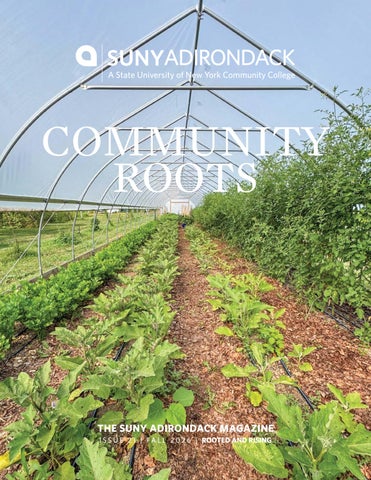
COMMUNITY ROOTS
THE SUNY ADIRONDACK MAGAZINE I S S U E 2 1 | F A L L 2 0 2 6 | ROOTED AND RISING
FALL 2026 | ROOTED AND RISING
2
INSIDE ...
GIVE TO GREAT FUTURES
In this issue, we celebrate the college’s 65th anniversary, notable alumni and how we intend to shape our future.
4
6
Academics
9
Campus news
26
Donating to SUNY Adirondack Foundation is an investment in individual futures and community prosperity. Scan the QR code or visit www.sunyacc.edu/give
12
Alumni profiles
Faculty and staff updates
Internships
22 30
Early College Career Academy
Campus farm improvements
FALL 2026 | ROOTED AND RISING
Our ASCEND plan — Academic and Strategic Completion, Enrollment and Navigation for Student Development — will help turn these priorities into action. By connecting our academic, enrollment and student-support efforts, this coordinated approach will bolster students from their first interaction with the college through graduation, transfer or entry into the workforce. The stories in this Report to the Community show these priorities and our values in action. They reflect the excellence of our faculty and staff, the determination of our students and alumni, and the impact of our community partnerships. SUNY Adirondack is rooted in community and rising toward opportunity through innovation and responsible stewardship. As we begin our next 65 years, we remain committed to honoring the traditions that shaped us, while embracing new possibilities for those we serve. Thank you for being part of SUNY Adirondack’s story and its promise. Sincerely,
Anastasia L. Urtz, J.D. President
PILLAR 1 PILLAR 2
Our 2026–2031 Strategic Plan benefited from the input of students, employees, alumni, employers and community partners. The plan renews our mission to deliver transformative education that expands opportunity for all learners, while advancing our vision of SUNY Adirondack as a launch pad for success through accessible, future-focused education.
PILLAR 3
For 65 years, SUNY Adirondack has been deeply rooted in the communities we serve. Generations of students have come here to discover their potential, prepare for meaningful careers and build brighter futures.
Our 2026-2031 Strategic Plan centers on four strategic priorities — pillars that will guide our work over the next five years:
PILLAR 4
Dear alumni and friends,
3
Future-focused learning: Offering excellent teaching, hands-on experiences and relevant programs that prepare students for transfer, careers and lifelong success
Enrollment and student success: Creating clear, flexible pathways and providing the personal support students need to feel connected, continue their education and achieve their goals
Workforce and community partnerships: Strengthening collaboration with employers, schools, alumni and community organizations to expand opportunities that support our region
Long-term strength and sustainability: Thoughtfully aligning our people, facilities, technology and financial resources so SUNY Adirondack remains strong for generations to come
PILLAR 1 | FUTURE-FOCUSED LEARNING
4
ACADEMICS ANTHROPOLOGY: Formerly a concentration under the Liberal Arts & Sciences: Humanities and Social Sciences Associate of Arts degree, Anthropology now stands as its own major. Half the credits can be earned online in this degree program, which is intended for transfer. APPLIED BUSINESS INFORMATION AND ANALYTICS: Students develop a strong foundation in hands-on experience in artificial intelligence (AI), data analytics, information systems and digital communication, graduating with the skills employers need in today’s technology-driven
workplace. Half the credits can be earned online, and this degree is eligible for SUNY Reconnect. ENGLISH: This flexible degree path allows a focus on literature, writing or journalism. Students learn processes and collaborative skills in writing, reading and developing ideas in this Associate of Arts degree designed for transfer. POLITICAL SCIENCE: Political Science — which was a Liberal Arts & Sciences: Humanities and Social Sciences concentration — teaches students to interpret
“Summer vacation” evokes thoughts of poolside barbecues and good beach reads. But for three SUNY Adirondack English professors, their time away from the classroom was centered on researching best practices in integrated reading and writing models. Jessica Best, Ph.D., professor of English, Donna E. Hayles, associate professor of English, and Stephanie Drotos, professor of English, worked to develop curriculum to transform how English 101 is taught at the college. For the past few years, incoming students who test into remedial writing were placed in an Accelerated Learning Program (ALP), taking ENG 101 and ENG 099: Writing/ Reading Workshop, a non-credit-bearing course. The rate at which those students successfully completed ENG 101 increased, but the students continued to experience a lower graduation rate than that of their peers.
As SUNY Adirondack continues to adapt to meet the needs of a changing economic and educational landscape, it proudly announces new majors for the 2026-2027 academic year. They include: A NEW MICROCREDENTIAL, HEALTHCARE ASSISTANT, was also added. This two-course program comprises 15 credits and prepares participants for entry into a wide range of allied health care and patient care experiences. They gain the necessary knowledge and skills to become a personal care aide (PCA), home health aide (HHA) and certified nurse aide (CNA).
and experience the world around them. Communication, thinking for yourself and problem-solving are the core of this program, which is designed for transfer to a bachelor’s degree program. Half the credits can be earned online. PSYCHOLOGY: Enhance your experience of the world around you with a major in Psychology. Communication, thinking for yourself and problem solving are at the core of this program, which in the past was a concentration. This Associate of Arts degree was designed for transfer.
Best
To learn more about degree and certificate programs at SUNY Adirondack, visit https://www. sunyacc.edu/programs-courses/ degrees-certificates
Hayles
With funding from SUNY Adirondack Foundation, Best, Hayles and Drotos are looking at ways to transform the experience, removing the zero-credit companion course, and integrating reading and writing into the composition-based course. “We’re going to pilot this one course in a fully integrated reading and writing classroom to benefit all the students, not just the ones who would otherwise be placed in remedial courses,” Best said.
Drotos
This fall, the trio will present to colleagues their findings, including a BrightSpace course for faculty. “We will ask all English faculty to take the course, but any faculty can take it, because everyone in some way teaches reading and writing,” Best said. They will also offer workshops for English faculty throughout the fall semester before piloting the redesigned class in Spring 2027. “Reading is absolutely essential to become a better writer and better student overall,” Best said.
PILLAR 1 | FUTURE-FOCUSED LEARNING
NEW FACULTY
As we prepare for a new academic year, we happily welcome new faculty members, including: Ryan Braymer, instructor of Engineering & Technology Rebekah More, assistant professor of Nursing & Allied Health Emily Petersen, Class of 2021, instructor of Culinary Arts Nancy Taylor, associate professor of Engineering & Physical Sciences Trinity Whitehead, Class of 2021, instructor of Cybersecurity & Networking (Temporary)
FACULTY PROFILE Ryan Braymer had a professor his sophomore year at Penn State who shifted how the then-engineering student thought. “He got me worried less about the grade I was getting and more interested in challenging myself to understand the material,” said Braymer, who joins SUNY Adirondack’s faculty this fall in the Engineering department. “That’s the challenge I’m looking forward to: getting students excited about and wanting to understand the material.” After working at an engineering consulting firm in Washington, D.C., for a decade, Braymer spent 10 years at Kenneth A. Kesselring Site, a U.S. Navy nuclear propulsion training and testing facility in Milton. Then, as his wife’s law practice took off, Braymer worked as a process server and paralegal to help her, while they raised their children. Braymer also started coaching wrestling at Glens Falls High School. “Coaching is like teaching, in a way,” Braymer said. In Spring 2026, he taught as an adjunct at SUNY Adirondack. “I really enjoyed it,” he said, noting he also spoke to engineering classes over the years. “This opportunity came around and I jumped at it.”
5
6
PILLAR 1 | FUTURE-FOCUSED LEARNING
INTERNSHIPS
With more than 200 partner businesses throughout the region — and beyond — SUNY Adirondack has connections to line students up with internships that help them explore their interests.
Rye Keith, Warren County Soil and Water
Kevin Tran, Regeneron
Antonio Chiaravalle, Warren County Soil and Water
This summer, 20 students went to work, earning credit and gaining invaluable experience.
which I had never done before,” he said.
His interest in the environment likely stemmed from attending school in Lake George, he said. “I think we get a stronger foundation in environmental science than most kids. We had a lot of labs on the lake and learned about invasives from a young age, and that has always been a priority for me.”
Rye Keith has been obsessed with microbiology since he was 3 years old and was in the hospital battling pneumonia. “It was crazy thinking, ‘Something so small I can’t even see it is putting me in the hospital and got me in a terrible state,’” the Salem native said. That interest didn’t fade and led Keith to SUNY Adirondack, where he is a Liberal Arts: Math and Science major with plans to transfer and ultimately earn a doctorate in microbiology. This summer, Keith was an intern analyzing water samples for Warren County Soil and Water. “I’ve learned a lot about the testing,
Associate Professor of Biology Amy Macaluso, chair of the Science Division, said getting hands-on research is not often done at the community college level. “Students are learning techniques for testing, learning to maintain an environment and sample data, and how to organize, present and share data,” she said. “This is experience a lot of two-year undergraduate students might not have.” Keith was joined in the internship program by Antonio Chiaravalle, an Environmental Science major from Lake George. Chiaravalle earned a degree in Computer Science from SUNY Adirondack, but realized it’s not his passion. While a student, he took an agro-ecology course. “That really excited me, so I decided to come back.”
The internship was an especially good fit, as students tested water samples collected from five area lakes for chloride and E. coli. “When those are found together, it’s an indicator of septic tank problems,” Macaluso explained. “It has been very cool to learn how to do testing, using all the equipment, and to see what’s going on in the lakes on a data level instead of observationally,” Chiaravalle said. The students also attended a water quality conference, which provided networking opportunities, and toured Up Yonda Farm Environmental Education Center.
PILLAR 1 | FUTURE-FOCUSED LEARNING “Having this internship on their applications will give them an advantage,” Macaluso said. Alexzander Warner always knew he wanted to go to college, but wasn’t quite sure what he wanted to study. So the Glens Falls native applied for SUNY Adirondack’s dual acceptance partnership with University at Albany. “At SUNY Adirondack, I had options for classes, so I took everything I needed to keep me on track to graduate, but chose classes that interested me,” he said. Two political science courses gave him the direction he was looking for. “I think it’s interesting how people interact, the reasons for conflict between people, between states, ways to stop conflict or bridge the gap,” Warner said, explaining he plans to earn a bachelor’s degree in political science with a concentration in international relations. Over the summer, Warner had an internship with Warren County Historical Society, giving him a glimpse into history and research. He was tasked with learning more about early settlers of Queensbury. “We had a map of the local settlers from 1762 to 1785, but just that they owned land — no date of birth, date of death, if they served in the military,” he explained. “I very much enjoy history and I learned a lot of interesting things about local settlers and how things were done,” Warner said. “But it was more than just genealogy; I really liked being in meetings and seeing how they were run, being a part of events and making fantastic connections.” On campus, Warner is secretary of College Activity Board, treasurer for Legacy Leaders Club, a TRIO student and plans to be a tour guide in the fall.
“I wish Adirondack were a four-year college,” he said. “I’d stay right here.” Aidan Cole sees political science as the most direct way to change the world. “I’ve been interested in politics and social sciences since I was pretty young, like 12,” he said. “I want to have the greatest positive impact on the world that I can.” After high school, the Gansevoort native took a gap year. “That was an important and good thing for me,” he said. Then, he enrolled at SUNY Adirondack. “Every single person I asked almost universally said, ‘Go to two years of community college before deciding to go to a four-year,’” he said. “And SUNY Adirondack Saratoga is right next to my house.” Cole’s political science classes are mostly on the Queensbury campus, but he doesn’t mind. Over the summer, he even signed on to an internship with Warren County Planning Department, to work on its Hamlets Project. “I’m making 3D models to put into software so we can use it as a model for alternate zoning plans and what zoning changes could do,” he explained. While that isn’t a direct line to political science, the summer provided him with much more than just experience with new software. Warner said he attended meetings, and was surrounded by co-workers and supervisors who answered his questions and explained processes to him, shared other projects they’re working on, and included him on work in the grant application process. “I am learning a lot from the tertiary aspects,” he said. Kevin Tran had an exciting summer:
The SUNY Adirondack Engineering student had an internship at Regeneron, the biotechnology company that is building a $2 billion facility at the former Quad Graphics site in Saratoga Springs. “A lot of great people work at this company,” Tran said just a week into his internship. “They know so much and I’m trying to absorb as much as I can.” After working in his family’s business for several years, Tran decided to pursue a college degree. He always liked numbers, math and science, so he decided to major in engineering. “I see it as another way for me to contribute to society,” Tran said. “Being able to look back on my work 20 years from now and it just so happens to be some sort of infrastructure, I’ve seen myself doing that for a long time.” In a chemistry class at SUNY Adirondack, Tran learned about the internship at Regeneron. “I really like chemistry, so I was interested. I want experiences that point me in a certain direction or allow me to see if I’m a good fit for an industry like this,” he said. “SUNY Adirondack has given me so many opportunities,” Tran said. That includes being part of SUNY Reconnect, a state-funded program in which state residents ages 25 to 55 who don’t have a college degree can earn one free of charge in a high-demand area of study. “I’m very thankful.” Several of SUNY Adirondack’s majors will support Regeneron’s workforce as the company’s expansion will create 1,000 new jobs, including Engineering, Mechatronics, Cybersecurity and Networking, and more. “This is a great company,” Tran said. “Everything is well managed, organized and there are a lot of skills I will take away from this internship.”
7
8
ALUMNI PROFILE Natasha Blue wants working moms to know that they can earn a degree. “People think, ‘I don’t have time,’ but once you talk to people and get the resources you need, you can do it,” she said. “You can make it happen.” And she should know. In May, the Ballston Spa resident walked across the Harding Mazzotti stage, SUNY Adirondack Nursing degree in hand, with her family cheering from the audience. But in 2021, she was a newly divorced mom of four, earning a living doing grocery and food delivery, with her youngest child in tow. “The older kids were in school and I could bring my son with me, and he loved it,” she recalled. She was making decent money in tips, but started to think about her next move. “I want my kids to have the best future, to be able to help put them through school, and to do more than I could if I worked for $23 an hour for the rest of my life.” Blue always wanted to be a nurse — “I mean, I’m a natural caregiver, a people person, obviously, I have six kids, I’m kind and I love people,” she said — so she decided to go to college. “I said ‘That’s it, I’m doing nursing.’ And I jumped right in.” She started work on prerequisite courses at SUNY Adirondack in 2023 and learned that, through Healthcare Pathways, a grant-funded program at the college that supports people pursuing health care careers, she could become a licensed PCA
PILLAR 1 | FUTURE-FOCUSED LEARNING (personal care assistant) to work in a hospital while going to school. “As soon as I was done the class, I was hired,” she marveled. Around that time, she started dating a man who had been a close friend in high school. “I told him, ‘I’m signed up at SUNY Adirondack and it’s a big commitment,’ and he said, ‘That’s awesome,’” she remembered.
NATASHA BLUE Hometown: Ballston Spa, New York 2026 graduate of SUNY Adirondack with a degree in Nursing Currently: Nurse at Saratoga Hospital
By the time she entered the Nursing program, she learned she was pregnant — with twins. Despite what seemed like an impossible proposition (going to college full time, working and caring for six kids, including two infants), Blue pushed forward.
“I had tried college when I had just my two oldest kids, but this go-round, I said, ‘It’s time.’ It’s obviously never going to be the right time; you just have to want it enough,” she said. Her twins were able to stay at the on-campus day care, something she said was an enormous help. “I’d keep them there for two hours after class was done and head to the library,” she explained. Throughout the time it took to earn a Nursing degree, Blue faced significant challenges. Not a natural test taker, she often was frustrated by her performance on exams. Her father was diagnosed as having cancer, then was in hospice care. She missed some of her kids’ events. “But somehow I did it,” she said. Under SUNY Reconnect, a statefunded program that supports those ages 25 to 55 without a college
“I’m 37 and I’ve had plenty of jobs — serving, customer service, bartending — and they don’t care how nice you are, but in nursing you get recognized for that. The fact my classmates saw the way I am with patients and recognized it was so meaningful.” degree earn an associate in high-demand fields, and with support from Healthcare Pathways, the cost of Blue’s tuition and school supplies were covered. She also received support through gas cards and even purchase of her cap and gown. At the Nursing Pinning Ceremony, Blue was honored with a DAISY Award, a recognition that celebrates and recognizes nurses by collecting nominations from patients, families and co-workers.
PILLAR 2 | ENROLLMENT AND STUDENT SUCCESS
SUNY ASAP
In June, SUNY Adirondack was named a State University of New York (SUNY) Advancing Success in Associate Pathways (ASAP) campus. SUNY ASAP provides students with support to finish an associate degree within three years. Eligible students have access to resources and support to overcome barriers that can prevent them from obtaining a degree. This includes funding to cover textbooks, groceries, transportation and other costs of attendance, as well as comprehensive personalized advisement, academic support and career development activities. Students who receive Pell, TAP or Excelsior might be eligible for ASAP, provided they meet other requirements. “This is an incredible opportunity for SUNY Adirondack students,” said Kate O’Sick, Ed.D, dean for Student Affairs. “ASAP allows us to expand proven, student-centered strategies to help more students finish their degrees and achieve their goals without accruing debt.”
CAMPUS NEWS In May 2025, SUNY announced that a new state-funded program, SUNY Reconnect, would provide free associate degrees in select fields for New York State residents ages 25 to 55 who never earned a college degree. At SUNY Adirondack, free tuition in high-demand majors started in the Fall 2025 semester. THE YEAR IN REVIEW:
139 50 89 37 3.12 34 students received Reconnect funding
attended full time
attended part time
18
Criminal Justice Substance Abuse:
28
The expansion was made possible through an additional $8 million in allocated funding in the 2026-27 State Budget, bringing the total state investment in this successful program to $20 million annually across SUNY.
Mechatronics:
8
Nursing:
24
Computer Science:
6
Engineering:
5
Environmental Science:
4
ASAP benefits include: • A cost-of-attendance award of up to $400 an academic year to cover non-tuition components after all federal and state financial aid; • A $50 monthly transportation stipend, up to $400 per year; • A $300 annual textbook stipend
Health Sciences:
46
www.sunyacc.edu/asap
average age
average overall GPA
MAJORS Cybersecurity:
SUNY Adirondack will launch its ASAP program with an inaugural cohort of 150 students this fall. Patrick Greene, the college’s former director of Upward Bound, was named director of ASAP at SUNY Adirondack.
9
Note: More than 139 students were eligible for Reconnect, but their financial needs were met by federal student aid and TAP.
students earned a 4.0 GPA in spring 2026 semester
10
PILLAR 2 | ENROLLMENT AND STUDENT SUCCESS
SUNY Adirondack was lauded by JED Foundation as the college wrapped up its four-year commitment to the suicideprevention initiative. “The college’s commitment to safeguarding student mental health remains a visible priority, shifting the campus culture toward a more campus-wide approach to well-being,” the final progress report read. In 2022, SUNY Adirondack signed on with the nonprofit organization on a journey to assess and enhance mental well-being initiatives and create positive lasting change on campus that prioritizes wellness. Included in the program were two Healthy Minds studies, one before and one after. The percentage of students who view mental health as a campus priority increased from 83 percent to 92 percent. Self-reported resilience rose from 37 percent to 49 percent, and knowing where to go on campus to seek help increased to 82 percent. With JED, SUNY Adirondack developed a strategic plan with objectives including making mental health a campus priority; developing life skills; promoting social connectedness; identifying students at risk; increasing help-seeking behavior; providing mental health and substance use services; crisis management procedures; and promoting means safety. While the program has ended, the initiatives it encouraged will continue at SUNY Adirondack, as will the college’s commitment to wellness.
“SUNY Adirondack has done incredible work implementing your JED Campus strategic plan,” the report reads.
Results reported by JED include: 91 PERCENT OF STUDENTS agree that administration is listening to student concerns regarding health and wellness — an increase from 80 percent in the first survey Students who agree their social relationships are supportive and rewarding INCREASED BY 12 PERCENT PROGRAMMING HAS EXPANDED TO INCLUDE an Active Minds club, an annual Fresh Check Day event, workshops that promote mental and physical wellness, and wellness materials in freshmen seminar classes
An increase in spaces dedicated to student gatherings and wellness, include a zenthemed Residence Hall floor An increased number of students reported that if mental health was affecting their academic performance, they would turn to their academic advisors (from 23 percent to 31 percent) or professors (from 24 percent to 28 percent)
91 PERCENT OF FULL-TIME FACULTY LEARNED ABOUT IDENTIFYING ATRISK STUDENTS IN DIVISION-LEVEL PRESENTATIONS
The number of students who reported feeling isolated from campus life DECLINED BY 8 PERCENT
24 staff members received intensive training in traumainformed response and suicide prevention
Mental health training program participation INCREASED BY 12 PERCENT ACROSS THE STUDENT BODY
Six staff members were certified as mental health first aid trainers, to train the campus community
STUDENTS WHO REPORT FEELING CONFIDENT helping someone with a mental health problem increased by 9 percent
The number of students who reported binge drinking in the past two weeks DECLINED BY 8 PERCENT
PILLAR 2 | ENROLLMENT AND STUDENT SUCCESS
STUDENT PROFILE When Joe Berube walked on to the SUNY Adirondack campus to enroll in classes last year, he was faced with a welcome surprise: Earning an associate degree wouldn’t cost him a dime. “That was not a factor in the decision to come back, but the fact I don’t have to pay for anything is amazing,” the Queensbury native said.
“College is not as taxing as I initially found it,” Berube noted. “I’ve been around a little, I’ve lived a little, I feel my own reason to be here rather than, ‘Oh, this is the thing you do, you graduate high school and you go to college and do more school.’” Berube works nights, mostly on weekends, at a hotel and has learned to schedule his classes to accommodate his work schedule. “It took a couple of months to properly balance working at the hotel and going to college during the day,” he said.
Berube gave college a try after high school, but it didn’t work out. “I wasn’t really sure where my education was going, so I ended up dropping out and working in factories 40 hours a week,” he said.
Since SUNY Reconnect covers the cost of tuition, required fees and supplies, Berube doesn’t have to work as many hours as he originally planned.
After five years of assembly work, he made a switch to the hospitality industry, working at regional hotels. From behind a front desk, he realized he wanted to give college another try. He enrolled in SUNY Adirondack as a Networking and Cybersecurity major (he has since switched to Computer Science), an area of study included in SUNY Reconnect, a state-funded program that supports those ages 25 to 55 in earning an associate degree in high-demand fields.
“I anticipated potentially having to pay thousands of dollars out of pocket, but now I can just go,” he said. “It’s nice to be able to do all this stuff and not have to worry about funding it; just knowing I’m covered has been a massive load off.” Learn more about SUNY Reconnect on Page 9 or at www.sunyacc.edu/freecc.
“I’m working toward a goal, and I feel that and it reflects in my work.”
11
12
PILLAR 2 | ENROLLMENT AND STUDENT SUCCESS
ALUMNI PROFILES
Gracelyn Germain with SUNY Adirondack President Anastasia L. Urtz, J.D., and SUNY Chancellor John B. King
When Gracelyn Germain first enrolled at SUNY Adirondack, she wasn’t sure nursing was the right path for her and left. “I was not mentally ready for it,” she remembered, “and I wasn’t sure it was what I wanted to do.” A few years later, when giving birth to her son, she had a bad experience with one of the nurses caring for her. “I thought, ‘If she can be a nurse, I can do this,’” she said. The Corinth native had been working as a waitress for several years, but returned to SUNY Adirondack’s Nursing program with a new sense of purpose.
“My son was my biggest inspiration to go back to school,” Germain said. “I want to have a better job for him, provide for him, I wanted to do better for him and become someone he could look up to.” Balancing coursework — especially in a program known for its rigor — and raising a 3-year-old wasn’t easy. With support from her family and a determination to succeed, Germain excelled in the classroom, joined Phi Theta Kappa, an honor society for associate degree students, and served as president.
“There was no room for failure,” she said. “Whenever things got hard, I would look at my son and remind myself that I was doing this for him.”
In May, Germain was selected to the Phi Theta Kappa All-New York Academic Team. “That was a great honor,” she said. Germain graduated in May and started a nurse residency at Glens Falls Hospital, where she’ll continue building the career she worked so hard to achieve while serving the community she calls home.
PILLAR 2 | ENROLLMENT AND STUDENT SUCCESS
In the two years Travis McKee spent at SUNY Adirondack, he went from taking remedial math with trepidation to flourishing in Calculus III. “I took all the math SUNY Adirondack had in a year and, in doing so, got really interested,” McKee said. As early as middle school, he had decided he was not good at math, and he wasn’t curious to improve. “I didn’t have interest in traditional schooling, my parents moved into the Adirondacks after college and didn’t have a ton of interest in traditional schooling, either. They were supportive of alternative education and that gave me space to find my own way,” McKee said, explaining that he was homeschooled for part of high school, but eventually quit and later earned a GED. He went to work for his father, a stone mason. “I got pretty good at it,” he said. “But over time, I realized my mind was always working and I had all these other thoughts.” “A couple years went by and I was realizing how much cool stuff was happening with computers, and I was not necessarily wanting to do hard labor my whole life,” he admitted. So at age 23, he started SUNY Adirondack as a Computer Science major, and discovered he was a different person and student than
he thought. “At 18, there’s no way I would have studied Computer Science; I would have studied English or one of the things I was already good at,” he said. “By the time I had a goal for what I wanted, I was able to pursue something I had to overcome.” He graduated, then enrolled in a bachelor’s degree program at New York University, where he had a minor in mathematics.
13
TRAVIS MCKEE Hometown: North Creek, New York 2014 graduate of SUNY Adirondack with a degree in Computer Science 2015 graduate of New York University (NYU) with a bachelor’s degree in computer science and a minor in mathematics Currently: Senior engineer manager for NVIDIA
After college, he started work at Bloomberg as a software engineer, blending his love of computers and math. He then worked at Amazon Web Services, then dbt Labs. “At Amazon, I helped launch AWS Data Exchange, a marketplace of sharing, buying and selling data. That’s when I moved into leadership, going from a software engineer to an engineering manager leading teams of engineers.” He moved on to Gretel, which was acquired by NVIDIA, where as a senior engineer manager he leads a team that creates artificial intelligence (AI) software. “This is engineering research for things that haven’t existed before,” he said. “There’s no playbook; we’re inventing this technology in real time.” That’s work he wouldn’t have been able to do had he followed a more traditional educational path. “I work on cutting-edge technology in one of the most advanced fields on the planet and there’s no way I would have been there if I had started where I was at 18,” McKee said.
“SUNY Adirondack was a really pivotal moment in my life. It was the first step of a whole long career. Doing well there meant I could go to NYU. Doing well at NYU led me to top jobs in the city; it’s like compounding interest. I had no real entry into this world of academic and business technology. I didn’t even finish high school. Putting a lot of energy and time into SUNY Adirondack started my career.”
14
PILLAR 2 | ENROLLMENT AND STUDENT SUCCESS
TYLER MCINTOSH Hometown: Corinth, New York 2012 graduate of SUNY Plattsburgh at Queensbury with a bachelor’s degree in criminal justice after earning 60 credits from SUNY Adirondack 2019 graduate of Marist University with a master’s degree in public administration 2023 earned a graduate certificate from University of Virginia in criminal justice education 2023 completed Law Enforcement Executive Leadership training at FBI National Academy Pursuing a law degree from Syracuse University
“SUNY Adirondack set the foundation for me.”
Currently: Major in U.S. Army National Guard; Saratoga Springs Police chief
Tyler McIntosh is one class shy of completing a degree at SUNY Adirondack, but that hasn’t held him back. “I had a child and was working full time, and I did everything I could, but just could not complete that one course.” McIntosh enrolled at SUNY Adirondack straight out of high school to study Criminal Justice. “I was geared toward helping people, making a difference, and it seemed like being a law enforcement professional was noble,” he explained. Classes he took secured his interest. “One of the first classes, I thought, ‘OK, this makes me want to come to class,’” he remembered. “The commitment and passion of the instructor really kept me engaged.” After his first year of college, he enlisted in the Army Reserves, went to basic training and advanced individual training, then mobilized to Iraq. “I started picking
up classes again, then deployed again; it took me a while to complete.” In 2012, he transferred to the Army National Guard as a commissioned officer, and transferred the credits he earned at SUNY Adirondack to SUNY Plattsburgh at Queensbury, from which he earned a bachelor’s degree in criminal justice. As he wrapped up work on that degree, he was hired by Saratoga Springs Police Department. “I finished my last class that fall when I was in the police academy.” By 2015, McIntosh was promoted to sergeant on the midnight shift. “I saw all kinds of wild behavior — disorderly conduct, drunk drivers, fatal crashes, domestic violence — a lot of crazy stuff happens at night,” McIntosh said. He went on to earn a master’s degree, then was promoted to lieutenant in 2022. He attended a 10-week training at the FBI National Academy in 2023. While there, he was notified he was selected as the next chief of police.
“It’s a challenging position; I’m the one overall responsible for everything the department does and doesn’t do,” McIntosh said. “One of the most rewarding things is having influence on the type of training and equipment, and culture of the organization.” McIntosh said he’s proud of the agency. “We have one of the best teams in this region, hands-down,” he boasted. But he still wants to bring more to the department. So this fall he will retire from the Army National Guard and is enrolled in law school at Syracuse University. “As chief, you are inundated with all sorts of legal issues,” McIntosh said. “We’ve had negotiations with the attorney general’s office, there are consistently labor relations-type incidents and questions, and a key aspect would be reducing risk and liability to the city.” “I’m here to protect people, to serve the people of this community,” he said. “It’s a really rewarding job.”
PILLAR 2 | ENROLLMENT AND STUDENT SUCCESS
In her memoir, Donna Giffune takes readers on an emotional journey through her son’s battle with cancer and how it shaped her. What it doesn’t include, though, is how SUNY Adirondack
armed her with the education she needed along the way. Giffune discovered the college in the early 2000s, when she worked as a physical therapist in a school district. “I earned a certificate in Early Childhood Education; I thought having a little understanding about young kids would give me a boost in the school environment,” she said. The skills she learned also helped her advocate for her students and her son, in school and out. “He had a stroke in late 2015 and I was at Albany Med, looking at equipment and listening to doctors talk about different kinds of medication,” she recounted. “I knew
I could get him walking and talking, but I didn’t understand ... what his brain and body were going through.” As her son, Ben, began to recover from a stroke, she again turned to SUNY Adirondack to learn what she needed to know. “In a matter of months, I applied to SUNY Adirondack’s RN program,” she said. Since 2003, the mother of four has also been writing a book, a memoir about learning resilience, transformation and deep enduring love while saving Ben, who was diagnosed as having a malignant brain tumor in 1992.
“At first, it was kind of cathartic, I just needed to get this out,” she said. “Every time I wrote it, I rewrote it, then wrote it again.” In June, the revisions were complete and the book published. In it, Giffune retraces how she became an advocate for her son — whose treatments saved his life but left him with significant brain damage — and, in doing so, discovered herself. While she grapples with despair, she also celebrates victories and joy.
DONNA GIFFUNE Hometown: Herkimer, New York 1983 graduate of Russell Sage College with a bachelor’s degree in physical therapy 2003 graduate of SUNY Adirondack with a certificate in Early Childhood Education 2016 graduate of SUNY Plattsburgh at Queensbury with a master’s degree in teaching 2018 graduate of SUNY Adirondack with a degree in Nursing Currently: Nurse and author of “Perfectly Guided: How Saving Ben Turned into Saving Me”
“Ben has jumped out of airplanes, flown alone to visit his sister, gone to college,” she checked off. “He wanted to live in a house, so we were able to figure out how he could get in a supported group living environment; he wanted to drive a car so he learned about the permit process, passed the permit test, was evaluated for a driving program ... he could sit behind the wheel and learn and experience driving. “We have done everything he wished for,” Giffune said. “Every time I thought we completed one wish, he gave me something else.” Her message is one of hope and inspiration. “There’s so much out there to help people get through these difficult challenges I call opportunities. My hope is that this book will bring to people who face tough stuff: You can have a life, you get through it and you’re better for it.”
“The book title, ‘Perfectly Guided,’ is because people in my life, or places I’ve been, opportunities that have opened up — how even in this midst of uncertainty, there were touchpoints that just seemed prepared for me and Ben.”
15
16
PILLAR 2 | ENROLLMENT AND STUDENT SUCCESS
ALEXIS BROZ-LAROCHE Hometown: Schuylerville, New York 2014 graduate of SUNY Adirondack with a degree in Adventure Sports 2020 graduate of SUNY Adirondack with a degree in Media Arts Currently: Founder of Wild For Life Inc. and licensed wildlife rehabilitator; pursuing vet tech certification online through Penn Foster
When Alexis Broz-LaRoche’s first child is born in December, nighttime feedings and sleep deprivation won’t be anything new. As founder of Wild For Life, a nonprofit animal rehabilitation center outside Saratoga Springs, Broz-LaRoche spends a few months a year waking every few hours to feed baby beavers and otters. With just one full-time employee and 10 volunteers, Wild For Life rehabilitates and returns to the wild more than 275 animals a year — birds of all types, squirrels, bobcats and countless other species. “I started this not just for love of animals, but also the love of people,” Broz-LaRoche said, explaining how a wildlife hotline she helps man fields up to 40 calls an hour. “People are desperate. Even if it’s the fifth or 25th squirrel of the day for us, it’s important to the callers and just heart-wrenching to see an animal in need.” She should know: Discovering an orphaned baby squirrel at a Mexican restaurant where she was bartending was a new beginning for Broz-LaRoche. “This squirrel was on the patio, trying to eat corn chips. Mama was hit by a car
and the babies were looking for food, for anything,” she remembered. “I put it in my apron pocket and told my boss I had to go home. That was the first rehab case I ever took in.” The next day, that little squirrel’s siblings showed up, and Broz-LaRoche took them in, too. She called a wildlife rehabilitator. “She said, ‘You’re good at this,’ then gave me two more,” she laughed. That woman became Broz-LaRoche’s mentor and helped her get a rehab license. What began as a pocket full of squirrels snowballed and now Broz-LaRoche is an expert on beaver and otter rehabilitation, one of just a few in the state. She attends conferences to continue learning and is working on earning vet tech certification online. When she was a high school track star with scholarship offers from colleges around the country, Broz-LaRoche didn’t imagine a life in which her garage would house a beaver habitat. “I had gone in thinking I had this certain track in life,” she said, “but after health issues my junior and senior years, that sort of all fell apart. I wasn’t sure what I wanted to do, but I knew I wanted to be outdoors, so SUNY Adirondack’s Adventure Sports program was really appealing to me.”
After earning a degree, Broz-LaRoche hit the road, visiting all 48 lower states and creating artwork out of her van. After nursing the baby squirrels back to health, she started taking in more animals in need. She also enrolled at SUNY Adirondack again, this time to earn a degree in Media Arts. When the COVID pandemic hit, she lost the jobs she used to support the rescue, so she started a TikTok account. “It was amazing how supportive the internet
PILLAR 2 | ENROLLMENT AND STUDENT SUCCESS was,” Broz-LaRoche marveled. “With nothing else to focus on, I was working with the animals and doing social media, so I started doing video editing and media marketing full time.” By 2022, she started working for National Grid. She was caring for animals regularly, so she brought animals to work. “I ran a little wildlife hospital out of my service van, with incubators and a formula warmer, and on my lunch break, I’d feed all the babies.” When she met the man who is now her husband, she told him she planned to run the rescue full time by the time she turned 35. “He told me, ‘You should just do it now.’ He really believed in me to start it, and I didn’t need much convincing; I had saved up a little, and we just went for it.” Broz-LaRoche secured a nonprofit 501c3 designation in 2024 and hasn’t looked back. She helps raise money to support the rescue by creating social media content that has attracted more than 500,000 followers. Whenever possible, Broz-LaRoche prepares rescued animals to return to the wild, but over the years has had a few that could not be released. Among them is Bo, a oneeyed beaver, an internet star and registered ambassador. Bo was found alone as a newborn after flooding. She lost her eye to disease and couldn’t be returned to the wild. She was tame enough, though, to enjoy human company and thrives in her role as a mentor to young beavers who land in the rescue. (Right now, she’s sharing her habitat with two.) “It’s a really hard decision to keep ambassadors,” Broz-LaRoche said. (She has one other, Three-Legged Gregory, an opossum; and is working to get ambassador status for Gretchen, a beaver whose leg was injured, leaving her unable to properly groom her coat to maintain its waterproofing. “She would freeze to death,” Broz said.) “That’s a decision that can’t be taken
17
seriously enough. If Bo didn’t have a pond and get to foster other beavers in a natural setting, it wouldn’t have been fair to her.”
“In the same way beavers create habitats and sanctuaries, we’re doing that here, just intentionally,” Broz-LaRoche said.
The semi-aquatic rodent changed Broz-LaRoche’s life, beyond turning her garage into a lodge. Since few rehabilitators specialize in beavers, Broz-LaRoche had to do extensive research and seek out mentors. Now, she’s a leader in beaver rehabilitation.
“I still very much use my Media Arts degree every day doing this work.
“I went to a beaver conference. Not many people live with nine beavers, so it was a unique experience. Everyone there was a Ph.D. in something, but some had never seen a beaver. An ecohydrologist had studied all this stuff involving beavers but had never held a baby beaver,” she said. “I fell in love with beavers because I met Bo and she’s adorable, but then I learned about the species and its value to the environment,” Broz-LaRoche explained, outlining how the animal — once nearly wiped out by the fur trade — preserves our wetlands, a crucial part of the ecosystem in which 41 percent of endangered species live. “Most of our grasslands are made from massive nutrient cycling initiated by beavers,” she said. There are three more beavers — these just babies — in a pen in Broz-LaRoche’s living room. What was once a sunporch is home to three otters, two porcupines and a oneeyed squirrel. A bird habitat a few hundred yards away from the house welcomes pigeons, herons, hummingbirds, and others, once including a Northern gannett, a large shorebird that was blown off course and crash-landed in our area, leading to an Audubon Society article. Another time, Broz-LaRoche cared for a wood stork, a species spotted only five times in the past 80 years. Broz-LaRoche and her mom once wrestled a bobcat hit by a car into the back of her minivan. She also assisted in the birth of a porcupine and removed fishing line from a turkey’s leg. “Every day, there are new animals here and new challenges.”
If I had to pay someone else to do it, I don’t know what I’d do. And Adventure Sports was a business track and that was pretty helpful in a lot of what I do now.”
HOW TO HELP Alexis Broz-LaRoche, founder of Wild For Life, said the biggest struggle she faces is funding the nonprofit organization. She raises money through social media and on Oct. 30 will host the Beaver Ball, a fundraising gala at Universal Preservation Hall in Saratoga. Proceeds will go to animal care and toward renovation of a leased property that will allow Broz-LaRoche to serve thousands of animals a year. Plans for the land just a mile or so down the road from Broz-LaRoche’s home include a wildlife hospital, an education center and a rehabilitation center. The hospital will include exam and procedure rooms, X-ray capabilities, incubators and a dorm space for caregivers to stay overnight when necessary. The education center will help fund the rehabilitation work. Tickets are available for the Beaver Ball, a fundraiser for Wild For Life, a 501c3 organization, at https://www. wildforlifeinc.org/beaverballtickets. To learn more about Wild For Life, including how to report an animal in need or make a donation, visit https://www.wildforlifeinc.org/.
18
PILLAR 2 | ENROLLMENT AND STUDENT SUCCESS
DENNIS HARRIS Hometown: Colorado Springs, Colorado 1996 graduate of SUNY Adirondack with a degree in Math & Science 1998 graduate of University at Albany with a bachelor’s degree in physics 2000 graduate of University at Albany with a master’s degree in physics 2010 graduate of University of Phoenix with a Master of Business Administration Currently: Mission manager/Lunar Payload manager at NASA
A lot of children dream of going to Mars on a NASA space shuttle, but when Dennis Harris was a single dad starting college at age 35, his sights were set closer to Earth. “I could never imagine having a job like what I have now,” admitted Harris, who enrolled at SUNY Adirondack after working in direct care for a few years. “I wanted to do something I really like as opposed to something I had to do; I had limited options with no education.” Harris changed his work schedule to part time, brought his younger son to the on-campus day care center and buckled down. “It was terrifying,” he admitted. “When I finished my first semester, I felt like my head was going to explode; I had not had to use my mind like that, it was almost like I had to rewrite my brain.”
“You know that phrase, ‘Everything I need to know I learned in kindergarten’? Everything I need to know professionally, I really learned in my two and a half years at Adirondack. I learned all the habits to be successful right there.”
Once he started, though, Harris’ mind blasted off. “All the lessons I learned at ACC, that’s where I learned everything about how to get along in the world, how to get to NASA, which was a long road,” he said. He graduated, then went to University at Albany, from which he earned bachelor’s and master’s degrees in physics. “Physics was hard to start, but when I got into how things roll and skid, photons and electrons, it rang my bell,” he said. He applied and was accepted into a Ph.D. program. “I was married, had three boys and the youngest was
only a couple years old, so I had to decide if I was going to spend another four years in a lab or go out into the real world,” he admitted. He chose the latter and started in the semiconductor field, working as a staff engineer, helping develop next-generation computer chips. After four years, he took a job at Ball Aerospace in Boulder, Colorado. “That was my introduction to space hardware,” he said. “Astronomy was my love and they had just proposed on a project for a space telescope.” After years of working on projects at Ball, Harris moved on to Jacobs in Huntsville, Alabama, where he was project manager for a NASA project helping lunar missions. “That’s how I ended up at NASA 20 years after I started,” he explained. “It was not a straight-line path; there are plenty of options if you come in as an intern doing aerospace, but I didn’t choose one of those.” Since, Harris managed five payloads that flew on Firefly Aerospace’s Blue Ghost Mission moon landing. “That was the most fulfilling thing I’ve ever done,” he said. “I helped these teams get their hardware built, qualified and delivered.” Harris has managed five different projects and has another launching this year to Mars. His work requires him to travel to Japan a few times a year. “No two days are the same; it’s hard to be bored.” “I work with a lot of professors and scientists who spend their entire careers trying to get something on the moon or into space, so it is fulfilling to succeed,” he said. “I don’t have anything left to prove professionally; I’m where I would be happy just to help us expand our scientific knowledge.”
PILLAR 2 | ENROLLMENT AND STUDENT SUCCESS
Jeff Trottier is an unassuming presence — albeit with impeccable manners and admirable posture — and an easy smile.
of his four-year commitment, Trottier was honorably discharged and went to work in the finishing department of IP. “I had taken some college classes down in Maryland, but decided I wanted a degree,” he explained. “ACC had night school and I wanted to better myself.”
But his resume belies that favorite-uncle vibe: Trottier was trained in intelligence, analysis interrogation and leadership at military academies around the country. He served in Guam; Iraq; Rome, New York; Greenland; and Afghanistan; earned a Legion of Merit, a Meritorious Service Medal, Joint Service Commendation Medal, an Air Force Commendation medal, an Army Achievement medal, Iraq and Afghanistan campaigns, a Humanitarian Service Medal — and that’s just to name a few of his accolades. He retired from the U.S. Air Force as a chief master sergeant, with his last position as a wing command chief.
He enrolled and earned a degree magna cum laude in 1997. “My vision was doing something with management,” he said, recounting that the plant where he worked eventually closed. While serving as town justice in Hadley, he joined the New York Air National Guard with a goal of earning a bachelor’s degree and serving his country again.
“Every educational opportunity I’ve had, I felt like SUNY Adirondack was part of it and the foundation of my higher education,” he said. Trottier joined the Air Force straight out of high school. “My plan was to come to SUNY Adirondack, but my twin brother came here and I thought, ‘My mom doesn’t need another person in college to pay for,’” he said. He played basketball and served as a radio communications analyst at Fort Meade. He had top-secret security clearance, analyzing signals from foreign entities. While in the military, he married and welcomed a son. At the end
19
JEFF TROTTIER Hometown: Lake Luzerne, New York 1997 graduate of SUNY Adirondack with a degree in Liberal Arts 2000 graduate of Nyack College with a bachelor’s degree in organizational management 2003 graduate of Community College of the Air Force with an associate degree in communications applications technology Currently: Retired insurance underwriter; retired chief master sergeant of the U.S. Air Force
In 2000, he graduated from Nyack College and started work at State Farm Insurance as a senior property and casualty underwriter. “That’s where I think my management degree from Nyack came in,” he said. “ACC was a great foundation for that; it really helped me manage my time.” One weekend a month, he worked in the Air Guard as an intelligence applications analyst out of Scotia, managing aircrew intelligence training and more. Trottier was voted town supervisor in Hadley in 2006, but when he was deployed for Iraqi Freedom in 2007, he wasn’t able to campaign for re-election. “My wife campaigned for me, and that was a tough time for us both,” he admitted. In 2009, he was deployed again, this time for Operation Enduring Freedom in Afghanistan. In the years since, he worked as an intelligence fusion analyst superintendent, operations group superintendent and wing command chief before retiring in 2023.
At the heart of all his successes is the foundation he built at SUNY Adirondack. “ACC is supportive of people who are working, they treat you as a normal student, and that gave me confidence to continue on.”
“I think of SUNY Adirondack like the foundation when you’re building a house. You know if you don’t have a foundation, the rest won’t go up well. I was always kind of organized, but the college helped me square the corners.”
20
PILLAR 3 | WORKFORCE AND COMMUNITY PARTNERSHIPS
FUN FACT
SUNY Adirondack’s Electrical Maintenance Technician program is a non-credit course that can build toward the college’s Technician Fundamentals — Industrial Maintenance microcredential.
STAFF PROFILES Deborah McGloine smiles when she recounts the countless successes she has witnessed as a workforce success coach at SUNY Adirondack’s Office of Continuing Education and Workforce Development. “I love helping people, love working in Continuing Education, I love when I get an email from a student thanking me for my help and telling me what they’re doing, that it makes a difference,” she said. “I’m just blessed.” McGloine provides wraparound support to students taking non-credit courses. She was hired post-COVID, when SUNY Adirondack received Workforce Readiness Academies Program funding from a U.S. Department of Education Reimagine grant. “We have since seen a need and grown,” McGloine said, explaining that what started as a few courses has led to hundreds of students being trained in HVAC, sterile processing, coding, certified
“This is a great example of our faculty being flexible and willing to work with adult learners in nontraditional pathways,” said Susan Wynkoop, director of Continuing Education and Workforce Development. Learn more about microcredentials at www.sunyacc.edu/microcredentials.
recovery peer advocate, bookkeeping, IT support and electrical maintenance technician, among others. The Electrical Maintenance Technician Bootcamp — a 12-week, 72-hour course held two evenings a week — was offered three times. The class covered basic math, precision measurement, Lockout Ragout OSHA Certification, magnetism, electrical measuring, AC and DC circuits, pneumatics and hydraulics, PLC and ladder logic, and total quality manufacturing. “The Electrical Maintenance program provides the student with an elementary exposure in understanding how electronics and automation are used in manufacturing,” said John Veitch, assistant professor of Mechatronics, Class of 1982. “The student will have knowledge in areas desirable for good-paying manufacturing employment.”
“We’re constantly connecting with employers in the manufacturing industry, then developing curriculum based on their needs,” McGloine said.
Resume writing, interviewing and networking are among the job preparedness topics McGloine covers during in-person talks and in weekly emails to students. She invites guest speakers from leading industry partners to speak in classes, providing students an opportunity to network. “The students who have taken these courses gain valuable credentials that enable them to take control of their futures. Our workforce development classes provide training and upskilling opportunities that create pathways to greater job security, increased financial stability and personal growth,” she said. Long after the original grant funding, McGloine has remained a key part of student success, with retention rates improving significantly over the past four years. “We are very unique in having a dedicated workforce success coach,” said Susan Wynkoop, director of Continuing Education and Workforce Development at SUNY Adirondack. “We support the students, shine a light on their potential and help them reach their goals,” McGloine said.
PILLAR 3 | WORKFORCE AND COMMUNITY PARTNERSHIPS
NEW STAFF
SUNY Adirondack’s Continuing Education programs offer short-term classes, workforce training and personal enrichment opportunities for adult learners in Queensbury, Saratoga and surrounding communities. Whether you’re changing careers, upgrading skills or exploring a new interest, you can start with flexible, affordable courses close to home.
Lillian Jackson loves learning and education so much, she planned to be a teacher. Soft spoken and unfailingly polite, she was a graduate student teaching in an elementary school when she realized classroom management wasn’t her strong suit. “I don’t think this is a sustainable career for me,” she admitted. To stay close to education, she took a job in admissions at a college in Montana. “I was excited to have a career in education without having to teach,” she said. She then moved to Utah and continued in
admissions, until her husband’s work moved the couple to Queensbury. “I didn’t have a job lined up, but knew I’d love to be back in higher education; I was just waiting for the right fit to open up,” she said. When she saw SUNY Adirondack’s community outreach coordinator position listed, she jumped on the opportunity.
“I love making connections on campus, and getting to know the community through all the different classes we offer,” she said of her new role. “I love being on the fun side of learning.”
21
22
PILLAR 3 | WORKFORCE AND COMMUNITY PARTNERSHIPS
Fifty-nine students were celebrated at the Early College Career Academy (ECCA) Completion Ceremony this past June. In collaboration with WSWHE (Washington, Saratoga, Warren, Hamilton and Essex) BOCES, SUNY Adirondack offers ECCA, a two-year program in which high school juniors and seniors attend college classes at SUNY Adirondack half the day and high school classes at their home schools the rest of the day. Students can pursue one of five tracts, including Business and Entrepreneurship; Information Technology: Computer Networking and Cybersecurity; Mechatronics/ Advanced Manufacturing; Media Arts; and Pathways to Teaching. By the time they graduate high school, these students have around 30 college
credits, which can be used toward a degree at SUNY Adirondack or to transfer to another institution. Students in New Media and Business and Entrepreneurship also earn a certificate. At the Completion Ceremony, students were honored with awards, including: Student Citizen Award: Ethan Williamson for Advanced Manufacturing; Elisia Carpenter for Business and Entrepreneurship in Queensbury; Frank Marshall for Business and Entrepreneurship in Saratoga; Lee Elissa for Information Technology; Cora Dennis for New Media in Queensbury; Halley LaBrecque for New Media in Saratoga; and Allison Bartone for Pathways to Teaching Student Leadership Award: Ethan Gonzales for Advanced Manufacturing; Cameron Porter for Business and Entrepreneurship in Queensbury; Alessandra Ouellette for Business and Entrepre-
neurship in Saratoga; Kaden Dunkley for Information Technology; Addison Barton for New Media in Queensbury; Madison Braim for New Media in Saratoga; and McKenzie Johnson for Pathways to Teaching Maureen VanBuren Memorial Scholarship Awards: Miles Martin for Advanced Manufacturing; Chloe Jasper for Business and Entrepreneurship; Avell Donders for Information Technology; Addison Barton for New Media; and Alexis Hatch for Pathways to Teaching Keirdon Brunell Memorial Scholarship and Award, on behalf of Nemer Motor Group: Logan Benson for Advanced Manufacturing; Raegan McWain for Pathways to Teaching; Isabelle Lumbra for New Media; Caleb Stranahan for Business and Entrepreneurship There are 80 students registered to begin the ECCA program in Fall 2026.
PILLAR 3 | WORKFORCE AND COMMUNITY PARTNERSHIPS
23
STUDENT PROFILE Izzy Lumbra has been an artist her entire life, so when she learned about the Early College Career Academy (ECCA) Media Arts program offered at SUNY Adirondack in collaboration with WSWHE BOCES, she signed up. “It was a lot of fun,” the recent Schuylerville High School graduate said. “It was such a great experience; I learned so much that now I’m a better artist and designer.” Izzy was asked to create a logo for her junior prom, the school’s field hockey team and the girls’ lacrosse team, and to design the yearbook cover. Izzy decided to enroll at SUNY Adirondack for the upcoming academic year.
“I hear so much good from friends who went to SUNY Adirondack: They love the campus, the community, the professors — everything; they love the school so much,” she said. She plans to live on campus, join the college shooting club and finish a degree in Media Arts. “I’ve become really interested in photography,” she said, explaining her decision to further explore the field. “I’ve been drawing for as long as I can remember; it’s just a great stress reliever and something that has always been part of my life,” Izzy said. “I think I’ll keep the drawing as a personal thing so it will still have the therapeutic effect.” “I want to start at SUNY Adirondack and see where it takes me,” she said.
24
PILLAR 4 | LONG-TERM STRENGTH AND SUSTAINABILITY
STRATEGIC PLAN
In 2026, SUNY Adirondack celebrates its 65th year and, while our mission has stayed the same, how we fulfill it is evolving.
Over the past several months, we invited the community to weigh in on what should not change about the college, what we should be and what our region needs from us. We sent more than 13,000 emails, posted on social media and our website, and sent media releases inviting the public to provide feedback. At six community meetings, we asked residents of Warren, Washington and Saratoga counties what they value about the college and what they need from it.
planning sessions and 354 surveys submitted, the committee identified recurring themes and, from them, developed a proposed vision and values.
What we heard became the foundation of the college’s Strategic Plan, a document designed to lead us through the next five years and into the future. At its heart is a mission that brings us back to our founding: “Deeply rooted in the communities we serve, SUNY Adirondack delivers transformative education that expands opportunities for all learners.”
Our vision for the future is clear: “SUNY Adirondack will be a launch pad for success by enriching, connecting and inspiring a diverse community through accessible, futurefocused education.”
That was what our founders intended for Adirondack Community College in 1961: to expand access to excellent educational so individuals could reach their goals and the regional economy had the workforce it needs to thrive. More than six decades later, those ideals have not changed, but the world around us has. The college gathered a Strategic Planning Committee of 14 members of faculty, administrative and support staffs, and our student body. Using feedback gathered from 243 individuals who attended
Our values reflect what you said matters most. For more than a half-century, SUNY Adirondack has evolved alongside the communities we serve. Our students and alumni have gone on to build businesses, care for patients, educate children, serve their communities and strengthen the region. So to us, these values are not just words on a page. They are at the center of our decision-making — for programs we develop, partnerships we build, ways we support students and investments we make in SUNY Adirondack’s future. And that future belongs to all of us.
CENTERED ON STUDENT SUCCESS, WE VALUE: STEWARDSHIP OF PLACE AND ENVIRONMENT: We honor, care for and learn from the Adirondack region by integrating sustainability and environmental responsibility. OPEN ACCESS AND OPPORTUNITY: We believe education should be accessible to all learners, embracing diverse backgrounds, ages, goals, and levels of preparation. BELONGING, EQUITY AND INCLUSION: We foster a welcoming, connected community in which students and employees feel valued, supported and empowered to succeed. TEACHING EXCELLENCE AND HIGH-IMPACT LEARNING: We commit to academic rigor, exceptional teaching and experiential learning that prepares students for transfer, careers and lifelong learning. DATA-INFORMED ACTION AND CONTINUOUS IMPROVEMENT: We use evidence to guide decisions, assess our effectiveness, adapt to meet the evolving needs of our students, and ensure institutional longevity.
PILLAR 4 | LONG-TERM STRENGTH AND SUSTAINABILITY
Around campus, “Rooted and Rising” has become somewhat of a motto, popping up on stickers, T-shirts and banners. The story behind its growth is seated in SUNY Adirondack’s accreditation. The college has been accredited by Middle States Commission for Higher Education (MSCHE) since 1972. Every eight years, the institution engages in a comprehensive self-study to prompt reflection and affirm the high quality of our educational programs. The Middle States review focuses on whether the college’s actions are aligned with our vision, mission and values. Work began on the reaccreditation process in October 2025. The theme “Rooted and Rising: Strength in Transitions” was adopted for the project to reflect the college’s new executive
leadership and recognize the changing higher education landscape it’s facing.
“The theme harkens to our deep roots in the community of more than 65 years,” said Wendy Johnston, professor of Political Science, who is co-chair of the Middle States steering committee. To be eligible to receive federal financial aid, higher education institutions must be accredited. The recognition provides quality assurance to the public.
25
talents to seven working groups, each assigned an MSCHE standard: •
Mission and Goals;
•
Ethics and Integrity;
•
Design and Delivery of the Student Learning Experience;
•
Support of the Student Experience;
•
Educational Effectiveness Assessment;
•
Planning, Resources and Institutional Improvement; and
•
Governance, Leadership and Administration.
The three-year process started with a self-study design, which was approved by MSCHE. The self-study design outlines how we intend to conduct our review, applying the evidence standards of Middle States.
“Our aim is to tell our story, demonstrate our commitment to excellence and continuous improvement, and showcase our resiliency and commitment to our mission,” said Jeannie Brown Leonard, director of Assessment and Learning Resources at SUNY Adirondack.
Faculty, administrators and staff from across campus are contributing their
In spring 2028, a team of peer evaluators will visit campus for an in-depth review.
26
PILLAR 4 | LONG-TERM STRENGTH AND SUSTAINABILITY
FACULTY & STAFF UPDATES Chef Matt Bolton
Kim Hedley, Ph.D.
Clint McCarthy
Chef Matt Bolton, Class of 2003, led SUNY Adirondack’s Seasoned to a People’s Choice Award in the vegan slider category at the July 29 Take a Bite Slider Challenge in downtown Glens Falls.
project returns roughly two acres of degraded woodland to native forest, following a Forest Conservation Plan developed with Warren County Soil and Water Conservation District.
Kim Hedley, Ph.D., professor of Nursing and chair of the Health Sciences Division, received the President’s Award for Excellence in Distinguished Service in May.
He started the summer by clearing the first stand. Then, he worked to knock back multiflora rose, asiatic bittersweet, honeysuckle, buckthorn and garlic mustard. Next he will install deer exclusion fencing, then plant native-tothis-area chestnut, hazelnut, white oak and sugar maple trees, roughly 500 per acre.
Anthony Lomenzo, a Campus Public Safety officer hired in late May, graduated Aug. 11 from Campus Public Safety Officer course. The 12-week training is held at Zone 5 Police Academy and certified Lomenzo as a campus public safety officer and New York state peace officer. Clint McCarthy, associate professor of Outdoor and Physical Education, spent much of the summer tackling issues Environmental Science students learn about in class: invasive press, climate adaptation and soil health. McCarthy is in the second year of a New York State Department of Agriculture and Markets Climate Resilient Farming grant (2025 to 2029) awarded to his Stone Cottage Farm LLC in Queensbury. The
For the past 21 years, McCarthy has organized tree plantings on campus, putting more than 1,000 in the ground. McCarthy also offers Stop the Bleed and American Heart Association Basic Life Support (BLS) Provider CPR/ AED as part of Healthcare Pathways trainings twice a month at SUNY Adirondack Saratoga. The Renaissance man had art and sculptures in three regional exhibitions this summer, and performed in two comedy shows at Wood Theater as part of Pulp City Comedy. He opened both shows with stand-up performances.
PILLAR 4 | LONG-TERM STRENGTH AND SUSTAINABILITY
27
Left to right: Kate O’Sick, Ed.D.; Emily Petersen; Evan Sullivan, Ph.D.; Michael Tiller Dean for Student Affairs Kate O’Sick, Ed.D, successfully completed her dissertation defense June 29. Titled “Exploring the Intersections of Design Thinking and Strategic Enrollment Management to Mitigate the Impacts of the COVID-19 Pandemic on Pell Eligible Enrollments at Community Colleges in New York State,” her three-article dissertation was submitted to the faculty of the Graduate School of Empire State University to culminate her fulfillment of the requirements for the degree of Doctor of Education in Educational Leadership and Change. Evan Sullivan, Ph.D., Class of 2010, assistant professor of European History, was awarded a fellowship by the Consortium for History, Science, Technology and Medicine (CHSTM), to study at member institutions. Sullivan went to the medical archives at Columbia University and Harvard University to research the experience of nurses during World War I. “Both these schools mobilized medical staff during World War I,” Sullivan said, “and have medical libraries and archives with historical documents.” When researching his first book, “Constructing Disability after the Great War: Blind Veterans in the Progressive Era,” Sullivan stumbled upon the story of Olga, a nurse who lost her vision as a result of her service. “She didn’t go to the same rehabilitation hospital that the men did, she wasn’t listed in any official records or articles related to blind vets after the war,” he said. “This sparked my curiosity, I’m really interested in finding out her story.”
PROMOTIONS Michael Cahill is assistant professor of Science.
NEW HIRES James Behrmann is administrator for Veterans Peer to Peer Program.
Echo Cutter is interim assistant director of UB Programs.
Ryan Braymer is instructor of Engineering & Technology.
Mark Dragoni, Ph.D., is associate professor of European History.
Kelly Girard, Class of 2020, is College Services associate.
Emily Forcier, Class of 2014, was named interim director of TRIO Opportunity Programs.
Lisa Grant, Class of 2010, is Prison Education coordinator.
Wendy Johnston, Class of 2006, is professor of Political Science. Joanne Malkani, Ph.D., is distinguished professor. Rebekah More is assistant professor of Nursing & Allied Health. Emily Petersen, Class of 2021, is instructor of Culinary Arts. Michael Tiller, Class of 2016, was promoted to supervising Campus Public Safety officer.
Lillian Jackson is coordinator of Community Outreach. Anthony Lomenzo and Dillon Wilcox are Campus Public Safety officers. Dan Perez was hired as building maintenance worker. Nancy Taylor is associate professor of Engineering & Physical Sciences. Trinity Whitehead, Class of 2021, is instructor of Cybersecurity & Networking (Temporary) Frank Woodard Jr. is a custodian.
Left to right: Michael Cahill; Mark Dragoni, Ph.D.; Emily Forcier
28
PILLAR 4 | LONG-TERM STRENGTH AND SUSTAINABILITY
FACILITIES MASTERPLAN A walk around campus reveals small changes that alone might not seem like much, but compounded are indicative of bigger developments to come. Faculty offices moved out of Dearlove Hall in preparation for SUNY Adirondack’s in-the-works facilities master plan. Built in 1984, Dearlove is slated for renovation to be transformed into a STEM (science, technology, engineering and math) center. “Dearlove Hall has a lot of deferred maintenance, so renovating it gives us the opportunity to address these problems, while transforming the space to best meet our students’ needs,” said former Vice President for Administrative Services and Treasurer Keith Kaplan.
“SUNY Adirondack will have more capacity for highly demanded mechatronics and cybersecurity opportunities and still accommodate our existing programs in other buildings on campus.”
Under the tentative plan, the first floor will be robotics, hydraulics/pneumatics and PLC laboratories; the second will be networking and PC hardware labs; and the ground floor will host a trades lab, lap support, mechanicals and a student lounge. The Visual Arts Gallery and fine arts instruction will be relocated to other spaces on campus. Also slated to see some changes will be the Humanities wing of Adirondack Hall. SUNY Adirondack’s Theater has already gotten updates, including new flooring, backstage organization systems and a fresh coat of paint. The area immediately outside the theater is being repurposed to give students a flexible meeting and lounge space. Nearby rooms and offices will be renovated to accommodate a planned paramedic training program. In the library in Scoville Learning Center, reference materials and books were moved to the second floor, to allow for more space for programs focused on student success such as EOP (Educational Opportunity Program) and TRIO
programs. The first floor still houses the Center for Reading and Writing and Math Lab, as well as Faculty Commons, an office space for adjunct instructors. On the other end of campus, the Student Center was newly refurbished. There are plans being developed, too, to include an admissions presentation space on the main floor, as well as improved access to restrooms. “The Student Center will become an even more student-focused space with an open floor plan,” Kaplan said. SUNY Adirondack is also proud to announce that ASAP (Advancing Success in Associate Pathways), a SUNY initiative to provide support systems to ensure timely degree completion, is located in Warren Hall adjacent to other vital student service departments. On the wish list on the south end of campus is an Athletics support building near the turf field, with bathrooms and concessions. “It’s an exciting time for the campus,” Kaplan said. “We are looking to quantify how much this will cost, then the next task is to get this in front of the counties and submit the plan to SUNY in September.”
PILLAR 4 | LONG-TERM STRENGTH AND SUSTAINABILITY
SAVE THE DATE!
Beeman Classic Golf Tournament Friday, May 28, 2027
29
SUNY Adirondack’s annual Beeman Classic Golf Tournament was the most successful in the program’s history, raising $71,330 in gross revenue ($51,000 net revenue). Tournament proceeds support the Foundation’s ADK Fund, helping provide critical resources for student success, campus improvements, and strategic initiatives that strengthen SUNY Adirondack’s teaching and learning environment.
GIVE TO GREAT FUTURES
Donating to SUNY Adirondack Foundation is an investment in individual futures and community prosperity. Scan the QR code or visit www.sunyacc.edu/give.
day of distinction One day. Two celebrations.
The journey to success began at SUNY Adirondack (or, for some, ACC). This year,
we’re bringing together two special traditions for the first time in one unforgettable day celebrating the remarkable accomplishments of our alumni.
Mark your calendars for Thursday, Oct. 22, 2026, and join us for: •
A luncheon honoring our newest Trailblazers, whose achievements inspire our college community and beyond
•
An evening reception celebrating the induction of SUNY Adirondack athletes into the SUNY Adirondack Athletics Hall of Fame
Countless stories of excellence, leadership and achievement.
SAVE THE DATE THURSDAY, OCTOBER 22, 2026
To RSVP, scan the QR code or visit www.sunyacc.edu/day-of-distinction
30
PILLAR 4 | LONG-TERM STRENGTH AND SUSTAINABILITY
Few people likely get excited by the prospect of having more work, but SUNY Adirondack Farm Manager Tommy Donolli, Class of 2023, smiles as he talks about The Farm securing grant funding to install a second 108-foot-by-16-foot high tunnel.
The tunnel — the second of that size, in addition to a smaller tunnel — will provide more room to start crops earlier, harvest longer and rotate crops, and opportunity for fall planting and overwintering.
during the summer Seasoned doesn’t run at full capacity as it does during the academic year, but there are still Collaborative Cuisine and Take A Bite events, and Continuing Education classes.
Agricultural Business classes, including Introduction to Sustainable Agriculture, Agroecology and Sustainable Foods, work on The Farm, growing produce that is used by Seasoned, the college’s student-run restaurant.
Also new at The Farm will be a BCS tractor, a walk-behind hand model to replace an oft-broken-down machine. “This has a bigger engine and is beefier for the work I put it through,” Donolli added.
“We use it for season extension and, since classes run late into the fall and start early in the spring, that’s more time for hands-on work,” Donolli said.
“I communicate with Chef Matt, get him his order, then everything else is surplus I put in The Farm store,” Donolli explained, adding that
Funded by an Adirondack North Country Association (ANCA) grant, the high tunnel will be installed by the middle of the fall semester, Donolli said. “The controlled ecosystem it creates makes it more manageable.”
PILLAR 4 | LONG-TERM STRENGTH AND SUSTAINABILITY
31
ECONOMIC IMPACT BY THE NUMBERS
OF SUNY ADIRONDACK ON WARREN, WASHINGTON AND SARATOGA COUNTIES
TOTAL IMPACT OPERATIONS CONTRIBUTIONS
$28.2
MILLION
$179.5
MILLION $19.6 MILLION
ON FACILITIES, SUPPLIES AND PROFESSIONAL SERVICES
STUDENT
INVESTMENT
$17.7 MILLION
$322,100
increased lifetime earnings of those with an associate degree
ANNUAL RETURN: Students who receive an associate degree from SUNY Adirondack earn an average of $8,100 more per year than high school graduates or those who earn a GED.
For every dollar invested in SUNY Adirondack, people in New York receive $6.20 in benefits
$82.3 MILLION:
RATE OF RETURN IS
of SUNY Adirondack students in 2022-23
for every dollar SUNY Adirondack students invest in college, they will receive $4.70 in future earnings
future lifetime earnings
18.7 PERCENT, meaning that
640 BAY ROAD QUEENSBURY, NY
“By changing our mindset, we can transform our lives.”
If you would like to receive this publication digitally, please scan the QR code to fill out a request form.
– William James, psychologist and philosopher
GREAT FUTURES START HERE. FIND EVERYTHING YOU NEED AT SUNY ADIRONDACK.
Learn more at www.sunyacc.edu/admissions
SUNYACC.EDU
@sunyadk #sunyadk
Finch Fine, Ultra Smooth, Bright White 10% PCW, 70 lb. text
SUNY Adirondack, a community college of the State University of New York, does not discriminate against any employee, applicant for employment, intern, whether paid or unpaid, contractor, student, or applicant for admission or other members of the college community (including but not limited to vendors, visitors and guests) based on a individual’s race, color, national origin, religion, creed, age, disability, sex, gender identification, gender expression, sexual orientation, self-identified or perceived sex, the status of being transgender, familial status, pregnancy, predisposing genetic characteristics, military status, veteran status, domestic violence victim state, criminal conviction or any other category protected by law. The college adheres to all federal and state laws prohibiting discrimination and sexual harassment in public institutions of higher education. The college prohibits conduct by any employee or any student who disrupts or interferes with another’s work performance or education experience, or who creates an intimidating, offensive or hostile work or educational environment due to discrimination based on protected status or sexual harassment. SUNY Adirondack is committed to educating employees in the recognition and prevention of workplace and education discrimination and sexual harassment, and to informing students, employees and others how to report a discrimination complaint. Inquiries about and reports regarding this notice and procedure may be made to compliance@sunyacc.edu or to one of the following: Chelsea Foster, director of Student Affairs and Early College Programs and Title IX coordinator, Warren Hall, Room 113, lyonsc@sunyacc.edu, 518-681-5650; Diane Wildey, associate vice president of Academic Affairs/Section 504 Coordinator, Scoville 324, wildeyd@sunyacc.edu, 518-743-2337. Inquiries may also be directed to the United States Department of Education’s Office for Civil Rights, 32 Old Slip 26th Floor, New York, NY 10005-2500, ocr.newyork@ed.gov, 646-428-3800.