What Actually Happens to Your Rubbish After the Skip Bin Leaves Your Driveway
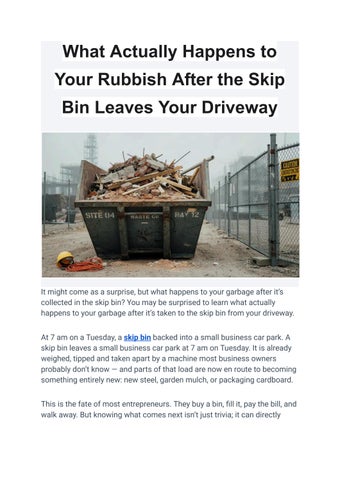
It might come as a surprise, but what happens to your garbage after it’s collected in the skip bin? You may be surprised to learn what actually happens to your garbage after it’s taken to the skip bin from your driveway. At 7 am on a Tuesday, a skip bin backed into a small business car park. A skip bin leaves a small business car park at 7 am on Tuesday. It is already weighed, tipped and taken apart by a machine most business owners probably don’t know — and parts of that load are now en route to becoming something entirely new: new steel, garden mulch, or packaging cardboard. This is the fate of most entrepreneurs. They buy a bin, fill it, pay the bill, and walk away. But knowing what comes next isn’t just trivia; it can directly
affect your costs, your compliance risk exposure, and, importantly, how customers and investors perceive your business. This is where most people don’t make time when running a business. Once you are aware of the chain through which your waste travels, you will see a few things come into focus: How some invoices are higher than others, why “landfill” is no longer the default outcome, and why a simple phone call to your provider can change your numbers. When the skip bin goes, the rubbish doesn’t! The one thing no one tells you when you book a skip is that you’re not paying for “disposal.” You’re paying for an entry into a logistics chain — a chain that has several stages, sorting, and several cost triggers that you never see on the invoice. That chain determines: ● If the volume isn’t important, how much you’re actually paying for is more important (i.e., weight and contamination) ● Do you have a local waste disposal scheme that your business is complying with? ● What proportion of your waste ends up in landfill waste and what proportion is returned to circulation? ● The time it takes to complete, and whether any delays could impact your project deadlines. This chain is typically the reason for any shock bills from skip bins. If you’ve ever thought, “It just goes to the tip,” then you’re not alone, because that’s the default for most business owners until they read through a diversion report. There’s a certain irony in this: This is one of the few expenses in any business that you can ask just one additional question to make a real
difference. Very few owners ever ask it, simply because they don’t know there is something to ask.
The first stop is not the landfill but the Transfer Station! Very little is sent to landfill. In most areas, skips go to the waste transfer station, a large industrial facility where staff sort and consolidate them to keep waste out of the environment. There, two things occur: 1. Your provider calculates the real cost based on the load weighed on arrival and departure. 2. It is checked for contamination – the wrong materials are mixed.
This is the part of the business that most business owners don’t know about. It’s also the point at which the cost of your work is quietly fixed, before you even receive an invoice.
What is the need for the detour? Why is a detour necessary? Transfer stations exist because direct tipping to a landfill is expensive and, in some areas, certain materials are prohibited from being tipped at a landfill. Governments set landfill levies by tonne to discourage dumping recoverable materials and to provide a financial incentive for providers to sort before dumping. So providers take loads to transfer stations first, recover materials, then send the rest of the load to landfill. Reducing the weight of landfill material reduces levy costs—this benefits the landfill and, in most cases, you. This is your first chance to inspect your load for contamination. Food waste, paint tins and asbestos-containing materials brought into a skip booked for “general construction waste” completely change the environment downstream and will affect you when it comes time to pay the bill.
What is considered contamination? What does contamination mean? Not all contamination is apparent. Common examples that end up surprising business owners: ● Mixed with other treated timber, which is different from the untreated timber. ● General waste contaminated with plasterboard (can affect a whole load if not separated)
● Liquid waste: paint, oil, chemicals, etc. — even if it is only a little waste ● Old monitors, cabling that are thrown with general office clear-outs (e-waste) ● Food waste and Construction/Officer waste combined All of these can bring a load from “recoverable” to “landfill-only”, and that upclassification can cost you more than you realize until you hear about it.
At Stop Two, you will learn how to take your “waste” and transform it into someone else’s income. This is the one thing that most people are surprised about. A significant percentage of your skip’s contents can be sold or recycled. The sorting facilities are not giving you a favor – they are recovering value and, in many instances, profit from the material, which you paid to have removed.
Mechanical vs. Manual Sorting Large facilities employ a combination of both: ● Mechanical sorting: separates materials using conveyor belts, magnets (for ferrous metal), eddy current separators (for non-ferrous metal such as aluminum), and air classifiers (by weight, density, and type). ● Manual sorting: people on the line remove items the machines reject or cannot read—untreated trees, contaminated cardboard, and usable items that aren’t trees. Manual sorting may be more important for smaller or regional facilities, and can be more accurate for mixed loads, but takes more time. Typically,
larger metro facilities are more mechanized, with higher-volume throughput at higher speed, but slightly less precision on edge cases.
What is usually removed? ● Timber: converted to mulch or particle board or biomass fuel ● Melted down and resold: often, the one single thing in your skip that may be worth the most pound for pound: steel, aluminum, copper; ● Cardboard and paper: baled and sold to paper mills ● Concrete and brick: crushed to aggregate for roadbase and construction fill ● Green waste: can be composted or mulched. ● Plasterboard: can be recycled into new plasterboard in areas with specialty recyclers. ● Glass: Crushed and reprocessed (usually a small percentage of commercial loads) After all that, what is left — real “eatables” — is what ends up in landfill. In many good facilities, that residual fraction is less than most people would think.
Why This Matters for Your Bottom Line Every material removed and sold from the material you are pulling reduces the net cost of processing your material. While you can pass this recovered value back to customers, some providers return a percentage to those with well-sorted, low-contamination skips. Some don’t even mention it — which is why it is important to ask the right questions at the outset.
A True Story: The Renovation that Recycled Itself During the fit-out of a café, two 6-cubic-meter skips were ordered by the owner for the demolition site – old flooring, plasterboard, timber framing, off-cut packaging, and general off-cuts.
She felt that most of it would go to waste. Out of curiosity, she asked her provider for a diversion record after collection. The figures left her in disbelief: ● 84% of the total weight was diverted from landfill ● The timber framing was reprocessed into mulch. ● The findings from this operation led to dispatching plasterboard to a specialist plasterboard recycler. ● She sold scrapped metal fittings to a scrap dealer, thus slightly lowering her invoice. Her redecorating did not alter in any way. The only change was that her provider used a facility with powerful sorting infrastructure, and she requested the report. So the one question turned an assumption into a number that she could use in her supplier conversations, and along the way, in a sustainability line on her website. Consider this scenario: you get ready for a second office clear-out, but this time it is more expensive. Compare that to another business owner who is emptying an office building. He put all this rubbish in one skip: old carpet tiles, broken furniture, e-waste, food packaging from the staff kitchen, and other rubbish. The transfer station flagged the load as contaminated. Because the load mixed e-waste and food waste with recoverable material, the whole skip was reclassified, and most of it went to landfill rather than being sorted for reuse. His final bill contained a contamination surcharge – one that he didn’t anticipate, nor was he clearly told about when booking. The lesson wasn’t about the unpredictable nature of skips. It’s that if, a few minutes before the bin was picked up, they had separated the materials, then there would have been no charge.
This document covers the hidden costs no one mentions when starting a business. The price of skip bins isn’t just about the bin size. It depends on two things: the load weight and how “clean” it is.
Why Mixed Loads Cost More ● Some loads are too contaminated to go through standard recycling lines, such as food waste being mixed in with construction waste. ● More contaminated loads are likely to go to landfill, resulting in additional levy costs. ● Some providers will assess a contamination fee over and above standard rates – sometimes this is not clearly itemized.
How Weight-Based Pricing Works in Reality Most commercial providers charge per ton, not just by bin size. That means: ● The cost of a half load (e.g. heavy material such as concrete or soil) is greater than a full load (e.g. light material such as cardboard or packaging). ● Two seemingly identical skips may cost very different amounts because of their contents. ● Before-and-after weighing of the truck — the difference is billable weight. Once you know this, you’ll approach the bin differently. Cost of movement is not related to space requirements, but rather is a function of the amount of heavy and dense material. Here are three ways to reduce disposal expenses:
1. As long as the separation is done at the source, even a very rough separation like wood in one pile, metals in another, general waste in another can help lower the contamination fees, and may help the load receive lower recycling rates instead of landfill rates. 2. “What is your provider’s diversion rate?” Not every provider serves a high-recovery transfer station. Some go directly to lower-cost, lower-recovery alternatives that slowly kill you, with higher fees for landfill. 3. Open a docket for a weighbridge diversion or a weigh-in docket. It’s one document that tells you what you paid for, what happened, and it’s usually easy to get, but of course, few business owners ever ask. The fourth, and not-so-obvious, option is to choose your skip’s time of order. The fourth (and not-so-obvious) option is to choose your skip’s collection time. A smaller skip can be collected more often, which reduces contamination risk, rather than a large skip being left to fill over a few weeks. The longer the skip is left open on site, the greater the risk of other non-trade waste being put in by those who are not thinking about the type of waste collected by the skip.
Why is this important beyond the trash? What is the significance of this beyond the trash? This is no longer a back-office concern; it’s a business concern for two reasons.
Compliance
Businesses are not only liable for waste products if they leave them on your driveway; in many areas, they have a ‘duty of care’ to the waste. In some jurisdictions, the paper trail may be used to trace back to the business that produced the material if it is found to have been improperly disposed of, or if your company illegally dumped it. This is especially important for industries that produce construction, demolition, or medical-related waste, as these are subject to more regulatory oversight and face potentially higher penalties for improper disposal.
Perception Once again, customers, landlords, and even investors are asking more questions about waste. A diversion report is no longer a compliance document; it’s proof that can be presented to clients, tender applications, and lease renewals about your environmental practices. It can provide a real “selling point” for small and medium businesses, especially. You can say that 84% of our renovation waste was diverted from landfill, and we can provide the report—this is a tangible, defensible statement, not just empty sustainability words.
Insurance and Risk Certain commercial insurance policies and landlord agreements are beginning to include provisions on waste disposal and environmental issues, especially for those in the construction, hospitality, or manufacturing sector. Having this information about your provider, which you can even document, will eliminate a lot of friction if those questions should ever be asked when you are reviewing a claim or a lease.