Biochempeg
https://www.biochempeg.com
Nucleic Acid Therapeutics: Recent Development In recent years, the approval of nucleic acid therapeutics for listing has been accelerating. Numerous nucleic acid therapeutics that have the potential to become blockbuster drugs have released clinical data covering cardiovascular and metabolic diseases, liver diseases, and a variety of rare diseases. Especially after the approval of the two mRNA COVID-19 vaccines, nucleic acid therapeutics have received more and more attention from the world.
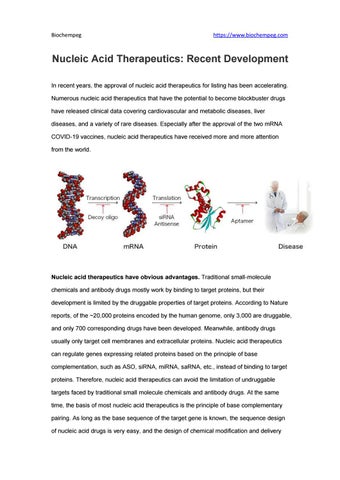
Nucleic acid therapeutics have obvious advantages. Traditional small-molecule chemicals and antibody drugs mostly work by binding to target proteins, but their development is limited by the druggable properties of target proteins. According to Nature reports, of the ~20,000 proteins encoded by the human genome, only 3,000 are druggable, and only 700 corresponding drugs have been developed. Meanwhile, antibody drugs usually only target cell membranes and extracellular proteins. Nucleic acid therapeutics can regulate genes expressing related proteins based on the principle of base complementation, such as ASO, siRNA, miRNA, saRNA, etc., instead of binding to target proteins. Therefore, nucleic acid therapeutics can avoid the limitation of undruggable targets faced by traditional small molecule chemicals and antibody drugs. At the same time, the basis of most nucleic acid therapeutics is the principle of base complementary pairing. As long as the base sequence of the target gene is known, the sequence design of nucleic acid drugs is very easy, and the design of chemical modification and delivery
Biochempeg
https://www.biochempeg.com
system and sequence design is relatively independent. In contrast, in the discovery and optimization of small molecule and antibody drugs, the optimization of properties such as activity and PKPD requires structural changes, which requires a lot of work.
The development process of nucleic acid drugs has not been smooth. Exogenous nucleic acid drugs need to overcome multiple obstacles to enter the body:
1) It is unstable and easily degraded by nucleases in the body;
2) Nucleic acid molecules are immunogenic and will activate the response of the human immune system;
3) The molecular structure is large and negatively charged, which makes it difficult to penetrate the cell membrane;
4) After entering the cell, the nucleic acid molecule needs to escape from the endosome to the cytoplasm (endosome escape). In view of the limitations encountered in the delivery of nucleic acid drugs in vivo, various measures have been applied to try to solve the above-mentioned problems, such as the chemical modification of nucleotides and the application of delivery systems. Chemical modification of nucleotides can improve the stability of nucleic acid molecules and reduce their immunogenicity, including chemical modification of ribose, phosphate backbone, bases, and nucleic acid chain ends. The development of delivery system technology has made it possible to prevent nucleic acid drugs from being degraded by nucleases while improving the efficiency of their entry into cells, such as polymers, lipids (liposomes or LNP), GalNAc, peptides, antibodies, etc.
The research and development of nucleic acid drugs are divided into a variety of technical routes, including ASO, siRNA, Aptamer, miRNA, mRNA, saRNA, sgRNA, U1 snRNA, etc.
Biochempeg
https://www.biochempeg.com
1) ASO is a single-stranded structure, chemical modification can effectively
improve its stability, immunogenicity, half-life and other properties. Moreover, it is an amphiphilic molecule (hydrophilic and lipophilic), which is relatively less dependent on the delivery system, and can be administered in the form of naked nucleic acid. Curently, there are 7 ASOs are approved by FDA and EMA. 2) siRNA is one of the current research hotspots of nucleic acid drugs. It induces
gene silencing through RISC, and the development of delivery system technology has greatly promoted the development of siRNA drugs. At present, 4 siRNA drugs have been approved by the FDA & EMA, and many siRNA drugs that are expected to become blockbuster drugs have published clinical data. 3) Due to the COVID-19 epidemic, the research and development of mRNA
vaccines have received more attention and great progress has been made. Two mRNA vaccines have been granted EUA by the FDA. LNP technology is applied in these two vaccines as a delivery system, consisting of a neutral phospholipid, cholesterol, a polyethylene-glycol (PEG)-lipid, and an ionizable cationic lipid, among them, PEG can enhance the stability and lifespan of LNPs.
At the same time, protein replacement
therapy based on the mRNA route is also being explored. In addition, the research and development of Aptamer, miRNA, saRNA, sgRNA, U1 snRNA and other types of nucleic acid drugs are all proceeding quickly.
Product
Gene target
Indication
Administration
Approval year
ASOs
Vitravene, fomivirsen (Ionis Pharmaceuticals)
ondys 51, eteplirsen (Sarepta Therapeutics) Tegsedi, inotersen (Ionis Pharmaceuticals)
1998 (withdrawn
Cytomegalovirus gene (UL123)
Cytomegalovirus infection
Intravitreal
Dystrophin (exon 51)
Duchenne muscular dystrophy
Intrathecal
2016
Transthyretin (TTR)
TTR-mediated amyloidosis
Subcutaneous
2018
Spinal muscular atrophy
Intrathecal
2016
Spinraza, nusinersen (Ionis
Survival of motor neuron 2
Pharmaceuticals)
(SMN2)
2002/2006)
Biochempeg
Kynamro, mipomersen (Ionis Pharmaceuticals)
Waylivra, Volanesoren (Ionis Pharmaceuticals / Akcea) Vyondys 53, golodirsen (Sarepta Therapeutics) Amondys 45, casimersen (Sarepta Therapeutics)
https://www.biochempeg.com
Apolipoprotein B-100
Hypercholesterolemia
Subcutaneous
2013
Apolipoprotein CIII
Familial chylomicronemia syndrome
Subcutaneous
2019
Dystrophin (exon 53)
Duchenne muscular dystrophy
Subcutaneous
Dystrophin (exon 45)
Duchenne muscular dystrophy
Subcutaneous
2021
2019 (confirmatory tria required)
GalNAc−siRNA conjugates
Givlaari, Givosiran (Alnylam Pharmaceuticals)
ALAS1
Acute hepatic porphyrias
Subcutaneous
2019
PCSK9
Hypercholesterolemia
Subcutaneous
2020
Glycolate oxidase
Primary hyperoxaluria type 1
Subcutaneous
2020
Intravenous
2018
Intramuscular
2020
Intramuscular
2020
Leqvio, inclisiran (Novartis/Alnylam Pharmaceuticals)
Oxlumo, lumasiran (Alnylam Pharmaceuticals)
LNP-RNA
Onpattro, patisiran (Alnylam
TTR siRNA
TTR-mediated amyloidosis
Comirnaty, tozinameran
SARS-CoV-2 spike protein
COVID-19 (FDA, emergency use;
(BioNTech/Pfizer)
mRNA
Switzerland, full approval)
mRNA-1273
SARS-CoV-2 spike protein
(Moderna/NIAID/BARDA)
mRNA
Pharmaceuticals)
COVID-19 (FDA, emergency use) AAV vectors
Glybera, alipogene tiparvovec (uniQure)
Lipoprotein lipase (LPL) (AAV1)
LPL deficiency
Intramuscular
2012 (withdrawn 2017)
RPE65 (AAV2)
Leber congenital amaurosis
Subretinal
2017
SMN1 (AAV9)
Spinal muscular atrophy
Intravenous
2019
Intramuscular
2021
Intramuscular
2021
Luxturna, voretigene neparvovec-rzyl (Spark Therapeutics)
Zolgensma, onasemnogene
beparvovec (AveXis/Novartis)
Adenovirus (Ad) vectors
axzevria, AZD1222, ChAdOx1 SARS-CoV-2 spike protein DNA COVID-19 (FDA and EMA emergency nCoV-19 (AstraZeneca) Ad26.COV2.S (Johnson & Johnson)
(ChAdOx1)
use)
SARS-CoV-2 spike protein DNA COVID-19 (FDA and EMA emergency (Ad26)
use)
Biochempeg
https://www.biochempeg.com
Convidecia, Ad5-nCoV
SARS-CoV-2 spike protein DNA
(CanSinoBIO)
(Ad5)
COVID-19 (Approved in China)
Intramuscular
Nucleic acid therapeutics approved by the FDA and EMA. Source: Reference [1]
With the advancement of clinical practice and the maturity of related technologies, the approval of nucleic acid drugs has accelerated significantly in recent years. At present, many different kinds of nucleic acid drugs are entering or have been in different clinical stages, and their indications are becoming more extensive and even curing some diseases. It is expected that as more difficulties are overcome, more nucleic acid drugs will be clinically applied. Nucleic acid drugs are expected to become the third-largest type of drugs after small molecule chemicals and antibody drugs.
As a global partner, Biochempeg can supply commercial quantities of high-quality functionalized PEGs, which are essential for your PEGylated nucleic acid therapeutics. We will PEGylate your nucleic acid therapeutics and deliver your PEGylated product with a certificate of analysis, as a regular end-product, for further testing at your site.
References: [1] Kulkarni, J.A., Witzigmann, D., Thomson, S.B. et al. The current landscape of nucleic acid therapeutics. Nat. Nanotechnol. 16, 630–643 (2021). https://doi.org/10.1038/s41565-021-00898-0
Related Articles: Therapeutic Oligonucleotides on the Rise Understand the COVID-19 mRNA Vaccine PEGylated Drug Delivery Systems for siRNA Drug Development in Cancer Therapy Advantages and Disadvantages of PEGylated Liposomes in Drug Delivery System
2021