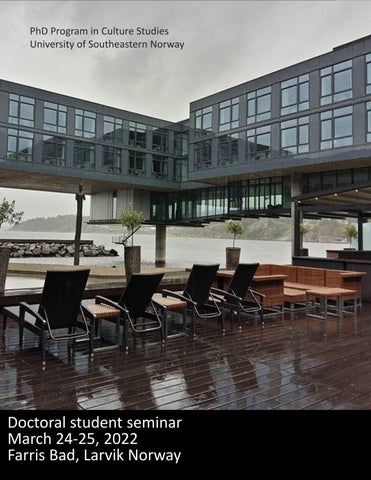
Photo by Tgjh
PhD Program in Culture Studies University of Southeastern Norway
Doctoral student seminar March 24-25, 2022 Farris Bad, Larvik Norway
Photo by Simone Hutsch
Table of Contents CV
Program ##
Cover Letter
##
About
##
Project
##
Project
##
Project
##
Project
##
Photo credits This page: Anne Gry Gudmundsdottir (PhD in Culture Studies 2019). Fieldwork in Kyrgyzstan. Cover page: Own work, Ssu, CC BY-SA 4.0, https://commons.wikimedia.org/w/index.php?curid=101955188
Day 1 Thursday, March 24, 2022 9:45
Arrival Farris Bad
10:15-10:30
Opening Words of Welcome PhD Program in Culture Studies, Heike Speitz & Jeanne Schoenwandt
10:30-12:30
Session with Mads Claudi, University of Oslo in Plenary – see below
12:30-13:30 Members of the Program Committee: Mats Johnansson, 13:30-14:15 Department of Traditional Arts & Traditional Music, and Marte Gulliksen, Department of Visual & Performing Arts Education. Photo: J Schoenwandt
Lunch buffet at Farris Project presentations in parallel sessions: Lysiane Lasausse (Nils Ivar Agøy, discussant) in RAKKE Husam Abusalem (Heidi Biseth, discussant) in MØLEN
14:15-15:00
Informational sessions in Plenary 14:15 Ellen Schrumpf updates on exchanges with Pune University, India 14:25 Nils Asle Bergsgard updates on the reorganization of PhD studies in the Faculty. Note: please submit your questions or comments for Nils Asle to Heike by the end of lunch. 14:50 Jeanne Schoenwandt updates on
the results of the candidate survey 15:00-15:30
Celebrating 10 years of Culture Studies at USN with a thank you for service to one of the program’s faculty!
15:30-17:00
Parallel meetings of the teaching staff & the fellows
Åsve Murtnes, program candidate, former student representative to the program committee and 2022 graduation hopeful. Photo: J Schoenwandt.
17:00-20:00
Open time
20:00
Dinner at Farris Bad
Keynote speaker Mads B Claudi University of Oslo Department of Linguistic and Nordic Studies
10:30 am – 12:30 pm Thursday, March 24, 2022
Tolkning, theori og metode/ Interpretation, theory and method Room: Mølen og Rakke
Professor Claudi vil snakke om fortolkning og om forholdet mellom teori, metode og empiri i humanistisk forskning, med særlig vekt på den såkalte filosofiske hermeneutikken, dvs. hermeneutikk forstått som fortolkningsteori eller filosofi. Professor Claudi will lecture on the topic of interpretation and the relationship between theory, method and empiri in research in the humanities, with particular emphasis on hermeneutics understood as a philosophy or as theories of interpretation. Please note: Presentation will be in Norwegian, you are however free to ask your questions/make comments in English.
Biography Mads B. Claudi is Associate Professor of Nordic Literature at the University of Oslo, and has previously worked with teacher education programs at USN and Oslomet. He has recently edited Litteraturhistoriske muligheter i forskning og undervisning (2022), and has previously published two textbooks, Litteraturteori (2013) and Litterære grunnbegreper (2010).
'On interpretation, theory and method in the humanities’: forslag til lesing Mats Claudi kommer til å snakke om fortolkning og om forholdet mellom teori, metode og empiri i humanistisk forskning, med særlig vekt på den såkalte filosofiske hermeneutikken, dvs. hermeneutikk forstått som fortolkningsteori eller -filosofi. Han trekker veksler på ulike tekster, både primære og sekundære, og her er noen dere kan ha utbytte av å konsultere: Hermeneutisk lesebok (red. Lægreid og Skorgen, 2001) inneholder en opplysende innledning. Boka rommer også mange relevante primærtekster, og han kommer til å komme innom Ricoeur, Gadamer, Dilthey, Taylor og Habermas. Også Nils Giljes Hermeneutikk som metode (2019) har et informativt innledningskapittel som kan være verdt å lese. Kanskje kan dere også ha nytte av å lese kapittelet om fortolkning i Humaniora. En innføring (Jordheim et al., 2012/2019). Søren Kjørups Menneskevidenskaberne (2008, i to bind) gir en oversiktlig innføring i ulike grunnlagsproblemer og forskningstradisjoner i humanistisk forskning. Det gjør også – i mye mer komprimert form – artikkelen om hermeneutikk på Stanford Encyclopedia of Philosophy: https://plato.stanford.edu/entries/hermeneutics/. Kanskje kan noen av dere også ha glede av å lese Atle Kittangs artikkel «Tre forståingsformer i litteraturforskinga» (fra Litteraturkritiske problem, 1975), som tilbyr en systematisering av lesemåter som kan ha relevans også utenfor litteraturforskningen. Interessant er også Dagfinn Føllesdals artikkel «Hermeneutics and the hypothetico-deductive method». Den argumenterer mot forestillingen om et fundamentalt metodologisk skille mellom humaniora og naturvitenskapene og diskuterer også hvordan fortolkninger kan vurderes: https://onlinelibrary.wiley.com/doi/full/10.1111/j.1746-8361.1979.tb00759.x Når det gjelder forholdet mellom teori, metode og empiri, diskuteres det på opplysende vis i Aslaug Nyrnes’ kapittel «Kunnskapstopologi» i Kunnskapens språk (red. Johansen, 2012). Fra samme bok kan dere også ha glede av å lese Anders Johansens innledende kapittel «Skrivemåte og metode». Other references, in English: Charles Taylor’s Interpretation and the Sciences of Man (https://www.jstor.org/stable/20125928?seq=1#metadata_info_tab_contents) and Paul Ricoeur’s What is a Text (DOI: https://doi.org/10.1017/CBO9781316534984.008).
Abstracts Project Presentations in Parallel Sessions Room: Mølen Presenter: Husam Abusalem
Discussant: Heidi Biseth
Arab Exilic bodies within the Norwegian Art Scene their presence, expressions, and experiences “What does it mean to embody an exilic identity?”* This question serves as the base of this PhD centred around the presence of Arab exilic bodies within the Norwegian art scene in an attempt to articulate a better understanding of how Arab exile is expressed and experienced, and how it intertwines with the concepts of human dignity, home, and identity. The research intends to create a critical Atlas that moves away from mere mapping and documentation into discourse and debate based on grounded theory, fieldwork findings, partnerships, collaborations and post-abyssal methodologies. In so doing, the research challenges the common representations and aesthetics of exilic bodies and refugees too often confined to the image of the “suffering subject” estranged from any constructed historical past or valued personal experiences. The Atlas of Exilic Culture is a form of activism against prejudices, preoccupied assumptions, and migration policies that often undermine, disregard, and even erase exilic culture. *This research uses the term “exilic identity” is an inclusive term used to reflect on the culture of exile beyond humanitarian crisis and political action, it refers to not only what exilic bodies have been exposed to as a minority in their place of refuge, but also their role in the society and shed lights on their agency and active participation in the identity-making of the new refuge.
Room: Rakke Presenter: Lysiane MJ Lasausse
Discussant: Nils Ivar Agøy
Medievalism and video games: a delve into the power of play over memories and history This project aims to study the influence of video games on memories and communities’ claims to the past, and their role in the preservation and sustainability of cultures. More specifically, this study aims to determine if, and how, video games can enhance communities’ presence, historical culture, and cultural heritage in the context of future developments and sustainability. The video game industry is booming, with an estimated 3,24 billion players around the world in 2021 (from 2 billion in 2015), and revenues that surpass those of movies and music. With a fast-paced increase of sales in 2020 and 2021, projected to increase further by 2025, it continues to put pressure on other entertainment giants. Video games change the way we view and consume media as well as culture, and have become a tool for marketing, teaching, activism, and awareness. This makes it an appealing medium to reflect on societies, and the sustainability of video games’ representations of cultures, as a highly pertinent and contemporary, but also futuristic, subject of study. This study also represents the opportunity to continue and explore in greater depth parts of my Master’s thesis: Norse mythology in video games: part of immanent Nordic regional branding.
Day 2 Friday, March 25, 2022 8:30-9:45 am Sustainability as a Cultural Challenge: Panel in Plenary Room: MØLEN AND RAKKE In 2021, six candidates were hired as part of a ‘sustainability cohort’. In this session, the candidates will express what ‘sustainability as a cultural challenge’ means to each of them and how the theme relates to their own work. Participants: Cleng Eikje, Linn Sigrid Bratland, Lysiane Lasausse, Margit Ims, Valdis Dolve, Zohreh Abdollahkhani. Moderator: Jeanne Schoenwandt
Parallel Sessions in MØLEN
Parallel Sessions in BIBALOU
10:00-11:30
Session 1
10:00-11:30
Session 4
11:30-12:15
Session 2, part 1
11:30-12:15
Session 5, part 1
12:15-13:15
LUNCH
12:15-13:15
LUNCH
13:15-14.00
Session 2, part 2
13:15-14:00
Session 5, part 1
14.00-15.30
Session 3
14:00-15:30
Session 6
15:30
Closing in Plenary
15:30
Closing in Plenary
Parallel Sessions in BØKERSKOGEN 10:00-11:30
Session 7
12:15-13:15
LUNCH
13:15-14:45
Session 8
15:30
Closing in Plenary
Parallel Sessions in RAKKE Room: 10:00-11:30
Session 9
12:15-13.15
LUNCH
13:15-15:15
Session 10
15:30
Closing in Plenary
Abstracts continued
Session 1 - Moderator: Jan Ove Tangen Abduction Research on Football Talent Development – from Theory of Science to method Presenter: Anders Belling Discussant: Maria Louise Karlsen The aim of my project is to elucidate “how does the professionalisation of Norwegian youth (elite) football influence Norwegian football and the youth players in it?” In this seminar I will go into detail on my way from the aim to methods in my research project, specifically my essay from Theory of Science will be my starting point. My research project concerns talent development in Norwegian football, focussing on players, parents, and coaches. During the course I decided on an carrying out abduction research and wrote my essay on abduction in relation to setting up the methodological choices and more practical methods. So, the focus will be on how abduction reflects in my methodological choices down to the specific methods chosen and how I have prepared these. A special focus will be on how I have attempted to create a diverse and effective setup for finding puzzles, allowing for a constant conversation between methods, theory, and analysis. Læreres arbeid med å realisere fysisk aktivitet i skolefag Presenter: Maria Louise Karlsen Discussant: Anders Belling Fysisk aktivitet slik begrepet brukes i skolen i dag, er et relativt nytt begrep. De siste tiårene har fysisk aktivitet i skolen i økende grad blitt knyttet til helseeffekter og tiltak for å redusere sykdom og tidlig død (WHO, 2004; WHO, 2010). I de senere årene har det i tillegg blitt satt søkelys i forskning og politiske styringsdokumenter på at fysisk aktivitet kan ha en effekt på læring og skoleprestasjoner (OECD, 2019; WHO, 2020). En konsekvens av slike globale trender er at det i norsk skole er igangsatt initiativer for at elever i grunnskolen skal oppfylle WHO (2020) sitt globale råd om å være i 60 minutters fysisk aktivitet daglig, der aktiviteten anbefales å være med moderat til høy intensitet. Denne artikkel vil undersøke hva lærere gjør for å realisere et slikt tiltak, Liv og røre, basert på standarden om 60 min fysisk aktivitet pr. dag i sin praksis i skolen. Videre undersøker artikkelen hvordan lærere snakker om det å gjennomføre fysisk aktivitet i undervisningen i skolefag, og hvordan lærere konstruerer elevene, og deres læringsutbytte i denne konteksten. Artikkel tar utgangspunkt i intervju med ungdomsskolelærere fra seks ulike skoler.
Abstracts continued
Session 2 - Moderator: Tine Prøitz Læreres og lærerstudenters oppfatninger av flerspråklighet i skolen. En diskursanalyse. Presenter: Anita Biringvad Discussant: Gro-Anita Myklevold Lærere og lærerstudenter befinner seg i samfunnsdiskurser på forskjellige nivåer som vil påvirke deres oppfattelse av hva flerspråklighet er. Undersøkelsen tar for seg tre av disse nivåene. Det første er diskurs på nasjonalt nivå, gjennom styringsdokumenter som LK20. Det andre nivået er diskursen lokalt på skolen, både styrt fra skoleledelsen og mellom kolleger. Det tredje nivået er diskurser fra lærerens privatliv utenfor arbeidstiden. Informanter vil være kontaktlærere på 3.trinn uavhengig av spesialisering. I tillegg skal det gjennomføres fokusgruppeintervju med 5.års lærerstudenter. Hvordan kan intervjuguiden på best mulig måte fange opp de forskjellige diskursene? Discrepancies between educational policies and research and multilingual practices Presenter: Grø-Anita Biringvad Discussant: Anita Biringvad Multilingualism is highlighted as an important asset in the CEFR, and in curriculum reform (LK06; LK20). In the latter, it is clearly argued that “All pupils shall experience that multilingualism is a resource […]” (The Ministry of Education and Research, 2017). However, multilingualism in curricula may be understood and operationalized in different ways, and despite the educational and political celebratory views of multilingualism (Berthelé, 2021), several studies report that language teachers are not sure of how to understand the construct and are insecure about how to implement multilingual teaching practices (Dahl & Krulatz, 2016; Haukås, 2016; Myklevold, 2021). Other studies show that teachers are reluctant to incorporate languages that they lack proficiency in (Haukås, 2016; Myklevold, forthcoming; Søndergaard Knudsen et al., 2021), and that the students themselves are not always willing to utilize their multilingual repertoires in class (Čeginskas, 2010; Liu & Evans, 2015; Myklevold & Speitz, 2021).This discrepancy between educational policies and research on the one hand, and the practice field on the other (Cummins & Persad, 2014; Lundberg, 2019), will be the focus of this study, to inform our understanding of how students and teachers perceive and make sense of multilingualism in theory and practice.
Abstracts continued
Session 3 - Moderator: Michael Weiss Bodies within a culture of boundaries and docility: Self-tracking technologies and the shaping of a new corporeal identity Presenter: Bright B Antwi
Discussant: Laima Nomeikaite
There has been a rising technological trend in recent years when people engage in body-based practices such as running and brisk walking in outdoor spaces, and workout sessions in fitness centres. Increasingly, the integration of new self-tracking technologies in physical activities has become a global trend. At the same time, the concept of self-care and identity, campaigns on health consciousness and well-being have become profoundly popular. Users of self-tracking technologies can monitor and measure physical health metrics such as steps taken, calories burned, heart rate, sleep patterns, menstrual trends, skin temperature and stress levels. However, critical issues regarding new user experiences in environments where societal expectations set boundaries on the moving bodies remain understudied. This study applies an ethnographic lens to provide insights into the adoption of smartwatches in new cultural spaces where self-tracking technologies are less incorporated into corporeal practices. Thirty-two semi-structured interviews, four ‘focused groups’ discussions, and participant observations with users of fitness centres and athletic tracks in Ghana were conducted to explore people’s experiences and engagements with self-tracking technologies. The study draws on Foucault’s concept of technologies of the self as one of the main theoretical perspectives in establishing the connection between the adoption of self-tracking technologies and the shaping of a new corporeal identity. The findings of the study suggest that the adoption of self-tracking technology can intrude and disrupt seemingly fundamental cultural fragments in society. Keywords: self-tracking technologies, smartwatches, fitness, identity, body, physical activity.
Street art, heritage and affective atmospheres Presenter: Laima Nomeikaite
Discussant: Bright B Antwi
During the last decade, street art and graffiti have received increased attention within the field of heritage studies. However, the current street art and heritage research has in a limited way explored street art's crucial relationships with everyday life and change, as well as its performative, affective, and atmospheric components. Accordingly, I suggest the notion of affective atmosphere within more-thanrepresentational theory in conceptualizing street art as an embodied and sensuous heritage experience. My investigation on street art and affective atmospheres is further based on the improvised everyday practices- walking-photographing, sensing, sound-making and observing- in the streets of Oslo. Furthermore, intertwining between theory and praxis, I explore the compositional and immaterial aspects of street art and affective urban atmospheres such as soundscape, movement, multi-sensual social life, atmospheric colour, lights, shadow, seasonality, and power. My analysis highlights that street art heritage experience is not solely the relation between the artwork and the human body, but rather that this experience is integrated by an overall urban atmosphere, and it co-exists with embodied experience and the material environment. Keywords: street art, graffiti, heritage, affective atmosphere, more-than-representational theory, urban space.
Abstracts continued
Session 4 - Moderator: Finn Hjardemaal Russefeiringer i et kjønnsperspektiv Presenter: Annette Winkelmann
Discussant: Trine S Ask
De norske russefeiringene ser ut til å ha et kjønnet uttrykk noe man særlig kan finne i russemusikken. Hvordan snakker russejenter og russegutter selv om det kjønnede i russefeiringene? Ved hjelp av feltarbeid i tre russefeiringer har jeg fått et innblikk i hvordan norske russejenter og russegutter forstår, forklarer og forhandler det kjønnede i russefeiringene. Ritualforskeren Randall Collins har på bakgrunn av sin forskning på ritualer sett at vellykkede ritualer ofte skaper en kollektiv moral og at denne igjen danner hellige objekter. I en analyse av russefeiringenes tekster er det en rimelig lesning at «hore» blir et lett tilgjengelig symbol på (seksuell) overskridelse. En feministisk kritisk analyse kan vise at russefeiringskulturen i hovedsak blir fremstilt på en maskulin måte. Et siste perspektiv, som kommer i forlengelsen av det sensitiverende begrepet postfeminisme, ønsker å vise hvor feminisme står i russefeiringenes kontekst. Slik deltakerne selv beskriver det så er målet med russefeiringene å ha det gøy, og det er ingen som ønsker å være det feministen Sara Ahmed kaller en killjoy. Denne nye formen for feminisme kan også kalles populærfeminisme og kan ses i sammenheng med populærmisogyni. Young women and stories of home in Telemark Presenter: Trine S Ask
Discussant: Annette Winkelmann
I am interested in how young people in Telemark think about home. What are their stories of home compared to earlier everyday conceptions? This paper takes as its starting point a qualitative longitudinal interview study of young people in Telemark. All informants in the study were recruited based on their varying degree of marginal position to both education and the labour market. I have studied how Marianne Gullestad describes stories of home in her fieldwork monograph “Kitchen-table society”. I want to compare Gullestad’s working class community from Bergen in the early 1980s with our longitudinal data, currently made up of ethnographical interviews produced over a period of eight years. The paper will address the different stories of young women in the longitudinal study to make a comparison with Gullestad’s argument. For this presentation, the focus will be on the interviews we have had with three informants, using a narrative approach.
Abstracts continued
Session 5 – Moderator: Ola K Berge Fortellinger om modernismen i publikumsutviklingens og normkritikkens tid. En sammenlignende analyse av modelleserne i formidlingsapper fra tre nasjonale samlingsutstillinger Presenter: Ida Skjelderup
Discussant: Audhild L Kennedy
Den 11. juni 2022 åpner det nye Nasjonalmuseet på Vestbanen. Det er stor spenning knyttet til åpningsutstillingene – hvilke verker vil stilles ut, og hvilke historier vil formidlingen fortelle? Nasjonale samlingsutstillinger kan ses som både kunstneriske og retoriske ytringer, som går inn i overordnede kulturpolitiske kontroverser. I avhandlingen gjør jeg retoriske og resepsjonsestetiske analyser av tre nasjonalmuseers verbalspråklige formidling; Det gamle Nasjonalgalleriet på Tullinløkkas Livets Dans, det svenske nasjonalmuseets Tidslinjen og samlingsutstillingen i det nye nasjonalmuseet. Viktige kontekster å forstå formidlingen innenfor er kontroverser knyttet til modernismens idealer om åpen og deltagende fortolkning, modernismens universalisme og den moderne kunstens legitimitet blant folk flest. Det siste tiåret har båret med seg en forskyvningmot kommersialisering og det som i kunstfeltet kalles «publikumsutvikling» - praksis som på ulike måter sikter mot popularisering og tilgjengeliggjøring av kunst- og museumsopplevelser. Samtidig ser vi at frontene i kulturoffentligheten har blitt hardere, og at normkritiske perspektiver er på vei inn i de fleste deler av kulturlivet. Avhandlingens undersøker derfor hvordan tekstene møter problemet med modernismens isolasjon fra folkeflertallet i en tid der den modernistiske kulturarven utfordres både av kommersialisering og politisering av kulturfeltet.
Future landscapes of heritage The place of affect and emotions: The narrative of how Notodden became an industrial town and a post-industrial World Heritage site
Presenter: Audhild L Kennedy
Discussant: Ida Skjelderup
In the current conjuncture of political, socio-economic and environmental uncertainty, heritage narratives may enable certain groups to shape, clarify and promote particular sites and values. My project looks into the local curriculum in the World Heritage area of Rjukan – Notodden in Norway. I wish to draw on some local socio-cultural elements that conceptually explore but also attempt to influence the future landscapes of the world heritage site of Rjukan – Notodden, that is, the local narrative of the site. I intend to look at some mechanisms that are utilised in the tale of Rjukan – Notodden and its industrial development in the early 20 th century. Furthermore, whether this tale is a narrative about the place, its landscape and cultural heritage, does the tale tie younger generations to a predetermined interpretation of local heritage? Its future and value? The case presented is drawn from anthropological fieldwork. A voiced intention behind the local curriculum on the industrial development in Rjukan – Notodden is that it must take an active part in developing and define notions of identity, community and knowledge of the children and youths in the World Heritage area. Many of the actors within the field of World Heritage in Rjukan – Notodden describe the industrial development of Rjukan – Notodden as its Industrial fairy tale.
Abstracts continued
Session 6 - Moderator: Hans Hauge Elevers forberedelser til vurdering – en kvalitativ studie av klasseromspraksis Presenter: Christine R Stenersen
Discussant: Knut D Moltubak
Læringsutbytte og resultater har i løpet av de siste tiårene blitt fokuspunktet i utdanningspolitikk og vurderingspraksis (Mølstad, Prøitz, & Dieudé, 2020). Vurderingspraksiser påvirker karakteren og kvaliteten på utdanningen, og er en fremtredende del av samtidens læringskultur (Shepard, 2013). Men hvordan dette økte fokuset på læringsutbytte og vurdering kan påvirke elevene vet vi fortsatt for lite om (McMillan, 2013). Denne studien undersøker autentiske klasseromssituasjoner, for å svare på det tentative forskningsspørsmålet: Hvordan forbereder elevene seg på en vurderingssituasjon innenfor de rammene som læreren fremstiller? Hvordan påvirker dette elevenes skolehverdag? Teoretisk trekker denne studien på discursive institutionalism (Schmidt, 2015) for å analysere og diskutere samspillet mellom politiske ideer og praksiser i klasserommet. I studien analyseres kvalitative data (videodata, lyddata og arbeidsmateriale fra klasserommene) samlet inn ved tre ungdomsskoler i Norge. Foreløpige funn tyder på at lærerne fremhever elevsamarbeid i forberedelse med vurdering som en nøkkelfaktor for å oppnå bedre resultater og lærerne oppmuntrer elevene til å samarbeide. Denne studien har som mål å bidra med kunnskap om hvordan endringer i utdanningspolitiske føringer kan påvirke klasseromspraksis knyttet til vurdering og hvordan dette kan påvirke elevenes skolehverdag.
Metodekapittel i monografi Presenter: Knut D Moltubak
Discussant: Christine R Stenersen
Dette kapittelet presenterer det kvalitative etnografiske forskningsdesignet som er valgt for mitt forskningsprosjekt. Feltarbeidet inneholder både deltakende observasjon, dokumentanalyser og feltsamtaler. Det vil gjøres rede for de ulike metodene som er valgt, og det vil bli begrunnet hvorfor disse er egnet for å sikre en kvalitativ god forskning. I motsetning til kvantitativ forsknings tydelige mål for kvalitet, hersker det stor uenighet om hvilke kriterier som skal være gjeldende for kvalitative prosjekter som dette. Kapittelet vil derfor også inneholde en diskusjon med utgangspunkt i åtte Teksten er et førsteutkast til metodekapittelet i min monografi, og da feltarbeidet ikke er gjennomført enda, vil metodiske og etiske overveielser bli vektlagt, mens rekruttering, datainnsamling og analyse i mindre grad vil være gjenstand for redegjørelse. Avslutningsvis vil refleksjoner over styrker og svakheter ved det valgte forskningsdesignet bli presentert.
Abstracts continued
Session 7 - Moderator: Kristin G Eriksen
The image and the text Presenter: Benjamin Richards
Discussant: Shari Bloom
According to arts-based researcher Rita Irwin, in a/r/tography, “art” represents the image and “graphy”, writing. These two elements of artographic research are independent yet not separate. There is rather a constant movement between the two, and through this movement they rub against one another, challenging, complimenting, extending and contradicting all at the same time, resisting transparent representations of the experience of doing research. Drawing on my own field work within post-industrial landscapes, including photos, videos and writings, I will explore and discuss the dynamic relationship within this border, between image and text and in a wider context between art and science. Where questions of how knowledge (about social and cultural phenomena) is produced, validated, consumed and used are constantly being negotiated. My conclusion, in the spirit of a/r/tography, is to open for new questions about what research and knowledge within cultural and social studies is and who it is for.
Digitalization and Heritage: Towards a Re-Enchantment of the Ancestral Presenter: Shari Bloom
Discussant: Benjamin Richards
Abstracts continued
Session 8 - Moderator: Lars Frers View of learning/ Pedagogical beliefs in makerspace. Theme: Learning perspectives in makerspaces Presenter: Ingrid H Høibo
Discussant: Karianne Helland
The maker movement is rapidly growing worldwide, working with fabrication and communication technologies, insisting on making as a fundamental human activity and emphasizing humans as the key player in digitalization. It is difficult to attach the movement to a single culture, trend or event. It is more likely a result of several simultaneously trends appearing at the right time, like the Do-It-Yourself / Do-It-Together- culture, ideas and mind-set from STE(A)M-pedagogy, hacker-culture, tinkering, docracy, co-working/ collaboration, community, open source-culture is also influencing the maker movement. Maker spaces have now been established in both formal and un-formal learning environments, such as public libraries, museums and science centers, schools and universities. However, while the maker movement is about to be a well-established and highly regarded pedagogical approach working with technology in schools, it is difficult to identify what view of learning the practitioners of maker pedagogy possess. The aim of this study is to explore how scholars have described and analyzed the mind-set of the maker movement in former studies. I further question the plenitude of mind-sets uncovered in such studies and possible categorization of these. Empirically, the article will be based on several (3-6) literature reviews of former studies on the maker movement related and learning.
International teacher educators’ views on democratic education Presenter: Karianne Helland
Discussant: Ingrid H Høibo
This paper investigates international teacher educators' perceptions, understandings, opinions and practices regarding democratic education. The empirical data consists of semi-structured interviews with 12 teacher educators in 3 European university programmes which aim at educating teachers for international contexts. The paper takes as a starting point a critical pedagogy lens and a ‘thick’ concept of democracy (Gandin and Apple, 2002). This entails a broad view of what may constitute democratic education, which includes e.g. ideas of global citizenship, intercultural communication and approaches to diversity in international classrooms. The participants show a strong engagement with democratic education in a thick sense. There is a particular concern with intercultural education and ensuring the inclusion of all students. While some participants have an explicitly critical and social justice-oriented approach, they more often show an individual/humanitarian rather than a structural/political weighting, or “soft” rather than “critical” global citizenship education (Andreotti 2014). This paper provides insight into the mediation teacher educators enact between the curriculum as written and students in the classroom and offers a picture of a central topic within an underresearched type of education programs.
Abstracts continued
Session 9 - Moderator: Ellen Schrumpf Historie nedandfrå Presenter: Eli M Farstad
Discussant: Johan M Staxrud
Mitt innlegg skal teikne opp dei historiografiske og teoretiske rammene for potensielle caseanalyser. Eg kjem til å kort kommentere historikarens utgangspunkt i møte med forskingsmateriale og -litteratur, og korleis «historie nedanfrå» er ein måte å nærme seg eit materiale på med eit medvite forhold til teori. Eg vil trekke linjer frå 1800-talet og kople inn den historiske materialismen, for så å bevege meg vidare inn i 1900-talet: spisse innlegget inn mot den sosialhistoriske bølgja frå 1960-åra, i Vesten og Noreg spesielt. Sentrale forfattarar som E.P. Thompson, Edvard Bull d.y. og Ingrid Semmingsen vil bli brukt som døme, og deira tolkingsutganspunkt og forhold til kjelder. Det vil vere naturleg å kommentere korleis den kulturhistorike og lingvistiske vendinga frå 1980-åra og fremover heng i hop med «historie nedanfrå». Betyr vendinga fragmentering av faget i negativ tyding, eller opnar den opp for å stille nye spørsmål også om «vanlege folks» agens i fortidige samfunn?
Rallarvisa som politisk uttrykk – subjektiv lyrikk for det kollektive Presenter: Johan M Staxrud
Discussant: Eli M Farstad
I denne artikkelen vil jeg ta utgangspunkt i én bestemt rallarvise for å undersøke koblingen mellom sangtekst og virkelighet, samt undersøke hvordan det uttrykket inngår i en kollektiv kamp for arbeiderrettigheter og kamp mot kapitaleiere og manglende forordninger for en gryende arbeiderklasse. «Vossebanevisen» ble skrevet av C. A Bernström og utgitt som skillingstrykk første gang i 1881, og som tittelen tilsier er visa knyttet til utbyggingen av jernbanen fra Bergen til Voss. Foruten «Vossebanevisen» vil jeg også vise til andre rallarviser og annen sanglyrikk knyttet til arbeiderperspektiver der det støtter analysen. Det politiske vil jeg belyse med Jacques Rancières teorier om hvem eller hva som kommer til orde i estetiske uttrykk, samt hans teorier om politisk dissens (Ranciére 1999, 2012, 2016). Jeg vil også benytte meg av det teoretiske perspektivet «historie nedenfra», med utgangspunkt i E. P. Thompson (1963/1991). Thompsons metode innlemmer kulturhistorie, vitneutsagn og kunstneriske uttrykk i historieskrivingen om arbeiderklassen. Et sentralt poeng vil være å undersøke det subjektive i uttrykket som en del av den kulturhistoriske og arbeiderhistoriske helheten. Når det gjelder den potensielle kraften i sanglyrikken vil jeg basere analysen på Middletons (1990, 2006) poengtering av sanglyrikk som en type rekontekstualisering av det hverdagslige, samt Cullers (2015) teorier om lyrikkens performativitet. Sentrale forskningsspørsmål er: På hvilken måte er sanglyrikk et performativt og samtidig virkelighetsrepresenterende uttrykk? Hvordan knytter sangtekstens motiver og tematikk an til virkelighet og kontekst? Hvordan kan vi i litterært og historisk analysearbeid benytte rallarviser som historisk kilde, og samtidig møte sangteksten som et litterært og estetisk uttrykk?
Abstracts continued
Session 10 - Moderator: Ketil Eide Presenters: Mari T Bastøe, Mariann Mustvedt, Sidse Mikkelsen Mari T Bastøe Hvordan forholde seg til data samlet inn av andre? Ph.d.-prosjektet mitt bidrar til og henter empiri fra et større, longitudinelt forskningsprosjekt om ungdoms gjennomføring og frafall i videregående skole, der data konstrueres gjennom en indirekte tilnærming med utgangspunkt i ungdommenes egne kontekster. Tematikken for PhDprosjektet mitt er skoleerfaringers betydning for unge voksnes opplevelse av kulturell og sosial tilhørighet. Tilhørighet studeres både gjennom fortellingene som skapes og de sosiale handlingene som kommer til uttrykk i møtene mellom forskere og informanter.
I lys av pågående digitalisering i samfunnet har kravene til åpenhet og gjenbruk av forskningsdata økt. Kvalitative data som konstrueres i møte mellom forsker og informant kjennetegnes av autentisitet, krever streng beskyttelse av personvern og har i liten grad hatt tradisjoner for deling. I dette innlegget diskuterer jeg hvordan PhD-prosjektet kan forholde seg til rammene for datakonstruksjon som er lagt i frafallsprosjektet, og konsekvensene av at mye av empirien er samlet inn av andre. Metodologiske, forskningsetiske og læringsrelaterte forhold vil tematiseres. Selv om det kan trekkes frem både fordeler og ulemper ved det å være tilknyttet et større forskningsprosjekt, legges det vekt på hvordan gitte rammer og samarbeid ved innhenting av empiri kan anvendes som ressurser for PhD-prosjektet. Arbeidsinkludering for personer med utviklingshemming Mariann Mustvedt Studiens problemstilling: «Hvilke konsekvenser har tilrettelegging for likeverdig deltakelse av mennesker med utviklingshemming i det ordinære arbeidsliv?» I studien undersøker jeg forhold rundt mennesker med psykisk utviklingshemning sin arbeidslivsdeltakelse. Det er liten kunnskap om hvordan dette målet hemmes eller fremmes av sosiale praksiser. De sosiale praksisene er knyttet til kulturelt betingede tatt-for-gitt-heter om hva mennesker med psykisk utviklingshemning har mulighet til å bidra med i en arbeidssammenheng og hva arbeidslivet krever av de ansatte. Studien fokuserer på meningssammenhengen til de som driver med og deltar i arbeidslivsinkluderingstiltak gjennom ansettelser av mennesker med psykisk utviklingshemning i det ordinære arbeidslivet. Arbeidskultur og kulturelle endringsprosesser i arbeidslivsinkluderingen for mennesker med psykisk utviklingshemning vil være sentralt i denne studien. Paperet presenterer mitt Phd-prosjekt der 2 ulike datainnsamlinger er gjennomført. I det første feltarbeid observerte/ intervjuet jeg ledere, kolleger og ansatt i ordinær bedrift for å identifisere endringsprosesser i arbeidskulturen når en ansetter person med utviklingshemming, til sammen 7 personer. I mitt andre feltarbeid observerte/ intervjuet 10 personer med utviklingshemming for å belyse deres erfaring med fast ansettelse i ordinærbedrift. I min studie er det spesielt viktig å kjenne til etiske retningslinjer og problemstillinger på grunn av målgruppens egenskaper, minoritetsstatus og deres posisjon som belastet sosial gruppe. Jeg vil derfor fokusere på etiske utfordringer med forskning på folk med redusert samtykkekompetanse.
Session 10 abstracts continued På kanten af uddannelse Sidse Mikkelsen Projektets formål er, med afsæt i Eramus+ projektet COSI.ed og det teoretiske rammeværk ‘Equalities Literacy’ teoretisk samt empirisk at undersøge og generere viden om marginaliseringsprocesser, forskellige former for social eksklusion og frafaldsrisici i sammenhæng med elever i udsatte positioner med særlig fokus på uddannelsesmæssige overgangssituationer (Stuart et al. 2020). Fokus vil være på de unges egne perspektiver og forståelser og vil være indlejret i en kulturel forståelse af de unges settings og handleformer. Projektet vil således forsøge at undersøge og forstå de komplekse (kulturelle) mekanismer, der udspiller sig i dette felt og vil prøve at undersøge hvilke forhold der er med til at positionere og konstituere børn og unge i uddannelsesfeltet samt de unges egne oplevelse heraf. Metodemæssigt vil projektet være kvalitativt funderet og den empiriske data vil tildels være struktureret som fænomenologiske livsverdensinterviews, men vil også udforske andre metoder i forhold til at give stemme til de udsatte unge, der har svært ved at deltage i en egentlig interviewsituation. Projektet vil derfor afprøve forskellige visuelle metoder såsom fotoeliciterede interviews, dialogisk tegning og walk’n’talks. Derudover vil projektet forsøge at udvikle en ’Snapchat’-metode. Dette vil være et fokus på seminaret og ramme om en fælles kritisk drøftelse.
Abstracts: Sustainability as a Cultural Challenge Panel Cleng Eikje I see sustainability also as a cultural problem, because it is not enough to be aware of the changes required. It is also of great importance to understand more about how humans act as they do, and how one should proceed to make us do the changes necessary to meet the challenges of the green shift. Cultural studies are important to develop this understanding. In my project, I will examine closer how representations of Norwegian outdoor recreation have become so closely linked to the idea that outdoor recreation is a sustainable activity, and that it is an effective tool to create positive attitudes and actions towards the environment. A perception seriously challenged by the so-called sustainability paradox in outdoor recreation, which actualized the rather large consumption of travel and equipment in pursuing these activities. My project will be able to contribute knowledge about how these representations have become so strong. So strong that they might stand in the way off the real changes that must be done to outdoor recreation to be able to meet the challenges of the green shift.
Zohreh Abdollahkhani Sustainability has become somewhat of a buzz-word in Olympics and as a buzz-word, it is not only overused but also distorted. According to United Nation (UN)’s 17 sustainable development goals (SDGs), sustainability has wide range variety including divers’ aspect of economic and social affairs. Although, International Olympic Committee (IOC) consider sustainability as one of the pillars of its strategic roadmap, it mostly limits to low carbon and green electricity in Olympic games. Moreover, IOC has 206 National Olympic Committees (NOCs) worldwide and thus covers a wide range of cultures. The optimistic view on the implementation of the IOC's sustainability strategies worldwide has been increasingly challenged with evidence suggesting that the five continents often approach such strategies differently. The question remains unanswered that should sustainability considered as a cultural challenge or is it about the “one-size fits all” policy/ goals, set mostly by white male decision makers, which seems incompatible with the incredible diversity of a large organization like IOC. My project will investigate gender equality as a form of social sustainability and a cultural challenge, as one of the IOC and UN sustainability goals (UN SDG 5, IOC O6 and O7).
Sustainability as Cultural Challenge – abstracts continued
Linn S Bratland Through the concept of research-creation, this project will illuminate the Fourth Industrial Revolution's effect on traditional craftsmanship and how this in turn influences tangible and economic aspects of the field. Theories from social science and humanities in regard to the concept of sustainability will have a central position as a framework to focus the inquiry and reflect empirical findings. The research will be based on a holistic perspective of culture and nature and an understanding of the traditional craft as a field with its own paradigm, although related to anthropology, art, design, and craft. Through my practice as a silversmith, the project will build on combinations of scientific and artistic methods, but the use of general theories in the research may provide potential value to other fields. Lysiane MJ Lasausse The word, and concept, of sustainability is, in itself, a cultural challenge. Often conflated with “sustainable development”, the cultural and human aspect of the term tends to be an afterthought. In the context of this study, the cultural aspect of sustainability is crucial: while video games do have a non-negligeable environmental impact, the possible repercussions on culture and impact on the perception of history are two factors that need to be studied further if we want to better understand their influence worldwide, and how to perhaps harness it in the pursuit and dissemination of research. My project studies video games as time capsules, capturing and preserving a point of view of its time and culture, that can be studied and reflected upon in the future to hopefully offer a way to engage with cultural representations. Margit Ims In this panel discussion, I will elaborate on how sustainability as a cultural challenge is connected to how we get to value different things and how literature is part of a cultural process of valorizing the future. My research project looks at contemporary literature, where my aim is to consider how Norwegian literature from the last decade presents and thematizes the loss of nature. The texts I will consider deal with extinction in different ways and make explicit use of endangered species which are listed on the IUCN Red List of Threatened Species. The link from threatened species to sustainability is quite obvious, and the term sustainability can have different meanings and directions; the different sustainability goals are examples of this. The term ‘sustainability’ carries with it a variety of associations and values and has evolved into a powerful symbol, providing many good reasons to go deeper into the topic of sustainability as a cultural challenge by asking what we mean when we talk about ‘sustainability’.
Valdis K Dolve FNs bærekraftsmål nummer 4 handler om utdanningens rolle for å få til en bærekraftig utvikling. UNESCO, som er FNs organisasjon for utdanning, vitenskap, kultur og kommunikasjon, har foreslått flere tverrfaglige kompetanser som er viktige for en bærekraftig framtid. I dette doktorgradsprosjektet fokuseres det på kompetansene systemforståelse, kritisk tenkning og framtidshåp. Empirien vil være lærerintervjuer, aksjonsforskning i videregående skole og en metodologistudie. Målet er å utvikle ny, vitenskapelig kunnskap om bærekraft som en kulturell utfordring. Prosjektet skal særlig studere utvikling av nøkkelkompetanser for bærekraft, hvor læring og kompetanse forstås som formative og transformative kulturelle praksiser og prosesser som har effekter knyttet til bærekraft.
Heike Speitz (interim head of program, 2021-2022) and Lars Frers (head of program 2019-2021, 2022-) study dinner choices. Meeting of the Program Committee held in Vrådal, March 2019. Photo: J Schoenwandt.
Seminar participants Doctoral candidates Anders Belling Audhild Lindheim Kennedy Christine R Stenersen Gro-Anita Myklevold Ingrid H Høibo Knut D Moltubak Lysiane MJ Lasausse Maria Louise Karlsen Sidse Mikkelsen Zohreh Abdollahkhani
Anita Biringvad Benjamin Richards Cleng A Eikje Husam Abusalem Johan M Staxrud Laima Nomeikaite Margit Ims Mariann Mustvedt Trine S Ask
Annette Winkelmann Bright B Antwi Eli M Farstad Ida Skjelderup Karianne Helland Linn S Bratland Mari T Bastøe Shari Bloom Valdis K Dolve
Program Administration Heike Speitz (interim head of program, 2021-2022) Jeanne Schoenwandt (senior advisor) Nataliia Katcarskaia (senior consultant)
Teaching Staff Bieke Gils Hans A Hauge Karl Christian Alvestad Lars Frers Nils Ivar Agøy Tine Prøitz
Ellen Schrumpf Heidi Biseth Ketil Eide Michael Weiss Ola K Berge Tommy Langseth
Finn Hjardemaal Jan Ove Tangen Kristin G Eriksen Nils Asle Bergsgard Pål Augestad
Name Last Name Profession
Invited Guests PEDRES
Eva Maagerø (representing Magnus Hontvedt, head of program) Liv-Anne Halderaker (advisor)
Heads of Department in the Faculty Eirin Sæther Jørn Boisen Jørn Varhaug Mette Bunting Stian Roland
(Visual & Performing Arts Education) (Language & Literature Studies) (Culture, Religion & Social Studies) (Educational Science) (Traditional Arts & Traditional Music)
Seminar Code of Conduct While the Program has no formal participant code of conduct in place where its seminars are concerned, it would like to take the occasion to make its affiliated candidates, faculty and staff aware of what some of the scientific organizations globally have put into place with regards to codes of conduct. What follows below is a modified extract of the code of conduct set by the Royal Geographical Society (with the Institute of British Geographers), https://www.rgs.org/research/annual-international-conference/code-of-conduct/ for its yearly conferences. We would like to invite the participants of the seminar to give us feedback on this code of conduct in the post-student seminar 2022 survey. Your input is appreciated. Please familiarize yourself with this code of conduct prior to attending the seminar. Guiding principles The student seminars organized by the PhD Program in Culture Studies are intended to be a space that allows culture studies, graduate students and other scholars of culture and careers in the field of culture studies to flourish through respectful, inclusive and equitable treatment of others sharing professional information, knowledge and ideas. The Program would like to promote a positive sense of academic community by asking everyone to:
•
Behave professionally
•
Treat everyone equally and respectfully
•
Listen to others’ views and engage constructively with them
•
Set an example
•
Be committed to helping each other and to be kind
•
Respect the environment and the people around you
The Program believes that everyone - students, staff and invited guests - has the right to be in a respectful, safe and welcoming environment at the seminar. We are dedicated to providing an inclusive experience for everyone, regardless of race, ethnicity, national origin, citizenship, or language, political or other opinion, gender, gender identity and expression, sexual orientation, disability, physical appearance, body size, age, religion or economic class. Discrimination, harassment, bullying and behaviours that are patronising have no place and will not be tolerated. Review procedures, data protection and confidentiality Any allegation of discrimination, harassment, bullying or victimization will be treated seriously, regardless of the seniority of those involved. If the severity of a reported incident/activity warrants it, the police will be notified, in consultation with the reporting party. The Program will use its discretion in determining how to follow up on reported incidents and whether this can be resolved at the time or require further referral, whether by notifying the police or by consulting USN’s protection officer. Any complaints or documents relating to any ethics case will be treated with the strictest confidence. All allegations will be investigated in confidence. All those who are involved in the investigation of an allegation, including witnesses, representatives and persons providing information, evidence and/or advice, have a duty to maintain confidentiality. Reporting If you experience or observe behaviour(s) that contravene(s) this code at the seminar, please be in touch with a member of the Program Administration who will assist you and potentially guide you to the resource appropriate to dealing with the issue. Participants reporting any issues during the seminar will also be supported by the Program during the seminar. Code of Conduct ‘Panel’: Reviewing Complaints Organizations such as the Royal Geographical Society (with the Institute of British Geographers) have a procedure in place for reviewing complaints. Please refer to the website for their yearly conference, noted above, for what such a process for reviewing complaints might look like. In time, the program may develop an equivalent process for dealing with complaints that will allow all seminar participants to feel assured that any potential complaints are treated in a professional and safe manner.
On-site Measures If there is cause, the Program might find itself obliged to act at the time of the seminar. Such action may include any of the following: 1) asking the offending person to cease the inappropriate behaviour, and warning them that any further reports will result in other sanctions, 2) requiring that the person avoid any interaction with, and physical proximity to, another person for the remainder of the seminar 3) requiring that the person immediately leave the event, not return and pay themselves for the cost of participating at the seminar, 4) publishing an anonymous account of the harassment subsequent to the seminar or 5) reporting the incident further to the appropriate authorities at USN or in the municipality. Formalization of a code of conduct The program administration proposes that the program committee formally ratify an appropriate Code of Conduct which be updated each year. At each seminar, the program administration will report on any cases previously referred and their outcomes.
The Sea from Farris Bad, March 2020. Photo: J Schoenwandt
© Programming, program design and layout: Jeanne Schoenwandt, PhD Program in Culture Studies. Printing: Trond Lerstang, USN Campus Printing Services, Bø campus, March 2022.